Definition and Purpose of Tort Law
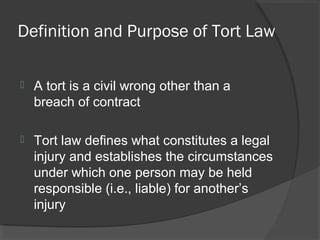
 A tort is a civil wrong other than a
breach of contract
 Tort law defines what constitutes a legal
injury and establishes the circumstances
under which one person may be held
responsible (i.e., liable) for another’s
injury
Categories of Torts
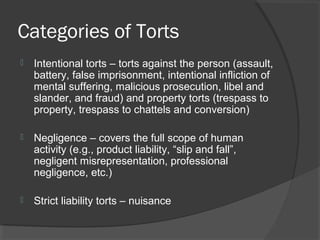
 Intentional torts – torts against the person (assault,
battery, false imprisonment, intentional infliction of
mental suffering, malicious prosecution, libel and
slander, and fraud) and property torts (trespass to
property, trespass to chattels and conversion)
 Negligence – covers the full scope of human
activity (e.g., product liability, “slip and fall”,
negligent misrepresentation, professional
negligence, etc.)
 Strict liability torts – nuisance
The Evolution of Tort Law
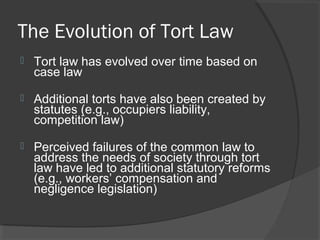
 Tort law has evolved over time based on
case law
 Additional torts have also been created by
statutes (e.g., occupiers liability,
competition law)
 Perceived failures of the common law to
address the needs of society through tort
law have led to additional statutory reforms
(e.g., workers’ compensation and
negligence legislation)
Elements of a Negligence Claim
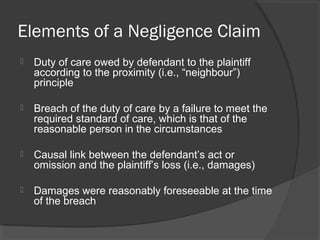
 Duty of care owed by defendant to the plaintiff
according to the proximity (i.e., “neighbour”)
principle
 Breach of the duty of care by a failure to meet the
required standard of care, which is that of the
reasonable person in the circumstances
 Causal link between the defendant’s act or
omission and the plaintiff’s loss (i.e., damages)
 Damages were reasonably foreseeable at the time
of the breach
The Duty and Standard of Care Owed
by Professionals
Professionals have a duty to exercise the
skill, care and diligence that may
reasonably be expected of a person (i.e.,
a professional person in a particular
discipline) of ordinary competence,
measured by the professional standards
of the time
Negligence and Economic Harm
 Negligence can involve compensable
harm that is purely economic in nature
 This is often, though not exclusively, the
situation in cases involving negligent
misrepresentation
Defences to Negligence Claims
 No duty of care owed – the duty of care can only
arise in circumstances involving reasonably
foreseeable harm and proximity sufficient to
establish a duty of care and where there are no
policy reasons that would negate the
establishment of the duty of care
 No breach of the standard of care
 No damages were caused by a breach of the
standard of care
 Damages were not reasonably foreseeable
 Limitation period has expired
Elements of Negligent
Misrepresentation
 Duty of care exists based on a special relationship (e.g.,
professional person and lay person who may reasonably rely
on the professional person’s professional expertise)
 Professional person makes representation that is untrue,
inaccurate or misleading
 The representation is made negligently
 Person receiving the representation relies on it in a
reasonable manner
 The reliance is detrimental and damages result
Defences to Claims for Negligent
Misrepresentation
 No duty of care is owed – (e.g., plaintiff is not a
member of the class of individuals that professional
knew would rely on the misrepresentation)
 Plaintiff’s reliance is not reasonable (e.g., the
representation was part of a discussion and not a
formal opinion or the professional limited liability
through a disclaimer clause)
 Professional’s negligent misrepresentation did not
cause damages
 Limitation period has expired
Objective of Damages for
Commission of Tort
To restore the plaintiff to the position he
or she would have been in if the tort had
not been committed
Damage Awards for
Commission of Tort
 General damages – compensation for non-monetary loss or
harm suffered as a result of the commission of the tort that
was foreseeable when the tort was committed (e.g., pain and
suffering, mental distress or damage to reputation)
 Special damages – compensation for the quantifiable
monetary losses suffered by the plaintiff that include direct
losses (such as amounts the plaintiff had to spend to try to
mitigate problems), consequential or economic losses (such
as lost profits in a business), and punitive damages, where
applicable
 Punitive damages – awarded to punish certain types of
behaviour (e.g., fraud or bad faith)
 Plaintiffs have a duty to mitigate their damages
Vicarious Liability
 In certain cases, one person can be
liable for the harm cause by another
 One example relevant to professional
liability is an employer’s liability for the
actions or omissions of its employees
THANK YOU!

EUT440 LAW 2 (Tort)

  • 2.
    Definition and Purposeof Tort Law  A tort is a civil wrong other than a breach of contract  Tort law defines what constitutes a legal injury and establishes the circumstances under which one person may be held responsible (i.e., liable) for another’s injury
  • 3.
    Categories of Torts Intentional torts – torts against the person (assault, battery, false imprisonment, intentional infliction of mental suffering, malicious prosecution, libel and slander, and fraud) and property torts (trespass to property, trespass to chattels and conversion)  Negligence – covers the full scope of human activity (e.g., product liability, “slip and fall”, negligent misrepresentation, professional negligence, etc.)  Strict liability torts – nuisance
  • 4.
    The Evolution ofTort Law  Tort law has evolved over time based on case law  Additional torts have also been created by statutes (e.g., occupiers liability, competition law)  Perceived failures of the common law to address the needs of society through tort law have led to additional statutory reforms (e.g., workers’ compensation and negligence legislation)
  • 5.
    Elements of aNegligence Claim  Duty of care owed by defendant to the plaintiff according to the proximity (i.e., “neighbour”) principle  Breach of the duty of care by a failure to meet the required standard of care, which is that of the reasonable person in the circumstances  Causal link between the defendant’s act or omission and the plaintiff’s loss (i.e., damages)  Damages were reasonably foreseeable at the time of the breach
  • 6.
    The Duty andStandard of Care Owed by Professionals Professionals have a duty to exercise the skill, care and diligence that may reasonably be expected of a person (i.e., a professional person in a particular discipline) of ordinary competence, measured by the professional standards of the time
  • 7.
    Negligence and EconomicHarm  Negligence can involve compensable harm that is purely economic in nature  This is often, though not exclusively, the situation in cases involving negligent misrepresentation
  • 8.
    Defences to NegligenceClaims  No duty of care owed – the duty of care can only arise in circumstances involving reasonably foreseeable harm and proximity sufficient to establish a duty of care and where there are no policy reasons that would negate the establishment of the duty of care  No breach of the standard of care  No damages were caused by a breach of the standard of care  Damages were not reasonably foreseeable  Limitation period has expired
  • 9.
    Elements of Negligent Misrepresentation Duty of care exists based on a special relationship (e.g., professional person and lay person who may reasonably rely on the professional person’s professional expertise)  Professional person makes representation that is untrue, inaccurate or misleading  The representation is made negligently  Person receiving the representation relies on it in a reasonable manner  The reliance is detrimental and damages result
  • 10.
    Defences to Claimsfor Negligent Misrepresentation  No duty of care is owed – (e.g., plaintiff is not a member of the class of individuals that professional knew would rely on the misrepresentation)  Plaintiff’s reliance is not reasonable (e.g., the representation was part of a discussion and not a formal opinion or the professional limited liability through a disclaimer clause)  Professional’s negligent misrepresentation did not cause damages  Limitation period has expired
  • 11.
    Objective of Damagesfor Commission of Tort To restore the plaintiff to the position he or she would have been in if the tort had not been committed
  • 12.
    Damage Awards for Commissionof Tort  General damages – compensation for non-monetary loss or harm suffered as a result of the commission of the tort that was foreseeable when the tort was committed (e.g., pain and suffering, mental distress or damage to reputation)  Special damages – compensation for the quantifiable monetary losses suffered by the plaintiff that include direct losses (such as amounts the plaintiff had to spend to try to mitigate problems), consequential or economic losses (such as lost profits in a business), and punitive damages, where applicable  Punitive damages – awarded to punish certain types of behaviour (e.g., fraud or bad faith)  Plaintiffs have a duty to mitigate their damages
  • 13.
    Vicarious Liability  Incertain cases, one person can be liable for the harm cause by another  One example relevant to professional liability is an employer’s liability for the actions or omissions of its employees
  • 14.