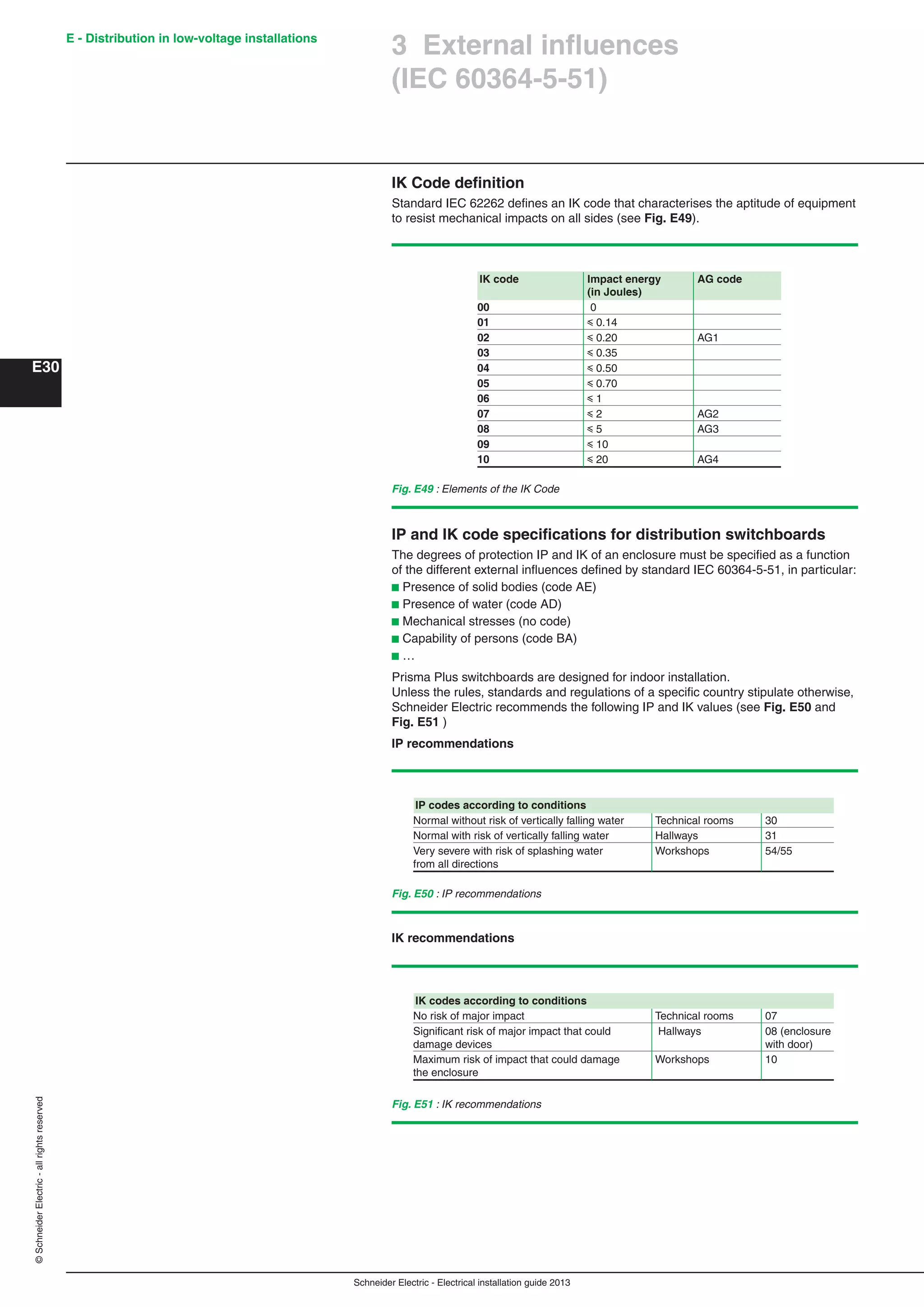
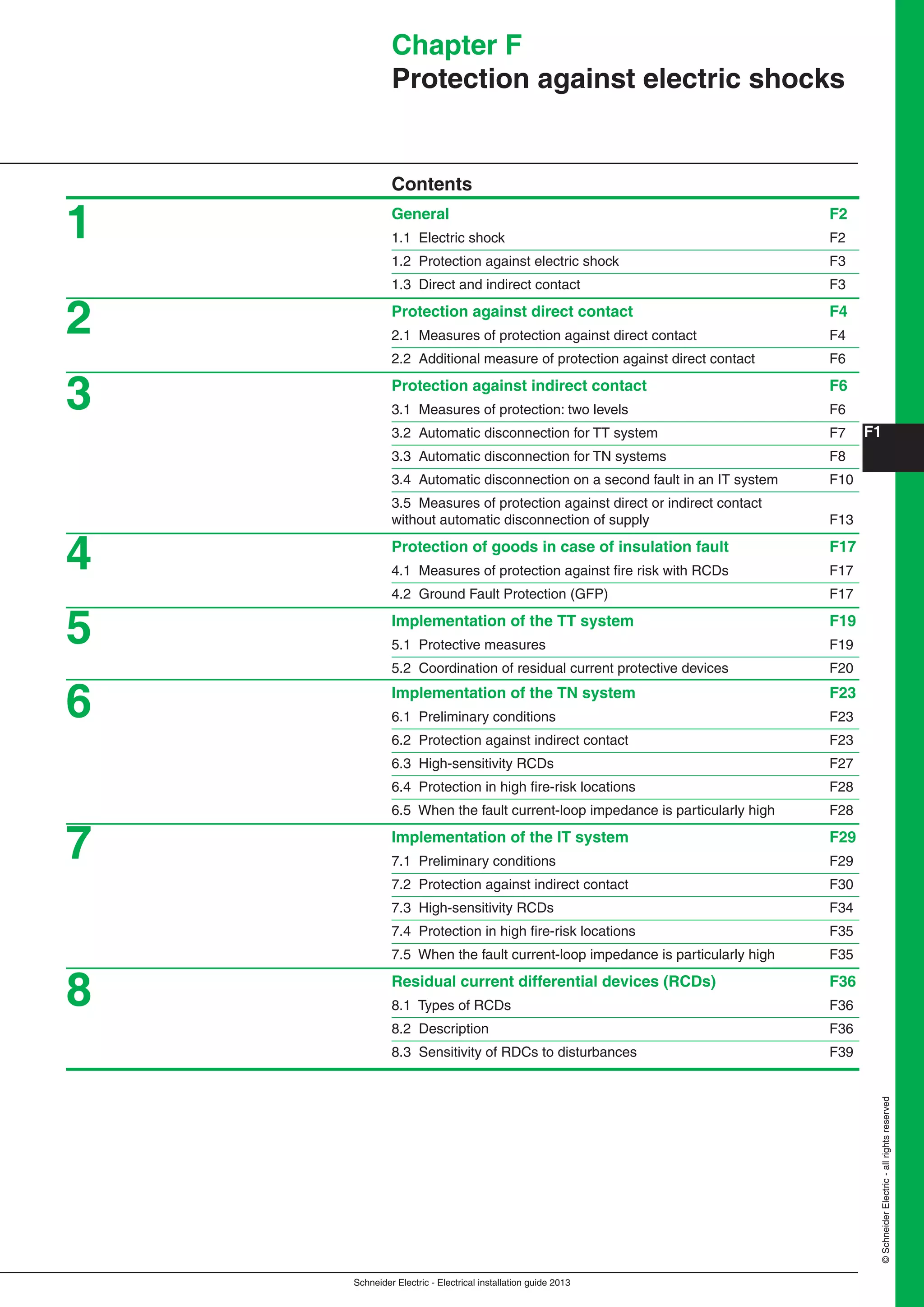
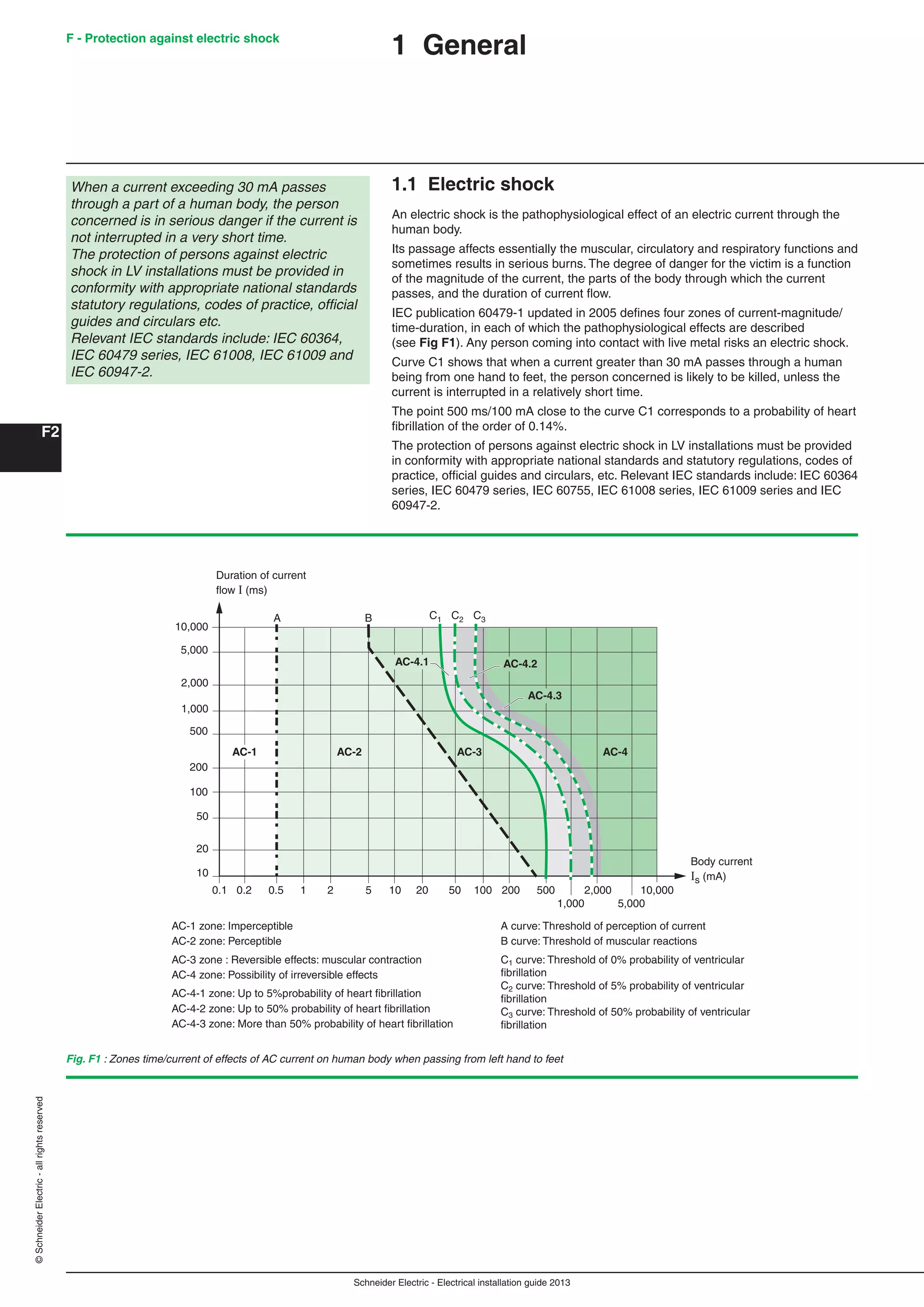
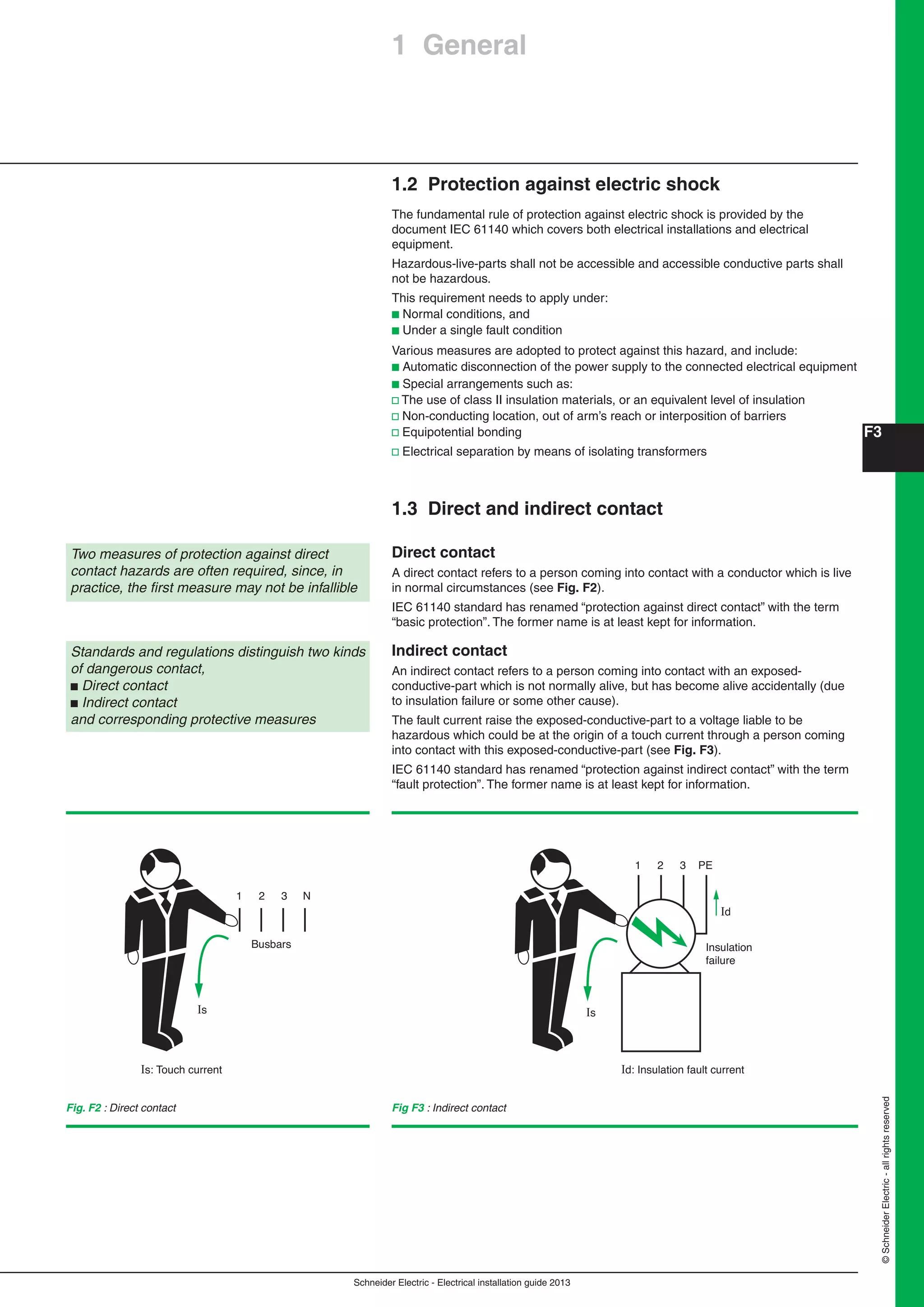
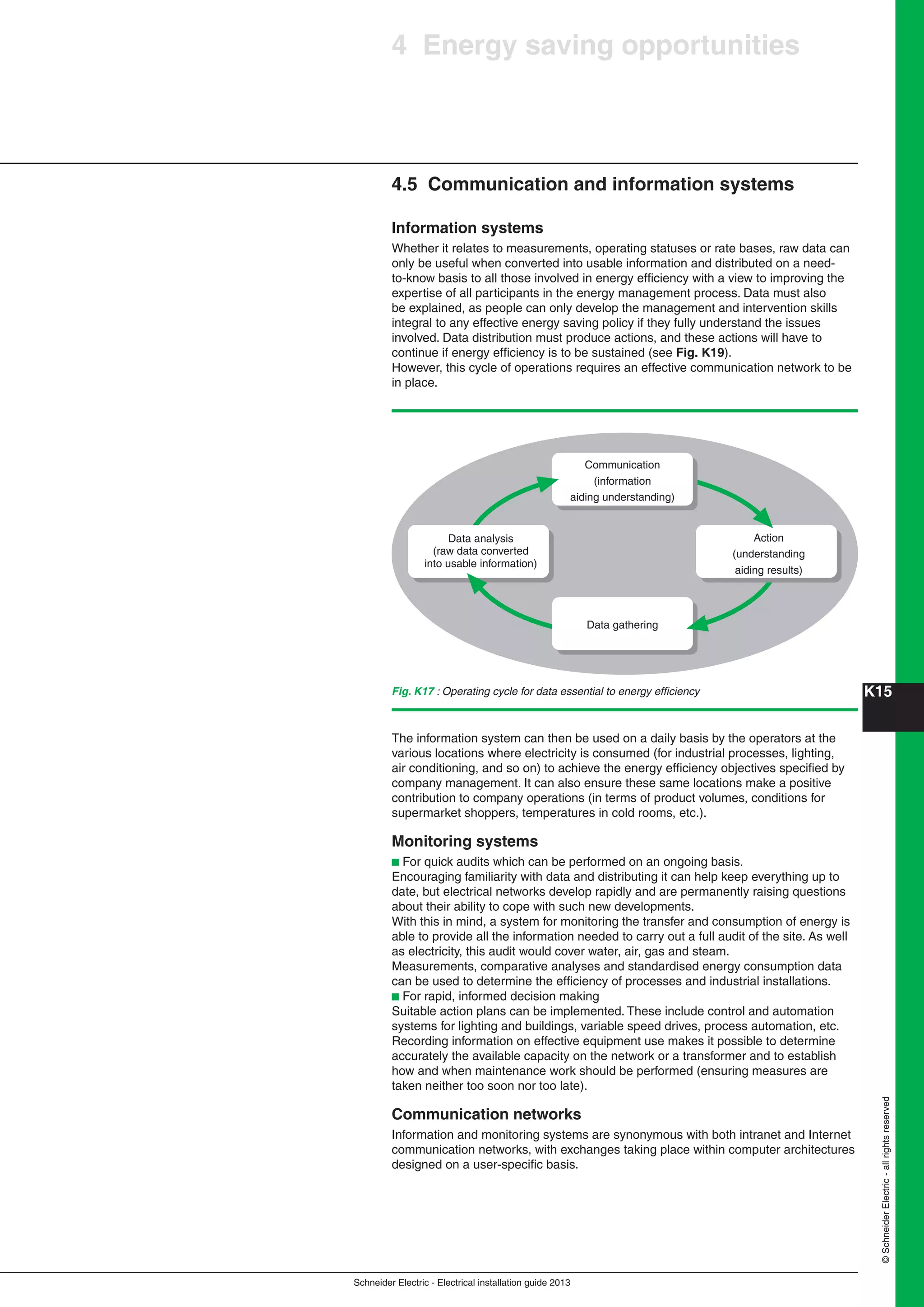
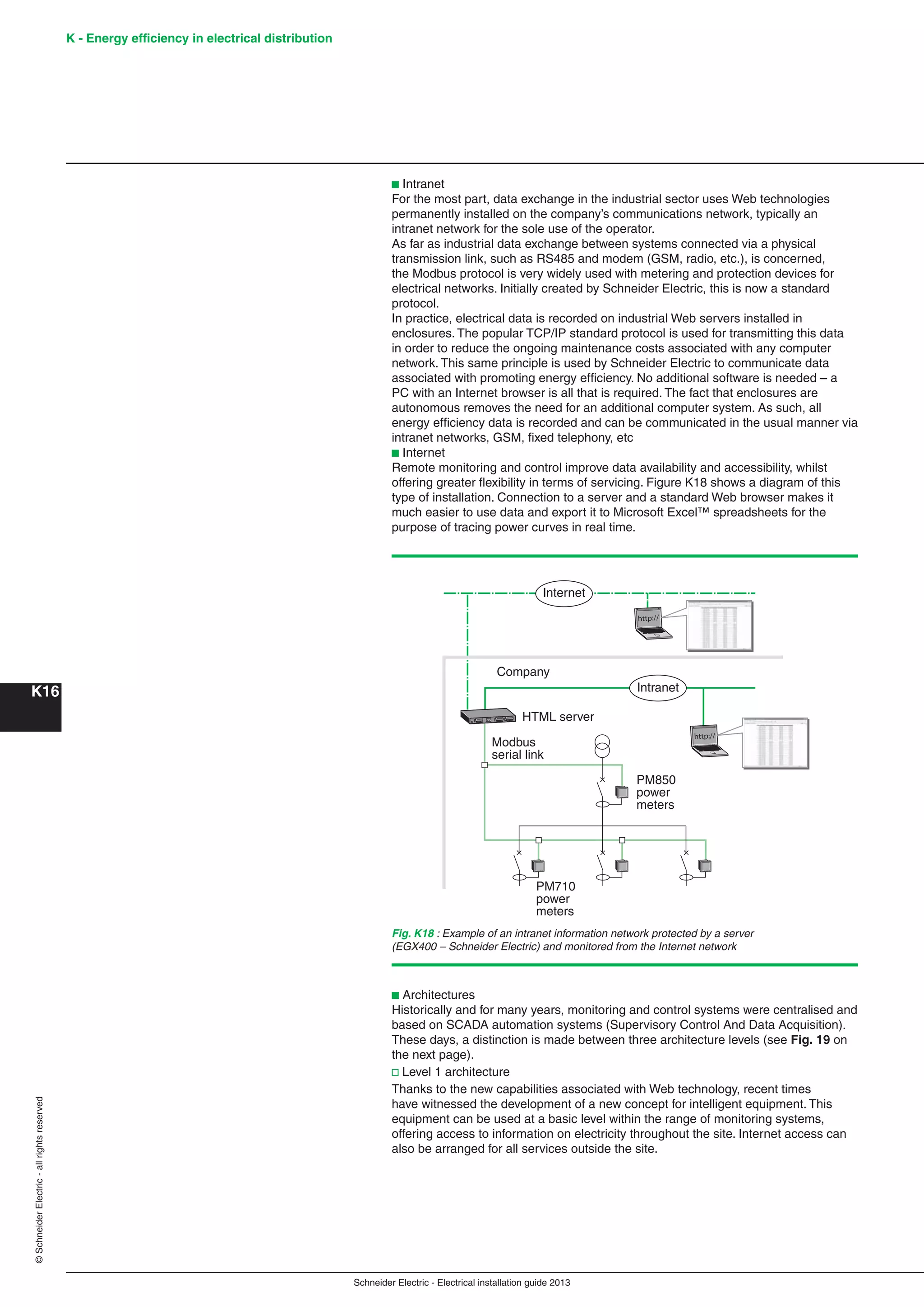
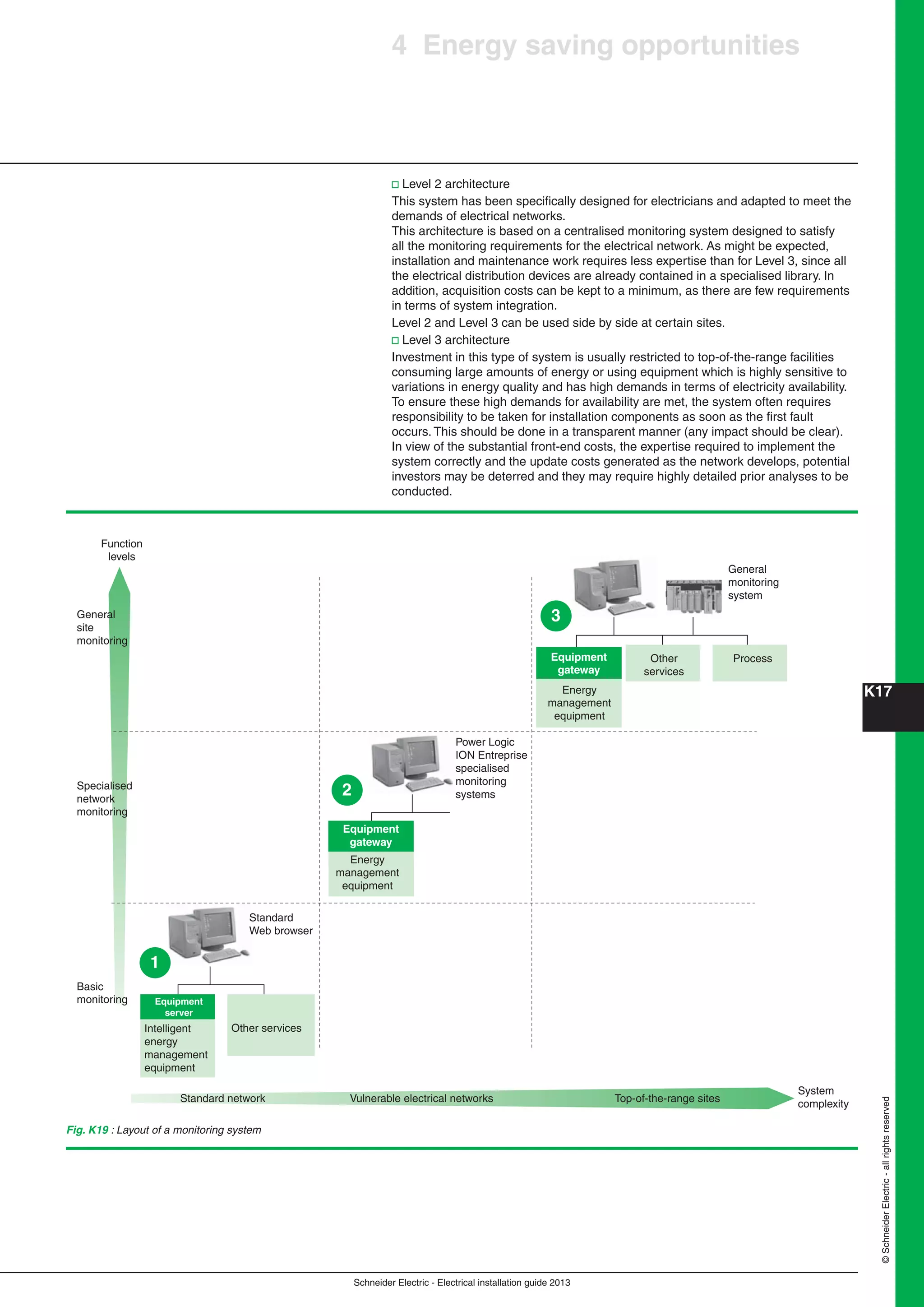
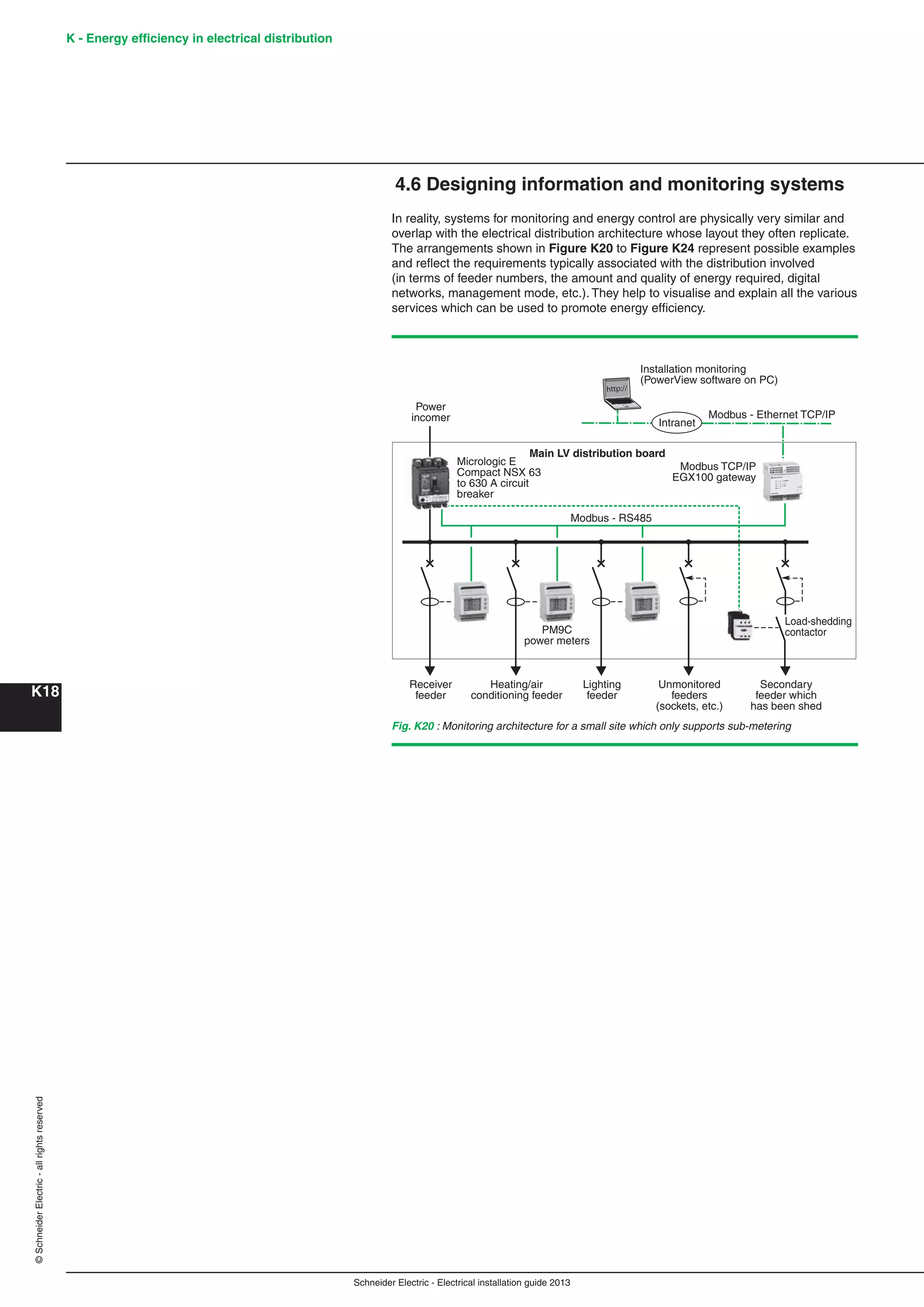
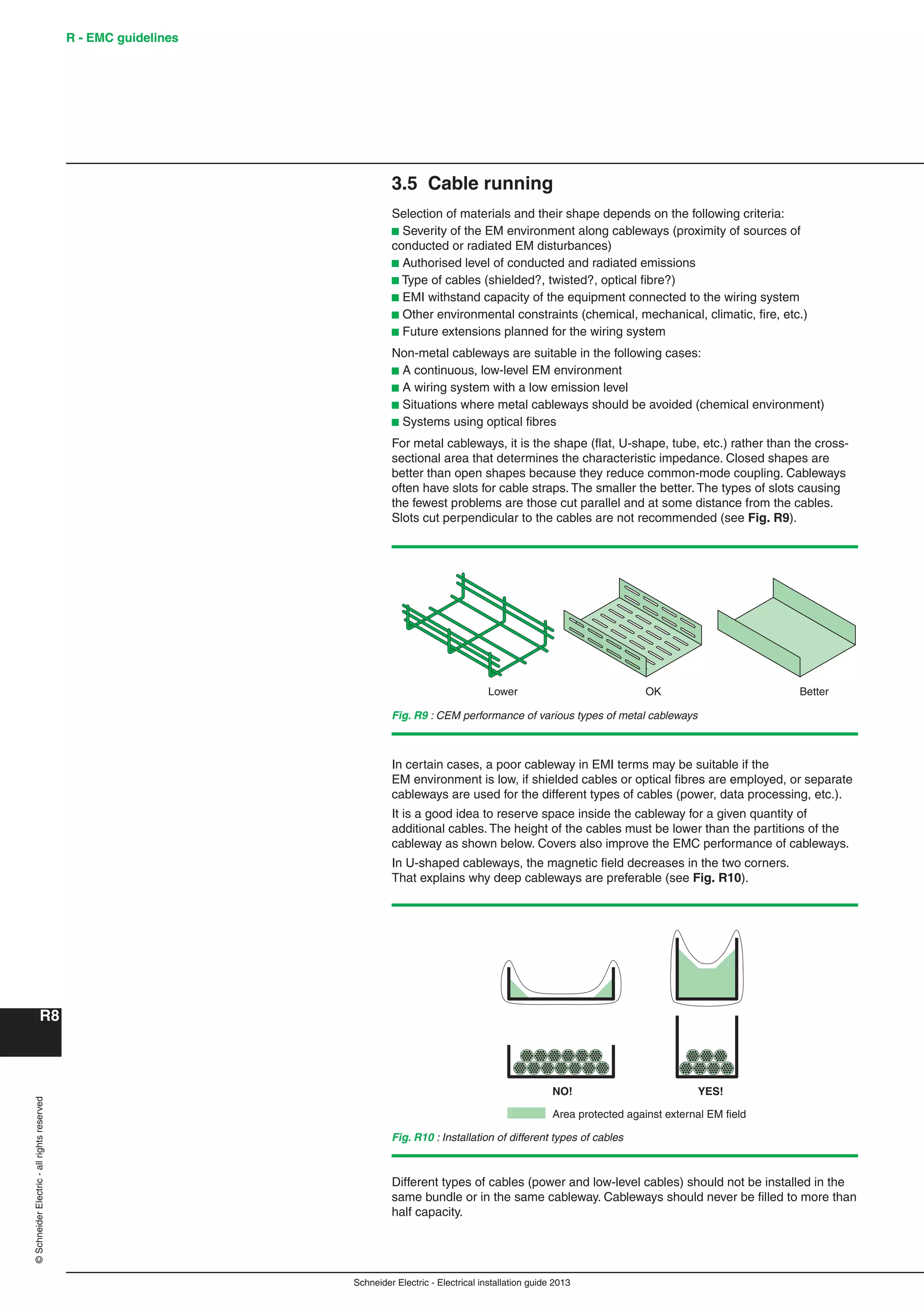
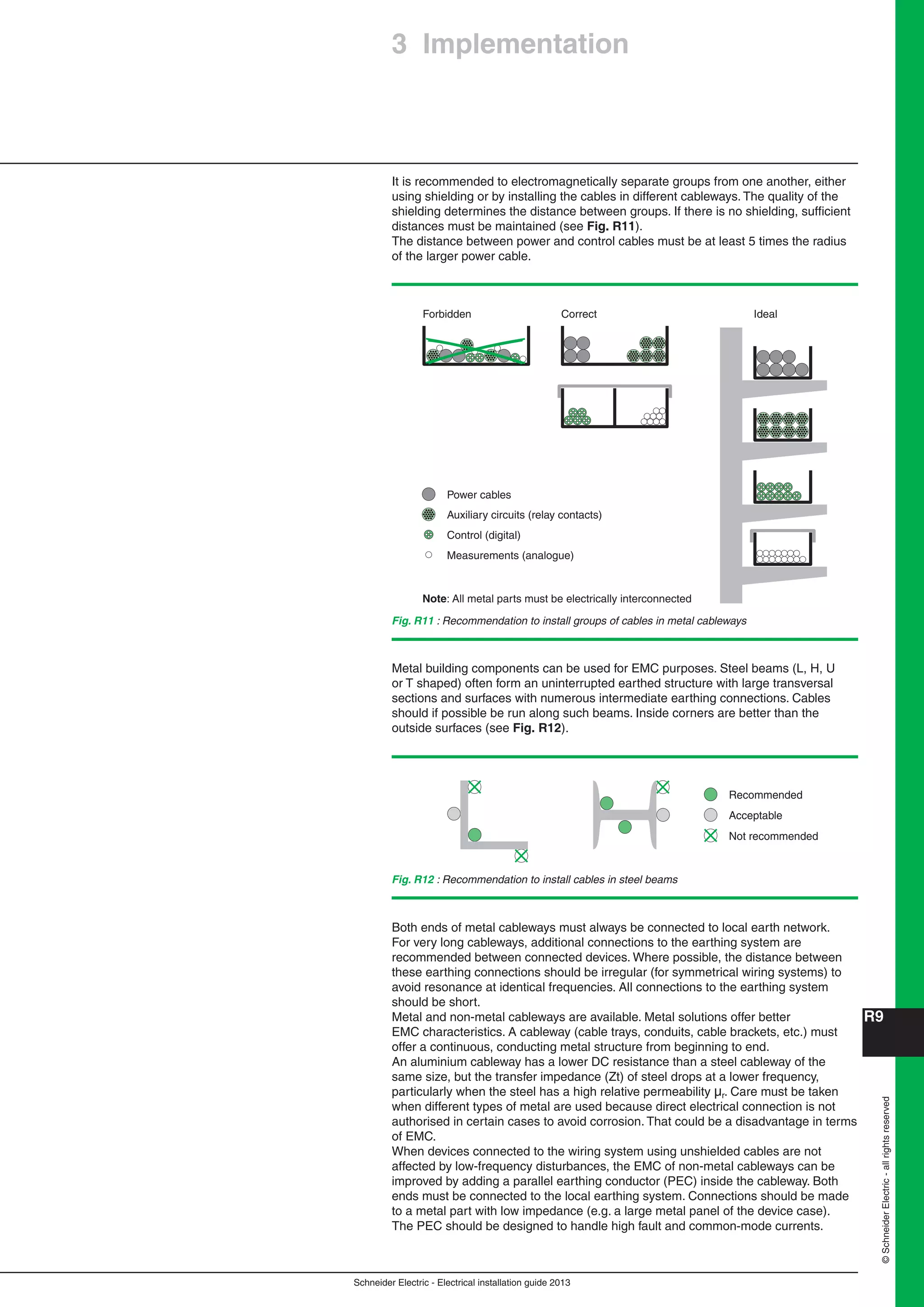
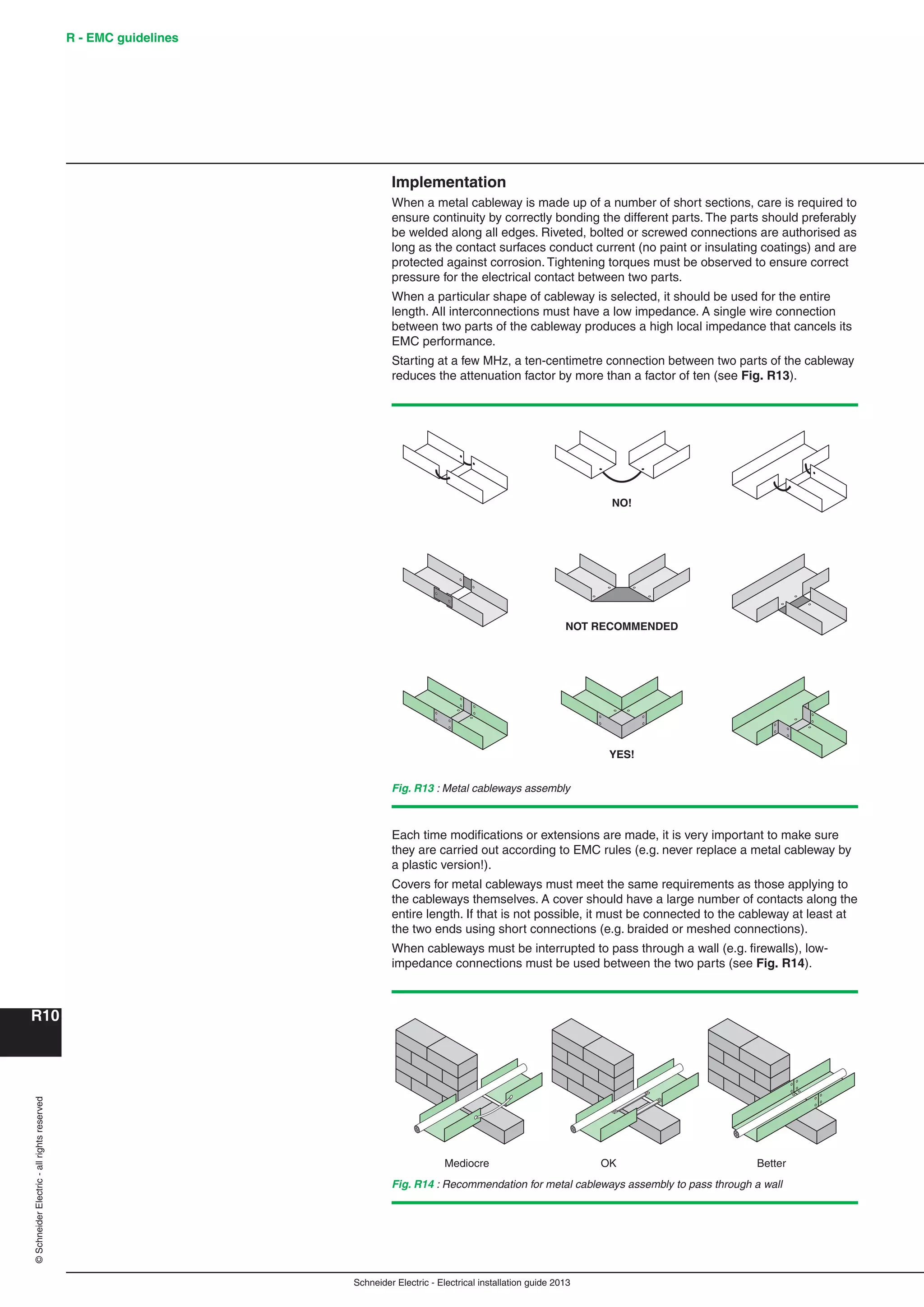
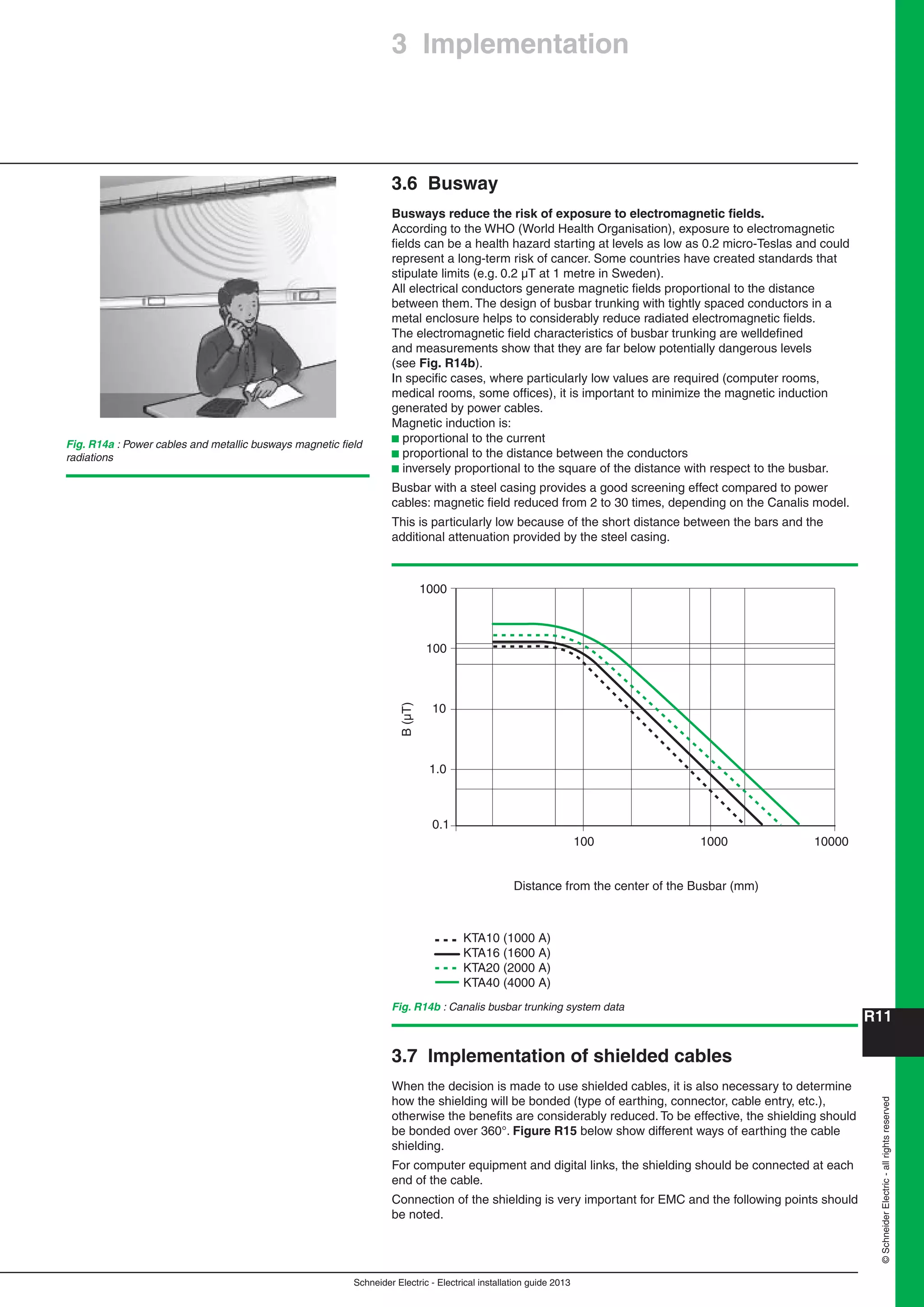
Electrical
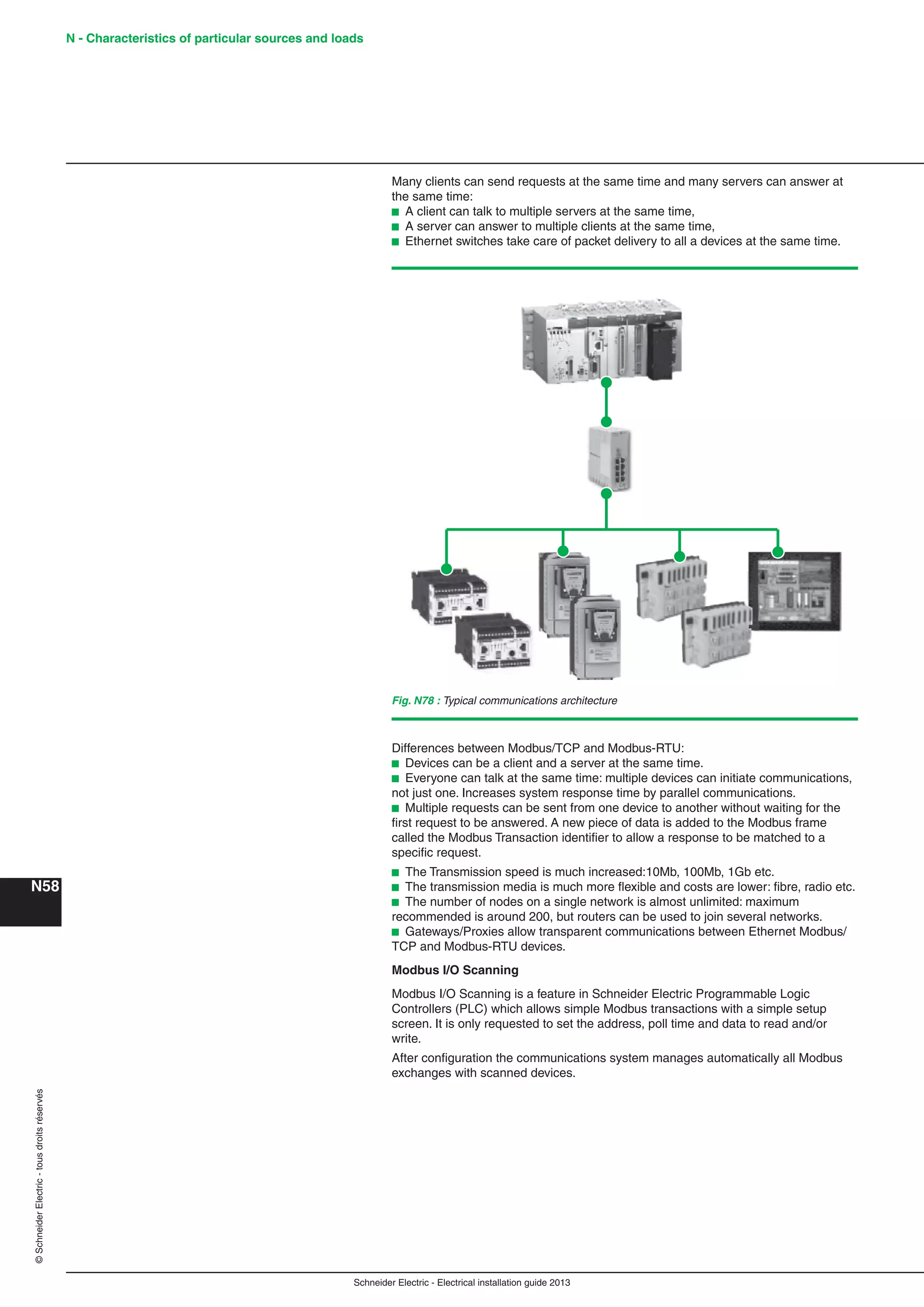
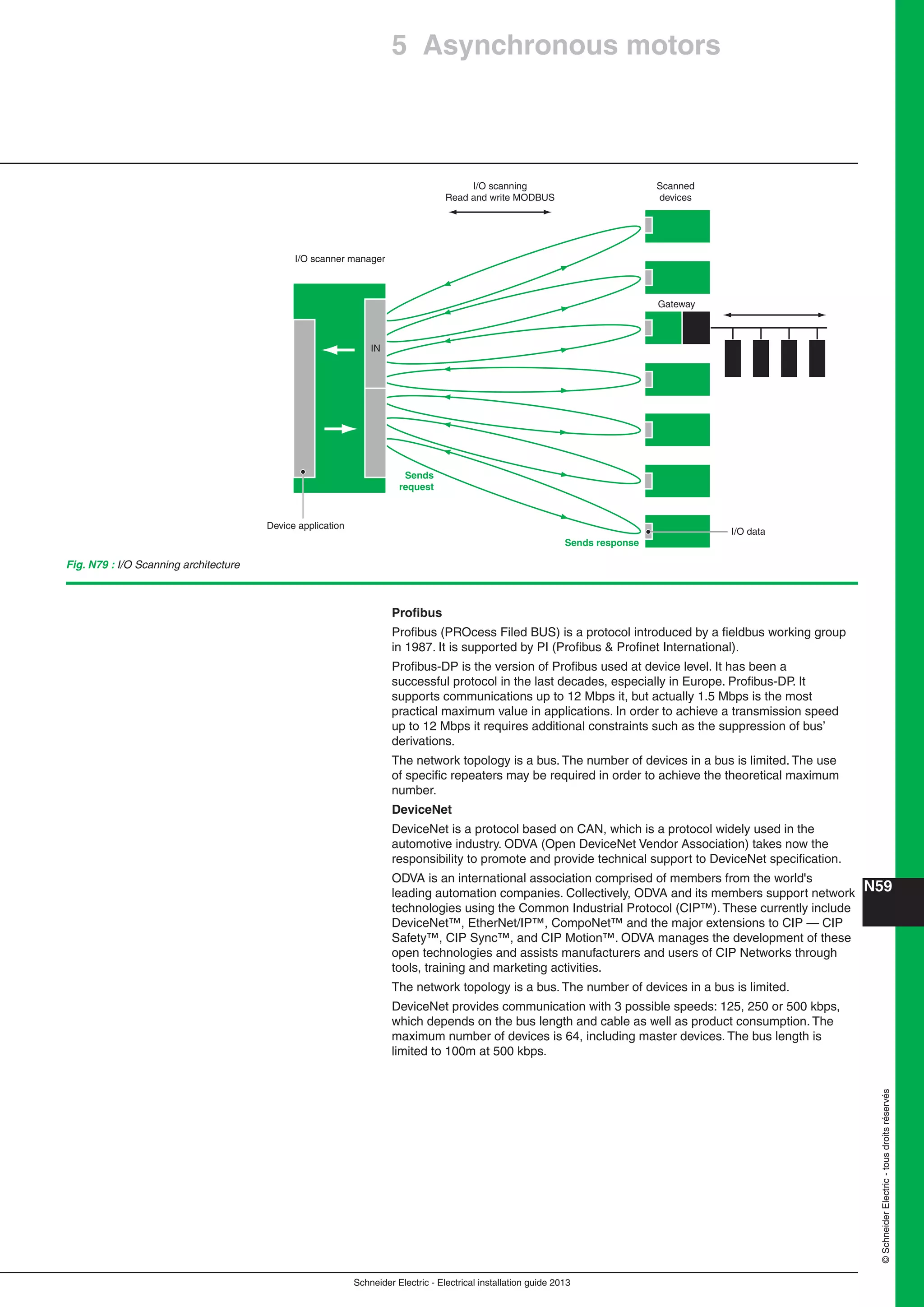
installation guide
2013
According to
IEC international
standards
06/2013
EIGED306001EN
ART.822690
Make the most of your energy
35, rue Joseph Monier
CS30323
F-92506 Rueil-Malmaison Cedex
RCS Nanterre 954 503 439
Capital social 896 313 776 €
www.schneider-electric.com
As standards, specifications and designs change from time to time, please ask for confirmation
of the information given in this pubication.
Schneider Electric Industries SAS
ElectricalinstallationguideAccordingtoIECinternationalstandards2013
This document has been
printed on ecological paper
This technical guide is the result of
a collective effort.
Illustrations and production:
AXESS - Valence -France
Printing:
Edition: 2013
Price: 40 €
ISBN: 978.2.9531643.3.6
N° dépôt légal: 1er semestre 2008
© Schneider Electric
All rights reserved in all countries
The Electrical Installation Guide is a single document covering the
techniques and standards related to low-voltage electrical installations.
It is intended for electrical professionals in companies, design offices,
inspection organisations, etc.
This Technical Guide is aimed at professional users and is only intended
to provide them guidelines for the definition of an industrial, tertiary or
domestic electrical installation. Information and guidelines contained in this
Guide are provided AS IS. Schneider Electric makes no warranty of any
kind, whether express or implied, such as but not limited to the warranties
of merchantability and fitness for a particular purpose, nor assumes any
legal liability or responsibility for the accuracy, completeness, or usefulness
of any information, apparatus, product, or process disclosed in this Guide,
nor represents that its use would not infringe privately owned rights.
The purpose of this guide is to facilitate the implementation of International
installation standards for designers & contractors, but in all cases the
original text of International or local standards in force shall prevail.
This new edition has been published to take into account changes in
techniques, standards and regulations, in particular electrical installation
standard IEC 60364 series.
We thank all the readers of the previous edition of this guide for their
comments that have helped improve the current edition.
We also thank the many people and organisations, too numerous to name
here, who have contributed in one way or another to the preparation of this
guide.
This guide has been written for electrical Engineers who have to design,
select electrical equipment, install these equipment and, inspect or
maintain low-voltage electrical installations in compliance with international
Standards of the International Electrotechnical Commission (IEC).
“Which technical solution will guarantee that all relevant safety rules are
met?” This question has been a permanent guideline for the elaboration of
this document.
An international Standard such as the IEC 60364 series “Low voltage
Electrical Installations” specifies extensively the rules to comply with to
ensure safety and correct operational functioning of all types of electrical
installations. As the Standard must be extensive, and has to be applicable
to all types of equipment and the technical solutions in use worldwide, the
text of the IEC rules is complex, and not presented in a ready-to-use order.
The Standard cannot therefore be considered as a working handbook, but
only as a reference document.
The aim of the present guide is to provide a clear, practical and step-
by-step explanation for the complete study of an electrical installation,
according to IEC 60364 series and other relevant IEC Standards. The first
chapter (A) presents the methodology to be used, and refers to all chapters
of the guide according to the different steps of the study.
We all hope that you, the reader, will find this handbook genuinely helpful.
Schneider Electric S.A.
Acknowlegements
This guide has been realized by a team of
experienced international experts, on the base
of IEC 60364 series of standard, and include the
latest developments in electrical standardization.
We shall mention particularly the following
experts and their area of expertise:
Chapter
Christian Collombet D
Bernard Jover R
Jacques Schonek D, G, L, M, N
Didier Fulchiron B
Didier Mignardot J, P
Eric Bettega E
Emmanuel Genevray E, P
Eric Breuillé F
Fleur Janet K
Franck Mégret G
Geoffroy De-Labrouhe K
Jean Marc Lupin L, M
Daniel Barstz N
Jérome Lecomte H
Matthieu Guillot F, H, P
Michel Sacotte B
Schneider Electric - Electrical installation guide 2013
Tools for more efficiency
in electrical installation design
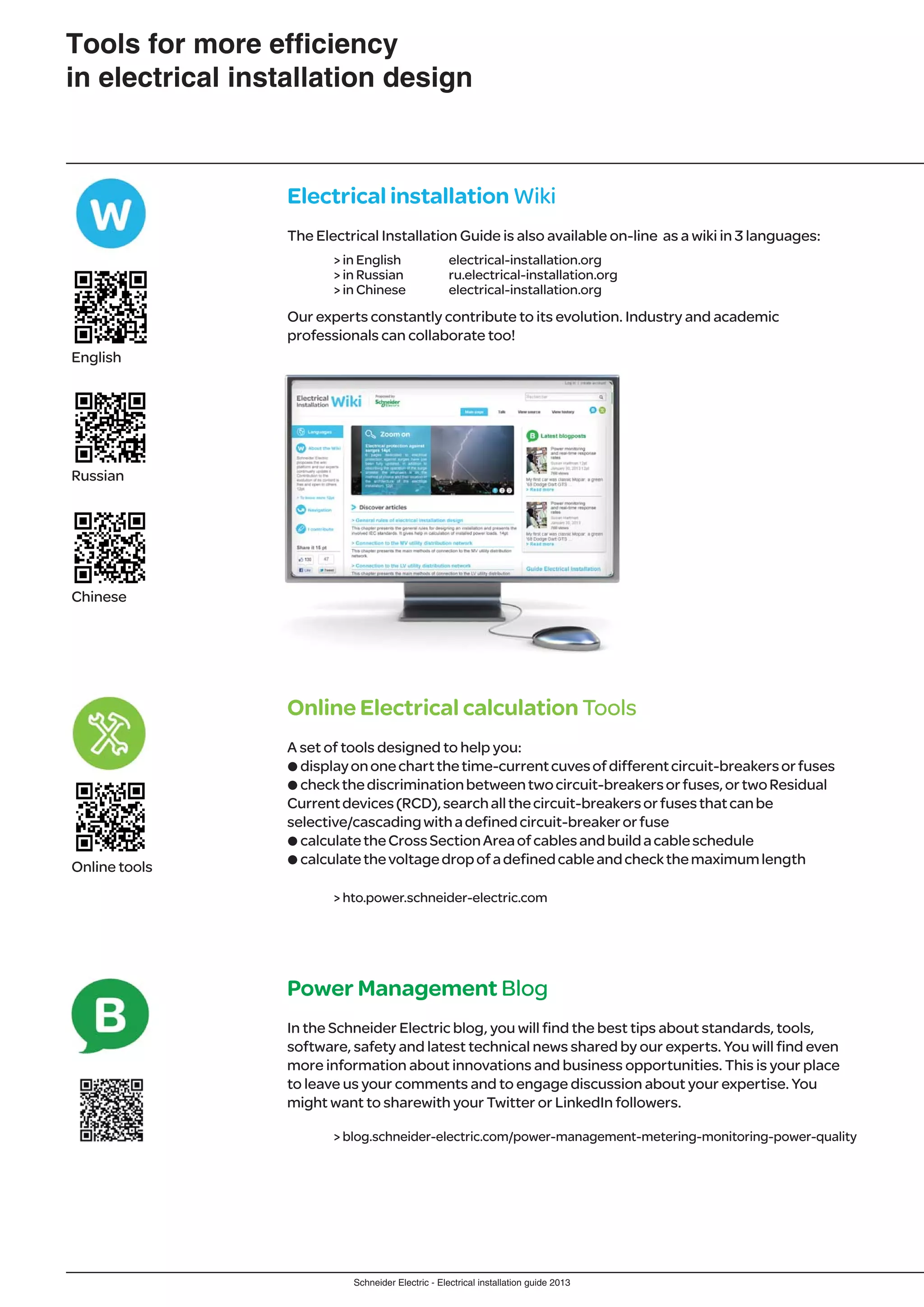
Electrical installation Wiki
The Electrical Installation Guide is also available on-line as a wiki in 3 languages:
> in English electrical-installation.org
> in Russian ru.electrical-installation.org
> in Chinese electrical-installation.org
Our experts constantly contribute to its evolution. Industry and academic
professionals can collaborate too!
Online Electrical calculation Tools
A set of tools designed to help you:
pdisplayononechartthetime-currentcuvesofdifferentcircuit-breakersorfuses
pcheckthediscriminationbetweentwocircuit-breakersorfuses,ortwoResidual
Currentdevices(RCD),searchallthecircuit-breakersorfusesthatcanbe
selective/cascadingwithadefinedcircuit-breakerorfuse
pcalculatetheCrossSectionAreaofcablesandbuildacableschedule
pcalculatethevoltagedropofadefinedcableandcheckthemaximumlength
> hto.power.schneider-electric.com
Power Management Blog
In the Schneider Electric blog, you will find the best tips about standards, tools,
software, safety and latest technical news shared by our experts. You will find even
more information about innovations and business opportunities. This is your place
to leave us your comments and to engage discussion about your expertise. You
might want to sharewith your Twitter or LinkedIn followers.
> blog.schneider-electric.com/power-management-metering-monitoring-power-quality
English
Russian
Chinese
Online tools
Schneider Electric - Electrical installation guide 2013
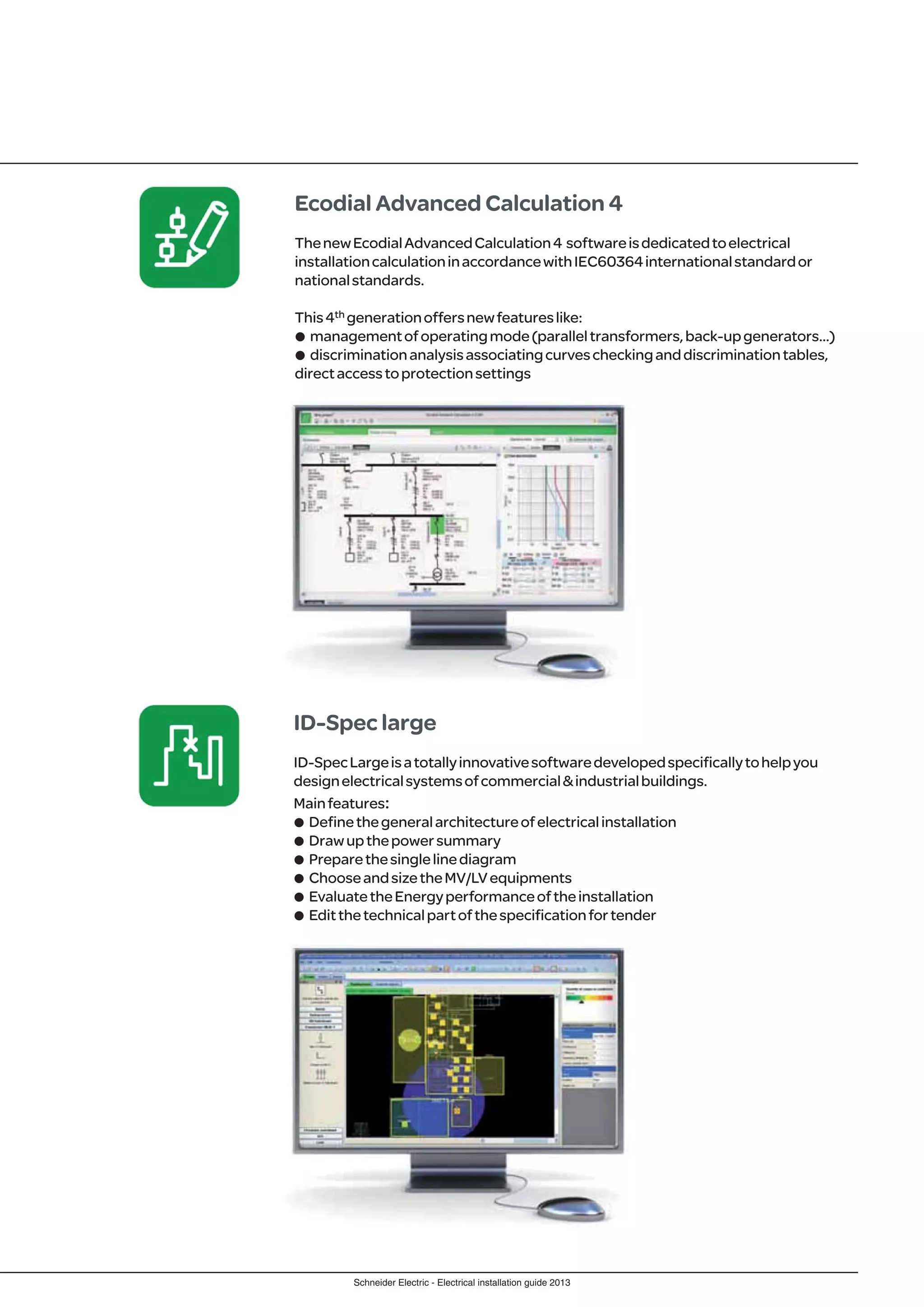
Ecodial Advanced Calculation 4
ThenewEcodialAdvancedCalculation4 softwareisdedicatedtoelectrical
installationcalculationinaccordancewithIEC60364internationalstandardor
nationalstandards.
This4th generationoffersnewfeatureslike:
p managementofoperatingmode(paralleltransformers,back-upgenerators…)
p discriminationanalysisassociatingcurvescheckinganddiscriminationtables,
directaccesstoprotectionsettings
ID-Spec large
ID-SpecLargeisatotallyinnovativesoftwaredevelopedspecificallytohelpyou
designelectricalsystemsofcommercial&industrialbuildings.
Mainfeatures:
p Definethegeneralarchitectureofelectricalinstallation
p Drawupthepowersummary
p Preparethesinglelinediagram
p ChooseandsizetheMV/LVequipments
p EvaluatetheEnergyperformanceoftheinstallation
p Editthetechnicalpartofthespecificationfortender
Foreword
Etienne TISON, International Electrotechnical Commission (IEC) TC64
Chairman.
The task of the IEC Technical Committee 64 is to develop and keep up-to-
date requirements
- for the protection of persons against electrical shock, and
- for the design, verification and implementation of low voltage electrical
installations.
Series of standard such as IEC 60364 developed by IEC TC64 is
considered by the international community as the basis of the majority of
national low-voltage wiring rules.
IEC 60364 series is mainly focussed on safety due the use of electricity by
people who may not be aware of risk resulting from the use of electricity.
But modern electrical installations are increasingly complex, due to external
input such as
- electromagnetic disturbances
- energy efficiency
- ...
Consequently, designers, installers and consumers need guidance on the
selection and installation of electrical equipment.
Schneider Electric has developed this Electrical Installation Guide
dedicated to low voltage electrical installations. It is based on IEC TC64
standards such as IEC 60364 series and provides additional information
in order to help designers, contractors and controllers for implementing
correct low-voltage electrical installations.
As TC64 Chairman, it is my great pleasure and honour to introduce this
guide. I am sure it will be used fruitfully by all persons involved in the
implementation of all low-voltage electrical installations.
Etienne TISON
Etienne TISON has been working with Schneider
Electric since 1978. He has been always involved
is various activities in low voltage field.
In 2008, Etienne TISON has been appointed
Chairman of IEC TC64 as well as Chairman of
CENELEC TC64.
Electrical installation guide 2013
General rules of electrical
installation design
A
B
C
D
E
F
G
H
J
K
L
M
N
Connection to the MV utility
distribution network
Connection to the LV utility
distribution network
MV & LV architecture selection
guide
LV Distribution
Protection against electric
shocks
Sizing and protection of
conductors
LV switchgear: functions &
selection
Overvoltage protection
Energy Efficiency in electrical
distribution
Power factor correction
Harmonic management
Characteristics of particular
sources and loads
PPhotovoltaic Installations
QResidential and other special
locations
REMC guidelines
Schneider Electric - Electrical installation guide 2013
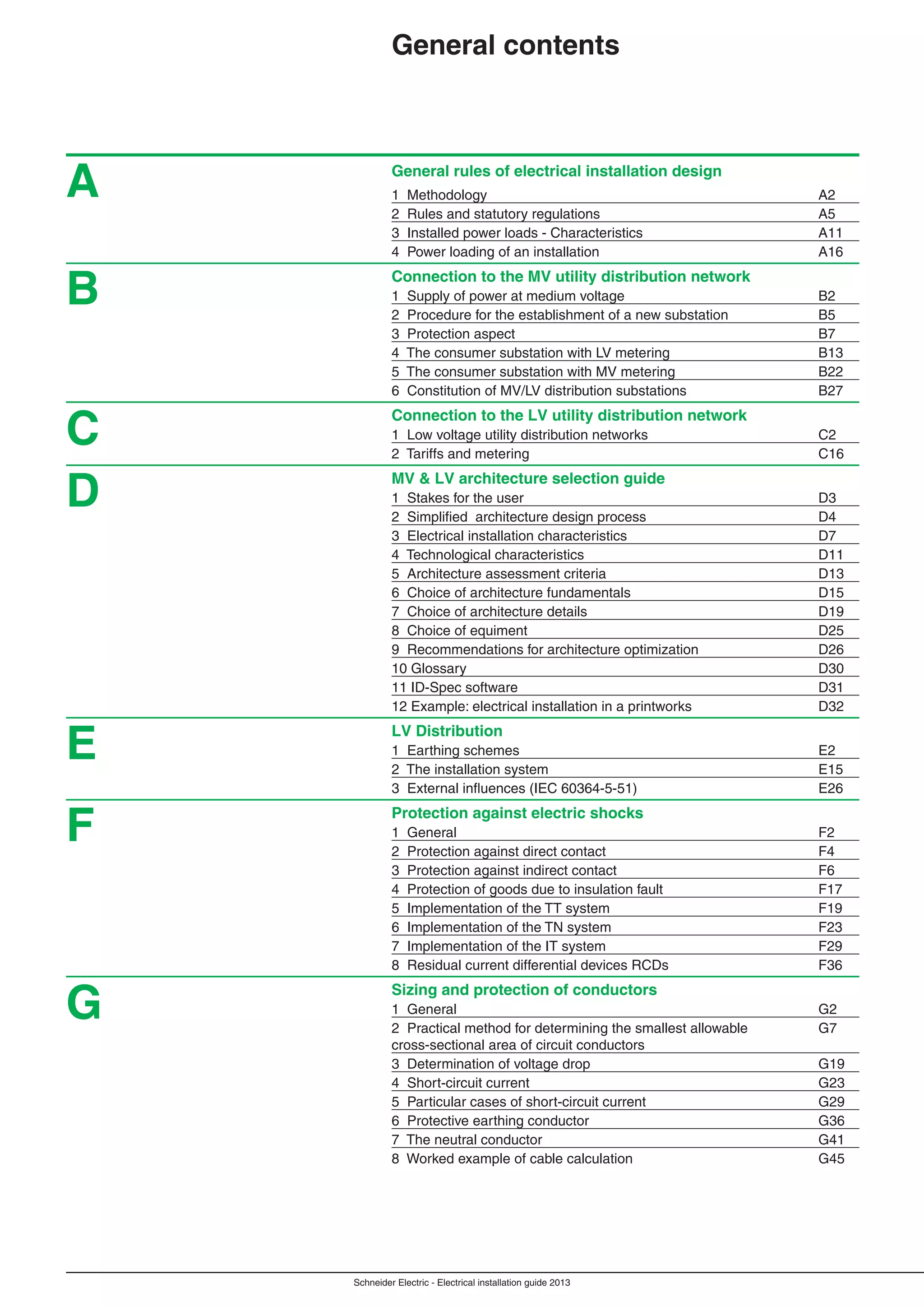
General rules of electrical installation design
1 Methodology A2
2 Rules and statutory regulations A5
3 Installed power loads - Characteristics A11
4 Power loading of an installation A16
Connection to the MV utility distribution network
1 Supply of power at medium voltage B2
2 Procedure for the establishment of a new substation B5
3 Protection aspect B7
4 The consumer substation with LV metering B13
5 The consumer substation with MV metering B22
6 Constitution of MV/LV distribution substations B27
Connection to the LV utility distribution network
1 Low voltage utility distribution networks C2
2 Tariffs and metering C16
MV & LV architecture selection guide
1 Stakes for the user D3
2 Simplified architecture design process D4
3 Electrical installation characteristics D7
4 Technological characteristics D11
5 Architecture assessment criteria D13
6 Choice of architecture fundamentals D15
7 Choice of architecture details D19
8 Choice of equiment D25
9 Recommendations for architecture optimization D26
10 Glossary D30
11 ID-Spec software D31
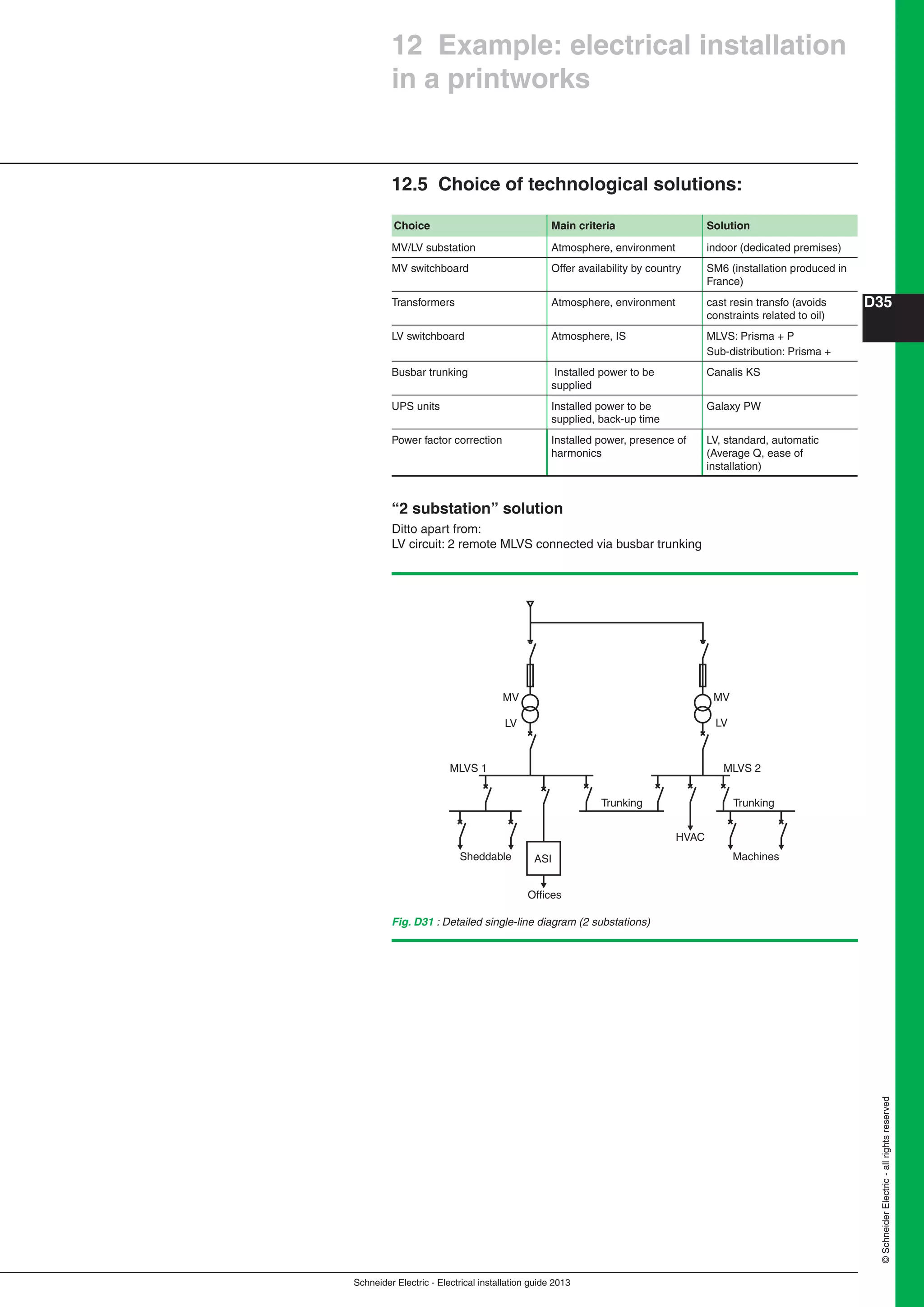
12 Example: electrical installation in a printworks D32
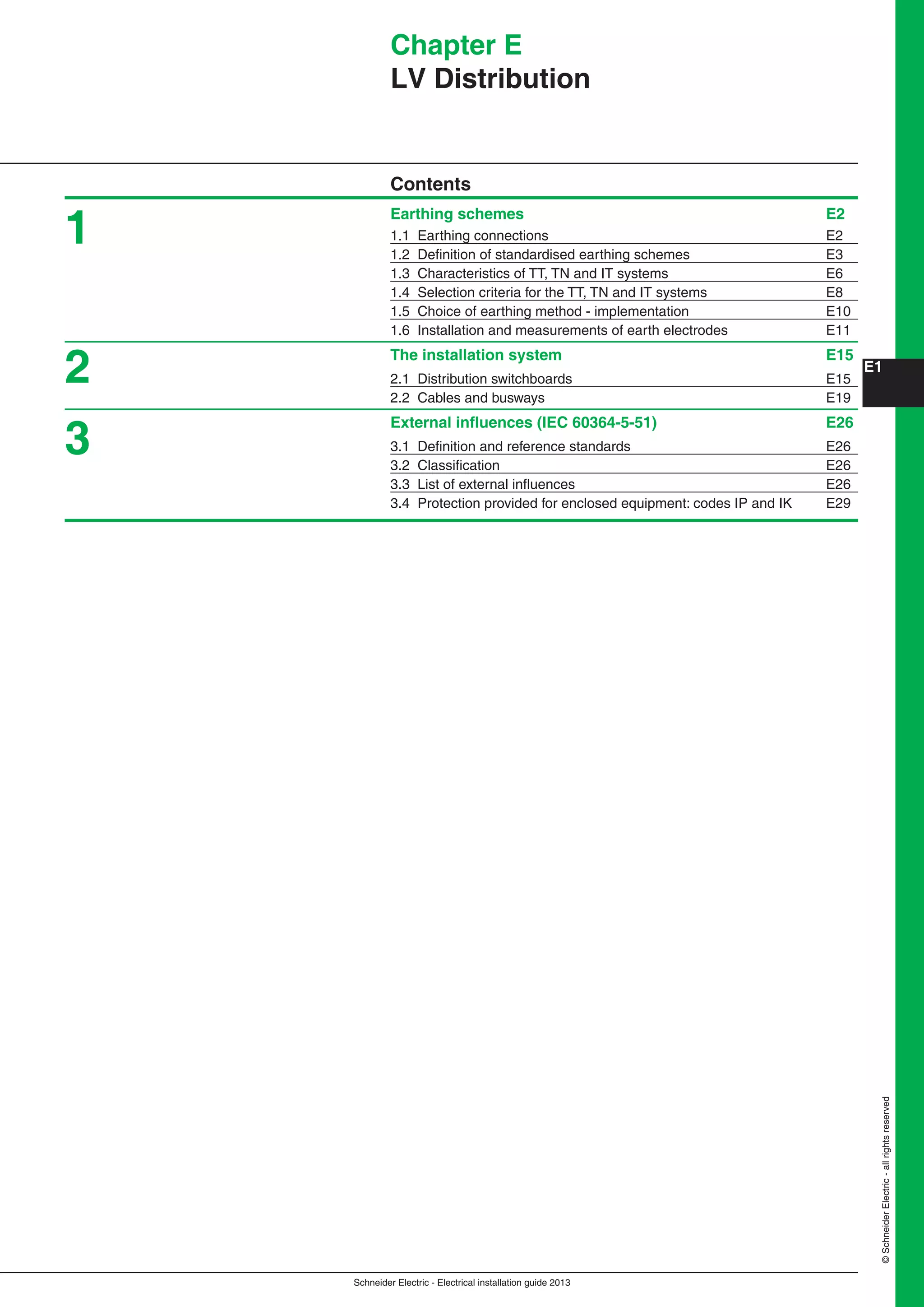
LV Distribution
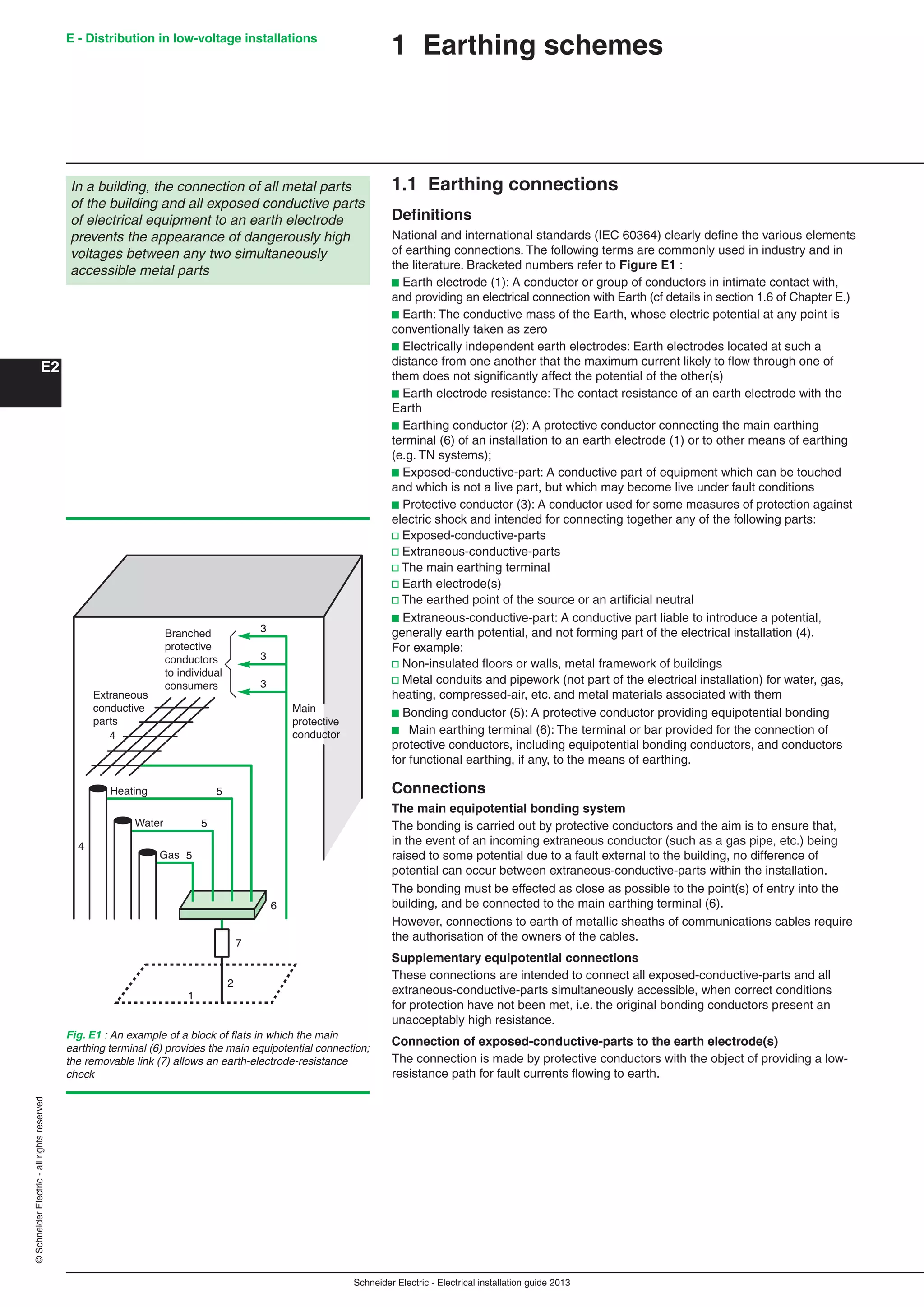
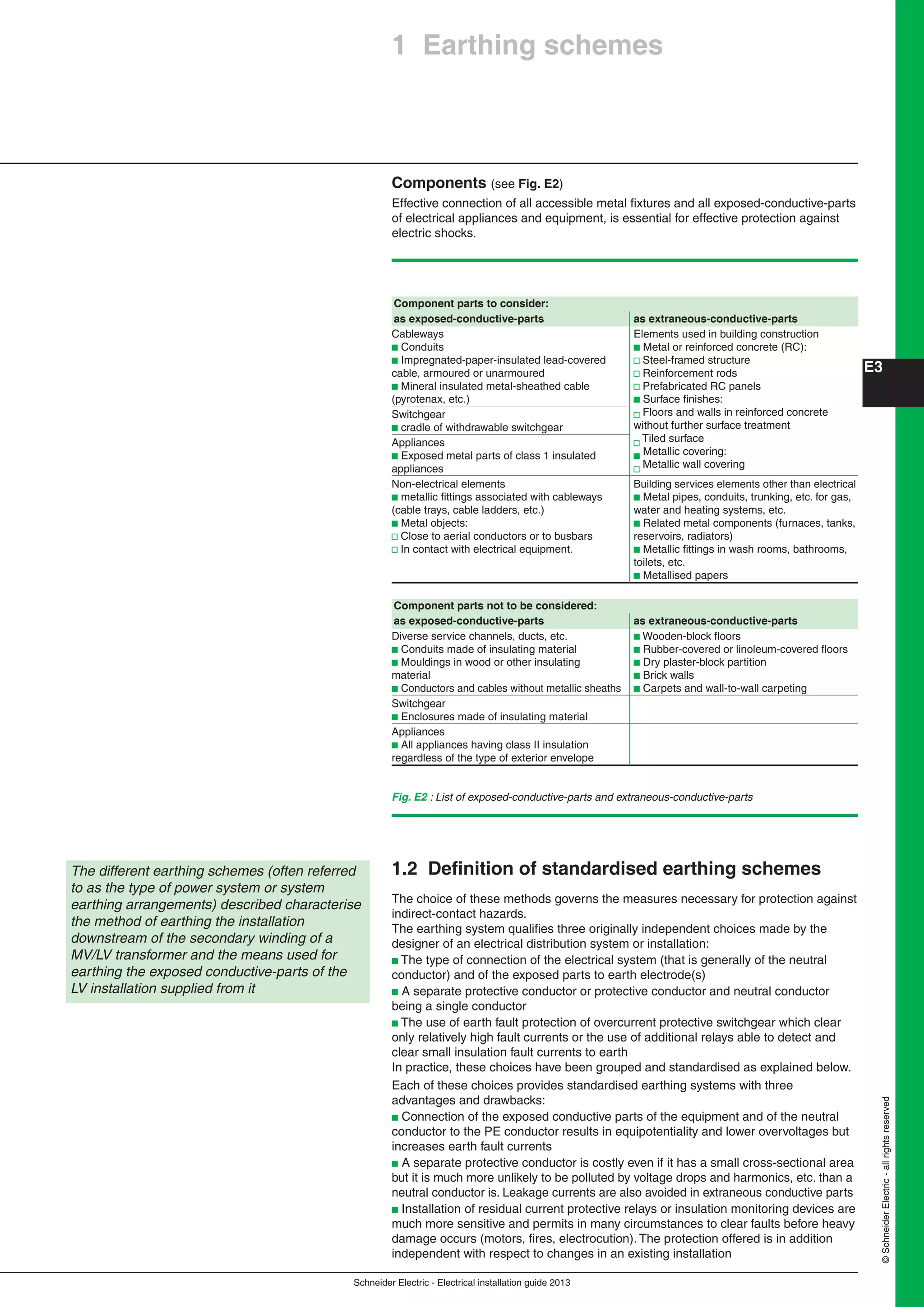
1 Earthing schemes E2
2 The installation system E15
3 External influences (IEC 60364-5-51) E26
Protection against electric shocks
1 General F2
2 Protection against direct contact F4
3 Protection against indirect contact F6
4 Protection of goods due to insulation fault F17
5 Implementation of the TT system F19
6 Implementation of the TN system F23
7 Implementation of the IT system F29
8 Residual current differential devices RCDs F36
Sizing and protection of conductors
1 General G2
2 Practical method for determining the smallest allowable G7
cross-sectional area of circuit conductors
3 Determination of voltage drop G19
4 Short-circuit current G23
5 Particular cases of short-circuit current G29
6 Protective earthing conductor G36
7 The neutral conductor G41
8 Worked example of cable calculation G45
A
B
C
D
E
F
General contents
G
Schneider Electric - Electrical installation guide 2013
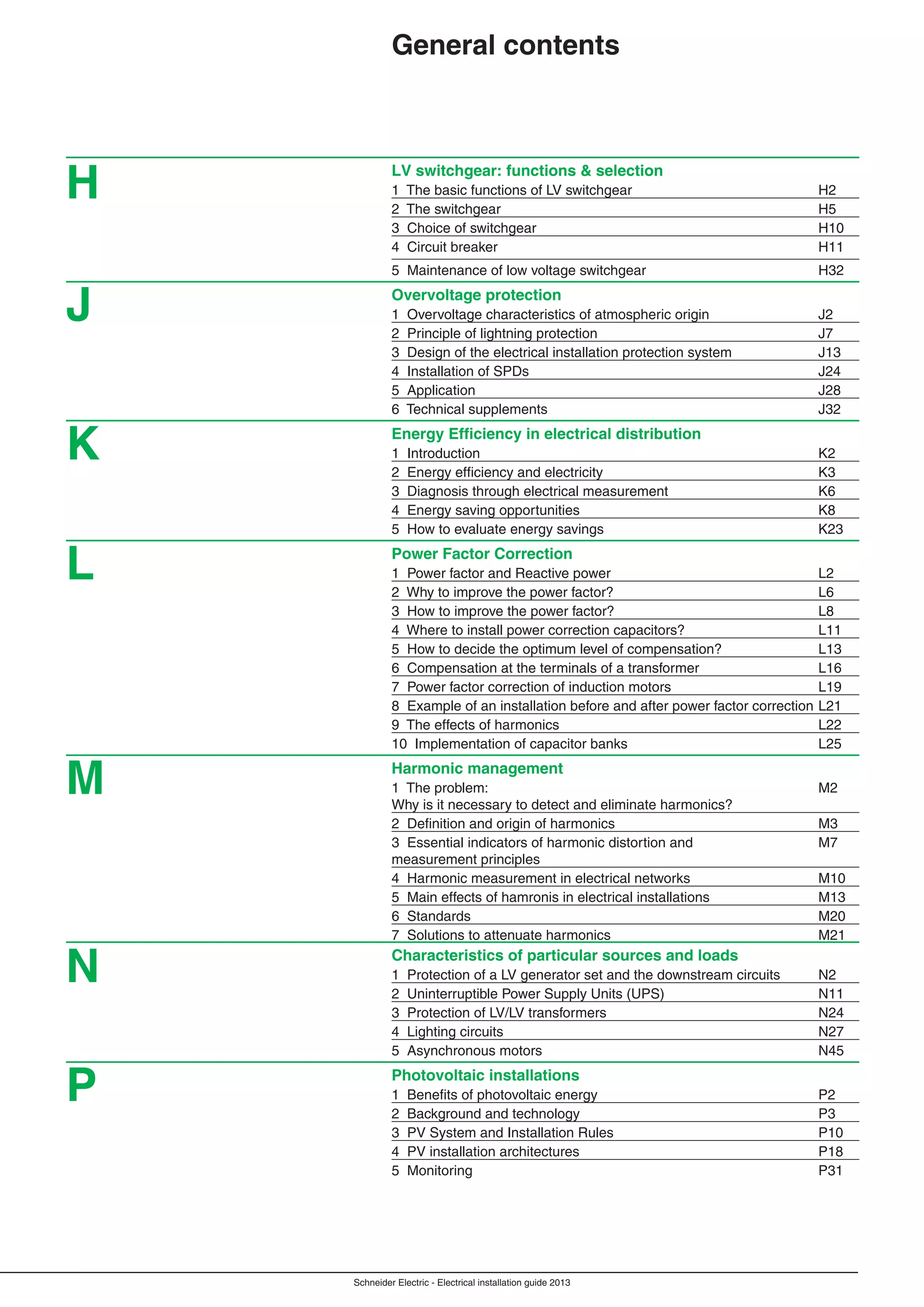
LV switchgear: functions & selection
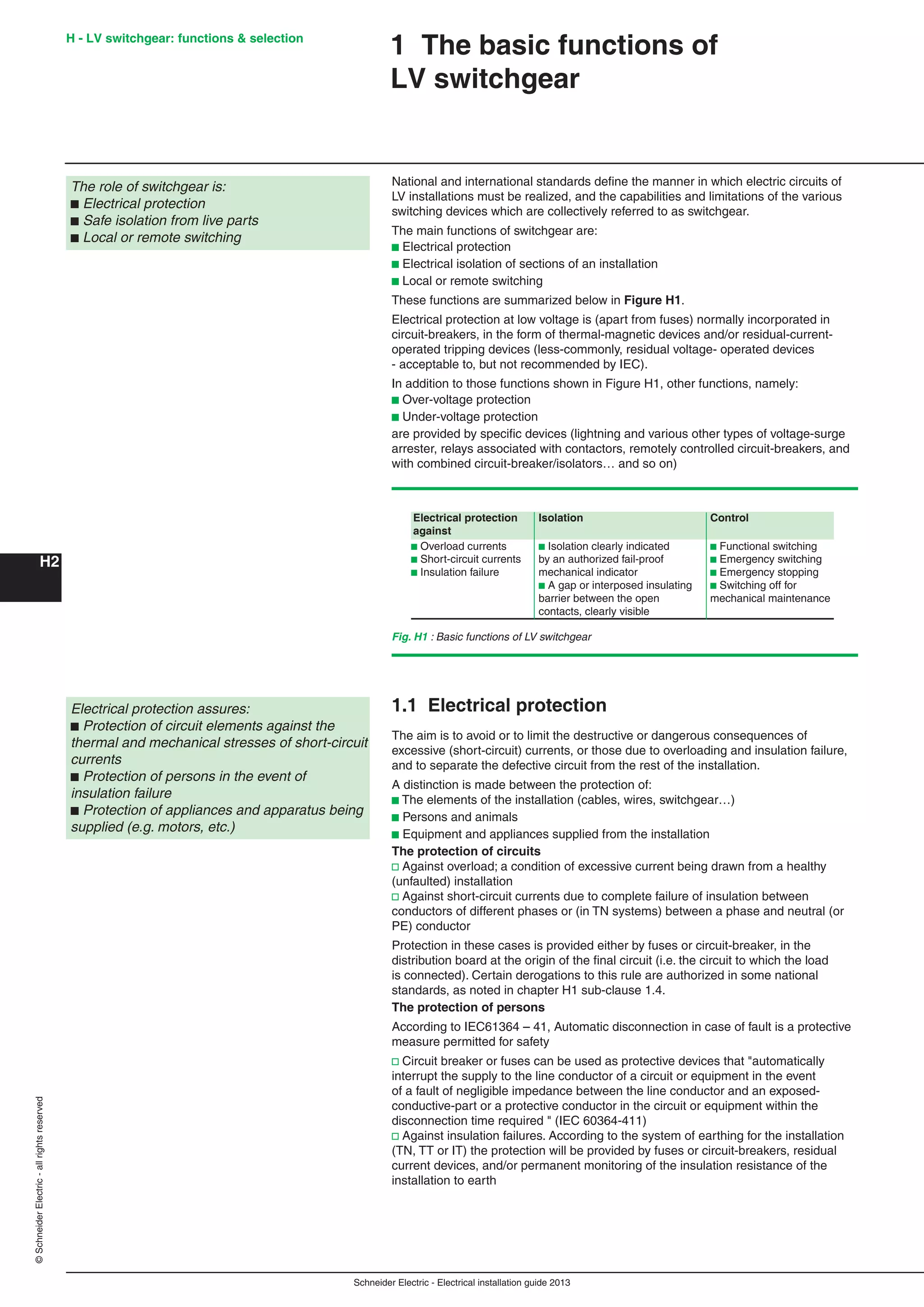
1 The basic functions of LV switchgear H2
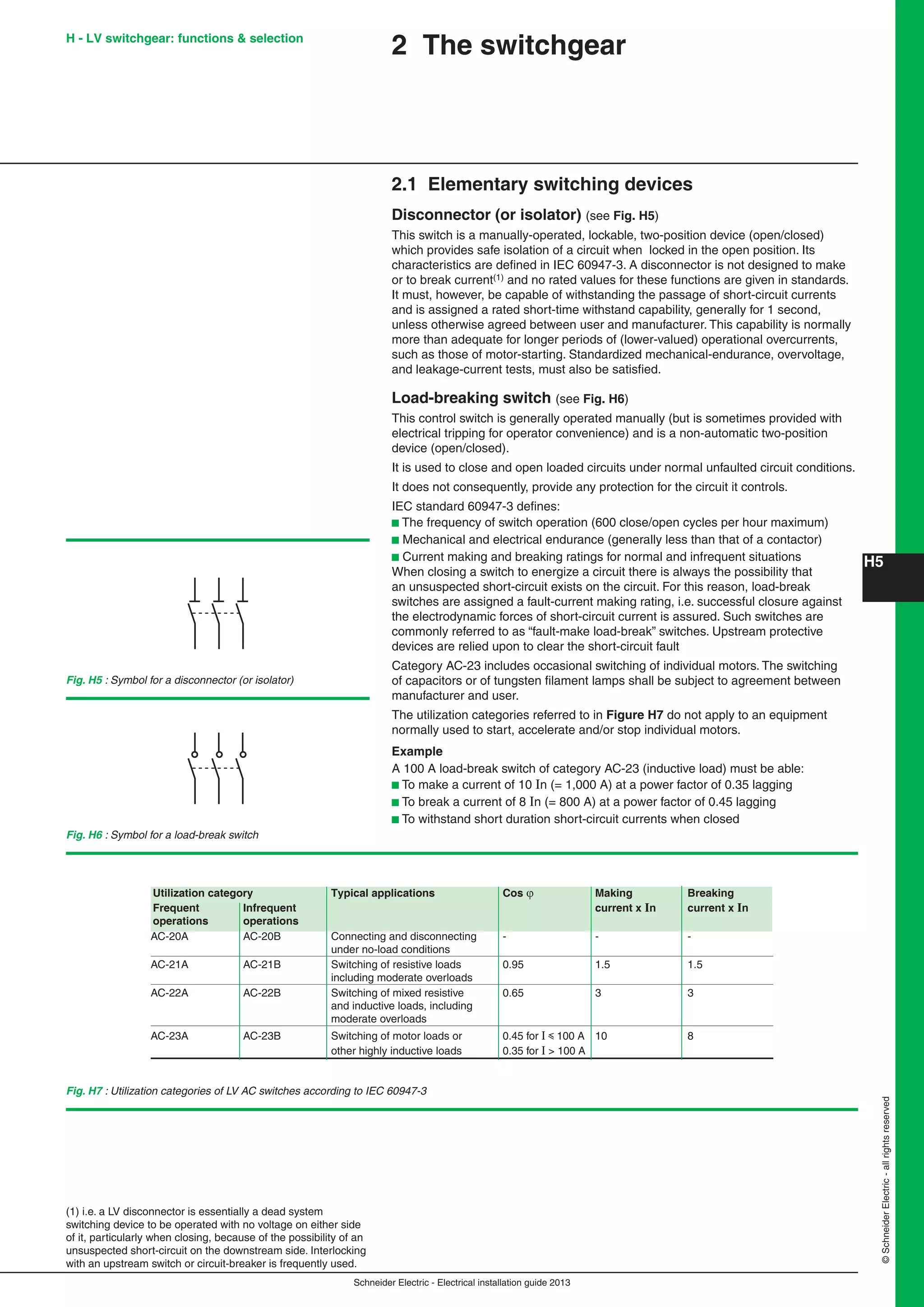
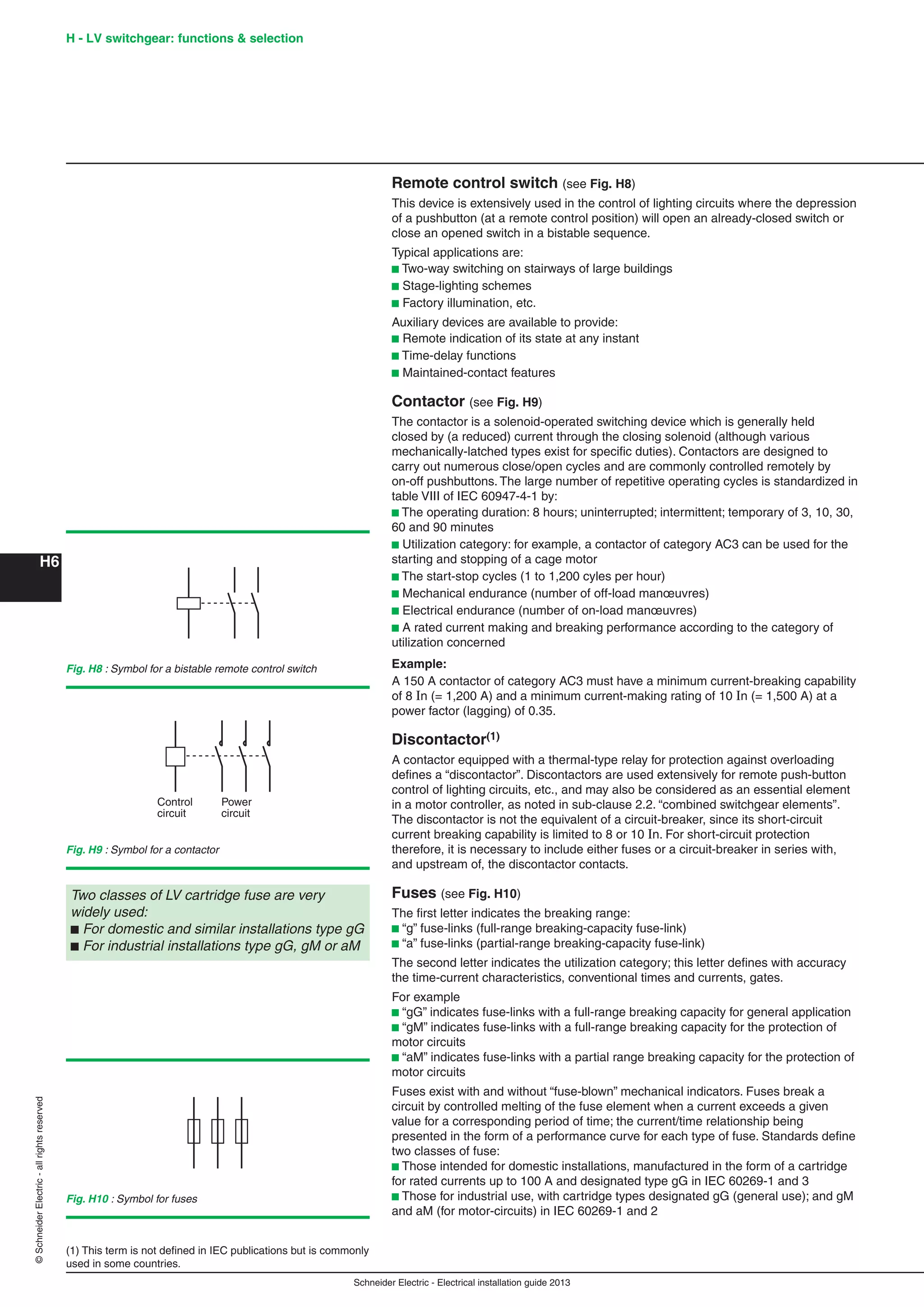
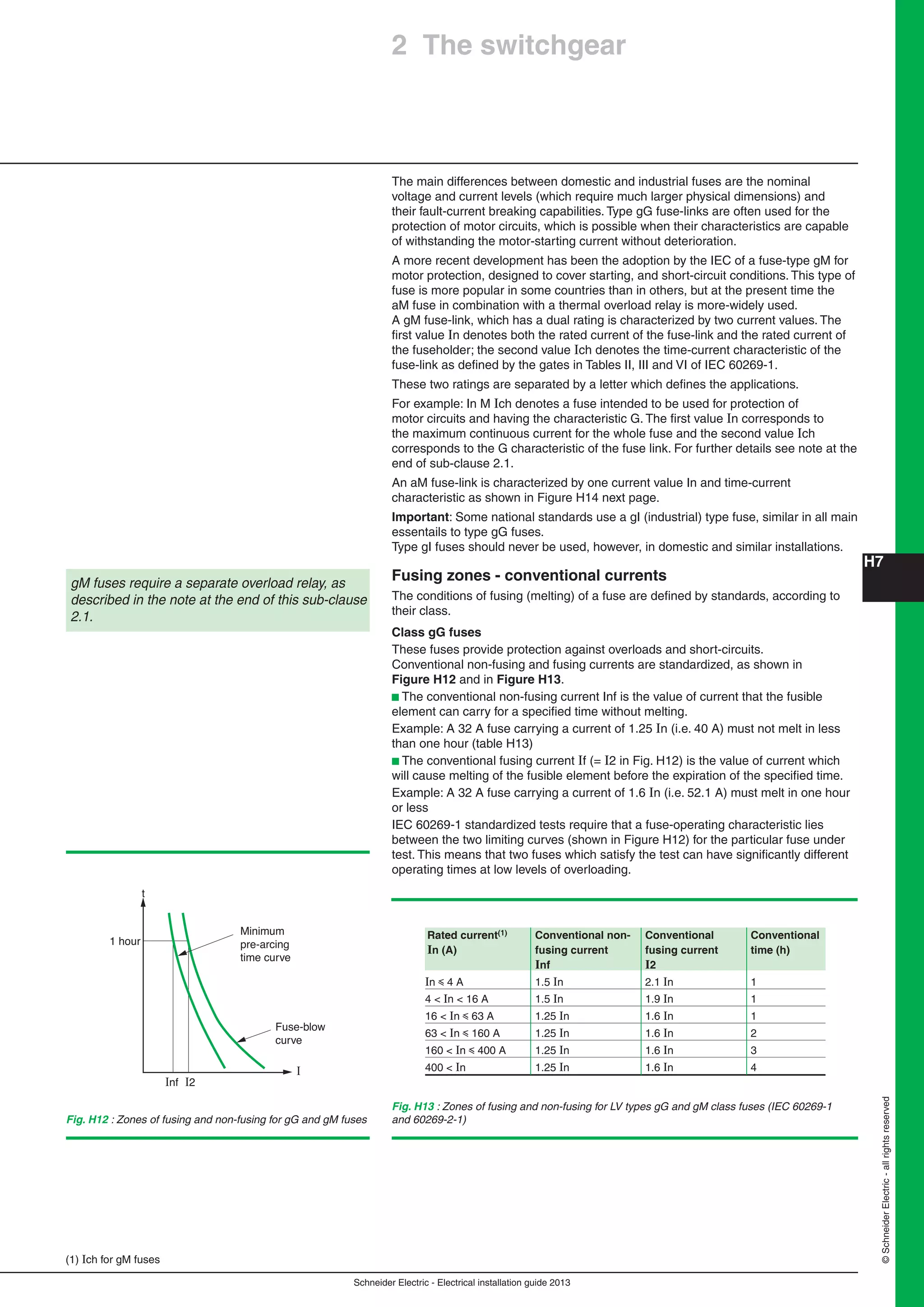
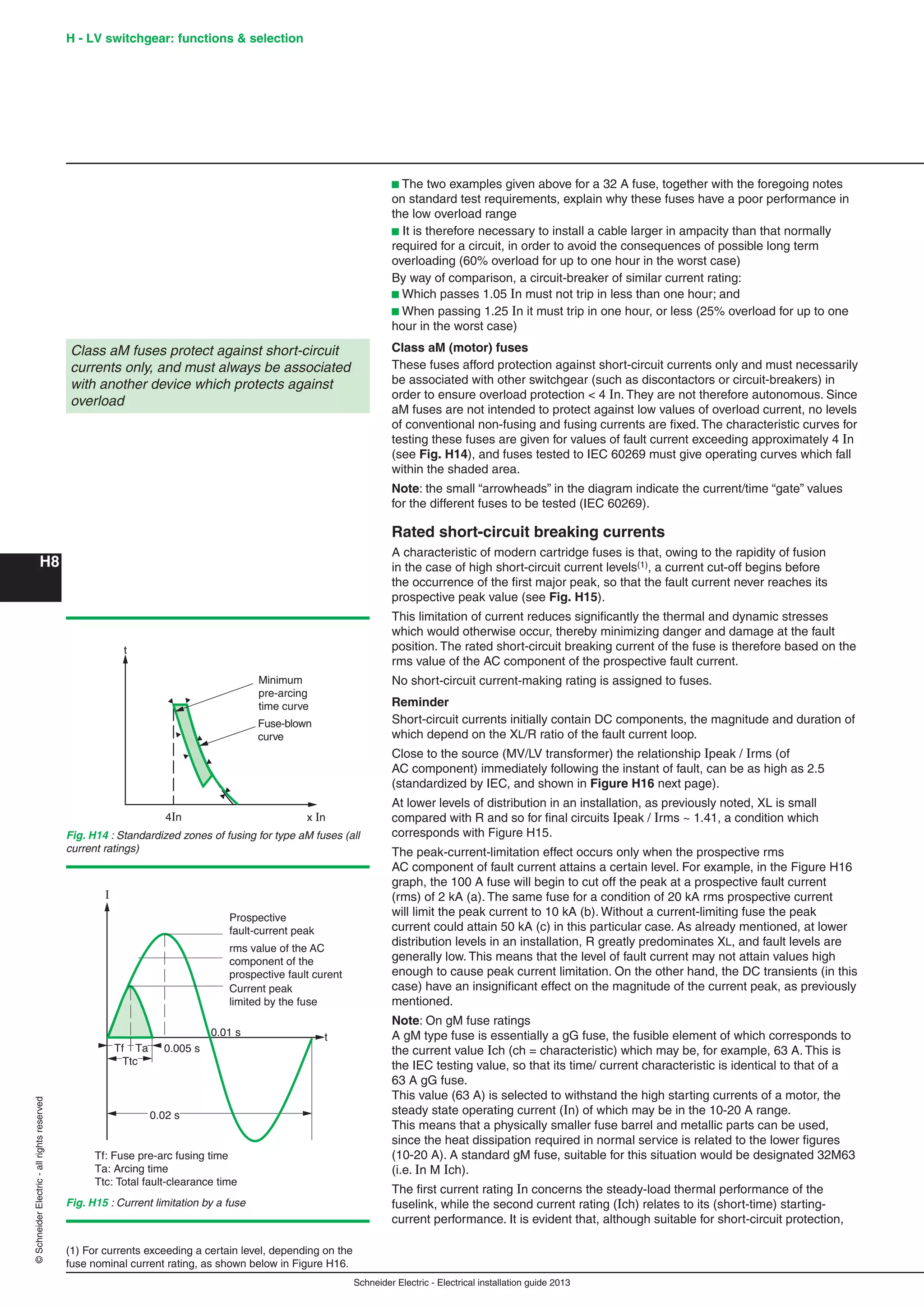
2 The switchgear H5
3 Choice of switchgear H10
4 Circuit breaker H11
5 Maintenance of low voltage switchgear H32
Overvoltage protection
1 Overvoltage characteristics of atmospheric origin J2
2 Principle of lightning protection J7
3 Design of the electrical installation protection system J13
4 Installation of SPDs J24
5 Application J28
6 Technical supplements J32
Energy Efficiency in electrical distribution
1 Introduction K2
2 Energy efficiency and electricity K3
3 Diagnosis through electrical measurement K6
4 Energy saving opportunities K8
5 How to evaluate energy savings K23
Power Factor Correction
1 Power factor and Reactive power L2
2 Why to improve the power factor? L6
3 How to improve the power factor? L8
4 Where to install power correction capacitors? L11
5 How to decide the optimum level of compensation? L13
6 Compensation at the terminals of a transformer L16
7 Power factor correction of induction motors L19
8 Example of an installation before and after power factor correction L21
9 The effects of harmonics L22
10 Implementation of capacitor banks L25
Harmonic management
1 The problem: M2
Why is it necessary to detect and eliminate harmonics?
2 Definition and origin of harmonics M3
3 Essential indicators of harmonic distortion and M7
measurement principles
4 Harmonic measurement in electrical networks M10
5 Main effects of hamronis in electrical installations M13
6 Standards M20
7 Solutions to attenuate harmonics M21
Characteristics of particular sources and loads
1 Protection of a LV generator set and the downstream circuits N2
2 Uninterruptible Power Supply Units (UPS) N11
3 Protection of LV/LV transformers N24
4 Lighting circuits N27
5 Asynchronous motors N45
Photovoltaic installations
1 Benefits of photovoltaic energy P2
2 Background and technology P3
3 PV System and Installation Rules P10
4 PV installation architectures P18
5 Monitoring P31
General contents
J
K
L
M
N
H
P
Schneider Electric - Electrical installation guide 2013
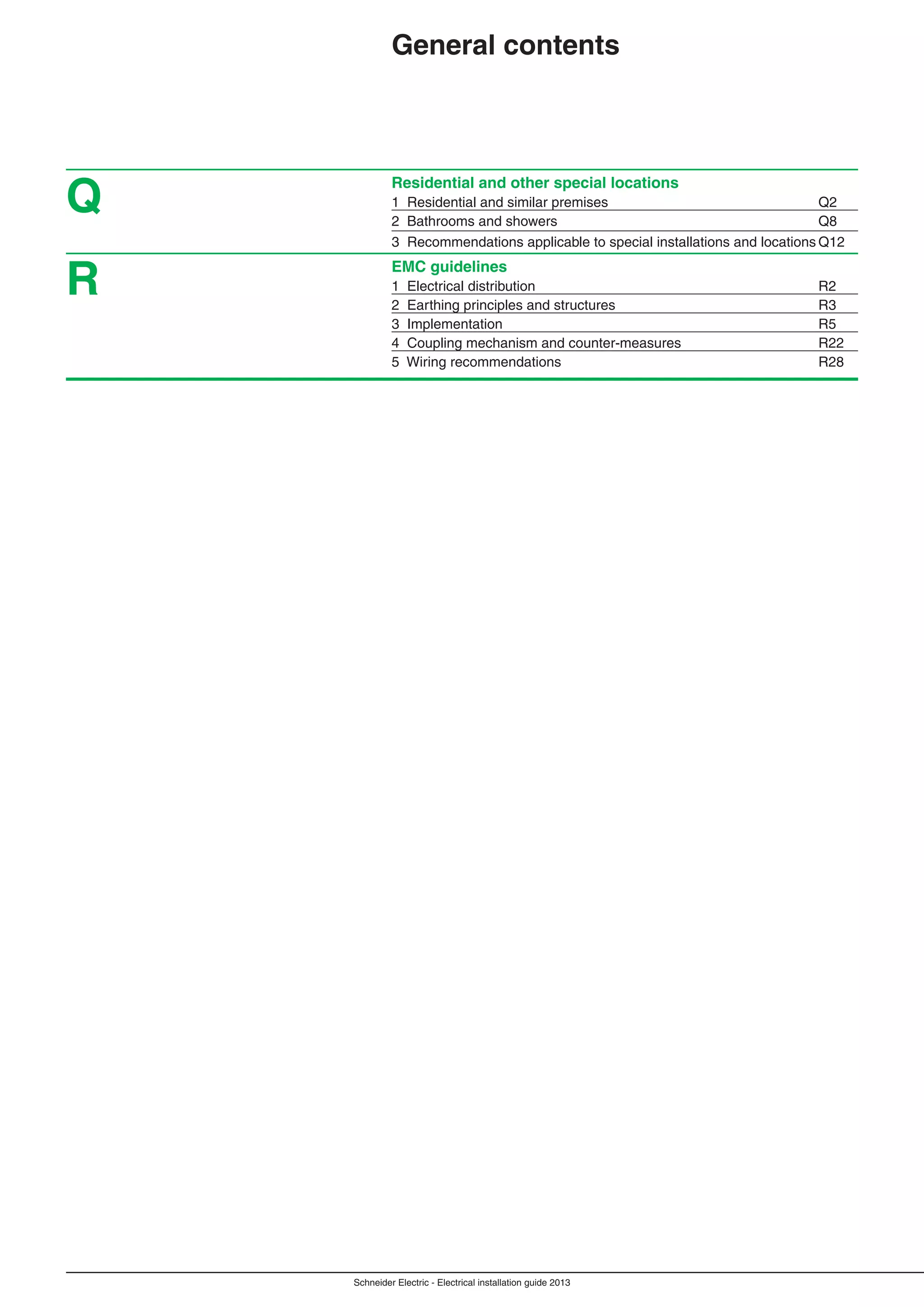
Residential and other special locations
1 Residential and similar premises Q2
2 Bathrooms and showers Q8
3 Recommendations applicable to special installations and locations Q12
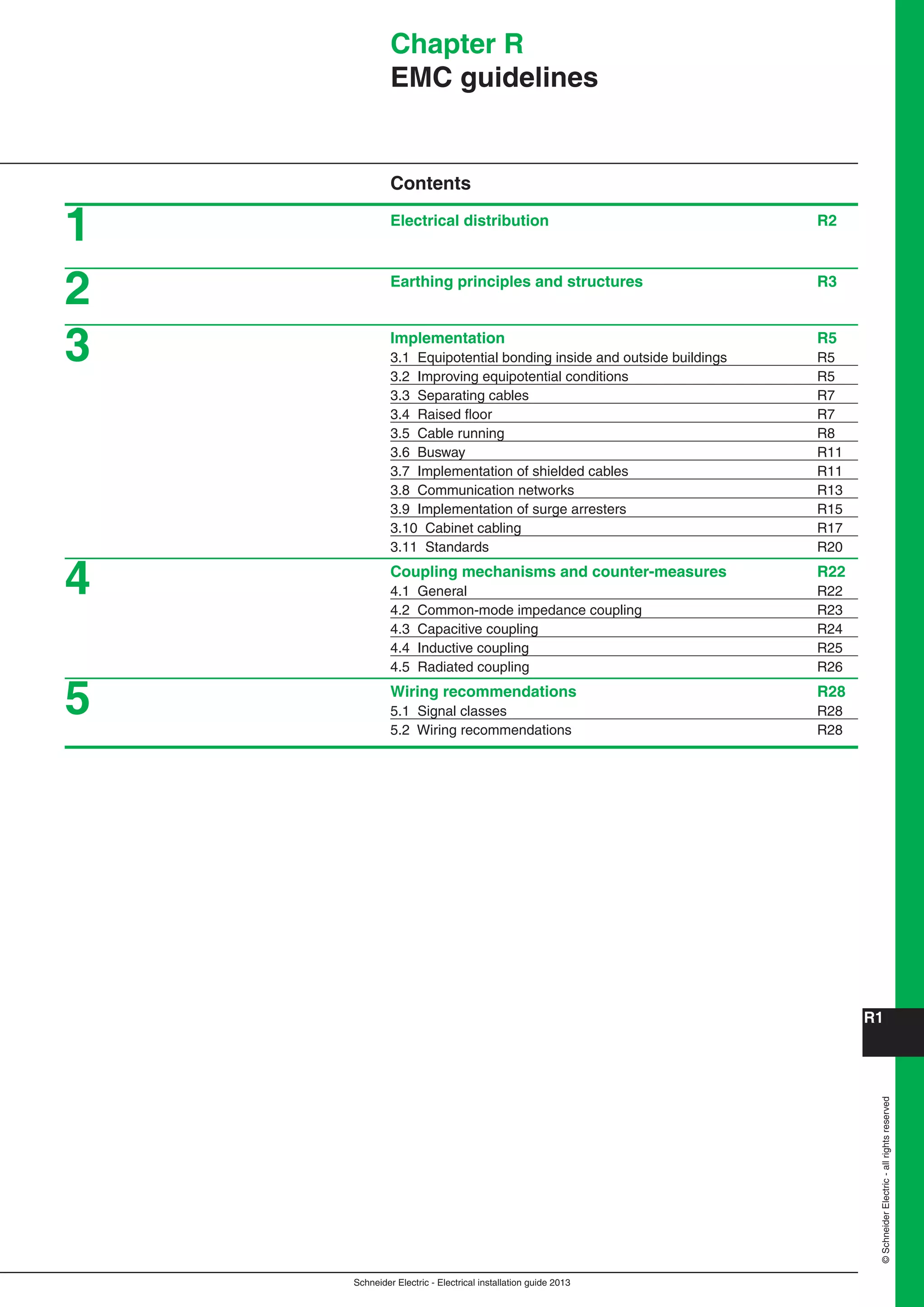
EMC guidelines
1 Electrical distribution R2
2 Earthing principles and structures R3
3 Implementation R5
4 Coupling mechanism and counter-measures R22
5 Wiring recommendations R28
Q
R
General contents
Schneider Electric - Electrical installation guide 2013
A1
©SchneiderElectric-allrightsreserved
Chapter A
General rules of electrical
installation design
Contents
Methodology A2
Rules and statutory regulations A5
2.1 Definition of voltage ranges A5
2.2 Regulations A6
2.3 Standards A6
2.4 Quality and safety of an electrical installation A7
2.5 Initial testing of an installation A8
2.6 Put in out of danger the existing electrical installations A8
2.7 Periodic check-testing of an installation A9
2.8 Conformity assessement (with standards and specifications) of
equipment used in the installation A9
2.9 Environment A10
Installed power loads - Characteristics A11
3.1 Induction motors A11
3.2 Resistive-type heating appliances and incandescent lamps
(conventional or halogen) A13
Power loading of an installation A16
4.1 Installed power (kW) A16
4.2 Installed apparent power (kVA) A16
4.3 Estimation of actual maximum kVA demand A17
4.4 Example of application of factors ku and ks A19
4.5 Diversity factor A19
4.6 Choice of transformer rating A20
4.7 Choice of power-supply sources A21
1
2
3
4
Schneider Electric - Electrical installation guide 2013
A - General rules of electrical installation design
A2
©SchneiderElectric-allrightsreserved
For the best results in electrical installation design it is recommended to read and to
use all the chapters of this guide in the order in which they are presented.
Rules and statutory regulations
Range of low-voltage extends from 0 V to 1 000 V in a.c. and from 0 V to 1 500
V in d.c. One of the first decision id the selection of type of current between the
alternative current which corresponds to the most common type of current through
out the world and the direct current. Then designers have to select the most
appropriate rated voltage within these ranges of voltages. When connected to a LV
public network, the type of current and the rated voltage are already selected and
imposed by the Utility.
Compliance with national regulations is then the second priority of the designers
of electrical installation. Regulations may be based on national or international
standards such as the IEC 60364 series.
Selection of equipment complying with national or international product standards
and appropriate verification of the completed installation is a powerful mean for
providing a safe installation with the expected quality. Defining and complying with
the verification and testing of the electrical installation at its completion as well as
periodic time will guarantee the safety and the quality of this installation all along its
life cycle. Conformity of equipment according to the appropriate product standards
used within the installation is also of prime importance for the level of safety and
quality.
Environmental conditions will become more and more stringent and will need to
be considered at the design stage of the installation. This may include national or
regional regulations considering the material used in the equipment as well as the
dismantling of the installation at its end of life
Installed power loads - Characteristics
A review of all applications needing to be supplied with electricity is to be done. Any
possible extensions or modifications during the whole life of the electrical installation
are to be considered. Such a review aimed to estimate the current flowing in each
circuit of the installation and the power supplies needed.
The total current or power demand can be calculated from the data relative to the
location and power of each load, together with the knowledge of the operating modes
(steady state demand, starting conditions, non simultaneous operation, etc.)
Estimation of the maximum power demand may use various factors depending
on the type of application; type of equipment and type of circuits used within the
electrical installation.
From these data, the power required from the supply source and (where appropriate)
the number of sources necessary for an adequate supply to the installation is readily
obtained.
Local information regarding tariff structures is also required to allow the best choice
of connection arrangement to the power-supply network, e.g. at medium voltage or
low voltage level.
Connection to the MV public distribution network
Where this connection is made at the Medium Voltage level a consumer-type
substation will have to be studied, built and equipped. This substation may be an
outdoor or indoor installation conforming to relevant standards and regulations (the
low-voltage section may be studied separately if necessary). Metering at medium-
voltage or low-voltage is possible in this case.
Connection to the LV utility distribution network
Where the connection is made at the Low Voltage level the installation will be
connected to the local power network and will (necessarily) be metered according to
LV tariffs.
MV & LV architecture selection guide
The whole electrical system including the MV installation and the LV installation
is to be studied as a complete system. The customer expectations and technical
parameters will impact the architecture of the system as well as the electrical
installation characteristics.
Determination of the most suitable architecture of the MV/LV main distribution and LV
power distribution level is often the result of optimization and compromise.
Neutral earthing arrangements are chosen according to local regulations, constraints
related to the power-supply, and to the type of loads.
1 Methodology
A - General rules of electrical installation design
A§3- Installed power loads - Characteristics
A§4- Power loading of an installation
B – Connection to the MV utility distribution
network
C - Connection to the LV utility distribution
network
D - MV & LV architecture selection guide
Schneider Electric - Electrical installation guide 2013
A3
©SchneiderElectric-allrightsreserved
The distribution equipment (panelboards, switchgears, circuit connections, ...) are
determined from building plans and from the location and grouping of loads.
The type of premises and allocation can influence their immunity to external
disturbances.
LV distribution
The system earthing is one protective measures commonly used for the protection
against electric shocks. These systems earthings have a major impact on the LV
electrical installation architecture and they need to be analysed as early as possible.
Advantages and drawbacks are to be analysed for a correct selection.
Another aspect needing to be considered at the earlier stage is the external
influences. In large electrical installation, different external influences may be
encountered and need to be considered independently. As a result of these external
influences proper selection of equipment according to their IP or IK codes has to be
made.
Protection against electric shocks
Protection against electric shock consists in providing provision for basic protection
(protection against direct contact) with provision for fault protection (protection
against indirect contact). Coordinated provisions result in a protective measure.
One of the most common protective measures consists in “automatic disconnection
of supply” where the provision for fault protection consists in the implementation of a
system earthing. Deep understanding of each standardized system (TT, TN and IT
system) is necessary for a correct implementation.
Sizing and protection of conductors
Selection of cross-sectional-areas of cables or isolated conductors for line
conductors is certainly one of the most important tasks of the designing process
of an electrical installation as this greatly influences the selection of overcurrent
protective devices, the voltage drop along these conductors and the estimation of
the prospective short-circuits currents: the maximum value relates to the overcurrent
protection and the minimum value relates to the fault protection by automatic
disconnection of supply. This has to be done for each circuit of the installation.
Similar task is to be done for the neutral conductors and for the Protective Earth (PE)
conductor.
LV switchgear: functions & selection
Once the short-circuit current are estimated, protective devices can be selected for
the overcurrent protection. Circuit-breakers have also other possible functions such
as switching and isolation. A complete understanding of the functionalities offered by
all switchgear and controlgear within the installation is necessary. Correct selection
of all devices can now be done.
A comprehensive understanding of all functionalities offered by the circuit-breakers is
of prime importance as this is the device offering the largest variety of functions.
Overvoltage protection
Direct or indirect lightning strokes can damage electrical equipment at a distance of
several kilometres. Operating voltage surges, transient and industrial frequency over-
voltage can also produce the same consequences.All protective measures against
overvoltage need to be assessed. One of the most used corresponds to the use of
Surge Protective Devices (SPD). Their selection; installation and protection within the
electrical installation request some particular attention.
Energy efficiency in electrical distribution
Implementation of active energy efficiency measures within the electrical installation
can produce high benefits for the user or owner: reduced power consumption,
reduced cost of energy, better use of electrical equipment. These measures will
most of the time request specific design for the installation as measuring electricity
consumption either per application (lighting, heating, process…) or per area (floor,
workshop) present particular interest for reducing the electricity consumption still
keeping the same level of service provided to the user.
Reactive energy
The power factor correction within electrical installations is carried out locally,
globally or as a combination of both methods. Improving the power factor has a direct
impact on the billing of consumed electricity and may also have an impact on the
energy efiiciency.
J – Protection against voltage surges in LV
L - Power factor correction and harmonic filtering
1 Methodology
F - Protection against electric shocks
G - Sizing and protection of conductors
H - LV switchgear: functions & selection
E - LV Distribution
K – Energy efficiency in electrical distribution
Schneider Electric - Electrical installation guide 2013
A - General rules of electrical installation design
A4
©SchneiderElectric-allrightsreserved
Harmonics
Harmonic currents in the network affect the quality of energy and are at the origin of
many disturbances as overloads, vibrations, ageing of equipment, trouble of sensitive
equipment, of local area networks, telephone networks. This chapter deals with the
origins and the effects of harmonics and explain how to measure them and present
the solutions.
Particular supply sources and loads
Particular items or equipment are studied:
b Specific sources such as alternators or inverters
b Specific loads with special characteristics, such as induction motors, lighting
circuits or LV/LV transformers
b Specific systems, such as direct-current networks
A green and economical energy
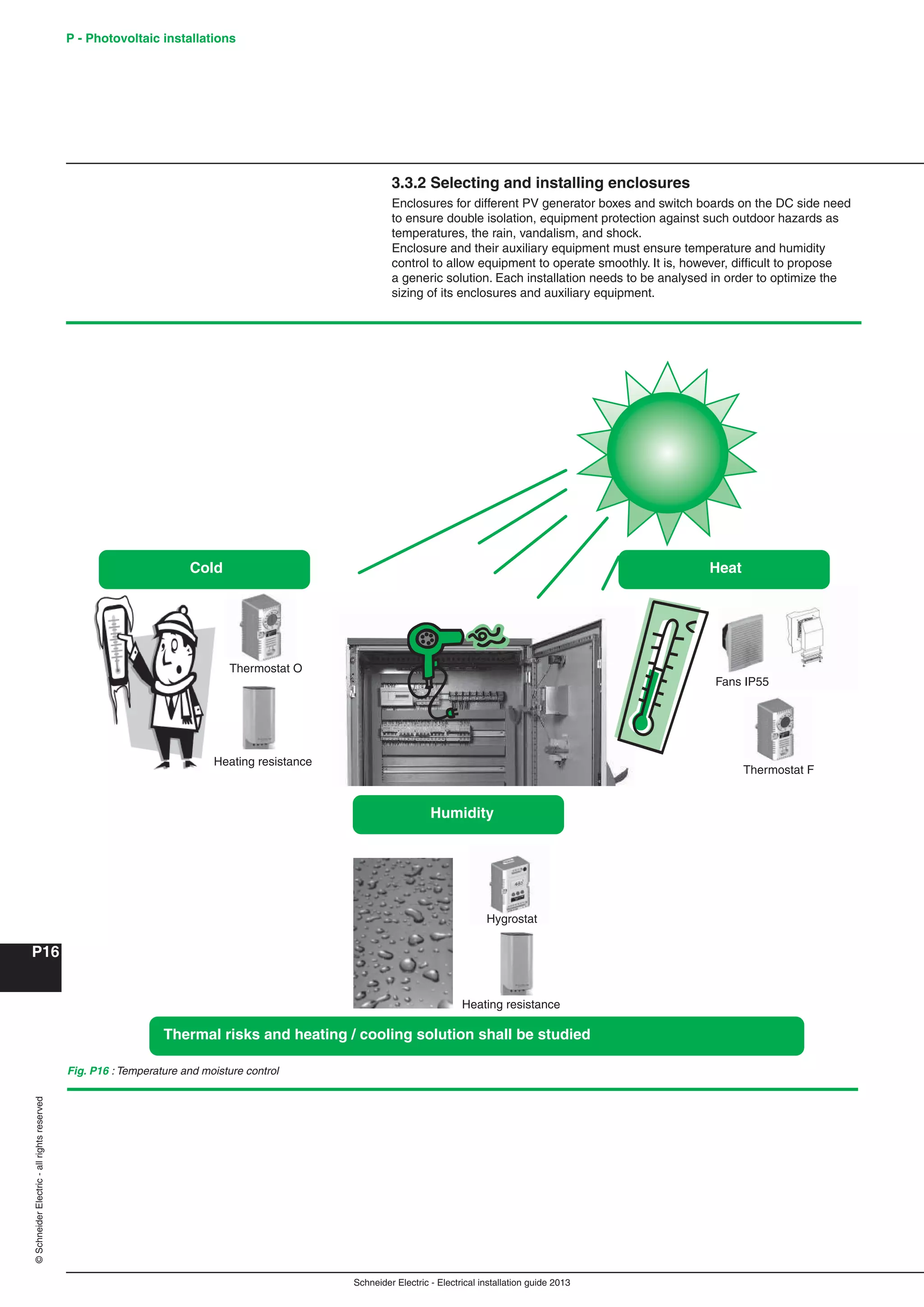
The solar energy development has to respect specific installation rules.
Generic applications
Certain premises and locations are subject to particularly strict regulations: the most
common example being residential dwellings.
EMC Guidelines
Some basic rules must be followed in order to ensure Electromagnetic Compatibility.
Non observance of these rules may have serious consequences in the operation of
the electrical installation: disturbance of communication systems, nuisance tripping of
protection devices, and even destruction of sensitive devices.
Ecodial software
Ecodial software(1) provides a complete design package for LV installations, in
accordance with IEC standards and recommendations.
The following features are included:
b Construction of one-line diagrams
b Calculation of short-circuit currents according to several operating modes (normal,
back-up, load shedding)
b Calculation of voltage drops
b Optimization of cable sizes
b Required ratings and settings of switchgear and fusegear
b Discrimination of protective devices
b Optimization ofswitchgear using cascading
b Verification of the protection of people and circuits
b Comprehensive print-out of the foregoing calculated design data
(1) Ecodial is a Schneider Electric software available in several
languages and standard version.
1 Methodology
N - Characteristics of particular sources and
loads
P - Photovoltaic Installations
M - Harmonic management
Q - Residential and other special locations
R - EMC guidelines
A companion tool of the Electrical Installation
Guide
Schneider Electric - Electrical installation guide 2013
A5
©SchneiderElectric-allrightsreserved
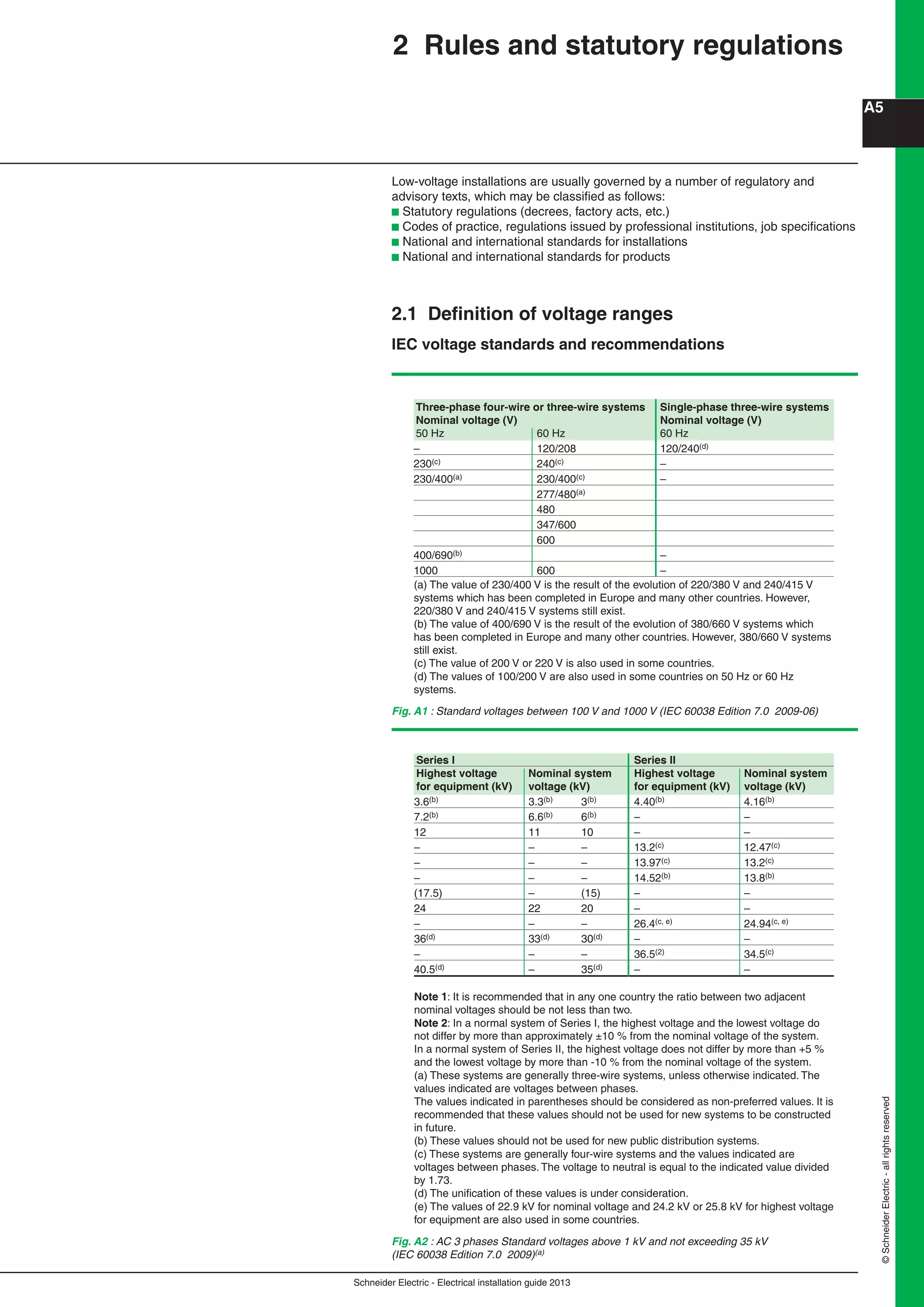
Low-voltage installations are usually governed by a number of regulatory and
advisory texts, which may be classified as follows:
b Statutory regulations (decrees, factory acts, etc.)
b Codes of practice, regulations issued by professional institutions, job specifications
b National and international standards for installations
b National and international standards for products
2.1 Definition of voltage ranges
IEC voltage standards and recommendations
2 Rules and statutory regulations
Three-phase four-wire or three-wire systems Single-phase three-wire systems
Nominal voltage (V) Nominal voltage (V)
50 Hz 60 Hz 60 Hz
– 120/208 120/240(d)
230(c) 240(c) –
230/400(a) 230/400(c) –
277/480(a)
480
347/600
600
400/690(b) –
1000 600 –
(a) The value of 230/400 V is the result of the evolution of 220/380 V and 240/415 V
systems which has been completed in Europe and many other countries. However,
220/380 V and 240/415 V systems still exist.
(b) The value of 400/690 V is the result of the evolution of 380/660 V systems which
has been completed in Europe and many other countries. However, 380/660 V systems
still exist.
(c) The value of 200 V or 220 V is also used in some countries.
(d) The values of 100/200 V are also used in some countries on 50 Hz or 60 Hz
systems.
Fig. A1 : Standard voltages between 100 V and 1000 V (IEC 60038 Edition 7.0 2009-06)
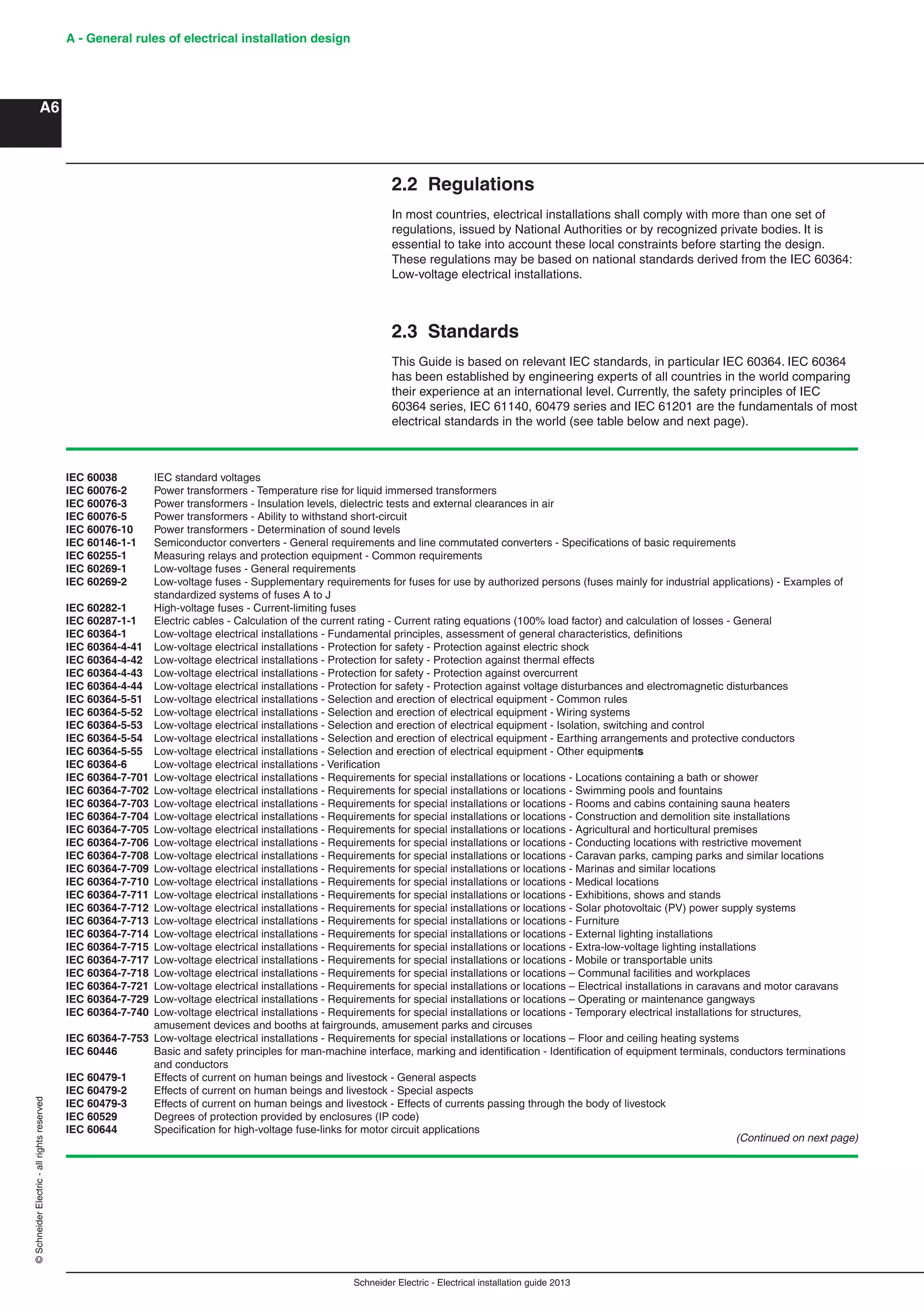
Series I Series II
Highest voltage Nominal system Highest voltage Nominal system
for equipment (kV) voltage (kV) for equipment (kV) voltage (kV)
3.6(b) 3.3(b) 3(b) 4.40(b) 4.16(b)
7.2(b) 6.6(b) 6(b) – –
12 11 10 – –
– – – 13.2(c) 12.47(c)
– – – 13.97(c) 13.2(c)
– – – 14.52(b) 13.8(b)
(17.5) – (15) – –
24 22 20 – –
– – – 26.4(c, e) 24.94(c, e)
36(d) 33(d) 30(d) – –
– – – 36.5(2) 34.5(c)
40.5(d) – 35(d) – –
Note 1: It is recommended that in any one country the ratio between two adjacent
nominal voltages should be not less than two.
Note 2: In a normal system of Series I, the highest voltage and the lowest voltage do
not differ by more than approximately ±10 % from the nominal voltage of the system.
In a normal system of Series II, the highest voltage does not differ by more than +5 %
and the lowest voltage by more than -10 % from the nominal voltage of the system.
(a) These systems are generally three-wire systems, unless otherwise indicated. The
values indicated are voltages between phases.
The values indicated in parentheses should be considered as non-preferred values. It is
recommended that these values should not be used for new systems to be constructed
in future.
(b) These values should not be used for new public distribution systems.
(c) These systems are generally four-wire systems and the values indicated are
voltages between phases. The voltage to neutral is equal to the indicated value divided
by 1.73.
(d) The unification of these values is under consideration.
(e) The values of 22.9 kV for nominal voltage and 24.2 kV or 25.8 kV for highest voltage
for equipment are also used in some countries.
Fig. A2 : AC 3 phases Standard voltages above 1 kV and not exceeding 35 kV
(IEC 60038 Edition 7.0 2009)(a)
Schneider Electric - Electrical installation guide 2013
A - General rules of electrical installation design
A6
©SchneiderElectric-allrightsreserved
2.2 Regulations
In most countries, electrical installations shall comply with more than one set of
regulations, issued by National Authorities or by recognized private bodies. It is
essential to take into account these local constraints before starting the design.
These regulations may be based on national standards derived from the IEC 60364:
Low-voltage electrical installations.
2.3 Standards
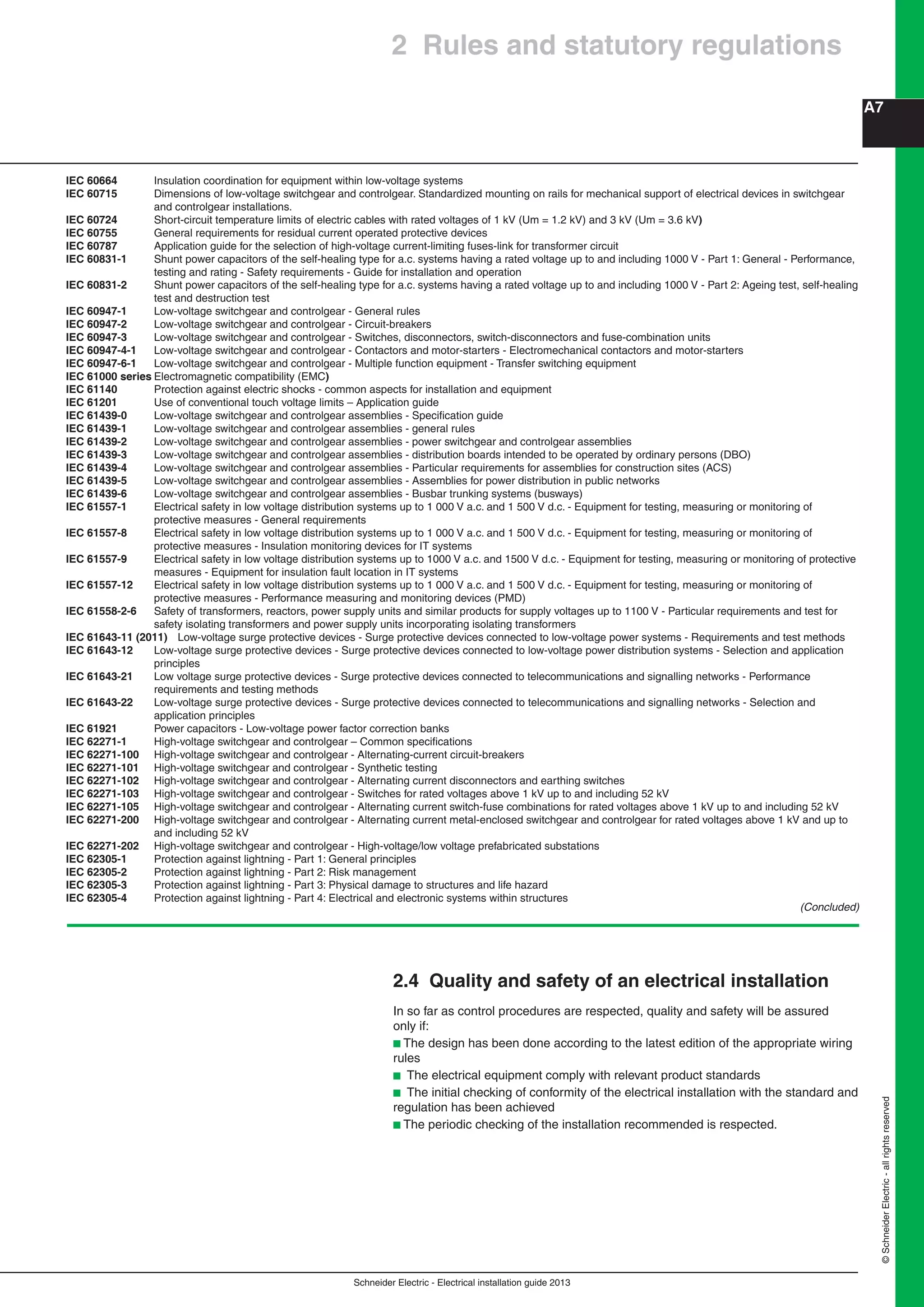
This Guide is based on relevant IEC standards, in particular IEC 60364. IEC 60364
has been established by engineering experts of all countries in the world comparing
their experience at an international level. Currently, the safety principles of IEC
60364 series, IEC 61140, 60479 series and IEC 61201 are the fundamentals of most
electrical standards in the world (see table below and next page).
IEC 60038 IEC standard voltages
IEC 60076-2 Power transformers - Temperature rise for liquid immersed transformers
IEC 60076-3 Power transformers - Insulation levels, dielectric tests and external clearances in air
IEC 60076-5 Power transformers - Ability to withstand short-circuit
IEC 60076-10 Power transformers - Determination of sound levels
IEC 60146-1-1 Semiconductor converters - General requirements and line commutated converters - Specifications of basic requirements
IEC 60255-1 Measuring relays and protection equipment - Common requirements
IEC 60269-1 Low-voltage fuses - General requirements
IEC 60269-2 Low-voltage fuses - Supplementary requirements for fuses for use by authorized persons (fuses mainly for industrial applications) - Examples of
standardized systems of fuses A to J
IEC 60282-1 High-voltage fuses - Current-limiting fuses
IEC 60287-1-1 Electric cables - Calculation of the current rating - Current rating equations (100% load factor) and calculation of losses - General
IEC 60364-1 Low-voltage electrical installations - Fundamental principles, assessment of general characteristics, definitions
IEC 60364-4-41 Low-voltage electrical installations - Protection for safety - Protection against electric shock
IEC 60364-4-42 Low-voltage electrical installations - Protection for safety - Protection against thermal effects
IEC 60364-4-43 Low-voltage electrical installations - Protection for safety - Protection against overcurrent
IEC 60364-4-44 Low-voltage electrical installations - Protection for safety - Protection against voltage disturbances and electromagnetic disturbances
IEC 60364-5-51 Low-voltage electrical installations - Selection and erection of electrical equipment - Common rules
IEC 60364-5-52 Low-voltage electrical installations - Selection and erection of electrical equipment - Wiring systems
IEC 60364-5-53 Low-voltage electrical installations - Selection and erection of electrical equipment - Isolation, switching and control
IEC 60364-5-54 Low-voltage electrical installations - Selection and erection of electrical equipment - Earthing arrangements and protective conductors
IEC 60364-5-55 Low-voltage electrical installations - Selection and erection of electrical equipment - Other equipments
IEC 60364-6 Low-voltage electrical installations - Verification
IEC 60364-7-701 Low-voltage electrical installations - Requirements for special installations or locations - Locations containing a bath or shower
IEC 60364-7-702 Low-voltage electrical installations - Requirements for special installations or locations - Swimming pools and fountains
IEC 60364-7-703 Low-voltage electrical installations - Requirements for special installations or locations - Rooms and cabins containing sauna heaters
IEC 60364-7-704 Low-voltage electrical installations - Requirements for special installations or locations - Construction and demolition site installations
IEC 60364-7-705 Low-voltage electrical installations - Requirements for special installations or locations - Agricultural and horticultural premises
IEC 60364-7-706 Low-voltage electrical installations - Requirements for special installations or locations - Conducting locations with restrictive movement
IEC 60364-7-708 Low-voltage electrical installations - Requirements for special installations or locations - Caravan parks, camping parks and similar locations
IEC 60364-7-709 Low-voltage electrical installations - Requirements for special installations or locations - Marinas and similar locations
IEC 60364-7-710 Low-voltage electrical installations - Requirements for special installations or locations - Medical locations
IEC 60364-7-711 Low-voltage electrical installations - Requirements for special installations or locations - Exhibitions, shows and stands
IEC 60364-7-712 Low-voltage electrical installations - Requirements for special installations or locations - Solar photovoltaic (PV) power supply systems
IEC 60364-7-713 Low-voltage electrical installations - Requirements for special installations or locations - Furniture
IEC 60364-7-714 Low-voltage electrical installations - Requirements for special installations or locations - External lighting installations
IEC 60364-7-715 Low-voltage electrical installations - Requirements for special installations or locations - Extra-low-voltage lighting installations
IEC 60364-7-717 Low-voltage electrical installations - Requirements for special installations or locations - Mobile or transportable units
IEC 60364-7-718 Low-voltage electrical installations - Requirements for special installations or locations – Communal facilities and workplaces
IEC 60364-7-721 Low-voltage electrical installations - Requirements for special installations or locations – Electrical installations in caravans and motor caravans
IEC 60364-7-729 Low-voltage electrical installations - Requirements for special installations or locations – Operating or maintenance gangways
IEC 60364-7-740 Low-voltage electrical installations - Requirements for special installations or locations - Temporary electrical installations for structures,
amusement devices and booths at fairgrounds, amusement parks and circuses
IEC 60364-7-753 Low-voltage electrical installations - Requirements for special installations or locations – Floor and ceiling heating systems
IEC 60446 Basic and safety principles for man-machine interface, marking and identification - Identification of equipment terminals, conductors terminations
and conductors
IEC 60479-1 Effects of current on human beings and livestock - General aspects
IEC 60479-2 Effects of current on human beings and livestock - Special aspects
IEC 60479-3 Effects of current on human beings and livestock - Effects of currents passing through the body of livestock
IEC 60529 Degrees of protection provided by enclosures (IP code)
IEC 60644 Specification for high-voltage fuse-links for motor circuit applications
(Continued on next page)
Schneider Electric - Electrical installation guide 2013
A7
©SchneiderElectric-allrightsreserved
IEC 60664 Insulation coordination for equipment within low-voltage systems
IEC 60715 Dimensions of low-voltage switchgear and controlgear. Standardized mounting on rails for mechanical support of electrical devices in switchgear
and controlgear installations.
IEC 60724 Short-circuit temperature limits of electric cables with rated voltages of 1 kV (Um = 1.2 kV) and 3 kV (Um = 3.6 kV)
IEC 60755 General requirements for residual current operated protective devices
IEC 60787 Application guide for the selection of high-voltage current-limiting fuses-link for transformer circuit
IEC 60831-1 Shunt power capacitors of the self-healing type for a.c. systems having a rated voltage up to and including 1000 V - Part 1: General - Performance,
testing and rating - Safety requirements - Guide for installation and operation
IEC 60831-2 Shunt power capacitors of the self-healing type for a.c. systems having a rated voltage up to and including 1000 V - Part 2: Ageing test, self-healing
test and destruction test
IEC 60947-1 Low-voltage switchgear and controlgear - General rules
IEC 60947-2 Low-voltage switchgear and controlgear - Circuit-breakers
IEC 60947-3 Low-voltage switchgear and controlgear - Switches, disconnectors, switch-disconnectors and fuse-combination units
IEC 60947-4-1 Low-voltage switchgear and controlgear - Contactors and motor-starters - Electromechanical contactors and motor-starters
IEC 60947-6-1 Low-voltage switchgear and controlgear - Multiple function equipment - Transfer switching equipment
IEC 61000 series Electromagnetic compatibility (EMC)
IEC 61140 Protection against electric shocks - common aspects for installation and equipment
IEC 61201 Use of conventional touch voltage limits – Application guide
IEC 61439-0 Low-voltage switchgear and controlgear assemblies - Specification guide
IEC 61439-1 Low-voltage switchgear and controlgear assemblies - general rules
IEC 61439-2 Low-voltage switchgear and controlgear assemblies - power switchgear and controlgear assemblies
IEC 61439-3 Low-voltage switchgear and controlgear assemblies - distribution boards intended to be operated by ordinary persons (DBO)
IEC 61439-4 Low-voltage switchgear and controlgear assemblies - Particular requirements for assemblies for construction sites (ACS)
IEC 61439-5 Low-voltage switchgear and controlgear assemblies - Assemblies for power distribution in public networks
IEC 61439-6 Low-voltage switchgear and controlgear assemblies - Busbar trunking systems (busways)
IEC 61557-1 Electrical safety in low voltage distribution systems up to 1 000 V a.c. and 1 500 V d.c. - Equipment for testing, measuring or monitoring of
protective measures - General requirements
IEC 61557-8 Electrical safety in low voltage distribution systems up to 1 000 V a.c. and 1 500 V d.c. - Equipment for testing, measuring or monitoring of
protective measures - Insulation monitoring devices for IT systems
IEC 61557-9 Electrical safety in low voltage distribution systems up to 1000 V a.c. and 1500 V d.c. - Equipment for testing, measuring or monitoring of protective
measures - Equipment for insulation fault location in IT systems
IEC 61557-12 Electrical safety in low voltage distribution systems up to 1 000 V a.c. and 1 500 V d.c. - Equipment for testing, measuring or monitoring of
protective measures - Performance measuring and monitoring devices (PMD)
IEC 61558-2-6 Safety of transformers, reactors, power supply units and similar products for supply voltages up to 1100 V - Particular requirements and test for
safety isolating transformers and power supply units incorporating isolating transformers
IEC 61643-11 (2011) Low-voltage surge protective devices - Surge protective devices connected to low-voltage power systems - Requirements and test methods
IEC 61643-12 Low-voltage surge protective devices - Surge protective devices connected to low-voltage power distribution systems - Selection and application
principles
IEC 61643-21 Low voltage surge protective devices - Surge protective devices connected to telecommunications and signalling networks - Performance
requirements and testing methods
IEC 61643-22 Low-voltage surge protective devices - Surge protective devices connected to telecommunications and signalling networks - Selection and
application principles
IEC 61921 Power capacitors - Low-voltage power factor correction banks
IEC 62271-1 High-voltage switchgear and controlgear – Common specifications
IEC 62271-100 High-voltage switchgear and controlgear - Alternating-current circuit-breakers
IEC 62271-101 High-voltage switchgear and controlgear - Synthetic testing
IEC 62271-102 High-voltage switchgear and controlgear - Alternating current disconnectors and earthing switches
IEC 62271-103 High-voltage switchgear and controlgear - Switches for rated voltages above 1 kV up to and including 52 kV
IEC 62271-105 High-voltage switchgear and controlgear - Alternating current switch-fuse combinations for rated voltages above 1 kV up to and including 52 kV
IEC 62271-200 High-voltage switchgear and controlgear - Alternating current metal-enclosed switchgear and controlgear for rated voltages above 1 kV and up to
and including 52 kV
IEC 62271-202 High-voltage switchgear and controlgear - High-voltage/low voltage prefabricated substations
IEC 62305-1 Protection against lightning - Part 1: General principles
IEC 62305-2 Protection against lightning - Part 2: Risk management
IEC 62305-3 Protection against lightning - Part 3: Physical damage to structures and life hazard
IEC 62305-4 Protection against lightning - Part 4: Electrical and electronic systems within structures
(Concluded)
2.4 Quality and safety of an electrical installation
In so far as control procedures are respected, quality and safety will be assured
only if:
b The design has been done according to the latest edition of the appropriate wiring
rules
b The electrical equipment comply with relevant product standards
b The initial checking of conformity of the electrical installation with the standard and
regulation has been achieved
b The periodic checking of the installation recommended is respected.
2 Rules and statutory regulations
Schneider Electric - Electrical installation guide 2013
A - General rules of electrical installation design
A8
©SchneiderElectric-allrightsreserved
2.5 Initial testing of an installation
Before a utility will connect an installation to its supply network, strict pre-
commissioning electrical tests and visual inspections by the authority, or by its
appointed agent, must be satisfied.
These tests are made according to local (governmental and/or institutional)
regulations, which may differ slightly from one country to another. The principles of
all such regulations however, are common, and are based on the observance of
rigorous safety rules in the design and realization of the installation.
IEC 60364-6 and related standards included in this guide are based on an
international consensus for such tests, intended to cover all the safety measures and
approved installation practices normally required for residential, commercial and (the
majority of) industrial buildings. Many industries however have additional regulations
related to a particular product (petroleum, coal, natural gas, etc.). Such additional
requirements are beyond the scope of this guide.
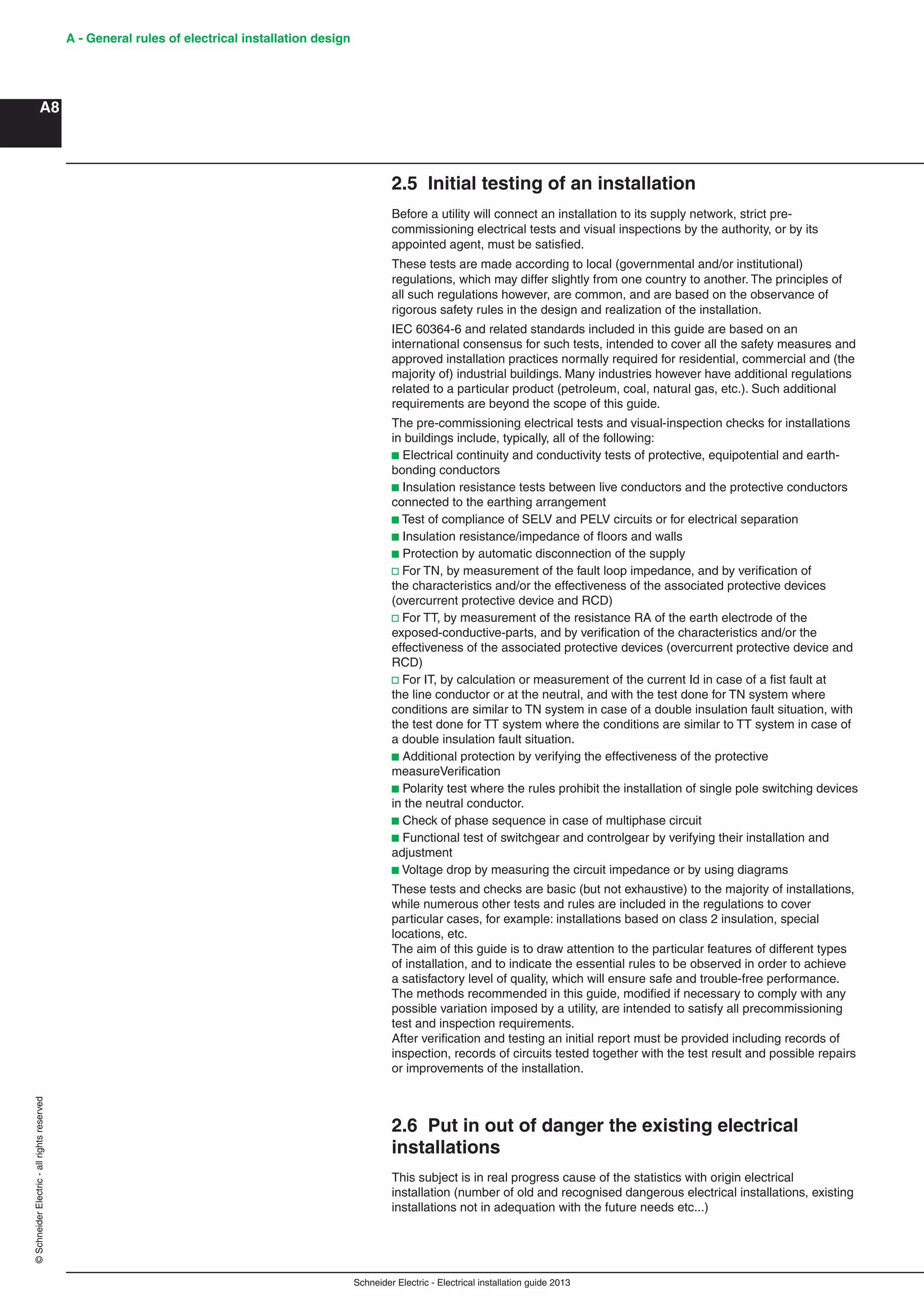
The pre-commissioning electrical tests and visual-inspection checks for installations
in buildings include, typically, all of the following:
b Electrical continuity and conductivity tests of protective, equipotential and earth-
bonding conductors
b Insulation resistance tests between live conductors and the protective conductors
connected to the earthing arrangement
b Test of compliance of SELV and PELV circuits or for electrical separation
b Insulation resistance/impedance of floors and walls
b Protection by automatic disconnection of the supply
v For TN, by measurement of the fault loop impedance, and by verification of
the characteristics and/or the effectiveness of the associated protective devices
(overcurrent protective device and RCD)
v For TT, by measurement of the resistance RA of the earth electrode of the
exposed-conductive-parts, and by verification of the characteristics and/or the
effectiveness of the associated protective devices (overcurrent protective device and
RCD)
v For IT, by calculation or measurement of the current Id in case of a fist fault at
the line conductor or at the neutral, and with the test done for TN system where
conditions are similar to TN system in case of a double insulation fault situation, with
the test done for TT system where the conditions are similar to TT system in case of
a double insulation fault situation.
b Additional protection by verifying the effectiveness of the protective
measureVerification
b Polarity test where the rules prohibit the installation of single pole switching devices
in the neutral conductor.
b Check of phase sequence in case of multiphase circuit
b Functional test of switchgear and controlgear by verifying their installation and
adjustment
b Voltage drop by measuring the circuit impedance or by using diagrams
These tests and checks are basic (but not exhaustive) to the majority of installations,
while numerous other tests and rules are included in the regulations to cover
particular cases, for example: installations based on class 2 insulation, special
locations, etc.
The aim of this guide is to draw attention to the particular features of different types
of installation, and to indicate the essential rules to be observed in order to achieve
a satisfactory level of quality, which will ensure safe and trouble-free performance.
The methods recommended in this guide, modified if necessary to comply with any
possible variation imposed by a utility, are intended to satisfy all precommissioning
test and inspection requirements.
After verification and testing an initial report must be provided including records of
inspection, records of circuits tested together with the test result and possible repairs
or improvements of the installation.
2.6 Put in out of danger the existing electrical
installations
This subject is in real progress cause of the statistics with origin electrical
installation (number of old and recognised dangerous electrical installations, existing
installations not in adequation with the future needs etc...)
Schneider Electric - Electrical installation guide 2013
A9
©SchneiderElectric-allrightsreserved
2.7 Periodic check-testing of an installation
In many countries, all industrial and commercial-building installations, together with
installations in buildings used for public gatherings, must be re-tested periodically by
authorized agents.
The following tests should be performed
b Verification of RCD effectiveness and adjustments
b Appropriate measurements for providing safety of persons against effects of
electric shock and protection against damage to property against fire and heat
b Confirmation that the installation is not damaged
b Identification of installation defects
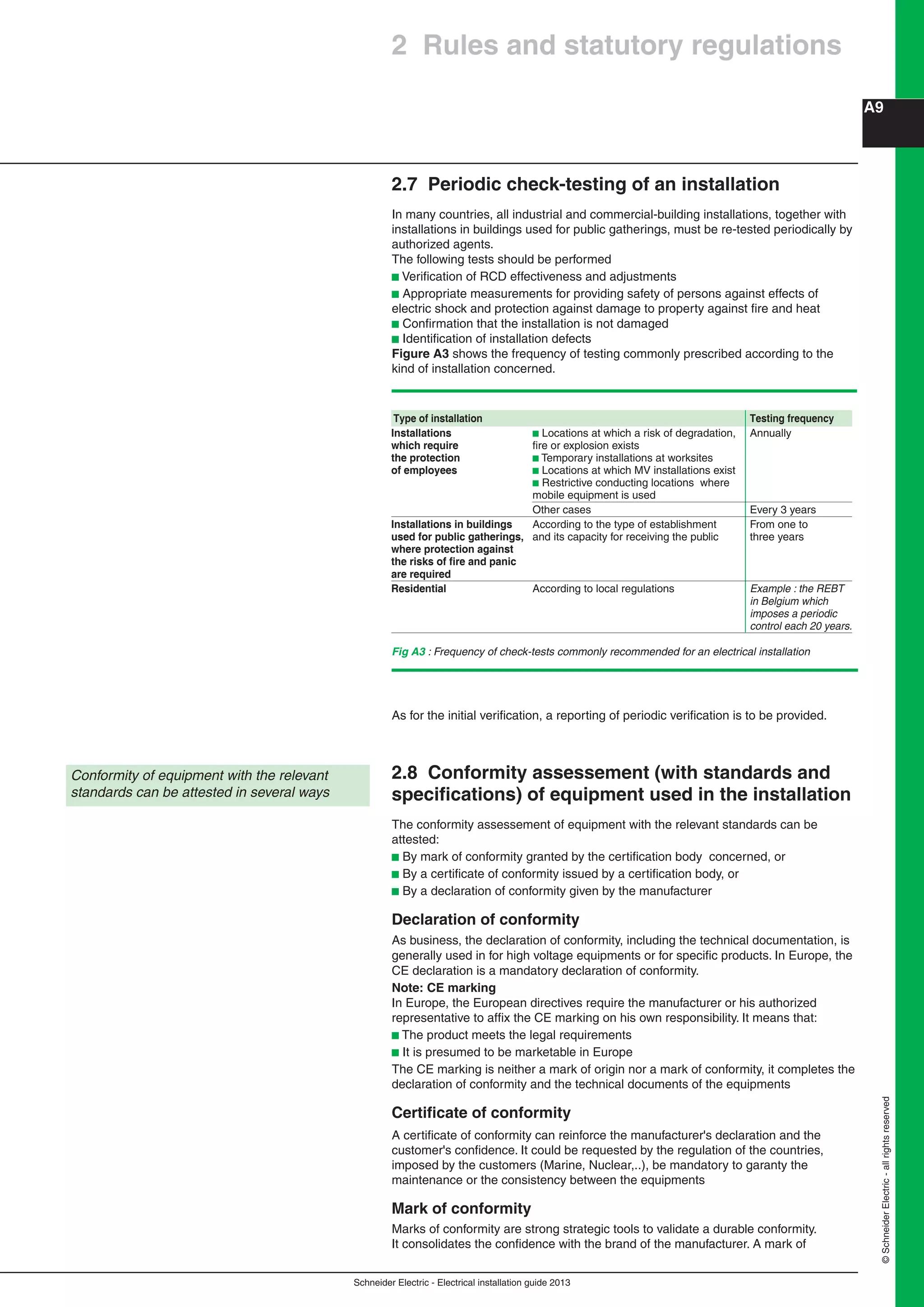
Figure A3 shows the frequency of testing commonly prescribed according to the
kind of installation concerned.
Conformity of equipment with the relevant
standards can be attested in several ways
Fig A3 : Frequency of check-tests commonly recommended for an electrical installation
As for the initial verification, a reporting of periodic verification is to be provided.
2.8 Conformity assessement (with standards and
specifications) of equipment used in the installation
The conformity assessement of equipment with the relevant standards can be
attested:
b By mark of conformity granted by the certification body concerned, or
b By a certificate of conformity issued by a certification body, or
b By a declaration of conformity given by the manufacturer
Declaration of conformity
As business, the declaration of conformity, including the technical documentation, is
generally used in for high voltage equipments or for specific products. In Europe, the
CE declaration is a mandatory declaration of conformity.
Note: CE marking
In Europe, the European directives require the manufacturer or his authorized
representative to affix the CE marking on his own responsibility. It means that:
b The product meets the legal requirements
b It is presumed to be marketable in Europe
The CE marking is neither a mark of origin nor a mark of conformity, it completes the
declaration of conformity and the technical documents of the equipments
Certificate of conformity
A certificate of conformity can reinforce the manufacturer's declaration and the
customer's confidence. It could be requested by the regulation of the countries,
imposed by the customers (Marine, Nuclear,..), be mandatory to garanty the
maintenance or the consistency between the equipments
Mark of conformity
Marks of conformity are strong strategic tools to validate a durable conformity.
It consolidates the confidence with the brand of the manufacturer. A mark of
Type of installation Testing frequency
Installations b Locations at which a risk of degradation, Annually
which require fire or explosion exists
the protection b Temporary installations at worksites
of employees b Locations at which MV installations exist
b Restrictive conducting locations where
mobile equipment is used
Other cases Every 3 years
Installations in buildings According to the type of establishment From one to
used for public gatherings, and its capacity for receiving the public three years
where protection against
the risks of fire and panic
are required
Residential According to local regulations Example : the REBT
in Belgium which
imposes a periodic
control each 20 years.
2 Rules and statutory regulations
Schneider Electric - Electrical installation guide 2013
A - General rules of electrical installation design
A10
©SchneiderElectric-allrightsreserved
2 Rules and statutory regulations
conformity is delivered by certification body if the equipment meets the requirements
from an applicable referential (including the standard) and after verification of the
manufacturer’s quality management system.
Audit on the production and follow up on the equipments are made globally each year.
Quality assurance
A laboratory for testing samples cannot certify the conformity of an entire production
run: these tests are called type tests. In some tests for conformity to standards,
the samples are destroyed (tests on fuses, for example).
Only the manufacturer can certify that the fabricated products have, in fact,
the characteristics stated.
Quality assurance certification is intended to complete the initial declaration or
certification of conformity.
As proof that all the necessary measures have been taken for assuring the quality of
production, the manufacturer obtains certification of the quality control system which
monitors the fabrication of the product concerned. These certificates are issued
by organizations specializing in quality control, and are based on the international
standard ISO 9001: 2000.
These standards define three model systems of quality assurance control
corresponding to different situations rather than to different levels of quality:
b Model 3 defines assurance of quality by inspection and checking of final products.
b Model 2 includes, in addition to checking of the final product, verification of the
manufacturing process. For example, this method is applied, to the manufacturer of
fuses where performance characteristics cannot be checked without destroying the fuse.
b Model 1 corresponds to model 2, but with the additional requirement that the
quality of the design process must be rigorously scrutinized; for example, where it is
not intended to fabricate and test a prototype (case of a custom-built product made to
specification).
2.9 Environment
The contribution of the whole electrical installation to sustainable development can
be significantly improved through the design of the installation. Actually, it has been
shown that an optimised design of the installation, taking into account operation
conditions, MV/LV substations location and distribution structure (switchboards,
busways, cables), can reduce substantially environmental impacts (raw material
depletion, energy depletion, end of life), especially in term of energy efficiency.
Beside its architecture, environmental specification of the electrical component
and equipment is a fundamental step for an eco-friendly installation. In particular to
ensure proper environmental information and anticipate regulation.
In Europe several Directives concerning electrical equipments have been published,
leading the worldwide move to more environment safe products.
a) RoHS Directive (Restriction of Hazardous Substances) : in force since July 2006
and revised on 2012. It aims to eliminate from products six hazardous substances:
lead, mercury, cadmium, hexavalent chromium, polybrominated biphenyls (PBB) or
polybrominated diphenyl ethers (PBDE) from most of end user electrical products..
Though electrical installations being “large scale fixed installation” are not in the
scope, RoHS compliance requirement may be a recommendation for a sustainable
installation
b) WEEE Directive (Waste of Electrical and Electronic Equipment) : in force since
August 2005 and currently under revision. Its purpose is to improve the end of life
treatments for household and non household equipment, under the responsibility
of the manufacturers. As for RoHS, electrical installations are not in the scope of
this directive. However, End of Life Product information is recommended to optimise
recycling process and cost.
c) Energy Related Product , also called Ecodesign. Apart for some equipments
like lighting or motors for which implementing measures are compulsory, there
are no legal requirements that directly apply to installation. However, trend is to
provide electrical equipments with their Environmental Product Declarattion , as it is
becoming for Construction Products , to anticipate Building Market coming requirements.
d) REACh : (Registration Evaluation Authorisation of Chemicals). In force since
2009, it aims to control chemical use and restrict application when necessary to
reduce hazards to people and environment. With regards to EE and installations, it
implies any supplier shall, upon request, communicate to its customer the hazardous
substances content in its product (so called SVHC). Then, an installer should ensure
that its suppliers have the appropriate information available
In other parts of the world new legislations will follow the same objectives.
Schneider Electric - Electrical installation guide 2013
A11
©SchneiderElectric-allrightsreserved
3 Installed power loads -
Characteristics
The examination of actual values of apparent-power required by each load enables
the establishment of:
b A declared power demand which determines the contract for the supply of energy
b The rating of the MV/LV transformer, where applicable (allowing for expected
increased load)
b Levels of load current at each distribution board
3.1 Induction motors
Current demand
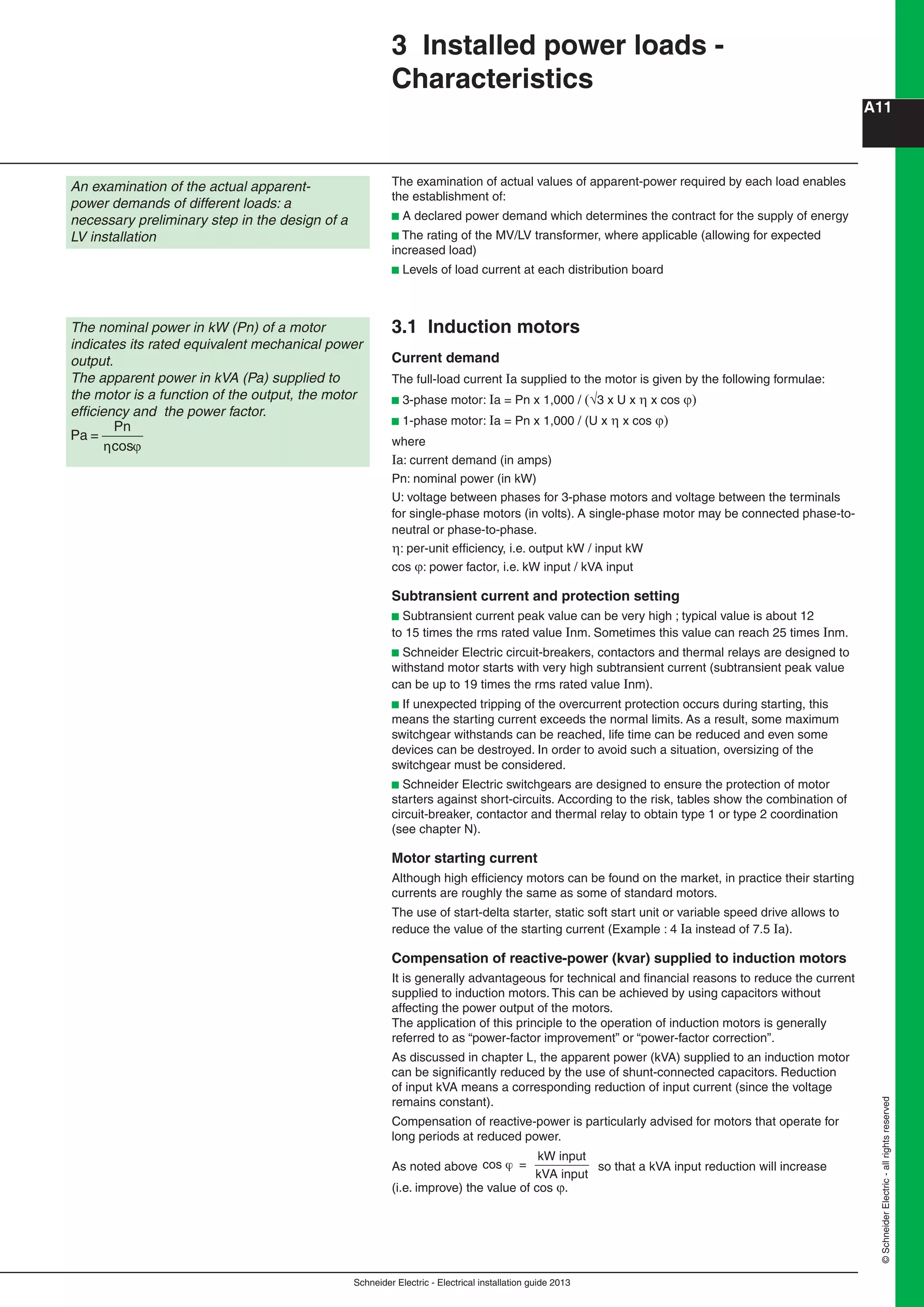
The full-load current Ia supplied to the motor is given by the following formulae:
b 3-phase motor: Ia = Pn x 1,000 / 3 x U x  x cos 
b 1-phase motor: Ia = Pn x 1,000 / (U x  x cos 
where
Ia: current demand (in amps)
Pn: nominal power (in kW)
U: voltage between phases for 3-phase motors and voltage between the terminals
for single-phase motors (in volts). A single-phase motor may be connected phase-to-
neutral or phase-to-phase.
: per-unit efficiency, i.e. output kW / input kW
cos : power factor, i.e. kW input / kVA input
Subtransient current and protection setting
b Subtransient current peak value can be very high ; typical value is about 12
to 15 times the rms rated value Inm. Sometimes this value can reach 25 times Inm.
b Schneider Electric circuit-breakers, contactors and thermal relays are designed to
withstand motor starts with very high subtransient current (subtransient peak value
can be up to 19 times the rms rated value Inm).
b If unexpected tripping of the overcurrent protection occurs during starting, this
means the starting current exceeds the normal limits. As a result, some maximum
switchgear withstands can be reached, life time can be reduced and even some
devices can be destroyed. In order to avoid such a situation, oversizing of the
switchgear must be considered.
b Schneider Electric switchgears are designed to ensure the protection of motor
starters against short-circuits. According to the risk, tables show the combination of
circuit-breaker, contactor and thermal relay to obtain type 1 or type 2 coordination
(see chapter N).
Motor starting current
Although high efficiency motors can be found on the market, in practice their starting
currents are roughly the same as some of standard motors.
The use of start-delta starter, static soft start unit or variable speed drive allows to
reduce the value of the starting current (Example : 4 Ia instead of 7.5 Ia).
Compensation of reactive-power (kvar) supplied to induction motors
It is generally advantageous for technical and financial reasons to reduce the current
supplied to induction motors. This can be achieved by using capacitors without
affecting the power output of the motors.
The application of this principle to the operation of induction motors is generally
referred to as “power-factor improvement” or “power-factor correction”.
As discussed in chapter L, the apparent power (kVA) supplied to an induction motor
can be significantly reduced by the use of shunt-connected capacitors. Reduction
of input kVA means a corresponding reduction of input current (since the voltage
remains constant).
Compensation of reactive-power is particularly advised for motors that operate for
long periods at reduced power.
As noted above cos =
kW input
kVA input
so that a kVA input reduction will increase
(i.e. improve) the value of cos .
An examination of the actual apparent-
power demands of different loads: a
necessary preliminary step in the design of a
LV installation
The nominal power in kW (Pn) of a motor
indicates its rated equivalent mechanical power
output.
The apparent power in kVA (Pa) supplied to
the motor is a function of the output, the motor
efficiency and the power factor.
Pa =
Pn
cosη ϕ
Schneider Electric - Electrical installation guide 2013
A - General rules of electrical installation design
A12
©SchneiderElectric-allrightsreserved
The current supplied to the motor, after power-factor correction, is given by:
I
cos
cos '
=Ia
where cos  is the power factor before compensation and cos ’ is the power factor
after compensation, Ia being the original current.
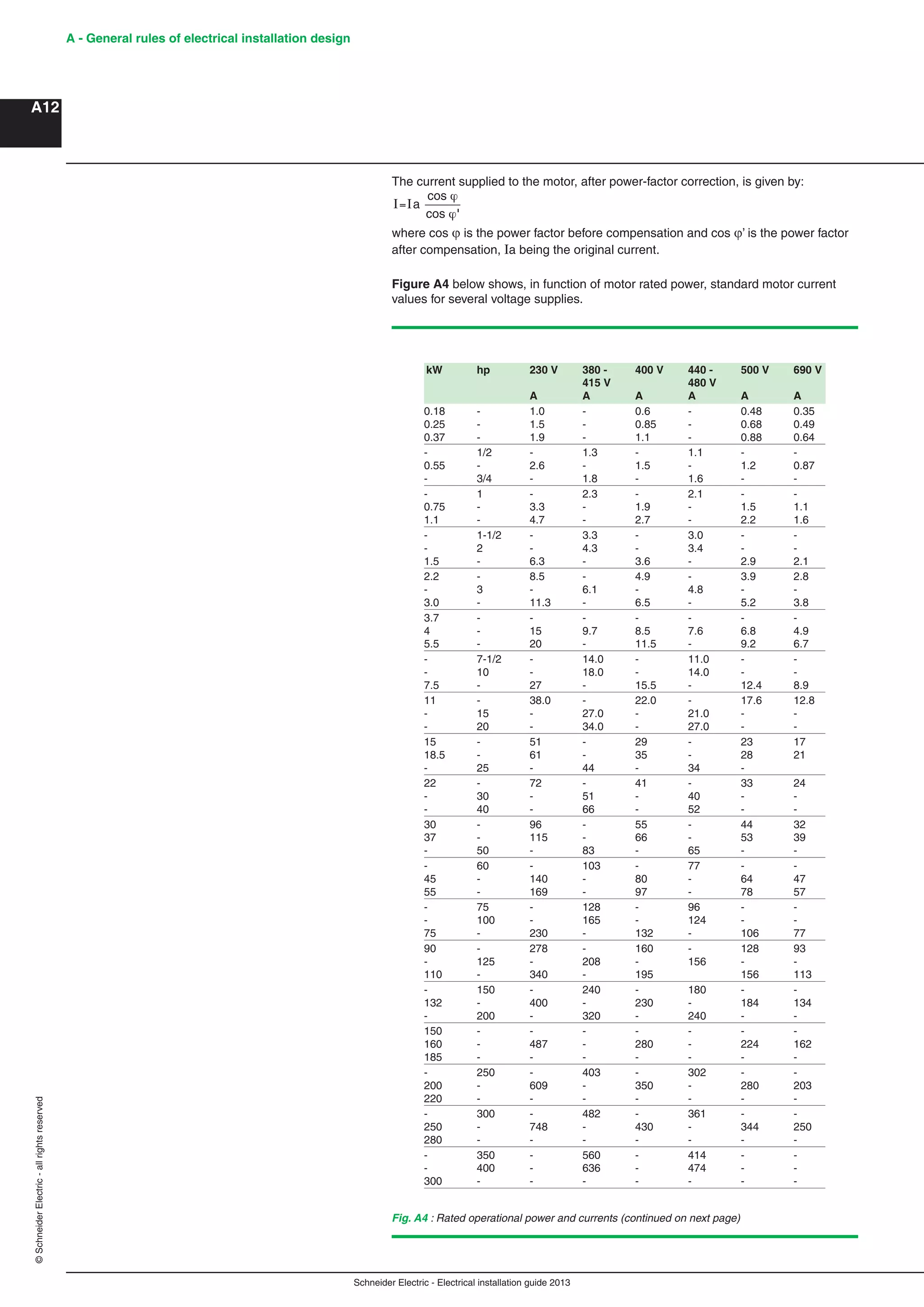
Figure A4 below shows, in function of motor rated power, standard motor current
values for several voltage supplies.
kW hp 230 V 380 - 400 V 440 - 500 V 690 V
415 V 480 V
A A A A A A
0.18 - 1.0 - 0.6 - 0.48 0.35
0.25 - 1.5 - 0.85 - 0.68 0.49
0.37 - 1.9 - 1.1 - 0.88 0.64
- 1/2 - 1.3 - 1.1 - -
0.55 - 2.6 - 1.5 - 1.2 0.87
- 3/4 - 1.8 - 1.6 - -
- 1 - 2.3 - 2.1 - -
0.75 - 3.3 - 1.9 - 1.5 1.1
1.1 - 4.7 - 2.7 - 2.2 1.6
- 1-1/2 - 3.3 - 3.0 - -
- 2 - 4.3 - 3.4 - -
1.5 - 6.3 - 3.6 - 2.9 2.1
2.2 - 8.5 - 4.9 - 3.9 2.8
- 3 - 6.1 - 4.8 - -
3.0 - 11.3 - 6.5 - 5.2 3.8
3.7 - - - - - - -
4 - 15 9.7 8.5 7.6 6.8 4.9
5.5 - 20 - 11.5 - 9.2 6.7
- 7-1/2 - 14.0 - 11.0 - -
- 10 - 18.0 - 14.0 - -
7.5 - 27 - 15.5 - 12.4 8.9
11 - 38.0 - 22.0 - 17.6 12.8
- 15 - 27.0 - 21.0 - -
- 20 - 34.0 - 27.0 - -
15 - 51 - 29 - 23 17
18.5 - 61 - 35 - 28 21
- 25 - 44 - 34 -
22 - 72 - 41 - 33 24
- 30 - 51 - 40 - -
- 40 - 66 - 52 - -
30 - 96 - 55 - 44 32
37 - 115 - 66 - 53 39
- 50 - 83 - 65 - -
- 60 - 103 - 77 - -
45 - 140 - 80 - 64 47
55 - 169 - 97 - 78 57
- 75 - 128 - 96 - -
- 100 - 165 - 124 - -
75 - 230 - 132 - 106 77
90 - 278 - 160 - 128 93
- 125 - 208 - 156 - -
110 - 340 - 195 156 113
- 150 - 240 - 180 - -
132 - 400 - 230 - 184 134
- 200 - 320 - 240 - -
150 - - - - - - -
160 - 487 - 280 - 224 162
185 - - - - - - -
- 250 - 403 - 302 - -
200 - 609 - 350 - 280 203
220 - - - - - - -
- 300 - 482 - 361 - -
250 - 748 - 430 - 344 250
280 - - - - - - -
- 350 - 560 - 414 - -
- 400 - 636 - 474 - -
300 - - - - - - -
Fig. A4 : Rated operational power and currents (continued on next page)
Schneider Electric - Electrical installation guide 2013
A13
©SchneiderElectric-allrightsreserved
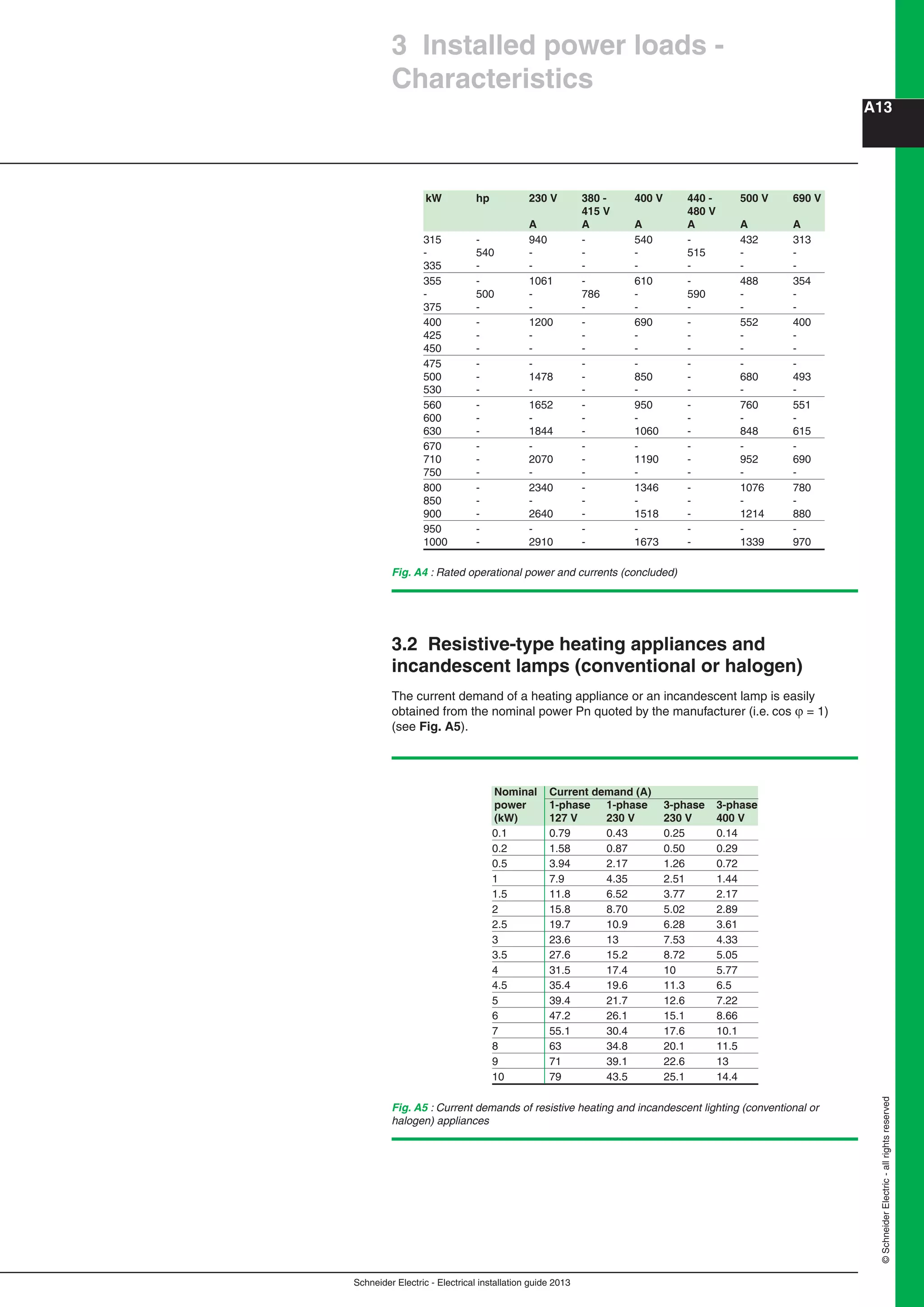
kW hp 230 V 380 - 400 V 440 - 500 V 690 V
415 V 480 V
A A A A A A
315 - 940 - 540 - 432 313
- 540 - - - 515 - -
335 - - - - - - -
355 - 1061 - 610 - 488 354
- 500 - 786 - 590 - -
375 - - - - - - -
400 - 1200 - 690 - 552 400
425 - - - - - - -
450 - - - - - - -
475 - - - - - - -
500 - 1478 - 850 - 680 493
530 - - - - - - -
560 - 1652 - 950 - 760 551
600 - - - - - - -
630 - 1844 - 1060 - 848 615
670 - - - - - - -
710 - 2070 - 1190 - 952 690
750 - - - - - - -
800 - 2340 - 1346 - 1076 780
850 - - - - - - -
900 - 2640 - 1518 - 1214 880
950 - - - - - - -
1000 - 2910 - 1673 - 1339 970
Fig. A4 : Rated operational power and currents (concluded)
3.2 Resistive-type heating appliances and
incandescent lamps (conventional or halogen)
The current demand of a heating appliance or an incandescent lamp is easily
obtained from the nominal power Pn quoted by the manufacturer (i.e. cos  = 1)
(see Fig. A5).
Fig. A5 : Current demands of resistive heating and incandescent lighting (conventional or
halogen) appliances
Nominal Current demand (A)
power 1-phase 1-phase 3-phase 3-phase
(kW) 127 V 230 V 230 V 400 V
0.1 0.79 0.43 0.25 0.14
0.2 1.58 0.87 0.50 0.29
0.5 3.94 2.17 1.26 0.72
1 7.9 4.35 2.51 1.44
1.5 11.8 6.52 3.77 2.17
2 15.8 8.70 5.02 2.89
2.5 19.7 10.9 6.28 3.61
3 23.6 13 7.53 4.33
3.5 27.6 15.2 8.72 5.05
4 31.5 17.4 10 5.77
4.5 35.4 19.6 11.3 6.5
5 39.4 21.7 12.6 7.22
6 47.2 26.1 15.1 8.66
7 55.1 30.4 17.6 10.1
8 63 34.8 20.1 11.5
9 71 39.1 22.6 13
10 79 43.5 25.1 14.4
3 Installed power loads -
Characteristics
Schneider Electric - Electrical installation guide 2013
A - General rules of electrical installation design
A14
©SchneiderElectric-allrightsreserved
(2) “Power-factor correction” is often referred to as
“compensation” in discharge-lighting-tube terminology.
Cos  is approximately 0.95 (the zero values of V and I
are almost in phase) but the power factor is 0.5 due to the
impulsive form of the current, the peak of which occurs “late”
in each half cycle
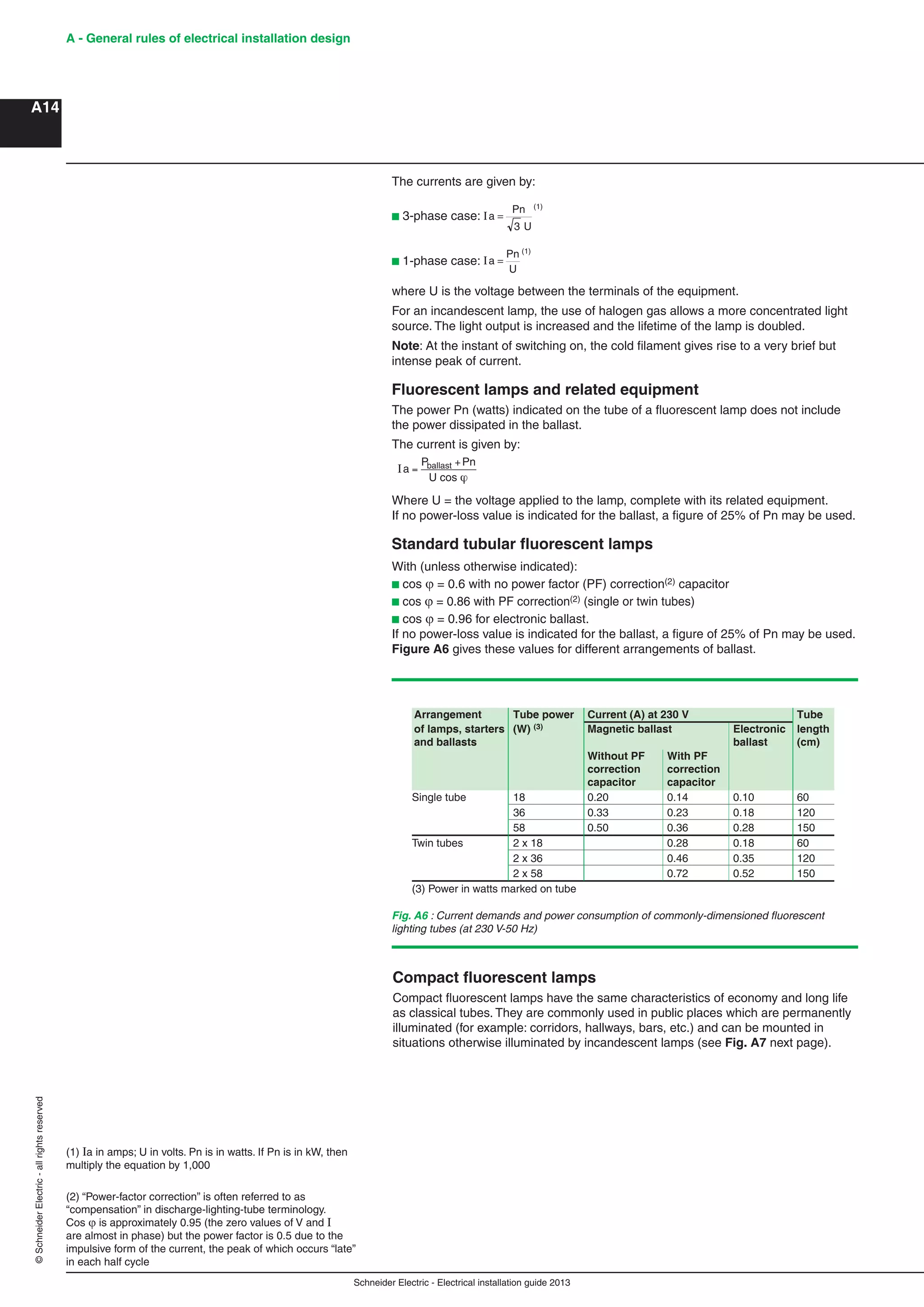
The currents are given by:
b 3-phase case: Ia =
Pn
U3
(1)
b 1-phase case: Ia =
Pn
U
(1)
where U is the voltage between the terminals of the equipment.
For an incandescent lamp, the use of halogen gas allows a more concentrated light
source. The light output is increased and the lifetime of the lamp is doubled.
Note: At the instant of switching on, the cold filament gives rise to a very brief but
intense peak of current.
Fluorescent lamps and related equipment
The power Pn (watts) indicated on the tube of a fluorescent lamp does not include
the power dissipated in the ballast.
The current is given by:
Ia
cos
=
+P Pn
U
ballast
Where U = the voltage applied to the lamp, complete with its related equipment.
If no power-loss value is indicated for the ballast, a figure of 25% of Pn may be used.
Standard tubular fluorescent lamps
With (unless otherwise indicated):
b cos  = 0.6 with no power factor (PF) correction(2) capacitor
b cos  = 0.86 with PF correction(2) (single or twin tubes)
b cos  = 0.96 for electronic ballast.
If no power-loss value is indicated for the ballast, a figure of 25% of Pn may be used.
Figure A6 gives these values for different arrangements of ballast.
(1) Ia in amps; U in volts. Pn is in watts. If Pn is in kW, then
multiply the equation by 1,000
Fig. A6 : Current demands and power consumption of commonly-dimensioned fluorescent
lighting tubes (at 230 V-50 Hz)
Arrangement Tube power Current (A) at 230 V Tube
of lamps, starters (W) (3) Magnetic ballast Electronic length
and ballasts ballast (cm)
Without PF With PF
correction correction
capacitor capacitor
Single tube 18 0.20 0.14 0.10 60
36 0.33 0.23 0.18 120
58 0.50 0.36 0.28 150
Twin tubes 2 x 18 0.28 0.18 60
2 x 36 0.46 0.35 120
2 x 58 0.72 0.52 150
(3) Power in watts marked on tube
Compact fluorescent lamps
Compact fluorescent lamps have the same characteristics of economy and long life
as classical tubes. They are commonly used in public places which are permanently
illuminated (for example: corridors, hallways, bars, etc.) and can be mounted in
situations otherwise illuminated by incandescent lamps (see Fig. A7 next page).
Schneider Electric - Electrical installation guide 2013
A15
©SchneiderElectric-allrightsreserved
3 Installed power loads -
Characteristics
The power in watts indicated on the tube of
a discharge lamp does not include the power
dissipated in the ballast.
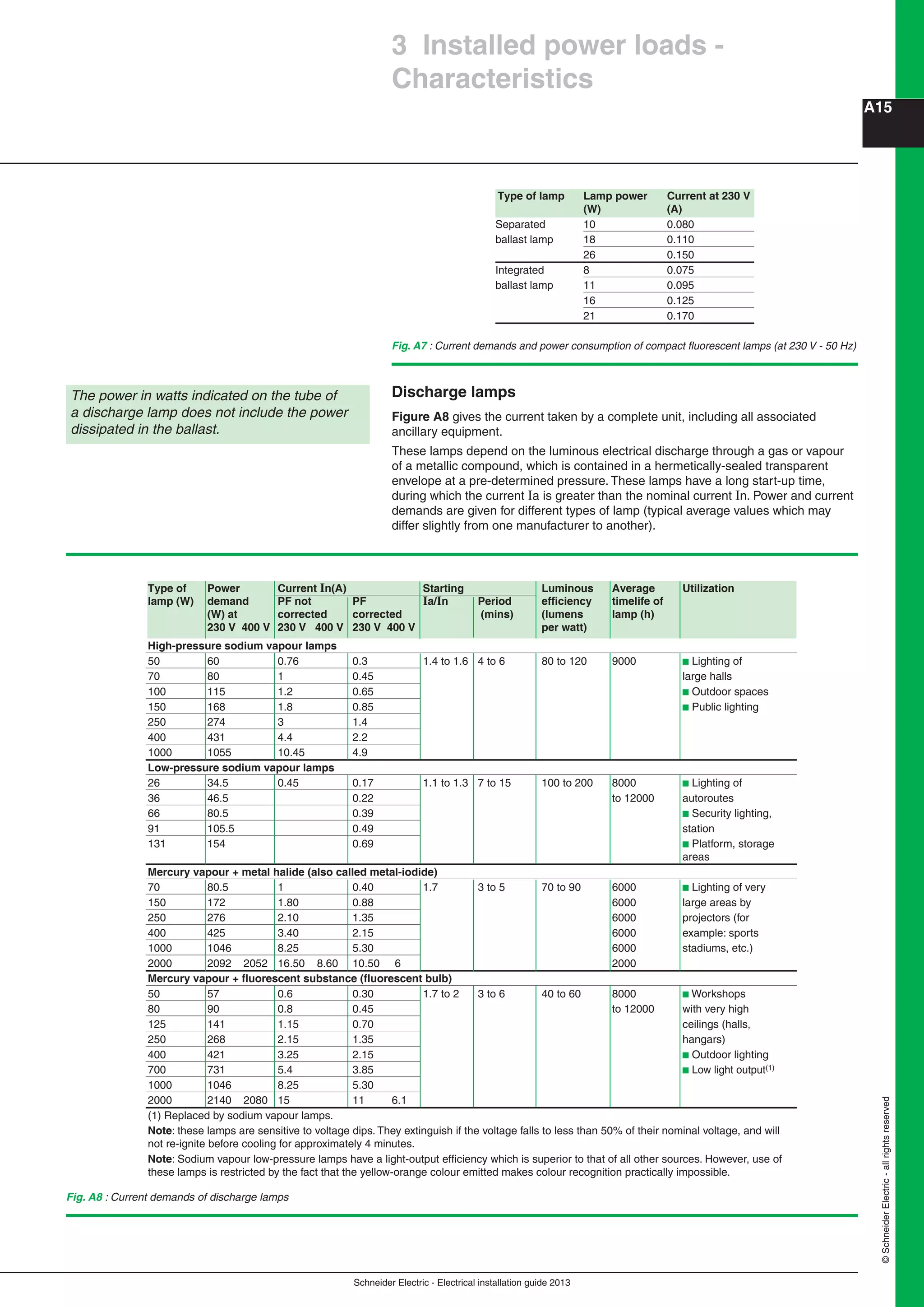
Fig. A7 : Current demands and power consumption of compact fluorescent lamps (at 230 V - 50 Hz)
Type of lamp Lamp power Current at 230 V
(W) (A)
Separated 10 0.080
ballast lamp 18 0.110
26 0.150
Integrated 8 0.075
ballast lamp 11 0.095
16 0.125
21 0.170
Fig. A8 : Current demands of discharge lamps
Type of Power Current In(A) Starting Luminous Average Utilization
lamp (W) demand PF not PF Ia/In Period efficiency timelife of
(W) at corrected corrected (mins) (lumens lamp (h)
230 V 400 V 230 V 400 V 230 V 400 V per watt)
High-pressure sodium vapour lamps
50 60 0.76 0.3 1.4 to 1.6 4 to 6 80 to 120 9000 b Lighting of
70 80 1 0.45 large halls
100 115 1.2 0.65 b Outdoor spaces
150 168 1.8 0.85 b Public lighting
250 274 3 1.4
400 431 4.4 2.2
1000 1055 10.45 4.9
Low-pressure sodium vapour lamps
26 34.5 0.45 0.17 1.1 to 1.3 7 to 15 100 to 200 8000 b Lighting of
36 46.5 0.22 to 12000 autoroutes
66 80.5 0.39 b Security lighting,
91 105.5 0.49 station
131 154 0.69 b Platform, storage
areas
Mercury vapour + metal halide (also called metal-iodide)
70 80.5 1 0.40 1.7 3 to 5 70 to 90 6000 b Lighting of very
150 172 1.80 0.88 6000 large areas by
250 276 2.10 1.35 6000 projectors (for
400 425 3.40 2.15 6000 example: sports
1000 1046 8.25 5.30 6000 stadiums, etc.)
2000 2092 2052 16.50 8.60 10.50 6 2000
Mercury vapour + fluorescent substance (fluorescent bulb)
50 57 0.6 0.30 1.7 to 2 3 to 6 40 to 60 8000 b Workshops
80 90 0.8 0.45 to 12000 with very high
125 141 1.15 0.70 ceilings (halls,
250 268 2.15 1.35 hangars)
400 421 3.25 2.15 b Outdoor lighting
700 731 5.4 3.85 b Low light output(1)
1000 1046 8.25 5.30
2000 2140 2080 15 11 6.1
(1) Replaced by sodium vapour lamps.
Note: these lamps are sensitive to voltage dips. They extinguish if the voltage falls to less than 50% of their nominal voltage, and will
not re-ignite before cooling for approximately 4 minutes.
Note: Sodium vapour low-pressure lamps have a light-output efficiency which is superior to that of all other sources. However, use of
these lamps is restricted by the fact that the yellow-orange colour emitted makes colour recognition practically impossible.
Discharge lamps
Figure A8 gives the current taken by a complete unit, including all associated
ancillary equipment.
These lamps depend on the luminous electrical discharge through a gas or vapour
of a metallic compound, which is contained in a hermetically-sealed transparent
envelope at a pre-determined pressure. These lamps have a long start-up time,
during which the current Ia is greater than the nominal current In. Power and current
demands are given for different types of lamp (typical average values which may
differ slightly from one manufacturer to another).
Schneider Electric - Electrical installation guide 2013
A - General rules of electrical installation design
A16
©SchneiderElectric-allrightsreserved A - General rules of electrical installation design
In order to design an installation, the actual maximum load demand likely to be
imposed on the power-supply system must be assessed.
To base the design simply on the arithmetic sum of all the loads existing in the
installation would be extravagantly uneconomical, and bad engineering practice.
The aim of this chapter is to show how some factors taking into account the diversity
(non simultaneous operation of all appliances of a given group) and utilization
(e.g. an electric motor is not generally operated at its full-load capability, etc.) of
all existing and projected loads can be assessed. The values given are based on
experience and on records taken from actual installations. In addition to providing
basic installation-design data on individual circuits, the results will provide a
global value for the installation, from which the requirements of a supply system
(distribution network, MV/LV transformer, or generating set) can be specified.
4.1 Installed power (kW)
The installed power is the sum of the nominal
powers of all power consuming devices in the
installation.
This is not the power to be actually supplied in
practice.
Most electrical appliances and equipments are marked to indicate their nominal
power rating (Pn).
The installed power is the sum of the nominal powers of all power-consuming
devices in the installation. This is not the power to be actually supplied in practice.
This is the case for electric motors, where the power rating refers to the output power
at its driving shaft. The input power consumption will evidently be greater
Fluorescent and discharge lamps associated with stabilizing ballasts, are other
cases in which the nominal power indicated on the lamp is less than the power
consumed by the lamp and its ballast.
Methods of assessing the actual power consumption of motors and lighting
appliances are given in Section 3 of this Chapter.
The power demand (kW) is necessary to choose the rated power of a generating set
or battery, and where the requirements of a prime mover have to be considered.
For a power supply from a LV public-supply network, or through a MV/LV transformer,
the significant quantity is the apparent power in kVA.
4.2 Installed apparent power (kVA)
The installed apparent power is commonly assumed to be the arithmetical sum of
the kVA of individual loads. The maximum estimated kVA to be supplied however is
not equal to the total installed kVA.
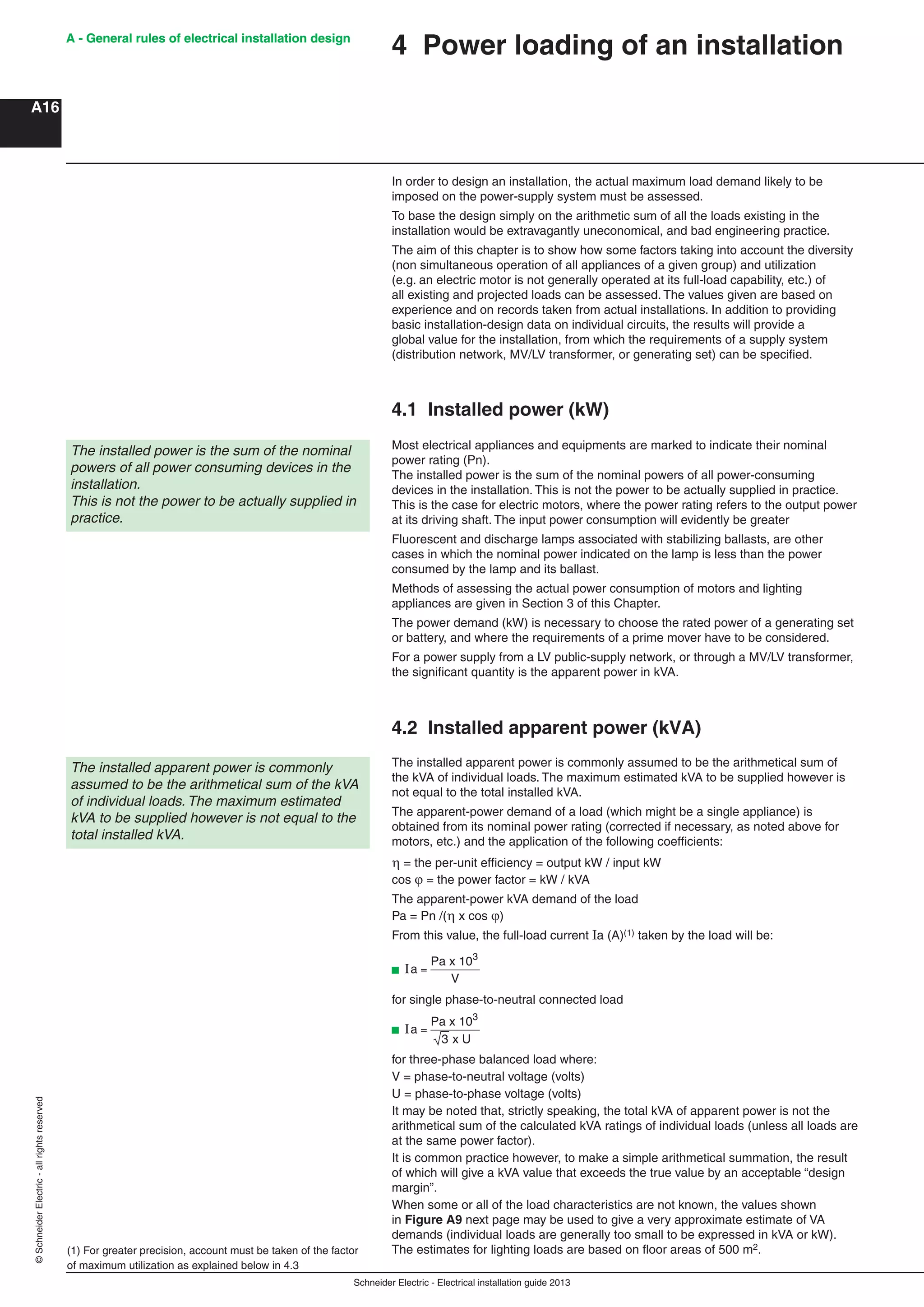
The apparent-power demand of a load (which might be a single appliance) is
obtained from its nominal power rating (corrected if necessary, as noted above for
motors, etc.) and the application of the following coefficients:
 = the per-unit efficiency = output kW / input kW
cos  = the power factor = kW / kVA
The apparent-power kVA demand of the load
Pa = Pn /( x cos )
From this value, the full-load current Ia (A)(1) taken by the load will be:
b Ia =
Pa x 10
V
3
for single phase-to-neutral connected load
b Ia =
Pa x 103
3 x U
for three-phase balanced load where:
V = phase-to-neutral voltage (volts)
U = phase-to-phase voltage (volts)
It may be noted that, strictly speaking, the total kVA of apparent power is not the
arithmetical sum of the calculated kVA ratings of individual loads (unless all loads are
at the same power factor).
It is common practice however, to make a simple arithmetical summation, the result
of which will give a kVA value that exceeds the true value by an acceptable “design
margin”.
When some or all of the load characteristics are not known, the values shown
in Figure A9 next page may be used to give a very approximate estimate of VA
demands (individual loads are generally too small to be expressed in kVA or kW).
The estimates for lighting loads are based on floor areas of 500 m2.
The installed apparent power is commonly
assumed to be the arithmetical sum of the kVA
of individual loads. The maximum estimated
kVA to be supplied however is not equal to the
total installed kVA.
(1) For greater precision, account must be taken of the factor
of maximum utilization as explained below in 4.3
4 Power loading of an installation
Schneider Electric - Electrical installation guide 2013
A17
©SchneiderElectric-allrightsreserved
Fig. A9 : Estimation of installed apparent power
4.3 Estimation of actual maximum kVA demand
All individual loads are not necessarily operating at full rated nominal power nor
necessarily at the same time. Factors ku and ks allow the determination of the
maximum power and apparent-power demands actually required to dimension the
installation.
Factor of maximum utilization (ku)
In normal operating conditions the power consumption of a load is sometimes less
than that indicated as its nominal power rating, a fairly common occurrence that
justifies the application of an utilization factor (ku) in the estimation of realistic values.
This factor must be applied to each individual load, with particular attention to
electric motors, which are very rarely operated at full load.
In an industrial installation this factor may be estimated on an average at 0.75 for
motors.
For incandescent-lighting loads, the factor always equals 1.
For socket-outlet circuits, the factors depend entirely on the type of appliances being
supplied from the sockets concerned.
For Electric Vehicle the utilization factor will be systematically estimated to 1, as it
takes a long time to load completely the batteries (several hours) and a dedicated
circuit feeding the charging station or wall box will be required by standards.
Factor of simultaneity (ks)
It is a matter of common experience that the simultaneous operation of all installed
loads of a given installation never occurs in practice, i.e. there is always some degree
of diversity and this fact is taken into account for estimating purposes by the use of a
simultaneity factor (ks).
The factor ks is applied to each group of loads (e.g. being supplied from a distribution
or sub-distribution board). The determination of these factors is the responsibility
of the designer, since it requires a detailed knowledge of the installation and the
conditions in which the individual circuits are to be exploited. For this reason, it is not
possible to give precise values for general application.
Fluorescent lighting (corrected to cos  = 0.86)
Type of application Estimated (VA/m2) Average lighting
fluorescent tube level (lux = lm/m2)
with industrial reflector(1)
Roads and highways 7 150
storage areas, intermittent work
Heavy-duty works: fabrication and 14 300
assembly of very large work pieces
Day-to-day work: office work 24 500
Fine work: drawing offices 41 800
high-precision assembly workshops
Power circuits
Type of application Estimated (VA/m2)
Pumping station compressed air 3 to 6
Ventilation of premises 23
Electrical convection heaters:
private houses 115 to 146
flats and apartments 90
Offices 25
Dispatching workshop 50
Assembly workshop 70
Machine shop 300
Painting workshop 350
Heat-treatment plant 700
(1) example: 65 W tube (ballast not included), flux 5,100 lumens (Im),
luminous efficiency of the tube = 78.5 Im / W.
4 Power loading of an installation
Schneider Electric - Electrical installation guide 2013
A - General rules of electrical installation design
A18
©SchneiderElectric-allrightsreserved
Factor of simultaneity for an apartment block
Some typical values for this case are given in Figure A10, and are applicable
to domestic consumers supplied at 230/400 V (3-phase 4-wires). In the case of
consumers using electrical heat-storage units for space heating, a factor of 0.8 is
recommended, regardless of the number of consumers.
Example (see Fig. A11):
5 storeys apartment building with 25 consumers, each having 6 kVA of installed load.
The total installed load for the building is: 36 + 24 + 30 + 36 + 24 = 150 kVA
The apparent-power supply required for the building is: 150 x 0.46 = 69 kVA
From Figure A10, it is possible to determine the magnitude of currents in different
sections of the common main feeder supplying all floors. For vertical rising mains
fed at ground level, the cross-sectional area of the conductors can evidently be
progressively reduced from the lower floors towards the upper floors.
These changes of conductor size are conventionally spaced by at least 3-floor
intervals.
In the example, the current entering the rising main at ground level is:
150 x 0.46 x 10
400 3
3
= 100 A
the current entering the third floor is:
(36 + 24) x 0.63 x 10
400 3
3
= 55 A
4th
floor
6 consumers
36 kVA
3rd
floor
2nd
floor
1st
floor
ground
floor
4 consumers
24 kVA
6 consumers
36 kVA
5 consumers
30 kVA
4 consumers
24 kVA
0.78
0.63
0.53
0.49
0.46
Fig. A11 : Application of the factor of simultaneity (ks) to an apartment block of 5 storeys
Fig. A10 : Simultaneity factors in an apartment block
Number of downstream Factor of
consumers simultaneity (ks)
2 to 4 1
5 to 9 0.78
10 to 14 0.63
15 to 19 0.53
20 to 24 0.49
25 to 29 0.46
30 to 34 0.44
35 to 39 0.42
40 to 49 0.41
50 and more 0.40
Schneider Electric - Electrical installation guide 2013
A19
©SchneiderElectric-allrightsreserved
4 Power loading of an installation
4.4 Example of application of factors ku and ks
An example in the estimation of actual maximum kVA demands at all levels of an
installation, from each load position to the point of supply is given Fig. A14.
In this example, the total installed apparent power is 126.6 kVA, which corresponds
to an actual (estimated) maximum value at the LV terminals of the MV/LV transformer
of 65 kVA only.
Note: in order to select cable sizes for the distribution circuits of an installation, the
current I (in amps) through a circuit is determined from the equation:
I =
kVA
U
x 103
3
where kVA is the actual maximum 3-phase apparent-power value shown on the
diagram for the circuit concerned, and U is the phase to- phase voltage (in volts).
4.5 Diversity factor
The term diversity factor, as defined in IEC standards, is identical to the factor of
simultaneity (ks) used in this guide, as described in 4.3. In some English-speaking
countries however (at the time of writing) diversity factor is the inverse of ks i.e. it is
always u 1.
Factor of simultaneity for distribution switchboards
Figure A12 shows hypothetical values of ks for a distribution board supplying a
number of circuits for which there is no indication of the manner in which the total
load divides between them.
If the circuits are mainly for lighting loads, it is prudent to adopt ks values close to
unity.
Fig. A12 : Factor of simultaneity for distribution boards
Circuit function Factor of simultaneity (ks)
Lighting 1
Heating and air conditioning 1
Socket-outlets 0.1 to 0.2 (1)
Lifts and catering hoist (2) b For the most powerful
motor 1
b For the second most
powerful motor 0.75
b For all motors 0.60
(1) In certain cases, notably in industrial installations, this factor can be higher.
(2) The current to take into consideration is equal to the nominal current of the motor,
increased by a third of its starting current.
Fig. A13 : Factor of simultaneity according to circuit function
Number of Factor of
circuits simultaneity (ks)
2 and 3 0.9
4 and 5 0.8
6 to 9 0.7
10 and more 0.6
Factor of simultaneity according to circuit function
ks factors which may be used for circuits supplying commonly-occurring loads, are
shown in Figure A13.
Schneider Electric - Electrical installation guide 2013
A - General rules of electrical installation design
A20
©SchneiderElectric-allrightsreserved
Fig A14 : An example in estimating the maximum predicted loading of an installation (the factor values used are for demonstration purposes only)
1
Distribution
box
Workshop A 5 0.8
0.8
0.8
0.8
0.8
0.8
5
5
5
2
2
Lathe
18
3 11
10.8
0.41
15
10.6
2.5
2.5
15
15
Ventilation
0.28118
112
1
Oven
30 fluorescent
lamps
Pedestal-
drill
Workshop B Compressor
Workshop C
no. 1
no. 2
no. 3
no. 4
no. 1
no. 2
no. 1
no. 2
no. 1
no. 2
4
4
4
4
1.6
1.6
18
3
14.4
12
1
1
1
1
2.5
2
18
15
15
2.5
Workshop A
distribution
box
0.75
Power
circuit
Power
circuit
Powver
circuit
Workshop B
distribution
box
Workshop C
distribution
box
Main
general
distribution
board
MGDB
Socket-
oulets
Socket-
oulets
Socket-
oulets
Lighting
circuit
Lighting
circuit
Lighting
circuit
0.9
0.9
0.9
0.9
10.6
3.6
3
12
4.3
1
15.6
18.9
37.8
35
5
2
65
LV / MV
Distribution
box
111
0.21
10/16 A
5 socket-
outlets
20 fluorescent
lamps
5 socket-
outlets
10 fluorescent
lamps
3 socket-
outlets
10/16 A
10/16 A
Utilization Apparent Utilization Apparent Simultaneity Apparent Simultaneity Apparent Simultaneity Apparent
power factor power factor power factor power factor power
(Pa) max. demand demand demand demand
kVA max. kVA kVA kVA kVA
Level 1 Level 2 Level 3
4.6 Choice of transformer rating
When an installation is to be supplied directly from a MV/LV transformer and
the maximum apparent-power loading of the installation has been determined, a
suitable rating for the transformer can be decided, taking into account the following
considerations (see Fig. A15):
b The possibility of improving the power factor of the installation (see chapter L)
b Anticipated extensions to the installation
b Installation constraints (e.g. temperature)
b Standard transformer ratings
The nominal full-load current In on the LV side of a 3-phase transformer is given by:
In
a x 103
=
P
U 3
where
b Pa = kVA rating of the transformer
b U = phase-to-phase voltage at no-load in volts (237 V or 410 V)
b In is in amperes.
For a single-phase transformer:
In
a x 103
=
P
V
where
b V = voltage between LV terminals at no-load (in volts)
Simplified equation for 400 V (3-phase load)
b In = kVA x 1.4
The IEC standard for power transformers is IEC 60076.
Fig. A15 : Standard apparent powers for MV/LV transformers
and related nominal output currents
Apparent power In (A)
kVA 237 V 410 V
100 244 141
160 390 225
250 609 352
315 767 444
400 974 563
500 1218 704
630 1535 887
800 1949 1127
1000 2436 1408
1250 3045 1760
1600 3898 2253
2000 4872 2816
2500 6090 3520
3150 7673 4436
Schneider Electric - Electrical installation guide 2013
A21
©SchneiderElectric-allrightsreserved
4.7 Choice of power-supply sources
The importance of maintaining a continuous supply raises the question of the use of
standby-power plant. The choice and characteristics of these alternative sources are
part of the architecture selection, as described in chapter D.
For the main source of supply the choice is generally between a connection to the
MV or the LV network of the power-supply utility. In some cases main source of
supply can be rotating generators in the case of remote installations with difficult
access to the local Utility public grid (MV or LV) or where the reliability of the public
grid does not have the minimum level of reliability expected.
In practice, connection to a MV source may be necessary where the load exceeds
(or is planned eventually to exceed) a certain level - generally of the order of
250 kVA, or if the quality of service required is greater than that normally available
from a LV network.
Moreover, if the installation is likely to cause disturbance to neighbouring consumers,
when connected to a LV network, the supply authorities may propose a MV service.
Supplies at MV can have certain advantages: in fact, a MV consumer:
b Is not disturbed by other consumers, which could be the case at LV
b Is free to choose any type of LV earthing system
b Has a wider choice of economic tariffs
b Can accept very large increases in load
It should be noted, however, that:
b The consumer is the owner of the MV/LV substation and, in some countries,
he must build equip and maintain it at his own expense. The power utility can, in
certain circumstances, participate in the investment, at the level of the MV line for
example
b A part of the connection costs can, for instance, often be recovered if a second
consumer is connected to the MV line within a certain time following the original
consumer’s own connection
b The consumer has access only to the LV part of the installation, access to the
MV part being reserved to the utility personnel (meter reading, operations, etc.).
However, in certain countries, the MV protective circuit-breaker (or fused load-break
switch) can be operated by the consumer
b The type and location of the substation are agreed between the consumer and
the utility
More and more renewable energy sources such as photovoltaic panels are used
to supply low-voltage electrical installations. In some case these PV panels
are connected in parallel to the Utility grid or these PV panels are used in an
autonomous mode without connection to the public grid. Conversion from d.c. to a.c.
is then necessary as rated voltage of these PV panels are higher and higher (few
hundreds volts) and also because PV panels produce d.c. currents.
4 Power loading of an installation
Schneider Electric - Electrical installation guide 2013
B1
©SchneiderElectric-allrightsreserved
Chapter B
Connection to the MV utility
distribution network
Contents
Power supply at medium voltage B2
1.1 Power supply characteristics of medium-voltage networks B2
1.2 Different types of MV power supply B2
1.3 Some practical issues concerning MV distribution networks B3
Procedure for the establishment of a new substation B5
2.1 Preliminary informations B5
2.2 Project studies B6
2.3 Implementation B6
2.4 Commissioning B6
Protection aspect B7
3.1 Protection against electric shocks B7
3.2 Protection of transformer and circuits B8
3.3 Interlocks and conditioned operations B10
The consumer substation with LV metering B13
4.1 Functions of the substation with LV metering B13
4.2 Choosing MV equipment B13
4.3 Choice of MV switchgear panel for a transformer circuit B15
4.4 Choice of MV/LV transformer B16
4.5 Instructions for use of MV equipment B19
The consumer substation with MV metering B22
5.1 Functions of the substation with MV metering B22
5.2 Choice of panels B24
5.3 Parallel operation of transformers B25
Constitution of MV/LV distribution substations B27
6.1 Different types of substation B27
6.2 Indoor substation B27
6.3 Outdoor substation B29
2
1
3
4
5
6
Schneider Electric - Electrical installation guide 2013
B - Connection to the MV utility
distribution network
B2
©SchneiderElectric-allrightsreserved
The term «medium voltage» is commonly used for distribution systems with voltages
above 1 kV and generally applied up to and including 52 kV(1). For technical and
economic reasons, the nominal voltage of medium-voltage distribution networks
rarely exceeds 35 kV.
In this chapter, networks which operate at 1000 V or less are referred to as low-
voltage (LV) networks, whereas networks requiring a step-down transformer to feed
LV networks are referred to as medium voltage (MV) networks.
1.1 Power supply characteristics of medium-voltage
networks
The characteristics of the MV network determine which switchgear is used in the MV
or MV/LV substation and are specific to individual countries. Familiarity with these
characteristics is essential when defining and implementing connections.
1.2 Different types of MV power supply
The following power supply methods may be used as appropriate for the type of
medium-voltage network.
Connection to an MV radial network: Single-line service
The substation is supplied by a tee-off from the MV radial network (overhead or
cable), also known as a spur network. This type of network supports a single supply
for loads (see Fig. B1).
The substation usually consists of an incoming panel, and overall protection is
provided by a load-break switch and fuses with earthing switches as shown in
Figure B1.
In some countries, the “substation” comprises a pole-mounted transformer without
a load-break switch or fuses (installed on the pole). This type of distribution is very
common in rural areas. Protection and switching devices are located remotely from
the transformer. These usually control a main overhead line to which secondary
overhead lines are connected.
The main characteristics of an MV power
supply are:
b The nominal voltage
b The short-circuit current
b The rated current used
b The earthing system
(1) According to the IEC there is no clear boundary between
medium and high voltage; local and historical factors play
a part, and limits are usually between 30 and 100 kV (see
IEV 601-01-28).The publication IEC 62271-1 "High-voltage
switchgear and controlgear; common specifications"
incorporates a note in its scope: "For the use of this standard,
high voltage (see IEV 601-01-27) is the rated voltage above
1 000 V. However, the term medium voltage (see IEV 601-01-
28) is commonly used for distribution systems with voltages
above 1 kV and generally applied up to and including 52 kV.".
Overhead line
Fig. B1 : Single-line service (single supply)
1 Power supply at medium voltage
Schneider Electric - Electrical installation guide 2013
B3
©SchneiderElectric-allrightsreserved
Connection to an MV loop: Ring-main service
The power supply for the substation is connected in series to the power line of the
medium-voltage distribution network to form a loop(1). This allows the line current
to pass through a busbar, making it possible for loads to have two different power
supplies (see Fig. B2).
The substation has three medium-voltage modular units or an integrated ring-main
unit supporting the following functions:
b 2 incoming panels, each with a load-break switch. These are part of the loop and
are connected to a busbar.
b 1 transformer feeder connected to the busbar. General protection is provided by
load-break switches, a combined load-break/isolating switch or a circuit breaker.
All these types of switchgear are fitted with earthing switches.
All switches and earthing switches have a making capacity which enables them to
close at the network’s short-circuit current. Under this arrangement, the user benefits
from a reliable power supply based on two MV feeders, with downtime kept to a
minimum in the event of faults or work on the supplier network(1).
This method is used for the underground MV distribution networks found in urban
areas.
Connection to two parallel MV cables: Parallel feeders service
If two parallel underground cables can be used to supply a substation, an MV
switchboard similar to that of a ring-main station can be used (see Fig. B3).
The main difference to the ring-main station is that both load-break switches are
interlocked. This means that only one of them can be closed at any one time (if one
is closed, the other must be open).
In the event of the loss of supply, the associated incoming load-break switch must be
open and the interlocking system must enable the switch which was open to close.
This sequence can be implemented either manually or automatically.
This method is used for networks in some densely-populated or expanding urban
areas supplied by underground cables.
1.3 Some practical issues concerning MV
distribution networks
Overhead networks
Weather conditions such as wind and frost may bring wires into contact and cause
temporary (as opposed to permanent) short-circuits.
Ceramic or glass insulating materials may be broken by wind-borne debris or
carelessly discharged firearms. Shorting to earth may also result when insulating
material becomes heavily soiled.
Many of these faults are able to rectify themselves. For example, damaged insulating
materials can continue functioning undetected in a dry environment, although heavy
rain will probably cause flashover to earth (e.g. via a metallic support structure).
Similarly, heavily soiled insulating material usually causes flashover to earth in damp
conditions.
Almost invariably, fault current will take the form of an electric arc, whose intense
heat dries the current’s path and, to some extent, re-establishes insulating
properties. During this time, protection devices will normally have proved effective in
eliminating the fault (fuses will blow or the circuit breaker will trip).
Experience has shown that, in the vast majority of cases, the supply can be restored
by replacing fuses or reclosing the circuit breaker.
As such, it is possible to improve the service continuity of overhead networks
significantly by using circuit breakers with an automated reclosing facility on the
relevant feeders.
These automated facilities support a set number of reclosing operations if a first
attempt proves unsuccessful. The interval between successive attempts can be
adjusted (to allow time for the air near the fault to deionise) before the circuit breaker
finally locks out after all the attempts (usually three) have failed.
Remote control switches can be used on cable segments within networks to further
improve service continuity. Load-break switches can also be teamed with a reclosing
circuit breaker to isolate individual sections.
(1) A medium-voltage loop is an underground distribution
network based on cables from two MV substation feeders. The
two feeders are the two ‘ends’ of the loop and each is protected
by an MV circuit breaker.
The loop is usually open, i.e. divided into two sections (half-
loops), each of which is supplied by a feeder. To support this
arrangement, the two incoming load-break switches on the
substations in the loop are closed, allowing current to circulate
around the loop. On one of the stations one switch is normally
left open, determining the start of the loop.
A fault on one of the half-loops will trigger the protection device
on the associated feeder, de-energising all substations within
that half loop. Once the fault on the affected cable segment
(between two adjacent substations) has been located, the
supply to these substations can be restored from the other
feeder.
This requires some reconfiguration of the loop, with the load-
break switches being switched in order to move the start of
the loop to the substation immediately downstream of the fault
and open the switch on the substation immediately upstream
of the fault on the loop. These measures isolate the cable
segment where the fault has occurred and restore the supply
to the whole loop, or to most of it if the switches that have been
switched are not on substations on either side of the sole cable
segment affected by the fault.
Systems for fault location and loop reconfiguration with remote
control switches allow these processes to be automated.
1 Power supply at medium voltage
Fig. B2 : Ring-main service (double supply). The transformer
is protected, in accordance with the applicable standards, by a
circuit breaker or load-break switch as shown in Figure B1.
Underground cable loop
Fig. B3 : Parallel feeders service (double supply). The
transformer is protected, in accordance with local standards, by
a circuit breaker or load-break switch as shown in Figure B1.
Underground cables in parallel
Schneider Electric - Electrical installation guide 2013
B - Connection to the MV utility
distribution network
B4
©SchneiderElectric-allrightsreserved
1 Power supply at medium voltage
Underground networks
Cable faults on underground networks can sometimes be caused by poorly arranged
cable boxes or badly laid cables. For the most part, however, faults are the result of
damage caused by tools such as pickaxes and pneumatic drills or by earthmoving
plant used by other public utilities.
Insulation faults sometimes occur in connection boxes as a result of overvoltage,
particularly at locations where an MV network is connected to an underground cable
network. In such cases, overvoltage is usually caused by atmospheric conditions,
and the reflection effects of electromagnetic waves at the junction box (where
circuit impedance changes sharply) may generate sufficient strain on the cable box
insulation for a fault to occur.
Devices to protect against overvoltages, such as lightning arresters, are often
installed at these locations.
Underground cable networks suffer from fewer faults than overhead networks, but
those which do occur are invariably permanent and take longer to locate and resolve.
In the event of a fault affecting an MV loop cable, the supply can be quickly restored
to users once the cable segment where the fault occurred has been located.
Having said this, if the fault occurs at a feeder for a radial supply, it can take several
hours to locate and resolve the fault, and all the users connected in a single branch
arrangement downstream of the fault will be affected.
In cases where service continuity is essential for all or part of the installation
concerned, provision must be made for an auxiliary supply.
Remote control and monitoring for MV networks
Remote control and monitoring of MV feeders makes it possible to reduce
loss of supply resulting from cable faults by supporting fast and effective loop
reconfiguration. This facility relies on switches with electric controls which are fitted
on a number of substations in the loop and linked to modified remote-control units.
All stations containing this equipment can have their supply restored remotely,
whereas other stations will require additional manual operations
Values of earth fault currents for MV power supply
The values of earth fault currents on distribution networks depend on the MV
substation’s earthing system (or neutral earthing system). They must be limited to
reduce their impact on the network and restrict possible increased potential on user
substation frames caused by the coupling of earth switches (overhead networks),
and to reduce flashover with the station’s LV circuits capable of generating
dangerous levels of potential in the low voltage installation.
Where networks have both overhead and underground elements, an increased
cable earthing capacitance value may cause the earth fault current value to rise and
require measures to compensate this phenomenon. Earthing impedance will then
involve reactance (a resistor in parallel with an inductor) in line with the leakage rate:
the neutral earthing system is compensated. Compensatory impedance makes it
possible to both:
b Control earth fault current values, regardless of the amount of cabling within the
network, and
b Eliminate most temporary and semi-permanent single-phase faults naturally by
facilitating self rectification, thereby avoiding many short-term losses
The use of centralised remote control and
monitoring based on SCADA (Supervisory
Control And Data Acquisition) systems and
recent developments in digital communication
technology is increasingly common in
countries where the complexity associated with
highly interconnected networks justifies the
investment required.
Schneider Electric - Electrical installation guide 2013
B5
©SchneiderElectric-allrightsreserved
B - Connection to the MV utility
distribution network
Large consumers of electricity are invariably supplied at MV.
On LV systems operating at 120/208 V (3-phase 4-wires), a load of 50 kVA might be
considered to be “large”, while on a 240/415 V 3-phase system a “large” consumer
could have a load in excess of 100 kVA. Both systems of LV distribution are common
in many parts of the world.
As a matter of interest, the IEC recommends a “world” standard of 230/400 V for
3-phase 4-wire systems. This is a compromise level and will allow existing systems
which operate at 220/380 V and at 240/415 V, or close to these values, to comply
with the proposed standard simply by adjusting the off-circuit tapping switches of
standard distribution transformers.
The distance over which the energy has to be transmitted is a further factor in
considering an MV or LV service. Services to small but isolated rural consumers are
obvious examples.
The decision of a MV or LV supply will depend on local circumstances and
considerations such as those mentioned above, and will generally be imposed by the
utility for the district concerned.
When a decision to supply power at MV has been made, there are two widely-
followed methods of proceeding:
1 - The power-supplier constructs a standard substation close to the consumer’s
premises, but the MV/LV transformer(s) is (are) located in transformer chamber(s)
inside the premises, close to the load centre
2 - The consumer constructs and equips his own substation on his own premises, to
which the power supplier makes the MV connection
In method no. 1 the power supplier owns the substation, the cable(s) to the
transformer(s), the transformer(s) and the transformer chamber(s), to which he has
unrestricted access.
The transformer chamber(s) is (are) constructed by the consumer (to plans and
regulations provided by the supplier) and include plinths, oil drains, fire walls and
ceilings, ventilation, lighting, and earthing systems, all to be approved by the supply
authority.
The tariff structure will cover an agreed part of the expenditure required to provide
the service.
Whichever procedure is followed, the same principles apply in the conception and
realization of the project. The following notes refer to procedure no. 2.
2.1 Preliminary information
Before any negotiations or discussions can be initiated with the supply authorities,
the following basic elements must be established:
Maximum anticipated power (kVA) demand
Determination of this parameter is described in Chapter A, and must take into
account the possibility of future additional load requirements. Factors to evaluate at
this stage are:
b The utilization factor (ku)
b The simultaneity factor (ks)
Layout plans and elevations showing location of proposed substation
Plans should indicate clearly the means of access to the proposed substation, with
dimensions of possible restrictions, e.g. entrances corridors and ceiling height,
together with possible load (weight) bearing limits, and so on, keeping in mind that:
b The power-supply personnel must have free and unrestricted access to the
MV equipment in the substation at all times
b Only qualified and authorized consumer’s personnel are allowed access to the
substation
b Some supply authorities or regulations require that the part of the installation operated
by the authority is located in a separated room from the part operated by the customer.
Degree of supply continuity required
The consumer must estimate the consequences of a supply failure in terms of its
duration:
b Loss of production
b Safety of personnel and equipment
2 Procedure for the establishment
of a new substation
The consumer must provide certain data to the
utility at the earliest stage of the project.
Schneider Electric - Electrical installation guide 2013
B - Connection to the MV utility
distribution network
B6
©SchneiderElectric-allrightsreserved
2.2 Project studies
From the information provided by the consumer, the power-supplier must indicate:
The type of power supply proposed, and define:
b The kind of power-supply system: overheadline or underground-cable network
b Service connection details: single-line service, ring-main installation, or parallel
feeders, etc.
b Power (kVA) limit and fault current level
The nominal voltage and rated voltage (Highest voltage for equipment)
Existing or future, depending on the development of the system.
Metering details which define:
b The cost of connection to the power network
b Tariff details (consumption and standing charges)
2.3 Implementation
Before any installation work is started, the official agreement of the power-supplier
must be obtained. The request for approval must include the following information,
largely based on the preliminary exchanges noted above:
b Location of the proposed substation
b Single-line diagram of power circuits and connections, together with earthing-
circuit proposals
b Full details of electrical equipment to be installed, including performance
characteristics
b Layout of equipment and provision for metering components
b Arrangements for power-factor improvement if required
b Arrangements provided for emergency standby power plant (MV or LV) if eventually
required
2.4 Commissioning
When required by the authority, commissioning tests must be successfully completed
before authority is given to energize the installation from the power supply system.
Even if no test is required by the authority it is better to do the following verification tests:
b Measurement of earth-electrode resistances
b Continuity of all equipotential earth-and safety bonding conductors
b Inspection and functional testing of all MV components
b Insulation checks of MV equipment
b Dielectric strength test of transformer oil (and switchgear oil if appropriate), if
applicable
b Inspection and testing of the LV installation in the substation
b Checks on all interlocks (mechanical key and electrical) and on all automatic
sequences
b Checks on correct protective-relay operation and settings
It is also imperative to check that all equipment is provided, such that any properly
executed operation can be carried out in complete safety. On receipt of the certificate
of conformity (if required):
b Personnel of the power-supply authority will energize the MV equipment and check
for correct operation of the metering
b The installation contractor is responsible for testing and connection of the
LV installation
When finally the substation is operational:
b The substation and all equipment belongs to the consumer
b The power-supply authority has operational control over all MV switchgear in the
substation, e.g. the two incoming load-break switches and the transformer MV switch
(or CB) in the case of a RingMainUnit, together with all associated MV earthing switches
b The power-supply personnel has unrestricted access to the MV equipment
b The consumer has independent control of the MV switch (or CB) of the transformer(s)
only, the consumer is responsible for the maintenance of all substation equipment,
and must request the power-supply authority to isolate and earth the switchgear to
allow maintenance work to proceed. The power supplier must issue a signed permit-
to-work to the consumers maintenance personnel, together with keys of locked-off
isolators, etc. at which the isolation has been carried out.
2 Procedure for the establishment
of a new substation
The utility must give specific information to the
prospective consumer.
The utility must give official approval of the
equipment to be installed in the substation,
and of proposed methods of installation.
After testing and checking of the installation by
an independent test authority, a certificate is
granted which permits the substation to be put
into service.
Schneider Electric - Electrical installation guide 2013
B7
©SchneiderElectric-allrightsreserved
B - Connection to the MV utility
distribution network 3 Protection aspect
The subject of protection in the electrical power industry is vast: it covers all aspects
of safety for personnel, and protection against damage or destruction of property,
plant, and equipment.
These different aspects of protection can be broadly classified according to the
following objectives:
b Protection of personnel and animals against the dangers of overvoltages and
electric shock, fire, explosions, and toxic gases, etc.
b Protection of the plant, equipment and components of a power system against
the stresses of short-circuit faults, atmospheric surges (lightning) and power-system
instability (loss of synchronism) etc.
b Protection of personnel and plant from the dangers of incorrect power-system
operation, by the use of electrical and mechanical interlocking. All classes of
switchgear (including, for example, tap-position selector switches on transformers,
and so on...) have well-defined operating limits. This means that the order in which
the different kinds of switching device can be safely closed or opened is vitally
important. Interlocking keys and analogous electrical control circuits are frequently
used to ensure strict compliance with correct operating sequences.
It is beyond the scope of a guide to describe in full technical detail the numerous
schemes of protection available to power-systems engineers, but it is hoped that the
following sections will prove to be useful through a discussion of general principles.
While some of the protective devices mentioned are of universal application,
descriptions generally will be confined to those in common use on MV and
LV systems only, as defined in Sub-clause 1.1 of this Chapter.
3.1 Protection against electric shocks
Protective measures against electric shock are based on two common dangers:
b Contact with an active conductor, i.e. which is live with respect to earth in normal
circumstances. This is referred to as a “direct contact” hazard.
b Contact with a conductive part of an apparatus which is normally dead, but which
has become live due to insulation failure in the apparatus. This is referred to as an
“indirect contact” hazard.
It may be noted that a third type of shock hazard can exist in the proximity of MV or
LV (or mixed) earth electrodes which are passing earth-fault currents. This hazard
is due to potential gradients on the surface of the ground and is referred to as a
“step-voltage” hazard; shock current enters one foot and leaves by the other foot, and
is particular dangerous for four-legged animals. A variation of this danger, known as
a “touch voltage” hazard can occur, for instance, when an earthed metallic part is
situated in an area in which potential gradients exist.
Touching the part would cause current to pass through the hand and both feet.
Animals with a relatively long front-to-hind legs span are particularly sensitive to
step-voltage hazards and cattle have been killed by the potential gradients caused by
a low voltage (230/400 V) neutral earth electrode of insufficiently low resistance.
Potential-gradient problems of the kind mentioned above are not normally
encountered in electrical installations of buildings, providing that equipotential
conductors properly bond all exposed metal parts of equipment and all extraneous
metal (i.e. not part of an electrical apparatus or the installation - for example
structural steelwork, etc.) to the protective-earthing conductor.
Direct-contact protection or basic protection
The main form of protection against direct contact hazards is to contain all live parts
in housings of insulating material or in metallic earthed housings, by placing out of
reach (behind insulated barriers or at the top of poles) or by means of obstacles.
Where insulated live parts are housed in a metal envelope, for example transformers,
electric motors and many domestic appliances, the metal envelope is connected to
the installation protective earthing system.
For MV switchgear, the IEC standard 62271-200 (Prefabricated Metal Enclosed
switchgear and controlgear for voltages up to 52 kV) specifies a minimum Protection
Index (IP coding) of IP2X which ensures the direct-contact protection. Furthermore,
the metallic enclosure has to demonstrate an electrical continuity, then establishing
a good segregation between inside and ouside of the enclosure. Proper grounding of
the enclosure further participates to the electrical protection of the operators under
normal operating conditions.
For LV appliances this is achieved through the third pin of a 3-pin plug and socket.
Total or even partial failure of insulation to the metal, can raise the voltage of the
envelope to a dangerous level (depending on the ratio of the resistance of the leakage
path through the insulation, to the resistance from the metal envelope to earth).
Protection against electric shocks and
overvoltages is closely related to the
achievement of efficient (low resistance)
earthing and effective application of the
principles of equipotential environments.
Schneider Electric - Electrical installation guide 2013
B - Connection to the MV utility
distribution network
B8
©SchneiderElectric-allrightsreserved
Indirect-contact protection or fault protection
A person touching the metal envelope of an apparatus with a faulty insulation, as
described above, is said to be making an indirect contact.
An indirect contact is characterized by the fact that a current path to earth exists
(through the protective earthing (PE) conductor) in parallel with the shock current
through the person concerned.
Case of fault on L.V. system
Extensive tests have shown that, providing the potential of the metal envelope is not
greater than 50 V with respect to earth, or to any conductive material within reaching
distance, no danger exists.
Indirect-contact hazard in the case of a MV fault
If the insulation failure in an apparatus is between a MV conductor and the metal
envelope, it is not generally possible to limit the rise of voltage of the envelope to
50 V or less, simply by reducing the earthing resistance to a low value. The solution
in this case is to create an equipotential situation, as described in Sub-clause 1.1
“Earthing systems”.
Earth connection resistance
Insulation faults affecting the MV substation’s equipment (internal) or resulting from
atmospheric overvoltages (external) may generate earth currents capable of causing
physical injury or damage to equipment.
Preventive measures essentially consist of:
b Interconnecting all substation frames and connecting them to the earth bar
b Minimising earth resistance
3.2 Protection of transformer and circuits
General
The electrical equipment and circuits in a substation must be protected in order
to avoid or to control damage due to abnormal currents and/or voltages. All
equipment normally used in power system installations have standardized short-time
withstand ratings for overcurrent and overvoltage. The role of protective scheme is
to ensure that this withstand limits can never be exceeded. In general, this means
that fault conditions must be cleared as fast as possible without missing to ensure
coordination between protective devices upstream and downstream the equipement
to be protected. This means, when there is a fault in a network, generally several
protective devices see the fault at the same time but only one must act.
These devices may be:
b Fuses which clear the faulty circuit directly or together with a mechanical tripping
attachment, which opens an associated three-phase load-break switch
b Relays which act indirectly on the circuit-breaker coil
Transformer protection
Stresses due to the supply network
Some voltage surges can occur on the network such as :
b Atmospheric voltage surges
Atmospheric voltage surges are caused by a stroke of lightning falling on or near an
overhead line.
b Operating voltage surges
A sudden change in the established operating conditions in an electrical network
causes transient phenomena to occur. This is generally a high frequency or damped
oscillation voltage surge wave.
For both voltage surges, the overvoltage protection device generally used is a
varistor (Zinc Oxide).
In most cases, voltage surges protection has no action on switchgear.
Stresses due to the load
Overloading is frequently due to the coincidental demand of a number of small
loads, or to an increase in the apparent power (kVA) demand of the installation,
due to expansion in a factory, with consequent building extensions, and so on. Load
increases raise the temperature of the wirings and of the insulation material. As
a result, temperature increases involve a reduction of the equipment working life.
Overload protection devices can be located on primary or secondary side of the
transformer.
Schneider Electric - Electrical installation guide 2013
B9
©SchneiderElectric-allrightsreserved
The protection against overloading of a transformer is now provided by a digital relay
which acts to trip the circuit-breaker on the secondary side of the transformer. Such
relay, generally called thermal overload relay, artificially simulates the temperature,
taking into account the time constant of the transformer. Some of them are able to
take into account the effect of harmonic currents due to non linear loads (rectifiers,
computer equipment, variable speed drives…).This type of relay is also able to
predict the time before overload tripping and the waiting time after tripping. So, this
information is very helpful to control load shedding operation.
In addition, larger oil-immersed transformers frequently have thermostats with two
settings, one for alarm purposes and the other for tripping.
Dry-type transformers use heat sensors embedded in the hottest part of the windings
insulation for alarm and tripping.
Internal faults
The protection of transformers by transformer-mounted devices, against the effects
of internal faults, is provided on transformers which are fitted with airbreathing
conservator tanks by the classical Buchholz mechanical relay (see Fig. B4). These
relays can detect a slow accumulation of gases which results from the arcing of
incipient faults in the winding insulation or from the ingress of air due to an oil leak.
This first level of detection generally gives an alarm, but if the condition deteriorates
further, a second level of detection will trip the upstream circuit-breaker.
An oil-surge detection feature of the Buchholz relay will trip the upstream circuit-
breaker “instantaneously” if a surge of oil occurs in the pipe connecting the main tank
with the conservator tank.
Such a surge can only occur due to the displacement of oil caused by a rapidly
formed bubble of gas, generated by an arc of short-circuit current in the oil.
By specially designing the cooling-oil radiator elements to perform a concerting action,
“totally filled” types of transformer as large as 10 MVA are now currently available.
Expansion of the oil is accommodated without an excessive rise in pressure by the
“bellows” effect of the radiator elements. A full description of these transformers is
given in Sub-clause 4.4 (see Fig. B5).
Evidently the Buchholz devices mentioned above cannot be applied to this design; a
modern counterpart has been developed however, which measures:
b The accumulation of gas
b Overpressure
b Overtemperature
The first two conditions trip the upstream circuit-breaker, and the third condition trips
the downstream circuit-breaker of the transformer.
Internal phase-to-phase short-circuit
Internal phase-to-phase short-circuit must be detected and cleared by:
b 3 fuses on the primary side of the tranformer or
b An overcurrent relay that trips a circuit-breaker upstream of the transformer
Internal phase-to-earth short-circuit
This is the most common type of internal fault. It must be detected by an earth fault
relay. Earth fault current can be calculated with the sum of the 3 primary phase
currents (if 3 current transformers are used) or by a specific core current transformer.
If a great sensitivity is needed, specific core current transformer will be prefered. In
such a case, a two current transformers set is sufficient (see Fig. B6).
Protection of circuits
The protection of the circuits downstream of the transformer must comply with the
IEC 60364 requirements.
Discrimination between the protective devices upstream and
downstream of the transformer
The consumer-type substation with LV metering requires discriminative operation
between the MV fuses or MV circuit-breaker and the LV circuit-breaker or fuses.
The rating of the MV fuses will be chosen according to the characteristics of the
transformer.
The tripping characteristics of the LV circuit-breaker must be such that, for an
overload or short-circuit condition downstream of its location, the breaker will trip
sufficiently quickly to ensure that the MV fuses or the MV circuit-breaker will not be
adversely affected by the passage of overcurrent through them.
The tripping performance curves for MV fuses or MV circuit-breaker and LV circuit-
breakers are given by graphs of time-to-operate against current passing through
them. Both curves have the general inverse-time/current form (with an abrupt
discontinuity in the CB curve at the current value above which “instantaneous”
tripping occurs).
Fig. B5 : Totally filled transformer
Fig. B4 : Transformer with conservator tank
Fig. B6 : Protection against earth fault on the MV winding
N
3
2
1
HV LV
3
2
1
E/F relayOvercurrent relay
3 Protection aspect
Schneider Electric - Electrical installation guide 2013
B - Connection to the MV utility
distribution network
B10
©SchneiderElectric-allrightsreserved
These curves are shown typically in Figure B7.
b In order to achieve discrimination (see Fig. B8):
All parts of the fuse or MV circuit-breaker curve must be above and to the right of the
CB curve.
b In order to leave the fuses unaffected (i.e. undamaged):
All parts of the minimum pre-arcing fuse curve must be located to the right of the CB
curve by a factor of 1.35 or more (e.g. where, at time T, the CB curve passes through
a point corresponding to 100 A, the fuse curve at the same time T must pass through
a point corresponding to 135 A, or more, and so on...) and, all parts of the fuse curve
must be above the CB curve by a factor of 2 or more (e.g. where, at a current level I
the CB curve passes through a point corresponding to 1.5 seconds, the fuse curve
at the same current level I must pass through a point corresponding to 3 seconds, or
more, etc.).
The factors 1.35 and 2 are based on standard maximum manufacturing tolerances
for MV fuses and LV circuit-breakers.
In order to compare the two curves, the MV currents must be converted to the
equivalent LV currents, or vice-versa.
Where a LV fuse-switch is used, similar separation of the characteristic curves of the
MV and LV fuses must be respected.
b In order to leave the MV circuit-breaker protection untripped:
All parts of the minimum MV circuit-breaker curve must be located to the right of
the LV CB curve by a factor of 1.35 or more (e.g. where, at time T, the LV CB curve
passes through a point corresponding to 100 A, the MV CB curve at the same time
T must pass through a point corresponding to 135 A, or more, and so on...) and, all
parts of the MV CB curve must be above the LV CB curve (time of LV CB curve must
be less or equal than MV CB curves minus 0.3 s)
The factors 1.35 and 0.3 s are based on standard maximum manufacturing
tolerances for MV current transformers, MV protection relay and LV circuit-breakers.
In order to compare the two curves, the MV currents must be converted to the
equivalent LV currents, or vice-versa.
Choice of protective device on the primary side of the
transformer
As explained before, for low reference current, the protection may be by fuses or by
circuit-breaker.
When the reference current is high, the protection will be achieved by circuit-breaker.
Protection by circuit-breaker provides a more sensitive transformer protection
compared with fuses. The implementation of additional protections (earth fault
protection, thermal overload protection) is easier with circuit-breakers.
3.3 Interlocks and conditioned operations
Mechanical and electrical interlocks are included on mechanisms and in the control
circuits of apparatus installed in substations, as a measure of protection against an
incorrect sequence of manœuvres by operating personnel.
Mechanical protection between functions located on separate equipment
(e.g. switchboard and transformer) is provided by key-transfer interlocking.
An interlocking scheme is intended to prevent any abnormal operational manœuvre.
Some of such operations would expose operating personnel to danger, some others
would only lead to an electrical incident.
Basic interlocking
Basic interlocking functions can be introduced in one given functionnal unit; some
of these functions are made mandatory by the IEC 62271-200, for metal-enclosed
MV switchgear, but some others are the result of a choice from the user.
Considering access to a MV panel, it requires a certain number of operations
which shall be carried out in a pre-determined order. It is necessary to carry out
operations in the reverse order to restore the system to its former condition. Either
proper procedures, or dedicated interlocks, can ensure that the required operations
are performed in the right sequence. Then such accessible compartment will be
classified as “accessible and interlocked” or “accessible by procedure”. Even for
users with proper rigorous procedures, use of interlocks can provide a further help
for safety of the operators.
Fig. B7 : Discrimination between MV fuse operation and LV
circuit-breaker tripping, for transformer protection
Fig. B8 : MV fuse and LV circuit-breaker configuration
U1 MV LV U2
D
C
Time
A
B
Current
Minimum pre-arcing
time of MV fuse
Circuit breaker
tripping
characteristic
B/A u 1.35 at any
moment in time
D/C u 2 at any
current value
Schneider Electric - Electrical installation guide 2013
B11
©SchneiderElectric-allrightsreserved
Key interlocking
Beyond the interlocks available within a given functionnal unit (see also 4.2), the
most widely-used form of locking/interlocking depends on the principle of key transfer.
The principle is based on the possibility of freeing or trapping one or several keys,
according to whether or not the required conditions are satisfied.
These conditions can be combined in unique and obligatory sequences, thereby
guaranteeing the safety of personnel and installation by the avoidance of an incorrect
operational procedure.
Non-observance of the correct sequence of operations in either case may have
extremely serious consequences for the operating personnel, as well as for the
equipment concerned.
Note: It is important to provide for a scheme of interlocking in the basic design stage
of planning a MV/LV substation. In this way, the apparatuses concerned will be
equipped during manufacture in a coherent manner, with assured compatibility of
keys and locking devices.
Service continuity
For a given MV switchboard, the definition of the accessible compartments as well
as their access conditions provide the basis of the “Loss of Service Continuity”
classification defined in the standard IEC 62271-200. Use of interlocks or only proper
procedure does not have any influence on the service continuity. Only the request for
accessing a given part of the switchboard, under normal operation conditions, results
in limiting conditions which can be more or less severe regarding the continuity of the
electrical distribution process.
Interlocks in substations
In a MV/LV distribution substation which includes:
b A single incoming MV panel or two incoming panels (from parallel feeders) or two
incoming/outgoing ring-main panels
b A transformer switchgear-and-protection panel, which can include a load-break/
disconnecting switch with MV fuses and an earthing switch, or a circuit-breaker and
line disconnecting switch together with an earthing switch
b A transformer compartment
Interlocks allow manœuvres and access to different panels in the following conditions:
Basic interlocks, embedded in single functionnal units
b Operation of the load-break/isolating switch
v If the panel door is closed and the associated earthing switch is open
b Operation of the line-disconnecting switch of the transformer switchgear - and
- protection panel
v If the door of the panel is closed, and
v If the circuit-breaker is open, and the earthing switch(es) is (are) open
b Closure of an earthing switch
v If the associated isolating switch(es) is (are) open(1)
b Access to an accessible compartment of each panel, if interlocks have been
specified
v If the isolating switch for the compartment is open and the earthing switch(es) for
the compartment is (are) closed
b Closure of the door of each accessible compartment, if interlocks have been
specified
v If the earthing switch(es) for the compartment is (are) closed
Functional interlocks involving several functional units or separate equipment
b Access to the terminals of a MV/LV transformer
v If the tee-off functional unit has its switch open and its earthing switch closed.
According to the possibility of back-feed from the LV side, a condition on the LV main
breaker can be necessary.
Practical example
In a consumer-type substation with LV metering, the interlocking scheme most
commonly used is MV/LV/TR (high voltage/ low voltage/transformer).
The aim of the interlocking is:
b To prevent access to the transformer compartment if the earthing switch has not
been previously closed
b To prevent the closure of the earthing switch in a transformer switchgear-and-
protection panel, if the LV circuit-breaker of the transformer has not been previously
locked “open” or “withdrawn”
(1) If the earthing switch is on an incoming circuit, the
associated isolating switches are those at both ends of the
circuit, and these should be suitably interlocked. In such
situation, the interlocking function becomes a multi-units key
interlock.
3 Protection aspect
Schneider Electric - Electrical installation guide 2013
B - Connection to the MV utility
distribution network
B12
©SchneiderElectric-allrightsreserved
Access to the MV or LV terminals of a transformer, (protected upstream by a
MV switchgear-and-protection panel, containing a MV load-break / isolating
switch, MV fuses, and a MV earthing switch) must comply with the strict procedure
described below, and is illustrated by the diagrams of Figure B9.
Note: The transformer in this example is provided with plug-in type MV terminal
connectors which can only be removed by unlocking a retaining device common to
all three phase connectors(1).
The MV load-break / disconnecting switch is mechanically linked with the
MV earthing switch such that only one of the switches can be closed, i.e. closure
of one switch automatically locks the closure of the other.
Procedure for the isolation and earthing of the power transformer, and removal
of the MV plug-type shrouded terminal connections (or protective cover)
Initial conditions
b MV load-break/disconnection switch and LV circuit-breaker are closed
b MV earthing switch locked in the open position by key “O”
b Key “O” is trapped in the LV circuit-breaker as long as that circuit-breaker is closed
Step 1
b Open LV CB and lock it open with key “O”
b Key “O” is then released
Step 2
b Open the MV switch
b Check that the “voltage presence” indicators extinguish when the MV switch is
opened
Step 3
b Unlock the MV earthing switch with key “O” and close the earthing switch
b Key “O” is now trapped
Step 4
The access panel to the MV fuses can now be removed (i.e. is released by closure of
the MV earthing switch). Key “S” is located in this panel, and is trapped when the MV
switch is closed
b Turn key “S” to lock the MV switch in the open position
b Key “S” is now released
Step 5
Key “S” allows removal of the common locking device of the plug-type MV terminal
connectors on the transformer or of the common protective cover over the terminals,
as the case may be.
In either case, exposure of one or more terminals will trap key “S” in the interlock.
The result of the foregoing procedure is that:
b The MV switch is locked in the open position by key “S”.
Key “S” is trapped at the transformer terminals interlock as long as the terminals are
exposed.
b The MV earthing switch is in the closed position but not locked, i.e. may be opened
or closed. When carrying out maintenance work, a padlock is generally used to lock
the earthing switch in the closed position, the key of the padlock being held by the
engineer supervizing the work.
b The LV CB is locked open by key “O”, which is trapped by the closed MV earthing
switch. The transformer is therefore safely isolated and earthed.
It may be noted that the upstream terminal of the load-break disconnecting switch
may remain live in the procedure described as the terminals in question are located
in a separate non accessible compartment in the particular switchgear under
discussion. Any other technical solution with exposed terminals in the accessed
compartment would need further de-energisation and interlocks.
(1) Or may be provided with a common protective cover over
the three terminals.
Fig. B9 : Example of MV/LV/TR interlocking
S
S
S
S
S
S
Panel or door
Legend
MV switch and LV CB closed
MV fuses accessible
Transformer MV terminals accessible
Key absent
Key free
Key trapped
O
O
O
O
3 Protection aspect
Schneider Electric - Electrical installation guide 2013
B13
©SchneiderElectric-allrightsreserved
B - Connection to the MV utility
distribution network
4.1 Functions of the substation with LV metering
A consumer substation with LV metering is an electrical installation connected to a
utility supply system at a nominal voltage of 1 kV - 35 kV, and includes a single
MV/LV transformer generally not exceeding 1,250 kVA.
Functions
The substation
All component parts of the substation are located in one room, either in an existing
building, or in the form of a prefabricated housing exterior to the building.
Connection to the MV network
Connection at MV can be:
b Either by a single service cable or overhead line, or
b Via two mechanically interlocked load-break switches with two service cables from
duplicate supply feeders, or
b Via two load-break switches of a ring-main unit
The transformer
Since the use of PCB(1)-filled transformers is prohibited in most countries,
the preferred available technologies are:
b Oil-immersed transformers for substations located outside premises
b Dry-type, vacuum-cast-resin transformers for locations inside premises, e.g.
multistoreyed buildings, buildings receiving the public, and so on...
Metering
Metering at low voltage allows the use of small metering transformers at modest cost.
Most tariff structures take account of MV/LV transformer losses.
LV installation circuits
A low-voltage circuit-breaker, suitable for isolation duty and locking off facilities, to:
b Supply a distribution board
b Protect the transformer against overloading and the downstream circuits against
short-circuit faults.
Simplified electrical network diagram
The diagram on the following page (Figure B10) shows:
b Methods for connecting to the network (4 options):
v Spur network or single-line service
v Provisional network (can be transformed into a loop)
v Parallel feeders service
v Loop or ring-main service
b MV protection and MV/LV transformation methods
b LV metering and LV general isolation methods
b LV protection and distribution methods
b Zones accessible to different parties
4.2 Choosing MV equipment
Standards and specifications
Switchgear and equipment shall conform to the following international standards:
IEC 62271-1, 62271-200, 60265-1, 62271-102, 62271-100, 62271-105
Local regulations may also demand conformance to national standards. These
include:
b France: UTE
b United Kingdom: BS
b Germany: VDE
b USA: ANSI
4 The consumer substation
with LV metering
(1) Polychlorinated biphenyl
Fig. B11 : SM6 modular unit
Schneider Electric - Electrical installation guide 2013
B - Connection to the MV utility
distribution network
B14
©SchneiderElectric-allrightsreserved
Fig. B10 : Consumer substation with LV metering
Power supply
system
Service
connection
MV protection and
MV/LV transformation
LV metering
and isolation
LV distribution
and protection
Supplier/consumer
interface
Downstream terminals
of LV isolator
Transformer
LV terminals
Protection
Protection
+
Auto-changeover
switch
Protection
Protection
Duplicate-
supply
service
Single-line service
(equipped for extension
to form a ring main)
Single-line service
Ring main
service Automatic
LV standby
source
Permitted if only one
transformer and rated power
low enough to accomodate
the limitations of fuses
Permitted
Schneider Electric - Electrical installation guide 2013
B15
©SchneiderElectric-allrightsreserved
Choosing types of equipment
Substations can be implemented in line with local standards and practices using
equipment such as:
b Modular units to support all types of layout and any subsequent expansion work
(whilst ensuring there is sufficient space)
b Compact arrangements based on the ring-main unit where the supply is provided
via a loop (single assembly comprising 3 functions). These are particularly suitable
where:
v Climatic conditions and/or pollution are very bad (integrated insulation)
v There is not enough space for a modular solution
Compartmentalised modular units in metallic enclosures
IEC 62271-200 standard
The IEC 62271-200 standard specifies «AC metal-enclosed switchgear and
controlgear for rated voltages above 1 kV and up to and including 52 kV».
The main precepts of the standard relate to:
b Switchgear types:
v AIS (Air Insulated Switchgear)
v GIS (Gas Insulated Switchgear)
b Functional units: «a switchgear component contained in a metallic enclosure and
incorporating all the main and auxiliary circuit equipment required to perform a single
function» - usually a modular unit
b Compartments: «a switchgear component contained in a closed metallic enclosure
(apart from the openings required for interconnection, control or ventilation)». The
manufacturer defines the content (e.g. busbar, cables, switchgear, etc.) and the
number of compartments able to house the following types of switchgear:
v Fixed
v Removable
b Accessibility of individual compartments:
v Controlled by interlocking or in accordance with procedures; for compartments
which can be opened during normal operation
v Using tools; for compartments which should not be opened during normal
operation
v Zero; for compartments which must not be opened
b The LSC (Loss of Service Continuity) defining the extent to which other
compartments can remain energised when one compartment is open
v LSC1, when opening a compartment requires the other functional units to be de-
energised
v LSC2 A, when the other functional units can remain energised
v LSC2 B, when the other functional units and all the cable compartments can
remain energised
v The partition class between energised components and an open compartment,
based on the type of partition: «a switchgear component contained in a metallic
enclosure and separating one compartment from another»:
v PM: metallic partitions
v PI: insulating partitions
4.3 Choice of MV switchgear panel for a transformer
circuit
Three types of MV switchgear panel are generally available:
b Load-break switch and separate MV fuses in the panel
b Load-break switch/MV fuses combination
b Circuit-breaker
Seven parameters influence the optimum choice:
b The primary current of the transformer
b The insulating medium of the transformer
b The position of the substation with respect to the load centre
b The kVA rating of the transformer
b The distance from switchgear to the transformer
b The use of separate protection relays (as opposed to direct-acting trip coils).
Note: The fuses used in the load-break/switch fuses combination have striker-pins
which ensure tripping of the 3-pole switch on the operation of one (or more) fuse(s).
4 The consumer substation
with LV metering
Schneider Electric - Electrical installation guide 2013
B - Connection to the MV utility
distribution network
B16
©SchneiderElectric-allrightsreserved
4.4 Choice of MV/LV transformer
Characteristic parameters of a transformer
A transformer is characterized in part by its electrical parameters, but also by its
technology and its conditions of use.
Electrical characteristics
b Rated power (Pn): the conventional apparent-power in kVA on which other design-
parameter values and the construction of the transformer are based. Manufacturing
tests and guarantees are referred to this rating
b Frequency: for power distribution systems of the kind discussed in this guide, the
frequency will be 50 Hz or 60 Hz
b Rated primary and secondary voltages: For a primary winding capable of operating at
more than one voltage level, a kVA rating corresponding to each level must be given.
The secondary rated voltage is its open circuit value
b Rated insulation levels are given by overvoltage-withstand test values at power
frequency, and by high voltage impulse tests values which simulate lightning
discharges. At the voltage levels discussed in this guide, overvoltages caused by
MV switching operations are generally less severe than those due to lightning, so
that no separate tests for switching-surge withstand capability are made
b Off-circuit tap-selector switch generally allows a choice of up to ± 2.5% and ± 5%
level about the rated voltage of the highest voltage winding. The transformer must be
de-energized before this switch is operated
b Winding configurations are indicated in diagrammatic form by standard symbols for
star, delta and inter-connected-star windings; (and combinations of these for special
duty, e.g. six-or twelve-phase rectifier transformers, etc.) and in an IEC-recommended
alphanumeric code. This code is read from left-to-right, the first letter refers to the
highest voltage winding, the second letter to the next highest, and so on:
v Capital letters refer to the highest voltage winding
D = delta
Y = star
Z = interconnected-star (or zigzag)
N = neutral connection brought out to a terminal
v Lower-case letters are used for tertiary and secondary windings
d = delta
y = star
z = interconnected-star (or zigzag)
n = neutral connection brought out to a terminal
v A number from 0 to 11, corresponding to those, on a clock dial (“0” is used instead
of “12”) follows any pair of letters to indicate the phase change (if any) which occurs
during the transformation.
A very common winding configuration used for distribution transformers is that
of a Dyn 11 transformer, which has a delta MV winding with a star-connected
secondary winding the neutral point of which is brought out to a terminal. The phase
change through the transformer is +30 degrees, i.e. phase 1 secondary voltage is
at “11 o’clock” when phase 1 of the primary voltage is at “12 o’clock”, as shown in
Figure B31 page B34. All combinations of delta, star and zigzag windings produce a
phase change which (if not zero) is either 30 degrees or a multiple of 30 degrees.
IEC 60076-4 describes the “clock code” in detail.
Characteristics related to the technology and utilization of the transformer
This list is not exhaustive:
b Choice of technology
The insulating medium is:
v Liquid (mineral oil) or
v Solid (epoxy resin and air)
b For indoor or outdoor installation
b Altitude (<= 1,000 m is standard)
b Temperature (IEC 60076-2)
v Maximum ambient air: 40 °C
v Daily maximum average ambient air: 30 °C
v Annual maximum average ambient air: 20 °C
For non-standard operating conditions, refer to “Influence of the Ambient temperature
and altitude on the rated current” on page B7.
Description of insulation techniques
There are two basic classes of distribution transformer presently available:
b Dry type (cast in resin)
b Liquid filled (oil-immersed)
Schneider Electric - Electrical installation guide 2013
B17
©SchneiderElectric-allrightsreserved
Dry type transformers
The windings of these transformers are insulated by resin between turns and by
resin and air to other windings and to frame. The resin is usually cast under vacuum
process (which is patented by major manufacturers).
It is recommended that the transformer be chosen according to the IEC 60076-11,
as follows:
b Environment class E2 (frequent condensation and/or high level of pollution)
b Climatic conditions class B2 (utilization, transport and stockage down to -25 °C)
b Fire resistance (transformers exposed to fire risk with low flammability and self
extinguishing in a given time)
The following description refers to the process developed by a leading European
manufacturer in this field.
The encapsulation of a winding uses three components:
b Epoxy-resin based on biphenol A with a viscosity that ensures complete
impregnation of the windings
b Anhydride hardener modified to introduce a degree of resilience in the moulding,
essential to avoid the development of cracks during the temperature cycles occurring
in normal operation
b Pulverulent additive composed of trihydrated alumina Al (OH)3 and silica which
enhances its mechanical and thermal properties, as well as giving exceptional
intrinsic qualities to the insulation in the presence of heat.
This three-component system of encapsulation gives Class F insulation ( = 100 K)
with excellent fire-resisting qualities and immediate self-extinction. These
transformers are therefore classified as nonflammable.
The mouldings of the windings contain no halogen compounds (chlorine, bromine,
etc.) or other compounds capable of producing corrosive or toxic pollutants, thereby
guaranteeing a high degree of safety to personnel in emergency situations, notably
in the event of a fire.
It also performs exceptionally well in hostile industrial atmospheres of dust, humidity,
etc. (see Fig. B12).
Liquid-filled transformers
The most common insulating/cooling liquid used in transformers is mineral oil.
Mineral oils are specified in IEC 60296. Being flammable, safety measures are
obligatory in many countries, especially for indoor substations. The DGPT unit
(Detection of Gas, Pressure and Temperature) ensures the protection of oil-filled
transformers. In the event of an anomaly, the DGPT causes the MV supply to the
transformer to be cut off very rapidly, before the situation becomes dangerous.
Mineral oil is bio-degradable and does not contain PCB (polychlorinated biphenyl),
which was the reason for banning askerel, i.e. Pyralène, Pyrolio, Pyroline...
On request, mineral oil can be replaced by an alternative insulating liquid, by
adapting the transformer, as required, and taking appropriate additional precautions
if necessary.
The insulating fluid also acts as a cooling medium; it expands as the load and/or
the ambient temperature increases, so that all liquid-filled transformers must be
designed to accommodate the extra volume of liquid without the pressure in the tank
becoming excessive.
There are two ways in which this pressure limitation is commonly achieved:
b Hermetically-sealed totally-filled tank (up to 10 MVA at the present time)
Developed by a leading French manufacturer in 1963, this method was adopted by the
national utility in 1972, and is now in world-wide service (see Fig. B13).
Expansion of the liquid is compensated by the elastic deformation of the oil-cooling
passages attached to the tank.
The “total-fill” technique has many important advantages over other methods:
v Oxydation of the dielectric liquid (with atmospheric oxygen) is entirely precluded
v No need for an air-drying device, and so no consequent maintenance (inspection
and changing of saturated dessicant)
v No need for dielectric-strength test of the liquid for at least 10 years
v Simplified protection against internal faults by means of a DGPT device is possible
v Simplicity of installation: lighter and lower profile (than tanks with a conservator)
and access to the MV and LV terminals is unobstructed
v Immediate detection of (even small) oil leaks; water cannot enter the tank
b Air-breathing conservator-type tank at atmospheric pressure
Expansion of the insulating liquid is taken up by a change in the level of liquid in
an expansion (conservator) tank, mounted above the transformer main tank, as
shown in Figure B14. The space above the liquid in the conservator may be filled
with air which is drawn in when the level of liquid falls, and is partially expelled
Fig. B12 : Dry-type transformer
4 The consumer substation
with LV metering
Fig. B14 : Air-breathing conservator-type tank at atmosphere
pressure
Fig. B13 : Hermetically-sealed totally-filled tank
Schneider Electric - Electrical installation guide 2013
B - Connection to the MV utility
distribution network
B18
©SchneiderElectric-allrightsreserved
when the level rises. When the air is drawn in from the surrounding atmosphere it is
admitted through an oil seal, before passing through a dessicating device (generally
containing silica-gel crystals) before entering the conservator. In some designs of
larger transformers the space above the oil is occupied by an impermeable air bag
so that the insulation liquid is never in contact with the atmosphere. The air enters
and exits from the deformable bag through an oil seal and dessicator, as previously
described. A conservator expansion tank is obligatory for transformers rated above
10 MVA (which is presently the upper limit for “total-fill” type transformers).
Choice of technology
As discussed above, the choice of transformer is between liquid-filled or dry type.
For ratings up to 10 MVA, totally-filled units are available as an alternative to
conservator-type transformers.
A choice depends on a number of considerations, including:
b Safety of persons in proximity to the transformer. Local regulations and official
recommendations may have to be respected
b Economic considerations, taking account of the relative advantages of each technique
The regulations affecting the choice are:
b Dry-type transformer:
v In some countries a dry-type transformer is obligatory in high apartment blocks
v Dry-type transformers impose no constraints in other situations
b Transformers with liquid insulation:
v This type of transformer is generally forbidden in high apartment blocks
v For different kinds of insulation liquids, installation restrictions, or minimum
protection against fire risk, vary according to the class of insulation used
v Some countries in which the use of liquid dielectrics is highly developed, classify
the several categories of liquid according to their fire performance. This latter is
assessed according to two criteria: the flash-point temperature, and the minimum
calorific power. The principal categories are shown in Figure B15 in which a
classification code is used for convenience.
Fig. B15 : Categories of dielectric fluids
Code Dielectric fluid Flash-point Minimum calorific power
(°C) (MJ/kg)
O1 Mineral oil < 300 -
K1 High-density hydrocarbons > 300 48
K2 Esters > 300 34 - 37
K3 Silicones > 300 27 - 28
L3 Insulating halogen liquids - 12
The determination of optimal power
Oversizing a transformer
It results in:
b Excessive investment and unecessarily high no-load losses, but
b Lower on-load losses
Undersizing a transformer
It causes:
b A reduced efficiency when fully loaded, (the highest efficiency is attained in the
range 50% - 70% full load) so that the optimum loading is not achieved
b On long-term overload, serious consequences for
v The transformer, owing to the premature ageing of the windings insulation, and in
extreme cases, resulting in failure of insulation and loss of the transformer
v The installation, if overheating of the transformer causes protective relays to trip
the controlling circuit-breaker.
Schneider Electric - Electrical installation guide 2013
B19
©SchneiderElectric-allrightsreserved
Definition of optimal power
In order to select an optimal power (kVA) rating for a transformer, the following
factors must be taken into account:
b List the power of installed power-consuming equipment as described in Chapter A
b Decide the utilization (or demand) factor for each individual item of load
b Determine the load cycle of the installation, noting the duration of loads and overloads
b Arrange for power-factor correction, if justified, in order to:
v Reduce cost penalties in tariffs based, in part, on maximum kVA demand
v Reduce the value of declared load (P(kVA) = P (kW)/cos )
b Select, among the range of standard transformer ratings available, taking into
account all possible future extensions to the installation.
It is important to ensure that cooling arrangements for the transformer are adequate.
4.5 Instructions for use of MV equipment
The purpose of this chapter is to provide general guidelines on how to avoid
or greatly reduce MV equipment degradation on sites exposed to humidity and
pollution.
Normal service conditions for indoor MV equipment
All MV equipments comply with specific standards and with the IEC 62271-1
standard “Common specifications for high-voltage switchgear and controlgear”,
which defines the normal conditions for the installation and use of such equipment.
For instance, regarding humidity, the standard mentions:
The conditions of humidity are as follows:
b The average value of the relative humidity, measured over a period of 24 h does
not exceed 90%;
b The average value of the water vapour pressure, over a period of 24 h does not
exceed 2.2 kPa;
b The average value of the relative humidity, over a period of one month does not
exceed 90%;
b The average value of water vapour pressure, over a period of one month does not
exceed 1.8 kPa;
Under these conditions, condensation may occasionally occur.
NOTE 1: Condensation can be expected where sudden temperature changes occur
in period of high humidity.
NOTE 2: To withstand the effects of high humidity and condensation, such as a
breakdown of insulation or corrosion of metallic parts, switchgear designed for such
conditions and tested accordingly shoul be used.
NOTE 3: Condensation may be prevented by special design of the building or
housing, by suitable ventilation and heating of the station or by use of dehumifying
equipment.
As indicated in the standard, condensation may occasionally occur even under
normal conditions. The standard goes on to indicate special measures concerning
the substation premises that can be implemented to prevent condensation.
Use under severe conditions
Under certain severe conditions concerning humidity and pollution, largely beyond
the normal conditions of use mentioned above, correctly designed electrical
equipment can be subject to damage by rapid corrosion of metal parts and surface
degradation of insulating parts.
Remedial measures for condensation problems
b Carefully design or adapt substation ventilation.
b Avoid temperature variations.
b Eliminate sources of humidity in the substation environment.
b Install an air conditioning system.
b Make sure cabling is in accordance with applicable rules.
Remedial measures for pollution problems
b Equip substation ventilation openings with chevron-type baffles to reduce entry
of dust and pollution.
b Keep substation ventilation to the minimum required for evacuation of transformer
heat to reduce entry of pollution and dust.
b Use MV cubicles with a sufficiently high degree of protection (IP).
b Use air conditioning systems with filters to restrict entry of pollution and dust.
b Regularly clean all traces of pollution from metal and insulating parts.
4 The consumer substation
with LV metering
Fig. B15 : SM6 metal enclosed indoor MV eqpuipment
Schneider Electric - Electrical installation guide 2013
B - Connection to the MV utility
distribution network
B20
©SchneiderElectric-allrightsreserved
Ventilation
Substation ventilation is generally required to dissipate the heat produced by
transformers and to allow drying after particularly wet or humid periods.
However, a number of studies have shown that excessive ventilation can drastically
increase condensation.
Ventilation should therefore be kept to the minimum level required.
Furthermore, ventilation should never generate sudden temperature variations that
can cause the dew point to be reached.
For this reason:
Natural ventilation should be used whenever possible. If forced ventilation is
necessary, the fans should operate continuously to avoid temperature fluctuations.
Guidelines for sizing the air entry and exit openings of substations are presented
hereafter.
Calculation methods
A number of calculation methods are available to estimate the required size of
substation ventilation openings, either for the design of new substations or the
adaptation of existing substations for which condensation problems have occurred.
The basic method is based on transformer dissipation.
The required ventilation opening surface areas S and S’ can be estimated using the
following formulas:
S
1.8 x 10⁻⁴
P
H
and S' 1.10 x S
where:
S = Lower (air entry) ventilation opening area [m²] (grid surface deducted)
S’= Upper (air exit) ventilation opening area [m²] (grid surface deducted)
P = Total dissipated power [W]
P is the sum of the power dissipated by:
b The transformer (dissipation at no load and due to load)
b The LV switchgear
b The MV switchgear
H = Height between ventilation opening mid-points [m]
See Fig. B16
Note:
This formula is valid for a yearly average temperature of 20 °C and a maximum
altitude of 1,000 m.
It must be noted that these formulae are able to determine only one order of
magnitude of the sections S and S', which are qualified as thermal section, i.e. fully
open and just necessary to evacuate the thermal energy generated inside the MV/LV
substation.
The pratical sections are of course larger according ot the adopted technological
solution.
Indeed, the real air flow is strongly dependant:
b on the openings shape and solutions adopted to ensure the cubicle protection
index (IP): metal grid, stamped holes, chevron louvers,...
b on internal components size and their position compared to the openings:
transformer and/or retention oil box position and dimensions, flow channel between
the components, ...
b and on some physical and environmental parameters: outside ambient
temperature, altitude, magnitude of the resulting temperature rise.
The understanding and the optimization of the attached physical phenomena are
subject to precise flow studies, based on the fluid dynamics laws, and realized with
specific analytic software.
Example:
Transformer dissipation = 7,970 W
LV switchgear dissipation = 750 W
MV switchgear dissipation = 300 W
The height between ventilation opening mid-points is 1.5 m.
Calculation:
Dissipated Power P = 7,970 + 750 + 300 = 9,020 W
S
1.8 x 10⁻⁴
P
1.5
1.32 m2
and S' 1.1 x 1.32 1.46 m2
Schneider Electric - Electrical installation guide 2013
B21
©SchneiderElectric-allrightsreserved
Ventilation opening locations
To favour evacuation of the heat produced by the transformer via natural convection,
ventilation openings should be located at the top and bottom of the wall near the
transformer. The heat dissipated by the MV switchboard is negligible.
To avoid condensation problems, the substation ventilation openings should be
located as far as possible from the switchboard (see Fig. B 17).
Type of ventilation openings
To reduce the entry of dust, pollution, mist, etc., the substation ventilation openings
should be equipped with chevron-blade baffles.
Always make sure the baffles are oriented in the right direction (see Fig. B18).
Temperature variations inside cubicles
To reduce temperature variations, always install anti-condensation heaters inside
MV cubicles if the average relative humidity can remain high over a long period of
time. The heaters must operate continuously, 24 hours a day all year long.
Never connect them to a temperature control or regulation system as this could lead
to temperature variations and condensation as well as a shorter service life for the
heating elements. Make sure the heaters offer an adequate service life (standard
versions are generally sufficient).
Temperature variations inside the substation
The following measures can be taken to reduce temperature variations inside the
substation:
b Improve the thermal insulation of the substation to reduce the effects of outdoor
temperature variations on the temperature inside the substation.
b Avoid substation heating if possible. If heating is required, make sure the regulation
system and/or thermostat are sufficiently accurate and designed to avoid excessive
temperature swings (e.g. no greater than 1 °C).
If a sufficiently accurate temperature regulation system is not available, leave the
heating on continuously, 24 hours a day all year long.
b Eliminate cold air drafts from cable trenches under cubicles or from openings in the
substation (under doors, roof joints, etc.).
Substation environment and humidity
Various factors outside the substation can affect the humidity inside.
b Plants
Avoid excessive plant growth around the substation.
b Substation waterproofing
The substation roof must not leak. Avoid flat roofs for which
waterproofing is difficult to implement and maintain.
b Humidity from cable trenches
Make sure cable trenches are dry under all conditions.
A partial solution is to add sand to the bottom of the cable trench.
Pollution protection and cleaning
Excessive pollution favours leakage current, tracking and flashover on insulators.
To prevent MV equipment degradation by pollution, it is possible to either protect the
equipment against pollution or regularly clean the resulting contamination.
Protection
Indoor MV switchgear can be protected by enclosures providing a sufficiently high
degree of protection (IP).
Cleaning
If not fully protected, MV equipment must be cleaned regularly to prevent
degradation by contamination from pollution.
Cleaning is a critical process. The use of unsuitable products can irreversibly
damage the equipment.
For cleaning procedures, please contact your Schneider Electric correspondent.
Fig. B16 : Natural ventilation
Fig. B17 : Ventilation opening locations
S'
H
200 mm
mini
S
4 The consumer substation
with LV metering
Fig. B18 : Chevron-blade baffles
Schneider Electric - Electrical installation guide 2013
B - Connection to the MV utility
distribution network
B22
©SchneiderElectric-allrightsreserved
5.1 Functions of the substation with MV metering
Functions
The substation
According to the complexity of the installation and the manner in which the load is
divided, the substation:
b Might include one room containing the MV switchboard and metering panel(s),
together with the transformer(s) and low-voltage main distribution board(s),
b Or might supply one or more transformer rooms, which include local LV distribution
boards, supplied at MV from switchgear in a main substation, similar to that
described above.
These substations may be installed, either:
b Inside a building, or
b Outdoors in prefabricated housings.
Connection to the MV network
Connection at MV can be:
b Either by a single service cable or overhead line, or
b Via two mechanically interlocked load-break switches with two service cables from
duplicate supply feeders, or
b Via two load-break switches of a ring-main unit.
Metering
Before the installation project begins, the agreement of the power-supply utility
regarding metering arrangements must be obtained.
A metering panel will be incorporated in the MV switchboard. Voltage transformers
and current transformers, having the necessary metering accuracy, may be included
in the main incoming circuit-breaker panel or (in the case of the voltage transformer)
may be installed separately in the metering panel.
Transformer rooms
If the installation includes a number of transformer rooms, MV supplies from the main
substation may be by simple radial feeders connected directly to the transformers, or
by duplicate feeders to each room, or again, by a ring-main, according to the degree
of supply availability desired.
In the two latter cases, 3-panel ring-main units will be required at each transformer
room.
Local emergency generators
Emergency standby generators are intended to maintain a power supply to essential
loads, in the event of failure of the power supply system.
Capacitors
Capacitors will be installed, according to requirements:
b In stepped MV banks at the main substation, or
b At LV in transformer rooms.
Transformers
For additional supply-security reasons, transformers may be arranged for automatic
changeover operation, or for parallel operation.
One-line diagrams
The diagrams shown in Figure B19 next page represent:
b The different methods of MV service connection, which may be one of four types:
v Single-line service
v Single-line service (equipped for extension to form a ring main)
v Duplicate supply service
v Ring main service
b General protection at MV, and MV metering functions
b Protection of outgoing MV circuits
b Protection of LV distribution circuits
5 The consumer substation
with MV metering
A consumer substation with MV metering
is an electrical installation connected to a
utility supply system at a nominal voltage of
1 kV - 35 kV and generally includes a single
MV/LV transformer which exceeds 1,250 kVA,
or several smaller transformers.
The rated current of the MV switchgear does
not normally exceed 400 A.
Schneider Electric - Electrical installation guide 2013
B23
©SchneiderElectric-allrightsreserved
Power supply
system
Service connection MV protection
and metering
MV distribution and protection
of outgoing circuits
LV distribution
and protection
Supplier/consumer
interface
Downstream terminals of
MV isolator for the installation
LV terminals of
transformer
Duplicate-
supply
service
Ring-main
service
Single-line service
(equipped for
extension to form
a ring main)
Protection
+ automatic
changeover
feature
Automatic LV
standby source
Protection
Protection
LV
Automatic LV/MV
standby source
A single transformer
Single-line service
Fig. B19 : Consumer substation with MV metering
5 The consumer substation
with MV metering
Schneider Electric - Electrical installation guide 2013
B - Connection to the MV utility
distribution network
B24
©SchneiderElectric-allrightsreserved
5.2 Choice of panels
A substation with MV metering includes, in addition to the panels described in 4.2,
panels specifically designed for metering and, if required, for automatic or manual
changeover from one source to another.
Metering and general protection
These two functions are achieved by the association of two panels:
b One panel containing the VT
b The main MV circuit-breaker panel containing the CTs for measurement and
protection
The general protection is usually against overcurrent (overload and short-circuit) and
earth faults. Both schemes use protective relays which are sealed by the power-
supply utility.
Substation including generators
Generator in stand alone operation
If the installation needs great power supply availability, a MV standby generator set
can be used. In such a case, the installation must include an automatic changeover.
In order to avoid any posssibility of parallel operation of the generator with the power
supply network, a specific panel with automatic changeover is needed (see Fig. B20).
b Protection
Specific protective devices are intended to protect the generator itself. It must be
noted that, due to the very low short-circuit power of the generator comparing with
the power supply network, a great attention must be paid to protection discrimination.
b Control
A voltage regulator controlling an alternator is generally arranged to respond to a
reduction of voltage at its terminals by automatically increasing the excitation current
of the alternator, until the voltage is restored to normal. When it is intended that
the alternator should operate in parallel with others, the AVR (Automatic Voltage
Regulator) is switched to “parallel operation” in which the AVR control circuit is
slightly modified (compounded) to ensure satisfactory sharing of kvars with the other
parallel machines.
When a number of alternators are operating in parallel under AVR control, an
increase in the excitation current of one of them (for example, carried out manually
after switching its AVR to Manual control) will have practically no effect on the voltage
level. In fact, the alternator in question will simply operate at a lower power factor
(more kVA, and therefore more current) than before.
The power factor of all the other machines will automatically improve, such that the
load power factor requirements are satisfied, as before.
Generator operating in parallel with the utility supply network
To connect a generator set on the network, the agreement of the power supply utility
is usually required. Generally the equipement (panels, protection relays) must be
approved by the utility.
The following notes indicate some basic consideration to be taken into account for
protection and control.
b Protection
To study the connection of generator set, the power supply utility needs some data
as follows :
v Power injected on the network
v Connection mode
v Short-circuit current of the generator set
v Voltage unbalance of the generator
v etc.
Depending on the connection mode, dedicated uncoupling protection functions are
required :
v Under-voltage and over-voltage protection
v Under-frequency and over-frequency protection
v Zero sequence overvoltage protection
v Maximum time of coupling (for momentary coupling)
v Reverse real power
For safety reasons, the switchgear used for uncoupling must also be provided
with the characteristics of a disconnector (i.e total isolation of all active conductors
between the generator set and the power supply network).
Fig. B20 : Section of MV switchboard including standby supply
panel
From standby generator
P y 20,000 kVA
MV distribution
panels for
which standby
supply is
required
Automatic
changeover
panel
Busbar
transition
panel
To remainder
of the MV
switchboard
Schneider Electric - Electrical installation guide 2013
B25
©SchneiderElectric-allrightsreserved
b Control
When generators at a consumer’s substation operate in parallel with all the
generation of the utility power supply system, supposing the power system voltage is
reduced for operational reasons (it is common to operate MV systems within a range
of ± 5% of nominal voltage, or even more, where load-flow patterns require it), an
AVR set to maintain the voltage within ± 3% (for example) will immediately attempt to
raise the voltage by increasing the excitation current of the alternator.
Instead of raising the voltage, the alternator will simply operate at a lower power
factor than before, thereby increasing its current output, and will continue to do so,
until it is eventually tripped out by its overcurrent protective relays. This is a well-
known problem and is usually overcome by the provision of a “constant power-
factor” control switch on the AVR unit.
By making this selection, the AVR will automatically adjust the excitation current
to match whatever voltage exists on the power system, while at the same time
maintaining the power factor of the alternator constant at the pre-set value (selected
on the AVR control unit).
In the event that the alternator becomes decoupled from the power system, the AVR
must be automatically (rapidly) switched back to “constant-voltage” control.
5.3 Parallel operation of transformers
The need for operation of two or more transformers in parallel often arises due to:
b Load growth, which exceeds the capactiy of an existing transformer
b Lack of space (height) for one large transformer
b A measure of security (the probability of two transformers failing at the same time
is very small)
b The adoption of a standard size of transformer throughout an installation
Total power (kVA)
The total power (kVA) available when two or more transformers of the same
kVA rating are connected in parallel, is equal to the sum of the individual ratings,
providing that the percentage impedances are all equal and the voltage ratios are
identical.
Transformers of unequal kVA ratings will share a load practically (but not exactly)
in proportion to their ratings, providing that the voltage ratios are identical and the
percentage impedances (at their own kVA rating) are identical, or very nearly so.
In these cases, a total of more than 90% of the sum of the two ratings is normally
available.
It is recommended that transformers, the kVA ratings of which differ by more
than 2:1, should not be operated permanently in parallel.
Conditions necessary for parallel operation
All paralleled units must be supplied from the same network.
The inevitable circulating currents exchanged between the secondary circuits of
paralleled transformers will be negligibly small providing that:
b Secondary cabling from the transformers to the point of paralleling have
approximately equal lengths and characteristics
b The transformer manufacturer is fully informed of the duty intended for the
transformers, so that:
v The winding configurations (star, delta, zigzag star) of the several transformers
have the same phase change between primary and secondary voltages
v The short-circuit impedances are equal, or differ by less than 10%
v Voltage differences between corresponding phases must not exceed 0.4%
v All possible information on the conditions of use, expected load cycles, etc. should
be given to the manufacturer with a view to optimizing load and no-load losses
5 The consumer substation
with MV metering
Schneider Electric - Electrical installation guide 2013
B - Connection to the MV utility
distribution network
B26
©SchneiderElectric-allrightsreserved
Common winding arrangements
As described in 4.4 “Electrical characteristics-winding configurations” the
relationships between primary, secondary, and tertiary windings depend on:
b Type of windings (delta, star, zigzag)
b Connection of the phase windings
Depending on which ends of the windings form the star point (for example), a
star winding will produce voltages which are 180° displaced with respect to those
produced if the opposite ends had been joined to form the star point. Similar 180°
changes occur in the two possible ways of connecting phase-to-phase coils to form
delta windings, while four different combinations of zigzag connections are possible.
b The phase displacement of the secondary phase voltages with respect to the
corresponding primary phase voltages.
As previously noted, this displacement (if not zero) will always be a multiple of
30° and will depend on the two factors mentioned above, viz type of windings and
connection (i.e. polarity) of the phase windings.
By far the most common type of distribution transformer winding configuration is the
Dyn 11 connection (see Fig. B21).
Fig. B21 : Phase change through a Dyn 11 transformer
1
23
V12
1
2
3
N
1
2
3
Voltage vectors
V12 on the primary winding produces V1N in the
secondary winding and so on ...
Windings
correspondence
1
2
3
N
5 The consumer substation
with MV metering
Schneider Electric - Electrical installation guide 2013
B27
©SchneiderElectric-allrightsreserved
MV/LV substations are constructed according to the magnitude of the load and the
kind of power system in question.
Substations may be built in public places, such as parks, residential districts, etc. or
on private premises, in which case the power supply authority must have unrestricted
access. This is normally assured by locating the substation, such that one of its
walls, which includes an access door, coincides with the boundary of the consumers
premises and the public way.
6.1 Different types of substation
Substations may be classified according to metering arrangements (MV or LV) and
type of supply (overhead line or underground cable).
The substations may be installed:
b Either indoors in room specially built for the purpose, within a building, or
b An outdoor installation which could be :
v Installed in a dedicated enclosure prefabricated or not, with indoor equipment
(switchgear and transformer)
v Ground mounted with outdoor equipment (switchgear and transformers)
v Pole mounted with dedicated outdoor equipment (swithgear and transformers)
Prefabricated substations provide a particularly simple, rapid and competitive choice.
6.2 Indoor substation
Conception
Figure B22 shows a typical equipment layout recommended for a LV metering
substation.
Remark: the use of a cast-resin dry-type transformer does not need a fireprotection
oil sump. However, periodic cleaning is needed.
6 Constitution of
MV/LV distribution substations
Fig. B22 : Typical arrangment of switchgear panels for LV metering
LV switchgear
LV connections
from
transformer
MV connections to transformer
(included in a panel or free-standing)
2 incoming
MV panels
MV
switching
and
protection
panel
Transformer LV cable
trench
Oil sumpConnection to the power-
supply network by single-core
or three-core cables,
with or without a cable trench
Current
transformers
provided by
power-supply
authority
B - Connection to the MV utility
distribution network
Schneider Electric - Electrical installation guide 2013
B - Connection to the MV utility
distribution network
B28
©SchneiderElectric-allrightsreserved
Service connections and equipment interconnections
At high voltage
b Connections to the MV system are made by, and are the responsibility of the utility
b Connections between the MV switchgear and the transformers may be:
v By short copper bars where the transformer is housed in a panel forming part of
the MV switchboard
v By single-core screened cables with synthetic insulation, with possible use of plug-
in type terminals at the transformer
At low voltage
b Connections between the LV terminals of the transformer and the LV switchgear
may be:
v Single-core cables
v Solid copper bars (circular or rectangular section) with heat-shrinkable insulation
Metering (see Fig. B23)
b Metering current transformers are generally installed in the protective cover of the
power transformer LV terminals, the cover being sealed by the supply utility
b Alternatively, the current transformers are installed in a sealed compartment within
the main LV distribution cabinet
b The meters are mounted on a panel which is completely free from vibrations
b Placed as close to the current transformers as possible, and
b Are accessible only to the utility
Fig. B23 : Plan view of typical substation with LV metering
800 mini
MV supply LV distribution
Meters
100
Safety accessories
Common earth busbar
for the substation
Earthing circuits
The substation must include:
b An earth electrode for all exposed conductive parts of electrical equipment in the
substation and exposed extraneous metal including:
v Protective metal screens
v Reinforcing rods in the concrete base of the substation
Substation lighting
Supply to the lighting circuits can be taken from a point upstream or downstream
of the main incoming LV circuit-breaker. In either case, appropriate overcurrent
protection must be provided. A separate automatic circuit (or circuits) is (are)
recommended for emergency lighting purposes.
Operating switches, pushbuttons, etc. are normally located immediately adjacent to
entrances.
Lighting fittings are arranged such that:
b Switchgear operating handles and position indication markings are adequately
illuminated
b All metering dials and instruction plaques and so on, can be easily read
Schneider Electric - Electrical installation guide 2013
B29
©SchneiderElectric-allrightsreserved
Materials for operation and safety
According to local safety rules, generally, the substation is provided with:
b Materials for assuring safe exploitation of the equipment including:
v Insulating stool and/or an insulating mat (rubber or synthetic)
v A pair of insulated gloves stored in an envelope provided for the purpose
v A voltage-detecting device for use on the MV equipment
v Earthing attachments (according to type of switchgear)
b Fire-extinguishing devices of the powder or CO2 type
b Warning signs, notices and safety alarms:
v On the external face of all access doors, a DANGER warning plaque and
prohibition of entry notice, together with instructions for first-aid care for victims of
electrical accidents.
6.3 Outdoor substations
Outdoor substation with prefabricated enclosures
A prefabricated MV/LV substation complying with IEC 62271-202 standard includes :
b equipment in accordance with IEC standards
b a type tested enclosure, which means during its design, it has undergone a battery
of tests (see Fig. B24):
v Degree of protection
v Functional tests
v Temperature class
v Non-flammable materials
v Mechanical resistance of the enclosure
v Sound level
v Insulation level
v Internal arc withstand
v Earthing circuit test
v Oil retention,…
Fig. B24 : Type tested substation according to IEC 62271-202 standard
Fig. B25 : The four designs according to IEC 62271-202
standard and two pictures [a] walk-in type MV/LV substation;
[b] half buried type MV/LV substation
6 Constitution of
MV/LV distribution substations
Main benefits are :
b Safety:
v For public and operators thanks to a high reproducible quality level
b Cost effective:
v Manufactured, equipped and tested in the factory
b Delivery time
v Delivered ready to be connected.
IEC 62271-202 standard includes four main designs (see Fig. B25)
b Walk-in type substation :
v Operation protected from bad weather conditions
b Non walk-in substation
v Ground space savings, and outdoors operations
b Half buried substation
v Limited visual impact
b Underground substation
v Blends completely into the environment.
Use of equipment conform
to IEC standards:
b Degree of protection
b Electromagnetic
compatibility
b Functional tests
b Temperature class
b Non-flammable
materials
Mechanical resistance
of the enclosure:
b Sound level
b Insulation level
b Internal arcing
withstandLV
Earthing circuit test Oil retention
MV
Walk-in Non walk-in Half buried
Underground
a - b -
Schneider Electric - Electrical installation guide 2013
B - Connection to the MV utility
distribution network
B30
©SchneiderElectric-allrightsreserved
6 Constitution of
MV/LV distribution substations
Fig. B27 : Pole-mounted transformer substation
Earthing conductor 25 mm2 copper
Protective conductor cover
LV circuit breaker D1
Safety earth mat
Lightning
arresters
Outdoor substations without enclosures (see Fig. B26)
These kinds of outdoor substation are common in some countries, based on
weatherproof equipment exposed to the elements.
These substations comprise a fenced area in which three or more concrete plinths
are installed for:
b A ring-main unit, or one or more switch-fuse or circuit-breaker unit(s)
b One or more transformer(s), and
b One or more LV distribution panel(s).
Pole mounted substations
Field of application
These substations are mainly used to supply isolated rural consumers from MV
overhead line distribution systems.
Constitution
In this type of substation, most often, the MV transformer protection is provided by
fuses.
Lightning arresters are provided, however, to protect the transformer and consumers
as shown in Figure B27.
General arrangement of equipment
As previously noted the location of the substation must allow easy access, not only
for personnel but for equipment handling (raising the transformer, for example) and
the manœuvring of heavy vehicles.
Fig. B26 : Outdoor substations without enclosures
Schneider Electric - Electrical installation guide 2013
C1
©SchneiderElectric-allrightsreserved
Chapter C
Connection to the LV utility
distribution network
Contents
Low-voltage utility distribution networks C2
1.1 Low-voltage consumers C2
1.2 Low-voltage distribution networks C10
1.3 The consumer service connection C11
1.4 Quality of supply voltage C15
Tariffs and metering C16
1
2
Schneider Electric - Electrical installation guide 2013
C - Connection to the LV utility
distribution network
C2
©SchneiderElectric-allrightsreserved
1.1 Low-voltage consumers
In Europe, the transition period on the voltage tolerance to “230V/400V + 10% / - 10%”
has been extended for another 5 years up to the year 2008.
Low-voltage consumers are, by definition, those consumers whose loads can be
satisfactorily supplied from the low-voltage system in their locality.
The voltage of the local LV network may be 120/208 V or 240/415 V, i.e. the lower
or upper extremes of the most common 3-phase levels in general use, or at some
intermediate level, as shown in Figure C1.
An international voltage standard for 3-phase 4-wire LV systems is recommended
by the IEC 60038 to be 230/400 V.
Loads up to 250 kVA can be supplied at LV, but power-supply organizations
generally propose a MV service at load levels for which their LV networks are
marginally adequate.
1 Low-voltage utility distribution
networks
The most-common LV supplies are within the
range 120 V single phase to 240/415 V
3-phase 4-wires.
Loads up to 250 kVA can be supplied at LV, but
power-supply organizations generally propose
a MV service at load levels for which their
LV networks are marginally adequate.
An international voltage standard for 3-phase
4-wire LV systems is recommended by the
IEC 60038 to be 230/400 V
Fig. C1 : Voltage of local LV network and their associated circuit diagrams (continued on next page)
Country Frequency & tolerance Domestic (V) Commercial (V) Industrial (V)
(Hz & %)
Afghanistan 50 380/220 (a) 380/220 (a) 380/220 (a)
220 (k)
Algeria 50 ± 1.5 220/127 (e) 380/220 (a) 10,000
220 (k) 220/127 (a) 5,500
6,600
380/220 (a)
Angola 50 380/220 (a) 380/220 (a) 380/220 (a)
220 (k)
Antigua and Barbuda 60 240 (k) 400/230 (a) 400/230 (a)
120 (k) 120/208 (a) 120/208 (a)
Argentina 50 ± 2 380/220 (a) 380/220 (a)
220 (k) 220 (k)
Armenia 50 ± 5 380/220 (a) 380/220 (a) 380/220 (a)
220 (k) 220 (k)
Australia 50 ± 0.1 415/240 (a) 415/240 (a) 22,000
240 (k) 440/250 (a) 11,000
440 (m) 6,600
415/240
440/250
Austria 50 ± 0.1 230 (k) 380/230 (a) (b) 5,000
230 (k) 380/220 (a)
Azerbaijan 50 ± 0.1 208/120 (a) 208/120 (a)
240/120 (k) 240/120 (k)
Bahrain 50 ± 0.1 415/240 (a) 415/240 (a) 11,000
240 (k) 240 (k) 415/240 (a)
240 (k)
Bangladesh 50 ± 2 410/220 (a) 410/220 (a) 11,000
220 (k) 410/220 (a)
Barbados 50 ± 6 230/115 (j) 230/115 (j) 230/400 (g)
115 (k) 200/115 (a) 230/155 (j)
220/115 (a)
Belarus 50 380/220 (a) 380/220 (a) 380/220 (a)
220 (k) 220 (k)
220/127 (a)
127 (k)
Belgium 50 ± 5 230 (k) 230 (k) 6,600
230 (a) 230 (a) 10,000
3N, 400 3N, 400 11,000
15,000
Bolivia 50 ± 0.5 230 (k) 400/230 (a) 400/230 (a)
230 (k)
Botswana 50 ± 3 220 (k) 380/220 (a) 380/220 (a)
Brazil 60 ± 3 220 (k, a) 220/380 (a) 69,000
127 (k, a) 127/220 (a) 23,200
13,800
11,200
220/380 (a)
127/220 (a)
Brunei 50 ± 2 230 230 11,000
68,000
Bulgaria 50 ± 0.1 220 220/240 1,000
690
380
Schneider Electric - Electrical installation guide 2013
C3
©SchneiderElectric-allrightsreserved
Fig. C1 : Voltage of local LV network and their associated circuit diagrams (continued on next page)
Cambodia 50 ± 1 220 (k) 220/300 220/380
Cameroon 50 ± 1 220/260 (k) 220/260 (k) 220/380 (a)
Canada 60 ± 0.02 120/240 (j) 347/600 (a) 7,200/12,500
480 (f) 347/600 (a)
240 (f) 120/208
120/240 (j) 600 (f)
120/208 (a) 480 (f)
240 (f)
Cape Verde 220 220 380/400
Chad 50 ± 1 220 (k) 220 (k) 380/220 (a)
Chile 50 ± 1 220 (k) 380/220 (a) 380/220 (a)
China 50 ± 0.5 220 (k) 380/220 (a) 380/220 (a)
220 (k) 220 (k)
Colombia 60 ± 1 120/240 (g) 120/240 (g) 13,200
120 (k) 120 (k) 120/240 (g)
Congo 50 220 (k) 240/120 (j) 380/220 (a)
120 (k)
Croatia 50 400/230 (a) 400/230 (a) 400/230 (a)
230 (k) 230 (k)
Cyprus 50 ± 0.1 240 (k) 415/240 11,000
415/240
Czech Republic 50 ± 1 230 500 400,000
230/400 220,000
110,000
35,000
22,000
10,000
6,000
3,000
Denmark 50 ± 1 400/230 (a) 400/230 (a) 400/230 (a)
Djibouti 50 400/230 (a) 400/230 (a)
Dominica 50 230 (k) 400/230 (a) 400/230 (a)
Egypt 50 ± 0.5 380/220 (a) 380/220 (a) 66,000
220 (k) 220 (k) 33,000
20,000
11,000
6,600
380/220 (a)
Estonia 50 ± 1 380/220 (a) 380/220 (a) 380/220 (a)
220 (k) 220 (k)
Ethiopia 50 ± 2.5 220 (k) 380/231 (a) 15 000
380/231 (a)
Falkland Islands 50 ± 3 230 (k) 415/230 (a) 415/230 (a)
Fidji Islands 50 ± 2 415/240 (a) 415/240 (a) 11,000
240 (k) 240 (k) 415/240 (a)
Finland 50 ± 0.1 230 (k) 400/230 (a) 690/400 (a)
400/230 (a)
France 50 ± 1 400/230 (a) 400/230 20,000
230 (a) 690/400 10,000
590/100 230/400
Gambia 50 220 (k) 220/380 380
Georgia 50 ± 0.5 380/220 (a) 380/220 (a) 380/220 (a)
220 (k) 220 (k)
Germany 50 ± 0.3 400/230 (a) 400/230 (a) 20,000
230 (k) 230 (k) 10,000
6,000
690/400
400/230
Ghana 50 ± 5 220/240 220/240 415/240 (a)
Gibraltar 50 ± 1 415/240 (a) 415/240 (a) 415/240 (a)
Greece 50 220 (k) 6,000 22,000
230 380/220 (a) 20,000
15,000
6,600
Granada 50 230 (k) 400/230 (a) 400/230 (a)
Hong Kong 50 ± 2 220 (k) 380/220 (a) 11,000
220 (k) 386/220 (a)
Hungary 50 ± 5 220 220 220/380
Iceland 50 ± 0.1 230 230/400 230/400
Country Frequency & tolerance Domestic (V) Commercial (V) Industrial (V)
(Hz & %)
1 Low-voltage utility distribution
networks
Schneider Electric - Electrical installation guide 2013
C - Connection to the LV utility
distribution network
C4
©SchneiderElectric-allrightsreserved
Fig. C1 : Voltage of local LV network and their associated circuit diagrams (continued on next page)
India 50 ± 1.5 440/250 (a) 440/250 (a) 11,000
230 (k) 230 (k) 400/230 (a)
440/250 (a)
Indonesia 50 ± 2 220 (k) 380/220 (a) 150,000
20,000
380/220 (a)
Iran 50 ± 5 220 (k) 380/220 (a) 20,000
11,000
400/231 (a)
380/220 (a)
Iraq 50 220 (k) 380/220 (a) 11,000
6,600
3,000
380/220 (a)
Ireland 50 ± 2 230 (k) 400/230 (a) 20,000
10,000
400/230 (a)
Israel 50 ± 0.2 400/230 (a) 400/230 (a) 22,000
230 (k) 230 (k) 12,600
6,300
400/230 (a)
Italy 50 ± 0.4 400/230 (a) 400/230 (a) 20,000
230 (k) 15,000
10,000
400/230 (a)
Jamaica 50 ± 1 220/110 (g) (j) 220/110 (g) (j) 4,000
2,300
220/110 (g)
Japan (east) + 0.1 200/100 (h) 200/100 (h) 140,000
- 0.3 (up to 50 kW) 60,000
20,000
6,000
200/100 (h)
Jordan 50 380/220 (a) 380/220 (a) 400 (a)
400/230 (k)
Kazakhstan 50 380/220 (a) 380/220 (a) 380/220 (a)
220 (k) 220 (k)
220/127 (a)
127 (k)
Kenya 50 240 (k) 415/240 (a) 415/240 (a)
Kirghizia 50 380/220 (a) 380/220 (a) 380/220 (a)
220 (k) 220 (k)
220/127 (a)
127 (k)
Korea (North) 60 +0, -5 220 (k) 220/380 (a) 13,600
6,800
Korea (South) 60 100 (k) 100/200 (j)
Kuwait 50 ± 3 240 (k) 415/240 (a) 415/240 (a)
Laos 50 ± 8 380/220 (a) 380/220 (a) 380/220 (a)
Lesotho 220 (k) 380/220 (a) 380/220 (a)
Latvia 50 ± 0.4 380/220 (a) 380/220 (a) 380/220 (a)
220 (k) 220 (k)
Lebanon 50 220 (k) 380/220 (a) 380/220 (a)
Libya 50 230 (k) 400/230 (a) 400/230 (a)
127 (k) 220/127 (a) 220/127 (a)
230 (k)
127 (k)
Lithuania 50 ± 0.5 380/220 (a) 380/220 (a) 380/220 (a)
220 (k) 220 (k)
Luxembourg 50 ± 0.5 380/220 (a) 380/220 (a) 20,000
15,000
5,000
Macedonia 50 380/220 (a) 380/220 (a) 10,000
220 (k) 220 (k) 6,600
380/220 (a)
Madagascar 50 220/110 (k) 380/220 (a) 35,000
5,000
380/220
Country Frequency & tolerance Domestic (V) Commercial (V) Industrial (V)
(Hz & %)
Schneider Electric - Electrical installation guide 2013
C5
©SchneiderElectric-allrightsreserved
Fig. C1 : Voltage of local LV network and their associated circuit diagrams (continued on next page)
1 Low-voltage utility distribution
networks
Country Frequency & tolerance Domestic (V) Commercial (V) Industrial (V)
(Hz & %)
Malaysia 50 ± 1 240 (k) 415/240 (a) 415/240 (a)
415 (a)
Malawi 50 ± 2.5 230 (k) 400 (a) 400 (a)
230 (k)
Mali 50 220 (k) 380/220 (a) 380/220 (a)
127 (k) 220/127 (a) 220/127 (a)
220 (k)
127 (k)
Malta 50 ± 2 240 (k) 415/240 (a) 415/240 (a)
Martinique 50 127 (k) 220/127 (a) 220/127 (a)
127 (k)
Mauritania 50 ± 1 230 (k) 400/230 (a) 400/230 (a)
Mexico 60 ± 0.2 127/220 (a) 127/220 (a) 13,800
220 (k) 220 (k) 13,200
120 (l) 120 (l) 277/480 (a)
127/220 (b)
Moldavia 50 380/220 (a) 380/220 (a) 380/220 (a)
220 (k) 220 (k)
220/127 (a)
127 (k)
Morocco 50 ± 5 380/220 (a) 380/220 (a) 225,000
220/110 (a) 150,000
60,000
22,000
20,000
Mozambique 50 380/220 (a) 380/220 (a) 6,000
10,000
Nepal 50 ± 1 220 (k) 440/220 (a) 11,000
220 (k) 440/220 (a)
Netherlands 50 ± 0.4 230/400 (a) 230/400 (a) 25,000
230 (k) 20,000
12,000
10,000
230/400
New Zealand 50 ± 1.5 400/230 (e) (a) 400/230 (e) (a) 11,000
230 (k) 230 (k) 400/230 (a)
460/230 (e)
Niger 50 ± 1 230 (k) 380/220 (a) 15,000
380/220 (a)
Nigeria 50 ± 1 230 (k) 400/230 (a) 15,000
220 (k) 380/220 (a) 11,000
400/230 (a)
380/220 (a)
Norway 50 ± 2 230/400 230/400 230/400
690
Oman 50 240 (k) 415/240 (a) 415/240 (a)
240 (k)
Pakistan 50 230 (k) 400/230 (a) 400/230 (a)
230 (k)
Papua New Guinea 50 ± 2 240 (k) 415/240 (a) 22,000
240 (k) 11,000
415/240 (a)
Paraguay 50 ± 0.5 220 (k) 380/220 (a) 22,000
220 (k) 380/220 (a)
Philippines (Rep of the) 60 ± 0.16 110/220 (j) 13,800 13,800
4,160 4,160
2,400 2,400
110/220 (h) 440 (b)
110/220 (h)
Poland 50 ± 0.1 230 (k) 400/230 (a) 1,000
690/400
400/230 (a)
Portugal 50 ± 1 380/220 (a) 15,000 15,000
220 (k) 5,000 5,000
380/220 (a) 380/220 (a)
220 (k)
Qatar 50 ± 0.1 415/240 (k) 415/240 (a) 11,000
415/240 (a)
Schneider Electric - Electrical installation guide 2013
C - Connection to the LV utility
distribution network
C6
©SchneiderElectric-allrightsreserved
Fig. C1 : Voltage of local LV network and their associated circuit diagrams (continued on next page)
Romania 50 ± 0.5 220 (k) 220/380 (a) 20,000
220/380 (a) 10,000
6,000
220/380 (a)
Russia 50 ± 0.2 380/220 (a) 380/220 (a) 380/220 (a)
220 (k) 220 (k)
Rwanda 50 ± 1 220 (k) 380/220 (a) 15,000
6,600
380/220 (a)
Saint Lucia 50 ± 3 240 (k) 415/240 (a) 11,000
415/240 (a)
Samoa 400/230
San Marino 50 ± 1 230/220 380 15,000
380
Saudi Arabia 60 220/127 (a) 220/127 (a) 11,000
380/220 (a) 7,200
380/220 (a)
The Solomon Islands 50 ± 2 240 415/240 415/240
Senegal 50 ± 5 220 (a) 380/220 (a) 90,000
127 (k) 220/127 (k) 30,000
6,600
Serbia and Montenegro 50 380/220 (a) 380/220 (a) 10,000
220 (k) 220 (k) 6,600
380/220 (a)
Seychelles 50 ± 1 400/230 (a) 400/230 (a) 11,000
400/230 (a)
Sierra Leone 50 ± 5 230 (k) 400/230 (a) 11,000
230 (k) 400
Singapore 50 400/230 (a) 400/230 (a) 22,000
230 (k) 6,600
400/230 (a)
Slovakia 50 ± 0.5 230 230 230/400
Slovenia 50 ± 0.1 220 (k) 380/220 (a) 10,000
6,600
380/220 (a)
Somalia 50 230 (k) 440/220 (j) 440/220 (g)
220 (k) 220/110 (j) 220/110 (g)
110 (k) 230 (k)
South Africa 50 ± 2.5 433/250 (a) 11,000 11,000
400/230 (a) 6,600 6,600
380/220 (a) 3,300 3,300
220 (k) 433/250 (a) 500 (b)
400/230 (a) 380/220 (a)
380/220 (a)
Spain 50 ± 3 380/220 (a) (e) 380/220 (a) 15,000
220 (k) 220/127 (a) (e) 11,000
220/127 (a) 380/220 (a)
127 (k)
Sri Lanka 50 ± 2 230 (k) 400/230 (a) 11,000
230 (k) 400/230 (a)
Sudan 50 240 (k) 415/240 (a) 415/240 (a)
240 (k)
Swaziland 50 ± 2.5 230 (k) 400/230 (a) 11,000
230 (k) 400/230 (a)
Sweden 50 ± 0.5 400/230 (a) 400/230 (a) 6,000
230 (k) 230 (k) 400/230 (a)
Switzerland 50 ± 2 400/230 (a) 400/230 (a) 20,000
10,000
3,000
1,000
690/500
Syria 50 220 (k) 380/220 (a) 380/220 (a)
115 (k) 220 (k)
200/115 (a)
Tadzhikistan 50 380/220 (a) 380/220 (a) 380/220 (a)
220 (k) 220 (k)
220/127 (a)
127 (k)
Country Frequency & tolerance Domestic (V) Commercial (V) Industrial (V)
(Hz & %)
Schneider Electric - Electrical installation guide 2013
C7
©SchneiderElectric-allrightsreserved
Fig. C1 : Voltage of local LV network and their associated circuit diagrams (continued on next page)
1 Low-voltage utility distribution
networks
Country Frequency & tolerance Domestic (V) Commercial (V) Industrial (V)
(Hz & %)
Tanzania 50 400/230 (a) 400/230 (a) 11,000
400/230 (a)
Thailand 50 220 (k) 380/220 (a) 380/220 (a)
220 (k)
Togo 50 220 (k) 380/220 (a) 20,000
5,500
380/220 (a)
Tunisia 50 ± 2 380/220 (a) 380/220 (a) 30,000
220 (k) 220 (k) 15,000
10,000
380/220 (a)
Turkmenistan 50 380/220 (a) 380/220 (a) 380/220 (a)
220 (k) 220 (k)
220/127 (a)
127 (k)
Turkey 50 ± 1 380/220 (a) 380/220 (a) 15,000
6,300
380/220 (a)
Uganda + 0.1 240 (k) 415/240 (a) 11,000
415/240 (a)
Ukraine + 0.2 / - 1.5 380/220 (a) 380/220 (a) 380/220 (a)
220 (k) 220 (k) 220 (k)
United Arab Emirates 50 ± 1 220 (k) 415/240 (a) 6,600
380/220 (a) 415/210 (a)
220 (k) 380/220 (a)
United Kingdom 50 ± 1 230 (k) 400/230 (a) 22,000
(except Northern 11,000
Ireland) 6,600
3,300
400/230 (a)
United Kingdom 50 ± 0.4 230 (k) 400/230 (a) 400/230 (a)
(Including Northern 220 (k) 380/220 (a) 380/220 (a)
Ireland)
United States of 60 ± 0.06 120/240 (j) 265/460 (a) 14,400
America 120/208 (a) 120/240 (j) 7,200
Charlotte 120/208 (a) 2,400
(North Carolina) 575 (f)
460 (f)
240 (f)
265/460 (a)
120/240 (j)
120/208 (a)
United States of 60 ± 0.2 120/240 (j) 480 (f) 13,200
America 120/208 (a) 120/240 (h) 4,800
Detroit (Michigan) 120/208 (a) 4,160
480 (f)
120/240 (h)
120/208 (a)
United States of 60 ± 0.2 120/240 (j) 4,800 4,800
America 120/240 (g) 120/240 (g)
Los Angeles (California)
United States of 60 ± 0.3 120/240 (j) 120/240 (j) 13,200
America 120/208 (a) 120/240 (h) 2,400
Miami (Florida) 120/208 (a) 480/277 (a)
120/240 (h)
United States of 60 120/240 (j) 120/240 (j) 12,470
America New York 120/208 (a) 120/208 (a) 4,160
(New York) 240 (f) 277/480 (a)
480 (f)
United States of 60 ± 0.03 120/240 (j) 265/460 (a) 13,200
America 120/240 (j) 11,500
Pittsburg 120/208 (a) 2,400
(Pennsylvania) 460 (f) 265/460 (a)
230 (f) 120/208 (a)
460 (f)
230 (f)
Schneider Electric - Electrical installation guide 2013
C - Connection to the LV utility
distribution network
C8
©SchneiderElectric-allrightsreserved
Country Frequency & tolerance Domestic (V) Commercial (V) Industrial (V)
(Hz & %)
United States of 60 120/240 (j) 227/480 (a) 19,900
America 120/240 (j) 12,000
Portland (Oregon) 120/208 (a) 7,200
480 (f) 2,400
240 (f) 277/480 (a)
120/208 (a)
480 (f)
240 (f)
United States of 60 ± 0.08 120/240 (j) 277/480 (a) 20,800
America 120/240 (j) 12,000
San Francisco 4,160
(California) 277/480 (a)
120/240 (g)
United States of 60 ± 0.08 120/240 (j) 277/480 (c) 12,470
America 120/208 (a) 120/240(h) 7,200
Toledo (Ohio) 120/208 (j) 4,800
4,160
480 (f)
277/480 (a)
120/208 (a)
Uruguay 50 ± 1 220 (b) (k) 220 (b) (k) 15,000
6,000
220 (b)
Vietnam 50 ± 0.1 220 (k) 380/220 (a) 35,000
15,000
10,000
6,000
Yemen 50 250 (k) 440/250 (a) 440/250 (a)
Zambia 50 ± 2.5 220 (k) 380/220 (a) 380 (a)
Zimbabwe 50 225 (k) 390/225 (a) 11,000
390/225 (a)
Fig. C1 : Voltage of local LV network and their associated circuit diagrams (concluded)
(f) Three-phase delta:
Three-wire
(g) Three-phase delta;
Four-wire:
Earthed mid point of
one phase
(h) Three-phase open delta;
Four-wire:
Earthed mid point of one
phase
(i) Three-phase
open delta:
Earthed junction
of phases
(j) Single-phase;
Three-wire:
Earthed mid point
(k) Single-phase;
Two-wire:
Earthed end of phase
(l) Single-phase;
Two-wire
Unearthed
(m) Single-wire:
Earthed return (swer)
V kV
(b) Three-phase star:
Three-wire
Circuit diagrams
(a) Three-phase star;
Four-wire:
Earthed neutral
(c) Three-phase star;
Three-wire:
Earthed neutral
(d) Three-phase star;
Four-wire:
Non-earthed neutral
(e) Two-phase star;
Three-wire
Earthed neutral
(n) DC:
Three-wire:
Unearthed
Schneider Electric - Electrical installation guide 2013
C9
©SchneiderElectric-allrightsreserved
Residential and commercial consumers
The function of a LV “mains” distributor is to provide service connections
(underground cable or overhead line) to a number of consumers along its route.
The current-rating requirements of distributors are estimated from the number of
consumers to be connected and an average demand per consumer.
The two principal limiting parameters of a distributor are:
b The maximum current which it is capable of carrying indefinitely, and
b The maximum length of cable which, when carrying its maximum current, will not
exceed the statutory voltage-drop limit
These constraints mean that the magnitude of loads which utilities are willing to
connect to their LV distribution mains, is necessarily restricted.
For the range of LV systems mentioned in the second paragraph of this sub-clause
(1.1) viz: 120 V single phase to 240/415 V 3-phase, typical maximum permitted loads
connected to a LV distributor might(1) be (see Fig. C2):
(1) The Figure C2 values shown are indicative only, being
(arbitrarily) based on 60 A maximum service currents for the
first three systems, since smaller voltage drops are allowed at
these lower voltages, for a given percentage statutory limit.
The second group of systems is (again, arbitrarily) based on a
maximum permitted service current of 120 A.
Fig. C2 : Typical maximum permitted loads connected to a LV distributor
Practices vary considerably from one power supply organization to another, and no
“standardized” values can be given.
Factors to be considered include:
b The size of an existing distribution network to which the new load is to be connected
b The total load already connected to the distribution network
b The location along the distribution network of the proposed new load, i.e. close to
the substation, or near the remote end of the distribution network, etc
In short, each case must be examined individually.
The load levels listed above are adequate for all normal residential consumers, and
will be sufficient for the installations of many administrative, commercial and similar
buildings.
Medium-size and small industrial consumers (with dedicated
LV lines direct from a utility supply MV/LV substation)
Medium and small industrial consumers can also be satisfactorily supplied at low-
voltage.
For loads which exceed the maximum permitted limit for a service from a distributor,
a dedicated cable can usually be provided from the LV distribution fuse- (or switch-)
board, in the power utility substation.
Generaly, the upper load limit which can be supplied by this means is restricted only
by the available spare transformer capacity in the substation.
In practice, however:
b Large loads (e.g. > 300 kVA) require correspondingly large cables, so that,
unless the load centre is close to the substation, this method can be economically
unfavourable
b Many utilities prefer to supply loads exceeding 200 kVA (this figure varies with
different suppliers) at medium voltage
For these reasons, dedicated supply lines at LV are generally applied (at 220/380 V
to 240/415 V) to a load range of 80 kVA to 250 kVA.
Consumers normally supplied at low voltage include:
b Residential dwellings
b Shops and commercial buildings
b Small factories, workshops and filling stations
b Restaurants
b Farms, etc
1 Low-voltage utility distribution
networks
System Assumed max. permitted current kVA
per consumer service
120 V 1-phase 2-wire 60 A 7.2
120/240 V 1-phase 3-wire 60 A 14.4
120/208 V 3-phase 4-wire 60 A 22
220/380 V 3-phase 4-wire 120 A 80
230/400 V 3-phase 4-wire 120 A 83
240/415 V 3-phase 4-wire 120 A 86
Schneider Electric - Electrical installation guide 2013
C - Connection to the LV utility
distribution network
C10
©SchneiderElectric-allrightsreserved
1.2 LV distribution networks
In European countries the standard 3-phase 4-wire distribution voltage level is
230/400 V. Many countries are currently converting their LV systems to the latest IEC
standard of 230/400 V nominal (IEC 60038). Medium
to large-sized towns and cities have underground cable distribution systems.
MV/LV distribution substations, mutually spaced at approximately 500-600 metres,
are typically equipped with:
b A 3-or 4-way MV switchboard, often made up of incoming and outgoing load-
break switches forming part of a ring main, and one or two MV circuit-breakers or
combined fuse/ load-break switches for the transformer circuits
b One or two 1,000 kVA MV/LV transformers
b One or two (coupled) 6-or 8-way LV 3-phase 4-wire distribution fuse boards, or
moulded-case circuit-breaker boards, control and protect outgoing 4-core distribution
cables, generally referred to as “distributors”
The output from a transformer is connected to the LV busbars via a load-break
switch, or simply through isolating links.
In densely-loaded areas, a standard size of distributor is laid to form a network,
with (generally) one cable along each pavement and 4-way link boxes located in
manholes at street corners, where two cables cross.
Recent trends are towards weather-proof cabinets above ground level, either against
a wall, or where possible, flush-mounted in the wall.
Links are inserted in such a way that distributors form radial circuits from the
substation with open-ended branches (see Fig. C3). Where a link box unites a
distributor from one substation with that from a neighbouring substation, the phase
links are omitted or replaced by fuses, but the neutral link remains in place.
In cities and large towns, standardized
LV distribution cables form a network through
link boxes. Some links are removed, so that
each (fused) distributor leaving a substation
forms a branched open-ended radial system,
as shown in Figure C3
Fig. C3 : Showing one of several ways in which a LV distribution network may be arranged for
radial branched-distributor operation, by removing (phase) links
4-way
link box
HV/LV
substation
Service
cable
Phase links
removed
Schneider Electric - Electrical installation guide 2013
C11
©SchneiderElectric-allrightsreserved
In less-densely loaded urban areas a more-
economic system of tapered radial distribution
is commonly used, in which conductors of
reduced size are installed as the distance from
a substation increases
Improved methods using insulated twisted
conductors to form a pole mounted aerial cable
are now standard practice in many countries
1 Low-voltage utility distribution
networks
This arrangement provides a very flexible system in which a complete substation can
be taken out of service, while the area normally supplied from it is fed from link boxes
of the surrounding substations.
Moreover, short lengths of distributor (between two link boxes) can be isolated for
fault-location and repair.
Where the load density requires it, the substations are more closely spaced, and
transformers up to 1,500 kVA are sometimes necessary.
Other forms of urban LV network, based on free-standing LV distribution pillars,
placed above ground at strategic points in the network, are widely used in areas of
lower load density. This scheme exploits the principle of tapered radial distributors in
which the distribution cable conductor size is reduced as the number of consumers
downstream diminish with distance from the substation.
In this scheme a number of large-sectioned LV radial feeders from the distribution
board in the substation supply the busbars of a distribution pillar, from which smaller
distributors supply consumers immediately surrounding the pillar.
Distribution in market towns, villages and rural areas generally has, for many years,
been based on bare copper conductors supported on wooden, concrete or steel
poles, and supplied from pole-mounted or ground-mounted transformers.
In recent years, LV insulated conductors, twisted to form a two-core or 4-core self
supporting cable for overhead use, have been developed, and are considered to be
safer and visually more acceptable than bare copper lines.
This is particularly so when the conductors are fixed to walls (e.g. under-eaves
wiring) where they are hardly noticeable.
As a matter of interest, similar principles have been applied at higher voltages, and
self supporting “bundled” insulated conductors for MV overhead installations are now
available for operation at 24 kV.
Where more than one substation supplies a village, arrangements are made at poles
on which the LV lines from different substations meet, to interconnect corresponding
phases.
North and Central American practice differs fundamentally from that in Europe, in
that LV networks are practically nonexistent, and 3-phase supplies to premises in
residential areas are rare.
The distribution is effectively carried out at medium voltage in a way, which again
differs from standard European practices. The MV system is, in fact, a 3-phase
4-wire system from which single-phase distribution networks (phase and neutral
conductors) supply numerous single-phase transformers, the secondary windings
of which are centre-tapped to produce 120/240 V single-phase 3-wire supplies.
The central conductors provide the LV neutrals, which, together with the MV neutral
conductors, are solidly earthed at intervals along their lengths.
Each MV/LV transformer normally supplies one or several premises directly from the
transformer position by radial service cable(s) or by overhead line(s).
Many other systems exist in these countries, but the one described appears to be
the most common.
Figure C4 (next page) shows the main features of the two systems.
1.3 The consumer-service connection
In the past, an underground cable service or the wall-mounted insulated conductors
from an overhead line service, invariably terminated inside the consumer’s premises,
where the cable-end sealing box, the utility fuses (inaccessible to the consumer) and
meters were installed.
A more recent trend is (as far as possible) to locate these service components in a
weatherproof housing outside the building.
The utility/consumer interface is often at the outgoing terminals of the meter(s) or,
in some cases, at the outgoing terminals of the installation main circuit-breaker
(depending on local practices) to which connection is made by utility staff, following a
satisfactory test and inspection of the installation.
A typical arrangement is shown in Figure C5 (next page).
In Europe, each utility-supply distribution
substation is able to supply at LV an area
corresponding to a radius of approximately
300 metres from the substation.
North and Central American systems of
distribution consist of a MV network from which
numerous (small) MV/LV transformers each
supply one or several consumers, by direct
service cable (or line) from the transformer
location
Service components and metering equipment
were formerly installed inside a consumer’s
building. The modern tendency is to locate
these items outside in a weatherproof cabinet
Schneider Electric - Electrical installation guide 2013
C - Connection to the LV utility
distribution network
C12
©SchneiderElectric-allrightsreserved
Fig. C4 : Widely-used American and European-type systems
Fig. C5 : Typical service arrangement for TT-earthed systems
N
2
N
N
1
N
3
N
N
2
1 2 3
N
13.8 kV / 2.4-4.16 kV
N3
2
1
21 N
Ph N
}HV (1)
MV (2)
1 ph MV / 230 V
service transformer
to isolated consumer(s)
(rural supplies)
For primary voltages > 72.5 kV
(see note) primary
winding may be:
- Delta
- Earthed star
- Earthed zigzag
Depending on the country concerned
Tertiary delta normally
(not always) used if the
primary winding is not delta
Main 3 ph and neutral
MV distributor
(1) 132 kV for example
(2) 11 kV for example
Note: At primary voltages greater than 72.5 kV in bulk-supply substations, it is common practice in some European countries
to use an earthed-star primary winding and a delta secondary winding. The neutral point on the secondary side is then
provided by a zigzag earthing reactor, the star point of which is connected to earth through a resistor.
Frequently, the earthing reactor has a secondary winding to provide LV 3-phase supplies for the substation. It is then referred
to as an “earthing transformer”.
LV distribution network
1 2 3
3 ph
MV / 230/400 V
4-wire distribution
transformer
Resistor replaced
by a Petersen
coil on O/H line
systems in some
countries
2.4 kV / 120-240 V
1 ph - 3 wire
distribution
transformer
Each MV/LV transformer shown
represents many similar units
CB
F
A
M
Schneider Electric - Electrical installation guide 2013
C13
©SchneiderElectric-allrightsreserved
A MCCB -moulded case circuit-breaker- which incorporates a sensitive residual-
current earth-fault protective feature is mandatory at the origin of any LV installation
forming part of a TT earthing system. The reason for this feature and related
leakage-current tripping levels are discussed in Clause 3 of Chapter G.
A further reason for this MCCB is that the consumer cannot exceed his (contractual)
declared maximum load, since the overload trip setting, which is sealed by the
supply authority, will cut off supply above the declared value. Closing and tripping of
the MCCB is freely available to the consumer, so that if the MCCB is inadvertently
tripped on overload, or due to an appliance fault, supplies can be quickly restored
following correction of the anomaly.
In view of the inconvenience to both the meter reader and consumer, the location of
meters is nowadays generally outside the premises, either:
b In a free-standing pillar-type housing as shown in Figures C6 and C7
b In a space inside a building, but with cable termination and supply authority’s fuses
located in a flush-mounted weatherproof cabinet accessible from the public way, as
shown in Figure C8 next page
b For private residential consumers, the equipment shown in the cabinet in
Figure C5 is installed in a weatherproof cabinet mounted vertically on a metal
frame in the front garden, or flush-mounted in the boundary wall, and accessible to
authorized personnel from the pavement. Figure C9 (next page) shows the general
arrangement, in which removable fuse links provide the means of isolation
1 Low-voltage utility distribution
networks
LV consumers are normally supplied according
to the TN or TT system, as described in
chapters F and G. The installation main circuit-
breaker for a TT supply must include a residual
current earth-leakage protective device. For a
TN service, overcurrent protection by circuit-
breaker or switch-fuse is required
Fig. C6 : Typical rural-type installation
In this kind of installation it is often necessary to place the main installation circuit-
breaker some distance from the point of utilization, e.g. saw-mills, pumping stations,
etc.
CB
M
F
A
Fig. C7 : Semi-urban installations (shopping precincts, etc.)
The main installation CB is located in the consumer’s premises in cases where it is
set to trip if the declared kVA load demand is exceeded.
CB
M
F
A
Schneider Electric - Electrical installation guide 2013
C - Connection to the LV utility
distribution network
C14
©SchneiderElectric-allrightsreserved
Fig. C8 : Town centre installations
CB
M
F
A
The service cable terminates in a flushmounted wall cabinet which contains the
isolating fuse links, accessible from the public way. This method is preferred for
esthetic reasons, when the consumer can provide a suitable metering and main-
switch location.
In the field of electronic metering, techniques have developed which make their
use attractive by utilities either for electricity metering and for billing purposes, the
liberalisation of the electricity market having increased the needs for more data
collection to be returned from the meters. For example electronic metering can also
help utilities to understand their customers’ consumption profiles. In the same way,
they will be useful for more and more power line communication and radio-frequency
applications as well.
In this area, prepayment systems are also more and more employed when
economically justified. They are based on the fact that for instance consumers having
made their payment at vending stations, generate tokens to pass the information
concerning this payment on to the meters. For these systems the key issues are
security and inter-operability which seem to have been addressed successfully
now. The attractiveness of these systems is due to the fact they not only replace the
meters but also the billing systems, the reading of meters and the administration of
the revenue collection.
Fig. C9 : Typical LV service arrangement for residential consumers
Isolation by
fuse links
Interface
Meter cabinet
Meter
Main
circuit
breaker
Installation
ConsumerUtility
Service cable
Schneider Electric - Electrical installation guide 2013
C15
©SchneiderElectric-allrightsreserved
1.4 Quality of supply voltage
The quality of the LV network supply voltage in its widest sense implies:
b Compliance with statutory limits of magnitude and frequency
b Freedom from continual fluctuation within those limits
b Uninterrupted power supply, except for scheduled maintenance shutdowns, or as a
result of system faults or other emergencies
b Preservation of a near-sinusoidal wave form
In this Sub-clause the maintenance of voltage magnitude only will be discussed.
In most countries, power-supply authorities have a statutory obligation to maintain
the level of voltage at the service position of consumers within the limits of ± 5% (or
in some cases ± 6% or more-see table C1) of the declared nominal value.
Again, IEC and most national standards recommend that LV appliances be designed
and tested to perform satisfactorily within the limits of ± 10% of nominal voltage. This
leaves a margin, under the worst conditions (of minus 5% at the service position, for
example) of 5% allowable voltage drop in the installation wiring.
The voltage drops in a typical distribution system occur as follows: the voltage at
the MV terminals of a MV/LV transformer is normally maintained within a ± 2% band
by the action of automatic onload tapchangers of the transformers at bulk-supply
substations, which feed the MV network from a higher-voltage subtransmission
system.
If the MV/LV transformer is in a location close to a bulk-supply substation, the ± 2%
voltage band may be centered on a voltage level which is higher than the nominal
MV value. For example, the voltage could be 20.5 kV ± 2% on a 20 kV system. In this
case, the MV/LV distribution transformer should have its MV off-circuit tapping switch
selected to the + 2.5% tap position.
Conversely, at locations remote from bulk supply substations a value of 19.5 kV ±
2% is possible, in which case the off-circuit tapping switch should be selected to the
- 5% position.
The different levels of voltage in a system are normal, and depend on the system
powerflow pattern. Moreover, these voltage differences are the reason for the term
“nominal” when referring to the system voltage.
Practical application
With the MV/LV transformer correctly selected at its off-circuit tapping switch, an
unloaded transformer output voltage will be held within a band of ± 2% of its no-load
voltage output.
To ensure that the transformer can maintain the necessary voltage level when fully
loaded, the output voltage at no-load must be as high as possible without exceeding
the upper + 5% limit (adopted for this example). In present-day practice, the winding
ratios generally give an output voltage of about 104% at no-load(1), when nominal
voltage is applied at MV, or is corrected by the tapping switch, as described above.
This would result in a voltage band of 102% to 106% in the present case.
A typical LV distribution transformer has a short-circuit reactance voltage of 5%. If it
is assumed that its resistance voltage is one tenth of this value, then the voltage drop
within the transformer when supplying full load at 0.8 power factor lagging, will be:
V% drop = R% cos  + X% sin 
= 0.5 x 0.8 + 5 x 0.6
= 0.4 + 3 = 3.4%
The voltage band at the output terminals of the fully-loaded transformer will therefore
be (102 - 3.4) = 98.6% to (106 - 3.4) = 102.6%.
The maximum allowable voltage drop along a distributor is therefore 98.6 - 95 = 3.6%.
This means, in practical terms, that a medium-sized 230/400 V 3-phase 4-wire
distribution cable of 240 mm2 copper conductors would be able to supply a total load
of 292 kVA at 0.8 PF lagging, distributed evenly over 306 metres of the distributor.
Alternatively, the same load at the premises of a single consumer could be supplied
at a distance of 153 metres from the transformer, for the same volt-drop, and so on...
As a matter of interest, the maximum rating of the cable, based on calculations
derived from IEC 60287 (1982) is 290 kVA, and so the 3.6% voltage margin is not
unduly restrictive, i.e. the cable can be fully loaded for distances normally required in
LV distribution systems.
Furthermore, 0.8 PF lagging is appropriate to industrial loads. In mixed semi-
industrial areas 0.85 is a more common value, while 0.9 is generally used for
calculations concerning residential areas, so that the volt-drop noted above may be
considered as a “worst case” example.
1 Low-voltage utility distribution
networks
An adequate level of voltage at the consumers
supply-service terminals is essential for
satisfactory operation of equipment and
appliances. Practical values of current, and
resulting voltage drops in a typical LV system,
show the importance of maintaining a high
Power Factor as a means of reducing voltage
drop.
(1) Transformers designed for the 230/400 V IEC standard
will have a no-load output of 420 V, i.e. 105% of the nominal
voltage
Schneider Electric - Electrical installation guide 2013
C - Connection to the LV utility
distribution network
C16
©SchneiderElectric-allrightsreserved
(1) Ripple control is a system of signalling in which a voice
frequency current (commonly at 175 Hz) is injected into the
LV mains at appropriate substations. The signal is injected
as coded impulses, and relays which are tuned to the signal
frequency and which recognize the particular code will operate
to initiate a required function. In this way, up to 960 discrete
control signals are available.
2 Tariffs and metering
No attempt will be made in this guide to discuss particular tariffs, since there appears
to be as many different tariff structures around the world as there are utilities.
Some tariffs are very complicated in detail but certain elements are basic to all of
them and are aimed at encouraging consumers to manage their power consumption
in a way which reduces the cost of generation, transmission and distribution.
The two predominant ways in which the cost of supplying power to consumers can
be reduced, are:
b Reduction of power losses in the generation, transmission and distribution of
electrical energy. In principle the lowest losses in a power system are attained when
all parts of the system operate at unity power factor
b Reduction of the peak power demand, while increasing the demand at low-load
periods, thereby exploiting the generating plant more fully, and minimizing plant
redundancy
Reduction of losses
Although the ideal condition noted in the first possibility mentioned above cannot
be realized in practice, many tariff structures are based partly on kVA demand, as
well as on kWh consumed. Since, for a given kW loading, the minimum value of kVA
occurs at unity power factor, the consumer can minimize billing costs by taking steps
to improve the power factor of the load (as discussed in Chapter L). The kVA demand
generally used for tariff purposes is the maximum average kVA demand occurring
during each billing period, and is based on average kVA demands, over fixed periods
(generally 10, 30 or 60 minute periods) and selecting the highest of these values.
The principle is described below in “principle of kVA maximum-demand metering”.
Reduction of peak power demand
The second aim, i.e. that of reducing peak power demands, while increasing demand
at low-load periods, has resulted in tariffs which offer substantial reduction in the cost
of energy at:
b Certain hours during the 24-hour day
b Certain periods of the year
The simplest example is that of a residential consumer with a storage-type water
heater (or storage-type space heater, etc.). The meter has two digital registers, one
of which operates during the day and the other (switched over by a timing device)
operates during the night. A contactor, operated by the same timing device, closes
the circuit of the water heater, the consumption of which is then indicated on the
register to which the cheaper rate applies. The heater can be switched on and off at
any time during the day if required, but will then be metered at the normal rate. Large
industrial consumers may have 3 or 4 rates which apply at different periods during
a 24-hour interval, and a similar number for different periods of the year. In such
schemes the ratio of cost per kWh during a period of peak demand for the year, and
that for the lowest-load period of the year, may be as much as 10: 1.
Meters
It will be appreciated that high-quality instruments and devices are necessary to
implement this kind of metering, when using classical electro-mechanical equipment.
Recent developments in electronic metering and micro-processors, together with
remote ripple-control(1) from an utility control centre (to change peak-period timing
throughout the year, etc.) are now operational, and facilitate considerably the
application of the principles discussed.
In most countries, some tariffs, as noted above, are partly based on kVA demand,
in addition to the kWh consumption, during the billing periods (often 3-monthly
intervals). The maximum demand registered by the meter to be described, is, in fact,
a maximum (i.e. the highest) average kVA demand registered for succeeding periods
during the billing interval.
Schneider Electric - Electrical installation guide 2013
C17
©SchneiderElectric-allrightsreserved
2 Tariffs and metering
Figure C10 shows a typical kVA demand curve over a period of two hours divided
into succeeding periods of 10 minutes. The meter measures the average value of
kVA during each of these 10 minute periods.
Fig. C10 : Maximum average value of kVA over an interval of 2 hours
0 1 2 hrs
t
kVA
Maximum average value
during the 2 hour interval
Average values
for 10 minute
periods
Principle of kVA maximum demand metering
A kVAh meter is similar in all essentials to a kWh meter but the current and voltage
phase relationship has been modified so that it effectively measures kVAh (kilo-
volt-ampere-hours). Furthermore, instead of having a set of decade counter dials,
as in the case of a conventional kWh meter, this instrument has a rotating pointer.
When the pointer turns it is measuring kVAh and pushing a red indicator before it.
At the end of 10 minutes the pointer will have moved part way round the dial (it is
designed so that it can never complete one revolution in 10 minutes) and is then
electrically reset to the zero position, to start another 10 minute period. The red
indicator remains at the position reached by the measuring pointer, and that position,
corresponds to the number of kVAh (kilo-volt-ampere-hours) taken by the load in
10 minutes. Instead of the dial being marked in kVAh at that point however it can be
marked in units of average kVA. The following figures will clarify the matter.
Supposing the point at which the red indicator reached corresponds to 5 kVAh.
It is known that a varying amount of kVA of apparent power has been flowing for
10 minutes, i.e. 1/6 hour.
If now, the 5 kVAh is divided by the number of hours, then the average kVA for the
period is obtained.
In this case the average kVA for the period will be:
5 x
1
= 5 x 6 = 30 kVA
1
6
Every point around the dial will be similarly marked i.e. the figure for average kVA will
be 6 times greater than the kVAh value at any given point. Similar reasoning can be
applied to any other reset-time interval.
At the end of the billing period, the red indicator will be at the maximum of all the
average values occurring in the billing period.
The red indicator will be reset to zero at the beginning of each billing period. Electro-
mechanical meters of the kind described are rapidly being replaced by electronic
instruments. The basic measuring principles on which these electronic meters
depend however, are the same as those described above.
Schneider Electric - Electrical installation guide 2013
D1
©SchneiderElectric-allrightsreserved
Chapter D
MV & LV architecture selection
guide
Contents
Stakes for the user D3
Simplified architecture design process D4
2.1 The architecture design D4
2.2 The whole process D5
Electrical installation characteristics D7
3.1 Activity D7
3.2 Site topology D7
3.3 Layout latitude D7
3.4 Service reliability D8
3.5 Maintainability D8
3.6 Installation flexibility D8
3.7 Power demand D9
3.8 Load distribution D9
3.9 Power interruption sensitivity D9
3.10 Disturbance sensitivity D10
3.11 Disturbance capability of circuits D10
3.12 Other considerations or constraints D10
Technological characteristics D11
4.1 Environment, atmosphere D11
4.2 Service Index D11
4.3 Other considerations D12
Architecture assessment criteria D13
5.1 On-site work time D13
5.2 Environmental impact D13
5.3 Preventive maintenance level D14
5.4 Availability of electrical power supply D14
Choice of architecture fundamentals D15
6.1 Connection to the upstream network D15
6.2 MV circuit configuration D16
6.3 Number and distribution of MV/LV transformation substations D17
6.4 Number of MV/LV transformers D18
6.5 MV back-up generator D18
Choice of architecture details D19
7.1 Layout D19
7.2 Centralized or distributed layout D20
7.3 Presence of back-up generators D21
7.4 Presence of an Uninterruptible Power Supply (UPS) D22
7.5 Configuration of LV circuits D22
Choice of equiment D25
1
2
3
4
5
6
7
8
Schneider Electric - Electrical installation guide 2013
D - MV & LV architecture selection guide
D2
©SchneiderElectric-allrightsreserved
Recommendations for architecture optimization D26
9.1 On-site work time D26
9.2 Environmental impact D26
9.3 Preventive maintenance volume D28
9.4 Electrical power availability D29
Glossary D30
ID-Spec software D31
Example: electrical installation in a printworks D32
12.1 Brief description D32
12.2 Installation characteristics D32
12.3 Technological characteristics D32
12.4 Architecture assessment criteria D33
12.5 Choice of technogical solutions D35
9
10
11
12
Schneider Electric - Electrical installation guide 2013
D3
©SchneiderElectric-allrightsreserved
D - MV & LV architecture selection guide
1 Stakes for the user
Choice of distribution architecture
The choice of distribution architecture has a decisive impact on installation
performance throughout its lifecycle:
b right from the construction phase, choices can greatly influence the installation
time, possibilities of work rate, required competencies of installation teams, etc.
b there will also be an impact on performance during the operation phase in terms
of quality and continuity of power supply to sensitive loads, power losses in power
supply circuits,
b and lastly, there will be an impact on the proportion of the installation that can be
recycled in the end-of-life phase.
The Electrical Distribution architecture of an installation involves the spatial
configuration, the choice of power sources, the definition of different distribution
levels, the single-line diagram and the choice of equipment.
The choice of the best architecture is often expressed in terms of seeking a
compromise between the various performance criteria that interest the customer who
will use the installation at different phases in its lifecycle. The earlier we search for
solutions, the more optimization possibilities exist (see Fig. D1).
Fig. D1 : Optimization potential
A successful search for an optimal solution is also strongly linked to the ability for
exchange between the various players involved in designing the various sections of
a project:
b the architect who defines the organization of the building according to user
requirements,
b the designers of different technical sections (lighting, heating, air conditioning,
fluids, etc.),
b the user’s representatives e.g. defining the process.
The following paragraphs present the selection criteria as well as the architecture
design process to meet the project performance criteria in the context of industrial
and tertiary buildings (excluding large sites).
Preliminary
design
Potential for
optimization
ID-Spec
Ecodial
Detailled
design
Installation
Exploitation
Schneider Electric - Electrical installation guide 2013
D - MV & LV architecture selection guide
D4
©SchneiderElectric-allrightsreserved
2 Simplified architecture design
process
2.1 The architecture design
The architecture design considered in this document is positioned at the Draft
Design stage. It generally covers the levels of MV/LV main distribution, LV power
distribution, and exceptionally the terminal distribution level. (see Fig. D2).
The design of an electrical distribution architecture can be described by a 3-stage
process, with iterative possibilities. This process is based on taking account of the
installation characteristics and criteria to be satisfied.
MV/LV main
distribution
LV power
distribution
LV terminal
distribution
M M M M
Fig. D2 : Example of single-line diagram
Schneider Electric - Electrical installation guide 2013
D5
©SchneiderElectric-allrightsreserved
Installation
characteristics
See § 3
Optimisation
recommendations
See § 9
Technological
characteristics
See § 4
Assessment
criteria
See § 5
Definitive
solution
ASSESSMENT
Schematic
diagram
Step 1
Choice of
fundamentals
See § 6
Data
Deliverable
Step
Detailed
diagram
See § 7
Step 2
Choice of
architecturedetails
Techno.
Solution
See § 8
Step 3
Choice of
equipment
Fig. D3 : Flow diagram for choosing the electrical distribution architecture
Step 1: Choice of distribution architecture fundamentals
This involves defining the general features of the electrical installation. It is based
on taking account of macroscopic characteristics concerning the installation and its
usage.
These characteristics have an impact on the connection to the upstream network,
MV circuits, the number of transformer substations, etc.
At the end of this step, we have several distribution schematic diagram solutions,
which are used as a starting point for the single-line diagram. The definitive choice is
confirmed at the end of the step 2.
2 Simplified architecture design
process
2.2 The whole process
The whole process is described briefly in the following paragraphs and illustrated on
Figure D3.
The process described in this document is not intended as the only solution. This
document is a guide intended for the use of electrical installation designers.
Schneider Electric - Electrical installation guide 2013
D - MV & LV architecture selection guide
D6
©SchneiderElectric-allrightsreserved
Step 2: choice of architecture details
This involves defining the electrical installation in more detail. It is based on the
results of the previous step, as well as on satisfying criteria relative to implementation
and operation of the installation.
The process loops back into step1 if the criteria are not satisfied. An iterative process
allows several assessment criteria combinations to be analyzed.
At the end of this step, we have a detailed single-line diagram.
Step 3: choice of equipment
The choice of equipment to be implemented is carried out in this stage, and results
from the choice of architecture. The choices are made from the manufacturer
catalogues, in order to satisfy certain criteria.
This stage is looped back into step 2 if the characteristics are not satisfied.
Assessment
This assessment step allows the Engineering Office to have figures as a basis for
discussions with the customer and other players.
According to the result of these discussions, it may be possible to loop back into step 1.
2 Simplified architecture design
process
Schneider Electric - Electrical installation guide 2013
D7
©SchneiderElectric-allrightsreserved
Espace avt et après illustration mini = 5mm
3 Electrical installation
characteristics
These are the main installation characteristics enabling the defining of the
fundamentals and details of the electrical distribution architecture. For each of these
characteristics, we supply a definition and the different categories or possible values.
3.1 Activity
Definition:
Main economic activity carried out on the site.
Indicative list of sectors considered for industrial buildings:
b Manufacturing
b Food & Beverage
b Logistics
Indicative list of sectors considered for tertiary buildings:
b Offices buildings
b Hypermarkets
b Shopping malls
3.2 Site topology
Definition:
Architectural characteristic of the building(s), taking account of the number of
buildings, number of floors, and of the surface area of each floor.
Different categories:
b Single storey building,
b Multi-storey building,
b Multi-building site,
b High-rise building.
3.3 Layout latitude
Definition:
Characteristic taking account of constraints in terms of the layout of the electrical
equipment in the building:
b aesthetics,
b accessibility,
b presence of dedicated locations,
b use of technical corridors (per floor),
b use of technical ducts (vertical).
Different categories:
b Low: the position of the electrical equipment is virtually imposed
b Medium: the position of the electrical equipment is partially imposed, to the
detriment of the criteria to be satisfied
b High: no constraints. The position of the electrical equipment can be defined to
best satisfy the criteria.
D - MV & LV architecture selection guide
Schneider Electric - Electrical installation guide 2013
D - MV & LV architecture selection guide
D8
©SchneiderElectric-allrightsreserved
3.4 Service reliability
Definition:
The ability of a power system to meet its supply function under stated conditions for
a specified period of time.
Different categories:
b Minimum: this level of service reliability implies risk of interruptions related to
constraints that are geographical (separate network, area distant from power
production centers), technical (overhead line, poorly meshed system), or economic
(insufficient maintenance, under-dimensioned generation).
b Standard
b Enhanced: this level of service reliability can be obtained by special measures
taken to reduce the probability of interruption (underground network, strong meshing,
etc.)
3.5 Maintainability
Definition:
Features input during design to limit the impact of maintenance actions on the
operation of the whole or part of the installation.
Different categories:
b Minimum: the installation must be stopped to carry out maintenance operations.
b Standard: maintenance operations can be carried out during installation
operations, but with deteriorated performance. These operations must be preferably
scheduled during periods of low activity. Example: several transformers with partial
redundancy and load shedding.
b Enhanced: special measures are taken to allow maintenance operations without
disturbing the installation operations. Example: double-ended configuration.
3.6 Installation flexibility
Definition:
Possibility of easily moving electricity delivery points within the installation, or to
easily increase the power supplied at certain points. Flexibility is a criterion which
also appears due to the uncertainty of the building during the pre-project summary
stage.
Different categories:
b No flexibility: the position of loads is fixed throughout the lifecycle, due to the high
constraints related to the building construction or the high weight of the supplied
process. E.g.: smelting works.
b Flexibility of design: the number of delivery points, the power of loads or their
location are not precisely known.
b Implementation flexibility: the loads can be installed after the installation is
commissioned.
b Operating flexibility: the position of loads will fluctuate, according to process re-
organization.
Examples:
v industrial building: extension, splitting and changing usage
v office building: splitting
Schneider Electric - Electrical installation guide 2013
D9
©SchneiderElectric-allrightsreserved
3 Electrical installation
characteristics
3.7 Power demand
Definition:
The sum of the apparent load power (in kVA), to which is applied a usage coefficient.
This represents the maximum power which can be consumed at a given time for the
installation, with the possibility of limited overloads that are of short duration.
Significant power ranges correspond to the transformer power limits most commonly
used:
b < 630kVA
b from 630 to 1250kVA
b from 1250 to 2500kVA
b > 2500kVA
3.8 Load distribution
Definition:
A characteristic related to the uniformity of load distribution (in kVA / m²) over an area
or throughout the building.
Different categories:
b Uniform distribution: the loads are generally of an average or low unit power and
spread throughout the surface area or over a large area of the building (uniform
density).
E.g.: lighting, individual workstations
b intermediate distribution: the loads are generally of medium power, placed in
groups over the whole building surface area
E.g.: machines for assembly, conveying, workstations, modular logistics “sites”
b localized loads: the loads are generally high power and localized in several areas
of the building (non-uniform density).
E.g.: HVAC
3.9 Power Interruption Sensitivity
Definition:
The aptitude of a circuit to accept a power interruption.
Different categories:
b “Sheddable” circuit: possible to shut down at any time for an indefinite duration
b Long interruption acceptable: interruption time > 3 minutes *
b Short interruption acceptable: interruption time < 3 minutes *
b No interruption acceptable.
We can distinguish various levels of severity of an electrical power interruption,
according to the possible consequences:
b No notable consequence,
b Loss of production,
b Deterioration of the production facilities or loss of sensitive data,
b Causing mortal danger.
This is expressed in terms of the criticality of supplying of loads or circuits.
b Non-critical:
The load or the circuit can be “shed” at any time. E.g.: sanitary water heating circuit.
b Low criticality:
A power interruption causes temporary discomfort for the occupants of a building,
without any financial consequences. Prolonging of the interruption beyond the critical
time can cause a loss of production or lower productivity. E.g.: heating, ventilation
and air conditioning circuits (HVAC).
b Medium criticality
A power interruption causes a short break in process or service. Prolonging of
the interruption beyond a critical time can cause a deterioration of the production
facilities or a cost of starting for starting back up.
E.g.: refrigerated units, lifts.
b High criticality
Any power interruption causes mortal danger or unacceptable financial losses.
E.g.: operating theatre, IT department, security department.
* indicative value, supplied by standard EN50160:
“Characteristics of the voltage supplied by public distribution
networks”.
Schneider Electric - Electrical installation guide 2013
D - MV & LV architecture selection guide
D10
©SchneiderElectric-allrightsreserved
3.10 Disturbance sensitivity
Definition
The ability of a circuit to work correctly in presence of an electrical power
disturbance.
A disturbance can lead to varying degrees of malfunctioning. E.g.: stopping working,
incorrect working, accelerated ageing, increase of losses, etc
Types of disturbances with an impact on circuit operations:
b brown-outs,
b overvoltages
b voltage distortion,
b voltage fluctuation,
b voltage imbalance.
Different categories:
b low sensitivity: disturbances in supply voltages have very little effect on operations.
E.g.: heating device.
b medium sensitivity: voltage disturbances cause a notable deterioration in
operations.
E.g.: motors, lighting.
b high sensitivity: voltage disturbances can cause operation stoppages or even the
deterioration of the supplied equipment.
E.g.: IT equipment.
The sensitivity of circuits to disturbances determines the design of shared or
dedicated power circuits. Indeed it is better to separate “sensitive” loads from
“disturbing” loads. E.g.: separating lighting circuits from motor supply circuits.
This choice also depends on operating features. E.g.: separate power supply of
lighting circuits to enable measurement of power consumption.
3.11 Disturbance capability of circuits
Definition
The ability of a circuit to disturb the operation of surrounding circuits due to
phenomena such as: harmonics, in-rush current, imbalance, High Frequency
currents, electromagnetic radiation, etc.
Different categories
b Non disturbing: no specific precaution to take
b moderate or occasional disturbance: separate power supply may be necessary in
the presence of medium or high sensitivity circuits. E.g.: lighting circuit generating
harmonic currents.
b Very disturbing: a dedicated power circuit or ways of attenuating disturbances are
essential for the correct functioning of the installation. E.g.: electrical motor with a
strong start-up current, welding equipment with fluctuating current.
3.12 Other considerations or constraints
b Environment
E.g.: lightning classification, sun exposure
b Specific rules
E.g.: hospitals, high rise buildings, etc.
b Rule of the Energy Distributor
Example: limits of connection power for LV, access to MV substation, etc
b Attachment loads
Loads attached to 2 independent circuits for reasons of redundancy.
b Designer experience
Consistency with previous designs or partial usage of previous designs,
standardization of sub-assemblies, existence of an installed equipment base.
b Load power supply constraints
Voltage level (230V, 400V, 690V), voltage system (single-phase, three-phase with or
without neutral, etc)
3 Electrical installation
characteristics
Schneider Electric - Electrical installation guide 2013
D11
©SchneiderElectric-allrightsreserved
Espace avt et après illustration mini = 5mm
4 Technological characteristics
The technological solutions considered concern the various types of MV and LV
equipment, as well as Busbar Trunking Systems .
The choice of technological solutions is made following the choice of single-line
diagram and according to characteristics given below.
4.1 Environment, atmosphere
A notion taking account of all of the environmental constraints (average ambient
temperature, altitude, humidity, corrosion, dust, impact, etc.) and bringing together
protection indexes IP and IK.
Different categories:
b Standard: no particular environmental constraints
b Enhanced: severe environment, several environmental parameters generate
important constraints for the installed equipment
b Specific: atypical environment, requiring special enhancements
4.2 Service Index
The service index (IS) is a value that allows us to characterize an LV switchboard
according to user requirements in terms of operation, maintenance, and scalability.
The different index values are indicated in the following table (Fig D4):
Operation (setting, measurement,
locking, padlocking)
Maintenance (cleaning, checking,
testing, repaining)
Upgrade (addition, modification,
site expansion)z
Level 1 IS = 1 • •
Operation may lead to complete
stoppage of the switchboard
IS = • 1 •
Operation may lead to complete
stoppage of the switchboard
IS = • • 1
Operation may lead to complete
stoppage of the switchboard
Level 2 IS = 2 • •
Operation may lead to stoppage of
only the functional unit
IS = • 2 •
Operation may lead to stoppage of
only the functional unit, with work on
connections
IS = • • 2
Operation may lead to stoppage
of only the functional unit, with
functional units provided for back-up
Level 3 IS = 3 • •
Operation may lead to stoppage of
the power of the functional unit only
IS = • 3 •
Operation may lead to stoppage of
only the functional unit, without work
on connections
IS = • • 3
Operation may lead to stoppage of
only the functional unit, with total
freedom in terms of upgrade
There are a limited number of relevant service indices (see Fig. D5)
The types of electrical connections of functional units can be denoted by a three-
letter code:
b The first letter denotes the type of electrical connection of the main incoming
circuit,
b The second letter denotes the type of electrical connection of the main outgoing
circuit,
b The third letter denotes the type of electrical connection of the auxiliary circuits.
The following letters are used:
b F for fixed connections,
b D for disconnectable connections,
b W for withdrawable connections.
Service ratings are related to other mechanical parameters, such as the Protection
Index (IP), form of internal separations, the type of connection of functional units or
switchgear (Fig. D5):
Technological examples are given in chapter E2.
b Definition of the protection index: see IEC 60529: “Degree of protection given by
enclosures (IP code)”,
b Definitions of the form and withdrawability: see IEC 61439-2: "Low-voltage
switchgear and controlgear assemblies – Part 2: Power switchgear and controlgear
assemblies".
D - MV & LV architecture selection guide
Fig. D4 : Different index values
Schneider Electric - Electrical installation guide 2013
D - MV & LV architecture selection guide
D12
©SchneiderElectric-allrightsreserved
4 Technological characteristics
4.3 Other considerations
Other considerations have an impact on the choice of technological solutions:
b Designer experience,
b Consistency with past designs or the partial use of past designs,
b Standardization of sub-assemblies,
b The existence of an installed equipment base,
b Utilities requirements,
b Technical criteria: target power factor, backed-up load power, presence of harmonic
generators…
These considerations should be taken into account during the detailed electrical
definition phase following the draft design stage.
Fig. D5 : correspondance between service index and other mechanical parameters and relevant service index
Service rating IS 111 211 212 223 232 233 332 333
Protection Index
IP
2XX 2XB 2XB 2XB 2XB 2XB 2XB
Form 1 1 3b 2b 4a 3b 3b 3b 3b 3b
Functional Unit
Withdrawability
FFF FFF WFW WFD WFW WWW WWW WWW
Operation Switching off
the whole
switchboard
Individually switching off the functional unit and re-commissioning < 1H Individually switching off
the functional unit and
re-commissioning < 1/4h
Maintenance Working time > 1 h with total unavailability Working time
between 1/4
h and 1h,
with work on
connections
Working time between 1/4 h and 1h, without work on connections
Upgrade Extention not planned Possible
adding of
functional units
with stopping
the switchboard
Possible
adding of
functional
units without
stopping the
switchboard
Possible adding
of functional
units with
stopping the
switchboard
Possible adding
of functional
units without
stopping the
switchboard
Possible adding
of functional
units with
stopping the
switchboard
Possible
adding of
functional
units without
stopping the
switchboard
Schneider Electric - Electrical installation guide 2013
D13
©SchneiderElectric-allrightsreserved
D - MV & LV architecture selection guide
Espace avt et après illustration mini = 5mm
5 Architecture assessment criteria
Certain decisive criteria are assessed at the end of the 3 stages in defining
architecture, in order to validate the architecture choice. These criteria are listed
below with the different allocated levels of priority.
5.1 On-site work time
Time for implementing the electrical equipment on the site.
Different levels of priority:
b Secondary: the on-site work time can be extended, if this gives a reduction in
overall installation costs,
b Special: the on-site work time must be minimized, without generating any
significant excess cost,
b Critical: the on-site work time must be reduced as far as possible, imperatively,
even if this generates a higher total installation cost,
5.2 Environmental impact
Taking into consideration environmental constraints in the installation design. This
takes account of: consumption of natural resources, Joule losses (related to CO2
emission), “recyclability” potential, throughout the installation’s lifecycle.
Different levels of priority:
b Non significant: environmental constraints are not given any special consideration,
b Minimal: the installation is designed with minimum regulatory requirements,
b Proactive: the installation is designed with a specific concern for protecting
the environment. Excess cost is allowed in this situation. E.g.: using low-loss
transformers.
The environmental impact of an installation will be determined according to the
method carrying out an installation lifecycle analysis, in which we distinguish
between the following 3 phases:
b manufacture,
b operation,
b end of life (dismantling, recycling).
In terms of environmental impact, 3 indicators (at least) can be taken into account
and influenced by the design of an electrical installation. Although each lifecycle
phase contributes to the three indicators, each of these indicators is mainly related to
one phase in particular:
b consumption of natural resources mainly has an impact on the manufacturing
phase,
b consumption of energy has an impact on the operation phase,
b “recycleability” potential has an impact on the end of life.
The following table details the contributing factors to the 3 environmental indicators
(Fig D7).
Indicators Contributors
Natural resources consumption Mass and type of materials used
Power consumption Joule losses at full load and no load
«Recyclability» potential Mass and type of material used
Fig D7 : Contributing factors to the 3 environmental indicators
Schneider Electric - Electrical installation guide 2013
D - MV & LV architecture selection guide
D14
©SchneiderElectric-allrightsreserved
5 Architecture assessment criteria
5.3 Preventive maintenance level
Definition:
Number of hours and sophistication of maintenance carried out during operations in
conformity with manufacturer recommendations to ensure dependable operation of
the installation and the maintaining of performance levels (avoiding failure: tripping,
down time, etc).
Different categories:
b Standard: according to manufacturer recommendations.
b Enhanced: according to manufacturer recommendations, with a severe
environment,
b Specific: specific maintenance plan, meeting high requirements for continuity of
service, and requiring a high level of maintenance staff competency.
5.4 Availability of electrical power supply
Definition:
This is the probability that an electrical installation be capable of supplying quality
power in conformity with the specifications of the equipment it is supplying. This is
expressed by an availability level:
Availability (%) = (1 - MTTR/ MTBF) x 100
MTTR (Mean Time To Repair): the average time to make the electrical system once
again operational following a failure (this includes detection of the reason for failure,
its repair and re-commissioning),
MTBF (Mean Time Between Failure): measurement of the average time for which
the electrical system is operational and therefore enables correct operation of the
application.
The different availability categories can only be defined for a given type of
installation. E.g.: hospitals, data centers.
Example of classification used in data centers:
Tier 1: the power supply and air conditioning are provided by one single channel,
without redundancy, which allows availability of 99.671%,
Tier 2: the power supply and air conditioning are provided by one single channel,
with redundancy, which allows availability of 99.741%,
Tier 3: the power supply and air conditioning are provided by several channels, with
one single redundant channel, which allows availability of 99.982%,
Tier 4: the power supply and air conditioning are provided by several channels, with
redundancy, which allows availability of 99.995%.
Schneider Electric - Electrical installation guide 2013
D15
©SchneiderElectric-allrightsreserved
D - MV & LV architecture selection guide
Espace avt et après illustration mini = 5mm
6 Choice of architecture
fundamentals
The single-line diagram can be broken down into different key parts, which are
determined throughout a process in 2 successive stages. During the first stage we
make the following choices:
b connection to the utilities network,
b configuration of MV circuits,
b number of power transformers,
b number and distribution of transformation substations,
b MV back-up generator
6.1 Connection to the upstream network
The main configurations for possible connection are as follows (see Fig. D8 for MV
service):
b LV service,
b MV single-line service,
b MV ring-main service,
b MV duplicate supply service,
b MV duplicate supply service with double busbar.
Metering, protection, disconnection devices, located in the delivery substations are
not represented on the following diagrams. They are often specific to each utilities
company and do not have an influence on the choice of installation architecture.
For each connection, one single transformer is shown for simplification purposes, but
in the practice, several transformers can be connected.
(MLVS: Main Low Voltage Switchboard)
a) Single-line: b) Ring-main:
MLVS
LV
MV
MLVS
LV
MV
c) Duplicate supply: d) Double busbar with duplicate supply:
MLVS1
LV
MV
MLVS2
LV
MV
MLVS
LV
MV
Fig. D8 : MV connection to the utilities network
Schneider Electric - Electrical installation guide 2013
D - MV & LV architecture selection guide
D16
©SchneiderElectric-allrightsreserved
For the different possible configurations, the most probable and usual set of
characteristics is given in the following table:
Configuration
LV MV
Characteristic to
consider
Simple-line Ring-main Duplicate supply Duplicate supply
with double
busbars
Activity Any Any Any Hi-tech, sensitive
office, health-care
Any
Site topology Single building Single building Single building Single building Several buildings
Service reliability Minimal Minimal Standard Enhanced Enhanced
Power demand < 630kVA 1250kVA 2500kVA > 2500kVA > 2500kVA
Other connection
constraints
Any Isolated site Low density urban
area
High density
urban area
Urban area with
utility constraint
6.2 MV circuit configuration
The main possible connection configurations are as follows (Fig. D9):
b single feeder, one or several transformers
b open ring, one MV incomer
b open ring, 2 MV incomers
The basic configuration is a radial single-feeder architecture, with one single
transformer.
In the case of using several transformers, no ring is realised unless all of the
transformers are located in a same substation.
Closed-ring configuration is not taken into account.
a) Single feeder: b) Open ring, 1 MV substation:
MLVS 1
LV
MLVS n
LV
MLVS 1
LV
MLVS 2
LV
MLVS n
LV
c) Open ring, 2 MV substations:
MLVS 1
MV
LV
MLVS 2
MV
LV
MLVS n
MV
LV
MV MV MV MV MV
Fig. D9 : MV circuit configuration
Schneider Electric - Electrical installation guide 2013
D17
©SchneiderElectric-allrightsreserved
MV circuit configuration
Characteristic to
consider
Single feeder Open ring
1 MV substation
Open ring
2 MV substations
Site topology Any
< 25000m²
Building with one
level or several
buildings
 25000m²
Several buildings
 25000m²
Maintainability Minimal or standard Enhanced Enhanced
Power demand Any > 1250kVA > 2500kVA
Disturbance sensitivity Long interruption
acceptable
Short interruption
acceptable
Short interruption
acceptable
Another exceptional configuration: power supply by 2 MV substations and connection
of the transformers to each of these 2 substations (MV “double ended” connection).
6 Choice of architecture
fundamentals
For the different possible configurations, the most probable and usual set of
characteristics is given in the table on Fig D10.
Fig. D10 : Typical values of the installation characteristics
6.3 Number and distribution of MV/LV
transformation substations
Main characteristics to consider to determine the transformation substations:
b Surface area of building or site
b Power demand, (to be compared with standardized transformer power),
b Load distribution
The preferred basic configuration comprises one single substation. Certain factors
contribute to increasing the number of substations (> 1):
b A large surface area (> 25000m²),
b The site configuration: several buildings,
b Total power > 2500kVA,
b Sensitivity to interruption: need for redundancy in the case of a fire.
Configuration
Characteristic to
consider
1 substation with
N transformers
N substations
N transformers
(identical substations)
N substations
M transformers
(different powers)
Building configuration < 25000m²  25000m²
1 building with several
floors
 25000m²
several buildings
Power demand < 2500kVA  2500kVA  2500kVA
Load distribution Localized loads Uniform distribution Medium density
Fig. D11 : Typical characteristics of the different configurations
Schneider Electric - Electrical installation guide 2013
D - MV & LV architecture selection guide
D18
©SchneiderElectric-allrightsreserved
6 Choice of architecture
fundamentals
6.4 Number of MV/LV transformers
Main characteristics to consider to determine the number of transformers:
b Surface of building or site
b Total power of the installed loads
b Sensitivity of circuits to power interruptions
b Sensitivity of circuits to disturbances
b Installation scalability
The basic preferred configuration comprises a single transformer supplying the total
power of the installed loads. Certain factors contribute to increasing the number of
transformers (> 1), preferably of equal power:
b A high total installed power (> 1250kVA): practical limit of unit power
(standardization, ease of replacement, space requirement, etc),
b A large surface area (> 5000m²): the setting up of several transformers as close as
possible to the distributed loads allows the length of LV trunking to be reduced
b A need for partial redundancy (down-graded operation possible in the case of a
transformer failure) or total redundancy (normal operation ensured in the case a
transformer failure)
b Separating of sensitive and disturbing loads (e.g.: IT, motors)
6.5 MV back-up generator
Main characteristics to consider for the implementation of an MV back-up generator:
b Site activity
b Total power of the installed loads
b Sensitivity of circuits to power interruptions
b Availability of the public distribution network
The preferred basic configuration does not include an MV generator. Certain factors
contribute to installing an MV generator:
b Site activity: process with co-generation, optimizing the energy bill,
b Low availability of the public distribution network.
Installation of a back-up generator can also be carried out at LV level.
Schneider Electric - Electrical installation guide 2013
D19
©SchneiderElectric-allrightsreserved
D - MV & LV architecture selection guide
Espace avt et après illustration mini = 5mm
7 Choice of architecture details
This is the second stage in designing of the electrical installation. During this stage
we carry out the following choices are carried out:
b Layout,
b Centralized or decentralized distribution,
b Presence of back-up generators,
b Presence of uninterruptible power supplies,
b Configuration of LV circuits,
b Architecture combinations.
7.1 Layout
Position of the main MV and LV equipment on the site or in the building.
This layout choice is applied to the results of stage 1.
Selection guide:
b Place power sources as close as possible to the barycenter of power consumers,
b Reduce atmospheric constraints: building dedicated premises if the layout in the
workshop is too restrictive (temperature, vibrations, dust, etc.),
b Placing heavy equipment (transformers, generators, etc) close to walls or main
exists for ease of maintenance,
A layout example is given in the following diagram (Fig. D12):
Fig. D12 : The position of the global current consumer barycenter guides the positioning of power sources
OfficeOffice
FinishingFinishing
PaintingPainting
Panel
shop
Panel
shop
Global current
consumer
Barycenter
Global current
consumer
Barycenter
Schneider Electric - Electrical installation guide 2013
D - MV & LV architecture selection guide
D20
©SchneiderElectric-allrightsreserved
7.2 Centralized or distributed layout
In centralized layout, current consumers are connected to the power sources
by a star-connection. Cables are suitable for centralized layout, with point to point
links between the MLVS and current consumers or sub-distribution boards (radial
distribution, star- distribution) (Fig. D13):
In decentralized layout, current consumers are connected to sources via a busway.
Busbar trunking systems are well suited to decentralized layout, to supply many
loads that are spread out, making it easy to change, move or add connections
(Fig D14):
Fig. D13: Example of centralized layout with point to point links
Fig. D14 : Example of decentralized layout, with busbar trunking links
Factors in favour of centralized layout (see summary table in Fig. D15):
b Installation flexibility: no,
b Load distribution: localized loads (high unit power loads).
Factors in favor of decentralized layout:
b Installation flexibility: "Implementation" flexibility (moving of workstations, etc…),
b Load distribution: uniform distribution of low unit power loads
Schneider Electric - Electrical installation guide 2013
D21
©SchneiderElectric-allrightsreserved
7 Choice of architecture details
Load distribution
Flexibility Localized loads Intermediate
distribution
Uniform distributed
No flexibility
Centralized Decentralized
Design flexibility
Implementation
flexibility Centralized Decentralized
Operation flexibility
LV switchboard
G
Fig. D16 : Connection of a back-up generator
Power supply by cables gives greater independence of circuits (lighting, power
sockets, HVAC, motors, auxiliaries, security, etc), reducing the consequences of a
fault from the point of view of power availability.
The use of busbar trunking systems allows load power circuits to be combined and
saves on conductors by taking advantage of a clustering coefficient. The choice
between cable and busbar trunking, according to the clustering coefficient, allows us
to find an economic optimum between investment costs, implementation costs and
operating costs.
These two distribution modes are often combined.
7.3 Presence of back-up generators (Fig. D16)
Here we only consider LV back-up generators.
The electrical power supply supplied by a back-up generator is produced by an
alternator, driven by a thermal engine.
No power can be produced until the generator has reached its rated speed. This type
of device is therefore not suitable for an uninterrupted power supply.
According to the generator’s capacity to supply power to all or only part of the
installation, there is either total or partial redundancy.
A back-up generator functions generally disconnected from the network. A source
switching system is therefore necessary.
The generator can function permanently or intermittently. Its back-up time depends
on the quantity of available fuel.
The main characteristics to consider for implementing LV back-up generator:
b Sensitivity of loads to power interruption,
b Availability of the public distribution network,
b Other constraints (e.g.: generators compulsory in hospitals or high-vise buildings)
The presence of generators can be decided to reduce the energy bill or due to the
opportunity for co-generation. These two aspects are not taken into account in this
guide.
The presence of a back-up generator is essential if the loads cannot be shed for
an indefinite duration (long interruption only acceptable) or if the utility network
availability is low.
Determining the number of back-up generator units is in line with the same criteria
as determining the number of transformers, as well as taking account of economic
and availability considerations (redundancy, start-up reliability, maintenance facility).
Fig. D15 : Recommendations for centralized or decentralized layout
Schneider Electric - Electrical installation guide 2013
D - MV & LV architecture selection guide
D22
©SchneiderElectric-allrightsreserved
7.4 Presence of an Uninterruptible Power Supply (UPS)
The electrical power from a UPS is supplied from a storage unit: batteries or inertia
wheel. This system allows us to avoid any power failure. The back-up time of the
system is limited: from several minutes to several hours.
The simultaneous presence of a back-up generator and a UPS unit is used for
permanently supply loads for which no failure is acceptable (Fig. D17). The back-up
time of the battery or the inertia wheel must be compatible with the maximum time
for the generator to start up and be brought on-line.
A UPS unit is also used for supply power to loads that are sensitive to disturbances
(generating a “clean” voltage that is independent of the network).
Main characteristics to be considered for implementing a UPS:
b Sensitivity of loads to power interruptions,
b Sensitivity of loads to disturbances.
The presence of a UPS unit is essential if and only if no failure is acceptable.
LV Switchboard
Non-critical
circuit
Critical
circuit
G
By-passNormal
ASI
Fig. D17 : Example of connection for a UPS
MLVS
Fig. D18 : Radial single feeder configuration
7.5 Configuration of LV circuits
Main possible configurations (see figures D18 to D25):
b Radial single feeder configuration: This is the reference configuration and
the most simple. A load is connected to only one single source. This configuration
provides a minimum level of availability, since there is no redundancy in case of
power source failure.
b Two-pole configuration: The power supply is provided by 2 transformers,
connected to the same MV line. When the transformers are close, they are generally
connected in parallel to the same MLVS.
b Variant: two-pole with two ½ MLVS: In order to increase the availability in case
of failure of the busbars or authorize maintenance on one of the transformers,
it is possible to split the MLVS into 2 parts, with a normally open link (NO). This
configuration generally requires an Automatic Transfer Switch, (ATS).
b Shedable switchboard (simple disconnectable attachment): A series of
shedable circuits can be connected to a dedicated switchboard. The connection to
the MLVS is interrupted when needed (overload, generator operation, etc)
b Interconnected switchboards: If transformers are physically distant from one
another, they may be connected by a busbar trunking. A critical load can be supplied
by one or other of the transformers. The availability of power is therefore improved,
since the load can always be supplied in the case of failure of one of the sources.
The redundancy can be:
v Total: each transformer being capable of supplying all of the installation,
v Partial: each transformer only being able to supply part of the installation. In this
case, part of the loads must be disconnected (load-shedding) in the case of one of
the transformers failing.
MLVS
NO
Fig. D20 : Two-pole configuration with two ½ MLVS and NO link
MLVS
Fig. D19 : Two-pole configuration
Schneider Electric - Electrical installation guide 2013
D23
©SchneiderElectric-allrightsreserved
MLVS
LV swichboard
Fig. D21 : Shedable switchboard
MLVS
Busbar
MLVS
Fig. D22 : Interconnected switchboards
MLVS
Busbar
BusbarBusbar
MLVS
MLVS
Busbar
MLVS
Fig. D23 : Ring configuration
or orG UPS
Fig. D24 : Double-ended configuration with automatic transfer switch
MLVS
1
Busbar
MLVS
G
2 3
Fig. D25 : Example of a configuration combination
1: Single feeder, 2: Switchboard interconnection, 3: Double-ended
b Ring configuration: This configuration can be considered as an extension of the
configuration with interconnection between switchboards. Typically, 4 transformers
connected to the same MV line, supply a ring using busbar trunking. A given load
is then supplied power by several clustered transformers. This configuration is well
suited to extended installations, with a high load density (in kVA/m²). If all of the loads
can be supplied by 3 transformers, there is total redundancy in the case of failure
of one of the transformers. In fact, each busbar can be fed power by one or other
of its ends. Otherwise, downgraded operation must be considered (with partial load
shedding). This configuration requires special design of the protection plan in order
to ensure discrimination in all of the fault circumstances.
b Double-ended power supply: This configuration is implemented in cases where
maximum availability is required. The principle involves having 2 independent power
sources, e.g.:
v 2 transformers supplied by different MV lines,
v 1 transformer and 1 generator,
v 1 transformer and 1 UPS.
An automatic transfer switch (ATS) is used to avoid the sources being parallel
connected. This configuration allows preventive and curative maintenance to be
carried out on all of the electrical distribution system upstream without interrupting
the power supply.
b Configuration combinations: An installation can be made up of several sub-
asssemblies with different configurations, according to requirements for the
availability of the different types of load. E.g.: generator unit and UPS, choice by
sectors (some sectors supplied by cables and others by busbar trunking).
7 Choice of architecture details
Schneider Electric - Electrical installation guide 2013
D - MV & LV architecture selection guide
D24
©SchneiderElectric-allrightsreserved
7 Choice of architecture details
For the different possible configurations, the most probable and usual set of
characteristics is given in the following table:
Configuration
Characteristic to be
considered
Radial Two-pole Sheddable load Interconnected
switchboards
Ring Double-ended
Site topology Any Any Any 1 level
5 to 25000m²
1 level
5 to 25000m²
Any
Location latitude Any Any Any Medium of high Medium or high Any
Maintainability Minimal Standard Minimal Standard Standard Enhanced
Power demand < 2500kVA Any Any  1250kVA > 2500kVA Any
Load distribution Localized loads Localized loads Localized load Intermediate or
uniforme distribution
Uniform distribution Localized loads
Interruptions sensitivity Long
interruption
acceptable
Long
interruption
acceptable
Sheddable Long
interruption
acceptable
Long
interruption
acceptable
Short or no
interruption
Disturbances sensitivity Low sensitivity High sensitivity Low sensitivity High sensitivity High sensitivity High sensitivity
Other constraints / / / / / Double-ended
loads
Schneider Electric - Electrical installation guide 2013
D25
©SchneiderElectric-allrightsreserved
D - MV & LV architecture selection guide
8 Choice of equipment
The choice of equipment is step 3 in the design of an electrical installation. The aim
of this step is to select equipment from the manufacturers’ catalogues. The choice of
technological solutions results from the choice of architecture.
List of equipment to consider:
b MV/LV substation,
b MV switchboards,
b Transformers,
b LV switchboards,
b Busbar trunking,
b UPS units,
b Power factor correction and filtering equipment.
Criteria to consider:
b Atmosphere, environment,
b Service index,
b Offer availability per country,
b Utilities requirements,
b Previous architecture choices.
The choice of equipment is basically linked to the offer availability in the country. This
criterion takes into account the availability of certain ranges of equipment or local
technical support.
The detailed selection of equipment is out of the scope of this document.
Schneider Electric - Electrical installation guide 2013
D - MV & LV architecture selection guide
D26
©SchneiderElectric-allrightsreserved
9 Recommendations for
architecture optimization
These recommendations are intended to guide the designer towards architecture
upgrades which allow him to improve assessment criteria.
9.1 On-site work
To be compatible with the “special” or “critical” work-site time, it is recommended to
limit uncertainties by applying the following recommendations:
b Use of proven solutions and equipment that has been validated and tested by
manufacturers (“functional” switchboard or “manufacturer” switchboard according to
the application criticality),
b Prefer the implementation of equipment for which there is a reliable distribution
network and for which it is possible to have local support (supplier well established),
b Prefer the use of factory-built equipment (MV/LV substation, busbar trunking),
allowing the volume of operations on site to be limited,
b Limit the variety of equipment implemented (e.g. the power of transformers),
b Avoid mixing equipment from different manufacturers.
9.2 Environmental impact
The optimization of the environmental assessment of an installation will involve
reducing:
b Power losses at full load and no load during installation operation,
b Overall, the mass of materials used to produce the installation.
Taken separately and when looking at only one piece of equipment, these 2
objectives may seem contradictory. However, when applied to whole installation, it
is possible to design the architecture to contribute to both objectives. The optimal
installation will therefore not be the sum of the optimal equipment taken separately,
but the result of an optimization of the overall installation.
Figure D26 gives an example of the contribution per equipment category to the
weight and energy dissipation for a 3500 kVA installation spread over 10000m².
b Installation is operating at 50% load on average, with 0,8 power factor
b Site is operating 6500 hours per years : 3 shifts + week ends with reduced activity
at night and week ends and full stop 1 month per year for site maintenance and
employees holidays.
b Power consumption is 9,1 GWh
b Reactive power is 6,8 GVARh. This reactive power will be invoiced in addition to
power consumption according to local energy
contract.
Total power usage
considered : 9,1 GWh
Losses 4%Losses
due to the
equipment
Energy
Usage
on site
Losses
due to 0,8
powerfactor
77 %
19 %
Total loss for equipment considered: 414 MWh Total mass of equipment considered: 18,900 kg
5 %
20 %
Transformers
75 %
LV cables
and trunking
10 %
44 %
Transformers
46 %
LV cables
and trunking
LV switchboard
and switchgear
LV switchboard
and switchgear
Fig. D26 : Example of the spread of losses and the weight of material for each equipment category
These data helps to understand and prioritize energy consumption and costs factors.
b Very first factor of power consumption is... energy usage. This can be optimized
with appropriate metering and analysis of loads actual consumption.
Schneider Electric - Electrical installation guide 2013
D27
©SchneiderElectric-allrightsreserved
Second is reactive energy. This lead to additional load on electrical network. and
additional energy invoicing. This can be optimized with power factor correction
solutions.
b Third is cables. Cable losses can be reduced by appropriate organisation and
design of site and use of busbar truncking instead of cables wherever accurate.
b MV to LV transformers are fourth with approx. 1% of losses.
b MV and LV switchboards come last with approximately 0,25% of losses.
Generally speaking, LV cables and trunking as well as the MV/LV transformers are
the main contributors to operating losses and the weight of equipment used.
Environmental optimization of the installation by the architecture will therefore
involve:
b reducing the length of LV circuits in the installation,
b clustering LV circuits wherever possible to take advantage of the factor of
simultaneity ks (see chapter A: General rules of electrical installation design, Chapter
– Power loading of an installation, 4.3 “Estimation of actual maximum kVA demand”)
Objectives Resources
Reducing the length of LV
circuits
Placing MV/LV substations as close as possible to the barycenter
of all of the LV loads to be supplied
Clustering LV circuits When the simultaneity factor of a group of loads to be supplied
is less than 0.7, the clustering of circuits allows us to limit the
volume of conductors supplying power to these loads.
In real terms this involves:
b setting up sub-distribution switchboards as close as possible to
the barycenter of the groups of loads if they are localized,
b setting up busbar trunking systems as close as possible to the
barycenter of the groups of loads if they are distributed.
The search for an optimal solution may lead to consider several
clustering scenarios.
In all cases, reducing the distance between the barycenter of
a group of loads and the equipment that supplies them power
allows to reduce environmental impact.
As an example figure D28 shows the impact of clustering circuits on reducing
the distance between the barycenter of the loads of an installation and that of the
sources considered (MLVS whose position is imposed). This example concerns a
mineral water bottling plant for which:
b the position of electrical equipment (MLVS) is imposed in the premises outside of
the process area for reasons of accessibility and atmosphere constraints,
b the installed power is around 4 MVA.
In solution No.1, the circuits are distributed for each workshop.
In solution No. 2, the circuits are distributed by process functions (production lines).
9 Recommendations for
architecture optimization
Fig. D27 : Environmental optimization : Objectives and Ressources.
Schneider Electric - Electrical installation guide 2013
D - MV & LV architecture selection guide
D28
©SchneiderElectric-allrightsreserved
Without changing the layout of electrical equipment, the second solution allows us
to achieve gains of around 15% on the weight of LV cables to be installed (gain on
lengths) and a better uniformity of transformer power.
To supplement the optimizations carried out in terms of architecture, the following
points also contribute to the optimization:
b the setting up of LV power factor correction to limit losses in the transformers and
LV circuits if this compensation is distributed,
b the use of low loss transformers,
b the use of aluminum LV busbar trunking when possible, since natural resources of
this metal are greater.
9.3 Preventive maintenance volume
Recommendations for reducing the volume of preventive maintenance:
b Use the same recommendations as for reducing the work site time,
b Focus maintenance work on critical circuits,
b Standardize the choice of equipment,
b Use equipment designed for severe atmospheres (requires less maintenance).
Solution Barycenter position
N°1 StorageWorkshop 3Workshop 2Workshop 1
Workshop 1
Barycenter
Workshop 2
Barycenter
Workshop 3
Barycenter
MLVS area
N°2 StorageWorkshop 3Workshop 2Workshop 1
Barycenter
line 1
Barycenter
line 2
Barycenter
line 3
MLVS area
Barycenter
line 3
Fig. D28 : Example of barycenter positioning
Schneider Electric - Electrical installation guide 2013
D29
©SchneiderElectric-allrightsreserved
9 Recommendations for
architecture optimization
9.4 Electrical power availability
Recommendations for improving the electrical power availability:
b Reduce the number of feeders per switchboard, in order to limit the effects of a
possible failure of a switchboard,
b Distributing circuits according to availability requirements,
b Using equipment that is in line with requirements (see Service Index, 4.2),
b Follow the selection guides proposed for steps 1 & 2 (see Fig. D3 page D5).
Recommendations to increase the level of availability:
b Change from a radial single feeder configuration to a two-pole configuration,
b Change from a two-pole configuration to a double-ended configuration,
b Change from a double-ended configuration to a uninterruptible configuration with a
UPS unit and a Static Transfer Switch
b Increase the level of maintenance (reducing the MTTR, increasing the MTBF)
Schneider Electric - Electrical installation guide 2013
D - MV & LV architecture selection guide
D30
©SchneiderElectric-allrightsreserved D - MV & LV architecture selection guide
10 Glossary
Architecture: choice of a single-line diagram and technological solutions, from
connection to the utility network through to load power supply circuits.
Main MV/LV distribution: Level upstream of the architecture, from connection
to the network utility through to LV distribution equipment on the site (MLVS – or
equivalent).
MLVS – Main Low Voltage Switchboard: Main switchboard downstream of the
MV/LV transformer, starting point of power distribution circuits in the installation
LV power distribution: intermediate level in the architecture, downstream of the
main level through to the sub-distribution switchboards (spatial and functional
distribution of electrical power in the circuits).
LV terminal distribution: Downstream level of the architecture, downstream of the
sub-distribution switchboards through to the loads. This level of distribution is not
dealt with in this guide.
Single-line diagram: general electrical schematic diagram to represent the main
electrical equipment and their interconnection.
MV substation, transformation substation: Enclosures grouping together MV
equipment and/or MV/LV transformers. These enclosures can be shared or separate,
according to the site layout, or the equipment technology. In certain countries, the
MV substation is assimilated with the delivery substation.
Technological solution: Resulting from the choice of technology for an installation
sub-assembly, from among the different products and equipment proposed by the
manufacturer.
Characteristics: Technical or environmental data relative to the installation, enabling
the best-suited architecture to be selected.
Criteria: Parameters for assessing the installation, enabling selection of the
architecture that is the best-suited to the needs of the customer.
Schneider Electric - Electrical installation guide 2013
D31
©SchneiderElectric-allrightsreserved
D - MV & LV architecture selection guide
11 ID-Spec software
ID-Spec is a new software which aims at helping the designer to be more productive
in draft design phase and argue easily his design decisions.
It supports the designer in selecting the relevant single line diagram patterns for main
distribution and sub distribution and in adapting these patterns to his project. It also
supports the designer in equipment technology and rating selection. Its generates
automatically the corresponding design specification documentation including single
line diagram and its argument, list and specification of the corresponding equipment.
Schneider Electric - Electrical installation guide 2013
D - MV & LV architecture selection guide
D32
©SchneiderElectric-allrightsreserved D - MV & LV architecture selection guide
12 Example: electrical installation
in a printworks
12.1 Brief description
Printing of personalized mailshots intended for mail order sales.
12.2 Installation characteristics
Characteristic Category
Activity Mechanical
Site topology single storey building,
10000m² (8000m² dedicated to the process, 2000m² for
ancillary areas)
Layout latitude High
Service reliability Standard
Maintainability Standard
Installation flexibility b No flexibility planned:
v HVAC
v Process utilities
v Office power supply
b Possible flexibility:
v finishing, putting in envelopes
v special machines, installed at a later date
v rotary machines (uncertainty at the draft design stage)
Power demand 3500kVA
Load distribution Intermediate distribution
Power interruptions sensitivity b Sheddable circuits:
v offices (apart from PC power sockets)
v air conditioning, office heating
v social premises
v maintenance premises
b long interruptions acceptable:
v printing machines
v workshop HVAC (hygrometric control)
v Finishing, envelope filling
v Process utilities (compressor, recycling of cooled water)
b No interruptions acceptable:
v servers, office PCs
Disturbance sensitivity b Average sensitivity:
v motors, lighting
b High sensitivity:
v IT
No special precaution to be taken due to the connection to
the EdF network (low level of disturbance)
Disturbance capability Non disturbing
Other constraints b Building with lightning classification: lightning surge
arresters installed
b Power supply by overhead single feeder line
12.3 Technological characteristics
Criteria Category
Atmosphere, environment b IP: standard (no dust, no water protection)
b IK: standard (use of technical pits, dedicated premises)
b °C: standard (temperature regulation)
Service index 211
Offer availability by country No problem (project carried out in France)
Other criteria Nothing particular
Schneider Electric - Electrical installation guide 2013
D33
©SchneiderElectric-allrightsreserved
12.4 Architecture assessment criteria
Criteria Category
On-site work time Secondary
Environmental impact Minimal: compliance with European standard regulations
Preventive maintenance costs Standard
Power supply availability Level I
Step 1: Architecture fundamentals
Choice Main criteria Solution
Connection to upstream
network
Isolated site single branch circuit
MV Circuits Layout + criticality single feeder
Number of transformers Power > 2500kVA 2 x 2000kVA
Number and distribution of
substations
Surface area and power
distribution
2 possible solutions: 1
substation or 2 substations
b if 1 substations: NO link
between MLVS
b if 2 substations:
interconnected switchboards
MV Generator Site activity No
MLVS 1 MLVS 2 MLVS 1 MLVS 2
Trunking
LV
MV
LV
MV
LV
MV
LV
MV
Fig. D29 : Two possible single-line diagrams
12 Example: electrical installation
in a printworks
Schneider Electric - Electrical installation guide 2013
D - MV & LV architecture selection guide
D34
©SchneiderElectric-allrightsreserved
Step 2: Architecture details
“1 substation” solution
Choice Main criteria Solution
Layout Atmospheric constraint Dedicated premises
Centralized or decentralized
layout
Uniform loads, distributed
power, scalability possibilities
Non-uniform loads, direct link
from MLVS
b Decentralized with busbar
trunking:
v finishing sector, envelope
filling
b Centralized with cables:
v special machines,
rotary machines, HVAC,
process utilities, offices
(2 switchboards), office air
conditioning, social premises,
maintenance
Presence of back-up
generator
Criticality  low
Network availability: standard
No back-up generator
Presence of UPS Criticality UPS unit for servers and office
PCs
LV circuit configuration 2 transformers, possible
partial redundancy
b Two-pole, variant 2 ½ MLVS
+ NO link (reduction of the Isc
by MLVS, no redundancy
b process ( weak)
b sheddable circuit for non-
critical loads
MLVS 1 MLVS 2
Trunking
Machines
HVAC
Sheddable Offices
ASI
LV
MV
LV
MV
Fig. D30 : Detailed single-line diagram (1 substation)
Schneider Electric - Electrical installation guide 2013
D35
©SchneiderElectric-allrightsreserved
12.5 Choice of technological solutions:
Fig. D31 : Detailed single-line diagram (2 substations)
Choice Main criteria Solution
MV/LV substation Atmosphere, environment indoor (dedicated premises)
MV switchboard Offer availability by country SM6 (installation produced in
France)
Transformers Atmosphere, environment cast resin transfo (avoids
constraints related to oil)
LV switchboard Atmosphere, IS MLVS: Prisma + P
Sub-distribution: Prisma +
Busbar trunking Installed power to be
supplied
Canalis KS
UPS units Installed power to be
supplied, back-up time
Galaxy PW
Power factor correction Installed power, presence of
harmonics
LV, standard, automatic
(Average Q, ease of
installation)
“2 substation” solution
Ditto apart from:
LV circuit: 2 remote MLVS connected via busbar trunking
MLVS 1 MLVS 2
Trunking Trunking
Machines
HVAC
Sheddable
Offices
ASI
LV
MV
LV
MV
12 Example: electrical installation
in a printworks
Schneider Electric - Electrical installation guide 2013
E1
©SchneiderElectric-allrightsreserved
Chapter E
LV Distribution
Contents
Earthing schemes E2
1.1 Earthing connections E2
1.2 Definition of standardised earthing schemes E3
1.3 Characteristics of TT, TN and IT systems E6
1.4 Selection criteria for the TT, TN and IT systems E8
1.5 Choice of earthing method - implementation E10
1.6 Installation and measurements of earth electrodes E11
The installation system E15
2.1 Distribution switchboards E15
2.2 Cables and busways E19
External influences (IEC 60364-5-51) E26
3.1 Definition and reference standards E26
3.2 Classification E26
3.3 List of external influences E26
3.4 Protection provided for enclosed equipment: codes IP and IK E29
1
2
3
Schneider Electric - Electrical installation guide 2013
E - Distribution in low-voltage installations
E2
©SchneiderElectric-allrightsreserved
1 Earthing schemes
1.1 Earthing connections
Definitions
National and international standards (IEC 60364) clearly define the various elements
of earthing connections. The following terms are commonly used in industry and in
the literature. Bracketed numbers refer to Figure E1 :
b Earth electrode (1): A conductor or group of conductors in intimate contact with,
and providing an electrical connection with Earth (cf details in section 1.6 of Chapter E.)
b Earth: The conductive mass of the Earth, whose electric potential at any point is
conventionally taken as zero
b Electrically independent earth electrodes: Earth electrodes located at such a
distance from one another that the maximum current likely to flow through one of
them does not significantly affect the potential of the other(s)
b Earth electrode resistance: The contact resistance of an earth electrode with the
Earth
b Earthing conductor (2): A protective conductor connecting the main earthing
terminal (6) of an installation to an earth electrode (1) or to other means of earthing
(e.g. TN systems);
b Exposed-conductive-part: A conductive part of equipment which can be touched
and which is not a live part, but which may become live under fault conditions
b Protective conductor (3): A conductor used for some measures of protection against
electric shock and intended for connecting together any of the following parts:
v Exposed-conductive-parts
v Extraneous-conductive-parts
v The main earthing terminal
v Earth electrode(s)
v The earthed point of the source or an artificial neutral
b Extraneous-conductive-part: A conductive part liable to introduce a potential,
generally earth potential, and not forming part of the electrical installation (4).
For example:
v Non-insulated floors or walls, metal framework of buildings
v Metal conduits and pipework (not part of the electrical installation) for water, gas,
heating, compressed-air, etc. and metal materials associated with them
b Bonding conductor (5): A protective conductor providing equipotential bonding
b Main earthing terminal (6): The terminal or bar provided for the connection of
protective conductors, including equipotential bonding conductors, and conductors
for functional earthing, if any, to the means of earthing.
Connections
The main equipotential bonding system
The bonding is carried out by protective conductors and the aim is to ensure that,
in the event of an incoming extraneous conductor (such as a gas pipe, etc.) being
raised to some potential due to a fault external to the building, no difference of
potential can occur between extraneous-conductive-parts within the installation.
The bonding must be effected as close as possible to the point(s) of entry into the
building, and be connected to the main earthing terminal (6).
However, connections to earth of metallic sheaths of communications cables require
the authorisation of the owners of the cables.
Supplementary equipotential connections
These connections are intended to connect all exposed-conductive-parts and all
extraneous-conductive-parts simultaneously accessible, when correct conditions
for protection have not been met, i.e. the original bonding conductors present an
unacceptably high resistance.
Connection of exposed-conductive-parts to the earth electrode(s)
The connection is made by protective conductors with the object of providing a low-
resistance path for fault currents flowing to earth.
In a building, the connection of all metal parts
of the building and all exposed conductive parts
of electrical equipment to an earth electrode
prevents the appearance of dangerously high
voltages between any two simultaneously
accessible metal parts
Fig. E1 : An example of a block of flats in which the main
earthing terminal (6) provides the main equipotential connection;
the removable link (7) allows an earth-electrode-resistance
check
Branched
protective
conductors
to individual
consumers
Extraneous
conductive
parts
3
3
3
Main
protective
conductor
1
2
7
6
5
5
5
4
4
Heating
Water
Gas
Schneider Electric - Electrical installation guide 2013
E3
©SchneiderElectric-allrightsreserved
Components (see Fig. E2)
Effective connection of all accessible metal fixtures and all exposed-conductive-parts
of electrical appliances and equipment, is essential for effective protection against
electric shocks.
Fig. E2 : List of exposed-conductive-parts and extraneous-conductive-parts
Component parts to consider:
as exposed-conductive-parts as extraneous-conductive-parts
Cableways Elements used in building construction
b Conduits b Metal or reinforced concrete (RC):
b Impregnated-paper-insulated lead-covered v Steel-framed structure
cable, armoured or unarmoured v Reinforcement rods
b Mineral insulated metal-sheathed cable v Prefabricated RC panels
(pyrotenax, etc.) b Surface finishes:
Switchgear v Floors and walls in reinforced concrete
b cradle of withdrawable switchgear without further surface treatment
Appliances v Tiled surface
b Exposed metal parts of class 1 insulated b Metallic covering:
appliances v Metallic wall covering
Non-electrical elements Building services elements other than electrical
b metallic fittings associated with cableways b Metal pipes, conduits, trunking, etc. for gas,
(cable trays, cable ladders, etc.) water and heating systems, etc.
b Metal objects: b Related metal components (furnaces, tanks,
v Close to aerial conductors or to busbars reservoirs, radiators)
v In contact with electrical equipment. b Metallic fittings in wash rooms, bathrooms,
toilets, etc.
b Metallised papers
Component parts not to be considered:
as exposed-conductive-parts as extraneous-conductive-parts
Diverse service channels, ducts, etc. b Wooden-block floors
b Conduits made of insulating material b Rubber-covered or linoleum-covered floors
b Mouldings in wood or other insulating b Dry plaster-block partition
material b Brick walls
b Conductors and cables without metallic sheaths b Carpets and wall-to-wall carpeting
Switchgear
b Enclosures made of insulating material
Appliances
b All appliances having class II insulation
regardless of the type of exterior envelope
1.2 Definition of standardised earthing schemes
The choice of these methods governs the measures necessary for protection against
indirect-contact hazards.
The earthing system qualifies three originally independent choices made by the
designer of an electrical distribution system or installation:
b The type of connection of the electrical system (that is generally of the neutral
conductor) and of the exposed parts to earth electrode(s)
b A separate protective conductor or protective conductor and neutral conductor
being a single conductor
b The use of earth fault protection of overcurrent protective switchgear which clear
only relatively high fault currents or the use of additional relays able to detect and
clear small insulation fault currents to earth
In practice, these choices have been grouped and standardised as explained below.
Each of these choices provides standardised earthing systems with three
advantages and drawbacks:
b Connection of the exposed conductive parts of the equipment and of the neutral
conductor to the PE conductor results in equipotentiality and lower overvoltages but
increases earth fault currents
b A separate protective conductor is costly even if it has a small cross-sectional area
but it is much more unlikely to be polluted by voltage drops and harmonics, etc. than a
neutral conductor is. Leakage currents are also avoided in extraneous conductive parts
b Installation of residual current protective relays or insulation monitoring devices are
much more sensitive and permits in many circumstances to clear faults before heavy
damage occurs (motors, fires, electrocution). The protection offered is in addition
independent with respect to changes in an existing installation
The different earthing schemes (often referred
to as the type of power system or system
earthing arrangements) described characterise
the method of earthing the installation
downstream of the secondary winding of a
MV/LV transformer and the means used for
earthing the exposed conductive-parts of the
LV installation supplied from it
1 Earthing schemes
Schneider Electric - Electrical installation guide 2013
E - Distribution in low-voltage installations
E4
©SchneiderElectric-allrightsreserved
TT system (earthed neutral) (see Fig. E3)
One point at the supply source is connected directly to earth. All exposed- and
extraneous-conductive-parts are connected to a separate earth electrode at the
installation. This electrode may or may not be electrically independent of the source
electrode. The two zones of influence may overlap without affecting the operation of
protective devices.
TN systems (exposed conductive parts connected to the
neutral)
The source is earthed as for the TT system (above). In the installation, all exposed-
and extraneous-conductive-parts are connected to the neutral conductor. The several
versions of TN systems are shown below.
TN-C system (see Fig. E4)
The neutral conductor is also used as a protective conductor and is referred to as
a PEN (Protective Earth and Neutral) conductor. This system is not permitted for
conductors of less than 10 mm2 or for portable equipment.
The TN-C system requires an effective equipotential environment within the
installation with dispersed earth electrodes spaced as regularly as possible since
the PEN conductor is both the neutral conductor and at the same time carries phase
unbalance currents as well as 3rd order harmonic currents (and their multiples).
The PEN conductor must therefore be connected to a number of earth electrodes in
the installation.
Caution: In the TN-C system, the “protective conductor” function has priority over
the “neutral function”. In particular, a PEN conductor must always be connected to
the earthing terminal of a load and a jumper is used to connect this terminal to the
neutral terminal.
TN-S system (see Fig. E5)
The TN-S system (5 wires) is obligatory for circuits with cross-sectional areas less
than 10 mm2 for portable equipment.
The protective conductor and the neutral conductor are separate. On underground
cable systems where lead-sheathed cables exist, the protective conductor is
generally the lead sheath. The use of separate PE and N conductors (5 wires)
is obligatory for circuits with cross-sectional areas less than 10 mm2 for portable
equipment.
TN-C-S system (see Fig. E6 below and Fig. E7 next page)
The TN-C and TN-S systems can be used in the same installation. In the TN-C-S
system, the TN-C (4 wires) system must never be used downstream of the TN-S
(5 wires) system, since any accidental interruption in the neutral on the upstream
part would lead to an interruption in the protective conductor in the downstream part
and therefore a danger.
L1
L2
L3
N
PE
Rn
Neutral
Earth
Exposed conductive parts
Earth
Fig. E3 : TT System
L1
L2
L3
PEN
Rn
Neutral
NeutralEarth
Exposed conductive parts
Fig. E4 : TN-C system
L1
L2
L3
N
PE
Rn
Fig. E5 : TN-S system
L1
L2
L3
N
PE
Bad Bad
16 mm2 6 mm2 16 mm2 16 mm2
PEN
TN-C scheme not permitted
downstream of TN-S scheme
5 x 50 mm2
PEN
PE
Fig. E6 : TN-C-S system
Schneider Electric - Electrical installation guide 2013
E5
©SchneiderElectric-allrightsreserved
IT system (isolated or impedance-earthed neutral)
IT system (isolated neutral)
No intentional connection is made between the neutral point of the supply source
and earth (see Fig. E8).
Exposed- and extraneous-conductive-parts of the installation are connected to an
earth electrode.
In practice all circuits have a leakage impedance to earth, since no insulation
is perfect. In parallel with this (distributed) resistive leakage path, there is the
distributed capacitive current path, the two paths together constituting the normal
leakage impedance to earth (see Fig. E9).
Example (see Fig. E10)
In a LV 3-phase 3-wire system, 1 km of cable will have a leakage impedance due to
C1, C2, C3 and R1, R2 and R3 equivalent to a neutral earth impedance Zct of 3,000
to 4,000 , without counting the filtering capacitances of electronic devices.
IT system (impedance-earthed neutral)
An impedance Zs (in the order of 1,000 to 2,000 ) is connected permanently
between the neutral point of the transformer LV winding and earth (see Fig. E11).
All exposed- and extraneous-conductive-parts are connected to an earth electrode.
The reasons for this form of power-source earthing are to fix the potential of a small
network with respect to earth (Zs is small compared to the leakage impedance) and to
reduce the level of overvoltages, such as transmitted surges from the MV windings,
static charges, etc. with respect to earth. It has, however, the effect of slightly
increasing the first-fault current level.
Fig. E7 : Connection of the PEN conductor in the TN-C system
L1
L2
L3
PEN
16 mm2 10 mm2 6 mm2 6 mm2
PEN
2
4 x 95 mm2
Correct Incorrect Correct Incorrect
PEN connected to the neutral
terminal is prohibited
S < 10 mm
TNC prohibited
N
PEN
Fig. E8 : IT system (isolated neutral)
Fig. E9 : IT system (isolated neutral)
Fig. E10 : Impedance equivalent to leakage impedances in an
IT system Fig. E11 : IT system (impedance-earthed neutral)
L1
L2
L3
N
PE
Neutral
Isolated or
impedance-earthed
Exposed conductive parts
Earth
R3R2R1
C3C2C1
MV/LV
Zct
MV/LV
MV/LV
Zs
1 Earthing schemes
Schneider Electric - Electrical installation guide 2013
E - Distribution in low-voltage installations
E6
©SchneiderElectric-allrightsreserved
1.3 Characteristics of TT, TN and IT systems
TT system (see Fig. E12)The TT system:
b Technique for the protection of persons: the
exposed conductive parts are earthed and
residual current devices (RCDs) are used
b Operating technique: interruption for the first
insulation fault
The TN system:
b Technique for the protection of persons:
v Interconnection and earthing of exposed
conductive parts and the neutral are mandatory
v Interruption for the first fault using overcurrent
protection (circuit-breakers or fuses)
b Operating technique: interruption for the first
insulation fault
Fig. E12 : TT system
Note: If the exposed conductive parts are earthed at a number of points, an RCD
must be installed for each set of circuits connected to a given earth electrode.
Main characteristics
b Simplest solution to design and install. Used in installations supplied directly by the
public LV distribution network.
b Does not require continuous monitoring during operation (a periodic check on the
RCDs may be necessary).
b Protection is ensured by special devices, the residual current devices (RCD), which
also prevent the risk of fire when they are set to y 500 mA.
b Each insulation fault results in an interruption in the supply of power, however the
outage is limited to the faulty circuit by installing the RCDs in series (selective RCDs)
or in parallel (circuit selection).
b Loads or parts of the installation which, during normal operation, cause high leakage
currents, require special measures to avoid nuisance tripping, i.e. supply the loads
with a separation transformer or use specific RCDs (see section 5.1 in chapter F).
TN system (see Fig. E13 and Fig. E14 )
Fig. E14 : TN-S system
Fig. E13 : TN-C system
PEN
N
PE
Schneider Electric - Electrical installation guide 2013
E7
©SchneiderElectric-allrightsreserved
Main characteristics
b Generally speaking, the TN system:
v requires the installation of earth electrodes at regular intervals throughout the
installation
v Requires that the initial check on effective tripping for the first insulation fault
be carried out by calculations during the design stage, followed by mandatory
measurements to confirm tripping during commissioning
v Requires that any modification or extension be designed and carried out by a
qualified electrician
v May result, in the case of insulation faults, in greater damage to the windings of
rotating machines
v May, on premises with a risk of fire, represent a greater danger due to the higher
fault currents
b In addition, the TN-C system:
v At first glance, would appear to be less expensive (elimination of a device pole and
of a conductor)
v Requires the use of fixed and rigid conductors
v Is forbidden in certain cases:
- Premises with a risk of fire
- For computer equipment (presence of harmonic currents in the neutral)
b In addition, the TN-S system:
v May be used even with flexible conductors and small conduits
v Due to the separation of the neutral and the protection conductor, provides a clean
PE (computer systems and premises with special risks)
IT system (see Fig. E15)IT system:
b Protection technique:
v Interconnection and earthing of exposed
conductive parts
v Indication of the first fault by an insulation
monitoring device (IMD)
v Interruption for the second fault using
overcurrent protection (circuit-breakers or fuses)
b Operating technique:
v Monitoring of the first insulation fault
v Mandatory location and clearing of the fault
v Interruption for two simultaneous insulation
faults
Fig. E15 : IT system
IMDCardew
Main characteristics
b Solution offering the best continuity of service during operation
b Indication of the first insulation fault, followed by mandatory location and clearing,
ensures systematic prevention of supply outages
b Generally used in installations supplied by a private MV/LV or LV/LV transformer
b Requires maintenance personnel for monitoring and operation
b Requires a high level of insulation in the network (implies breaking up the network
if it is very large and the use of circuit-separation transformers to supply loads with
high leakage currents)
b The check on effective tripping for two simultaneous faults must be carried out by
calculations during the design stage, followed by mandatory measurements during
commissioning on each group of interconnected exposed conductive parts
b Protection of the neutral conductor must be ensured as indicated in section 7.2 of
Chapter G
1 Earthing schemes
Schneider Electric - Electrical installation guide 2013
E - Distribution in low-voltage installations
E8
©SchneiderElectric-allrightsreserved
1.4 Selection criteria for the TT, TN and IT systems
In terms of the protection of persons, the three system earthing arrangements
(SEA) are equivalent if all installation and operating rules are correctly followed.
Consequently, selection does not depend on safety criteria.
It is by combining all requirements in terms of regulations, continuity of service,
operating conditions and the types of network and loads that it is possible to
determine the best system(s) (see Fig. E16).
Selection is determined by the following factors:
b Above all, the applicable regulations which in some cases impose certain types of
SEA
b Secondly, the decision of the owner if supply is via a private MV/LV transformer
(MV subscription) or the owner has a private energy source (or a separate-winding
transformer)
If the owner effectively has a choice, the decision on the SEA is taken following
discussions with the network designer (design office, contractor)
The discussions must cover:
b First of all, the operating requirements (the required level of continuity of service)
and the operating conditions (maintenance ensured by electrical personnel or not,
in-house personnel or outsourced, etc.)
b Secondly, the particular characteristics of the network and the loads
(see Fig. E17 next page)
Selection does not depend on safety criteria.
The three systems are equivalent in terms
of protection of persons if all installation and
operating rules are correctly followed.
The selection criteria for the best system(s)
depend on the regulatory requirements,
the required continuity of service, operating
conditions and the types of network and loads.
Fig. E16 : Comparison of system earthing arrangements
TT TN-S TN-C IT1(a) IT2(b) Comments
Electrical characteristics
Fault current - - - - - + - - Only the IT system offers virtually negligible first-fault currents
Fault voltage - - - + - In the IT system, the touch voltage is very low for the first fault,
but is considerable for the second
Touch voltage +/- - - - + - In the TT system, the touch voltage is very low if system is
equipotential, otherwise it is high
Protection
Protection of persons against indirect contact + + + + + All SEAs (system earthing arrangement) are equivalent,
if the rules are followed
Protection of persons with emergency + - - + - Systems where protection is ensured by RCDs are not sensitive
generating sets to a change in the internal impedance of the source
Protection against fire (with an RCD) + + Not + + All SEAs in which RCDs can be used are equivalent.
allowed The TN-C system is forbidden on premises where there is a risk of fire
Overvoltages
Continuous overvoltage + + + - + A phase-to-earth overvoltage is continuous in the IT system
if there is a first insulation fault
Transient overvoltage + - - + - Systems with high fault currents may cause transient overvoltages
Overvoltage if transformer breakdown - + + + + In the TT system, there is a voltage imbalance between
(primary/secondary) the different earth electrodes. The other systems are interconnected
to a single earth electrode
Electromagnetic compatibility
Immunity to nearby lightning strikes - + + + + In the TT system, there may be voltage imbalances between
the earth electrodes. In the TT system, there is a significant current
loop between the two separate earth electrodes
Immunity to lightning strikes on MV lines - - - - - All SEAs are equivalent when a MV line takes a direct lightning strike
Continuous emission of an + + - + + Connection of the PEN to the metal structures of the building is
electromagnetic field conducive to the continuous generation of electromagnetic fields
Transient non-equipotentiality of the PE + - - + - The PE is no longer equipotential if there is a high fault current
Continuity of service
Interruption for first fault - - - + + Only the IT system avoids tripping for the first insulation fault
Voltage dip during insulation fault + - - + - The TN-S, TNC and IT (2nd fault) systems generate high fault
currents which may cause phase voltage dips
Installation
Special devices - + + - - The TT system requires the use of RCDs. The IT system requires
the use of IMDs
Number of earth electrodes - + + -/+ -/+ The TT system requires two distinct earth electrodes. The IT system
offers a choice between one or two earth electrodes
Number of cables - - + - - Only the TN-C system offers, in certain cases, a reduction in
the number of cables
Maintenance
Cost of repairs - - - - - - - - The cost of repairs depends on the damage caused by
the amplitude of the fault currents
Installation damage + - - ++ - Systems causing high fault currents require a check on
the installation after clearing the fault
(a) IT-net when a first fault occurs.
(b) IT-net when a second fault occurs.
Schneider Electric - Electrical installation guide 2013
E9
©SchneiderElectric-allrightsreserved
Fig. E17 : Influence of networks and loads on the selection of system earthing arrangements
(1) When the SEA is not imposed by regulations, it is selected according to the level of operating characteristics (continuity of service that is
mandatory for safety reasons or desired to enhance productivity, etc.)
Whatever the SEA, the probability of an insulation failure increases with the length of the network. It may be a good idea to break up the
network, which facilitates fault location and makes it possible to implement the system advised above for each type of application.
(2) The risk of flashover on the surge limiter turns the isolated neutral into an earthed neutral. These risks are high for regions with frequent
thunder storms or installations supplied by overhead lines. If the IT system is selected to ensure a higher level of continuity of service, the
system designer must precisely calculate the tripping conditions for a second fault.
(3) Risk of RCD nuisance tripping.
(4) Whatever the SEA, the ideal solution is to isolate the disturbing section if it can be easily identified.
(5) Risks of phase-to-earth faults affecting equipotentiality.
(6) Insulation is uncertain due to humidity and conducting dust.
(7) The TN system is not advised due to the risk of damage to the generator in the case of an internal fault. What is more, when generator sets
supply safety equipment, the system must not trip for the first fault.
(8) The phase-to-earth current may be several times higher than In, with the risk of damaging or accelerating the ageing of motor windings, or of
destroying magnetic circuits.
(9) To combine continuity of service and safety, it is necessary and highly advised, whatever the SEA, to separate these loads from the rest of
the installation (transformers with local neutral connection).
(10) When load equipment quality is not a design priority, there is a risk that the insulation resistance will fall rapidly. The TT system with RCDs
is the best means to avoid problems.
(11) The mobility of this type of load causes frequent faults (sliding contact for bonding of exposed conductive parts) that must be countered.
Whatever the SEA, it is advised to supply these circuits using transformers with a local neutral connection.
(12) Requires the use of transformers with a local TN system to avoid operating risks and nuisance tripping at the first fault (TT) or a double fault (IT).
(12 bis) With a double break in the control circuit.
(13) Excessive limitation of the phase-to-neutral current due to the high value of the zero-phase impedance (at least 4 to 5 times the direct
impedance). This system must be replaced by a star-delta arrangement.
(14) The high fault currents make the TN system dangerous. The TN-C system is forbidden.
(15) Whatever the system, the RCD must be set to n y 500 mA.
(16) An installation supplied with LV energy must use the TT system. Maintaining this SEA means the least amount of modifications on the
existing network (no cables to be run, no protection devices to be modified).
(17) Possible without highly competent maintenance personnel.
(18) This type of installation requires particular attention in maintaining safety. The absence of preventive measures in the TN system means
highly qualified personnel are required to ensure safety over time.
(19) The risks of breaks in conductors (supply, protection) may cause the loss of equipotentiality for exposed conductive parts. A TT system or a
TN-S system with 30 mA RCDs is advised and is often mandatory. The IT system may be used in very specific cases.
(20) This solution avoids nuisance tripping for unexpected earth leakage.
Type of network Advised Possible Not advised
Very large network with high-quality earth electrodes TT, TN, IT (1)
for exposed conductive parts (10  max.) or mixed
Very large network with low-quality earth electrodes TN TN-S IT (1)
for exposed conductive parts (> 30 ) TN-C
Disturbed area (storms) TN TT IT (2)
(e.g. television or radio transmitter)
Network with high leakage currents (> 500 mA) TN (4) IT (4)
TT (3) (4)
Network with outdoor overhead lines TT (5) TN (5) (6) IT (6)
Emergency standby generator set IT TT TN (7)
Type of loads
Loads sensitive to high fault currents (motors, etc.) IT TT TN (8)
Loads with a low insulation level (electric furnaces, TN (9) TT (9) IT
welding machines, heating elements, immersion heaters,
equipment in large kitchens)
Numerous phase-neutral single-phase loads TT (10) IT (10)
(mobile, semi-fixed, portable) TN-S TN-C (10)
Loads with sizeable risks (hoists, conveyers, etc.) TN (11) TT (11) IT (11)
Numerous auxiliaries (machine tools) TN-S TN-C TT (12)
IT (12 bis)
Miscellaneous
Supply via star-star connected power transformer (13) TT IT IT (13)
without neutral with neutral
Premises with risk of fire IT (15) TN-S (15) TN-C (14)
TT (15)
Increase in power level of LV utility subscription, TT (16)
requiring a private substation
Installation with frequent modifications TT (17) TN (18)
IT (18)
Installation where the continuity of earth circuits is uncertain TT (19) TN-S TN-C
(work sites, old installations) IT (19)
Electronic equipment (computers, PLCs) TN-S TT TN-C
Machine control-monitoring network, PLC sensors and actuators IT (20) TN-S, TT
MV/LV
LV
1 Earthing schemes
Schneider Electric - Electrical installation guide 2013
E - Distribution in low-voltage installations
E10
©SchneiderElectric-allrightsreserved
1.5 Choice of earthing method - implementation
After consulting applicable regulations, Figures E16 and E17 can be used as an aid
in deciding on divisions and possible galvanic isolation of appropriate sections of a
proposed installation.
Division of source
This technique concerns the use of several transformers instead of employing one
high-rated unit. In this way, a load that is a source of network disturbances (large
motors, furnaces, etc.) can be supplied by its own transformer.
The quality and continuity of supply to the whole installation are thereby improved.
The cost of switchgear is reduced (short-circuit current level is lower).
The cost-effectiveness of separate transformers must be determined on a case by
case basis.
Network islands
The creation of galvanically-separated “islands” by means of LV/LV transformers
makes it possible to optimise the choice of earthing methods to meet specific
requirements (see Fig. E18 and Fig. E19 ).
Fig. E18 : TN-S island within an IT system
Fig. E19 : IT islands within a TN-S system
IMDIT system
LV/LV
MV/LV
TN-S system
TN-S system
LV/LV
MV/LV TN-S
Operating room
LV/LV
IT IT
Hospital
IMD IMD
Conclusion
The optimisation of the performance of the whole installation governs the choice of
earthing system.
Including:
b Initial investments, and
b Future operational expenditures, hard to assess, that can arise from insufficient
reliability, quality of equipment, safety, continuity of service, etc.
An ideal structure would comprise normal power supply sources, local reserve
power supply sources (see section 1.4 of Chapter E) and the appropriate earthing
arrangements.
Schneider Electric - Electrical installation guide 2013
E11
©SchneiderElectric-allrightsreserved
1.6 Installation and measurements of earth
electrodes
The quality of an earth electrode (resistance as low as possible) depends essentially
on two factors:
b Installation method
b Type of soil
Installation methods
Three common types of installation will be discussed:
Buried ring (see Fig. E20)
This solution is strongly recommended, particularly in the case of a new building.
The electrode should be buried around the perimeter of the excavation made for
the foundations. It is important that the bare conductor be in intimate contact with
the soil (and not placed in the gravel or aggregate hard-core, often forming a base
for concrete). At least four (widely-spaced) vertically arranged conductors from the
electrode should be provided for the installation connections and, where possible,
any reinforcing rods in concrete work should be connected to the electrode.
The conductor forming the earth electrode, particularly when it is laid in an
excavation for foundations, must be in the earth, at least 50 cm below the hard-core
or aggregate base for the concrete foundation. Neither the electrode nor the vertical
rising conductors to the ground floor, should ever be in contact with the foundation
concrete.
For existing buildings, the electrode conductor should be buried around the outside
wall of the premises to a depth of at least 1 metre. As a general rule, all vertical
connections from an electrode to above-ground level should be insulated for the
nominal LV voltage (600-1,000 V).
The conductors may be:
b Copper: Bare cable (u 25 mm2) or multiple-strip (u 25 mm2 and u 2 mm thick)
b Aluminium with lead jacket: Cable (u 35 mm2)
b Galvanised-steel cable: Bare cable (u 95 mm2) or multiple-strip (u 100 mm2
and u 3 mm thick)
The approximate resistance R of the electrode in ohms:
R
L
=
2
where
L = length of conductor in metres
 = resistivity of the soil in ohm-metres (see “Influence of the type of soil” next page)
Earthing rods (see Fig. E21)
Vertically driven earthing rods are often used for existing buildings, and for improving
(i.e. reducing the resistance of) existing earth electrodes.
The rods may be:
b Copper or (more commonly) copper-clad steel. The latter are generally 1 or
2 metres long and provided with screwed ends and sockets in order to reach
considerable depths, if necessary (for instance, the water-table level in areas of high
soil resistivity)
b Galvanised (see note (1) next page) steel pipe u 25 mm diameter or
rod u 15 mm diameter, u 2 metres long in each case.
A very effective method of obtaining a low-
resistance earth connection is to bury a
conductor in the form of a closed loop in the
soil at the bottom of the excavation for building
foundations.
The resistance R of such an electrode (in
homogeneous soil) is given (approximately) in
ohms by: R
L
=
2
where
L = length of the buried conductor in metres
 = soil resistivity in ohm-metres
Fig. E20 : Conductor buried below the level of the foundations,
i.e. not in the concrete
For n rods: R
n L
=
1
Fig. E21 : Earthing rods
Rods connected in parallel
L u 3 m
1 Earthing schemes
Schneider Electric - Electrical installation guide 2013
E - Distribution in low-voltage installations
E12
©SchneiderElectric-allrightsreserved
It is often necessary to use more than one rod, in which case the spacing between
them should exceed the depth to which they are driven, by a factor of 2 to 3.
The total resistance (in homogeneous soil) is then equal to the resistance of one rod,
divided by the number of rods in question. The approximate resistance R obtained is:
R
n L
=
1
if the distance separating the rods > 4L
where
L = the length of the rod in metres
 = resistivity of the soil in ohm-metres (see “Influence of the type of soil” below)
n = the number of rods
Vertical plates (see Fig. E22)
Rectangular plates, each side of which must be u 0.5 metres, are commonly used as
earth electrodes, being buried in a vertical plane such that the centre of the plate is
at least 1 metre below the surface of the soil.
The plates may be:
b Copper of 2 mm thickness
b Galvanised (1) steel of 3 mm thickness
The resistance R in ohms is given (approximately), by:
R
L
=
0.8
L = the perimeter of the plate in metres
 = resistivity of the soil in ohm-metres (see “Influence of the type of soil” below)
Influence of the type of soil
For a vertical plate electrode: R
L
=
0.8
(1) Where galvanised conducting materials are used for earth
electrodes, sacrificial cathodic protection anodes may be
necessary to avoid rapid corrosion of the electrodes where
the soil is aggressive. Specially prepared magnesium anodes
(in a porous sack filled with a suitable “soil”) are available for
direct connection to the electrodes. In such circumstances, a
specialist should be consulted
Measurements on earth electrodes in similar
soils are useful to determine the resistivity
value to be applied for the design of an earth-
electrode system
Fig. E22 : Vertical plate
2 mm thickness (Cu)
Fig. E23 : Resistivity (m) for different types of soil
Fig. E24 : Average resistivity (m) values for approximate earth-elect
Type of soil Average value of resistivity
in m
Fertile soil, compacted damp fill 50
Arid soil, gravel, uncompacted non-uniform fill 500
Stoney soil, bare, dry sand, fissured rocks 3,000
Type of soil Mean value of resistivity
in m
Swampy soil, bogs 1 - 30
Silt alluvium 20 - 100
Humus, leaf mould 10 - 150
Peat, turf 5 - 100
Soft clay 50
Marl and compacted clay 100 - 200
Jurassic marl 30 - 40
Clayey sand 50 - 500
Siliceous sand 200 - 300
Stoney ground 1,500 - 3,000
Grass-covered-stoney sub-soil 300 - 500
Chalky soil 100 - 300
Limestone 1,000 - 5,000
Fissured limestone 500 - 1,000
Schist, shale 50 - 300
Mica schist 800
Granite and sandstone 1,500 - 10,000
Modified granite and sandstone 100 - 600
Schneider Electric - Electrical installation guide 2013
E13
©SchneiderElectric-allrightsreserved
Measurement and constancy of the resistance between an
earth electrode and the earth
The resistance of the electrode/earth interface rarely remains constant
Among the principal factors affecting this resistance are the following:
b Humidity of the soil
The seasonal changes in the moisture content of the soil can be significant at depths
of up to 2 meters.
At a depth of 1 metre the resistivity and therefore the resistance can vary by a ratio
of 1 to 3 between a wet winter and a dry summer in temperate regions
b Frost
Frozen earth can increase the resistivity of the soil by several orders of magnitude.
This is one reason for recommending the installation of deep electrodes, in particular
in cold climates
b Ageing
The materials used for electrodes will generally deteriorate to some extent for
various reasons, for example:
v Chemical reactions (in acidic or alkaline soils)
v Galvanic: due to stray DC currents in the earth, for example from electric railways,
etc. or due to dissimilar metals forming primary cells. Different soils acting on
sections of the same conductor can also form cathodic and anodic areas with
consequent loss of surface metal from the latter areas. Unfortunately, the most
favourable conditions for low earth-electrode resistance (i.e. low soil resistivity) are
also those in which galvanic currents can most easily flow.
b Oxidation
Brazed and welded joints and connections are the points most sensitive to oxidation.
Thorough cleaning of a newly made joint or connection and wrapping with a suitable
greased-tape binding is a commonly used preventive measure.
Measurement of the earth-electrode resistance
There must always be one or more removable links to isolate an earth electrode so
that it can be tested.
There must always be removable links which allow the earth electrode to be isolated
from the installation, so that periodic tests of the earthing resistance can be carried
out. To make such tests, two auxiliary electrodes are required, each consisting of a
vertically driven rod.
b Ammeter method (see Fig. E25)
Fig. E25 : Measurement of the resistance to earth of the earth electrode of an installation by
means of an ammeter
U
A
t2
T
t1
A R R
U
i
B R R
U
i
C R R
U
i
T t
Tt
t t
t t
t T
t T
= + =
= + =
= + =
1
1
1
1 2
1 2
2
2
2
3
When the source voltage U is constant (adjusted to be the same value for each test)
then:
R
U
i i iT = +
2
1 1 1
1 3 2
1 Earthing schemes
Schneider Electric - Electrical installation guide 2013
E - Distribution in low-voltage installations
E14
©SchneiderElectric-allrightsreserved
1 Earthing schemes
In order to avoid errors due to stray earth currents (galvanic -DC- or leakage currents
from power and communication networks and so on) the test current should be
AC, but at a different frequency to that of the power system or any of its harmonics.
Instruments using hand-driven generators to make these measurements usually
produce an AC voltage at a frequency of between 85 Hz and 135 Hz.
The distances between the electrodes are not critical and may be in different
directions from the electrode being tested, according to site conditions. A number of
tests at different spacings and directions are generally made to cross-check the test
results.
b Use of a direct-reading earthing-resistance ohmmeter
These instruments use a hand-driven or electronic-type AC generator, together
with two auxiliary electrodes, the spacing of which must be such that the zone of
influence of the electrode being tested should not overlap that of the test electrode (C).
The test electrode (C) furthest from the electrode (X) under test, passes a current
through the earth and the electrode under test, while the second test electrode (P)
picks up a voltage. This voltage, measured between (X) and (P), is due to the test
current and is a measure of the contact resistance (of the electrode under test) with
earth. It is clear that the distance (X) to (P) must be carefully chosen to give accurate
results. If the distance (X) to (C) is increased, however, the zones of resistance of
electrodes (X) and (C) become more remote, one from the other, and the curve of
potential (voltage) becomes more nearly horizontal about the point (O).
In practical tests, therefore, the distance (X) to (C) is increased until readings taken
with electrode (P) at three different points, i.e. at (P) and at approximately 5 metres
on either side of (P), give similar values. The distance (X) to (P) is generally about
0.68 of the distance (X) to (C).
Fig. E26 : Measurement of the resistance to the mass of earth of electrode (X) using an earth-
electrode-testing ohmmeter.
X CP
O
X P
O
C
voltage-drop due
to the resistance
of electrode (X)
voltage-drop due
to the resistance
of electrode (C)
V
G
VG
VG
I
a) the principle of measurement is based on assumed homogeneous soil conditions. Where the
zones of influence of electrodes C and X overlap, the location of test electrode P is difficult to
determine for satisfactory results.
b) showing the effect on the potential gradient when (X) and (C) are widely spaced. The location
of test electrode P is not critical and can be easily determined.
Schneider Electric - Electrical installation guide 2013
E15
©SchneiderElectric-allrightsreserved
E - Distribution in low-voltage installations
2 The installation system
2.1 Distribution switchboards
A distribution switchboard is the point at which an incoming-power supply divides
into separate circuits, each of which is controlled and protected by the fuses or
switchgear of the switchboard. A distribution switchboard is divided into a number
of functional units, each comprising all the electrical and mechanical elements
that contribute to the fulfilment of a given function. It represents a key link in the
dependability chain.
Consequently, the type of distribution switchboard must be perfectly adapted to its
application. Its design and construction must comply with applicable standards and
working practises.
The distribution switchboard enclosure provides dual protection:
b Protection of switchgear, indicating instruments, relays, fusegear, etc. against
mechanical impacts, vibrations and other external influences likely to interfere with
operational integrity (EMI, dust, moisture, vermin, etc.)
b The protection of human life against the possibility of direct and indirect electric
shock (see degree of protection IP and the IK index in section 3.3 of Chapter E).
Types of distribution switchboards
Distribution switchboards may differ according to the kind of application and the
design principle adopted (notably in the arrangement of the busbars).
Distribution switchboards according to specific applications
The principal types of distribution switchboards are:
b The main LV switchboard - MLVS - (see Fig. E27a)
b Motor control centres - MCC - (see Fig. E27b)
b Sub-distribution switchboards (see Fig. E28)
b Final distribution switchboards (see Fig. E29)
Distribution switchboards for specific applications (e.g. heating, lifts, industrial
processes) can be located:
b Adjacent to the main LV switchboard, or
b Near the application concerned
Sub-distribution and final distribution switchboards are generally distributed
throughout the site.
Distribution switchboards, including the main
LV switchboard (MLVS), are critical to the
dependability of an electrical installation.
They must comply with well-defined standards
governing the design and construction of
LV switchgear assemblies
The load requirements dictate the type of
distribution switchboard to be installed
Fig. E27 : [a] A main LV switchboard - MLVS - (Prisma Plus P) with incoming circuits in the form
of busways - [b] A LV motor control centre - MCC - (Okken)
Fig. E28 : A sub-distribution switchboard (Prisma Plus G) Fig. E29 : Final distribution switchboards [a] Prisma Plus G Pack; [b] Kaedra; [c] mini-Pragma
a b c
a b
Schneider Electric - Electrical installation guide 2013
E - Distribution in low-voltage installations
E16
©SchneiderElectric-allrightsreserved
Two technologies of distribution switchboards
Traditional distribution switchboards
Switchgear and fusegear, etc. are normally located on a chassis at the rear of the
enclosure. Indications and control devices (meters, lamps, pushbuttons, etc.) are
mounted on the front face of the switchboard.
The placement of the components within the enclosure requires very careful study,
taking into account the dimensions of each item, the connections to be made to it,
and the clearances necessary to ensure safe and trouble-free operation. .
Functional distribution switchboards
Generally dedicated to specific applications, these distribution switchboards are
made up of functional modules that include switchgear devices together with
standardised accessories for mounting and connections, ensuring a high level of
reliability and a great capacity for last-minute and future changes.
b Many advantages
The use of functional distribution switchboards has spread to all levels of LV
electrical distribution, from the main LV switchboard (MLVS) to final distribution
switchboards, due to their many advantages:
v System modularity that makes it possible to integrate numerous functions in a
single distribution switchboard, including protection, control, technical management
and monitoring of electrical installations. Modular design also enhances distribution
switchboard maintenance, operation and upgrades
v Distribution switchboard design is fast because it simply involves adding functional
modules
v Prefabricated components can be mounted faster
v Finally, these distribution switchboards are subjected to type tests that ensure a
high degree of dependability.
The new Prisma Plus G and P ranges of functional distribution switchboards from
Schneider Electric cover needs up to 3200 A and offer:
v Flexibility and ease in building distribution switchboards
v Certification of a distribution switchboard complying with standard IEC 61439 and
the assurance of servicing under safe conditions
v Time savings at all stages, from design to installation, operation and modifications
or upgrades
v Easy adaptation, for example to meet the specific work habits and standards in
different countries
Figures E27a, E28 and E29 show examples of functional distribution switchboards
ranging for all power ratings and figure E27b shows a high-power industrial functional
distribution switchboard.
b Main types of functional units
Three basic technologies are used in functional distribution switchboards.
v Fixed functional units (see Fig. E30)
These units cannot be isolated from the supply so that any intervention for
maintenance, modifications and so on, requires the shutdown of the entire
distribution switchboard. Plug-in or withdrawable devices can however be used to
minimise shutdown times and improve the availability of the rest of the installation.
v Disconnectable functional units (see Fig. E31)
Each functional unit is mounted on a removable mounting plate and provided with a
means of isolation on the upstream side (busbars) and disconnecting facilities on the
downstream (outgoing circuit) side. The complete unit can therefore be removed for
servicing, without requiring a general shutdown.
v Drawer-type withdrawable functional units (see Fig. E32)
The switchgear and associated accessories for a complete function are mounted on
a drawer-type horizontally withdrawable chassis. The function is generally complex
and often concerns motor control.
Isolation is possible on both the upstream and downstream sides by the complete
withdrawal of the drawer, allowing fast replacement of a faulty unit without de-
energising the rest of the distribution switchboard.
A distinction is made between:
b Traditional distribution switchboards in which
switchgear and fusegear, etc. are fixed to a
chassis at the rear of an enclosure
b Functional distribution switchboards for
specific applications, based on modular and
standardised design.
Fig. E30 : Assembly of a final distribution switchboard with
fixed functional units (Prisma Plus G)
Fig. E31 : Distribution switchboard with disconnectable
functional units
Fig. E32 : Distribution switchboard with withdrawable functional
units in drawers
Schneider Electric - Electrical installation guide 2013
E17
©SchneiderElectric-allrightsreserved
Standards
Different standards
Certain types of distribution switchboards (in particular, functional distribution
switchboards) must comply with specific standards according to the application or
environment involved.
The reference international standards are IEC 61439-x series (“Low-voltage
switchgear and controlgear assemblies”), in which:
b IEC 61439-1 is dedicated to General rules
b IEC 61439-2 is dedicated to Power switchgear and controlgear Assemblies (PSC)
Standards IEC 61439-1 & 2
b Assembly system concept & definitions
v Assembly system: full range of mechanical and electrical components as defined
by the Original Manufacturer (enclosures, busbars, functional units, including
switchgear and control gear, terminals, …) which can be assembled in accordance
with the Original Manufacturer’s instructions, either in its factory, or on the installation
site, in order to produce various ASSEMBLIES.
Compliance with applicable standards is
essential in order to ensure an adequate
degree of dependability
Three elements of standards IEC 61439-1 & 2
contribute significantly to dependability:
b Clear definition of functional units
b Forms of separation between adjacent
functional units in accordance with user
requirements
b Clearly defined verification tests and routine
verification
2 The installation system
Fig. E32b : Main rules defined by the IEC 61439-1&2 standard
v Original Manufacturer: The organisation that has carried out the original design and
the associated verification of an assembly system. He is responsible for the 'Design
verifications' listed by IEC 61439-2 including many electrical tests.
v Assembly manufacturer: The organisation (whether or not the same as the
OM) responsible for the completed assembly. He is responsible for 'Routine
verifications' on each panel produced, according to the standard. If he derivates
from the instructions of the original manufacturer he has to carry out again design
verifications.
v Specifier: Specifies the needs and constraints for design, installation, operation
and upgrading of the complete system. Checks that its requirements have been fully
integrated by the Assembly Manufacturer. Depending on the application, the specifier
could be the end-user or a design office.
v End User: Should ask for a certified LV switchboard. By systematically requesting
routine verifications, he ensures that the assembly system used is compliant.
Note: the IEC 60439-1 two categories TTA (Type-tested LV switchgear and
controlgear assemblies) and PTTA (Partially type-tested LV switchgear and
controlgear assemblies) don’t exist anymore in IEC 61439-1.
b Functional units
The same standard defines functional units:
v Part of an assembly comprising all the electrical and mechanical elements that
contribute to the fulfilment of the same function
v The distribution switchboard includes an incoming functional unit and one or more
functional units for outgoing circuits, depending on the operating requirements of the
installation
What is more, distribution switchboard technologies use functional units that may be
fixed, disconnectable or withdrawable (see see section 4.2 of Chapter D & fig. E30,
E31, E32).
Schneider Electric - Electrical installation guide 2013
E - Distribution in low-voltage installations
E18
©SchneiderElectric-allrightsreserved
b Forms (see Fig. E33)
Separation of functional units within the assembly is provided by forms that are
specified for different types of operation.
The various forms are numbered from 1 to 4 with variations labelled “a” or “b”. Each
step up (from 1 to 4) is cumulative, i.e. a form with a higher number includes the
characteristics of forms with lower numbers. The standard distinguishes:
v Form 1: No separation
v Form 2: Separation of busbars from the functional units
v Form 3: Separation of busbars from the functional units and separation of all
functional units, one from another, except at their output terminals
v Form 4: As for Form 3, but including separation of the outgoing terminals of all
functional units, one from another
The decision on which form to implement results from an agreement between the
manufacturer and the user.
The Prima Plus functional range offers solutions for forms 1, 2b, 3b, 4a, 4b.
b Verification tests and routine verification
They ensure compliance of each distribution switchboard with the standard. The
availability of certificates of conformity issued by third-party bodies is a guarantee for
users.
Fig. E33 : Representation of different forms of LV functional distribution switchboards
Form 1 Form 2a Form 2b Form 3a
Busbar
Separation
Form 3b Form 4a Form 4b
Schneider Electric - Electrical installation guide 2013
E19
©SchneiderElectric-allrightsreserved
Total accessibility of electrical information and
intelligent distribution switchboards are now a
reality
Two types of distribution are possible:
b By insulated wires and cables
b By busbar trunking (busways)
2 The installation system
Remote monitoring and control of the electrical installation
Remote monitoring and control are no longer limited to large installations.
These functions are increasingly used and provide considerable cost savings.
The main potential advantages are:
b Reductions in energy bills
b Reductions in structural costs to maintain the installation in running order
b Better use of the investment, notably concerning optimisation of the installation life
cycle
b Greater satisfaction for energy users (in a building or in process industries) due to
improved power availability and/or quality
The above possibilities are all the more an option given the current deregulation of
the electrical-energy sector.
Modbus is increasingly used as the open standard for communication within the
distribution switchboard and between the distribution switchboard and customer
power monitoring and control applications. Modbus exists in two forms, twisted pair
(RS 485) and Ethernet-TCP/IP (IEEE 802.3).
The www.modbus.org site presents all bus specifications and constantly updates the
list of products and companies using the open industrial standard.
The use of web technologies has largely contributed to wider use by drastically
reducing the cost of accessing these functions through the use of an interface that is
now universal (web pages) and a degree of openness and upgradeability that simply
did not exist just a few years ago.
2.2 Cables and busways
Distribution by insulated conductors and cables
Definitions
b Conductor
A conductor comprises a single metallic core with or without an insulating envelope.
b Cable
A cable is made up of a number of conductors, electrically separated, but joined
mechanically, generally enclosed in a protective flexible sheath.
b Cableway
The term cableway refers to conductors and/or cables together with the means of
support and protection, etc. for example : cable trays, ladders, ducts, trenches, and
so on… are all “cableways”.
Conductor marking
Conductor identification must always respect the following three rules:
b Rule 1
The double colour green and yellow is strictly reserved for the PE and PEN
protection conductors.
b Rule 2
v When a circuit comprises a neutral conductor, it must be light blue or marked “1” for
cables with more than five conductors
v When a circuit does not have a neutral conductor, the light blue conductor may be
used as a phase conductor if it is part of a cable with more than one conductor
b Rule 3
Phase conductors may be any colour except:
v Green and yellow
v Green
v Yellow
v Light blue (see rule 2)
Schneider Electric - Electrical installation guide 2013
E - Distribution in low-voltage installations
E20
©SchneiderElectric-allrightsreserved
Conductors in a cable are identified either by their colour or by numbers (see Fig. E34).
Number of Circuit Fixed cableways
conductors Insulated conductors Rigid and flexible multi-
in circuit conductor cables
Ph Ph Pn N PE Ph Ph Ph N PE
1 Protection or earth G/Y
2 Single-phase between phases b b BL LB
Single-phase between phase and neutral b LB BL LB
Single-phase between phase and neutral b G/Y BL G/Y
+ protection conductor
3 Three-phase without neutral b b b BL B LB
2 phases + neutral b b LB BL B LB
2 phases + protection conductor b b G/Y BL LB G/Y
Single-phase between phase and neutral b LB G/Y BL LB G/Y
+ protection conductor
4 Three-phase with neutral b b b LB BL B BL LB
Three-phase with neutral + protection conductor b b b G/Y BL B LB G/Y
2 phases + neutral + protection conductor b b LB G/Y BL B LB G/Y
Three-phase with PEN conductor b b b G/Y BL B LB G/Y
5 Three-phase + neutral + protection conductor b b b LB G/Y BL B BL LB G/Y
> 5 Protection conductor: G/Y - Other conductors: BL: with numbering
The number “1” is reserved for the neutral conductor if it exists
G/Y: Green and yellow BL: Black b : As indicated in rule 3 LB: Light blue B: Brown
Note: If the circuit includes a protection conductor and if the available cable does not
have a green and yellow conductor, the protection conductor may be:
b A separate green and yellow conductor
b The blue conductor if the circuit does not have a neutral conductor
b A black conductor if the circuit has a neutral conductor
In the last two cases, the conductor used must be marked by green and yellow
bands or markings at the ends and on all visible lengths of the conductor.
Equipment power cords are marked similar to multi-conductor cables (see Fig. E35).
Distribution and installation methods (see Fig. E36)
Distribution takes place via cableways that carry single insulated conductors or
cables and include a fixing system and mechanical protection.
Fig. E34 : Conductor identification according to the type of circuit
Fig. E35 : Conductor identification on a circuit-breaker with a
phase and a neutral
Black conductor
N
Light blue conductor Heating, etc.
Building utilities sub-distribution swichboard
Main LV switchboard
(MLVS)
Final
distribution
swichboard
Floor sub-
distribution
swichboard
Fig. E36 : Radial distribution using cables in a hotel
Schneider Electric - Electrical installation guide 2013
E21
©SchneiderElectric-allrightsreserved
2 The installation system
Busbar trunking (busways)
Busbar trunking is intended to distribute power (from 20 A to 5000 A) and lighting
(in this application, the busbar trunking may play a dual role of supplying electrical
power and physically holding the lights).
Busbar trunking system components
A busbar trunking system comprises a set of conductors protected by an enclosure
(see Fig. E37). Used for the transmission and distribution of electrical power, busbar
trunking systems have all the necessary features for fitting: connectors, straights,
angles, fixings, etc. The tap-off points placed at regular intervals make power
available at every point in the installation.
Busways, also referred to as busbar trunking
systems, stand out for their ease of installation,
flexibility and number of possible connection
points
The various types of busbar trunking:
Busbar trunking systems are present at every level in electrical distribution: from
the link between the transformer and the low voltage switch switchboard (MLVS)
to the distribution of power sockets and lighting to offices, or power distribution to
workshops.
Fig. E37 : Busbar trunking system design for distribution of currents from 25 to 4000 A.
Straight trunking Tap-off points to
distribute current
Fixing system for ceilings, walls or
raised floor, etc.
End piece
Power Unit Range of clip-on tap-off units to
connect a load (e.g.: a machine) to
the busbar trunking
Angle
Fig. E38 : Radial distribution using busways
We talk about a distributed network architecture.
Schneider Electric - Electrical installation guide 2013
E - Distribution in low-voltage installations
E22
©SchneiderElectric-allrightsreserved
There are essentially three categories of busways.
b Transformer to MLVS busbar trunking
Installation of the busway may be considered as permanent and will most likely never
be modified. There are no tap-off points.
Frequently used for short runs, it is almost always used for ratings above 1,600 /
2,000 A, i.e. when the use of parallel cables makes installation impossible. Busways
are also used between the MLVS and downstream distribution switchboards.
The characteristics of main-distribution busways authorize operational currents from
1,000 to 5,000 A and short-circuit withstands up to 150 kA.
b Sub-distribution busbar trunking with low or high tap-off densities
Downstream of main-distribution busbar trunking , two types of applications must be
supplied:
v Mid-sized premises (industrial workshops with injection presses and metalwork
machines or large supermarkets with heavy loads). The short-circuit and current
levels can be fairly high (respectively 20 to 70 kA and 100 to 1,000 A)
v Small sites (workshops with machine-tools, textile factories with small machines,
supermarkets with small loads). The short-circuit and current levels are lower
(respectively 10 to 40 kA and 40 to 400 A)
Sub-distribution using busbar trunking meets user needs in terms of:
v Modifications and upgrades given the high number of tap-off points
v Dependability and continuity of service because tap-off units can be connected
under energized conditions in complete safety
The sub-distribution concept is also valid for vertical distribution in the form of 100 to
5,000 A risers in tall buildings.
b Lighting distribution busbar trunking
Lighting circuits can be distributed using two types of busbar trunking according to
whether the lighting fixtures are suspended from the busbar trunking or not.
v busbar trunking designed for the suspension of lighting fixtures
These busways supply and support light fixtures (industrial reflectors, discharge
lamps, etc.). They are used in industrial buildings, supermarkets, department stores
and warehouses. The busbar trunkings are very rigid and are designed for one or
two 25 A or 40 A circuits. They have tap-off outlets every 0.5 to 1 m.
v busbar trunking not designed for the suspension of lighting fixtures
Similar to prefabricated cable systems, these busways are used to supply all types
of lighting fixtures secured to the building structure. They are used in commercial
buildings (offices, shops, restaurants, hotels, etc.), especially in false ceilings. The
busbar trunking is flexible and designed for one 20 A circuit. It has tap-off outlets
every 1.2 m to 3 m.
Busbar trunking systems are suited to the requirements of a large number of
buildings.
b Industrial buildings: garages, workshops, farm buildings, logistic centers, etc.
b Commercial areas: stores, shopping malls, supermarkets, hotels, etc.
b Tertiary buildings: offices, schools, hospitals, sports rooms, cruise liners, etc.
Standards
Busbar trunking systems must meet all rules stated in IEC 61439-6.
This defines the manufacturing arrangements to be complied with in the design
of busbar trunking systems (e.g.: temperature rise characteristics, short-circuit
withstand, mechanical strength, etc.) as well as test methods to check them.
The new standard IEC61439-6 describes in particular the design verifications and
routine verifications required to ensure compliance.
By assembling the system components on the site according to the assembly
instructions, the contractor benefits from conformity with the standard.
The advantages of busbar trunking systems
Flexibility
b Easy to change configuration (on-site modification to change production line
configuration or extend production areas).
b Reusing components (components are kept intact): when an installation is subject
to major modifications, the busbar trunking is easy to dismantle and reuse.
b Power availability throughout the installation (possibility of having a tap-off point
every meter).
b Wide choice of tap-off units.
Schneider Electric - Electrical installation guide 2013
E23
©SchneiderElectric-allrightsreserved
2 The installation system
Simplicity
b Design can be carried out independently from the distribution and layout of current
consumers.
b Performances are independent of implementation: the use of cables requires a lot
of derating coefficients.
b Clear distribution layout
b Reduction of fitting time: the trunking system allows fitting times to be reduced by
up to 50% compared with a traditional cable installation.
b Manufacturer’s guarantee.
b Controlled execution times: the trunking system concept guarantees that there are
no unexpected surprises when fitting. The fitting time is clearly known in advance
and a quick solution can be provided to any problems on site with this adaptable and
scalable equipment.
b Easy to implement: modular components that are easy to handle, simple and quick
to connect.
Dependability
b Reliability guaranteed by being factory-built
b Fool-proof units
b Sequential assembly of straight components and tap-off units making it impossible
to make any mistakes
Continuity of service
b The large number of tap-off points makes it easy to supply power to any new
current consumer. Connecting and disconnecting is quick and can be carried out in
complete safety even when energized. These two operations (adding or modifying)
take place without having to stop operations.
b Quick and easy fault location since current consumers are near to the line
b Maintenance is non existent or greatly reduced
Major contribution to sustainable development
b Busbar trunking systems allow circuits to be combined. Compared with a
traditional cable distribution system, consumption of copper raw materials and
insulators is divided by 3 due to the busbar trunking distributed network concept
(see Fig. E39).
b Reusable device and all of its components are fully recyclable.
b Does not contain PVC and does not generate toxic gases or waste.
b Reduction of risks due to exposure to electromagnetic fields.
New functional features for Canalis
Busbar trunking systems are getting even better. Among the new features we can
mention:
b Increased performance with a IP55 protection index and new ratings of 160 A
through to 1000 A (Ks).
b New lighting offers with pre-cabled lights and new light ducts.
b New fixing accessories. Quick fixing system, cable ducts, shared support with
“VDI” (voice, data, images) circuits.
I1
I2
I3
I4
I5
I6
I7
I1
I2
I3
I4
I5
I6
I7
Distribution type Conductors Insulators Consumption
1 000 Joules4 kgAlu: 128 mm²
1 600 Joules12 kgCopper: 250 mm²
Copper equivalent: 86 mm²
Branched
ks: clustering coefficient= 0.6
Centralized
R R R R R R R
R R R R R R R
ΣIxks
ΣIxks
Fig. E39 : Example: 30 m of Canalis KS 250A equipped with 10 25 A, four-pole feeders
Schneider Electric - Electrical installation guide 2013
E - Distribution in low-voltage installations
E24
©SchneiderElectric-allrightsreserved
Busbar trunking systems are perfectly integrated with the environment:
b white color to enhance the working environment, naturally integrated in a range of
electrical distribution products.
b conformity with European regulations on reducing hazardous materials (RoHS).
Examples of Canalis busbar trunking systems
Fig. E40 : Flexible busbar trunking not capable of supporting light fittings : Canalis KDP (20 A)
Fig. E41 : Rigid busbar trunking able to support light fittings : Canalis KBA or KBB (25 and 40 A)
Fig. E42 : Lighting duct : Canalis KBX (25 A)
Fig. E43 : A busway for medium power distribution : Canalis KN (40 up to 160 A)
Schneider Electric - Electrical installation guide 2013
E25
©SchneiderElectric-allrightsreserved
Fig. E44 : A busway for medium power distribution : Canalis KS (100 up to 1000 A)
Fig. E45 : A busway for high power distribution : Canalis KT (800 up to 1000 A)
2 The installation system
Schneider Electric - Electrical installation guide 2013
E - Distribution in low-voltage installations
E26
©SchneiderElectric-allrightsreserved
3 External influences
(IEC 60364-5-51)
3.1 Definition and reference standards
Every electrical installation occupies an environment that presents a variable degree
of risk:
b For people
b For the equipment constituting the installation
Consequently, environmental conditions influence the definition and choice of
appropriate installation equipment and the choice of protective measures for the
safety of persons.
The environmental conditions are referred to collectively as “external influences”.
Many national standards concerned with external influences include a classification
scheme which is based on, or which closely resembles, that of international standard
IEC 60364-5-51.
3.2 Classification
Each condition of external influence is designated by a code comprising a group of
two capital letters and a number as follows:
First letter (A, B or C)
The first letter relates to the general category of external influence :
b A = environment
b B = utilisation
b C = construction of buildings
Second letter
The second letter relates to the nature of the external influence.
Number
The number relates to the class within each external influence.
Additional letter (optional)
Used only if the effective protection of persons is greater than that indicated by the
first IP digit.
When only the protection of persons is to be specified, the two digits of the IP code
are replaced by the X’s.
Example: IP XXB.
Example
For example the code AC2 signifies:
A = environment
AC = environment-altitude
AC2 = environment-altitude > 2,000 m
3.3 List of external influences
Figure E46 below is from IEC 60364-5-51, which should be referred to if further
details are required.
External influences shall be taken into account
when choosing:
b The appropriate measures to ensure the
safety of persons (in particular in special
locations or electrical installations)
b The characteristics of electrical equipment,
such as degree of protection (IP), mechanical
withstand (IK), etc.
If several external influences appear at the
same time, they can have independent or
mutual effects and the degree of protection must
be chosen accordingly
Code External influences Characteristics required for equipment
A - Environment
AA Ambient temperature (°C)
Low High Specially designed equipment or appropriate arrangements
AA1 - 60 °C + 5 °C
AA2 - 40 °C + 5 °C
AA3 - 25 °C + 5 °C
AA4 - 5° C + 40 °C Normal (special precautions in certain cases)
AA5 + 5 °C + 40 °C Normal
AA6 + 5 °C + 60 °C Specially designed equipment or appropriate arrangements
AA7 - 25 °C + 55 °C
AA8 - 50 °C + 40 °C
Fig. E46 : List of external influences (taken from Appendix A of IEC 60364-5-51) (continued on next page)
E - Distribution in low-voltage installations
Schneider Electric - Electrical installation guide 2013
E27
©SchneiderElectric-allrightsreserved
Code External influences Characteristics required for equipment
A - Environment
AB Atmospheric humidity
Air temperature °C Relative humidity % Absolute humidity g/m3
Low High Low High Low High
AB1 - 60 °C + 5 °C 3 100 0.003 7 Appropriate arrangements shall be made
AB2 - 40 °C + 5 °C 10 100 0.1 7
AB3 - 25 °C + 5 °C 10 100 0.5 7
AB4 - 5° C + 40 °C 5 95 1 29 Normal
AB5 + 5 °C + 40 °C 5 85 1 25 Normal
AB6 + 5 °C + 60 °C 10 100 1 35 Appropriate arrangements shall be made
AB7 - 25 °C + 55 °C 10 100 0.5 29
AB8 - 50 °C + 40 °C 15 100 0.04 36
AC Altitude
AC1 y 2000 m Normal
AC2 > 2000 m May necessitate precaution (derating factors)
AD Presence of water
AD1 Negligible Outdoor or non-weather protected locations IPX0
AD2 Free-falling drops IPX1 or IPX2
AD3 Sprays IPX3
AD4 Splashes IPX4
AD5 Jets Locations where hose water is used regularly IPX5
AD6 Waves Seashore locations (piers, beaches, quays…) IPX6
AD7 Immersion Water 150 mm above the highest point and IPX7
equipment not more than 1m below the surface
AD8 Submersion Equipment is permanently and totally covered IPX8
AE Presence of foreign solid bodies
Smallest dimension Example
AE1 Negligible IP0X
AE2 Small objects 2.5 mm Tools IP3X
AE3 Very small objects 1 mm Wire IP4X
AE4 Light dust IP5X if dust penetration is not harmful to functioning
AE5 Moderate dust IP6X if dust should not penetrate
AE6 Heavy dust IP6X
AF Presence of corrosive or polluting substances
AF1 Negligible Normal
AF2 Atmospheric According to the nature of the substance
AF3 Intermittent, accidental Protection against corrosion
AF4 Continuous Equipment specially designed
AG Mechanical stress impact
AG1 Low severity Normal
AG2 Medium severity Standard where applicable or reinforced material
AG3 High severity Reinforced protection
AH Vibrations
AH1 Low severity Household or similar Normal
AH2 Medium severity Usual industrial conditions Specially designed equipment or special arrangements
AH3 High severity Severe industrial conditions
AJ Other mechanical stresses
AK Presence of flora and/or mould growth
AH1 No hazard Normal
AH2 Hazard
AL Presence of fauna
AH1 No hazard Normal
AH2 Hazard
AM Electromagnetic, electrostatic or ionising influences / Low frequency electromagnetic phenomena / Harmonics
AM1 Harmonics, interharmonics Refer to applicable IEC standards
AM2 Signalling voltage
AM3 Voltage amplitude variations
AM4 Voltage unbalance
AM5 Power frequency variations
AM6 Induced low-frequency voltages
AM7 Direct current in a.c. networks
AM8 Radiated magnetic fields
AM9 Electric field
AM21 Induced oscillatory voltages or currents
Fig. E46 : List of external influences (taken from Appendix A of IEC 60364-5-51) (continued on next page)
3 External influences
(IEC 60364-5-51)
Schneider Electric - Electrical installation guide 2013
E - Distribution in low-voltage installations
E28
©SchneiderElectric-allrightsreserved
Fig. E46 : List of external influences (taken from Appendix A of IEC 60364-5-51) (concluded)
Code External influences Characteristics required for equipment
A - Environment
AM22 Conducted unidirectional transients of the nanosecond time scale Refer to applicable IEC standards
AM23 Conducted unidirectional transients of the microsecond to the millisecond
time scale
AM24 Conducted oscillatory transients
AM25 Radiated high frequency phenomena
AM31 Electrostatic discharges
AM41 Ionisation
AN Solar radiation
AN1 Low Normal
AN2 Medium
AN3 High
AP Seismic effect
AP1 Negligible Normal
AP2 Low severity
AP3 Medium severity
AP4 High severity
AQ Lightning
AQ1 Negligible Normal
AQ2 Indirect exposure
AQ3 Direct exposure
AR Movement of air
AQ1 Low Normal
AQ2 Medium
AQ3 High
AS Wind
AQ1 Low Normal
AQ2 Medium
AQ3 High
B - Utilization
BA Capability of persons
BA1 Ordinary Normal
BA2 Children
BA3 Handicapped
BA4 Instructed
BA5 Skilled
BB Electrical resistance of human body
BC Contact of persons with earth potential
BC1 None Class of equipment according to IEC61140
BC2 Low
BC3 Frequent
BC4 Continuous
BD Condition of evacuation in case of emergency
BD1 Low density / easy exit Normal
BD2 Low density / difficult exit
BD3 High density / easy exit
BD4 High density / difficult exit
BE Nature of processed or stored materials
BE1 No significant risks Normal
BE2 Fire risks
BE3 Explosion risks
BE4 Contamination risks
C - Construction of building
CA Construction materials
CA1 Non combustible Normal
CA2 Combustible
CB Building design
CB1 Negligible risks Normal
CB2 Propagation of fire
CB3 Movement
CB4 lexible or unstable
Schneider Electric - Electrical installation guide 2013
E29
©SchneiderElectric-allrightsreserved
3 External influences
(IEC 60364-5-51)
3.4 Protection provided for enclosed equipment:
codes IP and IK
IP code definition (see Fig. E47)
The degree of protection provided by an enclosure is indicated in the IP code,
recommended in IEC 60529.
Protection is afforded against the following external influences:
b Penetration by solid bodies
b Protection of persons against access to live parts
b Protection against the ingress of dust
b Protection against the ingress of liquids
Note: the IP code applies to electrical equipment for voltages up to and including
72.5 kV.
Elements of the IP Code and their meanings
A brief description of the IP Code elements is given in the following chart
(see Fig. E48).
Fig. E47 : IP Code arrangement
IP 2 3 C H
Code letters
(International Protection)
First characteristic numeral
(numerals 0 to 6, or letter X)
Second characteristic numeral
(numerals 0 to 6, or letter X)
Additional letter (optional)
(letters A, B, C, D)
Supplementary letter (optional)
(letters H, M, S, W)
Where a characteristic numeral is not required to be specified,
it shall be replaced by the letter "X" ("XX" if both numerals
are omitted). Additional letters and/or supplementary letters
may be omitted without replacement.
Code letters
Element Numerals
or letters
Meaning for the protection
of equipment
Meaning for the
protection of persons
First
characteristic
numeral 0
1
2
3
4
5
6
IP
Against ingress of solid foreign
objects
(non-protected)
u 50 mm diameter
u 12.5 mm diameter
u 2.5 mm diameter
u 1.0 mm diameter
Dust-protected
Dust-tight
Against access to
hazardous parts with
(non-protected)
Back of hand
Finger
Tool
Wire
Wire
Wire
Additional
letter
(optional) A
B
C
D
Against access to
hazardous parts with
back of hand
Finger
Tool
Wire
Supplementary
letter
(optional)
H
M
S
W
Supplementary information specific to:
High-voltage apparatus
Motion during water test
Stationary during water test
Weather conditions
Second
characteristic
numeral 0
1
2
3
4
5
6
7
8
Against ingress of water with
harmful effects
(non-protected)
Vertically dripping
Dripping (15° tilted)
Spraying
Splashing
Jetting
Powerful jetting
Temporary immersion
Continuous immersion
Fig. E48 : Elements of the IP Code
Schneider Electric - Electrical installation guide 2013
E - Distribution in low-voltage installations
E30
©SchneiderElectric-allrightsreserved
3 External influences
(IEC 60364-5-51)
IK Code definition
Standard IEC 62262 defines an IK code that characterises the aptitude of equipment
to resist mechanical impacts on all sides (see Fig. E49).
Fig. E49 : Elements of the IK Code
IK code Impact energy AG code
(in Joules)
00 0
01 y 0.14
02 y 0.20 AG1
03 y 0.35
04 y 0.50
05 y 0.70
06 y 1
07 y 2 AG2
08 y 5 AG3
09 y 10
10 y 20 AG4
IP and IK code specifications for distribution switchboards
The degrees of protection IP and IK of an enclosure must be specified as a function
of the different external influences defined by standard IEC 60364-5-51, in particular:
b Presence of solid bodies (code AE)
b Presence of water (code AD)
b Mechanical stresses (no code)
b Capability of persons (code BA)
b …
Prisma Plus switchboards are designed for indoor installation.
Unless the rules, standards and regulations of a specific country stipulate otherwise,
Schneider Electric recommends the following IP and IK values (see Fig. E50 and
Fig. E51 )
IP recommendations
Fig. E50 : IP recommendations
Fig. E51 : IK recommendations
IK recommendations
IP codes according to conditions
Normal without risk of vertically falling water Technical rooms 30
Normal with risk of vertically falling water Hallways 31
Very severe with risk of splashing water Workshops 54/55
from all directions
IK codes according to conditions
No risk of major impact Technical rooms 07
Significant risk of major impact that could Hallways 08 (enclosure
damage devices with door)
Maximum risk of impact that could damage Workshops 10
the enclosure
F1
Schneider Electric - Electrical installation guide 2013
©SchneiderElectric-allrightsreserved
Chapter F
Protection against electric shocks
Contents
General F2
1.1 Electric shock F2
1.2 Protection against electric shock F3
1.3 Direct and indirect contact F3
Protection against direct contact F4
2.1 Measures of protection against direct contact F4
2.2 Additional measure of protection against direct contact F6
Protection against indirect contact F6
3.1 Measures of protection: two levels F6
3.2 Automatic disconnection for TT system F7
3.3 Automatic disconnection for TN systems F8
3.4 Automatic disconnection on a second fault in an IT system F10
3.5 Measures of protection against direct or indirect contact
without automatic disconnection of supply F13
Protection of goods in case of insulation fault F17
4.1 Measures of protection against fire risk with RCDs F17
4.2 Ground Fault Protection (GFP) F17
Implementation of the TT system F19
5.1 Protective measures F19
5.2 Coordination of residual current protective devices F20
Implementation of the TN system F23
6.1 Preliminary conditions F23
6.2 Protection against indirect contact F23
6.3 High-sensitivity RCDs F27
6.4 Protection in high fire-risk locations F28
6.5 When the fault current-loop impedance is particularly high F28
Implementation of the IT system F29
7.1 Preliminary conditions F29
7.2 Protection against indirect contact F30
7.3 High-sensitivity RCDs F34
7.4 Protection in high fire-risk locations F35
7.5 When the fault current-loop impedance is particularly high F35
Residual current differential devices (RCDs) F36
8.1 Types of RCDs F36
8.2 Description F36
8.3 Sensitivity of RDCs to disturbances F39
1
2
3
4
5
6
7
8
Schneider Electric - Electrical installation guide 2013
F2
F - Protection against electric shock©SchneiderElectric-allrightsreserved
1 General
1.1 Electric shock
An electric shock is the pathophysiological effect of an electric current through the
human body.
Its passage affects essentially the muscular, circulatory and respiratory functions and
sometimes results in serious burns. The degree of danger for the victim is a function
of the magnitude of the current, the parts of the body through which the current
passes, and the duration of current flow.
IEC publication 60479-1 updated in 2005 defines four zones of current-magnitude/
time-duration, in each of which the pathophysiological effects are described
(see Fig F1). Any person coming into contact with live metal risks an electric shock.
Curve C1 shows that when a current greater than 30 mA passes through a human
being from one hand to feet, the person concerned is likely to be killed, unless the
current is interrupted in a relatively short time.
The point 500 ms/100 mA close to the curve C1 corresponds to a probability of heart
fibrillation of the order of 0.14%.
The protection of persons against electric shock in LV installations must be provided
in conformity with appropriate national standards and statutory regulations, codes of
practice, official guides and circulars, etc. Relevant IEC standards include: IEC 60364
series, IEC 60479 series, IEC 60755, IEC 61008 series, IEC 61009 series and IEC
60947-2.
Fig. F1 : Zones time/current of effects of AC current on human body when passing from left hand to feet
Body current
Is (mA)10
20
50
100
200
500
1,000
5,000
10,000
2,000
C1 C2 C3
Duration of current
flow I (ms)
A B
AC-2 AC-3 AC-4
0.1 0.2 0.5 1 2 5 10 20 50 100 200 500
1,000
2,000
5,000
10,000
AC-1
AC-4.1 AC-4.2
AC-4.3
AC-1 zone: Imperceptible
AC-2 zone: Perceptible
AC-3 zone : Reversible effects: muscular contraction
AC-4 zone: Possibility of irreversible effects
AC-4-1 zone: Up to 5%probability of heart fibrillation
AC-4-2 zone: Up to 50% probability of heart fibrillation
AC-4-3 zone: More than 50% probability of heart fibrillation
When a current exceeding 30 mA passes
through a part of a human body, the person
concerned is in serious danger if the current is
not interrupted in a very short time.
The protection of persons against electric
shock in LV installations must be provided in
conformity with appropriate national standards
statutory regulations, codes of practice, official
guides and circulars etc.
Relevant IEC standards include: IEC 60364,
IEC 60479 series, IEC 61008, IEC 61009 and
IEC 60947-2.
A curve: Threshold of perception of current
B curve: Threshold of muscular reactions
C1 curve: Threshold of 0% probability of ventricular
fibrillation
C2 curve: Threshold of 5% probability of ventricular
fibrillation
C3 curve: Threshold of 50% probability of ventricular
fibrillation
F3
Schneider Electric - Electrical installation guide 2013
©SchneiderElectric-allrightsreserved
1.2 Protection against electric shock
The fundamental rule of protection against electric shock is provided by the
document IEC 61140 which covers both electrical installations and electrical
equipment.
Hazardous-live-parts shall not be accessible and accessible conductive parts shall
not be hazardous.
This requirement needs to apply under:
b Normal conditions, and
b Under a single fault condition
Various measures are adopted to protect against this hazard, and include:
b Automatic disconnection of the power supply to the connected electrical equipment
b Special arrangements such as:
v The use of class II insulation materials, or an equivalent level of insulation
v Non-conducting location, out of arm’s reach or interposition of barriers
v Equipotential bonding
v Electrical separation by means of isolating transformers
1.3 Direct and indirect contact
Direct contact
A direct contact refers to a person coming into contact with a conductor which is live
in normal circumstances (see Fig. F2).
IEC 61140 standard has renamed “protection against direct contact” with the term
“basic protection”. The former name is at least kept for information.
Indirect contact
An indirect contact refers to a person coming into contact with an exposed-
conductive-part which is not normally alive, but has become alive accidentally (due
to insulation failure or some other cause).
The fault current raise the exposed-conductive-part to a voltage liable to be
hazardous which could be at the origin of a touch current through a person coming
into contact with this exposed-conductive-part (see Fig. F3).
IEC 61140 standard has renamed “protection against indirect contact” with the term
“fault protection”. The former name is at least kept for information.
Two measures of protection against direct
contact hazards are often required, since, in
practice, the first measure may not be infallible
Standards and regulations distinguish two kinds
of dangerous contact,
b Direct contact
b Indirect contact
and corresponding protective measures
Busbars
1 2 3 N
Is: Touch current
Is
Insulation
failure
1 2 3 PE
Id
Id: Insulation fault current
Is
Fig. F2 : Direct contact Fig F3 : Indirect contact
1 General
Schneider Electric - Electrical installation guide 2013
F - Protection against electric shock
F4
©SchneiderElectric-allrightsreserved
2 Protection against direct contact
Two complementary measures are commonly used as protection against the
dangers of direct contact:
b The physical prevention of contact with live parts by barriers, insulation,
inaccessibility, etc.
b Additional protection in the event that a direct contact occurs, despite or due to
failure of the above measures. This protection is based on residual-current operating
device with a high sensitivity (In y 30 mA) and a low operating time. These devices
are highly effective in the majority of case of direct contact.
2.1 Measures of protection against direct contact
Protection by the insulation of live parts
This protection consists of an insulation which complies with the relevant standards
(see Fig. F4). Paints, lacquers and varnishes do not provide an adequate protection.
IEC and national standards frequently
distinguish two protections:
b Complete (insulation, enclosures)
b Partial or particular
Fig. F4 : Inherent protection against direct contact by insulation of a 3-phase cable with outer
sheath
Fig. F5 : Example of isolation by envelope
Protection by means of barriers or enclosures
This measure is in widespread use, since many components and materials are
installed in cabinets, assemblies, control panels and distribution boards (see Fig. F5).
To be considered as providing effective protection against direct contact hazards,
these equipment must possess a degree of protection equal to at least IP 2X or
IP XXB (see chapter E sub-clause 3.4).
Moreover, an opening in an enclosure (door, front panel, drawer, etc.) must only be
removable, open or withdrawn:
b By means of a key or tool provided for this purpose, or
b After complete isolation of the live parts in the enclosure, or
b With the automatic interposition of another screen removable only with a key or
a tool. The metal enclosure and all metal removable screen must be bonded to the
protective earthing conductor of the installation.
Partial measures of protection
b Protection by means of obstacles, or by placing out of arm’s reach
This protection is reserved only to locations to which skilled or instructed
persons only have access. The erection of this protective measure is detailed in
IEC 60364-4-41.
Particular measures of protection
b Protection by use of extra-low voltage SELV (Safety Extra-Low Voltage) or by
limitation of the energy of discharge.
These measures are used only in low-power circuits, and in particular circumstances,
as described in section 3.5.
Schneider Electric - Electrical installation guide 2013
F5
©SchneiderElectric-allrightsreserved
2.2 Additional measure of protection against direct
contact
All the preceding protective measures are preventive, but experience has shown
that for various reasons they cannot be regarded as being infallible. Among these
reasons may be cited:
b Lack of proper maintenance
b Imprudence, carelessness
b Normal (or abnormal) wear and tear of insulation; for instance flexure and abrasion
of connecting leads
b Accidental contact
b Immersion in water, etc. A situation in which insulation is no longer effective
In order to protect users in such circumstances, highly sensitive fast tripping
devices, based on the detection of residual currents to earth (which may or may
not be through a human being or animal) are used to disconnect the power
supply automatically, and with sufficient rapidity to prevent injury to, or death by
electrocution, of a normally healthy human being (see Fig. F6).
These devices operate on the principle of differential current measurement, in which
any difference between the current entering a circuit and that leaving it (on a system
supplied from an earthed source) be flowing to earth, either through faulty insulation
or through contact of an earthed part, such as a person, with a live conductor.
Standardised residual-current devices, referred to as RCDs, sufficiently sensitive for
protection against direct contact are rated at 30 mA of differential current.
According to IEC 60364-4-41, additional protection by means of high sensitivity
RCDs (In y 30 mA) must be provided for circuits supplying socket-outlets with a
rated current y 20 A in all locations, and for circuits supplying mobile equipment with
a rated current y 32 A for use outdoors.
This additional protection is required in certain countries for circuits supplying socket-
outlets rated up to 32 A, and even higher if the location is wet and/or temporary
(such as work sites for instance).
It is also recommended to limit the number of socket-outlets protected by a RCD
(e.g. 10 socket-outlets for one RCD).
Chapter P section 3 itemises various common locations in which RCDs of
high sensitivity are obligatory (in some countries), but in any case, are highly
recommended as an effective protection against both direct and indirect contact
hazards.
An additional measure of protection against
the hazards of direct contact is provided by the
use of residual current operating device, which
operate at 30 mA or less, and are referred to as
RCDs of high sensitivity
Fig. F6 : High sensitivity RCD
2 Protection against direct contact
Schneider Electric - Electrical installation guide 2013
F - Protection against electric shock
F6
©SchneiderElectric-allrightsreserved
3 Protection against indirect
contact
Exposed-conductive-parts used in the manufacturing process of an electrical
equipment is separated from the live parts of the equipment by the “basic insulation”.
Failure of the basic insulation will result in the exposed-conductive-parts being alive.
Touching a normally dead part of an electrical equipment which has become live due
to the failure of its insulation, is referred to as an indirect contact.
3.1 Measures of protection: two levels
Two levels of protective measures exist:
b 1st level: The earthing of all exposed-conductive-parts of electrical equipment in the
installation and the constitution of an equipotential bonding network (see chapter G
section 6).
b 2sd level: Automatic disconnection of the supply of the section of the installation
concerned, in such a way that the touch-voltage/time safety requirements are
respected for any level of touch voltage Uc(1) (see Fig. F7).
(1) Touch voltage Uc is the voltage existing (as the result of
insulation failure) between an exposed-conductive-part and
any conductive element within reach which is at a different
(generally earth) potential.
Protection against indirect contact hazards
can be achieved by automatic disconnection of
the supply if the exposed-conductive-parts of
equipment are properly earthed
Uc
Earth
connection
Fig. F7 : Illustration of the dangerous touch voltage Uc
Fig. F8 : Maximum safe duration of the assumed values of AC touch voltage (in seconds)
Uo (V) 50 < Uo y 120 120 < Uo y 230 230 < Uo y 400 Uo > 400
System TN or IT 0.8 0.4 0.2 0.1
TT 0.3 0.2 0.07 0.04
The greater the value of Uc, the greater the rapidity of supply disconnection required
to provide protection (see Fig. F8). The highest value of Uc that can be tolerated
indefinitely without danger to human beings is 50 V CA.
Reminder of the theoretical disconnecting-time limits
Schneider Electric - Electrical installation guide 2013
F7
©SchneiderElectric-allrightsreserved
3.2 Automatic disconnection for TT system
Principle
In this system all exposed-conductive-parts and extraneous-conductive-parts of
the installation must be connected to a common earth electrode. The neutral point
of the supply system is normally earthed at a pint outside the influence area of the
installation earth electrode, but need not be so. The impedance of the earth-fault loop
therefore consists mainly in the two earth electrodes (i.e. the source and installation
electrodes) in series, so that the magnitude of the earth fault current is generally
too small to operate overcurrent relay or fuses, and the use of a residual current
operated device is essential.
This principle of protection is also valid if one common earth electrode only is used,
notably in the case of a consumer-type substation within the installation area, where
space limitation may impose the adoption of a TN system earthing, but where all
other conditions required by the TN system cannot be fulfilled.
Protection by automatic disconnection of the supply used in TT system is by RCD of
sensitivity: I n
R
i
50
A
where
RA is the resistance of the earth electrode for the installation
In is the rated residual operating current of the RCD
For temporary supplies (to work sites, …) and agricultural and horticultural premises,
the value of 50 V is replaced by 25 V.
Example (see Fig. F9)
b The resistance of the earth electrode of substation neutral Rn is 10 .
b The resistance of the earth electrode of the installation RA is 20 .
b The earth-fault loop current Id = 7.7 A.
b The fault voltage Uf = Id x RA = 154 V and therefore dangerous, but
In = 50/20 = 2.5 A so that a standard 300 mA RCD will operate in about 30 ms
without intentional time delay and will clear the fault where a fault voltage exceeding
appears on an exposed-conductive-part.
Fig. F10 : Maximum disconnecting time for AC final circuits not exceeding 32 A
1
2
3
N
PE
Rn = 10 Ω
Substation
earth
electrode
Installation
earth
electrode
RA = 20 Ω
Uf
Fig. F9 : Automatic disconnection of supply for TT system
Automatic disconnection for TT system is
achieved by RCD having a sensitivity of
I n
R
i
50
A
where RA is the resistance of the
installation earth electrode
3 Protection against indirect
contact
(1) Uo is the nominal phase to earth voltage
Uo(1) (V) T (s)
50 < Uo y 120 0.3
120 < Uo y 230 0.2
230 < Uo y 400 0.07
Uo > 400 0.04
Specified maximum disconnection time
The tripping times of RCDs are generally lower than those required in the majority
of national standards; this feature facilitates their use and allows the adoption of an
effective discriminative protection.
The IEC 60364-4-41 specifies the maximum operating time of protective devices
used in TT system for the protection against indirect contact:
b For all final circuits with a rated current not exceeding 32 A, the maximum
disconnecting time will not exceed the values indicated in Figure F10
b For all other circuits, the maximum disconnecting time is fixed to 1s. This limit
enables discrimination between RCDs when installed on distribution circuits.
RCD is a general term for all devices operating on the residual-current principle.
RCCB (Residual Current Circuit-Breaker) as defined in IEC 61008 series is a specific
class of RCD.
Type G (general) and type S (Selective) of IEC 61008 have a tripping time/current
characteristics as shown in Figure F11 next page. These characteristics allow a certain
degree of selective tripping between the several combination of ratings and types, as
shown later in sub-clause 4.3. Industrial type RCD according to IEC 60947-2 provide
more possibilities of discrimination due to their flexibility of time-delaying.
Schneider Electric - Electrical installation guide 2013
F - Protection against electric shock
F8
©SchneiderElectric-allrightsreserved
3.3 Automatic disconnection for TN systems
Principle
In this system all exposed and extraneous-conductive-parts of the installation are
connected directly to the earthed point of the power supply by protective conductors.
As noted in Chapter E Sub-clause 1.2, the way in which this direct connection is
carried out depends on whether the TN-C, TN-S, or TN-C-S method of implementing
the TN principle is used. In figure F12 the method TN-C is shown, in which the
neutral conductor acts as both the Protective-Earth and Neutral (PEN) conductor. In
all TN systems, any insulation fault to earth results in a phase to neutral short-circuit.
High fault current levels allow to use overcurrent protection but can give rise to touch
voltages exceeding 50% of the phase to neutral voltage at the fault position during
the short disconnection time.
In practice for utility distribution network, earth electrodes are normally installed at
regular intervals along the protective conductor (PE or PEN) of the network, while
the consumer is often required to install an earth electrode at the service entrance.
On large installations additional earth electrodes dispersed around the premises are
often provided, in order to reduce the touch voltage as much as possible. In high-rise
apartment blocks, all extraneous conductive parts are connected to the protective
conductor at each level. In order to ensure adequate protection, the earth-fault
current
Id or 0.8
Uo
Zc
=
Uo
Zs
must be higher or equal to Ia, where:
b Uo = nominal phase to neutral voltage
b Id = the fault current
b Ia = current equal to the value required to operate the protective device in the time
specified
b Zs = earth-fault current loop impedance, equal to the sum of the impedances of the
source, the live phase conductors to the fault position, the protective conductors from
the fault position back to the source
b Zc = the faulty-circuit loop impedance (see “conventional method” Sub-clause 6.2)
Note: The path through earth electrodes back to the source will have (generally)
much higher impedance values than those listed above, and need not be considered.
Example (see Fig. F12)
The fault voltage Uf = =
230
2
115 V and is hazardous;
The fault loop impedance Zs=ZAB + ZBC + ZDE + ZEN + ZNA.
If ZBC and ZDE are predominant, then:
Zs
L
S
= =2 64 3. m , so that
=Id=
230
64.3 x10⁻³
3,576 A ( 22 In based on a NSX160 circuit-breaker).
The “instantaneous” magnetic trip unit adjustment of the circuit-breaker is many time
less than this short-circuit value, so that positive operation in the shortest possible
time is assured.
Note: Some authorities base such calculations on the assumption that a voltage
drop of 20% occurs in the part of the impedance loop BANE.
This method, which is recommended, is explained in chapter F sub-clause 6.2
“conventional method” and in this example will give an estimated fault current of
230 x 0.8 x 10
64.3
2,816 A
3
= ( 18 In).
Fig. F12 : Automatic disconnection in TN system
1
2
3
PEN
NSX160
A
F
N E
D C
B
Uf
35 mm2
50 m
35 mm2
Fig. F11 : Maximum operating time of RCD’s (in seconds)
x In 1 2 5 > 5
Domestic Instantaneous 0.3 0.15 0.04 0.04
Type S 0.5 0.2 0.15 0.15
Industrial Instantaneous 0.3 0.15 0.04 0.04
Time-delay (0.06) 0.5 0.2 0.15 0.15
Time-delay (other) According to manufacturer
The automatic disconnection for TN system is
achieved by overcurrent protective devices or
RCD’s
Schneider Electric - Electrical installation guide 2013
F9
©SchneiderElectric-allrightsreserved
Specified maximum disconnection time
The IEC 60364-4-41 specifies the maximum operating time of protective devices
used in TN system for the protection against indirect contact:
b For all final circuits with a rated current not exceeding 32 A, the maximum
disconnecting time will not exceed the values indicated in Figure F13
b For all other circuits, the maximum disconnecting time is fixed to 5s. This limit
enables discrimination between protective devices installed on distribution circuits
Note: The use of RCDs may be necessary on TN-earthed systems. Use of RCDs on
TN-C-S systems means that the protective conductor and the neutral conductor must
(evidently) be separated upstream of the RCD. This separation is commonly made at
the service entrance.
Fig. F13 : Maximum disconnecting time for AC final circuits not exceeding 32 A
1
1: Short-time delayed trip
2: Instantaneous trip
Im Uo/Zs
I
2
t
Ia Uo/Zs
t
tc = 0.4 s
I
If the protection is to be provided by a circuit-
breaker, it is sufficient to verify that the fault
current will always exceed the current-setting
level of the instantaneous or short-time delay
tripping unit (Im)
Ia can be determined from the fuse
performance curve. In any case, protection
cannot be achieved if the loop impedance Zs
or Zc exceeds a certain value
Fig. F14 : Disconnection by circuit-breaker for a TN system Fig. F15 : Disconnection by fuses for a TN system
3 Protection against indirect
contact
(1) Uo is the nominal phase to earth voltage
Uo(1) (V) T (s)
50 < Uo y 120 0.8
120 < Uo y 230 0.4
230 < Uo y 400 0.2
Uo > 400 0.1
Protection by means of circuit-breaker (see Fig. F14)
The instantaneous trip unit of a circuit-breaker will eliminate a short-circuit to earth in
less than 0.1 second.
In consequence, automatic disconnection within the maximum allowable time will
always be assured, since all types of trip unit, magnetic or electronic, instantaneous
or slightly retarded, are suitable: Ia = Im. The maximum tolerance authorised
by the relevant standard, however, must always be taken into consideration. It is
sufficient therefore that the fault current
Uo
Zs
or 0.8
Uo
Zc
determined by calculation
(or estimated on site) be greater than the instantaneous trip-setting current, or than
the very short-time tripping threshold level, to be sure of tripping within the permitted
time limit.
Protection by means of fuses (see Fig. F15)
The value of current which assures the correct operation of a fuse can be
ascertained from a current/time performance graph for the fuse concerned.
The fault current
Uo
Zs
or 0.8
Uo
Zc
as determined above, must largely exceed that
necessary to ensure positive operation of the fuse. The condition to observe
therefore is that Ia <
Uo
Zs
or 0.8
Uo
Zc
as indicated in Figure F15.
Schneider Electric - Electrical installation guide 2013
F - Protection against electric shock
F10
©SchneiderElectric-allrightsreserved
Example: The nominal phase to neutral voltage of the network is 230 V and
the maximum disconnection time given by the graph in Figure F15 is 0.4 s.
The corresponding value of Ia can be read from the graph. Using the voltage (230 V)
and the current Ia, the complete loop impedance or the circuit loop impedance can
be calculated from Zs
a a
= =
230
I I
or Zc 0.8
230
. This impedance value must never be
exceeded and should preferably be substantially less to ensure satisfactory fuse
operation.
Protection by means of Residual Current Devices for
TN-S circuits
Residual Current Devices must be used where:
b The loop impedance cannot be determined precisely (lengths difficult to estimate,
presence of metallic material close to the wiring)
b The fault current is so low that the disconnecting time cannot be met by using
overcurrent protective devices
The rated tripping current of RCDs being in the order of a few amps, it is well below
the fault current level. RCDs are consequently well adapted to this situation.
In practice, they are often installed in the LV sub distribution and in many countries,
the automatic disconnection of final circuits shall be achieved by Residual Current
Devices.
3.4 Automatic disconnection on a second fault in an
IT system
In this type of system:
b The installation is isolated from earth, or the neutral point of its power-supply
source is connected to earth through a high impedance
b All exposed and extraneous-conductive-parts are earthed via an installation earth
electrode.
First fault situation
On the occurrence of a true fault to earth, referred to as a “first fault”, the fault current
is very low, such that the rule Id x RA y 50 V (see F3.2) is fulfilled and no dangerous
fault voltages can occur.
In practice the current Id is low, a condition that is neither dangerous to personnel,
nor harmful to the installation.
However, in this system:
b A permanent monitoring of the insulation to earth must be provided, coupled with
an alarm signal (audio and/or flashing lights, etc.) operating in the event of a first
earth fault (see Fig. F16)
b The rapid location and repair of a first fault is imperative if the full benefits of the
IT system are to be realised. Continuity of service is the great advantage afforded by
the system.
For a network formed from 1 km of new conductors, the leakage (capacitive)
impedance to earth Zf is of the order of 3,500  per phase. In normal operation, the
capacitive current(1) to earth is therefore:
Uo
Zf
= =
230
3,500
66 mA per phase.
During a phase to earth fault, as indicated in Figure F17 opposite page, the current
passing through the electrode resistance RnA is the vector sum of the capacitive
currents in the two healthy phases. The voltages of the healthy phases have
(because of the fault) increased to 3 the normal phase voltage, so that the capacitive
currents increase by the same amount. These currents are displaced, one from the
other by 60°, so that when added vectorially, this amounts to 3 x 66 mA = 198 mA, in
the present example.
The fault voltage Uf is therefore equal to 198 x 5 x 10-3 = 0.99 V, which is obviously
harmless.
The current through the short-circuit to earth is given by the vector sum of the
neutral-resistor current Id1 (=153 mA) and the capacitive current Id2 (198 mA).
Since the exposed-conductive-parts of the installation are connected directly to
earth, the neutral impedance Zct plays practically no part in the production of touch
voltages to earth.
In IT system the first fault to earth should not
cause any disconnection
(1) Resistive leakage current to earth through the insulation is
assumed to be negligibly small in the example.
Fig. F16 : Phases to earth insulation monitoring device
obligatory in IT system
Schneider Electric - Electrical installation guide 2013
F11
©SchneiderElectric-allrightsreserved
Second fault situation
On the appearance of a second fault, on a different phase, or on a neutral conductor,
a rapid disconnection becomes imperative. Fault clearance is carried out differently in
each of the following cases:
1st case
It concerns an installation in which all exposed conductive parts are bonded to a
common PE conductor, as shown in Figure F18.
In this case no earth electrodes are included in the fault current path, so that a high
level of fault current is assured, and conventional overcurrent protective devices are
used, i.e. circuit-breakers and fuses.
The first fault could occur at the end of a circuit in a remote part of the installation,
while the second fault could feasibly be located at the opposite end of the installation.
For this reason, it is conventional to double the loop impedance of a circuit, when
calculating the anticipated fault setting level for its overcurrent protective device(s).
Where the system includes a neutral conductor in addition to the 3 phase
conductors, the lowest short-circuit fault currents will occur if one of the (two) faults is
from the neutral conductor to earth (all four conductors are insulated from earth in an
IT scheme). In four-wire IT installations, therefore, the phase-to-neutral voltage must
be used to calculate short-circuit protective levels i.e. 0.8
Uo
2 Zc
auI (1) where
Uo = phase to neutral voltage
Zc = impedance of the circuit fault-current loop (see F3.3)
Ia = current level for trip setting
If no neutral conductor is distributed, then the voltage to use for the fault-current
calculation is the phase-to-phase value, i.e. 0.8
3 Uo
2 Zc
auI (1)
b Maximum tripping times
Disconnecting times for IT system depends on how the different installation and
substation earth electrodes are interconnected.
For final circuits supplying electrical equipment with a rated current not exceeding
32 A and having their exposed-conductive-parts bonded with the substation earth
electrode, the maximum tripping time is given in table F8. For the other circuits
within the same group of interconnected exposed-conductive-parts, the maximum
disconnecting time is 5 s. This is due to the fact that any double fault situation within
this group will result in a short-circuit current as in TN system.
For final circuits supplying electrical equipment with a rated current not exceeding
32 A and having their exposed-conductive-parts connected to an independent earth
electrode electrically separated from the substation earth electrode, the maximum
tripping time is given in Figure F13. For the other circuits within the same group of
non interconnected exposed-conductive-parts, the maximum disconnecting time is
1s. This is due to the fact that any double fault situation resulting from one insulation
fault within this group and another insulation fault from another group will generate a
fault current limited by the different earth electrode resistances as in TT system.
1
Id2
Id1
Id1 + Id2
2
3
N
PE
RnA = 5 Ω
Zct = 1,500 Ω
Zf
B
Uf
Ω
The simultaneous existence of two earth faults
(if not both on the same phase) is dangerous,
and rapid clearance by fuses or automatic
circuit-breaker tripping depends on the type of
earth-bonding scheme, and whether separate
earthing electrodes are used or not, in the
installation concerned
(1) Based on the “conventional method” noted in the first
example of Sub-clause 3.3.
3 Protection against indirect
contact
Fig. F17 : Fault current path for a first fault in IT system
Schneider Electric - Electrical installation guide 2013
F - Protection against electric shock
F12
©SchneiderElectric-allrightsreserved
b Protection by circuit-breaker
In the case shown in Figure F18, the adjustments of instantaneous and short-time
delay overcurrent trip unit must be decided. The times recommended here above can
be readily complied with. The short-circuit protection provided by the NSX160 circuit-
breaker is suitable to clear a phase to phase short-circuit occurring at the load ends
of the circuits concerned.
Reminder: In an IT system, the two circuits involved in a phase to phase short-circuit
are assumed to be of equal length, with the same cross sectional area conductors,
the PE conductors being the same cross sectional area as the phase conductors. In
such a case, the impedance of the circuit loop when using the “conventional method”
(sub clause 6.2) will be twice that calculated for one of the circuits in the TN case,
shown in Chapter F sub clause 3.3.
The resistance of circuit loop FGHJ = 2RJH =
L
a
2 in m where:
 = resistance of copper rod 1 meter long of cross sectional area 1 mm2, in m
L = length of the circuit in meters
a = cross sectional area of the conductor in mm2
FGHJ = 2 x 22.5 x 50/35 = 64.3 m
and the loop resistance B, C, D, E, F, G, H, J will be 2 x 64.3 = 129 m.
The fault current will therefore be 0.8 x 3 x 230 x 103/129 = 2,470 A.
b Protection by fuses
The current Ia for which fuse operation must be assured in a time specified according
to here above can be found from fuse operating curves, as described in figure F15.
The current indicated should be significantly lower than the fault currents calculated
for the circuit concerned.
b Protection by Residual current circuit-breakers (RCCBs)
For low values of short-circuit current, RCCBs are necessary. Protection against
indirect contact hazards can be achieved then by using one RCCB for each circuit.
2nd case
b It concerns exposed conductive parts which are earthed either individually (each part
having its own earth electrode) or in separate groups (one electrode for each group).
If all exposed conductive parts are not bonded to a common electrode system, then
it is possible for the second earth fault to occur in a different group or in a separately
earthed individual apparatus. Additional protection to that described above for
case 1, is required, and consists of a RCD placed at the circuit-breaker controlling
each group and each individually-earthed apparatus.
Fig. F18 : Circuit-breaker tripping on double fault situation when exposed-conductive-parts are
connected to a common protective conductor
1
Id
2
3
N
PE
NSX160
160 A
50 m
35 mm2
50 m
35 mm2
RA
E
DHG
BA
K
F
J
C
Schneider Electric - Electrical installation guide 2013
F13
©SchneiderElectric-allrightsreserved
Fig. F19 : Correspondence between the earth leakage capacitance and the first fault current
Group
earth
Case 1
PIMΩ
N
RARn
RCD
Group
earth 2
Group
earth 1
Case 2
PIMΩ
N
RA1Rn RA2
RCD
RCD RCD
Fig. F20 : Application of RCDs when exposed-conductive-parts are earthed individually or by group on IT system
Leakage capacitance First fault current
(μF) (A)
1 0.07
5 0.36
30 2.17
Note: 1 µF is the 1 km typical leakage capacitance for
4-conductor cable.
The reason for this requirement is that the separate-group electrodes are “bonded”
through the earth so that the phase to phase short-circuit current will generally be
limited when passing through the earth bond by the electrode contact resistances
with the earth, thereby making protection by overcurrent devices unreliable. The
more sensitive RCDs are therefore necessary, but the operating current of the RCDs
must evidently exceed that which occurs for a first fault (see Fig. F19).
3 Protection against indirect
contact
Extra-low voltage is used where the risks
are great: swimming pools, wandering-lead
hand lamps, and other portable appliances for
outdoor use, etc.
For a second fault occurring within a group having a common earth-electrode
system, the overcurrent protection operates, as described above for case 1.
Note 1: See also Chapter G Sub-clause 7.2, protection of the neutral conductor.
Note 2: In 3-phase 4-wire installations, protection against overcurrent in the neutral
conductor is sometimes more conveniently achieved by using a ring-type current
transformer over the single-core neutral conductor (see Fig. F20).
3.5 Measures of protection against direct or indirect
contact without automatic disconnection of supply
The use of SELV (Safety Extra-Low Voltage)
Safety by extra low voltage SELV is used in situations where the operation of electrical
equipment presents a serious hazard (swimming pools, amusement parks, etc.).
This measure depends on supplying power at extra-low voltage from the secondary
windings of isolating transformers especially designed according to national or to
international (IEC 60742) standard. The impulse withstand level of insulation between
the primary and secondary windings is very high, and/or an earthed metal screen
is sometimes incorporated between the windings. The secondary voltage never
exceeds 50 V rms.
Three conditions of exploitation must be respected in order to provide satisfactory
protection against indirect contact:
b No live conductor at SELV must be connected to earth
b Exposed-conductive-parts of SELV supplied equipment must not be connected to
earth, to other exposed conductive parts, or to extraneous-conductive-parts
b All live parts of SELV circuits and of other circuits of higher voltage must be
separated by a distance at least equal to that between the primary and secondary
windings of a safety isolating transformer.
Schneider Electric - Electrical installation guide 2013
F - Protection against electric shock
F14
©SchneiderElectric-allrightsreserved
These measures require that:
b SELV circuits must use conduits exclusively provided for them, unless cables which
are insulated for the highest voltage of the other circuits are used for the SELV circuits
b Socket outlets for the SELV system must not have an earth-pin contact. The
SELV circuit plugs and sockets must be special, so that inadvertent connection to a
different voltage level is not possible.
Note: In normal conditions, when the SELV voltage is less than 25 V, there is no
need to provide protection against direct contact hazards. Particular requirements
are indicated in Chapter P, Clause 3: “special locations”.
The use of PELV (Protection by Extra Low Voltage) (see Fig. F21)
This system is for general use where low voltage is required, or preferred for safety
reasons, other than in the high-risk locations noted above. The conception is similar
to that of the SELV system, but the secondary circuit is earthed at one point.
IEC 60364-4-41 defines precisely the significance of the reference PELV. Protection
against direct contact hazards is generally necessary, except when the equipment
is in the zone of equipotential bonding, and the nominal voltage does not exceed
25 V rms, and the equipment is used in normally dry locations only, and large-area
contact with the human body is not expected. In all other cases, 6 V rms is the
maximum permitted voltage, where no direct contact protection is provided.
Fig. F21 : Low-voltage supplies from a safety isolating transformer
Fig. F22 : Safety supply from a class II separation transformer
230 V / 24 V
FELV system (Functional Extra-Low Voltage)
Where, for functional reasons, a voltage of 50 V or less is used, but not all of the
requirements relating to SELV or PELV are fulfilled, appropriate measures described
in IEC 60364-4-41 must be taken to ensure protection against both direct and
indirect contact hazards, according to the location and use of these circuits.
Note: Such conditions may, for example, be encountered when the circuit contains
equipment (such as transformers, relays, remote-control switches, contactors)
insufficiently insulated with respect to circuits at higher voltages.
The electrical separation of circuits (see Fig. F22)
The principle of the electrical separation of circuits (generally single-phase circuits)
for safety purposes is based on the following rationale.
The two conductors from the unearthed single-phase secondary winding of a
separation transformer are insulated from earth.
If a direct contact is made with one conductor, a very small current only will flow into
the person making contact, through the earth and back to the other conductor, via
the inherent capacitance of that conductor with respect to earth. Since the conductor
capacitance to earth is very small, the current is generally below the level of perception.
As the length of circuit cable increases, the direct contact current will progressively
increase to a point where a dangerous electric shock will be experienced.
Even if a short length of cable precludes any danger from capacitive current, a low
value of insulation resistance with respect to earth can result in danger, since the
current path is then via the person making contact, through the earth and back to the
other conductor through the low conductor-to-earth insulation resistance.
For these reasons, relatively short lengths of well insulated cables are essential in
separation systems.
Transformers are specially designed for this duty, with a high degree of insulation
between primary and secondary windings, or with equivalent protection, such as an
earthed metal screen between the windings. Construction of the transformer is to
class II insulation standards.
The electrical separation of circuits is suitable
for relatively short cable lengths and high levels
of insulation resistance. It is preferably used for
an individual appliance
230 V/230 V
Schneider Electric - Electrical installation guide 2013
F15
©SchneiderElectric-allrightsreserved
3 Protection against indirect
contact
(1) It is recommended in IEC 364-4-41 that the product of the
nominal voltage of the circuit in volts and length in metres of
the wiring system should not exceed 100,000, and that the
length of the wiring system should not exceed 500 m.
As indicated before, successful exploitation of the principle requires that:
b No conductor or exposed conductive part of the secondary circuit must be
connected to earth,
b The length of secondary cabling must be limited to avoid large capacitance values(1),
b A high insulation-resistance value must be maintained for the cabling and appliances.
These conditions generally limit the application of this safety measure to an
individual appliance.
In the case where several appliances are supplied from a separation transformer, it is
necessary to observe the following requirements:
b The exposed conductive parts of all appliances must be connected together by an
insulated protective conductor, but not connected to earth,
b The socket outlets must be provided with an earth-pin connection. The earth-pin
connection is used in this case only to ensure the interconnection (bonding) of all
exposed conductive parts.
In the case of a second fault, overcurrent protection must provide automatic
disconnection in the same conditions as those required for an IT system of power
system earthing.
Class II equipment
These appliances are also referred to as having “double insulation” since in class
II appliances a supplementary insulation is added to the basic insulation (see
Fig. F23).
No conductive parts of a class II appliance must be connected to a protective conductor:
b Most portable or semi-fixed equipment, certain lamps, and some types of
transformer are designed to have double insulation. It is important to take particular
care in the exploitation of class II equipment and to verify regularly and often that the
class II standard is maintained (no broken outer envelope, etc.). Electronic devices,
radio and television sets have safety levels equivalent to class II, but are not formally
class II appliances
b Supplementary insulation in an electrical installation: IEC 60364-4-41(Sub-clause
413-2) and some national standards such as NF C 15-100 (France) describe in
more detail the necessary measures to achieve the supplementary insulation during
installation work.
Class II equipment symbol:
Fig. F23 : Principle of class II insulation level
Active part
Basic insulation
Supplementary insulation
A simple example is that of drawing a cable into a PVC conduit. Methods are also
described for distribution switchboards.
b For ASSEMBLIES, IEC 61439-1 describes a set of requirements, for what is
referred to as “total insulation”, equivalent to class II equipment
b Some cables are recognised as being equivalent to class II by many national standards
Out-of-arm’s reach or interposition of obstacles
By these means, the probability of touching a live exposed-conductive-part, while at
the same time touching an extraneous-conductive-part at earth potential, is extremely
low (see Fig. F24 next page). In practice, this measure can only be applied in a dry
location, and is implemented according to the following conditions:
b The floor and the wall of the chamber must be non-conducting, i.e. the resistance
to earth at any point must be:
v > 50 k (installation voltage y 500 V)
v > 100 k (500 V < installation voltage y 1000 V)
Resistance is measured by means of “MEGGER” type instruments (hand-operated
generator or battery-operated electronic model) between an electrode placed on the
floor or against the wall, and earth (i.e. the nearest protective earth conductor). The
electrode contact area pressure must be evidently be the same for all tests.
Different instruments suppliers provide electrodes specific to their own product, so
that care should be taken to ensure that the electrodes used are those supplied with
the instrument.
In principle, safety by placing simultaneously-
accessible conductive parts out-of-reach, or by
interposing obstacles, requires also a non-
conducting floor, and so is not an easily applied
principle
Schneider Electric - Electrical installation guide 2013
F - Protection against electric shock
F16
©SchneiderElectric-allrightsreserved
Earth-free equipotential chambers
In this scheme, all exposed-conductive-parts, including the floor (1) are bonded by
suitably large conductors, such that no significant difference of potential can exist
between any two points. A failure of insulation between a live conductor and the
metal envelope of an appliance will result in the whole “cage” being raised to phase-
to-earth voltage, but no fault current will flow. In such conditions, a person entering
the chamber would be at risk (since he/she would be stepping on to a live floor).
Suitable precautions must be taken to protect personnel from this danger (e.g. non-
conducting floor at entrances, etc.). Special protective devices are also necessary to
detect insulation failure, in the absence of significant fault current.
Fig. F24 : Protection by out-of arm’s reach arrangements and the interposition of non-conducting obstacles
Electrical
apparatus
Electrical
apparatus
< 2 m
Electrical
apparatus
Insulated
walls
Insulated
obstacles
> 2 m
Insulated floor
2.5 m
3 Protection against indirect
contact
Earth-free equipotential chambers are
associated with particular installations
(laboratories, etc.) and give rise to a number of
practical installation difficulties
b The placing of equipment and obstacles must be such that simultaneous contact
with two exposed-conductive-parts or with an exposed conductive-part and an
extraneous-conductive-part by an individual person is not possible.
b No exposed protective conductor must be introduced into the chamber concerned.
b Entrances to the chamber must be arranged so that persons entering are not at
risk, e.g. a person standing on a conducting floor outside the chamber must not be
able to reach through the doorway to touch an exposed-conductive-part, such as a
lighting switch mounted in an industrial-type cast-iron conduit box, for example.
(1) Extraneous conductive parts entering (or leaving) the
equipotential space (such as water pipes, etc.) must be
encased in suitable insulating material and excluded from the
equipotential network, since such parts are likely to be bonded
to protective (earthed) conductors elsewhere in the installation.
Fig. F25 : Equipotential bonding of all exposed-conductive-parts simultaneously accessible
Insulating material
Conductive
floor
M
Schneider Electric - Electrical installation guide 2013
F17
©SchneiderElectric-allrightsreserved
4 Protection of goods
in case of insulation fault
The standards consider the damage (mainly fire) of goods due to insulation faults
to be high. Therefore, for location with high risk of fire, 300 mA Residual Current
Devices must be used. For the other locations, some standards relies on technique
called « Ground Fault Protection » (GFP).
4.1 Measures of protection against fire risk with
RCDs
RCDs are very effective devices to provide protection against fire risk due to
insulation fault. This type of fault current is actually too low to be detected by the
other protection (overcurrent, reverse time).
For TT, IT TN-S systems in which leakage current can appear, the use of 300 mA
sensitivity RCDs provides a good protection against fire risk due to this type of fault.
An investigation has shown that the cost of the fires in industrial and tertiary
buildings can be very great.
The analysis of the phenomena shows that fire risk due to electicity is linked to
overheating due to a bad coordination between the maximum rated current of the
cable (or isolated conductor) and the overcurrent protection setting.
Overheating can also be due to the modification of the initial method of installation
(addition of cables on the same support).
This overheating can be the origin of electrical arc in humid environment. These
electrical arcs evolve when the fault current-loop impedance is greater than 0.6 
and exist only when an insulation fault occurs. Some tests have shown that a
300 mA fault current can induce a real risk of fire (see Fig. F26).
4.2 Ground Fault Protection (GFP)
Different type of ground fault protections (see Fig. F27)
Three types of GFP are possible dependind on the measuring device installed :
b “Residual Sensing” RS
The “insulation fault” current is calculated using the vectorial sum of currents of
current transformers secondaries. The current transformer on the neutral conductor
is often outside the circuit-breaker.
b “Source Ground Return” SGR
The « insulation fault current » is measured in the neutral – earth link of the
LV transformer. The current transformer is outside the circuit-breaker.
b “Zero Sequence” ZS
The « insulation fault » is directly measured at the secondary of the current
transformer using the sum of currents in live conductors. This type of GFP is only
used with low fault current values.
RCDs are very effective devices to provide
protection against fire risk due to insulation
fault because they can detect leakage current
(ex : 300 mA) wich are too low for the other
protections, but sufficient to cause a fire
Fig. F26 : Origin of fires in buildings
Beginning of fire
Humid dust
Id << 300 mA
Some tests have shown that a very low leakage
current (a few mA) can evolve and, from 300 mA,
induce a fire in humid and dusty environment.
L1
L2
L3
N
R
L1
L2
L3
N
PE
R
L1
L2
L3
N
R
RS system SGR system ZS system
Fig. F27 : Different types of ground fault protections
F - Protection against electric shock
Schneider Electric - Electrical installation guide 2013
F - Protection against electric shock
F18
©SchneiderElectric-allrightsreserved
Positioning GFP devices in the installation
4 Protection of goods
in case of insulation fault
Type / installation level Main-distribution Sub-distribution Comments
Source Ground Return v Used
(SGR)
Residual Sensing (RS) v b Often used
(SGR)
Zero Sequence v b Rarely used
(SGR)
v Possible
b Recommended or required
Schneider Electric - Electrical installation guide 2013
F19
©SchneiderElectric-allrightsreserved
5 Implementation of the TT system
5.1 Protective measures
Protection against indirect contact
General case
Protection against indirect contact is assured by RCDs, the sensitivity n of which
complies with the condition I n
50 V
R
i
A
(1)
The choice of sensitivity of the residual current device is a function of the resistance
RA of the earth electrode for the installation, and is given in Figure F28.
In Maximum resistance of the earth electrode
(50 V) (25 V)
3 A 16  8 
1 A 50  25 
500 mA 100  50 
300 mA 166  83 
30 mA 1666  833 
Fig. F28 : The upper limit of resistance for an installation earthing electrode which must not be
exceeded, for given sensitivity levels of RCDs at UL voltage limits of 50 V and 25 V
Case of distribution circuits (see Fig. F29)
IEC 60364-4-41 and a number of national standards recognize a maximum tripping
time of 1 second in installation distribution circuits (as opposed to final circuits). This
allows a degree of selective discrimination to be achieved:
b At level A: RCD time-delayed, e.g. “S” type
b At level B: RCD instantaneous
Case where the exposed conductive parts of an appliance, or group of
appliances, are connected to a separate earth electrode (see Fig. F30)
Protection against indirect contact by a RCD at the circuit-breaker level protecting
each group or separately-earthed individual appliance.
In each case, the sensitivity must be compatible with the resistance of the earth
electrode concerned.
High-sensitivity RCDs (see Fig. F31)
According to IEC 60364-4-41, high sensitivity RCDs (y 30 mA) must be used for
protection of socket outlets with rated current y 20 A in all locations. The use of such
RCDs is also recommended in the following cases:
b Socket-outlet circuits in wet locations at all current ratings
b Socket-outlet circuits in temporary installations
b Circuits supplying laundry rooms and swimming pools
b Supply circuits to work-sites, caravans, pleasure boats, and travelling fairs
See 2.2 and chapter P, section 3
Fig. F29 : Distribution circuits
Fig. F30 : Separate earth electrode Fig. F31 : Circuit supplying socket-outlets
A
B
RCDRCD
RCD
RA1 RA2
Distant location
(1) 25 V for work-site installations, agricultural establishments, etc.
F - Protection against electric shock
Schneider Electric - Electrical installation guide 2013
F - Protection against electric shock
F20
©SchneiderElectric-allrightsreserved
In high fire risk locations (see Fig. F32)
RCD protection at the circuit-breaker controlling all supplies to the area at risk is
necessary in some locations, and mandatory in many countries.
The sensitivity of the RCD must be y 500 mA, but a 300 mA sensitivity is
recommended.
Protection when exposed conductive parts are not connected
to earth (see Fig. F33)
(In the case of an existing installation where the location is dry and provision of
an earthing connection is not possible, or in the event that a protective earth wire
becomes broken).
RCDs of high sensitivity (y 30 mA) will afford both protection against indirect-contact
hazards, and the additional protection against the dangers of direct-contact.
Fig. F32 : Fire-risk location
Fire-risk
location
Fig. F33 : Unearthed exposed conductive parts (A)
5.2 Coordination of residual current protective
devices
Discriminative-tripping coordination is achieved either by time-delay or by subdivision
of circuits, which are then protected individually or by groups, or by a combination of
both methods.
Such discrimination avoids the tripping of any RCD, other than that immediately
upstream of a fault position:
b With equipment currently available, discrimination is possible at three or four
different levels of distribution :
v At the main general distribution board
v At local general distribution boards
v At sub-distribution boards
v At socket outlets for individual appliance protection
b In general, at distribution boards (and sub-distribution boards, if existing) and on
individual-appliance protection, devices for automatic disconnection in the event of
an indirect-contact hazard occurring are installed together with additional protection
against direct-contact hazards.
Discrimination between RCDs
The general specification for achieving total discrimination between two RCDs is as
follow:
b The ratio between the rated residual operating currents must be > 2
b Time delaying the upstream RCD
Discrimination is achieved by exploiting the several levels of standardized sensitivity:
30 mA, 100 mA, 300 mA and 1 A and the corresponding tripping times, as shown
opposite page in Figure F34.
Schneider Electric - Electrical installation guide 2013
F21
©SchneiderElectric-allrightsreserved
5 Implementation of the TT system
Discrimination at 2 levels (see Fig. F35)
Protection
b Level A: RCD time-delayed setting  (for industrial device) or type S (for domestic
device) for protection against indirect contacts
b Level B: RCD instantaneous, with high sensitivity on circuits supplying socket-
outlets or appliances at high risk (washing machines, etc.) See also Chapter P
Clause 3
Schneider Electric solutions
b Level A: Compact or Acti 9 circuit-breaker with adaptable RCD module
(Vigicompact NSX160), setting I or S type
b Level B: Circuit-breaker with integrated RCD module (DPN Vigi) or adaptable
RCD module (e.g. Vigi iC60) or Vigicompact NSX
Note: The setting of upstream RCCB must comply with selectivity rules and take into
account all the downstream earth leakage currents.
Discrimination at 3 or 4 levels (see Fig. F36)
Protection
b Level A: RCD time-delayed (setting III)
b Level B: RCD time-delayed (setting II)
b Level C: RCD time-delayed (setting I) or type S
b Level D: RCD instantaneous
Schneider Electric solutions
b Level A: Circuit-breaker associated with RCD and separate toroidal transformer
(Vigirex RH)
b Level B: Vigicompact NSX or Vigirex
b Level C: Vigirex, Vigicompact NSX or Vigi iC60
b Level D:
v Vigicompact NSX or
v Vigirex or
v Acti 9 with integrated or adaptable RCD module : Vigi iC60 or DPN Vigi
Note: The setting of upstream RCCB must comply with selectivity rules and take into
account all the downstream earth leakage currents
Fig. F34 : Total discrimination at 2 levels
t (ms)
40
10
60
100
130
150
200
250
500
1,000
300
10,000
15 Current
(mA)
30
100
150
60
300
500
600
1,000
1 1.5 10 100 500 1,000 (A)
I
II
selective RCDs
domestic
and industrial
(settings I and II)
RCD 30 mA
general domestic
and industrial setting 0
S
Fig. F35 : Total discrimination at 2 levels
A
B
RCD 300 mA
type S
RCD
30 mA
Fig. F36 : Total discrimination at 3 or 4 levels
A
B
C
D
Relay with separate
toroidal CT 3 A
delay time 500 ms
RCCB 1 A
delay time 250 ms
RCCB
30 mA
RCCB 300 A
delay time 50 ms
or type S
Schneider Electric - Electrical installation guide 2013
F - Protection against electric shock
F22
©SchneiderElectric-allrightsreserved
5 Implementation of the TT system
Fig. F37 : Typical 3-level installation, showing the protection of distribution circuits in a TT-earthed system. One motor is provided with specific protection
Masterpact
MV/LV
Vigi NG125
300 mA
selective
Reflex
iC60 diff.
30 mA
Vigi NG125 LMA
instantaneous
300 mA
Leakage current
of the filter: 20 mA Terminal
board
Discont.
Vigicompact
NSX100
Setting 1
300 mA
NSX100 MA
NSX400
Leakage current equal to 3.5 mA per
socket outlet (Information technology
equipement): max 4 sockets outlets.
Discriminative protection at three levels (see Fig. F37)
Schneider Electric - Electrical installation guide 2013
F23
©SchneiderElectric-allrightsreserved
6 Implementation of the TN system
6.1 Preliminary conditions
At the design stage, the maximum permitted lengths of cable downstream of a
protective circuit-breaker (or set of fuses) must be calculated, while during the
installation work certain rules must be fully respected.
Certain conditions must be observed, as listed below and illustrated in Figure F38.
1. PE conductor must be regularly connected to earth as much as possible.
2. The PE conductor must not pass through ferro-magnetic conduit, ducts, etc. or
be mounted on steel work, since inductive and/or proximity effects can increase the
effective impedance of the conductor.
3. In the case of a PEN conductor (a neutral conductor which is also used as a
protective conductor), connection must be made directly to the earth terminal of an
appliance (see 3 in Figure F38) before being looped to the neutral terminal of the
same appliance.
4. Where the conductor y 6 mm2 for copper or 10 mm2 for aluminium, or where a
cable is movable, the neutral and protective conductors should be separated (i.e. a
TN-S system should be adopted within the installation).
5. Earth faults may be cleared by overcurrent-protection devices, i.e. by fuses and
circuit-breakers.
The foregoing list indicates the conditions to be respected in the implementation of a
TN scheme for the protection against indirect contacts.
Fig. F38 : Implementation of the TN system of earthing
Notes:
b The TN scheme requires that the LV neutral of the MV/LV transformer, the exposed
conductive parts of the substation and of the installation, and the extraneous conductive
parts in the substation and installation, all be earthed to a common earthing system.
b For a substation in which the metering is at low-voltage, a means of isolation is required at
the origin of the LV installation, and the isolation must be clearly visible.
b A PEN conductor must never be interrupted under any circumstances. Control and
protective switchgear for the several TN arrangements will be:
v 3-pole when the circuit includes a PEN conductor,
v Preferably 4-pole (3 phases + neutral) when the circuit includes a neutral with a separate
PE conductor.
RpnA
PEN
TN-C system TN-C-S system
PE N
3
4
5
5
2 2
5
1
Three methods of calculation are commonly
used:
b The method of impedances, based on the
trigonometric addition of the system resistances
and inductive reactances
b The method of composition
b The conventional method, based on an
assumed voltage drop and the use of prepared
tables
6.2 Protection against indirect contact
Methods of determining levels of short-circuit current
In TN-earthed systems, a short-circuit to earth will, in principle, always provide
sufficient current to operate an overcurrent device.
The source and supply mains impedances are much lower than those of the
installation circuits, so that any restriction in the magnitude of earth-fault currents
will be mainly caused by the installation conductors (long flexible leads to appliances
greatly increase the “fault-loop” impedance, with a corresponding reduction of short-
circuit current).
The most recent IEC recommendations for indirect-contact protection on TN earthing
systems only relates maximum allowable tripping times to the nominal system
voltage (see Figure F12 in Sub-clause 3.3).
F - Protection against electric shock
Schneider Electric - Electrical installation guide 2013
F - Protection against electric shock
F24
©SchneiderElectric-allrightsreserved
The reasoning behind these recommendations is that, for TN systems, the current
which must flow in order to raise the potential of an exposed conductive part to 50 V
or more is so high that one of two possibilities will occur:
b Either the fault path will blow itself clear, practically instantaneously, or
b The conductor will weld itself into a solid fault and provide adequate current to
operate overcurrent devices
To ensure correct operation of overcurrent devices in the latter case, a reasonably
accurate assessment of short-circuit earth-fault current levels must be determined at
the design stage of a project.
A rigorous analysis requires the use of phase-sequence-component techniques
applied to every circuit in turn. The principle is straightforward, but the amount of
computation is not considered justifiable, especially since the zero-phase-sequence
impedances are extremely difficult to determine with any reasonable degree of
accuracy in an average LV installation.
Other simpler methods of adequate accuracy are preferred. Three practical methods
are:
b The “method of impedances”, based on the summation of all the impedances
(positive-phase-sequence only) around the fault loop, for each circuit
b The “method of composition”, which is an estimation of short-circuit current at
the remote end of a loop, when the short-circuit current level at the near end of the
loop is known
b The “conventional method” of calculating the minimum levels of earth-fault
currents, together with the use of tables of values for obtaining rapid results
These methods are only reliable for the case in which the cables that make up the
earth-fault-current loop are in close proximity (to each other) and not separated by
ferro-magnetic materials.
Method of impedances
This method summates the positive-sequence impedances of each item (cable, PE
conductor, transformer, etc.) included in the earth-fault loop circuit from which the
short-circuit earth-fault current is calculated, using the formula:
I =
( ) +( )∑ ∑
Uo
R X
2 2
where
(R) 2 = (the sum of all resistances in the loop)2 at the design stage of a project.
and (X) 2 = (the sum of all inductive reactances in the loop) 2
and Uo = nominal system phase-to-neutral voltage.
The application of the method is not always easy, because it supposes a knowledge
of all parameter values and characteristics of the elements in the loop. In many
cases, a national guide can supply typical values for estimation purposes.
Method of composition
This method permits the determination of the short-circuit current at the end of
a loop from the known value of short-circuit at the sending end, by means of the
approximate formula:
I I
I
sc
sc
Uo
=
U+Zs
where
Isc = upstream short-circuit current
I = end-of-loop short-circuit current
Uo = nominal system phase voltage
Zs = impedance of loop
Note: in this method the individual impedances are added arithmetically(1) as
opposed to the previous “method of impedances” procedure.
Conventional method
This method is generally considered to be sufficiently accurate to fix the upper limit
of cable lengths.
Principle
The principle bases the short-circuit current calculation on the assumption that the
voltage at the origin of the circuit concerned (i.e. at the point at which the circuit
protective device is located) remains at 80% or more of the nominal phase to neutral
voltage. The 80% value is used, together with the circuit loop impedance, to compute
the short-circuit current.
For calculations, modern practice is to use
software agreed by National Authorities, and
based on the method of impedances, such as
Ecodial. National Authorities generally also
publish Guides, which include typical values,
conductor lengths, etc.
(1) This results in a calculated current value which is less than
that it would actually flow. If the overcurrent settings are based
on this calculated value, then operation of the relay, or fuse, is
assured.
Schneider Electric - Electrical installation guide 2013
F25
©SchneiderElectric-allrightsreserved
6 Implementation of the TN system
This coefficient takes account of all voltage drops upstream of the point considered.
In LV cables, when all conductors of a 3-phase 4-wire circuit are in close proximity
(which is the normal case), the inductive reactance internal to and between
conductors is negligibly small compared to the cable resistance.
This approximation is considered to be valid for cable sizes up to 120 mm2.
Above that size, the resistance value R is increased as follows:The maximum length of any circuit of a
TN-earthed installation is:
m a
0.8 Uo Sph
+( )1 I
Fig. F39 : Calculation of L max. for a TN-earthed system, using
the conventional method
Core size (mm2) Value of resistance
S = 150 mm2 R+15%
S = 185 mm2 R+20%
S = 240 mm2 R+25%
Imagn
Id
L
C
PE
SPE Sph
A B
The maximum length of a circuit in a TN-earthed installation is given by the formula:
L
m a
max
0.8 Uo Sph
=
+( )1 I
where:
Lmax = maximum length in metres
Uo = phase volts = 230 V for a 230/400 V system
 = resistivity at normal working temperature in ohm-mm2/metre
(= 22.5 10-3 for copper; = 36 10-3 for aluminium)
Ia = trip current setting for the instantaneous operation of a circuit-breaker, or
Ia = the current which assures operation of the protective fuse concerned, in the
specified time.
m
Sph
SPE
=
Sph = cross-sectional area of the phase conductors of the circuit concerned in mm2
SPE = cross-sectional area of the protective conductor concerned in mm2.
(see Fig. F39)
Tables
The following tables, applicable to TN systems, have been established according to
the “conventional method” described above.
The tables give maximum circuit lengths, beyond which the ohmic resistance of the
conductors will limit the magnitude of the short-circuit current to a level below that
required to trip the circuit-breaker (or to blow the fuse) protecting the circuit, with
sufficient rapidity to ensure safety against indirect contact.
Correction factor m
Figure F40 indicates the correction factor to apply to the values given in Figures F41
to F44 next pages, according to the ratio Sph/SPE, the type of circuit, and the
conductor materials.
The tables take into account:
b The type of protection: circuit-breakers or fuses
b Operating-current settings
b Cross-sectional area of phase conductors and protective conductors
b Type of system earthing (see Fig. F45 page F27)
b Type of circuit-breaker (i.e. B, C or D)(1)
The tables may be used for 230/400 V systems.
Equivalent tables for protection by Compact and Acti 9 circuit-breakers (Schneider
Electric) are included in the relevant catalogues.
Fig. F40 : Correction factor to apply to the lengths given in tables F41 to F44 for
TN systems
Circuit Conductor m = Sph/SPE (or PEN)
material m = 1 m = 2 m = 3 m = 4
3P + N or P + N Copper 1 0.67 0.50 0.40
Aluminium 0.62 0.42 0.31 0.25
The following tables give the length of circuit
which must not be exceeded, in order that
persons be protected against indirect contact
hazards by protective devices
(1) For the definition of type B, C, D circuit-breakers, refer to
chapter H, clause 4.2
Schneider Electric - Electrical installation guide 2013
F - Protection against electric shock
F26
©SchneiderElectric-allrightsreserved
Circuits protected by general purpose circuit-breakers (Fig. F41)
Nominal Instantaneous or short-time-delayed tripping current Im (amperes)
cross-
sectional
area
of
conductors
mm2 50 63 80 100 125 160 200 250 320 400 500 560 630 700 800 875 1000 1120 1250 1600 2000 2500 3200 4000 5000 6300 8000 10000 12500
1.5 100 79 63 50 40 31 25 20 16 13 10 9 8 7 6 6 5 4 4
2.5 167 133 104 83 67 52 42 33 26 21 17 15 13 12 10 10 8 7 7 5 4
4 267 212 167 133 107 83 67 53 42 33 27 24 21 19 17 15 13 12 11 8 7 5 4
6 400 317 250 200 160 125 100 80 63 50 40 36 32 29 25 23 20 18 16 13 10 8 6 5 4
10 417 333 267 208 167 133 104 83 67 60 53 48 42 38 33 30 27 21 17 13 10 8 7 5 4
16 427 333 267 213 167 133 107 95 85 76 67 61 53 48 43 33 27 21 17 13 11 8 7 5 4
25 417 333 260 208 167 149 132 119 104 95 83 74 67 52 42 33 26 21 17 13 10 8 7
35 467 365 292 233 208 185 167 146 133 117 104 93 73 58 47 36 29 23 19 15 12 9
50 495 396 317 283 251 226 198 181 158 141 127 99 79 63 49 40 32 25 20 16 13
70 417 370 333 292 267 233 208 187 146 117 93 73 58 47 37 29 23 19
95 452 396 362 317 283 263 198 158 127 99 79 63 50 40 32 25
120 457 400 357 320 250 200 160 125 100 80 63 50 40 32
150 435 388 348 272 217 174 136 109 87 69 54 43 35
185 459 411 321 257 206 161 128 103 82 64 51 41
240 400 320 256 200 160 128 102 80 64 51
Circuits protected by Compact or Acti 9 circuit-breakers for industrial or
domestic use (Fig. F42 to Fig. F44)
Fig. F41 : Maximum circuit lengths (in metres) for different sizes of copper conductor and instantaneous-tripping-current settings for general-purpose circuit-breakers
in 230/400 V TN system with m = 1
Sph Rated current (A)
mm2 1 2 3 4 6 10 16 20 25 32 40 50 63 80 100 125
1.5 1200 600 400 300 200 120 75 60 48 37 30 24 19 15 12 10
2.5 1000 666 500 333 200 125 100 80 62 50 40 32 25 20 16
4 1066 800 533 320 200 160 128 100 80 64 51 40 32 26
6 1200 800 480 300 240 192 150 120 96 76 60 48 38
10 800 500 400 320 250 200 160 127 100 80 64
16 800 640 512 400 320 256 203 160 128 102
25 800 625 500 400 317 250 200 160
35 875 700 560 444 350 280 224
50 760 603 475 380 304
Fig. F42 : Maximum circuit lengths (in meters) for different sizes of copper conductor and rated currents for type B (1) circuit-breakers in a 230/400 V single-phase or
three-phase TN system with m = 1
(1) For the definition of type B and C circuit-breakers refer to
chapter H clause 4.2.
Sph Rated current (A)
mm2 1 2 3 4 6 10 16 20 25 32 40 50 63 80 100 125
1.5 600 300 200 150 100 60 37 30 24 18 15 12 9 7 6 5
2.5 500 333 250 167 100 62 50 40 31 25 20 16 12 10 8
4 533 400 267 160 100 80 64 50 40 32 25 20 16 13
6 600 400 240 150 120 96 75 60 48 38 30 24 19
10 667 400 250 200 160 125 100 80 63 50 40 32
16 640 400 320 256 200 160 128 101 80 64 51
25 625 500 400 312 250 200 159 125 100 80
35 875 700 560 437 350 280 222 175 140 112
50 760 594 475 380 301 237 190 152
Fig. F43 : Maximum circuit lengths (in metres) for different sizes of copper conductor and rated currents for type C (1) circuit-breakers in a 230/400 V single-phase or
three-phase TN system with m = 1
Schneider Electric - Electrical installation guide 2013
F27
©SchneiderElectric-allrightsreserved
6 Implementation of the TN system
Example
A 3-phase 4-wire (230/400 V) installation is TN-C earthed. A circuit is protected by a
type B circuit-breaker rated at 63 A, and consists of an aluminium cored cable with
50 mm2 phase conductors and a neutral conductor (PEN) of 25 mm2.
What is the maximum length of circuit, below which protection of persons against
indirect-contact hazards is assured by the instantaneous magnetic tripping relay of
the circuit-breaker?
Figure F42 gives, for 50 mm2 and a 63 A type B circuit-breaker, 603 metres, to which
must be applied a factor of 0.42 (Figure F40 for m
Sph
SPE
= = 2).
The maximum length of circuit is therefore:
603 x 0.42 = 253 metres.
Particular case where one or more exposed conductive part(s)
is (are) earthed to a separate earth electrode
Protection must be provided against indirect contact by a RCD at the origin of any
circuit supplying an appliance or group of appliances, the exposed conductive parts
of which are connected to an independent earth electrode.
The sensitivity of the RCD must be adapted to the earth electrode resistance (RA2 in
Figure F45). See specifications applicable to TT system.
6.3 High-sensitivity RCDs (see Fig. F31)
According to IEC 60364-4-41, high sensitivity RCDs (y 30 mA) must be used for
protection of socket outlets with rated current y 20 A in all locations. The use of such
RCDs is also recommended in the following cases:
b Socket-outlet circuits in wet locations at all current ratings
b Socket-outlet circuits in temporary installations
b Circuits supplying laundry rooms and swimming pools
b Supply circuits to work-sites, caravans, pleasure boats, and travelling fairs
See 2.2 and chapter P, al section 3.
Sph Rated current (A)
mm2 1 2 3 4 6 10 16 20 25 32 40 50 63 80 100 125
1.5 429 214 143 107 71 43 27 21 17 13 11 9 7 5 4 3
2.5 714 357 238 179 119 71 45 36 29 22 18 14 11 9 7 6
4 571 381 286 190 114 71 80 46 36 29 23 18 14 11 9
6 857 571 429 286 171 107 120 69 54 43 34 27 21 17 14
10 952 714 476 286 179 200 114 89 71 57 45 36 29 23
16 762 457 286 320 183 143 114 91 73 57 46 37
25 714 446 500 286 223 179 143 113 89 71 57
35 625 700 400 313 250 200 159 125 80 100
50 848 543 424 339 271 215 170 136 109
Fig. F44 : Maximum circuit lengths (in metres) for different sizes of copper conductor and rated currents for type D (1) circuit-breakers in a 230/400 V single-phase or
three-phase TN system with m = 1
(1) For the definition of type D circuit-breaker refer to chapter H
Sub-clause 4.2.
Fig. F45 : Separate earth electrode
RA1 RA2
Distant location
Fig. F46 : Circuit supplying socket-outlets
Schneider Electric - Electrical installation guide 2013
F - Protection against electric shock
F28
©SchneiderElectric-allrightsreserved
6.4 Protection in high fire-risk location
According to IEC 60364-422-3.10, circuits in high fire-risk locations must be
protected by RCDs of sensitivity y 500 mA. This excludes the TN-C arrangement and
TN-S must be adopted.
A preferred sensitivity of 300 mA is mandatory in some countries (see Fig. F47).
6.5 When the fault current-loop impedance is
particularly high
When the earth-fault current is limited due to an inevitably high fault-loop impedance,
so that the overcurrent protection cannot be relied upon to trip the circuit within the
prescribed time, the following possibilities should be considered:
Suggestion 1 (see Fig. F48)
b Install a circuit-breaker which has a lower instantaneous magnetic tripping level, for
example:
2In y Irm y 4In
This affords protection for persons on circuits which are abnormally long. It must
be checked, however, that high transient currents such as the starting currents of
motors will not cause nuisance trip-outs.
b Schneider Electric solutions
v Type G Compact (2Im y Irm y 4Im)
v Type B Acti 9 circuit-breaker
Suggestion 2 (see Fig. F49)
b Install a RCD on the circuit. The device does not need to be highly-sensitive
(HS) (several amps to a few tens of amps). Where socket-outlets are involved, the
particular circuits must, in any case, be protected by HS (y 30 mA) RCDs; generally
one RCD for a number of socket outlets on a common circuit.
b Schneider Electric solutions
v RCD Vigi NG125 : In = 1 or 3 A
v Vigicompact REH or REM: In = 3 to 30 A
v Type B Acti 9 circuit-breaker
Suggestion 3
Increase the size of the PE or PEN conductors and/or the phase conductors, to
reduce the loop impedance.
Suggestion 4
Add supplementary equipotential conductors. This will have a similar effect to that
of suggestion 3, i.e. a reduction in the earth-fault-loop resistance, while at the same
time improving the existing touch-voltage protection measures. The effectiveness
of this improvement may be checked by a resistance test between each exposed
conductive part and the local main protective conductor.
For TN-C installations, bonding as shown in Figure F50 is not allowed, and
suggestion 3 should be adopted.
Fig. F47 : Fire-risk location
Fire-risk
location
Fig. F48 : Circuit-breaker with low-set instantaneous magnetic
tripping
2 y Irm y 4In
PE or PEN
Great length of cable
Fig. F49 : RCD protection on TN systems with high earth-fault-
loop impedance
Fig. F50 : Improved equipotential bonding
Phases
Neutral
PE
6 Implementation of the TN system
Schneider Electric - Electrical installation guide 2013
F29
©SchneiderElectric-allrightsreserved
7 Implementation of the IT system
The basic feature of the IT earthing system is that, in the event of a short-circuit to
earth fault, the system can continue to operate without interruption. Such a fault is
referred to as a “first fault”.
In this system, all exposed conductive parts of an installation are connected via
PE conductors to an earth electrode at the installation, while the neutral point of the
supply transformer is:
b Either isolated from earth
b Or connected to earth through a high resistance (commonly 1,000 ohms or more)
This means that the current through an earth fault will be measured in milli-amps,
which will not cause serious damage at the fault position, or give rise to dangerous
touch voltages, or present a fire hazard. The system may therefore be allowed to
operate normally until it is convenient to isolate the faulty section for repair work. This
enhances continuity of service.
In practice, the system earthing requires certain specific measures for its satisfactory
exploitation:
b Permanent monitoring of the insulation with respect to earth, which must signal
(audibly or visually) the occurrence of the first fault
b A device for limiting the voltage which the neutral point of the supply transformer
can reach with respect to earth
b A “first-fault” location routine by an efficient maintenance staff. Fault location is
greatly facilitated by automatic devices which are currently available
b Automatic high-speed tripping of appropriate circuit-breakers must take place in
the event of a “second fault” occurring before the first fault is repaired. The second
fault (by definition) is an earth fault affecting a different live conductor than that of the
first fault (can be a phase or neutral conductor)(1).
The second fault results in a short-circuit through the earth and/or through
PE bonding conductors.
7.1 Preliminary conditions (see Fig. F51 and Fig. F52)
(1) On systems where the neutral is distributed, as shown in
Figure F56.
Minimum functions required Components and devices Examples
Protection against overvoltages (1) Voltage limiter Cardew C
at power frequency
Neutral earthing resistor (2) Resistor Impedance Zx
(for impedance earthing variation)
Overall earth-fault monitor (3) Permanent insulation Vigilohm TR22A
with alarm for first fault condition monitor PIM with alarm feature or XM 200
Automatic fault clearance (4) Four-pole circuit-breakers Compact circuit-breaker
on second fault and (if the neutral is distributed) or RCD-MS
protection of the neutral all 4 poles trip
conductor against overcurrent
Location of first fault (5) With device for fault-location Vigilohm system
on live system, or by successive
opening of circuits
Fig. F51 : Essential functions in IT schemes and examples with Schneider Electric products
Fig. F52 : Positions of essential functions in 3-phase 3-wire IT-earthed system
L1
L2
L3
N
HV/LV
4
4
2 1 3
5
4
F - Protection against electric shock
Schneider Electric - Electrical installation guide 2013
F - Protection against electric shock
F30
©SchneiderElectric-allrightsreserved
7.2 Protection against indirect contact
First-fault condition
The earth-fault current which flows under a first-fault condition is measured in milli-
amps.
The fault voltage with respect to earth is the product of this current and the
resistance of the installation earth electrode and PE conductor (from the faulted
component to the electrode). This value of voltage is clearly harmless and could
amount to several volts only in the worst case (1,000  earthing resistor will pass
230 mA(1) and a poor installation earth-electrode of 50 ohms, would give 11.5 V, for
example).
An alarm is given by the permanent insulation monitoring device.
Principle of earth-fault monitoring
A generator of very low frequency a.c. current, or of d.c. current, (to reduce the
effects of cable capacitance to negligible levels) applies a voltage between the
neutral point of the supply transformer and earth. This voltage causes a small current
to flow according to the insulation resistance to earth of the whole installation, plus
that of any connected appliance.
Low-frequency instruments can be used on a.c. systems which generate transient
d.c. components under fault conditions. Certain versions can distinguish between
resistive and capacitive components of the leakage current.
Modern equipment allow the measurement of leakage-current evolution, so that
prevention of a first fault can be achieved.
Examples of equipment
b Manual fault-location (see Fig. F53)
The generator may be fixed (example: XM100) or portable (example: GR10X
permitting the checking of dead circuits) and the receiver, together with the magnetic
clamp-type pick-up sensor, are portable.
Modern monitoring systems greatly facilitate
first-fault location and repair
(1) On a 230/400 V 3-phase system.
Fault-location systems comply with
IEC 61157-9 standard
Fig. F53 : Non-automatic (manual) fault location
P12 P50
P100
ON/OFF
GR10X
RM10N
XM100
XM100
b Fixed automatic fault location (see Fig. F54 next page)
The monitoring relay XM100, together with the fixed detectors XD1 or XD12 (each
connected to a toroidal CT embracing the conductors of the circuit concerned)
provide a system of automatic fault location on a live installation.
Moreover, the level of insulation is indicated for each monitored circuit, and two
levels are checked: the first level warns of unusually low insulation resistance so that
preventive measures may be taken, while the second level indicates a fault condition
and gives an alarm.
Schneider Electric - Electrical installation guide 2013
F31
©SchneiderElectric-allrightsreserved
7 Implementation of the IT system
Fig. F54 : Fixed automatic fault location
Fig. F55 : Automatic fault location and insulation-resistance data logging
XD1
XD1 XD1 XD12
1 to 12 circuits
Toroidal CTs
XM100
XM100
b Automatic monitoring, logging, and fault location (see Fig. F55)
The Vigilohm System also allows access to a printer and/or a PC which provides
a global review of the insulation level of an entire installation, and records the
chronological evolution of the insulation level of each circuit.
The central monitor XM100, together with the localization detectors XD08 and XD16,
associated with toroidal CTs from several circuits, as shown below in Figure F55,
provide the means for this automatic exploitation.
XM100
XD08 XD16
XM100
XL08
897
XL16
678
Schneider Electric - Electrical installation guide 2013
F - Protection against electric shock
F32
©SchneiderElectric-allrightsreserved
Implementation of permanent insulation-monitoring (PIM) devices
b Connection
The PIM device is normally connected between the neutral (or articificial neutral)
point of the power-supply transformer and its earth electrode.
b Supply
Power supply to the PIM device should be taken from a highly reliable source. In
practice, this is generally directly from the installation being monitored, through
overcurrent protective devices of suitable short-circuit current rating.
b Level settings
Certain national standards recommend a first setting at 20% below the insulation
level of the new installation. This value allows the detection of a reduction of the
insulation quality, necessitating preventive maintenance measures in a situation of
incipient failure.
The detection level for earth-fault alarm will be set at a much lower level.
By way of an example, the two levels might be:
v New installation insulation level: 100 k
v Leakage current without danger: 500 mA (fire risk at > 500 mA)
v Indication levels set by the consumer:
- Threshold for preventive maintenance: 0.8 x 100 = 80 k
- Threshold for short-circuit alarm: 500 
Notes:
v Following a long period of shutdown, during which the whole, or part of the installation
remains de-energized, humidity can reduce the general level of insulation resistance.
This situation, which is mainly due to leakage current over the damp surface of
healthy insulation, does not constitute a fault condition, and will improve rapidly as the
normal temperature rise of current-carrying conductors reduces the surface humidity.
v The PIM device (XM) can measure separately the resistive and the capacitive
current components of the leakage current to earth, thereby deriving the true
insulation resistance from the total permanent leakage current.
The case of a second fault
A second earth fault on an IT system (unless occurring on the same conductor
as the first fault) constitutes a phase-phase or phase-to-neutral fault, and whether
occurring on the same circuit as the first fault, or on a different circuit, overcurrent
protective devices (fuses or circuit-breakers) would normally operate an automatic
fault clearance.
The settings of overcurrent tripping relays and the ratings of fuses are the basic
parameters that decide the maximum practical length of circuit that can be
satisfactorily protected, as discussed in Sub-clause 6.2.
Note: In normal circumstances, the fault current path is through common
PE conductors, bonding all exposed conductive parts of an installation, and so the
fault loop impedance is sufficiently low to ensure an adequate level of fault current.
Where circuit lengths are unavoidably long, and especially if the appliances of a
circuit are earthed separately (so that the fault current passes through two earth
electrodes), reliable tripping on overcurrent may not be possible.
In this case, an RCD is recommended on each circuit of the installation.
Where an IT system is resistance earthed, however, care must be taken to ensure
that the RCD is not too sensitive, or a first fault may cause an unwanted trip-out.
Tripping of residual current devices which satisfy IEC standards may occur at values
of 0.5 n to n, where n is the nominal residual-current setting level.
Methods of determining levels of short-circuit current
A reasonably accurate assessment of short-circuit current levels must be carried out
at the design stage of a project.
A rigorous analysis is not necessary, since current magnitudes only are important for
the protective devices concerned (i.e. phase angles need not be determined) so that
simplified conservatively approximate methods are normally used. Three practical
methods are:
b The method of impedances, based on the vectorial summation of all the (positive-
phase-sequence) impedances around a fault-current loop
b The method of composition, which is an approximate estimation of short-circuit
current at the remote end of a loop, when the level of short-circuit current at the near
end of the loop is known. Complex impedances are combined arithmetically in this
method
b The conventional method, in which the minimum value of voltage at the origin of
a faulty circuit is assumed to be 80% of the nominal circuit voltage, and tables are
used based on this assumption, to give direct readings of circuit lengths.
Three methods of calculation are commonly
used:
b The method of impedances, based on the
trigonometric addition of the system resistances
and inductive reactances
b The method of composition
b The conventional method, based on an
assumed voltage drop and the use of prepared
tables
Schneider Electric - Electrical installation guide 2013
F33
©SchneiderElectric-allrightsreserved
7 Implementation of the IT system
These methods are reliable only for the cases in which wiring and cables which
make up the fault-current loop are in close proximity (to each other) and are not
separated by ferro-magnetic materials.
Methods of impedances
This method as described in Sub-clause 6.2, is identical for both the IT and
TN systems of earthing.
Methods of composition
This method as described in Sub-clause 6.2, is identical for both the IT and
TN systems of earthing.
Conventional method (see Fig. F56)
The principle is the same for an IT system as that described in Sub-clause 6.2 for a
TN system : the calculation of maximum circuit lengths which should not be exceeded
downstream of a circuit-breaker or fuses, to ensure protection by overcurrent devices.
It is clearly impossible to check circuit lengths for every feasible combination of two
concurrent faults.
All cases are covered, however, if the overcurrent trip setting is based on the
assumption that a first fault occurs at the remote end of the circuit concerned,
while the second fault occurs at the remote end of an identical circuit, as already
mentioned in Sub-clause 3.4. This may result, in general, in one trip-out only
occurring (on the circuit with the lower trip-setting level), thereby leaving the system
in a first-fault situation, but with one faulty circuit switched out of service.
b For the case of a 3-phase 3-wire installation the second fault can only cause a
phase/phase short-circuit, so that the voltage to use in the formula for maximum
circuit length is 3 Uo.
The maximum circuit length is given by:
L
a m
max
0.8 Uo 3 Sph
2
=
+( )I 1
metres
b For the case of a 3-phase 4-wire installation the lowest value of fault current will
occur if one of the faults is on a neutral conductor. In this case, Uo is the value to use
for computing the maximum cable length, and
L
a m
max
0.8 Uo S1
2
=
+( )I 1
metres
i.e. 50% only of the length permitted for a TN scheme (1)
The software Ecodial is based on the “method
of impedance”
The maximum length of an IT earthed circuit is:
b For a 3-phase 3-wire scheme
L
a m
max
0.8 Uo 3 Sph
2
=
+( )I 1
b For a 3-phase 4-wire scheme
L
a m
max
0.8 Uo S1
2
=
+( )I 1
(1) Reminder: There is no length limit for earth-fault protection
on a TT scheme, since protection is provided by RCDs of high
sensitivity.
Fig. F56 : Calculation of Lmax. for an IT-earthed system, showing fault-current path for a double-fault condition
Id
PE
Non distributed neutral
C
D
Id
A
B
N
Id
PE
Distributed neutral
Id
N
Schneider Electric - Electrical installation guide 2013
F - Protection against electric shock
F34
©SchneiderElectric-allrightsreserved
(1) The tables are those shown in Sub-clause 6.2 (Figures
F41 to F44). However, the table of correction factors (Figure
F57) which takes into account the ratio Sph/SPE, and of the
type of circuit (3-ph 3-wire; 3-ph 4-wire; 1-ph 2-wire) as well
as conductor material, is specific to the IT system, and differs
from that for TN.
In the preceding formulae:
Lmax = longest circuit in metres
Uo = phase-to-neutral voltage (230 V on a 230/400 V system)
 = resistivity at normal operating temperature (22.5 x 10⁻³ ohms-mm2/m for copper,
36 x 10-3 ohms-mm2/m for aluminium)
Ia = overcurrent trip-setting level in amps, or Ia = current in amps required to clear
the fuse in the specified time
m
Sph
SPE
=
SPE = cross-sectional area of PE conductor in mm2
S1 = S neutral if the circuit includes a neutral conductor
S1 = Sph if the circuit does not include a neutral conductor
Tables
The following tables have been established according to the “conventional method”
described above.
The tables give maximum circuit lengths, beyond which the ohmic resistance of
the conductors will limit the magnitude of the short-circuit current to a level below
that required to trip the circuit-breaker (or to blow the fuse) protecting the circuit,
with sufficient rapidity to ensure safety against indirect contact. The tables take into
account:
b The type of protection: circuit-breakers or fuses, operating-current settings
b Cross-sectional area of phase conductors and protective conductors
b Type of earthing scheme
b Correction factor: Figure F57 indicates the correction factor to apply to the lengths
given in tables F40 to F43, when considering an IT system
The following tables(1) give the length of circuit
which must not be exceeded, in order that
persons be protected against indirect contact
hazards by protective devices
Fig. F57 : Correction factor to apply to the lengths given in tables F41 to F44 for TN systems
Circuit Conductor m = Sph/SPE (or PEN)
material m = 1 m = 2 m = 3 m = 4
3 phases Copper 0.86 0.57 0.43 0.34
Aluminium 0.54 0.36 0.27 0.21
3ph + N or 1ph + N Copper 0.50 0.33 0.25 0.20
Aluminium 0.31 0.21 0.16 0.12
Example
A 3-phase 3-wire 230/400 V installation is IT-earthed.
One of its circuits is protected by a circuit-breaker rated at 63 A, and consists of an
aluminium-cored cable with 50 mm2 phase conductors. The 25 mm2 PE conductor
is also aluminum. What is the maximum length of circuit, below which protection of
persons against indirect-contact hazards is assured by the instantaneous magnetic
tripping relay of the circuit-breaker?
Figure F42 indicates 603 metres, to which must be applied a correction factor of 0.36
(m = 2 for aluminium cable).
The maximum length is therefore 217 metres.
7.3 High-sensitivity RCDs
According to IEC 60364-4-41, high sensitivity RCDs (y 30 mA) must be used for
protection of socket outlets with rated current y 20 A in all locations. The use of such
RCDs is also recommended in the following cases:
b Socket-outlet circuits in wet locations at all current ratings
b Socket-outlet circuits in temporary installations
b Circuits supplying laundry rooms and swimming pools
b Supply circuits to work-sites, caravans, pleasure boats, and travelling fairs
See 2.2 and chapter P, al section 3
Fig. F62 : Circuit supplying socket-outlets
Schneider Electric - Electrical installation guide 2013
F35
©SchneiderElectric-allrightsreserved
7 Implementation of the IT system
7.4 Protection in high fire-risk locations
Protection by a RCD of sensitivity y 500 mA at the origin of the circuit supplying the
fire-risk locations is mandatory in some countries (see Fig. F59).
A preferred sensitivity of 300 mA may be adopted.
7.5 When the fault current-loop impedance is
particularly high
When the earth-fault current is restricted due to an inevitably high fault-loop
impedance, so that the overcurrent protection cannot be relied upon to trip the circuit
within the prescribed time, the following possibilities should be considered:
Suggestion 1 (see Fig. F60)
b Install a circuit-breaker which has an instantaneous magnetic tripping element with
an operation level which is lower than the usual setting, for example:
2In y Irm y 4In
This affords protection for persons on circuits which are abnormally long. It must
be checked, however, that high transient currents such as the starting currents of
motors will not cause nuisance trip-outs.
b Schneider Electric solutions
v Compact NSX with G trip unit or Micrologic trip unit (2Im y Irm y 4Im)
v Type B Acti 9 circuit-breaker
Suggestion 2 (see Fig. F61)
Install a RCD on the circuit. The device does not need to be highly-sensitive (HS)
(several amps to a few tens of amps). Where socket-outlets are involved, the
particular circuits must, in any case, be protected by HS (y 30 mA) RCDs; generally
one RCD for a number of socket outlets on a common circuit.
b Schneider Electric solutions
v RCD Vigi NG125 : n = 1 or 3 A
v Vigicompact MH or ME: n = 3 to 30 A
Suggestion 3
Increase the size of the PE conductors and/or the phase conductors, to reduce the
loop impedance.
Suggestion 4 (see Fig. F62)
Add supplementary equipotential conductors. This will have a similar effect to that
of suggestion 3, i.e. a reduction in the earth-fault-loop resistance, while at the same
time improving the existing touch-voltage protection measures. The effectiveness
of this improvement may be checked by a resistance test between each exposed
conductive part and the local main protective conductor.
Fig. F59 : Fire-risk location
Fig. F60 : A circuit-breaker with low-set instantaneous
magnetic trip
Fig. F61 : RCD protection Fig. F62 : Improved equipotential bonding
Phases
Neutral
PE
2 y Irm y 4In
PE
Great length of cable
Fire-risk
location
Schneider Electric - Electrical installation guide 2013
F - Protection against electric shock
F36
©SchneiderElectric-allrightsreserved
Fig. F64 : Industrial-type CB with RCD module
8.1 Description of RCDs
Principle
The essential features are shown schematically in Figure F63 below.
A magnetic core encompasses all the current-carrying conductors of an electric
circuit and the magnetic flux generated in the core will depend at every instant on
the arithmetical sum of the currents; the currents passing in one direction being
considered as positive (1), while those passing in the opposite direction will be
negative (2).
In a normally healthy circuit 1 + 2 = 0 and there will be no flux in the magnetic core,
and zero e.m.f. in its coil.
An earth-fault current d will pass through the core to the fault, but will return to the
source via the earth, or via protective conductors in a TN-earthed system.
The current balance in the conductors passing through the magnetic core therefore
no longer exists, and the difference gives rise to a magnetic flux in the core.
The difference current is known as the “residual” current and the principle is referred
to as the “residual current” principle.
The resultant alternating flux in the core induces an e.m.f. in its coil, so that a current
I3 flows in the tripping-device operating coil. If the residual current exceeds the value
required to operate the tripping device either directly or via an electronic relay, then
the associated circuit-breaker will trip.
8.2 Types of RCDs
Residual current devices (RCD) are commonly incorporated in or associated with the
following components:
b Industrial-type moulded-case circuit-breakers (MCCB) and air circuit-breakers
(ACB) conforming to IEC 60947-2 and its appendix B and M
b Industrial type miniature circuit-breakers (MCB) conforming to IEC 60947-2 and its
appendix B and M
b Household and similar miniature circuit-breakers (MCB) complying with IEC 60898,
IEC 61008, IEC 61009
b Residual load switch conforming to particular national standards
b Relays with separate toroidal (ring-type) current transformers, conforming to
IEC 60947-2 Appendix M
RCDs are mandatorily used at the origin of TT-earthed installations, where their
ability to discriminate with other RCDs allows selective tripping, thereby ensuring the
level of service continuity required.
Industrial type circuit-breakers with integrated or adaptable
RCD module (see Fig. F64)
Industrial circuit-breakers with an integrated
RCD are covered in IEC 60947-2 and its
appendix B
Industrial type circuit-breaker
Vigi Compact
Acti 9 DIN-rail industrial
Circuit-breaker with adaptable Vigi RCD module
Adaptable residual current circuit-breakers, including DIN-rail mounted units (e.g.
Compact or Acti 9), are available, to which may be associated an auxiliary RCD
module (e.g. Vigi).
The ensemble provides a comprehensive range of protective functions (isolation,
protection against short-circuit, overload, and earth-fault.
8 Residual current devices (RCDs)
Fig. F63 : The principle of RCD operation
I1 I2
I3
Schneider Electric - Electrical installation guide 2013
F37
©SchneiderElectric-allrightsreserved
Fig. F65 : Domestic residual current circuit-breakers (RCCBs) for earth leakage protection
Household or domestic circuit-breakers with
an integrated RCD are covered in IEC 60898,
IEC 61008 and IEC 61009
The incoming-supply circuit-
breaker can also have time-
delayed characteristics and
integrate a RCD (type S).
“Monobloc” Déclic Vigi residual current circuit-breakers
intended for protection of terminal socket-outlet circuits
in domestic and tertiary sector applications.
RCDs with separate toroidal CTs can be used in association with circuit-breakers or
contactors.
Residual current circuit-breakers and RCDs with separate
toroidal current transformer (see Fig. F66)
Residual current load break switches are
covered by particular national standards.
RCDs with separate toroidal current
transformers are standardized in IEC 60947-2
appendix M
Fig. F66 : RCDs with separate toroidal current transformers (Vigirex)
Household and similar miniature circuit-breakers with RCD
(see Fig. F65)
8 Residual current devices (RCDs)
8.3 Sensitivity of RCDs to disturbances
In certain cases, aspects of the environment can disturb the correct operation of
RCDs:
b “nuisance” tripping: Break in power supply without the situation being really
hazardous. This type of tripping is often repetitive, causing major inconvenience and
detrimental to the quality of the user's electrical power supply.
b non-tripping, in the event of a hazard. Less perceptible than nuisance tripping,
these malfunctions must still be examined carefully since they undermine user safety.
This is why international standards define 3 categories of RCDs according to their
immunity to this type of disturbance (see below).
Schneider Electric - Electrical installation guide 2013
F - Protection against electric shock
F38
©SchneiderElectric-allrightsreserved
1.2 s 50 s
0.5U
U
Umax
Fig. F68 : Standardized 1.2/50 µs voltage transient wave
t
0.5
0.9
1
0.1
I
Fig. F69 : Standardized current-impulse wave 8/20 µs
10 s (f = 100 kHz)
t
100%
I
90%
10%
ca.0.5 s
60%
Fig. F67 : Standardized 0.5 µs/100 kHz current transient wave
Main disturbance types
Permanent earth leakage currents
Every LV installation has a permanent leakage current to earth, which is either due
to:
b Unbalance of the intrinsic capacitance between live conductors and earth for three-
phase circuits or
b Capacitance between live conductors and earth for single-phase circuits
The larger the installation the greater its capacitance with consequently increased
leakage current.
The capacitive current to earth is sometimes increased significantly by filtering
capacitors associated with electronic equipment (automation, IT and computer-
based systems, etc.).
In the absence of more precise data, permanent leakage current in a given
installation can be estimated from the following values, measured at 230 V 50 Hz:
Single-phase or three-phase line: 1.5 mA /100m
b Heating floor: 1mA / kW
b Fax terminal, printer: 1 mA
b Microcomputer, workstation: 2 mA
b Copy machine: 1.5 mA
Since RCDs complying with IEC and many national standards may operate under,
the limitation of permanent leakage current to 0.25 In, by sub-division of circuits
will, in practice, eliminate any unwanted tripping.
For very particular cases, such as the extension, or partial renovation of extended
IT-earthed installations, the manufacturers must be consulted.
High frequency components (harmonics, transients, etc.), are generated by
computer equipment power supplies, converters, motors with speed regulators,
fluorescent lighting systems and in the vicinity of high power switching devices and
reactive energy compensation banks.
Part of these high frequency currents may flow to earth through parasitic
capacitances. Although not hazardous for the user, these currents can still cause the
tripping of differential devices.
Energization
The initial energization of the capacitances mentioned above gives rise to high
frequency transient currents of very short duration, similar to that shown in
Figure F67.
The sudden occurrence of a first-fault on an IT-earthed system also causes transient
earth-leakage currents at high frequency, due to the sudden rise of the two healthy
phases to phase/phase voltage above earth.
Common mode overvoltages
Electrical networks are subjected to overvoltages due to lightning strikes or to abrupt
changes of system operating conditions (faults, fuse operation, switching, etc.).
These sudden changes often cause large transient voltages and currents in inductive
and capacitive circuits. Records have established that, on LV systems, overvoltages
remain generally below 6 kV, and that they can be adequately represented by the
conventional 1.2/50 µs impulse wave (see Fig. F68).
These overvoltages give rise to transient currents represented by a current impulse
wave of the conventional 8/20 µs form, having a peak value of several tens of
amperes (see Fig. F69).
The transient currents flow to earth via the capacitances of the installation.
Non-sinusoidal fault currents: RCDs type AC, A, B
Standard IEC 60755 (General requirements for residual current operated protective
devices) defines three types of RCD depending on the characteristics of the fault
current:
b Type AC
RCD for which tripping is ensured for residual sinusoidal alternating currents.
b Type A
RCD for which tripping is ensured:
v for residual sinusoidal alternating currents,
v for residual pulsating direct currents,
Schneider Electric - Electrical installation guide 2013
F39
©SchneiderElectric-allrightsreserved
Fig. F70 : External influence classification according to IEC 60364-3 standard
Disturbed
network
Influence of
the electrical
network
Clean network
Super-
immunized
residual current
protections
Type A SI: k
SI k
Super immunized
residual current
protections
SI k
Super immunized
residual current
protections
+
SI k
Super immunized
residual current
protections
+
Standard
immunized
residual current
protections
Type AC
Appropriate
additional
protection
(sealed cabinet
or unit)
Appropriate
additional
protection
(sealed cabinet
or unit +
overpressure)
AF1 AF2 AF3 AF4
b External
influences:
negligible,
b External
influences:
presence
of corrosive
or polluting
atmospheric
agents,
b External
influences:
intermittent
or accidental
action of
certain
common
chemicals,
b External
influences:
permanent
action of
corrosive
or polluting
chemicals
b Equipment
characteristics:
normal.
b Equipment
characteristics:
e.g. conformity
with salt mist
or atmospheric
pollution tests.
b Equipment
characteristics:
corrosion
protection.
b Equipment
characteristics:
specifically
studied
according to
the type of
products.
Examples of exposed sites External influences
Iron and steel works. Presence of sulfur, sulfur vapor, hydrogen
sulfide.
Marinas, trading ports, boats, sea edges, naval
shipyards.
Salt atmospheres, humid outside, low
temperatures.
Swimming pools, hospitals, food & beverage. Chlorinated compounds.
Petrochemicals. Hydrogen, combustion gases, nitrogen
oxides.
Breeding facilities, tips. Hydrogen sulfide.
8 Residual current devices (RCDs)
b Type B
RCD for which tripping is ensured:
v as for type A,
v for pure direct residual currents which may result from three-phase rectifying
circuits.
Cold: in the cases of temperatures under - 5 °C, very high sensitivity
electromechanical relays in the RCD may be “welded” by the condensation – freezing
action.
Type “Si” devices can operate under temperatures down to - 25 °C.
Atmospheres with high concentrations of chemicals or dust: the special alloys
used to make the RCDs can be notably damaged by corrosion. Dust can also block
the movement of mechanical parts.
See the measures to be taken according to the levels of severity defined by
standards in Fig. F70.
Regulations define the choice of earth leakage protection and its implementation.
The main reference texts are as follows:
b Standard IEC 60364-3:
v This gives a classification (AFx) for external influences in the presence of corrosive
or polluting substances.
v It defines the choice of materials to be used according to extreme influences.
Schneider Electric - Electrical installation guide 2013
F - Protection against electric shock
F40
©SchneiderElectric-allrightsreserved
Device type Nuisance
trippings
Non-trippings
High
frequency
leakage
current
Fault current Low
temperatures
(down to
- 25 °C)
Corrosion
Dust
Rectified
alternating
Pure direct
AC b
A b b b
SI b b b b b b
B b b b b b b
Fig. F71 : Immunity level of Schneider Electric RCDs
Immunity to nuisance tripping
Type SI RCDs have been designed to avoid nuisance tripping or non-tripping in case
of polluted network , lightning effect, high frequency currents, RF waves, etc. Figure
F72 below indicates the levels of tests undergone by this type of RCDs.
Disturbance type Rated test wave Immunity
Acti 9 :
ID-RCCB, DPN Vigi, Vigi iC60,
Vigi C120, Vigi NG125
SI type
Continuous disturbances
Harmonics 1 kHz Earth leakage current = 8 x In
Transient disturbances
Lightning induced overvoltage 1.2 / 50 µs pulse (IEC/
EN 61000-4-5)
4.5 kV between conductors 5.5 kV
/ earth
Lightning induced current 8 / 20 µs pulse (IEC/EN
61008)
5 kA peak
Switching transient, indirect
lightning currents
0.5 µs / 100 kHz “ ring
wave ”
(IEC/EN 61008)
400 A peak
Downstream surge arrester
operation, capacitance loading
10 ms pulse 500 A
Electromagnetic compatibility
Inductive load switchings
fluorescent lights, motors, etc.)
Repeated bursts (IEC
61000-4-4)
5 kV / 2.5 kHz
4 kV / 400 kHz
Fluorescent lights, thyristor
controlled circuits, etc.
RF conducted waves
(level 4 IEC 61000-4-6)
(level 4 IEC 61000-4-16)
30 V (150 kHz to 230 MHz)
250 mA (15 kHz to 150 kHz)
RF waves (TV&
radio, broadcact,
telecommunications,etc.)
RF radiated waves
80 MHz to 1 GHz
(IEC 61000-4-3)
30 V / m
Fig. F72 : Immunity to nuisance tripping tests undergone by Schneider Electric RCDs
Immunity level for Schneider Electric residual current devices
The Schneider Electric range comprises various types of RCDs allowing earth
leakage protection to be adapted to each application. The table below indicates the
choices to be made according to the type of probable disturbances at the point of
installation.
Schneider Electric - Electrical installation guide 2013
F41
©SchneiderElectric-allrightsreserved
Recommendations concerning the installation of RCDs with
separate toroidal current transformers
The detector of residual current is a closed magnetic circuit (usually circular) of
very high magnetic permeability, on which is wound a coil of wire, the ensemble
constituting a toroidal (or ring-type) current transformer.
Because of its high permeability, any small deviation from perfect symmetry of
the conductors encompassed by the core, and the proximity of ferrous material
(steel enclosure, chassis members, etc.) can affect the balance of magnetic forces
sufficiently, at times of large load currents (motor-starting current, transformer
energizing current surge, etc.) to cause unwanted tripping of the RCD.
Unless particular measures are taken, the ratio of operating current n to maximum
phase current ph (max.) is generally less than 1/1,000.
This limit can be increased substantially (i.e. the response can be desensitized) by
adopting the measures shown in Figure F73, and summarized in Figure F74.
Fig. F73 : Three measures to reduce the ratio nph (max.)
L
L = twice the diameter of
the magnetic ring core
Fig. F74 : Means of reducing the ratio I n/Iph (max.)
Measures Diameter Sensitivity
(mm) diminution factor
Careful centralizing of cables through the ring core 3
Oversizing of the ring core ø 50  ø 100 2
ø 80  ø 200 2
ø 120  ø 300 6
Use of a steel or soft-iron shielding sleeve ø 50 4
b Of wall thickness 0.5 mm ø 80 3
b Of length 2 x inside diameter of ring core ø 120 3
b Completely surrounding the conductors and ø 200 2
overlapping the circular core equally at both ends
These measures can be combined. By carefully centralizing the cables in a ring core
of 200 mm diameter, where a 50 mm core would be large enough, and using a sleeve,
the ratio 1/1,000 could become 1/30,000.
8 Residual current devices (RCDs)
Schneider Electric - Electrical installation guide 2013
F - Protection against electric shock
F42
©SchneiderElectric-allrightsreserved
Choice of characteristics of a residual-current circuit-breaker
(RCCB - IEC 61008)
Rated current
The rated current of a RCCB is chosen according to the maximum sustained load
current it will carry.
b If the RCCB is connected in series with, and downstream of a circuit-breaker, the
rated current of both items will be the same, i.e. n u n1 (see Fig. F75a)
b If the RCCB is located upstream of a group of circuits, protected by circuit-
breakers, as shown in Figure F75b, then the RCCB rated current will be given by:
n u ku x ks (n1 + n2 + n3 + n4)
Electrodynamic withstand requirements
Protection against short-circuits must be provided by an upstream SCPD (Short-
Circuit Protective Device) but it is considered that where the RCCB is located in the
same distribution box (complying with the appropriate standards) as the downstream
circuit-breakers (or fuses), the short-circuit protection afforded by these (outgoing-
circuit) SCPDs is an adequate alternative. Coordination between the RCCB and
the SCPDs is necessary, and manufacturers generally provide tables associating
RCCBs and circuit-breakers or fuses.
Fig. F75 : Residual current circuit-breakers (RCCBs)
In1
In1 In2 In3 In4
In
In
a b
8 Residual current devices (RCDs)
Schneider Electric - Electrical installation guide 2013
G1
©SchneiderElectric-allrightsreserved
Chapter G
Sizing and protection of conductors
Contents
General G2
1.1 Methodology and definition G2
1.2 Overcurrent protection principles G4
1.3 Practical values for a protective scheme G4
1.4 Location of protective devices G6
1.5 Conductors in parallel G6
Practical method for determining the smallest allowable G7
cross-sectional area of circuit conductors
2.1 General method for cables G7
2.2 Recommended simplified approach for cables G15
2.3 Busbar trunking systems G17
Determination of voltage drop G19
3.1 Maximum voltage drop limit G19
3.2 Calculation of voltage drop in steady load conditions G20
Short-circuit current G23
4.1 Short-circuit current at the secondary terminals of G23
a MV/LV distribution transformer
4.2 3-phase short-circuit current (Isc) at any point within G24
a LV installation
4.3 Isc at the receiving end of a feeder in terms of the Isc G27
at its sending end
4.4 Short-circuit current supplied by an alternator or an inverter G28
Particular cases of short-circuit current G29
5.1 Calculation of minimum levels of short-circuit current G29
5.2 Verification of the withstand capabilities of cables under G34
short-circuit conditions
Protective earthing conductor G36
6.1 Connection and choice G36
6.2 Conductor sizing G37
6.3 Protective conductor between MV/LV transformer and G39
the main general distribution board (MGDB)
6.4 Equipotential conductor G40
The neutral conductor G41
7.1 Sizing the neutral conductor G41
7.2 Protection of the neutral conductor G43
7.3 Breaking of the neutral conductor G43
7.4 Isolation of the neutral conductor G43
Worked example of cable calculation G45
1
2
3
4
5
6
7
8
Schneider Electric - Electrical installation guide 2013
G - Sizing and protection of conductors
G2
©SchneiderElectric-allrightsreserved
1 General
1.1 Methodology and definition
Methodology (see Fig. G1 )
Following a preliminary analysis of the power requirements of the installation, as
described in Chapter B Clause 4, a study of cabling(1) and its electrical protection is
undertaken, starting at the origin of the installation, through the intermediate stages
to the final circuits.
The cabling and its protection at each level must satisfy several conditions at the
same time, in order to ensure a safe and reliable installation, e.g. it must:
b Carry the permanent full load current, and normal short-time overcurrents
b Not cause voltage drops likely to result in an inferior performance of certain loads,
for example: an excessively long acceleration period when starting a motor, etc.
Moreover, the protective devices (circuit-breakers or fuses) must:
b Protect the cabling and busbars for all levels of overcurrent, up to and including
short-circuit currents
b Ensure protection of persons against indirect contact hazards, particularly in
TN- and IT- earthed systems, where the length of circuits may limit the magnitude
of short-circuit currents, thereby delaying automatic disconnection (it may be
remembered that TT- earthed installations are necessarily protected at the origin by
a RCD, generally rated at 300 mA).
The cross-sectional areas of conductors are determined by the general method
described in Sub-clause 2 of this Chapter. Apart from this method some national
standards may prescribe a minimum cross-sectional area to be observed for reasons
of mechanical endurance. Particular loads (as noted in Chapter N) require that the
cable supplying them be oversized, and that the protection of the circuit be likewise
modified.
Fig. G1 : Flow-chart for the selection of cable size and protective device rating for a given circuit
(1) The term “cabling” in this chapter, covers all insulated
conductors, including multi-core and single-core cables and
insulated wires drawn into conduits, etc.
Component parts of an electric circuit and its
protection are determined such that all normal
and abnormal operating conditions are satisfied
Power demand:
- kVA to be supplied
- Maximum load current IB
Conductor sizing:
- Selection of conductor type and insulation
- Selection of method of installation
- Taking account of correction factors for
different environment conditions
- Determination of cross-sectional areas using
tables giving the current carrying capability
Verification of the maximum voltage drop:
- Steady state conditions
- Motor starting conditions
Calculation of short-circuit currents:
- Upstream short-circuit power
- Maximum values
- Minimum values at conductor end
Selection of protective devices:
- Rated current
- Breaking capability
- Implementation of cascading
- Check of discrimination
Schneider Electric - Electrical installation guide 2013
G3
©SchneiderElectric-allrightsreserved
Fig. G2 : Calculation of maximum load current B
Definitions
Maximum load current: B
b At the final circuits level, this current corresponds to the rated kVA of the load.
In the case of motor-starting, or other loads which take a high in-rush current,
particularly where frequent starting is concerned (e.g. lift motors, resistance-type
spot welding, and so on) the cumulative thermal effects of the overcurrents must be
taken into account. Both cables and thermal type relays are affected.
b At all upstream circuit levels this current corresponds to the kVA to be supplied,
which takes account of the factors of simultaneity (diversity) and utilization, ks and ku
respectively, as shown in Figure G2.
Main distribution
board
Sub-distribution
board
80 A 60 A 100 A
M
Normal load
motor current
50 A
Combined factors of simultaneity
(or diversity) and utilization:
ks x ku = 0.69
IB = (80+60+100+50) x 0.69 = 200 A
50 A
Maximum permissible current: z
This is the maximum value of current that the cabling for the circuit can carry
indefinitely, without reducing its normal life expectancy.
The current depends, for a given cross sectional area of conductors, on several
parameters:
b Constitution of the cable and cable-way (Cu or Alu conductors; PVC or EPR etc.
insulation; number of active conductors)
b Ambient temperature
b Method of installation
b Influence of neighbouring circuits
Overcurrents
An overcurrent occurs each time the value of current exceeds the maximum load
current B for the load concerned.
This current must be cut off with a rapidity that depends upon its magnitude, if
permanent damage to the cabling (and appliance if the overcurrent is due to a
defective load component) is to be avoided.
Overcurrents of relatively short duration can however, occur in normal operation; two
types of overcurrent are distinguished:
b Overloads
These overcurrents can occur in healthy electric circuits, for example, due to a
number of small short-duration loads which occasionally occur co-incidentally: motor
starting loads, and so on. If either of these conditions persists however beyond a
given period (depending on protective-relay settings or fuse ratings) the circuit will be
automatically cut off.
b Short-circuit currents
These currents result from the failure of insulation between live conductors or/and
between live conductors and earth (on systems having low-impedance-earthed
neutrals) in any combination, viz:
v 3 phases short-circuited (and to neutral and/or earth, or not)
v 2 phases short-circuited (and to neutral and/or earth, or not)
v 1 phase short-circuited to neutral (and/or to earth)
1 General
Schneider Electric - Electrical installation guide 2013
G - Sizing and protection of conductors
G4
©SchneiderElectric-allrightsreserved
1.2 Overcurrent protection principles
A protective device is provided at the origin of the circuit concerned (see Fig. G3 and
Fig. G4).
b Acting to cut-off the current in a time shorter than that given by the 2t
characteristic of the circuit cabling
b But allowing the maximum load current B to flow indefinitely
The characteristics of insulated conductors when carrying short-circuit currents
can, for periods up to 5 seconds following short-circuit initiation, be determined
approximately by the formula:
2t = k2 S2 which shows that the allowable heat generated is proportional to the
squared cross-sectional-area of the condutor.
where
t: Duration of short-circuit current (seconds)
S: Cross sectional area of insulated conductor (mm2)
: Short-circuit current (A r.m.s.)
k: Insulated conductor constant (values of k2 are given in Figure G52 )
For a given insulated conductor, the maximum permissible current varies according
to the environment. For instance, for a high ambient temperature (a1 > a2), z1 is
less than z2 (see Fig. G5).  means “temperature”.
Note:
v SC: 3-phase short-circuit current
v SCB: rated 3-ph. short-circuit breaking current of the circuit-breaker
v r (or rth)(1): regulated “nominal” current level; e.g. a 50 A nominal circuit-breaker
can be regulated to have a protective range, i.e. a conventional overcurrent tripping
level (see Fig. G6 opposite page) similar to that of a 30 A circuit-breaker.
1.3 Practical values for a protective scheme
The following methods are based on rules laid down in the IEC standards, and are
representative of the practices in many countries.
General rules
A protective device (circuit-breaker or fuse) functions correctly if:
b Its nominal current or its setting current In is greater than the maximum load
current B but less than the maximum permissible current z for the circuit, i.e.
B y n y z corresponding to zone “a” in Figure G6
b Its tripping current 2 “conventional” setting is less than 1.45 z which corresponds
to zone “b” in Figure G6
The “conventional” setting tripping time may be 1 hour or 2 hours according to local
standards and the actual value selected for 2. For fuses, 2 is the current (denoted
f) which will operate the fuse in the conventional time.
Fig. G3 : Circuit protection by circuit-breaker
t
I
I2
t cable
characteristic
IB Ir ISCBIz
Circuit-breaker
tripping curve
ICU
Maximum
load
current
Temporary
overload
t
I
I2
t cable
characteristic
IB Ir cIz Iz
Fuse curve
Temporary
overload
Fig. G4 : Circuit protection by fuses
(1) Both designations are commonly used in different
standards.
1 2
θa1 > θa2
5 s
I2
t = k2
S2
Iz1 < Iz2
t
I
Fig. G5 : 2t characteristic of an insulated conductor at two different ambient temperatures
Schneider Electric - Electrical installation guide 2013
G5
©SchneiderElectric-allrightsreserved
1 General
Loads Circuit cabling
M
axim
um
load
currentIz
1.45
Iz
M
axim
um
load
currentIB
Protective device
0
zone a
zone b
zone c
In I2
IzIB
1.45 Iz Isc
ISCB
N
om
inalcurrentIn
or
its
regulated
currentIr
C
onventionalovercurrent
trip
currentI2
3-ph
short-circuit
fault-currentbreaking
rating
Fig. G6 : Current levels for determining circuir breaker or fuse characteristics
B y n y z zone a
2 y 1.45 z zone b
SCB u SC zone c
b Its 3-phase short-circuit fault-current breaking rating is greater than the 3-phase
short-circuit current existing at its point of installation. This corresponds to zone “c” in
Figure G6.
Applications
b Protection by circuit-breaker
By virtue of its high level of precision the current 2 is always less than 1.45 n (or
1.45 r) so that the condition 2 y 1.45 z (as noted in the “general rules” above) will
always be respected.
v Particular case
If the circuit-breaker itself does not protect against overloads, it is necessary to
ensure that, at a time of lowest value of short-circuit current, the overcurrent device
protecting the circuit will operate correctly. This particular case is examined in Sub-
clause 5.1.
b Protection by fuses
The condition 2 y 1.45 z must be taken into account, where 2 is the fusing (melting
level) current, equal to k2 x n (k2 ranges from 1.6 to 1.9) depending on the particular
fuse concerned.
A further factor k3 has been introduced ( k =
k
1.45
3
2
) such that 2 y 1.45 z
will be valid if n y z/k3.
For fuses type gG:
n < 16 A  k3 = 1.31
n u 16 A k3 = 1.10
Moreover, the short-circuit current breaking capacity of the fuse SCF must exceed
the level of 3-phase short-circuit current at the point of installation of the fuse(s).
b Association of different protective devices
The use of protective devices which have fault-current ratings lower than the fault
level existing at their point of installation are permitted by IEC and many national
standards in the following conditions:
v There exists upstream, another protective device which has the necessary short-
circuit rating, and
v The amount of energy allowed to pass through the upstream device is less than
that which can be withstood without damage by the downstream device and all
associated cabling and appliances.
Criteria for fuses:
B y n y z/k3 and SCF u SC.
Criteria for circuit-breakers:
B y n y z and SCB u SC.
Schneider Electric - Electrical installation guide 2013
G - Sizing and protection of conductors
G6
©SchneiderElectric-allrightsreserved
In pratice this arrangement is generally exploited in:
v The association of circuit-breakers/fuses
v The technique known as “cascading” or “series rating” in which the strong
current-limiting performance of certain circuit-breakers effectively reduces the
severity of downstream short-circuits
Possible combinations which have been tested in laboratories are indicated in certain
manufacturers catalogues.
1.4 Location of protective devices
General rule (see Fig. G7a)
A protective device is necessary at the origin of each circuit where a reduction of
permissible maximum current level occurs.
Possible alternative locations in certain circumstances
(see Fig. G7b)
The protective device may be placed part way along the circuit:
b If AB is not in proximity to combustible material, and
b If no socket-outlets or branch connections are taken from AB
Three cases may be useful in practice:
b Consider case (1) in the diagram
v AB y 3 metres, and
v AB has been installed to reduce to a practical minimum the risk of a short-circuit
(wires in heavy steel conduit for example)
b Consider case (2)
v The upstream device P1 protects the length AB against short-circuits in
accordance with Sub-clause 5.1
b Consider case (3)
v The overload device (S) is located adjacent to the load. This arrangement is
convenient for motor circuits. The device (S) constitutes the control (start/stop) and
overload protection of the motor while (SC) is: either a circuit-breaker (designed for
motor protection) or fuses type aM
v The short-circuit protection (SC) located at the origin of the circuit conforms with
the principles of Sub-clause 5.1
Circuits with no protection (see Fig. G7c)
Either
b The protective device P1 is calibrated to protect the cable S2 against overloads
and short-circuits
Or
b Where the breaking of a circuit constitutes a risk, e.g.
v Excitation circuits of rotating machines
v circuits of large lifting electromagnets
v the secondary circuits of current transformers
No circuit interruption can be tolerated, and the protection of the cabling is of
secondary importance.
1.5 Conductors in parallel
Conductors of the same cross-sectional-area, the same length, and of the same
material, can be connected in parallel.
The maximum permissible current is the sum of the individual-core maximum
currents, taking into account the mutual heating effects, method of installation, etc.
Protection against overload and short-circuits is identical to that for a single-cable
circuit.
The following precautions should be taken to avoid the risk of short-circuits on the
paralleled cables:
b Additional protection against mechanical damage and against humidity, by the
introduction of supplementary protection
b The cable route should be chosen so as to avoid close proximity to combustible
materials
A protective device is, in general, required at the
origin of each circuit
Fig. G7 : Location of protective devices
P
P2 P3 P4
50 mm2 10 mm2 25 mm2
P2
P3
Case (1) Case (2)
Short-circuit
protective
device
P1
sc
s
B
Overload
protective
device
B
B
< 3 m
A
Case (3)
P1: iC60 rated 15A
S2:
1.5 mm2
2.5 mm2
a
b
c
1 General
Schneider Electric - Electrical installation guide 2013
G7
©SchneiderElectric-allrightsreserved
G - Sizing and protection of conductors
2 Practical method for determining
the smallest allowable cross-
sectional area of circuit conductors
The reference international standard for the study of cabling is IEC 60364-5-52:
“Electrical installation of buildings - Part 5-52: Selection and erection of electrical
equipment - Wiring system”.
A summary of this standard is presented here, with examples of the most commonly
used methods of installation. The current-carrying capacities of conductors in all
different situations are given in annex A of the standard. A simplified method for use
of the tables of annex A is proposed in informative annex B of the standard.
2.1 General method for cables
Possible methods of installation for different types of
conductors or cables
The different admissible methods of installation are listed in Figure G8, in
conjonction with the different types of conductors and cables.
Fig. G8 : Selection of wiring systems (table 52-1 of IEC 60364-5-52)
Conductors and cables Method of installation
Without Clipped Conduit Cable trunking Cable Cable ladder On Support
fixings direct (including ducting Cable tray insulators wire
skirting trunking, Cable brackets
flush floor trunking)
Bare conductors – – – – – – + –
Insulated conductors – – + + + – + –
Sheathed Multi-core + + + + + + 0 +
cables
(including
armoured Single-core 0 + + + + + 0 +
and
mineral
insulated)
+ Permitted.
– Not permitted.
0 Not applicable, or not normally used in practice.
Espace avt et après illustration
Possible methods of installation for different situations:
Different methods of installation can be implemented in different situations. The
possible combinations are presented in Figure G9.
The number given in this table refer to the different wiring systems considered.
Fig. G9 : Erection of wiring systems (table 52-2 of IEC 60364-5-52)
Situations Method of installation
Without With Conduit Cable trunking Cable Cable ladder On Support
fixings fixings (including ducting cable tray, insulators wire
skirting trunking, cable brackets
flush floor trunking)
Building voids 40, 46, 0 15, 16, – 43 30, 31, 32, – –
15, 16 41, 42 33, 34
Cable channel 56 56 54, 55 0 44, 45 30, 31, 32, – –
33, 34
Buried in ground 72, 73 0 70, 71 – 70, 71 0 –
Embedded in structure 57, 58 3 1, 2, 50, 51, 52, 53 44, 45 0 – –
59, 60
Surface mounted – 20, 21 4, 5 6, 7, 8, 9, 12, 13, 14 6, 7, 30, 31, 32, 36 –
22, 23 8, 9 33, 34
Overhead – – 0 10, 11 – 30, 31, 32 36 35
33, 34
Immersed 80 80 0 – 0 0 – –
– Not permitted.
0 Not applicable, or not normally used in practice.
Schneider Electric - Electrical installation guide 2013
G - Sizing and protection of conductors
G8
©SchneiderElectric-allrightsreserved
Fig. G10 : Examples of methods of installation (part of table 52-3 of IEC 60364-5-52) (continued on next page)
Examples of wiring systems and reference methods of
installations
An illustration of some of the many different wiring systems and methods of
installation is provided in Figure G10.
Several reference methods are defined (with code letters A to G), grouping
installation methods having the same characteristics relative to the current-carrying
capacities of the wiring systems.
Item No. Methods of installation Description Reference method of
installation to be used to
obtain current-carrying
capacity
1 Insulated conductors or single-core A1
cables in conduit in a thermally
insulated wall
2 Multi-core cables in conduit in a A2
thermally insulated wall
4 Insulated conductors or single-core B1
cables in conduit on a wooden, or
masonry wall or spaced less than
0,3 x conduit diameter from it
5 Multi-core cable in conduit on a B2
wooden, or mansonry wall or spaced
less than 0,3 x conduit diameter
from it
20 Single-core or multi-core cables: C
- fixed on, or sapced less than 0.3 x cable
diameter from a wooden wall
30 On unperforated tray C
Room
Room
0.3 De
0.3 De
Schneider Electric - Electrical installation guide 2013
G9
©SchneiderElectric-allrightsreserved
2 Practical method for determining
the smallest allowable cross-
sectional area of circuit conductors
Fig. G10 : Examples of methods of installation (part of table 52-3 of IEC 60364-5-52)
Item No. Methods of installation Description Reference method of
installation to be used to
obtain current-carrying
capacity
31 On perforated tray E or F
36 Bare or insulated conductors on G
insulators
70 Multi-core cables in conduit or in cable D
ducting in the ground
71 Single-core cable in conduit or in cable D
ducting in the ground
0.3 De
0.3 De
Maximum operating temperature:
The current-carrying capacities given in the subsequent tables have been
determined so that the maximum insulation temperature is not exceeded for
sustained periods of time.
For different type of insulation material, the maximum admissible temperature is
given in Figure G11.
Type of insulation Temperature limit °C
Polyvinyl-chloride (PVC) 70 at the conductor
Cross-linked polyethylene (XLPE) and ethylene 90 at the conductor
propylene rubber (EPR)
Mineral (PVC covered or bare exposed to touch) 70 at the sheath
Mineral (bare not exposed to touch and not in 105 at the seath
contact with combustible material)
Fig. G11 : Maximum operating temperatures for types of insulation (table 52-4 of IEC 60364-5-52)
Correction factors:
In order to take environnement or special conditions of installation into account,
correction factors have been introduced.
The cross sectional area of cables is determined using the rated load current B
divided by different correction factors, k1, k2, ...:
I'
I
B
B
k k
=
⋅1 2...
I’B is the corrected load current, to be compared to the current-carrying capacity of
the considered cable.
Schneider Electric - Electrical installation guide 2013
G - Sizing and protection of conductors
G10
©SchneiderElectric-allrightsreserved
(see also Fig. G10)
b Ambient temperature
The current-carrying capacities of cables in the air are based on an average air
temperature equal to 30 °C. For other temperatures, the correction factor is given in
Figure G12 for PVC, EPR and XLPE insulation material.
The related correction factor is here noted k1.
The current-carrying capacities of cables in the ground are based on an average
ground temperature equal to 20 °C. For other temperatures, the correction factor is
given in Figure G13 for PVC, EPR and XLPE insulation material.
The related correction factor is here noted k2.
Fig. G12 : Correction factors for ambient air temperatures other than 30 °C to be applied to the
current-carrying capacities for cables in the air (from table A.52-14 of IEC 60364-5-52)
Ambient temperature °C Insulation
PVC XLPE and EPR
10 1.22 1.15
15 1.17 1.12
20 1.12 1.08
25 1.06 1.04
35 0.94 0.96
40 0.87 0.91
45 0.79 0.87
50 0.71 0.82
55 0.61 0.76
60 0.50 0.71
65 - 0.65
70 - 0.58
75 - 0.50
80 - 0.41
Fig. G13 : Correction factors for ambient ground temperatures other than 20 °C to be applied to
the current-carrying capacities for cables in ducts in the ground (from table A.52-15 of
IEC 60364-5-52)
Ground temperature °C Insulation
PVC XLPE and EPR
10 1.10 1.07
15 1.05 1.04
25 0.95 0.96
30 0.89 0.93
35 0.84 0.89
40 0.77 0.85
45 0.71 0.80
50 0.63 0.76
55 0.55 0.71
60 0.45 0.65
65 - 0.60
70 - 0.53
75 - 0.46
80 - 0.38
Schneider Electric - Electrical installation guide 2013
G11
©SchneiderElectric-allrightsreserved
2 Practical method for determining
the smallest allowable cross-
sectional area of circuit conductors
Fig. G14 : Correction factors for cables in buried ducts for soil thermal resistivities other than 2.5
K.m/W to be applied to the current-carrying capacities for reference method D (table A52.16 of
IEC 60364-5-52)
Thermal resistivity, K.m/W 1 1.5 2 2.5 3
Correction factor 1.18 1.1 1.05 1 0.96
Fig. G15 : Correction factor k3 depending on the nature of soil
Nature of soil k3
Very wet soil (saturated) 1.21
Wet soil 1.13
Damp soil 1.05
Dry soil 1.00
Very dry soil (sunbaked) 0.86
b Soil thermal resistivity
The current-carrying capacities of cables in the ground are based on a ground
resistivity equal to 2.5 K.m/W. For other values, the correction factor is given in
Figure G14.
The related correction factor is here noted k3.
Based on experience, a relationship exist between the soil nature and resistivity.
Then, empiric values of correction factors k3 are proposed in Figure G15, depending
on the nature of soil.
b Grouping of conductors or cables
The current-carrying capacities given in the subsequent tables relate to single
circuits consisting of the following numbers of loaded conductors:
v Two insulated conductors or two single-core cables, or one twin-core cable
(applicable to single-phase circuits);
v Three insulated conductors or three single-core cables, or one three-core cable
(applicable to three-phase circuits).
Where more insulated conductors or cables are installed in the same group, a group
reduction factor (here noted k4) shall be applied.
Examples are given in Figures G16 to G18 for different configurations (installation
methods, in free air or in the ground).
Figure G16 gives the values of correction factor k4 for different configurations of
unburied cables or conductors, grouping of more than one circuit or multi-core
cables.
Fig. G16 : Reduction factors for groups of more than one circuit or of more than one multi-core cable (table A.52-17 of IEC 60364-5-52)
Arrangement Number of circuits or multi-core cables Reference methods
(cables touching) 1 2 3 4 5 6 7 8 9 12 16 20
Bunched in air, on a 1.00 0.80 0.70 0.65 0.60 0.57 0.54 0.52 0.50 0.45 0.41 0.38 Methods A to F
surface, embedded or
enclosed
Single layer on wall, floor 1.00 0.85 0.79 0.75 0.73 0.72 0.72 0.71 0.70 No further reduction Method C
or unperforated tray factor for more than
Single layer fixed directly 0.95 0.81 0.72 0.68 0.66 0.64 0.63 0.62 0.61 nine circuits or
under a wooden ceiling multi-core cables
Single layer on a 1.00 0.88 0.82 0.77 0.75 0.73 0.73 0.72 0.72 Methods E and F
perforated horizontal or
vertical tray
Single layer on ladder 1.00 0.87 0.82 0.80 0.80 0.79 0.79 0.78 0.78
support or cleats etc.
Schneider Electric - Electrical installation guide 2013
G - Sizing and protection of conductors
G12
©SchneiderElectric-allrightsreserved
Method of installation Number Number of three-phase Use as a
of tray circuits multiplier to
rating for
1 2 3
Perforated 31 1 0.98 0.91 0.87 Three cables in
trays horizontal
2 0.96 0.87 0.81 formation
3 0.95 0.85 0.78
Vertical 31 1 0.96 0.86 Three cables in
perforated vertical
trays 2 0.95 0.84 formation
Ladder 32 1 1.00 0.97 0.96 Three cables in
supports, horizontal
cleats, etc... 33 2 0.98 0.93 0.89 formation
34 3 0.97 0.90 0.86
Perforated 31 1 1.00 0.98 0.96 Three cables in
trays trefoil formation
2 0.97 0.93 0.89
3 0.96 0.92 0.86
Vertical 31 1 1.00 0.91 0.89
perforated
trays 2 1.00 0.90 0.86
Ladder 32 1 1.00 1.00 1.00
supports,
cleats, etc... 33 2 0.97 0.95 0.93
34 3 0.96 0.94 0.90
Fig. G17 : Reduction factors for groups of more than one circuit of single-core cables to be applied to reference rating for one circuit of single-core cables in free air
- Method of installation F. (table A.52.21 of IEC 60364-5-52)
Figure G17 gives the values of correction factor k4 for different configurations of
unburied cables or conductors, for groups of more than one circuit of single-core
cables in free air.
Touching
20 mm
225 mm
20 mm
Touching
20 mm
Touching
225 mm
Spaced
20 mm
2De
De
2De
De
2De
De
Schneider Electric - Electrical installation guide 2013
G13
©SchneiderElectric-allrightsreserved
2 Practical method for determining
the smallest allowable cross-
sectional area of circuit conductors
Fig. G18 : Reduction factors for more than one circuit, single-core or multi-core cables laid
directly in the ground. Installation method D. (table 52-18 of IEC 60364-5-52)
Number Cable to cable clearance (a)a
of circuits Nil (cables One cable 0.125 m 0.25 m 0.5 m
touching) diameter
2 0.75 0.80 0.85 0.90 0.90
3 0.65 0.70 0.75 0.80 0.85
4 0.60 0.60 0.70 0.75 0.80
5 0.55 0.55 0.65 0.70 0.80
6 0.50 0.55 0.60 0.70 0.80
a Multi-core cables
a Single-core cables
a a
a a
Figure G18 gives the values of correction factor k4 for different configurations of
cables or conductors laid directly in the ground.
b Harmonic current
The current-carrying capacity of three-phase, 4-core or 5-core cables is based on
the assumption that only 3 conductors are fully loaded.
However, when harmonic currents are circulating, the neutral current can be
significant, and even higher than the phase currents. This is due to the fact that the
3rd harmonic currents of the three phases do not cancel each other, and sum up in
the neutral conductor.
This of course affects the current-carrying capacity of the cable, and a correction
factor noted here k5 shall be applied.
In addition, if the 3rd harmonic percentage h3 is greater than 33%, the neutral current
is greater than the phase current and the cable size selection is based on the neutral
current. The heating effect of harmonic currents in the phase conductors has also to
be taken into account.
The values of k5 depending on the 3rd harmonic content are given in Figure G19.
Fig. G19 : Correction factors for harmonic currents in four-core and five-core cables (table D.52.1
of IEC 60364-5-52)
Third harmonic content Correction factor
of phase current % Size selection is based Size selection is based
on phase current on neutral current
0 - 15 1.0
15 - 33 0.86
33 - 45 0.86
> 45 1.0 (1)
(1) If the neutral current is more than 135 % of the phase current and the cable size is selected
on the basis of the neutral current then the three phase conductors will not be fully loaded. The
reduction in heat generated by the phase conductors offsets the heat generated by the neutral
conductor to the extent that it is not necessary to apply any reduction factor to the current
carrying capacity for three loaded conductors.
Schneider Electric - Electrical installation guide 2013
G - Sizing and protection of conductors
G14
©SchneiderElectric-allrightsreserved
Admissible current as a function of nominal cross-sectional
area of conductors
IEC standard 60364-5-52 proposes extensive information in the form of tables
giving the admissible currents as a function of cross-sectional area of cables. Many
parameters are taken into account, such as the method of installation, type of
insulation material, type of conductor material, number of loaded conductors.
As an example, Figure G20 gives the current-carrying capacities for different
methods of installation of PVC insulation, three loaded copper or aluminium
conductors, free air or in ground.
Fig. G20 : Current-carrying capacities in amperes for different methods of installation, PVC insulation, three loaded conductors, copper or aluminium, conductor
temperature: 70 °C, ambient temperature: 30 °C in air, 20 °C in ground (table A.52.4 of IEC 60364-5-52)
Nominal Installation methods
cross-sectional A1 A2 B1 B2 C D
area of conductors
(mm2)
1 2 3 4 5 6 7
Copper
1.5 13.5 13 15.5 15 17.5 18
2.5 18 17.5 21 20 24 24
4 24 23 28 27 32 31
6 31 29 36 34 41 39
10 42 39 50 46 57 52
16 56 52 68 62 76 67
25 73 68 89 80 96 86
35 89 83 110 99 119 103
50 108 99 134 118 144 122
70 136 125 171 149 184 151
95 164 150 207 179 223 179
120 188 172 239 206 259 203
150 216 196 - - 299 230
185 245 223 - - 341 258
240 286 261 - - 403 297
300 328 298 - - 464 336
Aluminium
2.5 14 13.5 16.5 15.5 18.5 18.5
4 18.5 17.5 22 21 25 24
6 24 23 28 27 32 30
10 32 31 39 36 44 40
16 43 41 53 48 59 52
25 57 53 70 62 73 66
35 70 65 86 77 90 80
50 84 78 104 92 110 94
70 107 98 133 116 140 117
95 129 118 161 139 170 138
120 149 135 186 160 197 157
150 170 155 - - 227 178
185 194 176 - - 259 200
240 227 207 - - 305 230
300 261 237 - - 351 260
Schneider Electric - Electrical installation guide 2013
G15
©SchneiderElectric-allrightsreserved
2 Practical method for determining
the smallest allowable cross-
sectional area of circuit conductors
2.2 Recommended simplified approach for cables
In order to facilitate the selection of cables, 2 simplified tables are proposed, for
unburied and buried cables.
These tables summarize the most commonly used configurations and give easier
access to the information.
b Unburied cables:
Fig. G21a : Current-carrying capacity in amperes (table B.52-1 of IEC 60364-5-52)
Reference Number of loaded conductors and type of insulation
methods
A1 2 PVC 3 PVC 3 XLPE 2 XLPE
A2 3 PVC 2 PVC 3 XLPE 2 XLPE
B1 3 PVC 2 PVC 3 XLPE 2 XLPE
B2 3 PVC 2 PVC 3 XLPE 2 XLPE
C 3 PVC 2 PVC 3 XLPE 2 XLPE
E 3 PVC 2 PVC 3 XLPE 2 XLPE
F 3 PVC 2 PVC 3 XLPE 2 XLPE
1 2 3 4 5 6 7 8 9 10 11 12 13
Size (mm2)
Copper
1.5 13 13.5 14.5 15.5 17 18.5 19.5 22 23 24 26 -
2.5 17.5 18 19.5 21 23 25 27 30 31 33 36 -
4 23 24 26 28 31 34 36 40 42 45 49 -
6 29 31 34 36 40 43 46 51 54 58 63 -
10 39 42 46 50 54 60 63 70 75 80 86 -
16 52 56 61 68 73 80 85 94 100 107 115 -
25 68 73 80 89 95 101 110 119 127 135 149 161
35 - - - 110 117 126 137 147 158 169 185 200
50 - - - 134 141 153 167 179 192 207 225 242
70 - - - 171 179 196 213 229 246 268 289 310
95 - - - 207 216 238 258 278 298 328 352 377
120 - - - 239 249 276 299 322 346 382 410 437
150 - - - - 285 318 344 371 395 441 473 504
185 - - - - 324 362 392 424 450 506 542 575
240 - - - - 380 424 461 500 538 599 641 679
Aluminium
2.5 13.5 14 15 16.5 18.5 19.5 21 23 24 26 28 -
4 17.5 18.5 20 22 25 26 28 31 32 35 38 -
6 23 24 26 28 32 33 36 39 42 45 49 -
10 31 32 36 39 44 46 49 54 58 62 67 -
16 41 43 48 53 58 61 66 73 77 84 91 -
25 53 57 63 70 73 78 83 90 97 101 108 121
35 - - - 86 90 96 103 112 120 126 135 150
50 - - - 104 110 117 125 136 146 154 164 184
70 - - - 133 140 150 160 174 187 198 211 237
95 - - - 161 170 183 195 211 227 241 257 289
120 - - - 186 197 212 226 245 263 280 300 337
150 - - - - 226 245 261 283 304 324 346 389
185 - - - - 256 280 298 323 347 371 397 447
240 - - - - 300 330 352 382 409 439 470 530
Schneider Electric - Electrical installation guide 2013
G - Sizing and protection of conductors
G16
©SchneiderElectric-allrightsreserved
Correction factors are given in Figure G21b for groups of several circuits or multi-
core cables:
Fig. G21b : Reduction factors for groups of several circuits or of several multi-core cables
(table B.52-3 of IEC 60364-5-52)
Arrangement Number of circuits or multi-core cables
1 2 3 4 6 9 12 16 20
Embedded or enclosed 1.00 0.80 0.70 0.70 0.55 0.50 0.45 0.40 0.40
Single layer on walls, floors 1.00 0.85 0.80 0.75 0.70 0.70 - - -
or on unperforatedtrays
Single layer fixed directly 0.95 0.80 0.70 0.70 0.65 0.60 - - -
under a ceiling
Single layer on perforated 1.00 0.90 0.80 0.75 0.75 0.70 - - -
horizontal trays or on vertical trays
Single layer on cable 1.00 0.85 0.80 0.80 0.80 0.80 - - -
ladder supports or cleats, etc...
Fig. G22 : Current-carrying capacity in amperes (table B.52-1 of IEC 60364-5-52)
b Buried cables:
Installation Size Number of loaded conductors and type of insulation
method mm2 Two PVC Three PVC Two XLPE Three XLPE
D Copper
1.5 22 18 26 22
2.5 29 24 34 29
4 38 31 44 37
6 47 39 56 46
10 63 52 73 61
16 81 67 95 79
25 104 86 121 101
35 125 103 146 122
50 148 122 173 144
70 183 151 213 178
95 216 179 252 211
120 246 203 287 240
150 278 230 324 271
185 312 258 363 304
240 361 297 419 351
300 408 336 474 396
D Aluminium
2.5 22 18.5 26 22
4 29 24 34 29
6 36 30 42 36
10 48 40 56 47
16 62 52 73 61
25 80 66 93 78
35 96 80 112 94
50 113 94 132 112
70 140 117 163 138
95 166 138 193 164
120 189 157 220 186
150 213 178 249 210
185 240 200 279 236
240 277 230 322 272
300 313 260 364 308
Schneider Electric - Electrical installation guide 2013
G17
©SchneiderElectric-allrightsreserved
2 Practical method for determining
the smallest allowable cross-
sectional area of circuit conductors
2.3 Busbar trunking systems
The selection of busbar trunking systems is very straightforward, using the data
provided by the manufacturer. Methods of installation, insulation materials, correction
factors for grouping are not relevant parameters for this technology.
The cross section area of any given model has been determined by the manufacturer
based on:
b The rated current,
b An ambient air temperature equal to 35 °C,
b 3 loaded conductors.
Rated current
The rated current can be calculated taking account of:
b The layout,
b The current absorbed by the different loads connected along the trunking system.
Ambient temperature
A correction factor has to be applied for temperature higher than 35 °C. The
correction factor applicable to medium and high power range (up to 4,000 A) is given
in Figure G23a.
Fig. G23a : Correction factor for air temperature higher than 35 °C
°C 35 40 45 50 55
Correction factor 1 0.97 0.93 0.90 0.86
Neutral current
Where 3rd harmonic currents are circulating, the neutral conductor may be carrying a
significant current and the corresponding additional power losses must be taken into
account.
Figure G23b represents the maximum admissible phase and neutral currents (per
unit) in a high power busbar trunking system as functions of 3rd harmonic level.
Fig. G23b : Maximum admissible currents (p.u.) in a busbar trunking system as functions of the
3rd harmonic level.
0 10 20 30 40
3rd
harmonic current level (%)
Maximumadmissiblecurrent(p.u)
50 60 70
Neutral conductor
Phase conductor
80 90
0
0.2
0.4
0.6
0.8
1
1.2
1.4
Schneider Electric - Electrical installation guide 2013
G - Sizing and protection of conductors
G18
©SchneiderElectric-allrightsreserved
2 Practical method for determining
the smallest allowable cross-
sectional area of circuit conductors
The layout of the trunking system depends on the position of the current consumers,
the location of the power source and the possibilities for fixing the system.
v One single distribution line serves a 4 to 6 meter area
v Protection devices for current consumers are placed in tap-off units, connected
directly to usage points.
v One single feeder supplies all current consumers of different powers.
Once the trunking system layout is established, it is possible to calculate the
absorbed current In on the distribution line.
In is equal to the sum of absorbed currents by the current In consumers: In =  IB.
The current consumers do not all work at the same time and are not permanently on
full load, so we have to use a clustering coefficient kS : In =  (IB . kS).
Application Number of current consumers Ks Coefficient
Lighting, Heating 1
Distribution (engineering
workshop)
2...3
4...5
6...9
10...40
40 and over
0.9
0.8
0.7
0.6
0.5
Note : for industrial installations, remember to take account of upgrading of the machine
equipment base. As for a switchboard, a 20 % margin is recommended:
In  IB x ks x 1.2.
Fig G24 : Clustering coefficient according to the number of current consumers
Schneider Electric - Electrical installation guide 2013
G19
©SchneiderElectric-allrightsreserved
3 Determination of voltage drop
The impedance of circuit conductors is low but not negligible: when carrying
load current there is a voltage drop between the origin of the circuit and the load
terminals. The correct operation of a load (a motor, lighting circuit, etc.) depends
on the voltage at its terminals being maintained at a value close to its rated value.
It is necessary therefore to determine the circuit conductors such that at full-load
current, the load terminal voltage is maintained within the limits required for correct
performance.
This section deals with methods of determining voltage drops, in order to check that:
b They comply with the particular standards and regulations in force
b They can be tolerated by the load
b They satisfy the essential operational requirements
3.1 Maximum voltage drop
Maximum allowable voltage-drop vary from one country to another. Typical values for
LV installations are given below in Figure G25.
Fig. G25 : Maximum voltage-drop between the service-connection point and the point of utilization
Fig. G26 : Maximum voltage drop
Type of installations Lighting Other uses
circuits (heating and power)
A low-voltage service connection from 3% 5%
a LV public power distribution network
Consumers MV/LV substation supplied 6% 8%
from a public distribution MV system
These voltage-drop limits refer to normal steady-state operating conditions and do
not apply at times of motor starting, simultaneous switching (by chance) of several
loads, etc. as mentioned in Chapter A Sub-clause 4.3 (factor of simultaneity, etc.).
When voltage drops exceed the values shown in Figure G25, larger cables (wires)
must be used to correct the condition.
The value of 8%, while permitted, can lead to problems for motor loads; for example:
b In general, satisfactory motor performance requires a voltage within ± 5% of its
rated nominal value in steady-state operation,
b Starting current of a motor can be 5 to 7 times its full-load value (or even higher).
If an 8% voltage drop occurs at full-load current, then a drop of 40% or more will
occur during start-up. In such conditions the motor will either:
v Stall (i.e. remain stationary due to insufficient torque to overcome the load torque)
with consequent over-heating and eventual trip-out
v Or accelerate very slowly, so that the heavy current loading (with possibly
undesirable low-voltage effects on other equipment) will continue beyond the normal
start-up period
b Finally an 8% voltage drop represents a continuous power loss, which, for continuous
loads will be a significant waste of (metered) energy. For these reasons it is
recommended that the maximum value of 8% in steady operating conditions should not
be reached on circuits which are sensitive to under-voltage problems (see Fig. G26).
Load
LV consumer
5% (1)
8% (1)
MV consumer
(1) Between the LV supply point and the load
Schneider Electric - Electrical installation guide 2013
G - Sizing and protection of conductors
G20
©SchneiderElectric-allrightsreserved
3.2 Calculation of voltage drop in steady load
conditions
Use of formulae
Figure G27 below gives formulae commonly used to calculate voltage drop in a
given circuit per kilometre of length.
If:
b B: The full load current in amps
b L: Length of the cable in kilometres
b R: Resistance of the cable conductor in /km
R
km
S
R
km
S
=
( )
=
( )
22.5 mm
c.s.a. in mm
for copper
36 mm
c.s.a. in mm
for aluminium
2
2
2
2
Ω
Ω
/
/
Note: R is negligible above a c.s.a. of 500 mm2
b X: inductive reactance of a conductor in/km
Note: X is negligible for conductors of c.s.a. less than 50 mm2. In the absence of any
other information, take X as being equal to 0.08/km.
b : phase angle between voltage and current in the circuit considered, generally:
v Incandescent lighting: cos  = 1
v Motor power:
- At start-up: cos  = 0.35
- In normal service: cos  = 0.8
b Un: phase-to-phase voltage
b Vn: phase-to-neutral voltage
For prefabricated pre-wired ducts and bustrunking, resistance and inductive
reactance values are given by the manufacturer.
Fig. G27 : Voltage-drop formulae
Circuit Voltage drop (U)
in volts in %
Single phase: phase/phase ΔU cos X sin= +( )2IB R Lϕ ϕ 100 U
Un
Δ
Single phase: phase/neutral ΔU cos X sin= +( )2IB R Lϕ ϕ 100 U
Vn
Δ
Balanced 3-phase: 3 phases ΔU cos X sin= +( )3 IB R Lϕ ϕ 100 U
Un
Δ
(with or without neutral)
Simplified table
Calculations may be avoided by using Figure G28 next page, which gives, with
an adequate approximation, the phase-to-phase voltage drop per km of cable per
ampere, in terms of:
b Kinds of circuit use: motor circuits with cos  close to 0.8, or lighting with a cos 
close to 1.
b Type of cable; single-phase or 3-phase
Voltage drop in a cable is then given by:
K x B x L
K is given by the table,
IB is the full-load current in amps,
L is the length of cable in km.
The column motor power “cos  = 0.35” of Figure G28 may be used to compute the
voltage drop occurring during the start-up period of a motor (see example no. 1 after
the Figure G28).
Schneider Electric - Electrical installation guide 2013
G21
©SchneiderElectric-allrightsreserved
c.s.a. in mm2 Single-phase circuit Balanced three-phase circuit
Motor power Lighting Motor power Lighting
Normal service Start-up Normal service Start-up
Cu Al cos  = 0.8 cos  = 0.35 cos  = 1 cos  = 0.8 cos  = 0.35 cos  = 1
1.5 24 10.6 30 20 9.4 25
2.5 14.4 6.4 18 12 5.7 15
4 9.1 4.1 11.2 8 3.6 9.5
6 10 6.1 2.9 7.5 5.3 2.5 6.2
10 16 3.7 1.7 4.5 3.2 1.5 3.6
16 25 2.36 1.15 2.8 2.05 1 2.4
25 35 1.5 0.75 1.8 1.3 0.65 1.5
35 50 1.15 0.6 1.29 1 0.52 1.1
50 70 0.86 0.47 0.95 0.75 0.41 0.77
70 120 0.64 0.37 0.64 0.56 0.32 0.55
95 150 0.48 0.30 0.47 0.42 0.26 0.4
120 185 0.39 0.26 0.37 0.34 0.23 0.31
150 240 0.33 0.24 0.30 0.29 0.21 0.27
185 300 0.29 0.22 0.24 0.25 0.19 0.2
240 400 0.24 0.2 0.19 0.21 0.17 0.16
300 500 0.21 0.19 0.15 0.18 0.16 0.13
Fig. G28 : Phase-to-phase voltage drop U for a circuit, in volts per ampere per km
Examples
Example 1 (see Fig. G29)
A three-phase 35 mm2 copper cable 50 metres long supplies a 400 V motor taking:
b 100 A at a cos  = 0.8 on normal permanent load
b 500 A (5 In) at a cos  = 0.35 during start-up
The voltage drop at the origin of the motor cable in normal circumstances (i.e. with
the distribution board of Figure G29 distributing a total of 1,000 A) is 10 V phase-to-
phase.
What is the voltage drop at the motor terminals:
b In normal service?
b During start-up?
Solution:
b Voltage drop in normal service conditions:
Δ
Δ
U% 100
U
=
Un
Table G28 shows 1 V/A/km so that:
U for the cable = 1 x 100 x 0.05 = 5 V
U total = 10 + 5 = 15 V = i.e.
15
400
100 3x .75%=
This value is less than that authorized (8%) and is satisfactory.
b Voltage drop during motor start-up:
Ucable = 0.52 x 500 x 0.05 = 13 V
Owing to the additional current taken by the motor when starting, the voltage drop at
the distribution board will exceed 10 Volts.
Supposing that the infeed to the distribution board during motor starting is
900 + 500 = 1,400 A then the voltage drop at the distribution board will increase
approximately pro rata, i.e.
10
14
1,400
1,000
V
x
=
U distribution board = 14 V
U for the motor cable = 13 V
U total = 13 + 14 = 27 V i.e.
27
400
100 6x .75%=
a value which is satisfactory during motor starting.Fig. G29 : Example 1
1,000 A
400 V
50 m / 35 mm2 Cu
IB = 100 A
(500 A during start-up)
3 Determination of voltage drop
Schneider Electric - Electrical installation guide 2013
G - Sizing and protection of conductors
G22
©SchneiderElectric-allrightsreserved
3 Determination of voltage drop
Example 2 (see Fig. G30)
A 3-phase 4-wire copper line of 70 mm2 c.s.a. and a length of 50 m passes a current
of 150 A. The line supplies, among other loads, 3 single-phase lighting circuits, each
of 2.5 mm2 c.s.a. copper 20 m long, and each passing 20 A.
It is assumed that the currents in the 70 mm2 line are balanced and that the three
lighting circuits are all connected to it at the same point.
What is the voltage drop at the end of the lighting circuits?
Solution:
b Voltage drop in the 4-wire line:
Δ
Δ
U% 100
U
=
Un
Figure G28 shows 0.55 V/A/km
U line = 0.55 x 150 x 0.05 = 4.125 V phase-to-phase
which gives:
4 125
3
2.38 V=
.
phase to neutral.
b Voltage drop in any one of the lighting single-phase circuits:
U for a single-phase circuit = 18 x 20 x 0.02 = 7.2 V
The total voltage drop is therefore
7.2 + 2.38 = 9.6 V
9.6 V
V
.2%
230
100 4x =
This value is satisfactory, being less than the maximum permitted voltage drop of 6%.
Fig. G30 : Example 2
50 m / 70 mm2 Cu
IB = 150 A
20 m / 2.5 mm2 Cu
IB = 20 A
Schneider Electric - Electrical installation guide 2013
G23
©SchneiderElectric-allrightsreserved
G - Sizing and protection of conductors
4 Short-circuit current
A knowledge of 3-phase symmetrical short-circuit current values (Isc) at strategic
points of an installation is necessary in order to determine switchgear (fault current
rating), cables (thermal withstand rating), protective devices (discriminative trip
settings) and so on...
In the following notes a 3-phase short-circuit of zero impedance (the so-called bolted
short-circuit) fed through a typical MV/LV distribution transformer will be examined.
Except in very unusual circumstances, this type of fault is the most severe, and is
certainly the simplest to calculate.
Short-circuit currents occurring in a network supplied from a generator and also in
DC systems are dealt with in Chapter N.
The simplified calculations and practical rules which follow give conservative results
of sufficient accuracy, in the large majority of cases, for installation design purposes.
4.1 Short-circuit current at the secondary terminals
of a MV/LV distribution transformer
The case of one transformer
b In a simplified approach, the impedance of the MV system is assumed to be
negligibly small, so that: I
I
Isc
n
Usc
n
P
U
= =
x 100
where
x 10
and:
3
20 3
P = kVA rating of the transformer
U20 = phase-to-phase secondary volts on open circuit
n = nominal current in amps
sc = short-circuit fault current in amps
Usc = short-circuit impedance voltage of the transformer in %.
Typical values of Usc for distribution transformers are given in Figure G31.
Fig. G31 : Typical values of Usc for different kVA ratings of transformers with MV windings y 20 kV
b Example
400 kVA transformer, 420 V at no load
Usc = 4%
I I .n sc= = = =
4
420 3
550
5 0
4
13 7
00 x 10
x
A
5 x 100
kA
3
The case of several transformers in parallel feeding a busbar
The value of fault current on an outgoing circuit immediately downstream of
the busbars (see Fig. G32) can be estimated as the sum of the Isc from each
transformer calculated separately.
It is assumed that all transformers are supplied from the same MV network, in which
case the values obtained from Figure G31 when added together will give a slightly
higher fault-level value than would actually occur.
Other factors which have not been taken into account are the impedance of the
busbars and of the circuit-breakers.
The conservative fault-current value obtained however, is sufficiently accurate for
basic installation design purposes. The choice of circuit-breakers and incorporated
protective devices against short-circuit fault currents is described in Chapter H Sub-
clause 4.4.
Knowing the levels of 3-phase symmetrical
short-circuit currents (sc) at different points
in an installation is an essential feature of its
design
Transformer rating Usc in %
(kVA) Oil-immersed Cast-resin
dry type
50 to 750 4 6
800 to 3,200 6 6
Fig. G32 : Case of several transformers in parallel
Isc1
Isc1 + Isc2 + Isc3
Isc2 Isc3
Schneider Electric - Electrical installation guide 2013
G24
G - Sizing and protection of conductors©SchneiderElectric-allrightsreserved
4.2 3-phase short-circuit current (sc) at any point
within a LV installation
In a 3-phase installation Isc at any point is given by:
Isc
U
ZT
= 20
3
where
U20 = phase-to-phase voltage of the open circuited secondary windings of the power
supply transformer(s).
ZT = total impedance per phase of the installation upstream of the fault location (in)
Method of calculating ZT
Each component of an installation (MV network, transformer, cable, circuit-breaker,
busbar, and so on...) is characterized by its impedance Z, comprising an element
of resistance (R) and an inductive reactance (X). It may be noted that capacitive
reactances are not important in short-circuit current calculations.
The parameters R, X and Z are expressed in ohms, and are related by the sides of a
right angled triangle, as shown in the impedance diagram of Figure G33.
The method consists in dividing the network into convenient sections, and to
calculate the R and X values for each.
Where sections are connected in series in the network, all the resistive elements in
the section are added arithmetically; likewise for the reactances, to give RT and XT.
The impedance (ZT) for the combined sections concerned is then calculated from
Z R XT T T= +2 2
Any two sections of the network which are connected in parallel, can, if
predominantly both resistive (or both inductive) be combined to give a single
equivalent resistance (or reactance) as follows:
Let R1 and R2 be the two resistances connected in parallel, then the equivalent
resistance R3 will be given by:
R
R
3
1
=
x R
R + R
2
1 2
or for reactances X
X
3
1
=
x X
X + X
2
1 2
It should be noted that the calculation of X3 concerns only separated circuit without
mutual inductance. If the circuits in parallel are close togother the value of X3 will be
notably higher.
Determination of the impedance of each component
b Network upstream of the MV/LV transformer (see Fig. G34)
The 3-phase short-circuit fault level PSC, in kA or in MVA(1) is given by the power
supply authority concerned, from which an equivalent impedance can be deduced.
(1) Short-circuit MVA: 3 EL Isc where:
b EL = phase-to-phase nominal system voltage expressed in
kV (r.m.s.)
b sc = 3-phase short-circuit current expressed in kA (r.m.s.)
(2) up to 36 kV
A formula which makes this deduction and at the same time converts the impedance
to an equivalent value at LV is given, as follows:
Zs
U
Psc
= 0
2
where
Zs = impedance of the MV voltage network, expessed in milli-ohms
Uo = phase-to-phase no-load LV voltage, expressed in volts
Psc = MV 3-phase short-circuit fault level, expressed in kVA
The upstream (MV) resistance Ra is generally found to be negligible compared with
the corresponding Xa, the latter then being taken as the ohmic value for Za. If more
accurate calculations are necessary, Xa may be taken to be equal to 0.995 Za and
Ra equal to 0.1 Xa.
Figure G36 gives values for Ra and Xa corresponding to the most common MV(2)
short-circuit levels in utility power-supply networks, namely, 250 MVA and 500 MVA.
Psc Uo (V) Ra (m) Xa (m)
250 MVA 420 0.07 0.7
500 MVA 420 0.035 0.351
Fig. G34 : The impedance of the MV network referred to the LV side of the MV/LV transformer
Fig. G33 : Impedance diagram
Z
X
R
Schneider Electric - Electrical installation guide 2013
G25
©SchneiderElectric-allrightsreserved
b Transformers (see Fig. G35)
The impedance Ztr of a transformer, viewed from the LV terminals, is given by the
formula:
Ztr
U
Pn
x
Usc
= 20
2
100
where:
U20 = open-circuit secondary phase-to-phase voltage expressed in volts
Pn = rating of the transformer (in kVA)
Usc = the short-circuit impedance voltage of the transformer expressed in %
The transformer windings resistance Rtr can be derived from the total losses as
follows:
Pcu n
Pcu
n
= =3
3
2
2
I
I
x Rtr so that Rtr
x 103
in milli-ohms
where
Pcu = total losses in watts
n = nominal full-load current in amps
Rtr = resistance of one phase of the transformer in milli-ohms (the LV and
corresponding MV winding for one LV phase are included in this resistance value).
Xtr Ztr Rtr= −2 2
For an approximate calculation Rtr may be ignored since X  Z in standard
distribution type transformers.
(1) For 50 Hz systems, but 0.18 m/m length at 60 Hz
Rated Oil-immersed Cast-resin
Power Usc (%) Rtr (m) Xtr (m) Ztr (m) Usc (%) Rtr (m) Xtr (m) Ztr (m)
(kVA)
100 4 37.9 59.5 70.6 6 37.0 99.1 105.8
160 4 16.2 41.0 44.1 6 18.6 63.5 66.2
200 4 11.9 33.2 35.3 6 14.1 51.0 52.9
250 4 9.2 26.7 28.2 6 10.7 41.0 42.3
315 4 6.2 21.5 22.4 6 8.0 32.6 33.6
400 4 5.1 16.9 17.6 6 6.1 25.8 26.5
500 4 3.8 13.6 14.1 6 4.6 20.7 21.2
630 4 2.9 10.8 11.2 6 3.5 16.4 16.8
800 6 2.9 12.9 13.2 6 2.6 13.0 13.2
1,000 6 2.3 10.3 10.6 6 1.9 10.4 10.6
1,250 6 1.8 8.3 8.5 6 1.5 8.3 8.5
1,600 6 1.4 6.5 6.6 6 1.1 6.5 6.6
2,000 6 1.1 5.2 5.3 6 0.9 5.2 5.3
Fig. G35 : Resistance, reactance and impedance values for typical distribution 400 V transformers with MV windings y 20 kV
b Circuit-breakers
In LV circuits, the impedance of circuit-breakers upstream of the fault location must
be taken into account. The reactance value conventionally assumed is 0.15 m per
CB, while the resistance is neglected.
b Busbars
The resistance of busbars is generally negligible, so that the impedance is practically
all reactive, and amounts to approximately 0.15 m/metre(1) length for LV busbars
(doubling the spacing between the bars increases the reactance by about 10% only).
b Circuit conductors
The resistance of a conductor is given by the formula: Rc
L
S
= ρ
where
 = the resistivity constant of the conductor material at the normal operating
temperature being:
v 22.5 m.mm2/m for copper
v 36 m.mm2/m for aluminium
L = length of the conductor in m
S = c.s.a. of conductor in mm2
4 Short-circuit current
Schneider Electric - Electrical installation guide 2013
G26
G - Sizing and protection of conductors©SchneiderElectric-allrightsreserved
Cable reactance values can be obtained from the manufacturers. For c.s.a. of less
than 50 mm2 reactance may be ignored. In the absence of other information, a value
of 0.08 m/metre may be used (for 50 Hz systems) or 0.096 m/metre (for 60 Hz
systems). For prefabricated bus-trunking and similar pre-wired ducting systems, the
manufacturer should be consulted.
b Motors
At the instant of short-circuit, a running motor will act (for a brief period) as a
generator, and feed current into the fault.
In general, this fault-current contribution may be ignored. However, if the total
power of motors running simultaneously is higher than 25% of the total power
of transformers, the influence of motors must be taken into account. Their total
contribution can be estimated from the formula:
scm = 3.5 n from each motor i.e. 3.5mn for m similar motors operating concurrently.
The motors concerned will be the 3-phase motors only; single-phase-motor
contribution being insignificant.
b Fault-arc resistance
Short-circuit faults generally form an arc which has the properties of a resistance.
The resistance is not stable and its average value is low, but at low voltage this
resistance is sufficient to reduce the fault-current to some extent. Experience has
shown that a reduction of the order of 20% may be expected. This phenomenon will
effectively ease the current-breaking duty of a CB, but affords no relief for its fault-
current making duty.
b Recapitulation table (see Fig. G36)
Fig. G36 : Recapitulation table of impedances for different parts of a power-supply system
U20: Phase-to-phase no-load secondary voltage of MV/LV transformer (in volts).
Psc: 3-phase short-circuit power at MV terminals of the MV/LV transformers (in kVA).
Pcu: 3-phase total losses of the MV/LV transformer (in watts).
Pn: Rating of the MV/LV transformer (in kVA).
Usc: Short-circuit impedance voltage of the MV/LV transfomer (in %).
RT : Total resistance. XT: Total reactance
(1)  = resistivity at normal temperature of conductors in service
b  = 22.5 m x mm2/m for copper
b  = 36 m x mm2/m for aluminium
(2) If there are several conductors in parallel per phase, then divide the resistance of one conductor by the number of
conductors. The reactance remains practically unchanged.
Parts of power-supply system R (m) X (m)
Supply network
Figure G34
Transformer
Figure G35
Rtr is often negligible compared to Xtr with
for transformers > 100 kVA
Circuit-breaker Negligible XD = 0.15 m/pole
Busbars Negligible for S > 200 mm2 in the formula: XB = 0.15 m/m
(1)
Circuit conductors(2) (1) Cables: Xc = 0.08 m/m
Motors See Sub-clause 4.2 Motors
(often negligible at LV)
Three-phase short
circuit current in kA Isc
U
R XT T
=
+
20
2 2
3
M
Pcu
n
=
3 2
I
Rtr
x 103
Ztr Rtr−2 2
Ztr
U
Pn
x
Usc
= 20
2
100
R
L
S
= ρ
Ra
Xa
= 0.1 Xa Za Za
U
Psc
= =0 995 20
2
. ;
R
L
S
= ρ
Schneider Electric - Electrical installation guide 2013
G27
©SchneiderElectric-allrightsreserved
Fig. G37 : Example of short-circuit current calculations for a LV installation supplied at 400 V (nominal) from a 1,000 kVA MV/LV transformer
LV installation R (m) X (m) RT (m) XT (m)
MV network 0.035 0.351
Psc = 500 MVA
Transformer 2.24 8.10
20 kV/420 V
Pn = 1000 kVA
Usc = 5%
Pcu = 13.3 x 10³ watts
Single-core cables
5 m copper Xc = 0.08 x 5 = 0.40 2.41 8.85 Isc1 = 26 kA
4 x 240 mm2/phase
Main RD = 0 XD = 0.15
circuit-breaker
Busbars RB = 0 XB = 1.5 2.41 10.5 Isc2 = 22 kA
10 m
Three-core cable
100 m Xc = 100 x 0.08 = 8 26.1 18.5 Isc3 = 7.4 kA
95 mm2 copper
Three-core cable
20 m Xc = 20 x 0.08 = 1.6 71.1 20.1 Isc4 = 3.2 kA
10 mm2 copper
final circuits
Rc x= =
22.5
4
0.12
5
240
Rc x= =22.5 2 .68
100
95
3
Rc x= =22.5
20
10
45
4.3 Isc at the receiving end of a feeder as a function
of the Isc at its sending end
The network shown in Figure G38 typifies a case for the application of Figure G39
next page, derived by the «method of composition» (mentioned in Chapter F Sub-
clause 6.2). These tables give a rapid and sufficiently accurate value of short-circuit
current at a point in a network, knowing:
b The value of short-circuit current upstream of the point considered
b The length and composition of the circuit between the point at which the short-
circuit current level is known, and the point at which the level is to be determined
It is then sufficient to select a circuit-breaker with an appropriate short-circuit fault
rating immediately above that indicated in the tables.
If more precise values are required, it is possible to make a detailed calculation
(see Sub-Clause 4.2) or to use a software package, such as Ecodial. In such a case,
moreover, the possibility of using the cascading technique should be considered,
in which the use of a current limiting circuit-breaker at the upstream position would
allow all circuit-breakers downstream of the limiter to have a short-circuit current
rating much lower than would otherwise be necessary (See chapter H Sub-Clause 4.5).
Method
Select the c.s.a. of the conductor in the column for copper conductors (in this
example the c.s.a. is 47.5 mm2).
Search along the row corresponding to 47.5 mm2 for the length of conductor equal
to that of the circuit concerned (or the nearest possible on the low side). Descend
vertically the column in which the length is located, and stop at a row in the middle
section (of the 3 sections of the Figure) corresponding to the known fault-current
level (or the nearest to it on the high side).
In this case 30 kA is the nearest to 28 kA on the high side. The value of short-circuit
current at the downstream end of the 20 metre circuit is given at the intersection of
the vertical column in which the length is located, and the horizontal row corresponding
to the upstream Isc (or nearest to it on the high side).
This value in the example is seen to be 14.7 kA.
The procedure for aluminium conductors is similar, but the vertical column must be
ascended into the middle section of the table.
In consequence, a DIN-rail-mounted circuit-breaker rated at 63 A and Isc of 25 kA
(such as a NG 125N unit) can be used for the 55 A circuit in Figure G38.
A Compact rated at 160 A with an Isc capacity of 25 kA (such as a NS160 unit) can
be used to protect the 160 A circuit.
Fig. G38 : Determination of downstream short-circuit current
level Isc using Figure G39
400 V
Isc = 28 kA
IB = 55 A IB = 160 A
47,5 mm2
, Cu
20m
Isc = ?
Isc
R XT T
=
+
420
3 2 2
b Example of short-circuit calculations (see Fig. G37)
4 Short-circuit current
Schneider Electric - Electrical installation guide 2013
G28
G - Sizing and protection of conductors©SchneiderElectric-allrightsreserved
4 Short-circuit current
Fig. G39 : sc at a point downstream, as a function of a known upstream fault-current value and the length and c.s.a. of the intervening conductors,
in a 230/400 V 3-phase system
Note: for a 3-phase system having 230 V between phases, divide the above lengths by 3
Copper 230 V / 400 V
c.s.a. of phase Length of circuit (in metres)
conductors (mm2)
1.5 1.3 1.8 2.6 3.6 5.2 7.3 10.3 14.6 21
2.5 1.1 1.5 2.1 3.0 4.3 6.1 8.6 12.1 17.2 24 34
4 1.2 1.7 2.4 3.4 4.9 6.9 9.7 13.7 19.4 27 39 55
6 1.8 2.6 3.6 5.2 7.3 10.3 14.6 21 29 41 58 82
10 2.2 3.0 4.3 6.1 8.6 12.2 17.2 24 34 49 69 97 137
16 1.7 2.4 3.4 4.9 6.9 9.7 13.8 19.4 27 39 55 78 110 155 220
25 1.3 1.9 2.7 3.8 5.4 7.6 10.8 15.2 21 30 43 61 86 121 172 243 343
35 1.9 2.7 3.8 5.3 7.5 10.6 15.1 21 30 43 60 85 120 170 240 340 480
47.5 1.8 2.6 3.6 5.1 7.2 10.2 14.4 20 29 41 58 82 115 163 231 326 461
70 2.7 3.8 5.3 7.5 10.7 15.1 21 30 43 60 85 120 170 240 340
95 2.6 3.6 5.1 7.2 10.2 14.5 20 29 41 58 82 115 163 231 326 461
120 1.6 2.3 3.2 4.6 6.5 9.1 12.9 18.3 26 37 52 73 103 146 206 291 412
150 1.2 1.8 2.5 3.5 5.0 7.0 9.9 14.0 19.8 28 40 56 79 112 159 224 317 448
185 1.5 2.1 2.9 4.2 5.9 8.3 11.7 16.6 23 33 47 66 94 133 187 265 374 529
240 1.8 2.6 3.7 5.2 7.3 10.3 14.6 21 29 41 58 83 117 165 233 330 466 659
300 2.2 3.1 4.4 6.2 8.8 12.4 17.6 25 35 50 70 99 140 198 280 396 561
2x120 2.3 3.2 4.6 6.5 9.1 12.9 18.3 26 37 52 73 103 146 206 292 412 583
2x150 2.5 3.5 5.0 7.0 9.9 14.0 20 28 40 56 79 112 159 224 317 448 634
2x185 2.9 4.2 5.9 8.3 11.7 16.6 23 33 47 66 94 133 187 265 375 530 749
553x120 3.4 4.9 6.9 9.7 13.7 19.4 27 39 55 77 110 155 219 309 438 619
3x150 3.7 5.3 7.5 10.5 14.9 21 30 42 60 84 119 168 238 336 476 672
3x185 4.4 6.2 8.8 12.5 17.6 25 35 50 70 100 141 199 281 398 562
Isc upstream Isc downstream
(in kA) (in kA)
100 93 90 87 82 77 70 62 54 45 37 29 22 17.0 12.6 9.3 6.7 4.9 3.5 2.5 1.8 1.3 0.9
90 84 82 79 75 71 65 58 51 43 35 28 22 16.7 12.5 9.2 6.7 4.8 3.5 2.5 1.8 1.3 0.9
80 75 74 71 68 64 59 54 47 40 34 27 21 16.3 12.2 9.1 6.6 4.8 3.5 2.5 1.8 1.3 0.9
70 66 65 63 61 58 54 49 44 38 32 26 20 15.8 12.0 8.9 6.6 4.8 3.4 2.5 1.8 1.3 0.9
60 57 56 55 53 51 48 44 39 35 29 24 20 15.2 11.6 8.7 6.5 4.7 3.4 2.5 1.8 1.3 0.9
50 48 47 46 45 43 41 38 35 31 27 22 18.3 14.5 11.2 8.5 6.3 4.6 3.4 2.4 1.7 1.2 0.9
40 39 38 38 37 36 34 32 30 27 24 20 16.8 13.5 10.6 8.1 6.1 4.5 3.3 2.4 1.7 1.2 0.9
35 34 34 33 33 32 30 29 27 24 22 18.8 15.8 12.9 10.2 7.9 6.0 4.5 3.3 2.4 1.7 1.2 0.9
30 29 29 29 28 27 27 25 24 22 20 17.3 14.7 12.2 9.8 7.6 5.8 4.4 3.2 2.4 1.7 1.2 0.9
25 25 24 24 24 23 23 22 21 19.1 17.4 15.5 13.4 11.2 9.2 7.3 5.6 4.2 3.2 2.3 1.7 1.2 0.9
20 20 20 19.4 19.2 18.8 18.4 17.8 17.0 16.1 14.9 13.4 11.8 10.1 8.4 6.8 5.3 4.1 3.1 2.3 1.7 1.2 0.9
15 14.8 14.8 14.7 14.5 14.3 14.1 13.7 13.3 12.7 11.9 11.0 9.9 8.7 7.4 6.1 4.9 3.8 2.9 2.2 1.6 1.2 0.9
10 9.9 9.9 9.8 9.8 9.7 9.6 9.4 9.2 8.9 8.5 8.0 7.4 6.7 5.9 5.1 4.2 3.4 2.7 2.0 1.5 1.1 0.8
7 7.0 6.9 6.9 6.9 6.9 6.8 6.7 6.6 6.4 6.2 6.0 5.6 5.2 4.7 4.2 3.6 3.0 2.4 1.9 1.4 1.1 0.8
5 5.0 5.0 5.0 4.9 4.9 4.9 4.9 4.8 4.7 4.6 4.5 4.3 4.0 3.7 3.4 3.0 2.5 2.1 1.7 1.3 1.0 0.8
4 4.0 4.0 4.0 4.0 4.0 3.9 3.9 3.9 3.8 3.7 3.6 3.5 3.3 3.1 2.9 2.6 2.2 1.9 1.6 1.2 1.0 0.7
3 3.0 3.0 3.0 3.0 3.0 3.0 2.9 2.9 2.9 2.9 2.8 2.7 2.6 2.5 2.3 2.1 1.9 1.6 1.4 1.1 0.9 0.7
2 2.0 2.0 2.0 2.0 2.0 2.0 2.0 2.0 2.0 1.9 1.9 1.9 1.8 1.8 1.7 1.6 1.4 1.3 1.1 1.0 0.8 0.6
1 1.0 1.0 1.0 1.0 1.0 1.0 1.0 1.0 1.0 1.0 1.0 1.0 1.0 0.9 0.9 0.9 0.8 0.8 0.7 0.6 0.6 0.5
Aluminium 230 V / 400 V
c.s.a. of phase Length of circuit (in metres)
conductors (mm2)
2.5 1.4 1.9 2.7 3.8 5.4 7.6 10.8 15.3 22
4 1.1 1.5 2.2 3.1 4.3 6.1 8.6 12.2 17.3 24 35
6 1.6 2.3 3.2 4.6 6.5 9.2 13.0 18.3 26 37 52
10 1.9 2.7 3.8 5.4 7.7 10.8 15.3 22 31 43 61 86
16 2.2 3.1 4.3 6.1 8.7 12.2 17.3 24 35 49 69 98 138
25 1.7 2.4 3.4 4.8 6.8 9.6 13.5 19.1 27 38 54 76 108 153 216
35 1.7 2.4 3.4 4.7 6.7 9.5 13.4 18.9 27 38 54 76 107 151 214 302
47.5 1.6 2.3 3.2 4.6 6.4 9.1 12.9 18.2 26 36 51 73 103 145 205 290 410
70 2.4 3.4 4.7 6.7 9.5 13.4 19.0 27 38 54 76 107 151 214 303 428
95 2.3 3.2 4.6 6.4 9.1 12.9 18.2 26 36 51 73 103 145 205 290 411
120 2.9 4.1 5.8 8.1 11.5 16.3 23 32 46 65 92 130 184 259 367
150 3.1 4.4 6.3 8.8 12.5 17.7 25 35 50 71 100 141 199 282 399
185 2.6 3.7 5.2 7.4 10.4 14.8 21 30 42 59 83 118 167 236 333 471
240 1.2 1.6 2.3 3.3 4.6 6.5 9.2 13.0 18.4 26 37 52 73 104 147 208 294 415
300 1.4 2.0 2.8 3.9 5.5 7.8 11.1 15.6 22 31 44 62 88 125 177 250 353 499
2x120 1.4 2.0 2.9 4.1 5.8 8.1 11.5 16.3 23 33 46 65 92 130 184 260 367 519
2x150 1.6 2.2 3.1 4.4 6.3 8.8 12.5 17.7 25 35 50 71 100 141 200 282 399
2x185 1.9 2.6 3.7 5.2 7.4 10.5 14.8 21 30 42 59 83 118 167 236 334 472
2x240 2.3 3.3 4.6 6.5 9.2 13.0 18.4 26 37 52 74 104 147 208 294 415 587
3x120 2.2 3.1 4.3 6.1 8.6 12.2 17.3 24 34 49 69 97 138 195 275 389 551
3x150 2.3 3.3 4.7 6.6 9.4 13.3 18.8 27 37 53 75 106 150 212 299 423 598
3x185 2.8 3.9 5.5 7.8 11.1 15.7 22 31 44 63 89 125 177 250 354 500 707
3x240 3.5 4.9 6.9 9.8 13.8 19.5 28 39 55 78 110 156 220 312 441 623
4.4 Short-circuit current supplied by a generator or
an inverter: Please refer to Chapter N
Schneider Electric - Electrical installation guide 2013
G29
©SchneiderElectric-allrightsreserved
5 Particular cases of short-circuit
current
5.1 Calculation of minimum levels of short-circuit
current
In general, on LV circuits, a single protective device protects against all levels of
current, from the overload threshold through the maximum rated short-circuit current-
breaking capability of the device.
In certain cases, however, overload protective devices and separate short-circuit
protective devices are used.
Examples of such arrangements
Figures G40 to G42 show some common arrangements where overload and
short-circuit protections are achieved by separate devices.
If a protective device in a circuit is intended
only to protect against short-circuit faults, it is
essential that it will operate with certainty at the
lowest possible level of short-circuit current that
can occur on the circuit
aM fuses
(no protection
against overload)
Load breaking contactor
with thermal overload relay
Circuit breaker with
instantaneous magnetic
short-circuit protective relay only
Load breaking contactor
with thermal overload relay
Circuit breaker D
Load with
incorporated
overload
protection
S1
S2 < S1
Fig. G42a : Circuit-breaker D provides protection against short-
circuit faults as far as and including the load
Fig. G40 : Circuit protected by aM fuses
Fig. G41 : Circuit protected by circuit-breaker without thermal
overload relay
Protection to be provided Protection generally provided Additional protection
by the variable speed drive if not provided by the
variable speed drive
Cable overload Yes CB / Thermal relay
Motor overload Yes CB / Thermal relay
Downstream short-circuit Yes
Variable speed drive overload Yes
Overvoltage Yes
Undervoltage Yes
Loss of phase Yes
Upstream short-circuit Circuit-breaker
(short-circuit tripping)
Internal fault Circuit-breaker
(short-circuit and
overload tripping)
Downstream earth fault (self protection) RCD u 300 mA
(indirect contact)
Direct contact fault RCD y 30 mA
Figure G42b : Protection to be provided for variable speeed drive applications
As shown in Figures G40 and G41, the most common circuits using separate
devices control and protect motors.
Figure G42a constitutes a derogation in the basic protection rules, and is generally
used on circuits of prefabricated bustrunking, lighting rails, etc.
Variable speed drive
Figure G42b shows the functions provided by the variable speed drive, and if
necessary some additional functions provided by devices such as circuit-breaker,
thermal relay, RCD.
G - Sizing and protection of conductors
Schneider Electric - Electrical installation guide 2013
G - Sizing and protection of conductors
G30
©SchneiderElectric-allrightsreserved
Conditions to be fulfilled
The protective device must therefore satisfy the two following conditions:
b Its fault-current breaking rating must be greater than Isc, the 3-phase short-circuit
current at its point of installation
b Elimination of the minimum short-circuit current possible in the circuit, in a time tc
compatible with the thermal constraints of the circuit conductors, where:
tc
K S
scmin
i
2 2
2I
(valid for tc < 5 seconds)
Comparison of the tripping or fusing performance curve of protective devices, with
the limit curves of thermal constraint for a conductor shows that this condition is
satisfied if:
b sc (min) > m (instantaneous or short timedelay circuit-breaker trip setting current
level), (see Fig. G43)
b sc (min) > a for protection by fuses. The value of the current Ia corresponds to
the crossing point of the fuse curve and the cable thermal withstand curve
(see Fig. G44 and G45)
The protective device must fulfill:
b instantaneous trip setting m < scmin for a
circuit-breaker
b fusion current a < scmin for a fuse
Fig. G45 : Protection by gG-type fuses
I
t
Im
t =
k2 S2
I2
I
t
Ia
t =
k2 S2
I2
Fig. G43 : Protection by circuit-breaker
I
t
Ia
t =
k2 S2
I2
Fig. G44 : Protection by aM-type fuses
Schneider Electric - Electrical installation guide 2013
G31
©SchneiderElectric-allrightsreserved
Practical method of calculating Lmax
The limiting effect of the impedance of long circuit conductors on the value of
short-circuit currents must be checked and the length of a circuit must be restricted
accordingly.
The method of calculating the maximum permitted length has already been
demonstrated in TN- and IT- earthed schemes for single and double earth faults,
respectively (see Chapter F Sub-clauses 6.2 and 7.2). Two cases are considered
below:
1 - Calculation of Lmax for a 3-phase 3-wire circuit
The minimum short-circuit current will occur when two phase wires are short-
circuited at the remote end of the circuit (see Fig. G46).
In practice this means that the length of circuit
downstream of the protective device must not
exceed a calculated maximum length:
L
0.8 U Sph
2 m
max =
ρI
Load
P
0.8 U L
Using the “conventional method”, the voltage at the point of protection P is assumed
to be 80% of the nominal voltage during a short-circuit fault, so that 0.8 U = Isc Zd,
where:
Zd = impedance of the fault loop
sc = short-circuit current (ph/ph)
U = phase-to-phase nominal voltage
For cables y 120 mm2, reactance may be neglected, so that
Zd
2L
= ρ
Sph
(1)
where:
 = resistivity of conductor material at the average temperature during a short-circuit,
Sph = c.s.a. of a phase conductor in mm2
L = length in metres
The condition for the cable protection is m y sc with m = magnetic trip current
setting of the CB.
This leads to m y 0.8 U
Zd
which gives L y 0.8 U Sph
2 mρI
with U = 400 V
 = 1.25 x 0.018 = 0.023 .mm2/m(2) (Cu)
Lmax = maximum circuit length in metres
L
k Sph
m
max =
I
2 - Calculation of Lmax for a 3-phase 4-wire 230/400 V circuit
The minimum Isc will occur when the short-circuit is between a phase conductor and
the neutral.
A calculation similar to that of example 1 above is required, but using the following
formulae (for cable y 120 mm2 (1)).
b Where Sn for the neutral conductor = Sph for the phase conductor
L
3,333 Sph
m
max =
I
b If Sn for the neutral conductor < Sph, then
L 6,666
Sph
m
wheremax =
+
=
I
1
1 m
m
Sph
Sn
For larger c.s.a.’s than those listed, reactance values must be combined with those of
resistance to give an impedance. Reactance may be taken as 0.08 m/m for cables
(at 50 Hz). At 60 Hz the value is 0.096 m/m.
Fig G46 : Definition of L for a 3-phase 3-wire circuit
(1) For larger c.s.a.’s, the resistance calculated for the
conductors must be increased to account for the non-uniform
current density in the conductor (due to “skin” and “proximity”
effects)
Suitable values are as follows:
150 mm2: R + 15%
185 mm2: R + 20%
240 mm2: R + 25%
300 mm2: R + 30%
(2) The factor 1.25 applied to the copper resistivity is due
to the elevated temperature of the conductor when passing
short-circuit current. This value of 1.25 corresponds to the max
temperature of EPR or XLPE cables.
5 Particular cases of short-circuit
current
Schneider Electric - Electrical installation guide 2013
G - Sizing and protection of conductors
G32
©SchneiderElectric-allrightsreserved
Tabulated values for Lmax
Figure G47 below gives maximum circuit lengths (Lmax) in metres, for:
b 3-phase 4-wire 400 V circuits (i.e. with neutral) and
b 1-phase 2-wire 230 V circuits
protected by general-purpose circuit-breakers.
In other cases, apply correction factors (given in Figure G53) to the lengths obtained.
The calculations are based on the above methods, and a short-circuit trip level within
± 20% of the adjusted value m.
For the 50 mm2 c.s.a., calculation are based on a 47.5 mm2 real c.s.a.
Fig. G47 : Maximum circuit lengths in metres for copper conductors (for aluminium, the lengths must be multiplied by 0.62)
Operating current c.s.a. (nominal cross-sectional-area) of conductors (in mm2)
level Im of the
instantaneous
magnetic tripping
element (in A) 1.5 2.5 4 6 10 16 25 35 50 70 95 120 150 185 240
50 100 167 267 400
63 79 133 212 317
80 63 104 167 250 417
100 50 83 133 200 333
125 40 67 107 160 267 427
160 31 52 83 125 208 333
200 25 42 67 100 167 267 417
250 20 33 53 80 133 213 333 467
320 16 26 42 63 104 167 260 365 495
400 13 21 33 50 83 133 208 292 396
500 10 17 27 40 67 107 167 233 317
560 9 15 24 36 60 95 149 208 283 417
630 8 13 21 32 63 85 132 185 251 370
700 7 12 19 29 48 76 119 167 226 333 452
800 6 10 17 25 42 67 104 146 198 292 396
875 6 10 15 23 38 61 95 133 181 267 362 457
1000 5 8 13 20 33 53 83 117 158 233 317 400 435
1120 4 7 12 18 30 48 74 104 141 208 283 357 388 459
1250 4 7 11 16 27 43 67 93 127 187 253 320 348 411
1600 5 8 13 21 33 52 73 99 146 198 250 272 321 400
2000 4 7 10 17 27 42 58 79 117 158 200 217 257 320
2500 5 8 13 21 33 47 63 93 127 160 174 206 256
3200 4 6 10 17 26 36 49 73 99 125 136 161 200
4000 5 8 13 21 29 40 58 79 100 109 128 160
5000 4 7 11 17 23 32 47 63 80 87 103 128
6300 5 8 13 19 25 37 50 63 69 82 102
8000 4 7 10 15 20 29 40 50 54 64 80
10000 5 8 12 16 23 32 40 43 51 64
12500 4 7 9 13 19 25 32 35 41 51
Figures G48 to G50 next page give maximum circuit length (Lmax) in metres for:
b 3-phase 4-wire 400 V circuits (i.e. with neutral) and
b 1-phase 2-wire 230 V circuits
protected in both cases by domestic-type circuit-breakers or with circuit-breakers
having similar tripping/current characteristics.
In other cases, apply correction factors to the lengths indicated. These factors are
given in Figure G51 next page.
Schneider Electric - Electrical installation guide 2013
G33
©SchneiderElectric-allrightsreserved
Fig. G50 : Maximum length of copper-conductor circuits in metres protected by D-type circuit-breakers
Fig. G48 : Maximum length of copper-conductor circuits in metres protected by B-type circuit-breakers
Fig. G49 : Maximum length of copper-conductor circuits in metres protected by C-type circuit-breakers
Fig. G51 : Correction factor to apply to lengths obtained from Figures G47 to G50
Circuit detail
3-phase 3-wire 400 V circuit or 1-phase 2-wire 400 V circuit (no neutral) 1.73
1-phase 2-wire (phase and neutral) 230 V circuit 1
3-phase 4-wire 230/400 V circuit or 2-phase 3-wire 230/400 V circuit Sph / S neutral = 1 1
(i.e with neutral) Sph / S neutral = 2 0.67
Note: IEC 60898 accepts an upper short-circuit-current tripping range of 10-50 n for
type D circuit-breakers. European standards, and Figure G50 however, are based on
a range of 10-20 n, a range which covers the vast majority of domestic and similar
installations.
Rated current of c.s.a. (nominal cross-sectional-area) of conductors (in mm2)
circuit-breakers (in A) 1.5 2.5 4 6 10 16 25 35 50
6 200 333 533 800
10 120 200 320 480 800
16 75 125 200 300 500 800
20 60 100 160 240 400 640
25 48 80 128 192 320 512 800
32 37 62 100 150 250 400 625 875
40 30 50 80 120 200 320 500 700
50 24 40 64 96 160 256 400 560 760
63 19 32 51 76 127 203 317 444 603
80 15 25 40 60 100 160 250 350 475
100 12 20 32 48 80 128 200 280 380
125 10 16 26 38 64 102 160 224 304
Rated current of c.s.a. (nominal cross-sectional-area) of conductors (in mm2)
circuit-breakers (in A) 1.5 2.5 4 6 10 16 25 35 50
6 100 167 267 400 667
10 60 100 160 240 400 640
16 37 62 100 150 250 400 625 875
20 30 50 80 120 200 320 500 700
25 24 40 64 96 160 256 400 560 760
32 18.0 31 50 75 125 200 313 438 594
40 15.0 25 40 60 100 160 250 350 475
50 12.0 20 32 48 80 128 200 280 380
63 9.5 16.0 26 38 64 102 159 222 302
80 7.5 12.5 20 30 50 80 125 175 238
100 6.0 10.0 16.0 24 40 64 100 140 190
125 5.0 8.0 13.0 19.0 32 51 80 112 152
Rated current of c.s.a. (nominal cross-sectional-area) of conductors (in mm2)
circuit-breakers (in A) 1.5 2.5 4 6 10 16 25 35 50
1 429 714
2 214 357 571 857
3 143 238 381 571 952
4 107 179 286 429 714
6 71 119 190 286 476 762
10 43 71 114 171 286 457 714
16 27 45 71 107 179 286 446 625 848
20 21 36 57 86 143 229 357 500 679
25 17.0 29 46 69 114 183 286 400 543
32 13.0 22 36 54 89 143 223 313 424
40 11.0 18.0 29 43 71 114 179 250 339
50 9.0 14.0 23 34 57 91 143 200 271
63 7.0 11.0 18.0 27 45 73 113 159 215
80 5.0 9.0 14.0 21 36 57 89 125 170
100 4.0 7.0 11.0 17.0 29 46 71 100 136
125 3.0 6.0 9.0 14.0 23 37 57 80 109
5 Particular cases of short-circuit
current
Schneider Electric - Electrical installation guide 2013
G - Sizing and protection of conductors
G34
©SchneiderElectric-allrightsreserved
Examples
Example 1
In a 1-phase 2-wire installation the protection is provided by a 50 A circuit-breaker
type NSX80HMA, the instantaneous short-circuit current trip, is set at 500 A
(accuracy of ± 20%), i.e. in the worst case would require 500 x 1,2 = 600 A to trip.
The cable c.s.a. = 10 mm2 and the conductor material is copper.
In Figure G47, the row m = 500 A crosses the column c.s.a. = 10 mm2 at the value
for Lmax of 67 m. The circuit-breaker protects the cable against short-circuit faults,
therefore, provided that its length does not exceed 67 metres.
Example 2
In a 3-phase 3-wire 400 V circuit (without neutral), the protection is provided by a
220 A circuit-breaker type NSX250N with an instantaneous short-circuit current trip
unit type MA set at 2,000 A (± 20%), i.e. a worst case of 2,400 A to be certain of
tripping. The cable c.s.a. = 120 mm2 and the conductor material is copper.
In Figure G47 the row m = 2,000 A crosses the column c.s.a. = 120 mm2 at the
value for Lmax of 200 m. Being a 3-phase 3-wire 400 V circuit (without neutral), a
correction factor from Figure G51 must be applied. This factor is seen to be 1.73.
The circuit-breaker will therefore protect the cable against short-circuit current,
provided that its length does not exceed 200 x 1.73= 346 metres.
5.2 Verification of the withstand capabilities of
cables under short-circuit conditions
Thermal constraints
When the duration of short-circuit current is brief (several tenths of a second
up to five seconds maximum) all of the heat produced is assumed to remain in
the conductor, causing its temperature to rise. The heating process is said to be
adiabatic, an assumption that simplifies the calculation and gives a pessimistic result,
i.e. a higher conductor temperature than that which would actually occur, since in
practice, some heat would leave the conductor and pass into the insulation.
For a period of 5 seconds or less, the relationship 2t = k2S2 characterizes the
time in seconds during which a conductor of c.s.a. S (in mm2) can be allowed to
carry a current , before its temperature reaches a level which would damage the
surrounding insulation.
The factor k2 is given in Figure G52 below.
In general, verification of the thermal-withstand
capability of a cable is not necessary, except in
cases where cables of small c.s.a. are installed
close to, or feeding directly from, the main
general distribution board
Fig. G52 : Value of the constant k2
The method of verification consists in checking that the thermal energy I2t per
ohm of conductor material, allowed to pass by the protecting circuit-breaker (from
manufacturers catalogues) is less than that permitted for the particular conductor (as
given in Figure G53 below).
Fig. G53 : Maximum allowable thermal stress for cables 2t (expressed in ampere2 x second x 106)
Insulation Conductor copper (Cu) Conductor aluminium (Al)
PVC 13,225 5,776
XLPE 20,449 8,836
S (mm2) PVC XLPE
Copper Aluminium Copper Aluminium
1.5 0.0297 0.0130 0.0460 0.0199
2.5 0.0826 0.0361 0.1278 0.0552
4 0.2116 0.0924 0.3272 0.1414
6 0.4761 0.2079 0.7362 0.3181
10 1.3225 0.5776 2.0450 0.8836
16 3.3856 1.4786 5.2350 2.2620
25 8.2656 3.6100 12.7806 5.5225
35 16.2006 7.0756 25.0500 10.8241
50 29.839 13.032 46.133 19.936
Schneider Electric - Electrical installation guide 2013
G35
©SchneiderElectric-allrightsreserved
5 Particular cases of short-circuit
current
Example
Is a copper-cored XLPE cable of 4 mm2 c.s.a. adequately protected by a
iC60N circuit-breaker?
Figure G53 shows that the 2t value for the cable is 0.3272 x 10⁶, while the maximum
“let-through” value by the circuit-breaker, as given in the manufacturer’s catalogue, is
considerably less (< 0.1.106 A2s).
The cable is therefore adequately protected by the circuit-breaker up to its full rated
breaking capability.
Electrodynamic constraints
For all type of circuit (conductors or bus-trunking), it is necessary to take
electrodynamic effects into account.
To withstand the electrodynamic constraints, the conductors must be solidly fixed
and the connection must be strongly tightened.
For bus-trunking, rails, etc. it is also necessary to verify that the electrodynamic
withstand performance is satisfactory when carrying short-circuit currents. The peak
value of current, limited by the circuit-breaker or fuse, must be less than the busbar
system rating. Tables of coordination ensuring adequate protection of their products
are generally published by the manufacturers and provide a major advantage of such
systems.
Schneider Electric - Electrical installation guide 2013
G36
©SchneiderElectric-allrightsreserved G - Sizing and protection of conductors
6 Protective earthing conductor
(PE)
6.1 Connection and choice
Protective (PE) conductors provide the bonding connection between all exposed
and extraneous conductive parts of an installation, to create the main equipotential
bonding system. These conductors conduct fault current due to insulation failure
(between a phase conductor and an exposed conductive part) to the earthed neutral
of the source. PE conductors are connected to the main earthing terminal of the
installation.
The main earthing terminal is connected to the earthing electrode (see Chapter E)
by the earthing conductor (grounding electrode conductor in the USA).
PE conductors must be:
b Insulated and coloured yellow and green (stripes)
b Protected against mechanical and chemical damage
In IT and TN-earthed schemes it is strongly recommended that PE conductors
should be installed in close proximity (i.e. in the same conduits, on the same cable
tray, etc.) as the live cables of the related circuit. This arrangement ensures the
minimum possible inductive reactance in the earth-fault current carrying circuits.
It should be noted that this arrangement is originally provided by bus-trunking.
Connection
PE conductors must:
b Not include any means of breaking the continuity of the circuit (such as a switch,
removable links, etc.)
b Connect exposed conductive parts individually to the main PE conductor, i.e. in
parallel, not in series, as shown in Figure G54
b Have an individual terminal on common earthing bars in distribution boards.
TT scheme
The PE conductor need not necessarily be installed in close proximity to the live
conductors of the corresponding circuit, since high values of earth-fault current are
not needed to operate the RCD-type of protection used in TT installations.
IT and TN schemes
The PE or PEN conductor, as previously noted, must be installed as close as
possible to the corresponding live conductors of the circuit and no ferro-magnetic
material must be interposed between them. A PEN conductor must always be
connected directly to the earth terminal of an appliance, with a looped connection
from the earth terminal to the neutral terminal of the appliance (see Fig. G55).
b TN-C scheme (the neutral and PE conductor are one and the same, referred to as
a PEN conductor)
The protective function of a PEN conductor has priority, so that all rules governing
PE conductors apply strictly to PEN conductors
b TN-C to TN-S transition
The PE conductor for the installation is connected to the PEN terminal or bar (see
Fig. G56) generally at the origin of the installation. Downstream of the point of
separation, no PE conductor can be connected to the neutral conductor.
Fig. G55 : Direct connection of the PEN conductor to the earth
terminal of an appliance
PE
PE
Correct
Incorrect
Fig. G54 : A poor connection in a series arrangement will leave
all downstream appliances unprotected
Fig. G56 : The TN-C-S scheme
PEN
PEN PE
N
Espace avt et après illustration
G - Sizing and protection of conductors
Schneider Electric - Electrical installation guide 2013
G37
©SchneiderElectric-allrightsreserved
Types of materials
Materials of the kinds mentioned below in Figure G57 can be used for PE conductors,
provided that the conditions mentioned in the last column are satisfied.
Fig. G57 : Choice of protective conductors (PE)
6.2 Conductor sizing
Figure G58 below is based on IEC 60364-5-54. This table provides two methods of
determining the appropriate c.s.a. for both PE or PEN conductors.
Fig. G58 : Minimum cross section area of protective conductors
(1) Data valid if the prospective conductor is of the same material as the line conductor. Otherwise, a correction factor must be applied.
(2) When the PE conductor is separated from the circuit phase conductors, the following minimum values must be respected:
b 2.5 mm2 if the PE is mechanically protected
b 4 mm2 if the PE is not mechanically protected
(3) For mechanical reasons, a PEN conductor, shall have a cross-sectional area not less than 10 mm2 in copper or 16 mm2 in aluminium.
(4) Refer to table G53 for the application of this formula.
(1) In TN and IT schemes, fault clearance is generally achieved by overcurrent devices (fuses or circuit-breakers) so that the impedance
of the fault-current loop must be sufficiently low to assure positive protective device operation. The surest means of achieving a low loop
impedance is to use a supplementary core in the same cable as the circuit conductors (or taking the same route as the circuit conductors).
This solution minimizes the inductive reactance and therefore the impedance of the loop.
(2) The PEN conductor is a neutral conductor that is also used as a protective earth conductor. This means that a current may be flowing
through it at any time (in the absence of an earth fault). For this reason an insulated conductor is recommended for PEN operation.
(3) The manufacturer provides the necessary values of R and X components of the impedances (phase/PE, phase/PEN) to include in the
calculation of the earth-fault loop impedance.
(4) Possible, but not recomended, since the impedance of the earth-fault loop cannot be known at the design stage. Measurements on the
completed installation are the only practical means of assuring adequate protection for persons.
(5) It must allow the connection of other PE conductors. Note: these elements must carry an indivual green/yellow striped visual indication,
15 to 100 mm long (or the letters PE at less than 15 cm from each extremity).
(6) These elements must be demountable only if other means have been provided to ensure uninterrupted continuity of protection.
(7) With the agreement of the appropriate water authorities.
(8) In the prefabricated pre-wired trunking and similar elements, the metallic housing may be used as a PEN conductor, in parallel with the
corresponding bar, or other PE conductor in the housing.
(9) Forbidden in some countries only. Universally allowed to be used for supplementary equipotential conductors.
Type of protective earthing conductor (PE) IT scheme TN scheme TT scheme Conditions to be respected
Supplementary In the same cable Strongly Strongly recommended Correct The PE conductor must
conductor as the phases, or in recommended be insulated to the same
the same cable run level as the phases
Independent of the Possible (1) Possible (1) (2) Correct b The PE conductor may
phase conductors be bare or insulated (2)
Metallic housing of bus-trunking or of other Possible (3) PE possible (3) Correct b The electrical continuity
prefabricated prewired ducting (5) PEN possible (8) must be assured by protection
External sheath of extruded, mineral- insulated Possible (3) PE possible (3) Possible against deterioration by
conductors (e.g. «pyrotenax» type systems) PEN not recommended (2)(3) mechanical, chemical and
Certain extraneous conductive elements (6) Possible (4) PE possible (4) Possible electrochemical hazards
such as: PEN forbidden b Their conductance
b Steel building structures must be adequate
b Machine frames
b Water pipes (7)
Metallic cable ways, such as, conduits (9), Possible (4) PE possible (4) Possible
ducts, trunking, trays, ladders, and so on… PEN not recommended (2)(4)
Forbidden for use as PE conductors, are: metal conduits (9), gas pipes, hot-water pipes, cable-armouring tapes (9) or wires (9)
c.s.a. of phase Minimum c.s.a. of Minimum c.s.a. of
conductors Sph (mm2) PE conductor (mm2) PEN conductor (mm2)
Cu Al
Simplified Sph y 16 Sph
(2) Sph
(3) Sph
(3)
method (1) 16 < Sph y 25 16 16
25 < Sph y 35 25
35 < Sph y 50 Sph /2 Sph /2
Sph > 50 Sph /2
Adiabatic method Any size
S
t
k
PE/PEN =
⋅I2 (3) (4)
6 Protective earthing conductor
(PE)
Schneider Electric - Electrical installation guide 2013
G38
©SchneiderElectric-allrightsreserved G - Sizing and protection of conductors
The two methods are:
b Adiabatic (which corresponds with that described in IEC 60724)
This method, while being economical and assuring protection of the conductor
against overheating, leads to small c.s.a.’s compared to those of the corresponding
circuit phase conductors. The result is sometimes incompatible with the necessity
in IT and TN schemes to minimize the impedance of the circuit earth-fault loop, to
ensure positive operation by instantaneous overcurrent tripping devices. This method
is used in practice, therefore, for TT installations, and for dimensioning an earthing
conductor (1).
b Simplified
This method is based on PE conductor sizes being related to those of the
corresponding circuit phase conductors, assuming that the same conductor material
is used in each case.
Thus, in Figure G58 for:
Sph y 16 mm2 SPE = Sph
16 < Sph y 35 mm2 SPE = 16 mm2
Sph > 35 mm2 S
Sph
PE =
2
Note: when, in a TT scheme, the installation earth electrode is beyond the zone of
influence of the source earthing electrode, the c.s.a. of the PE conductor can be
limited to 25 mm2 (for copper) or 35 mm2 (for aluminium).
The neutral cannot be used as a PEN conductor unless its c.s.a. is equal to or larger
than 10 mm2 (copper) or 16 mm2 (aluminium).
Moreover, a PEN conductor is not allowed in a flexible cable. Since a PEN conductor
functions also as a neutral conductor, its c.s.a. cannot, in any case, be less than that
necessary for the neutral, as discussed in Subclause 7.1 of this Chapter.
This c.s.a. cannot be less than that of the phase conductors unless:
b The kVA rating of single-phase loads is less than 10% of the total kVA load, and
b Imax likely to pass through the neutral in normal circumstances, is less than the
current permitted for the selected cable size.
Furthermore, protection of the neutral conductor must be assured by the protective
devices provided for phase-conductor protection (described in Sub-clause 7.2 of this
Chapter).
Values of factor k to be used in the formulae
These values are identical in several national standards, and the temperature rise
ranges, together with factor k values and the upper temperature limits for the different
classes of insulation, correspond with those published in IEC 60724 (1984).
The data presented in Figure G59 are those most commonly needed for LV installation
design.
(1) Grounding electrode conductor
Fig. G59 : k factor values for LV PE conductors, commonly used in national standards and
complying with IEC 60724
k values Nature of insulation
Polyvinylchloride (PVC) Cross-linked-polyethylene
(XLPE)
Ethylene-propylene-rubber
(EPR)
Final temperature (°C) 160 250
Initial temperature (°C) 30 30
Insulated conductors Copper 143 176
not incoporated in Aluminium 95 116
cables or bare Steel 52 64
conductors in contact
with cable jackets
Conductors of a Copper 115 143
multi-core-cable Aluminium 76 94
Schneider Electric - Electrical installation guide 2013
G39
©SchneiderElectric-allrightsreserved
6.3 Protective conductor between MV/LV transformer
and the main general distribution board (MGDB)
All phase and neutral conductors upstream of the main incoming circuit-breaker
controlling and protecting the MGDB are protected by devices at the MV side of the
transformer. The conductors in question, together with the PE conductor, must be
dimensioned accordingly. Dimensioning of the phase and neutral conductors from
the transformer is exemplified in Sub-clause 7.5 of this chapter (for circuit C1 of the
system illustrated in Fig. G65).
Recommended conductor sizes for bare and insulated PE conductors from the
transformer neutral point, shown in Figure G60, are indicated below in Figure G61.
The kVA rating to consider is the sum of all (if more than one) transformers
connected to the MGDB.
These conductors must be sized according to
national practices
PE
MGDB
Main earth bar
for the LV installation
Fig. G60 : PE conductor to the main earth bar in the MGDB
Fig. G61 : Recommended c.s.a. of PE conductor between the MV/LV transformer and the MGDB,
as a function of transformer ratings and fault-clearance times.
Transformer Conductor Bare PVC-insulated XLPE-insulated
rating in kVA material conductors conductors conductors
(230/400 V Copper t(s) 0.2 0.5 - 0.2 0.5 - 0.2 0.5 -
output) Aluminium t(s) - 0.2 0.5 - 0.2 0.5 - 0.2 0.5
y100 c.s.a. of PE 25 25 25 25 25 25 25 25 25
160 conductors 25 25 35 25 25 50 25 25 35
200 SPE (mm2) 25 35 50 25 35 50 25 25 50
250 25 35 70 35 50 70 25 35 50
315 35 50 70 35 50 95 35 50 70
400 50 70 95 50 70 95 35 50 95
500 50 70 120 70 95 120 50 70 95
630 70 95 150 70 95 150 70 95 120
800 70 120 150 95 120 185 70 95 150
1,000 95 120 185 95 120 185 70 120 150
1,250 95 150 185 120 150 240 95 120 185
The table indicates the c.s.a. of the conductors in mm2 according to:
b The nominal rating of the MV/LV transformer(s) in kVA
b The fault-current clearance time by the MV protective devices, in seconds
b The kinds of insulation and conductor materials
If the MV protection is by fuses, then use the 0.2 seconds columns.
In IT schemes, if an overvoltage protection device is installed (between the
transformer neutral point and earth) the conductors for connection of the device
should also be dimensioned in the same way as that described above for
PE conductors.
6 Protective earthing conductor
(PE)
Schneider Electric - Electrical installation guide 2013
G40
©SchneiderElectric-allrightsreserved G - Sizing and protection of conductors
6 Protective earthing conductor
(PE)
Fig. G62 : Supplementary equipotential conductors
M1 M2
Between two exposed conductive parts
if SPE1 y SPE2
then SLS = SPE1
Between an exposed conductive part
and a metallic structure
M1
Metal structures
(conduits, girders…)
2
SPE1 SPE1SPE2
SPE
SLS SLS
SLS =
6.4 Equipotential conductor
The main equipotential conductor
This conductor must, in general, have a c.s.a. at least equal to half of that of the
largest PE conductor, but in no case need exceed 25 mm2 (copper) or 35 mm2
(aluminium) while its minimum c.s.a. is 6 mm2 (copper) or 10 mm2 (aluminium).
Supplementary equipotential conductor
This conductor allows an exposed conductive part which is remote from the nearest
main equipotential conductor (PE conductor) to be connected to a local protective
conductor. Its c.s.a. must be at least half of that of the protective conductor to which
it is connected.
If it connects two exposed conductive parts (M1 and M2 in Figure G62) its c.s.a.
must be at least equal to that of the smaller of the two PE conductors (for M1 and
M2). Equipotential conductors which are not incorporated in a cable, should be
protected mechanically by conduits, ducting, etc. wherever possible.
Other important uses for supplementary equipotential conductors concern the
reduction of the earth-fault loop impedance, particulary for indirect-contact protection
schemes in TN- or IT-earthed installations, and in special locations with increased
electrical risk (refer to IEC 60364-4-41).
Schneider Electric - Electrical installation guide 2013
G41
©SchneiderElectric-allrightsreserved
7 The neutral conductor
The c.s.a. and the protection of the neutral conductor, apart from its current-carrying
requirement, depend on several factors, namely:
b The type of earthing system, TT, TN, etc.
b The harmonic currents
b The method of protection against indirect contact hazards according to the
methods described below
The color of the neutral conductor is statutorily blue. PEN conductor, when insulated,
shall be marked by one of the following methods :
b Green-and-yellow throughout its length with, in addition, light blue markings at the
terminations, or
b Light blue throughout its length with, in addition, green-and-yellow markings at the
terminations
7.1 Sizing the neutral conductor
Influence of the type of earthing system
TT and TN-S schemes
b Single-phase circuits or those of c.s.a. y 16 mm2 (copper) 25 mm2 (aluminium): the
c.s.a. of the neutral conductor must be equal to that of the phases
b Three-phase circuits of c.s.a. > 16 mm2 copper or 25 mm2 aluminium: the c.s.a. of
the neutral may be chosen to be:
v Equal to that of the phase conductors, or
v Smaller, on condition that:
- The current likely to flow through the neutral in normal conditions is less than the
permitted value Iz. The influence of triplen(1) harmonics must be given particular
consideration or
- The neutral conductor is protected against short-circuit, in accordance with the
following Sub-clause G-7.2
- The size of the neutral conductor is at least equal to 16 mm2 in copper or 25 mm2 in
aluminium
TN-C scheme
The same conditions apply in theory as those mentioned above, but in practice,
the neutral conductor must not be open-circuited under any circumstances since
it constitutes a PE as well as a neutral conductor (see Figure G58 “c.s.a. of PEN
conductor” column).
IT scheme
In general, it is not recommended to distribute the neutral conductor, i.e. a 3-phase
3-wire scheme is preferred. When a 3-phase 4-wire installation is necessary,
however, the conditions described above for TT and TN-S schemes are applicable.
Influence of harmonic currents
Effects of triplen harmonics
Harmonics are generated by the non-linear loads of the installation (computers,
fluorescent lighting, rectifiers, power electronic choppers) and can produce high
currents in the Neutral. In particular triplen harmonics of the three Phases have a
tendency to cumulate in the Neutral as:
b Fundamental currents are out-of-phase by 2/3 so that their sum is zero
b On the other hand, triplen harmonics of the three Phases are always positioned in
the same manner with respect to their own fundamental, and are in phase with each
other (see Fig. G63a).(1) Harmonics of order 3 and multiple of 3
Fig. G63a : Triplen harmonics are in phase and cumulate in the Neutral
+I1 H1 I1 H3
I2 H1 + I2 H3
I3 H1
Ik H1IN =
1
3
+
+
I3 H3
Ik H3
0 + IH3
1
3
3
G - Sizing and protection of conductors
Schneider Electric - Electrical installation guide 2013
G42
G - Sizing and protection of conductors©SchneiderElectric-allrightsreserved
Figure G63b shows the load factor of the neutral conductor as a function of the
percentage of 3rd harmonic.
In practice, this maximum load factor cannot exceed 3.
Reduction factors for harmonic currents in four-core and five-core cables with
four cores carrying current
The basic calculation of a cable concerns only cables with three loaded conductors
i.e there is no current in the neutral conductor. Because of the third harmonic current,
there is a current in the neutral. As a result, this neutral current creates an hot
environment for the 3 phase conductors and for this reason, a reduction factor for
phase conductors is necessary (see Fig. G63).
Reduction factors, applied to the current-carrying capacity of a cable with three
loaded conductors, give the current-carrying capacity of a cable with four loaded
conductors, where the current in the fourth conductor is due to harmonics. The
reduction factors also take the heating effect of the harmonic current in the phase
conductors into account.
b Where the neutral current is expected to be higher than the phase current, then the
cable size should be selected on the basis of the neutral current
b Where the cable size selection is based on a neutral current which is not
significantly higher than the phase current, it is necessary to reduce the tabulated
current carrying capacity for three loaded conductors
b If the neutral current is more than 135% of the phase current and the cable size is
selected on the basis of the neutral current then the three phase conductors will not
be fully loaded. The reduction in heat generated by the phase conductors offsets the
heat generated by the neutral conductor to the extent that it is not necessary to apply
any reduction factor to the current carrying capacity for three loaded conductors.
b In order to protect cables, the fuse or circuit-breaker has to be sized taking into
account the greatest of the values of the line currents (phase or neutral). However,
there are special devices (for example the Compact NSX circuit breaker equipped
with the OSN tripping unit), that allow the use of a c.s.a. of the phase conductors
smaller than the c.s.a. of the neutral conductor. A big economic gain can thus be
made.
Fig. G63b : Load factor of the neutral conductor vs the percentage of 3rd harmonic
0 20 40 60 80 100
INeutral
IPhase
i3 (%)0
0.2
0.4
0.6
0.8
1.0
1.2
1.4
1.6
1.8
2.0
Fig. G63 : Reduction factors for harmonic currents in four-core and five-core cables
(according to IEC 60364-5-52)
Third harmonic content Reduction factor
of phase current Size selection is based on Size selection is based on
(%) phase current neutral current
0 - 15 1.0 -
15 - 33 0.86 -
33 - 45 - 0.86
> 45 - 1.0 (1)
Compact NSX100 circuit breaker
(1) If the neutral current is more than 135 % of the phase current and the cable size is selected
on the basis of the neutral current then the three phase conductors will not be fully loaded. The
reduction in heat generated by the phase conductors offsets the heat generated by the neutral
conductor to the extent that it is not necessary to apply any reduction factor to the current
carrying capacity for three loaded conductors.
Schneider Electric - Electrical installation guide 2013
G43
©SchneiderElectric-allrightsreserved
Examples
Consider a three-phase circuit with a design load of 37 A to be installed using four-
core PVC insulated cable clipped to a wall, installation method C. From Figure G24,
a 6 mm2 cable with copper conductors has a current-carrying capacity of 40 A and
hence is suitable if harmonics are not present in the circuit.
b If 20 % third harmonic is present, then a reduction factor of 0,86 is applied and the
design load becomes: 37/0.86 = 43 A.
For this load a 10 mm2 cable is necessary.
In this case, the use of a special protective device (Compact NSX equipped with the
OSN trip unit for instance) would allow the use of a 6 mm2 cable for the phases and
of 10 mm2 for the neutral.
b If 40 % third harmonic is present, the cable size selection is based on the neutral
current which is: 37 x 0,4 x 3 = 44,4 A and a reduction factor of 0,86 is applied,
leading to a design load of: 44.4/0.86 = 51.6 A.
For this load a 10 mm2 cable is suitable.
b If 50 % third harmonic is present, the cable size is again selected on the basis of
the neutral current, which is: 37 x 0,5 x 3 = 55,5 A .In this case the rating factor is
1 and a 16 mm2 cable is required.
In this case, the use of a special protective device (Compact NSX equipped with the
OSN trip for instance) would allow the use of a 6 mm2 cable for the phases and of
10 mm2 for the neutral.
7.2 Protection of the neutral conductor
(see Fig. G64 next page)
Protection against overload
If the neutral conductor is correctly sized (including harmonics), no specific
protection of the neutral conductor is required because it is protected by the phase
protection.
However, in practice, if the c.s.a. of the neutral conductor is lower than the phase
c.s.a, a neutral overload protection must be installed.
Protection against short-circuit
If the c.s.a. of the neutral conductor is lower than the c.s.a. of the phase conductor,
the neutral conductor must be protected against short-circuit.
If the c.s.a. of the neutral conductor is equal or greater than the c.s.a. of the phase
conductor, no specific protection of the neutral conductor is required because it is
protected by the phase protection.
7.3 Breaking of the neutral conductor
(see Fig. G64 next page)
The need to break or not the neutral conductor is related to the protection against
indirect contact.
In TN-C scheme
The neutral conductor must not be open-circuited under any circumstances since it
constitutes a PE as well as a neutral conductor.
In TT, TN-S and IT schemes
In the event of a fault, the circuit-breaker will open all poles, including the neutral
pole, i.e. the circuit-breaker is omnipolar.
The action can only be achieved with fuses in an indirect way, in which the operation
of one or more fuses triggers a mechanical trip-out of all poles of an associated
series-connected load-break switch.
7.4 Isolation of the neutral conductor
(see Fig. G64 next page)
It is considered to be the good practice that every circuit be provided with the means
for its isolation.
7 The neutral conductor
Schneider Electric - Electrical installation guide 2013
G44
G - Sizing and protection of conductors©SchneiderElectric-allrightsreserved
Fig. G64 : The various situations in which the neutral conductor may appear
TT TN-C TN-S IT
Single-phase
(Phase-Neutral)
(B)
or or
Single-phase
(Phase-Phase)
(A) (A)
or or
Three-phase
four wires
Sn u Sph
(B)
or
Three-phase
four wires
Sn < Sph
(B)
or
N N N N
N N
N N
N
N N
N N N
N
(A) Authorized for TT or TN-S systems if a RCD is installed at the origin of the circuit or upstream of it, and if no artificial
neutral is distributed downstream of its location
(B) The neutral overcurrent protection is not necessary:
b If the neutral conductor is protected against short-circuits by a device placed upstream, or,
b If the circuit is protected by a RCD which sensitivity is less than 15% of the neutral admissible current.
7 The neutral conductor
Schneider Electric - Electrical installation guide 2013
G45
©SchneiderElectric-allrightsreserved
Worked example of cable calculation (see Fig. G65)
The installation is supplied through a 630 kVA transformer. The process requires
a high degree of supply continuity and part of the installation can be supplied by a
250 kVA standby generator. The global earthing system is TN-S, except for the most
critical loads supplied by an isolation transformer with a downstream IT configuration.
The single-line diagram is shown in Figure G65 below. The results of a computer
study for the circuit from transformer T1 down to the cable C7 is reproduced on
Figure G66. This study was carried out with Ecodial software (a Schneider Electric
product).
This is followed by the same calculations carried out by the simplified method
described in this guide.
630 kVA 400V 50 Hz
250 kVA 400V 50 Hz
180 kvar
C1
Q1
B2
B6 B13
C3
Q3Q16
C16
R16
T1
Q7
ku = 1.0
IB
= 254.71 A
P = 150 kW
C7
L7
P = 125 kVA
U = 400 V
Q11
C11
T11
Q12
C12
G
Q5
G5
C5
Q8
ku = 1.0
IB
= 254.71 A
P = 150 kW
C8
L8
Q14
ku = 1.0
IB
= 84,90 A
P = 50 kW
C14
L14
Q15
ku = 1.0
IB
= 84,90 A
P = 50 kW
C15
L15
Q10
ku = 1.0
IB
= 169,81 A
P = 100 kW
C10
L10
20 m
Q4
C4
Fig. G65 : Example of single-line diagram
8 Worked example of cable
calculation
G - Sizing and protection of conductors
Schneider Electric - Electrical installation guide 2013
G46
G - Sizing and protection of conductors©SchneiderElectric-allrightsreserved
Calculation using software Ecodial
Fig. G66 : Partial results of calculation carried out with Ecodial software (Schneider Electric)
General network characteristics
Earthing system TN-S
Neutral distributed No
Voltage (V) 400
Frequency (Hz) 50
Upstream fault level (MVA) 500
Resistance of MV network (m) 0.0351
Reactance of MV network (m) 0.351
Transformer T1
Rating (kVA) 630
Short-circuit impedance voltage (%) 4
Transformer resistance RT (m) 3.472
Transformer reactance XT (m) 10.64
3-phase short-circuit current Ik3 (kA) 21.54
Cable C1
Length (m) 5
Maximum load current (A) 860
Type of insulation PVC
Ambient temperature (°C) 30
Conductor material Copper
Single-core or multi-core cable Single
Installation method F
Number of layers 1
Phase conductor selected csa (mm2) 2 x 240
Neutral conductor selected csa (mm2) 2 x 240
PE conductor selected csa (mm2) 1 x 120
Voltage drop U (%) 0.122
3-phase short-circuit current Ik3 (kA) 21.5
Courant de défaut phase-terre Id (kA) 15.9
Circuit-breaker Q1
Load current (A) 860
Type Compact
Reference NS1000N
Rated current (A) 1000
Number of poles and protected poles 4P4d
Tripping unit Micrologic 5.0
Overload trip Ir (A) 900
Short-delay trip Im / Isd (A) 9000
Tripping time tm (ms) 50
Switchboard B2
Reference Linergy 1250
Rated current (A) 1050
Circuit breaker Q3
Load current (A) 509
Type Compact
Reference NSX630F
Rated current (A) 630
Number of poles and protected poles 4P4d
Tripping unit Micrologic 2.3
Overload trip Ir (A) 510
Short-delay trip Im / Isd (A) 5100
Cable C3
Length 20
Maximum load current (A) 509
Type of insulation PVC
Ambient temperature (°C) 30
Conductor material Copper
Single-core or multi-core cable Single
Installation method F
Phase conductor selected csa (mm2) 2 x 95
Neutral conductor selected csa (mm2) 2 x 95
PE conductor selected csa (mm2) 1 x 95
Cable voltage drop U (%) 0.53
Total voltage drop U (%) 0.65
3-phase short-circuit current Ik3 (kA) 19.1
1-phase-to-earth fault current Id (kA) 11.5
Switchboard B6
Reference Linergy 800
Rated current (A) 750
Circuit-breaker Q7
Load current (A) 255
Type Compact
Reference NSX400F
Rated current (A) 400
Number of poles and protected poles 3P3d
Tripping unit Micrologic 2.3
Overload trip Ir (A) 258
Short-delay trip Im / Isd (A) 2576
Cable C7
Length 5
Maximum load current (A) 255
Type of insulation PVC
Ambient temperature (°C) 30
Conductor material Copper
Single-core or multi-core cable Single
Installation method F
Phase conductor selected csa (mm2) 1 x 95
Neutral conductor selected csa (mm2) -
PE conductor selected csa (mm2) 1 x 50
Cable voltage drop U (%) 0.14
Total voltage drop U (%) 0.79
3-phase short-circuit current Ik3 (kA) 18.0
1-phase-to-earth fault current Id (kA) 10.0
The same calculation using the simplified method
recommended in this guide
b Dimensioning circuit C1
The MV/LV 630 kVA transformer has a rated no-load voltage of 420 V. Circuit C1
must be suitable for a current of:
IB = =
630 x 10
x 420
866 A per phase
3
3
Schneider Electric - Electrical installation guide 2013
G47
©SchneiderElectric-allrightsreserved
Two single-core PVC-insulated copper cables in parallel will be used for each phase.
These cables will be laid on cable trays according to method F.
Each conductor will therefore carry 433A. Figure G21a indicates that for 3 loaded
conductors with PVC isolation, the required c.s.a. is 240mm².
The resistance and the inductive reactance, for the two conductors in parallel, and
for a length of 5 metres, are:
R = =
22.5 x 5
240 x 2
0.23 mΩ (cable resistance: 22.5 m.mm2/m)
X = 0,08 x 5 = 0,4 m(cable reactance: 0.08 m/m)
b Dimensioning circuit C3
Circuit C3 supplies two 150kW loads with cos φ = 0.85, so the total load current is:
I
3 x 400 x 0.85
A= =
300 x 10
509
3
B
Two single-core PVC-insulated copper cables in parallel will be used for each phase.
These cables will be laid on cable trays according to method F.
Each conductor will therefore carry 255A. Figure G21a indicates that for 3 loaded
conductors with PVC isolation, the required c.s.a. is 95mm².
The resistance and the inductive reactance, for the two conductors in parallel, and
for a length of 20 metres, are:
R = =
22.5 x 20
95 x 2
2.37 mΩ
X = 0.08 x 20 = 1.6 mΩ
b Dimensioning circuit C7
Circuit C7 supplies one 150kW load with cos φ = 0.85, so the total load current is:
I
3 x 400 x 0.85
A= =
150 x 10
255B
3
One single-core PVC-insulated copper cable will be used for each phase. The cables
will be laid on cable trays according to method F.
Each conductor will therefore carry 255A. Figure G21a indicates that for 3 loaded
conductors with PVC isolation, the required c.s.a. is 95mm².
The resistance and the inductive reactance for a length of 20 metres is:
R = =
22.5 x 5
95
1.18 mΩ
X = 0.08 x 5 = 0.4 mΩ
(cable resistance: 22.5 mΩ.mm2/m)
(cable reactance: 0.08 mΩ/m)
(cable resistance: 22.5 mΩ.mm2/m)
(cable reactance: 0.08 mΩ/m)
b Calculation of short-circuit currents for the selection of circuit-breakers Q1,
Q3, Q7 (see Fig. G67)
Circuit components R (m) X (m) Z (m) Ikmax (kA)
Upstream MV network, 0,035 0,351
500MVA fault level
(see Fig. G34)
Transformer 630kVA, 4% 2.9 10.8
(see Fig. G35)
Cable C1 0.23 0.4
Sub-total 3.16 11.55 11.97 20.2
Cable C3 2.37 1.6
Sub-total 5.53 13.15 14.26 17
Cable C7 1.18 0.4
Sub-total 6.71 13.55 15.12 16
Fig. G67 : Example of short-circuit current evaluation
8 Worked example of cable
calculation
Schneider Electric - Electrical installation guide 2013
G48
G - Sizing and protection of conductors©SchneiderElectric-allrightsreserved
8 Worked example of cable
calculation
b The protective conductor
When using the adiabatic method, the minimum c.s.a. for the protective earth
conductor (PE) can be calculated by the formula given in Figure G58:
I
k
S = .t
PE
2
For circuit C1, I = 20.2kA and k = 143.
t is the maximum operating time of the MV protection, e.g. 0.5s
This gives:
100 mm
143
0.520200
k
t.I
S
2
2
PE =
×
==
A single 120 mm2 conductor is therefore largely sufficient, provided that it also
satisfies the requirements for indirect contact protection (i.e. that its impedance is
sufficiently low).
Generally, for circuits with phase conductor c.s.a. Sph ≥ 50 mm2, the PE conductor
minimum c.s.a. will be Sph / 2. Then, for circuit C3, the PE conductor will be 95mm2,
and for circuit C7, the PE conductor will be 50mm2.
b Protection against indirect-contact hazards
For circuit C3 of Figure G65, Figures F41 and F40, or the formula given page F25
may be used for a 3-phase 4-wire circuit.
The maximum permitted length of the circuit is given by:
L
0.8 x U x S
ρ x (1 + m) x I
= 0 ph
max
a
L = 75 m
0.8 x 230 2 x 95
22.5 x 10 x (1+2) x 630 x 11
=max -3
(The value in the denominator 630 x 11 is the maximum current level at which the
instantaneous short-circuit magnetic trip of the 630 A circuit-breaker operates).
The length of 20 metres is therefore fully protected by “instantaneous” over-current
devices.
b Voltage drop
The voltage drop is calculated using the data given in Figure G28, for balanced
three-phase circuits, motor power normal service (cos φ = 0.8).
The results are summarized on figure G68:
Fig. G68 : Voltage drop introduced by the different cables
The total voltage drop at the end of cable C7 is then: 0.77%.
C1 C3 C7
c.s.a. 2 x 240mm² 2 x 95mm² 1 x 95mm²
∆U per conductor
(V/A/km) see Fig. G28
0.21 0.42 0.42
Load current (A) 866 509 255
Length (m) 5 20 5
Voltage drop (V) 0.45 2.1 0.53
Voltage drop (%) 0.11 0.53 0.13
H1
Schneider Electric - Electrical installation guide 2013
©SchneiderElectric-allrightsreserved
Chapter H
LV switchgear: functions &
selection
Contents
The basic functions of LV switchgear H2
1.1 Electrical protection H2
1.2 Isolation H3
1.3 Switchgear control H4
The switchgear H5
2.1 Elementary switching devices H5
2.2 Combined switchgear elements H9
Choice of switchgear H10
3.1 Switchgear selection H10
3.2 Tabulated functional capabilities of LV switchgear H10
Circuit-breaker H11
4.1 Standards and description H11
4.2 Fundamental characteristics of a circuit-breaker H13
4.3 Other characteristics of a circuit-breaker H15
4.4 Selection of a circuit-breaker H18
4.5 Coordination between circuit-breakers H22
4.6 Discrimination MV/LV in a consumer’s substation H28
4.7 Circuit- breakers suitable for IT systems H29
4.8 Ultra rapid circuit breaker H29
Maintenance of low voltage switchgear H32
1
2
3
4
5
H2
©SchneiderElectric-allrightsreserved H - LV switchgear: functions & selection
Schneider Electric - Electrical installation guide 2013
1 The basic functions of
LV switchgear
The role of switchgear is:
b Electrical protection
b Safe isolation from live parts
b Local or remote switching
National and international standards define the manner in which electric circuits of
LV installations must be realized, and the capabilities and limitations of the various
switching devices which are collectively referred to as switchgear.
The main functions of switchgear are:
b Electrical protection
b Electrical isolation of sections of an installation
b Local or remote switching
These functions are summarized below in Figure H1.
Electrical protection at low voltage is (apart from fuses) normally incorporated in
circuit-breakers, in the form of thermal-magnetic devices and/or residual-current-
operated tripping devices (less-commonly, residual voltage- operated devices
- acceptable to, but not recommended by IEC).
In addition to those functions shown in Figure H1, other functions, namely:
b Over-voltage protection
b Under-voltage protection
are provided by specific devices (lightning and various other types of voltage-surge
arrester, relays associated with contactors, remotely controlled circuit-breakers, and
with combined circuit-breaker/isolators… and so on)
Fig. H1 : Basic functions of LV switchgear
1.1 Electrical protection
The aim is to avoid or to limit the destructive or dangerous consequences of
excessive (short-circuit) currents, or those due to overloading and insulation failure,
and to separate the defective circuit from the rest of the installation.
A distinction is made between the protection of:
b The elements of the installation (cables, wires, switchgear…)
b Persons and animals
b Equipment and appliances supplied from the installation
The protection of circuits
v Against overload; a condition of excessive current being drawn from a healthy
(unfaulted) installation
v Against short-circuit currents due to complete failure of insulation between
conductors of different phases or (in TN systems) between a phase and neutral (or
PE) conductor
Protection in these cases is provided either by fuses or circuit-breaker, in the
distribution board at the origin of the final circuit (i.e. the circuit to which the load
is connected). Certain derogations to this rule are authorized in some national
standards, as noted in chapter H1 sub-clause 1.4.
The protection of persons
According to IEC61364 – 41, Automatic disconnection in case of fault is a protective
measure permitted for safety
v Circuit breaker or fuses can be used as protective devices that "automatically
interrupt the supply to the line conductor of a circuit or equipment in the event
of a fault of negligible impedance between the line conductor and an exposed-
conductive-part or a protective conductor in the circuit or equipment within the
disconnection time required " (IEC 60364-411)
v Against insulation failures. According to the system of earthing for the installation
(TN, TT or IT) the protection will be provided by fuses or circuit-breakers, residual
current devices, and/or permanent monitoring of the insulation resistance of the
installation to earth
Electrical protection assures:
b Protection of circuit elements against the
thermal and mechanical stresses of short-circuit
currents
b Protection of persons in the event of
insulation failure
b Protection of appliances and apparatus being
supplied (e.g. motors, etc.)
Electrical protection Isolation Control
against
b Overload currents b Isolation clearly indicated b Functional switching
b Short-circuit currents by an authorized fail-proof b Emergency switching
b Insulation failure mechanical indicator b Emergency stopping
b A gap or interposed insulating b Switching off for
barrier between the open mechanical maintenance
contacts, clearly visible
H3
Schneider Electric - Electrical installation guide 2013
©SchneiderElectric-allrightsreserved
The protection of electric motors
v Against overheating, due, for example, to long term overloading, stalled rotor,
single-phasing, etc. Thermal relays, specially designed to match the particular
characteristics of motors are used.
Such relays may, if required, also protect the motor-circuit cable against overload.
Short-circuit protection is provided either by type aM fuses or by a circuit-breaker
from which the thermal (overload) protective element has been removed, or
otherwise made inoperative.
1.2 Isolation
The aim of isolation is to separate a circuit or apparatus (such as a motor, etc.) from
the remainder of a system which is energized, in order that personnel may carry out
work on the isolated part in perfect safety.
In principle, all circuits of an LV installation shall have means to be isolated.
In practice, in order to maintain an optimum continuity of service, it is preferred to
provide a means of isolation at the origin of each circuit.
An isolating device must fulfil the following requirements:
b All poles of a circuit, including the neutral (except where the neutral is a PEN
conductor) must open(1)
b It must be provided with a locking system in open position with a key (e.g. by
means of a padlock) in order to avoid an unauthorized reclosure by inadvertence
b It must comply with a recognized national or international standard
(e.g. IEC 60947-3) concerning clearance between contacts, creepage distances,
overvoltage withstand capability, etc.:
Other requirements apply:
v Verification that the contacts of the isolating device are, in fact, open.
The verification may be:
- Either visual, where the device is suitably designed to allow the contacts to be seen
(some national standards impose this condition for an isolating device located at the
origin of a LV installation supplied directly from a MV/LV transformer)
- Or mechanical, by means of an indicator solidly welded to the operating shaft
of the device. In this case the construction of the device must be such that, in the
eventuality that the contacts become welded together in the closed position, the
indicator cannot possibly indicate that it is in the open position
v Leakage currents. With the isolating device open, leakage currents between the
open contacts of each phase must not exceed:
- 0.5 mA for a new device
- 6.0 mA at the end of its useful life
v Voltage-surge withstand capability, across open contacts. The isolating device,
when open must withstand a 1.2/50 s impulse, having a peak value of 6, 8 or 12 kV
according to its service voltage, as shown in Figure H2. The device must satisfy
these conditions for altitudes up to 2,000 metres. Correction factors are given in
IEC 60664-1 for altitudes greater than 2,000 metres.
Consequently, if tests are carried out at sea level, the test values must be increased
by 23% to take into account the effect of altitude. See standard IEC 60947.
1 The basic functions of
LV switchgear
A state of isolation clearly indicated by an
approved “fail-proof” indicator, or the visible
separation of contacts, are both deemed to
satisfy the national standards of many countries
(1) the concurrent opening of all live conductors, while not
always obligatory, is however, strongly recommended (for
reasons of greater safety and facility of operation). The neutral
contact opens after the phase contacts, and closes before
them (IEC 60947-1).
Service (nominal Impulse withstand
voltage peak voltage category
(V) (for 2,000 metres)
(kV)
III IV
230/400 4 6
400/690 6 8
690/1,000 8 12
Fig. H2 : Peak value of impulse voltage according to normal service voltage of test specimen.
The degrees III and IV are degrees of pollution defined in IEC 60664-1
H4
©SchneiderElectric-allrightsreserved H - LV switchgear: functions & selection
Schneider Electric - Electrical installation guide 2013
1.3 Switchgear control
In broad terms “control” signifies any facility for safely modifying a load-carrying
power system at all levels of an installation. The operation of switchgear is an
important part of power-system control.
Functional control
This control relates to all switching operations in normal service conditions for
energizing or de-energizing a part of a system or installation, or an individual piece
of equipment, item of plant, etc.
Switchgear intended for such duty must be installed at least:
b At the origin of any installation
b At the final load circuit or circuits (one switch may control several loads)
Marking (of the circuits being controlled) must be clear and unambiguous.
In order to provide the maximum flexibility and continuity of operation, particularly
where the switching device also constitutes the protection (e.g. a circuit-breaker or
switch-fuse) it is preferable to include a switch at each level of distribution, i.e. on
each outgoing way of all distribution and subdistribution boards.
The manœuvre may be:
b Either manual (by means of an operating lever on the switch) or
b Electric, by push-button on the switch or at a remote location (load-shedding and
reconnection, for example)
These switches operate instantaneously (i.e. with no deliberate delay), and those
that provide protection are invariably omni-polar(1).
The main circuit-breaker for the entire installation, as well as any circuit-breakers
used for change-over (from one source to another) must be omni-polar units.
Emergency switching - emergency stop
An emergency switching is intended to de-energize a live circuit which is, or could
become, dangerous (electric shock or fire).
An emergency stop is intended to halt a movement which has become dangerous.
In the two cases:
b The emergency control device or its means of operation (local or at remote
location(s)) such as a large red mushroom-headed emergency-stop pushbutton must
be recognizable and readily accessible, in proximity to any position at which danger
could arise or be seen
b A single action must result in a complete switching-off of all live conductors (2) (3)
b A “break glass” emergency switching initiation device is authorized, but in
unmanned installations the re-energizing of the circuit can only be achieved by
means of a key held by an authorized person
It should be noted that in certain cases, an emergency system of braking, may
require that the auxiliary supply to the braking-system circuits be maintained until
final stoppage of the machinery.
Switching-off for mechanical maintenance work
This operation assures the stopping of a machine and its impossibility to be
inadvertently restarted while mechanical maintenance work is being carried out
on the driven machinery. The shutdown is generally carried out at the functional
switching device, with the use of a suitable safety lock and warning notice at the
switch mechanism.
(1) One break in each phase and (where appropriate) one
break in the neutral.
(2) Taking into account stalled motors.
(3) In a TN schema the PEN conductor must never be
opened, since it functions as a protective earthing wire as well
as the system neutral conductor.
1 The basic functions of
LV switchgear
Switchgear-control functions allow system
operating personnel to modify a loaded system
at any moment, according to requirements,
and include:
b Functional control (routine switching, etc.)
b Emergency switching
b Maintenance operations on the power system
H5
Schneider Electric - Electrical installation guide 2013
©SchneiderElectric-allrightsreserved
2 The switchgear
2.1 Elementary switching devices
Disconnector (or isolator) (see Fig. H5)
This switch is a manually-operated, lockable, two-position device (open/closed)
which provides safe isolation of a circuit when locked in the open position. Its
characteristics are defined in IEC 60947-3. A disconnector is not designed to make
or to break current(1) and no rated values for these functions are given in standards.
It must, however, be capable of withstanding the passage of short-circuit currents
and is assigned a rated short-time withstand capability, generally for 1 second,
unless otherwise agreed between user and manufacturer. This capability is normally
more than adequate for longer periods of (lower-valued) operational overcurrents,
such as those of motor-starting. Standardized mechanical-endurance, overvoltage,
and leakage-current tests, must also be satisfied.
Load-breaking switch (see Fig. H6)
This control switch is generally operated manually (but is sometimes provided with
electrical tripping for operator convenience) and is a non-automatic two-position
device (open/closed).
It is used to close and open loaded circuits under normal unfaulted circuit conditions.
It does not consequently, provide any protection for the circuit it controls.
IEC standard 60947-3 defines:
b The frequency of switch operation (600 close/open cycles per hour maximum)
b Mechanical and electrical endurance (generally less than that of a contactor)
b Current making and breaking ratings for normal and infrequent situations
When closing a switch to energize a circuit there is always the possibility that
an unsuspected short-circuit exists on the circuit. For this reason, load-break
switches are assigned a fault-current making rating, i.e. successful closure against
the electrodynamic forces of short-circuit current is assured. Such switches are
commonly referred to as “fault-make load-break” switches. Upstream protective
devices are relied upon to clear the short-circuit fault
Category AC-23 includes occasional switching of individual motors. The switching
of capacitors or of tungsten filament lamps shall be subject to agreement between
manufacturer and user.
The utilization categories referred to in Figure H7 do not apply to an equipment
normally used to start, accelerate and/or stop individual motors.
Example
A 100 A load-break switch of category AC-23 (inductive load) must be able:
b To make a current of 10 In (= 1,000 A) at a power factor of 0.35 lagging
b To break a current of 8 In (= 800 A) at a power factor of 0.45 lagging
b To withstand short duration short-circuit currents when closed
(1) i.e. a LV disconnector is essentially a dead system
switching device to be operated with no voltage on either side
of it, particularly when closing, because of the possibility of an
unsuspected short-circuit on the downstream side. Interlocking
with an upstream switch or circuit-breaker is frequently used.
Fig. H7 : Utilization categories of LV AC switches according to IEC 60947-3
Fig. H5 : Symbol for a disconnector (or isolator)
Fig. H6 : Symbol for a load-break switch
Utilization category Typical applications Cos  Making Breaking
Frequent Infrequent current x In current x In
operations operations
AC-20A AC-20B Connecting and disconnecting - - -
under no-load conditions
AC-21A AC-21B Switching of resistive loads 0.95 1.5 1.5
including moderate overloads
AC-22A AC-22B Switching of mixed resistive 0.65 3 3
and inductive loads, including
moderate overloads
AC-23A AC-23B Switching of motor loads or 0.45 for I y100 A 10 8
other highly inductive loads 0.35 for I > 100 A
H - LV switchgear: functions & selection
H6
©SchneiderElectric-allrightsreserved H - LV switchgear: functions & selection
Schneider Electric - Electrical installation guide 2013
Remote control switch (see Fig. H8)
This device is extensively used in the control of lighting circuits where the depression
of a pushbutton (at a remote control position) will open an already-closed switch or
close an opened switch in a bistable sequence.
Typical applications are:
b Two-way switching on stairways of large buildings
b Stage-lighting schemes
b Factory illumination, etc.
Auxiliary devices are available to provide:
b Remote indication of its state at any instant
b Time-delay functions
b Maintained-contact features
Contactor (see Fig. H9)
The contactor is a solenoid-operated switching device which is generally held
closed by (a reduced) current through the closing solenoid (although various
mechanically-latched types exist for specific duties). Contactors are designed to
carry out numerous close/open cycles and are commonly controlled remotely by
on-off pushbuttons. The large number of repetitive operating cycles is standardized in
table VIII of IEC 60947-4-1 by:
b The operating duration: 8 hours; uninterrupted; intermittent; temporary of 3, 10, 30,
60 and 90 minutes
b Utilization category: for example, a contactor of category AC3 can be used for the
starting and stopping of a cage motor
b The start-stop cycles (1 to 1,200 cyles per hour)
b Mechanical endurance (number of off-load manœuvres)
b Electrical endurance (number of on-load manœuvres)
b A rated current making and breaking performance according to the category of
utilization concerned
Example:
A 150 A contactor of category AC3 must have a minimum current-breaking capability
of 8 In (= 1,200 A) and a minimum current-making rating of 10 In (= 1,500 A) at a
power factor (lagging) of 0.35.
Discontactor(1)
A contactor equipped with a thermal-type relay for protection against overloading
defines a “discontactor”. Discontactors are used extensively for remote push-button
control of lighting circuits, etc., and may also be considered as an essential element
in a motor controller, as noted in sub-clause 2.2. “combined switchgear elements”.
The discontactor is not the equivalent of a circuit-breaker, since its short-circuit
current breaking capability is limited to 8 or 10 In. For short-circuit protection
therefore, it is necessary to include either fuses or a circuit-breaker in series with,
and upstream of, the discontactor contacts.
Fuses (see Fig. H10)
The first letter indicates the breaking range:
b “g” fuse-links (full-range breaking-capacity fuse-link)
b “a” fuse-links (partial-range breaking-capacity fuse-link)
The second letter indicates the utilization category; this letter defines with accuracy
the time-current characteristics, conventional times and currents, gates.
For example
b “gG” indicates fuse-links with a full-range breaking capacity for general application
b “gM” indicates fuse-links with a full-range breaking capacity for the protection of
motor circuits
b “aM” indicates fuse-links with a partial range breaking capacity for the protection of
motor circuits
Fuses exist with and without “fuse-blown” mechanical indicators. Fuses break a
circuit by controlled melting of the fuse element when a current exceeds a given
value for a corresponding period of time; the current/time relationship being
presented in the form of a performance curve for each type of fuse. Standards define
two classes of fuse:
b Those intended for domestic installations, manufactured in the form of a cartridge
for rated currents up to 100 A and designated type gG in IEC 60269-1 and 3
b Those for industrial use, with cartridge types designated gG (general use); and gM
and aM (for motor-circuits) in IEC 60269-1 and 2
Fig. H8 : Symbol for a bistable remote control switch
Control
circuit
Power
circuit
Fig. H9 : Symbol for a contactor
(1) This term is not defined in IEC publications but is commonly
used in some countries.
Two classes of LV cartridge fuse are very
widely used:
b For domestic and similar installations type gG
b For industrial installations type gG, gM or aM
Fig. H10 : Symbol for fuses
H7
Schneider Electric - Electrical installation guide 2013
©SchneiderElectric-allrightsreserved
The main differences between domestic and industrial fuses are the nominal
voltage and current levels (which require much larger physical dimensions) and
their fault-current breaking capabilities. Type gG fuse-links are often used for the
protection of motor circuits, which is possible when their characteristics are capable
of withstanding the motor-starting current without deterioration.
A more recent development has been the adoption by the IEC of a fuse-type gM for
motor protection, designed to cover starting, and short-circuit conditions. This type of
fuse is more popular in some countries than in others, but at the present time the
aM fuse in combination with a thermal overload relay is more-widely used.
A gM fuse-link, which has a dual rating is characterized by two current values. The
first value In denotes both the rated current of the fuse-link and the rated current of
the fuseholder; the second value Ich denotes the time-current characteristic of the
fuse-link as defined by the gates in Tables II, III and VI of IEC 60269-1.
These two ratings are separated by a letter which defines the applications.
For example: In M Ich denotes a fuse intended to be used for protection of
motor circuits and having the characteristic G. The first value In corresponds to
the maximum continuous current for the whole fuse and the second value Ich
corresponds to the G characteristic of the fuse link. For further details see note at the
end of sub-clause 2.1.
An aM fuse-link is characterized by one current value In and time-current
characteristic as shown in Figure H14 next page.
Important: Some national standards use a gI (industrial) type fuse, similar in all main
essentails to type gG fuses.
Type gI fuses should never be used, however, in domestic and similar installations.
Fusing zones - conventional currents
The conditions of fusing (melting) of a fuse are defined by standards, according to
their class.
Class gG fuses
These fuses provide protection against overloads and short-circuits.
Conventional non-fusing and fusing currents are standardized, as shown in
Figure H12 and in Figure H13.
b The conventional non-fusing current Inf is the value of current that the fusible
element can carry for a specified time without melting.
Example: A 32 A fuse carrying a current of 1.25 In (i.e. 40 A) must not melt in less
than one hour (table H13)
b The conventional fusing current If (= I2 in Fig. H12) is the value of current which
will cause melting of the fusible element before the expiration of the specified time.
Example: A 32 A fuse carrying a current of 1.6 In (i.e. 52.1 A) must melt in one hour
or less
IEC 60269-1 standardized tests require that a fuse-operating characteristic lies
between the two limiting curves (shown in Figure H12) for the particular fuse under
test. This means that two fuses which satisfy the test can have significantly different
operating times at low levels of overloading.
gM fuses require a separate overload relay, as
described in the note at the end of this sub-clause
2.1.
1 hour
t
Minimum
pre-arcing
time curve
Fuse-blow
curve
I
Inf I2
2 The switchgear
Fig. H12 : Zones of fusing and non-fusing for gG and gM fuses
(1) Ich for gM fuses
Fig. H13 : Zones of fusing and non-fusing for LV types gG and gM class fuses (IEC 60269-1
and 60269-2-1)
Rated current(1) Conventional non- Conventional Conventional
In (A) fusing current fusing current time (h)
Inf I2
In y 4 A 1.5 In 2.1 In 1
4 < In < 16 A 1.5 In 1.9 In 1
16 < In y 63 A 1.25 In 1.6 In 1
63 < In y 160 A 1.25 In 1.6 In 2
160 < In y 400 A 1.25 In 1.6 In 3
400 < In 1.25 In 1.6 In 4
H8
©SchneiderElectric-allrightsreserved H - LV switchgear: functions & selection
Schneider Electric - Electrical installation guide 2013
b The two examples given above for a 32 A fuse, together with the foregoing notes
on standard test requirements, explain why these fuses have a poor performance in
the low overload range
b It is therefore necessary to install a cable larger in ampacity than that normally
required for a circuit, in order to avoid the consequences of possible long term
overloading (60% overload for up to one hour in the worst case)
By way of comparison, a circuit-breaker of similar current rating:
b Which passes 1.05 In must not trip in less than one hour; and
b When passing 1.25 In it must trip in one hour, or less (25% overload for up to one
hour in the worst case)
Class aM (motor) fuses
These fuses afford protection against short-circuit currents only and must necessarily
be associated with other switchgear (such as discontactors or circuit-breakers) in
order to ensure overload protection < 4 In. They are not therefore autonomous. Since
aM fuses are not intended to protect against low values of overload current, no levels
of conventional non-fusing and fusing currents are fixed. The characteristic curves for
testing these fuses are given for values of fault current exceeding approximately 4 In
(see Fig. H14), and fuses tested to IEC 60269 must give operating curves which fall
within the shaded area.
Note: the small “arrowheads” in the diagram indicate the current/time “gate” values
for the different fuses to be tested (IEC 60269).
Rated short-circuit breaking currents
A characteristic of modern cartridge fuses is that, owing to the rapidity of fusion
in the case of high short-circuit current levels(1), a current cut-off begins before
the occurrence of the first major peak, so that the fault current never reaches its
prospective peak value (see Fig. H15).
This limitation of current reduces significantly the thermal and dynamic stresses
which would otherwise occur, thereby minimizing danger and damage at the fault
position. The rated short-circuit breaking current of the fuse is therefore based on the
rms value of the AC component of the prospective fault current.
No short-circuit current-making rating is assigned to fuses.
Reminder
Short-circuit currents initially contain DC components, the magnitude and duration of
which depend on the XL/R ratio of the fault current loop.
Close to the source (MV/LV transformer) the relationship Ipeak / Irms (of
AC component) immediately following the instant of fault, can be as high as 2.5
(standardized by IEC, and shown in Figure H16 next page).
At lower levels of distribution in an installation, as previously noted, XL is small
compared with R and so for final circuits Ipeak / Irms ~ 1.41, a condition which
corresponds with Figure H15.
The peak-current-limitation effect occurs only when the prospective rms
AC component of fault current attains a certain level. For example, in the Figure H16
graph, the 100 A fuse will begin to cut off the peak at a prospective fault current
(rms) of 2 kA (a). The same fuse for a condition of 20 kA rms prospective current
will limit the peak current to 10 kA (b). Without a current-limiting fuse the peak
current could attain 50 kA (c) in this particular case. As already mentioned, at lower
distribution levels in an installation, R greatly predominates XL, and fault levels are
generally low. This means that the level of fault current may not attain values high
enough to cause peak current limitation. On the other hand, the DC transients (in this
case) have an insignificant effect on the magnitude of the current peak, as previously
mentioned.
Note: On gM fuse ratings
A gM type fuse is essentially a gG fuse, the fusible element of which corresponds to
the current value Ich (ch = characteristic) which may be, for example, 63 A. This is
the IEC testing value, so that its time/ current characteristic is identical to that of a
63 A gG fuse.
This value (63 A) is selected to withstand the high starting currents of a motor, the
steady state operating current (In) of which may be in the 10-20 A range.
This means that a physically smaller fuse barrel and metallic parts can be used,
since the heat dissipation required in normal service is related to the lower figures
(10-20 A). A standard gM fuse, suitable for this situation would be designated 32M63
(i.e. In M Ich).
The first current rating In concerns the steady-load thermal performance of the
fuselink, while the second current rating (Ich) relates to its (short-time) starting-
current performance. It is evident that, although suitable for short-circuit protection,
Class aM fuses protect against short-circuit
currents only, and must always be associated
with another device which protects against
overload
(1) For currents exceeding a certain level, depending on the
fuse nominal current rating, as shown below in Figure H16.
x In
t
4In
Fuse-blown
curve
Minimum
pre-arcing
time curve
Fig. H14 : Standardized zones of fusing for type aM fuses (all
current ratings)
I
0.005 s
0.02 s
0.01 s t
Prospective
fault-current peak
rms value of the AC
component of the
prospective fault curent
Current peak
limited by the fuse
Tf Ta
Ttc
Tf: Fuse pre-arc fusing time
Ta: Arcing time
Ttc: Total fault-clearance time
Fig. H15 : Current limitation by a fuse
H9
Schneider Electric - Electrical installation guide 2013
©SchneiderElectric-allrightsreserved
overload protection for the motor is not provided by the fuse, and so a separate
thermal-type relay is always necessary when using gM fuses. The only advantage
offered by gM fuses, therefore, when compared with aM fuses, are reduced physical
dimensions and slightly lower cost.
2.2 Combined switchgear elements
Single units of switchgear do not, in general, fulfil all the requirements of the three
basic functions, viz: Protection, control and isolation.
Where the installation of a circuit-breaker is not appropriate (notably where the
switching rate is high, over extended periods) combinations of units specifically
designed for such a performance are employed. The most commonly-used
combinations are described below.
Switch and fuse combinations
Two cases are distinguished:
b The type in which the operation of one (or more) fuse(s) causes the switch to open.
This is achieved by the use of fuses fitted with striker pins, and a system of switch
tripping springs and toggle mechanisms (see Fig. H17)
b The type in which a non-automatic switch is associated with a set of fuses in a
common enclosure.
In some countries, and in IEC 60947-3, the terms “switch-fuse” and “fuse-switch”
have specific meanings, viz:
v A switch-fuse comprises a switch (generally 2 breaks per pole) on the upstream
side of three fixed fuse-bases, into which the fuse carriers are inserted (see Fig. H18)
v A fuse-switch consists of three switch blades each constituting a double-break per
phase.
These blades are not continuous throughout their length, but each has a gap in the
centre which is bridged by the fuse cartridge. Some designs have only a single break
per phase, as shown in Figure H19.
Fig. H17 : Symbol for an automatic tripping switch-fuse
Fig. H19 : Symbol for a non-automatic switch-fuse
Fig. H18 : Symbol for a non-automatic fuse-switch
2 The switchgear
Fig. H16 : Limited peak current versus prospective rms values
of the AC component of fault current for LV fuses
1 2 5 10 20 50 100
1
2
5
10
20
50
100
(a)
(b)
(c)
Peak current
cut-off
characteristic
curves
Maximum possible current
peak characteristic
i.e. 2.5 Irms (IEC)
160A
100A
50A
Nominal
fuse
ratings
Prospective fault
current (kA) peak
AC component of prospective
fault current (kA) rms
Fig. H20 : Symbol for a fuse disconnector + discontactor
Fig. H21 : Symbol for a fuse-switch disconnector + discontactor
The current range for these devices is limited to 100 A maximum at 400 V 3-phase,
while their principal use is in domestic and similar installations. To avoid confusion
between the first group (i.e. automatic tripping) and the second group, the term
“switch-fuse” should be qualified by the adjectives “automatic” or “non-automatic”.
Fuse – disconnector + discontactor
Fuse - switch-disconnector + discontactor
As previously mentioned, a discontactor does not provide protection against short-
circuit faults. It is necessary, therefore, to add fuses (generally of type aM) to perform
this function. The combination is used mainly for motor control circuits, where the
disconnector or switch-disconnector allows safe operations such as:
b The changing of fuse links (with the circuit isolated)
b Work on the circuit downstream of the discontactor (risk of remote closure of the
discontactor)
The fuse-disconnector must be interlocked with the discontactor such that no opening
or closing manœuvre of the fuse disconnector is possible unless the discontactor is
open ( Figure H20), since the fuse disconnector has no load-switching capability.
A fuse-switch-disconnector (evidently) requires no interlocking (Figure H21).
The switch must be of class AC22 or AC23 if the circuit supplies a motor.
Circuit-breaker + contactor
Circuit-breaker + discontactor
These combinations are used in remotely controlled distribution systems in which the
rate of switching is high, or for control and protection of a circuit supplying motors.
3 Choice of switchgear
3.1 Switchgear selection
Software is being used more and more in the field of optimal selection of switchgear.
Each circuit is considered one at a time, and a list is drawn up of the required
protection functions and exploitation of the installation, among those mentioned in
Figure H22 and summarized in Figure H1.
A number of switchgear combinations are studied and compared with each other
against relevant criteria, with the aim of achieving:
b Satisfactory performance
b Compatibility among the individual items; from the rated current In to the fault-level
rating Icu
b Compatibility with upstream switchgear or taking into account its contribution
b Conformity with all regulations and specifications concerning safe and reliable
circuit performance
In order to determine the number of poles for an item of switchgear, reference is
made to chapter G, clause 7 Fig. G64. Multifunction switchgear, initially more costly,
reduces installation costs and problems of installation or exploitation. It is often found
that such switchgear provides the best solution.
3.2 Tabulated functional capabilities of LV
switchgear
After having studied the basic functions of LV switchgear (clause 1, Figure H1) and
the different components of switchgear (clause 2), Figure H22 summarizes the
capabilities of the various components to perform the basic functions.
(1) Where cut-off of all active conductors is provided
(2) It may be necessary to maintain supply to a braking system
(3) If it is associated with a thermal relay (the combination is commonly referred to as a “discontactor”)
(4) In certain countries a disconnector with visible contacts is mandatory at the origin of a LV installation supplied directly from a MV/LV transformer
(5) Certain items of switchgear are suitable for isolation duties (e.g. RCCBs according to IEC 61008) without being explicitly marked as such
Isolation Control Electrical protection
Switchgear Functional Emergency Emergency Switching for Overload Short-circuit Electric
item switching stop mechanical shock
(mechanical) maintenance
Isolator (or b
disconnector)(4)
Switch(5) b b b (1) b (1) (2) b
Residual b b b (1) b (1) (2) b b
device
(RCCB)(5)
Switch- b b b (1) b (1) (2) b
disconnector
Contactor b b (1) b (1) (2) b b (3)
Remote control b b (1) b
switch
Fuse b b b
Circuit b b (1) b (1) (2) b b b
breaker
Circuit-breaker b b b (1) b (1) (2) b b b
disconnector(5)
Residual b b b (1) b (1) (2) b b b b
and overcurrent
circuit-breaker
(RCBO)(5)
Point of Origin of each All points where, In general at the At the supply At the supply Origin of each Origin of each Origin of circuits
installation circuit for operational incoming circuit point to each point to each circuit circuit where the
(general reasons it may to every machine machine earthing system
principle) be necessary distribution and/or on the is appropriate
to stop the board machine TN-S, IT, TT
process concerned
Fig. H22 : Functions fulfilled by different items of switchgear
H - LV switchgear: functions & selectionH - LV switchgear: functions & selection
H10
©SchneiderElectric-allrightsreserved
Schneider Electric - Electrical installation guide 2013
H11
Schneider Electric - Electrical installation guide 2013
©SchneiderElectric-allrightsreserved
4 Circuit-breaker
The circuit-breaker/disconnector fulfills all of the
basic switchgear functions, while, by means of
accessories, numerous other possibilities exist
As shown in Figure H23 the circuit-breaker/ disconnector is the only item of
switchgear capable of simultaneously satisfying all the basic functions necessary in
an electrical installation.
Moreover, it can, by means of auxiliary units, provide a wide range of other functions,
for example: indication (on-off - tripped on fault); undervoltage tripping; remote
control… etc. These features make a circuit-breaker/ disconnector the basic unit of
switchgear for any electrical installation.
Fig. H23 : Functions performed by a circuit-breaker/disconnector
4.1 Standards and description
Standards
For industrial LV installations the relevant IEC standards are, or are due to be:
b 60947-1: general rules
b 60947-2: part 2: circuit-breakers
b 60947-3: part 3: switches, disconnectors, switch-disconnectors and fuse
combination units
b 60947-4: part 4: contactors and motor starters
b 60947-5: part 5: control-circuit devices and switching elements
b 60947-6: part 6: multiple function switching devices
b 60947-7: part 7: ancillary equipment
b 60947-8: Part 8: Control units for built-in thermal protection (PTC) for rotating
electrical machines.
For domestic and similar LV installations, the appropriate standard is IEC 60898, or
an equivalent national standard.
Description
Figure H24 shows schematically the main parts of a LV circuit-breaker and its four
essential functions:
b The circuit-breaking components, comprising the fixed and moving contacts and
the arc-dividing chamber
b The latching mechanism which becomes unlatched by the tripping device on
detection of abnormal current conditions
This mechanism is also linked to the operation handle of the breaker.
b A trip-mechanism actuating device:
v Either: a thermal-magnetic device, in which a thermally-operated bi-metal strip
detects an overload condition, while an electromagnetic striker pin operates at
current levels reached in short-circuit conditions, or
v An electronic relay operated from current transformers, one of which is installed on
each phase
b A space allocated to the several types of terminal currently used for the main
power circuit conductors
Domestic circuit-breakers (see Fig. H25 next page) complying with IEC 60898 and
similar national standards perform the basic functions of:
b Isolation
b Protection against overcurrent
Power circuit terminals
Trip mechanism and
protective devices
Latching mechanism
Contacts and arc-diving
chamber
Fool-proof mechanical
indicator
Fig. H24 : Main parts of a circuit-breaker
Industrial circuit-breakers must comply with
IEC 60947-1 and 60947-2 or other equivalent
standards.
Domestic-type circuit-breakers must comply with
IEC standard 60898, or an equivalent national
standard
Functions Possible conditions
Isolation b
Control Functional b
Emergency switching b (With the possibility of a tripping
coil for remote control)
Switching-off for mechanical b
maintenance
Protection Overload b
Short-circuit b
Insulation fault b (With differential-current relay)
Undervoltage b (With undervoltage-trip coil)
Remote control b Added or incorporated
Indication and measurement b (Generally optional with an
electronic tripping device)
H - LV switchgear: functions & selection
H12
©SchneiderElectric-allrightsreserved H - LV switchgear: functions & selection
Schneider Electric - Electrical installation guide 2013
Some models can be adapted to provide sensitive detection (30 mA) of earth-
leakage current with CB tripping, by the addition of a modular block, while other
models (RCBOs, complying with IEC 61009 and CBRs complying with IEC 60947-2
Annex B) have this residual current feature incorporated as shown in Figure H26.
Apart from the above-mentioned functions further features can be associated with
the basic circuit-breaker by means of additional modules, as shown in Figure H27;
notably remote control and indication (on-off-fault).
O-OFF
O-OFF
O-OFF
-
-
1
2
3
4
5
Fig. H27 : “Acti 9” system of LV modular switchgear components
Fig. H29 : Example of air circuit-breakers. Masterpact provides many control features in its
“Micrologic” tripping unit
Moulded-case circuit-breakers complying with IEC 60947-2 are available from 100
to 630 A and provide a similar range of auxiliary functions to those described above
(see Figure H28).
Air circuit-breakers of large current ratings, complying with IEC 60947-2, are
generally used in the main switch board and provide protector for currents from
630 A to 6300 A, typically.(see Figure H29).
In addition to the protection functions, the Micrologic unit provides optimized
functions such as measurement (including power quality functions), diagnosis,
communication, control and monitoring.
Fig. H25 : Domestic-type circuit-breaker providing overcurrent
protection and circuit isolation features
Fig. H26 : Domestic-type circuit-breaker as above (Fig. H25)
with incorparated protection against electric shocks
Fig. H28 : Example of a Compact NSX industrial type of circuit-
breaker capable of numerous auxiliary functions
H13
Schneider Electric - Electrical installation guide 2013
©SchneiderElectric-allrightsreserved
4 Circuit-breaker
4.2 Fundamental characteristics of a circuit-breaker
The fundamental characteristics of a circuit-breaker are:
b Its rated voltage Ue
b Its rated current In
b Its tripping-current-level adjustment ranges for overload protection (Ir(1) or Irth(1))
and for short-circuit protection (Im)(1)
b Its short-circuit current breaking rating (Icu for industrial CBs; Icn for domestic-
type CBs).
Rated operational voltage (Ue)
This is the voltage at which the circuit-breaker has been designed to operate, in
normal (undisturbed) conditions.
Other values of voltage are also assigned to the circuit-breaker, corresponding to
disturbed conditions, as noted in sub-clause 4.3.
Rated current (In)
This is the maximum value of current that a circuit-breaker, fitted with a specified
overcurrent tripping relay, can carry indefinitely at an ambient temperature stated by
the manufacturer, without exceeding the specified temperature limits of the current
carrying parts.
Example
A circuit-breaker rated at In = 125 A for an ambient temperature of 40 °C will be
equipped with a suitably calibrated overcurrent tripping relay (set at 125 A). The
same circuit-breaker can be used at higher values of ambient temperature however,
if suitably “derated”. Thus, the circuit-breaker in an ambient temperature of 50 °C
could carry only 117 A indefinitely, or again, only 109 A at 60 °C, while complying
with the specified temperature limit.
Derating a circuit-breaker is achieved therefore, by reducing the trip-current setting
of its overload relay, and marking the CB accordingly. The use of an electronic-type
of tripping unit, designed to withstand high temperatures, allows circuit-breakers
(derated as described) to operate at 60 °C (or even at 70 °C) ambient.
Note: In for circuit-breakers (in IEC 60947-2) is equal to Iu for switchgear generally,
Iu being the rated uninterrupted current.
Frame-size rating
A circuit-breaker which can be fitted with overcurrent tripping units of different current
level-setting ranges, is assigned a rating which corresponds to the highest current-
level-setting tripping unit that can be fitted.
Example
A Compact NSX630N circuit-breaker can be equipped with 11 electronic trip units
from 150 A to 630 A. The size of the circuit-breaker is 630 A.
Overload relay trip-current setting (Irth or Ir)
Apart from small circuit-breakers which are very easily replaced, industrial circuit-
breakers are equipped with removable, i.e. exchangeable, overcurrent-trip relays.
Moreover, in order to adapt a circuit-breaker to the requirements of the circuit
it controls, and to avoid the need to install over-sized cables, the trip relays are
generally adjustable. The trip-current setting Ir or Irth (both designations are
in common use) is the current above which the circuit-breaker will trip. It also
represents the maximum current that the circuit-breaker can carry without tripping.
That value must be greater than the maximum load current IB, but less than the
maximum current permitted in the circuit Iz (see chapter G, sub-clause 1.3).
The thermal-trip relays are generally adjustable from 0.7 to 1.0 times In, but when
electronic devices are used for this duty, the adjustment range is greater; typically 0.4
to 1 times In.
Example (see Fig. H30)
A NSX630N circuit-breaker equipped with a 400 A Micrologic 6.3E overcurrent trip
relay, set at 0.9, will have a trip-current setting:
Ir = 400 x 0.9 = 360 A
Note: For circuit-breakers equipped with non-adjustable overcurrent-trip relays,
Ir = In. Example: for iC60N 20 A circuit-breaker, Ir = In = 20 A.
(1) Current-level setting values which refer to the current-
operated thermal and “instantaneous” magnetic tripping
devices for over-load and short-circuit protection.
0.4 In
160 A 360 A 400 A 630 A
Rated current of
the tripping unit
In
Overload trip
current setting
Ir
Adjustment
range
Circuit breaker
frame-size rating
Fig. H30 : Example of a NSX630N circuit-breaker equipped with
a Micrologic 6.3E trip unit adjusted to 0.9, to give Ir = 360 A
H14
©SchneiderElectric-allrightsreserved H - LV switchgear: functions & selection
Schneider Electric - Electrical installation guide 2013
Short-circuit relay trip-current setting (Im)
Short-circuit tripping relays (instantaneous or slightly time-delayed) are intended to
trip the circuit-breaker rapidly on the occurrence of high values of fault current. Their
tripping threshold Im is:
b Either fixed by standards for domestic type CBs, e.g. IEC 60898, or,
b Indicated by the manufacturer for industrial type CBs according to related
standards, notably IEC 60947-2.
For the latter circuit-breakers there exists a wide variety of tripping devices which
allow a user to adapt the protective performance of the circuit-breaker to the
particular requirements of a load (see Fig. H31, Fig. H32 and Fig. H33).
Fig. H31 : Tripping-current ranges of overload and short-circuit protective devices for LV circuit-breakers
I(A
Im
t (s )
Ir IcuIi
Fig. H33 : Performance curve of a circuit-breaker electronic protective scheme
Ir: Overload (thermal or long-delay) relay trip-current
setting
Im: Short-circuit (magnetic or short-delay) relay trip-
current setting
Ii: Short-circuit instantaneous relay trip-current setting.
Icu: Breaking capacity
I(A
Im
t (s )
Ir Icu
Fig. H32 : Performance curve of a circuit-breaker thermal-
magnetic protective scheme
(1) 50 In in IEC 60898, which is considered to be unrealistically high by most European manufacturers (Schneider Electric = 10 to 14 In).
(2) For industrial use, IEC standards do not specify values. The above values are given only as being those in common use.
Type of Overload Short-circuit protection
protective protection
relay
Domestic Thermal- Ir = In Low setting Standard setting High setting circuit
breakers magnetic type B type C type D
IEC 60898 3 In y Im y 5 In 5 In y Im y 10 In 10 In y Im y 20 In(1)
Modular Thermal- Ir = In Low setting Standard setting High setting
industrial(2) magnetic fixed type B or Z type C type D or K
circuit-breakers 3.2 In y fixed y 4.8 In 7 In y fixed y 10 In 10 In y fixed y 14 In
Industrial(2) Thermal- Ir = In fixed Fixed: Im = 7 to 10 In
circuit-breakers magnetic Adjustable: Adjustable:
IEC 60947-2 0.7 In y Ir y In - Low setting : 2 to 5 In
- Standard setting: 5 to 10 In
Electronic Long delay Short-delay, adjustable
0.4 In y Ir y In 1.5 Ir y Im y 10 Ir
Instantaneous (I) fixed
I = 12 to 15 In
H15
Schneider Electric - Electrical installation guide 2013
©SchneiderElectric-allrightsreserved
Isolating feature
A circuit-breaker is suitable for isolating a circuit if it fulfills all the conditions
prescribed for a disconnector (at its rated voltage) in the relevant standard (see
sub-clause 1.2). In such a case it is referred to as a circuit-breaker-disconnector and
marked on its front face with the symbol
All Acti 9, Compact NSX and Masterpact LV switchgear of Schneider Electric ranges
are in this category.
Rated short-circuit breaking capacity (Icu or Icn)
The short-circuit current-breaking rating of a CB is the highest (prospective) value
of current that the CB is capable of breaking without being damaged. The value
of current quoted in the standards is the rms value of the AC component of the
fault current, i.e. the DC transient component (which is always present in the worst
possible case of short-circuit) is assumed to be zero for calculating the standardized
value. This rated value (Icu) for industrial CBs and (Icn) for domestic-type CBs is
normally given in kA rms.
Icu (rated ultimate s.c. breaking capacity) and Ics (rated service s.c. breaking
capacity) are defined in IEC 60947-2 together with a table relating Ics with Icu for
different categories of utilization A (instantaneous tripping) and B (time-delayed
tripping) as discussed in subclause 4.3.
Tests for proving the rated s.c. breaking capacities of CBs are governed by
standards, and include:
b Operating sequences, comprising a succession of operations, i.e. closing and
opening on short-circuit
b Current and voltage phase displacement. When the current is in phase with the
supply voltage (cos  for the circuit = 1), interruption of the current is easier than
that at any other power factor. Breaking a current at low lagging values of cos  is
considerably more difficult to achieve; a zero power-factor circuit being (theoretically)
the most onerous case.
In practice, all power-system short-circuit fault currents are (more or less) at lagging
power factors, and standards are based on values commonly considered to be
representative of the majority of power systems. In general, the greater the level of
fault current (at a given voltage), the lower the power factor of the fault-current loop,
for example, close to generators or large transformers.
Figure H34 below extracted from IEC 60947-2 relates standardized values of cos 
to industrial circuit-breakers according to their rated Icu.
b Following an open - time delay - close/open sequence to test the Icu capacity of a
CB, further tests are made to ensure that:
v The dielectric withstand capability
v The disconnection (isolation) performance and
v The correct operation of the overload protection
have not been impaired by the test.
4.3 Other characteristics of a circuit-breaker
Rated insulation voltage (Ui)
This is the value of voltage to which the dielectric tests voltage (generally greater
than 2 Ui) and creepage distances are referred to.
The maximum value of rated operational voltage must never exceed that of the rated
insulation voltage, i.e. Ue y Ui.
Familiarity with the following characteristics of
LV circuit-breakers is often necessary when
making a final choice.
4 Circuit-breaker
The short-circuit current-breaking performance
of a LV circuit-breaker is related (approximately)
to the cos  of the fault-current loop. Standard
values for this relationship have been
established in some standards
Icu cos 
6 kA < Icu y 10 kA 0.5
10 kA < Icu y 20 kA 0.3
20 kA < Icu y 50 kA 0.25
50 kA < Icu 0.2
Fig. H34 : Icu related to power factor (cos ) of fault-current circuit (IEC 60947-2)
H16
©SchneiderElectric-allrightsreserved H - LV switchgear: functions & selection
Schneider Electric - Electrical installation guide 2013
Rated impulse-withstand voltage (Uimp)
This characteristic expresses, in kV peak (of a prescribed form and polarity) the value
of voltage which the equipment is capable of withstanding without failure, under test
conditions.
Generally, for industrial circuit-breakers, Uimp = 8 kV and for domestic types,
Uimp = 6 kV.
Category (A or B) and rated short-time withstand current (Icw)
As already briefly mentioned (sub-clause 4.2) there are two categories of
LV industrial switchgear, A and B, according to IEC 60947-2:
b Those of category A, for which there is no deliberate delay in the operation of the
“instantaneous” short-circuit magnetic tripping device (see Fig. H35), are generally
moulded-case type circuit-breakers, and
b Those of category B for which, in order to discriminate with other circuit-breakers
on a time basis, it is possible to delay the tripping of the CB, where the fault-current
level is lower than that of the short-time withstand current rating (Icw) of the CB
(see Fig. H36). This is generally applied to large open-type circuit-breakers and
to certain heavy-duty moulded-case types. Icw is the maximum current that the B
category CB can withstand, thermally and electrodynamically, without sustaining
damage, for a period of time given by the manufacturer.
Rated making capacity (Icm)
Icm is the highest instantaneous value of current that the circuit-breaker can
establish at rated voltage in specified conditions. In AC systems this instantaneous
peak value is related to Icu (i.e. to the rated breaking current) by the factor k, which
depends on the power factor (cos ) of the short-circuit current loop (as shown in
Figure H37 ).
In a correctly designed installation, a circuit-
breaker is never required to operate at its
maximum breaking current Icu. For this reason
a new characteristic Ics has been introduced.
It is expressed in IEC 60947-2 as a percentage
of Icu (25, 50, 75, 100%)
Icu cos  Icm = kIcu
6 kA < Icu y 10 kA 0.5 1.7 x Icu
10 kA < Icu y 20 kA 0.3 2 x Icu
20 kA < Icu y 50 kA 0.25 2.1 x Icu
50 kA y Icu 0.2 2.2 x Icu
Fig. H37 : Relation between rated breaking capacity Icu and rated making capacity Icm at
different power-factor values of short-circuit current, as standardized in IEC 60947-2
Example: A Masterpact NW08H2 circuit-breaker has a rated breaking capacity
Icu of 100 kA. The peak value of its rated making capacity Icm will be
100 x 2.2 = 220 kA.
Rated service short-circuit breaking capacity (Ics)
The rated breaking capacity (Icu) or (Icn) is the maximum fault-current a circuit-
breaker can successfully interrupt without being damaged. The probability of such
a current occurring is extremely low, and in normal circumstances the fault-currents
are considerably less than the rated breaking capacity (Icu) of the CB. On the other
hand it is important that high currents (of low probability) be interrupted under good
conditions, so that the CB is immediately available for reclosure, after the faulty
circuit has been repaired. It is for these reasons that a new characteristic (Ics) has
been created, expressed as a percentage of Icu, viz: 25, 50, 75, 100% for industrial
circuit-breakers. The standard test sequence is as follows:
b O - CO - CO(1) (at Ics)
b Tests carried out following this sequence are intended to verify that the CB is in a
good state and available for normal service
For domestic CBs, Ics = k Icn. The factor k values are given in IEC 60898 table XIV.
In Europe it is the industrial practice to use a k factor of 100% so that Ics = Icu.
(1) O represents an opening operation.
CO represents a closing operation followed by an opening
operation.
I(A)
Im
t (s)
Fig. H35 : Category A circuit-breaker
I(A )
Im
t (s )
IcuIcwI
Fig. H36 : Category B circuit-breaker
H17
Schneider Electric - Electrical installation guide 2013
©SchneiderElectric-allrightsreserved
4 Circuit-breaker
Fault-current limitation
The fault-current limitation capacity of a CB concerns its ability, more or less
effective, in preventing the passage of the maximum prospective fault-current,
permitting only a limited amount of current to flow, as shown in Figure H38.
The current-limitation performance is given by the CB manufacturer in the form of
curves (see Fig. H39).
b Diagram (a) shows the limited peak value of current plotted against the rms
value of the AC component of the prospective fault current (“prospective” fault-
current refers to the fault-current which would flow if the CB had no current-limiting
capability)
b Limitation of the current greatly reduces the thermal stresses (proportional I2t) and
this is shown by the curve of diagram (b) of Figure H39, again, versus the rms value
of the AC component of the prospective fault current.
LV circuit-breakers for domestic and similar installations are classified in certain
standards (notably European Standard EN 60 898). CBs belonging to one class (of
current limiters) have standardized limiting I2t let-through characteristics defined by
that class.
In these cases, manufacturers do not normally provide characteristic performance
curves.
Many designs of LV circuit-breakers feature
a short-circuit current limitation capability,
whereby the current is reduced and prevented
from reaching its (otherwise) maximum peak
value (see Fig. H38). The current-limitation
performance of these CBs is presented in
the form of graphs, typified by that shown in
Figure H39, diagram (a)
150 kA
Limited
current peak
(A2 x s)
2.105
4,5.105
Prospective AC
component (rms)
a)
Limited
current
peak
(kA)
N
on-lim
ited
current
characteristics
150 kA
22
Prospective AC
component (rms)
b)
Fig. H39 : Performance curves of a typical LV current-limiting circuit-breaker
Current limitation reduces both thermal and
electrodynamic stresses on all circuit elements
through which the current passes, thereby
prolonging the useful life of these elements.
Furthermore, the limitation feature allows
“cascading” techniques to be used (see 4.5)
thereby significantly reducing design and
installation costs
The advantages of current limitation
The use of current-limiting CBs affords numerous advantages:
b Better conservation of installation networks: current-limiting CBs strongly attenuate
all harmful effects associated with short-circuit currents
b Reduction of thermal effects: Conductors (and therefore insulation) heating is
significantly reduced, so that the life of cables is correspondingly increased
b Reduction of mechanical effects: forces due to electromagnetic repulsion are lower,
with less risk of deformation and possible rupture, excessive burning of contacts, etc.
b Reduction of electromagnetic-interference effects:
v Less influence on measuring instruments and associated circuits,
telecommunication systems, etc.
These circuit-breakers therefore contribute towards an improved exploitation of:
b Cables and wiring
b Prefabricated cable-trunking systems
b Switchgear, thereby reducing the ageing of the installation
Example
On a system having a prospective shortcircuit current of 150 kA rms, a Compact L
circuit-breaker limits the peak current to less than 10% of the calculated prospective
peak value, and the thermal effects to less than 1% of those calculated.
Cascading of the several levels of distribution in an installation, downstream of a
limiting CB, will also result in important savings.
The technique of cascading, described in sub-clause 4.5 allows, in fact, substantial
savings on switchgear (lower performance permissible downstream of the limiting
CB(s)) enclosures, and design studies, of up to 20% (overall).
Discriminative protection schemes and cascading are compatible, in the Compact
NSX range, up to the full short-circuit breaking capacity of the switchgear.Fig. H38 : Prospective and actual currents
Icc
t
Limited
current peak
Limited
current
tc
Prospectice
fault-current
Prospectice
fault-current peak
H18
©SchneiderElectric-allrightsreserved H - LV switchgear: functions & selection
Schneider Electric - Electrical installation guide 2013
4.4 Selection of a circuit-breaker
Choice of a circuit-breaker
The choice of a CB is made in terms of:
b Electrical characteristics of the installation for which the CB is intended
b Its eventual environment: ambient temperature, in a kiosk or switchboard
enclosure, climatic conditions, etc.
b Short-circuit current breaking and making requirements
b Operational specifications: discriminative tripping, requirements (or not) for
remote control and indication and related auxiliary contacts, auxiliary tripping coils,
connection
b Installation regulations; in particular: protection of persons
b Load characteristics, such as motors, fluorescent lighting, LV/LV transformers
The following notes relate to the choice LV circuit-breaker for use in distribution
systems.
Choice of rated current in terms of ambient temperature
The rated current of a circuit-breaker is defined for operation at a given ambient
temperature, in general:
b 30 C for domestic-type CBs
b 40 C for industrial-type CBs
Performance of these CBs in a different ambient temperature depends mainly on the
technology of their tripping units (see Fig. H40).
The choice of a range of circuit-breakers is
determined by: the electrical characteristics of
the installation, the environment, the loads and
a need for remote control, together with the type
of telecommunications system envisaged
Ambient
temperature
Single CB
in free air
Circuit breakers installed
in an enclosure
Ambient
temperature
Temperature of air
surrouding the
circuit breakers
Fig. H40 : Ambient temperature
Circuit-breakers with uncompensated thermal
tripping units have a trip current level that
depends on the surrounding temperature
Uncompensated thermal magnetic tripping units
Circuit-breakers with uncompensated thermal tripping elements have a tripping-
current level that depends on the surrounding temperature. If the CB is installed
in an enclosure, or in a hot location (boiler room, etc.), the current required to trip
the CB on overload will be sensibly reduced. When the temperature in which the
CB is located exceeds its reference temperature, it will therefore be “derated”. For
this reason, CB manufacturers provide tables which indicate factors to apply at
temperatures different to the CB reference temperature. It may be noted from typical
examples of such tables (see Fig. H41) that a lower temperature than the reference
value produces an up-rating of the CB. Moreover, small modular-type CBs mounted
in juxtaposition, as shown typically in Figure H27, are usually mounted in a small
closed metal case. In this situation, mutual heating, when passing normal load
currents, generally requires them to be derated by a factor of 0.8.
Example
What rating (In) should be selected for a iC60N?
b Protecting a circuit, the maximum load current of which is estimated to be 34 A
b Installed side-by-side with other CBs in a closed distribution box
b In an ambient temperature of 50 C
A iC60N circuit-breaker rated at 40 A would be derated to 35.6 A in ambient air at
50 C (see Fig. H41). To allow for mutual heating in the enclosed space, however, the
0.8 factor noted above must be employed, so that, 35.6 x 0.8 = 28.5 A, which is not
suitable for the 34 A load.
A 50 A circuit-breaker would therefore be selected, giving a (derated) current rating
of 44 x 0.8 = 35.2 A.
Compensated thermal-magnetic tripping units
These tripping units include a bi-metal compensating strip which allows the overload
trip-current setting (Ir or Irth) to be adjusted, within a specified range, irrespective of
the ambient temperature.
For example:
b In certain countries, the TT system is standard on LV distribution systems, and
domestic (and similar) installations are protected at the service position by a circuit-
breaker provided by the supply authority. This CB, besides affording protection
against indirect-contact hazard, will trip on overload; in this case, if the consumer
exceeds the current level stated in his supply contract with the power authority. The
circuit-breaker (y 60 A) is compensated for a temperature range of - 5 C to + 40 C.
b LV circuit-breakers at ratings y 630 A are commonly equipped with compensated
tripping units for this range (- 5 C to + 40 C)
H19
Schneider Electric - Electrical installation guide 2013
©SchneiderElectric-allrightsreserved
4 Circuit-breaker
Electronic trip units
An important advantage with electronic tripping units is their stable performance
in changing temperature conditions. However, the switchgear itself often imposes
operational limits in elevated temperatures, so that manufacturers generally provide
an operating chart relating the maximum values of permissible trip-current levels to
the ambient temperature (see Fig. H42).
Moreover, electronic trip units can provide information that can be used for a better
management of the electrical distribution, including energy efficiency and power
quality.
iC60a, iC60H: curve C. iC60N: curves B and C (reference temperature: 30 °C)
Rating (A) 20 °C 25 °C 30 °C 35 °C 40 °C 45 °C 50 °C 55 °C 60 °C
1 1.05 1.02 1.00 0.98 0.95 0.93 0.90 0.88 0.85
2 2.08 2.04 2.00 1.96 1.92 1.88 1.84 1.80 1.74
3 3.18 3.09 3.00 2.91 2.82 2.70 2.61 2.49 2.37
4 4.24 4.12 4.00 3.88 3.76 3.64 3.52 3.36 3.24
6 6.24 6.12 6.00 5.88 5.76 5.64 5.52 5.40 5.30
10 10.6 10.3 10.0 9.70 9.30 9.00 8.60 8.20 7.80
16 16.8 16.5 16.0 15.5 15.2 14.7 14.2 13.8 13.5
20 21.0 20.6 20.0 19.4 19.0 18.4 17.8 17.4 16.8
25 26.2 25.7 25.0 24.2 23.7 23.0 22.2 21.5 20.7
32 33.5 32.9 32.0 31.4 30.4 29.8 28.4 28.2 27.5
40 42.0 41.2 40.0 38.8 38.0 36.8 35.6 34.4 33.2
50 52.5 51.5 50.0 48.5 47.4 45.5 44.0 42.5 40.5
63 66.2 64.9 63.0 61.1 58.0 56.7 54.2 51.7 49.2
Fig. H41 : Examples of tables for the determination of derating/uprating factors to apply to CBs
with uncompensated thermal tripping units, according to temperature
Electronic tripping units are highly stable in
changing temperature levels
In (A)Coeff.
2,0001
NW20 withdrawable with
horizontal plugs
NW20 L1 withdrawable
with on edge plugs
1,8900.95
1,8000.90
20 50 55 6035 40 4525 30
θ°C
Fig. H42 : Derating of Masterpact NW20 circuit-breaker, according to the temperature
Masterpact NW20 version 40°C 45°C 50°C 55°C 60°C
H1/H2/H3 Withdrawable with In (A) 2,000 2,000 2,000 1,980 1,890
horizontal plugs Maximum 1 1 1 0.99 0.95
adjustment Ir
L1 Withdrawable with In (A) 2,000 200 1,900 1,850 1,800
on-edge plugs Maximum 1 1 0.95 0.93 0.90
adjustment Ir
Compact NSX100-250 equippment with TM-D or TM-G trip units
Rating Temperature (°C)
(A) 10 15 20 25 30 35 40 45 50 55 60 65 70
16 18.4 18.7 18 18 17 16.6 16 15.6 15.2 14.8 14.5 14 13.8
25 28.8 28 27.5 25 26.3 25.6 25 24.5 24 23.5 23 22 21
32 36.8 36 35.2 34.4 33.6 32.8 32 31.3 30.5 30 29.5 29 28.5
40 46 45 44 43 42 41 40 39 38 37 36 35 34
50 57.5 56 55 54 52.5 51 50 49 48 47 46 45 44
63 72 71 69 68 66 65 63 61.5 60 58 57 55 54
80 92 90 88 86 84 82 80 78 76 74 72 70 68
100 115 113 110 108 105 103 100 97.5 95 92.5 90 87.5 85
125 144 141 138 134 131 128 125 122 119 116 113 109 106
160 184 180 176 172 168 164 160 156 152 148 144 140 136
200 230 225 220 215 210 205 200 195 190 185 180 175 170
250 288 281 277 269 263 256 250 244 238 231 225 219 213
H20
©SchneiderElectric-allrightsreserved H - LV switchgear: functions & selection
Schneider Electric - Electrical installation guide 2013
Selection of an instantaneous, or short-time-delay, tripping
threshold
Figure H43 below summarizes the main characteristics of the instantaneous or
short-time delay trip units.
Selection of a circuit-breaker according to the short-circuit
breaking capacity requirements
The installation of a circuit-breaker in a LV installation must fulfil one of the two
following conditions:
b Either have a rated short-circuit breaking capacity Icu (or Icn) which is equal to or
exceeds the prospective short-circuit current calculated for its point of installation, or
b If this is not the case, be associated with another device which is located
upstream, and which has the required short-circuit breaking capacity
In the second case, the characteristics of the two devices must be co-ordinated
such that the energy permitted to pass through the upstream device must not
exceed that which the downstream device and all associated cables, wires and other
components can withstand, without being damaged in any way. This technique is
profitably employed in:
b Associations of fuses and circuit-breakers
b Associations of current-limiting circuit-breakers and standard circuit-breakers.
The technique is known as “cascading” (see sub-clause 4.5 of this chapter)
The selection of main and principal circuit-breakers
A single transformer
If the transformer is located in a consumer’s substation, certain national standards
require a LV circuit-breaker in which the open contacts are clearly visible such as
Compact NSX withdrawable circuit-breaker.
Example (see Fig. H44 opposite page)
What type of circuit-breaker is suitable for the main circuit-breaker of an installation
supplied through a 250 kVA MV/LV (400 V) 3-phase transformer in a consumer’s
substation?
In transformer = 360 A
Isc (3-phase) = 8.9 kA
A Compact NSX400N with an adjustable tripping-unit range of 160 A - 400 A and a
short-circuit breaking capacity (Icu) of 50 kA would be a suitable choice for this duty.
The installation of a LV circuit-breaker requires
that its short-circuit breaking capacity (or that of
the CB together with an associated device) be
equal to or exceeds the calculated prospective
short-circuit current at its point of installation
The circuit-breaker at the output of the smallest
transformer must have a short-circuit capacity
adequate for a fault current which is higher
than that through any of the other transformer
LV circuit-breakers
Fig. H43 : Different tripping units, instantaneous or short-time-delayed
Type Tripping unit Applications
Low setting b Sources producing low short-circuit-
type B current levels
(standby generators)
b Long lengths of line or cable
Standard setting b Protection of circuits: general case
type C
High setting b Protection of circuits having high initial
type D or K transient current levels
(e.g. motors, transformers, resistive loads)
12 In b Protection of motors in association with
type MA discontactors
(contactors with overload protection)
I
t
I
t
I
t
I
t
H21
Schneider Electric - Electrical installation guide 2013
©SchneiderElectric-allrightsreserved
Several transformers in parallel (see Fig. H45)
b The circuit-breakers CBP outgoing from the LV distribution board must each be
capable of breaking the total fault current from all transformers connected to the
busbars, viz: Isc1 + Isc2 + Isc3
b The circuit-breakers CBM, each controlling the output of a transformer, must be
capable of dealing with a maximum short-circuit current of (for example) Isc2 + Isc3
only, for a short-circuit located on the upstream side of CBM1.
From these considerations, it will be seen that the circuit-breaker of the smallest
transformer will be subjected to the highest level of fault current in these
circumstances, while the circuit-breaker of the largest transformer will pass the
lowest level of short-circuit current
b The ratings of CBMs must be chosen according to the kVA ratings of the
associated transformers
Note: The essential conditions for the successful operation of 3-phase transformers
in parallel may be summarized as follows:
1. the phase shift of the voltages, primary to secondary, must be the same in all units
to be paralleled.
2. the open-circuit voltage ratios, primary to secondary, must be the same in all units.
3. the short-circuit impedance voltage (Zsc%) must be the same for all units.
For example, a 750 kVA transformer with a Zsc = 6% will share the load correctly
with a 1,000 kVA transformer having a Zsc of 6%, i.e. the transformers will be loaded
automatically in proportion to their kVA ratings. For transformers having a ratio of kVA
ratings exceeding 2, parallel operation is not recommended.
Figure H46 indicates, for the most usual arrangement (2 or 3 transformers of
equal kVA ratings) the maximum short-circuit currents to which main and principal
CBs (CBM and CBP respectively, in Figure H45) are subjected. It is based on the
following hypotheses:
b The short-circuit 3-phase power on the MV side of the transformer is 500 MVA
b The transformers are standard 20/0.4 kV distribution-type units rated as listed
b The cables from each transformer to its LV circuit-breaker comprise 5 metres of
single core conductors
b Between each incoming-circuit CBM and each outgoing-circuit CBP there is
1 metre of busbar
b The switchgear is installed in a floormounted enclosed switchboard, in an ambient-
air temperature of 30 C
Moreover, this table shows selected circuit-breakers of M-G manufacture
recommended for main and principal circuit-breakers in each case.
Example (see Fig. H47 next page)
b Circuit-breaker selection for CBM duty:
For a 800 kVA transformer In = 1.126 A; Icu (minimum) = 38 kA (from Figure H46),
the CBM indicated in the table is a Compact NS1250N (Icu = 50 kA)
b Circuit-breaker selection for CBP duty:
The s.c. breaking capacity (Icu) required for these circuit-breakers is given in the
Figure H46 as 56 kA.
A recommended choice for the three outgoing circuits 1, 2 and 3 would be current-
limiting circuit-breakers types NSX400 L, NSX250 L and NSX100 L. The Icu rating in
each case = 150 kA.
Compact
NSX400N
250 kVA
20 kV/400 V
MV
Tr1
LV
CBM
A1
B1
CBP
MV
Tr2
LV
CBM
A2
B2
CBP
MV
Tr3
LV
CBM
A3
B3
E
Fig. H44 : Example of a transformer in a consumer’s substation
Fig. H45 : Transformers in parallel
4 Circuit-breaker
Fig. H46 : Maximum values of short-circuit current to be interrupted by main and principal circuit-breakers (CBM and CBP respectively), for several transformers in parallel
Number and kVA ratings Minimum S.C breaking Main circuit-breakers (CBM) Minimum S.C breaking Rated current In of
of 20/0.4 kV transformers capacity of main CBs total discrimination with out capacity of principal CBs principal circuit-breaker
(Icu) kA going circuit-breakers (CBP) (Icu) kA (CPB) 250A
2 x 400 14 NW08N1/NS800N 27 NSX250F
3 x 400 28 NW08N1/NS800N 42 NSX250N
2 x 630 22 NW10N1/NS1000N 42 NSX250N
3 x 630 44 NW10N1/NS1000N 67 NSX250S
2 x 800 19 NW12N1/NS1250N 38 NSX250N
3 x 800 38 NW12N1/NS1250N 56 NSX250H
2 x 1,000 23 NW16N1/NS1600N 47 NSX250N
3 x 1,000 47 NW16N1/NS1600N 70 NSX250H
2 x 1,250 29 NW20N1/NS2000N 59 NSX250H
3 x 1,250 59 NW20N1/NS2000N 88 NSX250S
2 x 1,600 38 NW25N1/NS2500N 75 NSX250S
3 x 1,600 75 NW25N1/NS2500N 113 NSX250L
2 x 2,000 47 NW32N1/NS3200N 94 NSX250S
3 x 2,000 94 NW32N1/NS3200N 141 NSX250L
H22
©SchneiderElectric-allrightsreserved H - LV switchgear: functions & selection
Schneider Electric - Electrical installation guide 2013
These circuit-breakers provide the advantages of:
v Absolute discrimination with the upstream (CBM) breakers
v Exploitation of the “cascading” technique, with its associated savings for all
downstream components
Choice of outgoing-circuit CBs and final-circuit CBs
Use of table G40
From this table, the value of 3-phase short-circuit current can be determined rapidly
for any point in the installation, knowing:
b The value of short-circuit current at a point upstream of that intended for the CB
concerned
b The length, c.s.a., and the composition of the conductors between the two points
A circuit-breaker rated for a short-circuit breaking capacity exceeding the tabulated
value may then be selected.
Detailed calculation of the short-circuit current level
In order to calculate more precisely the short-circuit current, notably, when the short-
circuit current-breaking capacity of a CB is slightly less than that derived from the
table, it is necessary to use the method indicated in chapter G clause 4.
Two-pole circuit-breakers (for phase and neutral) with one protected pole only
These CBs are generally provided with an overcurrent protective device on the
phase pole only, and may be used in TT, TN-S and IT schemes. In an IT scheme,
however, the following conditions must be respected:
b Condition (B) of table G67 for the protection of the neutral conductor against
overcurrent in the case of a double fault
b Short-circuit current-breaking rating: A 2-pole phase-neutral CB must, by
convention, be capable of breaking on one pole (at the phase-to-phase voltage) the
current of a double fault equal to 15% of the 3-phase short-circuit current at the point
of its installation, if that current is y 10 kA; or 25% of the 3-phase short-circuit current
if it exceeds 10 kA
b Protection against indirect contact: this protection is provided according to the
rules for IT schemes
Insufficient short-circuit current breaking rating
In low-voltage distribution systems it sometimes happens, especially in heavy-duty
networks, that the Isc calculated exceeds the Icu rating of the CBs available for
installation, or system changes upstream result in lower level CB ratings being
exceeded
b Solution 1: Check whether or not appropriate CBs upstream of the CBs affected
are of the current-limiting type, allowing the principle of cascading (described in sub-
clause 4.5) to be applied
b Solution 2: Install a range of CBs having a higher rating. This solution is
economically interesting only where one or two CBs are affected
b Solution 3: Associate current-limiting fuses (gG or aM) with the CBs concerned, on
the upstream side. This arrangement must, however, respect the following rules:
v The fuse rating must be appropriate
v No fuse in the neutral conductor, except in certain IT installations where a double
fault produces a current in the neutral which exceeds the short-circuit breaking rating
of the CB. In this case, the blowing of the neutral fuse must cause the CB to trip on
all phases
4.5 Coordination between circuit-breakers
Cascading or Back-up protection
Definition of the cascading technique
By limiting the peak value of short-circuit current passing through it, a current-limiting
CB permits the use, in all circuits downstream of its location, of switchgear and
circuit components having much lower short-circuit breaking capacities, and thermal
and electromechanical withstand capabilities than would otherwise be necessary.
Reduced physical size and lower performance requirements lead to substantial
economy and to the simplification of installation work. It may be noted that, while a
current-limiting circuit-breaker has the effect on downstream circuits of (apparently)
increasing the source impedance during short-circuit conditions, it has no such
effect in any other condition; for example, during the starting of a large motor (where
a low source impedance is highly desirable). The range of Compact NSX current-
limiting circuit-breakers with powerful limiting performances is particularly interesting.
Short-circuit fault-current levels at any point in
an installation may be obtained from tables
The technique of “cascading” uses the
properties of current-limiting circuit-breakers
to permit the installation of all downstream
switchgear, cables and other circuit components
of significantly lower performance than would
otherwise be necessary, thereby simplifying and
reducing the cost of an installation
CBP1
3 Tr
800 kVA
20 kV/400 V
CBM
400 A
CBP2
100 A
CBP3
200 A
Fig. H47 : Transformers in parallel
H23
Schneider Electric - Electrical installation guide 2013
©SchneiderElectric-allrightsreserved
4 Circuit-breaker
Conditions of implementation
Most national standards admit the cascading technique, on condition that the
amount of energy “let through” by the limiting CB is less than the energy all
downstream CBs and components are able to withstand without damage.
In practice this can only be verified for CBs by tests performed in a laboratory. Such
tests are carried out by manufacturers who provide the information in the form of
tables, so that users can confidently design a cascading scheme based on the
combination of recommended circuit-breaker types. As an example, Figure H48
indicates the cascading possibilities of circuit-breaker types iC60, C120 and NG125
when installed downstream of current-limiting CBs Compact NSX 250 N, H or L for a
230/400 V or 240/415 V 3-phase installation.
In general, laboratory tests are necessary to
ensure that the conditions of implementation
required by national standards are met and
compatible switchgear combinations must be
provided by the manufacturer
Fig. H48 : Example of cascading possibilities on a 230/400 V or 240/415 V 3-phase installation
kA rms
Short-circuit 150 NSX250L
breaking capacity 70 NSX250H
of the upstream 50 NSX250N
(limiter) CBs
Possible short-circuit 150 NG125L
breaking capacity of 70 NG125L
the downstream CBs 36 NG125N NG125N
(benefiting from the
30 iC60N/H<=32A iC60N/H<=32 A iC60N/H<=32A
cascading technique)
30 iC60L<=25A iC60L<=25A iC60L<=25A
25 iC60H>=40A iC60H>=40A iC60H>=40A
iC120N/H iC120N/H iC120N/H
20 iC60N>=40A iC60N>=40A iC60N>=40A
Advantages of cascading
The current limitation benefits all downstream circuits that are controlled by the
current-limiting CB concerned.
The principle is not restrictive, i.e. current-limiting CBs can be installed at any point in
an installation where the downstream circuits would otherwise be inadequately rated.
The result is:
b Simplified short-circuit current calculations
b Simplification, i.e. a wider choice of downstream switchgear and appliances
b The use of lighter-duty switchgear and appliances, with consequently lower cost
b Economy of space requirements, since light-duty equipment have generally a
smaller volume
Principles of discriminative tripping (selectivity)
Discrimination (selectivity) is achieved by automatic protective devices if a fault
condition, occurring at any point in the installation, is cleared by the protective device
located immediately upstream of the fault, while all other protective devices remain
unaffected (see Fig. H49).
Isc
A
B
Isc
Total discrimination
Isc BIr B
0
0
Isc
Isc BIsIr B
Is = discrimination limit
B only opens
Partial discrimination
A and B open
Fig. H49 : Total and partial discrimination
Discrimination may be total or partial, and
based on the principles of current levels, or
time-delays, or a combination of both. A more
recent development is based on the logic
techniques.
The Schneider Electric system takes
advantages of both current-limitation and
discrimination
H24
©SchneiderElectric-allrightsreserved H - LV switchgear: functions & selection
Schneider Electric - Electrical installation guide 2013
Discrimination between circuit-breakers A and B is total if the maximum value of
short-circuit-current on circuit B (Isc B) does not exceed the short-circuit trip setting
of circuit-breaker A (Im A). For this condition, B only will trip (see Fig. H50).
Discrimination is partial if the maximum possible short-circuit current on circuit B
exceeds the short-circuit trip-current setting of circuit-breaker A. For this maximum
condition, both A and B will trip (see Fig. H51).
Protection against overload : discrimination based on current levels
(see Fig. H52a)
This method is realized by setting successive tripping thresholds at stepped levels,
from downstream relays (lower settings) towards the source (higher settings).
Discrimination is total or partial, depending on particular conditions, as noted above.
As a rule of thumb, discrimination is achieved when:
b IrA/IrB > 2:
Protection against low level short-circuit currents : discrimination based on
stepped time delays (see Fig. H52b)
This method is implemented by adjusting the time-delayed tripping units, such that
downstream relays have the shortest operating times, with progressively longer
delays towards the source.
In the two-level arrangement shown, upstream circuit-breaker A is delayed
sufficiently to ensure total discrimination with B (for example: Masterpact with
electronic trip unit).
Discrimination based on a combination of the two previous methods
(see Fig. H52c)
A time-delay added to a current level scheme can improve the overall discrimination
performance.
The upstream CB has two high-speed magnetic tripping thresholds:
b Im A: delayed magnetic trip or short-delay electronic trip
b Ii: instantaneous strip
Discrimination is total if Isc B < Ii (instantaneous).
Protection against high level short-circuit currents: discrimination based on
arc-energy levels
This technology implemented in the Compact NSX range (current limiting circuit-
breaker) is extremely effective for achievement of total discrimination.
Principle: When a very high level short-circuit current is detected by the two circuits-
breaker A and B, their contacts open simultaneously. As a result, the current is highly
limited.
b The very high arc-energy at level B induces the tripping of circuit-breaker B
b Then, the arc-energy is limited at level A and is not sufficient to induce the tripping
of A
As a rule of thumb, the discrimination between Compact NSX is total if the size ratio
between A and B is greater than 2.5.
t
Im A Is cBIr AIr B
B A
Is c A
I
A and B openB only opens
Fig. H51 : Partial discrimination between CBs A and B
t
Im AIr AIr B
B A
Isc B
I
Fig. H50 : Total discrimination between CBs A and B
I
t
Ir AIr B
B A
a) b)
I
t
Isc B
Δt
A
B
A
B
c) t
Im A
delayed
Isc B
I
B A
Ii A
instantaneous
Fig. H52 : Discrimination
H25
Schneider Electric - Electrical installation guide 2013
©SchneiderElectric-allrightsreserved
4 Circuit-breaker
Discrimination quality
Discrimination is total if Is > Isc(D2), i.e. Isd1 > Isc(D2).
This normally implies:
b a relatively low level Isc(D2),
b a large difference between the ratings of circuit-breakers D1 and D2.
Current discrimination is normally used in final distribution.
Current-level discrimination
This technique is directly linked to the staging of the Long Time (LT) tripping curves
of two serial-connected circuit-breakers.
Discrimination based on time-delayed tripping
uses CBs referred to as “selective” (in some
countries).
Implementation of these CBs is relatively simple
and consists in delaying the instant of tripping
of the several series-connected circuit-breakers
in a stepped time sequence
Fig. H53 : Current discrimination
The discrimination limit ls is:
b Is = Isd2 if the thresholds lsd1 and lsd2 are too close or merge,
b Is = Isd1 if the thresholds lsd1 and lsd2 are sufficiently far apart.
As a rule, current discrimination is achieved when:
b Ir1 / Ir2 < 2,
b Isd1 / Isd2 > 2.
The discrimination limit is:
b Is = Isd1.
Time discrimination
This is the extension of current discrimination and is obtained by staging over time
of the tripping curves. This technique consists of giving a time delay of t to the Short
Time (ST) tripping of D1.
Fig. H54 : Time discrimination
D1
D2
Isd 2 Isd1Ir2 Ir1
t D2 D1
I
D1
D2
Isd 2 Isd1 Ii1Ir2 Ir1
t
D2 D1
I
Δt
H26
©SchneiderElectric-allrightsreserved H - LV switchgear: functions & selection
Schneider Electric - Electrical installation guide 2013
The thresholds (Ir1, Isd1) of D1 and (Ir2, Isd2) comply with the staging rules of
current discrimination.
The discrimination limit ls of the association is at least equal to li1, the instantaneous
threshold of D1.
Discrimination quality
There are two possible applications:
b on final and/or intermediate feeders
A category circuit-breakers can be used with time-delayed tripping of the
upstream circuit-breaker. This allows extension of current discrimination up
to the instantaneous threshold li1 of the upstream circuit-breaker: Is = li1.
If Isc(D2) is not too high - case of a final feeder - total discrimination
can be obtained.
b on the incomers and feeders of the MSB
At this level, as continuity of supply takes priority, the installation
characteristics allow use of B category circuit-breakers designed for
time-delayed tripping. These circuit-breakers have a high thermal withstand
(Icw u 50% Icn for t = 1s): Is = Icw1.
Even for high lsc(D2), time discrimination normally provides total
discrimination: Icw1 > Icc(D2).
Note: Use of B category circuit-breakers means that the installation must withstand
high electrodynamic and thermal stresses.
Consequently, these circuit-breakers have a high instantaneous threshold li that can
be adjusted and disabled in order to protect the busbars if necessary.
Practical example of discrimination at several levels with Schneider Electric
circuit-breakers (with electronic trip units)
"Masterpact NT is totally selective with any moulded-case Compact NSX circuit
breaker, i.e., the downstream circuit-breaker will trip for any short-circuit value up to
its breaking capacity. Further, all Compact NSX CBs are totally selective, as long as
the ration between sizes is greater than 1.6 and the ratio between ratings is greater
than 2.5. The same rules apply for the total selectivity with the miniature circuit-
breakers Acti 9 further downstream (see Fig. H55).
Fig. H55 : 4 level discrimination with Schneider Electric circuit breakers : Masterpact NT
Compact NSX and Acti 9
I
t
Icc B
A
Icc
B
Only B opens
Current-breaking
time for B
Non tripping
time of A
Ir B
Masterpact NT06
630 A
Compact NSX
250 A
Compact NSX
100 A
Acti 9
iC60
H27
Schneider Electric - Electrical installation guide 2013
©SchneiderElectric-allrightsreserved
Energy discrimination with current limitation
Cascading between 2 devices is normally achieved by using the tripping of the
upstream circuit-breaker A to help the downstream circuit-breaker B to break the
current. The discrimination limit Is is consequently equal to the ultimate breaking
current Icu B of circuit-breaker B acting alone, as cascading requires the tripping of
both devices.
The energy discrimination technology implemented in Compact NSX circuit-breakers
allows to improve the discrimination limit to a value higher than the ultimate breaking
current Icu B of the downstream circuit-breaker. The principle is as follows:
b The downstream limiting circuit-breaker B sees a very high short-circuit current.
The tripping is very fast (<1 ms) and then, the current is limited
b The upstream circuit-breaker A sees a limited short-circuit current compared to its
breaking capability, but this current induces a repulsion of the contacts. As a result,
the arcing voltage increases the current limitation. However, the arc energy is not
high enough to induce the tripping of the circuit-breaker. So, the circuit-breaker A
helps the circuit-breaker B to trip, without tripping itself. The discrimination limit can
be higher than Icu B and the discrimination becomes total with a reduced cost of the
devices
Natural total discriminitation with Compact NSX
The major advantage of the Compact NSX range is to provide a natural total
discrimination between two series-connected devices if:
b The ratio of the two trip-unit current ratings is > 1.6
b The ratio of rated currents of the two circuit-breakers is > 2.5
Logic discrimination or “Zone Sequence Interlocking – ZSI”
This type of discrimination can be achieved with circuit-breakers equipped with
specially designed electronic trip units (Compact, Masterpact): only the Short Time
Protection (STP) and Ground Fault Protection (GFP) functions of the controlled
devices are managed by Logic Discrimination. In particular, the Instantaneous
Protection function - inherent protection function - is not concerned.
Settings of controlled circuit-breakers
b time delay: there are no rules, but staging (if any)of the time delays of time
discrimination must be applied ( tD1 u tD2 u tD3),
b thresholds: there are no threshold rules to be applied, but natural staging of the
protection device ratings must be complied with (IcrD1 u IcrD2 u IcrD3).
Note: This technique ensures discrimination even with circuit-breakers of similar
ratings.
Principles
Activation of the Logic Discrimination function is via transmission of information on
the pilot wire:
b ZSI input:
v low level (no downstream faults): the Protection function is on standby with a
reduced time delay (y 0,1 s),
v high level (presence of downstream faults): the relevant Protection function moves
to the time delay status set on the device.
b ZSI output:
v low level: the trip unit detects no faults and sends no orders,
v high level: the trip unit detects a fault and sends an order.
Operation
A pilot wire connects in cascading form the protection devices of an installation
(see Fig. H56). When a fault occurs, each circuit-breaker upstream of the fault
(detecting a fault) sends an order (high level output) and moves the upstream circuit-
breaker to its natural time delay (high level input). The circuitbreaker placed just
above the fault does not receive any orders (low level input) and thus trips almost
instantaneously.
Discrimination schemes based on logic
techniques are possible, using CBs equipped
with electronic tripping units designed for
the purpose (Compact, Masterpact) and
interconnected with pilot wires
Fig. H56 : Logic discrimination.
pilot wire
interlocking
order
interlocking
order
D1
D2
D3
4 Circuit-breaker
H28
©SchneiderElectric-allrightsreserved H - LV switchgear: functions & selection
Schneider Electric - Electrical installation guide 2013
4.6 Discrimination MV/LV in a consumer’s
substation
In general the transformer in a consumer’s substation is protected by MV fuses,
suitably rated to match the transformer, in accordance with the principles laid down
in IEC 60787 and IEC 60420, by following the advice of the fuse manufacturer.
The basic requirement is that a MV fuse will not operate for LV faults occurring
downstream of the transformer LV circuit-breaker, so that the tripping characteristic
curve of the latter must be to the left of that of the MV fuse pre-arcing curve.
This requirement generally fixes the maximum settings for the LV circuit-breaker
protection:
b Maximum short-circuit current-level setting of the magnetic tripping element
b Maximum time-delay allowable for the short-circuit current tripping element
(see Fig. H57)
Example:
b Short-circuit level at MV terminals of transformer: 250 MVA
b Transformer MV/LV: 1,250 kVA 20/0.4 kV
b MV fuses: 63 A
b Cabling, transformer - LV circuit-breaker: 10 metres single-core cables
b LV circuit-breaker: Compact NSX 2000 set at 1,800 A (Ir)
What is the maximum short-circuit trip current setting and its maximum time delay
allowable?
The curves of Figure H58 show that discrimination is assured if the short-time delay
tripping unit of the CB is set at:
b A level y 6 Ir = 10.8 kA
b A time-delay setting of step 1 or 2
Fig. H57 : Example
63 A
1,250 kVA
20 kV / 400 V
Compact
NS2000
set at 1,800 A
Full-load current
1,760 A
3-phase
short-circuit
current level
31.4 kA
I
t
(s)
Step 4
Step 3
Step 2
Step 10.50
0.1
0.2
10
100
200
1,000
NS 2000
set at
1,800 A
1,800 A
Ir
Isc maxi
31.4 kA
10 kA
0.01
Minimum pre-arcing
curve for 63 A HV fuses
(current referred to the
secondary side of the
transformer)
1 4 6
8
Fig. H58 : Curves of MV fuses and LV circuit-breaker
Discrimination quality
This technique enables:
b easy achievement as standard of discrimination on 3 levels or more,
b elimination of important stresses on the installation, relating to time-
delayed tripping of the protection device, in event of a fault directly on the
upstream busbars.
All the protection devices are thus virtually instantaneous,
b easy achievement of downstream discrimination with non-controlled
circuit-breakers.
H29
Schneider Electric - Electrical installation guide 2013
©SchneiderElectric-allrightsreserved
4 Circuit-breaker
Fig. H60 : Example of ultra rapid power circuit breaker: Masterpact UR (Schneider Electric)
4.7 Circuit- breakers suitable for IT systems
In IT system, circuit breakers may have to face an unusual situation called double
earth fault when a second fault to earth occurs in presence of a first fault on the
opposite side of a circuit breaker (see Fig : H59).
In that case circuit breaker has to clear the fault with phase to phase voltage across
a single pole instead of phase to neutral voltage. Breaking capacity of the breaker
may be modified in such a situation.
Annex H of IEC60947-2 deals with this situation and circuit breaker used in IT
system shall have been tested according to this annex.
When a circuit-breaker has not been tested according to this annex, a marking by
the symbol
IT
shall be used on the nameplate.
Regulation in some countries may add additional requirements.
4.8 Ultra rapid circuit breaker
As installed power increases, electrical distribution has to shift from a LV design to
a HV design. Indeed, a high short-circuit level can be a threat to the installation and
make impossible the selection of low voltage equipments (Switchboard and bus bars,
circuit breaker…)
These situations could be met in the following applications: Bus bars coupling
onboard merchant vessels, off shore platform, loop networks (in industry), where
the current and energy are important because of the installed power (several
transformers or generators in parallel) and HV design not easy.
Two solutions could be used:
b Pyrotechnic interruption switching device
b Power circuit breaker based solution
Some power circuit breakers with additionnal feature (based on the Thomson effect
technology for instance) provide an ultra rapid opening system on very high short-
circuit level (see Fig. H59). The breaking performance makes it possible to limit the
short-circuit current and prospective energy, and consequently protect the electrical
installation against the electrodynamic and thermal effects of short-circuit.
Fig. H59 : Double earth fault situation
Earthing system: IT
H30
©SchneiderElectric-allrightsreserved H - LV switchgear: functions & selection
Schneider Electric - Electrical installation guide 2013
By inserting a tie breaker (see Fig. H62) - Masterpact UR - to separate the sources
under fault conditions, the short circuit at (A) will consist in:
b a limited short circuit coming from generator G1 and G2 interrupted by the
Masterpact UR (see curve 2)
b a non limited short circuit from generators G3 and G4 (see curve 3).
Fig. H62 : diagram of the network
I1
Masterpact
UR I2
I2I1I3
I3
I peak
(ms)
0
I peak
(ms)
0
G3
(A)
= limited +
M2
G4G1
M1
G2
I1
non limited
I1
Masterpact UR
limited by
I2
non limited
Curve 2 Curve 3
Example of limitation offered by Masterpact UR in decoupling bus bars in case
of short circuit (see Fig. H61):
When a short-circuit occurs downstream in the installation (A) with no tie breaker, the
short-circuit level will be the total sum of all the generated power (illustrated by curve 1).
Fig. H61 : Diagram of the network
I1 I2
I2I1I3
I3
I peak
(ms)
0
G3
(A)
= +
M2
G4G1
M1
G2 I2I1I3 =
non limited
+
I2I1
non limited
Curve 1
-
H31
Schneider Electric - Electrical installation guide 2013
©SchneiderElectric-allrightsreserved
4 Circuit-breaker
Fig. H63 : diagram of the network
The resulting short circuit level is illustrated by curve 4 (see Fig.H63):
The consequence of the strong limitation of the short circuit current and the
prospective energy allows the design of a LV network instead of a MV design.
This also prevents the network from being totally shutdown (black out) in case of
short circuit in the main switchboard.
The following table (Fig. H64) give some example of limitation with MAsterpact UR
as a tie breaker between source 1 & 2
Fig. H64 : Example of limitation by Masterpact UR for 690 V - 60 hz network. (IEC 947-2)
Source 2 Source 1
50 55 60 65 70 75 80 85 90 95 100 110
50 169 207 183 229 193 240 203 251 213 262 224 273 234 284 244 295 254 306 264 317 274 327 295 349
55 176 229 189 240 199 251 210 262 220 273 230 284 240 295 250 306 260 317 270 327 281 338 301 360
60 178 240 191 251 201 262 211 273 220 284 230 295 240 306 249 317 259 327 269 338 278 349 298 371
65 181 251 194 262 204 273 214 284 223 295 233 306 242 317 252 327 262 338 272 349 281 360 301 382
70 185 262 198 273 207 284 217 295 226 306 236 317 246 327 255 338 265 349 275 360 284 371 304 393
75 189 273 201 284 211 295 220 306 230 317 240 327 249 338 259 349 268 360 278 371 288 382 307 404
80 192 284 205 295 214 306 224 317 233 327 243 338 252 349 262 360 272 371 281 382 291 393 310 415
85 196 295 208 306 218 317 227 327 237 338 246 349 256 360 265 371 275 382 284 393 294 404 313 426
90 199 306 212 317 221 327 231 338 240 349 249 360 259 371 268 382 278 393 288 404 297 415 316 437
95 204 317 216 327 225 338 235 349 244 360 253 371 263 382 272 393 282 404 291 415 301 426 320 448
100 209 327 221 338 230 349 239 360 249 371 258 382 268 393 277 404 287 415 296 426 306 437 325 458
110 218 349 230 360 239 371 248 382 258 393 267 404 276 415 286 426 295 437 305 448 314 458 333 480
Limited
No limited
xxx Example
I peak
(ms)
0
I2I1I3 = limited +
Curve 4
H32
©SchneiderElectric-allrightsreserved
Schneider Electric - Electrical installation guide 2013
5 Maintenance of low voltage
switchgear
IEC60364-6 requires initial and periodic verifications of electrical installations. The
electrical switchboard and all its equipment continue to age whether they operate
or not. This aging process is due mainly to environmental influences and operating
conditions. To ensure that Low voltage switchgear and especially circuit breakers
retains the operating and safety characteristics specified in the catalogue for the
whole of its service life, it is recommended that:
b The device is installed in optimum environmental and operating conditions
b Routine inspections and regular maintenance are carried out by qualified
personnel.
A switchboard and the switchgear age, whether they are in operation or not. Ageing
is due primarily to the influence of the environment and the operating conditions.
Influence of the environment
A device placed in a given environment is subjected to its effects. The main
environmental factors that accelerate device ageing are:
- temperature
- vibration
- relative humidity
- salt environment
- dust
- corrosive atmospheres.
- percent load
- current harmonics
Preventive maintenance
Preventive maintenance consists in carrying out, at predetermined intervals or
according to prescribed criteria, checks intended to reduce the probability of a failure
or deterioration in the operation of a system.
There are two types of preventive maintenance:
Periodic maintenance
For each type of product, maintenance recommendations are laid out by the
technical department. These verification procedures, intended to maintain systems or
their subassemblies in correct operating condition over the targeted service life, must
be carried out according to the time intervals stipulated in this document.
Conditional maintenance
To a certain extent, conditional-maintenance operations are a means to reduce (but
not eliminate) the recommended periodic-maintenance operations (thus limited to
the strict minimum) that require an annual shutdown of the installation.
These operations are launched when programmed alarms indicate that a predefined
threshold has been reached. (Number of operation > durability, aging indicators…)
Electronic trip units in power circuit breaker can propose such functions. Conditional
maintenance is the means to optimise installation maintenance.
Maintenance level
There are three recommended maintenance levels.
The table below indicates maintenance operations and their intervals according to
the level:
Fig. H65 : Maintenance level
Level Maintenance interval Maintenance operations
Level II 1 year Visual inspection and functional testing, replacement of
faulty accessories
Level III 2 years As for level II plus servicing operation and subassembly
tests
Level IV 5 years As for level III plus diagnostics and repairs (by
manufacturer)
H - LV switchgear: functions & selection
©SchneiderElectric-allrightsreserved
H33
Schneider Electric - Electrical installation guide 2013
5 Maintenance of low voltage
switchgear
The intervals stated are for normal environmental and
operating conditions.
Provided all the environmental conditions are more favourable, maintenance
intervals can be longer (for example, Level III maintenance can be carried out every
3 years).
If just one of the conditions is more severe, maintenance must be carried out more
frequently
Functions linked specifically to safety require particular intervals.
Note:
It is advisable to test that the remote safety stop commands and the earth leakage
protection (Vigi module) work at regular intervals (every 6 months).
Example of maintenance recommendation for Power Circuit Breaker (>630A)
The case
The case is an essential element in the circuit breaker.
First of all, it ensures a number of safety functions:
- functional insulation between the phases themselves and between the phases and
the exposed conductive parts in order to resist transient overvoltages caused by the
distribution system
- a barrier avoiding direct user contact with live parts
- protection against the effects of electrical arcs and overpressures caused by
short-circuits.
Secondly, it serves to support the entire pole operating mechanism as well as the
mechanical and electrical accessories of the circuit breaker.
On the case, there should be:
- no traces of grime (grease), excessive dust or condensation which all reduce
insulation
- no signs of burns or cracks which would reduce the mechanical solidity of the case
and thus its capacity to withstand short-circuits.
Preventive maintenance for cases consists of a visual inspection of its condition and
cleaning with a dry cloth or a vacuum cleaner. All cleaning products with solvents are
strictly forbidden. It is advised to measure the insulation every five years and following
trips due to a short-circuit. The product must be replaced if there are signs of burns or
cracks.
Arc chutes (for Air Circuit breaker)
During a short-circuit, the arc chute serves to extinguish the arc and to absorb the
high level of energy along the entire path of the short-circuit. It also contributes
to arc extinction under rated current conditions. An arc chute that is not in good
condition may not be capable of fully clearing the short-circuit and ultimately result
in the destruction of the circuit breaker. The arc chutes for air circuit breaker must
be regularly checked. The fins of the arc chutes may be blackened but must not be
significantly damaged. What is more, the filters must not be blocked to avoid internal
overpressures. It is advised to use a vacuum cleaner rather than a cloth to remove
dust from the outside of the arc chutes.
Fig. H66 : Example of maintenance recommendation for Power Circuit Breaker (>630A)
H34
©SchneiderElectric-allrightsreserved
Schneider Electric - Electrical installation guide 2013
Main contacts (for Air Circuit breaker)
The contacts make and break the current under normal conditions (rated current for
the installation) and under exceptional conditions (overloads and short-circuits). The
contacts are eroded by the many opening and closing cycles and can be particularly
deteriorated by short-circuit currents.
Worn contacts may result in abnormal temperature rise and accelerate device ageing.
It is imperative to remove the arc chutes and visually check contact wear at least once
a year and following each short-circuit.
The contact-wear indicators constitute an absolute minimum value that must not be
overrun.
Device and chassis mechanisms
Mechanical operation of the circuit breaker may be hindered by dust, knocks,
aggressive atmospheres, no greasing or excessive greasing. Operating safety is
ensured by dusting and general cleaning, proper greasing and regular opening and
closing of the circuit breaker.
Operating cycles
The imperative need to ensure continuity of service in an installation generally means
that power circuit breakers are rarely operated. If, on the one hand, an excessive
number of operating cycles accelerates device ageing, it is also true that a lack of
operation over a long period can result in mechanical malfunctions. Regular operation
is required to maintain the normal performance level of each part involved in the
opening and closing cycles.
In installations where power circuit breakers are used in source changeover systems, it
is advised to periodically operate the circuit breaker for the alternate source.
Fig. H66 : Example of maintenance recommendation for Power Circuit Breaker (>630A) (continued)
H - LV switchgear: functions & selection
©SchneiderElectric-allrightsreserved
H35
Schneider Electric - Electrical installation guide 2013
Fig. H66 : Example of maintenance recommendation for Power Circuit Breaker (>630A) (continued)
5 Maintenance of low voltage
switchgear
Electronic trip unit
If an electric fault occurs in the installation, the electronic trip unit detects the fault
and orders the circuit breaker to open and thus protect life and property. Electronic
components and circuit boards are sensitive to the environment (ambient temperature,
humid and corrosive atmospheres) and to severe operating conditions (magnetic
fields, vibrations, etc.). To ensure correct operation, it is necessary to periodically
check:
- the chain of action resulting in a trip
- the response time as a function of the level of the fault current.
Depending on the operating and environment conditions, it is advised to estimate their
service life and to replace them if necessary to avoid any risk of non-operation when
they are needed.
Auxiliary circuits
Control auxiliaries
MX and XF shunt releases are respectively used to remotely open and close the circuit
breaker using an electrical order or by a supervisor via a communication network.
The MN undervoltage release is used to break the power circuit if the distribution
system voltage drops or fails in order to protect life (emergency off) or property.
Preventive maintenance consists in periodically checking operation at minimum values.
Depending on the operating and environment conditions, it is advised to
estimate their service life and to replace them if necessary to avoid any risk of
non-operation when they are needed.
Auxiliary wiring
Auxiliary wiring is used to transmit orders to the various control devices and to transmit
status-condition information. Incorrect connections or damaged insulation may result in
either non-operation of the circuit breaker or nuisance tripping.
Auxiliary wiring must be regularly checked and replaced as needed, particularly if
there are vibrations, high ambient temperatures or corrosive atmospheres.
Indication contacts
The contacts indicating the status of the circuit-breaker (ON / OFF), of the chassis
(CE, CD, CT), a trip due to an electrical fault (SDE) or that the circuit breaker is
ready to close (PF) provide the operator with the status information required to react
correspondingly. Any incorrect indications may result in erroneous device operation
that could endanger life and property. Contact failure (wear, loose connections)
may result from vibrations, corrosion or abnormal temperature rise and preventive
maintenance must ensure that contacts correctly conduct or isolate according to their
positions.
Gear motor
The gear motor (MCH) automatically recharges the operating-mechanism springs
as soon as the circuit breaker is closed. The gear motor makes it possible to
instantaneously reclose the device following an opening. This function may be
indispensable for safety reasons. The charging lever serves simply as a backup
means if the auxiliary voltage fails. Given the mechanical forces exerted to charge the
mechanism, the gear motor wears quickly. Periodic checks on gear-motor operation
and the charging time are required to ensure the device closing function.
Schneider Electric - Electrical installation guide 2013
J1
©SchneiderElectric-allrightsreserved
Chapter J
Overvoltage protection
Contents
Overvoltage of atmospheric origin J2
1.1 Overvoltage definitions J2
1.2 Overvoltage characteristics of atmospheric origin J3
1.3 Effects on electrical installations J3
1.4 Characterization of the lightning wave J6
Principle of lightning protection J7
2.1 General rules J7
2.2 Building protection system J7
2.3 Electrical installation protection system J9
2.4 The Surge Protection Device (SPD) J10
Design of the electrical installation protection system J13
3.1 Design rules J13
3.2 Elements of the protection system J14
3.3 Common characteristics of SPDs according to the installation
characteristics J16
3.4 Selection of a Type 1 SPD J19
3.5 Selection of a Type 2 SPD J19
3.6 Selection of external Short Circuit Protection Device (SCPD) J20
3.7 SPD and protection device coordination table J22
Installation of SPDs J24
4.1 Connection J24
4.2 Cabling rules J26
Application J28
5.1 Installation examples J28
5.2 SPD for photovoltaic applications J29
Technical supplements J32
6.1 Lightning protection standards J32
6.2 The components of a SPD J32
6.3 End-of-life indication J34
6.4 Detailed characteristics of the external SCPD J34
6.5 Propagation of a lightning wave J36
6.6 Example of lightning current in TT system J37
1
2
3
4
5
6
Schneider Electric - Electrical installation guide 2013
J - Overvoltage protection
J2
©SchneiderElectric-allrightsreserved
1 Overvoltage of atmospheric
origin
1.1 Overvoltage definitions
1.1.1 Various types of overvoltage
An overvoltage is a voltage pulse or wave which is superimposed on the rated
voltage of the network (see Fig. J1).
Voltage
Lightning type impulse
(duration = 100 µs)
"Operating impulse"
type dumped ring wave
(F = 100 kHz to 1 MHz)
Irms
Fig. J1 : Examples of overvoltage
This type of overvoltage is characterized by (see Fig. J2):
b the rise time tf (in µs);
b the gradient S (in kV/µs).
An overvoltage disturbs equipment and produces electromagnetic radiation.
Moreover, the duration of the overvoltage (T) causes an energy peak in the electric
circuits which could destroy equipment.
Voltage (V or kV)
U max
50 %
t
Rise time (tf)
Voltage surge duration (T)
Fig. J2 : Main characteristics of an overvoltage
Four types of overvoltage can disturb electrical installations and loads:
b Switching surges:
high-frequency overvoltages or burst disturbance (see Fig. J1) caused by a change
in the steady state in an electrical network (during operation of switchgear).
b Power-frequency overvoltages:
overvoltages of the same frequency as the network (50, 60 or 400 Hz) caused
by a permanent change of state in the network (following a fault: insulation fault,
breakdown of neutral conductor, etc.).
b Overvoltages caused by electrostatic discharge:
very short overvoltages (a few nanoseconds) of very high frequency caused by
the discharge of accumulated electric charges (for example, a person walking on a
carpet with insulating soles is electrically charged with a voltage of several kilovolts).
b Overvoltages of atmospheric origin.
Schneider Electric - Electrical installation guide 2013
J3
©SchneiderElectric-allrightsreserved
Lightning strokes in a few figures:
Lightning flashes produce an extremely large
quantity of pulsed electrical energy (see Fig. J4)
b of several thousand amperes (and several
thousand volts),
b of high frequency (approximately 1
megahertz),
b of short duration (from a microsecond to a
millisecond).
1.2 Overvoltage characteristics of atmospheric
origin
Between 2000 and 5000 storms are constantly undergoing formation throughout the
world. These storms are accompanied by lightning strokes which represent a serious
hazard for persons and equipment. Lightning flashes hit the ground at an average of
30 to 100 strokes per second, i.e. 3 billion lightning strokes each year.
The table in Figure J3 shows the characteristic lightning strike values. As can be
seen, 50% of lightning strokes have a current exceeding 33 kA and 5% a current
exceeding 65 kA. The energy conveyed by the lightning stroke is therefore very high.
Lightning also causes a large number of fires, mostly in agricultural areas (destroying
houses or making them unfit for use). High-rise buildings are especially prone to
lightning strokes.
1.3 Effects on electrical installations
Lightning damages electrical and electronic systems in particular: transformers,
electricity meters and electrical appliances on both residential and industrial
premises.
The cost of repairing the damage caused by lightning is very high. But it is very hard
to assess the consequences of:
b disturbances caused to computers and telecommunication networks;
b faults generated in the running of programmable logic controller programs and
control systems.
Moreover, the cost of operating losses may be far higher than the value of the
equipment destroyed.
Fig. J3 : Lightning discharge values given by the IEC 62305 standard
Cumulative probability
(%)
Peak current
(kA)
Gradient
(kA/μs)
95 7 9.1
50 33 24
5 65 65
1 140 95
0 270
Subsequent arcs
t3t2t1
Arc leader
l
l/2
Lightning
current
Time
Fig. J4 : Example of lightning current
1 Overvoltage of atmospheric
origin
Schneider Electric - Electrical installation guide 2013
J - Overvoltage protection
J4
©SchneiderElectric-allrightsreserved
1.3.1 Lightning stroke impacts
Lightning strokes can affect the electrical (and/or electronic) systems of a building in
two ways:
b by direct impact of the lightning stroke on the building (see Fig. J5 a);
b by indirect impact of the lightning stroke on the building:
v A lightning stroke can fall on an overhead electric power line supplying a building
(see Fig. J5 b). The overcurrent and overvoltage can spread several kilometres from
the point of impact.
v A lightning stroke can fall near an electric power line (see Fig. J5 c). It is the
electromagnetic radiation of the lightning current that produces a high current and an
overvoltage on the electric power supply network.
In the latter two cases, the hazardous currents and voltages are transmitted by the
power supply network.
v A lightning stroke can fall near a building (see Fig. J5 d). The earth potential
around the point of impact rises dangerously.
In all cases, the consequences for electrical installations and loads can be dramatic.
Lightning is a high-frequency electrical
phenomenon which causes overvoltages on
all conductive items, especially on electrical
cabling and equipment.
Electrical
installation
Installation
earth lead
a
b
c
d
Fig. J5 : Various types of lightning impact
Lightning falls on an unprotected building. Lightning falls near an overhead line. Lightning falls near a building.
Electrical
installation
Installation
earth lead
Electrical
installation
Installation
earth lead
Electrical
installation
Installation
earth lead
The lightning current flows to earth via the more or
less conductive structures of the building with very
destructive effects:
b thermal effects: Very violent overheating of
materials, causing fire,
b mechanical effects: Structural deformation,
b thermal flashover: Extremely dangerous
phenomenon in the presence of flammable or
explosive materials (hydrocarbons, dust, etc.).
The lightning current generates overvoltages
through electromagnetic induction in the distribution
system.
These overvoltages are propagated along the line to
the electrical equipment inside the buildings.
The lightning stroke generates the same types of
overvoltage as those described opposite.
In addition, the lightning current rises back from
the earth to the electrical installation, thus causing
equipment breakdown.
The building and the installations inside the
building are generally destroyed
The electrical installations inside the building are generally destroyed.
Fig. J6 : Consequence of a lightning stoke impact
Schneider Electric - Electrical installation guide 2013
J5
©SchneiderElectric-allrightsreserved
1.3.2 The various modes of propagation
b Common mode
Common-mode overvoltages appear between live conductors and earth: phase-to-
earth or neutral-to-earth (see Fig. J7). They are dangerous especially for appliances
whose frame is connected to earth due to risks of dielectric breakdown.
Fig. J7 : Common mode
Fig. J8 : Differential mode
Ph Imd
N
Imd
U voltage surge
differential mode
Equipment
Ph
Imc
Imc
N
Voltage surge
common mode
Equipment
b Differential mode
Differential-mode overvoltages appear between live conductors:
phase-to-phase or phase-to-neutral (see Fig. J8). They are especially dangerous for
electronic equipment, sensitive hardware such as computer systems, etc.
1 Overvoltage of atmospheric
origin
Schneider Electric - Electrical installation guide 2013
J - Overvoltage protection
J6
©SchneiderElectric-allrightsreserved
1.4 Characterization of the lightning wave
Analysis of the phenomena allows definition of the types of lightning current and
voltage waves.
b 2 types of current wave are considered by the IEC standards:
v 10/350 µs wave: to characterize the current waves from a direct lightning stroke
(see Fig. J9);
These two types of lightning current wave are used to define tests on SPDs
(IEC standard 61643-11) and equipment immunity to lightning currents.
The peak value of the current wave characterizes the intensity of the lightning stroke.
b The overvoltages created by lightning strokes are characterized by a 1.2/50 µs
voltage wave (see Fig. J11).
This type of voltage wave is used to verify equipment's withstand to overvoltages of
atmospheric origin (impulse voltage as per IEC 61000-4-5).
1 Overvoltage of atmospheric
origin
Fig. J9 : 10/350 µs current wave
350
10
Max.
100 %
I
50 %
t
(µs)
20
8
Max.
100 %
I
50 %
t
(µs)
v 8/20 µs wave: to characterize the current waves from an indirect lightning stroke
(see Fig. J10).
Fig. J10 : 8/20 µs current wave
Max.
100 %
50 %
1.2
50
t
V
(µs)
Fig. J11 : 1.2/50 µs voltage wave
Schneider Electric - Electrical installation guide 2013
J7
©SchneiderElectric-allrightsreserved
J - Overvoltage protection
2 Principle of lightning protection
2.1 General rules
2.1.1 Procedure to prevent risks of lightning strike
The basic principle for protection of an installation against the risk of lightning strikes
is to prevent the disturbing energy from reaching sensitive equipment. To achieve
this, it is necessary to:
b capture the lightning current and channel it to earth via the most direct path
(avoiding the vicinity of sensitive equipment);
b perform equipotential bonding of the installation;
This equipotential bonding is implemented by bonding conductors, supplemented by
Surge Protection Devices (SPDs) or spark gaps (e.g., antenna mast spark gap).
b minimize induced and indirect effects by installing SPDs and/or filters.
Two protection systems are used to eliminate or limit overvoltages: they are known
as the building protection system (for the outside of buildings) and the electrical
installation protection system (for the inside of buildings).
2.2 Building protection system
The role of the building protection system is to protect it against direct lightning
strokes.
The system consists of:
b the capture device: the lightning protection system;
b down-conductors designed to convey the lightning current to earth;
b "crow's foot" earth leads connected together;
b links between all metallic frames (equipotential bonding) and the earth leads.
When the lightning current flows in a conductor, if potential differences appear
between it and the frames connected to earth that are located in the vicinity, the
latter can cause destructive flashovers.
The system for protecting a building against the
effects of lightning must include:
b protection of structures against direct lightning
strokes;
b protection of electrical installations against
direct and indirect lightning strokes.
2.2.1 The 3 types of lightning protection system
Three types of building protection are used:
b The lightning rod (simple rod or with triggering system)
The lightning rod is a metallic capture tip placed at the top of the building. It is
earthed by one or more conductors (often copper strips) (see Fig. J12).
Fig. J12 : Lightning rod (simple rod or with triggering system)
Earth
down-conductor
(copper strip)
Check
terminal
"Crow's foot"
earth lead
Simple
lightning rod
Schneider Electric - Electrical installation guide 2013
J - Overvoltage protection
J8
©SchneiderElectric-allrightsreserved
2.2.2 Consequences of building protection for the electrical
installation's equipment
50% of the lightning current discharged by the building protection system rises back
into the earthing networks of the electrical installation (see Fig. J15): the potential
rise of the frames very frequently exceeds the insulation withstand capability of
the conductors in the various networks (LV, telecommunications, video cable, etc.).
Moreover, the flow of current through the down-conductors generates induced
overvoltages in the electrical installation.
Electrical
installation
Installation
earth lead
I
i
Fig. J15 : Direct lightning back current
b The lightning rod with taut wires
These wires are stretched above the structure to be protected. They are used to
protect special structures: rocket launching areas, military applications and protection
of high-voltage overhead lines (see Fig. J13).
b The lightning conductor with meshed cage (Faraday cage)
This protection involves placing numerous down conductors/tapes symmetrically all
around the building. (see Fig. J14).
This type of lightning protection system is used for highly exposed buildings housing
very sensitive installations such as computer rooms.
Fig. J13 : Taut wires
Tin plated copper 25 mm2
h
d > 0.1 h
Metal post
Frame grounded earth belt
Fig. J14 : Meshed cage (Faraday cage)
As a consequence, the building protection
system does not protect the electrical
installation: it is therefore compulsory to provide
for an electrical installation protection system.
Schneider Electric - Electrical installation guide 2013
J9
©SchneiderElectric-allrightsreserved
SPD
SPD
If L*>30m
Underground
MV supply
MV supply
Fig. J16 : Example of protection of a large-scale electrical installation
2.3 Electrical installation protection system
The main objective of the electrical installation protection system is to limit
overvoltages to values that are acceptable for the equipment.
The electrical installation protection system consists of:
b one or more SPDs depending on the building configuration;
b the equipotential bonding: metallic mesh of exposed conductive parts.
2.3.1 Implementation
The procedure to protect the electrical and electronic systems of a building is as
follows.
Search for information
b Identify all sensitive loads and their location in the building.
b Identify the electrical and electronic systems and their respective points of entry
into the building.
b Check whether a lightning protection system is present on the building or in the
vicinity.
b Become acquainted with the regulations applicable to the building's location.
b Assess the risk of lightning strike according to the geographic location, type of
power supply, lightning strike density, etc.
Solution implementation
b Install bonding conductors on frames by a mesh.
b Install a SPD in the LV incoming switchboard.
b Install an additional SPD in each subdistribution board located in the vicinity of
sensitive equipment (see Fig. J16).
If L*>30m
Underground
MV supply SPD
SPD
SPD
SPD
SPD
MV supply
2 Principle of lightning protection
* the phenomena of wave reflection is increasing from L=10m
Schneider Electric - Electrical installation guide 2013
J - Overvoltage protection
J10
©SchneiderElectric-allrightsreserved
2.4 The Surge Protection Device (SPD)
The Surge Protection Device (SPD) is a component of the electrical installation
protection system.
This device is connected in parallel on the power supply circuit of the loads that it
has to protect (see Fig. J17). It can also be used at all levels of the power supply
network.
This is the most commonly used and most efficient type of overvoltage protection.
Principle
SPD is designed to limit transient overvoltages of atmospheric origin and divert
current waves to earth, so as to limit the amplitude of this overvoltage to a value that
is not hazardous for the electrical installation and electric switchgear and controlgear.
SPD eliminates overvoltages:
b in common mode, between phase and neutral or earth;
b in differential mode, between phase and neutral.
In the event of an overvoltage exceeding the operating threshold, the SPD
b conducts the energy to earth, in common mode;
b distributes the energy to the other live conductors, in differential mode.
The three types of SPD:
b Type 1 SPD
The Type 1 SPD is recommended in the specific case of service-sector and industrial
buildings, protected by a lightning protection system or a meshed cage.
It protects electrical installations against direct lightning strokes. It can discharge
the back-current from lightning spreading from the earth conductor to the network
conductors.
Type 1 SPD is characterized by a 10/350 µs current wave.
b Type 2 SPD
The Type 2 SPD is the main protection system for all low voltage electrical
installations. Installed in each electrical switchboard, it prevents the spread of
overvoltages in the electrical installations and protects the loads.
Type 2 SPD is characterized by an 8/20 µs current wave.
b Type 3 SPD
These SPDs have a low discharge capacity. They must therefore mandatorily be
installed as a supplement to Type 2 SPD and in the vicinity of sensitive loads.
Type 3 SPD is characterized by a combination of voltage waves (1.2/50 µs) and
current waves (8/20 µs).
Incoming
circuit breaker
SPDLightning
current
Sensitive loads
Fig. J17 : Principle of protection system in parallel
Surge Protection Devices (SPD) are used for
electric power supply networks, telephone
networks, and communication and automatic
control buses.
Schneider Electric - Electrical installation guide 2013
J11
©SchneiderElectric-allrightsreserved
b Type 1 SPD
v Iimp: Impulse current
This is the peak value of a current of 10/350 µs waveform that the SPD is capable of
discharging 5 times.
v Ifi: Autoextinguish follow current
Applicable only to the spark gap technology.
This is the current (50 Hz) that the SPD is capable of interrupting by itself after
flashover. This current must always be greater than the prospective short-circuit
current at the point of installation.
b Type 2 SPD
v Imax: Maximum discharge current
This is the peak value of a current of 8/20 µs waveform that the SPD is capable of
discharging once.
b Type 3 SPD
v Uoc: Open-circuit voltage applied during class III (Type 3) tests.
2.4.1 Characteristics of SPD
International standard IEC 61643-11 Edition 1.0 (03/2011) defines the characteristics
and tests for SPD connected to low voltage distribution systems (see Fig. J19).
b Common characteristics
v Uc: Maximum continuous operating voltage
This is the A.C. or D.C. voltage above which the SPD becomes active. This value is
chosen according to the rated voltage and the system earthing arrangement.
v Up: Voltage protection level (at In)
This is the maximum voltage across the terminals of the SPD when it is active. This
voltage is reached when the current flowing in the SPD is equal to In. The voltage
protection level chosen must be below the overvoltage withstand capability of the
loads (see section 3.2). In the event of lightning strokes, the voltage across the
terminals of the SPD generally remains less than Up.
v In: Nominal discharge current
This is the peak value of a current of 8/20 µs waveform that the SPD is capable of
discharging 15 times.
Direct lightning stroke Indirect lightning stroke
IEC 61643-1 Class I test Class II test Class III test
IEC 61643-11/2007 Type 1 : T1 Type 2 : T2 Type 3 : T3
EN/IEC 61643-11 Type 1 Type 2 Type 3
Former VDE 0675v B C D
Type of test wave 10/350 8/20 1.2/50 + 8/20
Note 1: There exist T1 + T2 SPD (or Type 1 + 2 SPD) combining protection of loads against direct and indirect lightning strokes.
Note 2: some T2 SPD can also be declared as T3 .
Fig. J18 : SPD standard definition
In Imax< 1 mA
I
U
Up
Uc
Fig. J19 : Time/current characteristic of a SPD with varistor
In green, the guaranteed
operating range of the SPD.
2 Principle of lightning protection
b SPD normative definition
Schneider Electric - Electrical installation guide 2013
J - Overvoltage protection
J12
©SchneiderElectric-allrightsreserved
2 Principle of lightning protection
2.4.2 Main applications
b Low Voltage SPD
Very different devices, from both a technological and usage viewpoint, are
designated by this term. Low voltage SPDs are modular to be easily installed inside
LV switchboards.
There are also SPDs adaptable to power sockets, but these devices have a low
discharge capacity.
b SPD for communication networks
These devices protect telephon networks, switched networks and automatic control
networks (bus) against overvoltages coming from outside (lightning) and those
internal to the power supply network (polluting equipment, switchgear operation,
etc.).
Such SPDs are also installed in RJ11, RJ45, ... connectors or integrated into loads.
Schneider Electric - Electrical installation guide 2013
J13
©SchneiderElectric-allrightsreserved
3 Design of the electrical
installation protection system
3.1 Design rules
For a power distribution system, the main characteristics used to define the lightning
protection system and select a SPD to protect an electrical installation in a building
are:
b SPD
v quantity of SPD;
v type;
v level of exposure to define the SPD's maximum discharge current Imax.
b Short circuit protection device
v maximum discharge current Imax;
v short-circuit current Isc at the point of installation.
The logic diagram in the Figure J20 below illustrates this design rule.
Isc
at the installation point ?
Is there a lightning rod
on the building or within
50 metres of the building ?
Type 1 + Type2
or
Type 1+2
SPD
Risks level ?
Type2
SPD
Surge Protective
Device (SPD)
Short Circuit
Protection Device (SCPD)
No Yes
Low
20 kA
Medium
40 kA
High
65 kA
Imax
25 kA12,5 kA
mini.
Iimp
Risks level ?
Fig. J20 : Logic diagram for selection of a protection system
The other characteristics for selection of a SPD are predefined for an electrical
installation.
b number of poles in SPD;
b voltage protection level Up;
b operating voltage Uc.
This sub-section J3 describes in greater detail the criteria for selection of the
protection system according to the characteristics of the installation, the equipment
to be protected and the environment.
To protect an electrical installation in a building,
simple rules apply for the choice of
b SPD(s);
b its protection system.
J - Overvoltage protection
Schneider Electric - Electrical installation guide 2013
J14
©SchneiderElectric-allrightsreserved J - Overvoltage protection
3.2 Elements of the protection system
3.2.1 Location and type of SPD
The type of SPD to be installed at the origin of the installation depends on whether
or not a lightning protection system is present. If the building is fitted with a lightning
protection system (as per IEC 62305), a Type 1 SPD should be installed.
For SPD installed at the incoming end of the installation, the IEC 60364 installation
standards lay down minimum values for the following 2 characteristics:
b Nominal discharge current In = 5 kA (8/20) μs;
b Voltage protection level Up (at In) < 2.5 kV.
The number of additional SPDs to be installed is determined by:
b the size of the site and the difficulty of installing bonding conductors. On large
sites, it is essential to install a SPD at the incoming end of each subdistribution
enclosure.
b the distance separating sensitive loads to be protected from the incoming-end
protection device. When the loads are located more than 30 meters away from
the incoming-end protection device, it is necessary to provide for additional fine
protection as close as possible to sensitive loads. The phenomena of wave reflection
is increasing from 10 meters (see chapter 6.5)
b the risk of exposure. In the case of a very exposed site, the incoming-end SPD
cannot ensure both a high flow of lightning current and a sufficiently low voltage
protection level. In particular, a Type 1 SPD is generally accompanied by a Type 2
SPD.
The table in Figure J21 below shows the quantity and type of SPD to be set up on
the basis of the two factors defined above.
Fig. J21 : The 4 cases of SPD implementation
Note : The Type 1 SPD is installed in the electrical switchboard connected to the earth lead of the lightning protection system.
A SPD must always be installed at the origin of
the electrical installation.
DD
Is there a lightning rod on the building or
within 50 metres of the building ?
No Yes
Incoming
circuit breaker
Type 2
SPD
Type 3
SPD
one Type 2 SPD in main switchboard
one Type 2/Type 3 SPD in the enclosure close to sensitive equipment
Incoming
circuit breaker
Type 1
+
Type 2
SPD Type 3
SPD
one Type 1 and one Type 2 SPD (or one Type 1+2 SPD)
in the main switchboard
one Type 2/Type 3 SPD in the enclosure close to sensitive equipment
Incoming
circuit breaker
Type 1
+
Type 2
SPD
one Type 1 and one Type 2 SPD (or one Type 1+2 SPD)
in the main switchboard
Incoming
circuit breaker
Type 2
SPD
one Type 2 SPD in the main switchboard
D < 30 m
D > 30 m
Distance(D)separatingsensitiveequipmentfrom
lightningprotectionsysteminstalled
inmainswitchboard
DD
Schneider Electric - Electrical installation guide 2013
J15
©SchneiderElectric-allrightsreserved
3.2.2 Protection distributed levels
Several protection levels of SPD allows the energy to be distributed among several
SPDs, as shown in Figure J22 in which the three types of SPD are provided for:
b Type 1: when the building is fitted with a lightning protection system and located at
the incoming end of the installation, it absorbs a very large quantity of energy;
b Type 2: absorbs residual overvoltages;
b Type 3: provides "fine" protection if necessary for the most sensitive equipment
located very close to the loads.
3 Design of the electrical
installation protection system
Type 1
SPD
Main LV
Switchboard
(incoming protection)
Subdistribution
Board
Fine Protection
Enclosure
Type 2
SPD
Discharge Capacity (%)
Type 3
SPD
90 % 9 % 1 %
Sensitive
Equipment
Fig. J22 : Fine protection architecture
Note: The Type 1 and 2 SPD can be combined in a single SPD
N L1 L3L2
Fig. J23 : The PRD1 25r SPD fulfils the two functions of Type 1 and Type 2 (Type 1+2) in the same product
PRD1 25 r PRD1 25 r
Schneider Electric - Electrical installation guide 2013
J16
©SchneiderElectric-allrightsreserved J - Overvoltage protection
The most common values of Uc chosen according to the system earthing
arrangement.
TT, TN: 260, 320, 340, 350 V
IT: 440, 460 V
3.3.2 Voltage protection level Up (at In)
The 443-4 section of IEC 60364 standard, “Selection of equipment in the
installation”, helps with the choice of the protection level Up for the SPD in function
of the loads to be protected. The table of Figure J25 indicates the impulse withstand
capability of each kind of equipment.
SPDs connected
between
System configuration of distribution network
TT TN-C TN-S IT with
distributed
neutral
IT without
distributed
neutral
Line conductor and
neutral conductor
1.1 Uo NA 1.1 Uo 1.1 Uo NA
Each line conductor and
PE conductor
1.1 Uo NA 1.1 Uo 3Uo Vo
Neutral conductor and PE
conductor
Uo NA Uo Uo NA
Each line conductor and
PEN conductor
NA 1.1 Uo NA NA NA
NA: not applicable
NOTE 1: Uo is the line-to-neutral voltage, Vo is the line-to-line voltage of the low voltage system.
NOTE 2: This table is based on IEC 61643-1 amendment 1.
Fig. J24 : Stipulated minimum value of Uc for SPDs depending on the system earthing
arrangement (based on Table 53C of the IEC 60364-5-53 standard)
(1) As per IEC 60038.
(2) In Canada and the United States, for voltages exceeding 300 V relative to earth, the impulse
withstand voltage corresponding to the immediately higher voltage in the column is applicable.
(3) This impulse withstand voltage is applicable between live conductors and the PE conductor
Nominal voltage of Required impulse withstand voltage for
the installation(1) V kV
Three-phase Single-phase Equipment at Equipment of Appliances Specially
systems(2) systems with the origin of distribution and protected
middle point the installation final circuits equipment
(impulse (impulse (impulse (impulse
withstand withstand withstand withstand
category IV) category III) category II) category I)
120-240 4 2.5 1.5 0.8
230/400(2) - 6 4 2.5 1.5
277/480(2)
400/690 - 8 6 4 2.5
1,000 - Values subject to system engineers
Fig. J25 : Equipment impulse withstand category for an installation in conformity with IEC 60364
(Table 44B).
3.3 Common characteristics of SPDs according to
the installation characteristics
3.3.1 Operating voltage Uc
Depending on the system earthing arrangement, the maximum continuous operating
voltage Uc of SPD must be equal to or greater than the values shown in the table in
Figure J24.
Schneider Electric - Electrical installation guide 2013
J17
©SchneiderElectric-allrightsreserved
3 Design of the electrical
installation protection system
b Equipment of overvoltage category I is
only suitable for use in the fixed installation of
buildings where protective means are applied
outside the equipment – to limit transient
overvoltages to the specified level.
Examples of such equipment are those
containing electronic circuits like computers,
appliances with electronic programmes, etc.
b Equipment of overvoltage category II is
suitable for connection to the fixed electrical
installation, providing a normal degree of
availability normally required for current-using
equipment.
Examples of such equipment are household
appliances and similar loads.
b Equipment of overvoltage category III is for
use in the fixed installation downstream of,
and including the main distribution board,
providing a high degree of availability.
Examples of such equipment are distribution
boards, circuit-breakers, wiring systems
including cables, bus-bars, junction boxes,
switches, socket-outlets) in the fixed
installation, and equipment for industrial use
and some other equipment, e.g. stationary
motors with permanent connection to the
fixed installation.
b Equipment of overvoltage category IV is
suitable for use at, or in the proximity of,
the origin of the installation, for example
upstream of the main distribution board.
Examples of such equipment are electricity
meters, primary overcurrent protection
devices and ripple control units.
Fig. J26 : Overvoltage category of equipment
The "installed" Up performance should be compared with the impulse withstand
capability of the loads.
SPD has a voltage protection level Up that is intrinsic, i.e. defined and tested
independently of its installation. In practice, for the choice of Up performance of a
SPD, a safety margin must be taken to allow for the overvoltages inherent in the
installation of the SPD (see Fig. J27).
Fig. J27 : "Installed" Up
= Up + U1 + U2Up
Installed
Up
Loads
to be
protected
U1
U2
The "installed" voltage protection level Up generally adopted to protect sensitive
equipment in 230/400 V electrical installations is 2.5 kV (overvoltage category II,
see Fig. J28).
Note:
If the stipulated voltage protection level cannot be achieved
by the incoming-end SPD or if sensitive equipment items are
remote (see section 3.2.1), additional coordinated SPD must
be installed to achieve the required protection level.
Schneider Electric - Electrical installation guide 2013
J18
©SchneiderElectric-allrightsreserved J - Overvoltage protection
3.3.3 Number of poles
b Depending on the system earthing arrangement, it is necessary to provide for a
SPD architecture ensuring protection in common mode (CM) and differential mode
(DM).
Fig. J28 : Protection need according to the system earthing arrangement
TT TN-C TN-S IT
Phase-to-neutral (DM) Recommended1 - Recommended Not useful
Phase-to-earth (PE or PEN) (CM) Yes Yes Yes Yes
Neutral-to-earth (PE) (CM) Yes - Yes Yes2
Note:
b Common-mode overvoltage
A basic form of protection is to install a SPD in common mode between phases and
the PE (or PEN) conductor, whatever the type of system earthing arrangement used.
b Differential-mode overvoltage
In the TT and TN-S systems, earthing of the neutral results in an asymmetry due to
earth impedances which leads to the appearance of differential-mode voltages, even
though the overvoltage induced by a lightning stroke is common-mode.
2P, 3P and 4P SPDs (see Fig. J29)
b These are adapted to the TT and TN-S systems.
b They provide protection merely against common-mode overvoltages.
Fig. J29 : 2P, 3P, 4P SPDs
1P + N, 3P + N SPDs (see Fig. J30)
b These are adapted to the TT and TN-S systems.
b They provide protection against common-mode and differential-mode overvoltages.
Fig. J30 : 1P + N, 3P + N SPDs
1 The protection between phase and neutral can either be incorporated in the SPD placed at the origin of the
installation, or be remoted close to the equipment to be protected
2 If neutal distributed
Schneider Electric - Electrical installation guide 2013
J19
©SchneiderElectric-allrightsreserved
3 Design of the electrical
installation protection system
3.4 Selection of a Type 1 SPD
3.4.1 Impulse current Iimp
b Where there are no national regulations or specific regulations for the type of
building to be protected:
the impulse current Iimp shall be at least 12.5 kA (10/350 µs wave) per branch in
accordance with IEC 60364-5-534.
b Where regulations exist:
standard 62305-2 defines 4 levels: I, II, III and IV
The table in Figure J31 shows the different levels of Iimp in the regulatory case.
Fig. J31 : Table of Iimp values according to the building's voltage protection level (based on
IEC/EN 62305-2)
Protection level
as per EN 62305-2
External lightning
protection system
designed to handle direct
flash of:
Minimum required Iimp for
Type 1 SPD for line-neutral
network
I 200 kA 25 kA/pole
II 150 kA 18.75 kA/pole
III / IV 100 kA 12.5 kA/pole
3.4.2 Autoextinguish follow current Ifi
This characteristic is applicable only for SPDs with spark gap technology. The
autoextinguish follow current Ifi must always be greater than the prospective short-
circuit current Isc at the point of installation.
3.5 Selection of a Type 2 SPD
3.5.1 Maximum discharge current Imax
The maximum discharge current Imax is defined according to the estimated
exposure level relative to the building's location.
The value of the maximum discharge current (Imax) is determined by a risk analysis
(see table in Figure J32).
Fig. J32 : Recommended maximum discharge current Imax according to the exposure level
Exposure level
Low Medium High
Building environment Building located in an urban
or suburban area of grouped
housing
Building located in a plain Building where there is a
specific risk: pylon, tree,
mountainous region, wet area
or pond, etc.
Recommended Imax
value (kÂ)
20 40 65
Schneider Electric - Electrical installation guide 2013
J20
©SchneiderElectric-allrightsreserved J - Overvoltage protection
3.6 Selection of external Short Circuit Protection
Device (SCPD)
3.6.1 Risks to be avoided at end of life of the SPDs
b Due to ageing
In the case of natural end of life due to ageing, protection is of the thermal type. SPD
with varistors must have an internal disconnector which disables the SPD.
Note: End of life through thermal runaway does not concern SPD with gas discharge
tube or encapsulated spark gap.
b Due to a fault
The causes of end of life due to a short-circuit fault are:
v Maximum discharge capacity exceeded.
This fault results in a strong short circuit.
v A fault due to the distribution system (neutral/phase switchover, neutral
disconnection).
v Gradual deterioration of the varistor.
The latter two faults result in an impedant short circuit.
The installation must be protected from damage resulting from these types of fault:
the internal (thermal) disconnector defined above does not have time to warm up,
hence to operate.
A special device called "external Short Circuit Protection Device (external SCPD) ",
capable of eliminating the short circuit, should be installed. It can be implemented by
a circuit breaker or fuse device.
3.6.2 Characteristics of the external SCPD
The external SCPD should be coordinated with the SPD. It is designed to meet the
following two constraints:
Lightning current withstand
The lightning current withstand is an essential characteristic of the SPD's external
Short Circuit Protection Device.
The external SCPD must not trip upon 15 successive impulse currents at In.
Short-circuit current withstand
b The breaking capacity is determined by the installation rules (IEC 60364
standard):
The external SCPD should have a breaking capacity equal to or greater than the
prospective short-circuit current Isc at the installation point (in accordance with the
IEC 60364 standard).
b Protection of the installation against short circuits
In particular, the impedant short circuit dissipates a lot of energy and should be
eliminated very quickly to prevent damage to the installation and to the SPD.
The right association between a SPD and its external SCPD must be given by the
manufacturer.
The protection devices (thermal and short
circuit) must be coordinated with the SPD to
ensure reliable operation, i.e.
b ensure continuity of service:
v withstand lightning current waves;
v not generate excessive residual voltage.
b ensure effective protection against all types of
overcurrent:
v overload following thermal runaway of the
varistor;
v short circuit of low intensity (impedant);
v short circuit of high intensity.
Schneider Electric - Electrical installation guide 2013
J21
©SchneiderElectric-allrightsreserved
3 Design of the electrical
installation protection system
3.6.3 Installation mode for the external SCPD
b Device "in series"
The SCPD is described as "in series" (see Fig. J33) when the protection is
performed by the general protection device of the network to be protected (for
example, connection circuit breaker upstream of an installation).
Fig. J33 : SCPD "in series"
b Device "in parallel"
The SCPD is described as "in parallel" (see Fig. J34) when the protection is
performed specifically by a protection device associated with the SPD.
b The external SCPD is called a "disconnecting circuit breaker" if the function is
performed by a circuit breaker.
b The disconnecting circuit breaker may or may not be integrated into the SPD.
Fig. J34 : SCPD "in parallel"
Note:
In the case of a SPD with gas discharge tube or encapsulated spark gap, the SCPD
allows the current to be cut immediately after use.
Schneider Electric - Electrical installation guide 2013
J22
©SchneiderElectric-allrightsreserved J - Overvoltage protection
3.6.4 Guarantee of protection
The external SCPD should be coordinated with the SPD, and tested and guaranteed
by the SPD manufacturer in accordance with the recommendations of the IEC
61643-11 standard (NF EN 61643-1) Chap. 7.7.3. It should also be installed in
accordance with the manufacturer's recommendations.
When this device is integrated, conformity with product standard IEC 61643-11
naturally ensures protection.
Fig. J35 : SPDs with external SCPD, non-integrated (iC60 + PRD 40r) and integrated (Quick
PRD 40r)
+
3.6.5 Summary of external SCPDs characteristics
A detailed analysis of the characteristics is given in section 6.4.
The table in Figure J36 shows, on an example, a summary of the characteristics
according to the various types of external SCPD.
Installation mode for the
external SCPD
In series In parallel
Fuse protection
associated
Circuit breaker protection
associated
Circuit breaker protection
integrated
Surge protection of
equipment
= = = =
SPDs protect the equipment satisfactorily whatever the kind of associated external SCPD
Protection of installation
at end of life
- = + + +
No guarantee of protection
possible
Manufacturer's guarantee Full guarantee
Protection from impedant short
circuits not well ensured
Protection from short circuits perfectly ensured
Continuity of service at
end of life
- - + + +
The complete installation is
shut down
Only the SPD circuit is shut down
Maintenance at end
of life
- - = + +
Shutdown of the installation
required
Change of fuses Immediate resetting
Fig. J36 : Characteristics of end-of-life protection of a Type 2 SPD according to the external SCPDs
3.7 SPD and protection device coordination table
The table in Figure J37 below shows the coordination of disconnecting circuit
breakers (external SCPD) for Type 1 and 2 SPDs of the Schneider Electric brand for
all levels of short-circuit currents.
Coordination between SPD and its disconnecting circuit breakers, indicated and
guaranteed by Schneider Electric, ensures reliable protection (lightning wave
withstand, reinforced protection of impedant short-circuit currents, etc.)
Schneider Electric - Electrical installation guide 2013
J23
©SchneiderElectric-allrightsreserved
3 Design of the electrical
installation protection system
50
70
36
25
15
10
6
8 kA
20 kA
Low risk Medium risk
No lightning rod
Dedicated protection to be added
when equipment is more than 30m
from switchboard.
Lightning rod on
the building or within
50 m of the building
High risk Maximum risk
40 kA 65 kA 12.5 kA 25 kA
Isc (kA)
Type 2 - class II Type 1 - class I
Quick
iPRD20r
Quick
iPRD 40r
iC60L
20A(1)
iPF 8/
iPRD 8r
iC60H
20A(1)
iC60N
20A(1)
iPF 8/
iPRD 8r
iPF 8/
iPRD 8r
iC60L
25A(1)
iPF 20/
iPRD 20r
iC60H
25A(1)
iC60N
25A(1)
iPF 20/
iPRD20r
iPF 20/
iPRD 20r
NG125N(2)
40A(2)
iPF 40/
iPRD 40r
iC60H
40A(1)
iC60N
40A(1)
iPF 40/
iPRD 40r
iPF 40/
iPRD 40r
NG125N(2)
50A(2)
iPF 65/
iPRD 65r
NG125L
80A(1)
PRD1(3)
Master
NG125H
80A(1)
PRD1
Master
NG125N
80A(1)
PRD1
25r
NG125H
80A(1)
PRF1(3)
12.5r
NG125N
80A(1)
PRF1(3)
12.5r
C120H or
NG125N
80A(1)
PRF1(3)
12.5r
iC60H
50A(1)
iC60N
50A(1)
iPF 65/
iPRD 65r
iPF 65/
iPRD 65r
C120N
80A(1)
PRF1 12.5r(3)
NG125L
80A(1)
PRF1(3)
12.5r
iQuick
PRDxx
ImaxImax
SCPD not integrated
SCPD integrated
Need a more specific study
Fig. J37 : Coordination table between SPDs and their disconnecting circuit breakers of the Schneider Electric brand
(1): All circuit breakers are C curve - (2): NG 125 L for 1P & 2P - (3): Also Type 2 (class II) tested
3.7.1 Coordination with upstream protection devices
Coordination with overcurrent protection devices
In an electrical installation, the external SCPD is an apparatus identical to the
protection apparatus: this makes it possible to apply discrimination and cascading
techniques for technical and economic optimization of the protection plan.
Coordination with residual current devices
If the SPD is installed downstream of an earth leakage protection device, the latter
should be of the "si" or selective type with an immunity to pulse currents of at least 3
kA (8/20 µs current wave).
Note: S type residual current devices in conformity with the IEC
61008 or IEC 61009-1 standards comply with this requirement.
Schneider Electric - Electrical installation guide 2013
J - Overvoltage protection
J24
©SchneiderElectric-allrightsreserved
4 Installation of SPDs
4.1 Connection
One of the essential characteristics for the protection of equipment is the maximum
voltage protection level (installed Up) that the equipment can withstand at its
terminals. Accordingly, a SPD should be chosen with a voltage protection level
Up adapted to protection of the equipment (see Fig. J38). The total length of the
connection conductors is
L = L1+L2+L3.
For high-frequency currents, the impedance per unit length of this connection is
approximately 1 µH/m.
Hence, applying Lenz's law to this connection: ΔU = L di/dt
The normalized 8/20 µs current wave, with a current amplitude of 8 kA, accordingly
creates a voltage rise of 1000 V per metre of cable.
ΔU =1 x 10-6 x 8 x 103 /8 x 10-6 = 1000 V
Fig. J38 : Connections of a SPD L < 50 cm
U equipment
disconnection
circuit-breaker
load to be
protected
U2
Up
U1
SPD
L3
L2
L1
L = L1 + L2 + L3 < 50 cm
As a result the voltage across the equipment terminals, installed Up, is:
installed Up = Up + U1 + U2
If L1+L2+L3 = 50 cm, and the wave is 8/20 µs with an amplitude of 8 kÂ, the voltage
across the equipment terminals will be Up + 500 V.
4.1.1 Connection in plastic enclosure
Figure J39a below shows how to connect a SPD in plastic enclosure.
Fig. J39a : Example of connection in plastic enclosure
L1L2
L3 SPD
Earth distribution
block
to load
Circuit breaker
Earth auxiliairy
block
Connections of a SPD to the loads should be as
short as possible in order to reduce the value of
the voltage protection level (installed Up) on the
terminals of the protected equipment.
The total length of SPD connections to the
network and the earth terminal block should not
exceed 50 cm.
Schneider Electric - Electrical installation guide 2013
J25
©SchneiderElectric-allrightsreserved
4.1.2 Connection in metallic enclosure
In the case of a switchgear assembly in a metallic enclosure, it may be wise to
connect the SPD directly to the metallic enclosure, with the enclosure being used as
a protective conductor (see Fig. J39b).
This arrangement complies with standard IEC 61439-2 and the ASSEMBLY
manufacturer must make sure that the characteristics of the enclosure make this use
possible.
4.1.3 Conductor cross section
The recommended minimum conductor cross section takes into account:
b The normal service to be provided: Flow of the lightning current wave under a
maximum voltage drop (50 cm rule).
Note: Unlike applications at 50 Hz, the phenomenon of lightning being high-
frequency, the increase in the conductor cross section does not greatly reduce its
high-frequency impedance.
b The conductors' withstand to short-circuit currents: The conductor must resist a
short-circuit current during the maximum protection system cutoff time.
IEC 60364 recommends at the installation incoming end a minimum cross section of:
v 4 mm² (Cu) for connection of Type 2 SPD;
v 16 mm² (Cu) for connection of Type 1 SPD (presence of lightning protection
system).
Fig. J39b : Example of connection in metallic enclosure
L1
L2
L3
to load
SPD
Earth distribution
block
Circuit breaker
4 Installation of SPDs
Schneider Electric - Electrical installation guide 2013
J - Overvoltage protection
J26
©SchneiderElectric-allrightsreserved
4.2 Cabling rules
b Rule 1:
The first rule to comply with is that the length of the SPD connections between the
network (via the external SCPD) and the earthing terminal block should not exceed
50 cm.
Figure J40 shows the two possibilities for connection of a SPD.
Fig. 40 : SPD with separate or integrated external SCPD
Imax:
65kA
(8/20)
In: 20kA
(8/20)
Up:
1,5kV
Uc:
340Va
d1
d2
d3
d1 + d2 + d3 < 50 cm
SCPD
SPD
d1
d3
d1 + d3 35 cm
SPDQuick PRD
b Rule 2:
The conductors of protected outgoing feeders:
b should be connected to the terminals of the external SCPD or the SPD;
b should be separated physically from the polluted incoming conductors.
They are located to the right of the terminals of the SPD and the SCPD (see
Fig. J41).
Fig. 41 : The connections of protected outgoing feeders are to the right of the SPD terminals
iQuick PRDxx
Protected feedersPower supply
Schneider Electric - Electrical installation guide 2013
J27
©SchneiderElectric-allrightsreserved
4 Installation of SPDs
b Rule 3:
The incoming feeder phase, neutral and protection (PE) conductors should run one
beside another in order to reduce the loop surface (see Fig. J42).
b Rule 4:
The incoming conductors of the SPD should be remote from the protected outgoing
conductors to avoid polluting them by coupling (see Fig. J42).
b Rule 5:
The cables should be pinned against the metallic parts of the enclosure (if any) in
order to minimize the surface of the frame loop and hence benefit from a shielding
effect against EM disturbances.
In all cases, it must be checked that the frames of switchboards and enclosures are
earthed via very short connections.
Finally, if shielded cables are used, big lengths should be avoided, because they
reduce the efficiency of shielding (see Fig. J42).
Fig. 42 : Example of improvement of EMC by a reduction in the loop surfaces and common
impedance in an electric enclosure
Clean cables polluted by
neighbouring polluted cables
Clean cable paths separated
from polluted cable paths
protected
outgoing
feeders
protected
outgoing
feeders
Large
frame
loop
surface
Intermediate
earth
terminal
Intermediate
earth terminal
Main earth
terminal
Main earth
terminal
NO YES
Intermediate
earth
terminal
Intermediate
earth terminal
Main earth
terminal
Main earth
terminal
Small
frame
loop
surface
NO YES
Schneider Electric - Electrical installation guide 2013
J - Overvoltage protection
J28
©SchneiderElectric-allrightsreserved
5 Application
5.1 Installation examples
Fig. J43 : Application example: supermarket
iC60
40 A
PRD
40 kA
iC60
20 A
PRD
8 kA
iC60
20 A
PRD
8 kA
ID
"si"
ID
"si"
160 kVA
Solutions and schematic diagram
b The surge arrester selection guide has made it possible to determine the precise
value of the surge arrester at the incoming end of the installation and that of the
associated disconnection circuit breaker.
b As the sensitive devices (Uimp < 1.5 kV) are located more than 30 m from the
incoming protection device, the fine protection surge arresters must be installed as
close as possible to the loads.
b To ensure better continuity of service for cold room areas:
v"si" type residual current circuit breakers will be used to avoid nuisance tripping
caused by the rise in earth potential as the lightning wave passes through.
b For protection against atmospheric overvoltages:
v install a surge arrester in the main switchboard
v install a fine protection surge arrester in each switchboard (1 and 2) supplying the
sensitive devices situated more than 30 m from the incoming surge arrester
v install a surge arrester on the telecommunications network to protect the devices
supplied, for example fire alarms, modems, telephones, faxes.
Cabling recommendations
b Ensure the equipotentiality of the earth terminations of the building.
b Reduce the looped power supply cable areas.
Installation recommendations
b Install a surge arrester, Imax = 40 kA (8/20 µs) and a iC60 disconnection circuit
breaker rated at 20 A.
b Install fine protection surge arresters, Imax = 8 kA (8/20 µs) and the associated
iC60 disconnection circuit breakers rated at 20
Fig. J44 : Telecommunications network
MV/LV transformer
Main
switchboard
Switchboard 1 Switchboard
2
Heating Lighting Freezer Refrigerator
Storeroom lighting Power outlets
Fire-fighting system Alarm
IT system Checkout
Schneider Electric - Electrical installation guide 2013
J29
©SchneiderElectric-allrightsreserved
5 Application
Fig. J45 : SPD DC choice
5.2 SPD for Photovoltaic application
Overvoltage may occur in electrical installations for various reasons. It may be
caused by:
b The distribution network as a result of lightning or any work carried out.
b Lightning strikes (nearby or on buildings and PV installations, or on lightning
conductors).
b Variations in the electrical field due to lightning.
Like all outdoor structures, PV installations are exposed to the risk of lightning which
varies from region to region. Preventive and arrest systems and devices should be in
place.
5.2.1. Protection by equipotential bonding
The first safeguard to put in place is a medium (conductor) that ensures equipotential
bonding between all the conductive parts of a PV installation.
The aim is to bond all grounded conductors and metal parts and so create equal
potential at all points in the installed system.
5.2.2. Protection by surge protection devices (SPDs)
SPDs are particularly important to protect sensitive electrical equipments like AC/DC
Inverter, monitoring devices and PV modules, but also other sensitive equipments
powered by the 230 VAC electrical distribution network. The following method of risk
assessment is based on the evaluation of the critical length Lcrit and its comparison
with L the cumulative length of the d.c. lines.
SPD protection is required if L  Lcrit.
Lcrit depends on the type of PV installation and is calculated as the following table
(Fig.J45) sets out:
Type of installation Individual residential
premises
Terrestrial production
plant
Service/Industrial/
Agricultural/Buildings
Lcrit (in m) 115/Ng 200/Ng 450/Ng
L  Lcrit Surge protective device(s) compulsory on DC side
L < Lcrit Surge protective device(s) not compulsory on DC side
L is the sum of:
b the sum of distances between the inverter(s) and the junction box(es),
taking into account that the lengths of cable located in the same conduit are
counted only once, and
b the sum of distances between the junction box and the connection points
of the photovoltaic modules forming the string, taking into account that the
lengths of cable located in the same conduit are counted only once.
Ng is arc lightning density (number of strikes/km²/year).
Schneider Electric - Electrical installation guide 2013
J - Overvoltage protection
J30
©SchneiderElectric-allrightsreserved
Installing an SPD
The number and location of SPDs on the DC side depend on the length of
the cables between the solar panels and inverter. The SPD should be installed
in the vicinity of the inverter if the length is less than 10 metres. If it is greater
than 10 metres, a second SPD is necessary and should be located in the box
close to the solar panel, the first one is located in the inverter area.
To be efficient, SPD connection cables to the L+ / L- network and between
the SPD’s earth terminal block and ground busbar must be as short as
possible – less than 2.5 metres (d1+d2<50 cm).
SPD Protection
Location PV modules or
Array boxes
Inverter
DC side
Inverter AC side Main board
LDC LAC Lightning rod
Criteria < 10 m > 10 m < 10 m > 10 m Yes No
Type of
SPD
No
need
"SPD 1"
Type 2*
"SPD 2"
Type 2*
No need "SPD 3"
Type 2*
"SPD 4"
Type 1*
"SPD 4"
Type 2 if
Ng > 2,5 &
overhead
line
* Type 1 separation distance according to EN 62305 is not observed.
Fig. J46 : SPD selection
SPD
1
Array box Generator box AC box
Main LV switch
board
SPD
2
LDC SPD
3
SPD
4
LAC
Schneider Electric - Electrical installation guide 2013
J31
©SchneiderElectric-allrightsreserved
5 Application
Safe and reliable photovoltaic energy generation
Depending on the distance between the "generator" part and the "conversion" part, it may be necessary to install two surge arresters or more, to ensure protection of
each of the two parts.
Fig. J47 : SPD location
- + - + - +
-
+
-
+
> 4 mm2
d1 + d2 < 50 cm
d3
d2
d1
d1 + d3 < 50 cm
d2 + d3 < 50 cm
N
L
d y 10 m
- + - + - +
-
+
-
+
d3
d2
d1 N
L
d >10 m
d3
IPRD-DC
2
d2
d1
IPRD-DC
1
IPRD-DC
1
Schneider Electric - Electrical installation guide 2013
J - Overvoltage protection
J32
©SchneiderElectric-allrightsreserved
6.1 Lightning protection standards
The IEC 62305 standard parts 1 to 4 (NF EN 62305 parts 1 to 4) reorganizes and
updates the standard publications IEC 61024 (series), IEC 61312 (series) and IEC
61663 (series) on lightning protection systems.
b Part 1 - General principles:
This part presents general information on lightning and its characteristics and
general data, and introduces the other documents.
b Part 2 - Risk management:
This part presents the analysis making it possible to calculate the risk for a structure
and to determine the various protection scenarios in order to permit technical and
economic optimization.
b Part 3 - Physical damage to structures and life hazard:
This part describes protection from direct lightning strokes, including the lightning
protection system, down-conductor, earth lead, equipotentiality and hence SPD with
equipotential bonding (Type 1 SPD).
b Part 4 - Electrical and electronic systems within structures:
This part describes protection from the induced effects of lightning, including the
protection system by SPD (Types 2 and 3), cable shielding, rules for installation of
SPD, etc.
This series of standards is supplemented by:
b the IEC 61643 series of standards for the definition of surge protection products
(see sub-section 2);
b the IEC 60364-4 and -5 series of standards for application of the products in LV
electrical installations (see sub-section 3).
6.2 The components of a SPD
The SPD chiefly consists of (see Fig. J48):
1) one or more nonlinear components: the live part (varistor, gas discharge tube,
etc.);
2) a thermal protective device (internal disconnector) which protects it from thermal
runaway at end of life (SPD with varistor);
3) an indicator which indicates end of life of the SPD;
Some SPDs allow remote reporting of this indication;
4) an external SCPD which provides protection against short circuits (this device can
be integrated into the SPD).
1
2
3
4
Fig. J48 : Diagram of a SPD
6 Technical supplements
Schneider Electric - Electrical installation guide 2013
J33
©SchneiderElectric-allrightsreserved
6.2.1 Technology of the live part
Several technologies are available to implement the live part. They each have
advantages and disadvantages:
b Zener diodes;
b The gas discharge tube (controlled or not controlled);
b The varistor (zinc oxide varistor).
The table below shows the characteristics and the arrangements of 3 commonly
used technologies.
Component Gas Discharge Tube
(GDT)
Encapsulated spark
gap
Zinc oxide varistor GDT and varistor in
series
Encapsulated spark
gap and varistor in
parallel
Characteristics
Operating mode Voltage switching Voltage switching Voltage limiting Voltage-switching and
-limiting in series
Voltage-switching and
-limiting in parallel
Operating curves u
I
u
I
Application b Telecom network
b LV network
(associated with
varistor)
LV network LV network LV network LV network
Type Type 2 Type 1 Type 1 ou Type 2 Type 1+ Type 2 Type 1+ Type 2
Fig. J49 : Summary performance table
Note: Two technologies can be installed in the same SPD (see Fig. J50)
N L1 L3L2
Fig. J50 : The Schneider Electric brand PRD SPD incorporates a gas discharge tube between
neutral and earth and varistors between phase and neutral
6 Technical supplements
Schneider Electric - Electrical installation guide 2013
J - Overvoltage protection
J34
©SchneiderElectric-allrightsreserved
6.3 End-of-life indication
End-of-life indicators are associated with the internal disconnector and the external
SCPD of the SPD to informs the user that the equipment is no longer protected
against overvoltages of atmospheric origin.
Local indication
This function is generally required by the installation codes.
The end-of-life indication is given by an indicator (luminous or mechanical) to the
internal disconnector and/or the external SCPD.
When the external SCPD is implemented by a fuse device, it is necessary to provide
for a fuse with a striker and a base equipped with a tripping system to ensure this
function.
Integrated disconnecting circuit breaker
The mechanical indicator and the position of the control handle allow natural end-of-
life indication.
6.3.1 Local indication and remote reporting
iQuick PRD SPD of the Schneider Electric brand is of the "ready to wire" type with an
integrated disconnecting circuit breaker.
Local indication
iQuick PRD SPD (see Fig. J51) is fitted with local mechanical status indicators:
b the (red) mechanical indicator and the position of the disconnecting circuit breaker
handle indicate shutdown of the SPD;
b the (red) mechanical indicator on each cartridge indicates cartridge end of life.
Remote reporting (see Fig. J52)
iQuick PRD SPD is fitted with an indication contact which allows remote reporting of:
b cartridge end of life;
b a missing cartridge, and when it has been put back in place;
b a fault on the network (short circuit, disconnection of neutral, phase/neutral
reversal);
b local manual switching.
As a result, remote monitoring of the operating condition of the installed SPDs
makes it possible to ensure that these protective devices in standby state are always
ready to operate.
6.3.2 Maintenance at end of life
When the end-of-life indicator indicates shutdown, the SPD (or the cartridge in
question) must be replaced.
In the case of the iQuick PRD SPD, maintenance is facilitated:
b The cartridge at end of life (to be replaced) is easily identifiable by the Maintenance
Department.
b The cartridge at end of life can be replaced in complete safety, because a safety
device prohibits closing of the disconnecting circuit breaker if a cartridge is missing.
6.4 Detailed characteristics of the external SCPD
6.4.1 Current wave withstand
The current wave withstand tests on external SCPDs show as follows:
b For a given rating and technology (NH or cylindrical fuse), the current wave
withstand capability is better with an aM type fuse (motor protection) than with a gG
type fuse (general use).
b For a given rating, the current wave withstand capability is better with a circuit
breaker than with a fuse device.
Figure J53 below shows the results of the voltage wave withstand tests:
b to protect a SPD defined for Imax = 20 kA, the external SCPD to be chosen is
either a MCCB 16 A or a Fuse aM 63 A,
Note: in this case, a Fuse gG 63 A is not suitable.
b to protect a SPD defined for Imax = 40 kA, the external SCPD to be chosen is
either a MCCB 63 A or a Fuse aM 125 A,
Fig. J51 : iQuick PRD 3P +N SPD of the Schneider
Electric brand
Fig. J52 : Installation of indicator light with a iQuick PRD
SPD
Schneider Electric - Electrical installation guide 2013
J35
©SchneiderElectric-allrightsreserved
6 Technical supplements
6.4.2 Installed Up voltage protection level
In general:
b The voltage drop across the terminals of a circuit breaker is higher than that across
the terminals of a fuse device. This is because the impedance of the circuit-breaker
components (thermal and magnetic tripping devices) is higher than that of a fuse.
However:
b The difference between the voltage drops remains slight for current waves not
exceeding 10 kA (95% of cases);
b The installed Up voltage protection level also takes into account the cabling
impedance. This can be high in the case of a fuse technology (protection device
remote from the SPD) and low in the case of a circuit-breaker technology (circuit
breaker close to, and even integrated into the SPD).
Note: The installed Up voltage protection level is the sum of the voltage drops:
v in the SPD;
v in the external SCPD;
v in the equipment cabling.
6.4.3 Protection from impedant short circuits
An impedant short circuit dissipates a lot of energy and should be eliminated very
quickly to prevent damage to the installation and to the SPD.
Figure J54 compares the response time and the energy limitation of a protection
system by a 63 A aM fuse and a 25 A circuit breaker.
These two protection systems have the same 8/20 µs current wave withstand
capability (27 kA and 30 kA respectively).
MCB 16 A
Fuse aM 63 A
Fuse gG 63 A
10 30 50 I kA
(8/20) µs20 40
Fuse gG 125 A
MCB 63 A
MCB 40 A
Withstand Melting or tripping
Fig. J53 : Comparison of SCPDs voltage wave withstand capabilities for Imax = 20 kA and Imax = 40 kA
0,01
2
s
350 2000 A 350 2000 A
A²s
104
MCB 25 A Fuse aM 63 A
Fig. J54 : Comparison of time/current and energy limitations curves for a circuit
breaker and a fuse having the same 8/20 µs current wave withstand capability
In green colour,
the impedant
short circuit area
Schneider Electric - Electrical installation guide 2013
J - Overvoltage protection
J36
©SchneiderElectric-allrightsreserved
6.5 Propagation of a lightning wave
Electrical networks are low-frequency and, as a result, propagation of the voltage
wave is instantaneous relative to the frequency of the phenomenon: at any point of a
conductor, the instantaneous voltage is the same.
The lightning wave is a high-frequency phenomenon (several hundred kHz to a
MHz):
b The lightning wave is propagated along a conductor at a certain speed relative to
the frequency of the phenomenon. As a result, at any given time, the voltage does
not have the same value at all points on the medium (see Fig. J55).
Fig. J55 : Propagation of a lightning wave in a conductor
Cable
Voltage wave
b A change of medium creates a phenomenon of propagation and/or reflection of the
wave depending on:
v the difference of impedance between the two media;
v the frequency of the progressive wave (steepness of the rise time in the case of a
pulse);
v the length of the medium.
In the case of total reflection in particular, the voltage value may double.
Example: case of protection by a SPD
Modelling of the phenomenon applied to a lightning wave and tests in laboratory
showed that a load powered by 30 m of cable protected upstream by a SPD at
voltage Up sustains, due to reflection phenomena, a maximum voltage of 2 x Up
(see Fig. J56). This voltage wave is not energetic.
Fig. J56 : Reflection of a lightning wave at the termination of a cable
Ui Uo
2000
0
32 4 5 6 7 8 9 10
Cable
Ui = Voltage at SPD level
Uo = Voltage at cable termination
Ui
Uo
V
µs
Corrective action
Of the three factors (difference of impedance, frequency, distance), the only one that
can really be controlled is the length of cable between the SPD and the load to be
protected. The greater this length, the greater the reflection.
Generally for the overvoltage fronts faced in a building, reflection phenomena are
significant from 10 m and can double the voltage from 30 m (see Fig. J57).
It is necessary to install a second SPD in fine protection if the cable length exceeds
10 m between the incoming-end SPD and the equipment to be protected.
Schneider Electric - Electrical installation guide 2013
J37
©SchneiderElectric-allrightsreserved
6 Technical supplements
Fig. J57 : Maximum voltage at the extremity of the cable according to its length to a
front of incident voltage =4kV/us
1
2
0
10 m 20 m 30 m 40 m 50 m0
Up
6.6 Example of lightning current in TT system
Common mode SPD between phase and PE or phase and PEN is installed whatever
type of system earthing arrangement (see Fig. J58).
The neutral earthing resistor R1 used for the pylons has a lower resistance than the
earthing resistor R2 used for the installation.
The lightning current will flow through circuit ABCD to earth via the easiest path. It
will pass through varistors V1 and V2 in series, causing a differential voltage equal to
twice the Up voltage of the SPD (Up1 + Up2) to appear at the terminals of A and C
at the entrance to the installation in extreme cases.
To protect the loads between Ph and N effectively, the differential mode voltage
(between A and C) must be reduced.
Another SPD architecture is therefore used (see Fig. J59)
The lightning current flows through circuit ABH which has a lower impedance than
circuit ABCD, as the impedance of the component used between B and H is null (gas
filled spark gap). In this case, the differential voltage is equal to the residual voltage
of the SPD (Up2).
Fig. J58 : Common protection only
I
I
I
I
SPD
Fig. J59 : Common and differential protection
SPD
I
I
I
Schneider Electric - Electrical installation guide 2013
K1
©SchneiderElectric-allrightsreserved
Chapter K
Energy efficiency
in electrical distribution
Contents
Energy Efficiency in brief K2
Energy efficiency and electricity K3
2.1 An international appetite for regulation K3
2.2 NF EN 15232 standard K3
2.3 How to achieve energy efficiency K3
Diagnosis through electrical measurement K6
3.1 Electrical measurements K6
3.2 Adapted measuring instruments K6
Energy saving opportunities K8
4.1 Motor-related savings opportunities K8
4.2 Lighting K11
4.3 Power factor correction and harmonic filtering K13
4.4 Load management K14
4.5 Communication and information systems K15
4.6 Designing information and monitoring systems K18
How to evaluate energy savings K23
5.1 IPMVP and EVO procedures K23
5.2 Achieving sustainable performance K25
1
2
3
4
5
Schneider Electric - Electrical installation guide 2013
K - Energy efficiency in electrical distribution
K2
©SchneiderElectric-allrightsreserved
1 Energy Efficiency in brief
The aim of this chapter is to facilitate communication between the designers of
electrical installations and the energy consumers who use them. Consumers
frequently require advice on how best to reduce consumption and the amount they
spend on energy.
While there are a number of factors influencing attitudes and opinions towards
energy efficiency, particularly the increasing cost of energy and a growing awareness
of our responsibilities towards the environment, legislation probably has the greatest
impact on changing behaviour and practices. Various governments across the world
are setting themselves energy saving targets and passing regulations to ensure
these are met. Reducing greenhouse gas emissions is a global target set at the
Kyoto Earth Summit in 1997 and was finally ratified by 169 countries in December
2006.
Under the Kyoto Protocol industrialised countries have agreed to reduce their
collective emissions of greenhouse gases by 5.2% compared to the year 1990
between 2008 and 2012 (this represents a 29% reduction in terms of the emissions
levels expected for 2012 prior to the Protocol). One of Europe’s targets is a 20%
reduction in for CO2 by 2020.
Given that 50% of CO2 emissions can be attributed to electricity consumption
associated with residential and commercial buildings, and that the use of domestic
appliances and other equipment such as ventilation and air conditioning systems
increases, a specific focus is done concerning buildings:
b All new buildings constructed must consume 50% less energy.
b 1 in 10 existing buildings must reduce consumption by 30% each year.
As far as most countries are concerned, it is clear that 80% of the buildings which
will be standing in 2020 have already been constructed. The refurbishment of
existing building stock and improving energy management is vital in meeting
emission reduction targets. Given that in the western world, most buildings have
already undergone thermal performance upgrades such as cavity wall insulation,
loft insulation and double-glazing, the only potential for further savings lies in
reducing the amount of energy consumed. Action to improve the thermal and energy
performance of existing buildings will almost certainly become compulsory in order to
meet the targets that have been set out.
Regarding the industrial segment, electrical energy represents 40% of consumed
energy. Amongst these 40%, the rate due to motors is 80%. Focusing efforts
on motors consumption reduction is clearly a good way to start to do savings.
Technology exists to help promote energy efficiency on many levels, from reducing
electricity consumption to managing other energy sources more efficiently. Ambitious
regulatory measures may be required to ensure these technologies are adopted
quickly enough to achieve the 2020 targets.
K3
Schneider Electric - Electrical installation guide 2013
©SchneiderElectric-allrightsreserved
K - Energy efficiency in electrical distribution
Energy saving regulations affect all buildings,
both new and existing, as well as their electrical
installations.
2 Energy efficiency and
electricity
2.1 An international appetite for regulation
The Kyoto Protocol saw governments start to set out clear commitments in terms of
quantitative targets and specific agendas for reducing CO2 emissions.
In addition to their Kyoto obligations, many countries have set themselves fixed,
long-term targets in line with the latest EEIG (European Economic Interest Group)
recommendations to the UNFCCC (United Nations Framework Convention on
Climate Change) regarding energy saving and based on stabilising CO2 levels.
The European Union is setting a good example with its firm commitment, signed
by all the national EU leaders in March 2007, to a 20% reduction by 2020. Known
as 3x20, this agreement aims to reduce CO2 emissions by 20%, improve energy
efficiency by 20% and increase the contribution made by renewable energies to 20%.
Some European Countries are looking at a 50% reduction by 2050. Reaching these
targets, however, wiII require significant changes, with governments stepping up their
use of regulations, legislation and standardisation.
Across the world, legislation and regulations are serving to underline stakeholder
obligations and put taxation and financial structures in place.
b In the USA
v The Energy Policy Act of 2005,
v Construction regulations,
v Energy regulations (10CFR434),
v Energy management programmes for various states (10CFR420),
v Rules for energy conservation for consumer products (10CFR430).
b In China
v Energy conservation law,
v Architecture law (energy efficiency and construction),
v Renewable energy law,
b In the European Union
v The EU Emission Trading Scheme
v The Energy Performance of Building Directive
v The European Ecodesign Directive (Directive 2009/125/EC) concerning Energy
Using Products (EUP) and Energy Related Products (ERP)
v The Energy End-use Efficiency and Energy Services Directive.
2.2 NF EN 15232 (for more information about french
regulations related to Energy Efficiency, see the french
version of the book, chapter "Efficacité énergétique de la
distribution électrique")
2.3 How to achieve energy efficiency
Whilst it is currently possible to obtain energy savings of up to 30%, this potential
reduction can only really be understood in terms of the differences which exist
between active and passive forms of energy efficiency.
Active and passive energy efficiency
Passive energy efficiency is achieved by such measures as reducing heat loss and
using equipment which requires little energy. Active energy efficiency is achieved by
putting in place an infrastructure for measuring, monitoring and controlling energy
use with a view to making lasting changes.
TIt is possible to build on the savings achieved here by performing analyses and
introducing more suitable remedial measures. For example, although savings of
between 5% and 15% may be obtained by improving how installations are used or
by optimising the equipment itself (decommissioning redundant systems, adjusting
motors and heating), more significant savings can also be achieved.
v Up to 40% on energy for motors by using control and automation mechanisms to
manage motorised systems,
v Up to 30% on lighting by introducing an automated management mechanism
based on optimal use.
It is important to remember, however, that savings may be lost through.
b Unplanned/unmanaged downtime affecting equipment and processes
b A lack of automation/adjustment mechanisms (motors, heating)
b A failure to ensure energy saving measures are adopted at all times.
K - Energy efficiency in electrical distribution
K4
Schneider Electric - Electrical installation guide 2013
©SchneiderElectric-allrightsreserved
Fig. K1 : Les 4 conditions de la pérennité des économies
1 Quantifying 2 Implementation of basic measures 3 Automation 4 Monitoring and improvement
b Kilowatt hour meters
b Energy quality meters
b Low-consumption devices
b Thermal insulation materials
b Energy quality improvement
b Energy reliability improvement
b Building management systems
b Lighting control systems
b Motor control systems
b Home control systems
b Power management software
b Remote monitoring systems
Fig. K2 : and monitoring technology ensures savings are sustained over the long term.
Energy
consumption
70 %
100 %
Time
Efficientdevices
andequipment
Usageoptimised
byautomation
Monitoring and support
b Up to 8% lost per year without a
monitoring and support programme
b Up to 12% lost per year without
systems for control and adjustment
A realistic approach would be to establish the identity of energy consumers and
adopt passive followed by active saving measures, before finally implementing
inspection and support devices to ensure that any savings made can be sustained
over the long term. This involves a four-stage process:
b The first stage is concerned with diagnosis and primarily aims to get a better idea
of where and how energy is being consumed. This requires the development of
initial measures and a comparative assessment process with a view to evaluating
performance, defining the main areas for improvement and estimating achievable
energy saving levels. The logic behind this approach is based on the realisation that
you can only improve what you can measure.
b The next stage involves establishing basic requirements in terms of passive
energy efficiency. These include:
v Replacing existing equipment/devices with low-consumption alternatives (bulbs,
motors, etc.),
v Improving thermal insulation and ensuring that energy quality auxiliaries work in a
stable environment where savings can be sustained over time.
b The stage that follows this involves automation and active energy efficiency.
Anything responsible for energy consumption must be subjected to a process of
active management aimed at achieving permanent savings.
Active energy efficiency does not require highly energy-efficient devices and
equipment to be already installed, as the approach can be applied to all types of
equipment. Good management is essential for maximum efficiency – there is no
point in having low-consumption bulbs if you are going to waste energy by leaving
them switched on in empty rooms!
All things considered, energy management is the key to optimising use and
eliminating waste.
b The final stage consists of implementing basic changes, introducing automation
and putting in place an infrastructure based around monitoring, support and
continuous improvement. This infrastructure and the ongoing processes associated
with it will underpin the pursuit of energy efficiency over future years (see Fig. K1).
The key to sustainable savings
As Figure K2 illustrates, energy savings amounting to 30% are readily achievable
as things stand, although annual losses of 8% must be expected if there is neither
proper support nor monitoring of key indicators. It is clear, therefore, that information
is crucial to ensuring that energy savings are sustained over the long term.
K5
Schneider Electric - Electrical installation guide 2013
©SchneiderElectric-allrightsreserved
Fig. K3 : Energy efficiency solutions based on the life cycle
Energy audit
and measurement
Industrial and
building processes
Low-consumption
devices, thermal
insulation, power
factor correction,
etc.
Adopt basic
measures
Passive energy
efficiency
Active energy efficiency
Optimisation via
adjustment and
automation
Variable speed drives
(when appropriate),
lighting/air conditioning
control, etc..
Monitor,
support,
improve
Control,
improve
Installation of meters,
monitoring devices,
energy saving analysis software
2 Energy efficiency and
electricity
Consequently, energy monitoring and information systems are essential and must be
put in place to deal with the challenges ahead.
Approaches to energy efficiency must have a proper structure if significant long-term
savings are to be achieved, but only those companies with sufficient resources to
actively intervene at any stage of a process will be in a position to pass the savings
promised on to their customers. This is where Schneider Electric can help with its
approach based on managing the life cycle of customer products (see Fig. K3).
Ultimately, the objectives set can only be achieved by sharing risks and developing a
win-win relationship between those involved in the approach.
The reports provided by the energy monitoring or information systems can be
used to formulate suitable energy efficiency projects in line with different strategies
acceptable to all those involved.
b Start with a simple project involving relatively little expense and geared towards
quick wins, before going on to make more significant investments (this is often the
preferred business solution).
b Think in terms of how the investment for a project can and must be recouped when
devising a project (this is a popular method for assessing and selecting projects). The
advantage of this method is the simplicity of the analysis involved. Its disadvantage is
the impossibility of tracking the full impact of a project over the long term.
b Other, more complex strategies may be selected. These involve an analysis of
various management parameters such as the current net value or the internal
return-on-investment rate. Whilst the analysis required under these strategies
demands more work, they provide a more precise indication of the overall impact
of the project.
K - Energy efficiency in electrical distribution
K6
Schneider Electric - Electrical installation guide 2013
©SchneiderElectric-allrightsreserved
3 Diagnosis through electrical
measurement
3.1 Electrical measurements
Voltage and current, two key values for understanding (almost)
everything
As far as electrical measurements are concerned, voltage and current are the two
values on which other values are based (power, energy, power factor, etc.).
You should have a full range of measuring devices capable of providing the specific
measurements required for the application.You can significantly increase the value of
your information by obtaining other data from the same measurements:
b Operating positions for devices (start/stop, open/closed, etc.)
b Number of operating hours/switching operations
b Motor load
b Battery charge
b Equipment failures
b etc.
There is no such thing as a “one-size-fits-all” solution. It is a question of finding the
best compromise, in technological and financial terms, for the particular needs of the
given situation, whilst remembering that measurement accuracy involves costs which
have to be compared against the anticipated returns on investment.
In addition, when the operator’s electrical network is expected to undergo frequent
changes given the activities in which it is involved, these changes should prompt a
search for immediate and significant optimisation measures.
Approaches to energy efficiency also need to take other parameters into account
(temperature, light, pressure, etc.), since, assuming energy is transformed without
any losses, the energy consumed by a piece of equipment may exceed the useful
energy it produces. One example of this is a motor, which converts the energy it
consumes into heat as well as mechanical energy.
Collecating relevant electrical data for specific objectives
As well as contributing towards energy efficiency, the information gleaned from
electrical data is commonly used to support a number of other objectives:
b Increasing user understanding and providing opportunities for optimising
equipment and procedures
b Optimising functionality and extending the service life of equipment associated with
the electrical network
b Playing a pivotal role in increasing the productivity of associated processes
(industrial or even administrative/management procedures) by avoiding/reducing
periods of lost productivity and guaranteeing the availability of a high-quality energy
supply
3.2 Adapted measuring instruments
Electronic equipment is increasingly replacing analogical equipment in electrical
installations. It supports more accurate measurement of new values and is able to
make these available to users at both local and remote locations.
All these various measuring devices (referred to as “PMD” for “Performance
Measuring and Monitoring Device”) have to meet the requirements of international
standard IEC 61557-12. According to this standard, devices have a code denoting
their installation options, operating temperature range and accuracy class.
As a result, it has become significantly easier to select and identify these
devices (see Fig. K4).
A number of devices have been designed for inclusion in this category. These include
Sepam overload and measuring relays, TeSys U motor controllers, NRC 12 capacitor
battery controllers and Galaxy outage-free supply devices. The new Masterpact and
Compact circuit breakers with integrated Micrologic measuring devices (see Fig. K5)
also simplify matters by multiplying measurement points.
It is also now possible to broadcast measurements via digital networks. The table
in Figure K6 shows examples of measurements available via Modbus, RS485 or
Ethernet.
Fig. K4 : Identifying measuring devices in accordance
with IEC 61557-12
c = Current measurement
S : with external sensor, D : direct measurement
v = Voltage measurement
S : avec capteur extérieur, D : mesure directe
Temperature class
Active energy accuracy class
PMD / cv / Ktt / p
Unit of measurement PM700 (Schneider Electric)
Code : PMD/SD/K55/1
Fig. K5 : Compact NSX circuit breaker equipped with a
Micrologic trip unit and TeSys U controller (Schneider Electric)
K7
Schneider Electric - Electrical installation guide 2013
©SchneiderElectric-allrightsreserved
3 Diagnosis through electrical
measurement
Units of
measurement
MV measurement
and overload relays
LV measurement
and overload relays
Capacitor battery
controllers
Monitoring and
insulation devices
Examples Circuit monitoring
device, kilowatt hour
meter
Sepam Masterpact and
Compact Micrologic
circuit breakers
Varlogic Vigilohm system
Control of energy consumption
Energy, inst., max., min. b b b b -
Energy, reclosing capability b b b - -
Power factor, inst. b b b - -
Cos φ inst. - - - b -
Improved energy availability
Current, inst., max., min., imbalance b b b b -
Current, wave form capture b b b - -
Voltage, inst., max., min., imbalance b b b b -
Voltage, wave form capture b b b - -
Device status b b b b -
Fault history b b b - -
Frequency, inst., max., min. b b b - -
THDu, THDi b b b b -
Improved electrical installation management
Load temperature, thermal state of
load and device
b b - b -
Insulation resistance - - - - b
Motor controllers LV variable speed
drives
LV soft starters MV soft starters Outage-free supply
devices
Examples TeSys U ATV.1 ATS.8 Motorpact RVSS Galaxy
Control of energy consumption
Energy, inst., max., min. - b - b b
Energy, reclosing capability - b b b -
Power factor, inst. - - b b b
Improved energy availability
Current, inst., max., min., imbalance b b b b b
Current, wave form capture - - - b b
Device status b b b b b
Fault history b b b b -
THDu, THDi - b - - -
Improved electrical installation management
Load temperature, thermal state of
load and device
b b b b b
Motor running hours - b b b -
Battery follow up - - - - b
Fig. K6 : Examples of measurements available via Modbus, RS485 or Ethernet
K - Energy efficiency in electrical distribution
K8
Schneider Electric - Electrical installation guide 2013
©SchneiderElectric-allrightsreserved
4 Energy saving opportunities
A number of different measures can be adopted to save energy (see Fig. K7).
b Reduce energy use
These measures try to achieve the same results by consuming less (e.g. installing
highly energy-efficient lights which provide the same quality of light but consume less
energy) or reduce energy consumption by taking care to use no more energy than is
strictly necessary (e.g. another method would be to have fewer lights in a room which
is too brightly lit).
b Save energy
These measures reduce costs per unit rather than reducing the total amount of
energy used. For example, day-time activities could be performed at night to in order
to take advantage of cheaper rates. Similarly, work could be scheduled to avoid peak
hours and demand response programmes.
b Energy reliability
As well as contributing to operational efficiency by avoiding lost production, these
measures avoid the energy losses associated with frequent restarts and the extra
work generated when batches of products go to waste.
Fig. K7 : An overall strategy for energy management
Overall strategy for
energy management
Reduce
consumption
Optimise
energy
costs
Improve
reliability and
availability
Everyone immediately thinks of equipment for transforming energy (motors, lighting/
heating devices) when considering areas where savings can be made. Less obvious,
perhaps, are the potential savings offered by the various control devices and
programmes associated with this type of equipment.
4.1 Motor-related savings opportunities
Motorised systems are one of the potential areas where energy savings can be
made.
Choice/replacement of the motor
Those wishing to improve passive energy efficiency often consider replacing motors
as a starting point, especially if the existing motors are old and require rewinding.
This trend is reinforced by the determination of major countries to stop low-efficiency
motor sales in the near future.
Based on the IEC60034-30 Standard’s definition of three efficiency classes (IE1, IE2,
IE3), many countries have defined a plan to gradually force IE1 and IE2 motor sales
to meet IE3 requirements.
In the EU, for example, motors of less than 375 kW have to be IE3-compliant by
January 2015 (EC 640/2009).
There are two reasons for replacing an old motor:
b To benefit from the advantages offered by new high-performance motors (see
Fig. K8)
Depending on their rated power, high-performance motors can improve operational
efficiency by up to 10% compared to standard motors. By comparison, motors which
have undergone rewinding see their efficiency reduced by 3% to 4% compared to the
original motor.
Fig. K8 : Definition of energy efficiency classes for LV motors,
according to Standard IEC60034-30
Motors represent 80% of electrical energy
consumption in the industry segment
70
75
80
85
90
95
1 10 100
Nominal value (kW)
Efficiency(%)
IE1 4 poles
IE2 4 poles
IE3 4 poles
K9
Schneider Electric - Electrical installation guide 2013
©SchneiderElectric-allrightsreserved
4 Energy saving opportunities
Fig. K10 : Motor starter examples: TeSys D Direct on line contactors, Star Delta starter, Altistart
softstarter
b To avoid oversizing
In the past, designers tended to install oversized motors in order to provide an
adequate safety margin and eliminate the risk of failure, even in conditions which
were highly unlikely to occur. Studies show that at least one-third of motors are
clearly oversized and operate at below 50% of their nominal load.
However:
v Oversized motors are more expensive.
v Oversized motors are sometimes less efficient than correctly sized motors: motors
are at their most effective working point when operating between 30% and 100%
of rated load and are built to sustain short periods at 120% of their rated load.
Efficiency declines rapidly when loads are below 30%.
v The power factor drops drastically when the motor does not work at full load, which
can lead to charges being levied for reactive power.
Knowing that energy costs account for over 97% of the lifecycle costs of a motor,
investing in a more expensive but more efficient motor can quickly be very profitable.
However, before deciding whether to replace a motor, it is essential:
b to take the motor’s remaining life cycle into consideration.
b to remember that the expense of replacing a motor even if it is clearly oversized,
may not be justified if its load is very small or if it is only used infrequently (e.g. less
than 800 hours per year see Fig. K9).
b to ensure that the new motor’s critical performance characteristics (such as speed)
are equivalent to those of the existing motor.
Operation of the motor
Other approaches are also possible to improve the energy efficiency of motors:
b Improving active energy efficiency by simply stopping motors when they no longer
need to be running. This method may require improvements to be made in terms of
automation, training or monitoring, and operator incentives may have to be offered.
If an operator is not accountable for energy consumption, he/she may well forget to
stop a motor at times when it is not required.
b Monitoring and correcting all the components in drive chains, starting with those
on the larger motors, which may affect the overall efficiency. This may involve, for
example, aligning shafts or couplings as required. An angular offset of 0.6 mm in a
coupling can result in a power loss of as much as 8%.
Control of the motor
To ensure the best overall energy efficiency, the motor’s control system must be
chosen carefully, depending on the motor’s application:
b For a constant speed application, motor starters provide cheap, low-energy-
consumption solutions. Three kinds of starters can be used, depending on the
system’s constraints:
v Direct on line starter (contactor)
v Star Delta starter: to limit the inrush current, provided that the load allows a starting
torque of 1/3 of nominal torque
v Soft starter: when Star Delta starter is not suitable to perform a limited inrush
current function and if softbraking is needed.
Example of starter applications: ventilation, water storage pumps, waste water
treatment stirring units, constant speed conveyors, etc.
Fig. K9 : Life cycle cost reduction for IE2 and IE3 motors
compared to IE1 motors, depending on the number of
operating hours per year
Savings can be made by:
b Replacing an oversized old motor with an
appropriate high-efficiency motor
b Operating the motor cleverly
b Choosing an appropriate motor starter/
controller
The method for starting/controlling a motor
should always be based on a system-level
analysis, considering several factors such as
variable speed requirements, overall efficiency
and cost, mechanical constraints, reliability, etc.
LC1 D65A•• LC3 D32A•• ATS48••
-4%
-2%
0%
2%
4%
6%
8%
10%
0 1000 2000 3000 4000 5000 6000 7000 8000
Operating hours per year
ReductioninLifecyclecostcomparedtoIE1(%)
IE2 1.1kW
IE2 11 kW
IE3 1.1 kW
IE3 11 kW
K - Energy efficiency in electrical distribution
K10
Schneider Electric - Electrical installation guide 2013
©SchneiderElectric-allrightsreserved
b When the application requires varying the speed, a Variable Speed Drive (VSD)
provides a very efficient active solution as it limits the speed of the motor to limit
energy consumption.
It competes favourably with conventional mechanical solutions (valves, dampers and
throttles, etc.), used especially in pumps and fans, where their operating principle
causes energy to be lost by blocking ducts while motors are operating at full speed.
VSDs also offer improved control as well as reduced noise, transient effects and
vibration. Further advantages can be obtained by using these VSDs in conjunction
with control devices tailored to meet individual requirements.
As VSDs are expensive devices which generate additional energy losses and can
be a source of electrical pollution, their usage should be limited to applications that
intrinsically require variable speed.
Example of applications for VSDs: hoisting, positioning in machine tools, closed-loop
control: circular pumping or ventilation (without throttle) or booster pumps, complex
control electronics, etc.
b To handle loads that change depending on application requirements, starters,
VSDs, or a combination of both with an appropriate control strategy (see cascading
pumps example Fig. K12) should be considered, in order to provide the most
efficient and profitable overall solution.
Example of applications: HVAC for buildings, goods transport, water supply systems,
etc.
The method for starting/controlling a motor should always be based on a system-
level analysis, considering several factors such as variable speed requirements,
overall efficiency and cost, mechanical constraints, reliability, etc.
Fig. K11 : Altivar drives of various power ratings
Fig. K12 : Example of cascading pumps, which skilfully
combine starters and a variable speed drive to offer a flexible
but not too expensive solution
Altivar 12 (< 4 kW ) Altivar 21 (< 75 kW) Altivar 71 (< 630 kW)
4 external
pump
Variable speed
pump
(joker pump)
Pressure
sensor
ATV61
K11
Schneider Electric - Electrical installation guide 2013
©SchneiderElectric-allrightsreserved
4.2 Lighting
Lighting can account for over 35% of energy consumption in buildings, depending on
the types of activities carried out in them. Lighting control is one of the easiest ways
to make substantial energy savings for very little investment and is one of the most
common energy saving measures.
Lighting systems for commercial buildings are governed by standards, regulations
and building codes. Lighting not only needs to be functional, but must also meet
occupational health and safety requirements and be fit for purpose.
In many cases office lighting is excessive and there is considerable scope for making
passive energy savings. These can be achieved by replacing inefficient luminaires,
by replacing obsolete lights with high-performance/low-consumption alternatives and
by installing electronic ballasts. These kinds of approach are especially appropriate
in areas where lighting is required constantly or for long periods and savings cannot
be achieved by simply switching lights off. The time taken to recoup investments
varies from case to case, but many projects require a period of around two years.
Lights and electronic ballasts
More efficient lights may be a possibility, depending on the needs, type and age of
the lighting system. For example, new fluorescent lights are now available, although
ballasts also need to be replaced when lights are changed.
New types of ballast are also available, offering significant energy savings compared
to the earlier electromagnetic ballasts. For example, T8 lights with electronic ballasts
use between 32% and 40% less electricity than T12 lights fitted with electromagnetic
ballasts.
Having said this, electronic ballasts do have a number of disadvantages compared
with magnetic ballasts. Their operating frequency (between 20,000 and 60,000 Hz)
can introduce harmonic noise or distortion into the electrical network and presents
the risk of overheating or reducing the service life of transformers, motors and
neutral lines. There is even a danger of overvoltage trips being deactivated and
electronic components sustaining damage. However, these problems are mainly
restricted to facilities with heavy lighting loads and a large number of electronic
ballasts. Most current types of electronic ballast feature passive filtering in order to
keep harmonic distortion to less than 20 percent of fundamental current, or even 5%
for more sensitive facilities (hospitals, sensitive manufacturing environments, and so
on).
Other types of lighting may be more appropriate, depending on the conditions
involved. An assessment of lighting needs will focus on evaluating the activities
performed and the required levels of illumination and colour rendering. Many existing
lighting systems were designed to provide more light than required. Designing a new
system to closely fit lighting needs makes it easier to calculate and ultimately achieve
savings.
Apart from the issue of savings, and without forgetting the importance of complying
with the relevant standards and regulations, there are other advantages associated
with retrofitting lighting systems. These include lower maintenance costs, the chance
to make adjustments based on needs (office areas, “walk-through” areas etc.),
greater visual comfort (by eradicating the frequency beat and flickering typically
associated with migraine and eye strain) and improved colour rendering.
Reflectors
A less common passive energy efficiency measure, but one which is worth
considering in tandem with the use of lights fitted with ballasts, is to replace the
reflectors diverting light to areas where it is needed. Advances in materials and
design have resulted in better quality reflectors which can be fitted to existing lights.
These reflectors intensify useful light, so that fewer lights may be required in some
cases. Energy can be saved without having to compromise on lighting quality.
New, high-performance reflectors offer a spectral efficiency of over 90%
(see Fig. K13). This means:
b Two lights can be replaced by a single light, with potential savings of 50% or more
in terms of the energy costs associated with lighting.
b Existing luminaires can be retrofitted by installing mirror-type reflectors without
having to adjust the distance between them. This has the advantage of simplifying
the retrofitting process and reducing the work involved, with minimal changes made
to the existing ceiling design.
+ +
Above: Around 70% of a fluorescent tube’s
light is directed sideways and upwards.
Below: The new silver surfaces are designed to reflect
the maximum amount of light downwards.
+
Fig. K13 : Illustration of the general operating principle for high-
performance reflectors
4 Energy saving opportunities
K - Energy efficiency in electrical distribution
K12
Schneider Electric - Electrical installation guide 2013
©SchneiderElectric-allrightsreserved
Lighting control
The passive energy saving measures described above leave further scope for
making savings. The aim of lighting control programmes is to give users the required
levels of convenience and flexibility, whilst supporting active energy savings and cost
reduction by switching lights off as soon as they are no longer needed. There are a
number of technologies available with various degrees of sophistication, although
the time taken to recoup investments is generally short at six to twelve months. A
multitude of different devices are currently available too (see Fig. K14).
Fig. K14 : A selection of lighting control devices: timers, light sensors, movement sensors
b Timers to turn off lights after a certain period has passed. These are best used in
areas where the typical time spent or period of activity is clearly defined (such as
corridors).
b Occupancy/movement sensors to turn off lights when no movement has been
detected for a certain period. These are particularly well suited to areas where
the time spent or period of activity cannot be accurately predicted (storerooms,
stairwells, etc.).
b Photoelectric cells/daylight harvesting sensors to control lights near windows.
When sufficient daylight is available, lights are turned off or switched to night-light
mode.
b Programmable clocks to switch lights on and off at predetermined times (shop
fronts, office lights at nights and weekends)
b Dimmable lights to provide a low level of illumination (night light) at off-peak
periods (e.g. a car park requiring full illumination until midnight, but where lower
levels will suffice between midnight and dawn)
b Voltage regulators, ballasts or special electronic devices to optimise energy
consumption for lights (fluorescent tubes, high-pressure sodium lights, etc.)
b Wireless remote control devices for simple and economical retrofitting of existing
applications
These various technologies may be combined and can also be used to create a
specific effect or atmosphere. For example, programmable lighting panels in meeting
areas (for board meetings, presentations, conferences, etc.) have a number of
different light settings which can be changed at the flick of a switch.
K13
Schneider Electric - Electrical installation guide 2013
©SchneiderElectric-allrightsreserved
4 Energy saving opportunities
Centralised lighting management
Some of the lighting control systems currently available, such as those based on the
KNX protocol, have the additional advantage of supporting integration into building
management systems (see Fig. K15).
They offer greater flexibility of management and centralised monitoring, and provide
more scope for energy savings by enabling lighting controls to be integrated into
other systems (e.g. air conditioning). Certain systems enable energy savings of 30%,
although efficiency levels will depend on the application involved and this must be
chosen with some care.
Fig. K15 : An example of links established using Schneider Electric’s KNX system
If this type of system is to produce results, the design and implementation stage
must begin with an audit of energy consumption and a study of the lighting system
with a view to devising the best lighting solution and identifying potential reductions
in terms of both costs and energy consumption. As far as this kind of technology
is concerned, Schneider Electric also has solutions for offices as well as exterior
lighting, car parking facilities, parks and landscaped gardens.
4.3 Power factor correction and harmonic filtering
b If the energy distribution company imposes penalties for reactive power
consumption, improving power factor correction is a typically passive energy saving
measure. It takes immediate effect after implementation and does not require any
changes to procedures or staff behaviour. The investment involved can be recouped
in less than a year.
See Chapter L for further details.
b Many types of equipment (variable speed drives, electronic ballasts, etc.) and
computers generate harmonics within their line supply. The effects produced can
sometimes be significant (transient overvoltages causing protection relays to trip,
or heat and vibration potentially reducing the efficiency and service life of such
equipment as capacitor banks used for power factor correction). Harmonic filtering is
another typical passive energy saving measure to consider.
See Chapter M for further details.
Touch panel
Control station
Binary input
module External movement
sensor
KNX bus
Trancent
pushbutton
Internal
movement sensor
K - Energy efficiency in electrical distribution
K14
Schneider Electric - Electrical installation guide 2013
©SchneiderElectric-allrightsreserved
4.4 Load management
As part of their drive towards synchronizing the consumption and production of
electrical energy over the long term, energy distribution companies tailor their rates
to encourage consumers to reduce their requirements during peak periods.
A number of different strategies are possible, depending on consumption levels and
operating requirements: restricting demand (see Fig. K16), avoiding peak periods,
load scheduling or even generating additional energy on site.
Fig. K16 : An example of a load-management strategy
kW
Time
Reduced peak
demand
Peak demand
Peak demand rescheduled
to keep it below a given
threshold
b Demand restriction
Energy distribution companies can use this solution in supply contracts containing
optional or emergency (involving compulsory limits) restrictive clauses whose
application is determined by the consumer (based on special rates). This
management policy is typically used during the hottest or coldest months of the
year when companies and private customers have very high requirements for
ventilation, air conditioning and heating, and when electricity consumption exceeds
normal demand considerably. Reducing consumption in this way can prove
problematic in residential and service sector environments, as they may considerably
inconvenience building occupants. Customers from industry may show more of an
interest in this type of scheme and could benefit from contracts reducing unit costs
by up to 30% if they have a high number of non-essential loads.
b Peak demand avoidance
This method involves moving consumption peaks in line with the different rates
available. The idea is to reduce bills, even if overall consumption remains the same
b Load scheduling
This management strategy is an option for companies able to benefit from lower
rates by scheduling consumption for all their processes where time of day is neither
important nor critical.
b Additional energy generation on site
The use of generating sets to supply energy improves operational flexibility by
providing the energy needed to continue normal operations during periods of peak
or restricted demand. An automated control system can be configured to manage
this energy production in line with needs and the rates applicable at any given
time. When energy supplied from outside becomes more expensive than energy
generated internally, the control system automatically switches between the two.
K15
Schneider Electric - Electrical installation guide 2013
©SchneiderElectric-allrightsreserved
4 Energy saving opportunities
4.5 Communication and information systems
Information systems
Whether it relates to measurements, operating statuses or rate bases, raw data can
only be useful when converted into usable information and distributed on a need-
to-know basis to all those involved in energy efficiency with a view to improving the
expertise of all participants in the energy management process. Data must also
be explained, as people can only develop the management and intervention skills
integral to any effective energy saving policy if they fully understand the issues
involved. Data distribution must produce actions, and these actions will have to
continue if energy efficiency is to be sustained (see Fig. K19).
However, this cycle of operations requires an effective communication network to be
in place.
Fig. K17 : Operating cycle for data essential to energy efficiency
Data analysis
(raw data converted
into usable information)
Action
(understanding
aiding results)
Communication
(information
aiding understanding)
Data gathering
The information system can then be used on a daily basis by the operators at the
various locations where electricity is consumed (for industrial processes, lighting,
air conditioning, and so on) to achieve the energy efficiency objectives specified by
company management. It can also ensure these same locations make a positive
contribution to company operations (in terms of product volumes, conditions for
supermarket shoppers, temperatures in cold rooms, etc.).
Monitoring systems
b For quick audits which can be performed on an ongoing basis.
Encouraging familiarity with data and distributing it can help keep everything up to
date, but electrical networks develop rapidly and are permanently raising questions
about their ability to cope with such new developments.
With this in mind, a system for monitoring the transfer and consumption of energy is
able to provide all the information needed to carry out a full audit of the site. As well
as electricity, this audit would cover water, air, gas and steam.
Measurements, comparative analyses and standardised energy consumption data
can be used to determine the efficiency of processes and industrial installations.
b For rapid, informed decision making
Suitable action plans can be implemented. These include control and automation
systems for lighting and buildings, variable speed drives, process automation, etc.
Recording information on effective equipment use makes it possible to determine
accurately the available capacity on the network or a transformer and to establish
how and when maintenance work should be performed (ensuring measures are
taken neither too soon nor too late).
Communication networks
Information and monitoring systems are synonymous with both intranet and Internet
communication networks, with exchanges taking place within computer architectures
designed on a user-specific basis.
K - Energy efficiency in electrical distribution
K16
Schneider Electric - Electrical installation guide 2013
©SchneiderElectric-allrightsreserved
b Intranet
For the most part, data exchange in the industrial sector uses Web technologies
permanently installed on the company’s communications network, typically an
intranet network for the sole use of the operator.
As far as industrial data exchange between systems connected via a physical
transmission link, such as RS485 and modem (GSM, radio, etc.), is concerned,
the Modbus protocol is very widely used with metering and protection devices for
electrical networks. Initially created by Schneider Electric, this is now a standard
protocol.
In practice, electrical data is recorded on industrial Web servers installed in
enclosures. The popular TCP/IP standard protocol is used for transmitting this data
in order to reduce the ongoing maintenance costs associated with any computer
network. This same principle is used by Schneider Electric to communicate data
associated with promoting energy efficiency. No additional software is needed – a
PC with an Internet browser is all that is required. The fact that enclosures are
autonomous removes the need for an additional computer system. As such, all
energy efficiency data is recorded and can be communicated in the usual manner via
intranet networks, GSM, fixed telephony, etc
b Internet
Remote monitoring and control improve data availability and accessibility, whilst
offering greater flexibility in terms of servicing. Figure K18 shows a diagram of this
type of installation. Connection to a server and a standard Web browser makes it
much easier to use data and export it to Microsoft Excel™ spreadsheets for the
purpose of tracing power curves in real time.
Fig. K18 : Example of an intranet information network protected by a server
(EGX400 – Schneider Electric) and monitored from the Internet network
PM710
power
meters
PM850
power
meters
Modbus
serial link
Company
HTML server
Intranet
Internet
http://
http://
b Architectures
Historically and for many years, monitoring and control systems were centralised and
based on SCADA automation systems (Supervisory Control And Data Acquisition).
These days, a distinction is made between three architecture levels (see Fig. 19 on
the next page).
v Level 1 architecture
Thanks to the new capabilities associated with Web technology, recent times
have witnessed the development of a new concept for intelligent equipment. This
equipment can be used at a basic level within the range of monitoring systems,
offering access to information on electricity throughout the site. Internet access can
also be arranged for all services outside the site.
K17
Schneider Electric - Electrical installation guide 2013
©SchneiderElectric-allrightsreserved
4 Energy saving opportunities
v Level 2 architecture
This system has been specifically designed for electricians and adapted to meet the
demands of electrical networks.
This architecture is based on a centralised monitoring system designed to satisfy
all the monitoring requirements for the electrical network. As might be expected,
installation and maintenance work requires less expertise than for Level 3, since all
the electrical distribution devices are already contained in a specialised library. In
addition, acquisition costs can be kept to a minimum, as there are few requirements
in terms of system integration.
Level 2 and Level 3 can be used side by side at certain sites.
v Level 3 architecture
Investment in this type of system is usually restricted to top-of-the-range facilities
consuming large amounts of energy or using equipment which is highly sensitive to
variations in energy quality and has high demands in terms of electricity availability.
To ensure these high demands for availability are met, the system often requires
responsibility to be taken for installation components as soon as the first fault
occurs. This should be done in a transparent manner (any impact should be clear).
In view of the substantial front-end costs, the expertise required to implement the
system correctly and the update costs generated as the network develops, potential
investors may be deterred and they may require highly detailed prior analyses to be
conducted.
Power Logic
ION Entreprise
specialised
monitoring
systems
Standard
Web browser
1
2
3
Intelligent
energy
management
equipment
Other services
Equipment
server
Energy
management
equipment
Equipment
gateway
Energy
management
equipment
Other
services
ProcessEquipment
gateway
General
site
monitoring
Specialised
network
monitoring
Function
levels
Basic
monitoring
Standard network Vulnerable electrical networks Top-of-the-range sites
System
complexity
General
monitoring
system
Fig. K19 : Layout of a monitoring system
K - Energy efficiency in electrical distribution
K18
Schneider Electric - Electrical installation guide 2013
©SchneiderElectric-allrightsreserved
4.6 Designing information and monitoring systems
In reality, systems for monitoring and energy control are physically very similar and
overlap with the electrical distribution architecture whose layout they often replicate.
The arrangements shown in Figure K20 to Figure K24 represent possible examples
and reflect the requirements typically associated with the distribution involved
(in terms of feeder numbers, the amount and quality of energy required, digital
networks, management mode, etc.). They help to visualise and explain all the various
services which can be used to promote energy efficiency.
Fig. K20 : Monitoring architecture for a small site which only supports sub-metering
Receiver
feeder
Power
incomer
Micrologic E
Compact NSX 63
to 630 A circuit
breaker
Main LV distribution board
Modbus - RS485
Installation monitoring
(PowerView software on PC)
Modbus TCP/IP
EGX100 gateway
Heating/air
conditioning feeder
PM9C
power meters
Lighting
feeder
Unmonitored
feeders
(sockets, etc.)
Secondary
feeder which
has been shed
Load-shedding
contactor
Intranet
Modbus - Ethernet TCP/IP
http://
K19
Schneider Electric - Electrical installation guide 2013
©SchneiderElectric-allrightsreserved
4 Energy saving opportunities
Fig. K22 : Architecture for large multiple-site arrangements
Monitoring and
control (PC browser)
Site’s energy
management system:
ION Entreprise
Company’s energy
management system:
ION EEM
Buildings and
automation
systems
Large industrial site 1
Intranet
Monitoring and
control (PC browser)
Site’s energy
management system:
ION Entreprise
Large industrial site 2
Monitoring
and control
(PC browser)
Intranet
Other data
resources
relating to energy
Distributor
data
sources
Management
systems
(EAM, ERP)
Intranet
http://
http://http://
Receiver
feeder
Power
incomer
Main LV distribution
board for site A
Monitoring and
control of sites
A and B (PC browser)
EGX400
Web server
EGX400
Web server
Heating/air
conditioning
feeder
PM9C
power meters
Lighting
feeder
Unmonitored
feeders
(sockets, etc.)
Secondary
feeder
which has
been shed
Receiver
feeder
Heating/air
conditioning
feeder
Lighting
feeder
Unmonitored
feeders
(sockets, etc.)
Secondary
feeder
which has
been shed
Load-shedding
contactor
Internet
Ethernet TCP/IP
Power
incomer
Main LV distribution
board for site B
Monitoring and
control of sites
A and B (PC browser)
PM9C
power meters Load-shedding
contactor
Optional centralised
PowerView monitoring
Compact NSX
with Micrologic control
and measurement unit
http:// http://
Compact NSX with
Micrologic control
and measurement unit
Fig. K21 : Monitoring and control architecture for a company with several small sites
K - Energy efficiency in electrical distribution
K20
Schneider Electric - Electrical installation guide 2013
©SchneiderElectric-allrightsreserved
Fig. K23 : Monitoring and control architecture for a large, sensitive industrial site
ION 7850
power
meterMasterpact
Meters
Water
Gas
Power
incomer
Compact NSX
circuit breakers
with
Micrologic E
Compact NS
circuit breaker
with
Micrologic P
Main LV
distribution
board
Main high energy
availability
distribution board
Feeders which have been shed
Load-shedding
contactor
Load-shedding
contactor
PM9C
power
meter
Remote control
Compact NSX source
changeover system
Automation
Ethernet TCP/IP
Modbus - RS485
image
??
Monitoring and
control (PC browser)
GE
ION Entreprise
centralised monitoring
+ Web server
Intranet
=
~
=
~
Inverter
and bypass
Micrologic E
Compact NSX
63 to 630 A
circuit breakers
Sensitive feeders and term for service continuity and availability.
- Preventive/predictive/strategic maintenance
- Measurement of electrical parameters with harmonic
analyses and diagnostics
Modbus
Ethernet
EGX100
gateway
Micrologic E
Compact
NSX circuit
breakers
Secondary distribution board
Modbus - RS485
Modbus
Ethernet
EGX100 gateway
Sub-metering
and monitoring
Sub-metering
only
Feeders with no preventive
maintenance or below 63 A,
but to be included in sub-metering
Small feeders
without
sub-metering
Secondary
feeder
which has
been shed
Load shedding
for consumption
peaks with
sub-metering
and monitoring
Major feeders for
controlling big consumers
Load-shedding
contactor
PM9C
power meter
Concentrator
ME3ZR
kilowatt
hour meter
EN40
kilowatt
hour meter
http://
K21
Schneider Electric - Electrical installation guide 2013
©SchneiderElectric-allrightsreserved
4 Energy saving opportunities
Fig. K24 : Architecture for a large service-industry site
PM850
power
meter
CVC controller and
Web server load shedding,
Xenta 731 Modbus-Ethernet gateway
CVC controller and
Web server
load shedding,
Xenta 731
Modbus-Ethernet
gateway
Meters
Water
Gas
Power
incomer
Compact NSX
circuit breakers
with
Micrologic E
Main LV distribution board
Secondary distribution board
Feeders which
have been shed
Sub-metering
and monitoring
Sub-metering only
Load-shedding
contactor
PM9C
power
meter
PM9C power
meter
Lighting
feeder
CVC feeder
(fan coil units)
Lighting
feeder
CVC feeder
(fan coil units)
PM9C power
meter
PM9C
power
meter
Lan Talk - Ethernet TCP/IP
Modbus - RS485
Lan Talk-FTT-10
Modbus - RS485
Monitoring
and control
(PC browser)
VISTA centralised
monitoring
Unmonitored
feeders
(sockets, etc.)
Unmonitored
feeders
(sockets, etc.)
Intranet
Secondary distribution board
Sub-metering only
PM9C
power
meter
ME3ZR
kilowatt
hour
meter
EN40
kilowatt
hour meter
Load-shedding
contactor
Masterpact
ME3ZR
kilowatt
hour meter
EN40
kilowatt
hour meter
Xenta 411
or 421 logic
input module
Xenta 411
or 421 logic
input module
g
http://
K - Energy efficiency in electrical distribution
K22
Schneider Electric - Electrical installation guide 2013
©SchneiderElectric-allrightsreserved
4 Energy saving opportunities
In addition, these diagrams make it clear that the choice of components is
determined by the choice of architecture (for example, the sensors must be right
for the digital bus). The reverse also applies, however, since the initial choice of
architecture may be affected by a technological/economic assessment of component
installation and the results sought. In fact, the cost (in terms of purchase and
installation) of these components, which sometimes have the same name but
different characteristics, may vary widely and produce very variable results:
b A measuring device can measure one or more parameters with or without using
calculations (energy, power, cos ).
b Replacing a standard circuit breaker with a circuit breaker containing an electronic
control unit can provide a great deal of information on a digital bus (effective and
instantaneous measurements of currents, phase-to-neutral and phase-to-phase
voltages, imbalances of phase currents and phase-to-phase voltages, frequency,
total or phase-specific active and reactive power, etc.).
When designing these systems, therefore, it is very important to define objectives for
energy efficiency and be familiar with all the technological solutions, including their
respective advantages, disadvantages and any restrictions affecting their application
(see Fig. K27).
To cover all the various scenarios, it may be necessary to search through various
hardware catalogues or simply consult a manufacturer offering a wide range of
electrical distribution equipment and information systems. Certain manufacturers,
including Schneider Electric, offer advisory and research services to assist those
looking to select and implement all these various pieces of equipment.
Energy savings Cost optimisation Availability and
reliability
Variable speed drives p p p p p
High-performance
motors and transformers
p p p
Supply for MV motors p p p
Power factor correction p p p p
Harmonics management p p p p
Circuit configuration p p p
Auxiliary generators p p p p p
Outage-free supply
devices (see page N11)
p p p
Smooth starting p p p p p
iMCC p p p p
Architecture based on
intelligent equipment
Level 1
p p p
Specialised, centralised
architecture for
electricians
Level 2
p p p p p p
General/conventional,
centralised architecture
Level 3
p p p p p p
Fig. K27 : Solutions chart
K23
Schneider Electric - Electrical installation guide 2013
©SchneiderElectric-allrightsreserved
5 How to evaluate energy savings
One of the main obstacles facing those interested in devising and implementing
energy efficiency projects is the lack of reliable financial data to provide a convincing
business case. The higher the investment, the greater the need for credible proof of
the proposed advantages. As such, it is very important to have reliable methods for
quantifying results when investing in energy efficiency.
5.1 IPMVP and EVO procedures
To cater for this need, EVO (Efficiency Evaluation Organization), the body
responsible for evaluating performance, has published the IPMVP (International
Performance Measurement and Verification Protocol). This guide describes the
procedures used when measuring, calculating and documenting the savings
achieved as a result of various energy efficiency projects. So far, EVO has
published three volumes of the IPMVP, the first of which, “Concepts and Options
for Determining Energy and Water Savings”, outlines methods of varying cost and
accuracy for establishing total savings made or those made solely in terms of energy
efficiency. Schneider Electric uses this document when putting together energy
efficiency projects.
IPMVP principles and features
Before implementing the energy efficiency solution, a study based on IPMVP
principles should be carried out over a specific period in order to define the
relationship which exists between energy use and operating conditions. During this
period, reference values are defined by taking direct measurements or by simply
studying the energy bills for the site.
After implementation, this reference data is used to estimate the amount of energy,
referred to as “adjusted-baseline energy”, which would have been consumed had
the solution not been implemented. The energy saved is the difference between this
“adjusted-baseline energy” and the energy which was actually measured.
If a verification and measurement plan is put together as part of an IPMVP
programme, it needs to be:
b Accurate
Verification and measurement reports should be as accurate as possible for the
budget available. The costs involved in verification and measurement should normally
be comparatively low in terms of the anticipated savings.
b Complete
The study of energy savings should reflect the full impact of the project.
b Conservative
Where doubts exist in terms of results, verification and measurement procedures
should underestimate the savings being considered.
b Consistent
The energy efficiency report should cover the following factors in a consistent
manner:
v The various types of energy efficiency project
v The various types of experts involved in each project
v The various periods involved in each project
v The energy efficiency projects and the new energy supply projects
b Relevant
Identifying savings must involve measuring performance parameters which are
relevant or less well known, with estimates being made for less critical or more
predictable parameters.
b Transparent
All the measurements involved in the verification and measurement plan must be
presented in a clear and detailed manner.
The information provided in this chapter is
taken from Volume 1 of the IPMVP guide
published by EVO (see www.evo-world.org)
K - Energy efficiency in electrical distribution
K24
Schneider Electric - Electrical installation guide 2013
©SchneiderElectric-allrightsreserved
IPMVP options
Four study levels or “options” have been defined in line with the objectives assigned
to this energy efficiency approach:
b Retrofitting isolation systems with measurements of all key parameters = Option A
b Retrofitting isolation systems with measurements of all parameters = Option B
b Whole facility = Option C
b Calibrated simulation = Option D
Fig. K28 sets out these options in a table. The algorithm in Fig. K29 shows the
process of selecting options for a project.
Option A Option B Option C Option D
Financial objective Retrofit isolation systems: key
parameter measurement
Retrofit isolation systems: all
parameter measurement
Whole facility Calibrated simulation
Description Savings are calculated
using data from the main
performance parameter(s)
defining energy consumption
for the system involved in the
energy efficiency solution.
Estimates are used for
parameters not chosen for
actual measurements.
Savings are calculated using
actual energy consumption
data for the system involved in
the energy efficiency solution.
Savings are established using
actual energy consumption
data for the facility or a section
of it. Data for energy use
within the facility as a whole
is gathered on an ongoing
basis throughout the reporting
period.
Savings are established by
simulating energy consumption
for the facility or a section of it.
There must be evidence that
the simulation procedures are
providing an adequate model
of the facility’s actual energy
performance.
Savings calculation An engineering calculation
is performed for the energy
consumed during the baseline
period and the reporting period
based on:
b Ongoing or short-term
measurements of the main
performance parameter(s),
b And estimated values.
Ongoing or short-term
measurements of the energy
consumed during the baseline
period and the reporting period
An analysis of data on the
energy consumed during
the baseline period and the
reporting period for the whole
facility. Routine adjustments
are required, using techniques
such as simple comparison or
regression analysis.
Energy use simulation,
calibrated with hourly or
monthly utility billing data
When to use option On the one hand, the results
obtained using this option
are rather equivocal given
that some parameters are
estimated. Having said this,
it is a much less expensive
method than Option B.
Option B is more expensive
than Option A, as all
parameters are measured. It is
the better option, however, for
customers who require a high
level of accuracy.
For complex energy
management programmes
affecting many systems within
a facility, Option C supports
savings and helps to simplify
the processes involved.
Option D is only used when
there is no baseline data
available. This may be the
case where a site did not have
a meter before the solution
was implemented or where
acquiring baseline data would
involve too much time or
expense.
Fig. K28 : Summary of IPMVP options
K25
Schneider Electric - Electrical installation guide 2013
©SchneiderElectric-allrightsreserved
Start
Measurement
of on-site
factors or ECM
performance
Facility performanceECM performance
No
No
No
No
No
Yes
Yes
Yes
Yes
Yes
No
Yes
Able to isolate
ECM with meter(s)?
Need proof
of full performance?
Install isolation
meters for all
parameters and
assess interactive
effects.
Install isolation meters for
key parameters, assess
interactive effects and
estimate well known
parameters.
Need to assess
each ECM
separately?
Analysis of
main meter data
Simulate
system
or facility.
Obtain
calibration
data
Calibrate
simulation.
Simulate with
and without
ECM(s).Données de
référence ou données
de la période documentée
manquantes ?
Missing baseline
or reporting
period data?
Option B
Retrofit isolation:
measurement of
all parameters
Option A
Retrofit isolation:
measurement
of key parameters
Option C
Whole facility
Option D
Calibrated
simulation
Expected
savings >10%?
Fig. K29 : Process for selecting an IPMVP option for a project
Energy performance curve
Energy
conservation
measures
Contact
with
support
services
Savings with ongoing services
Savings without proper maintenance
Energy
audit and
consulting
Fig. K30 : Ensuring performance is sustainable over time
5.2. Achieving sustainable performance
Once the energy audits have been completed, the energy saving measures have
been implemented and the savings have been quantified, it is essential to follow the
procedures below to ensure performance can be sustained over time. Performance
tends to deteriorate if there is no continuous improvement cycle in place (see Fig. K30).
5 How to evaluate energy savings
K - Energy efficiency in electrical distribution
K26
Schneider Electric - Electrical installation guide 2013
©SchneiderElectric-allrightsreserved
A continuous improvement cycle will only work if there is an energy monitoring
system in place, and this system is used effectively and maintained. The system
supports a continuous and proactive analysis of energy use at the site, and informs
recommendations for improving the electrical distribution system.
Support services, either on site or at a remote location (accessible via telephone,
e-mail, VPN (Virtual Private Network) or any other type of long-distance connection),
are often required to ensure optimal performance for this type of system and the best
use of the collected data. Thanks to their contribution in terms of experience and
availability, these services also complement the operator’s in-house services. The
services available may include:
b Monitoring the performance of measuring devices
b Updating and adapting software
b Managing databases (e.g. archives)
b Continuously adapting the monitoring system in line with changing control
requirements.
5 How to evaluate energy savings
Schneider Electric - Electrical installation guide 2013
L1
©SchneiderElectric-allrightsreserved
Chapter L
Power Factor Correction
Contents
Power factor and Reactive power L2
1.1 Definition of Power Factor L2
1.2 Definition of reactive power L2
1.3 The nature of reactive power L4
1.4 Reactive power of capacitors L4
1.5 Equipment and appliances requiring reactive energy L4
1.6 Practical values of Power Factor L5
Why to improve the power factor? L6
2.1 Reduction in the cost of electricity L6
2.2 Technical/economic optimization L6
How to improve the power factor? L8
3.1 Theoretical principles L8
3.2 By using what equipment? L8
3.3 The choice between a fixed or automatically-regulated bank L10
of capacitors
Where to install power factor correction capacitors? L11
4.1 Global compensation L11
4.2 Compensation by sector L11
4.3 Individual compensation L12
How to determine the optimum level of compensation? L13
5.1 General method L13
5.2 Simplified method L13
5.3 Method based on the avoidance of tariff penalties L15
5.4 Method based on reduction of declared maximum apparent
power (kVA) L15
Compensation at the terminals of a transformer L16
6.1 Compensation to increase the available active power output L16
6.2 Compensation of reactive energy absorbed by the transformer L17
Power factor correction of induction motors L19
7.1 Connection of a capacitor bank and protection settings L19
7.2 How self-excitation of an induction motor can be avoided L20
Example of an installation before and L21
after power-factor correction
The effects of harmonics L22
9.1 Problems arising from power-system harmonics L22
9.2 Risk of resonance L23
9.3 Possible solutions L23
Implementation of capacitor banks L26
10.1 Capacitor elements L26
10.2 Choice of protection, control devices and connecting cables L27
1
2
3
4
5
6
7
8
9
10
Schneider Electric - Electrical installation guide 2013
L - Power Factor Correction
L2
©SchneiderElectric-allrightsreserved
1 Power factor and Reactive
power
1.1 Definition of power factor
The Power Factor is an indicator of the quality of design and management of an
electrical installation. It relies on two very basic notions: active and apparent power.
The active power P (kW) is the real power transmitted to loads such as motors,
lamps, heaters, and computers. The electrical active power is transformed into
mechanical power, heat or light.
In a circuit where the applied r.m.s. voltage is Vrms and the circulating r.m.s. current is
Irms, the apparent power S (kVA) is the product: Vrms x Irms.
The apparent power is the basis for electrical equipment rating.
The Power Factor  is the ratio of the active power P (kW) to the apparent power S
(kVA):
P(kW)
S(kVA)
The load may be a single power-consuming item, or a number of items (for example
an entire installation).
The value of power factor will range from 0 to 1.
1.2 Definition of reactive power
For most electrical loads like motors, the current I is lagging behind the voltage V by
an angle.
If currents and voltages are perfectly sinusoidal signals, a vector diagram can
be used for representation.
In this vector diagram, the current vector can be split into two components: one
in phase with the voltage vector (component Ia), one in quadrature (lagging by
90 degrees) with the voltage vector (component Ir). See Fig. L1.
Ia is called the "active" component of the current.
Ir is called the "reactive" component of the current.
The previous diagram drawn up for currents also applies to powers, by multiplying
each current by the common voltage V.
We thus define:
Apparent power: S = V x I (kVA)
Active power: P = V x Ia(kW)
Reactive power: Q = V x Ir (kvar)
In this diagram, we can see that:
b Power Factor: P/S = cos 
This formula is applicable for sinusoidal voltage and current. This is why the Power
Factor is then designated as "Displacement Power Factor".
b Q/S = sin
b Q/P = tan
A simple formula is obtained, linking apparent, active and reactive power: S² = P² + Q²
A power factor close to unity means that the apparent power S is minimal. This
means that the electrical equipment rating is minimal for the transmission of a given
active power P to the load. The reactive power is then small compared with the active
power.
A low value of power factor indicates the opposite condition.
Useful formulae (for balanced and near-balanced loads on 4-wire systems):
b Active power P (in kW)
v Single phase (1 phase and neutral): P = V.I.cos 
v Single phase (phase to phase): P = U.I.cos
v Three phase (3 wires or 3 wires + neutral): P = 3.U.I.cos 
b Reactive power Q (in kvar)
v Single phase (1 phase and neutral): P = V.I.sin 
v Single phase (phase to phase): Q = U.I.sin
v Three phase (3 wires or 3 wires + neutral): P = 3.U.I.sin 
Fig. L1 : Current vector diagram
Fig. L2 : Power vector diagram
I
ϕ
Ir
Ia V
ϕ
P
S
Q
Schneider Electric - Electrical installation guide 2013
L3
©SchneiderElectric-allrightsreserved
1 Power factor and Reactive
power
b Apparent power S (in kVA)
v Single phase (1 phase and neutral): S = V.I
v Single phase (phase to phase): S = U.I
v Three phase (3 wires or 3 wires + neutral): P = 3.U.I
where:
V = Voltage between phase and neutral
U = Voltage between phases
I = Line current
 = Phase angle between vectors V and I.
An example of power calculations (see Fig. L3)
Fig. L3 : Example in the calculation of active and reactive power
Type of Apparent power Active power Reactive power
circuit S (kVA) P (kW) Q (kvar)
Single-phase (phase and neutral) S = VI P = VI cos  Q = VI sin 
Single-phase (phase to phase) S = UI P = UI cos  Q = UI sin 
Example 5 kW of load 10 kVA 5 kW 8.7 kvar
cos  = 0.5
Three phase 3-wires or 3-wires + neutral S = 3 UI P = 3 UI cos  Q = 3 UI sin 
Example Motor Pn = 51 kW 65 kVA 56 kW 33 kvar
cos  = 0.86
 = 0.91 (motor efficiency)
The calculations for the three-phase example above are as follows:
Pn = delivered shaft power = 51 kW
P = active power consumed
P =
Pn
56 kW
ρ
= =
51
0 91.
S = apparent power
S =
P
cos
6 kVA
ϕ
= =
56
0 86
5
.
So that, on referring to diagram Figure L15 or using a pocket calculator, the value of
tan  corresponding to a cos  of 0.86 is found to be 0.59
Q = P tan  = 56 x 0.59 = 33 kvar (see Figure L2b).
Alternatively
Q - 65 -56 33 kvar2
= = =S P2 2 2
Q = 33 kvar
ϕ
P = 56 kW
S = 65 kVA
Fig. L2b : Calculation power diagram
Schneider Electric - Electrical installation guide 2013
L - Power Factor Correction
L4
©SchneiderElectric-allrightsreserved
1.3 The nature of reactive power
All inductive (i.e. electromagnetic) machines and devices that operate on AC systems
convert electrical energy from the power system generators into mechanical work
and heat. This energy is measured by kWh meters, and is referred to as “active”
energy.
In order to perform this conversion, magnetic fields have to be established in the
machines. The magnetic field is created by the circulation of current in coils, which
are mainly inductive. The current in these coils is therefore lagging by 90° relative to
the voltage, and represent the reactive current absorbed by the machine.
It should be noted that while reactive current does not draw power from the system,
it does cause power losses in transmission and distribution systems by heating the
conductors.
In practical power systems, load currents are invariably inductive, and impedances
of transmission and distribution systems predominantly inductive as well. The
combination of inductive current passing through an inductive reactance produces
the worst possible conditions of voltage drop (i.e. in direct phase opposition to the
system voltage).
For these two reasons (transmission power losses and voltage drop), the Network
Operators work for reducing the amount of reactive (inductive) current as much as
possible.
1.4 Reactive power of capacitors
The current flowing through capacitors is leading the voltage by 90°. The
corresponding current vector is then in opposition to the current vector of inductive
loads. This why capacitors are commonly used in the electrical systems, in order to
compensate the reactive power absorbed by inductive loads such as motors.
Inductive-reactive power is conventionally positive (absorbed by an inductive load),
while capacitive-reactive power is negative (supplied by a capacitive load).
As reactive-inductive loads and line reactance are responsible for voltage drops,
reactive-capacitive currents have the reverse effect on voltage levels and produce
voltage-rises in power systems.
1.5 Equipment and appliances requiring reactive
energy
All AC equipment and appliances that include electromagnetic devices, or depend
on magnetically coupled windings, require some degree of reactive current to create
magnetic flux.
The most common items in this class are transformers, reactors, motors and
discharge lamps with magnetic ballasts (see Fig. L5).
The proportion of reactive power (kvar) with respect to active power (kW) when a
piece of equipment is fully loaded varies according to the item concerned being:
b 65-75% for asynchronous motors (corresponding to a Power Factor 0.8 – 0.85)
b 5-10% for transformers (corresponding to a Power Factor close to 0.995)
Fig. L5 : Power consuming items that also require reactive
energy
Q
(kvar)
S
(kVA)
P
(kW)
Fig. L4 : An electric motor requires active power P and reactive
power Q from the power system
Schneider Electric - Electrical installation guide 2013
L5
©SchneiderElectric-allrightsreserved
1 Power factor and Reactive
power
1.6 Practical values of power factor
Average power factor values for the most commonly-used equipment and
appliances (see Fig. L6)
Equipment and appliances cos  tan 
b Common loaded at 0% 0.17 5.80
induction motor 25% 0.55 1.52
50% 0.73 0.94
75% 0.80 0.75
100% 0.85 0.62
b Incandescent lamps 1.0 0
b Fluorescent lamps (uncompensated) 0.5 1.73
b Fluorescent lamps (compensated) 0.93 0.39
b Discharge lamps 0.4 to 0.6 2.29 to 1.33
b Ovens using resistance elements 1.0 0
b Induction heating ovens (compensated) 0.85 0.62
b Dielectric type heating ovens 0.85 0.62
b Resistance-type soldering machines 0.8 to 0.9 0.75 to 0.48
b Fixed 1-phase arc-welding set 0.5 1.73
b Arc-welding motor-generating set 0.7 to 0.9 1.02 to 0.48
b Arc-welding transformer-rectifier set 0.7 to 0.8 1.02 to 0.75
b Arc furnace 0.8 0.75
Fig. L6 : Values of cos  and tan  for commonly-used equipment
Schneider Electric - Electrical installation guide 2013
L - Power Factor Correction
L6
©SchneiderElectric-allrightsreserved L - Power Factor Correction
2.1 Reduction in the cost of electricity
Good management in the consumption of reactive energy brings economic
advantages.
These notes are based on an actual tariff structure commonly applied in Europe,
designed to encourage consumers to minimize their consumption of reactive energy.
The installation of power-factor correction equipment on installations permits the
consumer to reduce his electricity bill by maintaining the level of reactive-power
consumption below a value contractually agreed with the power supply authority.
In this particular tariff, reactive energy is billed according to the tan  criterion.
As previously noted:
tan 
Q (kvar)
P (kW)
The same ratio applies to energies:
tan 
Q (kvarh)
P (kWh)
The power supply authority delivers reactive energy for free:
b If the reactive energy represents less than 40% of the active energy (tan  < 0.4)
for a maximum period of 16 hours each day (from 06-00 h to 22-00 h) during the
most-heavily loaded period (often in winter)
b Without limitation during light-load periods in winter, and in spring and summer.
During the periods of limitation, reactive energy consumption exceeding 40% of
the active energy (i.e. tan  > 0.4) is billed monthly at the current rates. Thus, the
quantity of reactive energy billed in these periods will be:
kvarh (to be billed) = kWh (tan  - 0.4) where:
v kWh is the active energy consumed during the periods of limitation
v kWh tan  is the total reactive energy during a period of limitation
v 0.4 kWh is the amount of reactive energy delivered for free during a period of
limitation
tan  = 0.4 corresponds to a power factor of 0.93 so that, if steps are taken to ensure
that during the limitation periods the power factor never falls below 0.93,
the consumer will have nothing to pay for the reactive power consumed.
Against the financial advantages of reduced billing, the consumer must balance the
cost of purchasing, installing and maintaining the power factor correction equipment
and controlling switchgear, automatic control equipment (where stepped levels of
compensation are required) together with the additional kWh consumed by the
losses of the equipment, etc. It may be found that it is more economic to provide
partial compensation only, and that paying for some of the reactive energy consumed
is less expensive than providing 100% compensation.
The question of power-factor correction is a matter of optimization, except in very
simple cases.
2.2 Technical/economic optimization
A high power factor allows the optimization of the components of an installation.
Overating of certain equipment can be avoided, but to achieve the best results, the
correction should be effected as close to the individual inductive items as possible.
Reduction of cable size
Figure L7 shows the required increase in the size of cables as the power factor is
reduced from unity to 0.4, for the same active power transmitted.
Improvement of the power factor of an
installation presents several technical and
economic advantages, notably in the reduction
of electricity bills
2 Why to improve the power
factor?
Power factor improvement allows the use of
smaller transformers, switchgear and cables,
etc. as well as reducing power losses and
voltage drop in an installation
Fig. L7 : Multiplying factor for cable size as a function of cos 
Multiplying factor 1 1.25 1.67 2.5
for the cross-sectional
area of the cable core(s)
cos  1 0.8 0.6 0.4
Schneider Electric - Electrical installation guide 2013
L7
©SchneiderElectric-allrightsreserved
2 Why to improve the power
factor?
(1) Since other benefits are obtained from a high value of
power factor, as previously noted.
Reduction of losses (P, kW) in cables
Losses in cables are proportional to the current squared, and are measured by the
kWh meter of the installation. Reduction of the total current in a conductor by 10% for
example, will reduce the losses by almost 20%.
Reduction of voltage drop
Power factor correction equipment reduce or even cancel completely the (inductive)
reactive current in upstream conductors, thereby reducing or eliminating voltage
drops.
Note: Over compensation will produce a voltage rise at the equipment level.
Increase in available power
By improving the power factor of a load supplied from a transformer, the current
through the transformer will be reduced, thereby allowing more load to be added. In
practice, it may be less expensive to improve the power factor (1), than to replace the
transformer by a larger unit.
This matter is further elaborated in clause 6.
Schneider Electric - Electrical installation guide 2013
L - Power Factor Correction
L8
©SchneiderElectric-allrightsreserved
3 How to improve the power factor?
3.1 Theoretical principles
An inductive load having a low power factor requires the generators and
transmission/distribution systems to pass reactive current (lagging the system
voltage by 90 degrees) with associated power losses and exaggerated voltage
drops, as noted in sub-clause 1.3. If a bank of shunt capacitors is added to the load,
its (capacitive) reactive current will take the same path through the power system
as that of the load reactive current. Since, as pointed out in sub-clause 1.3, this
capacitive current Ic (which leads the system voltage by 90 degrees) is in direct
phase opposition to the load reactive current (IL). The two components flowing
through the same path will cancel each other, such that if the capacitor bank is
sufficiently large and Ic = IL, there will be no reactive current flow in the system
upstream of the capacitors.
This is indicated in Figure L8 (a) and (b) which show the flow of the reactive
components of current only.
In this figure:
R represents the active-power elements of the load
L represents the (inductive) reactive-power elements of the load
C represents the (capacitive) reactive-power elements of the power-factor correction
equipment (i.e. capacitors).
It will be seen from diagram (b) of Figure L9, that the capacitor bank C appears
to be supplying all the reactive current of the load. For this reason, capacitors are
sometimes referred to as “generators of leading vars”.
In diagram (c) of Figure L9, the active-power current component has been added,
and shows that the (fully-compensated) load appears to the power system as having
a power factor of 1.
In general, it is not economical to fully compensate an installation.
Figure L9 uses the power diagram discussed in sub-clause 1.2 (see Fig. L2) to
illustrate the principle of compensation by reducing a large reactive power Q to a
smaller value Q’ by means of a bank of capacitors having a reactive power Qc.
In doing so, the magnitude of the apparent power S is seen reduced to S’.
Qc can be calculated by the following formula deduced from figure L9:
Qc=P.(tan()-tan()')
Example:
A motor consumes 100 kW at a power factor of 0.75 (i.e. tan  = 0.88). To improve
the power factor to 0.93 (i.e. tan  = 0.4), the reactive power of the capacitor bank
must be : Qc = 100 (0.88 - 0.4) = 48 kvar
The selected level of compensation and the calculation of rating for the capacitor
bank depend on the particular installation. The factors requiring attention are
explained in a general way in clause 5, and in clauses 6 and 7 for transformers and
motors.
Note: Before starting a compensation project, a number of precautions should be
observed. In particular, oversizing of motors should be avoided, as well as the no-
load running of motors. In this latter condition, the reactive energy consumed by a
motor results in a very low power factor ( 0.17); this is because the kW taken by the
motor (when it is unloaded) are very small.
3.2 By using what equipment?
Compensation at LV
At low voltage, compensation is provided by:
b Fixed-value capacitor
b Equipment providing automatic regulation, or banks which allow continuous
adjustment according to requirements, as loading of the installation changes
Note: When the installed reactive power of compensation exceeds 800 kvar, and the
load is continuous and stable, it is often found to be economically advantageous to
install capacitor banks at the medium voltage level.
Improving the power factor of an installation
requires a bank of capacitors which acts as a
source of reactive energy. This arrangement is
said to provide reactive energy compensation
C L
R
IL - IC IL ILIC
Load
C L
R
IL - IC = 0 IL ILIC
Load
C L
R
IR IRIR + IL ILIC
Load
a) Reactive current components only flow pattern
b) When IC = IL, all reactive power is supplied from the
capacitor bank
c) With load current added to case (b)
Fig. L8 : Showing the essential features of power-factor
correction
Qc
ϕϕ'
P
S
S'
Q
Q'
Fig. L9 : Diagram showing the principle of compensation:
Qc = P (tan - tan ’)
L - Power Factor Correction
Schneider Electric - Electrical installation guide 2013
L9
©SchneiderElectric-allrightsreserved
Fixed capacitors (see Fig. L10)
This arrangement employs one or more capacitor(s) to form a constant level of
compensation. Control may be:
b Manual: by circuit-breaker or load-break switch
b Semi-automatic: by contactor
b Direct connection to an appliance and switched with it
These capacitors are applied:
b At the terminals of inductive devices (motors and transformers)
b At busbars supplying numerous small motors and inductive appliance for which
individual compensation would be too costly
b In cases where the level of load is reasonably constant
Compensation can be carried out by a
fixed value of capacitance in favourable
circumstances
Compensation is more-commonly effected by
means of an automatically-controlled stepped
bank of capacitors
Fig. L11 : Example of automatic-compensation-regulating equipment
Automatic capacitor banks (see Fig. L11)
This kind of equipment provides automatic control of compensation, maintaining the
power factor within close limits around a selected level. Such equipment is applied at
points in an installation where the active-power and/or reactive-power variations are
relatively large, for example:
b At the busbars of a general power distribution board
b At the terminals of a heavily-loaded feeder cable
Fig. L10 : Example of fixed-value compensation capacitors
3 How to improve the power factor?
Schneider Electric - Electrical installation guide 2013
L - Power Factor Correction
L10
©SchneiderElectric-allrightsreserved
The principles of, and reasons, for using automatic
compensation
A bank of capacitors is divided into a number of sections, each of which is controlled
by a contactor. Closure of a contactor switches its section into parallel operation with
other sections already in service. The size of the bank can therefore be increased or
decreased in steps, by the closure and opening of the controlling contactors.
A control relay monitors the power factor of the controlled circuit(s) and is arranged
to close and open appropriate contactors to maintain a reasonably constant
system power factor (within the tolerance imposed by the size of each step of
compensation). The current transformer for the monitoring relay must evidently
be placed on one phase of the incoming cable which supplies the circuit(s) being
controlled, as shown in Figure L12.
Power factor correction equipment including static contactors (thyristors) instead of
usual contactors is particularly suitable for a certain number of installations using
equipment with fast cycle and/or sensitive to transient surges.
The advantages of static contactors are :
b Immediate response to all power factor fluctuation (response time as low as 40 ms
according to regulator option)
b Unlimited number of operations
b Elimination of transient phenomena on the network on capacitor switching
b Fully silent operation
By closely matching compensation to that required by the load, the possibility of
producing overvoltages at times of low load will be avoided, thereby preventing
an overvoltage condition, and possible damage to appliances and equipment.
Overvoltages due to excessive reactive compensation depend partly on the value of
source impedance.
Automatically-regulated banks of capacitors
allow an immediate adaptation of compensation
to match the level of load
Varmetric
relay
CT In / 5 A cl 1
U I
Fig. L12 : The principle of automatic-compensation control
3.3 The choice between a fixed or automatically-
regulated bank of capacitors
Commonly-applied rules
Where the kvar rating of the capacitors is less than, or equal to 15% of the supply
transformer rating, a fixed value of compensation is appropriate. Above the 15%
level, it is advisable to install an automatically-controlled bank of capacitors.
The location of low-voltage capacitors in an installation constitutes the mode of
compensation, which may be global (one location for the entire installation), partial
(section-by-section), local (at each individual device), or some combination of the
latter two. In principle, the ideal compensation is applied at a point of consumption
and at the level required at any instant.
In practice, technical and economic factors govern the choice.
3 How to improve the power factor?
Schneider Electric - Electrical installation guide 2013
L11
©SchneiderElectric-allrightsreserved
4 Where to install power factor
correction capacitors?
Where a load is continuous and stable, global
compensation can be applied
4.1 Global compensation (see Fig. L13)
Principle
The capacitor bank is connected to the busbars of the main LV distribution board for
the installation, and remains in service during the period of normal load.
Advantages
The global type of compensation:
b Reduces the tariff penalties for excessive consumption of kvars
b Reduces the apparent power kVA demand, on which standing charges are usually
based
b Relieves the supply transformer, which is then able to accept more load if
necessary
Comments
b Reactive current still flows in all conductors of cables leaving (i.e. downstream of)
the main LV distribution board
b For the above reason, the sizing of these cables, and power losses in them, are
not improved by the global mode of compensation.
Fig. L14 : Compensation by sector
Compensation by sector is recommended
when the installation is extensive, and where the
load/time patterns differ from one part of
the installation to another
M M M M
no. 2 no. 2
no. 1
4.2 Compensation by sector (see Fig. L14)
Principle
Capacitor banks are connected to busbars of each local distribution board, as shown
in Figure L14.
A significant part of the installation benefits from this arrangement, notably the feeder
cables from the main distribution board to each of the local distribution boards at
which the compensation measures are applied.
Advantages
The compensation by sector:
b Reduces the tariff penalties for excessive consumption of kvars
b Reduces the apparent power kVA demand, on which standing charges are usually
based
b Relieves the supply transformer, which is then able to accept more load if
necessary
b The size of the cables supplying the local distribution boards may be reduced, or
will have additional capacity for possible load increases
b Losses in the same cables will be reduced
Comments
b Reactive current still flows in all cables downstream of the local distribution boards
b For the above reason, the sizing of these cables, and the power losses in them,
are not improved by compensation by sector
b Where large changes in loads occur, there is always a risk of overcompensation
and consequent overvoltage problems
Fig. L13 : Global compensation
M M M M
no.1
Schneider Electric - Electrical installation guide 2013
L - Power Factor Correction
L12
©SchneiderElectric-allrightsreserved
Individual compensation should be considered
when the power of motor is significant with
respect to power of the installation
4.3 Individual compensation
Principle
Capacitors are connected directly to the terminals of inductive circuit (notably motors,
see further in Clause 7). Individual compensation should be considered when the
power of the motor is significant with respect to the declared power requirement
(kVA) of the installation.
The kvar rating of the capacitor bank is in the order of 25% of the kW rating of the
motor. Complementary compensation at the origin of the installation (transformer)
may also be beneficial.
Advantages
Individual compensation:
b Reduces the tariff penalties for excessive consumption of kvars
b Reduces the apparent power kVA demand
b Reduces the size of all cables as well as the cable losses
Comments
b Significant reactive currents no longer exist in the installation
4 Where to install power factor
correction capacitors?
Schneider Electric - Electrical installation guide 2013
L13
©SchneiderElectric-allrightsreserved
L - Power Factor Correction
5.1 General method
Listing of reactive power demands at the design stage
This listing can be made in the same way (and at the same time) as that for the
power loading described in chapter A. The levels of active and reactive power
loading, at each level of the installation (generally at points of distribution and sub-
distribution of circuits) can then be determined.
Technical-economic optimization for an existing installation
The optimum rating of compensation capacitors for an existing installation can be
determined from the following principal considerations:
b Electricity bills prior to the installation of capacitors
b Future electricity bills anticipated following the installation of capacitors
b Costs of:
v Purchase of capacitors and control equipment (contactors, relaying, cabinets, etc.)
v Installation and maintenance costs
v Cost of dielectric heating losses in the capacitors, versus reduced losses in cables,
transformer, etc., following the installation of capacitors
Several simplified methods applied to typical tariffs (common in Europe) are shown
in sub-clauses 5.3 and 5.4.
5.2 Simplified method
General principle
An approximate calculation is generally adequate for most practical cases, and may
be based on the assumption of a power factor of 0.8 (lagging) before compensation.
In order to improve the power factor to a value sufficient to avoid tariff penalties (this
depends on local tariff structures, but is assumed here to be 0.93) and to reduce
losses, volt-drops, etc. in the installation, reference can be made to Figure L15 next
page.
From the figure, it can be seen that, to raise the power factor of the installation from
0.8 to 0.93 will require 0.355 kvar per kW of load. The rating of a bank of capacitors
at the busbars of the main distribution board of the installation would be
Q (kvar) = 0.355 x P (kW).
This simple approach allows a rapid determination of the compensation capacitors
required, albeit in the global, partial or independent mode.
Example
It is required to improve the power factor of a 666 kVA installation from 0.75 to 0.928.
The active power demand is 666 x 0.75 = 500 kW.
In Figure L15, the intersection of the row cos  = 0.75 (before correction) with
the column cos  = 0.93 (after correction) indicates a value of 0.487 kvar of
compensation per kW of load.
For a load of 500 kW, therefore, 500 x 0.487 = 244 kvar of capacitive compensation
is required.
Note: this method is valid for any voltage level, i.e. is independent of voltage.
5 How to determine the optimum
level of compensation?
Schneider Electric - Electrical installation guide 2013
L - Power Factor Correction
L14
©SchneiderElectric-allrightsreserved
Before kvar rating of capacitor bank to install per kW of load, to improve cos  (the power factor) or tan ,
compensation to a given value
tan  0.75 0.59 0.48 0.46 0.43 0.40 0.36 0.33 0.29 0.25 0.20 0.14 0.0
tan  cos  cos  0.80 0.86 0.90 0.91 0.92 0.93 0.94 0.95 0.96 0.97 0.98 0.99 1
2.29 0.40 1.557 1.691 1.805 1.832 1.861 1.895 1.924 1.959 1.998 2.037 2.085 2.146 2.288
2.22 0.41 1.474 1.625 1.742 1.769 1.798 1.831 1.840 1.896 1.935 1.973 2.021 2.082 2.225
2.16 0.42 1.413 1.561 1.681 1.709 1.738 1.771 1.800 1.836 1.874 1.913 1.961 2.022 2.164
2.10 0.43 1.356 1.499 1.624 1.651 1.680 1.713 1.742 1.778 1.816 1.855 1.903 1.964 2.107
2.04 0.44 1.290 1.441 1.558 1.585 1.614 1.647 1.677 1.712 1.751 1.790 1.837 1.899 2.041
1.98 0.45 1.230 1.384 1.501 1.532 1.561 1.592 1.628 1.659 1.695 1.737 1.784 1.846 1.988
1.93 0.46 1.179 1.330 1.446 1.473 1.502 1.533 1.567 1.600 1.636 1.677 1.725 1.786 1.929
1.88 0.47 1.130 1.278 1.397 1.425 1.454 1.485 1.519 1.532 1.588 1.629 1.677 1.758 1.881
1.83 0.48 1.076 1.228 1.343 1.370 1.400 1.430 1.464 1.497 1.534 1.575 1.623 1.684 1.826
1.78 0.49 1.030 1.179 1.297 1.326 1.355 1.386 1.420 1.453 1.489 1.530 1.578 1.639 1.782
1.73 0.50 0.982 1.232 1.248 1.276 1.303 1.337 1.369 1.403 1.441 1.481 1.529 1.590 1.732
1.69 0.51 0.936 1.087 1.202 1.230 1.257 1.291 1.323 1.357 1.395 1.435 1.483 1.544 1.686
1.64 0.52 0.894 1.043 1.160 1.188 1.215 1.249 1.281 1.315 1.353 1.393 1.441 1.502 1.644
1.60 0.53 0.850 1.000 1.116 1.144 1.171 1.205 1.237 1.271 1.309 1.349 1.397 1.458 1.600
1.56 0.54 0.809 0.959 1.075 1.103 1.130 1.164 1.196 1.230 1.268 1.308 1.356 1.417 1.559
1.52 0.55 0.769 0.918 1.035 1.063 1.090 1.124 1.156 1.190 1.228 1.268 1.316 1.377 1.519
1.48 0.56 0.730 0.879 0.996 1.024 1.051 1.085 1.117 1.151 1.189 1.229 1.277 1.338 1.480
1.44 0.57 0.692 0.841 0.958 0.986 1.013 1.047 1.079 1.113 1.151 1.191 1.239 1.300 1.442
1.40 0.58 0.665 0.805 0.921 0.949 0.976 1.010 1.042 1.076 1.114 1.154 1.202 1.263 1.405
1.37 0.59 0.618 0.768 0.884 0.912 0.939 0.973 1.005 1.039 1.077 1.117 1.165 1.226 1.368
1.33 0.60 0.584 0.733 0.849 0.878 0.905 0.939 0.971 1.005 1.043 1.083 1.131 1.192 1.334
1.30 0.61 0.549 0.699 0.815 0.843 0.870 0.904 0.936 0.970 1.008 1.048 1.096 1.157 1.299
1.27 0.62 0.515 0.665 0.781 0.809 0.836 0.870 0.902 0.936 0.974 1.014 1.062 1.123 1.265
1.23 0.63 0.483 0.633 0.749 0.777 0.804 0.838 0.870 0.904 0.942 0.982 1.030 1.091 1.233
1.20 0.64 0.450 0.601 0.716 0.744 0.771 0.805 0.837 0.871 0.909 0.949 0.997 1.058 1.200
1.17 0.65 0.419 0.569 0.685 0.713 0.740 0.774 0.806 0.840 0.878 0.918 0.966 1.007 1.169
1.14 0.66 0.388 0.538 0.654 0.682 0.709 0.743 0.775 0.809 0.847 0.887 0.935 0.996 1.138
1.11 0.67 0.358 0.508 0.624 0.652 0.679 0.713 0.745 0.779 0.817 0.857 0.905 0.966 1.108
1.08 0.68 0.329 0.478 0.595 0.623 0.650 0.684 0.716 0.750 0.788 0.828 0.876 0.937 1.079
1.05 0.69 0.299 0.449 0.565 0.593 0.620 0.654 0.686 0.720 0.758 0.798 0.840 0.907 1.049
1.02 0.70 0.270 0.420 0.536 0.564 0.591 0.625 0.657 0.691 0.729 0.769 0.811 0.878 1.020
0.99 0.71 0.242 0.392 0.508 0.536 0.563 0.597 0.629 0.663 0.701 0.741 0.783 0.850 0.992
0.96 0.72 0.213 0.364 0.479 0.507 0.534 0.568 0.600 0.634 0.672 0.712 0.754 0.821 0.963
0.94 0.73 0.186 0.336 0.452 0.480 0.507 0.541 0.573 0.607 0.645 0.685 0.727 0.794 0.936
0.91 0.74 0.159 0.309 0.425 0.453 0.480 0.514 0.546 0.580 0.618 0.658 0.700 0.767 0.909
0.88 0.75 0.132 0.82 0.398 0.426 0.453 0.487 0.519 0.553 0.591 0.631 0.673 0.740 0.882
0.86 0.76 0.105 0.255 0.371 0.399 0.426 0.460 0.492 0.526 0.564 0.604 0.652 0.713 0.855
0.83 0.77 0.079 0.229 0.345 0.373 0.400 0.434 0.466 0.500 0.538 0.578 0.620 0.687 0.829
0.80 0.78 0.053 0.202 0.319 0.347 0.374 0.408 0.440 0.474 0.512 0.552 0.594 0.661 0.803
0.78 0.79 0.026 0.176 0.292 0.320 0.347 0.381 0.413 0.447 0.485 0.525 0.567 0.634 0.776
0.75 0.80 0.150 0.266 0.294 0.321 0.355 0.387 0.421 0.459 0.499 0.541 0.608 0.750
0.72 0.81 0.124 0.240 0.268 0.295 0.329 0.361 0.395 0.433 0.473 0.515 0.582 0.724
0.70 0.82 0.098 0.214 0.242 0.269 0.303 0.335 0.369 0.407 0.447 0.489 0.556 0.698
0.67 0.83 0.072 0.188 0.216 0.243 0.277 0.309 0.343 0.381 0.421 0.463 0.530 0.672
0.65 0.84 0.046 0.162 0.190 0.217 0.251 0.283 0.317 0.355 0.395 0.437 0.504 0.645
0.62 0.85 0.020 0.136 0.164 0.191 0.225 0.257 0.291 0.329 0.369 0.417 0.478 0.620
0.59 0.86 0.109 0.140 0.167 0.198 0.230 0.264 0.301 0.343 0.390 0.450 0.593
0.57 0.87 0.083 0.114 0.141 0.172 0.204 0.238 0.275 0.317 0.364 0.424 0.567
0.54 0.88 0.054 0.085 0.112 0.143 0.175 0.209 0.246 0.288 0.335 0.395 0.538
0.51 0.89 0.028 0.059 0.086 0.117 0.149 0.183 0.230 0.262 0.309 0.369 0.512
0.48 0.90 0.031 0.058 0.089 0.121 0.155 0.192 0.234 0.281 0.341 0.484
Fig. L15 : kvar to be installed per kW of load, to improve the power factor of an installation
Value selected as an example on section 5.2
Value selected as an example on section 5.4
Schneider Electric - Electrical installation guide 2013
L15
©SchneiderElectric-allrightsreserved
5.3 Method based on the avoidance of tariff
penalties
The following method allows calculation of the rating of a proposed capacitor bank,
based on billing details, where the tariff structure corresponds with (or is similar to)
the one described in sub-clause 2.1 of this chapter.
The method determines the minimum compensation required to avoid these charges
which are based on kvarh consumption.
The procedure is as follows:
b Refer to the bills covering consumption for the 5 months of winter (in France these
are November to March inclusive).
Note: in tropical climates the summer months may constitute the period of heaviest
loading and highest peaks (owing to extensive air conditioning loads) so that a
consequent variation of high-tariff periods is necessary in this case. The remainder of
this example will assume Winter conditions in France.
b Identify the line on the bills referring to “reactive-energy consumed” and “kvarh
to be charged”. Choose the bill which shows the highest charge for kvarh (after
checking that this was not due to some exceptional situation).
For example: 15,966 kvarh in January.
b Evaluate the total period of loaded operation of the installation for that month, for
instance: 220 hours (22 days x 10 hours). The hours which must be counted are
those occurring during the heaviest load and the highest peak loads occurring on
the power system. These are given in the tariff documents, and are (commonly)
during a 16-hour period each day, either from 06.00 h to 22.00 h or from 07.00 h to
23.00 h according to the region. Outside these periods, no charge is made for kvarh
consumption.
b The necessary value of compensation in kvar = kvarh billed/number of hours of
operation(1) = Qc
The rating of the installed capacitor bank is generally chosen to be slightly larger
than that calculated.
Certain manufacturers can provide “slide rules” especially designed to facilitate
these kinds of calculation, according to particular tariffs. These devices and
accompanying documentation advice on suitable equipment and control schemes,
as well as drawing attention to constraints imposed by harmonic voltages on the
power system. Such voltages require either over dimensioned capacitors (in terms of
heat-dissipation, voltage and current ratings) and/or harmonic-suppression inductors
or filters.
5.4 Method based on reduction of declared
maximum apparent power (kVA)
For consumers whose tariffs are based on a fixed charge per kVA declared, plus a
charge per kWh consumed, it is evident that a reduction in declared kVA would be
beneficial. The diagram of Figure L16 shows that as the power factor improves, the
kVA value diminishes for a given value of kW (P). The improvement of the power
factor is aimed at (apart from other advantages previously mentioned) reducing the
declared level and never exceeding it, thereby avoiding the payment of an excessive
price per kVA during the periods of excess, and/or tripping of the the main circuit-
breaker. Figure L15 (previous page) indicates the value of kvar of compensation per
kW of load, required to improve from one value of power factor to another.
Example:
A supermarket has a declared load of 122 kVA at a power factor of 0.7 lagging, i.e.an
active-power load of 85.4 kW. The particular contract for this consumer was based on
stepped values of declared kVA (in steps of 6 kVA up to 108 kVA, and 12 kVA steps
above that value, this is a common feature in many types of two-part tariff). In the
case being considered, the consumer was billed on the basis of
132 kVA. Referring to Figure L15, it can be seen that a 60 kvar bank of capacitors
will improve the power factor of the load from 0.7 to 0.95 (0.691 x 85.4 = 59 kvar
in the figure). The declared value of kVA will then be
85.4
0.95
9 kVA= 0 , i.e. an
improvement of 30%.
For 2-part tariffs based partly on a declared value
of kVA, Figure L17 allows determination of the
kvar of compensation required to reduce the
value of kVA declared, and to avoid exceeding it
Qc
ϕϕ'
P = 85.4 kW
Cos ϕ = 0.7
Cos ϕ'= 0.95
S = 122 kVA
S' = 90 kVA
Q = 87.1 kvar
Qc = 59 kvar
Q' = 28.1 kvar
S
S'
Q
Q'
Fig. L16 : Reduction of declared maximum kVA by power-
factor improvement
5 How to determine the optimum
level of compensation?
In the case of certain (common) types of
tariff, an examination of several bills covering
the most heavily-loaded period of the year
allows determination of the kvar level of
compensation required to avoid kvarh (reactive-
energy) charges. The pay-back period of a
bank of power-factor-correction capacitors
and associated equipment is generally about
18 months
(1) In the billing period, during the hours for which
reactive energy is charged for the case considered above:
Qc
15,996 kvarh
220 h
73 kvar= =
Schneider Electric - Electrical installation guide 2013
L - Power Factor Correction
L16
©SchneiderElectric-allrightsreserved
6.1 Compensation to increase the available active
power output
Steps similar to those taken to reduce the declared maximum kVA, i.e. improvement
of the load power factor, as discussed in subclause 5.4, will maximise the available
transformer capacity, i.e. to supply more active power.
Cases can arise where the replacement of a transformer by a larger unit, to overcome
a load growth, may be avoided by this means. Figure L17 shows directly the power
(kW) capability of fully-loaded transformers at different load power factors, from
which the increase of active-power output can be obtained as the value of power
factor increases.
6 Compensation at the terminals
of a transformer
The installation of a capacitor bank can avoid
the need to change a transformer in the event of
a load increase
Example: (see Fig. L18 )
An installation is supplied from a 630 kVA transformer loaded at 450 kW (P1) with a
mean power factor of 0.8 lagging. The apparent power S
450
0.8
5 kVA1 62= =
The corresponding reactive power
Q1 S1 P1 337 kvar2 2
= − =
The anticipated load increase P2 = 100 kW at a power factor of 0.7 lagging.
The apparent power S
100
0.7
kVA2 143= =
The corresponding reactive power
Q2 S2 P2 1 kvar2 2
= − = 02
What is the minimum value of capacitive kvar to be installed, in order to avoid a
change of transformer?
Total power now to be supplied:
P = P1 + P2 = 550 kW
The maximum reactive power capability of the 630 kVA transformer when delivering
550 kW is:
Qm S P2 2
= − Qm 6 5 307 kvar2 2
= − =30 50
Total reactive power required by the installation before compensation:
Q1 + Q2 = 337 + 102 = 439 kvar
So that the minimum size of capacitor bank to install:
Qkvar = 439 - 307 = 132 kvar
It should be noted that this calculation has not taken account of load peaks and their
duration.
The best possible improvement, i.e. correction which attains a power factor of
1 would permit a power reserve for the transformer of 630 - 550 = 80 kW.
The capacitor bank would then have to be rated at 439 kvar.
Fig. L17 : Active-power capability of fully-loaded transformers, when supplying loads at different values of power factor
Q
Q
PP1
S1
S
Q1
P2
S2 Q2
Q m
Fig. L18 : Compensation Q allows the installation-load
extension S2 to be added, without the need to replace the
existing transformer, the output of which is limited to S
tan  cos  Nominal rating of transformers (in kVA)
100 160 250 315 400 500 630 800 1000 1250 1600 2000
0.00 1 100 160 250 315 400 500 630 800 1000 1250 1600 2000
0.20 0.98 98 157 245 309 392 490 617 784 980 1225 1568 1960
0.29 0.96 96 154 240 302 384 480 605 768 960 1200 1536 1920
0.36 0.94 94 150 235 296 376 470 592 752 940 1175 1504 1880
0.43 0.92 92 147 230 290 368 460 580 736 920 1150 1472 1840
0.48 0.90 90 144 225 284 360 450 567 720 900 1125 1440 1800
0.54 0.88 88 141 220 277 352 440 554 704 880 1100 1408 1760
0.59 0.86 86 138 215 271 344 430 541 688 860 1075 1376 1720
0.65 0.84 84 134 210 265 336 420 529 672 840 1050 1344 1680
0.70 0.82 82 131 205 258 328 410 517 656 820 1025 1312 1640
0.75 0.80 80 128 200 252 320 400 504 640 800 1000 1280 1600
0.80 0.78 78 125 195 246 312 390 491 624 780 975 1248 1560
0.86 0.76 76 122 190 239 304 380 479 608 760 950 1216 1520
0.91 0.74 74 118 185 233 296 370 466 592 740 925 1184 1480
0.96 0.72 72 115 180 227 288 360 454 576 720 900 1152 1440
1.02 0.70 70 112 175 220 280 350 441 560 700 875 1120 1400
L - Power Factor Correction
Schneider Electric - Electrical installation guide 2013
L17
©SchneiderElectric-allrightsreserved
6.2 Compensation of reactive energy absorbed by
the transformer
The nature of transformer inductive reactances
All previous references have been to shunt connected devices such as those used
in normal loads, and power factor-correcting capacitor banks etc. The reason for
this is that shunt connected equipment requires (by far) the largest quantities of
reactive energy in power systems; however, series-connected reactances, such as
the inductive reactances of power lines and the leakage reactance of transformer
windings, etc., also absorb reactive energy.
Where metering is carried out at the MV side of a transformer, the reactive-energy
losses in the transformer may (depending on the tariff) need to be compensated. As
far as reactive-energy losses only are concerned, a transformer may be represented
by the elementary diagram of Figure L19. All reactance values are referred to
the secondary side of the transformer, where the shunt branch represents the
magnetizing-current path. The magnetizing current remains practically constant (at
about 1.8% of full-load current) from no load to full load, in normal circumstances,
i.e. with a constant primary voltage, so that a shunt capacitor of fixed value can be
installed at the MV or LV side, to compensate for the reactive energy absorbed.
Reactive-power absorption in series-connected
(leakage flux) reactance XL
A simple illustration of this phenomenon is given by the vector diagram of
Figure L20.
The reactive-current component through the load = I sin  so that QL = VI sin .
The reactive-current component from the source = I sin ’ so that QE = EI sin ’.
It can be seen that E > V and sin ’ > sin .
The difference between EI sin ’ and VI sin  gives the kvar per phase absorbed
by XL.
It can be shown that this kvar value is equal to I2XL (which is analogous to the I2R
active power (kW) losses due to the series resistance of power lines, etc.).
From the I2XL formula it is very simple to deduce the kvar absorbed at any load value
for a given transformer, as follows:
If per-unit values are used (instead of percentage values) direct multiplication of I
and XL can be carried out.
Example:
A 630 kVA transformer with a short-circuit reactance voltage of 4% is fully loaded.
What is its reactive-power (kvar) loss?
XL = 0.04 pu and I = 1 pu
loss = I2XL = 12 x 0.04 = 0.04 pu kvar
where 1 pu = 630 kVA
The 3-phase kvar losses are 630 x 0.04 = 25.2 kvar (or, quite simply, 4% of 630 kVA).
At half load i.e. I = 0.5 pu the losses will be
0.52 x 0.04 = 0.01 pu = 630 x 0.01 = 6.3 kvar and so on...
This example, and the vector diagram of Figure L20 show that:
b The power factor at the primary side of a loaded transformer is different (normally
lower) than that at the secondary side (due to the absorption of vars)
b Full-load kvar losses due to leakage reactance are equal to the transformer
percentage reactance (4% reactance means a kvar loss equal to 4% of the kVA rating
of the transformer)
b kvar losses due to leakage reactance vary according to the current
(or kVA loading) squared
Where metering is carried out at the MV side
of a transformer, the reactive-energy losses in
the transformer may need to be compensated
(depending on the tariff)
Fig. L19 : Transformer reactances per phase
Perfect transformer
Primary
winding
Secondary
winding
Magnetizing
reactance
Leakage reactance
The reactive power absorbed by a transformer
cannot be neglected, and can amount to (about)
5% of the transformer rating when supplying
its full load. Compensation can be provided by
a bank of capacitors. In transformers, reactive
power is absorbed by both shunt (magnetizing)
and series (leakage flux) reactances. Complete
compensation can be provided by a bank of
shunt-connected LV capacitors
XL
E
Source
V
Load
E
'
I sin
I
I sin
I
'
V
IXL
Fig. L20 : Reactive power absorption by series inductance
6 Compensation at the terminals
of a transformer
Schneider Electric - Electrical installation guide 2013
L - Power Factor Correction
L18
©SchneiderElectric-allrightsreserved
To determine the total kvar losses of a transformer the constant magnetizing-current
circuit losses (approx. 1.8% of the transformer kVA rating) must be added to the
foregoing “series” losses. Figure L21 shows the no-load and full-load kvar losses for
typical distribution transformers. In principle, series inductances can be compensated
by fixed series capacitors (as is commonly the case for long MV transmission lines).
This arrangement is operationally difficult, however, so that, at the voltage levels
covered by this guide, shunt compensation is always applied.
In the case of MV metering, it is sufficient to raise the power factor to a point where
the transformer plus load reactive-power consumption is below the level at which a
billing charge is made. This level depends on the tariff, but often corresponds to a
tan  value of 0.31 (cos  of 0.955).
6 Compensation at the terminals
of a transformer
Rated power (kVA) Reactive power (kvar) to be compensated
No load Full load
100 2.5 6.1
160 3.7 9.6
250 5.3 14.7
315 6.3 18.4
400 7.6 22.9
500 9.5 28.7
630 11.3 35.7
800 20 54.5
1000 23.9 72.4
1250 27.4 94.5
1600 31.9 126
2000 37.8 176
Fig. L21 : Reactive power consumption of distribution transformers with 20 kV primary windings
ϕ
IXL
I
V (Load voltage)
E (Input voltage)
Load
current
I0 Compensation current
Fig. L22 : Overcompensation of load to completely compensate transformer reactive-power losses
As a matter of interest, the kvar losses in a transformer can be completely
compensated by adjusting the capacitor bank to give the load a (slightly) leading
power factor. In such a case, all of the kvar of the transformer is being supplied from
the capacitor bank, while the input to the MV side of the transformer is at unity power
factor, as shown in Figure L22.
In practical terms, therefore, compensation for transformer-absorbed kvar is included
in the capacitors primarily intended for power factor correction of the load, either
globally, partially, or in the individual mode. Unlike most other kvar-absorbing items,
the transformer absorption (i.e. the part due to the leakage reactance) changes
significantly with variations of load level, so that, if individual compensation is applied
to the transformer, then an average level of loading will have to be assumed.
Fortunately, this kvar consumption generally forms only a relatively small part of the
total reactive power of an installation, and so mismatching of compensation at times
of load change is not likely to be a problem.
Figure L21 indicates typical kvar loss values for the magnetizing circuit (“no-load
kvar” columns), as well as for the total losses at full load, for a standard range of
distribution transformers supplied at 20 kV (which include the losses due to the
leakage reactance).
Schneider Electric - Electrical installation guide 2013
L19
©SchneiderElectric-allrightsreserved
L - Power Factor Correction
7.1 Connection of a capacitor bank and protection
settings
General precautions
Because of the small kW consumption, the power factor of a motor is very low at no-
load or on light load. The reactive current of the motor remains practically constant at
all loads, so that a number of unloaded motors constitute a consumption of reactive
power which is generally detrimental to an installation, for reasons explained in
preceding sections.
Two good general rules therefore are that unloaded motors should be switched off,
and motors should not be oversized (since they will then be lightly loaded).
Connection
The bank of capacitors should be connected directly to the terminals of the motor.
Special motors
It is recommended that special motors (stepping, plugging, inching, reversing motors,
etc.) should not be compensated.
Effect on protection settings
After applying compensation to a motor, the current to the motor-capacitor
combination will be lower than before, assuming the same motor-driven load
conditions. This is because a significant part of the reactive component of the motor
current is being supplied from the capacitor, as shown in Figure L23.
Where the overcurrent protection devices of the motor are located upstream of the
motor capacitor connection (and this will always be the case for terminal-connected
capacitors), the overcurrent relay settings must be reduced in the ratio:
cos  before compensation / cos  after compensation
For motors compensated in accordance with the kvar values indicated in Figure L24
(maximum values recommended for avoidance of self-excitation of standard
induction motors, as discussed in sub-clause 7.2), the above-mentioned ratio
will have a value similar to that indicated for the corresponding motor speed in
Figure L25.
7 Power factor correction of
induction motors
Individual motor compensation is recommended
where the motor power (kVA) is large with
respect to the declared power of the installation
Speed in rpm Reduction factor
750 0.88
1000 0.90
1500 0.91
3000 0.93
Active
power
Reactive
power
supplied
by capacitor
Power
made
available
C
Transformer
Before
compensation
After
compensation
MotorM M
Fig. L23 : Before compensation, the transformer supplies all
the reactive power; after compensation, the capacitor supplies
a large part of the reactive power Fig. L25 : Reduction factor for overcurrent protection after compensation
3-phase motors 230/400 V
Nominal power kvar to be installed
Speed of rotation (rpm)
kW hp 3000 1500 1000 750
22 30 6 8 9 10
30 40 7.5 10 11 12.5
37 50 9 11 12.5 16
45 60 11 13 14 17
55 75 13 17 18 21
75 100 17 22 25 28
90 125 20 25 27 30
110 150 24 29 33 37
132 180 31 36 38 43
160 218 35 41 44 52
200 274 43 47 53 61
250 340 52 57 63 71
280 380 57 63 70 79
355 482 67 76 86 98
400 544 78 82 97 106
450 610 87 93 107 117
Figure L24 : Maximum kvar of power factor correction applicable to motor terminals without risk
of self excitation
Schneider Electric - Electrical installation guide 2013
L - Power Factor Correction
L20
©SchneiderElectric-allrightsreserved
7.2 How self-excitation of an induction motor can be
avoided
When a motor is driving a high-inertia load, the motor will continue to rotate (unless
deliberately braked) after the motor supply has been switched off.
The “magnetic inertia” of the rotor circuit means that an emf will be generated in the
stator windings for a short period after switching off, and would normally reduce to
zero after 1 or 2 cycles, in the case of an uncompensated motor.
Compensation capacitors however, constitute a 3-phase reactive load for this
decaying emf, which causes capacitive currents to flow through the stator windings.
These stator currents will produce a rotating magnetic field in the rotor which acts
exactly along the same axis and in the same direction as that of the decaying
magnetic field.
The rotor flux consequently increases; the stator currents increase; and the voltage
at the terminals of the motor increases; sometimes to dangerously-high levels. This
phenomenon is known as self-excitation and is one reason why AC generators
are not normally operated at leading power factors, i.e. there is a tendency to
spontaneously (and uncontrollably) self excite.
Notes:
1. The characteristics of a motor being driven by the inertia of the load are not
rigorously identical to its no-load characteristics. This assumption, however, is
sufficiently accurate for practical purposes.
2. With the motor acting as a generator, the currents circulating are largely reactive,
so that the braking (retarding) effect on the motor is mainly due only to the load
represented by the cooling fan in the motor.
3. The (almost 90° lagging) current taken from the supply in normal circumstances by
the unloaded motor, and the (almost 90° leading) current supplied to the capacitors
by the motor acting as a generator, both have the same phase relationship to
the terminal voltage. It is for this reason that the two characteristics may be
superimposed on the graph.
In order to avoid self-excitation as described above, the kvar rating of the capacitor
bank must be limited to the following maximum value:
Qc y 0.9 x Io x Un x 3 where Io = the no-load current of the motor and Un =
phase-to-phase nominal voltage of the motor in kV. Figure L24 previous page gives
appropriate values of Qc corresponding to this criterion.
Example
A 75 kW, 3,000 rpm, 400 V, 3-phase motor may have a capacitor bank no larger
than 17 kvar according to Figure L24. The table values are, in general, too small to
adequately compensate the motor to the level of cos  normally required. Additional
compensation can, however, be applied to the system, for example an overall bank,
installed for global compensation of a number of smaller appliances.
High-inertia motors and/or loads
In any installation where high-inertia motor driven loads exist, the circuit-breakers or
contactors controlling such motors should, in the event of total loss of power supply,
be rapidly tripped.
If this precaution is not taken, then self excitation to very high voltages is likely to
occur, since all other banks of capacitors in the installation will effectively be in
parallel with those of the high-inertia motors.
The protection scheme for these motors should therefore include an overvoltage
tripping relay, together with reverse-power checking contacts (the motor will feed
power to the rest of the installation, until the stored inertial energy is dissipated).
If the capacitor bank associated with a high inertia motor is larger than that
recommended in Figure L24, then it should be separately controlled by a circuit-
breaker or contactor, which trips simultaneously with the main motor-controlling
circuit-breaker or contactor, as shown in Figure L26.
Closing of the main contactor is commonly subject to the capacitor contactor being
previously closed.
When a capacitor bank is connected to the
terminals of an induction motor, it is important
to check that the size of the bank is less than
that at which self-excitation can occur
Fig. L26 : Connection of the capacitor bank to the motor
7 Power factor correction of
induction motors
Schneider Electric - Electrical installation guide 2013
L21
©SchneiderElectric-allrightsreserved
L - Power Factor Correction
8 Example of an installation
before and after power-factor
correction
cos ϕ = 0.75
workshop
kVA
kW kvar
630 kVA
400 V
Installation before P.F. correction
b kvarh are billed heavily above the declared
level
b Apparent power kVA is significantly greater
than the kW demand
b The corresponding excess current causes
losses (kWh) which are billed
b The installation must be over-dimensioned
kVA=kW+kvar
→ → → → → →
Characteristics of the installation
500 kW cos ϕ = 0.75
b Transformer is overloaded
b The power demand is
S =
P
=
500
= 665 kVA
cos ϕ 0.75
S = apparent power
b The current flowing into the installation
downstream of the circuit breaker is
I = P = 960 A
3U cos ϕ
b Losses in cables are calculated as a
function of the current squared: 9602
P=I2
R
cos ϕ = 0.75
b Reactive energy is supplied through the
transformer and via the installation wiring
b The transformer, circuit breaker, and cables
must be over-dimensioned
Installation after P.F. correction
kVA=kW+kvar b The consumption of kvarh is
v Eliminated, or
v Reduced, according to the cos ϕ required
b The tariff penalties
v For reactive energy where applicable
v For the entire bill in some cases are
eliminated
b The fixed charge based on kVA demand is
adjusted to be close to the active power kW
demand
cos ϕ
Note: In fact, the cos ϕ of the workshop remains at 0.75 but cos ϕ for all the
installation upstream of the capacitor bank to the transformer LV terminals
is 0.928.
As mentioned in Sub-clause 6.2 the cos ϕ at the HV side of the transformer
will be slightly lower (2), due to the reactive power losses in the transformer.
= 0.75
workshop
kVA
kW
630 kVA
400 V
250 kvar
Characteristics of the installation
500 kW cos ϕ = 0.928
b Transformer no longer overloaded
b The power-demand is 539 kVA
b There is 14% spare-transformer capacity
available
b The current flowing into the installation
through the circuit breaker is 778 A
b The losses in the cables are
reduced to
7782
= 65% of the former value,
9602
thereby economizing in kWh consumed
cos ϕ = 0.928
b Reactive energy is supplied by the capacitor
bank
Capacitor bank rating is 250 kvar
in 5 automatically-controlled steps of 50 kvar.
(1)
Fig. L27 : Technical-economic comparison of an installation before and after power-factor correction
(1) The arrows denote vector quantities.
(2) Particularly in the pre-corrected case.
Schneider Electric - Electrical installation guide 2013
L - Power Factor Correction
L22
©SchneiderElectric-allrightsreserved
9.1 Problems arising from power-system harmonics
The presence of harmonics in electrical systems means that current and voltage are
distorted and deviate from sinusoidal waveforms.
Designers are requested to pay more and more attention to energy savings and
improved availability of electricity. This is why harmonics are a growing concern in the
management of electrical systems today.
Harmonics have existed from the earliest days of the industry and were (and still
are) caused by the non-linear magnetizing impedances of transformers, reactors,
fluorescent lamp ballasts, etc… In addition, power electronic devices have become
abundant today because of their capabilities for precise process control and energy
savings benefits. However, they also bring drawbacks to electrical distribution
systems: harmonics.
Harmonic currents caused by nonlinear loads connected to the distribution system
are flowing through the system impedances, and in turn distorts the supply voltage.
Such loads are increasingly more abundant in all industrial, commercial, and
residential installations and their percentage of the total load is growing steadily.
Examples include:
b Industrial equipment (welders, induction furnaces, battery chargers, DC power
supplies)
b Variable Speed Drives for AC and DC motors
b Uninterruptible Power Supplies (UPS)
b Office equipment (PCs, printers, servers, displays, etc.)
b Household appliances (TVs, microwave ovens, fluorescent lighting, washing
machines and dryers,light dimmers)
Harmonic currents increase the r.m.s. current in electrical systems and deteriorate
the supply voltage quality. They stress the electrical network and potentially damage
equipment. They may disrupt normal operation of devices and increase operating
costs.
Symptoms of problematic harmonic levels include overheating of transformers,
motors and cables, thermal tripping of protective devices and logic faults of digital
devices. In addition, the life span of many devices is reduced by elevated operating
temperatures.
Capacitors are especially sensitive to harmonic components of the supply voltage
due to the fact that capacitive reactance decreases as the frequency increases. In
practice, this means that a relatively small percentage of harmonic voltage can cause
a significant current to flow in the capacitor circuit.
A number of features may be used in various ways to reduce the consequences of
harmonics. In this section, practical means of reducing the influence of harmonics
are recommended, with particular reference to capacitor banks. A more detailed
overview is presented in chapter M: Harmonic
9 The effects of harmonicsL - Power Factor Correction
Schneider Electric - Electrical installation guide 2013
L23
©SchneiderElectric-allrightsreserved
9.2 Risk of resonance
Considering the simplified circuit represented on Figure L28 (no PFC capacitors
connected):
The voltage distortion Vh at the busbar level results from two different factors:
v connection of non-linear loads generating harmonic currents Ih,
v voltage distortion Uh present on the supply network due to non-linear loads outside
of the considered circuit (incoming harmonic voltage).
A significant indicator of harmonic importance is the percentage of non-linear loads
NLL, calculated by the formula:
Power of non-linear loads
Power of supply transformer
=NLL(%)
The connection of PFC capacitors (without reactors) results in the amplification of
harmonic currents at the busbar level, and an increase of the voltage distortion.
Capacitors are linear reactive devices, and consequently do not generate harmonics.
The installation of capacitors in a power system (in which the impedances are
predominantly inductive) can, however, result in total or partial resonance occurring
at one of the harmonic frequencies.
Because of harmonics, the current IC circulating through the PFC capacitors is
higher compared to the situation where only the fundamental current I1 is present.
If the natural frequency of the capacitor bank/ power-system reactance combination
is close to a particular harmonic, then partial resonance will occur, with amplified
values of voltage and current at the harmonic frequency concerned. In this particular
case, the elevated current will cause overheating of the capacitor, with degradation of
the dielectric, which may result in its eventual failure.
The order h0 of the natural resonant frequency between the system inductance and
the capacitor bank is given by:
Q
S
h SC
0
Where:
SSC = the level of system short-circuit power (kVA) at the point of connection of the
capacitor
Q = capacitor bank rating in kvar
h0 = the order of the natural frequency f0 , i.e. f0/50 for a 50 Hz system, or f0/60 for a
60 Hz system.
For example:
Transformer power rating: S = 630kVA
Short-circuit voltage: uSC = 6%
Short-circuit power at the busbar level: SSC ~ 10 MVA
Reactive power of the capacitor bank: Q = 350 kvar
Then:
5.5
350
10.10
Q
S
h
3
SC
0
The natural frequency of the capacitor/system-inductance combination is close to the
5th harmonic frequency of the system.
For a 50Hz system, the natural frequency f0 is then equal to f0 = 50 x h0 = 50 x 5.5 =
275 Hz
9.3 Possible solutions
Standard capacitors
The presence of harmonics in the supply voltage results in abnormally high current
levels through the capacitors. An allowance is made for this by designing capacitors
for an r.m.s. value of current equal to 1.3 times the nominal rated current. All series
elements, such as connections, fuses, switches, etc., associated with the capacitors
are similarly oversized, between 1.3 to 1.5 times the nominal ratings.
Standard capacitors can be used if the percentage of non-linear loads is lower than
10% (NLL  10%).
Fig. L29 : Simplified circuit diagram
Fig. L28 : Simplified circuit diagram
Non-linear
loads
Linear
load
Vh
Uh
Supply network
Ih
Non-linear
Capacitor
bank
loads
Linear
load
Vh
Uh
Supply network
Ih
9 The effects of harmonics
Schneider Electric - Electrical installation guide 2013
L - Power Factor Correction
L24
©SchneiderElectric-allrightsreserved
Capacitors with increased current rating
Capacitors with improved current capability ("heavy duty") can be used in order to
increase the safety margin. The technology of these capacitors allows a higher over-
current compared to what is strictly requested by the standards.
Another possibility is to use capacitors with increased rated current and voltage.
As the same reactive power must be generated, the capacitors must have the same
capacitance.
With a rated voltage UN (higher than the system voltage U), the rated current IN and
the rated power
QN will be given by the formulas:
U
U
I
I NN and
2
NN
U
U
Q
Q
Capacitors with improved current rating can be used if the percentage of non-linear
loads is lower than 20% (NLL  20%).
Connection of Power Factor Correction capacitors with
detuned reactors
In order to attenuate the effects of harmonics (significant increase of capacitor
current as well as high current and voltage distortion ), reactors should be associated
to capacitors. Reactors and capacitors are configured in a series resonant circuit,
tuned so that the series resonant frequency is below the lowest harmonic frequency
present in the system.
The use of detuned reactors thus prevents harmonic resonance problems, avoids the
risk of overloading the capacitors and helps reduce voltage harmonic distortion in the
network.
The tuning frequency can be expressed by the relative impedance of the reactor (in
%, relative to the capacitor impedance), or by the tuning order, or directly in Hz.
The most common values of relative impedance are 5.7, 7 and 14 % (14 % is used
with high level of 3rd harmonic voltages).
In this arrangement, the presence of the reactor increases the fundamental
frequency voltage (50 or 60Hz) across the capacitor.
This feature is taken into account by using capacitors which are designed with
a rated voltage UN higher than the network service voltage US, as shown on the
following table.
Fig. L30 : Simplified circuit diagram
Fig. L31 : Correspondance between relative impedance, tuning order and tuning frequency
Fig. L32 : Typical values of capacitor rated voltage
Relative impedance
(%)
Tuning order Tuning frequency
@50Hz (Hz)
Tuning frequency
@60Hz (Hz)
5.7 4.2 210 250
7 3.8 190 230
14 2.7 135 160
Capacitor Rated Voltage UN (V) Network Service Voltage US (V)
50 Hz 60 Hz
400 690 400 480 600
Relative Impedance
(%)
5,7 480 830 480 575 690
7
14 480 480
Non-linear
Capacitor
bank
+
detuned
reactor
loads
Linear
load
Vh
Uh
Supply network
Ih
Schneider Electric - Electrical installation guide 2013
L25
©SchneiderElectric-allrightsreserved
Summary
Practical rules are given in the following table, for selection of the suitable
configuration, depending on the system parameters:
b SSC = 3-phase short-circuit power in kVA at the busbar level
b Sn = sum of the kVA ratings of all transformers supplying (i.e. directly connected to)
the busbar
b Gh = sum of the kVA ratings of all harmonic-generating devices (static converters,
inverters, variable speed drives, etc.) connected to the busbar. If the ratings of some
of these devices are quoted in kW only, assume an average power factor of 0.7 to
obtain the kVA ratings
Gh  SSC/120 SSC/120 < Gh  SSC/70 SSC/70 < Gh  SSC/30 Gh > SSC/30
Standard capacitors Heavy Duty
capacitors or
capacitors with
voltage rating
increased by 10%
Heavy Duty
capacitors or
capacitors with
voltage rating
increased by 20%
+ detuned reactor
Harmonic filtering
necessary
See chapter M
"Harmonic
management"
Gh  0.1 x Sn 0.1 x Sn < Gh  0.2 x Sn 0.2 x Sn < Gh  0.5 x Sn Gh > 0.5 x Sn
Standard capacitors Heavy Duty
capacitors or
capacitors with
voltage rating
increased by 10%
Heavy Duty
capacitors or
capacitors with
voltage rating
increased by 20%
+ detuned reactor
Harmonic filtering
necessary
See chapter M
"Harmonic
management"
Simplified rule (if transformer rating  2MVA):
Fig. L33 : Simplified rules
General rule (for any size of transformer):
9 The effects of harmonics
Schneider Electric - Electrical installation guide 2013
L - Power Factor Correction
L26
©SchneiderElectric-allrightsreserved L - Power Factor Correction
10.1 Capacitor elements
Technology
Capacitors at low voltage are dry-type units (i.e. are not impregnated by liquid
dielectric) comprising metallised polypropylene self-healing film in the form of a two-
film roll.
Self-healing is a process by which the capacitor restores itself in the event of a fault
in the dielectric which can happen during high overloads, voltage transients, etc.
When insulation breaks down, a short duration arc is formed (Figure L34 - top). The
intense heat generated by this arc causes the metallization in the vicinity of the arc to
vaporise (Fig. L34 - middle).
Simultaneously it re-insulates the electrodes and maintains the operation and
integrity of the capacitor (Fig. L34 - bottom).
10 Implementation of capacitor
banks
Fig. L34 : Illustration of self-healing phenomena
Protection scheme
Capacitors must be associated with overload protection devices (fuses, or circuit
breaker, or overload relay + contactor), in order to limit the consequences of over-
currents. This may occur in case of overvoltage or high harmonic distortion.
In addition to external protection devices, capacitors are protected by a high-quality
system (Pressure Sensitive Disconnector, also called ‘tear-off fuse’) which switches
off the capacitors if an internal fault occurs. This enables safe disconnection and
electrical isolation at the end of the life of the capacitor.
The protection system operates as follows:
b Current levels greater than normal, but insufficient to trigger the over-current
protection sometimes occur, e.g. due to a microscopic flow in the dielectric film. Such
“faults” often reseal due to local heating caused by the leakage current,
b If the leakage current persists, the defect may produce gas by vaporizing of the
metallisation at the faulty location. This will gradually build up a pressure within the
container. Pressure can only lead to vertical expansion by bending lid outwards.
Connecting wires break at intended spots. Capacitor is disconnected irreversibly.
Figure 1 - (a) Metal layer - (b) Polypropylene film
(a)
(b)
Figure 2
Figure 3
Schneider Electric - Electrical installation guide 2013
L27
©SchneiderElectric-allrightsreserved
Fig. L35 : Cross-section view of a three-phase capacitor after Pressure Sensitive Device
operated: bended lid and disconnected wires
Fig. L36 : Main characteristics of capacitors according to IEC 60831-1/2
Main electrical characteristics, according to IEC standard 60831-1/2: "Shunt power
capacitors of the self-healing type for a.c. systems having a rated voltage up to and
including 1 000 V".
Electrical characteristics
Capacitance tolerance –5 % to +10 % for units and banks up to 100 kvar
–5 % to +5 % for units and banks above 100 kvar
Temperature range Min: from -50 to +5°C
Max: from +40 to +55°C
Permissible current overload 1.3 x IN
Permissible voltage overload 1.1 x UN, 8 h every 24 h
1.15 x UN, 30 min every 24 h
1.2 x UN, 5min
1.3 x UN, 1min
2.15 x UN for 10 s (type test)
Discharging unit to 75 V in 3 min or less
10.2 Choice of protection, control devices and
connecting cables
The choice of upstream cables, protection and control devices depends on the
current loading.
For capacitors, the current is a function of:
b The system voltage (fundamental and harmonics),
b The power rating.
The rated current IN of a 3-phase capacitor bank is equal to:
.U3
Q
IN with:
b Q: power rating (kvar)
b U: phase-to-phase voltage (kV)
Overload protection devices have to be implemented and set according to the
expected harmonic distortion. The following table summarizes the harmonic voltages
to be considered in the different configurations, and the corresponding maximum
overload factor IMP/IN. (IMP = maximum permissible current)
Cross-section wiew of a three-phase capacitor after
Pressure Sensitive Device operated: bended lid and
disconnected wires.
10 Implementation of capacitor
banks
Schneider Electric - Electrical installation guide 2013
L - Power Factor Correction
L28
©SchneiderElectric-allrightsreserved
Configuration Harmonic order THDu
max (%)
IMP/IN
3 5 7 11 13
Standard capacitors 5 1.5
Heavy Duty capacitors 7 1.8
Capacitors + 5.7% reactor 0.5 5 4 3.5 3 10 1.31
Capacitors + 7% reactor 0.5 6 4 3.5 3 8 1.19
Capacitors + 14% reactor 3 8 7 3.5 3 6 1.12
Fig. L37 : Typical permissible overload currents
Short time delay setting of circuit breakers (short-circuit protection) should be set at
10 x IN in order to be insensitive to inrush current.
Example 1:
50 kvar – 400V – 50 Hz – Standard capacitors
72A
0.43
50
IN
Long time delay setting: 1.5 x 72 = 108 A
Short time delay setting: 10 x 72 = 720 A
Example 2:
50 kvar – 400V – 50 Hz – Capacitors + 5.7% detuned reactor
72AIN
Long time delay setting: 1.31 x 72 = 94 A
Short time delay setting: 10 x IN = 720 A
Upstream cables
Figure L38 next page gives the minimum recommended cross section area of the
upstream cable for capacitor banks.
Cables for control
The minimum cross section area of these cables will be 1.5 mm2 for 230 V. For the
secondary side of the current transformer, the recommended cross section area is
 2.5 mm2.
Schneider Electric - Electrical installation guide 2013
L29
©SchneiderElectric-allrightsreserved
10 Implementation of capacitor
banks
Fig L38 : Cross-section of cables connecting medium and high power capacitor banks(1)
(1) Minimum cross-section not allowing for any correction
factors (installation mode, temperature, etc.). The calculations
were made for single-pole cables laid in open air at 30 °C.
Bank power Copper Aluminium
(kvar) cross- section cross- section
230 V 400 V (mm2) (mm2)
5 10 2.5 16
10 20 4 16
15 30 6 16
20 40 10 16
25 50 16 25
30 60 25 35
40 80 35 50
50 100 50 70
60 120 70 95
70 140 95 120
90-100 180 120 185
200 150 240
120 240 185 2 x 95
150 250 240 2 x 120
300 2 x 95 2 x 150
180-210 360 2 x 120 2 x 185
245 420 2 x 150 2 x 240
280 480 2 x 185 2 x 300
315 540 2 x 240 3 x 185
350 600 2 x 300 3 x 240
385 660 3 x 150 3 x 240
420 720 3 x 185 3 x 300
Voltage transients
High-frequency voltage and current transients occur when switching a capacitor
bank into service. The maximum voltage peak does not exceed (in the absence of
harmonics) twice the peak value of the rated voltage when switching uncharged
capacitors.
In the case of a capacitor being already charged at the instant of switch closure,
however, the voltage transient can reach a maximum value approaching 3 times the
normal rated peak value.
This maximum condition occurs only if:
b The existing voltage at the capacitor is equal to the peak value of rated voltage,
and
b The switch contacts close at the instant of peak supply voltage, and
b The polarity of the power-supply voltage is opposite to that of the charged
capacitor
In such a situation, the current transient will be at its maximum possible value, viz:
Twice that of its maximum when closing on to an initially uncharged capacitor, as
previously noted.
For any other values of voltage and polarity on the pre-charged capacitor, the
transient peaks of voltage and current will be less than those mentioned above.
In the particular case of peak rated voltage on the capacitor having the same polarity
as that of the supply voltage, and closing the switch at the instant of supply-voltage
peak, there would be no voltage or current transients.
Where automatic switching of stepped banks of capacitors is considered, therefore,
care must be taken to ensure that a section of capacitors about to be energized is
fully discharged.
The discharge delay time may be shortened, if necessary, by using discharge
resistors of a lower resistance value.
Schneider Electric - Electrical installation guide 2013
M1
©SchneiderElectric-allrightsreserved
Chapter M
Harmonic management
Contents
The problem: why is it necessary to manage harmonics? M2
Definition and origin of harmonics M3
2.1 Definition M3
2.2 Origin of harmonics M5
Essential indicators of harmonic distortion M7
and measurement principles
3.1 Power factor M7
3.2 Crest factor M8
3.3 Harmonic spectrum M9
3.4 r.m.s. values M9
3.5 Usefulness of the various indicators M9
Harmonic measurement in electrical networks M10
4.1 Procedures for harmonic measurement M10
4.2 Harmonic measurement devices M11
4.3 Which harmonic orders must be monitored and mitigated? M12
Main effects of harmonics in electrical installations M13
5.1 Resonance M13
5.2 Increased losses M13
5.3 Overload of equipment M15
5.4 Disturbances affecting sensitive loads M19
5.5 Economic impact M19
Standards M20
Solutions to mitigate harmonics M21
7.1 Basic solutions M21
7.2 Harmonic filtering M22
7.3 The method M24
1
2
3
4
7
5
6
Schneider Electric - Electrical installation guide 2013
M2
M - Harmonic management©SchneiderElectric-allrightsreserved
1 The problem: why is it necessary
to manage harmonics?
Harmonic disturbances
Harmonics flowing in distribution networks represent disturbances in the flow of
electricity. The quality of electrical power is deteriorated, and the efficiency of the
system is decreased.
Here are the main risks linked to harmonics:
b Overload of distribution networks due to the increase of r.m.s. currents,
b Overload of neutral conductors, which current can exceed the phase currents,
b Overload, vibration and premature ageing of generators, transformers and motors
as well as increased transformer hum,
b Overload and premature ageing of Power Factor Correction capacitors,
b Distortion of the supply voltage that can disturb sensitive loads,
b Disturbance in communication networks and telephone lines.
Economic impact of disturbances
All these disturbances have an economic impact:
b Premature ageing of equipment means it must be replaced sooner, unless
oversized right from the start,
b Overload on the distribution network means higher equipment rating, increased
subscribed power level for the industrial customer, and increased power losses,
b Unexpected current distortion can lead to nuisance tripping and production halt.
A necessary concern for the design and management of
electrical installations
Harmonics are the result of the always expanding number of power electronic
devices. They have become abundant today because of their capabilities for
precise process control and energy saving benefits. Typical examples are Variable
Speed Drives in the Industry, and Compact Fluorescent Lamps in commercial and
residential areas.
International standards have been published in order to help the designers of
equipment and installations. Harmonic emission limits have been set, so that no
unexpected and negative impact of harmonics should be encountered. In parallel to
a better understanding of effects, solutions have been developed by the Industry.
Harmonic consideration is now a full part of the design of electrical installations.
Schneider Electric - Electrical installation guide 2013
M3
©SchneiderElectric-allrightsreserved
2 Definition and origin of harmonics
2.1 Definition
The presence of harmonics in electrical systems means that current and voltage are
distorted and deviate from sinusoidal waveforms.
Harmonic currents are caused by non-linear loads connected to the distribution
system. A load is said to be non-linear when the current it draws does not have the
same waveform as the supply voltage. The flow of harmonic currents through system
impedances in turn creates voltage harmonics, which distort the supply voltage.
On Figure M1 are presented typical current waveforms for single-phase (top) and
three-phase non-linear loads (bottom).
M - Harmonic management
Fig. M1 : Examples of distorted current waveforms
The Fourier theorem states that all non-sinusoidal periodic functions can be
represented as the sum of terms (i.e. a series) made up of:
b A sinusoidal term at the fundamental frequency,
b Sinusoidal terms (harmonics) whose frequencies are whole multiples of the
fundamental frequency,
b A DC component, where applicable.
The harmonic of order h (commonly referred to as simply the hth harmonic) in a
signal is the sinusoidal component with a frequency that is h times the fundamental
frequency.
The equation for the harmonic expansion of a periodic function y (t) is presented
below:
( ) ( )∑
∞=
=
ϕω+=
h
1h
hh0 -thsin2YYty
where:
b Y0: value of the DC component, generally zero and considered as such hereinafter,
b Yh: r.m.s. value of the harmonic of order h,
b : angular frequency of the fundamental frequency,
b h: displacement of the harmonic component at t = 0.
Schneider Electric - Electrical installation guide 2013
M - Harmonic management
M4
©SchneiderElectric-allrightsreserved
Figure M2 shows an example of a current wave affected by harmonic distortion on
a 50Hz electrical distribution system. The distorted signal is the sum of a number of
superimposed harmonics:
b The value of the fundamental frequency (or first order harmonic) is 50 Hz,
b The 3rd order harmonic has a frequency of 150 Hz,
b The 5th order harmonic has a frequency of 250 Hz,
b Etc…
Total
Fundamental
50 Hz
Harmonic
3 (150 Hz)
Harmonic
5 (250 Hz)
Harmonic
7 (350 Hz)
Harmonic
9 (450 Hz)
I peak
(Ic)
I rms (IG
)
Ih1
Ih3
Ih5
Ih7
Ih8
Fig. M2 : Example of a current containing harmonics and expansion of the overall current into its
harmonic orders 1 (fundamental), 3, 5, 7 and 9
Individual harmonic component (or harmonic component of
order h)
The individual harmonic component is defined as the percentage of harmonics for
order h with respect to the fundamental. Particularly:
( )
1
h
h
U
U
100%u = for harmonic voltages
( )
1
h
h 100% = for harmonic currents
Total Harmonic Distortion (THD)
The Total Harmonic Distortion (THD) is an indicator of the distortion of a signal. It is
widely used in Electrical Engineering and Harmonic management in particular.
For a signal y, the THD is defined as:
1
h
h 1
h +++
=⎟
⎟
⎠
⎞
⎜
⎜
⎝
⎛
= ∑
=
=
...
THD is the ratio of the r.m.s. value of all the harmonic components of the signal y, to
the fundamental Y1.
H is generally taken equal to 50, but can be limited in most cases to 25.
Note that THD can exceed 1 and is generally expressed as a percentage.
Schneider Electric - Electrical installation guide 2013
M5
©SchneiderElectric-allrightsreserved
Current or voltage THD
For current harmonics, the equation is:
∑
=
=
⎟
⎟
⎠
⎞
⎜
⎜
⎝
⎛
=
Hh
2h
2
1
h
i
I
I
THD
By introducing the total r.m.s value of the current: ∑
=
=
=
Hh
1h
2
hrms II we obtain the
following relation:
1
I
I
THD
2
1
rms
i −⎟
⎟
⎠
⎞
⎜
⎜
⎝
⎛
= equivalent to:
2
i1rms THD1II +=
Example: for THDi = 40%, we get:
( ) 1I11I1II 11
2
1rms ×≈+=+=
For voltage harmonics, the equation is:
∑
=
=
⎟
⎟
⎠
⎞
⎜
⎜
⎝
⎛
=
Hh
2h
2
1
hTHD
2.2 Origin of harmonics
Harmonic currents
Equipment comprising power electronics circuits are typical non-linear loads and
generate harmonic currents. Such loads are increasingly frequent in all industrial,
commercial and residential installations and their percentage in overall electrical
consumption is growing steadily.
Examples include:
b Industrial equipment (welding machines, arc and induction furnaces, battery
chargers),
b Variable Speed Drives for AC or DC motors,
b Uninterruptible Power Supplies,
b Office equipment (PCs, printers, servers, etc.),
b Household appliances (TV sets, microwave ovens, fluorescent lighting, light
dimmers).
Harmonic voltages
In order to understand the origin of harmonic voltages, let's consider the simplified
diagram on Fig. M3.
2 Definition and origin of harmonics
Fig. M3 : Single-line diagram showing the impedance of the supply circuit for a non-linear load
Non-linear
load
A
Zh
B
Ih
Schneider Electric - Electrical installation guide 2013
M - Harmonic management
M6
©SchneiderElectric-allrightsreserved
The reactance of a conductor increases as a function of the frequency of the current
flowing through the conductor. For each harmonic current (order h), there is therefore
an impedance Zh in the supply circuit.
The total system can be split into different circuits:
b One circuit representing the flow of current at the fundamental frequency,
b One circuit representing the flow of harmonic currents.
When the harmonic current of order h flows through impedance Zh, it creates a
harmonic voltage Uh, where Uh = Zh x Ih (by Ohm's law).
The voltage at point B is therefore distorted. All devices supplied via point B receive
a distorted voltage.
For a given harmonic current, the voltage distortion is proportional to the impedance
in the distribution network.
Flow of harmonic currents in distribution networks
The non-linear loads can be considered to inject the harmonic currents upstream
into the distribution network, towards the source. The harmonic currents generated
by the different loads sum up at the busbar level creating the harmonic distortion.
Because of the different technologies of loads, harmonic currents of the same order
are generally not in phase. This diversity effect results in a partial summation.
Non-linear
load
Zl
I 50 Hz
Ih
Vh
Vh
= Harmonic voltage
= Zh
x Ih
Zh
Non-linear
load
Fig. M4 : Split of circuit into fundamental and harmonic circuits
Fig. M5 : Flow of harmonic currents in a distribution network
A
MV/LV
Devices drawing rectified
current (televisions,
computer hardware, etc.)
Fluorescent or
discharge lamps
Variable-speed drive
Rectifier
Arc furnace
Welding machine
Linear loads
G
Backup power
supply
Power-factor
correction
Ihe
Ihd
Ihb
Iha
(do not create
harmonics)
Harmonic
disturbances to
distribution network
and other users
2 Definition and origin of harmonics
Schneider Electric - Electrical installation guide 2013
M7
©SchneiderElectric-allrightsreserved
3 Essential indicators of harmonic
distortion and measurement
principles
A number of indicators are used to quantify and evaluate the harmonic distortion in
current and voltage waveforms, namely:
b Power factor
b Crest factor
b Harmonic spectrum
b R.m.s. value
These indicators are indispensable in determining any necessary corrective action.
3.1 Power factor
The power factor  is the ratio of the active power P (kW) to the apparent power S
(kVA). See Chapter L.
( )
( )kVAS
kWP
ë=
The Power Factor must not be mixed-up with the Displacement Power Factor (cos),
relative to fundamental signals only.
As the apparent power is calculated from the r.m.s. values, the Power Factor
integrates voltage and current distortion.
When the voltage is sinusoidal or virtually sinusoidal (THDu ~ 0), it may be said that
the active power is only a function of the fundamental current. Then:
ϕ=≈ cosIUPP 111
Consequently:
rms1
11
IU
cosIU
S
P
ë
ϕ
==
As:
2
i
rms
1
THD1
1
I
I
+
= (see 2.1), hence:
2
iTHD1
cos
ë
+
ϕ
≈
Figure M6 shows a graph of /cos as a function of THDi, for THDu ~ 0.
M - Harmonic management
Fig. M6 : Variation of /cos as a function of THDi, for THDu ~ 0
0 20 40 60 80 100 120 140
0.2
0.4
0.6
0.8
1
1.2
0
THDi (%)
λ/cos ϕ



kW
Schneider Electric - Electrical installation guide 2013
M - Harmonic management
M8
©SchneiderElectric-allrightsreserved
3.2 Crest factor
The crest factor is the ratio between the value of the peak current or voltage
(IM or UM) and its r.m.s. value.
b For a sinusoidal signal, the crest factor is therefore equal to 2.
b For a non-sinusoidal signal, the crest factor can be either greater than or less than 2.
The crest factor for the current drawn by non-linear loads is commonly much higher
than2. It is generally between 1.5 and 2 and can even reach 5 in critical cases.
A high crest factor signals high current peaks which, when detected by protection
devices, can cause nuisance tripping.
Examples:
Figure M7 represents the current absorbed by a compact fluorescent lamp.
Ir.m.s. : 0.16A
IM : 0.6A
THDi : 145%
Crest factor: 3.75
Fig. M7 : Typical current waveform of a compact fluorescent lamp
Figure M8 represents the voltage supplying non-linear loads through a high
impedance line, with a typical "flat top" distorted waveform.
Vr.m.s. : 500V
VM : 670V
THDu : 6.2%
Crest factor: 1.34
A
V
0 0.0s 0.01s 0.02s 0.03s
-0.8
-0.6
-0.4
-0.2
0
0.2
0.4
0.8
0.6
0
Fig. M8 : Typical voltage waveform in case of high impedance line supplying non-linear loads
0.0s 0.02s 0.04s
-600
-400
-200
0
200
400
600
Schneider Electric - Electrical installation guide 2013
M9
©SchneiderElectric-allrightsreserved
3.3 Harmonic spectrum
The harmonic spectrum is the representation of the amplitude of each harmonic
order with respect to its frequency.
Figure M9 shows an example of harmonic spectrum for a rectangular signal.
Each type of device causing harmonics draws a particular form of current, with
a particular harmonic content. This characteristic can be displayed by using the
harmonic spectrum.
3.4 r.m.s. value
The r.m.s. value of voltage and current can be calculated as a function of the r.m.s.
value of the various harmonic components:
2
H
2
2
2
1
H
1h
2
hrms I...IIII +++== ∑
=
2
H
2
2
2
1
H
1h
2
hrms V...VVVV +++== ∑
=
3.5 Usefulness of the various indicators
THDu is an indicator of the distortion of the voltage wave. Below are given indicative
values of THDu and the corresponding consequences in an installation:
b  5%: normal situation, no risk of malfunctions,
b 5 to 8%: significant harmonic distortion, some malfunctions are possible,
b  8%: major harmonic distortion, malfunctions are probable. In-depth analysis and
the installation of mitigation devices are required.
THDi is an indicator of the distortion of the current wave. The current distortion can
be different in the different parts of an installation. The origin of possible disturbances
can be detected by measuring the THDi of different circuits.
Below are given indicative values of THDi and the corresponding phenomena for a
whole installation:
b  10%: normal situation, no risk of malfunctions,
b 10 to 50%: significant harmonic distortion with a risk of temperature rise and the
resulting need to oversize cables and sources,
b  50%: major harmonic distortion, malfunctions are probable. In-depth analysis and
the installation of mitigation devices are required.
Power factor  is used to determine the rating for the different devices of the
installation.
Crest factor is used to characterise the aptitude of a generator (or UPS) to supply
high instantaneous currents. For example, computer equipment draws highly
distorted current for which the crest factor can reach 3 to 5.
Harmonic spectrum provides a different representation of electrical signals and can
be used to evaluate their distortion.
3 Essential indicators of harmonic
distortion and measurement
principles
U(t)
1
t
2 3 4 5 6
H %
100
33
20
10
h
Fig. M9 : Harmonic spectrum for a rectangular signal U(t)
Schneider Electric - Electrical installation guide 2013
M - Harmonic management
M10
©SchneiderElectric-allrightsreserved
4.1 Procedures for harmonic measurement
Harmonic measurements are carried out on industrial or commercial sites:
b Preventively, to obtain an overall idea on distribution-network status (network
mapping),
b In view of corrective action, to determine the origin of a disturbance and determine
the solutions required to eliminate it,
b To check the validity of a solution (followed by modifications in the distribution
network to check the reduction of harmonic disturbances)
The harmonic indicators can be measured:
b By an expert present on the site for a limited period of time (one day), giving
precise, but limited perception,
b By instrumentation devices installed and operating for a significant period of time
(at least one week) giving a reliable overview of the situation,
b Or by devices permanently installed in the distribution network, allowing a follow-up
of Power Quality.
One-shot or corrective actions
This kind of action is carried-out in case of observed disturbances, for which
harmonics are suspected. In order to determine the origin of the disturbances,
measurements of current and voltage are performed:
b At the supply source level,
b On the busbars of the main distribution switchboard (or on the MV busbars),
b On each outgoing circuit in the main distribution switchboard (or on the MV
busbars).
For accurate results, it is necessary to know the precise operating conditions of
the installation and particularly the status of the capacitor banks (operating or not,
number of connected steps).
The results of measurement will help the analysis in order to:
b Determine any necessary derating of equipment in the installation, or
b Quantify any necessary harmonic protection and filtering systems to be installed in
the distribution network, or
b Check the compliance of the electrical installation with the applicable standards or
Utility regulations (maximum permissible harmonic emission).
Long-term or preventive actions
For a number of reasons, the installation of permanent measurement devices in the
distribution network is very valuable.
b The presence of an expert on site is limited in time and it is not always possible
to observe all the possible situations. Only a number of measurements at different
points in the installation and over a sufficiently long period (one week to a month)
provide an overall view of operation and take into account all the situations that can
occur following:
v Fluctuations in the supply source,
v Variations in the operation of the installation,
v The addition of new equipment in the installation.
b Measurement devices installed in the distribution network prepare and facilitate the
diagnosis of the experts, thus reducing the number and duration of their visits.
b Permanent measurement devices detect any new disturbances arising following
the installation of new equipment, the implementation of new operating modes or
fluctuations in the supply network.
b For an overall evaluation of network status (preventive analysis), this avoids:
v Renting of measurement equipment,
v Calling in experts,
v Having to connect and disconnect the measurement equipment. For the overall
evaluation of network status, the analysis on the main low-voltage distribution
switchboards (MLVS) can often be carried out by the incoming device and/or the
measurement devices equipping each outgoing circuit,
b For corrective actions, it is possible to:
v Determine the operating conditions at the time of the incident,
v Draw-up a map of the distribution network and evaluate the implemented solution.
The diagnosis may be improved by the use of additional dedicated equipment in
case of specific problem.
4 Harmonic measurement in
electrical networks
Schneider Electric - Electrical installation guide 2013
M11
©SchneiderElectric-allrightsreserved
4 Harmonic measurement in
electrical networks
4.2 Harmonic measurement devices
Measurement devices provide instantaneous and average information concerning
harmonics. Instantaneous values are used for analysis of disturbances linked to
harmonics. Average values are used for Power Quality assessment.
The most recent measurement devices are designed referring to IEC standard
61000-4-7: "Electromagnetic compatibility (EMC) – Part 4-7: Testing and
measurement techniques – General guide on harmonics and interharmonics
measurements and instrumentation, for power supply systems and equipment
connected thereto".
The supplied values include:
b The harmonic spectrum of currents and voltages (amplitudes and percentage of
the fundamental),
b The THD for current and voltage,
b For specific analysis: the phase angle between harmonic voltage and current of
the same order and the phase of the harmonics with respect to a common reference
(e.g. the fundamental voltage).
Average values are indicators of the long-term Power Quality. Typical and relevant
statistical data are for example measures averaged by periods of 10 minutes, during
observation periods of 1 week.
In order to meet the Power Quality objectives, 95% of the measured values should
be less than specified values.
Fig. M10 gives the maximum harmonic voltage in order to meet the requirements
of standard EN50160: "Voltage characteristics of electricity supplied by public
distribution networks", for Low and Medium Voltage.
Portable instruments
The traditional observation and measurement methods include:
b Oscilloscope
An initial indication on the distortion affecting a signal can be obtained by viewing the
current or the voltage on an oscilloscope.
The waveform, when it diverges from a sinusoidal, clearly indicates the presence of
harmonics. Current and voltage peaks can be observed.
Note, however, that this method does not offer precise quantification of the harmonic
components.
b Digital analyser
Only recent digital analysers can determine the values of all the mentioned indicators
with sufficient accuracy.
They are using digital technology, specifically a high performance algorithm called
Fast Fourier Transform (FFT). Current or voltage signals are digitized and the
algorithm is applied on data relative to time windows of 10 (50Hz systems) or 12
periods (for 60Hz systems) of the power frequency.
The amplitude and phase of harmonics up to the 40th or 50th order are calculated,
depending on the class of measurement.
Fig. M10 : Values of individual harmonic voltages at the supply terminals for orders up to 25 given in percent of the fundamental voltage U1
Odd harmonics Odd harmonics Even harmonic
Not multiples of 3 Multiples of 3
Order h Relative amplitude Order h Relative amplitude Order h Relative amplitude
Uh : % Uh : % Uh : %
5 6 3 5 2 2
7 5 9 1.5 4 1
11 3.5 15 0.5 6...24 0.5
13 3 21 0.5
17 2
19 1.5
23 1.5
25 1.5
Schneider Electric - Electrical installation guide 2013
M - Harmonic management
M12
©SchneiderElectric-allrightsreserved
Processing of the successive values calculated using the FFT (smoothing,
classification, statistics) can be carried out by the measurement device or by external
software.
Functions of digital analysers
b Calculate the values of the harmonic indicators (power factor, crest factor,
individual harmonic amplitude, THD)
b In multi-channel analysers, supply virtually in real time the simultaneous spectral
decomposition of the currents and voltages
b Carry out various complementary functions (corrections, statistical detection,
measurement management, display, communication, etc.)
b Storage of data
Fixed instruments
Panel instrumentation provides continuous information to the Manager of the
electrical installation. Data can be accessible through dedicated power monitoring
devices or through the digital trip units of circuit breakers.
Fig. M13 : Example of electronic trip units of circuit-breakers
providing harmonic related information
Fig. M11 : Implementation of a digital Power Quality recorder
in a cabinet
Fig. M12 : Example of Power and Energy meter
4 Harmonic measurement in
electrical networks
4.3 Which harmonic orders must be monitored and
mitigated?
The most significant harmonic orders in three-phase distribution networks are the
odd orders (3, 5, 7, 9, 11, 13 ….)
Triplen harmonics (order multiple of 3) are present only in three-phase, four-wire
systems, when single phase loads are connected between phase and neutral.
Utilities are mainly focusing on low harmonic orders (5, 7, 11, and 13).
Generally speaking, harmonic conditioning of the lowest orders (up to 13) is
sufficient. More comprehensive conditioning takes into account harmonic orders up
to 25.
Harmonic amplitudes normally decrease as the frequency increases. Sufficiently
accurate measurements are obtained by measuring harmonics up to order 30.
Schneider Electric - Electrical installation guide 2013
M13
©SchneiderElectric-allrightsreserved
M - Harmonic management
5.1 Resonance
The simultaneous use of capacitive and inductive devices in distribution networks
may result in parallel or series resonance.
The origin of the resonance is the very high or very low impedance values at the
busbar level, at different frequencies. The variations in impedance modify the current
and voltage in the distribution network.
Here, only parallel resonance phenomena, the most common, will be discussed.
Consider the following simplified diagram (see Fig. M14) representing an installation
made up of:
b A supply transformer,
b Linear loads
b Non-linear loads drawing harmonic currents
b Power factor correction capacitors
For harmonic analysis, the equivalent diagram is shown on Figure M15 where:
LS = Supply inductance (upstream network + transformer + line)
C = Capacitance of the power factor correction capacitors
R = Resistance of the linear loads
Ih = Harmonic current
By neglecting R, the impedance Z is calculated by a simplified formula:
Z
s
=
jL
1-LsC 2
ω
ω
with:  = pulsation of harmonic currents
Resonance occurs when the denominator (1-LSC²) tends toward zero. The
corresponding frequency is called the resonance frequency of the circuit. At that
frequency, impedance is at its maximum and high amounts of harmonic voltages
appear because of the circulation of harmonic currents. This results in major voltage
distortion. The voltage distortion is accompanied, in the LS+C circuit, by the flow of
harmonic currents greater than those drawn by the loads, as illustrated on Figure M16.
The distribution network and the power factor correction capacitors are subjected to
high harmonic currents and the resulting risk of overloads. To avoid resonance, anti-
harmonic reactors can be installed in series with the capacitors.
5.2 Increased losses
Losses in conductors
The active power transmitted to a load is a function of the fundamental component
I1 of the current.
When the current drawn by the load contains harmonics, the r.m.s. value of the
current, Ir.m.s., is greater than the fundamental I1.
5 Main effects of harmonics in
electrical installations
Non-linear
load
Capacitor
bank
Linear
load
Ih
C
Fig. M14 : Diagram of an installation
Ls C R Ih
Z
Fig. M15 : Equivalent diagram of the installation shown in
Figure M14
Non-linear
loads
Capacitor
bank
Linear
load
Ih
Vh C
Uh Supply network
Non-linear
loads
Capacitor
bank
+
Detuned
reactor
Linear
load
Ih
Vh C
Uh Supply network
Fig. M16 : Illustration of parallel resonance Fig. M17 : Reduced circulation of harmonic currents with detuned reactors
Schneider Electric - Electrical installation guide 2013
M - Harmonic management
M14
©SchneiderElectric-allrightsreserved
The definition of THDi being:
1
I
I
THD
2
1
r.m.s.
i −⎟
⎟
⎠
⎞
⎜
⎜
⎝
⎛
=
it may be deduced that:
2
i1r.m.s. THD1II += .
Figure M18 shows, as a function of the harmonic distortion:
b The increase in the r.m.s. current Ir.m.s. for a load drawing a given fundamental
current
b The increase in Joule losses, not taking into account the skin effect. (The reference
point in the graph is 1 for Ir.m.s. and Joules losses, the case when there are no
harmonics)
The harmonic currents cause an increase of the Joule losses in all conductors in
which they flow and additional temperature rise in transformers, switchgear, cables,
etc.
0 20 40 60 80 100 120
1
1.2
1.4
1.6
1.8
2
2.2
0.8 THD
(%)
Joules losses
Irms
Fig. M18 : Increase in rms current and Joule losses as a function of the THD
Losses in asynchronous machines
The harmonic voltages (order h) supplied to asynchronous machines cause the
flow of currents in the rotor with frequencies higher than 50 Hz that are the origin of
additional losses.
Orders of magnitude
b A virtually rectangular supply voltage causes a 20% increase in losses
b A supply voltage with harmonics u5 = 8% (of U1, the fundamental voltage),
u7 = 5%, u11 = 3%, u13 = 1%, i.e. total harmonic distortion THDu equal to 10%, results
in additional losses of 6%
Losses in transformers
Harmonic currents flowing in transformers cause an increase in the “copper” losses
due to the Joule effect and increased “iron” losses due to eddy currents. The
harmonic voltages are responsible for “iron” losses due to hysteresis.
It is generally considered that losses in windings increase as the square of the THDi
and that core losses increase linearly with the THDu.
In Utility distribution transformers, where distortion levels are limited, losses increase
between 10 and 15%.
Losses in capacitors
The harmonic voltages applied to capacitors cause the flow of currents proportional
to the frequency of the harmonics. These currents cause additional losses.
Schneider Electric - Electrical installation guide 2013
M15
©SchneiderElectric-allrightsreserved
Example
A supply voltage has the following harmonics:
b Fundamental voltage U1,
b harmonic voltages u5 = 8% (of U1),
b u7 = 5%,
b u11 = 3%,
b u13 = 1%,
i.e. total harmonic distortion THDu equal to 10%. The amperage of the current is
multiplied by 1.19. Joule losses are multiplied by (1.19)², i.e. 1.4.
5.3 Overload of equipment
Generators
Generators supplying non-linear loads must be derated due to the additional losses
caused by harmonic currents.
The level of derating is approximately 10% for a generator where the overall load
is made up of 30% of non-linear loads. It is therefore necessary to oversize the
generator, in order to supply the same active power to loads.
Uninterruptible power systems (UPS)
The current drawn by computer systems has a very high crest factor. A UPS sized
taking into account exclusively the r.m.s. current may not be capable of supplying the
necessary peak current and may be overloaded.
Transformers
b The curve presented below (see Fig. M19) shows the typical derating required for
a transformer supplying electronic loads
%
Electronic
load
0 20 40 60 80 100
10
20
0
kVA
(%)
30
40
50
60
70
80
90
100
Example: If the transformer supplies an overall load comprising 40% of electronic
loads, it must be derated by 40%.
b Standard UTE C15-112 provides a derating factor for transformers as a function of
the harmonic currents.
k
1
1 0.1 h1.6
h 2
40
=
+
⎛
⎝
⎜
⎞
⎠
⎟
=
∑ Th
2
Th =
I
I
h
1
Typical values:
b Current with a rectangular waveform (1/h spectrum): k = 0.86
b Frequency-converter current (THD  50%): k = 0.80
Fig. M19 : Derating required for a transformer supplying electronic loads
5 Main effects of harmonics in
electrical installations
Schneider Electric - Electrical installation guide 2013
M - Harmonic management
M16
©SchneiderElectric-allrightsreserved
Asynchronous machines
Standard IEC60034-1 ("Rotating electrical machines – Rating and performance ")
defines a weighted harmonic factor (Harmonic voltage factor) for which the equation
and maximum value are provided below.
HVF
U
0.02h
h 2
13
=
=
∑
h2
i
Example
A supply voltage has a fundamental voltage U1 and harmonic voltages u3 = 2% of
U1, u5 = 3%, u7 = 1%. The THDu is 3.7% and the HVF is 0.018. The HVF value is
very close to the maximum value above which the machine must be derated.
Practically speaking, asynchronous machines must be supplied with a voltage having
a THDu not exceeding 10%.
Capacitors
According to IEC 60831-1 standard ("Shunt power capacitors of the self-healing type
for a.c. systems having a rated voltage up to and including 1 000 V – Part 1: General
– Performance, testing and rating – Safety requirements – Guide for installation"), the
r.m.s. current flowing in the capacitors must not exceed 1.3 times the rated current.
Using the example mentioned above, the fundamental voltage U1, harmonic voltages
u5 = 8% (of U1), u7 = 5%, u11 = 3%, u13 = 1%, i.e. total harmonic distortion THDu
equal to 10%, the result is
Ir.m.s./I1 = 1.19, at the rated voltage. For a voltage equal to 1.1 times the rated voltage,
the current limit
Ir.m.s./I1 = 1.3 is reached and it is necessary to resize the capacitors.
Neutral conductors
Consider a system made up of a balanced three-phase source and three identical
single-phase loads connected between the phases and the neutral (see Fig. M20).
Figure M21 shows an example of the currents flowing in the three phases and the
resulting current in the neutral conductor.
In this example, the current in the neutral conductor has a rms value that is higher
than the rms value of the current in a phase by a factor equal to the square root of 3.
The neutral conductor must therefore be sized accordingly.
The current in the neutral may therefore exceed the current in each phase
in installation such as those with a large number of single-phase devices (IT
equipment, fluorescent lighting). This is the case in office buildings, computer
centers, Internet Data Centers, call centers, banks, shopping centers, retail lighting
Is
Ir
It
In
Load
Load
Load
Fig. M20 : Flow of currents in the various conductors connected to a three-phase source
Schneider Electric - Electrical installation guide 2013
M17
©SchneiderElectric-allrightsreserved
20 400
In
t (ms)
t
(A)
It
Is
t
t
Ir
t
zones, etc.
This is not a general situation, due to the fact that power is being supplied
simultaneously to linear and/or three-phase loads (heating, ventilation, incandescent
lighting, etc.), which do not generate third order harmonic currents. However,
particular care must be taken when dimensioning the cross-sectional areas of neutral
conductors when designing new installations or when modifying them in the event of
a change in the loads being supplied with power.
A simplified approach can be used to estimate the loading of the neutral conductor.
For balanced loads, the current in the neutral IN is very close to 3 times the 3rd
harmonic current of the phase current (I3), i.e.: IN  3.I3
This can be expressed as: IN  3. i3 . I1
For low distortion factor values, the r.m.s. value of the current is similar to the r.m.s.
value of the fundamental, therefore: IN  3 . i3 IL
And: IN /IL  3 . i3 (%)
This equation simply links the overloading of the neutral (IN /IL) to the third harmonic
current ratio.
In particular, it shows that when this ratio reaches 33%, the current in the neutral
conductor is equal to the current in the phases. Whatever the distortion value, it has
been possible to use simulations to obtain a more precise law, which is illustrated in
Figure M22 next page.
The third harmonic ratio has an impact on the current in the neutral and therefore on
the capacity of all components in an installation:
b Distribution panels
b Protection and distribution devices
Fig. M21 : Example of the currents flowing in the various conductors connected to a three-phase
load (In = Ir + Is + It)
5 Main effects of harmonics in
electrical installations
Schneider Electric - Electrical installation guide 2013
M - Harmonic management
M18
©SchneiderElectric-allrightsreserved
Fig. M22 : Loading of the neutral conductor based on the 3rd harmonic ratio
0.2
0.4
0.6
0.8
1.0
1.2
1.4
1.6
1.8
2.0
0 20 40 60 80 100
0
IN
IL
/
I3
(%)
15 33
b Cables and trunking systems
According to the estimated third harmonic ratio, there are three possible scenarios:
ratio below 15%, between 15 and 33% or above 33%.
Third harmonic ratio below 15% (i3 ≤ 15%):
The neutral conductor is considered not to be carrying current. The cross-sectional
area of the phase conductors is determined solely by the current in the phases. The
cross-sectional area of the neutral conductor may be smaller than the cross-sectional
area of the phases if the cross sectional area is greater than 16 mm2 (copper) or
25 mm2 (aluminum).
Protection of the neutral is not obligatory, unless its cross-sectional area is smaller
than that of the phases.
Third harmonic ratio between 15 and 33% (15 < i3 ≤ 33%), or in the absence of
any information about harmonic ratios:
The neutral conductor is considered to be carrying current.
The operating current of the multi-pole trunking must be reduced by a factor
of 0.84 (or, conversely, select trunking with an operating current equal to the current
calculated, divided by 0.84).
The cross-sectional area of the neutral MUST be equal to the cross-sectional area of
the phases.
Protection of the neutral is not necessary.
Third harmonic ratio greater than 33% (i3 > 33%)
This rare case represents a particularly high harmonic ratio, generating the
circulation of a current in the neutral, which is greater than the current in the phases.
Precautions therefore have to be taken when dimensioning the neutral conductor.
Generally, the operating current of the phase conductors must be reduced by a
factor of 0.84 (or, conversely, select trunking with an operating current equal to the
current calculated, divided by 0.84). In addition, the operating current of the neutral
conductor must be equal to 1.45 times the operating current of the phase conductors
(i.e. 1.45/0.84 times the phase current calculated, therefore approximately 1.73 times
the phase current calculated).
The recommended method is to use multi-pole trunking in which the cross-sectional
area of the neutral is equal to the cross-sectional area of the phases. The current in
the neutral conductor is therefore a key factor in determining the cross sectional area
of the conductors. Protection of the neutral is not necessary, although it should be
protected if there is any doubt in terms of the loading of the neutral conductor.
This approach is common in final distribution, where multi-pole cables have identical
cross sectional areas for the phases and for neutral.
With busbar trunking systems, precise knowledge of the temperature rises caused by
harmonic currents enables a less conservative approach to be adopted. The rating of
a busbar trunking system can be selected directly as a function of the neutral current
calculated.
For more details, see chapter E and "Cahier Technique ECT212: The neutral: A live
and unique conductor"
5.4 Disturbances affecting sensitive loads
Schneider Electric - Electrical installation guide 2013
M19
©SchneiderElectric-allrightsreserved
Effects of distortion in the supply voltage
Distortion of the supply voltage can disturb the operation of sensitive devices:
b Regulation devices (temperature)
b Computer hardware
b Control and monitoring devices (protection relays)
Distortion of telephone signals
Harmonics cause disturbances in control circuits (low current levels). The level of
distortion depends on the distance that the power and control cables run in parallel,
the distance between the cables and the frequency of the harmonics.
5.5 Economic impact
Energy losses
Harmonics cause additional losses (Joule effect) in conductors and equipment.
Higher subscription costs
The presence of harmonic currents can require a higher subscribed power level
and consequently higher costs. What is more, Utilities will be increasingly inclined to
charge customers for major sources of harmonics.
Oversizing of equipment
b Derating of power sources (generators, transformers and UPSs) means they must
be oversized
b Conductors must be sized taking into account the flow of harmonic currents. In
addition, due the skin effect, the resistance of these conductors increases with
frequency. To avoid excessive losses due to the Joule effect, it is necessary to
oversize conductors
b Flow of harmonics in the neutral conductor means that it must be oversized as well
Reduced service life of equipment
When the level of distortion THDu of the supply voltage reaches 10%, the duration of
service life of equipment is significantly reduced. The reduction has been estimated
at:
b 32.5% for single-phase machines
b 18% for three-phase machines
b 5% for transformers
To maintain the service lives corresponding to the rated load, equipment must be
oversized.
Nuisance tripping and installation shutdown
Circuit-breakers in the installation are subjected to current peaks caused by
harmonics. These current peaks may cause nuisance tripping of old technology
units, with the resulting production losses, as well as the costs corresponding to the
time required to start the installation up again.
Examples
Given the economic consequences for the installations mentioned below, it was
necessary to install harmonic filters.
Computer centre for an insurance company
In this centre, nuisance tripping of a circuit-breaker was calculated to have cost
100 k€ per hour of down time.
Pharmaceutical laboratory
Harmonics caused the failure of a generator set and the interruption of a long
duration test on a new medication. The consequences were a loss estimated
at 17 M€.
Metallurgy factory
A set of induction furnaces caused the overload and destruction of three
transformers ranging from 1500 to 2500 kVA over a single year. The cost of the
interruptions in production were estimated at 20 k€ per hour.
Factory producing garden furniture
The failure of variable-speed drives resulted in production shutdowns estimated
at 10 k€ per hour.
5 Main effects of harmonics in
electrical installations
Schneider Electric - Electrical installation guide 2013
M - Harmonic management
M20
©SchneiderElectric-allrightsreserved
6 Standards
Harmonic emissions are subject to various standards and regulations:
b Compatibility standards for distribution networks
b Emissions standards applying to the equipment causing harmonics
b Recommendations issued by Utilities and applicable to installations
In view of rapidly attenuating the effects of harmonics, a triple system of standards
and regulations is currently in force based on the documents listed below.
Standards governing compatibility between distribution networks and
products
These standards determine the necessary compatibility between distribution
networks and products:
b The harmonics caused by a device must not disturb the distribution network
beyond certain limits
b Each device must be capable of operating normally in the presence of
disturbances up to specific levels
b Standard IEC 61000-2-2 is applicable for public low-voltage power supply systems
b Standard IEC 61000-2-4 is applicable for LV and MV industrial installations
Standards governing the quality of distribution networks
b Standard EN 50160 stipulates the characteristics of electricity supplied by public
distribution networks
b Standard IEEE 519 presents a joint approach between Utilities and customers
to limit the impact of non-linear loads. What is more, Utilities encourage preventive
action in view of reducing the deterioration of power quality, temperature rise and the
reduction of power factor. They will be increasingly inclined to charge customers for
major sources of harmonics
Standards governing equipment
b Standard IEC 61000-3-2 for low-voltage equipment with rated current under 16 A
b Standard IEC 61000-3-12 for low-voltage equipment with rated current higher than
16 A and lower than 75 A
Maximum permissible harmonic levels
International studies have collected data resulting in an estimation of typical
harmonic contents often encountered in electrical distribution networks. Figure M23
presents the levels that, in the opinion of many Utilities, should not be exceeded.
M - Harmonic management
Fig. M23 : Maximum admissible harmonic voltages and distortion (%)
Odd harmonic orders Odd harmonic orders Even harmonic orders THDu
non-multiples of 3 multiples of 3
Order h LV MV HV Order h LV MV HV Order h LV MV HV LV MV HV
5 6 5 2 3 5 4 2 2 2 1.8 1.4 8 6.5 3
7 5 4 2 9 1.5 1.2 1 4 1 1 0.8
11 3.5 3 1.5 15 0.4 0.3 0.3 6 0.5 0.5 0.4
13 3 2.5 1.5 21 0.3 0.2 0.2 8 0.5 0.5 0.4
17h49 2.27x17/h-0.27 1.9x17/h-0.2 1.2x17/h 21<h45 0.2 0.2 0.2 10h50 0.25x10/h+0.25 0.25x10/h+0.22 0.19x10/h+0.16
Schneider Electric - Electrical installation guide 2013
M21
©SchneiderElectric-allrightsreserved
7 Solutions to mitigate harmonicsM - Harmonic management
There are three different types of solutions to attenuate harmonics:
b Modifications in the installation
b Special devices in the supply system
b Filtering
7.1 Basic solutions
To limit the propagation of harmonics in the distribution network, different solutions
are available and should be taken into account particularly when designing a new
installation.
Position the non-linear loads upstream in the system
Overall harmonic disturbances increase as the short-circuit power decreases.
All economic considerations aside, it is preferable to connect the non-linear loads as
far upstream as possible (see Fig. M24).
Group the non-linear loads
When preparing the single-line diagram, the non-linear devices should be separated
from the others (see Fig. M25). The two groups of devices should be supplied by
different sets of busbars.
Fig. M24 : Non-linear loads positioned as far upstream as possible (recommended layout)
Sensitive
loads
Z2
Z1
Non-linear
loads
Where impedance
Z1
< Z2
Create separate sources
In attempting to limit harmonics, an additional improvement can be obtained by
creating a source via a separate transformer as indicated in the Figure M26.
The disadvantage is the increase in the cost of the installation.
Fig. M25 : Grouping of non-linear loads and connection as far upstream as possible
(recommended layout)
Sensitive
loads
Line impedances
Non-linear
load 1
Non-linear
load 2
Yes No
Fig. M26 : Supply of non-linear loads via a separate transformer
Non-linear
loads
Linear
loads
MV
network
Schneider Electric - Electrical installation guide 2013
M - Harmonic management
M22
©SchneiderElectric-allrightsreserved
Transformers with special connections
Different transformer connections can eliminate certain harmonic orders, as
indicated in the examples below:
b A Dyd connection suppresses 5th and 7th harmonics (see Fig. M27)
b A Dy connection suppresses the 3rd harmonic
b A DZ 5 connection suppresses the 5th harmonic
Install reactors
When variable-speed drives are supplied, it is possible to smooth the current
by installing line reactors. By increasing the impedance of the supply circuit, the
harmonic current is limited.
Installation of harmonic suppression reactors on capacitor banks increases the
impedance of the reactor/capacitor combination for high-order harmonics.
This avoids resonance and protects the capacitors.
Select the suitable system earthing arrangement
TNC system
In the TNC system, a single conductor (PEN) provides protection in the event of an
earth fault and the flow of unbalance currents.
Under steady-state conditions, the harmonic currents flow in the PEN. Because
of the PEN impedance, this results in slight differences in potential (a few volts)
between devices that can cause electronic equipment to malfunction.
The TNC system must therefore be reserved for the supply of power circuits at the
head of the installation and must not be used to supply sensitive loads.
TNS system
This system is recommended if harmonics are present.
The neutral conductor and the protection conductor PE are completely separate and
the potential throughout the distribution network is therefore more uniform.
7.2 Harmonic filtering
In cases where the preventive action presented above is insufficient, it is necessary
to equip the installation with filtering systems.
There are three types of filters:
b Passive
b Active
b Hybrid
Passive filters
Typical applications
b Industrial installations with a set of non-linear loads representing more than
500 kVA (variable-speed drives, UPSs, rectifiers, etc.)
b Installations requiring power-factor correction
b Installations where voltage distortion must be reduced to avoid disturbing sensitive
loads
b Installations where current distortion must be reduced to avoid overloads
Operating principle
An LC circuit, tuned to each harmonic order to be filtered, is installed in parallel with
the non-linear load (see Fig. M28). This bypass circuit absorbs the harmonics, thus
avoiding their flow in the distribution network.
Fig. M27 : A Dyd transformer blocks propagation of the 5th and 7th harmonics to the upstream
network
h11, h13
h5, h7, h11, h13
h5, h7, h11, h13
Schneider Electric - Electrical installation guide 2013
M23
©SchneiderElectric-allrightsreserved
Fig. M30 : Operating principle of a hybrid filter
7 Solutions to mitigate harmonics
Generally speaking, the passive filter is tuned to a harmonic order close to the order
to be eliminated. Several parallel-connected branches of filters can be used if a
significant reduction in the distortion of a number of harmonic orders is required.
Active filters (active harmonic conditioner)
Typical applications
b Commercial installations with a set of non-linear loads representing less than
500 kVA (variable-speed drives, UPSs, office equipment, etc.)
b Installations where current distortion must be reduced to avoid overloads.
Operating principle
These systems, comprising power electronics and installed in series or parallel
with the non-linear load, compensate the harmonic current or voltage drawn by the
load. Figure M29 shows a parallel-connected active harmonic conditioner (AHC)
compensating the harmonic current (Ihar = -Iact).
The AHC injects in opposite phase the harmonics drawn by the non-linear load, such
that the line current Is remains sinusoidal.
Hybrid filters
Typical applications
b Industrial installations with a set of non-linear loads representing more than 500
kVA (variable-speed drives, UPSs, rectifiers, etc.)
b Installations requiring power-factor correction
b Installations where voltage distortion must be reduced to avoid disturbing sensitive
loads
b Installations where current distortion must be reduced to avoid overloads
b Installations where strict limits on harmonic emissions must be met
Operating principle
Passive and active filters are combined in a single system to constitute a hybrid filter
(see Fig. M30). This new filtering solution offers the advantages of both types of
filters and covers a wide range of power and performance levels.
Non-linear
load
I har
Filter
Fig. M28 : Operating principle of a passive filter
Non-linear
load
Linear
load
AHC
Is
I har
Iact
Non-linear
load
Linear
load
AHC
Is
I har
Iact
Hybride filter
Fig. M29 : Operating principle of an active filter
Schneider Electric - Electrical installation guide 2013
M - Harmonic management
M24
©SchneiderElectric-allrightsreserved
7 Solutions to mitigate harmonics
Selection criteria
Passive filter
It offers both power-factor correction and high current-filtering capacity. Passive
filters also reduce the harmonic voltages in installations where the supply voltage is
disturbed. If the level of reactive power supplied is high, it is advised to turn off the
passive filter at times when the percent load is low.
Preliminary studies for a filter must take into account the possible presence of a
power factor correction capacitor bank which may have to be eliminated.
Active harmonic conditioners
They filter harmonics over a wide range of frequencies and can adapt to any type of
load. On the other hand, power ratings are limited.
Hybrid filters
They combine the performance of both active and passive filters.
7.3 The method
The best solution, in both technical and financial terms, is based on the results of an
in-depth study.
Harmonic audit of MV and LV networks
By calling on an expert, you are guaranteed that the proposed solution will produce
effective results (e.g. a guaranteed maximum THDu).
A harmonic audit is carried out by an engineer specialised in the disturbances
affecting electrical distribution networks and equipped with powerful analysis and
simulation equipment and software.
The steps in an audit are the following:
b Measurement of disturbances affecting current and phase-to-phase and phase to
neutral voltages at the supply source, the disturbed outgoing circuits and the non-
linear loads
b Computer modelling of the phenomena to obtain a precise explanation of the
causes and determine the best solutions
b A complete audit report presenting:
v The current levels of disturbances
v The maximum permissible levels of disturbances (refer to IEC 61000, IEEE 519,
etc.)
b A proposal containing solutions with guaranteed levels of performance
b Finally, implementation of the selected solution, using the necessary means and
resources.
The entire audit process should be certified ISO 9002.
Fig. M31 : Example of MV passive filter equipment
Fig. M32 : Active Harmonic Conditionner (AccuSine range)
Fig. M33 : Example of hybrid filter equipment
Schneider Electric - Electrical installation guide 2013
N1©SchneiderElectric-allrightsreserved
Chapter N
Characteristics of particular
sources and loads
Contents
Protection of a LV generator set N2
and the downstream circuits
1.1 Generator protection N2
1.2 Downstream LV network protection N5
1.3 The monitoring functions N5
1.4 Generator Set parallel-connection N10
Uninterruptible Power Supply units (UPS) N11
2.1 Availability and quality of electrical power N11
2.2 Types of static UPSs N12
2.3 Batteries N15
2.4 System earthing arrangements for installations comprising UPSs N16
2.5 Choice of protection schemes N18
2.6 Installation, connection and sizing of cables N20
2.7 The UPSs and their environment N22
2.8 Complementary equipment N22
Protection of LV/LV transformers N24
3.1 Transformer-energizing inrush current N24
3.2 Protection for the supply circuit of a LV/LV transformer N24
3.3 Typical electrical characteristics of LV/LV 50 Hz transformers N25
3.4 Protection of LV/LV transformers, using Schneider Electric
circuit-breakers N25
Lighting circuits N27
4.1 The different lamp technologies N27
4.2 Electrical characteristics of lamps N29
4.3 Constraints related to lighting devices and recommendations N34
4.4 Lighting of public areas N42
Asynchronous motors N45
5.1 Motor control systems N45
5.2 Motor protection functions N46
5.3 Motor monitoring N49
5.4 Motor starter configurations N50
5.5 Protection coordination N51
5.6 Basic protection scheme: circuit-breaker + contactor +
thermal relay N51
5.7 Control and protection switching gear (CPS) N52
5.8 Intelligent Power and Motor Control Centre (iPMCC) N54
5.9 Communication N56
5
4
3
2
1
Schneider Electric - Electrical installation guide 2013
N - Characteristics of particular sources and loads
N2
©SchneiderElectric-allrightsreserved
1 Protection of a LV generator set
and the downstream circuits
Most industrial and large commercial electrical installations include certain important
loads for which a power supply must be maintained, in the event that the utility
electrical supply fails:
b Either, because safety systems are involved (emergency lighting, automatic fire-
protection equipment, smoke dispersal fans, alarms and signalization, and so on…) or
b Because it concerns priority circuits, such as certain equipment, the stoppage of
which would entail a loss of production, or the destruction of a machine tool, etc.
One of the current means of maintaining a supply to the so-called “priority” loads, in
the event that other sources fail, is to install a diesel generator set connected, via a
change-over switch, to an emergency-power standby switchboard, from which the
priority services are fed (see Fig. N1).
G
Change-over switch
Priority circuitsNon-priority circuits
HV
LV
Fig N1 : Example of circuits supplied from a transformer or from an alternator
1.1 Generator protection
Figure N2 below shows the electrical sizing parameters of a Generator Set. Pn, Un
and In are, respectively, the power of the thermal motor, the rated voltage and the
rated current of the generator.
Fig N2 : Block diagram of a generator set
Thermal
motor
R
Un, In
Pn
S
T
N
Overload protection
The generator protection curve must be analysed (see Fig. N3).
Standards and requirements of applications can also stipulate specific overload
conditions. For example:
t (s)
1
0
0
3
2
1.1
7
10
12
100
1,000
Overloads
1.2 1.5 2 3 4 5
I
In
Fig N3 : Example of an overload curve t = f(I/In)
I/In t
1.1 > 1 h
1.5 30 s
The setting possibilities of the overload protection devices (or Long Time Delay) will
closely follow these requirements.
Note on overloads
b For economic reasons, the thermal motor of a replacement set may be strictly sized
for its nominal power. If there is an active power overload, the diesel motor will stall.
The active power balance of the priority loads must take this into account
b A production set must be able to withstand operating overloads:
v One hour overload
v One hour 10% overload every 12 hours (Prime Power)
Schneider Electric - Electrical installation guide 2013
N3©SchneiderElectric-allrightsreserved
1 Protection of a LV generator set
and the downstream circuits
Short-circuit current protection
Making the short-circuit current
The short-circuit current is the sum:
b Of an aperiodic current
b Of a damped sinusoidal current
The short-circuit current equation shows that it is composed of three successive
phases (see Fig. N4).
Fig N4 : Short-circuit current level during the 3 phases
I rms
≈ 0.3 In
≈ 3 In
In
Generator with compound
excitation or over-excitation
Generator with serial
excitation
t (s)
Fault appears
10 to 20 ms0
0
0.1 to 0.3 s
1 - Subtransient conditions
2 - Transient conditions
3 - Steady state conditions
1 2 3
b Subtransient phase
When a short-circuit appears at the terminals of a generator, the current is first made
at a relatively high value of around 6 to 12 In during the first cycle (0 to 20 ms).
The amplitude of the short-circuit output current is defined by three parameters:
v The subtransient reactance of the generator
v The level of excitation prior to the time of the fault and
v The impedance of the faulty circuit.
The short-circuit impedance of the generator to be considered is the subtransient
reactance x’’d expressed in % by the manufacturer. The typical value is 10 to 15%.
We determine the subtransient short-circuit impedance of the generator:
′′ =
′′
=X d
U x d
S
n(ohms) where S Un n
2
100
3 I
b Transient phase
The transient phase is placed 100 to 500 ms after the time of the fault. Starting from
the value of the fault current of the subtransient period, the current drops to 1.5 to
2 times the current In.
The short-circuit impedance to be considered for this period is the transient
reactance x’d expressed in % by the manufacturer. The typical value is 20 to 30%.
b Steady state phase
The steady state occurs after 500 ms.
When the fault persists, the output voltage collapses and the exciter regulation seeks
to raise this output voltage. The result is a stabilised sustained short-circuit current:
v If generator excitation does not increase during a short-circuit (no field
overexcitation) but is maintained at the level preceding the fault, the current stabilises
at a value that is given by the synchronous reactance Xd of the generator. The typical
value of xd is greater than 200%. Consequently, the final current will be less than the
full-load current of the generator, normally around 0.5 In.
v If the generator is equipped with maximum field excitation (field overriding) or with
compound excitation, the excitation “surge” voltage will cause the fault current to
increase for 10 seconds, normally to 2 to 3 times the full-load current of the generator.
Schneider Electric - Electrical installation guide 2013
N - Characteristics of particular sources and loads
N4
©SchneiderElectric-allrightsreserved
Calculating the short-circuit current
Manufacturers normally specify the impedance values and time constants required
for analysis of operation in transient or steady state conditions (see Fig. N5).
Fig N5 : Example of impedance table (in %)
(kVA) 75 200 400 800 1,600 2,500
x”d 10.5 10.4 12.9 10.5 18.8 19.1
x’d 21 15.6 19.4 18 33.8 30.2
xd 280 291 358 280 404 292
Resistances are always negligible compared with reactances. The parameters for the
short-circuit current study are:
b Value of the short-circuit current at generator terminals
Short-circuit current amplitude in transient conditions is:
I
I
sc3 =
′
n
X d
1
3
(X’d in ohms)
or
Isc3 =
′
In
x d
100 (x’d in%)
Un is the generator phase-to-phase output voltage.
Note: This value can be compared with the short-circuit current at the terminals of a
transformer. Thus, for the same power, currents in event of a short-circuit close to a
generator will be 5 to 6 times weaker than those that may occur with a transformer
(main source).
This difference is accentuated still further by the fact that generator set power is
normally less than that of the transformer (see Fig. N6).
Fig N6 : Example of a priority services switchboard supplied (in an emergency) from a standby
generator set
GS
Priority circuitsNon-priority circuits
MV
Source 1
Main/standby
NC NO
NC: Normally closed
NO: Normally open
NC
D1 D2
2,000 kVA
42 kA
500 kVA
2.5 kA
LV
When the LV network is supplied by the Main source 1 of 2,000 kVA, the short-circuit
current is 42 kA at the main LV board busbar. When the LV network is supplied by the
Replacement Source 2 of 500 kVA with transient reactance of 30%, the short-circuit
current is made at approx. 2.5 kA, i.e. at a value 16 times weaker than with the Main
source.
Schneider Electric - Electrical installation guide 2013
N5©SchneiderElectric-allrightsreserved
1 Protection of a LV generator set
and the downstream circuits
1.2 Downstream LV network protection
Priority circuit protection
Choice of breaking capacity
This must be systematically checked with the characteristics of the main source
(MV/LV transformer).
Setting of the Short Time Delay (STD) tripping current
b Subdistribution boards
The ratings of the protection devices for the subdistribution and final distribution
circuits are always lower than the generator rated current. Consequently, except in
special cases, conditions are the same as with transformer supply.
b Main LV switchboard
v The sizing of the main feeder protection devices is normally similar to that of the
generator set. Setting of the STD must allow for the short-circuit characteristic of the
generator set (see “Short-circuit current protection” before)
v Discrimination of protection devices on the priority feeders must be provided
in generator set operation (it can even be compulsory for safety feeders). It is
necessary to check proper staggering of STD setting of the protection devices of
the main feeders with that of the subdistribution protection devices downstream
(normally set for distribution circuits at 10 In).
Note: When operating on the generator set, use of a low sensitivity Residual
Current Device enables management of the insulation fault and ensures very simple
discrimination.
Safety of people
In the IT (2nd fault) and TN grounding systems, protection of people against indirect
contacts is provided by the STD protection of circuit-breakers. Their operation on
a fault must be ensured, whether the installation is supplied by the main source
(Transformer) or by the replacement source (generator set).
Calculating the insulation fault current
Zero-sequence reactance formulated as a% of Uo by the manufacturer x’o.
The typical value is 8%.
The phase-to-neutral single-phase short-circuit current is given by:
If
X o
=
′ + ′
Un
X d
3
2
The insulation fault current in the TN system is slightly greater than the three
phase fault current. For example, in event of an insulation fault on the system in the
previous example, the insulation fault current is equal to 3 kA.
1.3 The monitoring functions
Due to the specific characteristics of the generator and its regulation, the proper
operating parameters of the generator set must be monitored when special loads are
implemented.
The behaviour of the generator is different from that of the transformer:
b The active power it supplies is optimised for a power factor = 0.8
b At less than power factor 0.8, the generator may, by increased excitation, supply
part of the reactive power
Capacitor bank
An off-load generator connected to a capacitor bank may self-excite, consequently
increasing its overvoltage.
The capacitor banks used for power factor regulation must therefore be disconnected.
This operation can be performed by sending the stopping setpoint to the regulator
(if it is connected to the system managing the source switchings) or by opening the
circuit-breaker supplying the capacitors.
If capacitors continue to be necessary, do not use regulation of the power factor relay
in this case (incorrect and over-slow setting).
Motor restart and re-acceleration
A generator can supply at most in transient period a current of between 3 and 5 times
its nominal current.
A motor absorbs roughly 6 In for 2 to 20 s during start-up.
Schneider Electric - Electrical installation guide 2013
N - Characteristics of particular sources and loads
N6
©SchneiderElectric-allrightsreserved
If the sum of the motor power is high, simultaneous start-up of loads generates a
high pick-up current that can be damaging. A large voltage drop, due to the high
value of the generator transient and subtransient reactances will occur (20% to
30%), with a risk of:
b Non-starting of motors
b Temperature rise linked to the prolonged starting time due to the voltage drop
b Tripping of the thermal protection devices
Moreover, all the network and actuators are disturbed by the voltage drop.
Application (see Fig. N7)
A generator supplies a set of motors.
Generator characteristics: Pn = 130 kVA at a power factor of 0.8,
In = 150 A
x’d = 20% (for example) hence Isc = 750 A.
b The  Pmotors is 45 kW (45% of generator power)
Calculating voltage drop at start-up:
 PMotors = 45 kW, Im = 81 A, hence a starting current Id = 480 A for 2 to 20 s.
Voltage drop on the busbar for simultaneous motor starting:
ΔU
U
d n
sc n
=
−
−
⎛
⎝
⎜
⎞
⎠
⎟
I I
I I
100 in %
U = 55%
which is not tolerable for motors (failure to start).
b the  Pmotors is 20 kW (20% of generator power)
Calculating voltage drop at start-up:
 PMotors = 20 kW, Im = 35 A, hence a starting current Id = 210 A for 2 to 20 s.
Voltage drop on the busbar:
ΔU
U
d n
sc n
=
−
−
⎛
⎝
⎜
⎞
⎠
⎟
I I
I I
100 in %
U = 10%
which is high but tolerable (depending on the type of loads).
Fig N7 : Restarting of priority motors (P > 1/3 Pn)
G
Resistive loadsMotors
PLC
FN
Remote control 1
Remote control 2
F F F
Restarting tips
b If the Pmax of the largest motor >
1
3
Pn , a soft starter must be
installed on this motor
b If  Pmotors >
1
3
Pn , motor cascade restarting must be managed by a PLC
b If  Pmotors < 1
3
Pn , there are no restarting problems
Schneider Electric - Electrical installation guide 2013
N7©SchneiderElectric-allrightsreserved
1 Protection of a LV generator set
and the downstream circuits
Non-linear loads – Example of a UPS
Non-linear loads
These are mainly:
b Saturated magnetic circuits
b Discharge lamps, fluorescent lights
b Electronic converters
b Information Technology Equipment: PC, computers, etc.
These loads generate harmonic currents: supplied by a Generator Set, this can
create high voltage distortion due to the low short-circuit power of the generator.
Uninterruptible Power Supply (UPS) (see Fig. N8)
The combination of a UPS and generator set is the best solution for ensuring quality
power supply with long autonomy for the supply of sensitive loads.
It is also a non-linear load due to the input rectifier. On source switching, the autonomy
of the UPS on battery must allow starting and connection of the Generator Set.
Fig N8 : Generator set- UPS combination for Quality energy
G
Sensitive feeders
Mains 2
feeder
Mains 1
feeder
Uninterruptible
power supply
Non-sensitive
load
Electrical utility
HV incomer
NC NO
By-pass
UPS power
UPS inrush power must allow for:
b Nominal power of the downstream loads. This is the sum of the apparent powers
Pa absorbed by each application. Furthermore, so as not to oversize the installation,
the overload capacities at UPS level must be considered (for example: 1.5 In for
1 minute and 1.25 In for 10 minutes)
b The power required to recharge the battery: This current is proportional to the
autonomy required for a given power. The sizing Sr of a UPS is given by:
Sr = 1.17 x Pn
Figure N9 next page defines the pick-up currents and protection devices for
supplying the rectifier (Mains 1) and the standby mains (Mains 2).
Schneider Electric - Electrical installation guide 2013
N - Characteristics of particular sources and loads
N8
©SchneiderElectric-allrightsreserved
Generator Set/UPS combination
b Restarting the Rectifier on a Generator Set
The UPS rectifier can be equipped with a progressive starting of the charger to
prevent harmful pick-up currents when installation supply switches to the Generator
Set (see Fig. N10).
Fig N9 : Pick-up current for supplying the rectifier and standby mains
Nominal power Current value (A)
Pn (kVA) Mains 1 with 3Ph battery Mains 2 or 3Ph application
400 V - I1 400 V - Iu
40 86 60.5
60 123 91
80 158 121
100 198 151
120 240 182
160 317 243
200 395 304
250 493 360
300 590 456
400 793 608
500 990 760
600 1,180 912
800 1,648 1,215
Fig N10 : Progressive starting of a type 2 UPS rectifier
20 ms
5 to 10 s
t (s)
Mains 1
GS starting
UPS charger
starting
b Harmonics and voltage distortion
Total voltage distortion  is defined by:
τ(%) =
ΣU
U
h
2
1
where Uh is the harmonic voltage of order h.
This value depends on:
v The harmonic currents generated by the rectifier (proportional to the power Sr of
the rectifier)
v The longitudinal subtransient reactance X”d of the generator
v The power Sg of the generator
We define ′ = ′′U Rcc X d
Sr
Sg
(%) the generator relative short-circuit voltage, brought to
rectifier power, i.e. t = f(U’Rcc).
Schneider Electric - Electrical installation guide 2013
N9©SchneiderElectric-allrightsreserved
1 Protection of a LV generator set
and the downstream circuits
Note 1: As subtransient reactance is great, harmonic distortion is normally too high
compared with the tolerated value (7 to 8%) for reasonable economic sizing of the
generator: use of a suitable filter is an appropriate and cost-effective solution.
Note 2: Harmonic distortion is not harmful for the rectifier but may be harmful for the
other loads supplied in parallel with the rectifier.
Application
A chart is used to find the distortion  as a function of U’Rcc (see Fig. N11).
Fig N11 : Chart for calculating harmonic distorsion
τ (%) (Voltage harmonic distortion)
U'Rcc = X''dSr
Sg1 20
0
1
2
3
4
5
6
7
8
9
10
11
Without filter
With filter
(incorporated)
12
13
14
15
16
17
18
3 4 5 6 7 8 9 10 11 12
The chart gives:
b Either  as a function of U’Rcc
b Or U’Rcc as a function of 
From which generator set sizing, Sg, is determined.
Example: Generator sizing
b 300 kVA UPS without filter, subtransient reactance of 15%
The power Sr of the rectifier is Sr = 1.17 x 300 kVA = 351 kVA
For a  < 7%, the chart gives U’Rcc = 4%, power Sg is:
Sg = ≈351
15
4
x 1,400 kVA
b 300 kVA UPS with filter, subtransient reactance of 15%
For  = 5%, the calculation gives U’Rcc = 12%, power Sg is:
Sg = ≈351
15
12
x 500 kVA
Note: With an upstream transformer of 630 kVA on the 300 kVA UPS without filter,
the 5% ratio would be obtained.
The result is that operation on generator set must be continually monitored for
harmonic currents.
If voltage harmonic distortion is too great, use of a filter on the network is the most
effective solution to bring it back to values that can be tolerated by sensitive loads.
Schneider Electric - Electrical installation guide 2013
N - Characteristics of particular sources and loads
N10
©SchneiderElectric-allrightsreserved
1 Protection of a LV generator set
and the downstream circuits
1.4 Generator Set parallel-connection
Parallel-connection of the generator set irrespective of the application type - Safety
source, Replacement source or Production source - requires finer management of
connection, i.e. additional monitoring functions.
Parallel operation
As generator sets generate energy in parallel on the same load, they must be
synchronised properly (voltage, frequency) and load distribution must be balanced
properly. This function is performed by the regulator of each Generator Set (thermal
and excitation regulation). The parameters (frequency, voltage) are monitored before
connection: if the values of these parameters are correct, connection can take place.
Insulation faults (see Fig. N12)
An insulation fault inside the metal casing of a generator set may seriously damage
the generator of this set if the latter resembles a phase-to-neutral short-circuit. The
fault must be detected and eliminated quickly, else the other generators will generate
energy in the fault and trip on overload: installation continuity of supply will no longer be
guaranteed. Ground Fault Protection (GFP) built into the generator circuit is used to:
b Quickly disconnect the faulty generator and preserve continuity of supply
b Act at the faulty generator control circuits to stop it and reduce the risk of damage
This GFP is of the “Residual Sensing” type and must be installed as close as
possible to the protection device as per a TN-C/TN-S (1) system at each generator set
with grounding of frames by a separate PE. This kind of protection is usually called
“Restricted Earth Fault”.
(1) The system is in TN-C for sets seen as the “generator” and
in TN-S for sets seen as “loads”
Fig N12 : Insulation fault inside a generator
Protected
area
Generator no. 1
Phases
N
PE
PENPEN PE
PE
PE
Generator no. 2
Unprotected
area
RS RS
Generator Set operating as a load (see Fig. N13 and Fig. N14)
One of the parallel-connected generator sets may no longer operate as a generator
but as a motor (by loss of its excitation for example). This may generate overloading
of the other generator set(s) and thus place the electrical installation out of operation.
To check that the generator set really is supplying the installation with power
(operation as a generator), the proper flow direction of energy on the coupling busbar
must be checked using a specific “reverse power” check. Should a fault
occur, i.e. the set operates as a motor, this function will eliminate the faulty set.
Grounding parallel-connected Generator Sets
Grounding of connected generator sets may lead to circulation of earth fault currents
(triplen harmonics) by connection of neutrals for common grounding (grounding
system of the TN or TT type). Consequently, to prevent these currents from flowing
between the generator sets, we recommend the installation of a decoupling
resistance in the grounding circuit.
G
MV incomer
LV
HV busbar
F F
G
MV incomer
LV
HV busbar
F F
Fig N13 : Energy transfer direction – Generator Set as a
generator
Fig N14 : Energy transfer direction – Generator Set as a load
Schneider Electric - Electrical installation guide 2013
N11©SchneiderElectric-allrightsreserved
2 Uninterruptible Power Supply
units (UPS)
2.1 Availability and quality of electrical power
The disturbances presented above may affect:
b Safety of human life
b Safety of property
b The economic viability of a company or production process
Disturbances must therefore be eliminated.
A number of technical solutions contribute to this goal, with varying degrees of
effectiveness. These solutions may be compared on the basis of two criteria:
b Availability of the power supplied
b Quality of the power supplied
The availability of electrical power can be thought of as the time per year that power
is present at the load terminals. Availability is mainly affected by power interruptions
due to utility outages or electrical faults.
A number of solutions exist to limit the risk:
b Division of the installation so as to use a number of different sources rather than
just one
b Subdivision of the installation into priority and non-priority circuits, where the
supply of power to priority circuits can be picked up if necessary by another available
source
b Load shedding, as required, so that a reduced available power rating can be used
to supply standby power
b Selection of a system earthing arrangement suited to service-continuity goals, e.g.
IT system
b Discrimination of protection devices (selective tripping) to limit the consequences
of a fault to a part of the installation
Note that the only way of ensuring availability of power with respect to utility outages
is to provide, in addition to the above measures, an autonomous alternate source, at
least for priority loads (see Fig. N15).
Fig. N15 : Availability of electrical power
Priority circuitsNon-priority circuits
Alternate source2.5 kA G
This source takes over from the utility in the event of a problem, but two factors must
be taken into account:
b The transfer time (time required to take over from the utility) which must be
acceptable to the load
b The operating time during which it can supply the load
The quality of electrical power is determined by the elimination of the disturbances at
the load terminals.
An alternate source is a means to ensure the availability of power at the load
terminals, however, it does not guarantee, in many cases, the quality of the power
supplied with respect to the above disturbances.
N - Characteristics of particular sources and loads
Schneider Electric - Electrical installation guide 2013
N - Characteristics of particular sources and loads
N12
©SchneiderElectric-allrightsreserved
Today, many sensitive electronic applications require an electrical power supply
which is virtually free of these disturbances, to say nothing of outages, with
tolerances that are stricter than those of the utility.
This is the case, for example, for computer centers, telephone exchanges and many
industrial-process control and monitoring systems.
These applications require solutions that ensure both the availability and quality of
electrical power.
The UPS solution
The solution for sensitive applications is to provide a power interface between the
utility and the sensitive loads, providing voltage that is:
b Free of all disturbances present in utility power and in compliance with the strict
tolerances required by loads
b Available in the event of a utility outage, within specified tolerances
UPSs (Uninterruptible Power Supplies) satisfy these requirements in terms of power
availability and quality by:
b Supplying loads with voltage complying with strict tolerances, through use of an
inverter
b Providing an autonomous alternate source, through use of a battery
b Stepping in to replace utility power with no transfer time, i.e. without any interruption
in the supply of power to the load, through use of a static switch
These characteristics make UPSs the ideal power supply for all sensitive applications
because they ensure power quality and availability, whatever the state of utility power.
A UPS comprises the following main components:
b Rectifier/charger, which produces DC power to charge a battery and supply an
inverter
b Inverter, which produces quality electrical power, i.e.
v Free of all utility-power disturbances, notably micro-outages
v Within tolerances compatible with the requirements of sensitive electronic devices
(e.g. for Galaxy, tolerances in amplitude ± 0.5% and frequency ± 1%, compared to
± 10% and ± 5% in utility power systems, which correspond to improvement factors
of 20 and 5, respectively)
b Battery, which provides sufficient backup time (8 minutes to 1 hour or more) to
ensure the safety of life and property by replacing the utility as required
b Static switch, a semi-conductor based device which transfers the load from the
inverter to the utility and back, without any interruption in the supply of power
2.2 Types of static UPSs
Types of static UPSs are defined by standard IEC 62040.
The standard distinguishes three operating modes:
b Passive standby (also called off-line)
b Line interactive
b Double conversion (also called on-line)
These definitions concern UPS operation with respect to the power source including
the distribution system upstream of the UPS.
Standard IEC 62040 defines the following terms:
b Primary power: power normally continuously available which is usually supplied by
an electrical utility company, but sometimes by the user’s own generation
b Standby power: power intended to replace the primary power in the event of
primary-power failure
b Bypass power: power supplied via the bypass
Practically speaking, a UPS is equipped with two AC inputs, which are called the
normal AC input and bypass AC input in this guide.
b The normal AC input, noted as mains input 1, is supplied by the primary power, i.e.
by a cable connected to a feeder on the upstream utility or private distribution system
b The bypass AC input, noted as mains input 2, is generally supplied by standby
power, i.e. by a cable connected to an upstream feeder other than the one supplying
the normal AC input, backed up by an alternate source (e.g. by an engine-generator
set or another UPS, etc.)
When standby power is not available, the bypass AC input is supplied with primary
power (second cable parallel to the one connected to the normal AC input).
The bypass AC input is used to supply the bypass line(s) of the UPS, if they
exist. Consequently, the bypass line(s) is supplied with primary or standby power,
depending on the availability of a standby-power source.
Schneider Electric - Electrical installation guide 2013
N13©SchneiderElectric-allrightsreserved
2 Uninterruptible Power Supply
units (UPS)
UPS operating in passive-standby (off-line) mode
Operating principle
The inverter is connected in parallel with the AC input in a standby (see Fig. N16).
b Normal mode
The load is supplied by utility power via a filter which eliminates certain disturbances
and provides some degree of voltage regulation (the standard speaks of “additional
devices…to provide power conditioning”). The inverter operates in passive standby
mode.
b Battery backup mode
When the AC input voltage is outside specified tolerances for the UPS or the utility
power fails, the inverter and the battery step in to ensure a continuous supply of
power to the load following a very short (<10 ms) transfer time.
The UPS continues to operate on battery power until the end of battery backup time
or the utility power returns to normal, which provokes transfer of the load back to the
AC input (normal mode).
Usage
This configuration is in fact a compromise between an acceptable level of protection
against disturbances and cost. It can be used only with low power ratings (< 2 kVA).
It operates without a real static switch, so a certain time is required to transfer the
load to the inverter. This time is acceptable for certain individual applications, but
incompatible with the performance required by more sophisticated, sensitive systems
(large computer centers, telephone exchanges, etc.).
What is more, the frequency is not regulated and there is no bypass.
Note: In normal mode, the power supplying the load does not flow through the
inverter, which explains why this type of UPS is sometimes called “Off-line”. This term
is misleading, however, because it also suggests “not supplied by utility power”, when
in fact the load is supplied by the utility via the AC input during normal operation. That
is why standard IEC 62040 recommends the term “passive standby”.
UPS operating in line-interactive mode
Operating principle
The inverter is connected in parallel with the AC input in a standby configuration,
but also charges the battery. It thus interacts (reversible operation) with the AC input
source (see Fig. N17).
b Normal mode
The load is supplied with conditioned power via a parallel connection of the AC input
and the inverter. The inverter operates to provide output-voltage conditioning and/or
charge the battery. The output frequency depends on the AC-input frequency.
b Battery backup mode
When the AC input voltage is outside specified tolerances for the UPS or the utility
power fails, the inverter and the battery step in to ensure a continuous supply of
power to the load following a transfer without interruption using a static switch which
also disconnects the AC input to prevent power from the inverter from flowing upstream.
The UPS continues to operate on battery power until the end of battery backup time
or the utility power returns to normal, which provokes transfer of the load back to the
AC input (normal mode).
b Bypass mode
This type of UPS may be equipped with a bypass. If one of the UPS functions fails,
the load can be transferred to the bypass AC input (supplied with utility or standby
power, depending on the installation).
Usage
This configuration is not well suited to regulation of sensitive loads in the medium to
high-power range because frequency regulation is not possible.
For this reason, it is rarely used other than for low power ratings.
UPS operating in double-conversion (on-line) mode
Operating principle
The inverter is connected in series between the AC input and the application.
b Normal mode
During normal operation, all the power supplied to the load passes through the
rectifier/charger and inverter which together perform a double conversion (AC-DC-
AC), hence the name.
b Battery backup mode
When the AC input voltage is outside specified tolerances for the UPS or the utility
power fails, the inverter and the battery step in to ensure a continuous supply of
power to the load following a transfer without interruption using a static switch.
The UPS continues to operate on battery power until the end of battery backup time
or utility power returns to normal, which provokes transfer of the load back to the
AC input (normal mode).
Normal mode
Battery
Charger
Inverter
AC input
Filter/
conditioner
LoadBattery backup mode
Fig. N17 : UPS operating in line-interactive mode
Fig. N16 : UPS operating in passive standby mode
Normal mode
Battery
If only one AC input
Inverter
Normal
AC input
Bypass
AC input
Bypass
Static
switch
Load
Battery backup mode
Bypass mode
Schneider Electric - Electrical installation guide 2013
N - Characteristics of particular sources and loads
N14
©SchneiderElectric-allrightsreserved
b Bypass mode
This type of UPS is generally equipped with a static bypass, sometimes referred to
as a static switch (see Fig. N18).
The load can be transferred without interruption to the bypass AC input (supplied
with utility or standby power, depending on the installation), in the event of the
following:
v UPS failure
v Load-current transients (inrush or fault currents)
v Load peaks
However, the presence of a bypass assumes that the input and output frequencies
are identical and if the voltage levels are not the same, a bypass transformer is
required.
For certain loads, the UPS must be synchronized with the bypass power to ensure
load-supply continuity. What is more, when the UPS is in bypass mode, a disturbance
on the AC input source may be transmitted directly to the load because the inverter
no longer steps in.
Note: Another bypass line, often called the maintenance bypass, is available for
maintenance purposes. It is closed by a manual switch.
Normal mode
Battery
If only one AC input
Inverter
Normal
AC input
Bypass
AC input
Static
switch
(static
bypass)
Manual
maintenance
bypass
Load
Battery backup mode
Bypass mode
Fig. N18 : UPS operating in double-conversion (on-line) mode
Usage
In this configuration, the time required to transfer the load to the inverter is negligible
due to the static switch.
Also, the output voltage and frequency do not depend on the input voltage and
frequency conditions. This means that the UPS, when designed for this purpose, can
operate as a frequency converter.
Practically speaking, this is the main configuration used for medium and high
power ratings (from 10 kVA upwards).The rest of this chapter will consider only this
configuration.
Note: This type of UPS is often called “on-line”, meaning that the load is continuously
supplied by the inverter, regardless of the conditions on the AC input source. This
term is misleading, however, because it also suggests “supplied by utility power”,
when in fact the load is supplied by power that has been reconstituted by the double-
conversion system. That is why standard IEC 62040 recommends the term “double
conversion”.
Schneider Electric - Electrical installation guide 2013
N15©SchneiderElectric-allrightsreserved
2 Uninterruptible Power Supply
units (UPS)
2.3 Batteries
Selection of battery type
A battery is made up of interconnected cells which may be vented or of the
recombination type.
There are two main families of batteries:
b Nickel-cadmium batteries
b Lead-acid batteries
b Vented cells (lead-antimony): They are equipped with ports to
v Release to the atmosphere the oxygen and hydrogen produced during the different
chemical reactions
v Top off the electrolyte by adding distilled or demineralized water
b Recombination cells (lead, pure lead, lead-tin batteries): The gas recombination
rate is at least 95% and they therefore do not require water to be added during
service life
By extension, reference will be made to vented or recombination batteries
(recombination batteries are also often called “sealed” batteries).
The main types of batteries used in conjunction with UPSs are:
b Sealed lead-acid batteries, used 95% of the time because they are easy to
maintain and do not require a special room
b Vented lead-acid batteries
b Vented nickel-cadmium batteries
The above three types of batteries may be proposed, depending on economic factors
and the operating requirements of the installation, with all the available service-life
durations.
Capacity levels and backup times may be adapted to suit the user’s needs.
The proposed batteries are also perfectly suited to UPS applications in that they are
the result of collaboration with leading battery manufacturers.
Selection of back up time
Selection depends on:
b The average duration of power-system failures
b Any available long-lasting standby power (engine-generator set, etc.)
b The type of application
The typical range generally proposed is:
b Standard backup times of 10, 15 or 30 minutes
b Custom backup times
The following general rules apply:
b Computer applications
Battery backup time must be sufficient to cover file-saving and system-shutdown
procedures required to ensure a controlled shutdown of the computer system.
Generally speaking, the computer department determines the necessary backup
time, depending on its specific requirements.
b Industrial processes
The backup time calculation should take into account the economic cost incurred by
an interruption in the process and the time required to restart.
Selection table
Figure N19 next page sums up the main characteristics of the various types of
batteries.
Increasingly, recombination batteries would seem to be the market choice for the
following reasons:
b No maintenance
b Easy implementation
b Installation in all types of rooms (computer rooms, technical rooms not specifically
intended for batteries, etc.)
In certain cases, however, vented batteries are preferred, notably for:
b Long service life
b Long backup times
b High power ratings
Vented batteries must be installed in special rooms complying with precise
regulations and require appropriate maintenance.
Schneider Electric - Electrical installation guide 2013
N - Characteristics of particular sources and loads
N16
©SchneiderElectric-allrightsreserved
Installation methods
Depending on the UPS range, the battery capacity and backup time, the battery is:
b Sealed type and housed in the UPS cabinet
b Sealed type and housed in one to three cabinets
b Vented or sealed type and rack-mounted. In this case the installation method may be
v On shelves (see Fig. N20)
This installation method is possible for sealed batteries or maintenance-free vented
batteries which do not require topping up of their electrolyte.
v Tier mounting (see Fig. N21)
This installation method is suitable for all types of batteries and for vented batteries
in particular, as level checking and filling are made easy.
v In cabinets (see Fig. N22)
This installation method is suitable for sealed batteries. It is easy to implement and
offers maximum safety.
2.4 System earthing arrangements for installations
comprising UPSs
Application of protection systems, stipulated by the standards, in installations
comprising a UPS, requires a number of precautions for the following reasons:
b The UPS plays two roles
v A load for the upstream system
v A power source for downstream system
b When the battery is not installed in a cabinet, an insulation fault on the DC system
can lead to the flow of a residual DC component
This component can disturb the operation of certain protection devices, notably
RCDs used for the protection of persons.
Protection against direct contact (see Fig. N23)
All installations satisfy the applicable requirements because the equipment is housed
in cabinets providing a degree of protection IP 20. This is true even for the battery
when it is housed in a cabinet.
When batteries are not installed in a cabinet, i.e. generally in a special room, the
measures presented at the end of this chapter should be implemented.
Note: The TN system (version TN-S or TN-C) is the most commonly recommended
system for the supply of computer systems.
Fig. N19 : Main characteristics of the various types of batteries
Fig. N20 : Shelf mounting
Fig. N21 : Tier mounting
Fig. N22 : Cabinet mounting
Fig. N23 : Main characteristics of system earthing arrangements
Type of arrangement IT system TT system TN system
Operation b Signaling of first insulation fault b Disconnection for first b Disconnection for first insulation fault
b Locating and elimination of first fault insulation fault
b Disconnection for second insulation fault
Techniques for protection b Interconnection and earthing of b Earthing of conductive parts b Interconnection and earthing of
of persons conductive parts combined with use of RCDs conductive parts and neutral imperative
b Surveillance of first fault using an b First insulation fault results in b First insulation fault results in
insulation monitoring device (IMD) interruption by detecting leakage interruption by detecting overcurrents
b Second fault results in circuit interruption currents (circuit-breaker or fuse)
(circuit-breaker or fuse)
Advantages and b Solution offering the best continuity of b Easiest solution in terms of design b Low-cost solution in terms of installation
disadvantages service (first fault is signalled) and installation b Difficult design
b Requires competent surveillance b No insulation monitoring device (calculation of loop impedances)
personnel (location of first fault) (IMD) required b Qualified operating personnel required
b However, each fault results in b Flow of high fault currents
interruption of the concerned circuit
Service life Compact Operating- Frequency Special Cost
temperature of room
tolerances maintenance
Sealed lead-acid 5 or 10 years + + Low No Low medium
Vented lead-acid 5 or 10 years + ++ Medium Yes Low
Nickel-cadmium 5 or 10 years ++ +++ High no High
Schneider Electric - Electrical installation guide 2013
N17©SchneiderElectric-allrightsreserved
2 Uninterruptible Power Supply
units (UPS)
Essential points to be checked for UPSs
Figure N24 shows all the essential points that must be interconnected as well as the
devices to be installed (transformers, RCDs, etc.) to ensure installation conformity
with safety standards.
Fig. N24 : The essential points that must be connected in system earthing arrangements
N
CB0
T0
IMD 1
IMD 2
Earth 2
Earth
3
Earth 1
CB1
CB3
T1
T2
CB2
Q1 Q4S
Q5N
Q3BP
T0 neutral
T1 neutral
T2 neutral
Bypass
neutral
UPS exposed
conductive
parts
UPS output
Downstream
neutral
Load
exposed
conductive
parts
Schneider Electric - Electrical installation guide 2013
N - Characteristics of particular sources and loads
N18
©SchneiderElectric-allrightsreserved
2.5 Choice of protection schemes
The circuit-breakers have a major role in an installation but their importance often
appears at the time of accidental events which are not frequent. The best sizing of
UPS and the best choice of configuration can be compromised by a wrong choice of
only one circuit-breaker.
Circuit-breaker selection
Figure N25 shows how to select the circuit-breakers.
Fig. N25 : Circuit-breakers are submitted to a variety of situations
CB1 CB2
CB3
CB3
CB2
1010.1 100
0.1
0.01
0.001
1
10
100
Uc
GE
Ir
down-
stream
Select the breaking capacities of
CB1 and CB2 for the short-circuit
current of the most powerful source
(generally the transformer)
However, CB1 and CB2 must
trip on a short-circuit supplied
by the least powerful source
(generally the generator)
CB2 must protect the UPS static
switch if a short circuit occurs
downstream of the switch
The Im current of CB2 must be calculated for simultaneous
energizing of all the loads downstream of the UPS
If bypass power is not used to handle overloads, the UPS current must trip the CB3 circuit
breaker with the highest rating
The trip unit of CB3 muqt be set not to trip for the overcurrent when the load is energized
For distant short-circuits, the CB3 unit setting must not result in a dangerous touch voltage.
If necessary, install an RCD
The overload capacity of the static
switch is 10 to 12 In for 20 ms,
where In is the current flowing
through the UPS at full rated load
Trippingtime(inseconds)
Energizing of
a transformer
Energizing of all
loads downstream
of UPS
I/In of upstream
circuit breaker
Im
upstream
Im
down-
stream
Ir
upstream
Ir
down-
stream
CB2 curve
CB3 curve
Generator
short-circuit
Thermal limit
of static power
Schneider Electric - Electrical installation guide 2013
N19©SchneiderElectric-allrightsreserved
2 Uninterruptible Power Supply
units (UPS)
Rating
The selected rating (rated current) for the circuit-breaker must be the one just above
the rated current of the protected downstream cable.
Breaking capacity
The breaking capacity must be selected just above the short-circuit current that can
occur at the point of installation.
Ir and Im thresholds
The table below indicates how to determine the Ir (overload ; thermal or longtime)
and Im (short-circuit ; magnetic or short time) thresholds to ensure discrimination,
depending on the upstream and downstream trip units.
Remark (see Fig. N26)
b Time discrimination must be implemented by qualified personnel because time
delays before tripping increase the thermal stress (I2t) downstream (cables, semi-
conductors, etc.). Caution is required if tripping of CB2 is delayed using the Im
threshold time delay
b Energy discrimination does not depend on the trip unit, only on the circuit-breaker
Fig. N26 : Ir and Im thresholds depending on the upstream and downstream trip units
Type of downstream Ir upstream / Im upstream / Im upstream /
circuit Ir downstream Im downstream Im downstream
ratio ratio ratio
Downstream trip unit All types Magnetic Electronic
Distribution > 1.6 >2 >1.5
Asynchronous motor >3 >2 >1.5
Special case of generator short-circuits
Figure N27 shows the reaction of a generator to a short-circuit.
To avoid any uncertainty concerning the type of excitation, we will trip at the first
peak (3 to 5 In as per X”d) using the Im protection setting without a time delay.
Fig. N27 : Generator during short-circuit
Irms
t
3 In
In
0.3 In
Subtransient
conditions 10 to 20 ms
Transient conditions
100 to 300 ms
Generator with
over-excitation
Generator with
series excitation
Schneider Electric - Electrical installation guide 2013
N - Characteristics of particular sources and loads
N20
©SchneiderElectric-allrightsreserved
2.6 Installation, connection and sizing of cables
Ready-to-use UPS units
The low power UPSs, for micro computer systems for example, are compact ready-
to-use equipement. The internal wiring is built in the factory and adapted to the
characteristics of the devices.
Not ready-to-use UPS units
For the other UPSs, the wire connections to the power supply system, to the battery
and to the load are not included.
Wiring connections depend on the current level as indicated in Figure N28 below.
Fig.N28 : Current to be taken into account for the selection of the wire connections
SW
Static switch
Rectifier/
charger
Battery
capacity C10
Ib
Inverter
Load
Mains 1
Mains 2
Iu
I1
Iu
Calculation of currents I1, Iu
b The input current Iu from the power network is the load current
b The input current I1 of the charger/rectifier depends on:
v The capacity of the battery (C10) and the charging mode (Ib)
v The characteristics of the charger
v The efficiency of the inverter
b The current Ib is the current in the connection of the battery
These currents are given by the manufacturers.
Cable temperature rise and voltage drops
The cross section of cables depends on:
b Permissible temperature rise
b Permissible voltage drop
For a given load, each of these parameters results in a minimum permissible cross
section. The larger of the two must be used.
When routing cables, care must be taken to maintain the required distances between
control circuits and power circuits, to avoid any disturbances caused by HF currents.
Temperature rise
Permissible temperature rise in cables is limited by the withstand capacity of cable
insulation.
Temperature rise in cables depends on:
b The type of core (Cu or Al)
b The installation method
b The number of touching cables
Standards stipulate, for each type of cable, the maximum permissible current.
Voltage drops
The maximum permissible voltage drops are:
b 3% for AC circuits (50 or 60 Hz)
b 1% for DC circuits
Schneider Electric - Electrical installation guide 2013
N21©SchneiderElectric-allrightsreserved
2 Uninterruptible Power Supply
units (UPS)
Selection tables
Figure N29 indicates the voltage drop in percent for a circuit made up of 100 meters
of cable. To calculate the voltage drop in a circuit with a length L, multiply the value in
the table by L/100.
b Sph: Cross section of conductors
b In: Rated current of protection devices on circuit
Three-phase circuit
If the voltage drop exceeds 3% (50-60 Hz), increase the cross section of conductors.
DC circuit
If the voltage drop exceeds 1%, increase the cross section of conductors.
a - Three-phase circuits (copper conductors)
50-60 Hz - 380 V / 400 V / 415 V three-phase, cos  = 0.8, balanced system three-phase + N
In Sph (mN2)
(A) 10 16 25 35 50 70 95 120 150 185 240 300
10 0.9
15 1.2
20 1.6 1.1
25 2.0 1.3 0.9
32 2.6 1.7 1.1
40 3.3 2.1 1.4 1.0
50 4.1 2.6 1.7 1.3 1.0
63 5.1 3.3 2.2 1.6 1.2 0.9
70 5.7 3.7 2.4 1.7 1.3 1.0 0.8
80 6.5 4.2 2.7 2.1 1.5 1.2 0.9 0.7
100 8.2 5.3 3.4 2.6 2.0 2.0 1.1 0.9 0.8
125 6.6 4.3 3.2 2.4 2.4 1.4 1.1 1.0 0.8
160 5.5 4.3 3.2 3.2 1.8 1.5 1.2 1.1 0.9
200 5.3 3.9 3.9 2.2 1.8 1.6 1.3 1.2 0.9
250 4.9 4.9 2.8 2.3 1.9 1.7 1.4 1.2
320 3.5 2.9 2.5 2.1 1.9 1.5
400 4.4 3.6 3.1 2.7 2.3 1.9
500 4.5 3.9 3.4 2.9 2.4
600 4.9 4.2 3.6 3.0
800 5.3 4.4 3.8
1,000 6.5 4.7
For a three-phase 230 V circuit, multiply the result by e
For a single-phase 208/230 V circuit, multiply the result by 2
b - DC circuits (copper conductors)
In Sph (mN2)
(A) - - 25 35 50 70 95 120 150 185 240 300
100 5.1 3.6 2.6 1.9 1.3 1.0 0.8 0.7 0.5 0.4
125 4.5 3.2 2.3 1.6 1.3 1.0 0.8 0.6 0.5
160 4.0 2.9 2.2 1.6 1.2 1.1 0.6 0.7
200 3.6 2.7 2.2 1.6 1.3 1.0 0.8
250 3.3 2.7 2.2 1.7 1.3 1.0
320 3.4 2.7 2.1 1.6 1.3
400 3.4 2.8 2.1 1.6
500 3.4 2.6 2.1
600 4.3 3.3 2.7
800 4.2 3.4
1,000 5.3 4.2
1,250 5.3
Fig. N29 : Voltage drop in percent for [a] three-phase circuits and [b] DC circuits
Special case for neutral conductors
In three-phase systems, the third-order harmonics (and their multiples) of single-
phase loads add up in the neutral conductor (sum of the currents on the three
phases).
For this reason, the following rule may be applied:
neutral cross section = 1.5 x phase cross section
Schneider Electric - Electrical installation guide 2013
N - Characteristics of particular sources and loads
N22
©SchneiderElectric-allrightsreserved
Example
Consider a 70-meter 400 V three-phase circuit, with copper conductors and a rated
current of 600 A.
Standard IEC 60364 indicates, depending on the installation method and the load, a
minimum cross section.
We shall assume that the minimum cross section is 95 mm2.
It is first necessary to check that the voltage drop does not exceed 3%.
The table for three-phase circuits on the previous page indicates, for a 600 A current
flowing in a 300 mm2 cable, a voltage drop of 3% for 100 meters of cable, i.e. for
70 meters:
3 x 70 = 2.1 %
100
Therefore less than 3%
A identical calculation can be run for a DC current of 1,000 A.
In a ten-meter cable, the voltage drop for 100 meters of 240 mN2 cable is 5.3%, i.e.
for ten meters:
5.3 x 10 = 0.53 %
100
Therefore less than 3%
2.7 The UPSs and their environment
The UPSs can communicate with electrical and computing environment. They can
receive some data and provide information on their operation in order:
b To optimize the protection
For example, the UPS provides essential information on operating status to the
computer system (load on inverter, load on static bypass, load on battery, low battery
warning)
b To remotely control
The UPS provides measurement and operating status information to inform and
allow operators to take specific actions
b To manage the installation
The operator has a building and energy management system which allow to obtain
and save information from UPSs, to provide alarms and events and to take actions.
This evolution towards compatibilty between computer equipment and UPSs has the
effect to incorporate new built-in UPS functions.
2.8 Complementary equipment
Transformers
A two-winding transformer included on the upstream side of the static contactor of
circuit 2 allows:
b A change of voltage level when the power network voltage is different to that of the
load
b A change of system of earthing between the networks
Moreover, such a transformer :
b Reduces the short-circuit current level on the secondary, (i.e load) side compared
with that on the power network side
b Prevents third harmonic currents which may be present on the secondary side
from passing into the power-system network, providing that the primary winding is
connected in delta.
Anti-harmonic filter
The UPS system includes a battery charger which is controlled by thyristors or
transistors. The resulting regularly-chopped current cycles “generate” harmonic
components in the power-supply network.
These indesirable components are filtered at the input of the rectifier and for most
cases this reduces the harmonic current level sufficiently for all practical purposes.
Schneider Electric - Electrical installation guide 2013
N23©SchneiderElectric-allrightsreserved
2 Uninterruptible Power Supply
units (UPS)
In certain specific cases however, notably in very large installations, an additional
filter circuit may be necessary.
For example when :
b The power rating of the UPS system is large relative to the MV/LV transformer
suppllying it
b The LV busbars supply loads which are particularly sensitive to harmonics
b A diesel (or gas-turbine, etc,) driven alternator is provided as a standby power
supply
In such cases, the manufacturer of the UPS system should be consulted
Communication equipment
Communication with equipment associated with computer systems may entail the
need for suitable facilities within the UPS system. Such facilities may be incorporated
in an original design (see Fig. N30a ), or added to existing systems on request
(see Fig. N30b ).
Fig. N30b : UPS unit achieving disponibility and quality of computer system power supplyFig. N30a : Ready-to-use UPS unit (with DIN module)
Schneider Electric - Electrical installation guide 2013
N - Characteristics of particular sources and loads
N24
©SchneiderElectric-allrightsreserved
3 Protection of LV/LV transformers
These transformers are generally in the range of several hundreds of VA to some
hundreds of kVA and are frequently used for:
b Changing the low voltage level for:
v Auxiliary supplies to control and indication circuits
v Lighting circuits (230 V created when the primary system is 400 V 3-phase
3-wires)
b Changing the method of earthing for certain loads having a relatively high
capacitive current to earth (computer equipment) or resistive leakage current
(electric ovens, industrial-heating processes, mass-cooking installations, etc.)
LV/LV transformers are generally supplied with protective systems incorporated,
and the manufacturers must be consulted for details. Overcurrent protection must,
in any case, be provided on the primary side. The exploitation of these transformers
requires a knowledge of their particular function, together with a number of points
described below.
Note: In the particular cases of LV/LV safety isolating transformers at extra-low
voltage, an earthed metal screen between the primary and secondary windings
is frequently required, according to circumstances, as recommended in European
Standard EN 60742.
3.1 Transformer-energizing inrush current
At the moment of energizing a transformer, high values of transient current (which
includes a significant DC component) occur, and must be taken into account when
considering protection schemes (see Fig. N31).
Fig N31 : Transformer-energizing inrush current
In
I
I 1st
peak
10 to 25 In
t
RMS value of
the 1st
peak
t
20
ms
5 s
Im
I
IiIr
Fig N32 : Tripping characteristic of a Compact NS type STR
(electronic)
Fig N33 : Tripping characteristic of a Acti 9 curve D
The magnitude of the current peak depends on:
b The value of voltage at the instant of energization
b The magnitude and polarity of the residual flux existing in the core of the
transformer
b Characteristics of the load connected to the transformer
The first current peak can reach a value equal to 10 to 15 times the full-load r.m.s.
current, but for small transformers (< 50 kVA) may reach values of 20 to 25 times
the nominal full-load current. This transient current decreases rapidly, with a time
constant  of the order of several ms to severals tens of ms.
3.2 Protection for the supply circuit of a
LV/LV transformer
The protective device on the supply circuit for a LV/LV transformer must avoid the
possibility of incorrect operation due to the magnetizing inrush current surge, noted
above.It is necessary to use therefore:
b Selective (i.e. slighly time-delayed) circuit-breakers of the type Compact NS STR
(see Fig. N32) or
b Circuit-breakers having a very high magnetic-trip setting, of the types Compact NS
or Acti 9 curve D (see Fig. N33)
RMS value of
the 1st
peak
In 10In 14In
I
t
Schneider Electric - Electrical installation guide 2013
N25©SchneiderElectric-allrightsreserved
3 Protection of LV/LV transformers
Example
A 400 V 3-phase circuit is supplying a 125 kVA 400/230 V transformer (In = 180 A)
for which the first inrush current peak can reach 12 In, i.e. 12 x 180 = 2,160 A.
This current peak corresponds to a rms value of 1,530 A.
A compact NS 250N circuit-breaker with Ir setting of 200 A and Im setting at 8 x Ir
would therefore be a suitable protective device.
A particular case: Overload protection installed at the secondary side of the
transformer (see Fig. N34)
An advantage of overload protection located on the secondary side is that the short-
circuit protection on the primary side can be set at a high value, or alternatively a
circuit-breaker type MA (magnetic only) can be used. The primary side short-circuit
protection setting must, however, be sufficiently sensitive to ensure its operation in
the event of a short-circuit occuring on the secondary side of the transformer.
Note: The primary protection is sometimes provided by fuses, type aM. This practice
has two disadvantages:
b The fuses must be largely oversized (at least 4 times the nominal full-load rated
current of the transformer)
b In order to provide isolating facilities on the primary side, either a load-break switch
or a contactor must be associated with the fuses.
3.3 Typical electrical characteristics of LV/LV 50 Hz
transformers
400/230 V
125 kVA
3 x 70 mm2
NS250N
Trip unit
STR 22E
Fig N34 : Example
3.4 Protection of LV/LV transformers, using
Schneider Electric circuit-breakers
Acti 9 circuit-breaker
3-phase
kVA rating 5 6.3 8 10 12.5 16 20 25 31.5 40 50 63 80 100 125 160 200 250 315 400 500 630 800
No-load 100 110 130 150 160 170 270 310 350 350 410 460 520 570 680 680 790 950 1160 1240 1485 1855 2160
losses (W)
Full-load 250 320 390 500 600 840 800 1180 1240 1530 1650 2150 2540 3700 3700 5900 5900 6500 7400 9300 9400 11400 13400
losses (W)
Short-circuit 4.5 4.5 4.5 5.5 5.5 5.5 5.5 5.5 5 5 4.5 5 5 5.5 4.5 5.5 5 5 4.5 6 6 5.5 5.5
voltage (%)
1-phase
kVA rating 8 10 12.5 16 20 25 31.5 40 50 63 80 100 125 160
No-load losses (W) 105 115 120 140 150 175 200 215 265 305 450 450 525 635
Full-load losses (W) 400 530 635 730 865 1065 1200 1400 1900 2000 2450 3950 3950 4335
Short-circuit voltage (%) 5 5 5 4.5 4.5 4.5 4 4 5 5 4.5 5.5 5 5
Transformer power rating (kVA) Cricuit breaker Size
230/240 V 1-ph 230/240 V 3-ph 400/415 V 3-ph curve D or K (A)
400/415 V 1-ph
0.05 0.09 0.16 iC60, NG125 0.5
0.11 0.18 0.32 iC60, NG125 1
0.21 0.36 0.63 iC60, NG125 2
0.33 0.58 1.0 iC60, NG125 3
0.67 1.2 2.0 iC60, NG125 6
1.1 1.8 3.2 iC60, C120, NG125 10
1.7 2.9 5.0 iC60, C120, NG125 16
2.1 3.6 6.3 iC60, C120, NG125 20
2.7 4.6 8.0 iC60, C120, NG125 25
3.3 5.8 10 iC60, C120, NG125 32
4.2 7.2 13 iC60, C120, NG125 40
5.3 9.2 16 iC60, C120, NG125 50
6.7 12 20 iC60, C120, NG125 63
8.3 14 25 C120, NG125 80
11 18 32 C120, NG125 100
13 23 40 C120, NG125 125
Schneider Electric - Electrical installation guide 2013
N - Characteristics of particular sources and loads
N26
©SchneiderElectric-allrightsreserved
Compact NS100…NS250 circuit-breakers with TM-D trip unit
Compact NS100…NS1600 and Masterpact circuit-breakers with STR or
Micrologic trip unit
Transformer power rating (kVA) Circuit-breaker Trip unit
230/240 V 1-ph 230/240 V 3-ph 400/415 V 3-ph
400/415 V 1-ph
3 5…6 9…12 NS100N/H/L TN16D
5 8…9 14…16 NS100N/H/L TM05D
7…9 13…16 22…28 NS100N/H/L TN40D
12…15 20…25 35…44 NS100N/H/L TN63D
16…19 26…32 45…56 NS100N/H/L TN80D
18…23 32…40 55…69 NS160N/H/L TN100D
23…29 40…50 69…87 NS160N/H/L TN125D
29…37 51…64 89…111 NS250N/H/L TN160D
37…46 64…80 111…139 NS250N/H/L TN200D
Transformer power rating (kVA) Circuit-breaker Trip unit Setting
230/240 V 1-ph 230/240 V 3-ph 400/415 V 3-ph Ir max
400/415 V 1-ph
4…7 6…13 11…22 NS100N/H/L STR22SE 40 0.8
9…19 16…30 27…56 NS100N/H/L STR22SE 100 0.8
15…30 5…50 44…90 NS160N/H/L STR22SE 160 0.8
23…46 40…80 70…139 NS250N/H/L STR22SE 250 0.8
37…65 64…112 111…195 NS400N/H STR23SE / 53UE 400 0.7
37…55 64…95 111…166 NS400L STR23SE / 53UE 400 0.6
58…83 100…144 175…250 NS630N/H/L STR23SE / 53UE 630 0.6
58…150 100…250 175…436 NS800N/H - NT08H1 Micrologic 5.0/6.0/7.0 1
74…184 107…319 222…554 NS800N/H - NT08H1 - NW08N1/H1 Micrologic 5.0/6.0/7.0 1
90…230 159…398 277…693 NS1000N/H - NT10H1 - NW10N1/H1 Micrologic 5.0/6.0/7.0 1
115…288 200…498 346…866 NS1250N/H - NT12H1 - NW12N1/H1 Micrologic 5.0/6.0/7.0 1
147…368 256…640 443…1,108 NS1600N/H - NT16H1 - NW16N1/H1 Micrologic 5.0/6.0/7.0 1
184…460 320…800 554…1,385 NW20N1/H1 Micrologic 5.0/6.0/7.0 1
230…575 400…1,000 690…1,730 NW25N2/H3 Micrologic 5.0/6.0/7.0 1
294…736 510…1,280 886…2,217 NW32N2/H3 Micrologic 5.0/6.0/7.0 1
Schneider Electric - Electrical installation guide 2013
N27©SchneiderElectric-allrightsreserved
4 Lighting circuits
A source of comfort and productivity, lighting represents 15% of the quantity of
electricity consumed in industry and 40% in buildings. The quality of lighting (light
stability and continuity of service) depends on the quality of the electrical energy
thus consumed. The supply of electrical power to lighting networks has therefore
assumed great importance.
To help with their design and simplify the selection of appropriate protection devices,
an analysis of the different lamp technologies is presented. The distinctive features
of lighting circuits and their impact on control and protection devices are discussed.
Recommendations relative to the difficulties of lighting circuit implementation are given.
4.1 The different lamp technologies
Artificial luminous radiation can be produced from electrical energy according to two
principles: incandescence and electroluminescence.
Incandescence is the production of light via temperature elevation. The most
common example is a filament heated to white state by the circulation of an electrical
current. The energy supplied is transformed into heat by the Joule effect and into
luminous flux.
Luminescence is the phenomenon of emission by a material of visible or almost
visible luminous radiation. A gas (or vapors) subjected to an electrical discharge
emits luminous radiation (Electroluminescence of gases).
Since this gas does not conduct at normal temperature and pressure, the discharge
is produced by generating charged particles which permit ionization of the gas. The
nature, pressure and temperature of the gas determine the light spectrum.
Photoluminescence is the luminescence of a material exposed to visible or almost
visible radiation (ultraviolet, infrared).
When the substance absorbs ultraviolet radiation and emits visible radiation which
stops a short time after energization, this is fluorescence.
Incandescent lamps
Incandescent lamps are historically the oldest and the most often found in common
use.
They are based on the principle of a filament rendered incandescent in a vacuum or
neutral atmosphere which prevents combustion.
A distinction is made between:
b Standard bulbs
These contain a tungsten filament and are filled with an inert gas (nitrogen and
argon or krypton).
b Halogen bulbs
These also contain a tungsten filament, but are filled with a halogen compound
and an inert gas (krypton or xenon). This halogen compound is responsible for the
phenomenon of filament regeneration, which increases the service life of the lamps
and avoids them blackening. It also enables a higher filament temperature and
therefore greater luminosity in smaller-size bulbs.
The main disadvantage of incandescent lamps is their significant heat dissipation,
resulting in poor luminous efficiency.
Fluorescent lamps
Manual instalaciones electricas

Manual instalaciones electricas

  • 1.
    Electrical installation guide 2013 According to IECinternational standards 06/2013 EIGED306001EN ART.822690 Make the most of your energy 35, rue Joseph Monier CS30323 F-92506 Rueil-Malmaison Cedex RCS Nanterre 954 503 439 Capital social 896 313 776 € www.schneider-electric.com As standards, specifications and designs change from time to time, please ask for confirmation of the information given in this pubication. Schneider Electric Industries SAS ElectricalinstallationguideAccordingtoIECinternationalstandards2013 This document has been printed on ecological paper
  • 2.
    This technical guideis the result of a collective effort. Illustrations and production: AXESS - Valence -France Printing: Edition: 2013 Price: 40 € ISBN: 978.2.9531643.3.6 N° dépôt légal: 1er semestre 2008 © Schneider Electric All rights reserved in all countries The Electrical Installation Guide is a single document covering the techniques and standards related to low-voltage electrical installations. It is intended for electrical professionals in companies, design offices, inspection organisations, etc. This Technical Guide is aimed at professional users and is only intended to provide them guidelines for the definition of an industrial, tertiary or domestic electrical installation. Information and guidelines contained in this Guide are provided AS IS. Schneider Electric makes no warranty of any kind, whether express or implied, such as but not limited to the warranties of merchantability and fitness for a particular purpose, nor assumes any legal liability or responsibility for the accuracy, completeness, or usefulness of any information, apparatus, product, or process disclosed in this Guide, nor represents that its use would not infringe privately owned rights. The purpose of this guide is to facilitate the implementation of International installation standards for designers & contractors, but in all cases the original text of International or local standards in force shall prevail. This new edition has been published to take into account changes in techniques, standards and regulations, in particular electrical installation standard IEC 60364 series. We thank all the readers of the previous edition of this guide for their comments that have helped improve the current edition. We also thank the many people and organisations, too numerous to name here, who have contributed in one way or another to the preparation of this guide. This guide has been written for electrical Engineers who have to design, select electrical equipment, install these equipment and, inspect or maintain low-voltage electrical installations in compliance with international Standards of the International Electrotechnical Commission (IEC). “Which technical solution will guarantee that all relevant safety rules are met?” This question has been a permanent guideline for the elaboration of this document. An international Standard such as the IEC 60364 series “Low voltage Electrical Installations” specifies extensively the rules to comply with to ensure safety and correct operational functioning of all types of electrical installations. As the Standard must be extensive, and has to be applicable to all types of equipment and the technical solutions in use worldwide, the text of the IEC rules is complex, and not presented in a ready-to-use order. The Standard cannot therefore be considered as a working handbook, but only as a reference document. The aim of the present guide is to provide a clear, practical and step- by-step explanation for the complete study of an electrical installation, according to IEC 60364 series and other relevant IEC Standards. The first chapter (A) presents the methodology to be used, and refers to all chapters of the guide according to the different steps of the study. We all hope that you, the reader, will find this handbook genuinely helpful. Schneider Electric S.A.
  • 3.
    Acknowlegements This guide hasbeen realized by a team of experienced international experts, on the base of IEC 60364 series of standard, and include the latest developments in electrical standardization. We shall mention particularly the following experts and their area of expertise: Chapter Christian Collombet D Bernard Jover R Jacques Schonek D, G, L, M, N Didier Fulchiron B Didier Mignardot J, P Eric Bettega E Emmanuel Genevray E, P Eric Breuillé F Fleur Janet K Franck Mégret G Geoffroy De-Labrouhe K Jean Marc Lupin L, M Daniel Barstz N Jérome Lecomte H Matthieu Guillot F, H, P Michel Sacotte B
  • 4.
    Schneider Electric -Electrical installation guide 2013 Tools for more efficiency in electrical installation design Electrical installation Wiki The Electrical Installation Guide is also available on-line as a wiki in 3 languages: > in English electrical-installation.org > in Russian ru.electrical-installation.org > in Chinese electrical-installation.org Our experts constantly contribute to its evolution. Industry and academic professionals can collaborate too! Online Electrical calculation Tools A set of tools designed to help you: pdisplayononechartthetime-currentcuvesofdifferentcircuit-breakersorfuses pcheckthediscriminationbetweentwocircuit-breakersorfuses,ortwoResidual Currentdevices(RCD),searchallthecircuit-breakersorfusesthatcanbe selective/cascadingwithadefinedcircuit-breakerorfuse pcalculatetheCrossSectionAreaofcablesandbuildacableschedule pcalculatethevoltagedropofadefinedcableandcheckthemaximumlength > hto.power.schneider-electric.com Power Management Blog In the Schneider Electric blog, you will find the best tips about standards, tools, software, safety and latest technical news shared by our experts. You will find even more information about innovations and business opportunities. This is your place to leave us your comments and to engage discussion about your expertise. You might want to sharewith your Twitter or LinkedIn followers. > blog.schneider-electric.com/power-management-metering-monitoring-power-quality English Russian Chinese Online tools
  • 5.
    Schneider Electric -Electrical installation guide 2013 Ecodial Advanced Calculation 4 ThenewEcodialAdvancedCalculation4 softwareisdedicatedtoelectrical installationcalculationinaccordancewithIEC60364internationalstandardor nationalstandards. This4th generationoffersnewfeatureslike: p managementofoperatingmode(paralleltransformers,back-upgenerators…) p discriminationanalysisassociatingcurvescheckinganddiscriminationtables, directaccesstoprotectionsettings ID-Spec large ID-SpecLargeisatotallyinnovativesoftwaredevelopedspecificallytohelpyou designelectricalsystemsofcommercial&industrialbuildings. Mainfeatures: p Definethegeneralarchitectureofelectricalinstallation p Drawupthepowersummary p Preparethesinglelinediagram p ChooseandsizetheMV/LVequipments p EvaluatetheEnergyperformanceoftheinstallation p Editthetechnicalpartofthespecificationfortender
  • 6.
    Foreword Etienne TISON, InternationalElectrotechnical Commission (IEC) TC64 Chairman. The task of the IEC Technical Committee 64 is to develop and keep up-to- date requirements - for the protection of persons against electrical shock, and - for the design, verification and implementation of low voltage electrical installations. Series of standard such as IEC 60364 developed by IEC TC64 is considered by the international community as the basis of the majority of national low-voltage wiring rules. IEC 60364 series is mainly focussed on safety due the use of electricity by people who may not be aware of risk resulting from the use of electricity. But modern electrical installations are increasingly complex, due to external input such as - electromagnetic disturbances - energy efficiency - ... Consequently, designers, installers and consumers need guidance on the selection and installation of electrical equipment. Schneider Electric has developed this Electrical Installation Guide dedicated to low voltage electrical installations. It is based on IEC TC64 standards such as IEC 60364 series and provides additional information in order to help designers, contractors and controllers for implementing correct low-voltage electrical installations. As TC64 Chairman, it is my great pleasure and honour to introduce this guide. I am sure it will be used fruitfully by all persons involved in the implementation of all low-voltage electrical installations. Etienne TISON Etienne TISON has been working with Schneider Electric since 1978. He has been always involved is various activities in low voltage field. In 2008, Etienne TISON has been appointed Chairman of IEC TC64 as well as Chairman of CENELEC TC64. Electrical installation guide 2013
  • 7.
    General rules ofelectrical installation design A B C D E F G H J K L M N Connection to the MV utility distribution network Connection to the LV utility distribution network MV & LV architecture selection guide LV Distribution Protection against electric shocks Sizing and protection of conductors LV switchgear: functions & selection Overvoltage protection Energy Efficiency in electrical distribution Power factor correction Harmonic management Characteristics of particular sources and loads PPhotovoltaic Installations QResidential and other special locations REMC guidelines
  • 8.
    Schneider Electric -Electrical installation guide 2013 General rules of electrical installation design 1 Methodology A2 2 Rules and statutory regulations A5 3 Installed power loads - Characteristics A11 4 Power loading of an installation A16 Connection to the MV utility distribution network 1 Supply of power at medium voltage B2 2 Procedure for the establishment of a new substation B5 3 Protection aspect B7 4 The consumer substation with LV metering B13 5 The consumer substation with MV metering B22 6 Constitution of MV/LV distribution substations B27 Connection to the LV utility distribution network 1 Low voltage utility distribution networks C2 2 Tariffs and metering C16 MV & LV architecture selection guide 1 Stakes for the user D3 2 Simplified architecture design process D4 3 Electrical installation characteristics D7 4 Technological characteristics D11 5 Architecture assessment criteria D13 6 Choice of architecture fundamentals D15 7 Choice of architecture details D19 8 Choice of equiment D25 9 Recommendations for architecture optimization D26 10 Glossary D30 11 ID-Spec software D31 12 Example: electrical installation in a printworks D32 LV Distribution 1 Earthing schemes E2 2 The installation system E15 3 External influences (IEC 60364-5-51) E26 Protection against electric shocks 1 General F2 2 Protection against direct contact F4 3 Protection against indirect contact F6 4 Protection of goods due to insulation fault F17 5 Implementation of the TT system F19 6 Implementation of the TN system F23 7 Implementation of the IT system F29 8 Residual current differential devices RCDs F36 Sizing and protection of conductors 1 General G2 2 Practical method for determining the smallest allowable G7 cross-sectional area of circuit conductors 3 Determination of voltage drop G19 4 Short-circuit current G23 5 Particular cases of short-circuit current G29 6 Protective earthing conductor G36 7 The neutral conductor G41 8 Worked example of cable calculation G45 A B C D E F General contents G
  • 9.
    Schneider Electric -Electrical installation guide 2013 LV switchgear: functions & selection 1 The basic functions of LV switchgear H2 2 The switchgear H5 3 Choice of switchgear H10 4 Circuit breaker H11 5 Maintenance of low voltage switchgear H32 Overvoltage protection 1 Overvoltage characteristics of atmospheric origin J2 2 Principle of lightning protection J7 3 Design of the electrical installation protection system J13 4 Installation of SPDs J24 5 Application J28 6 Technical supplements J32 Energy Efficiency in electrical distribution 1 Introduction K2 2 Energy efficiency and electricity K3 3 Diagnosis through electrical measurement K6 4 Energy saving opportunities K8 5 How to evaluate energy savings K23 Power Factor Correction 1 Power factor and Reactive power L2 2 Why to improve the power factor? L6 3 How to improve the power factor? L8 4 Where to install power correction capacitors? L11 5 How to decide the optimum level of compensation? L13 6 Compensation at the terminals of a transformer L16 7 Power factor correction of induction motors L19 8 Example of an installation before and after power factor correction L21 9 The effects of harmonics L22 10 Implementation of capacitor banks L25 Harmonic management 1 The problem: M2 Why is it necessary to detect and eliminate harmonics? 2 Definition and origin of harmonics M3 3 Essential indicators of harmonic distortion and M7 measurement principles 4 Harmonic measurement in electrical networks M10 5 Main effects of hamronis in electrical installations M13 6 Standards M20 7 Solutions to attenuate harmonics M21 Characteristics of particular sources and loads 1 Protection of a LV generator set and the downstream circuits N2 2 Uninterruptible Power Supply Units (UPS) N11 3 Protection of LV/LV transformers N24 4 Lighting circuits N27 5 Asynchronous motors N45 Photovoltaic installations 1 Benefits of photovoltaic energy P2 2 Background and technology P3 3 PV System and Installation Rules P10 4 PV installation architectures P18 5 Monitoring P31 General contents J K L M N H P
  • 10.
    Schneider Electric -Electrical installation guide 2013 Residential and other special locations 1 Residential and similar premises Q2 2 Bathrooms and showers Q8 3 Recommendations applicable to special installations and locations Q12 EMC guidelines 1 Electrical distribution R2 2 Earthing principles and structures R3 3 Implementation R5 4 Coupling mechanism and counter-measures R22 5 Wiring recommendations R28 Q R General contents
  • 11.
    Schneider Electric -Electrical installation guide 2013 A1 ©SchneiderElectric-allrightsreserved Chapter A General rules of electrical installation design Contents Methodology A2 Rules and statutory regulations A5 2.1 Definition of voltage ranges A5 2.2 Regulations A6 2.3 Standards A6 2.4 Quality and safety of an electrical installation A7 2.5 Initial testing of an installation A8 2.6 Put in out of danger the existing electrical installations A8 2.7 Periodic check-testing of an installation A9 2.8 Conformity assessement (with standards and specifications) of equipment used in the installation A9 2.9 Environment A10 Installed power loads - Characteristics A11 3.1 Induction motors A11 3.2 Resistive-type heating appliances and incandescent lamps (conventional or halogen) A13 Power loading of an installation A16 4.1 Installed power (kW) A16 4.2 Installed apparent power (kVA) A16 4.3 Estimation of actual maximum kVA demand A17 4.4 Example of application of factors ku and ks A19 4.5 Diversity factor A19 4.6 Choice of transformer rating A20 4.7 Choice of power-supply sources A21 1 2 3 4
  • 12.
    Schneider Electric -Electrical installation guide 2013 A - General rules of electrical installation design A2 ©SchneiderElectric-allrightsreserved For the best results in electrical installation design it is recommended to read and to use all the chapters of this guide in the order in which they are presented. Rules and statutory regulations Range of low-voltage extends from 0 V to 1 000 V in a.c. and from 0 V to 1 500 V in d.c. One of the first decision id the selection of type of current between the alternative current which corresponds to the most common type of current through out the world and the direct current. Then designers have to select the most appropriate rated voltage within these ranges of voltages. When connected to a LV public network, the type of current and the rated voltage are already selected and imposed by the Utility. Compliance with national regulations is then the second priority of the designers of electrical installation. Regulations may be based on national or international standards such as the IEC 60364 series. Selection of equipment complying with national or international product standards and appropriate verification of the completed installation is a powerful mean for providing a safe installation with the expected quality. Defining and complying with the verification and testing of the electrical installation at its completion as well as periodic time will guarantee the safety and the quality of this installation all along its life cycle. Conformity of equipment according to the appropriate product standards used within the installation is also of prime importance for the level of safety and quality. Environmental conditions will become more and more stringent and will need to be considered at the design stage of the installation. This may include national or regional regulations considering the material used in the equipment as well as the dismantling of the installation at its end of life Installed power loads - Characteristics A review of all applications needing to be supplied with electricity is to be done. Any possible extensions or modifications during the whole life of the electrical installation are to be considered. Such a review aimed to estimate the current flowing in each circuit of the installation and the power supplies needed. The total current or power demand can be calculated from the data relative to the location and power of each load, together with the knowledge of the operating modes (steady state demand, starting conditions, non simultaneous operation, etc.) Estimation of the maximum power demand may use various factors depending on the type of application; type of equipment and type of circuits used within the electrical installation. From these data, the power required from the supply source and (where appropriate) the number of sources necessary for an adequate supply to the installation is readily obtained. Local information regarding tariff structures is also required to allow the best choice of connection arrangement to the power-supply network, e.g. at medium voltage or low voltage level. Connection to the MV public distribution network Where this connection is made at the Medium Voltage level a consumer-type substation will have to be studied, built and equipped. This substation may be an outdoor or indoor installation conforming to relevant standards and regulations (the low-voltage section may be studied separately if necessary). Metering at medium- voltage or low-voltage is possible in this case. Connection to the LV utility distribution network Where the connection is made at the Low Voltage level the installation will be connected to the local power network and will (necessarily) be metered according to LV tariffs. MV & LV architecture selection guide The whole electrical system including the MV installation and the LV installation is to be studied as a complete system. The customer expectations and technical parameters will impact the architecture of the system as well as the electrical installation characteristics. Determination of the most suitable architecture of the MV/LV main distribution and LV power distribution level is often the result of optimization and compromise. Neutral earthing arrangements are chosen according to local regulations, constraints related to the power-supply, and to the type of loads. 1 Methodology A - General rules of electrical installation design A§3- Installed power loads - Characteristics A§4- Power loading of an installation B – Connection to the MV utility distribution network C - Connection to the LV utility distribution network D - MV & LV architecture selection guide
  • 13.
    Schneider Electric -Electrical installation guide 2013 A3 ©SchneiderElectric-allrightsreserved The distribution equipment (panelboards, switchgears, circuit connections, ...) are determined from building plans and from the location and grouping of loads. The type of premises and allocation can influence their immunity to external disturbances. LV distribution The system earthing is one protective measures commonly used for the protection against electric shocks. These systems earthings have a major impact on the LV electrical installation architecture and they need to be analysed as early as possible. Advantages and drawbacks are to be analysed for a correct selection. Another aspect needing to be considered at the earlier stage is the external influences. In large electrical installation, different external influences may be encountered and need to be considered independently. As a result of these external influences proper selection of equipment according to their IP or IK codes has to be made. Protection against electric shocks Protection against electric shock consists in providing provision for basic protection (protection against direct contact) with provision for fault protection (protection against indirect contact). Coordinated provisions result in a protective measure. One of the most common protective measures consists in “automatic disconnection of supply” where the provision for fault protection consists in the implementation of a system earthing. Deep understanding of each standardized system (TT, TN and IT system) is necessary for a correct implementation. Sizing and protection of conductors Selection of cross-sectional-areas of cables or isolated conductors for line conductors is certainly one of the most important tasks of the designing process of an electrical installation as this greatly influences the selection of overcurrent protective devices, the voltage drop along these conductors and the estimation of the prospective short-circuits currents: the maximum value relates to the overcurrent protection and the minimum value relates to the fault protection by automatic disconnection of supply. This has to be done for each circuit of the installation. Similar task is to be done for the neutral conductors and for the Protective Earth (PE) conductor. LV switchgear: functions & selection Once the short-circuit current are estimated, protective devices can be selected for the overcurrent protection. Circuit-breakers have also other possible functions such as switching and isolation. A complete understanding of the functionalities offered by all switchgear and controlgear within the installation is necessary. Correct selection of all devices can now be done. A comprehensive understanding of all functionalities offered by the circuit-breakers is of prime importance as this is the device offering the largest variety of functions. Overvoltage protection Direct or indirect lightning strokes can damage electrical equipment at a distance of several kilometres. Operating voltage surges, transient and industrial frequency over- voltage can also produce the same consequences.All protective measures against overvoltage need to be assessed. One of the most used corresponds to the use of Surge Protective Devices (SPD). Their selection; installation and protection within the electrical installation request some particular attention. Energy efficiency in electrical distribution Implementation of active energy efficiency measures within the electrical installation can produce high benefits for the user or owner: reduced power consumption, reduced cost of energy, better use of electrical equipment. These measures will most of the time request specific design for the installation as measuring electricity consumption either per application (lighting, heating, process…) or per area (floor, workshop) present particular interest for reducing the electricity consumption still keeping the same level of service provided to the user. Reactive energy The power factor correction within electrical installations is carried out locally, globally or as a combination of both methods. Improving the power factor has a direct impact on the billing of consumed electricity and may also have an impact on the energy efiiciency. J – Protection against voltage surges in LV L - Power factor correction and harmonic filtering 1 Methodology F - Protection against electric shocks G - Sizing and protection of conductors H - LV switchgear: functions & selection E - LV Distribution K – Energy efficiency in electrical distribution
  • 14.
    Schneider Electric -Electrical installation guide 2013 A - General rules of electrical installation design A4 ©SchneiderElectric-allrightsreserved Harmonics Harmonic currents in the network affect the quality of energy and are at the origin of many disturbances as overloads, vibrations, ageing of equipment, trouble of sensitive equipment, of local area networks, telephone networks. This chapter deals with the origins and the effects of harmonics and explain how to measure them and present the solutions. Particular supply sources and loads Particular items or equipment are studied: b Specific sources such as alternators or inverters b Specific loads with special characteristics, such as induction motors, lighting circuits or LV/LV transformers b Specific systems, such as direct-current networks A green and economical energy The solar energy development has to respect specific installation rules. Generic applications Certain premises and locations are subject to particularly strict regulations: the most common example being residential dwellings. EMC Guidelines Some basic rules must be followed in order to ensure Electromagnetic Compatibility. Non observance of these rules may have serious consequences in the operation of the electrical installation: disturbance of communication systems, nuisance tripping of protection devices, and even destruction of sensitive devices. Ecodial software Ecodial software(1) provides a complete design package for LV installations, in accordance with IEC standards and recommendations. The following features are included: b Construction of one-line diagrams b Calculation of short-circuit currents according to several operating modes (normal, back-up, load shedding) b Calculation of voltage drops b Optimization of cable sizes b Required ratings and settings of switchgear and fusegear b Discrimination of protective devices b Optimization ofswitchgear using cascading b Verification of the protection of people and circuits b Comprehensive print-out of the foregoing calculated design data (1) Ecodial is a Schneider Electric software available in several languages and standard version. 1 Methodology N - Characteristics of particular sources and loads P - Photovoltaic Installations M - Harmonic management Q - Residential and other special locations R - EMC guidelines A companion tool of the Electrical Installation Guide
  • 15.
    Schneider Electric -Electrical installation guide 2013 A5 ©SchneiderElectric-allrightsreserved Low-voltage installations are usually governed by a number of regulatory and advisory texts, which may be classified as follows: b Statutory regulations (decrees, factory acts, etc.) b Codes of practice, regulations issued by professional institutions, job specifications b National and international standards for installations b National and international standards for products 2.1 Definition of voltage ranges IEC voltage standards and recommendations 2 Rules and statutory regulations Three-phase four-wire or three-wire systems Single-phase three-wire systems Nominal voltage (V) Nominal voltage (V) 50 Hz 60 Hz 60 Hz – 120/208 120/240(d) 230(c) 240(c) – 230/400(a) 230/400(c) – 277/480(a) 480 347/600 600 400/690(b) – 1000 600 – (a) The value of 230/400 V is the result of the evolution of 220/380 V and 240/415 V systems which has been completed in Europe and many other countries. However, 220/380 V and 240/415 V systems still exist. (b) The value of 400/690 V is the result of the evolution of 380/660 V systems which has been completed in Europe and many other countries. However, 380/660 V systems still exist. (c) The value of 200 V or 220 V is also used in some countries. (d) The values of 100/200 V are also used in some countries on 50 Hz or 60 Hz systems. Fig. A1 : Standard voltages between 100 V and 1000 V (IEC 60038 Edition 7.0 2009-06) Series I Series II Highest voltage Nominal system Highest voltage Nominal system for equipment (kV) voltage (kV) for equipment (kV) voltage (kV) 3.6(b) 3.3(b) 3(b) 4.40(b) 4.16(b) 7.2(b) 6.6(b) 6(b) – – 12 11 10 – – – – – 13.2(c) 12.47(c) – – – 13.97(c) 13.2(c) – – – 14.52(b) 13.8(b) (17.5) – (15) – – 24 22 20 – – – – – 26.4(c, e) 24.94(c, e) 36(d) 33(d) 30(d) – – – – – 36.5(2) 34.5(c) 40.5(d) – 35(d) – – Note 1: It is recommended that in any one country the ratio between two adjacent nominal voltages should be not less than two. Note 2: In a normal system of Series I, the highest voltage and the lowest voltage do not differ by more than approximately ±10 % from the nominal voltage of the system. In a normal system of Series II, the highest voltage does not differ by more than +5 % and the lowest voltage by more than -10 % from the nominal voltage of the system. (a) These systems are generally three-wire systems, unless otherwise indicated. The values indicated are voltages between phases. The values indicated in parentheses should be considered as non-preferred values. It is recommended that these values should not be used for new systems to be constructed in future. (b) These values should not be used for new public distribution systems. (c) These systems are generally four-wire systems and the values indicated are voltages between phases. The voltage to neutral is equal to the indicated value divided by 1.73. (d) The unification of these values is under consideration. (e) The values of 22.9 kV for nominal voltage and 24.2 kV or 25.8 kV for highest voltage for equipment are also used in some countries. Fig. A2 : AC 3 phases Standard voltages above 1 kV and not exceeding 35 kV (IEC 60038 Edition 7.0 2009)(a)
  • 16.
    Schneider Electric -Electrical installation guide 2013 A - General rules of electrical installation design A6 ©SchneiderElectric-allrightsreserved 2.2 Regulations In most countries, electrical installations shall comply with more than one set of regulations, issued by National Authorities or by recognized private bodies. It is essential to take into account these local constraints before starting the design. These regulations may be based on national standards derived from the IEC 60364: Low-voltage electrical installations. 2.3 Standards This Guide is based on relevant IEC standards, in particular IEC 60364. IEC 60364 has been established by engineering experts of all countries in the world comparing their experience at an international level. Currently, the safety principles of IEC 60364 series, IEC 61140, 60479 series and IEC 61201 are the fundamentals of most electrical standards in the world (see table below and next page). IEC 60038 IEC standard voltages IEC 60076-2 Power transformers - Temperature rise for liquid immersed transformers IEC 60076-3 Power transformers - Insulation levels, dielectric tests and external clearances in air IEC 60076-5 Power transformers - Ability to withstand short-circuit IEC 60076-10 Power transformers - Determination of sound levels IEC 60146-1-1 Semiconductor converters - General requirements and line commutated converters - Specifications of basic requirements IEC 60255-1 Measuring relays and protection equipment - Common requirements IEC 60269-1 Low-voltage fuses - General requirements IEC 60269-2 Low-voltage fuses - Supplementary requirements for fuses for use by authorized persons (fuses mainly for industrial applications) - Examples of standardized systems of fuses A to J IEC 60282-1 High-voltage fuses - Current-limiting fuses IEC 60287-1-1 Electric cables - Calculation of the current rating - Current rating equations (100% load factor) and calculation of losses - General IEC 60364-1 Low-voltage electrical installations - Fundamental principles, assessment of general characteristics, definitions IEC 60364-4-41 Low-voltage electrical installations - Protection for safety - Protection against electric shock IEC 60364-4-42 Low-voltage electrical installations - Protection for safety - Protection against thermal effects IEC 60364-4-43 Low-voltage electrical installations - Protection for safety - Protection against overcurrent IEC 60364-4-44 Low-voltage electrical installations - Protection for safety - Protection against voltage disturbances and electromagnetic disturbances IEC 60364-5-51 Low-voltage electrical installations - Selection and erection of electrical equipment - Common rules IEC 60364-5-52 Low-voltage electrical installations - Selection and erection of electrical equipment - Wiring systems IEC 60364-5-53 Low-voltage electrical installations - Selection and erection of electrical equipment - Isolation, switching and control IEC 60364-5-54 Low-voltage electrical installations - Selection and erection of electrical equipment - Earthing arrangements and protective conductors IEC 60364-5-55 Low-voltage electrical installations - Selection and erection of electrical equipment - Other equipments IEC 60364-6 Low-voltage electrical installations - Verification IEC 60364-7-701 Low-voltage electrical installations - Requirements for special installations or locations - Locations containing a bath or shower IEC 60364-7-702 Low-voltage electrical installations - Requirements for special installations or locations - Swimming pools and fountains IEC 60364-7-703 Low-voltage electrical installations - Requirements for special installations or locations - Rooms and cabins containing sauna heaters IEC 60364-7-704 Low-voltage electrical installations - Requirements for special installations or locations - Construction and demolition site installations IEC 60364-7-705 Low-voltage electrical installations - Requirements for special installations or locations - Agricultural and horticultural premises IEC 60364-7-706 Low-voltage electrical installations - Requirements for special installations or locations - Conducting locations with restrictive movement IEC 60364-7-708 Low-voltage electrical installations - Requirements for special installations or locations - Caravan parks, camping parks and similar locations IEC 60364-7-709 Low-voltage electrical installations - Requirements for special installations or locations - Marinas and similar locations IEC 60364-7-710 Low-voltage electrical installations - Requirements for special installations or locations - Medical locations IEC 60364-7-711 Low-voltage electrical installations - Requirements for special installations or locations - Exhibitions, shows and stands IEC 60364-7-712 Low-voltage electrical installations - Requirements for special installations or locations - Solar photovoltaic (PV) power supply systems IEC 60364-7-713 Low-voltage electrical installations - Requirements for special installations or locations - Furniture IEC 60364-7-714 Low-voltage electrical installations - Requirements for special installations or locations - External lighting installations IEC 60364-7-715 Low-voltage electrical installations - Requirements for special installations or locations - Extra-low-voltage lighting installations IEC 60364-7-717 Low-voltage electrical installations - Requirements for special installations or locations - Mobile or transportable units IEC 60364-7-718 Low-voltage electrical installations - Requirements for special installations or locations – Communal facilities and workplaces IEC 60364-7-721 Low-voltage electrical installations - Requirements for special installations or locations – Electrical installations in caravans and motor caravans IEC 60364-7-729 Low-voltage electrical installations - Requirements for special installations or locations – Operating or maintenance gangways IEC 60364-7-740 Low-voltage electrical installations - Requirements for special installations or locations - Temporary electrical installations for structures, amusement devices and booths at fairgrounds, amusement parks and circuses IEC 60364-7-753 Low-voltage electrical installations - Requirements for special installations or locations – Floor and ceiling heating systems IEC 60446 Basic and safety principles for man-machine interface, marking and identification - Identification of equipment terminals, conductors terminations and conductors IEC 60479-1 Effects of current on human beings and livestock - General aspects IEC 60479-2 Effects of current on human beings and livestock - Special aspects IEC 60479-3 Effects of current on human beings and livestock - Effects of currents passing through the body of livestock IEC 60529 Degrees of protection provided by enclosures (IP code) IEC 60644 Specification for high-voltage fuse-links for motor circuit applications (Continued on next page)
  • 17.
    Schneider Electric -Electrical installation guide 2013 A7 ©SchneiderElectric-allrightsreserved IEC 60664 Insulation coordination for equipment within low-voltage systems IEC 60715 Dimensions of low-voltage switchgear and controlgear. Standardized mounting on rails for mechanical support of electrical devices in switchgear and controlgear installations. IEC 60724 Short-circuit temperature limits of electric cables with rated voltages of 1 kV (Um = 1.2 kV) and 3 kV (Um = 3.6 kV) IEC 60755 General requirements for residual current operated protective devices IEC 60787 Application guide for the selection of high-voltage current-limiting fuses-link for transformer circuit IEC 60831-1 Shunt power capacitors of the self-healing type for a.c. systems having a rated voltage up to and including 1000 V - Part 1: General - Performance, testing and rating - Safety requirements - Guide for installation and operation IEC 60831-2 Shunt power capacitors of the self-healing type for a.c. systems having a rated voltage up to and including 1000 V - Part 2: Ageing test, self-healing test and destruction test IEC 60947-1 Low-voltage switchgear and controlgear - General rules IEC 60947-2 Low-voltage switchgear and controlgear - Circuit-breakers IEC 60947-3 Low-voltage switchgear and controlgear - Switches, disconnectors, switch-disconnectors and fuse-combination units IEC 60947-4-1 Low-voltage switchgear and controlgear - Contactors and motor-starters - Electromechanical contactors and motor-starters IEC 60947-6-1 Low-voltage switchgear and controlgear - Multiple function equipment - Transfer switching equipment IEC 61000 series Electromagnetic compatibility (EMC) IEC 61140 Protection against electric shocks - common aspects for installation and equipment IEC 61201 Use of conventional touch voltage limits – Application guide IEC 61439-0 Low-voltage switchgear and controlgear assemblies - Specification guide IEC 61439-1 Low-voltage switchgear and controlgear assemblies - general rules IEC 61439-2 Low-voltage switchgear and controlgear assemblies - power switchgear and controlgear assemblies IEC 61439-3 Low-voltage switchgear and controlgear assemblies - distribution boards intended to be operated by ordinary persons (DBO) IEC 61439-4 Low-voltage switchgear and controlgear assemblies - Particular requirements for assemblies for construction sites (ACS) IEC 61439-5 Low-voltage switchgear and controlgear assemblies - Assemblies for power distribution in public networks IEC 61439-6 Low-voltage switchgear and controlgear assemblies - Busbar trunking systems (busways) IEC 61557-1 Electrical safety in low voltage distribution systems up to 1 000 V a.c. and 1 500 V d.c. - Equipment for testing, measuring or monitoring of protective measures - General requirements IEC 61557-8 Electrical safety in low voltage distribution systems up to 1 000 V a.c. and 1 500 V d.c. - Equipment for testing, measuring or monitoring of protective measures - Insulation monitoring devices for IT systems IEC 61557-9 Electrical safety in low voltage distribution systems up to 1000 V a.c. and 1500 V d.c. - Equipment for testing, measuring or monitoring of protective measures - Equipment for insulation fault location in IT systems IEC 61557-12 Electrical safety in low voltage distribution systems up to 1 000 V a.c. and 1 500 V d.c. - Equipment for testing, measuring or monitoring of protective measures - Performance measuring and monitoring devices (PMD) IEC 61558-2-6 Safety of transformers, reactors, power supply units and similar products for supply voltages up to 1100 V - Particular requirements and test for safety isolating transformers and power supply units incorporating isolating transformers IEC 61643-11 (2011) Low-voltage surge protective devices - Surge protective devices connected to low-voltage power systems - Requirements and test methods IEC 61643-12 Low-voltage surge protective devices - Surge protective devices connected to low-voltage power distribution systems - Selection and application principles IEC 61643-21 Low voltage surge protective devices - Surge protective devices connected to telecommunications and signalling networks - Performance requirements and testing methods IEC 61643-22 Low-voltage surge protective devices - Surge protective devices connected to telecommunications and signalling networks - Selection and application principles IEC 61921 Power capacitors - Low-voltage power factor correction banks IEC 62271-1 High-voltage switchgear and controlgear – Common specifications IEC 62271-100 High-voltage switchgear and controlgear - Alternating-current circuit-breakers IEC 62271-101 High-voltage switchgear and controlgear - Synthetic testing IEC 62271-102 High-voltage switchgear and controlgear - Alternating current disconnectors and earthing switches IEC 62271-103 High-voltage switchgear and controlgear - Switches for rated voltages above 1 kV up to and including 52 kV IEC 62271-105 High-voltage switchgear and controlgear - Alternating current switch-fuse combinations for rated voltages above 1 kV up to and including 52 kV IEC 62271-200 High-voltage switchgear and controlgear - Alternating current metal-enclosed switchgear and controlgear for rated voltages above 1 kV and up to and including 52 kV IEC 62271-202 High-voltage switchgear and controlgear - High-voltage/low voltage prefabricated substations IEC 62305-1 Protection against lightning - Part 1: General principles IEC 62305-2 Protection against lightning - Part 2: Risk management IEC 62305-3 Protection against lightning - Part 3: Physical damage to structures and life hazard IEC 62305-4 Protection against lightning - Part 4: Electrical and electronic systems within structures (Concluded) 2.4 Quality and safety of an electrical installation In so far as control procedures are respected, quality and safety will be assured only if: b The design has been done according to the latest edition of the appropriate wiring rules b The electrical equipment comply with relevant product standards b The initial checking of conformity of the electrical installation with the standard and regulation has been achieved b The periodic checking of the installation recommended is respected. 2 Rules and statutory regulations
  • 18.
    Schneider Electric -Electrical installation guide 2013 A - General rules of electrical installation design A8 ©SchneiderElectric-allrightsreserved 2.5 Initial testing of an installation Before a utility will connect an installation to its supply network, strict pre- commissioning electrical tests and visual inspections by the authority, or by its appointed agent, must be satisfied. These tests are made according to local (governmental and/or institutional) regulations, which may differ slightly from one country to another. The principles of all such regulations however, are common, and are based on the observance of rigorous safety rules in the design and realization of the installation. IEC 60364-6 and related standards included in this guide are based on an international consensus for such tests, intended to cover all the safety measures and approved installation practices normally required for residential, commercial and (the majority of) industrial buildings. Many industries however have additional regulations related to a particular product (petroleum, coal, natural gas, etc.). Such additional requirements are beyond the scope of this guide. The pre-commissioning electrical tests and visual-inspection checks for installations in buildings include, typically, all of the following: b Electrical continuity and conductivity tests of protective, equipotential and earth- bonding conductors b Insulation resistance tests between live conductors and the protective conductors connected to the earthing arrangement b Test of compliance of SELV and PELV circuits or for electrical separation b Insulation resistance/impedance of floors and walls b Protection by automatic disconnection of the supply v For TN, by measurement of the fault loop impedance, and by verification of the characteristics and/or the effectiveness of the associated protective devices (overcurrent protective device and RCD) v For TT, by measurement of the resistance RA of the earth electrode of the exposed-conductive-parts, and by verification of the characteristics and/or the effectiveness of the associated protective devices (overcurrent protective device and RCD) v For IT, by calculation or measurement of the current Id in case of a fist fault at the line conductor or at the neutral, and with the test done for TN system where conditions are similar to TN system in case of a double insulation fault situation, with the test done for TT system where the conditions are similar to TT system in case of a double insulation fault situation. b Additional protection by verifying the effectiveness of the protective measureVerification b Polarity test where the rules prohibit the installation of single pole switching devices in the neutral conductor. b Check of phase sequence in case of multiphase circuit b Functional test of switchgear and controlgear by verifying their installation and adjustment b Voltage drop by measuring the circuit impedance or by using diagrams These tests and checks are basic (but not exhaustive) to the majority of installations, while numerous other tests and rules are included in the regulations to cover particular cases, for example: installations based on class 2 insulation, special locations, etc. The aim of this guide is to draw attention to the particular features of different types of installation, and to indicate the essential rules to be observed in order to achieve a satisfactory level of quality, which will ensure safe and trouble-free performance. The methods recommended in this guide, modified if necessary to comply with any possible variation imposed by a utility, are intended to satisfy all precommissioning test and inspection requirements. After verification and testing an initial report must be provided including records of inspection, records of circuits tested together with the test result and possible repairs or improvements of the installation. 2.6 Put in out of danger the existing electrical installations This subject is in real progress cause of the statistics with origin electrical installation (number of old and recognised dangerous electrical installations, existing installations not in adequation with the future needs etc...)
  • 19.
    Schneider Electric -Electrical installation guide 2013 A9 ©SchneiderElectric-allrightsreserved 2.7 Periodic check-testing of an installation In many countries, all industrial and commercial-building installations, together with installations in buildings used for public gatherings, must be re-tested periodically by authorized agents. The following tests should be performed b Verification of RCD effectiveness and adjustments b Appropriate measurements for providing safety of persons against effects of electric shock and protection against damage to property against fire and heat b Confirmation that the installation is not damaged b Identification of installation defects Figure A3 shows the frequency of testing commonly prescribed according to the kind of installation concerned. Conformity of equipment with the relevant standards can be attested in several ways Fig A3 : Frequency of check-tests commonly recommended for an electrical installation As for the initial verification, a reporting of periodic verification is to be provided. 2.8 Conformity assessement (with standards and specifications) of equipment used in the installation The conformity assessement of equipment with the relevant standards can be attested: b By mark of conformity granted by the certification body concerned, or b By a certificate of conformity issued by a certification body, or b By a declaration of conformity given by the manufacturer Declaration of conformity As business, the declaration of conformity, including the technical documentation, is generally used in for high voltage equipments or for specific products. In Europe, the CE declaration is a mandatory declaration of conformity. Note: CE marking In Europe, the European directives require the manufacturer or his authorized representative to affix the CE marking on his own responsibility. It means that: b The product meets the legal requirements b It is presumed to be marketable in Europe The CE marking is neither a mark of origin nor a mark of conformity, it completes the declaration of conformity and the technical documents of the equipments Certificate of conformity A certificate of conformity can reinforce the manufacturer's declaration and the customer's confidence. It could be requested by the regulation of the countries, imposed by the customers (Marine, Nuclear,..), be mandatory to garanty the maintenance or the consistency between the equipments Mark of conformity Marks of conformity are strong strategic tools to validate a durable conformity. It consolidates the confidence with the brand of the manufacturer. A mark of Type of installation Testing frequency Installations b Locations at which a risk of degradation, Annually which require fire or explosion exists the protection b Temporary installations at worksites of employees b Locations at which MV installations exist b Restrictive conducting locations where mobile equipment is used Other cases Every 3 years Installations in buildings According to the type of establishment From one to used for public gatherings, and its capacity for receiving the public three years where protection against the risks of fire and panic are required Residential According to local regulations Example : the REBT in Belgium which imposes a periodic control each 20 years. 2 Rules and statutory regulations
  • 20.
    Schneider Electric -Electrical installation guide 2013 A - General rules of electrical installation design A10 ©SchneiderElectric-allrightsreserved 2 Rules and statutory regulations conformity is delivered by certification body if the equipment meets the requirements from an applicable referential (including the standard) and after verification of the manufacturer’s quality management system. Audit on the production and follow up on the equipments are made globally each year. Quality assurance A laboratory for testing samples cannot certify the conformity of an entire production run: these tests are called type tests. In some tests for conformity to standards, the samples are destroyed (tests on fuses, for example). Only the manufacturer can certify that the fabricated products have, in fact, the characteristics stated. Quality assurance certification is intended to complete the initial declaration or certification of conformity. As proof that all the necessary measures have been taken for assuring the quality of production, the manufacturer obtains certification of the quality control system which monitors the fabrication of the product concerned. These certificates are issued by organizations specializing in quality control, and are based on the international standard ISO 9001: 2000. These standards define three model systems of quality assurance control corresponding to different situations rather than to different levels of quality: b Model 3 defines assurance of quality by inspection and checking of final products. b Model 2 includes, in addition to checking of the final product, verification of the manufacturing process. For example, this method is applied, to the manufacturer of fuses where performance characteristics cannot be checked without destroying the fuse. b Model 1 corresponds to model 2, but with the additional requirement that the quality of the design process must be rigorously scrutinized; for example, where it is not intended to fabricate and test a prototype (case of a custom-built product made to specification). 2.9 Environment The contribution of the whole electrical installation to sustainable development can be significantly improved through the design of the installation. Actually, it has been shown that an optimised design of the installation, taking into account operation conditions, MV/LV substations location and distribution structure (switchboards, busways, cables), can reduce substantially environmental impacts (raw material depletion, energy depletion, end of life), especially in term of energy efficiency. Beside its architecture, environmental specification of the electrical component and equipment is a fundamental step for an eco-friendly installation. In particular to ensure proper environmental information and anticipate regulation. In Europe several Directives concerning electrical equipments have been published, leading the worldwide move to more environment safe products. a) RoHS Directive (Restriction of Hazardous Substances) : in force since July 2006 and revised on 2012. It aims to eliminate from products six hazardous substances: lead, mercury, cadmium, hexavalent chromium, polybrominated biphenyls (PBB) or polybrominated diphenyl ethers (PBDE) from most of end user electrical products.. Though electrical installations being “large scale fixed installation” are not in the scope, RoHS compliance requirement may be a recommendation for a sustainable installation b) WEEE Directive (Waste of Electrical and Electronic Equipment) : in force since August 2005 and currently under revision. Its purpose is to improve the end of life treatments for household and non household equipment, under the responsibility of the manufacturers. As for RoHS, electrical installations are not in the scope of this directive. However, End of Life Product information is recommended to optimise recycling process and cost. c) Energy Related Product , also called Ecodesign. Apart for some equipments like lighting or motors for which implementing measures are compulsory, there are no legal requirements that directly apply to installation. However, trend is to provide electrical equipments with their Environmental Product Declarattion , as it is becoming for Construction Products , to anticipate Building Market coming requirements. d) REACh : (Registration Evaluation Authorisation of Chemicals). In force since 2009, it aims to control chemical use and restrict application when necessary to reduce hazards to people and environment. With regards to EE and installations, it implies any supplier shall, upon request, communicate to its customer the hazardous substances content in its product (so called SVHC). Then, an installer should ensure that its suppliers have the appropriate information available In other parts of the world new legislations will follow the same objectives.
  • 21.
    Schneider Electric -Electrical installation guide 2013 A11 ©SchneiderElectric-allrightsreserved 3 Installed power loads - Characteristics The examination of actual values of apparent-power required by each load enables the establishment of: b A declared power demand which determines the contract for the supply of energy b The rating of the MV/LV transformer, where applicable (allowing for expected increased load) b Levels of load current at each distribution board 3.1 Induction motors Current demand The full-load current Ia supplied to the motor is given by the following formulae: b 3-phase motor: Ia = Pn x 1,000 / 3 x U x  x cos  b 1-phase motor: Ia = Pn x 1,000 / (U x  x cos  where Ia: current demand (in amps) Pn: nominal power (in kW) U: voltage between phases for 3-phase motors and voltage between the terminals for single-phase motors (in volts). A single-phase motor may be connected phase-to- neutral or phase-to-phase. : per-unit efficiency, i.e. output kW / input kW cos : power factor, i.e. kW input / kVA input Subtransient current and protection setting b Subtransient current peak value can be very high ; typical value is about 12 to 15 times the rms rated value Inm. Sometimes this value can reach 25 times Inm. b Schneider Electric circuit-breakers, contactors and thermal relays are designed to withstand motor starts with very high subtransient current (subtransient peak value can be up to 19 times the rms rated value Inm). b If unexpected tripping of the overcurrent protection occurs during starting, this means the starting current exceeds the normal limits. As a result, some maximum switchgear withstands can be reached, life time can be reduced and even some devices can be destroyed. In order to avoid such a situation, oversizing of the switchgear must be considered. b Schneider Electric switchgears are designed to ensure the protection of motor starters against short-circuits. According to the risk, tables show the combination of circuit-breaker, contactor and thermal relay to obtain type 1 or type 2 coordination (see chapter N). Motor starting current Although high efficiency motors can be found on the market, in practice their starting currents are roughly the same as some of standard motors. The use of start-delta starter, static soft start unit or variable speed drive allows to reduce the value of the starting current (Example : 4 Ia instead of 7.5 Ia). Compensation of reactive-power (kvar) supplied to induction motors It is generally advantageous for technical and financial reasons to reduce the current supplied to induction motors. This can be achieved by using capacitors without affecting the power output of the motors. The application of this principle to the operation of induction motors is generally referred to as “power-factor improvement” or “power-factor correction”. As discussed in chapter L, the apparent power (kVA) supplied to an induction motor can be significantly reduced by the use of shunt-connected capacitors. Reduction of input kVA means a corresponding reduction of input current (since the voltage remains constant). Compensation of reactive-power is particularly advised for motors that operate for long periods at reduced power. As noted above cos = kW input kVA input so that a kVA input reduction will increase (i.e. improve) the value of cos . An examination of the actual apparent- power demands of different loads: a necessary preliminary step in the design of a LV installation The nominal power in kW (Pn) of a motor indicates its rated equivalent mechanical power output. The apparent power in kVA (Pa) supplied to the motor is a function of the output, the motor efficiency and the power factor. Pa = Pn cosη ϕ
  • 22.
    Schneider Electric -Electrical installation guide 2013 A - General rules of electrical installation design A12 ©SchneiderElectric-allrightsreserved The current supplied to the motor, after power-factor correction, is given by: I cos cos ' =Ia where cos  is the power factor before compensation and cos ’ is the power factor after compensation, Ia being the original current. Figure A4 below shows, in function of motor rated power, standard motor current values for several voltage supplies. kW hp 230 V 380 - 400 V 440 - 500 V 690 V 415 V 480 V A A A A A A 0.18 - 1.0 - 0.6 - 0.48 0.35 0.25 - 1.5 - 0.85 - 0.68 0.49 0.37 - 1.9 - 1.1 - 0.88 0.64 - 1/2 - 1.3 - 1.1 - - 0.55 - 2.6 - 1.5 - 1.2 0.87 - 3/4 - 1.8 - 1.6 - - - 1 - 2.3 - 2.1 - - 0.75 - 3.3 - 1.9 - 1.5 1.1 1.1 - 4.7 - 2.7 - 2.2 1.6 - 1-1/2 - 3.3 - 3.0 - - - 2 - 4.3 - 3.4 - - 1.5 - 6.3 - 3.6 - 2.9 2.1 2.2 - 8.5 - 4.9 - 3.9 2.8 - 3 - 6.1 - 4.8 - - 3.0 - 11.3 - 6.5 - 5.2 3.8 3.7 - - - - - - - 4 - 15 9.7 8.5 7.6 6.8 4.9 5.5 - 20 - 11.5 - 9.2 6.7 - 7-1/2 - 14.0 - 11.0 - - - 10 - 18.0 - 14.0 - - 7.5 - 27 - 15.5 - 12.4 8.9 11 - 38.0 - 22.0 - 17.6 12.8 - 15 - 27.0 - 21.0 - - - 20 - 34.0 - 27.0 - - 15 - 51 - 29 - 23 17 18.5 - 61 - 35 - 28 21 - 25 - 44 - 34 - 22 - 72 - 41 - 33 24 - 30 - 51 - 40 - - - 40 - 66 - 52 - - 30 - 96 - 55 - 44 32 37 - 115 - 66 - 53 39 - 50 - 83 - 65 - - - 60 - 103 - 77 - - 45 - 140 - 80 - 64 47 55 - 169 - 97 - 78 57 - 75 - 128 - 96 - - - 100 - 165 - 124 - - 75 - 230 - 132 - 106 77 90 - 278 - 160 - 128 93 - 125 - 208 - 156 - - 110 - 340 - 195 156 113 - 150 - 240 - 180 - - 132 - 400 - 230 - 184 134 - 200 - 320 - 240 - - 150 - - - - - - - 160 - 487 - 280 - 224 162 185 - - - - - - - - 250 - 403 - 302 - - 200 - 609 - 350 - 280 203 220 - - - - - - - - 300 - 482 - 361 - - 250 - 748 - 430 - 344 250 280 - - - - - - - - 350 - 560 - 414 - - - 400 - 636 - 474 - - 300 - - - - - - - Fig. A4 : Rated operational power and currents (continued on next page)
  • 23.
    Schneider Electric -Electrical installation guide 2013 A13 ©SchneiderElectric-allrightsreserved kW hp 230 V 380 - 400 V 440 - 500 V 690 V 415 V 480 V A A A A A A 315 - 940 - 540 - 432 313 - 540 - - - 515 - - 335 - - - - - - - 355 - 1061 - 610 - 488 354 - 500 - 786 - 590 - - 375 - - - - - - - 400 - 1200 - 690 - 552 400 425 - - - - - - - 450 - - - - - - - 475 - - - - - - - 500 - 1478 - 850 - 680 493 530 - - - - - - - 560 - 1652 - 950 - 760 551 600 - - - - - - - 630 - 1844 - 1060 - 848 615 670 - - - - - - - 710 - 2070 - 1190 - 952 690 750 - - - - - - - 800 - 2340 - 1346 - 1076 780 850 - - - - - - - 900 - 2640 - 1518 - 1214 880 950 - - - - - - - 1000 - 2910 - 1673 - 1339 970 Fig. A4 : Rated operational power and currents (concluded) 3.2 Resistive-type heating appliances and incandescent lamps (conventional or halogen) The current demand of a heating appliance or an incandescent lamp is easily obtained from the nominal power Pn quoted by the manufacturer (i.e. cos  = 1) (see Fig. A5). Fig. A5 : Current demands of resistive heating and incandescent lighting (conventional or halogen) appliances Nominal Current demand (A) power 1-phase 1-phase 3-phase 3-phase (kW) 127 V 230 V 230 V 400 V 0.1 0.79 0.43 0.25 0.14 0.2 1.58 0.87 0.50 0.29 0.5 3.94 2.17 1.26 0.72 1 7.9 4.35 2.51 1.44 1.5 11.8 6.52 3.77 2.17 2 15.8 8.70 5.02 2.89 2.5 19.7 10.9 6.28 3.61 3 23.6 13 7.53 4.33 3.5 27.6 15.2 8.72 5.05 4 31.5 17.4 10 5.77 4.5 35.4 19.6 11.3 6.5 5 39.4 21.7 12.6 7.22 6 47.2 26.1 15.1 8.66 7 55.1 30.4 17.6 10.1 8 63 34.8 20.1 11.5 9 71 39.1 22.6 13 10 79 43.5 25.1 14.4 3 Installed power loads - Characteristics
  • 24.
    Schneider Electric -Electrical installation guide 2013 A - General rules of electrical installation design A14 ©SchneiderElectric-allrightsreserved (2) “Power-factor correction” is often referred to as “compensation” in discharge-lighting-tube terminology. Cos  is approximately 0.95 (the zero values of V and I are almost in phase) but the power factor is 0.5 due to the impulsive form of the current, the peak of which occurs “late” in each half cycle The currents are given by: b 3-phase case: Ia = Pn U3 (1) b 1-phase case: Ia = Pn U (1) where U is the voltage between the terminals of the equipment. For an incandescent lamp, the use of halogen gas allows a more concentrated light source. The light output is increased and the lifetime of the lamp is doubled. Note: At the instant of switching on, the cold filament gives rise to a very brief but intense peak of current. Fluorescent lamps and related equipment The power Pn (watts) indicated on the tube of a fluorescent lamp does not include the power dissipated in the ballast. The current is given by: Ia cos = +P Pn U ballast Where U = the voltage applied to the lamp, complete with its related equipment. If no power-loss value is indicated for the ballast, a figure of 25% of Pn may be used. Standard tubular fluorescent lamps With (unless otherwise indicated): b cos  = 0.6 with no power factor (PF) correction(2) capacitor b cos  = 0.86 with PF correction(2) (single or twin tubes) b cos  = 0.96 for electronic ballast. If no power-loss value is indicated for the ballast, a figure of 25% of Pn may be used. Figure A6 gives these values for different arrangements of ballast. (1) Ia in amps; U in volts. Pn is in watts. If Pn is in kW, then multiply the equation by 1,000 Fig. A6 : Current demands and power consumption of commonly-dimensioned fluorescent lighting tubes (at 230 V-50 Hz) Arrangement Tube power Current (A) at 230 V Tube of lamps, starters (W) (3) Magnetic ballast Electronic length and ballasts ballast (cm) Without PF With PF correction correction capacitor capacitor Single tube 18 0.20 0.14 0.10 60 36 0.33 0.23 0.18 120 58 0.50 0.36 0.28 150 Twin tubes 2 x 18 0.28 0.18 60 2 x 36 0.46 0.35 120 2 x 58 0.72 0.52 150 (3) Power in watts marked on tube Compact fluorescent lamps Compact fluorescent lamps have the same characteristics of economy and long life as classical tubes. They are commonly used in public places which are permanently illuminated (for example: corridors, hallways, bars, etc.) and can be mounted in situations otherwise illuminated by incandescent lamps (see Fig. A7 next page).
  • 25.
    Schneider Electric -Electrical installation guide 2013 A15 ©SchneiderElectric-allrightsreserved 3 Installed power loads - Characteristics The power in watts indicated on the tube of a discharge lamp does not include the power dissipated in the ballast. Fig. A7 : Current demands and power consumption of compact fluorescent lamps (at 230 V - 50 Hz) Type of lamp Lamp power Current at 230 V (W) (A) Separated 10 0.080 ballast lamp 18 0.110 26 0.150 Integrated 8 0.075 ballast lamp 11 0.095 16 0.125 21 0.170 Fig. A8 : Current demands of discharge lamps Type of Power Current In(A) Starting Luminous Average Utilization lamp (W) demand PF not PF Ia/In Period efficiency timelife of (W) at corrected corrected (mins) (lumens lamp (h) 230 V 400 V 230 V 400 V 230 V 400 V per watt) High-pressure sodium vapour lamps 50 60 0.76 0.3 1.4 to 1.6 4 to 6 80 to 120 9000 b Lighting of 70 80 1 0.45 large halls 100 115 1.2 0.65 b Outdoor spaces 150 168 1.8 0.85 b Public lighting 250 274 3 1.4 400 431 4.4 2.2 1000 1055 10.45 4.9 Low-pressure sodium vapour lamps 26 34.5 0.45 0.17 1.1 to 1.3 7 to 15 100 to 200 8000 b Lighting of 36 46.5 0.22 to 12000 autoroutes 66 80.5 0.39 b Security lighting, 91 105.5 0.49 station 131 154 0.69 b Platform, storage areas Mercury vapour + metal halide (also called metal-iodide) 70 80.5 1 0.40 1.7 3 to 5 70 to 90 6000 b Lighting of very 150 172 1.80 0.88 6000 large areas by 250 276 2.10 1.35 6000 projectors (for 400 425 3.40 2.15 6000 example: sports 1000 1046 8.25 5.30 6000 stadiums, etc.) 2000 2092 2052 16.50 8.60 10.50 6 2000 Mercury vapour + fluorescent substance (fluorescent bulb) 50 57 0.6 0.30 1.7 to 2 3 to 6 40 to 60 8000 b Workshops 80 90 0.8 0.45 to 12000 with very high 125 141 1.15 0.70 ceilings (halls, 250 268 2.15 1.35 hangars) 400 421 3.25 2.15 b Outdoor lighting 700 731 5.4 3.85 b Low light output(1) 1000 1046 8.25 5.30 2000 2140 2080 15 11 6.1 (1) Replaced by sodium vapour lamps. Note: these lamps are sensitive to voltage dips. They extinguish if the voltage falls to less than 50% of their nominal voltage, and will not re-ignite before cooling for approximately 4 minutes. Note: Sodium vapour low-pressure lamps have a light-output efficiency which is superior to that of all other sources. However, use of these lamps is restricted by the fact that the yellow-orange colour emitted makes colour recognition practically impossible. Discharge lamps Figure A8 gives the current taken by a complete unit, including all associated ancillary equipment. These lamps depend on the luminous electrical discharge through a gas or vapour of a metallic compound, which is contained in a hermetically-sealed transparent envelope at a pre-determined pressure. These lamps have a long start-up time, during which the current Ia is greater than the nominal current In. Power and current demands are given for different types of lamp (typical average values which may differ slightly from one manufacturer to another).
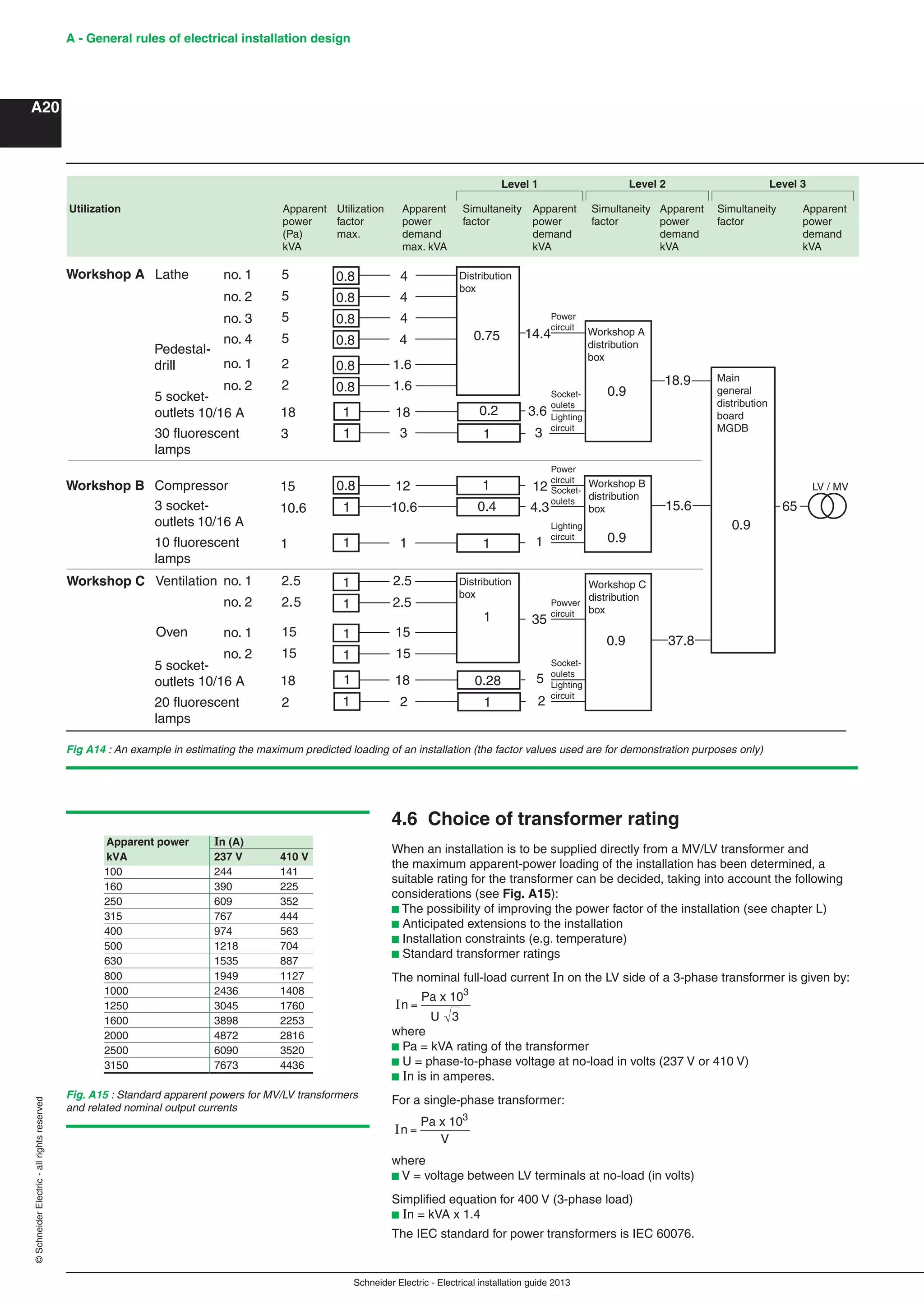
  • 26.
    Schneider Electric -Electrical installation guide 2013 A - General rules of electrical installation design A16 ©SchneiderElectric-allrightsreserved A - General rules of electrical installation design In order to design an installation, the actual maximum load demand likely to be imposed on the power-supply system must be assessed. To base the design simply on the arithmetic sum of all the loads existing in the installation would be extravagantly uneconomical, and bad engineering practice. The aim of this chapter is to show how some factors taking into account the diversity (non simultaneous operation of all appliances of a given group) and utilization (e.g. an electric motor is not generally operated at its full-load capability, etc.) of all existing and projected loads can be assessed. The values given are based on experience and on records taken from actual installations. In addition to providing basic installation-design data on individual circuits, the results will provide a global value for the installation, from which the requirements of a supply system (distribution network, MV/LV transformer, or generating set) can be specified. 4.1 Installed power (kW) The installed power is the sum of the nominal powers of all power consuming devices in the installation. This is not the power to be actually supplied in practice. Most electrical appliances and equipments are marked to indicate their nominal power rating (Pn). The installed power is the sum of the nominal powers of all power-consuming devices in the installation. This is not the power to be actually supplied in practice. This is the case for electric motors, where the power rating refers to the output power at its driving shaft. The input power consumption will evidently be greater Fluorescent and discharge lamps associated with stabilizing ballasts, are other cases in which the nominal power indicated on the lamp is less than the power consumed by the lamp and its ballast. Methods of assessing the actual power consumption of motors and lighting appliances are given in Section 3 of this Chapter. The power demand (kW) is necessary to choose the rated power of a generating set or battery, and where the requirements of a prime mover have to be considered. For a power supply from a LV public-supply network, or through a MV/LV transformer, the significant quantity is the apparent power in kVA. 4.2 Installed apparent power (kVA) The installed apparent power is commonly assumed to be the arithmetical sum of the kVA of individual loads. The maximum estimated kVA to be supplied however is not equal to the total installed kVA. The apparent-power demand of a load (which might be a single appliance) is obtained from its nominal power rating (corrected if necessary, as noted above for motors, etc.) and the application of the following coefficients:  = the per-unit efficiency = output kW / input kW cos  = the power factor = kW / kVA The apparent-power kVA demand of the load Pa = Pn /( x cos ) From this value, the full-load current Ia (A)(1) taken by the load will be: b Ia = Pa x 10 V 3 for single phase-to-neutral connected load b Ia = Pa x 103 3 x U for three-phase balanced load where: V = phase-to-neutral voltage (volts) U = phase-to-phase voltage (volts) It may be noted that, strictly speaking, the total kVA of apparent power is not the arithmetical sum of the calculated kVA ratings of individual loads (unless all loads are at the same power factor). It is common practice however, to make a simple arithmetical summation, the result of which will give a kVA value that exceeds the true value by an acceptable “design margin”. When some or all of the load characteristics are not known, the values shown in Figure A9 next page may be used to give a very approximate estimate of VA demands (individual loads are generally too small to be expressed in kVA or kW). The estimates for lighting loads are based on floor areas of 500 m2. The installed apparent power is commonly assumed to be the arithmetical sum of the kVA of individual loads. The maximum estimated kVA to be supplied however is not equal to the total installed kVA. (1) For greater precision, account must be taken of the factor of maximum utilization as explained below in 4.3 4 Power loading of an installation
  • 27.
    Schneider Electric -Electrical installation guide 2013 A17 ©SchneiderElectric-allrightsreserved Fig. A9 : Estimation of installed apparent power 4.3 Estimation of actual maximum kVA demand All individual loads are not necessarily operating at full rated nominal power nor necessarily at the same time. Factors ku and ks allow the determination of the maximum power and apparent-power demands actually required to dimension the installation. Factor of maximum utilization (ku) In normal operating conditions the power consumption of a load is sometimes less than that indicated as its nominal power rating, a fairly common occurrence that justifies the application of an utilization factor (ku) in the estimation of realistic values. This factor must be applied to each individual load, with particular attention to electric motors, which are very rarely operated at full load. In an industrial installation this factor may be estimated on an average at 0.75 for motors. For incandescent-lighting loads, the factor always equals 1. For socket-outlet circuits, the factors depend entirely on the type of appliances being supplied from the sockets concerned. For Electric Vehicle the utilization factor will be systematically estimated to 1, as it takes a long time to load completely the batteries (several hours) and a dedicated circuit feeding the charging station or wall box will be required by standards. Factor of simultaneity (ks) It is a matter of common experience that the simultaneous operation of all installed loads of a given installation never occurs in practice, i.e. there is always some degree of diversity and this fact is taken into account for estimating purposes by the use of a simultaneity factor (ks). The factor ks is applied to each group of loads (e.g. being supplied from a distribution or sub-distribution board). The determination of these factors is the responsibility of the designer, since it requires a detailed knowledge of the installation and the conditions in which the individual circuits are to be exploited. For this reason, it is not possible to give precise values for general application. Fluorescent lighting (corrected to cos  = 0.86) Type of application Estimated (VA/m2) Average lighting fluorescent tube level (lux = lm/m2) with industrial reflector(1) Roads and highways 7 150 storage areas, intermittent work Heavy-duty works: fabrication and 14 300 assembly of very large work pieces Day-to-day work: office work 24 500 Fine work: drawing offices 41 800 high-precision assembly workshops Power circuits Type of application Estimated (VA/m2) Pumping station compressed air 3 to 6 Ventilation of premises 23 Electrical convection heaters: private houses 115 to 146 flats and apartments 90 Offices 25 Dispatching workshop 50 Assembly workshop 70 Machine shop 300 Painting workshop 350 Heat-treatment plant 700 (1) example: 65 W tube (ballast not included), flux 5,100 lumens (Im), luminous efficiency of the tube = 78.5 Im / W. 4 Power loading of an installation
  • 28.
    Schneider Electric -Electrical installation guide 2013 A - General rules of electrical installation design A18 ©SchneiderElectric-allrightsreserved Factor of simultaneity for an apartment block Some typical values for this case are given in Figure A10, and are applicable to domestic consumers supplied at 230/400 V (3-phase 4-wires). In the case of consumers using electrical heat-storage units for space heating, a factor of 0.8 is recommended, regardless of the number of consumers. Example (see Fig. A11): 5 storeys apartment building with 25 consumers, each having 6 kVA of installed load. The total installed load for the building is: 36 + 24 + 30 + 36 + 24 = 150 kVA The apparent-power supply required for the building is: 150 x 0.46 = 69 kVA From Figure A10, it is possible to determine the magnitude of currents in different sections of the common main feeder supplying all floors. For vertical rising mains fed at ground level, the cross-sectional area of the conductors can evidently be progressively reduced from the lower floors towards the upper floors. These changes of conductor size are conventionally spaced by at least 3-floor intervals. In the example, the current entering the rising main at ground level is: 150 x 0.46 x 10 400 3 3 = 100 A the current entering the third floor is: (36 + 24) x 0.63 x 10 400 3 3 = 55 A 4th floor 6 consumers 36 kVA 3rd floor 2nd floor 1st floor ground floor 4 consumers 24 kVA 6 consumers 36 kVA 5 consumers 30 kVA 4 consumers 24 kVA 0.78 0.63 0.53 0.49 0.46 Fig. A11 : Application of the factor of simultaneity (ks) to an apartment block of 5 storeys Fig. A10 : Simultaneity factors in an apartment block Number of downstream Factor of consumers simultaneity (ks) 2 to 4 1 5 to 9 0.78 10 to 14 0.63 15 to 19 0.53 20 to 24 0.49 25 to 29 0.46 30 to 34 0.44 35 to 39 0.42 40 to 49 0.41 50 and more 0.40
  • 29.
    Schneider Electric -Electrical installation guide 2013 A19 ©SchneiderElectric-allrightsreserved 4 Power loading of an installation 4.4 Example of application of factors ku and ks An example in the estimation of actual maximum kVA demands at all levels of an installation, from each load position to the point of supply is given Fig. A14. In this example, the total installed apparent power is 126.6 kVA, which corresponds to an actual (estimated) maximum value at the LV terminals of the MV/LV transformer of 65 kVA only. Note: in order to select cable sizes for the distribution circuits of an installation, the current I (in amps) through a circuit is determined from the equation: I = kVA U x 103 3 where kVA is the actual maximum 3-phase apparent-power value shown on the diagram for the circuit concerned, and U is the phase to- phase voltage (in volts). 4.5 Diversity factor The term diversity factor, as defined in IEC standards, is identical to the factor of simultaneity (ks) used in this guide, as described in 4.3. In some English-speaking countries however (at the time of writing) diversity factor is the inverse of ks i.e. it is always u 1. Factor of simultaneity for distribution switchboards Figure A12 shows hypothetical values of ks for a distribution board supplying a number of circuits for which there is no indication of the manner in which the total load divides between them. If the circuits are mainly for lighting loads, it is prudent to adopt ks values close to unity. Fig. A12 : Factor of simultaneity for distribution boards Circuit function Factor of simultaneity (ks) Lighting 1 Heating and air conditioning 1 Socket-outlets 0.1 to 0.2 (1) Lifts and catering hoist (2) b For the most powerful motor 1 b For the second most powerful motor 0.75 b For all motors 0.60 (1) In certain cases, notably in industrial installations, this factor can be higher. (2) The current to take into consideration is equal to the nominal current of the motor, increased by a third of its starting current. Fig. A13 : Factor of simultaneity according to circuit function Number of Factor of circuits simultaneity (ks) 2 and 3 0.9 4 and 5 0.8 6 to 9 0.7 10 and more 0.6 Factor of simultaneity according to circuit function ks factors which may be used for circuits supplying commonly-occurring loads, are shown in Figure A13.
  • 30.
    Schneider Electric -Electrical installation guide 2013 A - General rules of electrical installation design A20 ©SchneiderElectric-allrightsreserved Fig A14 : An example in estimating the maximum predicted loading of an installation (the factor values used are for demonstration purposes only) 1 Distribution box Workshop A 5 0.8 0.8 0.8 0.8 0.8 0.8 5 5 5 2 2 Lathe 18 3 11 10.8 0.41 15 10.6 2.5 2.5 15 15 Ventilation 0.28118 112 1 Oven 30 fluorescent lamps Pedestal- drill Workshop B Compressor Workshop C no. 1 no. 2 no. 3 no. 4 no. 1 no. 2 no. 1 no. 2 no. 1 no. 2 4 4 4 4 1.6 1.6 18 3 14.4 12 1 1 1 1 2.5 2 18 15 15 2.5 Workshop A distribution box 0.75 Power circuit Power circuit Powver circuit Workshop B distribution box Workshop C distribution box Main general distribution board MGDB Socket- oulets Socket- oulets Socket- oulets Lighting circuit Lighting circuit Lighting circuit 0.9 0.9 0.9 0.9 10.6 3.6 3 12 4.3 1 15.6 18.9 37.8 35 5 2 65 LV / MV Distribution box 111 0.21 10/16 A 5 socket- outlets 20 fluorescent lamps 5 socket- outlets 10 fluorescent lamps 3 socket- outlets 10/16 A 10/16 A Utilization Apparent Utilization Apparent Simultaneity Apparent Simultaneity Apparent Simultaneity Apparent power factor power factor power factor power factor power (Pa) max. demand demand demand demand kVA max. kVA kVA kVA kVA Level 1 Level 2 Level 3 4.6 Choice of transformer rating When an installation is to be supplied directly from a MV/LV transformer and the maximum apparent-power loading of the installation has been determined, a suitable rating for the transformer can be decided, taking into account the following considerations (see Fig. A15): b The possibility of improving the power factor of the installation (see chapter L) b Anticipated extensions to the installation b Installation constraints (e.g. temperature) b Standard transformer ratings The nominal full-load current In on the LV side of a 3-phase transformer is given by: In a x 103 = P U 3 where b Pa = kVA rating of the transformer b U = phase-to-phase voltage at no-load in volts (237 V or 410 V) b In is in amperes. For a single-phase transformer: In a x 103 = P V where b V = voltage between LV terminals at no-load (in volts) Simplified equation for 400 V (3-phase load) b In = kVA x 1.4 The IEC standard for power transformers is IEC 60076. Fig. A15 : Standard apparent powers for MV/LV transformers and related nominal output currents Apparent power In (A) kVA 237 V 410 V 100 244 141 160 390 225 250 609 352 315 767 444 400 974 563 500 1218 704 630 1535 887 800 1949 1127 1000 2436 1408 1250 3045 1760 1600 3898 2253 2000 4872 2816 2500 6090 3520 3150 7673 4436
  • 31.
    Schneider Electric -Electrical installation guide 2013 A21 ©SchneiderElectric-allrightsreserved 4.7 Choice of power-supply sources The importance of maintaining a continuous supply raises the question of the use of standby-power plant. The choice and characteristics of these alternative sources are part of the architecture selection, as described in chapter D. For the main source of supply the choice is generally between a connection to the MV or the LV network of the power-supply utility. In some cases main source of supply can be rotating generators in the case of remote installations with difficult access to the local Utility public grid (MV or LV) or where the reliability of the public grid does not have the minimum level of reliability expected. In practice, connection to a MV source may be necessary where the load exceeds (or is planned eventually to exceed) a certain level - generally of the order of 250 kVA, or if the quality of service required is greater than that normally available from a LV network. Moreover, if the installation is likely to cause disturbance to neighbouring consumers, when connected to a LV network, the supply authorities may propose a MV service. Supplies at MV can have certain advantages: in fact, a MV consumer: b Is not disturbed by other consumers, which could be the case at LV b Is free to choose any type of LV earthing system b Has a wider choice of economic tariffs b Can accept very large increases in load It should be noted, however, that: b The consumer is the owner of the MV/LV substation and, in some countries, he must build equip and maintain it at his own expense. The power utility can, in certain circumstances, participate in the investment, at the level of the MV line for example b A part of the connection costs can, for instance, often be recovered if a second consumer is connected to the MV line within a certain time following the original consumer’s own connection b The consumer has access only to the LV part of the installation, access to the MV part being reserved to the utility personnel (meter reading, operations, etc.). However, in certain countries, the MV protective circuit-breaker (or fused load-break switch) can be operated by the consumer b The type and location of the substation are agreed between the consumer and the utility More and more renewable energy sources such as photovoltaic panels are used to supply low-voltage electrical installations. In some case these PV panels are connected in parallel to the Utility grid or these PV panels are used in an autonomous mode without connection to the public grid. Conversion from d.c. to a.c. is then necessary as rated voltage of these PV panels are higher and higher (few hundreds volts) and also because PV panels produce d.c. currents. 4 Power loading of an installation
  • 32.
    Schneider Electric -Electrical installation guide 2013
  • 33.
    Schneider Electric -Electrical installation guide 2013 B1 ©SchneiderElectric-allrightsreserved Chapter B Connection to the MV utility distribution network Contents Power supply at medium voltage B2 1.1 Power supply characteristics of medium-voltage networks B2 1.2 Different types of MV power supply B2 1.3 Some practical issues concerning MV distribution networks B3 Procedure for the establishment of a new substation B5 2.1 Preliminary informations B5 2.2 Project studies B6 2.3 Implementation B6 2.4 Commissioning B6 Protection aspect B7 3.1 Protection against electric shocks B7 3.2 Protection of transformer and circuits B8 3.3 Interlocks and conditioned operations B10 The consumer substation with LV metering B13 4.1 Functions of the substation with LV metering B13 4.2 Choosing MV equipment B13 4.3 Choice of MV switchgear panel for a transformer circuit B15 4.4 Choice of MV/LV transformer B16 4.5 Instructions for use of MV equipment B19 The consumer substation with MV metering B22 5.1 Functions of the substation with MV metering B22 5.2 Choice of panels B24 5.3 Parallel operation of transformers B25 Constitution of MV/LV distribution substations B27 6.1 Different types of substation B27 6.2 Indoor substation B27 6.3 Outdoor substation B29 2 1 3 4 5 6
  • 34.
    Schneider Electric -Electrical installation guide 2013 B - Connection to the MV utility distribution network B2 ©SchneiderElectric-allrightsreserved The term «medium voltage» is commonly used for distribution systems with voltages above 1 kV and generally applied up to and including 52 kV(1). For technical and economic reasons, the nominal voltage of medium-voltage distribution networks rarely exceeds 35 kV. In this chapter, networks which operate at 1000 V or less are referred to as low- voltage (LV) networks, whereas networks requiring a step-down transformer to feed LV networks are referred to as medium voltage (MV) networks. 1.1 Power supply characteristics of medium-voltage networks The characteristics of the MV network determine which switchgear is used in the MV or MV/LV substation and are specific to individual countries. Familiarity with these characteristics is essential when defining and implementing connections. 1.2 Different types of MV power supply The following power supply methods may be used as appropriate for the type of medium-voltage network. Connection to an MV radial network: Single-line service The substation is supplied by a tee-off from the MV radial network (overhead or cable), also known as a spur network. This type of network supports a single supply for loads (see Fig. B1). The substation usually consists of an incoming panel, and overall protection is provided by a load-break switch and fuses with earthing switches as shown in Figure B1. In some countries, the “substation” comprises a pole-mounted transformer without a load-break switch or fuses (installed on the pole). This type of distribution is very common in rural areas. Protection and switching devices are located remotely from the transformer. These usually control a main overhead line to which secondary overhead lines are connected. The main characteristics of an MV power supply are: b The nominal voltage b The short-circuit current b The rated current used b The earthing system (1) According to the IEC there is no clear boundary between medium and high voltage; local and historical factors play a part, and limits are usually between 30 and 100 kV (see IEV 601-01-28).The publication IEC 62271-1 "High-voltage switchgear and controlgear; common specifications" incorporates a note in its scope: "For the use of this standard, high voltage (see IEV 601-01-27) is the rated voltage above 1 000 V. However, the term medium voltage (see IEV 601-01- 28) is commonly used for distribution systems with voltages above 1 kV and generally applied up to and including 52 kV.". Overhead line Fig. B1 : Single-line service (single supply) 1 Power supply at medium voltage
  • 35.
    Schneider Electric -Electrical installation guide 2013 B3 ©SchneiderElectric-allrightsreserved Connection to an MV loop: Ring-main service The power supply for the substation is connected in series to the power line of the medium-voltage distribution network to form a loop(1). This allows the line current to pass through a busbar, making it possible for loads to have two different power supplies (see Fig. B2). The substation has three medium-voltage modular units or an integrated ring-main unit supporting the following functions: b 2 incoming panels, each with a load-break switch. These are part of the loop and are connected to a busbar. b 1 transformer feeder connected to the busbar. General protection is provided by load-break switches, a combined load-break/isolating switch or a circuit breaker. All these types of switchgear are fitted with earthing switches. All switches and earthing switches have a making capacity which enables them to close at the network’s short-circuit current. Under this arrangement, the user benefits from a reliable power supply based on two MV feeders, with downtime kept to a minimum in the event of faults or work on the supplier network(1). This method is used for the underground MV distribution networks found in urban areas. Connection to two parallel MV cables: Parallel feeders service If two parallel underground cables can be used to supply a substation, an MV switchboard similar to that of a ring-main station can be used (see Fig. B3). The main difference to the ring-main station is that both load-break switches are interlocked. This means that only one of them can be closed at any one time (if one is closed, the other must be open). In the event of the loss of supply, the associated incoming load-break switch must be open and the interlocking system must enable the switch which was open to close. This sequence can be implemented either manually or automatically. This method is used for networks in some densely-populated or expanding urban areas supplied by underground cables. 1.3 Some practical issues concerning MV distribution networks Overhead networks Weather conditions such as wind and frost may bring wires into contact and cause temporary (as opposed to permanent) short-circuits. Ceramic or glass insulating materials may be broken by wind-borne debris or carelessly discharged firearms. Shorting to earth may also result when insulating material becomes heavily soiled. Many of these faults are able to rectify themselves. For example, damaged insulating materials can continue functioning undetected in a dry environment, although heavy rain will probably cause flashover to earth (e.g. via a metallic support structure). Similarly, heavily soiled insulating material usually causes flashover to earth in damp conditions. Almost invariably, fault current will take the form of an electric arc, whose intense heat dries the current’s path and, to some extent, re-establishes insulating properties. During this time, protection devices will normally have proved effective in eliminating the fault (fuses will blow or the circuit breaker will trip). Experience has shown that, in the vast majority of cases, the supply can be restored by replacing fuses or reclosing the circuit breaker. As such, it is possible to improve the service continuity of overhead networks significantly by using circuit breakers with an automated reclosing facility on the relevant feeders. These automated facilities support a set number of reclosing operations if a first attempt proves unsuccessful. The interval between successive attempts can be adjusted (to allow time for the air near the fault to deionise) before the circuit breaker finally locks out after all the attempts (usually three) have failed. Remote control switches can be used on cable segments within networks to further improve service continuity. Load-break switches can also be teamed with a reclosing circuit breaker to isolate individual sections. (1) A medium-voltage loop is an underground distribution network based on cables from two MV substation feeders. The two feeders are the two ‘ends’ of the loop and each is protected by an MV circuit breaker. The loop is usually open, i.e. divided into two sections (half- loops), each of which is supplied by a feeder. To support this arrangement, the two incoming load-break switches on the substations in the loop are closed, allowing current to circulate around the loop. On one of the stations one switch is normally left open, determining the start of the loop. A fault on one of the half-loops will trigger the protection device on the associated feeder, de-energising all substations within that half loop. Once the fault on the affected cable segment (between two adjacent substations) has been located, the supply to these substations can be restored from the other feeder. This requires some reconfiguration of the loop, with the load- break switches being switched in order to move the start of the loop to the substation immediately downstream of the fault and open the switch on the substation immediately upstream of the fault on the loop. These measures isolate the cable segment where the fault has occurred and restore the supply to the whole loop, or to most of it if the switches that have been switched are not on substations on either side of the sole cable segment affected by the fault. Systems for fault location and loop reconfiguration with remote control switches allow these processes to be automated. 1 Power supply at medium voltage Fig. B2 : Ring-main service (double supply). The transformer is protected, in accordance with the applicable standards, by a circuit breaker or load-break switch as shown in Figure B1. Underground cable loop Fig. B3 : Parallel feeders service (double supply). The transformer is protected, in accordance with local standards, by a circuit breaker or load-break switch as shown in Figure B1. Underground cables in parallel
  • 36.
    Schneider Electric -Electrical installation guide 2013 B - Connection to the MV utility distribution network B4 ©SchneiderElectric-allrightsreserved 1 Power supply at medium voltage Underground networks Cable faults on underground networks can sometimes be caused by poorly arranged cable boxes or badly laid cables. For the most part, however, faults are the result of damage caused by tools such as pickaxes and pneumatic drills or by earthmoving plant used by other public utilities. Insulation faults sometimes occur in connection boxes as a result of overvoltage, particularly at locations where an MV network is connected to an underground cable network. In such cases, overvoltage is usually caused by atmospheric conditions, and the reflection effects of electromagnetic waves at the junction box (where circuit impedance changes sharply) may generate sufficient strain on the cable box insulation for a fault to occur. Devices to protect against overvoltages, such as lightning arresters, are often installed at these locations. Underground cable networks suffer from fewer faults than overhead networks, but those which do occur are invariably permanent and take longer to locate and resolve. In the event of a fault affecting an MV loop cable, the supply can be quickly restored to users once the cable segment where the fault occurred has been located. Having said this, if the fault occurs at a feeder for a radial supply, it can take several hours to locate and resolve the fault, and all the users connected in a single branch arrangement downstream of the fault will be affected. In cases where service continuity is essential for all or part of the installation concerned, provision must be made for an auxiliary supply. Remote control and monitoring for MV networks Remote control and monitoring of MV feeders makes it possible to reduce loss of supply resulting from cable faults by supporting fast and effective loop reconfiguration. This facility relies on switches with electric controls which are fitted on a number of substations in the loop and linked to modified remote-control units. All stations containing this equipment can have their supply restored remotely, whereas other stations will require additional manual operations Values of earth fault currents for MV power supply The values of earth fault currents on distribution networks depend on the MV substation’s earthing system (or neutral earthing system). They must be limited to reduce their impact on the network and restrict possible increased potential on user substation frames caused by the coupling of earth switches (overhead networks), and to reduce flashover with the station’s LV circuits capable of generating dangerous levels of potential in the low voltage installation. Where networks have both overhead and underground elements, an increased cable earthing capacitance value may cause the earth fault current value to rise and require measures to compensate this phenomenon. Earthing impedance will then involve reactance (a resistor in parallel with an inductor) in line with the leakage rate: the neutral earthing system is compensated. Compensatory impedance makes it possible to both: b Control earth fault current values, regardless of the amount of cabling within the network, and b Eliminate most temporary and semi-permanent single-phase faults naturally by facilitating self rectification, thereby avoiding many short-term losses The use of centralised remote control and monitoring based on SCADA (Supervisory Control And Data Acquisition) systems and recent developments in digital communication technology is increasingly common in countries where the complexity associated with highly interconnected networks justifies the investment required.
  • 37.
    Schneider Electric -Electrical installation guide 2013 B5 ©SchneiderElectric-allrightsreserved B - Connection to the MV utility distribution network Large consumers of electricity are invariably supplied at MV. On LV systems operating at 120/208 V (3-phase 4-wires), a load of 50 kVA might be considered to be “large”, while on a 240/415 V 3-phase system a “large” consumer could have a load in excess of 100 kVA. Both systems of LV distribution are common in many parts of the world. As a matter of interest, the IEC recommends a “world” standard of 230/400 V for 3-phase 4-wire systems. This is a compromise level and will allow existing systems which operate at 220/380 V and at 240/415 V, or close to these values, to comply with the proposed standard simply by adjusting the off-circuit tapping switches of standard distribution transformers. The distance over which the energy has to be transmitted is a further factor in considering an MV or LV service. Services to small but isolated rural consumers are obvious examples. The decision of a MV or LV supply will depend on local circumstances and considerations such as those mentioned above, and will generally be imposed by the utility for the district concerned. When a decision to supply power at MV has been made, there are two widely- followed methods of proceeding: 1 - The power-supplier constructs a standard substation close to the consumer’s premises, but the MV/LV transformer(s) is (are) located in transformer chamber(s) inside the premises, close to the load centre 2 - The consumer constructs and equips his own substation on his own premises, to which the power supplier makes the MV connection In method no. 1 the power supplier owns the substation, the cable(s) to the transformer(s), the transformer(s) and the transformer chamber(s), to which he has unrestricted access. The transformer chamber(s) is (are) constructed by the consumer (to plans and regulations provided by the supplier) and include plinths, oil drains, fire walls and ceilings, ventilation, lighting, and earthing systems, all to be approved by the supply authority. The tariff structure will cover an agreed part of the expenditure required to provide the service. Whichever procedure is followed, the same principles apply in the conception and realization of the project. The following notes refer to procedure no. 2. 2.1 Preliminary information Before any negotiations or discussions can be initiated with the supply authorities, the following basic elements must be established: Maximum anticipated power (kVA) demand Determination of this parameter is described in Chapter A, and must take into account the possibility of future additional load requirements. Factors to evaluate at this stage are: b The utilization factor (ku) b The simultaneity factor (ks) Layout plans and elevations showing location of proposed substation Plans should indicate clearly the means of access to the proposed substation, with dimensions of possible restrictions, e.g. entrances corridors and ceiling height, together with possible load (weight) bearing limits, and so on, keeping in mind that: b The power-supply personnel must have free and unrestricted access to the MV equipment in the substation at all times b Only qualified and authorized consumer’s personnel are allowed access to the substation b Some supply authorities or regulations require that the part of the installation operated by the authority is located in a separated room from the part operated by the customer. Degree of supply continuity required The consumer must estimate the consequences of a supply failure in terms of its duration: b Loss of production b Safety of personnel and equipment 2 Procedure for the establishment of a new substation The consumer must provide certain data to the utility at the earliest stage of the project.
  • 38.
    Schneider Electric -Electrical installation guide 2013 B - Connection to the MV utility distribution network B6 ©SchneiderElectric-allrightsreserved 2.2 Project studies From the information provided by the consumer, the power-supplier must indicate: The type of power supply proposed, and define: b The kind of power-supply system: overheadline or underground-cable network b Service connection details: single-line service, ring-main installation, or parallel feeders, etc. b Power (kVA) limit and fault current level The nominal voltage and rated voltage (Highest voltage for equipment) Existing or future, depending on the development of the system. Metering details which define: b The cost of connection to the power network b Tariff details (consumption and standing charges) 2.3 Implementation Before any installation work is started, the official agreement of the power-supplier must be obtained. The request for approval must include the following information, largely based on the preliminary exchanges noted above: b Location of the proposed substation b Single-line diagram of power circuits and connections, together with earthing- circuit proposals b Full details of electrical equipment to be installed, including performance characteristics b Layout of equipment and provision for metering components b Arrangements for power-factor improvement if required b Arrangements provided for emergency standby power plant (MV or LV) if eventually required 2.4 Commissioning When required by the authority, commissioning tests must be successfully completed before authority is given to energize the installation from the power supply system. Even if no test is required by the authority it is better to do the following verification tests: b Measurement of earth-electrode resistances b Continuity of all equipotential earth-and safety bonding conductors b Inspection and functional testing of all MV components b Insulation checks of MV equipment b Dielectric strength test of transformer oil (and switchgear oil if appropriate), if applicable b Inspection and testing of the LV installation in the substation b Checks on all interlocks (mechanical key and electrical) and on all automatic sequences b Checks on correct protective-relay operation and settings It is also imperative to check that all equipment is provided, such that any properly executed operation can be carried out in complete safety. On receipt of the certificate of conformity (if required): b Personnel of the power-supply authority will energize the MV equipment and check for correct operation of the metering b The installation contractor is responsible for testing and connection of the LV installation When finally the substation is operational: b The substation and all equipment belongs to the consumer b The power-supply authority has operational control over all MV switchgear in the substation, e.g. the two incoming load-break switches and the transformer MV switch (or CB) in the case of a RingMainUnit, together with all associated MV earthing switches b The power-supply personnel has unrestricted access to the MV equipment b The consumer has independent control of the MV switch (or CB) of the transformer(s) only, the consumer is responsible for the maintenance of all substation equipment, and must request the power-supply authority to isolate and earth the switchgear to allow maintenance work to proceed. The power supplier must issue a signed permit- to-work to the consumers maintenance personnel, together with keys of locked-off isolators, etc. at which the isolation has been carried out. 2 Procedure for the establishment of a new substation The utility must give specific information to the prospective consumer. The utility must give official approval of the equipment to be installed in the substation, and of proposed methods of installation. After testing and checking of the installation by an independent test authority, a certificate is granted which permits the substation to be put into service.
  • 39.
    Schneider Electric -Electrical installation guide 2013 B7 ©SchneiderElectric-allrightsreserved B - Connection to the MV utility distribution network 3 Protection aspect The subject of protection in the electrical power industry is vast: it covers all aspects of safety for personnel, and protection against damage or destruction of property, plant, and equipment. These different aspects of protection can be broadly classified according to the following objectives: b Protection of personnel and animals against the dangers of overvoltages and electric shock, fire, explosions, and toxic gases, etc. b Protection of the plant, equipment and components of a power system against the stresses of short-circuit faults, atmospheric surges (lightning) and power-system instability (loss of synchronism) etc. b Protection of personnel and plant from the dangers of incorrect power-system operation, by the use of electrical and mechanical interlocking. All classes of switchgear (including, for example, tap-position selector switches on transformers, and so on...) have well-defined operating limits. This means that the order in which the different kinds of switching device can be safely closed or opened is vitally important. Interlocking keys and analogous electrical control circuits are frequently used to ensure strict compliance with correct operating sequences. It is beyond the scope of a guide to describe in full technical detail the numerous schemes of protection available to power-systems engineers, but it is hoped that the following sections will prove to be useful through a discussion of general principles. While some of the protective devices mentioned are of universal application, descriptions generally will be confined to those in common use on MV and LV systems only, as defined in Sub-clause 1.1 of this Chapter. 3.1 Protection against electric shocks Protective measures against electric shock are based on two common dangers: b Contact with an active conductor, i.e. which is live with respect to earth in normal circumstances. This is referred to as a “direct contact” hazard. b Contact with a conductive part of an apparatus which is normally dead, but which has become live due to insulation failure in the apparatus. This is referred to as an “indirect contact” hazard. It may be noted that a third type of shock hazard can exist in the proximity of MV or LV (or mixed) earth electrodes which are passing earth-fault currents. This hazard is due to potential gradients on the surface of the ground and is referred to as a “step-voltage” hazard; shock current enters one foot and leaves by the other foot, and is particular dangerous for four-legged animals. A variation of this danger, known as a “touch voltage” hazard can occur, for instance, when an earthed metallic part is situated in an area in which potential gradients exist. Touching the part would cause current to pass through the hand and both feet. Animals with a relatively long front-to-hind legs span are particularly sensitive to step-voltage hazards and cattle have been killed by the potential gradients caused by a low voltage (230/400 V) neutral earth electrode of insufficiently low resistance. Potential-gradient problems of the kind mentioned above are not normally encountered in electrical installations of buildings, providing that equipotential conductors properly bond all exposed metal parts of equipment and all extraneous metal (i.e. not part of an electrical apparatus or the installation - for example structural steelwork, etc.) to the protective-earthing conductor. Direct-contact protection or basic protection The main form of protection against direct contact hazards is to contain all live parts in housings of insulating material or in metallic earthed housings, by placing out of reach (behind insulated barriers or at the top of poles) or by means of obstacles. Where insulated live parts are housed in a metal envelope, for example transformers, electric motors and many domestic appliances, the metal envelope is connected to the installation protective earthing system. For MV switchgear, the IEC standard 62271-200 (Prefabricated Metal Enclosed switchgear and controlgear for voltages up to 52 kV) specifies a minimum Protection Index (IP coding) of IP2X which ensures the direct-contact protection. Furthermore, the metallic enclosure has to demonstrate an electrical continuity, then establishing a good segregation between inside and ouside of the enclosure. Proper grounding of the enclosure further participates to the electrical protection of the operators under normal operating conditions. For LV appliances this is achieved through the third pin of a 3-pin plug and socket. Total or even partial failure of insulation to the metal, can raise the voltage of the envelope to a dangerous level (depending on the ratio of the resistance of the leakage path through the insulation, to the resistance from the metal envelope to earth). Protection against electric shocks and overvoltages is closely related to the achievement of efficient (low resistance) earthing and effective application of the principles of equipotential environments.
  • 40.
    Schneider Electric -Electrical installation guide 2013 B - Connection to the MV utility distribution network B8 ©SchneiderElectric-allrightsreserved Indirect-contact protection or fault protection A person touching the metal envelope of an apparatus with a faulty insulation, as described above, is said to be making an indirect contact. An indirect contact is characterized by the fact that a current path to earth exists (through the protective earthing (PE) conductor) in parallel with the shock current through the person concerned. Case of fault on L.V. system Extensive tests have shown that, providing the potential of the metal envelope is not greater than 50 V with respect to earth, or to any conductive material within reaching distance, no danger exists. Indirect-contact hazard in the case of a MV fault If the insulation failure in an apparatus is between a MV conductor and the metal envelope, it is not generally possible to limit the rise of voltage of the envelope to 50 V or less, simply by reducing the earthing resistance to a low value. The solution in this case is to create an equipotential situation, as described in Sub-clause 1.1 “Earthing systems”. Earth connection resistance Insulation faults affecting the MV substation’s equipment (internal) or resulting from atmospheric overvoltages (external) may generate earth currents capable of causing physical injury or damage to equipment. Preventive measures essentially consist of: b Interconnecting all substation frames and connecting them to the earth bar b Minimising earth resistance 3.2 Protection of transformer and circuits General The electrical equipment and circuits in a substation must be protected in order to avoid or to control damage due to abnormal currents and/or voltages. All equipment normally used in power system installations have standardized short-time withstand ratings for overcurrent and overvoltage. The role of protective scheme is to ensure that this withstand limits can never be exceeded. In general, this means that fault conditions must be cleared as fast as possible without missing to ensure coordination between protective devices upstream and downstream the equipement to be protected. This means, when there is a fault in a network, generally several protective devices see the fault at the same time but only one must act. These devices may be: b Fuses which clear the faulty circuit directly or together with a mechanical tripping attachment, which opens an associated three-phase load-break switch b Relays which act indirectly on the circuit-breaker coil Transformer protection Stresses due to the supply network Some voltage surges can occur on the network such as : b Atmospheric voltage surges Atmospheric voltage surges are caused by a stroke of lightning falling on or near an overhead line. b Operating voltage surges A sudden change in the established operating conditions in an electrical network causes transient phenomena to occur. This is generally a high frequency or damped oscillation voltage surge wave. For both voltage surges, the overvoltage protection device generally used is a varistor (Zinc Oxide). In most cases, voltage surges protection has no action on switchgear. Stresses due to the load Overloading is frequently due to the coincidental demand of a number of small loads, or to an increase in the apparent power (kVA) demand of the installation, due to expansion in a factory, with consequent building extensions, and so on. Load increases raise the temperature of the wirings and of the insulation material. As a result, temperature increases involve a reduction of the equipment working life. Overload protection devices can be located on primary or secondary side of the transformer.
  • 41.
    Schneider Electric -Electrical installation guide 2013 B9 ©SchneiderElectric-allrightsreserved The protection against overloading of a transformer is now provided by a digital relay which acts to trip the circuit-breaker on the secondary side of the transformer. Such relay, generally called thermal overload relay, artificially simulates the temperature, taking into account the time constant of the transformer. Some of them are able to take into account the effect of harmonic currents due to non linear loads (rectifiers, computer equipment, variable speed drives…).This type of relay is also able to predict the time before overload tripping and the waiting time after tripping. So, this information is very helpful to control load shedding operation. In addition, larger oil-immersed transformers frequently have thermostats with two settings, one for alarm purposes and the other for tripping. Dry-type transformers use heat sensors embedded in the hottest part of the windings insulation for alarm and tripping. Internal faults The protection of transformers by transformer-mounted devices, against the effects of internal faults, is provided on transformers which are fitted with airbreathing conservator tanks by the classical Buchholz mechanical relay (see Fig. B4). These relays can detect a slow accumulation of gases which results from the arcing of incipient faults in the winding insulation or from the ingress of air due to an oil leak. This first level of detection generally gives an alarm, but if the condition deteriorates further, a second level of detection will trip the upstream circuit-breaker. An oil-surge detection feature of the Buchholz relay will trip the upstream circuit- breaker “instantaneously” if a surge of oil occurs in the pipe connecting the main tank with the conservator tank. Such a surge can only occur due to the displacement of oil caused by a rapidly formed bubble of gas, generated by an arc of short-circuit current in the oil. By specially designing the cooling-oil radiator elements to perform a concerting action, “totally filled” types of transformer as large as 10 MVA are now currently available. Expansion of the oil is accommodated without an excessive rise in pressure by the “bellows” effect of the radiator elements. A full description of these transformers is given in Sub-clause 4.4 (see Fig. B5). Evidently the Buchholz devices mentioned above cannot be applied to this design; a modern counterpart has been developed however, which measures: b The accumulation of gas b Overpressure b Overtemperature The first two conditions trip the upstream circuit-breaker, and the third condition trips the downstream circuit-breaker of the transformer. Internal phase-to-phase short-circuit Internal phase-to-phase short-circuit must be detected and cleared by: b 3 fuses on the primary side of the tranformer or b An overcurrent relay that trips a circuit-breaker upstream of the transformer Internal phase-to-earth short-circuit This is the most common type of internal fault. It must be detected by an earth fault relay. Earth fault current can be calculated with the sum of the 3 primary phase currents (if 3 current transformers are used) or by a specific core current transformer. If a great sensitivity is needed, specific core current transformer will be prefered. In such a case, a two current transformers set is sufficient (see Fig. B6). Protection of circuits The protection of the circuits downstream of the transformer must comply with the IEC 60364 requirements. Discrimination between the protective devices upstream and downstream of the transformer The consumer-type substation with LV metering requires discriminative operation between the MV fuses or MV circuit-breaker and the LV circuit-breaker or fuses. The rating of the MV fuses will be chosen according to the characteristics of the transformer. The tripping characteristics of the LV circuit-breaker must be such that, for an overload or short-circuit condition downstream of its location, the breaker will trip sufficiently quickly to ensure that the MV fuses or the MV circuit-breaker will not be adversely affected by the passage of overcurrent through them. The tripping performance curves for MV fuses or MV circuit-breaker and LV circuit- breakers are given by graphs of time-to-operate against current passing through them. Both curves have the general inverse-time/current form (with an abrupt discontinuity in the CB curve at the current value above which “instantaneous” tripping occurs). Fig. B5 : Totally filled transformer Fig. B4 : Transformer with conservator tank Fig. B6 : Protection against earth fault on the MV winding N 3 2 1 HV LV 3 2 1 E/F relayOvercurrent relay 3 Protection aspect
  • 42.
    Schneider Electric -Electrical installation guide 2013 B - Connection to the MV utility distribution network B10 ©SchneiderElectric-allrightsreserved These curves are shown typically in Figure B7. b In order to achieve discrimination (see Fig. B8): All parts of the fuse or MV circuit-breaker curve must be above and to the right of the CB curve. b In order to leave the fuses unaffected (i.e. undamaged): All parts of the minimum pre-arcing fuse curve must be located to the right of the CB curve by a factor of 1.35 or more (e.g. where, at time T, the CB curve passes through a point corresponding to 100 A, the fuse curve at the same time T must pass through a point corresponding to 135 A, or more, and so on...) and, all parts of the fuse curve must be above the CB curve by a factor of 2 or more (e.g. where, at a current level I the CB curve passes through a point corresponding to 1.5 seconds, the fuse curve at the same current level I must pass through a point corresponding to 3 seconds, or more, etc.). The factors 1.35 and 2 are based on standard maximum manufacturing tolerances for MV fuses and LV circuit-breakers. In order to compare the two curves, the MV currents must be converted to the equivalent LV currents, or vice-versa. Where a LV fuse-switch is used, similar separation of the characteristic curves of the MV and LV fuses must be respected. b In order to leave the MV circuit-breaker protection untripped: All parts of the minimum MV circuit-breaker curve must be located to the right of the LV CB curve by a factor of 1.35 or more (e.g. where, at time T, the LV CB curve passes through a point corresponding to 100 A, the MV CB curve at the same time T must pass through a point corresponding to 135 A, or more, and so on...) and, all parts of the MV CB curve must be above the LV CB curve (time of LV CB curve must be less or equal than MV CB curves minus 0.3 s) The factors 1.35 and 0.3 s are based on standard maximum manufacturing tolerances for MV current transformers, MV protection relay and LV circuit-breakers. In order to compare the two curves, the MV currents must be converted to the equivalent LV currents, or vice-versa. Choice of protective device on the primary side of the transformer As explained before, for low reference current, the protection may be by fuses or by circuit-breaker. When the reference current is high, the protection will be achieved by circuit-breaker. Protection by circuit-breaker provides a more sensitive transformer protection compared with fuses. The implementation of additional protections (earth fault protection, thermal overload protection) is easier with circuit-breakers. 3.3 Interlocks and conditioned operations Mechanical and electrical interlocks are included on mechanisms and in the control circuits of apparatus installed in substations, as a measure of protection against an incorrect sequence of manœuvres by operating personnel. Mechanical protection between functions located on separate equipment (e.g. switchboard and transformer) is provided by key-transfer interlocking. An interlocking scheme is intended to prevent any abnormal operational manœuvre. Some of such operations would expose operating personnel to danger, some others would only lead to an electrical incident. Basic interlocking Basic interlocking functions can be introduced in one given functionnal unit; some of these functions are made mandatory by the IEC 62271-200, for metal-enclosed MV switchgear, but some others are the result of a choice from the user. Considering access to a MV panel, it requires a certain number of operations which shall be carried out in a pre-determined order. It is necessary to carry out operations in the reverse order to restore the system to its former condition. Either proper procedures, or dedicated interlocks, can ensure that the required operations are performed in the right sequence. Then such accessible compartment will be classified as “accessible and interlocked” or “accessible by procedure”. Even for users with proper rigorous procedures, use of interlocks can provide a further help for safety of the operators. Fig. B7 : Discrimination between MV fuse operation and LV circuit-breaker tripping, for transformer protection Fig. B8 : MV fuse and LV circuit-breaker configuration U1 MV LV U2 D C Time A B Current Minimum pre-arcing time of MV fuse Circuit breaker tripping characteristic B/A u 1.35 at any moment in time D/C u 2 at any current value
  • 43.
    Schneider Electric -Electrical installation guide 2013 B11 ©SchneiderElectric-allrightsreserved Key interlocking Beyond the interlocks available within a given functionnal unit (see also 4.2), the most widely-used form of locking/interlocking depends on the principle of key transfer. The principle is based on the possibility of freeing or trapping one or several keys, according to whether or not the required conditions are satisfied. These conditions can be combined in unique and obligatory sequences, thereby guaranteeing the safety of personnel and installation by the avoidance of an incorrect operational procedure. Non-observance of the correct sequence of operations in either case may have extremely serious consequences for the operating personnel, as well as for the equipment concerned. Note: It is important to provide for a scheme of interlocking in the basic design stage of planning a MV/LV substation. In this way, the apparatuses concerned will be equipped during manufacture in a coherent manner, with assured compatibility of keys and locking devices. Service continuity For a given MV switchboard, the definition of the accessible compartments as well as their access conditions provide the basis of the “Loss of Service Continuity” classification defined in the standard IEC 62271-200. Use of interlocks or only proper procedure does not have any influence on the service continuity. Only the request for accessing a given part of the switchboard, under normal operation conditions, results in limiting conditions which can be more or less severe regarding the continuity of the electrical distribution process. Interlocks in substations In a MV/LV distribution substation which includes: b A single incoming MV panel or two incoming panels (from parallel feeders) or two incoming/outgoing ring-main panels b A transformer switchgear-and-protection panel, which can include a load-break/ disconnecting switch with MV fuses and an earthing switch, or a circuit-breaker and line disconnecting switch together with an earthing switch b A transformer compartment Interlocks allow manœuvres and access to different panels in the following conditions: Basic interlocks, embedded in single functionnal units b Operation of the load-break/isolating switch v If the panel door is closed and the associated earthing switch is open b Operation of the line-disconnecting switch of the transformer switchgear - and - protection panel v If the door of the panel is closed, and v If the circuit-breaker is open, and the earthing switch(es) is (are) open b Closure of an earthing switch v If the associated isolating switch(es) is (are) open(1) b Access to an accessible compartment of each panel, if interlocks have been specified v If the isolating switch for the compartment is open and the earthing switch(es) for the compartment is (are) closed b Closure of the door of each accessible compartment, if interlocks have been specified v If the earthing switch(es) for the compartment is (are) closed Functional interlocks involving several functional units or separate equipment b Access to the terminals of a MV/LV transformer v If the tee-off functional unit has its switch open and its earthing switch closed. According to the possibility of back-feed from the LV side, a condition on the LV main breaker can be necessary. Practical example In a consumer-type substation with LV metering, the interlocking scheme most commonly used is MV/LV/TR (high voltage/ low voltage/transformer). The aim of the interlocking is: b To prevent access to the transformer compartment if the earthing switch has not been previously closed b To prevent the closure of the earthing switch in a transformer switchgear-and- protection panel, if the LV circuit-breaker of the transformer has not been previously locked “open” or “withdrawn” (1) If the earthing switch is on an incoming circuit, the associated isolating switches are those at both ends of the circuit, and these should be suitably interlocked. In such situation, the interlocking function becomes a multi-units key interlock. 3 Protection aspect
  • 44.
    Schneider Electric -Electrical installation guide 2013 B - Connection to the MV utility distribution network B12 ©SchneiderElectric-allrightsreserved Access to the MV or LV terminals of a transformer, (protected upstream by a MV switchgear-and-protection panel, containing a MV load-break / isolating switch, MV fuses, and a MV earthing switch) must comply with the strict procedure described below, and is illustrated by the diagrams of Figure B9. Note: The transformer in this example is provided with plug-in type MV terminal connectors which can only be removed by unlocking a retaining device common to all three phase connectors(1). The MV load-break / disconnecting switch is mechanically linked with the MV earthing switch such that only one of the switches can be closed, i.e. closure of one switch automatically locks the closure of the other. Procedure for the isolation and earthing of the power transformer, and removal of the MV plug-type shrouded terminal connections (or protective cover) Initial conditions b MV load-break/disconnection switch and LV circuit-breaker are closed b MV earthing switch locked in the open position by key “O” b Key “O” is trapped in the LV circuit-breaker as long as that circuit-breaker is closed Step 1 b Open LV CB and lock it open with key “O” b Key “O” is then released Step 2 b Open the MV switch b Check that the “voltage presence” indicators extinguish when the MV switch is opened Step 3 b Unlock the MV earthing switch with key “O” and close the earthing switch b Key “O” is now trapped Step 4 The access panel to the MV fuses can now be removed (i.e. is released by closure of the MV earthing switch). Key “S” is located in this panel, and is trapped when the MV switch is closed b Turn key “S” to lock the MV switch in the open position b Key “S” is now released Step 5 Key “S” allows removal of the common locking device of the plug-type MV terminal connectors on the transformer or of the common protective cover over the terminals, as the case may be. In either case, exposure of one or more terminals will trap key “S” in the interlock. The result of the foregoing procedure is that: b The MV switch is locked in the open position by key “S”. Key “S” is trapped at the transformer terminals interlock as long as the terminals are exposed. b The MV earthing switch is in the closed position but not locked, i.e. may be opened or closed. When carrying out maintenance work, a padlock is generally used to lock the earthing switch in the closed position, the key of the padlock being held by the engineer supervizing the work. b The LV CB is locked open by key “O”, which is trapped by the closed MV earthing switch. The transformer is therefore safely isolated and earthed. It may be noted that the upstream terminal of the load-break disconnecting switch may remain live in the procedure described as the terminals in question are located in a separate non accessible compartment in the particular switchgear under discussion. Any other technical solution with exposed terminals in the accessed compartment would need further de-energisation and interlocks. (1) Or may be provided with a common protective cover over the three terminals. Fig. B9 : Example of MV/LV/TR interlocking S S S S S S Panel or door Legend MV switch and LV CB closed MV fuses accessible Transformer MV terminals accessible Key absent Key free Key trapped O O O O 3 Protection aspect
  • 45.
    Schneider Electric -Electrical installation guide 2013 B13 ©SchneiderElectric-allrightsreserved B - Connection to the MV utility distribution network 4.1 Functions of the substation with LV metering A consumer substation with LV metering is an electrical installation connected to a utility supply system at a nominal voltage of 1 kV - 35 kV, and includes a single MV/LV transformer generally not exceeding 1,250 kVA. Functions The substation All component parts of the substation are located in one room, either in an existing building, or in the form of a prefabricated housing exterior to the building. Connection to the MV network Connection at MV can be: b Either by a single service cable or overhead line, or b Via two mechanically interlocked load-break switches with two service cables from duplicate supply feeders, or b Via two load-break switches of a ring-main unit The transformer Since the use of PCB(1)-filled transformers is prohibited in most countries, the preferred available technologies are: b Oil-immersed transformers for substations located outside premises b Dry-type, vacuum-cast-resin transformers for locations inside premises, e.g. multistoreyed buildings, buildings receiving the public, and so on... Metering Metering at low voltage allows the use of small metering transformers at modest cost. Most tariff structures take account of MV/LV transformer losses. LV installation circuits A low-voltage circuit-breaker, suitable for isolation duty and locking off facilities, to: b Supply a distribution board b Protect the transformer against overloading and the downstream circuits against short-circuit faults. Simplified electrical network diagram The diagram on the following page (Figure B10) shows: b Methods for connecting to the network (4 options): v Spur network or single-line service v Provisional network (can be transformed into a loop) v Parallel feeders service v Loop or ring-main service b MV protection and MV/LV transformation methods b LV metering and LV general isolation methods b LV protection and distribution methods b Zones accessible to different parties 4.2 Choosing MV equipment Standards and specifications Switchgear and equipment shall conform to the following international standards: IEC 62271-1, 62271-200, 60265-1, 62271-102, 62271-100, 62271-105 Local regulations may also demand conformance to national standards. These include: b France: UTE b United Kingdom: BS b Germany: VDE b USA: ANSI 4 The consumer substation with LV metering (1) Polychlorinated biphenyl Fig. B11 : SM6 modular unit
  • 46.
    Schneider Electric -Electrical installation guide 2013 B - Connection to the MV utility distribution network B14 ©SchneiderElectric-allrightsreserved Fig. B10 : Consumer substation with LV metering Power supply system Service connection MV protection and MV/LV transformation LV metering and isolation LV distribution and protection Supplier/consumer interface Downstream terminals of LV isolator Transformer LV terminals Protection Protection + Auto-changeover switch Protection Protection Duplicate- supply service Single-line service (equipped for extension to form a ring main) Single-line service Ring main service Automatic LV standby source Permitted if only one transformer and rated power low enough to accomodate the limitations of fuses Permitted
  • 47.
    Schneider Electric -Electrical installation guide 2013 B15 ©SchneiderElectric-allrightsreserved Choosing types of equipment Substations can be implemented in line with local standards and practices using equipment such as: b Modular units to support all types of layout and any subsequent expansion work (whilst ensuring there is sufficient space) b Compact arrangements based on the ring-main unit where the supply is provided via a loop (single assembly comprising 3 functions). These are particularly suitable where: v Climatic conditions and/or pollution are very bad (integrated insulation) v There is not enough space for a modular solution Compartmentalised modular units in metallic enclosures IEC 62271-200 standard The IEC 62271-200 standard specifies «AC metal-enclosed switchgear and controlgear for rated voltages above 1 kV and up to and including 52 kV». The main precepts of the standard relate to: b Switchgear types: v AIS (Air Insulated Switchgear) v GIS (Gas Insulated Switchgear) b Functional units: «a switchgear component contained in a metallic enclosure and incorporating all the main and auxiliary circuit equipment required to perform a single function» - usually a modular unit b Compartments: «a switchgear component contained in a closed metallic enclosure (apart from the openings required for interconnection, control or ventilation)». The manufacturer defines the content (e.g. busbar, cables, switchgear, etc.) and the number of compartments able to house the following types of switchgear: v Fixed v Removable b Accessibility of individual compartments: v Controlled by interlocking or in accordance with procedures; for compartments which can be opened during normal operation v Using tools; for compartments which should not be opened during normal operation v Zero; for compartments which must not be opened b The LSC (Loss of Service Continuity) defining the extent to which other compartments can remain energised when one compartment is open v LSC1, when opening a compartment requires the other functional units to be de- energised v LSC2 A, when the other functional units can remain energised v LSC2 B, when the other functional units and all the cable compartments can remain energised v The partition class between energised components and an open compartment, based on the type of partition: «a switchgear component contained in a metallic enclosure and separating one compartment from another»: v PM: metallic partitions v PI: insulating partitions 4.3 Choice of MV switchgear panel for a transformer circuit Three types of MV switchgear panel are generally available: b Load-break switch and separate MV fuses in the panel b Load-break switch/MV fuses combination b Circuit-breaker Seven parameters influence the optimum choice: b The primary current of the transformer b The insulating medium of the transformer b The position of the substation with respect to the load centre b The kVA rating of the transformer b The distance from switchgear to the transformer b The use of separate protection relays (as opposed to direct-acting trip coils). Note: The fuses used in the load-break/switch fuses combination have striker-pins which ensure tripping of the 3-pole switch on the operation of one (or more) fuse(s). 4 The consumer substation with LV metering
  • 48.
    Schneider Electric -Electrical installation guide 2013 B - Connection to the MV utility distribution network B16 ©SchneiderElectric-allrightsreserved 4.4 Choice of MV/LV transformer Characteristic parameters of a transformer A transformer is characterized in part by its electrical parameters, but also by its technology and its conditions of use. Electrical characteristics b Rated power (Pn): the conventional apparent-power in kVA on which other design- parameter values and the construction of the transformer are based. Manufacturing tests and guarantees are referred to this rating b Frequency: for power distribution systems of the kind discussed in this guide, the frequency will be 50 Hz or 60 Hz b Rated primary and secondary voltages: For a primary winding capable of operating at more than one voltage level, a kVA rating corresponding to each level must be given. The secondary rated voltage is its open circuit value b Rated insulation levels are given by overvoltage-withstand test values at power frequency, and by high voltage impulse tests values which simulate lightning discharges. At the voltage levels discussed in this guide, overvoltages caused by MV switching operations are generally less severe than those due to lightning, so that no separate tests for switching-surge withstand capability are made b Off-circuit tap-selector switch generally allows a choice of up to ± 2.5% and ± 5% level about the rated voltage of the highest voltage winding. The transformer must be de-energized before this switch is operated b Winding configurations are indicated in diagrammatic form by standard symbols for star, delta and inter-connected-star windings; (and combinations of these for special duty, e.g. six-or twelve-phase rectifier transformers, etc.) and in an IEC-recommended alphanumeric code. This code is read from left-to-right, the first letter refers to the highest voltage winding, the second letter to the next highest, and so on: v Capital letters refer to the highest voltage winding D = delta Y = star Z = interconnected-star (or zigzag) N = neutral connection brought out to a terminal v Lower-case letters are used for tertiary and secondary windings d = delta y = star z = interconnected-star (or zigzag) n = neutral connection brought out to a terminal v A number from 0 to 11, corresponding to those, on a clock dial (“0” is used instead of “12”) follows any pair of letters to indicate the phase change (if any) which occurs during the transformation. A very common winding configuration used for distribution transformers is that of a Dyn 11 transformer, which has a delta MV winding with a star-connected secondary winding the neutral point of which is brought out to a terminal. The phase change through the transformer is +30 degrees, i.e. phase 1 secondary voltage is at “11 o’clock” when phase 1 of the primary voltage is at “12 o’clock”, as shown in Figure B31 page B34. All combinations of delta, star and zigzag windings produce a phase change which (if not zero) is either 30 degrees or a multiple of 30 degrees. IEC 60076-4 describes the “clock code” in detail. Characteristics related to the technology and utilization of the transformer This list is not exhaustive: b Choice of technology The insulating medium is: v Liquid (mineral oil) or v Solid (epoxy resin and air) b For indoor or outdoor installation b Altitude (<= 1,000 m is standard) b Temperature (IEC 60076-2) v Maximum ambient air: 40 °C v Daily maximum average ambient air: 30 °C v Annual maximum average ambient air: 20 °C For non-standard operating conditions, refer to “Influence of the Ambient temperature and altitude on the rated current” on page B7. Description of insulation techniques There are two basic classes of distribution transformer presently available: b Dry type (cast in resin) b Liquid filled (oil-immersed)
  • 49.
    Schneider Electric -Electrical installation guide 2013 B17 ©SchneiderElectric-allrightsreserved Dry type transformers The windings of these transformers are insulated by resin between turns and by resin and air to other windings and to frame. The resin is usually cast under vacuum process (which is patented by major manufacturers). It is recommended that the transformer be chosen according to the IEC 60076-11, as follows: b Environment class E2 (frequent condensation and/or high level of pollution) b Climatic conditions class B2 (utilization, transport and stockage down to -25 °C) b Fire resistance (transformers exposed to fire risk with low flammability and self extinguishing in a given time) The following description refers to the process developed by a leading European manufacturer in this field. The encapsulation of a winding uses three components: b Epoxy-resin based on biphenol A with a viscosity that ensures complete impregnation of the windings b Anhydride hardener modified to introduce a degree of resilience in the moulding, essential to avoid the development of cracks during the temperature cycles occurring in normal operation b Pulverulent additive composed of trihydrated alumina Al (OH)3 and silica which enhances its mechanical and thermal properties, as well as giving exceptional intrinsic qualities to the insulation in the presence of heat. This three-component system of encapsulation gives Class F insulation ( = 100 K) with excellent fire-resisting qualities and immediate self-extinction. These transformers are therefore classified as nonflammable. The mouldings of the windings contain no halogen compounds (chlorine, bromine, etc.) or other compounds capable of producing corrosive or toxic pollutants, thereby guaranteeing a high degree of safety to personnel in emergency situations, notably in the event of a fire. It also performs exceptionally well in hostile industrial atmospheres of dust, humidity, etc. (see Fig. B12). Liquid-filled transformers The most common insulating/cooling liquid used in transformers is mineral oil. Mineral oils are specified in IEC 60296. Being flammable, safety measures are obligatory in many countries, especially for indoor substations. The DGPT unit (Detection of Gas, Pressure and Temperature) ensures the protection of oil-filled transformers. In the event of an anomaly, the DGPT causes the MV supply to the transformer to be cut off very rapidly, before the situation becomes dangerous. Mineral oil is bio-degradable and does not contain PCB (polychlorinated biphenyl), which was the reason for banning askerel, i.e. Pyralène, Pyrolio, Pyroline... On request, mineral oil can be replaced by an alternative insulating liquid, by adapting the transformer, as required, and taking appropriate additional precautions if necessary. The insulating fluid also acts as a cooling medium; it expands as the load and/or the ambient temperature increases, so that all liquid-filled transformers must be designed to accommodate the extra volume of liquid without the pressure in the tank becoming excessive. There are two ways in which this pressure limitation is commonly achieved: b Hermetically-sealed totally-filled tank (up to 10 MVA at the present time) Developed by a leading French manufacturer in 1963, this method was adopted by the national utility in 1972, and is now in world-wide service (see Fig. B13). Expansion of the liquid is compensated by the elastic deformation of the oil-cooling passages attached to the tank. The “total-fill” technique has many important advantages over other methods: v Oxydation of the dielectric liquid (with atmospheric oxygen) is entirely precluded v No need for an air-drying device, and so no consequent maintenance (inspection and changing of saturated dessicant) v No need for dielectric-strength test of the liquid for at least 10 years v Simplified protection against internal faults by means of a DGPT device is possible v Simplicity of installation: lighter and lower profile (than tanks with a conservator) and access to the MV and LV terminals is unobstructed v Immediate detection of (even small) oil leaks; water cannot enter the tank b Air-breathing conservator-type tank at atmospheric pressure Expansion of the insulating liquid is taken up by a change in the level of liquid in an expansion (conservator) tank, mounted above the transformer main tank, as shown in Figure B14. The space above the liquid in the conservator may be filled with air which is drawn in when the level of liquid falls, and is partially expelled Fig. B12 : Dry-type transformer 4 The consumer substation with LV metering Fig. B14 : Air-breathing conservator-type tank at atmosphere pressure Fig. B13 : Hermetically-sealed totally-filled tank
  • 50.
    Schneider Electric -Electrical installation guide 2013 B - Connection to the MV utility distribution network B18 ©SchneiderElectric-allrightsreserved when the level rises. When the air is drawn in from the surrounding atmosphere it is admitted through an oil seal, before passing through a dessicating device (generally containing silica-gel crystals) before entering the conservator. In some designs of larger transformers the space above the oil is occupied by an impermeable air bag so that the insulation liquid is never in contact with the atmosphere. The air enters and exits from the deformable bag through an oil seal and dessicator, as previously described. A conservator expansion tank is obligatory for transformers rated above 10 MVA (which is presently the upper limit for “total-fill” type transformers). Choice of technology As discussed above, the choice of transformer is between liquid-filled or dry type. For ratings up to 10 MVA, totally-filled units are available as an alternative to conservator-type transformers. A choice depends on a number of considerations, including: b Safety of persons in proximity to the transformer. Local regulations and official recommendations may have to be respected b Economic considerations, taking account of the relative advantages of each technique The regulations affecting the choice are: b Dry-type transformer: v In some countries a dry-type transformer is obligatory in high apartment blocks v Dry-type transformers impose no constraints in other situations b Transformers with liquid insulation: v This type of transformer is generally forbidden in high apartment blocks v For different kinds of insulation liquids, installation restrictions, or minimum protection against fire risk, vary according to the class of insulation used v Some countries in which the use of liquid dielectrics is highly developed, classify the several categories of liquid according to their fire performance. This latter is assessed according to two criteria: the flash-point temperature, and the minimum calorific power. The principal categories are shown in Figure B15 in which a classification code is used for convenience. Fig. B15 : Categories of dielectric fluids Code Dielectric fluid Flash-point Minimum calorific power (°C) (MJ/kg) O1 Mineral oil < 300 - K1 High-density hydrocarbons > 300 48 K2 Esters > 300 34 - 37 K3 Silicones > 300 27 - 28 L3 Insulating halogen liquids - 12 The determination of optimal power Oversizing a transformer It results in: b Excessive investment and unecessarily high no-load losses, but b Lower on-load losses Undersizing a transformer It causes: b A reduced efficiency when fully loaded, (the highest efficiency is attained in the range 50% - 70% full load) so that the optimum loading is not achieved b On long-term overload, serious consequences for v The transformer, owing to the premature ageing of the windings insulation, and in extreme cases, resulting in failure of insulation and loss of the transformer v The installation, if overheating of the transformer causes protective relays to trip the controlling circuit-breaker.
  • 51.
    Schneider Electric -Electrical installation guide 2013 B19 ©SchneiderElectric-allrightsreserved Definition of optimal power In order to select an optimal power (kVA) rating for a transformer, the following factors must be taken into account: b List the power of installed power-consuming equipment as described in Chapter A b Decide the utilization (or demand) factor for each individual item of load b Determine the load cycle of the installation, noting the duration of loads and overloads b Arrange for power-factor correction, if justified, in order to: v Reduce cost penalties in tariffs based, in part, on maximum kVA demand v Reduce the value of declared load (P(kVA) = P (kW)/cos ) b Select, among the range of standard transformer ratings available, taking into account all possible future extensions to the installation. It is important to ensure that cooling arrangements for the transformer are adequate. 4.5 Instructions for use of MV equipment The purpose of this chapter is to provide general guidelines on how to avoid or greatly reduce MV equipment degradation on sites exposed to humidity and pollution. Normal service conditions for indoor MV equipment All MV equipments comply with specific standards and with the IEC 62271-1 standard “Common specifications for high-voltage switchgear and controlgear”, which defines the normal conditions for the installation and use of such equipment. For instance, regarding humidity, the standard mentions: The conditions of humidity are as follows: b The average value of the relative humidity, measured over a period of 24 h does not exceed 90%; b The average value of the water vapour pressure, over a period of 24 h does not exceed 2.2 kPa; b The average value of the relative humidity, over a period of one month does not exceed 90%; b The average value of water vapour pressure, over a period of one month does not exceed 1.8 kPa; Under these conditions, condensation may occasionally occur. NOTE 1: Condensation can be expected where sudden temperature changes occur in period of high humidity. NOTE 2: To withstand the effects of high humidity and condensation, such as a breakdown of insulation or corrosion of metallic parts, switchgear designed for such conditions and tested accordingly shoul be used. NOTE 3: Condensation may be prevented by special design of the building or housing, by suitable ventilation and heating of the station or by use of dehumifying equipment. As indicated in the standard, condensation may occasionally occur even under normal conditions. The standard goes on to indicate special measures concerning the substation premises that can be implemented to prevent condensation. Use under severe conditions Under certain severe conditions concerning humidity and pollution, largely beyond the normal conditions of use mentioned above, correctly designed electrical equipment can be subject to damage by rapid corrosion of metal parts and surface degradation of insulating parts. Remedial measures for condensation problems b Carefully design or adapt substation ventilation. b Avoid temperature variations. b Eliminate sources of humidity in the substation environment. b Install an air conditioning system. b Make sure cabling is in accordance with applicable rules. Remedial measures for pollution problems b Equip substation ventilation openings with chevron-type baffles to reduce entry of dust and pollution. b Keep substation ventilation to the minimum required for evacuation of transformer heat to reduce entry of pollution and dust. b Use MV cubicles with a sufficiently high degree of protection (IP). b Use air conditioning systems with filters to restrict entry of pollution and dust. b Regularly clean all traces of pollution from metal and insulating parts. 4 The consumer substation with LV metering Fig. B15 : SM6 metal enclosed indoor MV eqpuipment
  • 52.
    Schneider Electric -Electrical installation guide 2013 B - Connection to the MV utility distribution network B20 ©SchneiderElectric-allrightsreserved Ventilation Substation ventilation is generally required to dissipate the heat produced by transformers and to allow drying after particularly wet or humid periods. However, a number of studies have shown that excessive ventilation can drastically increase condensation. Ventilation should therefore be kept to the minimum level required. Furthermore, ventilation should never generate sudden temperature variations that can cause the dew point to be reached. For this reason: Natural ventilation should be used whenever possible. If forced ventilation is necessary, the fans should operate continuously to avoid temperature fluctuations. Guidelines for sizing the air entry and exit openings of substations are presented hereafter. Calculation methods A number of calculation methods are available to estimate the required size of substation ventilation openings, either for the design of new substations or the adaptation of existing substations for which condensation problems have occurred. The basic method is based on transformer dissipation. The required ventilation opening surface areas S and S’ can be estimated using the following formulas: S 1.8 x 10⁻⁴ P H and S' 1.10 x S where: S = Lower (air entry) ventilation opening area [m²] (grid surface deducted) S’= Upper (air exit) ventilation opening area [m²] (grid surface deducted) P = Total dissipated power [W] P is the sum of the power dissipated by: b The transformer (dissipation at no load and due to load) b The LV switchgear b The MV switchgear H = Height between ventilation opening mid-points [m] See Fig. B16 Note: This formula is valid for a yearly average temperature of 20 °C and a maximum altitude of 1,000 m. It must be noted that these formulae are able to determine only one order of magnitude of the sections S and S', which are qualified as thermal section, i.e. fully open and just necessary to evacuate the thermal energy generated inside the MV/LV substation. The pratical sections are of course larger according ot the adopted technological solution. Indeed, the real air flow is strongly dependant: b on the openings shape and solutions adopted to ensure the cubicle protection index (IP): metal grid, stamped holes, chevron louvers,... b on internal components size and their position compared to the openings: transformer and/or retention oil box position and dimensions, flow channel between the components, ... b and on some physical and environmental parameters: outside ambient temperature, altitude, magnitude of the resulting temperature rise. The understanding and the optimization of the attached physical phenomena are subject to precise flow studies, based on the fluid dynamics laws, and realized with specific analytic software. Example: Transformer dissipation = 7,970 W LV switchgear dissipation = 750 W MV switchgear dissipation = 300 W The height between ventilation opening mid-points is 1.5 m. Calculation: Dissipated Power P = 7,970 + 750 + 300 = 9,020 W S 1.8 x 10⁻⁴ P 1.5 1.32 m2 and S' 1.1 x 1.32 1.46 m2
  • 53.
    Schneider Electric -Electrical installation guide 2013 B21 ©SchneiderElectric-allrightsreserved Ventilation opening locations To favour evacuation of the heat produced by the transformer via natural convection, ventilation openings should be located at the top and bottom of the wall near the transformer. The heat dissipated by the MV switchboard is negligible. To avoid condensation problems, the substation ventilation openings should be located as far as possible from the switchboard (see Fig. B 17). Type of ventilation openings To reduce the entry of dust, pollution, mist, etc., the substation ventilation openings should be equipped with chevron-blade baffles. Always make sure the baffles are oriented in the right direction (see Fig. B18). Temperature variations inside cubicles To reduce temperature variations, always install anti-condensation heaters inside MV cubicles if the average relative humidity can remain high over a long period of time. The heaters must operate continuously, 24 hours a day all year long. Never connect them to a temperature control or regulation system as this could lead to temperature variations and condensation as well as a shorter service life for the heating elements. Make sure the heaters offer an adequate service life (standard versions are generally sufficient). Temperature variations inside the substation The following measures can be taken to reduce temperature variations inside the substation: b Improve the thermal insulation of the substation to reduce the effects of outdoor temperature variations on the temperature inside the substation. b Avoid substation heating if possible. If heating is required, make sure the regulation system and/or thermostat are sufficiently accurate and designed to avoid excessive temperature swings (e.g. no greater than 1 °C). If a sufficiently accurate temperature regulation system is not available, leave the heating on continuously, 24 hours a day all year long. b Eliminate cold air drafts from cable trenches under cubicles or from openings in the substation (under doors, roof joints, etc.). Substation environment and humidity Various factors outside the substation can affect the humidity inside. b Plants Avoid excessive plant growth around the substation. b Substation waterproofing The substation roof must not leak. Avoid flat roofs for which waterproofing is difficult to implement and maintain. b Humidity from cable trenches Make sure cable trenches are dry under all conditions. A partial solution is to add sand to the bottom of the cable trench. Pollution protection and cleaning Excessive pollution favours leakage current, tracking and flashover on insulators. To prevent MV equipment degradation by pollution, it is possible to either protect the equipment against pollution or regularly clean the resulting contamination. Protection Indoor MV switchgear can be protected by enclosures providing a sufficiently high degree of protection (IP). Cleaning If not fully protected, MV equipment must be cleaned regularly to prevent degradation by contamination from pollution. Cleaning is a critical process. The use of unsuitable products can irreversibly damage the equipment. For cleaning procedures, please contact your Schneider Electric correspondent. Fig. B16 : Natural ventilation Fig. B17 : Ventilation opening locations S' H 200 mm mini S 4 The consumer substation with LV metering Fig. B18 : Chevron-blade baffles
  • 54.
    Schneider Electric -Electrical installation guide 2013 B - Connection to the MV utility distribution network B22 ©SchneiderElectric-allrightsreserved 5.1 Functions of the substation with MV metering Functions The substation According to the complexity of the installation and the manner in which the load is divided, the substation: b Might include one room containing the MV switchboard and metering panel(s), together with the transformer(s) and low-voltage main distribution board(s), b Or might supply one or more transformer rooms, which include local LV distribution boards, supplied at MV from switchgear in a main substation, similar to that described above. These substations may be installed, either: b Inside a building, or b Outdoors in prefabricated housings. Connection to the MV network Connection at MV can be: b Either by a single service cable or overhead line, or b Via two mechanically interlocked load-break switches with two service cables from duplicate supply feeders, or b Via two load-break switches of a ring-main unit. Metering Before the installation project begins, the agreement of the power-supply utility regarding metering arrangements must be obtained. A metering panel will be incorporated in the MV switchboard. Voltage transformers and current transformers, having the necessary metering accuracy, may be included in the main incoming circuit-breaker panel or (in the case of the voltage transformer) may be installed separately in the metering panel. Transformer rooms If the installation includes a number of transformer rooms, MV supplies from the main substation may be by simple radial feeders connected directly to the transformers, or by duplicate feeders to each room, or again, by a ring-main, according to the degree of supply availability desired. In the two latter cases, 3-panel ring-main units will be required at each transformer room. Local emergency generators Emergency standby generators are intended to maintain a power supply to essential loads, in the event of failure of the power supply system. Capacitors Capacitors will be installed, according to requirements: b In stepped MV banks at the main substation, or b At LV in transformer rooms. Transformers For additional supply-security reasons, transformers may be arranged for automatic changeover operation, or for parallel operation. One-line diagrams The diagrams shown in Figure B19 next page represent: b The different methods of MV service connection, which may be one of four types: v Single-line service v Single-line service (equipped for extension to form a ring main) v Duplicate supply service v Ring main service b General protection at MV, and MV metering functions b Protection of outgoing MV circuits b Protection of LV distribution circuits 5 The consumer substation with MV metering A consumer substation with MV metering is an electrical installation connected to a utility supply system at a nominal voltage of 1 kV - 35 kV and generally includes a single MV/LV transformer which exceeds 1,250 kVA, or several smaller transformers. The rated current of the MV switchgear does not normally exceed 400 A.
  • 55.
    Schneider Electric -Electrical installation guide 2013 B23 ©SchneiderElectric-allrightsreserved Power supply system Service connection MV protection and metering MV distribution and protection of outgoing circuits LV distribution and protection Supplier/consumer interface Downstream terminals of MV isolator for the installation LV terminals of transformer Duplicate- supply service Ring-main service Single-line service (equipped for extension to form a ring main) Protection + automatic changeover feature Automatic LV standby source Protection Protection LV Automatic LV/MV standby source A single transformer Single-line service Fig. B19 : Consumer substation with MV metering 5 The consumer substation with MV metering
  • 56.
    Schneider Electric -Electrical installation guide 2013 B - Connection to the MV utility distribution network B24 ©SchneiderElectric-allrightsreserved 5.2 Choice of panels A substation with MV metering includes, in addition to the panels described in 4.2, panels specifically designed for metering and, if required, for automatic or manual changeover from one source to another. Metering and general protection These two functions are achieved by the association of two panels: b One panel containing the VT b The main MV circuit-breaker panel containing the CTs for measurement and protection The general protection is usually against overcurrent (overload and short-circuit) and earth faults. Both schemes use protective relays which are sealed by the power- supply utility. Substation including generators Generator in stand alone operation If the installation needs great power supply availability, a MV standby generator set can be used. In such a case, the installation must include an automatic changeover. In order to avoid any posssibility of parallel operation of the generator with the power supply network, a specific panel with automatic changeover is needed (see Fig. B20). b Protection Specific protective devices are intended to protect the generator itself. It must be noted that, due to the very low short-circuit power of the generator comparing with the power supply network, a great attention must be paid to protection discrimination. b Control A voltage regulator controlling an alternator is generally arranged to respond to a reduction of voltage at its terminals by automatically increasing the excitation current of the alternator, until the voltage is restored to normal. When it is intended that the alternator should operate in parallel with others, the AVR (Automatic Voltage Regulator) is switched to “parallel operation” in which the AVR control circuit is slightly modified (compounded) to ensure satisfactory sharing of kvars with the other parallel machines. When a number of alternators are operating in parallel under AVR control, an increase in the excitation current of one of them (for example, carried out manually after switching its AVR to Manual control) will have practically no effect on the voltage level. In fact, the alternator in question will simply operate at a lower power factor (more kVA, and therefore more current) than before. The power factor of all the other machines will automatically improve, such that the load power factor requirements are satisfied, as before. Generator operating in parallel with the utility supply network To connect a generator set on the network, the agreement of the power supply utility is usually required. Generally the equipement (panels, protection relays) must be approved by the utility. The following notes indicate some basic consideration to be taken into account for protection and control. b Protection To study the connection of generator set, the power supply utility needs some data as follows : v Power injected on the network v Connection mode v Short-circuit current of the generator set v Voltage unbalance of the generator v etc. Depending on the connection mode, dedicated uncoupling protection functions are required : v Under-voltage and over-voltage protection v Under-frequency and over-frequency protection v Zero sequence overvoltage protection v Maximum time of coupling (for momentary coupling) v Reverse real power For safety reasons, the switchgear used for uncoupling must also be provided with the characteristics of a disconnector (i.e total isolation of all active conductors between the generator set and the power supply network). Fig. B20 : Section of MV switchboard including standby supply panel From standby generator P y 20,000 kVA MV distribution panels for which standby supply is required Automatic changeover panel Busbar transition panel To remainder of the MV switchboard
  • 57.
    Schneider Electric -Electrical installation guide 2013 B25 ©SchneiderElectric-allrightsreserved b Control When generators at a consumer’s substation operate in parallel with all the generation of the utility power supply system, supposing the power system voltage is reduced for operational reasons (it is common to operate MV systems within a range of ± 5% of nominal voltage, or even more, where load-flow patterns require it), an AVR set to maintain the voltage within ± 3% (for example) will immediately attempt to raise the voltage by increasing the excitation current of the alternator. Instead of raising the voltage, the alternator will simply operate at a lower power factor than before, thereby increasing its current output, and will continue to do so, until it is eventually tripped out by its overcurrent protective relays. This is a well- known problem and is usually overcome by the provision of a “constant power- factor” control switch on the AVR unit. By making this selection, the AVR will automatically adjust the excitation current to match whatever voltage exists on the power system, while at the same time maintaining the power factor of the alternator constant at the pre-set value (selected on the AVR control unit). In the event that the alternator becomes decoupled from the power system, the AVR must be automatically (rapidly) switched back to “constant-voltage” control. 5.3 Parallel operation of transformers The need for operation of two or more transformers in parallel often arises due to: b Load growth, which exceeds the capactiy of an existing transformer b Lack of space (height) for one large transformer b A measure of security (the probability of two transformers failing at the same time is very small) b The adoption of a standard size of transformer throughout an installation Total power (kVA) The total power (kVA) available when two or more transformers of the same kVA rating are connected in parallel, is equal to the sum of the individual ratings, providing that the percentage impedances are all equal and the voltage ratios are identical. Transformers of unequal kVA ratings will share a load practically (but not exactly) in proportion to their ratings, providing that the voltage ratios are identical and the percentage impedances (at their own kVA rating) are identical, or very nearly so. In these cases, a total of more than 90% of the sum of the two ratings is normally available. It is recommended that transformers, the kVA ratings of which differ by more than 2:1, should not be operated permanently in parallel. Conditions necessary for parallel operation All paralleled units must be supplied from the same network. The inevitable circulating currents exchanged between the secondary circuits of paralleled transformers will be negligibly small providing that: b Secondary cabling from the transformers to the point of paralleling have approximately equal lengths and characteristics b The transformer manufacturer is fully informed of the duty intended for the transformers, so that: v The winding configurations (star, delta, zigzag star) of the several transformers have the same phase change between primary and secondary voltages v The short-circuit impedances are equal, or differ by less than 10% v Voltage differences between corresponding phases must not exceed 0.4% v All possible information on the conditions of use, expected load cycles, etc. should be given to the manufacturer with a view to optimizing load and no-load losses 5 The consumer substation with MV metering
  • 58.
    Schneider Electric -Electrical installation guide 2013 B - Connection to the MV utility distribution network B26 ©SchneiderElectric-allrightsreserved Common winding arrangements As described in 4.4 “Electrical characteristics-winding configurations” the relationships between primary, secondary, and tertiary windings depend on: b Type of windings (delta, star, zigzag) b Connection of the phase windings Depending on which ends of the windings form the star point (for example), a star winding will produce voltages which are 180° displaced with respect to those produced if the opposite ends had been joined to form the star point. Similar 180° changes occur in the two possible ways of connecting phase-to-phase coils to form delta windings, while four different combinations of zigzag connections are possible. b The phase displacement of the secondary phase voltages with respect to the corresponding primary phase voltages. As previously noted, this displacement (if not zero) will always be a multiple of 30° and will depend on the two factors mentioned above, viz type of windings and connection (i.e. polarity) of the phase windings. By far the most common type of distribution transformer winding configuration is the Dyn 11 connection (see Fig. B21). Fig. B21 : Phase change through a Dyn 11 transformer 1 23 V12 1 2 3 N 1 2 3 Voltage vectors V12 on the primary winding produces V1N in the secondary winding and so on ... Windings correspondence 1 2 3 N 5 The consumer substation with MV metering
  • 59.
    Schneider Electric -Electrical installation guide 2013 B27 ©SchneiderElectric-allrightsreserved MV/LV substations are constructed according to the magnitude of the load and the kind of power system in question. Substations may be built in public places, such as parks, residential districts, etc. or on private premises, in which case the power supply authority must have unrestricted access. This is normally assured by locating the substation, such that one of its walls, which includes an access door, coincides with the boundary of the consumers premises and the public way. 6.1 Different types of substation Substations may be classified according to metering arrangements (MV or LV) and type of supply (overhead line or underground cable). The substations may be installed: b Either indoors in room specially built for the purpose, within a building, or b An outdoor installation which could be : v Installed in a dedicated enclosure prefabricated or not, with indoor equipment (switchgear and transformer) v Ground mounted with outdoor equipment (switchgear and transformers) v Pole mounted with dedicated outdoor equipment (swithgear and transformers) Prefabricated substations provide a particularly simple, rapid and competitive choice. 6.2 Indoor substation Conception Figure B22 shows a typical equipment layout recommended for a LV metering substation. Remark: the use of a cast-resin dry-type transformer does not need a fireprotection oil sump. However, periodic cleaning is needed. 6 Constitution of MV/LV distribution substations Fig. B22 : Typical arrangment of switchgear panels for LV metering LV switchgear LV connections from transformer MV connections to transformer (included in a panel or free-standing) 2 incoming MV panels MV switching and protection panel Transformer LV cable trench Oil sumpConnection to the power- supply network by single-core or three-core cables, with or without a cable trench Current transformers provided by power-supply authority B - Connection to the MV utility distribution network
  • 60.
    Schneider Electric -Electrical installation guide 2013 B - Connection to the MV utility distribution network B28 ©SchneiderElectric-allrightsreserved Service connections and equipment interconnections At high voltage b Connections to the MV system are made by, and are the responsibility of the utility b Connections between the MV switchgear and the transformers may be: v By short copper bars where the transformer is housed in a panel forming part of the MV switchboard v By single-core screened cables with synthetic insulation, with possible use of plug- in type terminals at the transformer At low voltage b Connections between the LV terminals of the transformer and the LV switchgear may be: v Single-core cables v Solid copper bars (circular or rectangular section) with heat-shrinkable insulation Metering (see Fig. B23) b Metering current transformers are generally installed in the protective cover of the power transformer LV terminals, the cover being sealed by the supply utility b Alternatively, the current transformers are installed in a sealed compartment within the main LV distribution cabinet b The meters are mounted on a panel which is completely free from vibrations b Placed as close to the current transformers as possible, and b Are accessible only to the utility Fig. B23 : Plan view of typical substation with LV metering 800 mini MV supply LV distribution Meters 100 Safety accessories Common earth busbar for the substation Earthing circuits The substation must include: b An earth electrode for all exposed conductive parts of electrical equipment in the substation and exposed extraneous metal including: v Protective metal screens v Reinforcing rods in the concrete base of the substation Substation lighting Supply to the lighting circuits can be taken from a point upstream or downstream of the main incoming LV circuit-breaker. In either case, appropriate overcurrent protection must be provided. A separate automatic circuit (or circuits) is (are) recommended for emergency lighting purposes. Operating switches, pushbuttons, etc. are normally located immediately adjacent to entrances. Lighting fittings are arranged such that: b Switchgear operating handles and position indication markings are adequately illuminated b All metering dials and instruction plaques and so on, can be easily read
  • 61.
    Schneider Electric -Electrical installation guide 2013 B29 ©SchneiderElectric-allrightsreserved Materials for operation and safety According to local safety rules, generally, the substation is provided with: b Materials for assuring safe exploitation of the equipment including: v Insulating stool and/or an insulating mat (rubber or synthetic) v A pair of insulated gloves stored in an envelope provided for the purpose v A voltage-detecting device for use on the MV equipment v Earthing attachments (according to type of switchgear) b Fire-extinguishing devices of the powder or CO2 type b Warning signs, notices and safety alarms: v On the external face of all access doors, a DANGER warning plaque and prohibition of entry notice, together with instructions for first-aid care for victims of electrical accidents. 6.3 Outdoor substations Outdoor substation with prefabricated enclosures A prefabricated MV/LV substation complying with IEC 62271-202 standard includes : b equipment in accordance with IEC standards b a type tested enclosure, which means during its design, it has undergone a battery of tests (see Fig. B24): v Degree of protection v Functional tests v Temperature class v Non-flammable materials v Mechanical resistance of the enclosure v Sound level v Insulation level v Internal arc withstand v Earthing circuit test v Oil retention,… Fig. B24 : Type tested substation according to IEC 62271-202 standard Fig. B25 : The four designs according to IEC 62271-202 standard and two pictures [a] walk-in type MV/LV substation; [b] half buried type MV/LV substation 6 Constitution of MV/LV distribution substations Main benefits are : b Safety: v For public and operators thanks to a high reproducible quality level b Cost effective: v Manufactured, equipped and tested in the factory b Delivery time v Delivered ready to be connected. IEC 62271-202 standard includes four main designs (see Fig. B25) b Walk-in type substation : v Operation protected from bad weather conditions b Non walk-in substation v Ground space savings, and outdoors operations b Half buried substation v Limited visual impact b Underground substation v Blends completely into the environment. Use of equipment conform to IEC standards: b Degree of protection b Electromagnetic compatibility b Functional tests b Temperature class b Non-flammable materials Mechanical resistance of the enclosure: b Sound level b Insulation level b Internal arcing withstandLV Earthing circuit test Oil retention MV Walk-in Non walk-in Half buried Underground a - b -
  • 62.
    Schneider Electric -Electrical installation guide 2013 B - Connection to the MV utility distribution network B30 ©SchneiderElectric-allrightsreserved 6 Constitution of MV/LV distribution substations Fig. B27 : Pole-mounted transformer substation Earthing conductor 25 mm2 copper Protective conductor cover LV circuit breaker D1 Safety earth mat Lightning arresters Outdoor substations without enclosures (see Fig. B26) These kinds of outdoor substation are common in some countries, based on weatherproof equipment exposed to the elements. These substations comprise a fenced area in which three or more concrete plinths are installed for: b A ring-main unit, or one or more switch-fuse or circuit-breaker unit(s) b One or more transformer(s), and b One or more LV distribution panel(s). Pole mounted substations Field of application These substations are mainly used to supply isolated rural consumers from MV overhead line distribution systems. Constitution In this type of substation, most often, the MV transformer protection is provided by fuses. Lightning arresters are provided, however, to protect the transformer and consumers as shown in Figure B27. General arrangement of equipment As previously noted the location of the substation must allow easy access, not only for personnel but for equipment handling (raising the transformer, for example) and the manœuvring of heavy vehicles. Fig. B26 : Outdoor substations without enclosures
  • 63.
    Schneider Electric -Electrical installation guide 2013 C1 ©SchneiderElectric-allrightsreserved Chapter C Connection to the LV utility distribution network Contents Low-voltage utility distribution networks C2 1.1 Low-voltage consumers C2 1.2 Low-voltage distribution networks C10 1.3 The consumer service connection C11 1.4 Quality of supply voltage C15 Tariffs and metering C16 1 2
  • 64.
    Schneider Electric -Electrical installation guide 2013 C - Connection to the LV utility distribution network C2 ©SchneiderElectric-allrightsreserved 1.1 Low-voltage consumers In Europe, the transition period on the voltage tolerance to “230V/400V + 10% / - 10%” has been extended for another 5 years up to the year 2008. Low-voltage consumers are, by definition, those consumers whose loads can be satisfactorily supplied from the low-voltage system in their locality. The voltage of the local LV network may be 120/208 V or 240/415 V, i.e. the lower or upper extremes of the most common 3-phase levels in general use, or at some intermediate level, as shown in Figure C1. An international voltage standard for 3-phase 4-wire LV systems is recommended by the IEC 60038 to be 230/400 V. Loads up to 250 kVA can be supplied at LV, but power-supply organizations generally propose a MV service at load levels for which their LV networks are marginally adequate. 1 Low-voltage utility distribution networks The most-common LV supplies are within the range 120 V single phase to 240/415 V 3-phase 4-wires. Loads up to 250 kVA can be supplied at LV, but power-supply organizations generally propose a MV service at load levels for which their LV networks are marginally adequate. An international voltage standard for 3-phase 4-wire LV systems is recommended by the IEC 60038 to be 230/400 V Fig. C1 : Voltage of local LV network and their associated circuit diagrams (continued on next page) Country Frequency & tolerance Domestic (V) Commercial (V) Industrial (V) (Hz & %) Afghanistan 50 380/220 (a) 380/220 (a) 380/220 (a) 220 (k) Algeria 50 ± 1.5 220/127 (e) 380/220 (a) 10,000 220 (k) 220/127 (a) 5,500 6,600 380/220 (a) Angola 50 380/220 (a) 380/220 (a) 380/220 (a) 220 (k) Antigua and Barbuda 60 240 (k) 400/230 (a) 400/230 (a) 120 (k) 120/208 (a) 120/208 (a) Argentina 50 ± 2 380/220 (a) 380/220 (a) 220 (k) 220 (k) Armenia 50 ± 5 380/220 (a) 380/220 (a) 380/220 (a) 220 (k) 220 (k) Australia 50 ± 0.1 415/240 (a) 415/240 (a) 22,000 240 (k) 440/250 (a) 11,000 440 (m) 6,600 415/240 440/250 Austria 50 ± 0.1 230 (k) 380/230 (a) (b) 5,000 230 (k) 380/220 (a) Azerbaijan 50 ± 0.1 208/120 (a) 208/120 (a) 240/120 (k) 240/120 (k) Bahrain 50 ± 0.1 415/240 (a) 415/240 (a) 11,000 240 (k) 240 (k) 415/240 (a) 240 (k) Bangladesh 50 ± 2 410/220 (a) 410/220 (a) 11,000 220 (k) 410/220 (a) Barbados 50 ± 6 230/115 (j) 230/115 (j) 230/400 (g) 115 (k) 200/115 (a) 230/155 (j) 220/115 (a) Belarus 50 380/220 (a) 380/220 (a) 380/220 (a) 220 (k) 220 (k) 220/127 (a) 127 (k) Belgium 50 ± 5 230 (k) 230 (k) 6,600 230 (a) 230 (a) 10,000 3N, 400 3N, 400 11,000 15,000 Bolivia 50 ± 0.5 230 (k) 400/230 (a) 400/230 (a) 230 (k) Botswana 50 ± 3 220 (k) 380/220 (a) 380/220 (a) Brazil 60 ± 3 220 (k, a) 220/380 (a) 69,000 127 (k, a) 127/220 (a) 23,200 13,800 11,200 220/380 (a) 127/220 (a) Brunei 50 ± 2 230 230 11,000 68,000 Bulgaria 50 ± 0.1 220 220/240 1,000 690 380
  • 65.
    Schneider Electric -Electrical installation guide 2013 C3 ©SchneiderElectric-allrightsreserved Fig. C1 : Voltage of local LV network and their associated circuit diagrams (continued on next page) Cambodia 50 ± 1 220 (k) 220/300 220/380 Cameroon 50 ± 1 220/260 (k) 220/260 (k) 220/380 (a) Canada 60 ± 0.02 120/240 (j) 347/600 (a) 7,200/12,500 480 (f) 347/600 (a) 240 (f) 120/208 120/240 (j) 600 (f) 120/208 (a) 480 (f) 240 (f) Cape Verde 220 220 380/400 Chad 50 ± 1 220 (k) 220 (k) 380/220 (a) Chile 50 ± 1 220 (k) 380/220 (a) 380/220 (a) China 50 ± 0.5 220 (k) 380/220 (a) 380/220 (a) 220 (k) 220 (k) Colombia 60 ± 1 120/240 (g) 120/240 (g) 13,200 120 (k) 120 (k) 120/240 (g) Congo 50 220 (k) 240/120 (j) 380/220 (a) 120 (k) Croatia 50 400/230 (a) 400/230 (a) 400/230 (a) 230 (k) 230 (k) Cyprus 50 ± 0.1 240 (k) 415/240 11,000 415/240 Czech Republic 50 ± 1 230 500 400,000 230/400 220,000 110,000 35,000 22,000 10,000 6,000 3,000 Denmark 50 ± 1 400/230 (a) 400/230 (a) 400/230 (a) Djibouti 50 400/230 (a) 400/230 (a) Dominica 50 230 (k) 400/230 (a) 400/230 (a) Egypt 50 ± 0.5 380/220 (a) 380/220 (a) 66,000 220 (k) 220 (k) 33,000 20,000 11,000 6,600 380/220 (a) Estonia 50 ± 1 380/220 (a) 380/220 (a) 380/220 (a) 220 (k) 220 (k) Ethiopia 50 ± 2.5 220 (k) 380/231 (a) 15 000 380/231 (a) Falkland Islands 50 ± 3 230 (k) 415/230 (a) 415/230 (a) Fidji Islands 50 ± 2 415/240 (a) 415/240 (a) 11,000 240 (k) 240 (k) 415/240 (a) Finland 50 ± 0.1 230 (k) 400/230 (a) 690/400 (a) 400/230 (a) France 50 ± 1 400/230 (a) 400/230 20,000 230 (a) 690/400 10,000 590/100 230/400 Gambia 50 220 (k) 220/380 380 Georgia 50 ± 0.5 380/220 (a) 380/220 (a) 380/220 (a) 220 (k) 220 (k) Germany 50 ± 0.3 400/230 (a) 400/230 (a) 20,000 230 (k) 230 (k) 10,000 6,000 690/400 400/230 Ghana 50 ± 5 220/240 220/240 415/240 (a) Gibraltar 50 ± 1 415/240 (a) 415/240 (a) 415/240 (a) Greece 50 220 (k) 6,000 22,000 230 380/220 (a) 20,000 15,000 6,600 Granada 50 230 (k) 400/230 (a) 400/230 (a) Hong Kong 50 ± 2 220 (k) 380/220 (a) 11,000 220 (k) 386/220 (a) Hungary 50 ± 5 220 220 220/380 Iceland 50 ± 0.1 230 230/400 230/400 Country Frequency & tolerance Domestic (V) Commercial (V) Industrial (V) (Hz & %) 1 Low-voltage utility distribution networks
  • 66.
    Schneider Electric -Electrical installation guide 2013 C - Connection to the LV utility distribution network C4 ©SchneiderElectric-allrightsreserved Fig. C1 : Voltage of local LV network and their associated circuit diagrams (continued on next page) India 50 ± 1.5 440/250 (a) 440/250 (a) 11,000 230 (k) 230 (k) 400/230 (a) 440/250 (a) Indonesia 50 ± 2 220 (k) 380/220 (a) 150,000 20,000 380/220 (a) Iran 50 ± 5 220 (k) 380/220 (a) 20,000 11,000 400/231 (a) 380/220 (a) Iraq 50 220 (k) 380/220 (a) 11,000 6,600 3,000 380/220 (a) Ireland 50 ± 2 230 (k) 400/230 (a) 20,000 10,000 400/230 (a) Israel 50 ± 0.2 400/230 (a) 400/230 (a) 22,000 230 (k) 230 (k) 12,600 6,300 400/230 (a) Italy 50 ± 0.4 400/230 (a) 400/230 (a) 20,000 230 (k) 15,000 10,000 400/230 (a) Jamaica 50 ± 1 220/110 (g) (j) 220/110 (g) (j) 4,000 2,300 220/110 (g) Japan (east) + 0.1 200/100 (h) 200/100 (h) 140,000 - 0.3 (up to 50 kW) 60,000 20,000 6,000 200/100 (h) Jordan 50 380/220 (a) 380/220 (a) 400 (a) 400/230 (k) Kazakhstan 50 380/220 (a) 380/220 (a) 380/220 (a) 220 (k) 220 (k) 220/127 (a) 127 (k) Kenya 50 240 (k) 415/240 (a) 415/240 (a) Kirghizia 50 380/220 (a) 380/220 (a) 380/220 (a) 220 (k) 220 (k) 220/127 (a) 127 (k) Korea (North) 60 +0, -5 220 (k) 220/380 (a) 13,600 6,800 Korea (South) 60 100 (k) 100/200 (j) Kuwait 50 ± 3 240 (k) 415/240 (a) 415/240 (a) Laos 50 ± 8 380/220 (a) 380/220 (a) 380/220 (a) Lesotho 220 (k) 380/220 (a) 380/220 (a) Latvia 50 ± 0.4 380/220 (a) 380/220 (a) 380/220 (a) 220 (k) 220 (k) Lebanon 50 220 (k) 380/220 (a) 380/220 (a) Libya 50 230 (k) 400/230 (a) 400/230 (a) 127 (k) 220/127 (a) 220/127 (a) 230 (k) 127 (k) Lithuania 50 ± 0.5 380/220 (a) 380/220 (a) 380/220 (a) 220 (k) 220 (k) Luxembourg 50 ± 0.5 380/220 (a) 380/220 (a) 20,000 15,000 5,000 Macedonia 50 380/220 (a) 380/220 (a) 10,000 220 (k) 220 (k) 6,600 380/220 (a) Madagascar 50 220/110 (k) 380/220 (a) 35,000 5,000 380/220 Country Frequency & tolerance Domestic (V) Commercial (V) Industrial (V) (Hz & %)
  • 67.
    Schneider Electric -Electrical installation guide 2013 C5 ©SchneiderElectric-allrightsreserved Fig. C1 : Voltage of local LV network and their associated circuit diagrams (continued on next page) 1 Low-voltage utility distribution networks Country Frequency & tolerance Domestic (V) Commercial (V) Industrial (V) (Hz & %) Malaysia 50 ± 1 240 (k) 415/240 (a) 415/240 (a) 415 (a) Malawi 50 ± 2.5 230 (k) 400 (a) 400 (a) 230 (k) Mali 50 220 (k) 380/220 (a) 380/220 (a) 127 (k) 220/127 (a) 220/127 (a) 220 (k) 127 (k) Malta 50 ± 2 240 (k) 415/240 (a) 415/240 (a) Martinique 50 127 (k) 220/127 (a) 220/127 (a) 127 (k) Mauritania 50 ± 1 230 (k) 400/230 (a) 400/230 (a) Mexico 60 ± 0.2 127/220 (a) 127/220 (a) 13,800 220 (k) 220 (k) 13,200 120 (l) 120 (l) 277/480 (a) 127/220 (b) Moldavia 50 380/220 (a) 380/220 (a) 380/220 (a) 220 (k) 220 (k) 220/127 (a) 127 (k) Morocco 50 ± 5 380/220 (a) 380/220 (a) 225,000 220/110 (a) 150,000 60,000 22,000 20,000 Mozambique 50 380/220 (a) 380/220 (a) 6,000 10,000 Nepal 50 ± 1 220 (k) 440/220 (a) 11,000 220 (k) 440/220 (a) Netherlands 50 ± 0.4 230/400 (a) 230/400 (a) 25,000 230 (k) 20,000 12,000 10,000 230/400 New Zealand 50 ± 1.5 400/230 (e) (a) 400/230 (e) (a) 11,000 230 (k) 230 (k) 400/230 (a) 460/230 (e) Niger 50 ± 1 230 (k) 380/220 (a) 15,000 380/220 (a) Nigeria 50 ± 1 230 (k) 400/230 (a) 15,000 220 (k) 380/220 (a) 11,000 400/230 (a) 380/220 (a) Norway 50 ± 2 230/400 230/400 230/400 690 Oman 50 240 (k) 415/240 (a) 415/240 (a) 240 (k) Pakistan 50 230 (k) 400/230 (a) 400/230 (a) 230 (k) Papua New Guinea 50 ± 2 240 (k) 415/240 (a) 22,000 240 (k) 11,000 415/240 (a) Paraguay 50 ± 0.5 220 (k) 380/220 (a) 22,000 220 (k) 380/220 (a) Philippines (Rep of the) 60 ± 0.16 110/220 (j) 13,800 13,800 4,160 4,160 2,400 2,400 110/220 (h) 440 (b) 110/220 (h) Poland 50 ± 0.1 230 (k) 400/230 (a) 1,000 690/400 400/230 (a) Portugal 50 ± 1 380/220 (a) 15,000 15,000 220 (k) 5,000 5,000 380/220 (a) 380/220 (a) 220 (k) Qatar 50 ± 0.1 415/240 (k) 415/240 (a) 11,000 415/240 (a)
  • 68.
    Schneider Electric -Electrical installation guide 2013 C - Connection to the LV utility distribution network C6 ©SchneiderElectric-allrightsreserved Fig. C1 : Voltage of local LV network and their associated circuit diagrams (continued on next page) Romania 50 ± 0.5 220 (k) 220/380 (a) 20,000 220/380 (a) 10,000 6,000 220/380 (a) Russia 50 ± 0.2 380/220 (a) 380/220 (a) 380/220 (a) 220 (k) 220 (k) Rwanda 50 ± 1 220 (k) 380/220 (a) 15,000 6,600 380/220 (a) Saint Lucia 50 ± 3 240 (k) 415/240 (a) 11,000 415/240 (a) Samoa 400/230 San Marino 50 ± 1 230/220 380 15,000 380 Saudi Arabia 60 220/127 (a) 220/127 (a) 11,000 380/220 (a) 7,200 380/220 (a) The Solomon Islands 50 ± 2 240 415/240 415/240 Senegal 50 ± 5 220 (a) 380/220 (a) 90,000 127 (k) 220/127 (k) 30,000 6,600 Serbia and Montenegro 50 380/220 (a) 380/220 (a) 10,000 220 (k) 220 (k) 6,600 380/220 (a) Seychelles 50 ± 1 400/230 (a) 400/230 (a) 11,000 400/230 (a) Sierra Leone 50 ± 5 230 (k) 400/230 (a) 11,000 230 (k) 400 Singapore 50 400/230 (a) 400/230 (a) 22,000 230 (k) 6,600 400/230 (a) Slovakia 50 ± 0.5 230 230 230/400 Slovenia 50 ± 0.1 220 (k) 380/220 (a) 10,000 6,600 380/220 (a) Somalia 50 230 (k) 440/220 (j) 440/220 (g) 220 (k) 220/110 (j) 220/110 (g) 110 (k) 230 (k) South Africa 50 ± 2.5 433/250 (a) 11,000 11,000 400/230 (a) 6,600 6,600 380/220 (a) 3,300 3,300 220 (k) 433/250 (a) 500 (b) 400/230 (a) 380/220 (a) 380/220 (a) Spain 50 ± 3 380/220 (a) (e) 380/220 (a) 15,000 220 (k) 220/127 (a) (e) 11,000 220/127 (a) 380/220 (a) 127 (k) Sri Lanka 50 ± 2 230 (k) 400/230 (a) 11,000 230 (k) 400/230 (a) Sudan 50 240 (k) 415/240 (a) 415/240 (a) 240 (k) Swaziland 50 ± 2.5 230 (k) 400/230 (a) 11,000 230 (k) 400/230 (a) Sweden 50 ± 0.5 400/230 (a) 400/230 (a) 6,000 230 (k) 230 (k) 400/230 (a) Switzerland 50 ± 2 400/230 (a) 400/230 (a) 20,000 10,000 3,000 1,000 690/500 Syria 50 220 (k) 380/220 (a) 380/220 (a) 115 (k) 220 (k) 200/115 (a) Tadzhikistan 50 380/220 (a) 380/220 (a) 380/220 (a) 220 (k) 220 (k) 220/127 (a) 127 (k) Country Frequency & tolerance Domestic (V) Commercial (V) Industrial (V) (Hz & %)
  • 69.
    Schneider Electric -Electrical installation guide 2013 C7 ©SchneiderElectric-allrightsreserved Fig. C1 : Voltage of local LV network and their associated circuit diagrams (continued on next page) 1 Low-voltage utility distribution networks Country Frequency & tolerance Domestic (V) Commercial (V) Industrial (V) (Hz & %) Tanzania 50 400/230 (a) 400/230 (a) 11,000 400/230 (a) Thailand 50 220 (k) 380/220 (a) 380/220 (a) 220 (k) Togo 50 220 (k) 380/220 (a) 20,000 5,500 380/220 (a) Tunisia 50 ± 2 380/220 (a) 380/220 (a) 30,000 220 (k) 220 (k) 15,000 10,000 380/220 (a) Turkmenistan 50 380/220 (a) 380/220 (a) 380/220 (a) 220 (k) 220 (k) 220/127 (a) 127 (k) Turkey 50 ± 1 380/220 (a) 380/220 (a) 15,000 6,300 380/220 (a) Uganda + 0.1 240 (k) 415/240 (a) 11,000 415/240 (a) Ukraine + 0.2 / - 1.5 380/220 (a) 380/220 (a) 380/220 (a) 220 (k) 220 (k) 220 (k) United Arab Emirates 50 ± 1 220 (k) 415/240 (a) 6,600 380/220 (a) 415/210 (a) 220 (k) 380/220 (a) United Kingdom 50 ± 1 230 (k) 400/230 (a) 22,000 (except Northern 11,000 Ireland) 6,600 3,300 400/230 (a) United Kingdom 50 ± 0.4 230 (k) 400/230 (a) 400/230 (a) (Including Northern 220 (k) 380/220 (a) 380/220 (a) Ireland) United States of 60 ± 0.06 120/240 (j) 265/460 (a) 14,400 America 120/208 (a) 120/240 (j) 7,200 Charlotte 120/208 (a) 2,400 (North Carolina) 575 (f) 460 (f) 240 (f) 265/460 (a) 120/240 (j) 120/208 (a) United States of 60 ± 0.2 120/240 (j) 480 (f) 13,200 America 120/208 (a) 120/240 (h) 4,800 Detroit (Michigan) 120/208 (a) 4,160 480 (f) 120/240 (h) 120/208 (a) United States of 60 ± 0.2 120/240 (j) 4,800 4,800 America 120/240 (g) 120/240 (g) Los Angeles (California) United States of 60 ± 0.3 120/240 (j) 120/240 (j) 13,200 America 120/208 (a) 120/240 (h) 2,400 Miami (Florida) 120/208 (a) 480/277 (a) 120/240 (h) United States of 60 120/240 (j) 120/240 (j) 12,470 America New York 120/208 (a) 120/208 (a) 4,160 (New York) 240 (f) 277/480 (a) 480 (f) United States of 60 ± 0.03 120/240 (j) 265/460 (a) 13,200 America 120/240 (j) 11,500 Pittsburg 120/208 (a) 2,400 (Pennsylvania) 460 (f) 265/460 (a) 230 (f) 120/208 (a) 460 (f) 230 (f)
  • 70.
    Schneider Electric -Electrical installation guide 2013 C - Connection to the LV utility distribution network C8 ©SchneiderElectric-allrightsreserved Country Frequency & tolerance Domestic (V) Commercial (V) Industrial (V) (Hz & %) United States of 60 120/240 (j) 227/480 (a) 19,900 America 120/240 (j) 12,000 Portland (Oregon) 120/208 (a) 7,200 480 (f) 2,400 240 (f) 277/480 (a) 120/208 (a) 480 (f) 240 (f) United States of 60 ± 0.08 120/240 (j) 277/480 (a) 20,800 America 120/240 (j) 12,000 San Francisco 4,160 (California) 277/480 (a) 120/240 (g) United States of 60 ± 0.08 120/240 (j) 277/480 (c) 12,470 America 120/208 (a) 120/240(h) 7,200 Toledo (Ohio) 120/208 (j) 4,800 4,160 480 (f) 277/480 (a) 120/208 (a) Uruguay 50 ± 1 220 (b) (k) 220 (b) (k) 15,000 6,000 220 (b) Vietnam 50 ± 0.1 220 (k) 380/220 (a) 35,000 15,000 10,000 6,000 Yemen 50 250 (k) 440/250 (a) 440/250 (a) Zambia 50 ± 2.5 220 (k) 380/220 (a) 380 (a) Zimbabwe 50 225 (k) 390/225 (a) 11,000 390/225 (a) Fig. C1 : Voltage of local LV network and their associated circuit diagrams (concluded) (f) Three-phase delta: Three-wire (g) Three-phase delta; Four-wire: Earthed mid point of one phase (h) Three-phase open delta; Four-wire: Earthed mid point of one phase (i) Three-phase open delta: Earthed junction of phases (j) Single-phase; Three-wire: Earthed mid point (k) Single-phase; Two-wire: Earthed end of phase (l) Single-phase; Two-wire Unearthed (m) Single-wire: Earthed return (swer) V kV (b) Three-phase star: Three-wire Circuit diagrams (a) Three-phase star; Four-wire: Earthed neutral (c) Three-phase star; Three-wire: Earthed neutral (d) Three-phase star; Four-wire: Non-earthed neutral (e) Two-phase star; Three-wire Earthed neutral (n) DC: Three-wire: Unearthed
  • 71.
    Schneider Electric -Electrical installation guide 2013 C9 ©SchneiderElectric-allrightsreserved Residential and commercial consumers The function of a LV “mains” distributor is to provide service connections (underground cable or overhead line) to a number of consumers along its route. The current-rating requirements of distributors are estimated from the number of consumers to be connected and an average demand per consumer. The two principal limiting parameters of a distributor are: b The maximum current which it is capable of carrying indefinitely, and b The maximum length of cable which, when carrying its maximum current, will not exceed the statutory voltage-drop limit These constraints mean that the magnitude of loads which utilities are willing to connect to their LV distribution mains, is necessarily restricted. For the range of LV systems mentioned in the second paragraph of this sub-clause (1.1) viz: 120 V single phase to 240/415 V 3-phase, typical maximum permitted loads connected to a LV distributor might(1) be (see Fig. C2): (1) The Figure C2 values shown are indicative only, being (arbitrarily) based on 60 A maximum service currents for the first three systems, since smaller voltage drops are allowed at these lower voltages, for a given percentage statutory limit. The second group of systems is (again, arbitrarily) based on a maximum permitted service current of 120 A. Fig. C2 : Typical maximum permitted loads connected to a LV distributor Practices vary considerably from one power supply organization to another, and no “standardized” values can be given. Factors to be considered include: b The size of an existing distribution network to which the new load is to be connected b The total load already connected to the distribution network b The location along the distribution network of the proposed new load, i.e. close to the substation, or near the remote end of the distribution network, etc In short, each case must be examined individually. The load levels listed above are adequate for all normal residential consumers, and will be sufficient for the installations of many administrative, commercial and similar buildings. Medium-size and small industrial consumers (with dedicated LV lines direct from a utility supply MV/LV substation) Medium and small industrial consumers can also be satisfactorily supplied at low- voltage. For loads which exceed the maximum permitted limit for a service from a distributor, a dedicated cable can usually be provided from the LV distribution fuse- (or switch-) board, in the power utility substation. Generaly, the upper load limit which can be supplied by this means is restricted only by the available spare transformer capacity in the substation. In practice, however: b Large loads (e.g. > 300 kVA) require correspondingly large cables, so that, unless the load centre is close to the substation, this method can be economically unfavourable b Many utilities prefer to supply loads exceeding 200 kVA (this figure varies with different suppliers) at medium voltage For these reasons, dedicated supply lines at LV are generally applied (at 220/380 V to 240/415 V) to a load range of 80 kVA to 250 kVA. Consumers normally supplied at low voltage include: b Residential dwellings b Shops and commercial buildings b Small factories, workshops and filling stations b Restaurants b Farms, etc 1 Low-voltage utility distribution networks System Assumed max. permitted current kVA per consumer service 120 V 1-phase 2-wire 60 A 7.2 120/240 V 1-phase 3-wire 60 A 14.4 120/208 V 3-phase 4-wire 60 A 22 220/380 V 3-phase 4-wire 120 A 80 230/400 V 3-phase 4-wire 120 A 83 240/415 V 3-phase 4-wire 120 A 86
  • 72.
    Schneider Electric -Electrical installation guide 2013 C - Connection to the LV utility distribution network C10 ©SchneiderElectric-allrightsreserved 1.2 LV distribution networks In European countries the standard 3-phase 4-wire distribution voltage level is 230/400 V. Many countries are currently converting their LV systems to the latest IEC standard of 230/400 V nominal (IEC 60038). Medium to large-sized towns and cities have underground cable distribution systems. MV/LV distribution substations, mutually spaced at approximately 500-600 metres, are typically equipped with: b A 3-or 4-way MV switchboard, often made up of incoming and outgoing load- break switches forming part of a ring main, and one or two MV circuit-breakers or combined fuse/ load-break switches for the transformer circuits b One or two 1,000 kVA MV/LV transformers b One or two (coupled) 6-or 8-way LV 3-phase 4-wire distribution fuse boards, or moulded-case circuit-breaker boards, control and protect outgoing 4-core distribution cables, generally referred to as “distributors” The output from a transformer is connected to the LV busbars via a load-break switch, or simply through isolating links. In densely-loaded areas, a standard size of distributor is laid to form a network, with (generally) one cable along each pavement and 4-way link boxes located in manholes at street corners, where two cables cross. Recent trends are towards weather-proof cabinets above ground level, either against a wall, or where possible, flush-mounted in the wall. Links are inserted in such a way that distributors form radial circuits from the substation with open-ended branches (see Fig. C3). Where a link box unites a distributor from one substation with that from a neighbouring substation, the phase links are omitted or replaced by fuses, but the neutral link remains in place. In cities and large towns, standardized LV distribution cables form a network through link boxes. Some links are removed, so that each (fused) distributor leaving a substation forms a branched open-ended radial system, as shown in Figure C3 Fig. C3 : Showing one of several ways in which a LV distribution network may be arranged for radial branched-distributor operation, by removing (phase) links 4-way link box HV/LV substation Service cable Phase links removed
  • 73.
    Schneider Electric -Electrical installation guide 2013 C11 ©SchneiderElectric-allrightsreserved In less-densely loaded urban areas a more- economic system of tapered radial distribution is commonly used, in which conductors of reduced size are installed as the distance from a substation increases Improved methods using insulated twisted conductors to form a pole mounted aerial cable are now standard practice in many countries 1 Low-voltage utility distribution networks This arrangement provides a very flexible system in which a complete substation can be taken out of service, while the area normally supplied from it is fed from link boxes of the surrounding substations. Moreover, short lengths of distributor (between two link boxes) can be isolated for fault-location and repair. Where the load density requires it, the substations are more closely spaced, and transformers up to 1,500 kVA are sometimes necessary. Other forms of urban LV network, based on free-standing LV distribution pillars, placed above ground at strategic points in the network, are widely used in areas of lower load density. This scheme exploits the principle of tapered radial distributors in which the distribution cable conductor size is reduced as the number of consumers downstream diminish with distance from the substation. In this scheme a number of large-sectioned LV radial feeders from the distribution board in the substation supply the busbars of a distribution pillar, from which smaller distributors supply consumers immediately surrounding the pillar. Distribution in market towns, villages and rural areas generally has, for many years, been based on bare copper conductors supported on wooden, concrete or steel poles, and supplied from pole-mounted or ground-mounted transformers. In recent years, LV insulated conductors, twisted to form a two-core or 4-core self supporting cable for overhead use, have been developed, and are considered to be safer and visually more acceptable than bare copper lines. This is particularly so when the conductors are fixed to walls (e.g. under-eaves wiring) where they are hardly noticeable. As a matter of interest, similar principles have been applied at higher voltages, and self supporting “bundled” insulated conductors for MV overhead installations are now available for operation at 24 kV. Where more than one substation supplies a village, arrangements are made at poles on which the LV lines from different substations meet, to interconnect corresponding phases. North and Central American practice differs fundamentally from that in Europe, in that LV networks are practically nonexistent, and 3-phase supplies to premises in residential areas are rare. The distribution is effectively carried out at medium voltage in a way, which again differs from standard European practices. The MV system is, in fact, a 3-phase 4-wire system from which single-phase distribution networks (phase and neutral conductors) supply numerous single-phase transformers, the secondary windings of which are centre-tapped to produce 120/240 V single-phase 3-wire supplies. The central conductors provide the LV neutrals, which, together with the MV neutral conductors, are solidly earthed at intervals along their lengths. Each MV/LV transformer normally supplies one or several premises directly from the transformer position by radial service cable(s) or by overhead line(s). Many other systems exist in these countries, but the one described appears to be the most common. Figure C4 (next page) shows the main features of the two systems. 1.3 The consumer-service connection In the past, an underground cable service or the wall-mounted insulated conductors from an overhead line service, invariably terminated inside the consumer’s premises, where the cable-end sealing box, the utility fuses (inaccessible to the consumer) and meters were installed. A more recent trend is (as far as possible) to locate these service components in a weatherproof housing outside the building. The utility/consumer interface is often at the outgoing terminals of the meter(s) or, in some cases, at the outgoing terminals of the installation main circuit-breaker (depending on local practices) to which connection is made by utility staff, following a satisfactory test and inspection of the installation. A typical arrangement is shown in Figure C5 (next page). In Europe, each utility-supply distribution substation is able to supply at LV an area corresponding to a radius of approximately 300 metres from the substation. North and Central American systems of distribution consist of a MV network from which numerous (small) MV/LV transformers each supply one or several consumers, by direct service cable (or line) from the transformer location Service components and metering equipment were formerly installed inside a consumer’s building. The modern tendency is to locate these items outside in a weatherproof cabinet
  • 74.
    Schneider Electric -Electrical installation guide 2013 C - Connection to the LV utility distribution network C12 ©SchneiderElectric-allrightsreserved Fig. C4 : Widely-used American and European-type systems Fig. C5 : Typical service arrangement for TT-earthed systems N 2 N N 1 N 3 N N 2 1 2 3 N 13.8 kV / 2.4-4.16 kV N3 2 1 21 N Ph N }HV (1) MV (2) 1 ph MV / 230 V service transformer to isolated consumer(s) (rural supplies) For primary voltages > 72.5 kV (see note) primary winding may be: - Delta - Earthed star - Earthed zigzag Depending on the country concerned Tertiary delta normally (not always) used if the primary winding is not delta Main 3 ph and neutral MV distributor (1) 132 kV for example (2) 11 kV for example Note: At primary voltages greater than 72.5 kV in bulk-supply substations, it is common practice in some European countries to use an earthed-star primary winding and a delta secondary winding. The neutral point on the secondary side is then provided by a zigzag earthing reactor, the star point of which is connected to earth through a resistor. Frequently, the earthing reactor has a secondary winding to provide LV 3-phase supplies for the substation. It is then referred to as an “earthing transformer”. LV distribution network 1 2 3 3 ph MV / 230/400 V 4-wire distribution transformer Resistor replaced by a Petersen coil on O/H line systems in some countries 2.4 kV / 120-240 V 1 ph - 3 wire distribution transformer Each MV/LV transformer shown represents many similar units CB F A M
  • 75.
    Schneider Electric -Electrical installation guide 2013 C13 ©SchneiderElectric-allrightsreserved A MCCB -moulded case circuit-breaker- which incorporates a sensitive residual- current earth-fault protective feature is mandatory at the origin of any LV installation forming part of a TT earthing system. The reason for this feature and related leakage-current tripping levels are discussed in Clause 3 of Chapter G. A further reason for this MCCB is that the consumer cannot exceed his (contractual) declared maximum load, since the overload trip setting, which is sealed by the supply authority, will cut off supply above the declared value. Closing and tripping of the MCCB is freely available to the consumer, so that if the MCCB is inadvertently tripped on overload, or due to an appliance fault, supplies can be quickly restored following correction of the anomaly. In view of the inconvenience to both the meter reader and consumer, the location of meters is nowadays generally outside the premises, either: b In a free-standing pillar-type housing as shown in Figures C6 and C7 b In a space inside a building, but with cable termination and supply authority’s fuses located in a flush-mounted weatherproof cabinet accessible from the public way, as shown in Figure C8 next page b For private residential consumers, the equipment shown in the cabinet in Figure C5 is installed in a weatherproof cabinet mounted vertically on a metal frame in the front garden, or flush-mounted in the boundary wall, and accessible to authorized personnel from the pavement. Figure C9 (next page) shows the general arrangement, in which removable fuse links provide the means of isolation 1 Low-voltage utility distribution networks LV consumers are normally supplied according to the TN or TT system, as described in chapters F and G. The installation main circuit- breaker for a TT supply must include a residual current earth-leakage protective device. For a TN service, overcurrent protection by circuit- breaker or switch-fuse is required Fig. C6 : Typical rural-type installation In this kind of installation it is often necessary to place the main installation circuit- breaker some distance from the point of utilization, e.g. saw-mills, pumping stations, etc. CB M F A Fig. C7 : Semi-urban installations (shopping precincts, etc.) The main installation CB is located in the consumer’s premises in cases where it is set to trip if the declared kVA load demand is exceeded. CB M F A
  • 76.
    Schneider Electric -Electrical installation guide 2013 C - Connection to the LV utility distribution network C14 ©SchneiderElectric-allrightsreserved Fig. C8 : Town centre installations CB M F A The service cable terminates in a flushmounted wall cabinet which contains the isolating fuse links, accessible from the public way. This method is preferred for esthetic reasons, when the consumer can provide a suitable metering and main- switch location. In the field of electronic metering, techniques have developed which make their use attractive by utilities either for electricity metering and for billing purposes, the liberalisation of the electricity market having increased the needs for more data collection to be returned from the meters. For example electronic metering can also help utilities to understand their customers’ consumption profiles. In the same way, they will be useful for more and more power line communication and radio-frequency applications as well. In this area, prepayment systems are also more and more employed when economically justified. They are based on the fact that for instance consumers having made their payment at vending stations, generate tokens to pass the information concerning this payment on to the meters. For these systems the key issues are security and inter-operability which seem to have been addressed successfully now. The attractiveness of these systems is due to the fact they not only replace the meters but also the billing systems, the reading of meters and the administration of the revenue collection. Fig. C9 : Typical LV service arrangement for residential consumers Isolation by fuse links Interface Meter cabinet Meter Main circuit breaker Installation ConsumerUtility Service cable
  • 77.
    Schneider Electric -Electrical installation guide 2013 C15 ©SchneiderElectric-allrightsreserved 1.4 Quality of supply voltage The quality of the LV network supply voltage in its widest sense implies: b Compliance with statutory limits of magnitude and frequency b Freedom from continual fluctuation within those limits b Uninterrupted power supply, except for scheduled maintenance shutdowns, or as a result of system faults or other emergencies b Preservation of a near-sinusoidal wave form In this Sub-clause the maintenance of voltage magnitude only will be discussed. In most countries, power-supply authorities have a statutory obligation to maintain the level of voltage at the service position of consumers within the limits of ± 5% (or in some cases ± 6% or more-see table C1) of the declared nominal value. Again, IEC and most national standards recommend that LV appliances be designed and tested to perform satisfactorily within the limits of ± 10% of nominal voltage. This leaves a margin, under the worst conditions (of minus 5% at the service position, for example) of 5% allowable voltage drop in the installation wiring. The voltage drops in a typical distribution system occur as follows: the voltage at the MV terminals of a MV/LV transformer is normally maintained within a ± 2% band by the action of automatic onload tapchangers of the transformers at bulk-supply substations, which feed the MV network from a higher-voltage subtransmission system. If the MV/LV transformer is in a location close to a bulk-supply substation, the ± 2% voltage band may be centered on a voltage level which is higher than the nominal MV value. For example, the voltage could be 20.5 kV ± 2% on a 20 kV system. In this case, the MV/LV distribution transformer should have its MV off-circuit tapping switch selected to the + 2.5% tap position. Conversely, at locations remote from bulk supply substations a value of 19.5 kV ± 2% is possible, in which case the off-circuit tapping switch should be selected to the - 5% position. The different levels of voltage in a system are normal, and depend on the system powerflow pattern. Moreover, these voltage differences are the reason for the term “nominal” when referring to the system voltage. Practical application With the MV/LV transformer correctly selected at its off-circuit tapping switch, an unloaded transformer output voltage will be held within a band of ± 2% of its no-load voltage output. To ensure that the transformer can maintain the necessary voltage level when fully loaded, the output voltage at no-load must be as high as possible without exceeding the upper + 5% limit (adopted for this example). In present-day practice, the winding ratios generally give an output voltage of about 104% at no-load(1), when nominal voltage is applied at MV, or is corrected by the tapping switch, as described above. This would result in a voltage band of 102% to 106% in the present case. A typical LV distribution transformer has a short-circuit reactance voltage of 5%. If it is assumed that its resistance voltage is one tenth of this value, then the voltage drop within the transformer when supplying full load at 0.8 power factor lagging, will be: V% drop = R% cos  + X% sin  = 0.5 x 0.8 + 5 x 0.6 = 0.4 + 3 = 3.4% The voltage band at the output terminals of the fully-loaded transformer will therefore be (102 - 3.4) = 98.6% to (106 - 3.4) = 102.6%. The maximum allowable voltage drop along a distributor is therefore 98.6 - 95 = 3.6%. This means, in practical terms, that a medium-sized 230/400 V 3-phase 4-wire distribution cable of 240 mm2 copper conductors would be able to supply a total load of 292 kVA at 0.8 PF lagging, distributed evenly over 306 metres of the distributor. Alternatively, the same load at the premises of a single consumer could be supplied at a distance of 153 metres from the transformer, for the same volt-drop, and so on... As a matter of interest, the maximum rating of the cable, based on calculations derived from IEC 60287 (1982) is 290 kVA, and so the 3.6% voltage margin is not unduly restrictive, i.e. the cable can be fully loaded for distances normally required in LV distribution systems. Furthermore, 0.8 PF lagging is appropriate to industrial loads. In mixed semi- industrial areas 0.85 is a more common value, while 0.9 is generally used for calculations concerning residential areas, so that the volt-drop noted above may be considered as a “worst case” example. 1 Low-voltage utility distribution networks An adequate level of voltage at the consumers supply-service terminals is essential for satisfactory operation of equipment and appliances. Practical values of current, and resulting voltage drops in a typical LV system, show the importance of maintaining a high Power Factor as a means of reducing voltage drop. (1) Transformers designed for the 230/400 V IEC standard will have a no-load output of 420 V, i.e. 105% of the nominal voltage
  • 78.
    Schneider Electric -Electrical installation guide 2013 C - Connection to the LV utility distribution network C16 ©SchneiderElectric-allrightsreserved (1) Ripple control is a system of signalling in which a voice frequency current (commonly at 175 Hz) is injected into the LV mains at appropriate substations. The signal is injected as coded impulses, and relays which are tuned to the signal frequency and which recognize the particular code will operate to initiate a required function. In this way, up to 960 discrete control signals are available. 2 Tariffs and metering No attempt will be made in this guide to discuss particular tariffs, since there appears to be as many different tariff structures around the world as there are utilities. Some tariffs are very complicated in detail but certain elements are basic to all of them and are aimed at encouraging consumers to manage their power consumption in a way which reduces the cost of generation, transmission and distribution. The two predominant ways in which the cost of supplying power to consumers can be reduced, are: b Reduction of power losses in the generation, transmission and distribution of electrical energy. In principle the lowest losses in a power system are attained when all parts of the system operate at unity power factor b Reduction of the peak power demand, while increasing the demand at low-load periods, thereby exploiting the generating plant more fully, and minimizing plant redundancy Reduction of losses Although the ideal condition noted in the first possibility mentioned above cannot be realized in practice, many tariff structures are based partly on kVA demand, as well as on kWh consumed. Since, for a given kW loading, the minimum value of kVA occurs at unity power factor, the consumer can minimize billing costs by taking steps to improve the power factor of the load (as discussed in Chapter L). The kVA demand generally used for tariff purposes is the maximum average kVA demand occurring during each billing period, and is based on average kVA demands, over fixed periods (generally 10, 30 or 60 minute periods) and selecting the highest of these values. The principle is described below in “principle of kVA maximum-demand metering”. Reduction of peak power demand The second aim, i.e. that of reducing peak power demands, while increasing demand at low-load periods, has resulted in tariffs which offer substantial reduction in the cost of energy at: b Certain hours during the 24-hour day b Certain periods of the year The simplest example is that of a residential consumer with a storage-type water heater (or storage-type space heater, etc.). The meter has two digital registers, one of which operates during the day and the other (switched over by a timing device) operates during the night. A contactor, operated by the same timing device, closes the circuit of the water heater, the consumption of which is then indicated on the register to which the cheaper rate applies. The heater can be switched on and off at any time during the day if required, but will then be metered at the normal rate. Large industrial consumers may have 3 or 4 rates which apply at different periods during a 24-hour interval, and a similar number for different periods of the year. In such schemes the ratio of cost per kWh during a period of peak demand for the year, and that for the lowest-load period of the year, may be as much as 10: 1. Meters It will be appreciated that high-quality instruments and devices are necessary to implement this kind of metering, when using classical electro-mechanical equipment. Recent developments in electronic metering and micro-processors, together with remote ripple-control(1) from an utility control centre (to change peak-period timing throughout the year, etc.) are now operational, and facilitate considerably the application of the principles discussed. In most countries, some tariffs, as noted above, are partly based on kVA demand, in addition to the kWh consumption, during the billing periods (often 3-monthly intervals). The maximum demand registered by the meter to be described, is, in fact, a maximum (i.e. the highest) average kVA demand registered for succeeding periods during the billing interval.
  • 79.
    Schneider Electric -Electrical installation guide 2013 C17 ©SchneiderElectric-allrightsreserved 2 Tariffs and metering Figure C10 shows a typical kVA demand curve over a period of two hours divided into succeeding periods of 10 minutes. The meter measures the average value of kVA during each of these 10 minute periods. Fig. C10 : Maximum average value of kVA over an interval of 2 hours 0 1 2 hrs t kVA Maximum average value during the 2 hour interval Average values for 10 minute periods Principle of kVA maximum demand metering A kVAh meter is similar in all essentials to a kWh meter but the current and voltage phase relationship has been modified so that it effectively measures kVAh (kilo- volt-ampere-hours). Furthermore, instead of having a set of decade counter dials, as in the case of a conventional kWh meter, this instrument has a rotating pointer. When the pointer turns it is measuring kVAh and pushing a red indicator before it. At the end of 10 minutes the pointer will have moved part way round the dial (it is designed so that it can never complete one revolution in 10 minutes) and is then electrically reset to the zero position, to start another 10 minute period. The red indicator remains at the position reached by the measuring pointer, and that position, corresponds to the number of kVAh (kilo-volt-ampere-hours) taken by the load in 10 minutes. Instead of the dial being marked in kVAh at that point however it can be marked in units of average kVA. The following figures will clarify the matter. Supposing the point at which the red indicator reached corresponds to 5 kVAh. It is known that a varying amount of kVA of apparent power has been flowing for 10 minutes, i.e. 1/6 hour. If now, the 5 kVAh is divided by the number of hours, then the average kVA for the period is obtained. In this case the average kVA for the period will be: 5 x 1 = 5 x 6 = 30 kVA 1 6 Every point around the dial will be similarly marked i.e. the figure for average kVA will be 6 times greater than the kVAh value at any given point. Similar reasoning can be applied to any other reset-time interval. At the end of the billing period, the red indicator will be at the maximum of all the average values occurring in the billing period. The red indicator will be reset to zero at the beginning of each billing period. Electro- mechanical meters of the kind described are rapidly being replaced by electronic instruments. The basic measuring principles on which these electronic meters depend however, are the same as those described above.
  • 80.
    Schneider Electric -Electrical installation guide 2013
  • 81.
    Schneider Electric -Electrical installation guide 2013 D1 ©SchneiderElectric-allrightsreserved Chapter D MV & LV architecture selection guide Contents Stakes for the user D3 Simplified architecture design process D4 2.1 The architecture design D4 2.2 The whole process D5 Electrical installation characteristics D7 3.1 Activity D7 3.2 Site topology D7 3.3 Layout latitude D7 3.4 Service reliability D8 3.5 Maintainability D8 3.6 Installation flexibility D8 3.7 Power demand D9 3.8 Load distribution D9 3.9 Power interruption sensitivity D9 3.10 Disturbance sensitivity D10 3.11 Disturbance capability of circuits D10 3.12 Other considerations or constraints D10 Technological characteristics D11 4.1 Environment, atmosphere D11 4.2 Service Index D11 4.3 Other considerations D12 Architecture assessment criteria D13 5.1 On-site work time D13 5.2 Environmental impact D13 5.3 Preventive maintenance level D14 5.4 Availability of electrical power supply D14 Choice of architecture fundamentals D15 6.1 Connection to the upstream network D15 6.2 MV circuit configuration D16 6.3 Number and distribution of MV/LV transformation substations D17 6.4 Number of MV/LV transformers D18 6.5 MV back-up generator D18 Choice of architecture details D19 7.1 Layout D19 7.2 Centralized or distributed layout D20 7.3 Presence of back-up generators D21 7.4 Presence of an Uninterruptible Power Supply (UPS) D22 7.5 Configuration of LV circuits D22 Choice of equiment D25 1 2 3 4 5 6 7 8
  • 82.
    Schneider Electric -Electrical installation guide 2013 D - MV & LV architecture selection guide D2 ©SchneiderElectric-allrightsreserved Recommendations for architecture optimization D26 9.1 On-site work time D26 9.2 Environmental impact D26 9.3 Preventive maintenance volume D28 9.4 Electrical power availability D29 Glossary D30 ID-Spec software D31 Example: electrical installation in a printworks D32 12.1 Brief description D32 12.2 Installation characteristics D32 12.3 Technological characteristics D32 12.4 Architecture assessment criteria D33 12.5 Choice of technogical solutions D35 9 10 11 12
  • 83.
    Schneider Electric -Electrical installation guide 2013 D3 ©SchneiderElectric-allrightsreserved D - MV & LV architecture selection guide 1 Stakes for the user Choice of distribution architecture The choice of distribution architecture has a decisive impact on installation performance throughout its lifecycle: b right from the construction phase, choices can greatly influence the installation time, possibilities of work rate, required competencies of installation teams, etc. b there will also be an impact on performance during the operation phase in terms of quality and continuity of power supply to sensitive loads, power losses in power supply circuits, b and lastly, there will be an impact on the proportion of the installation that can be recycled in the end-of-life phase. The Electrical Distribution architecture of an installation involves the spatial configuration, the choice of power sources, the definition of different distribution levels, the single-line diagram and the choice of equipment. The choice of the best architecture is often expressed in terms of seeking a compromise between the various performance criteria that interest the customer who will use the installation at different phases in its lifecycle. The earlier we search for solutions, the more optimization possibilities exist (see Fig. D1). Fig. D1 : Optimization potential A successful search for an optimal solution is also strongly linked to the ability for exchange between the various players involved in designing the various sections of a project: b the architect who defines the organization of the building according to user requirements, b the designers of different technical sections (lighting, heating, air conditioning, fluids, etc.), b the user’s representatives e.g. defining the process. The following paragraphs present the selection criteria as well as the architecture design process to meet the project performance criteria in the context of industrial and tertiary buildings (excluding large sites). Preliminary design Potential for optimization ID-Spec Ecodial Detailled design Installation Exploitation
  • 84.
    Schneider Electric -Electrical installation guide 2013 D - MV & LV architecture selection guide D4 ©SchneiderElectric-allrightsreserved 2 Simplified architecture design process 2.1 The architecture design The architecture design considered in this document is positioned at the Draft Design stage. It generally covers the levels of MV/LV main distribution, LV power distribution, and exceptionally the terminal distribution level. (see Fig. D2). The design of an electrical distribution architecture can be described by a 3-stage process, with iterative possibilities. This process is based on taking account of the installation characteristics and criteria to be satisfied. MV/LV main distribution LV power distribution LV terminal distribution M M M M Fig. D2 : Example of single-line diagram
  • 85.
    Schneider Electric -Electrical installation guide 2013 D5 ©SchneiderElectric-allrightsreserved Installation characteristics See § 3 Optimisation recommendations See § 9 Technological characteristics See § 4 Assessment criteria See § 5 Definitive solution ASSESSMENT Schematic diagram Step 1 Choice of fundamentals See § 6 Data Deliverable Step Detailed diagram See § 7 Step 2 Choice of architecturedetails Techno. Solution See § 8 Step 3 Choice of equipment Fig. D3 : Flow diagram for choosing the electrical distribution architecture Step 1: Choice of distribution architecture fundamentals This involves defining the general features of the electrical installation. It is based on taking account of macroscopic characteristics concerning the installation and its usage. These characteristics have an impact on the connection to the upstream network, MV circuits, the number of transformer substations, etc. At the end of this step, we have several distribution schematic diagram solutions, which are used as a starting point for the single-line diagram. The definitive choice is confirmed at the end of the step 2. 2 Simplified architecture design process 2.2 The whole process The whole process is described briefly in the following paragraphs and illustrated on Figure D3. The process described in this document is not intended as the only solution. This document is a guide intended for the use of electrical installation designers.
  • 86.
    Schneider Electric -Electrical installation guide 2013 D - MV & LV architecture selection guide D6 ©SchneiderElectric-allrightsreserved Step 2: choice of architecture details This involves defining the electrical installation in more detail. It is based on the results of the previous step, as well as on satisfying criteria relative to implementation and operation of the installation. The process loops back into step1 if the criteria are not satisfied. An iterative process allows several assessment criteria combinations to be analyzed. At the end of this step, we have a detailed single-line diagram. Step 3: choice of equipment The choice of equipment to be implemented is carried out in this stage, and results from the choice of architecture. The choices are made from the manufacturer catalogues, in order to satisfy certain criteria. This stage is looped back into step 2 if the characteristics are not satisfied. Assessment This assessment step allows the Engineering Office to have figures as a basis for discussions with the customer and other players. According to the result of these discussions, it may be possible to loop back into step 1. 2 Simplified architecture design process
  • 87.
    Schneider Electric -Electrical installation guide 2013 D7 ©SchneiderElectric-allrightsreserved Espace avt et après illustration mini = 5mm 3 Electrical installation characteristics These are the main installation characteristics enabling the defining of the fundamentals and details of the electrical distribution architecture. For each of these characteristics, we supply a definition and the different categories or possible values. 3.1 Activity Definition: Main economic activity carried out on the site. Indicative list of sectors considered for industrial buildings: b Manufacturing b Food & Beverage b Logistics Indicative list of sectors considered for tertiary buildings: b Offices buildings b Hypermarkets b Shopping malls 3.2 Site topology Definition: Architectural characteristic of the building(s), taking account of the number of buildings, number of floors, and of the surface area of each floor. Different categories: b Single storey building, b Multi-storey building, b Multi-building site, b High-rise building. 3.3 Layout latitude Definition: Characteristic taking account of constraints in terms of the layout of the electrical equipment in the building: b aesthetics, b accessibility, b presence of dedicated locations, b use of technical corridors (per floor), b use of technical ducts (vertical). Different categories: b Low: the position of the electrical equipment is virtually imposed b Medium: the position of the electrical equipment is partially imposed, to the detriment of the criteria to be satisfied b High: no constraints. The position of the electrical equipment can be defined to best satisfy the criteria. D - MV & LV architecture selection guide
  • 88.
    Schneider Electric -Electrical installation guide 2013 D - MV & LV architecture selection guide D8 ©SchneiderElectric-allrightsreserved 3.4 Service reliability Definition: The ability of a power system to meet its supply function under stated conditions for a specified period of time. Different categories: b Minimum: this level of service reliability implies risk of interruptions related to constraints that are geographical (separate network, area distant from power production centers), technical (overhead line, poorly meshed system), or economic (insufficient maintenance, under-dimensioned generation). b Standard b Enhanced: this level of service reliability can be obtained by special measures taken to reduce the probability of interruption (underground network, strong meshing, etc.) 3.5 Maintainability Definition: Features input during design to limit the impact of maintenance actions on the operation of the whole or part of the installation. Different categories: b Minimum: the installation must be stopped to carry out maintenance operations. b Standard: maintenance operations can be carried out during installation operations, but with deteriorated performance. These operations must be preferably scheduled during periods of low activity. Example: several transformers with partial redundancy and load shedding. b Enhanced: special measures are taken to allow maintenance operations without disturbing the installation operations. Example: double-ended configuration. 3.6 Installation flexibility Definition: Possibility of easily moving electricity delivery points within the installation, or to easily increase the power supplied at certain points. Flexibility is a criterion which also appears due to the uncertainty of the building during the pre-project summary stage. Different categories: b No flexibility: the position of loads is fixed throughout the lifecycle, due to the high constraints related to the building construction or the high weight of the supplied process. E.g.: smelting works. b Flexibility of design: the number of delivery points, the power of loads or their location are not precisely known. b Implementation flexibility: the loads can be installed after the installation is commissioned. b Operating flexibility: the position of loads will fluctuate, according to process re- organization. Examples: v industrial building: extension, splitting and changing usage v office building: splitting
  • 89.
    Schneider Electric -Electrical installation guide 2013 D9 ©SchneiderElectric-allrightsreserved 3 Electrical installation characteristics 3.7 Power demand Definition: The sum of the apparent load power (in kVA), to which is applied a usage coefficient. This represents the maximum power which can be consumed at a given time for the installation, with the possibility of limited overloads that are of short duration. Significant power ranges correspond to the transformer power limits most commonly used: b < 630kVA b from 630 to 1250kVA b from 1250 to 2500kVA b > 2500kVA 3.8 Load distribution Definition: A characteristic related to the uniformity of load distribution (in kVA / m²) over an area or throughout the building. Different categories: b Uniform distribution: the loads are generally of an average or low unit power and spread throughout the surface area or over a large area of the building (uniform density). E.g.: lighting, individual workstations b intermediate distribution: the loads are generally of medium power, placed in groups over the whole building surface area E.g.: machines for assembly, conveying, workstations, modular logistics “sites” b localized loads: the loads are generally high power and localized in several areas of the building (non-uniform density). E.g.: HVAC 3.9 Power Interruption Sensitivity Definition: The aptitude of a circuit to accept a power interruption. Different categories: b “Sheddable” circuit: possible to shut down at any time for an indefinite duration b Long interruption acceptable: interruption time > 3 minutes * b Short interruption acceptable: interruption time < 3 minutes * b No interruption acceptable. We can distinguish various levels of severity of an electrical power interruption, according to the possible consequences: b No notable consequence, b Loss of production, b Deterioration of the production facilities or loss of sensitive data, b Causing mortal danger. This is expressed in terms of the criticality of supplying of loads or circuits. b Non-critical: The load or the circuit can be “shed” at any time. E.g.: sanitary water heating circuit. b Low criticality: A power interruption causes temporary discomfort for the occupants of a building, without any financial consequences. Prolonging of the interruption beyond the critical time can cause a loss of production or lower productivity. E.g.: heating, ventilation and air conditioning circuits (HVAC). b Medium criticality A power interruption causes a short break in process or service. Prolonging of the interruption beyond a critical time can cause a deterioration of the production facilities or a cost of starting for starting back up. E.g.: refrigerated units, lifts. b High criticality Any power interruption causes mortal danger or unacceptable financial losses. E.g.: operating theatre, IT department, security department. * indicative value, supplied by standard EN50160: “Characteristics of the voltage supplied by public distribution networks”.
  • 90.
    Schneider Electric -Electrical installation guide 2013 D - MV & LV architecture selection guide D10 ©SchneiderElectric-allrightsreserved 3.10 Disturbance sensitivity Definition The ability of a circuit to work correctly in presence of an electrical power disturbance. A disturbance can lead to varying degrees of malfunctioning. E.g.: stopping working, incorrect working, accelerated ageing, increase of losses, etc Types of disturbances with an impact on circuit operations: b brown-outs, b overvoltages b voltage distortion, b voltage fluctuation, b voltage imbalance. Different categories: b low sensitivity: disturbances in supply voltages have very little effect on operations. E.g.: heating device. b medium sensitivity: voltage disturbances cause a notable deterioration in operations. E.g.: motors, lighting. b high sensitivity: voltage disturbances can cause operation stoppages or even the deterioration of the supplied equipment. E.g.: IT equipment. The sensitivity of circuits to disturbances determines the design of shared or dedicated power circuits. Indeed it is better to separate “sensitive” loads from “disturbing” loads. E.g.: separating lighting circuits from motor supply circuits. This choice also depends on operating features. E.g.: separate power supply of lighting circuits to enable measurement of power consumption. 3.11 Disturbance capability of circuits Definition The ability of a circuit to disturb the operation of surrounding circuits due to phenomena such as: harmonics, in-rush current, imbalance, High Frequency currents, electromagnetic radiation, etc. Different categories b Non disturbing: no specific precaution to take b moderate or occasional disturbance: separate power supply may be necessary in the presence of medium or high sensitivity circuits. E.g.: lighting circuit generating harmonic currents. b Very disturbing: a dedicated power circuit or ways of attenuating disturbances are essential for the correct functioning of the installation. E.g.: electrical motor with a strong start-up current, welding equipment with fluctuating current. 3.12 Other considerations or constraints b Environment E.g.: lightning classification, sun exposure b Specific rules E.g.: hospitals, high rise buildings, etc. b Rule of the Energy Distributor Example: limits of connection power for LV, access to MV substation, etc b Attachment loads Loads attached to 2 independent circuits for reasons of redundancy. b Designer experience Consistency with previous designs or partial usage of previous designs, standardization of sub-assemblies, existence of an installed equipment base. b Load power supply constraints Voltage level (230V, 400V, 690V), voltage system (single-phase, three-phase with or without neutral, etc) 3 Electrical installation characteristics
  • 91.
    Schneider Electric -Electrical installation guide 2013 D11 ©SchneiderElectric-allrightsreserved Espace avt et après illustration mini = 5mm 4 Technological characteristics The technological solutions considered concern the various types of MV and LV equipment, as well as Busbar Trunking Systems . The choice of technological solutions is made following the choice of single-line diagram and according to characteristics given below. 4.1 Environment, atmosphere A notion taking account of all of the environmental constraints (average ambient temperature, altitude, humidity, corrosion, dust, impact, etc.) and bringing together protection indexes IP and IK. Different categories: b Standard: no particular environmental constraints b Enhanced: severe environment, several environmental parameters generate important constraints for the installed equipment b Specific: atypical environment, requiring special enhancements 4.2 Service Index The service index (IS) is a value that allows us to characterize an LV switchboard according to user requirements in terms of operation, maintenance, and scalability. The different index values are indicated in the following table (Fig D4): Operation (setting, measurement, locking, padlocking) Maintenance (cleaning, checking, testing, repaining) Upgrade (addition, modification, site expansion)z Level 1 IS = 1 • • Operation may lead to complete stoppage of the switchboard IS = • 1 • Operation may lead to complete stoppage of the switchboard IS = • • 1 Operation may lead to complete stoppage of the switchboard Level 2 IS = 2 • • Operation may lead to stoppage of only the functional unit IS = • 2 • Operation may lead to stoppage of only the functional unit, with work on connections IS = • • 2 Operation may lead to stoppage of only the functional unit, with functional units provided for back-up Level 3 IS = 3 • • Operation may lead to stoppage of the power of the functional unit only IS = • 3 • Operation may lead to stoppage of only the functional unit, without work on connections IS = • • 3 Operation may lead to stoppage of only the functional unit, with total freedom in terms of upgrade There are a limited number of relevant service indices (see Fig. D5) The types of electrical connections of functional units can be denoted by a three- letter code: b The first letter denotes the type of electrical connection of the main incoming circuit, b The second letter denotes the type of electrical connection of the main outgoing circuit, b The third letter denotes the type of electrical connection of the auxiliary circuits. The following letters are used: b F for fixed connections, b D for disconnectable connections, b W for withdrawable connections. Service ratings are related to other mechanical parameters, such as the Protection Index (IP), form of internal separations, the type of connection of functional units or switchgear (Fig. D5): Technological examples are given in chapter E2. b Definition of the protection index: see IEC 60529: “Degree of protection given by enclosures (IP code)”, b Definitions of the form and withdrawability: see IEC 61439-2: "Low-voltage switchgear and controlgear assemblies – Part 2: Power switchgear and controlgear assemblies". D - MV & LV architecture selection guide Fig. D4 : Different index values
  • 92.
    Schneider Electric -Electrical installation guide 2013 D - MV & LV architecture selection guide D12 ©SchneiderElectric-allrightsreserved 4 Technological characteristics 4.3 Other considerations Other considerations have an impact on the choice of technological solutions: b Designer experience, b Consistency with past designs or the partial use of past designs, b Standardization of sub-assemblies, b The existence of an installed equipment base, b Utilities requirements, b Technical criteria: target power factor, backed-up load power, presence of harmonic generators… These considerations should be taken into account during the detailed electrical definition phase following the draft design stage. Fig. D5 : correspondance between service index and other mechanical parameters and relevant service index Service rating IS 111 211 212 223 232 233 332 333 Protection Index IP 2XX 2XB 2XB 2XB 2XB 2XB 2XB Form 1 1 3b 2b 4a 3b 3b 3b 3b 3b Functional Unit Withdrawability FFF FFF WFW WFD WFW WWW WWW WWW Operation Switching off the whole switchboard Individually switching off the functional unit and re-commissioning < 1H Individually switching off the functional unit and re-commissioning < 1/4h Maintenance Working time > 1 h with total unavailability Working time between 1/4 h and 1h, with work on connections Working time between 1/4 h and 1h, without work on connections Upgrade Extention not planned Possible adding of functional units with stopping the switchboard Possible adding of functional units without stopping the switchboard Possible adding of functional units with stopping the switchboard Possible adding of functional units without stopping the switchboard Possible adding of functional units with stopping the switchboard Possible adding of functional units without stopping the switchboard
  • 93.
    Schneider Electric -Electrical installation guide 2013 D13 ©SchneiderElectric-allrightsreserved D - MV & LV architecture selection guide Espace avt et après illustration mini = 5mm 5 Architecture assessment criteria Certain decisive criteria are assessed at the end of the 3 stages in defining architecture, in order to validate the architecture choice. These criteria are listed below with the different allocated levels of priority. 5.1 On-site work time Time for implementing the electrical equipment on the site. Different levels of priority: b Secondary: the on-site work time can be extended, if this gives a reduction in overall installation costs, b Special: the on-site work time must be minimized, without generating any significant excess cost, b Critical: the on-site work time must be reduced as far as possible, imperatively, even if this generates a higher total installation cost, 5.2 Environmental impact Taking into consideration environmental constraints in the installation design. This takes account of: consumption of natural resources, Joule losses (related to CO2 emission), “recyclability” potential, throughout the installation’s lifecycle. Different levels of priority: b Non significant: environmental constraints are not given any special consideration, b Minimal: the installation is designed with minimum regulatory requirements, b Proactive: the installation is designed with a specific concern for protecting the environment. Excess cost is allowed in this situation. E.g.: using low-loss transformers. The environmental impact of an installation will be determined according to the method carrying out an installation lifecycle analysis, in which we distinguish between the following 3 phases: b manufacture, b operation, b end of life (dismantling, recycling). In terms of environmental impact, 3 indicators (at least) can be taken into account and influenced by the design of an electrical installation. Although each lifecycle phase contributes to the three indicators, each of these indicators is mainly related to one phase in particular: b consumption of natural resources mainly has an impact on the manufacturing phase, b consumption of energy has an impact on the operation phase, b “recycleability” potential has an impact on the end of life. The following table details the contributing factors to the 3 environmental indicators (Fig D7). Indicators Contributors Natural resources consumption Mass and type of materials used Power consumption Joule losses at full load and no load «Recyclability» potential Mass and type of material used Fig D7 : Contributing factors to the 3 environmental indicators
  • 94.
    Schneider Electric -Electrical installation guide 2013 D - MV & LV architecture selection guide D14 ©SchneiderElectric-allrightsreserved 5 Architecture assessment criteria 5.3 Preventive maintenance level Definition: Number of hours and sophistication of maintenance carried out during operations in conformity with manufacturer recommendations to ensure dependable operation of the installation and the maintaining of performance levels (avoiding failure: tripping, down time, etc). Different categories: b Standard: according to manufacturer recommendations. b Enhanced: according to manufacturer recommendations, with a severe environment, b Specific: specific maintenance plan, meeting high requirements for continuity of service, and requiring a high level of maintenance staff competency. 5.4 Availability of electrical power supply Definition: This is the probability that an electrical installation be capable of supplying quality power in conformity with the specifications of the equipment it is supplying. This is expressed by an availability level: Availability (%) = (1 - MTTR/ MTBF) x 100 MTTR (Mean Time To Repair): the average time to make the electrical system once again operational following a failure (this includes detection of the reason for failure, its repair and re-commissioning), MTBF (Mean Time Between Failure): measurement of the average time for which the electrical system is operational and therefore enables correct operation of the application. The different availability categories can only be defined for a given type of installation. E.g.: hospitals, data centers. Example of classification used in data centers: Tier 1: the power supply and air conditioning are provided by one single channel, without redundancy, which allows availability of 99.671%, Tier 2: the power supply and air conditioning are provided by one single channel, with redundancy, which allows availability of 99.741%, Tier 3: the power supply and air conditioning are provided by several channels, with one single redundant channel, which allows availability of 99.982%, Tier 4: the power supply and air conditioning are provided by several channels, with redundancy, which allows availability of 99.995%.
  • 95.
    Schneider Electric -Electrical installation guide 2013 D15 ©SchneiderElectric-allrightsreserved D - MV & LV architecture selection guide Espace avt et après illustration mini = 5mm 6 Choice of architecture fundamentals The single-line diagram can be broken down into different key parts, which are determined throughout a process in 2 successive stages. During the first stage we make the following choices: b connection to the utilities network, b configuration of MV circuits, b number of power transformers, b number and distribution of transformation substations, b MV back-up generator 6.1 Connection to the upstream network The main configurations for possible connection are as follows (see Fig. D8 for MV service): b LV service, b MV single-line service, b MV ring-main service, b MV duplicate supply service, b MV duplicate supply service with double busbar. Metering, protection, disconnection devices, located in the delivery substations are not represented on the following diagrams. They are often specific to each utilities company and do not have an influence on the choice of installation architecture. For each connection, one single transformer is shown for simplification purposes, but in the practice, several transformers can be connected. (MLVS: Main Low Voltage Switchboard) a) Single-line: b) Ring-main: MLVS LV MV MLVS LV MV c) Duplicate supply: d) Double busbar with duplicate supply: MLVS1 LV MV MLVS2 LV MV MLVS LV MV Fig. D8 : MV connection to the utilities network
  • 96.
    Schneider Electric -Electrical installation guide 2013 D - MV & LV architecture selection guide D16 ©SchneiderElectric-allrightsreserved For the different possible configurations, the most probable and usual set of characteristics is given in the following table: Configuration LV MV Characteristic to consider Simple-line Ring-main Duplicate supply Duplicate supply with double busbars Activity Any Any Any Hi-tech, sensitive office, health-care Any Site topology Single building Single building Single building Single building Several buildings Service reliability Minimal Minimal Standard Enhanced Enhanced Power demand < 630kVA 1250kVA 2500kVA > 2500kVA > 2500kVA Other connection constraints Any Isolated site Low density urban area High density urban area Urban area with utility constraint 6.2 MV circuit configuration The main possible connection configurations are as follows (Fig. D9): b single feeder, one or several transformers b open ring, one MV incomer b open ring, 2 MV incomers The basic configuration is a radial single-feeder architecture, with one single transformer. In the case of using several transformers, no ring is realised unless all of the transformers are located in a same substation. Closed-ring configuration is not taken into account. a) Single feeder: b) Open ring, 1 MV substation: MLVS 1 LV MLVS n LV MLVS 1 LV MLVS 2 LV MLVS n LV c) Open ring, 2 MV substations: MLVS 1 MV LV MLVS 2 MV LV MLVS n MV LV MV MV MV MV MV Fig. D9 : MV circuit configuration
  • 97.
    Schneider Electric -Electrical installation guide 2013 D17 ©SchneiderElectric-allrightsreserved MV circuit configuration Characteristic to consider Single feeder Open ring 1 MV substation Open ring 2 MV substations Site topology Any < 25000m² Building with one level or several buildings  25000m² Several buildings  25000m² Maintainability Minimal or standard Enhanced Enhanced Power demand Any > 1250kVA > 2500kVA Disturbance sensitivity Long interruption acceptable Short interruption acceptable Short interruption acceptable Another exceptional configuration: power supply by 2 MV substations and connection of the transformers to each of these 2 substations (MV “double ended” connection). 6 Choice of architecture fundamentals For the different possible configurations, the most probable and usual set of characteristics is given in the table on Fig D10. Fig. D10 : Typical values of the installation characteristics 6.3 Number and distribution of MV/LV transformation substations Main characteristics to consider to determine the transformation substations: b Surface area of building or site b Power demand, (to be compared with standardized transformer power), b Load distribution The preferred basic configuration comprises one single substation. Certain factors contribute to increasing the number of substations (> 1): b A large surface area (> 25000m²), b The site configuration: several buildings, b Total power > 2500kVA, b Sensitivity to interruption: need for redundancy in the case of a fire. Configuration Characteristic to consider 1 substation with N transformers N substations N transformers (identical substations) N substations M transformers (different powers) Building configuration < 25000m²  25000m² 1 building with several floors  25000m² several buildings Power demand < 2500kVA  2500kVA  2500kVA Load distribution Localized loads Uniform distribution Medium density Fig. D11 : Typical characteristics of the different configurations
  • 98.
    Schneider Electric -Electrical installation guide 2013 D - MV & LV architecture selection guide D18 ©SchneiderElectric-allrightsreserved 6 Choice of architecture fundamentals 6.4 Number of MV/LV transformers Main characteristics to consider to determine the number of transformers: b Surface of building or site b Total power of the installed loads b Sensitivity of circuits to power interruptions b Sensitivity of circuits to disturbances b Installation scalability The basic preferred configuration comprises a single transformer supplying the total power of the installed loads. Certain factors contribute to increasing the number of transformers (> 1), preferably of equal power: b A high total installed power (> 1250kVA): practical limit of unit power (standardization, ease of replacement, space requirement, etc), b A large surface area (> 5000m²): the setting up of several transformers as close as possible to the distributed loads allows the length of LV trunking to be reduced b A need for partial redundancy (down-graded operation possible in the case of a transformer failure) or total redundancy (normal operation ensured in the case a transformer failure) b Separating of sensitive and disturbing loads (e.g.: IT, motors) 6.5 MV back-up generator Main characteristics to consider for the implementation of an MV back-up generator: b Site activity b Total power of the installed loads b Sensitivity of circuits to power interruptions b Availability of the public distribution network The preferred basic configuration does not include an MV generator. Certain factors contribute to installing an MV generator: b Site activity: process with co-generation, optimizing the energy bill, b Low availability of the public distribution network. Installation of a back-up generator can also be carried out at LV level.
  • 99.
    Schneider Electric -Electrical installation guide 2013 D19 ©SchneiderElectric-allrightsreserved D - MV & LV architecture selection guide Espace avt et après illustration mini = 5mm 7 Choice of architecture details This is the second stage in designing of the electrical installation. During this stage we carry out the following choices are carried out: b Layout, b Centralized or decentralized distribution, b Presence of back-up generators, b Presence of uninterruptible power supplies, b Configuration of LV circuits, b Architecture combinations. 7.1 Layout Position of the main MV and LV equipment on the site or in the building. This layout choice is applied to the results of stage 1. Selection guide: b Place power sources as close as possible to the barycenter of power consumers, b Reduce atmospheric constraints: building dedicated premises if the layout in the workshop is too restrictive (temperature, vibrations, dust, etc.), b Placing heavy equipment (transformers, generators, etc) close to walls or main exists for ease of maintenance, A layout example is given in the following diagram (Fig. D12): Fig. D12 : The position of the global current consumer barycenter guides the positioning of power sources OfficeOffice FinishingFinishing PaintingPainting Panel shop Panel shop Global current consumer Barycenter Global current consumer Barycenter
  • 100.
    Schneider Electric -Electrical installation guide 2013 D - MV & LV architecture selection guide D20 ©SchneiderElectric-allrightsreserved 7.2 Centralized or distributed layout In centralized layout, current consumers are connected to the power sources by a star-connection. Cables are suitable for centralized layout, with point to point links between the MLVS and current consumers or sub-distribution boards (radial distribution, star- distribution) (Fig. D13): In decentralized layout, current consumers are connected to sources via a busway. Busbar trunking systems are well suited to decentralized layout, to supply many loads that are spread out, making it easy to change, move or add connections (Fig D14): Fig. D13: Example of centralized layout with point to point links Fig. D14 : Example of decentralized layout, with busbar trunking links Factors in favour of centralized layout (see summary table in Fig. D15): b Installation flexibility: no, b Load distribution: localized loads (high unit power loads). Factors in favor of decentralized layout: b Installation flexibility: "Implementation" flexibility (moving of workstations, etc…), b Load distribution: uniform distribution of low unit power loads
  • 101.
    Schneider Electric -Electrical installation guide 2013 D21 ©SchneiderElectric-allrightsreserved 7 Choice of architecture details Load distribution Flexibility Localized loads Intermediate distribution Uniform distributed No flexibility Centralized Decentralized Design flexibility Implementation flexibility Centralized Decentralized Operation flexibility LV switchboard G Fig. D16 : Connection of a back-up generator Power supply by cables gives greater independence of circuits (lighting, power sockets, HVAC, motors, auxiliaries, security, etc), reducing the consequences of a fault from the point of view of power availability. The use of busbar trunking systems allows load power circuits to be combined and saves on conductors by taking advantage of a clustering coefficient. The choice between cable and busbar trunking, according to the clustering coefficient, allows us to find an economic optimum between investment costs, implementation costs and operating costs. These two distribution modes are often combined. 7.3 Presence of back-up generators (Fig. D16) Here we only consider LV back-up generators. The electrical power supply supplied by a back-up generator is produced by an alternator, driven by a thermal engine. No power can be produced until the generator has reached its rated speed. This type of device is therefore not suitable for an uninterrupted power supply. According to the generator’s capacity to supply power to all or only part of the installation, there is either total or partial redundancy. A back-up generator functions generally disconnected from the network. A source switching system is therefore necessary. The generator can function permanently or intermittently. Its back-up time depends on the quantity of available fuel. The main characteristics to consider for implementing LV back-up generator: b Sensitivity of loads to power interruption, b Availability of the public distribution network, b Other constraints (e.g.: generators compulsory in hospitals or high-vise buildings) The presence of generators can be decided to reduce the energy bill or due to the opportunity for co-generation. These two aspects are not taken into account in this guide. The presence of a back-up generator is essential if the loads cannot be shed for an indefinite duration (long interruption only acceptable) or if the utility network availability is low. Determining the number of back-up generator units is in line with the same criteria as determining the number of transformers, as well as taking account of economic and availability considerations (redundancy, start-up reliability, maintenance facility). Fig. D15 : Recommendations for centralized or decentralized layout
  • 102.
    Schneider Electric -Electrical installation guide 2013 D - MV & LV architecture selection guide D22 ©SchneiderElectric-allrightsreserved 7.4 Presence of an Uninterruptible Power Supply (UPS) The electrical power from a UPS is supplied from a storage unit: batteries or inertia wheel. This system allows us to avoid any power failure. The back-up time of the system is limited: from several minutes to several hours. The simultaneous presence of a back-up generator and a UPS unit is used for permanently supply loads for which no failure is acceptable (Fig. D17). The back-up time of the battery or the inertia wheel must be compatible with the maximum time for the generator to start up and be brought on-line. A UPS unit is also used for supply power to loads that are sensitive to disturbances (generating a “clean” voltage that is independent of the network). Main characteristics to be considered for implementing a UPS: b Sensitivity of loads to power interruptions, b Sensitivity of loads to disturbances. The presence of a UPS unit is essential if and only if no failure is acceptable. LV Switchboard Non-critical circuit Critical circuit G By-passNormal ASI Fig. D17 : Example of connection for a UPS MLVS Fig. D18 : Radial single feeder configuration 7.5 Configuration of LV circuits Main possible configurations (see figures D18 to D25): b Radial single feeder configuration: This is the reference configuration and the most simple. A load is connected to only one single source. This configuration provides a minimum level of availability, since there is no redundancy in case of power source failure. b Two-pole configuration: The power supply is provided by 2 transformers, connected to the same MV line. When the transformers are close, they are generally connected in parallel to the same MLVS. b Variant: two-pole with two ½ MLVS: In order to increase the availability in case of failure of the busbars or authorize maintenance on one of the transformers, it is possible to split the MLVS into 2 parts, with a normally open link (NO). This configuration generally requires an Automatic Transfer Switch, (ATS). b Shedable switchboard (simple disconnectable attachment): A series of shedable circuits can be connected to a dedicated switchboard. The connection to the MLVS is interrupted when needed (overload, generator operation, etc) b Interconnected switchboards: If transformers are physically distant from one another, they may be connected by a busbar trunking. A critical load can be supplied by one or other of the transformers. The availability of power is therefore improved, since the load can always be supplied in the case of failure of one of the sources. The redundancy can be: v Total: each transformer being capable of supplying all of the installation, v Partial: each transformer only being able to supply part of the installation. In this case, part of the loads must be disconnected (load-shedding) in the case of one of the transformers failing. MLVS NO Fig. D20 : Two-pole configuration with two ½ MLVS and NO link MLVS Fig. D19 : Two-pole configuration
  • 103.
    Schneider Electric -Electrical installation guide 2013 D23 ©SchneiderElectric-allrightsreserved MLVS LV swichboard Fig. D21 : Shedable switchboard MLVS Busbar MLVS Fig. D22 : Interconnected switchboards MLVS Busbar BusbarBusbar MLVS MLVS Busbar MLVS Fig. D23 : Ring configuration or orG UPS Fig. D24 : Double-ended configuration with automatic transfer switch MLVS 1 Busbar MLVS G 2 3 Fig. D25 : Example of a configuration combination 1: Single feeder, 2: Switchboard interconnection, 3: Double-ended b Ring configuration: This configuration can be considered as an extension of the configuration with interconnection between switchboards. Typically, 4 transformers connected to the same MV line, supply a ring using busbar trunking. A given load is then supplied power by several clustered transformers. This configuration is well suited to extended installations, with a high load density (in kVA/m²). If all of the loads can be supplied by 3 transformers, there is total redundancy in the case of failure of one of the transformers. In fact, each busbar can be fed power by one or other of its ends. Otherwise, downgraded operation must be considered (with partial load shedding). This configuration requires special design of the protection plan in order to ensure discrimination in all of the fault circumstances. b Double-ended power supply: This configuration is implemented in cases where maximum availability is required. The principle involves having 2 independent power sources, e.g.: v 2 transformers supplied by different MV lines, v 1 transformer and 1 generator, v 1 transformer and 1 UPS. An automatic transfer switch (ATS) is used to avoid the sources being parallel connected. This configuration allows preventive and curative maintenance to be carried out on all of the electrical distribution system upstream without interrupting the power supply. b Configuration combinations: An installation can be made up of several sub- asssemblies with different configurations, according to requirements for the availability of the different types of load. E.g.: generator unit and UPS, choice by sectors (some sectors supplied by cables and others by busbar trunking). 7 Choice of architecture details
  • 104.
    Schneider Electric -Electrical installation guide 2013 D - MV & LV architecture selection guide D24 ©SchneiderElectric-allrightsreserved 7 Choice of architecture details For the different possible configurations, the most probable and usual set of characteristics is given in the following table: Configuration Characteristic to be considered Radial Two-pole Sheddable load Interconnected switchboards Ring Double-ended Site topology Any Any Any 1 level 5 to 25000m² 1 level 5 to 25000m² Any Location latitude Any Any Any Medium of high Medium or high Any Maintainability Minimal Standard Minimal Standard Standard Enhanced Power demand < 2500kVA Any Any  1250kVA > 2500kVA Any Load distribution Localized loads Localized loads Localized load Intermediate or uniforme distribution Uniform distribution Localized loads Interruptions sensitivity Long interruption acceptable Long interruption acceptable Sheddable Long interruption acceptable Long interruption acceptable Short or no interruption Disturbances sensitivity Low sensitivity High sensitivity Low sensitivity High sensitivity High sensitivity High sensitivity Other constraints / / / / / Double-ended loads
  • 105.
    Schneider Electric -Electrical installation guide 2013 D25 ©SchneiderElectric-allrightsreserved D - MV & LV architecture selection guide 8 Choice of equipment The choice of equipment is step 3 in the design of an electrical installation. The aim of this step is to select equipment from the manufacturers’ catalogues. The choice of technological solutions results from the choice of architecture. List of equipment to consider: b MV/LV substation, b MV switchboards, b Transformers, b LV switchboards, b Busbar trunking, b UPS units, b Power factor correction and filtering equipment. Criteria to consider: b Atmosphere, environment, b Service index, b Offer availability per country, b Utilities requirements, b Previous architecture choices. The choice of equipment is basically linked to the offer availability in the country. This criterion takes into account the availability of certain ranges of equipment or local technical support. The detailed selection of equipment is out of the scope of this document.
  • 106.
    Schneider Electric -Electrical installation guide 2013 D - MV & LV architecture selection guide D26 ©SchneiderElectric-allrightsreserved 9 Recommendations for architecture optimization These recommendations are intended to guide the designer towards architecture upgrades which allow him to improve assessment criteria. 9.1 On-site work To be compatible with the “special” or “critical” work-site time, it is recommended to limit uncertainties by applying the following recommendations: b Use of proven solutions and equipment that has been validated and tested by manufacturers (“functional” switchboard or “manufacturer” switchboard according to the application criticality), b Prefer the implementation of equipment for which there is a reliable distribution network and for which it is possible to have local support (supplier well established), b Prefer the use of factory-built equipment (MV/LV substation, busbar trunking), allowing the volume of operations on site to be limited, b Limit the variety of equipment implemented (e.g. the power of transformers), b Avoid mixing equipment from different manufacturers. 9.2 Environmental impact The optimization of the environmental assessment of an installation will involve reducing: b Power losses at full load and no load during installation operation, b Overall, the mass of materials used to produce the installation. Taken separately and when looking at only one piece of equipment, these 2 objectives may seem contradictory. However, when applied to whole installation, it is possible to design the architecture to contribute to both objectives. The optimal installation will therefore not be the sum of the optimal equipment taken separately, but the result of an optimization of the overall installation. Figure D26 gives an example of the contribution per equipment category to the weight and energy dissipation for a 3500 kVA installation spread over 10000m². b Installation is operating at 50% load on average, with 0,8 power factor b Site is operating 6500 hours per years : 3 shifts + week ends with reduced activity at night and week ends and full stop 1 month per year for site maintenance and employees holidays. b Power consumption is 9,1 GWh b Reactive power is 6,8 GVARh. This reactive power will be invoiced in addition to power consumption according to local energy contract. Total power usage considered : 9,1 GWh Losses 4%Losses due to the equipment Energy Usage on site Losses due to 0,8 powerfactor 77 % 19 % Total loss for equipment considered: 414 MWh Total mass of equipment considered: 18,900 kg 5 % 20 % Transformers 75 % LV cables and trunking 10 % 44 % Transformers 46 % LV cables and trunking LV switchboard and switchgear LV switchboard and switchgear Fig. D26 : Example of the spread of losses and the weight of material for each equipment category These data helps to understand and prioritize energy consumption and costs factors. b Very first factor of power consumption is... energy usage. This can be optimized with appropriate metering and analysis of loads actual consumption.
  • 107.
    Schneider Electric -Electrical installation guide 2013 D27 ©SchneiderElectric-allrightsreserved Second is reactive energy. This lead to additional load on electrical network. and additional energy invoicing. This can be optimized with power factor correction solutions. b Third is cables. Cable losses can be reduced by appropriate organisation and design of site and use of busbar truncking instead of cables wherever accurate. b MV to LV transformers are fourth with approx. 1% of losses. b MV and LV switchboards come last with approximately 0,25% of losses. Generally speaking, LV cables and trunking as well as the MV/LV transformers are the main contributors to operating losses and the weight of equipment used. Environmental optimization of the installation by the architecture will therefore involve: b reducing the length of LV circuits in the installation, b clustering LV circuits wherever possible to take advantage of the factor of simultaneity ks (see chapter A: General rules of electrical installation design, Chapter – Power loading of an installation, 4.3 “Estimation of actual maximum kVA demand”) Objectives Resources Reducing the length of LV circuits Placing MV/LV substations as close as possible to the barycenter of all of the LV loads to be supplied Clustering LV circuits When the simultaneity factor of a group of loads to be supplied is less than 0.7, the clustering of circuits allows us to limit the volume of conductors supplying power to these loads. In real terms this involves: b setting up sub-distribution switchboards as close as possible to the barycenter of the groups of loads if they are localized, b setting up busbar trunking systems as close as possible to the barycenter of the groups of loads if they are distributed. The search for an optimal solution may lead to consider several clustering scenarios. In all cases, reducing the distance between the barycenter of a group of loads and the equipment that supplies them power allows to reduce environmental impact. As an example figure D28 shows the impact of clustering circuits on reducing the distance between the barycenter of the loads of an installation and that of the sources considered (MLVS whose position is imposed). This example concerns a mineral water bottling plant for which: b the position of electrical equipment (MLVS) is imposed in the premises outside of the process area for reasons of accessibility and atmosphere constraints, b the installed power is around 4 MVA. In solution No.1, the circuits are distributed for each workshop. In solution No. 2, the circuits are distributed by process functions (production lines). 9 Recommendations for architecture optimization Fig. D27 : Environmental optimization : Objectives and Ressources.

  • 108.
    Schneider Electric -Electrical installation guide 2013 D - MV & LV architecture selection guide D28 ©SchneiderElectric-allrightsreserved Without changing the layout of electrical equipment, the second solution allows us to achieve gains of around 15% on the weight of LV cables to be installed (gain on lengths) and a better uniformity of transformer power. To supplement the optimizations carried out in terms of architecture, the following points also contribute to the optimization: b the setting up of LV power factor correction to limit losses in the transformers and LV circuits if this compensation is distributed, b the use of low loss transformers, b the use of aluminum LV busbar trunking when possible, since natural resources of this metal are greater. 9.3 Preventive maintenance volume Recommendations for reducing the volume of preventive maintenance: b Use the same recommendations as for reducing the work site time, b Focus maintenance work on critical circuits, b Standardize the choice of equipment, b Use equipment designed for severe atmospheres (requires less maintenance). Solution Barycenter position N°1 StorageWorkshop 3Workshop 2Workshop 1 Workshop 1 Barycenter Workshop 2 Barycenter Workshop 3 Barycenter MLVS area N°2 StorageWorkshop 3Workshop 2Workshop 1 Barycenter line 1 Barycenter line 2 Barycenter line 3 MLVS area Barycenter line 3 Fig. D28 : Example of barycenter positioning
  • 109.
    Schneider Electric -Electrical installation guide 2013 D29 ©SchneiderElectric-allrightsreserved 9 Recommendations for architecture optimization 9.4 Electrical power availability Recommendations for improving the electrical power availability: b Reduce the number of feeders per switchboard, in order to limit the effects of a possible failure of a switchboard, b Distributing circuits according to availability requirements, b Using equipment that is in line with requirements (see Service Index, 4.2), b Follow the selection guides proposed for steps 1 & 2 (see Fig. D3 page D5). Recommendations to increase the level of availability: b Change from a radial single feeder configuration to a two-pole configuration, b Change from a two-pole configuration to a double-ended configuration, b Change from a double-ended configuration to a uninterruptible configuration with a UPS unit and a Static Transfer Switch b Increase the level of maintenance (reducing the MTTR, increasing the MTBF)
  • 110.
    Schneider Electric -Electrical installation guide 2013 D - MV & LV architecture selection guide D30 ©SchneiderElectric-allrightsreserved D - MV & LV architecture selection guide 10 Glossary Architecture: choice of a single-line diagram and technological solutions, from connection to the utility network through to load power supply circuits. Main MV/LV distribution: Level upstream of the architecture, from connection to the network utility through to LV distribution equipment on the site (MLVS – or equivalent). MLVS – Main Low Voltage Switchboard: Main switchboard downstream of the MV/LV transformer, starting point of power distribution circuits in the installation LV power distribution: intermediate level in the architecture, downstream of the main level through to the sub-distribution switchboards (spatial and functional distribution of electrical power in the circuits). LV terminal distribution: Downstream level of the architecture, downstream of the sub-distribution switchboards through to the loads. This level of distribution is not dealt with in this guide. Single-line diagram: general electrical schematic diagram to represent the main electrical equipment and their interconnection. MV substation, transformation substation: Enclosures grouping together MV equipment and/or MV/LV transformers. These enclosures can be shared or separate, according to the site layout, or the equipment technology. In certain countries, the MV substation is assimilated with the delivery substation. Technological solution: Resulting from the choice of technology for an installation sub-assembly, from among the different products and equipment proposed by the manufacturer. Characteristics: Technical or environmental data relative to the installation, enabling the best-suited architecture to be selected. Criteria: Parameters for assessing the installation, enabling selection of the architecture that is the best-suited to the needs of the customer.
  • 111.
    Schneider Electric -Electrical installation guide 2013 D31 ©SchneiderElectric-allrightsreserved D - MV & LV architecture selection guide 11 ID-Spec software ID-Spec is a new software which aims at helping the designer to be more productive in draft design phase and argue easily his design decisions. It supports the designer in selecting the relevant single line diagram patterns for main distribution and sub distribution and in adapting these patterns to his project. It also supports the designer in equipment technology and rating selection. Its generates automatically the corresponding design specification documentation including single line diagram and its argument, list and specification of the corresponding equipment.
  • 112.
    Schneider Electric -Electrical installation guide 2013 D - MV & LV architecture selection guide D32 ©SchneiderElectric-allrightsreserved D - MV & LV architecture selection guide 12 Example: electrical installation in a printworks 12.1 Brief description Printing of personalized mailshots intended for mail order sales. 12.2 Installation characteristics Characteristic Category Activity Mechanical Site topology single storey building, 10000m² (8000m² dedicated to the process, 2000m² for ancillary areas) Layout latitude High Service reliability Standard Maintainability Standard Installation flexibility b No flexibility planned: v HVAC v Process utilities v Office power supply b Possible flexibility: v finishing, putting in envelopes v special machines, installed at a later date v rotary machines (uncertainty at the draft design stage) Power demand 3500kVA Load distribution Intermediate distribution Power interruptions sensitivity b Sheddable circuits: v offices (apart from PC power sockets) v air conditioning, office heating v social premises v maintenance premises b long interruptions acceptable: v printing machines v workshop HVAC (hygrometric control) v Finishing, envelope filling v Process utilities (compressor, recycling of cooled water) b No interruptions acceptable: v servers, office PCs Disturbance sensitivity b Average sensitivity: v motors, lighting b High sensitivity: v IT No special precaution to be taken due to the connection to the EdF network (low level of disturbance) Disturbance capability Non disturbing Other constraints b Building with lightning classification: lightning surge arresters installed b Power supply by overhead single feeder line 12.3 Technological characteristics Criteria Category Atmosphere, environment b IP: standard (no dust, no water protection) b IK: standard (use of technical pits, dedicated premises) b °C: standard (temperature regulation) Service index 211 Offer availability by country No problem (project carried out in France) Other criteria Nothing particular
  • 113.
    Schneider Electric -Electrical installation guide 2013 D33 ©SchneiderElectric-allrightsreserved 12.4 Architecture assessment criteria Criteria Category On-site work time Secondary Environmental impact Minimal: compliance with European standard regulations Preventive maintenance costs Standard Power supply availability Level I Step 1: Architecture fundamentals Choice Main criteria Solution Connection to upstream network Isolated site single branch circuit MV Circuits Layout + criticality single feeder Number of transformers Power > 2500kVA 2 x 2000kVA Number and distribution of substations Surface area and power distribution 2 possible solutions: 1 substation or 2 substations b if 1 substations: NO link between MLVS b if 2 substations: interconnected switchboards MV Generator Site activity No MLVS 1 MLVS 2 MLVS 1 MLVS 2 Trunking LV MV LV MV LV MV LV MV Fig. D29 : Two possible single-line diagrams 12 Example: electrical installation in a printworks
  • 114.
    Schneider Electric -Electrical installation guide 2013 D - MV & LV architecture selection guide D34 ©SchneiderElectric-allrightsreserved Step 2: Architecture details “1 substation” solution Choice Main criteria Solution Layout Atmospheric constraint Dedicated premises Centralized or decentralized layout Uniform loads, distributed power, scalability possibilities Non-uniform loads, direct link from MLVS b Decentralized with busbar trunking: v finishing sector, envelope filling b Centralized with cables: v special machines, rotary machines, HVAC, process utilities, offices (2 switchboards), office air conditioning, social premises, maintenance Presence of back-up generator Criticality  low Network availability: standard No back-up generator Presence of UPS Criticality UPS unit for servers and office PCs LV circuit configuration 2 transformers, possible partial redundancy b Two-pole, variant 2 ½ MLVS + NO link (reduction of the Isc by MLVS, no redundancy b process ( weak) b sheddable circuit for non- critical loads MLVS 1 MLVS 2 Trunking Machines HVAC Sheddable Offices ASI LV MV LV MV Fig. D30 : Detailed single-line diagram (1 substation)
  • 115.
    Schneider Electric -Electrical installation guide 2013 D35 ©SchneiderElectric-allrightsreserved 12.5 Choice of technological solutions: Fig. D31 : Detailed single-line diagram (2 substations) Choice Main criteria Solution MV/LV substation Atmosphere, environment indoor (dedicated premises) MV switchboard Offer availability by country SM6 (installation produced in France) Transformers Atmosphere, environment cast resin transfo (avoids constraints related to oil) LV switchboard Atmosphere, IS MLVS: Prisma + P Sub-distribution: Prisma + Busbar trunking Installed power to be supplied Canalis KS UPS units Installed power to be supplied, back-up time Galaxy PW Power factor correction Installed power, presence of harmonics LV, standard, automatic (Average Q, ease of installation) “2 substation” solution Ditto apart from: LV circuit: 2 remote MLVS connected via busbar trunking MLVS 1 MLVS 2 Trunking Trunking Machines HVAC Sheddable Offices ASI LV MV LV MV 12 Example: electrical installation in a printworks
  • 116.
    Schneider Electric -Electrical installation guide 2013
  • 117.
    Schneider Electric -Electrical installation guide 2013 E1 ©SchneiderElectric-allrightsreserved Chapter E LV Distribution Contents Earthing schemes E2 1.1 Earthing connections E2 1.2 Definition of standardised earthing schemes E3 1.3 Characteristics of TT, TN and IT systems E6 1.4 Selection criteria for the TT, TN and IT systems E8 1.5 Choice of earthing method - implementation E10 1.6 Installation and measurements of earth electrodes E11 The installation system E15 2.1 Distribution switchboards E15 2.2 Cables and busways E19 External influences (IEC 60364-5-51) E26 3.1 Definition and reference standards E26 3.2 Classification E26 3.3 List of external influences E26 3.4 Protection provided for enclosed equipment: codes IP and IK E29 1 2 3
  • 118.
    Schneider Electric -Electrical installation guide 2013 E - Distribution in low-voltage installations E2 ©SchneiderElectric-allrightsreserved 1 Earthing schemes 1.1 Earthing connections Definitions National and international standards (IEC 60364) clearly define the various elements of earthing connections. The following terms are commonly used in industry and in the literature. Bracketed numbers refer to Figure E1 : b Earth electrode (1): A conductor or group of conductors in intimate contact with, and providing an electrical connection with Earth (cf details in section 1.6 of Chapter E.) b Earth: The conductive mass of the Earth, whose electric potential at any point is conventionally taken as zero b Electrically independent earth electrodes: Earth electrodes located at such a distance from one another that the maximum current likely to flow through one of them does not significantly affect the potential of the other(s) b Earth electrode resistance: The contact resistance of an earth electrode with the Earth b Earthing conductor (2): A protective conductor connecting the main earthing terminal (6) of an installation to an earth electrode (1) or to other means of earthing (e.g. TN systems); b Exposed-conductive-part: A conductive part of equipment which can be touched and which is not a live part, but which may become live under fault conditions b Protective conductor (3): A conductor used for some measures of protection against electric shock and intended for connecting together any of the following parts: v Exposed-conductive-parts v Extraneous-conductive-parts v The main earthing terminal v Earth electrode(s) v The earthed point of the source or an artificial neutral b Extraneous-conductive-part: A conductive part liable to introduce a potential, generally earth potential, and not forming part of the electrical installation (4). For example: v Non-insulated floors or walls, metal framework of buildings v Metal conduits and pipework (not part of the electrical installation) for water, gas, heating, compressed-air, etc. and metal materials associated with them b Bonding conductor (5): A protective conductor providing equipotential bonding b Main earthing terminal (6): The terminal or bar provided for the connection of protective conductors, including equipotential bonding conductors, and conductors for functional earthing, if any, to the means of earthing. Connections The main equipotential bonding system The bonding is carried out by protective conductors and the aim is to ensure that, in the event of an incoming extraneous conductor (such as a gas pipe, etc.) being raised to some potential due to a fault external to the building, no difference of potential can occur between extraneous-conductive-parts within the installation. The bonding must be effected as close as possible to the point(s) of entry into the building, and be connected to the main earthing terminal (6). However, connections to earth of metallic sheaths of communications cables require the authorisation of the owners of the cables. Supplementary equipotential connections These connections are intended to connect all exposed-conductive-parts and all extraneous-conductive-parts simultaneously accessible, when correct conditions for protection have not been met, i.e. the original bonding conductors present an unacceptably high resistance. Connection of exposed-conductive-parts to the earth electrode(s) The connection is made by protective conductors with the object of providing a low- resistance path for fault currents flowing to earth. In a building, the connection of all metal parts of the building and all exposed conductive parts of electrical equipment to an earth electrode prevents the appearance of dangerously high voltages between any two simultaneously accessible metal parts Fig. E1 : An example of a block of flats in which the main earthing terminal (6) provides the main equipotential connection; the removable link (7) allows an earth-electrode-resistance check Branched protective conductors to individual consumers Extraneous conductive parts 3 3 3 Main protective conductor 1 2 7 6 5 5 5 4 4 Heating Water Gas
  • 119.
    Schneider Electric -Electrical installation guide 2013 E3 ©SchneiderElectric-allrightsreserved Components (see Fig. E2) Effective connection of all accessible metal fixtures and all exposed-conductive-parts of electrical appliances and equipment, is essential for effective protection against electric shocks. Fig. E2 : List of exposed-conductive-parts and extraneous-conductive-parts Component parts to consider: as exposed-conductive-parts as extraneous-conductive-parts Cableways Elements used in building construction b Conduits b Metal or reinforced concrete (RC): b Impregnated-paper-insulated lead-covered v Steel-framed structure cable, armoured or unarmoured v Reinforcement rods b Mineral insulated metal-sheathed cable v Prefabricated RC panels (pyrotenax, etc.) b Surface finishes: Switchgear v Floors and walls in reinforced concrete b cradle of withdrawable switchgear without further surface treatment Appliances v Tiled surface b Exposed metal parts of class 1 insulated b Metallic covering: appliances v Metallic wall covering Non-electrical elements Building services elements other than electrical b metallic fittings associated with cableways b Metal pipes, conduits, trunking, etc. for gas, (cable trays, cable ladders, etc.) water and heating systems, etc. b Metal objects: b Related metal components (furnaces, tanks, v Close to aerial conductors or to busbars reservoirs, radiators) v In contact with electrical equipment. b Metallic fittings in wash rooms, bathrooms, toilets, etc. b Metallised papers Component parts not to be considered: as exposed-conductive-parts as extraneous-conductive-parts Diverse service channels, ducts, etc. b Wooden-block floors b Conduits made of insulating material b Rubber-covered or linoleum-covered floors b Mouldings in wood or other insulating b Dry plaster-block partition material b Brick walls b Conductors and cables without metallic sheaths b Carpets and wall-to-wall carpeting Switchgear b Enclosures made of insulating material Appliances b All appliances having class II insulation regardless of the type of exterior envelope 1.2 Definition of standardised earthing schemes The choice of these methods governs the measures necessary for protection against indirect-contact hazards. The earthing system qualifies three originally independent choices made by the designer of an electrical distribution system or installation: b The type of connection of the electrical system (that is generally of the neutral conductor) and of the exposed parts to earth electrode(s) b A separate protective conductor or protective conductor and neutral conductor being a single conductor b The use of earth fault protection of overcurrent protective switchgear which clear only relatively high fault currents or the use of additional relays able to detect and clear small insulation fault currents to earth In practice, these choices have been grouped and standardised as explained below. Each of these choices provides standardised earthing systems with three advantages and drawbacks: b Connection of the exposed conductive parts of the equipment and of the neutral conductor to the PE conductor results in equipotentiality and lower overvoltages but increases earth fault currents b A separate protective conductor is costly even if it has a small cross-sectional area but it is much more unlikely to be polluted by voltage drops and harmonics, etc. than a neutral conductor is. Leakage currents are also avoided in extraneous conductive parts b Installation of residual current protective relays or insulation monitoring devices are much more sensitive and permits in many circumstances to clear faults before heavy damage occurs (motors, fires, electrocution). The protection offered is in addition independent with respect to changes in an existing installation The different earthing schemes (often referred to as the type of power system or system earthing arrangements) described characterise the method of earthing the installation downstream of the secondary winding of a MV/LV transformer and the means used for earthing the exposed conductive-parts of the LV installation supplied from it 1 Earthing schemes
  • 120.
    Schneider Electric -Electrical installation guide 2013 E - Distribution in low-voltage installations E4 ©SchneiderElectric-allrightsreserved TT system (earthed neutral) (see Fig. E3) One point at the supply source is connected directly to earth. All exposed- and extraneous-conductive-parts are connected to a separate earth electrode at the installation. This electrode may or may not be electrically independent of the source electrode. The two zones of influence may overlap without affecting the operation of protective devices. TN systems (exposed conductive parts connected to the neutral) The source is earthed as for the TT system (above). In the installation, all exposed- and extraneous-conductive-parts are connected to the neutral conductor. The several versions of TN systems are shown below. TN-C system (see Fig. E4) The neutral conductor is also used as a protective conductor and is referred to as a PEN (Protective Earth and Neutral) conductor. This system is not permitted for conductors of less than 10 mm2 or for portable equipment. The TN-C system requires an effective equipotential environment within the installation with dispersed earth electrodes spaced as regularly as possible since the PEN conductor is both the neutral conductor and at the same time carries phase unbalance currents as well as 3rd order harmonic currents (and their multiples). The PEN conductor must therefore be connected to a number of earth electrodes in the installation. Caution: In the TN-C system, the “protective conductor” function has priority over the “neutral function”. In particular, a PEN conductor must always be connected to the earthing terminal of a load and a jumper is used to connect this terminal to the neutral terminal. TN-S system (see Fig. E5) The TN-S system (5 wires) is obligatory for circuits with cross-sectional areas less than 10 mm2 for portable equipment. The protective conductor and the neutral conductor are separate. On underground cable systems where lead-sheathed cables exist, the protective conductor is generally the lead sheath. The use of separate PE and N conductors (5 wires) is obligatory for circuits with cross-sectional areas less than 10 mm2 for portable equipment. TN-C-S system (see Fig. E6 below and Fig. E7 next page) The TN-C and TN-S systems can be used in the same installation. In the TN-C-S system, the TN-C (4 wires) system must never be used downstream of the TN-S (5 wires) system, since any accidental interruption in the neutral on the upstream part would lead to an interruption in the protective conductor in the downstream part and therefore a danger. L1 L2 L3 N PE Rn Neutral Earth Exposed conductive parts Earth Fig. E3 : TT System L1 L2 L3 PEN Rn Neutral NeutralEarth Exposed conductive parts Fig. E4 : TN-C system L1 L2 L3 N PE Rn Fig. E5 : TN-S system L1 L2 L3 N PE Bad Bad 16 mm2 6 mm2 16 mm2 16 mm2 PEN TN-C scheme not permitted downstream of TN-S scheme 5 x 50 mm2 PEN PE Fig. E6 : TN-C-S system
  • 121.
    Schneider Electric -Electrical installation guide 2013 E5 ©SchneiderElectric-allrightsreserved IT system (isolated or impedance-earthed neutral) IT system (isolated neutral) No intentional connection is made between the neutral point of the supply source and earth (see Fig. E8). Exposed- and extraneous-conductive-parts of the installation are connected to an earth electrode. In practice all circuits have a leakage impedance to earth, since no insulation is perfect. In parallel with this (distributed) resistive leakage path, there is the distributed capacitive current path, the two paths together constituting the normal leakage impedance to earth (see Fig. E9). Example (see Fig. E10) In a LV 3-phase 3-wire system, 1 km of cable will have a leakage impedance due to C1, C2, C3 and R1, R2 and R3 equivalent to a neutral earth impedance Zct of 3,000 to 4,000 , without counting the filtering capacitances of electronic devices. IT system (impedance-earthed neutral) An impedance Zs (in the order of 1,000 to 2,000 ) is connected permanently between the neutral point of the transformer LV winding and earth (see Fig. E11). All exposed- and extraneous-conductive-parts are connected to an earth electrode. The reasons for this form of power-source earthing are to fix the potential of a small network with respect to earth (Zs is small compared to the leakage impedance) and to reduce the level of overvoltages, such as transmitted surges from the MV windings, static charges, etc. with respect to earth. It has, however, the effect of slightly increasing the first-fault current level. Fig. E7 : Connection of the PEN conductor in the TN-C system L1 L2 L3 PEN 16 mm2 10 mm2 6 mm2 6 mm2 PEN 2 4 x 95 mm2 Correct Incorrect Correct Incorrect PEN connected to the neutral terminal is prohibited S < 10 mm TNC prohibited N PEN Fig. E8 : IT system (isolated neutral) Fig. E9 : IT system (isolated neutral) Fig. E10 : Impedance equivalent to leakage impedances in an IT system Fig. E11 : IT system (impedance-earthed neutral) L1 L2 L3 N PE Neutral Isolated or impedance-earthed Exposed conductive parts Earth R3R2R1 C3C2C1 MV/LV Zct MV/LV MV/LV Zs 1 Earthing schemes
  • 122.
    Schneider Electric -Electrical installation guide 2013 E - Distribution in low-voltage installations E6 ©SchneiderElectric-allrightsreserved 1.3 Characteristics of TT, TN and IT systems TT system (see Fig. E12)The TT system: b Technique for the protection of persons: the exposed conductive parts are earthed and residual current devices (RCDs) are used b Operating technique: interruption for the first insulation fault The TN system: b Technique for the protection of persons: v Interconnection and earthing of exposed conductive parts and the neutral are mandatory v Interruption for the first fault using overcurrent protection (circuit-breakers or fuses) b Operating technique: interruption for the first insulation fault Fig. E12 : TT system Note: If the exposed conductive parts are earthed at a number of points, an RCD must be installed for each set of circuits connected to a given earth electrode. Main characteristics b Simplest solution to design and install. Used in installations supplied directly by the public LV distribution network. b Does not require continuous monitoring during operation (a periodic check on the RCDs may be necessary). b Protection is ensured by special devices, the residual current devices (RCD), which also prevent the risk of fire when they are set to y 500 mA. b Each insulation fault results in an interruption in the supply of power, however the outage is limited to the faulty circuit by installing the RCDs in series (selective RCDs) or in parallel (circuit selection). b Loads or parts of the installation which, during normal operation, cause high leakage currents, require special measures to avoid nuisance tripping, i.e. supply the loads with a separation transformer or use specific RCDs (see section 5.1 in chapter F). TN system (see Fig. E13 and Fig. E14 ) Fig. E14 : TN-S system Fig. E13 : TN-C system PEN N PE
  • 123.
    Schneider Electric -Electrical installation guide 2013 E7 ©SchneiderElectric-allrightsreserved Main characteristics b Generally speaking, the TN system: v requires the installation of earth electrodes at regular intervals throughout the installation v Requires that the initial check on effective tripping for the first insulation fault be carried out by calculations during the design stage, followed by mandatory measurements to confirm tripping during commissioning v Requires that any modification or extension be designed and carried out by a qualified electrician v May result, in the case of insulation faults, in greater damage to the windings of rotating machines v May, on premises with a risk of fire, represent a greater danger due to the higher fault currents b In addition, the TN-C system: v At first glance, would appear to be less expensive (elimination of a device pole and of a conductor) v Requires the use of fixed and rigid conductors v Is forbidden in certain cases: - Premises with a risk of fire - For computer equipment (presence of harmonic currents in the neutral) b In addition, the TN-S system: v May be used even with flexible conductors and small conduits v Due to the separation of the neutral and the protection conductor, provides a clean PE (computer systems and premises with special risks) IT system (see Fig. E15)IT system: b Protection technique: v Interconnection and earthing of exposed conductive parts v Indication of the first fault by an insulation monitoring device (IMD) v Interruption for the second fault using overcurrent protection (circuit-breakers or fuses) b Operating technique: v Monitoring of the first insulation fault v Mandatory location and clearing of the fault v Interruption for two simultaneous insulation faults Fig. E15 : IT system IMDCardew Main characteristics b Solution offering the best continuity of service during operation b Indication of the first insulation fault, followed by mandatory location and clearing, ensures systematic prevention of supply outages b Generally used in installations supplied by a private MV/LV or LV/LV transformer b Requires maintenance personnel for monitoring and operation b Requires a high level of insulation in the network (implies breaking up the network if it is very large and the use of circuit-separation transformers to supply loads with high leakage currents) b The check on effective tripping for two simultaneous faults must be carried out by calculations during the design stage, followed by mandatory measurements during commissioning on each group of interconnected exposed conductive parts b Protection of the neutral conductor must be ensured as indicated in section 7.2 of Chapter G 1 Earthing schemes
  • 124.
    Schneider Electric -Electrical installation guide 2013 E - Distribution in low-voltage installations E8 ©SchneiderElectric-allrightsreserved 1.4 Selection criteria for the TT, TN and IT systems In terms of the protection of persons, the three system earthing arrangements (SEA) are equivalent if all installation and operating rules are correctly followed. Consequently, selection does not depend on safety criteria. It is by combining all requirements in terms of regulations, continuity of service, operating conditions and the types of network and loads that it is possible to determine the best system(s) (see Fig. E16). Selection is determined by the following factors: b Above all, the applicable regulations which in some cases impose certain types of SEA b Secondly, the decision of the owner if supply is via a private MV/LV transformer (MV subscription) or the owner has a private energy source (or a separate-winding transformer) If the owner effectively has a choice, the decision on the SEA is taken following discussions with the network designer (design office, contractor) The discussions must cover: b First of all, the operating requirements (the required level of continuity of service) and the operating conditions (maintenance ensured by electrical personnel or not, in-house personnel or outsourced, etc.) b Secondly, the particular characteristics of the network and the loads (see Fig. E17 next page) Selection does not depend on safety criteria. The three systems are equivalent in terms of protection of persons if all installation and operating rules are correctly followed. The selection criteria for the best system(s) depend on the regulatory requirements, the required continuity of service, operating conditions and the types of network and loads. Fig. E16 : Comparison of system earthing arrangements TT TN-S TN-C IT1(a) IT2(b) Comments Electrical characteristics Fault current - - - - - + - - Only the IT system offers virtually negligible first-fault currents Fault voltage - - - + - In the IT system, the touch voltage is very low for the first fault, but is considerable for the second Touch voltage +/- - - - + - In the TT system, the touch voltage is very low if system is equipotential, otherwise it is high Protection Protection of persons against indirect contact + + + + + All SEAs (system earthing arrangement) are equivalent, if the rules are followed Protection of persons with emergency + - - + - Systems where protection is ensured by RCDs are not sensitive generating sets to a change in the internal impedance of the source Protection against fire (with an RCD) + + Not + + All SEAs in which RCDs can be used are equivalent. allowed The TN-C system is forbidden on premises where there is a risk of fire Overvoltages Continuous overvoltage + + + - + A phase-to-earth overvoltage is continuous in the IT system if there is a first insulation fault Transient overvoltage + - - + - Systems with high fault currents may cause transient overvoltages Overvoltage if transformer breakdown - + + + + In the TT system, there is a voltage imbalance between (primary/secondary) the different earth electrodes. The other systems are interconnected to a single earth electrode Electromagnetic compatibility Immunity to nearby lightning strikes - + + + + In the TT system, there may be voltage imbalances between the earth electrodes. In the TT system, there is a significant current loop between the two separate earth electrodes Immunity to lightning strikes on MV lines - - - - - All SEAs are equivalent when a MV line takes a direct lightning strike Continuous emission of an + + - + + Connection of the PEN to the metal structures of the building is electromagnetic field conducive to the continuous generation of electromagnetic fields Transient non-equipotentiality of the PE + - - + - The PE is no longer equipotential if there is a high fault current Continuity of service Interruption for first fault - - - + + Only the IT system avoids tripping for the first insulation fault Voltage dip during insulation fault + - - + - The TN-S, TNC and IT (2nd fault) systems generate high fault currents which may cause phase voltage dips Installation Special devices - + + - - The TT system requires the use of RCDs. The IT system requires the use of IMDs Number of earth electrodes - + + -/+ -/+ The TT system requires two distinct earth electrodes. The IT system offers a choice between one or two earth electrodes Number of cables - - + - - Only the TN-C system offers, in certain cases, a reduction in the number of cables Maintenance Cost of repairs - - - - - - - - The cost of repairs depends on the damage caused by the amplitude of the fault currents Installation damage + - - ++ - Systems causing high fault currents require a check on the installation after clearing the fault (a) IT-net when a first fault occurs. (b) IT-net when a second fault occurs.
  • 125.
    Schneider Electric -Electrical installation guide 2013 E9 ©SchneiderElectric-allrightsreserved Fig. E17 : Influence of networks and loads on the selection of system earthing arrangements (1) When the SEA is not imposed by regulations, it is selected according to the level of operating characteristics (continuity of service that is mandatory for safety reasons or desired to enhance productivity, etc.) Whatever the SEA, the probability of an insulation failure increases with the length of the network. It may be a good idea to break up the network, which facilitates fault location and makes it possible to implement the system advised above for each type of application. (2) The risk of flashover on the surge limiter turns the isolated neutral into an earthed neutral. These risks are high for regions with frequent thunder storms or installations supplied by overhead lines. If the IT system is selected to ensure a higher level of continuity of service, the system designer must precisely calculate the tripping conditions for a second fault. (3) Risk of RCD nuisance tripping. (4) Whatever the SEA, the ideal solution is to isolate the disturbing section if it can be easily identified. (5) Risks of phase-to-earth faults affecting equipotentiality. (6) Insulation is uncertain due to humidity and conducting dust. (7) The TN system is not advised due to the risk of damage to the generator in the case of an internal fault. What is more, when generator sets supply safety equipment, the system must not trip for the first fault. (8) The phase-to-earth current may be several times higher than In, with the risk of damaging or accelerating the ageing of motor windings, or of destroying magnetic circuits. (9) To combine continuity of service and safety, it is necessary and highly advised, whatever the SEA, to separate these loads from the rest of the installation (transformers with local neutral connection). (10) When load equipment quality is not a design priority, there is a risk that the insulation resistance will fall rapidly. The TT system with RCDs is the best means to avoid problems. (11) The mobility of this type of load causes frequent faults (sliding contact for bonding of exposed conductive parts) that must be countered. Whatever the SEA, it is advised to supply these circuits using transformers with a local neutral connection. (12) Requires the use of transformers with a local TN system to avoid operating risks and nuisance tripping at the first fault (TT) or a double fault (IT). (12 bis) With a double break in the control circuit. (13) Excessive limitation of the phase-to-neutral current due to the high value of the zero-phase impedance (at least 4 to 5 times the direct impedance). This system must be replaced by a star-delta arrangement. (14) The high fault currents make the TN system dangerous. The TN-C system is forbidden. (15) Whatever the system, the RCD must be set to n y 500 mA. (16) An installation supplied with LV energy must use the TT system. Maintaining this SEA means the least amount of modifications on the existing network (no cables to be run, no protection devices to be modified). (17) Possible without highly competent maintenance personnel. (18) This type of installation requires particular attention in maintaining safety. The absence of preventive measures in the TN system means highly qualified personnel are required to ensure safety over time. (19) The risks of breaks in conductors (supply, protection) may cause the loss of equipotentiality for exposed conductive parts. A TT system or a TN-S system with 30 mA RCDs is advised and is often mandatory. The IT system may be used in very specific cases. (20) This solution avoids nuisance tripping for unexpected earth leakage. Type of network Advised Possible Not advised Very large network with high-quality earth electrodes TT, TN, IT (1) for exposed conductive parts (10  max.) or mixed Very large network with low-quality earth electrodes TN TN-S IT (1) for exposed conductive parts (> 30 ) TN-C Disturbed area (storms) TN TT IT (2) (e.g. television or radio transmitter) Network with high leakage currents (> 500 mA) TN (4) IT (4) TT (3) (4) Network with outdoor overhead lines TT (5) TN (5) (6) IT (6) Emergency standby generator set IT TT TN (7) Type of loads Loads sensitive to high fault currents (motors, etc.) IT TT TN (8) Loads with a low insulation level (electric furnaces, TN (9) TT (9) IT welding machines, heating elements, immersion heaters, equipment in large kitchens) Numerous phase-neutral single-phase loads TT (10) IT (10) (mobile, semi-fixed, portable) TN-S TN-C (10) Loads with sizeable risks (hoists, conveyers, etc.) TN (11) TT (11) IT (11) Numerous auxiliaries (machine tools) TN-S TN-C TT (12) IT (12 bis) Miscellaneous Supply via star-star connected power transformer (13) TT IT IT (13) without neutral with neutral Premises with risk of fire IT (15) TN-S (15) TN-C (14) TT (15) Increase in power level of LV utility subscription, TT (16) requiring a private substation Installation with frequent modifications TT (17) TN (18) IT (18) Installation where the continuity of earth circuits is uncertain TT (19) TN-S TN-C (work sites, old installations) IT (19) Electronic equipment (computers, PLCs) TN-S TT TN-C Machine control-monitoring network, PLC sensors and actuators IT (20) TN-S, TT MV/LV LV 1 Earthing schemes
  • 126.
    Schneider Electric -Electrical installation guide 2013 E - Distribution in low-voltage installations E10 ©SchneiderElectric-allrightsreserved 1.5 Choice of earthing method - implementation After consulting applicable regulations, Figures E16 and E17 can be used as an aid in deciding on divisions and possible galvanic isolation of appropriate sections of a proposed installation. Division of source This technique concerns the use of several transformers instead of employing one high-rated unit. In this way, a load that is a source of network disturbances (large motors, furnaces, etc.) can be supplied by its own transformer. The quality and continuity of supply to the whole installation are thereby improved. The cost of switchgear is reduced (short-circuit current level is lower). The cost-effectiveness of separate transformers must be determined on a case by case basis. Network islands The creation of galvanically-separated “islands” by means of LV/LV transformers makes it possible to optimise the choice of earthing methods to meet specific requirements (see Fig. E18 and Fig. E19 ). Fig. E18 : TN-S island within an IT system Fig. E19 : IT islands within a TN-S system IMDIT system LV/LV MV/LV TN-S system TN-S system LV/LV MV/LV TN-S Operating room LV/LV IT IT Hospital IMD IMD Conclusion The optimisation of the performance of the whole installation governs the choice of earthing system. Including: b Initial investments, and b Future operational expenditures, hard to assess, that can arise from insufficient reliability, quality of equipment, safety, continuity of service, etc. An ideal structure would comprise normal power supply sources, local reserve power supply sources (see section 1.4 of Chapter E) and the appropriate earthing arrangements.
  • 127.
    Schneider Electric -Electrical installation guide 2013 E11 ©SchneiderElectric-allrightsreserved 1.6 Installation and measurements of earth electrodes The quality of an earth electrode (resistance as low as possible) depends essentially on two factors: b Installation method b Type of soil Installation methods Three common types of installation will be discussed: Buried ring (see Fig. E20) This solution is strongly recommended, particularly in the case of a new building. The electrode should be buried around the perimeter of the excavation made for the foundations. It is important that the bare conductor be in intimate contact with the soil (and not placed in the gravel or aggregate hard-core, often forming a base for concrete). At least four (widely-spaced) vertically arranged conductors from the electrode should be provided for the installation connections and, where possible, any reinforcing rods in concrete work should be connected to the electrode. The conductor forming the earth electrode, particularly when it is laid in an excavation for foundations, must be in the earth, at least 50 cm below the hard-core or aggregate base for the concrete foundation. Neither the electrode nor the vertical rising conductors to the ground floor, should ever be in contact with the foundation concrete. For existing buildings, the electrode conductor should be buried around the outside wall of the premises to a depth of at least 1 metre. As a general rule, all vertical connections from an electrode to above-ground level should be insulated for the nominal LV voltage (600-1,000 V). The conductors may be: b Copper: Bare cable (u 25 mm2) or multiple-strip (u 25 mm2 and u 2 mm thick) b Aluminium with lead jacket: Cable (u 35 mm2) b Galvanised-steel cable: Bare cable (u 95 mm2) or multiple-strip (u 100 mm2 and u 3 mm thick) The approximate resistance R of the electrode in ohms: R L = 2 where L = length of conductor in metres  = resistivity of the soil in ohm-metres (see “Influence of the type of soil” next page) Earthing rods (see Fig. E21) Vertically driven earthing rods are often used for existing buildings, and for improving (i.e. reducing the resistance of) existing earth electrodes. The rods may be: b Copper or (more commonly) copper-clad steel. The latter are generally 1 or 2 metres long and provided with screwed ends and sockets in order to reach considerable depths, if necessary (for instance, the water-table level in areas of high soil resistivity) b Galvanised (see note (1) next page) steel pipe u 25 mm diameter or rod u 15 mm diameter, u 2 metres long in each case. A very effective method of obtaining a low- resistance earth connection is to bury a conductor in the form of a closed loop in the soil at the bottom of the excavation for building foundations. The resistance R of such an electrode (in homogeneous soil) is given (approximately) in ohms by: R L = 2 where L = length of the buried conductor in metres  = soil resistivity in ohm-metres Fig. E20 : Conductor buried below the level of the foundations, i.e. not in the concrete For n rods: R n L = 1 Fig. E21 : Earthing rods Rods connected in parallel L u 3 m 1 Earthing schemes
  • 128.
    Schneider Electric -Electrical installation guide 2013 E - Distribution in low-voltage installations E12 ©SchneiderElectric-allrightsreserved It is often necessary to use more than one rod, in which case the spacing between them should exceed the depth to which they are driven, by a factor of 2 to 3. The total resistance (in homogeneous soil) is then equal to the resistance of one rod, divided by the number of rods in question. The approximate resistance R obtained is: R n L = 1 if the distance separating the rods > 4L where L = the length of the rod in metres  = resistivity of the soil in ohm-metres (see “Influence of the type of soil” below) n = the number of rods Vertical plates (see Fig. E22) Rectangular plates, each side of which must be u 0.5 metres, are commonly used as earth electrodes, being buried in a vertical plane such that the centre of the plate is at least 1 metre below the surface of the soil. The plates may be: b Copper of 2 mm thickness b Galvanised (1) steel of 3 mm thickness The resistance R in ohms is given (approximately), by: R L = 0.8 L = the perimeter of the plate in metres  = resistivity of the soil in ohm-metres (see “Influence of the type of soil” below) Influence of the type of soil For a vertical plate electrode: R L = 0.8 (1) Where galvanised conducting materials are used for earth electrodes, sacrificial cathodic protection anodes may be necessary to avoid rapid corrosion of the electrodes where the soil is aggressive. Specially prepared magnesium anodes (in a porous sack filled with a suitable “soil”) are available for direct connection to the electrodes. In such circumstances, a specialist should be consulted Measurements on earth electrodes in similar soils are useful to determine the resistivity value to be applied for the design of an earth- electrode system Fig. E22 : Vertical plate 2 mm thickness (Cu) Fig. E23 : Resistivity (m) for different types of soil Fig. E24 : Average resistivity (m) values for approximate earth-elect Type of soil Average value of resistivity in m Fertile soil, compacted damp fill 50 Arid soil, gravel, uncompacted non-uniform fill 500 Stoney soil, bare, dry sand, fissured rocks 3,000 Type of soil Mean value of resistivity in m Swampy soil, bogs 1 - 30 Silt alluvium 20 - 100 Humus, leaf mould 10 - 150 Peat, turf 5 - 100 Soft clay 50 Marl and compacted clay 100 - 200 Jurassic marl 30 - 40 Clayey sand 50 - 500 Siliceous sand 200 - 300 Stoney ground 1,500 - 3,000 Grass-covered-stoney sub-soil 300 - 500 Chalky soil 100 - 300 Limestone 1,000 - 5,000 Fissured limestone 500 - 1,000 Schist, shale 50 - 300 Mica schist 800 Granite and sandstone 1,500 - 10,000 Modified granite and sandstone 100 - 600
  • 129.
    Schneider Electric -Electrical installation guide 2013 E13 ©SchneiderElectric-allrightsreserved Measurement and constancy of the resistance between an earth electrode and the earth The resistance of the electrode/earth interface rarely remains constant Among the principal factors affecting this resistance are the following: b Humidity of the soil The seasonal changes in the moisture content of the soil can be significant at depths of up to 2 meters. At a depth of 1 metre the resistivity and therefore the resistance can vary by a ratio of 1 to 3 between a wet winter and a dry summer in temperate regions b Frost Frozen earth can increase the resistivity of the soil by several orders of magnitude. This is one reason for recommending the installation of deep electrodes, in particular in cold climates b Ageing The materials used for electrodes will generally deteriorate to some extent for various reasons, for example: v Chemical reactions (in acidic or alkaline soils) v Galvanic: due to stray DC currents in the earth, for example from electric railways, etc. or due to dissimilar metals forming primary cells. Different soils acting on sections of the same conductor can also form cathodic and anodic areas with consequent loss of surface metal from the latter areas. Unfortunately, the most favourable conditions for low earth-electrode resistance (i.e. low soil resistivity) are also those in which galvanic currents can most easily flow. b Oxidation Brazed and welded joints and connections are the points most sensitive to oxidation. Thorough cleaning of a newly made joint or connection and wrapping with a suitable greased-tape binding is a commonly used preventive measure. Measurement of the earth-electrode resistance There must always be one or more removable links to isolate an earth electrode so that it can be tested. There must always be removable links which allow the earth electrode to be isolated from the installation, so that periodic tests of the earthing resistance can be carried out. To make such tests, two auxiliary electrodes are required, each consisting of a vertically driven rod. b Ammeter method (see Fig. E25) Fig. E25 : Measurement of the resistance to earth of the earth electrode of an installation by means of an ammeter U A t2 T t1 A R R U i B R R U i C R R U i T t Tt t t t t t T t T = + = = + = = + = 1 1 1 1 2 1 2 2 2 2 3 When the source voltage U is constant (adjusted to be the same value for each test) then: R U i i iT = + 2 1 1 1 1 3 2 1 Earthing schemes
  • 130.
    Schneider Electric -Electrical installation guide 2013 E - Distribution in low-voltage installations E14 ©SchneiderElectric-allrightsreserved 1 Earthing schemes In order to avoid errors due to stray earth currents (galvanic -DC- or leakage currents from power and communication networks and so on) the test current should be AC, but at a different frequency to that of the power system or any of its harmonics. Instruments using hand-driven generators to make these measurements usually produce an AC voltage at a frequency of between 85 Hz and 135 Hz. The distances between the electrodes are not critical and may be in different directions from the electrode being tested, according to site conditions. A number of tests at different spacings and directions are generally made to cross-check the test results. b Use of a direct-reading earthing-resistance ohmmeter These instruments use a hand-driven or electronic-type AC generator, together with two auxiliary electrodes, the spacing of which must be such that the zone of influence of the electrode being tested should not overlap that of the test electrode (C). The test electrode (C) furthest from the electrode (X) under test, passes a current through the earth and the electrode under test, while the second test electrode (P) picks up a voltage. This voltage, measured between (X) and (P), is due to the test current and is a measure of the contact resistance (of the electrode under test) with earth. It is clear that the distance (X) to (P) must be carefully chosen to give accurate results. If the distance (X) to (C) is increased, however, the zones of resistance of electrodes (X) and (C) become more remote, one from the other, and the curve of potential (voltage) becomes more nearly horizontal about the point (O). In practical tests, therefore, the distance (X) to (C) is increased until readings taken with electrode (P) at three different points, i.e. at (P) and at approximately 5 metres on either side of (P), give similar values. The distance (X) to (P) is generally about 0.68 of the distance (X) to (C). Fig. E26 : Measurement of the resistance to the mass of earth of electrode (X) using an earth- electrode-testing ohmmeter. X CP O X P O C voltage-drop due to the resistance of electrode (X) voltage-drop due to the resistance of electrode (C) V G VG VG I a) the principle of measurement is based on assumed homogeneous soil conditions. Where the zones of influence of electrodes C and X overlap, the location of test electrode P is difficult to determine for satisfactory results. b) showing the effect on the potential gradient when (X) and (C) are widely spaced. The location of test electrode P is not critical and can be easily determined.
  • 131.
    Schneider Electric -Electrical installation guide 2013 E15 ©SchneiderElectric-allrightsreserved E - Distribution in low-voltage installations 2 The installation system 2.1 Distribution switchboards A distribution switchboard is the point at which an incoming-power supply divides into separate circuits, each of which is controlled and protected by the fuses or switchgear of the switchboard. A distribution switchboard is divided into a number of functional units, each comprising all the electrical and mechanical elements that contribute to the fulfilment of a given function. It represents a key link in the dependability chain. Consequently, the type of distribution switchboard must be perfectly adapted to its application. Its design and construction must comply with applicable standards and working practises. The distribution switchboard enclosure provides dual protection: b Protection of switchgear, indicating instruments, relays, fusegear, etc. against mechanical impacts, vibrations and other external influences likely to interfere with operational integrity (EMI, dust, moisture, vermin, etc.) b The protection of human life against the possibility of direct and indirect electric shock (see degree of protection IP and the IK index in section 3.3 of Chapter E). Types of distribution switchboards Distribution switchboards may differ according to the kind of application and the design principle adopted (notably in the arrangement of the busbars). Distribution switchboards according to specific applications The principal types of distribution switchboards are: b The main LV switchboard - MLVS - (see Fig. E27a) b Motor control centres - MCC - (see Fig. E27b) b Sub-distribution switchboards (see Fig. E28) b Final distribution switchboards (see Fig. E29) Distribution switchboards for specific applications (e.g. heating, lifts, industrial processes) can be located: b Adjacent to the main LV switchboard, or b Near the application concerned Sub-distribution and final distribution switchboards are generally distributed throughout the site. Distribution switchboards, including the main LV switchboard (MLVS), are critical to the dependability of an electrical installation. They must comply with well-defined standards governing the design and construction of LV switchgear assemblies The load requirements dictate the type of distribution switchboard to be installed Fig. E27 : [a] A main LV switchboard - MLVS - (Prisma Plus P) with incoming circuits in the form of busways - [b] A LV motor control centre - MCC - (Okken) Fig. E28 : A sub-distribution switchboard (Prisma Plus G) Fig. E29 : Final distribution switchboards [a] Prisma Plus G Pack; [b] Kaedra; [c] mini-Pragma a b c a b
  • 132.
    Schneider Electric -Electrical installation guide 2013 E - Distribution in low-voltage installations E16 ©SchneiderElectric-allrightsreserved Two technologies of distribution switchboards Traditional distribution switchboards Switchgear and fusegear, etc. are normally located on a chassis at the rear of the enclosure. Indications and control devices (meters, lamps, pushbuttons, etc.) are mounted on the front face of the switchboard. The placement of the components within the enclosure requires very careful study, taking into account the dimensions of each item, the connections to be made to it, and the clearances necessary to ensure safe and trouble-free operation. . Functional distribution switchboards Generally dedicated to specific applications, these distribution switchboards are made up of functional modules that include switchgear devices together with standardised accessories for mounting and connections, ensuring a high level of reliability and a great capacity for last-minute and future changes. b Many advantages The use of functional distribution switchboards has spread to all levels of LV electrical distribution, from the main LV switchboard (MLVS) to final distribution switchboards, due to their many advantages: v System modularity that makes it possible to integrate numerous functions in a single distribution switchboard, including protection, control, technical management and monitoring of electrical installations. Modular design also enhances distribution switchboard maintenance, operation and upgrades v Distribution switchboard design is fast because it simply involves adding functional modules v Prefabricated components can be mounted faster v Finally, these distribution switchboards are subjected to type tests that ensure a high degree of dependability. The new Prisma Plus G and P ranges of functional distribution switchboards from Schneider Electric cover needs up to 3200 A and offer: v Flexibility and ease in building distribution switchboards v Certification of a distribution switchboard complying with standard IEC 61439 and the assurance of servicing under safe conditions v Time savings at all stages, from design to installation, operation and modifications or upgrades v Easy adaptation, for example to meet the specific work habits and standards in different countries Figures E27a, E28 and E29 show examples of functional distribution switchboards ranging for all power ratings and figure E27b shows a high-power industrial functional distribution switchboard. b Main types of functional units Three basic technologies are used in functional distribution switchboards. v Fixed functional units (see Fig. E30) These units cannot be isolated from the supply so that any intervention for maintenance, modifications and so on, requires the shutdown of the entire distribution switchboard. Plug-in or withdrawable devices can however be used to minimise shutdown times and improve the availability of the rest of the installation. v Disconnectable functional units (see Fig. E31) Each functional unit is mounted on a removable mounting plate and provided with a means of isolation on the upstream side (busbars) and disconnecting facilities on the downstream (outgoing circuit) side. The complete unit can therefore be removed for servicing, without requiring a general shutdown. v Drawer-type withdrawable functional units (see Fig. E32) The switchgear and associated accessories for a complete function are mounted on a drawer-type horizontally withdrawable chassis. The function is generally complex and often concerns motor control. Isolation is possible on both the upstream and downstream sides by the complete withdrawal of the drawer, allowing fast replacement of a faulty unit without de- energising the rest of the distribution switchboard. A distinction is made between: b Traditional distribution switchboards in which switchgear and fusegear, etc. are fixed to a chassis at the rear of an enclosure b Functional distribution switchboards for specific applications, based on modular and standardised design. Fig. E30 : Assembly of a final distribution switchboard with fixed functional units (Prisma Plus G) Fig. E31 : Distribution switchboard with disconnectable functional units Fig. E32 : Distribution switchboard with withdrawable functional units in drawers
  • 133.
    Schneider Electric -Electrical installation guide 2013 E17 ©SchneiderElectric-allrightsreserved Standards Different standards Certain types of distribution switchboards (in particular, functional distribution switchboards) must comply with specific standards according to the application or environment involved. The reference international standards are IEC 61439-x series (“Low-voltage switchgear and controlgear assemblies”), in which: b IEC 61439-1 is dedicated to General rules b IEC 61439-2 is dedicated to Power switchgear and controlgear Assemblies (PSC) Standards IEC 61439-1 & 2 b Assembly system concept & definitions v Assembly system: full range of mechanical and electrical components as defined by the Original Manufacturer (enclosures, busbars, functional units, including switchgear and control gear, terminals, …) which can be assembled in accordance with the Original Manufacturer’s instructions, either in its factory, or on the installation site, in order to produce various ASSEMBLIES. Compliance with applicable standards is essential in order to ensure an adequate degree of dependability Three elements of standards IEC 61439-1 & 2 contribute significantly to dependability: b Clear definition of functional units b Forms of separation between adjacent functional units in accordance with user requirements b Clearly defined verification tests and routine verification 2 The installation system Fig. E32b : Main rules defined by the IEC 61439-1&2 standard v Original Manufacturer: The organisation that has carried out the original design and the associated verification of an assembly system. He is responsible for the 'Design verifications' listed by IEC 61439-2 including many electrical tests. v Assembly manufacturer: The organisation (whether or not the same as the OM) responsible for the completed assembly. He is responsible for 'Routine verifications' on each panel produced, according to the standard. If he derivates from the instructions of the original manufacturer he has to carry out again design verifications. v Specifier: Specifies the needs and constraints for design, installation, operation and upgrading of the complete system. Checks that its requirements have been fully integrated by the Assembly Manufacturer. Depending on the application, the specifier could be the end-user or a design office. v End User: Should ask for a certified LV switchboard. By systematically requesting routine verifications, he ensures that the assembly system used is compliant. Note: the IEC 60439-1 two categories TTA (Type-tested LV switchgear and controlgear assemblies) and PTTA (Partially type-tested LV switchgear and controlgear assemblies) don’t exist anymore in IEC 61439-1. b Functional units The same standard defines functional units: v Part of an assembly comprising all the electrical and mechanical elements that contribute to the fulfilment of the same function v The distribution switchboard includes an incoming functional unit and one or more functional units for outgoing circuits, depending on the operating requirements of the installation What is more, distribution switchboard technologies use functional units that may be fixed, disconnectable or withdrawable (see see section 4.2 of Chapter D & fig. E30, E31, E32).
  • 134.
    Schneider Electric -Electrical installation guide 2013 E - Distribution in low-voltage installations E18 ©SchneiderElectric-allrightsreserved b Forms (see Fig. E33) Separation of functional units within the assembly is provided by forms that are specified for different types of operation. The various forms are numbered from 1 to 4 with variations labelled “a” or “b”. Each step up (from 1 to 4) is cumulative, i.e. a form with a higher number includes the characteristics of forms with lower numbers. The standard distinguishes: v Form 1: No separation v Form 2: Separation of busbars from the functional units v Form 3: Separation of busbars from the functional units and separation of all functional units, one from another, except at their output terminals v Form 4: As for Form 3, but including separation of the outgoing terminals of all functional units, one from another The decision on which form to implement results from an agreement between the manufacturer and the user. The Prima Plus functional range offers solutions for forms 1, 2b, 3b, 4a, 4b. b Verification tests and routine verification They ensure compliance of each distribution switchboard with the standard. The availability of certificates of conformity issued by third-party bodies is a guarantee for users. Fig. E33 : Representation of different forms of LV functional distribution switchboards Form 1 Form 2a Form 2b Form 3a Busbar Separation Form 3b Form 4a Form 4b
  • 135.
    Schneider Electric -Electrical installation guide 2013 E19 ©SchneiderElectric-allrightsreserved Total accessibility of electrical information and intelligent distribution switchboards are now a reality Two types of distribution are possible: b By insulated wires and cables b By busbar trunking (busways) 2 The installation system Remote monitoring and control of the electrical installation Remote monitoring and control are no longer limited to large installations. These functions are increasingly used and provide considerable cost savings. The main potential advantages are: b Reductions in energy bills b Reductions in structural costs to maintain the installation in running order b Better use of the investment, notably concerning optimisation of the installation life cycle b Greater satisfaction for energy users (in a building or in process industries) due to improved power availability and/or quality The above possibilities are all the more an option given the current deregulation of the electrical-energy sector. Modbus is increasingly used as the open standard for communication within the distribution switchboard and between the distribution switchboard and customer power monitoring and control applications. Modbus exists in two forms, twisted pair (RS 485) and Ethernet-TCP/IP (IEEE 802.3). The www.modbus.org site presents all bus specifications and constantly updates the list of products and companies using the open industrial standard. The use of web technologies has largely contributed to wider use by drastically reducing the cost of accessing these functions through the use of an interface that is now universal (web pages) and a degree of openness and upgradeability that simply did not exist just a few years ago. 2.2 Cables and busways Distribution by insulated conductors and cables Definitions b Conductor A conductor comprises a single metallic core with or without an insulating envelope. b Cable A cable is made up of a number of conductors, electrically separated, but joined mechanically, generally enclosed in a protective flexible sheath. b Cableway The term cableway refers to conductors and/or cables together with the means of support and protection, etc. for example : cable trays, ladders, ducts, trenches, and so on… are all “cableways”. Conductor marking Conductor identification must always respect the following three rules: b Rule 1 The double colour green and yellow is strictly reserved for the PE and PEN protection conductors. b Rule 2 v When a circuit comprises a neutral conductor, it must be light blue or marked “1” for cables with more than five conductors v When a circuit does not have a neutral conductor, the light blue conductor may be used as a phase conductor if it is part of a cable with more than one conductor b Rule 3 Phase conductors may be any colour except: v Green and yellow v Green v Yellow v Light blue (see rule 2)
  • 136.
    Schneider Electric -Electrical installation guide 2013 E - Distribution in low-voltage installations E20 ©SchneiderElectric-allrightsreserved Conductors in a cable are identified either by their colour or by numbers (see Fig. E34). Number of Circuit Fixed cableways conductors Insulated conductors Rigid and flexible multi- in circuit conductor cables Ph Ph Pn N PE Ph Ph Ph N PE 1 Protection or earth G/Y 2 Single-phase between phases b b BL LB Single-phase between phase and neutral b LB BL LB Single-phase between phase and neutral b G/Y BL G/Y + protection conductor 3 Three-phase without neutral b b b BL B LB 2 phases + neutral b b LB BL B LB 2 phases + protection conductor b b G/Y BL LB G/Y Single-phase between phase and neutral b LB G/Y BL LB G/Y + protection conductor 4 Three-phase with neutral b b b LB BL B BL LB Three-phase with neutral + protection conductor b b b G/Y BL B LB G/Y 2 phases + neutral + protection conductor b b LB G/Y BL B LB G/Y Three-phase with PEN conductor b b b G/Y BL B LB G/Y 5 Three-phase + neutral + protection conductor b b b LB G/Y BL B BL LB G/Y > 5 Protection conductor: G/Y - Other conductors: BL: with numbering The number “1” is reserved for the neutral conductor if it exists G/Y: Green and yellow BL: Black b : As indicated in rule 3 LB: Light blue B: Brown Note: If the circuit includes a protection conductor and if the available cable does not have a green and yellow conductor, the protection conductor may be: b A separate green and yellow conductor b The blue conductor if the circuit does not have a neutral conductor b A black conductor if the circuit has a neutral conductor In the last two cases, the conductor used must be marked by green and yellow bands or markings at the ends and on all visible lengths of the conductor. Equipment power cords are marked similar to multi-conductor cables (see Fig. E35). Distribution and installation methods (see Fig. E36) Distribution takes place via cableways that carry single insulated conductors or cables and include a fixing system and mechanical protection. Fig. E34 : Conductor identification according to the type of circuit Fig. E35 : Conductor identification on a circuit-breaker with a phase and a neutral Black conductor N Light blue conductor Heating, etc. Building utilities sub-distribution swichboard Main LV switchboard (MLVS) Final distribution swichboard Floor sub- distribution swichboard Fig. E36 : Radial distribution using cables in a hotel
  • 137.
    Schneider Electric -Electrical installation guide 2013 E21 ©SchneiderElectric-allrightsreserved 2 The installation system Busbar trunking (busways) Busbar trunking is intended to distribute power (from 20 A to 5000 A) and lighting (in this application, the busbar trunking may play a dual role of supplying electrical power and physically holding the lights). Busbar trunking system components A busbar trunking system comprises a set of conductors protected by an enclosure (see Fig. E37). Used for the transmission and distribution of electrical power, busbar trunking systems have all the necessary features for fitting: connectors, straights, angles, fixings, etc. The tap-off points placed at regular intervals make power available at every point in the installation. Busways, also referred to as busbar trunking systems, stand out for their ease of installation, flexibility and number of possible connection points The various types of busbar trunking: Busbar trunking systems are present at every level in electrical distribution: from the link between the transformer and the low voltage switch switchboard (MLVS) to the distribution of power sockets and lighting to offices, or power distribution to workshops. Fig. E37 : Busbar trunking system design for distribution of currents from 25 to 4000 A. Straight trunking Tap-off points to distribute current Fixing system for ceilings, walls or raised floor, etc. End piece Power Unit Range of clip-on tap-off units to connect a load (e.g.: a machine) to the busbar trunking Angle Fig. E38 : Radial distribution using busways We talk about a distributed network architecture.
  • 138.
    Schneider Electric -Electrical installation guide 2013 E - Distribution in low-voltage installations E22 ©SchneiderElectric-allrightsreserved There are essentially three categories of busways. b Transformer to MLVS busbar trunking Installation of the busway may be considered as permanent and will most likely never be modified. There are no tap-off points. Frequently used for short runs, it is almost always used for ratings above 1,600 / 2,000 A, i.e. when the use of parallel cables makes installation impossible. Busways are also used between the MLVS and downstream distribution switchboards. The characteristics of main-distribution busways authorize operational currents from 1,000 to 5,000 A and short-circuit withstands up to 150 kA. b Sub-distribution busbar trunking with low or high tap-off densities Downstream of main-distribution busbar trunking , two types of applications must be supplied: v Mid-sized premises (industrial workshops with injection presses and metalwork machines or large supermarkets with heavy loads). The short-circuit and current levels can be fairly high (respectively 20 to 70 kA and 100 to 1,000 A) v Small sites (workshops with machine-tools, textile factories with small machines, supermarkets with small loads). The short-circuit and current levels are lower (respectively 10 to 40 kA and 40 to 400 A) Sub-distribution using busbar trunking meets user needs in terms of: v Modifications and upgrades given the high number of tap-off points v Dependability and continuity of service because tap-off units can be connected under energized conditions in complete safety The sub-distribution concept is also valid for vertical distribution in the form of 100 to 5,000 A risers in tall buildings. b Lighting distribution busbar trunking Lighting circuits can be distributed using two types of busbar trunking according to whether the lighting fixtures are suspended from the busbar trunking or not. v busbar trunking designed for the suspension of lighting fixtures These busways supply and support light fixtures (industrial reflectors, discharge lamps, etc.). They are used in industrial buildings, supermarkets, department stores and warehouses. The busbar trunkings are very rigid and are designed for one or two 25 A or 40 A circuits. They have tap-off outlets every 0.5 to 1 m. v busbar trunking not designed for the suspension of lighting fixtures Similar to prefabricated cable systems, these busways are used to supply all types of lighting fixtures secured to the building structure. They are used in commercial buildings (offices, shops, restaurants, hotels, etc.), especially in false ceilings. The busbar trunking is flexible and designed for one 20 A circuit. It has tap-off outlets every 1.2 m to 3 m. Busbar trunking systems are suited to the requirements of a large number of buildings. b Industrial buildings: garages, workshops, farm buildings, logistic centers, etc. b Commercial areas: stores, shopping malls, supermarkets, hotels, etc. b Tertiary buildings: offices, schools, hospitals, sports rooms, cruise liners, etc. Standards Busbar trunking systems must meet all rules stated in IEC 61439-6. This defines the manufacturing arrangements to be complied with in the design of busbar trunking systems (e.g.: temperature rise characteristics, short-circuit withstand, mechanical strength, etc.) as well as test methods to check them. The new standard IEC61439-6 describes in particular the design verifications and routine verifications required to ensure compliance. By assembling the system components on the site according to the assembly instructions, the contractor benefits from conformity with the standard. The advantages of busbar trunking systems Flexibility b Easy to change configuration (on-site modification to change production line configuration or extend production areas). b Reusing components (components are kept intact): when an installation is subject to major modifications, the busbar trunking is easy to dismantle and reuse. b Power availability throughout the installation (possibility of having a tap-off point every meter). b Wide choice of tap-off units.
  • 139.
    Schneider Electric -Electrical installation guide 2013 E23 ©SchneiderElectric-allrightsreserved 2 The installation system Simplicity b Design can be carried out independently from the distribution and layout of current consumers. b Performances are independent of implementation: the use of cables requires a lot of derating coefficients. b Clear distribution layout b Reduction of fitting time: the trunking system allows fitting times to be reduced by up to 50% compared with a traditional cable installation. b Manufacturer’s guarantee. b Controlled execution times: the trunking system concept guarantees that there are no unexpected surprises when fitting. The fitting time is clearly known in advance and a quick solution can be provided to any problems on site with this adaptable and scalable equipment. b Easy to implement: modular components that are easy to handle, simple and quick to connect. Dependability b Reliability guaranteed by being factory-built b Fool-proof units b Sequential assembly of straight components and tap-off units making it impossible to make any mistakes Continuity of service b The large number of tap-off points makes it easy to supply power to any new current consumer. Connecting and disconnecting is quick and can be carried out in complete safety even when energized. These two operations (adding or modifying) take place without having to stop operations. b Quick and easy fault location since current consumers are near to the line b Maintenance is non existent or greatly reduced Major contribution to sustainable development b Busbar trunking systems allow circuits to be combined. Compared with a traditional cable distribution system, consumption of copper raw materials and insulators is divided by 3 due to the busbar trunking distributed network concept (see Fig. E39). b Reusable device and all of its components are fully recyclable. b Does not contain PVC and does not generate toxic gases or waste. b Reduction of risks due to exposure to electromagnetic fields. New functional features for Canalis Busbar trunking systems are getting even better. Among the new features we can mention: b Increased performance with a IP55 protection index and new ratings of 160 A through to 1000 A (Ks). b New lighting offers with pre-cabled lights and new light ducts. b New fixing accessories. Quick fixing system, cable ducts, shared support with “VDI” (voice, data, images) circuits. I1 I2 I3 I4 I5 I6 I7 I1 I2 I3 I4 I5 I6 I7 Distribution type Conductors Insulators Consumption 1 000 Joules4 kgAlu: 128 mm² 1 600 Joules12 kgCopper: 250 mm² Copper equivalent: 86 mm² Branched ks: clustering coefficient= 0.6 ks: clustering coefficient= 0.6 Centralized R R R R R R R R R R R R R R ΣIxks ΣIxks Fig. E39 : Example: 30 m of Canalis KS 250A equipped with 10 25 A, four-pole feeders
  • 140.
    Schneider Electric -Electrical installation guide 2013 E - Distribution in low-voltage installations E24 ©SchneiderElectric-allrightsreserved Busbar trunking systems are perfectly integrated with the environment: b white color to enhance the working environment, naturally integrated in a range of electrical distribution products. b conformity with European regulations on reducing hazardous materials (RoHS). Examples of Canalis busbar trunking systems Fig. E40 : Flexible busbar trunking not capable of supporting light fittings : Canalis KDP (20 A) Fig. E41 : Rigid busbar trunking able to support light fittings : Canalis KBA or KBB (25 and 40 A) Fig. E42 : Lighting duct : Canalis KBX (25 A) Fig. E43 : A busway for medium power distribution : Canalis KN (40 up to 160 A)
  • 141.
    Schneider Electric -Electrical installation guide 2013 E25 ©SchneiderElectric-allrightsreserved Fig. E44 : A busway for medium power distribution : Canalis KS (100 up to 1000 A) Fig. E45 : A busway for high power distribution : Canalis KT (800 up to 1000 A) 2 The installation system
  • 142.
    Schneider Electric -Electrical installation guide 2013 E - Distribution in low-voltage installations E26 ©SchneiderElectric-allrightsreserved 3 External influences (IEC 60364-5-51) 3.1 Definition and reference standards Every electrical installation occupies an environment that presents a variable degree of risk: b For people b For the equipment constituting the installation Consequently, environmental conditions influence the definition and choice of appropriate installation equipment and the choice of protective measures for the safety of persons. The environmental conditions are referred to collectively as “external influences”. Many national standards concerned with external influences include a classification scheme which is based on, or which closely resembles, that of international standard IEC 60364-5-51. 3.2 Classification Each condition of external influence is designated by a code comprising a group of two capital letters and a number as follows: First letter (A, B or C) The first letter relates to the general category of external influence : b A = environment b B = utilisation b C = construction of buildings Second letter The second letter relates to the nature of the external influence. Number The number relates to the class within each external influence. Additional letter (optional) Used only if the effective protection of persons is greater than that indicated by the first IP digit. When only the protection of persons is to be specified, the two digits of the IP code are replaced by the X’s. Example: IP XXB. Example For example the code AC2 signifies: A = environment AC = environment-altitude AC2 = environment-altitude > 2,000 m 3.3 List of external influences Figure E46 below is from IEC 60364-5-51, which should be referred to if further details are required. External influences shall be taken into account when choosing: b The appropriate measures to ensure the safety of persons (in particular in special locations or electrical installations) b The characteristics of electrical equipment, such as degree of protection (IP), mechanical withstand (IK), etc. If several external influences appear at the same time, they can have independent or mutual effects and the degree of protection must be chosen accordingly Code External influences Characteristics required for equipment A - Environment AA Ambient temperature (°C) Low High Specially designed equipment or appropriate arrangements AA1 - 60 °C + 5 °C AA2 - 40 °C + 5 °C AA3 - 25 °C + 5 °C AA4 - 5° C + 40 °C Normal (special precautions in certain cases) AA5 + 5 °C + 40 °C Normal AA6 + 5 °C + 60 °C Specially designed equipment or appropriate arrangements AA7 - 25 °C + 55 °C AA8 - 50 °C + 40 °C Fig. E46 : List of external influences (taken from Appendix A of IEC 60364-5-51) (continued on next page) E - Distribution in low-voltage installations
  • 143.
    Schneider Electric -Electrical installation guide 2013 E27 ©SchneiderElectric-allrightsreserved Code External influences Characteristics required for equipment A - Environment AB Atmospheric humidity Air temperature °C Relative humidity % Absolute humidity g/m3 Low High Low High Low High AB1 - 60 °C + 5 °C 3 100 0.003 7 Appropriate arrangements shall be made AB2 - 40 °C + 5 °C 10 100 0.1 7 AB3 - 25 °C + 5 °C 10 100 0.5 7 AB4 - 5° C + 40 °C 5 95 1 29 Normal AB5 + 5 °C + 40 °C 5 85 1 25 Normal AB6 + 5 °C + 60 °C 10 100 1 35 Appropriate arrangements shall be made AB7 - 25 °C + 55 °C 10 100 0.5 29 AB8 - 50 °C + 40 °C 15 100 0.04 36 AC Altitude AC1 y 2000 m Normal AC2 > 2000 m May necessitate precaution (derating factors) AD Presence of water AD1 Negligible Outdoor or non-weather protected locations IPX0 AD2 Free-falling drops IPX1 or IPX2 AD3 Sprays IPX3 AD4 Splashes IPX4 AD5 Jets Locations where hose water is used regularly IPX5 AD6 Waves Seashore locations (piers, beaches, quays…) IPX6 AD7 Immersion Water 150 mm above the highest point and IPX7 equipment not more than 1m below the surface AD8 Submersion Equipment is permanently and totally covered IPX8 AE Presence of foreign solid bodies Smallest dimension Example AE1 Negligible IP0X AE2 Small objects 2.5 mm Tools IP3X AE3 Very small objects 1 mm Wire IP4X AE4 Light dust IP5X if dust penetration is not harmful to functioning AE5 Moderate dust IP6X if dust should not penetrate AE6 Heavy dust IP6X AF Presence of corrosive or polluting substances AF1 Negligible Normal AF2 Atmospheric According to the nature of the substance AF3 Intermittent, accidental Protection against corrosion AF4 Continuous Equipment specially designed AG Mechanical stress impact AG1 Low severity Normal AG2 Medium severity Standard where applicable or reinforced material AG3 High severity Reinforced protection AH Vibrations AH1 Low severity Household or similar Normal AH2 Medium severity Usual industrial conditions Specially designed equipment or special arrangements AH3 High severity Severe industrial conditions AJ Other mechanical stresses AK Presence of flora and/or mould growth AH1 No hazard Normal AH2 Hazard AL Presence of fauna AH1 No hazard Normal AH2 Hazard AM Electromagnetic, electrostatic or ionising influences / Low frequency electromagnetic phenomena / Harmonics AM1 Harmonics, interharmonics Refer to applicable IEC standards AM2 Signalling voltage AM3 Voltage amplitude variations AM4 Voltage unbalance AM5 Power frequency variations AM6 Induced low-frequency voltages AM7 Direct current in a.c. networks AM8 Radiated magnetic fields AM9 Electric field AM21 Induced oscillatory voltages or currents Fig. E46 : List of external influences (taken from Appendix A of IEC 60364-5-51) (continued on next page) 3 External influences (IEC 60364-5-51)
  • 144.
    Schneider Electric -Electrical installation guide 2013 E - Distribution in low-voltage installations E28 ©SchneiderElectric-allrightsreserved Fig. E46 : List of external influences (taken from Appendix A of IEC 60364-5-51) (concluded) Code External influences Characteristics required for equipment A - Environment AM22 Conducted unidirectional transients of the nanosecond time scale Refer to applicable IEC standards AM23 Conducted unidirectional transients of the microsecond to the millisecond time scale AM24 Conducted oscillatory transients AM25 Radiated high frequency phenomena AM31 Electrostatic discharges AM41 Ionisation AN Solar radiation AN1 Low Normal AN2 Medium AN3 High AP Seismic effect AP1 Negligible Normal AP2 Low severity AP3 Medium severity AP4 High severity AQ Lightning AQ1 Negligible Normal AQ2 Indirect exposure AQ3 Direct exposure AR Movement of air AQ1 Low Normal AQ2 Medium AQ3 High AS Wind AQ1 Low Normal AQ2 Medium AQ3 High B - Utilization BA Capability of persons BA1 Ordinary Normal BA2 Children BA3 Handicapped BA4 Instructed BA5 Skilled BB Electrical resistance of human body BC Contact of persons with earth potential BC1 None Class of equipment according to IEC61140 BC2 Low BC3 Frequent BC4 Continuous BD Condition of evacuation in case of emergency BD1 Low density / easy exit Normal BD2 Low density / difficult exit BD3 High density / easy exit BD4 High density / difficult exit BE Nature of processed or stored materials BE1 No significant risks Normal BE2 Fire risks BE3 Explosion risks BE4 Contamination risks C - Construction of building CA Construction materials CA1 Non combustible Normal CA2 Combustible CB Building design CB1 Negligible risks Normal CB2 Propagation of fire CB3 Movement CB4 lexible or unstable
  • 145.
    Schneider Electric -Electrical installation guide 2013 E29 ©SchneiderElectric-allrightsreserved 3 External influences (IEC 60364-5-51) 3.4 Protection provided for enclosed equipment: codes IP and IK IP code definition (see Fig. E47) The degree of protection provided by an enclosure is indicated in the IP code, recommended in IEC 60529. Protection is afforded against the following external influences: b Penetration by solid bodies b Protection of persons against access to live parts b Protection against the ingress of dust b Protection against the ingress of liquids Note: the IP code applies to electrical equipment for voltages up to and including 72.5 kV. Elements of the IP Code and their meanings A brief description of the IP Code elements is given in the following chart (see Fig. E48). Fig. E47 : IP Code arrangement IP 2 3 C H Code letters (International Protection) First characteristic numeral (numerals 0 to 6, or letter X) Second characteristic numeral (numerals 0 to 6, or letter X) Additional letter (optional) (letters A, B, C, D) Supplementary letter (optional) (letters H, M, S, W) Where a characteristic numeral is not required to be specified, it shall be replaced by the letter "X" ("XX" if both numerals are omitted). Additional letters and/or supplementary letters may be omitted without replacement. Code letters Element Numerals or letters Meaning for the protection of equipment Meaning for the protection of persons First characteristic numeral 0 1 2 3 4 5 6 IP Against ingress of solid foreign objects (non-protected) u 50 mm diameter u 12.5 mm diameter u 2.5 mm diameter u 1.0 mm diameter Dust-protected Dust-tight Against access to hazardous parts with (non-protected) Back of hand Finger Tool Wire Wire Wire Additional letter (optional) A B C D Against access to hazardous parts with back of hand Finger Tool Wire Supplementary letter (optional) H M S W Supplementary information specific to: High-voltage apparatus Motion during water test Stationary during water test Weather conditions Second characteristic numeral 0 1 2 3 4 5 6 7 8 Against ingress of water with harmful effects (non-protected) Vertically dripping Dripping (15° tilted) Spraying Splashing Jetting Powerful jetting Temporary immersion Continuous immersion Fig. E48 : Elements of the IP Code
  • 146.
    Schneider Electric -Electrical installation guide 2013 E - Distribution in low-voltage installations E30 ©SchneiderElectric-allrightsreserved 3 External influences (IEC 60364-5-51) IK Code definition Standard IEC 62262 defines an IK code that characterises the aptitude of equipment to resist mechanical impacts on all sides (see Fig. E49). Fig. E49 : Elements of the IK Code IK code Impact energy AG code (in Joules) 00 0 01 y 0.14 02 y 0.20 AG1 03 y 0.35 04 y 0.50 05 y 0.70 06 y 1 07 y 2 AG2 08 y 5 AG3 09 y 10 10 y 20 AG4 IP and IK code specifications for distribution switchboards The degrees of protection IP and IK of an enclosure must be specified as a function of the different external influences defined by standard IEC 60364-5-51, in particular: b Presence of solid bodies (code AE) b Presence of water (code AD) b Mechanical stresses (no code) b Capability of persons (code BA) b … Prisma Plus switchboards are designed for indoor installation. Unless the rules, standards and regulations of a specific country stipulate otherwise, Schneider Electric recommends the following IP and IK values (see Fig. E50 and Fig. E51 ) IP recommendations Fig. E50 : IP recommendations Fig. E51 : IK recommendations IK recommendations IP codes according to conditions Normal without risk of vertically falling water Technical rooms 30 Normal with risk of vertically falling water Hallways 31 Very severe with risk of splashing water Workshops 54/55 from all directions IK codes according to conditions No risk of major impact Technical rooms 07 Significant risk of major impact that could Hallways 08 (enclosure damage devices with door) Maximum risk of impact that could damage Workshops 10 the enclosure
  • 147.
    F1 Schneider Electric -Electrical installation guide 2013 ©SchneiderElectric-allrightsreserved Chapter F Protection against electric shocks Contents General F2 1.1 Electric shock F2 1.2 Protection against electric shock F3 1.3 Direct and indirect contact F3 Protection against direct contact F4 2.1 Measures of protection against direct contact F4 2.2 Additional measure of protection against direct contact F6 Protection against indirect contact F6 3.1 Measures of protection: two levels F6 3.2 Automatic disconnection for TT system F7 3.3 Automatic disconnection for TN systems F8 3.4 Automatic disconnection on a second fault in an IT system F10 3.5 Measures of protection against direct or indirect contact without automatic disconnection of supply F13 Protection of goods in case of insulation fault F17 4.1 Measures of protection against fire risk with RCDs F17 4.2 Ground Fault Protection (GFP) F17 Implementation of the TT system F19 5.1 Protective measures F19 5.2 Coordination of residual current protective devices F20 Implementation of the TN system F23 6.1 Preliminary conditions F23 6.2 Protection against indirect contact F23 6.3 High-sensitivity RCDs F27 6.4 Protection in high fire-risk locations F28 6.5 When the fault current-loop impedance is particularly high F28 Implementation of the IT system F29 7.1 Preliminary conditions F29 7.2 Protection against indirect contact F30 7.3 High-sensitivity RCDs F34 7.4 Protection in high fire-risk locations F35 7.5 When the fault current-loop impedance is particularly high F35 Residual current differential devices (RCDs) F36 8.1 Types of RCDs F36 8.2 Description F36 8.3 Sensitivity of RDCs to disturbances F39 1 2 3 4 5 6 7 8
  • 148.
    Schneider Electric -Electrical installation guide 2013 F2 F - Protection against electric shock©SchneiderElectric-allrightsreserved 1 General 1.1 Electric shock An electric shock is the pathophysiological effect of an electric current through the human body. Its passage affects essentially the muscular, circulatory and respiratory functions and sometimes results in serious burns. The degree of danger for the victim is a function of the magnitude of the current, the parts of the body through which the current passes, and the duration of current flow. IEC publication 60479-1 updated in 2005 defines four zones of current-magnitude/ time-duration, in each of which the pathophysiological effects are described (see Fig F1). Any person coming into contact with live metal risks an electric shock. Curve C1 shows that when a current greater than 30 mA passes through a human being from one hand to feet, the person concerned is likely to be killed, unless the current is interrupted in a relatively short time. The point 500 ms/100 mA close to the curve C1 corresponds to a probability of heart fibrillation of the order of 0.14%. The protection of persons against electric shock in LV installations must be provided in conformity with appropriate national standards and statutory regulations, codes of practice, official guides and circulars, etc. Relevant IEC standards include: IEC 60364 series, IEC 60479 series, IEC 60755, IEC 61008 series, IEC 61009 series and IEC 60947-2. Fig. F1 : Zones time/current of effects of AC current on human body when passing from left hand to feet Body current Is (mA)10 20 50 100 200 500 1,000 5,000 10,000 2,000 C1 C2 C3 Duration of current flow I (ms) A B AC-2 AC-3 AC-4 0.1 0.2 0.5 1 2 5 10 20 50 100 200 500 1,000 2,000 5,000 10,000 AC-1 AC-4.1 AC-4.2 AC-4.3 AC-1 zone: Imperceptible AC-2 zone: Perceptible AC-3 zone : Reversible effects: muscular contraction AC-4 zone: Possibility of irreversible effects AC-4-1 zone: Up to 5%probability of heart fibrillation AC-4-2 zone: Up to 50% probability of heart fibrillation AC-4-3 zone: More than 50% probability of heart fibrillation When a current exceeding 30 mA passes through a part of a human body, the person concerned is in serious danger if the current is not interrupted in a very short time. The protection of persons against electric shock in LV installations must be provided in conformity with appropriate national standards statutory regulations, codes of practice, official guides and circulars etc. Relevant IEC standards include: IEC 60364, IEC 60479 series, IEC 61008, IEC 61009 and IEC 60947-2. A curve: Threshold of perception of current B curve: Threshold of muscular reactions C1 curve: Threshold of 0% probability of ventricular fibrillation C2 curve: Threshold of 5% probability of ventricular fibrillation C3 curve: Threshold of 50% probability of ventricular fibrillation
  • 149.
    F3 Schneider Electric -Electrical installation guide 2013 ©SchneiderElectric-allrightsreserved 1.2 Protection against electric shock The fundamental rule of protection against electric shock is provided by the document IEC 61140 which covers both electrical installations and electrical equipment. Hazardous-live-parts shall not be accessible and accessible conductive parts shall not be hazardous. This requirement needs to apply under: b Normal conditions, and b Under a single fault condition Various measures are adopted to protect against this hazard, and include: b Automatic disconnection of the power supply to the connected electrical equipment b Special arrangements such as: v The use of class II insulation materials, or an equivalent level of insulation v Non-conducting location, out of arm’s reach or interposition of barriers v Equipotential bonding v Electrical separation by means of isolating transformers 1.3 Direct and indirect contact Direct contact A direct contact refers to a person coming into contact with a conductor which is live in normal circumstances (see Fig. F2). IEC 61140 standard has renamed “protection against direct contact” with the term “basic protection”. The former name is at least kept for information. Indirect contact An indirect contact refers to a person coming into contact with an exposed- conductive-part which is not normally alive, but has become alive accidentally (due to insulation failure or some other cause). The fault current raise the exposed-conductive-part to a voltage liable to be hazardous which could be at the origin of a touch current through a person coming into contact with this exposed-conductive-part (see Fig. F3). IEC 61140 standard has renamed “protection against indirect contact” with the term “fault protection”. The former name is at least kept for information. Two measures of protection against direct contact hazards are often required, since, in practice, the first measure may not be infallible Standards and regulations distinguish two kinds of dangerous contact, b Direct contact b Indirect contact and corresponding protective measures Busbars 1 2 3 N Is: Touch current Is Insulation failure 1 2 3 PE Id Id: Insulation fault current Is Fig. F2 : Direct contact Fig F3 : Indirect contact 1 General
  • 150.
    Schneider Electric -Electrical installation guide 2013 F - Protection against electric shock F4 ©SchneiderElectric-allrightsreserved 2 Protection against direct contact Two complementary measures are commonly used as protection against the dangers of direct contact: b The physical prevention of contact with live parts by barriers, insulation, inaccessibility, etc. b Additional protection in the event that a direct contact occurs, despite or due to failure of the above measures. This protection is based on residual-current operating device with a high sensitivity (In y 30 mA) and a low operating time. These devices are highly effective in the majority of case of direct contact. 2.1 Measures of protection against direct contact Protection by the insulation of live parts This protection consists of an insulation which complies with the relevant standards (see Fig. F4). Paints, lacquers and varnishes do not provide an adequate protection. IEC and national standards frequently distinguish two protections: b Complete (insulation, enclosures) b Partial or particular Fig. F4 : Inherent protection against direct contact by insulation of a 3-phase cable with outer sheath Fig. F5 : Example of isolation by envelope Protection by means of barriers or enclosures This measure is in widespread use, since many components and materials are installed in cabinets, assemblies, control panels and distribution boards (see Fig. F5). To be considered as providing effective protection against direct contact hazards, these equipment must possess a degree of protection equal to at least IP 2X or IP XXB (see chapter E sub-clause 3.4). Moreover, an opening in an enclosure (door, front panel, drawer, etc.) must only be removable, open or withdrawn: b By means of a key or tool provided for this purpose, or b After complete isolation of the live parts in the enclosure, or b With the automatic interposition of another screen removable only with a key or a tool. The metal enclosure and all metal removable screen must be bonded to the protective earthing conductor of the installation. Partial measures of protection b Protection by means of obstacles, or by placing out of arm’s reach This protection is reserved only to locations to which skilled or instructed persons only have access. The erection of this protective measure is detailed in IEC 60364-4-41. Particular measures of protection b Protection by use of extra-low voltage SELV (Safety Extra-Low Voltage) or by limitation of the energy of discharge. These measures are used only in low-power circuits, and in particular circumstances, as described in section 3.5.
  • 151.
    Schneider Electric -Electrical installation guide 2013 F5 ©SchneiderElectric-allrightsreserved 2.2 Additional measure of protection against direct contact All the preceding protective measures are preventive, but experience has shown that for various reasons they cannot be regarded as being infallible. Among these reasons may be cited: b Lack of proper maintenance b Imprudence, carelessness b Normal (or abnormal) wear and tear of insulation; for instance flexure and abrasion of connecting leads b Accidental contact b Immersion in water, etc. A situation in which insulation is no longer effective In order to protect users in such circumstances, highly sensitive fast tripping devices, based on the detection of residual currents to earth (which may or may not be through a human being or animal) are used to disconnect the power supply automatically, and with sufficient rapidity to prevent injury to, or death by electrocution, of a normally healthy human being (see Fig. F6). These devices operate on the principle of differential current measurement, in which any difference between the current entering a circuit and that leaving it (on a system supplied from an earthed source) be flowing to earth, either through faulty insulation or through contact of an earthed part, such as a person, with a live conductor. Standardised residual-current devices, referred to as RCDs, sufficiently sensitive for protection against direct contact are rated at 30 mA of differential current. According to IEC 60364-4-41, additional protection by means of high sensitivity RCDs (In y 30 mA) must be provided for circuits supplying socket-outlets with a rated current y 20 A in all locations, and for circuits supplying mobile equipment with a rated current y 32 A for use outdoors. This additional protection is required in certain countries for circuits supplying socket- outlets rated up to 32 A, and even higher if the location is wet and/or temporary (such as work sites for instance). It is also recommended to limit the number of socket-outlets protected by a RCD (e.g. 10 socket-outlets for one RCD). Chapter P section 3 itemises various common locations in which RCDs of high sensitivity are obligatory (in some countries), but in any case, are highly recommended as an effective protection against both direct and indirect contact hazards. An additional measure of protection against the hazards of direct contact is provided by the use of residual current operating device, which operate at 30 mA or less, and are referred to as RCDs of high sensitivity Fig. F6 : High sensitivity RCD 2 Protection against direct contact
  • 152.
    Schneider Electric -Electrical installation guide 2013 F - Protection against electric shock F6 ©SchneiderElectric-allrightsreserved 3 Protection against indirect contact Exposed-conductive-parts used in the manufacturing process of an electrical equipment is separated from the live parts of the equipment by the “basic insulation”. Failure of the basic insulation will result in the exposed-conductive-parts being alive. Touching a normally dead part of an electrical equipment which has become live due to the failure of its insulation, is referred to as an indirect contact. 3.1 Measures of protection: two levels Two levels of protective measures exist: b 1st level: The earthing of all exposed-conductive-parts of electrical equipment in the installation and the constitution of an equipotential bonding network (see chapter G section 6). b 2sd level: Automatic disconnection of the supply of the section of the installation concerned, in such a way that the touch-voltage/time safety requirements are respected for any level of touch voltage Uc(1) (see Fig. F7). (1) Touch voltage Uc is the voltage existing (as the result of insulation failure) between an exposed-conductive-part and any conductive element within reach which is at a different (generally earth) potential. Protection against indirect contact hazards can be achieved by automatic disconnection of the supply if the exposed-conductive-parts of equipment are properly earthed Uc Earth connection Fig. F7 : Illustration of the dangerous touch voltage Uc Fig. F8 : Maximum safe duration of the assumed values of AC touch voltage (in seconds) Uo (V) 50 < Uo y 120 120 < Uo y 230 230 < Uo y 400 Uo > 400 System TN or IT 0.8 0.4 0.2 0.1 TT 0.3 0.2 0.07 0.04 The greater the value of Uc, the greater the rapidity of supply disconnection required to provide protection (see Fig. F8). The highest value of Uc that can be tolerated indefinitely without danger to human beings is 50 V CA. Reminder of the theoretical disconnecting-time limits
  • 153.
    Schneider Electric -Electrical installation guide 2013 F7 ©SchneiderElectric-allrightsreserved 3.2 Automatic disconnection for TT system Principle In this system all exposed-conductive-parts and extraneous-conductive-parts of the installation must be connected to a common earth electrode. The neutral point of the supply system is normally earthed at a pint outside the influence area of the installation earth electrode, but need not be so. The impedance of the earth-fault loop therefore consists mainly in the two earth electrodes (i.e. the source and installation electrodes) in series, so that the magnitude of the earth fault current is generally too small to operate overcurrent relay or fuses, and the use of a residual current operated device is essential. This principle of protection is also valid if one common earth electrode only is used, notably in the case of a consumer-type substation within the installation area, where space limitation may impose the adoption of a TN system earthing, but where all other conditions required by the TN system cannot be fulfilled. Protection by automatic disconnection of the supply used in TT system is by RCD of sensitivity: I n R i 50 A where RA is the resistance of the earth electrode for the installation In is the rated residual operating current of the RCD For temporary supplies (to work sites, …) and agricultural and horticultural premises, the value of 50 V is replaced by 25 V. Example (see Fig. F9) b The resistance of the earth electrode of substation neutral Rn is 10 . b The resistance of the earth electrode of the installation RA is 20 . b The earth-fault loop current Id = 7.7 A. b The fault voltage Uf = Id x RA = 154 V and therefore dangerous, but In = 50/20 = 2.5 A so that a standard 300 mA RCD will operate in about 30 ms without intentional time delay and will clear the fault where a fault voltage exceeding appears on an exposed-conductive-part. Fig. F10 : Maximum disconnecting time for AC final circuits not exceeding 32 A 1 2 3 N PE Rn = 10 Ω Substation earth electrode Installation earth electrode RA = 20 Ω Uf Fig. F9 : Automatic disconnection of supply for TT system Automatic disconnection for TT system is achieved by RCD having a sensitivity of I n R i 50 A where RA is the resistance of the installation earth electrode 3 Protection against indirect contact (1) Uo is the nominal phase to earth voltage Uo(1) (V) T (s) 50 < Uo y 120 0.3 120 < Uo y 230 0.2 230 < Uo y 400 0.07 Uo > 400 0.04 Specified maximum disconnection time The tripping times of RCDs are generally lower than those required in the majority of national standards; this feature facilitates their use and allows the adoption of an effective discriminative protection. The IEC 60364-4-41 specifies the maximum operating time of protective devices used in TT system for the protection against indirect contact: b For all final circuits with a rated current not exceeding 32 A, the maximum disconnecting time will not exceed the values indicated in Figure F10 b For all other circuits, the maximum disconnecting time is fixed to 1s. This limit enables discrimination between RCDs when installed on distribution circuits. RCD is a general term for all devices operating on the residual-current principle. RCCB (Residual Current Circuit-Breaker) as defined in IEC 61008 series is a specific class of RCD. Type G (general) and type S (Selective) of IEC 61008 have a tripping time/current characteristics as shown in Figure F11 next page. These characteristics allow a certain degree of selective tripping between the several combination of ratings and types, as shown later in sub-clause 4.3. Industrial type RCD according to IEC 60947-2 provide more possibilities of discrimination due to their flexibility of time-delaying.
  • 154.
    Schneider Electric -Electrical installation guide 2013 F - Protection against electric shock F8 ©SchneiderElectric-allrightsreserved 3.3 Automatic disconnection for TN systems Principle In this system all exposed and extraneous-conductive-parts of the installation are connected directly to the earthed point of the power supply by protective conductors. As noted in Chapter E Sub-clause 1.2, the way in which this direct connection is carried out depends on whether the TN-C, TN-S, or TN-C-S method of implementing the TN principle is used. In figure F12 the method TN-C is shown, in which the neutral conductor acts as both the Protective-Earth and Neutral (PEN) conductor. In all TN systems, any insulation fault to earth results in a phase to neutral short-circuit. High fault current levels allow to use overcurrent protection but can give rise to touch voltages exceeding 50% of the phase to neutral voltage at the fault position during the short disconnection time. In practice for utility distribution network, earth electrodes are normally installed at regular intervals along the protective conductor (PE or PEN) of the network, while the consumer is often required to install an earth electrode at the service entrance. On large installations additional earth electrodes dispersed around the premises are often provided, in order to reduce the touch voltage as much as possible. In high-rise apartment blocks, all extraneous conductive parts are connected to the protective conductor at each level. In order to ensure adequate protection, the earth-fault current Id or 0.8 Uo Zc = Uo Zs must be higher or equal to Ia, where: b Uo = nominal phase to neutral voltage b Id = the fault current b Ia = current equal to the value required to operate the protective device in the time specified b Zs = earth-fault current loop impedance, equal to the sum of the impedances of the source, the live phase conductors to the fault position, the protective conductors from the fault position back to the source b Zc = the faulty-circuit loop impedance (see “conventional method” Sub-clause 6.2) Note: The path through earth electrodes back to the source will have (generally) much higher impedance values than those listed above, and need not be considered. Example (see Fig. F12) The fault voltage Uf = = 230 2 115 V and is hazardous; The fault loop impedance Zs=ZAB + ZBC + ZDE + ZEN + ZNA. If ZBC and ZDE are predominant, then: Zs L S = =2 64 3. m , so that =Id= 230 64.3 x10⁻³ 3,576 A ( 22 In based on a NSX160 circuit-breaker). The “instantaneous” magnetic trip unit adjustment of the circuit-breaker is many time less than this short-circuit value, so that positive operation in the shortest possible time is assured. Note: Some authorities base such calculations on the assumption that a voltage drop of 20% occurs in the part of the impedance loop BANE. This method, which is recommended, is explained in chapter F sub-clause 6.2 “conventional method” and in this example will give an estimated fault current of 230 x 0.8 x 10 64.3 2,816 A 3 = ( 18 In). Fig. F12 : Automatic disconnection in TN system 1 2 3 PEN NSX160 A F N E D C B Uf 35 mm2 50 m 35 mm2 Fig. F11 : Maximum operating time of RCD’s (in seconds) x In 1 2 5 > 5 Domestic Instantaneous 0.3 0.15 0.04 0.04 Type S 0.5 0.2 0.15 0.15 Industrial Instantaneous 0.3 0.15 0.04 0.04 Time-delay (0.06) 0.5 0.2 0.15 0.15 Time-delay (other) According to manufacturer The automatic disconnection for TN system is achieved by overcurrent protective devices or RCD’s
  • 155.
    Schneider Electric -Electrical installation guide 2013 F9 ©SchneiderElectric-allrightsreserved Specified maximum disconnection time The IEC 60364-4-41 specifies the maximum operating time of protective devices used in TN system for the protection against indirect contact: b For all final circuits with a rated current not exceeding 32 A, the maximum disconnecting time will not exceed the values indicated in Figure F13 b For all other circuits, the maximum disconnecting time is fixed to 5s. This limit enables discrimination between protective devices installed on distribution circuits Note: The use of RCDs may be necessary on TN-earthed systems. Use of RCDs on TN-C-S systems means that the protective conductor and the neutral conductor must (evidently) be separated upstream of the RCD. This separation is commonly made at the service entrance. Fig. F13 : Maximum disconnecting time for AC final circuits not exceeding 32 A 1 1: Short-time delayed trip 2: Instantaneous trip Im Uo/Zs I 2 t Ia Uo/Zs t tc = 0.4 s I If the protection is to be provided by a circuit- breaker, it is sufficient to verify that the fault current will always exceed the current-setting level of the instantaneous or short-time delay tripping unit (Im) Ia can be determined from the fuse performance curve. In any case, protection cannot be achieved if the loop impedance Zs or Zc exceeds a certain value Fig. F14 : Disconnection by circuit-breaker for a TN system Fig. F15 : Disconnection by fuses for a TN system 3 Protection against indirect contact (1) Uo is the nominal phase to earth voltage Uo(1) (V) T (s) 50 < Uo y 120 0.8 120 < Uo y 230 0.4 230 < Uo y 400 0.2 Uo > 400 0.1 Protection by means of circuit-breaker (see Fig. F14) The instantaneous trip unit of a circuit-breaker will eliminate a short-circuit to earth in less than 0.1 second. In consequence, automatic disconnection within the maximum allowable time will always be assured, since all types of trip unit, magnetic or electronic, instantaneous or slightly retarded, are suitable: Ia = Im. The maximum tolerance authorised by the relevant standard, however, must always be taken into consideration. It is sufficient therefore that the fault current Uo Zs or 0.8 Uo Zc determined by calculation (or estimated on site) be greater than the instantaneous trip-setting current, or than the very short-time tripping threshold level, to be sure of tripping within the permitted time limit. Protection by means of fuses (see Fig. F15) The value of current which assures the correct operation of a fuse can be ascertained from a current/time performance graph for the fuse concerned. The fault current Uo Zs or 0.8 Uo Zc as determined above, must largely exceed that necessary to ensure positive operation of the fuse. The condition to observe therefore is that Ia < Uo Zs or 0.8 Uo Zc as indicated in Figure F15.
  • 156.
    Schneider Electric -Electrical installation guide 2013 F - Protection against electric shock F10 ©SchneiderElectric-allrightsreserved Example: The nominal phase to neutral voltage of the network is 230 V and the maximum disconnection time given by the graph in Figure F15 is 0.4 s. The corresponding value of Ia can be read from the graph. Using the voltage (230 V) and the current Ia, the complete loop impedance or the circuit loop impedance can be calculated from Zs a a = = 230 I I or Zc 0.8 230 . This impedance value must never be exceeded and should preferably be substantially less to ensure satisfactory fuse operation. Protection by means of Residual Current Devices for TN-S circuits Residual Current Devices must be used where: b The loop impedance cannot be determined precisely (lengths difficult to estimate, presence of metallic material close to the wiring) b The fault current is so low that the disconnecting time cannot be met by using overcurrent protective devices The rated tripping current of RCDs being in the order of a few amps, it is well below the fault current level. RCDs are consequently well adapted to this situation. In practice, they are often installed in the LV sub distribution and in many countries, the automatic disconnection of final circuits shall be achieved by Residual Current Devices. 3.4 Automatic disconnection on a second fault in an IT system In this type of system: b The installation is isolated from earth, or the neutral point of its power-supply source is connected to earth through a high impedance b All exposed and extraneous-conductive-parts are earthed via an installation earth electrode. First fault situation On the occurrence of a true fault to earth, referred to as a “first fault”, the fault current is very low, such that the rule Id x RA y 50 V (see F3.2) is fulfilled and no dangerous fault voltages can occur. In practice the current Id is low, a condition that is neither dangerous to personnel, nor harmful to the installation. However, in this system: b A permanent monitoring of the insulation to earth must be provided, coupled with an alarm signal (audio and/or flashing lights, etc.) operating in the event of a first earth fault (see Fig. F16) b The rapid location and repair of a first fault is imperative if the full benefits of the IT system are to be realised. Continuity of service is the great advantage afforded by the system. For a network formed from 1 km of new conductors, the leakage (capacitive) impedance to earth Zf is of the order of 3,500  per phase. In normal operation, the capacitive current(1) to earth is therefore: Uo Zf = = 230 3,500 66 mA per phase. During a phase to earth fault, as indicated in Figure F17 opposite page, the current passing through the electrode resistance RnA is the vector sum of the capacitive currents in the two healthy phases. The voltages of the healthy phases have (because of the fault) increased to 3 the normal phase voltage, so that the capacitive currents increase by the same amount. These currents are displaced, one from the other by 60°, so that when added vectorially, this amounts to 3 x 66 mA = 198 mA, in the present example. The fault voltage Uf is therefore equal to 198 x 5 x 10-3 = 0.99 V, which is obviously harmless. The current through the short-circuit to earth is given by the vector sum of the neutral-resistor current Id1 (=153 mA) and the capacitive current Id2 (198 mA). Since the exposed-conductive-parts of the installation are connected directly to earth, the neutral impedance Zct plays practically no part in the production of touch voltages to earth. In IT system the first fault to earth should not cause any disconnection (1) Resistive leakage current to earth through the insulation is assumed to be negligibly small in the example. Fig. F16 : Phases to earth insulation monitoring device obligatory in IT system
  • 157.
    Schneider Electric -Electrical installation guide 2013 F11 ©SchneiderElectric-allrightsreserved Second fault situation On the appearance of a second fault, on a different phase, or on a neutral conductor, a rapid disconnection becomes imperative. Fault clearance is carried out differently in each of the following cases: 1st case It concerns an installation in which all exposed conductive parts are bonded to a common PE conductor, as shown in Figure F18. In this case no earth electrodes are included in the fault current path, so that a high level of fault current is assured, and conventional overcurrent protective devices are used, i.e. circuit-breakers and fuses. The first fault could occur at the end of a circuit in a remote part of the installation, while the second fault could feasibly be located at the opposite end of the installation. For this reason, it is conventional to double the loop impedance of a circuit, when calculating the anticipated fault setting level for its overcurrent protective device(s). Where the system includes a neutral conductor in addition to the 3 phase conductors, the lowest short-circuit fault currents will occur if one of the (two) faults is from the neutral conductor to earth (all four conductors are insulated from earth in an IT scheme). In four-wire IT installations, therefore, the phase-to-neutral voltage must be used to calculate short-circuit protective levels i.e. 0.8 Uo 2 Zc auI (1) where Uo = phase to neutral voltage Zc = impedance of the circuit fault-current loop (see F3.3) Ia = current level for trip setting If no neutral conductor is distributed, then the voltage to use for the fault-current calculation is the phase-to-phase value, i.e. 0.8 3 Uo 2 Zc auI (1) b Maximum tripping times Disconnecting times for IT system depends on how the different installation and substation earth electrodes are interconnected. For final circuits supplying electrical equipment with a rated current not exceeding 32 A and having their exposed-conductive-parts bonded with the substation earth electrode, the maximum tripping time is given in table F8. For the other circuits within the same group of interconnected exposed-conductive-parts, the maximum disconnecting time is 5 s. This is due to the fact that any double fault situation within this group will result in a short-circuit current as in TN system. For final circuits supplying electrical equipment with a rated current not exceeding 32 A and having their exposed-conductive-parts connected to an independent earth electrode electrically separated from the substation earth electrode, the maximum tripping time is given in Figure F13. For the other circuits within the same group of non interconnected exposed-conductive-parts, the maximum disconnecting time is 1s. This is due to the fact that any double fault situation resulting from one insulation fault within this group and another insulation fault from another group will generate a fault current limited by the different earth electrode resistances as in TT system. 1 Id2 Id1 Id1 + Id2 2 3 N PE RnA = 5 Ω Zct = 1,500 Ω Zf B Uf Ω The simultaneous existence of two earth faults (if not both on the same phase) is dangerous, and rapid clearance by fuses or automatic circuit-breaker tripping depends on the type of earth-bonding scheme, and whether separate earthing electrodes are used or not, in the installation concerned (1) Based on the “conventional method” noted in the first example of Sub-clause 3.3. 3 Protection against indirect contact Fig. F17 : Fault current path for a first fault in IT system
  • 158.
    Schneider Electric -Electrical installation guide 2013 F - Protection against electric shock F12 ©SchneiderElectric-allrightsreserved b Protection by circuit-breaker In the case shown in Figure F18, the adjustments of instantaneous and short-time delay overcurrent trip unit must be decided. The times recommended here above can be readily complied with. The short-circuit protection provided by the NSX160 circuit- breaker is suitable to clear a phase to phase short-circuit occurring at the load ends of the circuits concerned. Reminder: In an IT system, the two circuits involved in a phase to phase short-circuit are assumed to be of equal length, with the same cross sectional area conductors, the PE conductors being the same cross sectional area as the phase conductors. In such a case, the impedance of the circuit loop when using the “conventional method” (sub clause 6.2) will be twice that calculated for one of the circuits in the TN case, shown in Chapter F sub clause 3.3. The resistance of circuit loop FGHJ = 2RJH = L a 2 in m where:  = resistance of copper rod 1 meter long of cross sectional area 1 mm2, in m L = length of the circuit in meters a = cross sectional area of the conductor in mm2 FGHJ = 2 x 22.5 x 50/35 = 64.3 m and the loop resistance B, C, D, E, F, G, H, J will be 2 x 64.3 = 129 m. The fault current will therefore be 0.8 x 3 x 230 x 103/129 = 2,470 A. b Protection by fuses The current Ia for which fuse operation must be assured in a time specified according to here above can be found from fuse operating curves, as described in figure F15. The current indicated should be significantly lower than the fault currents calculated for the circuit concerned. b Protection by Residual current circuit-breakers (RCCBs) For low values of short-circuit current, RCCBs are necessary. Protection against indirect contact hazards can be achieved then by using one RCCB for each circuit. 2nd case b It concerns exposed conductive parts which are earthed either individually (each part having its own earth electrode) or in separate groups (one electrode for each group). If all exposed conductive parts are not bonded to a common electrode system, then it is possible for the second earth fault to occur in a different group or in a separately earthed individual apparatus. Additional protection to that described above for case 1, is required, and consists of a RCD placed at the circuit-breaker controlling each group and each individually-earthed apparatus. Fig. F18 : Circuit-breaker tripping on double fault situation when exposed-conductive-parts are connected to a common protective conductor 1 Id 2 3 N PE NSX160 160 A 50 m 35 mm2 50 m 35 mm2 RA E DHG BA K F J C
  • 159.
    Schneider Electric -Electrical installation guide 2013 F13 ©SchneiderElectric-allrightsreserved Fig. F19 : Correspondence between the earth leakage capacitance and the first fault current Group earth Case 1 PIMΩ N RARn RCD Group earth 2 Group earth 1 Case 2 PIMΩ N RA1Rn RA2 RCD RCD RCD Fig. F20 : Application of RCDs when exposed-conductive-parts are earthed individually or by group on IT system Leakage capacitance First fault current (μF) (A) 1 0.07 5 0.36 30 2.17 Note: 1 µF is the 1 km typical leakage capacitance for 4-conductor cable. The reason for this requirement is that the separate-group electrodes are “bonded” through the earth so that the phase to phase short-circuit current will generally be limited when passing through the earth bond by the electrode contact resistances with the earth, thereby making protection by overcurrent devices unreliable. The more sensitive RCDs are therefore necessary, but the operating current of the RCDs must evidently exceed that which occurs for a first fault (see Fig. F19). 3 Protection against indirect contact Extra-low voltage is used where the risks are great: swimming pools, wandering-lead hand lamps, and other portable appliances for outdoor use, etc. For a second fault occurring within a group having a common earth-electrode system, the overcurrent protection operates, as described above for case 1. Note 1: See also Chapter G Sub-clause 7.2, protection of the neutral conductor. Note 2: In 3-phase 4-wire installations, protection against overcurrent in the neutral conductor is sometimes more conveniently achieved by using a ring-type current transformer over the single-core neutral conductor (see Fig. F20). 3.5 Measures of protection against direct or indirect contact without automatic disconnection of supply The use of SELV (Safety Extra-Low Voltage) Safety by extra low voltage SELV is used in situations where the operation of electrical equipment presents a serious hazard (swimming pools, amusement parks, etc.). This measure depends on supplying power at extra-low voltage from the secondary windings of isolating transformers especially designed according to national or to international (IEC 60742) standard. The impulse withstand level of insulation between the primary and secondary windings is very high, and/or an earthed metal screen is sometimes incorporated between the windings. The secondary voltage never exceeds 50 V rms. Three conditions of exploitation must be respected in order to provide satisfactory protection against indirect contact: b No live conductor at SELV must be connected to earth b Exposed-conductive-parts of SELV supplied equipment must not be connected to earth, to other exposed conductive parts, or to extraneous-conductive-parts b All live parts of SELV circuits and of other circuits of higher voltage must be separated by a distance at least equal to that between the primary and secondary windings of a safety isolating transformer.
  • 160.
    Schneider Electric -Electrical installation guide 2013 F - Protection against electric shock F14 ©SchneiderElectric-allrightsreserved These measures require that: b SELV circuits must use conduits exclusively provided for them, unless cables which are insulated for the highest voltage of the other circuits are used for the SELV circuits b Socket outlets for the SELV system must not have an earth-pin contact. The SELV circuit plugs and sockets must be special, so that inadvertent connection to a different voltage level is not possible. Note: In normal conditions, when the SELV voltage is less than 25 V, there is no need to provide protection against direct contact hazards. Particular requirements are indicated in Chapter P, Clause 3: “special locations”. The use of PELV (Protection by Extra Low Voltage) (see Fig. F21) This system is for general use where low voltage is required, or preferred for safety reasons, other than in the high-risk locations noted above. The conception is similar to that of the SELV system, but the secondary circuit is earthed at one point. IEC 60364-4-41 defines precisely the significance of the reference PELV. Protection against direct contact hazards is generally necessary, except when the equipment is in the zone of equipotential bonding, and the nominal voltage does not exceed 25 V rms, and the equipment is used in normally dry locations only, and large-area contact with the human body is not expected. In all other cases, 6 V rms is the maximum permitted voltage, where no direct contact protection is provided. Fig. F21 : Low-voltage supplies from a safety isolating transformer Fig. F22 : Safety supply from a class II separation transformer 230 V / 24 V FELV system (Functional Extra-Low Voltage) Where, for functional reasons, a voltage of 50 V or less is used, but not all of the requirements relating to SELV or PELV are fulfilled, appropriate measures described in IEC 60364-4-41 must be taken to ensure protection against both direct and indirect contact hazards, according to the location and use of these circuits. Note: Such conditions may, for example, be encountered when the circuit contains equipment (such as transformers, relays, remote-control switches, contactors) insufficiently insulated with respect to circuits at higher voltages. The electrical separation of circuits (see Fig. F22) The principle of the electrical separation of circuits (generally single-phase circuits) for safety purposes is based on the following rationale. The two conductors from the unearthed single-phase secondary winding of a separation transformer are insulated from earth. If a direct contact is made with one conductor, a very small current only will flow into the person making contact, through the earth and back to the other conductor, via the inherent capacitance of that conductor with respect to earth. Since the conductor capacitance to earth is very small, the current is generally below the level of perception. As the length of circuit cable increases, the direct contact current will progressively increase to a point where a dangerous electric shock will be experienced. Even if a short length of cable precludes any danger from capacitive current, a low value of insulation resistance with respect to earth can result in danger, since the current path is then via the person making contact, through the earth and back to the other conductor through the low conductor-to-earth insulation resistance. For these reasons, relatively short lengths of well insulated cables are essential in separation systems. Transformers are specially designed for this duty, with a high degree of insulation between primary and secondary windings, or with equivalent protection, such as an earthed metal screen between the windings. Construction of the transformer is to class II insulation standards. The electrical separation of circuits is suitable for relatively short cable lengths and high levels of insulation resistance. It is preferably used for an individual appliance 230 V/230 V
  • 161.
    Schneider Electric -Electrical installation guide 2013 F15 ©SchneiderElectric-allrightsreserved 3 Protection against indirect contact (1) It is recommended in IEC 364-4-41 that the product of the nominal voltage of the circuit in volts and length in metres of the wiring system should not exceed 100,000, and that the length of the wiring system should not exceed 500 m. As indicated before, successful exploitation of the principle requires that: b No conductor or exposed conductive part of the secondary circuit must be connected to earth, b The length of secondary cabling must be limited to avoid large capacitance values(1), b A high insulation-resistance value must be maintained for the cabling and appliances. These conditions generally limit the application of this safety measure to an individual appliance. In the case where several appliances are supplied from a separation transformer, it is necessary to observe the following requirements: b The exposed conductive parts of all appliances must be connected together by an insulated protective conductor, but not connected to earth, b The socket outlets must be provided with an earth-pin connection. The earth-pin connection is used in this case only to ensure the interconnection (bonding) of all exposed conductive parts. In the case of a second fault, overcurrent protection must provide automatic disconnection in the same conditions as those required for an IT system of power system earthing. Class II equipment These appliances are also referred to as having “double insulation” since in class II appliances a supplementary insulation is added to the basic insulation (see Fig. F23). No conductive parts of a class II appliance must be connected to a protective conductor: b Most portable or semi-fixed equipment, certain lamps, and some types of transformer are designed to have double insulation. It is important to take particular care in the exploitation of class II equipment and to verify regularly and often that the class II standard is maintained (no broken outer envelope, etc.). Electronic devices, radio and television sets have safety levels equivalent to class II, but are not formally class II appliances b Supplementary insulation in an electrical installation: IEC 60364-4-41(Sub-clause 413-2) and some national standards such as NF C 15-100 (France) describe in more detail the necessary measures to achieve the supplementary insulation during installation work. Class II equipment symbol: Fig. F23 : Principle of class II insulation level Active part Basic insulation Supplementary insulation A simple example is that of drawing a cable into a PVC conduit. Methods are also described for distribution switchboards. b For ASSEMBLIES, IEC 61439-1 describes a set of requirements, for what is referred to as “total insulation”, equivalent to class II equipment b Some cables are recognised as being equivalent to class II by many national standards Out-of-arm’s reach or interposition of obstacles By these means, the probability of touching a live exposed-conductive-part, while at the same time touching an extraneous-conductive-part at earth potential, is extremely low (see Fig. F24 next page). In practice, this measure can only be applied in a dry location, and is implemented according to the following conditions: b The floor and the wall of the chamber must be non-conducting, i.e. the resistance to earth at any point must be: v > 50 k (installation voltage y 500 V) v > 100 k (500 V < installation voltage y 1000 V) Resistance is measured by means of “MEGGER” type instruments (hand-operated generator or battery-operated electronic model) between an electrode placed on the floor or against the wall, and earth (i.e. the nearest protective earth conductor). The electrode contact area pressure must be evidently be the same for all tests. Different instruments suppliers provide electrodes specific to their own product, so that care should be taken to ensure that the electrodes used are those supplied with the instrument. In principle, safety by placing simultaneously- accessible conductive parts out-of-reach, or by interposing obstacles, requires also a non- conducting floor, and so is not an easily applied principle
  • 162.
    Schneider Electric -Electrical installation guide 2013 F - Protection against electric shock F16 ©SchneiderElectric-allrightsreserved Earth-free equipotential chambers In this scheme, all exposed-conductive-parts, including the floor (1) are bonded by suitably large conductors, such that no significant difference of potential can exist between any two points. A failure of insulation between a live conductor and the metal envelope of an appliance will result in the whole “cage” being raised to phase- to-earth voltage, but no fault current will flow. In such conditions, a person entering the chamber would be at risk (since he/she would be stepping on to a live floor). Suitable precautions must be taken to protect personnel from this danger (e.g. non- conducting floor at entrances, etc.). Special protective devices are also necessary to detect insulation failure, in the absence of significant fault current. Fig. F24 : Protection by out-of arm’s reach arrangements and the interposition of non-conducting obstacles Electrical apparatus Electrical apparatus < 2 m Electrical apparatus Insulated walls Insulated obstacles > 2 m Insulated floor 2.5 m 3 Protection against indirect contact Earth-free equipotential chambers are associated with particular installations (laboratories, etc.) and give rise to a number of practical installation difficulties b The placing of equipment and obstacles must be such that simultaneous contact with two exposed-conductive-parts or with an exposed conductive-part and an extraneous-conductive-part by an individual person is not possible. b No exposed protective conductor must be introduced into the chamber concerned. b Entrances to the chamber must be arranged so that persons entering are not at risk, e.g. a person standing on a conducting floor outside the chamber must not be able to reach through the doorway to touch an exposed-conductive-part, such as a lighting switch mounted in an industrial-type cast-iron conduit box, for example. (1) Extraneous conductive parts entering (or leaving) the equipotential space (such as water pipes, etc.) must be encased in suitable insulating material and excluded from the equipotential network, since such parts are likely to be bonded to protective (earthed) conductors elsewhere in the installation. Fig. F25 : Equipotential bonding of all exposed-conductive-parts simultaneously accessible Insulating material Conductive floor M
  • 163.
    Schneider Electric -Electrical installation guide 2013 F17 ©SchneiderElectric-allrightsreserved 4 Protection of goods in case of insulation fault The standards consider the damage (mainly fire) of goods due to insulation faults to be high. Therefore, for location with high risk of fire, 300 mA Residual Current Devices must be used. For the other locations, some standards relies on technique called « Ground Fault Protection » (GFP). 4.1 Measures of protection against fire risk with RCDs RCDs are very effective devices to provide protection against fire risk due to insulation fault. This type of fault current is actually too low to be detected by the other protection (overcurrent, reverse time). For TT, IT TN-S systems in which leakage current can appear, the use of 300 mA sensitivity RCDs provides a good protection against fire risk due to this type of fault. An investigation has shown that the cost of the fires in industrial and tertiary buildings can be very great. The analysis of the phenomena shows that fire risk due to electicity is linked to overheating due to a bad coordination between the maximum rated current of the cable (or isolated conductor) and the overcurrent protection setting. Overheating can also be due to the modification of the initial method of installation (addition of cables on the same support). This overheating can be the origin of electrical arc in humid environment. These electrical arcs evolve when the fault current-loop impedance is greater than 0.6  and exist only when an insulation fault occurs. Some tests have shown that a 300 mA fault current can induce a real risk of fire (see Fig. F26). 4.2 Ground Fault Protection (GFP) Different type of ground fault protections (see Fig. F27) Three types of GFP are possible dependind on the measuring device installed : b “Residual Sensing” RS The “insulation fault” current is calculated using the vectorial sum of currents of current transformers secondaries. The current transformer on the neutral conductor is often outside the circuit-breaker. b “Source Ground Return” SGR The « insulation fault current » is measured in the neutral – earth link of the LV transformer. The current transformer is outside the circuit-breaker. b “Zero Sequence” ZS The « insulation fault » is directly measured at the secondary of the current transformer using the sum of currents in live conductors. This type of GFP is only used with low fault current values. RCDs are very effective devices to provide protection against fire risk due to insulation fault because they can detect leakage current (ex : 300 mA) wich are too low for the other protections, but sufficient to cause a fire Fig. F26 : Origin of fires in buildings Beginning of fire Humid dust Id << 300 mA Some tests have shown that a very low leakage current (a few mA) can evolve and, from 300 mA, induce a fire in humid and dusty environment. L1 L2 L3 N R L1 L2 L3 N PE R L1 L2 L3 N R RS system SGR system ZS system Fig. F27 : Different types of ground fault protections F - Protection against electric shock
  • 164.
    Schneider Electric -Electrical installation guide 2013 F - Protection against electric shock F18 ©SchneiderElectric-allrightsreserved Positioning GFP devices in the installation 4 Protection of goods in case of insulation fault Type / installation level Main-distribution Sub-distribution Comments Source Ground Return v Used (SGR) Residual Sensing (RS) v b Often used (SGR) Zero Sequence v b Rarely used (SGR) v Possible b Recommended or required
  • 165.
    Schneider Electric -Electrical installation guide 2013 F19 ©SchneiderElectric-allrightsreserved 5 Implementation of the TT system 5.1 Protective measures Protection against indirect contact General case Protection against indirect contact is assured by RCDs, the sensitivity n of which complies with the condition I n 50 V R i A (1) The choice of sensitivity of the residual current device is a function of the resistance RA of the earth electrode for the installation, and is given in Figure F28. In Maximum resistance of the earth electrode (50 V) (25 V) 3 A 16  8  1 A 50  25  500 mA 100  50  300 mA 166  83  30 mA 1666  833  Fig. F28 : The upper limit of resistance for an installation earthing electrode which must not be exceeded, for given sensitivity levels of RCDs at UL voltage limits of 50 V and 25 V Case of distribution circuits (see Fig. F29) IEC 60364-4-41 and a number of national standards recognize a maximum tripping time of 1 second in installation distribution circuits (as opposed to final circuits). This allows a degree of selective discrimination to be achieved: b At level A: RCD time-delayed, e.g. “S” type b At level B: RCD instantaneous Case where the exposed conductive parts of an appliance, or group of appliances, are connected to a separate earth electrode (see Fig. F30) Protection against indirect contact by a RCD at the circuit-breaker level protecting each group or separately-earthed individual appliance. In each case, the sensitivity must be compatible with the resistance of the earth electrode concerned. High-sensitivity RCDs (see Fig. F31) According to IEC 60364-4-41, high sensitivity RCDs (y 30 mA) must be used for protection of socket outlets with rated current y 20 A in all locations. The use of such RCDs is also recommended in the following cases: b Socket-outlet circuits in wet locations at all current ratings b Socket-outlet circuits in temporary installations b Circuits supplying laundry rooms and swimming pools b Supply circuits to work-sites, caravans, pleasure boats, and travelling fairs See 2.2 and chapter P, section 3 Fig. F29 : Distribution circuits Fig. F30 : Separate earth electrode Fig. F31 : Circuit supplying socket-outlets A B RCDRCD RCD RA1 RA2 Distant location (1) 25 V for work-site installations, agricultural establishments, etc. F - Protection against electric shock
  • 166.
    Schneider Electric -Electrical installation guide 2013 F - Protection against electric shock F20 ©SchneiderElectric-allrightsreserved In high fire risk locations (see Fig. F32) RCD protection at the circuit-breaker controlling all supplies to the area at risk is necessary in some locations, and mandatory in many countries. The sensitivity of the RCD must be y 500 mA, but a 300 mA sensitivity is recommended. Protection when exposed conductive parts are not connected to earth (see Fig. F33) (In the case of an existing installation where the location is dry and provision of an earthing connection is not possible, or in the event that a protective earth wire becomes broken). RCDs of high sensitivity (y 30 mA) will afford both protection against indirect-contact hazards, and the additional protection against the dangers of direct-contact. Fig. F32 : Fire-risk location Fire-risk location Fig. F33 : Unearthed exposed conductive parts (A) 5.2 Coordination of residual current protective devices Discriminative-tripping coordination is achieved either by time-delay or by subdivision of circuits, which are then protected individually or by groups, or by a combination of both methods. Such discrimination avoids the tripping of any RCD, other than that immediately upstream of a fault position: b With equipment currently available, discrimination is possible at three or four different levels of distribution : v At the main general distribution board v At local general distribution boards v At sub-distribution boards v At socket outlets for individual appliance protection b In general, at distribution boards (and sub-distribution boards, if existing) and on individual-appliance protection, devices for automatic disconnection in the event of an indirect-contact hazard occurring are installed together with additional protection against direct-contact hazards. Discrimination between RCDs The general specification for achieving total discrimination between two RCDs is as follow: b The ratio between the rated residual operating currents must be > 2 b Time delaying the upstream RCD Discrimination is achieved by exploiting the several levels of standardized sensitivity: 30 mA, 100 mA, 300 mA and 1 A and the corresponding tripping times, as shown opposite page in Figure F34.
  • 167.
    Schneider Electric -Electrical installation guide 2013 F21 ©SchneiderElectric-allrightsreserved 5 Implementation of the TT system Discrimination at 2 levels (see Fig. F35) Protection b Level A: RCD time-delayed setting  (for industrial device) or type S (for domestic device) for protection against indirect contacts b Level B: RCD instantaneous, with high sensitivity on circuits supplying socket- outlets or appliances at high risk (washing machines, etc.) See also Chapter P Clause 3 Schneider Electric solutions b Level A: Compact or Acti 9 circuit-breaker with adaptable RCD module (Vigicompact NSX160), setting I or S type b Level B: Circuit-breaker with integrated RCD module (DPN Vigi) or adaptable RCD module (e.g. Vigi iC60) or Vigicompact NSX Note: The setting of upstream RCCB must comply with selectivity rules and take into account all the downstream earth leakage currents. Discrimination at 3 or 4 levels (see Fig. F36) Protection b Level A: RCD time-delayed (setting III) b Level B: RCD time-delayed (setting II) b Level C: RCD time-delayed (setting I) or type S b Level D: RCD instantaneous Schneider Electric solutions b Level A: Circuit-breaker associated with RCD and separate toroidal transformer (Vigirex RH) b Level B: Vigicompact NSX or Vigirex b Level C: Vigirex, Vigicompact NSX or Vigi iC60 b Level D: v Vigicompact NSX or v Vigirex or v Acti 9 with integrated or adaptable RCD module : Vigi iC60 or DPN Vigi Note: The setting of upstream RCCB must comply with selectivity rules and take into account all the downstream earth leakage currents Fig. F34 : Total discrimination at 2 levels t (ms) 40 10 60 100 130 150 200 250 500 1,000 300 10,000 15 Current (mA) 30 100 150 60 300 500 600 1,000 1 1.5 10 100 500 1,000 (A) I II selective RCDs domestic and industrial (settings I and II) RCD 30 mA general domestic and industrial setting 0 S Fig. F35 : Total discrimination at 2 levels A B RCD 300 mA type S RCD 30 mA Fig. F36 : Total discrimination at 3 or 4 levels A B C D Relay with separate toroidal CT 3 A delay time 500 ms RCCB 1 A delay time 250 ms RCCB 30 mA RCCB 300 A delay time 50 ms or type S
  • 168.
    Schneider Electric -Electrical installation guide 2013 F - Protection against electric shock F22 ©SchneiderElectric-allrightsreserved 5 Implementation of the TT system Fig. F37 : Typical 3-level installation, showing the protection of distribution circuits in a TT-earthed system. One motor is provided with specific protection Masterpact MV/LV Vigi NG125 300 mA selective Reflex iC60 diff. 30 mA Vigi NG125 LMA instantaneous 300 mA Leakage current of the filter: 20 mA Terminal board Discont. Vigicompact NSX100 Setting 1 300 mA NSX100 MA NSX400 Leakage current equal to 3.5 mA per socket outlet (Information technology equipement): max 4 sockets outlets. Discriminative protection at three levels (see Fig. F37)
  • 169.
    Schneider Electric -Electrical installation guide 2013 F23 ©SchneiderElectric-allrightsreserved 6 Implementation of the TN system 6.1 Preliminary conditions At the design stage, the maximum permitted lengths of cable downstream of a protective circuit-breaker (or set of fuses) must be calculated, while during the installation work certain rules must be fully respected. Certain conditions must be observed, as listed below and illustrated in Figure F38. 1. PE conductor must be regularly connected to earth as much as possible. 2. The PE conductor must not pass through ferro-magnetic conduit, ducts, etc. or be mounted on steel work, since inductive and/or proximity effects can increase the effective impedance of the conductor. 3. In the case of a PEN conductor (a neutral conductor which is also used as a protective conductor), connection must be made directly to the earth terminal of an appliance (see 3 in Figure F38) before being looped to the neutral terminal of the same appliance. 4. Where the conductor y 6 mm2 for copper or 10 mm2 for aluminium, or where a cable is movable, the neutral and protective conductors should be separated (i.e. a TN-S system should be adopted within the installation). 5. Earth faults may be cleared by overcurrent-protection devices, i.e. by fuses and circuit-breakers. The foregoing list indicates the conditions to be respected in the implementation of a TN scheme for the protection against indirect contacts. Fig. F38 : Implementation of the TN system of earthing Notes: b The TN scheme requires that the LV neutral of the MV/LV transformer, the exposed conductive parts of the substation and of the installation, and the extraneous conductive parts in the substation and installation, all be earthed to a common earthing system. b For a substation in which the metering is at low-voltage, a means of isolation is required at the origin of the LV installation, and the isolation must be clearly visible. b A PEN conductor must never be interrupted under any circumstances. Control and protective switchgear for the several TN arrangements will be: v 3-pole when the circuit includes a PEN conductor, v Preferably 4-pole (3 phases + neutral) when the circuit includes a neutral with a separate PE conductor. RpnA PEN TN-C system TN-C-S system PE N 3 4 5 5 2 2 5 1 Three methods of calculation are commonly used: b The method of impedances, based on the trigonometric addition of the system resistances and inductive reactances b The method of composition b The conventional method, based on an assumed voltage drop and the use of prepared tables 6.2 Protection against indirect contact Methods of determining levels of short-circuit current In TN-earthed systems, a short-circuit to earth will, in principle, always provide sufficient current to operate an overcurrent device. The source and supply mains impedances are much lower than those of the installation circuits, so that any restriction in the magnitude of earth-fault currents will be mainly caused by the installation conductors (long flexible leads to appliances greatly increase the “fault-loop” impedance, with a corresponding reduction of short- circuit current). The most recent IEC recommendations for indirect-contact protection on TN earthing systems only relates maximum allowable tripping times to the nominal system voltage (see Figure F12 in Sub-clause 3.3). F - Protection against electric shock
  • 170.
    Schneider Electric -Electrical installation guide 2013 F - Protection against electric shock F24 ©SchneiderElectric-allrightsreserved The reasoning behind these recommendations is that, for TN systems, the current which must flow in order to raise the potential of an exposed conductive part to 50 V or more is so high that one of two possibilities will occur: b Either the fault path will blow itself clear, practically instantaneously, or b The conductor will weld itself into a solid fault and provide adequate current to operate overcurrent devices To ensure correct operation of overcurrent devices in the latter case, a reasonably accurate assessment of short-circuit earth-fault current levels must be determined at the design stage of a project. A rigorous analysis requires the use of phase-sequence-component techniques applied to every circuit in turn. The principle is straightforward, but the amount of computation is not considered justifiable, especially since the zero-phase-sequence impedances are extremely difficult to determine with any reasonable degree of accuracy in an average LV installation. Other simpler methods of adequate accuracy are preferred. Three practical methods are: b The “method of impedances”, based on the summation of all the impedances (positive-phase-sequence only) around the fault loop, for each circuit b The “method of composition”, which is an estimation of short-circuit current at the remote end of a loop, when the short-circuit current level at the near end of the loop is known b The “conventional method” of calculating the minimum levels of earth-fault currents, together with the use of tables of values for obtaining rapid results These methods are only reliable for the case in which the cables that make up the earth-fault-current loop are in close proximity (to each other) and not separated by ferro-magnetic materials. Method of impedances This method summates the positive-sequence impedances of each item (cable, PE conductor, transformer, etc.) included in the earth-fault loop circuit from which the short-circuit earth-fault current is calculated, using the formula: I = ( ) +( )∑ ∑ Uo R X 2 2 where (R) 2 = (the sum of all resistances in the loop)2 at the design stage of a project. and (X) 2 = (the sum of all inductive reactances in the loop) 2 and Uo = nominal system phase-to-neutral voltage. The application of the method is not always easy, because it supposes a knowledge of all parameter values and characteristics of the elements in the loop. In many cases, a national guide can supply typical values for estimation purposes. Method of composition This method permits the determination of the short-circuit current at the end of a loop from the known value of short-circuit at the sending end, by means of the approximate formula: I I I sc sc Uo = U+Zs where Isc = upstream short-circuit current I = end-of-loop short-circuit current Uo = nominal system phase voltage Zs = impedance of loop Note: in this method the individual impedances are added arithmetically(1) as opposed to the previous “method of impedances” procedure. Conventional method This method is generally considered to be sufficiently accurate to fix the upper limit of cable lengths. Principle The principle bases the short-circuit current calculation on the assumption that the voltage at the origin of the circuit concerned (i.e. at the point at which the circuit protective device is located) remains at 80% or more of the nominal phase to neutral voltage. The 80% value is used, together with the circuit loop impedance, to compute the short-circuit current. For calculations, modern practice is to use software agreed by National Authorities, and based on the method of impedances, such as Ecodial. National Authorities generally also publish Guides, which include typical values, conductor lengths, etc. (1) This results in a calculated current value which is less than that it would actually flow. If the overcurrent settings are based on this calculated value, then operation of the relay, or fuse, is assured.
  • 171.
    Schneider Electric -Electrical installation guide 2013 F25 ©SchneiderElectric-allrightsreserved 6 Implementation of the TN system This coefficient takes account of all voltage drops upstream of the point considered. In LV cables, when all conductors of a 3-phase 4-wire circuit are in close proximity (which is the normal case), the inductive reactance internal to and between conductors is negligibly small compared to the cable resistance. This approximation is considered to be valid for cable sizes up to 120 mm2. Above that size, the resistance value R is increased as follows:The maximum length of any circuit of a TN-earthed installation is: m a 0.8 Uo Sph +( )1 I Fig. F39 : Calculation of L max. for a TN-earthed system, using the conventional method Core size (mm2) Value of resistance S = 150 mm2 R+15% S = 185 mm2 R+20% S = 240 mm2 R+25% Imagn Id L C PE SPE Sph A B The maximum length of a circuit in a TN-earthed installation is given by the formula: L m a max 0.8 Uo Sph = +( )1 I where: Lmax = maximum length in metres Uo = phase volts = 230 V for a 230/400 V system  = resistivity at normal working temperature in ohm-mm2/metre (= 22.5 10-3 for copper; = 36 10-3 for aluminium) Ia = trip current setting for the instantaneous operation of a circuit-breaker, or Ia = the current which assures operation of the protective fuse concerned, in the specified time. m Sph SPE = Sph = cross-sectional area of the phase conductors of the circuit concerned in mm2 SPE = cross-sectional area of the protective conductor concerned in mm2. (see Fig. F39) Tables The following tables, applicable to TN systems, have been established according to the “conventional method” described above. The tables give maximum circuit lengths, beyond which the ohmic resistance of the conductors will limit the magnitude of the short-circuit current to a level below that required to trip the circuit-breaker (or to blow the fuse) protecting the circuit, with sufficient rapidity to ensure safety against indirect contact. Correction factor m Figure F40 indicates the correction factor to apply to the values given in Figures F41 to F44 next pages, according to the ratio Sph/SPE, the type of circuit, and the conductor materials. The tables take into account: b The type of protection: circuit-breakers or fuses b Operating-current settings b Cross-sectional area of phase conductors and protective conductors b Type of system earthing (see Fig. F45 page F27) b Type of circuit-breaker (i.e. B, C or D)(1) The tables may be used for 230/400 V systems. Equivalent tables for protection by Compact and Acti 9 circuit-breakers (Schneider Electric) are included in the relevant catalogues. Fig. F40 : Correction factor to apply to the lengths given in tables F41 to F44 for TN systems Circuit Conductor m = Sph/SPE (or PEN) material m = 1 m = 2 m = 3 m = 4 3P + N or P + N Copper 1 0.67 0.50 0.40 Aluminium 0.62 0.42 0.31 0.25 The following tables give the length of circuit which must not be exceeded, in order that persons be protected against indirect contact hazards by protective devices (1) For the definition of type B, C, D circuit-breakers, refer to chapter H, clause 4.2
  • 172.
    Schneider Electric -Electrical installation guide 2013 F - Protection against electric shock F26 ©SchneiderElectric-allrightsreserved Circuits protected by general purpose circuit-breakers (Fig. F41) Nominal Instantaneous or short-time-delayed tripping current Im (amperes) cross- sectional area of conductors mm2 50 63 80 100 125 160 200 250 320 400 500 560 630 700 800 875 1000 1120 1250 1600 2000 2500 3200 4000 5000 6300 8000 10000 12500 1.5 100 79 63 50 40 31 25 20 16 13 10 9 8 7 6 6 5 4 4 2.5 167 133 104 83 67 52 42 33 26 21 17 15 13 12 10 10 8 7 7 5 4 4 267 212 167 133 107 83 67 53 42 33 27 24 21 19 17 15 13 12 11 8 7 5 4 6 400 317 250 200 160 125 100 80 63 50 40 36 32 29 25 23 20 18 16 13 10 8 6 5 4 10 417 333 267 208 167 133 104 83 67 60 53 48 42 38 33 30 27 21 17 13 10 8 7 5 4 16 427 333 267 213 167 133 107 95 85 76 67 61 53 48 43 33 27 21 17 13 11 8 7 5 4 25 417 333 260 208 167 149 132 119 104 95 83 74 67 52 42 33 26 21 17 13 10 8 7 35 467 365 292 233 208 185 167 146 133 117 104 93 73 58 47 36 29 23 19 15 12 9 50 495 396 317 283 251 226 198 181 158 141 127 99 79 63 49 40 32 25 20 16 13 70 417 370 333 292 267 233 208 187 146 117 93 73 58 47 37 29 23 19 95 452 396 362 317 283 263 198 158 127 99 79 63 50 40 32 25 120 457 400 357 320 250 200 160 125 100 80 63 50 40 32 150 435 388 348 272 217 174 136 109 87 69 54 43 35 185 459 411 321 257 206 161 128 103 82 64 51 41 240 400 320 256 200 160 128 102 80 64 51 Circuits protected by Compact or Acti 9 circuit-breakers for industrial or domestic use (Fig. F42 to Fig. F44) Fig. F41 : Maximum circuit lengths (in metres) for different sizes of copper conductor and instantaneous-tripping-current settings for general-purpose circuit-breakers in 230/400 V TN system with m = 1 Sph Rated current (A) mm2 1 2 3 4 6 10 16 20 25 32 40 50 63 80 100 125 1.5 1200 600 400 300 200 120 75 60 48 37 30 24 19 15 12 10 2.5 1000 666 500 333 200 125 100 80 62 50 40 32 25 20 16 4 1066 800 533 320 200 160 128 100 80 64 51 40 32 26 6 1200 800 480 300 240 192 150 120 96 76 60 48 38 10 800 500 400 320 250 200 160 127 100 80 64 16 800 640 512 400 320 256 203 160 128 102 25 800 625 500 400 317 250 200 160 35 875 700 560 444 350 280 224 50 760 603 475 380 304 Fig. F42 : Maximum circuit lengths (in meters) for different sizes of copper conductor and rated currents for type B (1) circuit-breakers in a 230/400 V single-phase or three-phase TN system with m = 1 (1) For the definition of type B and C circuit-breakers refer to chapter H clause 4.2. Sph Rated current (A) mm2 1 2 3 4 6 10 16 20 25 32 40 50 63 80 100 125 1.5 600 300 200 150 100 60 37 30 24 18 15 12 9 7 6 5 2.5 500 333 250 167 100 62 50 40 31 25 20 16 12 10 8 4 533 400 267 160 100 80 64 50 40 32 25 20 16 13 6 600 400 240 150 120 96 75 60 48 38 30 24 19 10 667 400 250 200 160 125 100 80 63 50 40 32 16 640 400 320 256 200 160 128 101 80 64 51 25 625 500 400 312 250 200 159 125 100 80 35 875 700 560 437 350 280 222 175 140 112 50 760 594 475 380 301 237 190 152 Fig. F43 : Maximum circuit lengths (in metres) for different sizes of copper conductor and rated currents for type C (1) circuit-breakers in a 230/400 V single-phase or three-phase TN system with m = 1
  • 173.
    Schneider Electric -Electrical installation guide 2013 F27 ©SchneiderElectric-allrightsreserved 6 Implementation of the TN system Example A 3-phase 4-wire (230/400 V) installation is TN-C earthed. A circuit is protected by a type B circuit-breaker rated at 63 A, and consists of an aluminium cored cable with 50 mm2 phase conductors and a neutral conductor (PEN) of 25 mm2. What is the maximum length of circuit, below which protection of persons against indirect-contact hazards is assured by the instantaneous magnetic tripping relay of the circuit-breaker? Figure F42 gives, for 50 mm2 and a 63 A type B circuit-breaker, 603 metres, to which must be applied a factor of 0.42 (Figure F40 for m Sph SPE = = 2). The maximum length of circuit is therefore: 603 x 0.42 = 253 metres. Particular case where one or more exposed conductive part(s) is (are) earthed to a separate earth electrode Protection must be provided against indirect contact by a RCD at the origin of any circuit supplying an appliance or group of appliances, the exposed conductive parts of which are connected to an independent earth electrode. The sensitivity of the RCD must be adapted to the earth electrode resistance (RA2 in Figure F45). See specifications applicable to TT system. 6.3 High-sensitivity RCDs (see Fig. F31) According to IEC 60364-4-41, high sensitivity RCDs (y 30 mA) must be used for protection of socket outlets with rated current y 20 A in all locations. The use of such RCDs is also recommended in the following cases: b Socket-outlet circuits in wet locations at all current ratings b Socket-outlet circuits in temporary installations b Circuits supplying laundry rooms and swimming pools b Supply circuits to work-sites, caravans, pleasure boats, and travelling fairs See 2.2 and chapter P, al section 3. Sph Rated current (A) mm2 1 2 3 4 6 10 16 20 25 32 40 50 63 80 100 125 1.5 429 214 143 107 71 43 27 21 17 13 11 9 7 5 4 3 2.5 714 357 238 179 119 71 45 36 29 22 18 14 11 9 7 6 4 571 381 286 190 114 71 80 46 36 29 23 18 14 11 9 6 857 571 429 286 171 107 120 69 54 43 34 27 21 17 14 10 952 714 476 286 179 200 114 89 71 57 45 36 29 23 16 762 457 286 320 183 143 114 91 73 57 46 37 25 714 446 500 286 223 179 143 113 89 71 57 35 625 700 400 313 250 200 159 125 80 100 50 848 543 424 339 271 215 170 136 109 Fig. F44 : Maximum circuit lengths (in metres) for different sizes of copper conductor and rated currents for type D (1) circuit-breakers in a 230/400 V single-phase or three-phase TN system with m = 1 (1) For the definition of type D circuit-breaker refer to chapter H Sub-clause 4.2. Fig. F45 : Separate earth electrode RA1 RA2 Distant location Fig. F46 : Circuit supplying socket-outlets
  • 174.
    Schneider Electric -Electrical installation guide 2013 F - Protection against electric shock F28 ©SchneiderElectric-allrightsreserved 6.4 Protection in high fire-risk location According to IEC 60364-422-3.10, circuits in high fire-risk locations must be protected by RCDs of sensitivity y 500 mA. This excludes the TN-C arrangement and TN-S must be adopted. A preferred sensitivity of 300 mA is mandatory in some countries (see Fig. F47). 6.5 When the fault current-loop impedance is particularly high When the earth-fault current is limited due to an inevitably high fault-loop impedance, so that the overcurrent protection cannot be relied upon to trip the circuit within the prescribed time, the following possibilities should be considered: Suggestion 1 (see Fig. F48) b Install a circuit-breaker which has a lower instantaneous magnetic tripping level, for example: 2In y Irm y 4In This affords protection for persons on circuits which are abnormally long. It must be checked, however, that high transient currents such as the starting currents of motors will not cause nuisance trip-outs. b Schneider Electric solutions v Type G Compact (2Im y Irm y 4Im) v Type B Acti 9 circuit-breaker Suggestion 2 (see Fig. F49) b Install a RCD on the circuit. The device does not need to be highly-sensitive (HS) (several amps to a few tens of amps). Where socket-outlets are involved, the particular circuits must, in any case, be protected by HS (y 30 mA) RCDs; generally one RCD for a number of socket outlets on a common circuit. b Schneider Electric solutions v RCD Vigi NG125 : In = 1 or 3 A v Vigicompact REH or REM: In = 3 to 30 A v Type B Acti 9 circuit-breaker Suggestion 3 Increase the size of the PE or PEN conductors and/or the phase conductors, to reduce the loop impedance. Suggestion 4 Add supplementary equipotential conductors. This will have a similar effect to that of suggestion 3, i.e. a reduction in the earth-fault-loop resistance, while at the same time improving the existing touch-voltage protection measures. The effectiveness of this improvement may be checked by a resistance test between each exposed conductive part and the local main protective conductor. For TN-C installations, bonding as shown in Figure F50 is not allowed, and suggestion 3 should be adopted. Fig. F47 : Fire-risk location Fire-risk location Fig. F48 : Circuit-breaker with low-set instantaneous magnetic tripping 2 y Irm y 4In PE or PEN Great length of cable Fig. F49 : RCD protection on TN systems with high earth-fault- loop impedance Fig. F50 : Improved equipotential bonding Phases Neutral PE 6 Implementation of the TN system
  • 175.
    Schneider Electric -Electrical installation guide 2013 F29 ©SchneiderElectric-allrightsreserved 7 Implementation of the IT system The basic feature of the IT earthing system is that, in the event of a short-circuit to earth fault, the system can continue to operate without interruption. Such a fault is referred to as a “first fault”. In this system, all exposed conductive parts of an installation are connected via PE conductors to an earth electrode at the installation, while the neutral point of the supply transformer is: b Either isolated from earth b Or connected to earth through a high resistance (commonly 1,000 ohms or more) This means that the current through an earth fault will be measured in milli-amps, which will not cause serious damage at the fault position, or give rise to dangerous touch voltages, or present a fire hazard. The system may therefore be allowed to operate normally until it is convenient to isolate the faulty section for repair work. This enhances continuity of service. In practice, the system earthing requires certain specific measures for its satisfactory exploitation: b Permanent monitoring of the insulation with respect to earth, which must signal (audibly or visually) the occurrence of the first fault b A device for limiting the voltage which the neutral point of the supply transformer can reach with respect to earth b A “first-fault” location routine by an efficient maintenance staff. Fault location is greatly facilitated by automatic devices which are currently available b Automatic high-speed tripping of appropriate circuit-breakers must take place in the event of a “second fault” occurring before the first fault is repaired. The second fault (by definition) is an earth fault affecting a different live conductor than that of the first fault (can be a phase or neutral conductor)(1). The second fault results in a short-circuit through the earth and/or through PE bonding conductors. 7.1 Preliminary conditions (see Fig. F51 and Fig. F52) (1) On systems where the neutral is distributed, as shown in Figure F56. Minimum functions required Components and devices Examples Protection against overvoltages (1) Voltage limiter Cardew C at power frequency Neutral earthing resistor (2) Resistor Impedance Zx (for impedance earthing variation) Overall earth-fault monitor (3) Permanent insulation Vigilohm TR22A with alarm for first fault condition monitor PIM with alarm feature or XM 200 Automatic fault clearance (4) Four-pole circuit-breakers Compact circuit-breaker on second fault and (if the neutral is distributed) or RCD-MS protection of the neutral all 4 poles trip conductor against overcurrent Location of first fault (5) With device for fault-location Vigilohm system on live system, or by successive opening of circuits Fig. F51 : Essential functions in IT schemes and examples with Schneider Electric products Fig. F52 : Positions of essential functions in 3-phase 3-wire IT-earthed system L1 L2 L3 N HV/LV 4 4 2 1 3 5 4 F - Protection against electric shock
  • 176.
    Schneider Electric -Electrical installation guide 2013 F - Protection against electric shock F30 ©SchneiderElectric-allrightsreserved 7.2 Protection against indirect contact First-fault condition The earth-fault current which flows under a first-fault condition is measured in milli- amps. The fault voltage with respect to earth is the product of this current and the resistance of the installation earth electrode and PE conductor (from the faulted component to the electrode). This value of voltage is clearly harmless and could amount to several volts only in the worst case (1,000  earthing resistor will pass 230 mA(1) and a poor installation earth-electrode of 50 ohms, would give 11.5 V, for example). An alarm is given by the permanent insulation monitoring device. Principle of earth-fault monitoring A generator of very low frequency a.c. current, or of d.c. current, (to reduce the effects of cable capacitance to negligible levels) applies a voltage between the neutral point of the supply transformer and earth. This voltage causes a small current to flow according to the insulation resistance to earth of the whole installation, plus that of any connected appliance. Low-frequency instruments can be used on a.c. systems which generate transient d.c. components under fault conditions. Certain versions can distinguish between resistive and capacitive components of the leakage current. Modern equipment allow the measurement of leakage-current evolution, so that prevention of a first fault can be achieved. Examples of equipment b Manual fault-location (see Fig. F53) The generator may be fixed (example: XM100) or portable (example: GR10X permitting the checking of dead circuits) and the receiver, together with the magnetic clamp-type pick-up sensor, are portable. Modern monitoring systems greatly facilitate first-fault location and repair (1) On a 230/400 V 3-phase system. Fault-location systems comply with IEC 61157-9 standard Fig. F53 : Non-automatic (manual) fault location P12 P50 P100 ON/OFF GR10X RM10N XM100 XM100 b Fixed automatic fault location (see Fig. F54 next page) The monitoring relay XM100, together with the fixed detectors XD1 or XD12 (each connected to a toroidal CT embracing the conductors of the circuit concerned) provide a system of automatic fault location on a live installation. Moreover, the level of insulation is indicated for each monitored circuit, and two levels are checked: the first level warns of unusually low insulation resistance so that preventive measures may be taken, while the second level indicates a fault condition and gives an alarm.
  • 177.
    Schneider Electric -Electrical installation guide 2013 F31 ©SchneiderElectric-allrightsreserved 7 Implementation of the IT system Fig. F54 : Fixed automatic fault location Fig. F55 : Automatic fault location and insulation-resistance data logging XD1 XD1 XD1 XD12 1 to 12 circuits Toroidal CTs XM100 XM100 b Automatic monitoring, logging, and fault location (see Fig. F55) The Vigilohm System also allows access to a printer and/or a PC which provides a global review of the insulation level of an entire installation, and records the chronological evolution of the insulation level of each circuit. The central monitor XM100, together with the localization detectors XD08 and XD16, associated with toroidal CTs from several circuits, as shown below in Figure F55, provide the means for this automatic exploitation. XM100 XD08 XD16 XM100 XL08 897 XL16 678
  • 178.
    Schneider Electric -Electrical installation guide 2013 F - Protection against electric shock F32 ©SchneiderElectric-allrightsreserved Implementation of permanent insulation-monitoring (PIM) devices b Connection The PIM device is normally connected between the neutral (or articificial neutral) point of the power-supply transformer and its earth electrode. b Supply Power supply to the PIM device should be taken from a highly reliable source. In practice, this is generally directly from the installation being monitored, through overcurrent protective devices of suitable short-circuit current rating. b Level settings Certain national standards recommend a first setting at 20% below the insulation level of the new installation. This value allows the detection of a reduction of the insulation quality, necessitating preventive maintenance measures in a situation of incipient failure. The detection level for earth-fault alarm will be set at a much lower level. By way of an example, the two levels might be: v New installation insulation level: 100 k v Leakage current without danger: 500 mA (fire risk at > 500 mA) v Indication levels set by the consumer: - Threshold for preventive maintenance: 0.8 x 100 = 80 k - Threshold for short-circuit alarm: 500  Notes: v Following a long period of shutdown, during which the whole, or part of the installation remains de-energized, humidity can reduce the general level of insulation resistance. This situation, which is mainly due to leakage current over the damp surface of healthy insulation, does not constitute a fault condition, and will improve rapidly as the normal temperature rise of current-carrying conductors reduces the surface humidity. v The PIM device (XM) can measure separately the resistive and the capacitive current components of the leakage current to earth, thereby deriving the true insulation resistance from the total permanent leakage current. The case of a second fault A second earth fault on an IT system (unless occurring on the same conductor as the first fault) constitutes a phase-phase or phase-to-neutral fault, and whether occurring on the same circuit as the first fault, or on a different circuit, overcurrent protective devices (fuses or circuit-breakers) would normally operate an automatic fault clearance. The settings of overcurrent tripping relays and the ratings of fuses are the basic parameters that decide the maximum practical length of circuit that can be satisfactorily protected, as discussed in Sub-clause 6.2. Note: In normal circumstances, the fault current path is through common PE conductors, bonding all exposed conductive parts of an installation, and so the fault loop impedance is sufficiently low to ensure an adequate level of fault current. Where circuit lengths are unavoidably long, and especially if the appliances of a circuit are earthed separately (so that the fault current passes through two earth electrodes), reliable tripping on overcurrent may not be possible. In this case, an RCD is recommended on each circuit of the installation. Where an IT system is resistance earthed, however, care must be taken to ensure that the RCD is not too sensitive, or a first fault may cause an unwanted trip-out. Tripping of residual current devices which satisfy IEC standards may occur at values of 0.5 n to n, where n is the nominal residual-current setting level. Methods of determining levels of short-circuit current A reasonably accurate assessment of short-circuit current levels must be carried out at the design stage of a project. A rigorous analysis is not necessary, since current magnitudes only are important for the protective devices concerned (i.e. phase angles need not be determined) so that simplified conservatively approximate methods are normally used. Three practical methods are: b The method of impedances, based on the vectorial summation of all the (positive- phase-sequence) impedances around a fault-current loop b The method of composition, which is an approximate estimation of short-circuit current at the remote end of a loop, when the level of short-circuit current at the near end of the loop is known. Complex impedances are combined arithmetically in this method b The conventional method, in which the minimum value of voltage at the origin of a faulty circuit is assumed to be 80% of the nominal circuit voltage, and tables are used based on this assumption, to give direct readings of circuit lengths. Three methods of calculation are commonly used: b The method of impedances, based on the trigonometric addition of the system resistances and inductive reactances b The method of composition b The conventional method, based on an assumed voltage drop and the use of prepared tables
  • 179.
    Schneider Electric -Electrical installation guide 2013 F33 ©SchneiderElectric-allrightsreserved 7 Implementation of the IT system These methods are reliable only for the cases in which wiring and cables which make up the fault-current loop are in close proximity (to each other) and are not separated by ferro-magnetic materials. Methods of impedances This method as described in Sub-clause 6.2, is identical for both the IT and TN systems of earthing. Methods of composition This method as described in Sub-clause 6.2, is identical for both the IT and TN systems of earthing. Conventional method (see Fig. F56) The principle is the same for an IT system as that described in Sub-clause 6.2 for a TN system : the calculation of maximum circuit lengths which should not be exceeded downstream of a circuit-breaker or fuses, to ensure protection by overcurrent devices. It is clearly impossible to check circuit lengths for every feasible combination of two concurrent faults. All cases are covered, however, if the overcurrent trip setting is based on the assumption that a first fault occurs at the remote end of the circuit concerned, while the second fault occurs at the remote end of an identical circuit, as already mentioned in Sub-clause 3.4. This may result, in general, in one trip-out only occurring (on the circuit with the lower trip-setting level), thereby leaving the system in a first-fault situation, but with one faulty circuit switched out of service. b For the case of a 3-phase 3-wire installation the second fault can only cause a phase/phase short-circuit, so that the voltage to use in the formula for maximum circuit length is 3 Uo. The maximum circuit length is given by: L a m max 0.8 Uo 3 Sph 2 = +( )I 1 metres b For the case of a 3-phase 4-wire installation the lowest value of fault current will occur if one of the faults is on a neutral conductor. In this case, Uo is the value to use for computing the maximum cable length, and L a m max 0.8 Uo S1 2 = +( )I 1 metres i.e. 50% only of the length permitted for a TN scheme (1) The software Ecodial is based on the “method of impedance” The maximum length of an IT earthed circuit is: b For a 3-phase 3-wire scheme L a m max 0.8 Uo 3 Sph 2 = +( )I 1 b For a 3-phase 4-wire scheme L a m max 0.8 Uo S1 2 = +( )I 1 (1) Reminder: There is no length limit for earth-fault protection on a TT scheme, since protection is provided by RCDs of high sensitivity. Fig. F56 : Calculation of Lmax. for an IT-earthed system, showing fault-current path for a double-fault condition Id PE Non distributed neutral C D Id A B N Id PE Distributed neutral Id N
  • 180.
    Schneider Electric -Electrical installation guide 2013 F - Protection against electric shock F34 ©SchneiderElectric-allrightsreserved (1) The tables are those shown in Sub-clause 6.2 (Figures F41 to F44). However, the table of correction factors (Figure F57) which takes into account the ratio Sph/SPE, and of the type of circuit (3-ph 3-wire; 3-ph 4-wire; 1-ph 2-wire) as well as conductor material, is specific to the IT system, and differs from that for TN. In the preceding formulae: Lmax = longest circuit in metres Uo = phase-to-neutral voltage (230 V on a 230/400 V system)  = resistivity at normal operating temperature (22.5 x 10⁻³ ohms-mm2/m for copper, 36 x 10-3 ohms-mm2/m for aluminium) Ia = overcurrent trip-setting level in amps, or Ia = current in amps required to clear the fuse in the specified time m Sph SPE = SPE = cross-sectional area of PE conductor in mm2 S1 = S neutral if the circuit includes a neutral conductor S1 = Sph if the circuit does not include a neutral conductor Tables The following tables have been established according to the “conventional method” described above. The tables give maximum circuit lengths, beyond which the ohmic resistance of the conductors will limit the magnitude of the short-circuit current to a level below that required to trip the circuit-breaker (or to blow the fuse) protecting the circuit, with sufficient rapidity to ensure safety against indirect contact. The tables take into account: b The type of protection: circuit-breakers or fuses, operating-current settings b Cross-sectional area of phase conductors and protective conductors b Type of earthing scheme b Correction factor: Figure F57 indicates the correction factor to apply to the lengths given in tables F40 to F43, when considering an IT system The following tables(1) give the length of circuit which must not be exceeded, in order that persons be protected against indirect contact hazards by protective devices Fig. F57 : Correction factor to apply to the lengths given in tables F41 to F44 for TN systems Circuit Conductor m = Sph/SPE (or PEN) material m = 1 m = 2 m = 3 m = 4 3 phases Copper 0.86 0.57 0.43 0.34 Aluminium 0.54 0.36 0.27 0.21 3ph + N or 1ph + N Copper 0.50 0.33 0.25 0.20 Aluminium 0.31 0.21 0.16 0.12 Example A 3-phase 3-wire 230/400 V installation is IT-earthed. One of its circuits is protected by a circuit-breaker rated at 63 A, and consists of an aluminium-cored cable with 50 mm2 phase conductors. The 25 mm2 PE conductor is also aluminum. What is the maximum length of circuit, below which protection of persons against indirect-contact hazards is assured by the instantaneous magnetic tripping relay of the circuit-breaker? Figure F42 indicates 603 metres, to which must be applied a correction factor of 0.36 (m = 2 for aluminium cable). The maximum length is therefore 217 metres. 7.3 High-sensitivity RCDs According to IEC 60364-4-41, high sensitivity RCDs (y 30 mA) must be used for protection of socket outlets with rated current y 20 A in all locations. The use of such RCDs is also recommended in the following cases: b Socket-outlet circuits in wet locations at all current ratings b Socket-outlet circuits in temporary installations b Circuits supplying laundry rooms and swimming pools b Supply circuits to work-sites, caravans, pleasure boats, and travelling fairs See 2.2 and chapter P, al section 3 Fig. F62 : Circuit supplying socket-outlets
  • 181.
    Schneider Electric -Electrical installation guide 2013 F35 ©SchneiderElectric-allrightsreserved 7 Implementation of the IT system 7.4 Protection in high fire-risk locations Protection by a RCD of sensitivity y 500 mA at the origin of the circuit supplying the fire-risk locations is mandatory in some countries (see Fig. F59). A preferred sensitivity of 300 mA may be adopted. 7.5 When the fault current-loop impedance is particularly high When the earth-fault current is restricted due to an inevitably high fault-loop impedance, so that the overcurrent protection cannot be relied upon to trip the circuit within the prescribed time, the following possibilities should be considered: Suggestion 1 (see Fig. F60) b Install a circuit-breaker which has an instantaneous magnetic tripping element with an operation level which is lower than the usual setting, for example: 2In y Irm y 4In This affords protection for persons on circuits which are abnormally long. It must be checked, however, that high transient currents such as the starting currents of motors will not cause nuisance trip-outs. b Schneider Electric solutions v Compact NSX with G trip unit or Micrologic trip unit (2Im y Irm y 4Im) v Type B Acti 9 circuit-breaker Suggestion 2 (see Fig. F61) Install a RCD on the circuit. The device does not need to be highly-sensitive (HS) (several amps to a few tens of amps). Where socket-outlets are involved, the particular circuits must, in any case, be protected by HS (y 30 mA) RCDs; generally one RCD for a number of socket outlets on a common circuit. b Schneider Electric solutions v RCD Vigi NG125 : n = 1 or 3 A v Vigicompact MH or ME: n = 3 to 30 A Suggestion 3 Increase the size of the PE conductors and/or the phase conductors, to reduce the loop impedance. Suggestion 4 (see Fig. F62) Add supplementary equipotential conductors. This will have a similar effect to that of suggestion 3, i.e. a reduction in the earth-fault-loop resistance, while at the same time improving the existing touch-voltage protection measures. The effectiveness of this improvement may be checked by a resistance test between each exposed conductive part and the local main protective conductor. Fig. F59 : Fire-risk location Fig. F60 : A circuit-breaker with low-set instantaneous magnetic trip Fig. F61 : RCD protection Fig. F62 : Improved equipotential bonding Phases Neutral PE 2 y Irm y 4In PE Great length of cable Fire-risk location
  • 182.
    Schneider Electric -Electrical installation guide 2013 F - Protection against electric shock F36 ©SchneiderElectric-allrightsreserved Fig. F64 : Industrial-type CB with RCD module 8.1 Description of RCDs Principle The essential features are shown schematically in Figure F63 below. A magnetic core encompasses all the current-carrying conductors of an electric circuit and the magnetic flux generated in the core will depend at every instant on the arithmetical sum of the currents; the currents passing in one direction being considered as positive (1), while those passing in the opposite direction will be negative (2). In a normally healthy circuit 1 + 2 = 0 and there will be no flux in the magnetic core, and zero e.m.f. in its coil. An earth-fault current d will pass through the core to the fault, but will return to the source via the earth, or via protective conductors in a TN-earthed system. The current balance in the conductors passing through the magnetic core therefore no longer exists, and the difference gives rise to a magnetic flux in the core. The difference current is known as the “residual” current and the principle is referred to as the “residual current” principle. The resultant alternating flux in the core induces an e.m.f. in its coil, so that a current I3 flows in the tripping-device operating coil. If the residual current exceeds the value required to operate the tripping device either directly or via an electronic relay, then the associated circuit-breaker will trip. 8.2 Types of RCDs Residual current devices (RCD) are commonly incorporated in or associated with the following components: b Industrial-type moulded-case circuit-breakers (MCCB) and air circuit-breakers (ACB) conforming to IEC 60947-2 and its appendix B and M b Industrial type miniature circuit-breakers (MCB) conforming to IEC 60947-2 and its appendix B and M b Household and similar miniature circuit-breakers (MCB) complying with IEC 60898, IEC 61008, IEC 61009 b Residual load switch conforming to particular national standards b Relays with separate toroidal (ring-type) current transformers, conforming to IEC 60947-2 Appendix M RCDs are mandatorily used at the origin of TT-earthed installations, where their ability to discriminate with other RCDs allows selective tripping, thereby ensuring the level of service continuity required. Industrial type circuit-breakers with integrated or adaptable RCD module (see Fig. F64) Industrial circuit-breakers with an integrated RCD are covered in IEC 60947-2 and its appendix B Industrial type circuit-breaker Vigi Compact Acti 9 DIN-rail industrial Circuit-breaker with adaptable Vigi RCD module Adaptable residual current circuit-breakers, including DIN-rail mounted units (e.g. Compact or Acti 9), are available, to which may be associated an auxiliary RCD module (e.g. Vigi). The ensemble provides a comprehensive range of protective functions (isolation, protection against short-circuit, overload, and earth-fault. 8 Residual current devices (RCDs) Fig. F63 : The principle of RCD operation I1 I2 I3
  • 183.
    Schneider Electric -Electrical installation guide 2013 F37 ©SchneiderElectric-allrightsreserved Fig. F65 : Domestic residual current circuit-breakers (RCCBs) for earth leakage protection Household or domestic circuit-breakers with an integrated RCD are covered in IEC 60898, IEC 61008 and IEC 61009 The incoming-supply circuit- breaker can also have time- delayed characteristics and integrate a RCD (type S). “Monobloc” Déclic Vigi residual current circuit-breakers intended for protection of terminal socket-outlet circuits in domestic and tertiary sector applications. RCDs with separate toroidal CTs can be used in association with circuit-breakers or contactors. Residual current circuit-breakers and RCDs with separate toroidal current transformer (see Fig. F66) Residual current load break switches are covered by particular national standards. RCDs with separate toroidal current transformers are standardized in IEC 60947-2 appendix M Fig. F66 : RCDs with separate toroidal current transformers (Vigirex) Household and similar miniature circuit-breakers with RCD (see Fig. F65) 8 Residual current devices (RCDs) 8.3 Sensitivity of RCDs to disturbances In certain cases, aspects of the environment can disturb the correct operation of RCDs: b “nuisance” tripping: Break in power supply without the situation being really hazardous. This type of tripping is often repetitive, causing major inconvenience and detrimental to the quality of the user's electrical power supply. b non-tripping, in the event of a hazard. Less perceptible than nuisance tripping, these malfunctions must still be examined carefully since they undermine user safety. This is why international standards define 3 categories of RCDs according to their immunity to this type of disturbance (see below).
  • 184.
    Schneider Electric -Electrical installation guide 2013 F - Protection against electric shock F38 ©SchneiderElectric-allrightsreserved 1.2 s 50 s 0.5U U Umax Fig. F68 : Standardized 1.2/50 µs voltage transient wave t 0.5 0.9 1 0.1 I Fig. F69 : Standardized current-impulse wave 8/20 µs 10 s (f = 100 kHz) t 100% I 90% 10% ca.0.5 s 60% Fig. F67 : Standardized 0.5 µs/100 kHz current transient wave Main disturbance types Permanent earth leakage currents Every LV installation has a permanent leakage current to earth, which is either due to: b Unbalance of the intrinsic capacitance between live conductors and earth for three- phase circuits or b Capacitance between live conductors and earth for single-phase circuits The larger the installation the greater its capacitance with consequently increased leakage current. The capacitive current to earth is sometimes increased significantly by filtering capacitors associated with electronic equipment (automation, IT and computer- based systems, etc.). In the absence of more precise data, permanent leakage current in a given installation can be estimated from the following values, measured at 230 V 50 Hz: Single-phase or three-phase line: 1.5 mA /100m b Heating floor: 1mA / kW b Fax terminal, printer: 1 mA b Microcomputer, workstation: 2 mA b Copy machine: 1.5 mA Since RCDs complying with IEC and many national standards may operate under, the limitation of permanent leakage current to 0.25 In, by sub-division of circuits will, in practice, eliminate any unwanted tripping. For very particular cases, such as the extension, or partial renovation of extended IT-earthed installations, the manufacturers must be consulted. High frequency components (harmonics, transients, etc.), are generated by computer equipment power supplies, converters, motors with speed regulators, fluorescent lighting systems and in the vicinity of high power switching devices and reactive energy compensation banks. Part of these high frequency currents may flow to earth through parasitic capacitances. Although not hazardous for the user, these currents can still cause the tripping of differential devices. Energization The initial energization of the capacitances mentioned above gives rise to high frequency transient currents of very short duration, similar to that shown in Figure F67. The sudden occurrence of a first-fault on an IT-earthed system also causes transient earth-leakage currents at high frequency, due to the sudden rise of the two healthy phases to phase/phase voltage above earth. Common mode overvoltages Electrical networks are subjected to overvoltages due to lightning strikes or to abrupt changes of system operating conditions (faults, fuse operation, switching, etc.). These sudden changes often cause large transient voltages and currents in inductive and capacitive circuits. Records have established that, on LV systems, overvoltages remain generally below 6 kV, and that they can be adequately represented by the conventional 1.2/50 µs impulse wave (see Fig. F68). These overvoltages give rise to transient currents represented by a current impulse wave of the conventional 8/20 µs form, having a peak value of several tens of amperes (see Fig. F69). The transient currents flow to earth via the capacitances of the installation. Non-sinusoidal fault currents: RCDs type AC, A, B Standard IEC 60755 (General requirements for residual current operated protective devices) defines three types of RCD depending on the characteristics of the fault current: b Type AC RCD for which tripping is ensured for residual sinusoidal alternating currents. b Type A RCD for which tripping is ensured: v for residual sinusoidal alternating currents, v for residual pulsating direct currents,
  • 185.
    Schneider Electric -Electrical installation guide 2013 F39 ©SchneiderElectric-allrightsreserved Fig. F70 : External influence classification according to IEC 60364-3 standard Disturbed network Influence of the electrical network Clean network Super- immunized residual current protections Type A SI: k SI k Super immunized residual current protections SI k Super immunized residual current protections + SI k Super immunized residual current protections + Standard immunized residual current protections Type AC Appropriate additional protection (sealed cabinet or unit) Appropriate additional protection (sealed cabinet or unit + overpressure) AF1 AF2 AF3 AF4 b External influences: negligible, b External influences: presence of corrosive or polluting atmospheric agents, b External influences: intermittent or accidental action of certain common chemicals, b External influences: permanent action of corrosive or polluting chemicals b Equipment characteristics: normal. b Equipment characteristics: e.g. conformity with salt mist or atmospheric pollution tests. b Equipment characteristics: corrosion protection. b Equipment characteristics: specifically studied according to the type of products. Examples of exposed sites External influences Iron and steel works. Presence of sulfur, sulfur vapor, hydrogen sulfide. Marinas, trading ports, boats, sea edges, naval shipyards. Salt atmospheres, humid outside, low temperatures. Swimming pools, hospitals, food & beverage. Chlorinated compounds. Petrochemicals. Hydrogen, combustion gases, nitrogen oxides. Breeding facilities, tips. Hydrogen sulfide. 8 Residual current devices (RCDs) b Type B RCD for which tripping is ensured: v as for type A, v for pure direct residual currents which may result from three-phase rectifying circuits. Cold: in the cases of temperatures under - 5 °C, very high sensitivity electromechanical relays in the RCD may be “welded” by the condensation – freezing action. Type “Si” devices can operate under temperatures down to - 25 °C. Atmospheres with high concentrations of chemicals or dust: the special alloys used to make the RCDs can be notably damaged by corrosion. Dust can also block the movement of mechanical parts. See the measures to be taken according to the levels of severity defined by standards in Fig. F70. Regulations define the choice of earth leakage protection and its implementation. The main reference texts are as follows: b Standard IEC 60364-3: v This gives a classification (AFx) for external influences in the presence of corrosive or polluting substances. v It defines the choice of materials to be used according to extreme influences.
  • 186.
    Schneider Electric -Electrical installation guide 2013 F - Protection against electric shock F40 ©SchneiderElectric-allrightsreserved Device type Nuisance trippings Non-trippings High frequency leakage current Fault current Low temperatures (down to - 25 °C) Corrosion Dust Rectified alternating Pure direct AC b A b b b SI b b b b b b B b b b b b b Fig. F71 : Immunity level of Schneider Electric RCDs Immunity to nuisance tripping Type SI RCDs have been designed to avoid nuisance tripping or non-tripping in case of polluted network , lightning effect, high frequency currents, RF waves, etc. Figure F72 below indicates the levels of tests undergone by this type of RCDs. Disturbance type Rated test wave Immunity Acti 9 : ID-RCCB, DPN Vigi, Vigi iC60, Vigi C120, Vigi NG125 SI type Continuous disturbances Harmonics 1 kHz Earth leakage current = 8 x In Transient disturbances Lightning induced overvoltage 1.2 / 50 µs pulse (IEC/ EN 61000-4-5) 4.5 kV between conductors 5.5 kV / earth Lightning induced current 8 / 20 µs pulse (IEC/EN 61008) 5 kA peak Switching transient, indirect lightning currents 0.5 µs / 100 kHz “ ring wave ” (IEC/EN 61008) 400 A peak Downstream surge arrester operation, capacitance loading 10 ms pulse 500 A Electromagnetic compatibility Inductive load switchings fluorescent lights, motors, etc.) Repeated bursts (IEC 61000-4-4) 5 kV / 2.5 kHz 4 kV / 400 kHz Fluorescent lights, thyristor controlled circuits, etc. RF conducted waves (level 4 IEC 61000-4-6) (level 4 IEC 61000-4-16) 30 V (150 kHz to 230 MHz) 250 mA (15 kHz to 150 kHz) RF waves (TV& radio, broadcact, telecommunications,etc.) RF radiated waves 80 MHz to 1 GHz (IEC 61000-4-3) 30 V / m Fig. F72 : Immunity to nuisance tripping tests undergone by Schneider Electric RCDs Immunity level for Schneider Electric residual current devices The Schneider Electric range comprises various types of RCDs allowing earth leakage protection to be adapted to each application. The table below indicates the choices to be made according to the type of probable disturbances at the point of installation.
  • 187.
    Schneider Electric -Electrical installation guide 2013 F41 ©SchneiderElectric-allrightsreserved Recommendations concerning the installation of RCDs with separate toroidal current transformers The detector of residual current is a closed magnetic circuit (usually circular) of very high magnetic permeability, on which is wound a coil of wire, the ensemble constituting a toroidal (or ring-type) current transformer. Because of its high permeability, any small deviation from perfect symmetry of the conductors encompassed by the core, and the proximity of ferrous material (steel enclosure, chassis members, etc.) can affect the balance of magnetic forces sufficiently, at times of large load currents (motor-starting current, transformer energizing current surge, etc.) to cause unwanted tripping of the RCD. Unless particular measures are taken, the ratio of operating current n to maximum phase current ph (max.) is generally less than 1/1,000. This limit can be increased substantially (i.e. the response can be desensitized) by adopting the measures shown in Figure F73, and summarized in Figure F74. Fig. F73 : Three measures to reduce the ratio nph (max.) L L = twice the diameter of the magnetic ring core Fig. F74 : Means of reducing the ratio I n/Iph (max.) Measures Diameter Sensitivity (mm) diminution factor Careful centralizing of cables through the ring core 3 Oversizing of the ring core ø 50  ø 100 2 ø 80  ø 200 2 ø 120  ø 300 6 Use of a steel or soft-iron shielding sleeve ø 50 4 b Of wall thickness 0.5 mm ø 80 3 b Of length 2 x inside diameter of ring core ø 120 3 b Completely surrounding the conductors and ø 200 2 overlapping the circular core equally at both ends These measures can be combined. By carefully centralizing the cables in a ring core of 200 mm diameter, where a 50 mm core would be large enough, and using a sleeve, the ratio 1/1,000 could become 1/30,000. 8 Residual current devices (RCDs)
  • 188.
    Schneider Electric -Electrical installation guide 2013 F - Protection against electric shock F42 ©SchneiderElectric-allrightsreserved Choice of characteristics of a residual-current circuit-breaker (RCCB - IEC 61008) Rated current The rated current of a RCCB is chosen according to the maximum sustained load current it will carry. b If the RCCB is connected in series with, and downstream of a circuit-breaker, the rated current of both items will be the same, i.e. n u n1 (see Fig. F75a) b If the RCCB is located upstream of a group of circuits, protected by circuit- breakers, as shown in Figure F75b, then the RCCB rated current will be given by: n u ku x ks (n1 + n2 + n3 + n4) Electrodynamic withstand requirements Protection against short-circuits must be provided by an upstream SCPD (Short- Circuit Protective Device) but it is considered that where the RCCB is located in the same distribution box (complying with the appropriate standards) as the downstream circuit-breakers (or fuses), the short-circuit protection afforded by these (outgoing- circuit) SCPDs is an adequate alternative. Coordination between the RCCB and the SCPDs is necessary, and manufacturers generally provide tables associating RCCBs and circuit-breakers or fuses. Fig. F75 : Residual current circuit-breakers (RCCBs) In1 In1 In2 In3 In4 In In a b 8 Residual current devices (RCDs)
  • 189.
    Schneider Electric -Electrical installation guide 2013 G1 ©SchneiderElectric-allrightsreserved Chapter G Sizing and protection of conductors Contents General G2 1.1 Methodology and definition G2 1.2 Overcurrent protection principles G4 1.3 Practical values for a protective scheme G4 1.4 Location of protective devices G6 1.5 Conductors in parallel G6 Practical method for determining the smallest allowable G7 cross-sectional area of circuit conductors 2.1 General method for cables G7 2.2 Recommended simplified approach for cables G15 2.3 Busbar trunking systems G17 Determination of voltage drop G19 3.1 Maximum voltage drop limit G19 3.2 Calculation of voltage drop in steady load conditions G20 Short-circuit current G23 4.1 Short-circuit current at the secondary terminals of G23 a MV/LV distribution transformer 4.2 3-phase short-circuit current (Isc) at any point within G24 a LV installation 4.3 Isc at the receiving end of a feeder in terms of the Isc G27 at its sending end 4.4 Short-circuit current supplied by an alternator or an inverter G28 Particular cases of short-circuit current G29 5.1 Calculation of minimum levels of short-circuit current G29 5.2 Verification of the withstand capabilities of cables under G34 short-circuit conditions Protective earthing conductor G36 6.1 Connection and choice G36 6.2 Conductor sizing G37 6.3 Protective conductor between MV/LV transformer and G39 the main general distribution board (MGDB) 6.4 Equipotential conductor G40 The neutral conductor G41 7.1 Sizing the neutral conductor G41 7.2 Protection of the neutral conductor G43 7.3 Breaking of the neutral conductor G43 7.4 Isolation of the neutral conductor G43 Worked example of cable calculation G45 1 2 3 4 5 6 7 8
  • 190.
    Schneider Electric -Electrical installation guide 2013 G - Sizing and protection of conductors G2 ©SchneiderElectric-allrightsreserved 1 General 1.1 Methodology and definition Methodology (see Fig. G1 ) Following a preliminary analysis of the power requirements of the installation, as described in Chapter B Clause 4, a study of cabling(1) and its electrical protection is undertaken, starting at the origin of the installation, through the intermediate stages to the final circuits. The cabling and its protection at each level must satisfy several conditions at the same time, in order to ensure a safe and reliable installation, e.g. it must: b Carry the permanent full load current, and normal short-time overcurrents b Not cause voltage drops likely to result in an inferior performance of certain loads, for example: an excessively long acceleration period when starting a motor, etc. Moreover, the protective devices (circuit-breakers or fuses) must: b Protect the cabling and busbars for all levels of overcurrent, up to and including short-circuit currents b Ensure protection of persons against indirect contact hazards, particularly in TN- and IT- earthed systems, where the length of circuits may limit the magnitude of short-circuit currents, thereby delaying automatic disconnection (it may be remembered that TT- earthed installations are necessarily protected at the origin by a RCD, generally rated at 300 mA). The cross-sectional areas of conductors are determined by the general method described in Sub-clause 2 of this Chapter. Apart from this method some national standards may prescribe a minimum cross-sectional area to be observed for reasons of mechanical endurance. Particular loads (as noted in Chapter N) require that the cable supplying them be oversized, and that the protection of the circuit be likewise modified. Fig. G1 : Flow-chart for the selection of cable size and protective device rating for a given circuit (1) The term “cabling” in this chapter, covers all insulated conductors, including multi-core and single-core cables and insulated wires drawn into conduits, etc. Component parts of an electric circuit and its protection are determined such that all normal and abnormal operating conditions are satisfied Power demand: - kVA to be supplied - Maximum load current IB Conductor sizing: - Selection of conductor type and insulation - Selection of method of installation - Taking account of correction factors for different environment conditions - Determination of cross-sectional areas using tables giving the current carrying capability Verification of the maximum voltage drop: - Steady state conditions - Motor starting conditions Calculation of short-circuit currents: - Upstream short-circuit power - Maximum values - Minimum values at conductor end Selection of protective devices: - Rated current - Breaking capability - Implementation of cascading - Check of discrimination
  • 191.
    Schneider Electric -Electrical installation guide 2013 G3 ©SchneiderElectric-allrightsreserved Fig. G2 : Calculation of maximum load current B Definitions Maximum load current: B b At the final circuits level, this current corresponds to the rated kVA of the load. In the case of motor-starting, or other loads which take a high in-rush current, particularly where frequent starting is concerned (e.g. lift motors, resistance-type spot welding, and so on) the cumulative thermal effects of the overcurrents must be taken into account. Both cables and thermal type relays are affected. b At all upstream circuit levels this current corresponds to the kVA to be supplied, which takes account of the factors of simultaneity (diversity) and utilization, ks and ku respectively, as shown in Figure G2. Main distribution board Sub-distribution board 80 A 60 A 100 A M Normal load motor current 50 A Combined factors of simultaneity (or diversity) and utilization: ks x ku = 0.69 IB = (80+60+100+50) x 0.69 = 200 A 50 A Maximum permissible current: z This is the maximum value of current that the cabling for the circuit can carry indefinitely, without reducing its normal life expectancy. The current depends, for a given cross sectional area of conductors, on several parameters: b Constitution of the cable and cable-way (Cu or Alu conductors; PVC or EPR etc. insulation; number of active conductors) b Ambient temperature b Method of installation b Influence of neighbouring circuits Overcurrents An overcurrent occurs each time the value of current exceeds the maximum load current B for the load concerned. This current must be cut off with a rapidity that depends upon its magnitude, if permanent damage to the cabling (and appliance if the overcurrent is due to a defective load component) is to be avoided. Overcurrents of relatively short duration can however, occur in normal operation; two types of overcurrent are distinguished: b Overloads These overcurrents can occur in healthy electric circuits, for example, due to a number of small short-duration loads which occasionally occur co-incidentally: motor starting loads, and so on. If either of these conditions persists however beyond a given period (depending on protective-relay settings or fuse ratings) the circuit will be automatically cut off. b Short-circuit currents These currents result from the failure of insulation between live conductors or/and between live conductors and earth (on systems having low-impedance-earthed neutrals) in any combination, viz: v 3 phases short-circuited (and to neutral and/or earth, or not) v 2 phases short-circuited (and to neutral and/or earth, or not) v 1 phase short-circuited to neutral (and/or to earth) 1 General
  • 192.
    Schneider Electric -Electrical installation guide 2013 G - Sizing and protection of conductors G4 ©SchneiderElectric-allrightsreserved 1.2 Overcurrent protection principles A protective device is provided at the origin of the circuit concerned (see Fig. G3 and Fig. G4). b Acting to cut-off the current in a time shorter than that given by the 2t characteristic of the circuit cabling b But allowing the maximum load current B to flow indefinitely The characteristics of insulated conductors when carrying short-circuit currents can, for periods up to 5 seconds following short-circuit initiation, be determined approximately by the formula: 2t = k2 S2 which shows that the allowable heat generated is proportional to the squared cross-sectional-area of the condutor. where t: Duration of short-circuit current (seconds) S: Cross sectional area of insulated conductor (mm2) : Short-circuit current (A r.m.s.) k: Insulated conductor constant (values of k2 are given in Figure G52 ) For a given insulated conductor, the maximum permissible current varies according to the environment. For instance, for a high ambient temperature (a1 > a2), z1 is less than z2 (see Fig. G5).  means “temperature”. Note: v SC: 3-phase short-circuit current v SCB: rated 3-ph. short-circuit breaking current of the circuit-breaker v r (or rth)(1): regulated “nominal” current level; e.g. a 50 A nominal circuit-breaker can be regulated to have a protective range, i.e. a conventional overcurrent tripping level (see Fig. G6 opposite page) similar to that of a 30 A circuit-breaker. 1.3 Practical values for a protective scheme The following methods are based on rules laid down in the IEC standards, and are representative of the practices in many countries. General rules A protective device (circuit-breaker or fuse) functions correctly if: b Its nominal current or its setting current In is greater than the maximum load current B but less than the maximum permissible current z for the circuit, i.e. B y n y z corresponding to zone “a” in Figure G6 b Its tripping current 2 “conventional” setting is less than 1.45 z which corresponds to zone “b” in Figure G6 The “conventional” setting tripping time may be 1 hour or 2 hours according to local standards and the actual value selected for 2. For fuses, 2 is the current (denoted f) which will operate the fuse in the conventional time. Fig. G3 : Circuit protection by circuit-breaker t I I2 t cable characteristic IB Ir ISCBIz Circuit-breaker tripping curve ICU Maximum load current Temporary overload t I I2 t cable characteristic IB Ir cIz Iz Fuse curve Temporary overload Fig. G4 : Circuit protection by fuses (1) Both designations are commonly used in different standards. 1 2 θa1 > θa2 5 s I2 t = k2 S2 Iz1 < Iz2 t I Fig. G5 : 2t characteristic of an insulated conductor at two different ambient temperatures
  • 193.
    Schneider Electric -Electrical installation guide 2013 G5 ©SchneiderElectric-allrightsreserved 1 General Loads Circuit cabling M axim um load currentIz 1.45 Iz M axim um load currentIB Protective device 0 zone a zone b zone c In I2 IzIB 1.45 Iz Isc ISCB N om inalcurrentIn or its regulated currentIr C onventionalovercurrent trip currentI2 3-ph short-circuit fault-currentbreaking rating Fig. G6 : Current levels for determining circuir breaker or fuse characteristics B y n y z zone a 2 y 1.45 z zone b SCB u SC zone c b Its 3-phase short-circuit fault-current breaking rating is greater than the 3-phase short-circuit current existing at its point of installation. This corresponds to zone “c” in Figure G6. Applications b Protection by circuit-breaker By virtue of its high level of precision the current 2 is always less than 1.45 n (or 1.45 r) so that the condition 2 y 1.45 z (as noted in the “general rules” above) will always be respected. v Particular case If the circuit-breaker itself does not protect against overloads, it is necessary to ensure that, at a time of lowest value of short-circuit current, the overcurrent device protecting the circuit will operate correctly. This particular case is examined in Sub- clause 5.1. b Protection by fuses The condition 2 y 1.45 z must be taken into account, where 2 is the fusing (melting level) current, equal to k2 x n (k2 ranges from 1.6 to 1.9) depending on the particular fuse concerned. A further factor k3 has been introduced ( k = k 1.45 3 2 ) such that 2 y 1.45 z will be valid if n y z/k3. For fuses type gG: n < 16 A  k3 = 1.31 n u 16 A k3 = 1.10 Moreover, the short-circuit current breaking capacity of the fuse SCF must exceed the level of 3-phase short-circuit current at the point of installation of the fuse(s). b Association of different protective devices The use of protective devices which have fault-current ratings lower than the fault level existing at their point of installation are permitted by IEC and many national standards in the following conditions: v There exists upstream, another protective device which has the necessary short- circuit rating, and v The amount of energy allowed to pass through the upstream device is less than that which can be withstood without damage by the downstream device and all associated cabling and appliances. Criteria for fuses: B y n y z/k3 and SCF u SC. Criteria for circuit-breakers: B y n y z and SCB u SC.
  • 194.
    Schneider Electric -Electrical installation guide 2013 G - Sizing and protection of conductors G6 ©SchneiderElectric-allrightsreserved In pratice this arrangement is generally exploited in: v The association of circuit-breakers/fuses v The technique known as “cascading” or “series rating” in which the strong current-limiting performance of certain circuit-breakers effectively reduces the severity of downstream short-circuits Possible combinations which have been tested in laboratories are indicated in certain manufacturers catalogues. 1.4 Location of protective devices General rule (see Fig. G7a) A protective device is necessary at the origin of each circuit where a reduction of permissible maximum current level occurs. Possible alternative locations in certain circumstances (see Fig. G7b) The protective device may be placed part way along the circuit: b If AB is not in proximity to combustible material, and b If no socket-outlets or branch connections are taken from AB Three cases may be useful in practice: b Consider case (1) in the diagram v AB y 3 metres, and v AB has been installed to reduce to a practical minimum the risk of a short-circuit (wires in heavy steel conduit for example) b Consider case (2) v The upstream device P1 protects the length AB against short-circuits in accordance with Sub-clause 5.1 b Consider case (3) v The overload device (S) is located adjacent to the load. This arrangement is convenient for motor circuits. The device (S) constitutes the control (start/stop) and overload protection of the motor while (SC) is: either a circuit-breaker (designed for motor protection) or fuses type aM v The short-circuit protection (SC) located at the origin of the circuit conforms with the principles of Sub-clause 5.1 Circuits with no protection (see Fig. G7c) Either b The protective device P1 is calibrated to protect the cable S2 against overloads and short-circuits Or b Where the breaking of a circuit constitutes a risk, e.g. v Excitation circuits of rotating machines v circuits of large lifting electromagnets v the secondary circuits of current transformers No circuit interruption can be tolerated, and the protection of the cabling is of secondary importance. 1.5 Conductors in parallel Conductors of the same cross-sectional-area, the same length, and of the same material, can be connected in parallel. The maximum permissible current is the sum of the individual-core maximum currents, taking into account the mutual heating effects, method of installation, etc. Protection against overload and short-circuits is identical to that for a single-cable circuit. The following precautions should be taken to avoid the risk of short-circuits on the paralleled cables: b Additional protection against mechanical damage and against humidity, by the introduction of supplementary protection b The cable route should be chosen so as to avoid close proximity to combustible materials A protective device is, in general, required at the origin of each circuit Fig. G7 : Location of protective devices P P2 P3 P4 50 mm2 10 mm2 25 mm2 P2 P3 Case (1) Case (2) Short-circuit protective device P1 sc s B Overload protective device B B < 3 m A Case (3) P1: iC60 rated 15A S2: 1.5 mm2 2.5 mm2 a b c 1 General
  • 195.
    Schneider Electric -Electrical installation guide 2013 G7 ©SchneiderElectric-allrightsreserved G - Sizing and protection of conductors 2 Practical method for determining the smallest allowable cross- sectional area of circuit conductors The reference international standard for the study of cabling is IEC 60364-5-52: “Electrical installation of buildings - Part 5-52: Selection and erection of electrical equipment - Wiring system”. A summary of this standard is presented here, with examples of the most commonly used methods of installation. The current-carrying capacities of conductors in all different situations are given in annex A of the standard. A simplified method for use of the tables of annex A is proposed in informative annex B of the standard. 2.1 General method for cables Possible methods of installation for different types of conductors or cables The different admissible methods of installation are listed in Figure G8, in conjonction with the different types of conductors and cables. Fig. G8 : Selection of wiring systems (table 52-1 of IEC 60364-5-52) Conductors and cables Method of installation Without Clipped Conduit Cable trunking Cable Cable ladder On Support fixings direct (including ducting Cable tray insulators wire skirting trunking, Cable brackets flush floor trunking) Bare conductors – – – – – – + – Insulated conductors – – + + + – + – Sheathed Multi-core + + + + + + 0 + cables (including armoured Single-core 0 + + + + + 0 + and mineral insulated) + Permitted. – Not permitted. 0 Not applicable, or not normally used in practice. Espace avt et après illustration Possible methods of installation for different situations: Different methods of installation can be implemented in different situations. The possible combinations are presented in Figure G9. The number given in this table refer to the different wiring systems considered. Fig. G9 : Erection of wiring systems (table 52-2 of IEC 60364-5-52) Situations Method of installation Without With Conduit Cable trunking Cable Cable ladder On Support fixings fixings (including ducting cable tray, insulators wire skirting trunking, cable brackets flush floor trunking) Building voids 40, 46, 0 15, 16, – 43 30, 31, 32, – – 15, 16 41, 42 33, 34 Cable channel 56 56 54, 55 0 44, 45 30, 31, 32, – – 33, 34 Buried in ground 72, 73 0 70, 71 – 70, 71 0 – Embedded in structure 57, 58 3 1, 2, 50, 51, 52, 53 44, 45 0 – – 59, 60 Surface mounted – 20, 21 4, 5 6, 7, 8, 9, 12, 13, 14 6, 7, 30, 31, 32, 36 – 22, 23 8, 9 33, 34 Overhead – – 0 10, 11 – 30, 31, 32 36 35 33, 34 Immersed 80 80 0 – 0 0 – – – Not permitted. 0 Not applicable, or not normally used in practice.
  • 196.
    Schneider Electric -Electrical installation guide 2013 G - Sizing and protection of conductors G8 ©SchneiderElectric-allrightsreserved Fig. G10 : Examples of methods of installation (part of table 52-3 of IEC 60364-5-52) (continued on next page) Examples of wiring systems and reference methods of installations An illustration of some of the many different wiring systems and methods of installation is provided in Figure G10. Several reference methods are defined (with code letters A to G), grouping installation methods having the same characteristics relative to the current-carrying capacities of the wiring systems. Item No. Methods of installation Description Reference method of installation to be used to obtain current-carrying capacity 1 Insulated conductors or single-core A1 cables in conduit in a thermally insulated wall 2 Multi-core cables in conduit in a A2 thermally insulated wall 4 Insulated conductors or single-core B1 cables in conduit on a wooden, or masonry wall or spaced less than 0,3 x conduit diameter from it 5 Multi-core cable in conduit on a B2 wooden, or mansonry wall or spaced less than 0,3 x conduit diameter from it 20 Single-core or multi-core cables: C - fixed on, or sapced less than 0.3 x cable diameter from a wooden wall 30 On unperforated tray C Room Room 0.3 De 0.3 De
  • 197.
    Schneider Electric -Electrical installation guide 2013 G9 ©SchneiderElectric-allrightsreserved 2 Practical method for determining the smallest allowable cross- sectional area of circuit conductors Fig. G10 : Examples of methods of installation (part of table 52-3 of IEC 60364-5-52) Item No. Methods of installation Description Reference method of installation to be used to obtain current-carrying capacity 31 On perforated tray E or F 36 Bare or insulated conductors on G insulators 70 Multi-core cables in conduit or in cable D ducting in the ground 71 Single-core cable in conduit or in cable D ducting in the ground 0.3 De 0.3 De Maximum operating temperature: The current-carrying capacities given in the subsequent tables have been determined so that the maximum insulation temperature is not exceeded for sustained periods of time. For different type of insulation material, the maximum admissible temperature is given in Figure G11. Type of insulation Temperature limit °C Polyvinyl-chloride (PVC) 70 at the conductor Cross-linked polyethylene (XLPE) and ethylene 90 at the conductor propylene rubber (EPR) Mineral (PVC covered or bare exposed to touch) 70 at the sheath Mineral (bare not exposed to touch and not in 105 at the seath contact with combustible material) Fig. G11 : Maximum operating temperatures for types of insulation (table 52-4 of IEC 60364-5-52) Correction factors: In order to take environnement or special conditions of installation into account, correction factors have been introduced. The cross sectional area of cables is determined using the rated load current B divided by different correction factors, k1, k2, ...: I' I B B k k = ⋅1 2... I’B is the corrected load current, to be compared to the current-carrying capacity of the considered cable.
  • 198.
    Schneider Electric -Electrical installation guide 2013 G - Sizing and protection of conductors G10 ©SchneiderElectric-allrightsreserved (see also Fig. G10) b Ambient temperature The current-carrying capacities of cables in the air are based on an average air temperature equal to 30 °C. For other temperatures, the correction factor is given in Figure G12 for PVC, EPR and XLPE insulation material. The related correction factor is here noted k1. The current-carrying capacities of cables in the ground are based on an average ground temperature equal to 20 °C. For other temperatures, the correction factor is given in Figure G13 for PVC, EPR and XLPE insulation material. The related correction factor is here noted k2. Fig. G12 : Correction factors for ambient air temperatures other than 30 °C to be applied to the current-carrying capacities for cables in the air (from table A.52-14 of IEC 60364-5-52) Ambient temperature °C Insulation PVC XLPE and EPR 10 1.22 1.15 15 1.17 1.12 20 1.12 1.08 25 1.06 1.04 35 0.94 0.96 40 0.87 0.91 45 0.79 0.87 50 0.71 0.82 55 0.61 0.76 60 0.50 0.71 65 - 0.65 70 - 0.58 75 - 0.50 80 - 0.41 Fig. G13 : Correction factors for ambient ground temperatures other than 20 °C to be applied to the current-carrying capacities for cables in ducts in the ground (from table A.52-15 of IEC 60364-5-52) Ground temperature °C Insulation PVC XLPE and EPR 10 1.10 1.07 15 1.05 1.04 25 0.95 0.96 30 0.89 0.93 35 0.84 0.89 40 0.77 0.85 45 0.71 0.80 50 0.63 0.76 55 0.55 0.71 60 0.45 0.65 65 - 0.60 70 - 0.53 75 - 0.46 80 - 0.38
  • 199.
    Schneider Electric -Electrical installation guide 2013 G11 ©SchneiderElectric-allrightsreserved 2 Practical method for determining the smallest allowable cross- sectional area of circuit conductors Fig. G14 : Correction factors for cables in buried ducts for soil thermal resistivities other than 2.5 K.m/W to be applied to the current-carrying capacities for reference method D (table A52.16 of IEC 60364-5-52) Thermal resistivity, K.m/W 1 1.5 2 2.5 3 Correction factor 1.18 1.1 1.05 1 0.96 Fig. G15 : Correction factor k3 depending on the nature of soil Nature of soil k3 Very wet soil (saturated) 1.21 Wet soil 1.13 Damp soil 1.05 Dry soil 1.00 Very dry soil (sunbaked) 0.86 b Soil thermal resistivity The current-carrying capacities of cables in the ground are based on a ground resistivity equal to 2.5 K.m/W. For other values, the correction factor is given in Figure G14. The related correction factor is here noted k3. Based on experience, a relationship exist between the soil nature and resistivity. Then, empiric values of correction factors k3 are proposed in Figure G15, depending on the nature of soil. b Grouping of conductors or cables The current-carrying capacities given in the subsequent tables relate to single circuits consisting of the following numbers of loaded conductors: v Two insulated conductors or two single-core cables, or one twin-core cable (applicable to single-phase circuits); v Three insulated conductors or three single-core cables, or one three-core cable (applicable to three-phase circuits). Where more insulated conductors or cables are installed in the same group, a group reduction factor (here noted k4) shall be applied. Examples are given in Figures G16 to G18 for different configurations (installation methods, in free air or in the ground). Figure G16 gives the values of correction factor k4 for different configurations of unburied cables or conductors, grouping of more than one circuit or multi-core cables. Fig. G16 : Reduction factors for groups of more than one circuit or of more than one multi-core cable (table A.52-17 of IEC 60364-5-52) Arrangement Number of circuits or multi-core cables Reference methods (cables touching) 1 2 3 4 5 6 7 8 9 12 16 20 Bunched in air, on a 1.00 0.80 0.70 0.65 0.60 0.57 0.54 0.52 0.50 0.45 0.41 0.38 Methods A to F surface, embedded or enclosed Single layer on wall, floor 1.00 0.85 0.79 0.75 0.73 0.72 0.72 0.71 0.70 No further reduction Method C or unperforated tray factor for more than Single layer fixed directly 0.95 0.81 0.72 0.68 0.66 0.64 0.63 0.62 0.61 nine circuits or under a wooden ceiling multi-core cables Single layer on a 1.00 0.88 0.82 0.77 0.75 0.73 0.73 0.72 0.72 Methods E and F perforated horizontal or vertical tray Single layer on ladder 1.00 0.87 0.82 0.80 0.80 0.79 0.79 0.78 0.78 support or cleats etc.
  • 200.
    Schneider Electric -Electrical installation guide 2013 G - Sizing and protection of conductors G12 ©SchneiderElectric-allrightsreserved Method of installation Number Number of three-phase Use as a of tray circuits multiplier to rating for 1 2 3 Perforated 31 1 0.98 0.91 0.87 Three cables in trays horizontal 2 0.96 0.87 0.81 formation 3 0.95 0.85 0.78 Vertical 31 1 0.96 0.86 Three cables in perforated vertical trays 2 0.95 0.84 formation Ladder 32 1 1.00 0.97 0.96 Three cables in supports, horizontal cleats, etc... 33 2 0.98 0.93 0.89 formation 34 3 0.97 0.90 0.86 Perforated 31 1 1.00 0.98 0.96 Three cables in trays trefoil formation 2 0.97 0.93 0.89 3 0.96 0.92 0.86 Vertical 31 1 1.00 0.91 0.89 perforated trays 2 1.00 0.90 0.86 Ladder 32 1 1.00 1.00 1.00 supports, cleats, etc... 33 2 0.97 0.95 0.93 34 3 0.96 0.94 0.90 Fig. G17 : Reduction factors for groups of more than one circuit of single-core cables to be applied to reference rating for one circuit of single-core cables in free air - Method of installation F. (table A.52.21 of IEC 60364-5-52) Figure G17 gives the values of correction factor k4 for different configurations of unburied cables or conductors, for groups of more than one circuit of single-core cables in free air. Touching 20 mm 225 mm 20 mm Touching 20 mm Touching 225 mm Spaced 20 mm 2De De 2De De 2De De
  • 201.
    Schneider Electric -Electrical installation guide 2013 G13 ©SchneiderElectric-allrightsreserved 2 Practical method for determining the smallest allowable cross- sectional area of circuit conductors Fig. G18 : Reduction factors for more than one circuit, single-core or multi-core cables laid directly in the ground. Installation method D. (table 52-18 of IEC 60364-5-52) Number Cable to cable clearance (a)a of circuits Nil (cables One cable 0.125 m 0.25 m 0.5 m touching) diameter 2 0.75 0.80 0.85 0.90 0.90 3 0.65 0.70 0.75 0.80 0.85 4 0.60 0.60 0.70 0.75 0.80 5 0.55 0.55 0.65 0.70 0.80 6 0.50 0.55 0.60 0.70 0.80 a Multi-core cables a Single-core cables a a a a Figure G18 gives the values of correction factor k4 for different configurations of cables or conductors laid directly in the ground. b Harmonic current The current-carrying capacity of three-phase, 4-core or 5-core cables is based on the assumption that only 3 conductors are fully loaded. However, when harmonic currents are circulating, the neutral current can be significant, and even higher than the phase currents. This is due to the fact that the 3rd harmonic currents of the three phases do not cancel each other, and sum up in the neutral conductor. This of course affects the current-carrying capacity of the cable, and a correction factor noted here k5 shall be applied. In addition, if the 3rd harmonic percentage h3 is greater than 33%, the neutral current is greater than the phase current and the cable size selection is based on the neutral current. The heating effect of harmonic currents in the phase conductors has also to be taken into account. The values of k5 depending on the 3rd harmonic content are given in Figure G19. Fig. G19 : Correction factors for harmonic currents in four-core and five-core cables (table D.52.1 of IEC 60364-5-52) Third harmonic content Correction factor of phase current % Size selection is based Size selection is based on phase current on neutral current 0 - 15 1.0 15 - 33 0.86 33 - 45 0.86 > 45 1.0 (1) (1) If the neutral current is more than 135 % of the phase current and the cable size is selected on the basis of the neutral current then the three phase conductors will not be fully loaded. The reduction in heat generated by the phase conductors offsets the heat generated by the neutral conductor to the extent that it is not necessary to apply any reduction factor to the current carrying capacity for three loaded conductors.
  • 202.
    Schneider Electric -Electrical installation guide 2013 G - Sizing and protection of conductors G14 ©SchneiderElectric-allrightsreserved Admissible current as a function of nominal cross-sectional area of conductors IEC standard 60364-5-52 proposes extensive information in the form of tables giving the admissible currents as a function of cross-sectional area of cables. Many parameters are taken into account, such as the method of installation, type of insulation material, type of conductor material, number of loaded conductors. As an example, Figure G20 gives the current-carrying capacities for different methods of installation of PVC insulation, three loaded copper or aluminium conductors, free air or in ground. Fig. G20 : Current-carrying capacities in amperes for different methods of installation, PVC insulation, three loaded conductors, copper or aluminium, conductor temperature: 70 °C, ambient temperature: 30 °C in air, 20 °C in ground (table A.52.4 of IEC 60364-5-52) Nominal Installation methods cross-sectional A1 A2 B1 B2 C D area of conductors (mm2) 1 2 3 4 5 6 7 Copper 1.5 13.5 13 15.5 15 17.5 18 2.5 18 17.5 21 20 24 24 4 24 23 28 27 32 31 6 31 29 36 34 41 39 10 42 39 50 46 57 52 16 56 52 68 62 76 67 25 73 68 89 80 96 86 35 89 83 110 99 119 103 50 108 99 134 118 144 122 70 136 125 171 149 184 151 95 164 150 207 179 223 179 120 188 172 239 206 259 203 150 216 196 - - 299 230 185 245 223 - - 341 258 240 286 261 - - 403 297 300 328 298 - - 464 336 Aluminium 2.5 14 13.5 16.5 15.5 18.5 18.5 4 18.5 17.5 22 21 25 24 6 24 23 28 27 32 30 10 32 31 39 36 44 40 16 43 41 53 48 59 52 25 57 53 70 62 73 66 35 70 65 86 77 90 80 50 84 78 104 92 110 94 70 107 98 133 116 140 117 95 129 118 161 139 170 138 120 149 135 186 160 197 157 150 170 155 - - 227 178 185 194 176 - - 259 200 240 227 207 - - 305 230 300 261 237 - - 351 260
  • 203.
    Schneider Electric -Electrical installation guide 2013 G15 ©SchneiderElectric-allrightsreserved 2 Practical method for determining the smallest allowable cross- sectional area of circuit conductors 2.2 Recommended simplified approach for cables In order to facilitate the selection of cables, 2 simplified tables are proposed, for unburied and buried cables. These tables summarize the most commonly used configurations and give easier access to the information. b Unburied cables: Fig. G21a : Current-carrying capacity in amperes (table B.52-1 of IEC 60364-5-52) Reference Number of loaded conductors and type of insulation methods A1 2 PVC 3 PVC 3 XLPE 2 XLPE A2 3 PVC 2 PVC 3 XLPE 2 XLPE B1 3 PVC 2 PVC 3 XLPE 2 XLPE B2 3 PVC 2 PVC 3 XLPE 2 XLPE C 3 PVC 2 PVC 3 XLPE 2 XLPE E 3 PVC 2 PVC 3 XLPE 2 XLPE F 3 PVC 2 PVC 3 XLPE 2 XLPE 1 2 3 4 5 6 7 8 9 10 11 12 13 Size (mm2) Copper 1.5 13 13.5 14.5 15.5 17 18.5 19.5 22 23 24 26 - 2.5 17.5 18 19.5 21 23 25 27 30 31 33 36 - 4 23 24 26 28 31 34 36 40 42 45 49 - 6 29 31 34 36 40 43 46 51 54 58 63 - 10 39 42 46 50 54 60 63 70 75 80 86 - 16 52 56 61 68 73 80 85 94 100 107 115 - 25 68 73 80 89 95 101 110 119 127 135 149 161 35 - - - 110 117 126 137 147 158 169 185 200 50 - - - 134 141 153 167 179 192 207 225 242 70 - - - 171 179 196 213 229 246 268 289 310 95 - - - 207 216 238 258 278 298 328 352 377 120 - - - 239 249 276 299 322 346 382 410 437 150 - - - - 285 318 344 371 395 441 473 504 185 - - - - 324 362 392 424 450 506 542 575 240 - - - - 380 424 461 500 538 599 641 679 Aluminium 2.5 13.5 14 15 16.5 18.5 19.5 21 23 24 26 28 - 4 17.5 18.5 20 22 25 26 28 31 32 35 38 - 6 23 24 26 28 32 33 36 39 42 45 49 - 10 31 32 36 39 44 46 49 54 58 62 67 - 16 41 43 48 53 58 61 66 73 77 84 91 - 25 53 57 63 70 73 78 83 90 97 101 108 121 35 - - - 86 90 96 103 112 120 126 135 150 50 - - - 104 110 117 125 136 146 154 164 184 70 - - - 133 140 150 160 174 187 198 211 237 95 - - - 161 170 183 195 211 227 241 257 289 120 - - - 186 197 212 226 245 263 280 300 337 150 - - - - 226 245 261 283 304 324 346 389 185 - - - - 256 280 298 323 347 371 397 447 240 - - - - 300 330 352 382 409 439 470 530
  • 204.
    Schneider Electric -Electrical installation guide 2013 G - Sizing and protection of conductors G16 ©SchneiderElectric-allrightsreserved Correction factors are given in Figure G21b for groups of several circuits or multi- core cables: Fig. G21b : Reduction factors for groups of several circuits or of several multi-core cables (table B.52-3 of IEC 60364-5-52) Arrangement Number of circuits or multi-core cables 1 2 3 4 6 9 12 16 20 Embedded or enclosed 1.00 0.80 0.70 0.70 0.55 0.50 0.45 0.40 0.40 Single layer on walls, floors 1.00 0.85 0.80 0.75 0.70 0.70 - - - or on unperforatedtrays Single layer fixed directly 0.95 0.80 0.70 0.70 0.65 0.60 - - - under a ceiling Single layer on perforated 1.00 0.90 0.80 0.75 0.75 0.70 - - - horizontal trays or on vertical trays Single layer on cable 1.00 0.85 0.80 0.80 0.80 0.80 - - - ladder supports or cleats, etc... Fig. G22 : Current-carrying capacity in amperes (table B.52-1 of IEC 60364-5-52) b Buried cables: Installation Size Number of loaded conductors and type of insulation method mm2 Two PVC Three PVC Two XLPE Three XLPE D Copper 1.5 22 18 26 22 2.5 29 24 34 29 4 38 31 44 37 6 47 39 56 46 10 63 52 73 61 16 81 67 95 79 25 104 86 121 101 35 125 103 146 122 50 148 122 173 144 70 183 151 213 178 95 216 179 252 211 120 246 203 287 240 150 278 230 324 271 185 312 258 363 304 240 361 297 419 351 300 408 336 474 396 D Aluminium 2.5 22 18.5 26 22 4 29 24 34 29 6 36 30 42 36 10 48 40 56 47 16 62 52 73 61 25 80 66 93 78 35 96 80 112 94 50 113 94 132 112 70 140 117 163 138 95 166 138 193 164 120 189 157 220 186 150 213 178 249 210 185 240 200 279 236 240 277 230 322 272 300 313 260 364 308
  • 205.
    Schneider Electric -Electrical installation guide 2013 G17 ©SchneiderElectric-allrightsreserved 2 Practical method for determining the smallest allowable cross- sectional area of circuit conductors 2.3 Busbar trunking systems The selection of busbar trunking systems is very straightforward, using the data provided by the manufacturer. Methods of installation, insulation materials, correction factors for grouping are not relevant parameters for this technology. The cross section area of any given model has been determined by the manufacturer based on: b The rated current, b An ambient air temperature equal to 35 °C, b 3 loaded conductors. Rated current The rated current can be calculated taking account of: b The layout, b The current absorbed by the different loads connected along the trunking system. Ambient temperature A correction factor has to be applied for temperature higher than 35 °C. The correction factor applicable to medium and high power range (up to 4,000 A) is given in Figure G23a. Fig. G23a : Correction factor for air temperature higher than 35 °C °C 35 40 45 50 55 Correction factor 1 0.97 0.93 0.90 0.86 Neutral current Where 3rd harmonic currents are circulating, the neutral conductor may be carrying a significant current and the corresponding additional power losses must be taken into account. Figure G23b represents the maximum admissible phase and neutral currents (per unit) in a high power busbar trunking system as functions of 3rd harmonic level. Fig. G23b : Maximum admissible currents (p.u.) in a busbar trunking system as functions of the 3rd harmonic level. 0 10 20 30 40 3rd harmonic current level (%) Maximumadmissiblecurrent(p.u) 50 60 70 Neutral conductor Phase conductor 80 90 0 0.2 0.4 0.6 0.8 1 1.2 1.4
  • 206.
    Schneider Electric -Electrical installation guide 2013 G - Sizing and protection of conductors G18 ©SchneiderElectric-allrightsreserved 2 Practical method for determining the smallest allowable cross- sectional area of circuit conductors The layout of the trunking system depends on the position of the current consumers, the location of the power source and the possibilities for fixing the system. v One single distribution line serves a 4 to 6 meter area v Protection devices for current consumers are placed in tap-off units, connected directly to usage points. v One single feeder supplies all current consumers of different powers. Once the trunking system layout is established, it is possible to calculate the absorbed current In on the distribution line. In is equal to the sum of absorbed currents by the current In consumers: In =  IB. The current consumers do not all work at the same time and are not permanently on full load, so we have to use a clustering coefficient kS : In =  (IB . kS). Application Number of current consumers Ks Coefficient Lighting, Heating 1 Distribution (engineering workshop) 2...3 4...5 6...9 10...40 40 and over 0.9 0.8 0.7 0.6 0.5 Note : for industrial installations, remember to take account of upgrading of the machine equipment base. As for a switchboard, a 20 % margin is recommended: In  IB x ks x 1.2. Fig G24 : Clustering coefficient according to the number of current consumers
  • 207.
    Schneider Electric -Electrical installation guide 2013 G19 ©SchneiderElectric-allrightsreserved 3 Determination of voltage drop The impedance of circuit conductors is low but not negligible: when carrying load current there is a voltage drop between the origin of the circuit and the load terminals. The correct operation of a load (a motor, lighting circuit, etc.) depends on the voltage at its terminals being maintained at a value close to its rated value. It is necessary therefore to determine the circuit conductors such that at full-load current, the load terminal voltage is maintained within the limits required for correct performance. This section deals with methods of determining voltage drops, in order to check that: b They comply with the particular standards and regulations in force b They can be tolerated by the load b They satisfy the essential operational requirements 3.1 Maximum voltage drop Maximum allowable voltage-drop vary from one country to another. Typical values for LV installations are given below in Figure G25. Fig. G25 : Maximum voltage-drop between the service-connection point and the point of utilization Fig. G26 : Maximum voltage drop Type of installations Lighting Other uses circuits (heating and power) A low-voltage service connection from 3% 5% a LV public power distribution network Consumers MV/LV substation supplied 6% 8% from a public distribution MV system These voltage-drop limits refer to normal steady-state operating conditions and do not apply at times of motor starting, simultaneous switching (by chance) of several loads, etc. as mentioned in Chapter A Sub-clause 4.3 (factor of simultaneity, etc.). When voltage drops exceed the values shown in Figure G25, larger cables (wires) must be used to correct the condition. The value of 8%, while permitted, can lead to problems for motor loads; for example: b In general, satisfactory motor performance requires a voltage within ± 5% of its rated nominal value in steady-state operation, b Starting current of a motor can be 5 to 7 times its full-load value (or even higher). If an 8% voltage drop occurs at full-load current, then a drop of 40% or more will occur during start-up. In such conditions the motor will either: v Stall (i.e. remain stationary due to insufficient torque to overcome the load torque) with consequent over-heating and eventual trip-out v Or accelerate very slowly, so that the heavy current loading (with possibly undesirable low-voltage effects on other equipment) will continue beyond the normal start-up period b Finally an 8% voltage drop represents a continuous power loss, which, for continuous loads will be a significant waste of (metered) energy. For these reasons it is recommended that the maximum value of 8% in steady operating conditions should not be reached on circuits which are sensitive to under-voltage problems (see Fig. G26). Load LV consumer 5% (1) 8% (1) MV consumer (1) Between the LV supply point and the load
  • 208.
    Schneider Electric -Electrical installation guide 2013 G - Sizing and protection of conductors G20 ©SchneiderElectric-allrightsreserved 3.2 Calculation of voltage drop in steady load conditions Use of formulae Figure G27 below gives formulae commonly used to calculate voltage drop in a given circuit per kilometre of length. If: b B: The full load current in amps b L: Length of the cable in kilometres b R: Resistance of the cable conductor in /km R km S R km S = ( ) = ( ) 22.5 mm c.s.a. in mm for copper 36 mm c.s.a. in mm for aluminium 2 2 2 2 Ω Ω / / Note: R is negligible above a c.s.a. of 500 mm2 b X: inductive reactance of a conductor in/km Note: X is negligible for conductors of c.s.a. less than 50 mm2. In the absence of any other information, take X as being equal to 0.08/km. b : phase angle between voltage and current in the circuit considered, generally: v Incandescent lighting: cos  = 1 v Motor power: - At start-up: cos  = 0.35 - In normal service: cos  = 0.8 b Un: phase-to-phase voltage b Vn: phase-to-neutral voltage For prefabricated pre-wired ducts and bustrunking, resistance and inductive reactance values are given by the manufacturer. Fig. G27 : Voltage-drop formulae Circuit Voltage drop (U) in volts in % Single phase: phase/phase ΔU cos X sin= +( )2IB R Lϕ ϕ 100 U Un Δ Single phase: phase/neutral ΔU cos X sin= +( )2IB R Lϕ ϕ 100 U Vn Δ Balanced 3-phase: 3 phases ΔU cos X sin= +( )3 IB R Lϕ ϕ 100 U Un Δ (with or without neutral) Simplified table Calculations may be avoided by using Figure G28 next page, which gives, with an adequate approximation, the phase-to-phase voltage drop per km of cable per ampere, in terms of: b Kinds of circuit use: motor circuits with cos  close to 0.8, or lighting with a cos  close to 1. b Type of cable; single-phase or 3-phase Voltage drop in a cable is then given by: K x B x L K is given by the table, IB is the full-load current in amps, L is the length of cable in km. The column motor power “cos  = 0.35” of Figure G28 may be used to compute the voltage drop occurring during the start-up period of a motor (see example no. 1 after the Figure G28).
  • 209.
    Schneider Electric -Electrical installation guide 2013 G21 ©SchneiderElectric-allrightsreserved c.s.a. in mm2 Single-phase circuit Balanced three-phase circuit Motor power Lighting Motor power Lighting Normal service Start-up Normal service Start-up Cu Al cos  = 0.8 cos  = 0.35 cos  = 1 cos  = 0.8 cos  = 0.35 cos  = 1 1.5 24 10.6 30 20 9.4 25 2.5 14.4 6.4 18 12 5.7 15 4 9.1 4.1 11.2 8 3.6 9.5 6 10 6.1 2.9 7.5 5.3 2.5 6.2 10 16 3.7 1.7 4.5 3.2 1.5 3.6 16 25 2.36 1.15 2.8 2.05 1 2.4 25 35 1.5 0.75 1.8 1.3 0.65 1.5 35 50 1.15 0.6 1.29 1 0.52 1.1 50 70 0.86 0.47 0.95 0.75 0.41 0.77 70 120 0.64 0.37 0.64 0.56 0.32 0.55 95 150 0.48 0.30 0.47 0.42 0.26 0.4 120 185 0.39 0.26 0.37 0.34 0.23 0.31 150 240 0.33 0.24 0.30 0.29 0.21 0.27 185 300 0.29 0.22 0.24 0.25 0.19 0.2 240 400 0.24 0.2 0.19 0.21 0.17 0.16 300 500 0.21 0.19 0.15 0.18 0.16 0.13 Fig. G28 : Phase-to-phase voltage drop U for a circuit, in volts per ampere per km Examples Example 1 (see Fig. G29) A three-phase 35 mm2 copper cable 50 metres long supplies a 400 V motor taking: b 100 A at a cos  = 0.8 on normal permanent load b 500 A (5 In) at a cos  = 0.35 during start-up The voltage drop at the origin of the motor cable in normal circumstances (i.e. with the distribution board of Figure G29 distributing a total of 1,000 A) is 10 V phase-to- phase. What is the voltage drop at the motor terminals: b In normal service? b During start-up? Solution: b Voltage drop in normal service conditions: Δ Δ U% 100 U = Un Table G28 shows 1 V/A/km so that: U for the cable = 1 x 100 x 0.05 = 5 V U total = 10 + 5 = 15 V = i.e. 15 400 100 3x .75%= This value is less than that authorized (8%) and is satisfactory. b Voltage drop during motor start-up: Ucable = 0.52 x 500 x 0.05 = 13 V Owing to the additional current taken by the motor when starting, the voltage drop at the distribution board will exceed 10 Volts. Supposing that the infeed to the distribution board during motor starting is 900 + 500 = 1,400 A then the voltage drop at the distribution board will increase approximately pro rata, i.e. 10 14 1,400 1,000 V x = U distribution board = 14 V U for the motor cable = 13 V U total = 13 + 14 = 27 V i.e. 27 400 100 6x .75%= a value which is satisfactory during motor starting.Fig. G29 : Example 1 1,000 A 400 V 50 m / 35 mm2 Cu IB = 100 A (500 A during start-up) 3 Determination of voltage drop
  • 210.
    Schneider Electric -Electrical installation guide 2013 G - Sizing and protection of conductors G22 ©SchneiderElectric-allrightsreserved 3 Determination of voltage drop Example 2 (see Fig. G30) A 3-phase 4-wire copper line of 70 mm2 c.s.a. and a length of 50 m passes a current of 150 A. The line supplies, among other loads, 3 single-phase lighting circuits, each of 2.5 mm2 c.s.a. copper 20 m long, and each passing 20 A. It is assumed that the currents in the 70 mm2 line are balanced and that the three lighting circuits are all connected to it at the same point. What is the voltage drop at the end of the lighting circuits? Solution: b Voltage drop in the 4-wire line: Δ Δ U% 100 U = Un Figure G28 shows 0.55 V/A/km U line = 0.55 x 150 x 0.05 = 4.125 V phase-to-phase which gives: 4 125 3 2.38 V= . phase to neutral. b Voltage drop in any one of the lighting single-phase circuits: U for a single-phase circuit = 18 x 20 x 0.02 = 7.2 V The total voltage drop is therefore 7.2 + 2.38 = 9.6 V 9.6 V V .2% 230 100 4x = This value is satisfactory, being less than the maximum permitted voltage drop of 6%. Fig. G30 : Example 2 50 m / 70 mm2 Cu IB = 150 A 20 m / 2.5 mm2 Cu IB = 20 A
  • 211.
    Schneider Electric -Electrical installation guide 2013 G23 ©SchneiderElectric-allrightsreserved G - Sizing and protection of conductors 4 Short-circuit current A knowledge of 3-phase symmetrical short-circuit current values (Isc) at strategic points of an installation is necessary in order to determine switchgear (fault current rating), cables (thermal withstand rating), protective devices (discriminative trip settings) and so on... In the following notes a 3-phase short-circuit of zero impedance (the so-called bolted short-circuit) fed through a typical MV/LV distribution transformer will be examined. Except in very unusual circumstances, this type of fault is the most severe, and is certainly the simplest to calculate. Short-circuit currents occurring in a network supplied from a generator and also in DC systems are dealt with in Chapter N. The simplified calculations and practical rules which follow give conservative results of sufficient accuracy, in the large majority of cases, for installation design purposes. 4.1 Short-circuit current at the secondary terminals of a MV/LV distribution transformer The case of one transformer b In a simplified approach, the impedance of the MV system is assumed to be negligibly small, so that: I I Isc n Usc n P U = = x 100 where x 10 and: 3 20 3 P = kVA rating of the transformer U20 = phase-to-phase secondary volts on open circuit n = nominal current in amps sc = short-circuit fault current in amps Usc = short-circuit impedance voltage of the transformer in %. Typical values of Usc for distribution transformers are given in Figure G31. Fig. G31 : Typical values of Usc for different kVA ratings of transformers with MV windings y 20 kV b Example 400 kVA transformer, 420 V at no load Usc = 4% I I .n sc= = = = 4 420 3 550 5 0 4 13 7 00 x 10 x A 5 x 100 kA 3 The case of several transformers in parallel feeding a busbar The value of fault current on an outgoing circuit immediately downstream of the busbars (see Fig. G32) can be estimated as the sum of the Isc from each transformer calculated separately. It is assumed that all transformers are supplied from the same MV network, in which case the values obtained from Figure G31 when added together will give a slightly higher fault-level value than would actually occur. Other factors which have not been taken into account are the impedance of the busbars and of the circuit-breakers. The conservative fault-current value obtained however, is sufficiently accurate for basic installation design purposes. The choice of circuit-breakers and incorporated protective devices against short-circuit fault currents is described in Chapter H Sub- clause 4.4. Knowing the levels of 3-phase symmetrical short-circuit currents (sc) at different points in an installation is an essential feature of its design Transformer rating Usc in % (kVA) Oil-immersed Cast-resin dry type 50 to 750 4 6 800 to 3,200 6 6 Fig. G32 : Case of several transformers in parallel Isc1 Isc1 + Isc2 + Isc3 Isc2 Isc3
  • 212.
    Schneider Electric -Electrical installation guide 2013 G24 G - Sizing and protection of conductors©SchneiderElectric-allrightsreserved 4.2 3-phase short-circuit current (sc) at any point within a LV installation In a 3-phase installation Isc at any point is given by: Isc U ZT = 20 3 where U20 = phase-to-phase voltage of the open circuited secondary windings of the power supply transformer(s). ZT = total impedance per phase of the installation upstream of the fault location (in) Method of calculating ZT Each component of an installation (MV network, transformer, cable, circuit-breaker, busbar, and so on...) is characterized by its impedance Z, comprising an element of resistance (R) and an inductive reactance (X). It may be noted that capacitive reactances are not important in short-circuit current calculations. The parameters R, X and Z are expressed in ohms, and are related by the sides of a right angled triangle, as shown in the impedance diagram of Figure G33. The method consists in dividing the network into convenient sections, and to calculate the R and X values for each. Where sections are connected in series in the network, all the resistive elements in the section are added arithmetically; likewise for the reactances, to give RT and XT. The impedance (ZT) for the combined sections concerned is then calculated from Z R XT T T= +2 2 Any two sections of the network which are connected in parallel, can, if predominantly both resistive (or both inductive) be combined to give a single equivalent resistance (or reactance) as follows: Let R1 and R2 be the two resistances connected in parallel, then the equivalent resistance R3 will be given by: R R 3 1 = x R R + R 2 1 2 or for reactances X X 3 1 = x X X + X 2 1 2 It should be noted that the calculation of X3 concerns only separated circuit without mutual inductance. If the circuits in parallel are close togother the value of X3 will be notably higher. Determination of the impedance of each component b Network upstream of the MV/LV transformer (see Fig. G34) The 3-phase short-circuit fault level PSC, in kA or in MVA(1) is given by the power supply authority concerned, from which an equivalent impedance can be deduced. (1) Short-circuit MVA: 3 EL Isc where: b EL = phase-to-phase nominal system voltage expressed in kV (r.m.s.) b sc = 3-phase short-circuit current expressed in kA (r.m.s.) (2) up to 36 kV A formula which makes this deduction and at the same time converts the impedance to an equivalent value at LV is given, as follows: Zs U Psc = 0 2 where Zs = impedance of the MV voltage network, expessed in milli-ohms Uo = phase-to-phase no-load LV voltage, expressed in volts Psc = MV 3-phase short-circuit fault level, expressed in kVA The upstream (MV) resistance Ra is generally found to be negligible compared with the corresponding Xa, the latter then being taken as the ohmic value for Za. If more accurate calculations are necessary, Xa may be taken to be equal to 0.995 Za and Ra equal to 0.1 Xa. Figure G36 gives values for Ra and Xa corresponding to the most common MV(2) short-circuit levels in utility power-supply networks, namely, 250 MVA and 500 MVA. Psc Uo (V) Ra (m) Xa (m) 250 MVA 420 0.07 0.7 500 MVA 420 0.035 0.351 Fig. G34 : The impedance of the MV network referred to the LV side of the MV/LV transformer Fig. G33 : Impedance diagram Z X R
  • 213.
    Schneider Electric -Electrical installation guide 2013 G25 ©SchneiderElectric-allrightsreserved b Transformers (see Fig. G35) The impedance Ztr of a transformer, viewed from the LV terminals, is given by the formula: Ztr U Pn x Usc = 20 2 100 where: U20 = open-circuit secondary phase-to-phase voltage expressed in volts Pn = rating of the transformer (in kVA) Usc = the short-circuit impedance voltage of the transformer expressed in % The transformer windings resistance Rtr can be derived from the total losses as follows: Pcu n Pcu n = =3 3 2 2 I I x Rtr so that Rtr x 103 in milli-ohms where Pcu = total losses in watts n = nominal full-load current in amps Rtr = resistance of one phase of the transformer in milli-ohms (the LV and corresponding MV winding for one LV phase are included in this resistance value). Xtr Ztr Rtr= −2 2 For an approximate calculation Rtr may be ignored since X  Z in standard distribution type transformers. (1) For 50 Hz systems, but 0.18 m/m length at 60 Hz Rated Oil-immersed Cast-resin Power Usc (%) Rtr (m) Xtr (m) Ztr (m) Usc (%) Rtr (m) Xtr (m) Ztr (m) (kVA) 100 4 37.9 59.5 70.6 6 37.0 99.1 105.8 160 4 16.2 41.0 44.1 6 18.6 63.5 66.2 200 4 11.9 33.2 35.3 6 14.1 51.0 52.9 250 4 9.2 26.7 28.2 6 10.7 41.0 42.3 315 4 6.2 21.5 22.4 6 8.0 32.6 33.6 400 4 5.1 16.9 17.6 6 6.1 25.8 26.5 500 4 3.8 13.6 14.1 6 4.6 20.7 21.2 630 4 2.9 10.8 11.2 6 3.5 16.4 16.8 800 6 2.9 12.9 13.2 6 2.6 13.0 13.2 1,000 6 2.3 10.3 10.6 6 1.9 10.4 10.6 1,250 6 1.8 8.3 8.5 6 1.5 8.3 8.5 1,600 6 1.4 6.5 6.6 6 1.1 6.5 6.6 2,000 6 1.1 5.2 5.3 6 0.9 5.2 5.3 Fig. G35 : Resistance, reactance and impedance values for typical distribution 400 V transformers with MV windings y 20 kV b Circuit-breakers In LV circuits, the impedance of circuit-breakers upstream of the fault location must be taken into account. The reactance value conventionally assumed is 0.15 m per CB, while the resistance is neglected. b Busbars The resistance of busbars is generally negligible, so that the impedance is practically all reactive, and amounts to approximately 0.15 m/metre(1) length for LV busbars (doubling the spacing between the bars increases the reactance by about 10% only). b Circuit conductors The resistance of a conductor is given by the formula: Rc L S = ρ where  = the resistivity constant of the conductor material at the normal operating temperature being: v 22.5 m.mm2/m for copper v 36 m.mm2/m for aluminium L = length of the conductor in m S = c.s.a. of conductor in mm2 4 Short-circuit current
  • 214.
    Schneider Electric -Electrical installation guide 2013 G26 G - Sizing and protection of conductors©SchneiderElectric-allrightsreserved Cable reactance values can be obtained from the manufacturers. For c.s.a. of less than 50 mm2 reactance may be ignored. In the absence of other information, a value of 0.08 m/metre may be used (for 50 Hz systems) or 0.096 m/metre (for 60 Hz systems). For prefabricated bus-trunking and similar pre-wired ducting systems, the manufacturer should be consulted. b Motors At the instant of short-circuit, a running motor will act (for a brief period) as a generator, and feed current into the fault. In general, this fault-current contribution may be ignored. However, if the total power of motors running simultaneously is higher than 25% of the total power of transformers, the influence of motors must be taken into account. Their total contribution can be estimated from the formula: scm = 3.5 n from each motor i.e. 3.5mn for m similar motors operating concurrently. The motors concerned will be the 3-phase motors only; single-phase-motor contribution being insignificant. b Fault-arc resistance Short-circuit faults generally form an arc which has the properties of a resistance. The resistance is not stable and its average value is low, but at low voltage this resistance is sufficient to reduce the fault-current to some extent. Experience has shown that a reduction of the order of 20% may be expected. This phenomenon will effectively ease the current-breaking duty of a CB, but affords no relief for its fault- current making duty. b Recapitulation table (see Fig. G36) Fig. G36 : Recapitulation table of impedances for different parts of a power-supply system U20: Phase-to-phase no-load secondary voltage of MV/LV transformer (in volts). Psc: 3-phase short-circuit power at MV terminals of the MV/LV transformers (in kVA). Pcu: 3-phase total losses of the MV/LV transformer (in watts). Pn: Rating of the MV/LV transformer (in kVA). Usc: Short-circuit impedance voltage of the MV/LV transfomer (in %). RT : Total resistance. XT: Total reactance (1)  = resistivity at normal temperature of conductors in service b  = 22.5 m x mm2/m for copper b  = 36 m x mm2/m for aluminium (2) If there are several conductors in parallel per phase, then divide the resistance of one conductor by the number of conductors. The reactance remains practically unchanged. Parts of power-supply system R (m) X (m) Supply network Figure G34 Transformer Figure G35 Rtr is often negligible compared to Xtr with for transformers > 100 kVA Circuit-breaker Negligible XD = 0.15 m/pole Busbars Negligible for S > 200 mm2 in the formula: XB = 0.15 m/m (1) Circuit conductors(2) (1) Cables: Xc = 0.08 m/m Motors See Sub-clause 4.2 Motors (often negligible at LV) Three-phase short circuit current in kA Isc U R XT T = + 20 2 2 3 M Pcu n = 3 2 I Rtr x 103 Ztr Rtr−2 2 Ztr U Pn x Usc = 20 2 100 R L S = ρ Ra Xa = 0.1 Xa Za Za U Psc = =0 995 20 2 . ; R L S = ρ
  • 215.
    Schneider Electric -Electrical installation guide 2013 G27 ©SchneiderElectric-allrightsreserved Fig. G37 : Example of short-circuit current calculations for a LV installation supplied at 400 V (nominal) from a 1,000 kVA MV/LV transformer LV installation R (m) X (m) RT (m) XT (m) MV network 0.035 0.351 Psc = 500 MVA Transformer 2.24 8.10 20 kV/420 V Pn = 1000 kVA Usc = 5% Pcu = 13.3 x 10³ watts Single-core cables 5 m copper Xc = 0.08 x 5 = 0.40 2.41 8.85 Isc1 = 26 kA 4 x 240 mm2/phase Main RD = 0 XD = 0.15 circuit-breaker Busbars RB = 0 XB = 1.5 2.41 10.5 Isc2 = 22 kA 10 m Three-core cable 100 m Xc = 100 x 0.08 = 8 26.1 18.5 Isc3 = 7.4 kA 95 mm2 copper Three-core cable 20 m Xc = 20 x 0.08 = 1.6 71.1 20.1 Isc4 = 3.2 kA 10 mm2 copper final circuits Rc x= = 22.5 4 0.12 5 240 Rc x= =22.5 2 .68 100 95 3 Rc x= =22.5 20 10 45 4.3 Isc at the receiving end of a feeder as a function of the Isc at its sending end The network shown in Figure G38 typifies a case for the application of Figure G39 next page, derived by the «method of composition» (mentioned in Chapter F Sub- clause 6.2). These tables give a rapid and sufficiently accurate value of short-circuit current at a point in a network, knowing: b The value of short-circuit current upstream of the point considered b The length and composition of the circuit between the point at which the short- circuit current level is known, and the point at which the level is to be determined It is then sufficient to select a circuit-breaker with an appropriate short-circuit fault rating immediately above that indicated in the tables. If more precise values are required, it is possible to make a detailed calculation (see Sub-Clause 4.2) or to use a software package, such as Ecodial. In such a case, moreover, the possibility of using the cascading technique should be considered, in which the use of a current limiting circuit-breaker at the upstream position would allow all circuit-breakers downstream of the limiter to have a short-circuit current rating much lower than would otherwise be necessary (See chapter H Sub-Clause 4.5). Method Select the c.s.a. of the conductor in the column for copper conductors (in this example the c.s.a. is 47.5 mm2). Search along the row corresponding to 47.5 mm2 for the length of conductor equal to that of the circuit concerned (or the nearest possible on the low side). Descend vertically the column in which the length is located, and stop at a row in the middle section (of the 3 sections of the Figure) corresponding to the known fault-current level (or the nearest to it on the high side). In this case 30 kA is the nearest to 28 kA on the high side. The value of short-circuit current at the downstream end of the 20 metre circuit is given at the intersection of the vertical column in which the length is located, and the horizontal row corresponding to the upstream Isc (or nearest to it on the high side). This value in the example is seen to be 14.7 kA. The procedure for aluminium conductors is similar, but the vertical column must be ascended into the middle section of the table. In consequence, a DIN-rail-mounted circuit-breaker rated at 63 A and Isc of 25 kA (such as a NG 125N unit) can be used for the 55 A circuit in Figure G38. A Compact rated at 160 A with an Isc capacity of 25 kA (such as a NS160 unit) can be used to protect the 160 A circuit. Fig. G38 : Determination of downstream short-circuit current level Isc using Figure G39 400 V Isc = 28 kA IB = 55 A IB = 160 A 47,5 mm2 , Cu 20m Isc = ? Isc R XT T = + 420 3 2 2 b Example of short-circuit calculations (see Fig. G37) 4 Short-circuit current
  • 216.
    Schneider Electric -Electrical installation guide 2013 G28 G - Sizing and protection of conductors©SchneiderElectric-allrightsreserved 4 Short-circuit current Fig. G39 : sc at a point downstream, as a function of a known upstream fault-current value and the length and c.s.a. of the intervening conductors, in a 230/400 V 3-phase system Note: for a 3-phase system having 230 V between phases, divide the above lengths by 3 Copper 230 V / 400 V c.s.a. of phase Length of circuit (in metres) conductors (mm2) 1.5 1.3 1.8 2.6 3.6 5.2 7.3 10.3 14.6 21 2.5 1.1 1.5 2.1 3.0 4.3 6.1 8.6 12.1 17.2 24 34 4 1.2 1.7 2.4 3.4 4.9 6.9 9.7 13.7 19.4 27 39 55 6 1.8 2.6 3.6 5.2 7.3 10.3 14.6 21 29 41 58 82 10 2.2 3.0 4.3 6.1 8.6 12.2 17.2 24 34 49 69 97 137 16 1.7 2.4 3.4 4.9 6.9 9.7 13.8 19.4 27 39 55 78 110 155 220 25 1.3 1.9 2.7 3.8 5.4 7.6 10.8 15.2 21 30 43 61 86 121 172 243 343 35 1.9 2.7 3.8 5.3 7.5 10.6 15.1 21 30 43 60 85 120 170 240 340 480 47.5 1.8 2.6 3.6 5.1 7.2 10.2 14.4 20 29 41 58 82 115 163 231 326 461 70 2.7 3.8 5.3 7.5 10.7 15.1 21 30 43 60 85 120 170 240 340 95 2.6 3.6 5.1 7.2 10.2 14.5 20 29 41 58 82 115 163 231 326 461 120 1.6 2.3 3.2 4.6 6.5 9.1 12.9 18.3 26 37 52 73 103 146 206 291 412 150 1.2 1.8 2.5 3.5 5.0 7.0 9.9 14.0 19.8 28 40 56 79 112 159 224 317 448 185 1.5 2.1 2.9 4.2 5.9 8.3 11.7 16.6 23 33 47 66 94 133 187 265 374 529 240 1.8 2.6 3.7 5.2 7.3 10.3 14.6 21 29 41 58 83 117 165 233 330 466 659 300 2.2 3.1 4.4 6.2 8.8 12.4 17.6 25 35 50 70 99 140 198 280 396 561 2x120 2.3 3.2 4.6 6.5 9.1 12.9 18.3 26 37 52 73 103 146 206 292 412 583 2x150 2.5 3.5 5.0 7.0 9.9 14.0 20 28 40 56 79 112 159 224 317 448 634 2x185 2.9 4.2 5.9 8.3 11.7 16.6 23 33 47 66 94 133 187 265 375 530 749 553x120 3.4 4.9 6.9 9.7 13.7 19.4 27 39 55 77 110 155 219 309 438 619 3x150 3.7 5.3 7.5 10.5 14.9 21 30 42 60 84 119 168 238 336 476 672 3x185 4.4 6.2 8.8 12.5 17.6 25 35 50 70 100 141 199 281 398 562 Isc upstream Isc downstream (in kA) (in kA) 100 93 90 87 82 77 70 62 54 45 37 29 22 17.0 12.6 9.3 6.7 4.9 3.5 2.5 1.8 1.3 0.9 90 84 82 79 75 71 65 58 51 43 35 28 22 16.7 12.5 9.2 6.7 4.8 3.5 2.5 1.8 1.3 0.9 80 75 74 71 68 64 59 54 47 40 34 27 21 16.3 12.2 9.1 6.6 4.8 3.5 2.5 1.8 1.3 0.9 70 66 65 63 61 58 54 49 44 38 32 26 20 15.8 12.0 8.9 6.6 4.8 3.4 2.5 1.8 1.3 0.9 60 57 56 55 53 51 48 44 39 35 29 24 20 15.2 11.6 8.7 6.5 4.7 3.4 2.5 1.8 1.3 0.9 50 48 47 46 45 43 41 38 35 31 27 22 18.3 14.5 11.2 8.5 6.3 4.6 3.4 2.4 1.7 1.2 0.9 40 39 38 38 37 36 34 32 30 27 24 20 16.8 13.5 10.6 8.1 6.1 4.5 3.3 2.4 1.7 1.2 0.9 35 34 34 33 33 32 30 29 27 24 22 18.8 15.8 12.9 10.2 7.9 6.0 4.5 3.3 2.4 1.7 1.2 0.9 30 29 29 29 28 27 27 25 24 22 20 17.3 14.7 12.2 9.8 7.6 5.8 4.4 3.2 2.4 1.7 1.2 0.9 25 25 24 24 24 23 23 22 21 19.1 17.4 15.5 13.4 11.2 9.2 7.3 5.6 4.2 3.2 2.3 1.7 1.2 0.9 20 20 20 19.4 19.2 18.8 18.4 17.8 17.0 16.1 14.9 13.4 11.8 10.1 8.4 6.8 5.3 4.1 3.1 2.3 1.7 1.2 0.9 15 14.8 14.8 14.7 14.5 14.3 14.1 13.7 13.3 12.7 11.9 11.0 9.9 8.7 7.4 6.1 4.9 3.8 2.9 2.2 1.6 1.2 0.9 10 9.9 9.9 9.8 9.8 9.7 9.6 9.4 9.2 8.9 8.5 8.0 7.4 6.7 5.9 5.1 4.2 3.4 2.7 2.0 1.5 1.1 0.8 7 7.0 6.9 6.9 6.9 6.9 6.8 6.7 6.6 6.4 6.2 6.0 5.6 5.2 4.7 4.2 3.6 3.0 2.4 1.9 1.4 1.1 0.8 5 5.0 5.0 5.0 4.9 4.9 4.9 4.9 4.8 4.7 4.6 4.5 4.3 4.0 3.7 3.4 3.0 2.5 2.1 1.7 1.3 1.0 0.8 4 4.0 4.0 4.0 4.0 4.0 3.9 3.9 3.9 3.8 3.7 3.6 3.5 3.3 3.1 2.9 2.6 2.2 1.9 1.6 1.2 1.0 0.7 3 3.0 3.0 3.0 3.0 3.0 3.0 2.9 2.9 2.9 2.9 2.8 2.7 2.6 2.5 2.3 2.1 1.9 1.6 1.4 1.1 0.9 0.7 2 2.0 2.0 2.0 2.0 2.0 2.0 2.0 2.0 2.0 1.9 1.9 1.9 1.8 1.8 1.7 1.6 1.4 1.3 1.1 1.0 0.8 0.6 1 1.0 1.0 1.0 1.0 1.0 1.0 1.0 1.0 1.0 1.0 1.0 1.0 1.0 0.9 0.9 0.9 0.8 0.8 0.7 0.6 0.6 0.5 Aluminium 230 V / 400 V c.s.a. of phase Length of circuit (in metres) conductors (mm2) 2.5 1.4 1.9 2.7 3.8 5.4 7.6 10.8 15.3 22 4 1.1 1.5 2.2 3.1 4.3 6.1 8.6 12.2 17.3 24 35 6 1.6 2.3 3.2 4.6 6.5 9.2 13.0 18.3 26 37 52 10 1.9 2.7 3.8 5.4 7.7 10.8 15.3 22 31 43 61 86 16 2.2 3.1 4.3 6.1 8.7 12.2 17.3 24 35 49 69 98 138 25 1.7 2.4 3.4 4.8 6.8 9.6 13.5 19.1 27 38 54 76 108 153 216 35 1.7 2.4 3.4 4.7 6.7 9.5 13.4 18.9 27 38 54 76 107 151 214 302 47.5 1.6 2.3 3.2 4.6 6.4 9.1 12.9 18.2 26 36 51 73 103 145 205 290 410 70 2.4 3.4 4.7 6.7 9.5 13.4 19.0 27 38 54 76 107 151 214 303 428 95 2.3 3.2 4.6 6.4 9.1 12.9 18.2 26 36 51 73 103 145 205 290 411 120 2.9 4.1 5.8 8.1 11.5 16.3 23 32 46 65 92 130 184 259 367 150 3.1 4.4 6.3 8.8 12.5 17.7 25 35 50 71 100 141 199 282 399 185 2.6 3.7 5.2 7.4 10.4 14.8 21 30 42 59 83 118 167 236 333 471 240 1.2 1.6 2.3 3.3 4.6 6.5 9.2 13.0 18.4 26 37 52 73 104 147 208 294 415 300 1.4 2.0 2.8 3.9 5.5 7.8 11.1 15.6 22 31 44 62 88 125 177 250 353 499 2x120 1.4 2.0 2.9 4.1 5.8 8.1 11.5 16.3 23 33 46 65 92 130 184 260 367 519 2x150 1.6 2.2 3.1 4.4 6.3 8.8 12.5 17.7 25 35 50 71 100 141 200 282 399 2x185 1.9 2.6 3.7 5.2 7.4 10.5 14.8 21 30 42 59 83 118 167 236 334 472 2x240 2.3 3.3 4.6 6.5 9.2 13.0 18.4 26 37 52 74 104 147 208 294 415 587 3x120 2.2 3.1 4.3 6.1 8.6 12.2 17.3 24 34 49 69 97 138 195 275 389 551 3x150 2.3 3.3 4.7 6.6 9.4 13.3 18.8 27 37 53 75 106 150 212 299 423 598 3x185 2.8 3.9 5.5 7.8 11.1 15.7 22 31 44 63 89 125 177 250 354 500 707 3x240 3.5 4.9 6.9 9.8 13.8 19.5 28 39 55 78 110 156 220 312 441 623 4.4 Short-circuit current supplied by a generator or an inverter: Please refer to Chapter N
  • 217.
    Schneider Electric -Electrical installation guide 2013 G29 ©SchneiderElectric-allrightsreserved 5 Particular cases of short-circuit current 5.1 Calculation of minimum levels of short-circuit current In general, on LV circuits, a single protective device protects against all levels of current, from the overload threshold through the maximum rated short-circuit current- breaking capability of the device. In certain cases, however, overload protective devices and separate short-circuit protective devices are used. Examples of such arrangements Figures G40 to G42 show some common arrangements where overload and short-circuit protections are achieved by separate devices. If a protective device in a circuit is intended only to protect against short-circuit faults, it is essential that it will operate with certainty at the lowest possible level of short-circuit current that can occur on the circuit aM fuses (no protection against overload) Load breaking contactor with thermal overload relay Circuit breaker with instantaneous magnetic short-circuit protective relay only Load breaking contactor with thermal overload relay Circuit breaker D Load with incorporated overload protection S1 S2 < S1 Fig. G42a : Circuit-breaker D provides protection against short- circuit faults as far as and including the load Fig. G40 : Circuit protected by aM fuses Fig. G41 : Circuit protected by circuit-breaker without thermal overload relay Protection to be provided Protection generally provided Additional protection by the variable speed drive if not provided by the variable speed drive Cable overload Yes CB / Thermal relay Motor overload Yes CB / Thermal relay Downstream short-circuit Yes Variable speed drive overload Yes Overvoltage Yes Undervoltage Yes Loss of phase Yes Upstream short-circuit Circuit-breaker (short-circuit tripping) Internal fault Circuit-breaker (short-circuit and overload tripping) Downstream earth fault (self protection) RCD u 300 mA (indirect contact) Direct contact fault RCD y 30 mA Figure G42b : Protection to be provided for variable speeed drive applications As shown in Figures G40 and G41, the most common circuits using separate devices control and protect motors. Figure G42a constitutes a derogation in the basic protection rules, and is generally used on circuits of prefabricated bustrunking, lighting rails, etc. Variable speed drive Figure G42b shows the functions provided by the variable speed drive, and if necessary some additional functions provided by devices such as circuit-breaker, thermal relay, RCD. G - Sizing and protection of conductors
  • 218.
    Schneider Electric -Electrical installation guide 2013 G - Sizing and protection of conductors G30 ©SchneiderElectric-allrightsreserved Conditions to be fulfilled The protective device must therefore satisfy the two following conditions: b Its fault-current breaking rating must be greater than Isc, the 3-phase short-circuit current at its point of installation b Elimination of the minimum short-circuit current possible in the circuit, in a time tc compatible with the thermal constraints of the circuit conductors, where: tc K S scmin i 2 2 2I (valid for tc < 5 seconds) Comparison of the tripping or fusing performance curve of protective devices, with the limit curves of thermal constraint for a conductor shows that this condition is satisfied if: b sc (min) > m (instantaneous or short timedelay circuit-breaker trip setting current level), (see Fig. G43) b sc (min) > a for protection by fuses. The value of the current Ia corresponds to the crossing point of the fuse curve and the cable thermal withstand curve (see Fig. G44 and G45) The protective device must fulfill: b instantaneous trip setting m < scmin for a circuit-breaker b fusion current a < scmin for a fuse Fig. G45 : Protection by gG-type fuses I t Im t = k2 S2 I2 I t Ia t = k2 S2 I2 Fig. G43 : Protection by circuit-breaker I t Ia t = k2 S2 I2 Fig. G44 : Protection by aM-type fuses
  • 219.
    Schneider Electric -Electrical installation guide 2013 G31 ©SchneiderElectric-allrightsreserved Practical method of calculating Lmax The limiting effect of the impedance of long circuit conductors on the value of short-circuit currents must be checked and the length of a circuit must be restricted accordingly. The method of calculating the maximum permitted length has already been demonstrated in TN- and IT- earthed schemes for single and double earth faults, respectively (see Chapter F Sub-clauses 6.2 and 7.2). Two cases are considered below: 1 - Calculation of Lmax for a 3-phase 3-wire circuit The minimum short-circuit current will occur when two phase wires are short- circuited at the remote end of the circuit (see Fig. G46). In practice this means that the length of circuit downstream of the protective device must not exceed a calculated maximum length: L 0.8 U Sph 2 m max = ρI Load P 0.8 U L Using the “conventional method”, the voltage at the point of protection P is assumed to be 80% of the nominal voltage during a short-circuit fault, so that 0.8 U = Isc Zd, where: Zd = impedance of the fault loop sc = short-circuit current (ph/ph) U = phase-to-phase nominal voltage For cables y 120 mm2, reactance may be neglected, so that Zd 2L = ρ Sph (1) where:  = resistivity of conductor material at the average temperature during a short-circuit, Sph = c.s.a. of a phase conductor in mm2 L = length in metres The condition for the cable protection is m y sc with m = magnetic trip current setting of the CB. This leads to m y 0.8 U Zd which gives L y 0.8 U Sph 2 mρI with U = 400 V  = 1.25 x 0.018 = 0.023 .mm2/m(2) (Cu) Lmax = maximum circuit length in metres L k Sph m max = I 2 - Calculation of Lmax for a 3-phase 4-wire 230/400 V circuit The minimum Isc will occur when the short-circuit is between a phase conductor and the neutral. A calculation similar to that of example 1 above is required, but using the following formulae (for cable y 120 mm2 (1)). b Where Sn for the neutral conductor = Sph for the phase conductor L 3,333 Sph m max = I b If Sn for the neutral conductor < Sph, then L 6,666 Sph m wheremax = + = I 1 1 m m Sph Sn For larger c.s.a.’s than those listed, reactance values must be combined with those of resistance to give an impedance. Reactance may be taken as 0.08 m/m for cables (at 50 Hz). At 60 Hz the value is 0.096 m/m. Fig G46 : Definition of L for a 3-phase 3-wire circuit (1) For larger c.s.a.’s, the resistance calculated for the conductors must be increased to account for the non-uniform current density in the conductor (due to “skin” and “proximity” effects) Suitable values are as follows: 150 mm2: R + 15% 185 mm2: R + 20% 240 mm2: R + 25% 300 mm2: R + 30% (2) The factor 1.25 applied to the copper resistivity is due to the elevated temperature of the conductor when passing short-circuit current. This value of 1.25 corresponds to the max temperature of EPR or XLPE cables. 5 Particular cases of short-circuit current
  • 220.
    Schneider Electric -Electrical installation guide 2013 G - Sizing and protection of conductors G32 ©SchneiderElectric-allrightsreserved Tabulated values for Lmax Figure G47 below gives maximum circuit lengths (Lmax) in metres, for: b 3-phase 4-wire 400 V circuits (i.e. with neutral) and b 1-phase 2-wire 230 V circuits protected by general-purpose circuit-breakers. In other cases, apply correction factors (given in Figure G53) to the lengths obtained. The calculations are based on the above methods, and a short-circuit trip level within ± 20% of the adjusted value m. For the 50 mm2 c.s.a., calculation are based on a 47.5 mm2 real c.s.a. Fig. G47 : Maximum circuit lengths in metres for copper conductors (for aluminium, the lengths must be multiplied by 0.62) Operating current c.s.a. (nominal cross-sectional-area) of conductors (in mm2) level Im of the instantaneous magnetic tripping element (in A) 1.5 2.5 4 6 10 16 25 35 50 70 95 120 150 185 240 50 100 167 267 400 63 79 133 212 317 80 63 104 167 250 417 100 50 83 133 200 333 125 40 67 107 160 267 427 160 31 52 83 125 208 333 200 25 42 67 100 167 267 417 250 20 33 53 80 133 213 333 467 320 16 26 42 63 104 167 260 365 495 400 13 21 33 50 83 133 208 292 396 500 10 17 27 40 67 107 167 233 317 560 9 15 24 36 60 95 149 208 283 417 630 8 13 21 32 63 85 132 185 251 370 700 7 12 19 29 48 76 119 167 226 333 452 800 6 10 17 25 42 67 104 146 198 292 396 875 6 10 15 23 38 61 95 133 181 267 362 457 1000 5 8 13 20 33 53 83 117 158 233 317 400 435 1120 4 7 12 18 30 48 74 104 141 208 283 357 388 459 1250 4 7 11 16 27 43 67 93 127 187 253 320 348 411 1600 5 8 13 21 33 52 73 99 146 198 250 272 321 400 2000 4 7 10 17 27 42 58 79 117 158 200 217 257 320 2500 5 8 13 21 33 47 63 93 127 160 174 206 256 3200 4 6 10 17 26 36 49 73 99 125 136 161 200 4000 5 8 13 21 29 40 58 79 100 109 128 160 5000 4 7 11 17 23 32 47 63 80 87 103 128 6300 5 8 13 19 25 37 50 63 69 82 102 8000 4 7 10 15 20 29 40 50 54 64 80 10000 5 8 12 16 23 32 40 43 51 64 12500 4 7 9 13 19 25 32 35 41 51 Figures G48 to G50 next page give maximum circuit length (Lmax) in metres for: b 3-phase 4-wire 400 V circuits (i.e. with neutral) and b 1-phase 2-wire 230 V circuits protected in both cases by domestic-type circuit-breakers or with circuit-breakers having similar tripping/current characteristics. In other cases, apply correction factors to the lengths indicated. These factors are given in Figure G51 next page.
  • 221.
    Schneider Electric -Electrical installation guide 2013 G33 ©SchneiderElectric-allrightsreserved Fig. G50 : Maximum length of copper-conductor circuits in metres protected by D-type circuit-breakers Fig. G48 : Maximum length of copper-conductor circuits in metres protected by B-type circuit-breakers Fig. G49 : Maximum length of copper-conductor circuits in metres protected by C-type circuit-breakers Fig. G51 : Correction factor to apply to lengths obtained from Figures G47 to G50 Circuit detail 3-phase 3-wire 400 V circuit or 1-phase 2-wire 400 V circuit (no neutral) 1.73 1-phase 2-wire (phase and neutral) 230 V circuit 1 3-phase 4-wire 230/400 V circuit or 2-phase 3-wire 230/400 V circuit Sph / S neutral = 1 1 (i.e with neutral) Sph / S neutral = 2 0.67 Note: IEC 60898 accepts an upper short-circuit-current tripping range of 10-50 n for type D circuit-breakers. European standards, and Figure G50 however, are based on a range of 10-20 n, a range which covers the vast majority of domestic and similar installations. Rated current of c.s.a. (nominal cross-sectional-area) of conductors (in mm2) circuit-breakers (in A) 1.5 2.5 4 6 10 16 25 35 50 6 200 333 533 800 10 120 200 320 480 800 16 75 125 200 300 500 800 20 60 100 160 240 400 640 25 48 80 128 192 320 512 800 32 37 62 100 150 250 400 625 875 40 30 50 80 120 200 320 500 700 50 24 40 64 96 160 256 400 560 760 63 19 32 51 76 127 203 317 444 603 80 15 25 40 60 100 160 250 350 475 100 12 20 32 48 80 128 200 280 380 125 10 16 26 38 64 102 160 224 304 Rated current of c.s.a. (nominal cross-sectional-area) of conductors (in mm2) circuit-breakers (in A) 1.5 2.5 4 6 10 16 25 35 50 6 100 167 267 400 667 10 60 100 160 240 400 640 16 37 62 100 150 250 400 625 875 20 30 50 80 120 200 320 500 700 25 24 40 64 96 160 256 400 560 760 32 18.0 31 50 75 125 200 313 438 594 40 15.0 25 40 60 100 160 250 350 475 50 12.0 20 32 48 80 128 200 280 380 63 9.5 16.0 26 38 64 102 159 222 302 80 7.5 12.5 20 30 50 80 125 175 238 100 6.0 10.0 16.0 24 40 64 100 140 190 125 5.0 8.0 13.0 19.0 32 51 80 112 152 Rated current of c.s.a. (nominal cross-sectional-area) of conductors (in mm2) circuit-breakers (in A) 1.5 2.5 4 6 10 16 25 35 50 1 429 714 2 214 357 571 857 3 143 238 381 571 952 4 107 179 286 429 714 6 71 119 190 286 476 762 10 43 71 114 171 286 457 714 16 27 45 71 107 179 286 446 625 848 20 21 36 57 86 143 229 357 500 679 25 17.0 29 46 69 114 183 286 400 543 32 13.0 22 36 54 89 143 223 313 424 40 11.0 18.0 29 43 71 114 179 250 339 50 9.0 14.0 23 34 57 91 143 200 271 63 7.0 11.0 18.0 27 45 73 113 159 215 80 5.0 9.0 14.0 21 36 57 89 125 170 100 4.0 7.0 11.0 17.0 29 46 71 100 136 125 3.0 6.0 9.0 14.0 23 37 57 80 109 5 Particular cases of short-circuit current
  • 222.
    Schneider Electric -Electrical installation guide 2013 G - Sizing and protection of conductors G34 ©SchneiderElectric-allrightsreserved Examples Example 1 In a 1-phase 2-wire installation the protection is provided by a 50 A circuit-breaker type NSX80HMA, the instantaneous short-circuit current trip, is set at 500 A (accuracy of ± 20%), i.e. in the worst case would require 500 x 1,2 = 600 A to trip. The cable c.s.a. = 10 mm2 and the conductor material is copper. In Figure G47, the row m = 500 A crosses the column c.s.a. = 10 mm2 at the value for Lmax of 67 m. The circuit-breaker protects the cable against short-circuit faults, therefore, provided that its length does not exceed 67 metres. Example 2 In a 3-phase 3-wire 400 V circuit (without neutral), the protection is provided by a 220 A circuit-breaker type NSX250N with an instantaneous short-circuit current trip unit type MA set at 2,000 A (± 20%), i.e. a worst case of 2,400 A to be certain of tripping. The cable c.s.a. = 120 mm2 and the conductor material is copper. In Figure G47 the row m = 2,000 A crosses the column c.s.a. = 120 mm2 at the value for Lmax of 200 m. Being a 3-phase 3-wire 400 V circuit (without neutral), a correction factor from Figure G51 must be applied. This factor is seen to be 1.73. The circuit-breaker will therefore protect the cable against short-circuit current, provided that its length does not exceed 200 x 1.73= 346 metres. 5.2 Verification of the withstand capabilities of cables under short-circuit conditions Thermal constraints When the duration of short-circuit current is brief (several tenths of a second up to five seconds maximum) all of the heat produced is assumed to remain in the conductor, causing its temperature to rise. The heating process is said to be adiabatic, an assumption that simplifies the calculation and gives a pessimistic result, i.e. a higher conductor temperature than that which would actually occur, since in practice, some heat would leave the conductor and pass into the insulation. For a period of 5 seconds or less, the relationship 2t = k2S2 characterizes the time in seconds during which a conductor of c.s.a. S (in mm2) can be allowed to carry a current , before its temperature reaches a level which would damage the surrounding insulation. The factor k2 is given in Figure G52 below. In general, verification of the thermal-withstand capability of a cable is not necessary, except in cases where cables of small c.s.a. are installed close to, or feeding directly from, the main general distribution board Fig. G52 : Value of the constant k2 The method of verification consists in checking that the thermal energy I2t per ohm of conductor material, allowed to pass by the protecting circuit-breaker (from manufacturers catalogues) is less than that permitted for the particular conductor (as given in Figure G53 below). Fig. G53 : Maximum allowable thermal stress for cables 2t (expressed in ampere2 x second x 106) Insulation Conductor copper (Cu) Conductor aluminium (Al) PVC 13,225 5,776 XLPE 20,449 8,836 S (mm2) PVC XLPE Copper Aluminium Copper Aluminium 1.5 0.0297 0.0130 0.0460 0.0199 2.5 0.0826 0.0361 0.1278 0.0552 4 0.2116 0.0924 0.3272 0.1414 6 0.4761 0.2079 0.7362 0.3181 10 1.3225 0.5776 2.0450 0.8836 16 3.3856 1.4786 5.2350 2.2620 25 8.2656 3.6100 12.7806 5.5225 35 16.2006 7.0756 25.0500 10.8241 50 29.839 13.032 46.133 19.936
  • 223.
    Schneider Electric -Electrical installation guide 2013 G35 ©SchneiderElectric-allrightsreserved 5 Particular cases of short-circuit current Example Is a copper-cored XLPE cable of 4 mm2 c.s.a. adequately protected by a iC60N circuit-breaker? Figure G53 shows that the 2t value for the cable is 0.3272 x 10⁶, while the maximum “let-through” value by the circuit-breaker, as given in the manufacturer’s catalogue, is considerably less (< 0.1.106 A2s). The cable is therefore adequately protected by the circuit-breaker up to its full rated breaking capability. Electrodynamic constraints For all type of circuit (conductors or bus-trunking), it is necessary to take electrodynamic effects into account. To withstand the electrodynamic constraints, the conductors must be solidly fixed and the connection must be strongly tightened. For bus-trunking, rails, etc. it is also necessary to verify that the electrodynamic withstand performance is satisfactory when carrying short-circuit currents. The peak value of current, limited by the circuit-breaker or fuse, must be less than the busbar system rating. Tables of coordination ensuring adequate protection of their products are generally published by the manufacturers and provide a major advantage of such systems.
  • 224.
    Schneider Electric -Electrical installation guide 2013 G36 ©SchneiderElectric-allrightsreserved G - Sizing and protection of conductors 6 Protective earthing conductor (PE) 6.1 Connection and choice Protective (PE) conductors provide the bonding connection between all exposed and extraneous conductive parts of an installation, to create the main equipotential bonding system. These conductors conduct fault current due to insulation failure (between a phase conductor and an exposed conductive part) to the earthed neutral of the source. PE conductors are connected to the main earthing terminal of the installation. The main earthing terminal is connected to the earthing electrode (see Chapter E) by the earthing conductor (grounding electrode conductor in the USA). PE conductors must be: b Insulated and coloured yellow and green (stripes) b Protected against mechanical and chemical damage In IT and TN-earthed schemes it is strongly recommended that PE conductors should be installed in close proximity (i.e. in the same conduits, on the same cable tray, etc.) as the live cables of the related circuit. This arrangement ensures the minimum possible inductive reactance in the earth-fault current carrying circuits. It should be noted that this arrangement is originally provided by bus-trunking. Connection PE conductors must: b Not include any means of breaking the continuity of the circuit (such as a switch, removable links, etc.) b Connect exposed conductive parts individually to the main PE conductor, i.e. in parallel, not in series, as shown in Figure G54 b Have an individual terminal on common earthing bars in distribution boards. TT scheme The PE conductor need not necessarily be installed in close proximity to the live conductors of the corresponding circuit, since high values of earth-fault current are not needed to operate the RCD-type of protection used in TT installations. IT and TN schemes The PE or PEN conductor, as previously noted, must be installed as close as possible to the corresponding live conductors of the circuit and no ferro-magnetic material must be interposed between them. A PEN conductor must always be connected directly to the earth terminal of an appliance, with a looped connection from the earth terminal to the neutral terminal of the appliance (see Fig. G55). b TN-C scheme (the neutral and PE conductor are one and the same, referred to as a PEN conductor) The protective function of a PEN conductor has priority, so that all rules governing PE conductors apply strictly to PEN conductors b TN-C to TN-S transition The PE conductor for the installation is connected to the PEN terminal or bar (see Fig. G56) generally at the origin of the installation. Downstream of the point of separation, no PE conductor can be connected to the neutral conductor. Fig. G55 : Direct connection of the PEN conductor to the earth terminal of an appliance PE PE Correct Incorrect Fig. G54 : A poor connection in a series arrangement will leave all downstream appliances unprotected Fig. G56 : The TN-C-S scheme PEN PEN PE N Espace avt et après illustration G - Sizing and protection of conductors
  • 225.
    Schneider Electric -Electrical installation guide 2013 G37 ©SchneiderElectric-allrightsreserved Types of materials Materials of the kinds mentioned below in Figure G57 can be used for PE conductors, provided that the conditions mentioned in the last column are satisfied. Fig. G57 : Choice of protective conductors (PE) 6.2 Conductor sizing Figure G58 below is based on IEC 60364-5-54. This table provides two methods of determining the appropriate c.s.a. for both PE or PEN conductors. Fig. G58 : Minimum cross section area of protective conductors (1) Data valid if the prospective conductor is of the same material as the line conductor. Otherwise, a correction factor must be applied. (2) When the PE conductor is separated from the circuit phase conductors, the following minimum values must be respected: b 2.5 mm2 if the PE is mechanically protected b 4 mm2 if the PE is not mechanically protected (3) For mechanical reasons, a PEN conductor, shall have a cross-sectional area not less than 10 mm2 in copper or 16 mm2 in aluminium. (4) Refer to table G53 for the application of this formula. (1) In TN and IT schemes, fault clearance is generally achieved by overcurrent devices (fuses or circuit-breakers) so that the impedance of the fault-current loop must be sufficiently low to assure positive protective device operation. The surest means of achieving a low loop impedance is to use a supplementary core in the same cable as the circuit conductors (or taking the same route as the circuit conductors). This solution minimizes the inductive reactance and therefore the impedance of the loop. (2) The PEN conductor is a neutral conductor that is also used as a protective earth conductor. This means that a current may be flowing through it at any time (in the absence of an earth fault). For this reason an insulated conductor is recommended for PEN operation. (3) The manufacturer provides the necessary values of R and X components of the impedances (phase/PE, phase/PEN) to include in the calculation of the earth-fault loop impedance. (4) Possible, but not recomended, since the impedance of the earth-fault loop cannot be known at the design stage. Measurements on the completed installation are the only practical means of assuring adequate protection for persons. (5) It must allow the connection of other PE conductors. Note: these elements must carry an indivual green/yellow striped visual indication, 15 to 100 mm long (or the letters PE at less than 15 cm from each extremity). (6) These elements must be demountable only if other means have been provided to ensure uninterrupted continuity of protection. (7) With the agreement of the appropriate water authorities. (8) In the prefabricated pre-wired trunking and similar elements, the metallic housing may be used as a PEN conductor, in parallel with the corresponding bar, or other PE conductor in the housing. (9) Forbidden in some countries only. Universally allowed to be used for supplementary equipotential conductors. Type of protective earthing conductor (PE) IT scheme TN scheme TT scheme Conditions to be respected Supplementary In the same cable Strongly Strongly recommended Correct The PE conductor must conductor as the phases, or in recommended be insulated to the same the same cable run level as the phases Independent of the Possible (1) Possible (1) (2) Correct b The PE conductor may phase conductors be bare or insulated (2) Metallic housing of bus-trunking or of other Possible (3) PE possible (3) Correct b The electrical continuity prefabricated prewired ducting (5) PEN possible (8) must be assured by protection External sheath of extruded, mineral- insulated Possible (3) PE possible (3) Possible against deterioration by conductors (e.g. «pyrotenax» type systems) PEN not recommended (2)(3) mechanical, chemical and Certain extraneous conductive elements (6) Possible (4) PE possible (4) Possible electrochemical hazards such as: PEN forbidden b Their conductance b Steel building structures must be adequate b Machine frames b Water pipes (7) Metallic cable ways, such as, conduits (9), Possible (4) PE possible (4) Possible ducts, trunking, trays, ladders, and so on… PEN not recommended (2)(4) Forbidden for use as PE conductors, are: metal conduits (9), gas pipes, hot-water pipes, cable-armouring tapes (9) or wires (9) c.s.a. of phase Minimum c.s.a. of Minimum c.s.a. of conductors Sph (mm2) PE conductor (mm2) PEN conductor (mm2) Cu Al Simplified Sph y 16 Sph (2) Sph (3) Sph (3) method (1) 16 < Sph y 25 16 16 25 < Sph y 35 25 35 < Sph y 50 Sph /2 Sph /2 Sph > 50 Sph /2 Adiabatic method Any size S t k PE/PEN = ⋅I2 (3) (4) 6 Protective earthing conductor (PE)
  • 226.
    Schneider Electric -Electrical installation guide 2013 G38 ©SchneiderElectric-allrightsreserved G - Sizing and protection of conductors The two methods are: b Adiabatic (which corresponds with that described in IEC 60724) This method, while being economical and assuring protection of the conductor against overheating, leads to small c.s.a.’s compared to those of the corresponding circuit phase conductors. The result is sometimes incompatible with the necessity in IT and TN schemes to minimize the impedance of the circuit earth-fault loop, to ensure positive operation by instantaneous overcurrent tripping devices. This method is used in practice, therefore, for TT installations, and for dimensioning an earthing conductor (1). b Simplified This method is based on PE conductor sizes being related to those of the corresponding circuit phase conductors, assuming that the same conductor material is used in each case. Thus, in Figure G58 for: Sph y 16 mm2 SPE = Sph 16 < Sph y 35 mm2 SPE = 16 mm2 Sph > 35 mm2 S Sph PE = 2 Note: when, in a TT scheme, the installation earth electrode is beyond the zone of influence of the source earthing electrode, the c.s.a. of the PE conductor can be limited to 25 mm2 (for copper) or 35 mm2 (for aluminium). The neutral cannot be used as a PEN conductor unless its c.s.a. is equal to or larger than 10 mm2 (copper) or 16 mm2 (aluminium). Moreover, a PEN conductor is not allowed in a flexible cable. Since a PEN conductor functions also as a neutral conductor, its c.s.a. cannot, in any case, be less than that necessary for the neutral, as discussed in Subclause 7.1 of this Chapter. This c.s.a. cannot be less than that of the phase conductors unless: b The kVA rating of single-phase loads is less than 10% of the total kVA load, and b Imax likely to pass through the neutral in normal circumstances, is less than the current permitted for the selected cable size. Furthermore, protection of the neutral conductor must be assured by the protective devices provided for phase-conductor protection (described in Sub-clause 7.2 of this Chapter). Values of factor k to be used in the formulae These values are identical in several national standards, and the temperature rise ranges, together with factor k values and the upper temperature limits for the different classes of insulation, correspond with those published in IEC 60724 (1984). The data presented in Figure G59 are those most commonly needed for LV installation design. (1) Grounding electrode conductor Fig. G59 : k factor values for LV PE conductors, commonly used in national standards and complying with IEC 60724 k values Nature of insulation Polyvinylchloride (PVC) Cross-linked-polyethylene (XLPE) Ethylene-propylene-rubber (EPR) Final temperature (°C) 160 250 Initial temperature (°C) 30 30 Insulated conductors Copper 143 176 not incoporated in Aluminium 95 116 cables or bare Steel 52 64 conductors in contact with cable jackets Conductors of a Copper 115 143 multi-core-cable Aluminium 76 94
  • 227.
    Schneider Electric -Electrical installation guide 2013 G39 ©SchneiderElectric-allrightsreserved 6.3 Protective conductor between MV/LV transformer and the main general distribution board (MGDB) All phase and neutral conductors upstream of the main incoming circuit-breaker controlling and protecting the MGDB are protected by devices at the MV side of the transformer. The conductors in question, together with the PE conductor, must be dimensioned accordingly. Dimensioning of the phase and neutral conductors from the transformer is exemplified in Sub-clause 7.5 of this chapter (for circuit C1 of the system illustrated in Fig. G65). Recommended conductor sizes for bare and insulated PE conductors from the transformer neutral point, shown in Figure G60, are indicated below in Figure G61. The kVA rating to consider is the sum of all (if more than one) transformers connected to the MGDB. These conductors must be sized according to national practices PE MGDB Main earth bar for the LV installation Fig. G60 : PE conductor to the main earth bar in the MGDB Fig. G61 : Recommended c.s.a. of PE conductor between the MV/LV transformer and the MGDB, as a function of transformer ratings and fault-clearance times. Transformer Conductor Bare PVC-insulated XLPE-insulated rating in kVA material conductors conductors conductors (230/400 V Copper t(s) 0.2 0.5 - 0.2 0.5 - 0.2 0.5 - output) Aluminium t(s) - 0.2 0.5 - 0.2 0.5 - 0.2 0.5 y100 c.s.a. of PE 25 25 25 25 25 25 25 25 25 160 conductors 25 25 35 25 25 50 25 25 35 200 SPE (mm2) 25 35 50 25 35 50 25 25 50 250 25 35 70 35 50 70 25 35 50 315 35 50 70 35 50 95 35 50 70 400 50 70 95 50 70 95 35 50 95 500 50 70 120 70 95 120 50 70 95 630 70 95 150 70 95 150 70 95 120 800 70 120 150 95 120 185 70 95 150 1,000 95 120 185 95 120 185 70 120 150 1,250 95 150 185 120 150 240 95 120 185 The table indicates the c.s.a. of the conductors in mm2 according to: b The nominal rating of the MV/LV transformer(s) in kVA b The fault-current clearance time by the MV protective devices, in seconds b The kinds of insulation and conductor materials If the MV protection is by fuses, then use the 0.2 seconds columns. In IT schemes, if an overvoltage protection device is installed (between the transformer neutral point and earth) the conductors for connection of the device should also be dimensioned in the same way as that described above for PE conductors. 6 Protective earthing conductor (PE)
  • 228.
    Schneider Electric -Electrical installation guide 2013 G40 ©SchneiderElectric-allrightsreserved G - Sizing and protection of conductors 6 Protective earthing conductor (PE) Fig. G62 : Supplementary equipotential conductors M1 M2 Between two exposed conductive parts if SPE1 y SPE2 then SLS = SPE1 Between an exposed conductive part and a metallic structure M1 Metal structures (conduits, girders…) 2 SPE1 SPE1SPE2 SPE SLS SLS SLS = 6.4 Equipotential conductor The main equipotential conductor This conductor must, in general, have a c.s.a. at least equal to half of that of the largest PE conductor, but in no case need exceed 25 mm2 (copper) or 35 mm2 (aluminium) while its minimum c.s.a. is 6 mm2 (copper) or 10 mm2 (aluminium). Supplementary equipotential conductor This conductor allows an exposed conductive part which is remote from the nearest main equipotential conductor (PE conductor) to be connected to a local protective conductor. Its c.s.a. must be at least half of that of the protective conductor to which it is connected. If it connects two exposed conductive parts (M1 and M2 in Figure G62) its c.s.a. must be at least equal to that of the smaller of the two PE conductors (for M1 and M2). Equipotential conductors which are not incorporated in a cable, should be protected mechanically by conduits, ducting, etc. wherever possible. Other important uses for supplementary equipotential conductors concern the reduction of the earth-fault loop impedance, particulary for indirect-contact protection schemes in TN- or IT-earthed installations, and in special locations with increased electrical risk (refer to IEC 60364-4-41).
  • 229.
    Schneider Electric -Electrical installation guide 2013 G41 ©SchneiderElectric-allrightsreserved 7 The neutral conductor The c.s.a. and the protection of the neutral conductor, apart from its current-carrying requirement, depend on several factors, namely: b The type of earthing system, TT, TN, etc. b The harmonic currents b The method of protection against indirect contact hazards according to the methods described below The color of the neutral conductor is statutorily blue. PEN conductor, when insulated, shall be marked by one of the following methods : b Green-and-yellow throughout its length with, in addition, light blue markings at the terminations, or b Light blue throughout its length with, in addition, green-and-yellow markings at the terminations 7.1 Sizing the neutral conductor Influence of the type of earthing system TT and TN-S schemes b Single-phase circuits or those of c.s.a. y 16 mm2 (copper) 25 mm2 (aluminium): the c.s.a. of the neutral conductor must be equal to that of the phases b Three-phase circuits of c.s.a. > 16 mm2 copper or 25 mm2 aluminium: the c.s.a. of the neutral may be chosen to be: v Equal to that of the phase conductors, or v Smaller, on condition that: - The current likely to flow through the neutral in normal conditions is less than the permitted value Iz. The influence of triplen(1) harmonics must be given particular consideration or - The neutral conductor is protected against short-circuit, in accordance with the following Sub-clause G-7.2 - The size of the neutral conductor is at least equal to 16 mm2 in copper or 25 mm2 in aluminium TN-C scheme The same conditions apply in theory as those mentioned above, but in practice, the neutral conductor must not be open-circuited under any circumstances since it constitutes a PE as well as a neutral conductor (see Figure G58 “c.s.a. of PEN conductor” column). IT scheme In general, it is not recommended to distribute the neutral conductor, i.e. a 3-phase 3-wire scheme is preferred. When a 3-phase 4-wire installation is necessary, however, the conditions described above for TT and TN-S schemes are applicable. Influence of harmonic currents Effects of triplen harmonics Harmonics are generated by the non-linear loads of the installation (computers, fluorescent lighting, rectifiers, power electronic choppers) and can produce high currents in the Neutral. In particular triplen harmonics of the three Phases have a tendency to cumulate in the Neutral as: b Fundamental currents are out-of-phase by 2/3 so that their sum is zero b On the other hand, triplen harmonics of the three Phases are always positioned in the same manner with respect to their own fundamental, and are in phase with each other (see Fig. G63a).(1) Harmonics of order 3 and multiple of 3 Fig. G63a : Triplen harmonics are in phase and cumulate in the Neutral +I1 H1 I1 H3 I2 H1 + I2 H3 I3 H1 Ik H1IN = 1 3 + + I3 H3 Ik H3 0 + IH3 1 3 3 G - Sizing and protection of conductors
  • 230.
    Schneider Electric -Electrical installation guide 2013 G42 G - Sizing and protection of conductors©SchneiderElectric-allrightsreserved Figure G63b shows the load factor of the neutral conductor as a function of the percentage of 3rd harmonic. In practice, this maximum load factor cannot exceed 3. Reduction factors for harmonic currents in four-core and five-core cables with four cores carrying current The basic calculation of a cable concerns only cables with three loaded conductors i.e there is no current in the neutral conductor. Because of the third harmonic current, there is a current in the neutral. As a result, this neutral current creates an hot environment for the 3 phase conductors and for this reason, a reduction factor for phase conductors is necessary (see Fig. G63). Reduction factors, applied to the current-carrying capacity of a cable with three loaded conductors, give the current-carrying capacity of a cable with four loaded conductors, where the current in the fourth conductor is due to harmonics. The reduction factors also take the heating effect of the harmonic current in the phase conductors into account. b Where the neutral current is expected to be higher than the phase current, then the cable size should be selected on the basis of the neutral current b Where the cable size selection is based on a neutral current which is not significantly higher than the phase current, it is necessary to reduce the tabulated current carrying capacity for three loaded conductors b If the neutral current is more than 135% of the phase current and the cable size is selected on the basis of the neutral current then the three phase conductors will not be fully loaded. The reduction in heat generated by the phase conductors offsets the heat generated by the neutral conductor to the extent that it is not necessary to apply any reduction factor to the current carrying capacity for three loaded conductors. b In order to protect cables, the fuse or circuit-breaker has to be sized taking into account the greatest of the values of the line currents (phase or neutral). However, there are special devices (for example the Compact NSX circuit breaker equipped with the OSN tripping unit), that allow the use of a c.s.a. of the phase conductors smaller than the c.s.a. of the neutral conductor. A big economic gain can thus be made. Fig. G63b : Load factor of the neutral conductor vs the percentage of 3rd harmonic 0 20 40 60 80 100 INeutral IPhase i3 (%)0 0.2 0.4 0.6 0.8 1.0 1.2 1.4 1.6 1.8 2.0 Fig. G63 : Reduction factors for harmonic currents in four-core and five-core cables (according to IEC 60364-5-52) Third harmonic content Reduction factor of phase current Size selection is based on Size selection is based on (%) phase current neutral current 0 - 15 1.0 - 15 - 33 0.86 - 33 - 45 - 0.86 > 45 - 1.0 (1) Compact NSX100 circuit breaker (1) If the neutral current is more than 135 % of the phase current and the cable size is selected on the basis of the neutral current then the three phase conductors will not be fully loaded. The reduction in heat generated by the phase conductors offsets the heat generated by the neutral conductor to the extent that it is not necessary to apply any reduction factor to the current carrying capacity for three loaded conductors.
  • 231.
    Schneider Electric -Electrical installation guide 2013 G43 ©SchneiderElectric-allrightsreserved Examples Consider a three-phase circuit with a design load of 37 A to be installed using four- core PVC insulated cable clipped to a wall, installation method C. From Figure G24, a 6 mm2 cable with copper conductors has a current-carrying capacity of 40 A and hence is suitable if harmonics are not present in the circuit. b If 20 % third harmonic is present, then a reduction factor of 0,86 is applied and the design load becomes: 37/0.86 = 43 A. For this load a 10 mm2 cable is necessary. In this case, the use of a special protective device (Compact NSX equipped with the OSN trip unit for instance) would allow the use of a 6 mm2 cable for the phases and of 10 mm2 for the neutral. b If 40 % third harmonic is present, the cable size selection is based on the neutral current which is: 37 x 0,4 x 3 = 44,4 A and a reduction factor of 0,86 is applied, leading to a design load of: 44.4/0.86 = 51.6 A. For this load a 10 mm2 cable is suitable. b If 50 % third harmonic is present, the cable size is again selected on the basis of the neutral current, which is: 37 x 0,5 x 3 = 55,5 A .In this case the rating factor is 1 and a 16 mm2 cable is required. In this case, the use of a special protective device (Compact NSX equipped with the OSN trip for instance) would allow the use of a 6 mm2 cable for the phases and of 10 mm2 for the neutral. 7.2 Protection of the neutral conductor (see Fig. G64 next page) Protection against overload If the neutral conductor is correctly sized (including harmonics), no specific protection of the neutral conductor is required because it is protected by the phase protection. However, in practice, if the c.s.a. of the neutral conductor is lower than the phase c.s.a, a neutral overload protection must be installed. Protection against short-circuit If the c.s.a. of the neutral conductor is lower than the c.s.a. of the phase conductor, the neutral conductor must be protected against short-circuit. If the c.s.a. of the neutral conductor is equal or greater than the c.s.a. of the phase conductor, no specific protection of the neutral conductor is required because it is protected by the phase protection. 7.3 Breaking of the neutral conductor (see Fig. G64 next page) The need to break or not the neutral conductor is related to the protection against indirect contact. In TN-C scheme The neutral conductor must not be open-circuited under any circumstances since it constitutes a PE as well as a neutral conductor. In TT, TN-S and IT schemes In the event of a fault, the circuit-breaker will open all poles, including the neutral pole, i.e. the circuit-breaker is omnipolar. The action can only be achieved with fuses in an indirect way, in which the operation of one or more fuses triggers a mechanical trip-out of all poles of an associated series-connected load-break switch. 7.4 Isolation of the neutral conductor (see Fig. G64 next page) It is considered to be the good practice that every circuit be provided with the means for its isolation. 7 The neutral conductor
  • 232.
    Schneider Electric -Electrical installation guide 2013 G44 G - Sizing and protection of conductors©SchneiderElectric-allrightsreserved Fig. G64 : The various situations in which the neutral conductor may appear TT TN-C TN-S IT Single-phase (Phase-Neutral) (B) or or Single-phase (Phase-Phase) (A) (A) or or Three-phase four wires Sn u Sph (B) or Three-phase four wires Sn < Sph (B) or N N N N N N N N N N N N N N N (A) Authorized for TT or TN-S systems if a RCD is installed at the origin of the circuit or upstream of it, and if no artificial neutral is distributed downstream of its location (B) The neutral overcurrent protection is not necessary: b If the neutral conductor is protected against short-circuits by a device placed upstream, or, b If the circuit is protected by a RCD which sensitivity is less than 15% of the neutral admissible current. 7 The neutral conductor
  • 233.
    Schneider Electric -Electrical installation guide 2013 G45 ©SchneiderElectric-allrightsreserved Worked example of cable calculation (see Fig. G65) The installation is supplied through a 630 kVA transformer. The process requires a high degree of supply continuity and part of the installation can be supplied by a 250 kVA standby generator. The global earthing system is TN-S, except for the most critical loads supplied by an isolation transformer with a downstream IT configuration. The single-line diagram is shown in Figure G65 below. The results of a computer study for the circuit from transformer T1 down to the cable C7 is reproduced on Figure G66. This study was carried out with Ecodial software (a Schneider Electric product). This is followed by the same calculations carried out by the simplified method described in this guide. 630 kVA 400V 50 Hz 250 kVA 400V 50 Hz 180 kvar C1 Q1 B2 B6 B13 C3 Q3Q16 C16 R16 T1 Q7 ku = 1.0 IB = 254.71 A P = 150 kW C7 L7 P = 125 kVA U = 400 V Q11 C11 T11 Q12 C12 G Q5 G5 C5 Q8 ku = 1.0 IB = 254.71 A P = 150 kW C8 L8 Q14 ku = 1.0 IB = 84,90 A P = 50 kW C14 L14 Q15 ku = 1.0 IB = 84,90 A P = 50 kW C15 L15 Q10 ku = 1.0 IB = 169,81 A P = 100 kW C10 L10 20 m Q4 C4 Fig. G65 : Example of single-line diagram 8 Worked example of cable calculation G - Sizing and protection of conductors
  • 234.
    Schneider Electric -Electrical installation guide 2013 G46 G - Sizing and protection of conductors©SchneiderElectric-allrightsreserved Calculation using software Ecodial Fig. G66 : Partial results of calculation carried out with Ecodial software (Schneider Electric) General network characteristics Earthing system TN-S Neutral distributed No Voltage (V) 400 Frequency (Hz) 50 Upstream fault level (MVA) 500 Resistance of MV network (m) 0.0351 Reactance of MV network (m) 0.351 Transformer T1 Rating (kVA) 630 Short-circuit impedance voltage (%) 4 Transformer resistance RT (m) 3.472 Transformer reactance XT (m) 10.64 3-phase short-circuit current Ik3 (kA) 21.54 Cable C1 Length (m) 5 Maximum load current (A) 860 Type of insulation PVC Ambient temperature (°C) 30 Conductor material Copper Single-core or multi-core cable Single Installation method F Number of layers 1 Phase conductor selected csa (mm2) 2 x 240 Neutral conductor selected csa (mm2) 2 x 240 PE conductor selected csa (mm2) 1 x 120 Voltage drop U (%) 0.122 3-phase short-circuit current Ik3 (kA) 21.5 Courant de défaut phase-terre Id (kA) 15.9 Circuit-breaker Q1 Load current (A) 860 Type Compact Reference NS1000N Rated current (A) 1000 Number of poles and protected poles 4P4d Tripping unit Micrologic 5.0 Overload trip Ir (A) 900 Short-delay trip Im / Isd (A) 9000 Tripping time tm (ms) 50 Switchboard B2 Reference Linergy 1250 Rated current (A) 1050 Circuit breaker Q3 Load current (A) 509 Type Compact Reference NSX630F Rated current (A) 630 Number of poles and protected poles 4P4d Tripping unit Micrologic 2.3 Overload trip Ir (A) 510 Short-delay trip Im / Isd (A) 5100 Cable C3 Length 20 Maximum load current (A) 509 Type of insulation PVC Ambient temperature (°C) 30 Conductor material Copper Single-core or multi-core cable Single Installation method F Phase conductor selected csa (mm2) 2 x 95 Neutral conductor selected csa (mm2) 2 x 95 PE conductor selected csa (mm2) 1 x 95 Cable voltage drop U (%) 0.53 Total voltage drop U (%) 0.65 3-phase short-circuit current Ik3 (kA) 19.1 1-phase-to-earth fault current Id (kA) 11.5 Switchboard B6 Reference Linergy 800 Rated current (A) 750 Circuit-breaker Q7 Load current (A) 255 Type Compact Reference NSX400F Rated current (A) 400 Number of poles and protected poles 3P3d Tripping unit Micrologic 2.3 Overload trip Ir (A) 258 Short-delay trip Im / Isd (A) 2576 Cable C7 Length 5 Maximum load current (A) 255 Type of insulation PVC Ambient temperature (°C) 30 Conductor material Copper Single-core or multi-core cable Single Installation method F Phase conductor selected csa (mm2) 1 x 95 Neutral conductor selected csa (mm2) - PE conductor selected csa (mm2) 1 x 50 Cable voltage drop U (%) 0.14 Total voltage drop U (%) 0.79 3-phase short-circuit current Ik3 (kA) 18.0 1-phase-to-earth fault current Id (kA) 10.0 The same calculation using the simplified method recommended in this guide b Dimensioning circuit C1 The MV/LV 630 kVA transformer has a rated no-load voltage of 420 V. Circuit C1 must be suitable for a current of: IB = = 630 x 10 x 420 866 A per phase 3 3
  • 235.
    Schneider Electric -Electrical installation guide 2013 G47 ©SchneiderElectric-allrightsreserved Two single-core PVC-insulated copper cables in parallel will be used for each phase. These cables will be laid on cable trays according to method F. Each conductor will therefore carry 433A. Figure G21a indicates that for 3 loaded conductors with PVC isolation, the required c.s.a. is 240mm². The resistance and the inductive reactance, for the two conductors in parallel, and for a length of 5 metres, are: R = = 22.5 x 5 240 x 2 0.23 mΩ (cable resistance: 22.5 m.mm2/m) X = 0,08 x 5 = 0,4 m(cable reactance: 0.08 m/m) b Dimensioning circuit C3 Circuit C3 supplies two 150kW loads with cos φ = 0.85, so the total load current is: I 3 x 400 x 0.85 A= = 300 x 10 509 3 B Two single-core PVC-insulated copper cables in parallel will be used for each phase. These cables will be laid on cable trays according to method F. Each conductor will therefore carry 255A. Figure G21a indicates that for 3 loaded conductors with PVC isolation, the required c.s.a. is 95mm². The resistance and the inductive reactance, for the two conductors in parallel, and for a length of 20 metres, are: R = = 22.5 x 20 95 x 2 2.37 mΩ X = 0.08 x 20 = 1.6 mΩ b Dimensioning circuit C7 Circuit C7 supplies one 150kW load with cos φ = 0.85, so the total load current is: I 3 x 400 x 0.85 A= = 150 x 10 255B 3 One single-core PVC-insulated copper cable will be used for each phase. The cables will be laid on cable trays according to method F. Each conductor will therefore carry 255A. Figure G21a indicates that for 3 loaded conductors with PVC isolation, the required c.s.a. is 95mm². The resistance and the inductive reactance for a length of 20 metres is: R = = 22.5 x 5 95 1.18 mΩ X = 0.08 x 5 = 0.4 mΩ (cable resistance: 22.5 mΩ.mm2/m) (cable reactance: 0.08 mΩ/m) (cable resistance: 22.5 mΩ.mm2/m) (cable reactance: 0.08 mΩ/m) b Calculation of short-circuit currents for the selection of circuit-breakers Q1, Q3, Q7 (see Fig. G67) Circuit components R (m) X (m) Z (m) Ikmax (kA) Upstream MV network, 0,035 0,351 500MVA fault level (see Fig. G34) Transformer 630kVA, 4% 2.9 10.8 (see Fig. G35) Cable C1 0.23 0.4 Sub-total 3.16 11.55 11.97 20.2 Cable C3 2.37 1.6 Sub-total 5.53 13.15 14.26 17 Cable C7 1.18 0.4 Sub-total 6.71 13.55 15.12 16 Fig. G67 : Example of short-circuit current evaluation 8 Worked example of cable calculation
  • 236.
    Schneider Electric -Electrical installation guide 2013 G48 G - Sizing and protection of conductors©SchneiderElectric-allrightsreserved 8 Worked example of cable calculation b The protective conductor When using the adiabatic method, the minimum c.s.a. for the protective earth conductor (PE) can be calculated by the formula given in Figure G58: I k S = .t PE 2 For circuit C1, I = 20.2kA and k = 143. t is the maximum operating time of the MV protection, e.g. 0.5s This gives: 100 mm 143 0.520200 k t.I S 2 2 PE = × == A single 120 mm2 conductor is therefore largely sufficient, provided that it also satisfies the requirements for indirect contact protection (i.e. that its impedance is sufficiently low). Generally, for circuits with phase conductor c.s.a. Sph ≥ 50 mm2, the PE conductor minimum c.s.a. will be Sph / 2. Then, for circuit C3, the PE conductor will be 95mm2, and for circuit C7, the PE conductor will be 50mm2. b Protection against indirect-contact hazards For circuit C3 of Figure G65, Figures F41 and F40, or the formula given page F25 may be used for a 3-phase 4-wire circuit. The maximum permitted length of the circuit is given by: L 0.8 x U x S ρ x (1 + m) x I = 0 ph max a L = 75 m 0.8 x 230 2 x 95 22.5 x 10 x (1+2) x 630 x 11 =max -3 (The value in the denominator 630 x 11 is the maximum current level at which the instantaneous short-circuit magnetic trip of the 630 A circuit-breaker operates). The length of 20 metres is therefore fully protected by “instantaneous” over-current devices. b Voltage drop The voltage drop is calculated using the data given in Figure G28, for balanced three-phase circuits, motor power normal service (cos φ = 0.8). The results are summarized on figure G68: Fig. G68 : Voltage drop introduced by the different cables The total voltage drop at the end of cable C7 is then: 0.77%. C1 C3 C7 c.s.a. 2 x 240mm² 2 x 95mm² 1 x 95mm² ∆U per conductor (V/A/km) see Fig. G28 0.21 0.42 0.42 Load current (A) 866 509 255 Length (m) 5 20 5 Voltage drop (V) 0.45 2.1 0.53 Voltage drop (%) 0.11 0.53 0.13
  • 237.
    H1 Schneider Electric -Electrical installation guide 2013 ©SchneiderElectric-allrightsreserved Chapter H LV switchgear: functions & selection Contents The basic functions of LV switchgear H2 1.1 Electrical protection H2 1.2 Isolation H3 1.3 Switchgear control H4 The switchgear H5 2.1 Elementary switching devices H5 2.2 Combined switchgear elements H9 Choice of switchgear H10 3.1 Switchgear selection H10 3.2 Tabulated functional capabilities of LV switchgear H10 Circuit-breaker H11 4.1 Standards and description H11 4.2 Fundamental characteristics of a circuit-breaker H13 4.3 Other characteristics of a circuit-breaker H15 4.4 Selection of a circuit-breaker H18 4.5 Coordination between circuit-breakers H22 4.6 Discrimination MV/LV in a consumer’s substation H28 4.7 Circuit- breakers suitable for IT systems H29 4.8 Ultra rapid circuit breaker H29 Maintenance of low voltage switchgear H32 1 2 3 4 5
  • 238.
    H2 ©SchneiderElectric-allrightsreserved H -LV switchgear: functions & selection Schneider Electric - Electrical installation guide 2013 1 The basic functions of LV switchgear The role of switchgear is: b Electrical protection b Safe isolation from live parts b Local or remote switching National and international standards define the manner in which electric circuits of LV installations must be realized, and the capabilities and limitations of the various switching devices which are collectively referred to as switchgear. The main functions of switchgear are: b Electrical protection b Electrical isolation of sections of an installation b Local or remote switching These functions are summarized below in Figure H1. Electrical protection at low voltage is (apart from fuses) normally incorporated in circuit-breakers, in the form of thermal-magnetic devices and/or residual-current- operated tripping devices (less-commonly, residual voltage- operated devices - acceptable to, but not recommended by IEC). In addition to those functions shown in Figure H1, other functions, namely: b Over-voltage protection b Under-voltage protection are provided by specific devices (lightning and various other types of voltage-surge arrester, relays associated with contactors, remotely controlled circuit-breakers, and with combined circuit-breaker/isolators… and so on) Fig. H1 : Basic functions of LV switchgear 1.1 Electrical protection The aim is to avoid or to limit the destructive or dangerous consequences of excessive (short-circuit) currents, or those due to overloading and insulation failure, and to separate the defective circuit from the rest of the installation. A distinction is made between the protection of: b The elements of the installation (cables, wires, switchgear…) b Persons and animals b Equipment and appliances supplied from the installation The protection of circuits v Against overload; a condition of excessive current being drawn from a healthy (unfaulted) installation v Against short-circuit currents due to complete failure of insulation between conductors of different phases or (in TN systems) between a phase and neutral (or PE) conductor Protection in these cases is provided either by fuses or circuit-breaker, in the distribution board at the origin of the final circuit (i.e. the circuit to which the load is connected). Certain derogations to this rule are authorized in some national standards, as noted in chapter H1 sub-clause 1.4. The protection of persons According to IEC61364 – 41, Automatic disconnection in case of fault is a protective measure permitted for safety v Circuit breaker or fuses can be used as protective devices that "automatically interrupt the supply to the line conductor of a circuit or equipment in the event of a fault of negligible impedance between the line conductor and an exposed- conductive-part or a protective conductor in the circuit or equipment within the disconnection time required " (IEC 60364-411) v Against insulation failures. According to the system of earthing for the installation (TN, TT or IT) the protection will be provided by fuses or circuit-breakers, residual current devices, and/or permanent monitoring of the insulation resistance of the installation to earth Electrical protection assures: b Protection of circuit elements against the thermal and mechanical stresses of short-circuit currents b Protection of persons in the event of insulation failure b Protection of appliances and apparatus being supplied (e.g. motors, etc.) Electrical protection Isolation Control against b Overload currents b Isolation clearly indicated b Functional switching b Short-circuit currents by an authorized fail-proof b Emergency switching b Insulation failure mechanical indicator b Emergency stopping b A gap or interposed insulating b Switching off for barrier between the open mechanical maintenance contacts, clearly visible
  • 239.
    H3 Schneider Electric -Electrical installation guide 2013 ©SchneiderElectric-allrightsreserved The protection of electric motors v Against overheating, due, for example, to long term overloading, stalled rotor, single-phasing, etc. Thermal relays, specially designed to match the particular characteristics of motors are used. Such relays may, if required, also protect the motor-circuit cable against overload. Short-circuit protection is provided either by type aM fuses or by a circuit-breaker from which the thermal (overload) protective element has been removed, or otherwise made inoperative. 1.2 Isolation The aim of isolation is to separate a circuit or apparatus (such as a motor, etc.) from the remainder of a system which is energized, in order that personnel may carry out work on the isolated part in perfect safety. In principle, all circuits of an LV installation shall have means to be isolated. In practice, in order to maintain an optimum continuity of service, it is preferred to provide a means of isolation at the origin of each circuit. An isolating device must fulfil the following requirements: b All poles of a circuit, including the neutral (except where the neutral is a PEN conductor) must open(1) b It must be provided with a locking system in open position with a key (e.g. by means of a padlock) in order to avoid an unauthorized reclosure by inadvertence b It must comply with a recognized national or international standard (e.g. IEC 60947-3) concerning clearance between contacts, creepage distances, overvoltage withstand capability, etc.: Other requirements apply: v Verification that the contacts of the isolating device are, in fact, open. The verification may be: - Either visual, where the device is suitably designed to allow the contacts to be seen (some national standards impose this condition for an isolating device located at the origin of a LV installation supplied directly from a MV/LV transformer) - Or mechanical, by means of an indicator solidly welded to the operating shaft of the device. In this case the construction of the device must be such that, in the eventuality that the contacts become welded together in the closed position, the indicator cannot possibly indicate that it is in the open position v Leakage currents. With the isolating device open, leakage currents between the open contacts of each phase must not exceed: - 0.5 mA for a new device - 6.0 mA at the end of its useful life v Voltage-surge withstand capability, across open contacts. The isolating device, when open must withstand a 1.2/50 s impulse, having a peak value of 6, 8 or 12 kV according to its service voltage, as shown in Figure H2. The device must satisfy these conditions for altitudes up to 2,000 metres. Correction factors are given in IEC 60664-1 for altitudes greater than 2,000 metres. Consequently, if tests are carried out at sea level, the test values must be increased by 23% to take into account the effect of altitude. See standard IEC 60947. 1 The basic functions of LV switchgear A state of isolation clearly indicated by an approved “fail-proof” indicator, or the visible separation of contacts, are both deemed to satisfy the national standards of many countries (1) the concurrent opening of all live conductors, while not always obligatory, is however, strongly recommended (for reasons of greater safety and facility of operation). The neutral contact opens after the phase contacts, and closes before them (IEC 60947-1). Service (nominal Impulse withstand voltage peak voltage category (V) (for 2,000 metres) (kV) III IV 230/400 4 6 400/690 6 8 690/1,000 8 12 Fig. H2 : Peak value of impulse voltage according to normal service voltage of test specimen. The degrees III and IV are degrees of pollution defined in IEC 60664-1
  • 240.
    H4 ©SchneiderElectric-allrightsreserved H -LV switchgear: functions & selection Schneider Electric - Electrical installation guide 2013 1.3 Switchgear control In broad terms “control” signifies any facility for safely modifying a load-carrying power system at all levels of an installation. The operation of switchgear is an important part of power-system control. Functional control This control relates to all switching operations in normal service conditions for energizing or de-energizing a part of a system or installation, or an individual piece of equipment, item of plant, etc. Switchgear intended for such duty must be installed at least: b At the origin of any installation b At the final load circuit or circuits (one switch may control several loads) Marking (of the circuits being controlled) must be clear and unambiguous. In order to provide the maximum flexibility and continuity of operation, particularly where the switching device also constitutes the protection (e.g. a circuit-breaker or switch-fuse) it is preferable to include a switch at each level of distribution, i.e. on each outgoing way of all distribution and subdistribution boards. The manœuvre may be: b Either manual (by means of an operating lever on the switch) or b Electric, by push-button on the switch or at a remote location (load-shedding and reconnection, for example) These switches operate instantaneously (i.e. with no deliberate delay), and those that provide protection are invariably omni-polar(1). The main circuit-breaker for the entire installation, as well as any circuit-breakers used for change-over (from one source to another) must be omni-polar units. Emergency switching - emergency stop An emergency switching is intended to de-energize a live circuit which is, or could become, dangerous (electric shock or fire). An emergency stop is intended to halt a movement which has become dangerous. In the two cases: b The emergency control device or its means of operation (local or at remote location(s)) such as a large red mushroom-headed emergency-stop pushbutton must be recognizable and readily accessible, in proximity to any position at which danger could arise or be seen b A single action must result in a complete switching-off of all live conductors (2) (3) b A “break glass” emergency switching initiation device is authorized, but in unmanned installations the re-energizing of the circuit can only be achieved by means of a key held by an authorized person It should be noted that in certain cases, an emergency system of braking, may require that the auxiliary supply to the braking-system circuits be maintained until final stoppage of the machinery. Switching-off for mechanical maintenance work This operation assures the stopping of a machine and its impossibility to be inadvertently restarted while mechanical maintenance work is being carried out on the driven machinery. The shutdown is generally carried out at the functional switching device, with the use of a suitable safety lock and warning notice at the switch mechanism. (1) One break in each phase and (where appropriate) one break in the neutral. (2) Taking into account stalled motors. (3) In a TN schema the PEN conductor must never be opened, since it functions as a protective earthing wire as well as the system neutral conductor. 1 The basic functions of LV switchgear Switchgear-control functions allow system operating personnel to modify a loaded system at any moment, according to requirements, and include: b Functional control (routine switching, etc.) b Emergency switching b Maintenance operations on the power system
  • 241.
    H5 Schneider Electric -Electrical installation guide 2013 ©SchneiderElectric-allrightsreserved 2 The switchgear 2.1 Elementary switching devices Disconnector (or isolator) (see Fig. H5) This switch is a manually-operated, lockable, two-position device (open/closed) which provides safe isolation of a circuit when locked in the open position. Its characteristics are defined in IEC 60947-3. A disconnector is not designed to make or to break current(1) and no rated values for these functions are given in standards. It must, however, be capable of withstanding the passage of short-circuit currents and is assigned a rated short-time withstand capability, generally for 1 second, unless otherwise agreed between user and manufacturer. This capability is normally more than adequate for longer periods of (lower-valued) operational overcurrents, such as those of motor-starting. Standardized mechanical-endurance, overvoltage, and leakage-current tests, must also be satisfied. Load-breaking switch (see Fig. H6) This control switch is generally operated manually (but is sometimes provided with electrical tripping for operator convenience) and is a non-automatic two-position device (open/closed). It is used to close and open loaded circuits under normal unfaulted circuit conditions. It does not consequently, provide any protection for the circuit it controls. IEC standard 60947-3 defines: b The frequency of switch operation (600 close/open cycles per hour maximum) b Mechanical and electrical endurance (generally less than that of a contactor) b Current making and breaking ratings for normal and infrequent situations When closing a switch to energize a circuit there is always the possibility that an unsuspected short-circuit exists on the circuit. For this reason, load-break switches are assigned a fault-current making rating, i.e. successful closure against the electrodynamic forces of short-circuit current is assured. Such switches are commonly referred to as “fault-make load-break” switches. Upstream protective devices are relied upon to clear the short-circuit fault Category AC-23 includes occasional switching of individual motors. The switching of capacitors or of tungsten filament lamps shall be subject to agreement between manufacturer and user. The utilization categories referred to in Figure H7 do not apply to an equipment normally used to start, accelerate and/or stop individual motors. Example A 100 A load-break switch of category AC-23 (inductive load) must be able: b To make a current of 10 In (= 1,000 A) at a power factor of 0.35 lagging b To break a current of 8 In (= 800 A) at a power factor of 0.45 lagging b To withstand short duration short-circuit currents when closed (1) i.e. a LV disconnector is essentially a dead system switching device to be operated with no voltage on either side of it, particularly when closing, because of the possibility of an unsuspected short-circuit on the downstream side. Interlocking with an upstream switch or circuit-breaker is frequently used. Fig. H7 : Utilization categories of LV AC switches according to IEC 60947-3 Fig. H5 : Symbol for a disconnector (or isolator) Fig. H6 : Symbol for a load-break switch Utilization category Typical applications Cos  Making Breaking Frequent Infrequent current x In current x In operations operations AC-20A AC-20B Connecting and disconnecting - - - under no-load conditions AC-21A AC-21B Switching of resistive loads 0.95 1.5 1.5 including moderate overloads AC-22A AC-22B Switching of mixed resistive 0.65 3 3 and inductive loads, including moderate overloads AC-23A AC-23B Switching of motor loads or 0.45 for I y100 A 10 8 other highly inductive loads 0.35 for I > 100 A H - LV switchgear: functions & selection
  • 242.
    H6 ©SchneiderElectric-allrightsreserved H -LV switchgear: functions & selection Schneider Electric - Electrical installation guide 2013 Remote control switch (see Fig. H8) This device is extensively used in the control of lighting circuits where the depression of a pushbutton (at a remote control position) will open an already-closed switch or close an opened switch in a bistable sequence. Typical applications are: b Two-way switching on stairways of large buildings b Stage-lighting schemes b Factory illumination, etc. Auxiliary devices are available to provide: b Remote indication of its state at any instant b Time-delay functions b Maintained-contact features Contactor (see Fig. H9) The contactor is a solenoid-operated switching device which is generally held closed by (a reduced) current through the closing solenoid (although various mechanically-latched types exist for specific duties). Contactors are designed to carry out numerous close/open cycles and are commonly controlled remotely by on-off pushbuttons. The large number of repetitive operating cycles is standardized in table VIII of IEC 60947-4-1 by: b The operating duration: 8 hours; uninterrupted; intermittent; temporary of 3, 10, 30, 60 and 90 minutes b Utilization category: for example, a contactor of category AC3 can be used for the starting and stopping of a cage motor b The start-stop cycles (1 to 1,200 cyles per hour) b Mechanical endurance (number of off-load manœuvres) b Electrical endurance (number of on-load manœuvres) b A rated current making and breaking performance according to the category of utilization concerned Example: A 150 A contactor of category AC3 must have a minimum current-breaking capability of 8 In (= 1,200 A) and a minimum current-making rating of 10 In (= 1,500 A) at a power factor (lagging) of 0.35. Discontactor(1) A contactor equipped with a thermal-type relay for protection against overloading defines a “discontactor”. Discontactors are used extensively for remote push-button control of lighting circuits, etc., and may also be considered as an essential element in a motor controller, as noted in sub-clause 2.2. “combined switchgear elements”. The discontactor is not the equivalent of a circuit-breaker, since its short-circuit current breaking capability is limited to 8 or 10 In. For short-circuit protection therefore, it is necessary to include either fuses or a circuit-breaker in series with, and upstream of, the discontactor contacts. Fuses (see Fig. H10) The first letter indicates the breaking range: b “g” fuse-links (full-range breaking-capacity fuse-link) b “a” fuse-links (partial-range breaking-capacity fuse-link) The second letter indicates the utilization category; this letter defines with accuracy the time-current characteristics, conventional times and currents, gates. For example b “gG” indicates fuse-links with a full-range breaking capacity for general application b “gM” indicates fuse-links with a full-range breaking capacity for the protection of motor circuits b “aM” indicates fuse-links with a partial range breaking capacity for the protection of motor circuits Fuses exist with and without “fuse-blown” mechanical indicators. Fuses break a circuit by controlled melting of the fuse element when a current exceeds a given value for a corresponding period of time; the current/time relationship being presented in the form of a performance curve for each type of fuse. Standards define two classes of fuse: b Those intended for domestic installations, manufactured in the form of a cartridge for rated currents up to 100 A and designated type gG in IEC 60269-1 and 3 b Those for industrial use, with cartridge types designated gG (general use); and gM and aM (for motor-circuits) in IEC 60269-1 and 2 Fig. H8 : Symbol for a bistable remote control switch Control circuit Power circuit Fig. H9 : Symbol for a contactor (1) This term is not defined in IEC publications but is commonly used in some countries. Two classes of LV cartridge fuse are very widely used: b For domestic and similar installations type gG b For industrial installations type gG, gM or aM Fig. H10 : Symbol for fuses
  • 243.
    H7 Schneider Electric -Electrical installation guide 2013 ©SchneiderElectric-allrightsreserved The main differences between domestic and industrial fuses are the nominal voltage and current levels (which require much larger physical dimensions) and their fault-current breaking capabilities. Type gG fuse-links are often used for the protection of motor circuits, which is possible when their characteristics are capable of withstanding the motor-starting current without deterioration. A more recent development has been the adoption by the IEC of a fuse-type gM for motor protection, designed to cover starting, and short-circuit conditions. This type of fuse is more popular in some countries than in others, but at the present time the aM fuse in combination with a thermal overload relay is more-widely used. A gM fuse-link, which has a dual rating is characterized by two current values. The first value In denotes both the rated current of the fuse-link and the rated current of the fuseholder; the second value Ich denotes the time-current characteristic of the fuse-link as defined by the gates in Tables II, III and VI of IEC 60269-1. These two ratings are separated by a letter which defines the applications. For example: In M Ich denotes a fuse intended to be used for protection of motor circuits and having the characteristic G. The first value In corresponds to the maximum continuous current for the whole fuse and the second value Ich corresponds to the G characteristic of the fuse link. For further details see note at the end of sub-clause 2.1. An aM fuse-link is characterized by one current value In and time-current characteristic as shown in Figure H14 next page. Important: Some national standards use a gI (industrial) type fuse, similar in all main essentails to type gG fuses. Type gI fuses should never be used, however, in domestic and similar installations. Fusing zones - conventional currents The conditions of fusing (melting) of a fuse are defined by standards, according to their class. Class gG fuses These fuses provide protection against overloads and short-circuits. Conventional non-fusing and fusing currents are standardized, as shown in Figure H12 and in Figure H13. b The conventional non-fusing current Inf is the value of current that the fusible element can carry for a specified time without melting. Example: A 32 A fuse carrying a current of 1.25 In (i.e. 40 A) must not melt in less than one hour (table H13) b The conventional fusing current If (= I2 in Fig. H12) is the value of current which will cause melting of the fusible element before the expiration of the specified time. Example: A 32 A fuse carrying a current of 1.6 In (i.e. 52.1 A) must melt in one hour or less IEC 60269-1 standardized tests require that a fuse-operating characteristic lies between the two limiting curves (shown in Figure H12) for the particular fuse under test. This means that two fuses which satisfy the test can have significantly different operating times at low levels of overloading. gM fuses require a separate overload relay, as described in the note at the end of this sub-clause 2.1. 1 hour t Minimum pre-arcing time curve Fuse-blow curve I Inf I2 2 The switchgear Fig. H12 : Zones of fusing and non-fusing for gG and gM fuses (1) Ich for gM fuses Fig. H13 : Zones of fusing and non-fusing for LV types gG and gM class fuses (IEC 60269-1 and 60269-2-1) Rated current(1) Conventional non- Conventional Conventional In (A) fusing current fusing current time (h) Inf I2 In y 4 A 1.5 In 2.1 In 1 4 < In < 16 A 1.5 In 1.9 In 1 16 < In y 63 A 1.25 In 1.6 In 1 63 < In y 160 A 1.25 In 1.6 In 2 160 < In y 400 A 1.25 In 1.6 In 3 400 < In 1.25 In 1.6 In 4
  • 244.
    H8 ©SchneiderElectric-allrightsreserved H -LV switchgear: functions & selection Schneider Electric - Electrical installation guide 2013 b The two examples given above for a 32 A fuse, together with the foregoing notes on standard test requirements, explain why these fuses have a poor performance in the low overload range b It is therefore necessary to install a cable larger in ampacity than that normally required for a circuit, in order to avoid the consequences of possible long term overloading (60% overload for up to one hour in the worst case) By way of comparison, a circuit-breaker of similar current rating: b Which passes 1.05 In must not trip in less than one hour; and b When passing 1.25 In it must trip in one hour, or less (25% overload for up to one hour in the worst case) Class aM (motor) fuses These fuses afford protection against short-circuit currents only and must necessarily be associated with other switchgear (such as discontactors or circuit-breakers) in order to ensure overload protection < 4 In. They are not therefore autonomous. Since aM fuses are not intended to protect against low values of overload current, no levels of conventional non-fusing and fusing currents are fixed. The characteristic curves for testing these fuses are given for values of fault current exceeding approximately 4 In (see Fig. H14), and fuses tested to IEC 60269 must give operating curves which fall within the shaded area. Note: the small “arrowheads” in the diagram indicate the current/time “gate” values for the different fuses to be tested (IEC 60269). Rated short-circuit breaking currents A characteristic of modern cartridge fuses is that, owing to the rapidity of fusion in the case of high short-circuit current levels(1), a current cut-off begins before the occurrence of the first major peak, so that the fault current never reaches its prospective peak value (see Fig. H15). This limitation of current reduces significantly the thermal and dynamic stresses which would otherwise occur, thereby minimizing danger and damage at the fault position. The rated short-circuit breaking current of the fuse is therefore based on the rms value of the AC component of the prospective fault current. No short-circuit current-making rating is assigned to fuses. Reminder Short-circuit currents initially contain DC components, the magnitude and duration of which depend on the XL/R ratio of the fault current loop. Close to the source (MV/LV transformer) the relationship Ipeak / Irms (of AC component) immediately following the instant of fault, can be as high as 2.5 (standardized by IEC, and shown in Figure H16 next page). At lower levels of distribution in an installation, as previously noted, XL is small compared with R and so for final circuits Ipeak / Irms ~ 1.41, a condition which corresponds with Figure H15. The peak-current-limitation effect occurs only when the prospective rms AC component of fault current attains a certain level. For example, in the Figure H16 graph, the 100 A fuse will begin to cut off the peak at a prospective fault current (rms) of 2 kA (a). The same fuse for a condition of 20 kA rms prospective current will limit the peak current to 10 kA (b). Without a current-limiting fuse the peak current could attain 50 kA (c) in this particular case. As already mentioned, at lower distribution levels in an installation, R greatly predominates XL, and fault levels are generally low. This means that the level of fault current may not attain values high enough to cause peak current limitation. On the other hand, the DC transients (in this case) have an insignificant effect on the magnitude of the current peak, as previously mentioned. Note: On gM fuse ratings A gM type fuse is essentially a gG fuse, the fusible element of which corresponds to the current value Ich (ch = characteristic) which may be, for example, 63 A. This is the IEC testing value, so that its time/ current characteristic is identical to that of a 63 A gG fuse. This value (63 A) is selected to withstand the high starting currents of a motor, the steady state operating current (In) of which may be in the 10-20 A range. This means that a physically smaller fuse barrel and metallic parts can be used, since the heat dissipation required in normal service is related to the lower figures (10-20 A). A standard gM fuse, suitable for this situation would be designated 32M63 (i.e. In M Ich). The first current rating In concerns the steady-load thermal performance of the fuselink, while the second current rating (Ich) relates to its (short-time) starting- current performance. It is evident that, although suitable for short-circuit protection, Class aM fuses protect against short-circuit currents only, and must always be associated with another device which protects against overload (1) For currents exceeding a certain level, depending on the fuse nominal current rating, as shown below in Figure H16. x In t 4In Fuse-blown curve Minimum pre-arcing time curve Fig. H14 : Standardized zones of fusing for type aM fuses (all current ratings) I 0.005 s 0.02 s 0.01 s t Prospective fault-current peak rms value of the AC component of the prospective fault curent Current peak limited by the fuse Tf Ta Ttc Tf: Fuse pre-arc fusing time Ta: Arcing time Ttc: Total fault-clearance time Fig. H15 : Current limitation by a fuse
  • 245.
    H9 Schneider Electric -Electrical installation guide 2013 ©SchneiderElectric-allrightsreserved overload protection for the motor is not provided by the fuse, and so a separate thermal-type relay is always necessary when using gM fuses. The only advantage offered by gM fuses, therefore, when compared with aM fuses, are reduced physical dimensions and slightly lower cost. 2.2 Combined switchgear elements Single units of switchgear do not, in general, fulfil all the requirements of the three basic functions, viz: Protection, control and isolation. Where the installation of a circuit-breaker is not appropriate (notably where the switching rate is high, over extended periods) combinations of units specifically designed for such a performance are employed. The most commonly-used combinations are described below. Switch and fuse combinations Two cases are distinguished: b The type in which the operation of one (or more) fuse(s) causes the switch to open. This is achieved by the use of fuses fitted with striker pins, and a system of switch tripping springs and toggle mechanisms (see Fig. H17) b The type in which a non-automatic switch is associated with a set of fuses in a common enclosure. In some countries, and in IEC 60947-3, the terms “switch-fuse” and “fuse-switch” have specific meanings, viz: v A switch-fuse comprises a switch (generally 2 breaks per pole) on the upstream side of three fixed fuse-bases, into which the fuse carriers are inserted (see Fig. H18) v A fuse-switch consists of three switch blades each constituting a double-break per phase. These blades are not continuous throughout their length, but each has a gap in the centre which is bridged by the fuse cartridge. Some designs have only a single break per phase, as shown in Figure H19. Fig. H17 : Symbol for an automatic tripping switch-fuse Fig. H19 : Symbol for a non-automatic switch-fuse Fig. H18 : Symbol for a non-automatic fuse-switch 2 The switchgear Fig. H16 : Limited peak current versus prospective rms values of the AC component of fault current for LV fuses 1 2 5 10 20 50 100 1 2 5 10 20 50 100 (a) (b) (c) Peak current cut-off characteristic curves Maximum possible current peak characteristic i.e. 2.5 Irms (IEC) 160A 100A 50A Nominal fuse ratings Prospective fault current (kA) peak AC component of prospective fault current (kA) rms Fig. H20 : Symbol for a fuse disconnector + discontactor Fig. H21 : Symbol for a fuse-switch disconnector + discontactor The current range for these devices is limited to 100 A maximum at 400 V 3-phase, while their principal use is in domestic and similar installations. To avoid confusion between the first group (i.e. automatic tripping) and the second group, the term “switch-fuse” should be qualified by the adjectives “automatic” or “non-automatic”. Fuse – disconnector + discontactor Fuse - switch-disconnector + discontactor As previously mentioned, a discontactor does not provide protection against short- circuit faults. It is necessary, therefore, to add fuses (generally of type aM) to perform this function. The combination is used mainly for motor control circuits, where the disconnector or switch-disconnector allows safe operations such as: b The changing of fuse links (with the circuit isolated) b Work on the circuit downstream of the discontactor (risk of remote closure of the discontactor) The fuse-disconnector must be interlocked with the discontactor such that no opening or closing manœuvre of the fuse disconnector is possible unless the discontactor is open ( Figure H20), since the fuse disconnector has no load-switching capability. A fuse-switch-disconnector (evidently) requires no interlocking (Figure H21). The switch must be of class AC22 or AC23 if the circuit supplies a motor. Circuit-breaker + contactor Circuit-breaker + discontactor These combinations are used in remotely controlled distribution systems in which the rate of switching is high, or for control and protection of a circuit supplying motors.
  • 246.
    3 Choice ofswitchgear 3.1 Switchgear selection Software is being used more and more in the field of optimal selection of switchgear. Each circuit is considered one at a time, and a list is drawn up of the required protection functions and exploitation of the installation, among those mentioned in Figure H22 and summarized in Figure H1. A number of switchgear combinations are studied and compared with each other against relevant criteria, with the aim of achieving: b Satisfactory performance b Compatibility among the individual items; from the rated current In to the fault-level rating Icu b Compatibility with upstream switchgear or taking into account its contribution b Conformity with all regulations and specifications concerning safe and reliable circuit performance In order to determine the number of poles for an item of switchgear, reference is made to chapter G, clause 7 Fig. G64. Multifunction switchgear, initially more costly, reduces installation costs and problems of installation or exploitation. It is often found that such switchgear provides the best solution. 3.2 Tabulated functional capabilities of LV switchgear After having studied the basic functions of LV switchgear (clause 1, Figure H1) and the different components of switchgear (clause 2), Figure H22 summarizes the capabilities of the various components to perform the basic functions. (1) Where cut-off of all active conductors is provided (2) It may be necessary to maintain supply to a braking system (3) If it is associated with a thermal relay (the combination is commonly referred to as a “discontactor”) (4) In certain countries a disconnector with visible contacts is mandatory at the origin of a LV installation supplied directly from a MV/LV transformer (5) Certain items of switchgear are suitable for isolation duties (e.g. RCCBs according to IEC 61008) without being explicitly marked as such Isolation Control Electrical protection Switchgear Functional Emergency Emergency Switching for Overload Short-circuit Electric item switching stop mechanical shock (mechanical) maintenance Isolator (or b disconnector)(4) Switch(5) b b b (1) b (1) (2) b Residual b b b (1) b (1) (2) b b device (RCCB)(5) Switch- b b b (1) b (1) (2) b disconnector Contactor b b (1) b (1) (2) b b (3) Remote control b b (1) b switch Fuse b b b Circuit b b (1) b (1) (2) b b b breaker Circuit-breaker b b b (1) b (1) (2) b b b disconnector(5) Residual b b b (1) b (1) (2) b b b b and overcurrent circuit-breaker (RCBO)(5) Point of Origin of each All points where, In general at the At the supply At the supply Origin of each Origin of each Origin of circuits installation circuit for operational incoming circuit point to each point to each circuit circuit where the (general reasons it may to every machine machine earthing system principle) be necessary distribution and/or on the is appropriate to stop the board machine TN-S, IT, TT process concerned Fig. H22 : Functions fulfilled by different items of switchgear H - LV switchgear: functions & selectionH - LV switchgear: functions & selection H10 ©SchneiderElectric-allrightsreserved Schneider Electric - Electrical installation guide 2013
  • 247.
    H11 Schneider Electric -Electrical installation guide 2013 ©SchneiderElectric-allrightsreserved 4 Circuit-breaker The circuit-breaker/disconnector fulfills all of the basic switchgear functions, while, by means of accessories, numerous other possibilities exist As shown in Figure H23 the circuit-breaker/ disconnector is the only item of switchgear capable of simultaneously satisfying all the basic functions necessary in an electrical installation. Moreover, it can, by means of auxiliary units, provide a wide range of other functions, for example: indication (on-off - tripped on fault); undervoltage tripping; remote control… etc. These features make a circuit-breaker/ disconnector the basic unit of switchgear for any electrical installation. Fig. H23 : Functions performed by a circuit-breaker/disconnector 4.1 Standards and description Standards For industrial LV installations the relevant IEC standards are, or are due to be: b 60947-1: general rules b 60947-2: part 2: circuit-breakers b 60947-3: part 3: switches, disconnectors, switch-disconnectors and fuse combination units b 60947-4: part 4: contactors and motor starters b 60947-5: part 5: control-circuit devices and switching elements b 60947-6: part 6: multiple function switching devices b 60947-7: part 7: ancillary equipment b 60947-8: Part 8: Control units for built-in thermal protection (PTC) for rotating electrical machines. For domestic and similar LV installations, the appropriate standard is IEC 60898, or an equivalent national standard. Description Figure H24 shows schematically the main parts of a LV circuit-breaker and its four essential functions: b The circuit-breaking components, comprising the fixed and moving contacts and the arc-dividing chamber b The latching mechanism which becomes unlatched by the tripping device on detection of abnormal current conditions This mechanism is also linked to the operation handle of the breaker. b A trip-mechanism actuating device: v Either: a thermal-magnetic device, in which a thermally-operated bi-metal strip detects an overload condition, while an electromagnetic striker pin operates at current levels reached in short-circuit conditions, or v An electronic relay operated from current transformers, one of which is installed on each phase b A space allocated to the several types of terminal currently used for the main power circuit conductors Domestic circuit-breakers (see Fig. H25 next page) complying with IEC 60898 and similar national standards perform the basic functions of: b Isolation b Protection against overcurrent Power circuit terminals Trip mechanism and protective devices Latching mechanism Contacts and arc-diving chamber Fool-proof mechanical indicator Fig. H24 : Main parts of a circuit-breaker Industrial circuit-breakers must comply with IEC 60947-1 and 60947-2 or other equivalent standards. Domestic-type circuit-breakers must comply with IEC standard 60898, or an equivalent national standard Functions Possible conditions Isolation b Control Functional b Emergency switching b (With the possibility of a tripping coil for remote control) Switching-off for mechanical b maintenance Protection Overload b Short-circuit b Insulation fault b (With differential-current relay) Undervoltage b (With undervoltage-trip coil) Remote control b Added or incorporated Indication and measurement b (Generally optional with an electronic tripping device) H - LV switchgear: functions & selection
  • 248.
    H12 ©SchneiderElectric-allrightsreserved H -LV switchgear: functions & selection Schneider Electric - Electrical installation guide 2013 Some models can be adapted to provide sensitive detection (30 mA) of earth- leakage current with CB tripping, by the addition of a modular block, while other models (RCBOs, complying with IEC 61009 and CBRs complying with IEC 60947-2 Annex B) have this residual current feature incorporated as shown in Figure H26. Apart from the above-mentioned functions further features can be associated with the basic circuit-breaker by means of additional modules, as shown in Figure H27; notably remote control and indication (on-off-fault). O-OFF O-OFF O-OFF - - 1 2 3 4 5 Fig. H27 : “Acti 9” system of LV modular switchgear components Fig. H29 : Example of air circuit-breakers. Masterpact provides many control features in its “Micrologic” tripping unit Moulded-case circuit-breakers complying with IEC 60947-2 are available from 100 to 630 A and provide a similar range of auxiliary functions to those described above (see Figure H28). Air circuit-breakers of large current ratings, complying with IEC 60947-2, are generally used in the main switch board and provide protector for currents from 630 A to 6300 A, typically.(see Figure H29). In addition to the protection functions, the Micrologic unit provides optimized functions such as measurement (including power quality functions), diagnosis, communication, control and monitoring. Fig. H25 : Domestic-type circuit-breaker providing overcurrent protection and circuit isolation features Fig. H26 : Domestic-type circuit-breaker as above (Fig. H25) with incorparated protection against electric shocks Fig. H28 : Example of a Compact NSX industrial type of circuit- breaker capable of numerous auxiliary functions
  • 249.
    H13 Schneider Electric -Electrical installation guide 2013 ©SchneiderElectric-allrightsreserved 4 Circuit-breaker 4.2 Fundamental characteristics of a circuit-breaker The fundamental characteristics of a circuit-breaker are: b Its rated voltage Ue b Its rated current In b Its tripping-current-level adjustment ranges for overload protection (Ir(1) or Irth(1)) and for short-circuit protection (Im)(1) b Its short-circuit current breaking rating (Icu for industrial CBs; Icn for domestic- type CBs). Rated operational voltage (Ue) This is the voltage at which the circuit-breaker has been designed to operate, in normal (undisturbed) conditions. Other values of voltage are also assigned to the circuit-breaker, corresponding to disturbed conditions, as noted in sub-clause 4.3. Rated current (In) This is the maximum value of current that a circuit-breaker, fitted with a specified overcurrent tripping relay, can carry indefinitely at an ambient temperature stated by the manufacturer, without exceeding the specified temperature limits of the current carrying parts. Example A circuit-breaker rated at In = 125 A for an ambient temperature of 40 °C will be equipped with a suitably calibrated overcurrent tripping relay (set at 125 A). The same circuit-breaker can be used at higher values of ambient temperature however, if suitably “derated”. Thus, the circuit-breaker in an ambient temperature of 50 °C could carry only 117 A indefinitely, or again, only 109 A at 60 °C, while complying with the specified temperature limit. Derating a circuit-breaker is achieved therefore, by reducing the trip-current setting of its overload relay, and marking the CB accordingly. The use of an electronic-type of tripping unit, designed to withstand high temperatures, allows circuit-breakers (derated as described) to operate at 60 °C (or even at 70 °C) ambient. Note: In for circuit-breakers (in IEC 60947-2) is equal to Iu for switchgear generally, Iu being the rated uninterrupted current. Frame-size rating A circuit-breaker which can be fitted with overcurrent tripping units of different current level-setting ranges, is assigned a rating which corresponds to the highest current- level-setting tripping unit that can be fitted. Example A Compact NSX630N circuit-breaker can be equipped with 11 electronic trip units from 150 A to 630 A. The size of the circuit-breaker is 630 A. Overload relay trip-current setting (Irth or Ir) Apart from small circuit-breakers which are very easily replaced, industrial circuit- breakers are equipped with removable, i.e. exchangeable, overcurrent-trip relays. Moreover, in order to adapt a circuit-breaker to the requirements of the circuit it controls, and to avoid the need to install over-sized cables, the trip relays are generally adjustable. The trip-current setting Ir or Irth (both designations are in common use) is the current above which the circuit-breaker will trip. It also represents the maximum current that the circuit-breaker can carry without tripping. That value must be greater than the maximum load current IB, but less than the maximum current permitted in the circuit Iz (see chapter G, sub-clause 1.3). The thermal-trip relays are generally adjustable from 0.7 to 1.0 times In, but when electronic devices are used for this duty, the adjustment range is greater; typically 0.4 to 1 times In. Example (see Fig. H30) A NSX630N circuit-breaker equipped with a 400 A Micrologic 6.3E overcurrent trip relay, set at 0.9, will have a trip-current setting: Ir = 400 x 0.9 = 360 A Note: For circuit-breakers equipped with non-adjustable overcurrent-trip relays, Ir = In. Example: for iC60N 20 A circuit-breaker, Ir = In = 20 A. (1) Current-level setting values which refer to the current- operated thermal and “instantaneous” magnetic tripping devices for over-load and short-circuit protection. 0.4 In 160 A 360 A 400 A 630 A Rated current of the tripping unit In Overload trip current setting Ir Adjustment range Circuit breaker frame-size rating Fig. H30 : Example of a NSX630N circuit-breaker equipped with a Micrologic 6.3E trip unit adjusted to 0.9, to give Ir = 360 A
  • 250.
    H14 ©SchneiderElectric-allrightsreserved H -LV switchgear: functions & selection Schneider Electric - Electrical installation guide 2013 Short-circuit relay trip-current setting (Im) Short-circuit tripping relays (instantaneous or slightly time-delayed) are intended to trip the circuit-breaker rapidly on the occurrence of high values of fault current. Their tripping threshold Im is: b Either fixed by standards for domestic type CBs, e.g. IEC 60898, or, b Indicated by the manufacturer for industrial type CBs according to related standards, notably IEC 60947-2. For the latter circuit-breakers there exists a wide variety of tripping devices which allow a user to adapt the protective performance of the circuit-breaker to the particular requirements of a load (see Fig. H31, Fig. H32 and Fig. H33). Fig. H31 : Tripping-current ranges of overload and short-circuit protective devices for LV circuit-breakers I(A Im t (s ) Ir IcuIi Fig. H33 : Performance curve of a circuit-breaker electronic protective scheme Ir: Overload (thermal or long-delay) relay trip-current setting Im: Short-circuit (magnetic or short-delay) relay trip- current setting Ii: Short-circuit instantaneous relay trip-current setting. Icu: Breaking capacity I(A Im t (s ) Ir Icu Fig. H32 : Performance curve of a circuit-breaker thermal- magnetic protective scheme (1) 50 In in IEC 60898, which is considered to be unrealistically high by most European manufacturers (Schneider Electric = 10 to 14 In). (2) For industrial use, IEC standards do not specify values. The above values are given only as being those in common use. Type of Overload Short-circuit protection protective protection relay Domestic Thermal- Ir = In Low setting Standard setting High setting circuit breakers magnetic type B type C type D IEC 60898 3 In y Im y 5 In 5 In y Im y 10 In 10 In y Im y 20 In(1) Modular Thermal- Ir = In Low setting Standard setting High setting industrial(2) magnetic fixed type B or Z type C type D or K circuit-breakers 3.2 In y fixed y 4.8 In 7 In y fixed y 10 In 10 In y fixed y 14 In Industrial(2) Thermal- Ir = In fixed Fixed: Im = 7 to 10 In circuit-breakers magnetic Adjustable: Adjustable: IEC 60947-2 0.7 In y Ir y In - Low setting : 2 to 5 In - Standard setting: 5 to 10 In Electronic Long delay Short-delay, adjustable 0.4 In y Ir y In 1.5 Ir y Im y 10 Ir Instantaneous (I) fixed I = 12 to 15 In
  • 251.
    H15 Schneider Electric -Electrical installation guide 2013 ©SchneiderElectric-allrightsreserved Isolating feature A circuit-breaker is suitable for isolating a circuit if it fulfills all the conditions prescribed for a disconnector (at its rated voltage) in the relevant standard (see sub-clause 1.2). In such a case it is referred to as a circuit-breaker-disconnector and marked on its front face with the symbol All Acti 9, Compact NSX and Masterpact LV switchgear of Schneider Electric ranges are in this category. Rated short-circuit breaking capacity (Icu or Icn) The short-circuit current-breaking rating of a CB is the highest (prospective) value of current that the CB is capable of breaking without being damaged. The value of current quoted in the standards is the rms value of the AC component of the fault current, i.e. the DC transient component (which is always present in the worst possible case of short-circuit) is assumed to be zero for calculating the standardized value. This rated value (Icu) for industrial CBs and (Icn) for domestic-type CBs is normally given in kA rms. Icu (rated ultimate s.c. breaking capacity) and Ics (rated service s.c. breaking capacity) are defined in IEC 60947-2 together with a table relating Ics with Icu for different categories of utilization A (instantaneous tripping) and B (time-delayed tripping) as discussed in subclause 4.3. Tests for proving the rated s.c. breaking capacities of CBs are governed by standards, and include: b Operating sequences, comprising a succession of operations, i.e. closing and opening on short-circuit b Current and voltage phase displacement. When the current is in phase with the supply voltage (cos  for the circuit = 1), interruption of the current is easier than that at any other power factor. Breaking a current at low lagging values of cos  is considerably more difficult to achieve; a zero power-factor circuit being (theoretically) the most onerous case. In practice, all power-system short-circuit fault currents are (more or less) at lagging power factors, and standards are based on values commonly considered to be representative of the majority of power systems. In general, the greater the level of fault current (at a given voltage), the lower the power factor of the fault-current loop, for example, close to generators or large transformers. Figure H34 below extracted from IEC 60947-2 relates standardized values of cos  to industrial circuit-breakers according to their rated Icu. b Following an open - time delay - close/open sequence to test the Icu capacity of a CB, further tests are made to ensure that: v The dielectric withstand capability v The disconnection (isolation) performance and v The correct operation of the overload protection have not been impaired by the test. 4.3 Other characteristics of a circuit-breaker Rated insulation voltage (Ui) This is the value of voltage to which the dielectric tests voltage (generally greater than 2 Ui) and creepage distances are referred to. The maximum value of rated operational voltage must never exceed that of the rated insulation voltage, i.e. Ue y Ui. Familiarity with the following characteristics of LV circuit-breakers is often necessary when making a final choice. 4 Circuit-breaker The short-circuit current-breaking performance of a LV circuit-breaker is related (approximately) to the cos  of the fault-current loop. Standard values for this relationship have been established in some standards Icu cos  6 kA < Icu y 10 kA 0.5 10 kA < Icu y 20 kA 0.3 20 kA < Icu y 50 kA 0.25 50 kA < Icu 0.2 Fig. H34 : Icu related to power factor (cos ) of fault-current circuit (IEC 60947-2)
  • 252.
    H16 ©SchneiderElectric-allrightsreserved H -LV switchgear: functions & selection Schneider Electric - Electrical installation guide 2013 Rated impulse-withstand voltage (Uimp) This characteristic expresses, in kV peak (of a prescribed form and polarity) the value of voltage which the equipment is capable of withstanding without failure, under test conditions. Generally, for industrial circuit-breakers, Uimp = 8 kV and for domestic types, Uimp = 6 kV. Category (A or B) and rated short-time withstand current (Icw) As already briefly mentioned (sub-clause 4.2) there are two categories of LV industrial switchgear, A and B, according to IEC 60947-2: b Those of category A, for which there is no deliberate delay in the operation of the “instantaneous” short-circuit magnetic tripping device (see Fig. H35), are generally moulded-case type circuit-breakers, and b Those of category B for which, in order to discriminate with other circuit-breakers on a time basis, it is possible to delay the tripping of the CB, where the fault-current level is lower than that of the short-time withstand current rating (Icw) of the CB (see Fig. H36). This is generally applied to large open-type circuit-breakers and to certain heavy-duty moulded-case types. Icw is the maximum current that the B category CB can withstand, thermally and electrodynamically, without sustaining damage, for a period of time given by the manufacturer. Rated making capacity (Icm) Icm is the highest instantaneous value of current that the circuit-breaker can establish at rated voltage in specified conditions. In AC systems this instantaneous peak value is related to Icu (i.e. to the rated breaking current) by the factor k, which depends on the power factor (cos ) of the short-circuit current loop (as shown in Figure H37 ). In a correctly designed installation, a circuit- breaker is never required to operate at its maximum breaking current Icu. For this reason a new characteristic Ics has been introduced. It is expressed in IEC 60947-2 as a percentage of Icu (25, 50, 75, 100%) Icu cos  Icm = kIcu 6 kA < Icu y 10 kA 0.5 1.7 x Icu 10 kA < Icu y 20 kA 0.3 2 x Icu 20 kA < Icu y 50 kA 0.25 2.1 x Icu 50 kA y Icu 0.2 2.2 x Icu Fig. H37 : Relation between rated breaking capacity Icu and rated making capacity Icm at different power-factor values of short-circuit current, as standardized in IEC 60947-2 Example: A Masterpact NW08H2 circuit-breaker has a rated breaking capacity Icu of 100 kA. The peak value of its rated making capacity Icm will be 100 x 2.2 = 220 kA. Rated service short-circuit breaking capacity (Ics) The rated breaking capacity (Icu) or (Icn) is the maximum fault-current a circuit- breaker can successfully interrupt without being damaged. The probability of such a current occurring is extremely low, and in normal circumstances the fault-currents are considerably less than the rated breaking capacity (Icu) of the CB. On the other hand it is important that high currents (of low probability) be interrupted under good conditions, so that the CB is immediately available for reclosure, after the faulty circuit has been repaired. It is for these reasons that a new characteristic (Ics) has been created, expressed as a percentage of Icu, viz: 25, 50, 75, 100% for industrial circuit-breakers. The standard test sequence is as follows: b O - CO - CO(1) (at Ics) b Tests carried out following this sequence are intended to verify that the CB is in a good state and available for normal service For domestic CBs, Ics = k Icn. The factor k values are given in IEC 60898 table XIV. In Europe it is the industrial practice to use a k factor of 100% so that Ics = Icu. (1) O represents an opening operation. CO represents a closing operation followed by an opening operation. I(A) Im t (s) Fig. H35 : Category A circuit-breaker I(A ) Im t (s ) IcuIcwI Fig. H36 : Category B circuit-breaker
  • 253.
    H17 Schneider Electric -Electrical installation guide 2013 ©SchneiderElectric-allrightsreserved 4 Circuit-breaker Fault-current limitation The fault-current limitation capacity of a CB concerns its ability, more or less effective, in preventing the passage of the maximum prospective fault-current, permitting only a limited amount of current to flow, as shown in Figure H38. The current-limitation performance is given by the CB manufacturer in the form of curves (see Fig. H39). b Diagram (a) shows the limited peak value of current plotted against the rms value of the AC component of the prospective fault current (“prospective” fault- current refers to the fault-current which would flow if the CB had no current-limiting capability) b Limitation of the current greatly reduces the thermal stresses (proportional I2t) and this is shown by the curve of diagram (b) of Figure H39, again, versus the rms value of the AC component of the prospective fault current. LV circuit-breakers for domestic and similar installations are classified in certain standards (notably European Standard EN 60 898). CBs belonging to one class (of current limiters) have standardized limiting I2t let-through characteristics defined by that class. In these cases, manufacturers do not normally provide characteristic performance curves. Many designs of LV circuit-breakers feature a short-circuit current limitation capability, whereby the current is reduced and prevented from reaching its (otherwise) maximum peak value (see Fig. H38). The current-limitation performance of these CBs is presented in the form of graphs, typified by that shown in Figure H39, diagram (a) 150 kA Limited current peak (A2 x s) 2.105 4,5.105 Prospective AC component (rms) a) Limited current peak (kA) N on-lim ited current characteristics 150 kA 22 Prospective AC component (rms) b) Fig. H39 : Performance curves of a typical LV current-limiting circuit-breaker Current limitation reduces both thermal and electrodynamic stresses on all circuit elements through which the current passes, thereby prolonging the useful life of these elements. Furthermore, the limitation feature allows “cascading” techniques to be used (see 4.5) thereby significantly reducing design and installation costs The advantages of current limitation The use of current-limiting CBs affords numerous advantages: b Better conservation of installation networks: current-limiting CBs strongly attenuate all harmful effects associated with short-circuit currents b Reduction of thermal effects: Conductors (and therefore insulation) heating is significantly reduced, so that the life of cables is correspondingly increased b Reduction of mechanical effects: forces due to electromagnetic repulsion are lower, with less risk of deformation and possible rupture, excessive burning of contacts, etc. b Reduction of electromagnetic-interference effects: v Less influence on measuring instruments and associated circuits, telecommunication systems, etc. These circuit-breakers therefore contribute towards an improved exploitation of: b Cables and wiring b Prefabricated cable-trunking systems b Switchgear, thereby reducing the ageing of the installation Example On a system having a prospective shortcircuit current of 150 kA rms, a Compact L circuit-breaker limits the peak current to less than 10% of the calculated prospective peak value, and the thermal effects to less than 1% of those calculated. Cascading of the several levels of distribution in an installation, downstream of a limiting CB, will also result in important savings. The technique of cascading, described in sub-clause 4.5 allows, in fact, substantial savings on switchgear (lower performance permissible downstream of the limiting CB(s)) enclosures, and design studies, of up to 20% (overall). Discriminative protection schemes and cascading are compatible, in the Compact NSX range, up to the full short-circuit breaking capacity of the switchgear.Fig. H38 : Prospective and actual currents Icc t Limited current peak Limited current tc Prospectice fault-current Prospectice fault-current peak
  • 254.
    H18 ©SchneiderElectric-allrightsreserved H -LV switchgear: functions & selection Schneider Electric - Electrical installation guide 2013 4.4 Selection of a circuit-breaker Choice of a circuit-breaker The choice of a CB is made in terms of: b Electrical characteristics of the installation for which the CB is intended b Its eventual environment: ambient temperature, in a kiosk or switchboard enclosure, climatic conditions, etc. b Short-circuit current breaking and making requirements b Operational specifications: discriminative tripping, requirements (or not) for remote control and indication and related auxiliary contacts, auxiliary tripping coils, connection b Installation regulations; in particular: protection of persons b Load characteristics, such as motors, fluorescent lighting, LV/LV transformers The following notes relate to the choice LV circuit-breaker for use in distribution systems. Choice of rated current in terms of ambient temperature The rated current of a circuit-breaker is defined for operation at a given ambient temperature, in general: b 30 C for domestic-type CBs b 40 C for industrial-type CBs Performance of these CBs in a different ambient temperature depends mainly on the technology of their tripping units (see Fig. H40). The choice of a range of circuit-breakers is determined by: the electrical characteristics of the installation, the environment, the loads and a need for remote control, together with the type of telecommunications system envisaged Ambient temperature Single CB in free air Circuit breakers installed in an enclosure Ambient temperature Temperature of air surrouding the circuit breakers Fig. H40 : Ambient temperature Circuit-breakers with uncompensated thermal tripping units have a trip current level that depends on the surrounding temperature Uncompensated thermal magnetic tripping units Circuit-breakers with uncompensated thermal tripping elements have a tripping- current level that depends on the surrounding temperature. If the CB is installed in an enclosure, or in a hot location (boiler room, etc.), the current required to trip the CB on overload will be sensibly reduced. When the temperature in which the CB is located exceeds its reference temperature, it will therefore be “derated”. For this reason, CB manufacturers provide tables which indicate factors to apply at temperatures different to the CB reference temperature. It may be noted from typical examples of such tables (see Fig. H41) that a lower temperature than the reference value produces an up-rating of the CB. Moreover, small modular-type CBs mounted in juxtaposition, as shown typically in Figure H27, are usually mounted in a small closed metal case. In this situation, mutual heating, when passing normal load currents, generally requires them to be derated by a factor of 0.8. Example What rating (In) should be selected for a iC60N? b Protecting a circuit, the maximum load current of which is estimated to be 34 A b Installed side-by-side with other CBs in a closed distribution box b In an ambient temperature of 50 C A iC60N circuit-breaker rated at 40 A would be derated to 35.6 A in ambient air at 50 C (see Fig. H41). To allow for mutual heating in the enclosed space, however, the 0.8 factor noted above must be employed, so that, 35.6 x 0.8 = 28.5 A, which is not suitable for the 34 A load. A 50 A circuit-breaker would therefore be selected, giving a (derated) current rating of 44 x 0.8 = 35.2 A. Compensated thermal-magnetic tripping units These tripping units include a bi-metal compensating strip which allows the overload trip-current setting (Ir or Irth) to be adjusted, within a specified range, irrespective of the ambient temperature. For example: b In certain countries, the TT system is standard on LV distribution systems, and domestic (and similar) installations are protected at the service position by a circuit- breaker provided by the supply authority. This CB, besides affording protection against indirect-contact hazard, will trip on overload; in this case, if the consumer exceeds the current level stated in his supply contract with the power authority. The circuit-breaker (y 60 A) is compensated for a temperature range of - 5 C to + 40 C. b LV circuit-breakers at ratings y 630 A are commonly equipped with compensated tripping units for this range (- 5 C to + 40 C)
  • 255.
    H19 Schneider Electric -Electrical installation guide 2013 ©SchneiderElectric-allrightsreserved 4 Circuit-breaker Electronic trip units An important advantage with electronic tripping units is their stable performance in changing temperature conditions. However, the switchgear itself often imposes operational limits in elevated temperatures, so that manufacturers generally provide an operating chart relating the maximum values of permissible trip-current levels to the ambient temperature (see Fig. H42). Moreover, electronic trip units can provide information that can be used for a better management of the electrical distribution, including energy efficiency and power quality. iC60a, iC60H: curve C. iC60N: curves B and C (reference temperature: 30 °C) Rating (A) 20 °C 25 °C 30 °C 35 °C 40 °C 45 °C 50 °C 55 °C 60 °C 1 1.05 1.02 1.00 0.98 0.95 0.93 0.90 0.88 0.85 2 2.08 2.04 2.00 1.96 1.92 1.88 1.84 1.80 1.74 3 3.18 3.09 3.00 2.91 2.82 2.70 2.61 2.49 2.37 4 4.24 4.12 4.00 3.88 3.76 3.64 3.52 3.36 3.24 6 6.24 6.12 6.00 5.88 5.76 5.64 5.52 5.40 5.30 10 10.6 10.3 10.0 9.70 9.30 9.00 8.60 8.20 7.80 16 16.8 16.5 16.0 15.5 15.2 14.7 14.2 13.8 13.5 20 21.0 20.6 20.0 19.4 19.0 18.4 17.8 17.4 16.8 25 26.2 25.7 25.0 24.2 23.7 23.0 22.2 21.5 20.7 32 33.5 32.9 32.0 31.4 30.4 29.8 28.4 28.2 27.5 40 42.0 41.2 40.0 38.8 38.0 36.8 35.6 34.4 33.2 50 52.5 51.5 50.0 48.5 47.4 45.5 44.0 42.5 40.5 63 66.2 64.9 63.0 61.1 58.0 56.7 54.2 51.7 49.2 Fig. H41 : Examples of tables for the determination of derating/uprating factors to apply to CBs with uncompensated thermal tripping units, according to temperature Electronic tripping units are highly stable in changing temperature levels In (A)Coeff. 2,0001 NW20 withdrawable with horizontal plugs NW20 L1 withdrawable with on edge plugs 1,8900.95 1,8000.90 20 50 55 6035 40 4525 30 θ°C Fig. H42 : Derating of Masterpact NW20 circuit-breaker, according to the temperature Masterpact NW20 version 40°C 45°C 50°C 55°C 60°C H1/H2/H3 Withdrawable with In (A) 2,000 2,000 2,000 1,980 1,890 horizontal plugs Maximum 1 1 1 0.99 0.95 adjustment Ir L1 Withdrawable with In (A) 2,000 200 1,900 1,850 1,800 on-edge plugs Maximum 1 1 0.95 0.93 0.90 adjustment Ir Compact NSX100-250 equippment with TM-D or TM-G trip units Rating Temperature (°C) (A) 10 15 20 25 30 35 40 45 50 55 60 65 70 16 18.4 18.7 18 18 17 16.6 16 15.6 15.2 14.8 14.5 14 13.8 25 28.8 28 27.5 25 26.3 25.6 25 24.5 24 23.5 23 22 21 32 36.8 36 35.2 34.4 33.6 32.8 32 31.3 30.5 30 29.5 29 28.5 40 46 45 44 43 42 41 40 39 38 37 36 35 34 50 57.5 56 55 54 52.5 51 50 49 48 47 46 45 44 63 72 71 69 68 66 65 63 61.5 60 58 57 55 54 80 92 90 88 86 84 82 80 78 76 74 72 70 68 100 115 113 110 108 105 103 100 97.5 95 92.5 90 87.5 85 125 144 141 138 134 131 128 125 122 119 116 113 109 106 160 184 180 176 172 168 164 160 156 152 148 144 140 136 200 230 225 220 215 210 205 200 195 190 185 180 175 170 250 288 281 277 269 263 256 250 244 238 231 225 219 213
  • 256.
    H20 ©SchneiderElectric-allrightsreserved H -LV switchgear: functions & selection Schneider Electric - Electrical installation guide 2013 Selection of an instantaneous, or short-time-delay, tripping threshold Figure H43 below summarizes the main characteristics of the instantaneous or short-time delay trip units. Selection of a circuit-breaker according to the short-circuit breaking capacity requirements The installation of a circuit-breaker in a LV installation must fulfil one of the two following conditions: b Either have a rated short-circuit breaking capacity Icu (or Icn) which is equal to or exceeds the prospective short-circuit current calculated for its point of installation, or b If this is not the case, be associated with another device which is located upstream, and which has the required short-circuit breaking capacity In the second case, the characteristics of the two devices must be co-ordinated such that the energy permitted to pass through the upstream device must not exceed that which the downstream device and all associated cables, wires and other components can withstand, without being damaged in any way. This technique is profitably employed in: b Associations of fuses and circuit-breakers b Associations of current-limiting circuit-breakers and standard circuit-breakers. The technique is known as “cascading” (see sub-clause 4.5 of this chapter) The selection of main and principal circuit-breakers A single transformer If the transformer is located in a consumer’s substation, certain national standards require a LV circuit-breaker in which the open contacts are clearly visible such as Compact NSX withdrawable circuit-breaker. Example (see Fig. H44 opposite page) What type of circuit-breaker is suitable for the main circuit-breaker of an installation supplied through a 250 kVA MV/LV (400 V) 3-phase transformer in a consumer’s substation? In transformer = 360 A Isc (3-phase) = 8.9 kA A Compact NSX400N with an adjustable tripping-unit range of 160 A - 400 A and a short-circuit breaking capacity (Icu) of 50 kA would be a suitable choice for this duty. The installation of a LV circuit-breaker requires that its short-circuit breaking capacity (or that of the CB together with an associated device) be equal to or exceeds the calculated prospective short-circuit current at its point of installation The circuit-breaker at the output of the smallest transformer must have a short-circuit capacity adequate for a fault current which is higher than that through any of the other transformer LV circuit-breakers Fig. H43 : Different tripping units, instantaneous or short-time-delayed Type Tripping unit Applications Low setting b Sources producing low short-circuit- type B current levels (standby generators) b Long lengths of line or cable Standard setting b Protection of circuits: general case type C High setting b Protection of circuits having high initial type D or K transient current levels (e.g. motors, transformers, resistive loads) 12 In b Protection of motors in association with type MA discontactors (contactors with overload protection) I t I t I t I t
  • 257.
    H21 Schneider Electric -Electrical installation guide 2013 ©SchneiderElectric-allrightsreserved Several transformers in parallel (see Fig. H45) b The circuit-breakers CBP outgoing from the LV distribution board must each be capable of breaking the total fault current from all transformers connected to the busbars, viz: Isc1 + Isc2 + Isc3 b The circuit-breakers CBM, each controlling the output of a transformer, must be capable of dealing with a maximum short-circuit current of (for example) Isc2 + Isc3 only, for a short-circuit located on the upstream side of CBM1. From these considerations, it will be seen that the circuit-breaker of the smallest transformer will be subjected to the highest level of fault current in these circumstances, while the circuit-breaker of the largest transformer will pass the lowest level of short-circuit current b The ratings of CBMs must be chosen according to the kVA ratings of the associated transformers Note: The essential conditions for the successful operation of 3-phase transformers in parallel may be summarized as follows: 1. the phase shift of the voltages, primary to secondary, must be the same in all units to be paralleled. 2. the open-circuit voltage ratios, primary to secondary, must be the same in all units. 3. the short-circuit impedance voltage (Zsc%) must be the same for all units. For example, a 750 kVA transformer with a Zsc = 6% will share the load correctly with a 1,000 kVA transformer having a Zsc of 6%, i.e. the transformers will be loaded automatically in proportion to their kVA ratings. For transformers having a ratio of kVA ratings exceeding 2, parallel operation is not recommended. Figure H46 indicates, for the most usual arrangement (2 or 3 transformers of equal kVA ratings) the maximum short-circuit currents to which main and principal CBs (CBM and CBP respectively, in Figure H45) are subjected. It is based on the following hypotheses: b The short-circuit 3-phase power on the MV side of the transformer is 500 MVA b The transformers are standard 20/0.4 kV distribution-type units rated as listed b The cables from each transformer to its LV circuit-breaker comprise 5 metres of single core conductors b Between each incoming-circuit CBM and each outgoing-circuit CBP there is 1 metre of busbar b The switchgear is installed in a floormounted enclosed switchboard, in an ambient- air temperature of 30 C Moreover, this table shows selected circuit-breakers of M-G manufacture recommended for main and principal circuit-breakers in each case. Example (see Fig. H47 next page) b Circuit-breaker selection for CBM duty: For a 800 kVA transformer In = 1.126 A; Icu (minimum) = 38 kA (from Figure H46), the CBM indicated in the table is a Compact NS1250N (Icu = 50 kA) b Circuit-breaker selection for CBP duty: The s.c. breaking capacity (Icu) required for these circuit-breakers is given in the Figure H46 as 56 kA. A recommended choice for the three outgoing circuits 1, 2 and 3 would be current- limiting circuit-breakers types NSX400 L, NSX250 L and NSX100 L. The Icu rating in each case = 150 kA. Compact NSX400N 250 kVA 20 kV/400 V MV Tr1 LV CBM A1 B1 CBP MV Tr2 LV CBM A2 B2 CBP MV Tr3 LV CBM A3 B3 E Fig. H44 : Example of a transformer in a consumer’s substation Fig. H45 : Transformers in parallel 4 Circuit-breaker Fig. H46 : Maximum values of short-circuit current to be interrupted by main and principal circuit-breakers (CBM and CBP respectively), for several transformers in parallel Number and kVA ratings Minimum S.C breaking Main circuit-breakers (CBM) Minimum S.C breaking Rated current In of of 20/0.4 kV transformers capacity of main CBs total discrimination with out capacity of principal CBs principal circuit-breaker (Icu) kA going circuit-breakers (CBP) (Icu) kA (CPB) 250A 2 x 400 14 NW08N1/NS800N 27 NSX250F 3 x 400 28 NW08N1/NS800N 42 NSX250N 2 x 630 22 NW10N1/NS1000N 42 NSX250N 3 x 630 44 NW10N1/NS1000N 67 NSX250S 2 x 800 19 NW12N1/NS1250N 38 NSX250N 3 x 800 38 NW12N1/NS1250N 56 NSX250H 2 x 1,000 23 NW16N1/NS1600N 47 NSX250N 3 x 1,000 47 NW16N1/NS1600N 70 NSX250H 2 x 1,250 29 NW20N1/NS2000N 59 NSX250H 3 x 1,250 59 NW20N1/NS2000N 88 NSX250S 2 x 1,600 38 NW25N1/NS2500N 75 NSX250S 3 x 1,600 75 NW25N1/NS2500N 113 NSX250L 2 x 2,000 47 NW32N1/NS3200N 94 NSX250S 3 x 2,000 94 NW32N1/NS3200N 141 NSX250L
  • 258.
    H22 ©SchneiderElectric-allrightsreserved H -LV switchgear: functions & selection Schneider Electric - Electrical installation guide 2013 These circuit-breakers provide the advantages of: v Absolute discrimination with the upstream (CBM) breakers v Exploitation of the “cascading” technique, with its associated savings for all downstream components Choice of outgoing-circuit CBs and final-circuit CBs Use of table G40 From this table, the value of 3-phase short-circuit current can be determined rapidly for any point in the installation, knowing: b The value of short-circuit current at a point upstream of that intended for the CB concerned b The length, c.s.a., and the composition of the conductors between the two points A circuit-breaker rated for a short-circuit breaking capacity exceeding the tabulated value may then be selected. Detailed calculation of the short-circuit current level In order to calculate more precisely the short-circuit current, notably, when the short- circuit current-breaking capacity of a CB is slightly less than that derived from the table, it is necessary to use the method indicated in chapter G clause 4. Two-pole circuit-breakers (for phase and neutral) with one protected pole only These CBs are generally provided with an overcurrent protective device on the phase pole only, and may be used in TT, TN-S and IT schemes. In an IT scheme, however, the following conditions must be respected: b Condition (B) of table G67 for the protection of the neutral conductor against overcurrent in the case of a double fault b Short-circuit current-breaking rating: A 2-pole phase-neutral CB must, by convention, be capable of breaking on one pole (at the phase-to-phase voltage) the current of a double fault equal to 15% of the 3-phase short-circuit current at the point of its installation, if that current is y 10 kA; or 25% of the 3-phase short-circuit current if it exceeds 10 kA b Protection against indirect contact: this protection is provided according to the rules for IT schemes Insufficient short-circuit current breaking rating In low-voltage distribution systems it sometimes happens, especially in heavy-duty networks, that the Isc calculated exceeds the Icu rating of the CBs available for installation, or system changes upstream result in lower level CB ratings being exceeded b Solution 1: Check whether or not appropriate CBs upstream of the CBs affected are of the current-limiting type, allowing the principle of cascading (described in sub- clause 4.5) to be applied b Solution 2: Install a range of CBs having a higher rating. This solution is economically interesting only where one or two CBs are affected b Solution 3: Associate current-limiting fuses (gG or aM) with the CBs concerned, on the upstream side. This arrangement must, however, respect the following rules: v The fuse rating must be appropriate v No fuse in the neutral conductor, except in certain IT installations where a double fault produces a current in the neutral which exceeds the short-circuit breaking rating of the CB. In this case, the blowing of the neutral fuse must cause the CB to trip on all phases 4.5 Coordination between circuit-breakers Cascading or Back-up protection Definition of the cascading technique By limiting the peak value of short-circuit current passing through it, a current-limiting CB permits the use, in all circuits downstream of its location, of switchgear and circuit components having much lower short-circuit breaking capacities, and thermal and electromechanical withstand capabilities than would otherwise be necessary. Reduced physical size and lower performance requirements lead to substantial economy and to the simplification of installation work. It may be noted that, while a current-limiting circuit-breaker has the effect on downstream circuits of (apparently) increasing the source impedance during short-circuit conditions, it has no such effect in any other condition; for example, during the starting of a large motor (where a low source impedance is highly desirable). The range of Compact NSX current- limiting circuit-breakers with powerful limiting performances is particularly interesting. Short-circuit fault-current levels at any point in an installation may be obtained from tables The technique of “cascading” uses the properties of current-limiting circuit-breakers to permit the installation of all downstream switchgear, cables and other circuit components of significantly lower performance than would otherwise be necessary, thereby simplifying and reducing the cost of an installation CBP1 3 Tr 800 kVA 20 kV/400 V CBM 400 A CBP2 100 A CBP3 200 A Fig. H47 : Transformers in parallel
  • 259.
    H23 Schneider Electric -Electrical installation guide 2013 ©SchneiderElectric-allrightsreserved 4 Circuit-breaker Conditions of implementation Most national standards admit the cascading technique, on condition that the amount of energy “let through” by the limiting CB is less than the energy all downstream CBs and components are able to withstand without damage. In practice this can only be verified for CBs by tests performed in a laboratory. Such tests are carried out by manufacturers who provide the information in the form of tables, so that users can confidently design a cascading scheme based on the combination of recommended circuit-breaker types. As an example, Figure H48 indicates the cascading possibilities of circuit-breaker types iC60, C120 and NG125 when installed downstream of current-limiting CBs Compact NSX 250 N, H or L for a 230/400 V or 240/415 V 3-phase installation. In general, laboratory tests are necessary to ensure that the conditions of implementation required by national standards are met and compatible switchgear combinations must be provided by the manufacturer Fig. H48 : Example of cascading possibilities on a 230/400 V or 240/415 V 3-phase installation kA rms Short-circuit 150 NSX250L breaking capacity 70 NSX250H of the upstream 50 NSX250N (limiter) CBs Possible short-circuit 150 NG125L breaking capacity of 70 NG125L the downstream CBs 36 NG125N NG125N (benefiting from the 30 iC60N/H<=32A iC60N/H<=32 A iC60N/H<=32A cascading technique) 30 iC60L<=25A iC60L<=25A iC60L<=25A 25 iC60H>=40A iC60H>=40A iC60H>=40A iC120N/H iC120N/H iC120N/H 20 iC60N>=40A iC60N>=40A iC60N>=40A Advantages of cascading The current limitation benefits all downstream circuits that are controlled by the current-limiting CB concerned. The principle is not restrictive, i.e. current-limiting CBs can be installed at any point in an installation where the downstream circuits would otherwise be inadequately rated. The result is: b Simplified short-circuit current calculations b Simplification, i.e. a wider choice of downstream switchgear and appliances b The use of lighter-duty switchgear and appliances, with consequently lower cost b Economy of space requirements, since light-duty equipment have generally a smaller volume Principles of discriminative tripping (selectivity) Discrimination (selectivity) is achieved by automatic protective devices if a fault condition, occurring at any point in the installation, is cleared by the protective device located immediately upstream of the fault, while all other protective devices remain unaffected (see Fig. H49). Isc A B Isc Total discrimination Isc BIr B 0 0 Isc Isc BIsIr B Is = discrimination limit B only opens Partial discrimination A and B open Fig. H49 : Total and partial discrimination Discrimination may be total or partial, and based on the principles of current levels, or time-delays, or a combination of both. A more recent development is based on the logic techniques. The Schneider Electric system takes advantages of both current-limitation and discrimination
  • 260.
    H24 ©SchneiderElectric-allrightsreserved H -LV switchgear: functions & selection Schneider Electric - Electrical installation guide 2013 Discrimination between circuit-breakers A and B is total if the maximum value of short-circuit-current on circuit B (Isc B) does not exceed the short-circuit trip setting of circuit-breaker A (Im A). For this condition, B only will trip (see Fig. H50). Discrimination is partial if the maximum possible short-circuit current on circuit B exceeds the short-circuit trip-current setting of circuit-breaker A. For this maximum condition, both A and B will trip (see Fig. H51). Protection against overload : discrimination based on current levels (see Fig. H52a) This method is realized by setting successive tripping thresholds at stepped levels, from downstream relays (lower settings) towards the source (higher settings). Discrimination is total or partial, depending on particular conditions, as noted above. As a rule of thumb, discrimination is achieved when: b IrA/IrB > 2: Protection against low level short-circuit currents : discrimination based on stepped time delays (see Fig. H52b) This method is implemented by adjusting the time-delayed tripping units, such that downstream relays have the shortest operating times, with progressively longer delays towards the source. In the two-level arrangement shown, upstream circuit-breaker A is delayed sufficiently to ensure total discrimination with B (for example: Masterpact with electronic trip unit). Discrimination based on a combination of the two previous methods (see Fig. H52c) A time-delay added to a current level scheme can improve the overall discrimination performance. The upstream CB has two high-speed magnetic tripping thresholds: b Im A: delayed magnetic trip or short-delay electronic trip b Ii: instantaneous strip Discrimination is total if Isc B < Ii (instantaneous). Protection against high level short-circuit currents: discrimination based on arc-energy levels This technology implemented in the Compact NSX range (current limiting circuit- breaker) is extremely effective for achievement of total discrimination. Principle: When a very high level short-circuit current is detected by the two circuits- breaker A and B, their contacts open simultaneously. As a result, the current is highly limited. b The very high arc-energy at level B induces the tripping of circuit-breaker B b Then, the arc-energy is limited at level A and is not sufficient to induce the tripping of A As a rule of thumb, the discrimination between Compact NSX is total if the size ratio between A and B is greater than 2.5. t Im A Is cBIr AIr B B A Is c A I A and B openB only opens Fig. H51 : Partial discrimination between CBs A and B t Im AIr AIr B B A Isc B I Fig. H50 : Total discrimination between CBs A and B I t Ir AIr B B A a) b) I t Isc B Δt A B A B c) t Im A delayed Isc B I B A Ii A instantaneous Fig. H52 : Discrimination
  • 261.
    H25 Schneider Electric -Electrical installation guide 2013 ©SchneiderElectric-allrightsreserved 4 Circuit-breaker Discrimination quality Discrimination is total if Is > Isc(D2), i.e. Isd1 > Isc(D2). This normally implies: b a relatively low level Isc(D2), b a large difference between the ratings of circuit-breakers D1 and D2. Current discrimination is normally used in final distribution. Current-level discrimination This technique is directly linked to the staging of the Long Time (LT) tripping curves of two serial-connected circuit-breakers. Discrimination based on time-delayed tripping uses CBs referred to as “selective” (in some countries). Implementation of these CBs is relatively simple and consists in delaying the instant of tripping of the several series-connected circuit-breakers in a stepped time sequence Fig. H53 : Current discrimination The discrimination limit ls is: b Is = Isd2 if the thresholds lsd1 and lsd2 are too close or merge, b Is = Isd1 if the thresholds lsd1 and lsd2 are sufficiently far apart. As a rule, current discrimination is achieved when: b Ir1 / Ir2 < 2, b Isd1 / Isd2 > 2. The discrimination limit is: b Is = Isd1. Time discrimination This is the extension of current discrimination and is obtained by staging over time of the tripping curves. This technique consists of giving a time delay of t to the Short Time (ST) tripping of D1. Fig. H54 : Time discrimination D1 D2 Isd 2 Isd1Ir2 Ir1 t D2 D1 I D1 D2 Isd 2 Isd1 Ii1Ir2 Ir1 t D2 D1 I Δt
  • 262.
    H26 ©SchneiderElectric-allrightsreserved H -LV switchgear: functions & selection Schneider Electric - Electrical installation guide 2013 The thresholds (Ir1, Isd1) of D1 and (Ir2, Isd2) comply with the staging rules of current discrimination. The discrimination limit ls of the association is at least equal to li1, the instantaneous threshold of D1. Discrimination quality There are two possible applications: b on final and/or intermediate feeders A category circuit-breakers can be used with time-delayed tripping of the upstream circuit-breaker. This allows extension of current discrimination up to the instantaneous threshold li1 of the upstream circuit-breaker: Is = li1. If Isc(D2) is not too high - case of a final feeder - total discrimination can be obtained. b on the incomers and feeders of the MSB At this level, as continuity of supply takes priority, the installation characteristics allow use of B category circuit-breakers designed for time-delayed tripping. These circuit-breakers have a high thermal withstand (Icw u 50% Icn for t = 1s): Is = Icw1. Even for high lsc(D2), time discrimination normally provides total discrimination: Icw1 > Icc(D2). Note: Use of B category circuit-breakers means that the installation must withstand high electrodynamic and thermal stresses. Consequently, these circuit-breakers have a high instantaneous threshold li that can be adjusted and disabled in order to protect the busbars if necessary. Practical example of discrimination at several levels with Schneider Electric circuit-breakers (with electronic trip units) "Masterpact NT is totally selective with any moulded-case Compact NSX circuit breaker, i.e., the downstream circuit-breaker will trip for any short-circuit value up to its breaking capacity. Further, all Compact NSX CBs are totally selective, as long as the ration between sizes is greater than 1.6 and the ratio between ratings is greater than 2.5. The same rules apply for the total selectivity with the miniature circuit- breakers Acti 9 further downstream (see Fig. H55). Fig. H55 : 4 level discrimination with Schneider Electric circuit breakers : Masterpact NT Compact NSX and Acti 9 I t Icc B A Icc B Only B opens Current-breaking time for B Non tripping time of A Ir B Masterpact NT06 630 A Compact NSX 250 A Compact NSX 100 A Acti 9 iC60
  • 263.
    H27 Schneider Electric -Electrical installation guide 2013 ©SchneiderElectric-allrightsreserved Energy discrimination with current limitation Cascading between 2 devices is normally achieved by using the tripping of the upstream circuit-breaker A to help the downstream circuit-breaker B to break the current. The discrimination limit Is is consequently equal to the ultimate breaking current Icu B of circuit-breaker B acting alone, as cascading requires the tripping of both devices. The energy discrimination technology implemented in Compact NSX circuit-breakers allows to improve the discrimination limit to a value higher than the ultimate breaking current Icu B of the downstream circuit-breaker. The principle is as follows: b The downstream limiting circuit-breaker B sees a very high short-circuit current. The tripping is very fast (<1 ms) and then, the current is limited b The upstream circuit-breaker A sees a limited short-circuit current compared to its breaking capability, but this current induces a repulsion of the contacts. As a result, the arcing voltage increases the current limitation. However, the arc energy is not high enough to induce the tripping of the circuit-breaker. So, the circuit-breaker A helps the circuit-breaker B to trip, without tripping itself. The discrimination limit can be higher than Icu B and the discrimination becomes total with a reduced cost of the devices Natural total discriminitation with Compact NSX The major advantage of the Compact NSX range is to provide a natural total discrimination between two series-connected devices if: b The ratio of the two trip-unit current ratings is > 1.6 b The ratio of rated currents of the two circuit-breakers is > 2.5 Logic discrimination or “Zone Sequence Interlocking – ZSI” This type of discrimination can be achieved with circuit-breakers equipped with specially designed electronic trip units (Compact, Masterpact): only the Short Time Protection (STP) and Ground Fault Protection (GFP) functions of the controlled devices are managed by Logic Discrimination. In particular, the Instantaneous Protection function - inherent protection function - is not concerned. Settings of controlled circuit-breakers b time delay: there are no rules, but staging (if any)of the time delays of time discrimination must be applied ( tD1 u tD2 u tD3), b thresholds: there are no threshold rules to be applied, but natural staging of the protection device ratings must be complied with (IcrD1 u IcrD2 u IcrD3). Note: This technique ensures discrimination even with circuit-breakers of similar ratings. Principles Activation of the Logic Discrimination function is via transmission of information on the pilot wire: b ZSI input: v low level (no downstream faults): the Protection function is on standby with a reduced time delay (y 0,1 s), v high level (presence of downstream faults): the relevant Protection function moves to the time delay status set on the device. b ZSI output: v low level: the trip unit detects no faults and sends no orders, v high level: the trip unit detects a fault and sends an order. Operation A pilot wire connects in cascading form the protection devices of an installation (see Fig. H56). When a fault occurs, each circuit-breaker upstream of the fault (detecting a fault) sends an order (high level output) and moves the upstream circuit- breaker to its natural time delay (high level input). The circuitbreaker placed just above the fault does not receive any orders (low level input) and thus trips almost instantaneously. Discrimination schemes based on logic techniques are possible, using CBs equipped with electronic tripping units designed for the purpose (Compact, Masterpact) and interconnected with pilot wires Fig. H56 : Logic discrimination. pilot wire interlocking order interlocking order D1 D2 D3 4 Circuit-breaker
  • 264.
    H28 ©SchneiderElectric-allrightsreserved H -LV switchgear: functions & selection Schneider Electric - Electrical installation guide 2013 4.6 Discrimination MV/LV in a consumer’s substation In general the transformer in a consumer’s substation is protected by MV fuses, suitably rated to match the transformer, in accordance with the principles laid down in IEC 60787 and IEC 60420, by following the advice of the fuse manufacturer. The basic requirement is that a MV fuse will not operate for LV faults occurring downstream of the transformer LV circuit-breaker, so that the tripping characteristic curve of the latter must be to the left of that of the MV fuse pre-arcing curve. This requirement generally fixes the maximum settings for the LV circuit-breaker protection: b Maximum short-circuit current-level setting of the magnetic tripping element b Maximum time-delay allowable for the short-circuit current tripping element (see Fig. H57) Example: b Short-circuit level at MV terminals of transformer: 250 MVA b Transformer MV/LV: 1,250 kVA 20/0.4 kV b MV fuses: 63 A b Cabling, transformer - LV circuit-breaker: 10 metres single-core cables b LV circuit-breaker: Compact NSX 2000 set at 1,800 A (Ir) What is the maximum short-circuit trip current setting and its maximum time delay allowable? The curves of Figure H58 show that discrimination is assured if the short-time delay tripping unit of the CB is set at: b A level y 6 Ir = 10.8 kA b A time-delay setting of step 1 or 2 Fig. H57 : Example 63 A 1,250 kVA 20 kV / 400 V Compact NS2000 set at 1,800 A Full-load current 1,760 A 3-phase short-circuit current level 31.4 kA I t (s) Step 4 Step 3 Step 2 Step 10.50 0.1 0.2 10 100 200 1,000 NS 2000 set at 1,800 A 1,800 A Ir Isc maxi 31.4 kA 10 kA 0.01 Minimum pre-arcing curve for 63 A HV fuses (current referred to the secondary side of the transformer) 1 4 6 8 Fig. H58 : Curves of MV fuses and LV circuit-breaker Discrimination quality This technique enables: b easy achievement as standard of discrimination on 3 levels or more, b elimination of important stresses on the installation, relating to time- delayed tripping of the protection device, in event of a fault directly on the upstream busbars. All the protection devices are thus virtually instantaneous, b easy achievement of downstream discrimination with non-controlled circuit-breakers.
  • 265.
    H29 Schneider Electric -Electrical installation guide 2013 ©SchneiderElectric-allrightsreserved 4 Circuit-breaker Fig. H60 : Example of ultra rapid power circuit breaker: Masterpact UR (Schneider Electric) 4.7 Circuit- breakers suitable for IT systems In IT system, circuit breakers may have to face an unusual situation called double earth fault when a second fault to earth occurs in presence of a first fault on the opposite side of a circuit breaker (see Fig : H59). In that case circuit breaker has to clear the fault with phase to phase voltage across a single pole instead of phase to neutral voltage. Breaking capacity of the breaker may be modified in such a situation. Annex H of IEC60947-2 deals with this situation and circuit breaker used in IT system shall have been tested according to this annex. When a circuit-breaker has not been tested according to this annex, a marking by the symbol IT shall be used on the nameplate. Regulation in some countries may add additional requirements. 4.8 Ultra rapid circuit breaker As installed power increases, electrical distribution has to shift from a LV design to a HV design. Indeed, a high short-circuit level can be a threat to the installation and make impossible the selection of low voltage equipments (Switchboard and bus bars, circuit breaker…) These situations could be met in the following applications: Bus bars coupling onboard merchant vessels, off shore platform, loop networks (in industry), where the current and energy are important because of the installed power (several transformers or generators in parallel) and HV design not easy. Two solutions could be used: b Pyrotechnic interruption switching device b Power circuit breaker based solution Some power circuit breakers with additionnal feature (based on the Thomson effect technology for instance) provide an ultra rapid opening system on very high short- circuit level (see Fig. H59). The breaking performance makes it possible to limit the short-circuit current and prospective energy, and consequently protect the electrical installation against the electrodynamic and thermal effects of short-circuit. Fig. H59 : Double earth fault situation Earthing system: IT
  • 266.
    H30 ©SchneiderElectric-allrightsreserved H -LV switchgear: functions & selection Schneider Electric - Electrical installation guide 2013 By inserting a tie breaker (see Fig. H62) - Masterpact UR - to separate the sources under fault conditions, the short circuit at (A) will consist in: b a limited short circuit coming from generator G1 and G2 interrupted by the Masterpact UR (see curve 2) b a non limited short circuit from generators G3 and G4 (see curve 3). Fig. H62 : diagram of the network I1 Masterpact UR I2 I2I1I3 I3 I peak (ms) 0 I peak (ms) 0 G3 (A) = limited + M2 G4G1 M1 G2 I1 non limited I1 Masterpact UR limited by I2 non limited Curve 2 Curve 3 Example of limitation offered by Masterpact UR in decoupling bus bars in case of short circuit (see Fig. H61): When a short-circuit occurs downstream in the installation (A) with no tie breaker, the short-circuit level will be the total sum of all the generated power (illustrated by curve 1). Fig. H61 : Diagram of the network I1 I2 I2I1I3 I3 I peak (ms) 0 G3 (A) = + M2 G4G1 M1 G2 I2I1I3 = non limited + I2I1 non limited Curve 1 -
  • 267.
    H31 Schneider Electric -Electrical installation guide 2013 ©SchneiderElectric-allrightsreserved 4 Circuit-breaker Fig. H63 : diagram of the network The resulting short circuit level is illustrated by curve 4 (see Fig.H63): The consequence of the strong limitation of the short circuit current and the prospective energy allows the design of a LV network instead of a MV design. This also prevents the network from being totally shutdown (black out) in case of short circuit in the main switchboard. The following table (Fig. H64) give some example of limitation with MAsterpact UR as a tie breaker between source 1 & 2 Fig. H64 : Example of limitation by Masterpact UR for 690 V - 60 hz network. (IEC 947-2) Source 2 Source 1 50 55 60 65 70 75 80 85 90 95 100 110 50 169 207 183 229 193 240 203 251 213 262 224 273 234 284 244 295 254 306 264 317 274 327 295 349 55 176 229 189 240 199 251 210 262 220 273 230 284 240 295 250 306 260 317 270 327 281 338 301 360 60 178 240 191 251 201 262 211 273 220 284 230 295 240 306 249 317 259 327 269 338 278 349 298 371 65 181 251 194 262 204 273 214 284 223 295 233 306 242 317 252 327 262 338 272 349 281 360 301 382 70 185 262 198 273 207 284 217 295 226 306 236 317 246 327 255 338 265 349 275 360 284 371 304 393 75 189 273 201 284 211 295 220 306 230 317 240 327 249 338 259 349 268 360 278 371 288 382 307 404 80 192 284 205 295 214 306 224 317 233 327 243 338 252 349 262 360 272 371 281 382 291 393 310 415 85 196 295 208 306 218 317 227 327 237 338 246 349 256 360 265 371 275 382 284 393 294 404 313 426 90 199 306 212 317 221 327 231 338 240 349 249 360 259 371 268 382 278 393 288 404 297 415 316 437 95 204 317 216 327 225 338 235 349 244 360 253 371 263 382 272 393 282 404 291 415 301 426 320 448 100 209 327 221 338 230 349 239 360 249 371 258 382 268 393 277 404 287 415 296 426 306 437 325 458 110 218 349 230 360 239 371 248 382 258 393 267 404 276 415 286 426 295 437 305 448 314 458 333 480 Limited No limited xxx Example I peak (ms) 0 I2I1I3 = limited + Curve 4
  • 268.
    H32 ©SchneiderElectric-allrightsreserved Schneider Electric -Electrical installation guide 2013 5 Maintenance of low voltage switchgear IEC60364-6 requires initial and periodic verifications of electrical installations. The electrical switchboard and all its equipment continue to age whether they operate or not. This aging process is due mainly to environmental influences and operating conditions. To ensure that Low voltage switchgear and especially circuit breakers retains the operating and safety characteristics specified in the catalogue for the whole of its service life, it is recommended that: b The device is installed in optimum environmental and operating conditions b Routine inspections and regular maintenance are carried out by qualified personnel. A switchboard and the switchgear age, whether they are in operation or not. Ageing is due primarily to the influence of the environment and the operating conditions. Influence of the environment A device placed in a given environment is subjected to its effects. The main environmental factors that accelerate device ageing are: - temperature - vibration - relative humidity - salt environment - dust - corrosive atmospheres. - percent load - current harmonics Preventive maintenance Preventive maintenance consists in carrying out, at predetermined intervals or according to prescribed criteria, checks intended to reduce the probability of a failure or deterioration in the operation of a system. There are two types of preventive maintenance: Periodic maintenance For each type of product, maintenance recommendations are laid out by the technical department. These verification procedures, intended to maintain systems or their subassemblies in correct operating condition over the targeted service life, must be carried out according to the time intervals stipulated in this document. Conditional maintenance To a certain extent, conditional-maintenance operations are a means to reduce (but not eliminate) the recommended periodic-maintenance operations (thus limited to the strict minimum) that require an annual shutdown of the installation. These operations are launched when programmed alarms indicate that a predefined threshold has been reached. (Number of operation > durability, aging indicators…) Electronic trip units in power circuit breaker can propose such functions. Conditional maintenance is the means to optimise installation maintenance. Maintenance level There are three recommended maintenance levels. The table below indicates maintenance operations and their intervals according to the level: Fig. H65 : Maintenance level Level Maintenance interval Maintenance operations Level II 1 year Visual inspection and functional testing, replacement of faulty accessories Level III 2 years As for level II plus servicing operation and subassembly tests Level IV 5 years As for level III plus diagnostics and repairs (by manufacturer) H - LV switchgear: functions & selection
  • 269.
    ©SchneiderElectric-allrightsreserved H33 Schneider Electric -Electrical installation guide 2013 5 Maintenance of low voltage switchgear The intervals stated are for normal environmental and operating conditions. Provided all the environmental conditions are more favourable, maintenance intervals can be longer (for example, Level III maintenance can be carried out every 3 years). If just one of the conditions is more severe, maintenance must be carried out more frequently Functions linked specifically to safety require particular intervals. Note: It is advisable to test that the remote safety stop commands and the earth leakage protection (Vigi module) work at regular intervals (every 6 months). Example of maintenance recommendation for Power Circuit Breaker (>630A) The case The case is an essential element in the circuit breaker. First of all, it ensures a number of safety functions: - functional insulation between the phases themselves and between the phases and the exposed conductive parts in order to resist transient overvoltages caused by the distribution system - a barrier avoiding direct user contact with live parts - protection against the effects of electrical arcs and overpressures caused by short-circuits. Secondly, it serves to support the entire pole operating mechanism as well as the mechanical and electrical accessories of the circuit breaker. On the case, there should be: - no traces of grime (grease), excessive dust or condensation which all reduce insulation - no signs of burns or cracks which would reduce the mechanical solidity of the case and thus its capacity to withstand short-circuits. Preventive maintenance for cases consists of a visual inspection of its condition and cleaning with a dry cloth or a vacuum cleaner. All cleaning products with solvents are strictly forbidden. It is advised to measure the insulation every five years and following trips due to a short-circuit. The product must be replaced if there are signs of burns or cracks. Arc chutes (for Air Circuit breaker) During a short-circuit, the arc chute serves to extinguish the arc and to absorb the high level of energy along the entire path of the short-circuit. It also contributes to arc extinction under rated current conditions. An arc chute that is not in good condition may not be capable of fully clearing the short-circuit and ultimately result in the destruction of the circuit breaker. The arc chutes for air circuit breaker must be regularly checked. The fins of the arc chutes may be blackened but must not be significantly damaged. What is more, the filters must not be blocked to avoid internal overpressures. It is advised to use a vacuum cleaner rather than a cloth to remove dust from the outside of the arc chutes. Fig. H66 : Example of maintenance recommendation for Power Circuit Breaker (>630A)
  • 270.
    H34 ©SchneiderElectric-allrightsreserved Schneider Electric -Electrical installation guide 2013 Main contacts (for Air Circuit breaker) The contacts make and break the current under normal conditions (rated current for the installation) and under exceptional conditions (overloads and short-circuits). The contacts are eroded by the many opening and closing cycles and can be particularly deteriorated by short-circuit currents. Worn contacts may result in abnormal temperature rise and accelerate device ageing. It is imperative to remove the arc chutes and visually check contact wear at least once a year and following each short-circuit. The contact-wear indicators constitute an absolute minimum value that must not be overrun. Device and chassis mechanisms Mechanical operation of the circuit breaker may be hindered by dust, knocks, aggressive atmospheres, no greasing or excessive greasing. Operating safety is ensured by dusting and general cleaning, proper greasing and regular opening and closing of the circuit breaker. Operating cycles The imperative need to ensure continuity of service in an installation generally means that power circuit breakers are rarely operated. If, on the one hand, an excessive number of operating cycles accelerates device ageing, it is also true that a lack of operation over a long period can result in mechanical malfunctions. Regular operation is required to maintain the normal performance level of each part involved in the opening and closing cycles. In installations where power circuit breakers are used in source changeover systems, it is advised to periodically operate the circuit breaker for the alternate source. Fig. H66 : Example of maintenance recommendation for Power Circuit Breaker (>630A) (continued) H - LV switchgear: functions & selection
  • 271.
    ©SchneiderElectric-allrightsreserved H35 Schneider Electric -Electrical installation guide 2013 Fig. H66 : Example of maintenance recommendation for Power Circuit Breaker (>630A) (continued) 5 Maintenance of low voltage switchgear Electronic trip unit If an electric fault occurs in the installation, the electronic trip unit detects the fault and orders the circuit breaker to open and thus protect life and property. Electronic components and circuit boards are sensitive to the environment (ambient temperature, humid and corrosive atmospheres) and to severe operating conditions (magnetic fields, vibrations, etc.). To ensure correct operation, it is necessary to periodically check: - the chain of action resulting in a trip - the response time as a function of the level of the fault current. Depending on the operating and environment conditions, it is advised to estimate their service life and to replace them if necessary to avoid any risk of non-operation when they are needed. Auxiliary circuits Control auxiliaries MX and XF shunt releases are respectively used to remotely open and close the circuit breaker using an electrical order or by a supervisor via a communication network. The MN undervoltage release is used to break the power circuit if the distribution system voltage drops or fails in order to protect life (emergency off) or property. Preventive maintenance consists in periodically checking operation at minimum values. Depending on the operating and environment conditions, it is advised to estimate their service life and to replace them if necessary to avoid any risk of non-operation when they are needed. Auxiliary wiring Auxiliary wiring is used to transmit orders to the various control devices and to transmit status-condition information. Incorrect connections or damaged insulation may result in either non-operation of the circuit breaker or nuisance tripping. Auxiliary wiring must be regularly checked and replaced as needed, particularly if there are vibrations, high ambient temperatures or corrosive atmospheres. Indication contacts The contacts indicating the status of the circuit-breaker (ON / OFF), of the chassis (CE, CD, CT), a trip due to an electrical fault (SDE) or that the circuit breaker is ready to close (PF) provide the operator with the status information required to react correspondingly. Any incorrect indications may result in erroneous device operation that could endanger life and property. Contact failure (wear, loose connections) may result from vibrations, corrosion or abnormal temperature rise and preventive maintenance must ensure that contacts correctly conduct or isolate according to their positions. Gear motor The gear motor (MCH) automatically recharges the operating-mechanism springs as soon as the circuit breaker is closed. The gear motor makes it possible to instantaneously reclose the device following an opening. This function may be indispensable for safety reasons. The charging lever serves simply as a backup means if the auxiliary voltage fails. Given the mechanical forces exerted to charge the mechanism, the gear motor wears quickly. Periodic checks on gear-motor operation and the charging time are required to ensure the device closing function.
  • 272.
    Schneider Electric -Electrical installation guide 2013
  • 273.
    Schneider Electric -Electrical installation guide 2013 J1 ©SchneiderElectric-allrightsreserved Chapter J Overvoltage protection Contents Overvoltage of atmospheric origin J2 1.1 Overvoltage definitions J2 1.2 Overvoltage characteristics of atmospheric origin J3 1.3 Effects on electrical installations J3 1.4 Characterization of the lightning wave J6 Principle of lightning protection J7 2.1 General rules J7 2.2 Building protection system J7 2.3 Electrical installation protection system J9 2.4 The Surge Protection Device (SPD) J10 Design of the electrical installation protection system J13 3.1 Design rules J13 3.2 Elements of the protection system J14 3.3 Common characteristics of SPDs according to the installation characteristics J16 3.4 Selection of a Type 1 SPD J19 3.5 Selection of a Type 2 SPD J19 3.6 Selection of external Short Circuit Protection Device (SCPD) J20 3.7 SPD and protection device coordination table J22 Installation of SPDs J24 4.1 Connection J24 4.2 Cabling rules J26 Application J28 5.1 Installation examples J28 5.2 SPD for photovoltaic applications J29 Technical supplements J32 6.1 Lightning protection standards J32 6.2 The components of a SPD J32 6.3 End-of-life indication J34 6.4 Detailed characteristics of the external SCPD J34 6.5 Propagation of a lightning wave J36 6.6 Example of lightning current in TT system J37 1 2 3 4 5 6
  • 274.
    Schneider Electric -Electrical installation guide 2013 J - Overvoltage protection J2 ©SchneiderElectric-allrightsreserved 1 Overvoltage of atmospheric origin 1.1 Overvoltage definitions 1.1.1 Various types of overvoltage An overvoltage is a voltage pulse or wave which is superimposed on the rated voltage of the network (see Fig. J1). Voltage Lightning type impulse (duration = 100 µs) "Operating impulse" type dumped ring wave (F = 100 kHz to 1 MHz) Irms Fig. J1 : Examples of overvoltage This type of overvoltage is characterized by (see Fig. J2): b the rise time tf (in µs); b the gradient S (in kV/µs). An overvoltage disturbs equipment and produces electromagnetic radiation. Moreover, the duration of the overvoltage (T) causes an energy peak in the electric circuits which could destroy equipment. Voltage (V or kV) U max 50 % t Rise time (tf) Voltage surge duration (T) Fig. J2 : Main characteristics of an overvoltage Four types of overvoltage can disturb electrical installations and loads: b Switching surges: high-frequency overvoltages or burst disturbance (see Fig. J1) caused by a change in the steady state in an electrical network (during operation of switchgear). b Power-frequency overvoltages: overvoltages of the same frequency as the network (50, 60 or 400 Hz) caused by a permanent change of state in the network (following a fault: insulation fault, breakdown of neutral conductor, etc.). b Overvoltages caused by electrostatic discharge: very short overvoltages (a few nanoseconds) of very high frequency caused by the discharge of accumulated electric charges (for example, a person walking on a carpet with insulating soles is electrically charged with a voltage of several kilovolts). b Overvoltages of atmospheric origin.
  • 275.
    Schneider Electric -Electrical installation guide 2013 J3 ©SchneiderElectric-allrightsreserved Lightning strokes in a few figures: Lightning flashes produce an extremely large quantity of pulsed electrical energy (see Fig. J4) b of several thousand amperes (and several thousand volts), b of high frequency (approximately 1 megahertz), b of short duration (from a microsecond to a millisecond). 1.2 Overvoltage characteristics of atmospheric origin Between 2000 and 5000 storms are constantly undergoing formation throughout the world. These storms are accompanied by lightning strokes which represent a serious hazard for persons and equipment. Lightning flashes hit the ground at an average of 30 to 100 strokes per second, i.e. 3 billion lightning strokes each year. The table in Figure J3 shows the characteristic lightning strike values. As can be seen, 50% of lightning strokes have a current exceeding 33 kA and 5% a current exceeding 65 kA. The energy conveyed by the lightning stroke is therefore very high. Lightning also causes a large number of fires, mostly in agricultural areas (destroying houses or making them unfit for use). High-rise buildings are especially prone to lightning strokes. 1.3 Effects on electrical installations Lightning damages electrical and electronic systems in particular: transformers, electricity meters and electrical appliances on both residential and industrial premises. The cost of repairing the damage caused by lightning is very high. But it is very hard to assess the consequences of: b disturbances caused to computers and telecommunication networks; b faults generated in the running of programmable logic controller programs and control systems. Moreover, the cost of operating losses may be far higher than the value of the equipment destroyed. Fig. J3 : Lightning discharge values given by the IEC 62305 standard Cumulative probability (%) Peak current (kA) Gradient (kA/μs) 95 7 9.1 50 33 24 5 65 65 1 140 95 0 270 Subsequent arcs t3t2t1 Arc leader l l/2 Lightning current Time Fig. J4 : Example of lightning current 1 Overvoltage of atmospheric origin
  • 276.
    Schneider Electric -Electrical installation guide 2013 J - Overvoltage protection J4 ©SchneiderElectric-allrightsreserved 1.3.1 Lightning stroke impacts Lightning strokes can affect the electrical (and/or electronic) systems of a building in two ways: b by direct impact of the lightning stroke on the building (see Fig. J5 a); b by indirect impact of the lightning stroke on the building: v A lightning stroke can fall on an overhead electric power line supplying a building (see Fig. J5 b). The overcurrent and overvoltage can spread several kilometres from the point of impact. v A lightning stroke can fall near an electric power line (see Fig. J5 c). It is the electromagnetic radiation of the lightning current that produces a high current and an overvoltage on the electric power supply network. In the latter two cases, the hazardous currents and voltages are transmitted by the power supply network. v A lightning stroke can fall near a building (see Fig. J5 d). The earth potential around the point of impact rises dangerously. In all cases, the consequences for electrical installations and loads can be dramatic. Lightning is a high-frequency electrical phenomenon which causes overvoltages on all conductive items, especially on electrical cabling and equipment. Electrical installation Installation earth lead a b c d Fig. J5 : Various types of lightning impact Lightning falls on an unprotected building. Lightning falls near an overhead line. Lightning falls near a building. Electrical installation Installation earth lead Electrical installation Installation earth lead Electrical installation Installation earth lead The lightning current flows to earth via the more or less conductive structures of the building with very destructive effects: b thermal effects: Very violent overheating of materials, causing fire, b mechanical effects: Structural deformation, b thermal flashover: Extremely dangerous phenomenon in the presence of flammable or explosive materials (hydrocarbons, dust, etc.). The lightning current generates overvoltages through electromagnetic induction in the distribution system. These overvoltages are propagated along the line to the electrical equipment inside the buildings. The lightning stroke generates the same types of overvoltage as those described opposite. In addition, the lightning current rises back from the earth to the electrical installation, thus causing equipment breakdown. The building and the installations inside the building are generally destroyed The electrical installations inside the building are generally destroyed. Fig. J6 : Consequence of a lightning stoke impact
  • 277.
    Schneider Electric -Electrical installation guide 2013 J5 ©SchneiderElectric-allrightsreserved 1.3.2 The various modes of propagation b Common mode Common-mode overvoltages appear between live conductors and earth: phase-to- earth or neutral-to-earth (see Fig. J7). They are dangerous especially for appliances whose frame is connected to earth due to risks of dielectric breakdown. Fig. J7 : Common mode Fig. J8 : Differential mode Ph Imd N Imd U voltage surge differential mode Equipment Ph Imc Imc N Voltage surge common mode Equipment b Differential mode Differential-mode overvoltages appear between live conductors: phase-to-phase or phase-to-neutral (see Fig. J8). They are especially dangerous for electronic equipment, sensitive hardware such as computer systems, etc. 1 Overvoltage of atmospheric origin
  • 278.
    Schneider Electric -Electrical installation guide 2013 J - Overvoltage protection J6 ©SchneiderElectric-allrightsreserved 1.4 Characterization of the lightning wave Analysis of the phenomena allows definition of the types of lightning current and voltage waves. b 2 types of current wave are considered by the IEC standards: v 10/350 µs wave: to characterize the current waves from a direct lightning stroke (see Fig. J9); These two types of lightning current wave are used to define tests on SPDs (IEC standard 61643-11) and equipment immunity to lightning currents. The peak value of the current wave characterizes the intensity of the lightning stroke. b The overvoltages created by lightning strokes are characterized by a 1.2/50 µs voltage wave (see Fig. J11). This type of voltage wave is used to verify equipment's withstand to overvoltages of atmospheric origin (impulse voltage as per IEC 61000-4-5). 1 Overvoltage of atmospheric origin Fig. J9 : 10/350 µs current wave 350 10 Max. 100 % I 50 % t (µs) 20 8 Max. 100 % I 50 % t (µs) v 8/20 µs wave: to characterize the current waves from an indirect lightning stroke (see Fig. J10). Fig. J10 : 8/20 µs current wave Max. 100 % 50 % 1.2 50 t V (µs) Fig. J11 : 1.2/50 µs voltage wave
  • 279.
    Schneider Electric -Electrical installation guide 2013 J7 ©SchneiderElectric-allrightsreserved J - Overvoltage protection 2 Principle of lightning protection 2.1 General rules 2.1.1 Procedure to prevent risks of lightning strike The basic principle for protection of an installation against the risk of lightning strikes is to prevent the disturbing energy from reaching sensitive equipment. To achieve this, it is necessary to: b capture the lightning current and channel it to earth via the most direct path (avoiding the vicinity of sensitive equipment); b perform equipotential bonding of the installation; This equipotential bonding is implemented by bonding conductors, supplemented by Surge Protection Devices (SPDs) or spark gaps (e.g., antenna mast spark gap). b minimize induced and indirect effects by installing SPDs and/or filters. Two protection systems are used to eliminate or limit overvoltages: they are known as the building protection system (for the outside of buildings) and the electrical installation protection system (for the inside of buildings). 2.2 Building protection system The role of the building protection system is to protect it against direct lightning strokes. The system consists of: b the capture device: the lightning protection system; b down-conductors designed to convey the lightning current to earth; b "crow's foot" earth leads connected together; b links between all metallic frames (equipotential bonding) and the earth leads. When the lightning current flows in a conductor, if potential differences appear between it and the frames connected to earth that are located in the vicinity, the latter can cause destructive flashovers. The system for protecting a building against the effects of lightning must include: b protection of structures against direct lightning strokes; b protection of electrical installations against direct and indirect lightning strokes. 2.2.1 The 3 types of lightning protection system Three types of building protection are used: b The lightning rod (simple rod or with triggering system) The lightning rod is a metallic capture tip placed at the top of the building. It is earthed by one or more conductors (often copper strips) (see Fig. J12). Fig. J12 : Lightning rod (simple rod or with triggering system) Earth down-conductor (copper strip) Check terminal "Crow's foot" earth lead Simple lightning rod
  • 280.
    Schneider Electric -Electrical installation guide 2013 J - Overvoltage protection J8 ©SchneiderElectric-allrightsreserved 2.2.2 Consequences of building protection for the electrical installation's equipment 50% of the lightning current discharged by the building protection system rises back into the earthing networks of the electrical installation (see Fig. J15): the potential rise of the frames very frequently exceeds the insulation withstand capability of the conductors in the various networks (LV, telecommunications, video cable, etc.). Moreover, the flow of current through the down-conductors generates induced overvoltages in the electrical installation. Electrical installation Installation earth lead I i Fig. J15 : Direct lightning back current b The lightning rod with taut wires These wires are stretched above the structure to be protected. They are used to protect special structures: rocket launching areas, military applications and protection of high-voltage overhead lines (see Fig. J13). b The lightning conductor with meshed cage (Faraday cage) This protection involves placing numerous down conductors/tapes symmetrically all around the building. (see Fig. J14). This type of lightning protection system is used for highly exposed buildings housing very sensitive installations such as computer rooms. Fig. J13 : Taut wires Tin plated copper 25 mm2 h d > 0.1 h Metal post Frame grounded earth belt Fig. J14 : Meshed cage (Faraday cage) As a consequence, the building protection system does not protect the electrical installation: it is therefore compulsory to provide for an electrical installation protection system.
  • 281.
    Schneider Electric -Electrical installation guide 2013 J9 ©SchneiderElectric-allrightsreserved SPD SPD If L*>30m Underground MV supply MV supply Fig. J16 : Example of protection of a large-scale electrical installation 2.3 Electrical installation protection system The main objective of the electrical installation protection system is to limit overvoltages to values that are acceptable for the equipment. The electrical installation protection system consists of: b one or more SPDs depending on the building configuration; b the equipotential bonding: metallic mesh of exposed conductive parts. 2.3.1 Implementation The procedure to protect the electrical and electronic systems of a building is as follows. Search for information b Identify all sensitive loads and their location in the building. b Identify the electrical and electronic systems and their respective points of entry into the building. b Check whether a lightning protection system is present on the building or in the vicinity. b Become acquainted with the regulations applicable to the building's location. b Assess the risk of lightning strike according to the geographic location, type of power supply, lightning strike density, etc. Solution implementation b Install bonding conductors on frames by a mesh. b Install a SPD in the LV incoming switchboard. b Install an additional SPD in each subdistribution board located in the vicinity of sensitive equipment (see Fig. J16). If L*>30m Underground MV supply SPD SPD SPD SPD SPD MV supply 2 Principle of lightning protection * the phenomena of wave reflection is increasing from L=10m
  • 282.
    Schneider Electric -Electrical installation guide 2013 J - Overvoltage protection J10 ©SchneiderElectric-allrightsreserved 2.4 The Surge Protection Device (SPD) The Surge Protection Device (SPD) is a component of the electrical installation protection system. This device is connected in parallel on the power supply circuit of the loads that it has to protect (see Fig. J17). It can also be used at all levels of the power supply network. This is the most commonly used and most efficient type of overvoltage protection. Principle SPD is designed to limit transient overvoltages of atmospheric origin and divert current waves to earth, so as to limit the amplitude of this overvoltage to a value that is not hazardous for the electrical installation and electric switchgear and controlgear. SPD eliminates overvoltages: b in common mode, between phase and neutral or earth; b in differential mode, between phase and neutral. In the event of an overvoltage exceeding the operating threshold, the SPD b conducts the energy to earth, in common mode; b distributes the energy to the other live conductors, in differential mode. The three types of SPD: b Type 1 SPD The Type 1 SPD is recommended in the specific case of service-sector and industrial buildings, protected by a lightning protection system or a meshed cage. It protects electrical installations against direct lightning strokes. It can discharge the back-current from lightning spreading from the earth conductor to the network conductors. Type 1 SPD is characterized by a 10/350 µs current wave. b Type 2 SPD The Type 2 SPD is the main protection system for all low voltage electrical installations. Installed in each electrical switchboard, it prevents the spread of overvoltages in the electrical installations and protects the loads. Type 2 SPD is characterized by an 8/20 µs current wave. b Type 3 SPD These SPDs have a low discharge capacity. They must therefore mandatorily be installed as a supplement to Type 2 SPD and in the vicinity of sensitive loads. Type 3 SPD is characterized by a combination of voltage waves (1.2/50 µs) and current waves (8/20 µs). Incoming circuit breaker SPDLightning current Sensitive loads Fig. J17 : Principle of protection system in parallel Surge Protection Devices (SPD) are used for electric power supply networks, telephone networks, and communication and automatic control buses.
  • 283.
    Schneider Electric -Electrical installation guide 2013 J11 ©SchneiderElectric-allrightsreserved b Type 1 SPD v Iimp: Impulse current This is the peak value of a current of 10/350 µs waveform that the SPD is capable of discharging 5 times. v Ifi: Autoextinguish follow current Applicable only to the spark gap technology. This is the current (50 Hz) that the SPD is capable of interrupting by itself after flashover. This current must always be greater than the prospective short-circuit current at the point of installation. b Type 2 SPD v Imax: Maximum discharge current This is the peak value of a current of 8/20 µs waveform that the SPD is capable of discharging once. b Type 3 SPD v Uoc: Open-circuit voltage applied during class III (Type 3) tests. 2.4.1 Characteristics of SPD International standard IEC 61643-11 Edition 1.0 (03/2011) defines the characteristics and tests for SPD connected to low voltage distribution systems (see Fig. J19). b Common characteristics v Uc: Maximum continuous operating voltage This is the A.C. or D.C. voltage above which the SPD becomes active. This value is chosen according to the rated voltage and the system earthing arrangement. v Up: Voltage protection level (at In) This is the maximum voltage across the terminals of the SPD when it is active. This voltage is reached when the current flowing in the SPD is equal to In. The voltage protection level chosen must be below the overvoltage withstand capability of the loads (see section 3.2). In the event of lightning strokes, the voltage across the terminals of the SPD generally remains less than Up. v In: Nominal discharge current This is the peak value of a current of 8/20 µs waveform that the SPD is capable of discharging 15 times. Direct lightning stroke Indirect lightning stroke IEC 61643-1 Class I test Class II test Class III test IEC 61643-11/2007 Type 1 : T1 Type 2 : T2 Type 3 : T3 EN/IEC 61643-11 Type 1 Type 2 Type 3 Former VDE 0675v B C D Type of test wave 10/350 8/20 1.2/50 + 8/20 Note 1: There exist T1 + T2 SPD (or Type 1 + 2 SPD) combining protection of loads against direct and indirect lightning strokes. Note 2: some T2 SPD can also be declared as T3 . Fig. J18 : SPD standard definition In Imax< 1 mA I U Up Uc Fig. J19 : Time/current characteristic of a SPD with varistor In green, the guaranteed operating range of the SPD. 2 Principle of lightning protection b SPD normative definition
  • 284.
    Schneider Electric -Electrical installation guide 2013 J - Overvoltage protection J12 ©SchneiderElectric-allrightsreserved 2 Principle of lightning protection 2.4.2 Main applications b Low Voltage SPD Very different devices, from both a technological and usage viewpoint, are designated by this term. Low voltage SPDs are modular to be easily installed inside LV switchboards. There are also SPDs adaptable to power sockets, but these devices have a low discharge capacity. b SPD for communication networks These devices protect telephon networks, switched networks and automatic control networks (bus) against overvoltages coming from outside (lightning) and those internal to the power supply network (polluting equipment, switchgear operation, etc.). Such SPDs are also installed in RJ11, RJ45, ... connectors or integrated into loads.
  • 285.
    Schneider Electric -Electrical installation guide 2013 J13 ©SchneiderElectric-allrightsreserved 3 Design of the electrical installation protection system 3.1 Design rules For a power distribution system, the main characteristics used to define the lightning protection system and select a SPD to protect an electrical installation in a building are: b SPD v quantity of SPD; v type; v level of exposure to define the SPD's maximum discharge current Imax. b Short circuit protection device v maximum discharge current Imax; v short-circuit current Isc at the point of installation. The logic diagram in the Figure J20 below illustrates this design rule. Isc at the installation point ? Is there a lightning rod on the building or within 50 metres of the building ? Type 1 + Type2 or Type 1+2 SPD Risks level ? Type2 SPD Surge Protective Device (SPD) Short Circuit Protection Device (SCPD) No Yes Low 20 kA Medium 40 kA High 65 kA Imax 25 kA12,5 kA mini. Iimp Risks level ? Fig. J20 : Logic diagram for selection of a protection system The other characteristics for selection of a SPD are predefined for an electrical installation. b number of poles in SPD; b voltage protection level Up; b operating voltage Uc. This sub-section J3 describes in greater detail the criteria for selection of the protection system according to the characteristics of the installation, the equipment to be protected and the environment. To protect an electrical installation in a building, simple rules apply for the choice of b SPD(s); b its protection system. J - Overvoltage protection
  • 286.
    Schneider Electric -Electrical installation guide 2013 J14 ©SchneiderElectric-allrightsreserved J - Overvoltage protection 3.2 Elements of the protection system 3.2.1 Location and type of SPD The type of SPD to be installed at the origin of the installation depends on whether or not a lightning protection system is present. If the building is fitted with a lightning protection system (as per IEC 62305), a Type 1 SPD should be installed. For SPD installed at the incoming end of the installation, the IEC 60364 installation standards lay down minimum values for the following 2 characteristics: b Nominal discharge current In = 5 kA (8/20) μs; b Voltage protection level Up (at In) < 2.5 kV. The number of additional SPDs to be installed is determined by: b the size of the site and the difficulty of installing bonding conductors. On large sites, it is essential to install a SPD at the incoming end of each subdistribution enclosure. b the distance separating sensitive loads to be protected from the incoming-end protection device. When the loads are located more than 30 meters away from the incoming-end protection device, it is necessary to provide for additional fine protection as close as possible to sensitive loads. The phenomena of wave reflection is increasing from 10 meters (see chapter 6.5) b the risk of exposure. In the case of a very exposed site, the incoming-end SPD cannot ensure both a high flow of lightning current and a sufficiently low voltage protection level. In particular, a Type 1 SPD is generally accompanied by a Type 2 SPD. The table in Figure J21 below shows the quantity and type of SPD to be set up on the basis of the two factors defined above. Fig. J21 : The 4 cases of SPD implementation Note : The Type 1 SPD is installed in the electrical switchboard connected to the earth lead of the lightning protection system. A SPD must always be installed at the origin of the electrical installation. DD Is there a lightning rod on the building or within 50 metres of the building ? No Yes Incoming circuit breaker Type 2 SPD Type 3 SPD one Type 2 SPD in main switchboard one Type 2/Type 3 SPD in the enclosure close to sensitive equipment Incoming circuit breaker Type 1 + Type 2 SPD Type 3 SPD one Type 1 and one Type 2 SPD (or one Type 1+2 SPD) in the main switchboard one Type 2/Type 3 SPD in the enclosure close to sensitive equipment Incoming circuit breaker Type 1 + Type 2 SPD one Type 1 and one Type 2 SPD (or one Type 1+2 SPD) in the main switchboard Incoming circuit breaker Type 2 SPD one Type 2 SPD in the main switchboard D < 30 m D > 30 m Distance(D)separatingsensitiveequipmentfrom lightningprotectionsysteminstalled inmainswitchboard DD
  • 287.
    Schneider Electric -Electrical installation guide 2013 J15 ©SchneiderElectric-allrightsreserved 3.2.2 Protection distributed levels Several protection levels of SPD allows the energy to be distributed among several SPDs, as shown in Figure J22 in which the three types of SPD are provided for: b Type 1: when the building is fitted with a lightning protection system and located at the incoming end of the installation, it absorbs a very large quantity of energy; b Type 2: absorbs residual overvoltages; b Type 3: provides "fine" protection if necessary for the most sensitive equipment located very close to the loads. 3 Design of the electrical installation protection system Type 1 SPD Main LV Switchboard (incoming protection) Subdistribution Board Fine Protection Enclosure Type 2 SPD Discharge Capacity (%) Type 3 SPD 90 % 9 % 1 % Sensitive Equipment Fig. J22 : Fine protection architecture Note: The Type 1 and 2 SPD can be combined in a single SPD N L1 L3L2 Fig. J23 : The PRD1 25r SPD fulfils the two functions of Type 1 and Type 2 (Type 1+2) in the same product PRD1 25 r PRD1 25 r
  • 288.
    Schneider Electric -Electrical installation guide 2013 J16 ©SchneiderElectric-allrightsreserved J - Overvoltage protection The most common values of Uc chosen according to the system earthing arrangement. TT, TN: 260, 320, 340, 350 V IT: 440, 460 V 3.3.2 Voltage protection level Up (at In) The 443-4 section of IEC 60364 standard, “Selection of equipment in the installation”, helps with the choice of the protection level Up for the SPD in function of the loads to be protected. The table of Figure J25 indicates the impulse withstand capability of each kind of equipment. SPDs connected between System configuration of distribution network TT TN-C TN-S IT with distributed neutral IT without distributed neutral Line conductor and neutral conductor 1.1 Uo NA 1.1 Uo 1.1 Uo NA Each line conductor and PE conductor 1.1 Uo NA 1.1 Uo 3Uo Vo Neutral conductor and PE conductor Uo NA Uo Uo NA Each line conductor and PEN conductor NA 1.1 Uo NA NA NA NA: not applicable NOTE 1: Uo is the line-to-neutral voltage, Vo is the line-to-line voltage of the low voltage system. NOTE 2: This table is based on IEC 61643-1 amendment 1. Fig. J24 : Stipulated minimum value of Uc for SPDs depending on the system earthing arrangement (based on Table 53C of the IEC 60364-5-53 standard) (1) As per IEC 60038. (2) In Canada and the United States, for voltages exceeding 300 V relative to earth, the impulse withstand voltage corresponding to the immediately higher voltage in the column is applicable. (3) This impulse withstand voltage is applicable between live conductors and the PE conductor Nominal voltage of Required impulse withstand voltage for the installation(1) V kV Three-phase Single-phase Equipment at Equipment of Appliances Specially systems(2) systems with the origin of distribution and protected middle point the installation final circuits equipment (impulse (impulse (impulse (impulse withstand withstand withstand withstand category IV) category III) category II) category I) 120-240 4 2.5 1.5 0.8 230/400(2) - 6 4 2.5 1.5 277/480(2) 400/690 - 8 6 4 2.5 1,000 - Values subject to system engineers Fig. J25 : Equipment impulse withstand category for an installation in conformity with IEC 60364 (Table 44B). 3.3 Common characteristics of SPDs according to the installation characteristics 3.3.1 Operating voltage Uc Depending on the system earthing arrangement, the maximum continuous operating voltage Uc of SPD must be equal to or greater than the values shown in the table in Figure J24.
  • 289.
    Schneider Electric -Electrical installation guide 2013 J17 ©SchneiderElectric-allrightsreserved 3 Design of the electrical installation protection system b Equipment of overvoltage category I is only suitable for use in the fixed installation of buildings where protective means are applied outside the equipment – to limit transient overvoltages to the specified level. Examples of such equipment are those containing electronic circuits like computers, appliances with electronic programmes, etc. b Equipment of overvoltage category II is suitable for connection to the fixed electrical installation, providing a normal degree of availability normally required for current-using equipment. Examples of such equipment are household appliances and similar loads. b Equipment of overvoltage category III is for use in the fixed installation downstream of, and including the main distribution board, providing a high degree of availability. Examples of such equipment are distribution boards, circuit-breakers, wiring systems including cables, bus-bars, junction boxes, switches, socket-outlets) in the fixed installation, and equipment for industrial use and some other equipment, e.g. stationary motors with permanent connection to the fixed installation. b Equipment of overvoltage category IV is suitable for use at, or in the proximity of, the origin of the installation, for example upstream of the main distribution board. Examples of such equipment are electricity meters, primary overcurrent protection devices and ripple control units. Fig. J26 : Overvoltage category of equipment The "installed" Up performance should be compared with the impulse withstand capability of the loads. SPD has a voltage protection level Up that is intrinsic, i.e. defined and tested independently of its installation. In practice, for the choice of Up performance of a SPD, a safety margin must be taken to allow for the overvoltages inherent in the installation of the SPD (see Fig. J27). Fig. J27 : "Installed" Up = Up + U1 + U2Up Installed Up Loads to be protected U1 U2 The "installed" voltage protection level Up generally adopted to protect sensitive equipment in 230/400 V electrical installations is 2.5 kV (overvoltage category II, see Fig. J28). Note: If the stipulated voltage protection level cannot be achieved by the incoming-end SPD or if sensitive equipment items are remote (see section 3.2.1), additional coordinated SPD must be installed to achieve the required protection level.
  • 290.
    Schneider Electric -Electrical installation guide 2013 J18 ©SchneiderElectric-allrightsreserved J - Overvoltage protection 3.3.3 Number of poles b Depending on the system earthing arrangement, it is necessary to provide for a SPD architecture ensuring protection in common mode (CM) and differential mode (DM). Fig. J28 : Protection need according to the system earthing arrangement TT TN-C TN-S IT Phase-to-neutral (DM) Recommended1 - Recommended Not useful Phase-to-earth (PE or PEN) (CM) Yes Yes Yes Yes Neutral-to-earth (PE) (CM) Yes - Yes Yes2 Note: b Common-mode overvoltage A basic form of protection is to install a SPD in common mode between phases and the PE (or PEN) conductor, whatever the type of system earthing arrangement used. b Differential-mode overvoltage In the TT and TN-S systems, earthing of the neutral results in an asymmetry due to earth impedances which leads to the appearance of differential-mode voltages, even though the overvoltage induced by a lightning stroke is common-mode. 2P, 3P and 4P SPDs (see Fig. J29) b These are adapted to the TT and TN-S systems. b They provide protection merely against common-mode overvoltages. Fig. J29 : 2P, 3P, 4P SPDs 1P + N, 3P + N SPDs (see Fig. J30) b These are adapted to the TT and TN-S systems. b They provide protection against common-mode and differential-mode overvoltages. Fig. J30 : 1P + N, 3P + N SPDs 1 The protection between phase and neutral can either be incorporated in the SPD placed at the origin of the installation, or be remoted close to the equipment to be protected 2 If neutal distributed
  • 291.
    Schneider Electric -Electrical installation guide 2013 J19 ©SchneiderElectric-allrightsreserved 3 Design of the electrical installation protection system 3.4 Selection of a Type 1 SPD 3.4.1 Impulse current Iimp b Where there are no national regulations or specific regulations for the type of building to be protected: the impulse current Iimp shall be at least 12.5 kA (10/350 µs wave) per branch in accordance with IEC 60364-5-534. b Where regulations exist: standard 62305-2 defines 4 levels: I, II, III and IV The table in Figure J31 shows the different levels of Iimp in the regulatory case. Fig. J31 : Table of Iimp values according to the building's voltage protection level (based on IEC/EN 62305-2) Protection level as per EN 62305-2 External lightning protection system designed to handle direct flash of: Minimum required Iimp for Type 1 SPD for line-neutral network I 200 kA 25 kA/pole II 150 kA 18.75 kA/pole III / IV 100 kA 12.5 kA/pole 3.4.2 Autoextinguish follow current Ifi This characteristic is applicable only for SPDs with spark gap technology. The autoextinguish follow current Ifi must always be greater than the prospective short- circuit current Isc at the point of installation. 3.5 Selection of a Type 2 SPD 3.5.1 Maximum discharge current Imax The maximum discharge current Imax is defined according to the estimated exposure level relative to the building's location. The value of the maximum discharge current (Imax) is determined by a risk analysis (see table in Figure J32). Fig. J32 : Recommended maximum discharge current Imax according to the exposure level Exposure level Low Medium High Building environment Building located in an urban or suburban area of grouped housing Building located in a plain Building where there is a specific risk: pylon, tree, mountainous region, wet area or pond, etc. Recommended Imax value (kÂ) 20 40 65
  • 292.
    Schneider Electric -Electrical installation guide 2013 J20 ©SchneiderElectric-allrightsreserved J - Overvoltage protection 3.6 Selection of external Short Circuit Protection Device (SCPD) 3.6.1 Risks to be avoided at end of life of the SPDs b Due to ageing In the case of natural end of life due to ageing, protection is of the thermal type. SPD with varistors must have an internal disconnector which disables the SPD. Note: End of life through thermal runaway does not concern SPD with gas discharge tube or encapsulated spark gap. b Due to a fault The causes of end of life due to a short-circuit fault are: v Maximum discharge capacity exceeded. This fault results in a strong short circuit. v A fault due to the distribution system (neutral/phase switchover, neutral disconnection). v Gradual deterioration of the varistor. The latter two faults result in an impedant short circuit. The installation must be protected from damage resulting from these types of fault: the internal (thermal) disconnector defined above does not have time to warm up, hence to operate. A special device called "external Short Circuit Protection Device (external SCPD) ", capable of eliminating the short circuit, should be installed. It can be implemented by a circuit breaker or fuse device. 3.6.2 Characteristics of the external SCPD The external SCPD should be coordinated with the SPD. It is designed to meet the following two constraints: Lightning current withstand The lightning current withstand is an essential characteristic of the SPD's external Short Circuit Protection Device. The external SCPD must not trip upon 15 successive impulse currents at In. Short-circuit current withstand b The breaking capacity is determined by the installation rules (IEC 60364 standard): The external SCPD should have a breaking capacity equal to or greater than the prospective short-circuit current Isc at the installation point (in accordance with the IEC 60364 standard). b Protection of the installation against short circuits In particular, the impedant short circuit dissipates a lot of energy and should be eliminated very quickly to prevent damage to the installation and to the SPD. The right association between a SPD and its external SCPD must be given by the manufacturer. The protection devices (thermal and short circuit) must be coordinated with the SPD to ensure reliable operation, i.e. b ensure continuity of service: v withstand lightning current waves; v not generate excessive residual voltage. b ensure effective protection against all types of overcurrent: v overload following thermal runaway of the varistor; v short circuit of low intensity (impedant); v short circuit of high intensity.
  • 293.
    Schneider Electric -Electrical installation guide 2013 J21 ©SchneiderElectric-allrightsreserved 3 Design of the electrical installation protection system 3.6.3 Installation mode for the external SCPD b Device "in series" The SCPD is described as "in series" (see Fig. J33) when the protection is performed by the general protection device of the network to be protected (for example, connection circuit breaker upstream of an installation). Fig. J33 : SCPD "in series" b Device "in parallel" The SCPD is described as "in parallel" (see Fig. J34) when the protection is performed specifically by a protection device associated with the SPD. b The external SCPD is called a "disconnecting circuit breaker" if the function is performed by a circuit breaker. b The disconnecting circuit breaker may or may not be integrated into the SPD. Fig. J34 : SCPD "in parallel" Note: In the case of a SPD with gas discharge tube or encapsulated spark gap, the SCPD allows the current to be cut immediately after use.
  • 294.
    Schneider Electric -Electrical installation guide 2013 J22 ©SchneiderElectric-allrightsreserved J - Overvoltage protection 3.6.4 Guarantee of protection The external SCPD should be coordinated with the SPD, and tested and guaranteed by the SPD manufacturer in accordance with the recommendations of the IEC 61643-11 standard (NF EN 61643-1) Chap. 7.7.3. It should also be installed in accordance with the manufacturer's recommendations. When this device is integrated, conformity with product standard IEC 61643-11 naturally ensures protection. Fig. J35 : SPDs with external SCPD, non-integrated (iC60 + PRD 40r) and integrated (Quick PRD 40r) + 3.6.5 Summary of external SCPDs characteristics A detailed analysis of the characteristics is given in section 6.4. The table in Figure J36 shows, on an example, a summary of the characteristics according to the various types of external SCPD. Installation mode for the external SCPD In series In parallel Fuse protection associated Circuit breaker protection associated Circuit breaker protection integrated Surge protection of equipment = = = = SPDs protect the equipment satisfactorily whatever the kind of associated external SCPD Protection of installation at end of life - = + + + No guarantee of protection possible Manufacturer's guarantee Full guarantee Protection from impedant short circuits not well ensured Protection from short circuits perfectly ensured Continuity of service at end of life - - + + + The complete installation is shut down Only the SPD circuit is shut down Maintenance at end of life - - = + + Shutdown of the installation required Change of fuses Immediate resetting Fig. J36 : Characteristics of end-of-life protection of a Type 2 SPD according to the external SCPDs 3.7 SPD and protection device coordination table The table in Figure J37 below shows the coordination of disconnecting circuit breakers (external SCPD) for Type 1 and 2 SPDs of the Schneider Electric brand for all levels of short-circuit currents. Coordination between SPD and its disconnecting circuit breakers, indicated and guaranteed by Schneider Electric, ensures reliable protection (lightning wave withstand, reinforced protection of impedant short-circuit currents, etc.)
  • 295.
    Schneider Electric -Electrical installation guide 2013 J23 ©SchneiderElectric-allrightsreserved 3 Design of the electrical installation protection system 50 70 36 25 15 10 6 8 kA 20 kA Low risk Medium risk No lightning rod Dedicated protection to be added when equipment is more than 30m from switchboard. Lightning rod on the building or within 50 m of the building High risk Maximum risk 40 kA 65 kA 12.5 kA 25 kA Isc (kA) Type 2 - class II Type 1 - class I Quick iPRD20r Quick iPRD 40r iC60L 20A(1) iPF 8/ iPRD 8r iC60H 20A(1) iC60N 20A(1) iPF 8/ iPRD 8r iPF 8/ iPRD 8r iC60L 25A(1) iPF 20/ iPRD 20r iC60H 25A(1) iC60N 25A(1) iPF 20/ iPRD20r iPF 20/ iPRD 20r NG125N(2) 40A(2) iPF 40/ iPRD 40r iC60H 40A(1) iC60N 40A(1) iPF 40/ iPRD 40r iPF 40/ iPRD 40r NG125N(2) 50A(2) iPF 65/ iPRD 65r NG125L 80A(1) PRD1(3) Master NG125H 80A(1) PRD1 Master NG125N 80A(1) PRD1 25r NG125H 80A(1) PRF1(3) 12.5r NG125N 80A(1) PRF1(3) 12.5r C120H or NG125N 80A(1) PRF1(3) 12.5r iC60H 50A(1) iC60N 50A(1) iPF 65/ iPRD 65r iPF 65/ iPRD 65r C120N 80A(1) PRF1 12.5r(3) NG125L 80A(1) PRF1(3) 12.5r iQuick PRDxx ImaxImax SCPD not integrated SCPD integrated Need a more specific study Fig. J37 : Coordination table between SPDs and their disconnecting circuit breakers of the Schneider Electric brand (1): All circuit breakers are C curve - (2): NG 125 L for 1P & 2P - (3): Also Type 2 (class II) tested 3.7.1 Coordination with upstream protection devices Coordination with overcurrent protection devices In an electrical installation, the external SCPD is an apparatus identical to the protection apparatus: this makes it possible to apply discrimination and cascading techniques for technical and economic optimization of the protection plan. Coordination with residual current devices If the SPD is installed downstream of an earth leakage protection device, the latter should be of the "si" or selective type with an immunity to pulse currents of at least 3 kA (8/20 µs current wave). Note: S type residual current devices in conformity with the IEC 61008 or IEC 61009-1 standards comply with this requirement.
  • 296.
    Schneider Electric -Electrical installation guide 2013 J - Overvoltage protection J24 ©SchneiderElectric-allrightsreserved 4 Installation of SPDs 4.1 Connection One of the essential characteristics for the protection of equipment is the maximum voltage protection level (installed Up) that the equipment can withstand at its terminals. Accordingly, a SPD should be chosen with a voltage protection level Up adapted to protection of the equipment (see Fig. J38). The total length of the connection conductors is L = L1+L2+L3. For high-frequency currents, the impedance per unit length of this connection is approximately 1 µH/m. Hence, applying Lenz's law to this connection: ΔU = L di/dt The normalized 8/20 µs current wave, with a current amplitude of 8 kA, accordingly creates a voltage rise of 1000 V per metre of cable. ΔU =1 x 10-6 x 8 x 103 /8 x 10-6 = 1000 V Fig. J38 : Connections of a SPD L < 50 cm U equipment disconnection circuit-breaker load to be protected U2 Up U1 SPD L3 L2 L1 L = L1 + L2 + L3 < 50 cm As a result the voltage across the equipment terminals, installed Up, is: installed Up = Up + U1 + U2 If L1+L2+L3 = 50 cm, and the wave is 8/20 µs with an amplitude of 8 kÂ, the voltage across the equipment terminals will be Up + 500 V. 4.1.1 Connection in plastic enclosure Figure J39a below shows how to connect a SPD in plastic enclosure. Fig. J39a : Example of connection in plastic enclosure L1L2 L3 SPD Earth distribution block to load Circuit breaker Earth auxiliairy block Connections of a SPD to the loads should be as short as possible in order to reduce the value of the voltage protection level (installed Up) on the terminals of the protected equipment. The total length of SPD connections to the network and the earth terminal block should not exceed 50 cm.
  • 297.
    Schneider Electric -Electrical installation guide 2013 J25 ©SchneiderElectric-allrightsreserved 4.1.2 Connection in metallic enclosure In the case of a switchgear assembly in a metallic enclosure, it may be wise to connect the SPD directly to the metallic enclosure, with the enclosure being used as a protective conductor (see Fig. J39b). This arrangement complies with standard IEC 61439-2 and the ASSEMBLY manufacturer must make sure that the characteristics of the enclosure make this use possible. 4.1.3 Conductor cross section The recommended minimum conductor cross section takes into account: b The normal service to be provided: Flow of the lightning current wave under a maximum voltage drop (50 cm rule). Note: Unlike applications at 50 Hz, the phenomenon of lightning being high- frequency, the increase in the conductor cross section does not greatly reduce its high-frequency impedance. b The conductors' withstand to short-circuit currents: The conductor must resist a short-circuit current during the maximum protection system cutoff time. IEC 60364 recommends at the installation incoming end a minimum cross section of: v 4 mm² (Cu) for connection of Type 2 SPD; v 16 mm² (Cu) for connection of Type 1 SPD (presence of lightning protection system). Fig. J39b : Example of connection in metallic enclosure L1 L2 L3 to load SPD Earth distribution block Circuit breaker 4 Installation of SPDs
  • 298.
    Schneider Electric -Electrical installation guide 2013 J - Overvoltage protection J26 ©SchneiderElectric-allrightsreserved 4.2 Cabling rules b Rule 1: The first rule to comply with is that the length of the SPD connections between the network (via the external SCPD) and the earthing terminal block should not exceed 50 cm. Figure J40 shows the two possibilities for connection of a SPD. Fig. 40 : SPD with separate or integrated external SCPD Imax: 65kA (8/20) In: 20kA (8/20) Up: 1,5kV Uc: 340Va d1 d2 d3 d1 + d2 + d3 < 50 cm SCPD SPD d1 d3 d1 + d3 35 cm SPDQuick PRD b Rule 2: The conductors of protected outgoing feeders: b should be connected to the terminals of the external SCPD or the SPD; b should be separated physically from the polluted incoming conductors. They are located to the right of the terminals of the SPD and the SCPD (see Fig. J41). Fig. 41 : The connections of protected outgoing feeders are to the right of the SPD terminals iQuick PRDxx Protected feedersPower supply
  • 299.
    Schneider Electric -Electrical installation guide 2013 J27 ©SchneiderElectric-allrightsreserved 4 Installation of SPDs b Rule 3: The incoming feeder phase, neutral and protection (PE) conductors should run one beside another in order to reduce the loop surface (see Fig. J42). b Rule 4: The incoming conductors of the SPD should be remote from the protected outgoing conductors to avoid polluting them by coupling (see Fig. J42). b Rule 5: The cables should be pinned against the metallic parts of the enclosure (if any) in order to minimize the surface of the frame loop and hence benefit from a shielding effect against EM disturbances. In all cases, it must be checked that the frames of switchboards and enclosures are earthed via very short connections. Finally, if shielded cables are used, big lengths should be avoided, because they reduce the efficiency of shielding (see Fig. J42). Fig. 42 : Example of improvement of EMC by a reduction in the loop surfaces and common impedance in an electric enclosure Clean cables polluted by neighbouring polluted cables Clean cable paths separated from polluted cable paths protected outgoing feeders protected outgoing feeders Large frame loop surface Intermediate earth terminal Intermediate earth terminal Main earth terminal Main earth terminal NO YES Intermediate earth terminal Intermediate earth terminal Main earth terminal Main earth terminal Small frame loop surface NO YES
  • 300.
    Schneider Electric -Electrical installation guide 2013 J - Overvoltage protection J28 ©SchneiderElectric-allrightsreserved 5 Application 5.1 Installation examples Fig. J43 : Application example: supermarket iC60 40 A PRD 40 kA iC60 20 A PRD 8 kA iC60 20 A PRD 8 kA ID "si" ID "si" 160 kVA Solutions and schematic diagram b The surge arrester selection guide has made it possible to determine the precise value of the surge arrester at the incoming end of the installation and that of the associated disconnection circuit breaker. b As the sensitive devices (Uimp < 1.5 kV) are located more than 30 m from the incoming protection device, the fine protection surge arresters must be installed as close as possible to the loads. b To ensure better continuity of service for cold room areas: v"si" type residual current circuit breakers will be used to avoid nuisance tripping caused by the rise in earth potential as the lightning wave passes through. b For protection against atmospheric overvoltages: v install a surge arrester in the main switchboard v install a fine protection surge arrester in each switchboard (1 and 2) supplying the sensitive devices situated more than 30 m from the incoming surge arrester v install a surge arrester on the telecommunications network to protect the devices supplied, for example fire alarms, modems, telephones, faxes. Cabling recommendations b Ensure the equipotentiality of the earth terminations of the building. b Reduce the looped power supply cable areas. Installation recommendations b Install a surge arrester, Imax = 40 kA (8/20 µs) and a iC60 disconnection circuit breaker rated at 20 A. b Install fine protection surge arresters, Imax = 8 kA (8/20 µs) and the associated iC60 disconnection circuit breakers rated at 20 Fig. J44 : Telecommunications network MV/LV transformer Main switchboard Switchboard 1 Switchboard 2 Heating Lighting Freezer Refrigerator Storeroom lighting Power outlets Fire-fighting system Alarm IT system Checkout
  • 301.
    Schneider Electric -Electrical installation guide 2013 J29 ©SchneiderElectric-allrightsreserved 5 Application Fig. J45 : SPD DC choice 5.2 SPD for Photovoltaic application Overvoltage may occur in electrical installations for various reasons. It may be caused by: b The distribution network as a result of lightning or any work carried out. b Lightning strikes (nearby or on buildings and PV installations, or on lightning conductors). b Variations in the electrical field due to lightning. Like all outdoor structures, PV installations are exposed to the risk of lightning which varies from region to region. Preventive and arrest systems and devices should be in place. 5.2.1. Protection by equipotential bonding The first safeguard to put in place is a medium (conductor) that ensures equipotential bonding between all the conductive parts of a PV installation. The aim is to bond all grounded conductors and metal parts and so create equal potential at all points in the installed system. 5.2.2. Protection by surge protection devices (SPDs) SPDs are particularly important to protect sensitive electrical equipments like AC/DC Inverter, monitoring devices and PV modules, but also other sensitive equipments powered by the 230 VAC electrical distribution network. The following method of risk assessment is based on the evaluation of the critical length Lcrit and its comparison with L the cumulative length of the d.c. lines. SPD protection is required if L  Lcrit. Lcrit depends on the type of PV installation and is calculated as the following table (Fig.J45) sets out: Type of installation Individual residential premises Terrestrial production plant Service/Industrial/ Agricultural/Buildings Lcrit (in m) 115/Ng 200/Ng 450/Ng L  Lcrit Surge protective device(s) compulsory on DC side L < Lcrit Surge protective device(s) not compulsory on DC side L is the sum of: b the sum of distances between the inverter(s) and the junction box(es), taking into account that the lengths of cable located in the same conduit are counted only once, and b the sum of distances between the junction box and the connection points of the photovoltaic modules forming the string, taking into account that the lengths of cable located in the same conduit are counted only once. Ng is arc lightning density (number of strikes/km²/year).
  • 302.
    Schneider Electric -Electrical installation guide 2013 J - Overvoltage protection J30 ©SchneiderElectric-allrightsreserved Installing an SPD The number and location of SPDs on the DC side depend on the length of the cables between the solar panels and inverter. The SPD should be installed in the vicinity of the inverter if the length is less than 10 metres. If it is greater than 10 metres, a second SPD is necessary and should be located in the box close to the solar panel, the first one is located in the inverter area. To be efficient, SPD connection cables to the L+ / L- network and between the SPD’s earth terminal block and ground busbar must be as short as possible – less than 2.5 metres (d1+d2<50 cm). SPD Protection Location PV modules or Array boxes Inverter DC side Inverter AC side Main board LDC LAC Lightning rod Criteria < 10 m > 10 m < 10 m > 10 m Yes No Type of SPD No need "SPD 1" Type 2* "SPD 2" Type 2* No need "SPD 3" Type 2* "SPD 4" Type 1* "SPD 4" Type 2 if Ng > 2,5 & overhead line * Type 1 separation distance according to EN 62305 is not observed. Fig. J46 : SPD selection SPD 1 Array box Generator box AC box Main LV switch board SPD 2 LDC SPD 3 SPD 4 LAC
  • 303.
    Schneider Electric -Electrical installation guide 2013 J31 ©SchneiderElectric-allrightsreserved 5 Application Safe and reliable photovoltaic energy generation Depending on the distance between the "generator" part and the "conversion" part, it may be necessary to install two surge arresters or more, to ensure protection of each of the two parts. Fig. J47 : SPD location - + - + - + - + - + > 4 mm2 d1 + d2 < 50 cm d3 d2 d1 d1 + d3 < 50 cm d2 + d3 < 50 cm N L d y 10 m - + - + - + - + - + d3 d2 d1 N L d >10 m d3 IPRD-DC 2 d2 d1 IPRD-DC 1 IPRD-DC 1
  • 304.
    Schneider Electric -Electrical installation guide 2013 J - Overvoltage protection J32 ©SchneiderElectric-allrightsreserved 6.1 Lightning protection standards The IEC 62305 standard parts 1 to 4 (NF EN 62305 parts 1 to 4) reorganizes and updates the standard publications IEC 61024 (series), IEC 61312 (series) and IEC 61663 (series) on lightning protection systems. b Part 1 - General principles: This part presents general information on lightning and its characteristics and general data, and introduces the other documents. b Part 2 - Risk management: This part presents the analysis making it possible to calculate the risk for a structure and to determine the various protection scenarios in order to permit technical and economic optimization. b Part 3 - Physical damage to structures and life hazard: This part describes protection from direct lightning strokes, including the lightning protection system, down-conductor, earth lead, equipotentiality and hence SPD with equipotential bonding (Type 1 SPD). b Part 4 - Electrical and electronic systems within structures: This part describes protection from the induced effects of lightning, including the protection system by SPD (Types 2 and 3), cable shielding, rules for installation of SPD, etc. This series of standards is supplemented by: b the IEC 61643 series of standards for the definition of surge protection products (see sub-section 2); b the IEC 60364-4 and -5 series of standards for application of the products in LV electrical installations (see sub-section 3). 6.2 The components of a SPD The SPD chiefly consists of (see Fig. J48): 1) one or more nonlinear components: the live part (varistor, gas discharge tube, etc.); 2) a thermal protective device (internal disconnector) which protects it from thermal runaway at end of life (SPD with varistor); 3) an indicator which indicates end of life of the SPD; Some SPDs allow remote reporting of this indication; 4) an external SCPD which provides protection against short circuits (this device can be integrated into the SPD). 1 2 3 4 Fig. J48 : Diagram of a SPD 6 Technical supplements
  • 305.
    Schneider Electric -Electrical installation guide 2013 J33 ©SchneiderElectric-allrightsreserved 6.2.1 Technology of the live part Several technologies are available to implement the live part. They each have advantages and disadvantages: b Zener diodes; b The gas discharge tube (controlled or not controlled); b The varistor (zinc oxide varistor). The table below shows the characteristics and the arrangements of 3 commonly used technologies. Component Gas Discharge Tube (GDT) Encapsulated spark gap Zinc oxide varistor GDT and varistor in series Encapsulated spark gap and varistor in parallel Characteristics Operating mode Voltage switching Voltage switching Voltage limiting Voltage-switching and -limiting in series Voltage-switching and -limiting in parallel Operating curves u I u I Application b Telecom network b LV network (associated with varistor) LV network LV network LV network LV network Type Type 2 Type 1 Type 1 ou Type 2 Type 1+ Type 2 Type 1+ Type 2 Fig. J49 : Summary performance table Note: Two technologies can be installed in the same SPD (see Fig. J50) N L1 L3L2 Fig. J50 : The Schneider Electric brand PRD SPD incorporates a gas discharge tube between neutral and earth and varistors between phase and neutral 6 Technical supplements
  • 306.
    Schneider Electric -Electrical installation guide 2013 J - Overvoltage protection J34 ©SchneiderElectric-allrightsreserved 6.3 End-of-life indication End-of-life indicators are associated with the internal disconnector and the external SCPD of the SPD to informs the user that the equipment is no longer protected against overvoltages of atmospheric origin. Local indication This function is generally required by the installation codes. The end-of-life indication is given by an indicator (luminous or mechanical) to the internal disconnector and/or the external SCPD. When the external SCPD is implemented by a fuse device, it is necessary to provide for a fuse with a striker and a base equipped with a tripping system to ensure this function. Integrated disconnecting circuit breaker The mechanical indicator and the position of the control handle allow natural end-of- life indication. 6.3.1 Local indication and remote reporting iQuick PRD SPD of the Schneider Electric brand is of the "ready to wire" type with an integrated disconnecting circuit breaker. Local indication iQuick PRD SPD (see Fig. J51) is fitted with local mechanical status indicators: b the (red) mechanical indicator and the position of the disconnecting circuit breaker handle indicate shutdown of the SPD; b the (red) mechanical indicator on each cartridge indicates cartridge end of life. Remote reporting (see Fig. J52) iQuick PRD SPD is fitted with an indication contact which allows remote reporting of: b cartridge end of life; b a missing cartridge, and when it has been put back in place; b a fault on the network (short circuit, disconnection of neutral, phase/neutral reversal); b local manual switching. As a result, remote monitoring of the operating condition of the installed SPDs makes it possible to ensure that these protective devices in standby state are always ready to operate. 6.3.2 Maintenance at end of life When the end-of-life indicator indicates shutdown, the SPD (or the cartridge in question) must be replaced. In the case of the iQuick PRD SPD, maintenance is facilitated: b The cartridge at end of life (to be replaced) is easily identifiable by the Maintenance Department. b The cartridge at end of life can be replaced in complete safety, because a safety device prohibits closing of the disconnecting circuit breaker if a cartridge is missing. 6.4 Detailed characteristics of the external SCPD 6.4.1 Current wave withstand The current wave withstand tests on external SCPDs show as follows: b For a given rating and technology (NH or cylindrical fuse), the current wave withstand capability is better with an aM type fuse (motor protection) than with a gG type fuse (general use). b For a given rating, the current wave withstand capability is better with a circuit breaker than with a fuse device. Figure J53 below shows the results of the voltage wave withstand tests: b to protect a SPD defined for Imax = 20 kA, the external SCPD to be chosen is either a MCCB 16 A or a Fuse aM 63 A, Note: in this case, a Fuse gG 63 A is not suitable. b to protect a SPD defined for Imax = 40 kA, the external SCPD to be chosen is either a MCCB 63 A or a Fuse aM 125 A, Fig. J51 : iQuick PRD 3P +N SPD of the Schneider Electric brand Fig. J52 : Installation of indicator light with a iQuick PRD SPD
  • 307.
    Schneider Electric -Electrical installation guide 2013 J35 ©SchneiderElectric-allrightsreserved 6 Technical supplements 6.4.2 Installed Up voltage protection level In general: b The voltage drop across the terminals of a circuit breaker is higher than that across the terminals of a fuse device. This is because the impedance of the circuit-breaker components (thermal and magnetic tripping devices) is higher than that of a fuse. However: b The difference between the voltage drops remains slight for current waves not exceeding 10 kA (95% of cases); b The installed Up voltage protection level also takes into account the cabling impedance. This can be high in the case of a fuse technology (protection device remote from the SPD) and low in the case of a circuit-breaker technology (circuit breaker close to, and even integrated into the SPD). Note: The installed Up voltage protection level is the sum of the voltage drops: v in the SPD; v in the external SCPD; v in the equipment cabling. 6.4.3 Protection from impedant short circuits An impedant short circuit dissipates a lot of energy and should be eliminated very quickly to prevent damage to the installation and to the SPD. Figure J54 compares the response time and the energy limitation of a protection system by a 63 A aM fuse and a 25 A circuit breaker. These two protection systems have the same 8/20 µs current wave withstand capability (27 kA and 30 kA respectively). MCB 16 A Fuse aM 63 A Fuse gG 63 A 10 30 50 I kA (8/20) µs20 40 Fuse gG 125 A MCB 63 A MCB 40 A Withstand Melting or tripping Fig. J53 : Comparison of SCPDs voltage wave withstand capabilities for Imax = 20 kA and Imax = 40 kA 0,01 2 s 350 2000 A 350 2000 A A²s 104 MCB 25 A Fuse aM 63 A Fig. J54 : Comparison of time/current and energy limitations curves for a circuit breaker and a fuse having the same 8/20 µs current wave withstand capability In green colour, the impedant short circuit area
  • 308.
    Schneider Electric -Electrical installation guide 2013 J - Overvoltage protection J36 ©SchneiderElectric-allrightsreserved 6.5 Propagation of a lightning wave Electrical networks are low-frequency and, as a result, propagation of the voltage wave is instantaneous relative to the frequency of the phenomenon: at any point of a conductor, the instantaneous voltage is the same. The lightning wave is a high-frequency phenomenon (several hundred kHz to a MHz): b The lightning wave is propagated along a conductor at a certain speed relative to the frequency of the phenomenon. As a result, at any given time, the voltage does not have the same value at all points on the medium (see Fig. J55). Fig. J55 : Propagation of a lightning wave in a conductor Cable Voltage wave b A change of medium creates a phenomenon of propagation and/or reflection of the wave depending on: v the difference of impedance between the two media; v the frequency of the progressive wave (steepness of the rise time in the case of a pulse); v the length of the medium. In the case of total reflection in particular, the voltage value may double. Example: case of protection by a SPD Modelling of the phenomenon applied to a lightning wave and tests in laboratory showed that a load powered by 30 m of cable protected upstream by a SPD at voltage Up sustains, due to reflection phenomena, a maximum voltage of 2 x Up (see Fig. J56). This voltage wave is not energetic. Fig. J56 : Reflection of a lightning wave at the termination of a cable Ui Uo 2000 0 32 4 5 6 7 8 9 10 Cable Ui = Voltage at SPD level Uo = Voltage at cable termination Ui Uo V µs Corrective action Of the three factors (difference of impedance, frequency, distance), the only one that can really be controlled is the length of cable between the SPD and the load to be protected. The greater this length, the greater the reflection. Generally for the overvoltage fronts faced in a building, reflection phenomena are significant from 10 m and can double the voltage from 30 m (see Fig. J57). It is necessary to install a second SPD in fine protection if the cable length exceeds 10 m between the incoming-end SPD and the equipment to be protected.
  • 309.
    Schneider Electric -Electrical installation guide 2013 J37 ©SchneiderElectric-allrightsreserved 6 Technical supplements Fig. J57 : Maximum voltage at the extremity of the cable according to its length to a front of incident voltage =4kV/us 1 2 0 10 m 20 m 30 m 40 m 50 m0 Up 6.6 Example of lightning current in TT system Common mode SPD between phase and PE or phase and PEN is installed whatever type of system earthing arrangement (see Fig. J58). The neutral earthing resistor R1 used for the pylons has a lower resistance than the earthing resistor R2 used for the installation. The lightning current will flow through circuit ABCD to earth via the easiest path. It will pass through varistors V1 and V2 in series, causing a differential voltage equal to twice the Up voltage of the SPD (Up1 + Up2) to appear at the terminals of A and C at the entrance to the installation in extreme cases. To protect the loads between Ph and N effectively, the differential mode voltage (between A and C) must be reduced. Another SPD architecture is therefore used (see Fig. J59) The lightning current flows through circuit ABH which has a lower impedance than circuit ABCD, as the impedance of the component used between B and H is null (gas filled spark gap). In this case, the differential voltage is equal to the residual voltage of the SPD (Up2). Fig. J58 : Common protection only I I I I SPD Fig. J59 : Common and differential protection SPD I I I
  • 310.
    Schneider Electric -Electrical installation guide 2013
  • 311.
    Schneider Electric -Electrical installation guide 2013 K1 ©SchneiderElectric-allrightsreserved Chapter K Energy efficiency in electrical distribution Contents Energy Efficiency in brief K2 Energy efficiency and electricity K3 2.1 An international appetite for regulation K3 2.2 NF EN 15232 standard K3 2.3 How to achieve energy efficiency K3 Diagnosis through electrical measurement K6 3.1 Electrical measurements K6 3.2 Adapted measuring instruments K6 Energy saving opportunities K8 4.1 Motor-related savings opportunities K8 4.2 Lighting K11 4.3 Power factor correction and harmonic filtering K13 4.4 Load management K14 4.5 Communication and information systems K15 4.6 Designing information and monitoring systems K18 How to evaluate energy savings K23 5.1 IPMVP and EVO procedures K23 5.2 Achieving sustainable performance K25 1 2 3 4 5
  • 312.
    Schneider Electric -Electrical installation guide 2013 K - Energy efficiency in electrical distribution K2 ©SchneiderElectric-allrightsreserved 1 Energy Efficiency in brief The aim of this chapter is to facilitate communication between the designers of electrical installations and the energy consumers who use them. Consumers frequently require advice on how best to reduce consumption and the amount they spend on energy. While there are a number of factors influencing attitudes and opinions towards energy efficiency, particularly the increasing cost of energy and a growing awareness of our responsibilities towards the environment, legislation probably has the greatest impact on changing behaviour and practices. Various governments across the world are setting themselves energy saving targets and passing regulations to ensure these are met. Reducing greenhouse gas emissions is a global target set at the Kyoto Earth Summit in 1997 and was finally ratified by 169 countries in December 2006. Under the Kyoto Protocol industrialised countries have agreed to reduce their collective emissions of greenhouse gases by 5.2% compared to the year 1990 between 2008 and 2012 (this represents a 29% reduction in terms of the emissions levels expected for 2012 prior to the Protocol). One of Europe’s targets is a 20% reduction in for CO2 by 2020. Given that 50% of CO2 emissions can be attributed to electricity consumption associated with residential and commercial buildings, and that the use of domestic appliances and other equipment such as ventilation and air conditioning systems increases, a specific focus is done concerning buildings: b All new buildings constructed must consume 50% less energy. b 1 in 10 existing buildings must reduce consumption by 30% each year. As far as most countries are concerned, it is clear that 80% of the buildings which will be standing in 2020 have already been constructed. The refurbishment of existing building stock and improving energy management is vital in meeting emission reduction targets. Given that in the western world, most buildings have already undergone thermal performance upgrades such as cavity wall insulation, loft insulation and double-glazing, the only potential for further savings lies in reducing the amount of energy consumed. Action to improve the thermal and energy performance of existing buildings will almost certainly become compulsory in order to meet the targets that have been set out. Regarding the industrial segment, electrical energy represents 40% of consumed energy. Amongst these 40%, the rate due to motors is 80%. Focusing efforts on motors consumption reduction is clearly a good way to start to do savings. Technology exists to help promote energy efficiency on many levels, from reducing electricity consumption to managing other energy sources more efficiently. Ambitious regulatory measures may be required to ensure these technologies are adopted quickly enough to achieve the 2020 targets.
  • 313.
    K3 Schneider Electric -Electrical installation guide 2013 ©SchneiderElectric-allrightsreserved K - Energy efficiency in electrical distribution Energy saving regulations affect all buildings, both new and existing, as well as their electrical installations. 2 Energy efficiency and electricity 2.1 An international appetite for regulation The Kyoto Protocol saw governments start to set out clear commitments in terms of quantitative targets and specific agendas for reducing CO2 emissions. In addition to their Kyoto obligations, many countries have set themselves fixed, long-term targets in line with the latest EEIG (European Economic Interest Group) recommendations to the UNFCCC (United Nations Framework Convention on Climate Change) regarding energy saving and based on stabilising CO2 levels. The European Union is setting a good example with its firm commitment, signed by all the national EU leaders in March 2007, to a 20% reduction by 2020. Known as 3x20, this agreement aims to reduce CO2 emissions by 20%, improve energy efficiency by 20% and increase the contribution made by renewable energies to 20%. Some European Countries are looking at a 50% reduction by 2050. Reaching these targets, however, wiII require significant changes, with governments stepping up their use of regulations, legislation and standardisation. Across the world, legislation and regulations are serving to underline stakeholder obligations and put taxation and financial structures in place. b In the USA v The Energy Policy Act of 2005, v Construction regulations, v Energy regulations (10CFR434), v Energy management programmes for various states (10CFR420), v Rules for energy conservation for consumer products (10CFR430). b In China v Energy conservation law, v Architecture law (energy efficiency and construction), v Renewable energy law, b In the European Union v The EU Emission Trading Scheme v The Energy Performance of Building Directive v The European Ecodesign Directive (Directive 2009/125/EC) concerning Energy Using Products (EUP) and Energy Related Products (ERP) v The Energy End-use Efficiency and Energy Services Directive. 2.2 NF EN 15232 (for more information about french regulations related to Energy Efficiency, see the french version of the book, chapter "Efficacité énergétique de la distribution électrique") 2.3 How to achieve energy efficiency Whilst it is currently possible to obtain energy savings of up to 30%, this potential reduction can only really be understood in terms of the differences which exist between active and passive forms of energy efficiency. Active and passive energy efficiency Passive energy efficiency is achieved by such measures as reducing heat loss and using equipment which requires little energy. Active energy efficiency is achieved by putting in place an infrastructure for measuring, monitoring and controlling energy use with a view to making lasting changes. TIt is possible to build on the savings achieved here by performing analyses and introducing more suitable remedial measures. For example, although savings of between 5% and 15% may be obtained by improving how installations are used or by optimising the equipment itself (decommissioning redundant systems, adjusting motors and heating), more significant savings can also be achieved. v Up to 40% on energy for motors by using control and automation mechanisms to manage motorised systems, v Up to 30% on lighting by introducing an automated management mechanism based on optimal use. It is important to remember, however, that savings may be lost through. b Unplanned/unmanaged downtime affecting equipment and processes b A lack of automation/adjustment mechanisms (motors, heating) b A failure to ensure energy saving measures are adopted at all times.
  • 314.
    K - Energyefficiency in electrical distribution K4 Schneider Electric - Electrical installation guide 2013 ©SchneiderElectric-allrightsreserved Fig. K1 : Les 4 conditions de la pérennité des économies 1 Quantifying 2 Implementation of basic measures 3 Automation 4 Monitoring and improvement b Kilowatt hour meters b Energy quality meters b Low-consumption devices b Thermal insulation materials b Energy quality improvement b Energy reliability improvement b Building management systems b Lighting control systems b Motor control systems b Home control systems b Power management software b Remote monitoring systems Fig. K2 : and monitoring technology ensures savings are sustained over the long term. Energy consumption 70 % 100 % Time Efficientdevices andequipment Usageoptimised byautomation Monitoring and support b Up to 8% lost per year without a monitoring and support programme b Up to 12% lost per year without systems for control and adjustment A realistic approach would be to establish the identity of energy consumers and adopt passive followed by active saving measures, before finally implementing inspection and support devices to ensure that any savings made can be sustained over the long term. This involves a four-stage process: b The first stage is concerned with diagnosis and primarily aims to get a better idea of where and how energy is being consumed. This requires the development of initial measures and a comparative assessment process with a view to evaluating performance, defining the main areas for improvement and estimating achievable energy saving levels. The logic behind this approach is based on the realisation that you can only improve what you can measure. b The next stage involves establishing basic requirements in terms of passive energy efficiency. These include: v Replacing existing equipment/devices with low-consumption alternatives (bulbs, motors, etc.), v Improving thermal insulation and ensuring that energy quality auxiliaries work in a stable environment where savings can be sustained over time. b The stage that follows this involves automation and active energy efficiency. Anything responsible for energy consumption must be subjected to a process of active management aimed at achieving permanent savings. Active energy efficiency does not require highly energy-efficient devices and equipment to be already installed, as the approach can be applied to all types of equipment. Good management is essential for maximum efficiency – there is no point in having low-consumption bulbs if you are going to waste energy by leaving them switched on in empty rooms! All things considered, energy management is the key to optimising use and eliminating waste. b The final stage consists of implementing basic changes, introducing automation and putting in place an infrastructure based around monitoring, support and continuous improvement. This infrastructure and the ongoing processes associated with it will underpin the pursuit of energy efficiency over future years (see Fig. K1). The key to sustainable savings As Figure K2 illustrates, energy savings amounting to 30% are readily achievable as things stand, although annual losses of 8% must be expected if there is neither proper support nor monitoring of key indicators. It is clear, therefore, that information is crucial to ensuring that energy savings are sustained over the long term.
  • 315.
    K5 Schneider Electric -Electrical installation guide 2013 ©SchneiderElectric-allrightsreserved Fig. K3 : Energy efficiency solutions based on the life cycle Energy audit and measurement Industrial and building processes Low-consumption devices, thermal insulation, power factor correction, etc. Adopt basic measures Passive energy efficiency Active energy efficiency Optimisation via adjustment and automation Variable speed drives (when appropriate), lighting/air conditioning control, etc.. Monitor, support, improve Control, improve Installation of meters, monitoring devices, energy saving analysis software 2 Energy efficiency and electricity Consequently, energy monitoring and information systems are essential and must be put in place to deal with the challenges ahead. Approaches to energy efficiency must have a proper structure if significant long-term savings are to be achieved, but only those companies with sufficient resources to actively intervene at any stage of a process will be in a position to pass the savings promised on to their customers. This is where Schneider Electric can help with its approach based on managing the life cycle of customer products (see Fig. K3). Ultimately, the objectives set can only be achieved by sharing risks and developing a win-win relationship between those involved in the approach. The reports provided by the energy monitoring or information systems can be used to formulate suitable energy efficiency projects in line with different strategies acceptable to all those involved. b Start with a simple project involving relatively little expense and geared towards quick wins, before going on to make more significant investments (this is often the preferred business solution). b Think in terms of how the investment for a project can and must be recouped when devising a project (this is a popular method for assessing and selecting projects). The advantage of this method is the simplicity of the analysis involved. Its disadvantage is the impossibility of tracking the full impact of a project over the long term. b Other, more complex strategies may be selected. These involve an analysis of various management parameters such as the current net value or the internal return-on-investment rate. Whilst the analysis required under these strategies demands more work, they provide a more precise indication of the overall impact of the project.
  • 316.
    K - Energyefficiency in electrical distribution K6 Schneider Electric - Electrical installation guide 2013 ©SchneiderElectric-allrightsreserved 3 Diagnosis through electrical measurement 3.1 Electrical measurements Voltage and current, two key values for understanding (almost) everything As far as electrical measurements are concerned, voltage and current are the two values on which other values are based (power, energy, power factor, etc.). You should have a full range of measuring devices capable of providing the specific measurements required for the application.You can significantly increase the value of your information by obtaining other data from the same measurements: b Operating positions for devices (start/stop, open/closed, etc.) b Number of operating hours/switching operations b Motor load b Battery charge b Equipment failures b etc. There is no such thing as a “one-size-fits-all” solution. It is a question of finding the best compromise, in technological and financial terms, for the particular needs of the given situation, whilst remembering that measurement accuracy involves costs which have to be compared against the anticipated returns on investment. In addition, when the operator’s electrical network is expected to undergo frequent changes given the activities in which it is involved, these changes should prompt a search for immediate and significant optimisation measures. Approaches to energy efficiency also need to take other parameters into account (temperature, light, pressure, etc.), since, assuming energy is transformed without any losses, the energy consumed by a piece of equipment may exceed the useful energy it produces. One example of this is a motor, which converts the energy it consumes into heat as well as mechanical energy. Collecating relevant electrical data for specific objectives As well as contributing towards energy efficiency, the information gleaned from electrical data is commonly used to support a number of other objectives: b Increasing user understanding and providing opportunities for optimising equipment and procedures b Optimising functionality and extending the service life of equipment associated with the electrical network b Playing a pivotal role in increasing the productivity of associated processes (industrial or even administrative/management procedures) by avoiding/reducing periods of lost productivity and guaranteeing the availability of a high-quality energy supply 3.2 Adapted measuring instruments Electronic equipment is increasingly replacing analogical equipment in electrical installations. It supports more accurate measurement of new values and is able to make these available to users at both local and remote locations. All these various measuring devices (referred to as “PMD” for “Performance Measuring and Monitoring Device”) have to meet the requirements of international standard IEC 61557-12. According to this standard, devices have a code denoting their installation options, operating temperature range and accuracy class. As a result, it has become significantly easier to select and identify these devices (see Fig. K4). A number of devices have been designed for inclusion in this category. These include Sepam overload and measuring relays, TeSys U motor controllers, NRC 12 capacitor battery controllers and Galaxy outage-free supply devices. The new Masterpact and Compact circuit breakers with integrated Micrologic measuring devices (see Fig. K5) also simplify matters by multiplying measurement points. It is also now possible to broadcast measurements via digital networks. The table in Figure K6 shows examples of measurements available via Modbus, RS485 or Ethernet. Fig. K4 : Identifying measuring devices in accordance with IEC 61557-12 c = Current measurement S : with external sensor, D : direct measurement v = Voltage measurement S : avec capteur extérieur, D : mesure directe Temperature class Active energy accuracy class PMD / cv / Ktt / p Unit of measurement PM700 (Schneider Electric) Code : PMD/SD/K55/1 Fig. K5 : Compact NSX circuit breaker equipped with a Micrologic trip unit and TeSys U controller (Schneider Electric)
  • 317.
    K7 Schneider Electric -Electrical installation guide 2013 ©SchneiderElectric-allrightsreserved 3 Diagnosis through electrical measurement Units of measurement MV measurement and overload relays LV measurement and overload relays Capacitor battery controllers Monitoring and insulation devices Examples Circuit monitoring device, kilowatt hour meter Sepam Masterpact and Compact Micrologic circuit breakers Varlogic Vigilohm system Control of energy consumption Energy, inst., max., min. b b b b - Energy, reclosing capability b b b - - Power factor, inst. b b b - - Cos φ inst. - - - b - Improved energy availability Current, inst., max., min., imbalance b b b b - Current, wave form capture b b b - - Voltage, inst., max., min., imbalance b b b b - Voltage, wave form capture b b b - - Device status b b b b - Fault history b b b - - Frequency, inst., max., min. b b b - - THDu, THDi b b b b - Improved electrical installation management Load temperature, thermal state of load and device b b - b - Insulation resistance - - - - b Motor controllers LV variable speed drives LV soft starters MV soft starters Outage-free supply devices Examples TeSys U ATV.1 ATS.8 Motorpact RVSS Galaxy Control of energy consumption Energy, inst., max., min. - b - b b Energy, reclosing capability - b b b - Power factor, inst. - - b b b Improved energy availability Current, inst., max., min., imbalance b b b b b Current, wave form capture - - - b b Device status b b b b b Fault history b b b b - THDu, THDi - b - - - Improved electrical installation management Load temperature, thermal state of load and device b b b b b Motor running hours - b b b - Battery follow up - - - - b Fig. K6 : Examples of measurements available via Modbus, RS485 or Ethernet
  • 318.
    K - Energyefficiency in electrical distribution K8 Schneider Electric - Electrical installation guide 2013 ©SchneiderElectric-allrightsreserved 4 Energy saving opportunities A number of different measures can be adopted to save energy (see Fig. K7). b Reduce energy use These measures try to achieve the same results by consuming less (e.g. installing highly energy-efficient lights which provide the same quality of light but consume less energy) or reduce energy consumption by taking care to use no more energy than is strictly necessary (e.g. another method would be to have fewer lights in a room which is too brightly lit). b Save energy These measures reduce costs per unit rather than reducing the total amount of energy used. For example, day-time activities could be performed at night to in order to take advantage of cheaper rates. Similarly, work could be scheduled to avoid peak hours and demand response programmes. b Energy reliability As well as contributing to operational efficiency by avoiding lost production, these measures avoid the energy losses associated with frequent restarts and the extra work generated when batches of products go to waste. Fig. K7 : An overall strategy for energy management Overall strategy for energy management Reduce consumption Optimise energy costs Improve reliability and availability Everyone immediately thinks of equipment for transforming energy (motors, lighting/ heating devices) when considering areas where savings can be made. Less obvious, perhaps, are the potential savings offered by the various control devices and programmes associated with this type of equipment. 4.1 Motor-related savings opportunities Motorised systems are one of the potential areas where energy savings can be made. Choice/replacement of the motor Those wishing to improve passive energy efficiency often consider replacing motors as a starting point, especially if the existing motors are old and require rewinding. This trend is reinforced by the determination of major countries to stop low-efficiency motor sales in the near future. Based on the IEC60034-30 Standard’s definition of three efficiency classes (IE1, IE2, IE3), many countries have defined a plan to gradually force IE1 and IE2 motor sales to meet IE3 requirements. In the EU, for example, motors of less than 375 kW have to be IE3-compliant by January 2015 (EC 640/2009). There are two reasons for replacing an old motor: b To benefit from the advantages offered by new high-performance motors (see Fig. K8) Depending on their rated power, high-performance motors can improve operational efficiency by up to 10% compared to standard motors. By comparison, motors which have undergone rewinding see their efficiency reduced by 3% to 4% compared to the original motor. Fig. K8 : Definition of energy efficiency classes for LV motors, according to Standard IEC60034-30 Motors represent 80% of electrical energy consumption in the industry segment 70 75 80 85 90 95 1 10 100 Nominal value (kW) Efficiency(%) IE1 4 poles IE2 4 poles IE3 4 poles
  • 319.
    K9 Schneider Electric -Electrical installation guide 2013 ©SchneiderElectric-allrightsreserved 4 Energy saving opportunities Fig. K10 : Motor starter examples: TeSys D Direct on line contactors, Star Delta starter, Altistart softstarter b To avoid oversizing In the past, designers tended to install oversized motors in order to provide an adequate safety margin and eliminate the risk of failure, even in conditions which were highly unlikely to occur. Studies show that at least one-third of motors are clearly oversized and operate at below 50% of their nominal load. However: v Oversized motors are more expensive. v Oversized motors are sometimes less efficient than correctly sized motors: motors are at their most effective working point when operating between 30% and 100% of rated load and are built to sustain short periods at 120% of their rated load. Efficiency declines rapidly when loads are below 30%. v The power factor drops drastically when the motor does not work at full load, which can lead to charges being levied for reactive power. Knowing that energy costs account for over 97% of the lifecycle costs of a motor, investing in a more expensive but more efficient motor can quickly be very profitable. However, before deciding whether to replace a motor, it is essential: b to take the motor’s remaining life cycle into consideration. b to remember that the expense of replacing a motor even if it is clearly oversized, may not be justified if its load is very small or if it is only used infrequently (e.g. less than 800 hours per year see Fig. K9). b to ensure that the new motor’s critical performance characteristics (such as speed) are equivalent to those of the existing motor. Operation of the motor Other approaches are also possible to improve the energy efficiency of motors: b Improving active energy efficiency by simply stopping motors when they no longer need to be running. This method may require improvements to be made in terms of automation, training or monitoring, and operator incentives may have to be offered. If an operator is not accountable for energy consumption, he/she may well forget to stop a motor at times when it is not required. b Monitoring and correcting all the components in drive chains, starting with those on the larger motors, which may affect the overall efficiency. This may involve, for example, aligning shafts or couplings as required. An angular offset of 0.6 mm in a coupling can result in a power loss of as much as 8%. Control of the motor To ensure the best overall energy efficiency, the motor’s control system must be chosen carefully, depending on the motor’s application: b For a constant speed application, motor starters provide cheap, low-energy- consumption solutions. Three kinds of starters can be used, depending on the system’s constraints: v Direct on line starter (contactor) v Star Delta starter: to limit the inrush current, provided that the load allows a starting torque of 1/3 of nominal torque v Soft starter: when Star Delta starter is not suitable to perform a limited inrush current function and if softbraking is needed. Example of starter applications: ventilation, water storage pumps, waste water treatment stirring units, constant speed conveyors, etc. Fig. K9 : Life cycle cost reduction for IE2 and IE3 motors compared to IE1 motors, depending on the number of operating hours per year Savings can be made by: b Replacing an oversized old motor with an appropriate high-efficiency motor b Operating the motor cleverly b Choosing an appropriate motor starter/ controller The method for starting/controlling a motor should always be based on a system-level analysis, considering several factors such as variable speed requirements, overall efficiency and cost, mechanical constraints, reliability, etc. LC1 D65A•• LC3 D32A•• ATS48•• -4% -2% 0% 2% 4% 6% 8% 10% 0 1000 2000 3000 4000 5000 6000 7000 8000 Operating hours per year ReductioninLifecyclecostcomparedtoIE1(%) IE2 1.1kW IE2 11 kW IE3 1.1 kW IE3 11 kW
  • 320.
    K - Energyefficiency in electrical distribution K10 Schneider Electric - Electrical installation guide 2013 ©SchneiderElectric-allrightsreserved b When the application requires varying the speed, a Variable Speed Drive (VSD) provides a very efficient active solution as it limits the speed of the motor to limit energy consumption. It competes favourably with conventional mechanical solutions (valves, dampers and throttles, etc.), used especially in pumps and fans, where their operating principle causes energy to be lost by blocking ducts while motors are operating at full speed. VSDs also offer improved control as well as reduced noise, transient effects and vibration. Further advantages can be obtained by using these VSDs in conjunction with control devices tailored to meet individual requirements. As VSDs are expensive devices which generate additional energy losses and can be a source of electrical pollution, their usage should be limited to applications that intrinsically require variable speed. Example of applications for VSDs: hoisting, positioning in machine tools, closed-loop control: circular pumping or ventilation (without throttle) or booster pumps, complex control electronics, etc. b To handle loads that change depending on application requirements, starters, VSDs, or a combination of both with an appropriate control strategy (see cascading pumps example Fig. K12) should be considered, in order to provide the most efficient and profitable overall solution. Example of applications: HVAC for buildings, goods transport, water supply systems, etc. The method for starting/controlling a motor should always be based on a system- level analysis, considering several factors such as variable speed requirements, overall efficiency and cost, mechanical constraints, reliability, etc. Fig. K11 : Altivar drives of various power ratings Fig. K12 : Example of cascading pumps, which skilfully combine starters and a variable speed drive to offer a flexible but not too expensive solution Altivar 12 (< 4 kW ) Altivar 21 (< 75 kW) Altivar 71 (< 630 kW) 4 external pump Variable speed pump (joker pump) Pressure sensor ATV61
  • 321.
    K11 Schneider Electric -Electrical installation guide 2013 ©SchneiderElectric-allrightsreserved 4.2 Lighting Lighting can account for over 35% of energy consumption in buildings, depending on the types of activities carried out in them. Lighting control is one of the easiest ways to make substantial energy savings for very little investment and is one of the most common energy saving measures. Lighting systems for commercial buildings are governed by standards, regulations and building codes. Lighting not only needs to be functional, but must also meet occupational health and safety requirements and be fit for purpose. In many cases office lighting is excessive and there is considerable scope for making passive energy savings. These can be achieved by replacing inefficient luminaires, by replacing obsolete lights with high-performance/low-consumption alternatives and by installing electronic ballasts. These kinds of approach are especially appropriate in areas where lighting is required constantly or for long periods and savings cannot be achieved by simply switching lights off. The time taken to recoup investments varies from case to case, but many projects require a period of around two years. Lights and electronic ballasts More efficient lights may be a possibility, depending on the needs, type and age of the lighting system. For example, new fluorescent lights are now available, although ballasts also need to be replaced when lights are changed. New types of ballast are also available, offering significant energy savings compared to the earlier electromagnetic ballasts. For example, T8 lights with electronic ballasts use between 32% and 40% less electricity than T12 lights fitted with electromagnetic ballasts. Having said this, electronic ballasts do have a number of disadvantages compared with magnetic ballasts. Their operating frequency (between 20,000 and 60,000 Hz) can introduce harmonic noise or distortion into the electrical network and presents the risk of overheating or reducing the service life of transformers, motors and neutral lines. There is even a danger of overvoltage trips being deactivated and electronic components sustaining damage. However, these problems are mainly restricted to facilities with heavy lighting loads and a large number of electronic ballasts. Most current types of electronic ballast feature passive filtering in order to keep harmonic distortion to less than 20 percent of fundamental current, or even 5% for more sensitive facilities (hospitals, sensitive manufacturing environments, and so on). Other types of lighting may be more appropriate, depending on the conditions involved. An assessment of lighting needs will focus on evaluating the activities performed and the required levels of illumination and colour rendering. Many existing lighting systems were designed to provide more light than required. Designing a new system to closely fit lighting needs makes it easier to calculate and ultimately achieve savings. Apart from the issue of savings, and without forgetting the importance of complying with the relevant standards and regulations, there are other advantages associated with retrofitting lighting systems. These include lower maintenance costs, the chance to make adjustments based on needs (office areas, “walk-through” areas etc.), greater visual comfort (by eradicating the frequency beat and flickering typically associated with migraine and eye strain) and improved colour rendering. Reflectors A less common passive energy efficiency measure, but one which is worth considering in tandem with the use of lights fitted with ballasts, is to replace the reflectors diverting light to areas where it is needed. Advances in materials and design have resulted in better quality reflectors which can be fitted to existing lights. These reflectors intensify useful light, so that fewer lights may be required in some cases. Energy can be saved without having to compromise on lighting quality. New, high-performance reflectors offer a spectral efficiency of over 90% (see Fig. K13). This means: b Two lights can be replaced by a single light, with potential savings of 50% or more in terms of the energy costs associated with lighting. b Existing luminaires can be retrofitted by installing mirror-type reflectors without having to adjust the distance between them. This has the advantage of simplifying the retrofitting process and reducing the work involved, with minimal changes made to the existing ceiling design. + + Above: Around 70% of a fluorescent tube’s light is directed sideways and upwards. Below: The new silver surfaces are designed to reflect the maximum amount of light downwards. + Fig. K13 : Illustration of the general operating principle for high- performance reflectors 4 Energy saving opportunities
  • 322.
    K - Energyefficiency in electrical distribution K12 Schneider Electric - Electrical installation guide 2013 ©SchneiderElectric-allrightsreserved Lighting control The passive energy saving measures described above leave further scope for making savings. The aim of lighting control programmes is to give users the required levels of convenience and flexibility, whilst supporting active energy savings and cost reduction by switching lights off as soon as they are no longer needed. There are a number of technologies available with various degrees of sophistication, although the time taken to recoup investments is generally short at six to twelve months. A multitude of different devices are currently available too (see Fig. K14). Fig. K14 : A selection of lighting control devices: timers, light sensors, movement sensors b Timers to turn off lights after a certain period has passed. These are best used in areas where the typical time spent or period of activity is clearly defined (such as corridors). b Occupancy/movement sensors to turn off lights when no movement has been detected for a certain period. These are particularly well suited to areas where the time spent or period of activity cannot be accurately predicted (storerooms, stairwells, etc.). b Photoelectric cells/daylight harvesting sensors to control lights near windows. When sufficient daylight is available, lights are turned off or switched to night-light mode. b Programmable clocks to switch lights on and off at predetermined times (shop fronts, office lights at nights and weekends) b Dimmable lights to provide a low level of illumination (night light) at off-peak periods (e.g. a car park requiring full illumination until midnight, but where lower levels will suffice between midnight and dawn) b Voltage regulators, ballasts or special electronic devices to optimise energy consumption for lights (fluorescent tubes, high-pressure sodium lights, etc.) b Wireless remote control devices for simple and economical retrofitting of existing applications These various technologies may be combined and can also be used to create a specific effect or atmosphere. For example, programmable lighting panels in meeting areas (for board meetings, presentations, conferences, etc.) have a number of different light settings which can be changed at the flick of a switch.
  • 323.
    K13 Schneider Electric -Electrical installation guide 2013 ©SchneiderElectric-allrightsreserved 4 Energy saving opportunities Centralised lighting management Some of the lighting control systems currently available, such as those based on the KNX protocol, have the additional advantage of supporting integration into building management systems (see Fig. K15). They offer greater flexibility of management and centralised monitoring, and provide more scope for energy savings by enabling lighting controls to be integrated into other systems (e.g. air conditioning). Certain systems enable energy savings of 30%, although efficiency levels will depend on the application involved and this must be chosen with some care. Fig. K15 : An example of links established using Schneider Electric’s KNX system If this type of system is to produce results, the design and implementation stage must begin with an audit of energy consumption and a study of the lighting system with a view to devising the best lighting solution and identifying potential reductions in terms of both costs and energy consumption. As far as this kind of technology is concerned, Schneider Electric also has solutions for offices as well as exterior lighting, car parking facilities, parks and landscaped gardens. 4.3 Power factor correction and harmonic filtering b If the energy distribution company imposes penalties for reactive power consumption, improving power factor correction is a typically passive energy saving measure. It takes immediate effect after implementation and does not require any changes to procedures or staff behaviour. The investment involved can be recouped in less than a year. See Chapter L for further details. b Many types of equipment (variable speed drives, electronic ballasts, etc.) and computers generate harmonics within their line supply. The effects produced can sometimes be significant (transient overvoltages causing protection relays to trip, or heat and vibration potentially reducing the efficiency and service life of such equipment as capacitor banks used for power factor correction). Harmonic filtering is another typical passive energy saving measure to consider. See Chapter M for further details. Touch panel Control station Binary input module External movement sensor KNX bus Trancent pushbutton Internal movement sensor
  • 324.
    K - Energyefficiency in electrical distribution K14 Schneider Electric - Electrical installation guide 2013 ©SchneiderElectric-allrightsreserved 4.4 Load management As part of their drive towards synchronizing the consumption and production of electrical energy over the long term, energy distribution companies tailor their rates to encourage consumers to reduce their requirements during peak periods. A number of different strategies are possible, depending on consumption levels and operating requirements: restricting demand (see Fig. K16), avoiding peak periods, load scheduling or even generating additional energy on site. Fig. K16 : An example of a load-management strategy kW Time Reduced peak demand Peak demand Peak demand rescheduled to keep it below a given threshold b Demand restriction Energy distribution companies can use this solution in supply contracts containing optional or emergency (involving compulsory limits) restrictive clauses whose application is determined by the consumer (based on special rates). This management policy is typically used during the hottest or coldest months of the year when companies and private customers have very high requirements for ventilation, air conditioning and heating, and when electricity consumption exceeds normal demand considerably. Reducing consumption in this way can prove problematic in residential and service sector environments, as they may considerably inconvenience building occupants. Customers from industry may show more of an interest in this type of scheme and could benefit from contracts reducing unit costs by up to 30% if they have a high number of non-essential loads. b Peak demand avoidance This method involves moving consumption peaks in line with the different rates available. The idea is to reduce bills, even if overall consumption remains the same b Load scheduling This management strategy is an option for companies able to benefit from lower rates by scheduling consumption for all their processes where time of day is neither important nor critical. b Additional energy generation on site The use of generating sets to supply energy improves operational flexibility by providing the energy needed to continue normal operations during periods of peak or restricted demand. An automated control system can be configured to manage this energy production in line with needs and the rates applicable at any given time. When energy supplied from outside becomes more expensive than energy generated internally, the control system automatically switches between the two.
  • 325.
    K15 Schneider Electric -Electrical installation guide 2013 ©SchneiderElectric-allrightsreserved 4 Energy saving opportunities 4.5 Communication and information systems Information systems Whether it relates to measurements, operating statuses or rate bases, raw data can only be useful when converted into usable information and distributed on a need- to-know basis to all those involved in energy efficiency with a view to improving the expertise of all participants in the energy management process. Data must also be explained, as people can only develop the management and intervention skills integral to any effective energy saving policy if they fully understand the issues involved. Data distribution must produce actions, and these actions will have to continue if energy efficiency is to be sustained (see Fig. K19). However, this cycle of operations requires an effective communication network to be in place. Fig. K17 : Operating cycle for data essential to energy efficiency Data analysis (raw data converted into usable information) Action (understanding aiding results) Communication (information aiding understanding) Data gathering The information system can then be used on a daily basis by the operators at the various locations where electricity is consumed (for industrial processes, lighting, air conditioning, and so on) to achieve the energy efficiency objectives specified by company management. It can also ensure these same locations make a positive contribution to company operations (in terms of product volumes, conditions for supermarket shoppers, temperatures in cold rooms, etc.). Monitoring systems b For quick audits which can be performed on an ongoing basis. Encouraging familiarity with data and distributing it can help keep everything up to date, but electrical networks develop rapidly and are permanently raising questions about their ability to cope with such new developments. With this in mind, a system for monitoring the transfer and consumption of energy is able to provide all the information needed to carry out a full audit of the site. As well as electricity, this audit would cover water, air, gas and steam. Measurements, comparative analyses and standardised energy consumption data can be used to determine the efficiency of processes and industrial installations. b For rapid, informed decision making Suitable action plans can be implemented. These include control and automation systems for lighting and buildings, variable speed drives, process automation, etc. Recording information on effective equipment use makes it possible to determine accurately the available capacity on the network or a transformer and to establish how and when maintenance work should be performed (ensuring measures are taken neither too soon nor too late). Communication networks Information and monitoring systems are synonymous with both intranet and Internet communication networks, with exchanges taking place within computer architectures designed on a user-specific basis.
  • 326.
    K - Energyefficiency in electrical distribution K16 Schneider Electric - Electrical installation guide 2013 ©SchneiderElectric-allrightsreserved b Intranet For the most part, data exchange in the industrial sector uses Web technologies permanently installed on the company’s communications network, typically an intranet network for the sole use of the operator. As far as industrial data exchange between systems connected via a physical transmission link, such as RS485 and modem (GSM, radio, etc.), is concerned, the Modbus protocol is very widely used with metering and protection devices for electrical networks. Initially created by Schneider Electric, this is now a standard protocol. In practice, electrical data is recorded on industrial Web servers installed in enclosures. The popular TCP/IP standard protocol is used for transmitting this data in order to reduce the ongoing maintenance costs associated with any computer network. This same principle is used by Schneider Electric to communicate data associated with promoting energy efficiency. No additional software is needed – a PC with an Internet browser is all that is required. The fact that enclosures are autonomous removes the need for an additional computer system. As such, all energy efficiency data is recorded and can be communicated in the usual manner via intranet networks, GSM, fixed telephony, etc b Internet Remote monitoring and control improve data availability and accessibility, whilst offering greater flexibility in terms of servicing. Figure K18 shows a diagram of this type of installation. Connection to a server and a standard Web browser makes it much easier to use data and export it to Microsoft Excel™ spreadsheets for the purpose of tracing power curves in real time. Fig. K18 : Example of an intranet information network protected by a server (EGX400 – Schneider Electric) and monitored from the Internet network PM710 power meters PM850 power meters Modbus serial link Company HTML server Intranet Internet http:// http:// b Architectures Historically and for many years, monitoring and control systems were centralised and based on SCADA automation systems (Supervisory Control And Data Acquisition). These days, a distinction is made between three architecture levels (see Fig. 19 on the next page). v Level 1 architecture Thanks to the new capabilities associated with Web technology, recent times have witnessed the development of a new concept for intelligent equipment. This equipment can be used at a basic level within the range of monitoring systems, offering access to information on electricity throughout the site. Internet access can also be arranged for all services outside the site.
  • 327.
    K17 Schneider Electric -Electrical installation guide 2013 ©SchneiderElectric-allrightsreserved 4 Energy saving opportunities v Level 2 architecture This system has been specifically designed for electricians and adapted to meet the demands of electrical networks. This architecture is based on a centralised monitoring system designed to satisfy all the monitoring requirements for the electrical network. As might be expected, installation and maintenance work requires less expertise than for Level 3, since all the electrical distribution devices are already contained in a specialised library. In addition, acquisition costs can be kept to a minimum, as there are few requirements in terms of system integration. Level 2 and Level 3 can be used side by side at certain sites. v Level 3 architecture Investment in this type of system is usually restricted to top-of-the-range facilities consuming large amounts of energy or using equipment which is highly sensitive to variations in energy quality and has high demands in terms of electricity availability. To ensure these high demands for availability are met, the system often requires responsibility to be taken for installation components as soon as the first fault occurs. This should be done in a transparent manner (any impact should be clear). In view of the substantial front-end costs, the expertise required to implement the system correctly and the update costs generated as the network develops, potential investors may be deterred and they may require highly detailed prior analyses to be conducted. Power Logic ION Entreprise specialised monitoring systems Standard Web browser 1 2 3 Intelligent energy management equipment Other services Equipment server Energy management equipment Equipment gateway Energy management equipment Other services ProcessEquipment gateway General site monitoring Specialised network monitoring Function levels Basic monitoring Standard network Vulnerable electrical networks Top-of-the-range sites System complexity General monitoring system Fig. K19 : Layout of a monitoring system
  • 328.
    K - Energyefficiency in electrical distribution K18 Schneider Electric - Electrical installation guide 2013 ©SchneiderElectric-allrightsreserved 4.6 Designing information and monitoring systems In reality, systems for monitoring and energy control are physically very similar and overlap with the electrical distribution architecture whose layout they often replicate. The arrangements shown in Figure K20 to Figure K24 represent possible examples and reflect the requirements typically associated with the distribution involved (in terms of feeder numbers, the amount and quality of energy required, digital networks, management mode, etc.). They help to visualise and explain all the various services which can be used to promote energy efficiency. Fig. K20 : Monitoring architecture for a small site which only supports sub-metering Receiver feeder Power incomer Micrologic E Compact NSX 63 to 630 A circuit breaker Main LV distribution board Modbus - RS485 Installation monitoring (PowerView software on PC) Modbus TCP/IP EGX100 gateway Heating/air conditioning feeder PM9C power meters Lighting feeder Unmonitored feeders (sockets, etc.) Secondary feeder which has been shed Load-shedding contactor Intranet Modbus - Ethernet TCP/IP http://
  • 329.
    K19 Schneider Electric -Electrical installation guide 2013 ©SchneiderElectric-allrightsreserved 4 Energy saving opportunities Fig. K22 : Architecture for large multiple-site arrangements Monitoring and control (PC browser) Site’s energy management system: ION Entreprise Company’s energy management system: ION EEM Buildings and automation systems Large industrial site 1 Intranet Monitoring and control (PC browser) Site’s energy management system: ION Entreprise Large industrial site 2 Monitoring and control (PC browser) Intranet Other data resources relating to energy Distributor data sources Management systems (EAM, ERP) Intranet http:// http://http:// Receiver feeder Power incomer Main LV distribution board for site A Monitoring and control of sites A and B (PC browser) EGX400 Web server EGX400 Web server Heating/air conditioning feeder PM9C power meters Lighting feeder Unmonitored feeders (sockets, etc.) Secondary feeder which has been shed Receiver feeder Heating/air conditioning feeder Lighting feeder Unmonitored feeders (sockets, etc.) Secondary feeder which has been shed Load-shedding contactor Internet Ethernet TCP/IP Power incomer Main LV distribution board for site B Monitoring and control of sites A and B (PC browser) PM9C power meters Load-shedding contactor Optional centralised PowerView monitoring Compact NSX with Micrologic control and measurement unit http:// http:// Compact NSX with Micrologic control and measurement unit Fig. K21 : Monitoring and control architecture for a company with several small sites
  • 330.
    K - Energyefficiency in electrical distribution K20 Schneider Electric - Electrical installation guide 2013 ©SchneiderElectric-allrightsreserved Fig. K23 : Monitoring and control architecture for a large, sensitive industrial site ION 7850 power meterMasterpact Meters Water Gas Power incomer Compact NSX circuit breakers with Micrologic E Compact NS circuit breaker with Micrologic P Main LV distribution board Main high energy availability distribution board Feeders which have been shed Load-shedding contactor Load-shedding contactor PM9C power meter Remote control Compact NSX source changeover system Automation Ethernet TCP/IP Modbus - RS485 image ?? Monitoring and control (PC browser) GE ION Entreprise centralised monitoring + Web server Intranet = ~ = ~ Inverter and bypass Micrologic E Compact NSX 63 to 630 A circuit breakers Sensitive feeders and term for service continuity and availability. - Preventive/predictive/strategic maintenance - Measurement of electrical parameters with harmonic analyses and diagnostics Modbus Ethernet EGX100 gateway Micrologic E Compact NSX circuit breakers Secondary distribution board Modbus - RS485 Modbus Ethernet EGX100 gateway Sub-metering and monitoring Sub-metering only Feeders with no preventive maintenance or below 63 A, but to be included in sub-metering Small feeders without sub-metering Secondary feeder which has been shed Load shedding for consumption peaks with sub-metering and monitoring Major feeders for controlling big consumers Load-shedding contactor PM9C power meter Concentrator ME3ZR kilowatt hour meter EN40 kilowatt hour meter http://
  • 331.
    K21 Schneider Electric -Electrical installation guide 2013 ©SchneiderElectric-allrightsreserved 4 Energy saving opportunities Fig. K24 : Architecture for a large service-industry site PM850 power meter CVC controller and Web server load shedding, Xenta 731 Modbus-Ethernet gateway CVC controller and Web server load shedding, Xenta 731 Modbus-Ethernet gateway Meters Water Gas Power incomer Compact NSX circuit breakers with Micrologic E Main LV distribution board Secondary distribution board Feeders which have been shed Sub-metering and monitoring Sub-metering only Load-shedding contactor PM9C power meter PM9C power meter Lighting feeder CVC feeder (fan coil units) Lighting feeder CVC feeder (fan coil units) PM9C power meter PM9C power meter Lan Talk - Ethernet TCP/IP Modbus - RS485 Lan Talk-FTT-10 Modbus - RS485 Monitoring and control (PC browser) VISTA centralised monitoring Unmonitored feeders (sockets, etc.) Unmonitored feeders (sockets, etc.) Intranet Secondary distribution board Sub-metering only PM9C power meter ME3ZR kilowatt hour meter EN40 kilowatt hour meter Load-shedding contactor Masterpact ME3ZR kilowatt hour meter EN40 kilowatt hour meter Xenta 411 or 421 logic input module Xenta 411 or 421 logic input module g http://
  • 332.
    K - Energyefficiency in electrical distribution K22 Schneider Electric - Electrical installation guide 2013 ©SchneiderElectric-allrightsreserved 4 Energy saving opportunities In addition, these diagrams make it clear that the choice of components is determined by the choice of architecture (for example, the sensors must be right for the digital bus). The reverse also applies, however, since the initial choice of architecture may be affected by a technological/economic assessment of component installation and the results sought. In fact, the cost (in terms of purchase and installation) of these components, which sometimes have the same name but different characteristics, may vary widely and produce very variable results: b A measuring device can measure one or more parameters with or without using calculations (energy, power, cos ). b Replacing a standard circuit breaker with a circuit breaker containing an electronic control unit can provide a great deal of information on a digital bus (effective and instantaneous measurements of currents, phase-to-neutral and phase-to-phase voltages, imbalances of phase currents and phase-to-phase voltages, frequency, total or phase-specific active and reactive power, etc.). When designing these systems, therefore, it is very important to define objectives for energy efficiency and be familiar with all the technological solutions, including their respective advantages, disadvantages and any restrictions affecting their application (see Fig. K27). To cover all the various scenarios, it may be necessary to search through various hardware catalogues or simply consult a manufacturer offering a wide range of electrical distribution equipment and information systems. Certain manufacturers, including Schneider Electric, offer advisory and research services to assist those looking to select and implement all these various pieces of equipment. Energy savings Cost optimisation Availability and reliability Variable speed drives p p p p p High-performance motors and transformers p p p Supply for MV motors p p p Power factor correction p p p p Harmonics management p p p p Circuit configuration p p p Auxiliary generators p p p p p Outage-free supply devices (see page N11) p p p Smooth starting p p p p p iMCC p p p p Architecture based on intelligent equipment Level 1 p p p Specialised, centralised architecture for electricians Level 2 p p p p p p General/conventional, centralised architecture Level 3 p p p p p p Fig. K27 : Solutions chart
  • 333.
    K23 Schneider Electric -Electrical installation guide 2013 ©SchneiderElectric-allrightsreserved 5 How to evaluate energy savings One of the main obstacles facing those interested in devising and implementing energy efficiency projects is the lack of reliable financial data to provide a convincing business case. The higher the investment, the greater the need for credible proof of the proposed advantages. As such, it is very important to have reliable methods for quantifying results when investing in energy efficiency. 5.1 IPMVP and EVO procedures To cater for this need, EVO (Efficiency Evaluation Organization), the body responsible for evaluating performance, has published the IPMVP (International Performance Measurement and Verification Protocol). This guide describes the procedures used when measuring, calculating and documenting the savings achieved as a result of various energy efficiency projects. So far, EVO has published three volumes of the IPMVP, the first of which, “Concepts and Options for Determining Energy and Water Savings”, outlines methods of varying cost and accuracy for establishing total savings made or those made solely in terms of energy efficiency. Schneider Electric uses this document when putting together energy efficiency projects. IPMVP principles and features Before implementing the energy efficiency solution, a study based on IPMVP principles should be carried out over a specific period in order to define the relationship which exists between energy use and operating conditions. During this period, reference values are defined by taking direct measurements or by simply studying the energy bills for the site. After implementation, this reference data is used to estimate the amount of energy, referred to as “adjusted-baseline energy”, which would have been consumed had the solution not been implemented. The energy saved is the difference between this “adjusted-baseline energy” and the energy which was actually measured. If a verification and measurement plan is put together as part of an IPMVP programme, it needs to be: b Accurate Verification and measurement reports should be as accurate as possible for the budget available. The costs involved in verification and measurement should normally be comparatively low in terms of the anticipated savings. b Complete The study of energy savings should reflect the full impact of the project. b Conservative Where doubts exist in terms of results, verification and measurement procedures should underestimate the savings being considered. b Consistent The energy efficiency report should cover the following factors in a consistent manner: v The various types of energy efficiency project v The various types of experts involved in each project v The various periods involved in each project v The energy efficiency projects and the new energy supply projects b Relevant Identifying savings must involve measuring performance parameters which are relevant or less well known, with estimates being made for less critical or more predictable parameters. b Transparent All the measurements involved in the verification and measurement plan must be presented in a clear and detailed manner. The information provided in this chapter is taken from Volume 1 of the IPMVP guide published by EVO (see www.evo-world.org)
  • 334.
    K - Energyefficiency in electrical distribution K24 Schneider Electric - Electrical installation guide 2013 ©SchneiderElectric-allrightsreserved IPMVP options Four study levels or “options” have been defined in line with the objectives assigned to this energy efficiency approach: b Retrofitting isolation systems with measurements of all key parameters = Option A b Retrofitting isolation systems with measurements of all parameters = Option B b Whole facility = Option C b Calibrated simulation = Option D Fig. K28 sets out these options in a table. The algorithm in Fig. K29 shows the process of selecting options for a project. Option A Option B Option C Option D Financial objective Retrofit isolation systems: key parameter measurement Retrofit isolation systems: all parameter measurement Whole facility Calibrated simulation Description Savings are calculated using data from the main performance parameter(s) defining energy consumption for the system involved in the energy efficiency solution. Estimates are used for parameters not chosen for actual measurements. Savings are calculated using actual energy consumption data for the system involved in the energy efficiency solution. Savings are established using actual energy consumption data for the facility or a section of it. Data for energy use within the facility as a whole is gathered on an ongoing basis throughout the reporting period. Savings are established by simulating energy consumption for the facility or a section of it. There must be evidence that the simulation procedures are providing an adequate model of the facility’s actual energy performance. Savings calculation An engineering calculation is performed for the energy consumed during the baseline period and the reporting period based on: b Ongoing or short-term measurements of the main performance parameter(s), b And estimated values. Ongoing or short-term measurements of the energy consumed during the baseline period and the reporting period An analysis of data on the energy consumed during the baseline period and the reporting period for the whole facility. Routine adjustments are required, using techniques such as simple comparison or regression analysis. Energy use simulation, calibrated with hourly or monthly utility billing data When to use option On the one hand, the results obtained using this option are rather equivocal given that some parameters are estimated. Having said this, it is a much less expensive method than Option B. Option B is more expensive than Option A, as all parameters are measured. It is the better option, however, for customers who require a high level of accuracy. For complex energy management programmes affecting many systems within a facility, Option C supports savings and helps to simplify the processes involved. Option D is only used when there is no baseline data available. This may be the case where a site did not have a meter before the solution was implemented or where acquiring baseline data would involve too much time or expense. Fig. K28 : Summary of IPMVP options
  • 335.
    K25 Schneider Electric -Electrical installation guide 2013 ©SchneiderElectric-allrightsreserved Start Measurement of on-site factors or ECM performance Facility performanceECM performance No No No No No Yes Yes Yes Yes Yes No Yes Able to isolate ECM with meter(s)? Need proof of full performance? Install isolation meters for all parameters and assess interactive effects. Install isolation meters for key parameters, assess interactive effects and estimate well known parameters. Need to assess each ECM separately? Analysis of main meter data Simulate system or facility. Obtain calibration data Calibrate simulation. Simulate with and without ECM(s).Données de référence ou données de la période documentée manquantes ? Missing baseline or reporting period data? Option B Retrofit isolation: measurement of all parameters Option A Retrofit isolation: measurement of key parameters Option C Whole facility Option D Calibrated simulation Expected savings >10%? Fig. K29 : Process for selecting an IPMVP option for a project Energy performance curve Energy conservation measures Contact with support services Savings with ongoing services Savings without proper maintenance Energy audit and consulting Fig. K30 : Ensuring performance is sustainable over time 5.2. Achieving sustainable performance Once the energy audits have been completed, the energy saving measures have been implemented and the savings have been quantified, it is essential to follow the procedures below to ensure performance can be sustained over time. Performance tends to deteriorate if there is no continuous improvement cycle in place (see Fig. K30). 5 How to evaluate energy savings
  • 336.
    K - Energyefficiency in electrical distribution K26 Schneider Electric - Electrical installation guide 2013 ©SchneiderElectric-allrightsreserved A continuous improvement cycle will only work if there is an energy monitoring system in place, and this system is used effectively and maintained. The system supports a continuous and proactive analysis of energy use at the site, and informs recommendations for improving the electrical distribution system. Support services, either on site or at a remote location (accessible via telephone, e-mail, VPN (Virtual Private Network) or any other type of long-distance connection), are often required to ensure optimal performance for this type of system and the best use of the collected data. Thanks to their contribution in terms of experience and availability, these services also complement the operator’s in-house services. The services available may include: b Monitoring the performance of measuring devices b Updating and adapting software b Managing databases (e.g. archives) b Continuously adapting the monitoring system in line with changing control requirements. 5 How to evaluate energy savings
  • 337.
    Schneider Electric -Electrical installation guide 2013 L1 ©SchneiderElectric-allrightsreserved Chapter L Power Factor Correction Contents Power factor and Reactive power L2 1.1 Definition of Power Factor L2 1.2 Definition of reactive power L2 1.3 The nature of reactive power L4 1.4 Reactive power of capacitors L4 1.5 Equipment and appliances requiring reactive energy L4 1.6 Practical values of Power Factor L5 Why to improve the power factor? L6 2.1 Reduction in the cost of electricity L6 2.2 Technical/economic optimization L6 How to improve the power factor? L8 3.1 Theoretical principles L8 3.2 By using what equipment? L8 3.3 The choice between a fixed or automatically-regulated bank L10 of capacitors Where to install power factor correction capacitors? L11 4.1 Global compensation L11 4.2 Compensation by sector L11 4.3 Individual compensation L12 How to determine the optimum level of compensation? L13 5.1 General method L13 5.2 Simplified method L13 5.3 Method based on the avoidance of tariff penalties L15 5.4 Method based on reduction of declared maximum apparent power (kVA) L15 Compensation at the terminals of a transformer L16 6.1 Compensation to increase the available active power output L16 6.2 Compensation of reactive energy absorbed by the transformer L17 Power factor correction of induction motors L19 7.1 Connection of a capacitor bank and protection settings L19 7.2 How self-excitation of an induction motor can be avoided L20 Example of an installation before and L21 after power-factor correction The effects of harmonics L22 9.1 Problems arising from power-system harmonics L22 9.2 Risk of resonance L23 9.3 Possible solutions L23 Implementation of capacitor banks L26 10.1 Capacitor elements L26 10.2 Choice of protection, control devices and connecting cables L27 1 2 3 4 5 6 7 8 9 10
  • 338.
    Schneider Electric -Electrical installation guide 2013 L - Power Factor Correction L2 ©SchneiderElectric-allrightsreserved 1 Power factor and Reactive power 1.1 Definition of power factor The Power Factor is an indicator of the quality of design and management of an electrical installation. It relies on two very basic notions: active and apparent power. The active power P (kW) is the real power transmitted to loads such as motors, lamps, heaters, and computers. The electrical active power is transformed into mechanical power, heat or light. In a circuit where the applied r.m.s. voltage is Vrms and the circulating r.m.s. current is Irms, the apparent power S (kVA) is the product: Vrms x Irms. The apparent power is the basis for electrical equipment rating. The Power Factor  is the ratio of the active power P (kW) to the apparent power S (kVA): P(kW) S(kVA) The load may be a single power-consuming item, or a number of items (for example an entire installation). The value of power factor will range from 0 to 1. 1.2 Definition of reactive power For most electrical loads like motors, the current I is lagging behind the voltage V by an angle. If currents and voltages are perfectly sinusoidal signals, a vector diagram can be used for representation. In this vector diagram, the current vector can be split into two components: one in phase with the voltage vector (component Ia), one in quadrature (lagging by 90 degrees) with the voltage vector (component Ir). See Fig. L1. Ia is called the "active" component of the current. Ir is called the "reactive" component of the current. The previous diagram drawn up for currents also applies to powers, by multiplying each current by the common voltage V. We thus define: Apparent power: S = V x I (kVA) Active power: P = V x Ia(kW) Reactive power: Q = V x Ir (kvar) In this diagram, we can see that: b Power Factor: P/S = cos  This formula is applicable for sinusoidal voltage and current. This is why the Power Factor is then designated as "Displacement Power Factor". b Q/S = sin b Q/P = tan A simple formula is obtained, linking apparent, active and reactive power: S² = P² + Q² A power factor close to unity means that the apparent power S is minimal. This means that the electrical equipment rating is minimal for the transmission of a given active power P to the load. The reactive power is then small compared with the active power. A low value of power factor indicates the opposite condition. Useful formulae (for balanced and near-balanced loads on 4-wire systems): b Active power P (in kW) v Single phase (1 phase and neutral): P = V.I.cos  v Single phase (phase to phase): P = U.I.cos v Three phase (3 wires or 3 wires + neutral): P = 3.U.I.cos  b Reactive power Q (in kvar) v Single phase (1 phase and neutral): P = V.I.sin  v Single phase (phase to phase): Q = U.I.sin v Three phase (3 wires or 3 wires + neutral): P = 3.U.I.sin  Fig. L1 : Current vector diagram Fig. L2 : Power vector diagram I ϕ Ir Ia V ϕ P S Q
  • 339.
    Schneider Electric -Electrical installation guide 2013 L3 ©SchneiderElectric-allrightsreserved 1 Power factor and Reactive power b Apparent power S (in kVA) v Single phase (1 phase and neutral): S = V.I v Single phase (phase to phase): S = U.I v Three phase (3 wires or 3 wires + neutral): P = 3.U.I where: V = Voltage between phase and neutral U = Voltage between phases I = Line current  = Phase angle between vectors V and I. An example of power calculations (see Fig. L3) Fig. L3 : Example in the calculation of active and reactive power Type of Apparent power Active power Reactive power circuit S (kVA) P (kW) Q (kvar) Single-phase (phase and neutral) S = VI P = VI cos  Q = VI sin  Single-phase (phase to phase) S = UI P = UI cos  Q = UI sin  Example 5 kW of load 10 kVA 5 kW 8.7 kvar cos  = 0.5 Three phase 3-wires or 3-wires + neutral S = 3 UI P = 3 UI cos  Q = 3 UI sin  Example Motor Pn = 51 kW 65 kVA 56 kW 33 kvar cos  = 0.86  = 0.91 (motor efficiency) The calculations for the three-phase example above are as follows: Pn = delivered shaft power = 51 kW P = active power consumed P = Pn 56 kW ρ = = 51 0 91. S = apparent power S = P cos 6 kVA ϕ = = 56 0 86 5 . So that, on referring to diagram Figure L15 or using a pocket calculator, the value of tan  corresponding to a cos  of 0.86 is found to be 0.59 Q = P tan  = 56 x 0.59 = 33 kvar (see Figure L2b). Alternatively Q - 65 -56 33 kvar2 = = =S P2 2 2 Q = 33 kvar ϕ P = 56 kW S = 65 kVA Fig. L2b : Calculation power diagram
  • 340.
    Schneider Electric -Electrical installation guide 2013 L - Power Factor Correction L4 ©SchneiderElectric-allrightsreserved 1.3 The nature of reactive power All inductive (i.e. electromagnetic) machines and devices that operate on AC systems convert electrical energy from the power system generators into mechanical work and heat. This energy is measured by kWh meters, and is referred to as “active” energy. In order to perform this conversion, magnetic fields have to be established in the machines. The magnetic field is created by the circulation of current in coils, which are mainly inductive. The current in these coils is therefore lagging by 90° relative to the voltage, and represent the reactive current absorbed by the machine. It should be noted that while reactive current does not draw power from the system, it does cause power losses in transmission and distribution systems by heating the conductors. In practical power systems, load currents are invariably inductive, and impedances of transmission and distribution systems predominantly inductive as well. The combination of inductive current passing through an inductive reactance produces the worst possible conditions of voltage drop (i.e. in direct phase opposition to the system voltage). For these two reasons (transmission power losses and voltage drop), the Network Operators work for reducing the amount of reactive (inductive) current as much as possible. 1.4 Reactive power of capacitors The current flowing through capacitors is leading the voltage by 90°. The corresponding current vector is then in opposition to the current vector of inductive loads. This why capacitors are commonly used in the electrical systems, in order to compensate the reactive power absorbed by inductive loads such as motors. Inductive-reactive power is conventionally positive (absorbed by an inductive load), while capacitive-reactive power is negative (supplied by a capacitive load). As reactive-inductive loads and line reactance are responsible for voltage drops, reactive-capacitive currents have the reverse effect on voltage levels and produce voltage-rises in power systems. 1.5 Equipment and appliances requiring reactive energy All AC equipment and appliances that include electromagnetic devices, or depend on magnetically coupled windings, require some degree of reactive current to create magnetic flux. The most common items in this class are transformers, reactors, motors and discharge lamps with magnetic ballasts (see Fig. L5). The proportion of reactive power (kvar) with respect to active power (kW) when a piece of equipment is fully loaded varies according to the item concerned being: b 65-75% for asynchronous motors (corresponding to a Power Factor 0.8 – 0.85) b 5-10% for transformers (corresponding to a Power Factor close to 0.995) Fig. L5 : Power consuming items that also require reactive energy Q (kvar) S (kVA) P (kW) Fig. L4 : An electric motor requires active power P and reactive power Q from the power system
  • 341.
    Schneider Electric -Electrical installation guide 2013 L5 ©SchneiderElectric-allrightsreserved 1 Power factor and Reactive power 1.6 Practical values of power factor Average power factor values for the most commonly-used equipment and appliances (see Fig. L6) Equipment and appliances cos  tan  b Common loaded at 0% 0.17 5.80 induction motor 25% 0.55 1.52 50% 0.73 0.94 75% 0.80 0.75 100% 0.85 0.62 b Incandescent lamps 1.0 0 b Fluorescent lamps (uncompensated) 0.5 1.73 b Fluorescent lamps (compensated) 0.93 0.39 b Discharge lamps 0.4 to 0.6 2.29 to 1.33 b Ovens using resistance elements 1.0 0 b Induction heating ovens (compensated) 0.85 0.62 b Dielectric type heating ovens 0.85 0.62 b Resistance-type soldering machines 0.8 to 0.9 0.75 to 0.48 b Fixed 1-phase arc-welding set 0.5 1.73 b Arc-welding motor-generating set 0.7 to 0.9 1.02 to 0.48 b Arc-welding transformer-rectifier set 0.7 to 0.8 1.02 to 0.75 b Arc furnace 0.8 0.75 Fig. L6 : Values of cos  and tan  for commonly-used equipment
  • 342.
    Schneider Electric -Electrical installation guide 2013 L - Power Factor Correction L6 ©SchneiderElectric-allrightsreserved L - Power Factor Correction 2.1 Reduction in the cost of electricity Good management in the consumption of reactive energy brings economic advantages. These notes are based on an actual tariff structure commonly applied in Europe, designed to encourage consumers to minimize their consumption of reactive energy. The installation of power-factor correction equipment on installations permits the consumer to reduce his electricity bill by maintaining the level of reactive-power consumption below a value contractually agreed with the power supply authority. In this particular tariff, reactive energy is billed according to the tan  criterion. As previously noted: tan  Q (kvar) P (kW) The same ratio applies to energies: tan  Q (kvarh) P (kWh) The power supply authority delivers reactive energy for free: b If the reactive energy represents less than 40% of the active energy (tan  < 0.4) for a maximum period of 16 hours each day (from 06-00 h to 22-00 h) during the most-heavily loaded period (often in winter) b Without limitation during light-load periods in winter, and in spring and summer. During the periods of limitation, reactive energy consumption exceeding 40% of the active energy (i.e. tan  > 0.4) is billed monthly at the current rates. Thus, the quantity of reactive energy billed in these periods will be: kvarh (to be billed) = kWh (tan  - 0.4) where: v kWh is the active energy consumed during the periods of limitation v kWh tan  is the total reactive energy during a period of limitation v 0.4 kWh is the amount of reactive energy delivered for free during a period of limitation tan  = 0.4 corresponds to a power factor of 0.93 so that, if steps are taken to ensure that during the limitation periods the power factor never falls below 0.93, the consumer will have nothing to pay for the reactive power consumed. Against the financial advantages of reduced billing, the consumer must balance the cost of purchasing, installing and maintaining the power factor correction equipment and controlling switchgear, automatic control equipment (where stepped levels of compensation are required) together with the additional kWh consumed by the losses of the equipment, etc. It may be found that it is more economic to provide partial compensation only, and that paying for some of the reactive energy consumed is less expensive than providing 100% compensation. The question of power-factor correction is a matter of optimization, except in very simple cases. 2.2 Technical/economic optimization A high power factor allows the optimization of the components of an installation. Overating of certain equipment can be avoided, but to achieve the best results, the correction should be effected as close to the individual inductive items as possible. Reduction of cable size Figure L7 shows the required increase in the size of cables as the power factor is reduced from unity to 0.4, for the same active power transmitted. Improvement of the power factor of an installation presents several technical and economic advantages, notably in the reduction of electricity bills 2 Why to improve the power factor? Power factor improvement allows the use of smaller transformers, switchgear and cables, etc. as well as reducing power losses and voltage drop in an installation Fig. L7 : Multiplying factor for cable size as a function of cos  Multiplying factor 1 1.25 1.67 2.5 for the cross-sectional area of the cable core(s) cos  1 0.8 0.6 0.4
  • 343.
    Schneider Electric -Electrical installation guide 2013 L7 ©SchneiderElectric-allrightsreserved 2 Why to improve the power factor? (1) Since other benefits are obtained from a high value of power factor, as previously noted. Reduction of losses (P, kW) in cables Losses in cables are proportional to the current squared, and are measured by the kWh meter of the installation. Reduction of the total current in a conductor by 10% for example, will reduce the losses by almost 20%. Reduction of voltage drop Power factor correction equipment reduce or even cancel completely the (inductive) reactive current in upstream conductors, thereby reducing or eliminating voltage drops. Note: Over compensation will produce a voltage rise at the equipment level. Increase in available power By improving the power factor of a load supplied from a transformer, the current through the transformer will be reduced, thereby allowing more load to be added. In practice, it may be less expensive to improve the power factor (1), than to replace the transformer by a larger unit. This matter is further elaborated in clause 6.
  • 344.
    Schneider Electric -Electrical installation guide 2013 L - Power Factor Correction L8 ©SchneiderElectric-allrightsreserved 3 How to improve the power factor? 3.1 Theoretical principles An inductive load having a low power factor requires the generators and transmission/distribution systems to pass reactive current (lagging the system voltage by 90 degrees) with associated power losses and exaggerated voltage drops, as noted in sub-clause 1.3. If a bank of shunt capacitors is added to the load, its (capacitive) reactive current will take the same path through the power system as that of the load reactive current. Since, as pointed out in sub-clause 1.3, this capacitive current Ic (which leads the system voltage by 90 degrees) is in direct phase opposition to the load reactive current (IL). The two components flowing through the same path will cancel each other, such that if the capacitor bank is sufficiently large and Ic = IL, there will be no reactive current flow in the system upstream of the capacitors. This is indicated in Figure L8 (a) and (b) which show the flow of the reactive components of current only. In this figure: R represents the active-power elements of the load L represents the (inductive) reactive-power elements of the load C represents the (capacitive) reactive-power elements of the power-factor correction equipment (i.e. capacitors). It will be seen from diagram (b) of Figure L9, that the capacitor bank C appears to be supplying all the reactive current of the load. For this reason, capacitors are sometimes referred to as “generators of leading vars”. In diagram (c) of Figure L9, the active-power current component has been added, and shows that the (fully-compensated) load appears to the power system as having a power factor of 1. In general, it is not economical to fully compensate an installation. Figure L9 uses the power diagram discussed in sub-clause 1.2 (see Fig. L2) to illustrate the principle of compensation by reducing a large reactive power Q to a smaller value Q’ by means of a bank of capacitors having a reactive power Qc. In doing so, the magnitude of the apparent power S is seen reduced to S’. Qc can be calculated by the following formula deduced from figure L9: Qc=P.(tan()-tan()') Example: A motor consumes 100 kW at a power factor of 0.75 (i.e. tan  = 0.88). To improve the power factor to 0.93 (i.e. tan  = 0.4), the reactive power of the capacitor bank must be : Qc = 100 (0.88 - 0.4) = 48 kvar The selected level of compensation and the calculation of rating for the capacitor bank depend on the particular installation. The factors requiring attention are explained in a general way in clause 5, and in clauses 6 and 7 for transformers and motors. Note: Before starting a compensation project, a number of precautions should be observed. In particular, oversizing of motors should be avoided, as well as the no- load running of motors. In this latter condition, the reactive energy consumed by a motor results in a very low power factor ( 0.17); this is because the kW taken by the motor (when it is unloaded) are very small. 3.2 By using what equipment? Compensation at LV At low voltage, compensation is provided by: b Fixed-value capacitor b Equipment providing automatic regulation, or banks which allow continuous adjustment according to requirements, as loading of the installation changes Note: When the installed reactive power of compensation exceeds 800 kvar, and the load is continuous and stable, it is often found to be economically advantageous to install capacitor banks at the medium voltage level. Improving the power factor of an installation requires a bank of capacitors which acts as a source of reactive energy. This arrangement is said to provide reactive energy compensation C L R IL - IC IL ILIC Load C L R IL - IC = 0 IL ILIC Load C L R IR IRIR + IL ILIC Load a) Reactive current components only flow pattern b) When IC = IL, all reactive power is supplied from the capacitor bank c) With load current added to case (b) Fig. L8 : Showing the essential features of power-factor correction Qc ϕϕ' P S S' Q Q' Fig. L9 : Diagram showing the principle of compensation: Qc = P (tan - tan ’) L - Power Factor Correction
  • 345.
    Schneider Electric -Electrical installation guide 2013 L9 ©SchneiderElectric-allrightsreserved Fixed capacitors (see Fig. L10) This arrangement employs one or more capacitor(s) to form a constant level of compensation. Control may be: b Manual: by circuit-breaker or load-break switch b Semi-automatic: by contactor b Direct connection to an appliance and switched with it These capacitors are applied: b At the terminals of inductive devices (motors and transformers) b At busbars supplying numerous small motors and inductive appliance for which individual compensation would be too costly b In cases where the level of load is reasonably constant Compensation can be carried out by a fixed value of capacitance in favourable circumstances Compensation is more-commonly effected by means of an automatically-controlled stepped bank of capacitors Fig. L11 : Example of automatic-compensation-regulating equipment Automatic capacitor banks (see Fig. L11) This kind of equipment provides automatic control of compensation, maintaining the power factor within close limits around a selected level. Such equipment is applied at points in an installation where the active-power and/or reactive-power variations are relatively large, for example: b At the busbars of a general power distribution board b At the terminals of a heavily-loaded feeder cable Fig. L10 : Example of fixed-value compensation capacitors 3 How to improve the power factor?
  • 346.
    Schneider Electric -Electrical installation guide 2013 L - Power Factor Correction L10 ©SchneiderElectric-allrightsreserved The principles of, and reasons, for using automatic compensation A bank of capacitors is divided into a number of sections, each of which is controlled by a contactor. Closure of a contactor switches its section into parallel operation with other sections already in service. The size of the bank can therefore be increased or decreased in steps, by the closure and opening of the controlling contactors. A control relay monitors the power factor of the controlled circuit(s) and is arranged to close and open appropriate contactors to maintain a reasonably constant system power factor (within the tolerance imposed by the size of each step of compensation). The current transformer for the monitoring relay must evidently be placed on one phase of the incoming cable which supplies the circuit(s) being controlled, as shown in Figure L12. Power factor correction equipment including static contactors (thyristors) instead of usual contactors is particularly suitable for a certain number of installations using equipment with fast cycle and/or sensitive to transient surges. The advantages of static contactors are : b Immediate response to all power factor fluctuation (response time as low as 40 ms according to regulator option) b Unlimited number of operations b Elimination of transient phenomena on the network on capacitor switching b Fully silent operation By closely matching compensation to that required by the load, the possibility of producing overvoltages at times of low load will be avoided, thereby preventing an overvoltage condition, and possible damage to appliances and equipment. Overvoltages due to excessive reactive compensation depend partly on the value of source impedance. Automatically-regulated banks of capacitors allow an immediate adaptation of compensation to match the level of load Varmetric relay CT In / 5 A cl 1 U I Fig. L12 : The principle of automatic-compensation control 3.3 The choice between a fixed or automatically- regulated bank of capacitors Commonly-applied rules Where the kvar rating of the capacitors is less than, or equal to 15% of the supply transformer rating, a fixed value of compensation is appropriate. Above the 15% level, it is advisable to install an automatically-controlled bank of capacitors. The location of low-voltage capacitors in an installation constitutes the mode of compensation, which may be global (one location for the entire installation), partial (section-by-section), local (at each individual device), or some combination of the latter two. In principle, the ideal compensation is applied at a point of consumption and at the level required at any instant. In practice, technical and economic factors govern the choice. 3 How to improve the power factor?
  • 347.
    Schneider Electric -Electrical installation guide 2013 L11 ©SchneiderElectric-allrightsreserved 4 Where to install power factor correction capacitors? Where a load is continuous and stable, global compensation can be applied 4.1 Global compensation (see Fig. L13) Principle The capacitor bank is connected to the busbars of the main LV distribution board for the installation, and remains in service during the period of normal load. Advantages The global type of compensation: b Reduces the tariff penalties for excessive consumption of kvars b Reduces the apparent power kVA demand, on which standing charges are usually based b Relieves the supply transformer, which is then able to accept more load if necessary Comments b Reactive current still flows in all conductors of cables leaving (i.e. downstream of) the main LV distribution board b For the above reason, the sizing of these cables, and power losses in them, are not improved by the global mode of compensation. Fig. L14 : Compensation by sector Compensation by sector is recommended when the installation is extensive, and where the load/time patterns differ from one part of the installation to another M M M M no. 2 no. 2 no. 1 4.2 Compensation by sector (see Fig. L14) Principle Capacitor banks are connected to busbars of each local distribution board, as shown in Figure L14. A significant part of the installation benefits from this arrangement, notably the feeder cables from the main distribution board to each of the local distribution boards at which the compensation measures are applied. Advantages The compensation by sector: b Reduces the tariff penalties for excessive consumption of kvars b Reduces the apparent power kVA demand, on which standing charges are usually based b Relieves the supply transformer, which is then able to accept more load if necessary b The size of the cables supplying the local distribution boards may be reduced, or will have additional capacity for possible load increases b Losses in the same cables will be reduced Comments b Reactive current still flows in all cables downstream of the local distribution boards b For the above reason, the sizing of these cables, and the power losses in them, are not improved by compensation by sector b Where large changes in loads occur, there is always a risk of overcompensation and consequent overvoltage problems Fig. L13 : Global compensation M M M M no.1
  • 348.
    Schneider Electric -Electrical installation guide 2013 L - Power Factor Correction L12 ©SchneiderElectric-allrightsreserved Individual compensation should be considered when the power of motor is significant with respect to power of the installation 4.3 Individual compensation Principle Capacitors are connected directly to the terminals of inductive circuit (notably motors, see further in Clause 7). Individual compensation should be considered when the power of the motor is significant with respect to the declared power requirement (kVA) of the installation. The kvar rating of the capacitor bank is in the order of 25% of the kW rating of the motor. Complementary compensation at the origin of the installation (transformer) may also be beneficial. Advantages Individual compensation: b Reduces the tariff penalties for excessive consumption of kvars b Reduces the apparent power kVA demand b Reduces the size of all cables as well as the cable losses Comments b Significant reactive currents no longer exist in the installation 4 Where to install power factor correction capacitors?
  • 349.
    Schneider Electric -Electrical installation guide 2013 L13 ©SchneiderElectric-allrightsreserved L - Power Factor Correction 5.1 General method Listing of reactive power demands at the design stage This listing can be made in the same way (and at the same time) as that for the power loading described in chapter A. The levels of active and reactive power loading, at each level of the installation (generally at points of distribution and sub- distribution of circuits) can then be determined. Technical-economic optimization for an existing installation The optimum rating of compensation capacitors for an existing installation can be determined from the following principal considerations: b Electricity bills prior to the installation of capacitors b Future electricity bills anticipated following the installation of capacitors b Costs of: v Purchase of capacitors and control equipment (contactors, relaying, cabinets, etc.) v Installation and maintenance costs v Cost of dielectric heating losses in the capacitors, versus reduced losses in cables, transformer, etc., following the installation of capacitors Several simplified methods applied to typical tariffs (common in Europe) are shown in sub-clauses 5.3 and 5.4. 5.2 Simplified method General principle An approximate calculation is generally adequate for most practical cases, and may be based on the assumption of a power factor of 0.8 (lagging) before compensation. In order to improve the power factor to a value sufficient to avoid tariff penalties (this depends on local tariff structures, but is assumed here to be 0.93) and to reduce losses, volt-drops, etc. in the installation, reference can be made to Figure L15 next page. From the figure, it can be seen that, to raise the power factor of the installation from 0.8 to 0.93 will require 0.355 kvar per kW of load. The rating of a bank of capacitors at the busbars of the main distribution board of the installation would be Q (kvar) = 0.355 x P (kW). This simple approach allows a rapid determination of the compensation capacitors required, albeit in the global, partial or independent mode. Example It is required to improve the power factor of a 666 kVA installation from 0.75 to 0.928. The active power demand is 666 x 0.75 = 500 kW. In Figure L15, the intersection of the row cos  = 0.75 (before correction) with the column cos  = 0.93 (after correction) indicates a value of 0.487 kvar of compensation per kW of load. For a load of 500 kW, therefore, 500 x 0.487 = 244 kvar of capacitive compensation is required. Note: this method is valid for any voltage level, i.e. is independent of voltage. 5 How to determine the optimum level of compensation?
  • 350.
    Schneider Electric -Electrical installation guide 2013 L - Power Factor Correction L14 ©SchneiderElectric-allrightsreserved Before kvar rating of capacitor bank to install per kW of load, to improve cos  (the power factor) or tan , compensation to a given value tan  0.75 0.59 0.48 0.46 0.43 0.40 0.36 0.33 0.29 0.25 0.20 0.14 0.0 tan  cos  cos  0.80 0.86 0.90 0.91 0.92 0.93 0.94 0.95 0.96 0.97 0.98 0.99 1 2.29 0.40 1.557 1.691 1.805 1.832 1.861 1.895 1.924 1.959 1.998 2.037 2.085 2.146 2.288 2.22 0.41 1.474 1.625 1.742 1.769 1.798 1.831 1.840 1.896 1.935 1.973 2.021 2.082 2.225 2.16 0.42 1.413 1.561 1.681 1.709 1.738 1.771 1.800 1.836 1.874 1.913 1.961 2.022 2.164 2.10 0.43 1.356 1.499 1.624 1.651 1.680 1.713 1.742 1.778 1.816 1.855 1.903 1.964 2.107 2.04 0.44 1.290 1.441 1.558 1.585 1.614 1.647 1.677 1.712 1.751 1.790 1.837 1.899 2.041 1.98 0.45 1.230 1.384 1.501 1.532 1.561 1.592 1.628 1.659 1.695 1.737 1.784 1.846 1.988 1.93 0.46 1.179 1.330 1.446 1.473 1.502 1.533 1.567 1.600 1.636 1.677 1.725 1.786 1.929 1.88 0.47 1.130 1.278 1.397 1.425 1.454 1.485 1.519 1.532 1.588 1.629 1.677 1.758 1.881 1.83 0.48 1.076 1.228 1.343 1.370 1.400 1.430 1.464 1.497 1.534 1.575 1.623 1.684 1.826 1.78 0.49 1.030 1.179 1.297 1.326 1.355 1.386 1.420 1.453 1.489 1.530 1.578 1.639 1.782 1.73 0.50 0.982 1.232 1.248 1.276 1.303 1.337 1.369 1.403 1.441 1.481 1.529 1.590 1.732 1.69 0.51 0.936 1.087 1.202 1.230 1.257 1.291 1.323 1.357 1.395 1.435 1.483 1.544 1.686 1.64 0.52 0.894 1.043 1.160 1.188 1.215 1.249 1.281 1.315 1.353 1.393 1.441 1.502 1.644 1.60 0.53 0.850 1.000 1.116 1.144 1.171 1.205 1.237 1.271 1.309 1.349 1.397 1.458 1.600 1.56 0.54 0.809 0.959 1.075 1.103 1.130 1.164 1.196 1.230 1.268 1.308 1.356 1.417 1.559 1.52 0.55 0.769 0.918 1.035 1.063 1.090 1.124 1.156 1.190 1.228 1.268 1.316 1.377 1.519 1.48 0.56 0.730 0.879 0.996 1.024 1.051 1.085 1.117 1.151 1.189 1.229 1.277 1.338 1.480 1.44 0.57 0.692 0.841 0.958 0.986 1.013 1.047 1.079 1.113 1.151 1.191 1.239 1.300 1.442 1.40 0.58 0.665 0.805 0.921 0.949 0.976 1.010 1.042 1.076 1.114 1.154 1.202 1.263 1.405 1.37 0.59 0.618 0.768 0.884 0.912 0.939 0.973 1.005 1.039 1.077 1.117 1.165 1.226 1.368 1.33 0.60 0.584 0.733 0.849 0.878 0.905 0.939 0.971 1.005 1.043 1.083 1.131 1.192 1.334 1.30 0.61 0.549 0.699 0.815 0.843 0.870 0.904 0.936 0.970 1.008 1.048 1.096 1.157 1.299 1.27 0.62 0.515 0.665 0.781 0.809 0.836 0.870 0.902 0.936 0.974 1.014 1.062 1.123 1.265 1.23 0.63 0.483 0.633 0.749 0.777 0.804 0.838 0.870 0.904 0.942 0.982 1.030 1.091 1.233 1.20 0.64 0.450 0.601 0.716 0.744 0.771 0.805 0.837 0.871 0.909 0.949 0.997 1.058 1.200 1.17 0.65 0.419 0.569 0.685 0.713 0.740 0.774 0.806 0.840 0.878 0.918 0.966 1.007 1.169 1.14 0.66 0.388 0.538 0.654 0.682 0.709 0.743 0.775 0.809 0.847 0.887 0.935 0.996 1.138 1.11 0.67 0.358 0.508 0.624 0.652 0.679 0.713 0.745 0.779 0.817 0.857 0.905 0.966 1.108 1.08 0.68 0.329 0.478 0.595 0.623 0.650 0.684 0.716 0.750 0.788 0.828 0.876 0.937 1.079 1.05 0.69 0.299 0.449 0.565 0.593 0.620 0.654 0.686 0.720 0.758 0.798 0.840 0.907 1.049 1.02 0.70 0.270 0.420 0.536 0.564 0.591 0.625 0.657 0.691 0.729 0.769 0.811 0.878 1.020 0.99 0.71 0.242 0.392 0.508 0.536 0.563 0.597 0.629 0.663 0.701 0.741 0.783 0.850 0.992 0.96 0.72 0.213 0.364 0.479 0.507 0.534 0.568 0.600 0.634 0.672 0.712 0.754 0.821 0.963 0.94 0.73 0.186 0.336 0.452 0.480 0.507 0.541 0.573 0.607 0.645 0.685 0.727 0.794 0.936 0.91 0.74 0.159 0.309 0.425 0.453 0.480 0.514 0.546 0.580 0.618 0.658 0.700 0.767 0.909 0.88 0.75 0.132 0.82 0.398 0.426 0.453 0.487 0.519 0.553 0.591 0.631 0.673 0.740 0.882 0.86 0.76 0.105 0.255 0.371 0.399 0.426 0.460 0.492 0.526 0.564 0.604 0.652 0.713 0.855 0.83 0.77 0.079 0.229 0.345 0.373 0.400 0.434 0.466 0.500 0.538 0.578 0.620 0.687 0.829 0.80 0.78 0.053 0.202 0.319 0.347 0.374 0.408 0.440 0.474 0.512 0.552 0.594 0.661 0.803 0.78 0.79 0.026 0.176 0.292 0.320 0.347 0.381 0.413 0.447 0.485 0.525 0.567 0.634 0.776 0.75 0.80 0.150 0.266 0.294 0.321 0.355 0.387 0.421 0.459 0.499 0.541 0.608 0.750 0.72 0.81 0.124 0.240 0.268 0.295 0.329 0.361 0.395 0.433 0.473 0.515 0.582 0.724 0.70 0.82 0.098 0.214 0.242 0.269 0.303 0.335 0.369 0.407 0.447 0.489 0.556 0.698 0.67 0.83 0.072 0.188 0.216 0.243 0.277 0.309 0.343 0.381 0.421 0.463 0.530 0.672 0.65 0.84 0.046 0.162 0.190 0.217 0.251 0.283 0.317 0.355 0.395 0.437 0.504 0.645 0.62 0.85 0.020 0.136 0.164 0.191 0.225 0.257 0.291 0.329 0.369 0.417 0.478 0.620 0.59 0.86 0.109 0.140 0.167 0.198 0.230 0.264 0.301 0.343 0.390 0.450 0.593 0.57 0.87 0.083 0.114 0.141 0.172 0.204 0.238 0.275 0.317 0.364 0.424 0.567 0.54 0.88 0.054 0.085 0.112 0.143 0.175 0.209 0.246 0.288 0.335 0.395 0.538 0.51 0.89 0.028 0.059 0.086 0.117 0.149 0.183 0.230 0.262 0.309 0.369 0.512 0.48 0.90 0.031 0.058 0.089 0.121 0.155 0.192 0.234 0.281 0.341 0.484 Fig. L15 : kvar to be installed per kW of load, to improve the power factor of an installation Value selected as an example on section 5.2 Value selected as an example on section 5.4
  • 351.
    Schneider Electric -Electrical installation guide 2013 L15 ©SchneiderElectric-allrightsreserved 5.3 Method based on the avoidance of tariff penalties The following method allows calculation of the rating of a proposed capacitor bank, based on billing details, where the tariff structure corresponds with (or is similar to) the one described in sub-clause 2.1 of this chapter. The method determines the minimum compensation required to avoid these charges which are based on kvarh consumption. The procedure is as follows: b Refer to the bills covering consumption for the 5 months of winter (in France these are November to March inclusive). Note: in tropical climates the summer months may constitute the period of heaviest loading and highest peaks (owing to extensive air conditioning loads) so that a consequent variation of high-tariff periods is necessary in this case. The remainder of this example will assume Winter conditions in France. b Identify the line on the bills referring to “reactive-energy consumed” and “kvarh to be charged”. Choose the bill which shows the highest charge for kvarh (after checking that this was not due to some exceptional situation). For example: 15,966 kvarh in January. b Evaluate the total period of loaded operation of the installation for that month, for instance: 220 hours (22 days x 10 hours). The hours which must be counted are those occurring during the heaviest load and the highest peak loads occurring on the power system. These are given in the tariff documents, and are (commonly) during a 16-hour period each day, either from 06.00 h to 22.00 h or from 07.00 h to 23.00 h according to the region. Outside these periods, no charge is made for kvarh consumption. b The necessary value of compensation in kvar = kvarh billed/number of hours of operation(1) = Qc The rating of the installed capacitor bank is generally chosen to be slightly larger than that calculated. Certain manufacturers can provide “slide rules” especially designed to facilitate these kinds of calculation, according to particular tariffs. These devices and accompanying documentation advice on suitable equipment and control schemes, as well as drawing attention to constraints imposed by harmonic voltages on the power system. Such voltages require either over dimensioned capacitors (in terms of heat-dissipation, voltage and current ratings) and/or harmonic-suppression inductors or filters. 5.4 Method based on reduction of declared maximum apparent power (kVA) For consumers whose tariffs are based on a fixed charge per kVA declared, plus a charge per kWh consumed, it is evident that a reduction in declared kVA would be beneficial. The diagram of Figure L16 shows that as the power factor improves, the kVA value diminishes for a given value of kW (P). The improvement of the power factor is aimed at (apart from other advantages previously mentioned) reducing the declared level and never exceeding it, thereby avoiding the payment of an excessive price per kVA during the periods of excess, and/or tripping of the the main circuit- breaker. Figure L15 (previous page) indicates the value of kvar of compensation per kW of load, required to improve from one value of power factor to another. Example: A supermarket has a declared load of 122 kVA at a power factor of 0.7 lagging, i.e.an active-power load of 85.4 kW. The particular contract for this consumer was based on stepped values of declared kVA (in steps of 6 kVA up to 108 kVA, and 12 kVA steps above that value, this is a common feature in many types of two-part tariff). In the case being considered, the consumer was billed on the basis of 132 kVA. Referring to Figure L15, it can be seen that a 60 kvar bank of capacitors will improve the power factor of the load from 0.7 to 0.95 (0.691 x 85.4 = 59 kvar in the figure). The declared value of kVA will then be 85.4 0.95 9 kVA= 0 , i.e. an improvement of 30%. For 2-part tariffs based partly on a declared value of kVA, Figure L17 allows determination of the kvar of compensation required to reduce the value of kVA declared, and to avoid exceeding it Qc ϕϕ' P = 85.4 kW Cos ϕ = 0.7 Cos ϕ'= 0.95 S = 122 kVA S' = 90 kVA Q = 87.1 kvar Qc = 59 kvar Q' = 28.1 kvar S S' Q Q' Fig. L16 : Reduction of declared maximum kVA by power- factor improvement 5 How to determine the optimum level of compensation? In the case of certain (common) types of tariff, an examination of several bills covering the most heavily-loaded period of the year allows determination of the kvar level of compensation required to avoid kvarh (reactive- energy) charges. The pay-back period of a bank of power-factor-correction capacitors and associated equipment is generally about 18 months (1) In the billing period, during the hours for which reactive energy is charged for the case considered above: Qc 15,996 kvarh 220 h 73 kvar= =
  • 352.
    Schneider Electric -Electrical installation guide 2013 L - Power Factor Correction L16 ©SchneiderElectric-allrightsreserved 6.1 Compensation to increase the available active power output Steps similar to those taken to reduce the declared maximum kVA, i.e. improvement of the load power factor, as discussed in subclause 5.4, will maximise the available transformer capacity, i.e. to supply more active power. Cases can arise where the replacement of a transformer by a larger unit, to overcome a load growth, may be avoided by this means. Figure L17 shows directly the power (kW) capability of fully-loaded transformers at different load power factors, from which the increase of active-power output can be obtained as the value of power factor increases. 6 Compensation at the terminals of a transformer The installation of a capacitor bank can avoid the need to change a transformer in the event of a load increase Example: (see Fig. L18 ) An installation is supplied from a 630 kVA transformer loaded at 450 kW (P1) with a mean power factor of 0.8 lagging. The apparent power S 450 0.8 5 kVA1 62= = The corresponding reactive power Q1 S1 P1 337 kvar2 2 = − = The anticipated load increase P2 = 100 kW at a power factor of 0.7 lagging. The apparent power S 100 0.7 kVA2 143= = The corresponding reactive power Q2 S2 P2 1 kvar2 2 = − = 02 What is the minimum value of capacitive kvar to be installed, in order to avoid a change of transformer? Total power now to be supplied: P = P1 + P2 = 550 kW The maximum reactive power capability of the 630 kVA transformer when delivering 550 kW is: Qm S P2 2 = − Qm 6 5 307 kvar2 2 = − =30 50 Total reactive power required by the installation before compensation: Q1 + Q2 = 337 + 102 = 439 kvar So that the minimum size of capacitor bank to install: Qkvar = 439 - 307 = 132 kvar It should be noted that this calculation has not taken account of load peaks and their duration. The best possible improvement, i.e. correction which attains a power factor of 1 would permit a power reserve for the transformer of 630 - 550 = 80 kW. The capacitor bank would then have to be rated at 439 kvar. Fig. L17 : Active-power capability of fully-loaded transformers, when supplying loads at different values of power factor Q Q PP1 S1 S Q1 P2 S2 Q2 Q m Fig. L18 : Compensation Q allows the installation-load extension S2 to be added, without the need to replace the existing transformer, the output of which is limited to S tan  cos  Nominal rating of transformers (in kVA) 100 160 250 315 400 500 630 800 1000 1250 1600 2000 0.00 1 100 160 250 315 400 500 630 800 1000 1250 1600 2000 0.20 0.98 98 157 245 309 392 490 617 784 980 1225 1568 1960 0.29 0.96 96 154 240 302 384 480 605 768 960 1200 1536 1920 0.36 0.94 94 150 235 296 376 470 592 752 940 1175 1504 1880 0.43 0.92 92 147 230 290 368 460 580 736 920 1150 1472 1840 0.48 0.90 90 144 225 284 360 450 567 720 900 1125 1440 1800 0.54 0.88 88 141 220 277 352 440 554 704 880 1100 1408 1760 0.59 0.86 86 138 215 271 344 430 541 688 860 1075 1376 1720 0.65 0.84 84 134 210 265 336 420 529 672 840 1050 1344 1680 0.70 0.82 82 131 205 258 328 410 517 656 820 1025 1312 1640 0.75 0.80 80 128 200 252 320 400 504 640 800 1000 1280 1600 0.80 0.78 78 125 195 246 312 390 491 624 780 975 1248 1560 0.86 0.76 76 122 190 239 304 380 479 608 760 950 1216 1520 0.91 0.74 74 118 185 233 296 370 466 592 740 925 1184 1480 0.96 0.72 72 115 180 227 288 360 454 576 720 900 1152 1440 1.02 0.70 70 112 175 220 280 350 441 560 700 875 1120 1400 L - Power Factor Correction
  • 353.
    Schneider Electric -Electrical installation guide 2013 L17 ©SchneiderElectric-allrightsreserved 6.2 Compensation of reactive energy absorbed by the transformer The nature of transformer inductive reactances All previous references have been to shunt connected devices such as those used in normal loads, and power factor-correcting capacitor banks etc. The reason for this is that shunt connected equipment requires (by far) the largest quantities of reactive energy in power systems; however, series-connected reactances, such as the inductive reactances of power lines and the leakage reactance of transformer windings, etc., also absorb reactive energy. Where metering is carried out at the MV side of a transformer, the reactive-energy losses in the transformer may (depending on the tariff) need to be compensated. As far as reactive-energy losses only are concerned, a transformer may be represented by the elementary diagram of Figure L19. All reactance values are referred to the secondary side of the transformer, where the shunt branch represents the magnetizing-current path. The magnetizing current remains practically constant (at about 1.8% of full-load current) from no load to full load, in normal circumstances, i.e. with a constant primary voltage, so that a shunt capacitor of fixed value can be installed at the MV or LV side, to compensate for the reactive energy absorbed. Reactive-power absorption in series-connected (leakage flux) reactance XL A simple illustration of this phenomenon is given by the vector diagram of Figure L20. The reactive-current component through the load = I sin  so that QL = VI sin . The reactive-current component from the source = I sin ’ so that QE = EI sin ’. It can be seen that E > V and sin ’ > sin . The difference between EI sin ’ and VI sin  gives the kvar per phase absorbed by XL. It can be shown that this kvar value is equal to I2XL (which is analogous to the I2R active power (kW) losses due to the series resistance of power lines, etc.). From the I2XL formula it is very simple to deduce the kvar absorbed at any load value for a given transformer, as follows: If per-unit values are used (instead of percentage values) direct multiplication of I and XL can be carried out. Example: A 630 kVA transformer with a short-circuit reactance voltage of 4% is fully loaded. What is its reactive-power (kvar) loss? XL = 0.04 pu and I = 1 pu loss = I2XL = 12 x 0.04 = 0.04 pu kvar where 1 pu = 630 kVA The 3-phase kvar losses are 630 x 0.04 = 25.2 kvar (or, quite simply, 4% of 630 kVA). At half load i.e. I = 0.5 pu the losses will be 0.52 x 0.04 = 0.01 pu = 630 x 0.01 = 6.3 kvar and so on... This example, and the vector diagram of Figure L20 show that: b The power factor at the primary side of a loaded transformer is different (normally lower) than that at the secondary side (due to the absorption of vars) b Full-load kvar losses due to leakage reactance are equal to the transformer percentage reactance (4% reactance means a kvar loss equal to 4% of the kVA rating of the transformer) b kvar losses due to leakage reactance vary according to the current (or kVA loading) squared Where metering is carried out at the MV side of a transformer, the reactive-energy losses in the transformer may need to be compensated (depending on the tariff) Fig. L19 : Transformer reactances per phase Perfect transformer Primary winding Secondary winding Magnetizing reactance Leakage reactance The reactive power absorbed by a transformer cannot be neglected, and can amount to (about) 5% of the transformer rating when supplying its full load. Compensation can be provided by a bank of capacitors. In transformers, reactive power is absorbed by both shunt (magnetizing) and series (leakage flux) reactances. Complete compensation can be provided by a bank of shunt-connected LV capacitors XL E Source V Load E ' I sin I I sin I ' V IXL Fig. L20 : Reactive power absorption by series inductance 6 Compensation at the terminals of a transformer
  • 354.
    Schneider Electric -Electrical installation guide 2013 L - Power Factor Correction L18 ©SchneiderElectric-allrightsreserved To determine the total kvar losses of a transformer the constant magnetizing-current circuit losses (approx. 1.8% of the transformer kVA rating) must be added to the foregoing “series” losses. Figure L21 shows the no-load and full-load kvar losses for typical distribution transformers. In principle, series inductances can be compensated by fixed series capacitors (as is commonly the case for long MV transmission lines). This arrangement is operationally difficult, however, so that, at the voltage levels covered by this guide, shunt compensation is always applied. In the case of MV metering, it is sufficient to raise the power factor to a point where the transformer plus load reactive-power consumption is below the level at which a billing charge is made. This level depends on the tariff, but often corresponds to a tan  value of 0.31 (cos  of 0.955). 6 Compensation at the terminals of a transformer Rated power (kVA) Reactive power (kvar) to be compensated No load Full load 100 2.5 6.1 160 3.7 9.6 250 5.3 14.7 315 6.3 18.4 400 7.6 22.9 500 9.5 28.7 630 11.3 35.7 800 20 54.5 1000 23.9 72.4 1250 27.4 94.5 1600 31.9 126 2000 37.8 176 Fig. L21 : Reactive power consumption of distribution transformers with 20 kV primary windings ϕ IXL I V (Load voltage) E (Input voltage) Load current I0 Compensation current Fig. L22 : Overcompensation of load to completely compensate transformer reactive-power losses As a matter of interest, the kvar losses in a transformer can be completely compensated by adjusting the capacitor bank to give the load a (slightly) leading power factor. In such a case, all of the kvar of the transformer is being supplied from the capacitor bank, while the input to the MV side of the transformer is at unity power factor, as shown in Figure L22. In practical terms, therefore, compensation for transformer-absorbed kvar is included in the capacitors primarily intended for power factor correction of the load, either globally, partially, or in the individual mode. Unlike most other kvar-absorbing items, the transformer absorption (i.e. the part due to the leakage reactance) changes significantly with variations of load level, so that, if individual compensation is applied to the transformer, then an average level of loading will have to be assumed. Fortunately, this kvar consumption generally forms only a relatively small part of the total reactive power of an installation, and so mismatching of compensation at times of load change is not likely to be a problem. Figure L21 indicates typical kvar loss values for the magnetizing circuit (“no-load kvar” columns), as well as for the total losses at full load, for a standard range of distribution transformers supplied at 20 kV (which include the losses due to the leakage reactance).
  • 355.
    Schneider Electric -Electrical installation guide 2013 L19 ©SchneiderElectric-allrightsreserved L - Power Factor Correction 7.1 Connection of a capacitor bank and protection settings General precautions Because of the small kW consumption, the power factor of a motor is very low at no- load or on light load. The reactive current of the motor remains practically constant at all loads, so that a number of unloaded motors constitute a consumption of reactive power which is generally detrimental to an installation, for reasons explained in preceding sections. Two good general rules therefore are that unloaded motors should be switched off, and motors should not be oversized (since they will then be lightly loaded). Connection The bank of capacitors should be connected directly to the terminals of the motor. Special motors It is recommended that special motors (stepping, plugging, inching, reversing motors, etc.) should not be compensated. Effect on protection settings After applying compensation to a motor, the current to the motor-capacitor combination will be lower than before, assuming the same motor-driven load conditions. This is because a significant part of the reactive component of the motor current is being supplied from the capacitor, as shown in Figure L23. Where the overcurrent protection devices of the motor are located upstream of the motor capacitor connection (and this will always be the case for terminal-connected capacitors), the overcurrent relay settings must be reduced in the ratio: cos  before compensation / cos  after compensation For motors compensated in accordance with the kvar values indicated in Figure L24 (maximum values recommended for avoidance of self-excitation of standard induction motors, as discussed in sub-clause 7.2), the above-mentioned ratio will have a value similar to that indicated for the corresponding motor speed in Figure L25. 7 Power factor correction of induction motors Individual motor compensation is recommended where the motor power (kVA) is large with respect to the declared power of the installation Speed in rpm Reduction factor 750 0.88 1000 0.90 1500 0.91 3000 0.93 Active power Reactive power supplied by capacitor Power made available C Transformer Before compensation After compensation MotorM M Fig. L23 : Before compensation, the transformer supplies all the reactive power; after compensation, the capacitor supplies a large part of the reactive power Fig. L25 : Reduction factor for overcurrent protection after compensation 3-phase motors 230/400 V Nominal power kvar to be installed Speed of rotation (rpm) kW hp 3000 1500 1000 750 22 30 6 8 9 10 30 40 7.5 10 11 12.5 37 50 9 11 12.5 16 45 60 11 13 14 17 55 75 13 17 18 21 75 100 17 22 25 28 90 125 20 25 27 30 110 150 24 29 33 37 132 180 31 36 38 43 160 218 35 41 44 52 200 274 43 47 53 61 250 340 52 57 63 71 280 380 57 63 70 79 355 482 67 76 86 98 400 544 78 82 97 106 450 610 87 93 107 117 Figure L24 : Maximum kvar of power factor correction applicable to motor terminals without risk of self excitation
  • 356.
    Schneider Electric -Electrical installation guide 2013 L - Power Factor Correction L20 ©SchneiderElectric-allrightsreserved 7.2 How self-excitation of an induction motor can be avoided When a motor is driving a high-inertia load, the motor will continue to rotate (unless deliberately braked) after the motor supply has been switched off. The “magnetic inertia” of the rotor circuit means that an emf will be generated in the stator windings for a short period after switching off, and would normally reduce to zero after 1 or 2 cycles, in the case of an uncompensated motor. Compensation capacitors however, constitute a 3-phase reactive load for this decaying emf, which causes capacitive currents to flow through the stator windings. These stator currents will produce a rotating magnetic field in the rotor which acts exactly along the same axis and in the same direction as that of the decaying magnetic field. The rotor flux consequently increases; the stator currents increase; and the voltage at the terminals of the motor increases; sometimes to dangerously-high levels. This phenomenon is known as self-excitation and is one reason why AC generators are not normally operated at leading power factors, i.e. there is a tendency to spontaneously (and uncontrollably) self excite. Notes: 1. The characteristics of a motor being driven by the inertia of the load are not rigorously identical to its no-load characteristics. This assumption, however, is sufficiently accurate for practical purposes. 2. With the motor acting as a generator, the currents circulating are largely reactive, so that the braking (retarding) effect on the motor is mainly due only to the load represented by the cooling fan in the motor. 3. The (almost 90° lagging) current taken from the supply in normal circumstances by the unloaded motor, and the (almost 90° leading) current supplied to the capacitors by the motor acting as a generator, both have the same phase relationship to the terminal voltage. It is for this reason that the two characteristics may be superimposed on the graph. In order to avoid self-excitation as described above, the kvar rating of the capacitor bank must be limited to the following maximum value: Qc y 0.9 x Io x Un x 3 where Io = the no-load current of the motor and Un = phase-to-phase nominal voltage of the motor in kV. Figure L24 previous page gives appropriate values of Qc corresponding to this criterion. Example A 75 kW, 3,000 rpm, 400 V, 3-phase motor may have a capacitor bank no larger than 17 kvar according to Figure L24. The table values are, in general, too small to adequately compensate the motor to the level of cos  normally required. Additional compensation can, however, be applied to the system, for example an overall bank, installed for global compensation of a number of smaller appliances. High-inertia motors and/or loads In any installation where high-inertia motor driven loads exist, the circuit-breakers or contactors controlling such motors should, in the event of total loss of power supply, be rapidly tripped. If this precaution is not taken, then self excitation to very high voltages is likely to occur, since all other banks of capacitors in the installation will effectively be in parallel with those of the high-inertia motors. The protection scheme for these motors should therefore include an overvoltage tripping relay, together with reverse-power checking contacts (the motor will feed power to the rest of the installation, until the stored inertial energy is dissipated). If the capacitor bank associated with a high inertia motor is larger than that recommended in Figure L24, then it should be separately controlled by a circuit- breaker or contactor, which trips simultaneously with the main motor-controlling circuit-breaker or contactor, as shown in Figure L26. Closing of the main contactor is commonly subject to the capacitor contactor being previously closed. When a capacitor bank is connected to the terminals of an induction motor, it is important to check that the size of the bank is less than that at which self-excitation can occur Fig. L26 : Connection of the capacitor bank to the motor 7 Power factor correction of induction motors
  • 357.
    Schneider Electric -Electrical installation guide 2013 L21 ©SchneiderElectric-allrightsreserved L - Power Factor Correction 8 Example of an installation before and after power-factor correction cos ϕ = 0.75 workshop kVA kW kvar 630 kVA 400 V Installation before P.F. correction b kvarh are billed heavily above the declared level b Apparent power kVA is significantly greater than the kW demand b The corresponding excess current causes losses (kWh) which are billed b The installation must be over-dimensioned kVA=kW+kvar → → → → → → Characteristics of the installation 500 kW cos ϕ = 0.75 b Transformer is overloaded b The power demand is S = P = 500 = 665 kVA cos ϕ 0.75 S = apparent power b The current flowing into the installation downstream of the circuit breaker is I = P = 960 A 3U cos ϕ b Losses in cables are calculated as a function of the current squared: 9602 P=I2 R cos ϕ = 0.75 b Reactive energy is supplied through the transformer and via the installation wiring b The transformer, circuit breaker, and cables must be over-dimensioned Installation after P.F. correction kVA=kW+kvar b The consumption of kvarh is v Eliminated, or v Reduced, according to the cos ϕ required b The tariff penalties v For reactive energy where applicable v For the entire bill in some cases are eliminated b The fixed charge based on kVA demand is adjusted to be close to the active power kW demand cos ϕ Note: In fact, the cos ϕ of the workshop remains at 0.75 but cos ϕ for all the installation upstream of the capacitor bank to the transformer LV terminals is 0.928. As mentioned in Sub-clause 6.2 the cos ϕ at the HV side of the transformer will be slightly lower (2), due to the reactive power losses in the transformer. = 0.75 workshop kVA kW 630 kVA 400 V 250 kvar Characteristics of the installation 500 kW cos ϕ = 0.928 b Transformer no longer overloaded b The power-demand is 539 kVA b There is 14% spare-transformer capacity available b The current flowing into the installation through the circuit breaker is 778 A b The losses in the cables are reduced to 7782 = 65% of the former value, 9602 thereby economizing in kWh consumed cos ϕ = 0.928 b Reactive energy is supplied by the capacitor bank Capacitor bank rating is 250 kvar in 5 automatically-controlled steps of 50 kvar. (1) Fig. L27 : Technical-economic comparison of an installation before and after power-factor correction (1) The arrows denote vector quantities. (2) Particularly in the pre-corrected case.
  • 358.
    Schneider Electric -Electrical installation guide 2013 L - Power Factor Correction L22 ©SchneiderElectric-allrightsreserved 9.1 Problems arising from power-system harmonics The presence of harmonics in electrical systems means that current and voltage are distorted and deviate from sinusoidal waveforms. Designers are requested to pay more and more attention to energy savings and improved availability of electricity. This is why harmonics are a growing concern in the management of electrical systems today. Harmonics have existed from the earliest days of the industry and were (and still are) caused by the non-linear magnetizing impedances of transformers, reactors, fluorescent lamp ballasts, etc… In addition, power electronic devices have become abundant today because of their capabilities for precise process control and energy savings benefits. However, they also bring drawbacks to electrical distribution systems: harmonics. Harmonic currents caused by nonlinear loads connected to the distribution system are flowing through the system impedances, and in turn distorts the supply voltage. Such loads are increasingly more abundant in all industrial, commercial, and residential installations and their percentage of the total load is growing steadily. Examples include: b Industrial equipment (welders, induction furnaces, battery chargers, DC power supplies) b Variable Speed Drives for AC and DC motors b Uninterruptible Power Supplies (UPS) b Office equipment (PCs, printers, servers, displays, etc.) b Household appliances (TVs, microwave ovens, fluorescent lighting, washing machines and dryers,light dimmers) Harmonic currents increase the r.m.s. current in electrical systems and deteriorate the supply voltage quality. They stress the electrical network and potentially damage equipment. They may disrupt normal operation of devices and increase operating costs. Symptoms of problematic harmonic levels include overheating of transformers, motors and cables, thermal tripping of protective devices and logic faults of digital devices. In addition, the life span of many devices is reduced by elevated operating temperatures. Capacitors are especially sensitive to harmonic components of the supply voltage due to the fact that capacitive reactance decreases as the frequency increases. In practice, this means that a relatively small percentage of harmonic voltage can cause a significant current to flow in the capacitor circuit. A number of features may be used in various ways to reduce the consequences of harmonics. In this section, practical means of reducing the influence of harmonics are recommended, with particular reference to capacitor banks. A more detailed overview is presented in chapter M: Harmonic 9 The effects of harmonicsL - Power Factor Correction
  • 359.
    Schneider Electric -Electrical installation guide 2013 L23 ©SchneiderElectric-allrightsreserved 9.2 Risk of resonance Considering the simplified circuit represented on Figure L28 (no PFC capacitors connected): The voltage distortion Vh at the busbar level results from two different factors: v connection of non-linear loads generating harmonic currents Ih, v voltage distortion Uh present on the supply network due to non-linear loads outside of the considered circuit (incoming harmonic voltage). A significant indicator of harmonic importance is the percentage of non-linear loads NLL, calculated by the formula: Power of non-linear loads Power of supply transformer =NLL(%) The connection of PFC capacitors (without reactors) results in the amplification of harmonic currents at the busbar level, and an increase of the voltage distortion. Capacitors are linear reactive devices, and consequently do not generate harmonics. The installation of capacitors in a power system (in which the impedances are predominantly inductive) can, however, result in total or partial resonance occurring at one of the harmonic frequencies. Because of harmonics, the current IC circulating through the PFC capacitors is higher compared to the situation where only the fundamental current I1 is present. If the natural frequency of the capacitor bank/ power-system reactance combination is close to a particular harmonic, then partial resonance will occur, with amplified values of voltage and current at the harmonic frequency concerned. In this particular case, the elevated current will cause overheating of the capacitor, with degradation of the dielectric, which may result in its eventual failure. The order h0 of the natural resonant frequency between the system inductance and the capacitor bank is given by: Q S h SC 0 Where: SSC = the level of system short-circuit power (kVA) at the point of connection of the capacitor Q = capacitor bank rating in kvar h0 = the order of the natural frequency f0 , i.e. f0/50 for a 50 Hz system, or f0/60 for a 60 Hz system. For example: Transformer power rating: S = 630kVA Short-circuit voltage: uSC = 6% Short-circuit power at the busbar level: SSC ~ 10 MVA Reactive power of the capacitor bank: Q = 350 kvar Then: 5.5 350 10.10 Q S h 3 SC 0 The natural frequency of the capacitor/system-inductance combination is close to the 5th harmonic frequency of the system. For a 50Hz system, the natural frequency f0 is then equal to f0 = 50 x h0 = 50 x 5.5 = 275 Hz 9.3 Possible solutions Standard capacitors The presence of harmonics in the supply voltage results in abnormally high current levels through the capacitors. An allowance is made for this by designing capacitors for an r.m.s. value of current equal to 1.3 times the nominal rated current. All series elements, such as connections, fuses, switches, etc., associated with the capacitors are similarly oversized, between 1.3 to 1.5 times the nominal ratings. Standard capacitors can be used if the percentage of non-linear loads is lower than 10% (NLL  10%). Fig. L29 : Simplified circuit diagram Fig. L28 : Simplified circuit diagram Non-linear loads Linear load Vh Uh Supply network Ih Non-linear Capacitor bank loads Linear load Vh Uh Supply network Ih 9 The effects of harmonics
  • 360.
    Schneider Electric -Electrical installation guide 2013 L - Power Factor Correction L24 ©SchneiderElectric-allrightsreserved Capacitors with increased current rating Capacitors with improved current capability ("heavy duty") can be used in order to increase the safety margin. The technology of these capacitors allows a higher over- current compared to what is strictly requested by the standards. Another possibility is to use capacitors with increased rated current and voltage. As the same reactive power must be generated, the capacitors must have the same capacitance. With a rated voltage UN (higher than the system voltage U), the rated current IN and the rated power QN will be given by the formulas: U U I I NN and 2 NN U U Q Q Capacitors with improved current rating can be used if the percentage of non-linear loads is lower than 20% (NLL  20%). Connection of Power Factor Correction capacitors with detuned reactors In order to attenuate the effects of harmonics (significant increase of capacitor current as well as high current and voltage distortion ), reactors should be associated to capacitors. Reactors and capacitors are configured in a series resonant circuit, tuned so that the series resonant frequency is below the lowest harmonic frequency present in the system. The use of detuned reactors thus prevents harmonic resonance problems, avoids the risk of overloading the capacitors and helps reduce voltage harmonic distortion in the network. The tuning frequency can be expressed by the relative impedance of the reactor (in %, relative to the capacitor impedance), or by the tuning order, or directly in Hz. The most common values of relative impedance are 5.7, 7 and 14 % (14 % is used with high level of 3rd harmonic voltages). In this arrangement, the presence of the reactor increases the fundamental frequency voltage (50 or 60Hz) across the capacitor. This feature is taken into account by using capacitors which are designed with a rated voltage UN higher than the network service voltage US, as shown on the following table. Fig. L30 : Simplified circuit diagram Fig. L31 : Correspondance between relative impedance, tuning order and tuning frequency Fig. L32 : Typical values of capacitor rated voltage Relative impedance (%) Tuning order Tuning frequency @50Hz (Hz) Tuning frequency @60Hz (Hz) 5.7 4.2 210 250 7 3.8 190 230 14 2.7 135 160 Capacitor Rated Voltage UN (V) Network Service Voltage US (V) 50 Hz 60 Hz 400 690 400 480 600 Relative Impedance (%) 5,7 480 830 480 575 690 7 14 480 480 Non-linear Capacitor bank + detuned reactor loads Linear load Vh Uh Supply network Ih
  • 361.
    Schneider Electric -Electrical installation guide 2013 L25 ©SchneiderElectric-allrightsreserved Summary Practical rules are given in the following table, for selection of the suitable configuration, depending on the system parameters: b SSC = 3-phase short-circuit power in kVA at the busbar level b Sn = sum of the kVA ratings of all transformers supplying (i.e. directly connected to) the busbar b Gh = sum of the kVA ratings of all harmonic-generating devices (static converters, inverters, variable speed drives, etc.) connected to the busbar. If the ratings of some of these devices are quoted in kW only, assume an average power factor of 0.7 to obtain the kVA ratings Gh  SSC/120 SSC/120 < Gh  SSC/70 SSC/70 < Gh  SSC/30 Gh > SSC/30 Standard capacitors Heavy Duty capacitors or capacitors with voltage rating increased by 10% Heavy Duty capacitors or capacitors with voltage rating increased by 20% + detuned reactor Harmonic filtering necessary See chapter M "Harmonic management" Gh  0.1 x Sn 0.1 x Sn < Gh  0.2 x Sn 0.2 x Sn < Gh  0.5 x Sn Gh > 0.5 x Sn Standard capacitors Heavy Duty capacitors or capacitors with voltage rating increased by 10% Heavy Duty capacitors or capacitors with voltage rating increased by 20% + detuned reactor Harmonic filtering necessary See chapter M "Harmonic management" Simplified rule (if transformer rating  2MVA): Fig. L33 : Simplified rules General rule (for any size of transformer): 9 The effects of harmonics
  • 362.
    Schneider Electric -Electrical installation guide 2013 L - Power Factor Correction L26 ©SchneiderElectric-allrightsreserved L - Power Factor Correction 10.1 Capacitor elements Technology Capacitors at low voltage are dry-type units (i.e. are not impregnated by liquid dielectric) comprising metallised polypropylene self-healing film in the form of a two- film roll. Self-healing is a process by which the capacitor restores itself in the event of a fault in the dielectric which can happen during high overloads, voltage transients, etc. When insulation breaks down, a short duration arc is formed (Figure L34 - top). The intense heat generated by this arc causes the metallization in the vicinity of the arc to vaporise (Fig. L34 - middle). Simultaneously it re-insulates the electrodes and maintains the operation and integrity of the capacitor (Fig. L34 - bottom). 10 Implementation of capacitor banks Fig. L34 : Illustration of self-healing phenomena Protection scheme Capacitors must be associated with overload protection devices (fuses, or circuit breaker, or overload relay + contactor), in order to limit the consequences of over- currents. This may occur in case of overvoltage or high harmonic distortion. In addition to external protection devices, capacitors are protected by a high-quality system (Pressure Sensitive Disconnector, also called ‘tear-off fuse’) which switches off the capacitors if an internal fault occurs. This enables safe disconnection and electrical isolation at the end of the life of the capacitor. The protection system operates as follows: b Current levels greater than normal, but insufficient to trigger the over-current protection sometimes occur, e.g. due to a microscopic flow in the dielectric film. Such “faults” often reseal due to local heating caused by the leakage current, b If the leakage current persists, the defect may produce gas by vaporizing of the metallisation at the faulty location. This will gradually build up a pressure within the container. Pressure can only lead to vertical expansion by bending lid outwards. Connecting wires break at intended spots. Capacitor is disconnected irreversibly. Figure 1 - (a) Metal layer - (b) Polypropylene film (a) (b) Figure 2 Figure 3
  • 363.
    Schneider Electric -Electrical installation guide 2013 L27 ©SchneiderElectric-allrightsreserved Fig. L35 : Cross-section view of a three-phase capacitor after Pressure Sensitive Device operated: bended lid and disconnected wires Fig. L36 : Main characteristics of capacitors according to IEC 60831-1/2 Main electrical characteristics, according to IEC standard 60831-1/2: "Shunt power capacitors of the self-healing type for a.c. systems having a rated voltage up to and including 1 000 V". Electrical characteristics Capacitance tolerance –5 % to +10 % for units and banks up to 100 kvar –5 % to +5 % for units and banks above 100 kvar Temperature range Min: from -50 to +5°C Max: from +40 to +55°C Permissible current overload 1.3 x IN Permissible voltage overload 1.1 x UN, 8 h every 24 h 1.15 x UN, 30 min every 24 h 1.2 x UN, 5min 1.3 x UN, 1min 2.15 x UN for 10 s (type test) Discharging unit to 75 V in 3 min or less 10.2 Choice of protection, control devices and connecting cables The choice of upstream cables, protection and control devices depends on the current loading. For capacitors, the current is a function of: b The system voltage (fundamental and harmonics), b The power rating. The rated current IN of a 3-phase capacitor bank is equal to: .U3 Q IN with: b Q: power rating (kvar) b U: phase-to-phase voltage (kV) Overload protection devices have to be implemented and set according to the expected harmonic distortion. The following table summarizes the harmonic voltages to be considered in the different configurations, and the corresponding maximum overload factor IMP/IN. (IMP = maximum permissible current) Cross-section wiew of a three-phase capacitor after Pressure Sensitive Device operated: bended lid and disconnected wires. 10 Implementation of capacitor banks
  • 364.
    Schneider Electric -Electrical installation guide 2013 L - Power Factor Correction L28 ©SchneiderElectric-allrightsreserved Configuration Harmonic order THDu max (%) IMP/IN 3 5 7 11 13 Standard capacitors 5 1.5 Heavy Duty capacitors 7 1.8 Capacitors + 5.7% reactor 0.5 5 4 3.5 3 10 1.31 Capacitors + 7% reactor 0.5 6 4 3.5 3 8 1.19 Capacitors + 14% reactor 3 8 7 3.5 3 6 1.12 Fig. L37 : Typical permissible overload currents Short time delay setting of circuit breakers (short-circuit protection) should be set at 10 x IN in order to be insensitive to inrush current. Example 1: 50 kvar – 400V – 50 Hz – Standard capacitors 72A 0.43 50 IN Long time delay setting: 1.5 x 72 = 108 A Short time delay setting: 10 x 72 = 720 A Example 2: 50 kvar – 400V – 50 Hz – Capacitors + 5.7% detuned reactor 72AIN Long time delay setting: 1.31 x 72 = 94 A Short time delay setting: 10 x IN = 720 A Upstream cables Figure L38 next page gives the minimum recommended cross section area of the upstream cable for capacitor banks. Cables for control The minimum cross section area of these cables will be 1.5 mm2 for 230 V. For the secondary side of the current transformer, the recommended cross section area is  2.5 mm2.
  • 365.
    Schneider Electric -Electrical installation guide 2013 L29 ©SchneiderElectric-allrightsreserved 10 Implementation of capacitor banks Fig L38 : Cross-section of cables connecting medium and high power capacitor banks(1) (1) Minimum cross-section not allowing for any correction factors (installation mode, temperature, etc.). The calculations were made for single-pole cables laid in open air at 30 °C. Bank power Copper Aluminium (kvar) cross- section cross- section 230 V 400 V (mm2) (mm2) 5 10 2.5 16 10 20 4 16 15 30 6 16 20 40 10 16 25 50 16 25 30 60 25 35 40 80 35 50 50 100 50 70 60 120 70 95 70 140 95 120 90-100 180 120 185 200 150 240 120 240 185 2 x 95 150 250 240 2 x 120 300 2 x 95 2 x 150 180-210 360 2 x 120 2 x 185 245 420 2 x 150 2 x 240 280 480 2 x 185 2 x 300 315 540 2 x 240 3 x 185 350 600 2 x 300 3 x 240 385 660 3 x 150 3 x 240 420 720 3 x 185 3 x 300 Voltage transients High-frequency voltage and current transients occur when switching a capacitor bank into service. The maximum voltage peak does not exceed (in the absence of harmonics) twice the peak value of the rated voltage when switching uncharged capacitors. In the case of a capacitor being already charged at the instant of switch closure, however, the voltage transient can reach a maximum value approaching 3 times the normal rated peak value. This maximum condition occurs only if: b The existing voltage at the capacitor is equal to the peak value of rated voltage, and b The switch contacts close at the instant of peak supply voltage, and b The polarity of the power-supply voltage is opposite to that of the charged capacitor In such a situation, the current transient will be at its maximum possible value, viz: Twice that of its maximum when closing on to an initially uncharged capacitor, as previously noted. For any other values of voltage and polarity on the pre-charged capacitor, the transient peaks of voltage and current will be less than those mentioned above. In the particular case of peak rated voltage on the capacitor having the same polarity as that of the supply voltage, and closing the switch at the instant of supply-voltage peak, there would be no voltage or current transients. Where automatic switching of stepped banks of capacitors is considered, therefore, care must be taken to ensure that a section of capacitors about to be energized is fully discharged. The discharge delay time may be shortened, if necessary, by using discharge resistors of a lower resistance value.
  • 366.
    Schneider Electric -Electrical installation guide 2013
  • 367.
    Schneider Electric -Electrical installation guide 2013 M1 ©SchneiderElectric-allrightsreserved Chapter M Harmonic management Contents The problem: why is it necessary to manage harmonics? M2 Definition and origin of harmonics M3 2.1 Definition M3 2.2 Origin of harmonics M5 Essential indicators of harmonic distortion M7 and measurement principles 3.1 Power factor M7 3.2 Crest factor M8 3.3 Harmonic spectrum M9 3.4 r.m.s. values M9 3.5 Usefulness of the various indicators M9 Harmonic measurement in electrical networks M10 4.1 Procedures for harmonic measurement M10 4.2 Harmonic measurement devices M11 4.3 Which harmonic orders must be monitored and mitigated? M12 Main effects of harmonics in electrical installations M13 5.1 Resonance M13 5.2 Increased losses M13 5.3 Overload of equipment M15 5.4 Disturbances affecting sensitive loads M19 5.5 Economic impact M19 Standards M20 Solutions to mitigate harmonics M21 7.1 Basic solutions M21 7.2 Harmonic filtering M22 7.3 The method M24 1 2 3 4 7 5 6
  • 368.
    Schneider Electric -Electrical installation guide 2013 M2 M - Harmonic management©SchneiderElectric-allrightsreserved 1 The problem: why is it necessary to manage harmonics? Harmonic disturbances Harmonics flowing in distribution networks represent disturbances in the flow of electricity. The quality of electrical power is deteriorated, and the efficiency of the system is decreased. Here are the main risks linked to harmonics: b Overload of distribution networks due to the increase of r.m.s. currents, b Overload of neutral conductors, which current can exceed the phase currents, b Overload, vibration and premature ageing of generators, transformers and motors as well as increased transformer hum, b Overload and premature ageing of Power Factor Correction capacitors, b Distortion of the supply voltage that can disturb sensitive loads, b Disturbance in communication networks and telephone lines. Economic impact of disturbances All these disturbances have an economic impact: b Premature ageing of equipment means it must be replaced sooner, unless oversized right from the start, b Overload on the distribution network means higher equipment rating, increased subscribed power level for the industrial customer, and increased power losses, b Unexpected current distortion can lead to nuisance tripping and production halt. A necessary concern for the design and management of electrical installations Harmonics are the result of the always expanding number of power electronic devices. They have become abundant today because of their capabilities for precise process control and energy saving benefits. Typical examples are Variable Speed Drives in the Industry, and Compact Fluorescent Lamps in commercial and residential areas. International standards have been published in order to help the designers of equipment and installations. Harmonic emission limits have been set, so that no unexpected and negative impact of harmonics should be encountered. In parallel to a better understanding of effects, solutions have been developed by the Industry. Harmonic consideration is now a full part of the design of electrical installations.
  • 369.
    Schneider Electric -Electrical installation guide 2013 M3 ©SchneiderElectric-allrightsreserved 2 Definition and origin of harmonics 2.1 Definition The presence of harmonics in electrical systems means that current and voltage are distorted and deviate from sinusoidal waveforms. Harmonic currents are caused by non-linear loads connected to the distribution system. A load is said to be non-linear when the current it draws does not have the same waveform as the supply voltage. The flow of harmonic currents through system impedances in turn creates voltage harmonics, which distort the supply voltage. On Figure M1 are presented typical current waveforms for single-phase (top) and three-phase non-linear loads (bottom). M - Harmonic management Fig. M1 : Examples of distorted current waveforms The Fourier theorem states that all non-sinusoidal periodic functions can be represented as the sum of terms (i.e. a series) made up of: b A sinusoidal term at the fundamental frequency, b Sinusoidal terms (harmonics) whose frequencies are whole multiples of the fundamental frequency, b A DC component, where applicable. The harmonic of order h (commonly referred to as simply the hth harmonic) in a signal is the sinusoidal component with a frequency that is h times the fundamental frequency. The equation for the harmonic expansion of a periodic function y (t) is presented below: ( ) ( )∑ ∞= = ϕω+= h 1h hh0 -thsin2YYty where: b Y0: value of the DC component, generally zero and considered as such hereinafter, b Yh: r.m.s. value of the harmonic of order h, b : angular frequency of the fundamental frequency, b h: displacement of the harmonic component at t = 0.
  • 370.
    Schneider Electric -Electrical installation guide 2013 M - Harmonic management M4 ©SchneiderElectric-allrightsreserved Figure M2 shows an example of a current wave affected by harmonic distortion on a 50Hz electrical distribution system. The distorted signal is the sum of a number of superimposed harmonics: b The value of the fundamental frequency (or first order harmonic) is 50 Hz, b The 3rd order harmonic has a frequency of 150 Hz, b The 5th order harmonic has a frequency of 250 Hz, b Etc… Total Fundamental 50 Hz Harmonic 3 (150 Hz) Harmonic 5 (250 Hz) Harmonic 7 (350 Hz) Harmonic 9 (450 Hz) I peak (Ic) I rms (IG ) Ih1 Ih3 Ih5 Ih7 Ih8 Fig. M2 : Example of a current containing harmonics and expansion of the overall current into its harmonic orders 1 (fundamental), 3, 5, 7 and 9 Individual harmonic component (or harmonic component of order h) The individual harmonic component is defined as the percentage of harmonics for order h with respect to the fundamental. Particularly: ( ) 1 h h U U 100%u = for harmonic voltages ( ) 1 h h 100% = for harmonic currents Total Harmonic Distortion (THD) The Total Harmonic Distortion (THD) is an indicator of the distortion of a signal. It is widely used in Electrical Engineering and Harmonic management in particular. For a signal y, the THD is defined as: 1 h h 1 h +++ =⎟ ⎟ ⎠ ⎞ ⎜ ⎜ ⎝ ⎛ = ∑ = = ... THD is the ratio of the r.m.s. value of all the harmonic components of the signal y, to the fundamental Y1. H is generally taken equal to 50, but can be limited in most cases to 25. Note that THD can exceed 1 and is generally expressed as a percentage.
  • 371.
    Schneider Electric -Electrical installation guide 2013 M5 ©SchneiderElectric-allrightsreserved Current or voltage THD For current harmonics, the equation is: ∑ = = ⎟ ⎟ ⎠ ⎞ ⎜ ⎜ ⎝ ⎛ = Hh 2h 2 1 h i I I THD By introducing the total r.m.s value of the current: ∑ = = = Hh 1h 2 hrms II we obtain the following relation: 1 I I THD 2 1 rms i −⎟ ⎟ ⎠ ⎞ ⎜ ⎜ ⎝ ⎛ = equivalent to: 2 i1rms THD1II += Example: for THDi = 40%, we get: ( ) 1I11I1II 11 2 1rms ×≈+=+= For voltage harmonics, the equation is: ∑ = = ⎟ ⎟ ⎠ ⎞ ⎜ ⎜ ⎝ ⎛ = Hh 2h 2 1 hTHD 2.2 Origin of harmonics Harmonic currents Equipment comprising power electronics circuits are typical non-linear loads and generate harmonic currents. Such loads are increasingly frequent in all industrial, commercial and residential installations and their percentage in overall electrical consumption is growing steadily. Examples include: b Industrial equipment (welding machines, arc and induction furnaces, battery chargers), b Variable Speed Drives for AC or DC motors, b Uninterruptible Power Supplies, b Office equipment (PCs, printers, servers, etc.), b Household appliances (TV sets, microwave ovens, fluorescent lighting, light dimmers). Harmonic voltages In order to understand the origin of harmonic voltages, let's consider the simplified diagram on Fig. M3. 2 Definition and origin of harmonics Fig. M3 : Single-line diagram showing the impedance of the supply circuit for a non-linear load Non-linear load A Zh B Ih
  • 372.
    Schneider Electric -Electrical installation guide 2013 M - Harmonic management M6 ©SchneiderElectric-allrightsreserved The reactance of a conductor increases as a function of the frequency of the current flowing through the conductor. For each harmonic current (order h), there is therefore an impedance Zh in the supply circuit. The total system can be split into different circuits: b One circuit representing the flow of current at the fundamental frequency, b One circuit representing the flow of harmonic currents. When the harmonic current of order h flows through impedance Zh, it creates a harmonic voltage Uh, where Uh = Zh x Ih (by Ohm's law). The voltage at point B is therefore distorted. All devices supplied via point B receive a distorted voltage. For a given harmonic current, the voltage distortion is proportional to the impedance in the distribution network. Flow of harmonic currents in distribution networks The non-linear loads can be considered to inject the harmonic currents upstream into the distribution network, towards the source. The harmonic currents generated by the different loads sum up at the busbar level creating the harmonic distortion. Because of the different technologies of loads, harmonic currents of the same order are generally not in phase. This diversity effect results in a partial summation. Non-linear load Zl I 50 Hz Ih Vh Vh = Harmonic voltage = Zh x Ih Zh Non-linear load Fig. M4 : Split of circuit into fundamental and harmonic circuits Fig. M5 : Flow of harmonic currents in a distribution network A MV/LV Devices drawing rectified current (televisions, computer hardware, etc.) Fluorescent or discharge lamps Variable-speed drive Rectifier Arc furnace Welding machine Linear loads G Backup power supply Power-factor correction Ihe Ihd Ihb Iha (do not create harmonics) Harmonic disturbances to distribution network and other users 2 Definition and origin of harmonics
  • 373.
    Schneider Electric -Electrical installation guide 2013 M7 ©SchneiderElectric-allrightsreserved 3 Essential indicators of harmonic distortion and measurement principles A number of indicators are used to quantify and evaluate the harmonic distortion in current and voltage waveforms, namely: b Power factor b Crest factor b Harmonic spectrum b R.m.s. value These indicators are indispensable in determining any necessary corrective action. 3.1 Power factor The power factor  is the ratio of the active power P (kW) to the apparent power S (kVA). See Chapter L. ( ) ( )kVAS kWP ë= The Power Factor must not be mixed-up with the Displacement Power Factor (cos), relative to fundamental signals only. As the apparent power is calculated from the r.m.s. values, the Power Factor integrates voltage and current distortion. When the voltage is sinusoidal or virtually sinusoidal (THDu ~ 0), it may be said that the active power is only a function of the fundamental current. Then: ϕ=≈ cosIUPP 111 Consequently: rms1 11 IU cosIU S P ë ϕ == As: 2 i rms 1 THD1 1 I I + = (see 2.1), hence: 2 iTHD1 cos ë + ϕ ≈ Figure M6 shows a graph of /cos as a function of THDi, for THDu ~ 0. M - Harmonic management Fig. M6 : Variation of /cos as a function of THDi, for THDu ~ 0 0 20 40 60 80 100 120 140 0.2 0.4 0.6 0.8 1 1.2 0 THDi (%) λ/cos ϕ    kW
  • 374.
    Schneider Electric -Electrical installation guide 2013 M - Harmonic management M8 ©SchneiderElectric-allrightsreserved 3.2 Crest factor The crest factor is the ratio between the value of the peak current or voltage (IM or UM) and its r.m.s. value. b For a sinusoidal signal, the crest factor is therefore equal to 2. b For a non-sinusoidal signal, the crest factor can be either greater than or less than 2. The crest factor for the current drawn by non-linear loads is commonly much higher than2. It is generally between 1.5 and 2 and can even reach 5 in critical cases. A high crest factor signals high current peaks which, when detected by protection devices, can cause nuisance tripping. Examples: Figure M7 represents the current absorbed by a compact fluorescent lamp. Ir.m.s. : 0.16A IM : 0.6A THDi : 145% Crest factor: 3.75 Fig. M7 : Typical current waveform of a compact fluorescent lamp Figure M8 represents the voltage supplying non-linear loads through a high impedance line, with a typical "flat top" distorted waveform. Vr.m.s. : 500V VM : 670V THDu : 6.2% Crest factor: 1.34 A V 0 0.0s 0.01s 0.02s 0.03s -0.8 -0.6 -0.4 -0.2 0 0.2 0.4 0.8 0.6 0 Fig. M8 : Typical voltage waveform in case of high impedance line supplying non-linear loads 0.0s 0.02s 0.04s -600 -400 -200 0 200 400 600
  • 375.
    Schneider Electric -Electrical installation guide 2013 M9 ©SchneiderElectric-allrightsreserved 3.3 Harmonic spectrum The harmonic spectrum is the representation of the amplitude of each harmonic order with respect to its frequency. Figure M9 shows an example of harmonic spectrum for a rectangular signal. Each type of device causing harmonics draws a particular form of current, with a particular harmonic content. This characteristic can be displayed by using the harmonic spectrum. 3.4 r.m.s. value The r.m.s. value of voltage and current can be calculated as a function of the r.m.s. value of the various harmonic components: 2 H 2 2 2 1 H 1h 2 hrms I...IIII +++== ∑ = 2 H 2 2 2 1 H 1h 2 hrms V...VVVV +++== ∑ = 3.5 Usefulness of the various indicators THDu is an indicator of the distortion of the voltage wave. Below are given indicative values of THDu and the corresponding consequences in an installation: b  5%: normal situation, no risk of malfunctions, b 5 to 8%: significant harmonic distortion, some malfunctions are possible, b  8%: major harmonic distortion, malfunctions are probable. In-depth analysis and the installation of mitigation devices are required. THDi is an indicator of the distortion of the current wave. The current distortion can be different in the different parts of an installation. The origin of possible disturbances can be detected by measuring the THDi of different circuits. Below are given indicative values of THDi and the corresponding phenomena for a whole installation: b  10%: normal situation, no risk of malfunctions, b 10 to 50%: significant harmonic distortion with a risk of temperature rise and the resulting need to oversize cables and sources, b  50%: major harmonic distortion, malfunctions are probable. In-depth analysis and the installation of mitigation devices are required. Power factor  is used to determine the rating for the different devices of the installation. Crest factor is used to characterise the aptitude of a generator (or UPS) to supply high instantaneous currents. For example, computer equipment draws highly distorted current for which the crest factor can reach 3 to 5. Harmonic spectrum provides a different representation of electrical signals and can be used to evaluate their distortion. 3 Essential indicators of harmonic distortion and measurement principles U(t) 1 t 2 3 4 5 6 H % 100 33 20 10 h Fig. M9 : Harmonic spectrum for a rectangular signal U(t)
  • 376.
    Schneider Electric -Electrical installation guide 2013 M - Harmonic management M10 ©SchneiderElectric-allrightsreserved 4.1 Procedures for harmonic measurement Harmonic measurements are carried out on industrial or commercial sites: b Preventively, to obtain an overall idea on distribution-network status (network mapping), b In view of corrective action, to determine the origin of a disturbance and determine the solutions required to eliminate it, b To check the validity of a solution (followed by modifications in the distribution network to check the reduction of harmonic disturbances) The harmonic indicators can be measured: b By an expert present on the site for a limited period of time (one day), giving precise, but limited perception, b By instrumentation devices installed and operating for a significant period of time (at least one week) giving a reliable overview of the situation, b Or by devices permanently installed in the distribution network, allowing a follow-up of Power Quality. One-shot or corrective actions This kind of action is carried-out in case of observed disturbances, for which harmonics are suspected. In order to determine the origin of the disturbances, measurements of current and voltage are performed: b At the supply source level, b On the busbars of the main distribution switchboard (or on the MV busbars), b On each outgoing circuit in the main distribution switchboard (or on the MV busbars). For accurate results, it is necessary to know the precise operating conditions of the installation and particularly the status of the capacitor banks (operating or not, number of connected steps). The results of measurement will help the analysis in order to: b Determine any necessary derating of equipment in the installation, or b Quantify any necessary harmonic protection and filtering systems to be installed in the distribution network, or b Check the compliance of the electrical installation with the applicable standards or Utility regulations (maximum permissible harmonic emission). Long-term or preventive actions For a number of reasons, the installation of permanent measurement devices in the distribution network is very valuable. b The presence of an expert on site is limited in time and it is not always possible to observe all the possible situations. Only a number of measurements at different points in the installation and over a sufficiently long period (one week to a month) provide an overall view of operation and take into account all the situations that can occur following: v Fluctuations in the supply source, v Variations in the operation of the installation, v The addition of new equipment in the installation. b Measurement devices installed in the distribution network prepare and facilitate the diagnosis of the experts, thus reducing the number and duration of their visits. b Permanent measurement devices detect any new disturbances arising following the installation of new equipment, the implementation of new operating modes or fluctuations in the supply network. b For an overall evaluation of network status (preventive analysis), this avoids: v Renting of measurement equipment, v Calling in experts, v Having to connect and disconnect the measurement equipment. For the overall evaluation of network status, the analysis on the main low-voltage distribution switchboards (MLVS) can often be carried out by the incoming device and/or the measurement devices equipping each outgoing circuit, b For corrective actions, it is possible to: v Determine the operating conditions at the time of the incident, v Draw-up a map of the distribution network and evaluate the implemented solution. The diagnosis may be improved by the use of additional dedicated equipment in case of specific problem. 4 Harmonic measurement in electrical networks
  • 377.
    Schneider Electric -Electrical installation guide 2013 M11 ©SchneiderElectric-allrightsreserved 4 Harmonic measurement in electrical networks 4.2 Harmonic measurement devices Measurement devices provide instantaneous and average information concerning harmonics. Instantaneous values are used for analysis of disturbances linked to harmonics. Average values are used for Power Quality assessment. The most recent measurement devices are designed referring to IEC standard 61000-4-7: "Electromagnetic compatibility (EMC) – Part 4-7: Testing and measurement techniques – General guide on harmonics and interharmonics measurements and instrumentation, for power supply systems and equipment connected thereto". The supplied values include: b The harmonic spectrum of currents and voltages (amplitudes and percentage of the fundamental), b The THD for current and voltage, b For specific analysis: the phase angle between harmonic voltage and current of the same order and the phase of the harmonics with respect to a common reference (e.g. the fundamental voltage). Average values are indicators of the long-term Power Quality. Typical and relevant statistical data are for example measures averaged by periods of 10 minutes, during observation periods of 1 week. In order to meet the Power Quality objectives, 95% of the measured values should be less than specified values. Fig. M10 gives the maximum harmonic voltage in order to meet the requirements of standard EN50160: "Voltage characteristics of electricity supplied by public distribution networks", for Low and Medium Voltage. Portable instruments The traditional observation and measurement methods include: b Oscilloscope An initial indication on the distortion affecting a signal can be obtained by viewing the current or the voltage on an oscilloscope. The waveform, when it diverges from a sinusoidal, clearly indicates the presence of harmonics. Current and voltage peaks can be observed. Note, however, that this method does not offer precise quantification of the harmonic components. b Digital analyser Only recent digital analysers can determine the values of all the mentioned indicators with sufficient accuracy. They are using digital technology, specifically a high performance algorithm called Fast Fourier Transform (FFT). Current or voltage signals are digitized and the algorithm is applied on data relative to time windows of 10 (50Hz systems) or 12 periods (for 60Hz systems) of the power frequency. The amplitude and phase of harmonics up to the 40th or 50th order are calculated, depending on the class of measurement. Fig. M10 : Values of individual harmonic voltages at the supply terminals for orders up to 25 given in percent of the fundamental voltage U1 Odd harmonics Odd harmonics Even harmonic Not multiples of 3 Multiples of 3 Order h Relative amplitude Order h Relative amplitude Order h Relative amplitude Uh : % Uh : % Uh : % 5 6 3 5 2 2 7 5 9 1.5 4 1 11 3.5 15 0.5 6...24 0.5 13 3 21 0.5 17 2 19 1.5 23 1.5 25 1.5
  • 378.
    Schneider Electric -Electrical installation guide 2013 M - Harmonic management M12 ©SchneiderElectric-allrightsreserved Processing of the successive values calculated using the FFT (smoothing, classification, statistics) can be carried out by the measurement device or by external software. Functions of digital analysers b Calculate the values of the harmonic indicators (power factor, crest factor, individual harmonic amplitude, THD) b In multi-channel analysers, supply virtually in real time the simultaneous spectral decomposition of the currents and voltages b Carry out various complementary functions (corrections, statistical detection, measurement management, display, communication, etc.) b Storage of data Fixed instruments Panel instrumentation provides continuous information to the Manager of the electrical installation. Data can be accessible through dedicated power monitoring devices or through the digital trip units of circuit breakers. Fig. M13 : Example of electronic trip units of circuit-breakers providing harmonic related information Fig. M11 : Implementation of a digital Power Quality recorder in a cabinet Fig. M12 : Example of Power and Energy meter 4 Harmonic measurement in electrical networks 4.3 Which harmonic orders must be monitored and mitigated? The most significant harmonic orders in three-phase distribution networks are the odd orders (3, 5, 7, 9, 11, 13 ….) Triplen harmonics (order multiple of 3) are present only in three-phase, four-wire systems, when single phase loads are connected between phase and neutral. Utilities are mainly focusing on low harmonic orders (5, 7, 11, and 13). Generally speaking, harmonic conditioning of the lowest orders (up to 13) is sufficient. More comprehensive conditioning takes into account harmonic orders up to 25. Harmonic amplitudes normally decrease as the frequency increases. Sufficiently accurate measurements are obtained by measuring harmonics up to order 30.
  • 379.
    Schneider Electric -Electrical installation guide 2013 M13 ©SchneiderElectric-allrightsreserved M - Harmonic management 5.1 Resonance The simultaneous use of capacitive and inductive devices in distribution networks may result in parallel or series resonance. The origin of the resonance is the very high or very low impedance values at the busbar level, at different frequencies. The variations in impedance modify the current and voltage in the distribution network. Here, only parallel resonance phenomena, the most common, will be discussed. Consider the following simplified diagram (see Fig. M14) representing an installation made up of: b A supply transformer, b Linear loads b Non-linear loads drawing harmonic currents b Power factor correction capacitors For harmonic analysis, the equivalent diagram is shown on Figure M15 where: LS = Supply inductance (upstream network + transformer + line) C = Capacitance of the power factor correction capacitors R = Resistance of the linear loads Ih = Harmonic current By neglecting R, the impedance Z is calculated by a simplified formula: Z s = jL 1-LsC 2 ω ω with:  = pulsation of harmonic currents Resonance occurs when the denominator (1-LSC²) tends toward zero. The corresponding frequency is called the resonance frequency of the circuit. At that frequency, impedance is at its maximum and high amounts of harmonic voltages appear because of the circulation of harmonic currents. This results in major voltage distortion. The voltage distortion is accompanied, in the LS+C circuit, by the flow of harmonic currents greater than those drawn by the loads, as illustrated on Figure M16. The distribution network and the power factor correction capacitors are subjected to high harmonic currents and the resulting risk of overloads. To avoid resonance, anti- harmonic reactors can be installed in series with the capacitors. 5.2 Increased losses Losses in conductors The active power transmitted to a load is a function of the fundamental component I1 of the current. When the current drawn by the load contains harmonics, the r.m.s. value of the current, Ir.m.s., is greater than the fundamental I1. 5 Main effects of harmonics in electrical installations Non-linear load Capacitor bank Linear load Ih C Fig. M14 : Diagram of an installation Ls C R Ih Z Fig. M15 : Equivalent diagram of the installation shown in Figure M14 Non-linear loads Capacitor bank Linear load Ih Vh C Uh Supply network Non-linear loads Capacitor bank + Detuned reactor Linear load Ih Vh C Uh Supply network Fig. M16 : Illustration of parallel resonance Fig. M17 : Reduced circulation of harmonic currents with detuned reactors
  • 380.
    Schneider Electric -Electrical installation guide 2013 M - Harmonic management M14 ©SchneiderElectric-allrightsreserved The definition of THDi being: 1 I I THD 2 1 r.m.s. i −⎟ ⎟ ⎠ ⎞ ⎜ ⎜ ⎝ ⎛ = it may be deduced that: 2 i1r.m.s. THD1II += . Figure M18 shows, as a function of the harmonic distortion: b The increase in the r.m.s. current Ir.m.s. for a load drawing a given fundamental current b The increase in Joule losses, not taking into account the skin effect. (The reference point in the graph is 1 for Ir.m.s. and Joules losses, the case when there are no harmonics) The harmonic currents cause an increase of the Joule losses in all conductors in which they flow and additional temperature rise in transformers, switchgear, cables, etc. 0 20 40 60 80 100 120 1 1.2 1.4 1.6 1.8 2 2.2 0.8 THD (%) Joules losses Irms Fig. M18 : Increase in rms current and Joule losses as a function of the THD Losses in asynchronous machines The harmonic voltages (order h) supplied to asynchronous machines cause the flow of currents in the rotor with frequencies higher than 50 Hz that are the origin of additional losses. Orders of magnitude b A virtually rectangular supply voltage causes a 20% increase in losses b A supply voltage with harmonics u5 = 8% (of U1, the fundamental voltage), u7 = 5%, u11 = 3%, u13 = 1%, i.e. total harmonic distortion THDu equal to 10%, results in additional losses of 6% Losses in transformers Harmonic currents flowing in transformers cause an increase in the “copper” losses due to the Joule effect and increased “iron” losses due to eddy currents. The harmonic voltages are responsible for “iron” losses due to hysteresis. It is generally considered that losses in windings increase as the square of the THDi and that core losses increase linearly with the THDu. In Utility distribution transformers, where distortion levels are limited, losses increase between 10 and 15%. Losses in capacitors The harmonic voltages applied to capacitors cause the flow of currents proportional to the frequency of the harmonics. These currents cause additional losses.
  • 381.
    Schneider Electric -Electrical installation guide 2013 M15 ©SchneiderElectric-allrightsreserved Example A supply voltage has the following harmonics: b Fundamental voltage U1, b harmonic voltages u5 = 8% (of U1), b u7 = 5%, b u11 = 3%, b u13 = 1%, i.e. total harmonic distortion THDu equal to 10%. The amperage of the current is multiplied by 1.19. Joule losses are multiplied by (1.19)², i.e. 1.4. 5.3 Overload of equipment Generators Generators supplying non-linear loads must be derated due to the additional losses caused by harmonic currents. The level of derating is approximately 10% for a generator where the overall load is made up of 30% of non-linear loads. It is therefore necessary to oversize the generator, in order to supply the same active power to loads. Uninterruptible power systems (UPS) The current drawn by computer systems has a very high crest factor. A UPS sized taking into account exclusively the r.m.s. current may not be capable of supplying the necessary peak current and may be overloaded. Transformers b The curve presented below (see Fig. M19) shows the typical derating required for a transformer supplying electronic loads % Electronic load 0 20 40 60 80 100 10 20 0 kVA (%) 30 40 50 60 70 80 90 100 Example: If the transformer supplies an overall load comprising 40% of electronic loads, it must be derated by 40%. b Standard UTE C15-112 provides a derating factor for transformers as a function of the harmonic currents. k 1 1 0.1 h1.6 h 2 40 = + ⎛ ⎝ ⎜ ⎞ ⎠ ⎟ = ∑ Th 2 Th = I I h 1 Typical values: b Current with a rectangular waveform (1/h spectrum): k = 0.86 b Frequency-converter current (THD  50%): k = 0.80 Fig. M19 : Derating required for a transformer supplying electronic loads 5 Main effects of harmonics in electrical installations
  • 382.
    Schneider Electric -Electrical installation guide 2013 M - Harmonic management M16 ©SchneiderElectric-allrightsreserved Asynchronous machines Standard IEC60034-1 ("Rotating electrical machines – Rating and performance ") defines a weighted harmonic factor (Harmonic voltage factor) for which the equation and maximum value are provided below. HVF U 0.02h h 2 13 = = ∑ h2 i Example A supply voltage has a fundamental voltage U1 and harmonic voltages u3 = 2% of U1, u5 = 3%, u7 = 1%. The THDu is 3.7% and the HVF is 0.018. The HVF value is very close to the maximum value above which the machine must be derated. Practically speaking, asynchronous machines must be supplied with a voltage having a THDu not exceeding 10%. Capacitors According to IEC 60831-1 standard ("Shunt power capacitors of the self-healing type for a.c. systems having a rated voltage up to and including 1 000 V – Part 1: General – Performance, testing and rating – Safety requirements – Guide for installation"), the r.m.s. current flowing in the capacitors must not exceed 1.3 times the rated current. Using the example mentioned above, the fundamental voltage U1, harmonic voltages u5 = 8% (of U1), u7 = 5%, u11 = 3%, u13 = 1%, i.e. total harmonic distortion THDu equal to 10%, the result is Ir.m.s./I1 = 1.19, at the rated voltage. For a voltage equal to 1.1 times the rated voltage, the current limit Ir.m.s./I1 = 1.3 is reached and it is necessary to resize the capacitors. Neutral conductors Consider a system made up of a balanced three-phase source and three identical single-phase loads connected between the phases and the neutral (see Fig. M20). Figure M21 shows an example of the currents flowing in the three phases and the resulting current in the neutral conductor. In this example, the current in the neutral conductor has a rms value that is higher than the rms value of the current in a phase by a factor equal to the square root of 3. The neutral conductor must therefore be sized accordingly. The current in the neutral may therefore exceed the current in each phase in installation such as those with a large number of single-phase devices (IT equipment, fluorescent lighting). This is the case in office buildings, computer centers, Internet Data Centers, call centers, banks, shopping centers, retail lighting Is Ir It In Load Load Load Fig. M20 : Flow of currents in the various conductors connected to a three-phase source
  • 383.
    Schneider Electric -Electrical installation guide 2013 M17 ©SchneiderElectric-allrightsreserved 20 400 In t (ms) t (A) It Is t t Ir t zones, etc. This is not a general situation, due to the fact that power is being supplied simultaneously to linear and/or three-phase loads (heating, ventilation, incandescent lighting, etc.), which do not generate third order harmonic currents. However, particular care must be taken when dimensioning the cross-sectional areas of neutral conductors when designing new installations or when modifying them in the event of a change in the loads being supplied with power. A simplified approach can be used to estimate the loading of the neutral conductor. For balanced loads, the current in the neutral IN is very close to 3 times the 3rd harmonic current of the phase current (I3), i.e.: IN  3.I3 This can be expressed as: IN  3. i3 . I1 For low distortion factor values, the r.m.s. value of the current is similar to the r.m.s. value of the fundamental, therefore: IN  3 . i3 IL And: IN /IL  3 . i3 (%) This equation simply links the overloading of the neutral (IN /IL) to the third harmonic current ratio. In particular, it shows that when this ratio reaches 33%, the current in the neutral conductor is equal to the current in the phases. Whatever the distortion value, it has been possible to use simulations to obtain a more precise law, which is illustrated in Figure M22 next page. The third harmonic ratio has an impact on the current in the neutral and therefore on the capacity of all components in an installation: b Distribution panels b Protection and distribution devices Fig. M21 : Example of the currents flowing in the various conductors connected to a three-phase load (In = Ir + Is + It) 5 Main effects of harmonics in electrical installations
  • 384.
    Schneider Electric -Electrical installation guide 2013 M - Harmonic management M18 ©SchneiderElectric-allrightsreserved Fig. M22 : Loading of the neutral conductor based on the 3rd harmonic ratio 0.2 0.4 0.6 0.8 1.0 1.2 1.4 1.6 1.8 2.0 0 20 40 60 80 100 0 IN IL / I3 (%) 15 33 b Cables and trunking systems According to the estimated third harmonic ratio, there are three possible scenarios: ratio below 15%, between 15 and 33% or above 33%. Third harmonic ratio below 15% (i3 ≤ 15%): The neutral conductor is considered not to be carrying current. The cross-sectional area of the phase conductors is determined solely by the current in the phases. The cross-sectional area of the neutral conductor may be smaller than the cross-sectional area of the phases if the cross sectional area is greater than 16 mm2 (copper) or 25 mm2 (aluminum). Protection of the neutral is not obligatory, unless its cross-sectional area is smaller than that of the phases. Third harmonic ratio between 15 and 33% (15 < i3 ≤ 33%), or in the absence of any information about harmonic ratios: The neutral conductor is considered to be carrying current. The operating current of the multi-pole trunking must be reduced by a factor of 0.84 (or, conversely, select trunking with an operating current equal to the current calculated, divided by 0.84). The cross-sectional area of the neutral MUST be equal to the cross-sectional area of the phases. Protection of the neutral is not necessary. Third harmonic ratio greater than 33% (i3 > 33%) This rare case represents a particularly high harmonic ratio, generating the circulation of a current in the neutral, which is greater than the current in the phases. Precautions therefore have to be taken when dimensioning the neutral conductor. Generally, the operating current of the phase conductors must be reduced by a factor of 0.84 (or, conversely, select trunking with an operating current equal to the current calculated, divided by 0.84). In addition, the operating current of the neutral conductor must be equal to 1.45 times the operating current of the phase conductors (i.e. 1.45/0.84 times the phase current calculated, therefore approximately 1.73 times the phase current calculated). The recommended method is to use multi-pole trunking in which the cross-sectional area of the neutral is equal to the cross-sectional area of the phases. The current in the neutral conductor is therefore a key factor in determining the cross sectional area of the conductors. Protection of the neutral is not necessary, although it should be protected if there is any doubt in terms of the loading of the neutral conductor. This approach is common in final distribution, where multi-pole cables have identical cross sectional areas for the phases and for neutral. With busbar trunking systems, precise knowledge of the temperature rises caused by harmonic currents enables a less conservative approach to be adopted. The rating of a busbar trunking system can be selected directly as a function of the neutral current calculated. For more details, see chapter E and "Cahier Technique ECT212: The neutral: A live and unique conductor" 5.4 Disturbances affecting sensitive loads
  • 385.
    Schneider Electric -Electrical installation guide 2013 M19 ©SchneiderElectric-allrightsreserved Effects of distortion in the supply voltage Distortion of the supply voltage can disturb the operation of sensitive devices: b Regulation devices (temperature) b Computer hardware b Control and monitoring devices (protection relays) Distortion of telephone signals Harmonics cause disturbances in control circuits (low current levels). The level of distortion depends on the distance that the power and control cables run in parallel, the distance between the cables and the frequency of the harmonics. 5.5 Economic impact Energy losses Harmonics cause additional losses (Joule effect) in conductors and equipment. Higher subscription costs The presence of harmonic currents can require a higher subscribed power level and consequently higher costs. What is more, Utilities will be increasingly inclined to charge customers for major sources of harmonics. Oversizing of equipment b Derating of power sources (generators, transformers and UPSs) means they must be oversized b Conductors must be sized taking into account the flow of harmonic currents. In addition, due the skin effect, the resistance of these conductors increases with frequency. To avoid excessive losses due to the Joule effect, it is necessary to oversize conductors b Flow of harmonics in the neutral conductor means that it must be oversized as well Reduced service life of equipment When the level of distortion THDu of the supply voltage reaches 10%, the duration of service life of equipment is significantly reduced. The reduction has been estimated at: b 32.5% for single-phase machines b 18% for three-phase machines b 5% for transformers To maintain the service lives corresponding to the rated load, equipment must be oversized. Nuisance tripping and installation shutdown Circuit-breakers in the installation are subjected to current peaks caused by harmonics. These current peaks may cause nuisance tripping of old technology units, with the resulting production losses, as well as the costs corresponding to the time required to start the installation up again. Examples Given the economic consequences for the installations mentioned below, it was necessary to install harmonic filters. Computer centre for an insurance company In this centre, nuisance tripping of a circuit-breaker was calculated to have cost 100 k€ per hour of down time. Pharmaceutical laboratory Harmonics caused the failure of a generator set and the interruption of a long duration test on a new medication. The consequences were a loss estimated at 17 M€. Metallurgy factory A set of induction furnaces caused the overload and destruction of three transformers ranging from 1500 to 2500 kVA over a single year. The cost of the interruptions in production were estimated at 20 k€ per hour. Factory producing garden furniture The failure of variable-speed drives resulted in production shutdowns estimated at 10 k€ per hour. 5 Main effects of harmonics in electrical installations
  • 386.
    Schneider Electric -Electrical installation guide 2013 M - Harmonic management M20 ©SchneiderElectric-allrightsreserved 6 Standards Harmonic emissions are subject to various standards and regulations: b Compatibility standards for distribution networks b Emissions standards applying to the equipment causing harmonics b Recommendations issued by Utilities and applicable to installations In view of rapidly attenuating the effects of harmonics, a triple system of standards and regulations is currently in force based on the documents listed below. Standards governing compatibility between distribution networks and products These standards determine the necessary compatibility between distribution networks and products: b The harmonics caused by a device must not disturb the distribution network beyond certain limits b Each device must be capable of operating normally in the presence of disturbances up to specific levels b Standard IEC 61000-2-2 is applicable for public low-voltage power supply systems b Standard IEC 61000-2-4 is applicable for LV and MV industrial installations Standards governing the quality of distribution networks b Standard EN 50160 stipulates the characteristics of electricity supplied by public distribution networks b Standard IEEE 519 presents a joint approach between Utilities and customers to limit the impact of non-linear loads. What is more, Utilities encourage preventive action in view of reducing the deterioration of power quality, temperature rise and the reduction of power factor. They will be increasingly inclined to charge customers for major sources of harmonics Standards governing equipment b Standard IEC 61000-3-2 for low-voltage equipment with rated current under 16 A b Standard IEC 61000-3-12 for low-voltage equipment with rated current higher than 16 A and lower than 75 A Maximum permissible harmonic levels International studies have collected data resulting in an estimation of typical harmonic contents often encountered in electrical distribution networks. Figure M23 presents the levels that, in the opinion of many Utilities, should not be exceeded. M - Harmonic management Fig. M23 : Maximum admissible harmonic voltages and distortion (%) Odd harmonic orders Odd harmonic orders Even harmonic orders THDu non-multiples of 3 multiples of 3 Order h LV MV HV Order h LV MV HV Order h LV MV HV LV MV HV 5 6 5 2 3 5 4 2 2 2 1.8 1.4 8 6.5 3 7 5 4 2 9 1.5 1.2 1 4 1 1 0.8 11 3.5 3 1.5 15 0.4 0.3 0.3 6 0.5 0.5 0.4 13 3 2.5 1.5 21 0.3 0.2 0.2 8 0.5 0.5 0.4 17h49 2.27x17/h-0.27 1.9x17/h-0.2 1.2x17/h 21<h45 0.2 0.2 0.2 10h50 0.25x10/h+0.25 0.25x10/h+0.22 0.19x10/h+0.16
  • 387.
    Schneider Electric -Electrical installation guide 2013 M21 ©SchneiderElectric-allrightsreserved 7 Solutions to mitigate harmonicsM - Harmonic management There are three different types of solutions to attenuate harmonics: b Modifications in the installation b Special devices in the supply system b Filtering 7.1 Basic solutions To limit the propagation of harmonics in the distribution network, different solutions are available and should be taken into account particularly when designing a new installation. Position the non-linear loads upstream in the system Overall harmonic disturbances increase as the short-circuit power decreases. All economic considerations aside, it is preferable to connect the non-linear loads as far upstream as possible (see Fig. M24). Group the non-linear loads When preparing the single-line diagram, the non-linear devices should be separated from the others (see Fig. M25). The two groups of devices should be supplied by different sets of busbars. Fig. M24 : Non-linear loads positioned as far upstream as possible (recommended layout) Sensitive loads Z2 Z1 Non-linear loads Where impedance Z1 < Z2 Create separate sources In attempting to limit harmonics, an additional improvement can be obtained by creating a source via a separate transformer as indicated in the Figure M26. The disadvantage is the increase in the cost of the installation. Fig. M25 : Grouping of non-linear loads and connection as far upstream as possible (recommended layout) Sensitive loads Line impedances Non-linear load 1 Non-linear load 2 Yes No Fig. M26 : Supply of non-linear loads via a separate transformer Non-linear loads Linear loads MV network
  • 388.
    Schneider Electric -Electrical installation guide 2013 M - Harmonic management M22 ©SchneiderElectric-allrightsreserved Transformers with special connections Different transformer connections can eliminate certain harmonic orders, as indicated in the examples below: b A Dyd connection suppresses 5th and 7th harmonics (see Fig. M27) b A Dy connection suppresses the 3rd harmonic b A DZ 5 connection suppresses the 5th harmonic Install reactors When variable-speed drives are supplied, it is possible to smooth the current by installing line reactors. By increasing the impedance of the supply circuit, the harmonic current is limited. Installation of harmonic suppression reactors on capacitor banks increases the impedance of the reactor/capacitor combination for high-order harmonics. This avoids resonance and protects the capacitors. Select the suitable system earthing arrangement TNC system In the TNC system, a single conductor (PEN) provides protection in the event of an earth fault and the flow of unbalance currents. Under steady-state conditions, the harmonic currents flow in the PEN. Because of the PEN impedance, this results in slight differences in potential (a few volts) between devices that can cause electronic equipment to malfunction. The TNC system must therefore be reserved for the supply of power circuits at the head of the installation and must not be used to supply sensitive loads. TNS system This system is recommended if harmonics are present. The neutral conductor and the protection conductor PE are completely separate and the potential throughout the distribution network is therefore more uniform. 7.2 Harmonic filtering In cases where the preventive action presented above is insufficient, it is necessary to equip the installation with filtering systems. There are three types of filters: b Passive b Active b Hybrid Passive filters Typical applications b Industrial installations with a set of non-linear loads representing more than 500 kVA (variable-speed drives, UPSs, rectifiers, etc.) b Installations requiring power-factor correction b Installations where voltage distortion must be reduced to avoid disturbing sensitive loads b Installations where current distortion must be reduced to avoid overloads Operating principle An LC circuit, tuned to each harmonic order to be filtered, is installed in parallel with the non-linear load (see Fig. M28). This bypass circuit absorbs the harmonics, thus avoiding their flow in the distribution network. Fig. M27 : A Dyd transformer blocks propagation of the 5th and 7th harmonics to the upstream network h11, h13 h5, h7, h11, h13 h5, h7, h11, h13
  • 389.
    Schneider Electric -Electrical installation guide 2013 M23 ©SchneiderElectric-allrightsreserved Fig. M30 : Operating principle of a hybrid filter 7 Solutions to mitigate harmonics Generally speaking, the passive filter is tuned to a harmonic order close to the order to be eliminated. Several parallel-connected branches of filters can be used if a significant reduction in the distortion of a number of harmonic orders is required. Active filters (active harmonic conditioner) Typical applications b Commercial installations with a set of non-linear loads representing less than 500 kVA (variable-speed drives, UPSs, office equipment, etc.) b Installations where current distortion must be reduced to avoid overloads. Operating principle These systems, comprising power electronics and installed in series or parallel with the non-linear load, compensate the harmonic current or voltage drawn by the load. Figure M29 shows a parallel-connected active harmonic conditioner (AHC) compensating the harmonic current (Ihar = -Iact). The AHC injects in opposite phase the harmonics drawn by the non-linear load, such that the line current Is remains sinusoidal. Hybrid filters Typical applications b Industrial installations with a set of non-linear loads representing more than 500 kVA (variable-speed drives, UPSs, rectifiers, etc.) b Installations requiring power-factor correction b Installations where voltage distortion must be reduced to avoid disturbing sensitive loads b Installations where current distortion must be reduced to avoid overloads b Installations where strict limits on harmonic emissions must be met Operating principle Passive and active filters are combined in a single system to constitute a hybrid filter (see Fig. M30). This new filtering solution offers the advantages of both types of filters and covers a wide range of power and performance levels. Non-linear load I har Filter Fig. M28 : Operating principle of a passive filter Non-linear load Linear load AHC Is I har Iact Non-linear load Linear load AHC Is I har Iact Hybride filter Fig. M29 : Operating principle of an active filter
  • 390.
    Schneider Electric -Electrical installation guide 2013 M - Harmonic management M24 ©SchneiderElectric-allrightsreserved 7 Solutions to mitigate harmonics Selection criteria Passive filter It offers both power-factor correction and high current-filtering capacity. Passive filters also reduce the harmonic voltages in installations where the supply voltage is disturbed. If the level of reactive power supplied is high, it is advised to turn off the passive filter at times when the percent load is low. Preliminary studies for a filter must take into account the possible presence of a power factor correction capacitor bank which may have to be eliminated. Active harmonic conditioners They filter harmonics over a wide range of frequencies and can adapt to any type of load. On the other hand, power ratings are limited. Hybrid filters They combine the performance of both active and passive filters. 7.3 The method The best solution, in both technical and financial terms, is based on the results of an in-depth study. Harmonic audit of MV and LV networks By calling on an expert, you are guaranteed that the proposed solution will produce effective results (e.g. a guaranteed maximum THDu). A harmonic audit is carried out by an engineer specialised in the disturbances affecting electrical distribution networks and equipped with powerful analysis and simulation equipment and software. The steps in an audit are the following: b Measurement of disturbances affecting current and phase-to-phase and phase to neutral voltages at the supply source, the disturbed outgoing circuits and the non- linear loads b Computer modelling of the phenomena to obtain a precise explanation of the causes and determine the best solutions b A complete audit report presenting: v The current levels of disturbances v The maximum permissible levels of disturbances (refer to IEC 61000, IEEE 519, etc.) b A proposal containing solutions with guaranteed levels of performance b Finally, implementation of the selected solution, using the necessary means and resources. The entire audit process should be certified ISO 9002. Fig. M31 : Example of MV passive filter equipment Fig. M32 : Active Harmonic Conditionner (AccuSine range) Fig. M33 : Example of hybrid filter equipment
  • 391.
    Schneider Electric -Electrical installation guide 2013 N1©SchneiderElectric-allrightsreserved Chapter N Characteristics of particular sources and loads Contents Protection of a LV generator set N2 and the downstream circuits 1.1 Generator protection N2 1.2 Downstream LV network protection N5 1.3 The monitoring functions N5 1.4 Generator Set parallel-connection N10 Uninterruptible Power Supply units (UPS) N11 2.1 Availability and quality of electrical power N11 2.2 Types of static UPSs N12 2.3 Batteries N15 2.4 System earthing arrangements for installations comprising UPSs N16 2.5 Choice of protection schemes N18 2.6 Installation, connection and sizing of cables N20 2.7 The UPSs and their environment N22 2.8 Complementary equipment N22 Protection of LV/LV transformers N24 3.1 Transformer-energizing inrush current N24 3.2 Protection for the supply circuit of a LV/LV transformer N24 3.3 Typical electrical characteristics of LV/LV 50 Hz transformers N25 3.4 Protection of LV/LV transformers, using Schneider Electric circuit-breakers N25 Lighting circuits N27 4.1 The different lamp technologies N27 4.2 Electrical characteristics of lamps N29 4.3 Constraints related to lighting devices and recommendations N34 4.4 Lighting of public areas N42 Asynchronous motors N45 5.1 Motor control systems N45 5.2 Motor protection functions N46 5.3 Motor monitoring N49 5.4 Motor starter configurations N50 5.5 Protection coordination N51 5.6 Basic protection scheme: circuit-breaker + contactor + thermal relay N51 5.7 Control and protection switching gear (CPS) N52 5.8 Intelligent Power and Motor Control Centre (iPMCC) N54 5.9 Communication N56 5 4 3 2 1
  • 392.
    Schneider Electric -Electrical installation guide 2013 N - Characteristics of particular sources and loads N2 ©SchneiderElectric-allrightsreserved 1 Protection of a LV generator set and the downstream circuits Most industrial and large commercial electrical installations include certain important loads for which a power supply must be maintained, in the event that the utility electrical supply fails: b Either, because safety systems are involved (emergency lighting, automatic fire- protection equipment, smoke dispersal fans, alarms and signalization, and so on…) or b Because it concerns priority circuits, such as certain equipment, the stoppage of which would entail a loss of production, or the destruction of a machine tool, etc. One of the current means of maintaining a supply to the so-called “priority” loads, in the event that other sources fail, is to install a diesel generator set connected, via a change-over switch, to an emergency-power standby switchboard, from which the priority services are fed (see Fig. N1). G Change-over switch Priority circuitsNon-priority circuits HV LV Fig N1 : Example of circuits supplied from a transformer or from an alternator 1.1 Generator protection Figure N2 below shows the electrical sizing parameters of a Generator Set. Pn, Un and In are, respectively, the power of the thermal motor, the rated voltage and the rated current of the generator. Fig N2 : Block diagram of a generator set Thermal motor R Un, In Pn S T N Overload protection The generator protection curve must be analysed (see Fig. N3). Standards and requirements of applications can also stipulate specific overload conditions. For example: t (s) 1 0 0 3 2 1.1 7 10 12 100 1,000 Overloads 1.2 1.5 2 3 4 5 I In Fig N3 : Example of an overload curve t = f(I/In) I/In t 1.1 > 1 h 1.5 30 s The setting possibilities of the overload protection devices (or Long Time Delay) will closely follow these requirements. Note on overloads b For economic reasons, the thermal motor of a replacement set may be strictly sized for its nominal power. If there is an active power overload, the diesel motor will stall. The active power balance of the priority loads must take this into account b A production set must be able to withstand operating overloads: v One hour overload v One hour 10% overload every 12 hours (Prime Power)
  • 393.
    Schneider Electric -Electrical installation guide 2013 N3©SchneiderElectric-allrightsreserved 1 Protection of a LV generator set and the downstream circuits Short-circuit current protection Making the short-circuit current The short-circuit current is the sum: b Of an aperiodic current b Of a damped sinusoidal current The short-circuit current equation shows that it is composed of three successive phases (see Fig. N4). Fig N4 : Short-circuit current level during the 3 phases I rms ≈ 0.3 In ≈ 3 In In Generator with compound excitation or over-excitation Generator with serial excitation t (s) Fault appears 10 to 20 ms0 0 0.1 to 0.3 s 1 - Subtransient conditions 2 - Transient conditions 3 - Steady state conditions 1 2 3 b Subtransient phase When a short-circuit appears at the terminals of a generator, the current is first made at a relatively high value of around 6 to 12 In during the first cycle (0 to 20 ms). The amplitude of the short-circuit output current is defined by three parameters: v The subtransient reactance of the generator v The level of excitation prior to the time of the fault and v The impedance of the faulty circuit. The short-circuit impedance of the generator to be considered is the subtransient reactance x’’d expressed in % by the manufacturer. The typical value is 10 to 15%. We determine the subtransient short-circuit impedance of the generator: ′′ = ′′ =X d U x d S n(ohms) where S Un n 2 100 3 I b Transient phase The transient phase is placed 100 to 500 ms after the time of the fault. Starting from the value of the fault current of the subtransient period, the current drops to 1.5 to 2 times the current In. The short-circuit impedance to be considered for this period is the transient reactance x’d expressed in % by the manufacturer. The typical value is 20 to 30%. b Steady state phase The steady state occurs after 500 ms. When the fault persists, the output voltage collapses and the exciter regulation seeks to raise this output voltage. The result is a stabilised sustained short-circuit current: v If generator excitation does not increase during a short-circuit (no field overexcitation) but is maintained at the level preceding the fault, the current stabilises at a value that is given by the synchronous reactance Xd of the generator. The typical value of xd is greater than 200%. Consequently, the final current will be less than the full-load current of the generator, normally around 0.5 In. v If the generator is equipped with maximum field excitation (field overriding) or with compound excitation, the excitation “surge” voltage will cause the fault current to increase for 10 seconds, normally to 2 to 3 times the full-load current of the generator.
  • 394.
    Schneider Electric -Electrical installation guide 2013 N - Characteristics of particular sources and loads N4 ©SchneiderElectric-allrightsreserved Calculating the short-circuit current Manufacturers normally specify the impedance values and time constants required for analysis of operation in transient or steady state conditions (see Fig. N5). Fig N5 : Example of impedance table (in %) (kVA) 75 200 400 800 1,600 2,500 x”d 10.5 10.4 12.9 10.5 18.8 19.1 x’d 21 15.6 19.4 18 33.8 30.2 xd 280 291 358 280 404 292 Resistances are always negligible compared with reactances. The parameters for the short-circuit current study are: b Value of the short-circuit current at generator terminals Short-circuit current amplitude in transient conditions is: I I sc3 = ′ n X d 1 3 (X’d in ohms) or Isc3 = ′ In x d 100 (x’d in%) Un is the generator phase-to-phase output voltage. Note: This value can be compared with the short-circuit current at the terminals of a transformer. Thus, for the same power, currents in event of a short-circuit close to a generator will be 5 to 6 times weaker than those that may occur with a transformer (main source). This difference is accentuated still further by the fact that generator set power is normally less than that of the transformer (see Fig. N6). Fig N6 : Example of a priority services switchboard supplied (in an emergency) from a standby generator set GS Priority circuitsNon-priority circuits MV Source 1 Main/standby NC NO NC: Normally closed NO: Normally open NC D1 D2 2,000 kVA 42 kA 500 kVA 2.5 kA LV When the LV network is supplied by the Main source 1 of 2,000 kVA, the short-circuit current is 42 kA at the main LV board busbar. When the LV network is supplied by the Replacement Source 2 of 500 kVA with transient reactance of 30%, the short-circuit current is made at approx. 2.5 kA, i.e. at a value 16 times weaker than with the Main source.
  • 395.
    Schneider Electric -Electrical installation guide 2013 N5©SchneiderElectric-allrightsreserved 1 Protection of a LV generator set and the downstream circuits 1.2 Downstream LV network protection Priority circuit protection Choice of breaking capacity This must be systematically checked with the characteristics of the main source (MV/LV transformer). Setting of the Short Time Delay (STD) tripping current b Subdistribution boards The ratings of the protection devices for the subdistribution and final distribution circuits are always lower than the generator rated current. Consequently, except in special cases, conditions are the same as with transformer supply. b Main LV switchboard v The sizing of the main feeder protection devices is normally similar to that of the generator set. Setting of the STD must allow for the short-circuit characteristic of the generator set (see “Short-circuit current protection” before) v Discrimination of protection devices on the priority feeders must be provided in generator set operation (it can even be compulsory for safety feeders). It is necessary to check proper staggering of STD setting of the protection devices of the main feeders with that of the subdistribution protection devices downstream (normally set for distribution circuits at 10 In). Note: When operating on the generator set, use of a low sensitivity Residual Current Device enables management of the insulation fault and ensures very simple discrimination. Safety of people In the IT (2nd fault) and TN grounding systems, protection of people against indirect contacts is provided by the STD protection of circuit-breakers. Their operation on a fault must be ensured, whether the installation is supplied by the main source (Transformer) or by the replacement source (generator set). Calculating the insulation fault current Zero-sequence reactance formulated as a% of Uo by the manufacturer x’o. The typical value is 8%. The phase-to-neutral single-phase short-circuit current is given by: If X o = ′ + ′ Un X d 3 2 The insulation fault current in the TN system is slightly greater than the three phase fault current. For example, in event of an insulation fault on the system in the previous example, the insulation fault current is equal to 3 kA. 1.3 The monitoring functions Due to the specific characteristics of the generator and its regulation, the proper operating parameters of the generator set must be monitored when special loads are implemented. The behaviour of the generator is different from that of the transformer: b The active power it supplies is optimised for a power factor = 0.8 b At less than power factor 0.8, the generator may, by increased excitation, supply part of the reactive power Capacitor bank An off-load generator connected to a capacitor bank may self-excite, consequently increasing its overvoltage. The capacitor banks used for power factor regulation must therefore be disconnected. This operation can be performed by sending the stopping setpoint to the regulator (if it is connected to the system managing the source switchings) or by opening the circuit-breaker supplying the capacitors. If capacitors continue to be necessary, do not use regulation of the power factor relay in this case (incorrect and over-slow setting). Motor restart and re-acceleration A generator can supply at most in transient period a current of between 3 and 5 times its nominal current. A motor absorbs roughly 6 In for 2 to 20 s during start-up.
  • 396.
    Schneider Electric -Electrical installation guide 2013 N - Characteristics of particular sources and loads N6 ©SchneiderElectric-allrightsreserved If the sum of the motor power is high, simultaneous start-up of loads generates a high pick-up current that can be damaging. A large voltage drop, due to the high value of the generator transient and subtransient reactances will occur (20% to 30%), with a risk of: b Non-starting of motors b Temperature rise linked to the prolonged starting time due to the voltage drop b Tripping of the thermal protection devices Moreover, all the network and actuators are disturbed by the voltage drop. Application (see Fig. N7) A generator supplies a set of motors. Generator characteristics: Pn = 130 kVA at a power factor of 0.8, In = 150 A x’d = 20% (for example) hence Isc = 750 A. b The  Pmotors is 45 kW (45% of generator power) Calculating voltage drop at start-up:  PMotors = 45 kW, Im = 81 A, hence a starting current Id = 480 A for 2 to 20 s. Voltage drop on the busbar for simultaneous motor starting: ΔU U d n sc n = − − ⎛ ⎝ ⎜ ⎞ ⎠ ⎟ I I I I 100 in % U = 55% which is not tolerable for motors (failure to start). b the  Pmotors is 20 kW (20% of generator power) Calculating voltage drop at start-up:  PMotors = 20 kW, Im = 35 A, hence a starting current Id = 210 A for 2 to 20 s. Voltage drop on the busbar: ΔU U d n sc n = − − ⎛ ⎝ ⎜ ⎞ ⎠ ⎟ I I I I 100 in % U = 10% which is high but tolerable (depending on the type of loads). Fig N7 : Restarting of priority motors (P > 1/3 Pn) G Resistive loadsMotors PLC FN Remote control 1 Remote control 2 F F F Restarting tips b If the Pmax of the largest motor > 1 3 Pn , a soft starter must be installed on this motor b If  Pmotors > 1 3 Pn , motor cascade restarting must be managed by a PLC b If  Pmotors < 1 3 Pn , there are no restarting problems
  • 397.
    Schneider Electric -Electrical installation guide 2013 N7©SchneiderElectric-allrightsreserved 1 Protection of a LV generator set and the downstream circuits Non-linear loads – Example of a UPS Non-linear loads These are mainly: b Saturated magnetic circuits b Discharge lamps, fluorescent lights b Electronic converters b Information Technology Equipment: PC, computers, etc. These loads generate harmonic currents: supplied by a Generator Set, this can create high voltage distortion due to the low short-circuit power of the generator. Uninterruptible Power Supply (UPS) (see Fig. N8) The combination of a UPS and generator set is the best solution for ensuring quality power supply with long autonomy for the supply of sensitive loads. It is also a non-linear load due to the input rectifier. On source switching, the autonomy of the UPS on battery must allow starting and connection of the Generator Set. Fig N8 : Generator set- UPS combination for Quality energy G Sensitive feeders Mains 2 feeder Mains 1 feeder Uninterruptible power supply Non-sensitive load Electrical utility HV incomer NC NO By-pass UPS power UPS inrush power must allow for: b Nominal power of the downstream loads. This is the sum of the apparent powers Pa absorbed by each application. Furthermore, so as not to oversize the installation, the overload capacities at UPS level must be considered (for example: 1.5 In for 1 minute and 1.25 In for 10 minutes) b The power required to recharge the battery: This current is proportional to the autonomy required for a given power. The sizing Sr of a UPS is given by: Sr = 1.17 x Pn Figure N9 next page defines the pick-up currents and protection devices for supplying the rectifier (Mains 1) and the standby mains (Mains 2).
  • 398.
    Schneider Electric -Electrical installation guide 2013 N - Characteristics of particular sources and loads N8 ©SchneiderElectric-allrightsreserved Generator Set/UPS combination b Restarting the Rectifier on a Generator Set The UPS rectifier can be equipped with a progressive starting of the charger to prevent harmful pick-up currents when installation supply switches to the Generator Set (see Fig. N10). Fig N9 : Pick-up current for supplying the rectifier and standby mains Nominal power Current value (A) Pn (kVA) Mains 1 with 3Ph battery Mains 2 or 3Ph application 400 V - I1 400 V - Iu 40 86 60.5 60 123 91 80 158 121 100 198 151 120 240 182 160 317 243 200 395 304 250 493 360 300 590 456 400 793 608 500 990 760 600 1,180 912 800 1,648 1,215 Fig N10 : Progressive starting of a type 2 UPS rectifier 20 ms 5 to 10 s t (s) Mains 1 GS starting UPS charger starting b Harmonics and voltage distortion Total voltage distortion  is defined by: τ(%) = ΣU U h 2 1 where Uh is the harmonic voltage of order h. This value depends on: v The harmonic currents generated by the rectifier (proportional to the power Sr of the rectifier) v The longitudinal subtransient reactance X”d of the generator v The power Sg of the generator We define ′ = ′′U Rcc X d Sr Sg (%) the generator relative short-circuit voltage, brought to rectifier power, i.e. t = f(U’Rcc).
  • 399.
    Schneider Electric -Electrical installation guide 2013 N9©SchneiderElectric-allrightsreserved 1 Protection of a LV generator set and the downstream circuits Note 1: As subtransient reactance is great, harmonic distortion is normally too high compared with the tolerated value (7 to 8%) for reasonable economic sizing of the generator: use of a suitable filter is an appropriate and cost-effective solution. Note 2: Harmonic distortion is not harmful for the rectifier but may be harmful for the other loads supplied in parallel with the rectifier. Application A chart is used to find the distortion  as a function of U’Rcc (see Fig. N11). Fig N11 : Chart for calculating harmonic distorsion τ (%) (Voltage harmonic distortion) U'Rcc = X''dSr Sg1 20 0 1 2 3 4 5 6 7 8 9 10 11 Without filter With filter (incorporated) 12 13 14 15 16 17 18 3 4 5 6 7 8 9 10 11 12 The chart gives: b Either  as a function of U’Rcc b Or U’Rcc as a function of  From which generator set sizing, Sg, is determined. Example: Generator sizing b 300 kVA UPS without filter, subtransient reactance of 15% The power Sr of the rectifier is Sr = 1.17 x 300 kVA = 351 kVA For a  < 7%, the chart gives U’Rcc = 4%, power Sg is: Sg = ≈351 15 4 x 1,400 kVA b 300 kVA UPS with filter, subtransient reactance of 15% For  = 5%, the calculation gives U’Rcc = 12%, power Sg is: Sg = ≈351 15 12 x 500 kVA Note: With an upstream transformer of 630 kVA on the 300 kVA UPS without filter, the 5% ratio would be obtained. The result is that operation on generator set must be continually monitored for harmonic currents. If voltage harmonic distortion is too great, use of a filter on the network is the most effective solution to bring it back to values that can be tolerated by sensitive loads.
  • 400.
    Schneider Electric -Electrical installation guide 2013 N - Characteristics of particular sources and loads N10 ©SchneiderElectric-allrightsreserved 1 Protection of a LV generator set and the downstream circuits 1.4 Generator Set parallel-connection Parallel-connection of the generator set irrespective of the application type - Safety source, Replacement source or Production source - requires finer management of connection, i.e. additional monitoring functions. Parallel operation As generator sets generate energy in parallel on the same load, they must be synchronised properly (voltage, frequency) and load distribution must be balanced properly. This function is performed by the regulator of each Generator Set (thermal and excitation regulation). The parameters (frequency, voltage) are monitored before connection: if the values of these parameters are correct, connection can take place. Insulation faults (see Fig. N12) An insulation fault inside the metal casing of a generator set may seriously damage the generator of this set if the latter resembles a phase-to-neutral short-circuit. The fault must be detected and eliminated quickly, else the other generators will generate energy in the fault and trip on overload: installation continuity of supply will no longer be guaranteed. Ground Fault Protection (GFP) built into the generator circuit is used to: b Quickly disconnect the faulty generator and preserve continuity of supply b Act at the faulty generator control circuits to stop it and reduce the risk of damage This GFP is of the “Residual Sensing” type and must be installed as close as possible to the protection device as per a TN-C/TN-S (1) system at each generator set with grounding of frames by a separate PE. This kind of protection is usually called “Restricted Earth Fault”. (1) The system is in TN-C for sets seen as the “generator” and in TN-S for sets seen as “loads” Fig N12 : Insulation fault inside a generator Protected area Generator no. 1 Phases N PE PENPEN PE PE PE Generator no. 2 Unprotected area RS RS Generator Set operating as a load (see Fig. N13 and Fig. N14) One of the parallel-connected generator sets may no longer operate as a generator but as a motor (by loss of its excitation for example). This may generate overloading of the other generator set(s) and thus place the electrical installation out of operation. To check that the generator set really is supplying the installation with power (operation as a generator), the proper flow direction of energy on the coupling busbar must be checked using a specific “reverse power” check. Should a fault occur, i.e. the set operates as a motor, this function will eliminate the faulty set. Grounding parallel-connected Generator Sets Grounding of connected generator sets may lead to circulation of earth fault currents (triplen harmonics) by connection of neutrals for common grounding (grounding system of the TN or TT type). Consequently, to prevent these currents from flowing between the generator sets, we recommend the installation of a decoupling resistance in the grounding circuit. G MV incomer LV HV busbar F F G MV incomer LV HV busbar F F Fig N13 : Energy transfer direction – Generator Set as a generator Fig N14 : Energy transfer direction – Generator Set as a load
  • 401.
    Schneider Electric -Electrical installation guide 2013 N11©SchneiderElectric-allrightsreserved 2 Uninterruptible Power Supply units (UPS) 2.1 Availability and quality of electrical power The disturbances presented above may affect: b Safety of human life b Safety of property b The economic viability of a company or production process Disturbances must therefore be eliminated. A number of technical solutions contribute to this goal, with varying degrees of effectiveness. These solutions may be compared on the basis of two criteria: b Availability of the power supplied b Quality of the power supplied The availability of electrical power can be thought of as the time per year that power is present at the load terminals. Availability is mainly affected by power interruptions due to utility outages or electrical faults. A number of solutions exist to limit the risk: b Division of the installation so as to use a number of different sources rather than just one b Subdivision of the installation into priority and non-priority circuits, where the supply of power to priority circuits can be picked up if necessary by another available source b Load shedding, as required, so that a reduced available power rating can be used to supply standby power b Selection of a system earthing arrangement suited to service-continuity goals, e.g. IT system b Discrimination of protection devices (selective tripping) to limit the consequences of a fault to a part of the installation Note that the only way of ensuring availability of power with respect to utility outages is to provide, in addition to the above measures, an autonomous alternate source, at least for priority loads (see Fig. N15). Fig. N15 : Availability of electrical power Priority circuitsNon-priority circuits Alternate source2.5 kA G This source takes over from the utility in the event of a problem, but two factors must be taken into account: b The transfer time (time required to take over from the utility) which must be acceptable to the load b The operating time during which it can supply the load The quality of electrical power is determined by the elimination of the disturbances at the load terminals. An alternate source is a means to ensure the availability of power at the load terminals, however, it does not guarantee, in many cases, the quality of the power supplied with respect to the above disturbances. N - Characteristics of particular sources and loads
  • 402.
    Schneider Electric -Electrical installation guide 2013 N - Characteristics of particular sources and loads N12 ©SchneiderElectric-allrightsreserved Today, many sensitive electronic applications require an electrical power supply which is virtually free of these disturbances, to say nothing of outages, with tolerances that are stricter than those of the utility. This is the case, for example, for computer centers, telephone exchanges and many industrial-process control and monitoring systems. These applications require solutions that ensure both the availability and quality of electrical power. The UPS solution The solution for sensitive applications is to provide a power interface between the utility and the sensitive loads, providing voltage that is: b Free of all disturbances present in utility power and in compliance with the strict tolerances required by loads b Available in the event of a utility outage, within specified tolerances UPSs (Uninterruptible Power Supplies) satisfy these requirements in terms of power availability and quality by: b Supplying loads with voltage complying with strict tolerances, through use of an inverter b Providing an autonomous alternate source, through use of a battery b Stepping in to replace utility power with no transfer time, i.e. without any interruption in the supply of power to the load, through use of a static switch These characteristics make UPSs the ideal power supply for all sensitive applications because they ensure power quality and availability, whatever the state of utility power. A UPS comprises the following main components: b Rectifier/charger, which produces DC power to charge a battery and supply an inverter b Inverter, which produces quality electrical power, i.e. v Free of all utility-power disturbances, notably micro-outages v Within tolerances compatible with the requirements of sensitive electronic devices (e.g. for Galaxy, tolerances in amplitude ± 0.5% and frequency ± 1%, compared to ± 10% and ± 5% in utility power systems, which correspond to improvement factors of 20 and 5, respectively) b Battery, which provides sufficient backup time (8 minutes to 1 hour or more) to ensure the safety of life and property by replacing the utility as required b Static switch, a semi-conductor based device which transfers the load from the inverter to the utility and back, without any interruption in the supply of power 2.2 Types of static UPSs Types of static UPSs are defined by standard IEC 62040. The standard distinguishes three operating modes: b Passive standby (also called off-line) b Line interactive b Double conversion (also called on-line) These definitions concern UPS operation with respect to the power source including the distribution system upstream of the UPS. Standard IEC 62040 defines the following terms: b Primary power: power normally continuously available which is usually supplied by an electrical utility company, but sometimes by the user’s own generation b Standby power: power intended to replace the primary power in the event of primary-power failure b Bypass power: power supplied via the bypass Practically speaking, a UPS is equipped with two AC inputs, which are called the normal AC input and bypass AC input in this guide. b The normal AC input, noted as mains input 1, is supplied by the primary power, i.e. by a cable connected to a feeder on the upstream utility or private distribution system b The bypass AC input, noted as mains input 2, is generally supplied by standby power, i.e. by a cable connected to an upstream feeder other than the one supplying the normal AC input, backed up by an alternate source (e.g. by an engine-generator set or another UPS, etc.) When standby power is not available, the bypass AC input is supplied with primary power (second cable parallel to the one connected to the normal AC input). The bypass AC input is used to supply the bypass line(s) of the UPS, if they exist. Consequently, the bypass line(s) is supplied with primary or standby power, depending on the availability of a standby-power source.
  • 403.
    Schneider Electric -Electrical installation guide 2013 N13©SchneiderElectric-allrightsreserved 2 Uninterruptible Power Supply units (UPS) UPS operating in passive-standby (off-line) mode Operating principle The inverter is connected in parallel with the AC input in a standby (see Fig. N16). b Normal mode The load is supplied by utility power via a filter which eliminates certain disturbances and provides some degree of voltage regulation (the standard speaks of “additional devices…to provide power conditioning”). The inverter operates in passive standby mode. b Battery backup mode When the AC input voltage is outside specified tolerances for the UPS or the utility power fails, the inverter and the battery step in to ensure a continuous supply of power to the load following a very short (<10 ms) transfer time. The UPS continues to operate on battery power until the end of battery backup time or the utility power returns to normal, which provokes transfer of the load back to the AC input (normal mode). Usage This configuration is in fact a compromise between an acceptable level of protection against disturbances and cost. It can be used only with low power ratings (< 2 kVA). It operates without a real static switch, so a certain time is required to transfer the load to the inverter. This time is acceptable for certain individual applications, but incompatible with the performance required by more sophisticated, sensitive systems (large computer centers, telephone exchanges, etc.). What is more, the frequency is not regulated and there is no bypass. Note: In normal mode, the power supplying the load does not flow through the inverter, which explains why this type of UPS is sometimes called “Off-line”. This term is misleading, however, because it also suggests “not supplied by utility power”, when in fact the load is supplied by the utility via the AC input during normal operation. That is why standard IEC 62040 recommends the term “passive standby”. UPS operating in line-interactive mode Operating principle The inverter is connected in parallel with the AC input in a standby configuration, but also charges the battery. It thus interacts (reversible operation) with the AC input source (see Fig. N17). b Normal mode The load is supplied with conditioned power via a parallel connection of the AC input and the inverter. The inverter operates to provide output-voltage conditioning and/or charge the battery. The output frequency depends on the AC-input frequency. b Battery backup mode When the AC input voltage is outside specified tolerances for the UPS or the utility power fails, the inverter and the battery step in to ensure a continuous supply of power to the load following a transfer without interruption using a static switch which also disconnects the AC input to prevent power from the inverter from flowing upstream. The UPS continues to operate on battery power until the end of battery backup time or the utility power returns to normal, which provokes transfer of the load back to the AC input (normal mode). b Bypass mode This type of UPS may be equipped with a bypass. If one of the UPS functions fails, the load can be transferred to the bypass AC input (supplied with utility or standby power, depending on the installation). Usage This configuration is not well suited to regulation of sensitive loads in the medium to high-power range because frequency regulation is not possible. For this reason, it is rarely used other than for low power ratings. UPS operating in double-conversion (on-line) mode Operating principle The inverter is connected in series between the AC input and the application. b Normal mode During normal operation, all the power supplied to the load passes through the rectifier/charger and inverter which together perform a double conversion (AC-DC- AC), hence the name. b Battery backup mode When the AC input voltage is outside specified tolerances for the UPS or the utility power fails, the inverter and the battery step in to ensure a continuous supply of power to the load following a transfer without interruption using a static switch. The UPS continues to operate on battery power until the end of battery backup time or utility power returns to normal, which provokes transfer of the load back to the AC input (normal mode). Normal mode Battery Charger Inverter AC input Filter/ conditioner LoadBattery backup mode Fig. N17 : UPS operating in line-interactive mode Fig. N16 : UPS operating in passive standby mode Normal mode Battery If only one AC input Inverter Normal AC input Bypass AC input Bypass Static switch Load Battery backup mode Bypass mode
  • 404.
    Schneider Electric -Electrical installation guide 2013 N - Characteristics of particular sources and loads N14 ©SchneiderElectric-allrightsreserved b Bypass mode This type of UPS is generally equipped with a static bypass, sometimes referred to as a static switch (see Fig. N18). The load can be transferred without interruption to the bypass AC input (supplied with utility or standby power, depending on the installation), in the event of the following: v UPS failure v Load-current transients (inrush or fault currents) v Load peaks However, the presence of a bypass assumes that the input and output frequencies are identical and if the voltage levels are not the same, a bypass transformer is required. For certain loads, the UPS must be synchronized with the bypass power to ensure load-supply continuity. What is more, when the UPS is in bypass mode, a disturbance on the AC input source may be transmitted directly to the load because the inverter no longer steps in. Note: Another bypass line, often called the maintenance bypass, is available for maintenance purposes. It is closed by a manual switch. Normal mode Battery If only one AC input Inverter Normal AC input Bypass AC input Static switch (static bypass) Manual maintenance bypass Load Battery backup mode Bypass mode Fig. N18 : UPS operating in double-conversion (on-line) mode Usage In this configuration, the time required to transfer the load to the inverter is negligible due to the static switch. Also, the output voltage and frequency do not depend on the input voltage and frequency conditions. This means that the UPS, when designed for this purpose, can operate as a frequency converter. Practically speaking, this is the main configuration used for medium and high power ratings (from 10 kVA upwards).The rest of this chapter will consider only this configuration. Note: This type of UPS is often called “on-line”, meaning that the load is continuously supplied by the inverter, regardless of the conditions on the AC input source. This term is misleading, however, because it also suggests “supplied by utility power”, when in fact the load is supplied by power that has been reconstituted by the double- conversion system. That is why standard IEC 62040 recommends the term “double conversion”.
  • 405.
    Schneider Electric -Electrical installation guide 2013 N15©SchneiderElectric-allrightsreserved 2 Uninterruptible Power Supply units (UPS) 2.3 Batteries Selection of battery type A battery is made up of interconnected cells which may be vented or of the recombination type. There are two main families of batteries: b Nickel-cadmium batteries b Lead-acid batteries b Vented cells (lead-antimony): They are equipped with ports to v Release to the atmosphere the oxygen and hydrogen produced during the different chemical reactions v Top off the electrolyte by adding distilled or demineralized water b Recombination cells (lead, pure lead, lead-tin batteries): The gas recombination rate is at least 95% and they therefore do not require water to be added during service life By extension, reference will be made to vented or recombination batteries (recombination batteries are also often called “sealed” batteries). The main types of batteries used in conjunction with UPSs are: b Sealed lead-acid batteries, used 95% of the time because they are easy to maintain and do not require a special room b Vented lead-acid batteries b Vented nickel-cadmium batteries The above three types of batteries may be proposed, depending on economic factors and the operating requirements of the installation, with all the available service-life durations. Capacity levels and backup times may be adapted to suit the user’s needs. The proposed batteries are also perfectly suited to UPS applications in that they are the result of collaboration with leading battery manufacturers. Selection of back up time Selection depends on: b The average duration of power-system failures b Any available long-lasting standby power (engine-generator set, etc.) b The type of application The typical range generally proposed is: b Standard backup times of 10, 15 or 30 minutes b Custom backup times The following general rules apply: b Computer applications Battery backup time must be sufficient to cover file-saving and system-shutdown procedures required to ensure a controlled shutdown of the computer system. Generally speaking, the computer department determines the necessary backup time, depending on its specific requirements. b Industrial processes The backup time calculation should take into account the economic cost incurred by an interruption in the process and the time required to restart. Selection table Figure N19 next page sums up the main characteristics of the various types of batteries. Increasingly, recombination batteries would seem to be the market choice for the following reasons: b No maintenance b Easy implementation b Installation in all types of rooms (computer rooms, technical rooms not specifically intended for batteries, etc.) In certain cases, however, vented batteries are preferred, notably for: b Long service life b Long backup times b High power ratings Vented batteries must be installed in special rooms complying with precise regulations and require appropriate maintenance.
  • 406.
    Schneider Electric -Electrical installation guide 2013 N - Characteristics of particular sources and loads N16 ©SchneiderElectric-allrightsreserved Installation methods Depending on the UPS range, the battery capacity and backup time, the battery is: b Sealed type and housed in the UPS cabinet b Sealed type and housed in one to three cabinets b Vented or sealed type and rack-mounted. In this case the installation method may be v On shelves (see Fig. N20) This installation method is possible for sealed batteries or maintenance-free vented batteries which do not require topping up of their electrolyte. v Tier mounting (see Fig. N21) This installation method is suitable for all types of batteries and for vented batteries in particular, as level checking and filling are made easy. v In cabinets (see Fig. N22) This installation method is suitable for sealed batteries. It is easy to implement and offers maximum safety. 2.4 System earthing arrangements for installations comprising UPSs Application of protection systems, stipulated by the standards, in installations comprising a UPS, requires a number of precautions for the following reasons: b The UPS plays two roles v A load for the upstream system v A power source for downstream system b When the battery is not installed in a cabinet, an insulation fault on the DC system can lead to the flow of a residual DC component This component can disturb the operation of certain protection devices, notably RCDs used for the protection of persons. Protection against direct contact (see Fig. N23) All installations satisfy the applicable requirements because the equipment is housed in cabinets providing a degree of protection IP 20. This is true even for the battery when it is housed in a cabinet. When batteries are not installed in a cabinet, i.e. generally in a special room, the measures presented at the end of this chapter should be implemented. Note: The TN system (version TN-S or TN-C) is the most commonly recommended system for the supply of computer systems. Fig. N19 : Main characteristics of the various types of batteries Fig. N20 : Shelf mounting Fig. N21 : Tier mounting Fig. N22 : Cabinet mounting Fig. N23 : Main characteristics of system earthing arrangements Type of arrangement IT system TT system TN system Operation b Signaling of first insulation fault b Disconnection for first b Disconnection for first insulation fault b Locating and elimination of first fault insulation fault b Disconnection for second insulation fault Techniques for protection b Interconnection and earthing of b Earthing of conductive parts b Interconnection and earthing of of persons conductive parts combined with use of RCDs conductive parts and neutral imperative b Surveillance of first fault using an b First insulation fault results in b First insulation fault results in insulation monitoring device (IMD) interruption by detecting leakage interruption by detecting overcurrents b Second fault results in circuit interruption currents (circuit-breaker or fuse) (circuit-breaker or fuse) Advantages and b Solution offering the best continuity of b Easiest solution in terms of design b Low-cost solution in terms of installation disadvantages service (first fault is signalled) and installation b Difficult design b Requires competent surveillance b No insulation monitoring device (calculation of loop impedances) personnel (location of first fault) (IMD) required b Qualified operating personnel required b However, each fault results in b Flow of high fault currents interruption of the concerned circuit Service life Compact Operating- Frequency Special Cost temperature of room tolerances maintenance Sealed lead-acid 5 or 10 years + + Low No Low medium Vented lead-acid 5 or 10 years + ++ Medium Yes Low Nickel-cadmium 5 or 10 years ++ +++ High no High
  • 407.
    Schneider Electric -Electrical installation guide 2013 N17©SchneiderElectric-allrightsreserved 2 Uninterruptible Power Supply units (UPS) Essential points to be checked for UPSs Figure N24 shows all the essential points that must be interconnected as well as the devices to be installed (transformers, RCDs, etc.) to ensure installation conformity with safety standards. Fig. N24 : The essential points that must be connected in system earthing arrangements N CB0 T0 IMD 1 IMD 2 Earth 2 Earth 3 Earth 1 CB1 CB3 T1 T2 CB2 Q1 Q4S Q5N Q3BP T0 neutral T1 neutral T2 neutral Bypass neutral UPS exposed conductive parts UPS output Downstream neutral Load exposed conductive parts
  • 408.
    Schneider Electric -Electrical installation guide 2013 N - Characteristics of particular sources and loads N18 ©SchneiderElectric-allrightsreserved 2.5 Choice of protection schemes The circuit-breakers have a major role in an installation but their importance often appears at the time of accidental events which are not frequent. The best sizing of UPS and the best choice of configuration can be compromised by a wrong choice of only one circuit-breaker. Circuit-breaker selection Figure N25 shows how to select the circuit-breakers. Fig. N25 : Circuit-breakers are submitted to a variety of situations CB1 CB2 CB3 CB3 CB2 1010.1 100 0.1 0.01 0.001 1 10 100 Uc GE Ir down- stream Select the breaking capacities of CB1 and CB2 for the short-circuit current of the most powerful source (generally the transformer) However, CB1 and CB2 must trip on a short-circuit supplied by the least powerful source (generally the generator) CB2 must protect the UPS static switch if a short circuit occurs downstream of the switch The Im current of CB2 must be calculated for simultaneous energizing of all the loads downstream of the UPS If bypass power is not used to handle overloads, the UPS current must trip the CB3 circuit breaker with the highest rating The trip unit of CB3 muqt be set not to trip for the overcurrent when the load is energized For distant short-circuits, the CB3 unit setting must not result in a dangerous touch voltage. If necessary, install an RCD The overload capacity of the static switch is 10 to 12 In for 20 ms, where In is the current flowing through the UPS at full rated load Trippingtime(inseconds) Energizing of a transformer Energizing of all loads downstream of UPS I/In of upstream circuit breaker Im upstream Im down- stream Ir upstream Ir down- stream CB2 curve CB3 curve Generator short-circuit Thermal limit of static power
  • 409.
    Schneider Electric -Electrical installation guide 2013 N19©SchneiderElectric-allrightsreserved 2 Uninterruptible Power Supply units (UPS) Rating The selected rating (rated current) for the circuit-breaker must be the one just above the rated current of the protected downstream cable. Breaking capacity The breaking capacity must be selected just above the short-circuit current that can occur at the point of installation. Ir and Im thresholds The table below indicates how to determine the Ir (overload ; thermal or longtime) and Im (short-circuit ; magnetic or short time) thresholds to ensure discrimination, depending on the upstream and downstream trip units. Remark (see Fig. N26) b Time discrimination must be implemented by qualified personnel because time delays before tripping increase the thermal stress (I2t) downstream (cables, semi- conductors, etc.). Caution is required if tripping of CB2 is delayed using the Im threshold time delay b Energy discrimination does not depend on the trip unit, only on the circuit-breaker Fig. N26 : Ir and Im thresholds depending on the upstream and downstream trip units Type of downstream Ir upstream / Im upstream / Im upstream / circuit Ir downstream Im downstream Im downstream ratio ratio ratio Downstream trip unit All types Magnetic Electronic Distribution > 1.6 >2 >1.5 Asynchronous motor >3 >2 >1.5 Special case of generator short-circuits Figure N27 shows the reaction of a generator to a short-circuit. To avoid any uncertainty concerning the type of excitation, we will trip at the first peak (3 to 5 In as per X”d) using the Im protection setting without a time delay. Fig. N27 : Generator during short-circuit Irms t 3 In In 0.3 In Subtransient conditions 10 to 20 ms Transient conditions 100 to 300 ms Generator with over-excitation Generator with series excitation
  • 410.
    Schneider Electric -Electrical installation guide 2013 N - Characteristics of particular sources and loads N20 ©SchneiderElectric-allrightsreserved 2.6 Installation, connection and sizing of cables Ready-to-use UPS units The low power UPSs, for micro computer systems for example, are compact ready- to-use equipement. The internal wiring is built in the factory and adapted to the characteristics of the devices. Not ready-to-use UPS units For the other UPSs, the wire connections to the power supply system, to the battery and to the load are not included. Wiring connections depend on the current level as indicated in Figure N28 below. Fig.N28 : Current to be taken into account for the selection of the wire connections SW Static switch Rectifier/ charger Battery capacity C10 Ib Inverter Load Mains 1 Mains 2 Iu I1 Iu Calculation of currents I1, Iu b The input current Iu from the power network is the load current b The input current I1 of the charger/rectifier depends on: v The capacity of the battery (C10) and the charging mode (Ib) v The characteristics of the charger v The efficiency of the inverter b The current Ib is the current in the connection of the battery These currents are given by the manufacturers. Cable temperature rise and voltage drops The cross section of cables depends on: b Permissible temperature rise b Permissible voltage drop For a given load, each of these parameters results in a minimum permissible cross section. The larger of the two must be used. When routing cables, care must be taken to maintain the required distances between control circuits and power circuits, to avoid any disturbances caused by HF currents. Temperature rise Permissible temperature rise in cables is limited by the withstand capacity of cable insulation. Temperature rise in cables depends on: b The type of core (Cu or Al) b The installation method b The number of touching cables Standards stipulate, for each type of cable, the maximum permissible current. Voltage drops The maximum permissible voltage drops are: b 3% for AC circuits (50 or 60 Hz) b 1% for DC circuits
  • 411.
    Schneider Electric -Electrical installation guide 2013 N21©SchneiderElectric-allrightsreserved 2 Uninterruptible Power Supply units (UPS) Selection tables Figure N29 indicates the voltage drop in percent for a circuit made up of 100 meters of cable. To calculate the voltage drop in a circuit with a length L, multiply the value in the table by L/100. b Sph: Cross section of conductors b In: Rated current of protection devices on circuit Three-phase circuit If the voltage drop exceeds 3% (50-60 Hz), increase the cross section of conductors. DC circuit If the voltage drop exceeds 1%, increase the cross section of conductors. a - Three-phase circuits (copper conductors) 50-60 Hz - 380 V / 400 V / 415 V three-phase, cos  = 0.8, balanced system three-phase + N In Sph (mN2) (A) 10 16 25 35 50 70 95 120 150 185 240 300 10 0.9 15 1.2 20 1.6 1.1 25 2.0 1.3 0.9 32 2.6 1.7 1.1 40 3.3 2.1 1.4 1.0 50 4.1 2.6 1.7 1.3 1.0 63 5.1 3.3 2.2 1.6 1.2 0.9 70 5.7 3.7 2.4 1.7 1.3 1.0 0.8 80 6.5 4.2 2.7 2.1 1.5 1.2 0.9 0.7 100 8.2 5.3 3.4 2.6 2.0 2.0 1.1 0.9 0.8 125 6.6 4.3 3.2 2.4 2.4 1.4 1.1 1.0 0.8 160 5.5 4.3 3.2 3.2 1.8 1.5 1.2 1.1 0.9 200 5.3 3.9 3.9 2.2 1.8 1.6 1.3 1.2 0.9 250 4.9 4.9 2.8 2.3 1.9 1.7 1.4 1.2 320 3.5 2.9 2.5 2.1 1.9 1.5 400 4.4 3.6 3.1 2.7 2.3 1.9 500 4.5 3.9 3.4 2.9 2.4 600 4.9 4.2 3.6 3.0 800 5.3 4.4 3.8 1,000 6.5 4.7 For a three-phase 230 V circuit, multiply the result by e For a single-phase 208/230 V circuit, multiply the result by 2 b - DC circuits (copper conductors) In Sph (mN2) (A) - - 25 35 50 70 95 120 150 185 240 300 100 5.1 3.6 2.6 1.9 1.3 1.0 0.8 0.7 0.5 0.4 125 4.5 3.2 2.3 1.6 1.3 1.0 0.8 0.6 0.5 160 4.0 2.9 2.2 1.6 1.2 1.1 0.6 0.7 200 3.6 2.7 2.2 1.6 1.3 1.0 0.8 250 3.3 2.7 2.2 1.7 1.3 1.0 320 3.4 2.7 2.1 1.6 1.3 400 3.4 2.8 2.1 1.6 500 3.4 2.6 2.1 600 4.3 3.3 2.7 800 4.2 3.4 1,000 5.3 4.2 1,250 5.3 Fig. N29 : Voltage drop in percent for [a] three-phase circuits and [b] DC circuits Special case for neutral conductors In three-phase systems, the third-order harmonics (and their multiples) of single- phase loads add up in the neutral conductor (sum of the currents on the three phases). For this reason, the following rule may be applied: neutral cross section = 1.5 x phase cross section
  • 412.
    Schneider Electric -Electrical installation guide 2013 N - Characteristics of particular sources and loads N22 ©SchneiderElectric-allrightsreserved Example Consider a 70-meter 400 V three-phase circuit, with copper conductors and a rated current of 600 A. Standard IEC 60364 indicates, depending on the installation method and the load, a minimum cross section. We shall assume that the minimum cross section is 95 mm2. It is first necessary to check that the voltage drop does not exceed 3%. The table for three-phase circuits on the previous page indicates, for a 600 A current flowing in a 300 mm2 cable, a voltage drop of 3% for 100 meters of cable, i.e. for 70 meters: 3 x 70 = 2.1 % 100 Therefore less than 3% A identical calculation can be run for a DC current of 1,000 A. In a ten-meter cable, the voltage drop for 100 meters of 240 mN2 cable is 5.3%, i.e. for ten meters: 5.3 x 10 = 0.53 % 100 Therefore less than 3% 2.7 The UPSs and their environment The UPSs can communicate with electrical and computing environment. They can receive some data and provide information on their operation in order: b To optimize the protection For example, the UPS provides essential information on operating status to the computer system (load on inverter, load on static bypass, load on battery, low battery warning) b To remotely control The UPS provides measurement and operating status information to inform and allow operators to take specific actions b To manage the installation The operator has a building and energy management system which allow to obtain and save information from UPSs, to provide alarms and events and to take actions. This evolution towards compatibilty between computer equipment and UPSs has the effect to incorporate new built-in UPS functions. 2.8 Complementary equipment Transformers A two-winding transformer included on the upstream side of the static contactor of circuit 2 allows: b A change of voltage level when the power network voltage is different to that of the load b A change of system of earthing between the networks Moreover, such a transformer : b Reduces the short-circuit current level on the secondary, (i.e load) side compared with that on the power network side b Prevents third harmonic currents which may be present on the secondary side from passing into the power-system network, providing that the primary winding is connected in delta. Anti-harmonic filter The UPS system includes a battery charger which is controlled by thyristors or transistors. The resulting regularly-chopped current cycles “generate” harmonic components in the power-supply network. These indesirable components are filtered at the input of the rectifier and for most cases this reduces the harmonic current level sufficiently for all practical purposes.
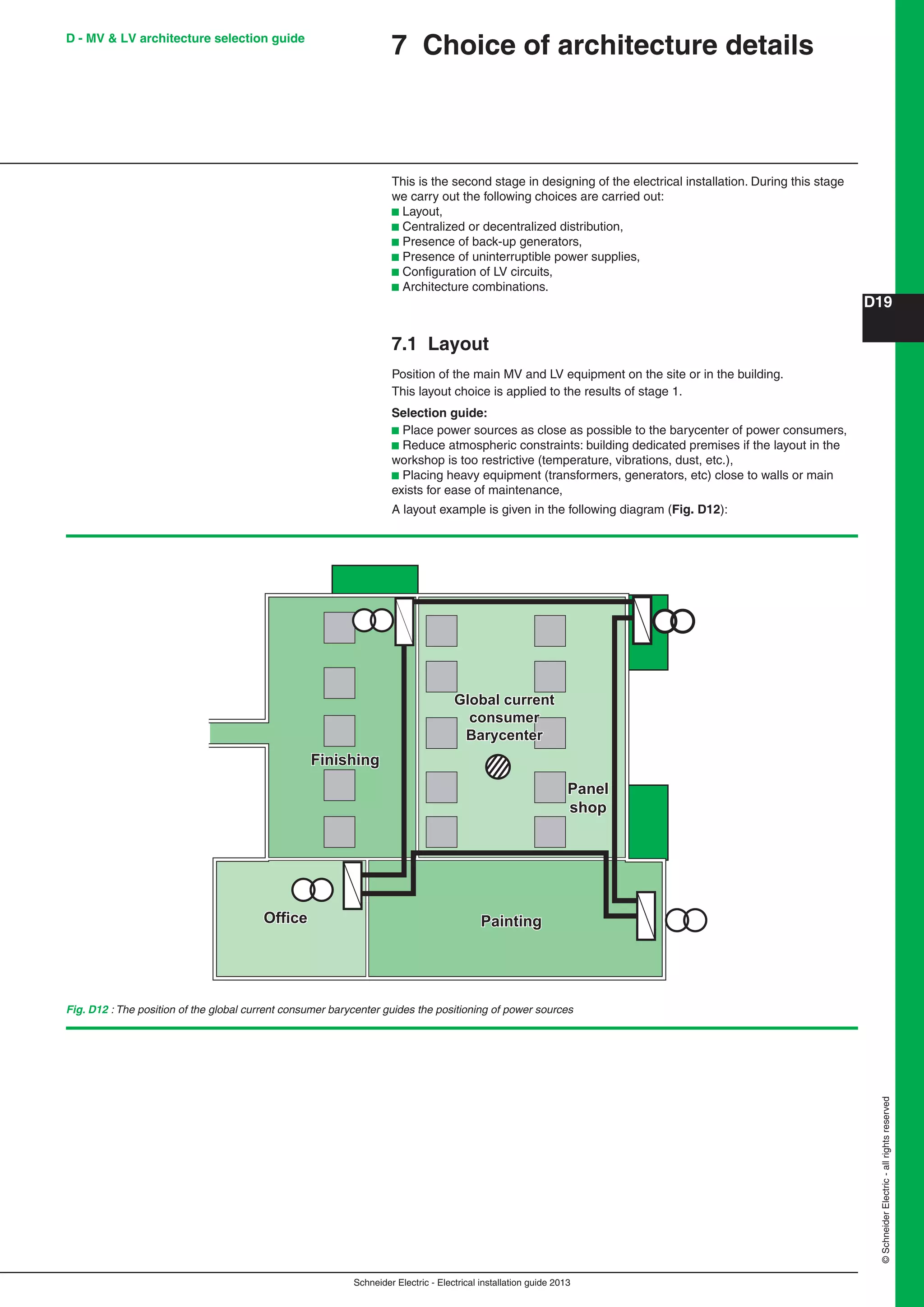
  • 413.
    Schneider Electric -Electrical installation guide 2013 N23©SchneiderElectric-allrightsreserved 2 Uninterruptible Power Supply units (UPS) In certain specific cases however, notably in very large installations, an additional filter circuit may be necessary. For example when : b The power rating of the UPS system is large relative to the MV/LV transformer suppllying it b The LV busbars supply loads which are particularly sensitive to harmonics b A diesel (or gas-turbine, etc,) driven alternator is provided as a standby power supply In such cases, the manufacturer of the UPS system should be consulted Communication equipment Communication with equipment associated with computer systems may entail the need for suitable facilities within the UPS system. Such facilities may be incorporated in an original design (see Fig. N30a ), or added to existing systems on request (see Fig. N30b ). Fig. N30b : UPS unit achieving disponibility and quality of computer system power supplyFig. N30a : Ready-to-use UPS unit (with DIN module)
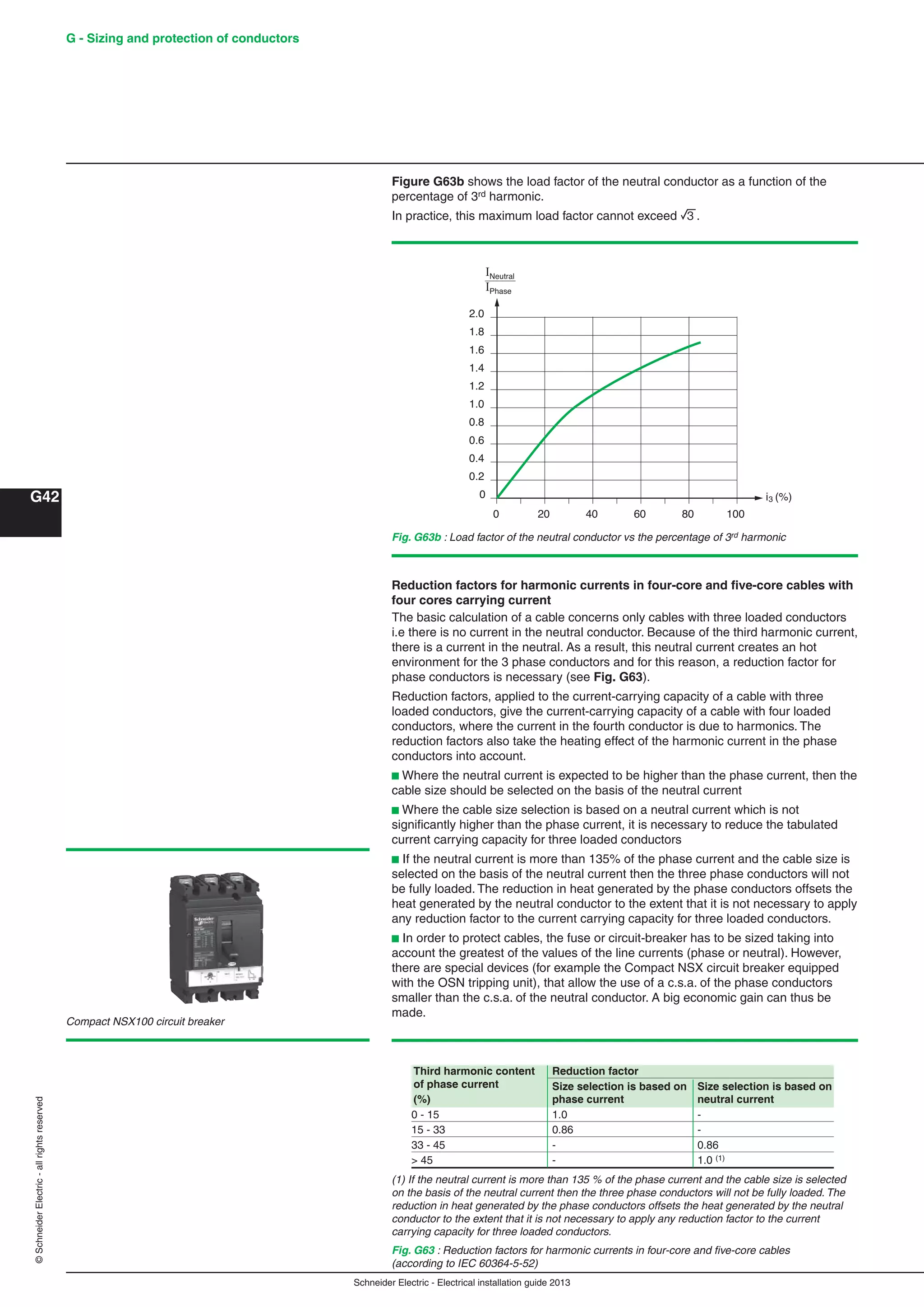
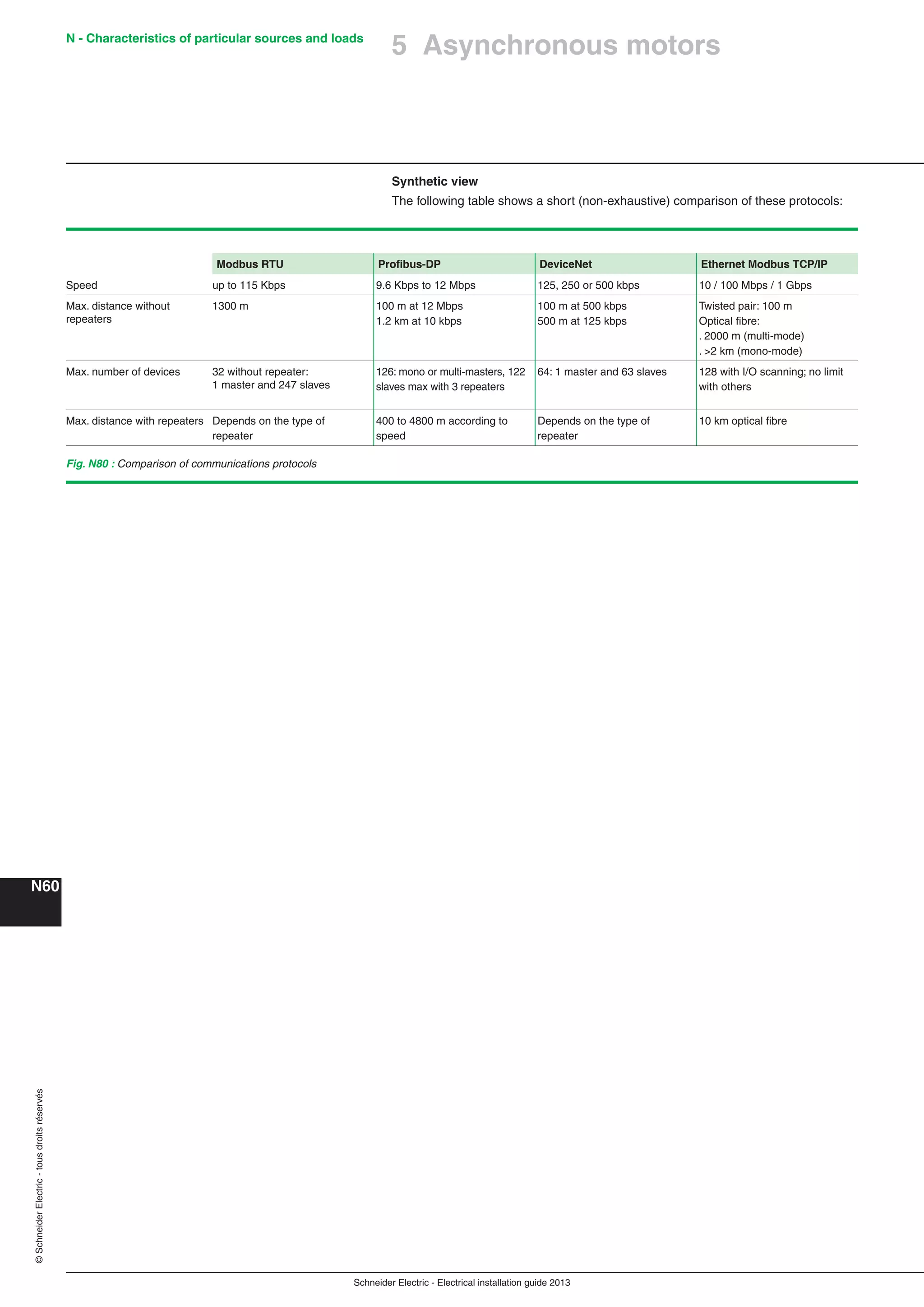
  • 414.
    Schneider Electric -Electrical installation guide 2013 N - Characteristics of particular sources and loads N24 ©SchneiderElectric-allrightsreserved 3 Protection of LV/LV transformers These transformers are generally in the range of several hundreds of VA to some hundreds of kVA and are frequently used for: b Changing the low voltage level for: v Auxiliary supplies to control and indication circuits v Lighting circuits (230 V created when the primary system is 400 V 3-phase 3-wires) b Changing the method of earthing for certain loads having a relatively high capacitive current to earth (computer equipment) or resistive leakage current (electric ovens, industrial-heating processes, mass-cooking installations, etc.) LV/LV transformers are generally supplied with protective systems incorporated, and the manufacturers must be consulted for details. Overcurrent protection must, in any case, be provided on the primary side. The exploitation of these transformers requires a knowledge of their particular function, together with a number of points described below. Note: In the particular cases of LV/LV safety isolating transformers at extra-low voltage, an earthed metal screen between the primary and secondary windings is frequently required, according to circumstances, as recommended in European Standard EN 60742. 3.1 Transformer-energizing inrush current At the moment of energizing a transformer, high values of transient current (which includes a significant DC component) occur, and must be taken into account when considering protection schemes (see Fig. N31). Fig N31 : Transformer-energizing inrush current In I I 1st peak 10 to 25 In t RMS value of the 1st peak t 20 ms 5 s Im I IiIr Fig N32 : Tripping characteristic of a Compact NS type STR (electronic) Fig N33 : Tripping characteristic of a Acti 9 curve D The magnitude of the current peak depends on: b The value of voltage at the instant of energization b The magnitude and polarity of the residual flux existing in the core of the transformer b Characteristics of the load connected to the transformer The first current peak can reach a value equal to 10 to 15 times the full-load r.m.s. current, but for small transformers (< 50 kVA) may reach values of 20 to 25 times the nominal full-load current. This transient current decreases rapidly, with a time constant  of the order of several ms to severals tens of ms. 3.2 Protection for the supply circuit of a LV/LV transformer The protective device on the supply circuit for a LV/LV transformer must avoid the possibility of incorrect operation due to the magnetizing inrush current surge, noted above.It is necessary to use therefore: b Selective (i.e. slighly time-delayed) circuit-breakers of the type Compact NS STR (see Fig. N32) or b Circuit-breakers having a very high magnetic-trip setting, of the types Compact NS or Acti 9 curve D (see Fig. N33) RMS value of the 1st peak In 10In 14In I t
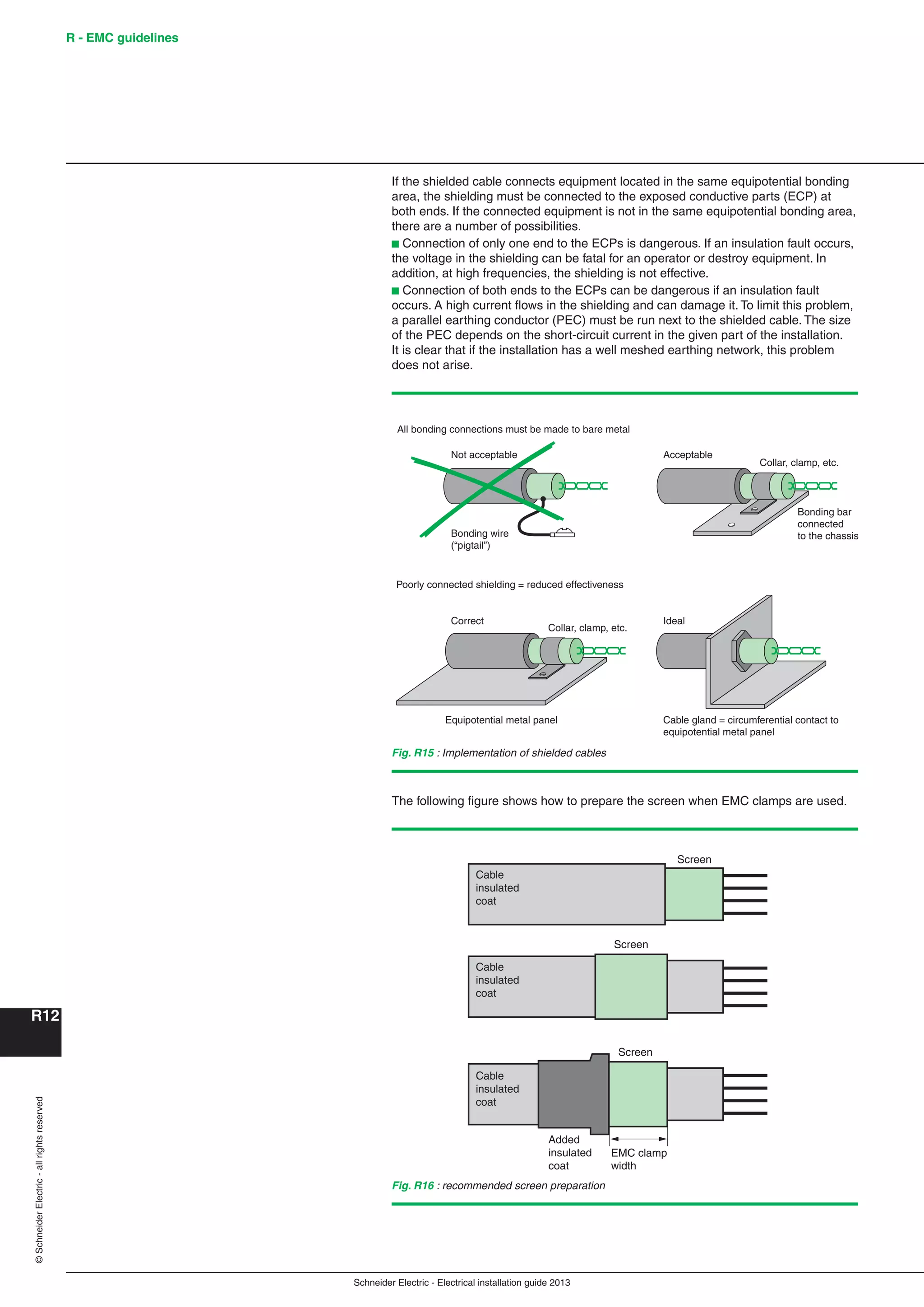
  • 415.
    Schneider Electric -Electrical installation guide 2013 N25©SchneiderElectric-allrightsreserved 3 Protection of LV/LV transformers Example A 400 V 3-phase circuit is supplying a 125 kVA 400/230 V transformer (In = 180 A) for which the first inrush current peak can reach 12 In, i.e. 12 x 180 = 2,160 A. This current peak corresponds to a rms value of 1,530 A. A compact NS 250N circuit-breaker with Ir setting of 200 A and Im setting at 8 x Ir would therefore be a suitable protective device. A particular case: Overload protection installed at the secondary side of the transformer (see Fig. N34) An advantage of overload protection located on the secondary side is that the short- circuit protection on the primary side can be set at a high value, or alternatively a circuit-breaker type MA (magnetic only) can be used. The primary side short-circuit protection setting must, however, be sufficiently sensitive to ensure its operation in the event of a short-circuit occuring on the secondary side of the transformer. Note: The primary protection is sometimes provided by fuses, type aM. This practice has two disadvantages: b The fuses must be largely oversized (at least 4 times the nominal full-load rated current of the transformer) b In order to provide isolating facilities on the primary side, either a load-break switch or a contactor must be associated with the fuses. 3.3 Typical electrical characteristics of LV/LV 50 Hz transformers 400/230 V 125 kVA 3 x 70 mm2 NS250N Trip unit STR 22E Fig N34 : Example 3.4 Protection of LV/LV transformers, using Schneider Electric circuit-breakers Acti 9 circuit-breaker 3-phase kVA rating 5 6.3 8 10 12.5 16 20 25 31.5 40 50 63 80 100 125 160 200 250 315 400 500 630 800 No-load 100 110 130 150 160 170 270 310 350 350 410 460 520 570 680 680 790 950 1160 1240 1485 1855 2160 losses (W) Full-load 250 320 390 500 600 840 800 1180 1240 1530 1650 2150 2540 3700 3700 5900 5900 6500 7400 9300 9400 11400 13400 losses (W) Short-circuit 4.5 4.5 4.5 5.5 5.5 5.5 5.5 5.5 5 5 4.5 5 5 5.5 4.5 5.5 5 5 4.5 6 6 5.5 5.5 voltage (%) 1-phase kVA rating 8 10 12.5 16 20 25 31.5 40 50 63 80 100 125 160 No-load losses (W) 105 115 120 140 150 175 200 215 265 305 450 450 525 635 Full-load losses (W) 400 530 635 730 865 1065 1200 1400 1900 2000 2450 3950 3950 4335 Short-circuit voltage (%) 5 5 5 4.5 4.5 4.5 4 4 5 5 4.5 5.5 5 5 Transformer power rating (kVA) Cricuit breaker Size 230/240 V 1-ph 230/240 V 3-ph 400/415 V 3-ph curve D or K (A) 400/415 V 1-ph 0.05 0.09 0.16 iC60, NG125 0.5 0.11 0.18 0.32 iC60, NG125 1 0.21 0.36 0.63 iC60, NG125 2 0.33 0.58 1.0 iC60, NG125 3 0.67 1.2 2.0 iC60, NG125 6 1.1 1.8 3.2 iC60, C120, NG125 10 1.7 2.9 5.0 iC60, C120, NG125 16 2.1 3.6 6.3 iC60, C120, NG125 20 2.7 4.6 8.0 iC60, C120, NG125 25 3.3 5.8 10 iC60, C120, NG125 32 4.2 7.2 13 iC60, C120, NG125 40 5.3 9.2 16 iC60, C120, NG125 50 6.7 12 20 iC60, C120, NG125 63 8.3 14 25 C120, NG125 80 11 18 32 C120, NG125 100 13 23 40 C120, NG125 125
  • 416.
    Schneider Electric -Electrical installation guide 2013 N - Characteristics of particular sources and loads N26 ©SchneiderElectric-allrightsreserved Compact NS100…NS250 circuit-breakers with TM-D trip unit Compact NS100…NS1600 and Masterpact circuit-breakers with STR or Micrologic trip unit Transformer power rating (kVA) Circuit-breaker Trip unit 230/240 V 1-ph 230/240 V 3-ph 400/415 V 3-ph 400/415 V 1-ph 3 5…6 9…12 NS100N/H/L TN16D 5 8…9 14…16 NS100N/H/L TM05D 7…9 13…16 22…28 NS100N/H/L TN40D 12…15 20…25 35…44 NS100N/H/L TN63D 16…19 26…32 45…56 NS100N/H/L TN80D 18…23 32…40 55…69 NS160N/H/L TN100D 23…29 40…50 69…87 NS160N/H/L TN125D 29…37 51…64 89…111 NS250N/H/L TN160D 37…46 64…80 111…139 NS250N/H/L TN200D Transformer power rating (kVA) Circuit-breaker Trip unit Setting 230/240 V 1-ph 230/240 V 3-ph 400/415 V 3-ph Ir max 400/415 V 1-ph 4…7 6…13 11…22 NS100N/H/L STR22SE 40 0.8 9…19 16…30 27…56 NS100N/H/L STR22SE 100 0.8 15…30 5…50 44…90 NS160N/H/L STR22SE 160 0.8 23…46 40…80 70…139 NS250N/H/L STR22SE 250 0.8 37…65 64…112 111…195 NS400N/H STR23SE / 53UE 400 0.7 37…55 64…95 111…166 NS400L STR23SE / 53UE 400 0.6 58…83 100…144 175…250 NS630N/H/L STR23SE / 53UE 630 0.6 58…150 100…250 175…436 NS800N/H - NT08H1 Micrologic 5.0/6.0/7.0 1 74…184 107…319 222…554 NS800N/H - NT08H1 - NW08N1/H1 Micrologic 5.0/6.0/7.0 1 90…230 159…398 277…693 NS1000N/H - NT10H1 - NW10N1/H1 Micrologic 5.0/6.0/7.0 1 115…288 200…498 346…866 NS1250N/H - NT12H1 - NW12N1/H1 Micrologic 5.0/6.0/7.0 1 147…368 256…640 443…1,108 NS1600N/H - NT16H1 - NW16N1/H1 Micrologic 5.0/6.0/7.0 1 184…460 320…800 554…1,385 NW20N1/H1 Micrologic 5.0/6.0/7.0 1 230…575 400…1,000 690…1,730 NW25N2/H3 Micrologic 5.0/6.0/7.0 1 294…736 510…1,280 886…2,217 NW32N2/H3 Micrologic 5.0/6.0/7.0 1
  • 417.
    Schneider Electric -Electrical installation guide 2013 N27©SchneiderElectric-allrightsreserved 4 Lighting circuits A source of comfort and productivity, lighting represents 15% of the quantity of electricity consumed in industry and 40% in buildings. The quality of lighting (light stability and continuity of service) depends on the quality of the electrical energy thus consumed. The supply of electrical power to lighting networks has therefore assumed great importance. To help with their design and simplify the selection of appropriate protection devices, an analysis of the different lamp technologies is presented. The distinctive features of lighting circuits and their impact on control and protection devices are discussed. Recommendations relative to the difficulties of lighting circuit implementation are given. 4.1 The different lamp technologies Artificial luminous radiation can be produced from electrical energy according to two principles: incandescence and electroluminescence. Incandescence is the production of light via temperature elevation. The most common example is a filament heated to white state by the circulation of an electrical current. The energy supplied is transformed into heat by the Joule effect and into luminous flux. Luminescence is the phenomenon of emission by a material of visible or almost visible luminous radiation. A gas (or vapors) subjected to an electrical discharge emits luminous radiation (Electroluminescence of gases). Since this gas does not conduct at normal temperature and pressure, the discharge is produced by generating charged particles which permit ionization of the gas. The nature, pressure and temperature of the gas determine the light spectrum. Photoluminescence is the luminescence of a material exposed to visible or almost visible radiation (ultraviolet, infrared). When the substance absorbs ultraviolet radiation and emits visible radiation which stops a short time after energization, this is fluorescence. Incandescent lamps Incandescent lamps are historically the oldest and the most often found in common use. They are based on the principle of a filament rendered incandescent in a vacuum or neutral atmosphere which prevents combustion. A distinction is made between: b Standard bulbs These contain a tungsten filament and are filled with an inert gas (nitrogen and argon or krypton). b Halogen bulbs These also contain a tungsten filament, but are filled with a halogen compound and an inert gas (krypton or xenon). This halogen compound is responsible for the phenomenon of filament regeneration, which increases the service life of the lamps and avoids them blackening. It also enables a higher filament temperature and therefore greater luminosity in smaller-size bulbs. The main disadvantage of incandescent lamps is their significant heat dissipation, resulting in poor luminous efficiency. Fluorescent lamps