2003 Schools WorkshopLou Adams, Audit Manager Team SPJoLynn Berge, Asst. Audit Manager Team SP
School Planning Guide
Audits of ApportionmentEnrollment, Staff Mix and Transportation
OverviewYour local knowledge Statewide analysis of dataCurrent approach fulfills legislative mandateLocation of plans and other informationAudit Memo (must use worksheets provided)Include ALL apportionment work in your TeamMate w/p – special ed tooAssigned apportionment specialist for each team
EnrollmentAlternative Learning Program (statewide theme)Summer School (FTE restrictions)September to October enrollment dropSpecial Education – state enrollment (conducted by SP staff)
Staff Mix	Acquire latest S275 from school districtBachelor Degree – LEAP boarder lineNew Hires – records on fileSocial Security Number VerificationFAWF districtsFollow up on prior issues
TransportationTeam SP compared ridership to enrollment over 3 years.Reconciled 1022As to 1026 funding reportAnalyzed trends in route type ridershipPlans are specific for individual districtsMode check on 3-yr accountability auditsFAWF filed districts Follow up from prior audit issues
Financial Section Update
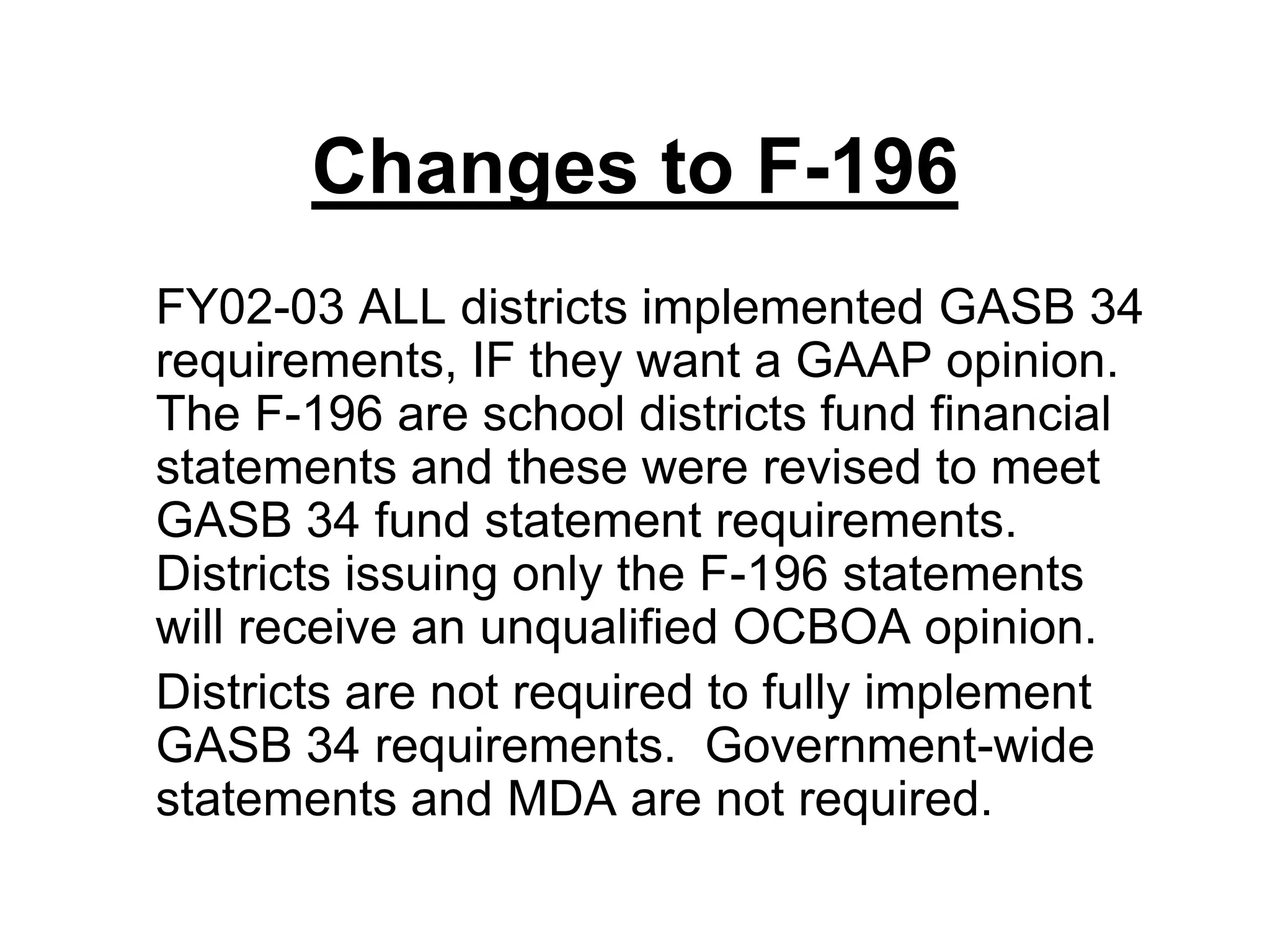
Changes to F-196	FY02-03 ALL districts implemented GASB 34 requirements, IF they want a GAAP opinion.  The F-196 are school districts fund financial statements and these were revised to meet GASB 34 fund statement requirements.  Districts issuing only the F-196 statements will receive an unqualified OCBOA opinion.	Districts are not required to fully implement GASB 34 requirements.  Government-wide statements and MDA are not required.
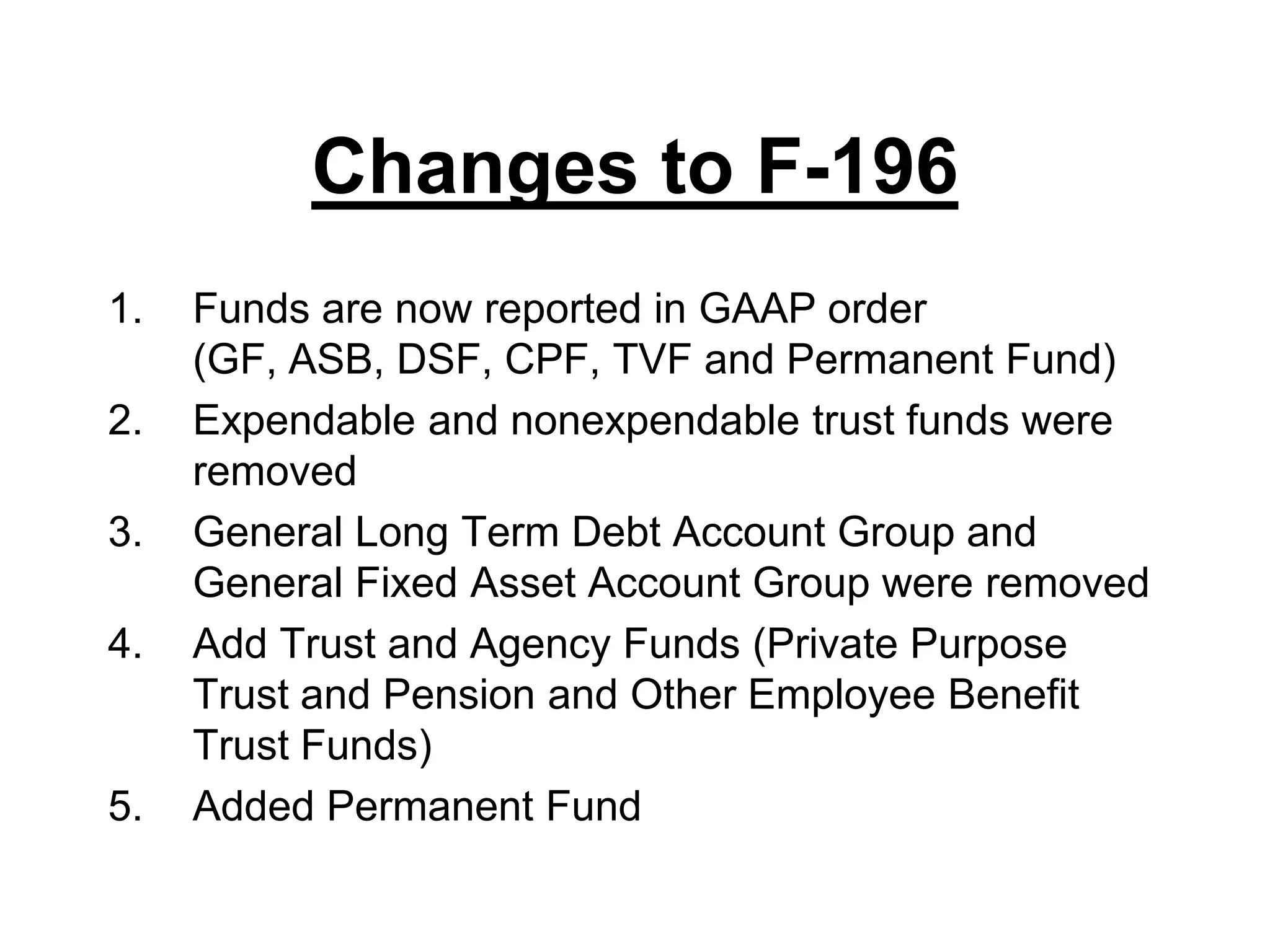
Changes to F-196Funds are now reported in GAAP order (GF, ASB, DSF, CPF, TVF and Permanent Fund)Expendable and nonexpendable trust funds were removedGeneral Long Term Debt Account Group and General Fixed Asset Account Group were removedAdd Trust and Agency Funds (Private Purpose Trust and Pension and Other Employee Benefit Trust Funds)Added Permanent Fund
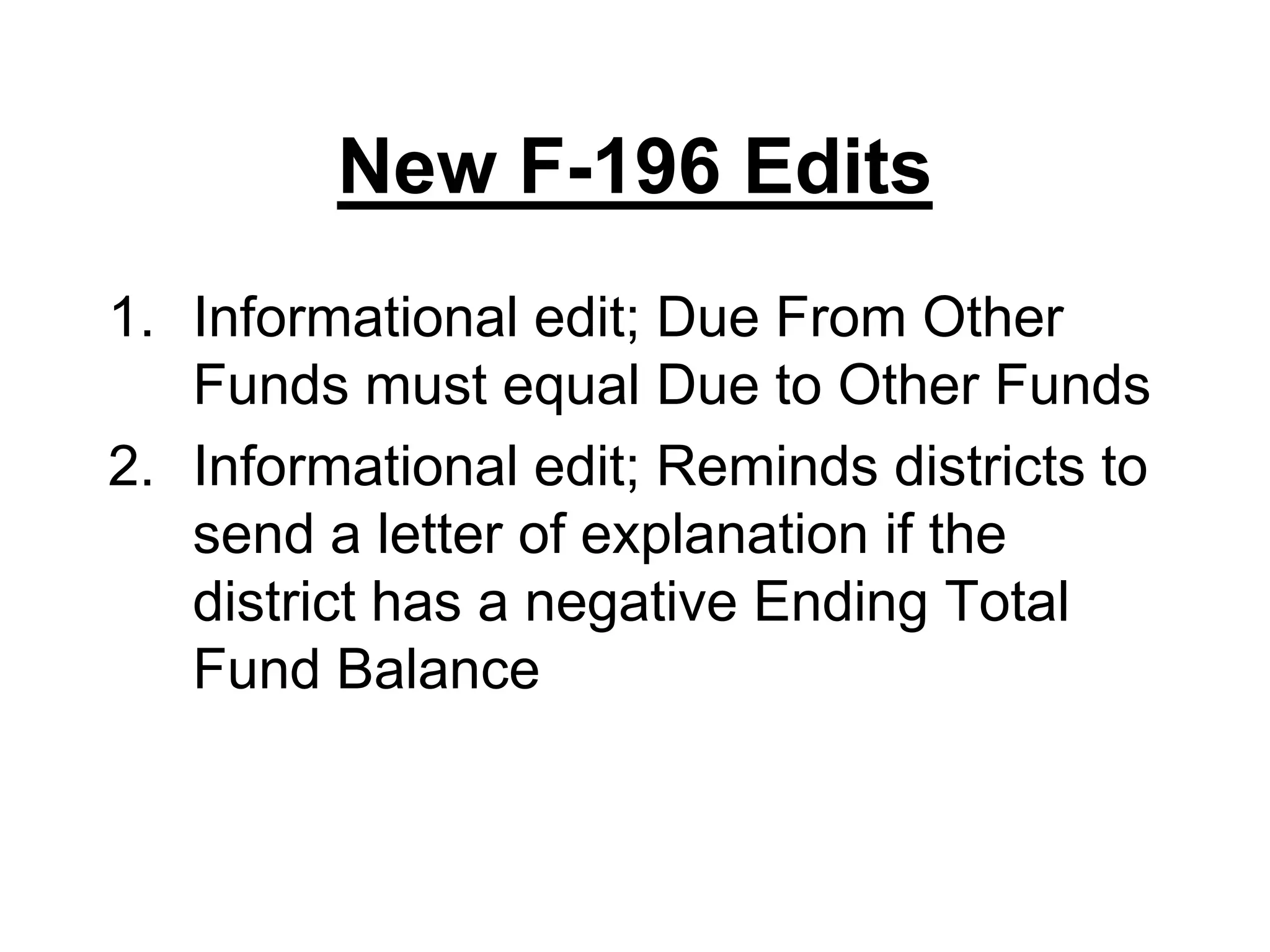
New F-196 EditsInformational edit; Due From Other Funds must equal Due to Other FundsInformational edit; Reminds districts to send a letter of explanation if the district has a negative Ending Total Fund Balance
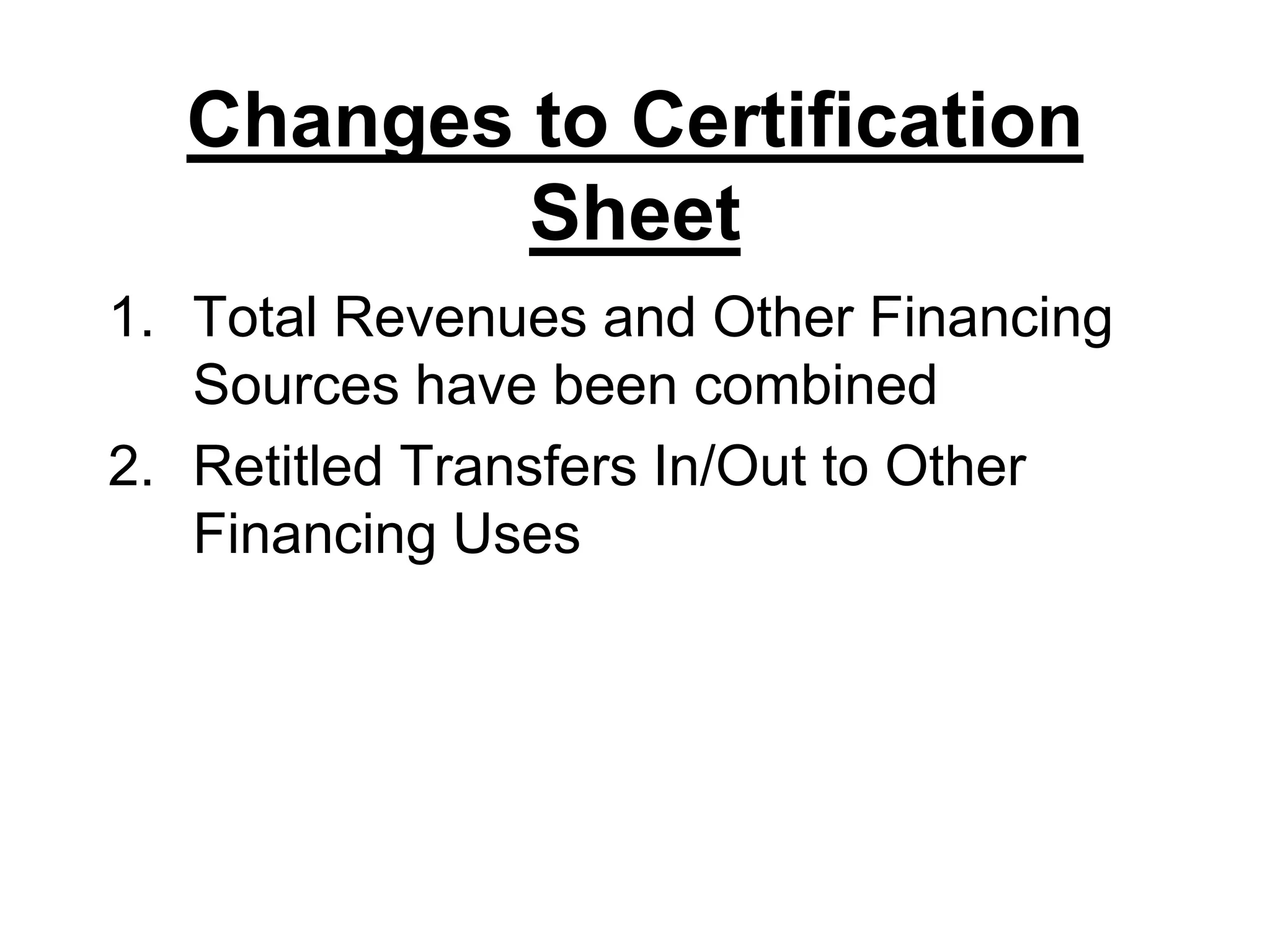
Changes to Certification SheetTotal Revenues and Other Financing Sources have been combinedRetitled Transfers In/Out to Other Financing Uses
Changes to Balance Sheet/Statement of Revenues, Expenditures and Changes in Fund BalanceGeneral ledger accounts have been rolled upABFR manual lists the GL accounts, including those that are combined in the roll upsTrust and Agency Funds and Permanent Fund entries are manually inputResidual Equity Transfers have been removedRetitled Transfer In/Out to Other Sources/Uses
Statement of Changes in Fiduciary Net AssetsFor Trust and Agency FundsNew statement in FY02/03Most entries are manually inputOther Trust Column will only be used by districts with a Pension and Other Employee Benefits Trust or Agency Fund
Schedule of Long-Term DebtNew in FY02/03Beginning outstanding debt balance as of 9/1/02 should equal ending balance as of 8/31/02Manually inputSimilar to what has been required by BARS manual
Changes to NotesNote 1 has been revised to include new language for Other Comprehensive Basis of Accounting
Updates to Auditing StandardsOpinion UnitsEffective for audits of financial statement periods ending after June 15, 2003For schools this is FY02/03TAS will be including this in A&A training in DecemberOnly GAAP audits (CAFRs) will be receiving audit reports with opinion unitsAll other reports will remain basically the same and no additional audit work will be neededTeamMate will be updated to include opinion unit requirements in financial statement section (materiality work)
Updates to Auditing StandardsSAS No. 99 – Consideration of Fraud in a Financial Statement AuditEffective for audits of financial statements for periods beginning on or after Dec. 15, 2002For schools this is FY03/04Teams will be notified when this information is updated in TeamMate
Permanent Fund and Trust FundsDistricts closed out their expendable and non-expendable trust funds, and from these balances, determined the beginning balance amounts in the new Permanent Fund and Private-purpose Trust FundAuditors need to determine whether the beginning balances are fairly stated.Recommend tracing the ending balances from old funds to how the new balances were determined.
Trust Fund activity in the ASB FundNon-charitable fundraising is allowed by RCW to remain in the ASB Fund (6000 accounts).However, auditors need to determine whether this activity is material to either the balance sheet or income statement and whether booking this activity in the ASB Fund has materially misstated the fund’s activity reported on the financials.If this activity materially misstates the ASB fund financial information, Districts should restate their financials to properly account for this activity.
Evaluating and Assessing Financial ConditionDistricts are required to report to the board monthly, WAC 392-123-115 requires “Monthly budget status report”.The WAC also requires written explanations for significant deviations in revenues or expenditures.Review information that the board is receiving and verify that it agrees with actual financial records.Does it agree with requirements?
Evaluating and Assessing Financial Condition Cont.-Refer to the Planning Guide for additional financial condition indicators and areas of risk:Enrollment projectionsYear end journal entriesFund balanceSome additional thoughts if financial condition is poor:Determine what current fund balance is at time of auditPerform analytical procedures on budget to actual information (budgeted vs. actual beginning and ending fund balance and revenues and expenditures), are there overwhelming differences?Use of restricted funds
Reservations and Designations of Fund BalancePerform analytical procedures at detail component level of fund balance (FAP).Are all items in fund balance appropriately categorized (reserves vs. designations).Reservations of fund balance only for:Resources not available for spending (inventory and imprest offsets)Legal restrictions on spending (bond funds, I-728)
Reservations and Designations of Fund BalanceAll reserves need to meet one of the two criteria.  Board resolution to “set aside” money is not a reservation.Designations represent management’s intended use of resources.May be made by board or managementMust be supported by appropriate documentation
I-728 MoneysFinancial statement workProperly presented on financialsreservation of fund balance is ok for unspent portionBooking unspent portion as deferred revenue is not proper treatmentLegal compliance work (only during accountability audits)Public hearing was held by May 1stFunds were spent on allowable activities and on those activities agreed upon based on public hearing input
MiscellaneousGeneral Fund FundraisingNeed to determine where district is coding this to for analytical purposes (revenue code 2900)State grantsLearning Assistance Program state moneys will be tested at a few districts that receive very large allocations.Teams will be notified for districts to test
K-12 Education System ReportFirst year out the doorProfiles the education industryCommon audit areas examinedFY02 audit results (findings, issues and other conditions of note)RecommendationsAudit focus for FY03
Current Hot Topics
General Fund FundraisingAGO issued February 19, 2003Concludes that districts have authority to raise funds in the general fund for educational purposes.School districts do not have authority to create enterprises that have no direct relationship to their educational programs. See guidelines in handout.Controls and monitoring should be similar to ASB fundraising.
Interlocal Agreements & PiggybackingAGM Issued April 1, 2003Not legally necessary to enter an interlocal agreement prior – however it’s a good business practiceBuyer bears burden of ensuring purchase is made in compliance with bid requirementsInterlocal Cooperation Act does not relieve buyer of statutory obligations
Open Public Meetings ActInformal opinion issued July 1, 2003 to Washington State School Directors Assoc.Questioned whether meetings to discuss operational strategies in the event of a strike are exempt from the Act.Analysis by AG is no, these meetings are not exempt and not considering to be part of the collective bargaining process
U.S. Communities Purchasing AllianceAGM issued June 23, 2003National organization that has contracted with Office Depot. The Alliance claimed local government could avoid compliance with its statutory competitive bidding requirement by entering an interlocal agreement under RCW 39.34.Aggressively pursued school districts.AGM concludes that statutory requirements can not be avoided by entering into interlocal agreements.
Other TopicsPTA interest in ASB rulesConsistency in reporting issues – early communication is keyNew webpage for School ProgramsAudit Issues Database – email ALL exit items, management letters and findings at conclusion of audit.FY02 challenges with audit reports

Power Point Example

  • 1.
    2003 Schools WorkshopLouAdams, Audit Manager Team SPJoLynn Berge, Asst. Audit Manager Team SP
  • 2.
  • 3.
    Audits of ApportionmentEnrollment,Staff Mix and Transportation
  • 4.
    OverviewYour local knowledgeStatewide analysis of dataCurrent approach fulfills legislative mandateLocation of plans and other informationAudit Memo (must use worksheets provided)Include ALL apportionment work in your TeamMate w/p – special ed tooAssigned apportionment specialist for each team
  • 5.
    EnrollmentAlternative Learning Program(statewide theme)Summer School (FTE restrictions)September to October enrollment dropSpecial Education – state enrollment (conducted by SP staff)
  • 6.
    Staff Mix Acquire latestS275 from school districtBachelor Degree – LEAP boarder lineNew Hires – records on fileSocial Security Number VerificationFAWF districtsFollow up on prior issues
  • 7.
    TransportationTeam SP comparedridership to enrollment over 3 years.Reconciled 1022As to 1026 funding reportAnalyzed trends in route type ridershipPlans are specific for individual districtsMode check on 3-yr accountability auditsFAWF filed districts Follow up from prior audit issues
  • 8.
  • 9.
    Changes to F-196 FY02-03ALL districts implemented GASB 34 requirements, IF they want a GAAP opinion. The F-196 are school districts fund financial statements and these were revised to meet GASB 34 fund statement requirements. Districts issuing only the F-196 statements will receive an unqualified OCBOA opinion. Districts are not required to fully implement GASB 34 requirements. Government-wide statements and MDA are not required.
  • 10.
    Changes to F-196Fundsare now reported in GAAP order (GF, ASB, DSF, CPF, TVF and Permanent Fund)Expendable and nonexpendable trust funds were removedGeneral Long Term Debt Account Group and General Fixed Asset Account Group were removedAdd Trust and Agency Funds (Private Purpose Trust and Pension and Other Employee Benefit Trust Funds)Added Permanent Fund
  • 11.
    New F-196 EditsInformationaledit; Due From Other Funds must equal Due to Other FundsInformational edit; Reminds districts to send a letter of explanation if the district has a negative Ending Total Fund Balance
  • 12.
    Changes to CertificationSheetTotal Revenues and Other Financing Sources have been combinedRetitled Transfers In/Out to Other Financing Uses
  • 13.
    Changes to BalanceSheet/Statement of Revenues, Expenditures and Changes in Fund BalanceGeneral ledger accounts have been rolled upABFR manual lists the GL accounts, including those that are combined in the roll upsTrust and Agency Funds and Permanent Fund entries are manually inputResidual Equity Transfers have been removedRetitled Transfer In/Out to Other Sources/Uses
  • 14.
    Statement of Changesin Fiduciary Net AssetsFor Trust and Agency FundsNew statement in FY02/03Most entries are manually inputOther Trust Column will only be used by districts with a Pension and Other Employee Benefits Trust or Agency Fund
  • 15.
    Schedule of Long-TermDebtNew in FY02/03Beginning outstanding debt balance as of 9/1/02 should equal ending balance as of 8/31/02Manually inputSimilar to what has been required by BARS manual
  • 16.
    Changes to NotesNote1 has been revised to include new language for Other Comprehensive Basis of Accounting
  • 17.
    Updates to AuditingStandardsOpinion UnitsEffective for audits of financial statement periods ending after June 15, 2003For schools this is FY02/03TAS will be including this in A&A training in DecemberOnly GAAP audits (CAFRs) will be receiving audit reports with opinion unitsAll other reports will remain basically the same and no additional audit work will be neededTeamMate will be updated to include opinion unit requirements in financial statement section (materiality work)
  • 18.
    Updates to AuditingStandardsSAS No. 99 – Consideration of Fraud in a Financial Statement AuditEffective for audits of financial statements for periods beginning on or after Dec. 15, 2002For schools this is FY03/04Teams will be notified when this information is updated in TeamMate
  • 19.
    Permanent Fund andTrust FundsDistricts closed out their expendable and non-expendable trust funds, and from these balances, determined the beginning balance amounts in the new Permanent Fund and Private-purpose Trust FundAuditors need to determine whether the beginning balances are fairly stated.Recommend tracing the ending balances from old funds to how the new balances were determined.
  • 20.
    Trust Fund activityin the ASB FundNon-charitable fundraising is allowed by RCW to remain in the ASB Fund (6000 accounts).However, auditors need to determine whether this activity is material to either the balance sheet or income statement and whether booking this activity in the ASB Fund has materially misstated the fund’s activity reported on the financials.If this activity materially misstates the ASB fund financial information, Districts should restate their financials to properly account for this activity.
  • 21.
    Evaluating and AssessingFinancial ConditionDistricts are required to report to the board monthly, WAC 392-123-115 requires “Monthly budget status report”.The WAC also requires written explanations for significant deviations in revenues or expenditures.Review information that the board is receiving and verify that it agrees with actual financial records.Does it agree with requirements?
  • 22.
    Evaluating and AssessingFinancial Condition Cont.-Refer to the Planning Guide for additional financial condition indicators and areas of risk:Enrollment projectionsYear end journal entriesFund balanceSome additional thoughts if financial condition is poor:Determine what current fund balance is at time of auditPerform analytical procedures on budget to actual information (budgeted vs. actual beginning and ending fund balance and revenues and expenditures), are there overwhelming differences?Use of restricted funds
  • 23.
    Reservations and Designationsof Fund BalancePerform analytical procedures at detail component level of fund balance (FAP).Are all items in fund balance appropriately categorized (reserves vs. designations).Reservations of fund balance only for:Resources not available for spending (inventory and imprest offsets)Legal restrictions on spending (bond funds, I-728)
  • 24.
    Reservations and Designationsof Fund BalanceAll reserves need to meet one of the two criteria. Board resolution to “set aside” money is not a reservation.Designations represent management’s intended use of resources.May be made by board or managementMust be supported by appropriate documentation
  • 25.
    I-728 MoneysFinancial statementworkProperly presented on financialsreservation of fund balance is ok for unspent portionBooking unspent portion as deferred revenue is not proper treatmentLegal compliance work (only during accountability audits)Public hearing was held by May 1stFunds were spent on allowable activities and on those activities agreed upon based on public hearing input
  • 26.
    MiscellaneousGeneral Fund FundraisingNeedto determine where district is coding this to for analytical purposes (revenue code 2900)State grantsLearning Assistance Program state moneys will be tested at a few districts that receive very large allocations.Teams will be notified for districts to test
  • 27.
    K-12 Education SystemReportFirst year out the doorProfiles the education industryCommon audit areas examinedFY02 audit results (findings, issues and other conditions of note)RecommendationsAudit focus for FY03
  • 28.
  • 29.
    General Fund FundraisingAGOissued February 19, 2003Concludes that districts have authority to raise funds in the general fund for educational purposes.School districts do not have authority to create enterprises that have no direct relationship to their educational programs. See guidelines in handout.Controls and monitoring should be similar to ASB fundraising.
  • 30.
    Interlocal Agreements &PiggybackingAGM Issued April 1, 2003Not legally necessary to enter an interlocal agreement prior – however it’s a good business practiceBuyer bears burden of ensuring purchase is made in compliance with bid requirementsInterlocal Cooperation Act does not relieve buyer of statutory obligations
  • 31.
    Open Public MeetingsActInformal opinion issued July 1, 2003 to Washington State School Directors Assoc.Questioned whether meetings to discuss operational strategies in the event of a strike are exempt from the Act.Analysis by AG is no, these meetings are not exempt and not considering to be part of the collective bargaining process
  • 32.
    U.S. Communities PurchasingAllianceAGM issued June 23, 2003National organization that has contracted with Office Depot. The Alliance claimed local government could avoid compliance with its statutory competitive bidding requirement by entering an interlocal agreement under RCW 39.34.Aggressively pursued school districts.AGM concludes that statutory requirements can not be avoided by entering into interlocal agreements.
  • 33.
    Other TopicsPTA interestin ASB rulesConsistency in reporting issues – early communication is keyNew webpage for School ProgramsAudit Issues Database – email ALL exit items, management letters and findings at conclusion of audit.FY02 challenges with audit reports