RECAP
What is the theory that explains and unifies different geologic phenomena? Recap
What is the theory that states that continents were once joined and then they broke apart? Recap
Give 3 evidences of Continental Drift provided by Wegener. Recap
What do you call the remanent magnetism from ancient rocks recording the direction and strength of the Earth’s magnetic field at that time? Recap
What is the theory that states that the seafloor separates at oceanic ridges? Recap
What are Earthquakes? The shaking or trembling caused by the sudden release of energy (also known as a  quake, tremor or temblor) Usually associated with faulting or breaking of rocks Continuing adjustment of position results in aftershocks


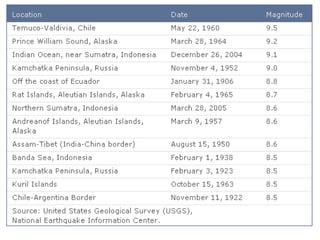
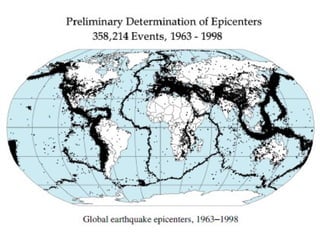
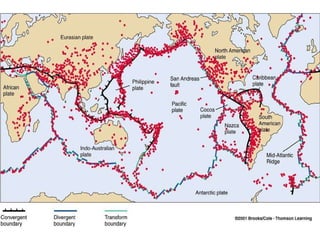
Where Do Earthquakes Occur and How Often? ~80% of all earthquakes occur in the circum-Pacific belt most of these result from convergent margin activity ~15% occur in the Mediterranean-Asiatic belt remaining 5% occur in the interiors of plates and on spreading ridge centers more than 150,000 quakes strong enough to be felt are recorded each year
 
Causes of Earthquakes Passing the Elastic Limit Causes Faulting Applied stresses can cause rocks to bend and stretch  Eventually rocks will break away from one another Area in which the rocks break and move is called a fault Vibrations produced is called an earthquake Earth’s crust movement causes the stresses applied
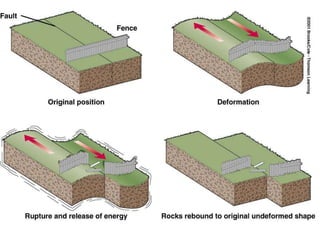
What is the  Elastic Rebound Theory ? Explains how energy is stored in rocks Rocks bend until the strength of the rock is exceeded Rupture occurs and the rocks quickly rebound to an undeformed shape Energy is released in waves that radiate outward from the fault
 
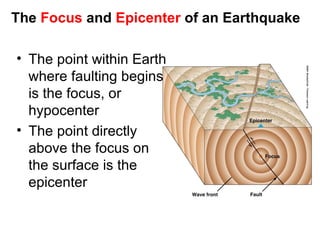
The  Focus  and  Epicenter  of an Earthquake The point within Earth where faulting begins is the focus, or hypocenter The point directly above the focus on the surface is the epicenter
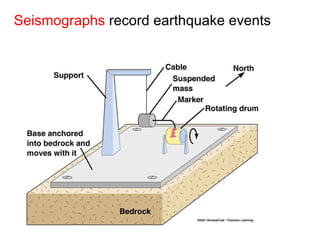
Measuring Earthquakes Seismology Seismologists - People who study earthquakes and seismic waves Use instruments called seismographs Record seismic waves A drum with a sheet of paper vibrates and a stationary pen marks the vibrations on the paper The height of the lines are used to measure the energy released from the earthquake called the magnitude
Seismographs  record earthquake events
What are Seismic Waves? Response of material to the arrival of energy fronts released by rupture Two types: Body waves P and S Surface waves R and L
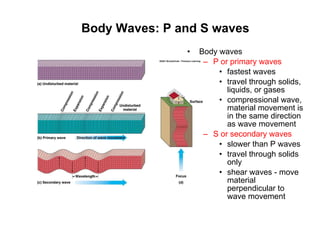
Body Waves: P and S waves Body waves P or primary waves fastest waves travel through solids, liquids, or gases compressional wave, material movement is in the same direction as wave movement S or secondary waves slower than P waves travel through solids only shear waves - move material perpendicular to wave movement
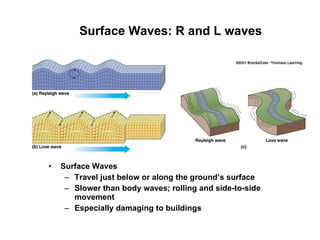
Surface Waves: R and L waves Surface Waves Travel just below or along the ground’s surface Slower than body waves; rolling and side-to-side movement Especially damaging to buildings
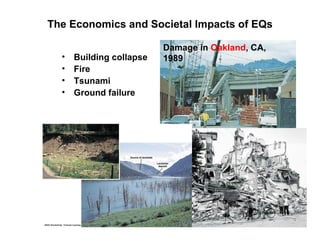
The Economics and Societal Impacts of EQs Damage in  Oakland , CA, 1989 Building collapse Fire Tsunami Ground failure
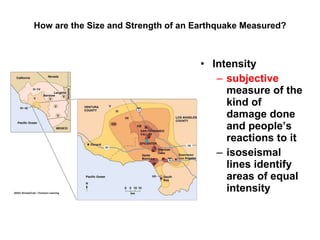
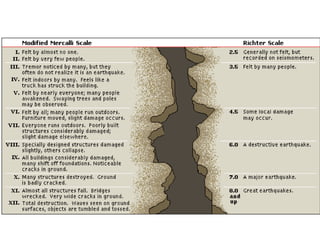
How are the Size and Strength of an Earthquake Measured? Intensity subjective  measure of the kind of damage done and people’s reactions to it isoseismal lines identify areas of equal intensity
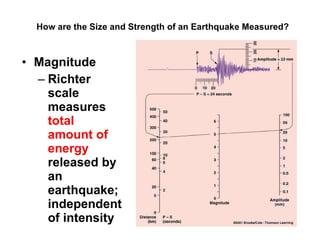
How are the Size and Strength of an Earthquake Measured? Magnitude Richter scale measures  total amount of energy  released by an earthquake; independent of intensity
 
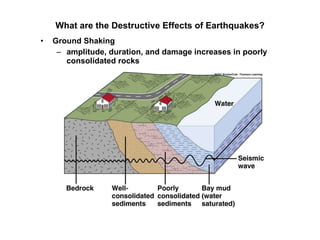
What are the Destructive Effects of Earthquakes? Ground Shaking amplitude, duration, and damage increases in poorly consolidated rocks
Tsunamis Caused by the movement of the ocean floor Causes a disruption in the water Some are so wide that a large ship can travel over the wave without knowing Recent earthquake in the Indian Ocean created a tsunamis that was 100 feet high and moving at 500 mph
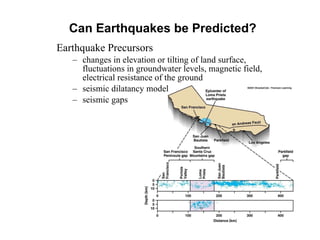
Can Earthquakes be Predicted? Earthquake Precursors  changes in elevation or tilting of land surface, fluctuations in groundwater levels, magnetic field, electrical resistance of the ground seismic dilatancy model seismic gaps
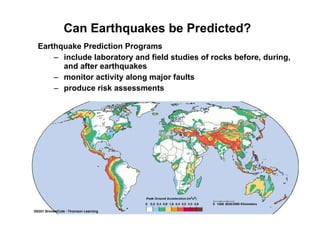
Can Earthquakes be Predicted? Earthquake Prediction Programs include laboratory and field studies of rocks before, during, and after earthquakes monitor activity along major faults produce risk assessments
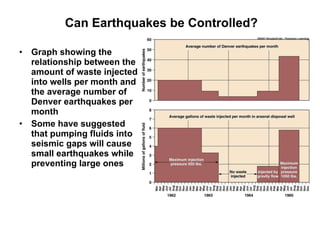
Can Earthquakes be Controlled? Graph showing the relationship between the amount of waste injected into wells per month and the average number of Denver earthquakes per month Some have suggested that pumping fluids into seismic gaps will cause small earthquakes while preventing large ones
EARTHQUAKE SAFETY
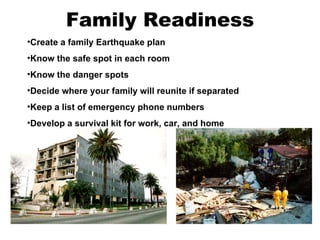
Family Readiness Create a family Earthquake plan Know the safe spot in each room Know the danger spots Decide where your family will reunite if separated Keep a list of emergency phone numbers Develop a survival kit for work, car, and home
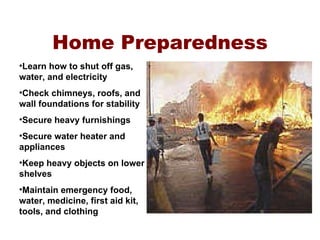
Home Preparedness Learn how to shut off gas, water, and electricity Check chimneys, roofs, and wall foundations for stability Secure heavy furnishings Secure water heater and appliances Keep heavy objects on lower shelves Maintain emergency food, water, medicine, first aid kit, tools, and clothing
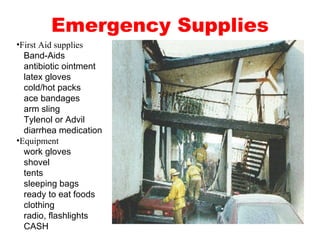
Emergency Supplies First Aid supplies   Band-Aids   antibiotic ointment   latex gloves   cold/hot packs   ace bandages   arm sling   Tylenol or Advil   diarrhea medication Equipment   work gloves   shovel   tents   sleeping bags   ready to eat foods   clothing   radio, flashlights   CASH
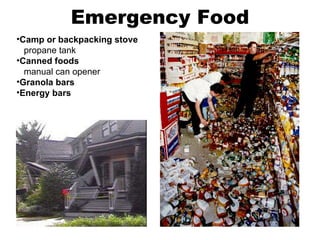
Emergency Food Camp or backpacking stove   propane tank Canned foods   manual can opener Granola bars Energy bars
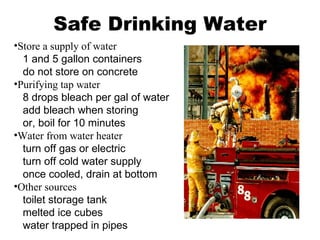
Safe Drinking Water Store a supply of water   1 and 5 gallon containers   do not store on concrete Purifying tap water   8 drops bleach per gal of water   add bleach when storing   or, boil for 10 minutes Water from water heater   turn off gas or electric   turn off cold water supply   once cooled, drain at bottom Other sources   toilet storage tank   melted ice cubes   water trapped in pipes
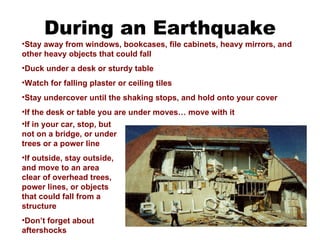
During an Earthquake Stay away from windows, bookcases, file cabinets, heavy mirrors, and other heavy objects that could fall Duck under a desk or sturdy table Watch for falling plaster or ceiling tiles Stay undercover until the shaking stops, and hold onto your cover If the desk or table you are under moves… move with it If in your car, stop, but not on a bridge, or under trees or a power line If outside, stay outside, and move to an area clear of overhead trees, power lines, or objects that could fall from a structure Don’t forget about aftershocks
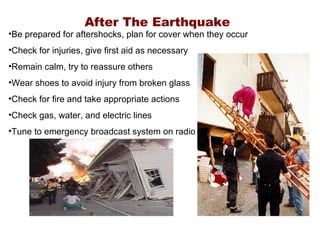
After The Earthquake Be prepared for aftershocks, plan for cover when they occur Check for injuries, give first aid as necessary Remain calm, try to reassure others Wear shoes to avoid injury from broken glass Check for fire and take appropriate actions Check gas, water, and electric lines Tune to emergency broadcast system on radio

Earthquakes

  • 1.
  • 2.
    What is thetheory that explains and unifies different geologic phenomena? Recap
  • 3.
    What is thetheory that states that continents were once joined and then they broke apart? Recap
  • 4.
    Give 3 evidencesof Continental Drift provided by Wegener. Recap
  • 5.
    What do youcall the remanent magnetism from ancient rocks recording the direction and strength of the Earth’s magnetic field at that time? Recap
  • 6.
    What is thetheory that states that the seafloor separates at oceanic ridges? Recap
  • 7.
    What are Earthquakes?The shaking or trembling caused by the sudden release of energy (also known as a quake, tremor or temblor) Usually associated with faulting or breaking of rocks Continuing adjustment of position results in aftershocks
  • 8.
  • 9.
  • 10.
  • 11.
    Where Do EarthquakesOccur and How Often? ~80% of all earthquakes occur in the circum-Pacific belt most of these result from convergent margin activity ~15% occur in the Mediterranean-Asiatic belt remaining 5% occur in the interiors of plates and on spreading ridge centers more than 150,000 quakes strong enough to be felt are recorded each year
  • 12.
  • 13.
    Causes of EarthquakesPassing the Elastic Limit Causes Faulting Applied stresses can cause rocks to bend and stretch Eventually rocks will break away from one another Area in which the rocks break and move is called a fault Vibrations produced is called an earthquake Earth’s crust movement causes the stresses applied
  • 14.
    What is the Elastic Rebound Theory ? Explains how energy is stored in rocks Rocks bend until the strength of the rock is exceeded Rupture occurs and the rocks quickly rebound to an undeformed shape Energy is released in waves that radiate outward from the fault
  • 15.
  • 16.
    The Focus and Epicenter of an Earthquake The point within Earth where faulting begins is the focus, or hypocenter The point directly above the focus on the surface is the epicenter
  • 17.
    Measuring Earthquakes SeismologySeismologists - People who study earthquakes and seismic waves Use instruments called seismographs Record seismic waves A drum with a sheet of paper vibrates and a stationary pen marks the vibrations on the paper The height of the lines are used to measure the energy released from the earthquake called the magnitude
  • 18.
    Seismographs recordearthquake events
  • 19.
    What are SeismicWaves? Response of material to the arrival of energy fronts released by rupture Two types: Body waves P and S Surface waves R and L
  • 20.
    Body Waves: Pand S waves Body waves P or primary waves fastest waves travel through solids, liquids, or gases compressional wave, material movement is in the same direction as wave movement S or secondary waves slower than P waves travel through solids only shear waves - move material perpendicular to wave movement
  • 21.
    Surface Waves: Rand L waves Surface Waves Travel just below or along the ground’s surface Slower than body waves; rolling and side-to-side movement Especially damaging to buildings
  • 22.
    The Economics andSocietal Impacts of EQs Damage in Oakland , CA, 1989 Building collapse Fire Tsunami Ground failure
  • 23.
    How are theSize and Strength of an Earthquake Measured? Intensity subjective measure of the kind of damage done and people’s reactions to it isoseismal lines identify areas of equal intensity
  • 24.
    How are theSize and Strength of an Earthquake Measured? Magnitude Richter scale measures total amount of energy released by an earthquake; independent of intensity
  • 25.
  • 26.
    What are theDestructive Effects of Earthquakes? Ground Shaking amplitude, duration, and damage increases in poorly consolidated rocks
  • 27.
    Tsunamis Caused bythe movement of the ocean floor Causes a disruption in the water Some are so wide that a large ship can travel over the wave without knowing Recent earthquake in the Indian Ocean created a tsunamis that was 100 feet high and moving at 500 mph
  • 28.
    Can Earthquakes bePredicted? Earthquake Precursors changes in elevation or tilting of land surface, fluctuations in groundwater levels, magnetic field, electrical resistance of the ground seismic dilatancy model seismic gaps
  • 29.
    Can Earthquakes bePredicted? Earthquake Prediction Programs include laboratory and field studies of rocks before, during, and after earthquakes monitor activity along major faults produce risk assessments
  • 30.
    Can Earthquakes beControlled? Graph showing the relationship between the amount of waste injected into wells per month and the average number of Denver earthquakes per month Some have suggested that pumping fluids into seismic gaps will cause small earthquakes while preventing large ones
  • 31.
  • 32.
    Family Readiness Createa family Earthquake plan Know the safe spot in each room Know the danger spots Decide where your family will reunite if separated Keep a list of emergency phone numbers Develop a survival kit for work, car, and home
  • 33.
    Home Preparedness Learnhow to shut off gas, water, and electricity Check chimneys, roofs, and wall foundations for stability Secure heavy furnishings Secure water heater and appliances Keep heavy objects on lower shelves Maintain emergency food, water, medicine, first aid kit, tools, and clothing
  • 34.
    Emergency Supplies FirstAid supplies Band-Aids antibiotic ointment latex gloves cold/hot packs ace bandages arm sling Tylenol or Advil diarrhea medication Equipment work gloves shovel tents sleeping bags ready to eat foods clothing radio, flashlights CASH
  • 35.
    Emergency Food Campor backpacking stove propane tank Canned foods manual can opener Granola bars Energy bars
  • 36.
    Safe Drinking WaterStore a supply of water 1 and 5 gallon containers do not store on concrete Purifying tap water 8 drops bleach per gal of water add bleach when storing or, boil for 10 minutes Water from water heater turn off gas or electric turn off cold water supply once cooled, drain at bottom Other sources toilet storage tank melted ice cubes water trapped in pipes
  • 37.
    During an EarthquakeStay away from windows, bookcases, file cabinets, heavy mirrors, and other heavy objects that could fall Duck under a desk or sturdy table Watch for falling plaster or ceiling tiles Stay undercover until the shaking stops, and hold onto your cover If the desk or table you are under moves… move with it If in your car, stop, but not on a bridge, or under trees or a power line If outside, stay outside, and move to an area clear of overhead trees, power lines, or objects that could fall from a structure Don’t forget about aftershocks
  • 38.
    After The EarthquakeBe prepared for aftershocks, plan for cover when they occur Check for injuries, give first aid as necessary Remain calm, try to reassure others Wear shoes to avoid injury from broken glass Check for fire and take appropriate actions Check gas, water, and electric lines Tune to emergency broadcast system on radio