1. What is the primary
cause of earthquakes?
a) Volcanic eruptions
b) Shifting tectonic plates
c) Underground explosions
d) Meteorite impacts
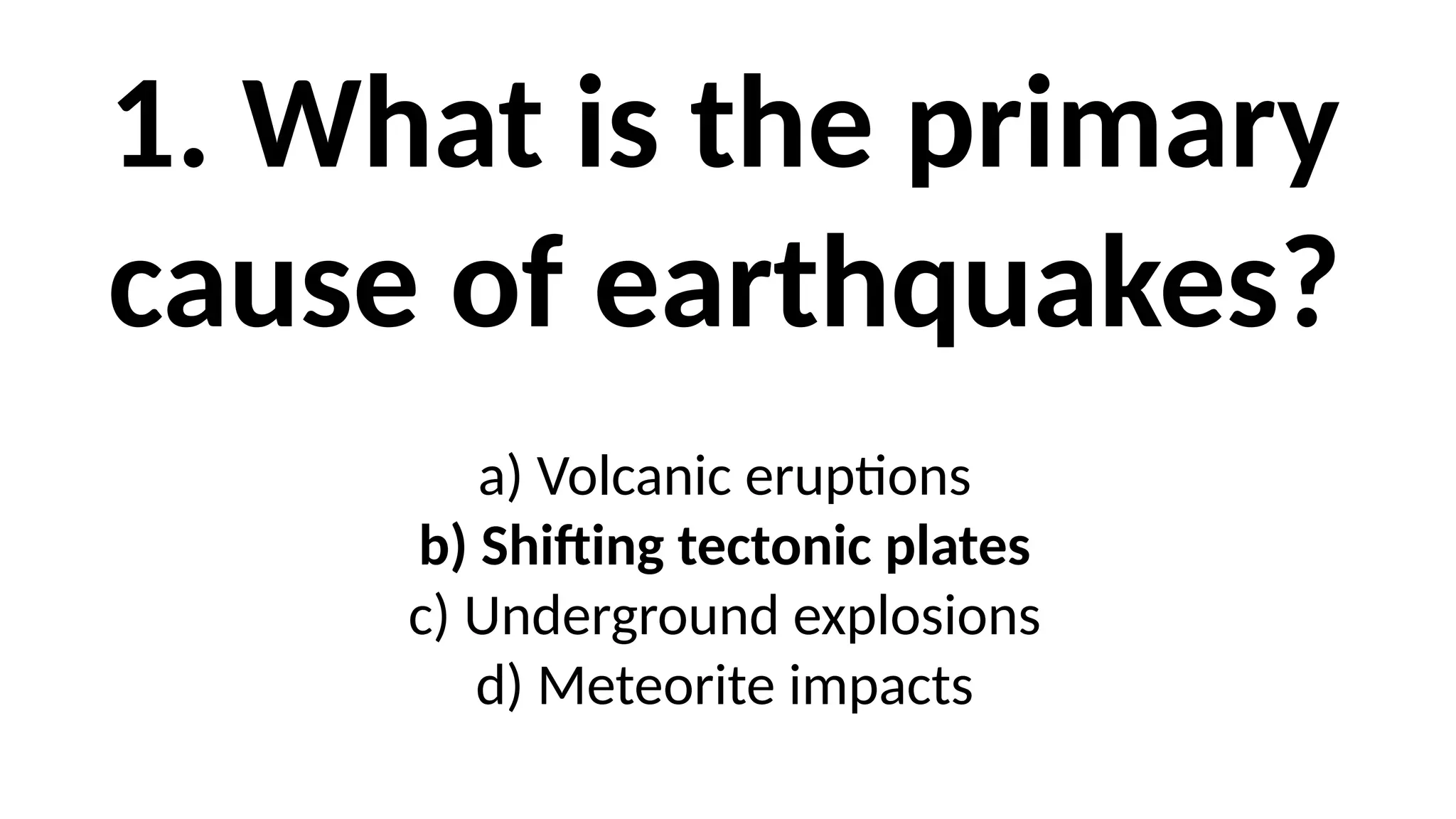
1. What is the primary
cause of earthquakes?
a) Volcanic eruptions
b) Shifting tectonic plates
c) Underground explosions
d) Meteorite impacts
2. Which of these is NOT a
common earthquake hazard?
a) Ground shaking
b) Tsunamis
c) Landslides
d) Volcanic eruptions
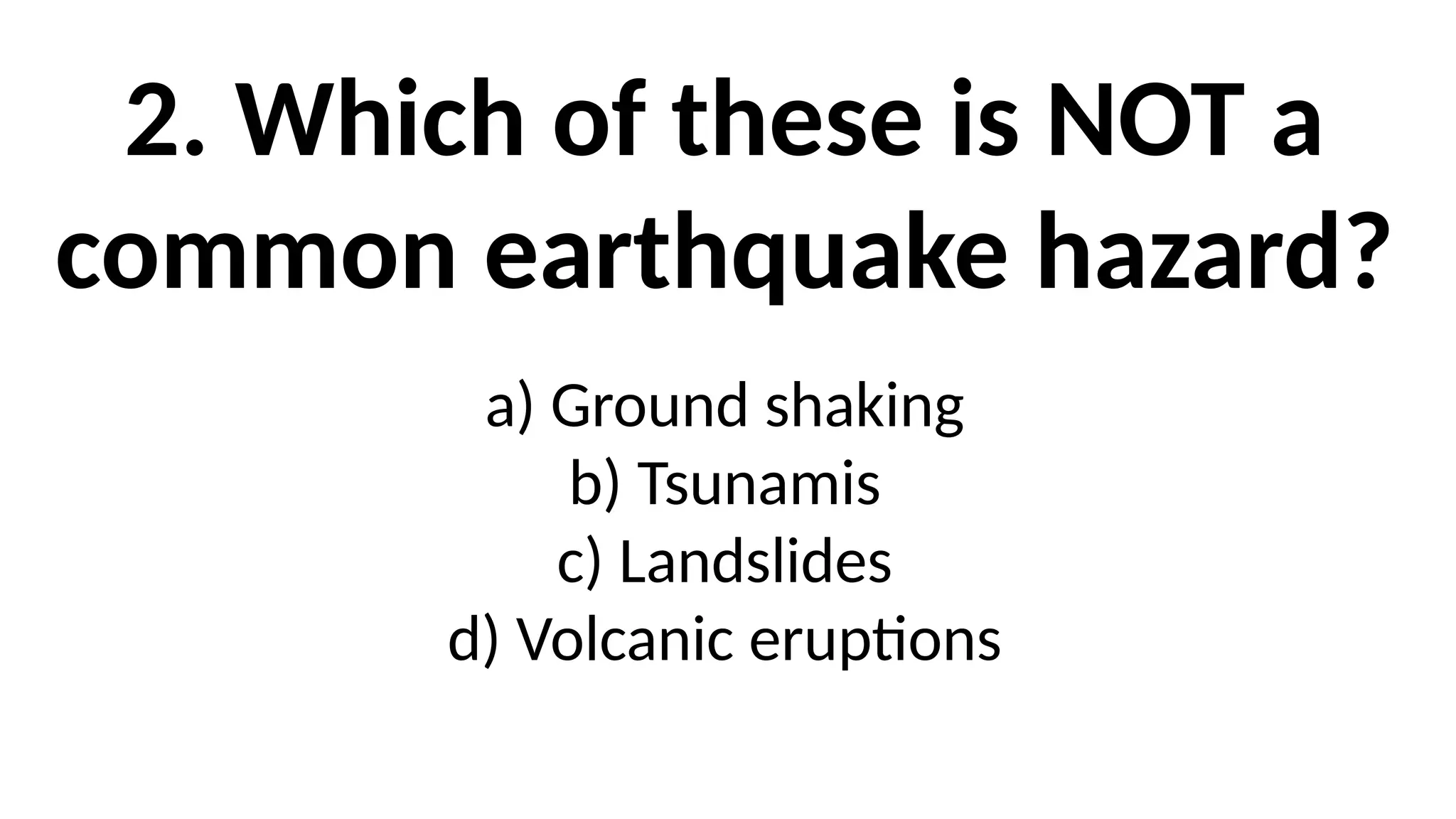
2. Which of these is NOT a
common earthquake hazard?
a) Ground shaking
b) Tsunamis
c) Landslides
d) Volcanic eruptions
3. What is the most important step
to take during an earthquake?
a) Run outside immediately
b) Stand near a window for visibility
c) Drop, cover, and hold on
d) Call for help
3. What is the most important step
to take during an earthquake?
a) Run outside immediately
b) Stand near a window for visibility
c) Drop, cover, and hold on
d) Call for help
4. Where is the safest place to
be during an earthquake?
a) Under a heavy table or desk
b) Near a window
c) In a doorway
d) Standing in the middle of a room
4. Where is the safest place to
be during an earthquake?
a) Under a heavy table or desk
b) Near a window
c) In a doorway
d) Standing in the middle of a room
5. What is the Richter scale
used to measure?
a) The intensity of an earthquake
b) The duration of an earthquake
c) The depth of an earthquake
d) The damage caused by an earthquake
5. What is the Richter scale
used to measure?
a) The intensity of an earthquake
b) The duration of an earthquake
c) The depth of an earthquake
d) The damage caused by an earthquake
6. What is a seismic wave?
a) A wave of energy that travels through the Earth's crust
b) A wave of water caused by an earthquake
c) A wave of air caused by an earthquake
d) A wave of heat caused by an earthquake
6. What is a seismic wave?
a) A wave of energy that travels through the Earth's crust
b) A wave of water caused by an earthquake
c) A wave of air caused by an earthquake
d) A wave of heat caused by an earthquake
7. What is the best way to
prepare for an earthquake?
a) Ignore the risk and hope for the best
b) Create an emergency plan and gather supplies
c) Wait for instructions from authorities
d) Move to a different location
7. What is the best way to
prepare for an earthquake?
a) Ignore the risk and hope for the best
b) Create an emergency plan and gather supplies
c) Wait for instructions from authorities
d) Move to a different location
8. What is the role of a
community in earthquake
preparedness?
a) To ignore the risk and hope for the best
b) To rely solely on government agencies for assistance
c) To work together, develop a plan and practice drills
d) To blame each other for the earthquake
8. What is the role of a
community in earthquake
preparedness?
a) To ignore the risk and hope for the best
b) To rely solely on government agencies for assistance
c) To work together, develop a plan and practice drills
d) To blame each other for the earthquake
9. What is a tsunami?
a) A series of large waves caused by an earthquake
b) A volcanic eruption that causes a large wave
c) A large storm that causes a wave
d) A tidal wave caused by the moon
9. What is a tsunami?
a) A series of large waves caused by an earthquake
b) A volcanic eruption that causes a large wave
c) A large storm that causes a wave
d) A tidal wave caused by the moon
10. What is the importance
of earthquake drills in
schools and workplaces?
a) To ensure that everyone knows what to do in case of an earthquake
b) To provide a fun activity for students and employees
c) To increase the number of earthquakes
d) To prepare for a natural disaster
10. What is the importance
of earthquake drills in
schools and workplaces?
a) To ensure that everyone knows what to do in case of an earthquake
b) To provide a fun activity for students and employees
c) To increase the number of earthquakes
d) To prepare for a natural disaster
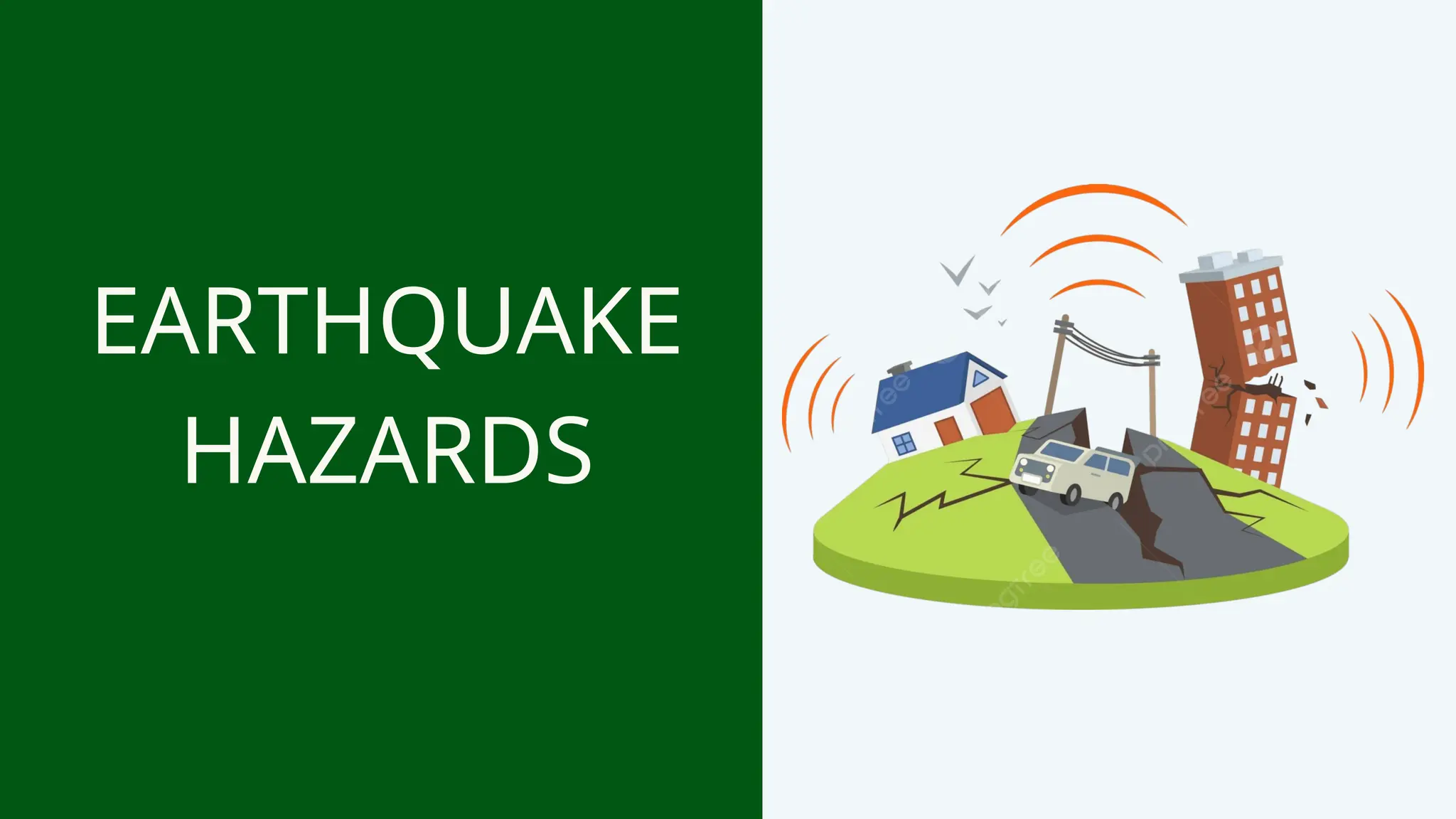
EARTHQUAKE
HAZARDS
Earthquake Hazards
and Risk Reduction
Methods
Your paragraph text
• An earthquake is the vibration of Earth produced by the rapid release of energy
within the lithosphere.
• Earthquakes are caused by slippage along a break in the lithosphere, called a
fault.
• The energy released by an earthquake travel in all directions from the focus in the
form of seismic waves.
• The movement that occurs along faults during earthquakes is a major factor in
changing Earth’s surface.
EARTHQUAKE
EARTHQUAKE
• Forces inside Earth slowly deform the rock that makes up Earth’s crust, causing
rock to bend.
• Elastic rebound is the tendency for the deformed rock along a fault to spring
back after an earthquake.
• An aftershock is an earthquake that occurs sometime soon after a major
earthquake.
• A seismograph is a device used to record the motion of the ground during an
earthquake.
1. Check yourself and others for injuries. Provide first aid if needed.
2. Check water, gas, and electric lines for damage. Shut off the valves if any
are damaged.
3. If you smell gas, open all windows and doors, leave immediately, and
report it to the authorities.
4. Drop, Cover, and Hold on during the shaking.
5. Stay inside and shelter under a sturdy table or bench. Avoid windows and
heavy objects
WHAT TO DO WHEN THERE IS AN EARTHQUAKE?
• STAY CALM, DO NOT PANIC
• ALWAYS CHECK YOUR
SORROUNDING
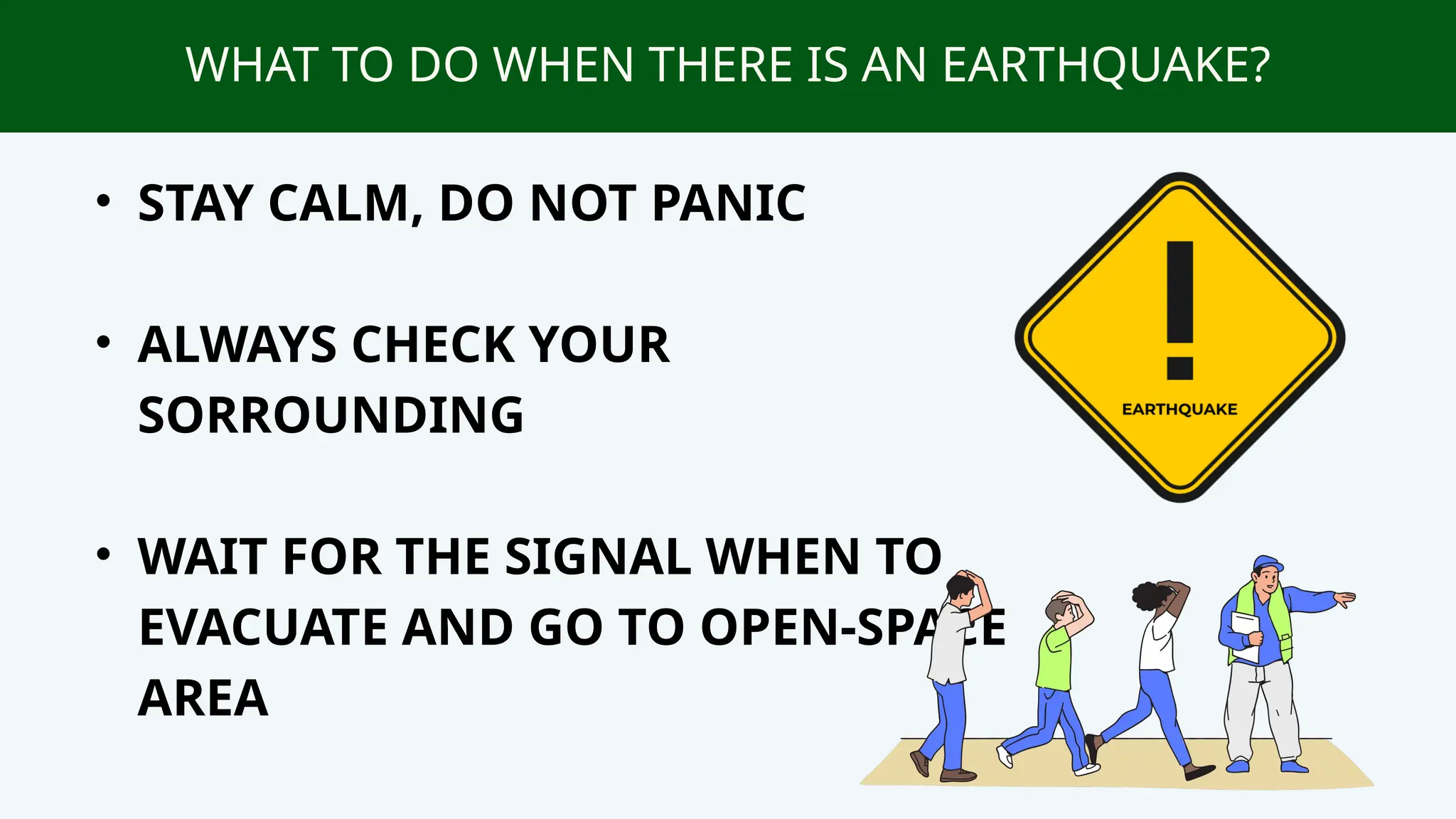
• WAIT FOR THE SIGNAL WHEN TO
EVACUATE AND GO TO OPEN-SPACE
AREA
WHAT TO DO WHEN THERE IS AN EARTHQUAKE?
Tectonic plates can move in different directions resulting in different
outcomes.
TECTONIC PLATES
Convergent
Faults
Divergent
Faults
Transform
Faults
Convergent boundaries
occur when plates collide
with each other. Volcanos
and Earthquakes
commonly occur along
convergent boundaries.
CONVERGENT BOUNDARIES
DIVERGENT BOUNDARIES
Divergent boundaries occur
when plates move away from
on another.
When they move apart, water
or magma fills the space and
TRANSFORM FAULT BOUNDARIES
Transform boundaries are
also know as sliding
boundaries. They occur
when plates slide creating
a break in the earth's
surface. This can create a
EARTHQUAKE
HAZARDS
What are Earthquake Hazards?
Earthquake Hazards refer to
earthquake agents which have the
potential to cause harm to a
vulnerable target which can either be
humans, animals or even your
environment.
EARTHQUAKE HAZARDS
PRIMARY EFFECTS
The effects of an earthquake can be classified as
primary or secondary:
• Primary effects are permanent features an
earthquake can bring out.
Examples include fault scarps, surface ruptures,
and offsets of natural or human-constructed
objects.
FAULT SCARP
SURFACE OR GROUND RUPTURE
CONSTRUCTION DAMAGE
• Secondary effects happen when ground
movement results in other types of
destruction.
Examples include landslides, tsunami,
liquefaction and fire.
SECONDARY EFFECTS
1. LANDSLIDES
Seismic vibration is a common triggering
mechanism for landslides. Landslides can have
particularly devastating effects like floods, blocking
of rivers, death, and damage to land and natural
resources. Landslides can be prevented by
reinforcing slope material, modifying the pathway
for surface and underwater and by putting piles and
2. TSUNAMI
A tsunami is a huge sea wave triggered by a violent
displacement of the ocean floor. Underwater
earthquakes, volcanic eruptions or landslides can
cause tsunamis. As it approaches a shallow
coastline, its speed decreases, but the height of the
tsunami increases drastically, bringing so much
damage to nearby communities. Tsunamis can also
overwhelm sewage systems, destroy structures and
3. LIQUEFACTION
Earthquake motion can turn loosely packed, water-
saturated soil to liquid— "liquefaction.” Liquefied soil
becomes less compact and ultimately loses the ability to
support roads, buried pipes, and, of course, houses. It is
caused by vibration or saturation with water which causes
the soil to decrease in density. These poses danger for it
led to unstable structures of buildings due to ground
4. FIRE
Earthquakes cause fires. Even moderate ground
shaking can break gas and electrical lines,
sever fuel lines, and overturn stoves. To further
complicate things, water pipes rupture, so it
would be impossible to extinguish the fire.
WHY DOES IT MATTER?
WHAT IS THE ROLE OF COMMUNITY DURING EARTHQUAKE
Community Support is the backbone that
holds us together when floods, hurricanes,
earthquakes, or wildfires strike. Whether
it's sharing resources, providing emotional
support, or coordinating rescue efforts,
the role of the community is paramount.
ACTIVITY:
VOLCANO DIORAMA
PREPAREDNESS PLAN

Disaster Readiness and Risk Reduction Earthquake Hazard

  • 1.
    1. What isthe primary cause of earthquakes? a) Volcanic eruptions b) Shifting tectonic plates c) Underground explosions d) Meteorite impacts
  • 2.
    1. What isthe primary cause of earthquakes? a) Volcanic eruptions b) Shifting tectonic plates c) Underground explosions d) Meteorite impacts
  • 3.
    2. Which ofthese is NOT a common earthquake hazard? a) Ground shaking b) Tsunamis c) Landslides d) Volcanic eruptions
  • 4.
    2. Which ofthese is NOT a common earthquake hazard? a) Ground shaking b) Tsunamis c) Landslides d) Volcanic eruptions
  • 5.
    3. What isthe most important step to take during an earthquake? a) Run outside immediately b) Stand near a window for visibility c) Drop, cover, and hold on d) Call for help
  • 6.
    3. What isthe most important step to take during an earthquake? a) Run outside immediately b) Stand near a window for visibility c) Drop, cover, and hold on d) Call for help
  • 7.
    4. Where isthe safest place to be during an earthquake? a) Under a heavy table or desk b) Near a window c) In a doorway d) Standing in the middle of a room
  • 8.
    4. Where isthe safest place to be during an earthquake? a) Under a heavy table or desk b) Near a window c) In a doorway d) Standing in the middle of a room
  • 9.
    5. What isthe Richter scale used to measure? a) The intensity of an earthquake b) The duration of an earthquake c) The depth of an earthquake d) The damage caused by an earthquake
  • 10.
    5. What isthe Richter scale used to measure? a) The intensity of an earthquake b) The duration of an earthquake c) The depth of an earthquake d) The damage caused by an earthquake
  • 11.
    6. What isa seismic wave? a) A wave of energy that travels through the Earth's crust b) A wave of water caused by an earthquake c) A wave of air caused by an earthquake d) A wave of heat caused by an earthquake
  • 12.
    6. What isa seismic wave? a) A wave of energy that travels through the Earth's crust b) A wave of water caused by an earthquake c) A wave of air caused by an earthquake d) A wave of heat caused by an earthquake
  • 13.
    7. What isthe best way to prepare for an earthquake? a) Ignore the risk and hope for the best b) Create an emergency plan and gather supplies c) Wait for instructions from authorities d) Move to a different location
  • 14.
    7. What isthe best way to prepare for an earthquake? a) Ignore the risk and hope for the best b) Create an emergency plan and gather supplies c) Wait for instructions from authorities d) Move to a different location
  • 15.
    8. What isthe role of a community in earthquake preparedness? a) To ignore the risk and hope for the best b) To rely solely on government agencies for assistance c) To work together, develop a plan and practice drills d) To blame each other for the earthquake
  • 16.
    8. What isthe role of a community in earthquake preparedness? a) To ignore the risk and hope for the best b) To rely solely on government agencies for assistance c) To work together, develop a plan and practice drills d) To blame each other for the earthquake
  • 17.
    9. What isa tsunami? a) A series of large waves caused by an earthquake b) A volcanic eruption that causes a large wave c) A large storm that causes a wave d) A tidal wave caused by the moon
  • 18.
    9. What isa tsunami? a) A series of large waves caused by an earthquake b) A volcanic eruption that causes a large wave c) A large storm that causes a wave d) A tidal wave caused by the moon
  • 19.
    10. What isthe importance of earthquake drills in schools and workplaces? a) To ensure that everyone knows what to do in case of an earthquake b) To provide a fun activity for students and employees c) To increase the number of earthquakes d) To prepare for a natural disaster
  • 20.
    10. What isthe importance of earthquake drills in schools and workplaces? a) To ensure that everyone knows what to do in case of an earthquake b) To provide a fun activity for students and employees c) To increase the number of earthquakes d) To prepare for a natural disaster
  • 22.
  • 27.
    Your paragraph text •An earthquake is the vibration of Earth produced by the rapid release of energy within the lithosphere. • Earthquakes are caused by slippage along a break in the lithosphere, called a fault. • The energy released by an earthquake travel in all directions from the focus in the form of seismic waves. • The movement that occurs along faults during earthquakes is a major factor in changing Earth’s surface. EARTHQUAKE
  • 28.
    EARTHQUAKE • Forces insideEarth slowly deform the rock that makes up Earth’s crust, causing rock to bend. • Elastic rebound is the tendency for the deformed rock along a fault to spring back after an earthquake. • An aftershock is an earthquake that occurs sometime soon after a major earthquake. • A seismograph is a device used to record the motion of the ground during an earthquake.
  • 29.
    1. Check yourselfand others for injuries. Provide first aid if needed. 2. Check water, gas, and electric lines for damage. Shut off the valves if any are damaged. 3. If you smell gas, open all windows and doors, leave immediately, and report it to the authorities. 4. Drop, Cover, and Hold on during the shaking. 5. Stay inside and shelter under a sturdy table or bench. Avoid windows and heavy objects WHAT TO DO WHEN THERE IS AN EARTHQUAKE?
  • 30.
    • STAY CALM,DO NOT PANIC • ALWAYS CHECK YOUR SORROUNDING • WAIT FOR THE SIGNAL WHEN TO EVACUATE AND GO TO OPEN-SPACE AREA WHAT TO DO WHEN THERE IS AN EARTHQUAKE?
  • 32.
    Tectonic plates canmove in different directions resulting in different outcomes. TECTONIC PLATES Convergent Faults Divergent Faults Transform Faults
  • 33.
    Convergent boundaries occur whenplates collide with each other. Volcanos and Earthquakes commonly occur along convergent boundaries. CONVERGENT BOUNDARIES
  • 34.
    DIVERGENT BOUNDARIES Divergent boundariesoccur when plates move away from on another. When they move apart, water or magma fills the space and
  • 35.
    TRANSFORM FAULT BOUNDARIES Transformboundaries are also know as sliding boundaries. They occur when plates slide creating a break in the earth's surface. This can create a
  • 37.
  • 38.
    What are EarthquakeHazards? Earthquake Hazards refer to earthquake agents which have the potential to cause harm to a vulnerable target which can either be humans, animals or even your environment. EARTHQUAKE HAZARDS
  • 39.
    PRIMARY EFFECTS The effectsof an earthquake can be classified as primary or secondary: • Primary effects are permanent features an earthquake can bring out. Examples include fault scarps, surface ruptures, and offsets of natural or human-constructed objects.
  • 40.
  • 41.
  • 42.
  • 43.
    • Secondary effectshappen when ground movement results in other types of destruction. Examples include landslides, tsunami, liquefaction and fire. SECONDARY EFFECTS
  • 44.
    1. LANDSLIDES Seismic vibrationis a common triggering mechanism for landslides. Landslides can have particularly devastating effects like floods, blocking of rivers, death, and damage to land and natural resources. Landslides can be prevented by reinforcing slope material, modifying the pathway for surface and underwater and by putting piles and
  • 46.
    2. TSUNAMI A tsunamiis a huge sea wave triggered by a violent displacement of the ocean floor. Underwater earthquakes, volcanic eruptions or landslides can cause tsunamis. As it approaches a shallow coastline, its speed decreases, but the height of the tsunami increases drastically, bringing so much damage to nearby communities. Tsunamis can also overwhelm sewage systems, destroy structures and
  • 48.
    3. LIQUEFACTION Earthquake motioncan turn loosely packed, water- saturated soil to liquid— "liquefaction.” Liquefied soil becomes less compact and ultimately loses the ability to support roads, buried pipes, and, of course, houses. It is caused by vibration or saturation with water which causes the soil to decrease in density. These poses danger for it led to unstable structures of buildings due to ground
  • 50.
    4. FIRE Earthquakes causefires. Even moderate ground shaking can break gas and electrical lines, sever fuel lines, and overturn stoves. To further complicate things, water pipes rupture, so it would be impossible to extinguish the fire.
  • 52.
    WHY DOES ITMATTER?
  • 53.
    WHAT IS THEROLE OF COMMUNITY DURING EARTHQUAKE Community Support is the backbone that holds us together when floods, hurricanes, earthquakes, or wildfires strike. Whether it's sharing resources, providing emotional support, or coordinating rescue efforts, the role of the community is paramount.
  • 54.