welcome
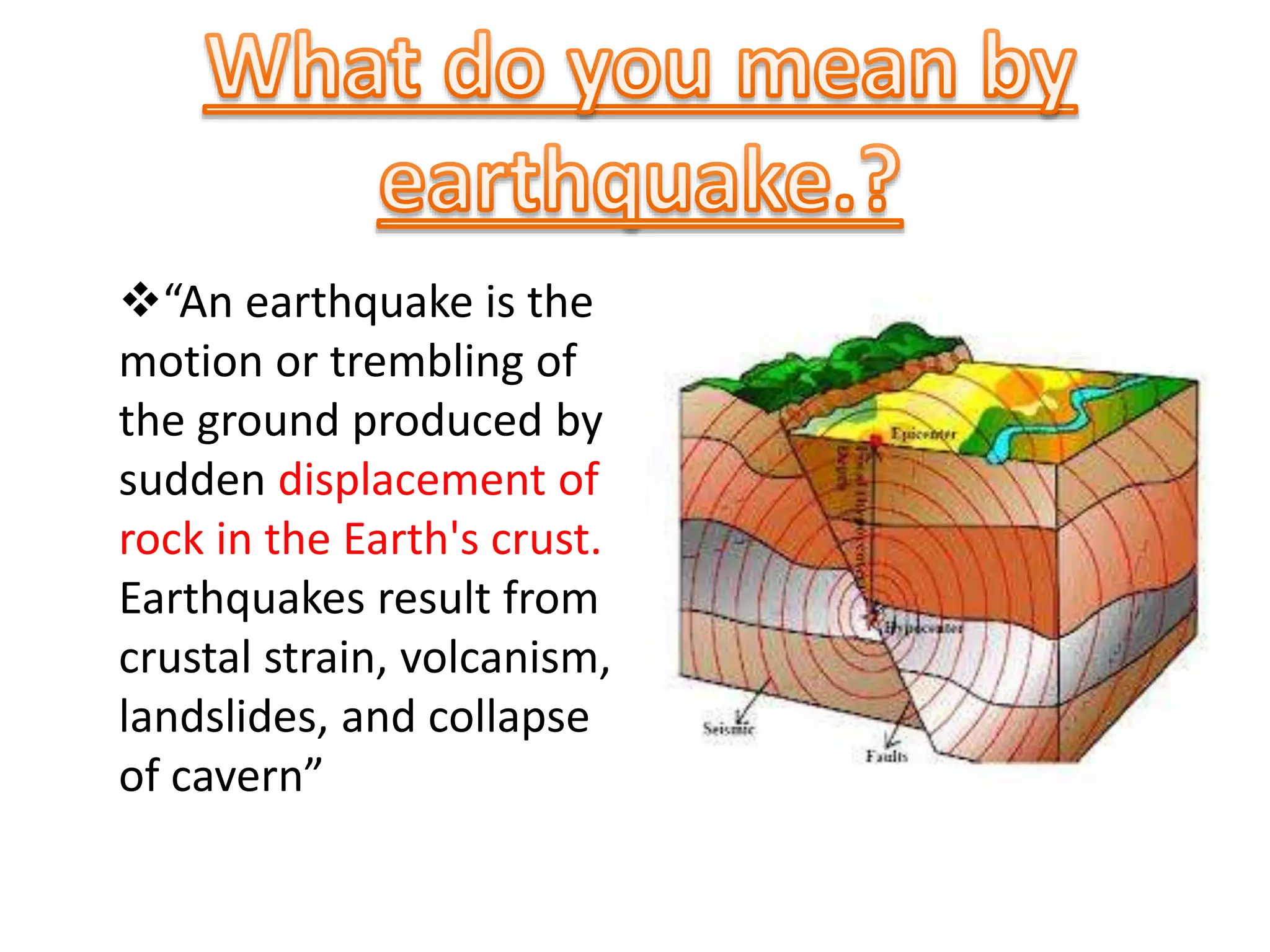
“An earthquake is the
motion or trembling of
the ground produced by
sudden displacement of
rock in the Earth's crust.
Earthquakes result from
crustal strain, volcanism,
landslides, and collapse
of cavern”
Stage 1: Two of the crusts
plates rub against each
other and stick in one
place. Pressure builds up as
they try and move past
each other.
Stage 2: Suddenly, the
pressure is too much
and the plates jerk
past each other. The
place where this
happens is called the
focus.
Why do earthquakes
happen?
Stage 3: Vibrations go out in all
directions through the rocks.
These vibrations are called
shockwaves or seismic waves
Stage 4: When the shock waves
reach the surface of the earth they
cause the ground to shake. The
most violent shaking is directly
above the focus at a point on the
Earths surface called the
epicentre.
focus
epicenter
Where do earthquakes occur:
1) Most earthquakes occur along the edge of the
oceanic and continental plate
Why do earthquakes happen?
Elastic Rebound
Definitions
• Earthquake = Vibration of the Earth
produced by the rapid release of energy
• Seismic waves = Energy moving outward
from the focus of an earthquake
• Focus= location of initial slip on the
fault; where the earthquake origins
• Epicenter= spot on Earth’s surface
directly above the focus
Stress and Strain along faults
Faults
A fault is a large crack in the Earth's crust where one
part of the crust has moved against another part.
There are three basic fault types
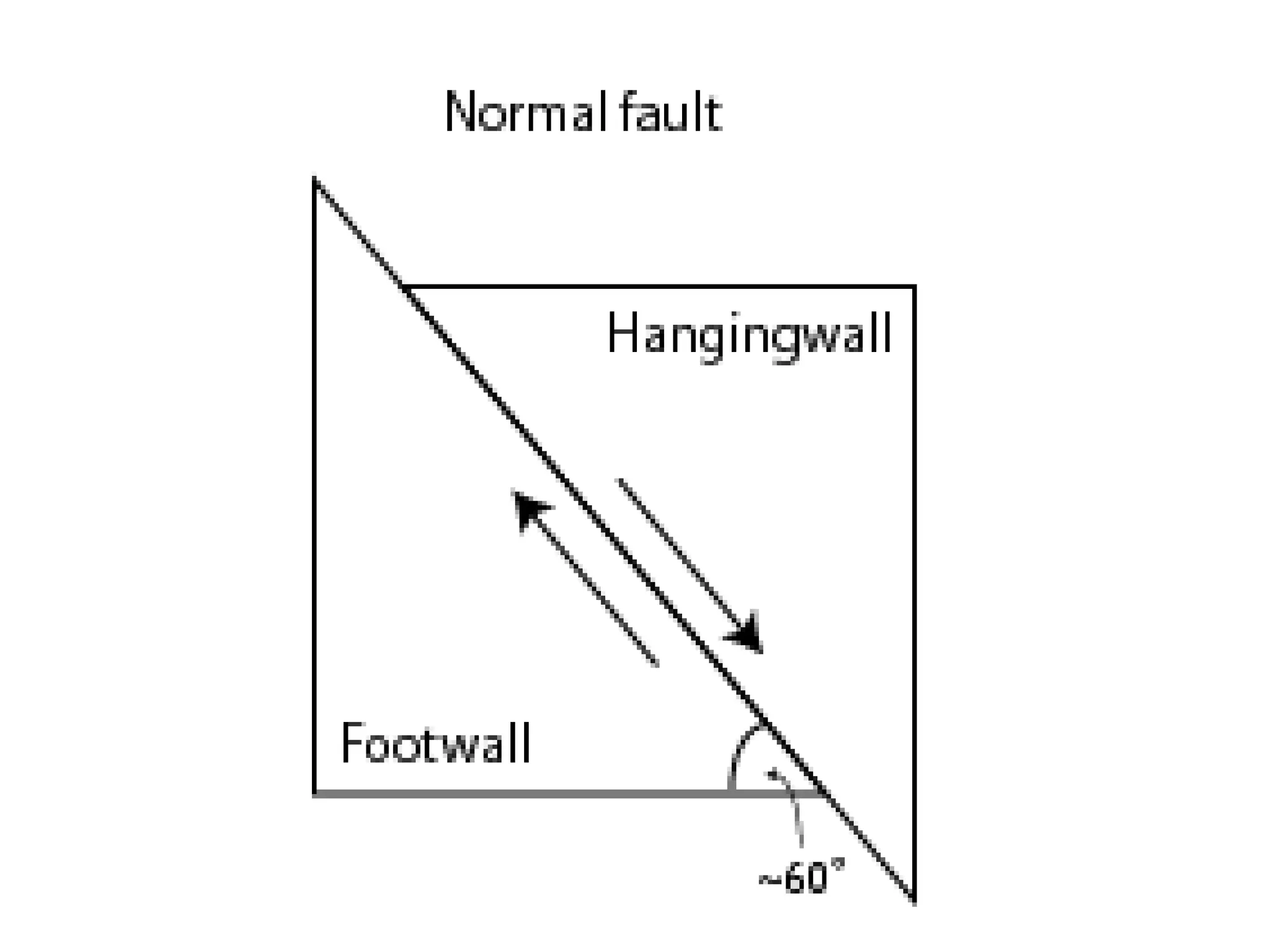
1. Normal faults: form when the
hanging wall drops down.
The forces that create
normal faults are pulling
the sides apart, or
extensional.
Fault Type2
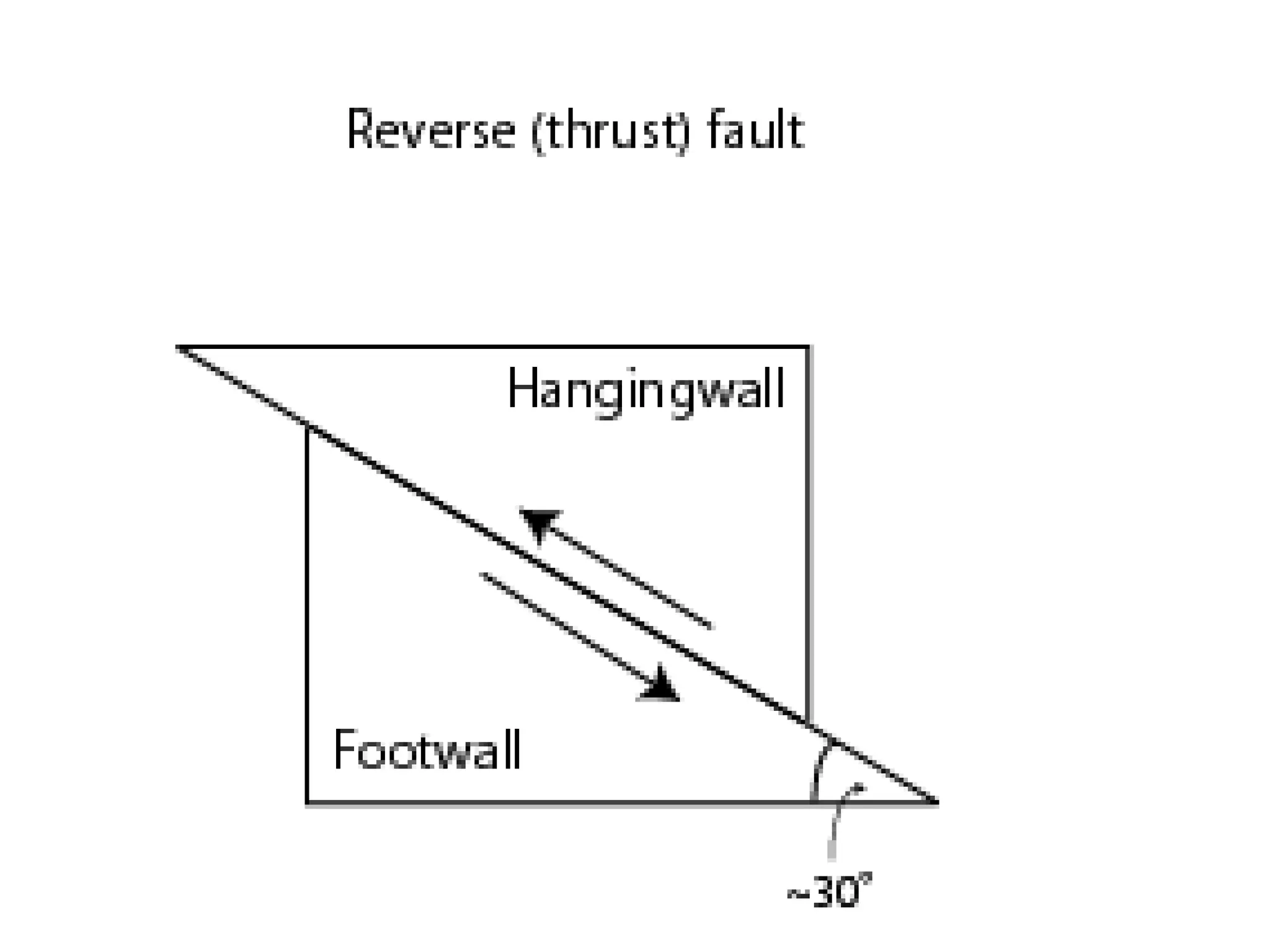
2. Reverse faults form
when the hanging wall
moves up.
The forces creating reverse
faults are compressional,
pushing the sides together.
Fault Type33. Strike-slip faults
have walls that move sideways,
not up or down.
That is, the slip occurs along
the strike, not up or down the
dip.
In these faults the fault plane is
usually vertical, so there is no
hanging wall .
FAULTS
Faults
Normal Fault
Reverse Fault
Strike-Slip
Fault
Strike Slip
Fault
Seismic waves: forms
• P-waves:
– called compressional, or push-pull waves
– Propagate parralel to the direction in which the wave is moving
– Move through solids, liquids
• S-waves:
– Called shear waves
– Propagate the movement perpendicular
to the direction in which the wave is
moving
• Surface waves (L-waves or long waves).
– Complex motion
– Up-and-down and side-to-side
– Slowest
– Most damage to structures, buildings
P-Wave Motion
Push-Pull Motion
S-Wave Motion
S-shake or shear wave
Earthquake Waves
Seismic Wave Motion
Major Hazards of Earthquakes
• Building Collapse
• Landslides
• Fire
• Tsunamis
4”
Building Collapse
.” Earthquakes don’t kill people, buildings kill people
Landslides
Fire
Great Alaska Earthquake
March 28, 1964
Valdez, Alaska
Magnitude 8.4
Tsunamis
Tsunami
Measuring earthquakes
• Seismometers:
instruments that detect
seismic waves
• Seismographs
Record intensity, height
and amplitude of seismic
waves
Richter Scale
• Henry richter
(1918-1992)
• Measures the energy or
strength released by
earthquake movement
• Provides accurate
measurements for small,
nearby earthquakes
Does not work for big, far ones
2) Intensity: Mercalli Scale:
– What did you feel?
– Assigns an intensity or rating to measure an earthquake at
a particular location (qualitative)
– (buildings nearly destroyed)
– Measures the destructive effect
• Intensity is a function of:
• Energy released by fault
• Geology of the location
• Surface substrate: can magnify shock waves e.g. Mexico
City (1985) and San Francisco (1989)
Seismographs
• Develop home earthquake plan
• Conduct earthquake drills
• Develop plan for reuniting family members
• Develop family communication plan
• Keep supplies on hand
CERT Basic Training
Unit 1: EarthquakesE-40
Earthquake Preparedness
• First:
– Check selves for injuries
– Protect selves from further danger
• Then:
– Extinguish small fires
– Clean up spills
– Inspect home for damage
– Help neighbors
– Tune to Emergency Alert System (EAS)
– Expect aftershocks
CERT Basic Training
Unit 1: EarthquakesE-41
After an Earthquake
• Drop, cover, and hold
• If indoors, stay there until shaking stops
• If outdoors, find a spot away from buildings,
trees, streetlights, power lines, and
overpasses
• If in a vehicle, drive to clear spot and stop
CERT Basic Training
Unit 1: EarthquakesE-42
During an Earthquake
• First:
– Check selves for injuries
– Protect selves from further danger
• Then:
– Extinguish small fires
– Clean up spills
– Inspect home for damage
– Help neighbors
– Tune to Emergency Alert System (EAS)
– Expect aftershocks
CERT Basic Training
Unit 1: EarthquakesE-43
After an Earthquake
Construction against earthquake
Frequencyof Occurrence of Earthquakes
Descriptor Magnitude Average Annually
Great 8 and higher 1 ¹
Major 7 - 7.9 17 ²
Strong 6 - 6.9 134 ²
Moderate 5 - 5.9 1319 ²
Light 4 - 4.9
13,000
(estimated)
Minor 3 - 3.9
130,000
(estimated)
Very Minor 2 - 2.9
1,300,000
(estimated)
¹ Based on observations since 1900.
² Based on observations since 1990.
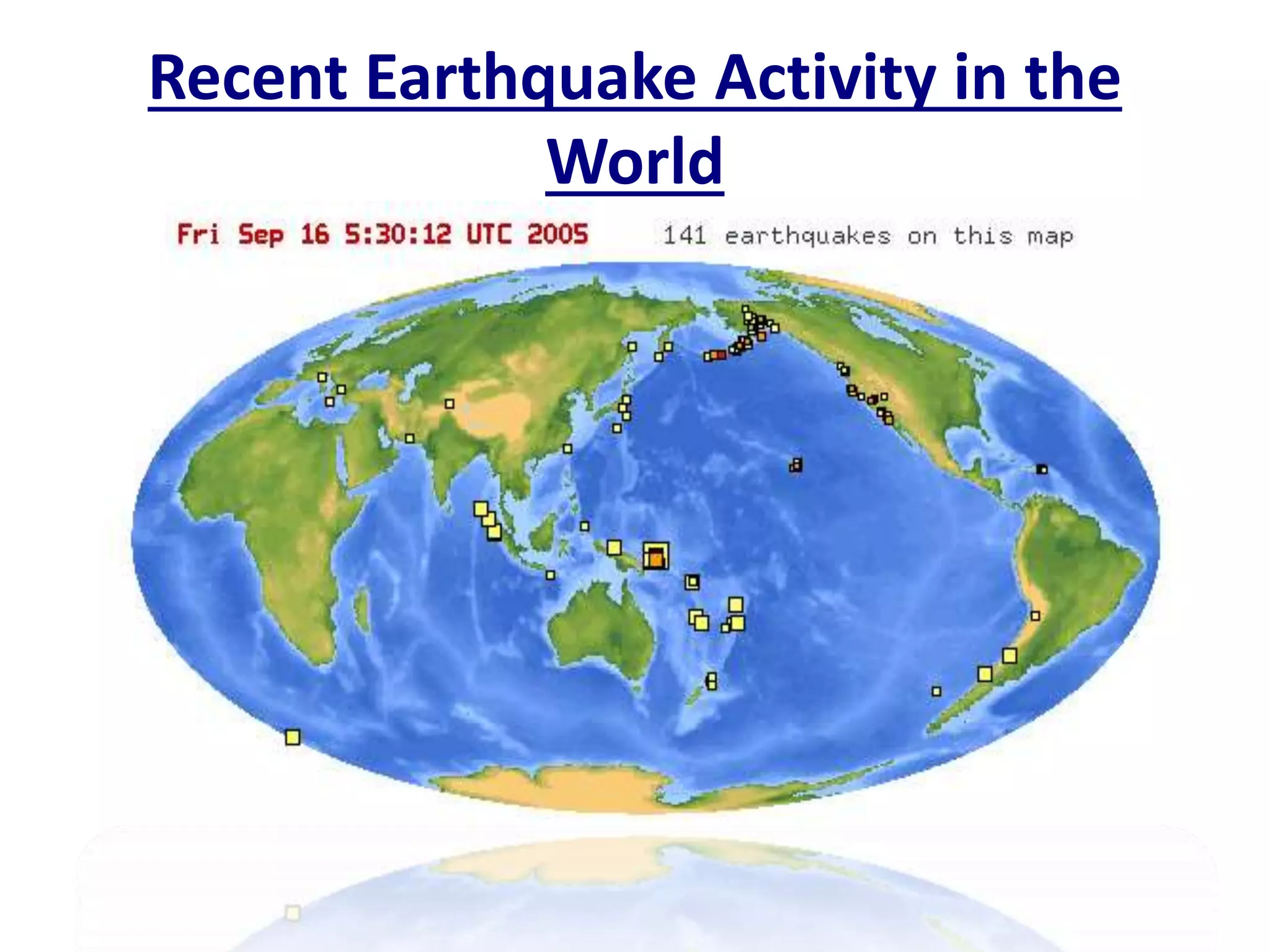
Recent Earthquake Activity in the
World
Most Destructive Known Earthquakes on Record in the World
Date Location Deaths Magnitude Comments
May 31, 1970 Peru 66,000 7.9 $530,000,000
damage, great rock
slide, floods.
July 27, 1976 China,
Tangshan
255,000
(official)
7.5 Estimated death toll as
high as 655,000.
Sept 19, 1985 Mexico
Michoacan
9500
(official)
8.0 Estimated death toll as
high as 30,000
Old lake bed magnified
shock waves by 500%
2001 Jan 26 India 20,023 7.7 166,836 injured,
600,000 homeless
.
2004 Dec 26 Sumatra 283,106 9.0 Deaths from earthquake
and tsunami
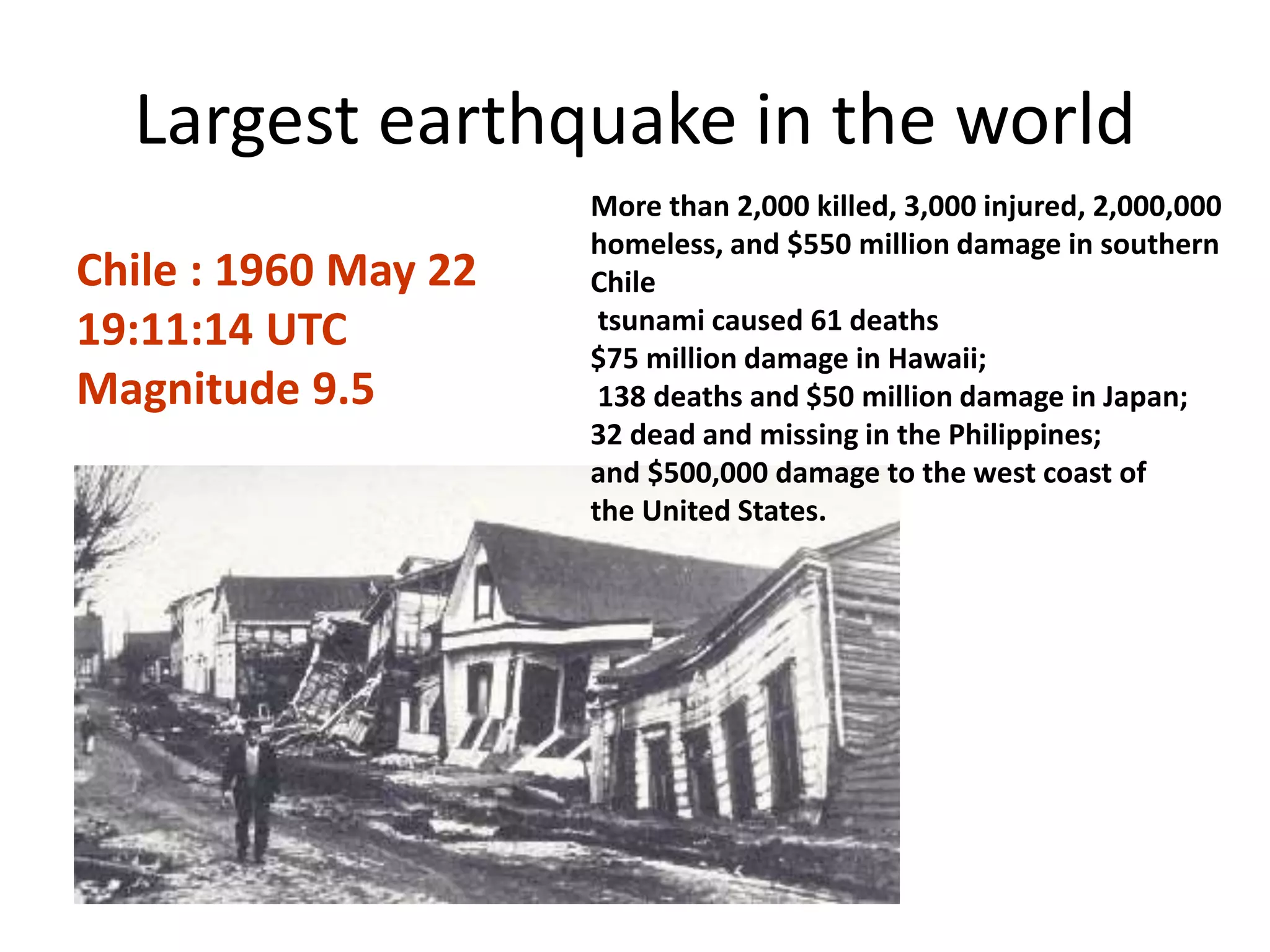
Largest earthquake in the world
Chile : 1960 May 22
19:11:14 UTC
Magnitude 9.5
More than 2,000 killed, 3,000 injured, 2,000,000
homeless, and $550 million damage in southern
Chile
tsunami caused 61 deaths
$75 million damage in Hawaii;
138 deaths and $50 million damage in Japan;
32 dead and missing in the Philippines;
and $500,000 damage to the west coast of
the United States.
Jun 23, 2001 S.Peru earthquake
Arequipa
Dead - More than 3,000
•A report of U.S. Army
relief operations recorded:
•498 deaths in San
Francisco
•64 deaths in Santa
Rosa
•102 deaths in and near
San Jose
Stanford University 1906 Earthquake
damage.
Earthquake damage in Anchorage on March 27, 1964
San Francisco are built on sandy soil or fill. Many homes built on this type of
soil were badly damaged during the 1989 Loma Prieta earthquake.
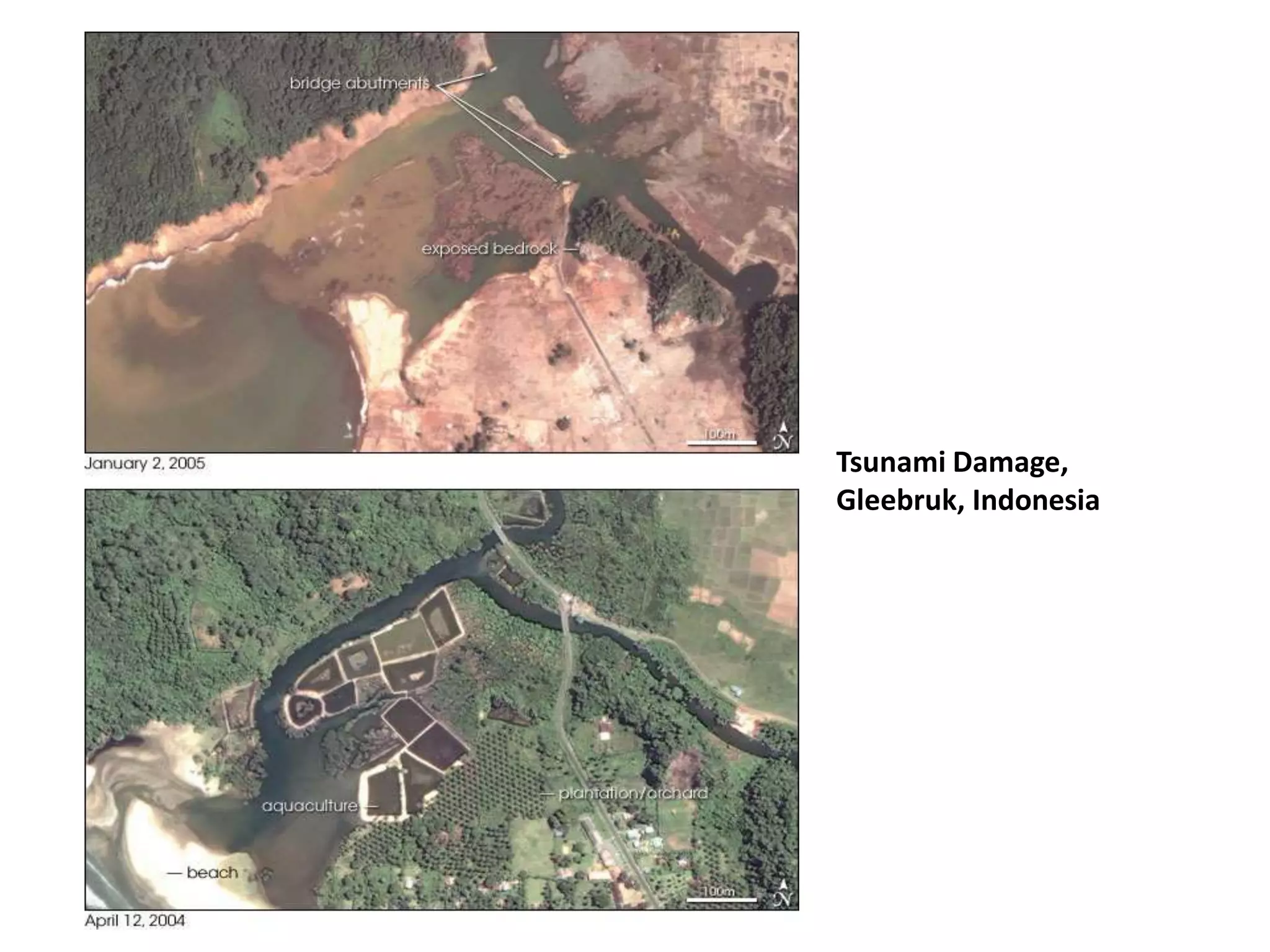
Tsunami Damage,
Gleebruk, Indonesia
India, Gujarat earthquake
Jan 26, 2001
Be smart About
Earthquake Safety
Earthquake
Earthquake

Earthquake

  • 1.
  • 3.
    “An earthquake isthe motion or trembling of the ground produced by sudden displacement of rock in the Earth's crust. Earthquakes result from crustal strain, volcanism, landslides, and collapse of cavern”
  • 4.
    Stage 1: Twoof the crusts plates rub against each other and stick in one place. Pressure builds up as they try and move past each other. Stage 2: Suddenly, the pressure is too much and the plates jerk past each other. The place where this happens is called the focus. Why do earthquakes happen?
  • 5.
    Stage 3: Vibrationsgo out in all directions through the rocks. These vibrations are called shockwaves or seismic waves Stage 4: When the shock waves reach the surface of the earth they cause the ground to shake. The most violent shaking is directly above the focus at a point on the Earths surface called the epicentre. focus epicenter
  • 6.
    Where do earthquakesoccur: 1) Most earthquakes occur along the edge of the oceanic and continental plate
  • 7.
  • 8.
  • 9.
    Definitions • Earthquake =Vibration of the Earth produced by the rapid release of energy • Seismic waves = Energy moving outward from the focus of an earthquake • Focus= location of initial slip on the fault; where the earthquake origins • Epicenter= spot on Earth’s surface directly above the focus
  • 12.
    Stress and Strainalong faults
  • 13.
    Faults A fault isa large crack in the Earth's crust where one part of the crust has moved against another part. There are three basic fault types 1. Normal faults: form when the hanging wall drops down. The forces that create normal faults are pulling the sides apart, or extensional.
  • 14.
    Fault Type2 2. Reversefaults form when the hanging wall moves up. The forces creating reverse faults are compressional, pushing the sides together.
  • 15.
    Fault Type33. Strike-slipfaults have walls that move sideways, not up or down. That is, the slip occurs along the strike, not up or down the dip. In these faults the fault plane is usually vertical, so there is no hanging wall .
  • 16.
  • 17.
  • 18.
  • 20.
  • 22.
  • 23.
  • 24.
    Seismic waves: forms •P-waves: – called compressional, or push-pull waves – Propagate parralel to the direction in which the wave is moving – Move through solids, liquids • S-waves: – Called shear waves – Propagate the movement perpendicular to the direction in which the wave is moving • Surface waves (L-waves or long waves). – Complex motion – Up-and-down and side-to-side – Slowest – Most damage to structures, buildings
  • 25.
  • 26.
  • 27.
  • 28.
  • 29.
    Major Hazards ofEarthquakes • Building Collapse • Landslides • Fire • Tsunamis 4”
  • 30.
    Building Collapse .” Earthquakesdon’t kill people, buildings kill people
  • 31.
  • 32.
    Fire Great Alaska Earthquake March28, 1964 Valdez, Alaska Magnitude 8.4
  • 33.
  • 34.
  • 35.
    Measuring earthquakes • Seismometers: instrumentsthat detect seismic waves • Seismographs Record intensity, height and amplitude of seismic waves
  • 36.
    Richter Scale • Henryrichter (1918-1992) • Measures the energy or strength released by earthquake movement • Provides accurate measurements for small, nearby earthquakes Does not work for big, far ones
  • 37.
    2) Intensity: MercalliScale: – What did you feel? – Assigns an intensity or rating to measure an earthquake at a particular location (qualitative) – (buildings nearly destroyed) – Measures the destructive effect • Intensity is a function of: • Energy released by fault • Geology of the location • Surface substrate: can magnify shock waves e.g. Mexico City (1985) and San Francisco (1989)
  • 38.
  • 39.
    • Develop homeearthquake plan • Conduct earthquake drills • Develop plan for reuniting family members • Develop family communication plan • Keep supplies on hand CERT Basic Training Unit 1: EarthquakesE-40 Earthquake Preparedness
  • 40.
    • First: – Checkselves for injuries – Protect selves from further danger • Then: – Extinguish small fires – Clean up spills – Inspect home for damage – Help neighbors – Tune to Emergency Alert System (EAS) – Expect aftershocks CERT Basic Training Unit 1: EarthquakesE-41 After an Earthquake
  • 41.
    • Drop, cover,and hold • If indoors, stay there until shaking stops • If outdoors, find a spot away from buildings, trees, streetlights, power lines, and overpasses • If in a vehicle, drive to clear spot and stop CERT Basic Training Unit 1: EarthquakesE-42 During an Earthquake
  • 42.
    • First: – Checkselves for injuries – Protect selves from further danger • Then: – Extinguish small fires – Clean up spills – Inspect home for damage – Help neighbors – Tune to Emergency Alert System (EAS) – Expect aftershocks CERT Basic Training Unit 1: EarthquakesE-43 After an Earthquake
  • 43.
  • 44.
    Frequencyof Occurrence ofEarthquakes Descriptor Magnitude Average Annually Great 8 and higher 1 ¹ Major 7 - 7.9 17 ² Strong 6 - 6.9 134 ² Moderate 5 - 5.9 1319 ² Light 4 - 4.9 13,000 (estimated) Minor 3 - 3.9 130,000 (estimated) Very Minor 2 - 2.9 1,300,000 (estimated) ¹ Based on observations since 1900. ² Based on observations since 1990.
  • 45.
  • 47.
    Most Destructive KnownEarthquakes on Record in the World Date Location Deaths Magnitude Comments May 31, 1970 Peru 66,000 7.9 $530,000,000 damage, great rock slide, floods. July 27, 1976 China, Tangshan 255,000 (official) 7.5 Estimated death toll as high as 655,000. Sept 19, 1985 Mexico Michoacan 9500 (official) 8.0 Estimated death toll as high as 30,000 Old lake bed magnified shock waves by 500% 2001 Jan 26 India 20,023 7.7 166,836 injured, 600,000 homeless . 2004 Dec 26 Sumatra 283,106 9.0 Deaths from earthquake and tsunami
  • 48.
    Largest earthquake inthe world Chile : 1960 May 22 19:11:14 UTC Magnitude 9.5 More than 2,000 killed, 3,000 injured, 2,000,000 homeless, and $550 million damage in southern Chile tsunami caused 61 deaths $75 million damage in Hawaii; 138 deaths and $50 million damage in Japan; 32 dead and missing in the Philippines; and $500,000 damage to the west coast of the United States.
  • 49.
    Jun 23, 2001S.Peru earthquake Arequipa
  • 50.
    Dead - Morethan 3,000 •A report of U.S. Army relief operations recorded: •498 deaths in San Francisco •64 deaths in Santa Rosa •102 deaths in and near San Jose Stanford University 1906 Earthquake damage.
  • 51.
    Earthquake damage inAnchorage on March 27, 1964
  • 52.
    San Francisco arebuilt on sandy soil or fill. Many homes built on this type of soil were badly damaged during the 1989 Loma Prieta earthquake.
  • 53.
  • 54.
  • 55.