Geology
Earth Structure
Dr. Akram Suleiman
Presented By :
Muna Abuhazeem 0207941
Yazan Derawii 0209525
Ahmad Tarayrah 0188114
Introduction
The Earth is a complex and dynamic planet that is constantly
changing. It is made up of several layers, each with its own unique
properties and characteristics.
Scientists think Earth was formed at roughly the same time as the
sun and other planets. Some 4.6 billion years ago when the solar
system coalesced from a giant, rotating cloud of gas and dust known
as the solar nebula. As the nebula collapsed under the force of its
own gravity, it spun faster and flattened into a disk. Most of the
material in that disk was then pulled toward the center to form the
sun.
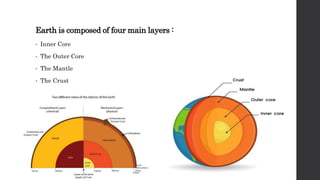
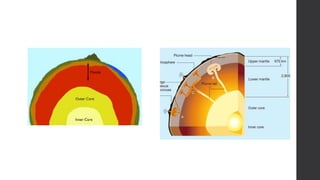
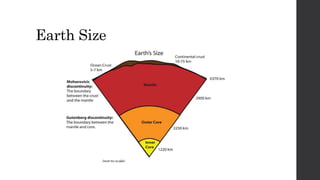
Earth is composed of four main layers :
• Inner Core
• The Outer Core
• The Mantle
• The Crust
The Outer Core
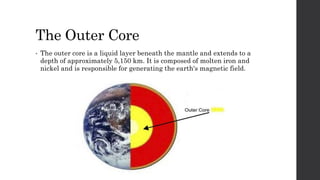
• The outer core is a liquid layer beneath the mantle and extends to a
depth of approximately 5,150 km. It is composed of molten iron and
nickel and is responsible for generating the earth's magnetic field.
Inner core
• The inner core of the Earth is a solid ball of iron and
nickel It is the hottest part of the planet, with
temperatures reaching up to 5,500 degrees Celsius.
• Despite its extreme heat, the inner core remains solid due
to the immense pressure exerted on it by the surrounding
layers of the Earth. This pressure also causes the inner
core to rotate slightly faster than the rest of the planet.
The Mantle
• The mantle is the thickest layer of the Earth, extending from the
bottom of the crust to the top of the outer core. It is composed of hot,
dense rock that is constantly moving and churning.
• The movement of the mantle is what drives plate tectonics, the
process by which the Earth's crust is broken into large plates that
move and interact with one another over time.
• The mantle is not static but rather churns slowly in convective motions, with
hotter material rising up and cooler material sinking; through this process,
Earth gradually loses its internal heat. In addition to being the driving force
of horizontal plate motion, mantle convection is manifested in the occurrence
of temporary superplumes—huge, rising jets of hot, partially molten rock—
which may originate from a deep layer near the core-mantle interface
Earth's crust
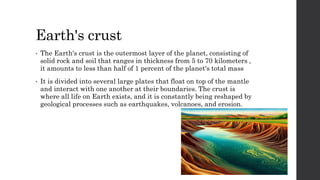
• The Earth's crust is the outermost layer of the planet, consisting of
solid rock and soil that ranges in thickness from 5 to 70 kilometers ,
it amounts to less than half of 1 percent of the planet's total mass
• It is divided into several large plates that float on top of the mantle
and interact with one another at their boundaries. The crust is
where all life on Earth exists, and it is constantly being reshaped by
geological processes such as earthquakes, volcanoes, and erosion.
Earth Size
Earthquakes
• One of the most important processes that happenes on the earth
Structure
• Earthquakes primarily occur in the crust. When two tectonic plates
move against each other, pressure builds up and causes a sudden
release of energy, resulting in an earthquake. The location and depth
of earthquakes can provide valuable information about the
movement of tectonic plates.
• Although earthquakes can occur in the upper mantle, they are less
common than those in the crust. This is because the mantle is not as
brittle as the crust and can absorb more energy without rupturing.
However, seismic waves generated by earthquakes in the crust can
travel through the mantle and provide valuable information about its
composition.
Conclusion
• In conclusion, the Earth's structure is a fascinating and
complex system that plays a crucial role in shaping our
planet and sustaining life. From the fiery depths of the
inner core to the ever-shifting plates of the crust, every
layer of the Earth is connected and constantly influencing
one another. As we continue to study and learn more
about the Earth's structure, we gain a deeper
understanding of the forces that drive our planet and the
delicate balance that sustains life as we know it.
References :
• Alden, A. (2015a). The Earth’s crust .
• National Geographic. (2015a). Core.
• Lunine, J. I. (2015). Earth: The interior. In Encyclopædia Britannica.
https://youtu.be/LBsPzEAB9wU

Earth Structure

  • 1.
    Geology Earth Structure Dr. AkramSuleiman Presented By : Muna Abuhazeem 0207941 Yazan Derawii 0209525 Ahmad Tarayrah 0188114
  • 2.
    Introduction The Earth isa complex and dynamic planet that is constantly changing. It is made up of several layers, each with its own unique properties and characteristics. Scientists think Earth was formed at roughly the same time as the sun and other planets. Some 4.6 billion years ago when the solar system coalesced from a giant, rotating cloud of gas and dust known as the solar nebula. As the nebula collapsed under the force of its own gravity, it spun faster and flattened into a disk. Most of the material in that disk was then pulled toward the center to form the sun.
  • 3.
    Earth is composedof four main layers : • Inner Core • The Outer Core • The Mantle • The Crust
  • 4.
    The Outer Core •The outer core is a liquid layer beneath the mantle and extends to a depth of approximately 5,150 km. It is composed of molten iron and nickel and is responsible for generating the earth's magnetic field.
  • 5.
    Inner core • Theinner core of the Earth is a solid ball of iron and nickel It is the hottest part of the planet, with temperatures reaching up to 5,500 degrees Celsius. • Despite its extreme heat, the inner core remains solid due to the immense pressure exerted on it by the surrounding layers of the Earth. This pressure also causes the inner core to rotate slightly faster than the rest of the planet.
  • 6.
    The Mantle • Themantle is the thickest layer of the Earth, extending from the bottom of the crust to the top of the outer core. It is composed of hot, dense rock that is constantly moving and churning. • The movement of the mantle is what drives plate tectonics, the process by which the Earth's crust is broken into large plates that move and interact with one another over time. • The mantle is not static but rather churns slowly in convective motions, with hotter material rising up and cooler material sinking; through this process, Earth gradually loses its internal heat. In addition to being the driving force of horizontal plate motion, mantle convection is manifested in the occurrence of temporary superplumes—huge, rising jets of hot, partially molten rock— which may originate from a deep layer near the core-mantle interface
  • 8.
    Earth's crust • TheEarth's crust is the outermost layer of the planet, consisting of solid rock and soil that ranges in thickness from 5 to 70 kilometers , it amounts to less than half of 1 percent of the planet's total mass • It is divided into several large plates that float on top of the mantle and interact with one another at their boundaries. The crust is where all life on Earth exists, and it is constantly being reshaped by geological processes such as earthquakes, volcanoes, and erosion.
  • 9.
  • 10.
    Earthquakes • One ofthe most important processes that happenes on the earth Structure • Earthquakes primarily occur in the crust. When two tectonic plates move against each other, pressure builds up and causes a sudden release of energy, resulting in an earthquake. The location and depth of earthquakes can provide valuable information about the movement of tectonic plates. • Although earthquakes can occur in the upper mantle, they are less common than those in the crust. This is because the mantle is not as brittle as the crust and can absorb more energy without rupturing. However, seismic waves generated by earthquakes in the crust can travel through the mantle and provide valuable information about its composition.
  • 11.
    Conclusion • In conclusion,the Earth's structure is a fascinating and complex system that plays a crucial role in shaping our planet and sustaining life. From the fiery depths of the inner core to the ever-shifting plates of the crust, every layer of the Earth is connected and constantly influencing one another. As we continue to study and learn more about the Earth's structure, we gain a deeper understanding of the forces that drive our planet and the delicate balance that sustains life as we know it.
  • 12.
    References : • Alden,A. (2015a). The Earth’s crust . • National Geographic. (2015a). Core. • Lunine, J. I. (2015). Earth: The interior. In Encyclopædia Britannica. https://youtu.be/LBsPzEAB9wU