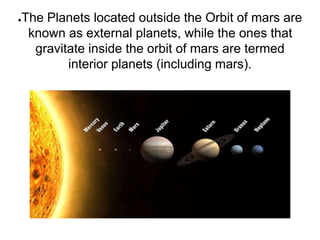
●The Planets located outside the Orbit of mars are 
known as external planets, while the ones that 
gravitate inside the orbit of mars are termed 
interior planets (including mars).
External Planets 
● The external planets, are the four planets 
farther to the sun. (Jupiter, Saturn, Uranus, and 
Neptune) 
● They are the biggest planets of the solar sistem, 
and they're divided in 2 groups.
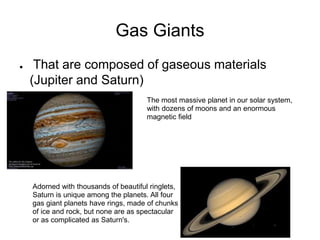
Gas Giants 
● That are composed of gaseous materials 
(Jupiter and Saturn) 
The most massive planet in our solar system, 
with dozens of moons and an enormous 
magnetic field 
Adorned with thousands of beautiful ringlets, 
Saturn is unique among the planets. All four 
gas giant planets have rings, made of chunks 
of ice and rock, but none are as spectacular 
or as complicated as Saturn's.
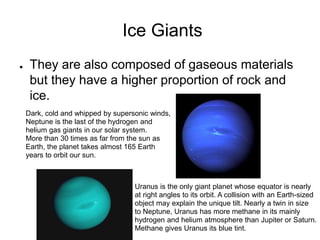
Ice Giants 
● They are also composed of gaseous materials 
but they have a higher proportion of rock and 
ice. 
Dark, cold and whipped by supersonic winds, 
Neptune is the last of the hydrogen and 
helium gas giants in our solar system. 
More than 30 times as far from the sun as 
Earth, the planet takes almost 165 Earth 
years to orbit our sun. 
Uranus is the only giant planet whose equator is nearly 
at right angles to its orbit. A collision with an Earth-sized 
object may explain the unique tilt. Nearly a twin in size 
to Neptune, Uranus has more methane in its mainly 
hydrogen and helium atmosphere than Jupiter or Saturn. 
Methane gives Uranus its blue tint.

Presentation about planets

  • 1.
    ●The Planets locatedoutside the Orbit of mars are known as external planets, while the ones that gravitate inside the orbit of mars are termed interior planets (including mars).
  • 2.
    External Planets ●The external planets, are the four planets farther to the sun. (Jupiter, Saturn, Uranus, and Neptune) ● They are the biggest planets of the solar sistem, and they're divided in 2 groups.
  • 3.
    Gas Giants ●That are composed of gaseous materials (Jupiter and Saturn) The most massive planet in our solar system, with dozens of moons and an enormous magnetic field Adorned with thousands of beautiful ringlets, Saturn is unique among the planets. All four gas giant planets have rings, made of chunks of ice and rock, but none are as spectacular or as complicated as Saturn's.
  • 4.
    Ice Giants ●They are also composed of gaseous materials but they have a higher proportion of rock and ice. Dark, cold and whipped by supersonic winds, Neptune is the last of the hydrogen and helium gas giants in our solar system. More than 30 times as far from the sun as Earth, the planet takes almost 165 Earth years to orbit our sun. Uranus is the only giant planet whose equator is nearly at right angles to its orbit. A collision with an Earth-sized object may explain the unique tilt. Nearly a twin in size to Neptune, Uranus has more methane in its mainly hydrogen and helium atmosphere than Jupiter or Saturn. Methane gives Uranus its blue tint.