Earthquakes
Sultan Taleb Dahie 0208484
MESHAL FNAITEL ALAZMI 0209795
A break in the rock (fault)
Bending of rocks by tectonic forces. The energy is being stored ,Frictional
forces are overcome and slippage takes place. The rocks snaps back
(spring back to their original position ). This produces the vibrations. This
springing back is called “elastic rebound”
Earthquake distribution
Depends on the probability of exposure of an area to occur Destructive
earthquakes on several factors:
1 - relative velocity of plate motion contiguous
2 - The type of relationship between the movement of the two plates the
two adjacent ones
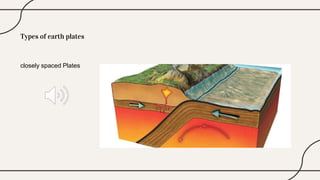
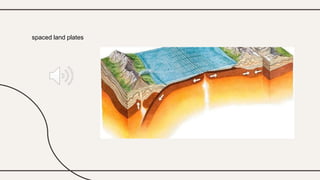
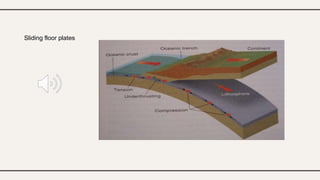
Types of earth plates
closely spaced Plates
spaced land plates
Sliding floor plates
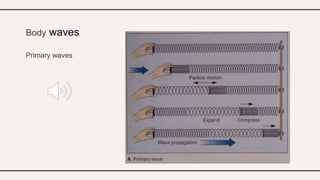
Body waves
Primary waves
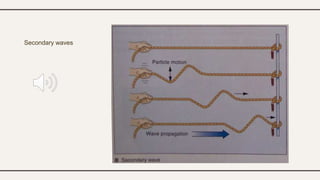
Secondary waves
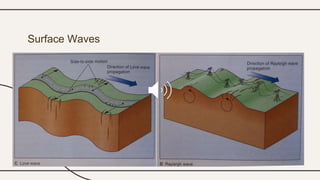
Surface Waves
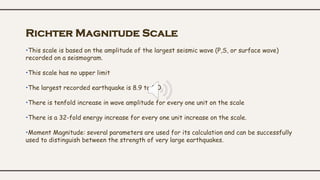
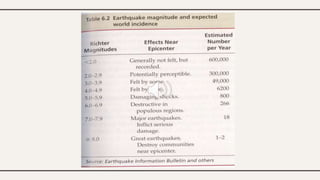
Richter Magnitude Scale
•This scale is based on the amplitude of the largest seismic wave (P,S, or surface wave)
recorded on a seismogram.
•This scale has no upper limit
•The largest recorded earthquake is 8.9 to 9.0
•There is tenfold increase in wave amplitude for every one unit on the scale
•There is a 32-fold energy increase for every one unit increase on the scale.
•Moment Magnitude: several parameters are used for its calculation and can be successfully
used to distinguish between the strength of very large earthquakes.
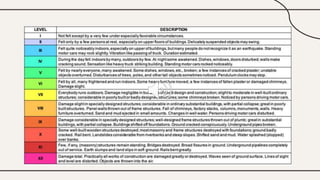
Measuring the Size of Earthquakes
Intensity = a measure of the degree of earthquake shaking at a
certain location based on the amount of damage
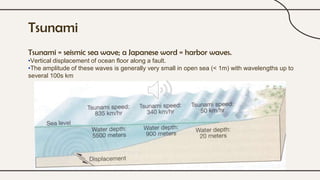
Tsunami
Tsunami = seismic sea wave; a Japanese word = harbor waves.
•Vertical displacement of ocean floor along a fault.
•The amplitude of these waves is generally very small in open sea (< 1m) with wavelengths up to
several 100s km
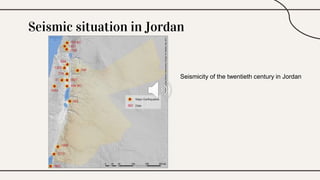
Seismic situation in Jordan
Seismicity of the twentieth century in Jordan

Earthquakes

  • 1.
    Earthquakes Sultan Taleb Dahie0208484 MESHAL FNAITEL ALAZMI 0209795
  • 3.
    A break inthe rock (fault) Bending of rocks by tectonic forces. The energy is being stored ,Frictional forces are overcome and slippage takes place. The rocks snaps back (spring back to their original position ). This produces the vibrations. This springing back is called “elastic rebound”
  • 4.
    Earthquake distribution Depends onthe probability of exposure of an area to occur Destructive earthquakes on several factors: 1 - relative velocity of plate motion contiguous 2 - The type of relationship between the movement of the two plates the two adjacent ones
  • 5.
    Types of earthplates closely spaced Plates
  • 6.
  • 7.
  • 8.
  • 9.
  • 10.
  • 11.
    Richter Magnitude Scale •Thisscale is based on the amplitude of the largest seismic wave (P,S, or surface wave) recorded on a seismogram. •This scale has no upper limit •The largest recorded earthquake is 8.9 to 9.0 •There is tenfold increase in wave amplitude for every one unit on the scale •There is a 32-fold energy increase for every one unit increase on the scale. •Moment Magnitude: several parameters are used for its calculation and can be successfully used to distinguish between the strength of very large earthquakes.
  • 13.
    Measuring the Sizeof Earthquakes Intensity = a measure of the degree of earthquake shaking at a certain location based on the amount of damage
  • 15.
    Tsunami Tsunami = seismicsea wave; a Japanese word = harbor waves. •Vertical displacement of ocean floor along a fault. •The amplitude of these waves is generally very small in open sea (< 1m) with wavelengths up to several 100s km
  • 16.
    Seismic situation inJordan Seismicity of the twentieth century in Jordan