Studying the Earth’sInterior
Scientists tried to explore and study the
interior of the Earth. Yet, until today, there are
no mechanical probes or actual explorations
done to totally discover the deepest region of
the Earth.
6.
How did theyknow?
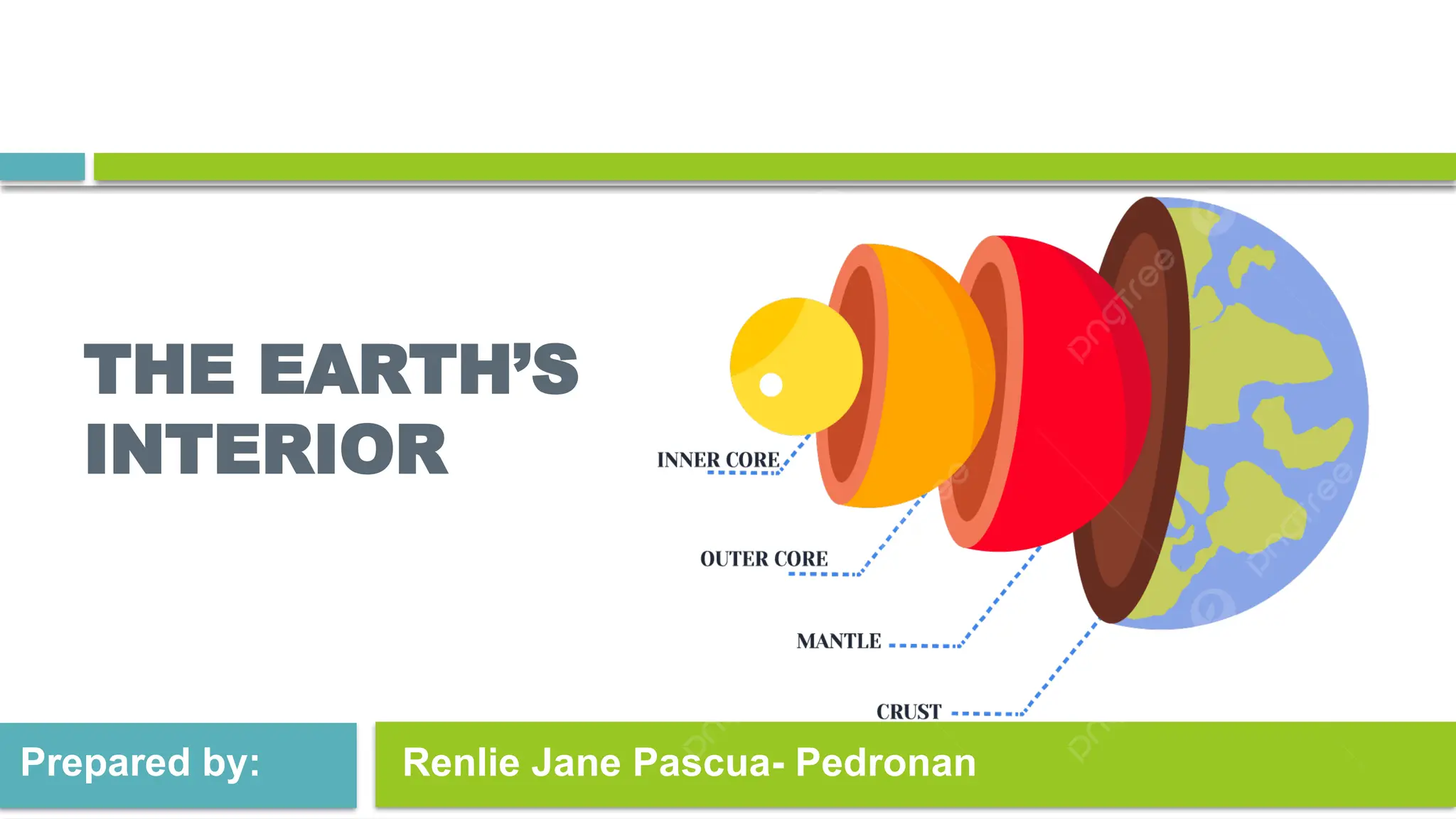
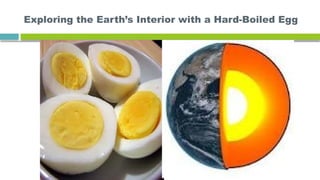
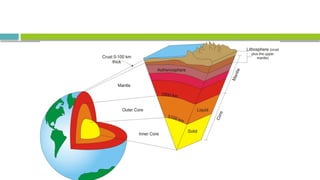
The Earth is made up of three layers: the crust,
the mantle, and the core.
The study of these layers is mostly done in the
Earth’s crust since mechanical probes are
impossible due to the tremendous heat and very
high pressure underneath the Earth’s surface.
7.
The Solid Earth
geology -the study of the structure, history, and activity
of the solid Earth, including its interactions with the
atmosphere, hydrosphere, cryosphere, and biosphere
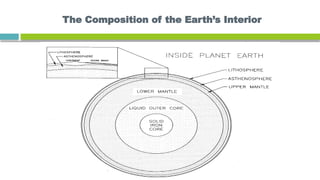
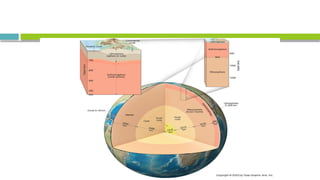
solid Earth contains four major zones: the core (which
is divided into inner and outer zones), the (upper and
lower) mantle, the asthenosphere, and the
lithosphere
8.
Geology
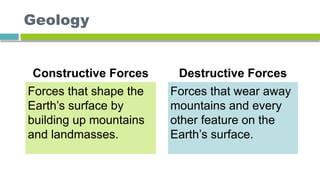
Forces that wearaway
mountains and every
other feature on the
Earth’s surface.
Forces that shape the
Earth’s surface by
building up mountains
and landmasses.
Constructive Forces Destructive Forces
9.
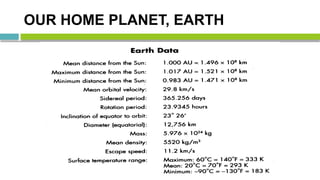
OUR HOME PLANET,EARTH
Our Earth is about average among the planets in the Solar
System, in many respects:
largest and most massive of the four terrestrial planets,
but smaller and less massive than the four giant, or
Jovian, planets
third in distance from the Sun among the four terrestrial
planets
has a moderately dense atmosphere; 90 times less dense
than that of Venus but 100 times denser than that of Mars
10.
OUR HOME PLANET,EARTH
Earth is also unique in many respects:
the only planet with liquid water on its surface.
the only one having a significant (21%) proportion of
molecular oxygen
to our best current knowledge, the only planet in the
solar system having living organisms
the only terrestrial planet having a moderately strong
magnetic field
the only terrestrial planet having a large satellite
The Solid Earth
the outer zones is not uniform and fixed over the
surface of the Earth, but shows much variability with
position and time.
The field of plate tectonics deals with this spatial and
temporal variability.
Geological phenomena such as earthquakes,
volcanoes, and continental drift are accounted for by
plate tectonics.
Bring the following:(Individual)
hardboiled egg/s
bread knife
used paper/newspaper to work on
17.
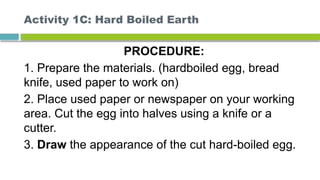
Activity 1C: HardBoiled Earth
PROCEDURE:
1. Prepare the materials. (hardboiled egg, bread
knife, used paper to work on)
2. Place used paper or newspaper on your working
area. Cut the egg into halves using a knife or a
cutter.
3. Draw the appearance of the cut hard-boiled egg.
18.
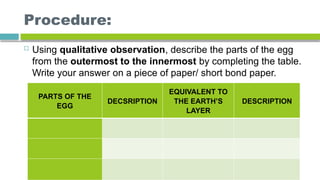
Procedure:
Using qualitativeobservation, describe the parts of the egg
from the outermost to the innermost by completing the table.
Write your answer on a piece of paper/ short bond paper.
PARTS OF THE
EGG
DECSRIPTION
EQUIVALENT TO
THE EARTH’S
LAYER
DESCRIPTION
19.
Guide Questions:
1. Howmany layers does a hard-boiled egg have?
2. Which is the largest part? The thinnest?
3. Compare the parts of the egg to the model of the
earth.
4. Aside from the hard-boiled egg, what other things
can you compare to the earth’s interior layers?
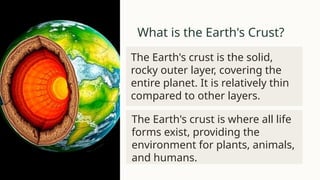
What is theEarth's Crust?
The Earth's crust is the solid,
rocky outer layer, covering the
entire planet. It is relatively thin
compared to other layers.
The Earth's crust is where all life
forms exist, providing the
environment for plants, animals,
and humans.
23.
The Crust
thinnest andthe outermost layer of the
Earth that extends from the surface to
about 32 kilometers below
Continental
Oceanic
24.
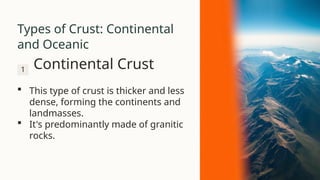
Types of Crust:Continental
and Oceanic
1 Continental Crust
This type of crust is thicker and less
dense, forming the continents and
landmasses.
It's predominantly made of granitic
rocks.
25.
Continental
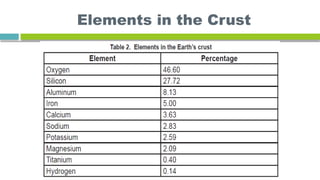
mainly madeup of silicon, oxygen, aluminum,
calcium, sodium, and potassium
mostly 35-40 kilometers
found under land masses
made of less dense rocks such as granite
26.
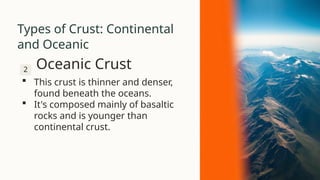
Types of Crust:Continental
and Oceanic
2 Oceanic Crust
This crust is thinner and denser,
found beneath the oceans.
It's composed mainly of basaltic
rocks and is younger than
continental crust.
27.
Oceanic
oceanic crustis around 7-10 kilometers thick which
its average thickness is 8 kilometers.
found under the ocean floor
made of dense rocks such as basalt
heavier than the continental crust.
Moho Discontinuity
Whilestudying the speed of earthquake
waves, Croatian geophysicist Andrija
Mohorovičić discovers a boundary
between Earth's crust and mantle, which
becomes known as the Mohorovičić, or
Moho, Discontinuity.
30.
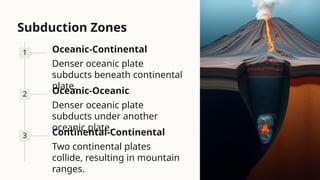
Subduction Zones
1 Oceanic-Continental
Denseroceanic plate
subducts beneath continental
plate.
2 Oceanic-Oceanic
Denser oceanic plate
subducts under another
oceanic plate.
3 Continental-Continental
Two continental plates
collide, resulting in mountain
ranges.
31.
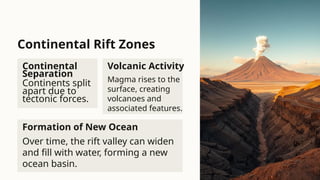
Continental Rift Zones
Continental
Separation
Continentssplit
apart due to
tectonic forces.
Volcanic Activity
Magma rises to the
surface, creating
volcanoes and
associated features.
Formation of New Ocean
Over time, the rift valley can widen
and fill with water, forming a new
ocean basin.
32.
Geological Processes Shapingthe Crust
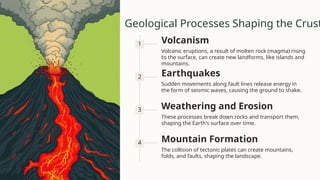
1 Volcanism
Volcanic eruptions, a result of molten rock (magma) rising
to the surface, can create new landforms, like islands and
mountains.
2 Earthquakes
Sudden movements along fault lines release energy in
the form of seismic waves, causing the ground to shake.
3 Weathering and Erosion
These processes break down rocks and transport them,
shaping the Earth's surface over time.
4 Mountain Formation
The collision of tectonic plates can create mountains,
folds, and faults, shaping the landscape.
33.
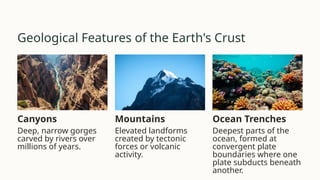
Geological Features ofthe Earth's Crust
Canyons
Deep, narrow gorges
carved by rivers over
millions of years.
Mountains
Elevated landforms
created by tectonic
forces or volcanic
activity.
Ocean Trenches
Deepest parts of the
ocean, formed at
convergent plate
boundaries where one
plate subducts beneath
another.
34.
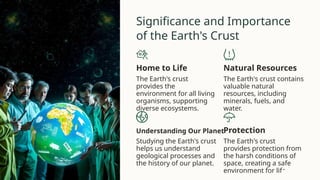
Significance and Importance
ofthe Earth's Crust
Home to Life
The Earth's crust
provides the
environment for all living
organisms, supporting
diverse ecosystems.
Natural Resources
The Earth's crust contains
valuable natural
resources, including
minerals, fuels, and
water.
Understanding Our Planet
Studying the Earth's crust
helps us understand
geological processes and
the history of our planet.
Protection
The Earth's crust
provides protection from
the harsh conditions of
space, creating a safe
environment for life.
The Mantle
Beneaththe crust is the mantle
extends to about 2900 kilometers from the Earth’s surface
about 80% of the Earth’s total volume
about 68% of its total mass
mainly made up of silicate rocks
and contrary to common belief, is solid, since both S-waves
and P-waves pass through it
37.
The Mantle
mostlymade of the elements silicon, oxygen, iron and
magnesium
lower part of the mantle consists of more iron than the upper
part
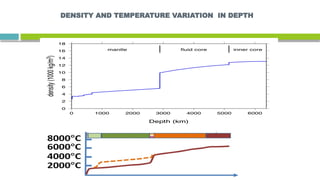
lower mantle is denser than the upper portion
temperature and the pressure increase with depth
high temperature and pressure in the mantle allows the solid
rock to flow slowly
38.
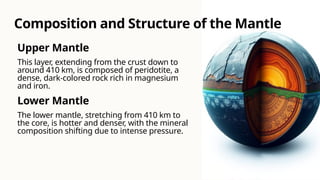
Upper Mantle
This layer,extending from the crust down to
around 410 km, is composed of peridotite, a
dense, dark-colored rock rich in magnesium
and iron.
Lower Mantle
The lower mantle, stretching from 410 km to
the core, is hotter and denser, with the mineral
composition shifting due to intense pressure.
Composition and Structure of the Mantle
39.
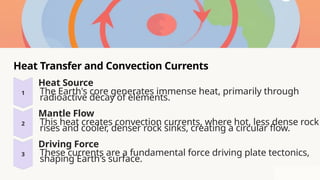
Heat Transfer andConvection Currents
Heat Source
The Earth's core generates immense heat, primarily through
radioactive decay of elements.
Mantle Flow
This heat creates convection currents, where hot, less dense rock
rises and cooler, denser rock sinks, creating a circular flow.
Driving Force
These currents are a fundamental force driving plate tectonics,
shaping Earth's surface.
40.
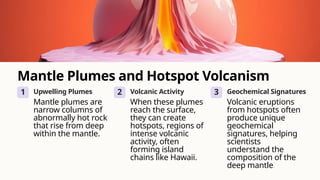
Mantle Plumes andHotspot Volcanism
1 Upwelling Plumes
Mantle plumes are
narrow columns of
abnormally hot rock
that rise from deep
within the mantle.
2 Volcanic Activity
When these plumes
reach the surface,
they can create
hotspots, regions of
intense volcanic
activity, often
forming island
chains like Hawaii.
3 Geochemical Signatures
Volcanic eruptions
from hotspots often
produce unique
geochemical
signatures, helping
scientists
understand the
composition of the
deep mantle.
41.
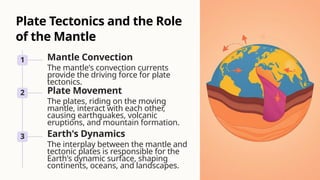
Plate Tectonics andthe Role
of the Mantle
1 Mantle Convection
The mantle's convection currents
provide the driving force for plate
tectonics.
2 Plate Movement
The plates, riding on the moving
mantle, interact with each other,
causing earthquakes, volcanic
eruptions, and mountain formation.
3 Earth's Dynamics
The interplay between the mantle and
tectonic plates is responsible for the
Earth's dynamic surface, shaping
continents, oceans, and landscapes.
42.
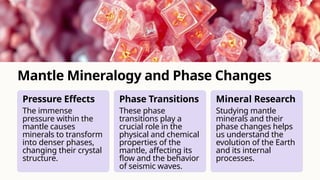
Mantle Mineralogy andPhase Changes
Pressure Effects
The immense
pressure within the
mantle causes
minerals to transform
into denser phases,
changing their crystal
structure.
Phase Transitions
These phase
transitions play a
crucial role in the
physical and chemical
properties of the
mantle, affecting its
flow and the behavior
of seismic waves.
Mineral Research
Studying mantle
minerals and their
phase changes helps
us understand the
evolution of the Earth
and its internal
processes.
43.
Implications for Earth'sEvolution and Future
Volcanic Activity
The mantle influences
volcanic eruptions,
which release gases and
minerals, impacting
Earth's atmosphere and
climate over time.
Earthquakes
The mantle's movement
drives plate tectonics,
causing earthquakes
that shape landscapes
and release energy
within the Earth.
Mountain Building
The collision of tectonic
plates, driven by mantle
convection, results in
the formation of
mountain ranges,
shaping Earth's
topography.
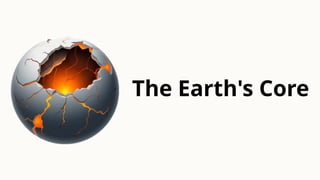
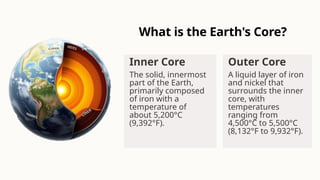
What is theEarth's Core?
Inner Core
The solid, innermost
part of the Earth,
primarily composed
of iron with a
temperature of
about 5,200°C
(9,392°F).
Outer Core
A liquid layer of iron
and nickel that
surrounds the inner
core, with
temperatures
ranging from
4,500°C to 5,500°C
(8,132°F to 9,932°F).
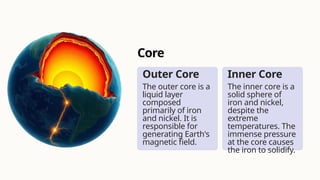
Core
Outer Core
The outercore is a
liquid layer
composed
primarily of iron
and nickel. It is
responsible for
generating Earth's
magnetic field.
Inner Core
The inner core is a
solid sphere of
iron and nickel,
despite the
extreme
temperatures. The
immense pressure
at the core causes
the iron to solidify.
48.
Outer Core
2900kilometers below the Earth’s surface
2250 kilometers thick
made up of iron and nickel
temperature reaches up to 2000o
C at this very high
temperature, iron and nickel melt
49.
Outer Core
Asidefrom seismic data analysis, the
Earth’s magnetic field strengthens the idea
that the Earth’s outer core is molten/liquid
mainly made up of iron and nickel moving
around the solid inner core, creating Earth’s
magnetism
50.
The Inner Core
made up of solid iron and nickel and has a radius of 1300
kilometers
about 5000o
C
extreme temperature could have molten the iron and nickel but
it is believed to have solidified as a result of pressure
freezing, which is common to liquids subjected under
tremendous pressure
51.
The Inner Core
Aside from the fact that the Earth has a magnetic field and
that it must be iron or other materials which are magnetic in
nature, the inner core must have a density that is about 14
times that of water.
Average crustal rocks with densities 2.8 times that of water
could not have the density calculated for the core.
So iron, which is three times denser than crustal rocks,
meets the required density.
52.
Clues that theinner core and the outer core
are made up of iron
Iron and nickel are both dense and magnetic.
overall density of the earth is much higher than
the density of the rocks in the crust
suggests that the inside must be made up of
something denser than rocks
53.
Clues that theinner core and the outer core are made
up of iron
Meteorite analysis have revealed that the most common
type is chondrite.
Chondrite contains iron, silicon, magnesium and
oxygen; some contains nickel.
The whole earth and the meteorite roughly have the
same density, thus the Earth’s mantle rock and a
meteorite minus its iron, have the same density.
54.
Structure of theEarth's Core
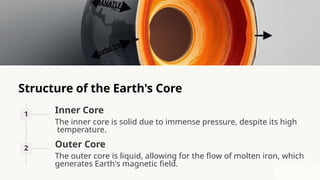
1 Inner Core
The inner core is solid due to immense pressure, despite its high
temperature.
2 Outer Core
The outer core is liquid, allowing for the flow of molten iron, which
generates Earth's magnetic field.
55.
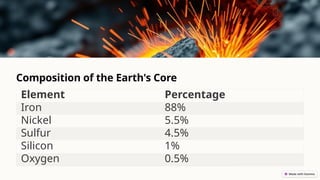
Composition of theEarth's Core
Element Percentage
Iron 88%
Nickel 5.5%
Sulfur 4.5%
Silicon 1%
Oxygen 0.5%
56.
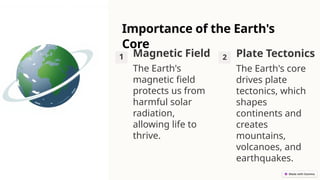
Importance of theEarth's
Core
1 Magnetic Field
The Earth's
magnetic field
protects us from
harmful solar
radiation,
allowing life to
thrive.
2 Plate Tectonics
The Earth's core
drives plate
tectonics, which
shapes
continents and
creates
mountains,
volcanoes, and
earthquakes.
57.
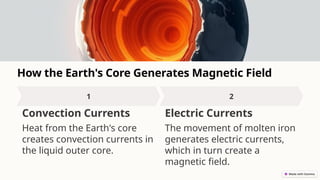
How the Earth'sCore Generates Magnetic Field
Convection Currents
Heat from the Earth's core
creates convection currents in
the liquid outer core.
Electric Currents
The movement of molten iron
generates electric currents,
which in turn create a
magnetic field.
58.
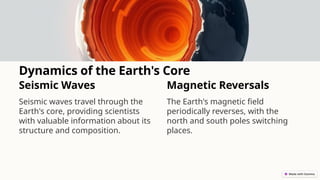
Dynamics of theEarth's Core
Seismic Waves
Seismic waves travel through the
Earth's core, providing scientists
with valuable information about its
structure and composition.
Magnetic Reversals
The Earth's magnetic field
periodically reverses, with the
north and south poles switching
places.
59.
Exploring the Earth'sCore
Drilling
Scientists have drilled deep into the Earth's crust, but
reaching the core remains a significant technological
challenge.
Seismology
By studying seismic waves, scientists can infer the
structure and composition of the Earth's core.
Satellite Data
Satellites provide valuable data about the Earth's
magnetic field, which is generated by the core.
60.
Did you know?
The deepest mine in the world, the gold mine in
South Africa, reaches a depth of 3.8km.
But...
You would have to travel more than 1,600 times that
distance-over 6000km-to reach the earth’s center.
Remember:
The abilityof the asthenosphere to flow slowly
is termed as plasticity.
crust and the uppermost part of the mantle
form a relatively cool, outermost rigid shell
called lithosphere (Gk.lithos means “stone”)
and is about 50 to 100 kilometers thick
65.
Remember:
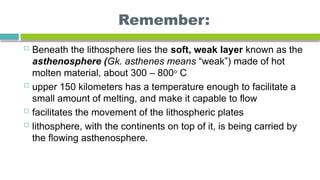
Beneath thelithosphere lies the soft, weak layer known as the
asthenosphere (Gk. asthenes means “weak”) made of hot
molten material, about 300 – 800o
C
upper 150 kilometers has a temperature enough to facilitate a
small amount of melting, and make it capable to flow
facilitates the movement of the lithospheric plates
lithosphere, with the continents on top of it, is being carried by
the flowing asthenosphere.
66.
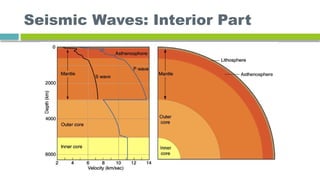
Seismic Waves
Seismicwaves from earthquakes are used to
analyze the composition and internal structure
of the Earth.
What are seismic waves?
Wheel of Names | Random name picker
67.
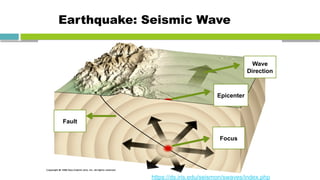
Seismic waves
Earthquakeis a vibration of the Earth
produced by the rapid release of energy.
This energy radiates in all directions from the
focus in the form of waves called seismic
waves.
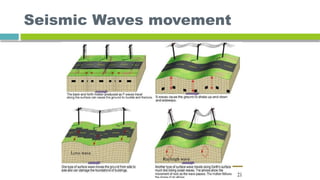
Surface Waves
canonly travel through the surface of the Earth
arrive after the main P and S waves
They are slower-moving than body waves but are
much larger and therefore more destructive.
They travel only through solid media.
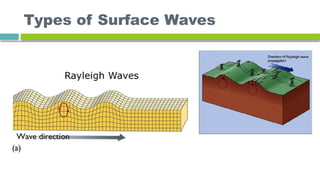
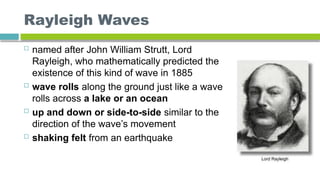
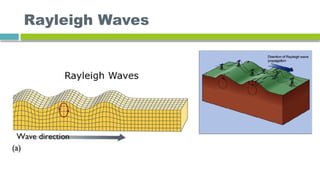
Rayleigh Waves
namedafter John William Strutt, Lord
Rayleigh, who mathematically predicted the
existence of this kind of wave in 1885
wave rolls along the ground just like a wave
rolls across a lake or an ocean
up and down or side-to-side similar to the
direction of the wave’s movement
shaking felt from an earthquake
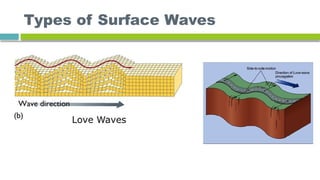
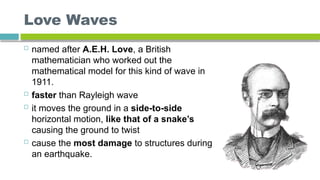
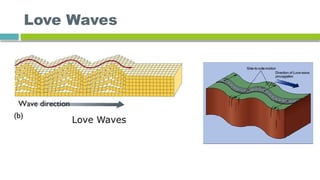
Love Waves
namedafter A.E.H. Love, a British
mathematician who worked out the
mathematical model for this kind of wave in
1911.
faster than Rayleigh wave
it moves the ground in a side-to-side
horizontal motion, like that of a snake’s
causing the ground to twist
cause the most damage to structures during
an earthquake.
Body waves
can travelthrough the Earth’s inner
layers
they are used by scientists to study the
Earth’s interior
higher frequency than the surface
waves
P-waves (Primary)
is apulse energy that travels quickly
through the Earth and through liquids
travels faster than the S-wave
it reaches a detector first
80.
P-waves (Primary)
compressionalwaves, travel by particles
vibrating parallel to the direction the wave travel
move backward and forward as they are
compressed and expanded
they travel through solids, liquids and gases
81.
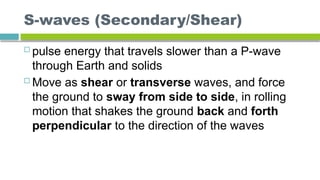
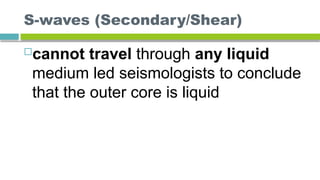
S-waves (Secondary/Shear)
pulseenergy that travels slower than a P-wave
through Earth and solids
Move as shear or transverse waves, and force
the ground to sway from side to side, in rolling
motion that shakes the ground back and forth
perpendicular to the direction of the waves
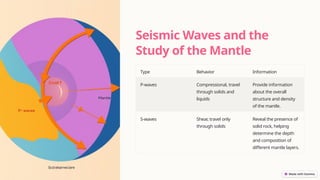
Seismic Waves andthe
Study of the Mantle
Type Behavior Information
P-waves Compressional, travel
through solids and
liquids
Provide information
about the overall
structure and density
of the mantle.
S-waves Shear, travel only
through solids
Reveal the presence of
solid rock, helping
determine the depth
and composition of
different mantle layers.
Remember:
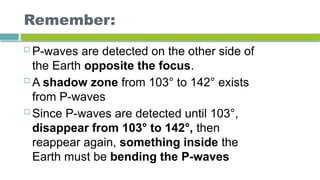
P-waves aredetected on the other side of
the Earth opposite the focus.
A shadow zone from 103° to 142° exists
from P-waves
Since P-waves are detected until 103°,
disappear from 103° to 142°, then
reappear again, something inside the
Earth must be bending the P-waves
87.
Remember:
existence ofa shadow zone, according to German
seismologist Beno Gutenberg ( u t ən b k), could
ɡ ː ɛʁ
only be explained if the Earth contained a core
composed of a material different from that of the
mantle causing the bending of the P-waves
To honor him, mantle–core boundary is called
Gutenberg discontinuity
88.
Remember:
From theepicenter, S-waves are detected until 103°, from
that point, S- waves are no longer detected
S-waves do not travel all throughout the Earth’s body
knowing the properties and characteristics of S-waves (that it
cannot travel through liquids), and with the idea that P-waves
are bent to some degree, this portion must be made of
liquid, thus the outer core
89.
Remember:
1936, theinnermost layer of the Earth was predicted by Inge
Lehmann, a Danish seismologist
discovered a new region of seismic reflection within the core
Earth has a core within a core
90.
Remember:
the outerpart of the core is liquid based from the
production of an S wave shadow and the inner part must be
solid with a different density than the rest of the surrounding
material
size of the inner core was accurately calculated through
nuclear underground tests conducted in Nevada.
echoes from seismic waves provided accurate data in
determining its size
91.
"Exploring Earth’s interiorreveals a
history written in stone, a record of
transformations that continue to shape
our future."
Editor's Notes
#1 This module will help you visualize and understand the composition and structure of the Earth’s interior. It provides you scientific knowledge that will help you describe the different layers of the Earth as well as understand their characteristics.
#2 In Module 1, you have learned about the different processes and landforms along plate boundaries that slowly shaped the Earth’s surface.
In Module 2, you will learn the connection between these processes with the internal structure and mechanisms of our planet.
#5 Despite significant advances in technology and scientific understanding, exploring the Earth's interior remains a daunting task. The deepest region of the Earth, known as the inner core, is approximately 6,371 kilometers (3,959 miles) away from the surface. The extreme conditions found at such great depths make it nearly impossible to design a mechanical probe or conduct actual explorations to totally discover the inner core.
#8 Example: Volcanic Eruption – adds new landmass.
Waethering and erosion due to water and wind
#13 The Earth's interior is a complex system of layers that are constantly interacting and evolving. These layers are crucial to understanding the planet's history and its ongoing geological processes.
#14 The Earth's interior is a complex system of layers that are constantly interacting and evolving. These layers are crucial to understanding the planet's history and its ongoing geological processes.
#21 The Earth's crust is the outermost layer of our planet, a thin, rocky shell that we live on. This layer is incredibly diverse, with varied landscapes and geologic features. It is relatively thin compared to the other layers, ranging from 3 to 45 miles in thickness.
#24 There are two main types of crust: continental crust, which makes up landmasses, and oceanic crust, found under the oceans. The differences in density and composition between these crust types play a key role in plate tectonics.
#26 There are two main types of crust: continental crust, which makes up landmasses, and oceanic crust, found under the oceans. The differences in density and composition between these crust types play a key role in plate tectonics.
#35 The Earth's mantle is a vast, enigmatic layer that lies beneath the crust and above the core, making up about 84% of Earth's total volume.
#44 The Earth's core is the innermost part of our planet, a sphere of solid iron and nickel surrounded by a liquid outer core. It's a mysterious realm that plays a crucial role in shaping our world.
#67 Seismic waves are vibrations (waves of energy) generated by earthquakes.
They travel through the Earth like a tsunami travels through the ocean, or the sound travels through the air. The time it takes for seismic waves to arrive at seismic observatories allow scientists to locate the precise location of the earthquake that generated them.
#68 The image shows a diagram of an earthquake. The epicenter is the point on the Earth's surface directly above the focus, where the earthquake originated. The seismic waves radiate outward from the focus in all directions. The red dot is the focus and the epicenter is above it, where the green arrow points.
#69 Body waves travel through the interior of the Earth. On the other hand, surface waves propagate only at the interface between two different media, like the interface between Earth and atmosphere (i.e. the surface of the Earth).
Body waves are of two types: Primary waves (also called P-waves, or pressure waves) and Secondary waves (S-waves, or shear waves).
P-waves are compression waves. They can propagate in solid or liquid material.
S-waves are shear waves. They only propagate in solid material.
By studying the trajectories of S-waves, scientists could prove that the Earth had a liquid outer core.
#70 This is because they are produced by a complex interaction of P- and S-waves reaching the Earth's surface .