
Early On ®  Michigan Part C of IDEA
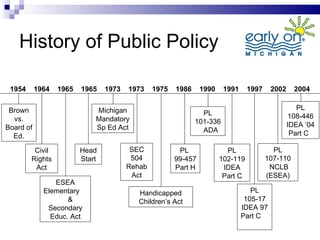
History of Public Policy 1954  1964  1965  1965  1973  1973  1975  1986  1990  1991  1997  2002  2004 Brown vs. Board of Ed. Civil Rights Act ESEA Elementary  & Secondary Educ. Act Michigan Mandatory Sp Ed Act Head Start SEC 504 Rehab Act PL  99-457 Part H PL 101-336 ADA PL 102-119 IDEA Part C PL 105-17 IDEA 97 Part C  PL 107-110 NCLB (ESEA) PL 108-446 IDEA ’04 Part C  Handicapped Children’s Act
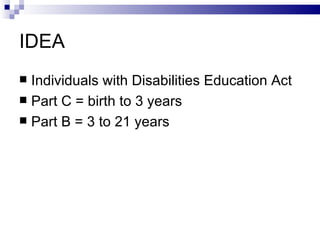
IDEA Individuals with Disabilities Education Act Part C = birth to 3 years Part B = 3 to 21 years
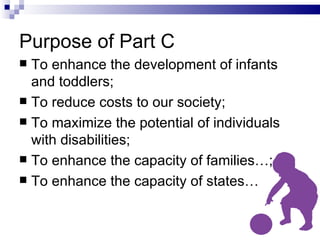
Purpose of Part C To enhance the development of infants and toddlers; To reduce costs to our society; To maximize the potential of individuals with disabilities; To enhance the capacity of families…; To enhance the capacity of states…
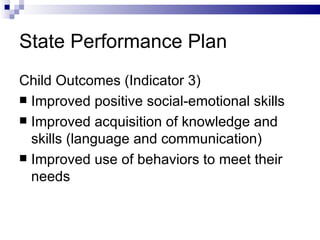
State Performance Plan Child Outcomes (Indicator 3) Improved positive social-emotional skills Improved acquisition of knowledge and skills (language and communication) Improved use of behaviors to meet their needs
What is  Early On ® A statewide system of early intervention services mandated by federal legislation (Part C of IDEA) Designed to help families find the  social, health and educational  services that will promote the development of their infants and  toddlers with special needs
What is  Early On  ® Based on partnerships between families and service providers and on collaboration among community agencies, organizations and private practitioners; Emphasizes early identification  and early services
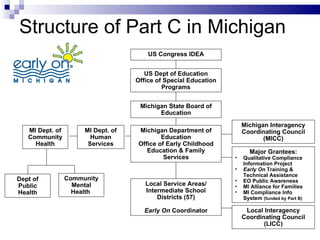
Structure of Part C in Michigan US Congress IDEA Michigan Interagency Coordinating Council (MICC) MI Dept. of Community Health MI Dept. of Human Services Dept of Public Health Community Mental Health  Local Service Areas/ Intermediate School Districts (57) Early On  Coordinator Local Interagency Coordinating Council (LICC) Major Grantees: Qualitative Compliance Information Project Early On  Training & Technical Assistance EO Public Awareness  MI Alliance for Families MI Compliance Info System  (funded by Part B) US Dept of Education Office of Special Education Programs Michigan State Board of Education Michigan Department of Education Office of Early Childhood Education & Family Services
Early On  Services Are: Strength based Family Centered Based on parent/professional partnerships Based on interagency collaboration
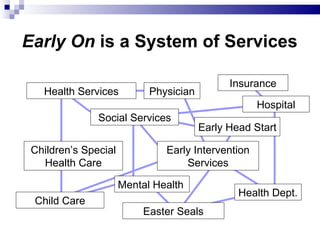
Early On  is a System of Services Mental Health Health Services Children’s Special Health Care Hospital Early Intervention Services Child Care Easter Seals Insurance Physician Health Dept. Social Services Early Head Start
Eligibility for  Early On  Services Any infant or toddler with an established condition (i.e., a physical or mental condition likely to lead to a delay) Any infant or toddler with a developmental delay
Categories of Established Conditions Chromosomal anomaly/genetic disorders Neurological disorders Congenital malformations Inborn errors of metabolism Sensory disorders Atypical developmental disorders Severe toxic exposure Chronic illnesses Severe infectious diseases
Developmental Delay in one of more of the following categories: Physical (including hearing and vision) Gross and Fine Motor Development Communication Development Cognitive Development Social/Emotional Development Adaptive (self-help)
Services Provided by  Early On Assistive Technology Services Audiology Services Family Training, Counseling & Home Visits Nursing Services Nutrition Services Occupational Therapy Speech Therapy Physical Therapy Special Instruction Social Work Psychological Services Health Services Service Coordination Transportation Vision Services
The  Early On  Process A referral is made because there is a suspicion that a child may be showing a delay or have an established condition; Contact is made with the family; A multidisciplinary developmental evaluation occurs; An interview with the family re:  concerns and daily routines.
The  Early On  Process A report is written including: Results of the evaluation Observation of parent and child Developmental History Health Status Results from the vision and hearing  screening An Individualized Family Service Plan (IFSP) meeting with the family.
The  Early On  Process The IFSP meeting will include: Results of the evaluation Concerns of the parents Outcomes desired by the parents for their child Outcomes in natural environments and  daily routines Supports needed by the family Early intervention services identified to support the outcomes
Six-Month Review Every six months, or sooner, the IFSP outcomes must be evaluated: Has the outcome been met? Does the outcome need to be changed? Has there been progress made toward achieving the outcome? Are new strategies needed? Do services need to be more intense,  less intense or stay the same?
Annual IFSP At least every 12 months a new IFSP is developed: What is the child’s current level of development? Are new outcomes needed? Are new services to support the outcomes needed? Have there been changes in the  family? Are there new concerns?
Transition Up to nine months before a child turns three years of age a transition planning meeting is held. A Transition plan with steps and services is written. Progress is measured. Eligibility for special education  determined. The child successfully transitions to  special education or to other  community services.
Clinton County RESA Early On ®  Training & Technical Assistance This presentation was produced and distributed through an IDEA Mandated Activities Project for CCRESA  EOT&TA, awarded by the Michigan Department of Education. Permission to reproduce granted. 13109 Schavey Rd. Suite 4 DeWitt, MI 48820 (866)334-5437 www.eotta.ccresa.org

Early On 101 Basics

  • 1.
    Early On ® Michigan Part C of IDEA
  • 2.
    History of PublicPolicy 1954 1964 1965 1965 1973 1973 1975 1986 1990 1991 1997 2002 2004 Brown vs. Board of Ed. Civil Rights Act ESEA Elementary & Secondary Educ. Act Michigan Mandatory Sp Ed Act Head Start SEC 504 Rehab Act PL 99-457 Part H PL 101-336 ADA PL 102-119 IDEA Part C PL 105-17 IDEA 97 Part C PL 107-110 NCLB (ESEA) PL 108-446 IDEA ’04 Part C Handicapped Children’s Act
  • 3.
    IDEA Individuals withDisabilities Education Act Part C = birth to 3 years Part B = 3 to 21 years
  • 4.
    Purpose of PartC To enhance the development of infants and toddlers; To reduce costs to our society; To maximize the potential of individuals with disabilities; To enhance the capacity of families…; To enhance the capacity of states…
  • 5.
    State Performance PlanChild Outcomes (Indicator 3) Improved positive social-emotional skills Improved acquisition of knowledge and skills (language and communication) Improved use of behaviors to meet their needs
  • 6.
    What is Early On ® A statewide system of early intervention services mandated by federal legislation (Part C of IDEA) Designed to help families find the social, health and educational services that will promote the development of their infants and toddlers with special needs
  • 7.
    What is Early On ® Based on partnerships between families and service providers and on collaboration among community agencies, organizations and private practitioners; Emphasizes early identification and early services
  • 8.
    Structure of PartC in Michigan US Congress IDEA Michigan Interagency Coordinating Council (MICC) MI Dept. of Community Health MI Dept. of Human Services Dept of Public Health Community Mental Health Local Service Areas/ Intermediate School Districts (57) Early On Coordinator Local Interagency Coordinating Council (LICC) Major Grantees: Qualitative Compliance Information Project Early On Training & Technical Assistance EO Public Awareness MI Alliance for Families MI Compliance Info System (funded by Part B) US Dept of Education Office of Special Education Programs Michigan State Board of Education Michigan Department of Education Office of Early Childhood Education & Family Services
  • 9.
    Early On Services Are: Strength based Family Centered Based on parent/professional partnerships Based on interagency collaboration
  • 10.
    Early On is a System of Services Mental Health Health Services Children’s Special Health Care Hospital Early Intervention Services Child Care Easter Seals Insurance Physician Health Dept. Social Services Early Head Start
  • 11.
    Eligibility for Early On Services Any infant or toddler with an established condition (i.e., a physical or mental condition likely to lead to a delay) Any infant or toddler with a developmental delay
  • 12.
    Categories of EstablishedConditions Chromosomal anomaly/genetic disorders Neurological disorders Congenital malformations Inborn errors of metabolism Sensory disorders Atypical developmental disorders Severe toxic exposure Chronic illnesses Severe infectious diseases
  • 13.
    Developmental Delay inone of more of the following categories: Physical (including hearing and vision) Gross and Fine Motor Development Communication Development Cognitive Development Social/Emotional Development Adaptive (self-help)
  • 14.
    Services Provided by Early On Assistive Technology Services Audiology Services Family Training, Counseling & Home Visits Nursing Services Nutrition Services Occupational Therapy Speech Therapy Physical Therapy Special Instruction Social Work Psychological Services Health Services Service Coordination Transportation Vision Services
  • 15.
    The EarlyOn Process A referral is made because there is a suspicion that a child may be showing a delay or have an established condition; Contact is made with the family; A multidisciplinary developmental evaluation occurs; An interview with the family re: concerns and daily routines.
  • 16.
    The EarlyOn Process A report is written including: Results of the evaluation Observation of parent and child Developmental History Health Status Results from the vision and hearing screening An Individualized Family Service Plan (IFSP) meeting with the family.
  • 17.
    The EarlyOn Process The IFSP meeting will include: Results of the evaluation Concerns of the parents Outcomes desired by the parents for their child Outcomes in natural environments and daily routines Supports needed by the family Early intervention services identified to support the outcomes
  • 18.
    Six-Month Review Everysix months, or sooner, the IFSP outcomes must be evaluated: Has the outcome been met? Does the outcome need to be changed? Has there been progress made toward achieving the outcome? Are new strategies needed? Do services need to be more intense, less intense or stay the same?
  • 19.
    Annual IFSP Atleast every 12 months a new IFSP is developed: What is the child’s current level of development? Are new outcomes needed? Are new services to support the outcomes needed? Have there been changes in the family? Are there new concerns?
  • 20.
    Transition Up tonine months before a child turns three years of age a transition planning meeting is held. A Transition plan with steps and services is written. Progress is measured. Eligibility for special education determined. The child successfully transitions to special education or to other community services.
  • 21.
    Clinton County RESAEarly On ® Training & Technical Assistance This presentation was produced and distributed through an IDEA Mandated Activities Project for CCRESA EOT&TA, awarded by the Michigan Department of Education. Permission to reproduce granted. 13109 Schavey Rd. Suite 4 DeWitt, MI 48820 (866)334-5437 www.eotta.ccresa.org

Editor's Notes

  • #9 Part C of IDEA was passed by the US Congress. The Federal Department of Education the Office of Special Education programs (OSEP) was given the responsibility for its implementation. In Michigan the Depart of Education of appointed the Lead Agency. Each State was permitted to name the State Agency that would take on the responsibility of implementation. Some have Health Dept. others Social Services, etc. The State Interagency Coordinating Council- SICC – is an advisory body to the Department of Education and is appointed by the Governor. Each State Agency has an Early On Coordinator in that Agency. The Early On Coordinator from Education is the official Part C Coordinator for the state. At the local level, since education is the lead agency, the responsibility for implementation falls to the local ISDs. Each local ISD has an Early On Coordinator responsible for the implementation of Part C – Early On in that particular service area. Every local ISD has a Local Interagency Coordinating Council LICC – that is advisory to the Early On Coordinator and the ISD. Major Grantees provide other services required by IDEA Part C: i.e., 1) data collection, 2) Evaluation, 3) Training & Technical Assistance, 4) Public Awareness and child find, 5) information for parents.
  • #11 With this slide, show that Early On is not a service itself, but a system that links services together for a family. The blue on this slide is Early On.