


“Don’t Worry. But Don’t Wait.”
Welcome to the 2011 Michigan Collaborative
      Early Childhood Conference
                         Victoria Meeder,
              Marketing/Public Awareness Supervisor
                                and
                        Stefanie Rathburn,
             Training & Technical Assistance Specialist
Learning Objectives
      1. Learn about Michigan's
         early intervention
         system, Early On®
      2. How to make a referral
      3. Red flags of development
Organizational Structure
OFFICE OF INNOVATIVE PROJECTS

Early On® Training & Technical Assistance
   • Personnel development for Early On
Pre-Service
   • Early On Center for Higher Education
Early On Public Awareness
   • Child find for Infants and Toddlers (Birth to age 3)
Project Find
   • Child find for special education (0 to 26)

619 Training and Technical Assistance
• Early Childhood Special Education Focus 3 to 5
What is Early On®
•   A statewide system of early intervention services mandated by federal
    legislation (Part C of IDEA)
    • Part C = birth to 3 years
    • Part B = 3 to 21 years
•   Designed to help families find the social, health and educational services
    that will promote the development of their infants and toddlers with
    special needs
•   Based on partnerships between families and service providers and on
    collaboration among community agencies, organizations and private
    practitioners;
•   Emphasizes early identification and early services
Purpose of Part C
       •   To enhance the development of
           infants and toddlers;
       •   To reduce costs to our society;
       •   To maximize the potential of
           individuals with disabilities;
       •   To enhance the capacity of
           families…;
       •   To enhance the capacity of states…
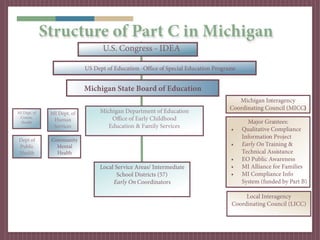
Structure of Part C in Michigan
                                   U.S. Congress - IDEA

                             US Dept of Education -Office of Special Education Programs


                             Michigan State Board of Education
                                                                                       Michigan Interagency
                                                                                    Coordinating Council (MICC)
MI Dept. of    MI Dept. of        Michigan Department of Education
 Comm.                                Office of Early Childhood
 Health
                Human                                                                       Major Grantees:
                Services             Education & Family Services
                                                                                     •    Qualitative Compliance
Dept of        Community
                                                                                          Information Project
Public           Mental                                                              •    Early On Training &
Health           Health                                                                   Technical Assistance
                                                                                     •    EO Public Awareness
                                  Local Service Areas/ Intermediate                  •    MI Alliance for Families
                                         School Districts (57)                       •    MI Compliance Info
                                       Early On Coordinators                              System (funded by Part B)

                                                                                          Local Interagency
                                                                                     Coordinating Council (LICC)
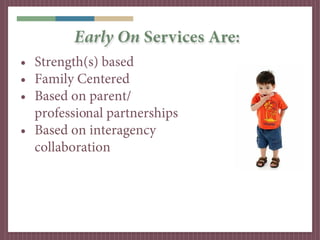
Early On Services Are:
• Strength(s) based
• Family Centered
• Based on parent/
  professional partnerships
• Based on interagency
  collaboration
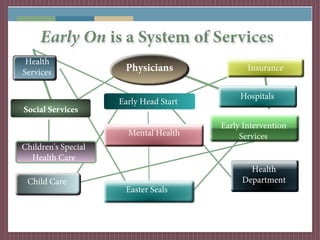
Early On is a System of Services
 Health
Services              Physicians               Insurance


                                             Hospitals
                     Early Head Start
Social Services
                                        Early Intervention
                       Mental Health         Services
Children's Special
  Health Care
                                               Health
 Child Care                                  Department
                      Easter Seals
Eligibility for Early On Services
• Any infant or toddler with an established condition
  (i.e., a physical or mental condition likely to lead to a
  delay)
• Developmental Delay
  • Under 2 months of age - any delay
  • 2 to 36 months of age - 20% in one or more areas
• Change in Eligibility Began July 2010
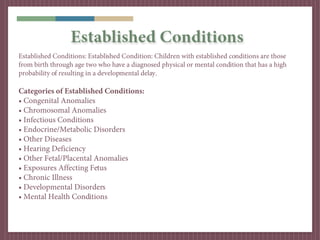
Established Conditions
Established Conditions: Established Condition: Children with established conditions are those
from birth through age two who have a diagnosed physical or mental condition that has a high
probability of resulting in a developmental delay.

Categories of Established Conditions:
• Congenital Anomalies
• Chromosomal Anomalies
• Infectious Conditions
• Endocrine/Metabolic Disorders
• Other Diseases
• Hearing Deficiency
• Other Fetal/Placental Anomalies
• Exposures Affecting Fetus
• Chronic Illness
• Developmental Disorders
• Mental Health Conditions
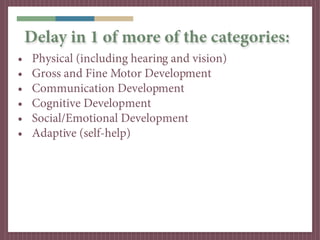
Delay in 1 of more of the categories:
•    Physical (including hearing and vision)
•    Gross and Fine Motor Development
•    Communication Development
•    Cognitive Development
•    Social/Emotional Development
•    Adaptive (self-help)
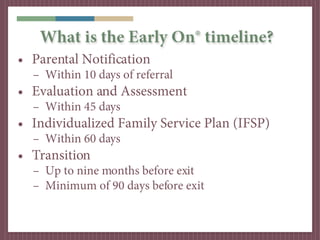
What is the Early On® timeline?
• Parental Notification
  – Within 10 days of referral
• Evaluation and Assessment
  – Within 45 days
• Individualized Family Service Plan (IFSP)
  – Within 60 days
• Transition
  – Up to nine months before exit
  – Minimum of 90 days before exit
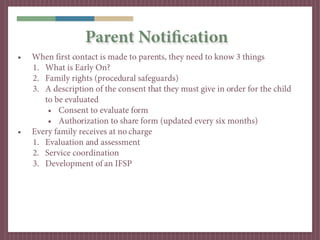
Parent Notification
•   When first contact is made to parents, they need to know 3 things
    1. What is Early On?
    2. Family rights (procedural safeguards)
    3. A description of the consent that they must give in order for the child
       to be evaluated
        • Consent to evaluate form
        • Authorization to share form (updated every six months)
•   Every family receives at no charge
    1. Evaluation and assessment
    2. Service coordination
    3. Development of an IFSP
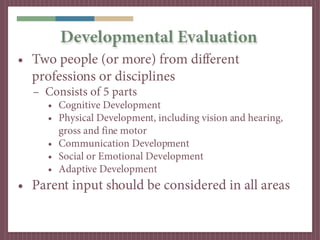
Developmental Evaluation
• Two people (or more) from different
  professions or disciplines
  – Consists of 5 parts
     • Cognitive Development
     • Physical Development, including vision and hearing,
       gross and fine motor
     • Communication Development
     • Social or Emotional Development
     • Adaptive Development
• Parent input should be considered in all areas
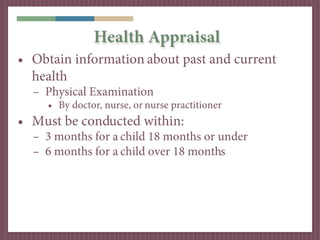
Health Appraisal
• Obtain information about past and current
  health
  – Physical Examination
     • By doctor, nurse, or nurse practitioner
• Must be conducted within:
  – 3 months for a child 18 months or under
  – 6 months for a child over 18 months
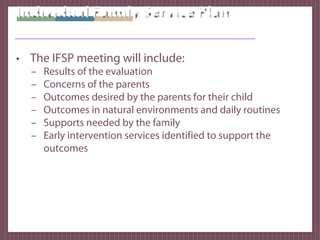
Individual Family Service Plan

• The IFSP meeting will include:
  –   Results of the evaluation
  –   Concerns of the parents
  –   Outcomes desired by the parents for their child
  –   Outcomes in natural environments and daily routines
  –   Supports needed by the family
  –   Early intervention services identified to support the
      outcomes
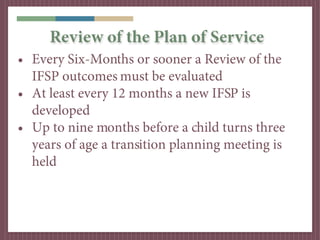
Review of the Plan of Service
• Every Six-Months or sooner a Review of the
  IFSP outcomes must be evaluated
• At least every 12 months a new IFSP is
  developed
• Up to nine months before a child turns three
  years of age a transition planning meeting is
  held
Services Provided by Early On
• Assistive Technology   •   Speech Therapy
  Services               •   Physical Therapy
• Audiology Services     •   Special Instruction
• Family Training,       •   Social Work
  Counseling & Home      •   Psychological
  Visits                     Services
• Nursing Services       •   Health Services
• Nutrition Services     •   Service Coordination
• Occupational           •   Transportation
  Therapy                •   Vision Services
When to Make a Referral
• If an established condition exists, it's best
  practice to share information about Early On.
• When a parent expresses concern
• When there is an identified red flag about a
  child’s development
Red Flags at 6 Months
•   Infant not reaching for objects
•   Not yet rolling over from stomach to back
•   Does not make eye contact
•   Does not laugh or squeal
    * (see handout for additional information about typical
      development and red flags for children birth to 48
      months of age)
Red Flags at Twelve Months
•   Persistent mouthing of objects
•   Excessive self-stimulation
•   Cannot stand when supported
•   Uses only one side of body
•   Not transferring objects from one hand to the other
•   Not looking for hidden objects
•   Not using single words
•   Does not use gestures, e.g., waving, pointing, or shaking
    head
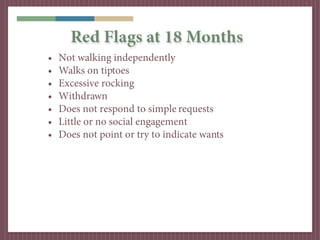
Red Flags at 18 Months
•   Not walking independently
•   Walks on tiptoes
•   Excessive rocking
•   Withdrawn
•   Does not respond to simple requests
•   Little or no social engagement
•   Does not point or try to indicate wants
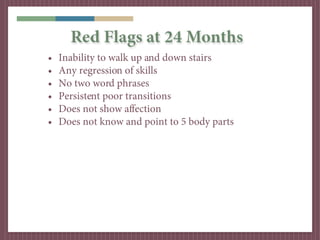
Red Flags at 24 Months
•   Inability to walk up and down stairs
•   Any regression of skills
•   No two word phrases
•   Persistent poor transitions
•   Does not show affection
•   Does not know and point to 5 body parts
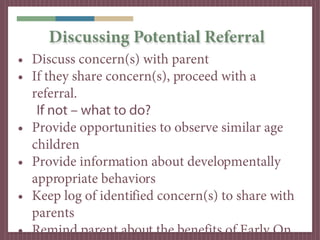
Discussing Potential Referral
• Discuss concern(s) with parent
• If they share concern(s), proceed with a
  referral.
   If not – what to do?
• Provide opportunities to observe similar age
  children
• Provide information about developmentally
  appropriate behaviors
• Keep log of identified concern(s) to share with
  parents
• Remind parent about the benefits of Early On,
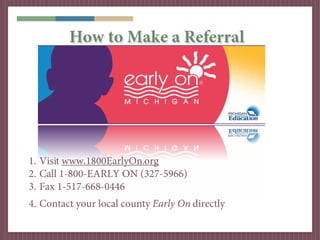
How to Make a Referral


1. Visit www.1800EarlyOn.org
2. Call 1-800-EARLY ON (327-5966)
3. Fax 1-517-668-0446
4. Contact your local county Early On directly
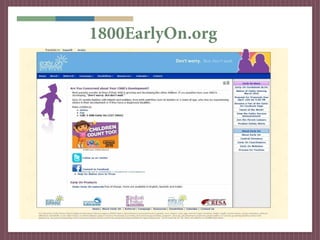
1800EarlyOn.org
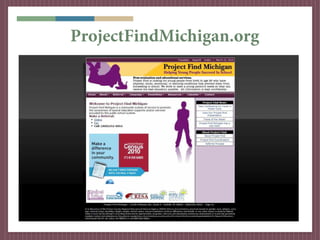
ProjectFindMichigan.org
Early On Michigan On Facebook
Follow Us on Twitter


http://twitter.com/ChildFindMich
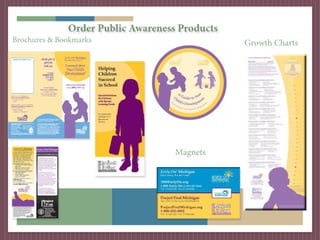
Order Public Awareness Products
Brochures & Bookmarks                           Growth Charts


                                    Magnets
Thank You for Attending
1-800-EARLY ON
1800EarlyOn.org

1-800-252-0052
ProjectFindMichigan.org

1-866-334-KIDS
eotta.ccresa.org

Michigan Collaborative Conf. 2011 - Presentation

  • 1.
    “Don’t Worry. ButDon’t Wait.” Welcome to the 2011 Michigan Collaborative Early Childhood Conference Victoria Meeder, Marketing/Public Awareness Supervisor and Stefanie Rathburn, Training & Technical Assistance Specialist
  • 2.
    Learning Objectives 1. Learn about Michigan's early intervention system, Early On® 2. How to make a referral 3. Red flags of development
  • 3.
    Organizational Structure OFFICE OFINNOVATIVE PROJECTS Early On® Training & Technical Assistance • Personnel development for Early On Pre-Service • Early On Center for Higher Education Early On Public Awareness • Child find for Infants and Toddlers (Birth to age 3) Project Find • Child find for special education (0 to 26) 619 Training and Technical Assistance • Early Childhood Special Education Focus 3 to 5
  • 4.
    What is EarlyOn® • A statewide system of early intervention services mandated by federal legislation (Part C of IDEA) • Part C = birth to 3 years • Part B = 3 to 21 years • Designed to help families find the social, health and educational services that will promote the development of their infants and toddlers with special needs • Based on partnerships between families and service providers and on collaboration among community agencies, organizations and private practitioners; • Emphasizes early identification and early services
  • 5.
    Purpose of PartC • To enhance the development of infants and toddlers; • To reduce costs to our society; • To maximize the potential of individuals with disabilities; • To enhance the capacity of families…; • To enhance the capacity of states…
  • 6.
    Structure of PartC in Michigan U.S. Congress - IDEA US Dept of Education -Office of Special Education Programs Michigan State Board of Education Michigan Interagency Coordinating Council (MICC) MI Dept. of MI Dept. of Michigan Department of Education Comm. Office of Early Childhood Health Human Major Grantees: Services Education & Family Services • Qualitative Compliance Dept of Community Information Project Public Mental • Early On Training & Health Health Technical Assistance • EO Public Awareness Local Service Areas/ Intermediate • MI Alliance for Families School Districts (57) • MI Compliance Info Early On Coordinators System (funded by Part B) Local Interagency Coordinating Council (LICC)
  • 7.
    Early On ServicesAre: • Strength(s) based • Family Centered • Based on parent/ professional partnerships • Based on interagency collaboration
  • 8.
    Early On isa System of Services Health Services Physicians Insurance Hospitals Early Head Start Social Services Early Intervention Mental Health Services Children's Special Health Care Health Child Care Department Easter Seals
  • 9.
    Eligibility for EarlyOn Services • Any infant or toddler with an established condition (i.e., a physical or mental condition likely to lead to a delay) • Developmental Delay • Under 2 months of age - any delay • 2 to 36 months of age - 20% in one or more areas • Change in Eligibility Began July 2010
  • 10.
    Established Conditions Established Conditions:Established Condition: Children with established conditions are those from birth through age two who have a diagnosed physical or mental condition that has a high probability of resulting in a developmental delay. Categories of Established Conditions: • Congenital Anomalies • Chromosomal Anomalies • Infectious Conditions • Endocrine/Metabolic Disorders • Other Diseases • Hearing Deficiency • Other Fetal/Placental Anomalies • Exposures Affecting Fetus • Chronic Illness • Developmental Disorders • Mental Health Conditions
  • 11.
    Delay in 1of more of the categories: • Physical (including hearing and vision) • Gross and Fine Motor Development • Communication Development • Cognitive Development • Social/Emotional Development • Adaptive (self-help)
  • 12.
    What is theEarly On® timeline? • Parental Notification – Within 10 days of referral • Evaluation and Assessment – Within 45 days • Individualized Family Service Plan (IFSP) – Within 60 days • Transition – Up to nine months before exit – Minimum of 90 days before exit
  • 13.
    Parent Notification • When first contact is made to parents, they need to know 3 things 1. What is Early On? 2. Family rights (procedural safeguards) 3. A description of the consent that they must give in order for the child to be evaluated • Consent to evaluate form • Authorization to share form (updated every six months) • Every family receives at no charge 1. Evaluation and assessment 2. Service coordination 3. Development of an IFSP
  • 14.
    Developmental Evaluation • Twopeople (or more) from different professions or disciplines – Consists of 5 parts • Cognitive Development • Physical Development, including vision and hearing, gross and fine motor • Communication Development • Social or Emotional Development • Adaptive Development • Parent input should be considered in all areas
  • 15.
    Health Appraisal • Obtaininformation about past and current health – Physical Examination • By doctor, nurse, or nurse practitioner • Must be conducted within: – 3 months for a child 18 months or under – 6 months for a child over 18 months
  • 16.
    Individual Family ServicePlan • The IFSP meeting will include: – Results of the evaluation – Concerns of the parents – Outcomes desired by the parents for their child – Outcomes in natural environments and daily routines – Supports needed by the family – Early intervention services identified to support the outcomes
  • 17.
    Review of thePlan of Service • Every Six-Months or sooner a Review of the IFSP outcomes must be evaluated • At least every 12 months a new IFSP is developed • Up to nine months before a child turns three years of age a transition planning meeting is held
  • 18.
    Services Provided byEarly On • Assistive Technology • Speech Therapy Services • Physical Therapy • Audiology Services • Special Instruction • Family Training, • Social Work Counseling & Home • Psychological Visits Services • Nursing Services • Health Services • Nutrition Services • Service Coordination • Occupational • Transportation Therapy • Vision Services
  • 19.
    When to Makea Referral • If an established condition exists, it's best practice to share information about Early On. • When a parent expresses concern • When there is an identified red flag about a child’s development
  • 20.
    Red Flags at6 Months • Infant not reaching for objects • Not yet rolling over from stomach to back • Does not make eye contact • Does not laugh or squeal * (see handout for additional information about typical development and red flags for children birth to 48 months of age)
  • 21.
    Red Flags atTwelve Months • Persistent mouthing of objects • Excessive self-stimulation • Cannot stand when supported • Uses only one side of body • Not transferring objects from one hand to the other • Not looking for hidden objects • Not using single words • Does not use gestures, e.g., waving, pointing, or shaking head
  • 22.
    Red Flags at18 Months • Not walking independently • Walks on tiptoes • Excessive rocking • Withdrawn • Does not respond to simple requests • Little or no social engagement • Does not point or try to indicate wants
  • 23.
    Red Flags at24 Months • Inability to walk up and down stairs • Any regression of skills • No two word phrases • Persistent poor transitions • Does not show affection • Does not know and point to 5 body parts
  • 24.
    Discussing Potential Referral •Discuss concern(s) with parent • If they share concern(s), proceed with a referral. If not – what to do? • Provide opportunities to observe similar age children • Provide information about developmentally appropriate behaviors • Keep log of identified concern(s) to share with parents • Remind parent about the benefits of Early On,
  • 25.
    How to Makea Referral 1. Visit www.1800EarlyOn.org 2. Call 1-800-EARLY ON (327-5966) 3. Fax 1-517-668-0446 4. Contact your local county Early On directly
  • 26.
  • 27.
  • 28.
    Early On MichiganOn Facebook
  • 29.
    Follow Us onTwitter http://twitter.com/ChildFindMich
  • 30.
    Order Public AwarenessProducts Brochures & Bookmarks Growth Charts Magnets
  • 31.
    Thank You forAttending 1-800-EARLY ON 1800EarlyOn.org 1-800-252-0052 ProjectFindMichigan.org 1-866-334-KIDS eotta.ccresa.org