Chapter 14 Early Childhood Special Education William L. Heward Exceptional Children: An Introduction to Special Education , 8e Copyright  © 2006 by Pearson Education, Inc. Upper Saddle River, New Jersey 07458 All rights reserved.
 
 
The Importance of Early Intervention Research has documented that early intervention can provide both intermediate and long-term benefits for young children with disabilities and those at risk for developmental delay IDEA and Early Childhood Special Education Mandatory preschool for children with disabilities ages 3-5 and voluntary early intervention services for infants and toddlers States that receive IDEA funds for early intervention must serve all infants and toddlers with developmental delays or established risk conditions States may also serve infants and toddlers who are identified as at-risk William L. Heward Exceptional Children: An Introduction to Special Education , 8e Copyright  © 2006 by Pearson Education, Inc. Upper Saddle River, New Jersey 07458 All rights reserved.
Early Childhood Special Education Early Childhood Special Education (Part B of IDEA) and Early Intervention (Part C of IDEA), provide services for children from birth to Kindergarten age who qualify according to state and federal law.  Early Intervention services are provided for infants and toddlers with a disability.  "Infant and toddler with a disability" means a child, ages birth through two, inclusive, who is eligible to receive services in the Part C early intervention system up to age three, and who: 1. Has delayed functioning;  2. Manifests atypical development or behavior;  3. Has behavioral disorders that interfere with acquisition of developmental skills; or  4. Has a diagnosed physical or mental condition that has a high probability of resulting in delay, even though no current delay exists.
Preschoolers may be found eligible for Early Childhood Special Education services under one or more of 14 disability categories, which are defined in the federal and state regulations: 1. autism 2. deaf-blindness 3. emotional disturbance 4. hearing impairment/deaf 5. learning disabilities 6. mental retardation 7. multiple disabilities 8. orthopedic impairment 9. other health impairment  10. severe disabilities  11. speech or language impairment  12. traumatic brain injury  13. visual impairment/blind  14. developmental delay Don’t have to fit under existing categories for infants & toddlers…..
Developmental delay" means a disability affecting a child ages two through eight: Who is experiencing developmental delays, as measured by appropriate diagnostic instruments and procedures, in one or more of the following areas:  physical development,  cognitive development,  communication development,  social or emotional development,  or adaptive development; and Who, by reason thereof, needs special education and related services. Virginia SPED
Long Term Goal The long term goal for our preschool aged children is for them to be as ready as possible to enter kindergarten.  The earlier services are provided for children with disabilities, the better the long term prognosis.  Children with special needs, who have experienced support early in life do better in future settings.
What is an IFSP? The Individualized Family Service Plan (IFSP) will be a roadmap through the Birth to Three System.   It will show you where to start from and where you plan to go.   Parent and service coordinator will check it every so often to make sure that family and child are still on course.   The parent has valuable information and insight about the child's strengths, needs, likes and dislikes.   That, along with information from the assessment and medical information from the child's doctor, will define the starting point.
Where the family wants to go and how they want to get there will depend on the family's priorities, concerns, lifestyles, and routines.   The family may want to complete a "Hopes and Dreams" exercise  to prepare to write down the IFSP "outcomes" section.   Outcomes are the changes the family will want to work toward for the child and family and can relate to any area of your child's development and daily or weekly routines (such as eating, dressing, making friends) or the family's life (such as training a baby-sitter or making time for play activities).   After the outcomes are written, including the many locations and people that will need to be involved, it is time to look at one or more of the following Birth to Three services and supports that would help the family to achieve those outcomes:   
service coordination  specialized instruction  speech and language services  physical therapy (P.T.)  occupational therapy (O.T.)  family training and counseling  assistive technology devices and services  audiological services  health services necessary to benefit from other early intervention services  medical services for Birth to Three diagnostic or evaluation nutrition services  nursing services  psychological services  social work services  vision and mobility services  transportation necessary to receive other services that are included in the IFSP  other services and supports
Where are they provided? The services of the IFSP will describe who will be providing any of these services, where, how often, and for how long.   Depending upon what the family prefers, services can be delivered in many different natural environments.   These may include various places: in the family home,  the child's day care,  a neighborhood play group,  or other places where the child spends his or her days so that it is a comfortable place for the family and the child.   Connect Birth to Three System…….
Individualized Family Services Plan An IFSP is a plan that addresses the needs of the child and family and is developed by a multidisciplinary team An IFSP   defines the family as being the recipient of early intervention services The IFSP must be evaluated once a year and reviewed at six-month intervals Special education for preschoolers Preschool children do not have to be identified under existing categories to receive services Local education agencies may elect to use a variety of service options William L. Heward Exceptional Children: An Introduction to Special Education , 8e Copyright  © 2006 by Pearson Education, Inc. Upper Saddle River, New Jersey 07458 All rights reserved.
According to IDEA, the  IFSP shall be in writing and contain statements of: the child's  present levels of physical development, cognitive development, communication development, social or emotional development, and adaptive development.  the family's  resources, priorities, and concerns relating to enhancing the development of the child with a disability;  the major outcomes  to be achieved for the child and the family; the criteria, procedures, and timelines used to determine progress; and whether modifications or revisions of the outcomes or services are necessary;  specific early intervention  services necessary to meet the unique needs of the child and the family, including the frequency, intensity, and the method of delivery;
According to IDEA, the  IFSP shall be in writing and contain statements of continued: the natural environments  in which services will be provided, including justification of the extent, if any, to which the services will not be provided in a natural environment;  the projected dates  for initiation of services and their anticipated duration;  the name of the service provider  who will be responsible for implementing the plan and coordinating with other agencies and persons; and  steps to support the child's  transition to preschool or other appropriate services. Juvenile HD
The  IFSP differs from the IEP  in several ways: It revolves around the family, as it is the family that is the constant in a child's life.  It includes outcomes targeted for the family, as opposed to focusing only on the eligible child.  It includes the notion of natural environments, which encompass home or community settings such as parks, child care, and gym classes. This focus creates opportunities for learning interventions in everyday routines and activities, rather than only in formal, contrived environments.  It includes activities undertaken with multiple agencies beyond the scope of Part C.   These are included to integrate all services into one plan.  It names a service coordinator to help the family during the development, implementation, and evaluation of the  IFSP .
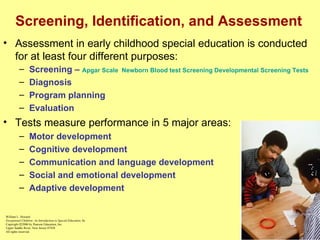
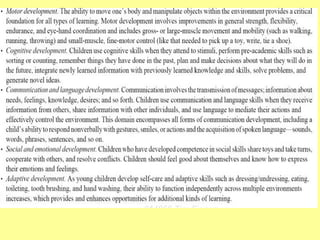
Screening, Identification, and Assessment Assessment in early childhood special education is conducted for at least four different purposes: Screening –  Apgar Scale   Newborn Blood test Screening   Developmental Screening Tests Diagnosis Program planning Evaluation Tests measure performance in 5 major areas: Motor development Cognitive development Communication and language development Social and emotional development Adaptive development William L. Heward Exceptional Children: An Introduction to Special Education , 8e Copyright  © 2006 by Pearson Education, Inc. Upper Saddle River, New Jersey 07458 All rights reserved.
 
Curriculum and Instruction in  Early Childhood Special Education Curriculum and program goals Support families in achieving their own goals Promote child engagement, independence, and mastery Promote development in all important domains Build and support social competence Facilitate the generalization use of skills Prepare and assist children for normalized life experiences with their families Help children and their families make smooth transitions Prevent or minimize the development of future problems or disabilities William L. Heward Exceptional Children: An Introduction to Special Education , 8e Copyright  © 2006 by Pearson Education, Inc. Upper Saddle River, New Jersey 07458 All rights reserved.   Please read this section p 572-574
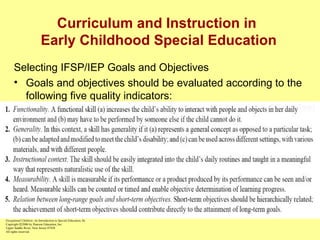
Curriculum and Instruction in  Early Childhood Special Education Selecting IFSP/IEP Goals and Objectives Goals and objectives should be evaluated according to the following five quality indicators: Functionality Generality Instructional context Measurability Relation between long-range goals and short-term objectives William L. Heward Exceptional Children: An Introduction to Special Education , 8e Copyright  © 2006 by Pearson Education, Inc. Upper Saddle River, New Jersey 07458 All rights reserved.
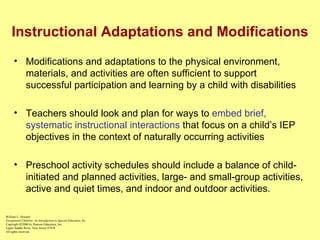
Instructional Adaptations and Modifications Modifications and adaptations to the physical environment, materials, and activities are often sufficient to support successful participation and learning by a child with disabilities Teachers should look and plan for ways to  embed brief, systematic instructional interactions  that focus on a child’s IEP objectives in the context of naturally occurring activities Preschool activity schedules should include a balance of child-initiated and planned activities, large- and small-group activities, active and quiet times, and indoor and outdoor activities. William L. Heward Exceptional Children: An Introduction to Special Education , 8e Copyright  © 2006 by Pearson Education, Inc. Upper Saddle River, New Jersey 07458 All rights reserved.
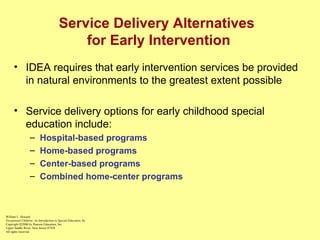
Service Delivery Alternatives  for Early Intervention IDEA requires that early intervention services be provided in natural environments to the greatest extent possible Service delivery options for early childhood special education include:  Hospital-based programs Home-based programs Center-based programs Combined home-center programs William L. Heward Exceptional Children: An Introduction to Special Education , 8e Copyright  © 2006 by Pearson Education, Inc. Upper Saddle River, New Jersey 07458 All rights reserved.
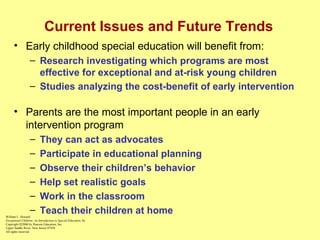
Current Issues and Future Trends Early childhood special education will benefit from: Research investigating which programs are most effective for exceptional and at-risk young children Studies analyzing the cost-benefit of early intervention   Parents are the most important people in an early intervention program They can act as advocates Participate in educational planning Observe their children’s behavior Help set realistic goals Work in the classroom Teach their children at home William L. Heward Exceptional Children: An Introduction to Special Education , 8e Copyright  © 2006 by Pearson Education, Inc. Upper Saddle River, New Jersey 07458 All rights reserved.

ch14LectureSPED100

  • 1.
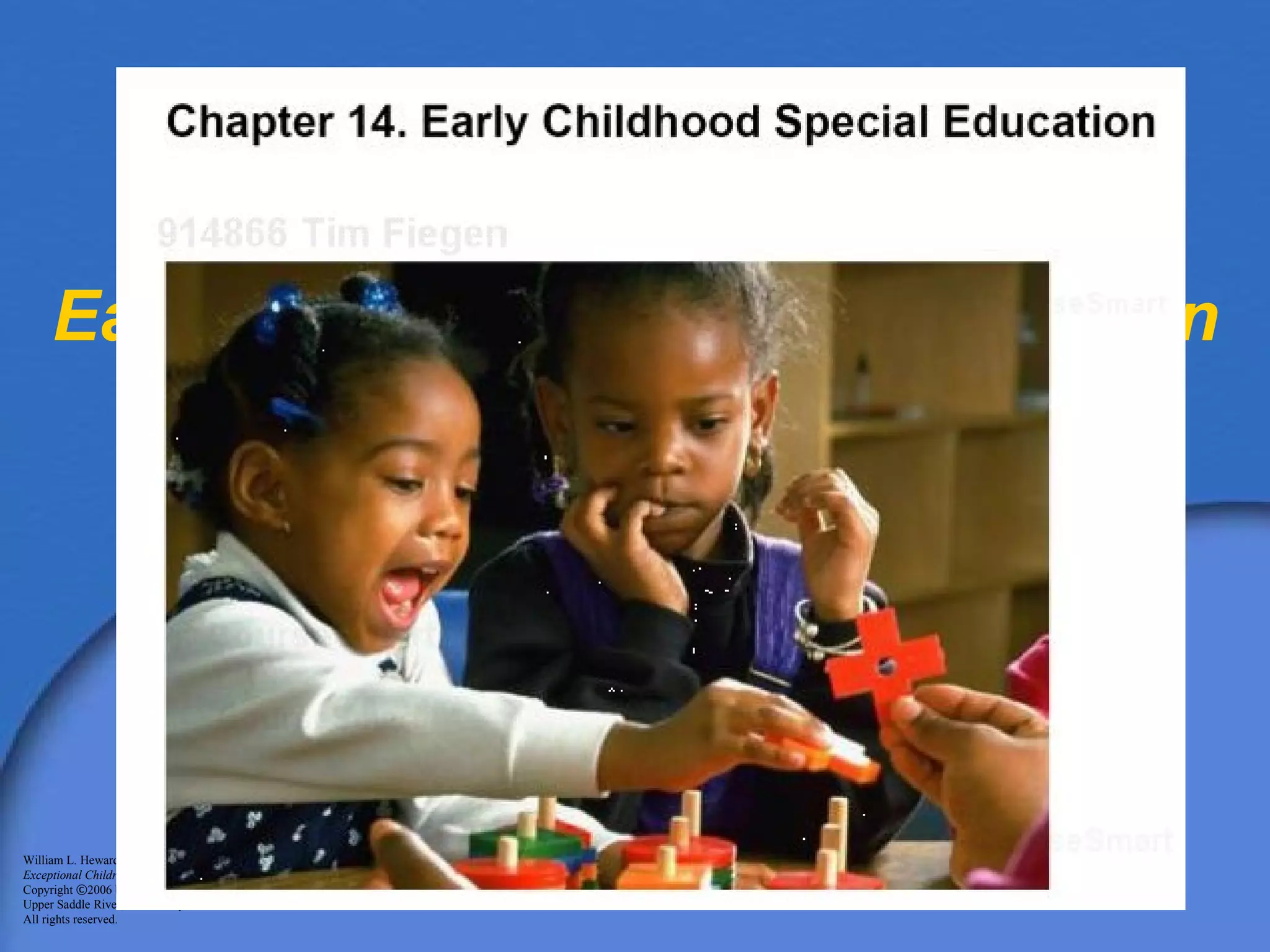
    Chapter 14 EarlyChildhood Special Education William L. Heward Exceptional Children: An Introduction to Special Education , 8e Copyright © 2006 by Pearson Education, Inc. Upper Saddle River, New Jersey 07458 All rights reserved.
  • 2.
  • 3.
  • 4.
    The Importance ofEarly Intervention Research has documented that early intervention can provide both intermediate and long-term benefits for young children with disabilities and those at risk for developmental delay IDEA and Early Childhood Special Education Mandatory preschool for children with disabilities ages 3-5 and voluntary early intervention services for infants and toddlers States that receive IDEA funds for early intervention must serve all infants and toddlers with developmental delays or established risk conditions States may also serve infants and toddlers who are identified as at-risk William L. Heward Exceptional Children: An Introduction to Special Education , 8e Copyright © 2006 by Pearson Education, Inc. Upper Saddle River, New Jersey 07458 All rights reserved.
  • 5.
    Early Childhood SpecialEducation Early Childhood Special Education (Part B of IDEA) and Early Intervention (Part C of IDEA), provide services for children from birth to Kindergarten age who qualify according to state and federal law. Early Intervention services are provided for infants and toddlers with a disability. "Infant and toddler with a disability" means a child, ages birth through two, inclusive, who is eligible to receive services in the Part C early intervention system up to age three, and who: 1. Has delayed functioning; 2. Manifests atypical development or behavior; 3. Has behavioral disorders that interfere with acquisition of developmental skills; or 4. Has a diagnosed physical or mental condition that has a high probability of resulting in delay, even though no current delay exists.
  • 6.
    Preschoolers may befound eligible for Early Childhood Special Education services under one or more of 14 disability categories, which are defined in the federal and state regulations: 1. autism 2. deaf-blindness 3. emotional disturbance 4. hearing impairment/deaf 5. learning disabilities 6. mental retardation 7. multiple disabilities 8. orthopedic impairment 9. other health impairment 10. severe disabilities 11. speech or language impairment 12. traumatic brain injury 13. visual impairment/blind 14. developmental delay Don’t have to fit under existing categories for infants & toddlers…..
  • 7.
    Developmental delay" meansa disability affecting a child ages two through eight: Who is experiencing developmental delays, as measured by appropriate diagnostic instruments and procedures, in one or more of the following areas: physical development, cognitive development, communication development, social or emotional development, or adaptive development; and Who, by reason thereof, needs special education and related services. Virginia SPED
  • 8.
    Long Term GoalThe long term goal for our preschool aged children is for them to be as ready as possible to enter kindergarten. The earlier services are provided for children with disabilities, the better the long term prognosis. Children with special needs, who have experienced support early in life do better in future settings.
  • 9.
    What is anIFSP? The Individualized Family Service Plan (IFSP) will be a roadmap through the Birth to Three System.  It will show you where to start from and where you plan to go.  Parent and service coordinator will check it every so often to make sure that family and child are still on course.  The parent has valuable information and insight about the child's strengths, needs, likes and dislikes.  That, along with information from the assessment and medical information from the child's doctor, will define the starting point.
  • 10.
    Where the familywants to go and how they want to get there will depend on the family's priorities, concerns, lifestyles, and routines.  The family may want to complete a "Hopes and Dreams" exercise  to prepare to write down the IFSP "outcomes" section.  Outcomes are the changes the family will want to work toward for the child and family and can relate to any area of your child's development and daily or weekly routines (such as eating, dressing, making friends) or the family's life (such as training a baby-sitter or making time for play activities).  After the outcomes are written, including the many locations and people that will need to be involved, it is time to look at one or more of the following Birth to Three services and supports that would help the family to achieve those outcomes:   
  • 11.
    service coordination specialized instruction speech and language services physical therapy (P.T.) occupational therapy (O.T.) family training and counseling assistive technology devices and services audiological services health services necessary to benefit from other early intervention services medical services for Birth to Three diagnostic or evaluation nutrition services nursing services psychological services social work services vision and mobility services transportation necessary to receive other services that are included in the IFSP other services and supports
  • 12.
    Where are theyprovided? The services of the IFSP will describe who will be providing any of these services, where, how often, and for how long.  Depending upon what the family prefers, services can be delivered in many different natural environments.  These may include various places: in the family home, the child's day care, a neighborhood play group, or other places where the child spends his or her days so that it is a comfortable place for the family and the child.  Connect Birth to Three System…….
  • 13.
    Individualized Family ServicesPlan An IFSP is a plan that addresses the needs of the child and family and is developed by a multidisciplinary team An IFSP defines the family as being the recipient of early intervention services The IFSP must be evaluated once a year and reviewed at six-month intervals Special education for preschoolers Preschool children do not have to be identified under existing categories to receive services Local education agencies may elect to use a variety of service options William L. Heward Exceptional Children: An Introduction to Special Education , 8e Copyright © 2006 by Pearson Education, Inc. Upper Saddle River, New Jersey 07458 All rights reserved.
  • 14.
    According to IDEA,the IFSP shall be in writing and contain statements of: the child's present levels of physical development, cognitive development, communication development, social or emotional development, and adaptive development. the family's resources, priorities, and concerns relating to enhancing the development of the child with a disability; the major outcomes to be achieved for the child and the family; the criteria, procedures, and timelines used to determine progress; and whether modifications or revisions of the outcomes or services are necessary; specific early intervention services necessary to meet the unique needs of the child and the family, including the frequency, intensity, and the method of delivery;
  • 15.
    According to IDEA,the IFSP shall be in writing and contain statements of continued: the natural environments in which services will be provided, including justification of the extent, if any, to which the services will not be provided in a natural environment; the projected dates for initiation of services and their anticipated duration; the name of the service provider who will be responsible for implementing the plan and coordinating with other agencies and persons; and steps to support the child's transition to preschool or other appropriate services. Juvenile HD
  • 16.
    The IFSPdiffers from the IEP in several ways: It revolves around the family, as it is the family that is the constant in a child's life. It includes outcomes targeted for the family, as opposed to focusing only on the eligible child. It includes the notion of natural environments, which encompass home or community settings such as parks, child care, and gym classes. This focus creates opportunities for learning interventions in everyday routines and activities, rather than only in formal, contrived environments. It includes activities undertaken with multiple agencies beyond the scope of Part C.   These are included to integrate all services into one plan. It names a service coordinator to help the family during the development, implementation, and evaluation of the IFSP .
  • 17.
    Screening, Identification, andAssessment Assessment in early childhood special education is conducted for at least four different purposes: Screening – Apgar Scale Newborn Blood test Screening Developmental Screening Tests Diagnosis Program planning Evaluation Tests measure performance in 5 major areas: Motor development Cognitive development Communication and language development Social and emotional development Adaptive development William L. Heward Exceptional Children: An Introduction to Special Education , 8e Copyright © 2006 by Pearson Education, Inc. Upper Saddle River, New Jersey 07458 All rights reserved.
  • 18.
  • 19.
    Curriculum and Instructionin Early Childhood Special Education Curriculum and program goals Support families in achieving their own goals Promote child engagement, independence, and mastery Promote development in all important domains Build and support social competence Facilitate the generalization use of skills Prepare and assist children for normalized life experiences with their families Help children and their families make smooth transitions Prevent or minimize the development of future problems or disabilities William L. Heward Exceptional Children: An Introduction to Special Education , 8e Copyright © 2006 by Pearson Education, Inc. Upper Saddle River, New Jersey 07458 All rights reserved. Please read this section p 572-574
  • 20.
    Curriculum and Instructionin Early Childhood Special Education Selecting IFSP/IEP Goals and Objectives Goals and objectives should be evaluated according to the following five quality indicators: Functionality Generality Instructional context Measurability Relation between long-range goals and short-term objectives William L. Heward Exceptional Children: An Introduction to Special Education , 8e Copyright © 2006 by Pearson Education, Inc. Upper Saddle River, New Jersey 07458 All rights reserved.
  • 21.
    Instructional Adaptations andModifications Modifications and adaptations to the physical environment, materials, and activities are often sufficient to support successful participation and learning by a child with disabilities Teachers should look and plan for ways to embed brief, systematic instructional interactions that focus on a child’s IEP objectives in the context of naturally occurring activities Preschool activity schedules should include a balance of child-initiated and planned activities, large- and small-group activities, active and quiet times, and indoor and outdoor activities. William L. Heward Exceptional Children: An Introduction to Special Education , 8e Copyright © 2006 by Pearson Education, Inc. Upper Saddle River, New Jersey 07458 All rights reserved.
  • 22.
    Service Delivery Alternatives for Early Intervention IDEA requires that early intervention services be provided in natural environments to the greatest extent possible Service delivery options for early childhood special education include: Hospital-based programs Home-based programs Center-based programs Combined home-center programs William L. Heward Exceptional Children: An Introduction to Special Education , 8e Copyright © 2006 by Pearson Education, Inc. Upper Saddle River, New Jersey 07458 All rights reserved.
  • 23.
    Current Issues andFuture Trends Early childhood special education will benefit from: Research investigating which programs are most effective for exceptional and at-risk young children Studies analyzing the cost-benefit of early intervention Parents are the most important people in an early intervention program They can act as advocates Participate in educational planning Observe their children’s behavior Help set realistic goals Work in the classroom Teach their children at home William L. Heward Exceptional Children: An Introduction to Special Education , 8e Copyright © 2006 by Pearson Education, Inc. Upper Saddle River, New Jersey 07458 All rights reserved.