“Don’t Worry. But Don’t Wait.”
                Welcome to the 2011 UPECC
                Early Childhood Conference
                     Stefanie Rathburn,
                    Training & Technical
                    Assistance Specialist

                    Workshop Session VI:
                  Saturday, April 16th, 2011
                      2:30 pm - 3:30 pm
Learning Objectives
      1. Learn about Michigan's
         early intervention
         system, Early On®
      2. How to make a referral
      3. Red flags of development
Organizational Structure
             OFFICE OF INNOVATIVE PROJECTS

Early On® Training & Technical Assistance
   • Personnel development for Early On
Pre-Service
   • Early On Center for Higher Education
Early On Public Awareness
   • Child find for Infants and Toddlers (Birth to age 3)
Project Find
   • Child find for special education (0 to 26)
619 Training and Technical Assistance
• Early Childhood Special Education Focus 3 to 5
What is Early On®
•   A statewide system of early intervention
    services mandated by federal legislation
    (Part C of IDEA)
    • Part C = birth to 3 years
    • Part B = 3 to 21 years
•   Designed to help families find the social,
    health and educational services that will
    promote the development of their infants
    and toddlers with special needs
•   Based on partnerships between families
    and service providers and on collaboration
    among community agencies, organizations
    and private practitioners;
•   Emphasizes early identification and early
    services
Purpose of Part C
• To enhance the development
  of infants and toddlers;
• To reduce costs to our
  society;
• To maximize the potential of
  individuals with disabilities;
• To enhance the capacity of
  families…;
• To enhance the capacity of
  states…
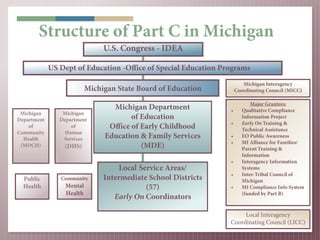
Structure of Part C in Michigan
                                U.S. Congress - IDEA

             US Dept of Education -Office of Special Education Programs
                                                                        Michigan Interagency
                           Michigan State Board of Education         Coordinating Council (MICC)

                                                                            Major Grantees:
                                  Michigan Department            •      Qualitative Compliance
 Michigan        Michigan
Department      Department              of Education                    Information Project
                                                                 •      Early On Training &
    of              of           Office of Early Childhood              Technical Assistance
Community         Human
  Health         Services       Education & Family Services      •      EO Public Awareness
                                                                 •      MI Alliance for Families/
 (MDCH)          (DHS)                     (MDE)                        Parent Training &
                                                                        Information
                                                                 •      Interagency Information
                                     Local Service Areas/               Systems
                                                                 •      Inter-Tribal Council of
  Public        Community       Intermediate School Districts           Michigan
  Health          Mental                     (57)                •      MI Compliance Info System
                  Health                                                (funded by Part B)
                                   Early On Coordinators

                                                                      Local Interagency
                                                                 Coordinating Council (LICC)
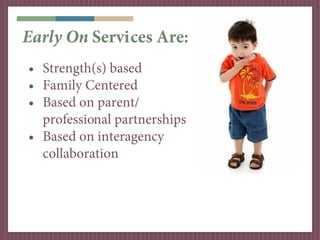
Early On Services Are:
• Strength(s) based
• Family Centered
• Based on parent/
  professional partnerships
• Based on interagency
  collaboration
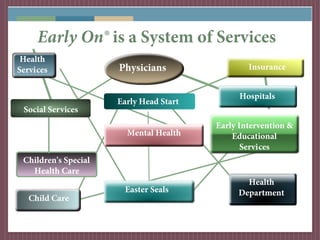
Early On® is a System of Services
 Health
Services              Physicians                 Insurance


                                               Hospitals
                      Early Head Start
 Social Services
                                         Early Intervention &
                        Mental Health        Educational
                                                Services
 Children's Special
   Health Care
                                                Health
                       Easter Seals           Department
   Child Care
Eligibility for Early On® Services
• Any infant or toddler with an established condition
  (i.e., a physical or mental condition likely to lead to
  a delay)
• Developmental Delay
  • Under 2 months of age - any delay
  • 2 to 36 months of age - 20% in one or more areas
• Change in Eligibility Began July 2010
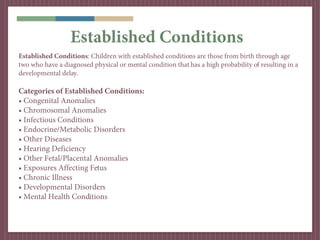
Established Conditions
Established Conditions: Children with established conditions are those from birth through age
two who have a diagnosed physical or mental condition that has a high probability of resulting in a
developmental delay.

Categories of Established Conditions:
• Congenital Anomalies
• Chromosomal Anomalies
• Infectious Conditions
• Endocrine/Metabolic Disorders
• Other Diseases
• Hearing Deficiency
• Other Fetal/Placental Anomalies
• Exposures Affecting Fetus
• Chronic Illness
• Developmental Disorders
• Mental Health Conditions
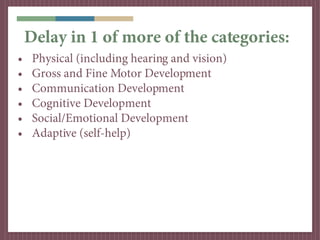
Delay in 1 of more of the categories:
•    Physical (including hearing and vision)
•    Gross and Fine Motor Development
•    Communication Development
•    Cognitive Development
•    Social/Emotional Development
•    Adaptive (self-help)
What is the Early On® timeline?
• Parental Notification
  – Within 10 days of referral
• Evaluation and Assessment
  – Within 45 days
• Individualized Family Service Plan (IFSP)
  – Within 60 days
• Transition
  – Up to nine months before exit
  – Minimum of 90 days before exit
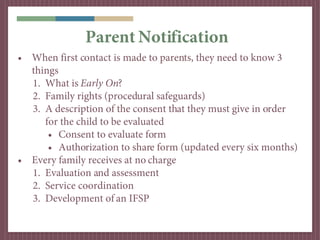
Parent Notification
• When first contact is made to parents, they need to know 3
  things
  1. What is Early On?
  2. Family rights (procedural safeguards)
  3. A description of the consent that they must give in order
     for the child to be evaluated
      • Consent to evaluate form
      • Authorization to share form (updated every six months)
• Every family receives at no charge
  1. Evaluation and assessment
  2. Service coordination
  3. Development of an IFSP
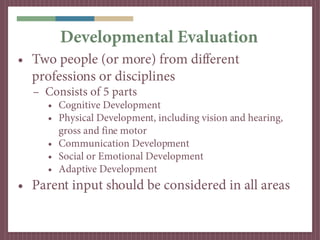
Developmental Evaluation
• Two people (or more) from different
  professions or disciplines
  – Consists of 5 parts
     • Cognitive Development
     • Physical Development, including vision and hearing,
       gross and fine motor
     • Communication Development
     • Social or Emotional Development
     • Adaptive Development
• Parent input should be considered in all areas
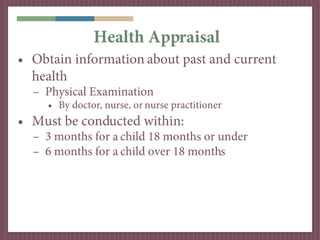
Health Appraisal
• Obtain information about past and current
  health
  – Physical Examination
     • By doctor, nurse, or nurse practitioner
• Must be conducted within:
  – 3 months for a child 18 months or under
  – 6 months for a child over 18 months
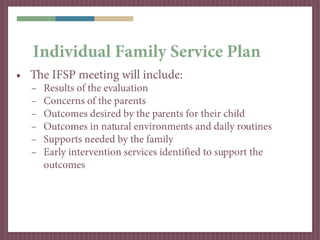
Individual Family Service Plan
• The IFSP meeting will include:
  –   Results of the evaluation
  –   Concerns of the parents
  –   Outcomes desired by the parents for their child
  –   Outcomes in natural environments and daily routines
  –   Supports needed by the family
  –   Early intervention services identified to support the
      outcomes
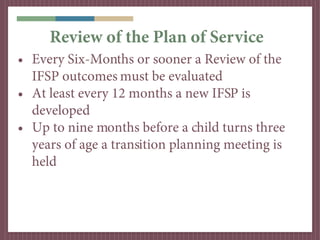
Review of the Plan of Service
• Every Six-Months or sooner a Review of the
  IFSP outcomes must be evaluated
• At least every 12 months a new IFSP is
  developed
• Up to nine months before a child turns three
  years of age a transition planning meeting is
  held
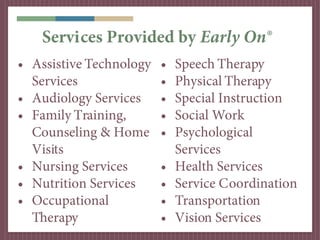
Services Provided by Early On®
• Assistive Technology   •   Speech Therapy
  Services               •   Physical Therapy
• Audiology Services     •   Special Instruction
• Family Training,       •   Social Work
  Counseling & Home      •   Psychological
  Visits                     Services
• Nursing Services       •   Health Services
• Nutrition Services     •   Service Coordination
• Occupational           •   Transportation
  Therapy                •   Vision Services
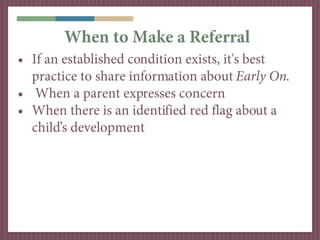
When to Make a Referral
• If an established condition exists, it's best
  practice to share information about Early On.
• When a parent expresses concern
• When there is an identified red flag about a
  child’s development
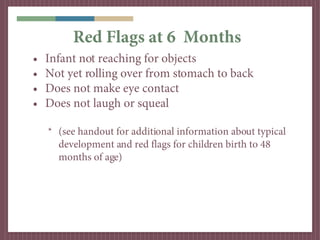
Red Flags at 6 Months
•   Infant not reaching for objects
•   Not yet rolling over from stomach to back
•   Does not make eye contact
•   Does not laugh or squeal

    * (see handout for additional information about typical
      development and red flags for children birth to 48
      months of age)
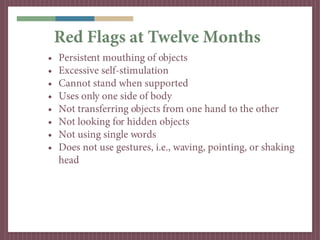
Red Flags at Twelve Months
•   Persistent mouthing of objects
•   Excessive self-stimulation
•   Cannot stand when supported
•   Uses only one side of body
•   Not transferring objects from one hand to the other
•   Not looking for hidden objects
•   Not using single words
•   Does not use gestures, i.e., waving, pointing, or shaking
    head
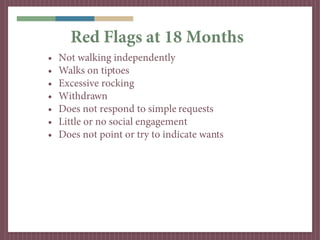
Red Flags at 18 Months
•   Not walking independently
•   Walks on tiptoes
•   Excessive rocking
•   Withdrawn
•   Does not respond to simple requests
•   Little or no social engagement
•   Does not point or try to indicate wants
Red Flags at 24 Months
•   Inability to walk up and down stairs
•   Any regression of skills
•   No two word phrases
•   Persistent poor transitions
•   Does not show affection
•   Does not know and point to 5 body parts
Discussing Potential Referral
• Discuss concern(s) with parent
• If they share concern(s), proceed with a referral.
  If not – what to do?
• Provide opportunities to observe similar age children
• Provide information about developmentally appropriate
  behaviors
• Keep log of identified concern(s) to share with parents
• Remind parent about the benefits of Early On, input from
  specific disciplines
• Provide an Early On brochure to parent
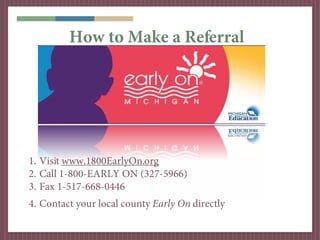
How to Make a Referral


1. Visit www.1800EarlyOn.org
2. Call 1-800-EARLY ON (327-5966)
3. Fax 1-517-668-0446
4. Contact your local county Early On directly
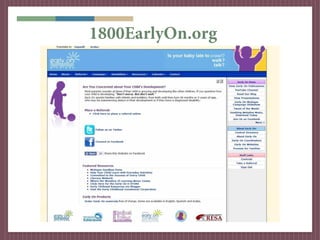
1800EarlyOn.org
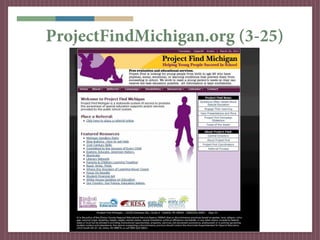
ProjectFindMichigan.org (3-25)
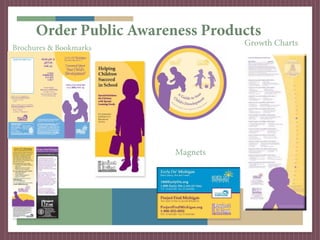
Order Public Awareness Products
                                   Growth Charts
Brochures & Bookmarks


                         Magnets
Bookmark These Websites
1-800-EARLY ON
1800EarlyOn.org

1-800-252-0052
ProjectFindMichigan.org

1-866-334-KIDS
eotta.ccresa.org


http://www.facebook.com/earlyonmichigan

Upecc early childhood_april_2011

  • 1.
    “Don’t Worry. ButDon’t Wait.” Welcome to the 2011 UPECC Early Childhood Conference Stefanie Rathburn, Training & Technical Assistance Specialist Workshop Session VI: Saturday, April 16th, 2011 2:30 pm - 3:30 pm
  • 2.
    Learning Objectives 1. Learn about Michigan's early intervention system, Early On® 2. How to make a referral 3. Red flags of development
  • 3.
    Organizational Structure OFFICE OF INNOVATIVE PROJECTS Early On® Training & Technical Assistance • Personnel development for Early On Pre-Service • Early On Center for Higher Education Early On Public Awareness • Child find for Infants and Toddlers (Birth to age 3) Project Find • Child find for special education (0 to 26) 619 Training and Technical Assistance • Early Childhood Special Education Focus 3 to 5
  • 4.
    What is EarlyOn® • A statewide system of early intervention services mandated by federal legislation (Part C of IDEA) • Part C = birth to 3 years • Part B = 3 to 21 years • Designed to help families find the social, health and educational services that will promote the development of their infants and toddlers with special needs • Based on partnerships between families and service providers and on collaboration among community agencies, organizations and private practitioners; • Emphasizes early identification and early services
  • 5.
    Purpose of PartC • To enhance the development of infants and toddlers; • To reduce costs to our society; • To maximize the potential of individuals with disabilities; • To enhance the capacity of families…; • To enhance the capacity of states…
  • 6.
    Structure of PartC in Michigan U.S. Congress - IDEA US Dept of Education -Office of Special Education Programs Michigan Interagency Michigan State Board of Education Coordinating Council (MICC) Major Grantees: Michigan Department • Qualitative Compliance Michigan Michigan Department Department of Education Information Project • Early On Training & of of Office of Early Childhood Technical Assistance Community Human Health Services Education & Family Services • EO Public Awareness • MI Alliance for Families/ (MDCH) (DHS) (MDE) Parent Training & Information • Interagency Information Local Service Areas/ Systems • Inter-Tribal Council of Public Community Intermediate School Districts Michigan Health Mental (57) • MI Compliance Info System Health (funded by Part B) Early On Coordinators Local Interagency Coordinating Council (LICC)
  • 7.
    Early On ServicesAre: • Strength(s) based • Family Centered • Based on parent/ professional partnerships • Based on interagency collaboration
  • 8.
    Early On® isa System of Services Health Services Physicians Insurance Hospitals Early Head Start Social Services Early Intervention & Mental Health Educational Services Children's Special Health Care Health Easter Seals Department Child Care
  • 9.
    Eligibility for EarlyOn® Services • Any infant or toddler with an established condition (i.e., a physical or mental condition likely to lead to a delay) • Developmental Delay • Under 2 months of age - any delay • 2 to 36 months of age - 20% in one or more areas • Change in Eligibility Began July 2010
  • 10.
    Established Conditions Established Conditions:Children with established conditions are those from birth through age two who have a diagnosed physical or mental condition that has a high probability of resulting in a developmental delay. Categories of Established Conditions: • Congenital Anomalies • Chromosomal Anomalies • Infectious Conditions • Endocrine/Metabolic Disorders • Other Diseases • Hearing Deficiency • Other Fetal/Placental Anomalies • Exposures Affecting Fetus • Chronic Illness • Developmental Disorders • Mental Health Conditions
  • 11.
    Delay in 1of more of the categories: • Physical (including hearing and vision) • Gross and Fine Motor Development • Communication Development • Cognitive Development • Social/Emotional Development • Adaptive (self-help)
  • 12.
    What is theEarly On® timeline? • Parental Notification – Within 10 days of referral • Evaluation and Assessment – Within 45 days • Individualized Family Service Plan (IFSP) – Within 60 days • Transition – Up to nine months before exit – Minimum of 90 days before exit
  • 13.
    Parent Notification • Whenfirst contact is made to parents, they need to know 3 things 1. What is Early On? 2. Family rights (procedural safeguards) 3. A description of the consent that they must give in order for the child to be evaluated • Consent to evaluate form • Authorization to share form (updated every six months) • Every family receives at no charge 1. Evaluation and assessment 2. Service coordination 3. Development of an IFSP
  • 14.
    Developmental Evaluation • Twopeople (or more) from different professions or disciplines – Consists of 5 parts • Cognitive Development • Physical Development, including vision and hearing, gross and fine motor • Communication Development • Social or Emotional Development • Adaptive Development • Parent input should be considered in all areas
  • 15.
    Health Appraisal • Obtaininformation about past and current health – Physical Examination • By doctor, nurse, or nurse practitioner • Must be conducted within: – 3 months for a child 18 months or under – 6 months for a child over 18 months
  • 16.
    Individual Family ServicePlan • The IFSP meeting will include: – Results of the evaluation – Concerns of the parents – Outcomes desired by the parents for their child – Outcomes in natural environments and daily routines – Supports needed by the family – Early intervention services identified to support the outcomes
  • 17.
    Review of thePlan of Service • Every Six-Months or sooner a Review of the IFSP outcomes must be evaluated • At least every 12 months a new IFSP is developed • Up to nine months before a child turns three years of age a transition planning meeting is held
  • 18.
    Services Provided byEarly On® • Assistive Technology • Speech Therapy Services • Physical Therapy • Audiology Services • Special Instruction • Family Training, • Social Work Counseling & Home • Psychological Visits Services • Nursing Services • Health Services • Nutrition Services • Service Coordination • Occupational • Transportation Therapy • Vision Services
  • 19.
    When to Makea Referral • If an established condition exists, it's best practice to share information about Early On. • When a parent expresses concern • When there is an identified red flag about a child’s development
  • 20.
    Red Flags at6 Months • Infant not reaching for objects • Not yet rolling over from stomach to back • Does not make eye contact • Does not laugh or squeal * (see handout for additional information about typical development and red flags for children birth to 48 months of age)
  • 21.
    Red Flags atTwelve Months • Persistent mouthing of objects • Excessive self-stimulation • Cannot stand when supported • Uses only one side of body • Not transferring objects from one hand to the other • Not looking for hidden objects • Not using single words • Does not use gestures, i.e., waving, pointing, or shaking head
  • 22.
    Red Flags at18 Months • Not walking independently • Walks on tiptoes • Excessive rocking • Withdrawn • Does not respond to simple requests • Little or no social engagement • Does not point or try to indicate wants
  • 23.
    Red Flags at24 Months • Inability to walk up and down stairs • Any regression of skills • No two word phrases • Persistent poor transitions • Does not show affection • Does not know and point to 5 body parts
  • 24.
    Discussing Potential Referral •Discuss concern(s) with parent • If they share concern(s), proceed with a referral. If not – what to do? • Provide opportunities to observe similar age children • Provide information about developmentally appropriate behaviors • Keep log of identified concern(s) to share with parents • Remind parent about the benefits of Early On, input from specific disciplines • Provide an Early On brochure to parent
  • 25.
    How to Makea Referral 1. Visit www.1800EarlyOn.org 2. Call 1-800-EARLY ON (327-5966) 3. Fax 1-517-668-0446 4. Contact your local county Early On directly
  • 26.
  • 27.
  • 28.
    Order Public AwarenessProducts Growth Charts Brochures & Bookmarks Magnets
  • 29.
    Bookmark These Websites 1-800-EARLYON 1800EarlyOn.org 1-800-252-0052 ProjectFindMichigan.org 1-866-334-KIDS eotta.ccresa.org http://www.facebook.com/earlyonmichigan