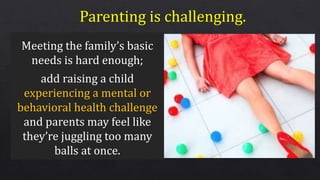
Meeting the family’s basic
needs is hard enough;
add raising a child
experiencing a mental or
behavioral health challenge
and parents may feel like
they’re juggling too many
balls at once.
Parenting is challenging.
4
Systems of Care is:
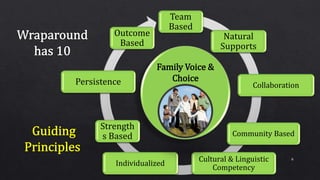
8
Team
Based
Natural
Supports
Collaboration
Community Based
Cultural & Linguistic
Competency
Individualized
Strength
s Based
Persistence
Outcome
Based
Family Voice &
Choice
Ten Principles youtube video
13
14
15
16
Culturally
Competent
Community
based
Strengths
Based
Individualized
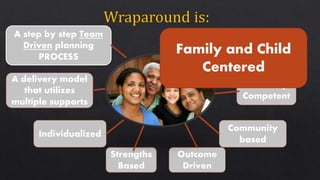
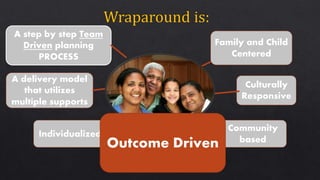
A delivery model
that utilizes
multiple supports
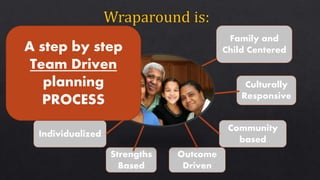
A step by step Team
Driven planning
PROCESS
Outcome
Driven
Family and Child
Centered
Community
based
Strengths
Based
Individualized
A delivery model
that utilizes
multiple supports
A step by step Team
Driven planning
PROCESS
Outcome
Driven
Family and
Child
Centered
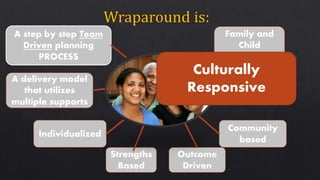
Culturally
Responsive
Culturally
Competent
Strengths
Based
Individualized
A delivery model
that utilizes
multiple supports
A step by step Team
Driven planning
PROCESS
Outcome
Driven
Family and
Child Centered
Community
based
Culturally
Responsive
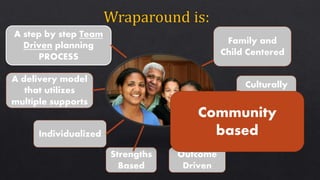
Community
based
Strengths
Based
Individualized
A delivery model
that utilizes
multiple supports
A step by step Team
Driven planning
PROCESS
Family and Child
Centered
Outcome Driven
Culturally
Responsive
Community
based
Individualized
A delivery model
that utilizes
multiple supports
A step by step Team
Driven planning
PROCESS
Outcome
Driven
Strengths
Based
Family and
Child Centered
Culturally
Responsive
Community
based
Strengths
Based
A delivery model
that utilizes
multiple supports
A step by step Team
Driven planning
PROCESS
Outcome
Driven
Family and
Child Centered
Individualized
Culturally
Responsive
Community
based
Strengths
Based
Individualized
A step by step Team
Driven planning
PROCESS
Outcome
Driven
Family and
Child Centered
A delivery
model that
utilizes multiple
supports
Culturally
Responsive
Community
based
Strengths
Based
Individualized
A delivery model
that utilizes
multiple supports
Outcome
Driven
Family and
Child CenteredA step by step
Team Driven
planning
PROCESS
THE Wraparound Team
26
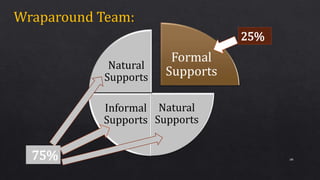
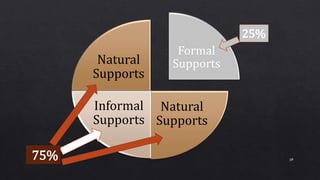
Formal
Supports
Natural
Supports
Informal
Supports
Natural
Supports
25%
75%
Wraparound Team:
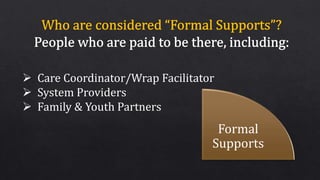
Formal
Supports
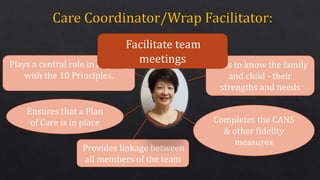
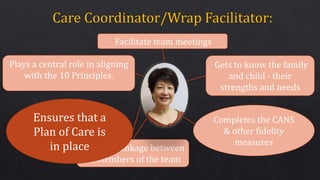
 Care Coordinator/Wrap Facilitator
 System Providers
 Family & Youth Partners
Gets to know the family
and child - their
strengths and needs
Completes the CANS
& other fidelity
measures
Provides linkage between
all members of the team
Plays a central role in aligning
with the 10 Principles.
Ensures that a Plan
of Care is in place
Facilitate team
meetings
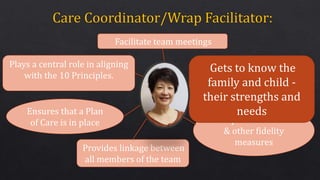
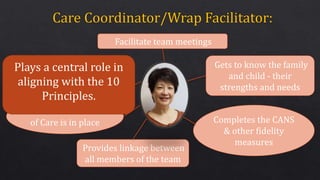
Completes the CANS
& other fidelity
measures
Gets to know the
family and child -
their strengths and
needs
Provides linkage between
all members of the team
Plays a central role in aligning
with the 10 Principles.
Ensures that a Plan
of Care is in place
Facilitate team meetings
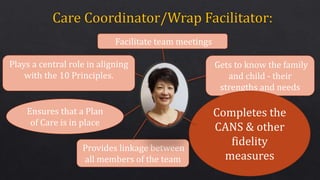
Gets to know the family
and child - their
strengths and needs
Completes the
CANS & other
fidelity
measures
Provides linkage between
all members of the team
Plays a central role in aligning
with the 10 Principles.
Ensures that a Plan
of Care is in place
Facilitate team meetings
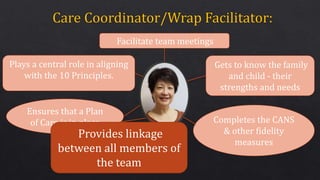
Gets to know the family
and child - their
strengths and needs
Completes the CANS
& other fidelity
measures
Plays a central role in aligning
with the 10 Principles.
Ensures that a Plan
of Care is in place
Facilitate team meetings
Provides linkage
between all members of
the team
Gets to know the family
and child - their
strengths and needs
Completes the CANS
& other fidelity
measures
Provides linkage between
all members of the team
Plays a central role in aligning
with the 10 Principles.
Ensures that a
Plan of Care is
in place
Facilitate team meetings
Gets to know the family
and child - their
strengths and needs
Completes the CANS
& other fidelity
measures
Provides linkage between
all members of the team
Ensures that a Plan
of Care is in place
Plays a central role in
aligning with the 10
Principles.
Facilitate team meetings
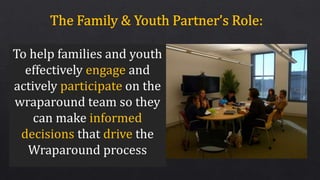
To help families and youth
effectively engage and
actively participate on the
wraparound team so they
can make informed
decisions that drive the
Wraparound process
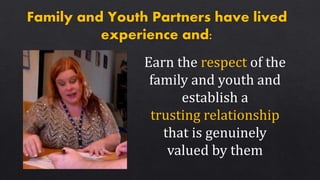
Earn the respect of the
family and youth and
establish a
trusting relationship
that is genuinely
valued by them
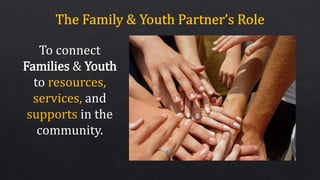
To connect
Families & Youth
to resources,
services, and
supports in the
community.
38
Formal
Supports
Natural
Supports
Informal
Supports
Natural
Supports
25%
75%
Natural
Supports
Natural
Supports
Informal
Supports
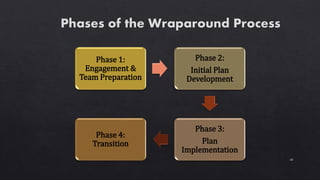
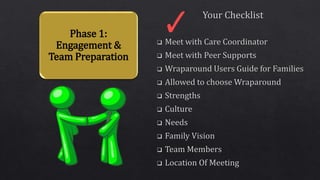
Phase 1:
Engagement &
Team Preparation
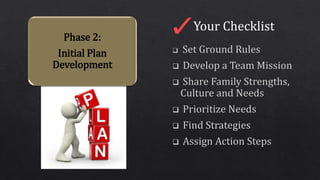
Phase 2:
Initial Plan
Development
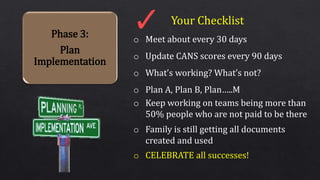
Phase 3:
Plan
Implementation
Phase 4:
Transition
41
Phase 1:
Engagement &
Team Preparation
Your Checklist
Phase 2:
Initial Plan
Development
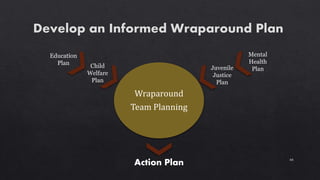
44
Wraparound
Team Planning
Education
Plan
Mental
Health
PlanJuvenile
Justice
Plan
Child
Welfare
Plan
Action Plan
Your Checklist
o Meet about every 30 days
o Update CANS scores every 90 days
o What’s working? What’s not?
o Plan A, Plan B, Plan…..M
o Keep working on teams being more than
50% people who are not paid to be there
o Family is still getting all documents
created and used
o CELEBRATE all successes!
Phase 3:
Plan
Implementation
Your Checklist
Phase 4:
Transition
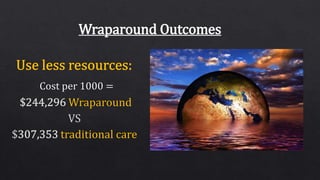
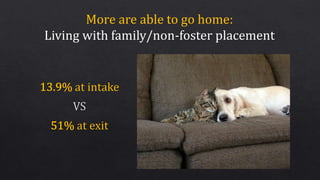
Wraparound Outcomes
More are able to go home:
Living with family/non-foster placement
How does a
family get into
Wraparound?
But different communities have different measures for
who can be in Wraparound. Most include families with:
• A child age birth to 18 years old
• A child involved with multiple
”systems”
• A child who has complex needs
• Oregon Health Plan enrolled
“Wraparound is a Voluntary Process”
Translation: You have a choice!
OFSN Statewide
Office:
1300 Broadway St. NE,
Suite 403
Training dept. Suite 102
Salem, OR 97301
503-363-8068 – Phone
503-390-3161 – FAX
Twitter: @OregonFSN
www.ofsn.org
OFSN’s Statewide Training Program:
Tammi Paul, Training Manager
tammip@ofsn.net
Victoria Haight, Training Coordinator
victoriah@ofsn.net
Shawna Canaga, Statewide Wraparound Trainer
shawnac@ofsn.net
Felicia Marshall, Administrative Assistant
feliciam@ofsn.net
Shannon Boyette, Peer Coach & TA Coordinator
Shannon@ofsn.netOregon Family Support Network

Wraparound 101 slide share

Editor's Notes

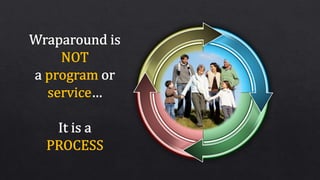
  • #2 Welcome participants Producer starts class and welcomes p’s to the virtual classroom. Asks that participants mute their phones with *1 Or via their computer on the dropdown menu. Good morning/afternoon! Welcome to Systems of care and Wraparound 101 – Session 1 – Systems of Care. My name is Victoria Haight and I’ll be your facilitator today. I hope you all were able to download and print a copy of the participants guide. If not, there’s a copy with the handouts on the bottom right of your screen, under “”
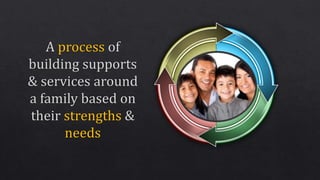
  • #5 Explain that: Wraparound is a model of care planning and coordination that came out of many similar efforts coming together to define: “what is working” Wraparound was developed as a specific and well-defined model that incorporates these components for a successful, principle-driven team process Research is showing positive results using this model for youth and families—young people spend less time in out of home placements, school placements stabilize and parents note a decrease in crisis situations and that their children’s educational and mental health needs are being met better Exercise: Ask participants to translate that description into more “family friendly” language. For example, An individualized care planning and care management system might translate to—a plan that really meets the needs of my child and my family.
  • #6 Ask p’s to open their p guide and turn to page 3 “Systems of Care” Ask for a volunteer to unmute and read the first definition from the P’s guide: A System of care is…. Ask for a second volunteer to unmute and read the second definition from the p guide: A System of care is…. Remember I said earlier that if systems are going to work together effectively, they need to share a core set of values and principles.
  • #7 Remind p’s that system of care core values and principles are the foundation on which support and services are built. One way to build them is with Wraparound
  • #9 (Refer participants to Handout #2: “10 Principles of the Wraparound Process”) Explain that The Wraparound process is guided throughout by these ten principles. Briefly review each principle Culture: focus on micro-culture = families definition of how they communicate, celebrate, interact, play, work, make decision. Wrap meeting should feel natural, like thanksgiving dinner for them, it may feel uncomfortable for the professionals. THE PRINCIPLES AND VALUES OF WRAPAROUND ARE THE FOUNDATION, BUT THESE ALONE WITHOUT A PLAN IS NOT ENOUGH. THE RIGHT “FOUNDATION”… PLUS THE RIGHT PLAN… GETS THE RIGHT RESULTS. It is Family Driven & Youth Guided, also know as family voice & choice.
  • #10 https://www.youtube.com/watch?v=VOQEisHEPYo
  • #11 Add: Not a new funding source Not new case management Not a quick fix
  • #14 Explain that: Wraparound is a model of care planning and coordination that came out of many similar efforts coming together to define: “what is working” Wraparound was developed as a specific and well-defined model that incorporates these components for a successful, principle-driven team process Research is showing positive results using this model for youth and families—young people spend less time in out of home placements, school placements stabilize and parents note a decrease in crisis situations and that their children’s educational and mental health needs are being met better Exercise: Ask participants to translate that description into more “family friendly” language. For example, An individualized care planning and care management system might translate to—a plan that really meets the needs of my child and my family.
  • #15 Explain that: Wraparound is a model of care planning and coordination that came out of many similar efforts coming together to define: “what is working” Wraparound was developed as a specific and well-defined model that incorporates these components for a successful, principle-driven team process Research is showing positive results using this model for youth and families—young people spend less time in out of home placements, school placements stabilize and parents note a decrease in crisis situations and that their children’s educational and mental health needs are being met better Exercise: Ask participants to translate that description into more “family friendly” language. For example, An individualized care planning and care management system might translate to—a plan that really meets the needs of my child and my family.
  • #16 Explain that: Wraparound is a model of care planning and coordination that came out of many similar efforts coming together to define: “what is working” Wraparound was developed as a specific and well-defined model that incorporates these components for a successful, principle-driven team process Research is showing positive results using this model for youth and families—young people spend less time in out of home placements, school placements stabilize and parents note a decrease in crisis situations and that their children’s educational and mental health needs are being met better Exercise: Ask participants to translate that description into more “family friendly” language. For example, An individualized care planning and care management system might translate to—a plan that really meets the needs of my child and my family.
  • #17 Explain that: Wraparound is a model of care planning and coordination that came out of many similar efforts coming together to define: “what is working” Wraparound was developed as a specific and well-defined model that incorporates these components for a successful, principle-driven team process Research is showing positive results using this model for youth and families—young people spend less time in out of home placements, school placements stabilize and parents note a decrease in crisis situations and that their children’s educational and mental health needs are being met better Exercise: Ask participants to translate that description into more “family friendly” language. For example, An individualized care planning and care management system might translate to—a plan that really meets the needs of my child and my family.
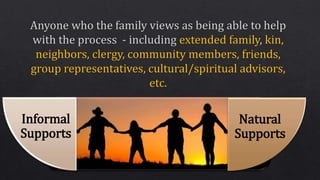
  • #26 Use white board: Type (but don’t send!) one person you think could be on a wrap team. Send now. (write on whiteboard what p’s selected) Who are we missing? Type(but don’t send!) another person you think could be on a wrap team. Send now (write on whiteboard what p’s selected). Now go ahead and use chat to type and send anyone that might be missing. Wraparound is a TEAM planning process. The team is composed of : The youth and family who the team is organized to support A wraparound facilitator – or care coordinator - who is ultimately responsible for engaging the family, convening the team, organizing and facilitating meetings, coordinating logistics and documenting the process A peer support specialist (Family and Youth partners) who works with the Wraparound facilitator to ensure that the family and youth have a central role in developing plans. Parent and youth peer specialists bring knowledge, skills and personal experience related to working with youth and families with complex needs. System partners and service providers that the family is involved in – including child welfare, juvenile justice, education and mental health. BE SURE TO INCLUDE PEOPLE WHO HAVE SIGNIFICANT DECISION MAKING POWER IN THE LIFE OF THE YOUTH. Anyone who the family views as being able to help with the process - including extended family, kin, neighbors, clergy, community members, friends, group representatives, cultural/spiritual advisors, etc.
  • #27 Explain: In Wraparound, a major goal is for the team to shift from reliance on formal supports, to primarily natural supports. In this way, youth and families are able to build a supportive natural network that helps them manage challenges and sustain their progress. Provide examples of natural support = non-paid supports. We want the people who impact the child life on a daily basis at the table. Natural supports (family friends, clergy, neighbor, soccer coach) Go back to the whiteboard with list of team members: who are the Formal supports? Informal? Natural? (use chat) Create poll Which of these people are NOT Natural Supports? Are NOT Formal Supports? Are NOT informal supports?
  • #29 The Care Coordinator “owns” responsibility for the process itself CANS = Child and Adolescent Needs and Strengths Assessment
  • #30 The Care Coordinator “owns” responsibility for the process itself CANS = Child and Adolescent Needs and Strengths Assessment
  • #31 The Care Coordinator “owns” responsibility for the process itself CANS = Child and Adolescent Needs and Strengths Assessment
  • #32 The Care Coordinator “owns” responsibility for the process itself CANS = Child and Adolescent Needs and Strengths Assessment
  • #33 The Care Coordinator “owns” responsibility for the process itself CANS = Child and Adolescent Needs and Strengths Assessment
  • #34 The Care Coordinator “owns” responsibility for the process itself CANS = Child and Adolescent Needs and Strengths Assessment
  • #37 .
  • #39 Explain: In Wraparound, a major goal is for the team to shift from reliance on formal supports, to primarily natural supports. In this way, youth and families are able to build a supportive natural network that helps them manage challenges and sustain their progress. Provide examples of natural support = non-paid supports. We want the people who impact the child life on a daily basis at the table. Natural supports (family friends, clergy, neighbor, soccer coach) Go back to the whiteboard with list of team members: who are the Formal supports? Informal? Natural? (use chat) Create poll Which of these people are NOT Natural Supports? Are NOT Formal Supports? Are NOT informal supports?
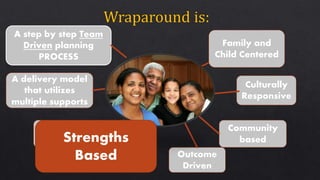
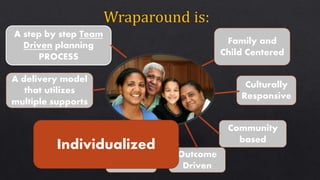
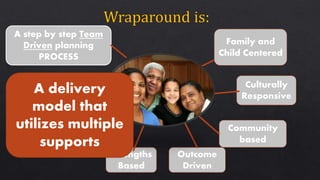
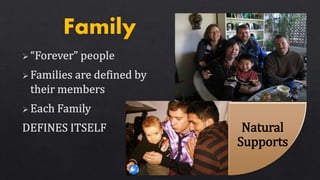
  • #40 This is a picture of Annette’s family—she has her nephew Nikko in her lap. Her sister is behind her and her brothers next to her. These are just some of the people that are defined as “family” in her life. Every family looks different.
  • #42 Explain: Wraparound is a planning process that follows a specific series of steps to build on strengths and address the complex needs of youth and their families. These steps are completed within four phases of the Wraparound process. The four phases are Engagement & Team Preparation Plan Development Plan implementation Transition. Briefly explain each phase and what happens.
  • #43 What you can expect in Fidelity Wrap: You will meet with Care Coordinator, Family Partner and/or Youth Partner and begin to get to know each other. You may meet at your home, somewhere in the community (like a coffee shop) or at an office based on your preferences. Sign Consents to Participate in the Process and Share Information Have the Process Explained You and the Care Coordinator will Begin to Assess your famlily’s Strengths and Needs –in conversation—the care coordinator will use assessment tool known as the CANS. The CANS will be used both as a way to help shape planning and as a way to measure progress over time. Develop a Crisis Plan if Needed—This should be more than instructions to dial 911. Spend some time with your care coordinator thinking through “warning signs” of a crisis and develop a plan together. The care coordinator and you should both have a written copy of the plan. Spend Time Developing a Family Vision—This is YOUR vision of the way you’d like things to be for you and your family. Often youth will also develop a vision. Sometimes family and youth don’t agree on one vision. Choose Members of Your Team
  • #44 This is a broad overview slide—more details on the next few slides. Pull out the Plan of Care and refer participants to page 11.
  • #45 Explain: All major systems involved with the youth and family sit on the Wraparound team and inform the Wraparound Plan. All system mandates and concerns are addressed. NOT a Democracy – we work to build consensus. No voting. Ask yourself- do I have the right people on my team? Do we have experts in their field etc. Don’t forget Primary Care Who else?
  • #46 The team meets monthly. Your family and child will be in regular contact with your care coordinator, family and youth partner. A lot of the real work happens between meetings and communication is essential. Team meetings are also a chance to update the team on your family’s progress, concerns and goals.
  • #47 The family decides that it is time to transition out of wraparound. Here is how the family knows: The team has achieved its mission. The family and or youth may be facilitating the meetings themselves by now. The team has discussed how the family will handle any new crisis. The family feels connected to services and understands how to access if needed in the future.
  • #48 Get rid of bar graphs
  • #51 Poll - Choose the best answer: a) Youth with mental health and/or behavior challenges typically have multiple overlapping challenges that need attention b) Families frequently have unmet basic needs that don’t get identified in a more traditional model c) Families don’t feel that the “traditional system” is working for them. This adds to treatment dropouts and missed opportunities d) All of the above
  • #53  “Wraparound is a planning process that follows a series of steps to help children and their families realize their hopes and dreams…..It is a planning process that brings people together from different parts of the whole family’s life. With help from one or more care cordinators, people from the family’s life work together, coordinate their activities and blend their perspectives of the family’s situation.” Referrals to wraparound can come from schools, mental health agencies, physicians and family partner agencies. The committee will consider whether the referral meets the local critieria to receive wraparound services. Wraparound can be helpful when a single service, such as therapy, is not successfully helping the child to succeed. It can be helpful when a child is involved with multiple systems such as child welfare, juvenile justice, special education, mental health services. It can be helpful when a family is experiencing multiple stresses such as homelessness, violent outbursts in the home, difficulty supporting the child to live in the home, multiple challenges in school settings and so forth.
  • #54  “Wraparound is a planning process that follows a series of steps to help children and their families realize their hopes and dreams…..It is a planning process that brings people together from different parts of the whole family’s life. With help from one or more care coordinators, people from the family’s life work together, coordinate their activities and blend their perspectives of the family’s situation.” Referrals to wraparound can come from schools, mental health agencies, physicians and family partner agencies. The committee will consider whether the referral meets the local critieria to receive wraparound process. Wraparound can be helpful when a single service, such as therapy, is not successfully helping the child to succeed. It can be helpful when a child is involved with multiple systems such as child welfare, juvenile justice, special education, mental health services. It can be helpful when a family is experiencing multiple stresses such as homelessness, violent outbursts in the home, difficulty supporting the child to live in the home, multiple challenges in school settings and so forth.