
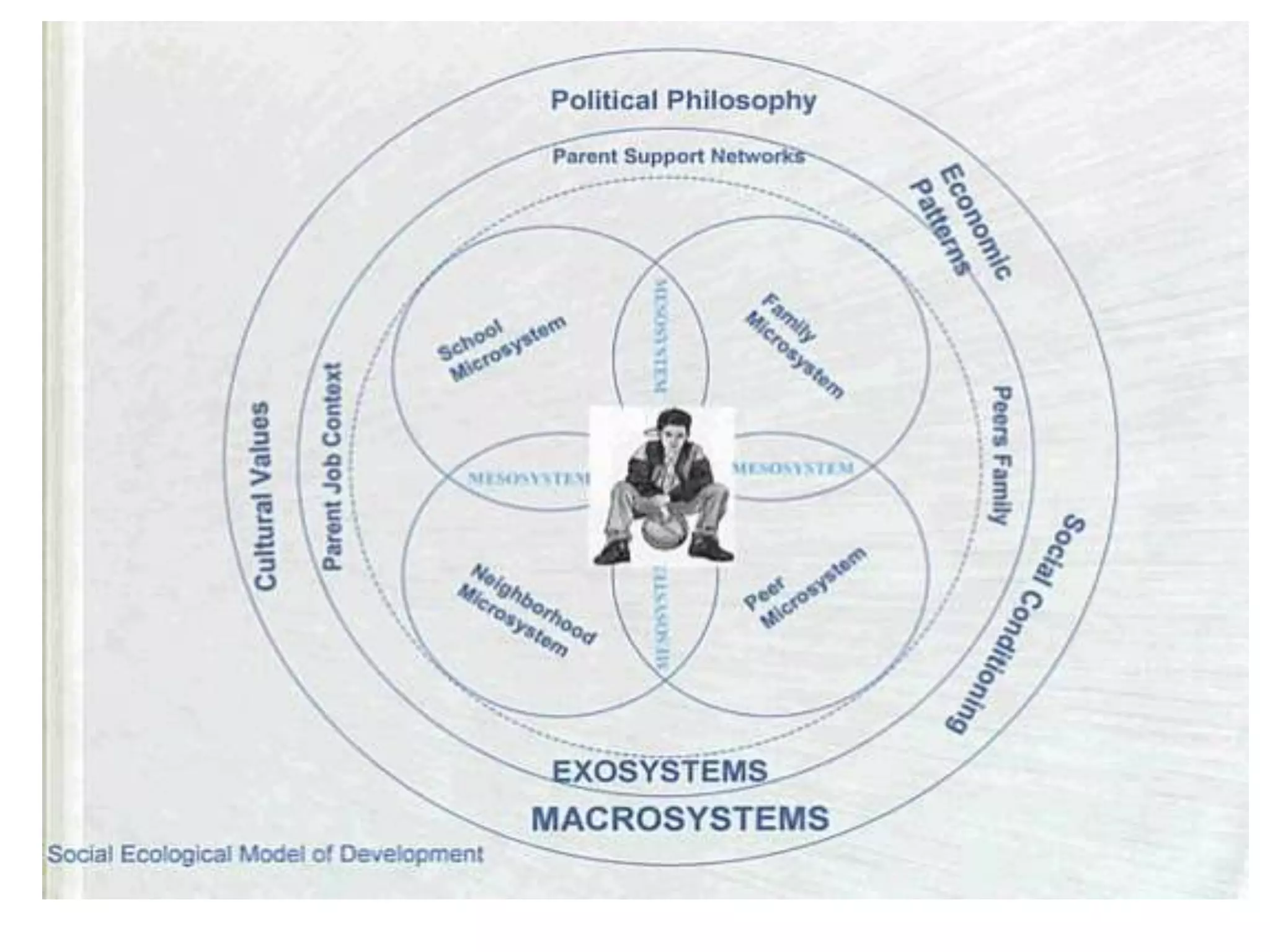


Family & Parenting Support in the 
Context of Violence Prevention 
Bernadette J. Madrid, MD 
University of the Philippines Manila 
and 
Child Protection Network Foundation
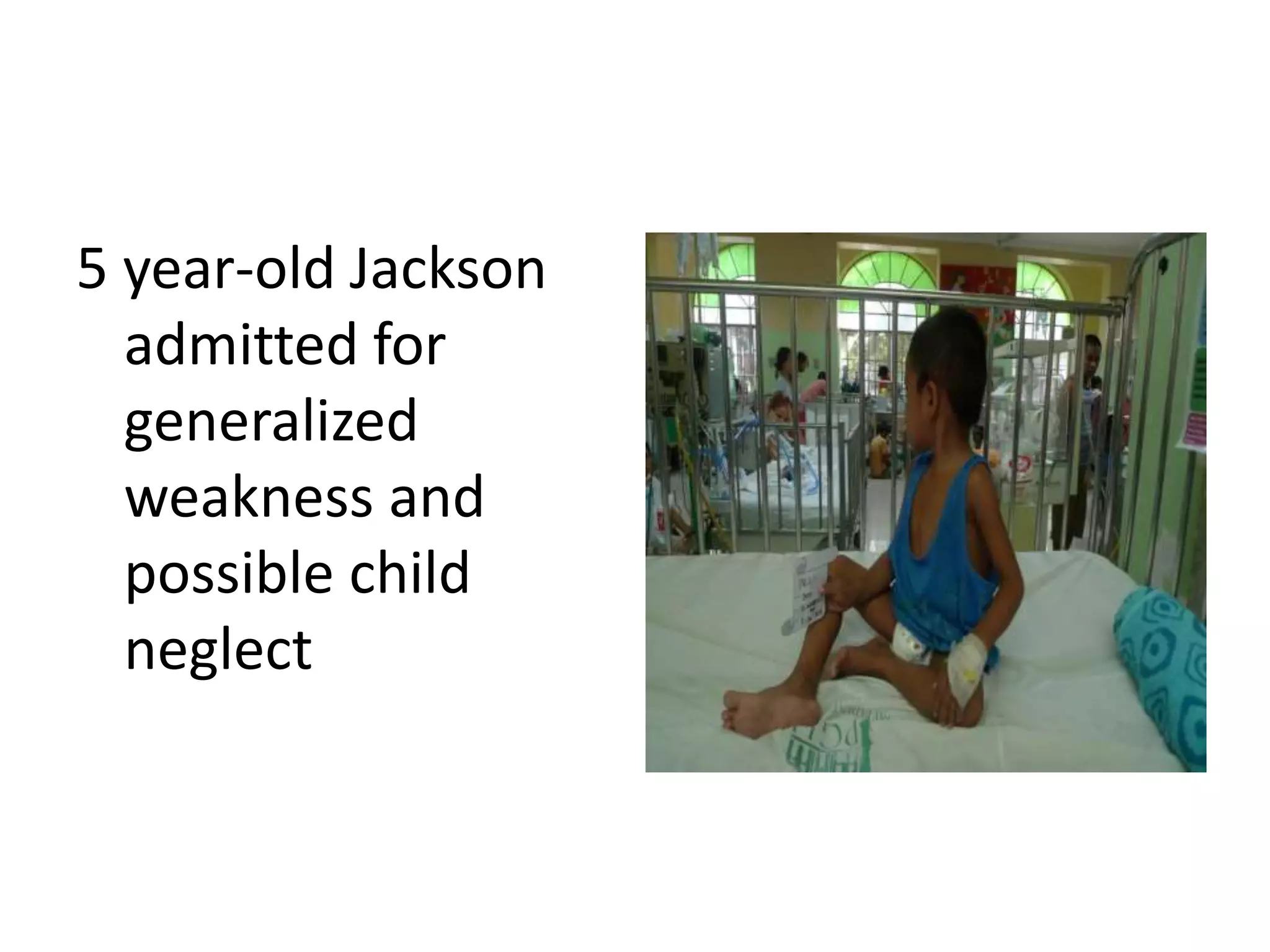
5 year-old Jackson 
admitted for 
generalized 
weakness and 
possible child 
neglect
Critical Periods & Brain Plasticity 
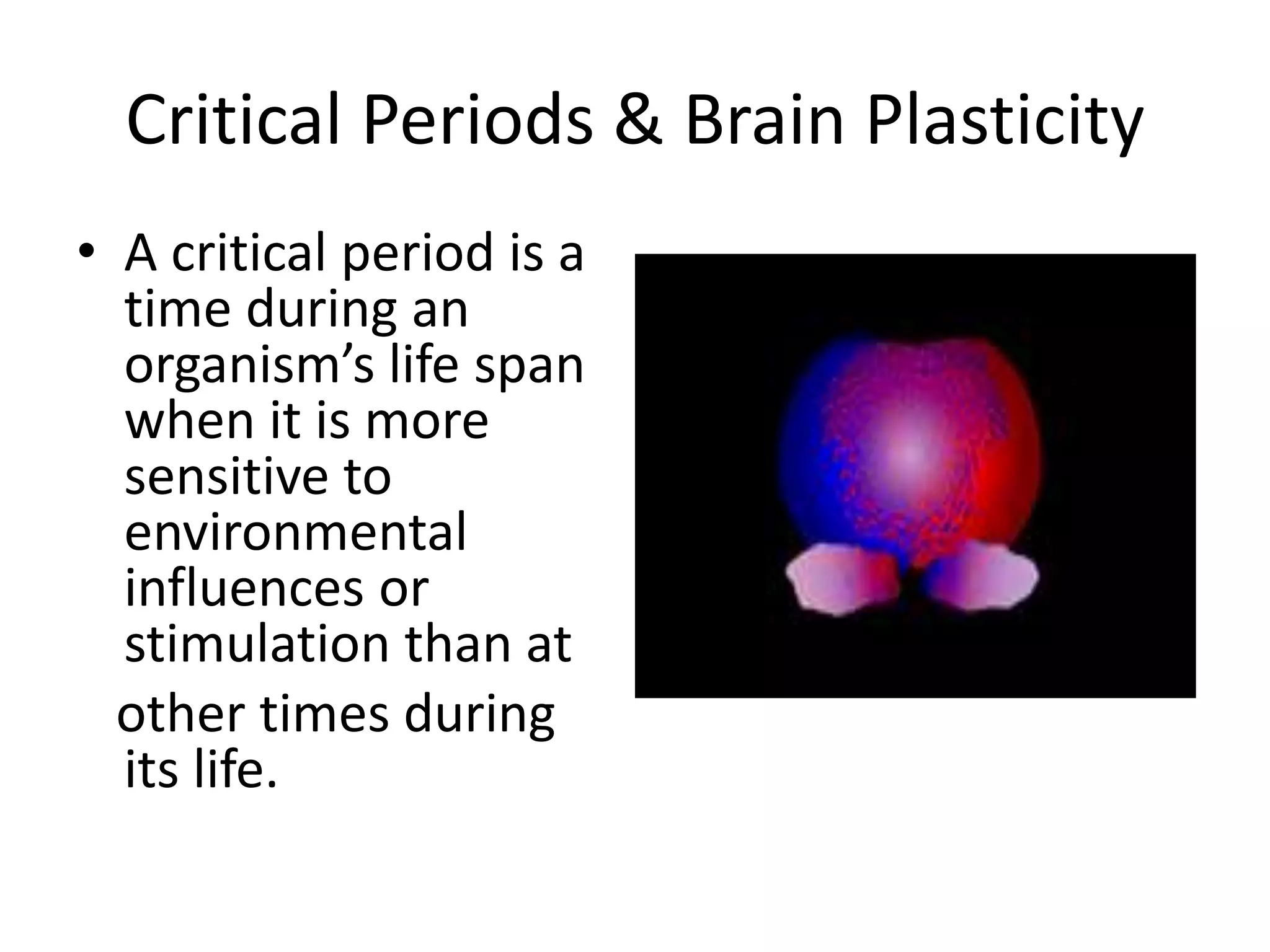
• A critical period is a 
time during an 
organism’s life span 
when it is more 
sensitive to 
environmental 
influences or 
stimulation than at 
other times during 
its life.
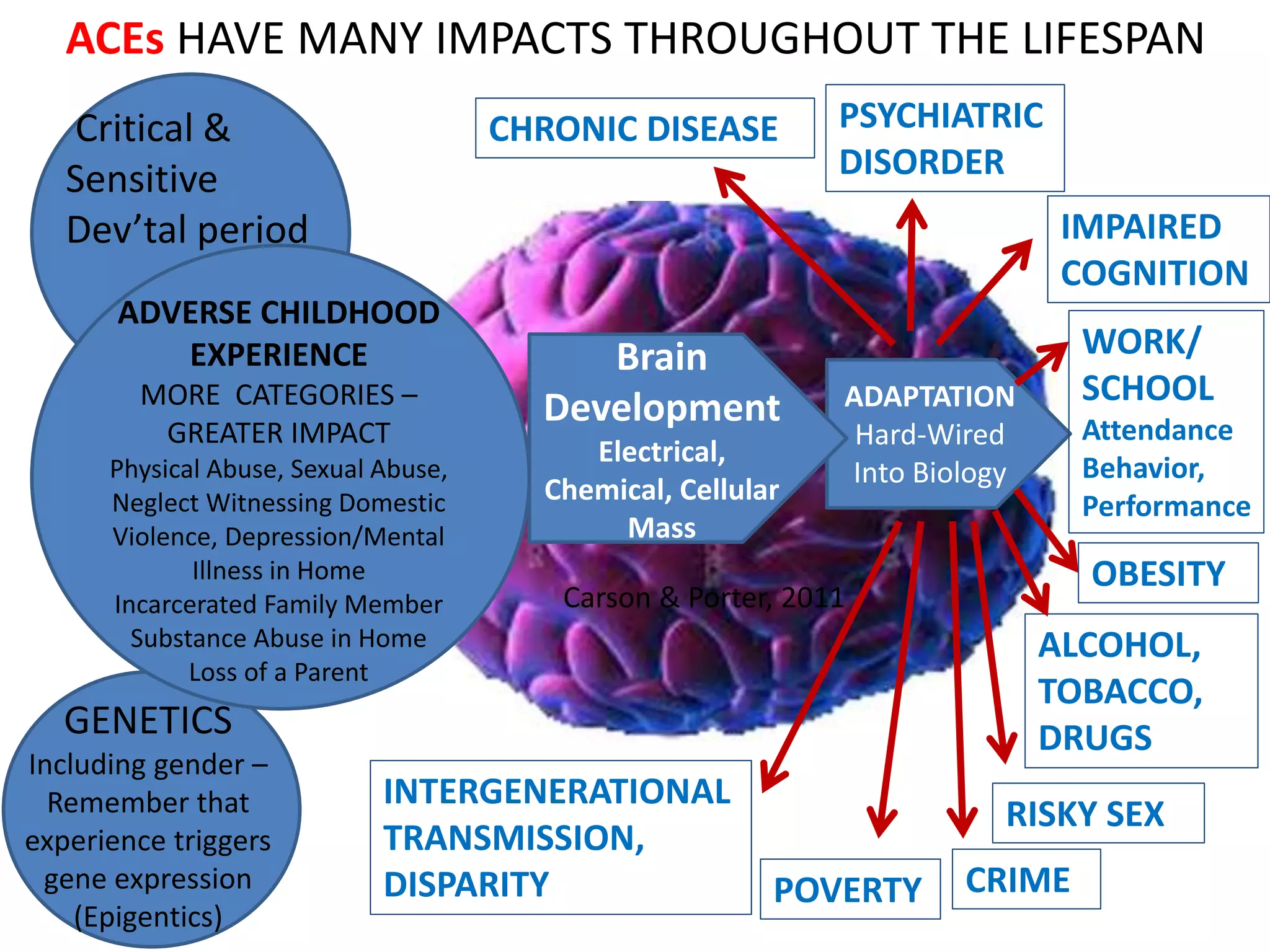
ACEs HAVE MANY IMPACTS THROUGHOUT THE LIFESPAN 
Critical & 
Sensitive 
Dev’tal period 
ADVERSE CHILDHOOD 
EXPERIENCE 
MORE CATEGORIES – 
GREATER IMPACT 
Physical Abuse, Sexual Abuse, 
Neglect Witnessing Domestic 
Violence, Depression/Mental 
Illness in Home 
Incarcerated Family Member 
Substance Abuse in Home 
Loss of a Parent 
GENETICS 
Including gender – 
Remember that 
experience triggers 
gene expression 
(Epigentics) 
CHRONIC DISEASE PSYCHIATRIC 
ADAPTATION 
Hard-Wired 
Into Biology 
Brain 
Development 
Electrical, 
Chemical, Cellular 
Mass 
DISORDER 
IMPAIRED 
COGNITION 
WORK/ 
SCHOOL 
Attendance 
Behavior, 
Performance 
OBESITY 
ALCOHOL, 
TOBACCO, 
DRUGS 
RISKY SEX 
Carson & Porter, 2011 
POVERTY CRIME 
INTERGENERATIONAL 
TRANSMISSION, 
DISPARITY
Adverse Childhood Experiences and 
Health-Risk Behaviors Among 
Adults in a Developing Country Setting 
Laurie S. Ramiro, PhD, Bernadette J. Madrid, MD, 
David R. Brown, PhD 
Child Abuse & Neglect 2010; 34: 842-855
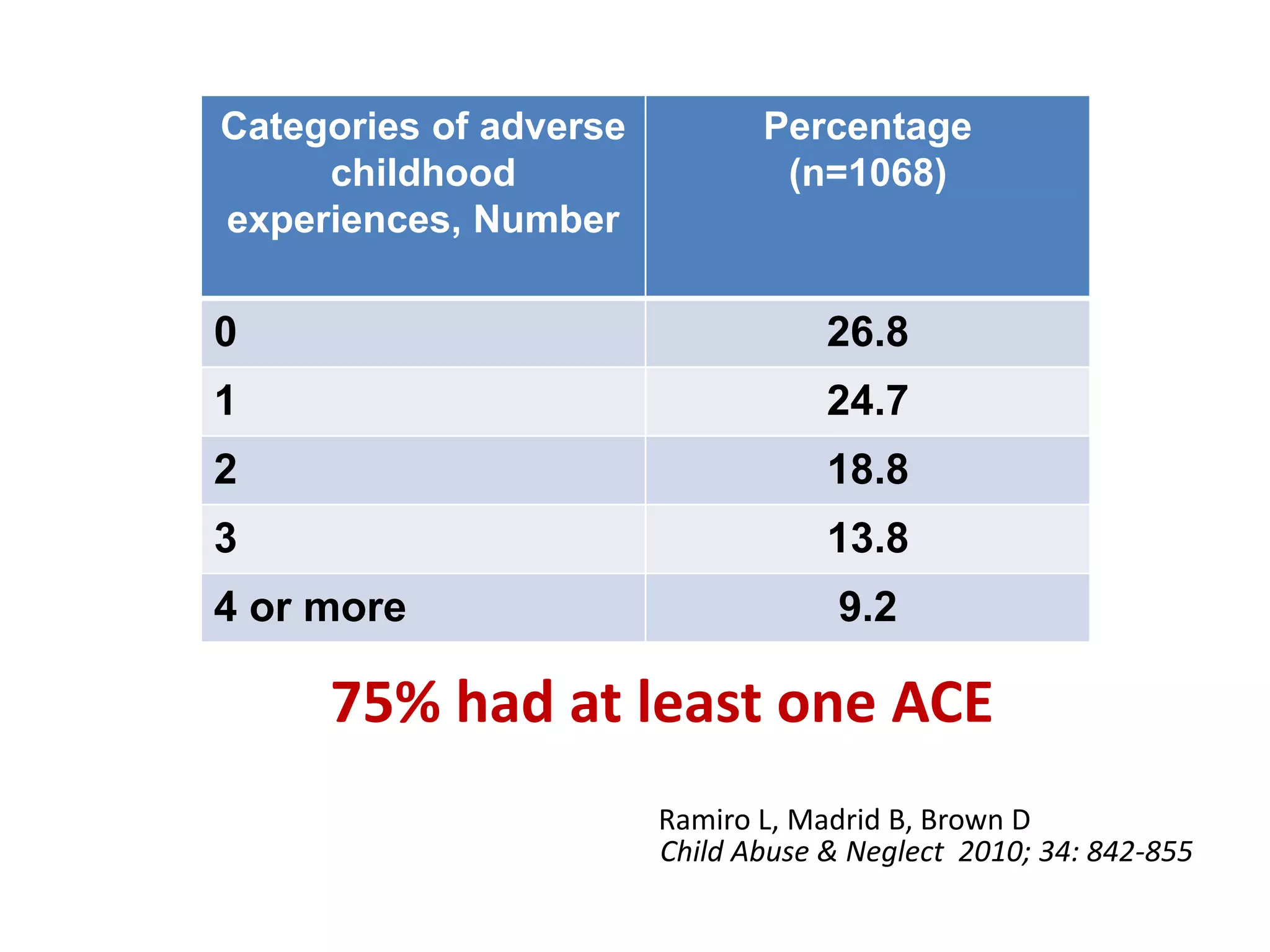
Categories of adverse 
childhood 
experiences, Number 
Percentage 
(n=1068) 
0 26.8 
1 24.7 
2 18.8 
3 13.8 
4 or more 9.2 
75% had at least one ACE 
Ramiro L, Madrid B, Brown D 
Child Abuse & Neglect 2010; 34: 842-855
Results of the Metro Manila 
ACE Study 
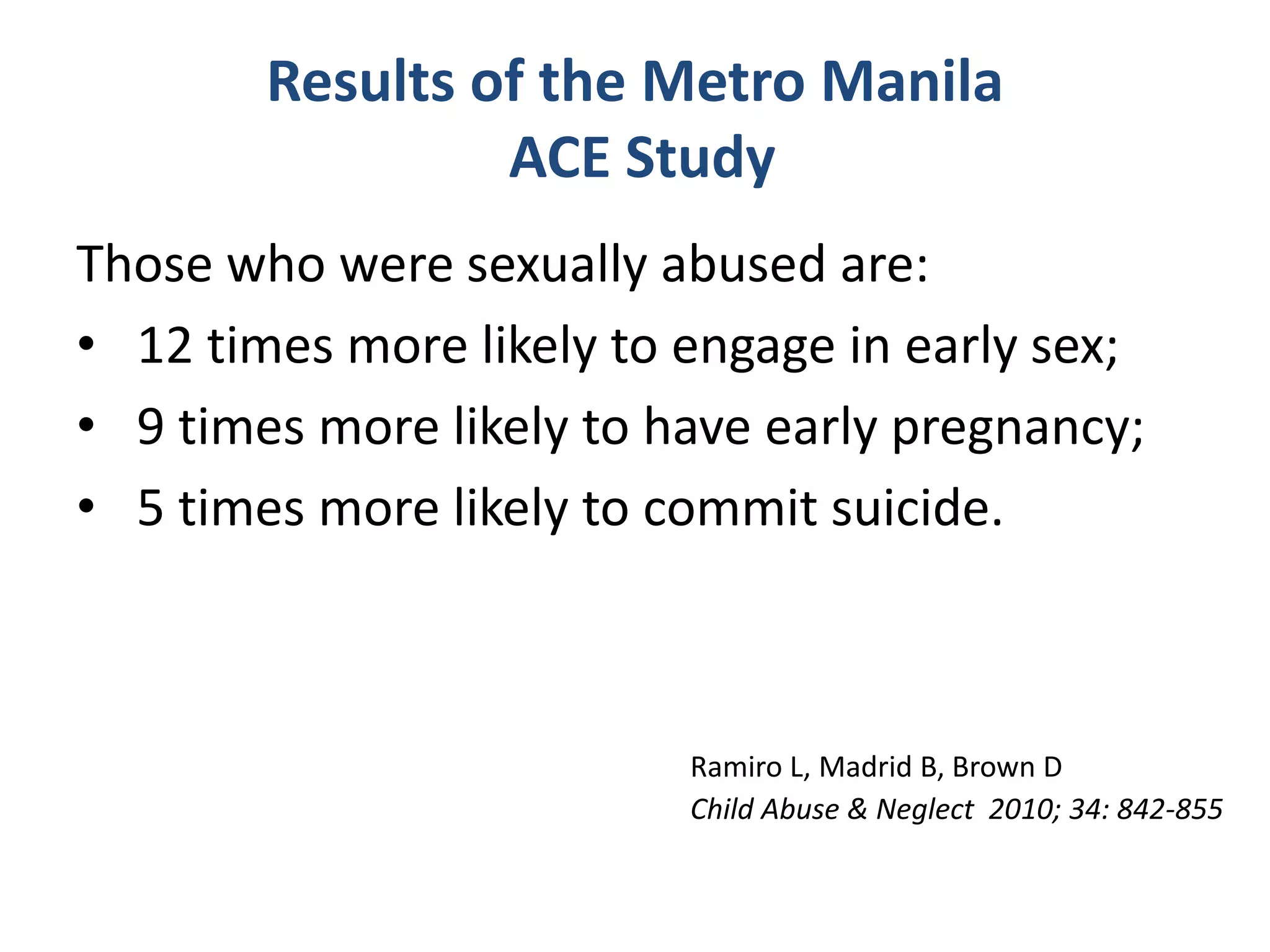
Those who were sexually abused are: 
• 12 times more likely to engage in early sex; 
• 9 times more likely to have early pregnancy; 
• 5 times more likely to commit suicide. 
Ramiro L, Madrid B, Brown D 
Child Abuse & Neglect 2010; 34: 842-855
Results of the Metro Manila 
ACE Study 
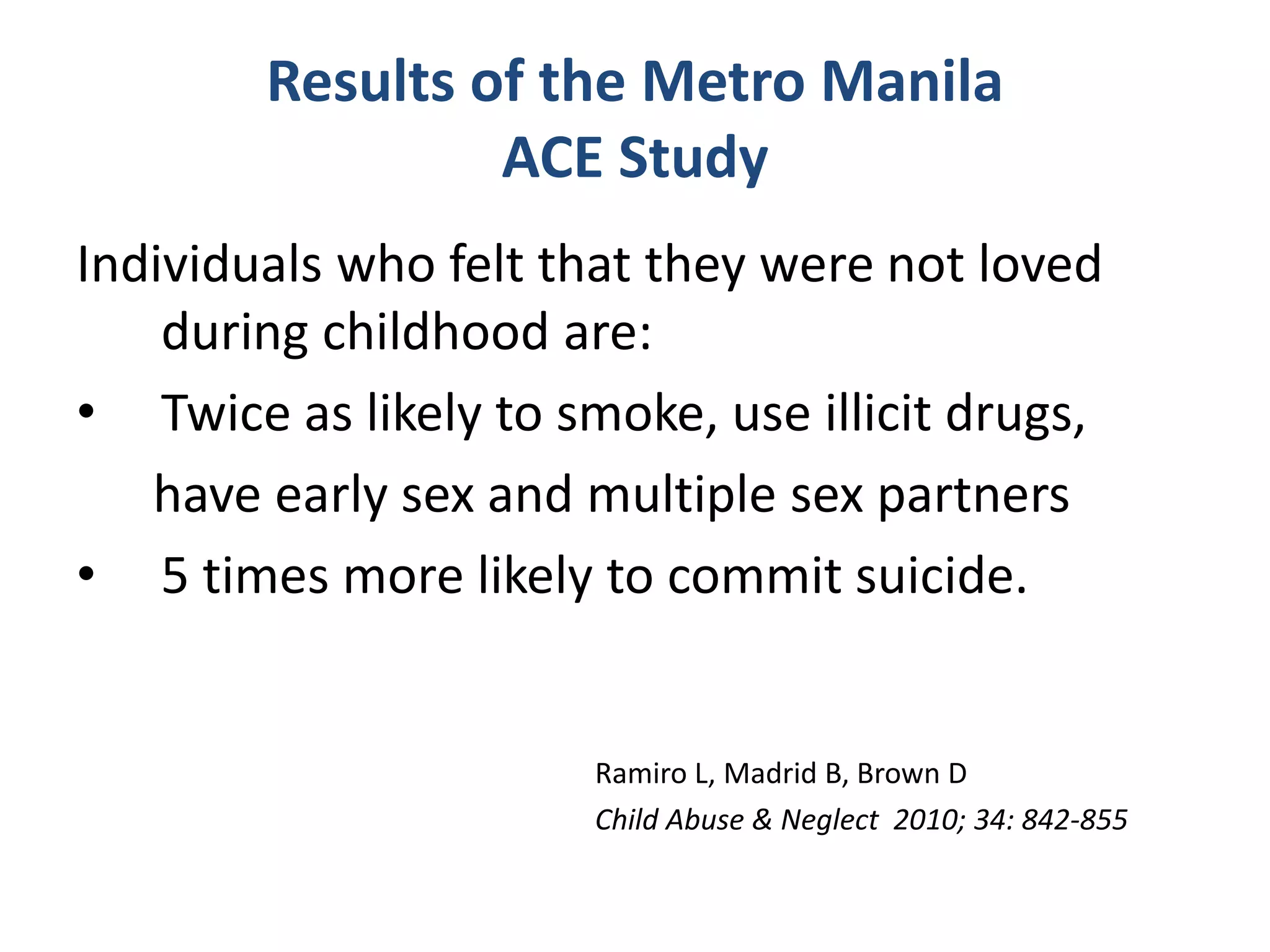
Individuals who felt that they were not loved 
during childhood are: 
• Twice as likely to smoke, use illicit drugs, 
have early sex and multiple sex partners 
• 5 times more likely to commit suicide. 
Ramiro L, Madrid B, Brown D 
Child Abuse & Neglect 2010; 34: 842-855
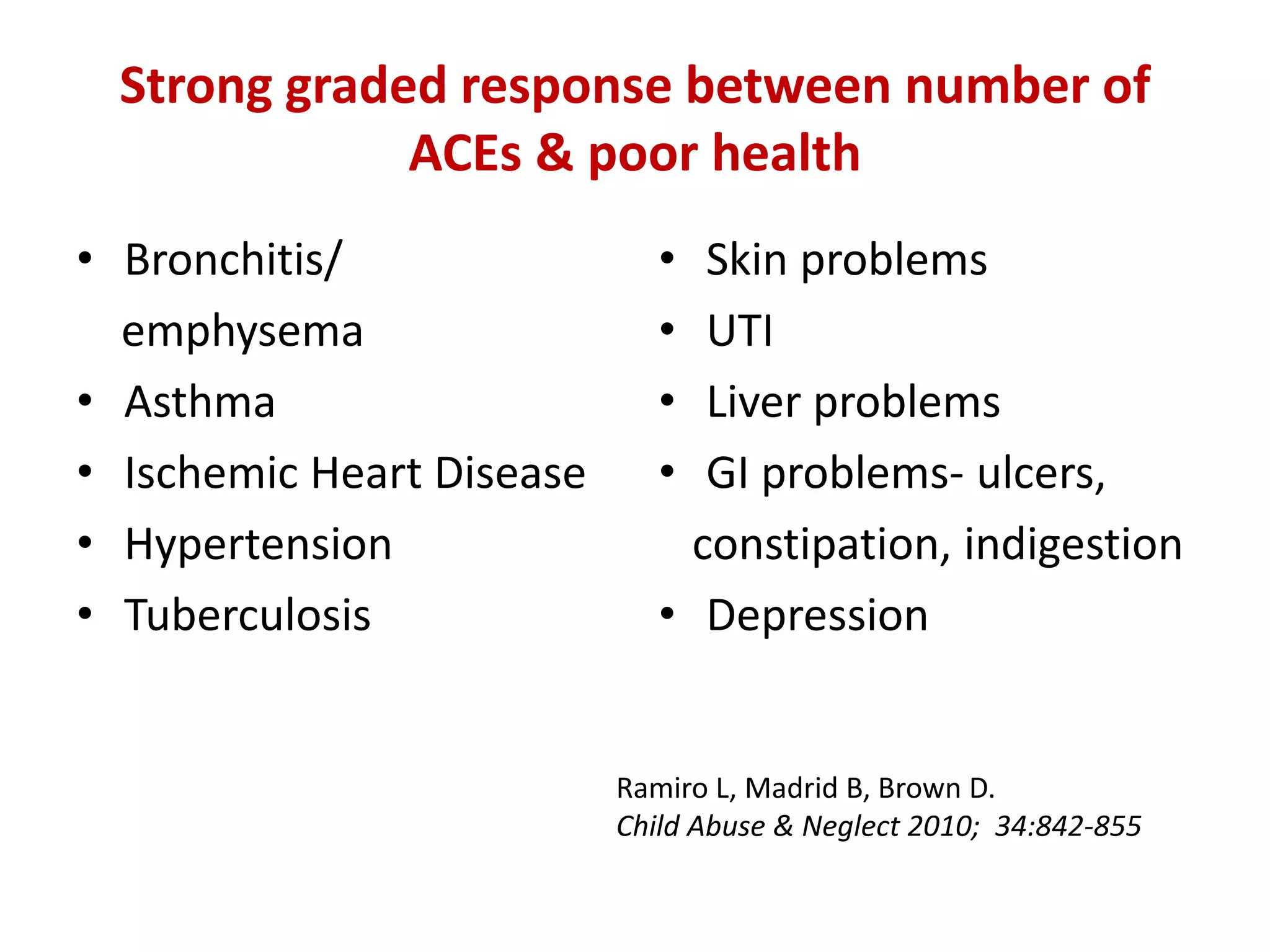
Strong graded response between number of 
ACEs & poor health 
• Bronchitis/ 
emphysema 
• Asthma 
• Ischemic Heart Disease 
• Hypertension 
• Tuberculosis 
• Skin problems 
• UTI 
• Liver problems 
• GI problems- ulcers, 
constipation, indigestion 
• Depression 
Ramiro L, Madrid B, Brown D. 
Child Abuse & Neglect 2010; 34:842-855
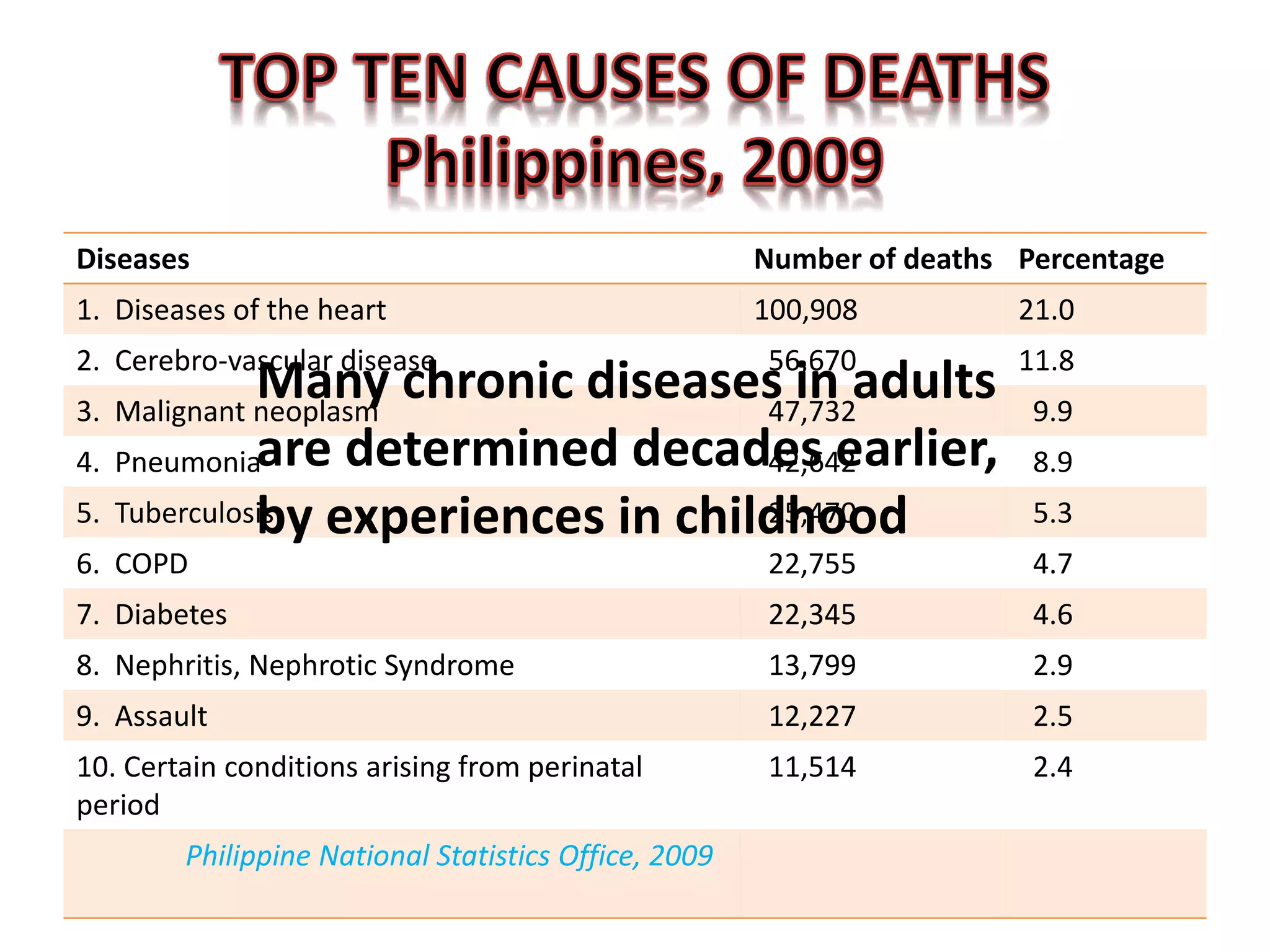
Diseases Number of deaths Percentage 
1. Diseases of the heart 100,908 21.0 
2. Cerebro-vascular Many disease chronic diseases 56,670 in adults 
11.8 
3. Malignant neoplasm 47,732 9.9 
4. Pneumonia are determined decades 42,642 earlier, 
8.9 
5. Tuberculosis by experiences in childhood 
25,470 5.3 
6. COPD 22,755 4.7 
7. Diabetes 22,345 4.6 
8. Nephritis, Nephrotic Syndrome 13,799 2.9 
9. Assault 12,227 2.5 
10. Certain conditions arising from perinatal 
11,514 2.4 
period 
Philippine National Statistics Office, 2009
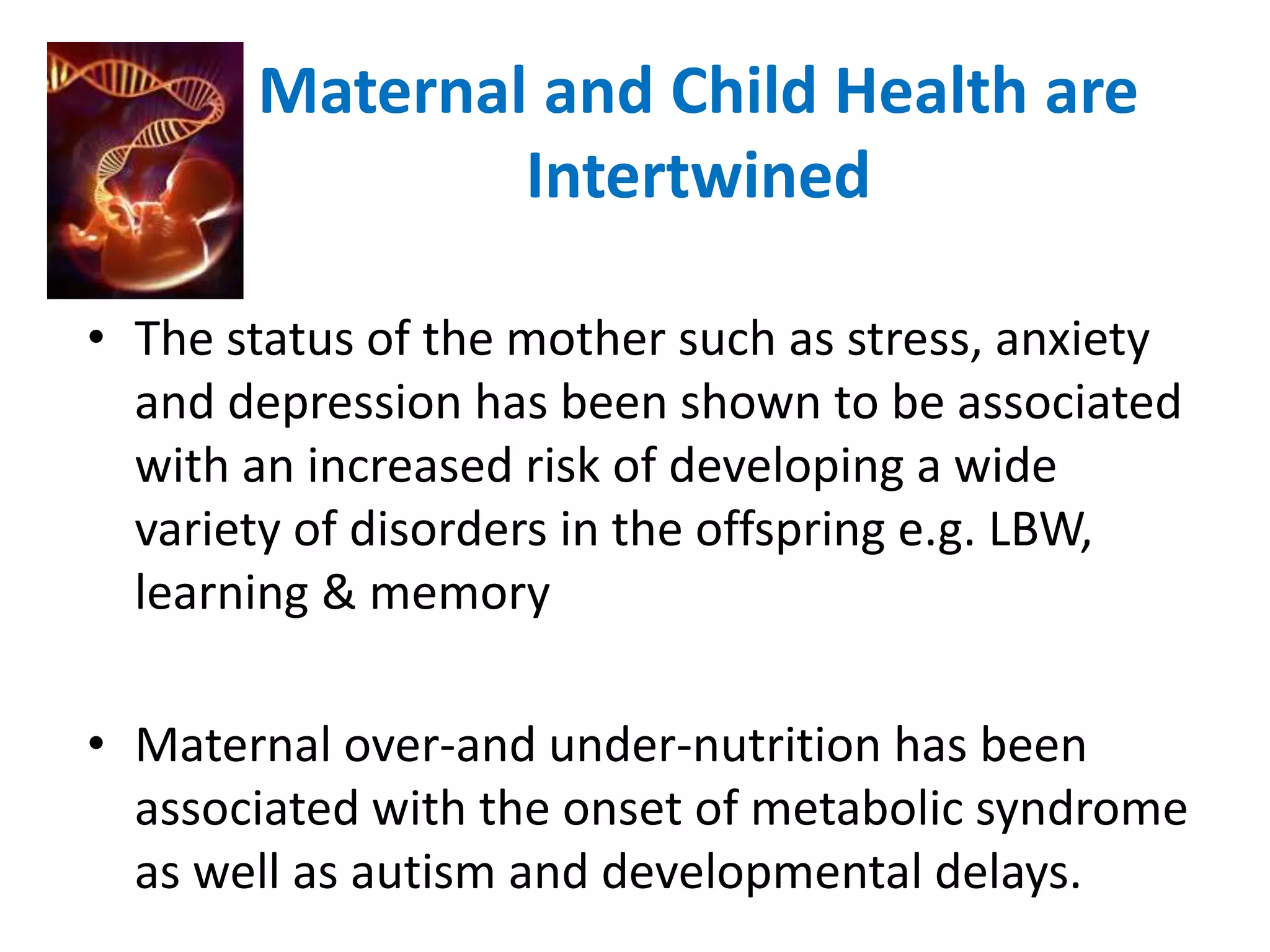
Maternal and Child Health are 
Intertwined 
• The status of the mother such as stress, anxiety 
and depression has been shown to be associated 
with an increased risk of developing a wide 
variety of disorders in the offspring e.g. LBW, 
learning & memory 
• Maternal over-and under-nutrition has been 
associated with the onset of metabolic syndrome 
as well as autism and developmental delays.
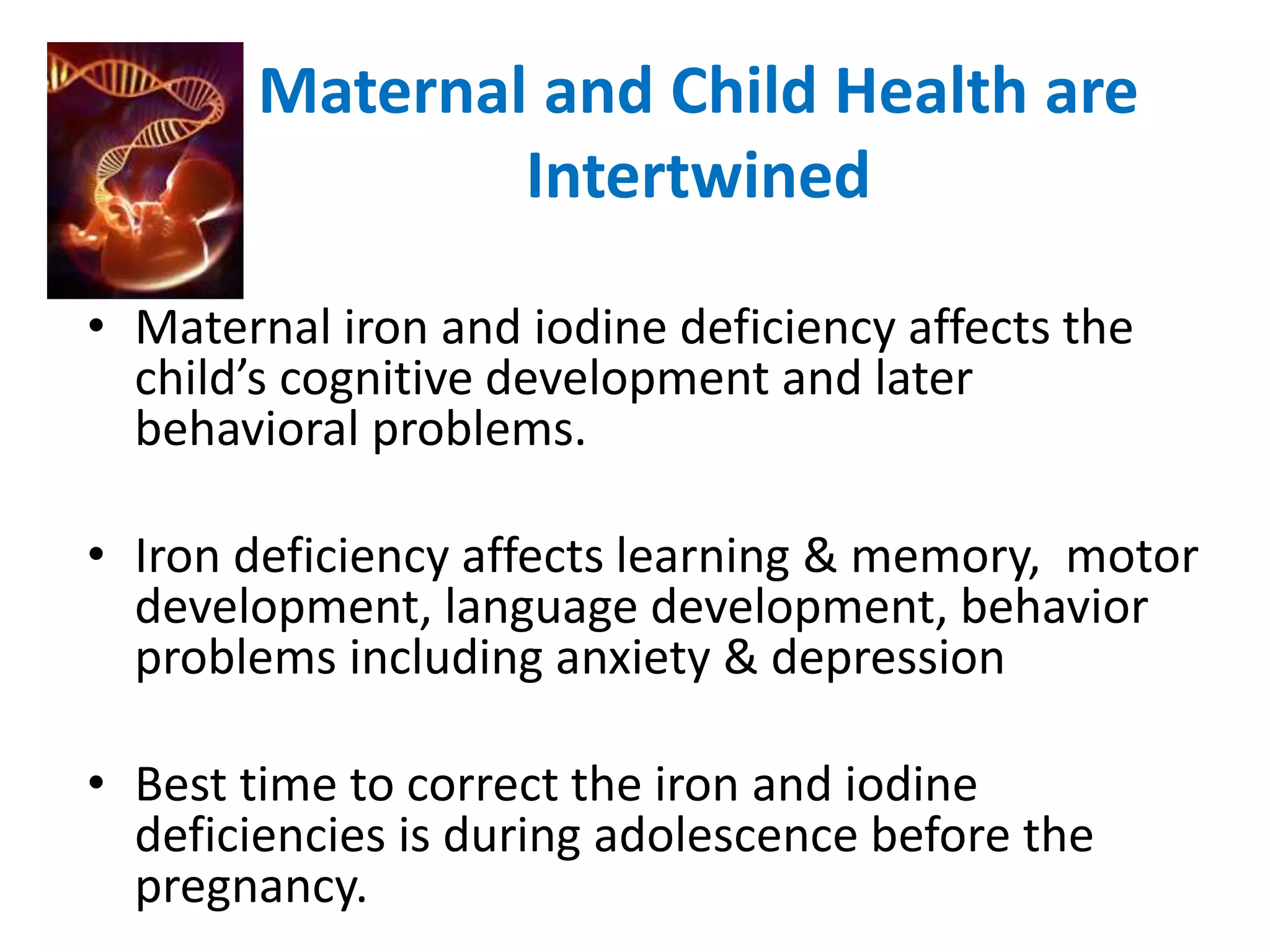
Maternal and Child Health are 
Intertwined 
• Maternal iron and iodine deficiency affects the 
child’s cognitive development and later 
behavioral problems. 
• Iron deficiency affects learning & memory, motor 
development, language development, behavior 
problems including anxiety & depression 
• Best time to correct the iron and iodine 
deficiencies is during adolescence before the 
pregnancy.
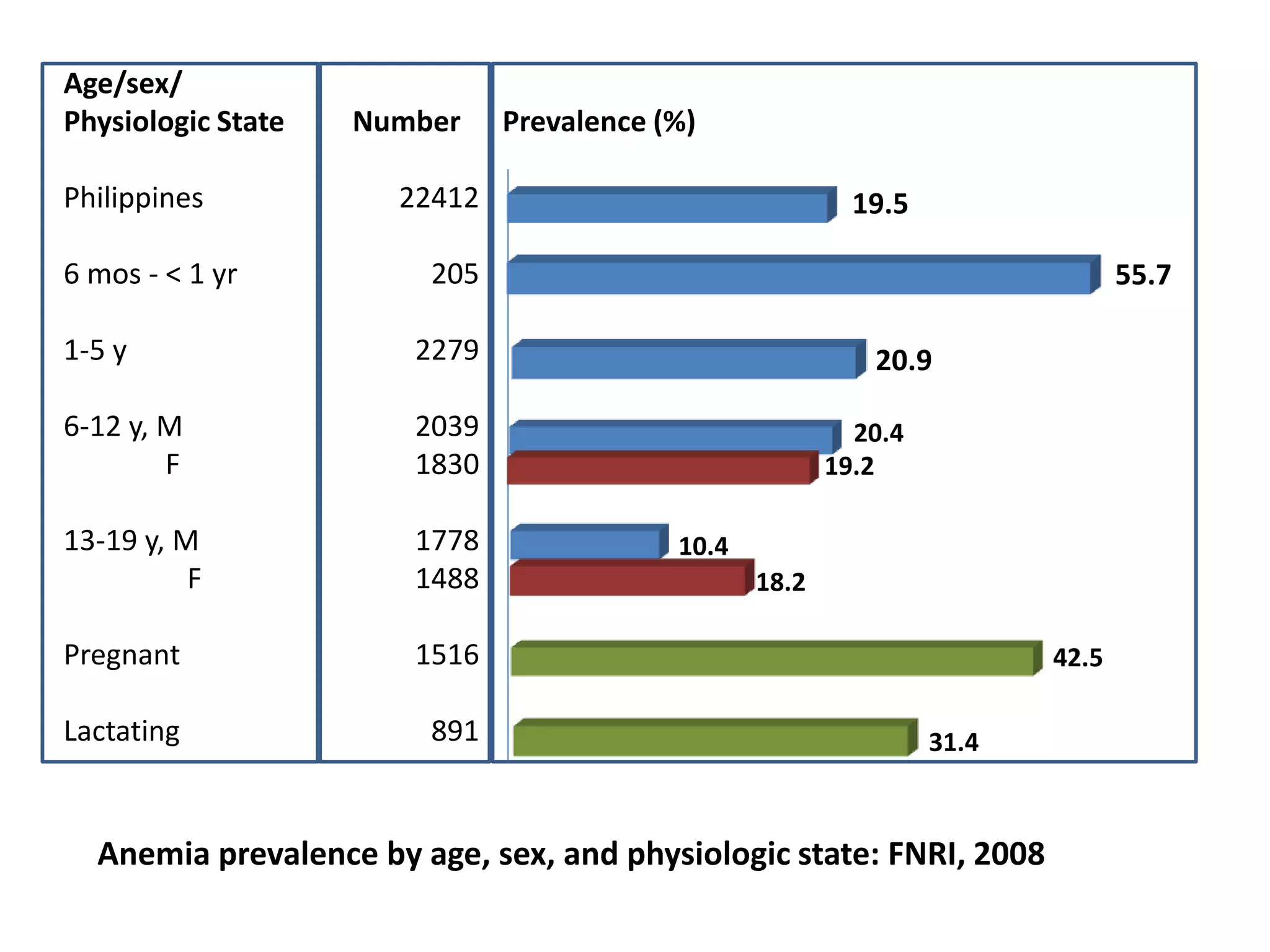
Age/sex/ 
Physiologic State Number Prevalence (%) 
Philippines 22412 
6 mos - < 1 yr 205 
1-5 y 2279 
6-12 y, M 2039 
F 1830 
13-19 y, M 1778 
F 1488 
Pregnant 1516 
Lactating 891 
19.5 
55.7 
20.9 
20.4 
19.2 
10.4 
18.2 
42.5 
31.4 
Anemia prevalence by age, sex, and physiologic state: FNRI, 2008
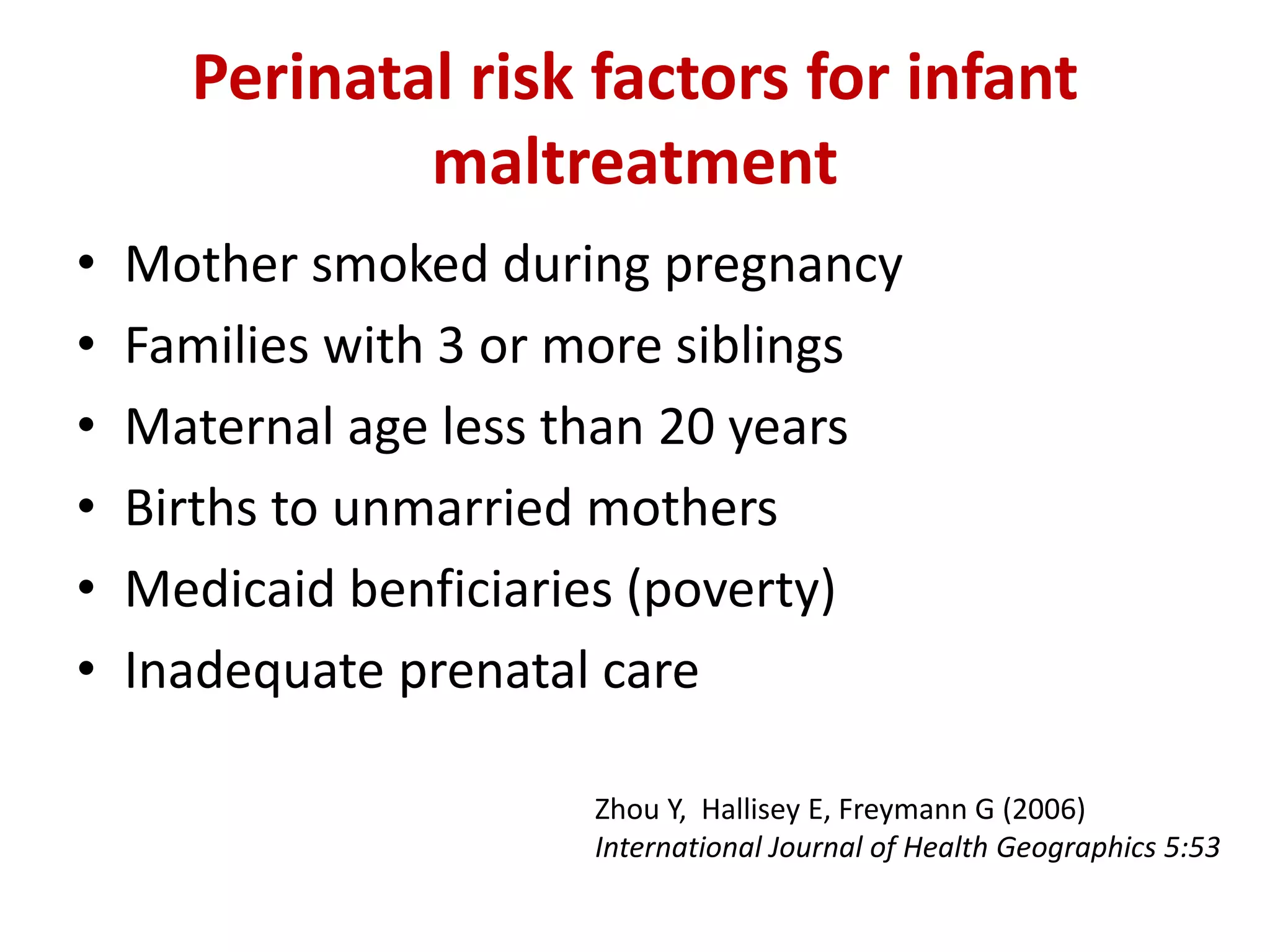
Perinatal risk factors for infant 
maltreatment 
• Mother smoked during pregnancy 
• Families with 3 or more siblings 
• Maternal age less than 20 years 
• Births to unmarried mothers 
• Medicaid benficiaries (poverty) 
• Inadequate prenatal care 
Zhou Y, Hallisey E, Freymann G (2006) 
International Journal of Health Geographics 5:53
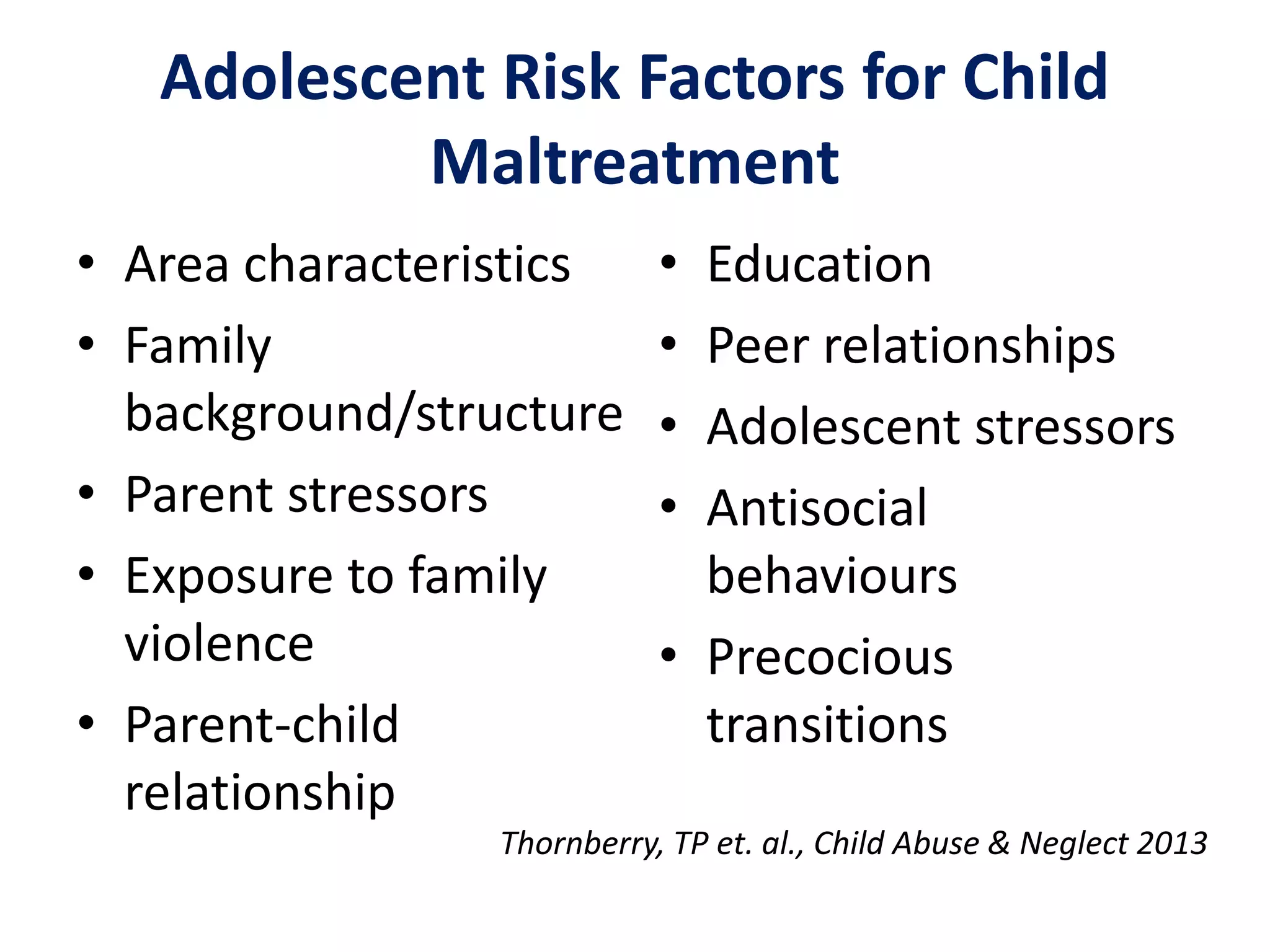
Adolescent Risk Factors for Child 
Maltreatment 
• Area characteristics 
• Family 
background/structure 
• Parent stressors 
• Exposure to family 
violence 
• Parent-child 
relationship 
• Education 
• Peer relationships 
• Adolescent stressors 
• Antisocial 
behaviours 
• Precocious 
transitions 
Thornberry, TP et. al., Child Abuse & Neglect 2013
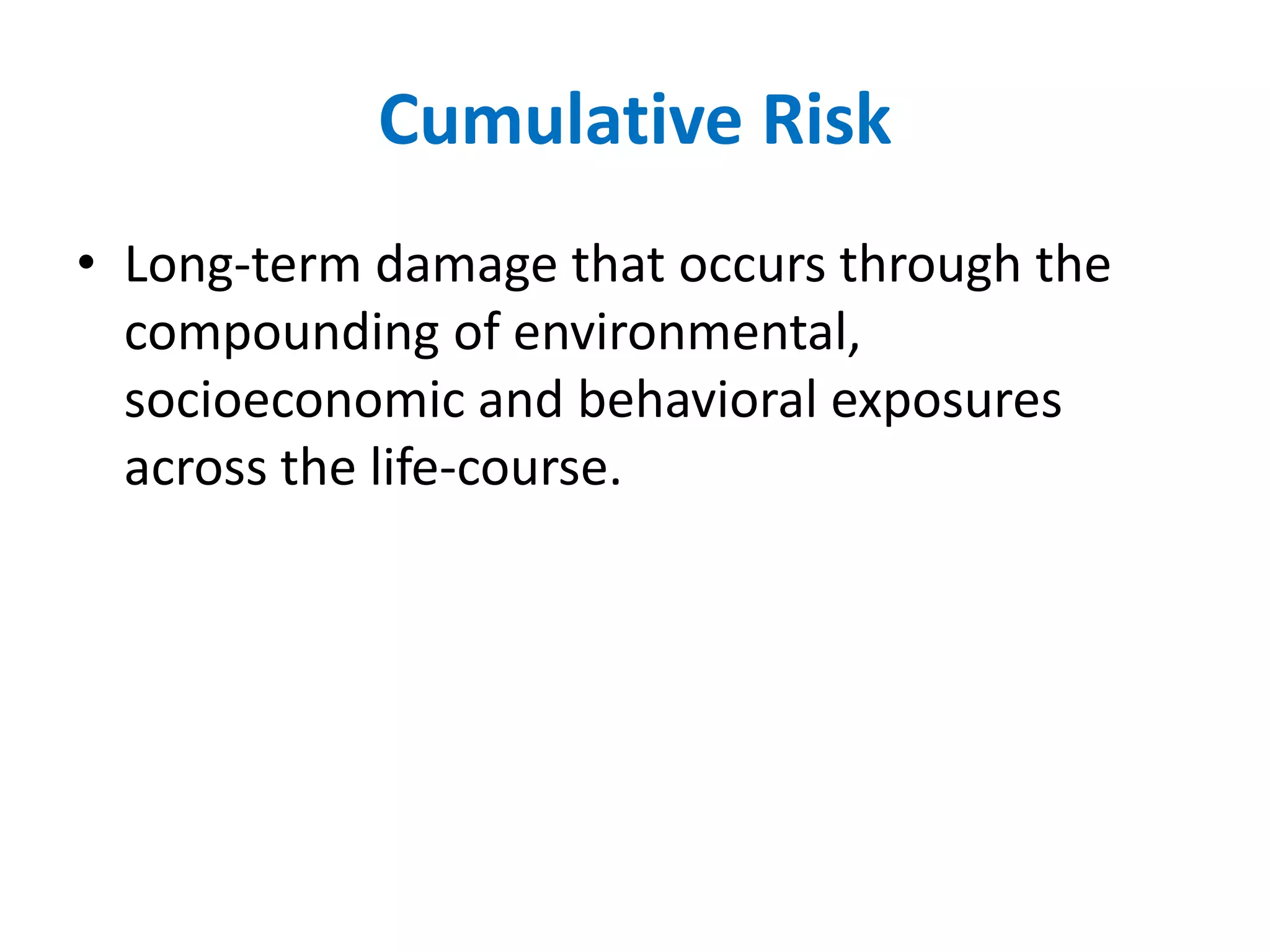
Cumulative Risk 
• Long-term damage that occurs through the 
compounding of environmental, 
socioeconomic and behavioral exposures 
across the life-course.
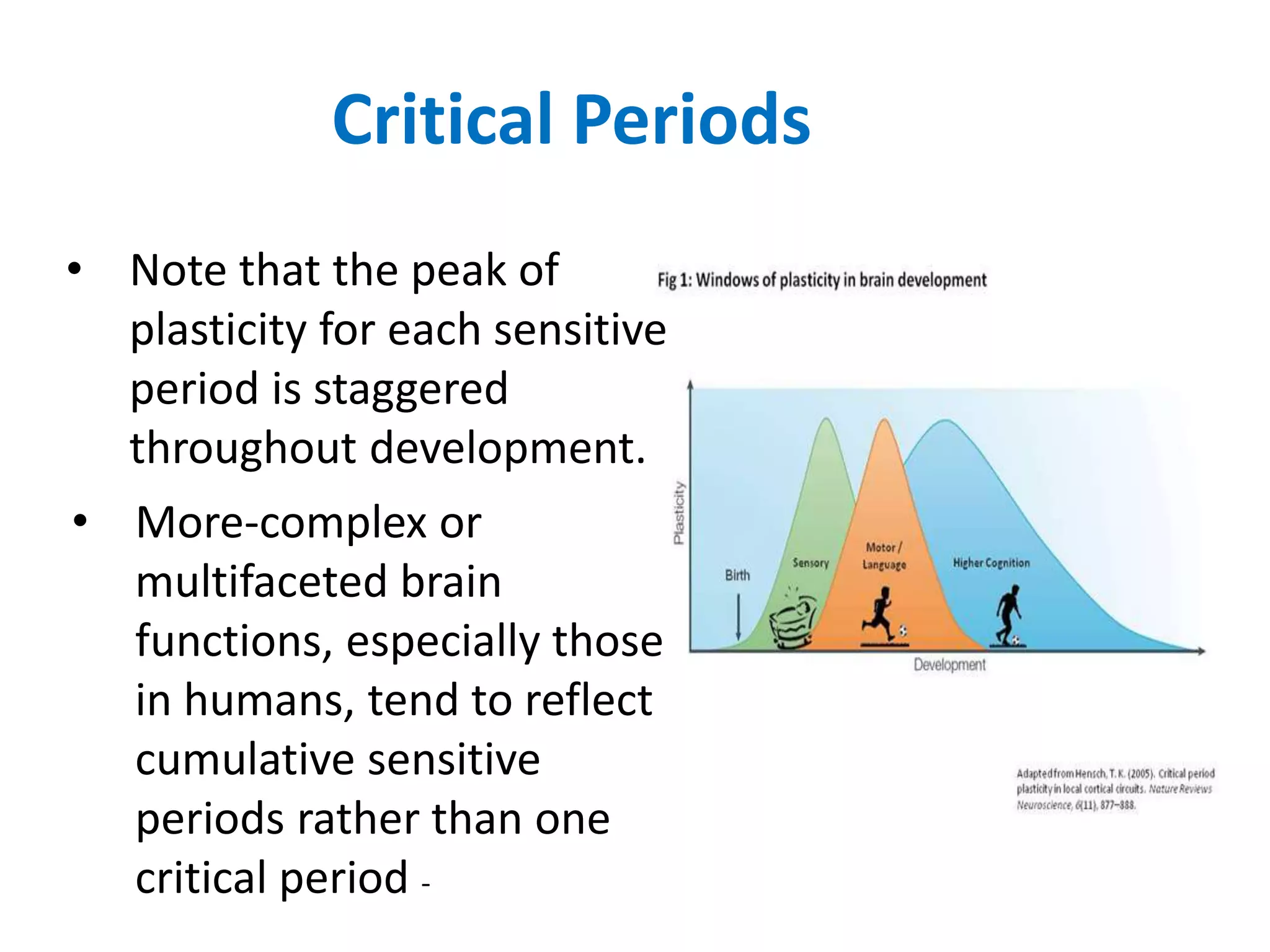
Critical Periods 
• Note that the peak of 
plasticity for each sensitive 
period is staggered 
throughout development. 
• More-complex or 
multifaceted brain 
functions, especially those 
in humans, tend to reflect 
cumulative sensitive 
periods rather than one 
critical period -
Connected by 25: Improving the life 
chances of the country’s most 
vulnerable 14-24 year olds 
Disconnected youth: They have not acquired the 
skills needed to connect with the labor force and 
they have not established social support systems: 
1. Those who do not complete high school. 
2. Youth deeply involved in the juvenile justice 
system. 
3. Young, unmarried mothers 
4. Adolescents in foster homes 
Michael Wald & Tia Martinez 2003 
Stanford University
Disconnected youth 
• Unless something is done they become either 
victims of trafficking, commercial sexual 
exploitation or incarcerated. 
• “These youth need major, major ongoing 
support in overcoming the sense of 
inadequacy, in acquiring job skills and 
education and in staying connected once 
change has started to occur.” 
Michael Wald & Tia Martinez 2003 
Stanford University
Child Maltreatment Prevention Readiness in 
Low- and Middle-Income Countries 
Mikton, Mehra, Butchart, et al (2011) 
• Evidence-based interventions alone are not 
sufficient to prevent child maltreatment, other 
conditions must be met to bridge the 
“science-practice” gap.
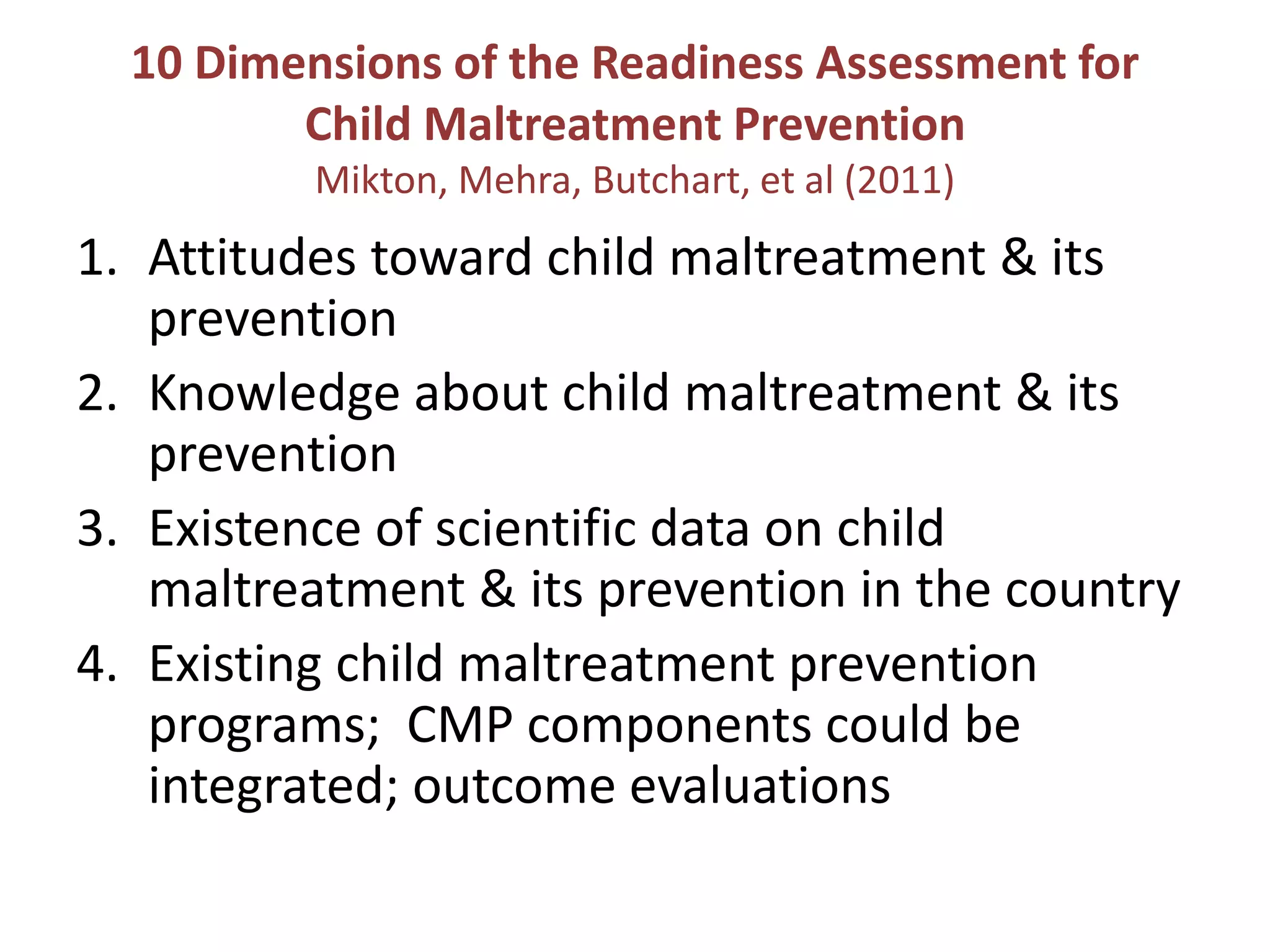
10 Dimensions of the Readiness Assessment for 
Child Maltreatment Prevention 
Mikton, Mehra, Butchart, et al (2011) 
1. Attitudes toward child maltreatment & its 
prevention 
2. Knowledge about child maltreatment & its 
prevention 
3. Existence of scientific data on child 
maltreatment & its prevention in the country 
4. Existing child maltreatment prevention 
programs; CMP components could be 
integrated; outcome evaluations
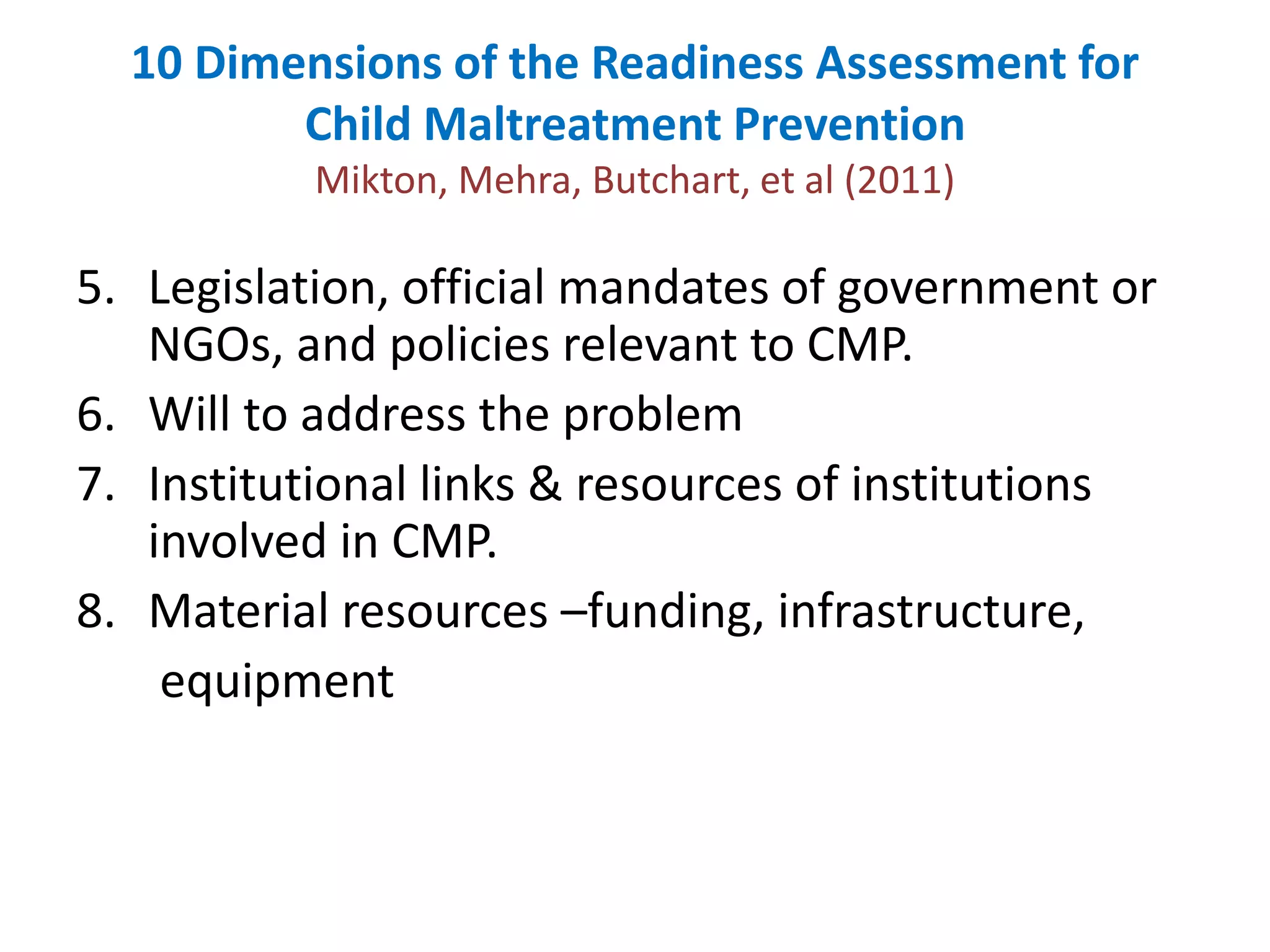
10 Dimensions of the Readiness Assessment for 
Child Maltreatment Prevention 
Mikton, Mehra, Butchart, et al (2011) 
5. Legislation, official mandates of government or 
NGOs, and policies relevant to CMP. 
6. Will to address the problem 
7. Institutional links & resources of institutions 
involved in CMP. 
8. Material resources –funding, infrastructure, 
equipment
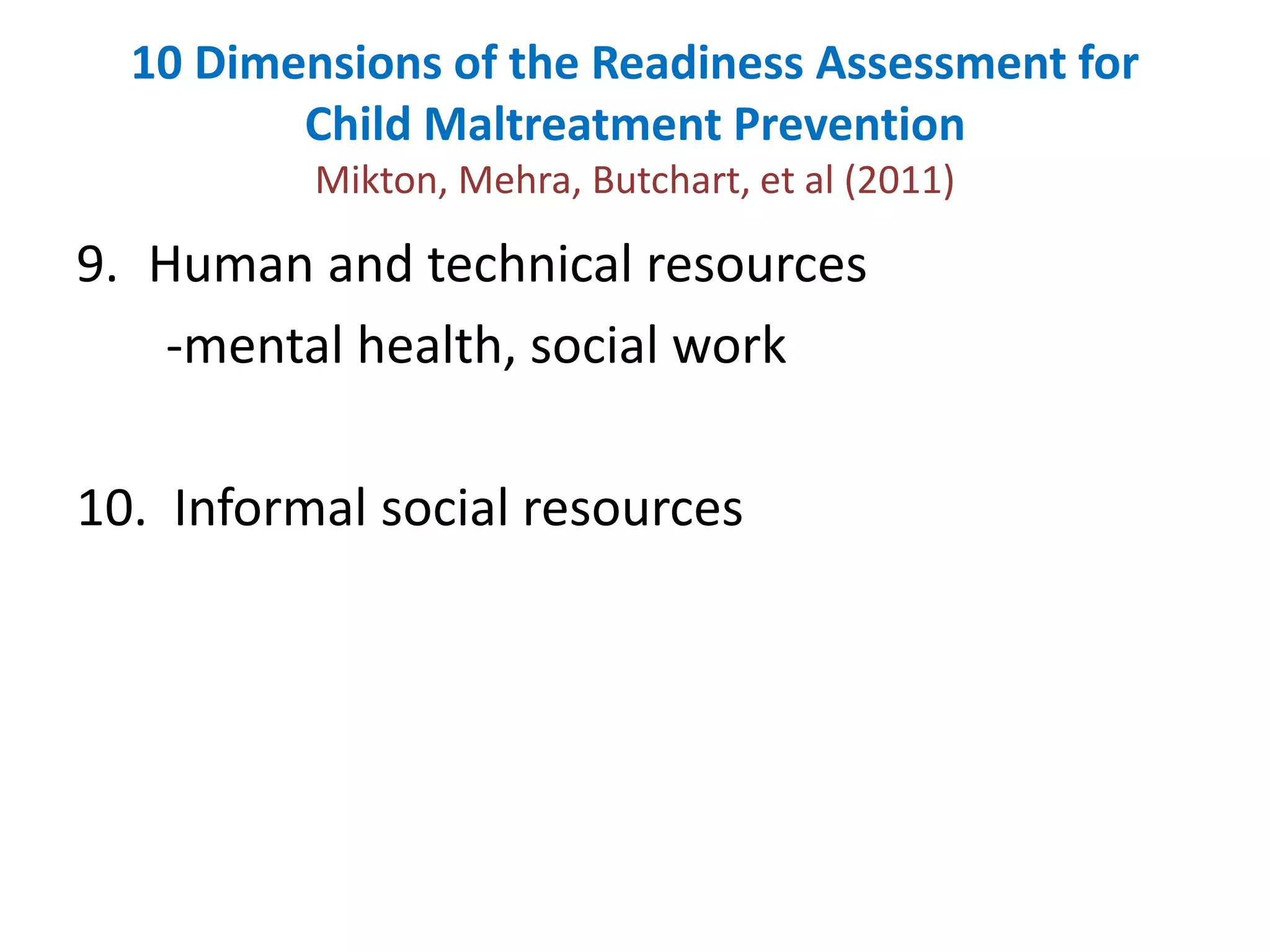
10 Dimensions of the Readiness Assessment for 
Child Maltreatment Prevention 
Mikton, Mehra, Butchart, et al (2011) 
9. Human and technical resources 
-mental health, social work 
10. Informal social resources
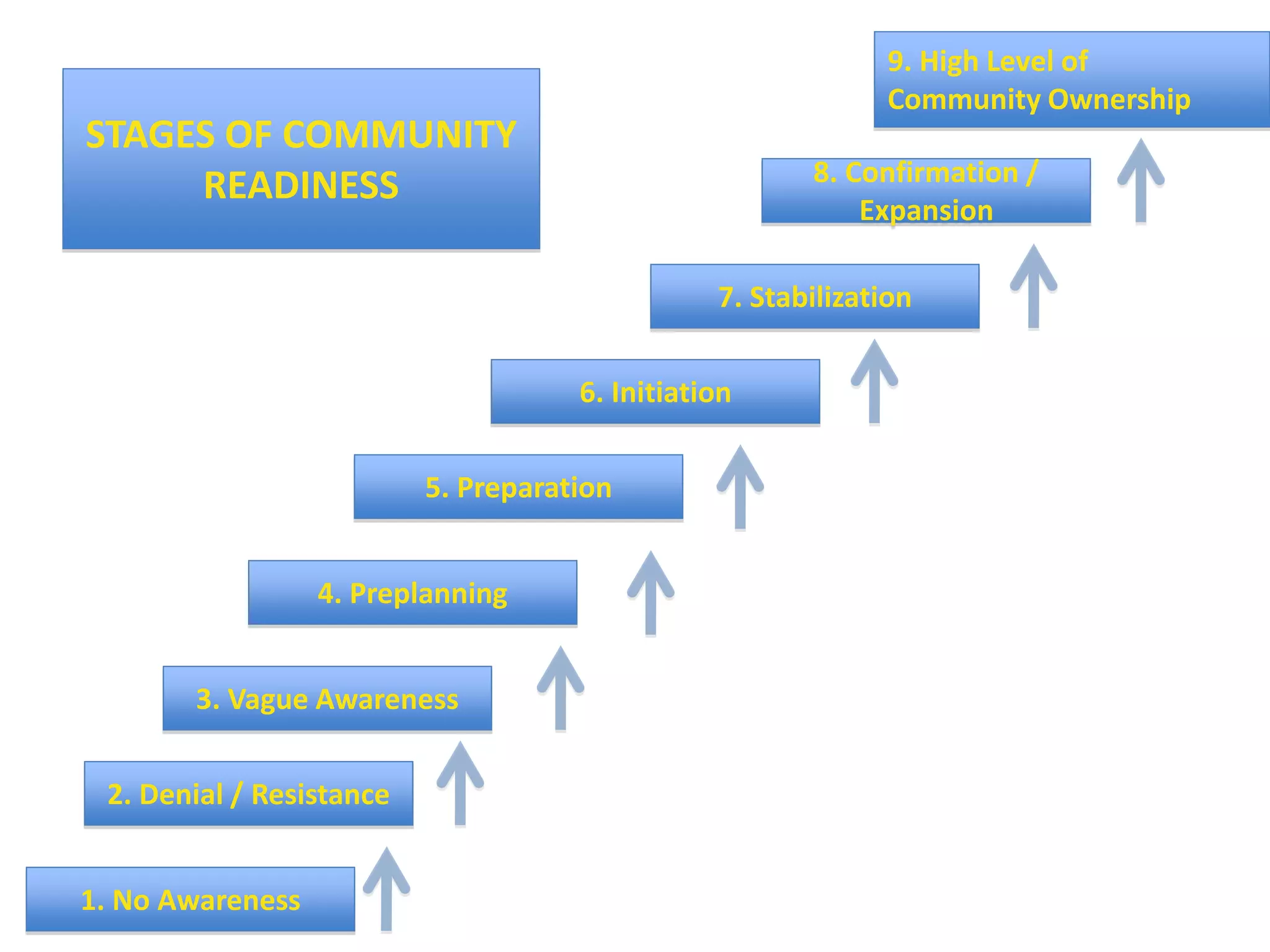
9. High Level of 
Community Ownership 
8. Confirmation / 
Expansion 
7. Stabilization 
6. Initiation 
STAGES OF COMMUNITY 
5. Preparation 
READINESS 
4. Preplanning 
3. Vague Awareness 
2. Denial / Resistance 
1. No Awareness
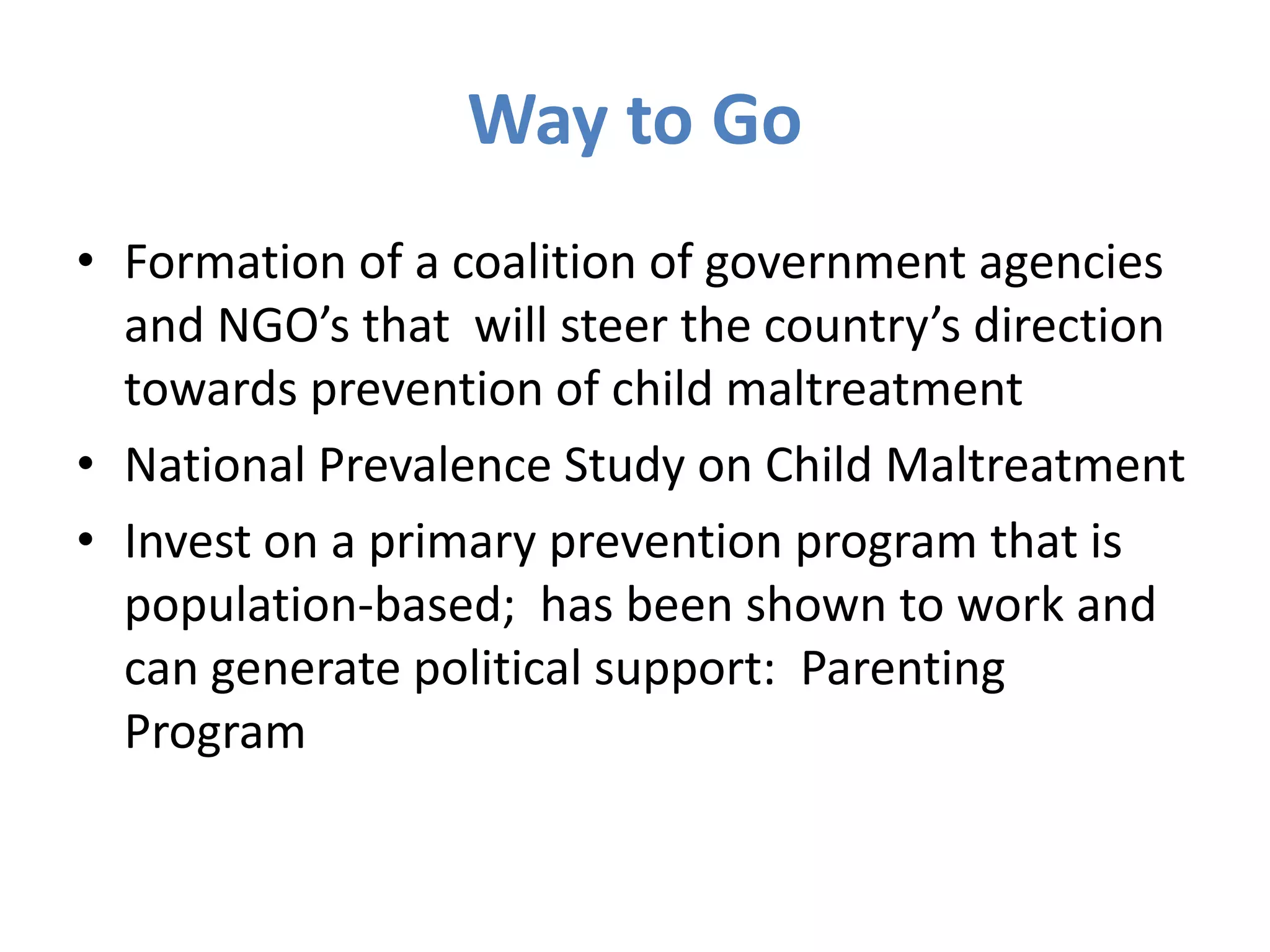
Way to Go 
• Formation of a coalition of government agencies 
and NGO’s that will steer the country’s direction 
towards prevention of child maltreatment 
• National Prevalence Study on Child Maltreatment 
• Invest on a primary prevention program that is 
population-based; has been shown to work and 
can generate political support: Parenting 
Program
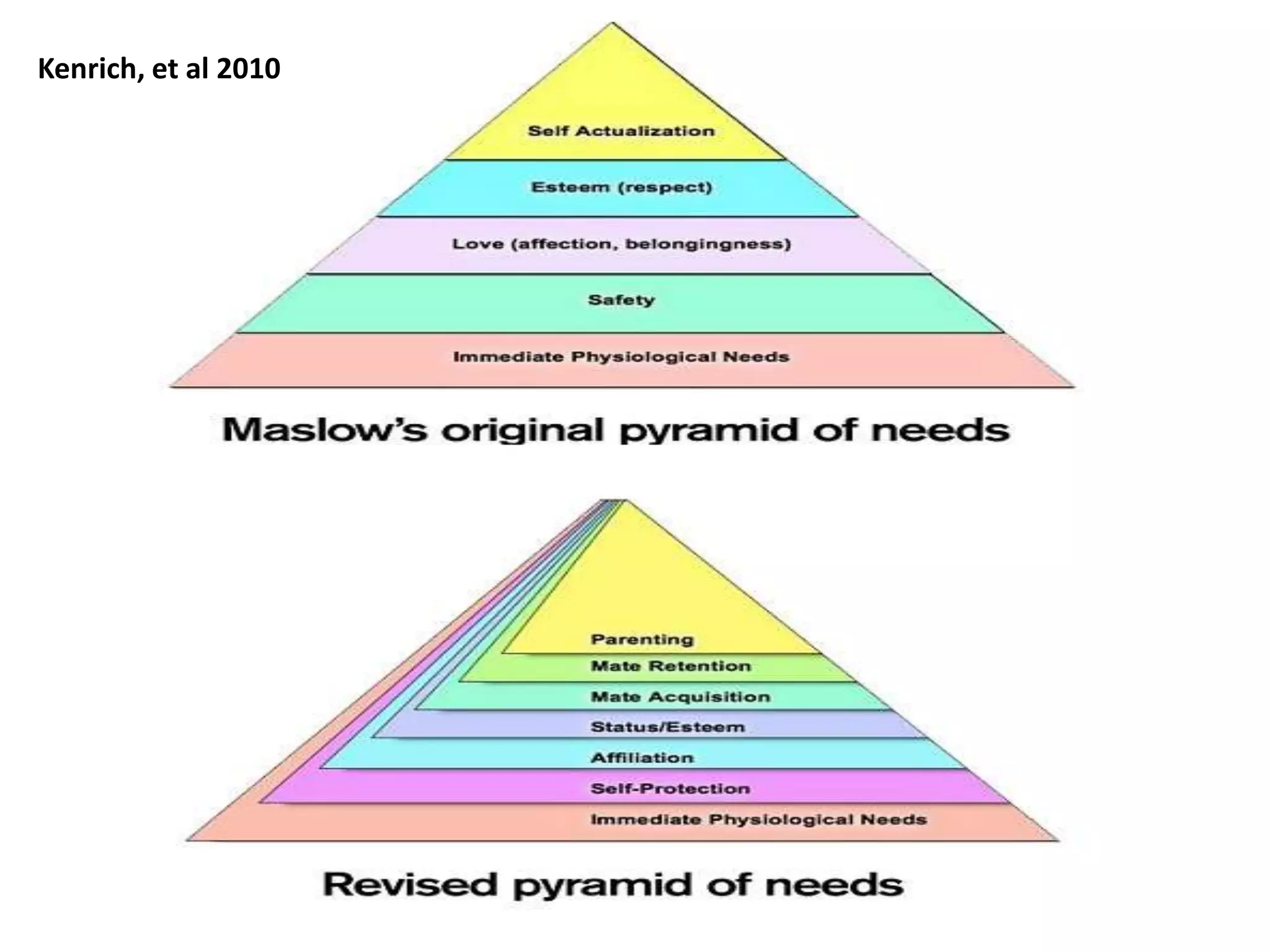
Kenrich, et al 2010
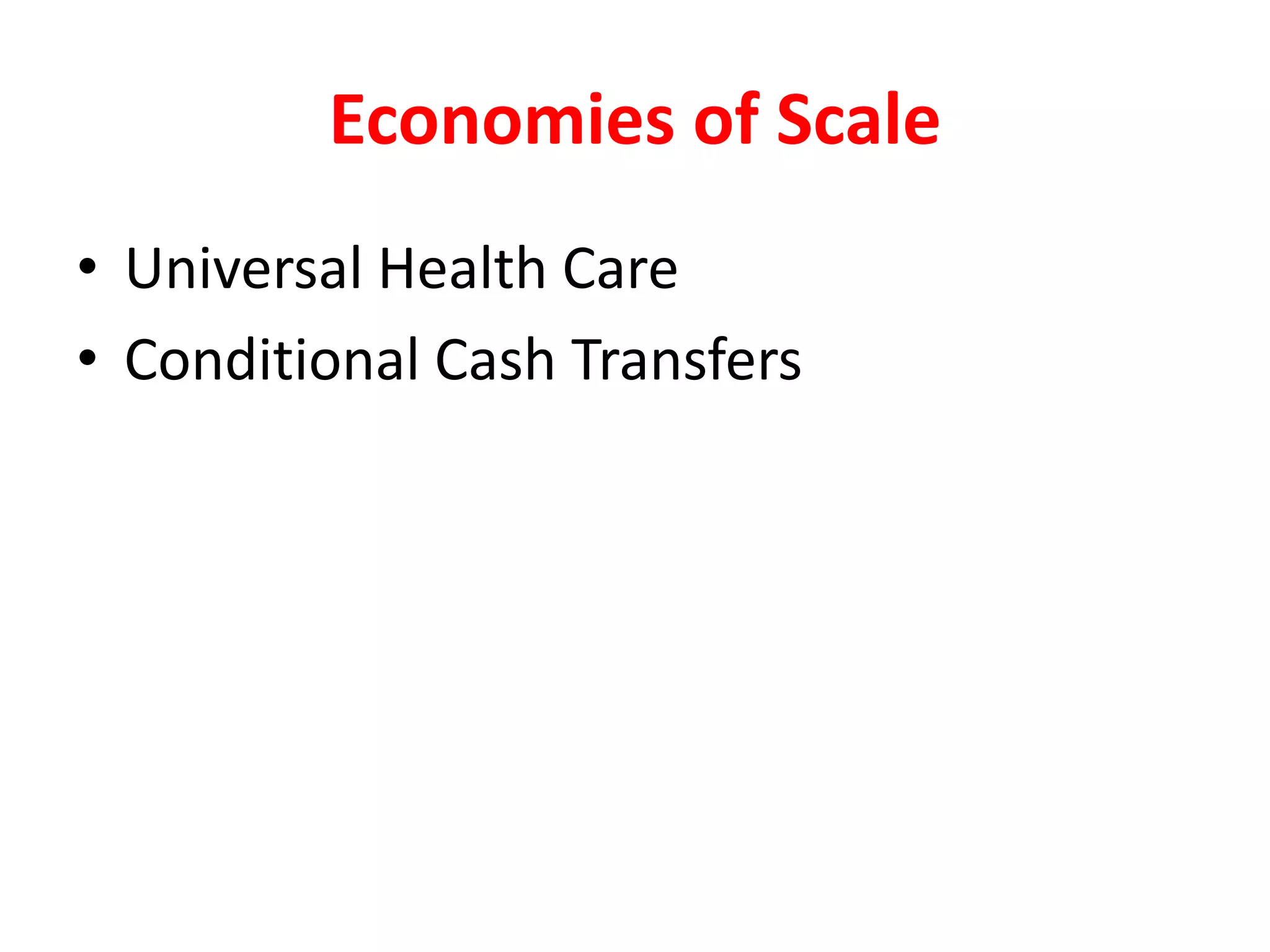
Economies of Scale 
• Universal Health Care 
• Conditional Cash Transfers
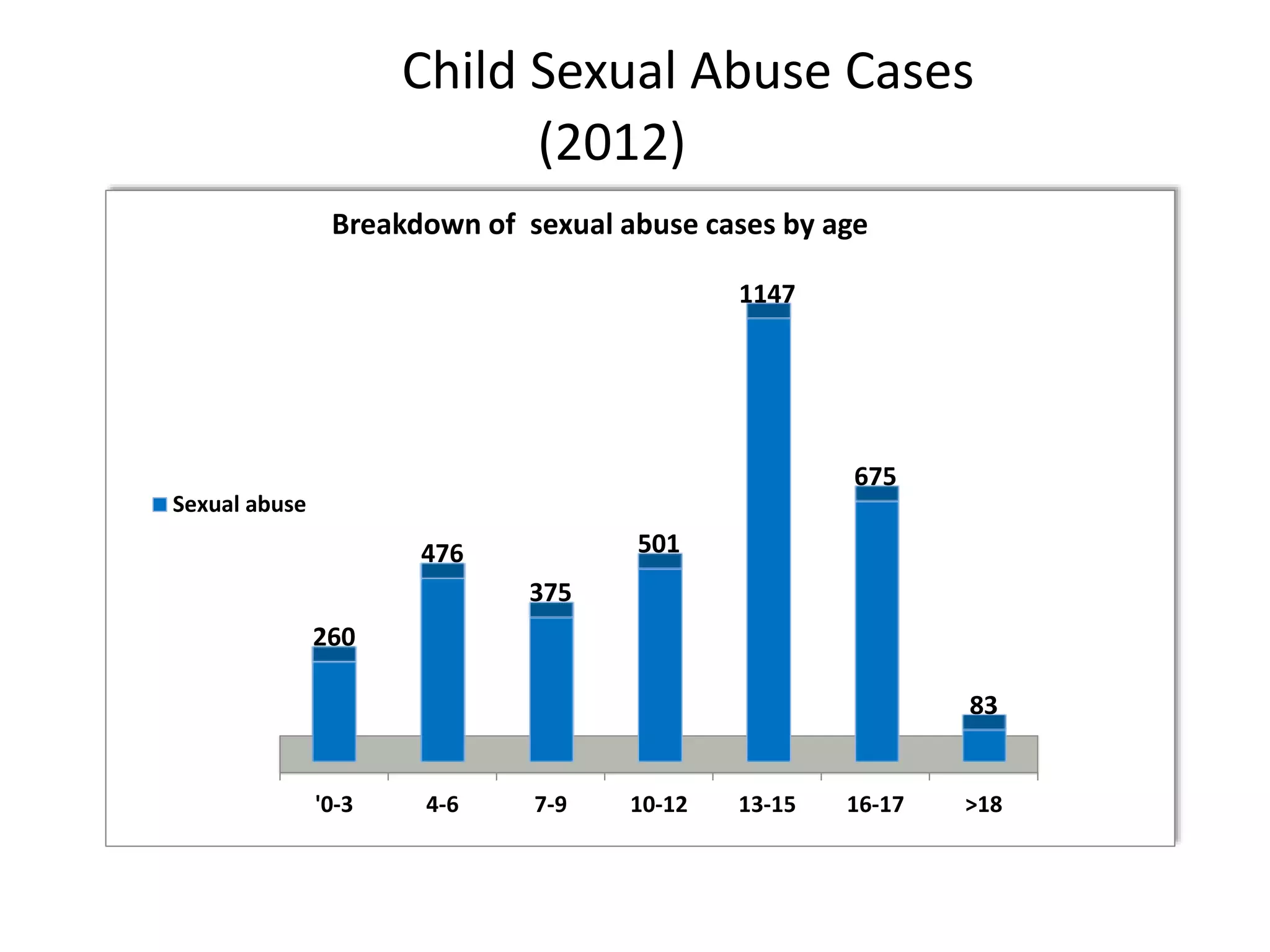
Breakdown of sexual abuse cases by age 
260 
476 
375 
501 
1147 
675 
83 
'0-3 4-6 7-9 10-12 13-15 16-17 >18 
Sexual abuse 
Child Sexual Abuse Cases 
(2012)
70 
60 
50 
40 
30 
20 
10 
0 
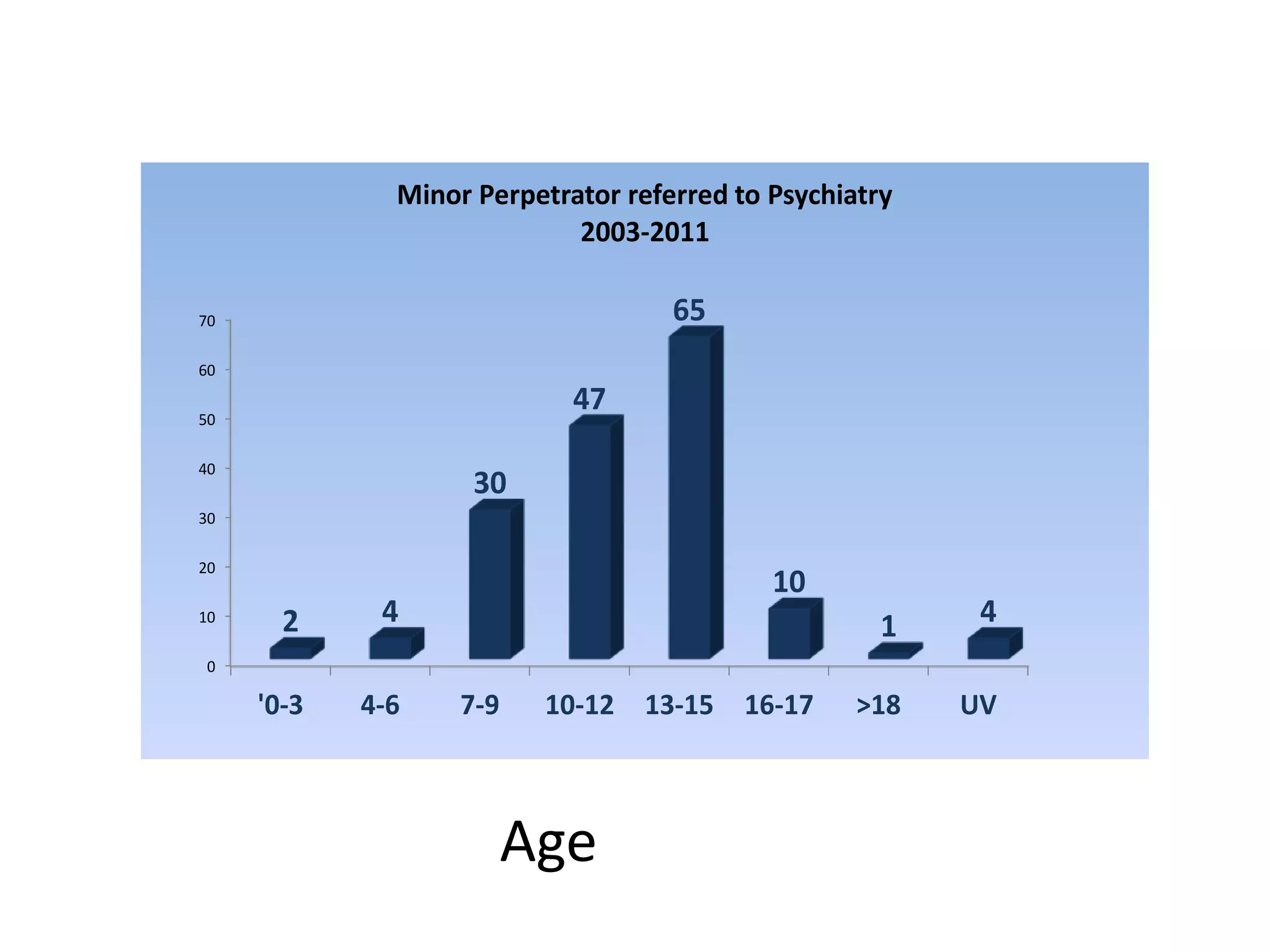
Minor Perpetrator referred to Psychiatry 
2 4 
30 
2003-2011 
47 
65 
10 
1 4 
'0-3 4-6 7-9 10-12 13-15 16-17 >18 UV 
Age
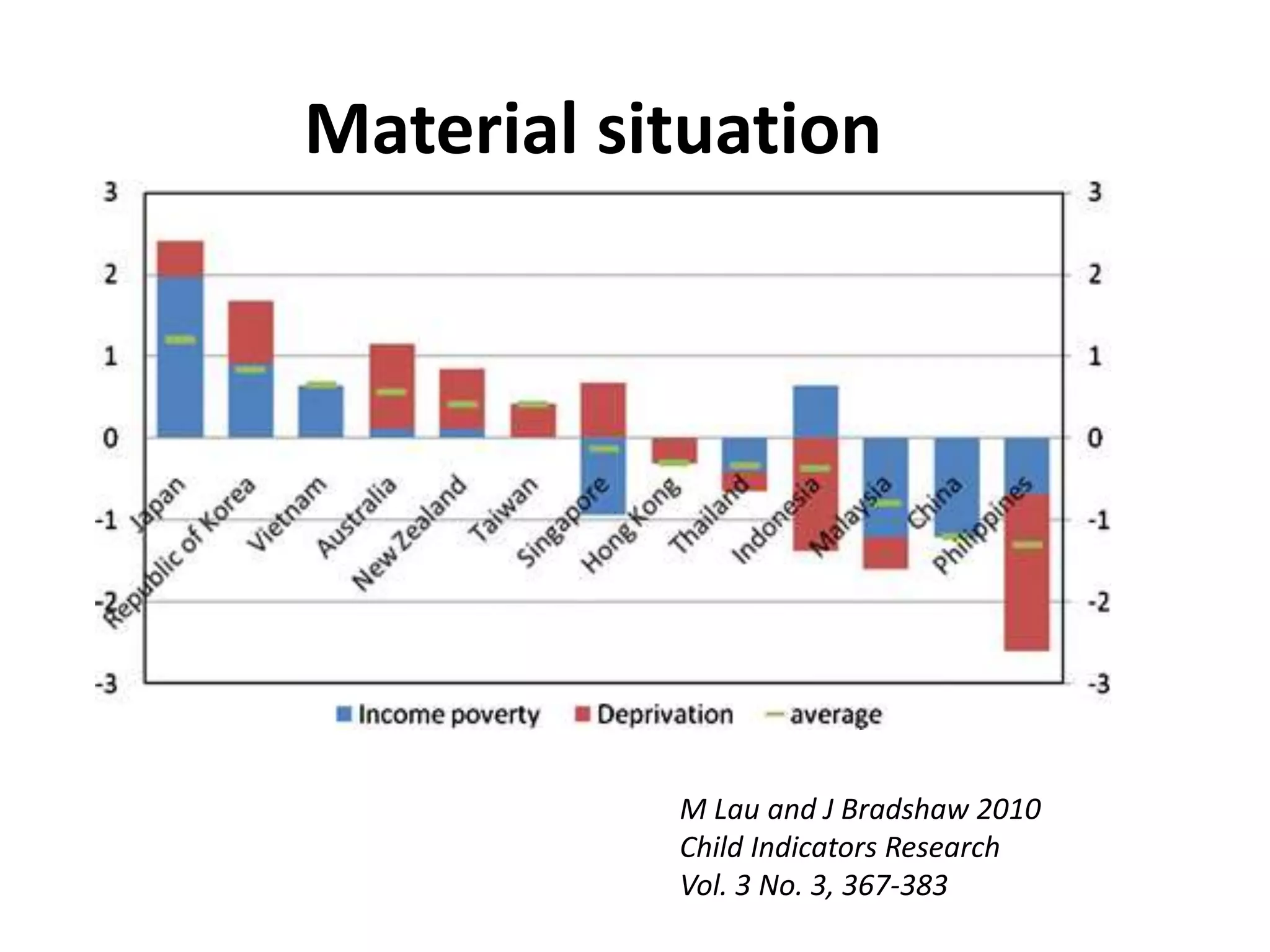
Material situation 
M Lau and J Bradshaw 2010 
Child Indicators Research 
Vol. 3 No. 3, 367-383
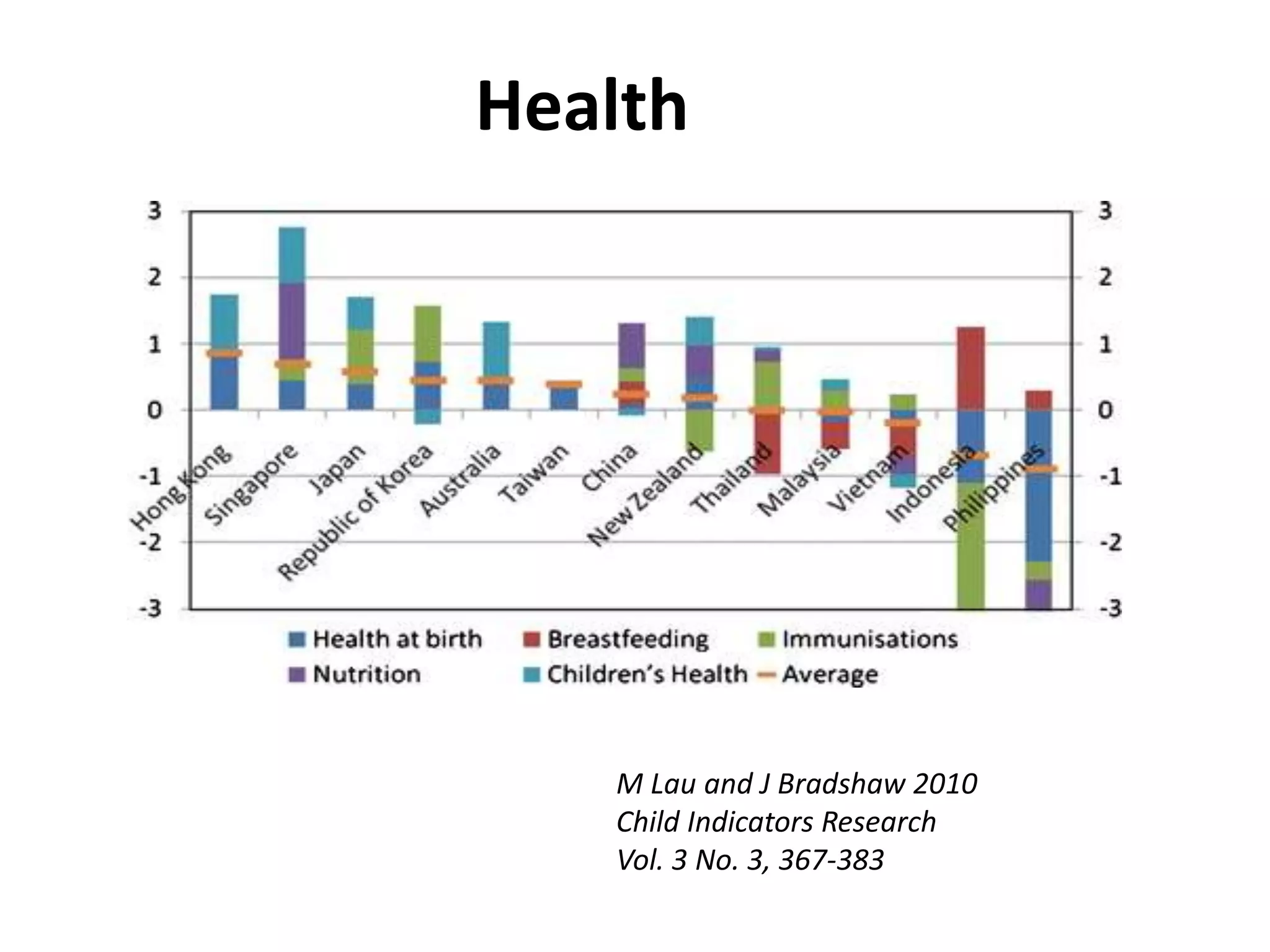
Health 
M Lau and J Bradshaw 2010 
Child Indicators Research 
Vol. 3 No. 3, 367-383
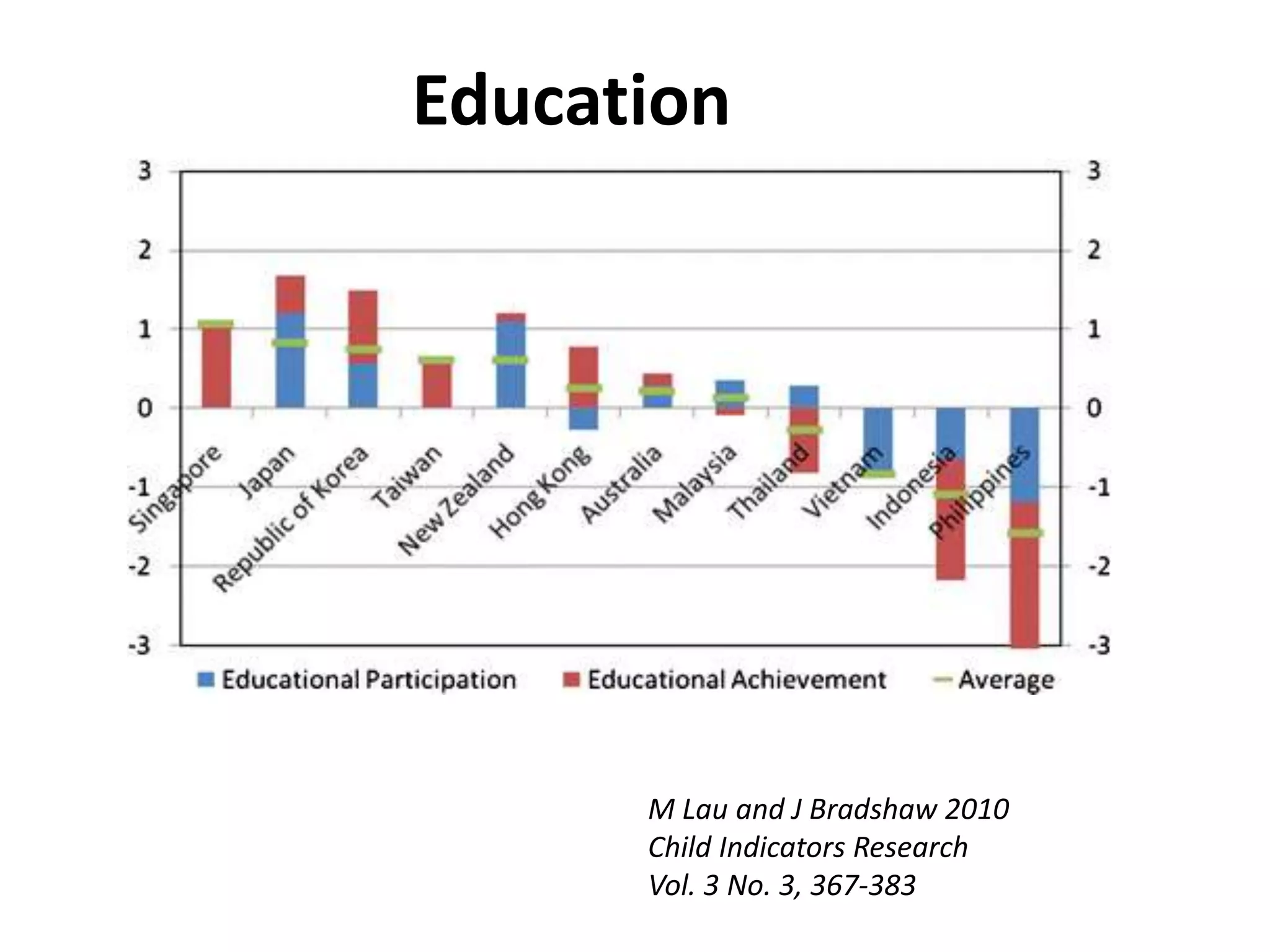
Education 
M Lau and J Bradshaw 2010 
Child Indicators Research 
Vol. 3 No. 3, 367-383
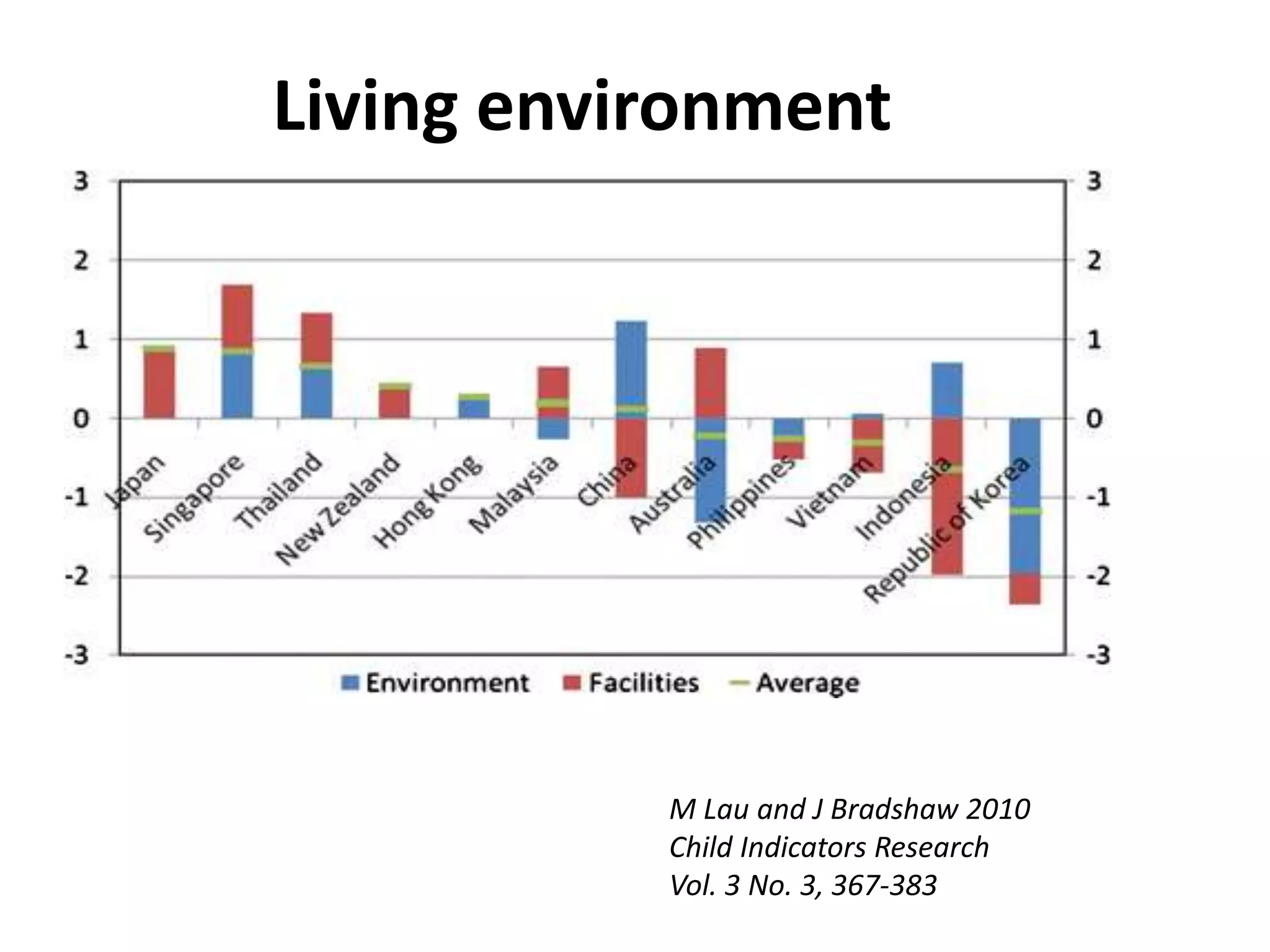
Living environment 
M Lau and J Bradshaw 2010 
Child Indicators Research 
Vol. 3 No. 3, 367-383
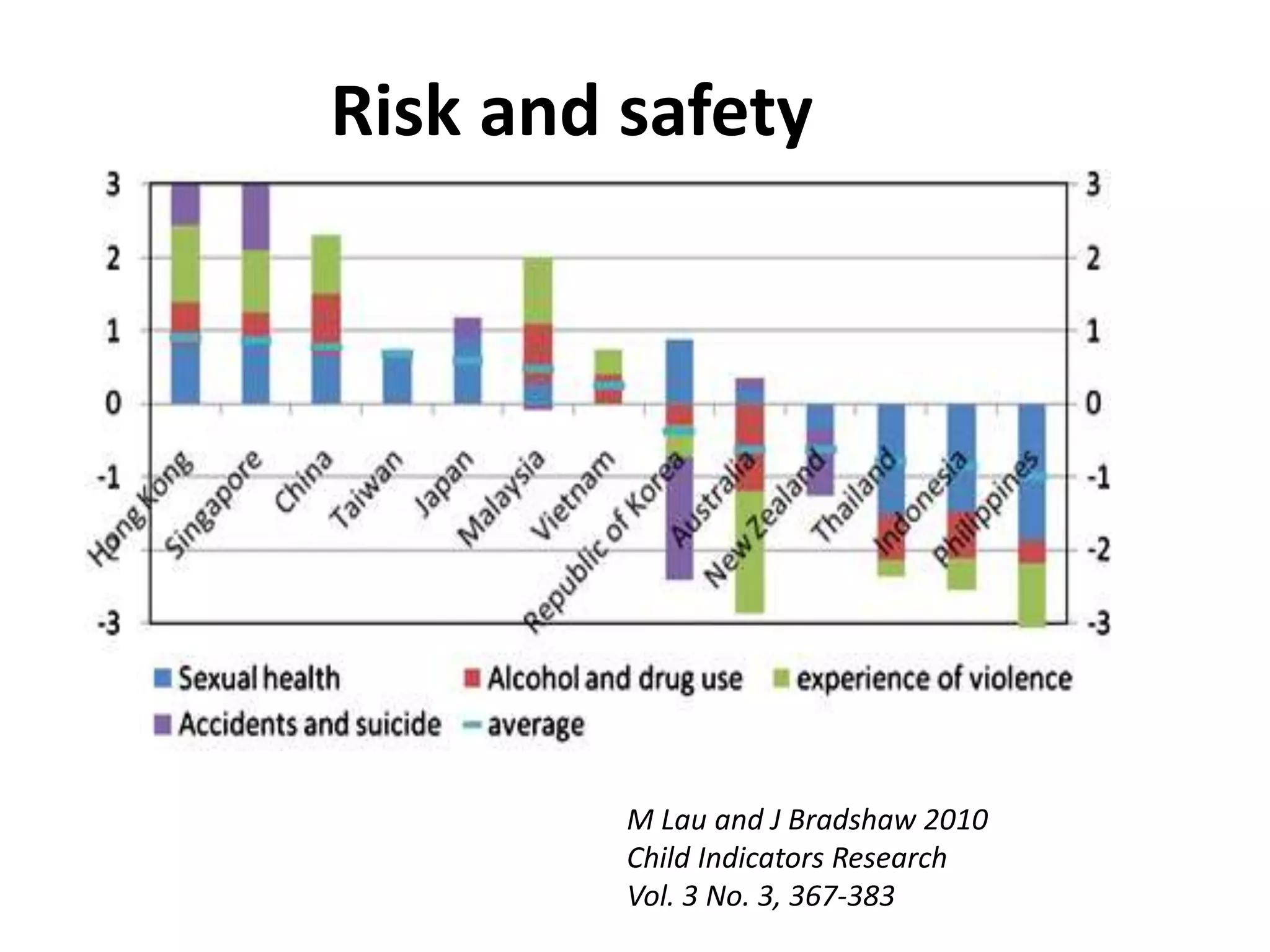
Risk and safety 
M Lau and J Bradshaw 2010 
Child Indicators Research 
Vol. 3 No. 3, 367-383
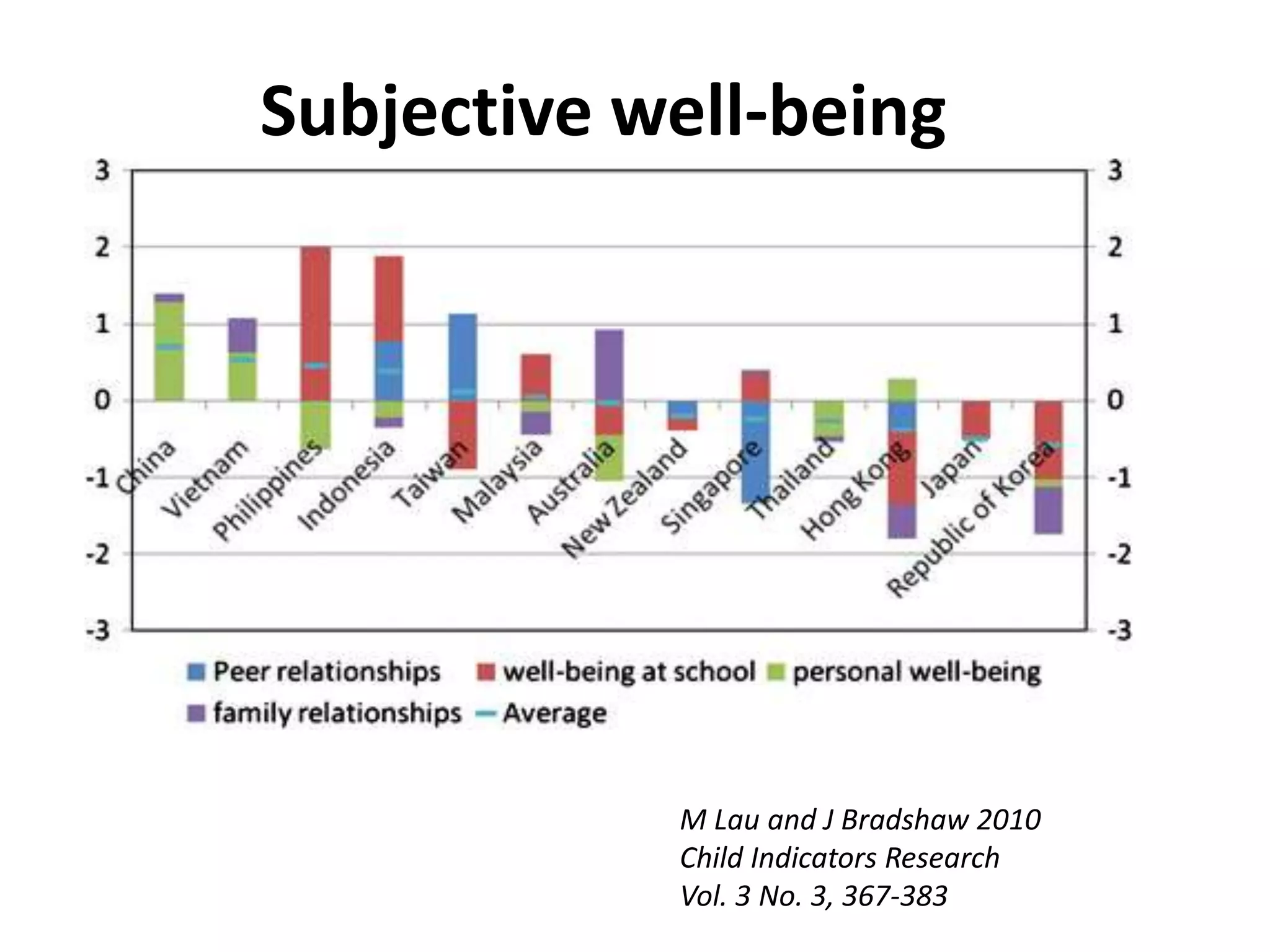
Subjective well-being 
M Lau and J Bradshaw 2010 
Child Indicators Research 
Vol. 3 No. 3, 367-383
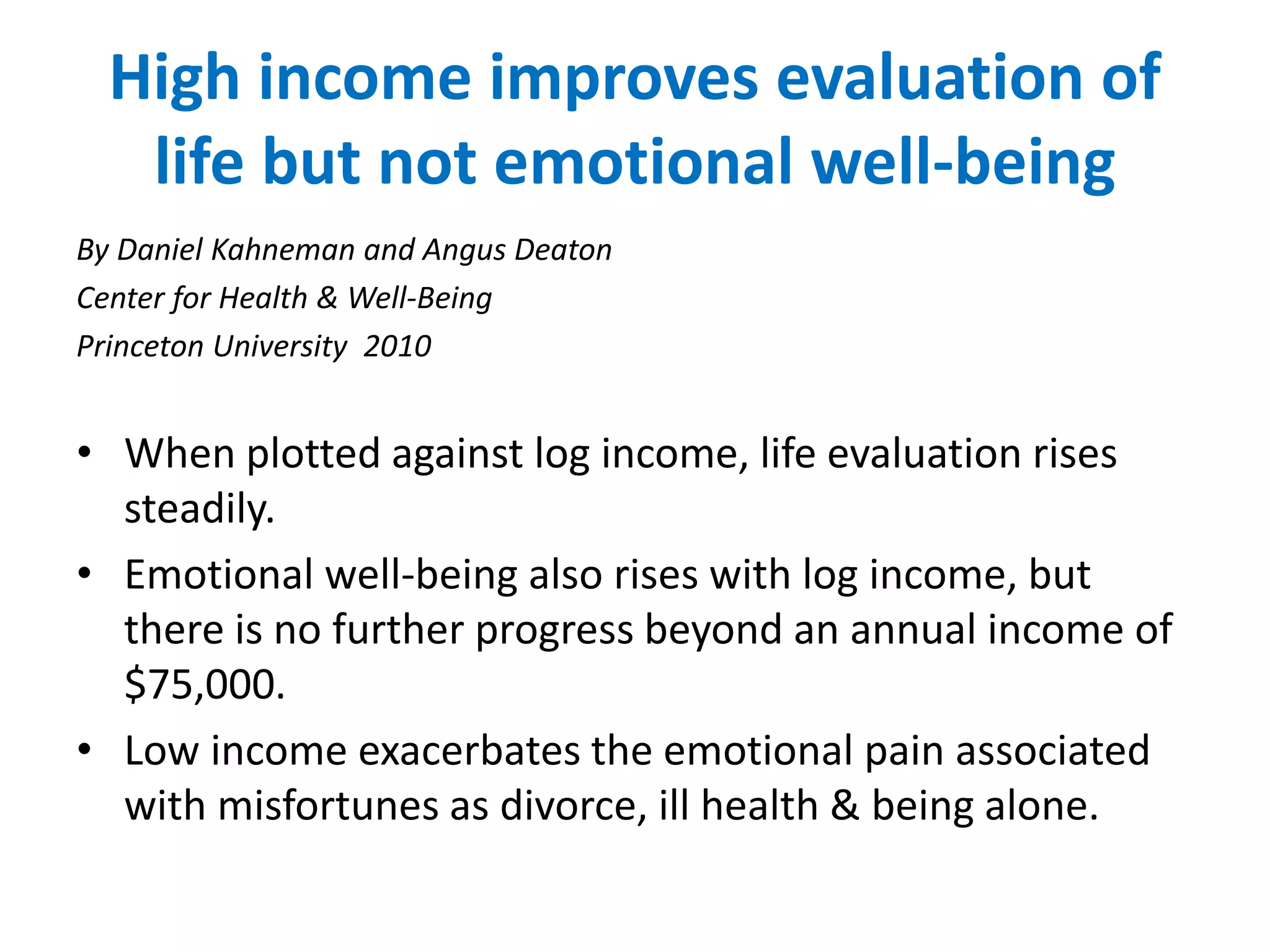
Can Money buy happiness?
High income improves evaluation of 
life but not emotional well-being 
By Daniel Kahneman and Angus Deaton 
Center for Health & Well-Being 
Princeton University 2010 
• When plotted against log income, life evaluation rises 
steadily. 
• Emotional well-being also rises with log income, but 
there is no further progress beyond an annual income of 
$75,000. 
• Low income exacerbates the emotional pain associated 
with misfortunes as divorce, ill health & being alone.
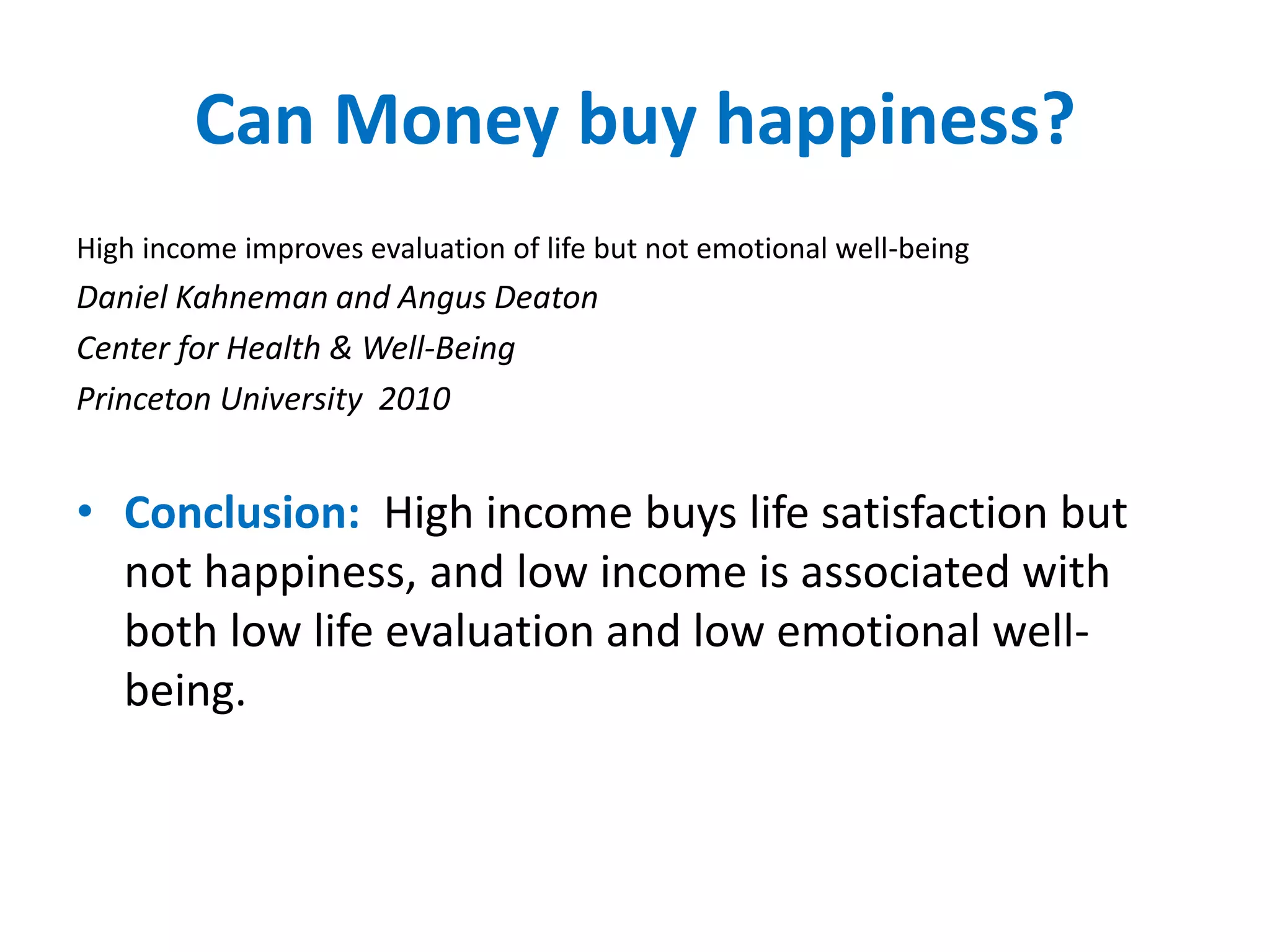
Can Money buy happiness? 
High income improves evaluation of life but not emotional well-being 
Daniel Kahneman and Angus Deaton 
Center for Health & Well-Being 
Princeton University 2010 
• Conclusion: High income buys life satisfaction but 
not happiness, and low income is associated with 
both low life evaluation and low emotional well-being.
Parenting support in the context of violence prevention

Parenting support in the context of violence prevention

  • 1.
    Family & ParentingSupport in the Context of Violence Prevention Bernadette J. Madrid, MD University of the Philippines Manila and Child Protection Network Foundation
  • 2.
    5 year-old Jackson admitted for generalized weakness and possible child neglect
  • 3.
    Critical Periods &Brain Plasticity • A critical period is a time during an organism’s life span when it is more sensitive to environmental influences or stimulation than at other times during its life.
  • 4.
    ACEs HAVE MANYIMPACTS THROUGHOUT THE LIFESPAN Critical & Sensitive Dev’tal period ADVERSE CHILDHOOD EXPERIENCE MORE CATEGORIES – GREATER IMPACT Physical Abuse, Sexual Abuse, Neglect Witnessing Domestic Violence, Depression/Mental Illness in Home Incarcerated Family Member Substance Abuse in Home Loss of a Parent GENETICS Including gender – Remember that experience triggers gene expression (Epigentics) CHRONIC DISEASE PSYCHIATRIC ADAPTATION Hard-Wired Into Biology Brain Development Electrical, Chemical, Cellular Mass DISORDER IMPAIRED COGNITION WORK/ SCHOOL Attendance Behavior, Performance OBESITY ALCOHOL, TOBACCO, DRUGS RISKY SEX Carson & Porter, 2011 POVERTY CRIME INTERGENERATIONAL TRANSMISSION, DISPARITY
  • 5.
    Adverse Childhood Experiencesand Health-Risk Behaviors Among Adults in a Developing Country Setting Laurie S. Ramiro, PhD, Bernadette J. Madrid, MD, David R. Brown, PhD Child Abuse & Neglect 2010; 34: 842-855
  • 6.
    Categories of adverse childhood experiences, Number Percentage (n=1068) 0 26.8 1 24.7 2 18.8 3 13.8 4 or more 9.2 75% had at least one ACE Ramiro L, Madrid B, Brown D Child Abuse & Neglect 2010; 34: 842-855
  • 7.
    Results of theMetro Manila ACE Study Those who were sexually abused are: • 12 times more likely to engage in early sex; • 9 times more likely to have early pregnancy; • 5 times more likely to commit suicide. Ramiro L, Madrid B, Brown D Child Abuse & Neglect 2010; 34: 842-855
  • 8.
    Results of theMetro Manila ACE Study Individuals who felt that they were not loved during childhood are: • Twice as likely to smoke, use illicit drugs, have early sex and multiple sex partners • 5 times more likely to commit suicide. Ramiro L, Madrid B, Brown D Child Abuse & Neglect 2010; 34: 842-855
  • 9.
    Strong graded responsebetween number of ACEs & poor health • Bronchitis/ emphysema • Asthma • Ischemic Heart Disease • Hypertension • Tuberculosis • Skin problems • UTI • Liver problems • GI problems- ulcers, constipation, indigestion • Depression Ramiro L, Madrid B, Brown D. Child Abuse & Neglect 2010; 34:842-855
  • 10.
    Diseases Number ofdeaths Percentage 1. Diseases of the heart 100,908 21.0 2. Cerebro-vascular Many disease chronic diseases 56,670 in adults 11.8 3. Malignant neoplasm 47,732 9.9 4. Pneumonia are determined decades 42,642 earlier, 8.9 5. Tuberculosis by experiences in childhood 25,470 5.3 6. COPD 22,755 4.7 7. Diabetes 22,345 4.6 8. Nephritis, Nephrotic Syndrome 13,799 2.9 9. Assault 12,227 2.5 10. Certain conditions arising from perinatal 11,514 2.4 period Philippine National Statistics Office, 2009
  • 12.
    Maternal and ChildHealth are Intertwined • The status of the mother such as stress, anxiety and depression has been shown to be associated with an increased risk of developing a wide variety of disorders in the offspring e.g. LBW, learning & memory • Maternal over-and under-nutrition has been associated with the onset of metabolic syndrome as well as autism and developmental delays.
  • 13.
    Maternal and ChildHealth are Intertwined • Maternal iron and iodine deficiency affects the child’s cognitive development and later behavioral problems. • Iron deficiency affects learning & memory, motor development, language development, behavior problems including anxiety & depression • Best time to correct the iron and iodine deficiencies is during adolescence before the pregnancy.
  • 14.
    Age/sex/ Physiologic StateNumber Prevalence (%) Philippines 22412 6 mos - < 1 yr 205 1-5 y 2279 6-12 y, M 2039 F 1830 13-19 y, M 1778 F 1488 Pregnant 1516 Lactating 891 19.5 55.7 20.9 20.4 19.2 10.4 18.2 42.5 31.4 Anemia prevalence by age, sex, and physiologic state: FNRI, 2008
  • 15.
    Perinatal risk factorsfor infant maltreatment • Mother smoked during pregnancy • Families with 3 or more siblings • Maternal age less than 20 years • Births to unmarried mothers • Medicaid benficiaries (poverty) • Inadequate prenatal care Zhou Y, Hallisey E, Freymann G (2006) International Journal of Health Geographics 5:53
  • 16.
    Adolescent Risk Factorsfor Child Maltreatment • Area characteristics • Family background/structure • Parent stressors • Exposure to family violence • Parent-child relationship • Education • Peer relationships • Adolescent stressors • Antisocial behaviours • Precocious transitions Thornberry, TP et. al., Child Abuse & Neglect 2013
  • 17.
    Cumulative Risk •Long-term damage that occurs through the compounding of environmental, socioeconomic and behavioral exposures across the life-course.
  • 18.
    Critical Periods •Note that the peak of plasticity for each sensitive period is staggered throughout development. • More-complex or multifaceted brain functions, especially those in humans, tend to reflect cumulative sensitive periods rather than one critical period -
  • 19.
    Connected by 25:Improving the life chances of the country’s most vulnerable 14-24 year olds Disconnected youth: They have not acquired the skills needed to connect with the labor force and they have not established social support systems: 1. Those who do not complete high school. 2. Youth deeply involved in the juvenile justice system. 3. Young, unmarried mothers 4. Adolescents in foster homes Michael Wald & Tia Martinez 2003 Stanford University
  • 20.
    Disconnected youth •Unless something is done they become either victims of trafficking, commercial sexual exploitation or incarcerated. • “These youth need major, major ongoing support in overcoming the sense of inadequacy, in acquiring job skills and education and in staying connected once change has started to occur.” Michael Wald & Tia Martinez 2003 Stanford University
  • 21.
    Child Maltreatment PreventionReadiness in Low- and Middle-Income Countries Mikton, Mehra, Butchart, et al (2011) • Evidence-based interventions alone are not sufficient to prevent child maltreatment, other conditions must be met to bridge the “science-practice” gap.
  • 22.
    10 Dimensions ofthe Readiness Assessment for Child Maltreatment Prevention Mikton, Mehra, Butchart, et al (2011) 1. Attitudes toward child maltreatment & its prevention 2. Knowledge about child maltreatment & its prevention 3. Existence of scientific data on child maltreatment & its prevention in the country 4. Existing child maltreatment prevention programs; CMP components could be integrated; outcome evaluations
  • 23.
    10 Dimensions ofthe Readiness Assessment for Child Maltreatment Prevention Mikton, Mehra, Butchart, et al (2011) 5. Legislation, official mandates of government or NGOs, and policies relevant to CMP. 6. Will to address the problem 7. Institutional links & resources of institutions involved in CMP. 8. Material resources –funding, infrastructure, equipment
  • 24.
    10 Dimensions ofthe Readiness Assessment for Child Maltreatment Prevention Mikton, Mehra, Butchart, et al (2011) 9. Human and technical resources -mental health, social work 10. Informal social resources
  • 25.
    9. High Levelof Community Ownership 8. Confirmation / Expansion 7. Stabilization 6. Initiation STAGES OF COMMUNITY 5. Preparation READINESS 4. Preplanning 3. Vague Awareness 2. Denial / Resistance 1. No Awareness
  • 26.
    Way to Go • Formation of a coalition of government agencies and NGO’s that will steer the country’s direction towards prevention of child maltreatment • National Prevalence Study on Child Maltreatment • Invest on a primary prevention program that is population-based; has been shown to work and can generate political support: Parenting Program
  • 27.
  • 28.
    Economies of Scale • Universal Health Care • Conditional Cash Transfers
  • 29.
    Breakdown of sexualabuse cases by age 260 476 375 501 1147 675 83 '0-3 4-6 7-9 10-12 13-15 16-17 >18 Sexual abuse Child Sexual Abuse Cases (2012)
  • 30.
    70 60 50 40 30 20 10 0 Minor Perpetrator referred to Psychiatry 2 4 30 2003-2011 47 65 10 1 4 '0-3 4-6 7-9 10-12 13-15 16-17 >18 UV Age
  • 32.
    Material situation MLau and J Bradshaw 2010 Child Indicators Research Vol. 3 No. 3, 367-383
  • 33.
    Health M Lauand J Bradshaw 2010 Child Indicators Research Vol. 3 No. 3, 367-383
  • 34.
    Education M Lauand J Bradshaw 2010 Child Indicators Research Vol. 3 No. 3, 367-383
  • 35.
    Living environment MLau and J Bradshaw 2010 Child Indicators Research Vol. 3 No. 3, 367-383
  • 36.
    Risk and safety M Lau and J Bradshaw 2010 Child Indicators Research Vol. 3 No. 3, 367-383
  • 37.
    Subjective well-being MLau and J Bradshaw 2010 Child Indicators Research Vol. 3 No. 3, 367-383
  • 38.
    Can Money buyhappiness?
  • 39.
    High income improvesevaluation of life but not emotional well-being By Daniel Kahneman and Angus Deaton Center for Health & Well-Being Princeton University 2010 • When plotted against log income, life evaluation rises steadily. • Emotional well-being also rises with log income, but there is no further progress beyond an annual income of $75,000. • Low income exacerbates the emotional pain associated with misfortunes as divorce, ill health & being alone.
  • 40.
    Can Money buyhappiness? High income improves evaluation of life but not emotional well-being Daniel Kahneman and Angus Deaton Center for Health & Well-Being Princeton University 2010 • Conclusion: High income buys life satisfaction but not happiness, and low income is associated with both low life evaluation and low emotional well-being.