Walker’s Point
  Youth & Family Center
Strengthening Youth & Families
                   Since 1976
About Our Organization
• Founded in 1976 as a private non-profit
  corporation.
• State licensed as a child welfare agency.
• Each of our shelters are state licensed group
  homes.
• Three Runaway Homeless Youth Programs.
• All of our services are FREE and counseling is
  confidential.
Walker’s Point Transitional &
Supportive Housing History
   1991: The Center purchases a building for
    a new TLP for homeless youth.

   2000: The program closes it’s doors due to
    loss of funding.

   2003: The TLP expands further to start the
    Insights program.

   2009: Center Receives Homeless
    Prevention Rapid Re-housing Stimulus
    grant.
TLP Youth Snapshot

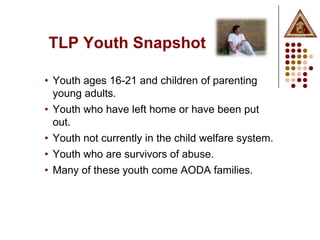
• Youth ages 16-21 and children of parenting
  young adults.
• Youth who have left home or have been put
  out.
• Youth not currently in the child welfare system.
• Youth who are survivors of abuse.
• Many of these youth come AODA families.
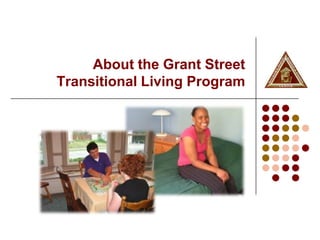
About the Grant Street
Transitional Living Program
Grant Street Transitional Living Program
SERVICES

         Supervised group home care for youth
          ages 16-17 years old for up to two years

         Individual Case Management

         Individual, Group and Family Counseling

         Independent Living Skills Training Class
          Focusing on Basic Life Skills

         Follow-up and Aftercare
Grant Street Transitional Living Program
Independent Living Skills
        Residents participate and will be assisted in:


         - Job Preparation and Attainment
         - Managing Personal Finances
         - Menu Planning and Food Preparation
         - Obtaining Vital Personal Records
         - Support with Educational Advancement
         - Assessment and Referrals for Physical and
         Mental Health Needs
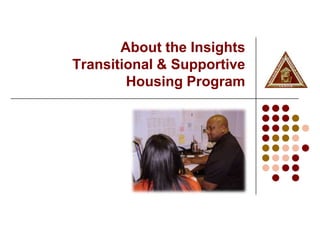
About the Insights
Transitional & Supportive
        Housing Program
Insights Transitional & Supportive
Housing Program
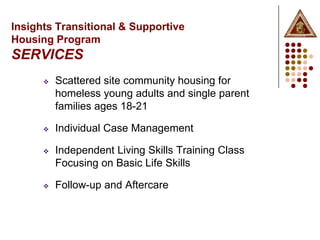
SERVICES
         Scattered site community housing for
          homeless young adults and single parent
          families ages 18-21

         Individual Case Management

         Independent Living Skills Training Class
          Focusing on Basic Life Skills

         Follow-up and Aftercare
Insights Transitional & Supportive
Housing Program
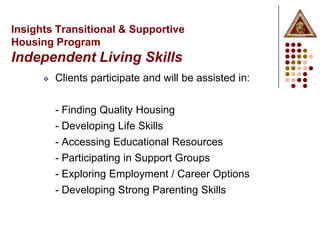
Independent Living Skills
         Clients participate and will be assisted in:


          - Finding Quality Housing
          - Developing Life Skills
          - Accessing Educational Resources
          - Participating in Support Groups
          - Exploring Employment / Career Options
          - Developing Strong Parenting Skills
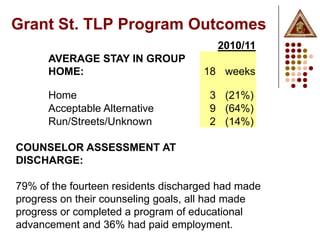
Grant St. TLP Program Outcomes
                                        2010/11
      AVERAGE STAY IN GROUP
      HOME:                          18 weeks

      Home                            3 (21%)
      Acceptable Alternative          9 (64%)
      Run/Streets/Unknown             2 (14%)

COUNSELOR ASSESSMENT AT
DISCHARGE:

79% of the fourteen residents discharged had made
progress on their counseling goals, all had made
progress or completed a program of educational
advancement and 36% had paid employment.
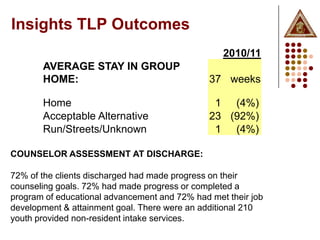
Insights TLP Outcomes
                                                  2010/11
       AVERAGE STAY IN GROUP
       HOME:                                   37 weeks

       Home                                     1 (4%)
       Acceptable Alternative                  23 (92%)
       Run/Streets/Unknown                      1 (4%)

COUNSELOR ASSESSMENT AT DISCHARGE:

72% of the clients discharged had made progress on their
counseling goals. 72% had made progress or completed a
program of educational advancement and 72% had met their job
development & attainment goal. There were an additional 210
youth provided non-resident intake services.
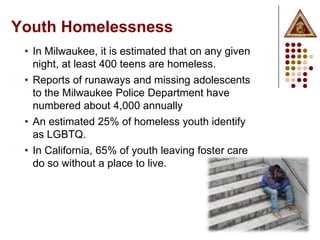
Youth Homelessness
 • In Milwaukee, it is estimated that on any given
   night, at least 400 teens are homeless.
 • Reports of runaways and missing adolescents
   to the Milwaukee Police Department have
   numbered about 4,000 annually
 • An estimated 25% of homeless youth identify
   as LGBTQ.
 • In California, 65% of youth leaving foster care
   do so without a place to live.
Staff Leadership
     Executive Director Andre Olton, Ph.D.
      walkersp@sbcglobal.net

     Program Director Todd Witt, MSW, LCSW
      414-647-8200
     414-530-8486
     toddwitt@sbcglobal.net
     www.walkerspoint.org
     www.facebook.com/walkerspoint

5.5 Housing and Service Interventions for Youth and Young Parents: Successful Models

  • 1.
    Walker’s Point Youth & Family Center Strengthening Youth & Families Since 1976
  • 2.
    About Our Organization •Founded in 1976 as a private non-profit corporation. • State licensed as a child welfare agency. • Each of our shelters are state licensed group homes. • Three Runaway Homeless Youth Programs. • All of our services are FREE and counseling is confidential.
  • 3.
    Walker’s Point Transitional& Supportive Housing History  1991: The Center purchases a building for a new TLP for homeless youth.  2000: The program closes it’s doors due to loss of funding.  2003: The TLP expands further to start the Insights program.  2009: Center Receives Homeless Prevention Rapid Re-housing Stimulus grant.
  • 4.
    TLP Youth Snapshot •Youth ages 16-21 and children of parenting young adults. • Youth who have left home or have been put out. • Youth not currently in the child welfare system. • Youth who are survivors of abuse. • Many of these youth come AODA families.
  • 5.
    About the GrantStreet Transitional Living Program
  • 6.
    Grant Street TransitionalLiving Program SERVICES  Supervised group home care for youth ages 16-17 years old for up to two years  Individual Case Management  Individual, Group and Family Counseling  Independent Living Skills Training Class Focusing on Basic Life Skills  Follow-up and Aftercare
  • 7.
    Grant Street TransitionalLiving Program Independent Living Skills  Residents participate and will be assisted in: - Job Preparation and Attainment - Managing Personal Finances - Menu Planning and Food Preparation - Obtaining Vital Personal Records - Support with Educational Advancement - Assessment and Referrals for Physical and Mental Health Needs
  • 8.
    About the Insights Transitional& Supportive Housing Program
  • 9.
    Insights Transitional &Supportive Housing Program SERVICES  Scattered site community housing for homeless young adults and single parent families ages 18-21  Individual Case Management  Independent Living Skills Training Class Focusing on Basic Life Skills  Follow-up and Aftercare
  • 10.
    Insights Transitional &Supportive Housing Program Independent Living Skills  Clients participate and will be assisted in: - Finding Quality Housing - Developing Life Skills - Accessing Educational Resources - Participating in Support Groups - Exploring Employment / Career Options - Developing Strong Parenting Skills
  • 11.
    Grant St. TLPProgram Outcomes 2010/11 AVERAGE STAY IN GROUP HOME: 18 weeks Home 3 (21%) Acceptable Alternative 9 (64%) Run/Streets/Unknown 2 (14%) COUNSELOR ASSESSMENT AT DISCHARGE: 79% of the fourteen residents discharged had made progress on their counseling goals, all had made progress or completed a program of educational advancement and 36% had paid employment.
  • 12.
    Insights TLP Outcomes 2010/11 AVERAGE STAY IN GROUP HOME: 37 weeks Home 1 (4%) Acceptable Alternative 23 (92%) Run/Streets/Unknown 1 (4%) COUNSELOR ASSESSMENT AT DISCHARGE: 72% of the clients discharged had made progress on their counseling goals. 72% had made progress or completed a program of educational advancement and 72% had met their job development & attainment goal. There were an additional 210 youth provided non-resident intake services.
  • 13.
    Youth Homelessness •In Milwaukee, it is estimated that on any given night, at least 400 teens are homeless. • Reports of runaways and missing adolescents to the Milwaukee Police Department have numbered about 4,000 annually • An estimated 25% of homeless youth identify as LGBTQ. • In California, 65% of youth leaving foster care do so without a place to live.
  • 14.
    Staff Leadership  Executive Director Andre Olton, Ph.D. walkersp@sbcglobal.net  Program Director Todd Witt, MSW, LCSW 414-647-8200 414-530-8486 toddwitt@sbcglobal.net www.walkerspoint.org www.facebook.com/walkerspoint

Editor's Notes

  • #3 -Runaway Act 1974 Expanded to RHY Act 1977State licensing requirements can serve as both opportunities & barriers for access.
  • #4 A Walker's Point youth and parent client testify in Congress on the importance of runaway and homeless youth services.1992:  Grant St. TLP opens its doors.2001:  Grant St. re-opens as a four-bed treatment foster home.2002:  The Transitional Living Program expands back to eight beds for minor aged homeless youth.Insights program for up to eighteen homeless youth, ages 18-21 years old, including those who are pregnant and parenting, using scattered site housing in the community.A new three-year federal Homeless Prevention and Rapid Re-Housing grant doubles the number of homeless and near-homeless youth provided supportive housing and services in our Insights program.
  • #5 The Minor Group Home is not licensed for teen parents. The 18-21 Year Old Insights program allows for the young adults to be housed in their apartments with their children.The youth have to meet homeless definition requirements to stay in Group Home program.Staff assist the minor youth to go through the children’s court process to obtain long term placement in our group home.Staff assess for where the youth are related to trauma, social and familial history and develop independent living plans with the youth. The plan fits the youth rather than making the youth fit a template plan.
  • #8 *Through Groups/case management. Resume building, mock interviews, job searching, application assistance. *Budget development, saving 70% into checking account. Weekly meal development. Id cards, SSI, school id, birth certificates which are all needed to participate in independent living. Linking youth up with school and a school program appropriate to them, FAFSA, secondary school/tech school preparation. Some services are provided out of house in the areas of AODA treatment, health/dental needs and long term counseling/psychiatric needs. Through the services provided, the program staff will prepare youth for the responsibilities of independent living, enabling them to enter young adulthood better prepared emotionally, physically, and with the resources to lead healthy and purposeful lives.Staff purposefully work with the youth in a way that promote independent living skills.
  • #11 -Case managers have ongoing relationships with local landlords. New relationships are established by local university and community housing listings, Craigslist and referrals. Potential clients take program letter when meeting landlords. Housing must meet inspection standards. Case managers advocate for potential and current clients. Client’s are the leasee but CM do apartment visits monthly.-ILS focus with maintaining apartments, healthy relationships/social emotional, employability skills and job readiness, budgeting/financial literacy, parenting skills, access to health care, obtaining vital records/accessing comm. Resources.. Case managers restructured group curriculum to provide 5 cycles of group in a year lasting 8 weeks per cycle. -Insights clients have to have completed a high school program or working towards a plan to complete primary education. Many are involved in secondary education goals.-Many employment resources are utilized including Milwaukee Workforce Development, temp agencies, seasonal employment, job corps, W-2 (welfare to work program) and other job readiness programs.
  • #12 -The U.S. Bureau of Labor Statistics reports that the adult black unemployment rate is 15.8% and the black youth unemployment rate is over 40%. JSONLINE article January 21st 2012.-Youth not employed participate in volunteer activities to develop employment skills as well as strengthen resumes and applications.2010/11 WP served 20 youth in Grant St. Program.
  • #13 -210 youth went through the application process, put on the waiting list but were ultimately turned away due to the program being @ capacity. Non-residential services included referrals to other community housing programs, adult shelters and access to basic living needs. *Given the amount of youth on the waiting list, the application process was revised to include a set schedule for youth to turn in applications, meet case managers and obtain a needs assessment survey. While awaiting an opportunity for interview clients were able to identify some basic tasks to accomplish. Staff have been better able to assess for need and motivation in the program. The result has been a reduction in premature discharges and those youth leaving their apartments upon discharge to go back to primary care giver. -2010/11 WP served 50 youth in the Insights program.
  • #14 -As reported on 2011 Point in time survey-MPD 2009 Statistics-National Foster Care Youth Statistics