Management of Oligometastatic
Lung Cancer
Yong Chan Ahn, MD/PhD
Dept. of Radiation Oncology
Samsung Medical Center, Sungkyunkwan University School of Medicine
• Oligometastasis
• Oligometastasis in NSCLC
• SMC Experience of SBRT for
Oligometastasis to Lung
• Local Treatment for Oligometastasis
• Clinical Studies/Review
• Survey
• Ongoing Trials
• Take Home Messages
Oligometastasis
Nat Rev Clin Oncol, 2011
Oligometastasis
• Theory 1st proposed by Hellman and
Weichselbaum in 1995.
• Along spectrum of locally confined to widely
metastatic cancer, there exists intermediate
“oligometastatic state” where metastases are
limited in number and location.
Paradigm Stages
Old Early vs Metastatic
New Early ~ Oligometastatic ~ Systemic
Nat Rev Clin Oncol, 2011
Oligometastasis
• Eradication of “oligometastases” with local
ablative Tx could be curative in select patients.
• Cure is achieved following curative surgical
resection in:
– Liver metastases from colon cancer
– Lung metastases from various sites
– Adrenal metastases from lung cancer
Nat Rev Clin Oncol, 2011
Single & DFI  36 months
Multiple or DFI < 36 months
Multiple and DFI < 36 months
Lung meta
Oligometastasis
• Oligometastases have long been recognized as
potentially curable, but were considered rare
exceptions to cancer metastasis paradigm.
• Oligometastatic state, however, is becoming
more frequently identified with more
sensitive methods.
• Clinicians will be able to limit ablative local
Tx to only those with true oligometastases.
Nat Rev Clin Oncol, 2011
Oligometastasis in NSCLC
Lung Cancer, 2013
Lung Cancer, 2013
Lung Cancer, 2013
Lung Cancer, 2013
Lung Cancer, 2013
Conclusion
• Patient selection is key determinant:
– Definitive Tx of primary tumor
– Long disease-free interval
– Lack of intra-thoracic nodal metastasis
• These should be utilized to guide clinical
decision making and design of future studies.
SMC Experience of SBRT for
Oligometastasis to Lung
Acta Oncol, 2012
SBRT for Lung Metastasis
• SBRT to 57 patients, 67 metastatic lesions
• Sep. 2001~Nov. 2010
• Lung toxicity:
– Grade 2 in 4 patients (6.0%)
– Grade 5 in 1
Acta Oncol, 2012
Acta Oncol, 2012
Response at 1 month:
- CR in 17 (25%)
- PR in 40 (60%)
- SD in 10 (15%)
Local progression in 3 (5%)
94.5% at 3 years
Acta Oncol, 2012
Acta Oncol, 2012
59.7% 56.2%
at 2 years at 5 years
Acta Oncol, 2012
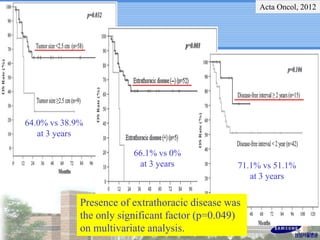
Presence of extrathoracic disease was
the only significant factor (p=0.049)
on multivariate analysis.
64.0% vs 38.9%
at 3 years
66.1% vs 0%
at 3 years 71.1% vs 51.1%
at 3 years
Acta Oncol, 2012
Conclusion
• SBRT for single or oligo-metastasis seems
quite effective and safe.
• Tumor size, disease-free interval, and presence
of extrathoracic disease are prognosticators for
survival.
Acta Oncol, 2012
Local Treatment for
Oligometastasis
Clinical Lung Cancer, 2014
Clinical Practice Points
• Select oligometastatic NSCLC Pts might benefit
from aggressive Tx to all disease sites:
– Pts with controlled primary lung cancer are
most likely to experience long-term survival.
– Pts with metachronous meta experienced the
longest survivals.
– Pts with synchronous meta and N1-2 disease
had the poorest survivals.
Clinical Lung Cancer, 2014
Clinical Studies/Review
• Radiation therapy for oligometastatic non-small cell lung cancer.
Salama JK, Schild SE. Cancer Metastasis Rev. 2015;34(2):183-93.
• Stereotactic body radiation therapy for oligometastases to the lung: a
phase 2 study. Nuyttens JJ et al. Int J Radiat Oncol Biol Phys. 2015;91(2):337-43.
• Stereotactic body radiotherapy for oligometastatic disease. Hanna GG et
al. Clin Oncol (R Coll Radiol). 2015;27(5):290-7.
• Predictive factors for local control in primary and metastatic lung
tumours after four to five fraction stereotactic ablative body
radiotherapy: a single institution's comprehensive experience. Thibault
I et al. Clin Oncol (R Coll Radiol). 2014;26(11):713-9.
• Outcomes and toxicities of stereotactic body radiation therapy for
non-spine bone oligometastases. Owen D et al. Pract Radiat Oncol.
2014;4(2):e143-9.
• Management of pulmonary oligometastases by stereotactic body
radiotherapy. Gamsiz H et al. Tumori. 2014;100(2):179-83.
• Radical treatment of synchronous oligometastatic non-small cell
lung carcinoma (NSCLC): patient outcomes and prognostic factors.
Griffioen GH et al. Lung Cancer. 2013;82(1):95-102.
• Reviews:
• SABR for aggressive local therapy of metastatic cancer: A new
paradigm for metastatic non-small cell lung cancer. Westover KD et al.
Lung Cancer. 2015;89(2):87-93.
• Stereotactic ablative radiotherapy for pulmonary oligometastases
and oligometastatic lung cancer. Shultz DB et al. J Thorac Oncol.
2014;9(10):1426-33.
Survey
Am J Clin Oncol, 2015
• 25-question survey
• 1,007 respondents from 43
countries
• SBRT users:
• Length of practice
• # patients treated
• Organs treated
• Primary reason
• Dose schedules
• Future intentions
• SBRT non-users:
• Reason for not using SBRT
• Future intentions
83%
>1/3
Am J Clin Oncol, 2015
Reasons for adopting SBRT to treat OM
84%
• Commonly treated organs: lung (90%), liver
(75%), and spine (70%).
• Most would offer second SBRT to new OM.
• 99% planned to continue and 66% planned to
increase SBRT use.
Various dose schedules!
Am J Clin Oncol, 2015
Reasons for planning to adopt SBRT
• The most common reasons for not using SBRT were lack of
clinical efficacy (48%) and/or lack of necessary image guidance
equipment (34%).  need for prospective clinical trials!
• Of those not using SBRT, 59% plan to start soon.
Am J Clin Oncol, 2015
Ongoing Trials
Metachronous meta ≤ 5 sites
NCT01446744
Canada/Netherlands
DFI  3 months
≤ 3 mets in any single organ
≤ 5 total mets
NCT01446744
Canada/NetherlandsMetachronous meta ≤ 5 sites
Arm 1
Lung 8 Gy/1 Fx; 20 Gy/5 Fx’s; 30 Gy/10 Fx’s
Bone 8 Gy/1 Fx; 20 Gy/5 Fx’s; 30 Gy/10 Fx’s
Brain 20 Gy/5 Fx’s; 30 Gy/10 Fx’s
Liver 20 Gy/5 Fx’s
NCT01446744
Canada/NetherlandsMetachronous meta ≤ 5 sites
NCT01725165
MDACCSynchronous meta ≤ 3 sites
NCT02045446
UTSWMCSynchronous meta ≤ 6 sites
Take Home Messages
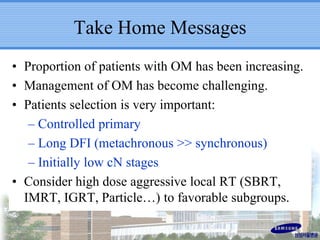
• Proportion of patients with OM has been increasing.
• Management of OM has become challenging.
• Patients selection is very important:
– Controlled primary
– Long DFI (metachronous >> synchronous)
– Initially low cN stages
• Consider high dose aggressive local RT (SBRT,
IMRT, IGRT, Particle…) to favorable subgroups.
Staging Project
16th WCLC at Denver
Paradigm has changed, is changing, and will change!
Don’t give up easily!
Thank your for your attention!

1509 webinar oligometa lung

  • 1.
    Management of Oligometastatic LungCancer Yong Chan Ahn, MD/PhD Dept. of Radiation Oncology Samsung Medical Center, Sungkyunkwan University School of Medicine
  • 2.
    • Oligometastasis • Oligometastasisin NSCLC • SMC Experience of SBRT for Oligometastasis to Lung • Local Treatment for Oligometastasis • Clinical Studies/Review • Survey • Ongoing Trials • Take Home Messages
  • 3.
  • 4.
    Nat Rev ClinOncol, 2011
  • 5.
    Oligometastasis • Theory 1stproposed by Hellman and Weichselbaum in 1995. • Along spectrum of locally confined to widely metastatic cancer, there exists intermediate “oligometastatic state” where metastases are limited in number and location. Paradigm Stages Old Early vs Metastatic New Early ~ Oligometastatic ~ Systemic Nat Rev Clin Oncol, 2011
  • 6.
    Oligometastasis • Eradication of“oligometastases” with local ablative Tx could be curative in select patients. • Cure is achieved following curative surgical resection in: – Liver metastases from colon cancer – Lung metastases from various sites – Adrenal metastases from lung cancer Nat Rev Clin Oncol, 2011
  • 7.
    Nat Rev ClinOncol, 2011 Single & DFI  36 months Multiple or DFI < 36 months Multiple and DFI < 36 months Lung meta
  • 8.
    Oligometastasis • Oligometastases havelong been recognized as potentially curable, but were considered rare exceptions to cancer metastasis paradigm. • Oligometastatic state, however, is becoming more frequently identified with more sensitive methods. • Clinicians will be able to limit ablative local Tx to only those with true oligometastases. Nat Rev Clin Oncol, 2011
  • 10.
  • 11.
  • 12.
  • 13.
  • 14.
  • 15.
    Lung Cancer, 2013 Conclusion •Patient selection is key determinant: – Definitive Tx of primary tumor – Long disease-free interval – Lack of intra-thoracic nodal metastasis • These should be utilized to guide clinical decision making and design of future studies.
  • 17.
    SMC Experience ofSBRT for Oligometastasis to Lung
  • 18.
  • 19.
    SBRT for LungMetastasis • SBRT to 57 patients, 67 metastatic lesions • Sep. 2001~Nov. 2010 • Lung toxicity: – Grade 2 in 4 patients (6.0%) – Grade 5 in 1 Acta Oncol, 2012
  • 20.
  • 21.
    Response at 1month: - CR in 17 (25%) - PR in 40 (60%) - SD in 10 (15%) Local progression in 3 (5%) 94.5% at 3 years Acta Oncol, 2012
  • 22.
  • 23.
    59.7% 56.2% at 2years at 5 years Acta Oncol, 2012
  • 24.
    Presence of extrathoracicdisease was the only significant factor (p=0.049) on multivariate analysis. 64.0% vs 38.9% at 3 years 66.1% vs 0% at 3 years 71.1% vs 51.1% at 3 years Acta Oncol, 2012
  • 25.
    Conclusion • SBRT forsingle or oligo-metastasis seems quite effective and safe. • Tumor size, disease-free interval, and presence of extrathoracic disease are prognosticators for survival. Acta Oncol, 2012
  • 26.
  • 27.
  • 28.
  • 29.
  • 30.
  • 31.
    Clinical Practice Points •Select oligometastatic NSCLC Pts might benefit from aggressive Tx to all disease sites: – Pts with controlled primary lung cancer are most likely to experience long-term survival. – Pts with metachronous meta experienced the longest survivals. – Pts with synchronous meta and N1-2 disease had the poorest survivals. Clinical Lung Cancer, 2014
  • 32.
  • 33.
    • Radiation therapyfor oligometastatic non-small cell lung cancer. Salama JK, Schild SE. Cancer Metastasis Rev. 2015;34(2):183-93. • Stereotactic body radiation therapy for oligometastases to the lung: a phase 2 study. Nuyttens JJ et al. Int J Radiat Oncol Biol Phys. 2015;91(2):337-43. • Stereotactic body radiotherapy for oligometastatic disease. Hanna GG et al. Clin Oncol (R Coll Radiol). 2015;27(5):290-7. • Predictive factors for local control in primary and metastatic lung tumours after four to five fraction stereotactic ablative body radiotherapy: a single institution's comprehensive experience. Thibault I et al. Clin Oncol (R Coll Radiol). 2014;26(11):713-9. • Outcomes and toxicities of stereotactic body radiation therapy for non-spine bone oligometastases. Owen D et al. Pract Radiat Oncol. 2014;4(2):e143-9. • Management of pulmonary oligometastases by stereotactic body radiotherapy. Gamsiz H et al. Tumori. 2014;100(2):179-83. • Radical treatment of synchronous oligometastatic non-small cell lung carcinoma (NSCLC): patient outcomes and prognostic factors. Griffioen GH et al. Lung Cancer. 2013;82(1):95-102.
  • 34.
    • Reviews: • SABRfor aggressive local therapy of metastatic cancer: A new paradigm for metastatic non-small cell lung cancer. Westover KD et al. Lung Cancer. 2015;89(2):87-93. • Stereotactic ablative radiotherapy for pulmonary oligometastases and oligometastatic lung cancer. Shultz DB et al. J Thorac Oncol. 2014;9(10):1426-33.
  • 35.
  • 36.
    Am J ClinOncol, 2015
  • 37.
    • 25-question survey •1,007 respondents from 43 countries • SBRT users: • Length of practice • # patients treated • Organs treated • Primary reason • Dose schedules • Future intentions • SBRT non-users: • Reason for not using SBRT • Future intentions 83% >1/3 Am J Clin Oncol, 2015
  • 38.
    Reasons for adoptingSBRT to treat OM 84% • Commonly treated organs: lung (90%), liver (75%), and spine (70%). • Most would offer second SBRT to new OM. • 99% planned to continue and 66% planned to increase SBRT use. Various dose schedules! Am J Clin Oncol, 2015
  • 39.
    Reasons for planningto adopt SBRT • The most common reasons for not using SBRT were lack of clinical efficacy (48%) and/or lack of necessary image guidance equipment (34%).  need for prospective clinical trials! • Of those not using SBRT, 59% plan to start soon. Am J Clin Oncol, 2015
  • 40.
  • 41.
    Metachronous meta ≤5 sites NCT01446744 Canada/Netherlands
  • 42.
    DFI  3months ≤ 3 mets in any single organ ≤ 5 total mets NCT01446744 Canada/NetherlandsMetachronous meta ≤ 5 sites
  • 43.
    Arm 1 Lung 8Gy/1 Fx; 20 Gy/5 Fx’s; 30 Gy/10 Fx’s Bone 8 Gy/1 Fx; 20 Gy/5 Fx’s; 30 Gy/10 Fx’s Brain 20 Gy/5 Fx’s; 30 Gy/10 Fx’s Liver 20 Gy/5 Fx’s NCT01446744 Canada/NetherlandsMetachronous meta ≤ 5 sites
  • 44.
  • 45.
  • 46.
    Take Home Messages •Proportion of patients with OM has been increasing. • Management of OM has become challenging. • Patients selection is very important: – Controlled primary – Long DFI (metachronous >> synchronous) – Initially low cN stages • Consider high dose aggressive local RT (SBRT, IMRT, IGRT, Particle…) to favorable subgroups.
  • 47.
    Staging Project 16th WCLCat Denver Paradigm has changed, is changing, and will change!
  • 51.
    Don’t give upeasily! Thank your for your attention!