Assessment Tools 1
EARLY CHILDHOOD
ASSESSMENT TOOLS
Assessment Tools 2
Early Childhood Assessment Program
Document prepared by:
Walkiria Oliver
Florida International University
Miami, Florida
NOTE: Factors such as (a child's) anxiety, lack of motivation, fatigue, and/or examiner inexperience
or failure to establish rapport may invalidate a child's test scores. Individual users may
have different experiences.
The information contained herein was based on resources available from the publishers of
the assessments and/or drawn from the examiner's manuals or other sources. For the sake of
brevity, all the individuals responsible for developing (e.g., authors) and reviewing these
instruments were not individually quoted herein. The readers are advised to consult the
respective publisher directly.
AP and FIU, jointly and individually, make no claims as to the rights of ownership of these
these instruments and AP and FIU, jointly and individually, shall not be liable for any errors
and/or omissions. The information provided in the following pages is subject to changes,
errors, omissions, and/or modifications - without prior notification.
Assessment Tools 3
Table of Contents
Foreword ……………………………………………………………………………………………………………………………………. i
Introduction ………………………………………………………………………………………………………………………………… 4
Overview of Early Childhood Tools: Tables of Explanatory Analyses ………………………………………………………………...7
Using Assessment to Inform Teaching or to Identify Special Needs ………………………………………………………………..20
Spanish Versions of Instruments Reviewed …………………………………………………………………………………………...22
Summary of Assessment Tools ..................…………………………………………………………………………………………… 23
Achenbach System of Empirically Based Assessment (ASEBA®) …………………………………………………………….. 24
Ages and Stages Questionnaires-2ndSecond Edition (ASQ-II) …………………………………………………………………27
Ages and Stages Questionnaires: Social Emotional (ASQ-SE) …………………………………………………………………30
Basic Early Assessment of Reading (BEAR) ………………………………………………………………………………………32
Bateria III Woodcock-Muñoz™ ……………………………………………………………………………………………………..33
Battelle Developmental Inventory 2nd Edition (BDI-2) ……………………………………………………………………………35
Behavior Assessment System for Children - Second Edition (BASC-2) ……………………………………………………......37
Bilingual Verbal Ability Tests- Normative Update (BVAT-NU) …………………………………………………………………...42
Bracken Basic Concept Scale: Expressive (BBCS:E) ……………………………………………………………………………..44
Bracken Basic Concept Scale– Third Edition: Receptive (BBCS–3:R) …………………………………………………………46
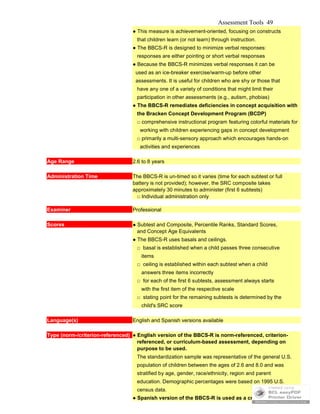
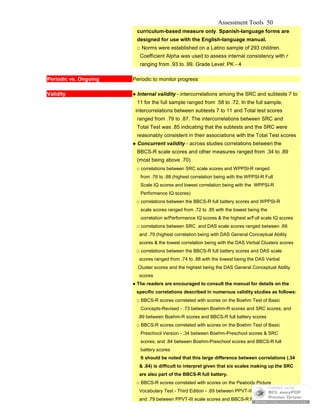
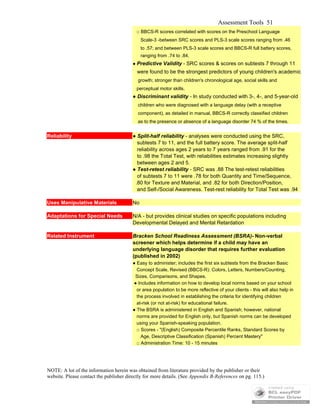
Bracken Basic Concept Scale -Revised (BBCS-R) …………………………………………………………………………...… 48
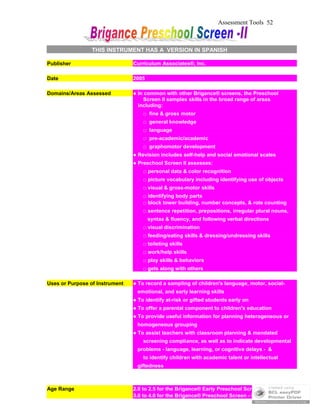
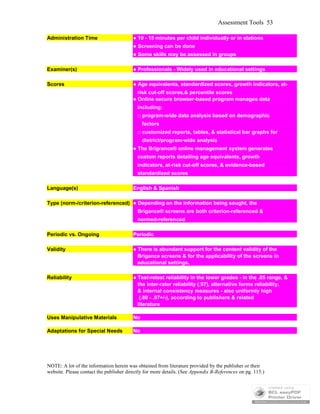
Brigance® Preschool Screen I ……………………………………………………………………………………………………….52
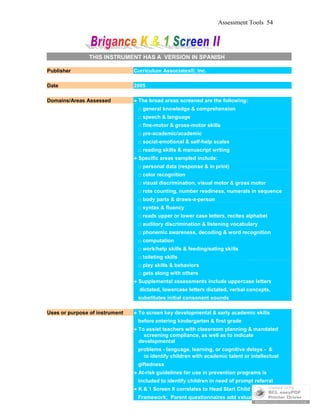
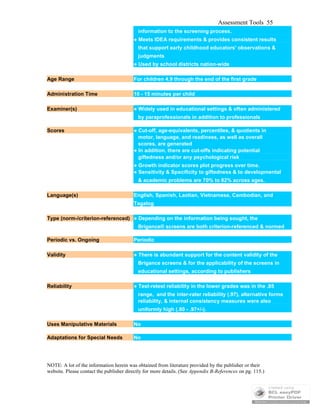
Brigance K & 1 Screen II …………………………………………………………………………………………………………......54
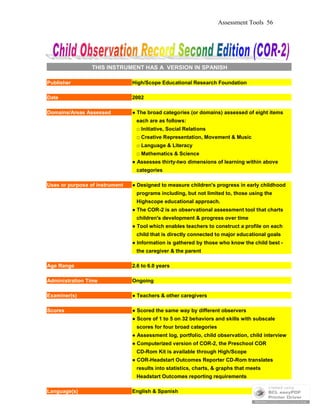
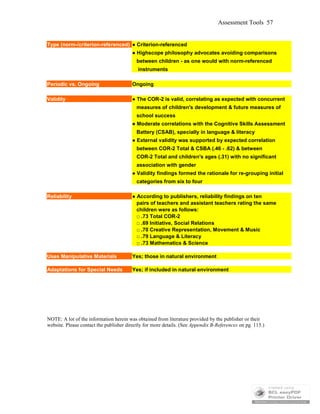
Child Observation Record Second Edition (COR-2) ………………………………………………………………………………56
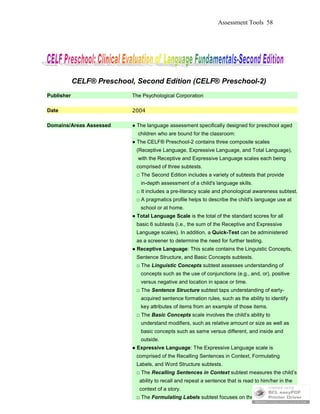
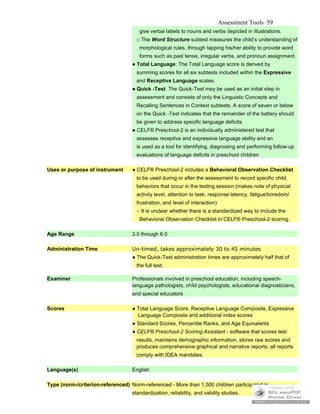
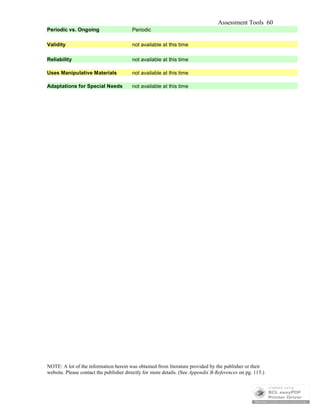
CELF® Preschool, Second Edition (CELF® Preschool-2) ……………………………………………………………………….58
Creative Curriculum® Developmental Continuum Assessment …………………………………………………………………61
Denver Developmental Screening Test II (DDST-R) ……………………………………………………………………………..62
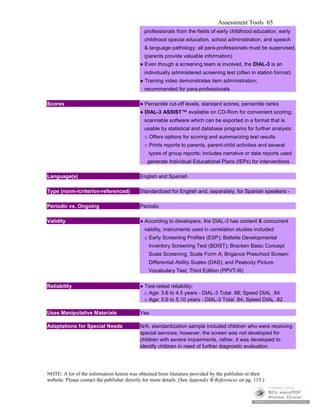
Developmental Indicators for the Assessment of Learning Third Edition (DIAL-3) ………………………………………….....64
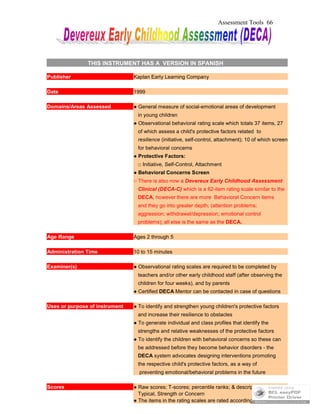
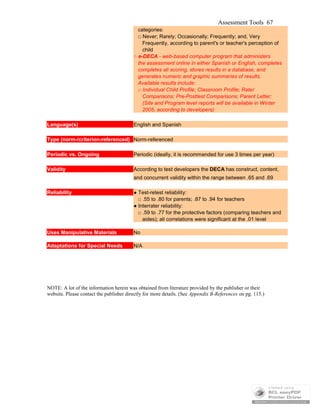
Devereux Early Childhood Assessment (DECA) ………………………………………………………………………………….66
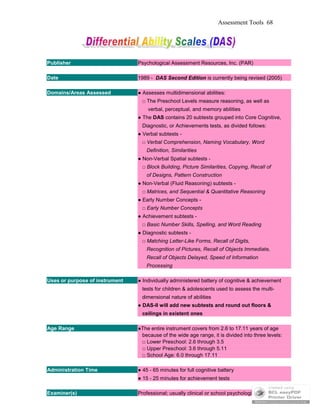
Differential Ability Scales (DAS) …………………………………………………………………………………………………….68
Early Learning Accomplishment Profile (E-LAP) …………………………………………………………………………………..70
Early Screening Inventory Kindergarten (ESI-K) ………………………………………………………………………................72
Early Screening Inventory Preschool (ESI-P) ……………………………………………………………………………………. 74
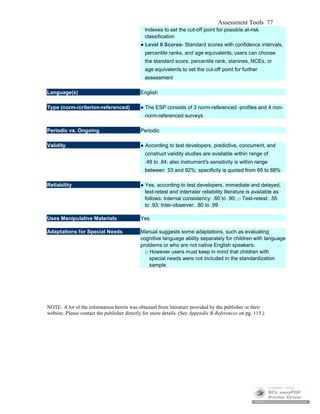
Early Screening Profile (ESP) …………………………………………………………………………………………………….. 76
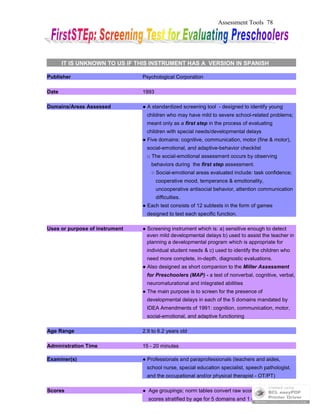
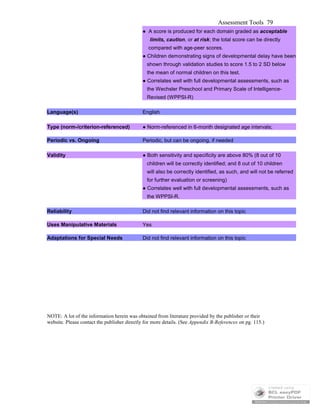
FirstSTEp: Screening Test for Evaluating Preschoolers ……………………………………………………………………….. 78
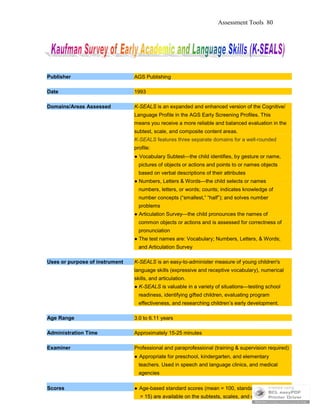
Kaufman Survey of Early Academic and Language Skills (K-SEALS) ……………………………………………………….. 80
Learning Accomplishment Profile-Diagnostic Third Edition (LAP-D) ………………………………………………………….. 83
Learning Accomplishment Profile Screens (3 yr-old, 4 yr-old, 5 yr-old) ………………………………………………………. 85
Learning Accomplishment Profile Third Edition (LAP 3) - formerly LAP-R ………………………………………………….....87
Miller Assessments for Preschoolers (MAP) …………………………………………………………………………………….. 89
NEPSY® …………………………………………………………………………………………………………………………….…90
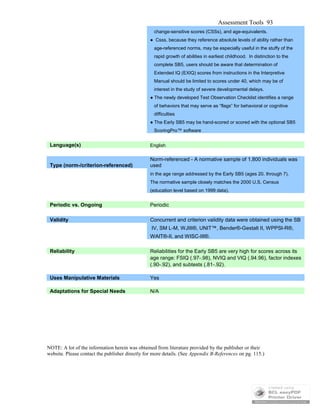
Stanford-Binet Intelligence Scales for Early Childhood (Early SB5) ………………………………………………………….. 92
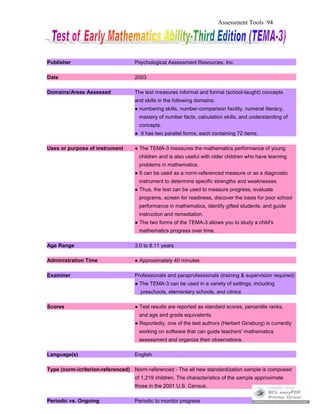
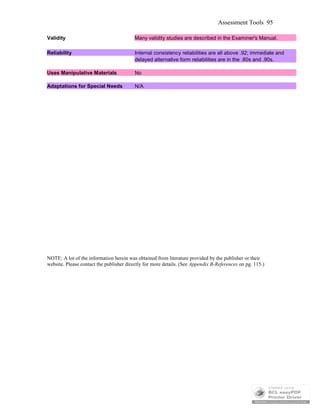
Test of Mathematics Ability - Third Edition (TEMA-3) …………………………………………………………………………… 94
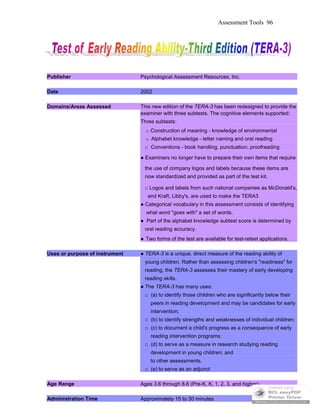
Test of Early Reading Ability - Third Edition (TERA-3) …………………………………………………………………………. 96
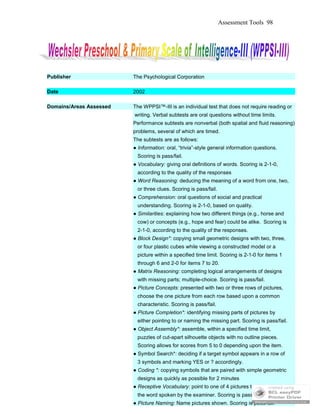
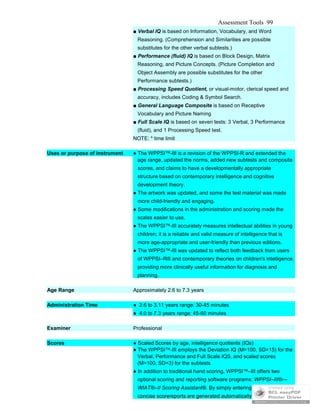
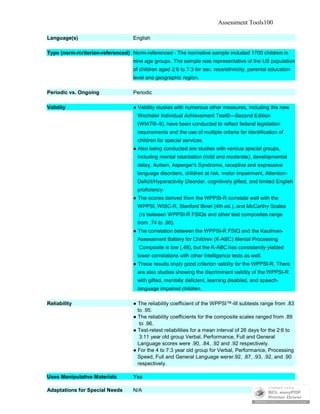
Wechsler Preschool & Primary Scale of Intelligence - Third Edition (WPPSI™-III) …………………………………………. 98
Woodcock-Johnson® III (WJ-III) Tests of Achievement ……………………………………………………………………… 101
Woodcock-Johnson® III (WJ-III) Tests of Cognitive Abilities ………………………………………………………….............104
Woodcock-Muñoz Language Survey-Revised (WMLS-R) …………………………………………………………………… 107
Work Sampling System 4th Edition (WSS-4) …………………………………………………………………………………….110
Appendix A – Coding Scheme Used in Tables ……………………………………………………………………………………….. 113
Appendix B – References ……………………………………………………………………………………………………………….. 115
Assessment Tools 4
Early Childhood Assessment Program
On behalf of the Early Learning Coalition of Miami-Dade/Monroe (ELCMDM) Counties
and, as part of the planning for the 2007 Assessment Task Force being sponsored by ELCMDM,
the Early Childhood Assessment Program (AP) located at Florida International University (FIU),
University Campus, researched numerous assessments instruments which were developed for
preschool children. The attached document entitled Early Childhood Tools evidences the results
of this research.
Due to the comprehensiveness of said results, the list of possible instruments to be
reviewed by the Assessment Task Force was narrowed down according to specific criteria, and
the instruments were rated based on a categorical matrix system. The assessment tools were
either accepted or eliminated for inclusion in the final list of possible candidates of tools to be
reviewed by the Assessment Task Force. (The AP staff’s expertise is in School Psychology,
specializing in Early Childhood Assessments, thus they are fully qualified to make the original
selection on behalf of ELCMDM.)
Only thirteen (13) instruments from the original list met the final criteria from the matrix.
Each criterion was used for these purposes as follows:
I. Language
Approximately twenty-five (25) instruments from the original list which had some type
of Spanish version; of these thirty (30), only thirteen (13) instruments also met additional
criteria. Thus, having a Spanish version became the first criteria when rating the instruments.
Language is of utmost importance in selecting instruments to appropriately serve the Miami-
Dade County population where many children are second-language learners (e.g., Spanish being
the dominant language).
II. Psychometrics
Norm-referenced instruments with good psychometric properties were preferred (e.g.,
those with concurrent validity, predictive validity, internal consistency reliability, and test-retest
reliability correlations of, at least, above .70, preferably in the .80’s and .90’s.). Criterion-
referenced instruments were expected to have lower psychometric properties, but preferential
treatment was given to those that approached the .70 cut-off point. However, it is important to
remember that with authentic-based assessments such as portfolios and teacher-rating scales, the
cut-off scores in the field can be as low as .45 and still prove to be effective tools.
III. Translated/Adaptations
This criteria pertained to whether the Spanish version of the instrument was a literal
translation from the English language (e.g., not desirable) or a true adaptation (e.g., desirable)
where ideas and basic concepts are expressed in native patterns and colloquialisms.
Assessment Tools 5
Unfortunately, few of the instruments either a) were adaptations from English into Spanish or b)
had information on whether they were translated or adapted into Spanish from English.
IV. Spanish-Speaking Norms
This category has to do with whether, or not, the normative data was gathered from a
Spanish-speaking population. For the purposes of making a determination on the selection of
instruments, preferential treatment (or weigh) was given to the Spanish version of instruments
which were standardized on this type of sample of children. Unfortunately, only three (3)
instruments met these criteria.
V. Reporting System (Friendly Recommendations)
The fifth category of the matrix was tools with parent/teacher-friendly reporting systems.
This category was critical because sometimes instruments which are child-friendly fail to provide
usefulness to the parent or teacher. Given a) the young age of our preschool population and b)
the current trend to work with the child before any referral can be made, the instruments with
useful reporting systems were preferred over others.
VI. Date Published
The cut-off date of publication was 1990. Instruments that were developed before this
time, though perhaps reviewed, were not even considered for the original list. The more recent
instruments were preferred because since their norming samples were more current, they were
generally more representative of the populations being tested today.
VII. Examiner Characteristics
This criterion was based on the examiner minimum qualifications as prescribed by the
test publishers. The final eleven (11) instruments had examiner qualifications which ranged from
that of a broad continuum (e.g., professional to paraprofessional) to being very narrow and
specific in focus (e.g., licensed school psychologists only). There was no predetermined
preference; the decision depended on the instrument.
VIII. Administration
This category had a specific cut-off point; specifically, +/-thirty minutes. Assessments
with administration times less than thirty minutes - most of which were screeners - were given
favorable ratings in the matrix; those with times over the thirty minutes were not given favorable
ratings, unless the other criteria could justify doing so. Keeping this in mind, few tools with
administration times over thirty minutes were able to meet criteria. The rationale for establishing
this low cut-off point was to meet the intentions of the ELCMDM for 2007; in other words, to
reduce the assessment time in order to increase the time in which to implement interventions.
Assessment Tools 6
IX. Purpose
This criteria was the most complicated to score. Principles and recommendations of the
National Educational Goals Panel (NEGP) were used to operationalize the purposes of
assessments - according to NEGP there are four: a) to support learning – P1, b) to screen for
and/or identify special needs – P2, c) to meet program evaluation/monitoring objectives – P3, d)
for high stakes accountability – P4. The original list was reviewed and scored in the matrix and
the respective sub-grouping was chosen in the case of each instrument – P1, P2, P3, or P4. There
was no predetermined preference; the decision depended on the instrument. However, the NEGP
is clear about the risks of combining assessment purposes. The AP staff followed these
recommendations when making final selection.
X. Software
This last criteria pertained to whether, or not, the tool had some type of computer
program available, and if so, the extent to which the program would assist users (e.g., 1- just to
enter data; 2- enter data & simple reporting system; 3- enter data, palm pilot program, plus all
types of reports, including program evaluation, etc.). The instruments which had useful, better
software were preferred, however, no tool was disqualified for poor or lack of software (e.g., this
is a variable that can always be added or improved).
XI. Other Considerations
A. Type: Formal/ Informal
This criteria was relevant to the extent that it is a dichotomous variable (e.g., categorizing
the tool into an either/or sub-grouping). One sub-grouping is that of the formal assessments; the
norm-referenced tools fall in this category. The other sub-grouping is that of the informal
assessments; the criterion-referenced tools fall in this category. There was no predetermined
preference; the decision depended on the instrument.
B. Type: Domains-Multi/ Single
This, too, is a dichotomous variable which categorizes tools according to the number of
domains – whether multiple (e.g., assesses a number of different concepts/content areas) or
single (e.g., assesses just one concept/content area). There was no predetermined preference; the
decision depended on the instrument.
XII. Summaries of Selected Instruments
The following tables summarize the relevant information on each of the thirteen (13) final
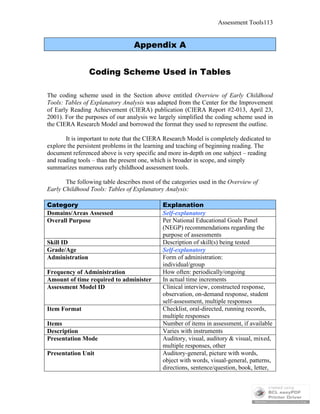
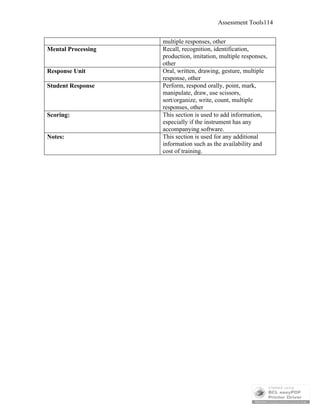
instruments chosen by the AP staff for the 2007 Assessment Task Force to review. Appendix A
explains the coding scheme used in tables.
Assessment Tools 7
Overview of Early Childhood Tools: Tables of Explanatory Analyses
Assessment Title/Year Published Author Publisher Price per Unit
Ages & Stages Questionnaires: Second Edition (ASQ-II) - 1999 Diane Bricker, & Jane
Squires, with assistance
from Linda Mounts,
LaWanda Potter, Robert
Nickel, Elizabeth
Twombly, et al
Brookes Publishing Co.
Contact:
By telephone, toll-free: 1-800-638-
3775
By FAX: 1-410-337-8539
By e-mail:
custserv@brookespublishing.com
 User’s Guide &
(photocopiable)
Questionnaires -
$125.00
 CD-ROM & User’s
Guide - $125.00
English and Spanish
versions are sold
separately
Domains/Areas Assessed Overall Purpose
Multiple: Communication, gross motor, fine motor, problem solving, and
personal-social (ea. domain is called a “questionnaire”)
P2 – Identification of special needs
Skill ID Grade/Age Administration Frequency of
Administration
Amount of time
required to
administer
Assessment Model ID
Multiple developmental
skills
6–60 months Parent questionnaire Ongoing (used for
monitoring purposes)
10 to 15 minutes Self-report (parental)
Item Format Items Description Presentation Mode Presentation Unit
Parent self-report 30-item Parents observe their child and complete simple
questionnaires about their child's abilities (some
activities prescribed)
Visual Questionnaire
Mental Processing Response Unit Student Response
Evaluation and decision-making (parental)  Parents check the appropriate box
 Parents circle the appropriate item
none
Scoring:
Scoring by professionals –
Parental responses of most of the time, sometimes, and rarely/never are converted
to 10, 5, and 0. A high total score = problems; a low total score = that the child is
considered to be competent (by parent completing questionnaires).
Notes:
Brookes Publishing offer ASQ Train-the-Trainer* programs with the test developers (or
associate) at the following approximate costs: 1 day: $2200–$3575; 2 days: $4400–$4675
*These fees are based on groups of 20 participants. For larger or smaller groups, the fees will
vary.
Assessment Tools 8
Assessment Title/Year Published Author Publisher Price per Unit
Ages & Stages Questionnaires: Social Emotional (ASQ-SE) - 2002 Jane Squires, Diane
Bricker, & Elizabeth
Twombly, with assistance
from Suzanne Yockelson,
Maura Schoen Davis, &
Younghee Kim
Brookes Publishing Co.
Contact:
By telephone, toll-free: 1-800-638-
3775
By FAX: 1-410-337-8539
By e-mail:
custserv@brookespublishing.com
 User’s Guide &
(photocopiable)
Questionnaires -
$199
 CD-ROM & User’s
Guide - $199.00
English and Spanish
versions are sold
separately
Domains/Areas Assessed Overall Purpose
Single: Personal-social (self-regulation, compliance, communication, adaptive
functioning, autonomy, affect, and interaction with people)
P2 – Identification of special needs
Skill ID Grade/Age Administration Frequency of
Administration
Amount of time
required to
administer
Assessment Model ID
Social-emotional 6–60 months Parent questionnaire Ongoing (used for
monitoring purposes)
10 to 15 minutes Self-report (parental)
Item Format Items Description Presentation Mode Presentation Unit
Parent self-report 32-item Parents are asked to respond to questions about their
child’s social-emotional behaviors.
Visual Questionnaire
Mental Processing Response Unit Student Response
Evaluation and decision-making (parental)  Parents check the appropriate box
 Parents circle the appropriate item
none
Scoring:
Scoring by professionals –
Parental responses of most of the time, sometimes, and rarely/never are converted
to 10, 5, and 0. A high total score = problems; a low total score = that the child is
considered to be competent by the parent completing the questionnaire.
Notes:
Brookes Publishing offer ASQ: SE Train-the-Trainer* programs at the following approximate
costs: 1 day: $1200–$1950
2 days: $1950–$2475
*These fees are based on groups of 20 participants. For larger or smaller groups, the fees will
vary.
Assessment Tools 9
Assessment Title/Year Published Author Publisher Price per Unit
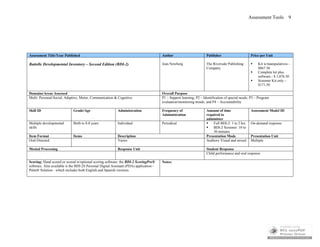
Battelle Developmental Inventory – Second Edition (BDI-2) Jean Newborg The Riverside Publishing
Company
 Kit w/manipulatives -
$867.50
 Complete kit plus
software - $ 1,076.50
 Screener Kit only –
$171.50
Domains/Areas Assessed Overall Purpose
Multi: Personal-Social, Adaptive, Motor, Communication & Cognitive P1 – Support learning; P2 – Identification of special needs; P3 – Program
evaluation/monitoring trends; and P4 – Accountability
Skill ID Grade/Age Administration Frequency of
Administration
Amount of time
required to
administer
Assessment Model ID
Multiple developmental
skills
Birth to 8.0 years Individual Periodical  Full BDI-2: 1 to 2 hrs.
 BDI-2 Screener: 10 to
30 minutes
On-demand response
Item Format Items Description Presentation Mode Presentation Unit
Oral-Directed Varies Auditory Visual and mixed Multiple
Mental Processing Response Unit Student Response
Child performance and oral response
Scoring: Hand scored or scored w/optional scoring software: the BDI-2 ScoringPro®
software. Also available is the BDI-2S Personal Digital Assistant (PDA) application -
Palm® Solution - which includes both English and Spanish versions.
Notes:
Assessment Tools 10
Assessment Title/Year Published Author Publisher Price per Unit
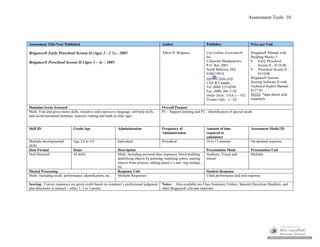
Brigance® Early Preschool Screen II (Ages 2 - 2 ½) - 2005
Brigance® Preschool Screen II (Ages 3 – 4) – 2005
Albert H. Brigance Curriculum Associates®,
Inc.
Corporate Headquarters
P.O. Box 2001
North Billerica, MA
01862-9914
info CAinc.com
USA & Canada:
Tel. (800) 225-0248
Fax (800) 366-1158
Order Desk: USA x – 432
Product Info: x - 62
Brigance® Manual with
Building Blocks *
 Early Preschool
Screen II - $110.00
 Preschool Screen II -
$110.00
Brigance® Screens
Scoring Software II with
Technical Report Manual -
$117.95
NOTE: *data sheets sold
separately
Domains/Areas Assessed Overall Purpose
Multi: Fine and gross motor skills, receptive and expressive language, self-help skills,
and social-emotional domains; assesses reading and math at older ages
P1 – Support learning and P2 – Identification of special needs
Skill ID Grade/Age Administration Frequency of
Administration
Amount of time
required to
administer
Assessment Model ID
Multiple developmental
skills
Age 2.0 to 4.0 Individual Periodical 10 to 15 minutes On-demand response
Item Format Items Description Presentation Mode Presentation Unit
Oral-Directed 44 skills Multi: Including personal data responses, block building,
identifying objects by pointing, matching colors, naming
objects from pictures, adding plural s’s and –ing endings,
etc.
Auditory, Visual and
mixed
Multiple
Mental Processing Response Unit Student Response
Multi: Including recall, performance, identification, etc. Multiple Responses Child performance and oral response
Scoring: Correct responses are given credit based on examiner’s professional judgment
plus directions in manual – either 1, 2 or 3 points.
Notes: Also available are Class Summary Folders, Spanish Directions Booklets, and
other Brigance® relevant materials
Assessment Tools 11
Assessment Title/Year Published Author Publisher Price per Unit
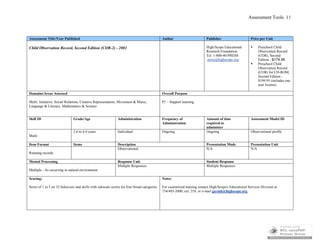
Child Observation Record, Second Edition (COR-2) - 2002 High/Scope Educational
Research Foundation
Tel. 1-800-40-PRESS
press@highscope.org
 Preschool Child
Observation Record
(COR), Second
Edition - $174.95
 Preschool Child
Observation Record
(COR) for CD-ROM,
Second Edition -
$199.95 (includes one
user license)
Domains/Areas Assessed Overall Purpose
Multi: Initiative, Social Relations, Creative Representation, Movement & Music,
Language & Literacy, Mathematics & Science
P1 – Support learning
Skill ID Grade/Age Administration Frequency of
Administration
Amount of time
required to
administer
Assessment Model ID
Multi
2.6 to 6.0 years Individual Ongoing Ongoing Observational profile
Item Format Items Description Presentation Mode Presentation Unit
Running records
Observational N/A N/A
Mental Processing Response Unit Student Response
Multiple - As occurring in natural environment
Multiple Responses Multiple Responses
Scoring:
Score of 1 to 5 on 32 behaviors and skills with subscale scores for four broad categories
Notes:
For customized training contact High/Scope's Educational Services Division at
734/485-2000, ext. 218, or e-mail gavinh@highscope.org
Assessment Tools 12
Assessment Title/Year Published Author Publisher Price per Unit
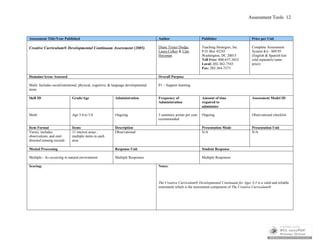
Creative Curriculum® Developmental Continuum Assessment (2005) Diane Trister Dodge,
Laura Colker & Cate
Heroman
Teaching Strategies, Inc.
P.O. Box 42243
Washington, DC 20015
Toll Free: 800-637-3652
Local: 202-362-7543
Fax: 202-364-7273
Complete Assessment
System Kit - $89.95
(English & Spanish kits
sold separately/same
price)
Domains/Areas Assessed Overall Purpose
Multi: Includes social/emotional, physical, cognitive, & language developmental
areas
P1 – Support learning
Skill ID Grade/Age Administration Frequency of
Administration
Amount of time
required to
administer
Assessment Model ID
Multi Age 3.0 to 5.0 Ongoing 3 summary points per year
recommended
Ongoing Observational checklist
Item Format Items Description Presentation Mode Presentation Unit
Varies, includes
observations, and oral-
directed running records
11 interest areas ;
multiple items in each
area
Observational N/A N/A
Mental Processing Response Unit Student Response
Multiple - As occurring in natural environment Multiple Responses Multiple Responses
Scoring: Notes:
The Creative Curriculum® Developmental Continuum for Ages 3-5 is a valid and reliable
instrument which is the assessment component of The Creative Curriculum®
Assessment Tools 13
Assessment Title/Year Published Author Publisher Price per Unit
Developmental Indicators for the Assessment of Learning-Third
Edition(DIAL-3), 1998
Carol Mardell-
Czudnowski & Dorothea
S. Goldenberg
AGS Publishing
4201 Woodland Road
Circle Pines, MN 55014-1796
phone 800.328.2560 /
651.287.7220
fax 800.471.8457 /
651.287.7223
customerservice@agsnet.com
 Complete kit, inc.
Speed DIAL
(Eng./Spa.) –
$469.99
 Complete kit with
ASSIST - $569.99
Domains/Areas Assessed Overall Purpose
Domains - Physical, Cognitive, Communication, Social or Emotional, and Adaptive.
Subtests - Motor - gross & fine motor development; Concepts – knowledge of basic
concepts such as counting and colors; Language – receptive & expressive language;
Self-Help Development – daily living skills in such areas as eating, drinking, &
dressing, and; Social Development – skills in relating to others.
(P2) - Developmental screening.
DIAL-3 is an individually administered screening test designed to identify young children
in need of further diagnostic assessment.
Skill ID Grade/Age Administration Frequency of
Administration
Amount of time
required to
administer
Assessment Model ID
Multi Age 3.0 - 6.11 Individual Periodic 20 -30 minutes; Speed DIAL
(condensed version): 15 - 20
minutes
Multiple: On-demand
response from child;
observational record;
parent questionnaire
Item Format Items Description Presentation Mode Presentation Unit
Each item assesses unique
behaviors. Some items
consist of only one task
(for example, catching),
while other items include
more than one task (for
example, jumping,
hopping, and skipping).
Gross Motor items include catching, jumping,
hopping, & skipping; Fine Motor items include
building with blocks, cutting, copying shapes and
letters, and writing, and a finger-touching task;
Language items include answering simple personal
questions, articulation, naming, or identifying objects
and actions, plus phonemic awareness tasks; Concept
items include pointing to named body parts, naming or
identifying colors, rote counting, counting blocks &
sorting shapes.
Multiple Varies
Mental Processing Response Unit Student Response
Multi: Including recall, performance, identification, etc. Multiple Responses Depending on task, child's response could be oral/motor.
Scoring: By hand or computer. Computerized scoring: ASSIST scoring software inc.
optional report to parents, parent-child activities, and group reporting capabilities.
Notes: Training options available. Optional 45-minute video is available in both
languages to enhance training through visual examples of the screening situation and item
administration.
Assessment Tools 14
Assessment Title/Year Published Author Publisher Price per Unit
DECA Program, 1999 Paul A. Le Buffe & Jack
A. Naglieri
Kaplan Early Learning
Company
Tel.: 1-800-334-2014 or
336-766-7374
Fax: 1-800-7526
DECA Kit - $199.95
DECA rating form –
approx. $1.00 ea.
Domains/Areas Assessed Overall Purpose
Protective Factors – Initiative, Attachment, Self-Control
Behavioral Concerns
(P2) Standardized assessment for protective factors; screener for behavior concerns
Skill ID Grade/Age Administration Frequency of
Administration
Amount of time
required to
administer
Assessment Model ID
Social-emotional Ages 2 through 5 Individual (parent &
teacher)
Periodic – 3 times p/year 10-15 minutes Observational record
Item Format Items Description Presentation Mode Presentation Unit
Questions to be rated (see
scoring below)
37 Ea. item answers: “During the past 4 weeks, how often
did the child...”
Visual Rating
Mental Processing Response Unit Student Response
Evaluation and decision-making (by parent & teacher,
not child)
checkmark none
Scoring:
Items are scored according to following Likert scale: Never (O); Rarely (1);
Occasionally (2); Frequently (3); and Very Frequently (4)
Notes:
Contact Kaplan directly. A trainer can be contracted starting at approx. $1,200 +
expenses per day/per trainer/Professional Development * (*Does not apply to Creative
Curriculum Approach training).
Keynote Address (if applicable) $3,000 + expenses
Training fees are based on a maximum number of 35 participants
Expenses include airfare or mileage, lodging, meals and training materials.
Assessment Tools 15
Assessment Title/Year Published Author Publisher Price per Unit
Early Screening Inventory-Preschool (ESI-P), 1997
NOTE: ESI-R is a continuous protocol screener for children age 3 to 6 years old. ESI-
P is for age 3 to 4 ½ while ESI-K is for children age 4 ½ to 6 years old.
Samuel J. Meisels, Martha
Stone Wiske, and Laura
W. Henderson
Pearson Early Learning
Group
1185 Avenue of the
Americas, 17th Floor
New York, NY 10036
Tel.: 1.800.321.3106
Fax: 1.800.393.3156
ESI-P Kit, English version
(Age 3-4 ½) - $118.50
ESI-P Kit, Spanish version
(Age 3-4 ½) - $118.50
Domains/Areas Assessed Overall Purpose
Developmental areas addressed: Score Sheet: Visual Motor/Adaptive, Language, and
Cognition; (Social/Emotional is covered in the comments) Parent Questionnaire: Self-
help skills
(P2) - It identifies young children at risk for school failure — accurately, quickly, and
cost effectively. Extensive research has shown the ESI-R to be both reliable and valid
Skill ID Grade/Age Administration Frequency of
Administration
Amount of time
required to
administer
Assessment Model ID
Multi Age 3 to 4 ½ Individual administered in
home or center
Periodic 15 to 20 minutes Multiple: On-demand
response from child and
observational
Item Format Items Description Presentation Mode Presentation Unit
Each item assesses unique
behaviors. Some items
consist of only one task
while others items include
more than one task along a
continuum of development
Some examples include: block building from imitation
or from model, and cutting, copying shapes; catching,
jumping, & skipping;
Multiple Varies
Mental Processing Response Unit Student Response
Multi: Including recall, performance, identification, etc. Multiple types of responses depending on tasks and
processing involved
Depending on task, child's response could be oral/motor
Scoring: By hand or computer.
Yields three scores: Refer, Re-screen and OK. - interpreted differently, depending on
age group. For each item, the child receives from 0-3 points.
Computerized scoring: ESI-Online (both ESI-P & ESI-K) scoring software includes
downloadable user guides, data entry & automated scoring, printable score-sheets
(Eng./Spa.) & parent questionnaires, class reports, report to parents, and tutorials.
 Licensed annually at a cost of $2.95 p/child. Technical support available from
8:00 a.m. to 8:00 p.m. EST, Mon. – Fri. For information on online products
(including registration) call Leah Theodorou at 1.888.832.9378, ext. 1775.
Notes: Training videos demonstrating procedures and administration are sold
separately; this is a recommended resource for every user.
On-site training is available for a fee, plus expenses; to be able to negotiate better price
and terms for training, (maybe a discount if included with the entire package), call
company with the actual number of participants.
For information on professional development and general product questions, call Dana
Schmidek at 1.888.832.9378, ext. 1763.
Assessment Tools 16
Assessment Title/Year Published Author Publisher Price per Unit
Learning Accomplishment Profile-Diagnostic Edition, III (LAP-D), 2005 Nehring, Aubrey D.;
Nehring, Ema F.; Bruni,
John R., Jr.; Randolph,
Patricia L.; Kaplan Press;
Sanford, Anne R.; Zelman,
Janet G.; Glover, M.
Elayne; Preminger, Jodi L.
Kaplan Early Learning
Company
1-800-334-2014 (Mon. –
Fri., 8:00 - 6:00 p.m., EST)
mailto:info@kaplanco.com
LAP-DIII Kit - $799.95
Domains/Areas Assessed Overall Purpose
Four developmental areas: fine motor, gross motor, cognition, and language. Each area
is contains two subscales. Language Naming & Language Comprehension; Fine Motor
Manipulation & Fine Motor Writing; Gross Motor Body Movement & Gross Motor
Object Movement, and; Cognitive Matching & Cognitive Counting
(P1) & (P2) Results from the LAP-D can be used for developing IEP's and for
classroom planning. Personal/Social and Self-Help Checklists are included, along with
LAP-D Pupil/Teacher/Parent Planning Cards
Skill ID Grade/Age Administration Frequency of
Administration
Amount of time
required to
administer
Assessment Model ID
Multi 30-60 months individual Periodic Approx. 1 ½ hours
(although this estimate
does not take into account
incidentals such as time to
establish rapport with the
child, bathroom breaks,
rest periods, etc.)
On-demand response,
some items timed
Item Format Items Description Presentation Mode Presentation Unit
Each item assesses unique
behavior
Total 226 items but each
subscale varies in # of
items.
Multi: including block building, from model or by
imitation, identifying objects by pointing, matching
colors, naming objects from pictures, to jumping,
hopping, and skipping.
Auditory, Visual and
mixed
Varies depending on item
Mental Processing Response Unit Student Response
Multi: Including recall, performance, identification, etc Multiple types of responses depending on tasks and
processing involved
Child performance and oral response
Scoring: By hand, computer or palm pilot.
The child reaches ceiling w/3 errors out of 5 consecutive items administered
Notes:
Contact Kaplan directly for training.
Assessment Tools 17
Assessment Title/Year Published Author Publisher Price per Unit
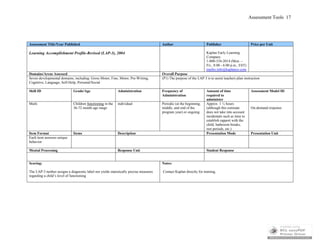
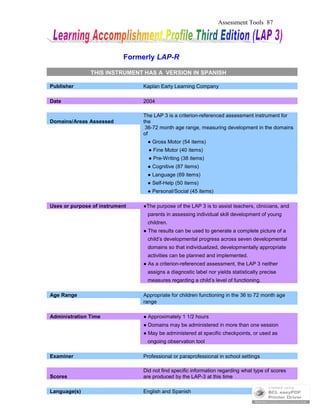
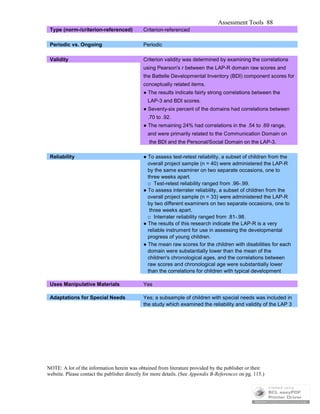
Learning Accomplishment Profile-Revised (LAP-3), 2004 Kaplan Early Learning
Company
1-800-334-2014 (Mon. –
Fri., 8:00 - 6:00 p.m., EST)
mailto:info@kaplanco.com
Domains/Areas Assessed Overall Purpose
Seven developmental domains, including: Gross Motor, Fine, Motor, Pre-Writing,
Cognitive, Language, Self-Help, Personal/Social
(P1) The purpose of the LAP 3 is to assist teachers plan instruction
Skill ID Grade/Age Administration Frequency of
Administration
Amount of time
required to
administer
Assessment Model ID
Multi Children functioning in the
36-72 month age range
individual Periodic (at the beginning,
middle, and end of the
program year) or ongoing
Approx. 1 ½ hours
(although this estimate
does not take into account
incidentals such as time to
establish rapport with the
child, bathroom breaks,
rest periods, etc.)
On-demand response
Item Format Items Description Presentation Mode Presentation Unit
Each item assesses unique
behavior
Mental Processing Response Unit Student Response
Scoring:
The LAP-3 neither assigns a diagnostic label nor yields statistically precise measures
regarding a child’s level of functioning
Notes:
Contact Kaplan directly for training.
Assessment Tools 18
Assessment Title/Year Published Author Publisher Price per Unit
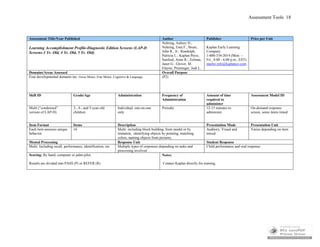
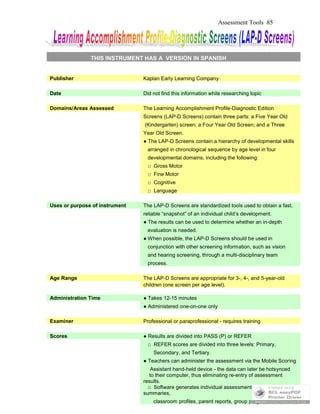
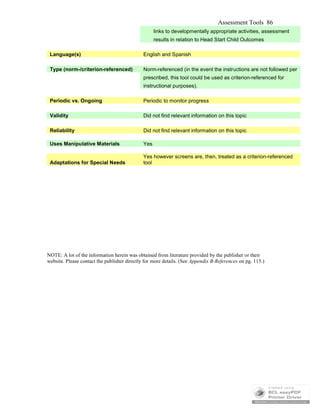
Learning Accomplishment Profile-Diagnostic Edition Screens (LAP-D
Screens-3 Yr. Old, 4 Yr. Old, 5 Yr. Old)
Nehring, Aubrey D.;
Nehring, Ema F.; Bruni,
John R., Jr.; Randolph,
Patricia L.; Kaplan Press;
Sanford, Anne R.; Zelman,
Janet G.; Glover, M.
Elayne; Preminger, Jodi L.
Kaplan Early Learning
Company
1-800-334-2014 (Mon. –
Fri., 8:00 - 6:00 p.m., EST)
mailto:info@kaplanco.com
Domains/Areas Assessed Overall Purpose
Four developmental domains inc. Gross Motor, Fine Motor, Cognitive & Language (P2)
Skill ID Grade/Age Administration Frequency of
Administration
Amount of time
required to
administer
Assessment Model ID
Multi (“condensed”
version of LAP-D)
3-, 4-, and 5-year-old
children
Individual, one-on-one
only
Periodic 12-15 minutes to
administer
On-demand response
screen, some items timed
Item Format Items Description Presentation Mode Presentation Unit
Each item assesses unique
behavior
16 Multi: including block building, from model or by
imitation, identifying objects by pointing, matching
colors, naming objects from pictures,
Auditory, Visual and
mixed
Varies depending on item
Mental Processing Response Unit Student Response
Multi: Including recall, performance, identification, etc Multiple types of responses depending on tasks and
processing involved
Child performance and oral response
Scoring: By hand, computer or palm pilot.
Results are divided into PASS (P) or REFER (R)
Notes:
Contact Kaplan directly for training.
Assessment Tools 19
Assessment Title/Year Published Author Publisher Price per Unit
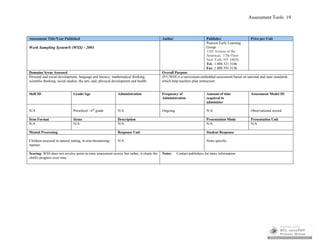
Work Sampling System® (WSS) - 2001
Pearson Early Learning
Group
1185 Avenue of the
Americas, 17th Floor
New York, NY 10036
Tel.: 1.800.321.3106
Fax: 1.800.393.3156
Domains/Areas Assessed Overall Purpose
Personal and social development; language and literacy; mathematical thinking;
scientific thinking; social studies; the arts, and; physical development and health
(P1) WSS is a curriculum-embedded assessment based on national and state standards
which help teachers plan instruction.
Skill ID Grade/Age Administration Frequency of
Administration
Amount of time
required to
administer
Assessment Model ID
N/A Preschool - 6th
grade N/A Ongoing N/A Observational record
Item Format Items Description Presentation Mode Presentation Unit
N/A N/A N/A N/A N/A
Mental Processing Response Unit Student Response
Children assessed in natural setting, in non-threatening-
manner.
N/A None specific
Scoring: WSS does not involve point-in-time assessment scores, but rather, it charts the
child's progress over time.
Notes: Contact publishers for more information
Assessment Tools 20
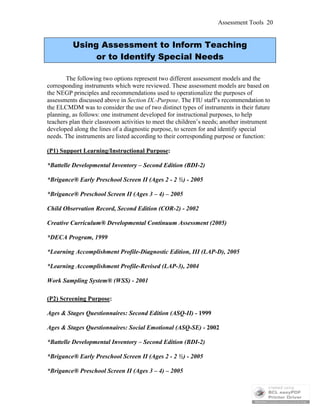
Using Assessment to Inform Teaching
or to Identify Special Needs
The following two options represent two different assessment models and the
corresponding instruments which were reviewed. These assessment models are based on
the NEGP principles and recommendations used to operationalize the purposes of
assessments discussed above in Section IX.-Purpose. The FIU staff’s recommendation to
the ELCMDM was to consider the use of two distinct types of instruments in their future
planning, as follows: one instrument developed for instructional purposes, to help
teachers plan their classroom activities to meet the children’s needs; another instrument
developed along the lines of a diagnostic purpose, to screen for and identify special
needs. The instruments are listed according to their corresponding purpose or function:
(P1) Support Learning/Instructional Purpose:
*Battelle Developmental Inventory – Second Edition (BDI-2)
*Brigance® Early Preschool Screen II (Ages 2 - 2 ½) - 2005
*Brigance® Preschool Screen II (Ages 3 – 4) – 2005
Child Observation Record, Second Edition (COR-2) - 2002
Creative Curriculum® Developmental Continuum Assessment (2005)
*DECA Program, 1999
*Learning Accomplishment Profile-Diagnostic Edition, III (LAP-D), 2005
*Learning Accomplishment Profile-Revised (LAP-3), 2004
Work Sampling System® (WSS) - 2001
(P2) Screening Purpose:
Ages & Stages Questionnaires: Second Edition (ASQ-II) - 1999
Ages & Stages Questionnaires: Social Emotional (ASQ-SE) - 2002
*Battelle Developmental Inventory – Second Edition (BDI-2)
*Brigance® Early Preschool Screen II (Ages 2 - 2 ½) - 2005
*Brigance® Preschool Screen II (Ages 3 – 4) – 2005
Assessment Tools 21
Developmental Indicators for the Assessment of Learning-Third Edition(DIAL-3),
1998
*DECA Program, 1999
Early Screening Inventory-Preschool (ESI-P), 1997
*Learning Accomplishment Profile-Diagnostic Edition, III (LAP-D), 2005
*Learning Accomplishment Profile-Diagnostic Edition Screens (LAP-D Screens-3 Yr.
Old, 4 Yr. Old, 5 Yr. Old)
NOTE: *Instruments with more than one purpose.
Assessment Tools 22
Spanish Versions of Instruments Reviewed
Achenbach System of Empirically Based Assessment (ASEBA®)
● Only Child Behavior Checklist (CBC) has a version in Spanish
Ages and Stages Questionnaires-2ndSecond Edition (ASQ-II)
Ages and Stages Questionnaires: Social Emotional (ASQ-SE)
Bateria III Woodcock-Muñoz™
● Spanish adaptation/translation of WJ® III
Battelle Developmental Inventory 2nd Edition (BDI-2)
● Battelle Developmental Inventory-Spanish (BDI-2 Spanish)
Behavior Assessment System for Children - Second Edition (BASC-2)
Bilingual Verval Ability Tests - Normative Update (BVAT-NU)
Bracken Basic Concept Scale: Expressive (BBCS:E)
Bracken Basic Concept Scale– Third Edition: Receptive (BBCS–3:R)
Bracken Basic Concept Scale-Revised (BBCS-R)
● Bracken School Readiness Assessment (BSRA)
Brigance K & 1 Screen II
Child Observation Record Second Edition (COR-2)
Creative Curriculum Developmental Continuum Assessment
Denver Developmental Screening Test-II (DDST-R)
Developmental Indicators for the Assessment of Learning Third Edition (DIAL-3)
Devereux Early Childhood Assessment (DECA)
Early Learning Accomplishment Profile (E-LAP)
Early Screening Inventory Kindergarten (ESI-K)
Early Screening Inventory Preschool (ESI-P)
Learning Accomplishment Profile-Diagnostic Third Edition (LAP-D)
Learning Accomplishment Profile Screens (3 yr-old, 4 yr-old, 5 yr-old)
Learning Accomplishment Profile Third Edition (LAP 3) - formerly LAP-R
Woodcock Language Proficiency Battery-Revised
Woodcock-Muñoz Language Survey-Revised
Work Sampling System 4th Edition (WSS-4)
● Some WSS-4 materials have been translated into Spanish
Assessment Tools 23
Summary of Assessment Tools
NOTE: Factors such as (a child's) anxiety, lack of motivation, fatigue, and/or examiner inexperience
or failure to establish rapport may invalidate a child's test scores. Individual users may
have different experiences.
The information contained herein was based on resources available from the publishers of
the assessments and/or drawn from the examiner's manuals or other sources. For the sake of
brevity, all the individuals responsible for developing (e.g., authors) and reviewing these
instruments were not individually quoted herein. The readers are advised to consult the
respective publisher directly.
AIP and FIU, jointly and individually, make no claims as to the rights of ownership of these
these instruments and AIP and FIU, jointly and individually, shall not be liable for any errors
and/or omissions. The information provided in the following pages is subject to changes,
errors, omissions, and/or modifications - without prior notification.
Assessment Tools 24
NOTE: The following Information pertains to the Pre-School module of the comprehensive Achenbach
System of Empirically Based Assessment which includes an integrated set of rating forms for ages 1.5 - 59+
THERE IS A SPANISH VERSION OF THE CHILD BEHAVIOR CHECKLIST
Publisher ASEBA
Date 2000
Domains/Areas Assessed ● The Child Behavior Checklist (CBCL/1.5-5) and the Caregiver-
Teacher Report Form (C-TRF), revised in 2000, are a set of rating
forms and profiles for the preschool-aged child. They replace the
previous editions of CBCL/2-3 and C-TRF/2-5.
● CHILD BEHAVIOR CHECKLIST: parent report consisting of a 99-
item child behavioral checklist (CBC) and a language development
survey (LDS) that asks parents to provide the child's best multi-
word phrases and words the child uses from a list of 310 words;
the LSD indicates whether a child's vocabulary and word
combinations are delayed relative to norms.
● CAREGIVER-TEACHER REPORT FORM: (CTR) a 99-item checklist
similar to the CBC except 17 family-specific items have been
replaced with group situation items.
● DSM-Oriented Scales: the 99 items in the CBC were organized
into seven syndromes and two broader groupings of syndromes,
while the 99 items in the CTR were organized into six of the CBC
syndromes with two of the broader groupings:
□ Internalizing: Emotionally reactive, Anxious/depressive, Somatic
complaints, Withdrawn
□ Externalizing: Attention problems, Aggressive behavior
□ Ungrouped (CBC only): Sleep problem
□ In the 2000 revision, the syndromes scored between forms are
based on results of factor analyses
□ DSM scales were constructed for the following categories:
Affective Problems, Anxiety Problems, Attention-Deficit/
Hyperactivity Problems, Oppositional Defiant Problems,
Pervasive Developmental Problems
Uses or purpose of instrument ● Information collected from parents and caregivers/teachers
is used to assess the behavioral, emotional, and social
functioning (including language development) of young
Assessment Tools 25
children between the ages of 1.5 and 5 years.
● To get a better understanding of how the child functions in
different conditions, it is recommended that information be
collected from more than one adult.
● The results can be used to structure interviews with parents,
identify areas for intervention, and evaluate intervention
outcomes; used in many setting including mental health clinics
Age Range 1.5 to 5 years
Administration Time 10 to 15 minutes to complete the forms (minimum 5th grade
reading level)
Examiner Parent/teacher self-report
Scores ● The manual provides instructions for converting raw scores into
T-scores; can be hand or computer scored with the Assessment
Data Manager (ADM) software
● T-scores compare a child’s performance against other children
& the scoring forms classify scores as normal (under 93%),
borderline (93 to 97%), or clinical (over 97%); the authors
recommend that the results be interpreted by someone with some
graduate training.
● Respondents complete the CBC and CTR by circling one of three
responses and the LDS by circling the words the child uses
spontaneously.
● The behavioral raw scores are derived by summing the response
item values (0, 1, or 2) for the syndrome scale, response
syndrome groupings, and total score.
● The raw score for the language development survey is the total
number of circled words.
Language(s) CBC is in English, Spanish and French; other forms in English
Type (norm-/criterion-referenced) ● CBCL/1.5-5 & C-TRF: re-normed as of 1999
□ LDS: Available norms for ages 18 to 35 months can indicate
whether a child's expressive language is delayed relative to his
chronological age
Periodic vs. Ongoing Periodic; at the discretion of the respective program
Validity ● (1) Concurrent validity: The CBC correctly classified 84% of a
sample of children (some of whom were diagnosed as having
emotional/behavioral problems), and the CTR correctly classified
74% of the children.
● (2) Predictive validity: An 11-year longitudinal study found that
children identified by the LDS to have language development
Assessment Tools 26
problems were more likely to have weak verbal skills at age 13.
Reliability ● (1) Internal consistency reliability (Cronbach’s alpha): the CBC
scales - ranged from .66 to .92 for the syndromes & .63 to .86 for
the DSM-oriented scales: between .89 and .92 for the two broader
groupings (internalizing & externalizing syndromes) & .95 for the
total score; the CTR syndromes - ranged from .52 to .96 & for the
the DSM-oriented scales from .68 to .93; and the internalizing
and externalizing groupings - .89 and .96, respectively, and for
the total score, .97.
● (2) Test-retest reliability (w/an 8-day interval between tests): the
correlations were .85 and .76 for the CBC and CTR, respectively;
studies on the LDS reported correlations greater or equal to .90.
Uses Manipulative Materials N/A
Adaptations for Special Needs None indicated
OTHER: New Instrument Test Observation Form for Ages 2-18 (TOF)
● Empirically based & DSM-oriented assessment of behavioral &
emotional problems during testing - documenting examiner's
observations without written reports
● 125-items; separate norms for each gender; co-normed with
Stanford-Binet Intelligence Scales, Fifth Edition
NOTE: A lot of the information herein was obtained from literature provided by the publisher or their
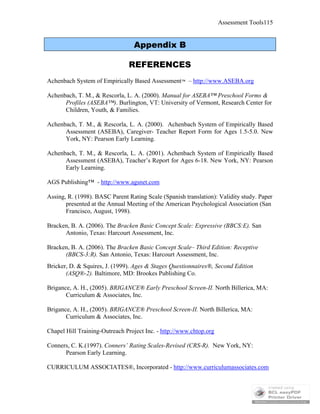
website. Please contact the publisher directly for more details. (See Appendix B-References on pg. 115.)
Assessment Tools 27
THIS INSTRUMENT HAS A VERSION IN SPANISH
Publisher Brookes Publishing Company
Date 1999
Domains/Areas Assessed ● Areas screened: Communication, gross motor, fine motor,
problem solving, and personal-social
● There are 19 questionnaires (corresponding to 19 designated
age intervals); each includes 30 developmental items to be
completed by parents at designated age-intervals, assessing
children in their natural environments with the goal of
ensuring valid results.
● The ASQ system is flexible and can fit the needs of diverse
monitoring & screening programs: the entire Master set
(all the age intervals) of questionnaires can be used or only
some age intervals: at 4, 6, 8, 10, 12, 14, 16, 18, 20, 22,
24, 27, 30, 33, 36, 42, 48, 54, and/or 60 months of age;
using the Master set, screening programs may choose ASQ
age intervals that fit their populations, program goals, & needs
Uses or purpose of instrument ● Main Uses: 1) Comprehensive, first-level screening of large
groups of infants and young children; 2) to monitor
development of children who are at-risk for delays
● The forms are photocopiable which keeps costs low for
preschools and, ultimately, parents
● Eight new questionnaires were added to this edition (since
1980) as a result of user feedback, extending the age-range
of the system to create a more authentic means of measuring
the rapidly developing skills of young children.
● Using parent-completed tools fulfills the spirit of the
Individuals with Disabilities Education Act (IDEA)
Amendments of 1997, which calls for parents to be partners in
their child's assessment and intervention activities.
Age Range 4 to 60 months of age (5 years old)
Administration Time Each questionnaire takes 10–15 minutes to complete
and approximately 3 minutes to score
Examiner(s) Professionals, paraprofessionals and non-professionals;
(in practice, the parents/caregivers complete the
the questionnaires and the professionals score them; it can also
Assessment Tools 28
be adapted to a variety of settings like health-clinics)
Scores ● Professionals convert parents' responses of yes, sometimes,
and not yet to 10, 5, and 0, respectively — in just 2-3
minutes — to color-coded scoring sheets, enabling them to
quickly determine a child's progress in each developmental
area.
● A low total score is indicative of problems while a high score
indicates the child is considered to be competent by the
parent completing the questionnaire
● The User's Guide then offers clear guidelines for determining
whether children are at high or low risk in the various
domains.
Language(s) English, Spanish, French and Korean; translations are in
development in other languages including Mandarin and
Arabic
Type (norm-/criterion-referenced) Norm-referenced questionnaires (by age intervals)
Periodic vs. Ongoing Ongoing (when used for monitoring purposes, which is often)
Validity ● Concurrent validity was studied by comparing the
classifications of the child's performance based on parent
questionnaire with that on professionally administered
standardized tests; the instruments were: The Revised
Gessell & Armatruda Developmental and Neurological
Examination (1980); the Bayley Scales of Infant Development
(1969):; the Stanford Binet Intelligence Scale (1985); the
McCarthy Scales of Children's Abilities (1972); and the
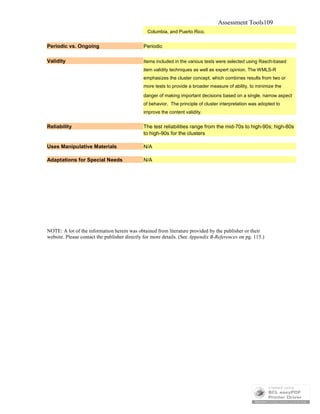
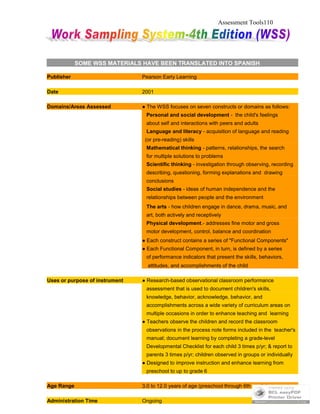
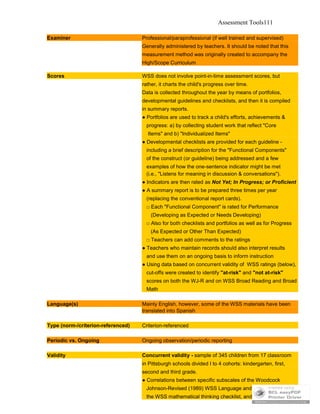
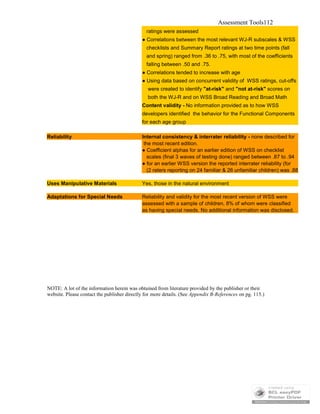
Battelle Developmental Inventory - BDI - (1984).
□ A child was considered "identified" when his score fell
below the cut-off point set at 2 standard deviations below
the mean.
● Specificity (ability to correctly identify typically developing
children) ranged from 81% to 92% with overall agreement of
86%; Sensitivity (ability to detect delayed development)
was lower, averaging 72%; according to publishers, in other
studies it was as high as 96%.
Reliability ● Test-retest reliability studies compared the results of
questionnaires completed by parents in a two-week time
period; the percentage of agreement based on the
questionnaires was .94%; interobserver reliability compared
questionnaires completed by parents with those completed
by examiners; percentage of agreement was also .94% - in
other words, 9 out of 10 times, there was agreement.
● Test-retest and interobserver reliability indicate that parents's
perception of their children using the questionnaire were
Assessment Tools 29
consistent over time; examiners's agreement with parental
evaluations of children were consistently high
● Internal consistency analyses indicated a strong relationship
across items and within areas on the questionnaires.
Uses Manipulative Materials Mostly those in natural environment
Adaptations for Special Needs N/A; a however, subsample of children with disabilities was used
to evaluate concurrent validity of questionnaires
NOTE: A lot of the information herein was obtained from literature provided by the publisher or their
website. Please contact the publisher directly for more details. (See Appendix B-References on pg. 115.)
Assessment Tools 30
THIS INSTRUMENT HAS A VERSION IN SPANISH
Publisher Brookes Publishing Company
Date 2002
Domains/Areas Assessed ● General areas screened: Personal-social (self-regulation,
compliance, communication, adaptive functioning,
autonomy, affect, and interaction with people)
● There are 8 questionnaires (corresponding to 8 designated
age intervals); each includes 22 - 36 developmental items
● The ASQ system is flexible and can fit the social-emotional needs
of diverse monitoring & screening programs:
the entire Master set of questionnaires can be used or only
some of the age intervals, such as at 6, 12, 18, 24, 30, 36, 48,
and/or or 60 months of age; using the Master set, screening
programs may choose ASQ-SE age intervals that fit their
populations, program goals, and needs
Uses or purpose of instrument ● The ASQ: SE is a series of 8 questionnaires designed to
be completed by parents to address the emotional &
social competence of young children.
● Created in response to feedback from Ages & Stages
Questionnaires® - giving users an easy-to-use tool with a
focus on children’s social-emotional behavior and all the
advantages of ASQ — the opportunity for input (as the
questionnaires are parent-completed) and the cost-effectiveness
of the photocopiable forms; the instruments are research
validated by professionals and also culturally sensitive.
Age Range 6–60 months
Administration Time ● Each questionnaire takes 10–15 minutes to complete and
approximately 3 minutes to score
Examiner(s) Professionals, paraprofessionals and non-professionals;
(in practice the parents/caregivers complete the
the questionnaires and the professionals score them, & it can
be adapted to a variety of settings like health-clinics)
Scores ● Professionals converted parents' responses of most of the
time, sometimes, and rarely or never to 10, 5, and 0, &
Assessment Tools 31
the total score, respectively — in just 2-3 minutes — to color-
coded scoring sheets, enabling them to quickly determine
a child's progress in each developmental area and total.
● Scoring pattern is opposite that of the ASQ - in the ASQ:SE
a high total score is indicative of problems, while a low
total score indicates the child is considered to be competent
by the parent completing the questionnaire
● The User's Guide then offers clear guidelines for determining
whether children are at high or low risk in the various
domains.
Language(s) Questionnaires in English and Spanish
Type (norm-/criterion-referenced) Norm-referenced questionnaires (by age intervals)
Periodic vs. Ongoing Ongoing (when used for monitoring purposes - which is often)
Validity ● Validity was studied by comparing the classification of
questionnaires completed by parents with the classification
of standardized assessments by trained examiners.
Comparisons were made with the following instruments:
□ the Child Behavior Checklist (1991, 1992); the Vineland
Social-Emotional Early Childhood Scale (1998)
● Concurrent validity between the ASQ:SE & concurrent
measures ranged from 81% to 95% with overall agreement
of 93%;
● Sensitivity (ability to detect delayed development) ranged
from 71% to 85% with 78% overall sensitivity.
● Specificity (ability to screen correctly those children without
delayed development) ranged from 90% to 98% with 95%
overall specificity - supporting the usefulness of the ASQ:SE
Reliability ● Investigated with over 3,000 children across the age intervals
and their families. Test-retest reliability was 94%
Uses Manipulative Materials Mostly those in natural environment
Adaptations for Special Needs N/A
NOTE: A lot of the information herein was obtained from literature provided by the publisher or their
website. Please contact the publisher directly for more details. (See Appendix B-References on pg. 115.)
Assessment Tools 32
Publisher The Riverside Publishing Company
Date 2001
Domains/Areas Assessed The paper-pencil edition of BEAR is a suite of four criterion-
referenced assessments of beginning reading and language arts
skills, as follows:
BEAR assesses progress toward developing four essential
reading skills: Reading Basics, Language Arts, Comprehension,
And Reading Fluency. There is a computer edition of BEAR
which offers computer-assisted administration of the 4 subtests
Uses or purpose of instrument To assess young students’ acquisition of the essential
components of reading—phonemic awareness, phonics,
vocabulary, comprehension, and oral reading fluency.
Age Range Grades: K through 3
rd
Administration Time Un-timed, estimated administration: Initial-Skills Analysis 45-60
minutes total; Specific-Skills Analysis 30-40 minutes per content
area; Oral Reading Fluency Assessment 15-30 minutes per
passage or list; and Summative Assessment 30-40 minutes per
content area.
Examiner Professional or paraprofessional
Scores ● Initial-Skills Analysis, Specific-Skill Analysis, and Summative
Assessment via computer. program
● BEAR paper and pencil assessments help monitor student
progress through-out the school-year
Language(s) English
Type (norm-/criterion-referenced) Criterion-referenced assessments
Periodic vs. Ongoing Ongoing
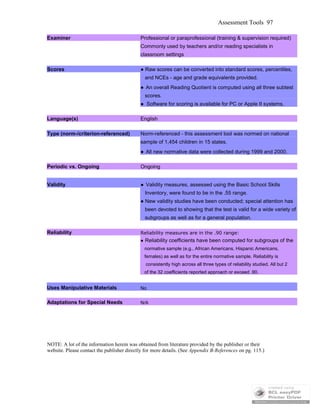
Validity & Reliability None described
Uses Manipulative Materials Yes
Adaptations for Special Needs N/A
NOTE: A lot of the information herein was obtained from literature provided by the publisher or their
website. Please contact the publisher directly for more details. (See Appendix B-References on pg. 115.)
Assessment Tools 33
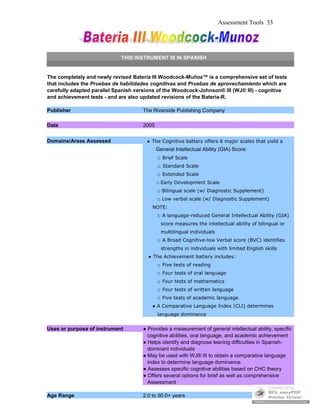
THIS INSTRUMENT IS IN SPANISH
The completely and newly revised Bateria III Woodcock-Muñoz™ is a comprehensive set of tests
that includes the Pruebas de habilidades cognitivas and Pruebas de aprovechamiento which are
carefully adapted parallel Spanish versions of the Woodcock-Johnson® III (WJ® III) - cognitive
and achievement tests - and are also updated revisions of the Bateria-R.
Publisher The Riverside Publishing Company
Date 2005
Domains/Areas Assessed ● The Cognitive battery offers 6 major scales that yield a
General Intellectual Ability (GIA) Score:
□ Brief Scale
□ Standard Scale
□ Extended Scale
□ Early Development Scale
□ Bilingual scale (w/ Diagnostic Supplement)
□ Low verbal scale (w/ Diagnostic Supplement)
NOTE:
□ A language-reduced General Intellectual Ability (GIA)
score measures the intellectual ability of bilingual or
multilingual individuals
□ A Broad Cognitive-low Verbal score (BVC) identifies
strengths in individuals with limited English skills
● The Achievement battery includes:
□ Five tests of reading
□ Four tests of oral language
□ Four tests of mathematics
□ Four tests of written language
□ Five tests of academic language
● A Comparative Language Index (CLI) determines
language dominance
Uses or purpose of instrument ● Provides a measurement of general intellectual ability, specific
cognitive abilities, oral language, and academic achievement
● Helps identify and diagnose leaning difficulties in Spanish-
dominant individuals
● May be used with WJ® III to obtain a comparative language
index to determine language dominance.
● Assesses specific cognitive abilities based on CHC theory
● Offers several options for brief as well as comprehensive
Assessment
Age Range 2.0 to 90.0+ years
Assessment Tools 34
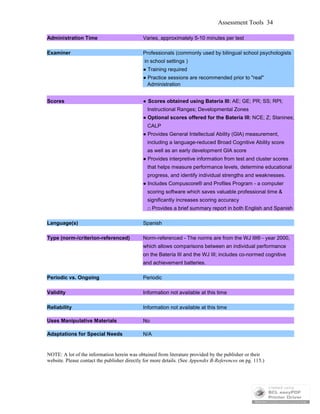
Administration Time Varies, approximately 5-10 minutes per test
Examiner Professionals (commonly used by bilingual school psychologists
in school settings )
● Training required
● Practice sessions are recommended prior to "real"
Administration
Scores ● Scores obtained using Batería III: AE; GE; PR; SS; RPI;
Instructional Ranges; Developmental Zones
● Optional scores offered for the Batería III: NCE; Z; Stanines;
CALP
● Provides General Intellectual Ability (GIA) measurement,
including a language-reduced Broad Cognitive Ability score
as well as an early development GIA score
● Provides interpretive information from test and cluster scores
that helps measure performance levels, determine educational
progress, and identify individual strengths and weaknesses.
● Includes Compuscore® and Profiles Program - a computer
scoring software which saves valuable professional time &
significantly increases scoring accuracy
□ Provides a brief summary report in both English and Spanish
Language(s) Spanish
Type (norm-/criterion-referenced) Norm-referenced - The norms are from the WJ III® - year 2000,
which allows comparisons between an individual performance
on the Batería III and the WJ III; includes co-normed cognitive
and achievement batteries.
Periodic vs. Ongoing Periodic
Validity Information not available at this time
Reliability Information not available at this time
Uses Manipulative Materials No
Adaptations for Special Needs N/A
NOTE: A lot of the information herein was obtained from literature provided by the publisher or their
website. Please contact the publisher directly for more details. (See Appendix B-References on pg. 115.)
Assessment Tools 35
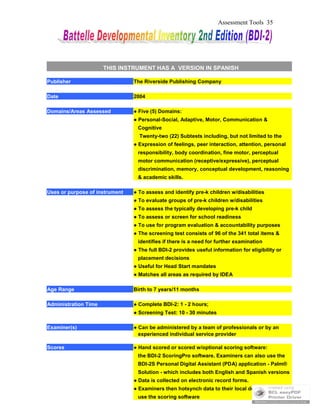
THIS INSTRUMENT HAS A VERSION IN SPANISH
Publisher The Riverside Publishing Company
Date 2004
Domains/Areas Assessed ● Five (5) Domains:
● Personal-Social, Adaptive, Motor, Communication &
Cognitive
Twenty-two (22) Subtests including, but not limited to the
● Expression of feelings, peer interaction, attention, personal
responsibility, body coordination, fine motor, perceptual
motor communication (receptive/expressive), perceptual
discrimination, memory, conceptual development, reasoning
& academic skills.
Uses or purpose of instrument ● To assess and identify pre-k children w/disabilities
● To evaluate groups of pre-k children w/disabilities
● To assess the typically developing pre-k child
● To assess or screen for school readiness
● To use for program evaluation & accountability purposes
● The screening test consists of 96 of the 341 total items &
identifies if there is a need for further examination
● The full BDI-2 provides useful information for eligibility or
placement decisions
● Useful for Head Start mandates
● Matches all areas as required by IDEA
Age Range Birth to 7 years/11 months
Administration Time ● Complete BDI-2: 1 - 2 hours;
● Screening Test: 10 - 30 minutes
Examiner(s) ● Can be administered by a team of professionals or by an
experienced individual service provider
Scores ● Hand scored or scored w/optional scoring software:
the BDI-2 ScoringPro software. Examiners can also use the
BDI-2S Personal Digital Assistant (PDA) application - Palm®
Solution - which includes both English and Spanish versions
● Data is collected on electronic record forms.
● Examiners then hotsynch data to their local desktop & can
use the scoring software
Assessment Tools 36
● Flexible web-based scoring options for use by team of
professionals or single examiner
● Wide range of computerized reports to choose
● Scoring procedure for BDI-2 Screening are similar to those
of the full BDI-2, but cut-off scores are provided to help
identify children who need additional follow-up
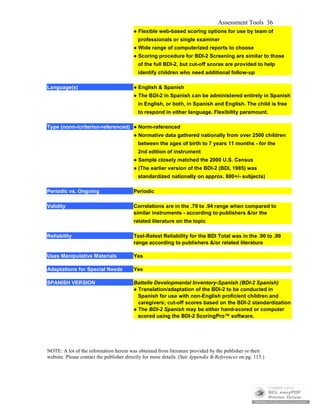
Language(s) ● English & Spanish
● The BDI-2 in Spanish can be administered entirely in Spanish
in English, or both, in Spanish and English. The child is free
to respond in either language. Flexibility paramount.
Type (norm-/criterion-referenced) ● Norm-referenced
● Normative data gathered nationally from over 2500 children
between the ages of birth to 7 years 11 months - for the
2nd edition of instrument
● Sample closely matched the 2000 U.S. Census
● (The earlier version of the BDI-2 (BDI, 1985) was
standardized nationally on approx. 800+/- subjects)
Periodic vs. Ongoing Periodic
Validity Correlations are in the .79 to .94 range when compared to
similar instruments - according to publishers &/or the
related literature on the topic
Reliability Test-Retest Reliability for the BDI Total was in the .90 to .99
range according to publishers &/or related literature
Uses Manipulative Materials Yes
Adaptations for Special Needs Yes
SPANISH VERSION Battelle Developmental Inventory-Spanish (BDI-2 Spanish)
● Translation/adaptation of the BDI-2 to be conducted in
Spanish for use with non-English proficient children and
caregivers; cut-off scores based on the BDI-2 standardization
● The BDI-2 Spanish may be either hand-scored or computer
scored using the BDI-2 ScoringPro™ software.
NOTE: A lot of the information herein was obtained from literature provided by the publisher or their
website. Please contact the publisher directly for more details. (See Appendix B-References on pg. 115.)
Assessment Tools 37
THIS INSTRUMENT HAS A SPANISH VERSION
Publisher AGS Publishing
Date 2005
Domains/Areas Assessed Overview: A comprehensive set of rating scales and forms
including the Teacher Rating Scales (TRS), Parent Rating
Scales (PRS), Self-Report of Personality (SRP), Student
Observation System (SOS), and Structured Developmental
History (SDH).
● By analyzing the child’s behavior from three perspectives—
Self, Teacher, and Parent—one gets a more complete and
balanced picture, as follows:
□ Self Perspective -
○ Self-Report of Personality (SRP): provides insight
into a child’s or adult’s thoughts and feelings.
○ Each form—child (ages 8 to 11), adolescent (ages 12
to 21), college (ages 18 to 25)—includes validity scales
for helping judge the quality of completed forms.
▪ A Spanish version is available for the child and
adolescent forms.
○ The BASC-2 version includes an SRP-Interview (SRP-I)
form for children 6-7 in which children provide simple
yes-or-no responses to questions asked by examiner;
responses are then recorded on a checklist - takes
20 minutes to complete.
□ Teacher Perspectives -
○ Teacher Rating Scales (TRS): used to measure adaptive
and problem behaviors in the preschool or school setting.
○ The forms describe specific behaviors that are rated on
a four-point scale of frequency, ranging from “Never” to
“Almost Always”; the TRS contains 100-139 items.
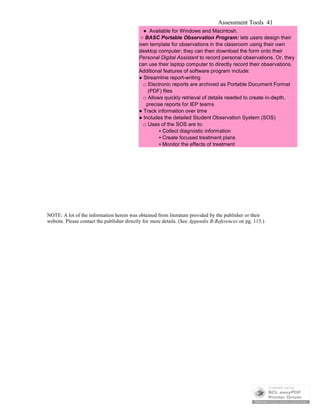
○ Student Observation System (SOS): used to code and
record direct observations of a child’s behavior utilizing
momentary time sampling—during 3-second intervals
spaced 30 seconds apart for 15 minutes.
▪ SOS assesses both adaptive and maladaptive
behaviors, from positive peer interaction to repetitive
motor movements
○ The SOS can also be used for the direct observation
portion of a FBA (Functional Behavioral Assessment).
Assessment Tools 38
○ You can use the SOS on its own, or with other BASC-2
components.
□ Parent Perspectives -
○ Parent Rating Scales (PRS): used to measure both
adaptive and problem behaviors in the community and
home setting.
○ The PRS contains 134-160 items and uses a four-
choice response format.
○ Structured Developmental History (SDH): a 12-page
history and background survey, helps when gathering
crucial information for the diagnostic and treatment
process. The SDH provides a thorough review of social,
psychological, developmental, educational, and medical
Information about a child.
○ You can use the SDH on its own, or with other BASC-2
Components.
□ Activities of Daily Living, Adaptability, Aggression, Anxiety,
Attention Problems, Atypicability, Conduct Problems,
Depression, Functional Communication, Hyperactivity,
Leadership, Learning Problems, Social Skills, Somatization,
Study Skills, Withdrawal
● This revision of the BASC includes new scales: Functional
Communication (TRS/PRS), Activities of Daily Living
(PRS), Attention Problems (SRP), and Hyperactivity
(SRP)
Uses or purpose of instrument ● The BASC-2 is a multi-method, multi-dimensional system
to evaluate the behavior and self-perceptions of children
young adults - it is multi-dimensional in that it has five
components, which may be used individually, or in any
combination, and that it measures numerous aspects of
and personality, including positive (adaptive) as well as
(clinical) dimensions
● BASC-2 is a well-established system for measuring behavior
and emotions - together the comprehensive set of rating
scales and forms will help you help understand the behaviors
and emotions of children and adolescents.
● These scales measure areas important for both IDEA and
DSM-IV classifications. In addition, the instrument is
respected for its developmental sensitivity and provides the
most extensive view of adaptive and maladaptive behavior.
● The uses of the basic BASC-2 tools are the following:
□ To assess behavior patterns - Teacher Rating Scales
(TRS); Parent Rating Scales (PRS); Student Observation
System (SOS)
□ To assess emotions and feelings - Self-Report of
Personality (SRP)
□ To gather background information - Structured
Assessment Tools 39
Developmental History (SDH)
● A great benefit of the BASC-2 if that it differentiates
between hyperactivity and attention problems.
Age Range & Administration Time 2-0 through 21-11 (TRS and PRS)
● TRS: Teachers or other qualified observers can complete
forms in about 10–20 minutes for each of the three age levels —
preschool (ages 2 to 5), child (ages 6 to 11), and adolescent
(ages 12 to 21)
● PRS: Parents or caregivers can complete forms in about 10-20
minutes for each of the three age levels —
preschool (ages 2 to 5), child (ages 6 to 11), and
adolescent (ages 12 to 21)
● 8-0 through college age (SRP)
□ Each form takes about 30 minutes to complete for each of
the three age levels -
child (ages 8 to 11), adolescent (ages 12 to 21), and college
(ages 18 to 25)
□ SRP-I (for ages 6 to 7) takes about 20 minutes to complete.
Examiner ● Professionals - test users/examiners should have a Ph.D. in
Psychology or be certified in School Psychology (applicable
for administration of TRS, PRS, and SRP)
● Paraprofessionals with training and supervision - (applicable
for administration of SOS and SDH)
Scores ● T scores and percentiles, for a general population and clinical
populations
● Parent Feedback Report:
○ Survey results are presented to parents by means of the
Parent Feedback Report - the reports work with all age levels
of the TRS, PRS, and SRP
○ Parents receive test results, interpretative information,
definitions of behavior problems, an explanation of treatment
approaches, and next steps
○ Includes a resource list.
Language(s) English and Spanish
● BASC-2 test items on CD: For parents and students wh
difficulty reading, test items are available on audio CD -
and Spanish versions are offered for both the Parent Ra
Scales and the Self-Report of Personality
Type (norm-/criterion-referenced) Norm-referenced - Normed based on current U.S. Census
population characteristics
Periodic vs. Ongoing Periodic
Validity ● Concurrent:
Groups of children with preexisting clinical diagnoses tend to
have distinct BASC-2 profiles.
Assessment Tools 40
● Predictive: none
● Content:
Item content came from teachers, parents, children, and
psychologists, as well as from reference sources such as the
Diagnostic and Statistical Manual of Mental Disorders, Fourth
Edition, Text Revision (DSM-IV-TR; American Psychiatric
Association, 2000) and other instruments.
● Instruments used in correlation studies:
TRS - include Achenbach System of Empirically Based
Assessment (ASEBA), Caregiver-Teacher Report Form for Ages
1.5-5 (ASEBA) and the Conners' Teacher Rating Scale-Revised
(CTRS-R; Conners, 1997).
PRS - include ASEBA Child Behavior Checklist for Ages 1.5-5
(ASEBA; Achenbach & Rescorla, 2000) and the Conners'
Parent Rating Scale-Revised (CPRS-R; Conners, 1997)
Reliability ● Internal consistency:
TRS - Preschool (age 2 -3) within the range of .87-.96 for
Composites; and .75-.92 for the Scales. Preschool (age 4 -5)
within the range of .91-.96 for Composites; and .81-.93 for the
Scales.
PRS - Preschool (age 2 -3) within the range of .85-.93 for
Composites; and .77-.88 for the Scales. Preschool (age 4 -5)
within the range of .87-.93 for Composites; and (.70-.87) for the
Scales.
● Test-retest:
TRS - Preschool (age 2 -5) within the range of .84-.87 for
Composites; and .72-.87 for the Scales.
PRS - Preschool (age 2 -5) within the range of .81-.86 for
Composites; and .72-.85 for the Scales.
Uses Manipulative Materials No
Adaptations for Special Needs N/A
Software Programs ○ BASC-2 ASSIST™ PLUS: computer scoring and interpretation
software which generates profiles, calculates validity indexes,
identifies strengths and weaknesses, and computes multi-rater
comparisons.
● Provides reports on all the optional content scales, target
behaviors for intervention, and relationships to DSM-IV-TR
diagnostic criteria
▪ Because the content scales are optional, they are only
available with the BASC-2 ASSIST Plus
▪ The optional seven TRS and PRS scales include anger
control, bullying, developmental social disorders,
emotional self-control, executive functioning, negative
emotionality, and resiliency
▪ Form levels SRP-A and SRP-COL offer these four optional
scales: anger control, ego strength, mania, and test
anxiety
Assessment Tools 41
● Available for Windows and Macintosh.
○ BASC Portable Observation Program: lets users design their
own template for observations in the classroom using their own
desktop computer; they can then download the form onto their
Personal Digital Assistant to record personal observations. Or, they
can use their laptop computer to directly record their observations.
Additional features of software program include:
● Streamline report-writing
□ Electronic reports are archived as Portable Document Format
(PDF) files
□ Allows quickly retrieval of details needed to create in-depth,
precise reports for IEP teams
● Track information over time
● Includes the detailed Student Observation System (SOS)
□ Uses of the SOS are to:
▪ Collect diagnostic information
▪ Create focused treatment plans
▪ Monitor the effects of treatment
NOTE: A lot of the information herein was obtained from literature provided by the publisher or their
website. Please contact the publisher directly for more details. (See Appendix B-References on pg. 115.)
Assessment Tools 42
THIS INSTRUMENT HAS A VERSION IN SPANISH
Publisher The Riverside Publishing Company
Date 2006 - expected date
Domains/Areas Assessed The Bilingual Verbal Ability Tests are comprised of three
subtests from the Woodcock-Johnson-Revised Test of
Cognitive Ability; Picture Vocabulary; Oral Vocabulary, and
Verbal Analogies.
● These three subtests have been translated into eighteen
languages, plus English.
Uses or purpose of instrument ● Provides a measure of overall verbal ability for bilingual
individuals, or the unique combination of cognitive/academic
language abilities possessed by bilingual individuals in
English and another language.
□ The need for this test is based in the reality that bilingual
persons know some things in one language, some things in
the other language, and some things in both languages -
traditional procedures only allow the person's ability to be
tested in the dominant language.
● The BVAT-NU can be used for a variety of purposes in bilingual
education and clinical assessment; it can be used for entry and
exit criteria for bilingual programs. It can be used to assess the
academic potential of bilingual students through a comparison of
his or her current level of English language proficiency to his or
her bilingual verbal ability.
● The BVAT-NU can also be used in place of Tests 1 an 31 the
WJ® III Tests of Cognitive Abilities to provide a general intellectual
ability-bilingual (GIA-Bil) score.
Age Range 5.0 to Adult
Administration Time Varies. When using the BVAT-NU, the examiner administers
the three subtests in English first. Any item that was missed is
then administered in the native language.
□ an estimate is approximately 30 minutes
Examiner ● It may be administered either by one examiner who is fluent in
the individual's two languages, or, alternatively, by a primary and
ancillary examiner team when a bilingual examiner is not
available.
Assessment Tools 43
Scores ● Scores that can be generated by using the BVAT include:
SS, PR, AE, GE, RPI, Instructional Ranges, CALP levels
● The BVAT-NU provides an overall score (BVA) which can be
used to determine an individual's overall level of verbal ability.
● For comparative purposes, the BVAT-NU also provides a
measure of English language proficiency.
● The BVAT yields an aptitude measure that can be used in
conjunction with the WJ-R Tests of Achievement.
● A Scoring and Reporting Program is included with each test
kit. This software program automates scoring procedures and
provides a narrative report of the individual's bilingual verbal
ability, English language proficiency, and language use and
exposure. When used with the WJ-R Tests of Achievement,
the achievement test results are scored and aptitude/
achievement discrepancies are calculated and interpreted.
The program determines and explains whether any identified
discrepancy is related to limitations of English language
proficiency.
Language(s) The languages available in BVAT -NU are:
Arabic; Chinese Simplified; Chinese Traditional; French;
German; Haitian-Creole; Hindi; Hmong; Italian;
Japanese; Korean; Navajo; Polish; Portuguese; Russian;
Spanish; Turkish; Vietnamese - plus English
Type (norm-/criterion-referenced) Norm-referenced
Periodic vs. Ongoing Periodic
Validity The construct validity of the BVA score was validated by
comparing estimates of bilingual verbal ability obtained by two
parallel, but independent, testing procedures. No further details
were available, per results of search.
Reliability According to the publishers, alternative form procedures
reliabilities are provided for the BVA score. No further details
were available, per results of search.
Uses Manipulative Materials No
Adaptations for Special Needs N/A
NOTE: A lot of the information herein was obtained from literature provided by the publisher or their
website. Please contact the publisher directly for more details. (See Appendix B-References on pg. 115.)
Assessment Tools 44
THIS INSTRUMENT HAS A VERSION IN SPANISH*
NOTE: *Spanish version of instrument is used with an English-language manual
Publisher The Psychological Corporation
Date Available Fall 2006
Domains/Areas Assessed The BBCS:E is a new test meant to complement the Receptive
Bracken instrument: The Bracken Basic Concept Scale– Third
Edition: Receptive (BBCS–3:R) detailed separately.
The BBCS:E assesses important educational concepts such as:
● color, letter/sounds, numbers/counting, size, shapes,
direction/position, self-/ social-awareness, texture/material, quality
time/sequence
Uses or purpose of instrument ● The BBCS:E is a developmentally sensitive measure of children’s
basic concept knowledge - includes the ability to evaluate a child’s
understanding of basic concepts expressively.
● The purpose of the BBCS:E is to evaluate the acquisition of basic
concepts of a child expressively, and to determine cognitive and
language development for childhood academic achievement.
● Assists in developing appropriate IEP goals that relate to the
educational curriculum
● Follows the early childhood education curriculum outlined through
Head Start and No Child left Behind Act
Age Range 3:0 through 6:11 years
Administration Time Individual; 30 minutes
Examiner Professional and paraprofessional
Scores ● Standard scores and concept age equivalents
● Scoring Assistant software which quickly & accurately score test
results, maintain demographic information, store raw scores, and
create comprehensive graphical and narrative reports for both the
BBCS–3:R and BBCS:E.
Language(s) English and Spanish
Type (norm-/criterion-referenced) Norm-referenced
Periodic vs. Ongoing Periodic to monitor progress
Assessment Tools 45
Validity None described yet; awaiting publication of manual
Reliability None described yet; awaiting publication of manual
Uses Manipulative Materials None described
Adaptations for Special Needs N/A but provides clinical studies on specific populations including
Developmental Delayed and Mental Retardation
NOTE: A lot of the information herein was obtained from literature provided by the publisher or their
website. Please contact the publisher directly for more details. (See Appendix B-References on pg. 115.)
Assessment Tools 46
THIS INSTRUMENT HAS A VERSION IN SPANISH*
NOTE: *Spanish version of instrument is used with an English-language manual
Publisher The Psychological Corporation
Date Available Fall 2006
Domains/Areas Assessed The BBCS-3:R is a revision of a test (including updated norms and
new items) meant to complement the Expressive Bracken instrument:
The Bracken Basic Concept Scale: Expressive (BBCS:E) detailed
separately.
The BBCS-3:R assesses important educational concepts such as:
● color, letter/sounds, numbers/counting, size, shapes,
direction/position, self-/ social-awareness, texture/material, quality,
time/sequence
Uses or purpose of instrument ● The BBCS-3:R is a developmentally sensitive measure of children’s
basic concept knowledge - includes the ability to evaluate a child’s
(receptive) understanding of basic concepts.
● The purpose of the BBCS-3:R is to evaluate the acquisition of
basic concepts of a child, and to determine cognitive and (receptive)
language development for childhood academic achievement.
● Assists in developing appropriate IEP goals that relate to the
educational curriculum
● Follows the early childhood education curriculum outlined through
Head Start and No Child left Behind Act
Age Range 3:0 through 6:11 years
Administration Time Individual; 30 to 45 minutes
Examiner Professional and paraprofessional
Scores ● Standard scores and concept age equivalents
● Scoring Assistant software which quickly and accurately score test
results, maintain demographic information, store raw scores, and
create comprehensive graphical and narrative reports for both the
BBCS–3:R and BBCS:E.
Language(s) English and Spanish
Type (norm-/criterion-referenced) Norm-referenced
Periodic vs. Ongoing Periodic to monitor progress
Assessment Tools 47
Validity None described yet; awaiting publication of manual
Reliability None described yet; awaiting publication of manual
Uses Manipulative Materials None described
Adaptations for Special Needs N/A but provides clinical studies on specific populations including
Developmental Delayed and Mental Retardation
NOTE: A lot of the information herein was obtained from literature provided by the publisher or their
website. Please contact the publisher directly for more details. (See Appendix B-References on pg. 115.)
Assessment Tools 48
THIS INSTRUMENT HAS A VERSION IN SPANISH*
NOTE: *Spanish version of instrument is used with an English-language manual
Publisher The Psychological Corporation
Date 1998
Domains/Areas Assessed The BBCS-R consists of 308 items in 11 subtests assessing
relevant educational concepts for this age group, as follows:
● Colors -identification of primary colors and basic color terms
● Letters - knowledge of upper and lower case letters
● Numbers/Counting - number recognition and counting abilities
● Sizes - understanding of one-, two- and three-dimensional sized
concepts such as tall, short and thick
● Comparisons - matching or differentiating objects based on
salient characteristics
● Shapes - knowledge of basic one-, two-, and three-dimensional
shapes (e.g., line, square, cube), and abstract shape-related
concepts (e.g., space)
● Direction/Position - understanding concepts such as behind,
on, closed, left/right, and center
● Self-/Social-Awareness - understanding of emotions such as
angry and tired; understanding of terms describing kinship,
gender, relative ages, and social appropriateness
● Texture/Material - understanding terms of characteristics of an
object such as heavy and sharp; knowledge of composition of
objects, such as wood and glass
● Quantity - understanding of concepts involving relative
quantities, such as a lot, full and triple
● Time/Sequence - understanding of concepts related to timing,
duration and ordering of events, such as after and slow
● A School Readiness Composite (SRC) is constructed from the
first six subtests: Colors, Letters, Numbers/Counting, Sizes,
Comparisons, and Shapes. A full battery score is created from
the 11 subtests.
Uses or purpose of instrument ● Designed to measure basic concept acquisition and receptive
language skills in young children - and to determine how familiar
children are with concepts that parents and teachers have taught
them to prepare them for a formal education.
● The BBCS-R is a developmentally sensitive measure enabling you to
assess important conceptual and receptive language abilities in
children rather than only their knowledge of common vocabulary words
Assessment Tools 49
● This measure is achievement-oriented, focusing on constructs
that children learn (or not learn) through instruction.
● The BBCS-R is designed to minimize verbal responses:
responses are either pointing or short verbal responses
● Because the BBCS-R minimizes verbal responses it can be
used as an ice-breaker exercise/warm-up before other
assessments. It is useful for children who are shy or those that
have any one of a variety of conditions that might limit their
participation in other assessments (e.g., autism, phobias)
● The BBCS-R remediates deficiencies in concept acquisition with
the Bracken Concept Development Program (BCDP)
□ comprehensive instructional program featuring colorful materials for
working with children experiencing gaps in concept development
□ primarily a multi-sensory approach which encourages hands-on
activities and experiences
Age Range 2.6 to 8 years
Administration Time The BBCS-R is un-timed so it varies (time for each subtest or full
battery is not provided); however, the SRC composite takes
approximately 30 minutes to administer (first 6 subtests)
□ Individual administration only
Examiner Professional
Scores ● Subtest and Composite, Percentile Ranks, Standard Scores,
and Concept Age Equivalents
● The BBCS-R uses basals and ceilings.
□ basal is established when a child passes three consecutive
items
□ ceiling is established within each subtest when a child
answers three items incorrectly
□ for each of the first 6 subtests, assessment always starts
with the first item of the respective scale
□ stating point for the remaining subtests is determined by the
child's SRC score
Language(s) English and Spanish versions available
Type (norm-/criterion-referenced) ● English version of the BBCS-R is norm-referenced, criterion-
referenced, or curriculum-based assessment, depending on
purpose to be used.
The standardization sample was representative of the general U.S.
population of children between the ages of 2.6 and 8.0 and was
stratified by age, gender, race/ethnicity, region and parent
education. Demographic percentages were based on 1995 U.S.
census data.
● Spanish version of the BBCS-R is used as a criterion-referenced
Assessment Tools 50
curriculum-based measure only. Spanish-language forms are
designed for use with the English-language manual.
□ Norms were established on a Latino sample of 293 children.
Coefficient Alpha was used to assess internal consistency with r
ranging from .93 to .99. Grade Level: PK - 4
Periodic vs. Ongoing Periodic to monitor progress
Validity ● Internal validity - intercorrelations among the SRC and subtests 7 to
11 for the full sample ranged from .58 to .72. In the full sample,
intercorrelations between subtests 7 to 11 and Total test scores
ranged from .79 to .87. The intercorrelations between SRC and
Total Test was .85 indicating that the subtests and the SRC were
reasonably consistent in their associations with the Total Test scores
● Concurrent validity - across studies correlations between the
BBCS-R scale scores and other measures ranged from .34 to .89
(most being above .70)
□ correlations between SRC scale scores and WPPSI-R ranged
from .76 to .88 (highest correlation being with the WPPSI-R Full
Scale IQ scores and lowest correlation being with the WPPSI-R
Performance IQ scores)
□ correlations between the BBCS-R full battery scores and WPPSI-R
scale scores ranged from .72 to .85 with the lowest being the
correlation w/Performance IQ scores & the highest w/Full scale IQ scores
□ correlations between SRC and DAS scale scores ranged between .69
and .79 (highest correlation being with DAS General Conceptual Ability
scores & the lowest correlation being with the DAS Verbal Clusters scores
□ correlations between the BBCS-R full battery scores and DAS scale
scores ranged from .74 to .88 with the lowest being the DAS Verbal
Cluster scores and the highest being the DAS General Conceptual Ability
scores
● The readers are encouraged to consult the manual for details on the
specific correlations described in numerous validity studies as follows:
□ BBCS-R scores correlated with scores on the Boehm Test of Basic
Concepts-Revised - .73 between Boehm-R scores and SRC scores; and
.89 between Boehm-R scores and BBCS-R full battery scores
□ BBCS-R scores correlated with scores on the Boehm Test of Basic
Preschool Version - .34 between Boehm-Preschool scores & SRC
scores; and .84 between Boehm-Preschool scores and BBCS-R full
battery scores
It should be noted that this large difference between correlations (.34
& .84) is difficult to interpret given that six scales making up the SRC
are also part of the BBCS-R full battery.
□ BBCS-R scores correlated with scores on the Peabody Picture
Vocabulary Test - Third Edition - .69 between PPVT-III scores and SRC;
and .79 between PPVT-III scale scores and BBCS-R full battery scores
Assessment Tools 51
□ BBCS-R scores correlated with scores on the Preschool Language
Scale-3 -between SRC scores and PLS-3 scale scores ranging from .46
to .57; and between PLS-3 scale scores and BBCS-R full battery scores,
ranging from .74 to .84.
● Predictive Validity - SRC scores & scores on subtests 7 through 11
were found to be the strongest predictors of young children's academic
growth; stronger than children's chronological age, social skills and
perceptual motor skills.
● Discriminant validity - In study conducted with 3-, 4-, and 5-year-old
children who were diagnosed with a language delay (with a receptive
component), as detailed in manual, BBCS-R correctly classified children
as to the presence or absence of a language disorder 74 % of the times.
Reliability ● Split-half reliability - analyses were conducted using the SRC,
subtests 7 to 11, and the full battery score. The average split-half
reliability across ages 2 years to 7 years ranged from .91 for the
to .98 the Total Test, with reliabilities estimates increasing slightly
between ages 2 and 5.
● Test-retest reliability - SRC was .88 The test-retest reliabilities
of subtests 7 to 11 were .78 for both Quantity and Time/Sequence,
.80 for Texture and Material, and .82 for both Direction/Position,
and Self-/Social Awareness. Test-rest reliability for Total Test was .94
Uses Manipulative Materials No
Adaptations for Special Needs N/A - but provides clinical studies on specific populations including
Developmental Delayed and Mental Retardation
Related Instrument Bracken School Readiness Assessment (BSRA)- Non-verbal
screener which helps determine if a child may have an
underlying language disorder that requires further evaluation
(published in 2002)
● Easy to administer; includes the first six subtests from the Bracken Basic
Concept Scale, Revised (BBCS-R): Colors, Letters, Numbers/Counting,
Sizes, Comparisons, and Shapes.
● Includes information on how to develop local norms based on your school
or area population to be more reflective of your clients - this will also help in
the process involved in establishing the criteria for identifying children
at-risk (or not at-risk) for educational failure.
● The BSRA is administered in English and Spanish; however, national
norms are provided for English only, but Spanish norms can be developed
using your Spanish-speaking population.
□ Scores - "(English) Composite Percentile Ranks, Standard Scores by
Age, Descriptive Classification (Spanish) Percent Mastery"
□ Administration Time: 10 - 15 minutes
NOTE: A lot of the information herein was obtained from literature provided by the publisher or their
website. Please contact the publisher directly for more details. (See Appendix B-References on pg. 115.)
Assessment Tools 52
THIS INSTRUMENT HAS A VERSION IN SPANISH
Publisher Curriculum Associates®, Inc.
Date 2005
Domains/Areas Assessed ● In common with other Brigance® screens, the Preschool
Screen II samples skills in the broad range of areas
including:
□ fine & gross motor
□ general knowledge
□ language
□ pre-academic/academic
□ graphomotor development
● Revision includes self-help and social emotional scales
● Preschool Screen II assesses:
□ personal data & color recognition
□ picture vocabulary including identifying use of objects
□ visual & gross-motor skills
□ identifying body parts
□ block tower building, number concepts, & rote counting
□ sentence repetition, prepositions, irregular plural nouns,
syntax & fluency, and following verbal directions
□ visual discrimination
□ feeding/eating skills & dressing/undressing skills
□ toileting skills
□ work/help skills
□ play skills & behaviors
□ gets along with others
Uses or Purpose of Instrument ● To record a sampling of children's language, motor, social-
emotional, and early learning skills
● To identify at-risk or gifted students early on
● To offer a parental component to children's education
● To provide useful information for planning heterogeneous or
homogeneous grouping
● To assist teachers with classroom planning & mandated
screening compliance, as well as to indicate developmental
problems - language, learning, or cognitive delays - &
to identify children with academic talent or intellectual
giftedness
Age Range 2.0 to 2.5 for the Brigance® Early Preschool Screen - II
3.0 to 4.0 for the Brigance® Preschool Screen - II
Assessment Tools 53
Administration Time ● 10 - 15 minutes per child individually or in stations
● Screening can be done
● Some skills may be assessed in groups
Examiner(s) ● Professionals - Widely used in educational settings
Scores ● Age equivalents, standardized scores, growth indicators, at-
risk cut-off scores,& percentile scores
● Online secure browser-based program manages data
including:
□ program-wide data analysis based on demographic
factors
□ customized reports, tables, & statistical bar graphs for
district/program-wide analysis
● The Brigrance® online management system generates
custom reports detailing age equivalents, growth
indicators, at-risk cut-off scores, & evidence-based
standardized scores
Language(s) English & Spanish
Type (norm-/criterion-referenced) ● Depending on the information being sought, the
Brigance® screens are both criterion-referenced &
normed-referenced
Periodic vs. Ongoing Periodic
Validity ● There is abundant support for the content validity of the
Brigance screens & for the applicability of the screens in
educational settings.
Reliability ● Test-retest reliability in the lower grades - in the .85 range, &
the inter-rater reliability (.97), alternative forms reliability,
& internal consistency measures - also uniformly high
(.80 - .97+/-), according to publishers & related
literature
Uses Manipulative Materials No
Adaptations for Special Needs No
NOTE: A lot of the information herein was obtained from literature provided by the publisher or their
website. Please contact the publisher directly for more details. (See Appendix B-References on pg. 115.)
Assessment Tools 54
THIS INSTRUMENT HAS A VERSION IN SPANISH
Publisher Curriculum Associates®, Inc.
Date 2005
Domains/Areas Assessed ● The broad areas screened are the following:
□ general knowledge & comprehension
□ speech & language
□ fine-motor & gross-motor skills
□ pre-academic/academic
□ social-emotional & self-help scales
□ reading skills & manuscript writing
● Specific areas sampled include:
□ personal data (response & in print)
□ color recognition
□ visual discrimination, visual motor & gross motor
□ rote counting, number readiness, numerals in sequence
□ body parts & draws-a-person
□ syntax & fluency
□ reads upper or lower case letters, recites alphabet
□ auditory discrimination & listening vocabulary
□ phonemic awareness, decoding & word recognition
□ computation
□ work/help skills & feeding/eating skills
□ toileting skills
□ play skills & behaviors
□ gets along with others
● Supplemental assessments include uppercase letters
dictated, lowercase letters dictated, verbal concepts,
substitutes initial consonant sounds
Uses or purpose of instrument ● To screen key developmental & early academic skills
before entering kindergarten & first grade
● To assist teachers with classroom planning & mandated
screening compliance, as well as to indicate
developmental
problems - language, learning, or cognitive delays - &
to identify children with academic talent or intellectual
giftedness
● At-risk guidelines for use in prevention programs is
included to identify children in need of prompt referral
● K & 1 Screen II correlates to Head Start Child Outcomes
Framework; Parent questionnaires add valuable
Assessment Tools 55
information to the screening process.
● Meets IDEA requirements & provides consistent results
that support early childhood educators' observations &
judgments
● Used by school districts nation-wide
Age Range For children 4.9 through the end of the first grade
Administration Time 10 - 15 minutes per child
Examiner(s) ● Widely used in educational settings & often administered
by paraprofessionals in addition to professionals
Scores ● Cut-off, age-equivalents, percentiles, & quotients in
motor, language, and readiness, as well as overall
scores, are generated
● In addition, there are cut-offs indicating potential
giftedness and/or any psychological risk
● Growth indicator scores plot progress over time.
● Sensitivity & Specificity to giftedness & to developmental
& academic problems are 70% to 82% across ages.
Language(s) English, Spanish, Laotian, Vietnamese, Cambodian, and
Tagalog
Type (norm-/criterion-referenced) ● Depending on the information being sought, the
Brigance® screens are both criterion-referenced & normed
Periodic vs. Ongoing Periodic
Validity ● There is abundant support for the content validity of the
Brigance screens & for the applicability of the screens in
educational settings, according to publishers
Reliability ● Test-retest reliability in the lower grades was in the .85
range, and the inter-rater reliability (.97), alternative forms
reliability, & internal consistency measures were also
uniformly high (.80 - .97+/-).
Uses Manipulative Materials No
Adaptations for Special Needs No
NOTE: A lot of the information herein was obtained from literature provided by the publisher or their
website. Please contact the publisher directly for more details. (See Appendix B-References on pg. 115.)
Assessment Tools 56
THIS INSTRUMENT HAS A VERSION IN SPANISH
Publisher High/Scope Educational Research Foundation
Date 2002
Domains/Areas Assessed ● The broad categories (or domains) assessed of eight items
each are as follows:
□ Initiative, Social Relations
□ Creative Representation, Movement & Music
□ Language & Literacy
□ Mathematics & Science
● Assesses thirty-two dimensions of learning within above
categories
Uses or purpose of instrument ● Designed to measure children's progress in early childhood
programs including, but not limited to, those using the
Highscope educational approach.
● The COR-2 is an observational assessment tool that charts
children's development & progress over time
● Tool which enables teachers to construct a profile on each
child that is directly connected to major educational goals
● Information is gathered by those who know the child best -
the caregiver & the parent
Age Range 2.6 to 6.0 years
Administration Time Ongoing
Examiner(s) ● Teachers & other caregivers
Scores ● Scored the same way by different observers
● Score of 1 to 5 on 32 behaviors and skills with subscale
scores for four broad categories
● Assessment log, portfolio, child observation, child interview
● Computerized version of COR-2, the Preschool COR
CD-Rom Kit is available through High/Scope
● COR-Headstart Outcomes Reporter CD-Rom translates
results into statistics, charts, & graphs that meets
Headstart Outcomes reporting requirements
Language(s) English & Spanish
Assessment Tools 57
Type (norm-/criterion-referenced) ● Criterion-referenced
● Highscope philosophy advocates avoiding comparisons
between children - as one would with norm-referenced
instruments
Periodic vs. Ongoing Ongoing
Validity ● The COR-2 is valid, correlating as expected with concurrent
measures of children's development & future measures of
school success
● Moderate correlations with the Cognitive Skills Assessment
Battery (CSAB), specially in language & literacy
● External validity was supported by expected correlation
between COR-2 Total & CSBA (.46 - .62) & between
COR-2 Total and children's ages (.31) with no significant
association with gender
● Validity findings formed the rationale for re-grouping initial
categories from six to four
Reliability ● According to publishers, reliability findings on ten
pairs of teachers and assistant teachers rating the same
children were as follows:
□ .73 Total COR-2
□ .69 Initiative, Social Relations
□ .70 Creative Representation, Movement & Music
□ .79 Language & Literacy
□ .73 Mathematics & Science
Uses Manipulative Materials Yes; those in natural environment
Adaptations for Special Needs Yes; if included in natural environment
NOTE: A lot of the information herein was obtained from literature provided by the publisher or their
website. Please contact the publisher directly for more details. (See Appendix B-References on pg. 115.)
Assessment Tools 58
CELF® Preschool, Second Edition (CELF® Preschool-2)
Publisher The Psychological Corporation
Date 2004
Domains/Areas Assessed ● The language assessment specifically designed for preschool aged
children who are bound for the classroom:
● The CELF® Preschool-2 contains three composite scales
(Receptive Language, Expressive Language, and Total Language),
with the Receptive and Expressive Language scales each being
comprised of three subtests.
□ The Second Edition includes a variety of subtests that provide
in-depth assessment of a child's language skills.
□ It includes a pre-literacy scale and phonological awareness subtest.
□ A pragmatics profile helps to describe the child's language use at
school or at home.
● Total Language Scale is the total of the standard scores for all
basic 6 subtests (i.e., the sum of the Receptive and Expressive
Language scales). In addition, a Quick-Test can be administered
as a screener to determine the need for further testing.
● Receptive Language: This scale contains the Linguistic Concepts,
Sentence Structure, and Basic Concepts subtests.
□ The Linguistic Concepts subtest assesses understanding of
concepts such as the use of conjunctions (e.g., and, or), positive
versus negative and location in space or time.
□ The Sentence Structure subtest taps understanding of early-
acquired sentence formation rules, such as the ability to identify
key attributes of items from an example of those items.
□ The Basic Concepts scale involves the child’s ability to
understand modifiers, such as relative amount or size as well as
basic concepts such as same versus different, and inside and
outside.
● Expressive Language: The Expressive Language scale is
comprised of the Recalling Sentences in Context, Formulating
Labels, and Word Structure subtests.
□ The Recalling Sentences in Context subtest measures the child’s
ability to recall and repeat a sentence that is read to him/her in the
context of a story.
□ The Formulating Labels subtest focuses on the child’s ability to
Assessment Tools 59
give verbal labels to nouns and verbs depicted in illustrations.
□ The Word Structure subtest measures the child’s understanding of
morphological rules, through tapping his/her ability to provide word
forms such as past tense, irregular verbs, and pronoun assignment.
● Total Language: The Total Language score is derived by
summing scores for all six subtests included within the Expressive
and Receptive Language scales.
● Quick -Test: The Quick-Test may be used as an initial step in
assessment and consists of only the Linguistic Concepts and
Recalling Sentences in Context subtests. A score of seven or below
on the Quick -Test indicates that the remainder of the battery should
be given to address specific language deficits.
● CELF® Preschool-2 is an individually administered test that
assesses receptive and expressive language ability and an
is used as a tool for identifying, diagnosing and performing follow-up
evaluations of language deficits in preschool children
Uses or purpose of instrument ● CELF® Preschool-2 includes a Behavioral Observation Checklist
to be used during or after the assessment to record specific child
behaviors that occur in the testing session (makes note of physical
activity level, attention to task, response latency, fatigue/boredom/
frustration, and level of interaction)
○ It is unclear whether there is a standardized way to include the
Behavioral Observation Checklist in CELF® Preschool-2 scoring.
Age Range 3.0 through 6.0
Administration Time Un-timed, takes approximately 30 to 45 minutes
● The Quick-Test administration times are approximately half that of
the full test.
Examiner Professionals involved in preschool education, including speech-
language pathologists, child psychologists, educational diagnosticians,
and special educators
Scores ● Total Language Score, Receptive Language Composite, Expressive
Language Composite and additional index scores
● Standard Scores, Percentile Ranks, and Age Equivalents
● CELF® Preschool-2 Scoring Assistant - software that scores test
results, maintains demographic information, stores raw scores and
produces comprehensive graphical and narrative reports; all reports
comply with IDEA mandates.
Language(s) English
Type (norm-/criterion-referenced) Norm-referenced - More than 1,500 children participated in
standardization, reliability, and validity studies.
Assessment Tools 60
Periodic vs. Ongoing Periodic
Validity not available at this time
Reliability not available at this time
Uses Manipulative Materials not available at this time
Adaptations for Special Needs not available at this time
NOTE: A lot of the information herein was obtained from literature provided by the publisher or their
website. Please contact the publisher directly for more details. (See Appendix B-References on pg. 115.)
Assessment Tools 61
THIS INSTRUMENT HAS A VERSION IN SPANISH
Publisher Teaching Strategies, Inc.
Date 2005
Domains/Areas Assessed ● Comprehensive assessment which includes social/emotional,
physical, cognitive, & language developmental areas
Uses or purpose of instrument ● To enhance teacher's effectiveness in understanding how content
is linked to teaching & learning
● To explain how & what children are learning to significant figures
(parents, administrators, public)
● 4th revision introduces goals & objectives in the form of a
developmental continuum
Age Range 3.0 to 5.0
Administration Time Ongoing
Examiner(s) Paraprofessionals as well as professionals
Scores ● Summary comments; checklist, assessment log, observation
record, individual child profile, class summary
● Multiple part child progress and planning reports (to share with the
parents of each child three times per year)
● Software reporting tool The Creative Curriculum Progress and
Outcomes Reporting Tool (CC-PORT) for web-based report-
writing
Language(s) English & Spanish versions
Type (norm-/criterion-referenced) Criterion-referenced
Periodic vs. Ongoing Ongoing
Validity ● Yes; according to publishers.
Reliability ● Yes, according to test developers
Uses Manipulative Materials Yes; those in the natural environment
Adaptations for Special Needs Yes; if included in the natural environment
Assessment Tools 62
THIS INSTRUMENT HAS A VERSION IN SPANISH
Publisher Denver Developmental Materials Inc.
Date 2005
Domains/Areas Assessed ● Broad categories of children's development in four areas
of functioning:
□ fine motor-adaptive
□ gross motor
□ personal-social
□ language skills
Uses or purpose of instrument ● To determine if a child's development is within the normal
range
● To identify changes in development rates or patterns over
time
● (Utilized by pediatricians to test a child's use of movement,
vision, hand skills & other general areas of development)
Age Range Birth to 6.0
Administration Time 20 minutes
Examiner(s) Professionals
Scores ● Diagnostic scores are treated as categories:
□ Normal
□ Abnormal
□ Questionable
□ Untestable
● Sources of scoring are parent report, child observation &
structured performance task
Language(s) English & Spanish versions
Type (norm-/criterion-referenced) ● Norm-referenced
Periodic vs. Ongoing Periodic
Validity ● Yes, according to developers
● Other studies cite psychometric deficiencies of the
DDST-R, such as poor sensitivity & specificity; however,
if used with clinical judgment it may be a valuable tool
Assessment Tools 63
for re-screening, parent-guidance, further evaluation
or referral
Reliability ● Yes; according to developers, acceptable item test-retest
and high inter-rater reliability (.90)
● Other studies cite low sensitivity in predicting later
developmental status & school readiness
● Despite the psychometric deficiencies cited in studies, if
used with clinical judgment, the DDST-R may be a
valuable tool for re-screening, parent-guidance, further
evaluation or referral
Uses Manipulative Materials Yes
Adaptations for Special Needs No
NOTE: A lot of the information herein was obtained from literature provided by the publisher or their
website. Please contact the publisher directly for more details. (See Appendix B-References on pg. 115.)
Assessment Tools 64
THIS INSTRUMENT HAS A VERSION IN SPANISH
Publisher AGS Publishing
Date 1998
Domains/Areas Assessed ● Motor Area: Gross Motor items include catching, jumping,
hopping & skipping; Fine Motor items include building blocks,
cutting, copying shapes and letters, and writing, and the
finger-touching task from the DIAL-R
● Language Area: Items include answers simple personal
questions (name, age, sex), articulation, naming (expressive)
or identifying (receptive) objects and actions, plus phonemic
awareness tasks such as rhyming and I Spy
● Concepts Area: Items include pointing to named body parts,
naming or identifying colors, rote counting, counting blocks,
placing a block in a named positions relative to a little house,
identifying concepts in a triad of pictures, and sorting shapes.
□ The DIAL-3 includes an item that assesses automatic
naming of colors - a skill developers attest is associated
with learning disabilities
● Self-Help Development: Looks at the child's development of
personal care skills related to dressing, eating and grooming
● Social Development: Looks at the child's development of
social skills with other children and parents, including rule
compliance, sharing, self-control, and empathy
● Speed-DIAL: consists of 10 items from Motor, Language &
Concepts
Uses or purpose of instrument ● The purpose of the DIAL-3 is to identify young children at-risk
or with delays in one or more of the developmental areas and
to screen all five early childhood areas: motor, language,
concepts, plus self-help and social development
● Instrument is presented in colorful, child-friendly, age-appropriate
tasks with the purpose of keeping children involved
Age Range 3.0 - 6.11
Administration Time 20 -30 minutes; Speed DIAL (condensed version): 15 - 20 minutes
Examiner(s) ● Screening team made up of professionals and para-
Assessment Tools 65
professionals from the fields of early childhood education, early
childhood special education, school administration, and speech
& language pathology; all para-professionals must be supervised,
(parents provide valuable information)
● Even though a screening team is involved, the DIAL-3 is an
individually administered screening test (often in station format)
● Training video demonstrates item administration;
recommended for para-professionals
Scores ● Percentile cut-off levels, standard scores, percentile ranks
● DIAL-3 ASSIST™ available on CD-Rom for convenient scoring;
scannable software which can be exported in a format that is
usable by statistical and database programs for further analysis:
□ Offers options for scoring and summarizing test results
□ Prints reports to parents, parent-child activities and several
types of group reports; includes narrative or data reports used
generate Individual Educational Plans (IEPs) for interventions
Language(s) English and Spanish
Type (norm-/criterion-referenced) Standardized for English and, separately, for Spanish speakers -
Periodic vs. Ongoing Periodic
Validity ● According to developers, the DIAL-3 has content & concurrent
validity, instruments used in correlation studies included:
□ Early Screening Profiles (ESP); Battelle Developmental
Inventory Screening Test (BDIST); Bracken Basic Concept
Scale Screening, Scale Form A; Brigance Preschool Screen;
Differential Ability Scales (DAS); and Peabody Picture
Vocabulary Test, Third Edition (PPVT-III)
Reliability ● Test-retest reliability:
□ Age: 3.6 to 4.5 years - DIAL-3 Total .88; Speed DIAL .84
□ Age: 5.6 to 5.10 years - DIAL-3 Total .84; Speed DIAL .82
Uses Manipulative Materials Yes
Adaptations for Special Needs N/A; standardization sample included children who were receiving
special services; however, the screen was not developed for
children with severe impairments, rather, it was developed to
identify children in need of further diagnostic evaluation
NOTE: A lot of the information herein was obtained from literature provided by the publisher or their
website. Please contact the publisher directly for more details. (See Appendix B-References on pg. 115.)
Assessment Tools 66
THIS INSTRUMENT HAS A VERSION IN SPANISH
Publisher Kaplan Early Learning Company
Date 1999
Domains/Areas Assessed ● General measure of social-emotional areas of development
in young children
● Observational behavioral rating scale which totals 37 items, 27
of which assess a child's protective factors related to
resilience (initiative, self-control, attachment); 10 of which screen
for behavioral concerns
● Protective Factors:
□ Initiative, Self-Control, Attachment
● Behavioral Concerns Screen
○ There is also now a Devereux Early Childhood Assessment
Clinical (DECA-C) which is a 62-item rating scale similar to the
DECA, however there are more Behavioral Concern items
and they go into greater depth; (attention problems;
aggression; withdrawal/depression; emotional control
problems); all else is the same as the DECA.
Age Range Ages 2 through 5
Administration Time 10 to 15 minutes
Examiner(s) ● Observational rating scales are required to be completed by
teachers and/or other early childhood staff (after observing the
children for four weeks), and by parents
● Certified DECA Mentor can be contacted in case of questions
Uses or purpose of instrument ● To identify and strengthen young children's protective factors
and increase their resilience to obstacles
● To generate individual and class profiles that identify the
strengths and relative weaknesses of the protective factors
● To identify the children with behavioral concerns so these can
be addressed before they become behavior disorders - the
DECA system advocates designing interventions promoting
the respective child's protective factors, as a way of
preventing emotional/behavioral problems in the future
Scores ● Raw scores; T-scores; percentile ranks; & descriptive scores:
Typical, Strength or Concern
● The items in the rating scales are rated according to following
Assessment Tools 67
categories:
□ Never; Rarely; Occasionally; Frequently; and, Very
Frequently, according to parent's or teacher's perception of
child
○ e-DECA - web-based computer program that administers
the assessment online in either Spanish or English, completes
completes all scoring, stores results in a database, and
generates numeric and graphic summaries of results.
Available results include:
□ Individual Child Profile; Classroom Profile; Rater
Comparisons; Pre-Posttest Comparisons; Parent Letter;
(Site and Program level reports will be available in Winter
2005, according to developers)
Language(s) English and Spanish
Type (norm-/criterion-referenced) Norm-referenced
Periodic vs. Ongoing Periodic (ideally, it is recommended for use 3 times per year)
Validity According to test developers the DECA has construct, content,
and concurrent validity within the range between .65 and .69
Reliability ● Test-retest reliability:
□ .55 to .80 for parents; .87 to .94 for teachers
● Interrater reliability:
□ .59 to .77 for the protective factors (comparing teachers and
aides); all correlations were significant at the .01 level
Uses Manipulative Materials No
Adaptations for Special Needs N/A
NOTE: A lot of the information herein was obtained from literature provided by the publisher or their
website. Please contact the publisher directly for more details. (See Appendix B-References on pg. 115.)
Assessment Tools 68
Publisher Psychological Assessment Resources, Inc. (PAR)
Date 1989 - DAS Second Edition is currently being revised (2005)
Domains/Areas Assessed ● Assesses multidimensional abilities:
□ The Preschool Levels measure reasoning, as well as
verbal, perceptual, and memory abilities
● The DAS contains 20 subtests grouped into Core Cognitive,
Diagnostic, or Achievements tests, as divided follows:
● Verbal subtests -
□ Verbal Comprehension, Naming Vocabulary, Word
Definition, Similarities
● Non-Verbal Spatial subtests -
□ Block Building, Picture Similarities, Copying, Recall of
of Designs, Pattern Construction
● Non-Verbal (Fluid Reasoning) subtests -
□ Matrices, and Sequential & Quantitative Reasoning
● Early Number Concepts -
□ Early Number Concepts
● Achievement subtests -
□ Basic Number Skills, Spelling, and Word Reading
● Diagnostic subtests -
□ Matching Letter-Like Forms, Recall of Digits,
Recognition of Pictures, Recall of Objects Immediate,
Recall of Objects Delayed, Speed of Information
Processing
Uses or purpose of instrument ● Individually administered battery of cognitive & achievement
tests for children & adolescents used to assess the multi-
dimensional nature of abilities
● DAS-II will add new subtests and round out floors &
ceilings in existent ones
Age Range ●The entire instrument covers from 2.6 to 17.11 years of age
because of the wide age range, it is divided into three levels:
□ Lower Preschool: 2.6 through 3.5
□ Upper Preschool: 3.6 through 5.11
□ School Age: 6.0 through 17.11
Administration Time ● 45 - 65 minutes for full cognitive battery
● 15 - 25 minutes for achievement tests
Examiner(s) Professional; usually clinical or school psychologists
Assessment Tools 69
Scores ● Specific ability for Verbal Ability, Non-Reasoning Ability &
Spatial Ability are reported as percentiles & standard scores
● Scores on diagnostic subtests - including perceptual
& memory skills - are reported by age as percentiles &
T-scores
● The DAS® Scoring Assistant® eliminates manual scoring;
automatically scores completed DAS protocol & analyzes
resulting profile (by same developer)
□ calculates subtest T-scores, the General Conceptual
Ability (GCA) score, and the Verbal, Non-Verbal Reasoning,
Spatial, and Special Non-Verbal scores
● Software program DAS for EXCEL™ requires the examiner
to enter obtained scores & the program calculates the rest
Language(s) ● English
● Spanish instructions for the Special Non-Verbal Composite
currently being developed to meet the growing demand for
bilingual assessment tools
Type (norm-/criterion-referenced) Standardized instrument
Periodic vs. Ongoing Periodic
Validity Yes, acceptable according to test developers
Reliability Yes, acceptable according to test developers
Uses Manipulative Materials Yes
Adaptations for Special Needs No, the DAS is inappropriate for children with severe impairments,
unless the trained examiner judges that the impairments would
not prevent a valid administration of the test (DAS 1989
standardization included children with mild impairments)
NOTE: A lot of the information herein was obtained from literature provided by the publisher or their
website. Please contact the publisher directly for more details. (See Appendix B-References on pg. 115.)
Assessment Tools 70
THIS INSTRUMENT HAS A VERSION IN SPANISH
Publisher Kaplan Early Learning Company
Date 2004
Domains/Areas Assessed The E-LAP contains a hierarchy of developmental skills arranged
in chronological sequence in six domains of development:
● Gross Motor
● Fine Motor
● Cognitive
● Language
● Self-Help
● Social Emotional
Uses or purpose of instrument ● The purpose of this criterion-referenced assessment is to assist
teachers, clinicians, and parents in assessing individual skill
development in six domains of development: gross motor, fine
motor, cognitive, language, self-help, and social emotional.
● The results of the E-LAP can be used to generate a complete
picture of a child’s developmental progress in the six domains
so that individualized, developmentally appropriate activities
can be planned and implemented.
● This assessment can be used with any infant and toddler,
including children with disabilities.
● It is expected that the E-LAP will be used more than once in
evaluating children over the course of several months.
● Early Learning Activity Cards are sequenced with instructional
activities and direct teaching procedures, which correlate with
the items on the E-LAP. Each card has the skill written as an
objective, teaching procedures for meeting the objective, and
additional suggestions for expanding emerging skills. Skill area
and developmental age are referenced on each card.
Age Range Appropriate for children functioning in the birth to 36 month age
range.
Administration Time ● Administration time takes about 1-11/2 hours.
● Domains may be administered in more than one session.
● Administered by trained professionals or paraprofessionals
● Administered at specific intervals or ongoing to monitor progress
Examiner Professional or paraprofessional - requires training
Scores ● After the basal has been determined, the assessment should
Assessment Tools 71
continue until the child fails to demonstrate 3 skills out of five
tasks presented. This defines the child's ceiling level of
performance and the assessment should end at this point.
● The absence of these skills should be analyzed for possible
inclusion in the IEP. The child can be tested several times and
new skills noted by the date of achievement.
● Teachers can record their classroom observations via the
Mobile Scoring Assistant hand-held device - the data can later
be hotsynced to their computer, thus eliminating re-entry of
assessment results.
Language(s) English and Spanish
Type (norm-/criterion-referenced) Criterion-referenced
Periodic vs. Ongoing Periodic or ongoing to monitor progress
Validity Criterion validity was determined by examining the correlations
using Pearson's r between the E-LAP developmental age domain
scores and the BSID-II Mental and Motor Scale
developmental age scores for conceptually related items
□ Correlations between the Early LAP and the BSID-II Mental
Scale for the core sample (n = 242) ranged from .90 to .97,
while correlations between the Early LAP and the BSID-II
Motor Scale ranged from .92-.94.
Reliability To assess test-retest reliability, a subset of children from the
project sample (n = 92) were administered the E-LAP by the
same examiner on two separate occasions, one to three weeks
apart.
□ Test-retest reliability ranged from .96-.99.
To assess interrater reliability, a subset of children from the project
sample (n = 49) were administered the E-LAP by two different
examiners on two separate occasions, one to three weeks apart.
□ Interrater reliability ranged from .96-.99.
● The results of this research indicate the E-LAP is a very reliable
instrument for use in assessing the developmental progress
of young children.
● The mean raw scores for the children with disabilities for each
domain were substantially lower than the mean of the children's
chronological ages, and the correlations between raw scores and
chronological age were substantially lower than the correlations
for children with typical development.
Uses Manipulative Materials Yes
Adaptations for Special Needs N/A; a subsample of children with disabilities was included in the
study which examined the reliability and validity of the E-LAP.
Assessment Tools 72
NOTE: This screen is the Kindergarten version of the ESI-Revised; there is also a Preschool
version of the ESI-R which is developmentally appropriate for younger children.
THIS INSTRUMENT HAS A VERSION IN SPANISH
Publisher Pearson Early Learning Group
Date 1997
Domains/Areas Assessed Brief developmental screening designed to identify children
who need special services to perform successfully in school
ESI-K is separated into three sections, as follows:
● Visual-Motor/Adaptive - This section uses block building;
drawing tasks and a visual memory game to assess fine
motor skills; eye-hand coordination; short-term memory
skills; and the ability to reproduce two- and three-
dimensional forms and structures
● Language and Cognition - This section focuses on
language comprehension and verbal expression; the ability
to reason and count; and the ability to remember auditory
sequences.
● Gross Motor - This section assesses the child’s level of
development in gross motor skills.
● The inventory also includes a Parent Questionnaire which
asks about demographic detail; family information; health
and development of the child; and self-help skills; (social/
emotional is covered in the comments)
Age Range 4.6 to 6.0 years
Administration Time 15 to 20 minutes
Examiner(s) Professional/paraprofessional (usually a trained teacher,
school psychologist, or speech pathologist)
Parents are invited to be present
Uses or purpose of instrument ● Developmental observational rating scale designed to identify
children who may be at risk of school failure. It provides a
quick overview of a child’s development in three major
areas: Visual-Motor/Adaptive, Language and Cognition,
and Gross Motor Skills.
● Interviews are part of screening process
Scores ● The ESI-K yields three scores: Refer, Rescreen and OK.
Assessment Tools 73
● These scores are interpreted differently, depending on the
age group.
□ Refer-- children may be at risk for delay/disability-- refer
for an in-depth, complete assessment
□ Rescreen-- use the screening again in 8 to 10 weeks to
determine if the screening was accurate (also gather
information from teachers and parents to help determine
next steps)
□ OK-- child appears to developing normally
● For each item, the child receives from 0-3 points;
Subscales are not scored-- only the total score is used
when interpreting results
● ESI-R Online™ is available for secure, automated scoring,
summarizing screening results, and providing individual
or group reports - includes both ESI-P and ESI-K
Language(s) English and Spanish versions
Type (norm-/criterion-referenced) Norm-referenced
Periodic vs. Ongoing Periodic
Validity ● Children's ESI-K total score was correlated with their
General Cognitive Indexes (GCIs) on the McCarthy Scales
of Children's Abilities (MSCA), according to publishers -
correlation coefficient of .73.
● Cost matrices analyses were calculated to determine cut-
off points: Sensitivity of ESI-K is .93 (9 out of 10 at-risk
children will be correctly identified) Specificity is .80 (4 out
of 5 children who were not at-risk were correctly identified
and were not referred for further evaluation)
Reliability ● According to publishers, interrater reliability correlations of
testers and observers were all above .97; alphas for testers/
observer pairs were equally high - all above .98
● The Cronbach reliability coefficients for the test-retest were
.87 for the whole group
Uses Manipulative Materials Yes
Adaptations for Special Needs N/A
NOTE: A lot of the information herein was obtained from literature provided by the publisher or their
website. Please contact the publisher directly for more details. (See Appendix B-References on pg. 115.)
Assessment Tools 74
NOTE: This screen is the Preschool version of the ESI-Revised; there is also a
Kindergarten version of the ESI-R which is developmentally appropriate for older children.
THIS INSTRUMENT HAS A VERSION IN SPANISH
Publisher Pearson Early Learning Group
Date 1997
Domains/Areas Assessed Brief developmental screening designed to identify children
who need special services to perform successfully in school
ESI-P is separated into three sections, as follows:
● Visual-Motor/Adaptive - This section uses block building;
drawing tasks and a visual memory game to assess fine
motor skills; eye-hand coordination; short-term memory
skills; and the ability to reproduce two- and three-
dimensional forms and structures
● Language and Cognition - This section focuses on
language comprehension and verbal expression; the ability
to reason and count; and the ability to remember auditory
sequences.
● Gross Motor - This section assesses the child’s level of
development in gross motor skills.
● The inventory also includes a Parent Questionnaire which
asks about demographic detail; family information; health
and development of the child; and self-help skills; (social/
emotional is covered in the comments)
Age Range 3.0 to 4.5 years old
Administration Time 15 to 20 minutes
Examiner(s) Professional/paraprofessional (usually a trained teacher,
school psychologist or speech pathologist)
Parents are invited to be present
Uses or purpose of instrument ● Developmental screening instrument designed to identify
children who may be at risk of school failure. It provides a
quick overview of a child’s development in three major
areas: Visual-Motor/Adaptive, Language and Cognition,
and Gross Motor Skills.
● interviews are part of screening process
● Widely used, specially in Head Start programs
Scores ● The ESI-P yields three scores: Refer, Rescreen and OK.
● These scores are interpreted differently, depending on the
Assessment Tools 75
age group.
□ Refer-- children may be at risk for delay/disability-- refer
for an in-depth, complete assessment
□ Rescreen-- use the screening again in 8 to 10 weeks to
determine if the screening was accurate (also gather
information from teachers and parents to help determine
next steps)
□ OK-- child appears to developing normally
● For each item, the child receives from 0-3 points;
Subscales are not scored-- only the total score is used
when interpreting results
● ESI-R Online™ is available for secure, automated scoring,
summarizing screening results, and providing individual
or group reports - includes both ESI-P and ESI-K
Language(s) English and Spanish versions
Type (norm-/criterion-referenced) Norm-referenced
Periodic vs. Ongoing Periodic
Validity ● Children's ESI-K total score was correlated with their
General Cognitive Indexes (GCIs) on the McCarthy Scales
of Children's Abilities (MSCA), according to publishers -
correlation coefficient of .73.
● Cost matrices analyses were calculated to determine cut-
off points: Sensitivity of ESI-K is .92 (9 out of 10 at-risk
children will be correctly identified) Specificity is .80 (4 out
of 5 children who were not at-risk were correctly identified
and were not referred for further evaluation)
Reliability ● According to publishers, interrater reliability correlations of
testers and observers were all above .99; alphas for testers/
observer pairs were equally high - .98
● The Cronbach reliability coefficients for the test-retest were
.87 for the whole group
Uses Manipulative Materials Yes
Adaptations for Special Needs N/A
NOTE: A lot of the information herein was obtained from literature provided by the publisher or their
website. Please contact the publisher directly for more details. (See Appendix B-References on pg. 115.)
Assessment Tools 76
Publisher AGS Publishing
Date 1990
Domains/Areas Assessed ● ESP screens the five major developmental areas specified
by P.L. 99-457: cognitive, language, motor, self-help and
social development
● Components may be used independently or in any
combination. They are:
□ Cognitive/Language Profile; Motor Profile;
Self-Help/Social Profile; Articulation Survey; Home
Survey; Health History Survey; Behavior Survey
● Composite Names - Total Screening (a composite of the
three profiles).
● Subtest Names - The Cognitive/Language Profile consists
of 2 subscales and 2 subtests, as follows:
□ the Cognitive subscale includes 2 cognitive, nonverbal
subtests (Visual Discrimination and Logical Relations),
and the Language subscale includes 2 language subtests
(Verbal Concepts and Basic School Skills).
Age Range 2.0 to 6.11
Administration Time 15 to 40 minutes
Examiner(s) ● Professionals and paraprofessionals (supervised) - in
educational, medical or community settings;
● Childhood specialists, preschool & early kindergarten
teachers (also used in Head Start programs)
● Individually administered, either as a mass screening or a
one-on-one by a single examiner
Uses or purpose of instrument ● ESP is an ecological battery that uses multiple domains,
settings and sources to measure cognitive, motor,
self-help/social development of young children and surveys
their articulation, home environment, health history and test
behavior.
● ESP provides practical information that helps the early
specialist make accurate screening decisions, and plan
interventions for young children and their respective families
Scores ● Level I Scores - 6 Screening indexes or broad categories
corresponding to 6 standard deviation units on the normal
curve can be used to determine which children need
further assessment; users can choose the Screening
Assessment Tools 77
Indexes to set the cut-off point for possible at-risk
classification
● Level II Scores- Standard scores with confidence intervals,
percentile ranks, and age equivalents; users can choose
the standard score, percentile rank, stanines, NCEs, or
age equivalents to set the cut-off point for further
assessment
Language(s) English
Type (norm-/criterion-referenced) ● The ESP consists of 3 norm-referenced -profiles and 4 non-
norm-referenced surveys
Periodic vs. Ongoing Periodic
Validity ● According to test developers, predictive, concurrent, and
construct validity studies are available within range of
.48 to .84; also instrument's sensitivity is within range
between 53 and 92%; specificity is quoted from 65 to 88%
Reliability ● Yes, according to test developers, immediate and delayed,
test-retest and interrater reliability literature is available as
follows: Internal consistency: .60 to .90; □ Test-retest: .55
to .93; Inter-observer: .80 to .99
Uses Manipulative Materials Yes
Adaptations for Special Needs Manual suggests some adaptations, such as evaluating
cognitive language ability separately for children with language
problems or who are not native English speakers.
□ However users must keep in mind that children with
special needs were not included in the standardization
sample
NOTE: A lot of the information herein was obtained from literature provided by the publisher or their
website. Please contact the publisher directly for more details. (See Appendix B-References on pg. 115.)
Assessment Tools 78
IT IS UNKNOWN TO US IF THIS INSTRUMENT HAS A VERSION IN SPANISH
Publisher Psychological Corporation
Date 1993
Domains/Areas Assessed ● A standardized screening tool - designed to identify young
children who may have mild to severe school-related problems;
meant only as a first step in the process of evaluating
children with special needs/developmental delays
● Five domains: cognitive, communication, motor (fine & motor),
social-emotional, and adaptive-behavior checklist
□ The social-emotional assessment occurs by observing
behaviors during the first step assessment.
○ Social-emotional areas evaluated include: task confidence;
cooperative mood, temperance & emotionality,
uncooperative antisocial behavior, attention communication
difficulties.
● Each test consists of 12 subtests in the form of games
designed to test each specific function.
Uses or purpose of instrument ● Screening instrument which is: a) sensitive enough to detect
even mild developmental delays b) used to assist the teacher in
planning a developmental program which is appropriate for
individual student needs & c) used to identify the children who
need more complete, in-depth, diagnostic evaluations.
● Also designed as short companion to the Miller Assessment
for Preschoolers (MAP) - a test of nonverbal, cognitive, verbal,
neuromaturational and integrated abilities
● The main purpose is to screen for the presence of
developmental delays in each of the 5 domains mandated by
IDEA Amendments of 1991: cognition, communication, motor,
social-emotional, and adaptive functioning
Age Range 2.9 to 6.2 years old
Administration Time 15 - 20 minutes
Examiner(s) ● Professionals and paraprofessionals (teachers and aides,
school nurse, special education specialist, speech pathologist,
and the occupational and/or physical therapist - OT/PT)
Scores ● Age groupings; norm tables convert raw scores to scaled
scores stratified by age for 5 domains and 1 composite
Assessment Tools 79
● A score is produced for each domain graded as acceptable
limits, caution, or at risk; the total score can be directly
compared with age-peer scores.
● Children demonstrating signs of developmental delay have been
shown through validation studies to score 1.5 to 2 SD below
the mean of normal children on this test.
● Correlates well with full developmental assessments, such as
the Wechsler Preschool and Primary Scale of Intelligence-
Revised (WPPSI-R)
Language(s) English
Type (norm-/criterion-referenced) ● Norm-referenced in 6-month designated age intervals;
Periodic vs. Ongoing Periodic, but can be ongoing, if needed
Validity ● Both sensitivity and specificity are above 80% (8 out of 10
children will be correctly identified; and 8 out of 10 children
will also be correctly identified, as such, and will not be referred
for further evaluation or screening)
● Correlates well with full developmental assessments, such as
the WPPSI-R.
Reliability Did not find relevant information on this topic
Uses Manipulative Materials Yes
Adaptations for Special Needs Did not find relevant information on this topic
NOTE: A lot of the information herein was obtained from literature provided by the publisher or their
website. Please contact the publisher directly for more details. (See Appendix B-References on pg. 115.)
Assessment Tools 80
Publisher AGS Publishing
Date 1993
Domains/Areas Assessed K-SEALS is an expanded and enhanced version of the Cognitive/
Language Profile in the AGS Early Screening Profiles. This
means you receive a more reliable and balanced evaluation in the
subtest, scale, and composite content areas.
K-SEALS features three separate domains for a well-rounded
profile:
● Vocabulary Subtest—the child identifies, by gesture or name,
pictures of objects or actions and points to or names objects
based on verbal descriptions of their attributes
● Numbers, Letters & Words—the child selects or names
numbers, letters, or words; counts; indicates knowledge of
number concepts (“smallest,” “half”); and solves number
problems
● Articulation Survey—the child pronounces the names of
common objects or actions and is assessed for correctness of
pronunciation
● The test names are: Vocabulary; Numbers, Letters, & Words;
and Articulation Survey
Uses or purpose of instrument K-SEALS is an easy-to-administer measure of young children's
language skills (expressive and receptive vocabulary), numerical
skills, and articulation.
● K-SEALS is valuable in a variety of situations—testing school
readiness, identifying gifted children, evaluating program
effectiveness, and researching children’s early development.
Age Range 3.0 to 6.11 years
Administration Time Approximately 15-25 minutes
Examiner Professional and paraprofessional (training & supervision required)
● Appropriate for preschool, kindergarten, and elementary
teachers. Used in speech and language clinics, and medical
agencies
Scores ● Age-based standard scores (mean = 100, standard deviation
= 15) are available on the subtests, scales, and composite.
Assessment Tools 81
● Percentile ranks, descriptive categories, and age equivalents are
also provided. Performance on the Articulation Survey subtest
can be interpreted using descriptive categories (Normal, Below
Average, Mild Difficulty, or Moderate to Severe Difficulty) and
item error analysis procedures.
Language(s) English
Type (norm-/criterion-referenced) Norm-referenced -Based on U.S. census data in the year 1990
and estimates for education attainment and region from 1985
estimates (from machine-readable data file).
Periodic vs. Ongoing Periodic to monitor progress
Validity Intercorrelations:
● Correlations between Vocabulary and Numbers, Letters and
Words: Mean is .59
● Correlations between Expressive Skills and Receptive Skills:
Mean is .86
● Correlations between Number Skills and Letter and Word Skills:
Mean is .77
Content:
The three K-SEALS subtests, Vocabulary; Numbers, Letters and
Words; and Articulation Survey were designed to measure
children's expressive and receptive language skills, pre-academic
skills, and articulation.
Construct:
● A test for young children should demonstrate age differentiation
if it is designed to measure constructs such as language and
academic skills that are related to development and learning and
are purported to increase with chronological age. Mean raw
scores for each K-SEALS subtest and scale increased steadily
with increasing age.
Concurrent:
● With tests of intelligence and achievement: The K-SEALS
composite correlated substantially with standard scores on
individually administered tests, correlating in the low .80s with
K-ABC Achievement, SB-IV Verbal Reasoning, and SB-IV Test
Composite; and about .55 to .65 with most other K-ABC and
SB-IV scales.
● Coefficients with the group-administered Metropolitan tests were
lower, typically ranging from the low .30s to the low .50s.
● With language and screening tests: Correlations of the PPVT-R
and BBCS standard scores with the K-SEALS language and
composite scales range from .66 to .73
● The correlations between the K-SEALS and the Battelle and the
DIAL-R are generally lower than this, but this is accountable in
terms of these measures having less overlap of content with the
K-SEALS.
Predictive:
● With intelligence, language, and achievement tests:
□ The Early Academic & Language Skills Composite correlated .
80 with the K-ABC Achievement Scale, and .76 with the
Assessment Tools 82
PPVT-R standard score. Correlation with the SAT Total Battery
and Otis-Lennon standard scores were .60 and .57 respectively.
● With Teacher's Ratings as criteria:
□ Vocabulary (.47); Numbers, Letters & Words (.57); Receptive
Skills (.58); Expressive Skills (.57); Number Skills (.49); Letter &
Word Skills (.53); and Early Academic & Language Skills
Composite.
Reliability Internal consistency:
● Median reliability the Subtests is .88 to .94
● Median reliability for the Scales is .81 to .94
● Median reliability for the Composite is .94
Test - Retest:
● Median test-retest reliability the Subtests is .87 to .92
● Median test-retest reliability for the Scales is .88 to .93
● Median test-retest reliability for the Composite is .94
Uses Manipulative Materials No
Adaptations for Special Needs Children with identified delays or handicaps were not systematically
sampled during standardization, however they were not excluded as
subjects unless they had visual, hearing, or physical problems that
prevented them from responding to test items.
NOTE: A lot of the information herein was obtained from literature provided by the publisher or their
website. Please contact the publisher directly for more details. (See Appendix B-References on pg. 115.)
Assessment Tools 83
THIS INSTRUMENT HAS A VERSION IN SPANISH
Publisher Kaplan Early Learning Company
Date Did not find relevant information on this topic
Domains/Areas Assessed The LAP-D contains a hierarchy of developmental skills arranged in
chronological sequence in four domains of development:
The domains are Language, Cognitive, Fine Motor and Gross Motor
The specific eight areas, or subscales, are the following:
● Language: Naming and Comprehension
● Cognitive: Counting and Matching
● Fine Motor: Writing and Manipulation
● Gross Motor: Body Movement and Object Movement
Uses or purpose of instrument ● The LAP-D provides a systematic method for observing children
functioning in the 30-72 month age range.
● The purpose of this normed-referenced assessment is to assist
teachers, clinicians, and parents in assessing individual skill
development in the four major developmental domains.
● The results can be used to generate a picture of a child's
developmental progress so that individualized, developmentally
appropriate activities can be planned and implemented.
Age Range 30 to 72 months
Administration Time ● Approximately 1 to 1 1/2 hours though it varies with different
children and/or examiners
● Domains may be administered in more than one session
Examiner Professional (often administered by teachers in school settings) -
requires training
Scores ● Scores are: standard deviation scores (z scores), percentiles,
age equivalents, NCE
● The LAP software generates:
□ Individual assessment results and summaries
□ Classroom profiles
□ Parent reports
□ Group progress charts
□ Links to developmentally appropriate activities
□ Individual, classroom, and center analyses of assessment
Assessment Tools 84
results in relation to the Head Start Child Outcome
● Teachers can administer the assessment via the Mobile Scoring
Assistant hand-held device - the data can later be hotsynced
to their computer, thus eliminating re-entry of assessment results.
□ Software generates individual assessment reports & summaries,
classroom profiles, parent reports, group progress charts,
links to developmentally appropriate activities, assessment
results in relation to Head Start Child Outcomes
Language(s) English and Spanish
Type (norm-/criterion-referenced) Norm-referenced (in the event the instructions are not followed per
prescribed, this tool could be used as criterion-referenced for
instructional purposes).
Periodic vs. Ongoing Periodic to monitor progress
Validity Did not find relevant information on this topic
Reliability Did not find relevant information on this topic
Uses Manipulative Materials Yes
Adaptations for Special Needs Yes however assessment is, then, treated as a criterion-referenced
instrument
NOTE: A lot of the information herein was obtained from literature provided by the publisher or their
website. Please contact the publisher directly for more details. (See Appendix B-References on pg. 115.)
Assessment Tools 85
THIS INSTRUMENT HAS A VERSION IN SPANISH
Publisher Kaplan Early Learning Company
Date Did not find this information while researching topic
Domains/Areas Assessed The Learning Accomplishment Profile-Diagnostic Edition
Screens (LAP-D Screens) contain three parts: a Five Year Old
(Kindergarten) screen; a Four Year Old Screen; and a Three
Year Old Screen.
● The LAP-D Screens contain a hierarchy of developmental skills
arranged in chronological sequence by age level in four
developmental domains, including the following:
□ Gross Motor
□ Fine Motor
□ Cognitive
□ Language
Uses or purpose of instrument The LAP-D Screens are standardized tools used to obtain a fast,
reliable “snapshot” of an individual child’s development.
● The results can be used to determine whether an in-depth
evaluation is needed.
● When possible, the LAP-D Screens should be used in
conjunction with other screening information, such as vision
and hearing screening, through a multi-disciplinary team
process.
Age Range The LAP-D Screens are appropriate for 3-, 4-, and 5-year-old
children (one screen per age level).
Administration Time ● Takes 12-15 minutes
● Administered one-on-one only
Examiner Professional or paraprofessional - requires training
Scores ● Results are divided into PASS (P) or REFER
□ REFER scores are divided into three levels: Primary,
Secondary, and Tertiary.
● Teachers can administer the assessment via the Mobile Scoring
Assistant hand-held device - the data can later be hotsynced
to their computer, thus eliminating re-entry of assessment
results.
□ Software generates individual assessment reports &
summaries,
classroom profiles, parent reports, group progress charts,
Assessment Tools 86
links to developmentally appropriate activities, assessment
results in relation to Head Start Child Outcomes
Language(s) English and Spanish
Type (norm-/criterion-referenced) Norm-referenced (in the event the instructions are not followed per
prescribed, this tool could be used as criterion-referenced for
instructional purposes).
Periodic vs. Ongoing Periodic to monitor progress
Validity Did not find relevant information on this topic
Reliability Did not find relevant information on this topic
Uses Manipulative Materials Yes
Adaptations for Special Needs
Yes however screens are, then, treated as a criterion-referenced
tool
NOTE: A lot of the information herein was obtained from literature provided by the publisher or their
website. Please contact the publisher directly for more details. (See Appendix B-References on pg. 115.)
Assessment Tools 87
Formerly LAP-R
THIS INSTRUMENT HAS A VERSION IN SPANISH
Publisher Kaplan Early Learning Company
Date 2004
Domains/Areas Assessed
The LAP 3 is a criterion-referenced assessment instrument for
the
36-72 month age range, measuring development in the domains
of
● Gross Motor (54 items)
● Fine Motor (40 items)
● Pre-Writing (38 items)
● Cognitive (87 items)
● Language (69 items)
● Self-Help (50 items)
● Personal/Social (45 items)
Uses or purpose of instrument ●The purpose of the LAP 3 is to assist teachers, clinicians, and
parents in assessing individual skill development of young
children.
● The results can be used to generate a complete picture of a
child’s developmental progress across seven developmental
domains so that individualized, developmentally appropriate
activities can be planned and implemented.
● As a criterion-referenced assessment, the LAP 3 neither
assigns a diagnostic label nor yields statistically precise
measures regarding a child’s level of functioning.
Age Range Appropriate for children functioning in the 36 to 72 month age
range
Administration Time ● Approximately 1 1/2 hours
● Domains may be administered in more than one session
● May be administered at specific checkpoints, or used as
ongoing observation tool
Examiner Professional or paraprofessional in school settings
Scores
Did not find specific information regarding what type of scores
are produced by the LAP-3 at this time
Language(s) English and Spanish
Assessment Tools 88
Type (norm-/criterion-referenced) Criterion-referenced
Periodic vs. Ongoing Periodic
Validity Criterion validity was determined by examining the correlations
using Pearson's r between the LAP-R domain raw scores and
the Battelle Developmental Inventory (BDI) component scores for
conceptually related items.
● The results indicate fairly strong correlations between the
LAP-3 and BDI scores.
● Seventy-six percent of the domains had correlations between
.70 to .92.
● The remaining 24% had correlations in the .54 to .69 range,
and were primarily related to the Communication Domain on
the BDI and the Personal/Social Domain on the LAP-3.
Reliability ● To assess test-retest reliability, a subset of children from the
overall project sample (n = 40) were administered the LAP-R
by the same examiner on two separate occasions, one to
three weeks apart.
□ Test-retest reliability ranged from .96-.99.
● To assess interrater reliability, a subset of children from the
overall project sample (n = 33) were administered the LAP-R
by two different examiners on two separate occasions, one to
three weeks apart.
□ Interrater reliability ranged from .81-.98.
● The results of this research indicate the LAP-R is a very
reliable instrument for use in assessing the developmental
progress of young children.
● The mean raw scores for the children with disabilities for each
domain were substantially lower than the mean of the
children's chronological ages, and the correlations between
raw scores and chronological age were substantially lower
than the correlations for children with typical development
Uses Manipulative Materials Yes
Adaptations for Special Needs Yes; a subsample of children with special needs was included in
the study which examined the reliability and validity of the LAP 3
NOTE: A lot of the information herein was obtained from literature provided by the publisher or their
website. Please contact the publisher directly for more details. (See Appendix B-References on pg. 115.)
Assessment Tools 89
IT IS UNKNOWN TO US IF THIS INSTRUMENT HAS A VERSION IN SPANISH
Publisher Psychological Corporation
Date 1988
Domains/Areas Assessed ● Foundation Index: assesses abilities involving motor tasks and
awareness of sensations
● Coordination Index: assess complex gross, fine, and oral motor
abilities
● Verbal Index: focus on memory, sequencing, comprehension,
association, & expression in a verbal context
visualization, and the performance of mental manipulations
Uses or purpose of instrument ● A short but comprehensive standardized assessment tool -
designed to identify young children for mild to moderate
developmental delays.
● Developed as a screening tool, it helps identify children at risk
for sensory, motor and language delays;
● Can be used to determine further need for in-depth assessment
and intervention & for creating a framework from which to
formulate IEPs & IFSPs; a color-coded record form delineates
age appropriate performance for each item
Age Range 2.9 to 5.8
Administration Time 30 to 40 minutes
Examiner(s) Professional
Scores Did not find relevant information on this topic
Language(s) English
Type (norm-/criterion-referenced) Nationally norm-referenced scales to identify children at risk for
developmental disabilities, specially sensory processing disorder
Periodic vs. Ongoing Did not find relevant information on this topic
Validity Did not find relevant information on this topic
Reliability Did not find relevant information on this topic
Uses Manipulative Materials Did not find relevant information on this topic
Adaptations for Special Needs Did not find relevant information on this topic
Assessment Tools 90
Publisher The Psychological Corporation
Date 1997
Domains/Areas Assessed Using NEPSY®'s comprehensive subtests, the examiner can identify
strengths and analyze deficits in five functional domains that
facilitate or interfere with a child's learning (the NEPSY® has 27
subtests specifically designed for children 3 to 12 years of age). The
functional domains are:
● Attention and Executive Functions—assesses inhibition,
self-regulation, monitoring, vigilance, selective and sustained
attention, maintenance of response set, planning, flexibility in
thinking, and figural fluency
● Language—assesses phonological processing abilities, receptive
language comprehension, expressive naming under confrontation
and speeded naming conditions, verbal fluency, and the ability to
produce rhythmic oral motor sequences
● Sensorimotor Functions—assesses sensory input at the tactile
level, fine motor speed for simple and complex movements, the
ability to imitate hand positions, rhythmic and sequential
movements and visuomotor precision in controlling pencil use
● Visuospatial Processing—assesses the ability to judge position
and directionality and the ability to copy two-dimensional
geometric figures and reconstruct three-dimensional designs from
a model or picture
● Memory and Learning—assesses immediate memory for
sentences, immediate and delayed memory for faces, names,
and list learning, and narrative memory under free and cued recall
conditions.
Uses or purpose of instrument ● NEPSY® provides a thorough means of assessing the
neuropsychological status of children with congenital or acquired
brain dysfunction, damage, or disease and is invaluable as a basis
for planning treatment, special education, and long-term follow-up
care.
● It is a child-friendly test that provides a wealth of clinical data
useful for planning treatment - when you need a complete
diagnostic picture, NEPSY® provides a flexible approach for
evaluating attention/ executive functions, language, visuospatial
processing, sensorimotor functions, and memory and learning.
● More than 10 years in development, NEPSY® detects strengths
as well as subtle deficiencies in the five functional domains that
facilitate or interfere with learning.
Assessment Tools 91
Age Range/ ● Core Assessment:
Administration Time □ Ages 3.0 to 4.0 - approximately 45 minutes
□ Ages 5.0 to 12.0 - approximately 65 minutes
● Full Assessment:
□ Ages 3.0 to 4.0 - approximately 1 hour
□ Ages 5.0 to 12.0 - approximately 2 hours
Examiner Professional
Scores ● Scaled Scores, Percentile Ranks, Core Domain Scores (Standard
Scores), and Base Rate Percentages (Supplemental and
Qualitative Scores) by age
Explanation:
● Each NEPSY® domain has a core set of subtests. A summary
standard score, based on the domain's core subtests, can be
obtained for each domain. For any domain, examiners can also
perform an expanded assessment using the additional subtests
from that domain or a selective assessment using additional
subtests across domains.
● In addition to subtest-level scores, on many subtests the
subcomponents may also be scored (these are Supplemental
Scores). Qualitative Observations made about the child's behavior
may be examined in relation to base rates of occurrence in the
standardization sample.
● Scoring Assistant® software program available for scoring and
reports
Language(s) English
Type (norm-/criterion-referenced) Norm-referenced - up-to-date norms are based on a nationally
representative sample of more than 1,000 U.S. children with
performances comparable to the performances of others in the
appropriate age groups.
Periodic vs. Ongoing Periodic
Validity ● Validity data include content and construct validity, as well as
studies with children diagnosed with learning disabilities,
attention-deficit/hyperactivity disorders, traumatic brain injury,
autistic disorders, and speech and language impairments.
Reliability ● The NEPSY® manual reports reliability statistics, including
inter-rater and interscorer agreement, subtest internal consistency,
and test-retest stability.
Uses Manipulative Materials NEPSY®'s materials were selected to be attractive to children,
engaging their attention throughout the administration of the test.
Adaptations for Special Needs No
Assessment Tools 92
Publisher The Riverside Publishing Company
Date 2005
Domains/Areas Assessed ● Measures: Fluid Reasoning, Knowledge, Quantitative
Reasoning
Visual-Spatial Processing, Working Memory
● The Early SB5, like the SB5, has 10 subtests. Two routing
subtests (Nonverbal Fluid Reasoning and Verbal Knowledge)
cover the age range 2.0 through 7.3, while the remaining eight
subtests offer scores in the preschool range from 2.0 - 5.11.
As with the SB5, testing begins in Item Book 1 with the two
routing subtests, which are retained in their entirety. However,
all remaining subtests into which the 1st two subtests route are
contained in Item Book 2, with only the most difficult levels of
items dropping across those subtests. Dropping these more
difficult items will generally have no impact on the scores of the
young children typically assessed with the Early SB5. However,
because of the changes, assessment for intellectual giftedness
would require use of only the two routing subtests or, better yet,
the complete SB5.
Uses or purpose of instrument ● Purpose: Individually administered assessment of intelligence
and cognitive abilities
Age Range 2 to 7-3 years (2 to 5-11 years for full battery; 6 to 7-3 years for
abbreviated battery)
Administration Time Full Battery: 30-50 minutes; Abbreviated Battery: 15-20 minutes
Examiner Professional
Scores
Scores that can be generated by the Early SB5 include: Full
Scale
IQ, Nonverbal IQ, Verbal IQ, Abbreviated Battery IQ, Standard
Scores, Percentile Ranks, Change-Sensitive Scores, and
Extended IQ. The SB5 can be hand-scored or scored with
optional
scoring software.
● All scored available for the SB5 are also available for the Early SB5.
● These include 10 subtest scores (scales scores have a mean of 10,
SD=3, score range 1-19), broad ability (factor index) and IQ
composite scores (mean of 100, SD=15, range 40-160), percentile,
Assessment Tools 93
change-sensitive scores (CSSs), and age-equivalents.
● Csss, because they reference absolute levels of ability rather than
age-referenced norms, may be especially useful in the stuffy of the
rapid growth of abilities in earliest childhood. In distinction to the
complete SB5, users should be aware that determination of
Extended IQ (EXIQ) scores from instructions in the Interpretive
Manual should be limited to scores under 40, which may be of
interest in the study of severe developmental delays.
● The newly developed Test Observation Checklist identifies a range
of behaviors that may serve as “flags” for behavioral or cognitive
difficulties
● The Early SB5 may be hand-scored or scored with the optional SB5
ScoringPro™ software
Language(s) English
Type (norm-/criterion-referenced)
Norm-referenced - A normative sample of 1,800 individuals was
used
in the age range addressed by the Early SB5 (ages 20. through 7).
The normative sample closely matches the 2000 U.S. Census
(education level based on 1999 data).
Periodic vs. Ongoing Periodic
Validity Concurrent and criterion validity data were obtained using the SB
IV, SM L-M, WJIII®, UNIT™, Bender®-Gestalt II, WPPSI-R®,
WAIT®-II, and WISC-III®.
Reliability Reliabilities for the Early SB5 are very high for scores across its
age range: FSIQ (.97-.98), NVIQ and VIQ (.94.96), factor indexes
(.90-.92), and subtests (.81-.92).
Uses Manipulative Materials Yes
Adaptations for Special Needs N/A
NOTE: A lot of the information herein was obtained from literature provided by the publisher or their
website. Please contact the publisher directly for more details. (See Appendix B-References on pg. 115.)
Assessment Tools 94
Publisher Psychological Assessment Resources, Inc.
Date 2003
Domains/Areas Assessed The test measures informal and formal (school-taught) concepts
and skills in the following domains:
● numbering skills, number-comparison facility, numeral literacy,
mastery of number facts, calculation skills, and understanding of
concepts.
● It has two parallel forms, each containing 72 items.
Uses or purpose of instrument ● The TEMA-3 measures the mathematics performance of young
children and is also useful with older children who have learning
problems in mathematics.
● It can be used as a norm-referenced measure or as a diagnostic
instrument to determine specific strengths and weaknesses.
● Thus, the test can be used to measure progress, evaluate
programs, screen for readiness, discover the basis for poor school
performance in mathematics, identify gifted students, and guide
instruction and remediation.
● The two forms of the TEMA-3 allows you to study a child's
mathematics progress over time.
Age Range 3.0 to 8.11 years
Administration Time ● Approximately 40 minutes
Examiner Professionals and paraprofessionals (training & supervision required)
● The TEMA-3 can be used in a variety of settings, including
preschools, elementary schools, and clinics
Scores ● Test results are reported as standard scores, percentile ranks,
and age and grade equivalents.
● Reportedly, one of the test authors (Herbert Ginsburg) is currently
working on software that can guide teachers' mathematics
assessment and organize their observations.
Language(s) English
Type (norm-/criterion-referenced) Norm-referenced - The all new standardization sample is composed
of 1,219 children. The characteristics of the sample approximate
those in the 2001 U.S. Census.
Periodic vs. Ongoing Periodic to monitor progress
Assessment Tools 95
Validity Many validity studies are described in the Examiner's Manual.
Reliability Internal consistency reliabilities are all above .92; immediate and
delayed alternative form reliabilities are in the .80s and .90s.
Uses Manipulative Materials No
Adaptations for Special Needs N/A
NOTE: A lot of the information herein was obtained from literature provided by the publisher or their
website. Please contact the publisher directly for more details. (See Appendix B-References on pg. 115.)
Assessment Tools 96
Publisher Psychological Assessment Resources, Inc.
Date 2002
Domains/Areas Assessed This new edition of the TERA-3 has been redesigned to provide the
examiner with three subtests. The cognitive elements supported:
Three subtests:
□ Construction of meaning - knowledge of environmental
□ Alphabet knowledge - letter naming and oral reading
□ Conventions - book handling, punctuation, proofreading
● Examiners no longer have to prepare their own items that require
the use of company logos and labels because these items are
now standardized and provided as part of the test kit.
□ Logos and labels from such national companies as McDonald's,
and Kraft, Libby's, are used to make the TERA3
● Categorical vocabulary in this assessment consists of identifying
what word "goes with" a set of words.
● Part of the alphabet knowledge subtest score is determined by
oral reading accuracy.
● Two forms of the test are available for test-retest applications.
Uses or purpose of instrument ● TERA-3 is a unique, direct measure of the reading ability of
young children. Rather than assessing children's "readiness" for
reading, the TERA-3 assesses their mastery of early developing
reading skills.
● The TERA-3 has many uses:
□ (a) to identify those children who are significantly below their
peers in reading development and may be candidates for early
intervention;
□ (b) to identify strengths and weaknesses of individual children;
□ (c) to document a child's progress as a consequence of early
reading intervention programs;
□ (d) to serve as a measure in research studying reading
development in young children; and
to other assessments.
□ (e) to serve as an adjunct
Age Range Ages 3.6 through 8.6 (Pre-K, K, 1, 2, 3, and higher)
Administration Time Approximately 15 to 30 minutes
Assessment Tools 97
Examiner Professional or paraprofessional (training & supervision required)
Commonly used by teachers and/or reading specialists in
classroom settings
Scores ● Raw scores can be converted into standard scores, percentiles,
and NCEs - age and grade equivalents provided.
● An overall Reading Quotient is computed using all three subtest
scores.
● Software for scoring is available for PC or Apple II systems.
Language(s) English
Type (norm-/criterion-referenced) Norm-referenced - this assessment tool was normed on national
sample of 1,454 children in 15 states.
● All new normative data were collected during 1999 and 2000.
Periodic vs. Ongoing Ongoing
Validity ● Validity measures, assessed using the Basic School Skills
Inventory, were found to be in the .55 range.
● New validity studies have been conducted; special attention has
been devoted to showing that the test is valid for a wide variety of
subgroups as well as for a general population.
Reliability Reliability measures are in the .90 range:
● Reliability coefficients have been computed for subgroups of the
normative sample (e.g., African Americans, Hispanic Americans,
females) as well as for the entire normative sample. Reliability is
consistently high across all three types of reliability studied. All but 2
of the 32 coefficients reported approach or exceed .90.
Uses Manipulative Materials No
Adaptations for Special Needs N/A
NOTE: A lot of the information herein was obtained from literature provided by the publisher or their
website. Please contact the publisher directly for more details. (See Appendix B-References on pg. 115.)
Assessment Tools 98
Publisher The Psychological Corporation
Date 2002
Domains/Areas Assessed The WPPSI™-III is an individual test that does not require reading or
writing. Verbal subtests are oral questions without time limits.
Performance subtests are nonverbal (both spatial and fluid reasoning)
problems, several of which are timed.
The subtests are as follows:
● Information: oral, “trivia”-style general information questions.
Scoring is pass/fail.
● Vocabulary: giving oral definitions of words. Scoring is 2-1-0,
according to the quality of the responses
● Word Reasoning: deducing the meaning of a word from one, two,
or three clues. Scoring is pass/fail.
● Comprehension: oral questions of social and practical
understanding. Scoring is 2-1-0, based on quality.
● Similarities: explaining how two different things (e.g., horse and
cow) or concepts (e.g., hope and fear) could be alike. Scoring is
2-1-0, according to the quality of the responses.
● Block Design*: copying small geometric designs with two, three,
or four plastic cubes while viewing a constructed model or a
picture within a specified time limit. Scoring is 2-1-0 for items 1
through 6 and 2-0 for items 7 to 20.
● Matrix Reasoning: completing logical arrangements of designs
with missing parts; multiple-choice. Scoring is pass/fail.
● Picture Concepts: presented with two or three rows of pictures,
choose the one picture from each row based upon a common
characteristic. Scoring is pass/fail.
● Picture Completion*: identifying missing parts of pictures by
either pointing to or naming the missing part. Scoring is pass/fail.
● Object Assembly*: assemble, within a specified time limit,
puzzles of cut-apart silhouette objects with no outline pieces.
Scoring allows for scores from 5 to 0 depending upon the item.
● Symbol Search*: deciding if a target symbol appears in a row of
3 symbols and marking YES or ? accordingly.
● Coding *: copying symbols that are paired with simple geometric
designs as quickly as possible for 2 minutes
● Receptive Vocabulary: point to one of 4 pictures that represents
the word spoken by the examiner. Scoring is pass/fail.
● Picture Naming: Name pictures shown. Scoring is pass/fail.
Assessment Tools 99
■ Verbal IQ is based on Information, Vocabulary, and Word
Reasoning. (Comprehension and Similarities are possible
substitutes for the other verbal subtests.)
■ Performance (fluid) IQ is based on Block Design, Matrix
Reasoning, and Picture Concepts. (Picture Completion and
Object Assembly are possible substitutes for the other
Performance subtests.)
■ Processing Speed Quotient, or visual-motor, clerical speed and
accuracy, includes Coding & Symbol Search.
■ General Language Composite is based on Receptive
Vocabulary and Picture Naming
■ Full Scale IQ is based on seven tests: 3 Verbal, 3 Performance
(fluid), and 1 Processing Speed test.
NOTE: * time limit
Uses or purpose of instrument ● The WPPSI™-III is a revision of the WPPSI-R and extended the
age range, updated the norms, added new subtests and composite
scores, and claims to have a developmentally appropriate
structure based on contemporary intelligence and cognitive
development theory.
● The artwork was updated, and some the test material was made
more child-friendly and engaging.
● Some modifications in the administration and scoring made the
scales easier to use.
● The WPPSI™-III accurately measures intellectual abilities in young
children; it is a reliable and valid measure of intelligence that is
more age-appropriate and user-friendly than previous editions.
● The WPPSI™-III was updated to reflect both feedback from users
of WPPSI–R® and contemporary theories on children's intelligence.
providing more clinically useful information for diagnosis and
planning.
Age Range Approximately 2.6 to 7.3 years
Administration Time ● 2.6 to 3.11 years range: 30-45 minutes
● 4.0 to 7.3 years range: 45-60 minutes
Examiner Professional
Scores ● Scaled Scores by age, intelligence quotients (IQs)
● The WPPSI™-III employs the Deviation IQ (M=100, SD=15) for the
Verbal, Performance and Full Scale IQS, and scaled scores
(M=100, SD=3) for the subtests
● In addition to traditional hand scoring, WPPSI™–III offers two
optional scoring and reporting software programs: WPPSI–III®—
WIAT®–II Scoring Assistant®. By simply entering raw scores,
concise scorereports are generated automatically from any PC.
Assessment Tools100
Language(s) English
Type (norm-/criterion-referenced) Norm-referenced - The normative sample included 1700 children in
nine age groups. The sample was representative of the US population
of children aged 2:6 to 7:3 for sex, race/ethnicity, parental education
level and geographic region.
Periodic vs. Ongoing Periodic
Validity ● Validity studies with numerous other measures, including the new
Wechsler Individual Achievement Test®—Second Edition
(WIAT®–II), have been conducted to reflect federal legislation
requirements and the use of multiple criteria for identification of
children for special services.
● Also being conducted are studies with various special groups,
including mental retardation (mild and moderate), developmental
delay, Autism, Asperger's Syndrome, receptive and expressive
language disorders, children at risk, motor impairment, Attention-
Deficit/Hyperactivity Disorder, cognitively gifted, and limited English
proficiency.
● The scores derived from the WPPSI-R correlate well with the
WPPSI, WISC-R, Stanford Binet (4th ed.), and McCarthy Scales
(rs between WPPSI-R FSIQs and other test composites range
from .74 to .90).
● The correlation between the WPPSI-R FSIQ and the Kaufman-
Assessment Battery for Children (K-ABC) Mental Processing
Composite is low (.49), but the K-ABC has consistently yielded
lower correlations with other intelligence tests as well.
● These results imply good criterion validity for the WPPSI-R. There
are also studies showing the discriminant validity of the WPPSI-R
with gifted, mentally deficient, learning disabled, and speech-
language impaired children.
Reliability ● The reliability coefficient of the WPPSI™-III subtests range from .83
to .95.
● The reliability coefficients for the composite scales ranged from .89
to .96.
● Test-retest reliabilities for a mean interval of 26 days for the 2:6 to
3:11 year old group Verbal, Performance, Full and General
Language scores were .90, .84, .92 and .92 respectively.
● For the 4 to 7:3 year old group for Verbal, Performance, Processing
Speed, Full and General Language werer.92, .87, .93, .92, and .90
respectively.
Uses Manipulative Materials Yes
Adaptations for Special Needs N/A
Assessment Tools101
NOTE: The Woodcock-Johnson® III Complete Battery consists of two distinct, co-normed batteries w
together form a comprehensive system for measuring general intellectual ability (g), specific cognitive
abilities, scholastic aptitude, oral language, and achievement. The following information applies only to
tests of achievement.
Publisher The Riverside Publishing Company
Date 2001
Domains/Areas Assessed The WJ® III measures many aspects of academic achievement with
a variety of brief tests and it is divided into two batteries - parallel
forms (A and B); the Standard and the Extended Battery.
● The Standard Battery includes tests 1 through 12 which provide
a broad set of scores.
□ Letter-Word Identification; Reading Fluency; Story Recall;
Understanding Directions; Calculation; Math Fluency;
Spelling; Writing Fluency;
● The Extended Battery includes tests 10 through 22 which
provide more in-depth diagnostic information on specific, relative
strengths and weaknesses
● Examiners can administer the Standard Battery either alone or
with the Extended Battery
● In addition, the tests are grouped into clusters, which parallel
the IDEA areas & provide sound procedures for determining
discrepancies between a student's abilities and achievement
in each area.
□ Oral Expression; Listening Comprehension; Written
Expression; Basic Reading Skills; Reading Comprehension;
Math Calculation Skills; Math Reasoning
Uses or purpose of instrument ● Although the WJ® III Tests of Achievement are measures of
academic achievement, they can be used with the WJ® III Tests
of Cognitive Abilities to assess a student's abilities on many
specific McGrew, Flanagan, and Ortiz Integrated Cattell-Horn-
Carroll Gf-Gc (CHC) "cognitive factors".
● This instrument was built upon the idea of selective testing. The
examiner is advised to consult the Selective Testing Table in the
manual to make sure to administer all of the tests necessary to
obtain the desired cluster score - depending on the goal of
testing.
● An additional new feature of this edition is that it is computer-
scored, thus decreasing errors from manual scoring
Assessment Tools102
Age Range 2 to 90+ years
Administration Time Approximately (5) minutes per test; (35 - 45) minutes per Standard
Battery; (90 - 115) minutes per Extended Battery (Individual users
may have different experiences)
Examiner Professionals (commonly used by school psychologists in school
settings)
● Training required
● Practice sessions are recommended prior to "real" administration
Scores ● Grade or Age Equivalent (GE or AE); Instructional Ranges;
Relative Proficiency Indexes (RPIs); Standard Scores
(Deviation Quotients); and Percentile Ranks available for each
test and cluster
● The Compuscore for the WJ® III has an additional column
that allows for the addition of one of the following scores:
NCE, T-Score, z-score, age or grade equivalent, Stanines, or
CALP level (for certain tests).
Language(s) English
Type (norm-/criterion-referenced) ● Norm-referenced - Normative data were gathered from 8,818
subjects in over 100 geographically diverse communities in the
U.S.
● The sample consisted of 1,143 preschool subjects; 4,784
kindergarten to twelfth-grade subjects; 1,165 college and
university subjects; and 1,843 adult subjects.
Periodic vs. Ongoing Periodic
Validity ● The WJ® III uses continuous-year norms to yield normative data
at 10 points in each grade; it provides age-based norms by
month from ages 24 months to 19 years and by year from ages
2 to 90+ years; and it provides grade-based norms for
kindergarten through 12th grade, 2-year college, and 4-year
college, including graduate school.
● It is a highly accurate and valid diagnostic system because the
two batteries were co-normed, which means that the normative
data are based on a single sample. When tests are co-normed,
examiners get actual discrepancies and avoid errors typically
associated with estimated discrepancies.
Reliability ● Most of the WJ® III tests show strong reliabilities of .80 or
higher; several are .90 or higher.
● The WJ® III interpretive plan is based on cluster interpretation -
and these show strong reliabilities, most at .90 or higher.
● The reliability characteristics of the WJ® III meet or exceed basic
standards for both individual placement and programming
decisions.
Assessment Tools103
Uses Manipulative Materials No
Adaptations for Special Needs N/A
NEW FEATURES This revision of the W-J® III Tests of Achievement consist of a
series of instruments which share the following new features:
● 7 new tests
● 8 new clusters
● 4 oral language tests
● Expanded broad achievement clusters with 3 tests to measure
basic skills, fluency, and application
● A revised procedure for evaluating intra-achievement
discrepancies that now include oral language
● Expanded reading tests containing more items to measure
early reading performance
● WJ® III Audio is available on CD (instead of cassette); this item
in CD format must be ordered separately.
NOTE: A lot of the information herein was obtained from literature provided by the publisher or their
website. Please contact the publisher directly for more details. (See Appendix B-References on pg. 115.)
Assessment Tools104
NOTE: The Woodcock-Johnson® III Complete Battery consists of two distinct, co-normed batteries w
together form a comprehensive system for measuring general intellectual ability (g), specific cognitive
abilities, scholastic aptitude, oral language, and achievement. The following information applies only to
tests of cognitive abilities.
Publisher The Riverside Publishing Company
Date 2001
Domains/Areas Assessed ● The Standard Battery consists of tests 1 through 10, and the
Extended Battery includes tests 11 through 20.
● The list of Broad Cognitive Factors and the Name of Tests, both
Standard and Extended, is as follows:
□ COMPREHENSION-KNOWLEDGE (Gc)
■ Verbal Comprehension (Std)
■ General Information* (Ext)
□ LONG TERM RETRIEVAL (Glr)
■ Visual-Auditory Learning (Std)
■ Retrieval Fluency* (Ext)
■ Visual-Auditory Learning-Delayed
□ VISUAL-SPATIAL THINKING (Gv)
■ Spatial Relations (Std)
■ Picture Recognition (Ext)
■ Planning (Gv/Gf)
□ AUDITORY PROCESSING (Ga)
■ Sound Blending (Std)
■ Auditory Attention (Ext)
■ Incomplete Words
□ FLUID REASONING (Gf)
■ Concept Formation (Std)
■ Analysis-Synthesis (Ext)
■ Planning* (Gv/Gf)
□ PROCESSING SPEED (Gs)
■ Visual Matching (Std)
■ Decision Speed* (Ext)
■ Rapid Picture Naming* (Ext)
■ Pair Cancellation*
□ SHORT-TERM MEMORY (Gsm)
■ Numbers Reversed (Std)
■ Memory for Words (Ext)
■ Auditory Working Memory*
Note: *New tests in the WJ III; the italicized test names are not part of the
Assessment Tools105
factor or cognitive performance clusters.
Uses or purpose of instrument ● Depending on the purpose and extent of the assessment,
examiners can use the Standard Battery alone or in conjunction
with the Extended Battery.
● By design, the WJ® III Tests of Cognitive Abilities were developed
to measure a student's abilities on many specific cognitive factors.
● Each of the 7 tests in the Standard Battery is designed to
measure one factor. However, the Extended Battery offers 7 more
tests - making two tests for each factor; one from the Standard
and one from the Extended Battery.
● There are 3 Standard and 3 Extended tests that contribute to
additional Clinical Clusters
● Tests can also be combined into a General Intellectual Ability
(GIA Std) score of 7 or 14 tests (GIA Ext) and into several
cognitive categories.
● Examiners are permitted to select the tests they need to select
abilities in which they are interested for a particular student.
● The WJ® III Tests of Cognitive Abilities is based on the Cattell-
Horn-Carroll (CHC) theory of cognitive abilities, which combines
Cattell and Horn's Gf-Gc theory and Carroll's three-stratum theory.
The CHC theory provides the most comprehensive framework
available for understanding the structure of human cognitive
abilities.
Age Range 2 to 90+ years
Administration Time Approximately (5) minutes per test; (35 - 45) minutes per Standard
Battery; (90 - 115) minutes per Extended Battery (Individual users
may have different experiences)
Examiner Professionals (commonly used by school psychologists in school
settings)
● Training required
● Practice sessions are recommended prior to "real" administration
Scores ● Grade or Age Equivalent (GE or AE); Instructional Ranges;
Relative Proficiency Indexes (RPIs); Standard Scores
(Deviation Quotients); and Percentile Ranks available for each
test and cluster
● The Compuscore for the WJ® III has an additional column
that allows for the addition of one of the following scores:
NCE, T-Score, z-score, age or grade equivalent, Stanines, or
CALP level (for certain tests).
Language(s) English
Assessment Tools106
Type (norm-/criterion-referenced) ● Norm-referenced - Normative data were gathered from 8,818
subjects in over 100 geographically diverse communities in the
U.S.
● The sample consisted of 1,143 preschool subjects; 4,784
kindergarten to twelfth-grade subjects; 1,165 college and
university subjects; and 1,843 adult subjects.
Periodic vs. Ongoing Periodic
Validity ● The WJ® III uses continuous-year norms to yield normative data
at 10 points in each grade; it provides age-based norms by
month from ages 24 months to 19 years and by year from ages
2 to 90+ years; and it provides grade-based norms for
kindergarten through 12th grade, 2-year college, and 4-year
college, including graduate school.
● It is a highly accurate and valid diagnostic system because the
two batteries were co-normed, which means that the normative
data are based on a single sample. When tests are co-normed,
examiners get actual discrepancies and avoid errors typically
associated with estimated discrepancies.
Reliability ● Most of the WJ® III tests show strong reliabilities of .80 or
higher; several are .90 or higher.
● The WJ® III interpretive plan is based on cluster interpretation -
and these show strong reliabilities, most at .90 or higher.
● The reliability characteristics of the WJ® III meet or exceed basic
standards for both individual placement and programming
decisions.
Uses Manipulative Materials No
Adaptations for Special Needs N/A
NEW FEATURES ● 8 new tests that measure information-processing abilities,
including tests of working memory, planning, naming speed, and
attention
● 5 new cognitive clusters; 2 additional clusters available when
cognitive and achievement batteries are used together
● Modified organization and interception plan that increases depth
and breadth of coverage
● Expanded cognitive factor structure so that two to three tests
clearly measure different narrow aspects of a broader ability
● Clusters and tests grouped into three broad cognitive areas:
Verbal Ability, Thinking Ability, and Cognitive Efficiency
● Expanded procedures for evaluating ability/achievement
discrepancies
● WJ® III Audio available separately on CD
● Diagnostic Supplement to the Tests of Cognitive Abilities some of
which help determine the basis for reading difficulties
Assessment Tools107
THIS INSTRUMENT HAS A VERSION IN SPANISH
Publisher The Riverside Publishing Company
Date 2005
Domains/Areas Assessed This major revision was expanded from four to seven tests:
● WMLS-R Test/Scales: 1) Picture Vocabulary; 2) Verbal
Analogies; 3) Letter-Word Identification; 4) Dictation;
5) Understanding Directions*; 6) Story Recall*; 7) Passage
Comprehension*
NOTE: *New tests.
The WMLS-R contains two forms in English and one in Spanish.
Each form contains the seven tests measuring different aspects
of language proficiency. Combinations of tests form clusters that
serve as broad measures for interpretation, as follows:
Oral Language Clusters
● Oral Language Clusters: measure of listening and speaking skills,
including language development and verbal reasoning. Tests:
Test 1: Picture Vocabulary; Test 2: Verbal Analogies.
● Oral Expression: aggregate measure or expressive vocabulary,
language comprehension and development, and memory. Tests:
Test 1: Picture Vocabulary; Test 6: Story Recall
● Listening: aggregate measure of listening ability, comprehension, a
linguistic competency. Tests: Test 2: Verbal Analogies; Test 5:
Understanding Directions
● Oral Language—Total: broad measure of language competency,
including listening and speaking skills, language development, verb
reasoning, and language comprehension.
Reading and Writing Clusters
● Reading-Writing: measure of letter and word identification skills and
spelling, punctuation, capitalization, and word usage skills.
Tests: Test 3: Letter-Word Identification; Test 4: Dictation
● Reading : measure of reading achievement, including letter and word
identification skills and the ability to comprehend written passages.
Tests: Test 3: Letter-Word Identification; Test 7: Passage
Comprehension
● Writing: A measure of spelling, capitalization, punctuation, and word
usage. Test: Test 4: Dictation
Broad Language Ability Clusters
● Broad English Ability: sampling of listening, speaking, reading, and
Assessment Tools108
writing skills. Tests: Test 1: Picture Vocabulary; Test 2: Verbal
Analogies; Test 3: Letter-Word Identification; Test 4: Dictation
● Language Comprehension: combined measure of listening and
Reading comprehension abilities. Tests: Test 6: Story Recall; Test 7:
Passage Comprehension
● Applied Language Proficiency: index of the proficiency with which
an individual can effectively apply listening speaking, reading, writing
and comprehension abilities. Tests: Test 4: Dictation; Test 5:
Understanding Directions; Test 6: Story Recall; Test 7: Passage
Comprehension
● Broad English Ability—Total: A broad-based measure of language
ability, including language comprehension abilities.
Uses or purpose of instrument ● Establishes language proficiency level in English or Spanish
● Assesses level of English Language Proficiency (ELP)
● Designed to measure cognitive academic language proficiency
● Determines eligibility for bilingual services
● Plans instructional programs
● Monitors progress
● Evaluates program effectiveness
● Used in research studies
● Allows for separate entry and year-end evaluations
● Meets requirements for English language proficiency under
NCLB
Age Range 2.0 to Adult
Administration Time 55 minutes for all 7 tests; 25 minutes for screening measure
Examiner Professional and trained paraprofessional (results interpreted by
professional)
Scores ● W Score, SS, RPI, and CALP
● WMLS-R Scoring and Reporting (software) Program provides
all derived scores for the individual and clusters in both the
English and Spanish versions
Language(s) English and Spanish
Type (norm-/criterion-referenced) Norm-referenced measure of reading, writing, listening, and
comprehension
● The WMLS-R normative data was gathered from 8,818 subjects in
more than 100 geographically diverse U.S. communities during
the standardization of the WJ® III
● The Spanish Form was calibrated to the WJ III norms using data
obtained from 1,157 native Spanish-speaking subjects from the
United States, Mexico, Argentina, Panama, Costa Rica,
Assessment Tools109
Columbia, and Puerto Rico.
Periodic vs. Ongoing Periodic
Validity Items included in the various tests were selected using Rasch-based
item validity techniques as well as expert opinion. The WMLS-R
emphasizes the cluster concept, which combines results from two or
more tests to provide a broader measure of ability, to minimize the
danger of making important decisions based on a single, narrow aspect
of behavior. The principle of cluster interpretation was adopted to
improve the content validity.
Reliability The test reliabilities range from the mid-70s to high-90s; high-80s
to high-90s for the clusters
Uses Manipulative Materials N/A
Adaptations for Special Needs N/A
NOTE: A lot of the information herein was obtained from literature provided by the publisher or their
website. Please contact the publisher directly for more details. (See Appendix B-References on pg. 115.)
Assessment Tools110
SOME WSS MATERIALS HAVE BEEN TRANSLATED INTO SPANISH
Publisher Pearson Early Learning
Date 2001
Domains/Areas Assessed ● The WSS focuses on seven constructs or domains as follows:
Personal and social development - the child's feelings
about self and interactions with peers and adults
Language and literacy - acquisition of language and reading
(or pre-reading) skills
Mathematical thinking - patterns, relationships, the search
for multiple solutions to problems
Scientific thinking - investigation through observing, recording
describing, questioning, forming explanations and drawing
conclusions
Social studies - ideas of human independence and the
relationships between people and the environment
The arts - how children engage in dance, drama, music, and
art, both actively and receptively
Physical development.- addresses fine motor and gross
motor development, control, balance and coordination
● Each construct contains a series of "Functional Components"
● Each Functional Component, in turn, is defined by a series
of performance indicators that present the skills, behaviors,
attitudes, and accomplishments of the child
Uses or purpose of instrument ● Research-based observational classroom performance
assessment that is used to document children's skills,
knowledge, behavior, acknowledge, behavior, and
accomplishments across a wide variety of curriculum areas on
multiple occasions in order to enhance teaching and learning
● Teachers observe the children and record the classroom
observations in the process note forms included in the teacher's
manual; document learning by completing a grade-level
Developmental Checklist for each child 3 times p/yr; & report to
parents 3 times p/yr; children observed in groups or individually
● Designed to improve instruction and enhance learning from
preschool to up to grade 6
Age Range 3.0 to 12.0 years of age (preschool through 6th grade)
Administration Time Ongoing
Assessment Tools111
Examiner Professional/paraprofessional (if well trained and supervised)
Generally administered by teachers. It should be noted that this
measurement method was originally created to accompany the
High/Scope Curriculum
Scores WSS does not involve point-in-time assessment scores, but
rather, it charts the child's progress over time.
Data is collected throughout the year by means of portfolios,
developmental guidelines and checklists, and then it is compiled
in summary reports.
● Portfolios are used to track a child's efforts, achievements &
progress: a) by collecting student work that reflect "Core
Items" and b) "Individualized Items"
● Developmental checklists are provided for each guideline -
including a brief description for the "Functional Components"
of the construct (or guideline) being addressed and a few
examples of how the one-sentence indicator might be met
(i.e., "Listens for meaning in discussion & conversations").
● Indicators are then rated as Not Yet; In Progress; or Proficient
● A summary report is to be prepared three times per year
(replacing the conventional report cards).
□ Each "Functional Component" is rated for Performance
(Developing as Expected or Needs Developing)
□ Also for both checklists and portfolios as well as for Progress
(As Expected or Other Than Expected)
□ Teachers can add comments to the ratings
● Teachers who maintain records should also interpret results
and use them on an ongoing basis to inform instruction
● Using data based on concurrent validity of WSS ratings (below),
cut-offs were created to identify "at-risk" and "not at-risk"
scores on both the WJ-R and on WSS Broad Reading and Broad
Math
Language(s) Mainly English, however, some of the WSS materials have been
translated into Spanish
Type (norm-/criterion-referenced) Criterion-referenced
Periodic vs. Ongoing Ongoing observation/periodic reporting
Validity Concurrent validity - sample of 345 children from 17 classroom
in Pittsburgh schools divided I to 4 cohorts: kindergarten, first,
second and third grade.
● Correlations between specific subscales of the Woodcock
Johnson-Revised (1989) WSS Language and Literacy checklist,
the WSS mathematical thinking checklist, and summary report `
Assessment Tools112
ratings were assessed
● Correlations between the most relevant WJ-R subscales & WSS
checklists and Summary Report ratings at two time points (fall
and spring) ranged from .36 to .75, with most of the coefficients
falling between .50 and .75.
● Correlations tended to increase with age
● Using data based on concurrent validity of WSS ratings, cut-offs
were created to identify "at-risk" and "not at-risk" scores on
both the WJ-R and on WSS Broad Reading and Broad Math
Content validity - No information provided as to how WSS
developers identified the behavior for the Functional Components
for each age group
Reliability Internal consistency & interrater reliability - none described for
the most recent edition.
● Coefficient alphas for an earlier edition of WSS on checklist
scales (final 3 waves of testing done) ranged between .87 to .94
● for an earlier WSS version the reported interrater reliability (for
(2 raters reporting on 24 familiar & 26 unfamiliar children) was .88
Uses Manipulative Materials Yes, those in the natural environment
Adaptations for Special Needs Reliability and validity for the most recent version of WSS were
assessed with a sample of children, 8% of whom were classified
as having special needs. No additional information was disclosed.
NOTE: A lot of the information herein was obtained from literature provided by the publisher or their
website. Please contact the publisher directly for more details. (See Appendix B-References on pg. 115.)
Assessment Tools113
Appendix A
Coding Scheme Used in Tables
The coding scheme used in the Section above entitled Overview of Early Childhood
Tools: Tables of Explanatory Analysis was adapted from the Center for the Improvement
of Early Reading Achievement (CIERA) publication (CIERA Report #2-013, April 23,
2001). For the purposes of our analysis we largely simplified the coding scheme used in
the CIERA Research Model and borrowed the format they used to represent the outline.
It is important to note that the CIERA Research Model is completely dedicated to
explore the persistent problems in the learning and teaching of beginning reading. The
document referenced above is very specific and more in-depth on one subject – reading
and reading tools – than the present one, which is broader in scope, and simply
summarizes numerous early childhood assessment tools.
The following table describes most of the categories used in the Overview of
Early Childhood Tools: Tables of Explanatory Analysis:
Category Explanation
Domains/Areas Assessed Self-explanatory
Overall Purpose Per National Educational Goals Panel
(NEGP) recommendations regarding the
purpose of assessments
Skill ID Description of skill(s) being tested
Grade/Age Self-explanatory
Administration Form of administration:
individual/group
Frequency of Administration How often: periodically/ongoing
Amount of time required to administer In actual time increments
Assessment Model ID Clinical interview, constructed response,
observation, on-demand response, student
self-assessment, multiple responses
Item Format Checklist, oral-directed, running records,
multiple responses
Items Number of items in assessment, if available
Description Varies with instruments
Presentation Mode Auditory, visual, auditory & visual, mixed,
multiple responses, other
Presentation Unit Auditory-general, picture with words,
object with words, visual-general, patterns,
directions, sentence/question, book, letter,
Assessment Tools114
multiple responses, other
Mental Processing Recall, recognition, identification,
production, imitation, multiple responses,
other
Response Unit Oral, written, drawing, gesture, multiple
response, other
Student Response Perform, respond orally, point, mark,
manipulate, draw, use scissors,
sort/organize, write, count, multiple
responses, other
Scoring: This section is used to add information,
especially if the instrument has any
accompanying software.
Notes: This section is used for any additional
information such as the availability and
cost of training.
Assessment Tools115
Appendix B
REFERENCES
Achenbach System of Empirically Based Assessment™ – http://www.ASEBA.org
Achenbach, T. M., & Rescorla, L. A. (2000). Manual for ASEBA™ Preschool Forms &
Profiles (ASEBA™). Burlington, VT: University of Vermont, Research Center for
Children, Youth, & Families.
Achenbach, T. M., & Rescorla, L. A. (2000). Achenbach System of Empirically Based
Assessment (ASEBA), Caregiver- Teacher Report Form for Ages 1.5-5.0. New
York, NY: Pearson Early Learning.
Achenbach, T. M., & Rescorla, L. A. (2001). Achenbach System of Empirically Based
Assessment (ASEBA), Teacher’s Report for Ages 6-18. New York, NY: Pearson
Early Learning.
AGS Publishing™ - http://www.agsnet.com
Assing, R. (1998). BASC Parent Rating Scale (Spanish translation): Validity study. Paper
presented at the Annual Meeting of the American Psychological Association (San
Francisco, August, 1998).
Bracken, B. A. (2006). The Bracken Basic Concept Scale: Expressive (BBCS:E). San
Antonio, Texas: Harcourt Assessment, Inc.
Bracken, B. A. (2006). The Bracken Basic Concept Scale– Third Edition: Receptive
(BBCS-3:R). San Antonio, Texas: Harcourt Assessment, Inc.
Bricker, D. & Squires, J. (1999). Ages & Stages Questionnaires®, Second Edition
(ASQ®-2). Baltimore, MD: Brookes Publishing Co.
Brigance, A. H., (2005). BRIGANCE® Early Preschool Screen-II. North Billerica, MA:
Curriculum & Associates, Inc.
Brigance, A. H., (2005). BRIGANCE® Preschool Screen-II. North Billerica, MA:
Curriculum & Associates, Inc.
Chapel Hill Training-Outreach Project Inc. - http://www.chtop.org
Conners, C. K.(1997). Conners’ Rating Scales-Revised (CRS-R). New York, NY:
Pearson Early Learning.
CURRICULUM ASSOCIATES®, Incorporated - http://www.curriculumassociates.com
Assessment Tools116
Denver Developmental Materials, Incorporated - http://www.denverii.com
Devereux Early Childhood Initiative – http://www.devereuxearlychildhood.org
Dichtelmiller, M. L., Jablon, J. R., Meisels, S. J., & Marsden, D. B. (2001). Work
Sampling for Head Start. New York, NY: Pearson Early Learning.
Elliott, C. D. (2005). Differential Ability Scales®
(DAS®
). Lutz, FL: Psychological
Assessment Resources, Inc.
Frankenburg, W.K., Dodds, J., Archer, P., Shapiro, H., Bresnick, B. (2005). Denver
Developmental Screening Test, Second Edition (DDST-R). Denver, CO: Denver
Developmental Materials, Inc.
Ginsburg, H. P. & Baroody, A. J. (2003). Test of Early Mathematics Ability, 3rd Ed.
(TEMA-3). Lutz, FL: Psychological Assessment Resources, Inc.
Harrison, P., Kaufman, A. Kaufman, N., Bruininks, R., Rynders, J., Ilmer, S., Sparrow S.,
& Cicchetti, D. (1990). Early Screening Profiles (ESP). Circle Mines, MN: AGS
Publishing.
High/Scope Educational Research Foundation - http://www.highscope.org
Kamphaus, R. & Reynolds, (2005). Behavior Assessment System for Children, Second
Edition (BASC-2). Circle Mines, MN: AGS Publishing.
Kaplan Early Learning Company - http://www.kaplanco.com
Kaufman, A. S., & Kaufman, N. L. (1993). The Kaufman Survey of Early Academic and
Language Skills (K-SEALS). Circle Mines, MN: AGS Publishing.
Korkman, M., Kirk, U., Kemp, S. (1997). NEPSY®. San Antonio, Texas: The
Psychological Corporation.
Mardell-Czudnowski, C. & Goldenberg, D. S. (1998). Developmental Indicators for the
Assessment of Learning, Third Edition, (DIAL-3). Circle Mines, MN: AGS
Publishing.
Meisels, S. J. & Piker, R. A. (2001). An analysis of early literacy assessments used for
instruction. Center for the Improvement of Early Reading Achievement Report #
2-013, April 23, 2001. Ann Arbor, Michigan: University of Michigan School of
Education – http://www.ciera.org
Meisels, S. J., Wiske, M. S., & Henderson, L. W. (1997). Early Screening Inventory-
Kindergarten (ESI-K). New York, NY: Pearson Early Learning.
Assessment Tools117
Meisels, S. J., Wiske, M. S., & Henderson, L. W. (1997). Early Screening Inventory-
Preschool (ESI-P). New York, NY: Pearson Early Learning.
Miller, L. J., (1993). FirstSTEp™: Screening Test for Evaluating Preschoolers. San
Antonio, Texas: The Psychological Corporation.
Miller, L. J., (1988). Miller Assessment for Preschoolers (MAP™). San Antonio, Texas:
The Psychological Corporation.
Muñoz-Sandoval, A. F., Cummins, J., Alvarado, C. G. & Ruef, M. L. (2006). Bilingual
Verbal Ability Tests, Normative Update BVAT®-NU). Itasca, IL: Riverside
Publishing Co.
Newborg, J. (2004). Battelle Developmental Inventory, Second Edition (BDI®-2). Itasca,
IL: Riverside Publishing Co.
Paul H. Brookes™ Publishing Company, Incorporated –
http://www.brookespublishing.com
Pearson Early Learning - http://www.pearsonearlylearning.com
Psychological Assessment Resources, Inc. (PAR™) - http://www3.parinc.com
D. Kim Reid, D. K., Wayne P. Hresko, W. P. & Donald D. Hammill, D. D. (2002). Test
of Early Reading Ability, ThirdEd. (TERA-3). Lutz, FL: Psychological
Assessment Resources, Inc.
Riverside Publishing Company - http://www.riverpub.com
Roid, G. H. (2005). Stanford-Binet Intelligence Scales for Early Childhood (Early SB5).
Itasca, IL: Riverside Publishing Co.
Semel, E, Wiig, E. H., & Secord, W. A. (2004). Clinical Evaluation of Language
Fundamentals®-(CELF®-2.) San Antonio, Texas: The Psychological
Corporation.
Shepard, L., Kagan, S. L., & Wurtz, E. (Eds.), (1998). Principles and recommendations
for early childhood assessments. (National Educational Goals Panel).Washington,
D.C.: U.S. Government Printing Office.
Teaching Strategies, Incorporated - http://www.teachingstrategies.com
The Psychological Corporation - http://harcourtassessment.com
Assessment Tools118
Squires, J., Bricker, D., & Twombly, E. (2002). Ages & Stages Questionnaires®: Social
Emotional (ASQ®:SE). Baltimore, MD: Brookes Publishing Co.
David Wechsler (2002). Wechsler Preschool and Primary Scale of Intelligence™—Third
Edition (WPPSI™–III). San Antonio, Texas: The Psychological Corporation.
Woodcock, R. W., Muñoz-Sandoval, A. F., McGrew, K. S., & Mather, N. (2005). Batería
III Woodcock-Muñoz™. Itasca, IL: Riverside Publishing Co.
Woodcock, R. W., McGrew, K. S., & Mather, N. (2001). The Woodcock-Johnson® III
(WJ-III®) Tests of Achievement. Itasca, IL: Riverside Publishing Co.
Woodcock, R. W., McGrew, K. S., & Mather, N. (2001). The Woodcock-Johnson® III
(WJ-III®) Tests of Cognitive Abilities. Itasca, IL: Riverside Publishing Co.

Early lap assessment tools

  • 1.
    Assessment Tools 1 EARLYCHILDHOOD ASSESSMENT TOOLS
  • 2.
    Assessment Tools 2 EarlyChildhood Assessment Program Document prepared by: Walkiria Oliver Florida International University Miami, Florida NOTE: Factors such as (a child's) anxiety, lack of motivation, fatigue, and/or examiner inexperience or failure to establish rapport may invalidate a child's test scores. Individual users may have different experiences. The information contained herein was based on resources available from the publishers of the assessments and/or drawn from the examiner's manuals or other sources. For the sake of brevity, all the individuals responsible for developing (e.g., authors) and reviewing these instruments were not individually quoted herein. The readers are advised to consult the respective publisher directly. AP and FIU, jointly and individually, make no claims as to the rights of ownership of these these instruments and AP and FIU, jointly and individually, shall not be liable for any errors and/or omissions. The information provided in the following pages is subject to changes, errors, omissions, and/or modifications - without prior notification.
  • 3.
    Assessment Tools 3 Tableof Contents Foreword ……………………………………………………………………………………………………………………………………. i Introduction ………………………………………………………………………………………………………………………………… 4 Overview of Early Childhood Tools: Tables of Explanatory Analyses ………………………………………………………………...7 Using Assessment to Inform Teaching or to Identify Special Needs ………………………………………………………………..20 Spanish Versions of Instruments Reviewed …………………………………………………………………………………………...22 Summary of Assessment Tools ..................…………………………………………………………………………………………… 23 Achenbach System of Empirically Based Assessment (ASEBA®) …………………………………………………………….. 24 Ages and Stages Questionnaires-2ndSecond Edition (ASQ-II) …………………………………………………………………27 Ages and Stages Questionnaires: Social Emotional (ASQ-SE) …………………………………………………………………30 Basic Early Assessment of Reading (BEAR) ………………………………………………………………………………………32 Bateria III Woodcock-Muñoz™ ……………………………………………………………………………………………………..33 Battelle Developmental Inventory 2nd Edition (BDI-2) ……………………………………………………………………………35 Behavior Assessment System for Children - Second Edition (BASC-2) ……………………………………………………......37 Bilingual Verbal Ability Tests- Normative Update (BVAT-NU) …………………………………………………………………...42 Bracken Basic Concept Scale: Expressive (BBCS:E) ……………………………………………………………………………..44 Bracken Basic Concept Scale– Third Edition: Receptive (BBCS–3:R) …………………………………………………………46 Bracken Basic Concept Scale -Revised (BBCS-R) …………………………………………………………………………...… 48 Brigance® Preschool Screen I ……………………………………………………………………………………………………….52 Brigance K & 1 Screen II …………………………………………………………………………………………………………......54 Child Observation Record Second Edition (COR-2) ………………………………………………………………………………56 CELF® Preschool, Second Edition (CELF® Preschool-2) ……………………………………………………………………….58 Creative Curriculum® Developmental Continuum Assessment …………………………………………………………………61 Denver Developmental Screening Test II (DDST-R) ……………………………………………………………………………..62 Developmental Indicators for the Assessment of Learning Third Edition (DIAL-3) ………………………………………….....64 Devereux Early Childhood Assessment (DECA) ………………………………………………………………………………….66 Differential Ability Scales (DAS) …………………………………………………………………………………………………….68 Early Learning Accomplishment Profile (E-LAP) …………………………………………………………………………………..70 Early Screening Inventory Kindergarten (ESI-K) ………………………………………………………………………................72 Early Screening Inventory Preschool (ESI-P) ……………………………………………………………………………………. 74 Early Screening Profile (ESP) …………………………………………………………………………………………………….. 76 FirstSTEp: Screening Test for Evaluating Preschoolers ……………………………………………………………………….. 78 Kaufman Survey of Early Academic and Language Skills (K-SEALS) ……………………………………………………….. 80 Learning Accomplishment Profile-Diagnostic Third Edition (LAP-D) ………………………………………………………….. 83 Learning Accomplishment Profile Screens (3 yr-old, 4 yr-old, 5 yr-old) ………………………………………………………. 85 Learning Accomplishment Profile Third Edition (LAP 3) - formerly LAP-R ………………………………………………….....87 Miller Assessments for Preschoolers (MAP) …………………………………………………………………………………….. 89 NEPSY® …………………………………………………………………………………………………………………………….…90 Stanford-Binet Intelligence Scales for Early Childhood (Early SB5) ………………………………………………………….. 92 Test of Mathematics Ability - Third Edition (TEMA-3) …………………………………………………………………………… 94 Test of Early Reading Ability - Third Edition (TERA-3) …………………………………………………………………………. 96 Wechsler Preschool & Primary Scale of Intelligence - Third Edition (WPPSI™-III) …………………………………………. 98 Woodcock-Johnson® III (WJ-III) Tests of Achievement ……………………………………………………………………… 101 Woodcock-Johnson® III (WJ-III) Tests of Cognitive Abilities ………………………………………………………….............104 Woodcock-Muñoz Language Survey-Revised (WMLS-R) …………………………………………………………………… 107 Work Sampling System 4th Edition (WSS-4) …………………………………………………………………………………….110 Appendix A – Coding Scheme Used in Tables ……………………………………………………………………………………….. 113 Appendix B – References ……………………………………………………………………………………………………………….. 115
  • 4.
    Assessment Tools 4 EarlyChildhood Assessment Program On behalf of the Early Learning Coalition of Miami-Dade/Monroe (ELCMDM) Counties and, as part of the planning for the 2007 Assessment Task Force being sponsored by ELCMDM, the Early Childhood Assessment Program (AP) located at Florida International University (FIU), University Campus, researched numerous assessments instruments which were developed for preschool children. The attached document entitled Early Childhood Tools evidences the results of this research. Due to the comprehensiveness of said results, the list of possible instruments to be reviewed by the Assessment Task Force was narrowed down according to specific criteria, and the instruments were rated based on a categorical matrix system. The assessment tools were either accepted or eliminated for inclusion in the final list of possible candidates of tools to be reviewed by the Assessment Task Force. (The AP staff’s expertise is in School Psychology, specializing in Early Childhood Assessments, thus they are fully qualified to make the original selection on behalf of ELCMDM.) Only thirteen (13) instruments from the original list met the final criteria from the matrix. Each criterion was used for these purposes as follows: I. Language Approximately twenty-five (25) instruments from the original list which had some type of Spanish version; of these thirty (30), only thirteen (13) instruments also met additional criteria. Thus, having a Spanish version became the first criteria when rating the instruments. Language is of utmost importance in selecting instruments to appropriately serve the Miami- Dade County population where many children are second-language learners (e.g., Spanish being the dominant language). II. Psychometrics Norm-referenced instruments with good psychometric properties were preferred (e.g., those with concurrent validity, predictive validity, internal consistency reliability, and test-retest reliability correlations of, at least, above .70, preferably in the .80’s and .90’s.). Criterion- referenced instruments were expected to have lower psychometric properties, but preferential treatment was given to those that approached the .70 cut-off point. However, it is important to remember that with authentic-based assessments such as portfolios and teacher-rating scales, the cut-off scores in the field can be as low as .45 and still prove to be effective tools. III. Translated/Adaptations This criteria pertained to whether the Spanish version of the instrument was a literal translation from the English language (e.g., not desirable) or a true adaptation (e.g., desirable) where ideas and basic concepts are expressed in native patterns and colloquialisms.
  • 5.
    Assessment Tools 5 Unfortunately,few of the instruments either a) were adaptations from English into Spanish or b) had information on whether they were translated or adapted into Spanish from English. IV. Spanish-Speaking Norms This category has to do with whether, or not, the normative data was gathered from a Spanish-speaking population. For the purposes of making a determination on the selection of instruments, preferential treatment (or weigh) was given to the Spanish version of instruments which were standardized on this type of sample of children. Unfortunately, only three (3) instruments met these criteria. V. Reporting System (Friendly Recommendations) The fifth category of the matrix was tools with parent/teacher-friendly reporting systems. This category was critical because sometimes instruments which are child-friendly fail to provide usefulness to the parent or teacher. Given a) the young age of our preschool population and b) the current trend to work with the child before any referral can be made, the instruments with useful reporting systems were preferred over others. VI. Date Published The cut-off date of publication was 1990. Instruments that were developed before this time, though perhaps reviewed, were not even considered for the original list. The more recent instruments were preferred because since their norming samples were more current, they were generally more representative of the populations being tested today. VII. Examiner Characteristics This criterion was based on the examiner minimum qualifications as prescribed by the test publishers. The final eleven (11) instruments had examiner qualifications which ranged from that of a broad continuum (e.g., professional to paraprofessional) to being very narrow and specific in focus (e.g., licensed school psychologists only). There was no predetermined preference; the decision depended on the instrument. VIII. Administration This category had a specific cut-off point; specifically, +/-thirty minutes. Assessments with administration times less than thirty minutes - most of which were screeners - were given favorable ratings in the matrix; those with times over the thirty minutes were not given favorable ratings, unless the other criteria could justify doing so. Keeping this in mind, few tools with administration times over thirty minutes were able to meet criteria. The rationale for establishing this low cut-off point was to meet the intentions of the ELCMDM for 2007; in other words, to reduce the assessment time in order to increase the time in which to implement interventions.
  • 6.
    Assessment Tools 6 IX.Purpose This criteria was the most complicated to score. Principles and recommendations of the National Educational Goals Panel (NEGP) were used to operationalize the purposes of assessments - according to NEGP there are four: a) to support learning – P1, b) to screen for and/or identify special needs – P2, c) to meet program evaluation/monitoring objectives – P3, d) for high stakes accountability – P4. The original list was reviewed and scored in the matrix and the respective sub-grouping was chosen in the case of each instrument – P1, P2, P3, or P4. There was no predetermined preference; the decision depended on the instrument. However, the NEGP is clear about the risks of combining assessment purposes. The AP staff followed these recommendations when making final selection. X. Software This last criteria pertained to whether, or not, the tool had some type of computer program available, and if so, the extent to which the program would assist users (e.g., 1- just to enter data; 2- enter data & simple reporting system; 3- enter data, palm pilot program, plus all types of reports, including program evaluation, etc.). The instruments which had useful, better software were preferred, however, no tool was disqualified for poor or lack of software (e.g., this is a variable that can always be added or improved). XI. Other Considerations A. Type: Formal/ Informal This criteria was relevant to the extent that it is a dichotomous variable (e.g., categorizing the tool into an either/or sub-grouping). One sub-grouping is that of the formal assessments; the norm-referenced tools fall in this category. The other sub-grouping is that of the informal assessments; the criterion-referenced tools fall in this category. There was no predetermined preference; the decision depended on the instrument. B. Type: Domains-Multi/ Single This, too, is a dichotomous variable which categorizes tools according to the number of domains – whether multiple (e.g., assesses a number of different concepts/content areas) or single (e.g., assesses just one concept/content area). There was no predetermined preference; the decision depended on the instrument. XII. Summaries of Selected Instruments The following tables summarize the relevant information on each of the thirteen (13) final instruments chosen by the AP staff for the 2007 Assessment Task Force to review. Appendix A explains the coding scheme used in tables.
  • 7.
    Assessment Tools 7 Overviewof Early Childhood Tools: Tables of Explanatory Analyses Assessment Title/Year Published Author Publisher Price per Unit Ages & Stages Questionnaires: Second Edition (ASQ-II) - 1999 Diane Bricker, & Jane Squires, with assistance from Linda Mounts, LaWanda Potter, Robert Nickel, Elizabeth Twombly, et al Brookes Publishing Co. Contact: By telephone, toll-free: 1-800-638- 3775 By FAX: 1-410-337-8539 By e-mail: custserv@brookespublishing.com  User’s Guide & (photocopiable) Questionnaires - $125.00  CD-ROM & User’s Guide - $125.00 English and Spanish versions are sold separately Domains/Areas Assessed Overall Purpose Multiple: Communication, gross motor, fine motor, problem solving, and personal-social (ea. domain is called a “questionnaire”) P2 – Identification of special needs Skill ID Grade/Age Administration Frequency of Administration Amount of time required to administer Assessment Model ID Multiple developmental skills 6–60 months Parent questionnaire Ongoing (used for monitoring purposes) 10 to 15 minutes Self-report (parental) Item Format Items Description Presentation Mode Presentation Unit Parent self-report 30-item Parents observe their child and complete simple questionnaires about their child's abilities (some activities prescribed) Visual Questionnaire Mental Processing Response Unit Student Response Evaluation and decision-making (parental)  Parents check the appropriate box  Parents circle the appropriate item none Scoring: Scoring by professionals – Parental responses of most of the time, sometimes, and rarely/never are converted to 10, 5, and 0. A high total score = problems; a low total score = that the child is considered to be competent (by parent completing questionnaires). Notes: Brookes Publishing offer ASQ Train-the-Trainer* programs with the test developers (or associate) at the following approximate costs: 1 day: $2200–$3575; 2 days: $4400–$4675 *These fees are based on groups of 20 participants. For larger or smaller groups, the fees will vary.
  • 8.
    Assessment Tools 8 AssessmentTitle/Year Published Author Publisher Price per Unit Ages & Stages Questionnaires: Social Emotional (ASQ-SE) - 2002 Jane Squires, Diane Bricker, & Elizabeth Twombly, with assistance from Suzanne Yockelson, Maura Schoen Davis, & Younghee Kim Brookes Publishing Co. Contact: By telephone, toll-free: 1-800-638- 3775 By FAX: 1-410-337-8539 By e-mail: custserv@brookespublishing.com  User’s Guide & (photocopiable) Questionnaires - $199  CD-ROM & User’s Guide - $199.00 English and Spanish versions are sold separately Domains/Areas Assessed Overall Purpose Single: Personal-social (self-regulation, compliance, communication, adaptive functioning, autonomy, affect, and interaction with people) P2 – Identification of special needs Skill ID Grade/Age Administration Frequency of Administration Amount of time required to administer Assessment Model ID Social-emotional 6–60 months Parent questionnaire Ongoing (used for monitoring purposes) 10 to 15 minutes Self-report (parental) Item Format Items Description Presentation Mode Presentation Unit Parent self-report 32-item Parents are asked to respond to questions about their child’s social-emotional behaviors. Visual Questionnaire Mental Processing Response Unit Student Response Evaluation and decision-making (parental)  Parents check the appropriate box  Parents circle the appropriate item none Scoring: Scoring by professionals – Parental responses of most of the time, sometimes, and rarely/never are converted to 10, 5, and 0. A high total score = problems; a low total score = that the child is considered to be competent by the parent completing the questionnaire. Notes: Brookes Publishing offer ASQ: SE Train-the-Trainer* programs at the following approximate costs: 1 day: $1200–$1950 2 days: $1950–$2475 *These fees are based on groups of 20 participants. For larger or smaller groups, the fees will vary.
  • 9.
    Assessment Tools 9 AssessmentTitle/Year Published Author Publisher Price per Unit Battelle Developmental Inventory – Second Edition (BDI-2) Jean Newborg The Riverside Publishing Company  Kit w/manipulatives - $867.50  Complete kit plus software - $ 1,076.50  Screener Kit only – $171.50 Domains/Areas Assessed Overall Purpose Multi: Personal-Social, Adaptive, Motor, Communication & Cognitive P1 – Support learning; P2 – Identification of special needs; P3 – Program evaluation/monitoring trends; and P4 – Accountability Skill ID Grade/Age Administration Frequency of Administration Amount of time required to administer Assessment Model ID Multiple developmental skills Birth to 8.0 years Individual Periodical  Full BDI-2: 1 to 2 hrs.  BDI-2 Screener: 10 to 30 minutes On-demand response Item Format Items Description Presentation Mode Presentation Unit Oral-Directed Varies Auditory Visual and mixed Multiple Mental Processing Response Unit Student Response Child performance and oral response Scoring: Hand scored or scored w/optional scoring software: the BDI-2 ScoringPro® software. Also available is the BDI-2S Personal Digital Assistant (PDA) application - Palm® Solution - which includes both English and Spanish versions. Notes:
  • 10.
    Assessment Tools 10 AssessmentTitle/Year Published Author Publisher Price per Unit Brigance® Early Preschool Screen II (Ages 2 - 2 ½) - 2005 Brigance® Preschool Screen II (Ages 3 – 4) – 2005 Albert H. Brigance Curriculum Associates®, Inc. Corporate Headquarters P.O. Box 2001 North Billerica, MA 01862-9914 info CAinc.com USA & Canada: Tel. (800) 225-0248 Fax (800) 366-1158 Order Desk: USA x – 432 Product Info: x - 62 Brigance® Manual with Building Blocks *  Early Preschool Screen II - $110.00  Preschool Screen II - $110.00 Brigance® Screens Scoring Software II with Technical Report Manual - $117.95 NOTE: *data sheets sold separately Domains/Areas Assessed Overall Purpose Multi: Fine and gross motor skills, receptive and expressive language, self-help skills, and social-emotional domains; assesses reading and math at older ages P1 – Support learning and P2 – Identification of special needs Skill ID Grade/Age Administration Frequency of Administration Amount of time required to administer Assessment Model ID Multiple developmental skills Age 2.0 to 4.0 Individual Periodical 10 to 15 minutes On-demand response Item Format Items Description Presentation Mode Presentation Unit Oral-Directed 44 skills Multi: Including personal data responses, block building, identifying objects by pointing, matching colors, naming objects from pictures, adding plural s’s and –ing endings, etc. Auditory, Visual and mixed Multiple Mental Processing Response Unit Student Response Multi: Including recall, performance, identification, etc. Multiple Responses Child performance and oral response Scoring: Correct responses are given credit based on examiner’s professional judgment plus directions in manual – either 1, 2 or 3 points. Notes: Also available are Class Summary Folders, Spanish Directions Booklets, and other Brigance® relevant materials
  • 11.
    Assessment Tools 11 AssessmentTitle/Year Published Author Publisher Price per Unit Child Observation Record, Second Edition (COR-2) - 2002 High/Scope Educational Research Foundation Tel. 1-800-40-PRESS press@highscope.org  Preschool Child Observation Record (COR), Second Edition - $174.95  Preschool Child Observation Record (COR) for CD-ROM, Second Edition - $199.95 (includes one user license) Domains/Areas Assessed Overall Purpose Multi: Initiative, Social Relations, Creative Representation, Movement & Music, Language & Literacy, Mathematics & Science P1 – Support learning Skill ID Grade/Age Administration Frequency of Administration Amount of time required to administer Assessment Model ID Multi 2.6 to 6.0 years Individual Ongoing Ongoing Observational profile Item Format Items Description Presentation Mode Presentation Unit Running records Observational N/A N/A Mental Processing Response Unit Student Response Multiple - As occurring in natural environment Multiple Responses Multiple Responses Scoring: Score of 1 to 5 on 32 behaviors and skills with subscale scores for four broad categories Notes: For customized training contact High/Scope's Educational Services Division at 734/485-2000, ext. 218, or e-mail gavinh@highscope.org
  • 12.
    Assessment Tools 12 AssessmentTitle/Year Published Author Publisher Price per Unit Creative Curriculum® Developmental Continuum Assessment (2005) Diane Trister Dodge, Laura Colker & Cate Heroman Teaching Strategies, Inc. P.O. Box 42243 Washington, DC 20015 Toll Free: 800-637-3652 Local: 202-362-7543 Fax: 202-364-7273 Complete Assessment System Kit - $89.95 (English & Spanish kits sold separately/same price) Domains/Areas Assessed Overall Purpose Multi: Includes social/emotional, physical, cognitive, & language developmental areas P1 – Support learning Skill ID Grade/Age Administration Frequency of Administration Amount of time required to administer Assessment Model ID Multi Age 3.0 to 5.0 Ongoing 3 summary points per year recommended Ongoing Observational checklist Item Format Items Description Presentation Mode Presentation Unit Varies, includes observations, and oral- directed running records 11 interest areas ; multiple items in each area Observational N/A N/A Mental Processing Response Unit Student Response Multiple - As occurring in natural environment Multiple Responses Multiple Responses Scoring: Notes: The Creative Curriculum® Developmental Continuum for Ages 3-5 is a valid and reliable instrument which is the assessment component of The Creative Curriculum®
  • 13.
    Assessment Tools 13 AssessmentTitle/Year Published Author Publisher Price per Unit Developmental Indicators for the Assessment of Learning-Third Edition(DIAL-3), 1998 Carol Mardell- Czudnowski & Dorothea S. Goldenberg AGS Publishing 4201 Woodland Road Circle Pines, MN 55014-1796 phone 800.328.2560 / 651.287.7220 fax 800.471.8457 / 651.287.7223 customerservice@agsnet.com  Complete kit, inc. Speed DIAL (Eng./Spa.) – $469.99  Complete kit with ASSIST - $569.99 Domains/Areas Assessed Overall Purpose Domains - Physical, Cognitive, Communication, Social or Emotional, and Adaptive. Subtests - Motor - gross & fine motor development; Concepts – knowledge of basic concepts such as counting and colors; Language – receptive & expressive language; Self-Help Development – daily living skills in such areas as eating, drinking, & dressing, and; Social Development – skills in relating to others. (P2) - Developmental screening. DIAL-3 is an individually administered screening test designed to identify young children in need of further diagnostic assessment. Skill ID Grade/Age Administration Frequency of Administration Amount of time required to administer Assessment Model ID Multi Age 3.0 - 6.11 Individual Periodic 20 -30 minutes; Speed DIAL (condensed version): 15 - 20 minutes Multiple: On-demand response from child; observational record; parent questionnaire Item Format Items Description Presentation Mode Presentation Unit Each item assesses unique behaviors. Some items consist of only one task (for example, catching), while other items include more than one task (for example, jumping, hopping, and skipping). Gross Motor items include catching, jumping, hopping, & skipping; Fine Motor items include building with blocks, cutting, copying shapes and letters, and writing, and a finger-touching task; Language items include answering simple personal questions, articulation, naming, or identifying objects and actions, plus phonemic awareness tasks; Concept items include pointing to named body parts, naming or identifying colors, rote counting, counting blocks & sorting shapes. Multiple Varies Mental Processing Response Unit Student Response Multi: Including recall, performance, identification, etc. Multiple Responses Depending on task, child's response could be oral/motor. Scoring: By hand or computer. Computerized scoring: ASSIST scoring software inc. optional report to parents, parent-child activities, and group reporting capabilities. Notes: Training options available. Optional 45-minute video is available in both languages to enhance training through visual examples of the screening situation and item administration.
  • 14.
    Assessment Tools 14 AssessmentTitle/Year Published Author Publisher Price per Unit DECA Program, 1999 Paul A. Le Buffe & Jack A. Naglieri Kaplan Early Learning Company Tel.: 1-800-334-2014 or 336-766-7374 Fax: 1-800-7526 DECA Kit - $199.95 DECA rating form – approx. $1.00 ea. Domains/Areas Assessed Overall Purpose Protective Factors – Initiative, Attachment, Self-Control Behavioral Concerns (P2) Standardized assessment for protective factors; screener for behavior concerns Skill ID Grade/Age Administration Frequency of Administration Amount of time required to administer Assessment Model ID Social-emotional Ages 2 through 5 Individual (parent & teacher) Periodic – 3 times p/year 10-15 minutes Observational record Item Format Items Description Presentation Mode Presentation Unit Questions to be rated (see scoring below) 37 Ea. item answers: “During the past 4 weeks, how often did the child...” Visual Rating Mental Processing Response Unit Student Response Evaluation and decision-making (by parent & teacher, not child) checkmark none Scoring: Items are scored according to following Likert scale: Never (O); Rarely (1); Occasionally (2); Frequently (3); and Very Frequently (4) Notes: Contact Kaplan directly. A trainer can be contracted starting at approx. $1,200 + expenses per day/per trainer/Professional Development * (*Does not apply to Creative Curriculum Approach training). Keynote Address (if applicable) $3,000 + expenses Training fees are based on a maximum number of 35 participants Expenses include airfare or mileage, lodging, meals and training materials.
  • 15.
    Assessment Tools 15 AssessmentTitle/Year Published Author Publisher Price per Unit Early Screening Inventory-Preschool (ESI-P), 1997 NOTE: ESI-R is a continuous protocol screener for children age 3 to 6 years old. ESI- P is for age 3 to 4 ½ while ESI-K is for children age 4 ½ to 6 years old. Samuel J. Meisels, Martha Stone Wiske, and Laura W. Henderson Pearson Early Learning Group 1185 Avenue of the Americas, 17th Floor New York, NY 10036 Tel.: 1.800.321.3106 Fax: 1.800.393.3156 ESI-P Kit, English version (Age 3-4 ½) - $118.50 ESI-P Kit, Spanish version (Age 3-4 ½) - $118.50 Domains/Areas Assessed Overall Purpose Developmental areas addressed: Score Sheet: Visual Motor/Adaptive, Language, and Cognition; (Social/Emotional is covered in the comments) Parent Questionnaire: Self- help skills (P2) - It identifies young children at risk for school failure — accurately, quickly, and cost effectively. Extensive research has shown the ESI-R to be both reliable and valid Skill ID Grade/Age Administration Frequency of Administration Amount of time required to administer Assessment Model ID Multi Age 3 to 4 ½ Individual administered in home or center Periodic 15 to 20 minutes Multiple: On-demand response from child and observational Item Format Items Description Presentation Mode Presentation Unit Each item assesses unique behaviors. Some items consist of only one task while others items include more than one task along a continuum of development Some examples include: block building from imitation or from model, and cutting, copying shapes; catching, jumping, & skipping; Multiple Varies Mental Processing Response Unit Student Response Multi: Including recall, performance, identification, etc. Multiple types of responses depending on tasks and processing involved Depending on task, child's response could be oral/motor Scoring: By hand or computer. Yields three scores: Refer, Re-screen and OK. - interpreted differently, depending on age group. For each item, the child receives from 0-3 points. Computerized scoring: ESI-Online (both ESI-P & ESI-K) scoring software includes downloadable user guides, data entry & automated scoring, printable score-sheets (Eng./Spa.) & parent questionnaires, class reports, report to parents, and tutorials.  Licensed annually at a cost of $2.95 p/child. Technical support available from 8:00 a.m. to 8:00 p.m. EST, Mon. – Fri. For information on online products (including registration) call Leah Theodorou at 1.888.832.9378, ext. 1775. Notes: Training videos demonstrating procedures and administration are sold separately; this is a recommended resource for every user. On-site training is available for a fee, plus expenses; to be able to negotiate better price and terms for training, (maybe a discount if included with the entire package), call company with the actual number of participants. For information on professional development and general product questions, call Dana Schmidek at 1.888.832.9378, ext. 1763.
  • 16.
    Assessment Tools 16 AssessmentTitle/Year Published Author Publisher Price per Unit Learning Accomplishment Profile-Diagnostic Edition, III (LAP-D), 2005 Nehring, Aubrey D.; Nehring, Ema F.; Bruni, John R., Jr.; Randolph, Patricia L.; Kaplan Press; Sanford, Anne R.; Zelman, Janet G.; Glover, M. Elayne; Preminger, Jodi L. Kaplan Early Learning Company 1-800-334-2014 (Mon. – Fri., 8:00 - 6:00 p.m., EST) mailto:info@kaplanco.com LAP-DIII Kit - $799.95 Domains/Areas Assessed Overall Purpose Four developmental areas: fine motor, gross motor, cognition, and language. Each area is contains two subscales. Language Naming & Language Comprehension; Fine Motor Manipulation & Fine Motor Writing; Gross Motor Body Movement & Gross Motor Object Movement, and; Cognitive Matching & Cognitive Counting (P1) & (P2) Results from the LAP-D can be used for developing IEP's and for classroom planning. Personal/Social and Self-Help Checklists are included, along with LAP-D Pupil/Teacher/Parent Planning Cards Skill ID Grade/Age Administration Frequency of Administration Amount of time required to administer Assessment Model ID Multi 30-60 months individual Periodic Approx. 1 ½ hours (although this estimate does not take into account incidentals such as time to establish rapport with the child, bathroom breaks, rest periods, etc.) On-demand response, some items timed Item Format Items Description Presentation Mode Presentation Unit Each item assesses unique behavior Total 226 items but each subscale varies in # of items. Multi: including block building, from model or by imitation, identifying objects by pointing, matching colors, naming objects from pictures, to jumping, hopping, and skipping. Auditory, Visual and mixed Varies depending on item Mental Processing Response Unit Student Response Multi: Including recall, performance, identification, etc Multiple types of responses depending on tasks and processing involved Child performance and oral response Scoring: By hand, computer or palm pilot. The child reaches ceiling w/3 errors out of 5 consecutive items administered Notes: Contact Kaplan directly for training.
  • 17.
    Assessment Tools 17 AssessmentTitle/Year Published Author Publisher Price per Unit Learning Accomplishment Profile-Revised (LAP-3), 2004 Kaplan Early Learning Company 1-800-334-2014 (Mon. – Fri., 8:00 - 6:00 p.m., EST) mailto:info@kaplanco.com Domains/Areas Assessed Overall Purpose Seven developmental domains, including: Gross Motor, Fine, Motor, Pre-Writing, Cognitive, Language, Self-Help, Personal/Social (P1) The purpose of the LAP 3 is to assist teachers plan instruction Skill ID Grade/Age Administration Frequency of Administration Amount of time required to administer Assessment Model ID Multi Children functioning in the 36-72 month age range individual Periodic (at the beginning, middle, and end of the program year) or ongoing Approx. 1 ½ hours (although this estimate does not take into account incidentals such as time to establish rapport with the child, bathroom breaks, rest periods, etc.) On-demand response Item Format Items Description Presentation Mode Presentation Unit Each item assesses unique behavior Mental Processing Response Unit Student Response Scoring: The LAP-3 neither assigns a diagnostic label nor yields statistically precise measures regarding a child’s level of functioning Notes: Contact Kaplan directly for training.
  • 18.
    Assessment Tools 18 AssessmentTitle/Year Published Author Publisher Price per Unit Learning Accomplishment Profile-Diagnostic Edition Screens (LAP-D Screens-3 Yr. Old, 4 Yr. Old, 5 Yr. Old) Nehring, Aubrey D.; Nehring, Ema F.; Bruni, John R., Jr.; Randolph, Patricia L.; Kaplan Press; Sanford, Anne R.; Zelman, Janet G.; Glover, M. Elayne; Preminger, Jodi L. Kaplan Early Learning Company 1-800-334-2014 (Mon. – Fri., 8:00 - 6:00 p.m., EST) mailto:info@kaplanco.com Domains/Areas Assessed Overall Purpose Four developmental domains inc. Gross Motor, Fine Motor, Cognitive & Language (P2) Skill ID Grade/Age Administration Frequency of Administration Amount of time required to administer Assessment Model ID Multi (“condensed” version of LAP-D) 3-, 4-, and 5-year-old children Individual, one-on-one only Periodic 12-15 minutes to administer On-demand response screen, some items timed Item Format Items Description Presentation Mode Presentation Unit Each item assesses unique behavior 16 Multi: including block building, from model or by imitation, identifying objects by pointing, matching colors, naming objects from pictures, Auditory, Visual and mixed Varies depending on item Mental Processing Response Unit Student Response Multi: Including recall, performance, identification, etc Multiple types of responses depending on tasks and processing involved Child performance and oral response Scoring: By hand, computer or palm pilot. Results are divided into PASS (P) or REFER (R) Notes: Contact Kaplan directly for training.
  • 19.
    Assessment Tools 19 AssessmentTitle/Year Published Author Publisher Price per Unit Work Sampling System® (WSS) - 2001 Pearson Early Learning Group 1185 Avenue of the Americas, 17th Floor New York, NY 10036 Tel.: 1.800.321.3106 Fax: 1.800.393.3156 Domains/Areas Assessed Overall Purpose Personal and social development; language and literacy; mathematical thinking; scientific thinking; social studies; the arts, and; physical development and health (P1) WSS is a curriculum-embedded assessment based on national and state standards which help teachers plan instruction. Skill ID Grade/Age Administration Frequency of Administration Amount of time required to administer Assessment Model ID N/A Preschool - 6th grade N/A Ongoing N/A Observational record Item Format Items Description Presentation Mode Presentation Unit N/A N/A N/A N/A N/A Mental Processing Response Unit Student Response Children assessed in natural setting, in non-threatening- manner. N/A None specific Scoring: WSS does not involve point-in-time assessment scores, but rather, it charts the child's progress over time. Notes: Contact publishers for more information
  • 20.
    Assessment Tools 20 UsingAssessment to Inform Teaching or to Identify Special Needs The following two options represent two different assessment models and the corresponding instruments which were reviewed. These assessment models are based on the NEGP principles and recommendations used to operationalize the purposes of assessments discussed above in Section IX.-Purpose. The FIU staff’s recommendation to the ELCMDM was to consider the use of two distinct types of instruments in their future planning, as follows: one instrument developed for instructional purposes, to help teachers plan their classroom activities to meet the children’s needs; another instrument developed along the lines of a diagnostic purpose, to screen for and identify special needs. The instruments are listed according to their corresponding purpose or function: (P1) Support Learning/Instructional Purpose: *Battelle Developmental Inventory – Second Edition (BDI-2) *Brigance® Early Preschool Screen II (Ages 2 - 2 ½) - 2005 *Brigance® Preschool Screen II (Ages 3 – 4) – 2005 Child Observation Record, Second Edition (COR-2) - 2002 Creative Curriculum® Developmental Continuum Assessment (2005) *DECA Program, 1999 *Learning Accomplishment Profile-Diagnostic Edition, III (LAP-D), 2005 *Learning Accomplishment Profile-Revised (LAP-3), 2004 Work Sampling System® (WSS) - 2001 (P2) Screening Purpose: Ages & Stages Questionnaires: Second Edition (ASQ-II) - 1999 Ages & Stages Questionnaires: Social Emotional (ASQ-SE) - 2002 *Battelle Developmental Inventory – Second Edition (BDI-2) *Brigance® Early Preschool Screen II (Ages 2 - 2 ½) - 2005 *Brigance® Preschool Screen II (Ages 3 – 4) – 2005
  • 21.
    Assessment Tools 21 DevelopmentalIndicators for the Assessment of Learning-Third Edition(DIAL-3), 1998 *DECA Program, 1999 Early Screening Inventory-Preschool (ESI-P), 1997 *Learning Accomplishment Profile-Diagnostic Edition, III (LAP-D), 2005 *Learning Accomplishment Profile-Diagnostic Edition Screens (LAP-D Screens-3 Yr. Old, 4 Yr. Old, 5 Yr. Old) NOTE: *Instruments with more than one purpose.
  • 22.
    Assessment Tools 22 SpanishVersions of Instruments Reviewed Achenbach System of Empirically Based Assessment (ASEBA®) ● Only Child Behavior Checklist (CBC) has a version in Spanish Ages and Stages Questionnaires-2ndSecond Edition (ASQ-II) Ages and Stages Questionnaires: Social Emotional (ASQ-SE) Bateria III Woodcock-Muñoz™ ● Spanish adaptation/translation of WJ® III Battelle Developmental Inventory 2nd Edition (BDI-2) ● Battelle Developmental Inventory-Spanish (BDI-2 Spanish) Behavior Assessment System for Children - Second Edition (BASC-2) Bilingual Verval Ability Tests - Normative Update (BVAT-NU) Bracken Basic Concept Scale: Expressive (BBCS:E) Bracken Basic Concept Scale– Third Edition: Receptive (BBCS–3:R) Bracken Basic Concept Scale-Revised (BBCS-R) ● Bracken School Readiness Assessment (BSRA) Brigance K & 1 Screen II Child Observation Record Second Edition (COR-2) Creative Curriculum Developmental Continuum Assessment Denver Developmental Screening Test-II (DDST-R) Developmental Indicators for the Assessment of Learning Third Edition (DIAL-3) Devereux Early Childhood Assessment (DECA) Early Learning Accomplishment Profile (E-LAP) Early Screening Inventory Kindergarten (ESI-K) Early Screening Inventory Preschool (ESI-P) Learning Accomplishment Profile-Diagnostic Third Edition (LAP-D) Learning Accomplishment Profile Screens (3 yr-old, 4 yr-old, 5 yr-old) Learning Accomplishment Profile Third Edition (LAP 3) - formerly LAP-R Woodcock Language Proficiency Battery-Revised Woodcock-Muñoz Language Survey-Revised Work Sampling System 4th Edition (WSS-4) ● Some WSS-4 materials have been translated into Spanish
  • 23.
    Assessment Tools 23 Summaryof Assessment Tools NOTE: Factors such as (a child's) anxiety, lack of motivation, fatigue, and/or examiner inexperience or failure to establish rapport may invalidate a child's test scores. Individual users may have different experiences. The information contained herein was based on resources available from the publishers of the assessments and/or drawn from the examiner's manuals or other sources. For the sake of brevity, all the individuals responsible for developing (e.g., authors) and reviewing these instruments were not individually quoted herein. The readers are advised to consult the respective publisher directly. AIP and FIU, jointly and individually, make no claims as to the rights of ownership of these these instruments and AIP and FIU, jointly and individually, shall not be liable for any errors and/or omissions. The information provided in the following pages is subject to changes, errors, omissions, and/or modifications - without prior notification.
  • 24.
    Assessment Tools 24 NOTE:The following Information pertains to the Pre-School module of the comprehensive Achenbach System of Empirically Based Assessment which includes an integrated set of rating forms for ages 1.5 - 59+ THERE IS A SPANISH VERSION OF THE CHILD BEHAVIOR CHECKLIST Publisher ASEBA Date 2000 Domains/Areas Assessed ● The Child Behavior Checklist (CBCL/1.5-5) and the Caregiver- Teacher Report Form (C-TRF), revised in 2000, are a set of rating forms and profiles for the preschool-aged child. They replace the previous editions of CBCL/2-3 and C-TRF/2-5. ● CHILD BEHAVIOR CHECKLIST: parent report consisting of a 99- item child behavioral checklist (CBC) and a language development survey (LDS) that asks parents to provide the child's best multi- word phrases and words the child uses from a list of 310 words; the LSD indicates whether a child's vocabulary and word combinations are delayed relative to norms. ● CAREGIVER-TEACHER REPORT FORM: (CTR) a 99-item checklist similar to the CBC except 17 family-specific items have been replaced with group situation items. ● DSM-Oriented Scales: the 99 items in the CBC were organized into seven syndromes and two broader groupings of syndromes, while the 99 items in the CTR were organized into six of the CBC syndromes with two of the broader groupings: □ Internalizing: Emotionally reactive, Anxious/depressive, Somatic complaints, Withdrawn □ Externalizing: Attention problems, Aggressive behavior □ Ungrouped (CBC only): Sleep problem □ In the 2000 revision, the syndromes scored between forms are based on results of factor analyses □ DSM scales were constructed for the following categories: Affective Problems, Anxiety Problems, Attention-Deficit/ Hyperactivity Problems, Oppositional Defiant Problems, Pervasive Developmental Problems Uses or purpose of instrument ● Information collected from parents and caregivers/teachers is used to assess the behavioral, emotional, and social functioning (including language development) of young
  • 25.
    Assessment Tools 25 childrenbetween the ages of 1.5 and 5 years. ● To get a better understanding of how the child functions in different conditions, it is recommended that information be collected from more than one adult. ● The results can be used to structure interviews with parents, identify areas for intervention, and evaluate intervention outcomes; used in many setting including mental health clinics Age Range 1.5 to 5 years Administration Time 10 to 15 minutes to complete the forms (minimum 5th grade reading level) Examiner Parent/teacher self-report Scores ● The manual provides instructions for converting raw scores into T-scores; can be hand or computer scored with the Assessment Data Manager (ADM) software ● T-scores compare a child’s performance against other children & the scoring forms classify scores as normal (under 93%), borderline (93 to 97%), or clinical (over 97%); the authors recommend that the results be interpreted by someone with some graduate training. ● Respondents complete the CBC and CTR by circling one of three responses and the LDS by circling the words the child uses spontaneously. ● The behavioral raw scores are derived by summing the response item values (0, 1, or 2) for the syndrome scale, response syndrome groupings, and total score. ● The raw score for the language development survey is the total number of circled words. Language(s) CBC is in English, Spanish and French; other forms in English Type (norm-/criterion-referenced) ● CBCL/1.5-5 & C-TRF: re-normed as of 1999 □ LDS: Available norms for ages 18 to 35 months can indicate whether a child's expressive language is delayed relative to his chronological age Periodic vs. Ongoing Periodic; at the discretion of the respective program Validity ● (1) Concurrent validity: The CBC correctly classified 84% of a sample of children (some of whom were diagnosed as having emotional/behavioral problems), and the CTR correctly classified 74% of the children. ● (2) Predictive validity: An 11-year longitudinal study found that children identified by the LDS to have language development
  • 26.
    Assessment Tools 26 problemswere more likely to have weak verbal skills at age 13. Reliability ● (1) Internal consistency reliability (Cronbach’s alpha): the CBC scales - ranged from .66 to .92 for the syndromes & .63 to .86 for the DSM-oriented scales: between .89 and .92 for the two broader groupings (internalizing & externalizing syndromes) & .95 for the total score; the CTR syndromes - ranged from .52 to .96 & for the the DSM-oriented scales from .68 to .93; and the internalizing and externalizing groupings - .89 and .96, respectively, and for the total score, .97. ● (2) Test-retest reliability (w/an 8-day interval between tests): the correlations were .85 and .76 for the CBC and CTR, respectively; studies on the LDS reported correlations greater or equal to .90. Uses Manipulative Materials N/A Adaptations for Special Needs None indicated OTHER: New Instrument Test Observation Form for Ages 2-18 (TOF) ● Empirically based & DSM-oriented assessment of behavioral & emotional problems during testing - documenting examiner's observations without written reports ● 125-items; separate norms for each gender; co-normed with Stanford-Binet Intelligence Scales, Fifth Edition NOTE: A lot of the information herein was obtained from literature provided by the publisher or their website. Please contact the publisher directly for more details. (See Appendix B-References on pg. 115.)
  • 27.
    Assessment Tools 27 THISINSTRUMENT HAS A VERSION IN SPANISH Publisher Brookes Publishing Company Date 1999 Domains/Areas Assessed ● Areas screened: Communication, gross motor, fine motor, problem solving, and personal-social ● There are 19 questionnaires (corresponding to 19 designated age intervals); each includes 30 developmental items to be completed by parents at designated age-intervals, assessing children in their natural environments with the goal of ensuring valid results. ● The ASQ system is flexible and can fit the needs of diverse monitoring & screening programs: the entire Master set (all the age intervals) of questionnaires can be used or only some age intervals: at 4, 6, 8, 10, 12, 14, 16, 18, 20, 22, 24, 27, 30, 33, 36, 42, 48, 54, and/or 60 months of age; using the Master set, screening programs may choose ASQ age intervals that fit their populations, program goals, & needs Uses or purpose of instrument ● Main Uses: 1) Comprehensive, first-level screening of large groups of infants and young children; 2) to monitor development of children who are at-risk for delays ● The forms are photocopiable which keeps costs low for preschools and, ultimately, parents ● Eight new questionnaires were added to this edition (since 1980) as a result of user feedback, extending the age-range of the system to create a more authentic means of measuring the rapidly developing skills of young children. ● Using parent-completed tools fulfills the spirit of the Individuals with Disabilities Education Act (IDEA) Amendments of 1997, which calls for parents to be partners in their child's assessment and intervention activities. Age Range 4 to 60 months of age (5 years old) Administration Time Each questionnaire takes 10–15 minutes to complete and approximately 3 minutes to score Examiner(s) Professionals, paraprofessionals and non-professionals; (in practice, the parents/caregivers complete the the questionnaires and the professionals score them; it can also
  • 28.
    Assessment Tools 28 beadapted to a variety of settings like health-clinics) Scores ● Professionals convert parents' responses of yes, sometimes, and not yet to 10, 5, and 0, respectively — in just 2-3 minutes — to color-coded scoring sheets, enabling them to quickly determine a child's progress in each developmental area. ● A low total score is indicative of problems while a high score indicates the child is considered to be competent by the parent completing the questionnaire ● The User's Guide then offers clear guidelines for determining whether children are at high or low risk in the various domains. Language(s) English, Spanish, French and Korean; translations are in development in other languages including Mandarin and Arabic Type (norm-/criterion-referenced) Norm-referenced questionnaires (by age intervals) Periodic vs. Ongoing Ongoing (when used for monitoring purposes, which is often) Validity ● Concurrent validity was studied by comparing the classifications of the child's performance based on parent questionnaire with that on professionally administered standardized tests; the instruments were: The Revised Gessell & Armatruda Developmental and Neurological Examination (1980); the Bayley Scales of Infant Development (1969):; the Stanford Binet Intelligence Scale (1985); the McCarthy Scales of Children's Abilities (1972); and the Battelle Developmental Inventory - BDI - (1984). □ A child was considered "identified" when his score fell below the cut-off point set at 2 standard deviations below the mean. ● Specificity (ability to correctly identify typically developing children) ranged from 81% to 92% with overall agreement of 86%; Sensitivity (ability to detect delayed development) was lower, averaging 72%; according to publishers, in other studies it was as high as 96%. Reliability ● Test-retest reliability studies compared the results of questionnaires completed by parents in a two-week time period; the percentage of agreement based on the questionnaires was .94%; interobserver reliability compared questionnaires completed by parents with those completed by examiners; percentage of agreement was also .94% - in other words, 9 out of 10 times, there was agreement. ● Test-retest and interobserver reliability indicate that parents's perception of their children using the questionnaire were
  • 29.
    Assessment Tools 29 consistentover time; examiners's agreement with parental evaluations of children were consistently high ● Internal consistency analyses indicated a strong relationship across items and within areas on the questionnaires. Uses Manipulative Materials Mostly those in natural environment Adaptations for Special Needs N/A; a however, subsample of children with disabilities was used to evaluate concurrent validity of questionnaires NOTE: A lot of the information herein was obtained from literature provided by the publisher or their website. Please contact the publisher directly for more details. (See Appendix B-References on pg. 115.)
  • 30.
    Assessment Tools 30 THISINSTRUMENT HAS A VERSION IN SPANISH Publisher Brookes Publishing Company Date 2002 Domains/Areas Assessed ● General areas screened: Personal-social (self-regulation, compliance, communication, adaptive functioning, autonomy, affect, and interaction with people) ● There are 8 questionnaires (corresponding to 8 designated age intervals); each includes 22 - 36 developmental items ● The ASQ system is flexible and can fit the social-emotional needs of diverse monitoring & screening programs: the entire Master set of questionnaires can be used or only some of the age intervals, such as at 6, 12, 18, 24, 30, 36, 48, and/or or 60 months of age; using the Master set, screening programs may choose ASQ-SE age intervals that fit their populations, program goals, and needs Uses or purpose of instrument ● The ASQ: SE is a series of 8 questionnaires designed to be completed by parents to address the emotional & social competence of young children. ● Created in response to feedback from Ages & Stages Questionnaires® - giving users an easy-to-use tool with a focus on children’s social-emotional behavior and all the advantages of ASQ — the opportunity for input (as the questionnaires are parent-completed) and the cost-effectiveness of the photocopiable forms; the instruments are research validated by professionals and also culturally sensitive. Age Range 6–60 months Administration Time ● Each questionnaire takes 10–15 minutes to complete and approximately 3 minutes to score Examiner(s) Professionals, paraprofessionals and non-professionals; (in practice the parents/caregivers complete the the questionnaires and the professionals score them, & it can be adapted to a variety of settings like health-clinics) Scores ● Professionals converted parents' responses of most of the time, sometimes, and rarely or never to 10, 5, and 0, &
  • 31.
    Assessment Tools 31 thetotal score, respectively — in just 2-3 minutes — to color- coded scoring sheets, enabling them to quickly determine a child's progress in each developmental area and total. ● Scoring pattern is opposite that of the ASQ - in the ASQ:SE a high total score is indicative of problems, while a low total score indicates the child is considered to be competent by the parent completing the questionnaire ● The User's Guide then offers clear guidelines for determining whether children are at high or low risk in the various domains. Language(s) Questionnaires in English and Spanish Type (norm-/criterion-referenced) Norm-referenced questionnaires (by age intervals) Periodic vs. Ongoing Ongoing (when used for monitoring purposes - which is often) Validity ● Validity was studied by comparing the classification of questionnaires completed by parents with the classification of standardized assessments by trained examiners. Comparisons were made with the following instruments: □ the Child Behavior Checklist (1991, 1992); the Vineland Social-Emotional Early Childhood Scale (1998) ● Concurrent validity between the ASQ:SE & concurrent measures ranged from 81% to 95% with overall agreement of 93%; ● Sensitivity (ability to detect delayed development) ranged from 71% to 85% with 78% overall sensitivity. ● Specificity (ability to screen correctly those children without delayed development) ranged from 90% to 98% with 95% overall specificity - supporting the usefulness of the ASQ:SE Reliability ● Investigated with over 3,000 children across the age intervals and their families. Test-retest reliability was 94% Uses Manipulative Materials Mostly those in natural environment Adaptations for Special Needs N/A NOTE: A lot of the information herein was obtained from literature provided by the publisher or their website. Please contact the publisher directly for more details. (See Appendix B-References on pg. 115.)
  • 32.
    Assessment Tools 32 PublisherThe Riverside Publishing Company Date 2001 Domains/Areas Assessed The paper-pencil edition of BEAR is a suite of four criterion- referenced assessments of beginning reading and language arts skills, as follows: BEAR assesses progress toward developing four essential reading skills: Reading Basics, Language Arts, Comprehension, And Reading Fluency. There is a computer edition of BEAR which offers computer-assisted administration of the 4 subtests Uses or purpose of instrument To assess young students’ acquisition of the essential components of reading—phonemic awareness, phonics, vocabulary, comprehension, and oral reading fluency. Age Range Grades: K through 3 rd Administration Time Un-timed, estimated administration: Initial-Skills Analysis 45-60 minutes total; Specific-Skills Analysis 30-40 minutes per content area; Oral Reading Fluency Assessment 15-30 minutes per passage or list; and Summative Assessment 30-40 minutes per content area. Examiner Professional or paraprofessional Scores ● Initial-Skills Analysis, Specific-Skill Analysis, and Summative Assessment via computer. program ● BEAR paper and pencil assessments help monitor student progress through-out the school-year Language(s) English Type (norm-/criterion-referenced) Criterion-referenced assessments Periodic vs. Ongoing Ongoing Validity & Reliability None described Uses Manipulative Materials Yes Adaptations for Special Needs N/A NOTE: A lot of the information herein was obtained from literature provided by the publisher or their website. Please contact the publisher directly for more details. (See Appendix B-References on pg. 115.)
  • 33.
    Assessment Tools 33 THISINSTRUMENT IS IN SPANISH The completely and newly revised Bateria III Woodcock-Muñoz™ is a comprehensive set of tests that includes the Pruebas de habilidades cognitivas and Pruebas de aprovechamiento which are carefully adapted parallel Spanish versions of the Woodcock-Johnson® III (WJ® III) - cognitive and achievement tests - and are also updated revisions of the Bateria-R. Publisher The Riverside Publishing Company Date 2005 Domains/Areas Assessed ● The Cognitive battery offers 6 major scales that yield a General Intellectual Ability (GIA) Score: □ Brief Scale □ Standard Scale □ Extended Scale □ Early Development Scale □ Bilingual scale (w/ Diagnostic Supplement) □ Low verbal scale (w/ Diagnostic Supplement) NOTE: □ A language-reduced General Intellectual Ability (GIA) score measures the intellectual ability of bilingual or multilingual individuals □ A Broad Cognitive-low Verbal score (BVC) identifies strengths in individuals with limited English skills ● The Achievement battery includes: □ Five tests of reading □ Four tests of oral language □ Four tests of mathematics □ Four tests of written language □ Five tests of academic language ● A Comparative Language Index (CLI) determines language dominance Uses or purpose of instrument ● Provides a measurement of general intellectual ability, specific cognitive abilities, oral language, and academic achievement ● Helps identify and diagnose leaning difficulties in Spanish- dominant individuals ● May be used with WJ® III to obtain a comparative language index to determine language dominance. ● Assesses specific cognitive abilities based on CHC theory ● Offers several options for brief as well as comprehensive Assessment Age Range 2.0 to 90.0+ years
  • 34.
    Assessment Tools 34 AdministrationTime Varies, approximately 5-10 minutes per test Examiner Professionals (commonly used by bilingual school psychologists in school settings ) ● Training required ● Practice sessions are recommended prior to "real" Administration Scores ● Scores obtained using Batería III: AE; GE; PR; SS; RPI; Instructional Ranges; Developmental Zones ● Optional scores offered for the Batería III: NCE; Z; Stanines; CALP ● Provides General Intellectual Ability (GIA) measurement, including a language-reduced Broad Cognitive Ability score as well as an early development GIA score ● Provides interpretive information from test and cluster scores that helps measure performance levels, determine educational progress, and identify individual strengths and weaknesses. ● Includes Compuscore® and Profiles Program - a computer scoring software which saves valuable professional time & significantly increases scoring accuracy □ Provides a brief summary report in both English and Spanish Language(s) Spanish Type (norm-/criterion-referenced) Norm-referenced - The norms are from the WJ III® - year 2000, which allows comparisons between an individual performance on the Batería III and the WJ III; includes co-normed cognitive and achievement batteries. Periodic vs. Ongoing Periodic Validity Information not available at this time Reliability Information not available at this time Uses Manipulative Materials No Adaptations for Special Needs N/A NOTE: A lot of the information herein was obtained from literature provided by the publisher or their website. Please contact the publisher directly for more details. (See Appendix B-References on pg. 115.)
  • 35.
    Assessment Tools 35 THISINSTRUMENT HAS A VERSION IN SPANISH Publisher The Riverside Publishing Company Date 2004 Domains/Areas Assessed ● Five (5) Domains: ● Personal-Social, Adaptive, Motor, Communication & Cognitive Twenty-two (22) Subtests including, but not limited to the ● Expression of feelings, peer interaction, attention, personal responsibility, body coordination, fine motor, perceptual motor communication (receptive/expressive), perceptual discrimination, memory, conceptual development, reasoning & academic skills. Uses or purpose of instrument ● To assess and identify pre-k children w/disabilities ● To evaluate groups of pre-k children w/disabilities ● To assess the typically developing pre-k child ● To assess or screen for school readiness ● To use for program evaluation & accountability purposes ● The screening test consists of 96 of the 341 total items & identifies if there is a need for further examination ● The full BDI-2 provides useful information for eligibility or placement decisions ● Useful for Head Start mandates ● Matches all areas as required by IDEA Age Range Birth to 7 years/11 months Administration Time ● Complete BDI-2: 1 - 2 hours; ● Screening Test: 10 - 30 minutes Examiner(s) ● Can be administered by a team of professionals or by an experienced individual service provider Scores ● Hand scored or scored w/optional scoring software: the BDI-2 ScoringPro software. Examiners can also use the BDI-2S Personal Digital Assistant (PDA) application - Palm® Solution - which includes both English and Spanish versions ● Data is collected on electronic record forms. ● Examiners then hotsynch data to their local desktop & can use the scoring software
  • 36.
    Assessment Tools 36 ●Flexible web-based scoring options for use by team of professionals or single examiner ● Wide range of computerized reports to choose ● Scoring procedure for BDI-2 Screening are similar to those of the full BDI-2, but cut-off scores are provided to help identify children who need additional follow-up Language(s) ● English & Spanish ● The BDI-2 in Spanish can be administered entirely in Spanish in English, or both, in Spanish and English. The child is free to respond in either language. Flexibility paramount. Type (norm-/criterion-referenced) ● Norm-referenced ● Normative data gathered nationally from over 2500 children between the ages of birth to 7 years 11 months - for the 2nd edition of instrument ● Sample closely matched the 2000 U.S. Census ● (The earlier version of the BDI-2 (BDI, 1985) was standardized nationally on approx. 800+/- subjects) Periodic vs. Ongoing Periodic Validity Correlations are in the .79 to .94 range when compared to similar instruments - according to publishers &/or the related literature on the topic Reliability Test-Retest Reliability for the BDI Total was in the .90 to .99 range according to publishers &/or related literature Uses Manipulative Materials Yes Adaptations for Special Needs Yes SPANISH VERSION Battelle Developmental Inventory-Spanish (BDI-2 Spanish) ● Translation/adaptation of the BDI-2 to be conducted in Spanish for use with non-English proficient children and caregivers; cut-off scores based on the BDI-2 standardization ● The BDI-2 Spanish may be either hand-scored or computer scored using the BDI-2 ScoringPro™ software. NOTE: A lot of the information herein was obtained from literature provided by the publisher or their website. Please contact the publisher directly for more details. (See Appendix B-References on pg. 115.)
  • 37.
    Assessment Tools 37 THISINSTRUMENT HAS A SPANISH VERSION Publisher AGS Publishing Date 2005 Domains/Areas Assessed Overview: A comprehensive set of rating scales and forms including the Teacher Rating Scales (TRS), Parent Rating Scales (PRS), Self-Report of Personality (SRP), Student Observation System (SOS), and Structured Developmental History (SDH). ● By analyzing the child’s behavior from three perspectives— Self, Teacher, and Parent—one gets a more complete and balanced picture, as follows: □ Self Perspective - ○ Self-Report of Personality (SRP): provides insight into a child’s or adult’s thoughts and feelings. ○ Each form—child (ages 8 to 11), adolescent (ages 12 to 21), college (ages 18 to 25)—includes validity scales for helping judge the quality of completed forms. ▪ A Spanish version is available for the child and adolescent forms. ○ The BASC-2 version includes an SRP-Interview (SRP-I) form for children 6-7 in which children provide simple yes-or-no responses to questions asked by examiner; responses are then recorded on a checklist - takes 20 minutes to complete. □ Teacher Perspectives - ○ Teacher Rating Scales (TRS): used to measure adaptive and problem behaviors in the preschool or school setting. ○ The forms describe specific behaviors that are rated on a four-point scale of frequency, ranging from “Never” to “Almost Always”; the TRS contains 100-139 items. ○ Student Observation System (SOS): used to code and record direct observations of a child’s behavior utilizing momentary time sampling—during 3-second intervals spaced 30 seconds apart for 15 minutes. ▪ SOS assesses both adaptive and maladaptive behaviors, from positive peer interaction to repetitive motor movements ○ The SOS can also be used for the direct observation portion of a FBA (Functional Behavioral Assessment).
  • 38.
    Assessment Tools 38 ○You can use the SOS on its own, or with other BASC-2 components. □ Parent Perspectives - ○ Parent Rating Scales (PRS): used to measure both adaptive and problem behaviors in the community and home setting. ○ The PRS contains 134-160 items and uses a four- choice response format. ○ Structured Developmental History (SDH): a 12-page history and background survey, helps when gathering crucial information for the diagnostic and treatment process. The SDH provides a thorough review of social, psychological, developmental, educational, and medical Information about a child. ○ You can use the SDH on its own, or with other BASC-2 Components. □ Activities of Daily Living, Adaptability, Aggression, Anxiety, Attention Problems, Atypicability, Conduct Problems, Depression, Functional Communication, Hyperactivity, Leadership, Learning Problems, Social Skills, Somatization, Study Skills, Withdrawal ● This revision of the BASC includes new scales: Functional Communication (TRS/PRS), Activities of Daily Living (PRS), Attention Problems (SRP), and Hyperactivity (SRP) Uses or purpose of instrument ● The BASC-2 is a multi-method, multi-dimensional system to evaluate the behavior and self-perceptions of children young adults - it is multi-dimensional in that it has five components, which may be used individually, or in any combination, and that it measures numerous aspects of and personality, including positive (adaptive) as well as (clinical) dimensions ● BASC-2 is a well-established system for measuring behavior and emotions - together the comprehensive set of rating scales and forms will help you help understand the behaviors and emotions of children and adolescents. ● These scales measure areas important for both IDEA and DSM-IV classifications. In addition, the instrument is respected for its developmental sensitivity and provides the most extensive view of adaptive and maladaptive behavior. ● The uses of the basic BASC-2 tools are the following: □ To assess behavior patterns - Teacher Rating Scales (TRS); Parent Rating Scales (PRS); Student Observation System (SOS) □ To assess emotions and feelings - Self-Report of Personality (SRP) □ To gather background information - Structured
  • 39.
    Assessment Tools 39 DevelopmentalHistory (SDH) ● A great benefit of the BASC-2 if that it differentiates between hyperactivity and attention problems. Age Range & Administration Time 2-0 through 21-11 (TRS and PRS) ● TRS: Teachers or other qualified observers can complete forms in about 10–20 minutes for each of the three age levels — preschool (ages 2 to 5), child (ages 6 to 11), and adolescent (ages 12 to 21) ● PRS: Parents or caregivers can complete forms in about 10-20 minutes for each of the three age levels — preschool (ages 2 to 5), child (ages 6 to 11), and adolescent (ages 12 to 21) ● 8-0 through college age (SRP) □ Each form takes about 30 minutes to complete for each of the three age levels - child (ages 8 to 11), adolescent (ages 12 to 21), and college (ages 18 to 25) □ SRP-I (for ages 6 to 7) takes about 20 minutes to complete. Examiner ● Professionals - test users/examiners should have a Ph.D. in Psychology or be certified in School Psychology (applicable for administration of TRS, PRS, and SRP) ● Paraprofessionals with training and supervision - (applicable for administration of SOS and SDH) Scores ● T scores and percentiles, for a general population and clinical populations ● Parent Feedback Report: ○ Survey results are presented to parents by means of the Parent Feedback Report - the reports work with all age levels of the TRS, PRS, and SRP ○ Parents receive test results, interpretative information, definitions of behavior problems, an explanation of treatment approaches, and next steps ○ Includes a resource list. Language(s) English and Spanish ● BASC-2 test items on CD: For parents and students wh difficulty reading, test items are available on audio CD - and Spanish versions are offered for both the Parent Ra Scales and the Self-Report of Personality Type (norm-/criterion-referenced) Norm-referenced - Normed based on current U.S. Census population characteristics Periodic vs. Ongoing Periodic Validity ● Concurrent: Groups of children with preexisting clinical diagnoses tend to have distinct BASC-2 profiles.
  • 40.
    Assessment Tools 40 ●Predictive: none ● Content: Item content came from teachers, parents, children, and psychologists, as well as from reference sources such as the Diagnostic and Statistical Manual of Mental Disorders, Fourth Edition, Text Revision (DSM-IV-TR; American Psychiatric Association, 2000) and other instruments. ● Instruments used in correlation studies: TRS - include Achenbach System of Empirically Based Assessment (ASEBA), Caregiver-Teacher Report Form for Ages 1.5-5 (ASEBA) and the Conners' Teacher Rating Scale-Revised (CTRS-R; Conners, 1997). PRS - include ASEBA Child Behavior Checklist for Ages 1.5-5 (ASEBA; Achenbach & Rescorla, 2000) and the Conners' Parent Rating Scale-Revised (CPRS-R; Conners, 1997) Reliability ● Internal consistency: TRS - Preschool (age 2 -3) within the range of .87-.96 for Composites; and .75-.92 for the Scales. Preschool (age 4 -5) within the range of .91-.96 for Composites; and .81-.93 for the Scales. PRS - Preschool (age 2 -3) within the range of .85-.93 for Composites; and .77-.88 for the Scales. Preschool (age 4 -5) within the range of .87-.93 for Composites; and (.70-.87) for the Scales. ● Test-retest: TRS - Preschool (age 2 -5) within the range of .84-.87 for Composites; and .72-.87 for the Scales. PRS - Preschool (age 2 -5) within the range of .81-.86 for Composites; and .72-.85 for the Scales. Uses Manipulative Materials No Adaptations for Special Needs N/A Software Programs ○ BASC-2 ASSIST™ PLUS: computer scoring and interpretation software which generates profiles, calculates validity indexes, identifies strengths and weaknesses, and computes multi-rater comparisons. ● Provides reports on all the optional content scales, target behaviors for intervention, and relationships to DSM-IV-TR diagnostic criteria ▪ Because the content scales are optional, they are only available with the BASC-2 ASSIST Plus ▪ The optional seven TRS and PRS scales include anger control, bullying, developmental social disorders, emotional self-control, executive functioning, negative emotionality, and resiliency ▪ Form levels SRP-A and SRP-COL offer these four optional scales: anger control, ego strength, mania, and test anxiety
  • 41.
    Assessment Tools 41 ●Available for Windows and Macintosh. ○ BASC Portable Observation Program: lets users design their own template for observations in the classroom using their own desktop computer; they can then download the form onto their Personal Digital Assistant to record personal observations. Or, they can use their laptop computer to directly record their observations. Additional features of software program include: ● Streamline report-writing □ Electronic reports are archived as Portable Document Format (PDF) files □ Allows quickly retrieval of details needed to create in-depth, precise reports for IEP teams ● Track information over time ● Includes the detailed Student Observation System (SOS) □ Uses of the SOS are to: ▪ Collect diagnostic information ▪ Create focused treatment plans ▪ Monitor the effects of treatment NOTE: A lot of the information herein was obtained from literature provided by the publisher or their website. Please contact the publisher directly for more details. (See Appendix B-References on pg. 115.)
  • 42.
    Assessment Tools 42 THISINSTRUMENT HAS A VERSION IN SPANISH Publisher The Riverside Publishing Company Date 2006 - expected date Domains/Areas Assessed The Bilingual Verbal Ability Tests are comprised of three subtests from the Woodcock-Johnson-Revised Test of Cognitive Ability; Picture Vocabulary; Oral Vocabulary, and Verbal Analogies. ● These three subtests have been translated into eighteen languages, plus English. Uses or purpose of instrument ● Provides a measure of overall verbal ability for bilingual individuals, or the unique combination of cognitive/academic language abilities possessed by bilingual individuals in English and another language. □ The need for this test is based in the reality that bilingual persons know some things in one language, some things in the other language, and some things in both languages - traditional procedures only allow the person's ability to be tested in the dominant language. ● The BVAT-NU can be used for a variety of purposes in bilingual education and clinical assessment; it can be used for entry and exit criteria for bilingual programs. It can be used to assess the academic potential of bilingual students through a comparison of his or her current level of English language proficiency to his or her bilingual verbal ability. ● The BVAT-NU can also be used in place of Tests 1 an 31 the WJ® III Tests of Cognitive Abilities to provide a general intellectual ability-bilingual (GIA-Bil) score. Age Range 5.0 to Adult Administration Time Varies. When using the BVAT-NU, the examiner administers the three subtests in English first. Any item that was missed is then administered in the native language. □ an estimate is approximately 30 minutes Examiner ● It may be administered either by one examiner who is fluent in the individual's two languages, or, alternatively, by a primary and ancillary examiner team when a bilingual examiner is not available.
  • 43.
    Assessment Tools 43 Scores● Scores that can be generated by using the BVAT include: SS, PR, AE, GE, RPI, Instructional Ranges, CALP levels ● The BVAT-NU provides an overall score (BVA) which can be used to determine an individual's overall level of verbal ability. ● For comparative purposes, the BVAT-NU also provides a measure of English language proficiency. ● The BVAT yields an aptitude measure that can be used in conjunction with the WJ-R Tests of Achievement. ● A Scoring and Reporting Program is included with each test kit. This software program automates scoring procedures and provides a narrative report of the individual's bilingual verbal ability, English language proficiency, and language use and exposure. When used with the WJ-R Tests of Achievement, the achievement test results are scored and aptitude/ achievement discrepancies are calculated and interpreted. The program determines and explains whether any identified discrepancy is related to limitations of English language proficiency. Language(s) The languages available in BVAT -NU are: Arabic; Chinese Simplified; Chinese Traditional; French; German; Haitian-Creole; Hindi; Hmong; Italian; Japanese; Korean; Navajo; Polish; Portuguese; Russian; Spanish; Turkish; Vietnamese - plus English Type (norm-/criterion-referenced) Norm-referenced Periodic vs. Ongoing Periodic Validity The construct validity of the BVA score was validated by comparing estimates of bilingual verbal ability obtained by two parallel, but independent, testing procedures. No further details were available, per results of search. Reliability According to the publishers, alternative form procedures reliabilities are provided for the BVA score. No further details were available, per results of search. Uses Manipulative Materials No Adaptations for Special Needs N/A NOTE: A lot of the information herein was obtained from literature provided by the publisher or their website. Please contact the publisher directly for more details. (See Appendix B-References on pg. 115.)
  • 44.
    Assessment Tools 44 THISINSTRUMENT HAS A VERSION IN SPANISH* NOTE: *Spanish version of instrument is used with an English-language manual Publisher The Psychological Corporation Date Available Fall 2006 Domains/Areas Assessed The BBCS:E is a new test meant to complement the Receptive Bracken instrument: The Bracken Basic Concept Scale– Third Edition: Receptive (BBCS–3:R) detailed separately. The BBCS:E assesses important educational concepts such as: ● color, letter/sounds, numbers/counting, size, shapes, direction/position, self-/ social-awareness, texture/material, quality time/sequence Uses or purpose of instrument ● The BBCS:E is a developmentally sensitive measure of children’s basic concept knowledge - includes the ability to evaluate a child’s understanding of basic concepts expressively. ● The purpose of the BBCS:E is to evaluate the acquisition of basic concepts of a child expressively, and to determine cognitive and language development for childhood academic achievement. ● Assists in developing appropriate IEP goals that relate to the educational curriculum ● Follows the early childhood education curriculum outlined through Head Start and No Child left Behind Act Age Range 3:0 through 6:11 years Administration Time Individual; 30 minutes Examiner Professional and paraprofessional Scores ● Standard scores and concept age equivalents ● Scoring Assistant software which quickly & accurately score test results, maintain demographic information, store raw scores, and create comprehensive graphical and narrative reports for both the BBCS–3:R and BBCS:E. Language(s) English and Spanish Type (norm-/criterion-referenced) Norm-referenced Periodic vs. Ongoing Periodic to monitor progress
  • 45.
    Assessment Tools 45 ValidityNone described yet; awaiting publication of manual Reliability None described yet; awaiting publication of manual Uses Manipulative Materials None described Adaptations for Special Needs N/A but provides clinical studies on specific populations including Developmental Delayed and Mental Retardation NOTE: A lot of the information herein was obtained from literature provided by the publisher or their website. Please contact the publisher directly for more details. (See Appendix B-References on pg. 115.)
  • 46.
    Assessment Tools 46 THISINSTRUMENT HAS A VERSION IN SPANISH* NOTE: *Spanish version of instrument is used with an English-language manual Publisher The Psychological Corporation Date Available Fall 2006 Domains/Areas Assessed The BBCS-3:R is a revision of a test (including updated norms and new items) meant to complement the Expressive Bracken instrument: The Bracken Basic Concept Scale: Expressive (BBCS:E) detailed separately. The BBCS-3:R assesses important educational concepts such as: ● color, letter/sounds, numbers/counting, size, shapes, direction/position, self-/ social-awareness, texture/material, quality, time/sequence Uses or purpose of instrument ● The BBCS-3:R is a developmentally sensitive measure of children’s basic concept knowledge - includes the ability to evaluate a child’s (receptive) understanding of basic concepts. ● The purpose of the BBCS-3:R is to evaluate the acquisition of basic concepts of a child, and to determine cognitive and (receptive) language development for childhood academic achievement. ● Assists in developing appropriate IEP goals that relate to the educational curriculum ● Follows the early childhood education curriculum outlined through Head Start and No Child left Behind Act Age Range 3:0 through 6:11 years Administration Time Individual; 30 to 45 minutes Examiner Professional and paraprofessional Scores ● Standard scores and concept age equivalents ● Scoring Assistant software which quickly and accurately score test results, maintain demographic information, store raw scores, and create comprehensive graphical and narrative reports for both the BBCS–3:R and BBCS:E. Language(s) English and Spanish Type (norm-/criterion-referenced) Norm-referenced Periodic vs. Ongoing Periodic to monitor progress
  • 47.
    Assessment Tools 47 ValidityNone described yet; awaiting publication of manual Reliability None described yet; awaiting publication of manual Uses Manipulative Materials None described Adaptations for Special Needs N/A but provides clinical studies on specific populations including Developmental Delayed and Mental Retardation NOTE: A lot of the information herein was obtained from literature provided by the publisher or their website. Please contact the publisher directly for more details. (See Appendix B-References on pg. 115.)
  • 48.
    Assessment Tools 48 THISINSTRUMENT HAS A VERSION IN SPANISH* NOTE: *Spanish version of instrument is used with an English-language manual Publisher The Psychological Corporation Date 1998 Domains/Areas Assessed The BBCS-R consists of 308 items in 11 subtests assessing relevant educational concepts for this age group, as follows: ● Colors -identification of primary colors and basic color terms ● Letters - knowledge of upper and lower case letters ● Numbers/Counting - number recognition and counting abilities ● Sizes - understanding of one-, two- and three-dimensional sized concepts such as tall, short and thick ● Comparisons - matching or differentiating objects based on salient characteristics ● Shapes - knowledge of basic one-, two-, and three-dimensional shapes (e.g., line, square, cube), and abstract shape-related concepts (e.g., space) ● Direction/Position - understanding concepts such as behind, on, closed, left/right, and center ● Self-/Social-Awareness - understanding of emotions such as angry and tired; understanding of terms describing kinship, gender, relative ages, and social appropriateness ● Texture/Material - understanding terms of characteristics of an object such as heavy and sharp; knowledge of composition of objects, such as wood and glass ● Quantity - understanding of concepts involving relative quantities, such as a lot, full and triple ● Time/Sequence - understanding of concepts related to timing, duration and ordering of events, such as after and slow ● A School Readiness Composite (SRC) is constructed from the first six subtests: Colors, Letters, Numbers/Counting, Sizes, Comparisons, and Shapes. A full battery score is created from the 11 subtests. Uses or purpose of instrument ● Designed to measure basic concept acquisition and receptive language skills in young children - and to determine how familiar children are with concepts that parents and teachers have taught them to prepare them for a formal education. ● The BBCS-R is a developmentally sensitive measure enabling you to assess important conceptual and receptive language abilities in children rather than only their knowledge of common vocabulary words
  • 49.
    Assessment Tools 49 ●This measure is achievement-oriented, focusing on constructs that children learn (or not learn) through instruction. ● The BBCS-R is designed to minimize verbal responses: responses are either pointing or short verbal responses ● Because the BBCS-R minimizes verbal responses it can be used as an ice-breaker exercise/warm-up before other assessments. It is useful for children who are shy or those that have any one of a variety of conditions that might limit their participation in other assessments (e.g., autism, phobias) ● The BBCS-R remediates deficiencies in concept acquisition with the Bracken Concept Development Program (BCDP) □ comprehensive instructional program featuring colorful materials for working with children experiencing gaps in concept development □ primarily a multi-sensory approach which encourages hands-on activities and experiences Age Range 2.6 to 8 years Administration Time The BBCS-R is un-timed so it varies (time for each subtest or full battery is not provided); however, the SRC composite takes approximately 30 minutes to administer (first 6 subtests) □ Individual administration only Examiner Professional Scores ● Subtest and Composite, Percentile Ranks, Standard Scores, and Concept Age Equivalents ● The BBCS-R uses basals and ceilings. □ basal is established when a child passes three consecutive items □ ceiling is established within each subtest when a child answers three items incorrectly □ for each of the first 6 subtests, assessment always starts with the first item of the respective scale □ stating point for the remaining subtests is determined by the child's SRC score Language(s) English and Spanish versions available Type (norm-/criterion-referenced) ● English version of the BBCS-R is norm-referenced, criterion- referenced, or curriculum-based assessment, depending on purpose to be used. The standardization sample was representative of the general U.S. population of children between the ages of 2.6 and 8.0 and was stratified by age, gender, race/ethnicity, region and parent education. Demographic percentages were based on 1995 U.S. census data. ● Spanish version of the BBCS-R is used as a criterion-referenced
  • 50.
    Assessment Tools 50 curriculum-basedmeasure only. Spanish-language forms are designed for use with the English-language manual. □ Norms were established on a Latino sample of 293 children. Coefficient Alpha was used to assess internal consistency with r ranging from .93 to .99. Grade Level: PK - 4 Periodic vs. Ongoing Periodic to monitor progress Validity ● Internal validity - intercorrelations among the SRC and subtests 7 to 11 for the full sample ranged from .58 to .72. In the full sample, intercorrelations between subtests 7 to 11 and Total test scores ranged from .79 to .87. The intercorrelations between SRC and Total Test was .85 indicating that the subtests and the SRC were reasonably consistent in their associations with the Total Test scores ● Concurrent validity - across studies correlations between the BBCS-R scale scores and other measures ranged from .34 to .89 (most being above .70) □ correlations between SRC scale scores and WPPSI-R ranged from .76 to .88 (highest correlation being with the WPPSI-R Full Scale IQ scores and lowest correlation being with the WPPSI-R Performance IQ scores) □ correlations between the BBCS-R full battery scores and WPPSI-R scale scores ranged from .72 to .85 with the lowest being the correlation w/Performance IQ scores & the highest w/Full scale IQ scores □ correlations between SRC and DAS scale scores ranged between .69 and .79 (highest correlation being with DAS General Conceptual Ability scores & the lowest correlation being with the DAS Verbal Clusters scores □ correlations between the BBCS-R full battery scores and DAS scale scores ranged from .74 to .88 with the lowest being the DAS Verbal Cluster scores and the highest being the DAS General Conceptual Ability scores ● The readers are encouraged to consult the manual for details on the specific correlations described in numerous validity studies as follows: □ BBCS-R scores correlated with scores on the Boehm Test of Basic Concepts-Revised - .73 between Boehm-R scores and SRC scores; and .89 between Boehm-R scores and BBCS-R full battery scores □ BBCS-R scores correlated with scores on the Boehm Test of Basic Preschool Version - .34 between Boehm-Preschool scores & SRC scores; and .84 between Boehm-Preschool scores and BBCS-R full battery scores It should be noted that this large difference between correlations (.34 & .84) is difficult to interpret given that six scales making up the SRC are also part of the BBCS-R full battery. □ BBCS-R scores correlated with scores on the Peabody Picture Vocabulary Test - Third Edition - .69 between PPVT-III scores and SRC; and .79 between PPVT-III scale scores and BBCS-R full battery scores
  • 51.
    Assessment Tools 51 □BBCS-R scores correlated with scores on the Preschool Language Scale-3 -between SRC scores and PLS-3 scale scores ranging from .46 to .57; and between PLS-3 scale scores and BBCS-R full battery scores, ranging from .74 to .84. ● Predictive Validity - SRC scores & scores on subtests 7 through 11 were found to be the strongest predictors of young children's academic growth; stronger than children's chronological age, social skills and perceptual motor skills. ● Discriminant validity - In study conducted with 3-, 4-, and 5-year-old children who were diagnosed with a language delay (with a receptive component), as detailed in manual, BBCS-R correctly classified children as to the presence or absence of a language disorder 74 % of the times. Reliability ● Split-half reliability - analyses were conducted using the SRC, subtests 7 to 11, and the full battery score. The average split-half reliability across ages 2 years to 7 years ranged from .91 for the to .98 the Total Test, with reliabilities estimates increasing slightly between ages 2 and 5. ● Test-retest reliability - SRC was .88 The test-retest reliabilities of subtests 7 to 11 were .78 for both Quantity and Time/Sequence, .80 for Texture and Material, and .82 for both Direction/Position, and Self-/Social Awareness. Test-rest reliability for Total Test was .94 Uses Manipulative Materials No Adaptations for Special Needs N/A - but provides clinical studies on specific populations including Developmental Delayed and Mental Retardation Related Instrument Bracken School Readiness Assessment (BSRA)- Non-verbal screener which helps determine if a child may have an underlying language disorder that requires further evaluation (published in 2002) ● Easy to administer; includes the first six subtests from the Bracken Basic Concept Scale, Revised (BBCS-R): Colors, Letters, Numbers/Counting, Sizes, Comparisons, and Shapes. ● Includes information on how to develop local norms based on your school or area population to be more reflective of your clients - this will also help in the process involved in establishing the criteria for identifying children at-risk (or not at-risk) for educational failure. ● The BSRA is administered in English and Spanish; however, national norms are provided for English only, but Spanish norms can be developed using your Spanish-speaking population. □ Scores - "(English) Composite Percentile Ranks, Standard Scores by Age, Descriptive Classification (Spanish) Percent Mastery" □ Administration Time: 10 - 15 minutes NOTE: A lot of the information herein was obtained from literature provided by the publisher or their website. Please contact the publisher directly for more details. (See Appendix B-References on pg. 115.)
  • 52.
    Assessment Tools 52 THISINSTRUMENT HAS A VERSION IN SPANISH Publisher Curriculum Associates®, Inc. Date 2005 Domains/Areas Assessed ● In common with other Brigance® screens, the Preschool Screen II samples skills in the broad range of areas including: □ fine & gross motor □ general knowledge □ language □ pre-academic/academic □ graphomotor development ● Revision includes self-help and social emotional scales ● Preschool Screen II assesses: □ personal data & color recognition □ picture vocabulary including identifying use of objects □ visual & gross-motor skills □ identifying body parts □ block tower building, number concepts, & rote counting □ sentence repetition, prepositions, irregular plural nouns, syntax & fluency, and following verbal directions □ visual discrimination □ feeding/eating skills & dressing/undressing skills □ toileting skills □ work/help skills □ play skills & behaviors □ gets along with others Uses or Purpose of Instrument ● To record a sampling of children's language, motor, social- emotional, and early learning skills ● To identify at-risk or gifted students early on ● To offer a parental component to children's education ● To provide useful information for planning heterogeneous or homogeneous grouping ● To assist teachers with classroom planning & mandated screening compliance, as well as to indicate developmental problems - language, learning, or cognitive delays - & to identify children with academic talent or intellectual giftedness Age Range 2.0 to 2.5 for the Brigance® Early Preschool Screen - II 3.0 to 4.0 for the Brigance® Preschool Screen - II
  • 53.
    Assessment Tools 53 AdministrationTime ● 10 - 15 minutes per child individually or in stations ● Screening can be done ● Some skills may be assessed in groups Examiner(s) ● Professionals - Widely used in educational settings Scores ● Age equivalents, standardized scores, growth indicators, at- risk cut-off scores,& percentile scores ● Online secure browser-based program manages data including: □ program-wide data analysis based on demographic factors □ customized reports, tables, & statistical bar graphs for district/program-wide analysis ● The Brigrance® online management system generates custom reports detailing age equivalents, growth indicators, at-risk cut-off scores, & evidence-based standardized scores Language(s) English & Spanish Type (norm-/criterion-referenced) ● Depending on the information being sought, the Brigance® screens are both criterion-referenced & normed-referenced Periodic vs. Ongoing Periodic Validity ● There is abundant support for the content validity of the Brigance screens & for the applicability of the screens in educational settings. Reliability ● Test-retest reliability in the lower grades - in the .85 range, & the inter-rater reliability (.97), alternative forms reliability, & internal consistency measures - also uniformly high (.80 - .97+/-), according to publishers & related literature Uses Manipulative Materials No Adaptations for Special Needs No NOTE: A lot of the information herein was obtained from literature provided by the publisher or their website. Please contact the publisher directly for more details. (See Appendix B-References on pg. 115.)
  • 54.
    Assessment Tools 54 THISINSTRUMENT HAS A VERSION IN SPANISH Publisher Curriculum Associates®, Inc. Date 2005 Domains/Areas Assessed ● The broad areas screened are the following: □ general knowledge & comprehension □ speech & language □ fine-motor & gross-motor skills □ pre-academic/academic □ social-emotional & self-help scales □ reading skills & manuscript writing ● Specific areas sampled include: □ personal data (response & in print) □ color recognition □ visual discrimination, visual motor & gross motor □ rote counting, number readiness, numerals in sequence □ body parts & draws-a-person □ syntax & fluency □ reads upper or lower case letters, recites alphabet □ auditory discrimination & listening vocabulary □ phonemic awareness, decoding & word recognition □ computation □ work/help skills & feeding/eating skills □ toileting skills □ play skills & behaviors □ gets along with others ● Supplemental assessments include uppercase letters dictated, lowercase letters dictated, verbal concepts, substitutes initial consonant sounds Uses or purpose of instrument ● To screen key developmental & early academic skills before entering kindergarten & first grade ● To assist teachers with classroom planning & mandated screening compliance, as well as to indicate developmental problems - language, learning, or cognitive delays - & to identify children with academic talent or intellectual giftedness ● At-risk guidelines for use in prevention programs is included to identify children in need of prompt referral ● K & 1 Screen II correlates to Head Start Child Outcomes Framework; Parent questionnaires add valuable
  • 55.
    Assessment Tools 55 informationto the screening process. ● Meets IDEA requirements & provides consistent results that support early childhood educators' observations & judgments ● Used by school districts nation-wide Age Range For children 4.9 through the end of the first grade Administration Time 10 - 15 minutes per child Examiner(s) ● Widely used in educational settings & often administered by paraprofessionals in addition to professionals Scores ● Cut-off, age-equivalents, percentiles, & quotients in motor, language, and readiness, as well as overall scores, are generated ● In addition, there are cut-offs indicating potential giftedness and/or any psychological risk ● Growth indicator scores plot progress over time. ● Sensitivity & Specificity to giftedness & to developmental & academic problems are 70% to 82% across ages. Language(s) English, Spanish, Laotian, Vietnamese, Cambodian, and Tagalog Type (norm-/criterion-referenced) ● Depending on the information being sought, the Brigance® screens are both criterion-referenced & normed Periodic vs. Ongoing Periodic Validity ● There is abundant support for the content validity of the Brigance screens & for the applicability of the screens in educational settings, according to publishers Reliability ● Test-retest reliability in the lower grades was in the .85 range, and the inter-rater reliability (.97), alternative forms reliability, & internal consistency measures were also uniformly high (.80 - .97+/-). Uses Manipulative Materials No Adaptations for Special Needs No NOTE: A lot of the information herein was obtained from literature provided by the publisher or their website. Please contact the publisher directly for more details. (See Appendix B-References on pg. 115.)
  • 56.
    Assessment Tools 56 THISINSTRUMENT HAS A VERSION IN SPANISH Publisher High/Scope Educational Research Foundation Date 2002 Domains/Areas Assessed ● The broad categories (or domains) assessed of eight items each are as follows: □ Initiative, Social Relations □ Creative Representation, Movement & Music □ Language & Literacy □ Mathematics & Science ● Assesses thirty-two dimensions of learning within above categories Uses or purpose of instrument ● Designed to measure children's progress in early childhood programs including, but not limited to, those using the Highscope educational approach. ● The COR-2 is an observational assessment tool that charts children's development & progress over time ● Tool which enables teachers to construct a profile on each child that is directly connected to major educational goals ● Information is gathered by those who know the child best - the caregiver & the parent Age Range 2.6 to 6.0 years Administration Time Ongoing Examiner(s) ● Teachers & other caregivers Scores ● Scored the same way by different observers ● Score of 1 to 5 on 32 behaviors and skills with subscale scores for four broad categories ● Assessment log, portfolio, child observation, child interview ● Computerized version of COR-2, the Preschool COR CD-Rom Kit is available through High/Scope ● COR-Headstart Outcomes Reporter CD-Rom translates results into statistics, charts, & graphs that meets Headstart Outcomes reporting requirements Language(s) English & Spanish
  • 57.
    Assessment Tools 57 Type(norm-/criterion-referenced) ● Criterion-referenced ● Highscope philosophy advocates avoiding comparisons between children - as one would with norm-referenced instruments Periodic vs. Ongoing Ongoing Validity ● The COR-2 is valid, correlating as expected with concurrent measures of children's development & future measures of school success ● Moderate correlations with the Cognitive Skills Assessment Battery (CSAB), specially in language & literacy ● External validity was supported by expected correlation between COR-2 Total & CSBA (.46 - .62) & between COR-2 Total and children's ages (.31) with no significant association with gender ● Validity findings formed the rationale for re-grouping initial categories from six to four Reliability ● According to publishers, reliability findings on ten pairs of teachers and assistant teachers rating the same children were as follows: □ .73 Total COR-2 □ .69 Initiative, Social Relations □ .70 Creative Representation, Movement & Music □ .79 Language & Literacy □ .73 Mathematics & Science Uses Manipulative Materials Yes; those in natural environment Adaptations for Special Needs Yes; if included in natural environment NOTE: A lot of the information herein was obtained from literature provided by the publisher or their website. Please contact the publisher directly for more details. (See Appendix B-References on pg. 115.)
  • 58.
    Assessment Tools 58 CELF®Preschool, Second Edition (CELF® Preschool-2) Publisher The Psychological Corporation Date 2004 Domains/Areas Assessed ● The language assessment specifically designed for preschool aged children who are bound for the classroom: ● The CELF® Preschool-2 contains three composite scales (Receptive Language, Expressive Language, and Total Language), with the Receptive and Expressive Language scales each being comprised of three subtests. □ The Second Edition includes a variety of subtests that provide in-depth assessment of a child's language skills. □ It includes a pre-literacy scale and phonological awareness subtest. □ A pragmatics profile helps to describe the child's language use at school or at home. ● Total Language Scale is the total of the standard scores for all basic 6 subtests (i.e., the sum of the Receptive and Expressive Language scales). In addition, a Quick-Test can be administered as a screener to determine the need for further testing. ● Receptive Language: This scale contains the Linguistic Concepts, Sentence Structure, and Basic Concepts subtests. □ The Linguistic Concepts subtest assesses understanding of concepts such as the use of conjunctions (e.g., and, or), positive versus negative and location in space or time. □ The Sentence Structure subtest taps understanding of early- acquired sentence formation rules, such as the ability to identify key attributes of items from an example of those items. □ The Basic Concepts scale involves the child’s ability to understand modifiers, such as relative amount or size as well as basic concepts such as same versus different, and inside and outside. ● Expressive Language: The Expressive Language scale is comprised of the Recalling Sentences in Context, Formulating Labels, and Word Structure subtests. □ The Recalling Sentences in Context subtest measures the child’s ability to recall and repeat a sentence that is read to him/her in the context of a story. □ The Formulating Labels subtest focuses on the child’s ability to
  • 59.
    Assessment Tools 59 giveverbal labels to nouns and verbs depicted in illustrations. □ The Word Structure subtest measures the child’s understanding of morphological rules, through tapping his/her ability to provide word forms such as past tense, irregular verbs, and pronoun assignment. ● Total Language: The Total Language score is derived by summing scores for all six subtests included within the Expressive and Receptive Language scales. ● Quick -Test: The Quick-Test may be used as an initial step in assessment and consists of only the Linguistic Concepts and Recalling Sentences in Context subtests. A score of seven or below on the Quick -Test indicates that the remainder of the battery should be given to address specific language deficits. ● CELF® Preschool-2 is an individually administered test that assesses receptive and expressive language ability and an is used as a tool for identifying, diagnosing and performing follow-up evaluations of language deficits in preschool children Uses or purpose of instrument ● CELF® Preschool-2 includes a Behavioral Observation Checklist to be used during or after the assessment to record specific child behaviors that occur in the testing session (makes note of physical activity level, attention to task, response latency, fatigue/boredom/ frustration, and level of interaction) ○ It is unclear whether there is a standardized way to include the Behavioral Observation Checklist in CELF® Preschool-2 scoring. Age Range 3.0 through 6.0 Administration Time Un-timed, takes approximately 30 to 45 minutes ● The Quick-Test administration times are approximately half that of the full test. Examiner Professionals involved in preschool education, including speech- language pathologists, child psychologists, educational diagnosticians, and special educators Scores ● Total Language Score, Receptive Language Composite, Expressive Language Composite and additional index scores ● Standard Scores, Percentile Ranks, and Age Equivalents ● CELF® Preschool-2 Scoring Assistant - software that scores test results, maintains demographic information, stores raw scores and produces comprehensive graphical and narrative reports; all reports comply with IDEA mandates. Language(s) English Type (norm-/criterion-referenced) Norm-referenced - More than 1,500 children participated in standardization, reliability, and validity studies.
  • 60.
    Assessment Tools 60 Periodicvs. Ongoing Periodic Validity not available at this time Reliability not available at this time Uses Manipulative Materials not available at this time Adaptations for Special Needs not available at this time NOTE: A lot of the information herein was obtained from literature provided by the publisher or their website. Please contact the publisher directly for more details. (See Appendix B-References on pg. 115.)
  • 61.
    Assessment Tools 61 THISINSTRUMENT HAS A VERSION IN SPANISH Publisher Teaching Strategies, Inc. Date 2005 Domains/Areas Assessed ● Comprehensive assessment which includes social/emotional, physical, cognitive, & language developmental areas Uses or purpose of instrument ● To enhance teacher's effectiveness in understanding how content is linked to teaching & learning ● To explain how & what children are learning to significant figures (parents, administrators, public) ● 4th revision introduces goals & objectives in the form of a developmental continuum Age Range 3.0 to 5.0 Administration Time Ongoing Examiner(s) Paraprofessionals as well as professionals Scores ● Summary comments; checklist, assessment log, observation record, individual child profile, class summary ● Multiple part child progress and planning reports (to share with the parents of each child three times per year) ● Software reporting tool The Creative Curriculum Progress and Outcomes Reporting Tool (CC-PORT) for web-based report- writing Language(s) English & Spanish versions Type (norm-/criterion-referenced) Criterion-referenced Periodic vs. Ongoing Ongoing Validity ● Yes; according to publishers. Reliability ● Yes, according to test developers Uses Manipulative Materials Yes; those in the natural environment Adaptations for Special Needs Yes; if included in the natural environment
  • 62.
    Assessment Tools 62 THISINSTRUMENT HAS A VERSION IN SPANISH Publisher Denver Developmental Materials Inc. Date 2005 Domains/Areas Assessed ● Broad categories of children's development in four areas of functioning: □ fine motor-adaptive □ gross motor □ personal-social □ language skills Uses or purpose of instrument ● To determine if a child's development is within the normal range ● To identify changes in development rates or patterns over time ● (Utilized by pediatricians to test a child's use of movement, vision, hand skills & other general areas of development) Age Range Birth to 6.0 Administration Time 20 minutes Examiner(s) Professionals Scores ● Diagnostic scores are treated as categories: □ Normal □ Abnormal □ Questionable □ Untestable ● Sources of scoring are parent report, child observation & structured performance task Language(s) English & Spanish versions Type (norm-/criterion-referenced) ● Norm-referenced Periodic vs. Ongoing Periodic Validity ● Yes, according to developers ● Other studies cite psychometric deficiencies of the DDST-R, such as poor sensitivity & specificity; however, if used with clinical judgment it may be a valuable tool
  • 63.
    Assessment Tools 63 forre-screening, parent-guidance, further evaluation or referral Reliability ● Yes; according to developers, acceptable item test-retest and high inter-rater reliability (.90) ● Other studies cite low sensitivity in predicting later developmental status & school readiness ● Despite the psychometric deficiencies cited in studies, if used with clinical judgment, the DDST-R may be a valuable tool for re-screening, parent-guidance, further evaluation or referral Uses Manipulative Materials Yes Adaptations for Special Needs No NOTE: A lot of the information herein was obtained from literature provided by the publisher or their website. Please contact the publisher directly for more details. (See Appendix B-References on pg. 115.)
  • 64.
    Assessment Tools 64 THISINSTRUMENT HAS A VERSION IN SPANISH Publisher AGS Publishing Date 1998 Domains/Areas Assessed ● Motor Area: Gross Motor items include catching, jumping, hopping & skipping; Fine Motor items include building blocks, cutting, copying shapes and letters, and writing, and the finger-touching task from the DIAL-R ● Language Area: Items include answers simple personal questions (name, age, sex), articulation, naming (expressive) or identifying (receptive) objects and actions, plus phonemic awareness tasks such as rhyming and I Spy ● Concepts Area: Items include pointing to named body parts, naming or identifying colors, rote counting, counting blocks, placing a block in a named positions relative to a little house, identifying concepts in a triad of pictures, and sorting shapes. □ The DIAL-3 includes an item that assesses automatic naming of colors - a skill developers attest is associated with learning disabilities ● Self-Help Development: Looks at the child's development of personal care skills related to dressing, eating and grooming ● Social Development: Looks at the child's development of social skills with other children and parents, including rule compliance, sharing, self-control, and empathy ● Speed-DIAL: consists of 10 items from Motor, Language & Concepts Uses or purpose of instrument ● The purpose of the DIAL-3 is to identify young children at-risk or with delays in one or more of the developmental areas and to screen all five early childhood areas: motor, language, concepts, plus self-help and social development ● Instrument is presented in colorful, child-friendly, age-appropriate tasks with the purpose of keeping children involved Age Range 3.0 - 6.11 Administration Time 20 -30 minutes; Speed DIAL (condensed version): 15 - 20 minutes Examiner(s) ● Screening team made up of professionals and para-
  • 65.
    Assessment Tools 65 professionalsfrom the fields of early childhood education, early childhood special education, school administration, and speech & language pathology; all para-professionals must be supervised, (parents provide valuable information) ● Even though a screening team is involved, the DIAL-3 is an individually administered screening test (often in station format) ● Training video demonstrates item administration; recommended for para-professionals Scores ● Percentile cut-off levels, standard scores, percentile ranks ● DIAL-3 ASSIST™ available on CD-Rom for convenient scoring; scannable software which can be exported in a format that is usable by statistical and database programs for further analysis: □ Offers options for scoring and summarizing test results □ Prints reports to parents, parent-child activities and several types of group reports; includes narrative or data reports used generate Individual Educational Plans (IEPs) for interventions Language(s) English and Spanish Type (norm-/criterion-referenced) Standardized for English and, separately, for Spanish speakers - Periodic vs. Ongoing Periodic Validity ● According to developers, the DIAL-3 has content & concurrent validity, instruments used in correlation studies included: □ Early Screening Profiles (ESP); Battelle Developmental Inventory Screening Test (BDIST); Bracken Basic Concept Scale Screening, Scale Form A; Brigance Preschool Screen; Differential Ability Scales (DAS); and Peabody Picture Vocabulary Test, Third Edition (PPVT-III) Reliability ● Test-retest reliability: □ Age: 3.6 to 4.5 years - DIAL-3 Total .88; Speed DIAL .84 □ Age: 5.6 to 5.10 years - DIAL-3 Total .84; Speed DIAL .82 Uses Manipulative Materials Yes Adaptations for Special Needs N/A; standardization sample included children who were receiving special services; however, the screen was not developed for children with severe impairments, rather, it was developed to identify children in need of further diagnostic evaluation NOTE: A lot of the information herein was obtained from literature provided by the publisher or their website. Please contact the publisher directly for more details. (See Appendix B-References on pg. 115.)
  • 66.
    Assessment Tools 66 THISINSTRUMENT HAS A VERSION IN SPANISH Publisher Kaplan Early Learning Company Date 1999 Domains/Areas Assessed ● General measure of social-emotional areas of development in young children ● Observational behavioral rating scale which totals 37 items, 27 of which assess a child's protective factors related to resilience (initiative, self-control, attachment); 10 of which screen for behavioral concerns ● Protective Factors: □ Initiative, Self-Control, Attachment ● Behavioral Concerns Screen ○ There is also now a Devereux Early Childhood Assessment Clinical (DECA-C) which is a 62-item rating scale similar to the DECA, however there are more Behavioral Concern items and they go into greater depth; (attention problems; aggression; withdrawal/depression; emotional control problems); all else is the same as the DECA. Age Range Ages 2 through 5 Administration Time 10 to 15 minutes Examiner(s) ● Observational rating scales are required to be completed by teachers and/or other early childhood staff (after observing the children for four weeks), and by parents ● Certified DECA Mentor can be contacted in case of questions Uses or purpose of instrument ● To identify and strengthen young children's protective factors and increase their resilience to obstacles ● To generate individual and class profiles that identify the strengths and relative weaknesses of the protective factors ● To identify the children with behavioral concerns so these can be addressed before they become behavior disorders - the DECA system advocates designing interventions promoting the respective child's protective factors, as a way of preventing emotional/behavioral problems in the future Scores ● Raw scores; T-scores; percentile ranks; & descriptive scores: Typical, Strength or Concern ● The items in the rating scales are rated according to following
  • 67.
    Assessment Tools 67 categories: □Never; Rarely; Occasionally; Frequently; and, Very Frequently, according to parent's or teacher's perception of child ○ e-DECA - web-based computer program that administers the assessment online in either Spanish or English, completes completes all scoring, stores results in a database, and generates numeric and graphic summaries of results. Available results include: □ Individual Child Profile; Classroom Profile; Rater Comparisons; Pre-Posttest Comparisons; Parent Letter; (Site and Program level reports will be available in Winter 2005, according to developers) Language(s) English and Spanish Type (norm-/criterion-referenced) Norm-referenced Periodic vs. Ongoing Periodic (ideally, it is recommended for use 3 times per year) Validity According to test developers the DECA has construct, content, and concurrent validity within the range between .65 and .69 Reliability ● Test-retest reliability: □ .55 to .80 for parents; .87 to .94 for teachers ● Interrater reliability: □ .59 to .77 for the protective factors (comparing teachers and aides); all correlations were significant at the .01 level Uses Manipulative Materials No Adaptations for Special Needs N/A NOTE: A lot of the information herein was obtained from literature provided by the publisher or their website. Please contact the publisher directly for more details. (See Appendix B-References on pg. 115.)
  • 68.
    Assessment Tools 68 PublisherPsychological Assessment Resources, Inc. (PAR) Date 1989 - DAS Second Edition is currently being revised (2005) Domains/Areas Assessed ● Assesses multidimensional abilities: □ The Preschool Levels measure reasoning, as well as verbal, perceptual, and memory abilities ● The DAS contains 20 subtests grouped into Core Cognitive, Diagnostic, or Achievements tests, as divided follows: ● Verbal subtests - □ Verbal Comprehension, Naming Vocabulary, Word Definition, Similarities ● Non-Verbal Spatial subtests - □ Block Building, Picture Similarities, Copying, Recall of of Designs, Pattern Construction ● Non-Verbal (Fluid Reasoning) subtests - □ Matrices, and Sequential & Quantitative Reasoning ● Early Number Concepts - □ Early Number Concepts ● Achievement subtests - □ Basic Number Skills, Spelling, and Word Reading ● Diagnostic subtests - □ Matching Letter-Like Forms, Recall of Digits, Recognition of Pictures, Recall of Objects Immediate, Recall of Objects Delayed, Speed of Information Processing Uses or purpose of instrument ● Individually administered battery of cognitive & achievement tests for children & adolescents used to assess the multi- dimensional nature of abilities ● DAS-II will add new subtests and round out floors & ceilings in existent ones Age Range ●The entire instrument covers from 2.6 to 17.11 years of age because of the wide age range, it is divided into three levels: □ Lower Preschool: 2.6 through 3.5 □ Upper Preschool: 3.6 through 5.11 □ School Age: 6.0 through 17.11 Administration Time ● 45 - 65 minutes for full cognitive battery ● 15 - 25 minutes for achievement tests Examiner(s) Professional; usually clinical or school psychologists
  • 69.
    Assessment Tools 69 Scores● Specific ability for Verbal Ability, Non-Reasoning Ability & Spatial Ability are reported as percentiles & standard scores ● Scores on diagnostic subtests - including perceptual & memory skills - are reported by age as percentiles & T-scores ● The DAS® Scoring Assistant® eliminates manual scoring; automatically scores completed DAS protocol & analyzes resulting profile (by same developer) □ calculates subtest T-scores, the General Conceptual Ability (GCA) score, and the Verbal, Non-Verbal Reasoning, Spatial, and Special Non-Verbal scores ● Software program DAS for EXCEL™ requires the examiner to enter obtained scores & the program calculates the rest Language(s) ● English ● Spanish instructions for the Special Non-Verbal Composite currently being developed to meet the growing demand for bilingual assessment tools Type (norm-/criterion-referenced) Standardized instrument Periodic vs. Ongoing Periodic Validity Yes, acceptable according to test developers Reliability Yes, acceptable according to test developers Uses Manipulative Materials Yes Adaptations for Special Needs No, the DAS is inappropriate for children with severe impairments, unless the trained examiner judges that the impairments would not prevent a valid administration of the test (DAS 1989 standardization included children with mild impairments) NOTE: A lot of the information herein was obtained from literature provided by the publisher or their website. Please contact the publisher directly for more details. (See Appendix B-References on pg. 115.)
  • 70.
    Assessment Tools 70 THISINSTRUMENT HAS A VERSION IN SPANISH Publisher Kaplan Early Learning Company Date 2004 Domains/Areas Assessed The E-LAP contains a hierarchy of developmental skills arranged in chronological sequence in six domains of development: ● Gross Motor ● Fine Motor ● Cognitive ● Language ● Self-Help ● Social Emotional Uses or purpose of instrument ● The purpose of this criterion-referenced assessment is to assist teachers, clinicians, and parents in assessing individual skill development in six domains of development: gross motor, fine motor, cognitive, language, self-help, and social emotional. ● The results of the E-LAP can be used to generate a complete picture of a child’s developmental progress in the six domains so that individualized, developmentally appropriate activities can be planned and implemented. ● This assessment can be used with any infant and toddler, including children with disabilities. ● It is expected that the E-LAP will be used more than once in evaluating children over the course of several months. ● Early Learning Activity Cards are sequenced with instructional activities and direct teaching procedures, which correlate with the items on the E-LAP. Each card has the skill written as an objective, teaching procedures for meeting the objective, and additional suggestions for expanding emerging skills. Skill area and developmental age are referenced on each card. Age Range Appropriate for children functioning in the birth to 36 month age range. Administration Time ● Administration time takes about 1-11/2 hours. ● Domains may be administered in more than one session. ● Administered by trained professionals or paraprofessionals ● Administered at specific intervals or ongoing to monitor progress Examiner Professional or paraprofessional - requires training Scores ● After the basal has been determined, the assessment should
  • 71.
    Assessment Tools 71 continueuntil the child fails to demonstrate 3 skills out of five tasks presented. This defines the child's ceiling level of performance and the assessment should end at this point. ● The absence of these skills should be analyzed for possible inclusion in the IEP. The child can be tested several times and new skills noted by the date of achievement. ● Teachers can record their classroom observations via the Mobile Scoring Assistant hand-held device - the data can later be hotsynced to their computer, thus eliminating re-entry of assessment results. Language(s) English and Spanish Type (norm-/criterion-referenced) Criterion-referenced Periodic vs. Ongoing Periodic or ongoing to monitor progress Validity Criterion validity was determined by examining the correlations using Pearson's r between the E-LAP developmental age domain scores and the BSID-II Mental and Motor Scale developmental age scores for conceptually related items □ Correlations between the Early LAP and the BSID-II Mental Scale for the core sample (n = 242) ranged from .90 to .97, while correlations between the Early LAP and the BSID-II Motor Scale ranged from .92-.94. Reliability To assess test-retest reliability, a subset of children from the project sample (n = 92) were administered the E-LAP by the same examiner on two separate occasions, one to three weeks apart. □ Test-retest reliability ranged from .96-.99. To assess interrater reliability, a subset of children from the project sample (n = 49) were administered the E-LAP by two different examiners on two separate occasions, one to three weeks apart. □ Interrater reliability ranged from .96-.99. ● The results of this research indicate the E-LAP is a very reliable instrument for use in assessing the developmental progress of young children. ● The mean raw scores for the children with disabilities for each domain were substantially lower than the mean of the children's chronological ages, and the correlations between raw scores and chronological age were substantially lower than the correlations for children with typical development. Uses Manipulative Materials Yes Adaptations for Special Needs N/A; a subsample of children with disabilities was included in the study which examined the reliability and validity of the E-LAP.
  • 72.
    Assessment Tools 72 NOTE:This screen is the Kindergarten version of the ESI-Revised; there is also a Preschool version of the ESI-R which is developmentally appropriate for younger children. THIS INSTRUMENT HAS A VERSION IN SPANISH Publisher Pearson Early Learning Group Date 1997 Domains/Areas Assessed Brief developmental screening designed to identify children who need special services to perform successfully in school ESI-K is separated into three sections, as follows: ● Visual-Motor/Adaptive - This section uses block building; drawing tasks and a visual memory game to assess fine motor skills; eye-hand coordination; short-term memory skills; and the ability to reproduce two- and three- dimensional forms and structures ● Language and Cognition - This section focuses on language comprehension and verbal expression; the ability to reason and count; and the ability to remember auditory sequences. ● Gross Motor - This section assesses the child’s level of development in gross motor skills. ● The inventory also includes a Parent Questionnaire which asks about demographic detail; family information; health and development of the child; and self-help skills; (social/ emotional is covered in the comments) Age Range 4.6 to 6.0 years Administration Time 15 to 20 minutes Examiner(s) Professional/paraprofessional (usually a trained teacher, school psychologist, or speech pathologist) Parents are invited to be present Uses or purpose of instrument ● Developmental observational rating scale designed to identify children who may be at risk of school failure. It provides a quick overview of a child’s development in three major areas: Visual-Motor/Adaptive, Language and Cognition, and Gross Motor Skills. ● Interviews are part of screening process Scores ● The ESI-K yields three scores: Refer, Rescreen and OK.
  • 73.
    Assessment Tools 73 ●These scores are interpreted differently, depending on the age group. □ Refer-- children may be at risk for delay/disability-- refer for an in-depth, complete assessment □ Rescreen-- use the screening again in 8 to 10 weeks to determine if the screening was accurate (also gather information from teachers and parents to help determine next steps) □ OK-- child appears to developing normally ● For each item, the child receives from 0-3 points; Subscales are not scored-- only the total score is used when interpreting results ● ESI-R Online™ is available for secure, automated scoring, summarizing screening results, and providing individual or group reports - includes both ESI-P and ESI-K Language(s) English and Spanish versions Type (norm-/criterion-referenced) Norm-referenced Periodic vs. Ongoing Periodic Validity ● Children's ESI-K total score was correlated with their General Cognitive Indexes (GCIs) on the McCarthy Scales of Children's Abilities (MSCA), according to publishers - correlation coefficient of .73. ● Cost matrices analyses were calculated to determine cut- off points: Sensitivity of ESI-K is .93 (9 out of 10 at-risk children will be correctly identified) Specificity is .80 (4 out of 5 children who were not at-risk were correctly identified and were not referred for further evaluation) Reliability ● According to publishers, interrater reliability correlations of testers and observers were all above .97; alphas for testers/ observer pairs were equally high - all above .98 ● The Cronbach reliability coefficients for the test-retest were .87 for the whole group Uses Manipulative Materials Yes Adaptations for Special Needs N/A NOTE: A lot of the information herein was obtained from literature provided by the publisher or their website. Please contact the publisher directly for more details. (See Appendix B-References on pg. 115.)
  • 74.
    Assessment Tools 74 NOTE:This screen is the Preschool version of the ESI-Revised; there is also a Kindergarten version of the ESI-R which is developmentally appropriate for older children. THIS INSTRUMENT HAS A VERSION IN SPANISH Publisher Pearson Early Learning Group Date 1997 Domains/Areas Assessed Brief developmental screening designed to identify children who need special services to perform successfully in school ESI-P is separated into three sections, as follows: ● Visual-Motor/Adaptive - This section uses block building; drawing tasks and a visual memory game to assess fine motor skills; eye-hand coordination; short-term memory skills; and the ability to reproduce two- and three- dimensional forms and structures ● Language and Cognition - This section focuses on language comprehension and verbal expression; the ability to reason and count; and the ability to remember auditory sequences. ● Gross Motor - This section assesses the child’s level of development in gross motor skills. ● The inventory also includes a Parent Questionnaire which asks about demographic detail; family information; health and development of the child; and self-help skills; (social/ emotional is covered in the comments) Age Range 3.0 to 4.5 years old Administration Time 15 to 20 minutes Examiner(s) Professional/paraprofessional (usually a trained teacher, school psychologist or speech pathologist) Parents are invited to be present Uses or purpose of instrument ● Developmental screening instrument designed to identify children who may be at risk of school failure. It provides a quick overview of a child’s development in three major areas: Visual-Motor/Adaptive, Language and Cognition, and Gross Motor Skills. ● interviews are part of screening process ● Widely used, specially in Head Start programs Scores ● The ESI-P yields three scores: Refer, Rescreen and OK. ● These scores are interpreted differently, depending on the
  • 75.
    Assessment Tools 75 agegroup. □ Refer-- children may be at risk for delay/disability-- refer for an in-depth, complete assessment □ Rescreen-- use the screening again in 8 to 10 weeks to determine if the screening was accurate (also gather information from teachers and parents to help determine next steps) □ OK-- child appears to developing normally ● For each item, the child receives from 0-3 points; Subscales are not scored-- only the total score is used when interpreting results ● ESI-R Online™ is available for secure, automated scoring, summarizing screening results, and providing individual or group reports - includes both ESI-P and ESI-K Language(s) English and Spanish versions Type (norm-/criterion-referenced) Norm-referenced Periodic vs. Ongoing Periodic Validity ● Children's ESI-K total score was correlated with their General Cognitive Indexes (GCIs) on the McCarthy Scales of Children's Abilities (MSCA), according to publishers - correlation coefficient of .73. ● Cost matrices analyses were calculated to determine cut- off points: Sensitivity of ESI-K is .92 (9 out of 10 at-risk children will be correctly identified) Specificity is .80 (4 out of 5 children who were not at-risk were correctly identified and were not referred for further evaluation) Reliability ● According to publishers, interrater reliability correlations of testers and observers were all above .99; alphas for testers/ observer pairs were equally high - .98 ● The Cronbach reliability coefficients for the test-retest were .87 for the whole group Uses Manipulative Materials Yes Adaptations for Special Needs N/A NOTE: A lot of the information herein was obtained from literature provided by the publisher or their website. Please contact the publisher directly for more details. (See Appendix B-References on pg. 115.)
  • 76.
    Assessment Tools 76 PublisherAGS Publishing Date 1990 Domains/Areas Assessed ● ESP screens the five major developmental areas specified by P.L. 99-457: cognitive, language, motor, self-help and social development ● Components may be used independently or in any combination. They are: □ Cognitive/Language Profile; Motor Profile; Self-Help/Social Profile; Articulation Survey; Home Survey; Health History Survey; Behavior Survey ● Composite Names - Total Screening (a composite of the three profiles). ● Subtest Names - The Cognitive/Language Profile consists of 2 subscales and 2 subtests, as follows: □ the Cognitive subscale includes 2 cognitive, nonverbal subtests (Visual Discrimination and Logical Relations), and the Language subscale includes 2 language subtests (Verbal Concepts and Basic School Skills). Age Range 2.0 to 6.11 Administration Time 15 to 40 minutes Examiner(s) ● Professionals and paraprofessionals (supervised) - in educational, medical or community settings; ● Childhood specialists, preschool & early kindergarten teachers (also used in Head Start programs) ● Individually administered, either as a mass screening or a one-on-one by a single examiner Uses or purpose of instrument ● ESP is an ecological battery that uses multiple domains, settings and sources to measure cognitive, motor, self-help/social development of young children and surveys their articulation, home environment, health history and test behavior. ● ESP provides practical information that helps the early specialist make accurate screening decisions, and plan interventions for young children and their respective families Scores ● Level I Scores - 6 Screening indexes or broad categories corresponding to 6 standard deviation units on the normal curve can be used to determine which children need further assessment; users can choose the Screening
  • 77.
    Assessment Tools 77 Indexesto set the cut-off point for possible at-risk classification ● Level II Scores- Standard scores with confidence intervals, percentile ranks, and age equivalents; users can choose the standard score, percentile rank, stanines, NCEs, or age equivalents to set the cut-off point for further assessment Language(s) English Type (norm-/criterion-referenced) ● The ESP consists of 3 norm-referenced -profiles and 4 non- norm-referenced surveys Periodic vs. Ongoing Periodic Validity ● According to test developers, predictive, concurrent, and construct validity studies are available within range of .48 to .84; also instrument's sensitivity is within range between 53 and 92%; specificity is quoted from 65 to 88% Reliability ● Yes, according to test developers, immediate and delayed, test-retest and interrater reliability literature is available as follows: Internal consistency: .60 to .90; □ Test-retest: .55 to .93; Inter-observer: .80 to .99 Uses Manipulative Materials Yes Adaptations for Special Needs Manual suggests some adaptations, such as evaluating cognitive language ability separately for children with language problems or who are not native English speakers. □ However users must keep in mind that children with special needs were not included in the standardization sample NOTE: A lot of the information herein was obtained from literature provided by the publisher or their website. Please contact the publisher directly for more details. (See Appendix B-References on pg. 115.)
  • 78.
    Assessment Tools 78 ITIS UNKNOWN TO US IF THIS INSTRUMENT HAS A VERSION IN SPANISH Publisher Psychological Corporation Date 1993 Domains/Areas Assessed ● A standardized screening tool - designed to identify young children who may have mild to severe school-related problems; meant only as a first step in the process of evaluating children with special needs/developmental delays ● Five domains: cognitive, communication, motor (fine & motor), social-emotional, and adaptive-behavior checklist □ The social-emotional assessment occurs by observing behaviors during the first step assessment. ○ Social-emotional areas evaluated include: task confidence; cooperative mood, temperance & emotionality, uncooperative antisocial behavior, attention communication difficulties. ● Each test consists of 12 subtests in the form of games designed to test each specific function. Uses or purpose of instrument ● Screening instrument which is: a) sensitive enough to detect even mild developmental delays b) used to assist the teacher in planning a developmental program which is appropriate for individual student needs & c) used to identify the children who need more complete, in-depth, diagnostic evaluations. ● Also designed as short companion to the Miller Assessment for Preschoolers (MAP) - a test of nonverbal, cognitive, verbal, neuromaturational and integrated abilities ● The main purpose is to screen for the presence of developmental delays in each of the 5 domains mandated by IDEA Amendments of 1991: cognition, communication, motor, social-emotional, and adaptive functioning Age Range 2.9 to 6.2 years old Administration Time 15 - 20 minutes Examiner(s) ● Professionals and paraprofessionals (teachers and aides, school nurse, special education specialist, speech pathologist, and the occupational and/or physical therapist - OT/PT) Scores ● Age groupings; norm tables convert raw scores to scaled scores stratified by age for 5 domains and 1 composite
  • 79.
    Assessment Tools 79 ●A score is produced for each domain graded as acceptable limits, caution, or at risk; the total score can be directly compared with age-peer scores. ● Children demonstrating signs of developmental delay have been shown through validation studies to score 1.5 to 2 SD below the mean of normal children on this test. ● Correlates well with full developmental assessments, such as the Wechsler Preschool and Primary Scale of Intelligence- Revised (WPPSI-R) Language(s) English Type (norm-/criterion-referenced) ● Norm-referenced in 6-month designated age intervals; Periodic vs. Ongoing Periodic, but can be ongoing, if needed Validity ● Both sensitivity and specificity are above 80% (8 out of 10 children will be correctly identified; and 8 out of 10 children will also be correctly identified, as such, and will not be referred for further evaluation or screening) ● Correlates well with full developmental assessments, such as the WPPSI-R. Reliability Did not find relevant information on this topic Uses Manipulative Materials Yes Adaptations for Special Needs Did not find relevant information on this topic NOTE: A lot of the information herein was obtained from literature provided by the publisher or their website. Please contact the publisher directly for more details. (See Appendix B-References on pg. 115.)
  • 80.
    Assessment Tools 80 PublisherAGS Publishing Date 1993 Domains/Areas Assessed K-SEALS is an expanded and enhanced version of the Cognitive/ Language Profile in the AGS Early Screening Profiles. This means you receive a more reliable and balanced evaluation in the subtest, scale, and composite content areas. K-SEALS features three separate domains for a well-rounded profile: ● Vocabulary Subtest—the child identifies, by gesture or name, pictures of objects or actions and points to or names objects based on verbal descriptions of their attributes ● Numbers, Letters & Words—the child selects or names numbers, letters, or words; counts; indicates knowledge of number concepts (“smallest,” “half”); and solves number problems ● Articulation Survey—the child pronounces the names of common objects or actions and is assessed for correctness of pronunciation ● The test names are: Vocabulary; Numbers, Letters, & Words; and Articulation Survey Uses or purpose of instrument K-SEALS is an easy-to-administer measure of young children's language skills (expressive and receptive vocabulary), numerical skills, and articulation. ● K-SEALS is valuable in a variety of situations—testing school readiness, identifying gifted children, evaluating program effectiveness, and researching children’s early development. Age Range 3.0 to 6.11 years Administration Time Approximately 15-25 minutes Examiner Professional and paraprofessional (training & supervision required) ● Appropriate for preschool, kindergarten, and elementary teachers. Used in speech and language clinics, and medical agencies Scores ● Age-based standard scores (mean = 100, standard deviation = 15) are available on the subtests, scales, and composite.
  • 81.
    Assessment Tools 81 ●Percentile ranks, descriptive categories, and age equivalents are also provided. Performance on the Articulation Survey subtest can be interpreted using descriptive categories (Normal, Below Average, Mild Difficulty, or Moderate to Severe Difficulty) and item error analysis procedures. Language(s) English Type (norm-/criterion-referenced) Norm-referenced -Based on U.S. census data in the year 1990 and estimates for education attainment and region from 1985 estimates (from machine-readable data file). Periodic vs. Ongoing Periodic to monitor progress Validity Intercorrelations: ● Correlations between Vocabulary and Numbers, Letters and Words: Mean is .59 ● Correlations between Expressive Skills and Receptive Skills: Mean is .86 ● Correlations between Number Skills and Letter and Word Skills: Mean is .77 Content: The three K-SEALS subtests, Vocabulary; Numbers, Letters and Words; and Articulation Survey were designed to measure children's expressive and receptive language skills, pre-academic skills, and articulation. Construct: ● A test for young children should demonstrate age differentiation if it is designed to measure constructs such as language and academic skills that are related to development and learning and are purported to increase with chronological age. Mean raw scores for each K-SEALS subtest and scale increased steadily with increasing age. Concurrent: ● With tests of intelligence and achievement: The K-SEALS composite correlated substantially with standard scores on individually administered tests, correlating in the low .80s with K-ABC Achievement, SB-IV Verbal Reasoning, and SB-IV Test Composite; and about .55 to .65 with most other K-ABC and SB-IV scales. ● Coefficients with the group-administered Metropolitan tests were lower, typically ranging from the low .30s to the low .50s. ● With language and screening tests: Correlations of the PPVT-R and BBCS standard scores with the K-SEALS language and composite scales range from .66 to .73 ● The correlations between the K-SEALS and the Battelle and the DIAL-R are generally lower than this, but this is accountable in terms of these measures having less overlap of content with the K-SEALS. Predictive: ● With intelligence, language, and achievement tests: □ The Early Academic & Language Skills Composite correlated . 80 with the K-ABC Achievement Scale, and .76 with the
  • 82.
    Assessment Tools 82 PPVT-Rstandard score. Correlation with the SAT Total Battery and Otis-Lennon standard scores were .60 and .57 respectively. ● With Teacher's Ratings as criteria: □ Vocabulary (.47); Numbers, Letters & Words (.57); Receptive Skills (.58); Expressive Skills (.57); Number Skills (.49); Letter & Word Skills (.53); and Early Academic & Language Skills Composite. Reliability Internal consistency: ● Median reliability the Subtests is .88 to .94 ● Median reliability for the Scales is .81 to .94 ● Median reliability for the Composite is .94 Test - Retest: ● Median test-retest reliability the Subtests is .87 to .92 ● Median test-retest reliability for the Scales is .88 to .93 ● Median test-retest reliability for the Composite is .94 Uses Manipulative Materials No Adaptations for Special Needs Children with identified delays or handicaps were not systematically sampled during standardization, however they were not excluded as subjects unless they had visual, hearing, or physical problems that prevented them from responding to test items. NOTE: A lot of the information herein was obtained from literature provided by the publisher or their website. Please contact the publisher directly for more details. (See Appendix B-References on pg. 115.)
  • 83.
    Assessment Tools 83 THISINSTRUMENT HAS A VERSION IN SPANISH Publisher Kaplan Early Learning Company Date Did not find relevant information on this topic Domains/Areas Assessed The LAP-D contains a hierarchy of developmental skills arranged in chronological sequence in four domains of development: The domains are Language, Cognitive, Fine Motor and Gross Motor The specific eight areas, or subscales, are the following: ● Language: Naming and Comprehension ● Cognitive: Counting and Matching ● Fine Motor: Writing and Manipulation ● Gross Motor: Body Movement and Object Movement Uses or purpose of instrument ● The LAP-D provides a systematic method for observing children functioning in the 30-72 month age range. ● The purpose of this normed-referenced assessment is to assist teachers, clinicians, and parents in assessing individual skill development in the four major developmental domains. ● The results can be used to generate a picture of a child's developmental progress so that individualized, developmentally appropriate activities can be planned and implemented. Age Range 30 to 72 months Administration Time ● Approximately 1 to 1 1/2 hours though it varies with different children and/or examiners ● Domains may be administered in more than one session Examiner Professional (often administered by teachers in school settings) - requires training Scores ● Scores are: standard deviation scores (z scores), percentiles, age equivalents, NCE ● The LAP software generates: □ Individual assessment results and summaries □ Classroom profiles □ Parent reports □ Group progress charts □ Links to developmentally appropriate activities □ Individual, classroom, and center analyses of assessment
  • 84.
    Assessment Tools 84 resultsin relation to the Head Start Child Outcome ● Teachers can administer the assessment via the Mobile Scoring Assistant hand-held device - the data can later be hotsynced to their computer, thus eliminating re-entry of assessment results. □ Software generates individual assessment reports & summaries, classroom profiles, parent reports, group progress charts, links to developmentally appropriate activities, assessment results in relation to Head Start Child Outcomes Language(s) English and Spanish Type (norm-/criterion-referenced) Norm-referenced (in the event the instructions are not followed per prescribed, this tool could be used as criterion-referenced for instructional purposes). Periodic vs. Ongoing Periodic to monitor progress Validity Did not find relevant information on this topic Reliability Did not find relevant information on this topic Uses Manipulative Materials Yes Adaptations for Special Needs Yes however assessment is, then, treated as a criterion-referenced instrument NOTE: A lot of the information herein was obtained from literature provided by the publisher or their website. Please contact the publisher directly for more details. (See Appendix B-References on pg. 115.)
  • 85.
    Assessment Tools 85 THISINSTRUMENT HAS A VERSION IN SPANISH Publisher Kaplan Early Learning Company Date Did not find this information while researching topic Domains/Areas Assessed The Learning Accomplishment Profile-Diagnostic Edition Screens (LAP-D Screens) contain three parts: a Five Year Old (Kindergarten) screen; a Four Year Old Screen; and a Three Year Old Screen. ● The LAP-D Screens contain a hierarchy of developmental skills arranged in chronological sequence by age level in four developmental domains, including the following: □ Gross Motor □ Fine Motor □ Cognitive □ Language Uses or purpose of instrument The LAP-D Screens are standardized tools used to obtain a fast, reliable “snapshot” of an individual child’s development. ● The results can be used to determine whether an in-depth evaluation is needed. ● When possible, the LAP-D Screens should be used in conjunction with other screening information, such as vision and hearing screening, through a multi-disciplinary team process. Age Range The LAP-D Screens are appropriate for 3-, 4-, and 5-year-old children (one screen per age level). Administration Time ● Takes 12-15 minutes ● Administered one-on-one only Examiner Professional or paraprofessional - requires training Scores ● Results are divided into PASS (P) or REFER □ REFER scores are divided into three levels: Primary, Secondary, and Tertiary. ● Teachers can administer the assessment via the Mobile Scoring Assistant hand-held device - the data can later be hotsynced to their computer, thus eliminating re-entry of assessment results. □ Software generates individual assessment reports & summaries, classroom profiles, parent reports, group progress charts,
  • 86.
    Assessment Tools 86 linksto developmentally appropriate activities, assessment results in relation to Head Start Child Outcomes Language(s) English and Spanish Type (norm-/criterion-referenced) Norm-referenced (in the event the instructions are not followed per prescribed, this tool could be used as criterion-referenced for instructional purposes). Periodic vs. Ongoing Periodic to monitor progress Validity Did not find relevant information on this topic Reliability Did not find relevant information on this topic Uses Manipulative Materials Yes Adaptations for Special Needs Yes however screens are, then, treated as a criterion-referenced tool NOTE: A lot of the information herein was obtained from literature provided by the publisher or their website. Please contact the publisher directly for more details. (See Appendix B-References on pg. 115.)
  • 87.
    Assessment Tools 87 FormerlyLAP-R THIS INSTRUMENT HAS A VERSION IN SPANISH Publisher Kaplan Early Learning Company Date 2004 Domains/Areas Assessed The LAP 3 is a criterion-referenced assessment instrument for the 36-72 month age range, measuring development in the domains of ● Gross Motor (54 items) ● Fine Motor (40 items) ● Pre-Writing (38 items) ● Cognitive (87 items) ● Language (69 items) ● Self-Help (50 items) ● Personal/Social (45 items) Uses or purpose of instrument ●The purpose of the LAP 3 is to assist teachers, clinicians, and parents in assessing individual skill development of young children. ● The results can be used to generate a complete picture of a child’s developmental progress across seven developmental domains so that individualized, developmentally appropriate activities can be planned and implemented. ● As a criterion-referenced assessment, the LAP 3 neither assigns a diagnostic label nor yields statistically precise measures regarding a child’s level of functioning. Age Range Appropriate for children functioning in the 36 to 72 month age range Administration Time ● Approximately 1 1/2 hours ● Domains may be administered in more than one session ● May be administered at specific checkpoints, or used as ongoing observation tool Examiner Professional or paraprofessional in school settings Scores Did not find specific information regarding what type of scores are produced by the LAP-3 at this time Language(s) English and Spanish
  • 88.
    Assessment Tools 88 Type(norm-/criterion-referenced) Criterion-referenced Periodic vs. Ongoing Periodic Validity Criterion validity was determined by examining the correlations using Pearson's r between the LAP-R domain raw scores and the Battelle Developmental Inventory (BDI) component scores for conceptually related items. ● The results indicate fairly strong correlations between the LAP-3 and BDI scores. ● Seventy-six percent of the domains had correlations between .70 to .92. ● The remaining 24% had correlations in the .54 to .69 range, and were primarily related to the Communication Domain on the BDI and the Personal/Social Domain on the LAP-3. Reliability ● To assess test-retest reliability, a subset of children from the overall project sample (n = 40) were administered the LAP-R by the same examiner on two separate occasions, one to three weeks apart. □ Test-retest reliability ranged from .96-.99. ● To assess interrater reliability, a subset of children from the overall project sample (n = 33) were administered the LAP-R by two different examiners on two separate occasions, one to three weeks apart. □ Interrater reliability ranged from .81-.98. ● The results of this research indicate the LAP-R is a very reliable instrument for use in assessing the developmental progress of young children. ● The mean raw scores for the children with disabilities for each domain were substantially lower than the mean of the children's chronological ages, and the correlations between raw scores and chronological age were substantially lower than the correlations for children with typical development Uses Manipulative Materials Yes Adaptations for Special Needs Yes; a subsample of children with special needs was included in the study which examined the reliability and validity of the LAP 3 NOTE: A lot of the information herein was obtained from literature provided by the publisher or their website. Please contact the publisher directly for more details. (See Appendix B-References on pg. 115.)
  • 89.
    Assessment Tools 89 ITIS UNKNOWN TO US IF THIS INSTRUMENT HAS A VERSION IN SPANISH Publisher Psychological Corporation Date 1988 Domains/Areas Assessed ● Foundation Index: assesses abilities involving motor tasks and awareness of sensations ● Coordination Index: assess complex gross, fine, and oral motor abilities ● Verbal Index: focus on memory, sequencing, comprehension, association, & expression in a verbal context visualization, and the performance of mental manipulations Uses or purpose of instrument ● A short but comprehensive standardized assessment tool - designed to identify young children for mild to moderate developmental delays. ● Developed as a screening tool, it helps identify children at risk for sensory, motor and language delays; ● Can be used to determine further need for in-depth assessment and intervention & for creating a framework from which to formulate IEPs & IFSPs; a color-coded record form delineates age appropriate performance for each item Age Range 2.9 to 5.8 Administration Time 30 to 40 minutes Examiner(s) Professional Scores Did not find relevant information on this topic Language(s) English Type (norm-/criterion-referenced) Nationally norm-referenced scales to identify children at risk for developmental disabilities, specially sensory processing disorder Periodic vs. Ongoing Did not find relevant information on this topic Validity Did not find relevant information on this topic Reliability Did not find relevant information on this topic Uses Manipulative Materials Did not find relevant information on this topic Adaptations for Special Needs Did not find relevant information on this topic
  • 90.
    Assessment Tools 90 PublisherThe Psychological Corporation Date 1997 Domains/Areas Assessed Using NEPSY®'s comprehensive subtests, the examiner can identify strengths and analyze deficits in five functional domains that facilitate or interfere with a child's learning (the NEPSY® has 27 subtests specifically designed for children 3 to 12 years of age). The functional domains are: ● Attention and Executive Functions—assesses inhibition, self-regulation, monitoring, vigilance, selective and sustained attention, maintenance of response set, planning, flexibility in thinking, and figural fluency ● Language—assesses phonological processing abilities, receptive language comprehension, expressive naming under confrontation and speeded naming conditions, verbal fluency, and the ability to produce rhythmic oral motor sequences ● Sensorimotor Functions—assesses sensory input at the tactile level, fine motor speed for simple and complex movements, the ability to imitate hand positions, rhythmic and sequential movements and visuomotor precision in controlling pencil use ● Visuospatial Processing—assesses the ability to judge position and directionality and the ability to copy two-dimensional geometric figures and reconstruct three-dimensional designs from a model or picture ● Memory and Learning—assesses immediate memory for sentences, immediate and delayed memory for faces, names, and list learning, and narrative memory under free and cued recall conditions. Uses or purpose of instrument ● NEPSY® provides a thorough means of assessing the neuropsychological status of children with congenital or acquired brain dysfunction, damage, or disease and is invaluable as a basis for planning treatment, special education, and long-term follow-up care. ● It is a child-friendly test that provides a wealth of clinical data useful for planning treatment - when you need a complete diagnostic picture, NEPSY® provides a flexible approach for evaluating attention/ executive functions, language, visuospatial processing, sensorimotor functions, and memory and learning. ● More than 10 years in development, NEPSY® detects strengths as well as subtle deficiencies in the five functional domains that facilitate or interfere with learning.
  • 91.
    Assessment Tools 91 AgeRange/ ● Core Assessment: Administration Time □ Ages 3.0 to 4.0 - approximately 45 minutes □ Ages 5.0 to 12.0 - approximately 65 minutes ● Full Assessment: □ Ages 3.0 to 4.0 - approximately 1 hour □ Ages 5.0 to 12.0 - approximately 2 hours Examiner Professional Scores ● Scaled Scores, Percentile Ranks, Core Domain Scores (Standard Scores), and Base Rate Percentages (Supplemental and Qualitative Scores) by age Explanation: ● Each NEPSY® domain has a core set of subtests. A summary standard score, based on the domain's core subtests, can be obtained for each domain. For any domain, examiners can also perform an expanded assessment using the additional subtests from that domain or a selective assessment using additional subtests across domains. ● In addition to subtest-level scores, on many subtests the subcomponents may also be scored (these are Supplemental Scores). Qualitative Observations made about the child's behavior may be examined in relation to base rates of occurrence in the standardization sample. ● Scoring Assistant® software program available for scoring and reports Language(s) English Type (norm-/criterion-referenced) Norm-referenced - up-to-date norms are based on a nationally representative sample of more than 1,000 U.S. children with performances comparable to the performances of others in the appropriate age groups. Periodic vs. Ongoing Periodic Validity ● Validity data include content and construct validity, as well as studies with children diagnosed with learning disabilities, attention-deficit/hyperactivity disorders, traumatic brain injury, autistic disorders, and speech and language impairments. Reliability ● The NEPSY® manual reports reliability statistics, including inter-rater and interscorer agreement, subtest internal consistency, and test-retest stability. Uses Manipulative Materials NEPSY®'s materials were selected to be attractive to children, engaging their attention throughout the administration of the test. Adaptations for Special Needs No
  • 92.
    Assessment Tools 92 PublisherThe Riverside Publishing Company Date 2005 Domains/Areas Assessed ● Measures: Fluid Reasoning, Knowledge, Quantitative Reasoning Visual-Spatial Processing, Working Memory ● The Early SB5, like the SB5, has 10 subtests. Two routing subtests (Nonverbal Fluid Reasoning and Verbal Knowledge) cover the age range 2.0 through 7.3, while the remaining eight subtests offer scores in the preschool range from 2.0 - 5.11. As with the SB5, testing begins in Item Book 1 with the two routing subtests, which are retained in their entirety. However, all remaining subtests into which the 1st two subtests route are contained in Item Book 2, with only the most difficult levels of items dropping across those subtests. Dropping these more difficult items will generally have no impact on the scores of the young children typically assessed with the Early SB5. However, because of the changes, assessment for intellectual giftedness would require use of only the two routing subtests or, better yet, the complete SB5. Uses or purpose of instrument ● Purpose: Individually administered assessment of intelligence and cognitive abilities Age Range 2 to 7-3 years (2 to 5-11 years for full battery; 6 to 7-3 years for abbreviated battery) Administration Time Full Battery: 30-50 minutes; Abbreviated Battery: 15-20 minutes Examiner Professional Scores Scores that can be generated by the Early SB5 include: Full Scale IQ, Nonverbal IQ, Verbal IQ, Abbreviated Battery IQ, Standard Scores, Percentile Ranks, Change-Sensitive Scores, and Extended IQ. The SB5 can be hand-scored or scored with optional scoring software. ● All scored available for the SB5 are also available for the Early SB5. ● These include 10 subtest scores (scales scores have a mean of 10, SD=3, score range 1-19), broad ability (factor index) and IQ composite scores (mean of 100, SD=15, range 40-160), percentile,
  • 93.
    Assessment Tools 93 change-sensitivescores (CSSs), and age-equivalents. ● Csss, because they reference absolute levels of ability rather than age-referenced norms, may be especially useful in the stuffy of the rapid growth of abilities in earliest childhood. In distinction to the complete SB5, users should be aware that determination of Extended IQ (EXIQ) scores from instructions in the Interpretive Manual should be limited to scores under 40, which may be of interest in the study of severe developmental delays. ● The newly developed Test Observation Checklist identifies a range of behaviors that may serve as “flags” for behavioral or cognitive difficulties ● The Early SB5 may be hand-scored or scored with the optional SB5 ScoringPro™ software Language(s) English Type (norm-/criterion-referenced) Norm-referenced - A normative sample of 1,800 individuals was used in the age range addressed by the Early SB5 (ages 20. through 7). The normative sample closely matches the 2000 U.S. Census (education level based on 1999 data). Periodic vs. Ongoing Periodic Validity Concurrent and criterion validity data were obtained using the SB IV, SM L-M, WJIII®, UNIT™, Bender®-Gestalt II, WPPSI-R®, WAIT®-II, and WISC-III®. Reliability Reliabilities for the Early SB5 are very high for scores across its age range: FSIQ (.97-.98), NVIQ and VIQ (.94.96), factor indexes (.90-.92), and subtests (.81-.92). Uses Manipulative Materials Yes Adaptations for Special Needs N/A NOTE: A lot of the information herein was obtained from literature provided by the publisher or their website. Please contact the publisher directly for more details. (See Appendix B-References on pg. 115.)
  • 94.
    Assessment Tools 94 PublisherPsychological Assessment Resources, Inc. Date 2003 Domains/Areas Assessed The test measures informal and formal (school-taught) concepts and skills in the following domains: ● numbering skills, number-comparison facility, numeral literacy, mastery of number facts, calculation skills, and understanding of concepts. ● It has two parallel forms, each containing 72 items. Uses or purpose of instrument ● The TEMA-3 measures the mathematics performance of young children and is also useful with older children who have learning problems in mathematics. ● It can be used as a norm-referenced measure or as a diagnostic instrument to determine specific strengths and weaknesses. ● Thus, the test can be used to measure progress, evaluate programs, screen for readiness, discover the basis for poor school performance in mathematics, identify gifted students, and guide instruction and remediation. ● The two forms of the TEMA-3 allows you to study a child's mathematics progress over time. Age Range 3.0 to 8.11 years Administration Time ● Approximately 40 minutes Examiner Professionals and paraprofessionals (training & supervision required) ● The TEMA-3 can be used in a variety of settings, including preschools, elementary schools, and clinics Scores ● Test results are reported as standard scores, percentile ranks, and age and grade equivalents. ● Reportedly, one of the test authors (Herbert Ginsburg) is currently working on software that can guide teachers' mathematics assessment and organize their observations. Language(s) English Type (norm-/criterion-referenced) Norm-referenced - The all new standardization sample is composed of 1,219 children. The characteristics of the sample approximate those in the 2001 U.S. Census. Periodic vs. Ongoing Periodic to monitor progress
  • 95.
    Assessment Tools 95 ValidityMany validity studies are described in the Examiner's Manual. Reliability Internal consistency reliabilities are all above .92; immediate and delayed alternative form reliabilities are in the .80s and .90s. Uses Manipulative Materials No Adaptations for Special Needs N/A NOTE: A lot of the information herein was obtained from literature provided by the publisher or their website. Please contact the publisher directly for more details. (See Appendix B-References on pg. 115.)
  • 96.
    Assessment Tools 96 PublisherPsychological Assessment Resources, Inc. Date 2002 Domains/Areas Assessed This new edition of the TERA-3 has been redesigned to provide the examiner with three subtests. The cognitive elements supported: Three subtests: □ Construction of meaning - knowledge of environmental □ Alphabet knowledge - letter naming and oral reading □ Conventions - book handling, punctuation, proofreading ● Examiners no longer have to prepare their own items that require the use of company logos and labels because these items are now standardized and provided as part of the test kit. □ Logos and labels from such national companies as McDonald's, and Kraft, Libby's, are used to make the TERA3 ● Categorical vocabulary in this assessment consists of identifying what word "goes with" a set of words. ● Part of the alphabet knowledge subtest score is determined by oral reading accuracy. ● Two forms of the test are available for test-retest applications. Uses or purpose of instrument ● TERA-3 is a unique, direct measure of the reading ability of young children. Rather than assessing children's "readiness" for reading, the TERA-3 assesses their mastery of early developing reading skills. ● The TERA-3 has many uses: □ (a) to identify those children who are significantly below their peers in reading development and may be candidates for early intervention; □ (b) to identify strengths and weaknesses of individual children; □ (c) to document a child's progress as a consequence of early reading intervention programs; □ (d) to serve as a measure in research studying reading development in young children; and to other assessments. □ (e) to serve as an adjunct Age Range Ages 3.6 through 8.6 (Pre-K, K, 1, 2, 3, and higher) Administration Time Approximately 15 to 30 minutes
  • 97.
    Assessment Tools 97 ExaminerProfessional or paraprofessional (training & supervision required) Commonly used by teachers and/or reading specialists in classroom settings Scores ● Raw scores can be converted into standard scores, percentiles, and NCEs - age and grade equivalents provided. ● An overall Reading Quotient is computed using all three subtest scores. ● Software for scoring is available for PC or Apple II systems. Language(s) English Type (norm-/criterion-referenced) Norm-referenced - this assessment tool was normed on national sample of 1,454 children in 15 states. ● All new normative data were collected during 1999 and 2000. Periodic vs. Ongoing Ongoing Validity ● Validity measures, assessed using the Basic School Skills Inventory, were found to be in the .55 range. ● New validity studies have been conducted; special attention has been devoted to showing that the test is valid for a wide variety of subgroups as well as for a general population. Reliability Reliability measures are in the .90 range: ● Reliability coefficients have been computed for subgroups of the normative sample (e.g., African Americans, Hispanic Americans, females) as well as for the entire normative sample. Reliability is consistently high across all three types of reliability studied. All but 2 of the 32 coefficients reported approach or exceed .90. Uses Manipulative Materials No Adaptations for Special Needs N/A NOTE: A lot of the information herein was obtained from literature provided by the publisher or their website. Please contact the publisher directly for more details. (See Appendix B-References on pg. 115.)
  • 98.
    Assessment Tools 98 PublisherThe Psychological Corporation Date 2002 Domains/Areas Assessed The WPPSI™-III is an individual test that does not require reading or writing. Verbal subtests are oral questions without time limits. Performance subtests are nonverbal (both spatial and fluid reasoning) problems, several of which are timed. The subtests are as follows: ● Information: oral, “trivia”-style general information questions. Scoring is pass/fail. ● Vocabulary: giving oral definitions of words. Scoring is 2-1-0, according to the quality of the responses ● Word Reasoning: deducing the meaning of a word from one, two, or three clues. Scoring is pass/fail. ● Comprehension: oral questions of social and practical understanding. Scoring is 2-1-0, based on quality. ● Similarities: explaining how two different things (e.g., horse and cow) or concepts (e.g., hope and fear) could be alike. Scoring is 2-1-0, according to the quality of the responses. ● Block Design*: copying small geometric designs with two, three, or four plastic cubes while viewing a constructed model or a picture within a specified time limit. Scoring is 2-1-0 for items 1 through 6 and 2-0 for items 7 to 20. ● Matrix Reasoning: completing logical arrangements of designs with missing parts; multiple-choice. Scoring is pass/fail. ● Picture Concepts: presented with two or three rows of pictures, choose the one picture from each row based upon a common characteristic. Scoring is pass/fail. ● Picture Completion*: identifying missing parts of pictures by either pointing to or naming the missing part. Scoring is pass/fail. ● Object Assembly*: assemble, within a specified time limit, puzzles of cut-apart silhouette objects with no outline pieces. Scoring allows for scores from 5 to 0 depending upon the item. ● Symbol Search*: deciding if a target symbol appears in a row of 3 symbols and marking YES or ? accordingly. ● Coding *: copying symbols that are paired with simple geometric designs as quickly as possible for 2 minutes ● Receptive Vocabulary: point to one of 4 pictures that represents the word spoken by the examiner. Scoring is pass/fail. ● Picture Naming: Name pictures shown. Scoring is pass/fail.
  • 99.
    Assessment Tools 99 ■Verbal IQ is based on Information, Vocabulary, and Word Reasoning. (Comprehension and Similarities are possible substitutes for the other verbal subtests.) ■ Performance (fluid) IQ is based on Block Design, Matrix Reasoning, and Picture Concepts. (Picture Completion and Object Assembly are possible substitutes for the other Performance subtests.) ■ Processing Speed Quotient, or visual-motor, clerical speed and accuracy, includes Coding & Symbol Search. ■ General Language Composite is based on Receptive Vocabulary and Picture Naming ■ Full Scale IQ is based on seven tests: 3 Verbal, 3 Performance (fluid), and 1 Processing Speed test. NOTE: * time limit Uses or purpose of instrument ● The WPPSI™-III is a revision of the WPPSI-R and extended the age range, updated the norms, added new subtests and composite scores, and claims to have a developmentally appropriate structure based on contemporary intelligence and cognitive development theory. ● The artwork was updated, and some the test material was made more child-friendly and engaging. ● Some modifications in the administration and scoring made the scales easier to use. ● The WPPSI™-III accurately measures intellectual abilities in young children; it is a reliable and valid measure of intelligence that is more age-appropriate and user-friendly than previous editions. ● The WPPSI™-III was updated to reflect both feedback from users of WPPSI–R® and contemporary theories on children's intelligence. providing more clinically useful information for diagnosis and planning. Age Range Approximately 2.6 to 7.3 years Administration Time ● 2.6 to 3.11 years range: 30-45 minutes ● 4.0 to 7.3 years range: 45-60 minutes Examiner Professional Scores ● Scaled Scores by age, intelligence quotients (IQs) ● The WPPSI™-III employs the Deviation IQ (M=100, SD=15) for the Verbal, Performance and Full Scale IQS, and scaled scores (M=100, SD=3) for the subtests ● In addition to traditional hand scoring, WPPSI™–III offers two optional scoring and reporting software programs: WPPSI–III®— WIAT®–II Scoring Assistant®. By simply entering raw scores, concise scorereports are generated automatically from any PC.
  • 100.
    Assessment Tools100 Language(s) English Type(norm-/criterion-referenced) Norm-referenced - The normative sample included 1700 children in nine age groups. The sample was representative of the US population of children aged 2:6 to 7:3 for sex, race/ethnicity, parental education level and geographic region. Periodic vs. Ongoing Periodic Validity ● Validity studies with numerous other measures, including the new Wechsler Individual Achievement Test®—Second Edition (WIAT®–II), have been conducted to reflect federal legislation requirements and the use of multiple criteria for identification of children for special services. ● Also being conducted are studies with various special groups, including mental retardation (mild and moderate), developmental delay, Autism, Asperger's Syndrome, receptive and expressive language disorders, children at risk, motor impairment, Attention- Deficit/Hyperactivity Disorder, cognitively gifted, and limited English proficiency. ● The scores derived from the WPPSI-R correlate well with the WPPSI, WISC-R, Stanford Binet (4th ed.), and McCarthy Scales (rs between WPPSI-R FSIQs and other test composites range from .74 to .90). ● The correlation between the WPPSI-R FSIQ and the Kaufman- Assessment Battery for Children (K-ABC) Mental Processing Composite is low (.49), but the K-ABC has consistently yielded lower correlations with other intelligence tests as well. ● These results imply good criterion validity for the WPPSI-R. There are also studies showing the discriminant validity of the WPPSI-R with gifted, mentally deficient, learning disabled, and speech- language impaired children. Reliability ● The reliability coefficient of the WPPSI™-III subtests range from .83 to .95. ● The reliability coefficients for the composite scales ranged from .89 to .96. ● Test-retest reliabilities for a mean interval of 26 days for the 2:6 to 3:11 year old group Verbal, Performance, Full and General Language scores were .90, .84, .92 and .92 respectively. ● For the 4 to 7:3 year old group for Verbal, Performance, Processing Speed, Full and General Language werer.92, .87, .93, .92, and .90 respectively. Uses Manipulative Materials Yes Adaptations for Special Needs N/A
  • 101.
    Assessment Tools101 NOTE: TheWoodcock-Johnson® III Complete Battery consists of two distinct, co-normed batteries w together form a comprehensive system for measuring general intellectual ability (g), specific cognitive abilities, scholastic aptitude, oral language, and achievement. The following information applies only to tests of achievement. Publisher The Riverside Publishing Company Date 2001 Domains/Areas Assessed The WJ® III measures many aspects of academic achievement with a variety of brief tests and it is divided into two batteries - parallel forms (A and B); the Standard and the Extended Battery. ● The Standard Battery includes tests 1 through 12 which provide a broad set of scores. □ Letter-Word Identification; Reading Fluency; Story Recall; Understanding Directions; Calculation; Math Fluency; Spelling; Writing Fluency; ● The Extended Battery includes tests 10 through 22 which provide more in-depth diagnostic information on specific, relative strengths and weaknesses ● Examiners can administer the Standard Battery either alone or with the Extended Battery ● In addition, the tests are grouped into clusters, which parallel the IDEA areas & provide sound procedures for determining discrepancies between a student's abilities and achievement in each area. □ Oral Expression; Listening Comprehension; Written Expression; Basic Reading Skills; Reading Comprehension; Math Calculation Skills; Math Reasoning Uses or purpose of instrument ● Although the WJ® III Tests of Achievement are measures of academic achievement, they can be used with the WJ® III Tests of Cognitive Abilities to assess a student's abilities on many specific McGrew, Flanagan, and Ortiz Integrated Cattell-Horn- Carroll Gf-Gc (CHC) "cognitive factors". ● This instrument was built upon the idea of selective testing. The examiner is advised to consult the Selective Testing Table in the manual to make sure to administer all of the tests necessary to obtain the desired cluster score - depending on the goal of testing. ● An additional new feature of this edition is that it is computer- scored, thus decreasing errors from manual scoring
  • 102.
    Assessment Tools102 Age Range2 to 90+ years Administration Time Approximately (5) minutes per test; (35 - 45) minutes per Standard Battery; (90 - 115) minutes per Extended Battery (Individual users may have different experiences) Examiner Professionals (commonly used by school psychologists in school settings) ● Training required ● Practice sessions are recommended prior to "real" administration Scores ● Grade or Age Equivalent (GE or AE); Instructional Ranges; Relative Proficiency Indexes (RPIs); Standard Scores (Deviation Quotients); and Percentile Ranks available for each test and cluster ● The Compuscore for the WJ® III has an additional column that allows for the addition of one of the following scores: NCE, T-Score, z-score, age or grade equivalent, Stanines, or CALP level (for certain tests). Language(s) English Type (norm-/criterion-referenced) ● Norm-referenced - Normative data were gathered from 8,818 subjects in over 100 geographically diverse communities in the U.S. ● The sample consisted of 1,143 preschool subjects; 4,784 kindergarten to twelfth-grade subjects; 1,165 college and university subjects; and 1,843 adult subjects. Periodic vs. Ongoing Periodic Validity ● The WJ® III uses continuous-year norms to yield normative data at 10 points in each grade; it provides age-based norms by month from ages 24 months to 19 years and by year from ages 2 to 90+ years; and it provides grade-based norms for kindergarten through 12th grade, 2-year college, and 4-year college, including graduate school. ● It is a highly accurate and valid diagnostic system because the two batteries were co-normed, which means that the normative data are based on a single sample. When tests are co-normed, examiners get actual discrepancies and avoid errors typically associated with estimated discrepancies. Reliability ● Most of the WJ® III tests show strong reliabilities of .80 or higher; several are .90 or higher. ● The WJ® III interpretive plan is based on cluster interpretation - and these show strong reliabilities, most at .90 or higher. ● The reliability characteristics of the WJ® III meet or exceed basic standards for both individual placement and programming decisions.
  • 103.
    Assessment Tools103 Uses ManipulativeMaterials No Adaptations for Special Needs N/A NEW FEATURES This revision of the W-J® III Tests of Achievement consist of a series of instruments which share the following new features: ● 7 new tests ● 8 new clusters ● 4 oral language tests ● Expanded broad achievement clusters with 3 tests to measure basic skills, fluency, and application ● A revised procedure for evaluating intra-achievement discrepancies that now include oral language ● Expanded reading tests containing more items to measure early reading performance ● WJ® III Audio is available on CD (instead of cassette); this item in CD format must be ordered separately. NOTE: A lot of the information herein was obtained from literature provided by the publisher or their website. Please contact the publisher directly for more details. (See Appendix B-References on pg. 115.)
  • 104.
    Assessment Tools104 NOTE: TheWoodcock-Johnson® III Complete Battery consists of two distinct, co-normed batteries w together form a comprehensive system for measuring general intellectual ability (g), specific cognitive abilities, scholastic aptitude, oral language, and achievement. The following information applies only to tests of cognitive abilities. Publisher The Riverside Publishing Company Date 2001 Domains/Areas Assessed ● The Standard Battery consists of tests 1 through 10, and the Extended Battery includes tests 11 through 20. ● The list of Broad Cognitive Factors and the Name of Tests, both Standard and Extended, is as follows: □ COMPREHENSION-KNOWLEDGE (Gc) ■ Verbal Comprehension (Std) ■ General Information* (Ext) □ LONG TERM RETRIEVAL (Glr) ■ Visual-Auditory Learning (Std) ■ Retrieval Fluency* (Ext) ■ Visual-Auditory Learning-Delayed □ VISUAL-SPATIAL THINKING (Gv) ■ Spatial Relations (Std) ■ Picture Recognition (Ext) ■ Planning (Gv/Gf) □ AUDITORY PROCESSING (Ga) ■ Sound Blending (Std) ■ Auditory Attention (Ext) ■ Incomplete Words □ FLUID REASONING (Gf) ■ Concept Formation (Std) ■ Analysis-Synthesis (Ext) ■ Planning* (Gv/Gf) □ PROCESSING SPEED (Gs) ■ Visual Matching (Std) ■ Decision Speed* (Ext) ■ Rapid Picture Naming* (Ext) ■ Pair Cancellation* □ SHORT-TERM MEMORY (Gsm) ■ Numbers Reversed (Std) ■ Memory for Words (Ext) ■ Auditory Working Memory* Note: *New tests in the WJ III; the italicized test names are not part of the
  • 105.
    Assessment Tools105 factor orcognitive performance clusters. Uses or purpose of instrument ● Depending on the purpose and extent of the assessment, examiners can use the Standard Battery alone or in conjunction with the Extended Battery. ● By design, the WJ® III Tests of Cognitive Abilities were developed to measure a student's abilities on many specific cognitive factors. ● Each of the 7 tests in the Standard Battery is designed to measure one factor. However, the Extended Battery offers 7 more tests - making two tests for each factor; one from the Standard and one from the Extended Battery. ● There are 3 Standard and 3 Extended tests that contribute to additional Clinical Clusters ● Tests can also be combined into a General Intellectual Ability (GIA Std) score of 7 or 14 tests (GIA Ext) and into several cognitive categories. ● Examiners are permitted to select the tests they need to select abilities in which they are interested for a particular student. ● The WJ® III Tests of Cognitive Abilities is based on the Cattell- Horn-Carroll (CHC) theory of cognitive abilities, which combines Cattell and Horn's Gf-Gc theory and Carroll's three-stratum theory. The CHC theory provides the most comprehensive framework available for understanding the structure of human cognitive abilities. Age Range 2 to 90+ years Administration Time Approximately (5) minutes per test; (35 - 45) minutes per Standard Battery; (90 - 115) minutes per Extended Battery (Individual users may have different experiences) Examiner Professionals (commonly used by school psychologists in school settings) ● Training required ● Practice sessions are recommended prior to "real" administration Scores ● Grade or Age Equivalent (GE or AE); Instructional Ranges; Relative Proficiency Indexes (RPIs); Standard Scores (Deviation Quotients); and Percentile Ranks available for each test and cluster ● The Compuscore for the WJ® III has an additional column that allows for the addition of one of the following scores: NCE, T-Score, z-score, age or grade equivalent, Stanines, or CALP level (for certain tests). Language(s) English
  • 106.
    Assessment Tools106 Type (norm-/criterion-referenced)● Norm-referenced - Normative data were gathered from 8,818 subjects in over 100 geographically diverse communities in the U.S. ● The sample consisted of 1,143 preschool subjects; 4,784 kindergarten to twelfth-grade subjects; 1,165 college and university subjects; and 1,843 adult subjects. Periodic vs. Ongoing Periodic Validity ● The WJ® III uses continuous-year norms to yield normative data at 10 points in each grade; it provides age-based norms by month from ages 24 months to 19 years and by year from ages 2 to 90+ years; and it provides grade-based norms for kindergarten through 12th grade, 2-year college, and 4-year college, including graduate school. ● It is a highly accurate and valid diagnostic system because the two batteries were co-normed, which means that the normative data are based on a single sample. When tests are co-normed, examiners get actual discrepancies and avoid errors typically associated with estimated discrepancies. Reliability ● Most of the WJ® III tests show strong reliabilities of .80 or higher; several are .90 or higher. ● The WJ® III interpretive plan is based on cluster interpretation - and these show strong reliabilities, most at .90 or higher. ● The reliability characteristics of the WJ® III meet or exceed basic standards for both individual placement and programming decisions. Uses Manipulative Materials No Adaptations for Special Needs N/A NEW FEATURES ● 8 new tests that measure information-processing abilities, including tests of working memory, planning, naming speed, and attention ● 5 new cognitive clusters; 2 additional clusters available when cognitive and achievement batteries are used together ● Modified organization and interception plan that increases depth and breadth of coverage ● Expanded cognitive factor structure so that two to three tests clearly measure different narrow aspects of a broader ability ● Clusters and tests grouped into three broad cognitive areas: Verbal Ability, Thinking Ability, and Cognitive Efficiency ● Expanded procedures for evaluating ability/achievement discrepancies ● WJ® III Audio available separately on CD ● Diagnostic Supplement to the Tests of Cognitive Abilities some of which help determine the basis for reading difficulties
  • 107.
    Assessment Tools107 THIS INSTRUMENTHAS A VERSION IN SPANISH Publisher The Riverside Publishing Company Date 2005 Domains/Areas Assessed This major revision was expanded from four to seven tests: ● WMLS-R Test/Scales: 1) Picture Vocabulary; 2) Verbal Analogies; 3) Letter-Word Identification; 4) Dictation; 5) Understanding Directions*; 6) Story Recall*; 7) Passage Comprehension* NOTE: *New tests. The WMLS-R contains two forms in English and one in Spanish. Each form contains the seven tests measuring different aspects of language proficiency. Combinations of tests form clusters that serve as broad measures for interpretation, as follows: Oral Language Clusters ● Oral Language Clusters: measure of listening and speaking skills, including language development and verbal reasoning. Tests: Test 1: Picture Vocabulary; Test 2: Verbal Analogies. ● Oral Expression: aggregate measure or expressive vocabulary, language comprehension and development, and memory. Tests: Test 1: Picture Vocabulary; Test 6: Story Recall ● Listening: aggregate measure of listening ability, comprehension, a linguistic competency. Tests: Test 2: Verbal Analogies; Test 5: Understanding Directions ● Oral Language—Total: broad measure of language competency, including listening and speaking skills, language development, verb reasoning, and language comprehension. Reading and Writing Clusters ● Reading-Writing: measure of letter and word identification skills and spelling, punctuation, capitalization, and word usage skills. Tests: Test 3: Letter-Word Identification; Test 4: Dictation ● Reading : measure of reading achievement, including letter and word identification skills and the ability to comprehend written passages. Tests: Test 3: Letter-Word Identification; Test 7: Passage Comprehension ● Writing: A measure of spelling, capitalization, punctuation, and word usage. Test: Test 4: Dictation Broad Language Ability Clusters ● Broad English Ability: sampling of listening, speaking, reading, and
  • 108.
    Assessment Tools108 writing skills.Tests: Test 1: Picture Vocabulary; Test 2: Verbal Analogies; Test 3: Letter-Word Identification; Test 4: Dictation ● Language Comprehension: combined measure of listening and Reading comprehension abilities. Tests: Test 6: Story Recall; Test 7: Passage Comprehension ● Applied Language Proficiency: index of the proficiency with which an individual can effectively apply listening speaking, reading, writing and comprehension abilities. Tests: Test 4: Dictation; Test 5: Understanding Directions; Test 6: Story Recall; Test 7: Passage Comprehension ● Broad English Ability—Total: A broad-based measure of language ability, including language comprehension abilities. Uses or purpose of instrument ● Establishes language proficiency level in English or Spanish ● Assesses level of English Language Proficiency (ELP) ● Designed to measure cognitive academic language proficiency ● Determines eligibility for bilingual services ● Plans instructional programs ● Monitors progress ● Evaluates program effectiveness ● Used in research studies ● Allows for separate entry and year-end evaluations ● Meets requirements for English language proficiency under NCLB Age Range 2.0 to Adult Administration Time 55 minutes for all 7 tests; 25 minutes for screening measure Examiner Professional and trained paraprofessional (results interpreted by professional) Scores ● W Score, SS, RPI, and CALP ● WMLS-R Scoring and Reporting (software) Program provides all derived scores for the individual and clusters in both the English and Spanish versions Language(s) English and Spanish Type (norm-/criterion-referenced) Norm-referenced measure of reading, writing, listening, and comprehension ● The WMLS-R normative data was gathered from 8,818 subjects in more than 100 geographically diverse U.S. communities during the standardization of the WJ® III ● The Spanish Form was calibrated to the WJ III norms using data obtained from 1,157 native Spanish-speaking subjects from the United States, Mexico, Argentina, Panama, Costa Rica,
  • 109.
    Assessment Tools109 Columbia, andPuerto Rico. Periodic vs. Ongoing Periodic Validity Items included in the various tests were selected using Rasch-based item validity techniques as well as expert opinion. The WMLS-R emphasizes the cluster concept, which combines results from two or more tests to provide a broader measure of ability, to minimize the danger of making important decisions based on a single, narrow aspect of behavior. The principle of cluster interpretation was adopted to improve the content validity. Reliability The test reliabilities range from the mid-70s to high-90s; high-80s to high-90s for the clusters Uses Manipulative Materials N/A Adaptations for Special Needs N/A NOTE: A lot of the information herein was obtained from literature provided by the publisher or their website. Please contact the publisher directly for more details. (See Appendix B-References on pg. 115.)
  • 110.
    Assessment Tools110 SOME WSSMATERIALS HAVE BEEN TRANSLATED INTO SPANISH Publisher Pearson Early Learning Date 2001 Domains/Areas Assessed ● The WSS focuses on seven constructs or domains as follows: Personal and social development - the child's feelings about self and interactions with peers and adults Language and literacy - acquisition of language and reading (or pre-reading) skills Mathematical thinking - patterns, relationships, the search for multiple solutions to problems Scientific thinking - investigation through observing, recording describing, questioning, forming explanations and drawing conclusions Social studies - ideas of human independence and the relationships between people and the environment The arts - how children engage in dance, drama, music, and art, both actively and receptively Physical development.- addresses fine motor and gross motor development, control, balance and coordination ● Each construct contains a series of "Functional Components" ● Each Functional Component, in turn, is defined by a series of performance indicators that present the skills, behaviors, attitudes, and accomplishments of the child Uses or purpose of instrument ● Research-based observational classroom performance assessment that is used to document children's skills, knowledge, behavior, acknowledge, behavior, and accomplishments across a wide variety of curriculum areas on multiple occasions in order to enhance teaching and learning ● Teachers observe the children and record the classroom observations in the process note forms included in the teacher's manual; document learning by completing a grade-level Developmental Checklist for each child 3 times p/yr; & report to parents 3 times p/yr; children observed in groups or individually ● Designed to improve instruction and enhance learning from preschool to up to grade 6 Age Range 3.0 to 12.0 years of age (preschool through 6th grade) Administration Time Ongoing
  • 111.
    Assessment Tools111 Examiner Professional/paraprofessional(if well trained and supervised) Generally administered by teachers. It should be noted that this measurement method was originally created to accompany the High/Scope Curriculum Scores WSS does not involve point-in-time assessment scores, but rather, it charts the child's progress over time. Data is collected throughout the year by means of portfolios, developmental guidelines and checklists, and then it is compiled in summary reports. ● Portfolios are used to track a child's efforts, achievements & progress: a) by collecting student work that reflect "Core Items" and b) "Individualized Items" ● Developmental checklists are provided for each guideline - including a brief description for the "Functional Components" of the construct (or guideline) being addressed and a few examples of how the one-sentence indicator might be met (i.e., "Listens for meaning in discussion & conversations"). ● Indicators are then rated as Not Yet; In Progress; or Proficient ● A summary report is to be prepared three times per year (replacing the conventional report cards). □ Each "Functional Component" is rated for Performance (Developing as Expected or Needs Developing) □ Also for both checklists and portfolios as well as for Progress (As Expected or Other Than Expected) □ Teachers can add comments to the ratings ● Teachers who maintain records should also interpret results and use them on an ongoing basis to inform instruction ● Using data based on concurrent validity of WSS ratings (below), cut-offs were created to identify "at-risk" and "not at-risk" scores on both the WJ-R and on WSS Broad Reading and Broad Math Language(s) Mainly English, however, some of the WSS materials have been translated into Spanish Type (norm-/criterion-referenced) Criterion-referenced Periodic vs. Ongoing Ongoing observation/periodic reporting Validity Concurrent validity - sample of 345 children from 17 classroom in Pittsburgh schools divided I to 4 cohorts: kindergarten, first, second and third grade. ● Correlations between specific subscales of the Woodcock Johnson-Revised (1989) WSS Language and Literacy checklist, the WSS mathematical thinking checklist, and summary report `
  • 112.
    Assessment Tools112 ratings wereassessed ● Correlations between the most relevant WJ-R subscales & WSS checklists and Summary Report ratings at two time points (fall and spring) ranged from .36 to .75, with most of the coefficients falling between .50 and .75. ● Correlations tended to increase with age ● Using data based on concurrent validity of WSS ratings, cut-offs were created to identify "at-risk" and "not at-risk" scores on both the WJ-R and on WSS Broad Reading and Broad Math Content validity - No information provided as to how WSS developers identified the behavior for the Functional Components for each age group Reliability Internal consistency & interrater reliability - none described for the most recent edition. ● Coefficient alphas for an earlier edition of WSS on checklist scales (final 3 waves of testing done) ranged between .87 to .94 ● for an earlier WSS version the reported interrater reliability (for (2 raters reporting on 24 familiar & 26 unfamiliar children) was .88 Uses Manipulative Materials Yes, those in the natural environment Adaptations for Special Needs Reliability and validity for the most recent version of WSS were assessed with a sample of children, 8% of whom were classified as having special needs. No additional information was disclosed. NOTE: A lot of the information herein was obtained from literature provided by the publisher or their website. Please contact the publisher directly for more details. (See Appendix B-References on pg. 115.)
  • 113.
    Assessment Tools113 Appendix A CodingScheme Used in Tables The coding scheme used in the Section above entitled Overview of Early Childhood Tools: Tables of Explanatory Analysis was adapted from the Center for the Improvement of Early Reading Achievement (CIERA) publication (CIERA Report #2-013, April 23, 2001). For the purposes of our analysis we largely simplified the coding scheme used in the CIERA Research Model and borrowed the format they used to represent the outline. It is important to note that the CIERA Research Model is completely dedicated to explore the persistent problems in the learning and teaching of beginning reading. The document referenced above is very specific and more in-depth on one subject – reading and reading tools – than the present one, which is broader in scope, and simply summarizes numerous early childhood assessment tools. The following table describes most of the categories used in the Overview of Early Childhood Tools: Tables of Explanatory Analysis: Category Explanation Domains/Areas Assessed Self-explanatory Overall Purpose Per National Educational Goals Panel (NEGP) recommendations regarding the purpose of assessments Skill ID Description of skill(s) being tested Grade/Age Self-explanatory Administration Form of administration: individual/group Frequency of Administration How often: periodically/ongoing Amount of time required to administer In actual time increments Assessment Model ID Clinical interview, constructed response, observation, on-demand response, student self-assessment, multiple responses Item Format Checklist, oral-directed, running records, multiple responses Items Number of items in assessment, if available Description Varies with instruments Presentation Mode Auditory, visual, auditory & visual, mixed, multiple responses, other Presentation Unit Auditory-general, picture with words, object with words, visual-general, patterns, directions, sentence/question, book, letter,
  • 114.
    Assessment Tools114 multiple responses,other Mental Processing Recall, recognition, identification, production, imitation, multiple responses, other Response Unit Oral, written, drawing, gesture, multiple response, other Student Response Perform, respond orally, point, mark, manipulate, draw, use scissors, sort/organize, write, count, multiple responses, other Scoring: This section is used to add information, especially if the instrument has any accompanying software. Notes: This section is used for any additional information such as the availability and cost of training.
  • 115.
    Assessment Tools115 Appendix B REFERENCES AchenbachSystem of Empirically Based Assessment™ – http://www.ASEBA.org Achenbach, T. M., & Rescorla, L. A. (2000). Manual for ASEBA™ Preschool Forms & Profiles (ASEBA™). Burlington, VT: University of Vermont, Research Center for Children, Youth, & Families. Achenbach, T. M., & Rescorla, L. A. (2000). Achenbach System of Empirically Based Assessment (ASEBA), Caregiver- Teacher Report Form for Ages 1.5-5.0. New York, NY: Pearson Early Learning. Achenbach, T. M., & Rescorla, L. A. (2001). Achenbach System of Empirically Based Assessment (ASEBA), Teacher’s Report for Ages 6-18. New York, NY: Pearson Early Learning. AGS Publishing™ - http://www.agsnet.com Assing, R. (1998). BASC Parent Rating Scale (Spanish translation): Validity study. Paper presented at the Annual Meeting of the American Psychological Association (San Francisco, August, 1998). Bracken, B. A. (2006). The Bracken Basic Concept Scale: Expressive (BBCS:E). San Antonio, Texas: Harcourt Assessment, Inc. Bracken, B. A. (2006). The Bracken Basic Concept Scale– Third Edition: Receptive (BBCS-3:R). San Antonio, Texas: Harcourt Assessment, Inc. Bricker, D. & Squires, J. (1999). Ages & Stages Questionnaires®, Second Edition (ASQ®-2). Baltimore, MD: Brookes Publishing Co. Brigance, A. H., (2005). BRIGANCE® Early Preschool Screen-II. North Billerica, MA: Curriculum & Associates, Inc. Brigance, A. H., (2005). BRIGANCE® Preschool Screen-II. North Billerica, MA: Curriculum & Associates, Inc. Chapel Hill Training-Outreach Project Inc. - http://www.chtop.org Conners, C. K.(1997). Conners’ Rating Scales-Revised (CRS-R). New York, NY: Pearson Early Learning. CURRICULUM ASSOCIATES®, Incorporated - http://www.curriculumassociates.com
  • 116.
    Assessment Tools116 Denver DevelopmentalMaterials, Incorporated - http://www.denverii.com Devereux Early Childhood Initiative – http://www.devereuxearlychildhood.org Dichtelmiller, M. L., Jablon, J. R., Meisels, S. J., & Marsden, D. B. (2001). Work Sampling for Head Start. New York, NY: Pearson Early Learning. Elliott, C. D. (2005). Differential Ability Scales® (DAS® ). Lutz, FL: Psychological Assessment Resources, Inc. Frankenburg, W.K., Dodds, J., Archer, P., Shapiro, H., Bresnick, B. (2005). Denver Developmental Screening Test, Second Edition (DDST-R). Denver, CO: Denver Developmental Materials, Inc. Ginsburg, H. P. & Baroody, A. J. (2003). Test of Early Mathematics Ability, 3rd Ed. (TEMA-3). Lutz, FL: Psychological Assessment Resources, Inc. Harrison, P., Kaufman, A. Kaufman, N., Bruininks, R., Rynders, J., Ilmer, S., Sparrow S., & Cicchetti, D. (1990). Early Screening Profiles (ESP). Circle Mines, MN: AGS Publishing. High/Scope Educational Research Foundation - http://www.highscope.org Kamphaus, R. & Reynolds, (2005). Behavior Assessment System for Children, Second Edition (BASC-2). Circle Mines, MN: AGS Publishing. Kaplan Early Learning Company - http://www.kaplanco.com Kaufman, A. S., & Kaufman, N. L. (1993). The Kaufman Survey of Early Academic and Language Skills (K-SEALS). Circle Mines, MN: AGS Publishing. Korkman, M., Kirk, U., Kemp, S. (1997). NEPSY®. San Antonio, Texas: The Psychological Corporation. Mardell-Czudnowski, C. & Goldenberg, D. S. (1998). Developmental Indicators for the Assessment of Learning, Third Edition, (DIAL-3). Circle Mines, MN: AGS Publishing. Meisels, S. J. & Piker, R. A. (2001). An analysis of early literacy assessments used for instruction. Center for the Improvement of Early Reading Achievement Report # 2-013, April 23, 2001. Ann Arbor, Michigan: University of Michigan School of Education – http://www.ciera.org Meisels, S. J., Wiske, M. S., & Henderson, L. W. (1997). Early Screening Inventory- Kindergarten (ESI-K). New York, NY: Pearson Early Learning.
  • 117.
    Assessment Tools117 Meisels, S.J., Wiske, M. S., & Henderson, L. W. (1997). Early Screening Inventory- Preschool (ESI-P). New York, NY: Pearson Early Learning. Miller, L. J., (1993). FirstSTEp™: Screening Test for Evaluating Preschoolers. San Antonio, Texas: The Psychological Corporation. Miller, L. J., (1988). Miller Assessment for Preschoolers (MAP™). San Antonio, Texas: The Psychological Corporation. Muñoz-Sandoval, A. F., Cummins, J., Alvarado, C. G. & Ruef, M. L. (2006). Bilingual Verbal Ability Tests, Normative Update BVAT®-NU). Itasca, IL: Riverside Publishing Co. Newborg, J. (2004). Battelle Developmental Inventory, Second Edition (BDI®-2). Itasca, IL: Riverside Publishing Co. Paul H. Brookes™ Publishing Company, Incorporated – http://www.brookespublishing.com Pearson Early Learning - http://www.pearsonearlylearning.com Psychological Assessment Resources, Inc. (PAR™) - http://www3.parinc.com D. Kim Reid, D. K., Wayne P. Hresko, W. P. & Donald D. Hammill, D. D. (2002). Test of Early Reading Ability, ThirdEd. (TERA-3). Lutz, FL: Psychological Assessment Resources, Inc. Riverside Publishing Company - http://www.riverpub.com Roid, G. H. (2005). Stanford-Binet Intelligence Scales for Early Childhood (Early SB5). Itasca, IL: Riverside Publishing Co. Semel, E, Wiig, E. H., & Secord, W. A. (2004). Clinical Evaluation of Language Fundamentals®-(CELF®-2.) San Antonio, Texas: The Psychological Corporation. Shepard, L., Kagan, S. L., & Wurtz, E. (Eds.), (1998). Principles and recommendations for early childhood assessments. (National Educational Goals Panel).Washington, D.C.: U.S. Government Printing Office. Teaching Strategies, Incorporated - http://www.teachingstrategies.com The Psychological Corporation - http://harcourtassessment.com
  • 118.
    Assessment Tools118 Squires, J.,Bricker, D., & Twombly, E. (2002). Ages & Stages Questionnaires®: Social Emotional (ASQ®:SE). Baltimore, MD: Brookes Publishing Co. David Wechsler (2002). Wechsler Preschool and Primary Scale of Intelligence™—Third Edition (WPPSI™–III). San Antonio, Texas: The Psychological Corporation. Woodcock, R. W., Muñoz-Sandoval, A. F., McGrew, K. S., & Mather, N. (2005). Batería III Woodcock-Muñoz™. Itasca, IL: Riverside Publishing Co. Woodcock, R. W., McGrew, K. S., & Mather, N. (2001). The Woodcock-Johnson® III (WJ-III®) Tests of Achievement. Itasca, IL: Riverside Publishing Co. Woodcock, R. W., McGrew, K. S., & Mather, N. (2001). The Woodcock-Johnson® III (WJ-III®) Tests of Cognitive Abilities. Itasca, IL: Riverside Publishing Co.