Field Isolation
Presentation for Operative
Dentistry
By: Mohsin Khan
Definition
 There are many ways to isolate an area of the mouth or a tooth
so that restorative services can be performed without
interference from soft tissues, the tongue, saliva or other fluids.
 By far the most complete method of obtaining field isolation is
the rubber dam.
Rubber Dam
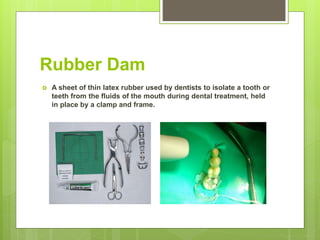
 A sheet of thin latex rubber used by dentists to isolate a tooth or
teeth from the fluids of the mouth during dental treatment, held
in place by a clamp and frame.
Instruments & Materials
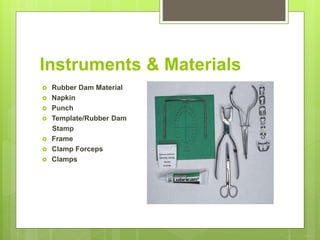
 Rubber Dam Material
 Napkin
 Punch
 Template/Rubber Dam
Stamp
 Frame
 Clamp Forceps
 Clamps
Punch
 At least two types of rubber dam punches are available.
 The Ainsworthtype punch, which is made by several
manufacturers, is excellent if it is well made.
 The Ivory punch (Heraeus Kulzer) is also excellent and has a
self-centering coned piston, or punch point, which helps to
prevent partially punched holes.
Template & Rubber Dam Stamp
 Templates are available to guide the marking of the dam.
Holes in each template correspond to tooth positions.
The template is laid over the dam, and a pen is used to
mark through selected holes onto the dam. With the
template, the dam can be marked and punched before
the patient is seated.
 Rubber stamps provide a very convenient and efficient
way of marking the dam for punching.
Frame
 Frame holders are exemplified by the Young frame (Young
Dental)and the Nygaard-Ostby frame (Coltène/ Whaledent).
 A U-shaped Youngtype frame is made by several manufacturers in
both metal and plastic. The Youngtype frames are available in both
adult and child sizes. A plastic frame is advantageous when
radiographs will be a part of the procedure because it is radiolucent.
The plastic frames do not, however, stand up to heat sterilization as
well as do metal frames, and they have a shorter life span. Metal
frames are less bulky and last for years.
 The Nygaard-Ostby frame is normally positioned on the tissue
surface or inside surface of the dam and touches the patient’s face
(or the rubber dam napkin).
Nygaard-Ostby frame Young frame
Clamp Forceps
 Ivory forceps (Heraeus Kulzer) have stabilizers that prevent the
clamp from rotating on the beaks. This is usually advantageous,
but it limits the use of these forceps to teeth that are within a
range of normal angulation.
 Stokes-type clamp forceps, which have notches near the tips of
their beaks to locate the holes of a rubber dam clamp (Fig 8-
12d), allow a range of rotation for the clamp so that it may be
positioned on teeth that are mesially or distally angled.
Clamps
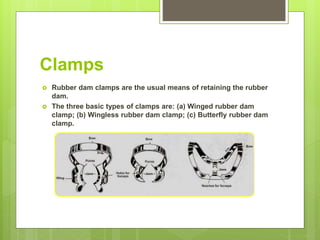
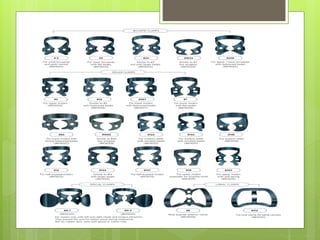
 Rubber dam clamps are the usual means of retaining the rubber
dam.
 The three basic types of clamps are: (a) Winged rubber dam
clamp; (b) Wingless rubber dam clamp; (c) Butterfly rubber dam
clamp.
Other Methods of Isolation
 Isolite (a newer isolation device that provides illumination in
addition to suction, retraction of tongue and cheek, and an
integrated bite block)
 Svedopter (a metal tongue-retraction device for isolation in
mandibular posterior areas)
 Hygoformic saliva ejector (is used in the same way as the
Svedopter for isolation in mandibular posterior areas, but it
does not have a reflective blade)
 Vac-Ejector (is made to facilitate isolation when restoring
posterior teeth. The Vac-Ejector incorporates a bite block,
tongue retractor for mandibular areas, and high-speed suction
attachment)
 Absorbent paper and cotton products (more frequently used so
it will be discussed in detail in the next slide)
Absorbent Paper & Cotton
Products
 Absorbent materials are important in dentistry. Vacuum apparatuses
remove fluids from the operating field by suctioning them; cotton
and paper products help control fluids by absorbing them. Several
types of absorbent cotton rolls are available in various diameters
and lengths. These are placed into areas of the mouth where salivary
gland ducts exit to absorb saliva and prevent salivary contamination
of the operating field.
 Isolation using absorbent materials with suctioning devices is less
effective than using the rubber dam with suction, but in many
procedures, the more complete isolation provided by the dam is
unnecessary. In these situations, absorbent products are useful.
 Small gauze sponges may be folded or rolled to substitute for cotton
rolls.
Summary of
Recommendations
 Use a heavy-gauge, prestamped dam.
 Floss through contacts prior to dam placement, planing any
contact that shreds or tears the floss.
 Use a good water-soluble lubricant, such as Velvachol.
 Use a clamp designed for four-point contact on the tooth, and
avoid overexpansion of the clamp so that the clamp will
maintain its strength and will be stable as a retainer.
 With waxed floss, floss the dam through each interproximal
contact in a single layer and avoid doubling or bunching the
dam in the contact.
Field Isolation

Field Isolation

  • 1.
    Field Isolation Presentation forOperative Dentistry By: Mohsin Khan
  • 2.
    Definition  There aremany ways to isolate an area of the mouth or a tooth so that restorative services can be performed without interference from soft tissues, the tongue, saliva or other fluids.  By far the most complete method of obtaining field isolation is the rubber dam.
  • 3.
    Rubber Dam  Asheet of thin latex rubber used by dentists to isolate a tooth or teeth from the fluids of the mouth during dental treatment, held in place by a clamp and frame.
  • 4.
    Instruments & Materials Rubber Dam Material  Napkin  Punch  Template/Rubber Dam Stamp  Frame  Clamp Forceps  Clamps
  • 5.
    Punch  At leasttwo types of rubber dam punches are available.  The Ainsworthtype punch, which is made by several manufacturers, is excellent if it is well made.  The Ivory punch (Heraeus Kulzer) is also excellent and has a self-centering coned piston, or punch point, which helps to prevent partially punched holes.
  • 7.
    Template & RubberDam Stamp  Templates are available to guide the marking of the dam. Holes in each template correspond to tooth positions. The template is laid over the dam, and a pen is used to mark through selected holes onto the dam. With the template, the dam can be marked and punched before the patient is seated.  Rubber stamps provide a very convenient and efficient way of marking the dam for punching.
  • 9.
    Frame  Frame holdersare exemplified by the Young frame (Young Dental)and the Nygaard-Ostby frame (Coltène/ Whaledent).  A U-shaped Youngtype frame is made by several manufacturers in both metal and plastic. The Youngtype frames are available in both adult and child sizes. A plastic frame is advantageous when radiographs will be a part of the procedure because it is radiolucent. The plastic frames do not, however, stand up to heat sterilization as well as do metal frames, and they have a shorter life span. Metal frames are less bulky and last for years.  The Nygaard-Ostby frame is normally positioned on the tissue surface or inside surface of the dam and touches the patient’s face (or the rubber dam napkin).
  • 10.
  • 11.
    Clamp Forceps  Ivoryforceps (Heraeus Kulzer) have stabilizers that prevent the clamp from rotating on the beaks. This is usually advantageous, but it limits the use of these forceps to teeth that are within a range of normal angulation.  Stokes-type clamp forceps, which have notches near the tips of their beaks to locate the holes of a rubber dam clamp (Fig 8- 12d), allow a range of rotation for the clamp so that it may be positioned on teeth that are mesially or distally angled.
  • 13.
    Clamps  Rubber damclamps are the usual means of retaining the rubber dam.  The three basic types of clamps are: (a) Winged rubber dam clamp; (b) Wingless rubber dam clamp; (c) Butterfly rubber dam clamp.
  • 15.
    Other Methods ofIsolation  Isolite (a newer isolation device that provides illumination in addition to suction, retraction of tongue and cheek, and an integrated bite block)  Svedopter (a metal tongue-retraction device for isolation in mandibular posterior areas)  Hygoformic saliva ejector (is used in the same way as the Svedopter for isolation in mandibular posterior areas, but it does not have a reflective blade)  Vac-Ejector (is made to facilitate isolation when restoring posterior teeth. The Vac-Ejector incorporates a bite block, tongue retractor for mandibular areas, and high-speed suction attachment)  Absorbent paper and cotton products (more frequently used so it will be discussed in detail in the next slide)
  • 16.
    Absorbent Paper &Cotton Products  Absorbent materials are important in dentistry. Vacuum apparatuses remove fluids from the operating field by suctioning them; cotton and paper products help control fluids by absorbing them. Several types of absorbent cotton rolls are available in various diameters and lengths. These are placed into areas of the mouth where salivary gland ducts exit to absorb saliva and prevent salivary contamination of the operating field.  Isolation using absorbent materials with suctioning devices is less effective than using the rubber dam with suction, but in many procedures, the more complete isolation provided by the dam is unnecessary. In these situations, absorbent products are useful.  Small gauze sponges may be folded or rolled to substitute for cotton rolls.
  • 17.
    Summary of Recommendations  Usea heavy-gauge, prestamped dam.  Floss through contacts prior to dam placement, planing any contact that shreds or tears the floss.  Use a good water-soluble lubricant, such as Velvachol.  Use a clamp designed for four-point contact on the tooth, and avoid overexpansion of the clamp so that the clamp will maintain its strength and will be stable as a retainer.  With waxed floss, floss the dam through each interproximal contact in a single layer and avoid doubling or bunching the dam in the contact.