Evaluation instruments for PHEP 101 training
Ohio Department of Health (ODH)
Thomas Muldrow
Instructional Design Department, Franklin University
IDPT 670: Capstone
Professor N
June 21, 2022
Evaluation instruments for PHEP 101 training to be used to gather data
Develop a survey questionnaire to measure learner satisfaction (Level 1 – Reaction)
The first instruments to get developed are for gathering level-1 evaluation data. The instrument
is meant to answer the questions “Is the training going ok and are there any significant issues?
If not, what adjustments need to be made to the course, the environment, or the teaching?”
The evaluation will allow for open-ended comments in addition to the normal questions based
on a 5-point scale. This will help with analyzing the data and comparing it across multiple
groups of learners.
The instrument developed by the client is grouped into major sections to collect information on
the learner's experience and to provide a holistic assessment of the training.
The instrument (Appendix A) that has been developed specifically for use during the beta test is
broken up into two sections – for the presentation and the presenter. It is beneficial to provide
a more detailed evaluation of the different components of the training.
Develop test items, in a variety of formats, to measure learning (Level 2 – Knowledge)
The next two instruments were developed to gather level-2 evaluation data. The instruments
are designed to answer the following question - “How effectively does the tailored PHEP 101
training prepare the newly hired local health department personnel to be effective Emergency
Response Coordinator (ERC)s?”. This will be taken before and after the completion of the
training to be able to measure the increase in knowledge and assess the effectiveness of the
training. The evaluation instrument involves multiple test items to challenge the learner and
facilitate completion. It has been limited to 30 questions to be as efficient as possible while
collecting all the required data.
The instruments (Appendix B) cover the six (6) outcomes/objectives associated with the second
evaluation question. The questions will be used by the client in the implementation of the
training, however, instead of doing a pre and post-test a selection of the questions will be used
throughout the training to test learning comprehension.
Develop a checklist for self-assessment, to measure whether the online seminar was
beneficial in the performance of the ERC duties (Level 3 – Behavior)
The Instrument (Appendix C) will include a 12 question self-assessment for the ERC to complete
30 days after the webinars to assess applicability of the information.
APPENDIX A – PRESENTATION EVALUATION
Participants - To determine the effectiveness of the program in meeting your needs and
interests, we need your input. Your responses will help us to evaluate our efforts, and your
comments and suggestions will help us to plan future programs that meet your needs and
interests
EXPLANATION OF RATINGS
Please circle the appropriate number after each statement. The questions will be assessed on a
5-point scale using Strongly agree, Agree, Neutral, Disagree, and Strongly disagree. Please give
your honest reaction by circling the appropriate number.
Scale: 1 = Strongly Disagree 2=Disagree 3=Neutral 4=Agree 5=Strongly Agree
Emergency Response Unit
Presentation
The presentation isdirectlyapplicable tomyjob 1 2 3 4 5
The presentationwasconcise andinformative. 1 2 3 4 5
The presentationcontainedpractical examplesanduseful
techniquesthatappliedtocurrentwork.
1 2 3 4 5
The visual aidswere effective 1 2 3 4 5
My knowledge and/orskillsincreased because of this presentation 1 2 3 4 5
Comments:
Presenters
The presenterdeliveredthe material inaclearandstructured
manner
1 2 3 4 5
The presenterwas knowledgeableaboutthe topicandany related
issues
1 2 3 4 5
The presentermaintainedmyinterestduringthe entire
presentation.
1 2 3 4 5
The presenterwaswell organizedandprepared 1 2 3 4 5
Comments:
Thank you for taking the time to complete this evaluation. We appreciate your support and
value the input you have provided. If you have any additional comments, they can be provided
anonymously to the evaluation team at muldro06@email.franklin.edu.
Many thanks,
Franklin University Project Team
APPENDIX B– PRE-TEST and POST-TEST
Instructions:
The idea behind this pre-test is to provide a quantifiable measure of the knowledge you already
possess prior to the training. It will also be used to measure the increase in knowledge because
of the course. Lastly, it will give you an indication of material that will be covered, serving as a
checklist of topics that will be addressed. Please ensure you answer all the questions below.
Objective 1: Define the fundamental elementsofplan writing
1. T/F Planwritingshouldemphasize caringforindividuals/populationswithaccessandfunctional
needs.
2. T/F Local EmergencyResponse Plans(ERPs)donotneedtoinvolve local andregional partners.
3. T/F The firststepinthe planningprocessisunderstandingthe situation.
4. T/F An EmergencyResponse Plan(ERP) shouldcontainPurpose,Scope andPlanningAssumptions
sections.
5. T/F One keyplanningprincipleisthe allocationof resources.
Objective 2: Describe the requirementsforan effective ContinuityofOperations(COOP) Plan
1. ______ AnLHD’s COOP PlanConceptof Operationsshouldbe separatedintofourphases(Select
the one that is Incorrect)
a. Operations
b. Reconstitution
c. Communications
d. ReadinessandPreparedness
2. ______ Essential Functions(EFs)are those thatthe LHD MUST continue throughoutadisruption
of normal activities,suchas:
a. PublicInformation/Communications
b. InfectiousDisease and Investigation
c. IT Support
d. Legal Support
3. ______ Critical Elementsof aCOOPPlaninclude:
a. Essential Records
b. Alternate Locations
c. Ordersof Succession
d. All the above
4. ______ How manyalternate locations(includingteleworkasanacceptable option/location)
musta LHD plan forwhenthe primary/normal businesslocationisinaccessible?
Answers:
a. One (1)
b. Two (2)
c. Three (3)
d. None
5. ______ Continuityplanning mainobjectives shouldinclude:
a. Reducingormitigatingdisruptionto critical supportservices
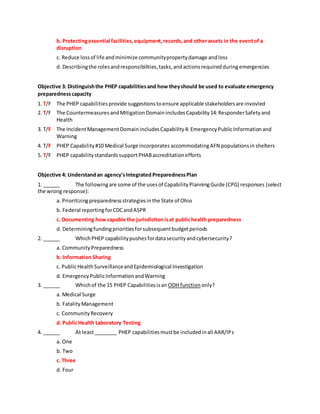
b. Protectingessential facilities,equipment,records,and otherassets in the eventof a
disruption
c. Reduce lossof life andminimizecommunitypropertydamage andloss
d. Describingthe rolesandresponsibilities,tasks,andactionsrequiredduringemergencies
Objective 3: Distinguishthe PHEP capabilitiesand how theyshould be used to evaluate emergency
preparednesscapacity
1. T/F The PHEP capabilitiesprovide suggestionstoensure applicable stakeholdersare invovled
2. T/F The CountermeasuresandMitigationDomainincludesCapability14:ResponderSafetyand
Health
3. T/F The IncidentManagementDomainincludesCapability4: EmergencyPublicInformationand
Warning
4. T/F PHEP Capability#10 Medical Surge incorporates accommodatingAFN populationsin shelters
5. T/F PHEP capabilitystandardssupportPHABaccreditationefforts
Objective 4: Understandan agency'sIntegrated PreparednessPlan
1. ______ The followingare some of the usesof CapabilityPlanningGuide (CPG) responses (select
the wrong response):
a. Prioritizingpreparednessstrategiesinthe State of Ohio
b. Federal reportingforCDCandASPR
c. Documenting how capable the jurisdictionisat publichealth preparedness
d. Determiningfundingprioritiesforsubsequentbudgetperiods
2. ______ WhichPHEP capabilitypushesfordatasecurityandcybersecurity?
a. CommunityPreparedness
b. Information Sharing
c. PublicHealthSurveillanceandEpidemiological Investigation
d. Emergency PublicInformationandWarning
3. ______ Whichof the 15 PHEP Capabilitiesisan ODH function only?
a. Medical Surge
b. FatalityManagement
c. CommunityRecovery
d. PublicHealth Laboratory Testing
4. ______ At least________ PHEP capabilitiesmustbe includedinall AAR/IPs
a. One
b. Two
c. Three
d. Four
5. _______ Whichof the followingis notoutlinedinPHEPCapability8:
a. Activationof dispensingoperations
b. Adverse event reporting
c. Acquiring,managing and transporting materiel
d. Monitoringthroughput
Objective 5: Describe the stepsinvolvedin submittinga deliverable forgrant reimbursement
1. Deliverable documentsubmissionsare uploadedontowhichGMISpage?
a. ProjectNarrative
b. Program Report
c. Application
d. Expenditure Report
2. Regional Email Boxes are basedon yourjurisdiction’sPHEPRegion. Theyare usedfor:
a. General Questions
b. Technical Assistance
c. Deliverable SubmissionNotification
d. All the above
3. Witha deliverable-basedgrantthe outcome changesbasedonthe BHP review process.Selectthe
groupingbelowthatbestfits the process.
a. LHD submitsforexpenditureimmediately/BHPremovesdeliverablefrombudget.
b. LHD submitsfor expenditure onthe appropriate expenditure report/ BHP hostsa TA call
and LHD resubmits
c. LHD submitsforexpenditureimmediately/BHPmakesnecessaryrevisionsandLHD
resubmits
d. LHD submitsforthe expenditure onthe appropriate expenditurereport/LHDsubmitsfor
the expenditure onthe appropriate expenditure report
4. WhichPHEP subgrantis fundedtothe CDC-determinedMetropolitanStatistical Areas:
a. Core
b. Regional
c. CitiesReadinessInitiative (CRI)
d. None of the above
5. The PHEP Grant Administration -PMPUdoesalotto fostercommunicationwithODHandtherefore
no requestistoolittle. Theyassistwith:
a. Deliverable overview andsubmission
b. Expense Reports
c. Allowablecosts
d. BudgetRevision/clarificationmemos
e. All the Above.
LHD submits
deliverable
following
Appendix B1
Deliverable
enters BHP
review process
LHD receives
comment in
GMIS
regarding
approval or
denial
If approved ____
If denied ____
Objective 6: Grant Administration
1. T/F GMIS isthe online platformfordeliverable submission,expenditure reports,budgets,and
applications.
2. T/F A Triad consistsof a HealthCommissioner,Directorof Nursing,andaPHEP Director.
3. T/F To submita deliverable,the onlyactionneededisanemail tomyPublicHealthConsultantwith
the document.
4. T/F Contact informationforyourLHD mustbe updatedwithin15days of changesto personnel listed
inyour Attachment1.
5. T/F Special conditionsmustbe submittedbyJuly30 of the new fiscal year.
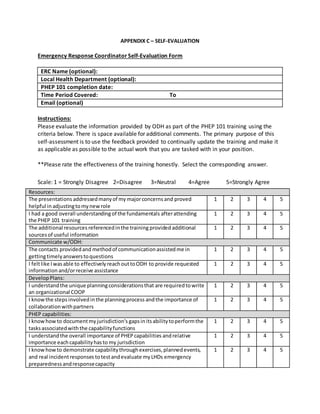
APPENDIX C – SELF-EVALUATION
Emergency Response Coordinator Self-Evaluation Form
ERC Name (optional):
Local Health Department (optional):
PHEP 101 completion date:
Time Period Covered: To
Email (optional)
Instructions:
Please evaluate the information provided by ODH as part of the PHEP 101 training using the
criteria below. There is space available for additional comments. The primary purpose of this
self-assessment is to use the feedback provided to continually update the training and make it
as applicable as possible to the actual work that you are tasked with in your position.
**Please rate the effectiveness of the training honestly. Select the corresponding answer.
Scale: 1 = Strongly Disagree 2=Disagree 3=Neutral 4=Agree 5=Strongly Agree
Resources:
The presentations addressedmanyof my majorconcerns and proved
helpful in adjustingtomynewrole
1 2 3 4 5
I had a good overall understandingof the fundamentals afterattending
the PHEP 101 training
1 2 3 4 5
The additional resources referencedinthe training provided additional
sourcesof useful information
1 2 3 4 5
Communicate w/ODH:
The contacts providedand methodof communicationassistedme in
gettingtimelyanswerstoquestions
1 2 3 4 5
I feltlike Iwasable to effectivelyreachouttoODH to provide requested
information and/orreceive assistance
1 2 3 4 5
DevelopPlans:
I understandthe unique planningconsiderationsthat are requiredtowrite
an organizational COOP
1 2 3 4 5
I knowthe steps involvedinthe planningprocess andthe importance of
collaborationwithpartners
1 2 3 4 5
PHEP capabilities:
I knowhowto documentmyjurisdiction's gapsinitsabilitytoperformthe
tasksassociatedwiththe capabilityfunctions
1 2 3 4 5
I understandthe overall importance of PHEPcapabilities andrelative
importance eachcapabilityhasto my jurisdiction
1 2 3 4 5
I knowhowto demonstrate capabilitythroughexercises,plannedevents,
and real incidentresponses totestandevaluate myLHDs emergency
preparednessandresponsecapacity
1 2 3 4 5
Comments:
What can we do to improve inthese areas?

Evaluation Instruments - ODH Project

  • 1.
    Evaluation instruments forPHEP 101 training Ohio Department of Health (ODH) Thomas Muldrow Instructional Design Department, Franklin University IDPT 670: Capstone Professor N June 21, 2022
  • 2.
    Evaluation instruments forPHEP 101 training to be used to gather data Develop a survey questionnaire to measure learner satisfaction (Level 1 – Reaction) The first instruments to get developed are for gathering level-1 evaluation data. The instrument is meant to answer the questions “Is the training going ok and are there any significant issues? If not, what adjustments need to be made to the course, the environment, or the teaching?” The evaluation will allow for open-ended comments in addition to the normal questions based on a 5-point scale. This will help with analyzing the data and comparing it across multiple groups of learners. The instrument developed by the client is grouped into major sections to collect information on the learner's experience and to provide a holistic assessment of the training. The instrument (Appendix A) that has been developed specifically for use during the beta test is broken up into two sections – for the presentation and the presenter. It is beneficial to provide a more detailed evaluation of the different components of the training. Develop test items, in a variety of formats, to measure learning (Level 2 – Knowledge) The next two instruments were developed to gather level-2 evaluation data. The instruments are designed to answer the following question - “How effectively does the tailored PHEP 101 training prepare the newly hired local health department personnel to be effective Emergency Response Coordinator (ERC)s?”. This will be taken before and after the completion of the training to be able to measure the increase in knowledge and assess the effectiveness of the training. The evaluation instrument involves multiple test items to challenge the learner and facilitate completion. It has been limited to 30 questions to be as efficient as possible while collecting all the required data. The instruments (Appendix B) cover the six (6) outcomes/objectives associated with the second evaluation question. The questions will be used by the client in the implementation of the training, however, instead of doing a pre and post-test a selection of the questions will be used throughout the training to test learning comprehension. Develop a checklist for self-assessment, to measure whether the online seminar was beneficial in the performance of the ERC duties (Level 3 – Behavior) The Instrument (Appendix C) will include a 12 question self-assessment for the ERC to complete 30 days after the webinars to assess applicability of the information.
  • 3.
    APPENDIX A –PRESENTATION EVALUATION Participants - To determine the effectiveness of the program in meeting your needs and interests, we need your input. Your responses will help us to evaluate our efforts, and your comments and suggestions will help us to plan future programs that meet your needs and interests EXPLANATION OF RATINGS Please circle the appropriate number after each statement. The questions will be assessed on a 5-point scale using Strongly agree, Agree, Neutral, Disagree, and Strongly disagree. Please give your honest reaction by circling the appropriate number. Scale: 1 = Strongly Disagree 2=Disagree 3=Neutral 4=Agree 5=Strongly Agree Emergency Response Unit Presentation The presentation isdirectlyapplicable tomyjob 1 2 3 4 5 The presentationwasconcise andinformative. 1 2 3 4 5 The presentationcontainedpractical examplesanduseful techniquesthatappliedtocurrentwork. 1 2 3 4 5 The visual aidswere effective 1 2 3 4 5 My knowledge and/orskillsincreased because of this presentation 1 2 3 4 5 Comments: Presenters The presenterdeliveredthe material inaclearandstructured manner 1 2 3 4 5 The presenterwas knowledgeableaboutthe topicandany related issues 1 2 3 4 5 The presentermaintainedmyinterestduringthe entire presentation. 1 2 3 4 5 The presenterwaswell organizedandprepared 1 2 3 4 5 Comments: Thank you for taking the time to complete this evaluation. We appreciate your support and value the input you have provided. If you have any additional comments, they can be provided anonymously to the evaluation team at muldro06@email.franklin.edu. Many thanks, Franklin University Project Team
  • 4.
    APPENDIX B– PRE-TESTand POST-TEST Instructions: The idea behind this pre-test is to provide a quantifiable measure of the knowledge you already possess prior to the training. It will also be used to measure the increase in knowledge because of the course. Lastly, it will give you an indication of material that will be covered, serving as a checklist of topics that will be addressed. Please ensure you answer all the questions below. Objective 1: Define the fundamental elementsofplan writing 1. T/F Planwritingshouldemphasize caringforindividuals/populationswithaccessandfunctional needs. 2. T/F Local EmergencyResponse Plans(ERPs)donotneedtoinvolve local andregional partners. 3. T/F The firststepinthe planningprocessisunderstandingthe situation. 4. T/F An EmergencyResponse Plan(ERP) shouldcontainPurpose,Scope andPlanningAssumptions sections. 5. T/F One keyplanningprincipleisthe allocationof resources. Objective 2: Describe the requirementsforan effective ContinuityofOperations(COOP) Plan 1. ______ AnLHD’s COOP PlanConceptof Operationsshouldbe separatedintofourphases(Select the one that is Incorrect) a. Operations b. Reconstitution c. Communications d. ReadinessandPreparedness 2. ______ Essential Functions(EFs)are those thatthe LHD MUST continue throughoutadisruption of normal activities,suchas: a. PublicInformation/Communications b. InfectiousDisease and Investigation c. IT Support d. Legal Support 3. ______ Critical Elementsof aCOOPPlaninclude: a. Essential Records b. Alternate Locations c. Ordersof Succession d. All the above 4. ______ How manyalternate locations(includingteleworkasanacceptable option/location) musta LHD plan forwhenthe primary/normal businesslocationisinaccessible? Answers: a. One (1) b. Two (2) c. Three (3) d. None 5. ______ Continuityplanning mainobjectives shouldinclude: a. Reducingormitigatingdisruptionto critical supportservices
  • 5.
    b. Protectingessential facilities,equipment,records,andotherassets in the eventof a disruption c. Reduce lossof life andminimizecommunitypropertydamage andloss d. Describingthe rolesandresponsibilities,tasks,andactionsrequiredduringemergencies Objective 3: Distinguishthe PHEP capabilitiesand how theyshould be used to evaluate emergency preparednesscapacity 1. T/F The PHEP capabilitiesprovide suggestionstoensure applicable stakeholdersare invovled 2. T/F The CountermeasuresandMitigationDomainincludesCapability14:ResponderSafetyand Health 3. T/F The IncidentManagementDomainincludesCapability4: EmergencyPublicInformationand Warning 4. T/F PHEP Capability#10 Medical Surge incorporates accommodatingAFN populationsin shelters 5. T/F PHEP capabilitystandardssupportPHABaccreditationefforts Objective 4: Understandan agency'sIntegrated PreparednessPlan 1. ______ The followingare some of the usesof CapabilityPlanningGuide (CPG) responses (select the wrong response): a. Prioritizingpreparednessstrategiesinthe State of Ohio b. Federal reportingforCDCandASPR c. Documenting how capable the jurisdictionisat publichealth preparedness d. Determiningfundingprioritiesforsubsequentbudgetperiods 2. ______ WhichPHEP capabilitypushesfordatasecurityandcybersecurity? a. CommunityPreparedness b. Information Sharing c. PublicHealthSurveillanceandEpidemiological Investigation d. Emergency PublicInformationandWarning 3. ______ Whichof the 15 PHEP Capabilitiesisan ODH function only? a. Medical Surge b. FatalityManagement c. CommunityRecovery d. PublicHealth Laboratory Testing 4. ______ At least________ PHEP capabilitiesmustbe includedinall AAR/IPs a. One b. Two c. Three d. Four
  • 6.
    5. _______ Whichofthe followingis notoutlinedinPHEPCapability8: a. Activationof dispensingoperations b. Adverse event reporting c. Acquiring,managing and transporting materiel d. Monitoringthroughput Objective 5: Describe the stepsinvolvedin submittinga deliverable forgrant reimbursement 1. Deliverable documentsubmissionsare uploadedontowhichGMISpage? a. ProjectNarrative b. Program Report c. Application d. Expenditure Report 2. Regional Email Boxes are basedon yourjurisdiction’sPHEPRegion. Theyare usedfor: a. General Questions b. Technical Assistance c. Deliverable SubmissionNotification d. All the above 3. Witha deliverable-basedgrantthe outcome changesbasedonthe BHP review process.Selectthe groupingbelowthatbestfits the process. a. LHD submitsforexpenditureimmediately/BHPremovesdeliverablefrombudget. b. LHD submitsfor expenditure onthe appropriate expenditure report/ BHP hostsa TA call and LHD resubmits c. LHD submitsforexpenditureimmediately/BHPmakesnecessaryrevisionsandLHD resubmits d. LHD submitsforthe expenditure onthe appropriate expenditurereport/LHDsubmitsfor the expenditure onthe appropriate expenditure report 4. WhichPHEP subgrantis fundedtothe CDC-determinedMetropolitanStatistical Areas: a. Core b. Regional c. CitiesReadinessInitiative (CRI) d. None of the above 5. The PHEP Grant Administration -PMPUdoesalotto fostercommunicationwithODHandtherefore no requestistoolittle. Theyassistwith: a. Deliverable overview andsubmission b. Expense Reports c. Allowablecosts d. BudgetRevision/clarificationmemos e. All the Above. LHD submits deliverable following Appendix B1 Deliverable enters BHP review process LHD receives comment in GMIS regarding approval or denial If approved ____ If denied ____
  • 7.
    Objective 6: GrantAdministration 1. T/F GMIS isthe online platformfordeliverable submission,expenditure reports,budgets,and applications. 2. T/F A Triad consistsof a HealthCommissioner,Directorof Nursing,andaPHEP Director. 3. T/F To submita deliverable,the onlyactionneededisanemail tomyPublicHealthConsultantwith the document. 4. T/F Contact informationforyourLHD mustbe updatedwithin15days of changesto personnel listed inyour Attachment1. 5. T/F Special conditionsmustbe submittedbyJuly30 of the new fiscal year.
  • 8.
    APPENDIX C –SELF-EVALUATION Emergency Response Coordinator Self-Evaluation Form ERC Name (optional): Local Health Department (optional): PHEP 101 completion date: Time Period Covered: To Email (optional) Instructions: Please evaluate the information provided by ODH as part of the PHEP 101 training using the criteria below. There is space available for additional comments. The primary purpose of this self-assessment is to use the feedback provided to continually update the training and make it as applicable as possible to the actual work that you are tasked with in your position. **Please rate the effectiveness of the training honestly. Select the corresponding answer. Scale: 1 = Strongly Disagree 2=Disagree 3=Neutral 4=Agree 5=Strongly Agree Resources: The presentations addressedmanyof my majorconcerns and proved helpful in adjustingtomynewrole 1 2 3 4 5 I had a good overall understandingof the fundamentals afterattending the PHEP 101 training 1 2 3 4 5 The additional resources referencedinthe training provided additional sourcesof useful information 1 2 3 4 5 Communicate w/ODH: The contacts providedand methodof communicationassistedme in gettingtimelyanswerstoquestions 1 2 3 4 5 I feltlike Iwasable to effectivelyreachouttoODH to provide requested information and/orreceive assistance 1 2 3 4 5 DevelopPlans: I understandthe unique planningconsiderationsthat are requiredtowrite an organizational COOP 1 2 3 4 5 I knowthe steps involvedinthe planningprocess andthe importance of collaborationwithpartners 1 2 3 4 5 PHEP capabilities: I knowhowto documentmyjurisdiction's gapsinitsabilitytoperformthe tasksassociatedwiththe capabilityfunctions 1 2 3 4 5 I understandthe overall importance of PHEPcapabilities andrelative importance eachcapabilityhasto my jurisdiction 1 2 3 4 5 I knowhowto demonstrate capabilitythroughexercises,plannedevents, and real incidentresponses totestandevaluate myLHDs emergency preparednessandresponsecapacity 1 2 3 4 5
  • 9.
    Comments: What can wedo to improve inthese areas?