





By, Muaz
Miza
Aida
Aqilah
What
Telescope
• A telescope is an instrument that aids in the
observation of remote objects by
collecting electromagnetic radiation (such as visible
light).
• Types of telescopes
 Optical telescopes (1608)
 Radio telescopes (1930s)
 Infrared telescopes (1960s)
 X-ray telescopes (1965)
 Submillimetre telescopes (1985)
Refracting telescope
Reflecting telescope
Modern Telescope
• A reflecting telescope
• Refracting telescope – classic telescope
• Types of modern telescope
 All modern research telescopes and large amateur ones are of the
reflector type because of its advantages over the refractor
telescope.
 Hubble Telescope is one of them.
Who & when
The Birth of Modern Telescopes
1200s
• Magnifying glasses become common in
thirteenth century
1350
• Spectacles (reading glasses)
• Symbols of learning
1608
• Hans Lippershey of Middelburg, and then of Jacob Metius of
Alkmaar – a concave & convex lens in a tube
• States General (the national government) in The Hague discussed
the patent
• The patent did not awarded – too easy to copy
1609
• In April, three-powered spyglasses could be bought in spectacle-maker's shops on
the Pont Neuf in Paris, and four months later there were several in Italy
• In June/July, Galileo constructed his first three-powered spyglass.
1609
• In August, Thomas Harriot observed the Moon with a six-powered instrument.
• Galileo presented an eight-powered instrument to the Venetian Senate and
turned a twenty-powered instrument in October or November. He observed the
Moon, discovered four satellites of Jupiter and the rings of Saturn, observed the
phases of Venus, studied sunspot, resolved nebular patches into stars and
discovered many other important phenomena.
1640s
• The length of telescopes began to increase (from 1m – 6 m)
• Telescopes had now again reached the point where further increases in
magnification would restrict the field of view of the instrument too much.
1672
• First working reflecting telescope created by Isaac Newton (Newtonian telescope)
• But the effort ended there. Others were unable to grind mirrors of regular
curvature, and to add to the problem, the mirror tarnished and had to be
repolished every few months, with the attending danger of damage to the
curvature.
Finally
1700s
• The reflecting telescope became a
reality in the hands of first, James
Hadley and then others.
• In the second half of the
eighteenth century, in the hands
of James Short and then William
Herschel, the reflecting telescope
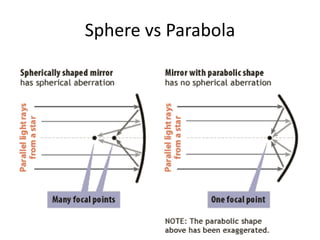
with parabolically ground mirrors
came into its own.
Sphere vs Parabola
where
Where ???
• The telescope was unveiled in the Netherlands.
• In October 1608, the States General (the national
government) in The Hague discussed the patent applications
first of Hans Lippershey and then Jacob Metius, on a device
for "seeing faraway things as though nearby."
• It consisted of a convex and concave lens in a tube, and the
combination magnified three or four times.
• The gentlemen found the device too easy to copy to award
the patent, but it voted a small award to Metius and
employed Lippershey to make several binocular versions, for
which he was paid handsomely.
why
Why They Built The Modern
Telescope?
1.They build it to see distant objects more clearly by magnifying them or
to increase the effective brightness of a faint object.
2.They also build it to observe remote objects which was then used in the
study of astronomy.
3.They also build it to look into outer space, such as stars, planets, moon etc.
Why Do You Think Telescopes Are So
Important?
Because they let us see further and discover what is out there in
the Universe. Very importantly, they let us see back in time.
Because light travels at 30,000 km per second, it means that
light coming from a distant object takes time to get to us.
The light we get from an object one billion light years away is
one billion years old, so we are seeing the object as it was
one billion years ago. In this way, we can see almost all the way
back to the start of the Universe, 13.7 billion years ago. In this
way, we can study the history of the Universe and how it evolved
to get to this point.
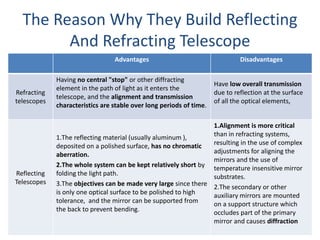
The Reason Why They Build Reflecting
And Refracting Telescope
Advantages Disadvantages
Refracting
telescopes
Having no central "stop" or other diffracting
element in the path of light as it enters the
telescope, and the alignment and transmission
characteristics are stable over long periods of time.
Have low overall transmission
due to reflection at the surface
of all the optical elements,
Reflecting
Telescopes
1.The reflecting material (usually aluminum ),
deposited on a polished surface, has no chromatic
aberration.
2.The whole system can be kept relatively short by
folding the light path.
3.The objectives can be made very large since there
is only one optical surface to be polished to high
tolerance, and the mirror can be supported from
the back to prevent bending.
1.Alignment is more critical
than in refracting systems,
resulting in the use of complex
adjustments for aligning the
mirrors and the use of
temperature insensitive mirror
substrates.
2.The secondary or other
auxiliary mirrors are mounted
on a support structure which
occludes part of the primary
mirror and causes diffraction
how
HOW ???
How does a telescope work ?
 Basically telescope has two types . Refracting
and reflecting .
 Refracting telescope use lenses to focus the
light ,while reflecting telescope use mirror .
 Refracting telescope work by using 2 lenses to
focus the light and make it look like the object
closer to us . Both lenses are convex lens .
This lens work by bending light inwards . This is
what make the image look smaller .
 Reflecting telescope use mirror instead of lens .
 In this case , the type of mirror used is concave
mirror .
 Mirror of this shape also accomplish the goal of
bending light together , except that they do it
by reflecting the light instead of bending it as it
passes through .
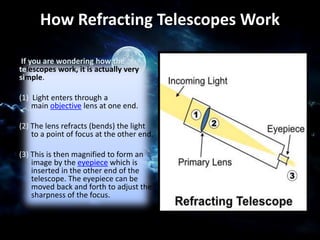
How Refracting Telescopes Work
If you are wondering how the
telescopes work, it is actually very
simple.
(1) Light enters through a
main objective lens at one end.
(2) The lens refracts (bends) the light
to a point of focus at the other end.
(3) This is then magnified to form an
image by the eyepiece which is
inserted in the other end of the
telescope. The eyepiece can be
moved back and forth to adjust the
sharpness of the focus.
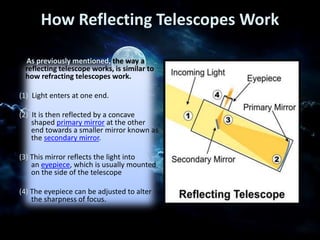
How Reflecting Telescopes Work
As previously mentioned, the way a
reflecting telescope works, is similar to
how refracting telescopes work.
(1) Light enters at one end.
(2) It is then reflected by a concave
shaped primary mirror at the other
end towards a smaller mirror known as
the secondary mirror.
(3) This mirror reflects the light into
an eyepiece, which is usually mounted
on the side of the telescope
(4) The eyepiece can be adjusted to alter
the sharpness of focus.
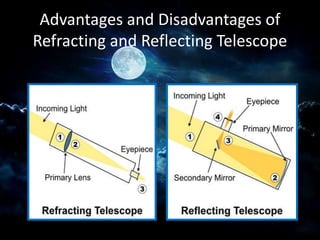
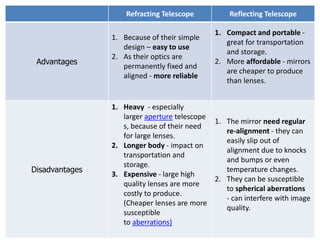
Advantages and Disadvantages of
Refracting and Reflecting Telescope
Refracting Telescope Reflecting Telescope
Advantages
1. Because of their simple
design – easy to use
2. As their optics are
permanently fixed and
aligned - more reliable
1. Compact and portable -
great for transportation
and storage.
2. More affordable - mirrors
are cheaper to produce
than lenses.
Disadvantages
1. Heavy - especially
larger aperture telescope
s, because of their need
for large lenses.
2. Longer body - impact on
transportation and
storage.
3. Expensive - large high
quality lenses are more
costly to produce.
(Cheaper lenses are more
susceptible
to aberrations)
1. The mirror need regular
re-alignment - they can
easily slip out of
alignment due to knocks
and bumps or even
temperature changes.
2. They can be susceptible
to spherical aberrations
- can interfere with image
quality.
Thank you!

Modern Telescope (5W's 1H)

  • 1.
  • 2.
  • 3.
    Telescope • A telescopeis an instrument that aids in the observation of remote objects by collecting electromagnetic radiation (such as visible light). • Types of telescopes  Optical telescopes (1608)  Radio telescopes (1930s)  Infrared telescopes (1960s)  X-ray telescopes (1965)  Submillimetre telescopes (1985) Refracting telescope Reflecting telescope
  • 4.
    Modern Telescope • Areflecting telescope • Refracting telescope – classic telescope • Types of modern telescope  All modern research telescopes and large amateur ones are of the reflector type because of its advantages over the refractor telescope.  Hubble Telescope is one of them.
  • 5.
  • 6.
    The Birth ofModern Telescopes 1200s • Magnifying glasses become common in thirteenth century 1350 • Spectacles (reading glasses) • Symbols of learning 1608 • Hans Lippershey of Middelburg, and then of Jacob Metius of Alkmaar – a concave & convex lens in a tube • States General (the national government) in The Hague discussed the patent • The patent did not awarded – too easy to copy
  • 7.
    1609 • In April,three-powered spyglasses could be bought in spectacle-maker's shops on the Pont Neuf in Paris, and four months later there were several in Italy • In June/July, Galileo constructed his first three-powered spyglass. 1609 • In August, Thomas Harriot observed the Moon with a six-powered instrument. • Galileo presented an eight-powered instrument to the Venetian Senate and turned a twenty-powered instrument in October or November. He observed the Moon, discovered four satellites of Jupiter and the rings of Saturn, observed the phases of Venus, studied sunspot, resolved nebular patches into stars and discovered many other important phenomena. 1640s • The length of telescopes began to increase (from 1m – 6 m) • Telescopes had now again reached the point where further increases in magnification would restrict the field of view of the instrument too much. 1672 • First working reflecting telescope created by Isaac Newton (Newtonian telescope) • But the effort ended there. Others were unable to grind mirrors of regular curvature, and to add to the problem, the mirror tarnished and had to be repolished every few months, with the attending danger of damage to the curvature.
  • 8.
    Finally 1700s • The reflectingtelescope became a reality in the hands of first, James Hadley and then others. • In the second half of the eighteenth century, in the hands of James Short and then William Herschel, the reflecting telescope with parabolically ground mirrors came into its own.
  • 9.
  • 10.
  • 11.
    Where ??? • Thetelescope was unveiled in the Netherlands. • In October 1608, the States General (the national government) in The Hague discussed the patent applications first of Hans Lippershey and then Jacob Metius, on a device for "seeing faraway things as though nearby." • It consisted of a convex and concave lens in a tube, and the combination magnified three or four times. • The gentlemen found the device too easy to copy to award the patent, but it voted a small award to Metius and employed Lippershey to make several binocular versions, for which he was paid handsomely.
  • 12.
  • 13.
    Why They BuiltThe Modern Telescope? 1.They build it to see distant objects more clearly by magnifying them or to increase the effective brightness of a faint object. 2.They also build it to observe remote objects which was then used in the study of astronomy. 3.They also build it to look into outer space, such as stars, planets, moon etc.
  • 14.
    Why Do YouThink Telescopes Are So Important? Because they let us see further and discover what is out there in the Universe. Very importantly, they let us see back in time. Because light travels at 30,000 km per second, it means that light coming from a distant object takes time to get to us. The light we get from an object one billion light years away is one billion years old, so we are seeing the object as it was one billion years ago. In this way, we can see almost all the way back to the start of the Universe, 13.7 billion years ago. In this way, we can study the history of the Universe and how it evolved to get to this point.
  • 15.
    The Reason WhyThey Build Reflecting And Refracting Telescope Advantages Disadvantages Refracting telescopes Having no central "stop" or other diffracting element in the path of light as it enters the telescope, and the alignment and transmission characteristics are stable over long periods of time. Have low overall transmission due to reflection at the surface of all the optical elements, Reflecting Telescopes 1.The reflecting material (usually aluminum ), deposited on a polished surface, has no chromatic aberration. 2.The whole system can be kept relatively short by folding the light path. 3.The objectives can be made very large since there is only one optical surface to be polished to high tolerance, and the mirror can be supported from the back to prevent bending. 1.Alignment is more critical than in refracting systems, resulting in the use of complex adjustments for aligning the mirrors and the use of temperature insensitive mirror substrates. 2.The secondary or other auxiliary mirrors are mounted on a support structure which occludes part of the primary mirror and causes diffraction
  • 16.
  • 17.
    HOW ??? How doesa telescope work ?  Basically telescope has two types . Refracting and reflecting .  Refracting telescope use lenses to focus the light ,while reflecting telescope use mirror .  Refracting telescope work by using 2 lenses to focus the light and make it look like the object closer to us . Both lenses are convex lens . This lens work by bending light inwards . This is what make the image look smaller .
  • 18.
     Reflecting telescopeuse mirror instead of lens .  In this case , the type of mirror used is concave mirror .  Mirror of this shape also accomplish the goal of bending light together , except that they do it by reflecting the light instead of bending it as it passes through .
  • 19.
    How Refracting TelescopesWork If you are wondering how the telescopes work, it is actually very simple. (1) Light enters through a main objective lens at one end. (2) The lens refracts (bends) the light to a point of focus at the other end. (3) This is then magnified to form an image by the eyepiece which is inserted in the other end of the telescope. The eyepiece can be moved back and forth to adjust the sharpness of the focus.
  • 20.
    How Reflecting TelescopesWork As previously mentioned, the way a reflecting telescope works, is similar to how refracting telescopes work. (1) Light enters at one end. (2) It is then reflected by a concave shaped primary mirror at the other end towards a smaller mirror known as the secondary mirror. (3) This mirror reflects the light into an eyepiece, which is usually mounted on the side of the telescope (4) The eyepiece can be adjusted to alter the sharpness of focus.
  • 21.
    Advantages and Disadvantagesof Refracting and Reflecting Telescope
  • 22.
    Refracting Telescope ReflectingTelescope Advantages 1. Because of their simple design – easy to use 2. As their optics are permanently fixed and aligned - more reliable 1. Compact and portable - great for transportation and storage. 2. More affordable - mirrors are cheaper to produce than lenses. Disadvantages 1. Heavy - especially larger aperture telescope s, because of their need for large lenses. 2. Longer body - impact on transportation and storage. 3. Expensive - large high quality lenses are more costly to produce. (Cheaper lenses are more susceptible to aberrations) 1. The mirror need regular re-alignment - they can easily slip out of alignment due to knocks and bumps or even temperature changes. 2. They can be susceptible to spherical aberrations - can interfere with image quality.
  • 23.