GEOCENTRIC MODEL
Alfredo Meneses III
THE PYTHAGOREAN
MODEL
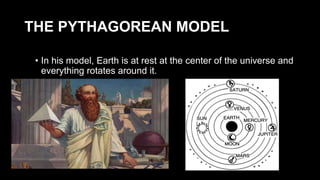
THE PYTHAGOREAN MODEL
• In his model, Earth is at rest at the center of the universe and
everything rotates around it.
Plato’s “Saving the Appearances”
• Plato adopted the Pythagorean
view of the motion of the
heavenly bodies as combinations
of circular motion about the earth.
• He assumed that all motions in
the universe are perfectly circular
and all heavenly bodies are
ethereal or perfect.
Plato’s “Saving the Appearances”
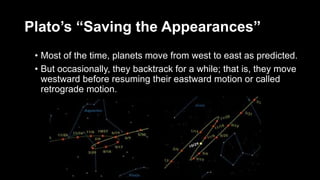
• Most of the time, planets move from west to east as predicted.
• But occasionally, they backtrack for a while; that is, they move
westward before resuming their eastward motion or called
retrograde motion.
EUDOXUS’ MODEL
EUDOXUS’ MODEL
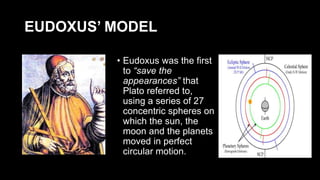
• Eudoxus was the first
to “save the
appearances” that
Plato referred to,
using a series of 27
concentric spheres on
which the sun, the
moon and the planets
moved in perfect
circular motion.
EUDOXUS’ MODEL
• The breakdown of the 27 spheres is as follows: one sphere for
fixed stars, three spheres for the sun, three spheres for the
moon, and four spheres each of the five known planets at the
time – Mercury, Venus, Mars, Saturn, and Jupiter.
ARISTOTLE’S MODEL
ARISTOTLE’S MODEL
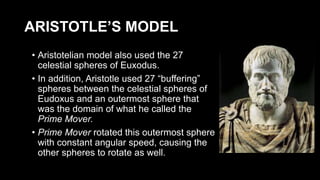
• Aristotelian model also used the 27
celestial spheres of Euxodus.
• In addition, Aristotle used 27 “buffering”
spheres between the celestial spheres of
Eudoxus and an outermost sphere that
was the domain of what he called the
Prime Mover.
• Prime Mover rotated this outermost sphere
with constant angular speed, causing the
other spheres to rotate as well.
ARISTOTLE’S MODEL
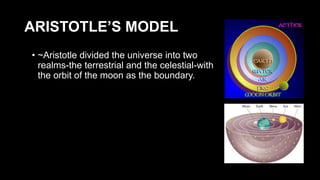
• ~Aristotle divided the universe into two
realms-the terrestrial and the celestial-with
the orbit of the moon as the boundary.
ARISTOTLE’S MODEL
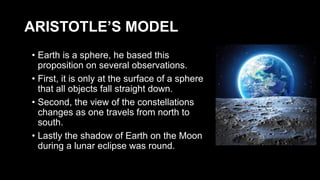
• Earth is a sphere, he based this
proposition on several observations.
• First, it is only at the surface of a sphere
that all objects fall straight down.
• Second, the view of the constellations
changes as one travels from north to
south.
• Lastly the shadow of Earth on the Moon
during a lunar eclipse was round.
PTOLEMY’S MODEL
PTOLEMY’S MODEL
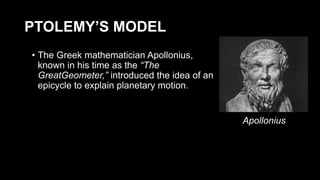
• The Greek mathematician Apollonius,
known in his time as the “The
GreatGeometer,” introduced the idea of an
epicycle to explain planetary motion.
Apollonius
PTOLEMY’S MODEL
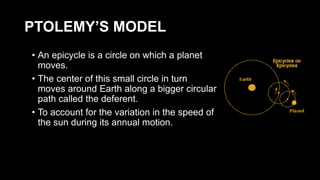
• An epicycle is a circle on which a planet
moves.
• The center of this small circle in turn
moves around Earth along a bigger circular
path called the deferent.
• To account for the variation in the speed of
the sun during its annual motion.
PTOLEMY’S MODEL
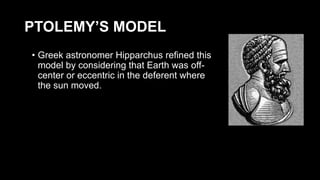
• Greek astronomer Hipparchus refined this
model by considering that Earth was off-
center or eccentric in the deferent where
the sun moved.
PTOLEMY’S MODEL
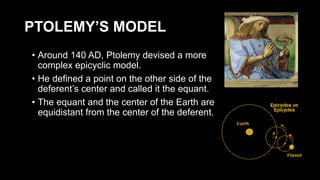
• Around 140 AD, Ptolemy devised a more
complex epicyclic model.
• He defined a point on the other side of the
deferent’s center and called it the equant.
• The equant and the center of the Earth are
equidistant from the center of the deferent.
PTOLEMY’S MODEL
• Ptolemy’s model of the universe survived
for more than 14 centuries.
• The Greeks not only knew that the Earth
was round.
• They also knew the circumference of Earth
to be 25 000 miles.
• Eratosthenes measured it in 235 BCE using
trigonometry and the knowledge of the
angle of elevation of the sun at noon in
Alexandria and Syene (now Aswan, Egypt).

Geocentric Model

  • 1.
  • 2.
  • 3.
    THE PYTHAGOREAN MODEL •In his model, Earth is at rest at the center of the universe and everything rotates around it.
  • 4.
    Plato’s “Saving theAppearances” • Plato adopted the Pythagorean view of the motion of the heavenly bodies as combinations of circular motion about the earth. • He assumed that all motions in the universe are perfectly circular and all heavenly bodies are ethereal or perfect.
  • 5.
    Plato’s “Saving theAppearances” • Most of the time, planets move from west to east as predicted. • But occasionally, they backtrack for a while; that is, they move westward before resuming their eastward motion or called retrograde motion.
  • 6.
  • 7.
    EUDOXUS’ MODEL • Eudoxuswas the first to “save the appearances” that Plato referred to, using a series of 27 concentric spheres on which the sun, the moon and the planets moved in perfect circular motion.
  • 8.
    EUDOXUS’ MODEL • Thebreakdown of the 27 spheres is as follows: one sphere for fixed stars, three spheres for the sun, three spheres for the moon, and four spheres each of the five known planets at the time – Mercury, Venus, Mars, Saturn, and Jupiter.
  • 9.
  • 10.
    ARISTOTLE’S MODEL • Aristotelianmodel also used the 27 celestial spheres of Euxodus. • In addition, Aristotle used 27 “buffering” spheres between the celestial spheres of Eudoxus and an outermost sphere that was the domain of what he called the Prime Mover. • Prime Mover rotated this outermost sphere with constant angular speed, causing the other spheres to rotate as well.
  • 11.
    ARISTOTLE’S MODEL • ~Aristotledivided the universe into two realms-the terrestrial and the celestial-with the orbit of the moon as the boundary.
  • 12.
    ARISTOTLE’S MODEL • Earthis a sphere, he based this proposition on several observations. • First, it is only at the surface of a sphere that all objects fall straight down. • Second, the view of the constellations changes as one travels from north to south. • Lastly the shadow of Earth on the Moon during a lunar eclipse was round.
  • 13.
  • 14.
    PTOLEMY’S MODEL • TheGreek mathematician Apollonius, known in his time as the “The GreatGeometer,” introduced the idea of an epicycle to explain planetary motion. Apollonius
  • 15.
    PTOLEMY’S MODEL • Anepicycle is a circle on which a planet moves. • The center of this small circle in turn moves around Earth along a bigger circular path called the deferent. • To account for the variation in the speed of the sun during its annual motion.
  • 16.
    PTOLEMY’S MODEL • Greekastronomer Hipparchus refined this model by considering that Earth was off- center or eccentric in the deferent where the sun moved.
  • 17.
    PTOLEMY’S MODEL • Around140 AD, Ptolemy devised a more complex epicyclic model. • He defined a point on the other side of the deferent’s center and called it the equant. • The equant and the center of the Earth are equidistant from the center of the deferent.
  • 18.
    PTOLEMY’S MODEL • Ptolemy’smodel of the universe survived for more than 14 centuries. • The Greeks not only knew that the Earth was round. • They also knew the circumference of Earth to be 25 000 miles. • Eratosthenes measured it in 235 BCE using trigonometry and the knowledge of the angle of elevation of the sun at noon in Alexandria and Syene (now Aswan, Egypt).

Editor's Notes

  • #2 Geocentric Models is where the Earth is the Center of the Universe. It was supported by different astronomers.
  • #19 Eratosthenes is the Father of Geometry