STRUCTURE, MATERIALS & CONSTRUCTION
By
Kimberley Ee Sze Ann (0315319)
Construction in modern architecture: The structure, materials and construction methods of Mies
van der Rohe’s Tugendhat House and Frank Lloyd Wright’s Fallingwater.
This essay discusses construction in modern architecture and is a comparison of the structure,
materials and construction methods of Mies van der Rohe’s Tugendhat House and Frank Lloyd
Wright’s Fallingwater.
Mies was a German architect who practiced architecture both in Germany and the United States
in the 60 years of his career. He is known for his minimalistic architecture inspired by the
Malevich art movement of suprematism and also his dictums of “less is more” and “God is in the
details”. Mies’ eye for detail and craft made his works icons of the period of modern architecture.
One such icon is the Tugendhat House in Brno, Czech Republic. The house was designed as a
large and luxurious villa for the Tugendhat family and was the last major European home by
Mies. (Miessociety.org, 2015).
On the other hand, Wright’s 70 year career was mostly confined to the United States. He is
famous for Prairie style architecture and the introduction of Usonian homes to America. His two
dictums were that "Every great architect is- necessarily - a great poet. He must be a great
original interpreter of his time, his day, his age" and “out of the ground and into the light!” which
defined his organic architecture (Sergeant, 1984). One of Wright’s most famous works is his
Fallingwater which was designed for the Kaufmann family. It was built over a waterfall so it
provided a beautiful view but became an integral part of their lives (Fallingwater.org, 2015).
The first element discussed is structure. In the 20th century, the challenge faced by architects
was to meet the principles underlying architectural design with rapid technological advancement
and the modernisation of society. In other words, the buildings would have to implement the
new materials and construction techniques while also accommodating specific needs of the user
whether in the planning of space or appearance of the building.
Mies met this challenge through his dictum of “less is more” and “God is in the details” as can
be seen in the structure of the Tugendhat House which showcased Mies’ signature of a minimal
frame work which embodied open space, clarity and freedom (Carter, 1999). In the Tugendhat
House, Mies used the revolutionary iron framework to dispense with supporting walls and
arranged the interior in order to achieve a feeling of space and light. Furthermore, the
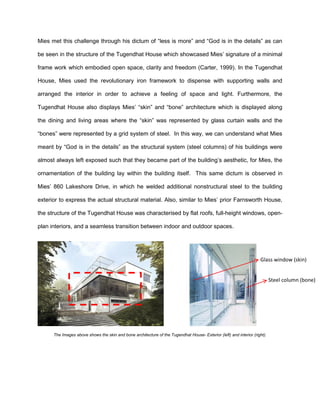
Tugendhat House also displays Mies’ “skin” and “bone” architecture which is displayed along
the dining and living areas where the “skin” was represented by glass curtain walls and the
“bones” were represented by a grid system of steel. In this way, we can understand what Mies
meant by “God is in the details” as the structural system (steel columns) of his buildings were
almost always left exposed such that they became part of the building’s aesthetic, for Mies, the
ornamentation of the building lay within the building itself. This same dictum is observed in
Mies’ 860 Lakeshore Drive, in which he welded additional nonstructural steel to the building
exterior to express the actual structural material. Also, similar to Mies’ prior Farnsworth House,
the structure of the Tugendhat House was characterised by flat roofs, full-height windows, open-
plan interiors, and a seamless transition between indoor and outdoor spaces.
The Images above shows the skin and bone architecture of the Tugendhat House- Exterior (left) and interior (right).
Glass window (skin)
Steel column (bone)
On the other hand, Wright’s answer to modernism was a philosophy he called organic
architecture. In Fallingwater, he realised a design so well integrated with its site that buildings,
furnishings, and surroundings become part of a unified, interrelated composition
(Fallingwater.org, 2015). Furthermore, comparable to Mies, Wright’s exterior facades were left
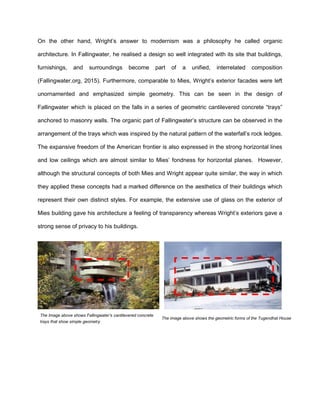
unornamented and emphasized simple geometry. This can be seen in the design of
Fallingwater which is placed on the falls in a series of geometric cantilevered concrete “trays”
anchored to masonry walls. The organic part of Fallingwater’s structure can be observed in the
arrangement of the trays which was inspired by the natural pattern of the waterfall’s rock ledges.
The expansive freedom of the American frontier is also expressed in the strong horizontal lines
and low ceilings which are almost similar to Mies’ fondness for horizontal planes. However,
although the structural concepts of both Mies and Wright appear quite similar, the way in which
they applied these concepts had a marked difference on the aesthetics of their buildings which
represent their own distinct styles. For example, the extensive use of glass on the exterior of
Mies building gave his architecture a feeling of transparency whereas Wright’s exteriors gave a
strong sense of privacy to his buildings.
The image above shows the geometric forms of the Tugendhat House
The Image above shows Fallingwater’s cantilevered concrete
trays that show simple geometry
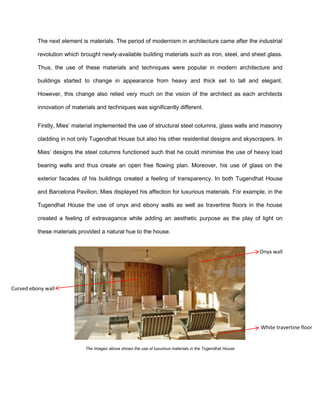
The next element is materials. The period of modernism in architecture came after the industrial
revolution which brought newly-available building materials such as iron, steel, and sheet glass.
Thus, the use of these materials and techniques were popular in modern architecture and
buildings started to change in appearance from heavy and thick set to tall and elegant.
However, this change also relied very much on the vision of the architect as each architects
innovation of materials and techniques was significantly different.
Firstly, Mies’ material implemented the use of structural steel columns, glass walls and masonry
cladding in not only Tugendhat House but also his other residential designs and skyscrapers. In
Mies’ designs the steel columns functioned such that he could minimise the use of heavy load
bearing walls and thus create an open free flowing plan. Moreover, his use of glass on the
exterior facades of his buildings created a feeling of transparency. In both Tugendhat House
and Barcelona Pavilion, Mies displayed his affection for luxurious materials. For example, in the
Tugendhat House the use of onyx and ebony walls as well as travertine floors in the house
created a feeling of extravagance while adding an aesthetic purpose as the play of light on
these materials provided a natural hue to the house.
The Images above shows the use of luxurious materials in the Tugendhat House
Onyx wall
Curved ebony wall
White travertine floor
Similar to Mies and his other contemporaries, Wright also implemented modern materials in his
designs. However, Wright distinctively employed materials and technological methods
resourcefully and honestly so his buildings were in harmony with the natural environment. For
example, in Fallingwater Wright employed the use of the same Pottsville sandstone as the
natural rock ledges in the masonry walls. He successfully changed the perception that
technology symbolised an impersonal and ugly part of society through his innovative use of
materials.
The last element is the methods of construction. The period of modernism in architecture was
dominated by industrialised buildings that greatly implemented standardisation and
prefabrication. This opened new possibilities as the prefabricated building components could be
easily manipulated.
The construction techniques of Mies echoed his thirst for precision and quality in his
architecture. Mies was a great enthusiast of industrialised buildings but although many parts of
his buildings were produced in factories, in the assembly process, the components were
customized (Smith, 2010) like the structural steel columns of the Tugendhat House. These
chromed steel components were produced through prefabrication however due to the minor
details that needed to be expressed in these columns they were only finished on site.
Consequently, in many of Mies’ projects the cost savings from the factory process became
negligible and thus Mies was credited for his eye for detail and achievement of simplicity and
refinement in his designs rather than affordability (Smith, 2010).
Wright’s approach to construction and modern industrialisation techniques varied greatly from
that of Mies and the modern masters of Europe. Although, he believed in new, innovative
architecture he stuck to traditional methods as well. Wright was skeptical of the use of
prefabrication in construction as he felt it lacked tactile qualities, and called into question the
authorship of the designer (Smith, 2010). Fallingwater was largely handmade, the lumpy white
stucco that was smooth only if you were two miles away was handcrafted and is proof of
Wright’s aversion to prefabrication. Furthermore, Wright’s approach differs from Mies’ as he
achieved affordability for his clients and his construction techniques did not prioritise aesthetics
alone. Wright never wanted his houses to be “mass produced” in the true sense; his architecture
was client- and site-driven first and technology-driven second (Smith, 2010).
In conclusion, the structure, materials and construction that were earlier analysed fully embody
the philosophy of both architects. In the case of Mies, he was able to achieve the simplistic
forms he associated with modern architecture in the structure of his buildings. Furthermore, he
also ornamented his buildings in such a way that the character of the buildings and his own
meticulous personality could be seen through his selection of material. Also, his methods of
construction were able to express modernism in his use of prefabrication while still maintaining
his design intentions. In comparison, Wright achieved his philosophy through the organic
structure of his buildings. Furthermore, his choice of materials was based on his belief of
providing affordable accommodation to society. Lastly, Wright unlike many other modern
architects did not favour prefabrication as a construction technique in his designs and in doing
so; he was able to preserve his design integrity.
References
Carter, P. (1999). Mies van der Rohe at Work. New York: Phaidon.
Frampton, K. (1992). Modern Architecture a Critical History (3rd ed.). London: Thames and
Hudson.
Macdonald, A. (2001). Structure and Architecture (2nd ed.). Oxford: Elsevier.
Sergeant, J. (1984). Frank Lloyd Wright's Usonian Houses: Designs for Moderate Cost One-
Family Homes. New York: Whitney.
Smith, R. (2010). Prefab Architecture: A Guide to Modular Design and Construction. New
Jersey: John Wiley & Sons.
Zidlicky, A. (2015). THE STRUCTURE | Vila Tugendhat. Tugendhat.eu. Retrieved 31 May 2015,
from http://www.tugendhat.eu/en/the-structure.html
Fallingwater.org,. (2015). Fallingwater | What is Fallingwater?. Retrieved 30 May 2015, from
http://www.fallingwater.org/37/what-is-fallingwater
Learn.canvas.net,. (2015). M9-Architecture and the Industrial Revolution: Art Appreciation.
Retrieved 30 May 2015, from https://learn.canvas.net/courses/24/pages/m9-architecture-
and-the-industrial-revolution
Miessociety.org,. (2015). Mies van der Rohe Society | Projects | Tugendhat House. Retrieved
30 May 2015, from http://www.miessociety.org/legacy/projects/tugendhat-house/

Mies vs Wright

  • 1.
    STRUCTURE, MATERIALS &CONSTRUCTION By Kimberley Ee Sze Ann (0315319)
  • 2.
    Construction in modernarchitecture: The structure, materials and construction methods of Mies van der Rohe’s Tugendhat House and Frank Lloyd Wright’s Fallingwater. This essay discusses construction in modern architecture and is a comparison of the structure, materials and construction methods of Mies van der Rohe’s Tugendhat House and Frank Lloyd Wright’s Fallingwater. Mies was a German architect who practiced architecture both in Germany and the United States in the 60 years of his career. He is known for his minimalistic architecture inspired by the Malevich art movement of suprematism and also his dictums of “less is more” and “God is in the details”. Mies’ eye for detail and craft made his works icons of the period of modern architecture. One such icon is the Tugendhat House in Brno, Czech Republic. The house was designed as a large and luxurious villa for the Tugendhat family and was the last major European home by Mies. (Miessociety.org, 2015). On the other hand, Wright’s 70 year career was mostly confined to the United States. He is famous for Prairie style architecture and the introduction of Usonian homes to America. His two dictums were that "Every great architect is- necessarily - a great poet. He must be a great original interpreter of his time, his day, his age" and “out of the ground and into the light!” which defined his organic architecture (Sergeant, 1984). One of Wright’s most famous works is his Fallingwater which was designed for the Kaufmann family. It was built over a waterfall so it provided a beautiful view but became an integral part of their lives (Fallingwater.org, 2015). The first element discussed is structure. In the 20th century, the challenge faced by architects was to meet the principles underlying architectural design with rapid technological advancement and the modernisation of society. In other words, the buildings would have to implement the new materials and construction techniques while also accommodating specific needs of the user whether in the planning of space or appearance of the building.
  • 3.
    Mies met thischallenge through his dictum of “less is more” and “God is in the details” as can be seen in the structure of the Tugendhat House which showcased Mies’ signature of a minimal frame work which embodied open space, clarity and freedom (Carter, 1999). In the Tugendhat House, Mies used the revolutionary iron framework to dispense with supporting walls and arranged the interior in order to achieve a feeling of space and light. Furthermore, the Tugendhat House also displays Mies’ “skin” and “bone” architecture which is displayed along the dining and living areas where the “skin” was represented by glass curtain walls and the “bones” were represented by a grid system of steel. In this way, we can understand what Mies meant by “God is in the details” as the structural system (steel columns) of his buildings were almost always left exposed such that they became part of the building’s aesthetic, for Mies, the ornamentation of the building lay within the building itself. This same dictum is observed in Mies’ 860 Lakeshore Drive, in which he welded additional nonstructural steel to the building exterior to express the actual structural material. Also, similar to Mies’ prior Farnsworth House, the structure of the Tugendhat House was characterised by flat roofs, full-height windows, open- plan interiors, and a seamless transition between indoor and outdoor spaces. The Images above shows the skin and bone architecture of the Tugendhat House- Exterior (left) and interior (right). Glass window (skin) Steel column (bone)
  • 4.
    On the otherhand, Wright’s answer to modernism was a philosophy he called organic architecture. In Fallingwater, he realised a design so well integrated with its site that buildings, furnishings, and surroundings become part of a unified, interrelated composition (Fallingwater.org, 2015). Furthermore, comparable to Mies, Wright’s exterior facades were left unornamented and emphasized simple geometry. This can be seen in the design of Fallingwater which is placed on the falls in a series of geometric cantilevered concrete “trays” anchored to masonry walls. The organic part of Fallingwater’s structure can be observed in the arrangement of the trays which was inspired by the natural pattern of the waterfall’s rock ledges. The expansive freedom of the American frontier is also expressed in the strong horizontal lines and low ceilings which are almost similar to Mies’ fondness for horizontal planes. However, although the structural concepts of both Mies and Wright appear quite similar, the way in which they applied these concepts had a marked difference on the aesthetics of their buildings which represent their own distinct styles. For example, the extensive use of glass on the exterior of Mies building gave his architecture a feeling of transparency whereas Wright’s exteriors gave a strong sense of privacy to his buildings. The image above shows the geometric forms of the Tugendhat House The Image above shows Fallingwater’s cantilevered concrete trays that show simple geometry
  • 5.
    The next elementis materials. The period of modernism in architecture came after the industrial revolution which brought newly-available building materials such as iron, steel, and sheet glass. Thus, the use of these materials and techniques were popular in modern architecture and buildings started to change in appearance from heavy and thick set to tall and elegant. However, this change also relied very much on the vision of the architect as each architects innovation of materials and techniques was significantly different. Firstly, Mies’ material implemented the use of structural steel columns, glass walls and masonry cladding in not only Tugendhat House but also his other residential designs and skyscrapers. In Mies’ designs the steel columns functioned such that he could minimise the use of heavy load bearing walls and thus create an open free flowing plan. Moreover, his use of glass on the exterior facades of his buildings created a feeling of transparency. In both Tugendhat House and Barcelona Pavilion, Mies displayed his affection for luxurious materials. For example, in the Tugendhat House the use of onyx and ebony walls as well as travertine floors in the house created a feeling of extravagance while adding an aesthetic purpose as the play of light on these materials provided a natural hue to the house. The Images above shows the use of luxurious materials in the Tugendhat House Onyx wall Curved ebony wall White travertine floor
  • 6.
    Similar to Miesand his other contemporaries, Wright also implemented modern materials in his designs. However, Wright distinctively employed materials and technological methods resourcefully and honestly so his buildings were in harmony with the natural environment. For example, in Fallingwater Wright employed the use of the same Pottsville sandstone as the natural rock ledges in the masonry walls. He successfully changed the perception that technology symbolised an impersonal and ugly part of society through his innovative use of materials. The last element is the methods of construction. The period of modernism in architecture was dominated by industrialised buildings that greatly implemented standardisation and prefabrication. This opened new possibilities as the prefabricated building components could be easily manipulated. The construction techniques of Mies echoed his thirst for precision and quality in his architecture. Mies was a great enthusiast of industrialised buildings but although many parts of his buildings were produced in factories, in the assembly process, the components were customized (Smith, 2010) like the structural steel columns of the Tugendhat House. These chromed steel components were produced through prefabrication however due to the minor details that needed to be expressed in these columns they were only finished on site. Consequently, in many of Mies’ projects the cost savings from the factory process became negligible and thus Mies was credited for his eye for detail and achievement of simplicity and refinement in his designs rather than affordability (Smith, 2010).
  • 7.
    Wright’s approach toconstruction and modern industrialisation techniques varied greatly from that of Mies and the modern masters of Europe. Although, he believed in new, innovative architecture he stuck to traditional methods as well. Wright was skeptical of the use of prefabrication in construction as he felt it lacked tactile qualities, and called into question the authorship of the designer (Smith, 2010). Fallingwater was largely handmade, the lumpy white stucco that was smooth only if you were two miles away was handcrafted and is proof of Wright’s aversion to prefabrication. Furthermore, Wright’s approach differs from Mies’ as he achieved affordability for his clients and his construction techniques did not prioritise aesthetics alone. Wright never wanted his houses to be “mass produced” in the true sense; his architecture was client- and site-driven first and technology-driven second (Smith, 2010). In conclusion, the structure, materials and construction that were earlier analysed fully embody the philosophy of both architects. In the case of Mies, he was able to achieve the simplistic forms he associated with modern architecture in the structure of his buildings. Furthermore, he also ornamented his buildings in such a way that the character of the buildings and his own meticulous personality could be seen through his selection of material. Also, his methods of construction were able to express modernism in his use of prefabrication while still maintaining his design intentions. In comparison, Wright achieved his philosophy through the organic structure of his buildings. Furthermore, his choice of materials was based on his belief of providing affordable accommodation to society. Lastly, Wright unlike many other modern architects did not favour prefabrication as a construction technique in his designs and in doing so; he was able to preserve his design integrity.
  • 8.
    References Carter, P. (1999).Mies van der Rohe at Work. New York: Phaidon. Frampton, K. (1992). Modern Architecture a Critical History (3rd ed.). London: Thames and Hudson. Macdonald, A. (2001). Structure and Architecture (2nd ed.). Oxford: Elsevier. Sergeant, J. (1984). Frank Lloyd Wright's Usonian Houses: Designs for Moderate Cost One- Family Homes. New York: Whitney. Smith, R. (2010). Prefab Architecture: A Guide to Modular Design and Construction. New Jersey: John Wiley & Sons. Zidlicky, A. (2015). THE STRUCTURE | Vila Tugendhat. Tugendhat.eu. Retrieved 31 May 2015, from http://www.tugendhat.eu/en/the-structure.html Fallingwater.org,. (2015). Fallingwater | What is Fallingwater?. Retrieved 30 May 2015, from http://www.fallingwater.org/37/what-is-fallingwater Learn.canvas.net,. (2015). M9-Architecture and the Industrial Revolution: Art Appreciation. Retrieved 30 May 2015, from https://learn.canvas.net/courses/24/pages/m9-architecture- and-the-industrial-revolution Miessociety.org,. (2015). Mies van der Rohe Society | Projects | Tugendhat House. Retrieved 30 May 2015, from http://www.miessociety.org/legacy/projects/tugendhat-house/