Modern Architecture
What is Modern Architecture?
• New architectural style that emerged in many Western countries in the
decade after World War I.
• Is an attempt to interprets one’s purpose through building in a style
independent of fix symmetries.
• It was based on the "rational" use of modern materials, the principles of
functionalist planning, and the rejection of historical precedent and
ornament.
Common themes of modern architecture include:
• The notion that "Form follows function", a dictum originally expressed by Frank Lloyd Wright's
early mentor Louis Sullivan, meaning that the result of design should derive directly from its
purpose
• Simplicity and clarity of forms and elimination of "unnecessary detail"
• Materials at 90 degrees to each other
• Visual expression of structure (as opposed to the hiding of structural elements)
• The related concept of "Truth to materials", meaning that the true nature or natural appearance
of a material ought to be seen rather than concealed or altered to represent something else
• Use of industrially-produced materials; adoption of the machine aesthetic
• Particularly in International Style modernism, a visual emphasis on horizontal and vertical lines
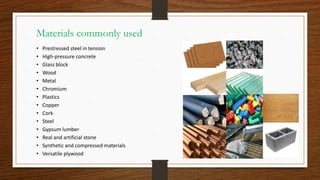
Materials commonly used
• Prestressed steel in tension
• High-pressure concrete
• Glass block
• Wood
• Metal
• Chromium
• Plastics
• Copper
• Cork
• Steel
• Gypsum lumber
• Real and artificial stone
• Synthetic and compressed materials
• Versatile plywood
Charecterestics…
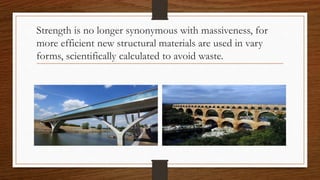
Strength is no longer synonymous with massiveness, for
more efficient new structural materials are used in vary
forms, scientifically calculated to avoid waste.
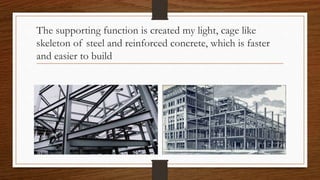
The supporting function is created my light, cage like
skeleton of steel and reinforced concrete, which is faster
and easier to build
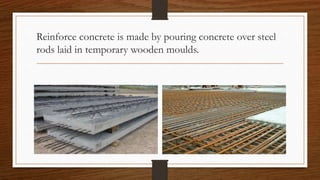
Reinforce concrete is made by pouring concrete over steel
rods laid in temporary wooden moulds.
Examples…
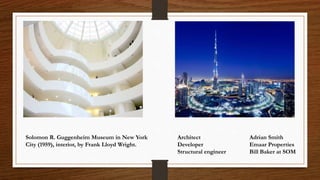
Architect Adrian Smith
Developer Emaar Properties
Structural engineer Bill Baker at SOM
Solomon R. Guggenheim Museum in New York
City (1959), interior, by Frank Lloyd Wright.
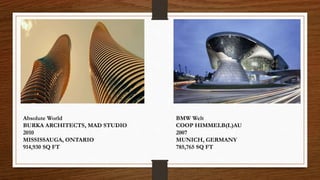
Absolute World
BURKA ARCHITECTS, MAD STUDIO
2010
MISSISSAUGA, ONTARIO
914,930 SQ FT
BMW Welt
COOP HIMMELB(L)AU
2007
MUNICH, GERMANY
785,765 SQ FT
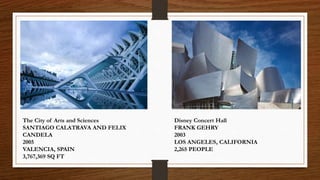
The City of Arts and Sciences
SANTIAGO CALATRAVA AND FELIX
CANDELA
2005
VALENCIA, SPAIN
3,767,369 SQ FT
Disney Concert Hall
FRANK GEHRY
2003
LOS ANGELES, CALIFORNIA
2,265 PEOPLE
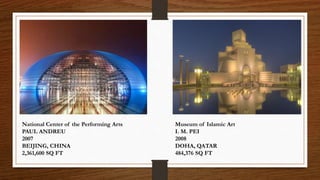
National Center of the Performing Arts
PAUL ANDREU
2007
BEIJING, CHINA
2,361,600 SQ FT
Museum of Islamic Art
I. M. PEI
2008
DOHA, QATAR
484,376 SQ FT
Thanks…

Modern architecture

  • 1.
  • 2.
    What is ModernArchitecture? • New architectural style that emerged in many Western countries in the decade after World War I. • Is an attempt to interprets one’s purpose through building in a style independent of fix symmetries. • It was based on the "rational" use of modern materials, the principles of functionalist planning, and the rejection of historical precedent and ornament.
  • 3.
    Common themes ofmodern architecture include: • The notion that "Form follows function", a dictum originally expressed by Frank Lloyd Wright's early mentor Louis Sullivan, meaning that the result of design should derive directly from its purpose • Simplicity and clarity of forms and elimination of "unnecessary detail" • Materials at 90 degrees to each other • Visual expression of structure (as opposed to the hiding of structural elements) • The related concept of "Truth to materials", meaning that the true nature or natural appearance of a material ought to be seen rather than concealed or altered to represent something else • Use of industrially-produced materials; adoption of the machine aesthetic • Particularly in International Style modernism, a visual emphasis on horizontal and vertical lines
  • 4.
    Materials commonly used •Prestressed steel in tension • High-pressure concrete • Glass block • Wood • Metal • Chromium • Plastics • Copper • Cork • Steel • Gypsum lumber • Real and artificial stone • Synthetic and compressed materials • Versatile plywood
  • 5.
  • 6.
    Strength is nolonger synonymous with massiveness, for more efficient new structural materials are used in vary forms, scientifically calculated to avoid waste.
  • 7.
    The supporting functionis created my light, cage like skeleton of steel and reinforced concrete, which is faster and easier to build
  • 8.
    Reinforce concrete ismade by pouring concrete over steel rods laid in temporary wooden moulds.
  • 9.
  • 10.
    Architect Adrian Smith DeveloperEmaar Properties Structural engineer Bill Baker at SOM Solomon R. Guggenheim Museum in New York City (1959), interior, by Frank Lloyd Wright.
  • 11.
    Absolute World BURKA ARCHITECTS,MAD STUDIO 2010 MISSISSAUGA, ONTARIO 914,930 SQ FT BMW Welt COOP HIMMELB(L)AU 2007 MUNICH, GERMANY 785,765 SQ FT
  • 12.
    The City ofArts and Sciences SANTIAGO CALATRAVA AND FELIX CANDELA 2005 VALENCIA, SPAIN 3,767,369 SQ FT Disney Concert Hall FRANK GEHRY 2003 LOS ANGELES, CALIFORNIA 2,265 PEOPLE
  • 13.
    National Center ofthe Performing Arts PAUL ANDREU 2007 BEIJING, CHINA 2,361,600 SQ FT Museum of Islamic Art I. M. PEI 2008 DOHA, QATAR 484,376 SQ FT
  • 14.