The defining feature of modern
architecture is the modern aesthetic
which may be summarized as
“plain geometric forms”
Common themes of modern
architecture include:
 The notion that "Form follows function",
expressed by Frank Lloyd Wright's,
meaning “The result of design should
derive directly from its purpose”
 Simplicity and clarity of forms and
elimination of "unnecessary detail"
 Materials at 90 degrees to each other
 Visual expression of structure (as
opposed to the hiding of structural
elements)
 The related concept of
"Truth to materials", meaning that the
true nature or natural appearance of a
material be seen rather than concealed
represent something else.
 Use of industrially-produced materials;
adoption of the machine aesthetic.
Modern Architectures mainly
surrounds by three factors:
 Material
 Steel, Glass, Reinforced concrete
 Schools of modernity
 The Chicago school
 The Werkbund
 The Bauhaus
 Big three architects
 Louis Sullivan
 Walter Gropius
 Ludwig Mies van der rohe
Materials played a vital role in
expanding Modern
Architectures
The two principal materials for the new forms
and high massive buildings:
 Steel (pioneered in Britain and brought
into general use in America)
 Reinforced concrete (developed in France)
Steel:
 The fundamental technical prerequisite
to large-scale modern architecture was
the development of metal framing.
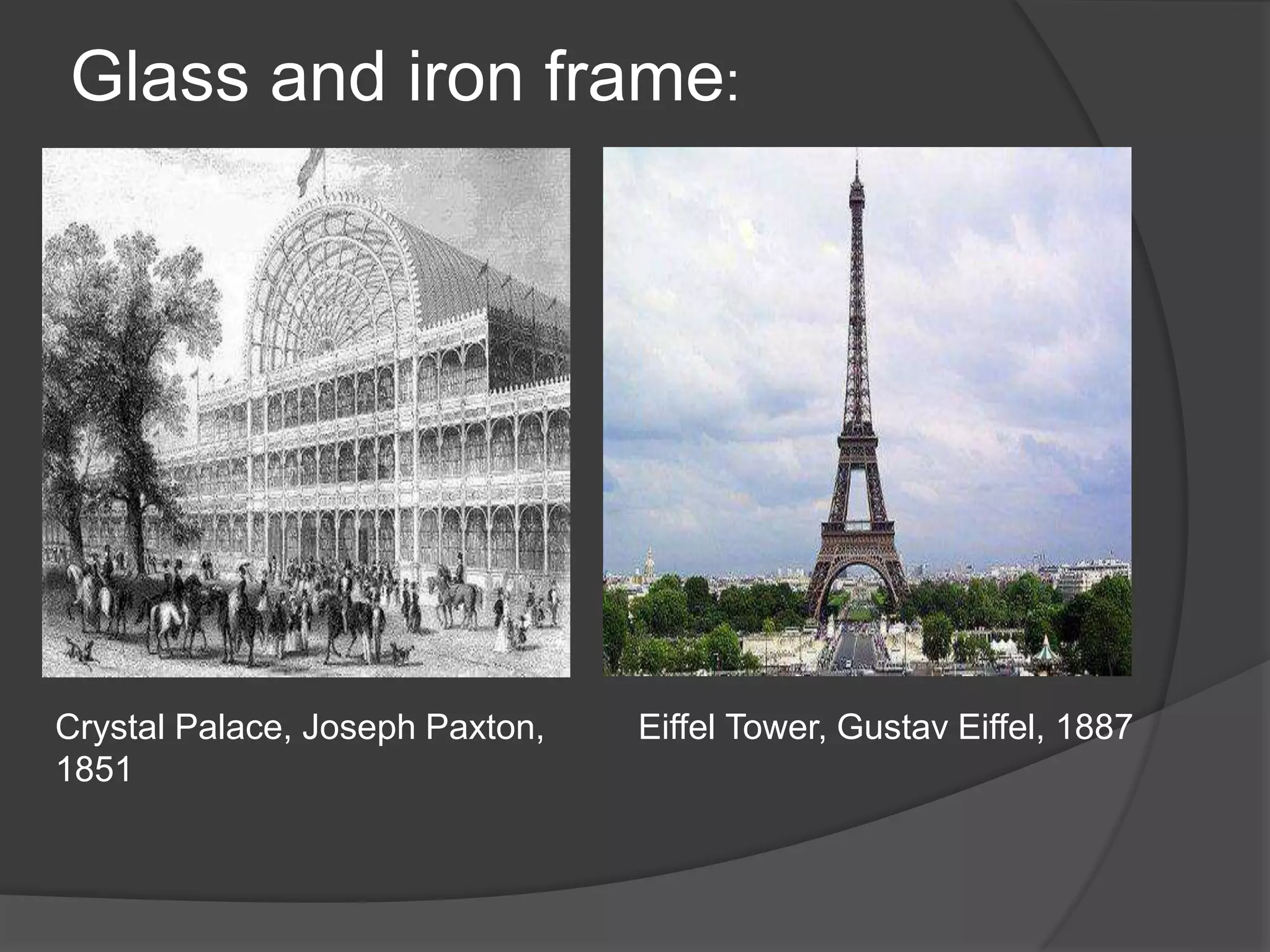
Glass and iron frame:
Crystal Palace, Joseph Paxton,
1851
Eiffel Tower, Gustav Eiffel, 1887
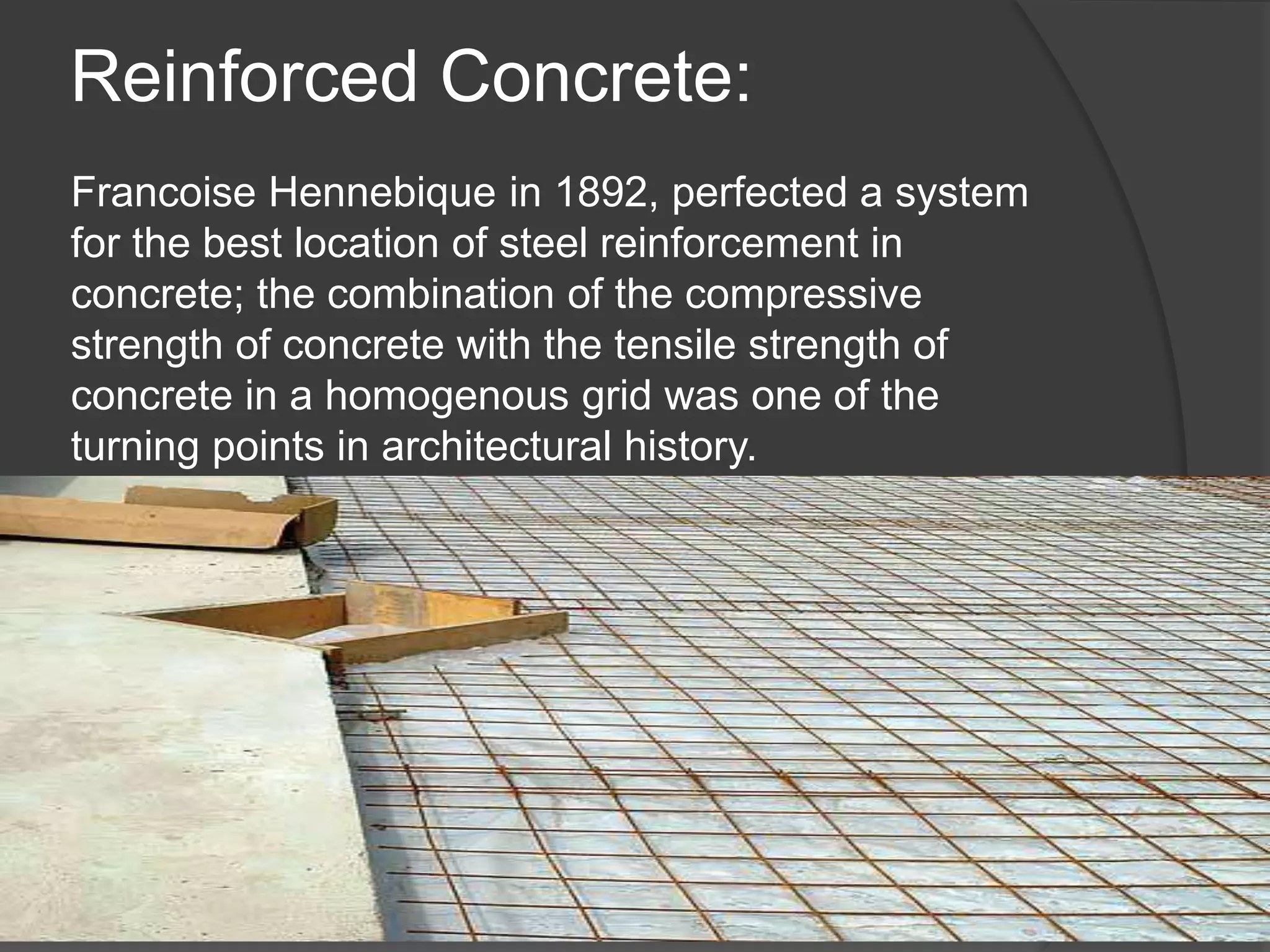
Reinforced Concrete:
Francoise Hennebique in 1892, perfected a system
for the best location of steel reinforcement in
concrete; the combination of the compressive
strength of concrete with the tensile strength of
concrete in a homogenous grid was one of the
turning points in architectural history.
The First Structures Based
on requirements of modern
architectures:
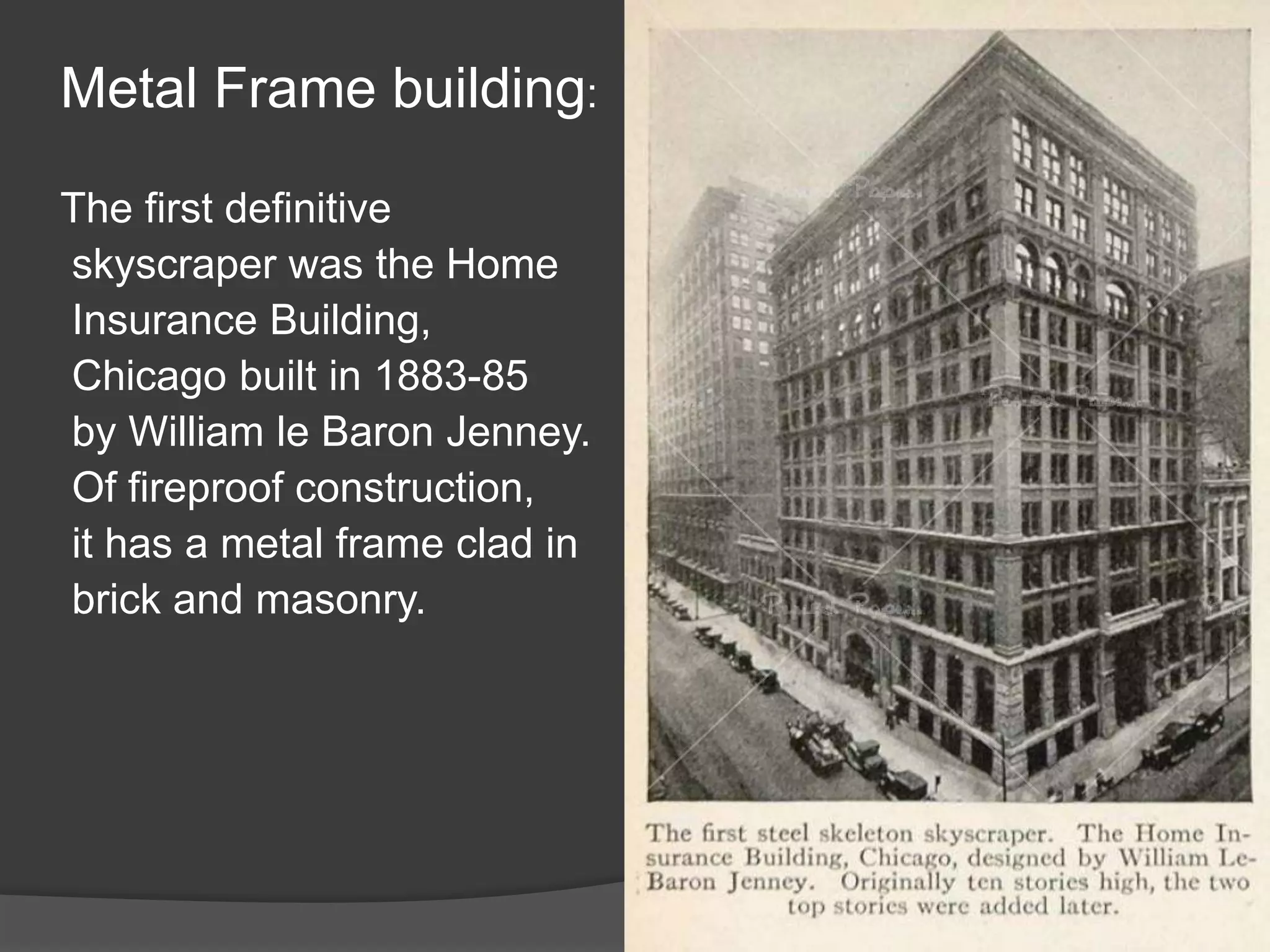
Metal Frame building:
The first definitive
skyscraper was the Home
Insurance Building,
Chicago built in 1883-85
by William le Baron Jenney.
Of fireproof construction,
it has a metal frame clad in
brick and masonry.
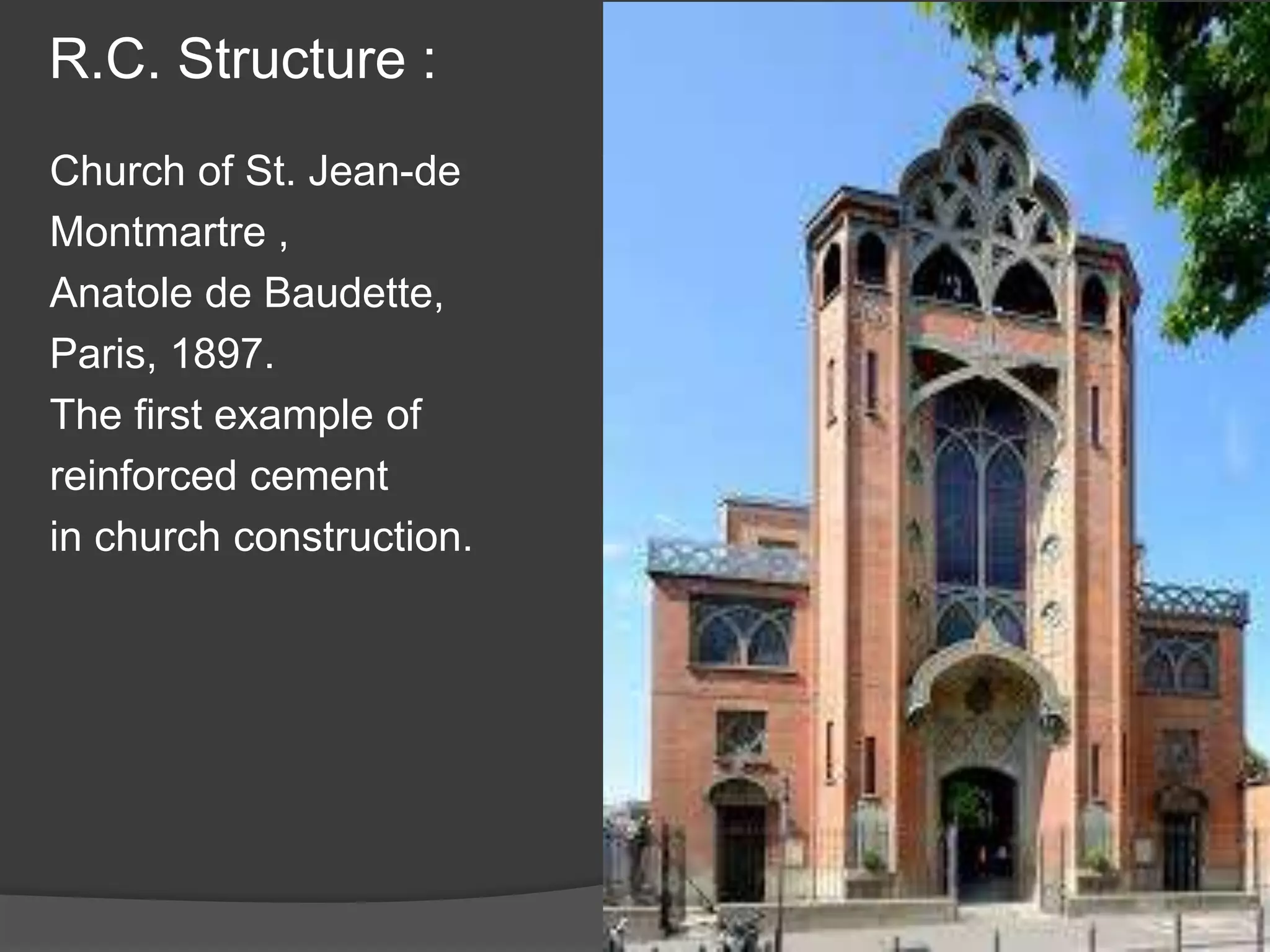
R.C. Structure :
Church of St. Jean-de
Montmartre ,
Anatole de Baudette,
Paris, 1897.
The first example of
reinforced cement
in church construction.
The ‘Schools’ of Modernity:
The Chicago School
The Werkbund
The Bauhaus
The Chicago School :
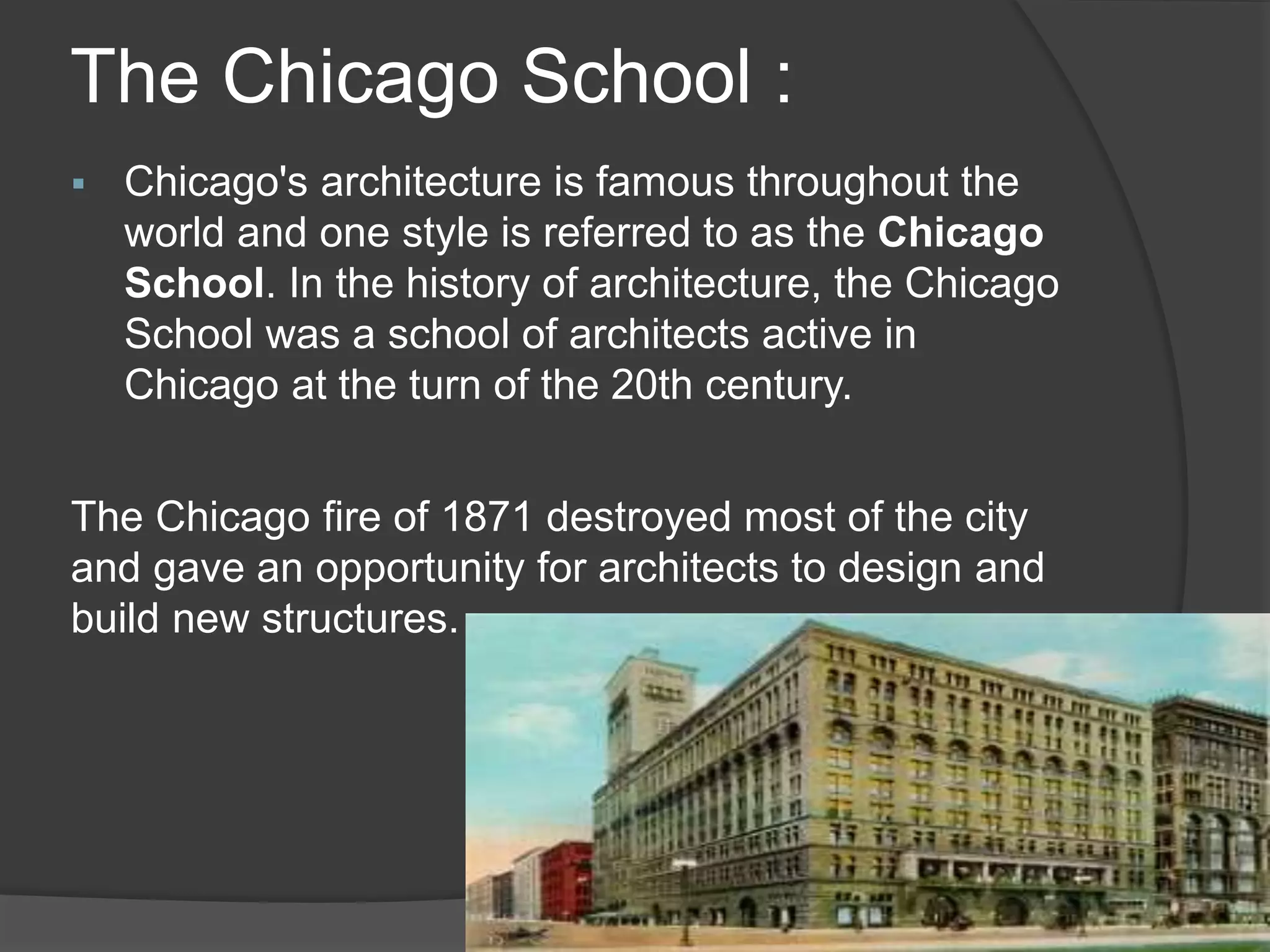
 Chicago's architecture is famous throughout the
world and one style is referred to as the Chicago
School. In the history of architecture, the Chicago
School was a school of architects active in
Chicago at the turn of the 20th century.
The Chicago fire of 1871 destroyed most of the city
and gave an opportunity for architects to design and
build new structures.
Chicago’s school shares to
Modern Architectures:
 They were among the first to promote the new
technologies of “steel-frame” construction in
commercial buildings.
 They developed a spatial aesthetic which co-
evolved with, and then came to influence, parallel
developments in European Modernism.
 The use of steel-frame buildings with masonry
cladding, allowing large plate-glass window areas
and limiting the amount of exterior ornamentation.
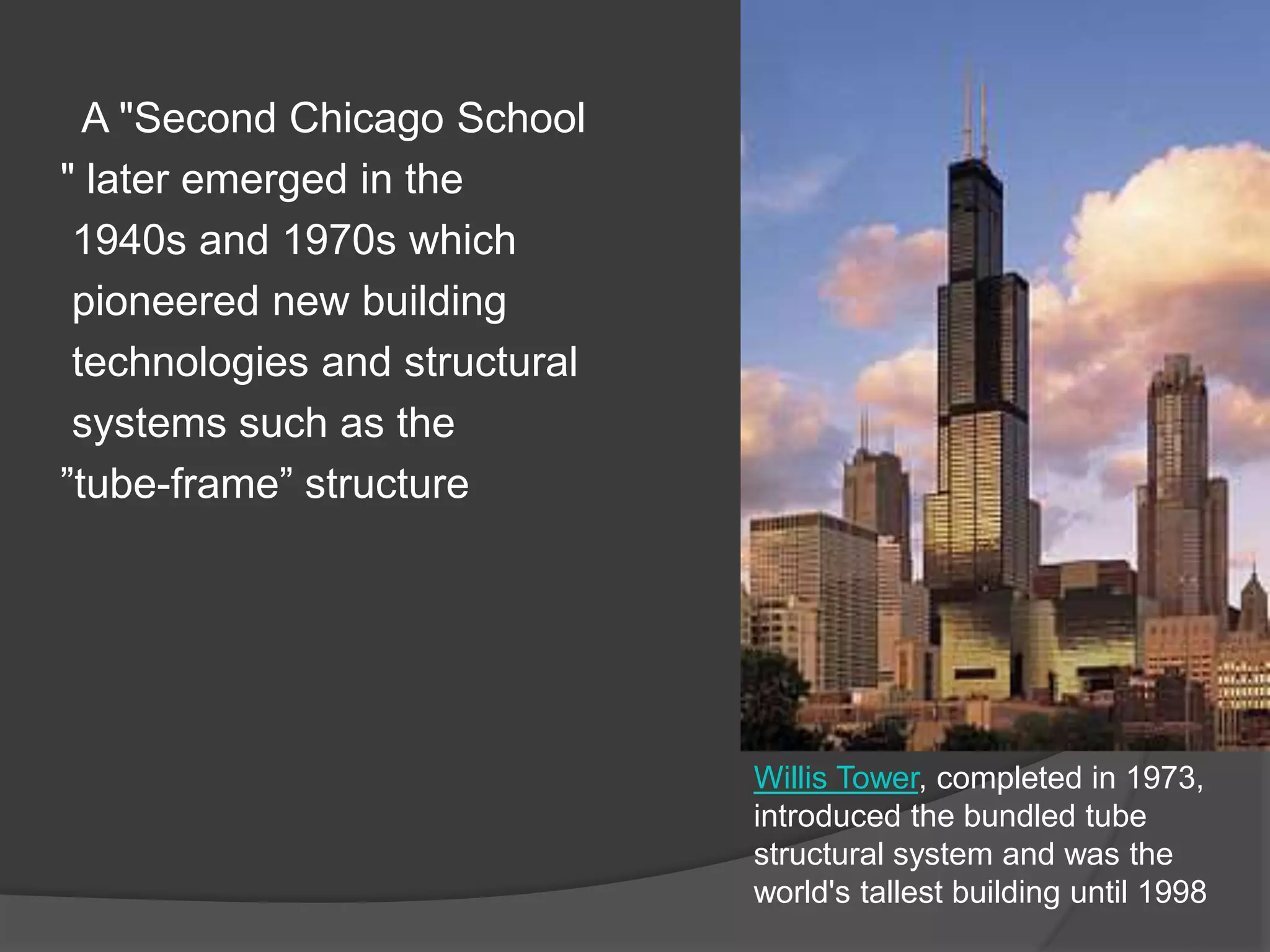
A "Second Chicago School
" later emerged in the
1940s and 1970s which
pioneered new building
technologies and structural
systems such as the
”tube-frame” structure
Willis Tower, completed in 1973,
introduced the bundled tube
structural system and was the
world's tallest building until 1998
Some of the more famous Chicago
School buildings include:
 Auditorium Building
 Sullivan Center
 Reliance Building
 Gage Group Buildings
 Chicago Building
 Brooks Building
 Fisher Building
 Heyworth Building
 Leiter I Building
 Leiter II Building
 Marquette Building
 Monadnock Building
 Montauk Building
 Rookery Building
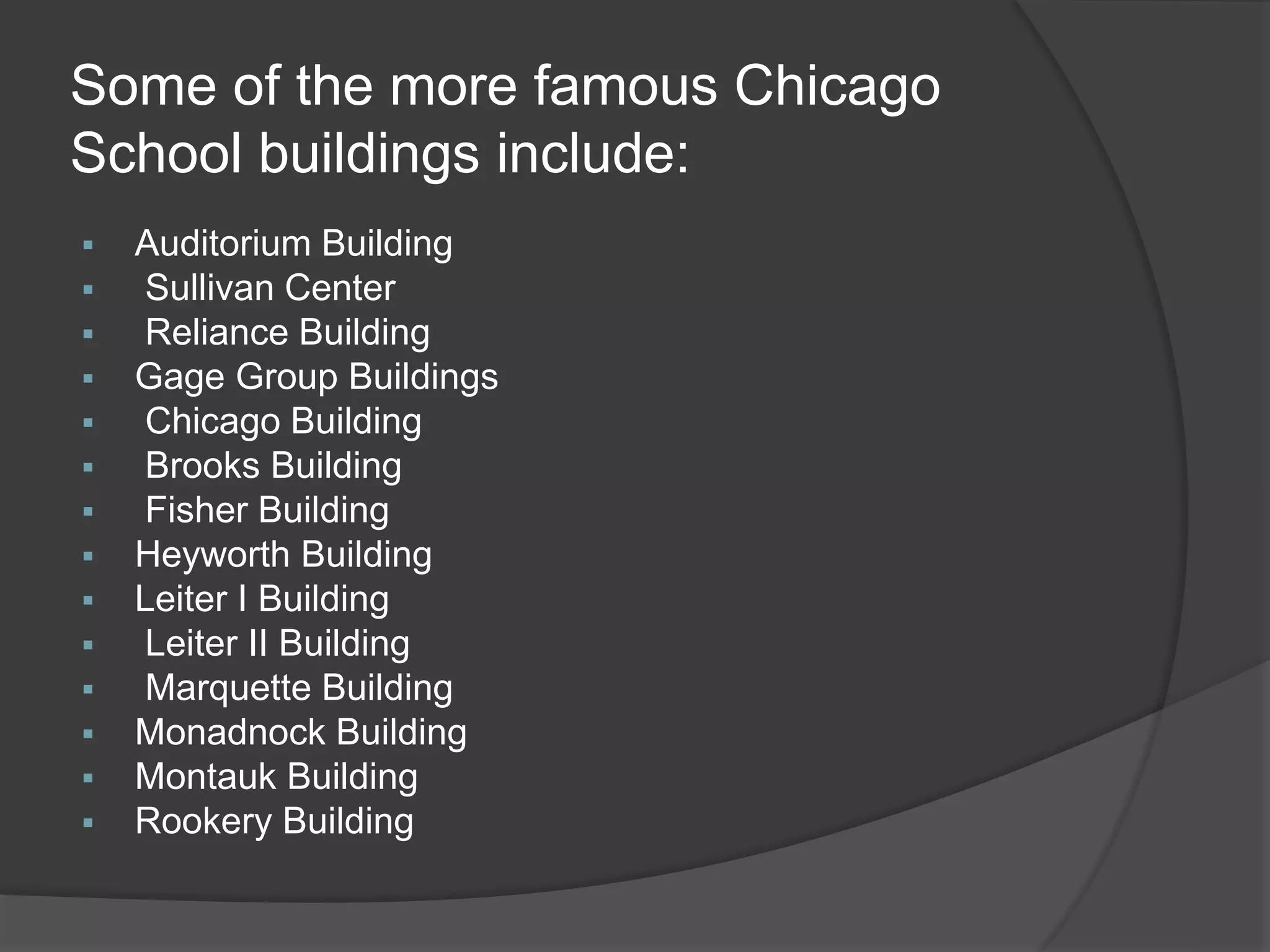
 Auditorium Building
Chicago June 30, 2012-92
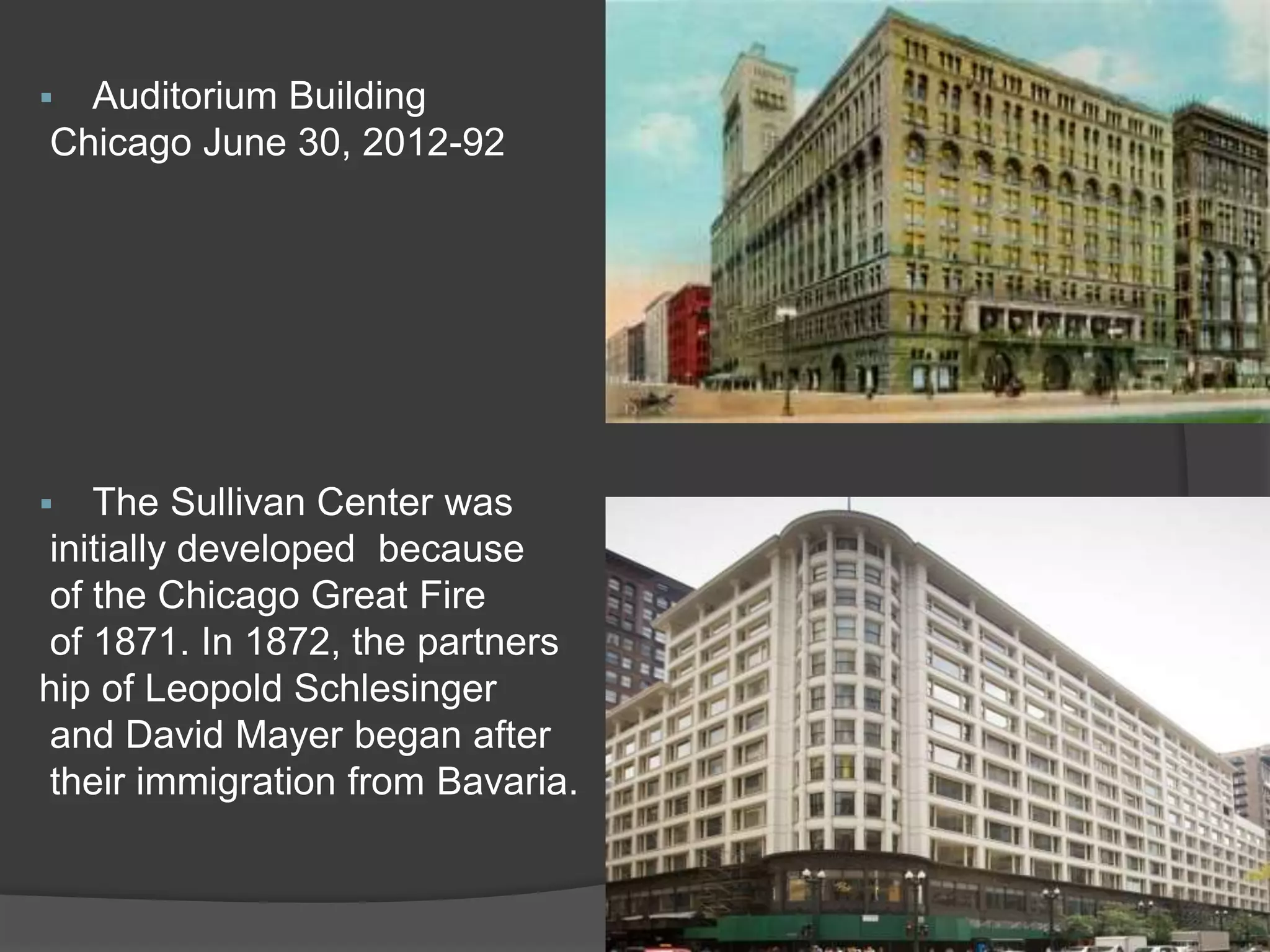
 The Sullivan Center was
initially developed because
of the Chicago Great Fire
of 1871. In 1872, the partners
hip of Leopold Schlesinger
and David Mayer began after
their immigration from Bavaria.
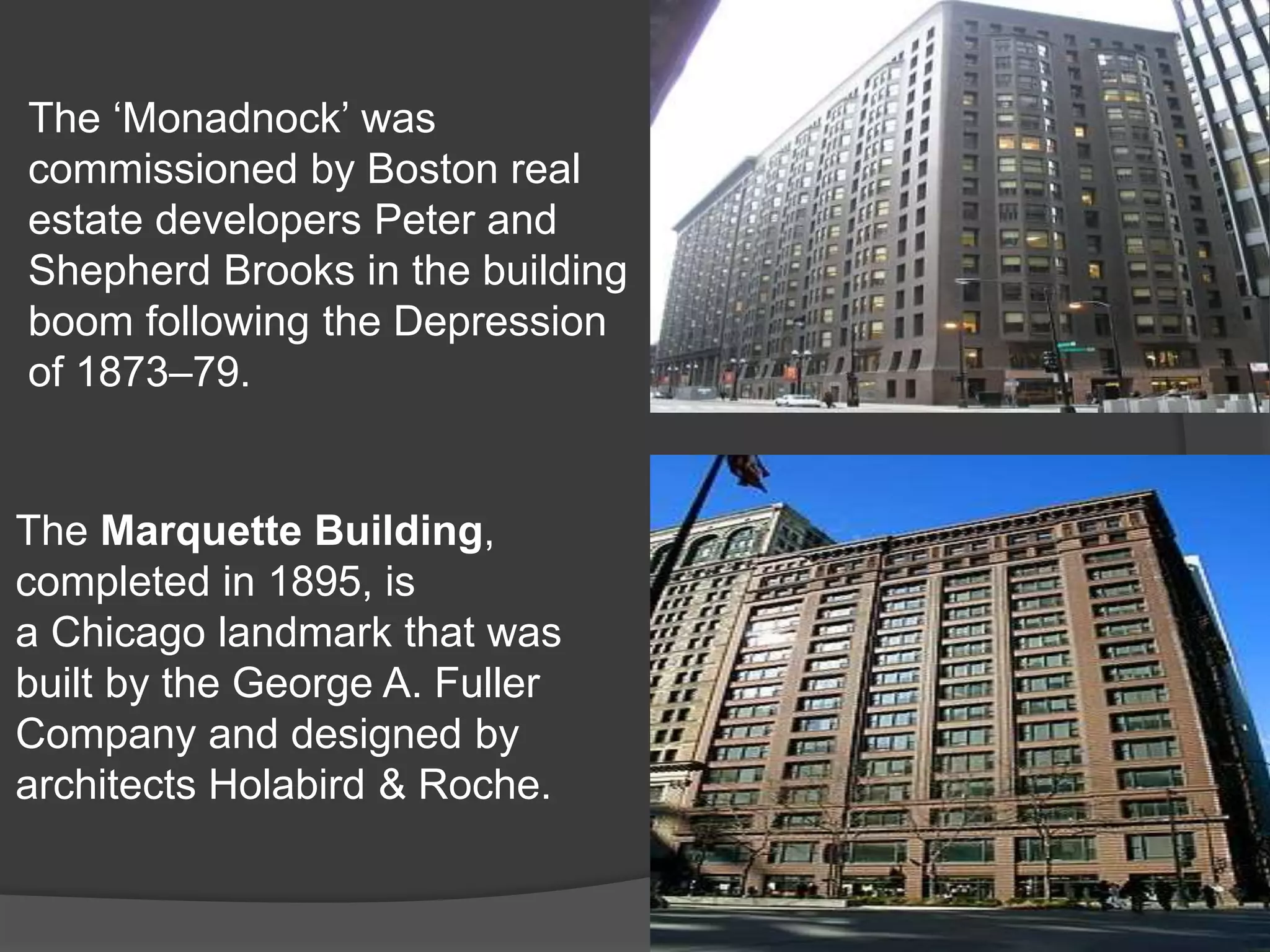
The ‘Monadnock’ was
commissioned by Boston real
estate developers Peter and
Shepherd Brooks in the building
boom following the Depression
of 1873–79.
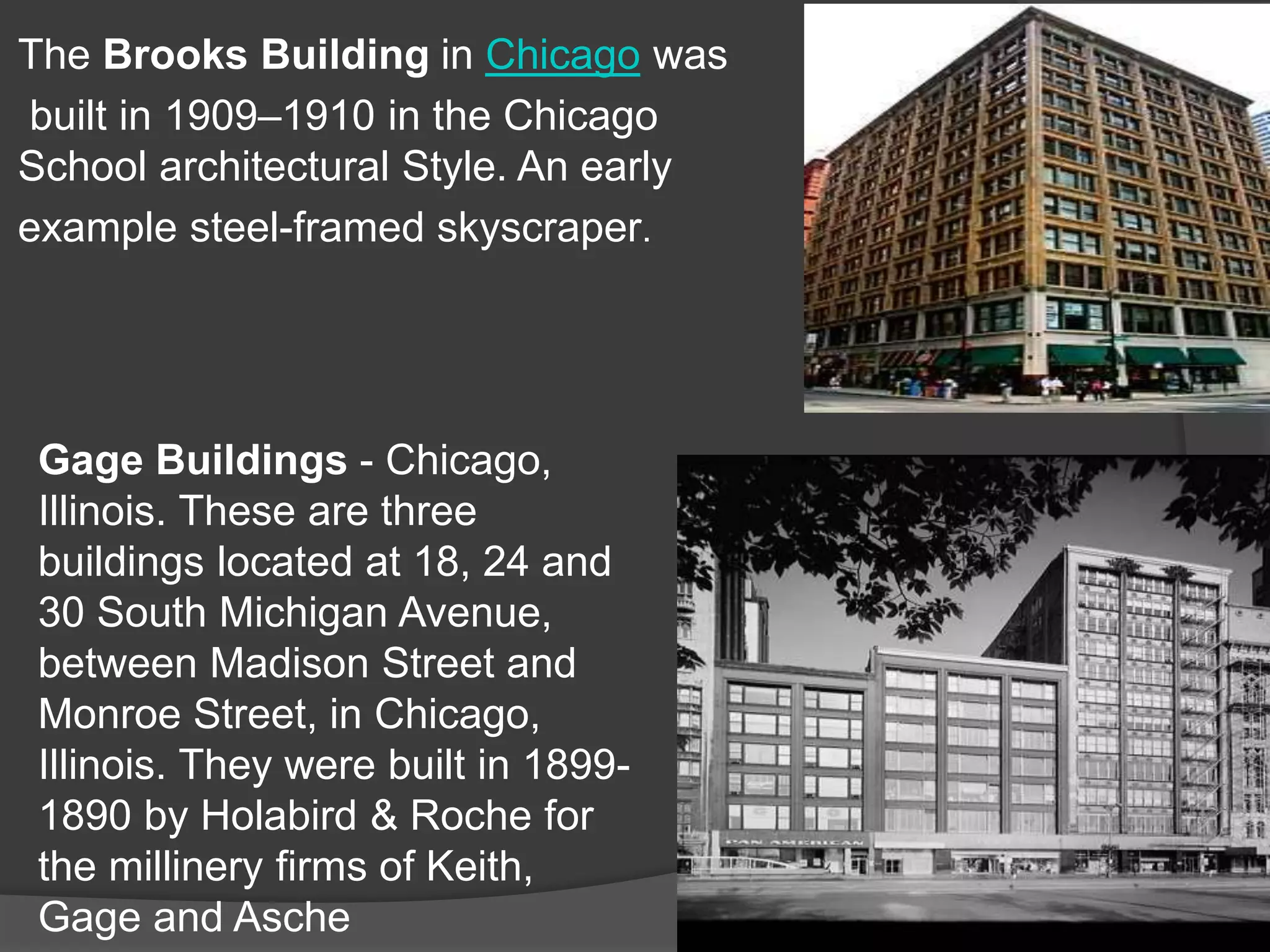
The Marquette Building,
completed in 1895, is
a Chicago landmark that was
built by the George A. Fuller
Company and designed by
architects Holabird & Roche.
The Brooks Building in Chicago was
built in 1909–1910 in the Chicago
School architectural Style. An early
example steel-framed skyscraper.
Gage Buildings - Chicago,
Illinois. These are three
buildings located at 18, 24 and
30 South Michigan Avenue,
between Madison Street and
Monroe Street, in Chicago,
Illinois. They were built in 1899-
1890 by Holabird & Roche for
the millinery firms of Keith,
Gage and Asche
The Werkbund:
The Deutscher Werkbund (German
Workforce) was a German organization of
artists, architects, and designers aiming to
refine human craft. It was founded by Peter
Behrens, Josef Hoffman, and Richard
Riemerschmid in 1907. .
Its initial purpose was to establish a
partnership of product manufacturers with
design professionals to improve the
competitiveness of German companies in
global markets
The organization originally included
twelve architects and twelve business
firms:
 Peter Behrens
 Theodor Fischecr (who served as its first president)
 Josef Hoffmann
 Bruno Paul
 Richard Riemerschmid.
 Heinrich Tessenow.
 Henry van de Velde.
 Van de Velde tan de Velde
 Eliel Saarinen
 Mies Van der Rohe, (who served as Architectural
Director).
Key dates of the Deutscher
Werkbund:
 1907, Establishment of the Werkbund in Munich
 1910, Salon d'Automne, Paris
 1914, Cologne exhibition, Germany
 1920, Lilly Reich becomes the first female Director
 1924, Berlin exhibition
 1927, Stuttgart exhibition (including
the Weissenhof Estate)
 1929, Breslau exhibition
 1938, Werkbund closed by the Nazis
 1949, Reestablishment
Weissenhoff states:
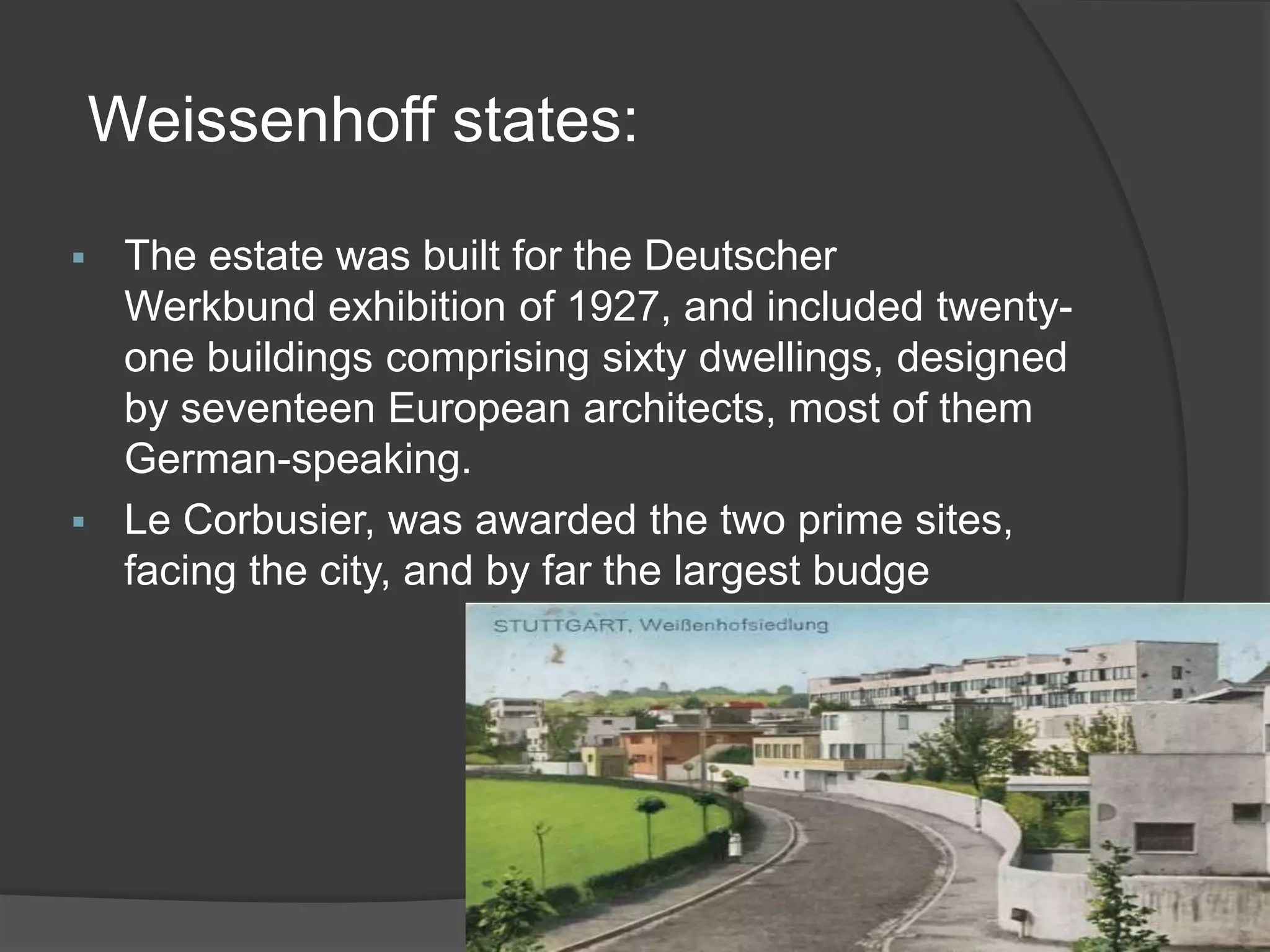
 The estate was built for the Deutscher
Werkbund exhibition of 1927, and included twenty-
one buildings comprising sixty dwellings, designed
by seventeen European architects, most of them
German-speaking.
 Le Corbusier, was awarded the two prime sites,
facing the city, and by far the largest budge
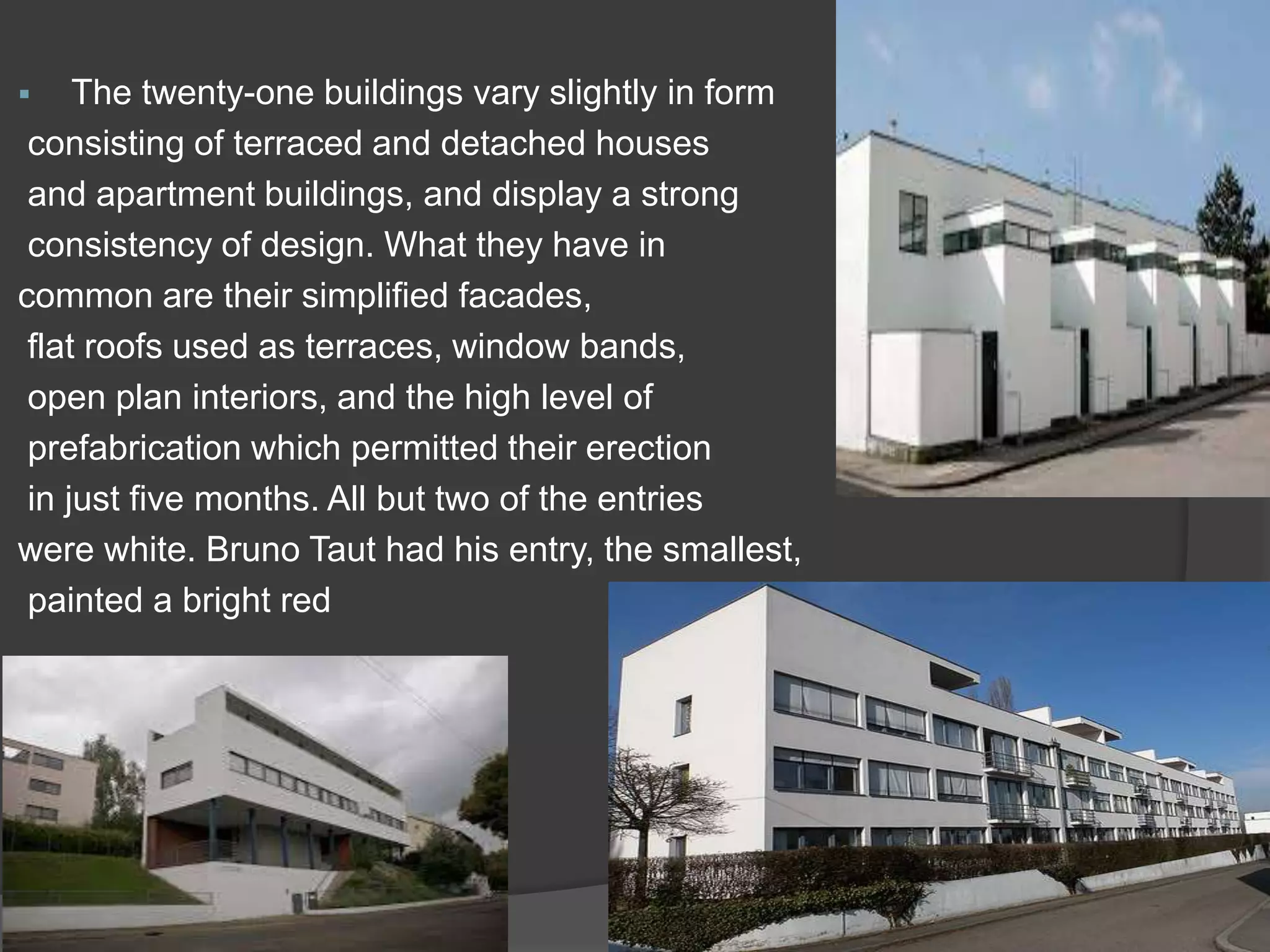
 The twenty-one buildings vary slightly in form
consisting of terraced and detached houses
and apartment buildings, and display a strong
consistency of design. What they have in
common are their simplified facades,
flat roofs used as terraces, window bands,
open plan interiors, and the high level of
prefabrication which permitted their erection
in just five months. All but two of the entries
were white. Bruno Taut had his entry, the smallest,
painted a bright red
The Bauhaus School 1919-
1933:
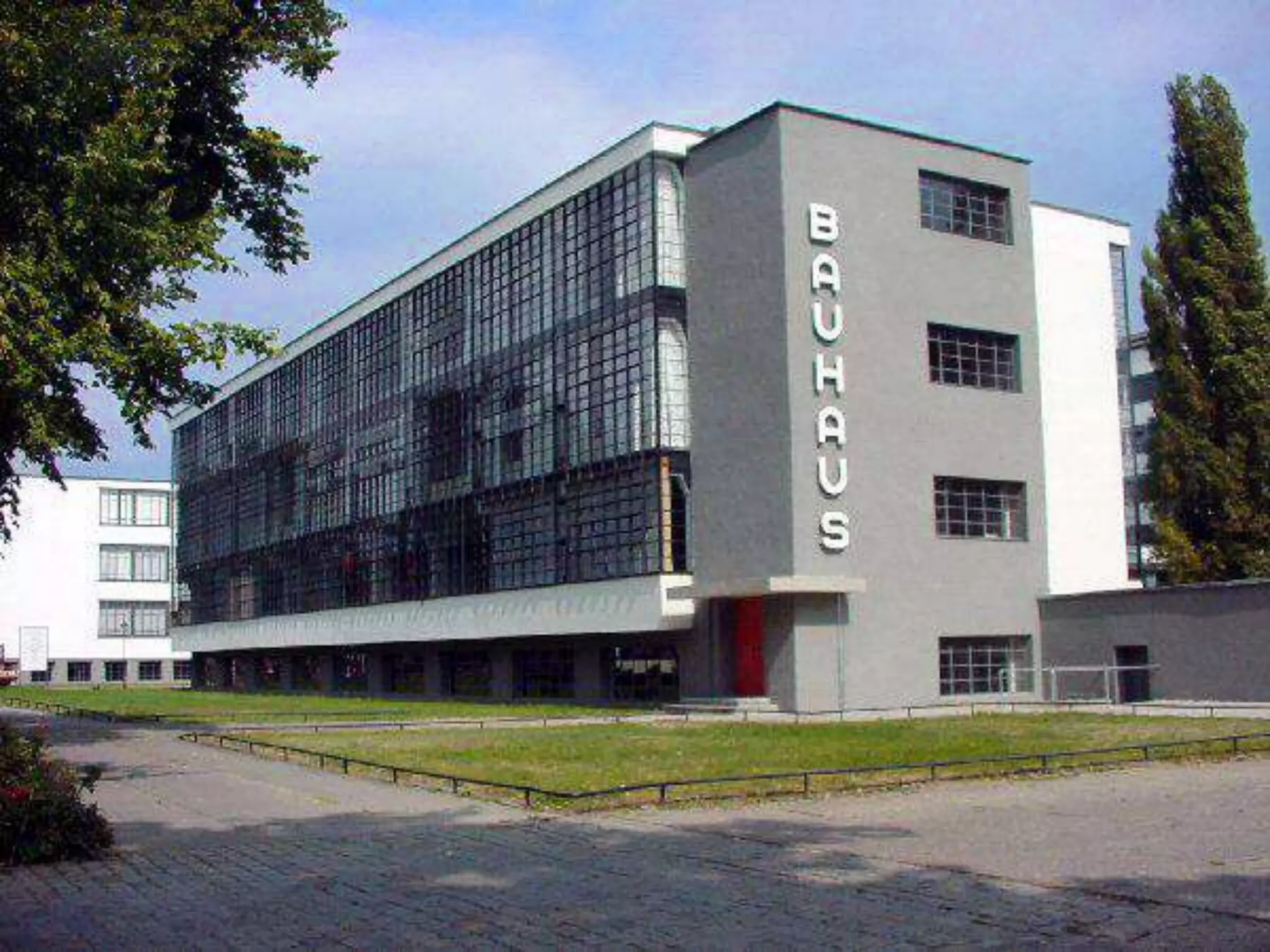
 The Bauhaus school was founded by
Walter Gropius in Weimar. In spite of its
name, and the fact that its founder was an
architect, the Bauhaus did not have an
architecture department during the first
years of its existence.
 The concept of the school at the beginning
was influenced by medieval construction of
churches wherein craftsmen and artists
collaborated in the completion and details
of the building.
 The Bauhaus, was a school in Germany
that combined crafts and the fine arts, and
was famous for the approach to design that
it publicized and taught.
 The term Bauhaus is German for "House of
Building" or "Building School".
 The Bauhaus had a profound influence
upon subsequent developments in art,
architecture, graphic design, interior
design, industrial design, and typography.
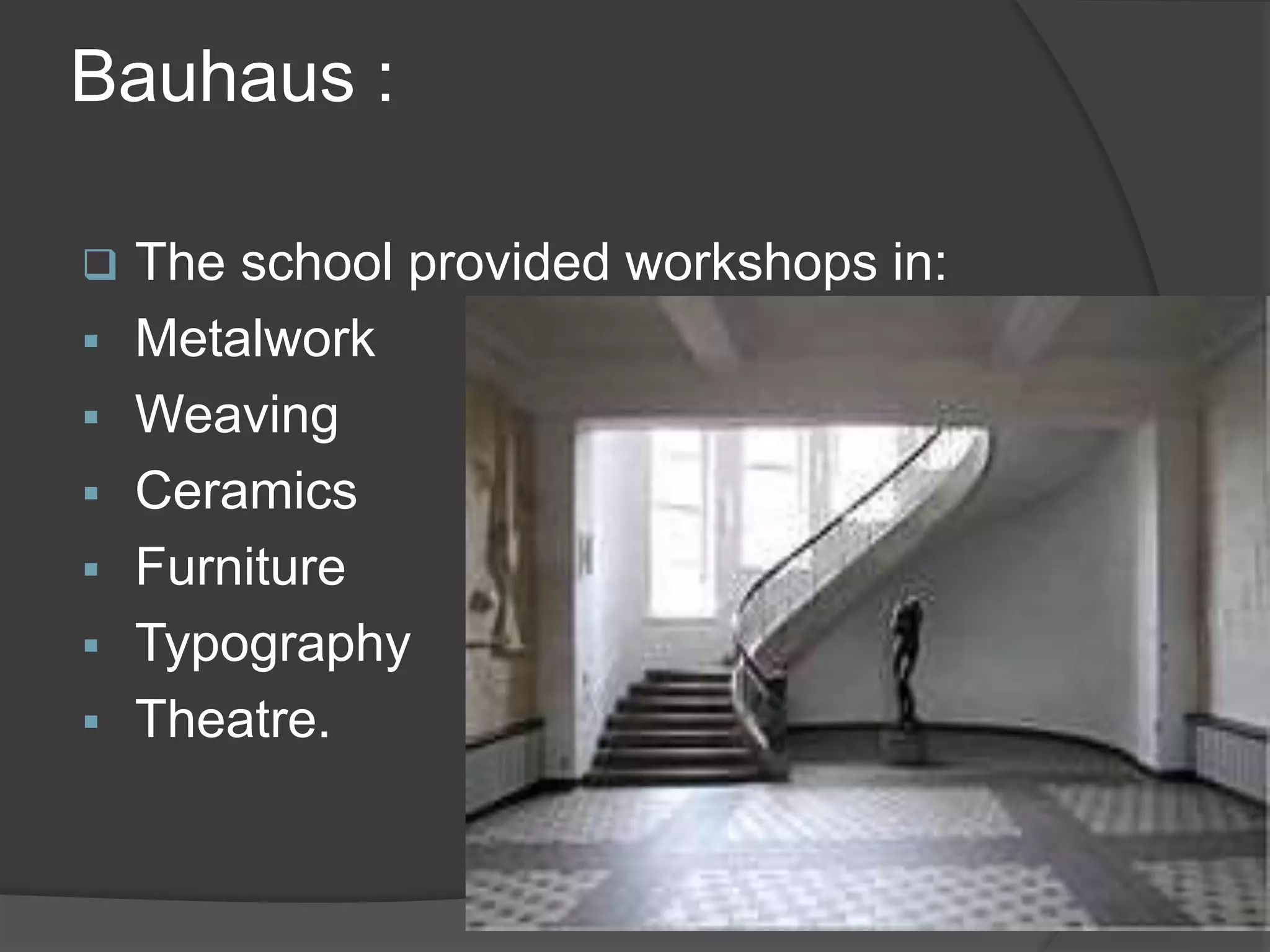
Bauhaus :
 The school provided workshops in:
 Metalwork
 Weaving
 Ceramics
 Furniture
 Typography
 Theatre.
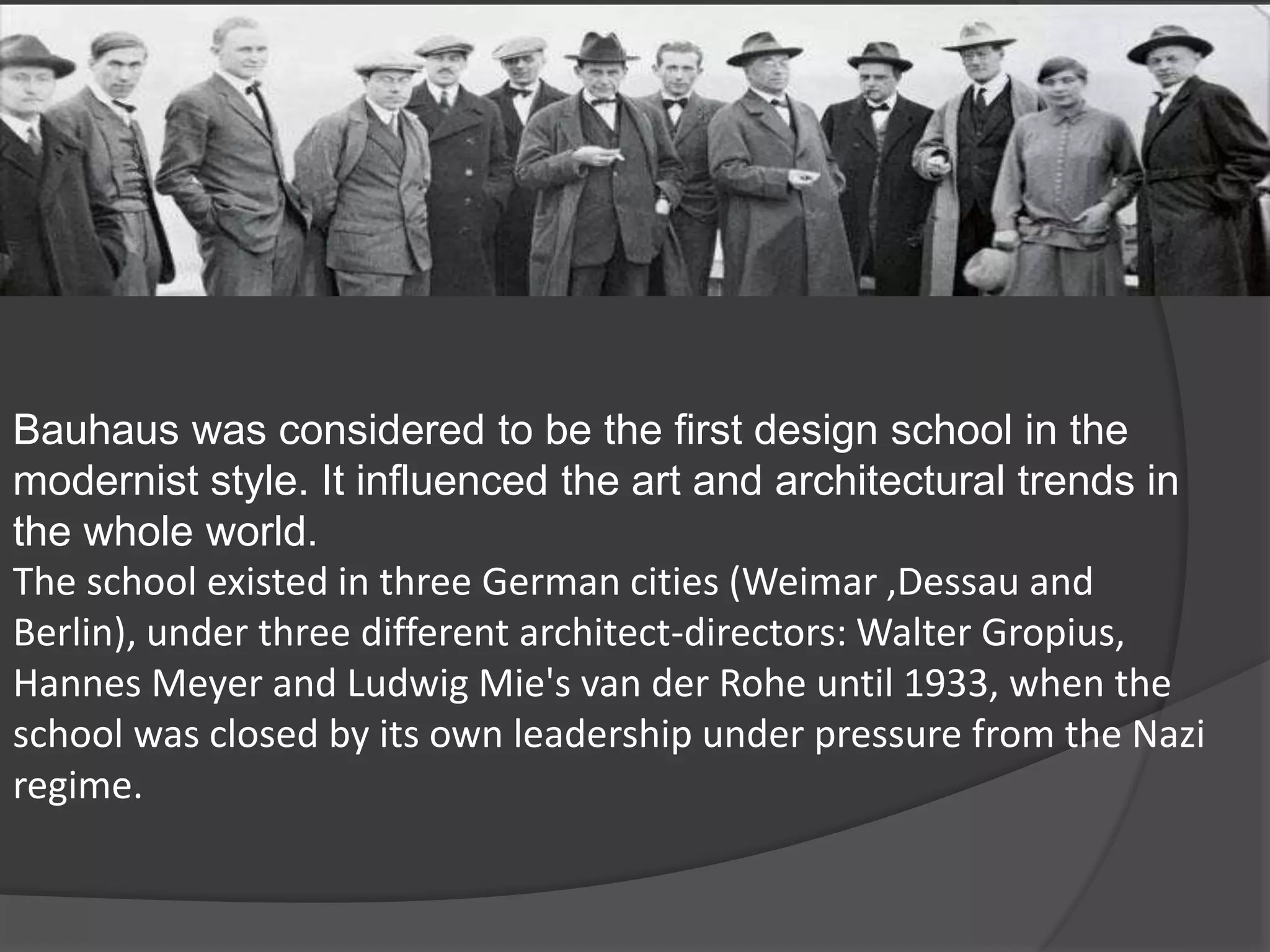
Bauhaus was considered to be the first design school in the
modernist style. It influenced the art and architectural trends in
the whole world.
The school existed in three German cities (Weimar ,Dessau and
Berlin), under three different architect-directors: Walter Gropius,
Hannes Meyer and Ludwig Mie's van der Rohe until 1933, when the
school was closed by its own leadership under pressure from the Nazi
regime.
The Big Three:
 Louis Sullivan
 Walter Gropius
 Ludwig Mies van der rohe
Louis Sullivan:
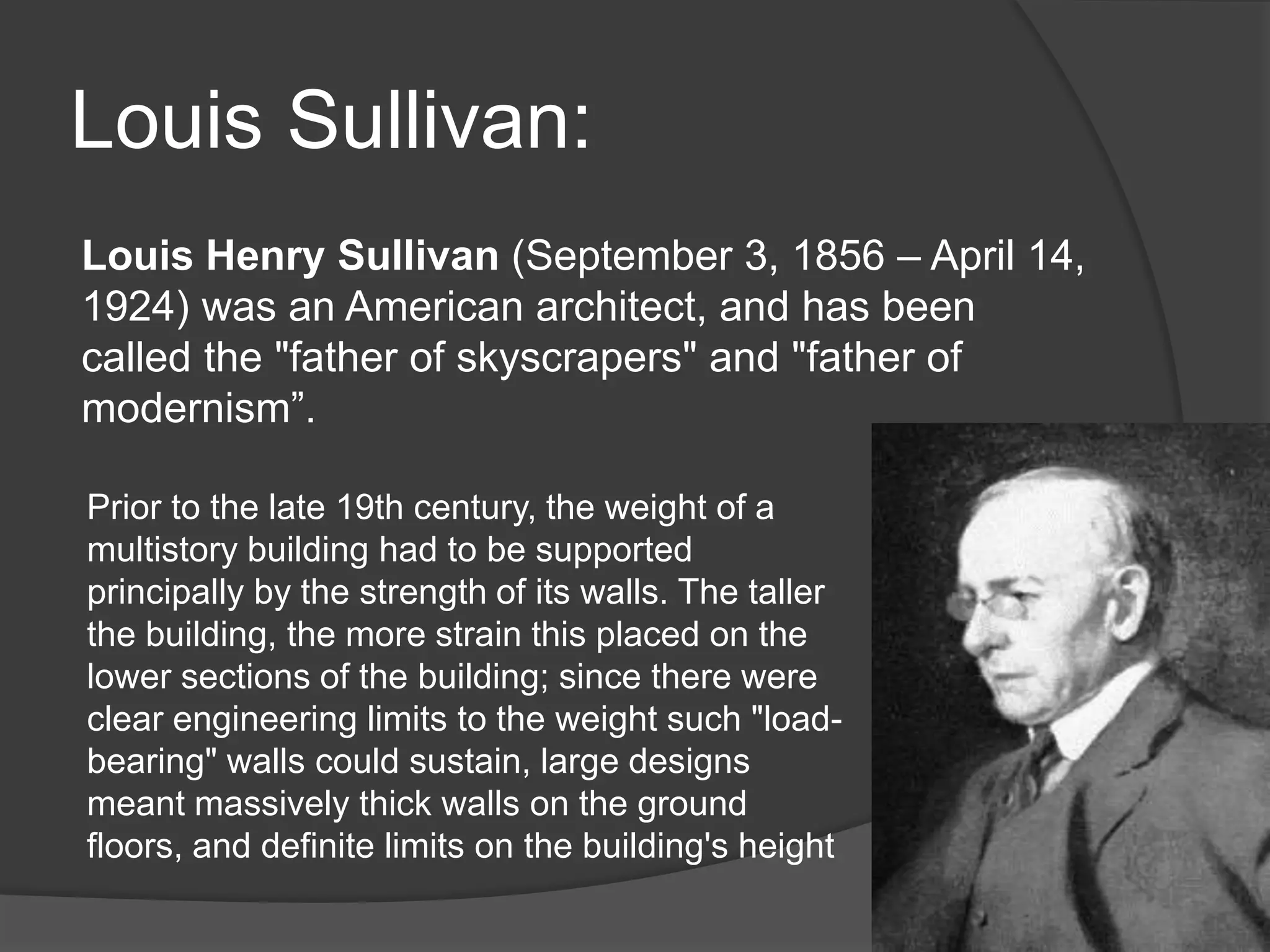
Louis Henry Sullivan (September 3, 1856 – April 14,
1924) was an American architect, and has been
called the "father of skyscrapers" and "father of
modernism”.
Prior to the late 19th century, the weight of a
multistory building had to be supported
principally by the strength of its walls. The taller
the building, the more strain this placed on the
lower sections of the building; since there were
clear engineering limits to the weight such "load-
bearing" walls could sustain, large designs
meant massively thick walls on the ground
floors, and definite limits on the building's height
In 1896, Louis Sullivan wrote in a poem:
It is the pervading law of all things organic and
inorganic,
Of all things physical and metaphysical,
Of all things human, and all things super-human,
Of all true manifestations of the head,
Of the heart, of the soul,
That the life is recognizable in its expression,
That form ever follows function.
This is the law. "Form follows function" would become
one of the prevailing tenets of modern architects
Louis Sullivan :
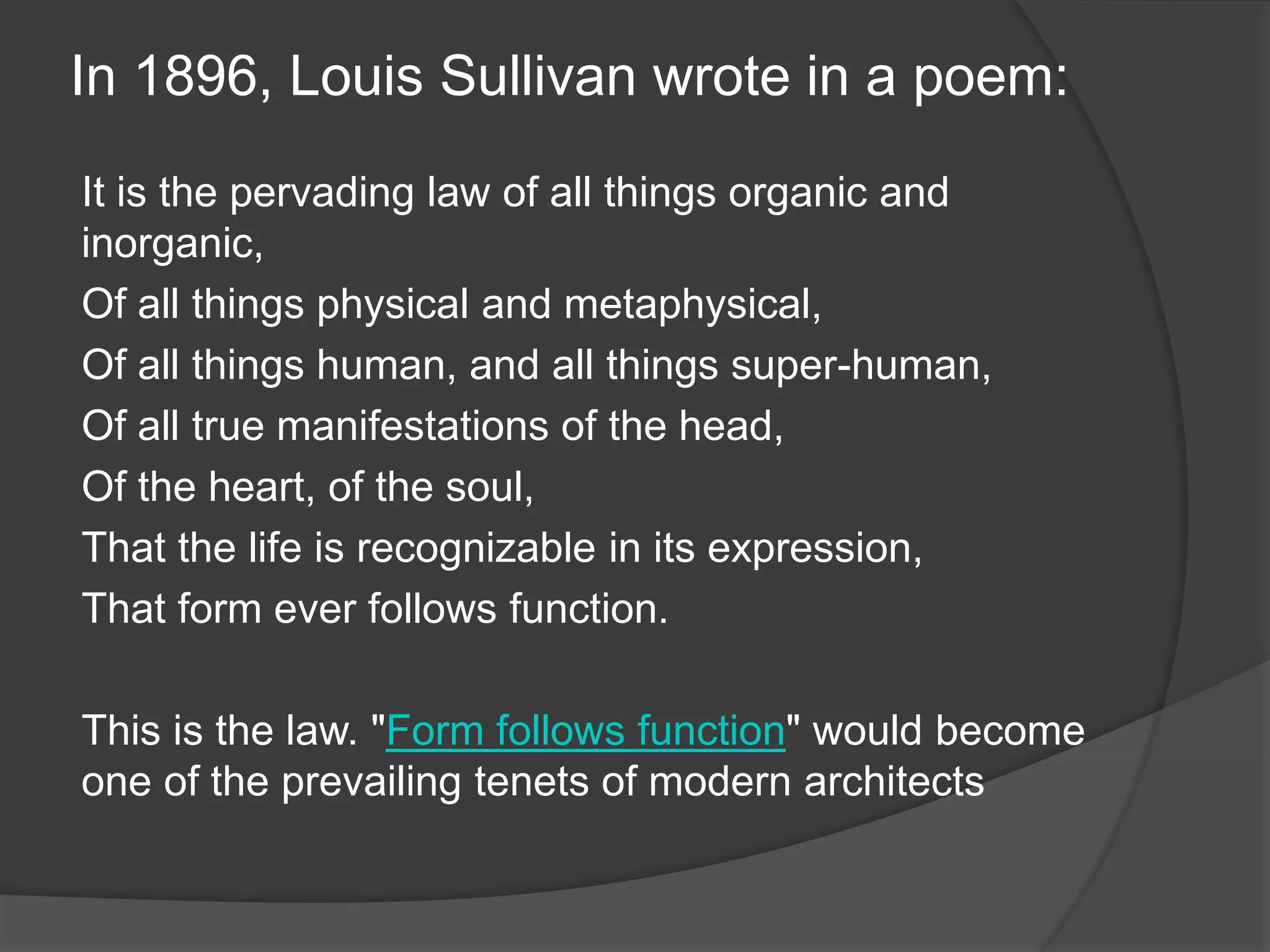
The Martin Ryerson Tomb is
an Egyptian Revival style mausoleum
designed by Louis Sullivan and
completed in 1889.
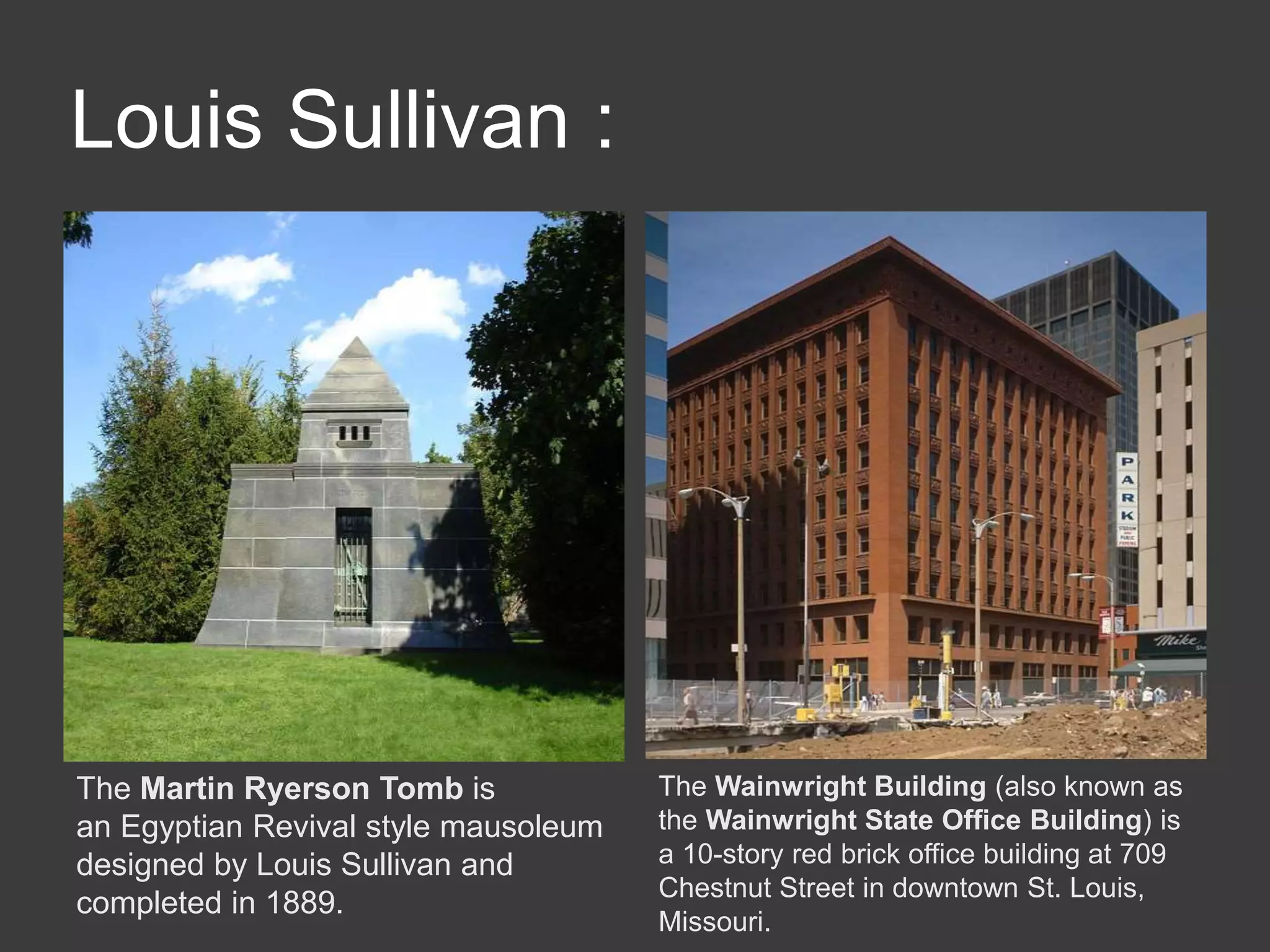
The Wainwright Building (also known as
the Wainwright State Office Building) is
a 10-story red brick office building at 709
Chestnut Street in downtown St. Louis,
Missouri.
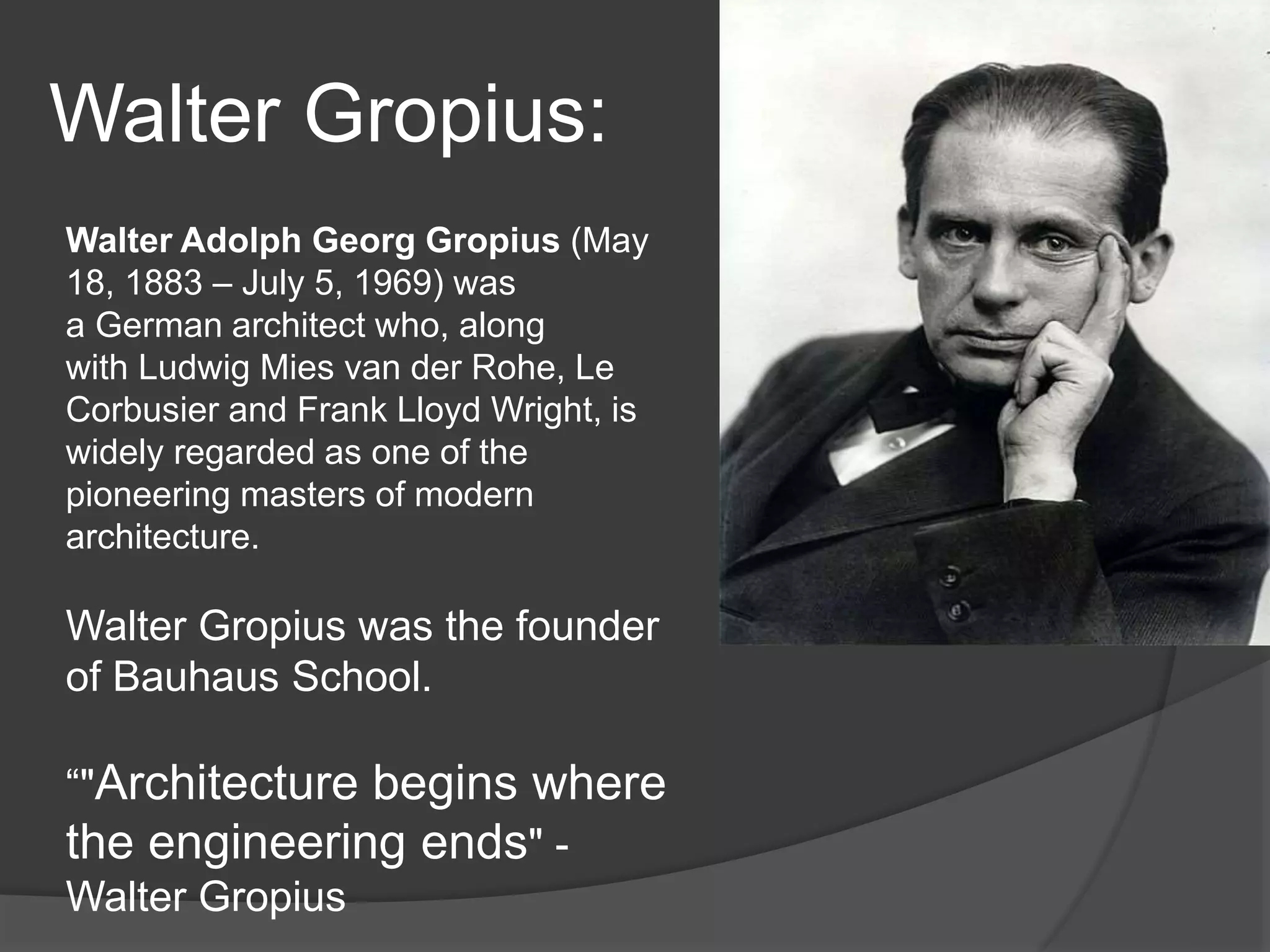
Walter Gropius:
Walter Adolph Georg Gropius (May
18, 1883 – July 5, 1969) was
a German architect who, along
with Ludwig Mies van der Rohe, Le
Corbusier and Frank Lloyd Wright, is
widely regarded as one of the
pioneering masters of modern
architecture.
Walter Gropius was the founder
of Bauhaus School.
“"Architecture begins where
the engineering ends" -
Walter Gropius
 Educator:
Founded the Bauhaus School of Design (1919-
1928)
Founded The Architect’s Collaborative (1945)
 Key moment
Fled Nazi Germany under the pretext of a
temporary visit to Britain with the help of architect
Maxwell Fry (1934)
 Key buildings
The Fagus-Werk Factory, Berlin (1911)
The Gropius House, Lincoln, Mass (1938)
The Pan Am Building, New York (1958)
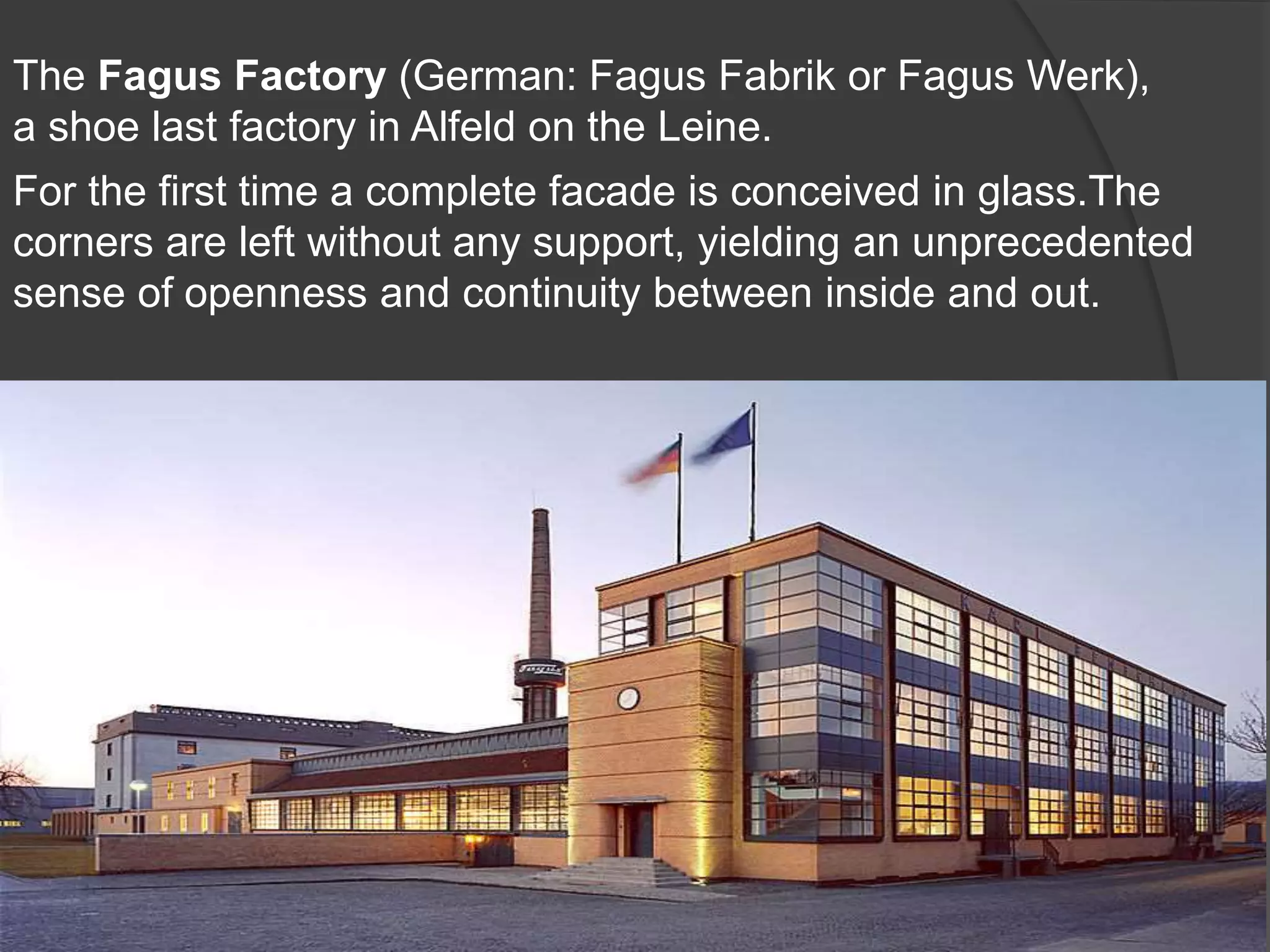
The Fagus Factory (German: Fagus Fabrik or Fagus Werk),
a shoe last factory in Alfeld on the Leine.
For the first time a complete facade is conceived in glass.The
corners are left without any support, yielding an unprecedented
sense of openness and continuity between inside and out.
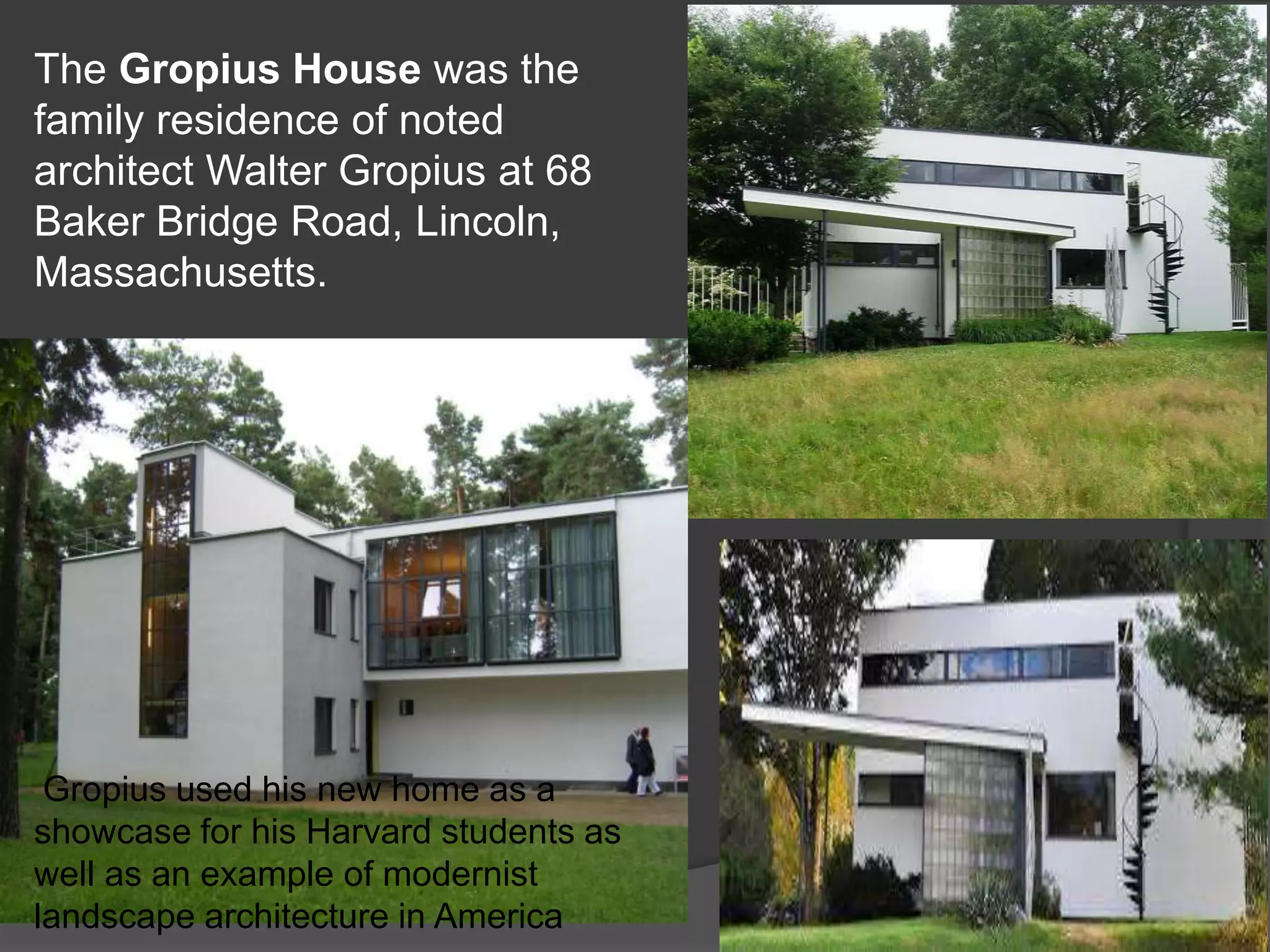
The Gropius House was the
family residence of noted
architect Walter Gropius at 68
Baker Bridge Road, Lincoln,
Massachusetts.
Gropius used his new home as a
showcase for his Harvard students as
well as an example of modernist
landscape architecture in America
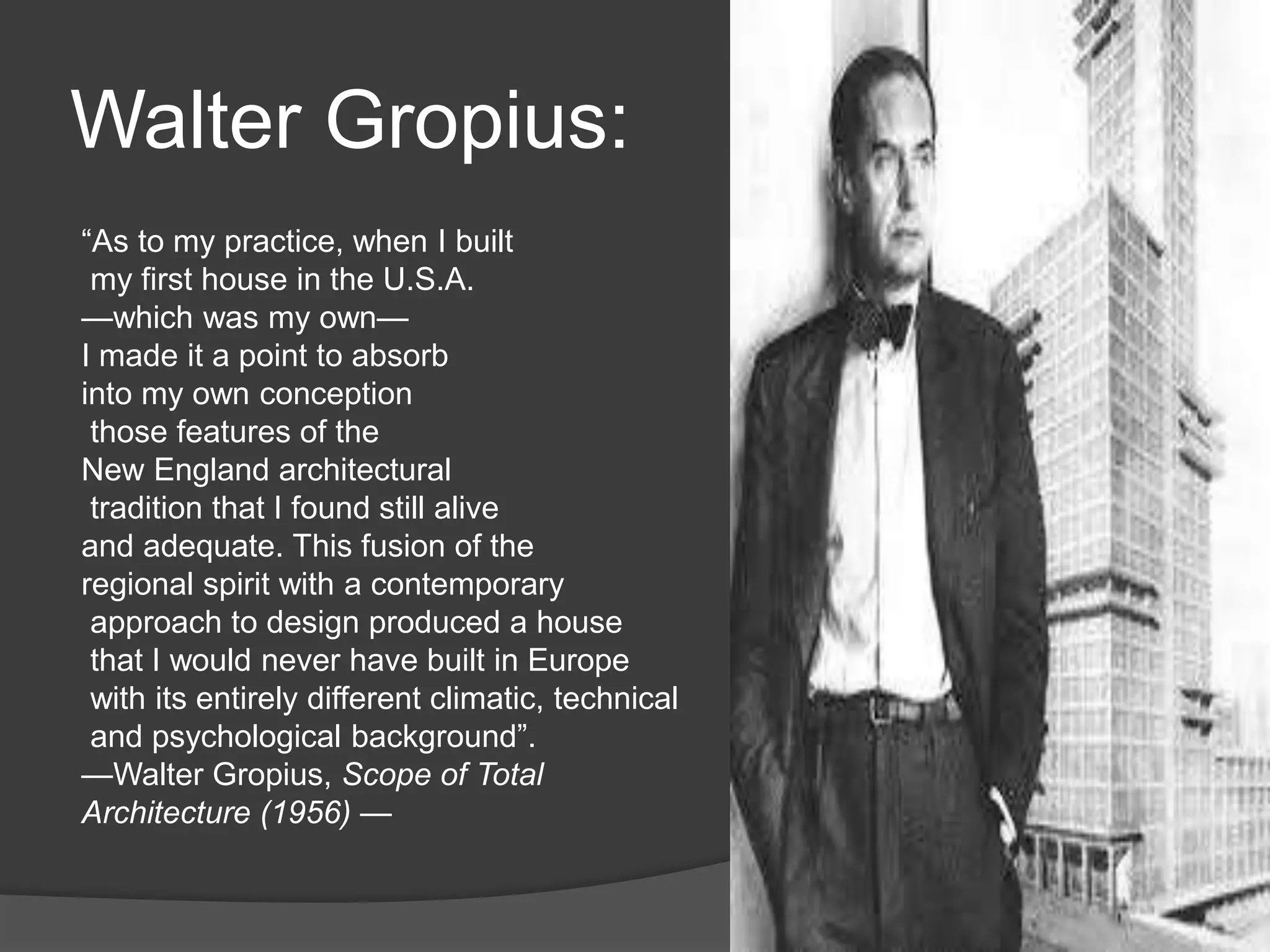
Walter Gropius:
“As to my practice, when I built
my first house in the U.S.A.
—which was my own—
I made it a point to absorb
into my own conception
those features of the
New England architectural
tradition that I found still alive
and adequate. This fusion of the
regional spirit with a contemporary
approach to design produced a house
that I would never have built in Europe
with its entirely different climatic, technical
and psychological background”.
—Walter Gropius, Scope of Total
Architecture (1956) —
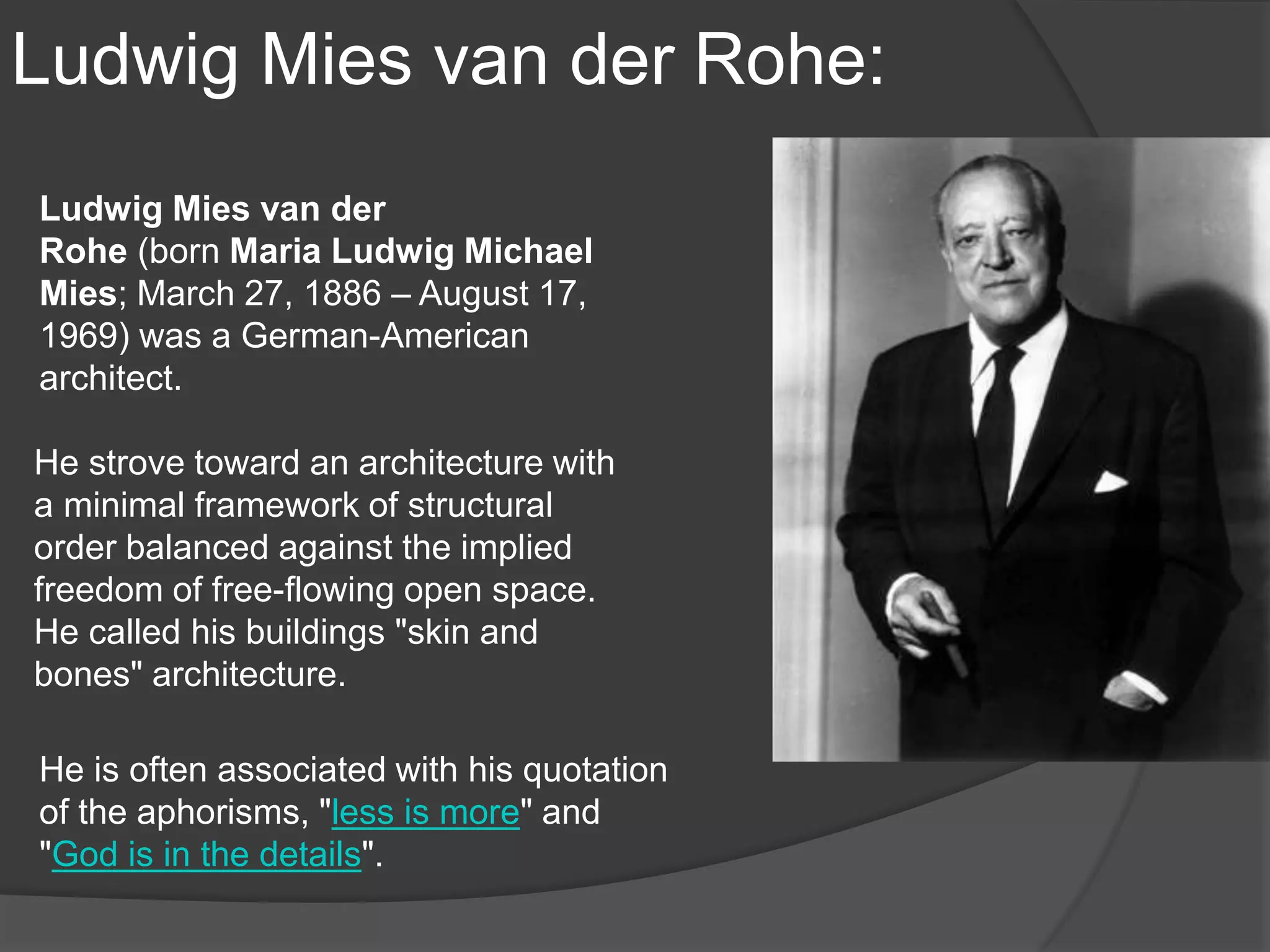
Ludwig Mies van der Rohe:
Ludwig Mies van der
Rohe (born Maria Ludwig Michael
Mies; March 27, 1886 – August 17,
1969) was a German-American
architect.
He strove toward an architecture with
a minimal framework of structural
order balanced against the implied
freedom of free-flowing open space.
He called his buildings "skin and
bones" architecture.
He is often associated with his quotation
of the aphorisms, "less is more" and
"God is in the details".
American work:
Mies worked from his studio in downtown Chicago for his
entire 31-year period in America.
His significant projects in the U.S. include in Chicago and the
area: the residential towers of 860–880 Lake Shore Dr, the
Chicago Federal Center complex, the Farnsworth
House, Crown Hall and other structures at IIT; and
the Seagram Building in New York. These iconic works
became the prototypes for his other projects. He also built
homes for wealthy clients
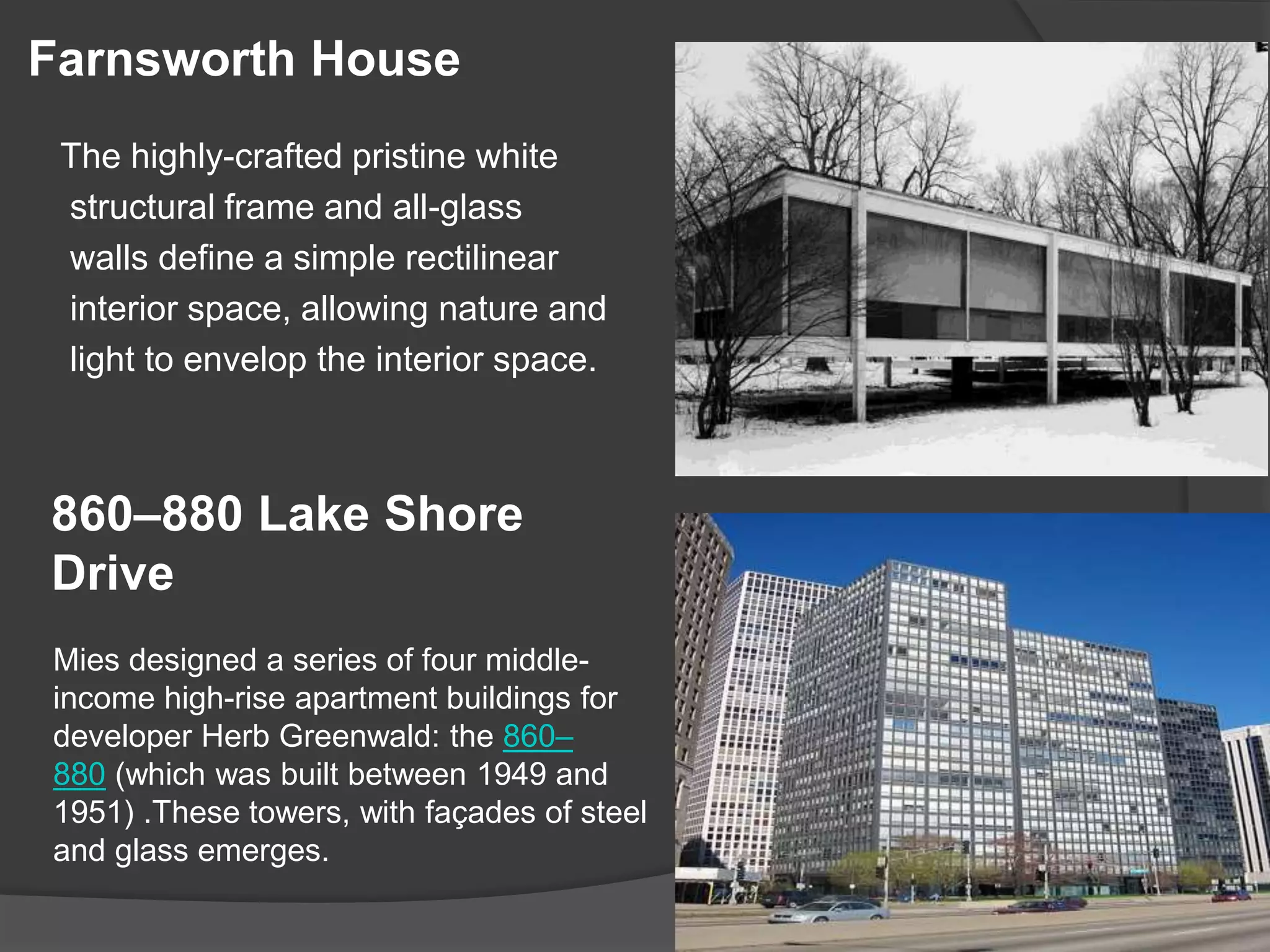
Farnsworth House
The highly-crafted pristine white
structural frame and all-glass
walls define a simple rectilinear
interior space, allowing nature and
light to envelop the interior space.
860–880 Lake Shore
Drive
Mies designed a series of four middle-
income high-rise apartment buildings for
developer Herb Greenwald: the 860–
880 (which was built between 1949 and
1951) .These towers, with façades of steel
and glass emerges.
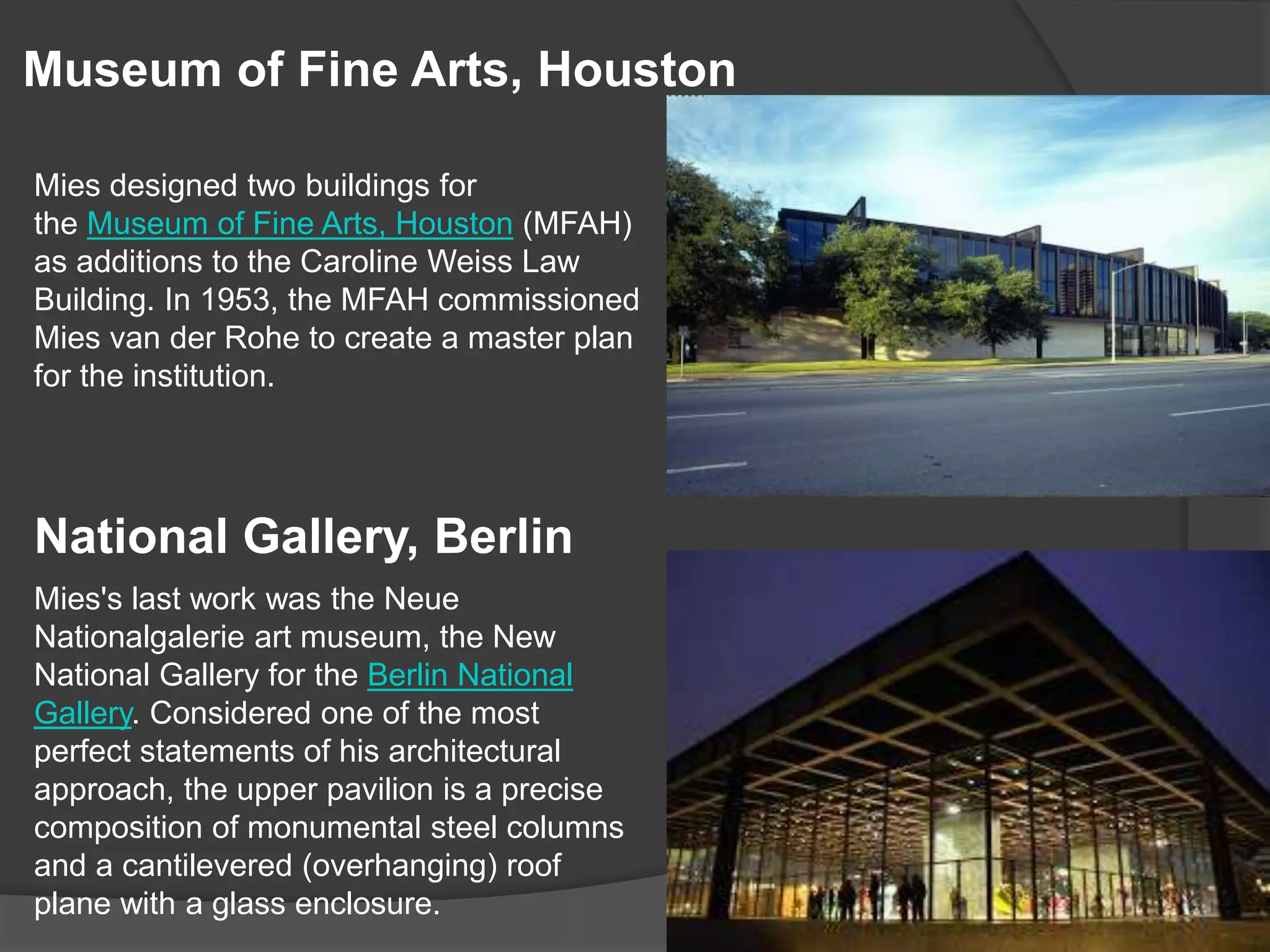
Museum of Fine Arts, Houston
Mies designed two buildings for
the Museum of Fine Arts, Houston (MFAH)
as additions to the Caroline Weiss Law
Building. In 1953, the MFAH commissioned
Mies van der Rohe to create a master plan
for the institution.
National Gallery, Berlin
Mies's last work was the Neue
Nationalgalerie art museum, the New
National Gallery for the Berlin National
Gallery. Considered one of the most
perfect statements of his architectural
approach, the upper pavilion is a precise
composition of monumental steel columns
and a cantilevered (overhanging) roof
plane with a glass enclosure.
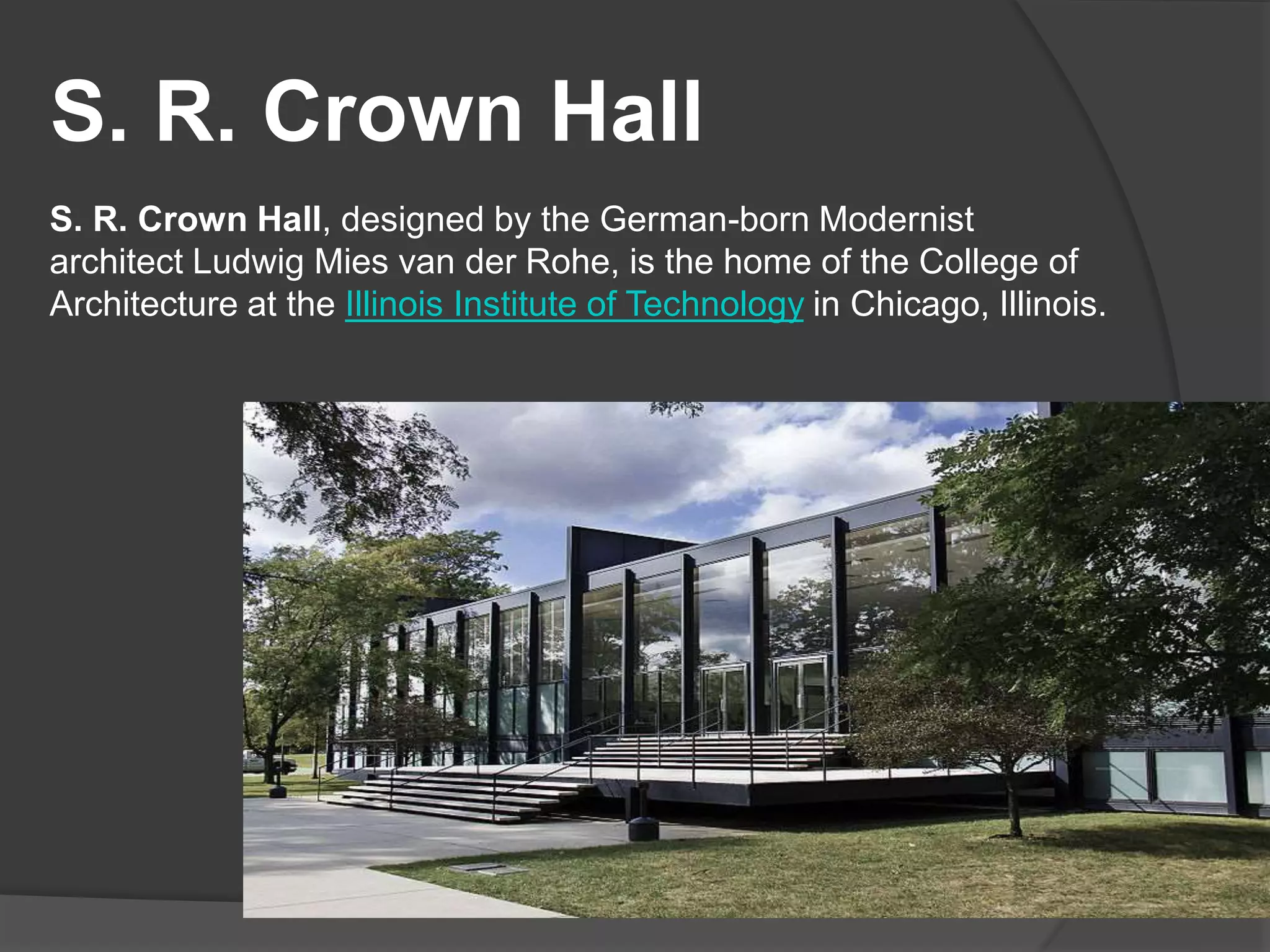
S. R. Crown Hall
S. R. Crown Hall, designed by the German-born Modernist
architect Ludwig Mies van der Rohe, is the home of the College of
Architecture at the Illinois Institute of Technology in Chicago, Illinois.

Modern Architectures (Umer Tariq)

  • 3.
    The defining featureof modern architecture is the modern aesthetic which may be summarized as “plain geometric forms”
  • 4.
    Common themes ofmodern architecture include:  The notion that "Form follows function", expressed by Frank Lloyd Wright's, meaning “The result of design should derive directly from its purpose”  Simplicity and clarity of forms and elimination of "unnecessary detail"  Materials at 90 degrees to each other  Visual expression of structure (as opposed to the hiding of structural elements)
  • 5.
     The relatedconcept of "Truth to materials", meaning that the true nature or natural appearance of a material be seen rather than concealed represent something else.  Use of industrially-produced materials; adoption of the machine aesthetic.
  • 7.
    Modern Architectures mainly surroundsby three factors:  Material  Steel, Glass, Reinforced concrete  Schools of modernity  The Chicago school  The Werkbund  The Bauhaus  Big three architects  Louis Sullivan  Walter Gropius  Ludwig Mies van der rohe
  • 8.
    Materials played avital role in expanding Modern Architectures The two principal materials for the new forms and high massive buildings:  Steel (pioneered in Britain and brought into general use in America)  Reinforced concrete (developed in France)
  • 9.
    Steel:  The fundamentaltechnical prerequisite to large-scale modern architecture was the development of metal framing.
  • 10.
    Glass and ironframe: Crystal Palace, Joseph Paxton, 1851 Eiffel Tower, Gustav Eiffel, 1887
  • 11.
    Reinforced Concrete: Francoise Hennebiquein 1892, perfected a system for the best location of steel reinforcement in concrete; the combination of the compressive strength of concrete with the tensile strength of concrete in a homogenous grid was one of the turning points in architectural history.
  • 12.
    The First StructuresBased on requirements of modern architectures:
  • 13.
    Metal Frame building: Thefirst definitive skyscraper was the Home Insurance Building, Chicago built in 1883-85 by William le Baron Jenney. Of fireproof construction, it has a metal frame clad in brick and masonry.
  • 14.
    R.C. Structure : Churchof St. Jean-de Montmartre , Anatole de Baudette, Paris, 1897. The first example of reinforced cement in church construction.
  • 15.
    The ‘Schools’ ofModernity: The Chicago School The Werkbund The Bauhaus
  • 16.
    The Chicago School:  Chicago's architecture is famous throughout the world and one style is referred to as the Chicago School. In the history of architecture, the Chicago School was a school of architects active in Chicago at the turn of the 20th century. The Chicago fire of 1871 destroyed most of the city and gave an opportunity for architects to design and build new structures.
  • 17.
    Chicago’s school sharesto Modern Architectures:  They were among the first to promote the new technologies of “steel-frame” construction in commercial buildings.  They developed a spatial aesthetic which co- evolved with, and then came to influence, parallel developments in European Modernism.  The use of steel-frame buildings with masonry cladding, allowing large plate-glass window areas and limiting the amount of exterior ornamentation.
  • 18.
    A "Second ChicagoSchool " later emerged in the 1940s and 1970s which pioneered new building technologies and structural systems such as the ”tube-frame” structure Willis Tower, completed in 1973, introduced the bundled tube structural system and was the world's tallest building until 1998
  • 19.
    Some of themore famous Chicago School buildings include:  Auditorium Building  Sullivan Center  Reliance Building  Gage Group Buildings  Chicago Building  Brooks Building  Fisher Building  Heyworth Building  Leiter I Building  Leiter II Building  Marquette Building  Monadnock Building  Montauk Building  Rookery Building
  • 20.
     Auditorium Building ChicagoJune 30, 2012-92  The Sullivan Center was initially developed because of the Chicago Great Fire of 1871. In 1872, the partners hip of Leopold Schlesinger and David Mayer began after their immigration from Bavaria.
  • 21.
    The ‘Monadnock’ was commissionedby Boston real estate developers Peter and Shepherd Brooks in the building boom following the Depression of 1873–79. The Marquette Building, completed in 1895, is a Chicago landmark that was built by the George A. Fuller Company and designed by architects Holabird & Roche.
  • 22.
    The Brooks Buildingin Chicago was built in 1909–1910 in the Chicago School architectural Style. An early example steel-framed skyscraper. Gage Buildings - Chicago, Illinois. These are three buildings located at 18, 24 and 30 South Michigan Avenue, between Madison Street and Monroe Street, in Chicago, Illinois. They were built in 1899- 1890 by Holabird & Roche for the millinery firms of Keith, Gage and Asche
  • 23.
    The Werkbund: The DeutscherWerkbund (German Workforce) was a German organization of artists, architects, and designers aiming to refine human craft. It was founded by Peter Behrens, Josef Hoffman, and Richard Riemerschmid in 1907. . Its initial purpose was to establish a partnership of product manufacturers with design professionals to improve the competitiveness of German companies in global markets
  • 24.
    The organization originallyincluded twelve architects and twelve business firms:  Peter Behrens  Theodor Fischecr (who served as its first president)  Josef Hoffmann  Bruno Paul  Richard Riemerschmid.  Heinrich Tessenow.  Henry van de Velde.  Van de Velde tan de Velde  Eliel Saarinen  Mies Van der Rohe, (who served as Architectural Director).
  • 25.
    Key dates ofthe Deutscher Werkbund:  1907, Establishment of the Werkbund in Munich  1910, Salon d'Automne, Paris  1914, Cologne exhibition, Germany  1920, Lilly Reich becomes the first female Director  1924, Berlin exhibition  1927, Stuttgart exhibition (including the Weissenhof Estate)  1929, Breslau exhibition  1938, Werkbund closed by the Nazis  1949, Reestablishment
  • 26.
    Weissenhoff states:  Theestate was built for the Deutscher Werkbund exhibition of 1927, and included twenty- one buildings comprising sixty dwellings, designed by seventeen European architects, most of them German-speaking.  Le Corbusier, was awarded the two prime sites, facing the city, and by far the largest budge
  • 27.
     The twenty-onebuildings vary slightly in form consisting of terraced and detached houses and apartment buildings, and display a strong consistency of design. What they have in common are their simplified facades, flat roofs used as terraces, window bands, open plan interiors, and the high level of prefabrication which permitted their erection in just five months. All but two of the entries were white. Bruno Taut had his entry, the smallest, painted a bright red
  • 29.
    The Bauhaus School1919- 1933:  The Bauhaus school was founded by Walter Gropius in Weimar. In spite of its name, and the fact that its founder was an architect, the Bauhaus did not have an architecture department during the first years of its existence.  The concept of the school at the beginning was influenced by medieval construction of churches wherein craftsmen and artists collaborated in the completion and details of the building.
  • 30.
     The Bauhaus,was a school in Germany that combined crafts and the fine arts, and was famous for the approach to design that it publicized and taught.  The term Bauhaus is German for "House of Building" or "Building School".  The Bauhaus had a profound influence upon subsequent developments in art, architecture, graphic design, interior design, industrial design, and typography.
  • 31.
    Bauhaus :  Theschool provided workshops in:  Metalwork  Weaving  Ceramics  Furniture  Typography  Theatre.
  • 32.
    Bauhaus was consideredto be the first design school in the modernist style. It influenced the art and architectural trends in the whole world. The school existed in three German cities (Weimar ,Dessau and Berlin), under three different architect-directors: Walter Gropius, Hannes Meyer and Ludwig Mie's van der Rohe until 1933, when the school was closed by its own leadership under pressure from the Nazi regime.
  • 33.
    The Big Three: Louis Sullivan  Walter Gropius  Ludwig Mies van der rohe
  • 34.
    Louis Sullivan: Louis HenrySullivan (September 3, 1856 – April 14, 1924) was an American architect, and has been called the "father of skyscrapers" and "father of modernism”. Prior to the late 19th century, the weight of a multistory building had to be supported principally by the strength of its walls. The taller the building, the more strain this placed on the lower sections of the building; since there were clear engineering limits to the weight such "load- bearing" walls could sustain, large designs meant massively thick walls on the ground floors, and definite limits on the building's height
  • 35.
    In 1896, LouisSullivan wrote in a poem: It is the pervading law of all things organic and inorganic, Of all things physical and metaphysical, Of all things human, and all things super-human, Of all true manifestations of the head, Of the heart, of the soul, That the life is recognizable in its expression, That form ever follows function. This is the law. "Form follows function" would become one of the prevailing tenets of modern architects
  • 36.
    Louis Sullivan : TheMartin Ryerson Tomb is an Egyptian Revival style mausoleum designed by Louis Sullivan and completed in 1889. The Wainwright Building (also known as the Wainwright State Office Building) is a 10-story red brick office building at 709 Chestnut Street in downtown St. Louis, Missouri.
  • 37.
    Walter Gropius: Walter AdolphGeorg Gropius (May 18, 1883 – July 5, 1969) was a German architect who, along with Ludwig Mies van der Rohe, Le Corbusier and Frank Lloyd Wright, is widely regarded as one of the pioneering masters of modern architecture. Walter Gropius was the founder of Bauhaus School. “"Architecture begins where the engineering ends" - Walter Gropius
  • 38.
     Educator: Founded theBauhaus School of Design (1919- 1928) Founded The Architect’s Collaborative (1945)  Key moment Fled Nazi Germany under the pretext of a temporary visit to Britain with the help of architect Maxwell Fry (1934)  Key buildings The Fagus-Werk Factory, Berlin (1911) The Gropius House, Lincoln, Mass (1938) The Pan Am Building, New York (1958)
  • 39.
    The Fagus Factory(German: Fagus Fabrik or Fagus Werk), a shoe last factory in Alfeld on the Leine. For the first time a complete facade is conceived in glass.The corners are left without any support, yielding an unprecedented sense of openness and continuity between inside and out.
  • 40.
    The Gropius Housewas the family residence of noted architect Walter Gropius at 68 Baker Bridge Road, Lincoln, Massachusetts. Gropius used his new home as a showcase for his Harvard students as well as an example of modernist landscape architecture in America
  • 41.
    Walter Gropius: “As tomy practice, when I built my first house in the U.S.A. —which was my own— I made it a point to absorb into my own conception those features of the New England architectural tradition that I found still alive and adequate. This fusion of the regional spirit with a contemporary approach to design produced a house that I would never have built in Europe with its entirely different climatic, technical and psychological background”. —Walter Gropius, Scope of Total Architecture (1956) —
  • 42.
    Ludwig Mies vander Rohe: Ludwig Mies van der Rohe (born Maria Ludwig Michael Mies; March 27, 1886 – August 17, 1969) was a German-American architect. He strove toward an architecture with a minimal framework of structural order balanced against the implied freedom of free-flowing open space. He called his buildings "skin and bones" architecture. He is often associated with his quotation of the aphorisms, "less is more" and "God is in the details".
  • 43.
    American work: Mies workedfrom his studio in downtown Chicago for his entire 31-year period in America. His significant projects in the U.S. include in Chicago and the area: the residential towers of 860–880 Lake Shore Dr, the Chicago Federal Center complex, the Farnsworth House, Crown Hall and other structures at IIT; and the Seagram Building in New York. These iconic works became the prototypes for his other projects. He also built homes for wealthy clients
  • 44.
    Farnsworth House The highly-craftedpristine white structural frame and all-glass walls define a simple rectilinear interior space, allowing nature and light to envelop the interior space. 860–880 Lake Shore Drive Mies designed a series of four middle- income high-rise apartment buildings for developer Herb Greenwald: the 860– 880 (which was built between 1949 and 1951) .These towers, with façades of steel and glass emerges.
  • 45.
    Museum of FineArts, Houston Mies designed two buildings for the Museum of Fine Arts, Houston (MFAH) as additions to the Caroline Weiss Law Building. In 1953, the MFAH commissioned Mies van der Rohe to create a master plan for the institution. National Gallery, Berlin Mies's last work was the Neue Nationalgalerie art museum, the New National Gallery for the Berlin National Gallery. Considered one of the most perfect statements of his architectural approach, the upper pavilion is a precise composition of monumental steel columns and a cantilevered (overhanging) roof plane with a glass enclosure.
  • 46.
    S. R. CrownHall S. R. Crown Hall, designed by the German-born Modernist architect Ludwig Mies van der Rohe, is the home of the College of Architecture at the Illinois Institute of Technology in Chicago, Illinois.