How do I promote better partnerships between librarians and tutors in my role as Academic Support Librarian? Clare McCluskey York St John University, UK
Motivation Belief that information literacy empowers people (Hepworth and Walton 2009) Belief that information literacy instruction would benefit the students in their learning experiences, especially on Enquiry Based Learning courses Experience that few in the institution realised the value a librarian could offer
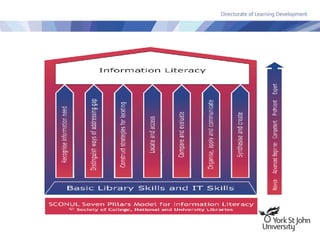
Information literacy “library user education, information skills training and education, and those areas of personal, transferable or ‘key’ skills relating to the use and manipulation of information in the context of learning, teaching and research issues” (SCONUL 2008)
 
Key papers published recently: Information behaviour of the researcher of the future (CIBER) http:// www.bl.uk/news/pdf/googlegen.pdf Higher Education in a Web 2.0 world (JISC) http://www.jisc.ac.uk/publications/documents/heweb2.aspx
Information provider? Demonstrator of processes Knowledge creator? Work with student to show why skills are needed – help them come to own conclusions
Methodology Action research – focus on improving my practice (McNiff & Whitehead 2006) I do not wish, nor am I able, to remove myself from the process or outcomes of the study – living theory Data measured against my values of  critical engagement, participation, partnerships and cross-curricula understanding
Initial investigations Reflective diary (to show situation from my point of view) Review of literature revealed embedding information skills into academic programmes as effective (e.g Gibson & Luxton 2009, McInnis Bowers et al 2009, Rich & Smart 2006) But how to get to that point? (McGuinness 2003 & 2007) Recorded discussion with tutor where partnership was growing
Three interventions Group focused, university-wide approach Staff development sessions for tutors Strategic approach Obtaining place on faculty quality committee Personal, one-to-one approach Semi-structured interviews about perception of my role with individual tutors
Data gathering Continuation of reflective diary Email feedback Semi-structured interviews Data then aligned with values to produce evidence (Whitehead 1989) Critical feedback sought from others
University-wide approach Feedback from one attendee: “Discussion about the interaction between library staff and module tutor facilitated a better awareness of the way in which staff can help students to undertake research searches…library staff can potentially facilitate learning in this area”
Further outcomes Tutor emailed all others in her subject area to promote value library could offer Advised module specific interventions Used key words such as “dialogue” and “student experience” which link to original values More tutors have since asked to work with me
Strategic approach Good for me as was able to learn about and advise on programmes Emails from members of panel revealed tutors also found it useful Language in emails revealed wish for interaction and co-operation in course design, linking to values of cross-curricula understanding and partnerships
Further outcomes Invitation to sit on quality panel sub-committee Ability to advise professionally on validation and re-validation of programmes and modules Better awareness on both parts about direction taken
One to one interviews Semi structured Aim 1: to find out views of my role Aim 2: to provide platform for future collaboration Two major concerns amongst tutors: Some do not understand the role of the librarian at all, seeing us as purely reactive Others aware of value in working with us, but unsure how to move co-operation forward
Further outcomes Invitation to join faculty research into evaluation of a year 3 undergraduate module Working collaboratively in promoting information skills via modules in postgraduate programmes
Summary Group approach led to greater awareness of role and more embedded skills sessions, but only amongst those who chose to attend – low take up Strategic approach led to greater awareness of role amongst management of faculty and better liaison about course design, but not for those working below this level
Summary One-to-one approach productive, led to invitations to work on module teams, yet time consuming Lessons to be learned for information professionals – one size does not fit all
Future study Investigation into the value of faculty based staff development sessions on information literacy Evaluation of embedded sessions from point of view of students’ information literacy and learning experience Look at conception of role of fellow librarians
References CIBER (2008)  Information behaviour of the researcher of the future: a Ciber briefing paper.   [Internet]  London, UCL.  Available from: <  http:// www.bl.uk/news/pdf/googlegen.pdf  > [Accessed 27 May 2009]. Committee of Inquiry into the changing learner experience (2009)  Higher Education in a Web 2.0 world.   [Internet] London, JISC.  Available from: <  http://www.jisc.ac.uk/media/documents/publications/heweb20rptv1.pdf   > [Accessed 27 May 2009]. Gibson, S. & Luxton, J. (2009) Departure from the library desk: one undergraduate programme’s story of its subject librarian’s evolving role.  Sconul focus  [Internet], 45, pp. 41-44.  Available from: <  http://www.sconul.ac.uk/publications/newsletter/45/  > [Accessed 22 May 2009]. Hepworth, M. & Walton, G. (2009)  Teaching information literacy for inquiry-based learning.   Oxford, Chandos.
References McGuinness, C. (2003) Attitudes of academics to the library’s role in information literacy education. In Martin, A. & Rader, H.  Information and IT literacy: enabling learning in the 21 st  century.  London, Facet, pp. 244-54. McGuinness, C. (2007) Exploring strategies for integrated information literacy: from academic champions to institution-wide change.  Communications in information literacy , 1 (1), pp. 26-38. McInnis Bowers, C., Chew, B., Bowers, M., Ford, C., Smith, C. & Herrington, C. (2009) Interdisciplinary synergy: a partnership between business and library faculty and its effects on students’ information literacy.  Journal of business and finance librarianship,  14, pp. 110-27. McNiff, J. & Whitehead, J. (2006)  All you need to know about action research.  London, Sage.
References Rich, M. & Smart, J. (2006) Win-win: the benefits of successful collaboration for information professionals, teaching staff and students.  Italics  [Internet], 5 (4), pp. 220-231.  Available from: <  http://www.ics.heacademy.ac.uk/italics/vol5iss4.htm  > [Accessed 22 May 2009]. SCONUL Advisory Committee on Information Literacy (1999)  Briefing paper: Information Skills in Higher Education.  [Internet] London, SCONUL.  Available from: <  http://www.sconul.ac.uk/groups/information_literacy/papers/Seven_pillars2.pdf  > [Accessed 27 May 2009]. SCONUL (2008)  About us.  [Internet] London, SCONUL.  Available from <  http://www.sconul.ac.uk/groups/information_literacy/About_us.html  > [Accessed 27 May 2009]. Whitehead, J. (1989) Creating a living educational theory from questions of the kind, “How do I improve my practice?”.  Cambridge journal of education,  19(1), pp. 137-53.

Librarians as partners in Higher Education

  • 1.
    How do Ipromote better partnerships between librarians and tutors in my role as Academic Support Librarian? Clare McCluskey York St John University, UK
  • 2.
    Motivation Belief thatinformation literacy empowers people (Hepworth and Walton 2009) Belief that information literacy instruction would benefit the students in their learning experiences, especially on Enquiry Based Learning courses Experience that few in the institution realised the value a librarian could offer
  • 3.
    Information literacy “libraryuser education, information skills training and education, and those areas of personal, transferable or ‘key’ skills relating to the use and manipulation of information in the context of learning, teaching and research issues” (SCONUL 2008)
  • 4.
  • 5.
    Key papers publishedrecently: Information behaviour of the researcher of the future (CIBER) http:// www.bl.uk/news/pdf/googlegen.pdf Higher Education in a Web 2.0 world (JISC) http://www.jisc.ac.uk/publications/documents/heweb2.aspx
  • 6.
    Information provider? Demonstratorof processes Knowledge creator? Work with student to show why skills are needed – help them come to own conclusions
  • 7.
    Methodology Action research– focus on improving my practice (McNiff & Whitehead 2006) I do not wish, nor am I able, to remove myself from the process or outcomes of the study – living theory Data measured against my values of critical engagement, participation, partnerships and cross-curricula understanding
  • 8.
    Initial investigations Reflectivediary (to show situation from my point of view) Review of literature revealed embedding information skills into academic programmes as effective (e.g Gibson & Luxton 2009, McInnis Bowers et al 2009, Rich & Smart 2006) But how to get to that point? (McGuinness 2003 & 2007) Recorded discussion with tutor where partnership was growing
  • 9.
    Three interventions Groupfocused, university-wide approach Staff development sessions for tutors Strategic approach Obtaining place on faculty quality committee Personal, one-to-one approach Semi-structured interviews about perception of my role with individual tutors
  • 10.
    Data gathering Continuationof reflective diary Email feedback Semi-structured interviews Data then aligned with values to produce evidence (Whitehead 1989) Critical feedback sought from others
  • 11.
    University-wide approach Feedbackfrom one attendee: “Discussion about the interaction between library staff and module tutor facilitated a better awareness of the way in which staff can help students to undertake research searches…library staff can potentially facilitate learning in this area”
  • 12.
    Further outcomes Tutoremailed all others in her subject area to promote value library could offer Advised module specific interventions Used key words such as “dialogue” and “student experience” which link to original values More tutors have since asked to work with me
  • 13.
    Strategic approach Goodfor me as was able to learn about and advise on programmes Emails from members of panel revealed tutors also found it useful Language in emails revealed wish for interaction and co-operation in course design, linking to values of cross-curricula understanding and partnerships
  • 14.
    Further outcomes Invitationto sit on quality panel sub-committee Ability to advise professionally on validation and re-validation of programmes and modules Better awareness on both parts about direction taken
  • 15.
    One to oneinterviews Semi structured Aim 1: to find out views of my role Aim 2: to provide platform for future collaboration Two major concerns amongst tutors: Some do not understand the role of the librarian at all, seeing us as purely reactive Others aware of value in working with us, but unsure how to move co-operation forward
  • 16.
    Further outcomes Invitationto join faculty research into evaluation of a year 3 undergraduate module Working collaboratively in promoting information skills via modules in postgraduate programmes
  • 17.
    Summary Group approachled to greater awareness of role and more embedded skills sessions, but only amongst those who chose to attend – low take up Strategic approach led to greater awareness of role amongst management of faculty and better liaison about course design, but not for those working below this level
  • 18.
    Summary One-to-one approachproductive, led to invitations to work on module teams, yet time consuming Lessons to be learned for information professionals – one size does not fit all
  • 19.
    Future study Investigationinto the value of faculty based staff development sessions on information literacy Evaluation of embedded sessions from point of view of students’ information literacy and learning experience Look at conception of role of fellow librarians
  • 20.
    References CIBER (2008) Information behaviour of the researcher of the future: a Ciber briefing paper. [Internet] London, UCL. Available from: < http:// www.bl.uk/news/pdf/googlegen.pdf > [Accessed 27 May 2009]. Committee of Inquiry into the changing learner experience (2009) Higher Education in a Web 2.0 world. [Internet] London, JISC. Available from: < http://www.jisc.ac.uk/media/documents/publications/heweb20rptv1.pdf > [Accessed 27 May 2009]. Gibson, S. & Luxton, J. (2009) Departure from the library desk: one undergraduate programme’s story of its subject librarian’s evolving role. Sconul focus [Internet], 45, pp. 41-44. Available from: < http://www.sconul.ac.uk/publications/newsletter/45/ > [Accessed 22 May 2009]. Hepworth, M. & Walton, G. (2009) Teaching information literacy for inquiry-based learning. Oxford, Chandos.
  • 21.
    References McGuinness, C.(2003) Attitudes of academics to the library’s role in information literacy education. In Martin, A. & Rader, H. Information and IT literacy: enabling learning in the 21 st century. London, Facet, pp. 244-54. McGuinness, C. (2007) Exploring strategies for integrated information literacy: from academic champions to institution-wide change. Communications in information literacy , 1 (1), pp. 26-38. McInnis Bowers, C., Chew, B., Bowers, M., Ford, C., Smith, C. & Herrington, C. (2009) Interdisciplinary synergy: a partnership between business and library faculty and its effects on students’ information literacy. Journal of business and finance librarianship, 14, pp. 110-27. McNiff, J. & Whitehead, J. (2006) All you need to know about action research. London, Sage.
  • 22.
    References Rich, M.& Smart, J. (2006) Win-win: the benefits of successful collaboration for information professionals, teaching staff and students. Italics [Internet], 5 (4), pp. 220-231. Available from: < http://www.ics.heacademy.ac.uk/italics/vol5iss4.htm > [Accessed 22 May 2009]. SCONUL Advisory Committee on Information Literacy (1999) Briefing paper: Information Skills in Higher Education. [Internet] London, SCONUL. Available from: < http://www.sconul.ac.uk/groups/information_literacy/papers/Seven_pillars2.pdf > [Accessed 27 May 2009]. SCONUL (2008) About us. [Internet] London, SCONUL. Available from < http://www.sconul.ac.uk/groups/information_literacy/About_us.html > [Accessed 27 May 2009]. Whitehead, J. (1989) Creating a living educational theory from questions of the kind, “How do I improve my practice?”. Cambridge journal of education, 19(1), pp. 137-53.