Joe Eshleman , MLIS, Instruction Librarian Johnson & Wales University Library, Charlotte, NC Richard Moniz , MA, MLIS, EdD, Director of Library Services Johnson & Wales University Library, Charlotte, NC Adjunct Instructor, UNCG MLIS & Johnson & Wales University, History Activating the Brain:  Guiding the Research Efforts of First Year Students FEBRUARY 2012
Session Objectives Theory Explore assumptions instructors make about student’s ability to do research Consider the broader cognitive benefits of skills associated with information literacy   Practice Learn about ways that information literacy tools are being taught at one university Share ways that you are addressing these issues in your classroom
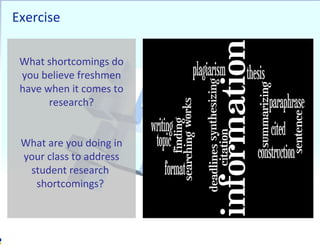
Exercise What shortcomings do you believe freshmen have when it comes to research? What are you doing in your class to address student research  shortcomings?
Cognitive benefits of Information Literacy Broad-based benefits from Information Literacy analogous to Whalen’s (2010) learning through narratives Vygotsky’s  Zone of Proximal Development Wood, Bruner, and Ross’  Scaffolding Intuitive belief that having basic knowledge of Information Literacy skills is the first step towards critical thinking and doing good research
Association of College & Research Libraries Standards “ The information literate student evaluates information and its sources critically and incorporates selected information into his or her knowledge base and value system.”  –  Association of College & Research Libraries Information Literacy Competency Standards for Higher Education
New England Association of Schools & Colleges Standards “ The institution ensures that students use information resources and information technology as an integral part of their education. The institution provides appropriate orientation and training for use of these resources, as well as instruction and support in information literacy and information technology appropriate to the degree level  and field of study.” New England Association of Schools & Colleges Commission on Institutions of Higher Education (SACS equivalent)
Information Literacy and English Composition Students retain more when Information Literacy sessions relate practical tools useful for their assignments  (Holliday, W., & Faggerheim, B. (2006). Integrating information literacy with a sequenced English composition curriculum.  Portal: Libraries and the Academy,  6(2): 169-184.) ENG1020 requires students to write basic research papers (many for the first time) Students require knowledge of research skills and resources to write their papers
Using concept maps – getting a topic Searching the library catalog Knowing what databases are available Knowing basic and advanced database search features such as citation help, limiting to scholarly journals, etc. Developing some basic library knowledge (or where to get it) Caveat/Note: Use of a worksheet was optional (based on librarian’s preference). Librarians also adapted the presentation somewhat based on style. Session Content
Research Design Pre-test and Post-test - Self Report Evidence of Learning – Worksheets and Online Test
Results 255 student participants included in the results (13 additional thrown out due to no pre-test and 7 due to no post-test) 3 librarians included in results (2 presenters and Jean Moats, Collection Management Librarian at Johnson & Wales) 9 English faculty 16 classes Best guess on results????
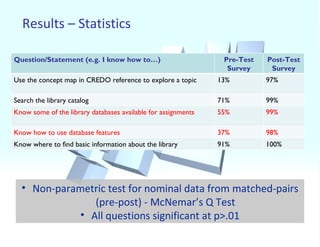
Results – Statistics  Non-parametric test for nominal data from matched-pairs (pre-post) - McNemar’s Q Test All questions significant at p>.01 Question/Statement (e.g. I know how to…) Pre-Test Survey Post-Test Survey Use the concept map in CREDO reference to explore a topic 13% 97% Search the library catalog 71% 99% Know some of the library databases available for assignments 55% 99% Know how to use database features 37% 98% Know where to find basic information about the library 91% 100%
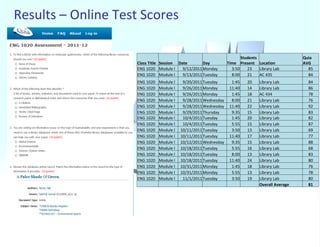
Results – Online Test Scores Class Title Session Date Day Time Students Present Location Quia AVG ENG 1020 Module l 9/12/2011 Monday 3:50 23 Library Lab 85 ENG 1020 Module l 9/13/2011 Tuesday 8:00 21 AC 435 84 ENG 1020 Module l 9/20/2011 Tuesday 1:45 20 Library Lab 84 ENG 1020 Module l 9/26/2011 Monday 11:40 14 Library Lab 86 ENG 1020 Module l 9/26/2011 Monday 1:45 18 AC 434 78 ENG 1020 Module l 9/28/2011 Wednesday 8:00 21 Library Lab 76 ENG 1020 Module l 9/28/2011 Wednesday 11:40 22 Library Lab 92 ENG 1020 Module l 9/29/2011 Thursday 9:35 15 Library Lab 83 ENG 1020 Module l 10/4/2011 Tuesday 1:45 20 Library Lab 82 ENG 1020 Module l 10/4/2011 Tuesday 5:55 15 Library Lab 87 ENG 1020 Module l 10/11/2011 Tuesday 3:50 13 Library Lab 69 ENG 1020 Module l 10/11/2011 Tuesday 11:40 17 Library Lab 77 ENG 1020 Module l 10/12/2011 Wednesday 9:35 15 Library Lab 88 ENG 1020 Module l 10/18/2011 Tuesday 5:55 16 Library Lab 68 ENG 1020 Module l 10/18/2011 Tuesday 8:00 13 Library Lab 83 ENG 1020 Module l 10/18/2011 Tuesday 11:40 24 Library Lab 80 ENG 1020 Module l 10/31/2011 Monday 1:45 18 Library Lab 76 ENG 1020 Module l 10/31/2011 Monday 5:55 13 Library Lab 78 ENG 1020 Module l 11/1/2011 Tuesday 3:50 19 Library Lab 80             Overall Average 81
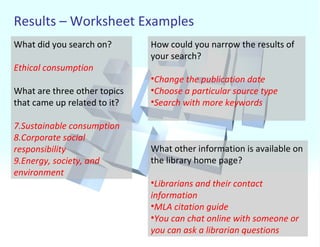
Results – Worksheet Examples What did you search on? Ethical consumption What are three other topics that came up related to it? Sustainable consumption Corporate social responsibility Energy, society, and environment How could you narrow the results of your search? Change the publication date Choose a particular source type Search with more keywords What other information is available on the library home page? Librarians and their contact information MLA citation guide You can chat online with someone or you can ask a librarian questions
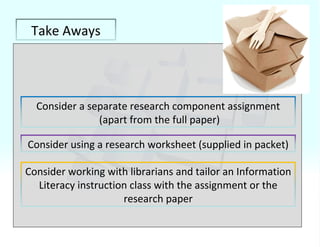
Take Aways Consider a separate research component assignment (apart from the full paper) Consider working with librarians and tailor an Information Literacy instruction class with the assignment or the research paper Consider using a research worksheet (supplied in packet)
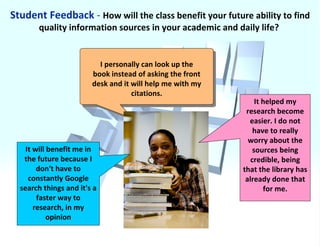
Student Feedback  -  How will the class benefit your future ability to find quality information sources in your academic and daily life?  It will benefit me in the future because I don't have to constantly Google search things and it's a faster way to research, in my opinion It helped my research become easier. I do not have to really worry about the sources being credible, being that the library has already done that for me. I personally can look up the book instead of asking the front desk and it will help me with my citations.
Reflection  Questions? Other Ideas/Thoughts? Thank you.
References/Suggested Readings Association of College & Research Libraries. (2000).  Information literacy competency standards for higher education , Retrieved September 8, 2011, from http://www.ala.org/ala/mgrps/divs/acrl/standards/informationliteracycompetency.cfm.   Burkhardt, J., MacDonald, M. C., and Rathemacher, A. J. (2010).  Teaching information literacy: 50 standards-based exercises for college students . Chicago: ALA.   Galvin, J. (2006). Information literacy and integrative learning.  College & Undergraduate Libraries , 13(3): 25-51.   Holliday, W., & Faggerheim, B. (2006). Integrating information literacy with a sequenced English composition curriculum.  Portal: Libraries and the Academy,  6(2): 169-184.   Killia, L. (2009). New textual formats: Reading online is re-wiring the human brain and changing how we process information.  Dalhousie Journal of Interdisciplinary Management , 5: 1-13.   Moniz, R., Fine, J., & Bliss, L. (2008). The effectiveness of direct-instruction and student-centered teaching methods on students' functional understanding of plagiarism.  College & Undergraduate Libraries , 15(3): 255-279.   Moniz, R., Eshleman, J., Mooney, B., Jewell, D., & Tran, C. (2010). The impact of information literacy-related instruction in the science classroom: Clickers versus nonclickers.  College & Undergraduate Libraries, 17 (4), 349-364.   Posley, K. (2011). Training the trainers: Teaching clinician educators to provide information literacy skills feedback,  Journal of Medical Association , 99(3): 258-261.   Vygotsky, L. S. (1978).  Mind in Society: The Development of Higher Psychological Processes . MA, Harvard University Press. Whalen. L. (2010). The neuroscience of teaching narratives: Facilitating social and emotional development. BRAIN: Broad Research in Artificial Intelligence and Neuroscience, 1(2): 143-147. Wood, D., Bruner, J. S. and Ross, G. (1976). “The Role of Tutoring in Problem Solving,”  Journal of Child Psychology and Psychiatry , 17: 89–100.

Activating the Brain

  • 1.
    Joe Eshleman ,MLIS, Instruction Librarian Johnson & Wales University Library, Charlotte, NC Richard Moniz , MA, MLIS, EdD, Director of Library Services Johnson & Wales University Library, Charlotte, NC Adjunct Instructor, UNCG MLIS & Johnson & Wales University, History Activating the Brain: Guiding the Research Efforts of First Year Students FEBRUARY 2012
  • 2.
    Session Objectives TheoryExplore assumptions instructors make about student’s ability to do research Consider the broader cognitive benefits of skills associated with information literacy Practice Learn about ways that information literacy tools are being taught at one university Share ways that you are addressing these issues in your classroom
  • 3.
    Exercise What shortcomingsdo you believe freshmen have when it comes to research? What are you doing in your class to address student research shortcomings?
  • 4.
    Cognitive benefits ofInformation Literacy Broad-based benefits from Information Literacy analogous to Whalen’s (2010) learning through narratives Vygotsky’s Zone of Proximal Development Wood, Bruner, and Ross’ Scaffolding Intuitive belief that having basic knowledge of Information Literacy skills is the first step towards critical thinking and doing good research
  • 5.
    Association of College& Research Libraries Standards “ The information literate student evaluates information and its sources critically and incorporates selected information into his or her knowledge base and value system.” – Association of College & Research Libraries Information Literacy Competency Standards for Higher Education
  • 6.
    New England Associationof Schools & Colleges Standards “ The institution ensures that students use information resources and information technology as an integral part of their education. The institution provides appropriate orientation and training for use of these resources, as well as instruction and support in information literacy and information technology appropriate to the degree level and field of study.” New England Association of Schools & Colleges Commission on Institutions of Higher Education (SACS equivalent)
  • 7.
    Information Literacy andEnglish Composition Students retain more when Information Literacy sessions relate practical tools useful for their assignments (Holliday, W., & Faggerheim, B. (2006). Integrating information literacy with a sequenced English composition curriculum. Portal: Libraries and the Academy, 6(2): 169-184.) ENG1020 requires students to write basic research papers (many for the first time) Students require knowledge of research skills and resources to write their papers
  • 8.
    Using concept maps– getting a topic Searching the library catalog Knowing what databases are available Knowing basic and advanced database search features such as citation help, limiting to scholarly journals, etc. Developing some basic library knowledge (or where to get it) Caveat/Note: Use of a worksheet was optional (based on librarian’s preference). Librarians also adapted the presentation somewhat based on style. Session Content
  • 9.
    Research Design Pre-testand Post-test - Self Report Evidence of Learning – Worksheets and Online Test
  • 10.
    Results 255 studentparticipants included in the results (13 additional thrown out due to no pre-test and 7 due to no post-test) 3 librarians included in results (2 presenters and Jean Moats, Collection Management Librarian at Johnson & Wales) 9 English faculty 16 classes Best guess on results????
  • 11.
    Results – Statistics Non-parametric test for nominal data from matched-pairs (pre-post) - McNemar’s Q Test All questions significant at p>.01 Question/Statement (e.g. I know how to…) Pre-Test Survey Post-Test Survey Use the concept map in CREDO reference to explore a topic 13% 97% Search the library catalog 71% 99% Know some of the library databases available for assignments 55% 99% Know how to use database features 37% 98% Know where to find basic information about the library 91% 100%
  • 12.
    Results – OnlineTest Scores Class Title Session Date Day Time Students Present Location Quia AVG ENG 1020 Module l 9/12/2011 Monday 3:50 23 Library Lab 85 ENG 1020 Module l 9/13/2011 Tuesday 8:00 21 AC 435 84 ENG 1020 Module l 9/20/2011 Tuesday 1:45 20 Library Lab 84 ENG 1020 Module l 9/26/2011 Monday 11:40 14 Library Lab 86 ENG 1020 Module l 9/26/2011 Monday 1:45 18 AC 434 78 ENG 1020 Module l 9/28/2011 Wednesday 8:00 21 Library Lab 76 ENG 1020 Module l 9/28/2011 Wednesday 11:40 22 Library Lab 92 ENG 1020 Module l 9/29/2011 Thursday 9:35 15 Library Lab 83 ENG 1020 Module l 10/4/2011 Tuesday 1:45 20 Library Lab 82 ENG 1020 Module l 10/4/2011 Tuesday 5:55 15 Library Lab 87 ENG 1020 Module l 10/11/2011 Tuesday 3:50 13 Library Lab 69 ENG 1020 Module l 10/11/2011 Tuesday 11:40 17 Library Lab 77 ENG 1020 Module l 10/12/2011 Wednesday 9:35 15 Library Lab 88 ENG 1020 Module l 10/18/2011 Tuesday 5:55 16 Library Lab 68 ENG 1020 Module l 10/18/2011 Tuesday 8:00 13 Library Lab 83 ENG 1020 Module l 10/18/2011 Tuesday 11:40 24 Library Lab 80 ENG 1020 Module l 10/31/2011 Monday 1:45 18 Library Lab 76 ENG 1020 Module l 10/31/2011 Monday 5:55 13 Library Lab 78 ENG 1020 Module l 11/1/2011 Tuesday 3:50 19 Library Lab 80             Overall Average 81
  • 13.
    Results – WorksheetExamples What did you search on? Ethical consumption What are three other topics that came up related to it? Sustainable consumption Corporate social responsibility Energy, society, and environment How could you narrow the results of your search? Change the publication date Choose a particular source type Search with more keywords What other information is available on the library home page? Librarians and their contact information MLA citation guide You can chat online with someone or you can ask a librarian questions
  • 14.
    Take Aways Considera separate research component assignment (apart from the full paper) Consider working with librarians and tailor an Information Literacy instruction class with the assignment or the research paper Consider using a research worksheet (supplied in packet)
  • 15.
    Student Feedback - How will the class benefit your future ability to find quality information sources in your academic and daily life? It will benefit me in the future because I don't have to constantly Google search things and it's a faster way to research, in my opinion It helped my research become easier. I do not have to really worry about the sources being credible, being that the library has already done that for me. I personally can look up the book instead of asking the front desk and it will help me with my citations.
  • 16.
    Reflection Questions?Other Ideas/Thoughts? Thank you.
  • 17.
    References/Suggested Readings Associationof College & Research Libraries. (2000). Information literacy competency standards for higher education , Retrieved September 8, 2011, from http://www.ala.org/ala/mgrps/divs/acrl/standards/informationliteracycompetency.cfm.   Burkhardt, J., MacDonald, M. C., and Rathemacher, A. J. (2010). Teaching information literacy: 50 standards-based exercises for college students . Chicago: ALA.   Galvin, J. (2006). Information literacy and integrative learning. College & Undergraduate Libraries , 13(3): 25-51.   Holliday, W., & Faggerheim, B. (2006). Integrating information literacy with a sequenced English composition curriculum. Portal: Libraries and the Academy, 6(2): 169-184.   Killia, L. (2009). New textual formats: Reading online is re-wiring the human brain and changing how we process information. Dalhousie Journal of Interdisciplinary Management , 5: 1-13.   Moniz, R., Fine, J., & Bliss, L. (2008). The effectiveness of direct-instruction and student-centered teaching methods on students' functional understanding of plagiarism. College & Undergraduate Libraries , 15(3): 255-279.   Moniz, R., Eshleman, J., Mooney, B., Jewell, D., & Tran, C. (2010). The impact of information literacy-related instruction in the science classroom: Clickers versus nonclickers. College & Undergraduate Libraries, 17 (4), 349-364.   Posley, K. (2011). Training the trainers: Teaching clinician educators to provide information literacy skills feedback, Journal of Medical Association , 99(3): 258-261.   Vygotsky, L. S. (1978). Mind in Society: The Development of Higher Psychological Processes . MA, Harvard University Press. Whalen. L. (2010). The neuroscience of teaching narratives: Facilitating social and emotional development. BRAIN: Broad Research in Artificial Intelligence and Neuroscience, 1(2): 143-147. Wood, D., Bruner, J. S. and Ross, G. (1976). “The Role of Tutoring in Problem Solving,” Journal of Child Psychology and Psychiatry , 17: 89–100.