DISEASES
OF
EXTERNAL
EAR
OVERVIEW
• 2.Trauma to auricle
• a. Hematoma of the auricle
• b. Frostbite
• c. Burns
• 3. Inflammatory Disorders
• a. Peicondritis
• b. Relapsing Pericondritis
• DISEASES OF EXTERNAL AUDITORY
CANAL
• 1.Inflammatory Disorders
• a. Furuncle
• b. Diffuse Otitis Externa
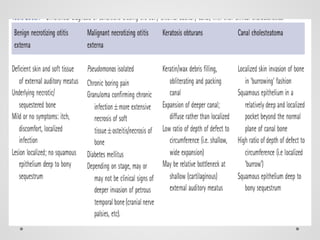
• c. Benign Necrotizing Externa
• d. Malignant Otitis Externa
• e. Herpes Zoster Oticus
• f. Otomycosis
• g. Aural Papillomatosis
•
• Developmental Anatomy
• DISEASES OF PINNA
• 1.Congenital Disorders
• a. Anotia
• b. Skin tags
• c. Microtia
• d. Macotia
• e. Bat ear
• f. Collapsed ear
• e. Folded over helical rim
• g. Bumps and cleft
• h. Cup ear
• i. Crytotia
• j. Positional problems
• k. Unusual malformations
• l. Stahl’s ear
• m. Polyotia
• n. Preauricular pit
• b. Malignant
• - Squamous cell
carcinoma of auricle
• - Squamous cell
carcinoma of External
auditory canal
• - Malignant Melanoma
• - Basal cell carcinoma of
Auricle
• DISEASES OF TYMPANIC
MEMBRANE
• 1. Myringitis bullosa
• 2. Myringitis granulosa
• 2. Other diseases of External
auditory Canal
• a. Cerumen impaction
• b. Exostosis of External auditory
canal
• c. Foreign bodies of ear
• d. Primary Auditory canal
Cholesteatoma
e. Acquired atresia and
stenosis of meatus
• 2. Tumors of External ear
• a. benign
• - Vascular tumors
• - Cysts
• - Keloid
• - Winker’s nodule
• - Keratoacanthoma
• - Adenoma
DEVELOPMENTAL ANATOMY
• Auricle or pinna - from 6 mesodermal thickenings (auricular
hillocks/tubercles) around the 1st
pharyngeal cleft, Auricular
hillocks of the mandibular arch - tragus, crus of helix, and
helix.
 Auricular hillocks of the hyoid arch - antihelix, antitragus,
and ear lobule.
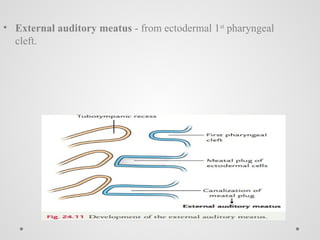
• External auditory meatus - from ectodermal 1st
pharyngeal
cleft.
DISEASES OF PINNA
• A
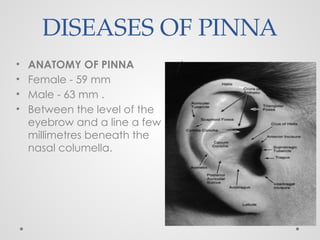
• ANATOMY OF PINNA
• Female - 59 mm
• Male - 63 mm .
• Between the level of the
eyebrow and a line a few
millimetres beneath the
nasal columella.
1. CONGENITAL
DISORDERS
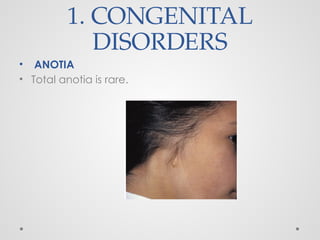
• ANOTIA
• Total anotia is rare.
SKIN TAGS
• Preauricular skin tags- very common
• Sometimes the lesion involves only skin but usually
the tag contains a long tail of cartilage extending
into the cheek .
• Management : elective excision of the skin tag and
cartilage spindle - A vertical ellipse.
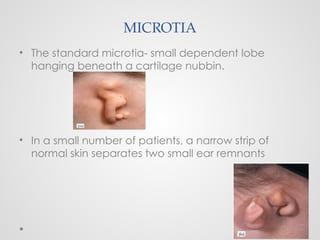
MICROTIA
• The standard microtia- small dependent lobe
hanging beneath a cartilage nubbin.
• In a small number of patients, a narrow strip of
normal skin separates two small ear remnants
MACROTIA
• Excessively large ear
• The scaphal hollow is too big, causing the ear to
appear top-heavy
• OR the lobe is too big, causing the ear appears
bottom-heavy.
• Management :
• excessively large upper ear- An anterior crescent of
skin and cartilage be removed from the scaphal
hollow of the ear.
• oversized lobe- a wedge of tissue is removed
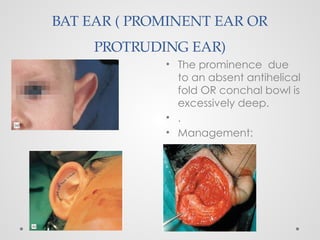
BAT EAR ( PROMINENT EAR OR
PROTRUDING EAR)
• The prominence due
to an absent antihelical
fold OR conchal bowl is
excessively deep.
• .
• Management:
COLLAPSED EAR
• Helical rim is adequate but
the scaphal hollow is folded
backwards to rest on the
conchal hollow.
• Management : Undoing soft
tissue tethering between the
scaphal and conchal
cartilages and splinting these
structures apart with a
cartilage graft.
• The conchal hollow - donor
site.
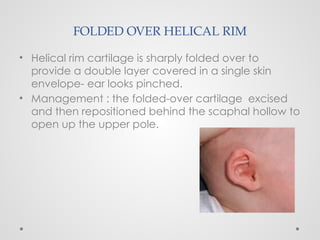
FOLDED OVER HELICAL RIM
• Helical rim cartilage is sharply folded over to
provide a double layer covered in a single skin
envelope- ear looks pinched.
• Management : the folded-over cartilage excised
and then repositioned behind the scaphal hollow to
open up the upper pole.
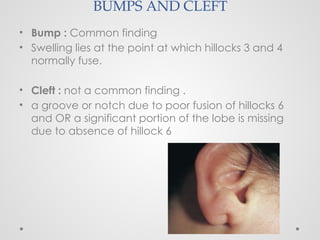
BUMPS AND CLEFT
• Bump : Common finding
• Swelling lies at the point at which hillocks 3 and 4
normally fuse.
• Cleft : not a common finding .
• a groove or notch due to poor fusion of hillocks 6
and OR a significant portion of the lobe is missing
due to absence of hillock 6
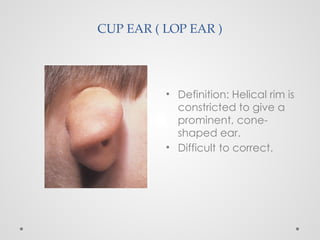
CUP EAR ( LOP EAR )
• Definition: Helical rim is
constricted to give a
prominent, cone-
shaped ear.
• Difficult to correct.
CRYPTOTIA ( POCKET EAR OR HIDDEN EAR)
Only the lower two-thirds of an ear is visible and the
upper auricular sulcus seems lost.
• Management : small Ear Buddies splint should be
applied - as soon as possible after birth
• Later surgery
POSITIONAL PROBLEMS
• Ears- too low set or hitched upward
• axis of the ear may be abnormal(excessively
vertical) such that patients complain about their
ears, but are unsure of what is wrong.
• Management :
• conchomastoid sutures to adjust the slope
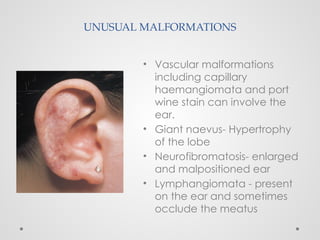
UNUSUAL MALFORMATIONS
• Vascular malformations
including capillary
haemangiomata and port
wine stain can involve the
ear.
• Giant naevus- Hypertrophy
of the lobe
• Neurofibromatosis- enlarged
and malpositioned ear
• Lymphangiomata - present
on the ear and sometimes
occlude the meatus
STAHL’S EAR ( ABNORMAL FOLDS OR THIRD CRUS )
• Management:
• easily and temporarily
corrected by finger
pressure
• Surgery
• A direct wedge
excision of the Stahl’s
bar by splint-
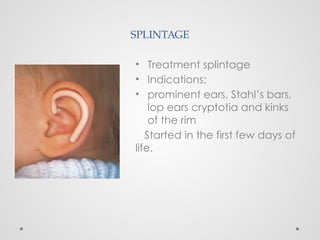
SPLINTAGE
• Treatment splintage
• Indications:
• prominent ears, Stahl’s bars,
lop ears cryptotia and kinks
of the rim
Started in the first few days of
life.
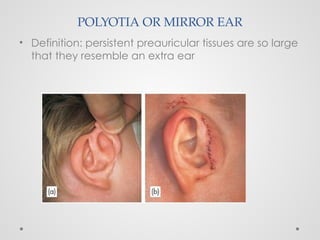
POLYOTIA OR MIRROR EAR
• Definition: persistent preauricular tissues are so large
that they resemble an extra ear
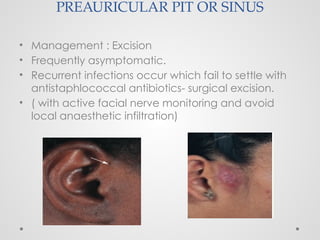
PREAURICULAR PIT OR SINUS
• Management : Excision
• Frequently asymptomatic.
• Recurrent infections occur which fail to settle with
antistaphlococcal antibiotics- surgical excision.
• ( with active facial nerve monitoring and avoid
local anaesthetic infiltration)
2. TRAUMA TO THE
AURICLE
• HAEMATOMA OF THE AURICLE
• Trauma- sports-related
• painless and inflammation -minimal.
• classic ‘cauliflower’ or ‘wrestler’s’ ear- If left
untreated
• Management :
• Evacuation- recurrence.
• To prevent recurrence –
• Local pressure dressings.
• A drain left in the incision site.
• A posterior incision, with excision of a disc of
cartilage and placement of a suction drain.
Through-and-through ‘mattress’ or ‘quilting’
sutures to apply compression, with or without
materials- distribute the compression more evenly
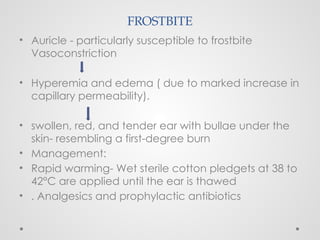
FROSTBITE
• Auricle - particularly susceptible to frostbite
Vasoconstriction
• Hyperemia and edema ( due to marked increase in
capillary permeability).
• swollen, red, and tender ear with bullae under the
skin- resembling a first-degree burn
• Management:
• Rapid warming- Wet sterile cotton pledgets at 38 to
42°C are applied until the ear is thawed
• . Analgesics and prophylactic antibiotics
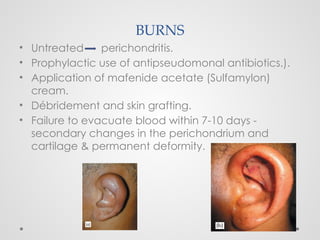
BURNS
• Untreated perichondritis.
• Prophylactic use of antipseudomonal antibiotics.).
• Application of mafenide acetate (Sulfamylon)
cream.
• Débridement and skin grafting.
• Failure to evacuate blood within 7-10 days -
secondary changes in the perichondrium and
cartilage & permanent deformity.
3. INFLAMMATORY
DISORDERS
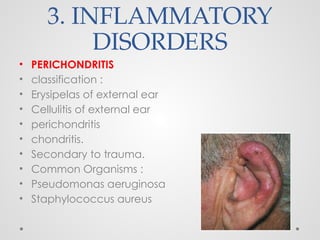
• PERICHONDRITIS
• classification :
• Erysipelas of external ear
• Cellulitis of external ear
• perichondritis
• chondritis.
• Secondary to trauma.
• Common Organisms :
• Pseudomonas aeruginosa
• Staphylococcus aureus
RELAPSING PERICHONDRITIS
• polychondropathy/ systemic chondromalacia
/chronic atrophic polychondritis.
Definition :a rare disease of episodic inflammation and
degeneration involving multiple cartilaginous structures,
usually those of the upper respiratory tract, as well as
connective tissue at various other sites.
• Diagnosis: Signs :
• 1. McAdam et al.
• 2. Damiani and Levine
• Management :
• steroids-)
• Immunosuppressants-
• NSAIDs4 , colchicine.
• Anti-CD4 monoclonal antibody , oral minocycline
have recently
DISEASES OF EXTERNAL
AUDITORY CANAL
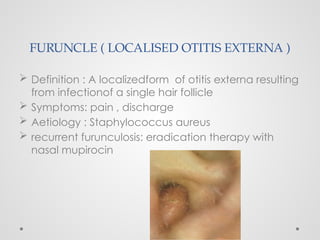
FURUNCLE ( LOCALISED OTITIS EXTERNA )
 Definition : A localizedform of otitis externa resulting
from infectionof a single hair follicle
 Symptoms: pain , discharge
 Aetiology : Staphylococcus aureus
 recurrent furunculosis: eradication therapy with
nasal mupirocin
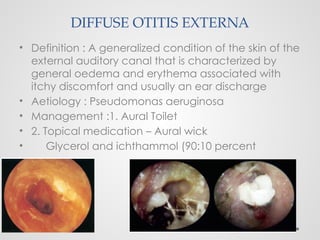
DIFFUSE OTITIS EXTERNA
• Definition : A generalized condition of the skin of the
external auditory canal that is characterized by
general oedema and erythema associated with
itchy discomfort and usually an ear discharge
• Aetiology : Pseudomonas aeruginosa
• Management :1. Aural Toilet
• 2. Topical medication – Aural wick
• Glycerol and ichthammol (90:10 percent
BENIGN NECROTIZING EXTERNA
• Benign necrotizing otitis externa / Benign necrotizing
osteitis of the external auditory meatus canal
• Definition :clinical condition of idiopathic necrosis of a
localized area of bone of the tympanic ring, with
secondary inflammation of the overlying soft tissue and
skin.
• Aetiology :
• Unknown
• Tympanic bone is particularly susceptible to
osteonecrosis because of its ‘relatively poor blood
supply’.
• Repeated local trauma
• Sign :
• characteristic positive
findings of a small area
of deficient skin and
soft tissue in the
external auditory
meatus revealing a
segment of necrotic
superficial bone
• D/D :
• Canal cholesteatoma-
presence of a lining of
squamous epithelium.
• Outcomes :
• Separation of the sequestrum, followed by epithial growth to
cover the bony defect
• progressive necrosis with exposure of the facial nerve and
jugular bulb.
• Management :
• removing the bony sequestrum once it separates
spontaneously with local toilet and local treatment to control
any infection.
• oral antibiotic
• early surgical removal of the sequestrum down to healthy
bone.
• Adjunctive hyperbaric oxygen
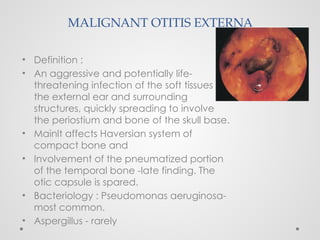
MALIGNANT OTITIS EXTERNA
• Definition :
• An aggressive and potentially life-
threatening infection of the soft tissues of
the external ear and surrounding
structures, quickly spreading to involve
the periostium and bone of the skull base.
• Mainlt affects Haversian system of
compact bone and
• Involvement of the pneumatized portion
of the temporal bone -late finding. The
otic capsule is spared.
• Bacteriology : Pseudomonas aeruginosa-
most common.
• Aspergillus - rarely
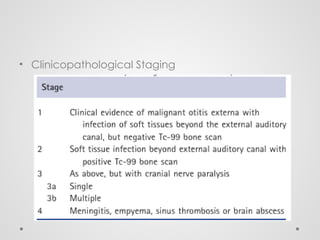
• Clinicopathological Staging
• Mainlt affects Haversian system of compact bone
and
• Involvement of the pneumatized portion of the
temporal bone -late finding. The otic capsule is
spared.
• Bacteriology : Pseudomonas aeruginosa- most
common.
• Aspergillus - rarely
• Predisposing Factors :
• elderly diabetic- – 1. impaired leukocyte mobility
 2. microangiopathy –
 ‘hyperglycexternal auditory canalia’ -
 Children- more common facial nerve palsy and
involvement of the middle ear.
 Refractory or suspected malignant otitis externa in
children or adults-.
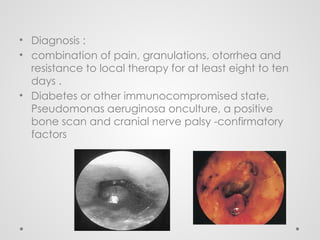
• Diagnosis :
• combination of pain, granulations, otorrhea and
resistance to local therapy for at least eight to ten
days .
• Diabetes or other immunocompromised state,
Pseudomonas aeruginosa onculture, a positive
bone scan and cranial nerve palsy -confirmatory
factors
• Investigations :
• Technetium (Tc-99m)
radionuclide bone scans.
• Gallium (Ga-67) - more
sensitive monitor of infection,.
• SPECT
• MRI
• Outcome :
• extensive skull base osteomyelitis- Involvement of
clivus and contralateral temporal bone, anteriorly
into the sphenoid, carotid, temporomandibular joint
and parapharyngeal space.
• Cranial nerve involvement :
• Facial nerve- most common
• IX, X and X
• VI or XII – rare
• :can spread to the central venous sinuses,
extradural space and meninges
• usual terminal events : Infective thrombophlebitis or
thrombosis of the internal carotid artery
• Management :
• Aural Toilet
• Systemic Antibiotics: Duration; at least six weeks
and in advanced cases, several months.
• ciprofloxacin with or without an aminoglycoside
and/or ceftazidime
• Oral rifampicin
• Implantable gentamicin
• Hyperbaric oxygen
• Surgery
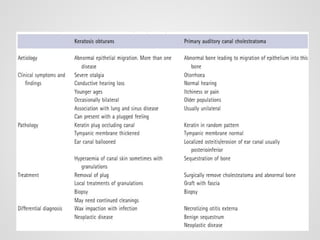
KERATOSIS OBTURANS
• the accumulation of a large
plug of desquaminated keratin
in the external auditory meatus
• Pathology :
• geometrically patterned keratin
plug within the lumen of an
expanded external auditory
canal . The keratin squames
are shed from the complete
circumference of the deep ear
canal forming a lamina (onion
skin) arrangement.,
• Aetiology :
• due to abnormal epithelial migration of the ear canal
skin.
• two types;
• 1. inflammatory nature - secondary to an acute
problem, such as a viral infection, causing
inflammation of the ear canal - temporarily alters the
epithelial migration. cured by removal.
• 2.the silent type - disease that carries on and on -
caused by abnormal separation of the keratin that
persists even after the first removal and will need
subsequent removals.
• Management:
• Removal often under general anaesthetic.
Canalplasty if recurrent
• Baed on extent of the cholesteatoma erosion;
• can be seen- conservative treatment .
• Cannot be seen - patients are treated with excision
of necrotic bone and cholesteatoma via the
mastoid and repair of the defect using temporalis
fascia. OR canal wall-up procedure with repair of
the defect
PRIMARY AUDITORY CANAL
CHOLESTEATOMA
• Definition : invasion of squamous tissue from the ear
into a localized area of bony erosion.
• Pathology :
• keratin is derived primarily from a sac that involves
the bone of the ear canal with bony fragments
within it and random keratin in the lumen of the ear
• Aetiology :
• piece of exposed bone of the primary auditory
canal becomes infected , sequests and the
epithelium migrates into this bony abnormality-
cholesteatoma.
HERPES ZOSTER OTICUS
• Definition :
• herpetic vesicular rash on the
concha, external auditory canal
or pinna with a lower motor
neurone palsy of the ipsilateral
facial nerve.
• Nomenclature:
• called as Ramsay Hunt syndrome
type 1 as Hunt actually described
three neurological syndromes –
only one of which involved the
facial nerve and the ear
• Pathology :
• end-stage of a severe infection originates from the
external auditory canal and progresses through cellulitis,
chondritis, periostitis, osteitis and finally osteomyelitis.
(following surgery to the temporal bone.)
• Infection is thought to spread out of the cartilaginous
external auditory canal through the fissures of Santorini,
con genital defects in the floor of the external auditory
canal.
• Once periostitis develops, this progresses rapidly across
the skull base.
• facial nerve and other cranial nerve palsies
• periostitis
• osteomyelitis
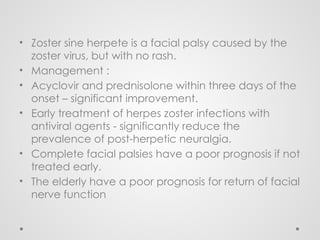
• Zoster sine herpete is a facial palsy caused by the
zoster virus, but with no rash.
• Management :
• Acyclovir and prednisolone within three days of the
onset – significant improvement.
• Early treatment of herpes zoster infections with
antiviral agents - significantly reduce the
prevalence of post-herpetic neuralgia.
• Complete facial palsies have a poor prognosis if not
treated early.
• The elderly have a poor prognosis for return of facial
nerve function
OTOMYCOSIS (fungal otitis externa)
Predisposing Factors :
hot, humid climates
secondary to prolonged treatment with topical
antibiotics.
Diabetes and immuno compromised states
Clinical Findings :
A black, grey, green, yellow or white discharge with
debris – resemble wet newspaper.
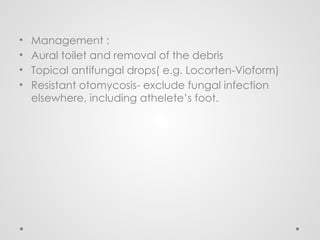
• Management :
• Aural toilet and removal of the debris
• Topical antifungal drops( e.g. Locorten-Vioform)
• Resistant otomycosis- exclude fungal infection
elsewhere, including athelete’s foot.
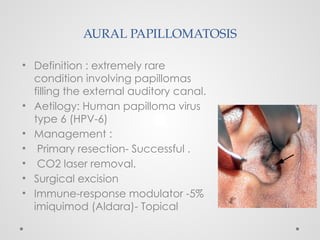
AURAL PAPILLOMATOSIS
• Definition : extremely rare
condition involving papillomas
filling the external auditory canal.
• Aetilogy: Human papilloma virus
type 6 (HPV-6)
• Management :
• Primary resection- Successful .
• CO2 laser removal.
• Surgical excision
• Immune-response modulator -5%
imiquimod (Aldara)- Topical
CERUMEN IMPACTION
• Definition: a mixture of secretions and sloughed
epithelial cells.
• Management:
• Manual debridement - trauma to the canal skin,
infection, or tympanic membrane perforation.
• Irrigation- flushing the wax out by a jet of warm
water- should not be done, if a tympanic membrane
perforation or myringotomy tube is present.
• Cerumenolytics - avoided ; active infections of the
ear canal, tympanostomy tubes, or tympanic
membrane perforation . Best option- manual
removal of cerumen, ideally using a binocular
microscope,
Exostosis of the external auditory canal
• Definition : benign growth of periosteal bone, which
forms a smooth, sessile, hemispherical swelling in the
deep part of the meatus, adjascent to the tympanic
membrane.
• Multiple, bilateral.
• Arise from the anterior or posterior walls of the
external auditory canal.
• Incidental finding.
• Relationship with cold water exposure
• Small - Incidental finding and aymptomatic
• stenosis > 80 % of the canal lumen- history of recurrent
otitis externa, chronic infection, wax and debris
accumulation and conductive hearing loss
• Management :
• Majority - no treatment ( Asymptomatic )
• General advice - avoidance of cold water
• Surgery :
• Indications :
• refractory to medical treatment,
• causing recurrent or persisting otitis externa,
frequent cerumen obstruction causing hearing loss
cases where wider access is required for middle ear
surgery
• Meatoplasty
• via a postaural ( recommended ) or transmeatal
approach
• very careful elevation and preservation of the skin
overlying the exostoses.
• The bone of the exostoses is removed by high
speed drill, using both cutting and diamond burrs
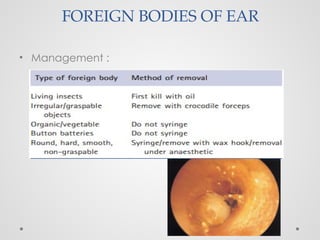
FOREIGN BODIES OF EAR
• Management :
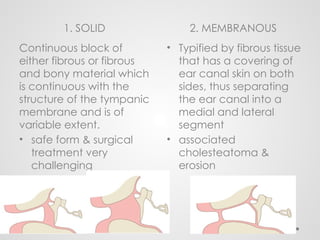
ACQUIRED ATRESIA AND STENOSIS OF
MEATUS
• Definition : ‘intraluminal sequelae of either
intraluminal or extra luminal processes of varying
aetiology, resulting in a blind sac in the external
acoustic meatus
1. SOLID 2. MEMBRANOUS
Continuous block of
either fibrous or fibrous
and bony material which
is continuous with the
structure of the tympanic
membrane and is of
variable extent.
• safe form & surgical
treatment very
challenging
• Typified by fibrous tissue
that has a covering of
ear canal skin on both
sides, thus separating
the ear canal into a
medial and lateral
segment
• associated
cholesteatoma &
erosion
• Diagnosis: CT
• Aetiology :
• Inflammation,
• Surgery
• Management :
• Medical
• wet phase : 1. removal of the medial granulations by
aspiration and cauterization with silver nitrate or
trichloroacetic acid
• 2. the ear pack with ribbon gauze or a wick
• conductive hearing impairment (if bilateral) : hearing aid
• Surgical :
• Fibrous Atresia
• Membranous :
• small atretic plate – trans canal approach
• Very thick lesion : retro auricular approach
TUMORS OF THE
EXTERNAL EAR
• BENIGN TUMORS
1. Vascular Tumor
 Capillary hemangioma
 Spider nevus: Small & fixed. Treatment, when
necessary- needle coagulation of the central vessel.
 Cavernous hemangioma: “strawberry tumor,” -
increases rapidly in size during the first year of life but
usually regresses thereafter.
 Lymphangioma : multiple pale circumscribed
lesions, like a cluster of fish or frog roe
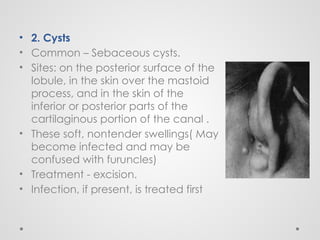
• 2. Cysts
• Common – Sebaceous cysts.
• Sites: on the posterior surface of the
lobule, in the skin over the mastoid
process, and in the skin of the
inferior or posterior parts of the
cartilaginous portion of the canal .
• These soft, nontender swellings( May
become infected and may be
confused with furuncles)
• Treatment - excision.
• Infection, if present, is treated first
• 3. Keloid
• Most commonly seen - pedunculated tumors on the
lobule following ear piercing.
• Also occur in mastoidectomy and endaural scars,
• disfigurement or stenosis of the canal.
• Treatment - excision followed by periodic injection
of a small amount of corticosteroids.
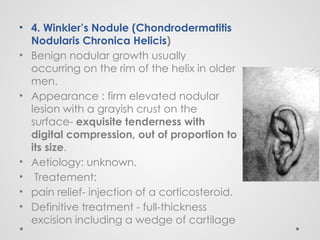
• 4. Winkler’s Nodule (Chondrodermatitis
Nodularis Chronica Helicis)
• Benign nodular growth usually
occurring on the rim of the helix in older
men.
• Appearance : firm elevated nodular
lesion with a grayish crust on the
surface- exquisite tenderness with
digital compression, out of proportion to
its size.
• Aetiology: unknown.
• Treatement:
• pain relief- injection of a corticosteroid.
• Definitive treatment - full-thickness
excision including a wedge of cartilage
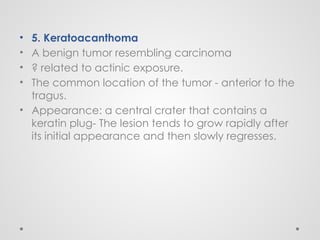
• 5. Keratoacanthoma
• A benign tumor resembling carcinoma
• ? related to actinic exposure.
• The common location of the tumor - anterior to the
tragus.
• Appearance: a central crater that contains a
keratin plug- The lesion tends to grow rapidly after
its initial appearance and then slowly regresses.
6.Adenoma
• Symptoms are minimal unless the growth
completely occludes the canal. Pain suggests
malignancy.
• A ceruminoma - adenoma of sweat gland origin
• Treatment - surgical excision.
MALIGNANT TUMORS OF THE
EXTERNAL EAR
• 1.Squamous Cell Carcinoma of the
Auricle
• present as ulcerated lesions with an
area of surrounding erythema and
induration
• Occur more often on the helix
• Treatment: wide excision and
reconstruction.
2.Squamous Cell Carcinoma of the
External Auditory Canal
• Malignancy should be suspected whenever otalgia
or bleeding is associated with the tumor and a
biopsy should be taken with local anesthesia using
a cupped biopsy forceps
• CT or MRI - the extent of a carcinoma
• Treatment -wide surgical excision and
postoperative radiation therapy. Anterior canal
tumors may spread through Santorini’s fissures into a
preauricular lymph node
3.Malignant Melanoma
• Diagnosis should be suspected when a pigmented
lesion begins to increase in size or change in color.
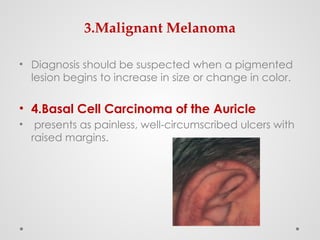
• 4.Basal Cell Carcinoma of the Auricle
• presents as painless, well-circumscribed ulcers with
raised margins.
DISEASES OF TYMPANIC
MEMBRANE
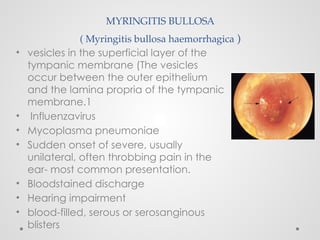
MYRINGITIS BULLOSA
( Myringitis bullosa haemorrhagica )
• vesicles in the superficial layer of the
tympanic membrane (The vesicles
occur between the outer epithelium
and the lamina propria of the tympanic
membrane.1
• Influenzavirus
• Mycoplasma pneumoniae
• Sudden onset of severe, usually
unilateral, often throbbing pain in the
ear- most common presentation.
• Bloodstained discharge
• Hearing impairment
• blood-filled, serous or serosanginous
blisters
• Diagnosis
• In cases without middle ear affection and without
sensorineural hearing loss- only analgesics.
• middle ear is affected, antibiotics can be used as
in the treatment of acute otitis media.
• In children less than two years of age, acute bullous
myringitis should be treated as acute otitis media.
Antibiotics have also been recommended in cases
with sensorineural hearing impairment
MYRINGITIS GRANULOSA
• granulating myringitis,, otitis
externa granulosa.
• A specific form of external otitis
characterized by granulation tissue
on the lateral aspect of the
tympanic membrane with possible
involvement of the external ear
canal.
• Aetiology :
• High-ambient temperature, swimming, lackof hygiene,
local irritants and foreignbodies.
• postoperative complication of tympanic membrane
grafting.
Symptoms :
• foul-smelling discharge, Little or no pain.
• Sensation of fullness or irritation in the ear.
• Signs :
• moderate amount of purulent secretion
• The tympanic membrane is covered with secretions
that sometimes crust.
• aural toilet- the granulation tissue is revealed.
• Management :
• Debridement of the ear at frequent intervals
Specific topical antimicrobial drops or powder with
or without steroids for at least two weeks
• Removal of granulations by physical methods
Application of caustic agents (chromic acid,
formalin, silver nitrate)
• Removal of granulations by physical methods,
underlay perichondrium and skin grafting
• Laser evaporization of granulation
OSTEORADIONECROSIS OF
TEMPORAL BONE
• Definition :
• Exposure and necrosis of a variable portion of
previously irradiated petrous temporal bone which
fails to heal over a period of three months.
• Aetiology :
• high-dose radiotherapy administered to and
around the petrous temporal bone for malignancies
of the parotid gland, external auditory canal,
middle ear, maxilla, nasopharynx and pituitary.
• .
Two forms
Localized Diffuse (Extensive )
• More severe symptoms
of pain and otorrhea
• mild otalgia and
otorrhoea, with small
areas of exposed bone
in the external auditory
canal
LOCALIZED DIFFUSE( EXTENSIVE)
• when the petrous
bone was in the
periphery of the
irradiated field.
• CT - small areas of
sequestration
• Management
conservatively-
toilet, careful
removal of
sequestra, local
antibiotics and
analgesics.
• irradiation is directed at the
petrous temporal bone
• CT - widespread bony
destruction.
• Complications : Erosion of
the facial canal and
extension to the inner ear
can occur, as well as
intracranial complications,
brain abscesses, meningitis
and death.
• Treatment : Radical surgical
debridement and repair.
THANK YOU

External Ear Diseases...pptx .

  • 1.
  • 2.
    OVERVIEW • 2.Trauma toauricle • a. Hematoma of the auricle • b. Frostbite • c. Burns • 3. Inflammatory Disorders • a. Peicondritis • b. Relapsing Pericondritis • DISEASES OF EXTERNAL AUDITORY CANAL • 1.Inflammatory Disorders • a. Furuncle • b. Diffuse Otitis Externa • c. Benign Necrotizing Externa • d. Malignant Otitis Externa • e. Herpes Zoster Oticus • f. Otomycosis • g. Aural Papillomatosis • • Developmental Anatomy • DISEASES OF PINNA • 1.Congenital Disorders • a. Anotia • b. Skin tags • c. Microtia • d. Macotia • e. Bat ear • f. Collapsed ear • e. Folded over helical rim • g. Bumps and cleft • h. Cup ear • i. Crytotia • j. Positional problems • k. Unusual malformations • l. Stahl’s ear • m. Polyotia • n. Preauricular pit
  • 3.
    • b. Malignant •- Squamous cell carcinoma of auricle • - Squamous cell carcinoma of External auditory canal • - Malignant Melanoma • - Basal cell carcinoma of Auricle • DISEASES OF TYMPANIC MEMBRANE • 1. Myringitis bullosa • 2. Myringitis granulosa • 2. Other diseases of External auditory Canal • a. Cerumen impaction • b. Exostosis of External auditory canal • c. Foreign bodies of ear • d. Primary Auditory canal Cholesteatoma e. Acquired atresia and stenosis of meatus • 2. Tumors of External ear • a. benign • - Vascular tumors • - Cysts • - Keloid • - Winker’s nodule • - Keratoacanthoma • - Adenoma
  • 4.
    DEVELOPMENTAL ANATOMY • Auricleor pinna - from 6 mesodermal thickenings (auricular hillocks/tubercles) around the 1st pharyngeal cleft, Auricular hillocks of the mandibular arch - tragus, crus of helix, and helix.  Auricular hillocks of the hyoid arch - antihelix, antitragus, and ear lobule.
  • 5.
    • External auditorymeatus - from ectodermal 1st pharyngeal cleft.
  • 6.
    DISEASES OF PINNA •A • ANATOMY OF PINNA • Female - 59 mm • Male - 63 mm . • Between the level of the eyebrow and a line a few millimetres beneath the nasal columella.
  • 7.
  • 8.
    SKIN TAGS • Preauricularskin tags- very common • Sometimes the lesion involves only skin but usually the tag contains a long tail of cartilage extending into the cheek . • Management : elective excision of the skin tag and cartilage spindle - A vertical ellipse.
  • 9.
    MICROTIA • The standardmicrotia- small dependent lobe hanging beneath a cartilage nubbin. • In a small number of patients, a narrow strip of normal skin separates two small ear remnants
  • 10.
    MACROTIA • Excessively largeear • The scaphal hollow is too big, causing the ear to appear top-heavy • OR the lobe is too big, causing the ear appears bottom-heavy. • Management : • excessively large upper ear- An anterior crescent of skin and cartilage be removed from the scaphal hollow of the ear. • oversized lobe- a wedge of tissue is removed
  • 11.
    BAT EAR (PROMINENT EAR OR PROTRUDING EAR) • The prominence due to an absent antihelical fold OR conchal bowl is excessively deep. • . • Management:
  • 13.
    COLLAPSED EAR • Helicalrim is adequate but the scaphal hollow is folded backwards to rest on the conchal hollow. • Management : Undoing soft tissue tethering between the scaphal and conchal cartilages and splinting these structures apart with a cartilage graft. • The conchal hollow - donor site.
  • 14.
    FOLDED OVER HELICALRIM • Helical rim cartilage is sharply folded over to provide a double layer covered in a single skin envelope- ear looks pinched. • Management : the folded-over cartilage excised and then repositioned behind the scaphal hollow to open up the upper pole.
  • 15.
    BUMPS AND CLEFT •Bump : Common finding • Swelling lies at the point at which hillocks 3 and 4 normally fuse. • Cleft : not a common finding . • a groove or notch due to poor fusion of hillocks 6 and OR a significant portion of the lobe is missing due to absence of hillock 6
  • 16.
    CUP EAR (LOP EAR ) • Definition: Helical rim is constricted to give a prominent, cone- shaped ear. • Difficult to correct.
  • 17.
    CRYPTOTIA ( POCKETEAR OR HIDDEN EAR) Only the lower two-thirds of an ear is visible and the upper auricular sulcus seems lost. • Management : small Ear Buddies splint should be applied - as soon as possible after birth • Later surgery
  • 18.
    POSITIONAL PROBLEMS • Ears-too low set or hitched upward • axis of the ear may be abnormal(excessively vertical) such that patients complain about their ears, but are unsure of what is wrong. • Management : • conchomastoid sutures to adjust the slope
  • 19.
    UNUSUAL MALFORMATIONS • Vascularmalformations including capillary haemangiomata and port wine stain can involve the ear. • Giant naevus- Hypertrophy of the lobe • Neurofibromatosis- enlarged and malpositioned ear • Lymphangiomata - present on the ear and sometimes occlude the meatus
  • 20.
    STAHL’S EAR (ABNORMAL FOLDS OR THIRD CRUS ) • Management: • easily and temporarily corrected by finger pressure • Surgery • A direct wedge excision of the Stahl’s bar by splint-
  • 21.
    SPLINTAGE • Treatment splintage •Indications: • prominent ears, Stahl’s bars, lop ears cryptotia and kinks of the rim Started in the first few days of life.
  • 22.
    POLYOTIA OR MIRROREAR • Definition: persistent preauricular tissues are so large that they resemble an extra ear
  • 23.
    PREAURICULAR PIT ORSINUS • Management : Excision • Frequently asymptomatic. • Recurrent infections occur which fail to settle with antistaphlococcal antibiotics- surgical excision. • ( with active facial nerve monitoring and avoid local anaesthetic infiltration)
  • 25.
    2. TRAUMA TOTHE AURICLE • HAEMATOMA OF THE AURICLE • Trauma- sports-related • painless and inflammation -minimal. • classic ‘cauliflower’ or ‘wrestler’s’ ear- If left untreated • Management : • Evacuation- recurrence. • To prevent recurrence – • Local pressure dressings. • A drain left in the incision site. • A posterior incision, with excision of a disc of cartilage and placement of a suction drain. Through-and-through ‘mattress’ or ‘quilting’ sutures to apply compression, with or without materials- distribute the compression more evenly
  • 26.
    FROSTBITE • Auricle -particularly susceptible to frostbite Vasoconstriction • Hyperemia and edema ( due to marked increase in capillary permeability). • swollen, red, and tender ear with bullae under the skin- resembling a first-degree burn • Management: • Rapid warming- Wet sterile cotton pledgets at 38 to 42°C are applied until the ear is thawed • . Analgesics and prophylactic antibiotics
  • 27.
    BURNS • Untreated perichondritis. •Prophylactic use of antipseudomonal antibiotics.). • Application of mafenide acetate (Sulfamylon) cream. • Débridement and skin grafting. • Failure to evacuate blood within 7-10 days - secondary changes in the perichondrium and cartilage & permanent deformity.
  • 28.
    3. INFLAMMATORY DISORDERS • PERICHONDRITIS •classification : • Erysipelas of external ear • Cellulitis of external ear • perichondritis • chondritis. • Secondary to trauma. • Common Organisms : • Pseudomonas aeruginosa • Staphylococcus aureus
  • 29.
    RELAPSING PERICHONDRITIS • polychondropathy/systemic chondromalacia /chronic atrophic polychondritis. Definition :a rare disease of episodic inflammation and degeneration involving multiple cartilaginous structures, usually those of the upper respiratory tract, as well as connective tissue at various other sites. • Diagnosis: Signs : • 1. McAdam et al. • 2. Damiani and Levine • Management : • steroids-) • Immunosuppressants- • NSAIDs4 , colchicine. • Anti-CD4 monoclonal antibody , oral minocycline have recently
  • 30.
  • 31.
    FURUNCLE ( LOCALISEDOTITIS EXTERNA )  Definition : A localizedform of otitis externa resulting from infectionof a single hair follicle  Symptoms: pain , discharge  Aetiology : Staphylococcus aureus  recurrent furunculosis: eradication therapy with nasal mupirocin
  • 32.
    DIFFUSE OTITIS EXTERNA •Definition : A generalized condition of the skin of the external auditory canal that is characterized by general oedema and erythema associated with itchy discomfort and usually an ear discharge • Aetiology : Pseudomonas aeruginosa • Management :1. Aural Toilet • 2. Topical medication – Aural wick • Glycerol and ichthammol (90:10 percent
  • 33.
    BENIGN NECROTIZING EXTERNA •Benign necrotizing otitis externa / Benign necrotizing osteitis of the external auditory meatus canal • Definition :clinical condition of idiopathic necrosis of a localized area of bone of the tympanic ring, with secondary inflammation of the overlying soft tissue and skin. • Aetiology : • Unknown • Tympanic bone is particularly susceptible to osteonecrosis because of its ‘relatively poor blood supply’. • Repeated local trauma
  • 34.
    • Sign : •characteristic positive findings of a small area of deficient skin and soft tissue in the external auditory meatus revealing a segment of necrotic superficial bone
  • 35.
    • D/D : •Canal cholesteatoma- presence of a lining of squamous epithelium.
  • 36.
    • Outcomes : •Separation of the sequestrum, followed by epithial growth to cover the bony defect • progressive necrosis with exposure of the facial nerve and jugular bulb. • Management : • removing the bony sequestrum once it separates spontaneously with local toilet and local treatment to control any infection. • oral antibiotic • early surgical removal of the sequestrum down to healthy bone. • Adjunctive hyperbaric oxygen
  • 37.
    MALIGNANT OTITIS EXTERNA •Definition : • An aggressive and potentially life- threatening infection of the soft tissues of the external ear and surrounding structures, quickly spreading to involve the periostium and bone of the skull base. • Mainlt affects Haversian system of compact bone and • Involvement of the pneumatized portion of the temporal bone -late finding. The otic capsule is spared. • Bacteriology : Pseudomonas aeruginosa- most common. • Aspergillus - rarely
  • 38.
  • 39.
    • Mainlt affectsHaversian system of compact bone and • Involvement of the pneumatized portion of the temporal bone -late finding. The otic capsule is spared. • Bacteriology : Pseudomonas aeruginosa- most common. • Aspergillus - rarely
  • 40.
    • Predisposing Factors: • elderly diabetic- – 1. impaired leukocyte mobility  2. microangiopathy –  ‘hyperglycexternal auditory canalia’ -  Children- more common facial nerve palsy and involvement of the middle ear.  Refractory or suspected malignant otitis externa in children or adults-.
  • 41.
    • Diagnosis : •combination of pain, granulations, otorrhea and resistance to local therapy for at least eight to ten days . • Diabetes or other immunocompromised state, Pseudomonas aeruginosa onculture, a positive bone scan and cranial nerve palsy -confirmatory factors
  • 42.
    • Investigations : •Technetium (Tc-99m) radionuclide bone scans. • Gallium (Ga-67) - more sensitive monitor of infection,. • SPECT • MRI
  • 44.
    • Outcome : •extensive skull base osteomyelitis- Involvement of clivus and contralateral temporal bone, anteriorly into the sphenoid, carotid, temporomandibular joint and parapharyngeal space. • Cranial nerve involvement : • Facial nerve- most common • IX, X and X • VI or XII – rare • :can spread to the central venous sinuses, extradural space and meninges • usual terminal events : Infective thrombophlebitis or thrombosis of the internal carotid artery
  • 45.
    • Management : •Aural Toilet • Systemic Antibiotics: Duration; at least six weeks and in advanced cases, several months. • ciprofloxacin with or without an aminoglycoside and/or ceftazidime • Oral rifampicin • Implantable gentamicin • Hyperbaric oxygen • Surgery
  • 46.
    KERATOSIS OBTURANS • theaccumulation of a large plug of desquaminated keratin in the external auditory meatus • Pathology : • geometrically patterned keratin plug within the lumen of an expanded external auditory canal . The keratin squames are shed from the complete circumference of the deep ear canal forming a lamina (onion skin) arrangement.,
  • 47.
    • Aetiology : •due to abnormal epithelial migration of the ear canal skin. • two types; • 1. inflammatory nature - secondary to an acute problem, such as a viral infection, causing inflammation of the ear canal - temporarily alters the epithelial migration. cured by removal. • 2.the silent type - disease that carries on and on - caused by abnormal separation of the keratin that persists even after the first removal and will need subsequent removals.
  • 48.
    • Management: • Removaloften under general anaesthetic. Canalplasty if recurrent • Baed on extent of the cholesteatoma erosion; • can be seen- conservative treatment . • Cannot be seen - patients are treated with excision of necrotic bone and cholesteatoma via the mastoid and repair of the defect using temporalis fascia. OR canal wall-up procedure with repair of the defect
  • 49.
    PRIMARY AUDITORY CANAL CHOLESTEATOMA •Definition : invasion of squamous tissue from the ear into a localized area of bony erosion. • Pathology : • keratin is derived primarily from a sac that involves the bone of the ear canal with bony fragments within it and random keratin in the lumen of the ear • Aetiology : • piece of exposed bone of the primary auditory canal becomes infected , sequests and the epithelium migrates into this bony abnormality- cholesteatoma.
  • 52.
    HERPES ZOSTER OTICUS •Definition : • herpetic vesicular rash on the concha, external auditory canal or pinna with a lower motor neurone palsy of the ipsilateral facial nerve. • Nomenclature: • called as Ramsay Hunt syndrome type 1 as Hunt actually described three neurological syndromes – only one of which involved the facial nerve and the ear
  • 53.
    • Pathology : •end-stage of a severe infection originates from the external auditory canal and progresses through cellulitis, chondritis, periostitis, osteitis and finally osteomyelitis. (following surgery to the temporal bone.) • Infection is thought to spread out of the cartilaginous external auditory canal through the fissures of Santorini, con genital defects in the floor of the external auditory canal. • Once periostitis develops, this progresses rapidly across the skull base. • facial nerve and other cranial nerve palsies • periostitis • osteomyelitis
  • 54.
    • Zoster sineherpete is a facial palsy caused by the zoster virus, but with no rash. • Management : • Acyclovir and prednisolone within three days of the onset – significant improvement. • Early treatment of herpes zoster infections with antiviral agents - significantly reduce the prevalence of post-herpetic neuralgia. • Complete facial palsies have a poor prognosis if not treated early. • The elderly have a poor prognosis for return of facial nerve function
  • 55.
    OTOMYCOSIS (fungal otitisexterna) Predisposing Factors : hot, humid climates secondary to prolonged treatment with topical antibiotics. Diabetes and immuno compromised states Clinical Findings : A black, grey, green, yellow or white discharge with debris – resemble wet newspaper.
  • 56.
    • Management : •Aural toilet and removal of the debris • Topical antifungal drops( e.g. Locorten-Vioform) • Resistant otomycosis- exclude fungal infection elsewhere, including athelete’s foot.
  • 57.
    AURAL PAPILLOMATOSIS • Definition: extremely rare condition involving papillomas filling the external auditory canal. • Aetilogy: Human papilloma virus type 6 (HPV-6) • Management : • Primary resection- Successful . • CO2 laser removal. • Surgical excision • Immune-response modulator -5% imiquimod (Aldara)- Topical
  • 58.
    CERUMEN IMPACTION • Definition:a mixture of secretions and sloughed epithelial cells. • Management: • Manual debridement - trauma to the canal skin, infection, or tympanic membrane perforation. • Irrigation- flushing the wax out by a jet of warm water- should not be done, if a tympanic membrane perforation or myringotomy tube is present. • Cerumenolytics - avoided ; active infections of the ear canal, tympanostomy tubes, or tympanic membrane perforation . Best option- manual removal of cerumen, ideally using a binocular microscope,
  • 59.
    Exostosis of theexternal auditory canal • Definition : benign growth of periosteal bone, which forms a smooth, sessile, hemispherical swelling in the deep part of the meatus, adjascent to the tympanic membrane. • Multiple, bilateral. • Arise from the anterior or posterior walls of the external auditory canal. • Incidental finding. • Relationship with cold water exposure • Small - Incidental finding and aymptomatic • stenosis > 80 % of the canal lumen- history of recurrent otitis externa, chronic infection, wax and debris accumulation and conductive hearing loss
  • 61.
    • Management : •Majority - no treatment ( Asymptomatic ) • General advice - avoidance of cold water • Surgery : • Indications : • refractory to medical treatment, • causing recurrent or persisting otitis externa, frequent cerumen obstruction causing hearing loss cases where wider access is required for middle ear surgery
  • 62.
    • Meatoplasty • viaa postaural ( recommended ) or transmeatal approach • very careful elevation and preservation of the skin overlying the exostoses. • The bone of the exostoses is removed by high speed drill, using both cutting and diamond burrs
  • 63.
    FOREIGN BODIES OFEAR • Management :
  • 64.
    ACQUIRED ATRESIA ANDSTENOSIS OF MEATUS • Definition : ‘intraluminal sequelae of either intraluminal or extra luminal processes of varying aetiology, resulting in a blind sac in the external acoustic meatus
  • 65.
    1. SOLID 2.MEMBRANOUS Continuous block of either fibrous or fibrous and bony material which is continuous with the structure of the tympanic membrane and is of variable extent. • safe form & surgical treatment very challenging • Typified by fibrous tissue that has a covering of ear canal skin on both sides, thus separating the ear canal into a medial and lateral segment • associated cholesteatoma & erosion
  • 66.
    • Diagnosis: CT •Aetiology : • Inflammation, • Surgery • Management : • Medical • wet phase : 1. removal of the medial granulations by aspiration and cauterization with silver nitrate or trichloroacetic acid • 2. the ear pack with ribbon gauze or a wick • conductive hearing impairment (if bilateral) : hearing aid
  • 67.
    • Surgical : •Fibrous Atresia • Membranous : • small atretic plate – trans canal approach • Very thick lesion : retro auricular approach
  • 68.
    TUMORS OF THE EXTERNALEAR • BENIGN TUMORS 1. Vascular Tumor  Capillary hemangioma  Spider nevus: Small & fixed. Treatment, when necessary- needle coagulation of the central vessel.  Cavernous hemangioma: “strawberry tumor,” - increases rapidly in size during the first year of life but usually regresses thereafter.  Lymphangioma : multiple pale circumscribed lesions, like a cluster of fish or frog roe
  • 69.
    • 2. Cysts •Common – Sebaceous cysts. • Sites: on the posterior surface of the lobule, in the skin over the mastoid process, and in the skin of the inferior or posterior parts of the cartilaginous portion of the canal . • These soft, nontender swellings( May become infected and may be confused with furuncles) • Treatment - excision. • Infection, if present, is treated first
  • 70.
    • 3. Keloid •Most commonly seen - pedunculated tumors on the lobule following ear piercing. • Also occur in mastoidectomy and endaural scars, • disfigurement or stenosis of the canal. • Treatment - excision followed by periodic injection of a small amount of corticosteroids.
  • 71.
    • 4. Winkler’sNodule (Chondrodermatitis Nodularis Chronica Helicis) • Benign nodular growth usually occurring on the rim of the helix in older men. • Appearance : firm elevated nodular lesion with a grayish crust on the surface- exquisite tenderness with digital compression, out of proportion to its size. • Aetiology: unknown. • Treatement: • pain relief- injection of a corticosteroid. • Definitive treatment - full-thickness excision including a wedge of cartilage
  • 72.
    • 5. Keratoacanthoma •A benign tumor resembling carcinoma • ? related to actinic exposure. • The common location of the tumor - anterior to the tragus. • Appearance: a central crater that contains a keratin plug- The lesion tends to grow rapidly after its initial appearance and then slowly regresses.
  • 73.
    6.Adenoma • Symptoms areminimal unless the growth completely occludes the canal. Pain suggests malignancy. • A ceruminoma - adenoma of sweat gland origin • Treatment - surgical excision.
  • 74.
    MALIGNANT TUMORS OFTHE EXTERNAL EAR • 1.Squamous Cell Carcinoma of the Auricle • present as ulcerated lesions with an area of surrounding erythema and induration • Occur more often on the helix • Treatment: wide excision and reconstruction.
  • 75.
    2.Squamous Cell Carcinomaof the External Auditory Canal • Malignancy should be suspected whenever otalgia or bleeding is associated with the tumor and a biopsy should be taken with local anesthesia using a cupped biopsy forceps • CT or MRI - the extent of a carcinoma • Treatment -wide surgical excision and postoperative radiation therapy. Anterior canal tumors may spread through Santorini’s fissures into a preauricular lymph node
  • 76.
    3.Malignant Melanoma • Diagnosisshould be suspected when a pigmented lesion begins to increase in size or change in color. • 4.Basal Cell Carcinoma of the Auricle • presents as painless, well-circumscribed ulcers with raised margins.
  • 77.
  • 78.
    MYRINGITIS BULLOSA ( Myringitisbullosa haemorrhagica ) • vesicles in the superficial layer of the tympanic membrane (The vesicles occur between the outer epithelium and the lamina propria of the tympanic membrane.1 • Influenzavirus • Mycoplasma pneumoniae • Sudden onset of severe, usually unilateral, often throbbing pain in the ear- most common presentation. • Bloodstained discharge • Hearing impairment • blood-filled, serous or serosanginous blisters
  • 79.
    • Diagnosis • Incases without middle ear affection and without sensorineural hearing loss- only analgesics. • middle ear is affected, antibiotics can be used as in the treatment of acute otitis media. • In children less than two years of age, acute bullous myringitis should be treated as acute otitis media. Antibiotics have also been recommended in cases with sensorineural hearing impairment
  • 80.
    MYRINGITIS GRANULOSA • granulatingmyringitis,, otitis externa granulosa. • A specific form of external otitis characterized by granulation tissue on the lateral aspect of the tympanic membrane with possible involvement of the external ear canal.
  • 81.
    • Aetiology : •High-ambient temperature, swimming, lackof hygiene, local irritants and foreignbodies. • postoperative complication of tympanic membrane grafting. Symptoms : • foul-smelling discharge, Little or no pain. • Sensation of fullness or irritation in the ear. • Signs : • moderate amount of purulent secretion • The tympanic membrane is covered with secretions that sometimes crust. • aural toilet- the granulation tissue is revealed.
  • 82.
    • Management : •Debridement of the ear at frequent intervals Specific topical antimicrobial drops or powder with or without steroids for at least two weeks • Removal of granulations by physical methods Application of caustic agents (chromic acid, formalin, silver nitrate) • Removal of granulations by physical methods, underlay perichondrium and skin grafting • Laser evaporization of granulation
  • 83.
    OSTEORADIONECROSIS OF TEMPORAL BONE •Definition : • Exposure and necrosis of a variable portion of previously irradiated petrous temporal bone which fails to heal over a period of three months. • Aetiology : • high-dose radiotherapy administered to and around the petrous temporal bone for malignancies of the parotid gland, external auditory canal, middle ear, maxilla, nasopharynx and pituitary. • .
  • 84.
    Two forms Localized Diffuse(Extensive ) • More severe symptoms of pain and otorrhea • mild otalgia and otorrhoea, with small areas of exposed bone in the external auditory canal
  • 85.
    LOCALIZED DIFFUSE( EXTENSIVE) •when the petrous bone was in the periphery of the irradiated field. • CT - small areas of sequestration • Management conservatively- toilet, careful removal of sequestra, local antibiotics and analgesics. • irradiation is directed at the petrous temporal bone • CT - widespread bony destruction. • Complications : Erosion of the facial canal and extension to the inner ear can occur, as well as intracranial complications, brain abscesses, meningitis and death. • Treatment : Radical surgical debridement and repair.
  • 86.

Editor's Notes

  • #4 three along caudal border of the mandibular arch, and three along cephalic border of the hyoid arch which fuse with one another to form auricle of the ear.
  • #5 At first it gets filled with the ectodermal cells forms a temporary solid meatal plug canalise at birth to form external auditory meatus
  • #11 Prior to this, the cartilage is especially soft and efforts to reshape it may instead cause irregularity.
  • #14 (Noonan syndrome, described under Hemifacial microsomia refer book****
  • #16 Difficult to correct
  • #17 When the ear is gently pulled away from the side of the head, the upper pole cartilage becomes evident, having been hidden beneath scalp skin. The upper pole is excessively tethered and the lower pole is prominent
  • #20 difficult to execute. Attempts to reshape the cartilage
  • #21 It is several weeks before the ear cartilage begins to harden and ideally splintage should be started in the first few days of life. At this stage the cartilage is easily remoulded, the sweat glands are poorly developed so that the tapes which hold the splint in place stick well, and the child moves its head little, and does not reach up to the ears to dislodge or pick at the splints. FEW MORE SLIDES CAN BE MADE ????
  • #22 Management: skin is peeled off the extra-auricular tissue & protruding cartilage remnants are trimmed. The trimmed cartilage fragments are packed into the anterior conchal hollow and then the skin of the extra ear is redraped to give the cheek a flatter shape
  • #25 Definition : collection of blood between the auricular cartilage and perichondrium. Aetilogy : Trauma, Spontaneous rupture of a blood vessel- occasionally Local pressure dressings –moulded pressure bandages or splints - inadequate
  • #26 because of its exposed location and lack of subcutaneous or adipose tissue to insulate the bone
  • #27 erythema (first degree), blistering (second degree), and full-thickness destruction (third degree) Avoid pressure on the ear, gentle cleansing and topical antibiotic applications . antipseudomonal antibiotics. (injected subperichondrially at several different injection sites over the anterior and posterior surfaces of the auricle).
  • #28 Infection or inflammation involving the perichondrium of the external ear: auricle and external auditory canal
  • #29 may present with similar signs of inflammation, involving the pinna and fever, but is differentiated on the basis of the systemic nature of the condition. This manifests in the involvement of cartilagi nous structures at multiple sites, possibly ocular conditions (scleritis, iritis and keratitis) and, occasionally, vasculitis.
  • #32 ACUTE OTITIS EXTERNA K/A SWIMMERS EAR
  • #41 BLACK AND WHITE a. Granulation tissue sits on the floor of the ear canal at the junction of the bony and cartilaginous
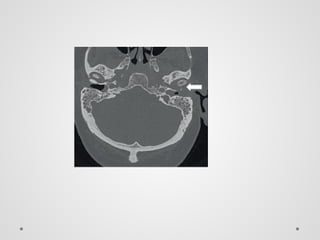
  • #43 Computed tomography of the temporal bone in a diabetic patient demonstrating bony erosion of the left anterior ear canal (arrow) and soft tissue filling the external auditory canal (EAC). A large polyp was noted on otoscopic examination of the patient’s EAC.
  • #55 FLAVUS NIGER
  • #56 The ‘foot and ear dermatophytid (id) reactioncanoccur froma fungal infection ina remotelocation.Immunotherapywithdermatophyte(Trichophy ton, Oidiomycetes andEpidermophyton (TOE)) extracts anddustmite, is thetreatmentofchoice.
  • #57 Topical treatment with 5% imiquimod three times weekly for 16 weeks resulted in up to 50% complete resolution of disease
  • #58 n extremely common problem, for which patients seek otolaryngologic advice and treatment, as it can cause discomfort, hearing loss, tinnitus, dizziness, and chronic cough.1
  • #62 Complications of surgery can include infection, tympanic membrane perforation, facial palsy, hearing loss from damage to ossicular chain or inner ear, exposure of the temporomandibular joint with chronic pain or subluxation and early or late soft tissue stenosis of the ear canal
  • #63 Children may present asymptomatically, or with pain or a discharge caused by otitis externa. Adults are often seen with cotton wool or broken matchsticks which have been used to clean or scratch the ear canal. Live insects in the ear, commonly small cockroaches,2 are annoying due to discomfort
  • #65 The face of the solid atresia may be blunt or tapering, producing a funnel-shaped medial aspect to the lumen of the ear canal
  • #68 CAP H – PORT WINE STAIN BALLENGERS 242 PAGE Various modalities have been recommended, including cryosurgery, surgical excision and skin grafting, radiation, electrolysis, and tattooing for port-wine staining
  • #69 Sebacoeus cyst in post auricular area
  • #70 triamcinolone) into the surgical site
  • #73 Ceruminous glands are modified apocrine sweat glands emptying into hair follicles.
  • #74 The most common malignant tumors of the external ear are squamous cell and basal cell carcinomas.
  • #75 growth in the EAC, which is clinically difficult to differentiate from an aural polyp, granulation tissue, and otitis externa. When a tumor is found in the canal, the location, size, and extent of the tumor should be thoroughly evaluated under an operating microscope