ENTERPRISE ARCHITECTURERichard Veryard February 2011Managing Complexity using Enterprise Architecture
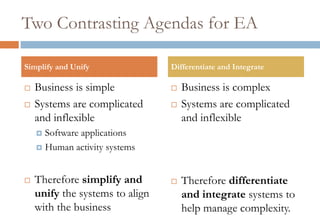
Two Contrasting Agendas for EABusiness is simpleSystems are complicated and inflexibleSoftware applicationsHuman activity systemsTherefore simplify and unify the systems to align with the businessBusiness is complexSystems are complicated and inflexibleTherefore differentiate and integrate systems to help manage complexity.Simplify and UnifyDifferentiate and Integrate
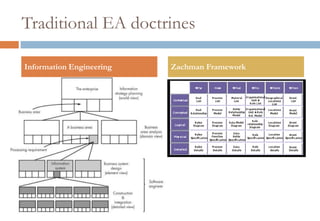
Traditional EA doctrinesInformation EngineeringZachman Framework
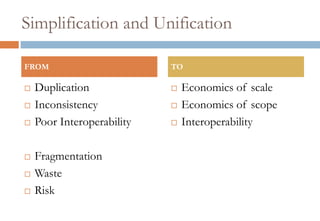
Simplification and UnificationDuplicationInconsistencyPoor InteroperabilityFragmentationWasteRiskEconomics of scaleEconomics of scopeInteroperabilityFROMTO
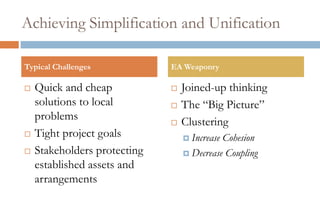
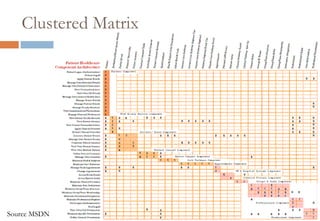
Achieving Simplification and UnificationQuick and cheap solutions to local problemsTight project goalsStakeholders protecting established assets and arrangementsJoined-up thinkingThe “Big Picture”ClusteringIncrease CohesionDecrease CouplingTypical ChallengesEA Weaponry
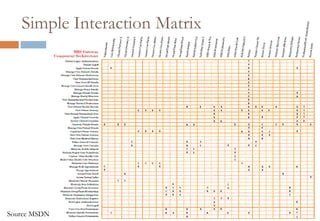
Simple Interaction MatrixSource MSDN
Clustered MatrixSource MSDN
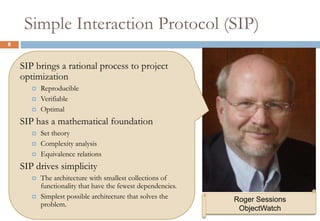
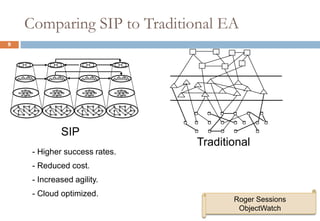
Simple Interaction Protocol (SIP) 8SIP brings a rational process to project optimizationReproducibleVerifiableOptimalSIP has a mathematical foundationSet theoryComplexity analysisEquivalence relationsSIP drives simplicityThe architecture with smallest collections of functionality that have the fewest dependencies.Simplest possible architecture that solves the problem.Roger SessionsObjectWatch
9Comparing SIP to Traditional EASIPTraditional- Higher success rates.- Reduced cost.- Increased agility.- Cloud optimized.Roger SessionsObjectWatch
Two Contrasting Agendas for EABusiness is simpleSystems are complicated and inflexibleSoftware applicationsHuman activity systemsTherefore simplify and unify the systems to align with the businessBusiness is complexSystems are complicated and inflexibleTherefore differentiate and integrate systems to help manage complexity.Simplify and UnifyDifferentiate and Integrate
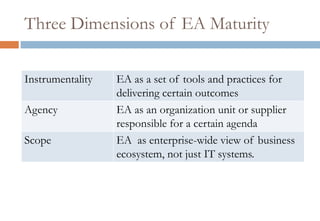
Three Dimensions of EA Maturity
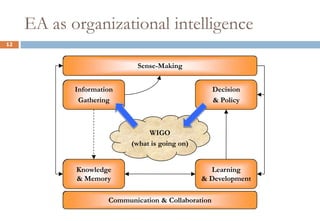
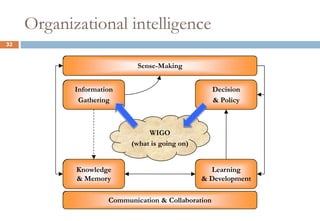
InformationGatheringDecision& PolicyWIGO(what is going on)Learning& DevelopmentKnowledge& MemoryEA as organizational intelligence12Sense-MakingCommunication & Collaboration
Responding to customer demand …
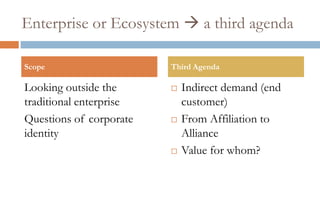
Enterprise or Ecosystem  a third agendaLooking outside the traditional enterpriseQuestions of corporate identityIndirect demand (end customer)From Affiliation to AllianceValue for whom?ScopeThird Agenda
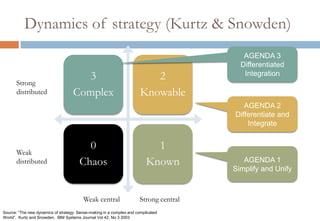
Dynamics of strategy (Kurtz & Snowden)AGENDA 3Differentiated IntegrationStrongdistributedAGENDA 2Differentiate and IntegrateWeakdistributedAGENDA 1Simplify and UnifyStrong centralWeak centralSource: “The new dynamics of strategy: Sense-making in a complex and complicated World”.  Kurtz and Snowden.  IBM Systems Journal Vol 42, No 3 2003
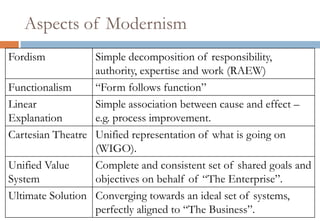
Aspects of Modernism
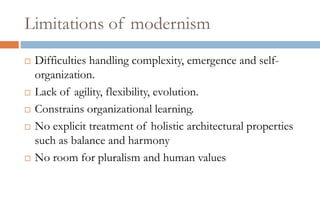
Limitations of modernismDifficulties handling complexity, emergence and self-organization.Lack of agility, flexibility, evolution. Constrains organizational learning.No explicit treatment of holistic architectural properties such as balance and harmonyNo room for pluralism and human values
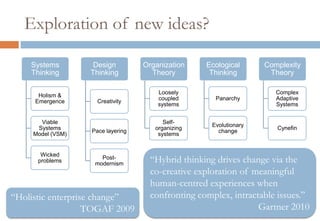
Exploration of new ideas?“Hybrid thinking drives change via the co-creative exploration of meaningful human-centred experiences when confronting complex, intractable issues.” Gartner 2010“Holistic enterprise change” TOGAF 2009
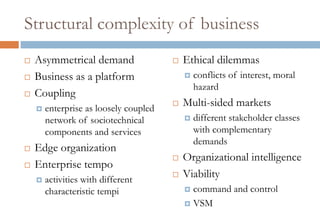
Structural complexity of businessAsymmetrical demand Business as a platformCouplingenterprise as loosely coupled network of sociotechnical components and servicesEdge organizationEnterprise tempoactivities with different characteristic tempiEthical dilemmasconflicts of interest, moral hazardMulti-sided marketsdifferent stakeholder classes with complementary demandsOrganizational intelligenceViabilitycommand and controlVSM
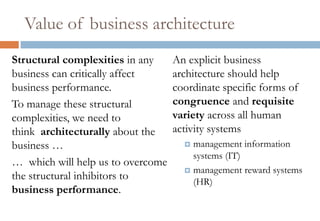
Value of business architecture Structural complexities in any business can critically affect business performance.To manage these structural complexities, we need to think  architecturallyabout the business ……  which will help us to overcome the structural inhibitors to business performance.An explicit business architecture should help coordinate specific forms of congruence and requisite variety across all human activity systemsmanagement information systems (IT) management reward systems (HR)
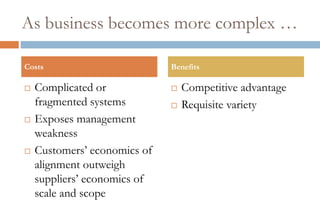
As business becomes more complex …Complicated or fragmented systemsExposes management weaknessCustomers’ economics of alignment outweigh suppliers’ economics of scale and scopeCompetitive advantageRequisite varietyCostsBenefits
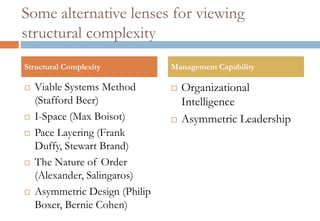
Some alternative lenses for viewing structural complexityViable Systems Method (Stafford Beer)I-Space (Max Boisot)Pace Layering (Frank Duffy, Stewart Brand)The Nature of Order (Alexander, Salingaros)Asymmetric Design (Philip Boxer, Bernie Cohen)Organizational IntelligenceAsymmetric Leadership Structural ComplexityManagement Capability
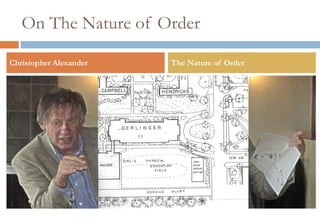
On The Nature of OrderChristopher AlexanderThe Nature of Order
To be simplified Exogenously defined linkagesWeak           (not convincing)Strong (convincing)explorationStrong            (evident to the player)just-in-time transfer(exploitation)Endogenouslydefined linkagesincremental improvementconvergence-divergenceasymmetric collapseWeak                              (not evident to the player)impositionThe relationship of the actor/ player to the larger context‘linkages’ = action-consequence pairing: strategies: ‘strong’ = convinced that they are right ‘weak’ = not convincedGood-enough ground for mechanism design that is convincing to a rational and intelligent actor… The right answer only emerges retrospectivelyAn expert would be expected to know the right answerComplex:Cause-and-effect are only coherent in retrospect and do not repeatKnowable:Cause-and-effect separated over time and spaceNB read-across to Hutchins’ Cognition in the WilddisorderKnown:Cause-and-effect relations repeatable, perceivable and predictableChaotic:No cause-and-effect relationships perceivableEveryone knows the right answerThere is no right answerSource: “The new dynamics of strategy: Sense-making in a complex and complicated World”.  Kurtz and Snowden.  IBM Systems Journal Vol 42, No 3 2003
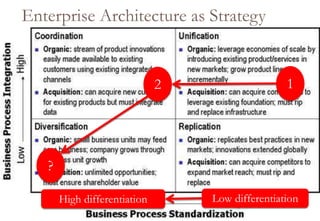
Enterprise Architecture as Strategy12?Low differentiationHigh differentiation
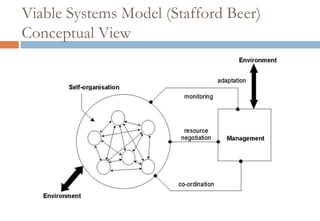
Viable Systems Model (Stafford Beer)Conceptual View
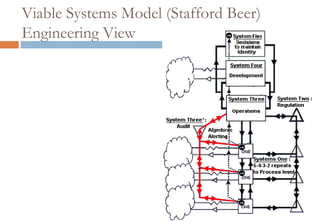
Viable Systems Model (Stafford Beer)Engineering View
Capability Requirement
Governance Cycle
Boisot I-space
Pace Layering
InformationGatheringDecision& PolicyWIGO(what is going on)Learning& DevelopmentKnowledge& MemoryOrganizational intelligence32Sense-MakingCommunication & Collaboration
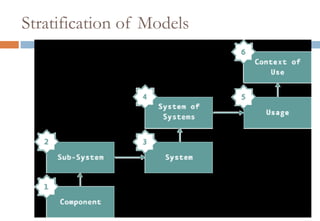
Stratification of Models
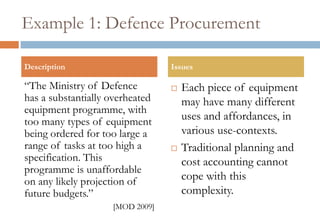
Example 1: Defence Procurement“The Ministry of Defence has a substantially overheated equipment programme, with too many types of equipment being ordered for too large a range of tasks at too high a specification. This programme is unaffordable on any likely projection of future budgets.” [MOD 2009]Each piece of equipment may have many different uses and affordances, in various use-contexts.Traditional planning and cost accounting cannot cope with this complexity.DescriptionIssues

EA Talk on Managing Complexity

  • 1.
    ENTERPRISE ARCHITECTURERichard VeryardFebruary 2011Managing Complexity using Enterprise Architecture
  • 2.
    Two Contrasting Agendasfor EABusiness is simpleSystems are complicated and inflexibleSoftware applicationsHuman activity systemsTherefore simplify and unify the systems to align with the businessBusiness is complexSystems are complicated and inflexibleTherefore differentiate and integrate systems to help manage complexity.Simplify and UnifyDifferentiate and Integrate
  • 3.
    Traditional EA doctrinesInformationEngineeringZachman Framework
  • 4.
    Simplification and UnificationDuplicationInconsistencyPoorInteroperabilityFragmentationWasteRiskEconomics of scaleEconomics of scopeInteroperabilityFROMTO
  • 5.
    Achieving Simplification andUnificationQuick and cheap solutions to local problemsTight project goalsStakeholders protecting established assets and arrangementsJoined-up thinkingThe “Big Picture”ClusteringIncrease CohesionDecrease CouplingTypical ChallengesEA Weaponry
  • 6.
  • 7.
  • 8.
    Simple Interaction Protocol(SIP) 8SIP brings a rational process to project optimizationReproducibleVerifiableOptimalSIP has a mathematical foundationSet theoryComplexity analysisEquivalence relationsSIP drives simplicityThe architecture with smallest collections of functionality that have the fewest dependencies.Simplest possible architecture that solves the problem.Roger SessionsObjectWatch
  • 9.
    9Comparing SIP toTraditional EASIPTraditional- Higher success rates.- Reduced cost.- Increased agility.- Cloud optimized.Roger SessionsObjectWatch
  • 10.
    Two Contrasting Agendasfor EABusiness is simpleSystems are complicated and inflexibleSoftware applicationsHuman activity systemsTherefore simplify and unify the systems to align with the businessBusiness is complexSystems are complicated and inflexibleTherefore differentiate and integrate systems to help manage complexity.Simplify and UnifyDifferentiate and Integrate
  • 11.
  • 12.
    InformationGatheringDecision& PolicyWIGO(what isgoing on)Learning& DevelopmentKnowledge& MemoryEA as organizational intelligence12Sense-MakingCommunication & Collaboration
  • 13.
  • 14.
    Enterprise or Ecosystem a third agendaLooking outside the traditional enterpriseQuestions of corporate identityIndirect demand (end customer)From Affiliation to AllianceValue for whom?ScopeThird Agenda
  • 15.
    Dynamics of strategy(Kurtz & Snowden)AGENDA 3Differentiated IntegrationStrongdistributedAGENDA 2Differentiate and IntegrateWeakdistributedAGENDA 1Simplify and UnifyStrong centralWeak centralSource: “The new dynamics of strategy: Sense-making in a complex and complicated World”. Kurtz and Snowden. IBM Systems Journal Vol 42, No 3 2003
  • 16.
  • 17.
    Limitations of modernismDifficultieshandling complexity, emergence and self-organization.Lack of agility, flexibility, evolution. Constrains organizational learning.No explicit treatment of holistic architectural properties such as balance and harmonyNo room for pluralism and human values
  • 18.
    Exploration of newideas?“Hybrid thinking drives change via the co-creative exploration of meaningful human-centred experiences when confronting complex, intractable issues.” Gartner 2010“Holistic enterprise change” TOGAF 2009
  • 19.
    Structural complexity ofbusinessAsymmetrical demand Business as a platformCouplingenterprise as loosely coupled network of sociotechnical components and servicesEdge organizationEnterprise tempoactivities with different characteristic tempiEthical dilemmasconflicts of interest, moral hazardMulti-sided marketsdifferent stakeholder classes with complementary demandsOrganizational intelligenceViabilitycommand and controlVSM
  • 20.
    Value of businessarchitecture Structural complexities in any business can critically affect business performance.To manage these structural complexities, we need to think  architecturallyabout the business …… which will help us to overcome the structural inhibitors to business performance.An explicit business architecture should help coordinate specific forms of congruence and requisite variety across all human activity systemsmanagement information systems (IT) management reward systems (HR)
  • 21.
    As business becomesmore complex …Complicated or fragmented systemsExposes management weaknessCustomers’ economics of alignment outweigh suppliers’ economics of scale and scopeCompetitive advantageRequisite varietyCostsBenefits
  • 22.
    Some alternative lensesfor viewing structural complexityViable Systems Method (Stafford Beer)I-Space (Max Boisot)Pace Layering (Frank Duffy, Stewart Brand)The Nature of Order (Alexander, Salingaros)Asymmetric Design (Philip Boxer, Bernie Cohen)Organizational IntelligenceAsymmetric Leadership Structural ComplexityManagement Capability
  • 23.
    On The Natureof OrderChristopher AlexanderThe Nature of Order
  • 24.
    To be simplifiedExogenously defined linkagesWeak (not convincing)Strong (convincing)explorationStrong (evident to the player)just-in-time transfer(exploitation)Endogenouslydefined linkagesincremental improvementconvergence-divergenceasymmetric collapseWeak (not evident to the player)impositionThe relationship of the actor/ player to the larger context‘linkages’ = action-consequence pairing: strategies: ‘strong’ = convinced that they are right ‘weak’ = not convincedGood-enough ground for mechanism design that is convincing to a rational and intelligent actor… The right answer only emerges retrospectivelyAn expert would be expected to know the right answerComplex:Cause-and-effect are only coherent in retrospect and do not repeatKnowable:Cause-and-effect separated over time and spaceNB read-across to Hutchins’ Cognition in the WilddisorderKnown:Cause-and-effect relations repeatable, perceivable and predictableChaotic:No cause-and-effect relationships perceivableEveryone knows the right answerThere is no right answerSource: “The new dynamics of strategy: Sense-making in a complex and complicated World”. Kurtz and Snowden. IBM Systems Journal Vol 42, No 3 2003
  • 25.
    Enterprise Architecture asStrategy12?Low differentiationHigh differentiation
  • 26.
    Viable Systems Model(Stafford Beer)Conceptual View
  • 27.
    Viable Systems Model(Stafford Beer)Engineering View
  • 28.
  • 29.
  • 30.
  • 31.
  • 32.
    InformationGatheringDecision& PolicyWIGO(what isgoing on)Learning& DevelopmentKnowledge& MemoryOrganizational intelligence32Sense-MakingCommunication & Collaboration
  • 33.
  • 34.
    Example 1: DefenceProcurement“The Ministry of Defence has a substantially overheated equipment programme, with too many types of equipment being ordered for too large a range of tasks at too high a specification. This programme is unaffordable on any likely projection of future budgets.” [MOD 2009]Each piece of equipment may have many different uses and affordances, in various use-contexts.Traditional planning and cost accounting cannot cope with this complexity.DescriptionIssues

Editor's Notes

  • #3 There are actually three contrasting agendas, but we’ll save the third agenda until later in the presentation. It is not clear to what extent the third agenda still counts as EA.1. simplify around single (simple) business model: single definition of 'market' qua single-sided market.2. differentiate business models and integrate to span their differences: multiple definitions of 'market' qua single-sided markets.3. differentiate business models AND differentiate the modes of integration: multiple 'markets' within multiple contexts-of-use qua multi-sided markets.(PJB)
  • #4 http://csis.pace.edu/~marchese/cs615sp/L3New/L3new.htmlhttp://en.wikipedia.org/wiki/Zachman_Framework
  • #7 Function versus data CRUD matrixhttp://msdn.microsoft.com/en-us/library/aa480036.aspx
  • #8 http://msdn.microsoft.com/en-us/library/aa480036.aspx
  • #11 There are actually three contrasting agendas, but we’ll save the third agenda until later in the presentation. It is not clear to what extent the third agenda still counts as EA.1. simplify around single (simple) business model: single definition of 'market' qua single-sided market.2. differentiate business models and integrate to span their differences: multiple definitions of 'market' qua single-sided markets.3. differentiate business models AND differentiate the modes of integration: multiple 'markets' within multiple contexts-of-use qua multi-sided markets.(PJB)
  • #15 3. differentiate business models AND differentiate the modes of integration: multiple 'markets' within multiple contexts-of-use qua multi-sided markets
  • #18 i.e. really bad at dealing with differentiated integration....Therefore need for new ideas
  • #21 http://rvsoapbox.blogspot.com/2010/10/selling-business-architecture.html
  • #24 http://thecelebration.blogspot.com/2010/11/new-urbanism-christopher-alexander.htmlhttp://www.natureoforder.com/teachers/givens/exercise2.htm
  • #26 Operating Model Quadrants (Adapted by Clive Finkelstein from Figure 2.3 of “Enterprise Architecture as Strategy”)http://esvc000904.wic047u.server-web.com/ten/ten38.htmhttp://rvsoapbox.blogspot.com/2010/05/differentiation-and-integration.html
  • #27 http://www.leeds.ac.uk/educol/documents/00001237.htm
  • #28 http://www.cybsys.co.uk/ProtoforMeta.htm
  • #29 Richard Veryard and Philip BoxerMetropolis and SOA GovernanceMicrosoft Architect JournalJuly 2005http://msdn.microsoft.com/en-us/architecture/aa480051.aspx
  • #30 Philip Boxer and Richard VeryardTaking Governance to the EdgeMicrosoft Architect JournalAugust 2006http://msdn.microsoft.com/en-us/architecture/bb245658.aspxhttp://www.asymmetricdesign.com/archives/29
  • #31 http://www.trainmor-knowmore.eu/75D2E63A.en.aspxhttp://www.anecdote.com.au/archives/2006/02/knowledge_hoard.htmlThe I-space² is a model describing how knowledge moves from being undiffused (ie only known by a few people) and concrete (ie very specific to a single situation) to becoming more abstract (ie. generalised to apply to more situations) and codified (ie. more able to be articulated). At point 3 on the diagram the knowledge has maximum value to an organisation because it can be applied in a variety of ways to a range of problems but hasn’t leaked (diffused) to its competitors. It is inevitable, however, that if the knowledge is valuable it will soon become common knowledge. In the case of the lawyers, the idea of using collaboration software to get all parties together can quickly arrive at point 3 but as soon as the solution is implemented the knowledge is diffused and available to everyone—competitive value diminished rapidly.Boisot’s argument is that organisations which operate in a slow moving environment, such as flute makers where the way flutes have been made hasn’t changed in a century, should do whatever it takes to protect their intellectual property including doing everything to retain their master craftspeople. Fast moving industries require a different strategy: keep your mean time at point 3 as high as possible. This requires an organisation to continually rotate through the I-space spiral with new ideas—constant innovation.
  • #32 http://www.locatearchitects.co.uk/seda-lg.htm
  • #34 Richard Veryard and Philip BoxerMetropolis and SOA GovernanceMicrosoft Architect JournalJuly 2005http://msdn.microsoft.com/en-us/architecture/aa480051.aspx
  • #35 http://news.bbc.co.uk/1/hi/uk/8308634.stmhttp://www.asymmetricdesign.com/archives/114
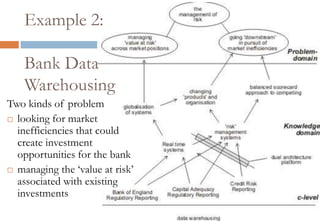
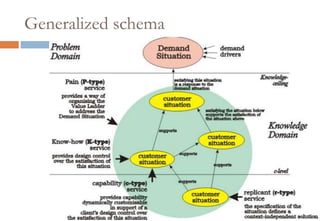
  • #36 The example here comes from working with a computing services business with banking customers. The customer was operating in a problem domain in which the fundamental concern with managing risk required them to manage two kinds of problem - looking for market inefficiencies that could create investment opportunities for the bank, and managing the ‘value at risk’ associated with existing investments.At the bottom of the diagram is ‘data warehousing’, understood to be a generic service that can be provided in a way that does not require knowledge of the specific bank’s situation, and ‘c-level‘ (it is always rising) is the level above which the bank’s specific context-of-use can no longer be ignored. In between c-level and the problem domain is a knowledge domain, in which knowledge about the bank’s context-of-use enables cKP-type services to be offered. The situations within this knowledge domain then identify opportunities for the supplier to provide services that cumulatively build on each other to meet their larger need in the problem domain.This is an effects ladder, and it provided the bank customer and the computing services supplier with a framework within which to build a shared picture of the bank’s context-of-use. http://www.asymmetricdesign.com/archives/82
  • #37 http://www.asymmetricdesign.com/archives/82
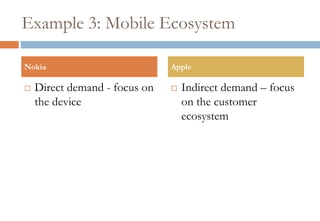
  • #38 http://www.theregister.co.uk/2011/02/16/nokia_had_choices_but_couldnt_take_them/
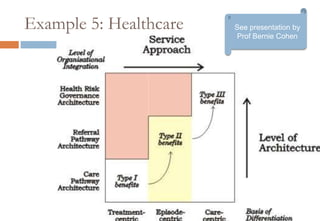
  • #40 http://www.asymmetricdesign.com/archives/72