Enterprise Architecture
Program
Making Order out of Chaos
By: Robert R. Rowntree, Jan. 14th,2018
Summary
The following will be discussed in this presentation:
1. What is Enterprise Architecture, its mandate, its importance
and how can it be used to deliver business value.
2. Balancing Architecture Governance between Architecture
Quality and Project dimensions – scope, time and cost.
3. Approach to providing Superior Customer Service, Quality
Deliverables and efficient/effective Operations while
demonstrating progress, value and results.
4. Create a Technology Strategy that drives the Business.
Robert R. Rowntree
2
#1 -Mandate
 Need to establish a Mandate for each unit within an Organization
so each units and their people know their role and responsibilities.
 Improves throughput and lowers cost by:
 Reducing duplication of effort
 Accountability through ownership
 Lowers the uncertainty in who does what in the organization.
 Reduces organizational “frictions”
 Each organization needs to establish what's right for them. The
industry’s best practice is:
 The EA Unit should mediate between the Users of Technology
(business) and all the Units comprising technology including Operations,
Solution Delivery and PMO to:
Deliver the Technology that Drives out of
the Organization’s Vision and Performance
goals.
Robert R. Rowntree
3
#1 -What is EA?
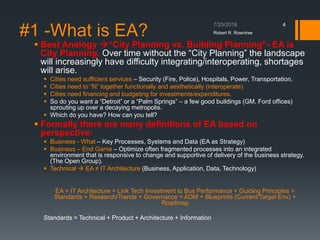
 Best Analogy “City Planning vs. Building Planning”- EA is
City Planning. Over time without the “City Planning” the landscape
will increasingly have difficulty integrating/interoperating, shortages
will arise.
 Cities need sufficient services – Security (Fire, Police), Hospitals, Power, Transportation.
 Cities need to “fit” together functionally and aesthetically (interoperate).
 Cities need financing and budgeting for investments/expenditures.
 So do you want a “Detroit” or a “Palm Springs” – a few good buildings (GM, Ford offices)
sprouting up over a decaying metropolis.
 Which do you have? How can you tell?
 Formally there are many definitions of EA based on
perspective:
 Business - What – Key Processes, Systems and Data (EA as Strategy)
 Business – End Game – Optimize often fragmented processes into an integrated
environment that is responsive to change and supportive of delivery of the business strategy.
(The Open Group).
 Technical  EA ≠ IT Architecture (Business, Application, Data, Technology)
EA = IT Architecture + Link Tech Investment to Bus Performance + Guiding Principles +
Standards + Research/Trends + Governance + ADM + Blueprints (Current/Target Env) +
Roadmap
Standards = Technical + Product + Architecture + Information
Robert R. Rowntree
4
#1 – Why is EA Important?
Accountability -> Links Technology Investment
to Business Performance
 Technology can’t exist without business
 Technology needs to be an accelerant of business initiatives
 Warning! – Don’t fall for the “alignment trap”
 Avoids Key Pain Point – Spending with no Accountability
Kaizen -> Captains the Discovery of Technology
Disruptors that can improve the Business
 External – Scanning the global technology landscape, industry
 Internal – Scanning within the organization for discoveries that
can benefit the entire enterprise – stop “reinventing the wheel”
 Think better customer service, up operational effectiveness,
reduce costs
Robert R. Rowntree
5
#1 – Why is EA Important?
Faster/Agile Business -> Faster/Better
Decisions by People via Governance and
Guidance.
 Governance – Getting desired behaviors to accelerate business
performance – “well-oiled” process reducing “frictions”.
 Principles – Guidelines that simplifies and aligns decision
making.
 Standards – Lowers component, labor cost. Speeds decisions
Accurate View of IT Stuff -> Uncertainty of
Asset State mitigated
 Big Pain Point of business – where is my stuff, how's it doing in
terms of age, fitness and support costs.
Robert R. Rowntree
6
#1- Why is EA Important?
Where are we headed? -> Technology
Roadmap clarifying how the business will win
over time.
 Roadmap – Time sequenced view of how technology will change
as business landscape changes while keeping the organization
competitive.
 ADM – Architectural Development Method that allows effective
change to happen in the right amount of time, quality and cost.
 Integrates and Interoperates – EA is “City Planning vs. Building
Planning”. Over time without the “City Planning” systems will
increasingly have difficulty integrating/interoperating.
Robert R. Rowntree
7
#2- Balancing Architecture
Balancing and Tradeoffs between EA Quality
and project dimensions – scope, time and cost
 Balance by Degree of Rigor (High, Medium, Low)
 Rigor scale typically based on cost – High =$$$$, Med = $$$, Low = $
 Factors – Risk (Strategic[Space Travel vs. Building Mgmt], Compliance,
Financial, Operational, Reputational), Culture, Finance Priorities, Mandate
 Rigor levels have levels of governance requirements - # of Checkpoints,
intensity of EA involvement, artifacts produced – In themselves cost $$$
 Mandate – Advocate versus Enforce – no teeth versus too much bite.
 Watch out for exploding OPEX – non-standard, limited reuse of
licenses & manpower skillset, solutions work fine individually but
lack integration capabilities – point to point vs centralized comm.
Duplicated data in each solution vs. normalized common data.
 El-Cheapo, non standard projects don’t likely translate to low
OPEX  OPEX = 4 to 8x CAPEX.
Robert R. Rowntree
8
#3 – Quality EA
Superior Customer Service
 Manage End to End EA Process  Higher Satisfaction
 Rapid Attention to Issue  Head off Customer Dissatisfaction
Quality Deliverables
 Only so much a “process” can drive quality – Activities that are
more an art than a science, those with many possible
exceptions, are dependent on the Artist.
 Aim for Artisans that have discipline, ability to learn, passion for
excellence.
 Provide Organizational Support – Good Technology, Physical Environment ,
Coaching, Training and Team Cohesion.
 Provide the Conditions - Autonomy, Mastery and Meaning – Meaning trumps
everything!
Robert R. Rowntree
9
#3 – Quality EA
Effective Operations – Unit, Team, Individuals
 High Performance Business – Targets, Incentives, Monitoring.
 High Performance Team – Vision, Priorities, Plan of Attack,
Knowledge/Capabilities Inventory, Speak Truths/Gotcha’s, Devils
Advocate.
 High Performance Individuals
 Are you making progress? - Clear Road Blocks. Highly correlated to Job
Satisfaction.
 “Check in” without “Checking up” – Vanquishes perception of micromanaging.
 Coaching – everyone has a learning plan – part personal goals, part traced to
company goals.
Demonstrate Progress, Value and Results
 Metric - Project Leaders satisfaction, # of Architectural Defects
ID’ed after Launch, % On-Time checkpoints.
Robert R. Rowntree
10
#4 – Technology Strategy
Strategy is not easy
 Not easy to assess – Wall street penalizes companies with game
changing strategies.
 CEO’s have tough time communicating and executing strategy -
IBM worldwide survey of CEOs.
Strategy is about – How are you going to get
there?
 Where are you? – Current State
 Where do you want to go? – Technology Vision
 How are you going to get there? - Strategy
Robert R. Rowntree
11
#4 – Technology Strategy
Approach
 Where are you?
 Company Analysis - Business and Technology current state,
Technology maturity assessment, SWOT analysis, Capabilities.
 Industry analysis - Current Trends, SWOT analysis
 Environmental Analysis – PEST – Political, Environmental, Social,
Technology
 Where do you want to go?
 Technology vision - Congruent with the business vision, strategy,
goals and objectives and roadmap
Robert R. Rowntree
12
#4 – Technology Strategy
Approach
 How are you going to get there? Strategy
 Guiding principles
 How you will make decisions. Mapped to business strategy, goals
and objectives.
 Proxy for technology having to understand all the business strategy.
 E.g., GP Lean/Agile approach because business mandate to move
towards Lean Management.
 Risks – E.g., Shadow IT, Lax DR/BC testing
 Technology Trends – Industry Analysis
 Company Today – Company Analysis – Landscape, benchmark etc
 Company Going Forward
 Vision
 Goals
 Capability Gaps.
Robert R. Rowntree
13
Appendix
Risks of EA
Metrics for EA
Robert R. Rowntree
14
Risks of EA
Over Thinking - Imbalance towards too much
thinking leaving little resources for Doing.
Lacks Integration – EA is not well integrated
with all Management centers
 Mgmt Centers – Solution Delivery, Portfolio Project Management
and Operations.
Advocate or Enforce– Have to determine
whether EA just advocates/advises, enforces or
somewhere in between.
 Post Mortem of Financial crisis showed Risk Management at
major financial institutes seen as Advocators/Recommenders of
what To Do/Not to Do. Major Fault.
Robert R. Rowntree
15
Metrics for EA
Metrics that can be used to communicate the
value of Enterprise Architecture
1. Time to Market/Agility - Quantitative
 Use of Standards – easier decisions, better
interoperability.
 Modern Technology – improve performance &
interoperability.
 Governance - streamlines decision making.
2. Revenue/IT Costs - Quantitative
 Financial markets track Revenue/IT Cost – research
shows that using people, process and technology can
elevate organization financial performance.
 Fewer Technologies – lower variance in product licensing
and labor – e.g.,databases all Oracle – volume discounts.
 Shorter Projects – faster decisions with slimmer set of
technologies provide deeper and narrow expertise.
Robert R. Rowntree
16
Metrics for EA
Metrics that can be used to communicate the
value of Enterprise Architecture
3. Reliability - Quantitative
 Standardize - Lower complexity and interoperability
gotchas.
 Focused expertise - slimmer set of technology
components.
4. Customer Satisfaction – Qualitative
 Combination of business owner and end user satisfaction
statistics.
 Business owners of IT systems satisfaction.
 End User satisfaction.
Robert R. Rowntree
17
WIP
Finished Beats Perfect – Avoid “Gold Plating”
Individual Time Buffers - % of Time for Thinking
Priorities, Categories, Triage.
Robert R. Rowntree
18
WIP
Creative/Innovating or Informing Meetings
Core Problem  CEO’s Worldwide – Lots of
Informing not enough Creative/Innovation.
EA mandate/culture – significant portion of
Creative for Organization.
Psychographics – Divergent/Creative/Unbounded
vs. Convergent/Consensus/bounded discussions
Divergent vs. Convergent Discussions
Corporation worldwide lack Divergent Thinkers.
Distribution in IT is about 80/20
Convergent/Divergent Thinkers.
Robert R. Rowntree
19
Risks of No EA
Locally Optimal, Enterprise Suboptimal – Organizational
units meet their performance goals, the Enterprise likely
not.
 Income vs. Balance sheet statement – short term solutions vs. long term
enterprise wealth. EA works to maximize enterprise wealth versus solutions
maximizing short term income/expenses.
Loosely following Standards, Regulations –
 Lower integration – point solutions work fine individually but not together.
Enterprise wide systems hard to build if not impossible.
 Lower interoperability – non standard means difficult and fragile integrations.
Changing anything takes more $$$, time and effort.
 Agility suffers – lower integratability and interoperability means less agility to
tackle fast moving and disruptive markets.
Denormalized, Duplicated and Dirty Data – .
 Low Integrity – hard to consistently update data in multiple spots.
 EA creating order and building solutions creating disorder.
 Complexity and disorder produces inefficiencies.
 Result  Costs go up, agility to grow and survive disruptions goes down.
Robert R. Rowntree
20

Enterprise architecture program v2

  • 1.
    Enterprise Architecture Program Making Orderout of Chaos By: Robert R. Rowntree, Jan. 14th,2018
  • 2.
    Summary The following willbe discussed in this presentation: 1. What is Enterprise Architecture, its mandate, its importance and how can it be used to deliver business value. 2. Balancing Architecture Governance between Architecture Quality and Project dimensions – scope, time and cost. 3. Approach to providing Superior Customer Service, Quality Deliverables and efficient/effective Operations while demonstrating progress, value and results. 4. Create a Technology Strategy that drives the Business. Robert R. Rowntree 2
  • 3.
    #1 -Mandate  Needto establish a Mandate for each unit within an Organization so each units and their people know their role and responsibilities.  Improves throughput and lowers cost by:  Reducing duplication of effort  Accountability through ownership  Lowers the uncertainty in who does what in the organization.  Reduces organizational “frictions”  Each organization needs to establish what's right for them. The industry’s best practice is:  The EA Unit should mediate between the Users of Technology (business) and all the Units comprising technology including Operations, Solution Delivery and PMO to: Deliver the Technology that Drives out of the Organization’s Vision and Performance goals. Robert R. Rowntree 3
  • 4.
    #1 -What isEA?  Best Analogy “City Planning vs. Building Planning”- EA is City Planning. Over time without the “City Planning” the landscape will increasingly have difficulty integrating/interoperating, shortages will arise.  Cities need sufficient services – Security (Fire, Police), Hospitals, Power, Transportation.  Cities need to “fit” together functionally and aesthetically (interoperate).  Cities need financing and budgeting for investments/expenditures.  So do you want a “Detroit” or a “Palm Springs” – a few good buildings (GM, Ford offices) sprouting up over a decaying metropolis.  Which do you have? How can you tell?  Formally there are many definitions of EA based on perspective:  Business - What – Key Processes, Systems and Data (EA as Strategy)  Business – End Game – Optimize often fragmented processes into an integrated environment that is responsive to change and supportive of delivery of the business strategy. (The Open Group).  Technical  EA ≠ IT Architecture (Business, Application, Data, Technology) EA = IT Architecture + Link Tech Investment to Bus Performance + Guiding Principles + Standards + Research/Trends + Governance + ADM + Blueprints (Current/Target Env) + Roadmap Standards = Technical + Product + Architecture + Information Robert R. Rowntree 4
  • 5.
    #1 – Whyis EA Important? Accountability -> Links Technology Investment to Business Performance  Technology can’t exist without business  Technology needs to be an accelerant of business initiatives  Warning! – Don’t fall for the “alignment trap”  Avoids Key Pain Point – Spending with no Accountability Kaizen -> Captains the Discovery of Technology Disruptors that can improve the Business  External – Scanning the global technology landscape, industry  Internal – Scanning within the organization for discoveries that can benefit the entire enterprise – stop “reinventing the wheel”  Think better customer service, up operational effectiveness, reduce costs Robert R. Rowntree 5
  • 6.
    #1 – Whyis EA Important? Faster/Agile Business -> Faster/Better Decisions by People via Governance and Guidance.  Governance – Getting desired behaviors to accelerate business performance – “well-oiled” process reducing “frictions”.  Principles – Guidelines that simplifies and aligns decision making.  Standards – Lowers component, labor cost. Speeds decisions Accurate View of IT Stuff -> Uncertainty of Asset State mitigated  Big Pain Point of business – where is my stuff, how's it doing in terms of age, fitness and support costs. Robert R. Rowntree 6
  • 7.
    #1- Why isEA Important? Where are we headed? -> Technology Roadmap clarifying how the business will win over time.  Roadmap – Time sequenced view of how technology will change as business landscape changes while keeping the organization competitive.  ADM – Architectural Development Method that allows effective change to happen in the right amount of time, quality and cost.  Integrates and Interoperates – EA is “City Planning vs. Building Planning”. Over time without the “City Planning” systems will increasingly have difficulty integrating/interoperating. Robert R. Rowntree 7
  • 8.
    #2- Balancing Architecture Balancingand Tradeoffs between EA Quality and project dimensions – scope, time and cost  Balance by Degree of Rigor (High, Medium, Low)  Rigor scale typically based on cost – High =$$$$, Med = $$$, Low = $  Factors – Risk (Strategic[Space Travel vs. Building Mgmt], Compliance, Financial, Operational, Reputational), Culture, Finance Priorities, Mandate  Rigor levels have levels of governance requirements - # of Checkpoints, intensity of EA involvement, artifacts produced – In themselves cost $$$  Mandate – Advocate versus Enforce – no teeth versus too much bite.  Watch out for exploding OPEX – non-standard, limited reuse of licenses & manpower skillset, solutions work fine individually but lack integration capabilities – point to point vs centralized comm. Duplicated data in each solution vs. normalized common data.  El-Cheapo, non standard projects don’t likely translate to low OPEX  OPEX = 4 to 8x CAPEX. Robert R. Rowntree 8
  • 9.
    #3 – QualityEA Superior Customer Service  Manage End to End EA Process  Higher Satisfaction  Rapid Attention to Issue  Head off Customer Dissatisfaction Quality Deliverables  Only so much a “process” can drive quality – Activities that are more an art than a science, those with many possible exceptions, are dependent on the Artist.  Aim for Artisans that have discipline, ability to learn, passion for excellence.  Provide Organizational Support – Good Technology, Physical Environment , Coaching, Training and Team Cohesion.  Provide the Conditions - Autonomy, Mastery and Meaning – Meaning trumps everything! Robert R. Rowntree 9
  • 10.
    #3 – QualityEA Effective Operations – Unit, Team, Individuals  High Performance Business – Targets, Incentives, Monitoring.  High Performance Team – Vision, Priorities, Plan of Attack, Knowledge/Capabilities Inventory, Speak Truths/Gotcha’s, Devils Advocate.  High Performance Individuals  Are you making progress? - Clear Road Blocks. Highly correlated to Job Satisfaction.  “Check in” without “Checking up” – Vanquishes perception of micromanaging.  Coaching – everyone has a learning plan – part personal goals, part traced to company goals. Demonstrate Progress, Value and Results  Metric - Project Leaders satisfaction, # of Architectural Defects ID’ed after Launch, % On-Time checkpoints. Robert R. Rowntree 10
  • 11.
    #4 – TechnologyStrategy Strategy is not easy  Not easy to assess – Wall street penalizes companies with game changing strategies.  CEO’s have tough time communicating and executing strategy - IBM worldwide survey of CEOs. Strategy is about – How are you going to get there?  Where are you? – Current State  Where do you want to go? – Technology Vision  How are you going to get there? - Strategy Robert R. Rowntree 11
  • 12.
    #4 – TechnologyStrategy Approach  Where are you?  Company Analysis - Business and Technology current state, Technology maturity assessment, SWOT analysis, Capabilities.  Industry analysis - Current Trends, SWOT analysis  Environmental Analysis – PEST – Political, Environmental, Social, Technology  Where do you want to go?  Technology vision - Congruent with the business vision, strategy, goals and objectives and roadmap Robert R. Rowntree 12
  • 13.
    #4 – TechnologyStrategy Approach  How are you going to get there? Strategy  Guiding principles  How you will make decisions. Mapped to business strategy, goals and objectives.  Proxy for technology having to understand all the business strategy.  E.g., GP Lean/Agile approach because business mandate to move towards Lean Management.  Risks – E.g., Shadow IT, Lax DR/BC testing  Technology Trends – Industry Analysis  Company Today – Company Analysis – Landscape, benchmark etc  Company Going Forward  Vision  Goals  Capability Gaps. Robert R. Rowntree 13
  • 14.
    Appendix Risks of EA Metricsfor EA Robert R. Rowntree 14
  • 15.
    Risks of EA OverThinking - Imbalance towards too much thinking leaving little resources for Doing. Lacks Integration – EA is not well integrated with all Management centers  Mgmt Centers – Solution Delivery, Portfolio Project Management and Operations. Advocate or Enforce– Have to determine whether EA just advocates/advises, enforces or somewhere in between.  Post Mortem of Financial crisis showed Risk Management at major financial institutes seen as Advocators/Recommenders of what To Do/Not to Do. Major Fault. Robert R. Rowntree 15
  • 16.
    Metrics for EA Metricsthat can be used to communicate the value of Enterprise Architecture 1. Time to Market/Agility - Quantitative  Use of Standards – easier decisions, better interoperability.  Modern Technology – improve performance & interoperability.  Governance - streamlines decision making. 2. Revenue/IT Costs - Quantitative  Financial markets track Revenue/IT Cost – research shows that using people, process and technology can elevate organization financial performance.  Fewer Technologies – lower variance in product licensing and labor – e.g.,databases all Oracle – volume discounts.  Shorter Projects – faster decisions with slimmer set of technologies provide deeper and narrow expertise. Robert R. Rowntree 16
  • 17.
    Metrics for EA Metricsthat can be used to communicate the value of Enterprise Architecture 3. Reliability - Quantitative  Standardize - Lower complexity and interoperability gotchas.  Focused expertise - slimmer set of technology components. 4. Customer Satisfaction – Qualitative  Combination of business owner and end user satisfaction statistics.  Business owners of IT systems satisfaction.  End User satisfaction. Robert R. Rowntree 17
  • 18.
    WIP Finished Beats Perfect– Avoid “Gold Plating” Individual Time Buffers - % of Time for Thinking Priorities, Categories, Triage. Robert R. Rowntree 18
  • 19.
    WIP Creative/Innovating or InformingMeetings Core Problem  CEO’s Worldwide – Lots of Informing not enough Creative/Innovation. EA mandate/culture – significant portion of Creative for Organization. Psychographics – Divergent/Creative/Unbounded vs. Convergent/Consensus/bounded discussions Divergent vs. Convergent Discussions Corporation worldwide lack Divergent Thinkers. Distribution in IT is about 80/20 Convergent/Divergent Thinkers. Robert R. Rowntree 19
  • 20.
    Risks of NoEA Locally Optimal, Enterprise Suboptimal – Organizational units meet their performance goals, the Enterprise likely not.  Income vs. Balance sheet statement – short term solutions vs. long term enterprise wealth. EA works to maximize enterprise wealth versus solutions maximizing short term income/expenses. Loosely following Standards, Regulations –  Lower integration – point solutions work fine individually but not together. Enterprise wide systems hard to build if not impossible.  Lower interoperability – non standard means difficult and fragile integrations. Changing anything takes more $$$, time and effort.  Agility suffers – lower integratability and interoperability means less agility to tackle fast moving and disruptive markets. Denormalized, Duplicated and Dirty Data – .  Low Integrity – hard to consistently update data in multiple spots.  EA creating order and building solutions creating disorder.  Complexity and disorder produces inefficiencies.  Result  Costs go up, agility to grow and survive disruptions goes down. Robert R. Rowntree 20