RICHARD VERYARD
EAST Perspectives June 2013
Perspectives on
Enterprise Architecture
and Systems Thinking
Agenda
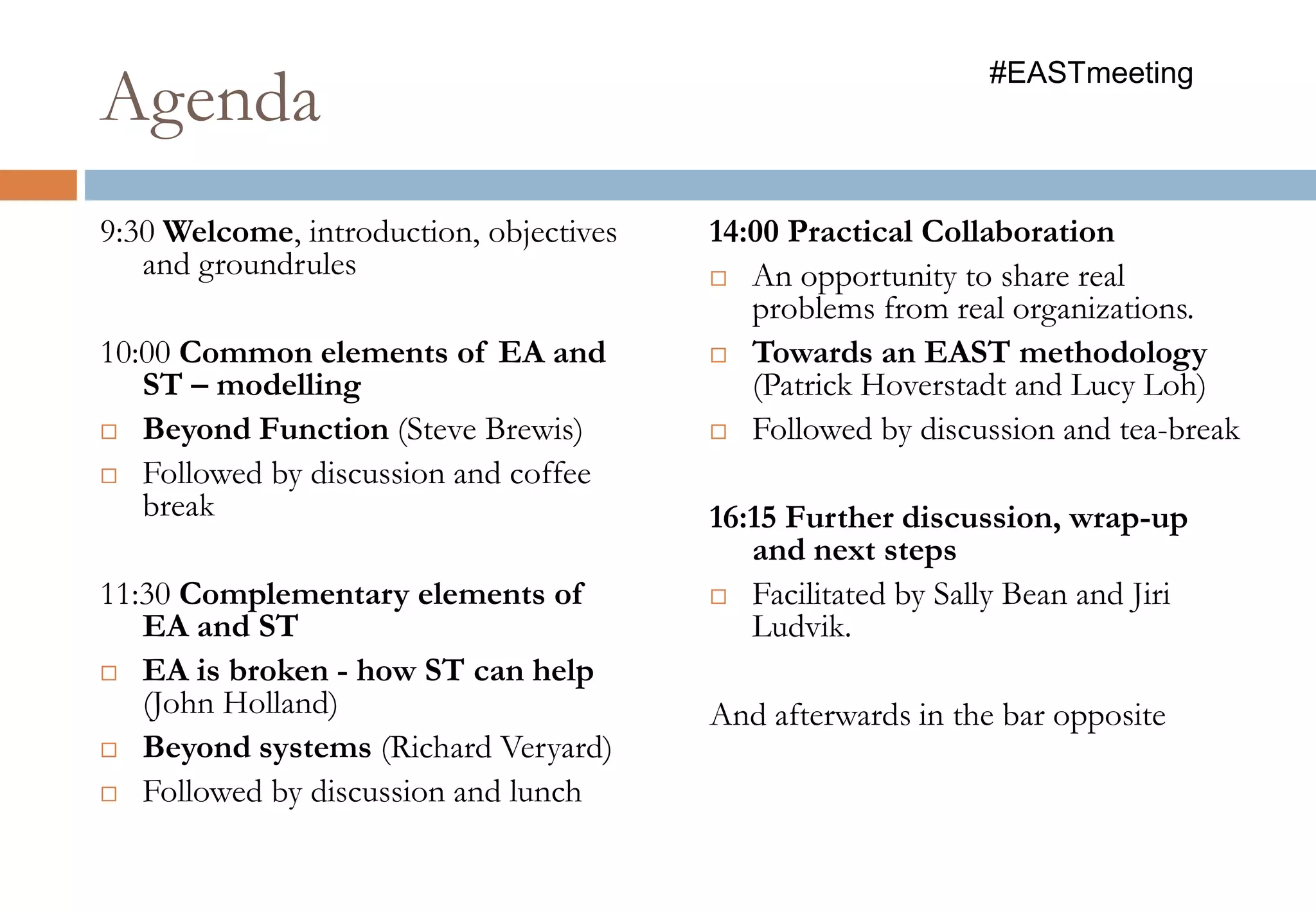
9:30 Welcome, introduction, objectives
and groundrules
10:00 Common elements of EA and
ST – modelling
 Beyond Function (Steve Brewis)
 Followed by discussion and coffee
break
11:30 Complementary elements of
EA and ST
 EA is broken - how ST can help
(John Holland)
 Beyond systems (Richard Veryard)
 Followed by discussion and lunch
14:00 Practical Collaboration
 An opportunity to share real
problems from real organizations.
 Towards an EAST methodology
(Patrick Hoverstadt and Lucy Loh)
 Followed by discussion and tea-break
16:15 Further discussion, wrap-up
and next steps
 Facilitated by Sally Bean and
JiriLudvik.
And afterwards in the bar opposite
#EASTmeeting
Shared Frustrations
 We can clearly see some major
problems with the structure and
behaviour of large enterprises
and public sector ecosystems.
 We can also see why current
initiatives are likely to fail.
 But the people in charge of
these systems don’t appreciate
the valuable contribution we
could make.
 We are often unable to
get access to working at
“the right level”.
 We are forced to work
on fragments of the
problem rather than
the whole.
who is WE?
Audience
1. Those who are blithely ignorant of the uncertainties.
2. Those who recognize the uncertainties but haven’t the
time to do anything about them; they’ve got to get on with
the job.
3. Those who are attempting to shed light on the design
process and on methods for realistically handling
these uncertainties.
Source J.P. Eberhard
who is WE?
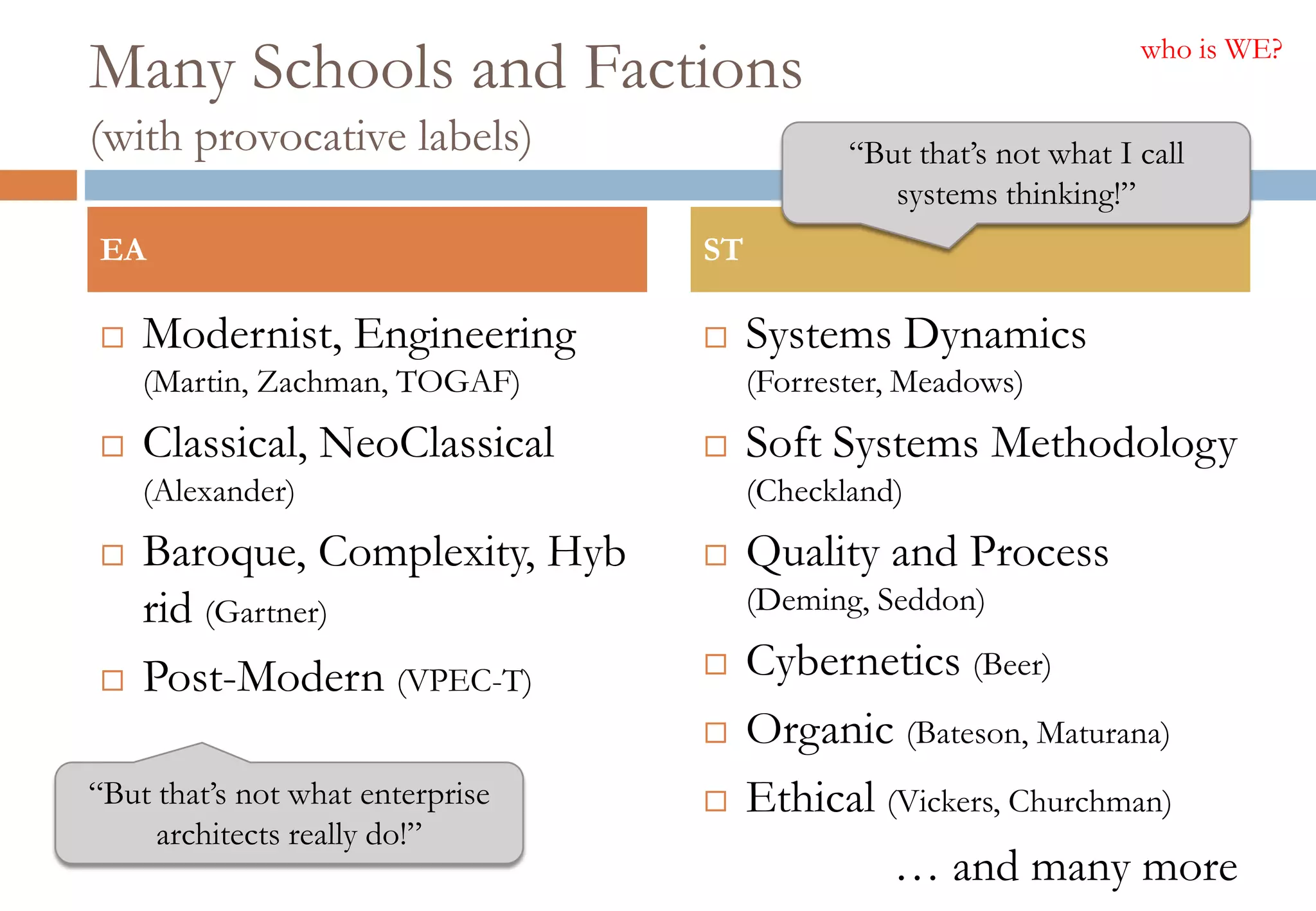
Many Schools and Factions
(with provocative labels)
 Modernist, Engineering
(Martin, Zachman, TOGAF)
 Classical, NeoClassical(Alex
ander)
 Baroque, Complexity, Hyb
rid (Gartner)
 Post-Modern (VPEC-T)
 Systems Dynamics
(Forrester, Meadows)
 Soft Systems Methodology
(Checkland)
 Quality and Process
(Deming, Seddon)
 Cybernetics (Beer)
 Organic (Bateson, Maturana)
 Ethical (Vickers, Churchman)
… and many more
EA ST
“But that’s not what I call
systems thinking!”
“But that’s not what enterprise
architects really do!”
who is WE?
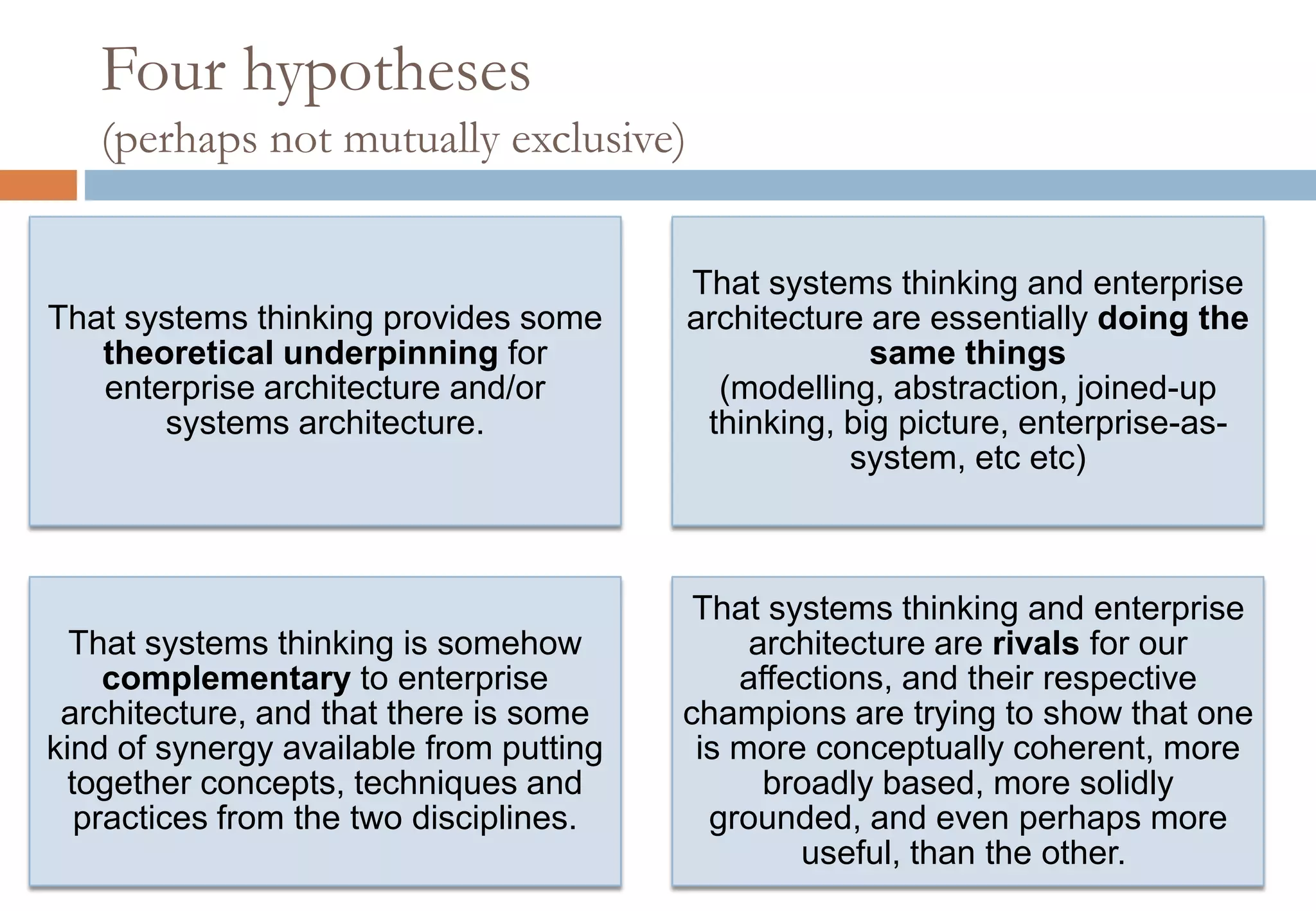
Four hypotheses
(perhaps not mutually exclusive)
That systems thinking provides some
theoretical underpinning for enterprise
architecture and/or systems architecture.
That systems thinking and enterprise
architecture are essentially doing the
same things
(modelling, abstraction, joined-up
thinking, big picture, enterprise-as-
system, etc etc)
That systems thinking is somehow
complementary to enterprise
architecture, and that there is some kind
of synergy available from putting together
concepts, techniques and practices from
the two disciplines.
That systems thinking and enterprise
architecture are rivals for our
affections, and their respective champions
are trying to show that one is more
conceptually coherent, more broadly
based, more solidly grounded, and even
perhaps more useful, than the other.
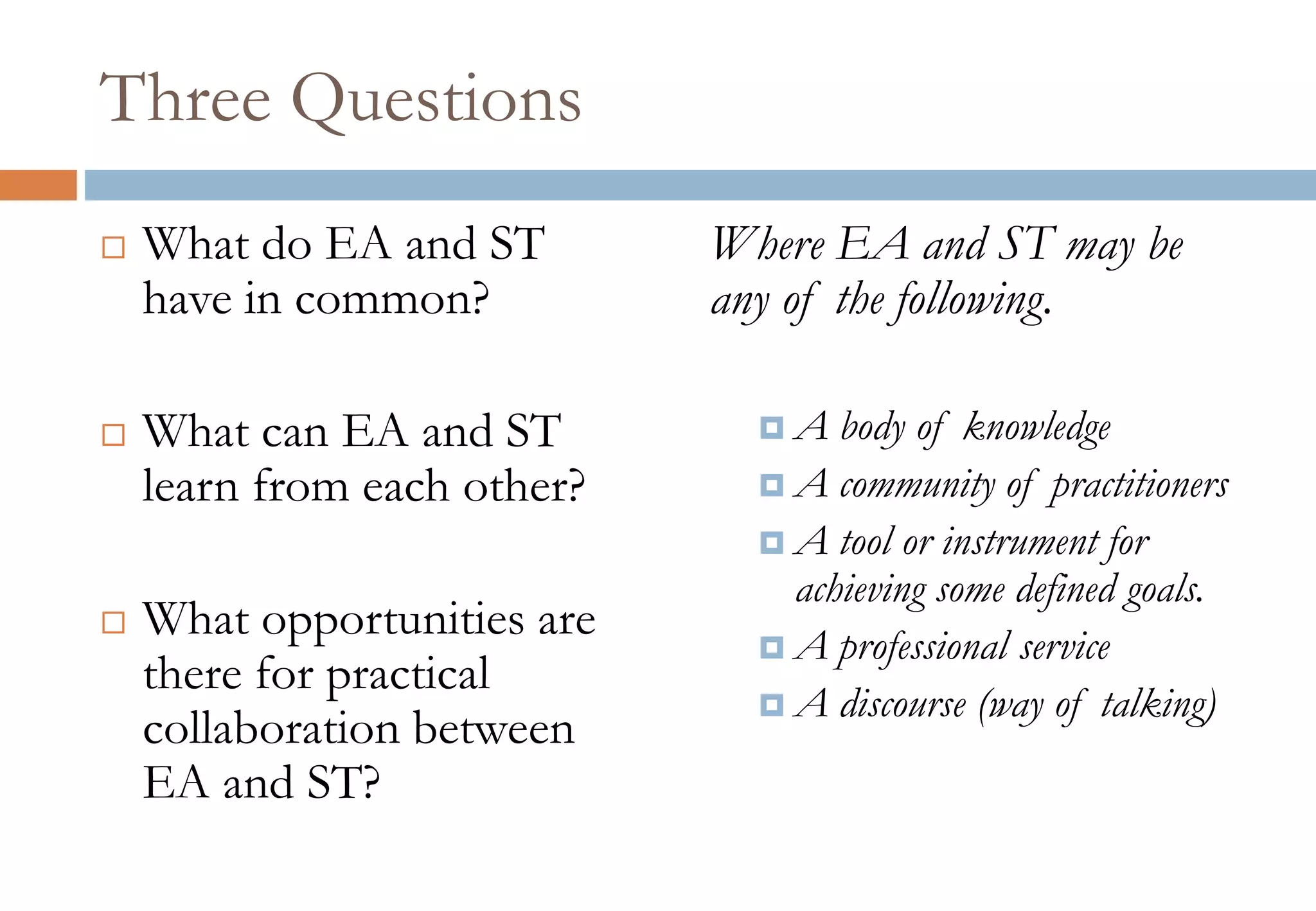
Three Questions
 What do EA and ST
have in common?
 What can EA and ST
learn from each other?
 What opportunities are
there for practical
collaboration between
EA and ST?
Where EA and ST may be
any of the following.
 A body of knowledge
 A community of practitioners
 A tool or instrument for
achieving some defined goals.
 A professional service
 A discourse (way of talking)
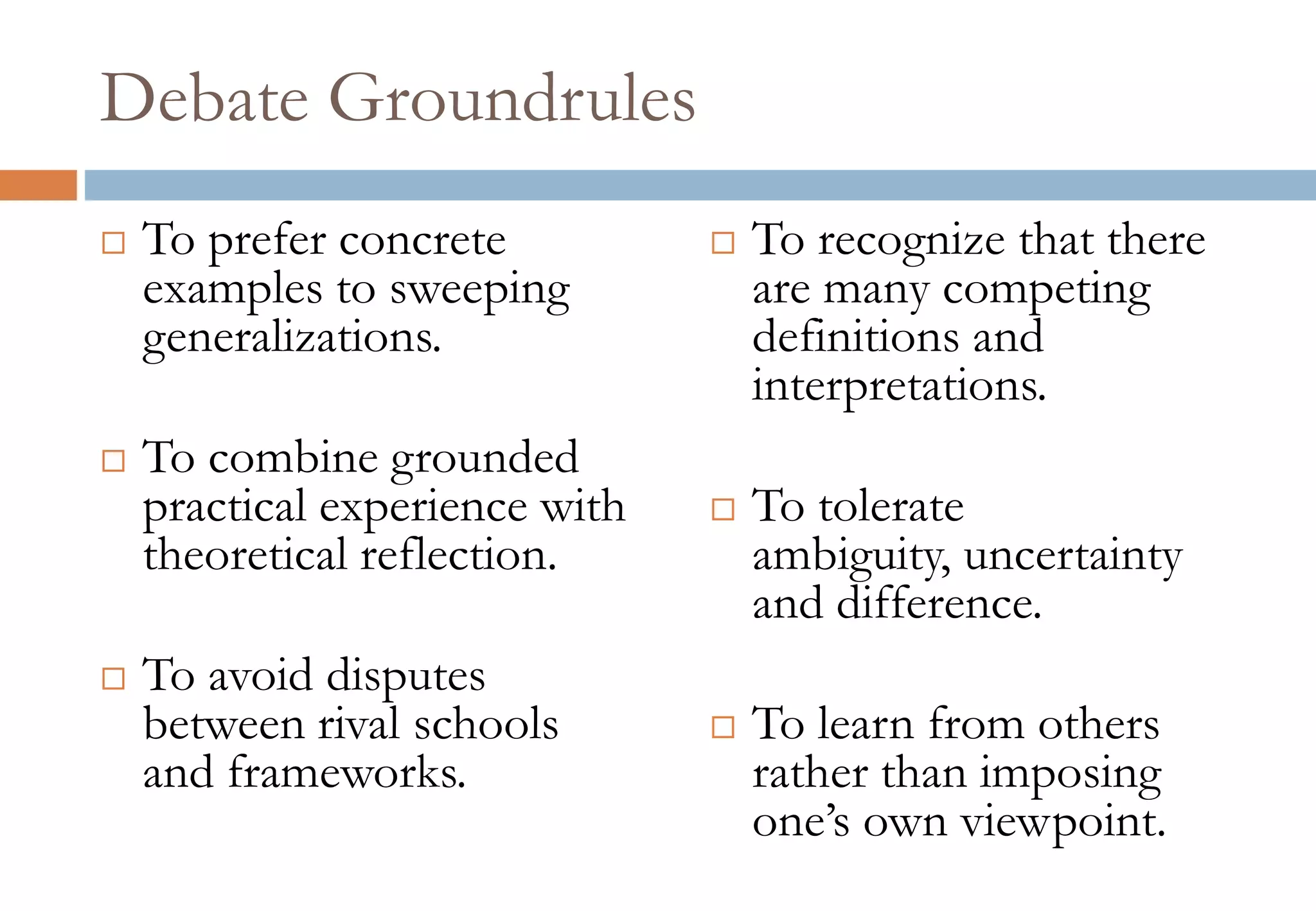
Debate Groundrules
 To prefer concrete
examples to sweeping
generalizations.
 To combine grounded
practical experience with
theoretical reflection.
 To avoid disputes
between rival schools
and frameworks.
 To recognize that there
are many competing
definitions and
interpretations.
 To tolerate
ambiguity, uncertainty
and difference.
 To learn from others
rather than imposing
one’s own viewpoint.
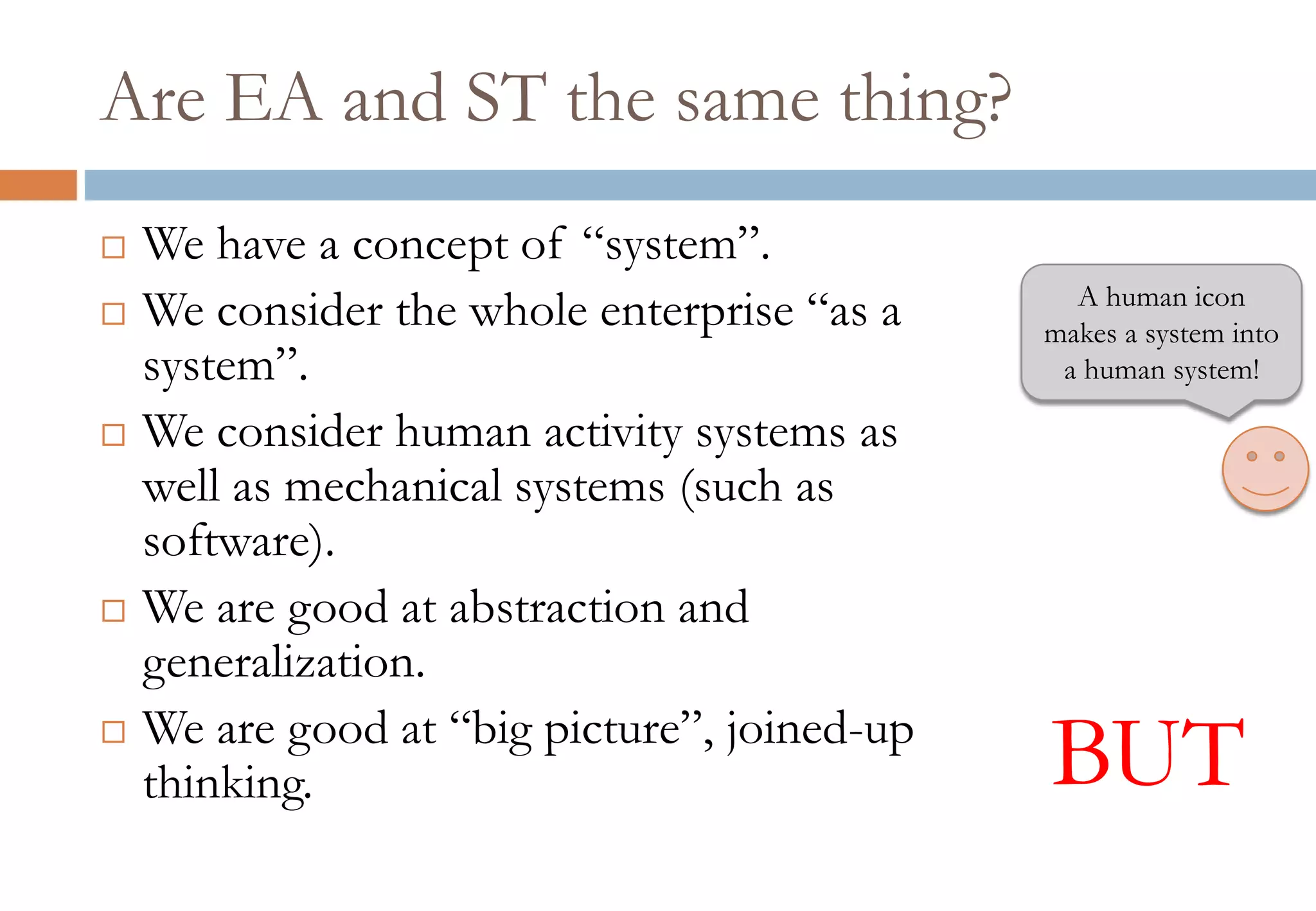
Are EA and ST the same thing?
 We have a concept of “system”.
 We consider the whole enterprise “as a
system”.
 We consider human activity systems as
well as mechanical systems (such as
software).
 We are good at abstraction and
generalization.
 We are good at “big picture”, joined-up
thinking. BUT
A human icon
makes a system into
a human system!
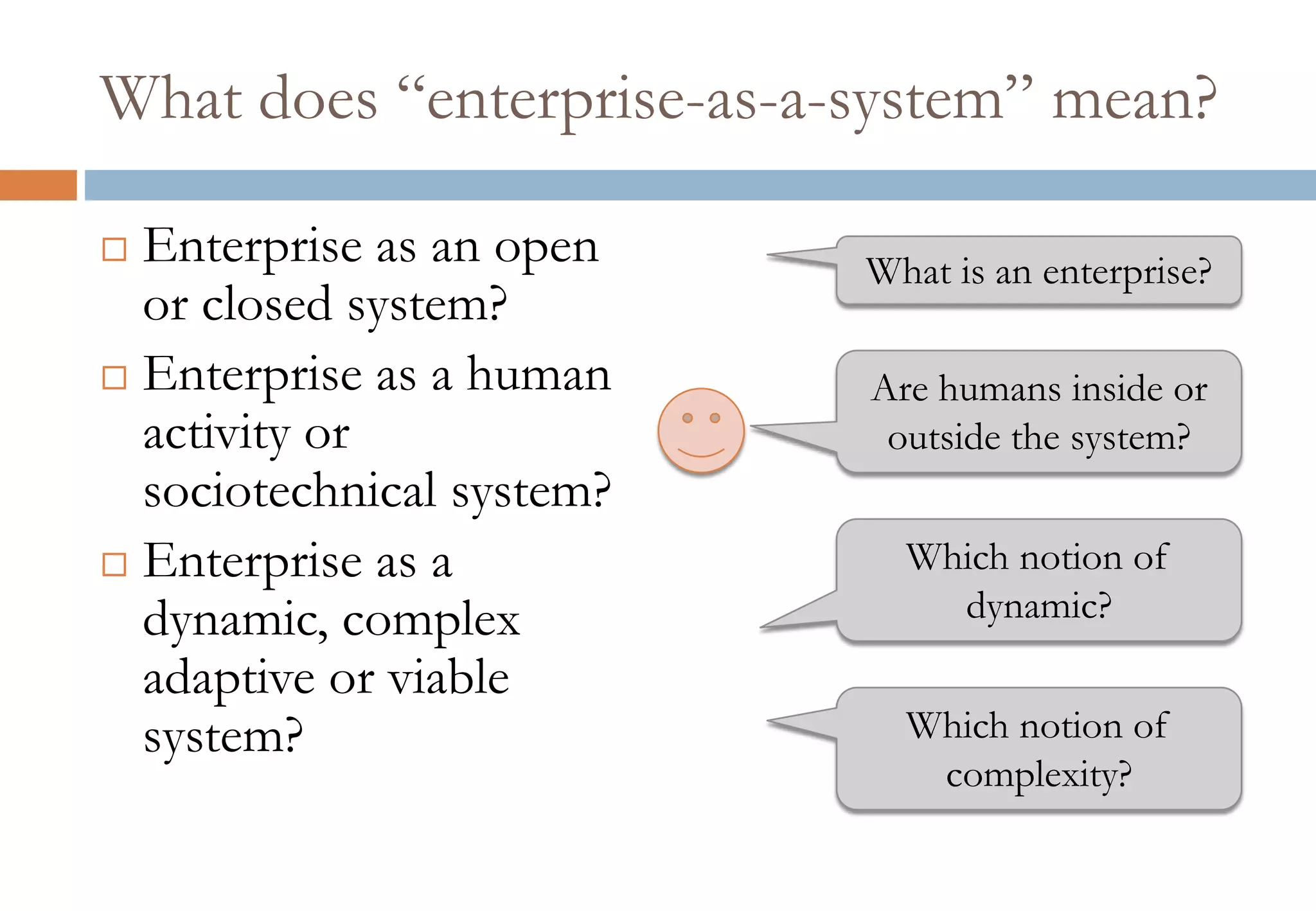
What does “enterprise-as-a-system” mean?
 Enterprise as an open
or closed system?
 Enterprise as a human
activity or
sociotechnical system?
 Enterprise as a
dynamic, complex
adaptive or viable
system?
What is an enterprise?
Are humans inside or
outside the system?
Which notion of
dynamic?
Which notion of
complexity?
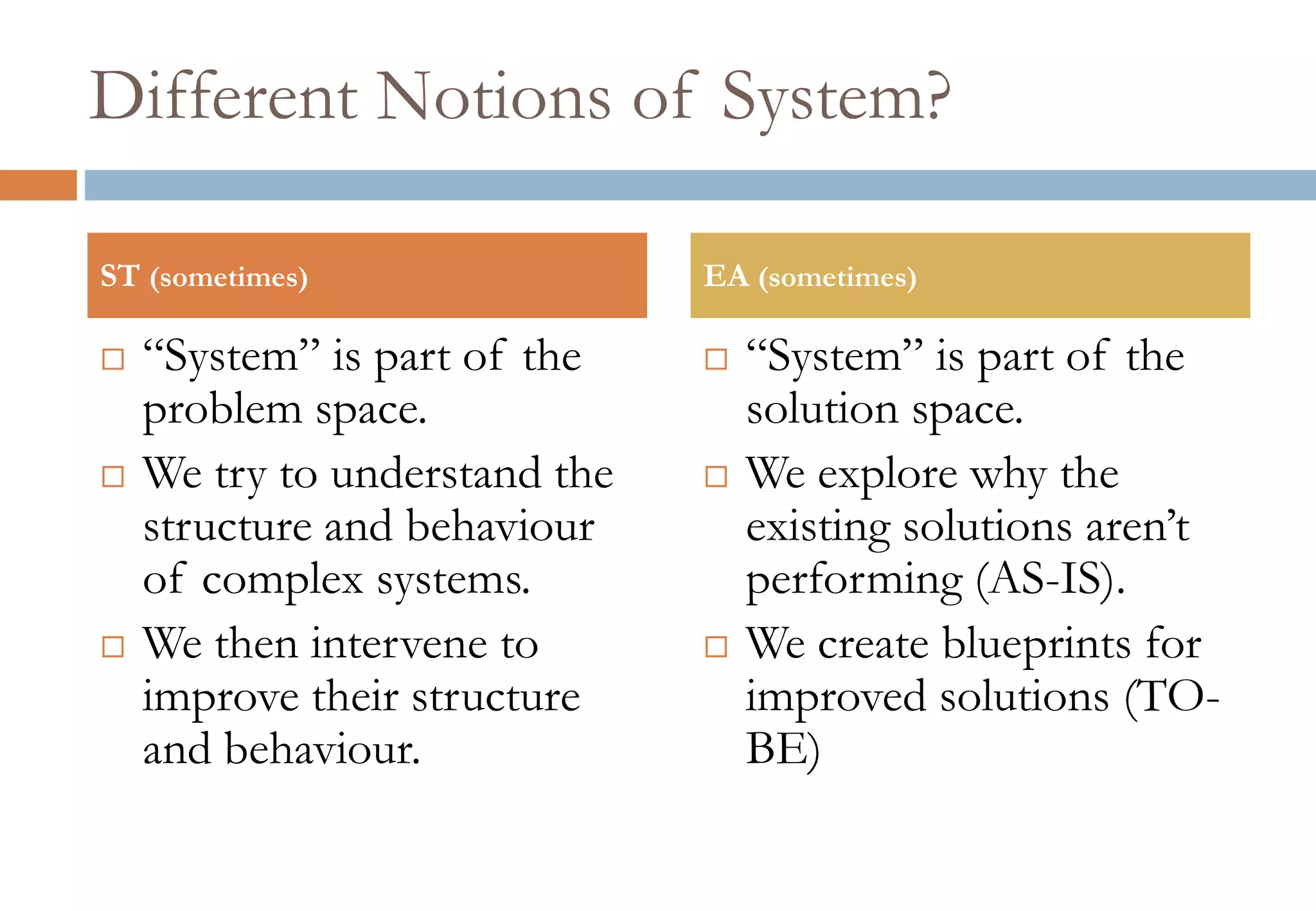
Different Notions of System?
 “System” is part of the
problem space.
 We try to understand the
structure and behaviour
of complex systems.
 We then intervene to
improve their structure
and behaviour.
 “System” is part of the
solution space.
 We explore why the
existing solutions aren’t
performing (AS-IS).
 We create blueprints for
improved solutions (TO-
BE)
ST (sometimes) EA (sometimes)
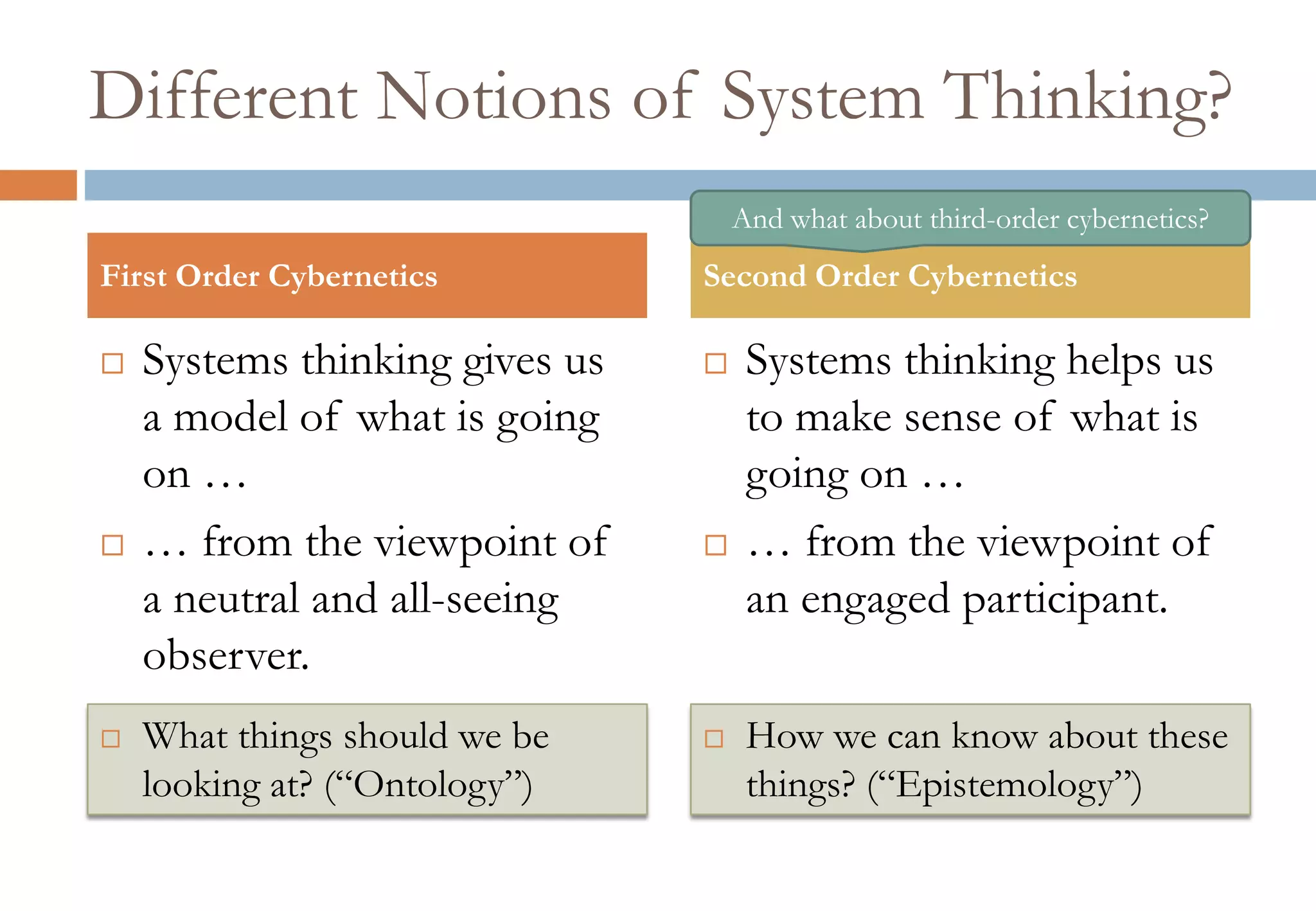
Different Notions of System Thinking?
 Systems thinking gives us
a model of what is going
on …
 … from the viewpoint of
a neutral and all-seeing
observer.
 Systems thinking helps us
to make sense of what is
going on …
 … from the viewpoint of
an engaged participant.
First Order Cybernetics Second Order Cybernetics
And what about third-order cybernetics?
 What things should we be
looking at? (“Ontology”)
 How we can know about these
things? (“Epistemology”)
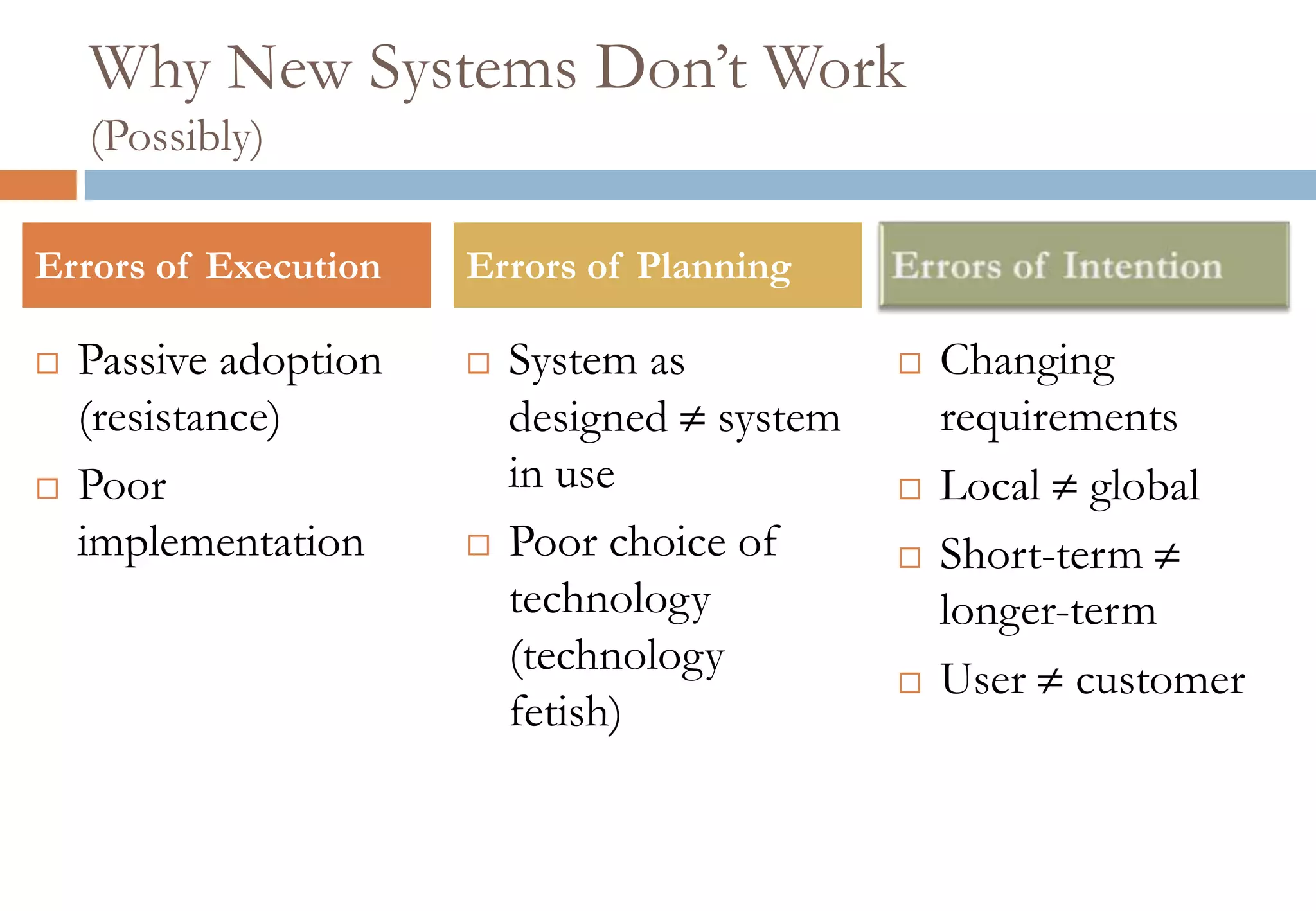
Why New Systems Don’t Work
(Possibly)
 Passive adoption
(resistance)
 Poor
implementation
 System as
designed system
in use
 Poor choice of
technology
(technology
fetish)
Errors of Execution Errors of Planning
 Changing
requirements
 Local global
 Short-term
longer-term
 User customer
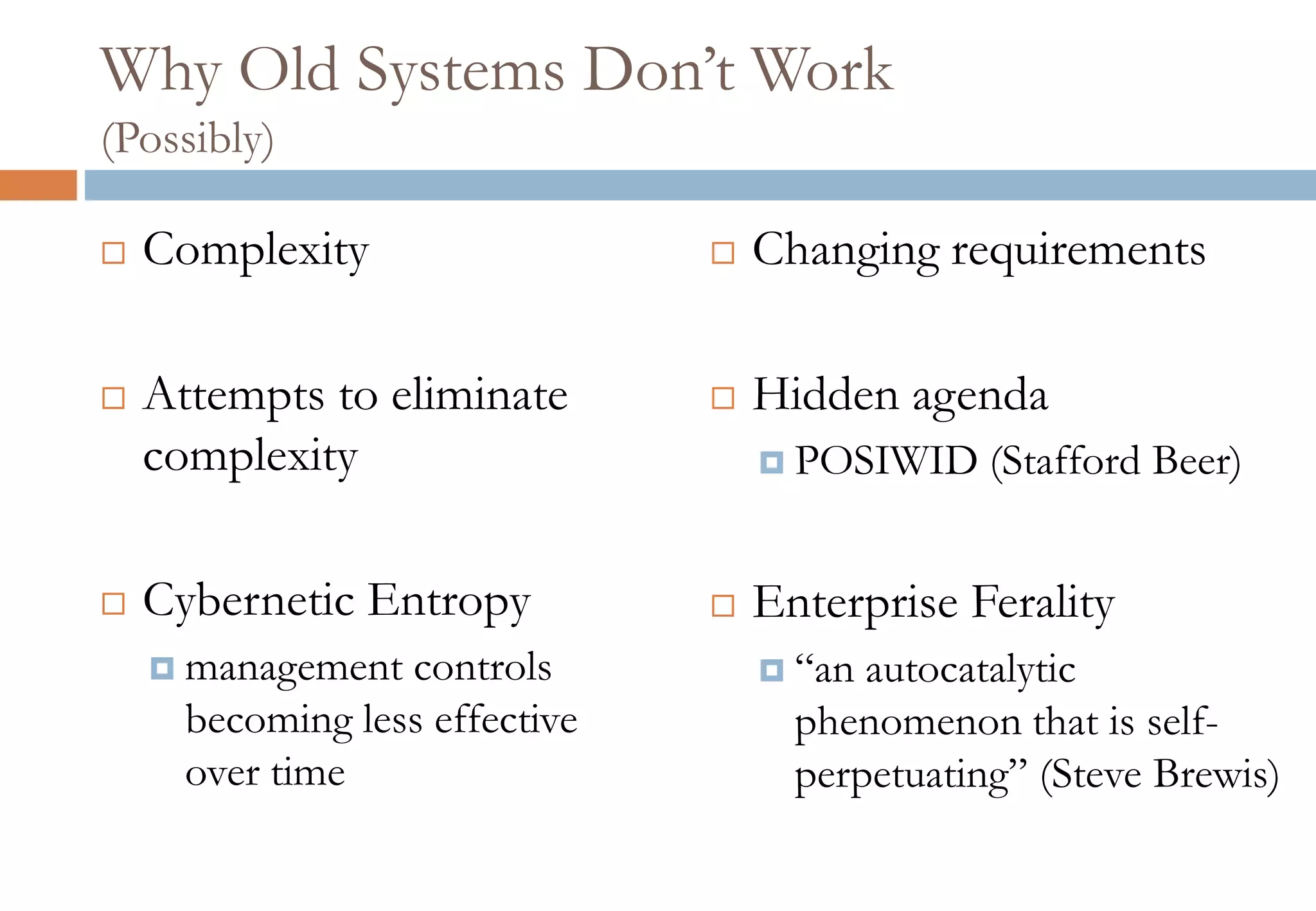
Why Old Systems Don’t Work
(Possibly)
 Complexity
 Attempts to eliminate
complexity
 Cybernetic Entropy
 management controls
becoming less effective
over time
 Changing requirements
 Hidden agenda
 POSIWID (Stafford Beer)
 Enterprise Ferality
 “an autocatalytic
phenomenon that is self-
perpetuating” (Steve Brewis)
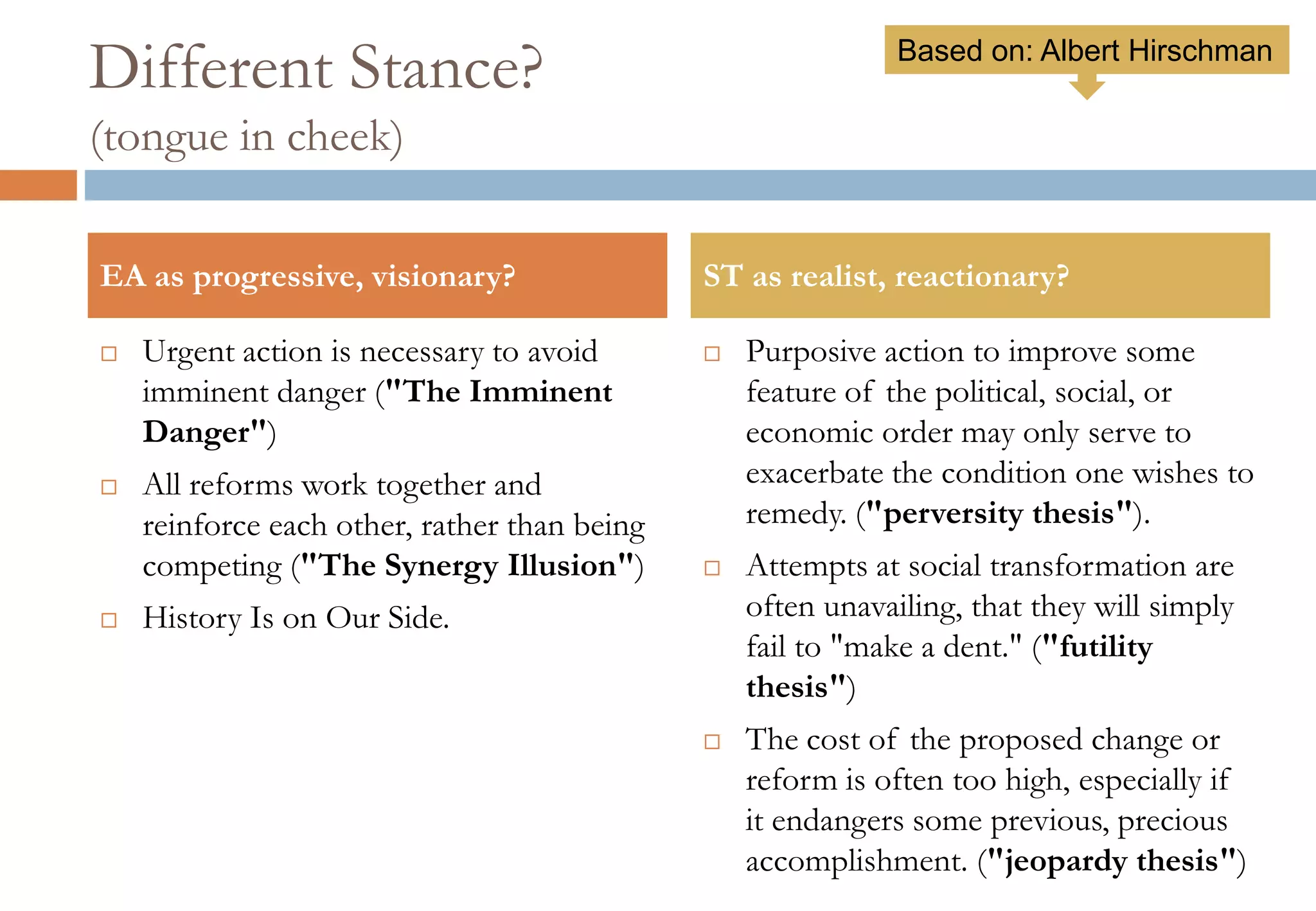
Different Stance?
(tongue in cheek)
 Urgent action is necessary to avoid
imminent danger ("The Imminent
Danger")
 All reforms work together and reinforce
each other, rather than being competing
("The Synergy Illusion")
 History Is on Our Side.
 Purposive action to improve some
feature of the political, social, or
economic order may only serve to
exacerbate the condition one wishes to
remedy. ("perversity thesis").
 Attempts at social transformation are
often unavailing, that they will simply
fail to "make a dent." ("futility thesis")
 The cost of the proposed change or
reform is often too high, especially if it
endangers some previous, precious
accomplishment. ("jeopardy thesis")
EA as progressive, visionary? ST as realist, reactionary?
Based on: Albert Hirschman
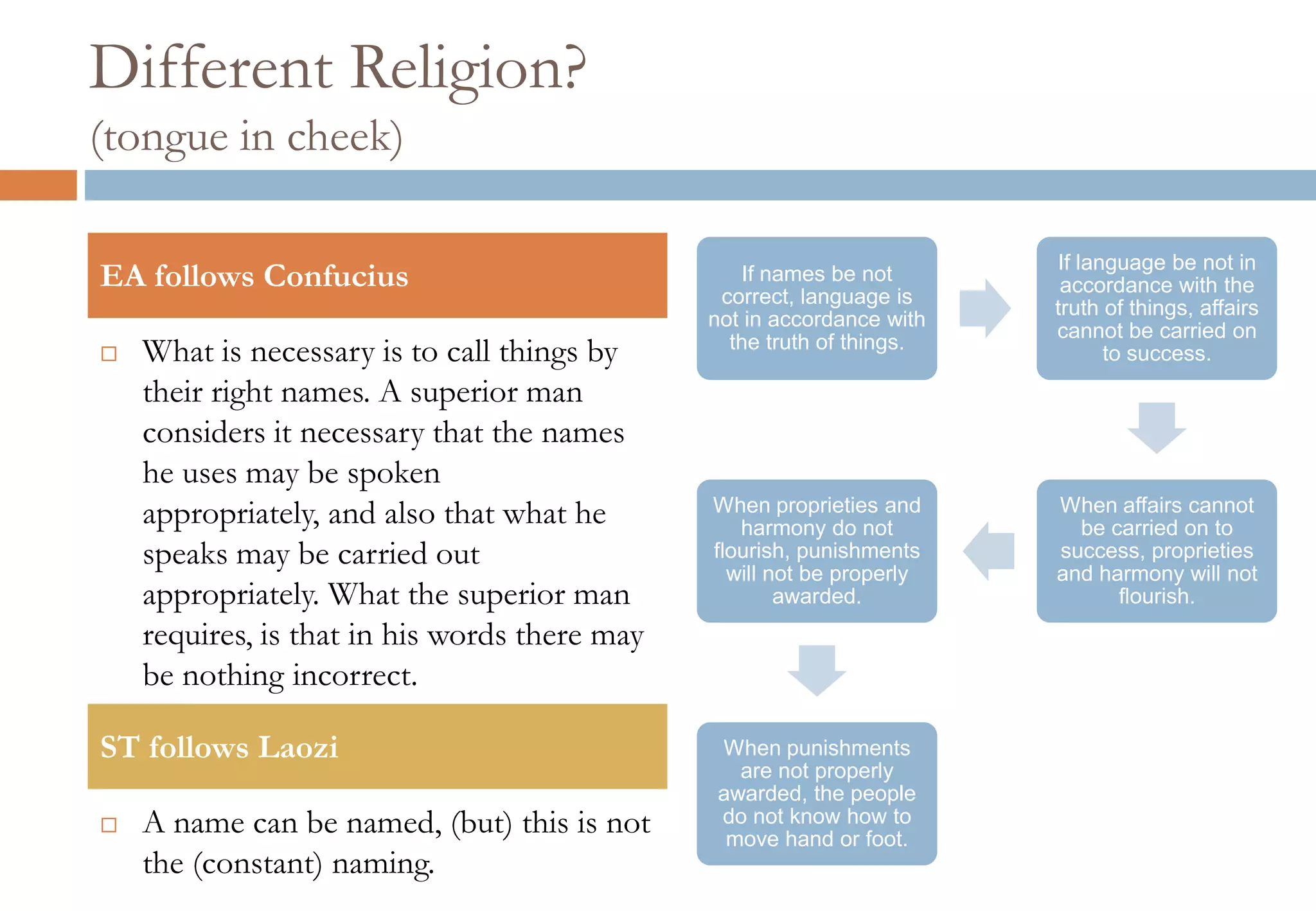
Different Religion?
(tongue in cheek)
What is necessary is to call things by their
right names. A superior man considers it
necessary that the names he uses may be
spoken appropriately, and also that what he
speaks may be carried out appropriately.
What the superior man requires, is that in
his words there may be nothing incorrect.
A name can be named, (but) this is not the
(constant) naming.
EA follows Confucius
ST follows Laozi
If names be not
correct, language is
not in accordance with
the truth of things.
If language be not in
accordance with the
truth of things, affairs
cannot be carried on
to success.
When affairs cannot
be carried on to
success, proprieties
and harmony will not
flourish.
When proprieties and
harmony do not
flourish, punishments
will not be properly
awarded.
When punishments
are not properly
awarded, the people
do not know how to
move hand or foot.
Different Discussion?
(tongue in cheek)
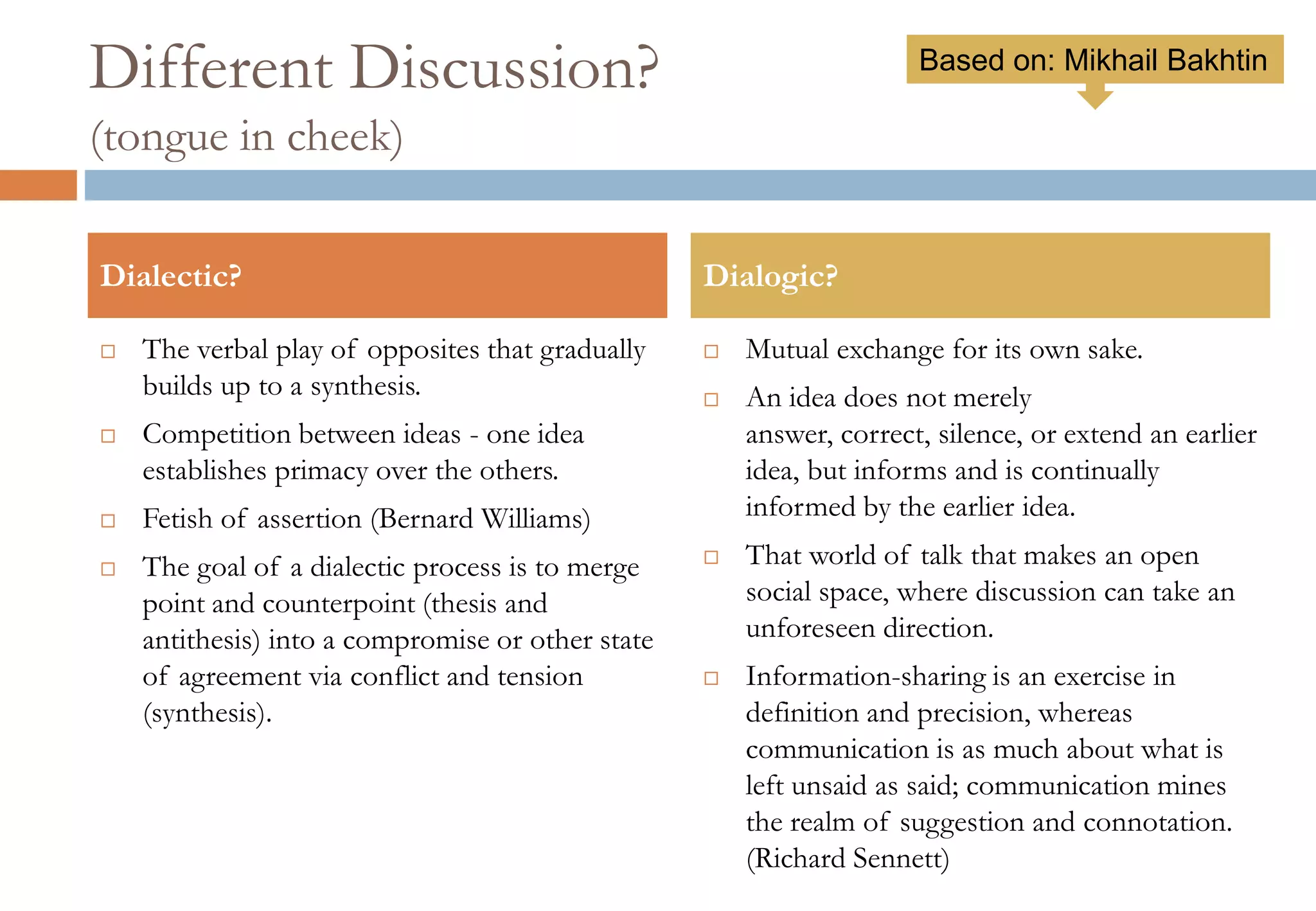
 The verbal play of opposites that gradually
builds up to a synthesis.
 Competition between ideas - one idea
establishes primacy over the others.
 Fetish of assertion (Bernard Williams)
 The goal of a dialectic process is to merge
point and counterpoint (thesis and antithesis)
into a compromise or other state of
agreement via conflict and tension (synthesis).
 Mutual exchange for its own sake.
 An idea does not merely
answer, correct, silence, or extend an earlier
idea, but informs and is continually informed
by the earlier idea.
 That world of talk that makes an open social
space, where discussion can take an
unforeseen direction.
 Information-sharing is an exercise in
definition and precision, whereas
communication is as much about what is left
unsaid as said; communication mines the
realm of suggestion and connotation.
(Richard Sennett)
Dialectic? Dialogic?
Based on: Mikhail Bakhtin
Which Practice?
 An individual or team customizes a
framework for a specific project or
organization.
 The project or organization deviates from
the official framework in various ways.
 Adding and subtracting activities
 Simpler or more complicated pathways
 Links to other frameworks
 Use of available tools
 A project may be retrospectively massaged
to comply with an official framework.
 The participants may be more or less
aware of any deviations and their
consequences.
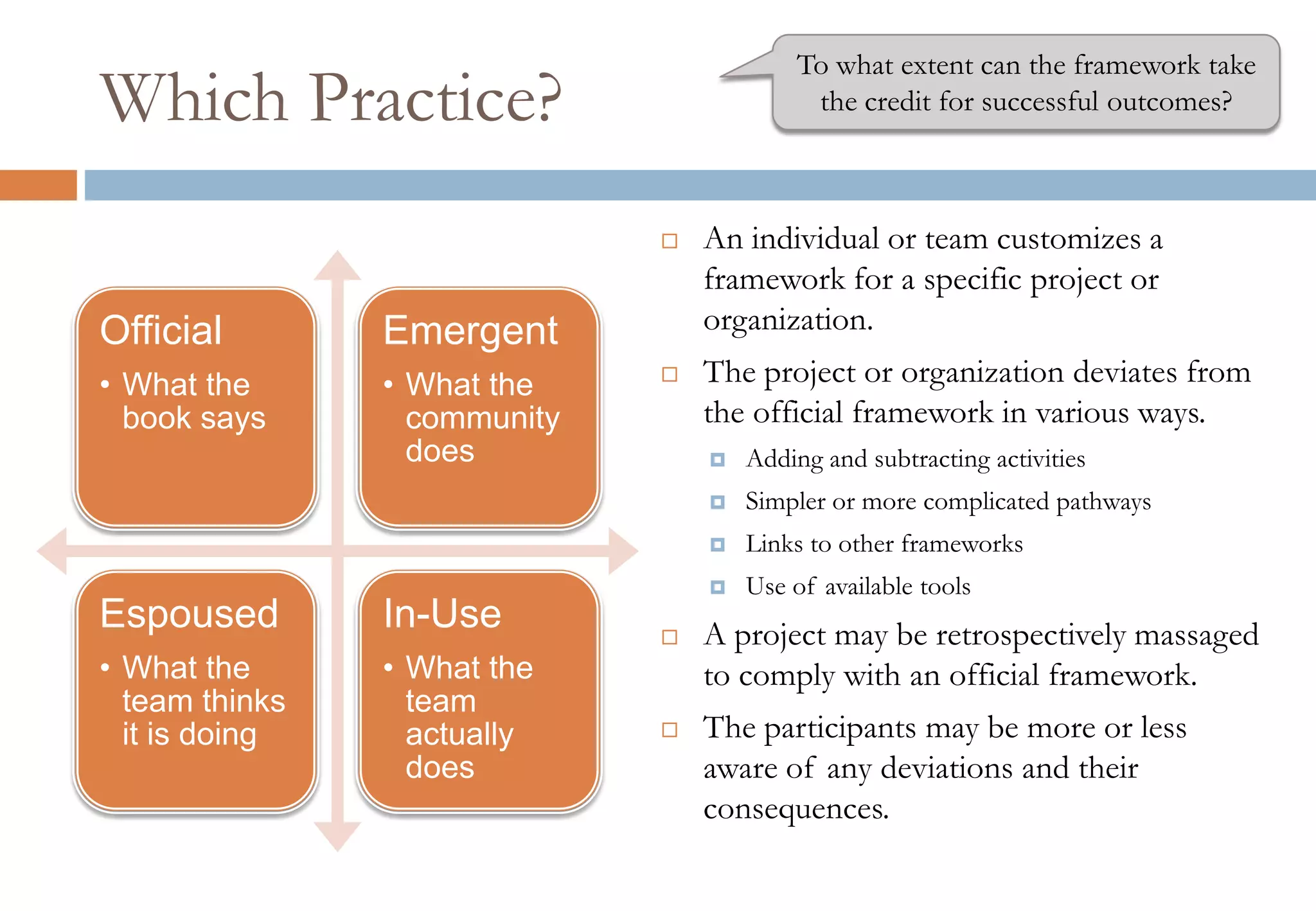
Official
• What the
book says
Emergent
• What the
community
does
Espoused
• What the
team thinks
it is doing
In-Use
• What the
team
actually
does
To what extent can the framework take
the credit for successful outcomes?
Five Anxieties
1. Hierarchical Nature of
Complexity
 Escalation
 Infinite Regression
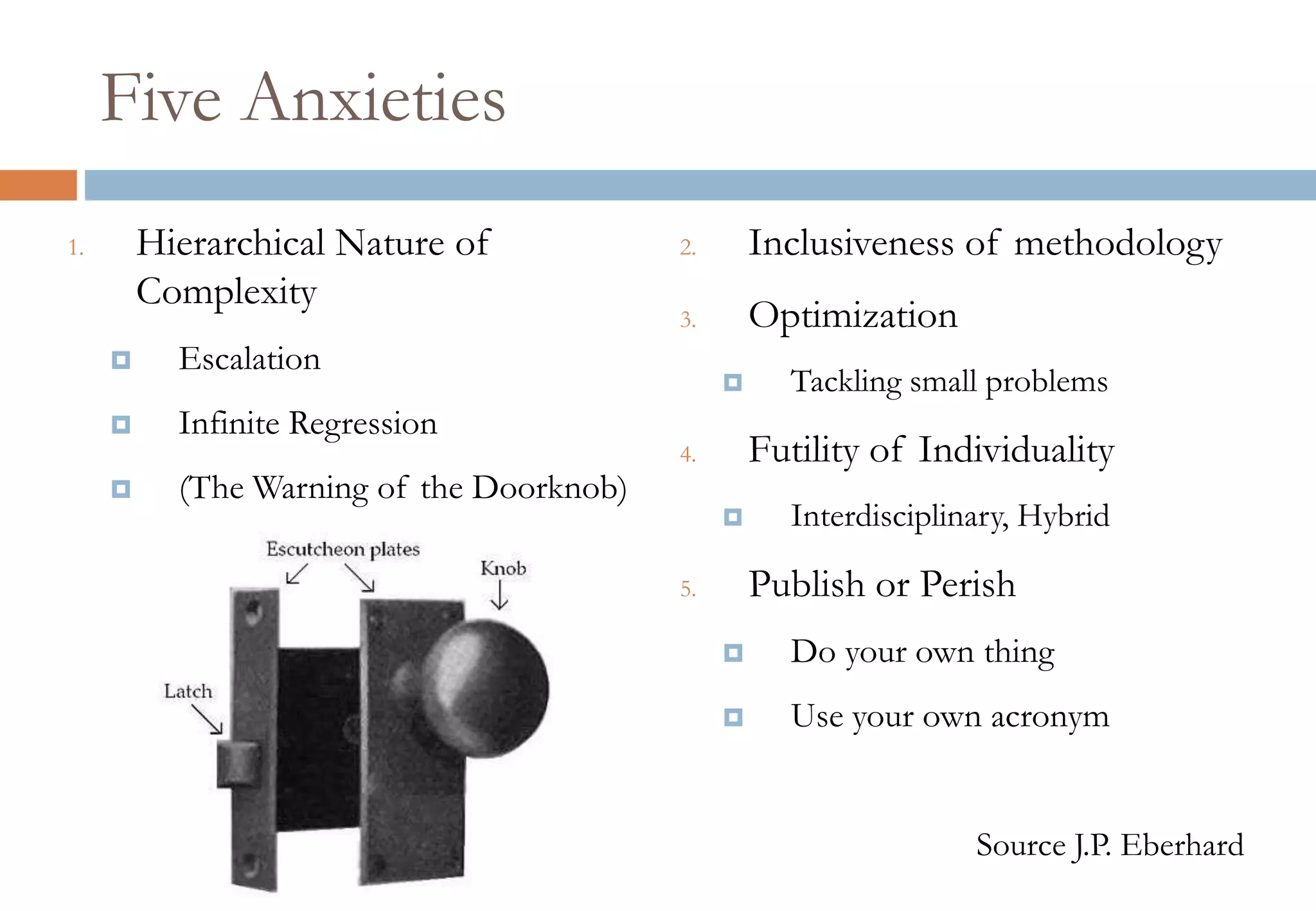
 (The Warning of the
Doorknob)
2. Inclusiveness of
methodology
3. Optimization
 Tackling small problems
4. Futility of Individuality
 Interdisciplinary, Hybrid
5. Publish or Perish
 Do your own thing
 Use your own acronym
Source J.P. Eberhard
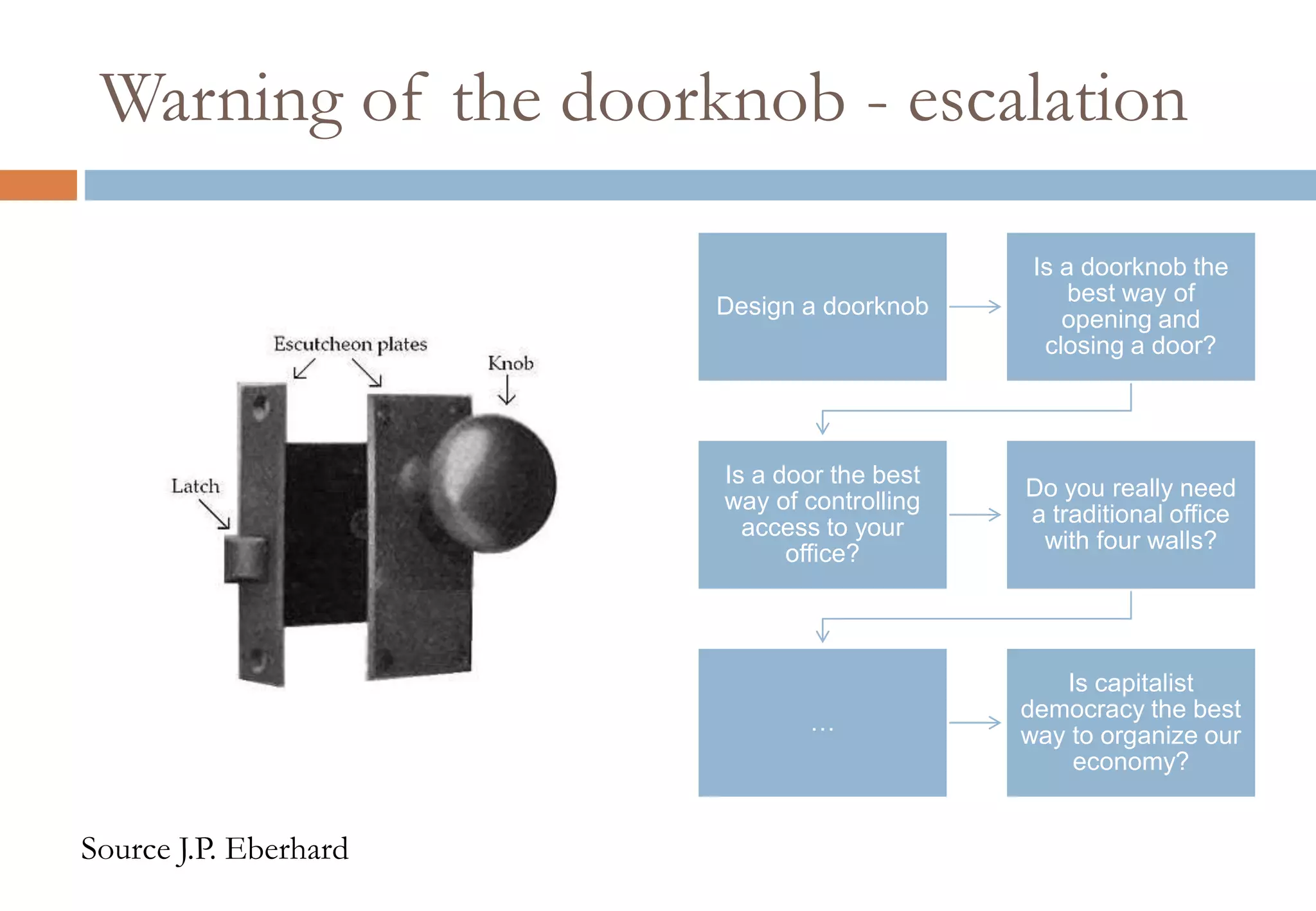
Warning of the doorknob - escalation
Design a doorknob
Is a doorknob the
best way of
opening and
closing a door?
Is a door the best
way of controlling
access to your
office?
Do you really need
a traditional office
with four walls?
…
Is capitalist
democracy the best
way to organize our
economy?
Source J.P. Eberhard
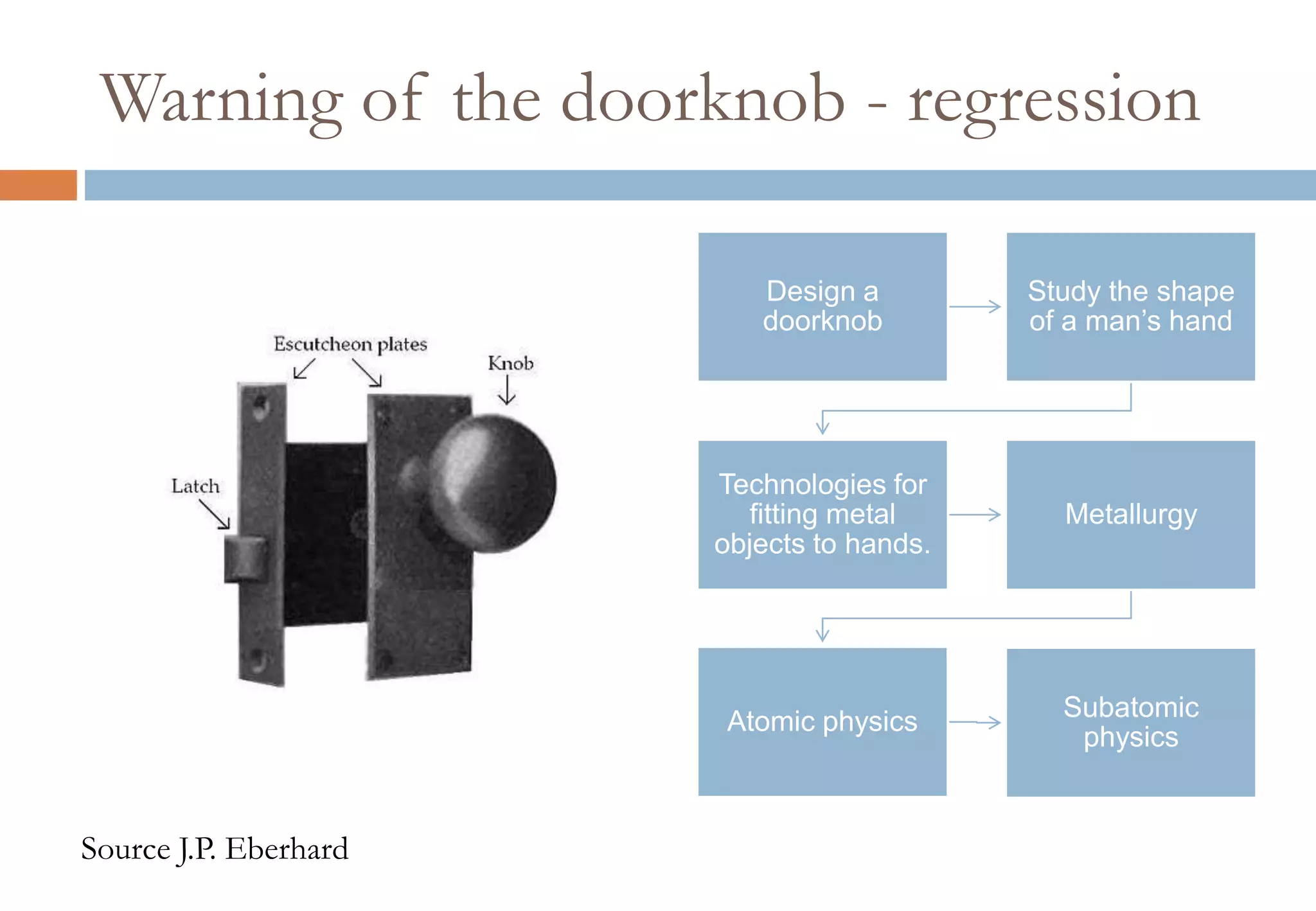
Warning of the doorknob - regression
Design a
doorknob
Study the shape
of a man’s hand
Technologies for
fitting metal
objects to hands.
Metallurgy
Atomic physics Subatomic
physics
Source J.P. Eberhard
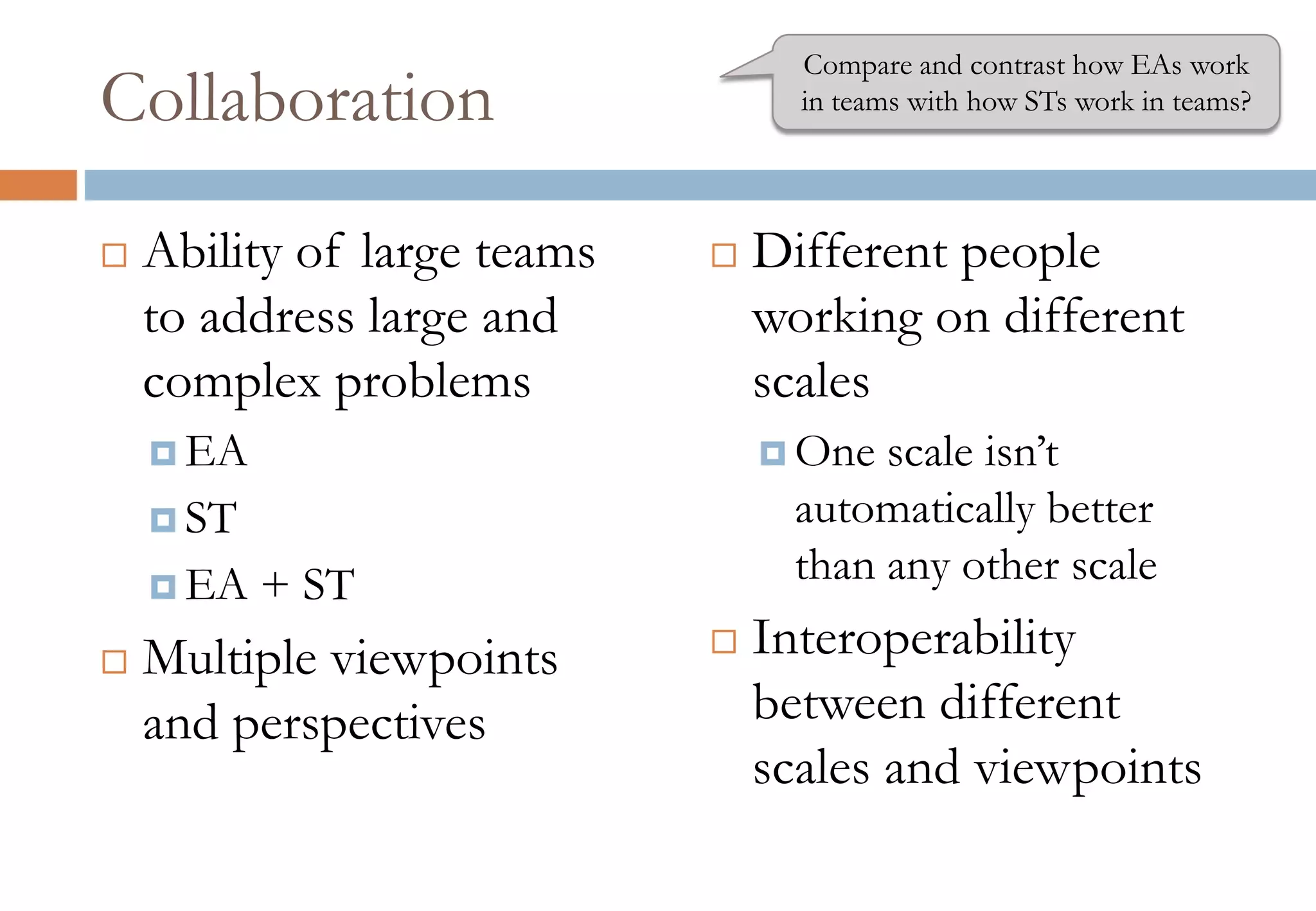
Collaboration
 Ability of large teams
to address large and
complex problems
 EA
 ST
 EA + ST
 Multiple viewpoints
and perspectives
 Different people
working on different
scales
 One scale isn’t
automatically better
than any other scale
 Interoperability
between different
scales and viewpoints
Compare and contrast how EAs work
in teams with how STs work in teams?
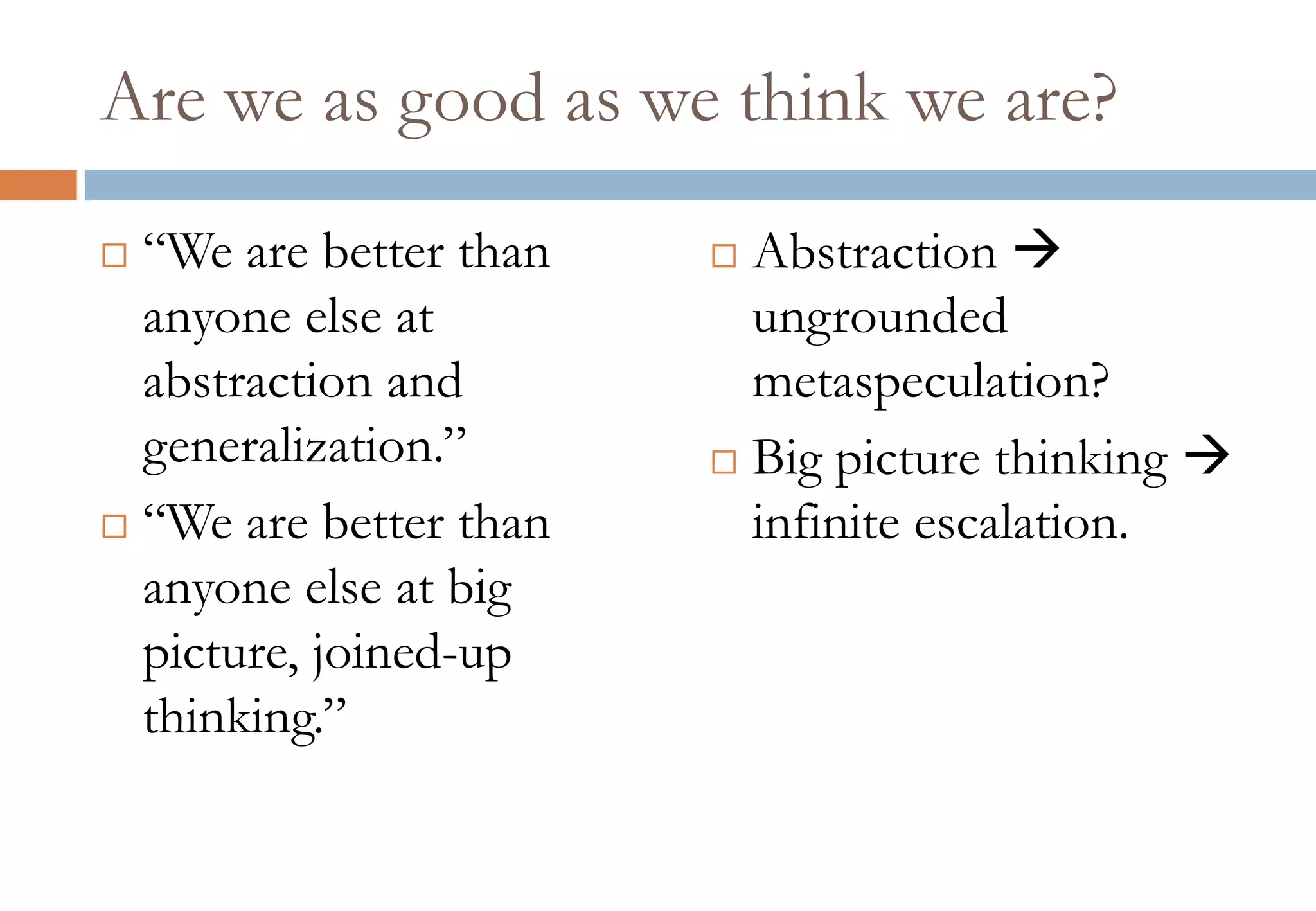
Are we as good as we think we are?
 “We are better than
anyone else at
abstraction and
generalization.”
 “We are better than
anyone else at big
picture, joined-up
thinking.”
 Abstraction 
ungrounded
metaspeculation?
 Big picture thinking 
infinite escalation.
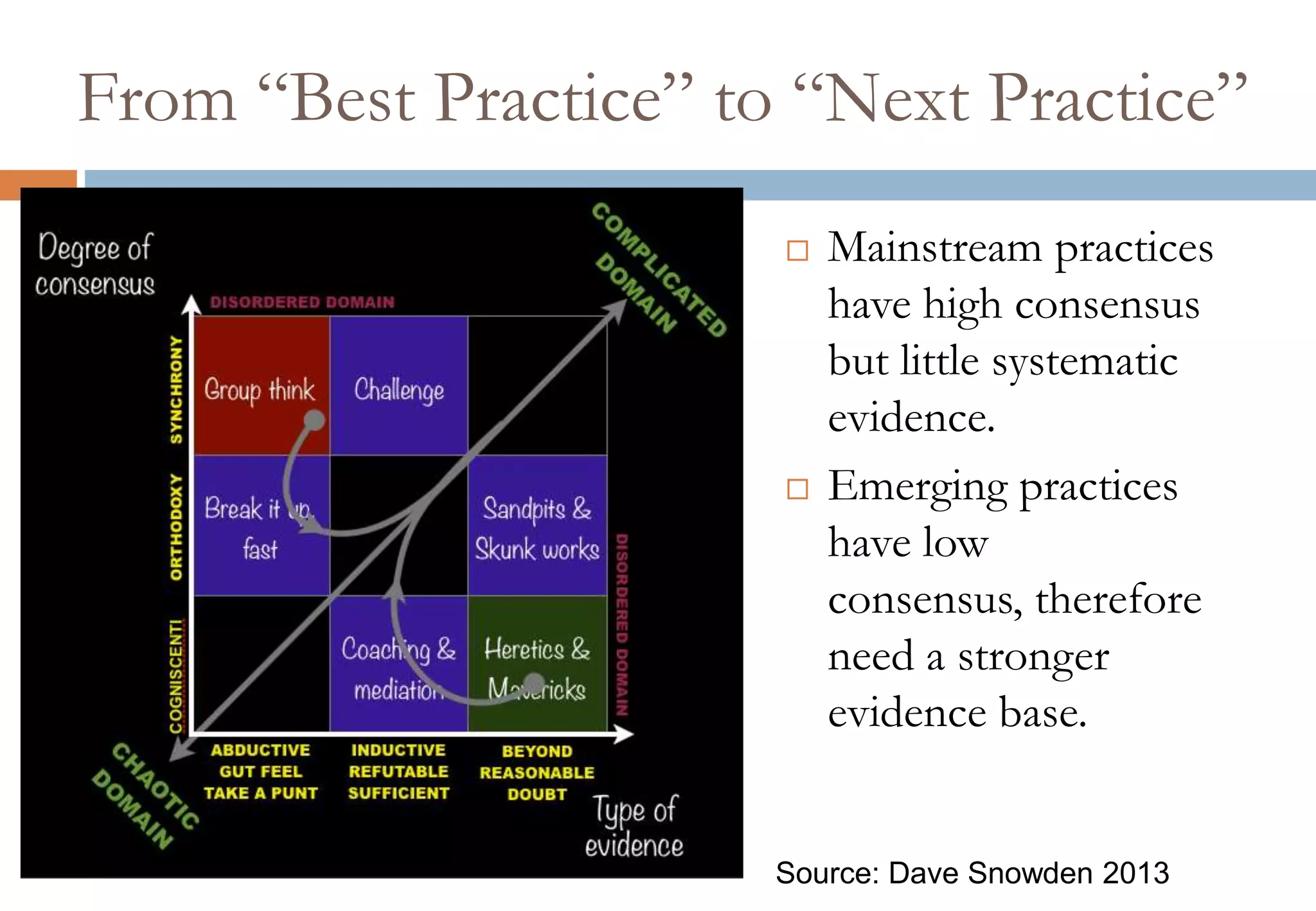
From “Best Practice” to “Next Practice”
 Mainstream practices
have high consensus
but little systematic
evidence.
 Emerging practices
have low
consensus, therefore
need a stronger
evidence base.
Source: Dave Snowden 2013
How can we improve practice?
References
 C. West Churchman, The Systems Approach and its Enemies
(1979)
 J.P. Eberhard, “We Ought to Know the Difference” in Gary T.
Moore (ed) Emerging Methods in Environmental Design and
Planning (MIT Press, 1970) pp 364-365
 Albert Hirschman, The Rhetoric of Reaction (1991)
 Richard Sennett, Together: The Rituals, Pleasures and Politics of
Cooperation (2012)
 Geoffrey Vickers, Human Systems are Different (1983)
Richard VeryardeBooks
• http://leanpub.com/u/richardveryard
Blog
• http://rvsoapbox.blogspot.co.uk/
Twitter
• http://twitter.com/richardveryard

Perspectives on Enterprise Architecture and Systems Thinking

  • 1.
    RICHARD VERYARD EAST PerspectivesJune 2013 Perspectives on Enterprise Architecture and Systems Thinking
  • 2.
    Agenda 9:30 Welcome, introduction,objectives and groundrules 10:00 Common elements of EA and ST – modelling  Beyond Function (Steve Brewis)  Followed by discussion and coffee break 11:30 Complementary elements of EA and ST  EA is broken - how ST can help (John Holland)  Beyond systems (Richard Veryard)  Followed by discussion and lunch 14:00 Practical Collaboration  An opportunity to share real problems from real organizations.  Towards an EAST methodology (Patrick Hoverstadt and Lucy Loh)  Followed by discussion and tea-break 16:15 Further discussion, wrap-up and next steps  Facilitated by Sally Bean and JiriLudvik. And afterwards in the bar opposite #EASTmeeting
  • 3.
    Shared Frustrations  Wecan clearly see some major problems with the structure and behaviour of large enterprises and public sector ecosystems.  We can also see why current initiatives are likely to fail.  But the people in charge of these systems don’t appreciate the valuable contribution we could make.  We are often unable to get access to working at “the right level”.  We are forced to work on fragments of the problem rather than the whole. who is WE?
  • 4.
    Audience 1. Those whoare blithely ignorant of the uncertainties. 2. Those who recognize the uncertainties but haven’t the time to do anything about them; they’ve got to get on with the job. 3. Those who are attempting to shed light on the design process and on methods for realistically handling these uncertainties. Source J.P. Eberhard who is WE?
  • 5.
    Many Schools andFactions (with provocative labels)  Modernist, Engineering (Martin, Zachman, TOGAF)  Classical, NeoClassical(Alex ander)  Baroque, Complexity, Hyb rid (Gartner)  Post-Modern (VPEC-T)  Systems Dynamics (Forrester, Meadows)  Soft Systems Methodology (Checkland)  Quality and Process (Deming, Seddon)  Cybernetics (Beer)  Organic (Bateson, Maturana)  Ethical (Vickers, Churchman) … and many more EA ST “But that’s not what I call systems thinking!” “But that’s not what enterprise architects really do!” who is WE?
  • 6.
    Four hypotheses (perhaps notmutually exclusive) That systems thinking provides some theoretical underpinning for enterprise architecture and/or systems architecture. That systems thinking and enterprise architecture are essentially doing the same things (modelling, abstraction, joined-up thinking, big picture, enterprise-as- system, etc etc) That systems thinking is somehow complementary to enterprise architecture, and that there is some kind of synergy available from putting together concepts, techniques and practices from the two disciplines. That systems thinking and enterprise architecture are rivals for our affections, and their respective champions are trying to show that one is more conceptually coherent, more broadly based, more solidly grounded, and even perhaps more useful, than the other.
  • 7.
    Three Questions  Whatdo EA and ST have in common?  What can EA and ST learn from each other?  What opportunities are there for practical collaboration between EA and ST? Where EA and ST may be any of the following.  A body of knowledge  A community of practitioners  A tool or instrument for achieving some defined goals.  A professional service  A discourse (way of talking)
  • 8.
    Debate Groundrules  Toprefer concrete examples to sweeping generalizations.  To combine grounded practical experience with theoretical reflection.  To avoid disputes between rival schools and frameworks.  To recognize that there are many competing definitions and interpretations.  To tolerate ambiguity, uncertainty and difference.  To learn from others rather than imposing one’s own viewpoint.
  • 9.
    Are EA andST the same thing?  We have a concept of “system”.  We consider the whole enterprise “as a system”.  We consider human activity systems as well as mechanical systems (such as software).  We are good at abstraction and generalization.  We are good at “big picture”, joined-up thinking. BUT A human icon makes a system into a human system!
  • 10.
    What does “enterprise-as-a-system”mean?  Enterprise as an open or closed system?  Enterprise as a human activity or sociotechnical system?  Enterprise as a dynamic, complex adaptive or viable system? What is an enterprise? Are humans inside or outside the system? Which notion of dynamic? Which notion of complexity?
  • 11.
    Different Notions ofSystem?  “System” is part of the problem space.  We try to understand the structure and behaviour of complex systems.  We then intervene to improve their structure and behaviour.  “System” is part of the solution space.  We explore why the existing solutions aren’t performing (AS-IS).  We create blueprints for improved solutions (TO- BE) ST (sometimes) EA (sometimes)
  • 12.
    Different Notions ofSystem Thinking?  Systems thinking gives us a model of what is going on …  … from the viewpoint of a neutral and all-seeing observer.  Systems thinking helps us to make sense of what is going on …  … from the viewpoint of an engaged participant. First Order Cybernetics Second Order Cybernetics And what about third-order cybernetics?  What things should we be looking at? (“Ontology”)  How we can know about these things? (“Epistemology”)
  • 13.
    Why New SystemsDon’t Work (Possibly)  Passive adoption (resistance)  Poor implementation  System as designed system in use  Poor choice of technology (technology fetish) Errors of Execution Errors of Planning  Changing requirements  Local global  Short-term longer-term  User customer
  • 14.
    Why Old SystemsDon’t Work (Possibly)  Complexity  Attempts to eliminate complexity  Cybernetic Entropy  management controls becoming less effective over time  Changing requirements  Hidden agenda  POSIWID (Stafford Beer)  Enterprise Ferality  “an autocatalytic phenomenon that is self- perpetuating” (Steve Brewis)
  • 15.
    Different Stance? (tongue incheek)  Urgent action is necessary to avoid imminent danger ("The Imminent Danger")  All reforms work together and reinforce each other, rather than being competing ("The Synergy Illusion")  History Is on Our Side.  Purposive action to improve some feature of the political, social, or economic order may only serve to exacerbate the condition one wishes to remedy. ("perversity thesis").  Attempts at social transformation are often unavailing, that they will simply fail to "make a dent." ("futility thesis")  The cost of the proposed change or reform is often too high, especially if it endangers some previous, precious accomplishment. ("jeopardy thesis") EA as progressive, visionary? ST as realist, reactionary? Based on: Albert Hirschman
  • 16.
    Different Religion? (tongue incheek) What is necessary is to call things by their right names. A superior man considers it necessary that the names he uses may be spoken appropriately, and also that what he speaks may be carried out appropriately. What the superior man requires, is that in his words there may be nothing incorrect. A name can be named, (but) this is not the (constant) naming. EA follows Confucius ST follows Laozi If names be not correct, language is not in accordance with the truth of things. If language be not in accordance with the truth of things, affairs cannot be carried on to success. When affairs cannot be carried on to success, proprieties and harmony will not flourish. When proprieties and harmony do not flourish, punishments will not be properly awarded. When punishments are not properly awarded, the people do not know how to move hand or foot.
  • 17.
    Different Discussion? (tongue incheek)  The verbal play of opposites that gradually builds up to a synthesis.  Competition between ideas - one idea establishes primacy over the others.  Fetish of assertion (Bernard Williams)  The goal of a dialectic process is to merge point and counterpoint (thesis and antithesis) into a compromise or other state of agreement via conflict and tension (synthesis).  Mutual exchange for its own sake.  An idea does not merely answer, correct, silence, or extend an earlier idea, but informs and is continually informed by the earlier idea.  That world of talk that makes an open social space, where discussion can take an unforeseen direction.  Information-sharing is an exercise in definition and precision, whereas communication is as much about what is left unsaid as said; communication mines the realm of suggestion and connotation. (Richard Sennett) Dialectic? Dialogic? Based on: Mikhail Bakhtin
  • 18.
    Which Practice?  Anindividual or team customizes a framework for a specific project or organization.  The project or organization deviates from the official framework in various ways.  Adding and subtracting activities  Simpler or more complicated pathways  Links to other frameworks  Use of available tools  A project may be retrospectively massaged to comply with an official framework.  The participants may be more or less aware of any deviations and their consequences. Official • What the book says Emergent • What the community does Espoused • What the team thinks it is doing In-Use • What the team actually does To what extent can the framework take the credit for successful outcomes?
  • 19.
    Five Anxieties 1. HierarchicalNature of Complexity  Escalation  Infinite Regression  (The Warning of the Doorknob) 2. Inclusiveness of methodology 3. Optimization  Tackling small problems 4. Futility of Individuality  Interdisciplinary, Hybrid 5. Publish or Perish  Do your own thing  Use your own acronym Source J.P. Eberhard
  • 20.
    Warning of thedoorknob - escalation Design a doorknob Is a doorknob the best way of opening and closing a door? Is a door the best way of controlling access to your office? Do you really need a traditional office with four walls? … Is capitalist democracy the best way to organize our economy? Source J.P. Eberhard
  • 21.
    Warning of thedoorknob - regression Design a doorknob Study the shape of a man’s hand Technologies for fitting metal objects to hands. Metallurgy Atomic physics Subatomic physics Source J.P. Eberhard
  • 22.
    Collaboration  Ability oflarge teams to address large and complex problems  EA  ST  EA + ST  Multiple viewpoints and perspectives  Different people working on different scales  One scale isn’t automatically better than any other scale  Interoperability between different scales and viewpoints Compare and contrast how EAs work in teams with how STs work in teams?
  • 23.
    Are we asgood as we think we are?  “We are better than anyone else at abstraction and generalization.”  “We are better than anyone else at big picture, joined-up thinking.”  Abstraction  ungrounded metaspeculation?  Big picture thinking  infinite escalation.
  • 24.
    From “Best Practice”to “Next Practice”  Mainstream practices have high consensus but little systematic evidence.  Emerging practices have low consensus, therefore need a stronger evidence base. Source: Dave Snowden 2013
  • 25.
    How can weimprove practice?
  • 26.
    References  C. WestChurchman, The Systems Approach and its Enemies (1979)  J.P. Eberhard, “We Ought to Know the Difference” in Gary T. Moore (ed) Emerging Methods in Environmental Design and Planning (MIT Press, 1970) pp 364-365  Albert Hirschman, The Rhetoric of Reaction (1991)  Richard Sennett, Together: The Rituals, Pleasures and Politics of Cooperation (2012)  Geoffrey Vickers, Human Systems are Different (1983)
  • 27.
    Richard VeryardeBooks • http://leanpub.com/u/richardveryard Blog •http://rvsoapbox.blogspot.co.uk/ Twitter • http://twitter.com/richardveryard

Editor's Notes

  • #4 Steve will talk about bringing together the reductionist paradigm of 'functional' architecture with the systemic paradigm of systems thinking, illustrating this with the modelling work he has been doing at BTJohn will talk about his experience in a large government organizationRichard will explore some practical dilemmas of systems thinking, and how to escape the dangers of analysis-paralysis.Patrick and Lucy will report on preliminary developments in the SCiO EAST working group, and explore a practical approach for combining EA and ST concepts and tools.
  • #29 http://cognitive-edge.com/blog/entry/5989/complex-domain-model-april2013-edition/