



What can Enterprise Architecture
learn from Systems Thinking?

Richard Veryard
Open Group Conference
London October 2013
Preamble 1

4

Who Am I?
Preamble 2

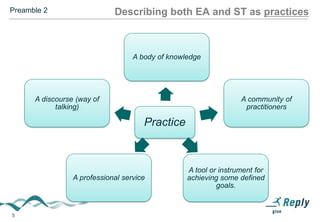
Describing both EA and ST as practices

A body of knowledge

A community of
practitioners

A discourse (way of
talking)

Practice

A professional service

5

A tool or instrument
for achieving some
defined goals.
Preamble 3

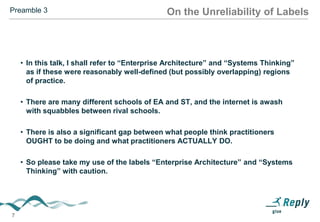
On the Unreliability of Labels

• Labels like EA and ST are almost impossible to pin down. People waste
much effort squabbling about definitions. Extreme precision doesn’t
always make any sense.
• In this talk, I shall refer to “Enterprise Architecture” and “Systems
Thinking” as if these were reasonably well-defined (but possibly
overlapping) regions of practice.
• There are many different schools of EA and ST, and the internet is
awash with squabbles between rival schools. (Especially on Linked-In).

• There is also a significant gap between what people think practitioners
OUGHT to be doing and what practitioners ACTUALLY DO.
• So please take my use of the labels “Enterprise Architecture” and
“Systems Thinking” with caution.

7
Schools of EA
• Modernist, Engineering
(James Martin, John
Zachman, TOGAF)

• Classical, NeoClassical
(Christopher Alexander)
• Baroque, Complexity, H
ybrid (Nick Gall)
• Post-Modern (VPEC-T)
• Pragmatic (CapabilityLed Planning)

8
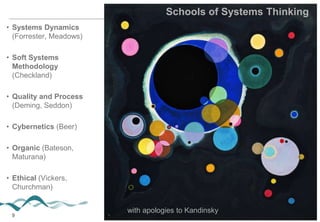
Schools of Systems Thinking
• Systems Dynamics
(Forrester, Meadows)
• Soft Systems
Methodology
(Checkland)

• Quality and Process
(Deming, Seddon)
• Cybernetics (Beer)
• Organic
(Bateson, Maturana)
• Ethical
(Vickers, Churchman)
with apologies to Kandinsky
9
Is that it?
“But that’s not what I call
systems thinking!”

“But that’s not what enterprise
architects really do!”
10
Three Questions

• What do EA and ST have in common?
– Common Goals?
– Common Ground?
– Shared Frustrations?
• What can EA and ST learn from each other?
– Stance
– Style

• What opportunities are there for practical collaboration between EA
and ST?

12
Shared Frustrations

who is WE?
• We can clearly see some major
problems with the structure and
behaviour of large enterprises
and public sector ecosystems.
• We can also see why current
initiatives are likely to fail.

• But the people in charge of these
systems don’t appreciate the
valuable contribution we could
make.

13

• We are often unable to get
access to working at “the
right level”.
• We are forced to work on
fragments of the problem
rather than the whole.
Common Self-Belief

• “We are better than
anyone else at
abstraction and
generalization.”
• “We are better than
anyone else at big
picture, joined-up
thinking.”

14

• Abstraction 
ungrounded
metaspeculation?
• Big picture thinking 
infinite escalation.
Common Ground
Similarities
Enterprise architecture and systems
thinking share some important
characteristics.
• Overlapping range of concepts and
techniques for tackling difficult
business problems.
• Practitioners face similar challenges
when working with large and
complex business organizations and
ecosystems,
• Similar difficulties and frustrations
in trying to engage stakeholders in
joined-up “big picture” thinking.

15

Differences
There are also some significant
differences, which create a real
opportunity for collaboration and
exchange.
• Different techniques
• Different perspective
• Different strengths
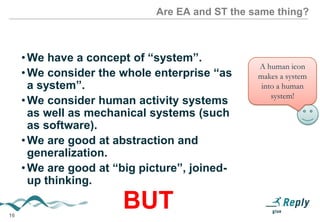
Are EA and ST the same thing?

• We have a concept of “system”.
• We consider the whole enterprise “as a
system”.
• We consider human activity systems as
well as mechanical systems (such as
software).
• We are good at abstraction and
generalization.
• We are good at “big picture”, joined-up
thinking.

BUT
16

A human icon
makes a system
into a human
system!
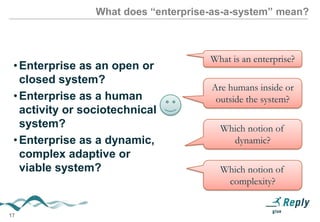
What does “enterprise-as-a-system” mean?

• Enterprise as an open or
closed system?
• Enterprise as a human
activity or sociotechnical
system?
• Enterprise as a
dynamic, complex
adaptive or viable system?

17

What is an enterprise?
Are humans inside or
outside the system?
Which notion of
dynamic?
Which notion of
complexity?
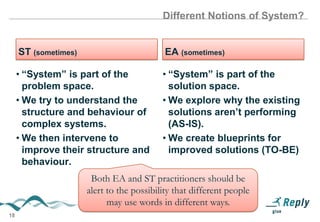
Different Notions of System?

ST (sometimes)

EA (sometimes)

• “System” is part of the problem • “System” is part of the solution
space.
space.
• We try to understand the
• We explore why the existing
structure and behaviour of
solutions aren’t performing
complex systems.
(AS-IS).
• We then intervene to improve
• We create blueprints for
their structure and behaviour.
improved solutions (TO-BE)

Both EA and ST practitioners should be
alert to the possibility that different people
may use words in different ways.
18
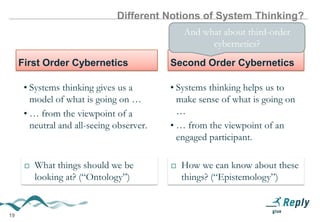
Different Notions of System Thinking?
And what about third-order
cybernetics?
First Order Cybernetics
• Systems thinking gives us a
model of what is going on …
• … from the viewpoint of a
neutral and all-seeing observer.



19

What things should we be
looking at? (“Ontology”)

Second Order Cybernetics
• Systems thinking helps us to
make sense of what is going on
…
• … from the viewpoint of an
engaged participant.


How we can know about these
things? (“Epistemology”)
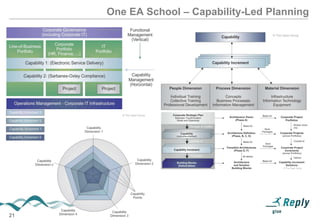
One EA School – Capability-Led Planning

21
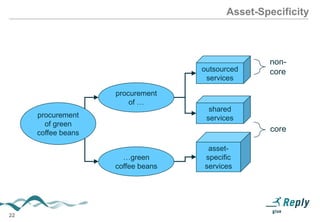
Asset-Specificity
Delegating a capability always introduces an additional capability –
namely governance.

outsourced
services

noncore

procurement
of …
shared
services

procurement
of green
coffee beans

core
…green
coffee beans

assetspecific
services

Decomposing a capability into smaller capabilities always introduces
an additional capability – namely that of coordinating multiple
capabilities to produce coherent outcomes.
22
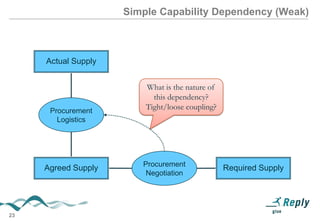
Simple Capability Dependency (Weak)

Actual Supply

Procurement
Logistics

Agreed Supply

23

What is the nature of
this dependency?
Tight/loose coupling?

Procurement
Negotiation

Required Supply
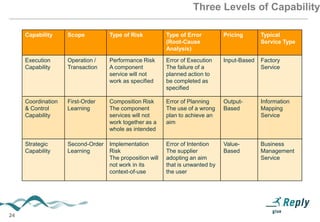
Three Levels of Capability

Capability

Type of Risk

Type of Error
(Root-Cause
Analysis)

Pricing

Typical
Service Type

Execution
Capability

Operation /
Transaction

Performance Risk
A component
service will not
work as specified

Error of Execution
The failure of a
planned action to
be completed as
specified

Input-Based

Factory
Service

Coordination
& Control
Capability

First-Order
Learning

Composition Risk
The component
services will not
work together as a
whole as intended

Error of Planning
The use of a wrong
plan to achieve an
aim

OutputBased

Information
Mapping
Service

Strategic
Capability

24

Scope

SecondOrder
Learning

Implementation
Risk
The proposition will
not work in its
context-of-use

Error of Intention
The supplier
adopting an aim
that is unwanted by
the user

ValueBased

Business
Management
Service
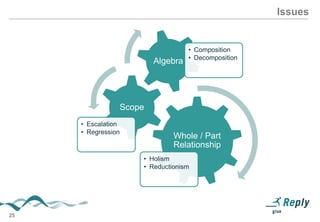
Issues

Algebra

• Composition
• Decomposition

Scope
• Escalation
• Regression

Whole / Part
Relationship
• Holism
• Reductionism

25
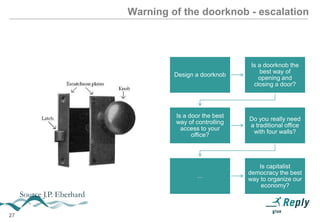
Warning of the doorknob - escalation

Design a doorknob

Is a door the best
way of controlling
access to your
office?

27

Do you really need a
traditional office with
four walls?

…

Source J.P. Eberhard

Is a doorknob the
best way of opening
and closing a door?

Is capitalist
democracy the best
way to organize our
economy?
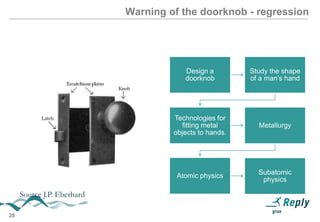
Warning of the doorknob - regression

Design a
doorknob

Technologies for
fitting metal
objects to hands.

28

Metallurgy

Atomic physics

Source J.P. Eberhard

Study the shape
of a man’s hand

Subatomic
physics
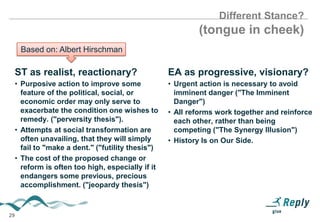
Different Stance?

(tongue in cheek)
Based on: Albert Hirschman

ST as realist, reactionary?

EA as progressive, visionary?

• Purposive action to improve some
feature of the political, social, or
economic order may only serve to
exacerbate the condition one wishes to
remedy. ("perversity thesis").
• Attempts at social transformation are
often unavailing, that they will simply
fail to "make a dent." ("futility thesis")
• The cost of the proposed change or
reform is often too high, especially if it
endangers some previous, precious
accomplishment. ("jeopardy thesis")

• Urgent action is necessary to avoid
imminent danger ("The Imminent
Danger")
• All reforms work together and reinforce
each other, rather than being
competing ("The Synergy Illusion")
• History Is on Our Side.

29
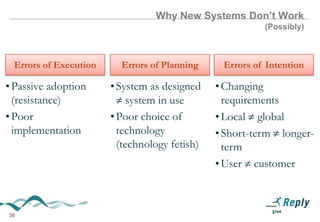
Why New Systems Don’t Work
(Possibly)

Errors of Execution

• Passive adoption
(resistance)
• Poor
implementation

30

Errors of Planning

• System as designed
system in use
• Poor choice of
technology
(technology fetish)

Errors of Intention

• Changing
requirements
• Local global
• Short-term
longer-term
• User customer
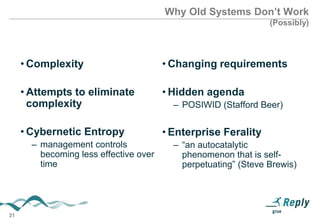
Why Old Systems Don’t Work
(Possibly)

• Complexity

• Changing requirements

• Attempts to eliminate
complexity

• Hidden agenda

• Cybernetic Entropy

• Enterprise Ferality

– management controls
becoming less effective over
time

31

– POSIWID (Stafford Beer)

– “an autocatalytic
phenomenon that is selfperpetuating” (Steve Brewis)
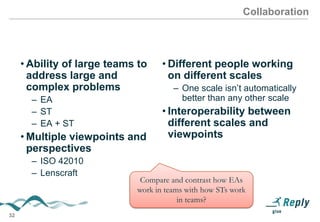
Collaboration

• Ability of large teams to • Different people
address large and
working on different
complex problems
scales
– EA
– ST
– EA + ST

– One scale isn’t
automatically better than
any other scale

• Multiple viewpoints and • Interoperability
between different
perspectives
scales and viewpoints
– ISO 42010
– Lenscraft

32

Compare and contrast how EAs
work in teams with how STs work
in teams?
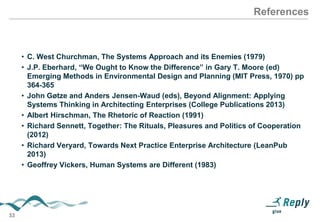
References

• C. West Churchman, The Systems Approach and its Enemies (1979)
• J.P. Eberhard, “We Ought to Know the Difference” in Gary T. Moore (ed)
Emerging Methods in Environmental Design and Planning (MIT
Press, 1970) pp 364-365
• John Gøtze and Anders Jensen-Waud (eds), Beyond Alignment: Applying
Systems Thinking in Architecting Enterprises (College Publications 2013)
• Albert Hirschman, The Rhetoric of Reaction (1991)
• Richard Sennett, Together: The Rituals, Pleasures and Politics of
Cooperation (2012)
• Richard Veryard, Towards Next Practice Enterprise Architecture
(LeanPub 2013)
• Geoffrey Vickers, Human Systems are Different (1983)

33
Contacts
www.replyltd.co.uk.
r.veryard@replyltd.co.uk
http://twitter.com/richardveryard

34

What can Enterprise Architecture learn from Systems Thinking?

  • 1.
    What can EnterpriseArchitecture learn from Systems Thinking? Richard Veryard Open Group Conference London October 2013
  • 2.
  • 3.
    Preamble 2 Describing bothEA and ST as practices A body of knowledge A community of practitioners A discourse (way of talking) Practice A professional service 5 A tool or instrument for achieving some defined goals.
  • 4.
    Preamble 3 On theUnreliability of Labels • Labels like EA and ST are almost impossible to pin down. People waste much effort squabbling about definitions. Extreme precision doesn’t always make any sense. • In this talk, I shall refer to “Enterprise Architecture” and “Systems Thinking” as if these were reasonably well-defined (but possibly overlapping) regions of practice. • There are many different schools of EA and ST, and the internet is awash with squabbles between rival schools. (Especially on Linked-In). • There is also a significant gap between what people think practitioners OUGHT to be doing and what practitioners ACTUALLY DO. • So please take my use of the labels “Enterprise Architecture” and “Systems Thinking” with caution. 7
  • 5.
    Schools of EA •Modernist, Engineering (James Martin, John Zachman, TOGAF) • Classical, NeoClassical (Christopher Alexander) • Baroque, Complexity, H ybrid (Nick Gall) • Post-Modern (VPEC-T) • Pragmatic (CapabilityLed Planning) 8
  • 6.
    Schools of SystemsThinking • Systems Dynamics (Forrester, Meadows) • Soft Systems Methodology (Checkland) • Quality and Process (Deming, Seddon) • Cybernetics (Beer) • Organic (Bateson, Maturana) • Ethical (Vickers, Churchman) with apologies to Kandinsky 9
  • 7.
    Is that it? “Butthat’s not what I call systems thinking!” “But that’s not what enterprise architects really do!” 10
  • 8.
    Three Questions • Whatdo EA and ST have in common? – Common Goals? – Common Ground? – Shared Frustrations? • What can EA and ST learn from each other? – Stance – Style • What opportunities are there for practical collaboration between EA and ST? 12
  • 9.
    Shared Frustrations who isWE? • We can clearly see some major problems with the structure and behaviour of large enterprises and public sector ecosystems. • We can also see why current initiatives are likely to fail. • But the people in charge of these systems don’t appreciate the valuable contribution we could make. 13 • We are often unable to get access to working at “the right level”. • We are forced to work on fragments of the problem rather than the whole.
  • 10.
    Common Self-Belief • “Weare better than anyone else at abstraction and generalization.” • “We are better than anyone else at big picture, joined-up thinking.” 14 • Abstraction  ungrounded metaspeculation? • Big picture thinking  infinite escalation.
  • 11.
    Common Ground Similarities Enterprise architectureand systems thinking share some important characteristics. • Overlapping range of concepts and techniques for tackling difficult business problems. • Practitioners face similar challenges when working with large and complex business organizations and ecosystems, • Similar difficulties and frustrations in trying to engage stakeholders in joined-up “big picture” thinking. 15 Differences There are also some significant differences, which create a real opportunity for collaboration and exchange. • Different techniques • Different perspective • Different strengths
  • 12.
    Are EA andST the same thing? • We have a concept of “system”. • We consider the whole enterprise “as a system”. • We consider human activity systems as well as mechanical systems (such as software). • We are good at abstraction and generalization. • We are good at “big picture”, joined-up thinking. BUT 16 A human icon makes a system into a human system!
  • 13.
    What does “enterprise-as-a-system”mean? • Enterprise as an open or closed system? • Enterprise as a human activity or sociotechnical system? • Enterprise as a dynamic, complex adaptive or viable system? 17 What is an enterprise? Are humans inside or outside the system? Which notion of dynamic? Which notion of complexity?
  • 14.
    Different Notions ofSystem? ST (sometimes) EA (sometimes) • “System” is part of the problem • “System” is part of the solution space. space. • We try to understand the • We explore why the existing structure and behaviour of solutions aren’t performing complex systems. (AS-IS). • We then intervene to improve • We create blueprints for their structure and behaviour. improved solutions (TO-BE) Both EA and ST practitioners should be alert to the possibility that different people may use words in different ways. 18
  • 15.
    Different Notions ofSystem Thinking? And what about third-order cybernetics? First Order Cybernetics • Systems thinking gives us a model of what is going on … • … from the viewpoint of a neutral and all-seeing observer.  19 What things should we be looking at? (“Ontology”) Second Order Cybernetics • Systems thinking helps us to make sense of what is going on … • … from the viewpoint of an engaged participant.  How we can know about these things? (“Epistemology”)
  • 16.
    One EA School– Capability-Led Planning 21
  • 17.
    Asset-Specificity Delegating a capabilityalways introduces an additional capability – namely governance. outsourced services noncore procurement of … shared services procurement of green coffee beans core …green coffee beans assetspecific services Decomposing a capability into smaller capabilities always introduces an additional capability – namely that of coordinating multiple capabilities to produce coherent outcomes. 22
  • 18.
    Simple Capability Dependency(Weak) Actual Supply Procurement Logistics Agreed Supply 23 What is the nature of this dependency? Tight/loose coupling? Procurement Negotiation Required Supply
  • 19.
    Three Levels ofCapability Capability Type of Risk Type of Error (Root-Cause Analysis) Pricing Typical Service Type Execution Capability Operation / Transaction Performance Risk A component service will not work as specified Error of Execution The failure of a planned action to be completed as specified Input-Based Factory Service Coordination & Control Capability First-Order Learning Composition Risk The component services will not work together as a whole as intended Error of Planning The use of a wrong plan to achieve an aim OutputBased Information Mapping Service Strategic Capability 24 Scope SecondOrder Learning Implementation Risk The proposition will not work in its context-of-use Error of Intention The supplier adopting an aim that is unwanted by the user ValueBased Business Management Service
  • 20.
    Issues Algebra • Composition • Decomposition Scope •Escalation • Regression Whole / Part Relationship • Holism • Reductionism 25
  • 21.
    Warning of thedoorknob - escalation Design a doorknob Is a door the best way of controlling access to your office? 27 Do you really need a traditional office with four walls? … Source J.P. Eberhard Is a doorknob the best way of opening and closing a door? Is capitalist democracy the best way to organize our economy?
  • 22.
    Warning of thedoorknob - regression Design a doorknob Technologies for fitting metal objects to hands. 28 Metallurgy Atomic physics Source J.P. Eberhard Study the shape of a man’s hand Subatomic physics
  • 23.
    Different Stance? (tongue incheek) Based on: Albert Hirschman ST as realist, reactionary? EA as progressive, visionary? • Purposive action to improve some feature of the political, social, or economic order may only serve to exacerbate the condition one wishes to remedy. ("perversity thesis"). • Attempts at social transformation are often unavailing, that they will simply fail to "make a dent." ("futility thesis") • The cost of the proposed change or reform is often too high, especially if it endangers some previous, precious accomplishment. ("jeopardy thesis") • Urgent action is necessary to avoid imminent danger ("The Imminent Danger") • All reforms work together and reinforce each other, rather than being competing ("The Synergy Illusion") • History Is on Our Side. 29
  • 24.
    Why New SystemsDon’t Work (Possibly) Errors of Execution • Passive adoption (resistance) • Poor implementation 30 Errors of Planning • System as designed system in use • Poor choice of technology (technology fetish) Errors of Intention • Changing requirements • Local global • Short-term longer-term • User customer
  • 25.
    Why Old SystemsDon’t Work (Possibly) • Complexity • Changing requirements • Attempts to eliminate complexity • Hidden agenda • Cybernetic Entropy • Enterprise Ferality – management controls becoming less effective over time 31 – POSIWID (Stafford Beer) – “an autocatalytic phenomenon that is selfperpetuating” (Steve Brewis)
  • 26.
    Collaboration • Ability oflarge teams to • Different people address large and working on different complex problems scales – EA – ST – EA + ST – One scale isn’t automatically better than any other scale • Multiple viewpoints and • Interoperability between different perspectives scales and viewpoints – ISO 42010 – Lenscraft 32 Compare and contrast how EAs work in teams with how STs work in teams?
  • 27.
    References • C. WestChurchman, The Systems Approach and its Enemies (1979) • J.P. Eberhard, “We Ought to Know the Difference” in Gary T. Moore (ed) Emerging Methods in Environmental Design and Planning (MIT Press, 1970) pp 364-365 • John Gøtze and Anders Jensen-Waud (eds), Beyond Alignment: Applying Systems Thinking in Architecting Enterprises (College Publications 2013) • Albert Hirschman, The Rhetoric of Reaction (1991) • Richard Sennett, Together: The Rituals, Pleasures and Politics of Cooperation (2012) • Richard Veryard, Towards Next Practice Enterprise Architecture (LeanPub 2013) • Geoffrey Vickers, Human Systems are Different (1983) 33
  • 28.

Editor's Notes

  • #9 http://www.tate.org.uk/art/artworks/kandinsky-swinging-t02344
  • #10 http://www.fertomniavirtus.com/vassily-kandinsky/
  • #11 http://www.tate.org.uk/art/artworks/kandinsky-swinging-t02344http://www.fertomniavirtus.com/vassily-kandinsky/
  • #22 http://pubs.opengroup.org/architecture/togaf9-doc/arch/chap32.html