
On Customer Insight

Richard Veryard
October 2013
Contents

Our Goal
• Building Knowledge about Customers
• To Support Reasoning about Customers

Sources of Knowledge
• Customer Tracking
• Customer Profiling
• Exploration and Experiment
Supporting Reasoning
• Managing Uncertainty
• Managing Privacy

2
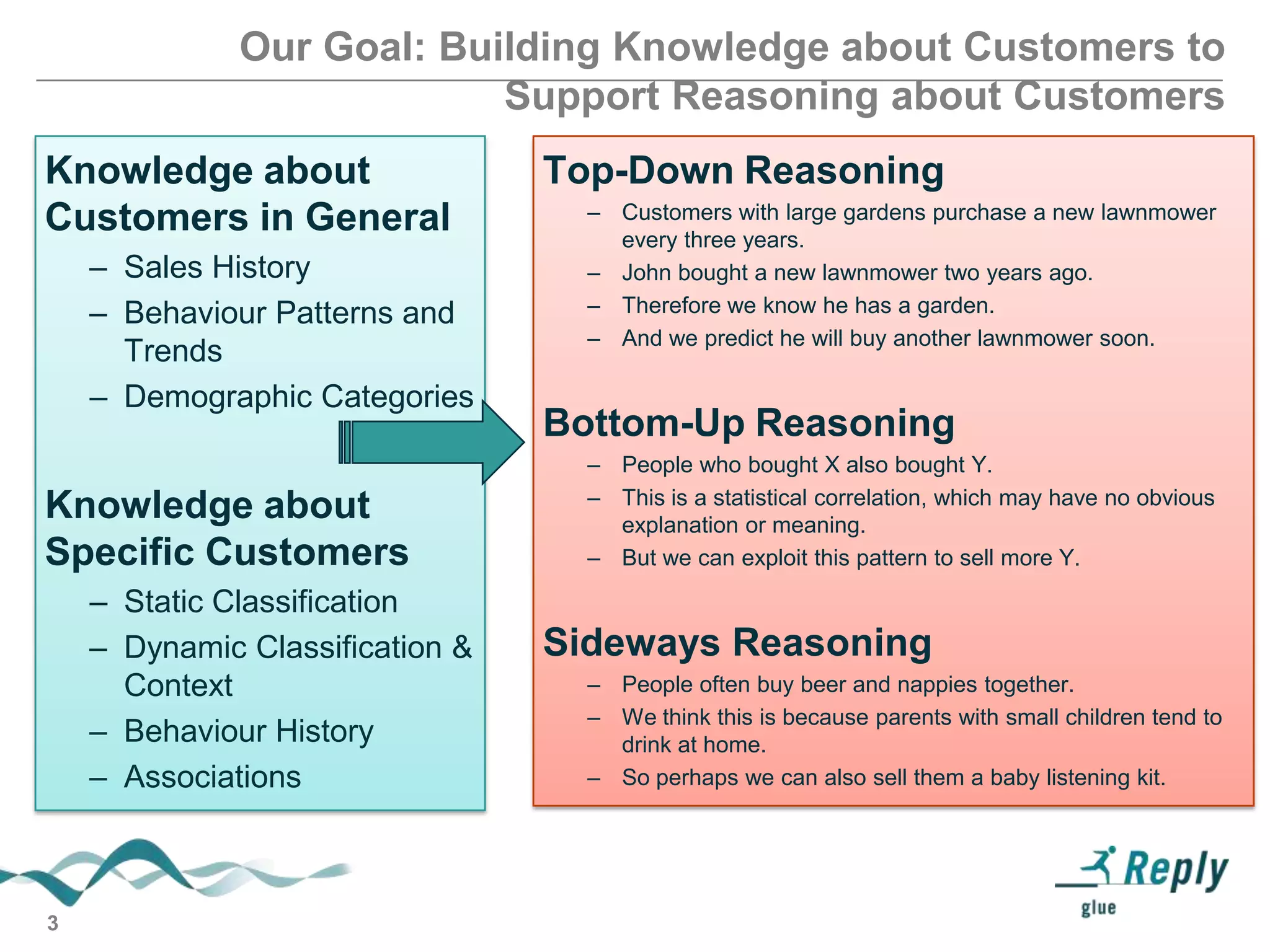
Our Goal: Building Knowledge about Customers to
Support Reasoning about Customers
Knowledge about
Customers in General
– Sales History
– Behaviour Patterns and
Trends
– Demographic Categories

Knowledge about
Specific Customers
– Static Classification
– Dynamic Classification &
Context
– Behaviour History
– Associations

3

Top-Down Reasoning
– Customers with large gardens purchase a new lawnmower
every three years.
– John bought a new lawnmower two years ago.
– Therefore we know he has a garden.
– And we predict he will buy another lawnmower soon.

Bottom-Up Reasoning
– People who bought X also bought Y.
– This is a statistical correlation, which may have no obvious
explanation or meaning.
– But we can exploit this pattern to sell more Y.

Sideways Reasoning
– People often buy beer and nappies together.
– We think this is because parents with small children tend to
drink at home.
– So perhaps we can also sell them a baby listening kit.
The emergence of bottom-up reasoning
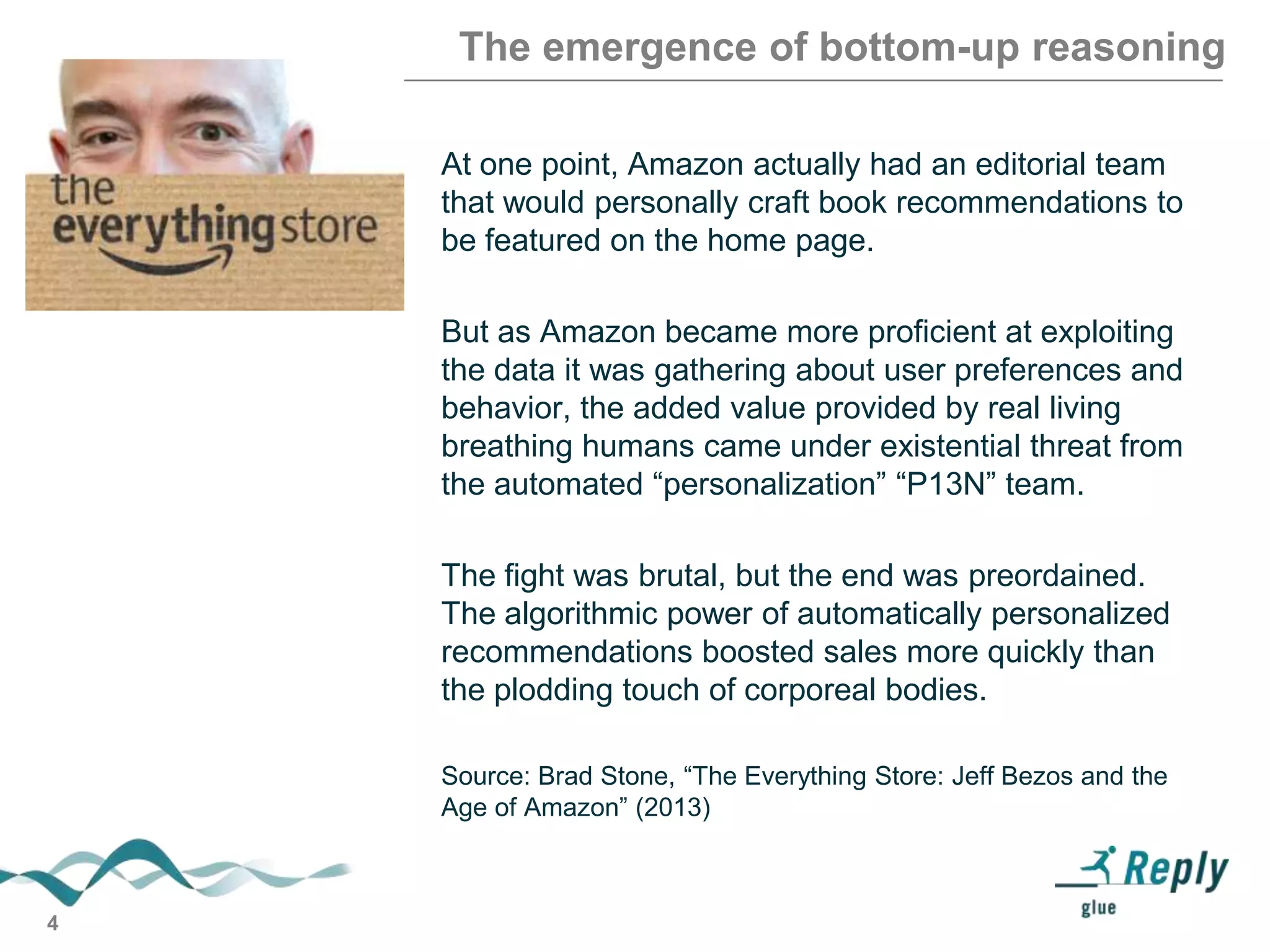
At one point, Amazon actually had an editorial team
that would personally craft book recommendations to
be featured on the home page.
But as Amazon became more proficient at exploiting
the data it was gathering about user preferences and
behavior, the added value provided by real living
breathing humans came under existential threat from
the automated ―personalization‖ ―P13N‖ team.

The fight was brutal, but the end was preordained.
The algorithmic power of automatically personalized
recommendations boosted sales more quickly than
the plodding touch of corporeal bodies.
Source: Brad Stone, ―The Everything Store: Jeff Bezos and the
Age of Amazon‖ (2013)

4
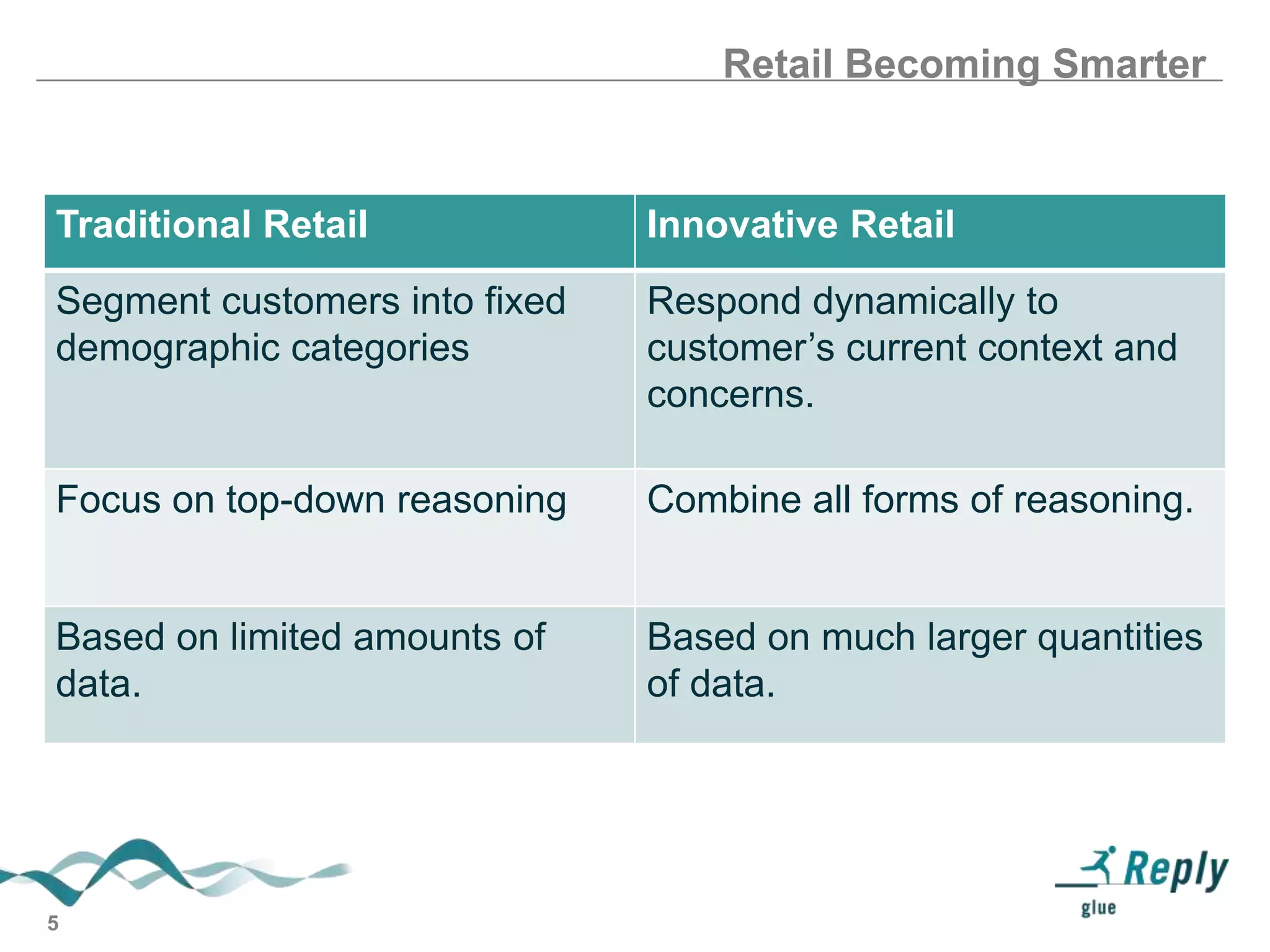
Retail Becoming Smarter

Traditional Retail

Innovative Retail

Segment customers into fixed
demographic categories

Respond dynamically to
customer’s current context and
concerns.

Focus on top-down reasoning

Combine all forms of reasoning.

Based on limited amounts of
data.

Based on much larger quantities
of data.

5
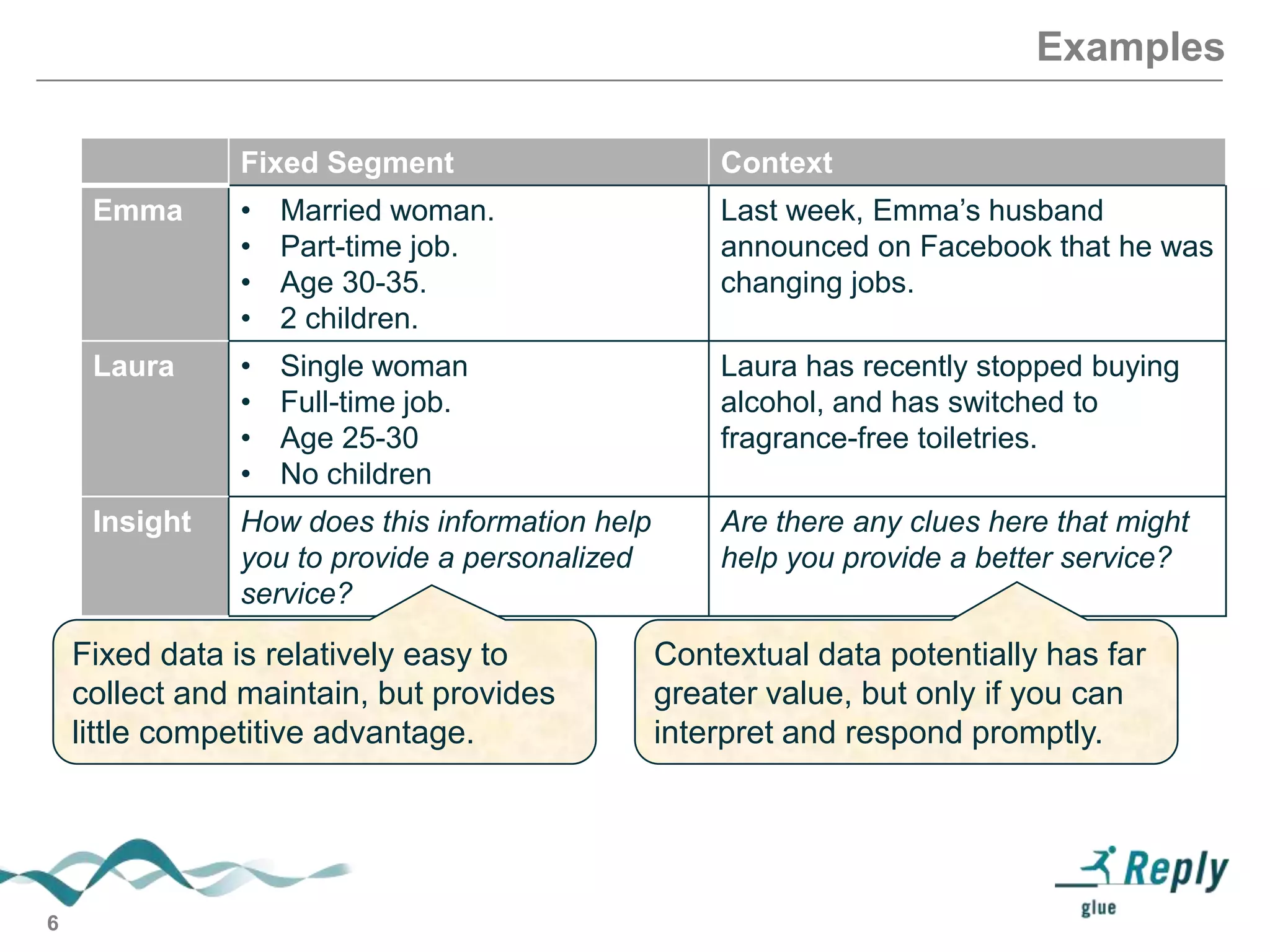
Examples
Fixed Segment

Context

Emma

•
•
•
•

Married woman.
Part-time job.
Age 30-35.
2 children.

Last week, Emma’s husband
announced on Facebook that he was
changing jobs.

Laura

•
•
•
•

Single woman
Full-time job.
Age 25-30
No children

Laura has recently stopped buying
alcohol, and has switched to
fragrance-free toiletries.

Insight

How does this information help
you to provide a personalized
service?

Fixed data is relatively easy to
collect and maintain, but provides
little competitive advantage.

6

Are there any clues here that might
help you provide a better service?

Contextual data potentially has far
greater value, but only if you can
interpret and respond promptly.
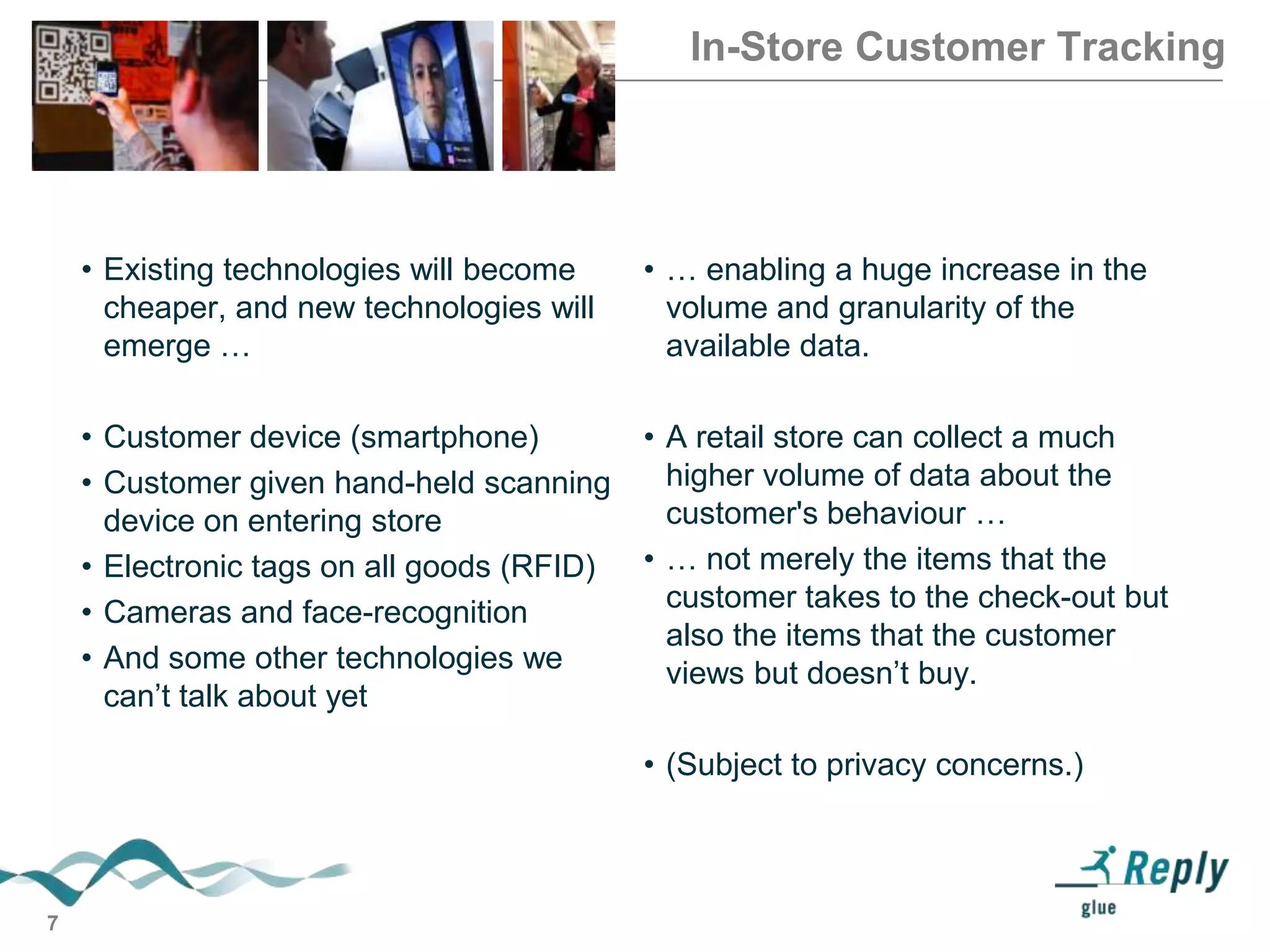
In-Store Customer Tracking

• Existing technologies will become
cheaper, and new technologies will
emerge …

• … enabling a huge increase in the
volume and granularity of the
available data.

• Customer device (smartphone)
• Customer given hand-held scanning
device on entering store
• Electronic tags on all goods (RFID)
• Cameras and face-recognition
• And some other technologies we
can’t talk about yet

• A retail store can collect a much
higher volume of data about the
customer's behaviour …
• … not merely the items that the
customer takes to the check-out but
also the items that the customer
views but doesn’t buy.
• (Subject to privacy concerns.)

7
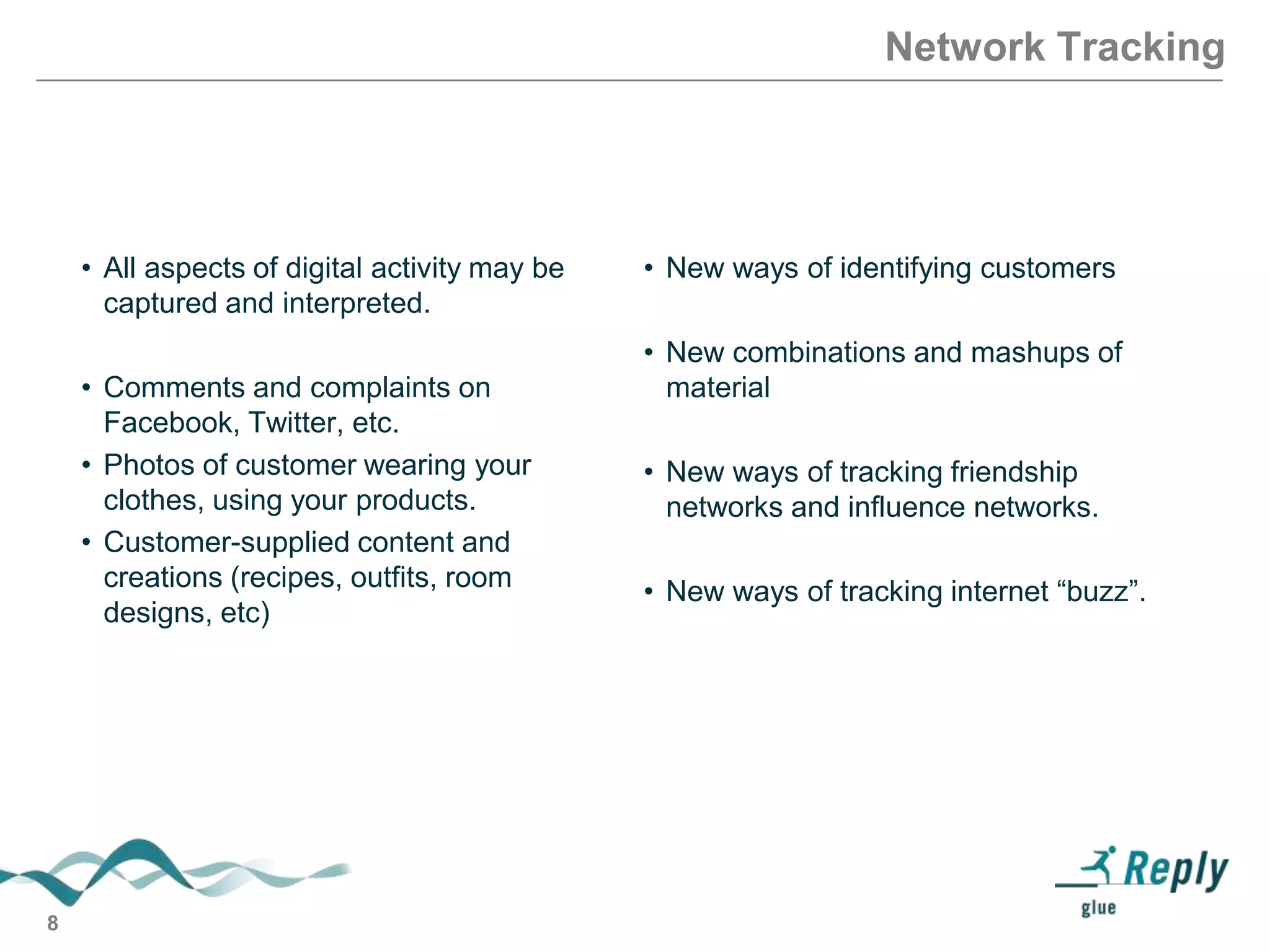
Network Tracking

• All aspects of digital activity may be
captured and interpreted.
• Comments and complaints on
Facebook, Twitter, etc.
• Photos of customer wearing your
clothes, using your products.
• Customer-supplied content and
creations (recipes, outfits, room
designs, etc)

8

• New ways of identifying customers
• New combinations and mashups of
material
• New ways of tracking friendship
networks and influence networks.
• New ways of tracking internet ―buzz‖.
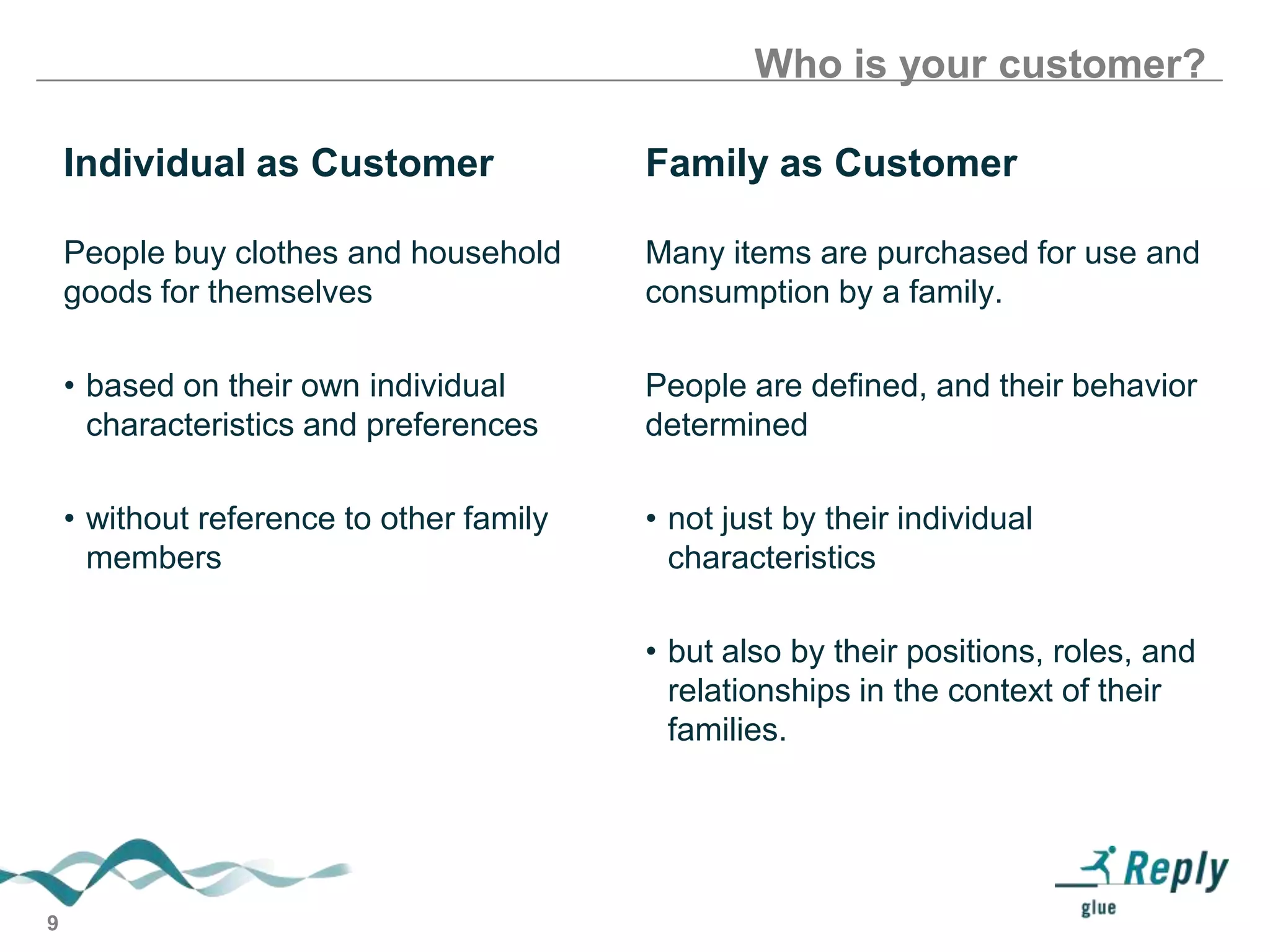
Who is your customer?
Individual as Customer

Family as Customer

People buy clothes and household
goods for themselves

Many items are purchased for use and
consumption by a family.

• based on their own individual
characteristics and preferences

People are defined, and their behavior
determined

• without reference to other family
members

• not just by their individual
characteristics

• but also by their positions, roles, and
relationships in the context of their
families.

9
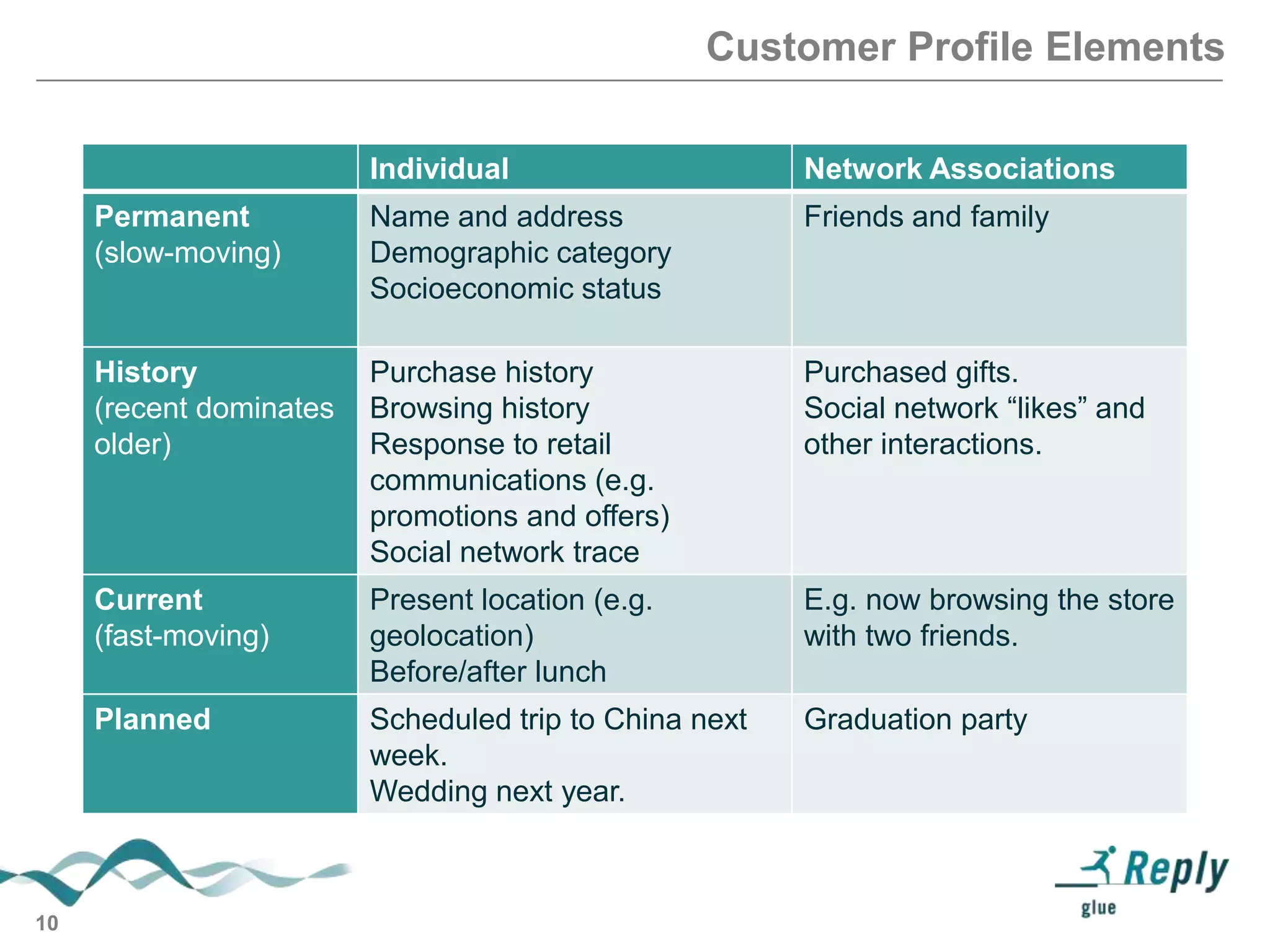
Customer Profile Elements
Individual
Permanent
(slow-moving)

Name and address
Demographic category
Socioeconomic status

Friends and family

History
(recent dominates
older)

Purchase history
Browsing history
Response to retail
communications (e.g.
promotions and offers)
Social network trace

Purchased gifts.
Social network ―likes‖ and
other interactions.

Current
(fast-moving)

Present location (e.g.
geolocation)
Before/after lunch

E.g. now browsing the store
with two friends.

Planned

10

Network Associations

Scheduled trip to China next
week.
Wedding next year.

Graduation party
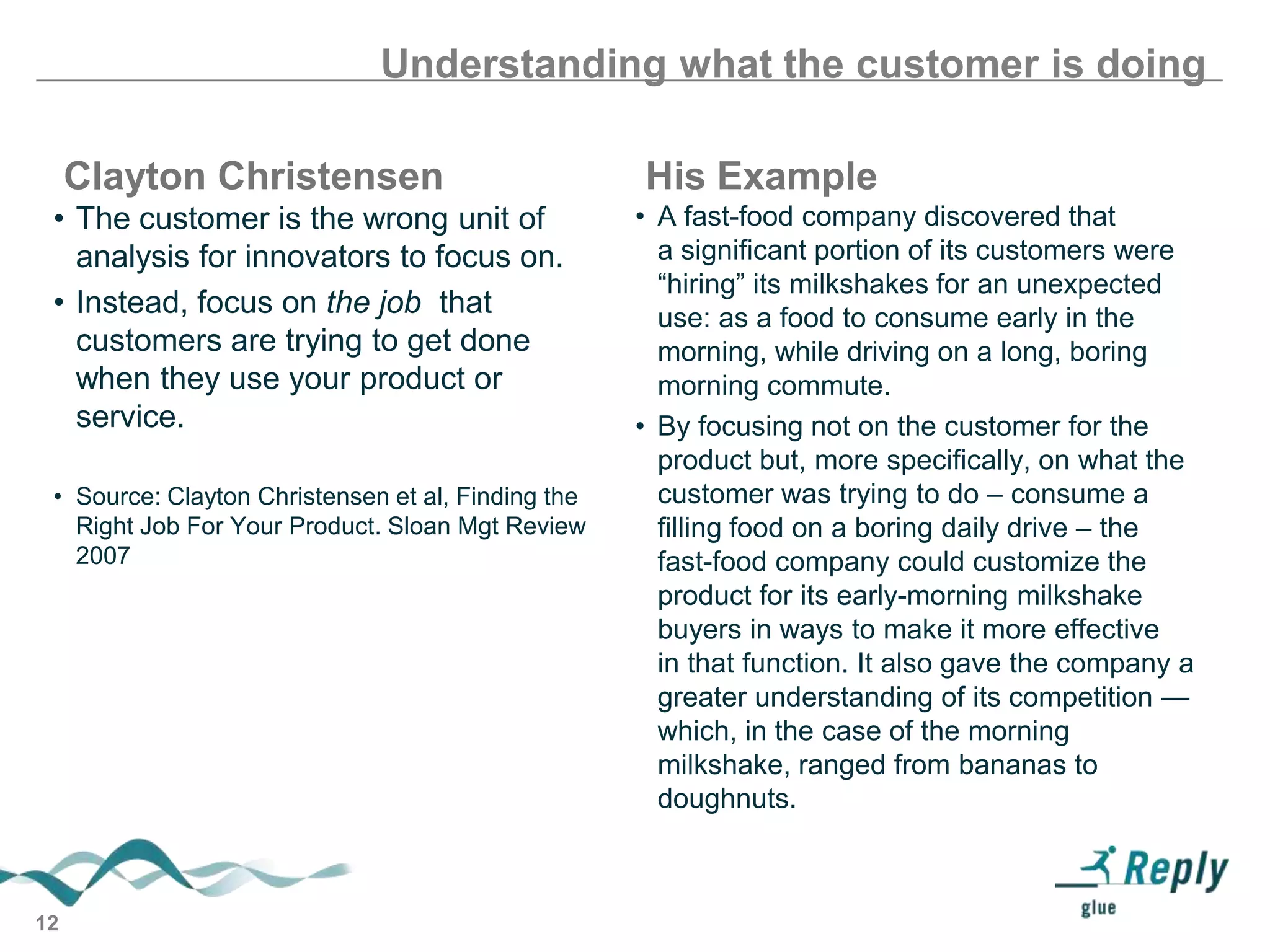
Understanding what the customer is doing
Clayton Christensen
• The customer is the wrong unit of
analysis for innovators to focus on.
• Instead, focus on the job that
customers are trying to get done
when they use your product or
service.
• Source: Clayton Christensen et al, Finding the
Right Job For Your Product. Sloan Mgt Review
2007

12

His Example
• A fast-food company discovered that
a significant portion of its customers were
―hiring‖ its milkshakes for an unexpected
use: as a food to consume early in the
morning, while driving on a long, boring
morning commute.
• By focusing not on the customer for the
product but, more specifically, on what the
customer was trying to do – consume a
filling food on a boring daily drive – the
fast-food company could customize the
product for its early-morning milkshake
buyers in ways to make it more effective
in that function. It also gave the company a
greater understanding of its competition —
which, in the case of the morning
milkshake, ranged from bananas to
doughnuts.
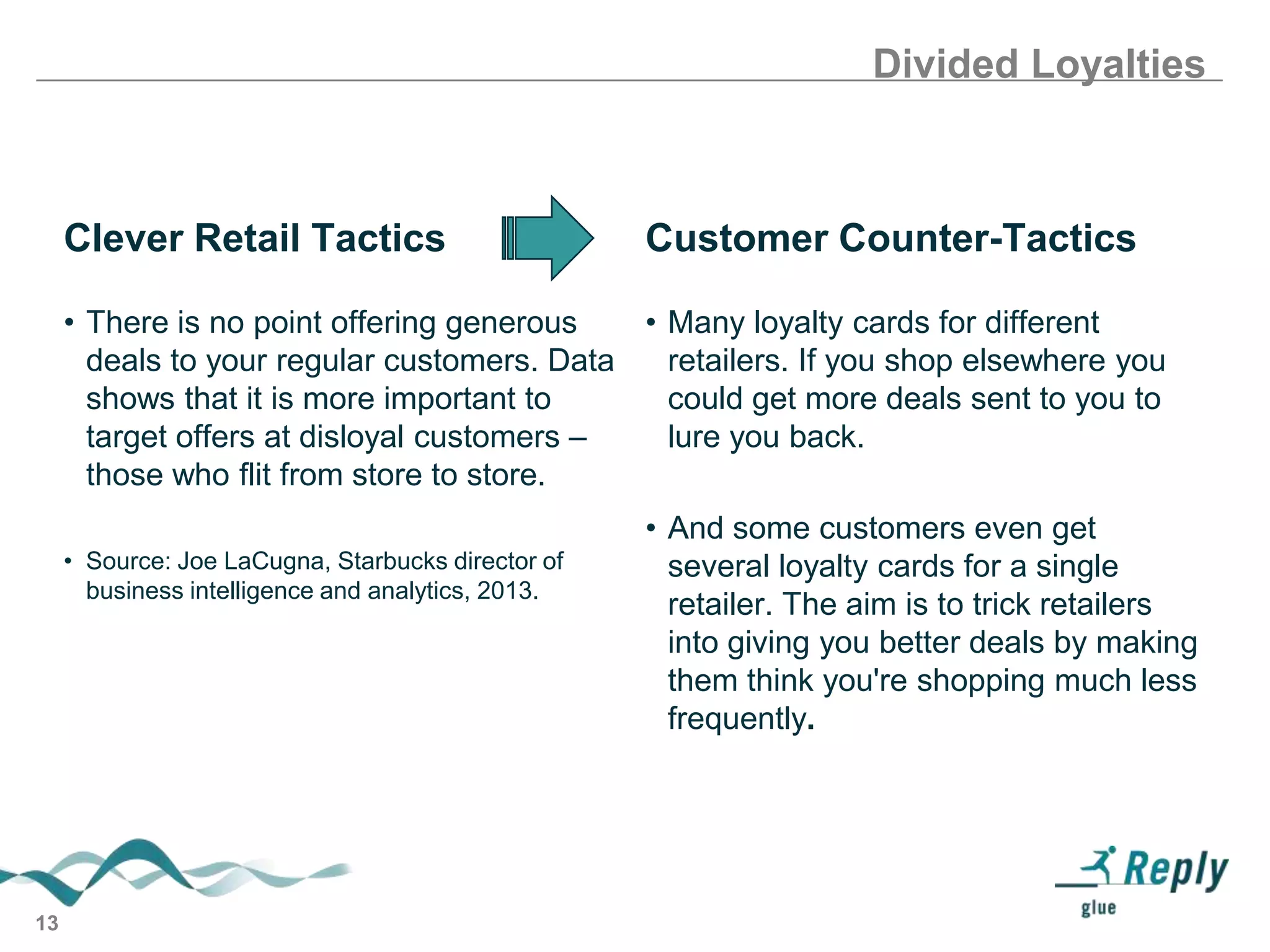
Divided Loyalties

Clever Retail Tactics

Customer Counter-Tactics

• There is no point offering generous
• Many loyalty cards for different
deals to your regular customers. Data
retailers. If you shop elsewhere you
shows that it is more important to
could get more deals sent to you to
target offers at disloyal customers –
lure you back.
those who flit from store to store.
• Source: Joe LaCugna, Starbucks director of
business intelligence and analytics, 2013.

13

• And some customers even get
several loyalty cards for a single
retailer. The aim is to trick retailers
into giving you better deals by making
them think you're shopping much less
frequently.
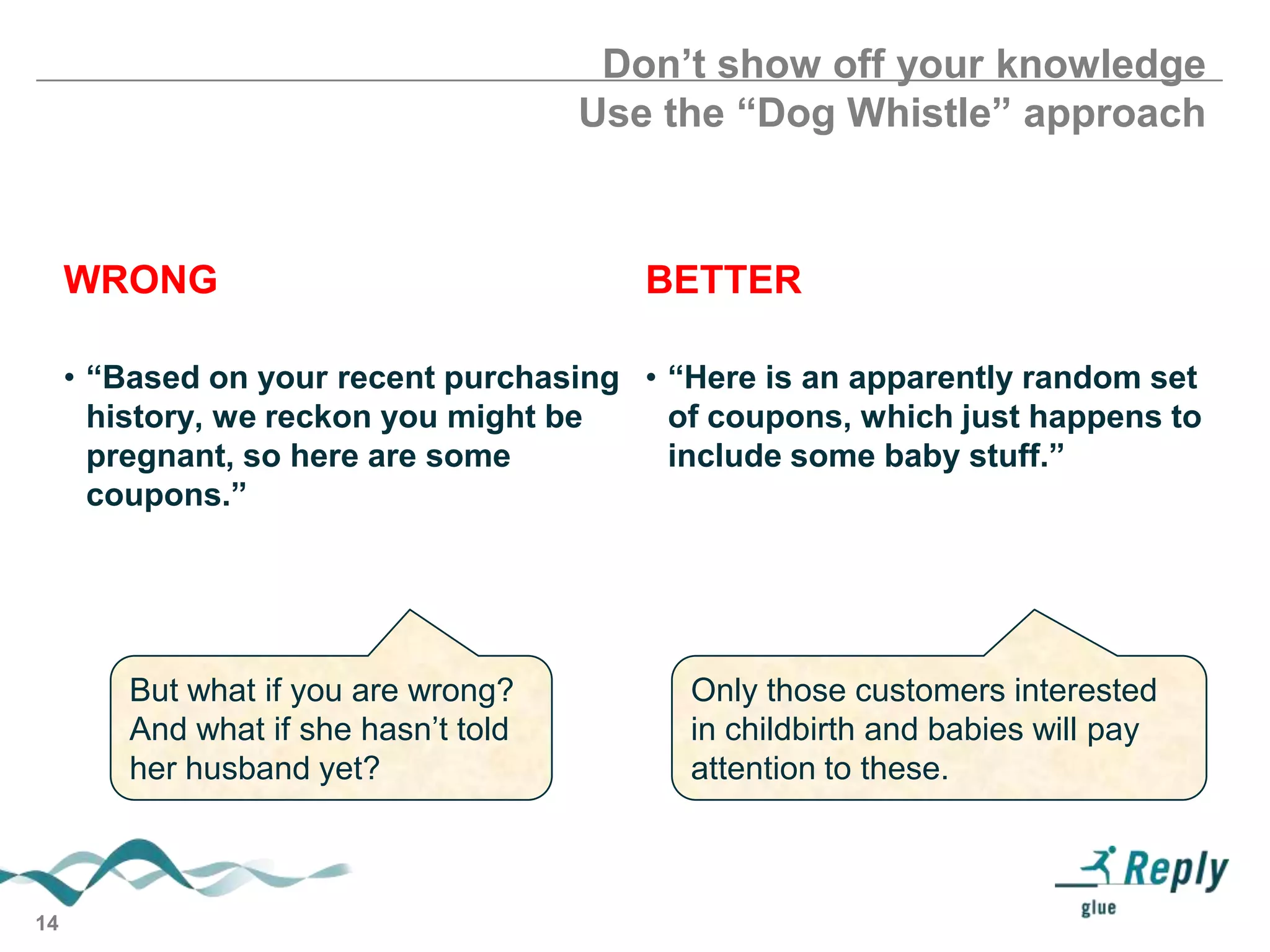
Don’t show off your knowledge
Use the “Dog Whistle” approach

WRONG

BETTER

• “Based on your recent purchasing • “Here is an apparently random set
history, we reckon you might be
of coupons, which just happens to
pregnant, so here are some
include some baby stuff.”
coupons.”

But what if you are wrong?
And what if she hasn’t told
her husband yet?

14

Only those customers interested
in childbirth and babies will pay
attention to these.
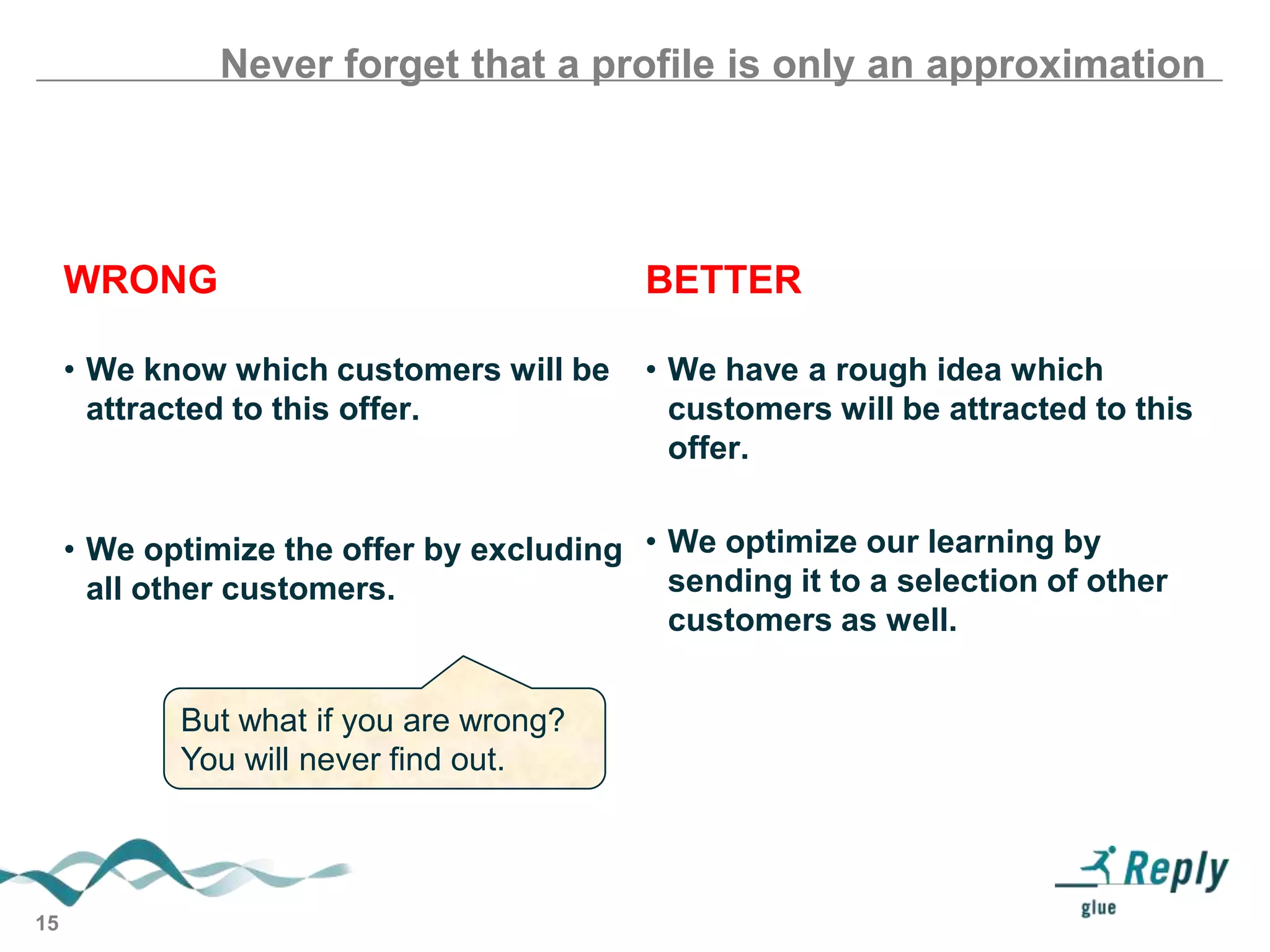
Never forget that a profile is only an approximation

WRONG

BETTER

• We know which customers will be
attracted to this offer.

• We have a rough idea which
customers will be attracted to this
offer.

• We optimize the offer by excluding • We optimize our learning by
sending it to a selection of other
all other customers.
customers as well.
But what if you are wrong?
You will never find out.

15
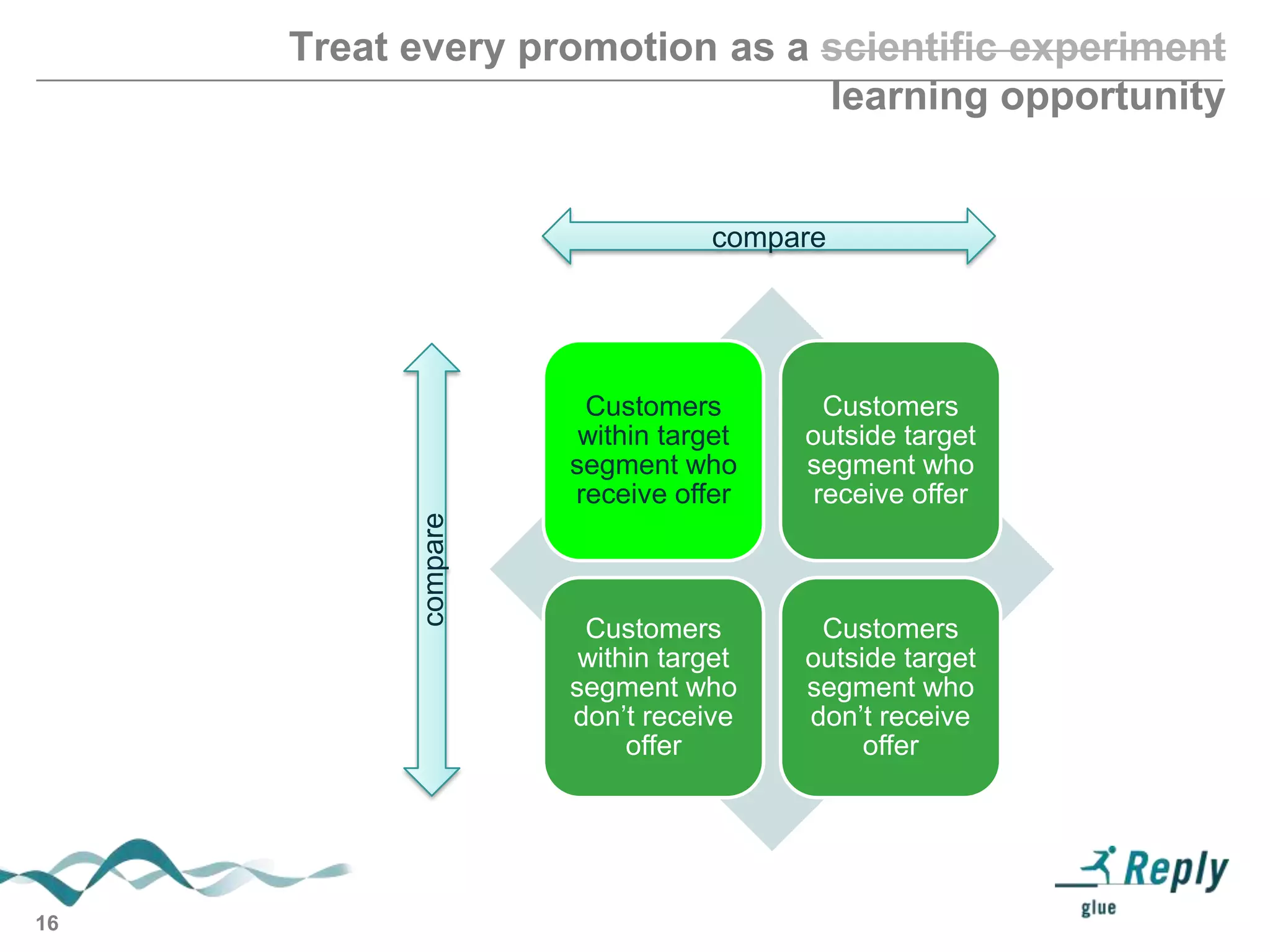
Treat every promotion as a scientific experiment
learning opportunity

compare

compare

Customers
within target
segment who
receive offer

16

Customers
outside target
segment who
receive offer

Customers
within target
segment who
don’t receive
offer

Customers
outside target
segment who
don’t receive
offer
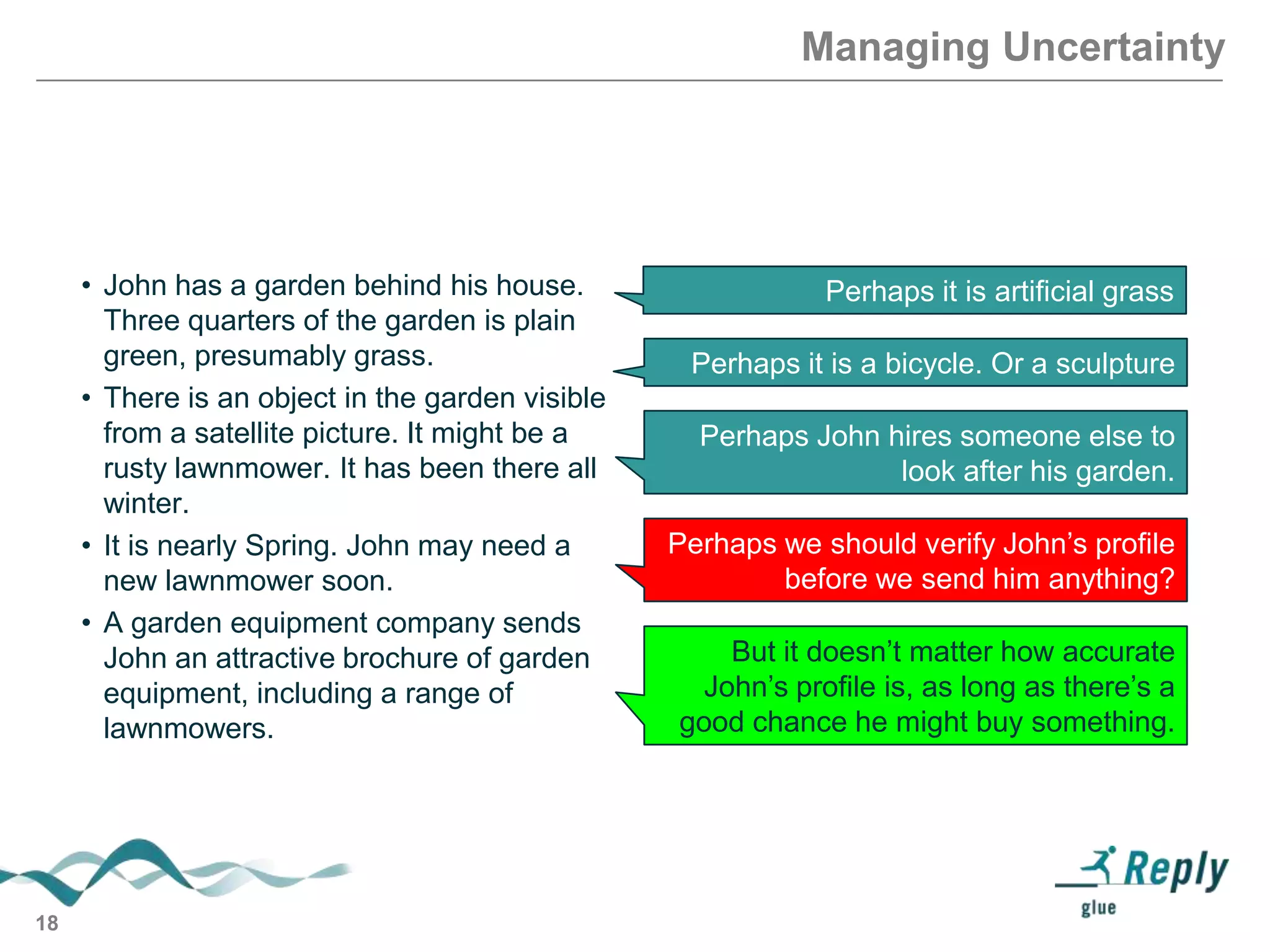
Managing Uncertainty

• John has a garden behind his house.
Three quarters of the garden is plain
green, presumably grass.
• There is an object in the garden visible
from a satellite picture. It might be a
rusty lawnmower. It has been there all
winter.
• It is nearly Spring. John may need a
new lawnmower soon.
• A garden equipment company sends
John an attractive brochure of garden
equipment, including a range of
lawnmowers.

18

Perhaps it is artificial grass
Perhaps it is a bicycle. Or a sculpture
Perhaps John hires someone else to
look after his garden.
Perhaps we should verify John’s profile
before we send him anything?
But it doesn’t matter how accurate
John’s profile is, as long as there’s a
good chance he might buy something.
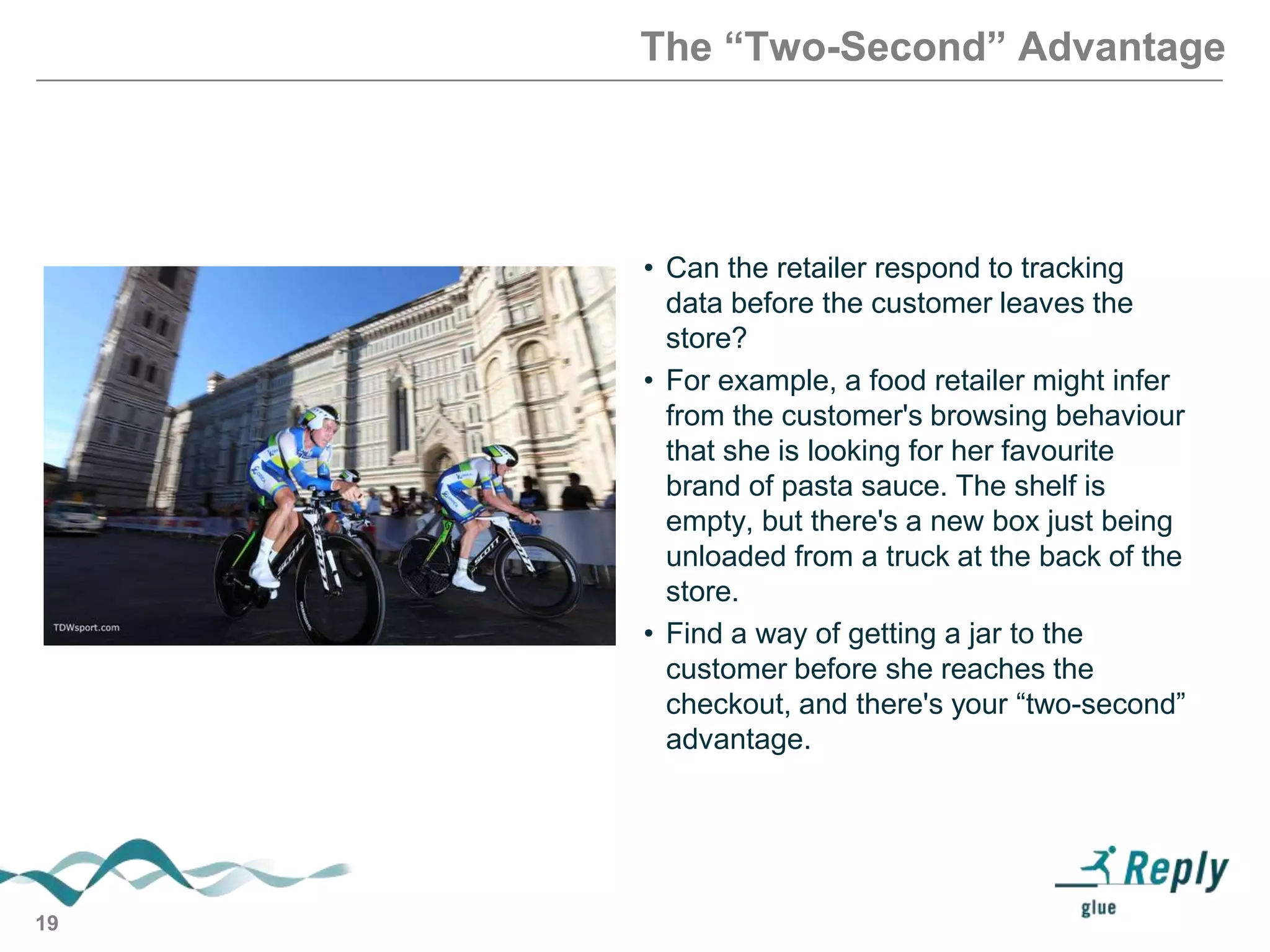
The “Two-Second” Advantage

• Can the retailer respond to tracking
data before the customer leaves the
store?
• For example, a food retailer might infer
from the customer's browsing behaviour
that she is looking for her favourite
brand of pasta sauce. The shelf is
empty, but there's a new box just being
unloaded from a truck at the back of the
store.
• Find a way of getting a jar to the
customer before she reaches the
checkout, and there's your ―two-second‖
advantage.

19
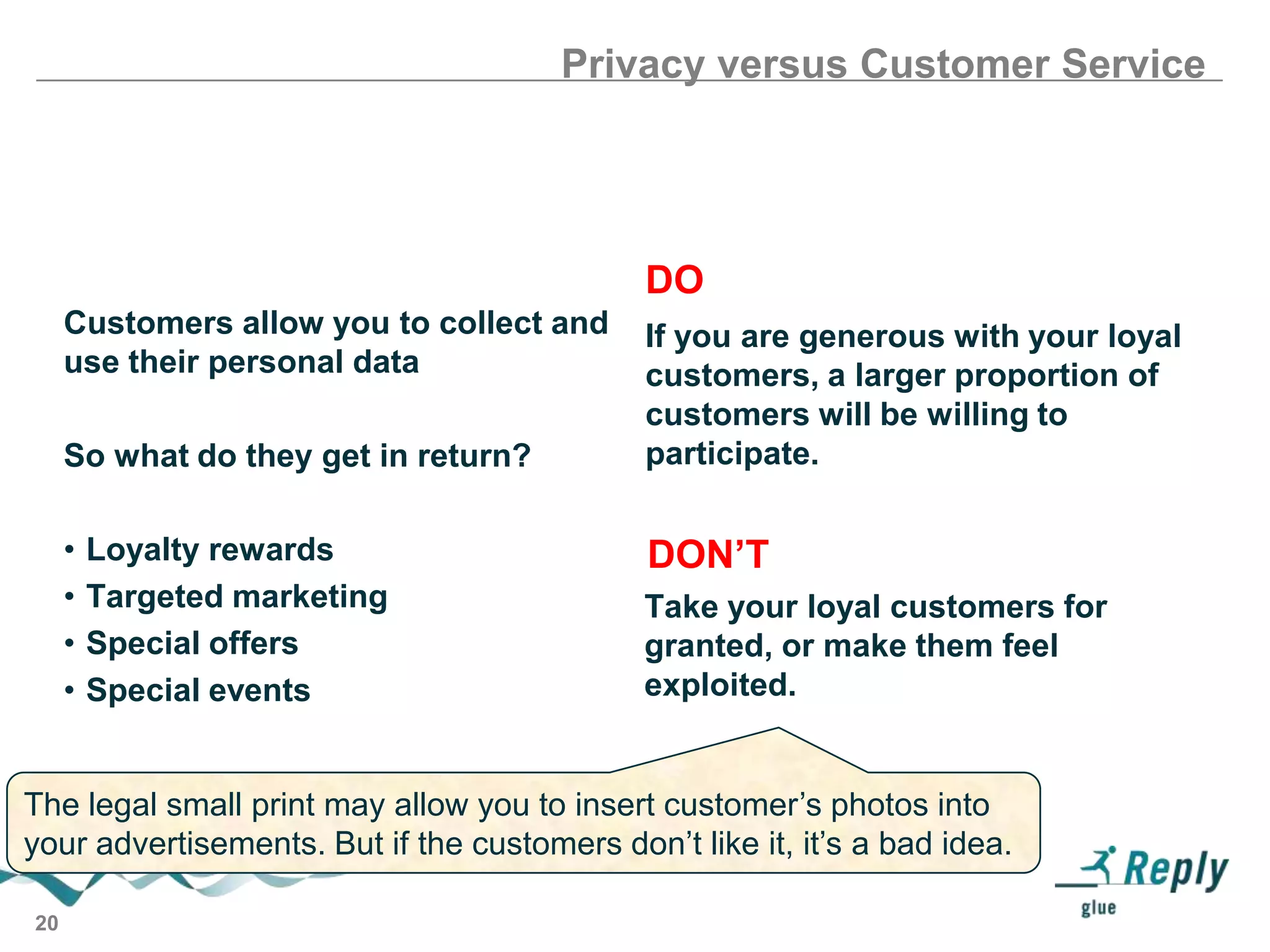
Privacy versus Customer Service

DO
Customers allow you to collect and
use their personal data

So what do they get in return?
•
•
•
•

Loyalty rewards
Targeted marketing
Special offers
Special events

If you are generous with your loyal
customers, a larger proportion of
customers will be willing to
participate.

DON’T
Take your loyal customers for
granted, or make them feel
exploited.

The legal small print may allow you to insert customer’s photos into
your advertisements. But if the customers don’t like it, it’s a bad idea.
20
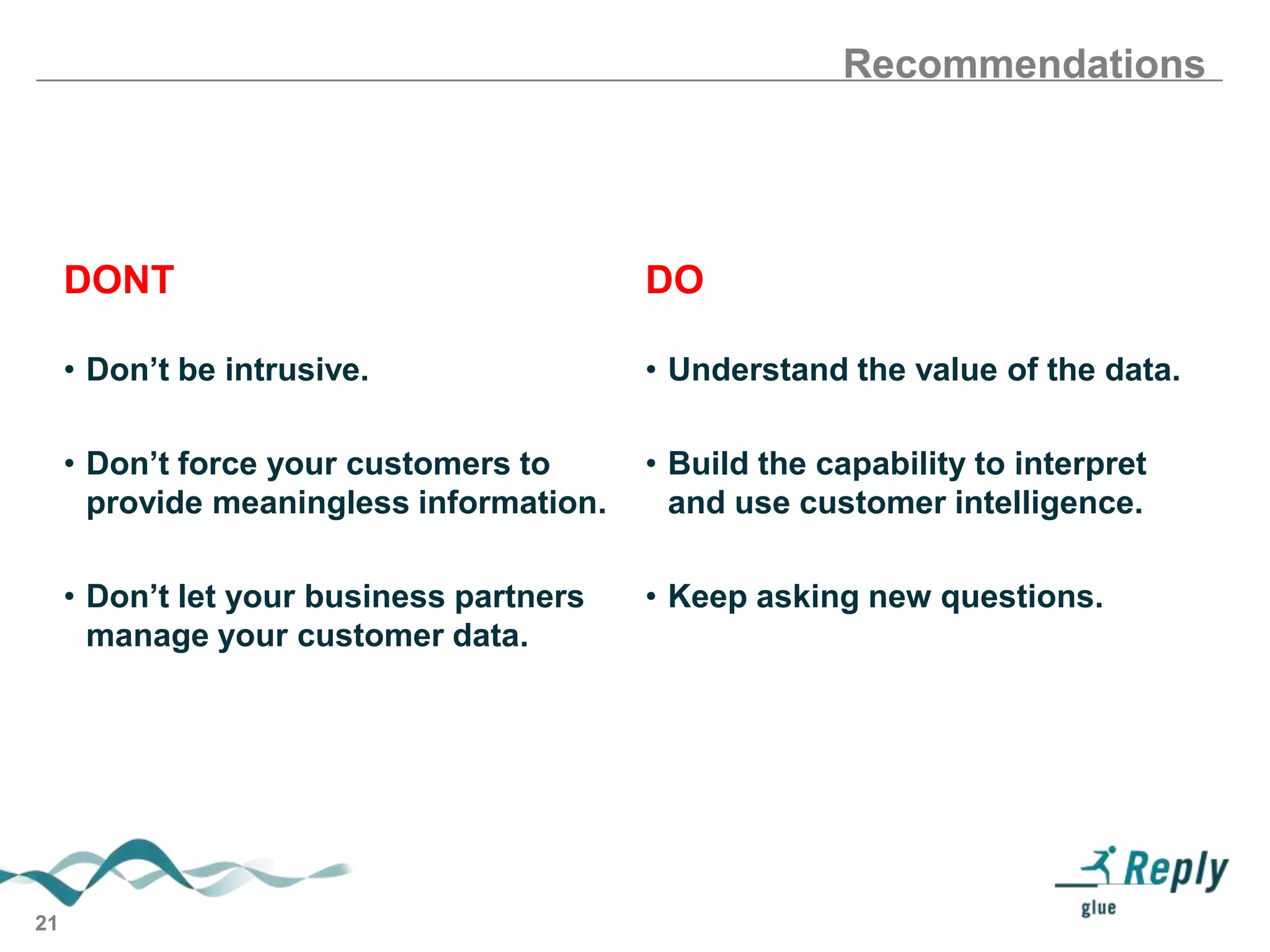
Recommendations

DONT
• Don’t be intrusive.

• Understand the value of the data.

• Don’t force your customers to
provide meaningless information.

• Build the capability to interpret
and use customer intelligence.

• Don’t let your business partners
manage your customer data.

21

DO

• Keep asking new questions.
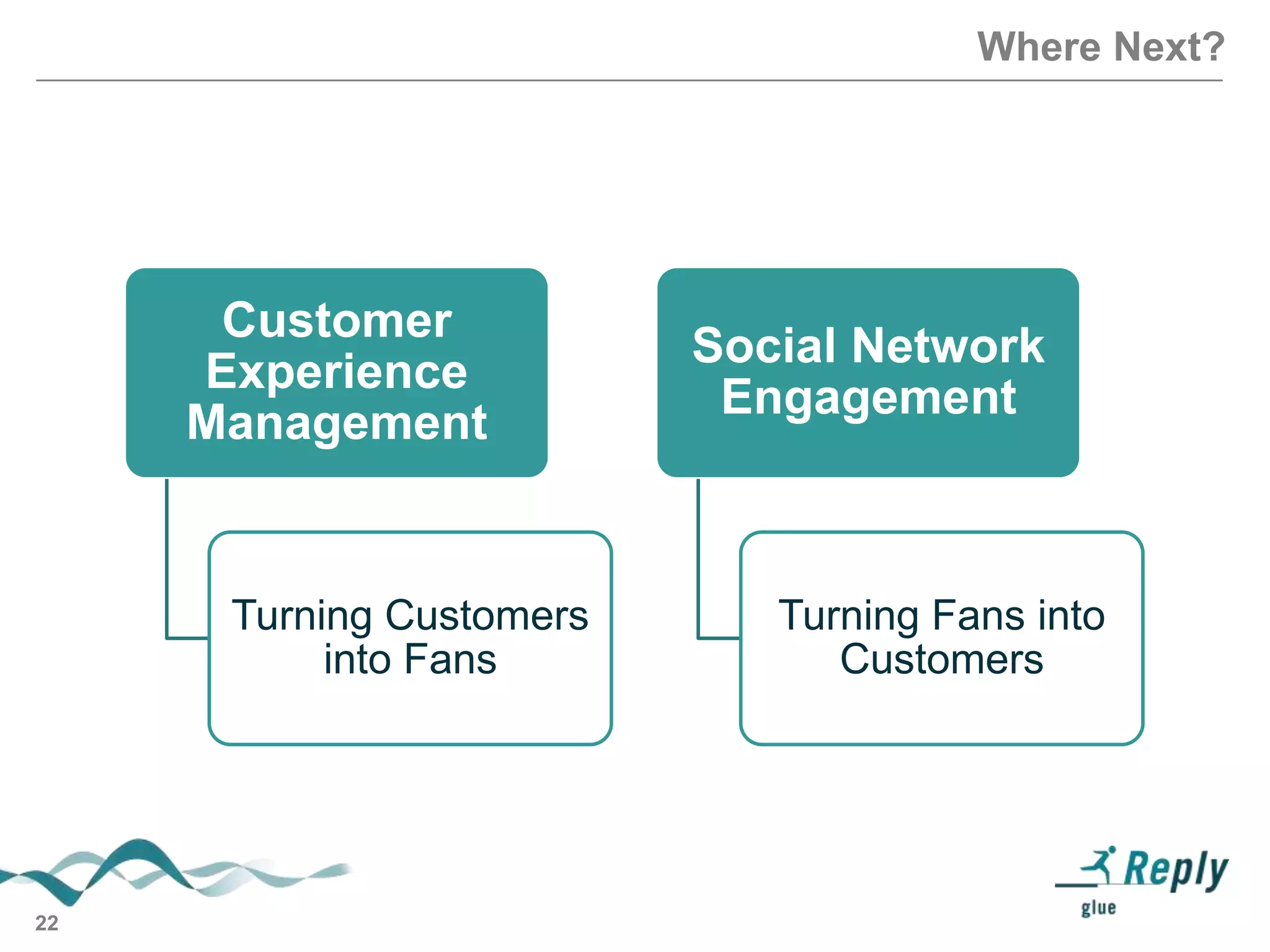
Where Next?

Customer
Experience
Management

Turning Customers
into Fans

22

Social Network
Engagement

Turning Fans into
Customers
Contacts
www.replyltd.co.uk.
r.veryard@replyltd.co.uk

23

On Customer Insight

  • 1.
    On Customer Insight RichardVeryard October 2013
  • 2.
    Contents Our Goal • BuildingKnowledge about Customers • To Support Reasoning about Customers Sources of Knowledge • Customer Tracking • Customer Profiling • Exploration and Experiment Supporting Reasoning • Managing Uncertainty • Managing Privacy 2
  • 3.
    Our Goal: BuildingKnowledge about Customers to Support Reasoning about Customers Knowledge about Customers in General – Sales History – Behaviour Patterns and Trends – Demographic Categories Knowledge about Specific Customers – Static Classification – Dynamic Classification & Context – Behaviour History – Associations 3 Top-Down Reasoning – Customers with large gardens purchase a new lawnmower every three years. – John bought a new lawnmower two years ago. – Therefore we know he has a garden. – And we predict he will buy another lawnmower soon. Bottom-Up Reasoning – People who bought X also bought Y. – This is a statistical correlation, which may have no obvious explanation or meaning. – But we can exploit this pattern to sell more Y. Sideways Reasoning – People often buy beer and nappies together. – We think this is because parents with small children tend to drink at home. – So perhaps we can also sell them a baby listening kit.
  • 4.
    The emergence ofbottom-up reasoning At one point, Amazon actually had an editorial team that would personally craft book recommendations to be featured on the home page. But as Amazon became more proficient at exploiting the data it was gathering about user preferences and behavior, the added value provided by real living breathing humans came under existential threat from the automated ―personalization‖ ―P13N‖ team. The fight was brutal, but the end was preordained. The algorithmic power of automatically personalized recommendations boosted sales more quickly than the plodding touch of corporeal bodies. Source: Brad Stone, ―The Everything Store: Jeff Bezos and the Age of Amazon‖ (2013) 4
  • 5.
    Retail Becoming Smarter TraditionalRetail Innovative Retail Segment customers into fixed demographic categories Respond dynamically to customer’s current context and concerns. Focus on top-down reasoning Combine all forms of reasoning. Based on limited amounts of data. Based on much larger quantities of data. 5
  • 6.
    Examples Fixed Segment Context Emma • • • • Married woman. Part-timejob. Age 30-35. 2 children. Last week, Emma’s husband announced on Facebook that he was changing jobs. Laura • • • • Single woman Full-time job. Age 25-30 No children Laura has recently stopped buying alcohol, and has switched to fragrance-free toiletries. Insight How does this information help you to provide a personalized service? Fixed data is relatively easy to collect and maintain, but provides little competitive advantage. 6 Are there any clues here that might help you provide a better service? Contextual data potentially has far greater value, but only if you can interpret and respond promptly.
  • 7.
    In-Store Customer Tracking •Existing technologies will become cheaper, and new technologies will emerge … • … enabling a huge increase in the volume and granularity of the available data. • Customer device (smartphone) • Customer given hand-held scanning device on entering store • Electronic tags on all goods (RFID) • Cameras and face-recognition • And some other technologies we can’t talk about yet • A retail store can collect a much higher volume of data about the customer's behaviour … • … not merely the items that the customer takes to the check-out but also the items that the customer views but doesn’t buy. • (Subject to privacy concerns.) 7
  • 8.
    Network Tracking • Allaspects of digital activity may be captured and interpreted. • Comments and complaints on Facebook, Twitter, etc. • Photos of customer wearing your clothes, using your products. • Customer-supplied content and creations (recipes, outfits, room designs, etc) 8 • New ways of identifying customers • New combinations and mashups of material • New ways of tracking friendship networks and influence networks. • New ways of tracking internet ―buzz‖.
  • 9.
    Who is yourcustomer? Individual as Customer Family as Customer People buy clothes and household goods for themselves Many items are purchased for use and consumption by a family. • based on their own individual characteristics and preferences People are defined, and their behavior determined • without reference to other family members • not just by their individual characteristics • but also by their positions, roles, and relationships in the context of their families. 9
  • 10.
    Customer Profile Elements Individual Permanent (slow-moving) Nameand address Demographic category Socioeconomic status Friends and family History (recent dominates older) Purchase history Browsing history Response to retail communications (e.g. promotions and offers) Social network trace Purchased gifts. Social network ―likes‖ and other interactions. Current (fast-moving) Present location (e.g. geolocation) Before/after lunch E.g. now browsing the store with two friends. Planned 10 Network Associations Scheduled trip to China next week. Wedding next year. Graduation party
  • 11.
    Understanding what thecustomer is doing Clayton Christensen • The customer is the wrong unit of analysis for innovators to focus on. • Instead, focus on the job that customers are trying to get done when they use your product or service. • Source: Clayton Christensen et al, Finding the Right Job For Your Product. Sloan Mgt Review 2007 12 His Example • A fast-food company discovered that a significant portion of its customers were ―hiring‖ its milkshakes for an unexpected use: as a food to consume early in the morning, while driving on a long, boring morning commute. • By focusing not on the customer for the product but, more specifically, on what the customer was trying to do – consume a filling food on a boring daily drive – the fast-food company could customize the product for its early-morning milkshake buyers in ways to make it more effective in that function. It also gave the company a greater understanding of its competition — which, in the case of the morning milkshake, ranged from bananas to doughnuts.
  • 12.
    Divided Loyalties Clever RetailTactics Customer Counter-Tactics • There is no point offering generous • Many loyalty cards for different deals to your regular customers. Data retailers. If you shop elsewhere you shows that it is more important to could get more deals sent to you to target offers at disloyal customers – lure you back. those who flit from store to store. • Source: Joe LaCugna, Starbucks director of business intelligence and analytics, 2013. 13 • And some customers even get several loyalty cards for a single retailer. The aim is to trick retailers into giving you better deals by making them think you're shopping much less frequently.
  • 13.
    Don’t show offyour knowledge Use the “Dog Whistle” approach WRONG BETTER • “Based on your recent purchasing • “Here is an apparently random set history, we reckon you might be of coupons, which just happens to pregnant, so here are some include some baby stuff.” coupons.” But what if you are wrong? And what if she hasn’t told her husband yet? 14 Only those customers interested in childbirth and babies will pay attention to these.
  • 14.
    Never forget thata profile is only an approximation WRONG BETTER • We know which customers will be attracted to this offer. • We have a rough idea which customers will be attracted to this offer. • We optimize the offer by excluding • We optimize our learning by sending it to a selection of other all other customers. customers as well. But what if you are wrong? You will never find out. 15
  • 15.
    Treat every promotionas a scientific experiment learning opportunity compare compare Customers within target segment who receive offer 16 Customers outside target segment who receive offer Customers within target segment who don’t receive offer Customers outside target segment who don’t receive offer
  • 16.
    Managing Uncertainty • Johnhas a garden behind his house. Three quarters of the garden is plain green, presumably grass. • There is an object in the garden visible from a satellite picture. It might be a rusty lawnmower. It has been there all winter. • It is nearly Spring. John may need a new lawnmower soon. • A garden equipment company sends John an attractive brochure of garden equipment, including a range of lawnmowers. 18 Perhaps it is artificial grass Perhaps it is a bicycle. Or a sculpture Perhaps John hires someone else to look after his garden. Perhaps we should verify John’s profile before we send him anything? But it doesn’t matter how accurate John’s profile is, as long as there’s a good chance he might buy something.
  • 17.
    The “Two-Second” Advantage •Can the retailer respond to tracking data before the customer leaves the store? • For example, a food retailer might infer from the customer's browsing behaviour that she is looking for her favourite brand of pasta sauce. The shelf is empty, but there's a new box just being unloaded from a truck at the back of the store. • Find a way of getting a jar to the customer before she reaches the checkout, and there's your ―two-second‖ advantage. 19
  • 18.
    Privacy versus CustomerService DO Customers allow you to collect and use their personal data So what do they get in return? • • • • Loyalty rewards Targeted marketing Special offers Special events If you are generous with your loyal customers, a larger proportion of customers will be willing to participate. DON’T Take your loyal customers for granted, or make them feel exploited. The legal small print may allow you to insert customer’s photos into your advertisements. But if the customers don’t like it, it’s a bad idea. 20
  • 19.
    Recommendations DONT • Don’t beintrusive. • Understand the value of the data. • Don’t force your customers to provide meaningless information. • Build the capability to interpret and use customer intelligence. • Don’t let your business partners manage your customer data. 21 DO • Keep asking new questions.
  • 20.
    Where Next? Customer Experience Management Turning Customers intoFans 22 Social Network Engagement Turning Fans into Customers
  • 21.

Editor's Notes

  • #4 Top-down reasoning (deductive)Bottom-up reasoning (inductive)Sideways reasoning (abductive)
  • #5 http://www.salon.com/2013/10/16/amazon_threat_or_menace/
  • #8 http://rvsoapbox.blogspot.de/2010/05/two-second-advantage.htmlhttp://www.business2community.com/customer-experience/2-massive-trends-impacting-your-customers-in-2013-0366486http://www.bbc.co.uk/news/technology-24803378http://www.avinteractive.com/news/49055/amscreen-face-detectionhttp://www.dijitalimaj.com/alamyDetail.aspx?img={308498AC-790C-4280-A622-158E8AFB7591}http://www.octarine.co.za/im-not-a-shoplifter/
  • #9 http://rvsoapbox.blogspot.de/2010/05/two-second-advantage.html
  • #10 http://archives.digitaltoday.in/businesstoday/22021999/cover.htmlSee also Healthcare organizations that have really "gotten it right" have long recognized that the patient is only part of the customer equation. Indeed, the family plays a vital role in the patient's overall perception of the care. The family is also a critical piece of making certain that the patient follows the treatment protocols or standards prescribed to the patient. The family contact is also often the one who completes your patient survey, especially on behalf of older patients.
  • #13 http://sloanreview.mit.edu/article/understanding-your-customer-isnt-enough/http://sloanreview.mit.edu/article/finding-the-right-job-for-your-product/http://rvsoapbox.blogspot.de/2009/05/customer-orientation.html
  • #14 http://www.theguardian.com/news/datablog/2013/oct/31/are-loyalty-cards-really-worth-it
  • #15 http://rvsoapbox.blogspot.co.uk/2008/08/responding-to-uncertainty.html
  • #18 Picture: Wikipediahttp://en.wikipedia.org/wiki/File:Schrodingers_cat.svgAustrian physicist Erwin Schrödinger proposed a thought experiment known as Schrödinger's cat to explore the consequences of uncertainty in quantum physics. If the cat is alive, then Schrödinger needs to buy catfood. If the cat is dead, he needs to buy a spade. According to Elster's logic, he might decide to buy both.At Schrödinger's local store, he is known as an infrequent purchaser of catfood. The storekeeper naturally infers that Schrödinger is a cat-owner, and this inference forms part of the storekeeper's model of the world. What the storekeeper doesn't know is that the cat is in mortal peril. Or perhaps Schrödinger is not buying the catfood for a real cat at all, but to procure a prop for one of his lectures.Businesses often construct imaginary pictures of their customers, inferring their personal circumstances and preferences from their buying habits. Sometimes these pictures are useful in predicting future behaviour, and for designing products and services that the customers might like. But I think there is a problem when businesses treat these pictures as if they were faithful representations of some reality.This is an ethical problem as well as an epistemological one. I have a recollection (I can't find the details right now) of a recent incident in which a British supermarket, having inferred that some of its female customers were pregnant, sent them a mailshot that assumed they were interested in babies. But this mailshot was experienced as intrusive and a breach of privacy, especially as some of the husbands and boyfriends hadn't even been told yet.http://rvsoapbox.blogspot.co.uk/2008/08/responding-to-uncertainty.html
  • #19 http://rvsoapbox.blogspot.co.uk/2008/09/responding-to-uncertainty-2.html
  • #20 http://rvsoapbox.blogspot.de/2010/05/two-second-advantage.htmlhttp://www.srm.de/news/road-cycling/uci-road-world-championships-men-ttt/