TEMPERATURE
DISSOLVED
OXYGEN (DO)
pH NITROGEN
PHOSPHATES
TURBIDITY
BIO-
INDICATORS
Water Quality Factors
Water Quality – Guided Notes
- pH level
- temperature (thermal pollution)
- turbidity
- bio-indicators
- dissolved oxygen
- salinity
- phosphates and nitrates (Phosphorous and
Nitrogen)
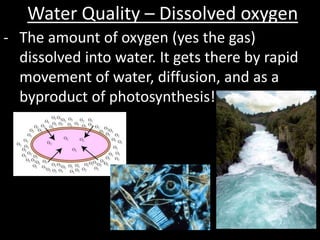
Water Quality – Dissolved oxygen
- The amount of oxygen (yes the gas)
dissolved into water. It gets there by rapid
movement of water, diffusion, and as a
byproduct of photosynthesis!
Water Quality – Salinity
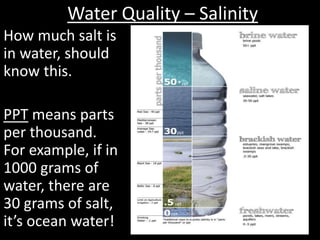
How much salt is
in water, should
know this.
PPT means parts
per thousand.
For example, if in
1000 grams of
water, there are
30 grams of salt,
it’s ocean water!
Water Quality – Thermal pollution
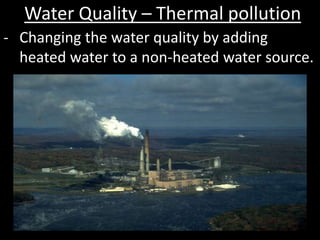
- Changing the water quality by adding
heated water to a non-heated water source.
TEMPERATURE
EFFECTS:
changes rate of photosynthesis
changes rate of respiration
changes DO in water
cold water holds more DO
hot water holds less DO
changes sensitivity of organisms to toxic
waste, parasites, disease.
TEMPERATURE
• Thermal pollution = adding warm water to
cold water.
CAUSES OF THERMAL POLLUTION:
• Industry (nuclear power plants, paper
mills)
• Urban Development (storm water runoff,
construction, soil erosion)
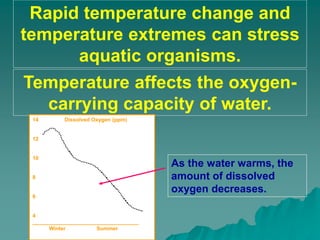
Temperature affects the oxygen-
carrying capacity of water.
Rapid temperature change and
temperature extremes can stress
aquatic organisms.
As the water warms, the
amount of dissolved
oxygen decreases.
14 Dissolved Oxygen (ppm)
12
10
8
6
4
____________________________________
Winter Summer
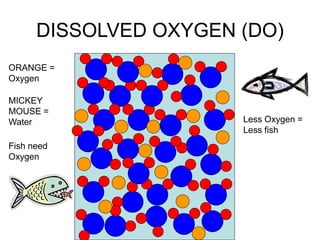
DISSOLVED OXYGEN (DO)
ORANGE =
Oxygen
MICKEY
MOUSE =
Water
Fish need
Oxygen
Less Oxygen =
Less fish
DISSOLVED OXYGEN (DO)
TO INCREASE DO:
• Much of DO comes from atmosphere
• Some of DO comes from photosynthesis
TO DECREASE DO:
• Add pollution
• Add organic waste
ORGANIC WASTE = LOW DO
• Organic waste = parts of once living things
EXAMPLES OF ORGANIC WASTE:
Sewage
Farm runoff
Discharge from food processing plants
HOW RAW SEWAGE LOWERS
DO
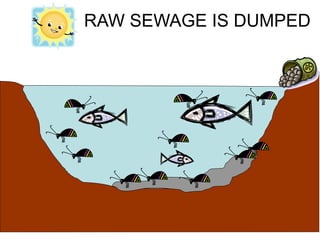
RAW SEWAGE GOES INTO WATER:
1. Decomposers chow down
2. Decomposers take up oxygen
3. Decomposers reproduce, taking up more
oxygen
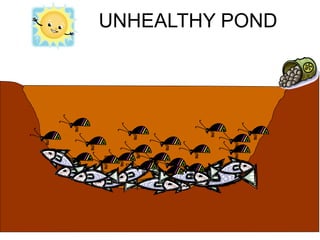
4. No more oxygen for other animals
5. Nothing left but decomposer & sewage-
filled water.
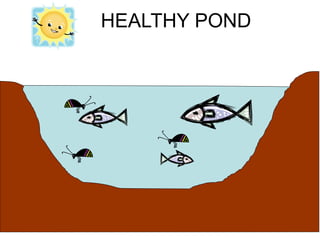
HEALTHY POND
RAW SEWAGE IS DUMPED
UNHEALTHY POND
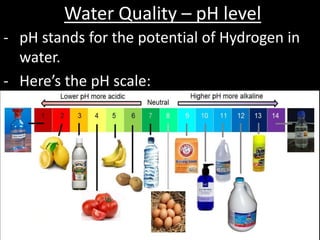
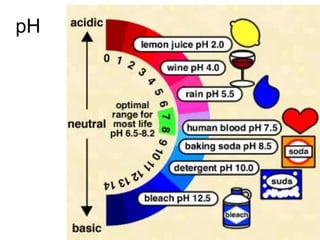
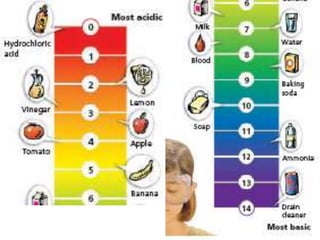
Water Quality – pH level
- pH stands for the potential of Hydrogen in
water.
- Here’s the pH scale:
pH
• pH = measure of concentration of
hydrogen ions in a substance
• Tells whether substance is:
ACID
BASE
NEUTRAL
pH
Measured on scale from 0 to 14
0 = highly acidic (HCl)
7 = neutral (pure water)
14 = highly basic (bleach)
Seawater pH ranges from 7.5 – 8.5
Average pH of ocean water = 7.8
pH of natural water = 6.5 – 8.5
Optimal range for life = 6.5 – 8.2
pH
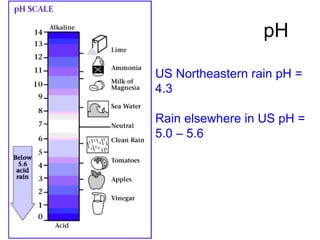
US Northeastern rain pH =
4.3
Rain elsewhere in US pH =
5.0 – 5.6
pH
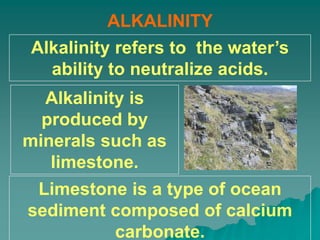
ALKALINITY
Alkalinity refers to the water’s
ability to neutralize acids.
Alkalinity is
produced by
minerals such as
limestone.
Limestone is a type of ocean
sediment composed of calcium
carbonate.
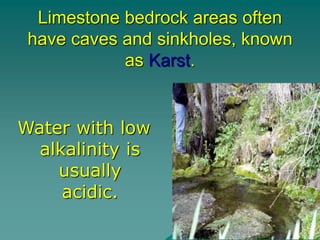
Limestone bedrock areas often
have caves and sinkholes, known
as Karst.
Water with low
alkalinity is
usually
acidic.
Ammonia
Ammonia is produced by the
decay of organic matter and
animal waste.
Ammonia is toxic to most
aquatic life, especially at high
pH.
Bacteria readily convert
ammonia to nitrate.
(a plant nutrient)
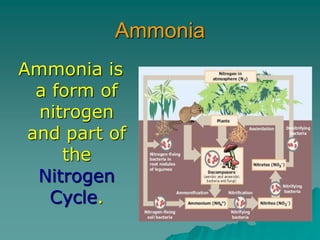
Ammonia
Ammonia is
a form of
nitrogen
and part of
the
Nitrogen
Cycle.
pH
SOURCES OF LOW pH IN WATER:
• Acid rain is cause of acid in
thousands of lakes
• Burning fossil fuels has increased
acid rain
EFFECTS OF LOW pH IN WATER:
• Low pH directly kills fish
• pH < 5, most fish eggs die
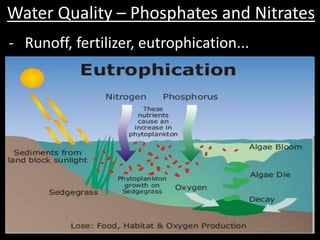
Water Quality – Phosphates and Nitrates
- Runoff, fertilizer, eutrophication...
NITROGEN
• Living organisms need nitrogen to
make proteins
• Nitrates (NO3) & Nitrites (NO2) are
compounds made of nitrogen &
oxygen
• Some nitrogen in water is good
• The wrong amount is bad
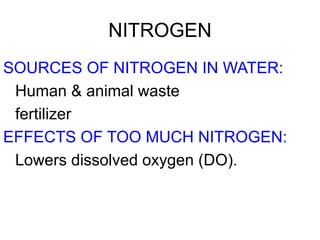
NITROGEN
SOURCES OF NITROGEN IN WATER:
Human & animal waste
fertilizer
EFFECTS OF TOO MUCH NITROGEN:
Lowers dissolved oxygen (DO).
NITROGEN – EUTROPHICATION
Q: How does Nitrogen reduce the amount of DO?
A: Eutrophication
• Nitrogen feeds algae (green stuff)
• Algae grows & grows
• Algae blocks sunlight
• Underwater plants die
• Algae die and decompose
• The decomposition takes up oxygen
• No DO for organisms, so they die
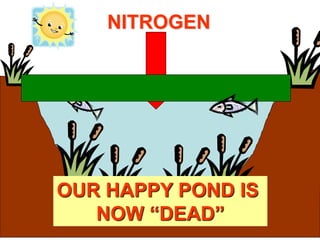
NITROGEN
OUR HAPPY POND IS
NOW “DEAD”
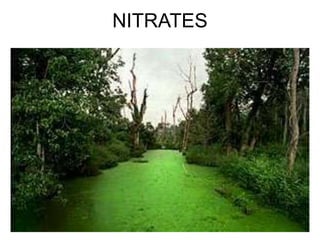
NITRATES
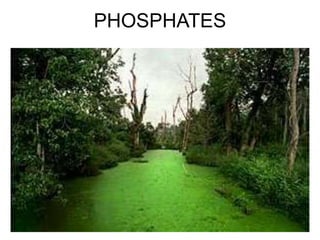
PHOSPHATES
• Phosphorus is an element like hydrogen
or oxygen
• Phosphorus combines with other things to
make phosphates
• Essential for living things
• Usually present in very small amounts
• Too much is bad
PHOSPHATES
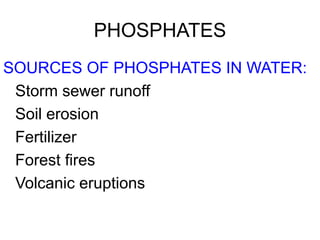
SOURCES OF PHOSPHATES IN WATER:
Storm sewer runoff
Soil erosion
Fertilizer
Forest fires
Volcanic eruptions
PHOSPHATES
PHOSPHATES
EFFECTS OF PHOSPHATES:
Eutrophication (same as with nitrates)
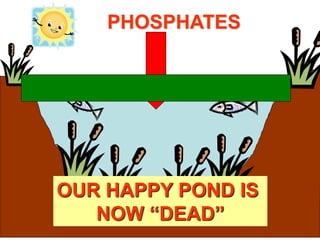
PHOSPHATES
OUR HAPPY POND IS
NOW “DEAD”
PHOSPHATES
Water Quality – Turbidity
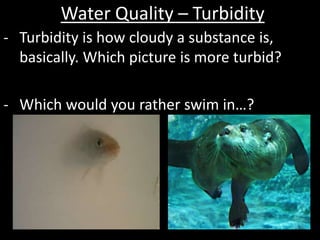
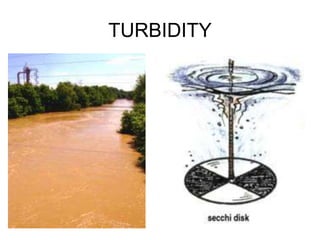
- Turbidity is how cloudy a substance is,
basically. Which picture is more turbid?
- Which would you rather swim in…?
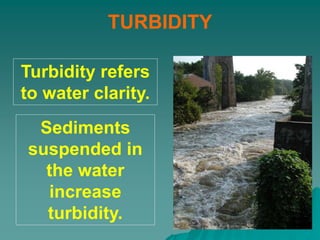
TURBIDITY
Turbidity refers
to water clarity.
Sediments
suspended in
the water
increase
turbidity.
TOTAL SUSPENDED SOLIDS
(TSS)
TSS is the measure of the
sediment suspended in the
water.
TSS is related to turbidity.
Water with high TSS usually has
high Total Dissolved Solids (TDS)
as well.
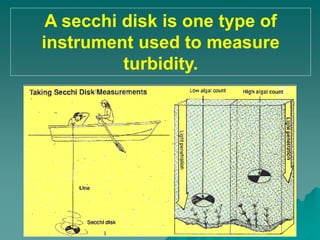
A secchi disk is one type of
instrument used to measure
turbidity.
TURBIDITY
TURBIDITY
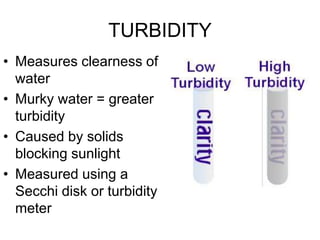
• Measures clearness of
water
• Murky water = greater
turbidity
• Caused by solids
blocking sunlight
• Measured using a
Secchi disk or turbidity
meter
TURBIDITY
HUMAN DUMPING:
Clay
Silt
Industrial waste
Raw sewage
SOURCES:
Human dumping
Construction
Soil erosion
Nitrate pollution
Phosphate
pollution
TURBIDITY
EFFECTS:
Clogs fish gills
Smothers eggs
Makes water unlivable
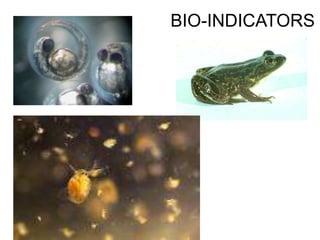
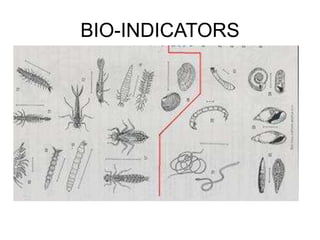
BIO-INDICATORS
• Bio-indicators = organisms that help
determine health of water.
• Presence or absence tells something
about the water.
• Not always an accurate way to measure
water quality.
• Accurate in telling environmental stress
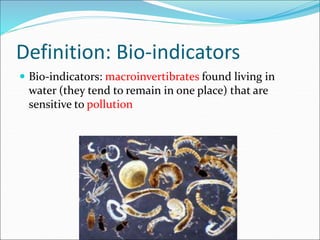
Definition: Bio-indicators
 Bio-indicators: macroinvertibrates found living in
water (they tend to remain in one place) that are
sensitive to pollution
BIO-INDICATORS
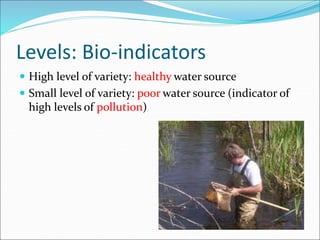
Levels: Bio-indicators
 High level of variety: healthy water source
 Small level of variety: poor water source (indicator of
high levels of pollution)
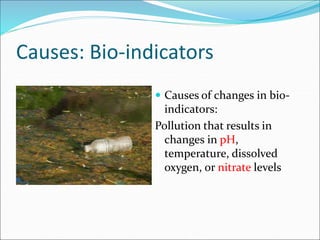
Causes: Bio-indicators
 Causes of changes in bio-
indicators:
Pollution that results in
changes in pH,
temperature, dissolved
oxygen, or nitrate levels
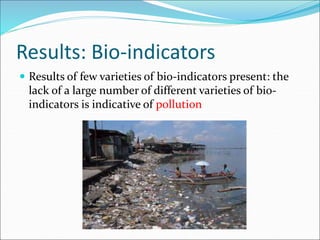
Results: Bio-indicators
 Results of few varieties of bio-indicators present: the
lack of a large number of different varieties of bio-
indicators is indicative of pollution
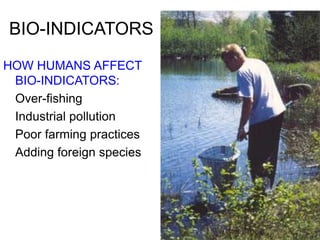
BIO-INDICATORS
HOW HUMANS AFFECT
BIO-INDICATORS:
Over-fishing
Industrial pollution
Poor farming practices
Adding foreign species
BIO-INDICATORS
TOXIC CHEMICALS
Toxic chemicals usually come
from industry and energy
production.
The effects are often not known
until years after they have entered
the environment.
Toxic chemicals include
heavy metals (lead,
mercury), organic
compounds (DDT, PCB),
inorganic substances
(arsenic) and others.

9863555

  • 1.
  • 2.
    Water Quality –Guided Notes - pH level - temperature (thermal pollution) - turbidity - bio-indicators - dissolved oxygen - salinity - phosphates and nitrates (Phosphorous and Nitrogen)
  • 3.
    Water Quality –Dissolved oxygen - The amount of oxygen (yes the gas) dissolved into water. It gets there by rapid movement of water, diffusion, and as a byproduct of photosynthesis!
  • 4.
    Water Quality –Salinity How much salt is in water, should know this. PPT means parts per thousand. For example, if in 1000 grams of water, there are 30 grams of salt, it’s ocean water!
  • 5.
    Water Quality –Thermal pollution - Changing the water quality by adding heated water to a non-heated water source.
  • 6.
    TEMPERATURE EFFECTS: changes rate ofphotosynthesis changes rate of respiration changes DO in water cold water holds more DO hot water holds less DO changes sensitivity of organisms to toxic waste, parasites, disease.
  • 7.
    TEMPERATURE • Thermal pollution= adding warm water to cold water. CAUSES OF THERMAL POLLUTION: • Industry (nuclear power plants, paper mills) • Urban Development (storm water runoff, construction, soil erosion)
  • 8.
    Temperature affects theoxygen- carrying capacity of water. Rapid temperature change and temperature extremes can stress aquatic organisms. As the water warms, the amount of dissolved oxygen decreases. 14 Dissolved Oxygen (ppm) 12 10 8 6 4 ____________________________________ Winter Summer
  • 9.
    DISSOLVED OXYGEN (DO) ORANGE= Oxygen MICKEY MOUSE = Water Fish need Oxygen Less Oxygen = Less fish
  • 10.
    DISSOLVED OXYGEN (DO) TOINCREASE DO: • Much of DO comes from atmosphere • Some of DO comes from photosynthesis TO DECREASE DO: • Add pollution • Add organic waste
  • 11.
    ORGANIC WASTE =LOW DO • Organic waste = parts of once living things EXAMPLES OF ORGANIC WASTE: Sewage Farm runoff Discharge from food processing plants
  • 12.
    HOW RAW SEWAGELOWERS DO RAW SEWAGE GOES INTO WATER: 1. Decomposers chow down 2. Decomposers take up oxygen 3. Decomposers reproduce, taking up more oxygen 4. No more oxygen for other animals 5. Nothing left but decomposer & sewage- filled water.
  • 13.
  • 14.
  • 15.
  • 16.
    Water Quality –pH level - pH stands for the potential of Hydrogen in water. - Here’s the pH scale:
  • 17.
    pH • pH =measure of concentration of hydrogen ions in a substance • Tells whether substance is: ACID BASE NEUTRAL
  • 18.
    pH Measured on scalefrom 0 to 14 0 = highly acidic (HCl) 7 = neutral (pure water) 14 = highly basic (bleach) Seawater pH ranges from 7.5 – 8.5 Average pH of ocean water = 7.8 pH of natural water = 6.5 – 8.5 Optimal range for life = 6.5 – 8.2
  • 19.
    pH US Northeastern rainpH = 4.3 Rain elsewhere in US pH = 5.0 – 5.6
  • 20.
  • 22.
    ALKALINITY Alkalinity refers tothe water’s ability to neutralize acids. Alkalinity is produced by minerals such as limestone. Limestone is a type of ocean sediment composed of calcium carbonate.
  • 23.
    Limestone bedrock areasoften have caves and sinkholes, known as Karst. Water with low alkalinity is usually acidic.
  • 24.
    Ammonia Ammonia is producedby the decay of organic matter and animal waste. Ammonia is toxic to most aquatic life, especially at high pH. Bacteria readily convert ammonia to nitrate. (a plant nutrient)
  • 25.
    Ammonia Ammonia is a formof nitrogen and part of the Nitrogen Cycle.
  • 26.
    pH SOURCES OF LOWpH IN WATER: • Acid rain is cause of acid in thousands of lakes • Burning fossil fuels has increased acid rain EFFECTS OF LOW pH IN WATER: • Low pH directly kills fish • pH < 5, most fish eggs die
  • 27.
    Water Quality –Phosphates and Nitrates - Runoff, fertilizer, eutrophication...
  • 28.
    NITROGEN • Living organismsneed nitrogen to make proteins • Nitrates (NO3) & Nitrites (NO2) are compounds made of nitrogen & oxygen • Some nitrogen in water is good • The wrong amount is bad
  • 29.
    NITROGEN SOURCES OF NITROGENIN WATER: Human & animal waste fertilizer EFFECTS OF TOO MUCH NITROGEN: Lowers dissolved oxygen (DO).
  • 30.
    NITROGEN – EUTROPHICATION Q:How does Nitrogen reduce the amount of DO? A: Eutrophication • Nitrogen feeds algae (green stuff) • Algae grows & grows • Algae blocks sunlight • Underwater plants die • Algae die and decompose • The decomposition takes up oxygen • No DO for organisms, so they die
  • 31.
    NITROGEN OUR HAPPY PONDIS NOW “DEAD”
  • 32.
  • 33.
    PHOSPHATES • Phosphorus isan element like hydrogen or oxygen • Phosphorus combines with other things to make phosphates • Essential for living things • Usually present in very small amounts • Too much is bad
  • 34.
    PHOSPHATES SOURCES OF PHOSPHATESIN WATER: Storm sewer runoff Soil erosion Fertilizer Forest fires Volcanic eruptions
  • 35.
  • 36.
  • 37.
    PHOSPHATES OUR HAPPY PONDIS NOW “DEAD”
  • 38.
  • 39.
    Water Quality –Turbidity - Turbidity is how cloudy a substance is, basically. Which picture is more turbid? - Which would you rather swim in…?
  • 40.
    TURBIDITY Turbidity refers to waterclarity. Sediments suspended in the water increase turbidity.
  • 41.
    TOTAL SUSPENDED SOLIDS (TSS) TSSis the measure of the sediment suspended in the water. TSS is related to turbidity. Water with high TSS usually has high Total Dissolved Solids (TDS) as well.
  • 42.
    A secchi diskis one type of instrument used to measure turbidity.
  • 43.
  • 44.
    TURBIDITY • Measures clearnessof water • Murky water = greater turbidity • Caused by solids blocking sunlight • Measured using a Secchi disk or turbidity meter
  • 45.
    TURBIDITY HUMAN DUMPING: Clay Silt Industrial waste Rawsewage SOURCES: Human dumping Construction Soil erosion Nitrate pollution Phosphate pollution
  • 46.
  • 47.
    BIO-INDICATORS • Bio-indicators =organisms that help determine health of water. • Presence or absence tells something about the water. • Not always an accurate way to measure water quality. • Accurate in telling environmental stress
  • 48.
    Definition: Bio-indicators  Bio-indicators:macroinvertibrates found living in water (they tend to remain in one place) that are sensitive to pollution
  • 49.
  • 50.
    Levels: Bio-indicators  Highlevel of variety: healthy water source  Small level of variety: poor water source (indicator of high levels of pollution)
  • 51.
    Causes: Bio-indicators  Causesof changes in bio- indicators: Pollution that results in changes in pH, temperature, dissolved oxygen, or nitrate levels
  • 52.
    Results: Bio-indicators  Resultsof few varieties of bio-indicators present: the lack of a large number of different varieties of bio- indicators is indicative of pollution
  • 53.
    BIO-INDICATORS HOW HUMANS AFFECT BIO-INDICATORS: Over-fishing Industrialpollution Poor farming practices Adding foreign species
  • 54.
  • 55.
    TOXIC CHEMICALS Toxic chemicalsusually come from industry and energy production. The effects are often not known until years after they have entered the environment.
  • 56.
    Toxic chemicals include heavymetals (lead, mercury), organic compounds (DDT, PCB), inorganic substances (arsenic) and others.