TRP 3
Value Stream Mapping in the
Chemical Industry
IAMC Toolkit
Innovative Approaches for the Sound Management of
Chemicals and Chemical Waste
Introduction
SMEs manufacturing chemical products have challenges
reducing waste (time, resources, personnel) which affects the
company’s profit.
Value Stream Mapping (VSM) is a tool which maps the entire
business (including sales, material procurement, production
and delivery) and identifies key areas of waste and their root
causes.
The reader will learn how to use VSM in the chemical
industry to reduce waste, decrease variable and raw material
costs and increase business productivity.
UNIDO│IAMC Toolkit│Images may not be copied, transmitted or manipulated 2
Contents
UNIDO│IAMC Toolkit│Images may not be copied, transmitted or manipulated 3
1. The Value Stream Map
ļ‚§ Key Idea
ļ‚§ Key Components
ļ‚§ How can VSM help Companies?
ļ‚§ ā€œMust Knowsā€ for VSM
2. VSM Symbols
ļ‚§ Process Boxes and Data Boxes
ļ‚§ Material Flow
ļ‚§ Information Flow
ļ‚§ Timeline
Topics
UNIDO│IAMC Toolkit│Images may not be copied, transmitted or manipulated 4
3. Generating the Map
ļ‚§ Getting Started
ļ‚§ Steps and Calculation of Key Data
ļ‚§ Example VSM
4. VSM Good Practices
ļ‚§ Parallel Equipment
ļ‚§ Logical Flow versus Geographic Arrangement
5. Key Messages
6. Glossary
The Value Stream Map
ļ‚§ The Value Stream Map
ļ‚§ VSM Symbols
ļ‚§ Generating the Map
ļ‚§ VSM Good Practices
ļ‚§ Key Messages
ļ‚§ Glossary
UNIDO│IAMC Toolkit│Images may not be copied, transmitted or manipulated 5
Key Idea (1)
UNIDO│IAMC Toolkit│Images may not be copied, transmitted or manipulated 6
What is a value stream map (VSM)?
VSM is a specific type of flowchart used to depict material
and information flow throughout a production process.
What is its objective?
VSM helps you to:
ļ‚§ Improve your understanding of the processes, inventory
flows and causes of waste
ļ‚§ Make decisions to improve your performance on the basis
of an idealized ā€œfuture stateā€ map
1. The value Stream Map 2. 3. 4. 5.
Key Idea (2)
UNIDO│IAMC Toolkit│Images may not be copied, transmitted or manipulated 7
How is it generated?
Value stream mapping builds on an existing Process Flow
Diagram (PFD) by:
ļ‚§ Drawing a visual representation of every process step
ļ‚§ Asking a set of key questions
ļ‚§ Drawing a ā€žfuture stateā€ map of optimized processes
This is done using a predefined set of standardized icons.
 A VSM enables you to identify and to plan to eliminate
waste in your production process.
1. The value Stream Map 2. 3. 4. 5.
Key Components (1)
UNIDO│IAMC Toolkit│Images may not be copied, transmitted or manipulated 8
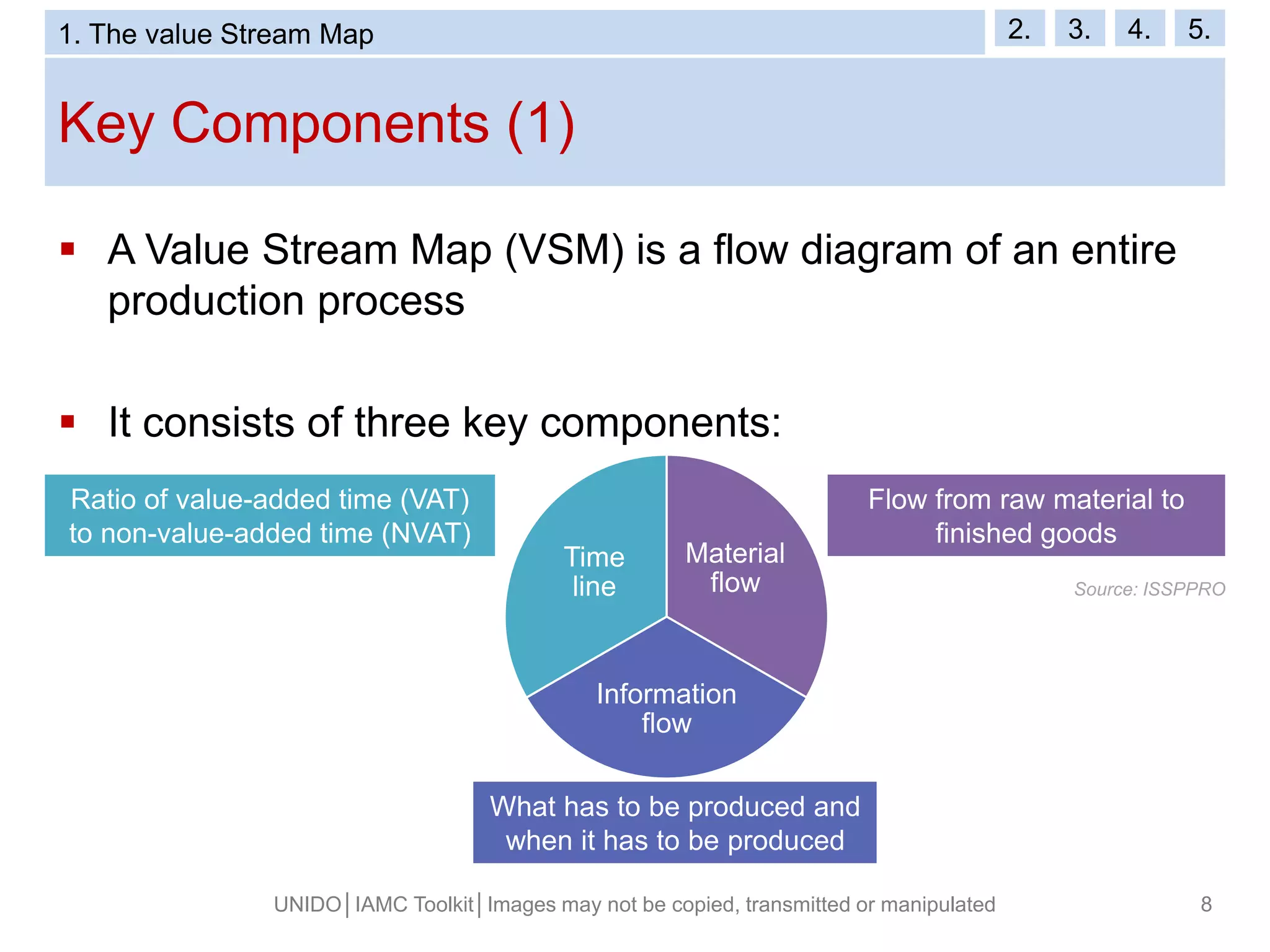
ļ‚§ A Value Stream Map (VSM) is a flow diagram of an entire
production process
ļ‚§ It consists of three key components:
Material
flow
Information
flow
Time
line
Flow from raw material to
finished goods
What has to be produced and
when it has to be produced
Ratio of value-added time (VAT)
to non-value-added time (NVAT)
Source: ISSPPRO
1. The value Stream Map 2. 3. 4. 5.
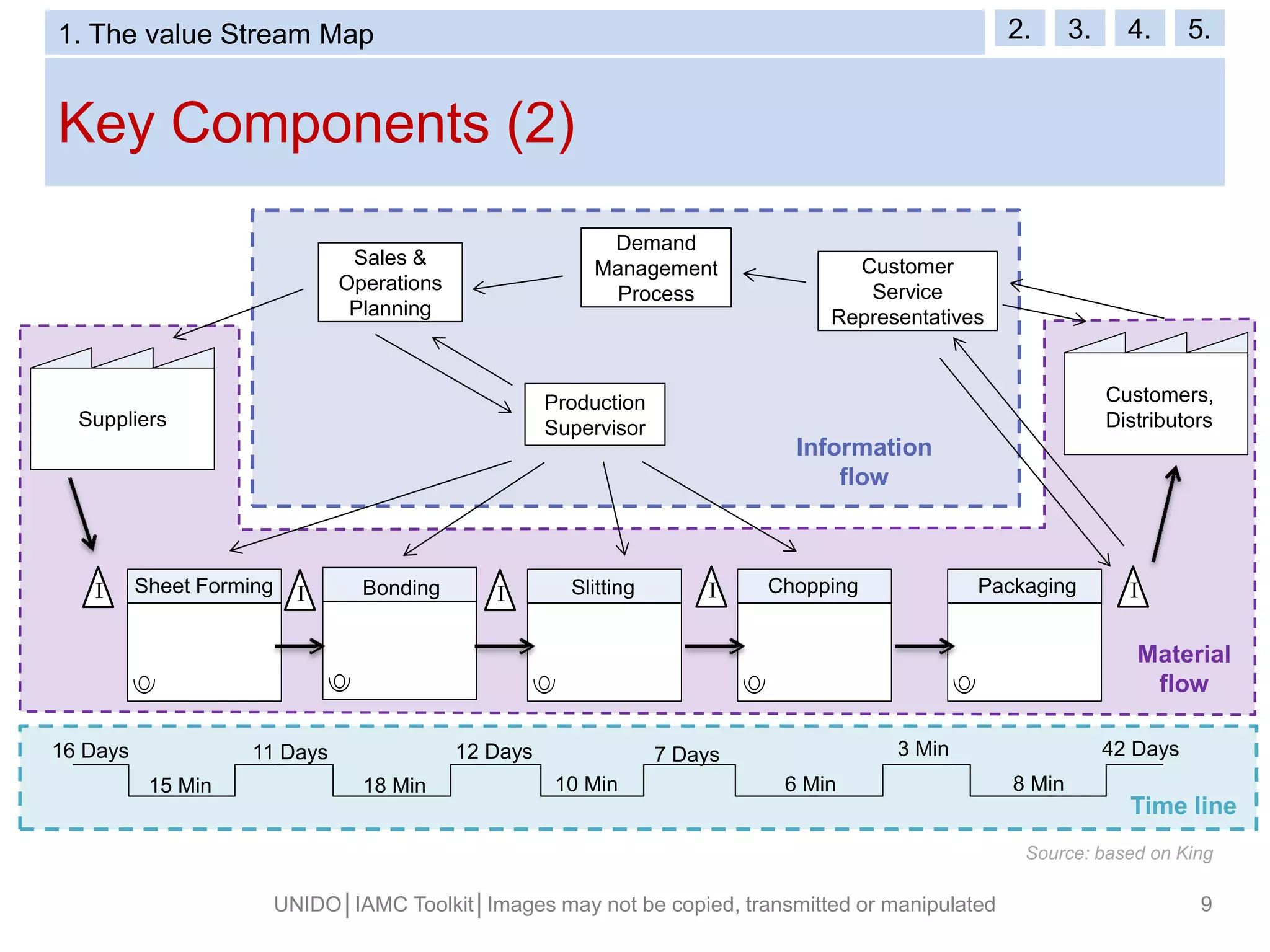
Time line
Material
flow
Key Components (2)
UNIDO│IAMC Toolkit│Images may not be copied, transmitted or manipulated 9
Customers,
DistributorsSuppliers
Sheet Forming SlittingBonding Chopping Packaging
Production
Supervisor
Demand
Management
Process
Customer
Service
Representatives
Sales &
Operations
Planning
Information
flow
I I I I I
15 Min 18 Min 10 Min 6 Min 8 Min
11 Days 12 Days 7 Days 3 Min 42 Days16 Days
Source: based on King
1. The value Stream Map 2. 3. 4. 5.
How can VSM help Companies? (1)
UNIDO│IAMC Toolkit│Images may not be copied, transmitted or manipulated 10
VSM and the design of an optimized future state help to:
Visualise the flow
ļ‚§ Get a clear overall picture of material and information flow
and where they touch
ļ‚§ Develop a sense of flow, inventory and bottlenecks
Create understanding how
ļ‚§ Value is created for the customer
ļ‚§ The entire production process operates rather than
individual units
1. The value Stream Map 2. 3. 4. 5.
How can VSM help Companies? (2)
UNIDO│IAMC Toolkit│Images may not be copied, transmitted or manipulated 11
VSM and the design of an optimized future state help to:
Identify waste in all areas of production
ļ‚§ Identify key areas of waste in the production process
ļ‚§ Identify which and how much waste is generated
ļ‚§ Identify the root causes for waste
Improve business performance
ļ‚§ Increase productivity
ļ‚§ Reduce material and energy waste
ļ‚§ Decrease variable and material costs
 The ā€œfuture stateā€ map is essential for this step. Its
optimized state serves as a target for all improvement
activities!
1. The value Stream Map 2. 3. 4. 5.
How can VSM help Companies? (3)
UNIDO│IAMC Toolkit│Images may not be copied, transmitted or manipulated 12
Example of VSM improving efficiency: Woodfold
Manufacturing, Inc.
ļ‚§ Manufacturer of custom wood products located in Forest
Grove, USA.
ļ‚§ Woodfold implemented many of the improvement
opportunities identified in the VSM, and achieved the
following results:
ļ‚§ Saved about $44,800 per year, including $34,700 per year
from improvements to paint spray transfer efficiency.
ļ‚§ Found a local recycler for PVC scrap, diverting 6 tons per
year of solid PVC waste from the landfill.
ļ‚§ Reduced volatile organic compound (VOC) emissions by
nearly 454 kg per year.
1. The value Stream Map 2. 3. 4. 5.
Source: EPA: The Lean and Chemicals Toolkit
ā€œMust Knowsā€ for VSM
UNIDO│IAMC Toolkit│Images may not be copied, transmitted or manipulated 13
In order to properly make a Value Stream Map, you should
know…
ļ‚§ Units of production
ļ‚§ Takt time
ļ‚§ Cycle time (C/T)
… of all processes in the entire production process.
1. The value Stream Map 2. 3. 4. 5.
Units of Production
UNIDO│IAMC Toolkit│Images may not be copied, transmitted or manipulated 14
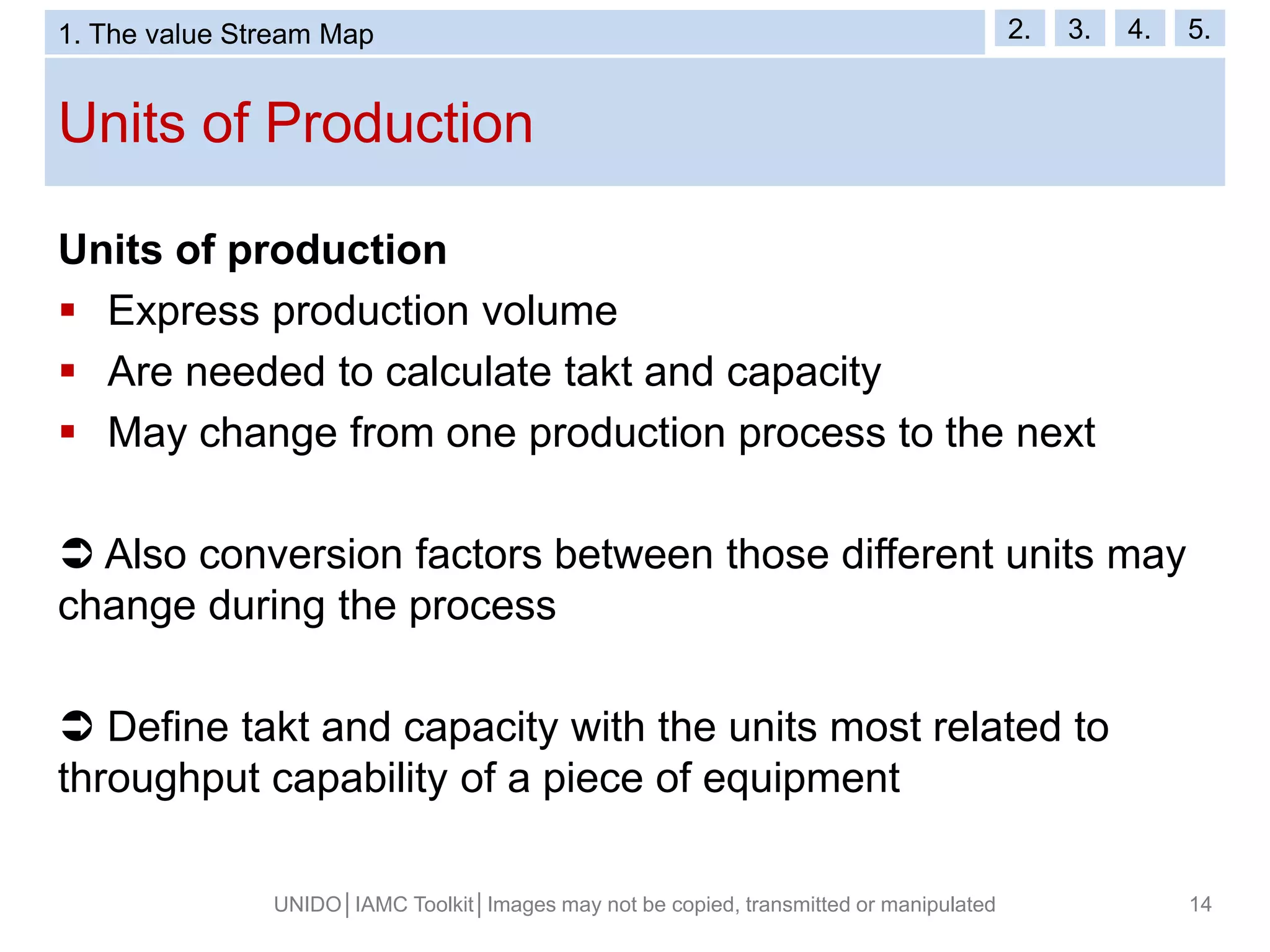
Units of production
ļ‚§ Express production volume
ļ‚§ Are needed to calculate takt and capacity
ļ‚§ May change from one production process to the next
 Also conversion factors between those different units may
change during the process
 Define takt and capacity with the units most related to
throughput capability of a piece of equipment
1. The value Stream Map 2. 3. 4. 5.
Takt Time
UNIDO│IAMC Toolkit│Images may not be copied, transmitted or manipulated 15
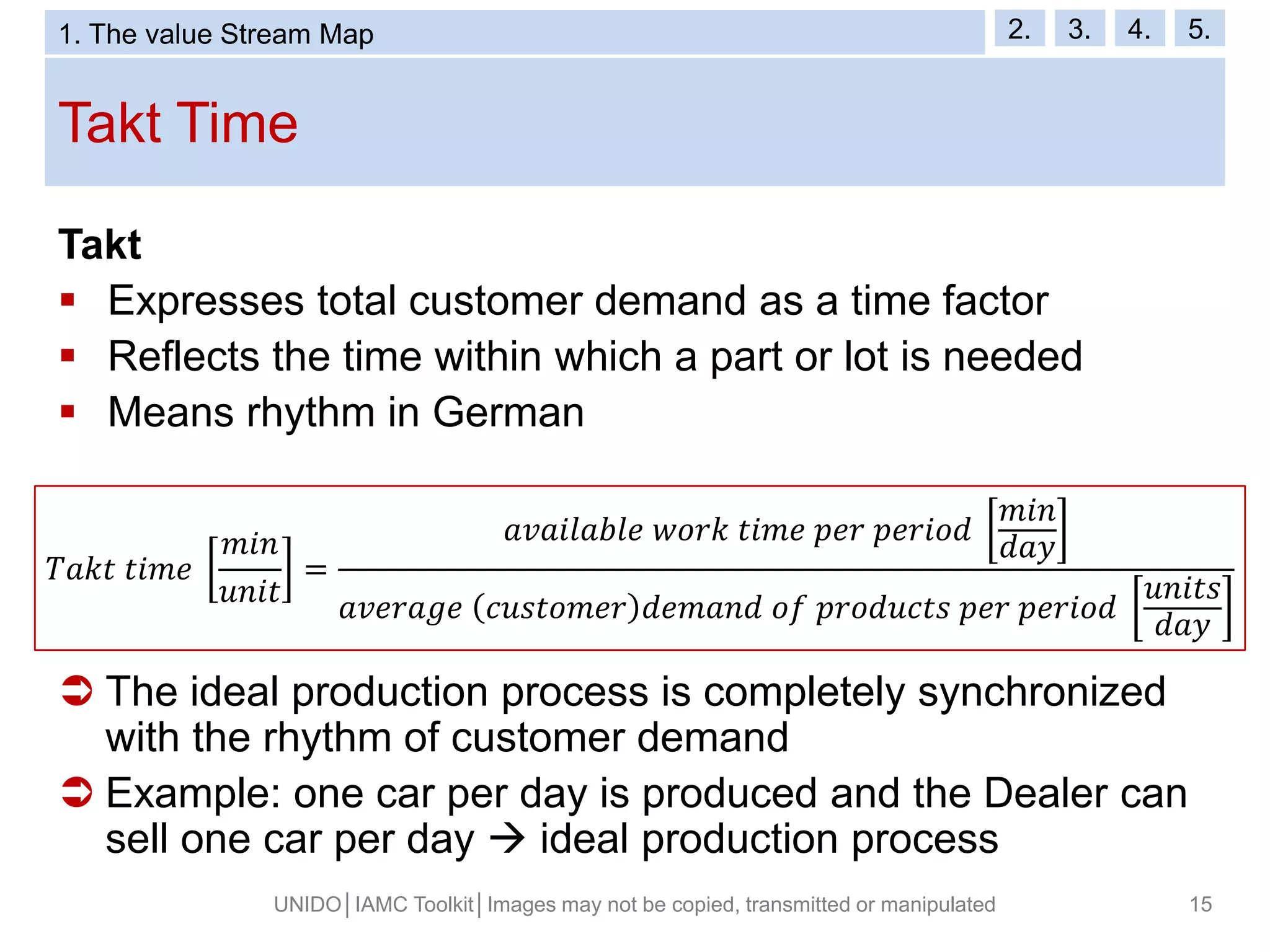
Takt
ļ‚§ Expresses total customer demand as a time factor
ļ‚§ Reflects the time within which a part or lot is needed
ļ‚§ Means rhythm in German
 The ideal production process is completely synchronized
with the rhythm of customer demand
 Example: one car per day is produced and the Dealer can
sell one car per day  ideal production process
š‘‡š‘Žš‘˜š‘” š‘”š‘–š‘šš‘’
š‘šš‘–š‘›
š‘¢š‘›š‘–š‘”
=
š‘Žš‘£š‘Žš‘–š‘™š‘Žš‘š‘™š‘’ š‘¤š‘œš‘Ÿš‘˜ š‘”š‘–š‘šš‘’ š‘š‘’š‘Ÿ š‘š‘’š‘Ÿš‘–š‘œš‘‘
š‘šš‘–š‘›
š‘‘š‘Žš‘¦
š‘Žš‘£š‘’š‘Ÿš‘Žš‘”š‘’ š‘š‘¢š‘ š‘”š‘œš‘šš‘’š‘Ÿ š‘‘š‘’š‘šš‘Žš‘›š‘‘ š‘œš‘“ š‘š‘Ÿš‘œš‘‘š‘¢š‘š‘”š‘  š‘š‘’š‘Ÿ š‘š‘’š‘Ÿš‘–š‘œš‘‘
š‘¢š‘›š‘–š‘”š‘ 
š‘‘š‘Žš‘¦
1. The value Stream Map 2. 3. 4. 5.
Cycle Time
UNIDO│IAMC Toolkit│Images may not be copied, transmitted or manipulated 16
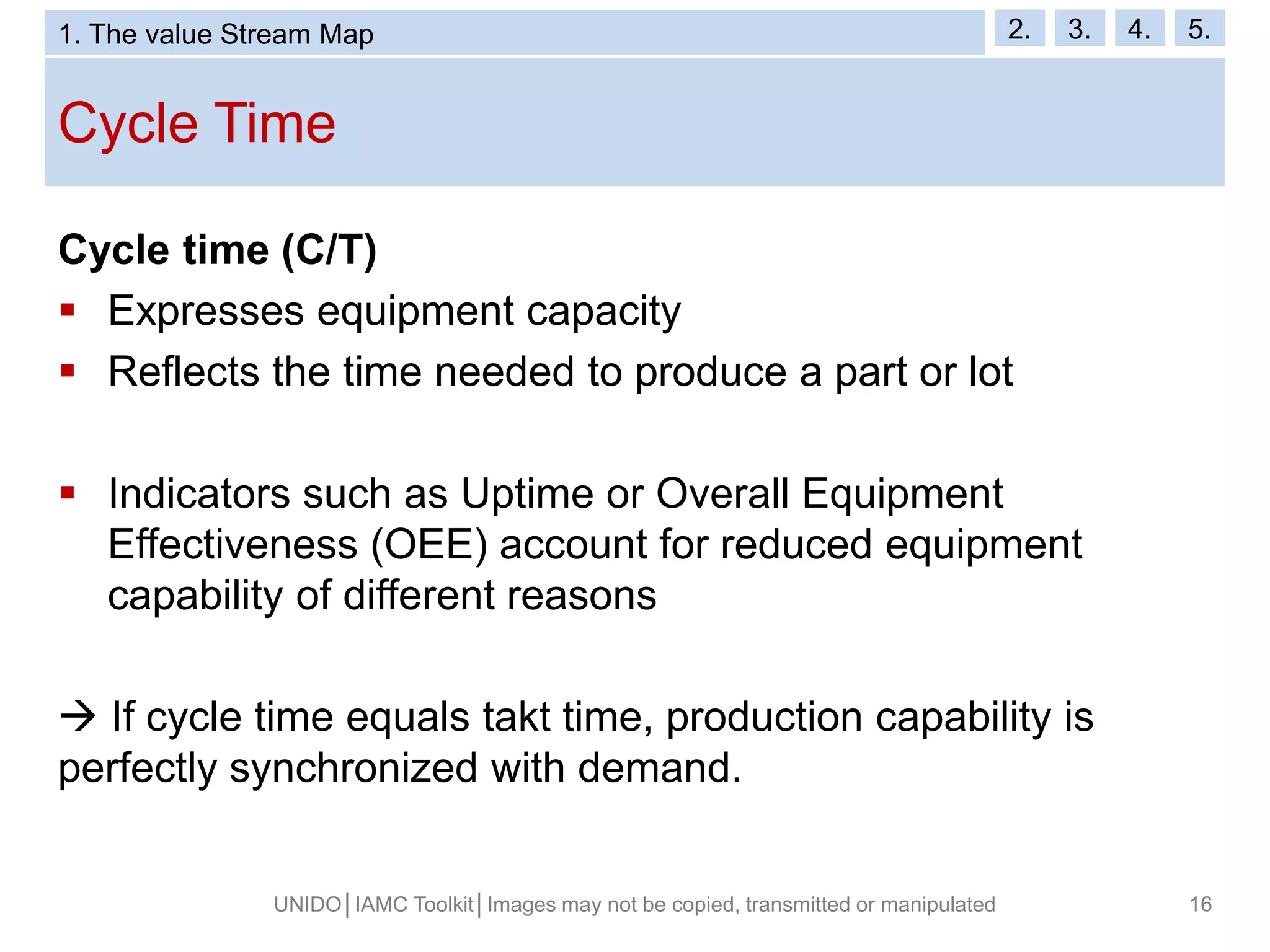
Cycle time (C/T)
ļ‚§ Expresses equipment capacity
ļ‚§ Reflects the time needed to produce a part or lot
ļ‚§ Indicators such as Uptime or Overall Equipment
Effectiveness (OEE) account for reduced equipment
capability of different reasons
 If cycle time equals takt time, production capability is
perfectly synchronized with demand.
1. The value Stream Map 2. 3. 4. 5.
Learning Objectives
UNIDO│IAMC Toolkit│Images may not be copied, transmitted or manipulated 17
Can you list and explain some benefits of VSM?
ļ‚§ Visualises the flow and helps to develop a sense of it
ļ‚§ Creates and expands understanding
ļ‚§ Helps in the identification of waste and its origins
ļ‚§ Supports improvement activities
Which parameters have to be known to create a VSM?
ļ‚§ Production units
ļ‚§ Takt time or takt rate
ļ‚§ Cycle time or cycle rate (=effective capacity)
?
1. The value Stream Map 2. 3. 4. 5.
VSM Symbols
ļ‚§ The Value Stream Map
ļ‚§ VSM Symbols
ļ‚§ Generating the Map
ļ‚§ VSM Good Practices
ļ‚§ Key Messages
ļ‚§ Glossary
UNIDO│IAMC Toolkit│Images may not be copied, transmitted or manipulated 18
Process Box and Process Step Data Box
UNIDO│IAMC Toolkit│Images may not be copied, transmitted or manipulated 19
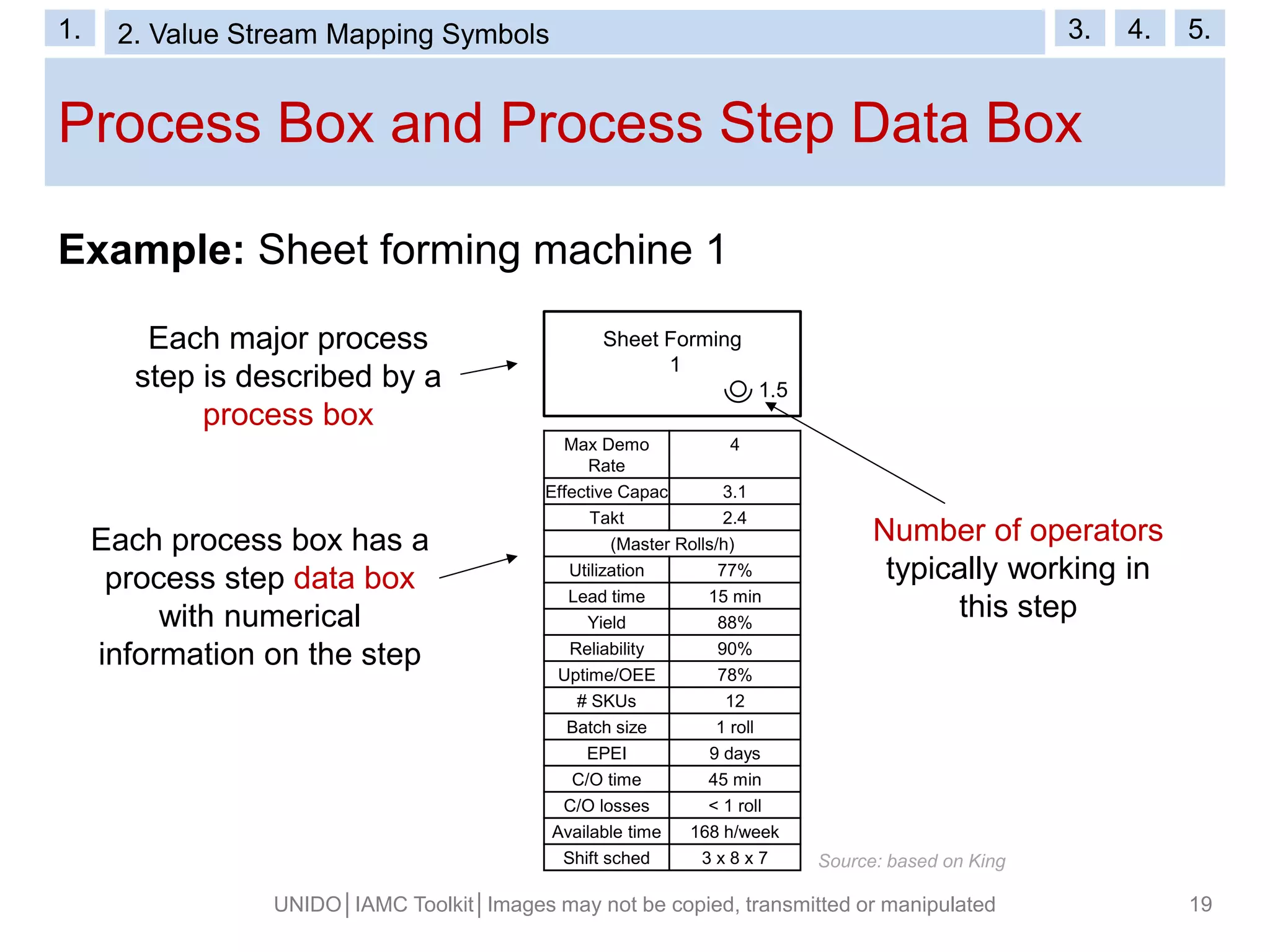
Example: Sheet forming machine 1
Each major process
step is described by a
process box
Each process box has a
process step data box
with numerical
information on the step
Number of operators
typically working in
this step
Sheet Forming
1
1.5
Max Demo
Rate
4
Effective Capac 3.1
Takt 2.4
(Master Rolls/h)
Utilization 77%
Lead time 15 min
Yield 88%
Reliability 90%
Uptime/OEE 78%
# SKUs 12
Batch size 1 roll
EPEI 9 days
C/O time 45 min
C/O losses < 1 roll
Available time 168 h/week
Shift sched 3 x 8 x 7 Source: based on King
1. 2. Value Stream Mapping Symbols 3. 4. 5.
Process Step Data Box (1)
ļ‚§ C/T (Cycle time) [min/unit]:Time between releases of
parts or batches
ļ‚§ Takt [min/unit]: Time available to produce one unit of
product
ļ‚§ Utilization [%]: Measure for how fully utilized a process
step is
ļ‚§ Lead time [min]: The time needed for one part or lot to
complete this process step
ļ‚§ Yield [%]: Percentage of material entering the step that
leaves it with required quality
ļ‚§ Reliability [%]: The percentage of time without any
equipment failure
ļ‚§ Uptime [%]: Measure reflecting all sorts of time lost
UNIDO│IAMC Toolkit│Images may not be copied, transmitted or manipulated 20
Process Step Data Box
C/T ## [min/unit]
Takt ## [min/unit]
Utilization ## [%]
Lead time ## [min]
Yield ## [%]
Reliability ## [%]
Uptime ## [%]
# SKUs ## [units]
Batch size ## [units]
EPEI ## [days]
C/O time ## [min]
C/O losses ## [units]
Available time ## [h/week]
Shift sched ## [h/week]
1. 2. Value Stream Mapping Symbols 3. 4. 5.
Process Step Data Box (2)
ļ‚§ Number of SKUs (Stock keeping units) [units]: Number
of specific products leaving this process step
ļ‚§ Batch size [units]: Amount of material produced as a
single lot
ļ‚§ EPEI [days]: Time span over which all product types
are made
ļ‚§ C/O (Changeover) time [min]: Time needed to change
from one product to another
ļ‚§ C/O (Changeover) losses [units]: Amount of material
lost in the change from one product to another
ļ‚§ Available time [h/week]: Total time this process step is
planned to run
ļ‚§ Shift sched(ule) [h/week]: Number of hours per shift,
shifts per day and days per week
UNIDO│IAMC Toolkit│Images may not be copied, transmitted or manipulated 21
Process Step Data Box
C/T ## [min/unit]
Takt ## [min/unit]
Utilization ## [%]
Lead time ## [min]
Yield ## [%]
Reliability ## [%]
Uptime ## [%]
# SKUs ## [units]
Batch size ## [units]
EPEI ## [days]
C/O time ## [min]
C/O losses ## [units]
Available time ## [h/week]
Shift sched ## [h/week]
1. 2. Value Stream Mapping Symbols 3. 4. 5.
Process Step Data Box (3)
The process data box can be
complemented by specific
environmental data, such as:
ļ‚§ Hazardous waste generation
ļ‚§ Water consumption
ļ‚§ Energy consumption
ļ‚§ Emissions generation
ļ‚§ Environmental, health and safety
hotspots (EHS HS)
 Can also be appropriate for
inventory data boxes!
UNIDO│IAMC Toolkit│Images may not be copied, transmitted or manipulated 22
Process Step Data Box
C/T ## [min/unit]
Takt ## [min/unit]
Utilization ## [%]
Lead time ## [min]
…
Material and Energy Data
Hazardous waste ## [kg/batch]
Water consumption ## [L/batch]
Energy
consumption
## [kWh/batch]
Emissions ## [kg/batch]
EHS HS ##
1. 2. Value Stream Mapping Symbols 3. 4. 5.
Key Metrics (1)
UNIDO│IAMC Toolkit│Images may not be copied, transmitted or manipulated 23
Apart from takt and cycle time, the following parameters
are commonly indicated:
ļ‚§ Utilisation: Measure of how fully utilized a process step is
ļ‚§ Uptime: Ratio of actual production time to availability time
š‘ˆš‘”š‘–š‘™š‘–š‘ š‘Žš‘”š‘–š‘œš‘› [%] =
š‘š‘¦š‘š‘™š‘’ š‘”š‘–š‘šš‘’
š‘šš‘–š‘›
š‘¢š‘›š‘–š‘”
š‘”š‘Žš‘˜š‘” š‘”š‘–š‘šš‘’
š‘šš‘–š‘›
š‘¢š‘›š‘–š‘”
=
š‘”š‘Žš‘˜š‘” š‘Ÿš‘Žš‘”š‘’
š‘¢š‘›š‘–š‘”š‘ 
ā„Ž
š‘’š‘“š‘“š‘’š‘š‘”š‘–š‘£š‘’ š‘š‘Žš‘š‘Žš‘š‘–š‘”š‘¦
š‘¢š‘›š‘–š‘”š‘ 
ā„Ž
š‘ˆš‘š‘”š‘–š‘šš‘’ % =
š‘£š‘Žš‘™š‘¢š‘Žš‘š‘™š‘’ š‘œš‘š‘’š‘Ÿš‘Žš‘”š‘–š‘›š‘” š‘”š‘–š‘šš‘’ [š‘šš‘–š‘›]
š‘£š‘Žš‘™š‘¢š‘Žš‘š‘™š‘’ š‘œš‘š‘’š‘Ÿš‘Žš‘”š‘–š‘›š‘” š‘”š‘–š‘šš‘’ + š‘™š‘œš‘ š‘ š‘’š‘  [š‘šš‘–š‘›]
1. 2. Value Stream Mapping Symbols 3. 4. 5.
Key Metrics (2)
UNIDO│IAMC Toolkit│Images may not be copied, transmitted or manipulated 24
Apart from takt and cycle time, the following parameters
are commonly indicated:
ļ‚§ Yield: Percentage of good parts leaving a process step
ļ‚§ Reliability: Measure of the steadiness of a machine
š‘Œš‘–š‘’š‘™š‘‘ [%] =
š‘šš‘Žš‘”š‘’š‘Ÿš‘–š‘Žš‘™ š‘™š‘’š‘Žš‘£š‘–š‘›š‘” š‘Ž š‘ š‘”š‘’š‘ š‘¤š‘–š‘”ā„Ž š‘Žš‘š‘š‘’š‘š‘”š‘Žš‘š‘™š‘’ š‘š‘Ÿš‘œš‘š‘’š‘Ÿš‘”š‘–š‘’š‘ 
š‘”š‘œš‘”š‘Žš‘™ š‘Žš‘šš‘œš‘¢š‘›š‘” š‘œš‘“ š‘šš‘Žš‘”š‘’š‘Ÿš‘–š‘Žš‘™ š‘’š‘›š‘”š‘’š‘Ÿš‘–š‘›š‘” š‘”ā„Žš‘’ š‘ š‘”š‘’š‘
š‘…š‘’š‘™š‘–š‘Žš‘š‘–š‘™š‘–š‘”š‘¦ [%] =
š‘”š‘–š‘šš‘’ š‘’š‘žš‘¢š‘–š‘š‘šš‘’š‘›š‘” š‘–š‘  š’š’š’• š’…š’š’˜š’ š‘‘š‘¢š‘’ š‘”š‘œ š‘’š‘žš‘¢š‘–š‘š‘šš‘’š‘›š‘” š‘“š‘Žš‘–š‘™š‘¢š‘Ÿš‘’š‘ 
š‘”š‘œš‘”š‘Žš‘™ š‘”š‘–š‘šš‘’ š‘Žš‘£š‘Žš‘–š‘™š‘Žš‘š‘™š‘’
1. 2. Value Stream Mapping Symbols 3. 4. 5.
Supplier Data Box
UNIDO│IAMC Toolkit│Images may not be copied, transmitted or manipulated 25
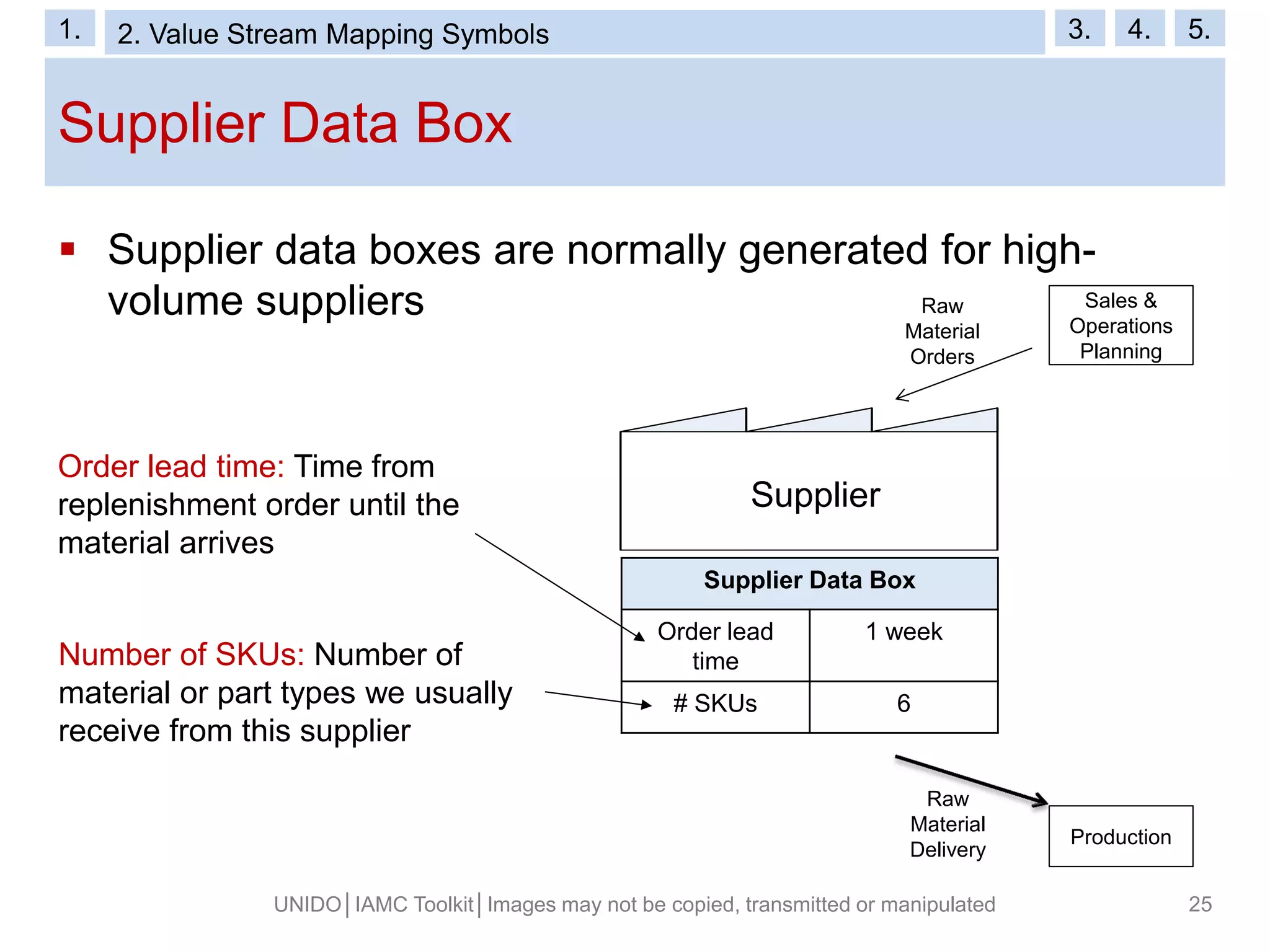
ļ‚§ Supplier data boxes are normally generated for high-
volume suppliers
Supplier Data Box
Order lead
time
1 week
# SKUs 6
Order lead time: Time from
replenishment order until the
material arrives
Number of SKUs: Number of
material or part types we usually
receive from this supplier
Supplier
Sales &
Operations
Planning
Production
Raw
Material
Orders
Raw
Material
Delivery
1. 2. Value Stream Mapping Symbols 3. 4. 5.
Transportation Data Box
UNIDO│IAMC Toolkit│Images may not be copied, transmitted or manipulated 26
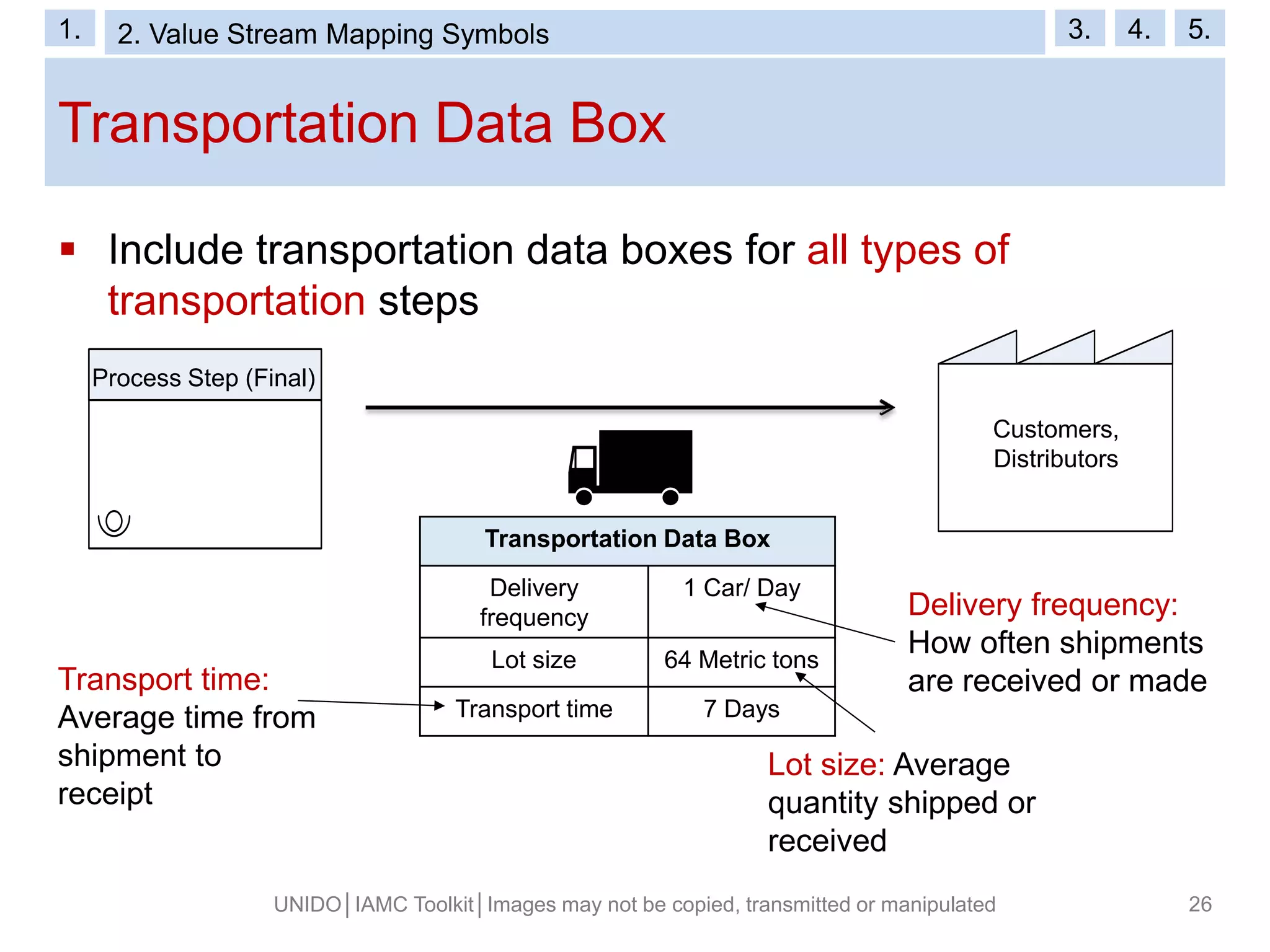
ļ‚§ Include transportation data boxes for all types of
transportation steps
Transportation Data Box
Delivery
frequency
1 Car/ Day
Lot size 64 Metric tons
Transport time 7 Days
Delivery frequency:
How often shipments
are received or made
Lot size: Average
quantity shipped or
received
Transport time:
Average time from
shipment to
receipt
Process Step (Final)
Customers,
Distributors
1. 2. Value Stream Mapping Symbols 3. 4. 5.
Inventory Data Box
UNIDO│IAMC Toolkit│Images may not be copied, transmitted or manipulated 27
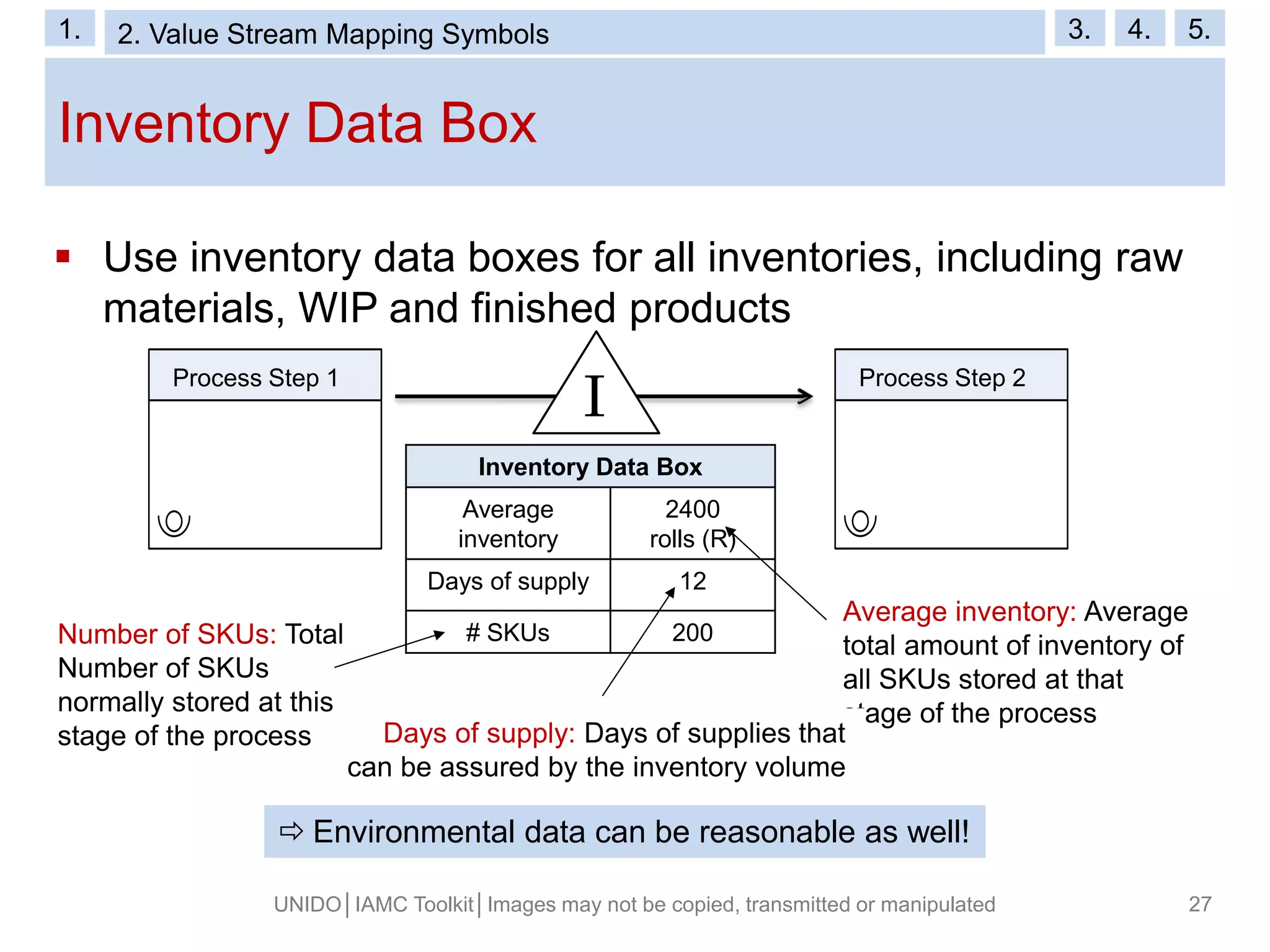
ļ‚§ Use inventory data boxes for all inventories, including raw
materials, WIP and finished products
Inventory Data Box
Average
inventory
2400
rolls (R)
Days of supply 12
# SKUs 200
Average inventory: Average
total amount of inventory of
all SKUs stored at that
stage of the process
DaDays of supply: Days of supplies that
can be assured by the inventory volume
Number of SKUs: Total
Number of SKUs
normally stored at this
stage of the process
 Environmental data can be reasonable as well!
I
Process Step 1 Process Step 2
1. 2. Value Stream Mapping Symbols 3. 4. 5.
Customer Data Box
UNIDO│IAMC Toolkit│Images may not be copied, transmitted or manipulated 28
ļ‚§ Customer Data Boxes tell you how much material
customers order and when they expect to receive it
Customer Data Box
Total quantity per
unit time
21M
m2/Month
TAKT 30K m2/Hour
Lead time
expectations
7 Days
Total quantity: Sum total of
all products ordered by all
customers
Lead time expectation:
Maximum time a customer
will accept between order
and delivery
Takt: Time available to
produce one unit of product
needed to fill customer
orders
Customers,
Distributors
Customer
Service Reps
Process Step (Final)
Orders
Order Grants
Finished
Products
1. 2. Value Stream Mapping Symbols 3. 4. 5.
Material Flow
UNIDO│IAMC Toolkit│Images may not be copied, transmitted or manipulated 29
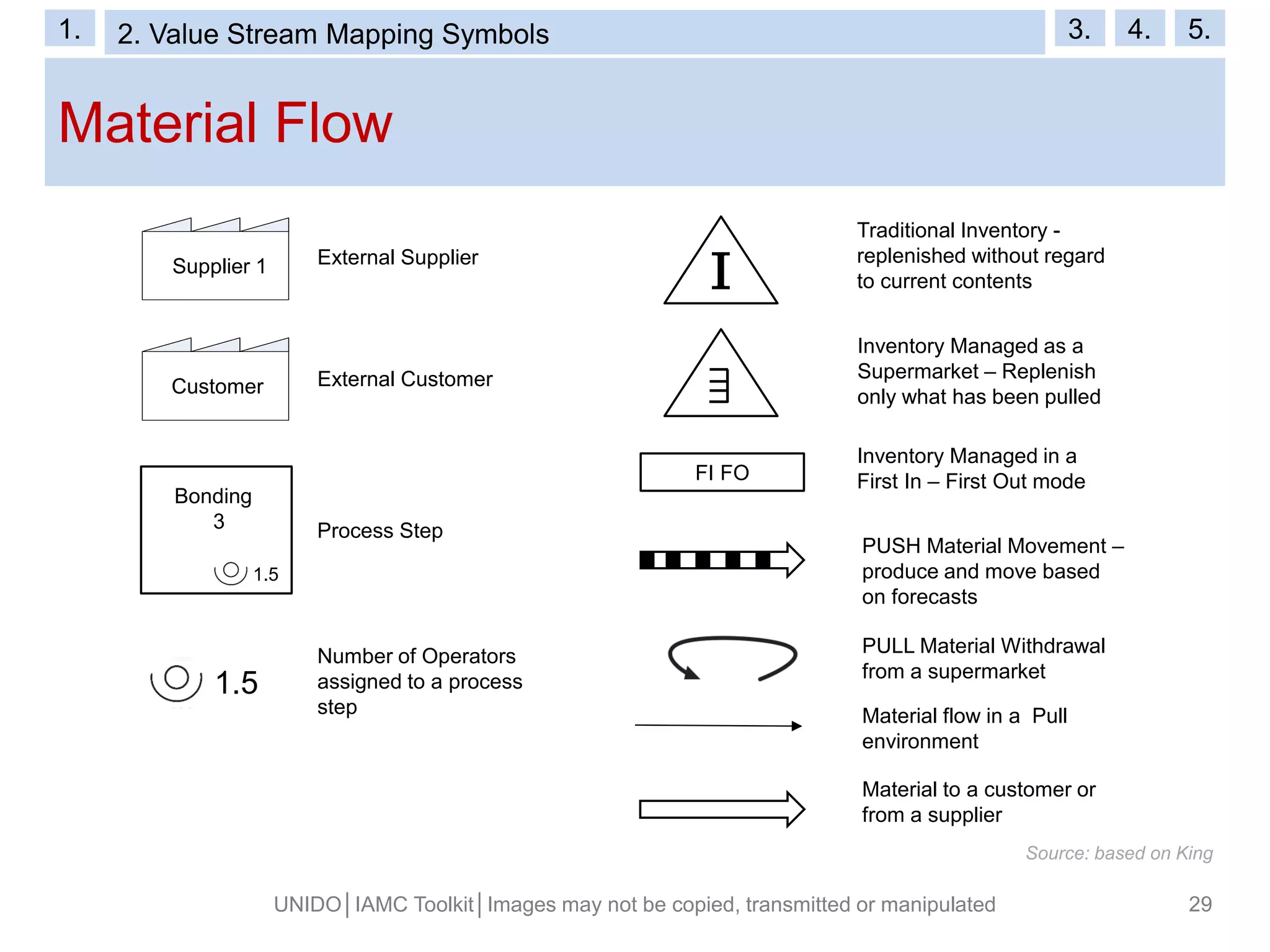
Customer
Supplier 1
I
FI FO
1.5
Bonding
3
1.5
External Supplier
External Customer
Process Step
Number of Operators
assigned to a process
step
Traditional Inventory -
replenished without regard
to current contents
Inventory Managed as a
Supermarket – Replenish
only what has been pulled
Inventory Managed in a
First In – First Out mode
PUSH Material Movement –
produce and move based
on forecasts
PULL Material Withdrawal
from a supermarket
Material flow in a Pull
environment
Material to a customer or
from a supplier

Source: based on King
1. 2. Value Stream Mapping Symbols 3. 4. 5.
Information Flow (1)
UNIDO│IAMC Toolkit│Images may not be copied, transmitted or manipulated 30
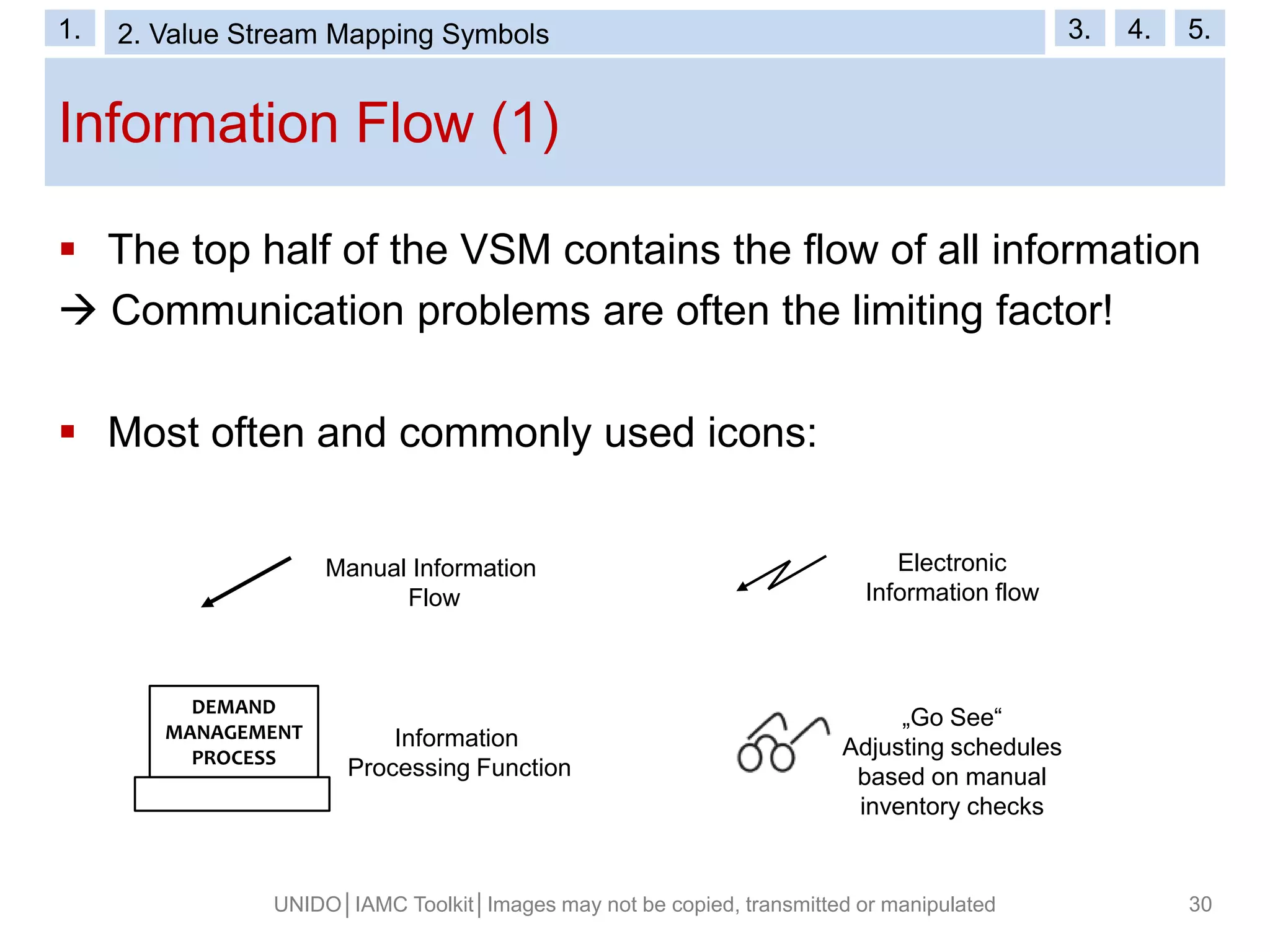
ļ‚§ The top half of the VSM contains the flow of all information
 Communication problems are often the limiting factor!
ļ‚§ Most often and commonly used icons:
Manual Information
Flow
Electronic
Information flow
Information
Processing Function
ā€žGo Seeā€œ
Adjusting schedules
based on manual
inventory checks
DEMAND
MANAGEMENT
PROCESS
1. 2. Value Stream Mapping Symbols 3. 4. 5.
Information Flow (2)
UNIDO│IAMC Toolkit│Images may not be copied, transmitted or manipulated 31
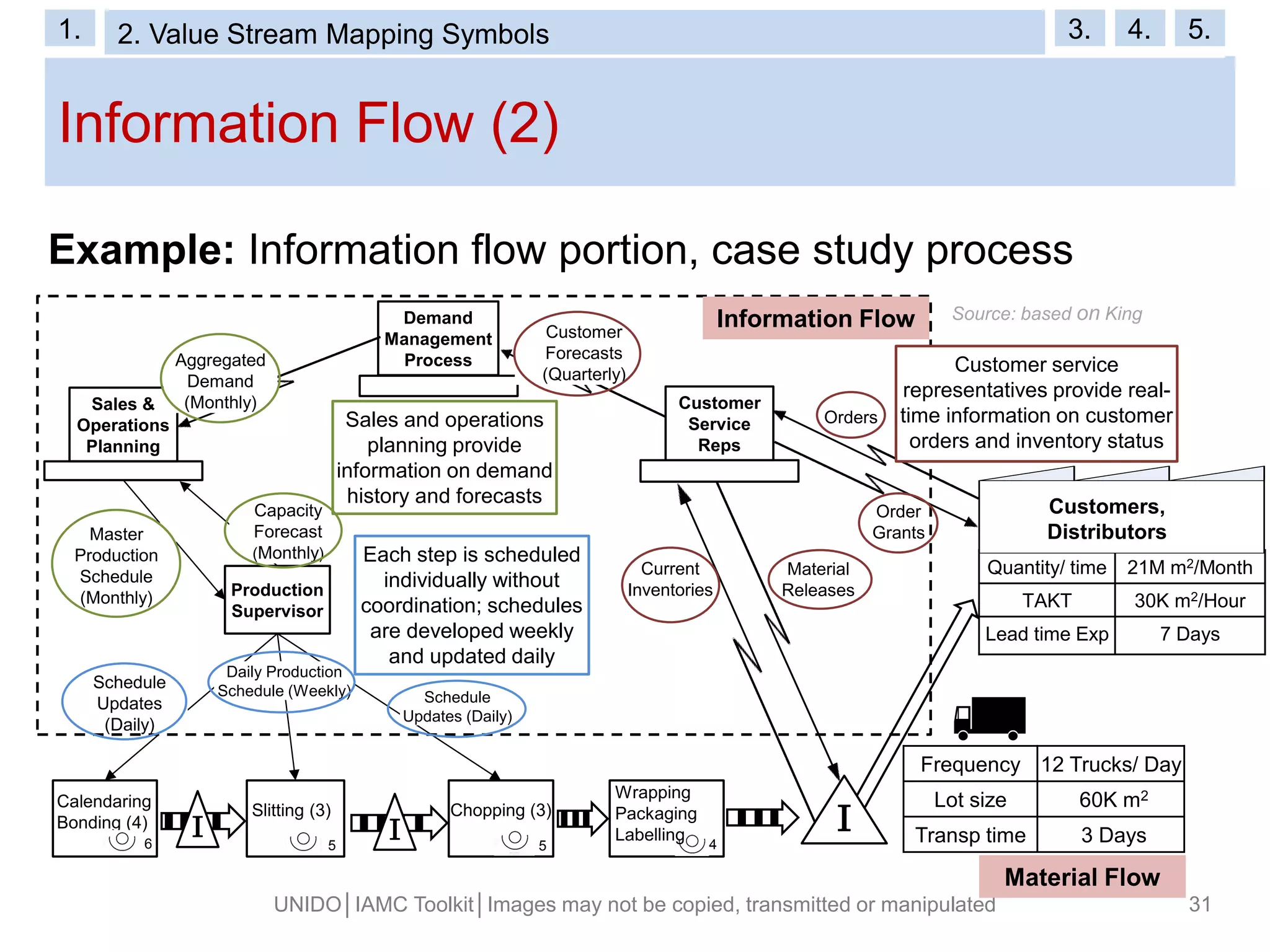
Example: Information flow portion, case study process
Calendaring
Bonding (4)
6
Quantity/ time 21M m2/Month
TAKT 30K m2/Hour
Lead time Exp 7 Days
Customers,
Distributors
Slitting (3)
5
Chopping (3)
5
Demand
Management
Process
Sales &
Operations
Planning
4
Frequency 12 Trucks/ Day
Lot size 60K m2
Transp time 3 Days
Production
Supervisor
I I I
Customer
Forecasts
(Quarterly)
Orders
Order
Grants
Customer
Service
Reps
Material
Releases
Current
Inventories
Aggregated
Demand
(Monthly)
Capacity
Forecast
(Monthly)
Master
Production
Schedule
(Monthly)
Schedule
Updates
(Daily)
Daily Production
Schedule (Weekly) Schedule
Updates (Daily)
Material Flow
Information Flow
Customer service
representatives provide real-
time information on customer
orders and inventory status
Sales and operations
planning provide
information on demand
history and forecasts
Each step is scheduled
individually without
coordination; schedules
are developed weekly
and updated daily
Source: based on King
Wrapping
Packaging
Labelling
1. 2. Value Stream Mapping Symbols 3. 4. 5.
Timeline
UNIDO│IAMC Toolkit│Images may not be copied, transmitted or manipulated 32
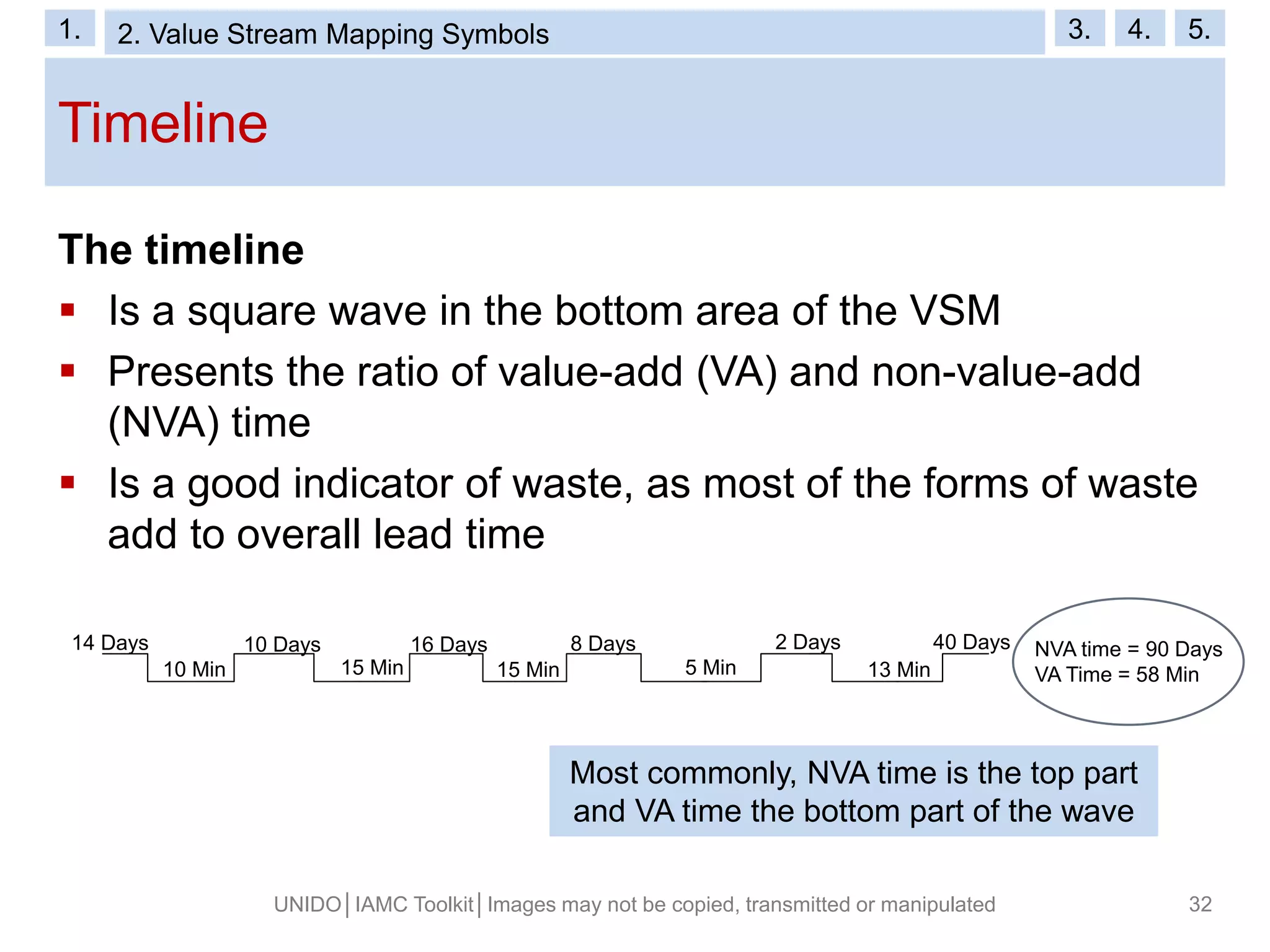
The timeline
ļ‚§ Is a square wave in the bottom area of the VSM
ļ‚§ Presents the ratio of value-add (VA) and non-value-add
(NVA) time
ļ‚§ Is a good indicator of waste, as most of the forms of waste
add to overall lead time
Most commonly, NVA time is the top part
and VA time the bottom part of the wave
NVA time = 90 Days
VA Time = 58 Min10 Min 15 Min 15 Min 5 Min 13 Min
10 Days 16 Days 8 Days 2 Days 40 Days14 Days
1. 2. Value Stream Mapping Symbols 3. 4. 5.
Learning Objectives
UNIDO│IAMC Toolkit│Images may not be copied, transmitted or manipulated 33
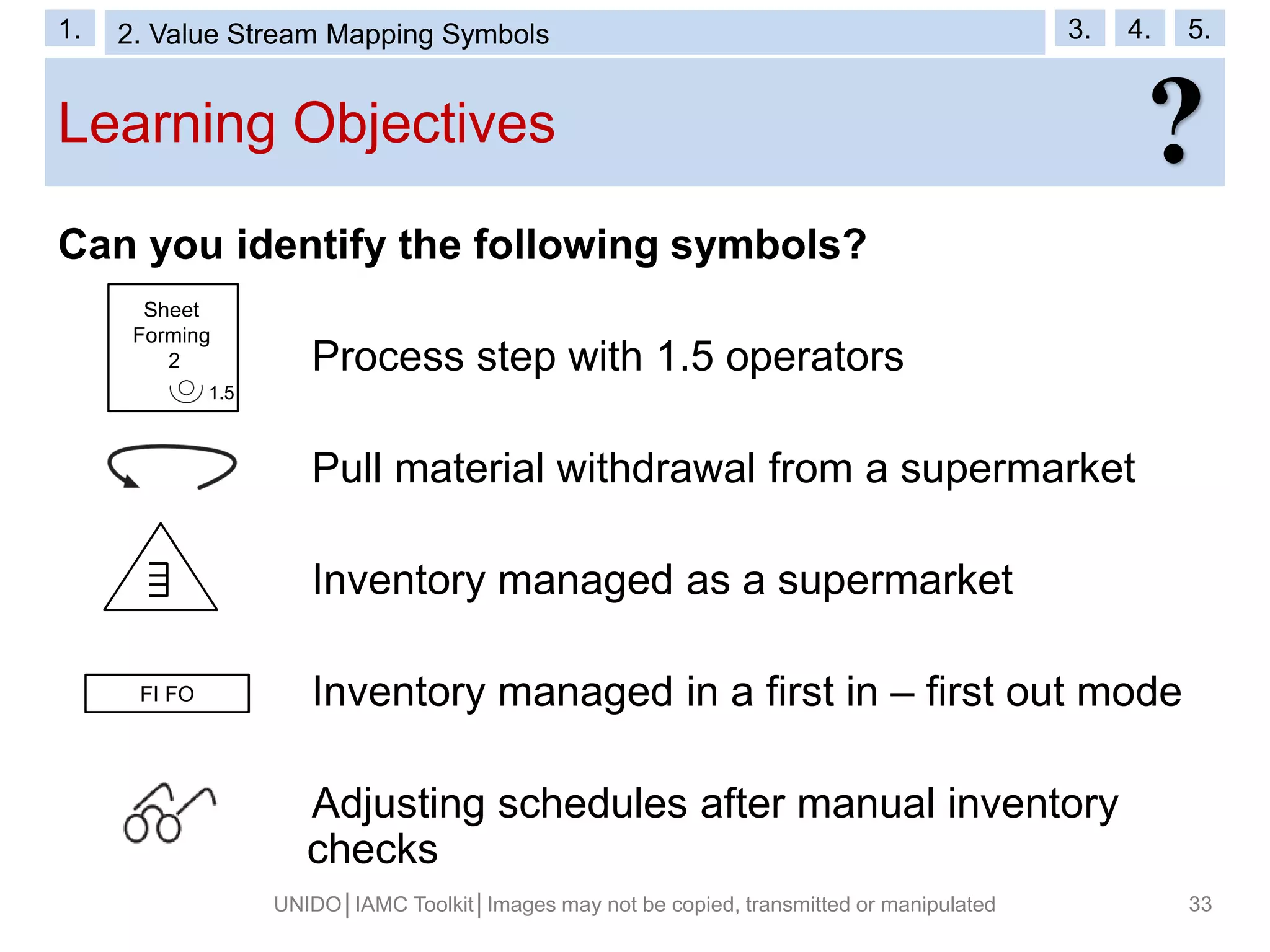
Can you identify the following symbols?
Process step with 1.5 operators
Pull material withdrawal from a supermarket
Inventory managed as a supermarket
Inventory managed in a first in – first out mode
Adjusting schedules after manual inventory
checks
?
FI FO
Sheet
Forming
2
1.5
1. 2. Value Stream Mapping Symbols 3. 4. 5.
Generating the Map
ļ‚§ The Value Stream Map
ļ‚§ VSM Symbols
ļ‚§ Generating the Map
ļ‚§ VSM Good Practices
ļ‚§ Key Messages
ļ‚§ Glossary
UNIDO│IAMC Toolkit│Images may not be copied, transmitted or manipulated 34
Getting Started (1)
UNIDO│IAMC Toolkit│Images may not be copied, transmitted or manipulated 35
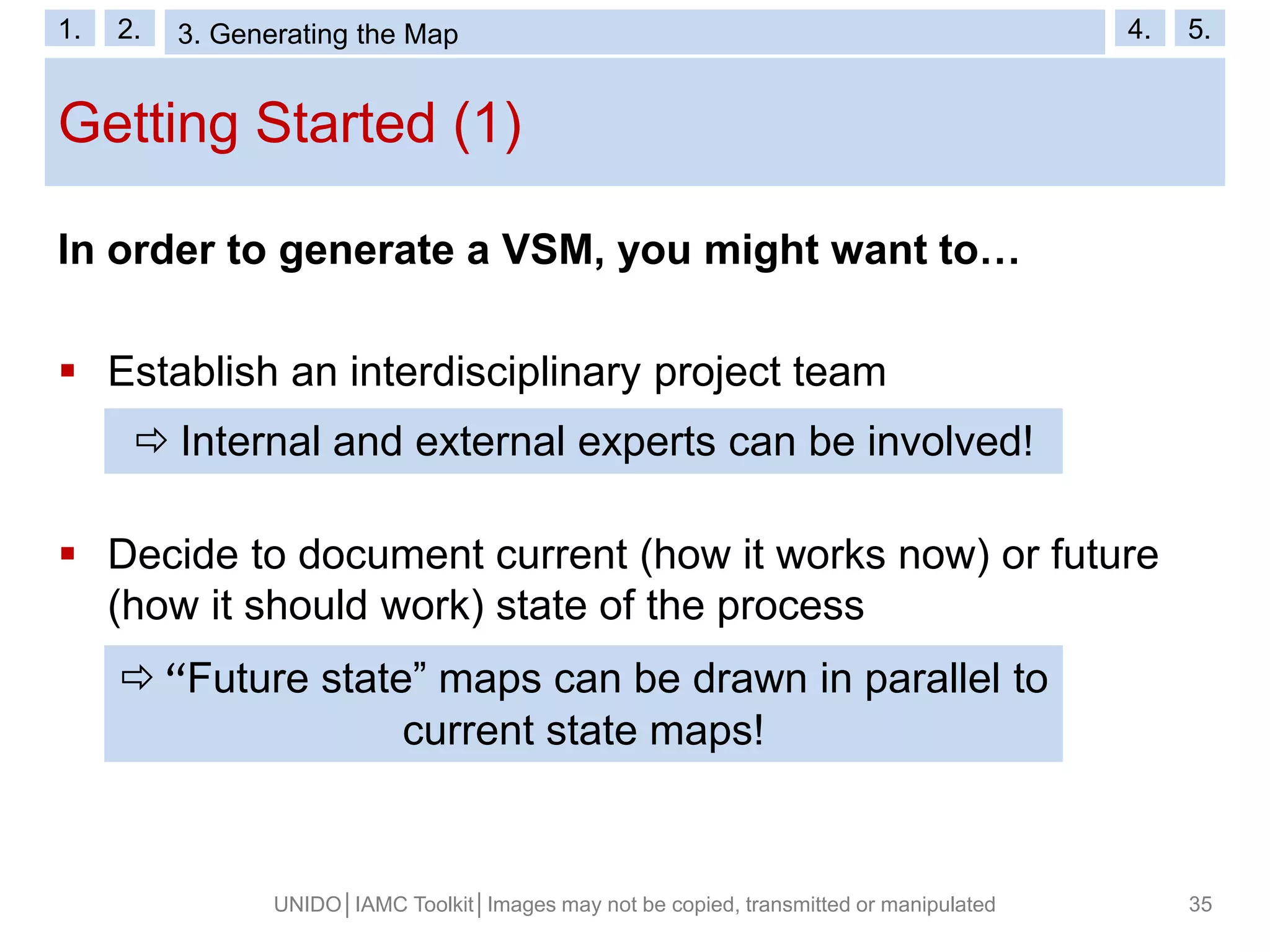
In order to generate a VSM, you might want to…
ļ‚§ Establish an interdisciplinary project team
ļ‚§ Decide to document current (how it works now) or future
(how it should work) state of the process
 Internal and external experts can be involved!
 ā€œFuture stateā€ maps can be drawn in parallel to
current state maps!
1. 2. 3. VSM Symbols 4. 5.1. 2. 3. Generating the Map 4. 5.
Getting Started (2)
UNIDO│IAMC Toolkit│Images may not be copied, transmitted or manipulated 36
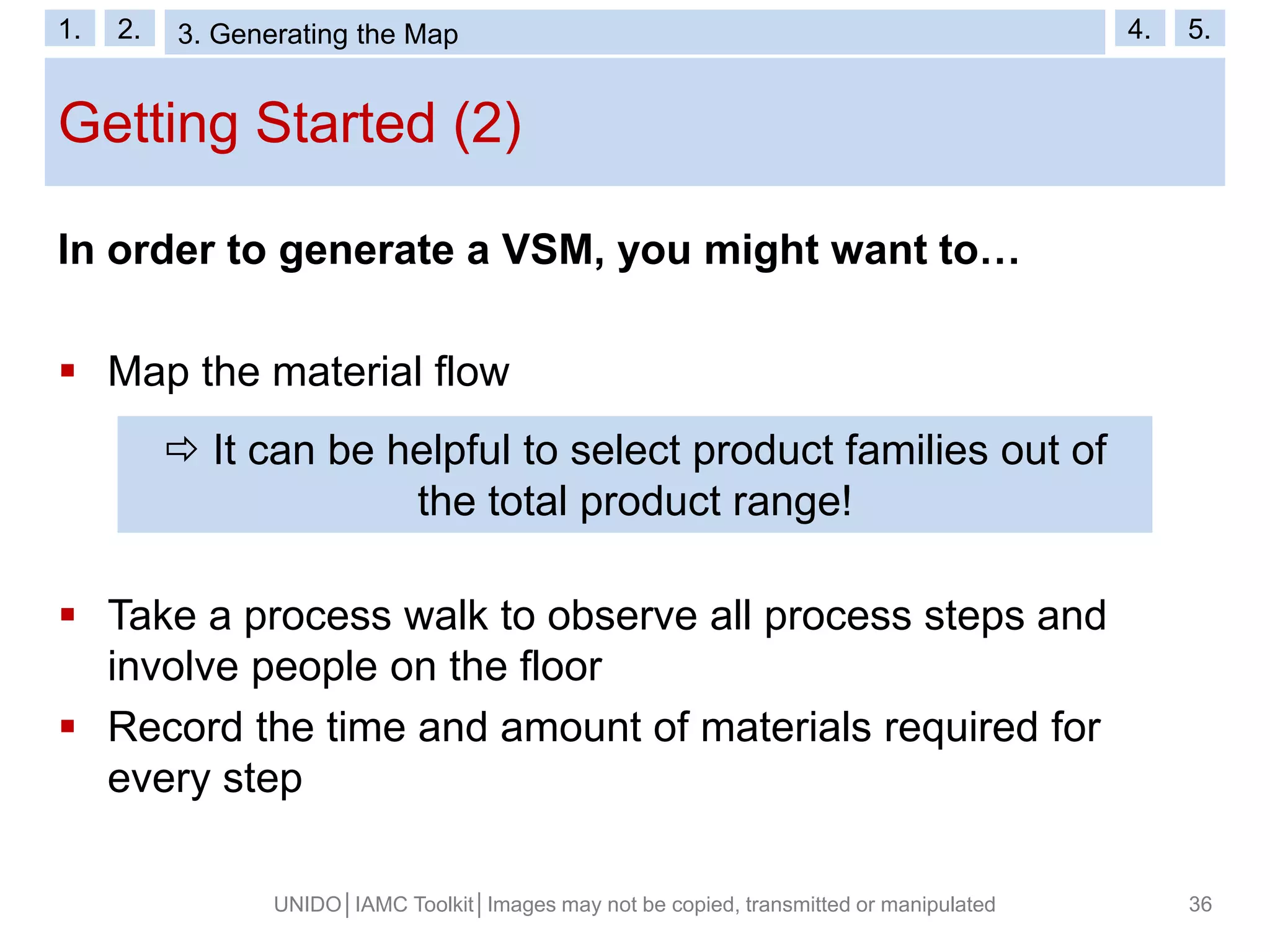
In order to generate a VSM, you might want to…
ļ‚§ Map the material flow
ļ‚§ Take a process walk to observe all process steps and
involve people on the floor
ļ‚§ Record the time and amount of materials required for
every step
 It can be helpful to select product families out of
the total product range!
1. 2. 3. VSM Symbols 4. 5.1. 2. 3. Generating the Map 4. 5.
Getting Started (3)
UNIDO│IAMC Toolkit│Images may not be copied, transmitted or manipulated 37
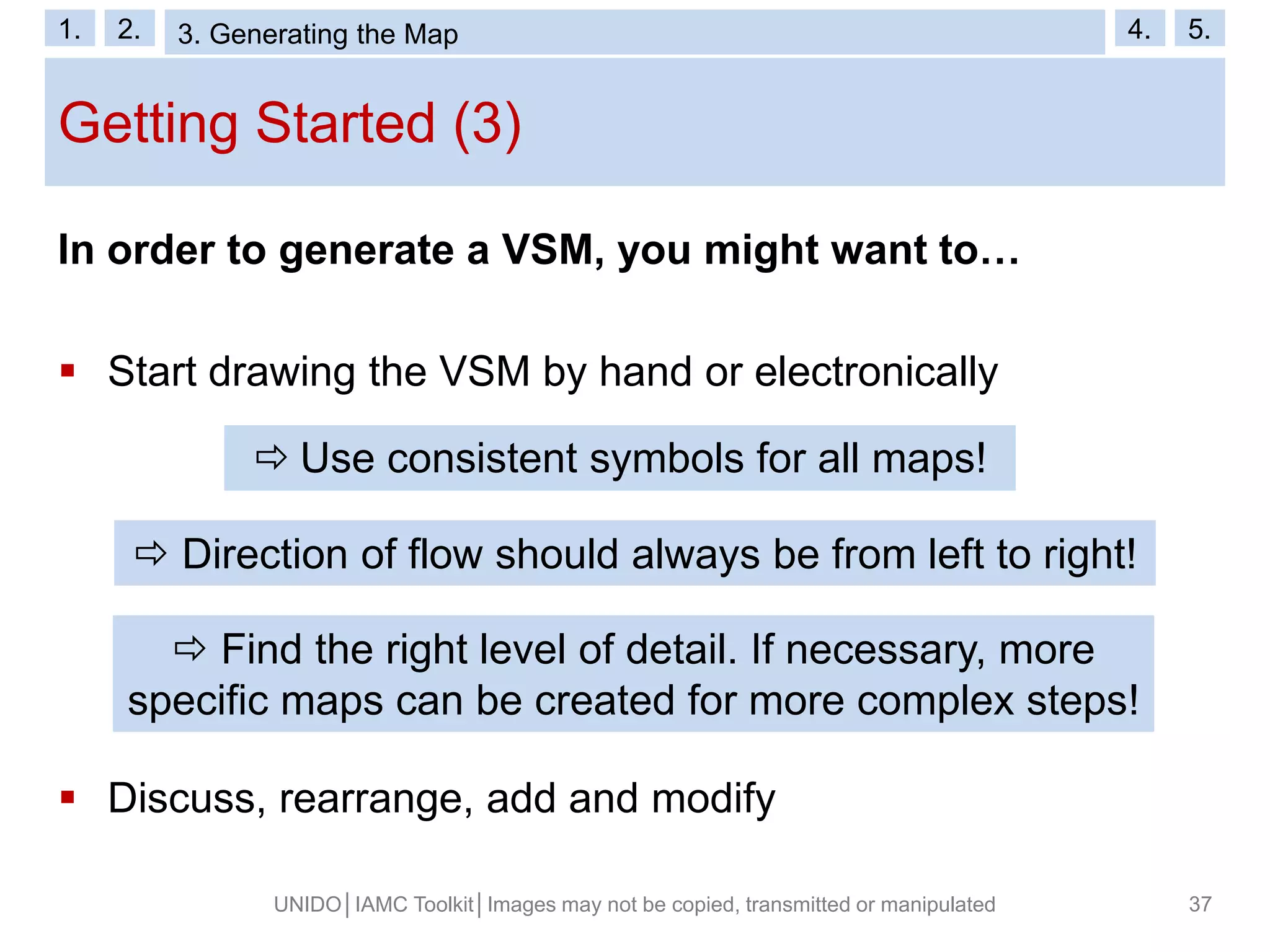
In order to generate a VSM, you might want to…
ļ‚§ Start drawing the VSM by hand or electronically
ļ‚§ Discuss, rearrange, add and modify
 Use consistent symbols for all maps!
 Direction of flow should always be from left to right!
 Find the right level of detail. If necessary, more
specific maps can be created for more complex steps!
1. 2. 3. VSM Symbols 4. 5.1. 2. 3. Generating the Map 4. 5.
Steps for Generating the VSM
UNIDO│IAMC Toolkit│Images may not be copied, transmitted or manipulated 38
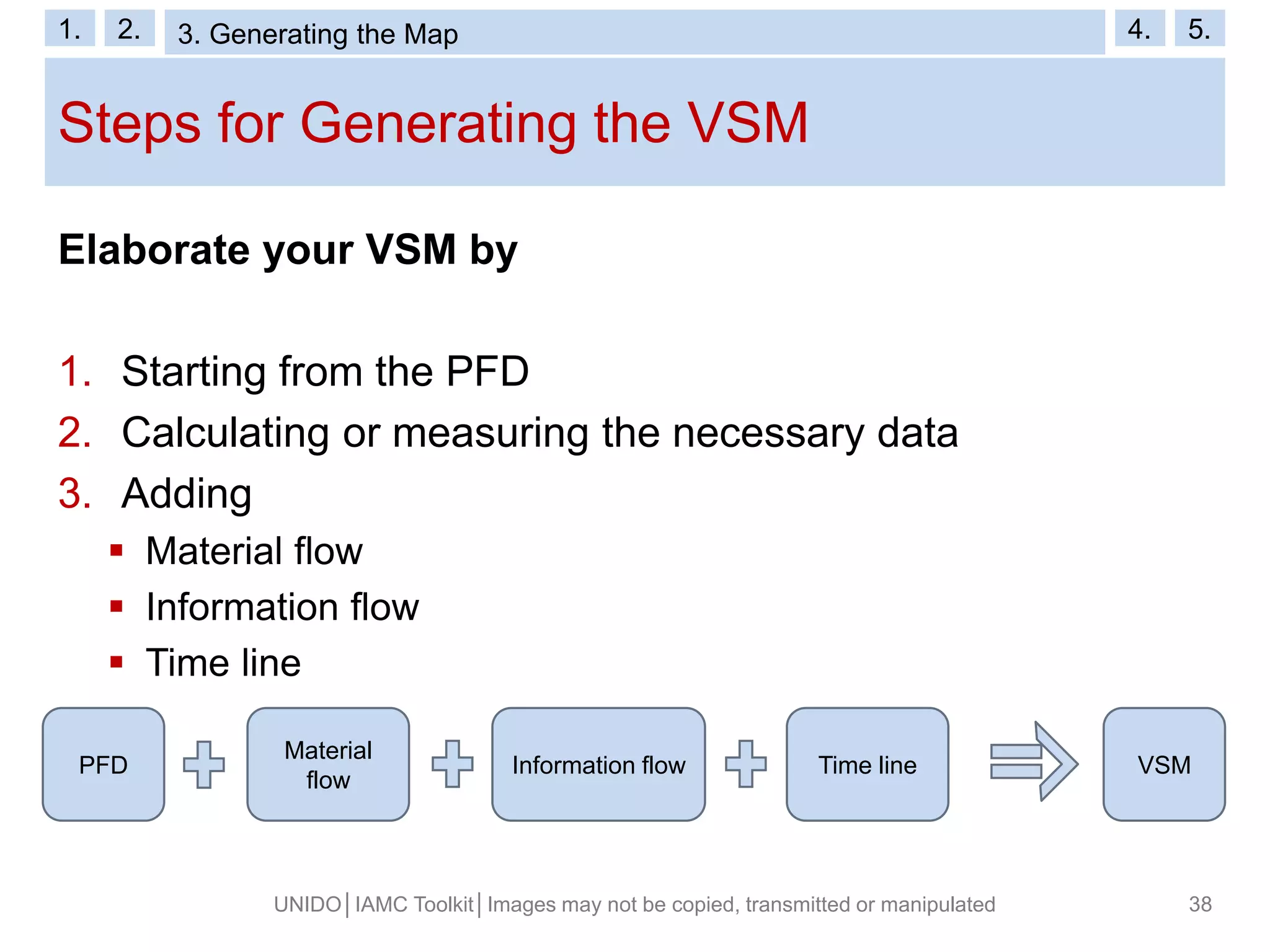
Elaborate your VSM by
1. Starting from the PFD
2. Calculating or measuring the necessary data
3. Adding
ļ‚§ Material flow
ļ‚§ Information flow
ļ‚§ Time line
PFD
Material
flow
Information flow Time line VSM
1. 2. 3. VSM Symbols 4. 5.1. 2. 3. Generating the Map 4. 5.
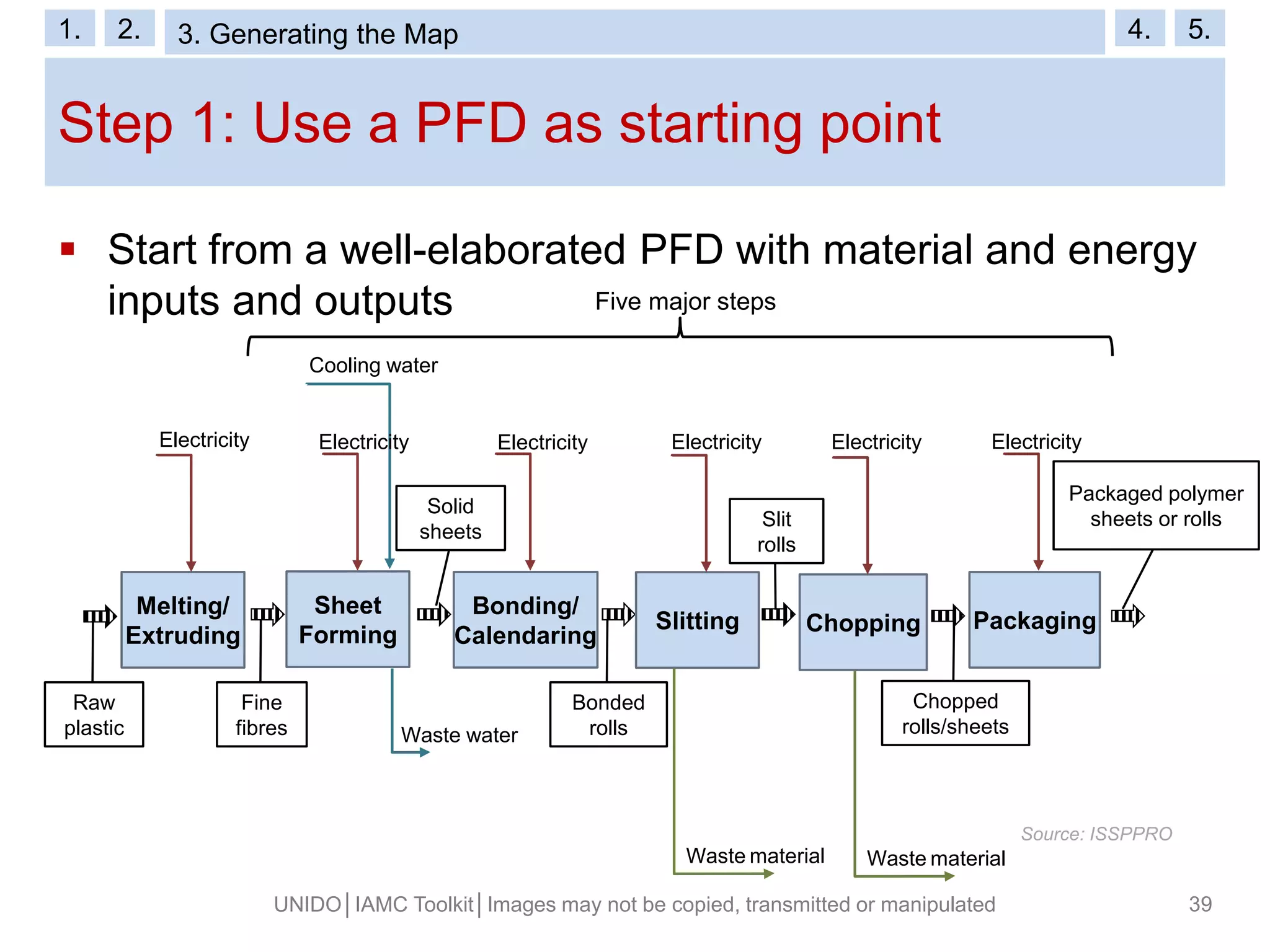
Step 1: Use a PFD as starting point
UNIDO│IAMC Toolkit│Images may not be copied, transmitted or manipulated 39
ļ‚§ Start from a well-elaborated PFD with material and energy
inputs and outputs
Solid
sheets
Melting/
Extruding
Electricity
Bonding/
Calendaring
PackagingChoppingSlitting
Waste material
Cooling water
Sheet
Forming
Waste water
Five major steps
Fine
fibres
Bonded
rolls
Chopped
rolls/sheets
Slit
rolls
Raw
plastic
Packaged polymer
sheets or rolls
Source: ISSPPRO
Electricity Electricity Electricity Electricity Electricity
Waste material
1. 2. 3. VSM Symbols 4. 5.1. 2. 3. Generating the Map 4. 5.
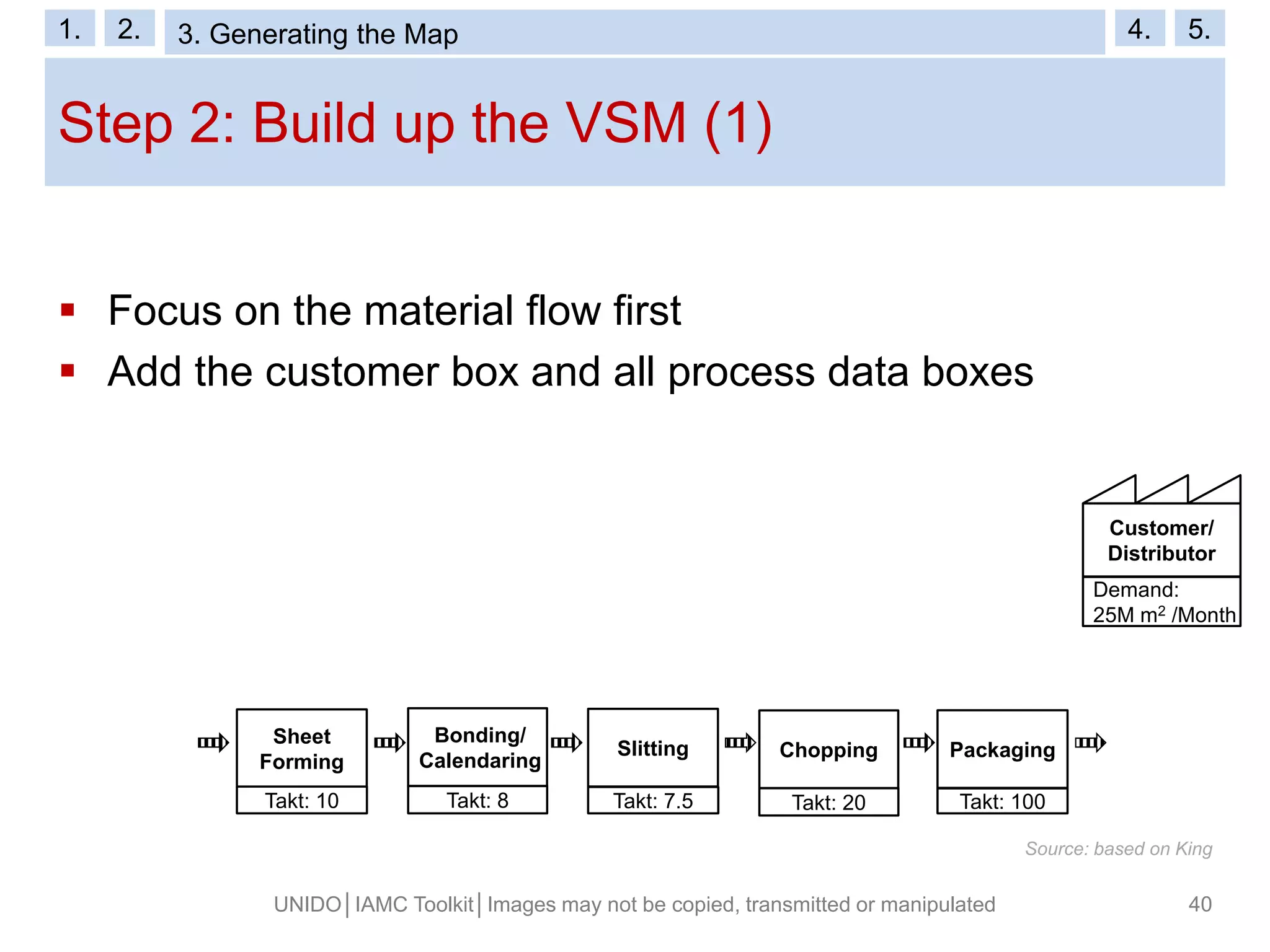
Step 2: Build up the VSM (1)
UNIDO│IAMC Toolkit│Images may not be copied, transmitted or manipulated 40
ļ‚§ Focus on the material flow first
ļ‚§ Add the customer box and all process data boxes
Customer/
Distributor
Demand:
25M m2 /Month
Sheet
Forming
Takt: 10
Bonding/
Calendaring
Takt: 8
Slitting
Takt: 7.5
Packaging
Takt: 100
Chopping
Takt: 20
Source: based on King
1. 2. 3. VSM Symbols 4. 5.1. 2. 3. Generating the Map 4. 5.
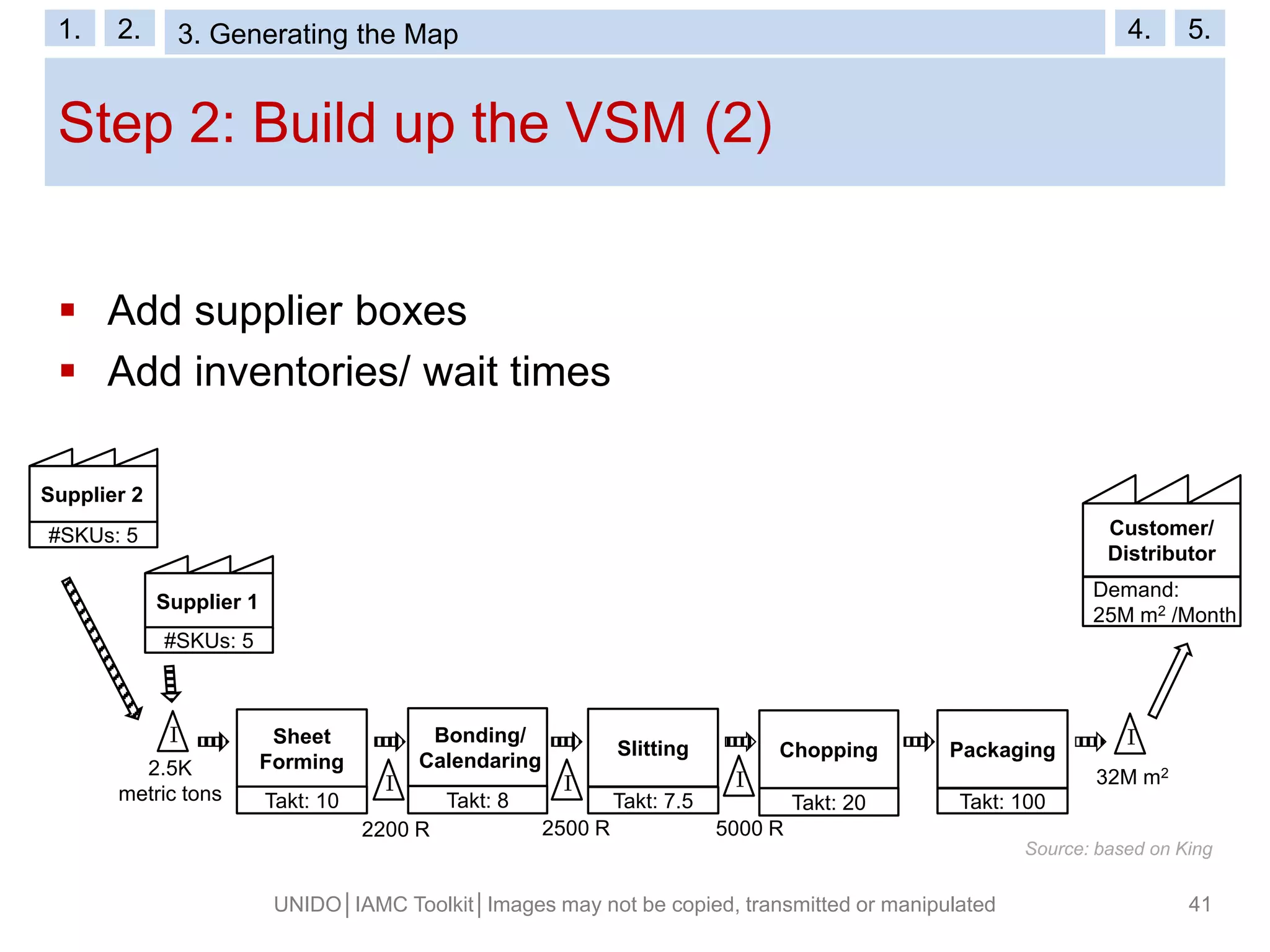
Step 2: Build up the VSM (2)
UNIDO│IAMC Toolkit│Images may not be copied, transmitted or manipulated 41
ļ‚§ Add supplier boxes
ļ‚§ Add inventories/ wait times
Supplier 2
#SKUs: 5
Supplier 1
#SKUs: 5
I I I
II
2.5K
metric tons
2200 R 2500 R 5000 R
32M m2
Source: based on King
Customer/
Distributor
Demand:
25M m2 /Month
Sheet
Forming
Takt: 10
Bonding/
Calendaring
Takt: 8
Slitting
Takt: 7.5
Packaging
Takt: 100
Chopping
Takt: 20
1. 2. 3. VSM Symbols 4. 5.1. 2. 3. Generating the Map 4. 5.
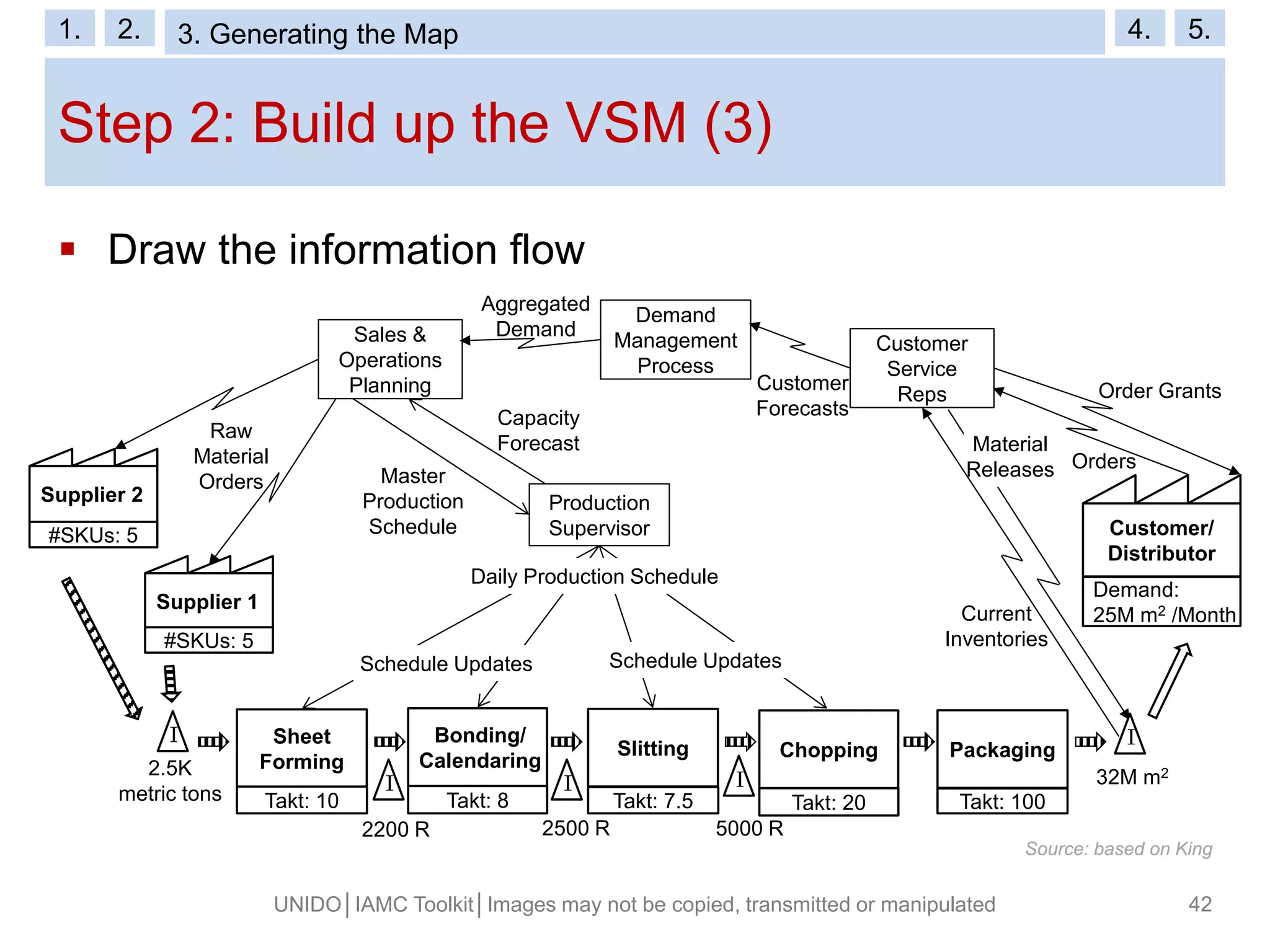
Step 2: Build up the VSM (3)
UNIDO│IAMC Toolkit│Images may not be copied, transmitted or manipulated 42
ļ‚§ Draw the information flow
Production
Supervisor
Sales &
Operations
Planning
Demand
Management
Process
Customer
Service
Reps
Daily Production Schedule
Schedule Updates Schedule Updates
Raw
Material
Orders
Aggregated
Demand
Customer
Forecasts
Order Grants
Current
Inventories
Material
Releases
Capacity
Forecast
Master
Production
Schedule
Orders
Source: based on King
Supplier 2
#SKUs: 5
Supplier 1
#SKUs: 5
I I I
II
2.5K
metric tons
2200 R 2500 R 5000 R
32M m2
Source: based on King
Customer/
Distributor
Demand:
25M m2 /Month
Sheet
Forming
Takt: 10
Bonding/
Calendaring
Takt: 8
Slitting
Takt: 7.5
Packaging
Takt: 100
Chopping
Takt: 20
1. 2. 3. VSM Symbols 4. 5.1. 2. 3. Generating the Map 4. 5.
Step 2: Build up the VSM (4)
UNIDO│IAMC Toolkit│Images may not be copied, transmitted or manipulated 43
ļ‚§ Draw the timeline
10 Min 15 Min 15 Min 5 Min 13 Min
10 Days 16 Days 8 Days 2 Days 40 Days14 Days
NVA time = 90 Days
VA time = 58 Min
Source: based on King
Production
Supervisor
Sales &
Operations
Planning
Demand
Management
Process
Customer
Service
Reps
Daily Production Schedule
Schedule Updates Schedule Updates
Raw
Material
Orders
Aggregated
Demand
Customer
Forecasts
Order Grants
Current
Inventories
Material
Releases
Capacity
Forecast
Master
Production
Schedule
Orders
Supplier 2
#SKUs: 5
Supplier 1
#SKUs: 5
I I I
II
2.5K
metric tons
2200 R 2500 R 5000 R
32M m2
Customer/
Distributor
Demand:
25M m2 /Month
Sheet
Forming
Takt: 10
Bonding/
Calendaring
Takt: 8
Slitting
Takt: 7.5
Packaging
Takt: 100
Chopping
Takt: 20
1. 2. 3. VSM Symbols 4. 5.1. 2. 3. Generating the Map 4. 5.
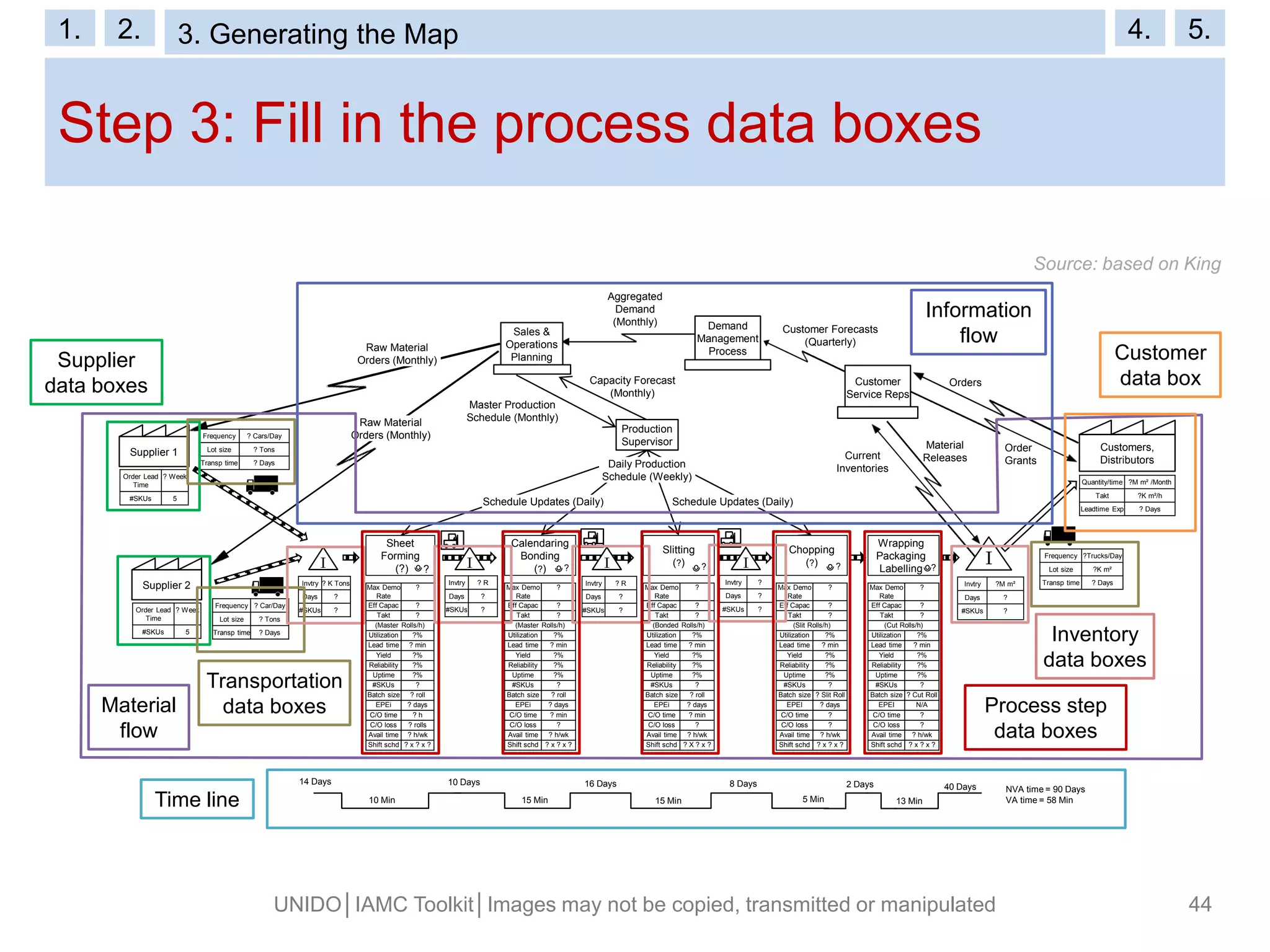
Step 3: Fill in the process data boxes
UNIDO│IAMC Toolkit│Images may not be copied, transmitted or manipulated 44
Invtry ? K Tons
Days ?
#SKUs ?
Invtry ? R
Days ?
#SKUs ?
Invtry ? R
Days ?
#SKUs ?
Invtry ?
Days ?
#SKUs ?
Invtry ?M m²
Days ?
#SKUs ?
Frequency ? Cars/Day
Lot size ? Tons
Transp time ? Days
Frequency ? Car/Day
Lot size ? Tons
Transp time ? Days
Order Lead
Time
? Week
#SKUs 5
Order Lead
Time
? Week
#SKUs 5
Quantity/time ?M m² /Month
Takt ?K m²/h
Leadtime Exp ? Days
Frequency ?Trucks/Day
Lot size ?K m²
Transp time ? Days
KEY
K = 1,000
M = 1,000,000
B = 1,000,000,000
Daily Production
Schedule (Weekly)
Schedule Updates (Daily)
Raw Material
Orders (Monthly)
Aggregated
Demand
(Monthly)
Customer Forecasts
(Quarterly)
Orders
Material
Releases
Capacity Forecast
(Monthly)
Master Production
Schedule (Monthly)
Schedule Updates (Daily)
Raw Material
Orders (Monthly)
Current
Inventories
Order
Grants
Production
Supervisor
Max Demo
Rate
?
Eff Capac ?
Takt ?
(Master Rolls/h)
Utilization ?%
Lead time ? min
Yield ?%
Reliability ?%
Uptime ?%
#SKUs ?
Batch size ? roll
EPEi ? days
C/O time ? h
C/O loss ? rolls
Avail time ? h/wk
Shift schd ? x ? x ?
Sheet
Forming
(?)
Calendaring
Bonding
(?) ?
Slitting
(?) ?
Chopping
(?)
Wrapping
Packaging
Labelling
Customers,
Distributors
Supplier 1
Sales &
Operations
Planning
Demand
Management
Process
Customer
Service Reps
10 Min 15 Min 15 Min 5 Min 13 Min
10 Days 16 Days 8 Days 2 Days 40 Days
14 Days
NVA time = 90 Days
VA time = 58 Min
I II I I
Supplier 2
? ?
Max Demo
Rate
?
Eff Capac ?
Takt ?
(Master Rolls/h)
Utilization ?%
Lead time ? min
Yield ?%
Reliability ?%
Uptime ?%
#SKUs ?
Batch size ? roll
EPEi ? days
C/O time ? min
C/O loss ?
Avail time ? h/wk
Shift schd ? x ? x ?
Max Demo
Rate
?
Eff Capac ?
Takt ?
(Bonded Rolls/h)
Utilization ?%
Lead time ? min
Yield ?%
Reliability ?%
Uptime ?%
#SKUs ?
Batch size ? roll
EPEi ? days
C/O time ? min
C/O loss ?
Avail time ? h/wk
Shift schd ? X ? x ?
Max Demo
Rate
?
Eff Capac ?
Takt ?
(Cut Rolls/h)
Utilization ?%
Lead time ? min
Yield ?%
Reliability ?%
Uptime ?%
#SKUs ?
Batch size ? Cut Roll
EPEI N/A
C/O time ?
C/O loss ?
Avail time ? h/wk
Shift schd ? x ? x ?
Max Demo
Rate
?
Eff Capac ?
Takt ?
(Slit Rolls/h)
Utilization ?%
Lead time ? min
Yield ?%
Reliability ?%
Uptime ?%
#SKUs ?
Batch size ? Slit Roll
EPEI ? days
C/O time ?
C/O loss ?
Avail time ? h/wk
Shift schd ? x ? x ?
Material
flow
Information
flow
Time line
Customer
data box
Supplier
data boxes
Transportation
data boxes
Inventory
data boxes
Process step
data boxes
?
Source: based on King
1. 2. 3. VSM Symbols 4. 5.1. 2. 3. Generating the Map 4. 5.
Step 4: Determine Key Metrics (1)
UNIDO│IAMC Toolkit│Images may not be copied, transmitted or manipulated 45
For the summary metrics box:
Sum of individual process metrics
ļ‚§ Total cycle time: Sum of all (process step) cycle times
Value-Added Time, VAT: Total time spent on value-added
activities
Non-Value-Added Time, NVAT: Total time spent on non-
value-added activities
 VAT and NVAT are measured directly from the process
š‘‡š‘œš‘”š‘Žš‘™ š‘š‘¦š‘š‘™š‘’ š‘”š‘–š‘šš‘’ š‘šš‘–š‘› = š‘‰š“š‘‡ š‘šš‘–š‘› + š‘š‘‰š“š‘‡ [š‘šš‘–š‘›]
NVAT = 2.39 days
VAT = 97 secs.
PCE = 0.15%
0.183 days
1. 2. 3. VSM Symbols 4. 5.1. 2. 3. Generating the Map 4. 5.
Step 4: Determine Key Metrics (2)
UNIDO│IAMC Toolkit│Images may not be copied, transmitted or manipulated 46
Entire process performance indicators:
ļ‚§ Process cycle efficiency (PCE): Value-added percentage
of the process
PCE[%] =
š‘‰š“š‘‡
š‘”š‘œš‘”š‘Žš‘™ š‘š‘¦š‘š‘™š‘’ š‘”š‘–š‘šš‘’
NVAT = 2.39 days
VAT = 97 secs.
PCE = 0.15%
25 secs 30 secs 42 secs
1 day 0.51 days 0.69 days 0.18 days
1. 2. 3. VSM Symbols 4. 5.1. 2. 3. Generating the Map 4. 5.
Step 4: Determine Key Metrics (3)
UNIDO│IAMC Toolkit│Images may not be copied, transmitted or manipulated 47
Entire process performance indicators:
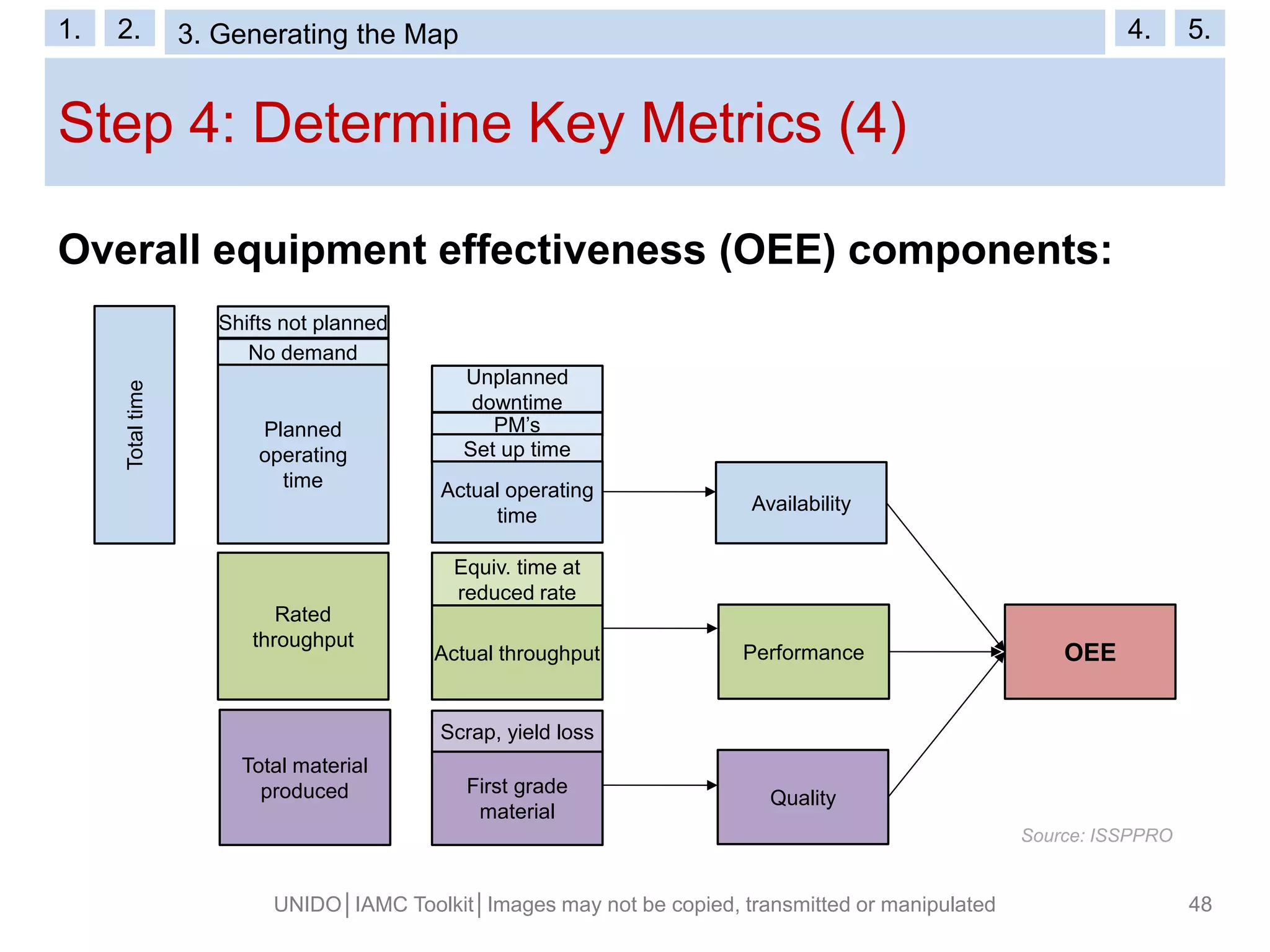
ļ‚§ Overall equipment effectiveness (OEE): reflects all the
factors detracting from optimum equipment performance
š‘‚šøšø % = š“š‘£š‘Žš‘–š‘™š‘Žš‘š‘–š‘™š‘–š‘”š‘¦ Ɨ š‘ƒš‘’š‘Ÿš‘“š‘œš‘Ÿš‘šš‘Žš‘›š‘š‘’ Ɨ š‘„š‘¢š‘Žš‘™š‘–š‘”š‘¦
š“š‘£š‘Žš‘–š‘™š‘Žš‘š‘–š‘™š‘–š‘”š‘¦ [%] =
š“š‘š‘”š‘¢š‘Žš‘™ š‘œš‘š‘’š‘Ÿš‘Žš‘”š‘–š‘›š‘” š‘”š‘–š‘šš‘’
š‘ƒš‘™š‘Žš‘›š‘›š‘’š‘‘ š‘œš‘š‘’š‘Ÿš‘Žš‘”š‘–š‘›š‘” š‘”š‘–š‘šš‘’
š‘ƒš‘’š‘Ÿš‘“š‘œš‘Ÿš‘šš‘Žš‘›š‘š‘’ % =
š“š‘š‘”š‘¢š‘Žš‘™ š‘”ā„Žš‘Ÿš‘œš‘¢š‘”ā„Žš‘š‘¢š‘”
š‘ƒš‘™š‘Žš‘›š‘›š‘’š‘‘ š‘”ā„Žš‘Ÿš‘œš‘¢š‘”ā„Žš‘š‘¢š‘”
š‘„š‘¢š‘Žš‘™š‘–š‘”š‘¦ [%] =
š‘„š‘¢š‘Žš‘›š‘”š‘–š‘”š‘¦ š‘œš‘“ š‘“š‘–š‘Ÿš‘ š‘” š‘”š‘Ÿš‘Žš‘‘š‘’ š‘šš‘Žš‘”š‘’š‘Ÿš‘–š‘Žš‘™
š‘‡š‘œš‘”š‘Žš‘™ š‘žš‘¢š‘Žš‘›š‘”š‘–š‘”š‘¦ š‘š‘Ÿš‘œš‘‘š‘¢š‘š‘’š‘‘
1. 2. 3. VSM Symbols 4. 5.1. 2. 3. Generating the Map 4. 5.
Step 4: Determine Key Metrics (4)
UNIDO│IAMC Toolkit│Images may not be copied, transmitted or manipulated 48
Overall equipment effectiveness (OEE) components:
Totaltime
Shifts not planned
No demand
Planned
operating
time
Unplanned
downtime
PM’s
Set up time
Actual operating
time
Rated
throughput
Actual throughput
Equiv. time at
reduced rate
Total material
produced First grade
material
Scrap, yield loss
Performance
Quality
OEE
Availability
Source: ISSPPRO
1. 2. 3. VSM Symbols 4. 5.1. 2. 3. Generating the Map 4. 5.
Learning Objectives
UNIDO│IAMC Toolkit│Images may not be copied, transmitted or manipulated 49
Invtry ? K Tons
Days ?
#SKUs ?
Invtry ? R
Days ?
#SKUs ?
Invtry ? R
Days ?
#SKUs ?
Invtry ?
Days ?
#SKUs ?
Invtry ?M m²
Days ?
#SKUs ?
Frequency ? Cars/Day
Lot size ? Tons
Transp time ? Days
Frequency ? Car/Day
Lot size ? Tons
Transp time ? Days
Order Lead
Time
? Week
#SKUs 5
Order Lead
Time
? Week
#SKUs 5
Quantity/time ?M m² /Month
Takt ?K m²/h
Leadtime Exp ? Days
Frequency ?Trucks/Day
Lot size ?K m²
Transp time ? Days
KEY
K = 1,000
M = 1,000,000
B = 1,000,000,000
Daily Production
Schedule (Weekly)
Schedule Updates (Daily)
Raw Material
Orders (Monthly)
Aggregated
Demand
(Monthly)
Customer Forecasts
(Quarterly)
Orders
Material
Releases
Capacity Forecast
(Monthly)
Master Production
Schedule (Monthly)
Schedule Updates (Daily)
Raw Material
Orders (Monthly)
Current
Inventories
Order
Grants
Production
Supervisor
Max Demo
Rate
?
Eff Capac ?
Takt ?
(Master Rolls/h)
Utilization ?%
Lead time ? min
Yield ?%
Reliability ?%
Uptime ?%
#SKUs ?
Batch size ? roll
EPEi ? days
C/O time ? h
C/O loss ? rolls
Avail time ? h/wk
Shift schd ? x ? x ?
Sheet
Forming
(?)
Calendaring
Bonding
(?) ?
Slitting
(?) ?
Chopping
(?)
Wrapping
Packaging
Labelling
Customers,
Distributors
Supplier 1
Sales &
Operations
Planning
Demand
Management
Process
Customer
Service Reps
10 Min 15 Min 15 Min 5 Min 13 Min
10 Days 16 Days 8 Days 2 Days 40 Days
14 Days
NVA time = 90 Days
VA time = 58 Min
I II I I
Supplier 2
? ?
Max Demo
Rate
?
Eff Capac ?
Takt ?
(Master Rolls/h)
Utilization ?%
Lead time ? min
Yield ?%
Reliability ?%
Uptime ?%
#SKUs ?
Batch size ? roll
EPEi ? days
C/O time ? min
C/O loss ?
Avail time ? h/wk
Shift schd ? x ? x ?
Max Demo
Rate
?
Eff Capac ?
Takt ?
(Bonded Rolls/h)
Utilization ?%
Lead time ? min
Yield ?%
Reliability ?%
Uptime ?%
#SKUs ?
Batch size ? roll
EPEi ? days
C/O time ? min
C/O loss ?
Avail time ? h/wk
Shift schd ? X ? x ?
Max Demo
Rate
?
Eff Capac ?
Takt ?
(Cut Rolls/h)
Utilization ?%
Lead time ? min
Yield ?%
Reliability ?%
Uptime ?%
#SKUs ?
Batch size ? Cut Roll
EPEI N/A
C/O time ?
C/O loss ?
Avail time ? h/wk
Shift schd ? x ? x ?
Max Demo
Rate
?
Eff Capac ?
Takt ?
(Slit Rolls/h)
Utilization ?%
Lead time ? min
Yield ?%
Reliability ?%
Uptime ?%
#SKUs ?
Batch size ? Slit Roll
EPEI ? days
C/O time ?
C/O loss ?
Avail time ? h/wk
Shift schd ? x ? x ?
Material
flow
Information
flow
Time line
Customer
data box
Supplier
data boxes
Transportation
data boxes
Inventory
data boxes
Process step
data boxes
?
Source: based on King
1. 2. 3. VSM Symbols 4. 5.1. 2. 3. Generating the Map 4. 5.
?
Can you identify the three components and the data
boxes?
Learning Objectives
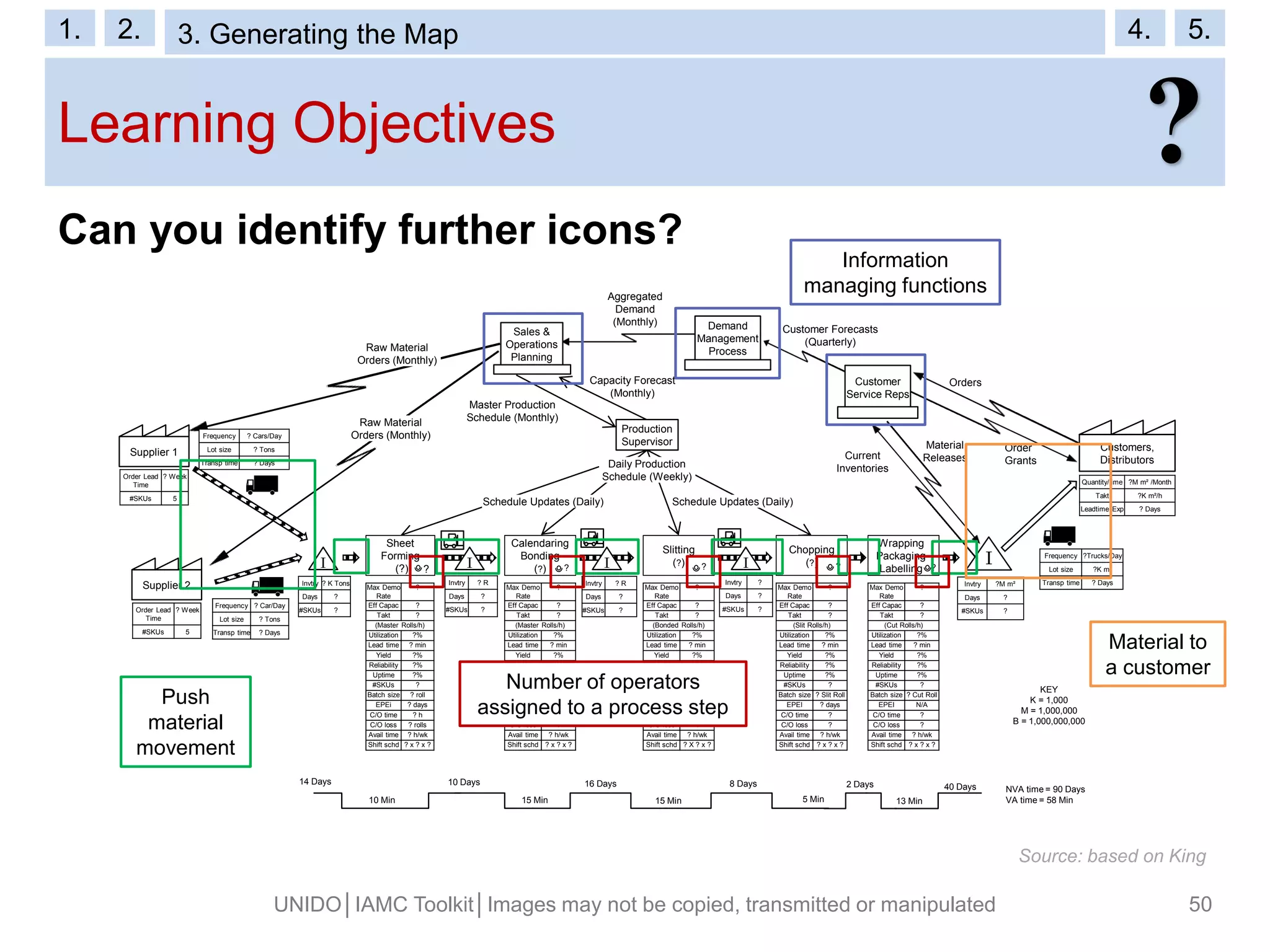
UNIDO│IAMC Toolkit│Images may not be copied, transmitted or manipulated 50
Invtry ? K Tons
Days ?
#SKUs ?
Invtry ? R
Days ?
#SKUs ?
Invtry ? R
Days ?
#SKUs ?
Invtry ?
Days ?
#SKUs ?
Invtry ?M m²
Days ?
#SKUs ?
Frequency ? Cars/Day
Lot size ? Tons
Transp time ? Days
Frequency ? Car/Day
Lot size ? Tons
Transp time ? Days
Order Lead
Time
? Week
#SKUs 5
Order Lead
Time
? Week
#SKUs 5
Quantity/time ?M m² /Month
Takt ?K m²/h
Leadtime Exp ? Days
Frequency ?Trucks/Day
Lot size ?K m²
Transp time ? Days
KEY
K = 1,000
M = 1,000,000
B = 1,000,000,000
Daily Production
Schedule (Weekly)
Schedule Updates (Daily)
Raw Material
Orders (Monthly)
Aggregated
Demand
(Monthly)
Customer Forecasts
(Quarterly)
Orders
Material
Releases
Capacity Forecast
(Monthly)
Master Production
Schedule (Monthly)
Schedule Updates (Daily)
Raw Material
Orders (Monthly)
Current
Inventories
Order
Grants
Production
Supervisor
Max Demo
Rate
?
Eff Capac ?
Takt ?
(Master Rolls/h)
Utilization ?%
Lead time ? min
Yield ?%
Reliability ?%
Uptime ?%
#SKUs ?
Batch size ? roll
EPEi ? days
C/O time ? h
C/O loss ? rolls
Avail time ? h/wk
Shift schd ? x ? x ?
Sheet
Forming
(?)
Calendaring
Bonding
(?) ?
Slitting
(?) ?
Chopping
(?)
Wrapping
Packaging
Labelling
Customers,
Distributors
Supplier 1
Sales &
Operations
Planning
Demand
Management
Process
Customer
Service Reps
10 Min 15 Min 15 Min 5 Min 13 Min
10 Days 16 Days 8 Days 2 Days 40 Days
14 Days
NVA time = 90 Days
VA time = 58 Min
I II I I
Supplier 2
? ?
Max Demo
Rate
?
Eff Capac ?
Takt ?
(Master Rolls/h)
Utilization ?%
Lead time ? min
Yield ?%
Reliability ?%
Uptime ?%
#SKUs ?
Batch size ? roll
EPEi ? days
C/O time ? min
C/O loss ?
Avail time ? h/wk
Shift schd ? x ? x ?
Max Demo
Rate
?
Eff Capac ?
Takt ?
(Bonded Rolls/h)
Utilization ?%
Lead time ? min
Yield ?%
Reliability ?%
Uptime ?%
#SKUs ?
Batch size ? roll
EPEi ? days
C/O time ? min
C/O loss ?
Avail time ? h/wk
Shift schd ? X ? x ?
Max Demo
Rate
?
Eff Capac ?
Takt ?
(Cut Rolls/h)
Utilization ?%
Lead time ? min
Yield ?%
Reliability ?%
Uptime ?%
#SKUs ?
Batch size ? Cut Roll
EPEI N/A
C/O time ?
C/O loss ?
Avail time ? h/wk
Shift schd ? x ? x ?
Max Demo
Rate
?
Eff Capac ?
Takt ?
(Slit Rolls/h)
Utilization ?%
Lead time ? min
Yield ?%
Reliability ?%
Uptime ?%
#SKUs ?
Batch size ? Slit Roll
EPEI ? days
C/O time ?
C/O loss ?
Avail time ? h/wk
Shift schd ? x ? x ?
?
Source: based on King
1. 2. 3. VSM Symbols 4. 5.1. 2. 3. Generating the Map 4. 5.
?
Information
managing functions
Push
material
movement
Material to
a customer
Number of operators
assigned to a process step
Can you identify further icons?
VSM Good Practices
ļ‚§ The Value Stream Map
ļ‚§ VSM Symbols
ļ‚§ Generating the Map
ļ‚§ VSM Good Practices
ļ‚§ Key Messages
ļ‚§ Glossary
UNIDO│IAMC Toolkit│Images may not be copied, transmitted or manipulated 51
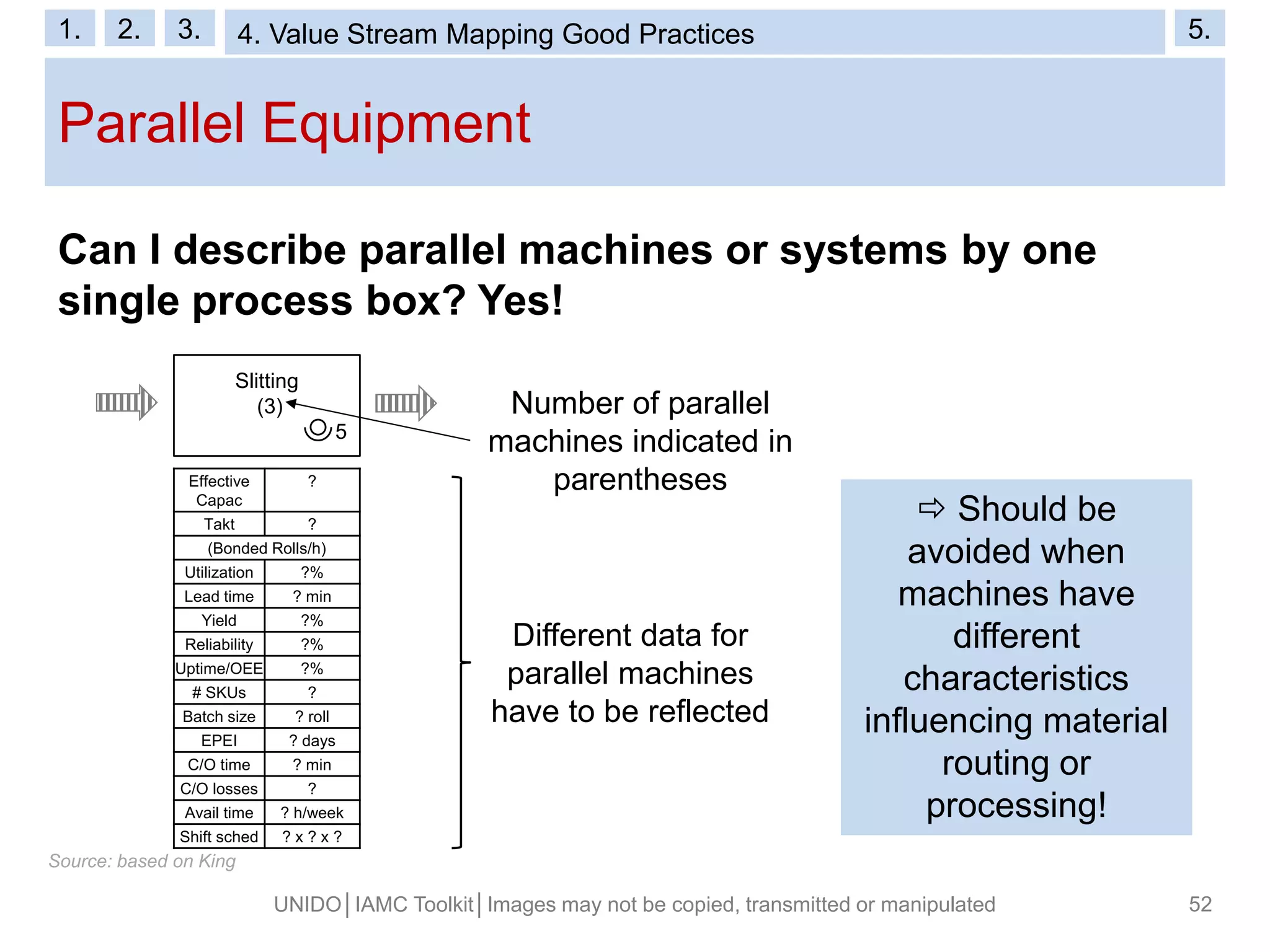
Parallel Equipment
UNIDO│IAMC Toolkit│Images may not be copied, transmitted or manipulated 52
Can I describe parallel machines or systems by one
single process box? Yes!
 Should be
avoided when
machines have
different
characteristics
influencing material
routing or
processing!
Number of parallel
machines indicated in
parentheses
Different data for
parallel machines
have to be reflected
Slitting
(3)
5
Effective
Capac
?
Takt ?
(Bonded Rolls/h)
Utilization ?%
Lead time ? min
Yield ?%
Reliability ?%
Uptime/OEE ?%
# SKUs ?
Batch size ? roll
EPEI ? days
C/O time ? min
C/O losses ?
Avail time ? h/week
Shift sched ? x ? x ?
Source: based on King
1. 2. 3. 4. Generating the Map 5.1. 2. 3. 4. Value Stream Mapping Good Practices 5.
Logical Flow vs. Geographic Arrangement (1)
UNIDO│IAMC Toolkit│Images may not be copied, transmitted or manipulated 53
Is it more reasonable to arrange process boxes logically
or geographically?
ļ‚§ In general, the VSM should be arranged in a way that the
true flow can be seen!
ļ‚§ Geographically accurate VSM can be helpful in some
cases, however it should be depicted on a second map.
1. 2. 3. 4. Generating the Map 5.1. 2. 3. 4. Value Stream Mapping Good Practices 5.
Calendaring
Bonding
(4)
Logical Flow vs. Geographic Arrangement (3)
UNIDO│IAMC Toolkit│Images may not be copied, transmitted or manipulated 54
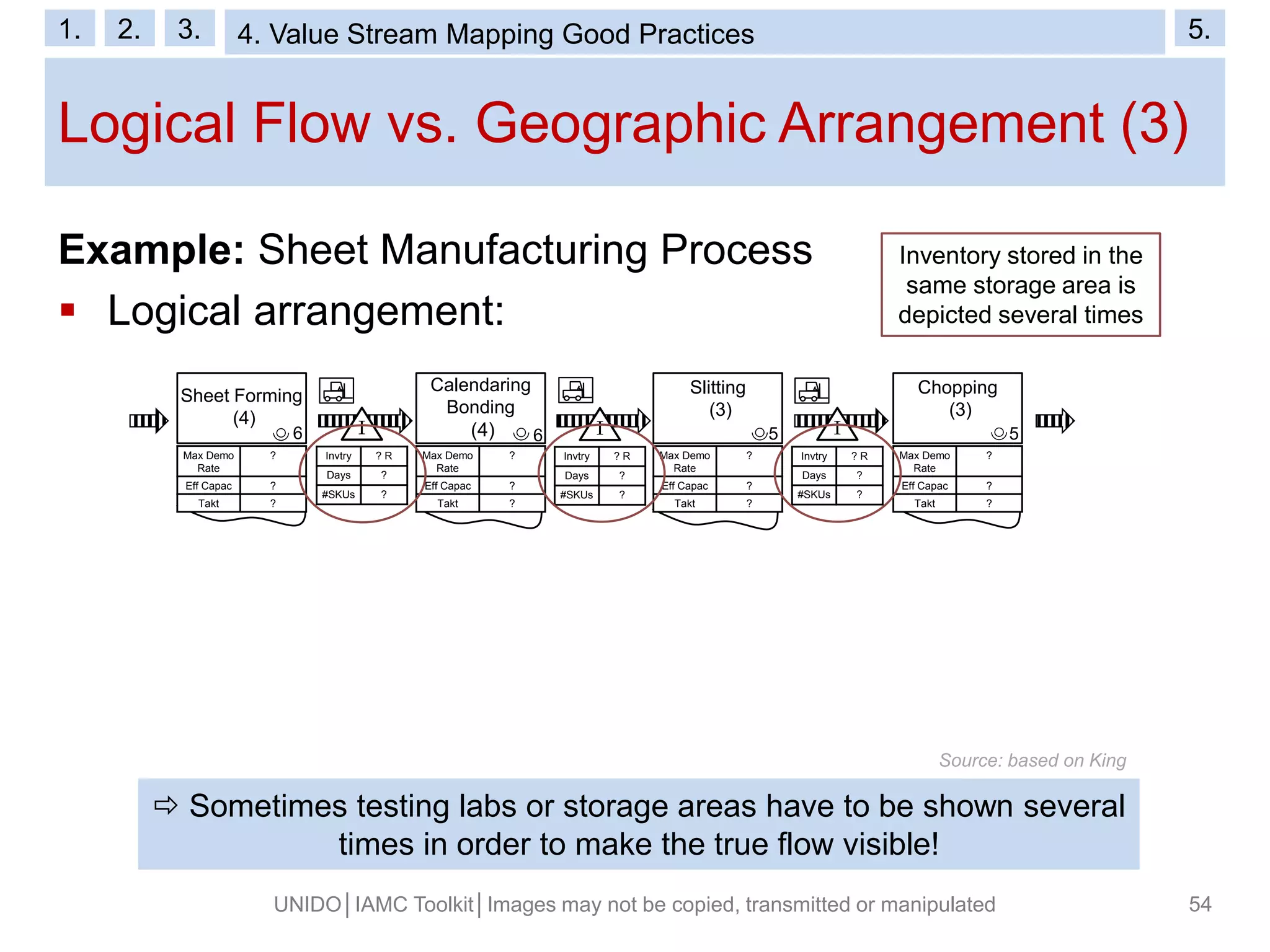
Example: Sheet Manufacturing Process
ļ‚§ Logical arrangement:
Inventory stored in the
same storage area is
depicted several times
Sheet Forming
(4)
 Sometimes testing labs or storage areas have to be shown several
times in order to make the true flow visible!
Max Demo
Rate
?
Eff Capac ?
Takt ?
Max Demo
Rate
?
Eff Capac ?
Takt ?
Slitting
(3)
56
Max Demo
Rate
?
Eff Capac ?
Takt ?
Chopping
(3)
5
Max Demo
Rate
?
Eff Capac ?
Takt ?
I
Invtry ? R
Days ?
#SKUs ?
I
Invtry ? R
Days ?
#SKUs ?
I
Invtry ? R
Days ?
#SKUs ?
Source: based on King
6
1. 2. 3. 4. Generating the Map 5.1. 2. 3. 4. Value Stream Mapping Good Practices 5.
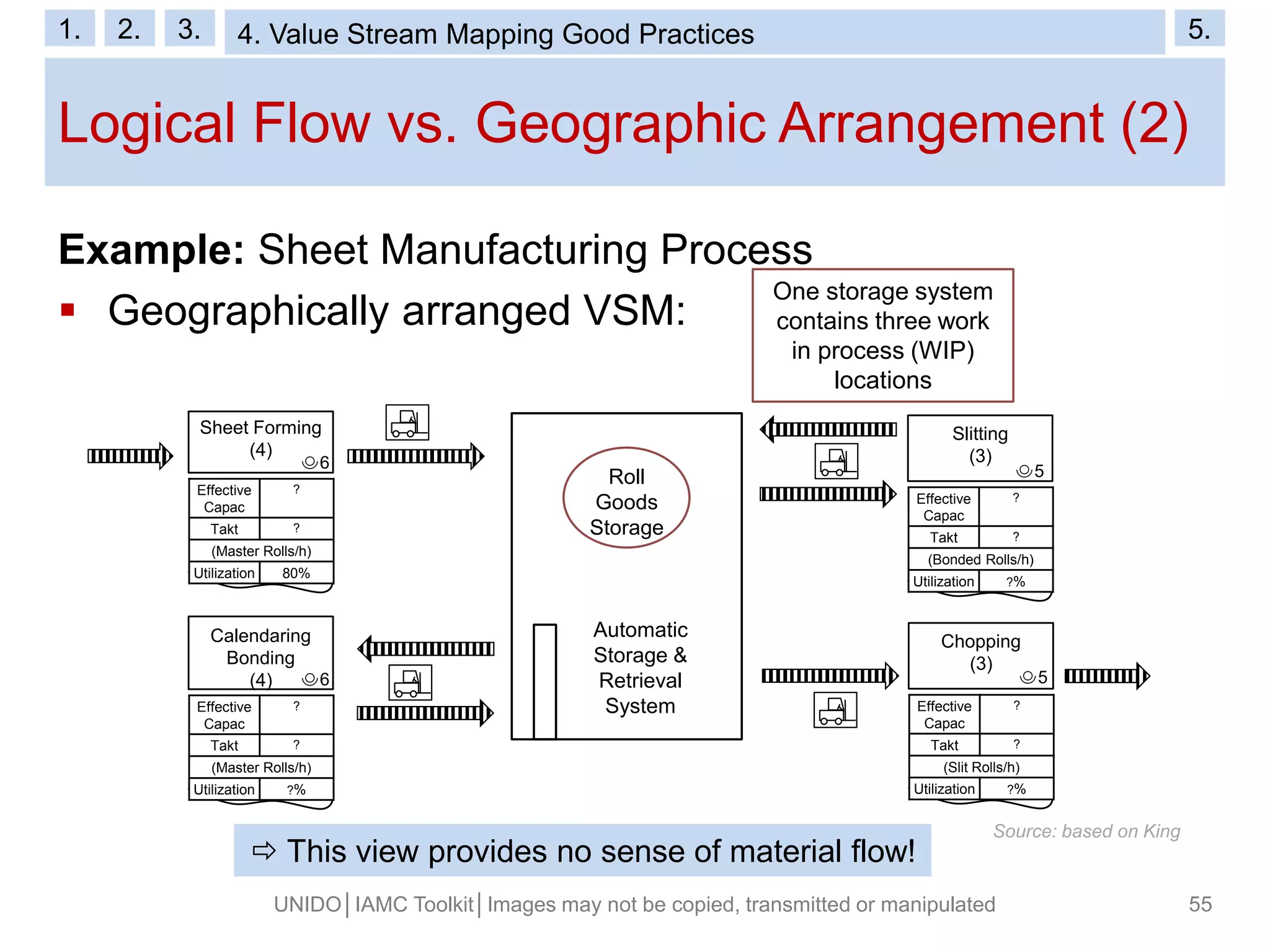
Example: Sheet Manufacturing Process
ļ‚§ Geographically arranged VSM:
Logical Flow vs. Geographic Arrangement (2)
UNIDO│IAMC Toolkit│Images may not be copied, transmitted or manipulated 55
One storage system
contains three work
in process (WIP)
locations
 This view provides no sense of material flow!
Sheet Forming
(4)
Effective
Capac
?
Takt ?
(Master Rolls/h)
Utilization 80%
Calendaring
Bonding
(4)
Effective
Capac
?
Takt ?
(Master Rolls/h)
Utilization ?%
Chopping
(3)
Effective
Capac
?
Takt ?
(Slit Rolls/h)
Utilization ?%
Slitting
(3)
Effective
Capac
?
Takt ?
(Bonded Rolls/h)
Utilization ?%
Roll
Goods
Storage
Automatic
Storage &
Retrieval
System
Source: based on King
5
5
6
6
1. 2. 3. 4. Generating the Map 5.1. 2. 3. 4. Value Stream Mapping Good Practices 5.
Learning Objectives
UNIDO│IAMC Toolkit│Images may not be copied, transmitted or manipulated 56
Summarize VSM Best Practices:
ļ‚§ When it is reasonable to aggregate/separate parallel
equipment?
ļ‚§ Parallel machines or systems of comparable properties
should be summed up in one process box
ļ‚§ However, if these parallel machines have different capabilities
influencing material routing or processing, they should be
separated
ļ‚§ Can you explain why a logically arranged VSM should be
preferred over a geographically arranged VSM?
ļ‚§ It helps identifying the real flow, whereas geographically
arranged VSM tend to get confusing and should only be as a
supplement if needed
?
1. 2. 3. 4. Generating the Map 5.1. 2. 3. 4. Value Stream Mapping Good Practices 5.
Key Messages
ļ‚§ The Value Stream Map
ļ‚§ VSM Symbols
ļ‚§ Generating the Map
ļ‚§ VSM Good Practices
ļ‚§ Key Messages
ļ‚§ Glossary
UNIDO│IAMC Toolkit│Images may not be copied, transmitted or manipulated 57
Key Messages (1)
UNIDO│IAMC Toolkit│Images may not be copied, transmitted or manipulated 58
What is a VSM?
A Value Stream Map (VSM) is a flow diagram of an entire
production process, including material and information flow in
connection with the required value-add and non-value add
time.
Key Messages (2)
UNIDO│IAMC Toolkit│Images may not be copied, transmitted or manipulated 59
What are the outcomes of a VSM?
ļ‚§ Identification of production times that do not add value to
the final product
ļ‚§ Identification of production steps that
ļ‚§ Waste (raw) material
ļ‚§ Produce (hazardous) waste
ļ‚§ Produce emissions and pollution
ļ‚§ Lead to risks for workers’ health
ļ‚§ Future state map showing an improved, less wasteful
production process
ļ‚§ Development of an implementation plan for further
improvements on the basis of Lean activities
Key Messages (3)
UNIDO│IAMC Toolkit│Images may not be copied, transmitted or manipulated 60
How can SMEs use VSM to improve their business?
VSM is a tool which enables you to:
ļ‚§ Improve your understanding of the processes, inventory
flows and sources of waste
ļ‚§ Make decisions to improve your performance on the basis
of an idealized ā€œfuture stateā€ map and to reach
ļ‚§ Higher productivity
ļ‚§ Lower material and energy waste
ļ‚§ Lower variable and material costs
Glossary
ļ‚§ The Value Stream Map
ļ‚§ VSM Symbols
ļ‚§ Generating the Map
ļ‚§ VSM Good Practices
ļ‚§ Key Messages
ļ‚§ Glossary
UNIDO│IAMC Toolkit│Images may not be copied, transmitted or manipulated 61
ļ‚§ A-type process: Converging production process, typically
found in assembly plants (starting with a variety of raw
materials, producing a small amount of final products)
ļ‚§ Batch size [units]: Amount of material produced as a single
lot
ļ‚§ Changeover (C/O) losses [units]: Amount of material lost in
the change from one product to another
ļ‚§ Changeover (C/O) time [min]: Time needed to change from
one product to another
ļ‚§ Cycle rate/Effective capacity [units/min]: Reciprocal of
cycle time
Glossary (1)
UNIDO│IAMC Toolkit│Images may not be copied, transmitted or manipulated 62
ļ‚§ Cycle time (C/T) [min/unit]: Time needed to produce a part
or lot; reflects equipment capacity
ļ‚§ Effective capacity: See cycle rate
ļ‚§ Every part every interval (EPEI) [days]: Time span over
which all product types are made
ļ‚§ Future state map: A VSM presenting an optimized state
serving as target of all improvement activities
ļ‚§ Lead time [min]: The time needed for one part or lot to
complete a specific process step
Glossary (2)
UNIDO│IAMC Toolkit│Images may not be copied, transmitted or manipulated 63
ļ‚§ Maximum demonstrated rate [units/min]: Maximum
production capacity possible under specific process
equipment configuration; reciprocal of ideal cycle time
ļ‚§ Non-value-added time (NVA time or NVAT) [min]: Total
time spent on non-value-added activities
ļ‚§ Order lead time [days]: Time from replenishment order
until the material arrives
ļ‚§ Overall equipment effectiveness (OEE) [%]: Measure
capturing all the factors detracting from optimum
equipment performance; comprising an availability factor, a
performance factor and a quality factor
Glossary (3)
UNIDO│IAMC Toolkit│Images may not be copied, transmitted or manipulated 64
ļ‚§ PFD / Process flow diagram: Diagram visualizing the flow
of plant processes and the major equipment
ļ‚§ Process cycle efficiency (PCE) [%]: Value-added
percentage of the process, calculated as VAT divided by
total cycle time
ļ‚§ Reliability [%]: Measure of the steadiness of a machine;
percentage of time without any equipment failure
ļ‚§ Shift schedule [h/week]: Number of hours per shift, shifts
per day and days per week
ļ‚§ Stock keeping units (SKUs) [units]: Product varieties
entering or leaving a process step
Glossary (4)
UNIDO│IAMC Toolkit│Images may not be copied, transmitted or manipulated 65
ļ‚§ Takt rate [units/min]: Rate at which a part or lot is needed,
reciprocal of takt time
ļ‚§ Takt time [min/unit]: Time within which a part or lot is
needed; calculated by dividing the time available in a
period by the average demand of products during this
period
ļ‚§ Total cycle time: Sum of all (process step) cycle times;
calculated by adding VAT and NVAT
ļ‚§ Uptime [%]: Measure reflecting all sorts of time lost;
calculated as net operating time divided by available
operating time
Glossary (5)
UNIDO│IAMC Toolkit│Images may not be copied, transmitted or manipulated 66
ļ‚§ Utilization [%]: Measure for how fully utilized a process
step is; calculated by dividing cycle time by takt time or
takt rate by effective capacity
ļ‚§ Value Stream Map (VSM): Visual tool used to identify the
current flow of material and information throughout a
production process
ļ‚§ Value-added time (VA time or VAT) [min]: Total time spent
on value-added activities
ļ‚§ V-type process: diverging production process, typically
found in process industries (starting from a small number
of raw materials, producing a wide range of different final
products)
Glossary (6)
UNIDO│IAMC Toolkit│Images may not be copied, transmitted or manipulated 67
ļ‚§ Work in Progress (WIP, also Work in Process) [units]: all
materials and partially finished goods within the production
process waiting to be completed
ļ‚§ Yield [%]: Percentage of good parts leaving a process step
Glossary (7)
UNIDO│IAMC Toolkit│Images may not be copied, transmitted or manipulated 68
Where to find more information
ļ‚§ VSM Font: http://www.ambor.com/public/vsm/vsmfont.html
ļ‚§ VSM Icons: http://www.lean.org/common/display/?o=866
Books:
ļ‚§ Rother M.; Shook J.: Learning to See: Value-Stream
Mapping to Create Value and Eliminate Muda: Value
Stream Mapping to Add Value and Eliminate Muda, 2009
ļ‚§ King, P. L.: Lean for the Process Industries: Dealing with
Complexity, 2009
ļ‚§ California State University, Northridge Course (Week 7&9):
http://www.csun.edu/~shternberg/shternberg-507.htm
UNIDO│IAMC Toolkit│Images may not be copied, transmitted or manipulated 69
Sources
UNIDO│IAMC Toolkit│Images may not be copied, transmitted or manipulated 70
ļ‚§ CSD Engineers, Switzerland / ISSPPRO, Germany, 2015
ļ‚§ King, P. L.: Lean for the Process Industries: Dealing with
Complexity, 2009
ļ‚§ King, P. L.; King, J. S.: The Product Wheel Handbook:
Creating Balanced Flow in High-Mix Process Operations,
2013
ļ‚§ EPA: The Lean and Chemicals Toolkit, 2009
http://www.epa.gov/lean/environment/toolkits/chemicals/in
dex.htm
ļ‚§ EPA: The Lean and Environment Toolkit, 2007
http://www.epa.gov/lean/environment/toolkits/environment/i
ndex.htm
Sources
UNIDO│IAMC Toolkit│Images may not be copied, transmitted or manipulated 71
Fusce posuere, magna sed pulvinar ultricies,
purus lectus malesuada libero, sit amet magna
eros quis (ARIAL 32).
Images
ļ‚§ ISSPPRO GmbH, Germany, 2015
ļ‚§ Shutterstock
UNIDO│IAMC Toolkit│Images may not be copied, transmitted or manipulated 72
Disclaimer
UNIDO│IAMC Toolkit│Images may not be copied, transmitted or manipulated 73
This presentation was elaborated with the requested
diligence and with the generally accepted principles of the
relevant field.
If a third party uses the contents of the presentation in order
to take decisions, the authors disclaim any liability for any
kind of direct or indirect (consequential) damages.

E12 1 value-stream-mapping-final-web

  • 1.
    TRP 3 Value StreamMapping in the Chemical Industry IAMC Toolkit Innovative Approaches for the Sound Management of Chemicals and Chemical Waste
  • 2.
    Introduction SMEs manufacturing chemicalproducts have challenges reducing waste (time, resources, personnel) which affects the company’s profit. Value Stream Mapping (VSM) is a tool which maps the entire business (including sales, material procurement, production and delivery) and identifies key areas of waste and their root causes. The reader will learn how to use VSM in the chemical industry to reduce waste, decrease variable and raw material costs and increase business productivity. UNIDO│IAMC Toolkit│Images may not be copied, transmitted or manipulated 2
  • 3.
    Contents UNIDO│IAMC Toolkit│Images maynot be copied, transmitted or manipulated 3 1. The Value Stream Map ļ‚§ Key Idea ļ‚§ Key Components ļ‚§ How can VSM help Companies? ļ‚§ ā€œMust Knowsā€ for VSM 2. VSM Symbols ļ‚§ Process Boxes and Data Boxes ļ‚§ Material Flow ļ‚§ Information Flow ļ‚§ Timeline
  • 4.
    Topics UNIDO│IAMC Toolkit│Images maynot be copied, transmitted or manipulated 4 3. Generating the Map ļ‚§ Getting Started ļ‚§ Steps and Calculation of Key Data ļ‚§ Example VSM 4. VSM Good Practices ļ‚§ Parallel Equipment ļ‚§ Logical Flow versus Geographic Arrangement 5. Key Messages 6. Glossary
  • 5.
    The Value StreamMap ļ‚§ The Value Stream Map ļ‚§ VSM Symbols ļ‚§ Generating the Map ļ‚§ VSM Good Practices ļ‚§ Key Messages ļ‚§ Glossary UNIDO│IAMC Toolkit│Images may not be copied, transmitted or manipulated 5
  • 6.
    Key Idea (1) UNIDO│IAMCToolkit│Images may not be copied, transmitted or manipulated 6 What is a value stream map (VSM)? VSM is a specific type of flowchart used to depict material and information flow throughout a production process. What is its objective? VSM helps you to: ļ‚§ Improve your understanding of the processes, inventory flows and causes of waste ļ‚§ Make decisions to improve your performance on the basis of an idealized ā€œfuture stateā€ map 1. The value Stream Map 2. 3. 4. 5.
  • 7.
    Key Idea (2) UNIDO│IAMCToolkit│Images may not be copied, transmitted or manipulated 7 How is it generated? Value stream mapping builds on an existing Process Flow Diagram (PFD) by: ļ‚§ Drawing a visual representation of every process step ļ‚§ Asking a set of key questions ļ‚§ Drawing a ā€žfuture stateā€ map of optimized processes This is done using a predefined set of standardized icons.  A VSM enables you to identify and to plan to eliminate waste in your production process. 1. The value Stream Map 2. 3. 4. 5.
  • 8.
    Key Components (1) UNIDO│IAMCToolkit│Images may not be copied, transmitted or manipulated 8 ļ‚§ A Value Stream Map (VSM) is a flow diagram of an entire production process ļ‚§ It consists of three key components: Material flow Information flow Time line Flow from raw material to finished goods What has to be produced and when it has to be produced Ratio of value-added time (VAT) to non-value-added time (NVAT) Source: ISSPPRO 1. The value Stream Map 2. 3. 4. 5.
  • 9.
    Time line Material flow Key Components(2) UNIDO│IAMC Toolkit│Images may not be copied, transmitted or manipulated 9 Customers, DistributorsSuppliers Sheet Forming SlittingBonding Chopping Packaging Production Supervisor Demand Management Process Customer Service Representatives Sales & Operations Planning Information flow I I I I I 15 Min 18 Min 10 Min 6 Min 8 Min 11 Days 12 Days 7 Days 3 Min 42 Days16 Days Source: based on King 1. The value Stream Map 2. 3. 4. 5.
  • 10.
    How can VSMhelp Companies? (1) UNIDO│IAMC Toolkit│Images may not be copied, transmitted or manipulated 10 VSM and the design of an optimized future state help to: Visualise the flow ļ‚§ Get a clear overall picture of material and information flow and where they touch ļ‚§ Develop a sense of flow, inventory and bottlenecks Create understanding how ļ‚§ Value is created for the customer ļ‚§ The entire production process operates rather than individual units 1. The value Stream Map 2. 3. 4. 5.
  • 11.
    How can VSMhelp Companies? (2) UNIDO│IAMC Toolkit│Images may not be copied, transmitted or manipulated 11 VSM and the design of an optimized future state help to: Identify waste in all areas of production ļ‚§ Identify key areas of waste in the production process ļ‚§ Identify which and how much waste is generated ļ‚§ Identify the root causes for waste Improve business performance ļ‚§ Increase productivity ļ‚§ Reduce material and energy waste ļ‚§ Decrease variable and material costs  The ā€œfuture stateā€ map is essential for this step. Its optimized state serves as a target for all improvement activities! 1. The value Stream Map 2. 3. 4. 5.
  • 12.
    How can VSMhelp Companies? (3) UNIDO│IAMC Toolkit│Images may not be copied, transmitted or manipulated 12 Example of VSM improving efficiency: Woodfold Manufacturing, Inc. ļ‚§ Manufacturer of custom wood products located in Forest Grove, USA. ļ‚§ Woodfold implemented many of the improvement opportunities identified in the VSM, and achieved the following results: ļ‚§ Saved about $44,800 per year, including $34,700 per year from improvements to paint spray transfer efficiency. ļ‚§ Found a local recycler for PVC scrap, diverting 6 tons per year of solid PVC waste from the landfill. ļ‚§ Reduced volatile organic compound (VOC) emissions by nearly 454 kg per year. 1. The value Stream Map 2. 3. 4. 5. Source: EPA: The Lean and Chemicals Toolkit
  • 13.
    ā€œMust Knowsā€ forVSM UNIDO│IAMC Toolkit│Images may not be copied, transmitted or manipulated 13 In order to properly make a Value Stream Map, you should know… ļ‚§ Units of production ļ‚§ Takt time ļ‚§ Cycle time (C/T) … of all processes in the entire production process. 1. The value Stream Map 2. 3. 4. 5.
  • 14.
    Units of Production UNIDO│IAMCToolkit│Images may not be copied, transmitted or manipulated 14 Units of production ļ‚§ Express production volume ļ‚§ Are needed to calculate takt and capacity ļ‚§ May change from one production process to the next  Also conversion factors between those different units may change during the process  Define takt and capacity with the units most related to throughput capability of a piece of equipment 1. The value Stream Map 2. 3. 4. 5.
  • 15.
    Takt Time UNIDO│IAMC Toolkit│Imagesmay not be copied, transmitted or manipulated 15 Takt ļ‚§ Expresses total customer demand as a time factor ļ‚§ Reflects the time within which a part or lot is needed ļ‚§ Means rhythm in German  The ideal production process is completely synchronized with the rhythm of customer demand  Example: one car per day is produced and the Dealer can sell one car per day  ideal production process š‘‡š‘Žš‘˜š‘” š‘”š‘–š‘šš‘’ š‘šš‘–š‘› š‘¢š‘›š‘–š‘” = š‘Žš‘£š‘Žš‘–š‘™š‘Žš‘š‘™š‘’ š‘¤š‘œš‘Ÿš‘˜ š‘”š‘–š‘šš‘’ š‘š‘’š‘Ÿ š‘š‘’š‘Ÿš‘–š‘œš‘‘ š‘šš‘–š‘› š‘‘š‘Žš‘¦ š‘Žš‘£š‘’š‘Ÿš‘Žš‘”š‘’ š‘š‘¢š‘ š‘”š‘œš‘šš‘’š‘Ÿ š‘‘š‘’š‘šš‘Žš‘›š‘‘ š‘œš‘“ š‘š‘Ÿš‘œš‘‘š‘¢š‘š‘”š‘  š‘š‘’š‘Ÿ š‘š‘’š‘Ÿš‘–š‘œš‘‘ š‘¢š‘›š‘–š‘”š‘  š‘‘š‘Žš‘¦ 1. The value Stream Map 2. 3. 4. 5.
  • 16.
    Cycle Time UNIDO│IAMC Toolkit│Imagesmay not be copied, transmitted or manipulated 16 Cycle time (C/T) ļ‚§ Expresses equipment capacity ļ‚§ Reflects the time needed to produce a part or lot ļ‚§ Indicators such as Uptime or Overall Equipment Effectiveness (OEE) account for reduced equipment capability of different reasons  If cycle time equals takt time, production capability is perfectly synchronized with demand. 1. The value Stream Map 2. 3. 4. 5.
  • 17.
    Learning Objectives UNIDO│IAMC Toolkit│Imagesmay not be copied, transmitted or manipulated 17 Can you list and explain some benefits of VSM? ļ‚§ Visualises the flow and helps to develop a sense of it ļ‚§ Creates and expands understanding ļ‚§ Helps in the identification of waste and its origins ļ‚§ Supports improvement activities Which parameters have to be known to create a VSM? ļ‚§ Production units ļ‚§ Takt time or takt rate ļ‚§ Cycle time or cycle rate (=effective capacity) ? 1. The value Stream Map 2. 3. 4. 5.
  • 18.
    VSM Symbols ļ‚§ TheValue Stream Map ļ‚§ VSM Symbols ļ‚§ Generating the Map ļ‚§ VSM Good Practices ļ‚§ Key Messages ļ‚§ Glossary UNIDO│IAMC Toolkit│Images may not be copied, transmitted or manipulated 18
  • 19.
    Process Box andProcess Step Data Box UNIDO│IAMC Toolkit│Images may not be copied, transmitted or manipulated 19 Example: Sheet forming machine 1 Each major process step is described by a process box Each process box has a process step data box with numerical information on the step Number of operators typically working in this step Sheet Forming 1 1.5 Max Demo Rate 4 Effective Capac 3.1 Takt 2.4 (Master Rolls/h) Utilization 77% Lead time 15 min Yield 88% Reliability 90% Uptime/OEE 78% # SKUs 12 Batch size 1 roll EPEI 9 days C/O time 45 min C/O losses < 1 roll Available time 168 h/week Shift sched 3 x 8 x 7 Source: based on King 1. 2. Value Stream Mapping Symbols 3. 4. 5.
  • 20.
    Process Step DataBox (1) ļ‚§ C/T (Cycle time) [min/unit]:Time between releases of parts or batches ļ‚§ Takt [min/unit]: Time available to produce one unit of product ļ‚§ Utilization [%]: Measure for how fully utilized a process step is ļ‚§ Lead time [min]: The time needed for one part or lot to complete this process step ļ‚§ Yield [%]: Percentage of material entering the step that leaves it with required quality ļ‚§ Reliability [%]: The percentage of time without any equipment failure ļ‚§ Uptime [%]: Measure reflecting all sorts of time lost UNIDO│IAMC Toolkit│Images may not be copied, transmitted or manipulated 20 Process Step Data Box C/T ## [min/unit] Takt ## [min/unit] Utilization ## [%] Lead time ## [min] Yield ## [%] Reliability ## [%] Uptime ## [%] # SKUs ## [units] Batch size ## [units] EPEI ## [days] C/O time ## [min] C/O losses ## [units] Available time ## [h/week] Shift sched ## [h/week] 1. 2. Value Stream Mapping Symbols 3. 4. 5.
  • 21.
    Process Step DataBox (2) ļ‚§ Number of SKUs (Stock keeping units) [units]: Number of specific products leaving this process step ļ‚§ Batch size [units]: Amount of material produced as a single lot ļ‚§ EPEI [days]: Time span over which all product types are made ļ‚§ C/O (Changeover) time [min]: Time needed to change from one product to another ļ‚§ C/O (Changeover) losses [units]: Amount of material lost in the change from one product to another ļ‚§ Available time [h/week]: Total time this process step is planned to run ļ‚§ Shift sched(ule) [h/week]: Number of hours per shift, shifts per day and days per week UNIDO│IAMC Toolkit│Images may not be copied, transmitted or manipulated 21 Process Step Data Box C/T ## [min/unit] Takt ## [min/unit] Utilization ## [%] Lead time ## [min] Yield ## [%] Reliability ## [%] Uptime ## [%] # SKUs ## [units] Batch size ## [units] EPEI ## [days] C/O time ## [min] C/O losses ## [units] Available time ## [h/week] Shift sched ## [h/week] 1. 2. Value Stream Mapping Symbols 3. 4. 5.
  • 22.
    Process Step DataBox (3) The process data box can be complemented by specific environmental data, such as: ļ‚§ Hazardous waste generation ļ‚§ Water consumption ļ‚§ Energy consumption ļ‚§ Emissions generation ļ‚§ Environmental, health and safety hotspots (EHS HS)  Can also be appropriate for inventory data boxes! UNIDO│IAMC Toolkit│Images may not be copied, transmitted or manipulated 22 Process Step Data Box C/T ## [min/unit] Takt ## [min/unit] Utilization ## [%] Lead time ## [min] … Material and Energy Data Hazardous waste ## [kg/batch] Water consumption ## [L/batch] Energy consumption ## [kWh/batch] Emissions ## [kg/batch] EHS HS ## 1. 2. Value Stream Mapping Symbols 3. 4. 5.
  • 23.
    Key Metrics (1) UNIDO│IAMCToolkit│Images may not be copied, transmitted or manipulated 23 Apart from takt and cycle time, the following parameters are commonly indicated: ļ‚§ Utilisation: Measure of how fully utilized a process step is ļ‚§ Uptime: Ratio of actual production time to availability time š‘ˆš‘”š‘–š‘™š‘–š‘ š‘Žš‘”š‘–š‘œš‘› [%] = š‘š‘¦š‘š‘™š‘’ š‘”š‘–š‘šš‘’ š‘šš‘–š‘› š‘¢š‘›š‘–š‘” š‘”š‘Žš‘˜š‘” š‘”š‘–š‘šš‘’ š‘šš‘–š‘› š‘¢š‘›š‘–š‘” = š‘”š‘Žš‘˜š‘” š‘Ÿš‘Žš‘”š‘’ š‘¢š‘›š‘–š‘”š‘  ā„Ž š‘’š‘“š‘“š‘’š‘š‘”š‘–š‘£š‘’ š‘š‘Žš‘š‘Žš‘š‘–š‘”š‘¦ š‘¢š‘›š‘–š‘”š‘  ā„Ž š‘ˆš‘š‘”š‘–š‘šš‘’ % = š‘£š‘Žš‘™š‘¢š‘Žš‘š‘™š‘’ š‘œš‘š‘’š‘Ÿš‘Žš‘”š‘–š‘›š‘” š‘”š‘–š‘šš‘’ [š‘šš‘–š‘›] š‘£š‘Žš‘™š‘¢š‘Žš‘š‘™š‘’ š‘œš‘š‘’š‘Ÿš‘Žš‘”š‘–š‘›š‘” š‘”š‘–š‘šš‘’ + š‘™š‘œš‘ š‘ š‘’š‘  [š‘šš‘–š‘›] 1. 2. Value Stream Mapping Symbols 3. 4. 5.
  • 24.
    Key Metrics (2) UNIDO│IAMCToolkit│Images may not be copied, transmitted or manipulated 24 Apart from takt and cycle time, the following parameters are commonly indicated: ļ‚§ Yield: Percentage of good parts leaving a process step ļ‚§ Reliability: Measure of the steadiness of a machine š‘Œš‘–š‘’š‘™š‘‘ [%] = š‘šš‘Žš‘”š‘’š‘Ÿš‘–š‘Žš‘™ š‘™š‘’š‘Žš‘£š‘–š‘›š‘” š‘Ž š‘ š‘”š‘’š‘ š‘¤š‘–š‘”ā„Ž š‘Žš‘š‘š‘’š‘š‘”š‘Žš‘š‘™š‘’ š‘š‘Ÿš‘œš‘š‘’š‘Ÿš‘”š‘–š‘’š‘  š‘”š‘œš‘”š‘Žš‘™ š‘Žš‘šš‘œš‘¢š‘›š‘” š‘œš‘“ š‘šš‘Žš‘”š‘’š‘Ÿš‘–š‘Žš‘™ š‘’š‘›š‘”š‘’š‘Ÿš‘–š‘›š‘” š‘”ā„Žš‘’ š‘ š‘”š‘’š‘ š‘…š‘’š‘™š‘–š‘Žš‘š‘–š‘™š‘–š‘”š‘¦ [%] = š‘”š‘–š‘šš‘’ š‘’š‘žš‘¢š‘–š‘š‘šš‘’š‘›š‘” š‘–š‘  š’š’š’• š’…š’š’˜š’ š‘‘š‘¢š‘’ š‘”š‘œ š‘’š‘žš‘¢š‘–š‘š‘šš‘’š‘›š‘” š‘“š‘Žš‘–š‘™š‘¢š‘Ÿš‘’š‘  š‘”š‘œš‘”š‘Žš‘™ š‘”š‘–š‘šš‘’ š‘Žš‘£š‘Žš‘–š‘™š‘Žš‘š‘™š‘’ 1. 2. Value Stream Mapping Symbols 3. 4. 5.
  • 25.
    Supplier Data Box UNIDO│IAMCToolkit│Images may not be copied, transmitted or manipulated 25 ļ‚§ Supplier data boxes are normally generated for high- volume suppliers Supplier Data Box Order lead time 1 week # SKUs 6 Order lead time: Time from replenishment order until the material arrives Number of SKUs: Number of material or part types we usually receive from this supplier Supplier Sales & Operations Planning Production Raw Material Orders Raw Material Delivery 1. 2. Value Stream Mapping Symbols 3. 4. 5.
  • 26.
    Transportation Data Box UNIDO│IAMCToolkit│Images may not be copied, transmitted or manipulated 26 ļ‚§ Include transportation data boxes for all types of transportation steps Transportation Data Box Delivery frequency 1 Car/ Day Lot size 64 Metric tons Transport time 7 Days Delivery frequency: How often shipments are received or made Lot size: Average quantity shipped or received Transport time: Average time from shipment to receipt Process Step (Final) Customers, Distributors 1. 2. Value Stream Mapping Symbols 3. 4. 5.
  • 27.
    Inventory Data Box UNIDO│IAMCToolkit│Images may not be copied, transmitted or manipulated 27 ļ‚§ Use inventory data boxes for all inventories, including raw materials, WIP and finished products Inventory Data Box Average inventory 2400 rolls (R) Days of supply 12 # SKUs 200 Average inventory: Average total amount of inventory of all SKUs stored at that stage of the process DaDays of supply: Days of supplies that can be assured by the inventory volume Number of SKUs: Total Number of SKUs normally stored at this stage of the process  Environmental data can be reasonable as well! I Process Step 1 Process Step 2 1. 2. Value Stream Mapping Symbols 3. 4. 5.
  • 28.
    Customer Data Box UNIDO│IAMCToolkit│Images may not be copied, transmitted or manipulated 28 ļ‚§ Customer Data Boxes tell you how much material customers order and when they expect to receive it Customer Data Box Total quantity per unit time 21M m2/Month TAKT 30K m2/Hour Lead time expectations 7 Days Total quantity: Sum total of all products ordered by all customers Lead time expectation: Maximum time a customer will accept between order and delivery Takt: Time available to produce one unit of product needed to fill customer orders Customers, Distributors Customer Service Reps Process Step (Final) Orders Order Grants Finished Products 1. 2. Value Stream Mapping Symbols 3. 4. 5.
  • 29.
    Material Flow UNIDO│IAMC Toolkit│Imagesmay not be copied, transmitted or manipulated 29 Customer Supplier 1 I FI FO 1.5 Bonding 3 1.5 External Supplier External Customer Process Step Number of Operators assigned to a process step Traditional Inventory - replenished without regard to current contents Inventory Managed as a Supermarket – Replenish only what has been pulled Inventory Managed in a First In – First Out mode PUSH Material Movement – produce and move based on forecasts PULL Material Withdrawal from a supermarket Material flow in a Pull environment Material to a customer or from a supplier  Source: based on King 1. 2. Value Stream Mapping Symbols 3. 4. 5.
  • 30.
    Information Flow (1) UNIDO│IAMCToolkit│Images may not be copied, transmitted or manipulated 30 ļ‚§ The top half of the VSM contains the flow of all information  Communication problems are often the limiting factor! ļ‚§ Most often and commonly used icons: Manual Information Flow Electronic Information flow Information Processing Function ā€žGo Seeā€œ Adjusting schedules based on manual inventory checks DEMAND MANAGEMENT PROCESS 1. 2. Value Stream Mapping Symbols 3. 4. 5.
  • 31.
    Information Flow (2) UNIDO│IAMCToolkit│Images may not be copied, transmitted or manipulated 31 Example: Information flow portion, case study process Calendaring Bonding (4) 6 Quantity/ time 21M m2/Month TAKT 30K m2/Hour Lead time Exp 7 Days Customers, Distributors Slitting (3) 5 Chopping (3) 5 Demand Management Process Sales & Operations Planning 4 Frequency 12 Trucks/ Day Lot size 60K m2 Transp time 3 Days Production Supervisor I I I Customer Forecasts (Quarterly) Orders Order Grants Customer Service Reps Material Releases Current Inventories Aggregated Demand (Monthly) Capacity Forecast (Monthly) Master Production Schedule (Monthly) Schedule Updates (Daily) Daily Production Schedule (Weekly) Schedule Updates (Daily) Material Flow Information Flow Customer service representatives provide real- time information on customer orders and inventory status Sales and operations planning provide information on demand history and forecasts Each step is scheduled individually without coordination; schedules are developed weekly and updated daily Source: based on King Wrapping Packaging Labelling 1. 2. Value Stream Mapping Symbols 3. 4. 5.
  • 32.
    Timeline UNIDO│IAMC Toolkit│Images maynot be copied, transmitted or manipulated 32 The timeline ļ‚§ Is a square wave in the bottom area of the VSM ļ‚§ Presents the ratio of value-add (VA) and non-value-add (NVA) time ļ‚§ Is a good indicator of waste, as most of the forms of waste add to overall lead time Most commonly, NVA time is the top part and VA time the bottom part of the wave NVA time = 90 Days VA Time = 58 Min10 Min 15 Min 15 Min 5 Min 13 Min 10 Days 16 Days 8 Days 2 Days 40 Days14 Days 1. 2. Value Stream Mapping Symbols 3. 4. 5.
  • 33.
    Learning Objectives UNIDO│IAMC Toolkit│Imagesmay not be copied, transmitted or manipulated 33 Can you identify the following symbols? Process step with 1.5 operators Pull material withdrawal from a supermarket Inventory managed as a supermarket Inventory managed in a first in – first out mode Adjusting schedules after manual inventory checks ? FI FO Sheet Forming 2 1.5 1. 2. Value Stream Mapping Symbols 3. 4. 5.
  • 34.
    Generating the Map ļ‚§The Value Stream Map ļ‚§ VSM Symbols ļ‚§ Generating the Map ļ‚§ VSM Good Practices ļ‚§ Key Messages ļ‚§ Glossary UNIDO│IAMC Toolkit│Images may not be copied, transmitted or manipulated 34
  • 35.
    Getting Started (1) UNIDO│IAMCToolkit│Images may not be copied, transmitted or manipulated 35 In order to generate a VSM, you might want to… ļ‚§ Establish an interdisciplinary project team ļ‚§ Decide to document current (how it works now) or future (how it should work) state of the process  Internal and external experts can be involved!  ā€œFuture stateā€ maps can be drawn in parallel to current state maps! 1. 2. 3. VSM Symbols 4. 5.1. 2. 3. Generating the Map 4. 5.
  • 36.
    Getting Started (2) UNIDO│IAMCToolkit│Images may not be copied, transmitted or manipulated 36 In order to generate a VSM, you might want to… ļ‚§ Map the material flow ļ‚§ Take a process walk to observe all process steps and involve people on the floor ļ‚§ Record the time and amount of materials required for every step  It can be helpful to select product families out of the total product range! 1. 2. 3. VSM Symbols 4. 5.1. 2. 3. Generating the Map 4. 5.
  • 37.
    Getting Started (3) UNIDO│IAMCToolkit│Images may not be copied, transmitted or manipulated 37 In order to generate a VSM, you might want to… ļ‚§ Start drawing the VSM by hand or electronically ļ‚§ Discuss, rearrange, add and modify  Use consistent symbols for all maps!  Direction of flow should always be from left to right!  Find the right level of detail. If necessary, more specific maps can be created for more complex steps! 1. 2. 3. VSM Symbols 4. 5.1. 2. 3. Generating the Map 4. 5.
  • 38.
    Steps for Generatingthe VSM UNIDO│IAMC Toolkit│Images may not be copied, transmitted or manipulated 38 Elaborate your VSM by 1. Starting from the PFD 2. Calculating or measuring the necessary data 3. Adding ļ‚§ Material flow ļ‚§ Information flow ļ‚§ Time line PFD Material flow Information flow Time line VSM 1. 2. 3. VSM Symbols 4. 5.1. 2. 3. Generating the Map 4. 5.
  • 39.
    Step 1: Usea PFD as starting point UNIDO│IAMC Toolkit│Images may not be copied, transmitted or manipulated 39 ļ‚§ Start from a well-elaborated PFD with material and energy inputs and outputs Solid sheets Melting/ Extruding Electricity Bonding/ Calendaring PackagingChoppingSlitting Waste material Cooling water Sheet Forming Waste water Five major steps Fine fibres Bonded rolls Chopped rolls/sheets Slit rolls Raw plastic Packaged polymer sheets or rolls Source: ISSPPRO Electricity Electricity Electricity Electricity Electricity Waste material 1. 2. 3. VSM Symbols 4. 5.1. 2. 3. Generating the Map 4. 5.
  • 40.
    Step 2: Buildup the VSM (1) UNIDO│IAMC Toolkit│Images may not be copied, transmitted or manipulated 40 ļ‚§ Focus on the material flow first ļ‚§ Add the customer box and all process data boxes Customer/ Distributor Demand: 25M m2 /Month Sheet Forming Takt: 10 Bonding/ Calendaring Takt: 8 Slitting Takt: 7.5 Packaging Takt: 100 Chopping Takt: 20 Source: based on King 1. 2. 3. VSM Symbols 4. 5.1. 2. 3. Generating the Map 4. 5.
  • 41.
    Step 2: Buildup the VSM (2) UNIDO│IAMC Toolkit│Images may not be copied, transmitted or manipulated 41 ļ‚§ Add supplier boxes ļ‚§ Add inventories/ wait times Supplier 2 #SKUs: 5 Supplier 1 #SKUs: 5 I I I II 2.5K metric tons 2200 R 2500 R 5000 R 32M m2 Source: based on King Customer/ Distributor Demand: 25M m2 /Month Sheet Forming Takt: 10 Bonding/ Calendaring Takt: 8 Slitting Takt: 7.5 Packaging Takt: 100 Chopping Takt: 20 1. 2. 3. VSM Symbols 4. 5.1. 2. 3. Generating the Map 4. 5.
  • 42.
    Step 2: Buildup the VSM (3) UNIDO│IAMC Toolkit│Images may not be copied, transmitted or manipulated 42 ļ‚§ Draw the information flow Production Supervisor Sales & Operations Planning Demand Management Process Customer Service Reps Daily Production Schedule Schedule Updates Schedule Updates Raw Material Orders Aggregated Demand Customer Forecasts Order Grants Current Inventories Material Releases Capacity Forecast Master Production Schedule Orders Source: based on King Supplier 2 #SKUs: 5 Supplier 1 #SKUs: 5 I I I II 2.5K metric tons 2200 R 2500 R 5000 R 32M m2 Source: based on King Customer/ Distributor Demand: 25M m2 /Month Sheet Forming Takt: 10 Bonding/ Calendaring Takt: 8 Slitting Takt: 7.5 Packaging Takt: 100 Chopping Takt: 20 1. 2. 3. VSM Symbols 4. 5.1. 2. 3. Generating the Map 4. 5.
  • 43.
    Step 2: Buildup the VSM (4) UNIDO│IAMC Toolkit│Images may not be copied, transmitted or manipulated 43 ļ‚§ Draw the timeline 10 Min 15 Min 15 Min 5 Min 13 Min 10 Days 16 Days 8 Days 2 Days 40 Days14 Days NVA time = 90 Days VA time = 58 Min Source: based on King Production Supervisor Sales & Operations Planning Demand Management Process Customer Service Reps Daily Production Schedule Schedule Updates Schedule Updates Raw Material Orders Aggregated Demand Customer Forecasts Order Grants Current Inventories Material Releases Capacity Forecast Master Production Schedule Orders Supplier 2 #SKUs: 5 Supplier 1 #SKUs: 5 I I I II 2.5K metric tons 2200 R 2500 R 5000 R 32M m2 Customer/ Distributor Demand: 25M m2 /Month Sheet Forming Takt: 10 Bonding/ Calendaring Takt: 8 Slitting Takt: 7.5 Packaging Takt: 100 Chopping Takt: 20 1. 2. 3. VSM Symbols 4. 5.1. 2. 3. Generating the Map 4. 5.
  • 44.
    Step 3: Fillin the process data boxes UNIDO│IAMC Toolkit│Images may not be copied, transmitted or manipulated 44 Invtry ? K Tons Days ? #SKUs ? Invtry ? R Days ? #SKUs ? Invtry ? R Days ? #SKUs ? Invtry ? Days ? #SKUs ? Invtry ?M m² Days ? #SKUs ? Frequency ? Cars/Day Lot size ? Tons Transp time ? Days Frequency ? Car/Day Lot size ? Tons Transp time ? Days Order Lead Time ? Week #SKUs 5 Order Lead Time ? Week #SKUs 5 Quantity/time ?M m² /Month Takt ?K m²/h Leadtime Exp ? Days Frequency ?Trucks/Day Lot size ?K m² Transp time ? Days KEY K = 1,000 M = 1,000,000 B = 1,000,000,000 Daily Production Schedule (Weekly) Schedule Updates (Daily) Raw Material Orders (Monthly) Aggregated Demand (Monthly) Customer Forecasts (Quarterly) Orders Material Releases Capacity Forecast (Monthly) Master Production Schedule (Monthly) Schedule Updates (Daily) Raw Material Orders (Monthly) Current Inventories Order Grants Production Supervisor Max Demo Rate ? Eff Capac ? Takt ? (Master Rolls/h) Utilization ?% Lead time ? min Yield ?% Reliability ?% Uptime ?% #SKUs ? Batch size ? roll EPEi ? days C/O time ? h C/O loss ? rolls Avail time ? h/wk Shift schd ? x ? x ? Sheet Forming (?) Calendaring Bonding (?) ? Slitting (?) ? Chopping (?) Wrapping Packaging Labelling Customers, Distributors Supplier 1 Sales & Operations Planning Demand Management Process Customer Service Reps 10 Min 15 Min 15 Min 5 Min 13 Min 10 Days 16 Days 8 Days 2 Days 40 Days 14 Days NVA time = 90 Days VA time = 58 Min I II I I Supplier 2 ? ? Max Demo Rate ? Eff Capac ? Takt ? (Master Rolls/h) Utilization ?% Lead time ? min Yield ?% Reliability ?% Uptime ?% #SKUs ? Batch size ? roll EPEi ? days C/O time ? min C/O loss ? Avail time ? h/wk Shift schd ? x ? x ? Max Demo Rate ? Eff Capac ? Takt ? (Bonded Rolls/h) Utilization ?% Lead time ? min Yield ?% Reliability ?% Uptime ?% #SKUs ? Batch size ? roll EPEi ? days C/O time ? min C/O loss ? Avail time ? h/wk Shift schd ? X ? x ? Max Demo Rate ? Eff Capac ? Takt ? (Cut Rolls/h) Utilization ?% Lead time ? min Yield ?% Reliability ?% Uptime ?% #SKUs ? Batch size ? Cut Roll EPEI N/A C/O time ? C/O loss ? Avail time ? h/wk Shift schd ? x ? x ? Max Demo Rate ? Eff Capac ? Takt ? (Slit Rolls/h) Utilization ?% Lead time ? min Yield ?% Reliability ?% Uptime ?% #SKUs ? Batch size ? Slit Roll EPEI ? days C/O time ? C/O loss ? Avail time ? h/wk Shift schd ? x ? x ? Material flow Information flow Time line Customer data box Supplier data boxes Transportation data boxes Inventory data boxes Process step data boxes ? Source: based on King 1. 2. 3. VSM Symbols 4. 5.1. 2. 3. Generating the Map 4. 5.
  • 45.
    Step 4: DetermineKey Metrics (1) UNIDO│IAMC Toolkit│Images may not be copied, transmitted or manipulated 45 For the summary metrics box: Sum of individual process metrics ļ‚§ Total cycle time: Sum of all (process step) cycle times Value-Added Time, VAT: Total time spent on value-added activities Non-Value-Added Time, NVAT: Total time spent on non- value-added activities  VAT and NVAT are measured directly from the process š‘‡š‘œš‘”š‘Žš‘™ š‘š‘¦š‘š‘™š‘’ š‘”š‘–š‘šš‘’ š‘šš‘–š‘› = š‘‰š“š‘‡ š‘šš‘–š‘› + š‘š‘‰š“š‘‡ [š‘šš‘–š‘›] NVAT = 2.39 days VAT = 97 secs. PCE = 0.15% 0.183 days 1. 2. 3. VSM Symbols 4. 5.1. 2. 3. Generating the Map 4. 5.
  • 46.
    Step 4: DetermineKey Metrics (2) UNIDO│IAMC Toolkit│Images may not be copied, transmitted or manipulated 46 Entire process performance indicators: ļ‚§ Process cycle efficiency (PCE): Value-added percentage of the process PCE[%] = š‘‰š“š‘‡ š‘”š‘œš‘”š‘Žš‘™ š‘š‘¦š‘š‘™š‘’ š‘”š‘–š‘šš‘’ NVAT = 2.39 days VAT = 97 secs. PCE = 0.15% 25 secs 30 secs 42 secs 1 day 0.51 days 0.69 days 0.18 days 1. 2. 3. VSM Symbols 4. 5.1. 2. 3. Generating the Map 4. 5.
  • 47.
    Step 4: DetermineKey Metrics (3) UNIDO│IAMC Toolkit│Images may not be copied, transmitted or manipulated 47 Entire process performance indicators: ļ‚§ Overall equipment effectiveness (OEE): reflects all the factors detracting from optimum equipment performance š‘‚šøšø % = š“š‘£š‘Žš‘–š‘™š‘Žš‘š‘–š‘™š‘–š‘”š‘¦ Ɨ š‘ƒš‘’š‘Ÿš‘“š‘œš‘Ÿš‘šš‘Žš‘›š‘š‘’ Ɨ š‘„š‘¢š‘Žš‘™š‘–š‘”š‘¦ š“š‘£š‘Žš‘–š‘™š‘Žš‘š‘–š‘™š‘–š‘”š‘¦ [%] = š“š‘š‘”š‘¢š‘Žš‘™ š‘œš‘š‘’š‘Ÿš‘Žš‘”š‘–š‘›š‘” š‘”š‘–š‘šš‘’ š‘ƒš‘™š‘Žš‘›š‘›š‘’š‘‘ š‘œš‘š‘’š‘Ÿš‘Žš‘”š‘–š‘›š‘” š‘”š‘–š‘šš‘’ š‘ƒš‘’š‘Ÿš‘“š‘œš‘Ÿš‘šš‘Žš‘›š‘š‘’ % = š“š‘š‘”š‘¢š‘Žš‘™ š‘”ā„Žš‘Ÿš‘œš‘¢š‘”ā„Žš‘š‘¢š‘” š‘ƒš‘™š‘Žš‘›š‘›š‘’š‘‘ š‘”ā„Žš‘Ÿš‘œš‘¢š‘”ā„Žš‘š‘¢š‘” š‘„š‘¢š‘Žš‘™š‘–š‘”š‘¦ [%] = š‘„š‘¢š‘Žš‘›š‘”š‘–š‘”š‘¦ š‘œš‘“ š‘“š‘–š‘Ÿš‘ š‘” š‘”š‘Ÿš‘Žš‘‘š‘’ š‘šš‘Žš‘”š‘’š‘Ÿš‘–š‘Žš‘™ š‘‡š‘œš‘”š‘Žš‘™ š‘žš‘¢š‘Žš‘›š‘”š‘–š‘”š‘¦ š‘š‘Ÿš‘œš‘‘š‘¢š‘š‘’š‘‘ 1. 2. 3. VSM Symbols 4. 5.1. 2. 3. Generating the Map 4. 5.
  • 48.
    Step 4: DetermineKey Metrics (4) UNIDO│IAMC Toolkit│Images may not be copied, transmitted or manipulated 48 Overall equipment effectiveness (OEE) components: Totaltime Shifts not planned No demand Planned operating time Unplanned downtime PM’s Set up time Actual operating time Rated throughput Actual throughput Equiv. time at reduced rate Total material produced First grade material Scrap, yield loss Performance Quality OEE Availability Source: ISSPPRO 1. 2. 3. VSM Symbols 4. 5.1. 2. 3. Generating the Map 4. 5.
  • 49.
    Learning Objectives UNIDO│IAMC Toolkit│Imagesmay not be copied, transmitted or manipulated 49 Invtry ? K Tons Days ? #SKUs ? Invtry ? R Days ? #SKUs ? Invtry ? R Days ? #SKUs ? Invtry ? Days ? #SKUs ? Invtry ?M m² Days ? #SKUs ? Frequency ? Cars/Day Lot size ? Tons Transp time ? Days Frequency ? Car/Day Lot size ? Tons Transp time ? Days Order Lead Time ? Week #SKUs 5 Order Lead Time ? Week #SKUs 5 Quantity/time ?M m² /Month Takt ?K m²/h Leadtime Exp ? Days Frequency ?Trucks/Day Lot size ?K m² Transp time ? Days KEY K = 1,000 M = 1,000,000 B = 1,000,000,000 Daily Production Schedule (Weekly) Schedule Updates (Daily) Raw Material Orders (Monthly) Aggregated Demand (Monthly) Customer Forecasts (Quarterly) Orders Material Releases Capacity Forecast (Monthly) Master Production Schedule (Monthly) Schedule Updates (Daily) Raw Material Orders (Monthly) Current Inventories Order Grants Production Supervisor Max Demo Rate ? Eff Capac ? Takt ? (Master Rolls/h) Utilization ?% Lead time ? min Yield ?% Reliability ?% Uptime ?% #SKUs ? Batch size ? roll EPEi ? days C/O time ? h C/O loss ? rolls Avail time ? h/wk Shift schd ? x ? x ? Sheet Forming (?) Calendaring Bonding (?) ? Slitting (?) ? Chopping (?) Wrapping Packaging Labelling Customers, Distributors Supplier 1 Sales & Operations Planning Demand Management Process Customer Service Reps 10 Min 15 Min 15 Min 5 Min 13 Min 10 Days 16 Days 8 Days 2 Days 40 Days 14 Days NVA time = 90 Days VA time = 58 Min I II I I Supplier 2 ? ? Max Demo Rate ? Eff Capac ? Takt ? (Master Rolls/h) Utilization ?% Lead time ? min Yield ?% Reliability ?% Uptime ?% #SKUs ? Batch size ? roll EPEi ? days C/O time ? min C/O loss ? Avail time ? h/wk Shift schd ? x ? x ? Max Demo Rate ? Eff Capac ? Takt ? (Bonded Rolls/h) Utilization ?% Lead time ? min Yield ?% Reliability ?% Uptime ?% #SKUs ? Batch size ? roll EPEi ? days C/O time ? min C/O loss ? Avail time ? h/wk Shift schd ? X ? x ? Max Demo Rate ? Eff Capac ? Takt ? (Cut Rolls/h) Utilization ?% Lead time ? min Yield ?% Reliability ?% Uptime ?% #SKUs ? Batch size ? Cut Roll EPEI N/A C/O time ? C/O loss ? Avail time ? h/wk Shift schd ? x ? x ? Max Demo Rate ? Eff Capac ? Takt ? (Slit Rolls/h) Utilization ?% Lead time ? min Yield ?% Reliability ?% Uptime ?% #SKUs ? Batch size ? Slit Roll EPEI ? days C/O time ? C/O loss ? Avail time ? h/wk Shift schd ? x ? x ? Material flow Information flow Time line Customer data box Supplier data boxes Transportation data boxes Inventory data boxes Process step data boxes ? Source: based on King 1. 2. 3. VSM Symbols 4. 5.1. 2. 3. Generating the Map 4. 5. ? Can you identify the three components and the data boxes?
  • 50.
    Learning Objectives UNIDO│IAMC Toolkit│Imagesmay not be copied, transmitted or manipulated 50 Invtry ? K Tons Days ? #SKUs ? Invtry ? R Days ? #SKUs ? Invtry ? R Days ? #SKUs ? Invtry ? Days ? #SKUs ? Invtry ?M m² Days ? #SKUs ? Frequency ? Cars/Day Lot size ? Tons Transp time ? Days Frequency ? Car/Day Lot size ? Tons Transp time ? Days Order Lead Time ? Week #SKUs 5 Order Lead Time ? Week #SKUs 5 Quantity/time ?M m² /Month Takt ?K m²/h Leadtime Exp ? Days Frequency ?Trucks/Day Lot size ?K m² Transp time ? Days KEY K = 1,000 M = 1,000,000 B = 1,000,000,000 Daily Production Schedule (Weekly) Schedule Updates (Daily) Raw Material Orders (Monthly) Aggregated Demand (Monthly) Customer Forecasts (Quarterly) Orders Material Releases Capacity Forecast (Monthly) Master Production Schedule (Monthly) Schedule Updates (Daily) Raw Material Orders (Monthly) Current Inventories Order Grants Production Supervisor Max Demo Rate ? Eff Capac ? Takt ? (Master Rolls/h) Utilization ?% Lead time ? min Yield ?% Reliability ?% Uptime ?% #SKUs ? Batch size ? roll EPEi ? days C/O time ? h C/O loss ? rolls Avail time ? h/wk Shift schd ? x ? x ? Sheet Forming (?) Calendaring Bonding (?) ? Slitting (?) ? Chopping (?) Wrapping Packaging Labelling Customers, Distributors Supplier 1 Sales & Operations Planning Demand Management Process Customer Service Reps 10 Min 15 Min 15 Min 5 Min 13 Min 10 Days 16 Days 8 Days 2 Days 40 Days 14 Days NVA time = 90 Days VA time = 58 Min I II I I Supplier 2 ? ? Max Demo Rate ? Eff Capac ? Takt ? (Master Rolls/h) Utilization ?% Lead time ? min Yield ?% Reliability ?% Uptime ?% #SKUs ? Batch size ? roll EPEi ? days C/O time ? min C/O loss ? Avail time ? h/wk Shift schd ? x ? x ? Max Demo Rate ? Eff Capac ? Takt ? (Bonded Rolls/h) Utilization ?% Lead time ? min Yield ?% Reliability ?% Uptime ?% #SKUs ? Batch size ? roll EPEi ? days C/O time ? min C/O loss ? Avail time ? h/wk Shift schd ? X ? x ? Max Demo Rate ? Eff Capac ? Takt ? (Cut Rolls/h) Utilization ?% Lead time ? min Yield ?% Reliability ?% Uptime ?% #SKUs ? Batch size ? Cut Roll EPEI N/A C/O time ? C/O loss ? Avail time ? h/wk Shift schd ? x ? x ? Max Demo Rate ? Eff Capac ? Takt ? (Slit Rolls/h) Utilization ?% Lead time ? min Yield ?% Reliability ?% Uptime ?% #SKUs ? Batch size ? Slit Roll EPEI ? days C/O time ? C/O loss ? Avail time ? h/wk Shift schd ? x ? x ? ? Source: based on King 1. 2. 3. VSM Symbols 4. 5.1. 2. 3. Generating the Map 4. 5. ? Information managing functions Push material movement Material to a customer Number of operators assigned to a process step Can you identify further icons?
  • 51.
    VSM Good Practices ļ‚§The Value Stream Map ļ‚§ VSM Symbols ļ‚§ Generating the Map ļ‚§ VSM Good Practices ļ‚§ Key Messages ļ‚§ Glossary UNIDO│IAMC Toolkit│Images may not be copied, transmitted or manipulated 51
  • 52.
    Parallel Equipment UNIDO│IAMC Toolkit│Imagesmay not be copied, transmitted or manipulated 52 Can I describe parallel machines or systems by one single process box? Yes!  Should be avoided when machines have different characteristics influencing material routing or processing! Number of parallel machines indicated in parentheses Different data for parallel machines have to be reflected Slitting (3) 5 Effective Capac ? Takt ? (Bonded Rolls/h) Utilization ?% Lead time ? min Yield ?% Reliability ?% Uptime/OEE ?% # SKUs ? Batch size ? roll EPEI ? days C/O time ? min C/O losses ? Avail time ? h/week Shift sched ? x ? x ? Source: based on King 1. 2. 3. 4. Generating the Map 5.1. 2. 3. 4. Value Stream Mapping Good Practices 5.
  • 53.
    Logical Flow vs.Geographic Arrangement (1) UNIDO│IAMC Toolkit│Images may not be copied, transmitted or manipulated 53 Is it more reasonable to arrange process boxes logically or geographically? ļ‚§ In general, the VSM should be arranged in a way that the true flow can be seen! ļ‚§ Geographically accurate VSM can be helpful in some cases, however it should be depicted on a second map. 1. 2. 3. 4. Generating the Map 5.1. 2. 3. 4. Value Stream Mapping Good Practices 5.
  • 54.
    Calendaring Bonding (4) Logical Flow vs.Geographic Arrangement (3) UNIDO│IAMC Toolkit│Images may not be copied, transmitted or manipulated 54 Example: Sheet Manufacturing Process ļ‚§ Logical arrangement: Inventory stored in the same storage area is depicted several times Sheet Forming (4)  Sometimes testing labs or storage areas have to be shown several times in order to make the true flow visible! Max Demo Rate ? Eff Capac ? Takt ? Max Demo Rate ? Eff Capac ? Takt ? Slitting (3) 56 Max Demo Rate ? Eff Capac ? Takt ? Chopping (3) 5 Max Demo Rate ? Eff Capac ? Takt ? I Invtry ? R Days ? #SKUs ? I Invtry ? R Days ? #SKUs ? I Invtry ? R Days ? #SKUs ? Source: based on King 6 1. 2. 3. 4. Generating the Map 5.1. 2. 3. 4. Value Stream Mapping Good Practices 5.
  • 55.
    Example: Sheet ManufacturingProcess ļ‚§ Geographically arranged VSM: Logical Flow vs. Geographic Arrangement (2) UNIDO│IAMC Toolkit│Images may not be copied, transmitted or manipulated 55 One storage system contains three work in process (WIP) locations  This view provides no sense of material flow! Sheet Forming (4) Effective Capac ? Takt ? (Master Rolls/h) Utilization 80% Calendaring Bonding (4) Effective Capac ? Takt ? (Master Rolls/h) Utilization ?% Chopping (3) Effective Capac ? Takt ? (Slit Rolls/h) Utilization ?% Slitting (3) Effective Capac ? Takt ? (Bonded Rolls/h) Utilization ?% Roll Goods Storage Automatic Storage & Retrieval System Source: based on King 5 5 6 6 1. 2. 3. 4. Generating the Map 5.1. 2. 3. 4. Value Stream Mapping Good Practices 5.
  • 56.
    Learning Objectives UNIDO│IAMC Toolkit│Imagesmay not be copied, transmitted or manipulated 56 Summarize VSM Best Practices: ļ‚§ When it is reasonable to aggregate/separate parallel equipment? ļ‚§ Parallel machines or systems of comparable properties should be summed up in one process box ļ‚§ However, if these parallel machines have different capabilities influencing material routing or processing, they should be separated ļ‚§ Can you explain why a logically arranged VSM should be preferred over a geographically arranged VSM? ļ‚§ It helps identifying the real flow, whereas geographically arranged VSM tend to get confusing and should only be as a supplement if needed ? 1. 2. 3. 4. Generating the Map 5.1. 2. 3. 4. Value Stream Mapping Good Practices 5.
  • 57.
    Key Messages ļ‚§ TheValue Stream Map ļ‚§ VSM Symbols ļ‚§ Generating the Map ļ‚§ VSM Good Practices ļ‚§ Key Messages ļ‚§ Glossary UNIDO│IAMC Toolkit│Images may not be copied, transmitted or manipulated 57
  • 58.
    Key Messages (1) UNIDO│IAMCToolkit│Images may not be copied, transmitted or manipulated 58 What is a VSM? A Value Stream Map (VSM) is a flow diagram of an entire production process, including material and information flow in connection with the required value-add and non-value add time.
  • 59.
    Key Messages (2) UNIDO│IAMCToolkit│Images may not be copied, transmitted or manipulated 59 What are the outcomes of a VSM? ļ‚§ Identification of production times that do not add value to the final product ļ‚§ Identification of production steps that ļ‚§ Waste (raw) material ļ‚§ Produce (hazardous) waste ļ‚§ Produce emissions and pollution ļ‚§ Lead to risks for workers’ health ļ‚§ Future state map showing an improved, less wasteful production process ļ‚§ Development of an implementation plan for further improvements on the basis of Lean activities
  • 60.
    Key Messages (3) UNIDO│IAMCToolkit│Images may not be copied, transmitted or manipulated 60 How can SMEs use VSM to improve their business? VSM is a tool which enables you to: ļ‚§ Improve your understanding of the processes, inventory flows and sources of waste ļ‚§ Make decisions to improve your performance on the basis of an idealized ā€œfuture stateā€ map and to reach ļ‚§ Higher productivity ļ‚§ Lower material and energy waste ļ‚§ Lower variable and material costs
  • 61.
    Glossary ļ‚§ The ValueStream Map ļ‚§ VSM Symbols ļ‚§ Generating the Map ļ‚§ VSM Good Practices ļ‚§ Key Messages ļ‚§ Glossary UNIDO│IAMC Toolkit│Images may not be copied, transmitted or manipulated 61
  • 62.
    ļ‚§ A-type process:Converging production process, typically found in assembly plants (starting with a variety of raw materials, producing a small amount of final products) ļ‚§ Batch size [units]: Amount of material produced as a single lot ļ‚§ Changeover (C/O) losses [units]: Amount of material lost in the change from one product to another ļ‚§ Changeover (C/O) time [min]: Time needed to change from one product to another ļ‚§ Cycle rate/Effective capacity [units/min]: Reciprocal of cycle time Glossary (1) UNIDO│IAMC Toolkit│Images may not be copied, transmitted or manipulated 62
  • 63.
    ļ‚§ Cycle time(C/T) [min/unit]: Time needed to produce a part or lot; reflects equipment capacity ļ‚§ Effective capacity: See cycle rate ļ‚§ Every part every interval (EPEI) [days]: Time span over which all product types are made ļ‚§ Future state map: A VSM presenting an optimized state serving as target of all improvement activities ļ‚§ Lead time [min]: The time needed for one part or lot to complete a specific process step Glossary (2) UNIDO│IAMC Toolkit│Images may not be copied, transmitted or manipulated 63
  • 64.
    ļ‚§ Maximum demonstratedrate [units/min]: Maximum production capacity possible under specific process equipment configuration; reciprocal of ideal cycle time ļ‚§ Non-value-added time (NVA time or NVAT) [min]: Total time spent on non-value-added activities ļ‚§ Order lead time [days]: Time from replenishment order until the material arrives ļ‚§ Overall equipment effectiveness (OEE) [%]: Measure capturing all the factors detracting from optimum equipment performance; comprising an availability factor, a performance factor and a quality factor Glossary (3) UNIDO│IAMC Toolkit│Images may not be copied, transmitted or manipulated 64
  • 65.
    ļ‚§ PFD /Process flow diagram: Diagram visualizing the flow of plant processes and the major equipment ļ‚§ Process cycle efficiency (PCE) [%]: Value-added percentage of the process, calculated as VAT divided by total cycle time ļ‚§ Reliability [%]: Measure of the steadiness of a machine; percentage of time without any equipment failure ļ‚§ Shift schedule [h/week]: Number of hours per shift, shifts per day and days per week ļ‚§ Stock keeping units (SKUs) [units]: Product varieties entering or leaving a process step Glossary (4) UNIDO│IAMC Toolkit│Images may not be copied, transmitted or manipulated 65
  • 66.
    ļ‚§ Takt rate[units/min]: Rate at which a part or lot is needed, reciprocal of takt time ļ‚§ Takt time [min/unit]: Time within which a part or lot is needed; calculated by dividing the time available in a period by the average demand of products during this period ļ‚§ Total cycle time: Sum of all (process step) cycle times; calculated by adding VAT and NVAT ļ‚§ Uptime [%]: Measure reflecting all sorts of time lost; calculated as net operating time divided by available operating time Glossary (5) UNIDO│IAMC Toolkit│Images may not be copied, transmitted or manipulated 66
  • 67.
    ļ‚§ Utilization [%]:Measure for how fully utilized a process step is; calculated by dividing cycle time by takt time or takt rate by effective capacity ļ‚§ Value Stream Map (VSM): Visual tool used to identify the current flow of material and information throughout a production process ļ‚§ Value-added time (VA time or VAT) [min]: Total time spent on value-added activities ļ‚§ V-type process: diverging production process, typically found in process industries (starting from a small number of raw materials, producing a wide range of different final products) Glossary (6) UNIDO│IAMC Toolkit│Images may not be copied, transmitted or manipulated 67
  • 68.
    ļ‚§ Work inProgress (WIP, also Work in Process) [units]: all materials and partially finished goods within the production process waiting to be completed ļ‚§ Yield [%]: Percentage of good parts leaving a process step Glossary (7) UNIDO│IAMC Toolkit│Images may not be copied, transmitted or manipulated 68
  • 69.
    Where to findmore information ļ‚§ VSM Font: http://www.ambor.com/public/vsm/vsmfont.html ļ‚§ VSM Icons: http://www.lean.org/common/display/?o=866 Books: ļ‚§ Rother M.; Shook J.: Learning to See: Value-Stream Mapping to Create Value and Eliminate Muda: Value Stream Mapping to Add Value and Eliminate Muda, 2009 ļ‚§ King, P. L.: Lean for the Process Industries: Dealing with Complexity, 2009 ļ‚§ California State University, Northridge Course (Week 7&9): http://www.csun.edu/~shternberg/shternberg-507.htm UNIDO│IAMC Toolkit│Images may not be copied, transmitted or manipulated 69
  • 70.
    Sources UNIDO│IAMC Toolkit│Images maynot be copied, transmitted or manipulated 70
  • 71.
    ļ‚§ CSD Engineers,Switzerland / ISSPPRO, Germany, 2015 ļ‚§ King, P. L.: Lean for the Process Industries: Dealing with Complexity, 2009 ļ‚§ King, P. L.; King, J. S.: The Product Wheel Handbook: Creating Balanced Flow in High-Mix Process Operations, 2013 ļ‚§ EPA: The Lean and Chemicals Toolkit, 2009 http://www.epa.gov/lean/environment/toolkits/chemicals/in dex.htm ļ‚§ EPA: The Lean and Environment Toolkit, 2007 http://www.epa.gov/lean/environment/toolkits/environment/i ndex.htm Sources UNIDO│IAMC Toolkit│Images may not be copied, transmitted or manipulated 71
  • 72.
    Fusce posuere, magnased pulvinar ultricies, purus lectus malesuada libero, sit amet magna eros quis (ARIAL 32). Images ļ‚§ ISSPPRO GmbH, Germany, 2015 ļ‚§ Shutterstock UNIDO│IAMC Toolkit│Images may not be copied, transmitted or manipulated 72
  • 73.
    Disclaimer UNIDO│IAMC Toolkit│Images maynot be copied, transmitted or manipulated 73 This presentation was elaborated with the requested diligence and with the generally accepted principles of the relevant field. If a third party uses the contents of the presentation in order to take decisions, the authors disclaim any liability for any kind of direct or indirect (consequential) damages.