Content
UNIDO│IAMC Toolkit│Images may not be copied, transmitted or manipulated 2
1. Introduction
2. Characterize customer segments
3. Characterize customer jobs
4. Assess desired and undesired outcomes
5. Identify customer unmet needs
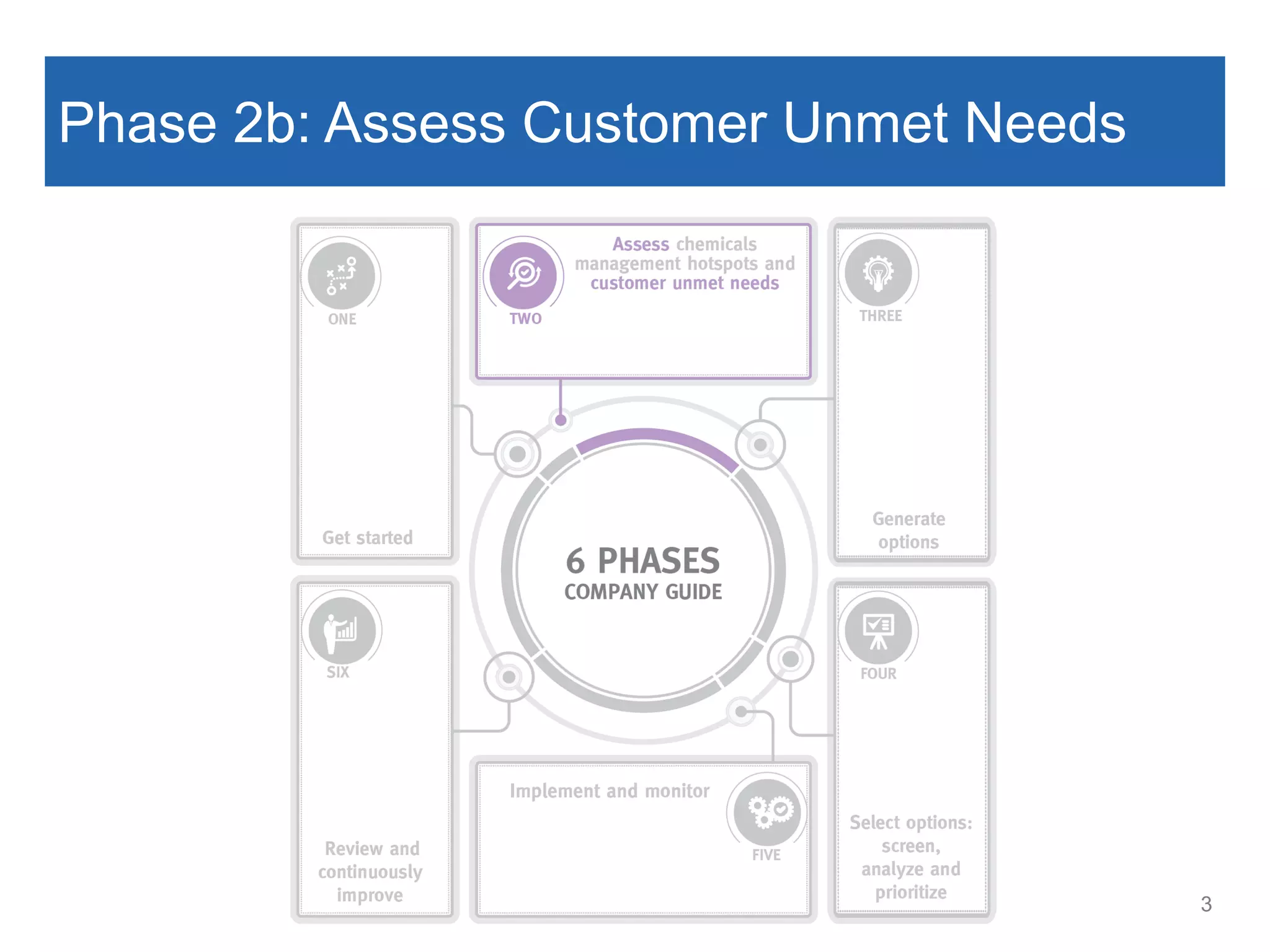
Phase 2b: Assess Customer Unmet Needs
3
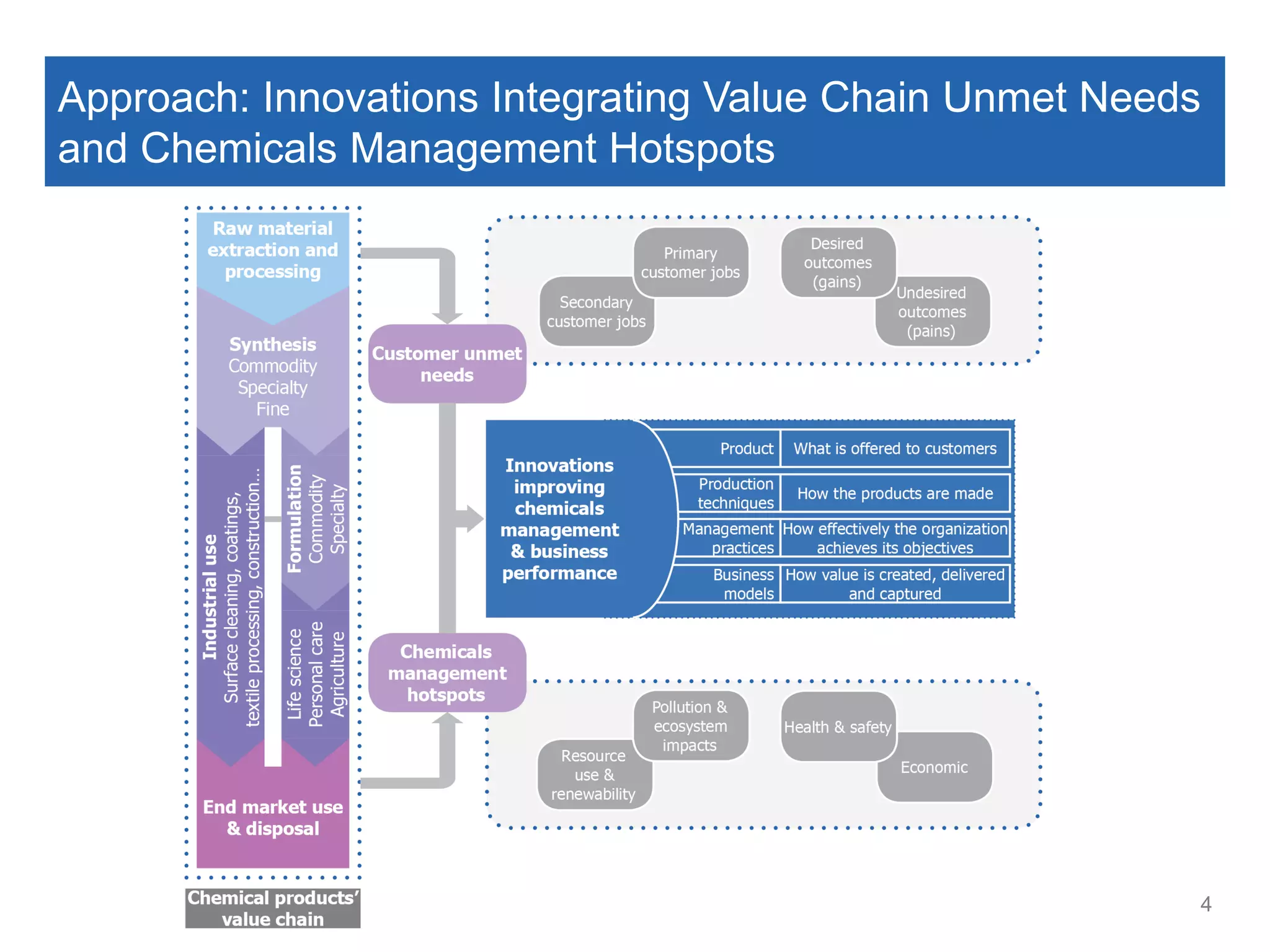
Approach: Innovations Integrating Value Chain Unmet Needs
and Chemicals Management Hotspots
4
Introduction: Using Customer Unmet Needs to
Drive Innovation
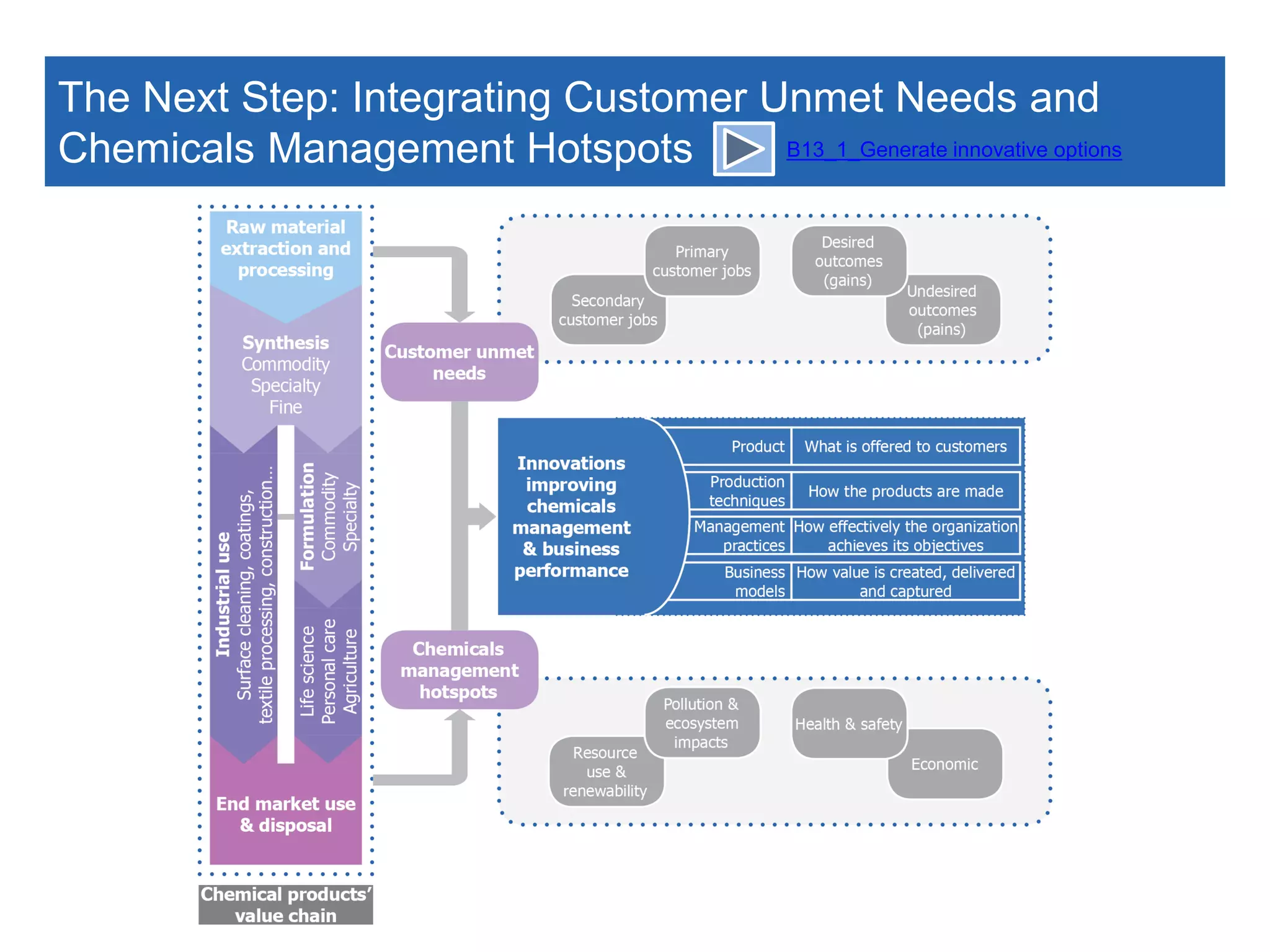
Innovation comes from integrating chemicals management hotspots with
the unmet or underserviced needs of direct and end market customers.
The company can use the unmet needs in the value chain to address
chemicals management hotspots and increase business performance
through targeted innovations. This section helps to identify the needs of
the company’s direct customers and end market customers.
To achieve this aim, the toolkit user will learn how to:
1. Determine important jobs to be done for specific customer segments
2. Determine desired and undesired outcomes (pains and gains) for the
company and its customers
3. Assess the fit between the company’s product offerings and its
customers’ outcomes
4. Generate unmet needs to drive innovation and create value
 The jobs and outcomes that are under-serviced or not being met are
called unmet needs.
UNIDO│IAMC Toolkit│Images may not be copied, transmitted or manipulated 5
Introduction to Customer Jobs to be Done and
Expected Outcomes (Gains and Pains)
The approaches jobs to be done (JTBD) and customer outcomes were
developed and made popular by several consultants including Clay
Christensen and Anthony Ulwick.
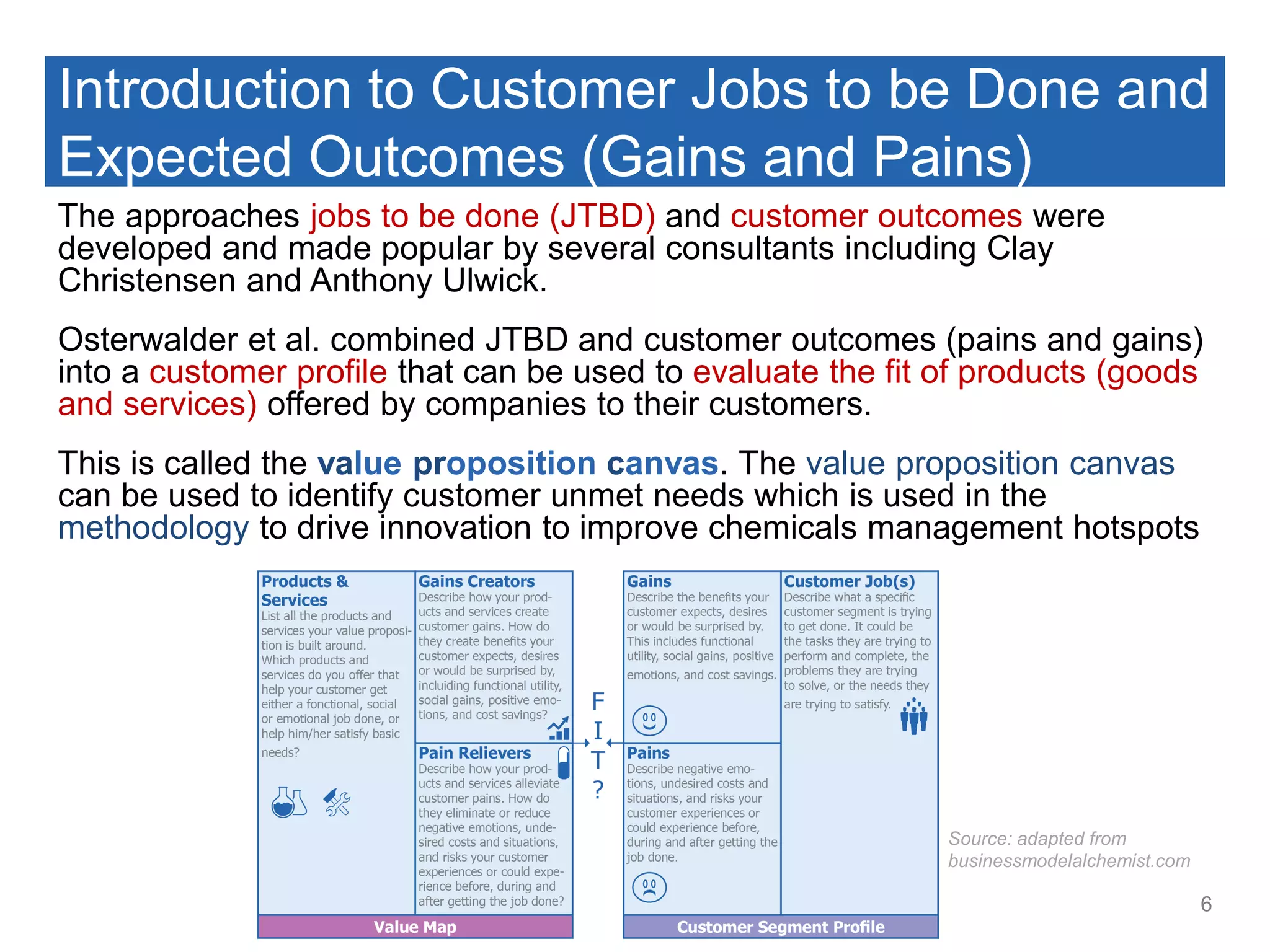
Osterwalder et al. combined JTBD and customer outcomes (pains and gains)
into a customer profile that can be used to evaluate the fit of products (goods
and services) offered by companies to their customers.
This is called the value proposition canvas. The value proposition canvas
can be used to identify customer unmet needs which is used in the
methodology to drive innovation to improve chemicals management hotspots
6
Source: adapted from
businessmodelalchemist.com

Phase 2b: Assess Customer Unmet Needs
Key tasks
 Characterize customer segments to be used for the JTBD
analysis
 Assess customer jobs to be done and prioritize most
important ones
 Assess desired and undesired outcomes (pains and gains)
for customers and suppliers and prioritize most important
ones
 Use the value proposition canvas to assess product
offering fit and identify unmet needs to prioritize to drive
the innovation process.
UNIDO│IAMC Toolkit│Images may not be copied, transmitted or manipulated 7
Deliverables
 Summary of key customer jobs and desired and undesired
outcomes
 Summary table of customer unmet needs
Assess Customer Unmet Needs
Key tasks
 Characterize customer
segments
 Assess customer jobs
 Assess desired and
undesired outcomes for
customers and suppliers
 Identify customer unmet
needs
UNIDO│IAMC Toolkit│Images may not be copied, transmitted or manipulated 8
Deliverables
 Summary of key customer jobs and desired and undesired
outcomes
 Summary table of customer unmet needs
Supporting tools
 Customer segment template
 Customer jobs template
 Outcome expectations
template
 Unmet needs template

Characterize Customer
Segments
UNIDO│IAMC Toolkit│Images may not be copied, transmitted or manipulated 9
Characterize Customer Segments
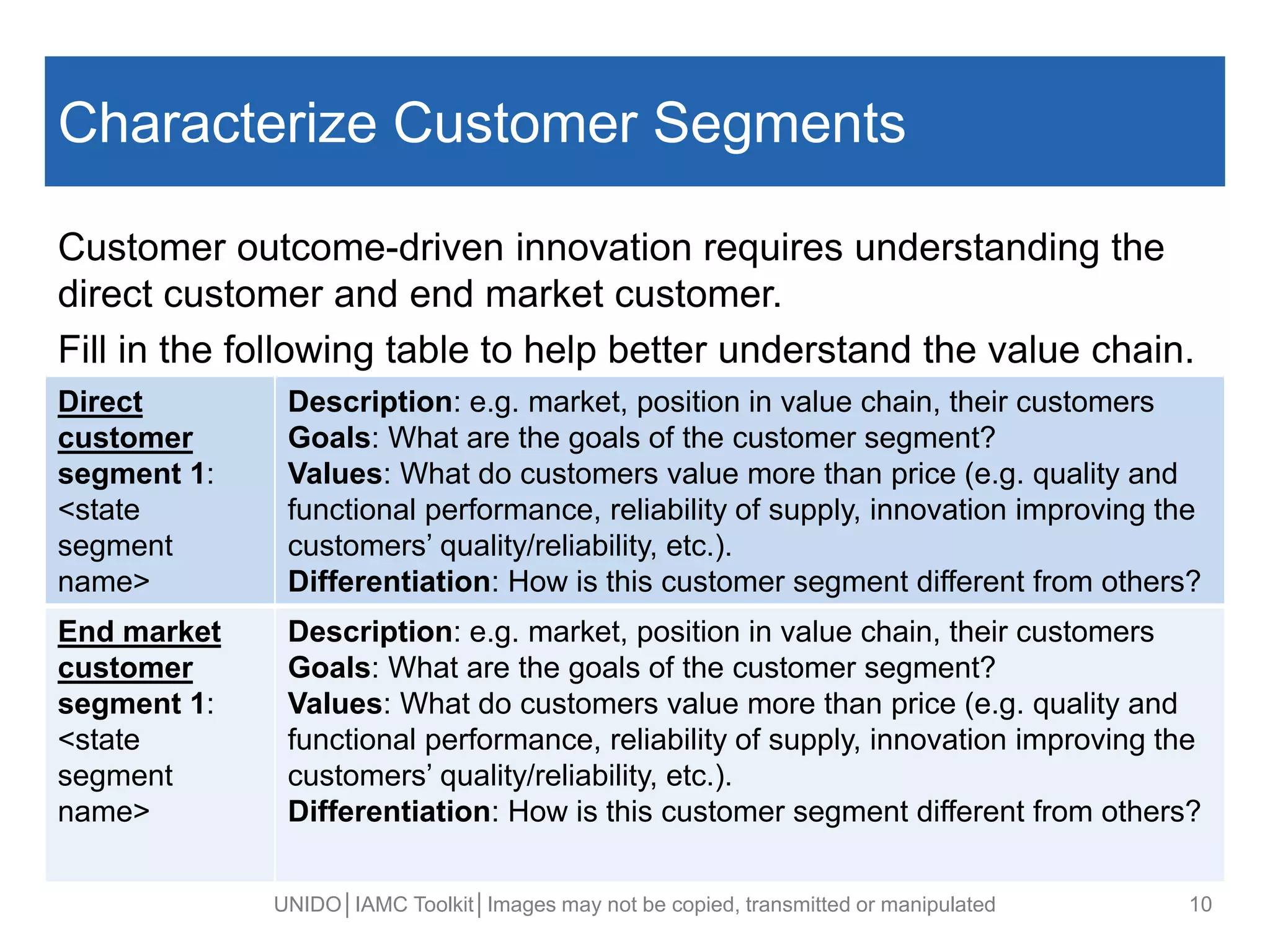
Customer outcome-driven innovation requires understanding the
direct customer and end market customer.
Fill in the following table to help better understand the value chain.
UNIDO│IAMC Toolkit│Images may not be copied, transmitted or manipulated 10
Direct
customer
segment 1:
<state
segment
name>
Description: e.g. market, position in value chain, their customers
Goals: What are the goals of the customer segment?
Values: What do customers value more than price (e.g. quality and
functional performance, reliability of supply, innovation improving the
customers’ quality/reliability, etc.).
Differentiation: How is this customer segment different from others?
End market
customer
segment 1:
<state
segment
name>
Description: e.g. market, position in value chain, their customers
Goals: What are the goals of the customer segment?
Values: What do customers value more than price (e.g. quality and
functional performance, reliability of supply, innovation improving the
customers’ quality/reliability, etc.).
Differentiation: How is this customer segment different from others?
Characterize Customer Jobs
UNIDO│IAMC Toolkit│Images may not be copied, transmitted or manipulated 11
Characterize Customer Jobs to be Done (1):
Background information on Customer Jobs
A key customer job is not a product, service or a specific solution.
 It’s the reason why customers buy goods, services and solutions.
Customer jobs are typically stable over time, however your product offerings to provide
solutions to these jobs should change over time, always increasing value.
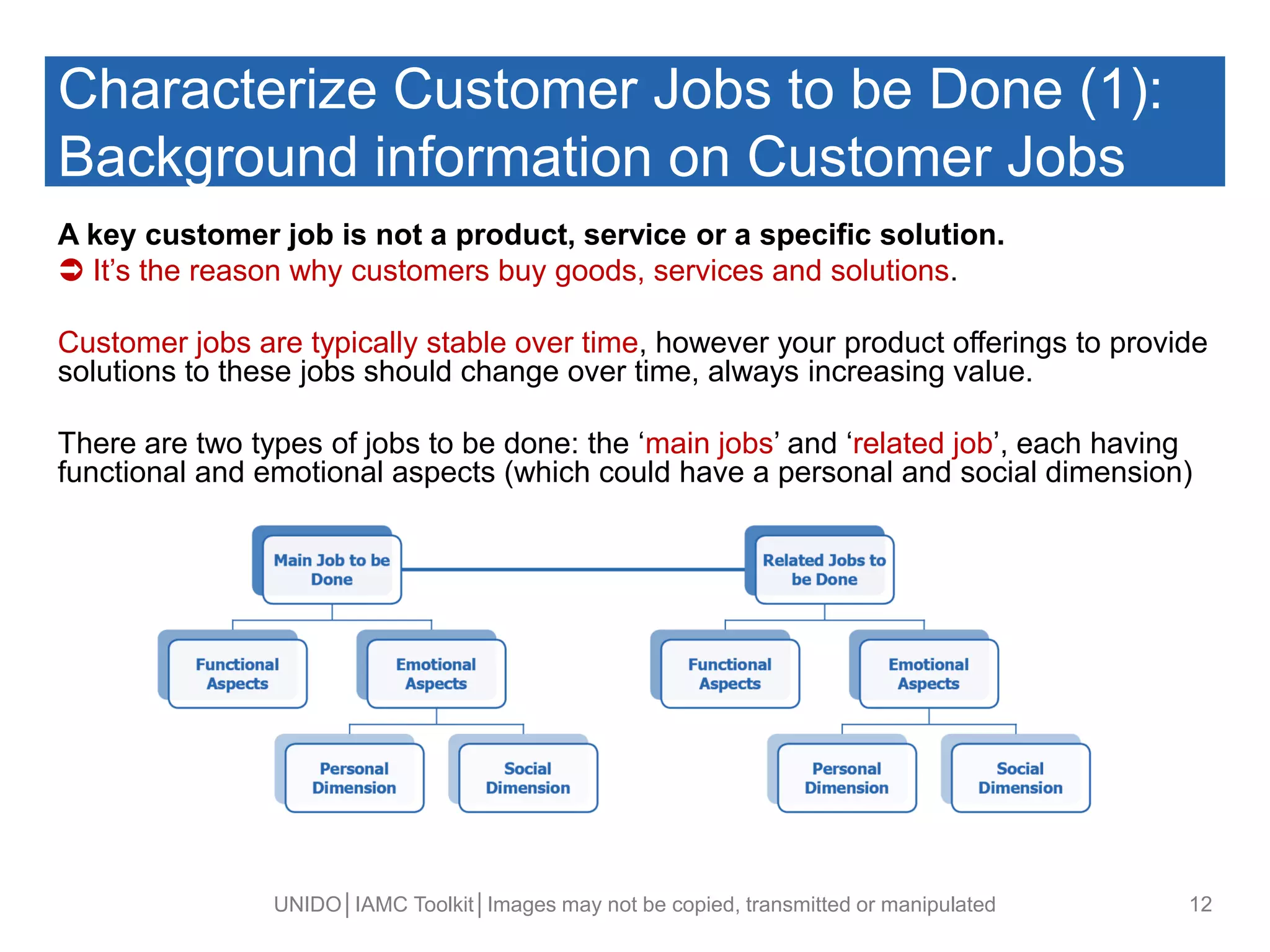
There are two types of jobs to be done: the ‘main jobs’ and ‘related job’, each having
functional and emotional aspects (which could have a personal and social dimension)
UNIDO│IAMC Toolkit│Images may not be copied, transmitted or manipulated 12
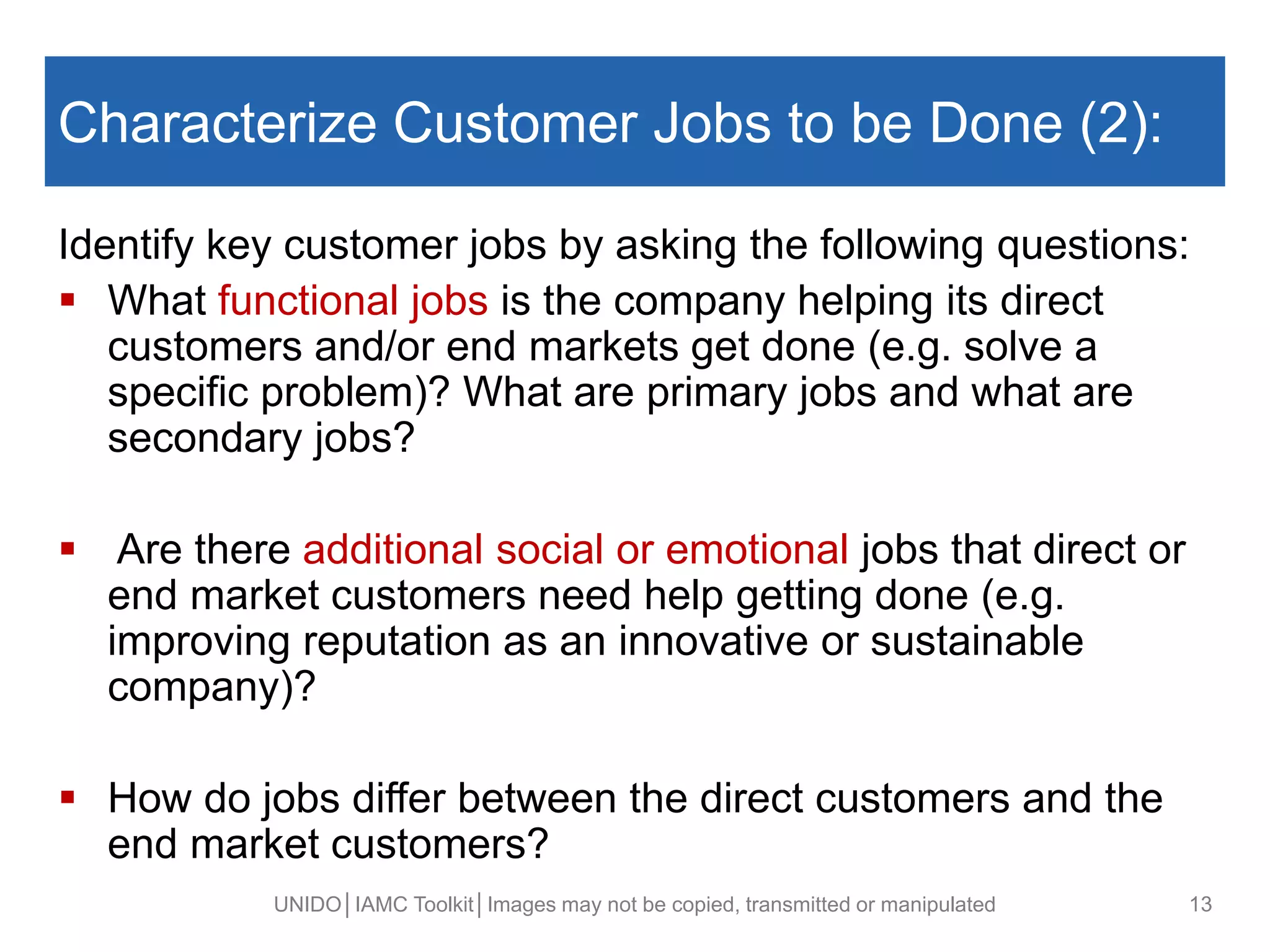
Characterize Customer Jobs to be Done (2):
Identify key customer jobs by asking the following questions:
 What functional jobs is the company helping its direct
customers and/or end markets get done (e.g. solve a
specific problem)? What are primary jobs and what are
secondary jobs?
 Are there additional social or emotional jobs that direct or
end market customers need help getting done (e.g.
improving reputation as an innovative or sustainable
company)?
 How do jobs differ between the direct customers and the
end market customers?
UNIDO│IAMC Toolkit│Images may not be copied, transmitted or manipulated 13
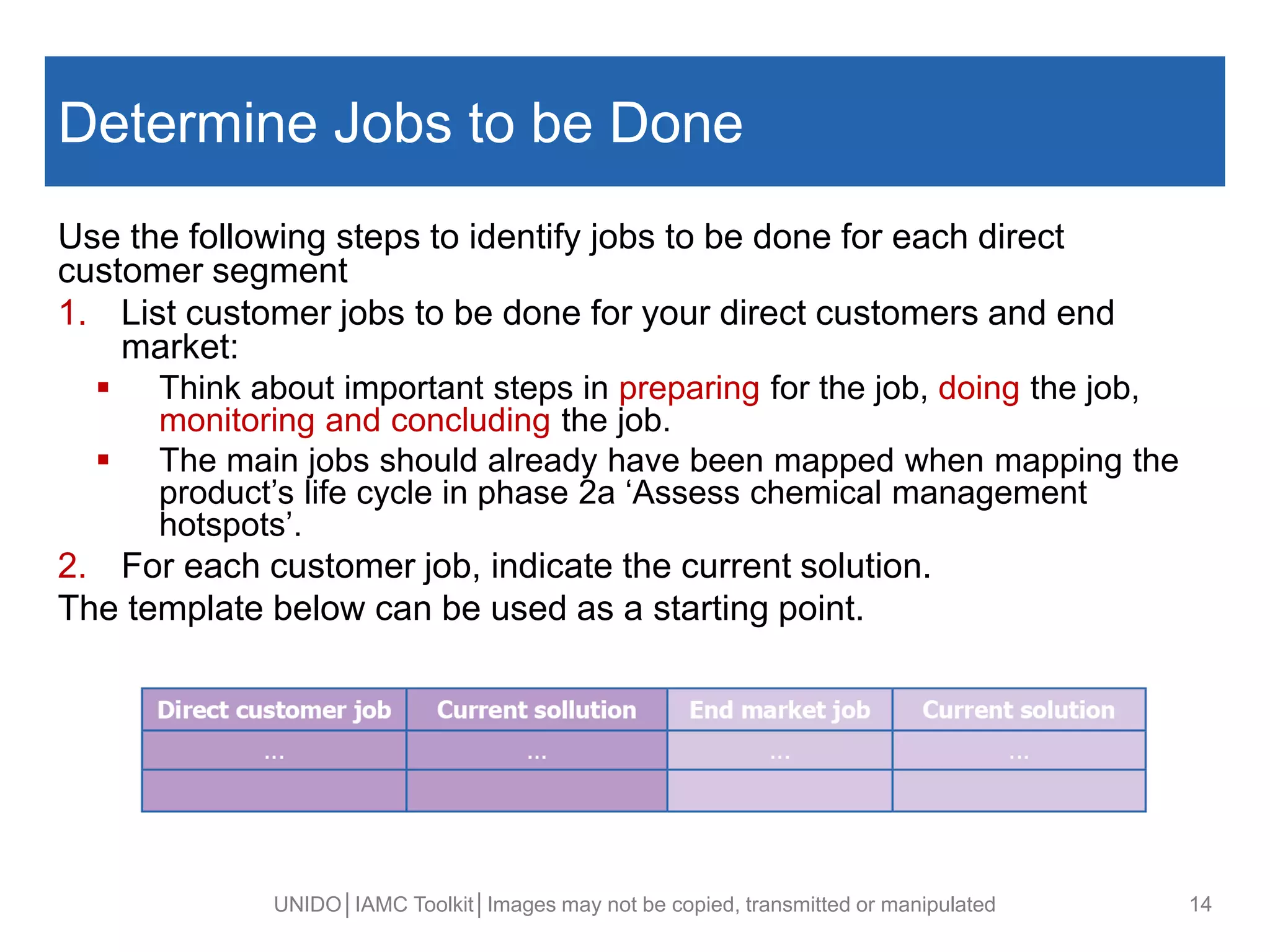
Determine Jobs to be Done
Use the following steps to identify jobs to be done for each direct
customer segment
1. List customer jobs to be done for your direct customers and end
market:
 Think about important steps in preparing for the job, doing the job,
monitoring and concluding the job.
 The main jobs should already have been mapped when mapping the
product’s life cycle in phase 2a ‘Assess chemical management
hotspots’.
2. For each customer job, indicate the current solution.
The template below can be used as a starting point.
UNIDO│IAMC Toolkit│Images may not be copied, transmitted or manipulated 14
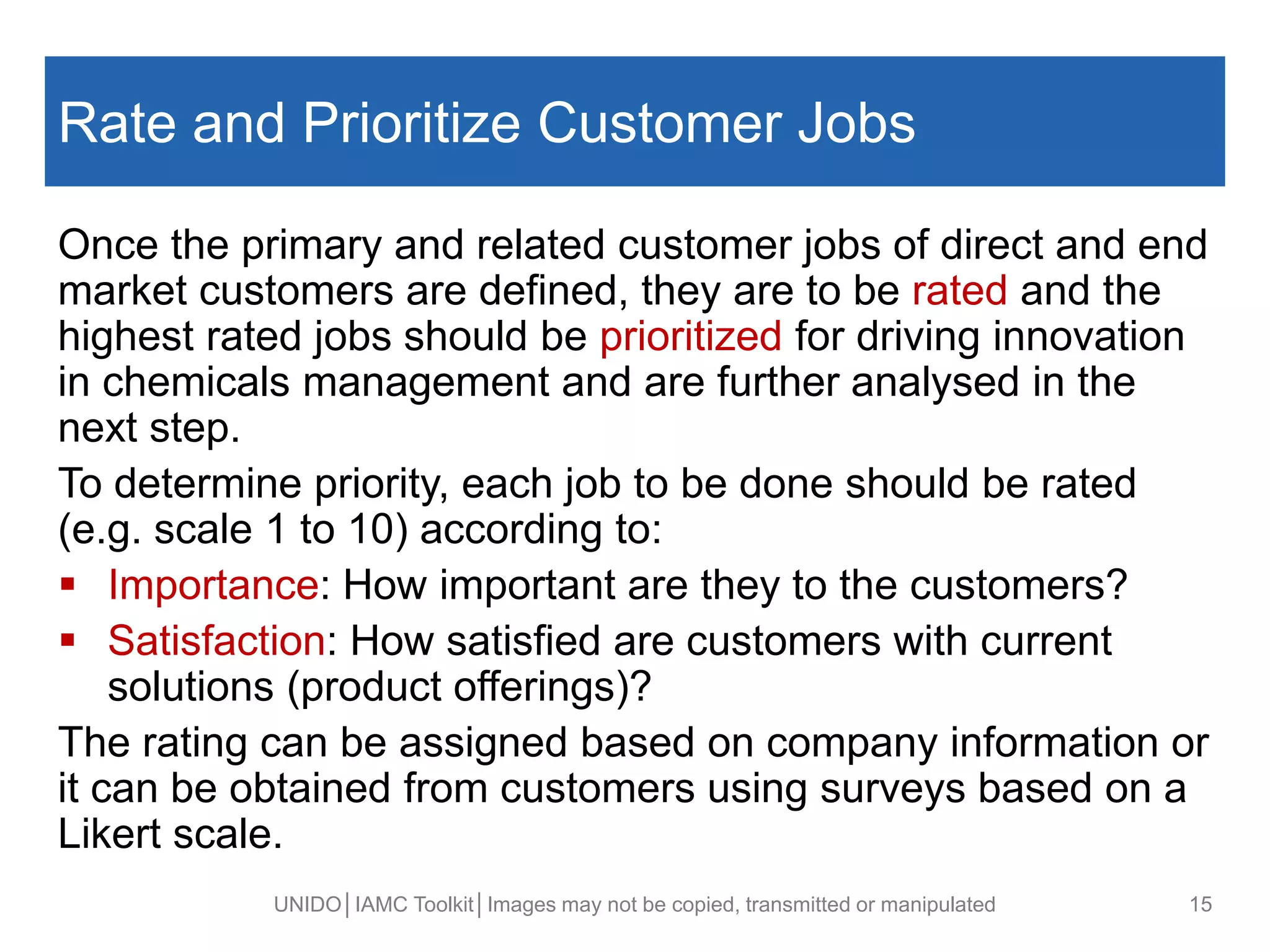
Rate and Prioritize Customer Jobs
Once the primary and related customer jobs of direct and end
market customers are defined, they are to be rated and the
highest rated jobs should be prioritized for driving innovation
in chemicals management and are further analysed in the
next step.
To determine priority, each job to be done should be rated
(e.g. scale 1 to 10) according to:
 Importance: How important are they to the customers?
 Satisfaction: How satisfied are customers with current
solutions (product offerings)?
The rating can be assigned based on company information or
it can be obtained from customers using surveys based on a
Likert scale.
UNIDO│IAMC Toolkit│Images may not be copied, transmitted or manipulated 15
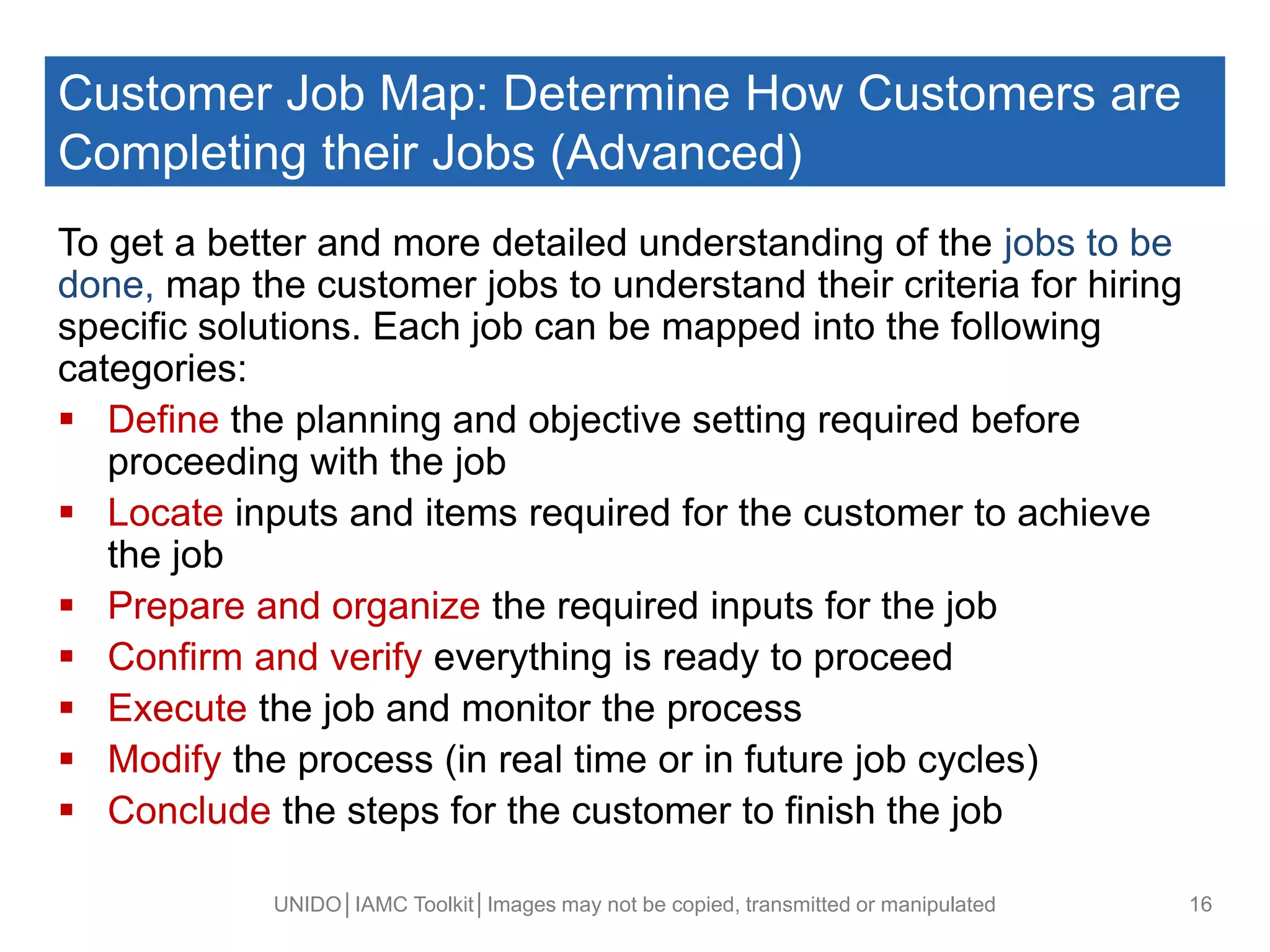
Customer Job Map: Determine How Customers are
Completing their Jobs (Advanced)
To get a better and more detailed understanding of the jobs to be
done, map the customer jobs to understand their criteria for hiring
specific solutions. Each job can be mapped into the following
categories:
 Define the planning and objective setting required before
proceeding with the job
 Locate inputs and items required for the customer to achieve
the job
 Prepare and organize the required inputs for the job
 Confirm and verify everything is ready to proceed
 Execute the job and monitor the process
 Modify the process (in real time or in future job cycles)
 Conclude the steps for the customer to finish the job
UNIDO│IAMC Toolkit│Images may not be copied, transmitted or manipulated 16
Assess Desired and
Undesired Outcomes
UNIDO│IAMC Toolkit│Images may not be copied, transmitted or manipulated 17
Assess Customer Outcome Expectations
Customers hire solutions that best help them complete their
primary and related jobs while providing more desired
outcomes (gains) and minimizing undesired outcomes
(pains).
Providers of solutions also want to maximize desired
outcomes (gains) and minimize undesired outcomes (pains)
for themselves.
For the high priority jobs identified in the previous steps:
1. List the job expected outcomes – desired and undesired –
for both the customer and the company
2. Prioritize expected outcome
UNIDO│IAMC Toolkit│Images may not be copied, transmitted or manipulated 18
List the Job Outcome Expectations (1)
Try to understand the criteria the customer would use to decide
which solution to choose. Such criteria could include cost, time,
quality, availability, ease of use, maintainability, dependability,
reliability, etc.
For undesired outcomes (pains), consider the following:
 What are possible negative outcomes for the customers or
problems faced when doing their key jobs?
 What are the main risks and obstacles related to doing their key
jobs?
 What keeps the customers awake at night?
For desired outcomes (gains), consider the following:
 What positive outcomes do the customers expect and require?
 What benefits (expected, desired, unexpected) are customers
looking for (e.g. are they expecting high quality the most)?
UNIDO│IAMC Toolkit│Images may not be copied, transmitted or manipulated 19
List the Job Outcome Expectations (2)
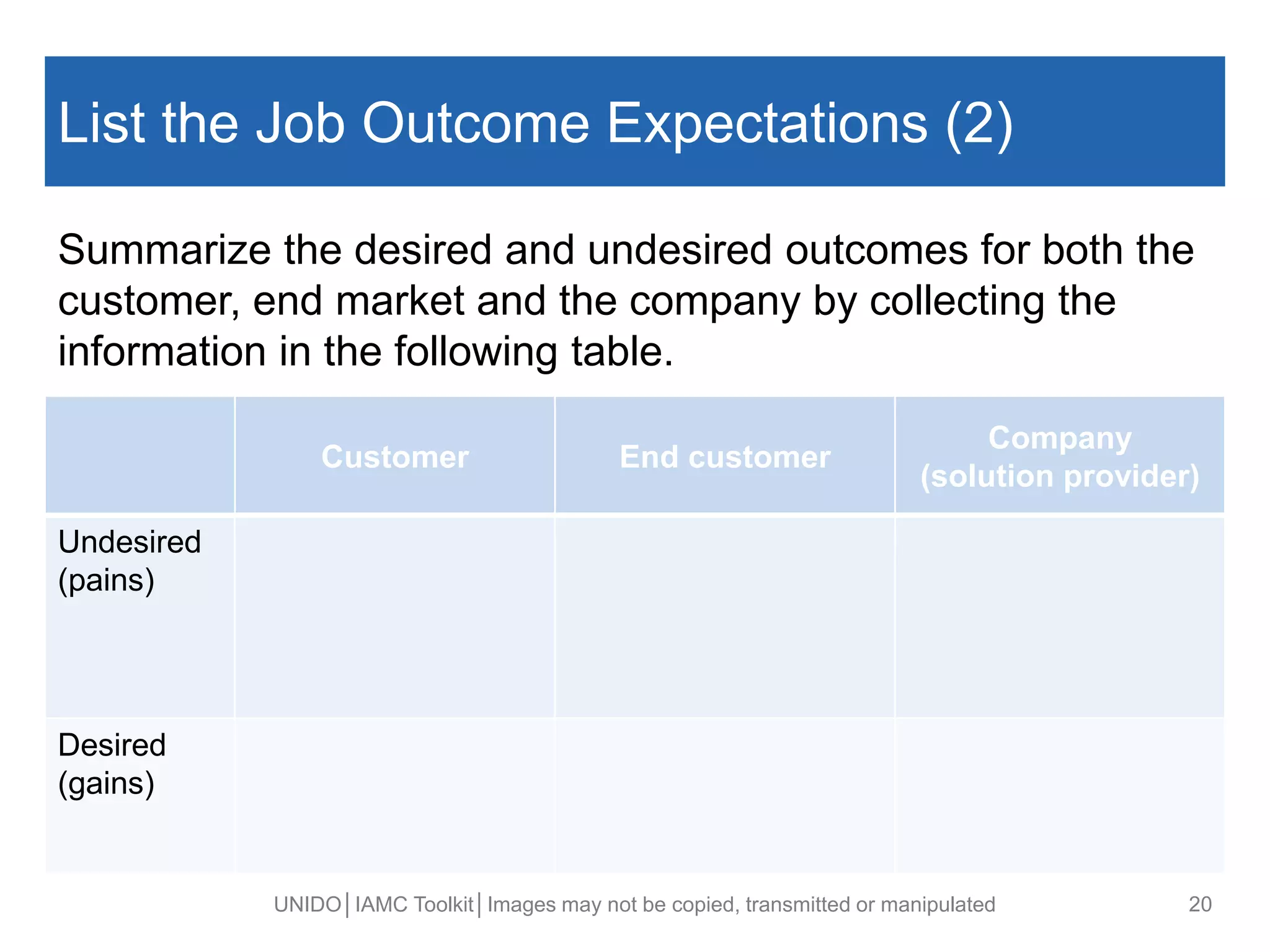
Summarize the desired and undesired outcomes for both the
customer, end market and the company by collecting the
information in the following table.
UNIDO│IAMC Toolkit│Images may not be copied, transmitted or manipulated 20
Customer End customer
Company
(solution provider)
Undesired
(pains)
Desired
(gains)
Create Outcome Statements (Advanced
Option)
Using outcome statements to drive your innovation
activities will result in more targeted and value-oriented
solutions.

An outcome statement consists of the following items:
 Direction of action (maximize, reduce, etc.)
 Unit of measurement (cost, time, conversion, amount,
defects, etc.)
 Object that you are affecting
 Context of the circumstances
UNIDO│IAMC Toolkit│Images may not be copied, transmitted or manipulated 21
Outcome Statements: Example of Cleaning
Clothes at a Hotel Chain
The following simple example, involving an equipment supplier providing washing
machines to hotel chains, shows how to formulate outcome statements which can drive
innovation to provide value for customers and the company.
Job to be done: cleaning clothes in institutions
Example customer (hotel chain) outcomes:
 Minimize the use of resources (water, energy, detergent) in cleaning clothes.
 Increase the likelihood of stain removal
 Minimize the amount of pollution in wastewater and meet legal requirements
 Reduce the consumption of hazardous and non-biodegradable chemicals
 Minimize the labour time to clean clothes and increase the overall productivity
 Maximize the likelihood of being recognized as a green business
Example provider (e.g. washing machine supplier) outcomes:
 Minimize the cost of developing and providing solutions
 Increase customer loyalty from using solutions
 Minimize impact on the environment resulting from production
 Maximize the likelihood of repeat customers
UNIDO│IAMC Toolkit│Images may not be copied, transmitted or manipulated 22
Rate and Prioritize Outcome Expectations
Once the outcome expectations of the customer, end market and
service provider are defined, they are to be rated and the highest
rated jobs should be prioritized for driving innovation in chemicals
management.
To determine priority, each outcome statement should be rated
(e.g. scale 1 to 10) according to:
 Importance: How important are they to the customers?
 Satisfaction: To which extent do the current solutions (product
offerings) fulfil the outcome statements?
The rating can be assigned based on company information and
estimates or can be obtained from customers using surveys based
on a Likert scale or a similar approach. This can identify which
outcome statements are overserved, served correctly or
underserved, so corrective action can be undertaken.
UNIDO│IAMC Toolkit│Images may not be copied, transmitted or manipulated 23
Identify Customer Unmet
Needs
UNIDO│IAMC Toolkit│Images may not be copied, transmitted or manipulated 24
Complete the Value Proposition Canvas and
Assess the Fit
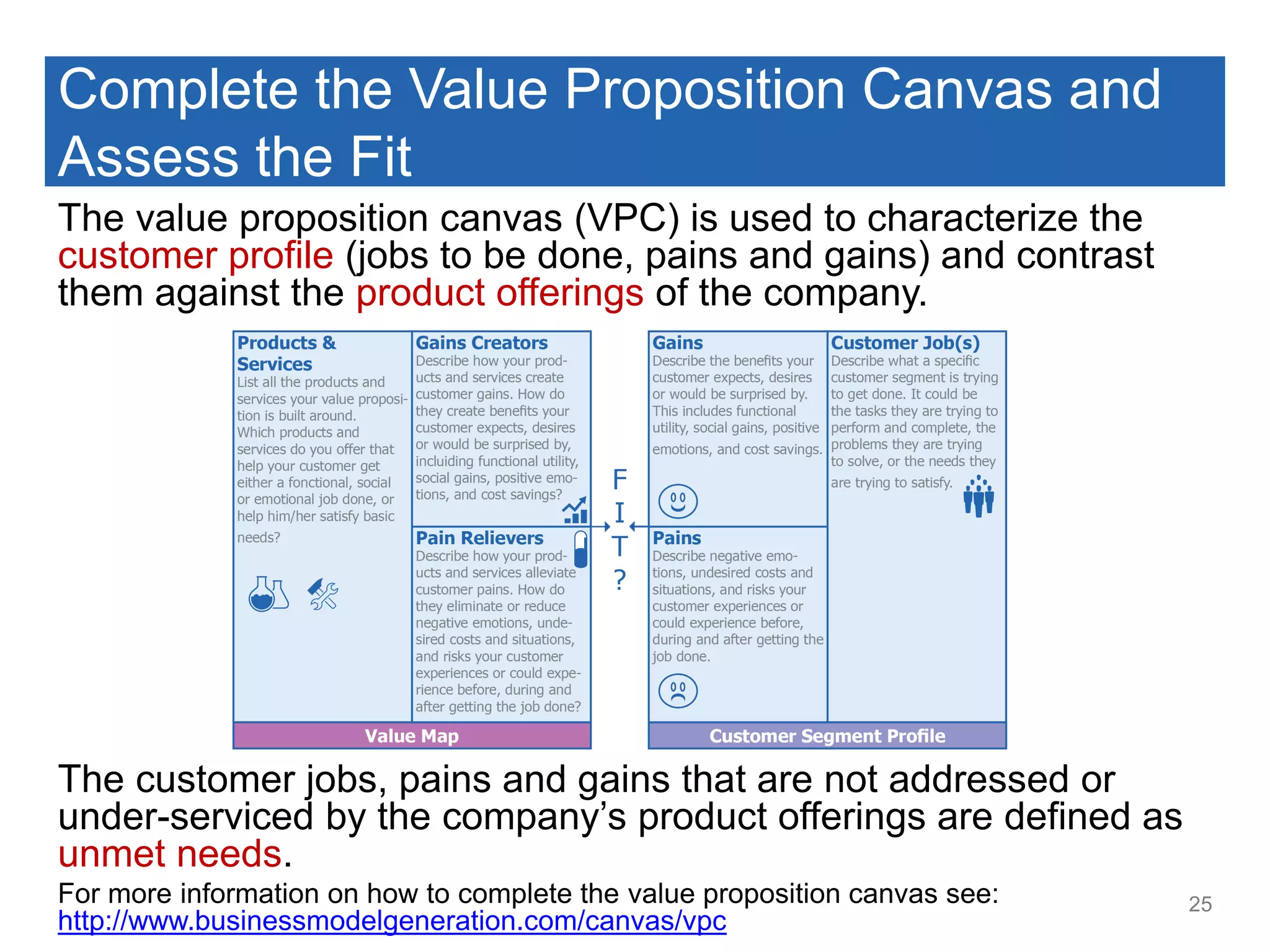
The value proposition canvas (VPC) is used to characterize the
customer profile (jobs to be done, pains and gains) and contrast
them against the product offerings of the company.
The customer jobs, pains and gains that are not addressed or
under-serviced by the company’s product offerings are defined as
unmet needs.
For more information on how to complete the value proposition canvas see:
http://www.businessmodelgeneration.com/canvas/vpc
25
Assess the Fit Between Customer Expected
Outcomes and Current Product Offerings
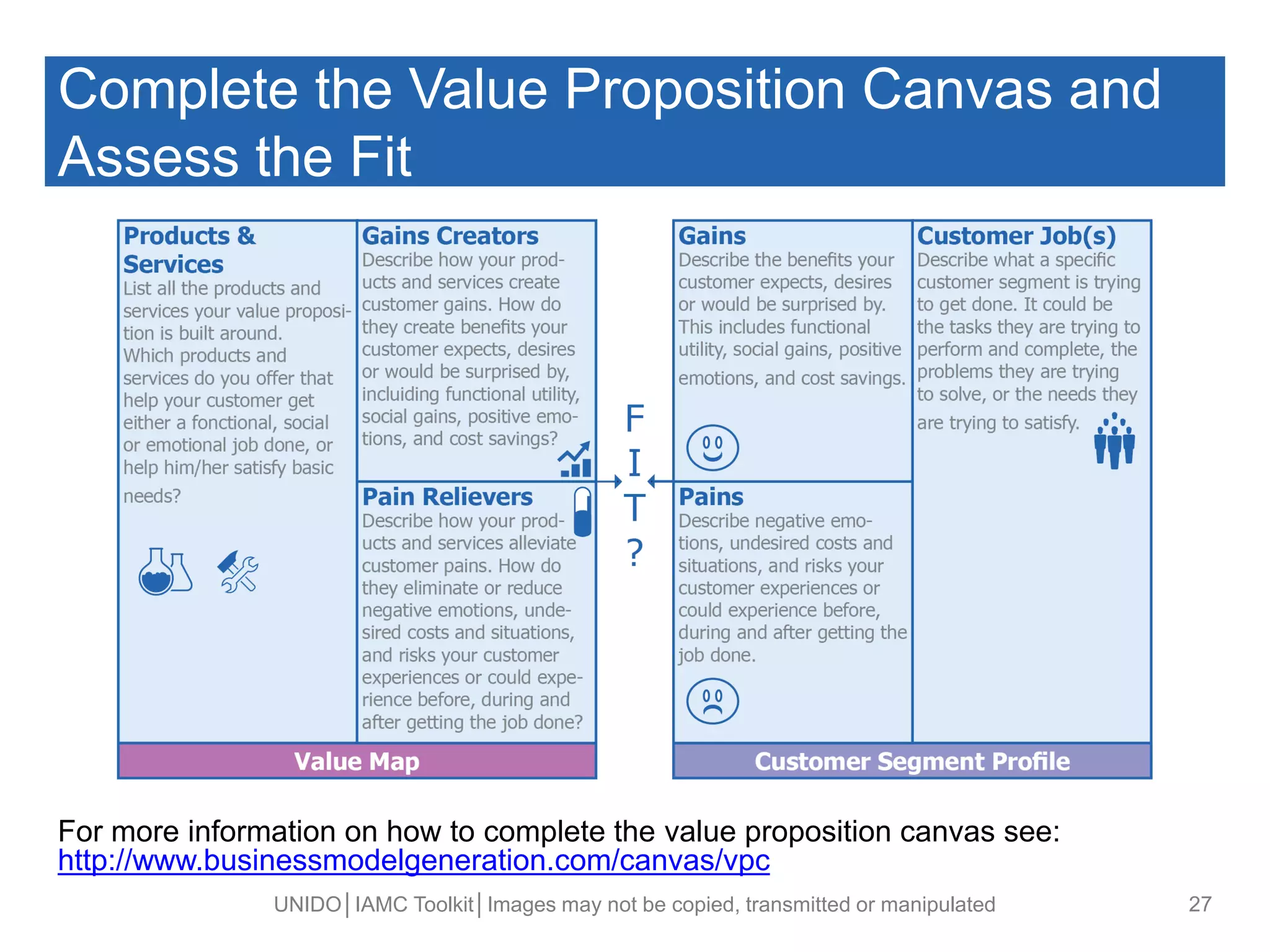
Step 1: Fill out the customer profile with on the VPC with the
customer jobs, pains and gains.
Step 2: Fill out the company’s value map:
 Products (goods and services): what you offer to customers that
is of value to them (which helps them do their jobs)
 Pain relievers: how your products reduce undesired outcomes
(e.g. challenges, problems, obstacles or risks)
 Gain creators: how your products produce desired outcomes
(expected or unexpected)
Step 3: Assess the fit. What jobs and outcomes does the
company’s product offering address well?
What jobs and outcomes are missing or underserviced?
 These are the unmet needs to be used to drive innovation in
improving chemicals management and creating value
UNIDO│IAMC Toolkit│Images may not be copied, transmitted or manipulated 26
Complete the Value Proposition Canvas and
Assess the Fit
For more information on how to complete the value proposition canvas see:
http://www.businessmodelgeneration.com/canvas/vpc
UNIDO│IAMC Toolkit│Images may not be copied, transmitted or manipulated 27
Define Unmet Needs in the Value Chain
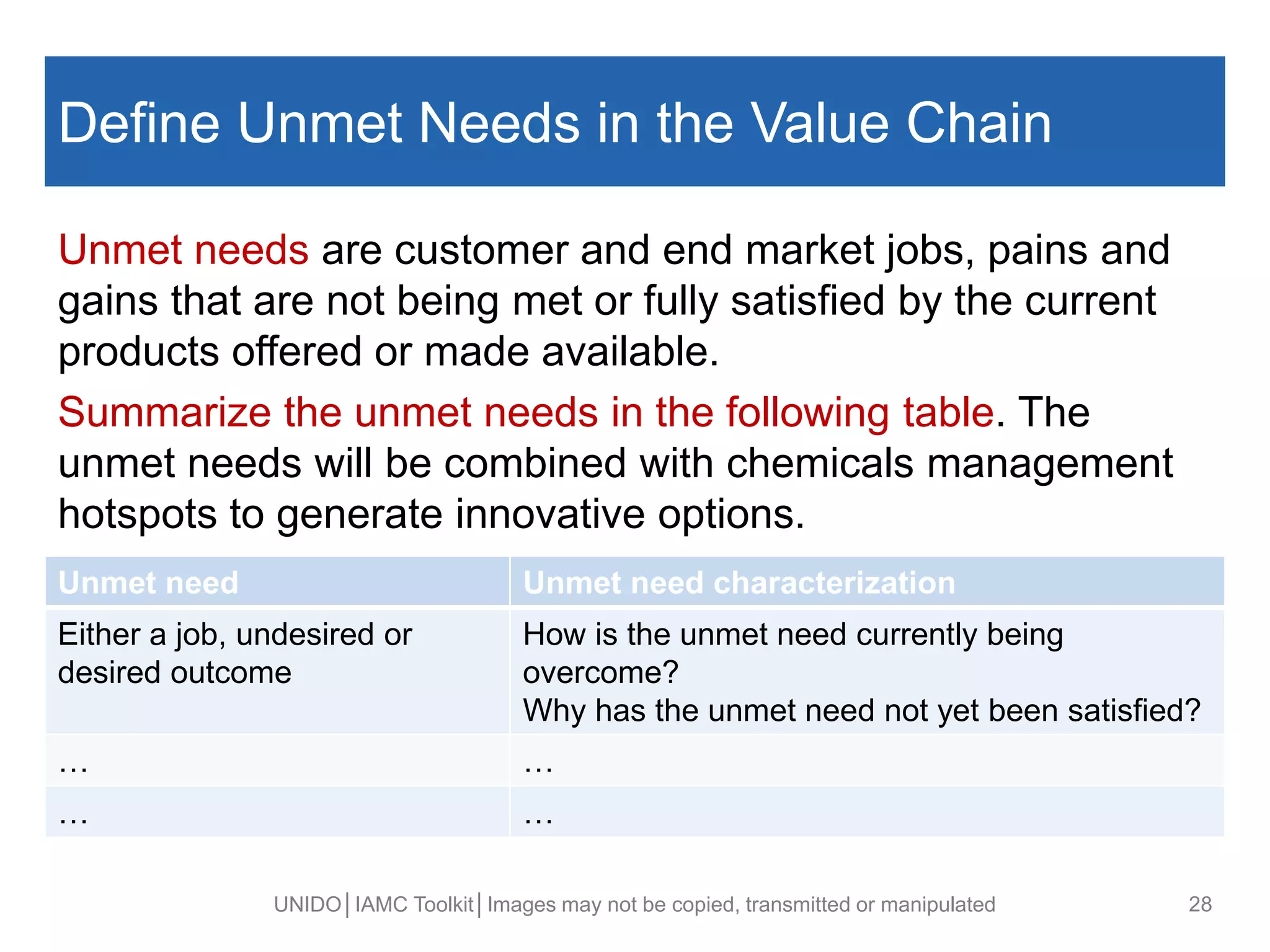
Unmet needs are customer and end market jobs, pains and
gains that are not being met or fully satisfied by the current
products offered or made available.
Summarize the unmet needs in the following table. The
unmet needs will be combined with chemicals management
hotspots to generate innovative options.
UNIDO│IAMC Toolkit│Images may not be copied, transmitted or manipulated 28
Unmet need Unmet need characterization
Either a job, undesired or
desired outcome
How is the unmet need currently being
overcome?
Why has the unmet need not yet been satisfied?
… …
… …
The Next Step: Integrating Customer Unmet Needs and
Chemicals Management Hotspots B13_1_Generate innovative options
Where to Find More Information
 The Innovator's Toolkit (2012) provides tools to understand
the unmet and underserviced needs of customers:
http://www.innovatorstoolkit.com/
 Strategyzer Value Proposition Canvas: helps to design
products that customers want and provides an overview of
how to help customers achieve desired outcomes:
http://www.businessmodelgeneration.com/canvas/vpc
 The 100% Open Innovation Toolkit provides an easy-to-
use method to implement open innovation:
http://100open.com
UNIDO│IAMC Toolkit│Images may not be copied, transmitted or manipulated 30
Sources
UNIDO│IAMC Toolkit│Images may not be copied, transmitted or manipulated 31
Fusce posuere, magna sed pulvinar ultricies,
purus lectus malesuada libero, sit amet magna
eros quis (ARIAL 32).
Sources
 CSD Engineers, Switzerland / ISSPPRO, Germany, 2015
 Bettencourt, L. A. and Ulwick, A. W. The Customer-
Centered Innovation Map. Harvard Business Review, April
2008.
 Osterwalder, A.; Pigneur, Y.; Bernarda, G.; Smith, A.;
Papadakos, T. Value Proposition Design: How to Create
Products and Services Customers Want, 2014.
 Silverstein, David; Samuel, Philip; DeCarlo, Neil. The
Innovator's Toolkit, 2012.
 The 100%Open Innovation Toolkit, http://100open.com
UNIDO│IAMC Toolkit│Images may not be copied, transmitted or manipulated 32
Disclaimer
UNIDO│IAMC Toolkit│Images may not be copied, transmitted or manipulated 33
This presentation was prepared with the requested diligence
and with the generally accepted principles of the relevant
field.
If a third party uses the contents of the presentation in order
to take decisions, the authors disclaim any liability for any
kind of direct or indirect (consequential) damage.

B12 2 assess customer unmet needs_final-pdf

  • 2.
    Content UNIDO│IAMC Toolkit│Images maynot be copied, transmitted or manipulated 2 1. Introduction 2. Characterize customer segments 3. Characterize customer jobs 4. Assess desired and undesired outcomes 5. Identify customer unmet needs
  • 3.
    Phase 2b: AssessCustomer Unmet Needs 3
  • 4.
    Approach: Innovations IntegratingValue Chain Unmet Needs and Chemicals Management Hotspots 4
  • 5.
    Introduction: Using CustomerUnmet Needs to Drive Innovation Innovation comes from integrating chemicals management hotspots with the unmet or underserviced needs of direct and end market customers. The company can use the unmet needs in the value chain to address chemicals management hotspots and increase business performance through targeted innovations. This section helps to identify the needs of the company’s direct customers and end market customers. To achieve this aim, the toolkit user will learn how to: 1. Determine important jobs to be done for specific customer segments 2. Determine desired and undesired outcomes (pains and gains) for the company and its customers 3. Assess the fit between the company’s product offerings and its customers’ outcomes 4. Generate unmet needs to drive innovation and create value  The jobs and outcomes that are under-serviced or not being met are called unmet needs. UNIDO│IAMC Toolkit│Images may not be copied, transmitted or manipulated 5
  • 6.
    Introduction to CustomerJobs to be Done and Expected Outcomes (Gains and Pains) The approaches jobs to be done (JTBD) and customer outcomes were developed and made popular by several consultants including Clay Christensen and Anthony Ulwick. Osterwalder et al. combined JTBD and customer outcomes (pains and gains) into a customer profile that can be used to evaluate the fit of products (goods and services) offered by companies to their customers. This is called the value proposition canvas. The value proposition canvas can be used to identify customer unmet needs which is used in the methodology to drive innovation to improve chemicals management hotspots 6 Source: adapted from businessmodelalchemist.com
  • 7.
     Phase 2b: AssessCustomer Unmet Needs Key tasks  Characterize customer segments to be used for the JTBD analysis  Assess customer jobs to be done and prioritize most important ones  Assess desired and undesired outcomes (pains and gains) for customers and suppliers and prioritize most important ones  Use the value proposition canvas to assess product offering fit and identify unmet needs to prioritize to drive the innovation process. UNIDO│IAMC Toolkit│Images may not be copied, transmitted or manipulated 7 Deliverables  Summary of key customer jobs and desired and undesired outcomes  Summary table of customer unmet needs
  • 8.
    Assess Customer UnmetNeeds Key tasks  Characterize customer segments  Assess customer jobs  Assess desired and undesired outcomes for customers and suppliers  Identify customer unmet needs UNIDO│IAMC Toolkit│Images may not be copied, transmitted or manipulated 8 Deliverables  Summary of key customer jobs and desired and undesired outcomes  Summary table of customer unmet needs Supporting tools  Customer segment template  Customer jobs template  Outcome expectations template  Unmet needs template 
  • 9.
    Characterize Customer Segments UNIDO│IAMC Toolkit│Imagesmay not be copied, transmitted or manipulated 9
  • 10.
    Characterize Customer Segments Customeroutcome-driven innovation requires understanding the direct customer and end market customer. Fill in the following table to help better understand the value chain. UNIDO│IAMC Toolkit│Images may not be copied, transmitted or manipulated 10 Direct customer segment 1: <state segment name> Description: e.g. market, position in value chain, their customers Goals: What are the goals of the customer segment? Values: What do customers value more than price (e.g. quality and functional performance, reliability of supply, innovation improving the customers’ quality/reliability, etc.). Differentiation: How is this customer segment different from others? End market customer segment 1: <state segment name> Description: e.g. market, position in value chain, their customers Goals: What are the goals of the customer segment? Values: What do customers value more than price (e.g. quality and functional performance, reliability of supply, innovation improving the customers’ quality/reliability, etc.). Differentiation: How is this customer segment different from others?
  • 11.
    Characterize Customer Jobs UNIDO│IAMCToolkit│Images may not be copied, transmitted or manipulated 11
  • 12.
    Characterize Customer Jobsto be Done (1): Background information on Customer Jobs A key customer job is not a product, service or a specific solution.  It’s the reason why customers buy goods, services and solutions. Customer jobs are typically stable over time, however your product offerings to provide solutions to these jobs should change over time, always increasing value. There are two types of jobs to be done: the ‘main jobs’ and ‘related job’, each having functional and emotional aspects (which could have a personal and social dimension) UNIDO│IAMC Toolkit│Images may not be copied, transmitted or manipulated 12
  • 13.
    Characterize Customer Jobsto be Done (2): Identify key customer jobs by asking the following questions:  What functional jobs is the company helping its direct customers and/or end markets get done (e.g. solve a specific problem)? What are primary jobs and what are secondary jobs?  Are there additional social or emotional jobs that direct or end market customers need help getting done (e.g. improving reputation as an innovative or sustainable company)?  How do jobs differ between the direct customers and the end market customers? UNIDO│IAMC Toolkit│Images may not be copied, transmitted or manipulated 13
  • 14.
    Determine Jobs tobe Done Use the following steps to identify jobs to be done for each direct customer segment 1. List customer jobs to be done for your direct customers and end market:  Think about important steps in preparing for the job, doing the job, monitoring and concluding the job.  The main jobs should already have been mapped when mapping the product’s life cycle in phase 2a ‘Assess chemical management hotspots’. 2. For each customer job, indicate the current solution. The template below can be used as a starting point. UNIDO│IAMC Toolkit│Images may not be copied, transmitted or manipulated 14
  • 15.
    Rate and PrioritizeCustomer Jobs Once the primary and related customer jobs of direct and end market customers are defined, they are to be rated and the highest rated jobs should be prioritized for driving innovation in chemicals management and are further analysed in the next step. To determine priority, each job to be done should be rated (e.g. scale 1 to 10) according to:  Importance: How important are they to the customers?  Satisfaction: How satisfied are customers with current solutions (product offerings)? The rating can be assigned based on company information or it can be obtained from customers using surveys based on a Likert scale. UNIDO│IAMC Toolkit│Images may not be copied, transmitted or manipulated 15
  • 16.
    Customer Job Map:Determine How Customers are Completing their Jobs (Advanced) To get a better and more detailed understanding of the jobs to be done, map the customer jobs to understand their criteria for hiring specific solutions. Each job can be mapped into the following categories:  Define the planning and objective setting required before proceeding with the job  Locate inputs and items required for the customer to achieve the job  Prepare and organize the required inputs for the job  Confirm and verify everything is ready to proceed  Execute the job and monitor the process  Modify the process (in real time or in future job cycles)  Conclude the steps for the customer to finish the job UNIDO│IAMC Toolkit│Images may not be copied, transmitted or manipulated 16
  • 17.
    Assess Desired and UndesiredOutcomes UNIDO│IAMC Toolkit│Images may not be copied, transmitted or manipulated 17
  • 18.
    Assess Customer OutcomeExpectations Customers hire solutions that best help them complete their primary and related jobs while providing more desired outcomes (gains) and minimizing undesired outcomes (pains). Providers of solutions also want to maximize desired outcomes (gains) and minimize undesired outcomes (pains) for themselves. For the high priority jobs identified in the previous steps: 1. List the job expected outcomes – desired and undesired – for both the customer and the company 2. Prioritize expected outcome UNIDO│IAMC Toolkit│Images may not be copied, transmitted or manipulated 18
  • 19.
    List the JobOutcome Expectations (1) Try to understand the criteria the customer would use to decide which solution to choose. Such criteria could include cost, time, quality, availability, ease of use, maintainability, dependability, reliability, etc. For undesired outcomes (pains), consider the following:  What are possible negative outcomes for the customers or problems faced when doing their key jobs?  What are the main risks and obstacles related to doing their key jobs?  What keeps the customers awake at night? For desired outcomes (gains), consider the following:  What positive outcomes do the customers expect and require?  What benefits (expected, desired, unexpected) are customers looking for (e.g. are they expecting high quality the most)? UNIDO│IAMC Toolkit│Images may not be copied, transmitted or manipulated 19
  • 20.
    List the JobOutcome Expectations (2) Summarize the desired and undesired outcomes for both the customer, end market and the company by collecting the information in the following table. UNIDO│IAMC Toolkit│Images may not be copied, transmitted or manipulated 20 Customer End customer Company (solution provider) Undesired (pains) Desired (gains)
  • 21.
    Create Outcome Statements(Advanced Option) Using outcome statements to drive your innovation activities will result in more targeted and value-oriented solutions. An outcome statement consists of the following items:  Direction of action (maximize, reduce, etc.)  Unit of measurement (cost, time, conversion, amount, defects, etc.)  Object that you are affecting  Context of the circumstances UNIDO│IAMC Toolkit│Images may not be copied, transmitted or manipulated 21
  • 22.
    Outcome Statements: Exampleof Cleaning Clothes at a Hotel Chain The following simple example, involving an equipment supplier providing washing machines to hotel chains, shows how to formulate outcome statements which can drive innovation to provide value for customers and the company. Job to be done: cleaning clothes in institutions Example customer (hotel chain) outcomes:  Minimize the use of resources (water, energy, detergent) in cleaning clothes.  Increase the likelihood of stain removal  Minimize the amount of pollution in wastewater and meet legal requirements  Reduce the consumption of hazardous and non-biodegradable chemicals  Minimize the labour time to clean clothes and increase the overall productivity  Maximize the likelihood of being recognized as a green business Example provider (e.g. washing machine supplier) outcomes:  Minimize the cost of developing and providing solutions  Increase customer loyalty from using solutions  Minimize impact on the environment resulting from production  Maximize the likelihood of repeat customers UNIDO│IAMC Toolkit│Images may not be copied, transmitted or manipulated 22
  • 23.
    Rate and PrioritizeOutcome Expectations Once the outcome expectations of the customer, end market and service provider are defined, they are to be rated and the highest rated jobs should be prioritized for driving innovation in chemicals management. To determine priority, each outcome statement should be rated (e.g. scale 1 to 10) according to:  Importance: How important are they to the customers?  Satisfaction: To which extent do the current solutions (product offerings) fulfil the outcome statements? The rating can be assigned based on company information and estimates or can be obtained from customers using surveys based on a Likert scale or a similar approach. This can identify which outcome statements are overserved, served correctly or underserved, so corrective action can be undertaken. UNIDO│IAMC Toolkit│Images may not be copied, transmitted or manipulated 23
  • 24.
    Identify Customer Unmet Needs UNIDO│IAMCToolkit│Images may not be copied, transmitted or manipulated 24
  • 25.
    Complete the ValueProposition Canvas and Assess the Fit The value proposition canvas (VPC) is used to characterize the customer profile (jobs to be done, pains and gains) and contrast them against the product offerings of the company. The customer jobs, pains and gains that are not addressed or under-serviced by the company’s product offerings are defined as unmet needs. For more information on how to complete the value proposition canvas see: http://www.businessmodelgeneration.com/canvas/vpc 25
  • 26.
    Assess the FitBetween Customer Expected Outcomes and Current Product Offerings Step 1: Fill out the customer profile with on the VPC with the customer jobs, pains and gains. Step 2: Fill out the company’s value map:  Products (goods and services): what you offer to customers that is of value to them (which helps them do their jobs)  Pain relievers: how your products reduce undesired outcomes (e.g. challenges, problems, obstacles or risks)  Gain creators: how your products produce desired outcomes (expected or unexpected) Step 3: Assess the fit. What jobs and outcomes does the company’s product offering address well? What jobs and outcomes are missing or underserviced?  These are the unmet needs to be used to drive innovation in improving chemicals management and creating value UNIDO│IAMC Toolkit│Images may not be copied, transmitted or manipulated 26
  • 27.
    Complete the ValueProposition Canvas and Assess the Fit For more information on how to complete the value proposition canvas see: http://www.businessmodelgeneration.com/canvas/vpc UNIDO│IAMC Toolkit│Images may not be copied, transmitted or manipulated 27
  • 28.
    Define Unmet Needsin the Value Chain Unmet needs are customer and end market jobs, pains and gains that are not being met or fully satisfied by the current products offered or made available. Summarize the unmet needs in the following table. The unmet needs will be combined with chemicals management hotspots to generate innovative options. UNIDO│IAMC Toolkit│Images may not be copied, transmitted or manipulated 28 Unmet need Unmet need characterization Either a job, undesired or desired outcome How is the unmet need currently being overcome? Why has the unmet need not yet been satisfied? … … … …
  • 29.
    The Next Step:Integrating Customer Unmet Needs and Chemicals Management Hotspots B13_1_Generate innovative options
  • 30.
    Where to FindMore Information  The Innovator's Toolkit (2012) provides tools to understand the unmet and underserviced needs of customers: http://www.innovatorstoolkit.com/  Strategyzer Value Proposition Canvas: helps to design products that customers want and provides an overview of how to help customers achieve desired outcomes: http://www.businessmodelgeneration.com/canvas/vpc  The 100% Open Innovation Toolkit provides an easy-to- use method to implement open innovation: http://100open.com UNIDO│IAMC Toolkit│Images may not be copied, transmitted or manipulated 30
  • 31.
    Sources UNIDO│IAMC Toolkit│Images maynot be copied, transmitted or manipulated 31
  • 32.
    Fusce posuere, magnased pulvinar ultricies, purus lectus malesuada libero, sit amet magna eros quis (ARIAL 32). Sources  CSD Engineers, Switzerland / ISSPPRO, Germany, 2015  Bettencourt, L. A. and Ulwick, A. W. The Customer- Centered Innovation Map. Harvard Business Review, April 2008.  Osterwalder, A.; Pigneur, Y.; Bernarda, G.; Smith, A.; Papadakos, T. Value Proposition Design: How to Create Products and Services Customers Want, 2014.  Silverstein, David; Samuel, Philip; DeCarlo, Neil. The Innovator's Toolkit, 2012.  The 100%Open Innovation Toolkit, http://100open.com UNIDO│IAMC Toolkit│Images may not be copied, transmitted or manipulated 32
  • 33.
    Disclaimer UNIDO│IAMC Toolkit│Images maynot be copied, transmitted or manipulated 33 This presentation was prepared with the requested diligence and with the generally accepted principles of the relevant field. If a third party uses the contents of the presentation in order to take decisions, the authors disclaim any liability for any kind of direct or indirect (consequential) damage.