TRP 1
Moving Towards Safer
Chemicals: Introduction
IAMC Toolkit
Innovative Approaches for the Sound Management of
Chemicals and Chemical Waste
Introduction
Manufacturers and industrial users of chemicals require chemicals
with properties to fulfill certain functions. At the same time,
chemicals have intrinsic hazardous properties which can cause
serious damage to physical equipment, the environment or human
health (acute or chronic effects).
This presentation provides step-by-step guidance on how to
compare chemicals with respect to their risks and substitute with
safer alternatives.
Specifically, the presentations shows how to assess the intrinsic
hazards of chemicals, compare different chemicals on the basis of
their chemical hazards, as well as functional and economic
performance.
UNIDO│IAMC Toolkit│Images may not be copied, transmitted or manipulated 2
1. Motivation
2. Steps for Moving Towards Safer Chemicals
3. Tools for Selecting Alternatives
4. Example Tool: GHS Column Model
Contents
UNIDO│IAMC Toolkit│Images may not be copied, transmitted or manipulated 3
Motivation
UNIDO│IAMC Toolkit│Images may not be copied, transmitted or manipulated 4
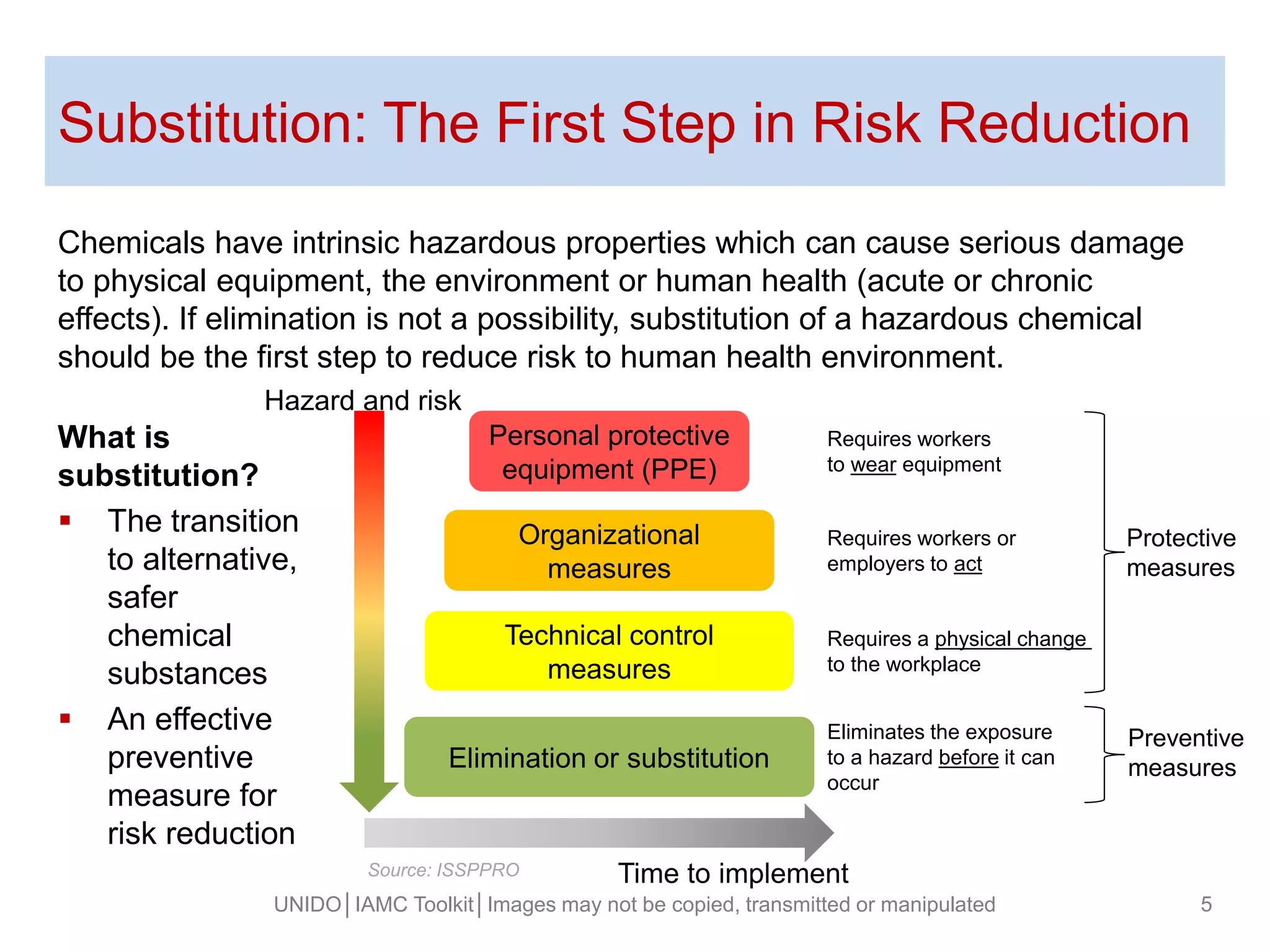
Substitution: The First Step in Risk Reduction
UNIDO│IAMC Toolkit│Images may not be copied, transmitted or manipulated 5
Time to implement
Elimination or substitution
Technical control
measures
Organizational
measures
Personal protective
equipment (PPE)
Protective
measures
Preventive
measures
Hazard and risk
Eliminates the exposure
to a hazard before it can
occur
Requires a physical change
to the workplace
Requires workers or
employers to act
Requires workers
to wear equipment
What is
substitution?
 The transition
to alternative,
safer
chemical
substances
 An effective
preventive
measure for
risk reduction
Source: ISSPPRO
Chemicals have intrinsic hazardous properties which can cause serious damage
to physical equipment, the environment or human health (acute or chronic
effects). If elimination is not a possibility, substitution of a hazardous chemical
should be the first step to reduce risk to human health environment.
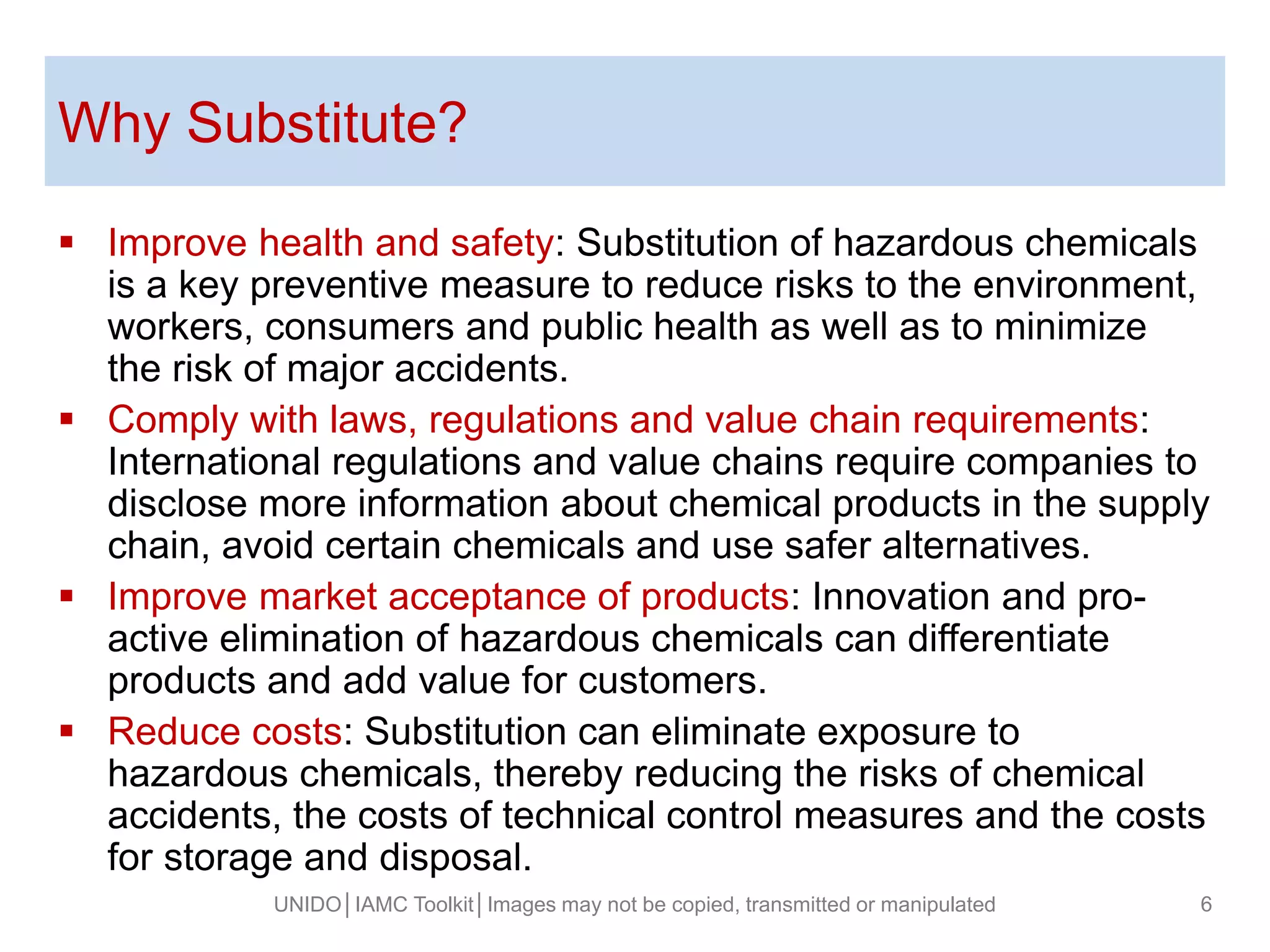
Why Substitute?
 Improve health and safety: Substitution of hazardous chemicals
is a key preventive measure to reduce risks to the environment,
workers, consumers and public health as well as to minimize
the risk of major accidents.
 Comply with laws, regulations and value chain requirements:
International regulations and value chains require companies to
disclose more information about chemical products in the supply
chain, avoid certain chemicals and use safer alternatives.
 Improve market acceptance of products: Innovation and pro-
active elimination of hazardous chemicals can differentiate
products and add value for customers.
 Reduce costs: Substitution can eliminate exposure to
hazardous chemicals, thereby reducing the risks of chemical
accidents, the costs of technical control measures and the costs
for storage and disposal.
UNIDO│IAMC Toolkit│Images may not be copied, transmitted or manipulated 6
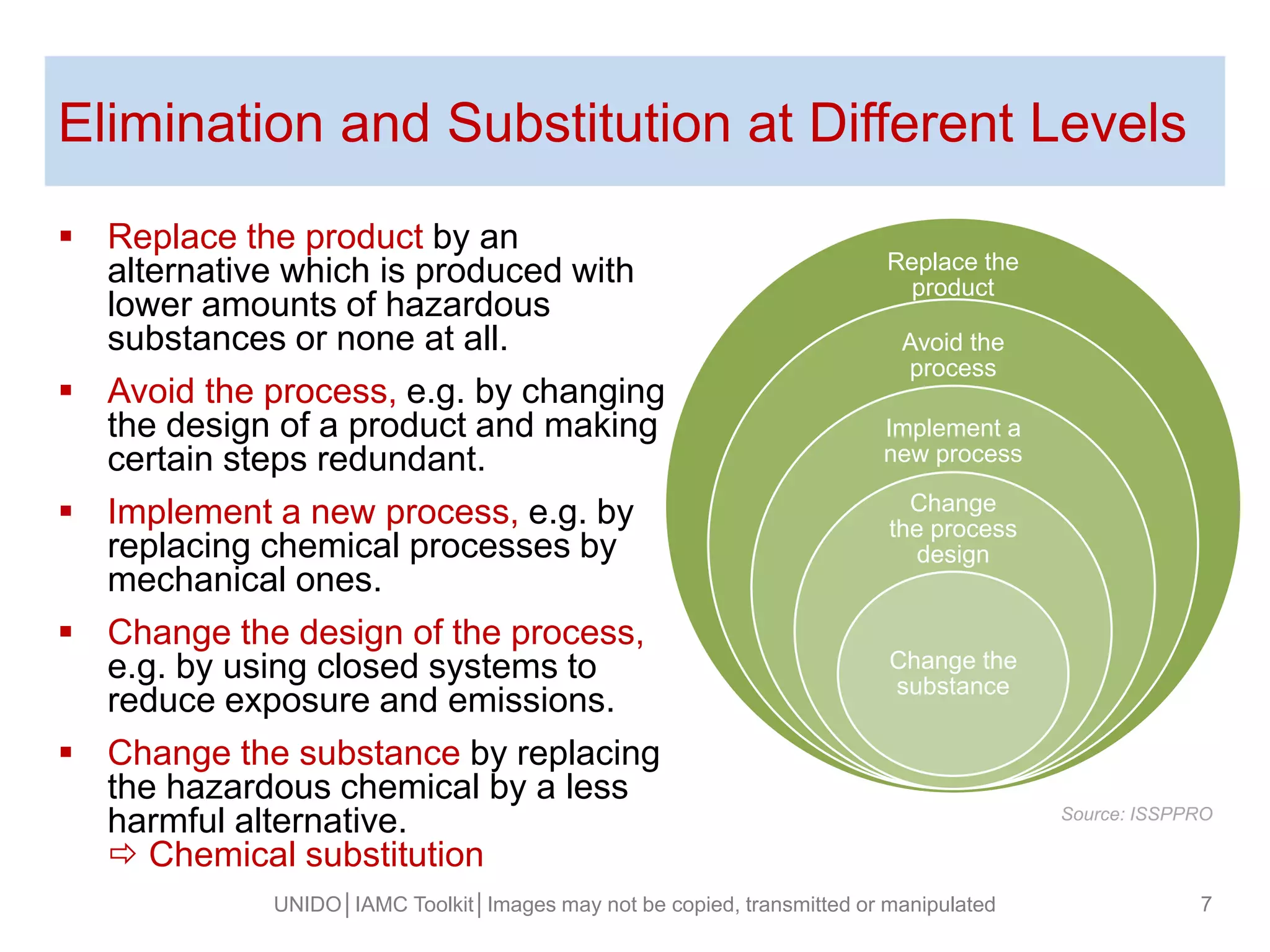
Elimination and Substitution at Different Levels
 Replace the product by an
alternative which is produced with
lower amounts of hazardous
substances or none at all.
 Avoid the process, e.g. by changing
the design of a product and making
certain steps redundant.
 Implement a new process, e.g. by
replacing chemical processes by
mechanical ones.
 Change the design of the process,
e.g. by using closed systems to
reduce exposure and emissions.
 Change the substance by replacing
the hazardous chemical by a less
harmful alternative.
 Chemical substitution
UNIDO│IAMC Toolkit│Images may not be copied, transmitted or manipulated 7
Replace the
product
Avoid the
process
Implement a
new process
Change
the process
design
Change the
substance
Source: ISSPPRO
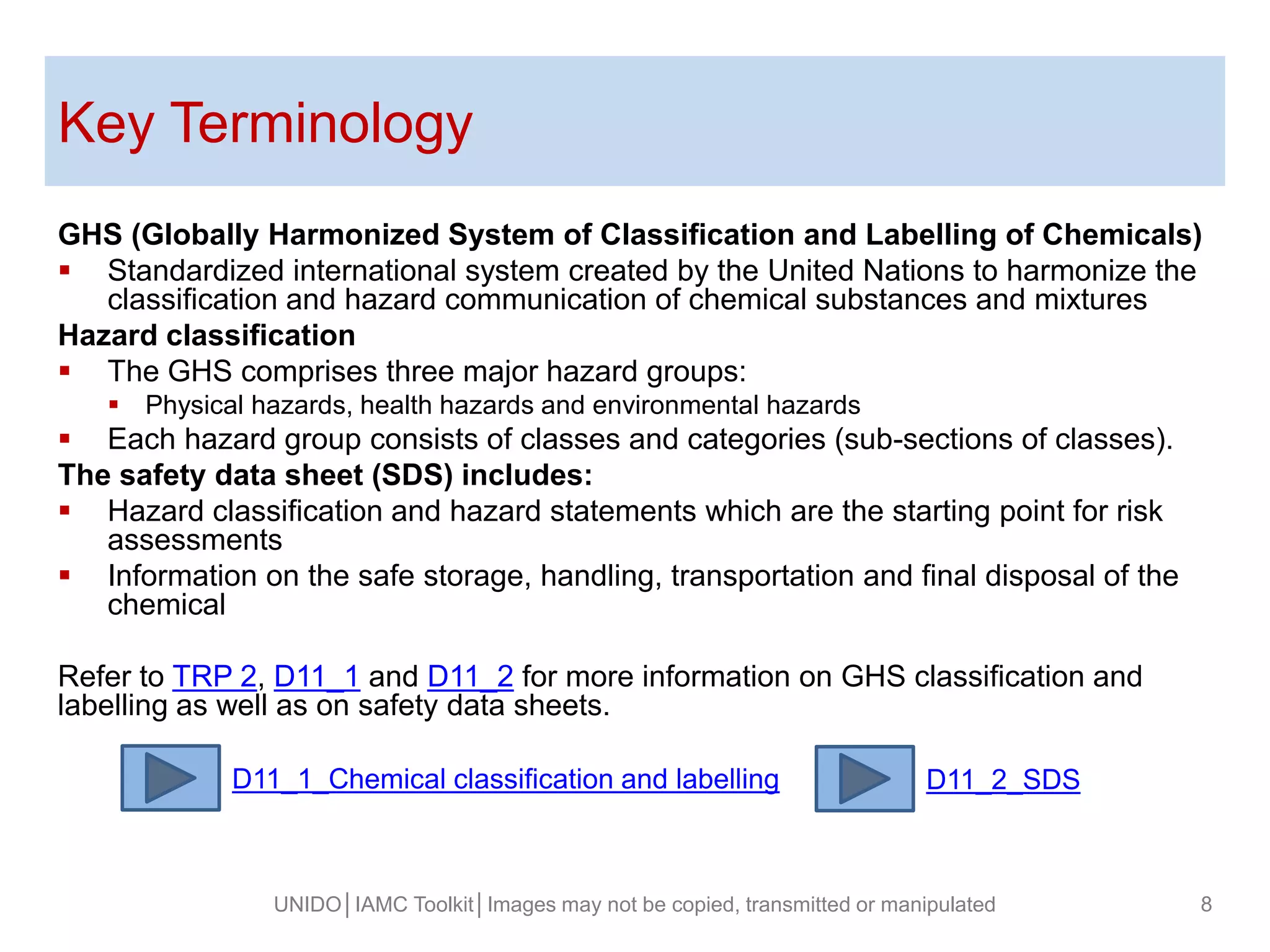
Key Terminology
GHS (Globally Harmonized System of Classification and Labelling of Chemicals)
 Standardized international system created by the United Nations to harmonize the
classification and hazard communication of chemical substances and mixtures
Hazard classification
 The GHS comprises three major hazard groups:
 Physical hazards, health hazards and environmental hazards
 Each hazard group consists of classes and categories (sub-sections of classes).
The safety data sheet (SDS) includes:
 Hazard classification and hazard statements which are the starting point for risk
assessments
 Information on the safe storage, handling, transportation and final disposal of the
chemical
Refer to TRP 2, D11_1 and D11_2 for more information on GHS classification and
labelling as well as on safety data sheets.
UNIDO│IAMC Toolkit│Images may not be copied, transmitted or manipulated 8
D11_2_SDSD11_1_Chemical classification and labelling
Steps for Moving Towards
Safer Chemicals
UNIDO│IAMC Toolkit│Images may not be copied, transmitted or manipulated 9
Steps for Moving Towards Safer Chemicals
UNIDO│IAMC Toolkit│Images may not be copied, transmitted or manipulated 10
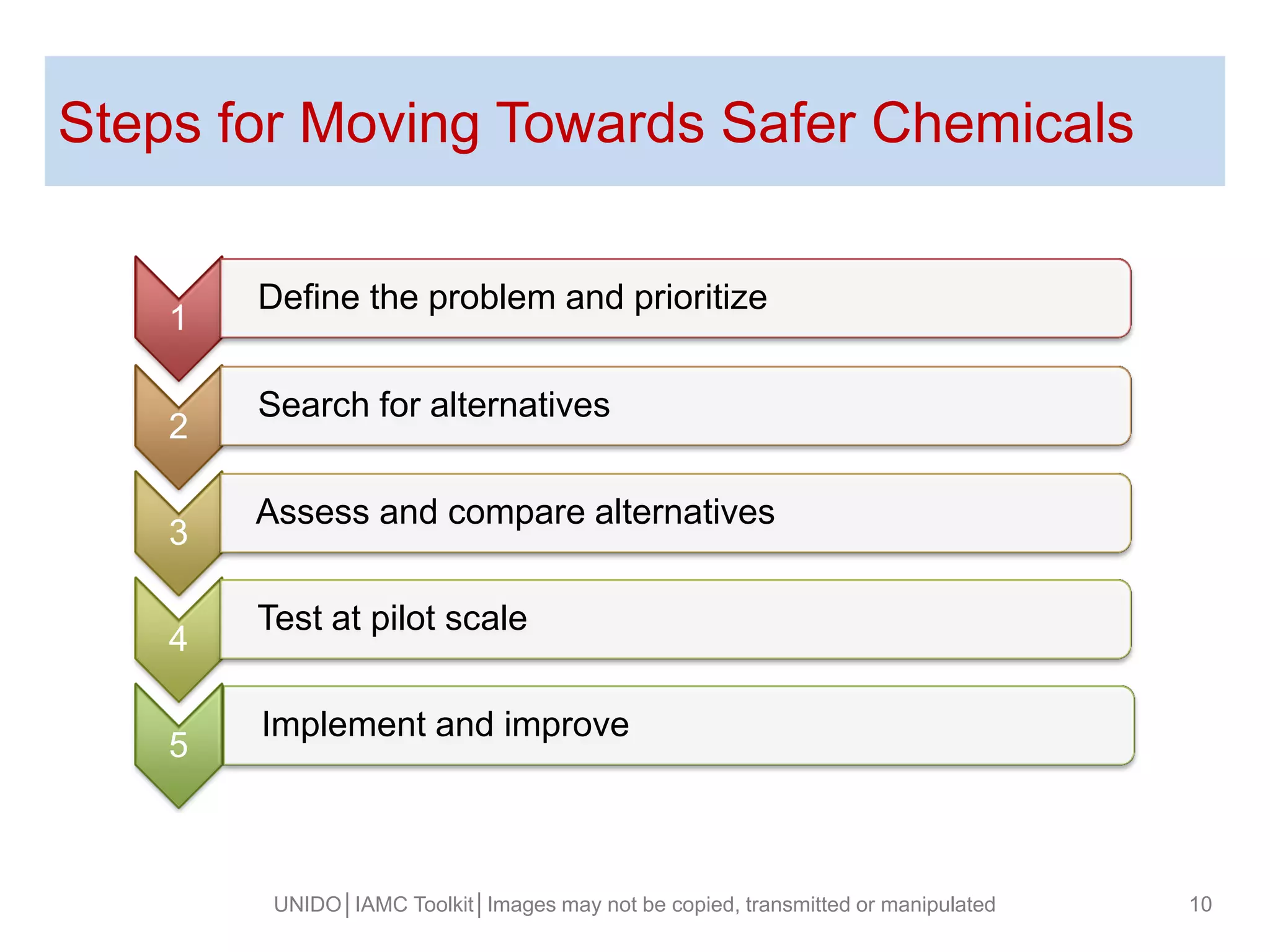
1
Define the problem and prioritize
2
Search for alternatives
3
Assess and compare alternatives
4
Test at pilot scale
5
Implement and improve
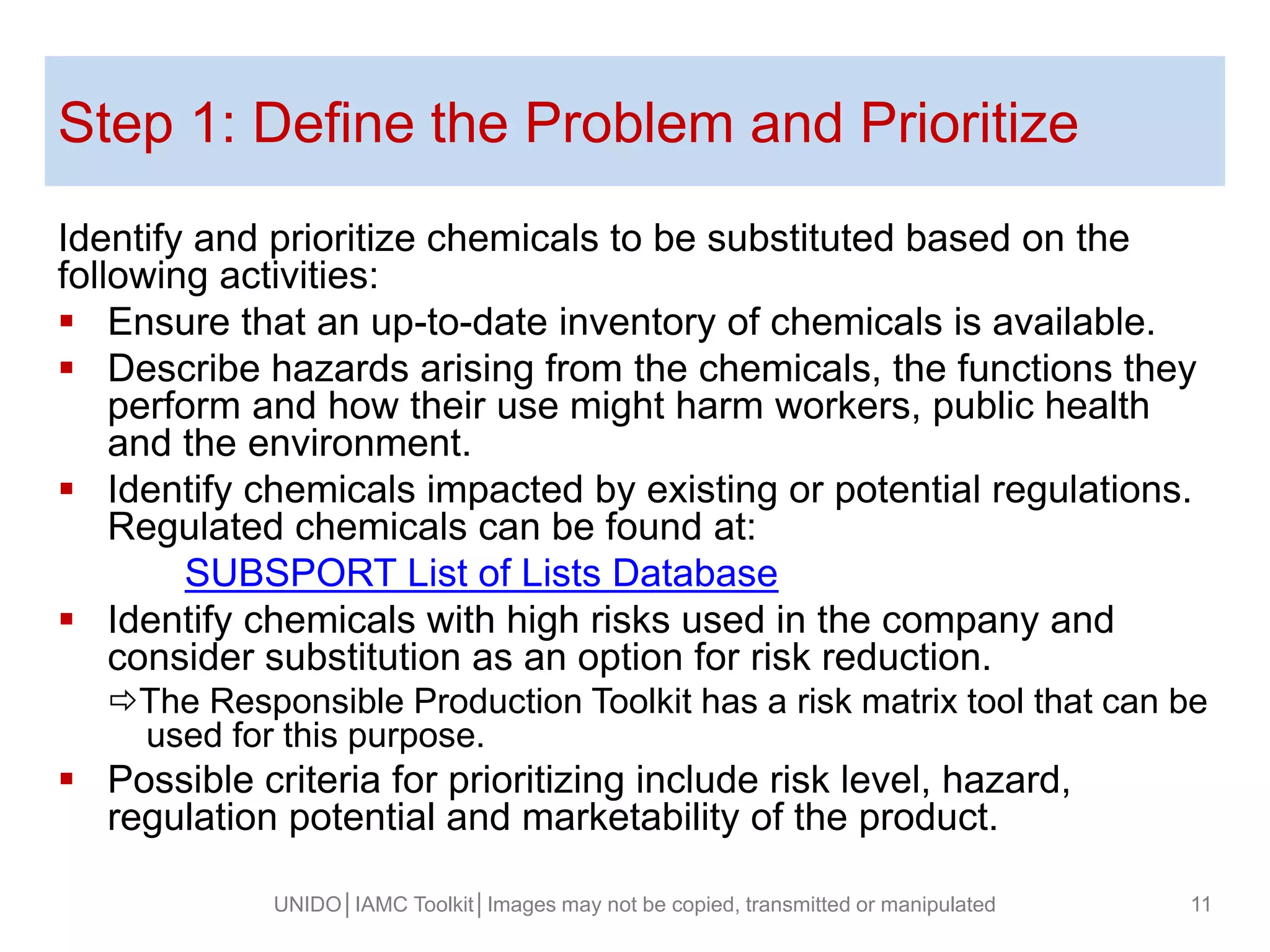
Step 1: Define the Problem and Prioritize
Identify and prioritize chemicals to be substituted based on the
following activities:
 Ensure that an up-to-date inventory of chemicals is available.
 Describe hazards arising from the chemicals, the functions they
perform and how their use might harm workers, public health
and the environment.
 Identify chemicals impacted by existing or potential regulations.
Regulated chemicals can be found at:
SUBSPORT List of Lists Database
 Identify chemicals with high risks used in the company and
consider substitution as an option for risk reduction.
The Responsible Production Toolkit has a risk matrix tool that can be
used for this purpose.
 Possible criteria for prioritizing include risk level, hazard,
regulation potential and marketability of the product.
UNIDO│IAMC Toolkit│Images may not be copied, transmitted or manipulated 11
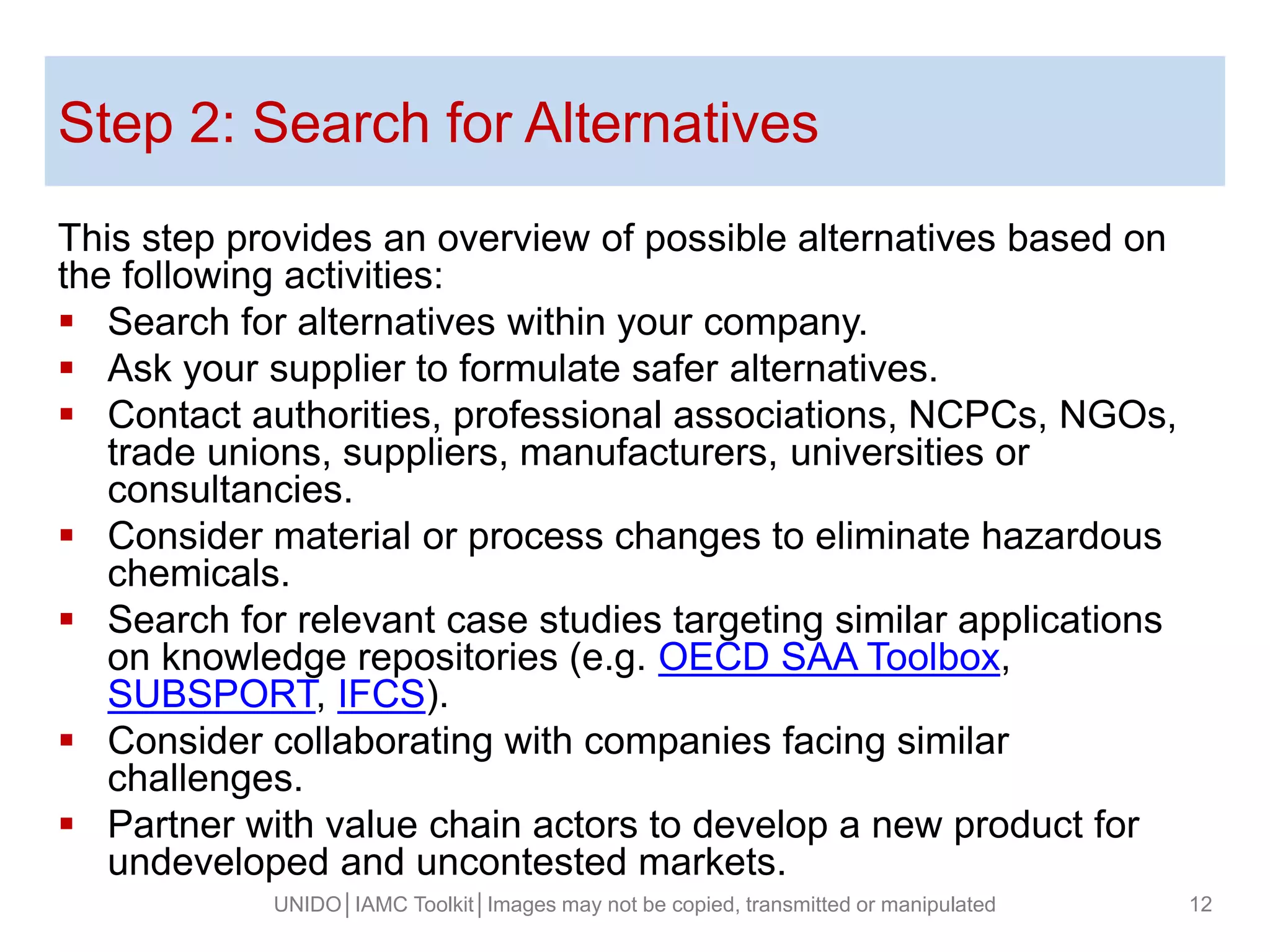
Step 2: Search for Alternatives
This step provides an overview of possible alternatives based on
the following activities:
 Search for alternatives within your company.
 Ask your supplier to formulate safer alternatives.
 Contact authorities, professional associations, NCPCs, NGOs,
trade unions, suppliers, manufacturers, universities or
consultancies.
 Consider material or process changes to eliminate hazardous
chemicals.
 Search for relevant case studies targeting similar applications
on knowledge repositories (e.g. OECD SAA Toolbox,
SUBSPORT, IFCS).
 Consider collaborating with companies facing similar
challenges.
 Partner with value chain actors to develop a new product for
undeveloped and uncontested markets.
UNIDO│IAMC Toolkit│Images may not be copied, transmitted or manipulated 12
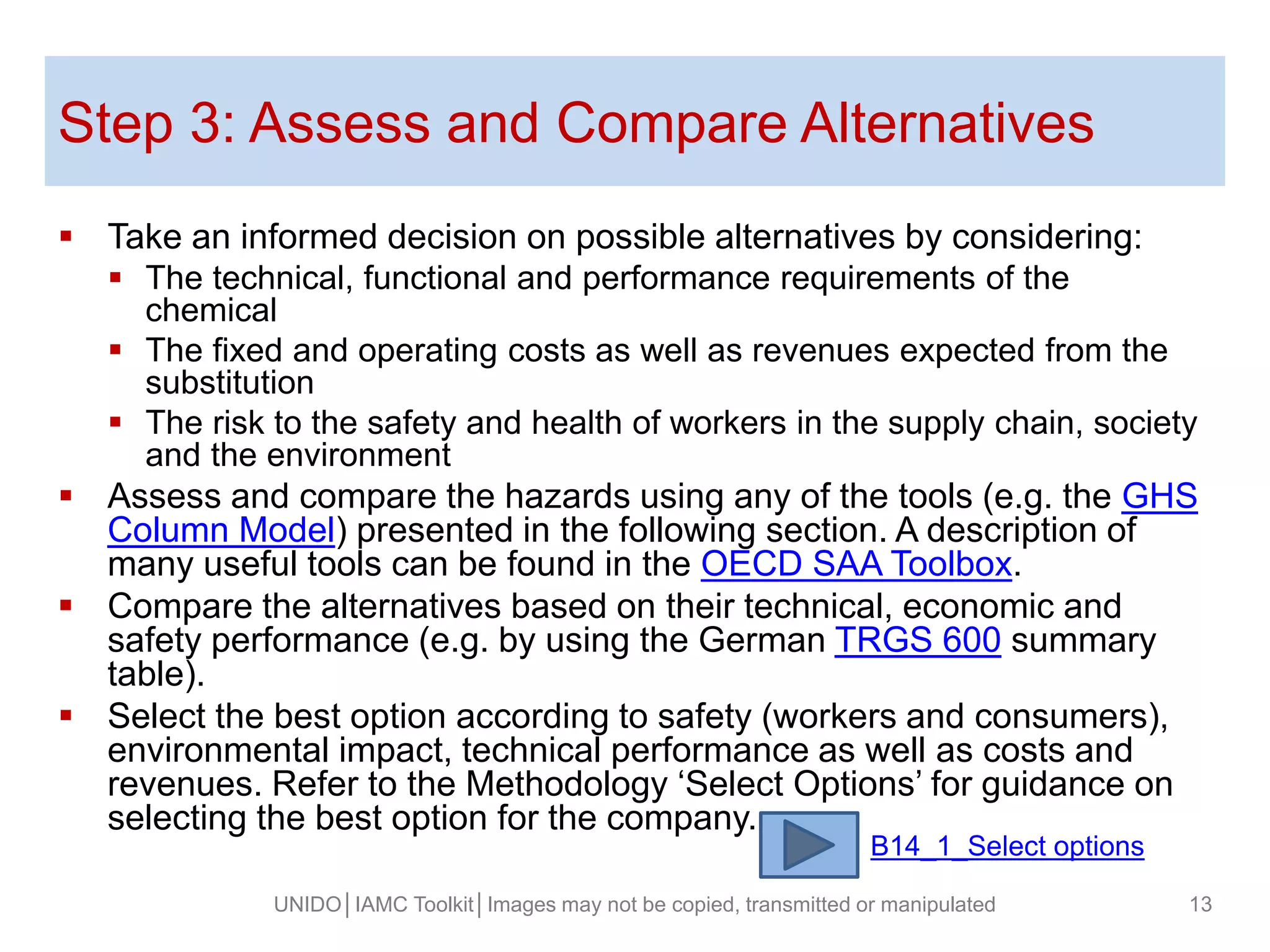
Step 3: Assess and Compare Alternatives
 Take an informed decision on possible alternatives by considering:
 The technical, functional and performance requirements of the
chemical
 The fixed and operating costs as well as revenues expected from the
substitution
 The risk to the safety and health of workers in the supply chain, society
and the environment
 Assess and compare the hazards using any of the tools (e.g. the GHS
Column Model) presented in the following section. A description of
many useful tools can be found in the OECD SAA Toolbox.
 Compare the alternatives based on their technical, economic and
safety performance (e.g. by using the German TRGS 600 summary
table).
 Select the best option according to safety (workers and consumers),
environmental impact, technical performance as well as costs and
revenues. Refer to the Methodology ‘Select Options’ for guidance on
selecting the best option for the company.
UNIDO│IAMC Toolkit│Images may not be copied, transmitted or manipulated 13
B14_1_Select options
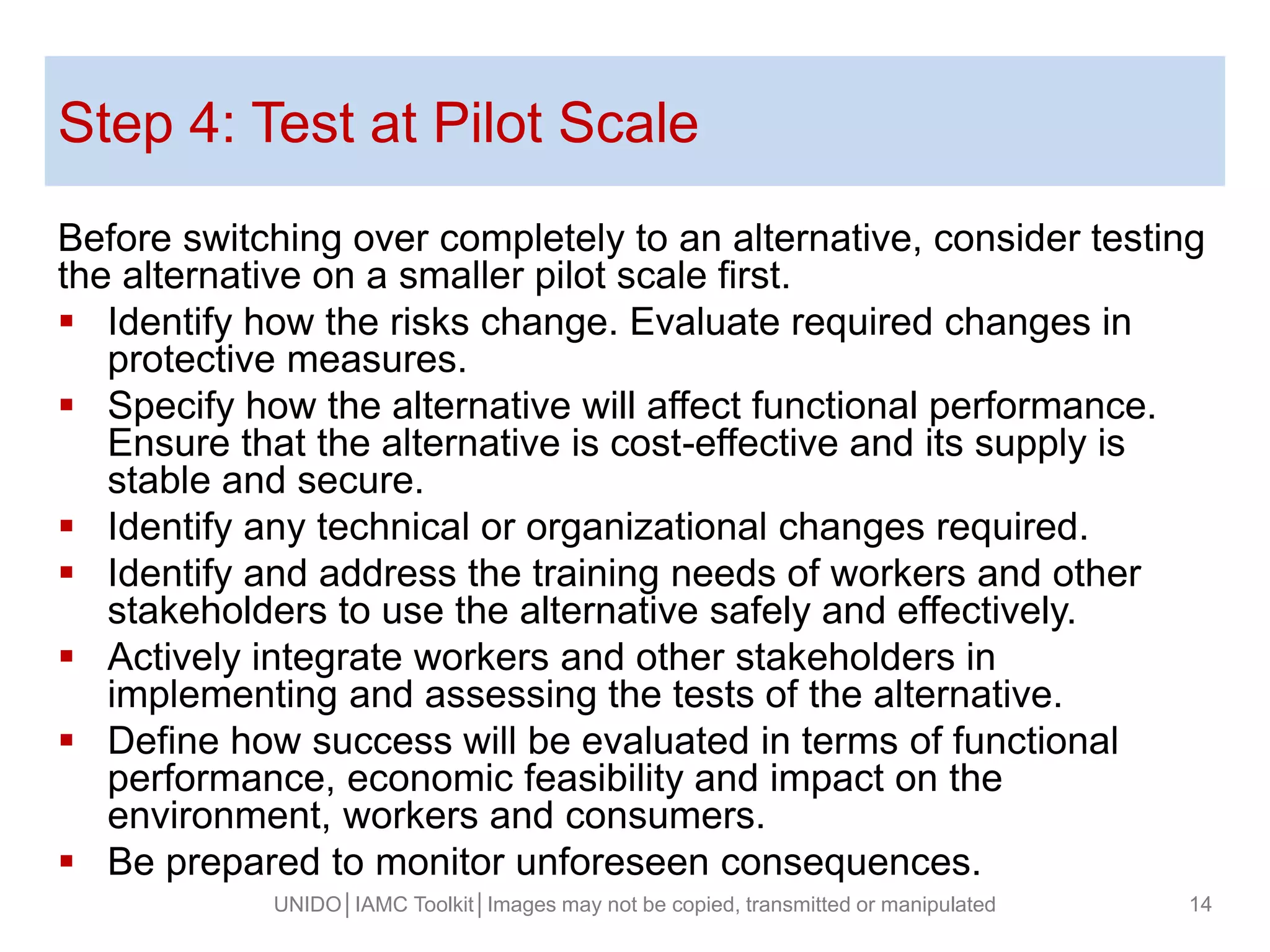
Step 4: Test at Pilot Scale
Before switching over completely to an alternative, consider testing
the alternative on a smaller pilot scale first.
 Identify how the risks change. Evaluate required changes in
protective measures.
 Specify how the alternative will affect functional performance.
Ensure that the alternative is cost-effective and its supply is
stable and secure.
 Identify any technical or organizational changes required.
 Identify and address the training needs of workers and other
stakeholders to use the alternative safely and effectively.
 Actively integrate workers and other stakeholders in
implementing and assessing the tests of the alternative.
 Define how success will be evaluated in terms of functional
performance, economic feasibility and impact on the
environment, workers and consumers.
 Be prepared to monitor unforeseen consequences.
UNIDO│IAMC Toolkit│Images may not be copied, transmitted or manipulated 14
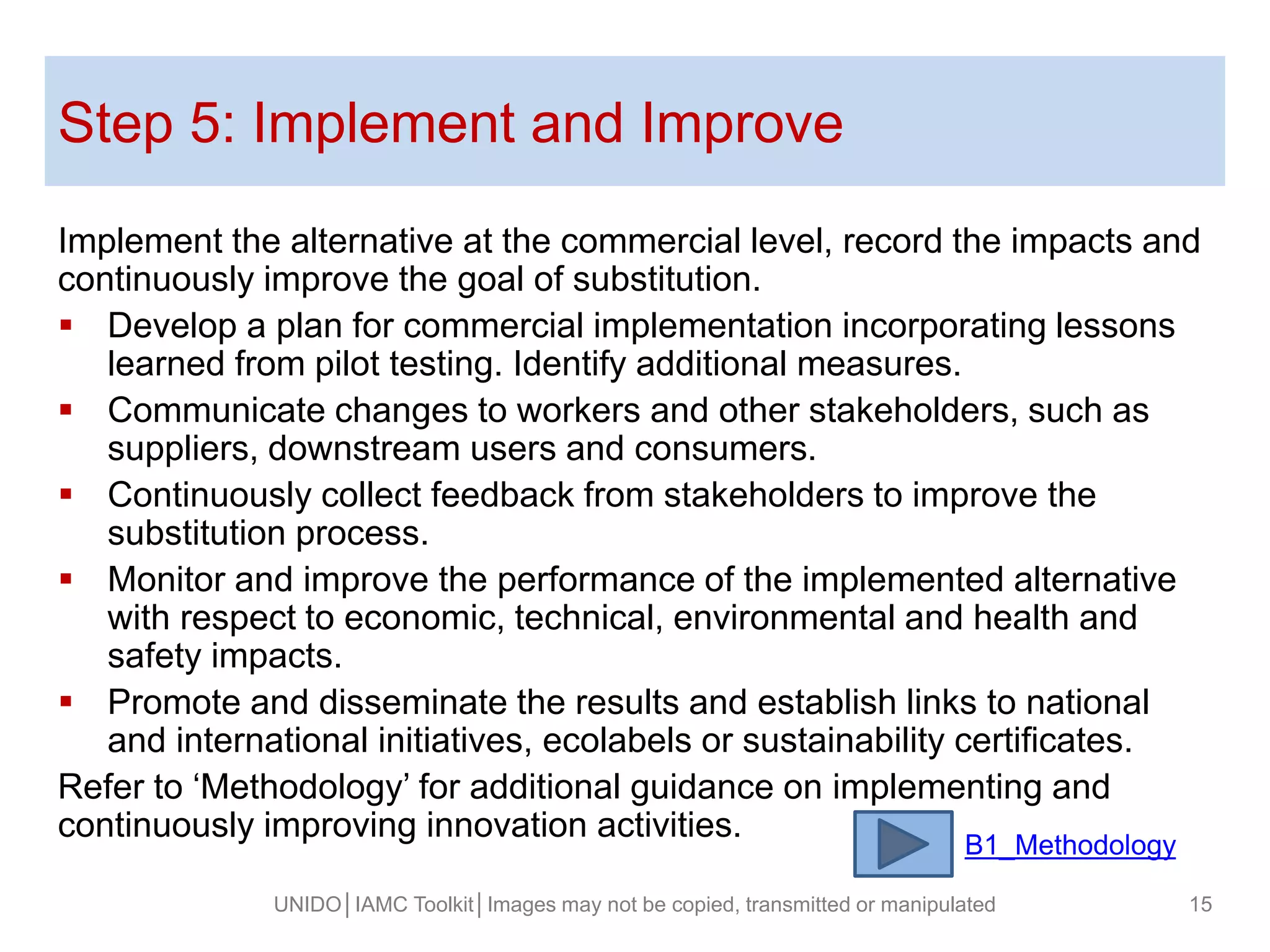
Step 5: Implement and Improve
Implement the alternative at the commercial level, record the impacts and
continuously improve the goal of substitution.
 Develop a plan for commercial implementation incorporating lessons
learned from pilot testing. Identify additional measures.
 Communicate changes to workers and other stakeholders, such as
suppliers, downstream users and consumers.
 Continuously collect feedback from stakeholders to improve the
substitution process.
 Monitor and improve the performance of the implemented alternative
with respect to economic, technical, environmental and health and
safety impacts.
 Promote and disseminate the results and establish links to national
and international initiatives, ecolabels or sustainability certificates.
Refer to ‘Methodology’ for additional guidance on implementing and
continuously improving innovation activities.
UNIDO│IAMC Toolkit│Images may not be copied, transmitted or manipulated 15
B1_Methodology
Tools for Selecting
Alternatives
UNIDO│IAMC Toolkit│Images may not be copied, transmitted or manipulated 16
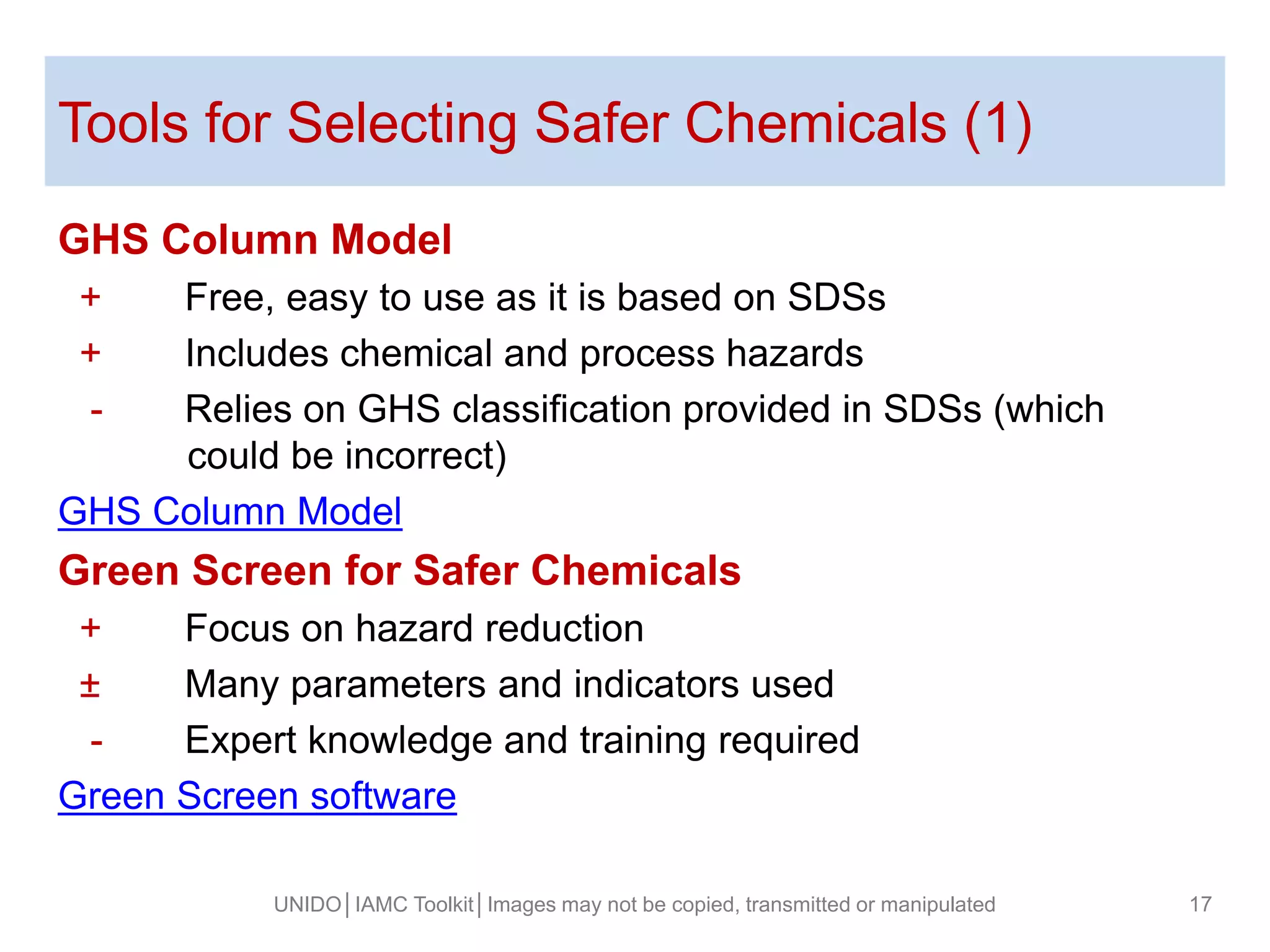
Tools for Selecting Safer Chemicals (1)
GHS Column Model
+ Free, easy to use as it is based on SDSs
+ Includes chemical and process hazards
- Relies on GHS classification provided in SDSs (which
could be incorrect)
GHS Column Model
Green Screen for Safer Chemicals
+ Focus on hazard reduction
± Many parameters and indicators used
- Expert knowledge and training required
Green Screen software
UNIDO│IAMC Toolkit│Images may not be copied, transmitted or manipulated 17
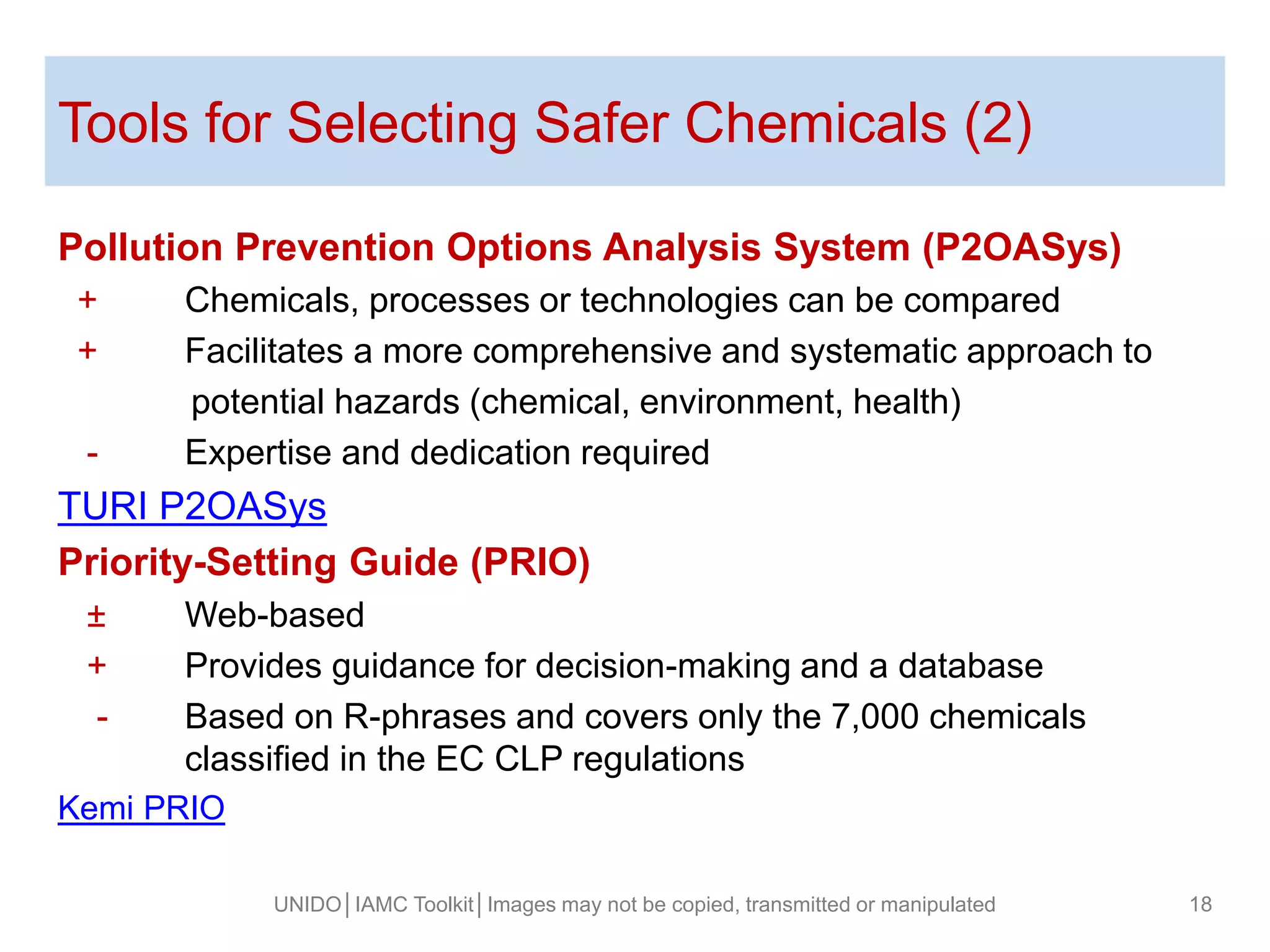
Tools for Selecting Safer Chemicals (2)
Pollution Prevention Options Analysis System (P2OASys)
+ Chemicals, processes or technologies can be compared
+ Facilitates a more comprehensive and systematic approach to
potential hazards (chemical, environment, health)
- Expertise and dedication required
TURI P2OASys
Priority-Setting Guide (PRIO)
± Web-based
+ Provides guidance for decision-making and a database
- Based on R-phrases and covers only the 7,000 chemicals
classified in the EC CLP regulations
Kemi PRIO
UNIDO│IAMC Toolkit│Images may not be copied, transmitted or manipulated 18
GHS Column Model
UNIDO│IAMC Toolkit│Images may not be copied, transmitted or manipulated 19
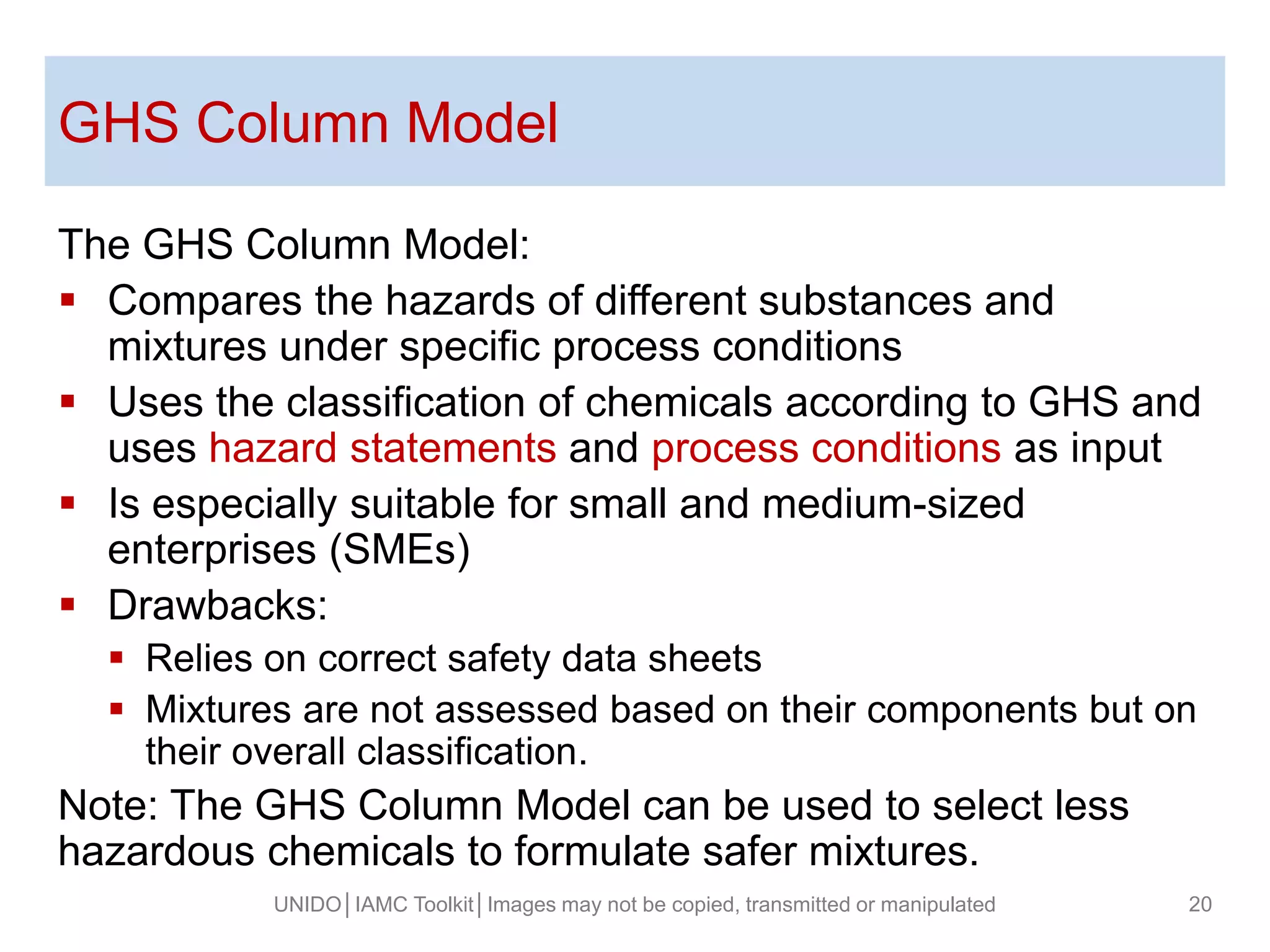
GHS Column Model
The GHS Column Model:
 Compares the hazards of different substances and
mixtures under specific process conditions
 Uses the classification of chemicals according to GHS and
uses hazard statements and process conditions as input
 Is especially suitable for small and medium-sized
enterprises (SMEs)
 Drawbacks:
 Relies on correct safety data sheets
 Mixtures are not assessed based on their components but on
their overall classification.
Note: The GHS Column Model can be used to select less
hazardous chemicals to formulate safer mixtures.
UNIDO│IAMC Toolkit│Images may not be copied, transmitted or manipulated 20
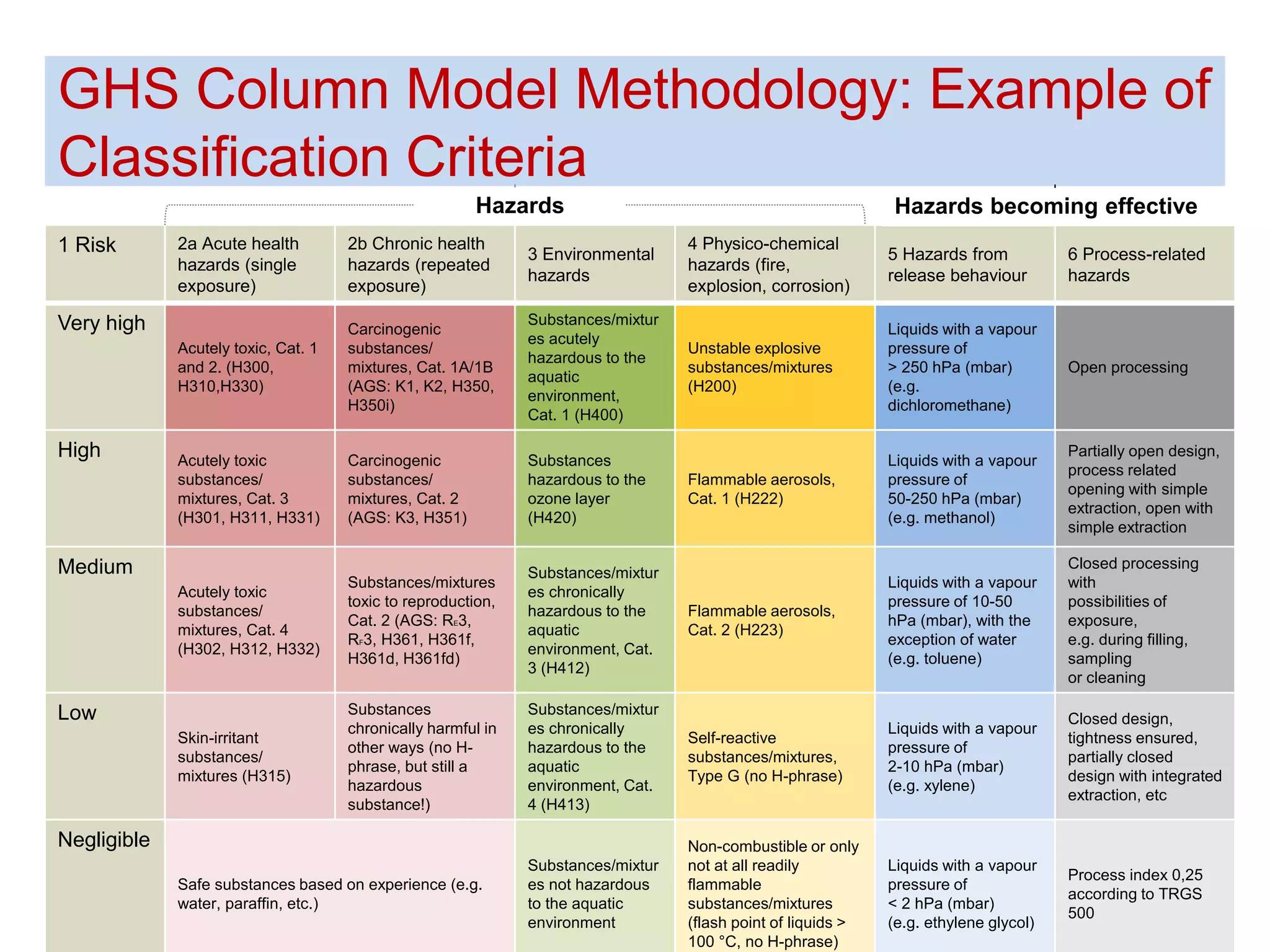
GHS Column Model Methodology: Example of
Classification Criteria
UNIDO│IAMC Toolkit│Images may not be copied, transmitted or manipulated 21
1 Risk 2a Acute health
hazards (single
exposure)
2b Chronic health
hazards (repeated
exposure)
3 Environmental
hazards
4 Physico-chemical
hazards (fire,
explosion, corrosion)
5 Hazards from
release behaviour
6 Process-related
hazards
Very high
Acutely toxic, Cat. 1
and 2. (H300,
H310,H330)
Carcinogenic
substances/
mixtures, Cat. 1A/1B
(AGS: K1, K2, H350,
H350i)
Substances/mixtur
es acutely
hazardous to the
aquatic
environment,
Cat. 1 (H400)
Unstable explosive
substances/mixtures
(H200)
Liquids with a vapour
pressure of
> 250 hPa (mbar)
(e.g.
dichloromethane)
Open processing
High Acutely toxic
substances/
mixtures, Cat. 3
(H301, H311, H331)
Carcinogenic
substances/
mixtures, Cat. 2
(AGS: K3, H351)
Substances
hazardous to the
ozone layer
(H420)
Flammable aerosols,
Cat. 1 (H222)
Liquids with a vapour
pressure of
50-250 hPa (mbar)
(e.g. methanol)
Partially open design,
process related
opening with simple
extraction, open with
simple extraction
Medium
Acutely toxic
substances/
mixtures, Cat. 4
(H302, H312, H332)
Substances/mixtures
toxic to reproduction,
Cat. 2 (AGS: RE3,
RF3, H361, H361f,
H361d, H361fd)
Substances/mixtur
es chronically
hazardous to the
aquatic
environment, Cat.
3 (H412)
Flammable aerosols,
Cat. 2 (H223)
Liquids with a vapour
pressure of 10-50
hPa (mbar), with the
exception of water
(e.g. toluene)
Closed processing
with
possibilities of
exposure,
e.g. during filling,
sampling
or cleaning
Low
Skin-irritant
substances/
mixtures (H315)
Substances
chronically harmful in
other ways (no H-
phrase, but still a
hazardous
substance!)
Substances/mixtur
es chronically
hazardous to the
aquatic
environment, Cat.
4 (H413)
Self-reactive
substances/mixtures,
Type G (no H-phrase)
Liquids with a vapour
pressure of
2-10 hPa (mbar)
(e.g. xylene)
Closed design,
tightness ensured,
partially closed
design with integrated
extraction, etc
Negligible
Safe substances based on experience (e.g.
water, paraffin, etc.)
Substances/mixtur
es not hazardous
to the aquatic
environment
Non-combustible or only
not at all readily
flammable
substances/mixtures
(flash point of liquids >
100 °C, no H-phrase)
Liquids with a vapour
pressure of
< 2 hPa (mbar)
(e.g. ethylene glycol)
Process index 0,25
according to TRGS
500
Hazards Hazards becoming effective
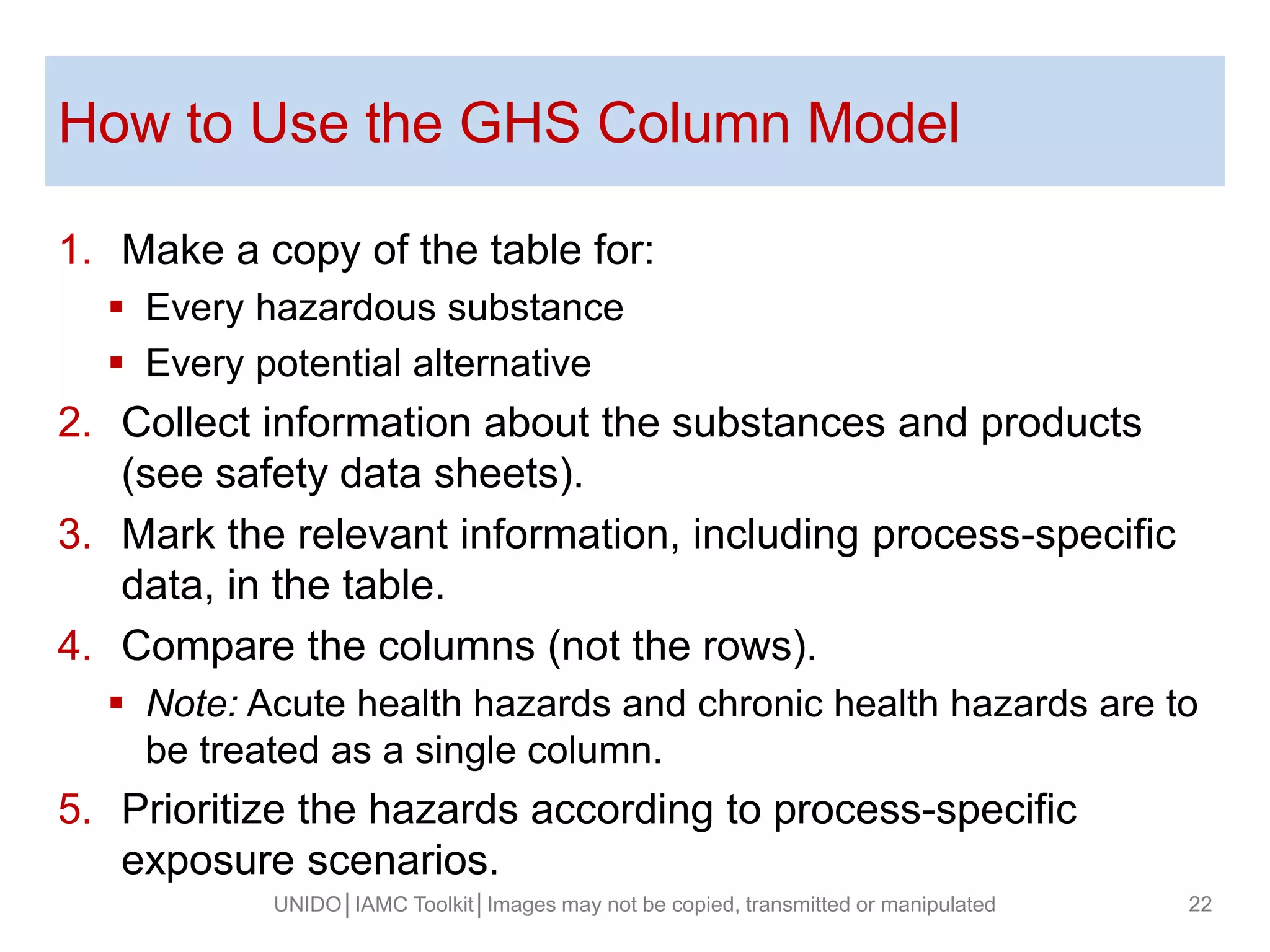
How to Use the GHS Column Model
1. Make a copy of the table for:
 Every hazardous substance
 Every potential alternative
2. Collect information about the substances and products
(see safety data sheets).
3. Mark the relevant information, including process-specific
data, in the table.
4. Compare the columns (not the rows).
 Note: Acute health hazards and chronic health hazards are to
be treated as a single column.
5. Prioritize the hazards according to process-specific
exposure scenarios.
UNIDO│IAMC Toolkit│Images may not be copied, transmitted or manipulated 22
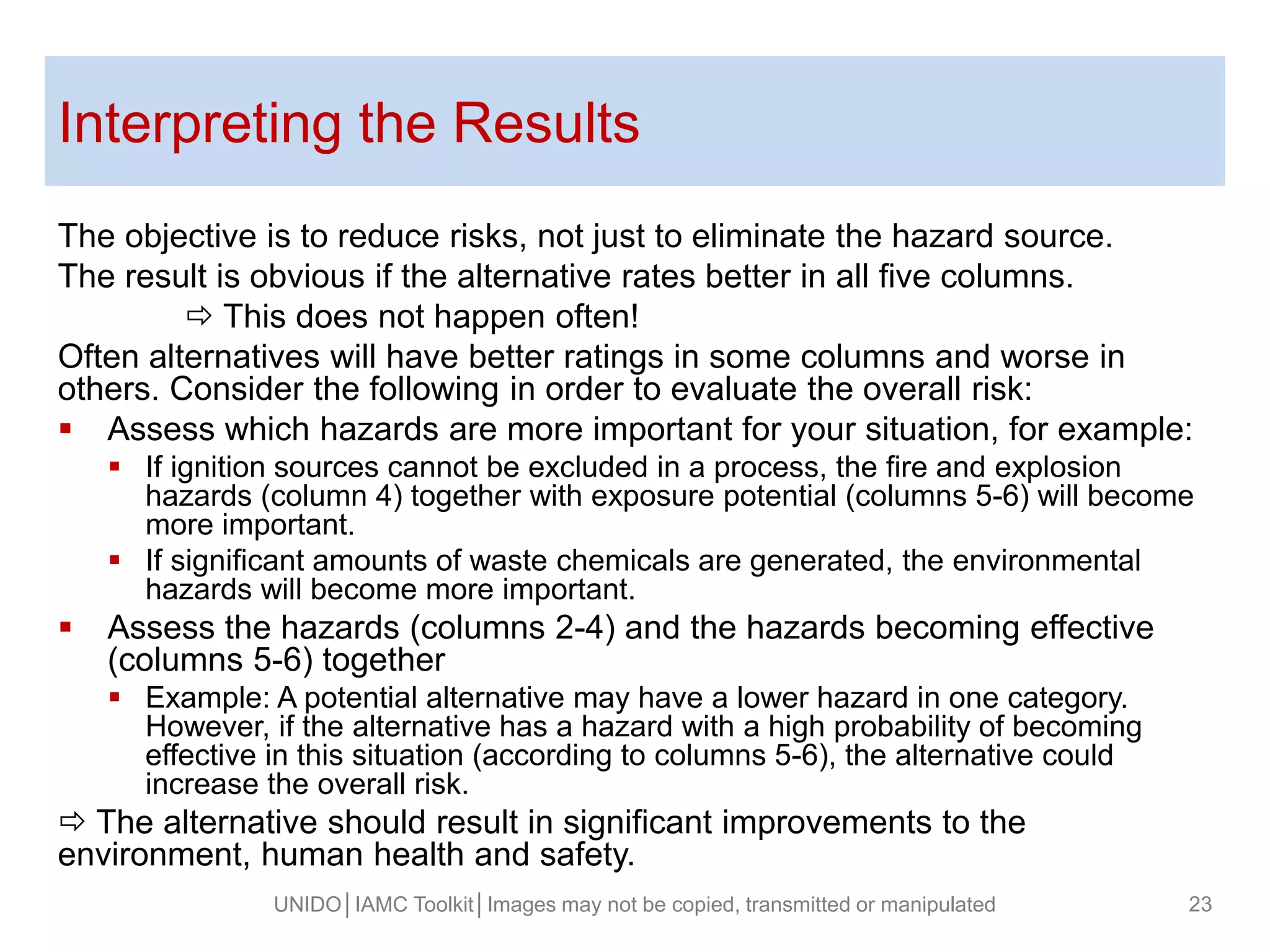
Interpreting the Results
The objective is to reduce risks, not just to eliminate the hazard source.
The result is obvious if the alternative rates better in all five columns.
 This does not happen often!
Often alternatives will have better ratings in some columns and worse in
others. Consider the following in order to evaluate the overall risk:
 Assess which hazards are more important for your situation, for example:
 If ignition sources cannot be excluded in a process, the fire and explosion
hazards (column 4) together with exposure potential (columns 5-6) will become
more important.
 If significant amounts of waste chemicals are generated, the environmental
hazards will become more important.
 Assess the hazards (columns 2-4) and the hazards becoming effective
(columns 5-6) together
 Example: A potential alternative may have a lower hazard in one category.
However, if the alternative has a hazard with a high probability of becoming
effective in this situation (according to columns 5-6), the alternative could
increase the overall risk.
 The alternative should result in significant improvements to the
environment, human health and safety.
UNIDO│IAMC Toolkit│Images may not be copied, transmitted or manipulated 23
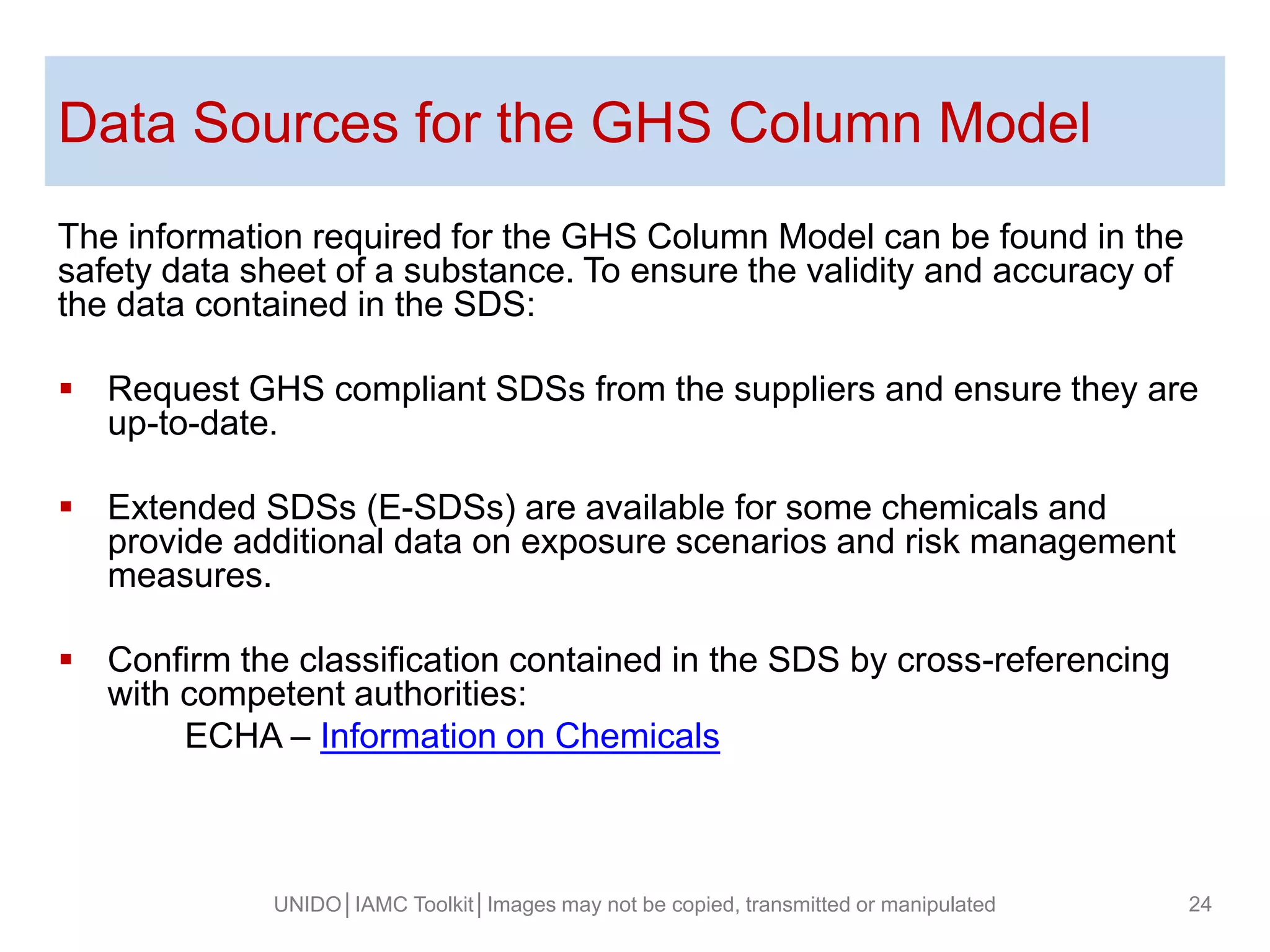
Data Sources for the GHS Column Model
The information required for the GHS Column Model can be found in the
safety data sheet of a substance. To ensure the validity and accuracy of
the data contained in the SDS:
 Request GHS compliant SDSs from the suppliers and ensure they are
up-to-date.
 Extended SDSs (E-SDSs) are available for some chemicals and
provide additional data on exposure scenarios and risk management
measures.
 Confirm the classification contained in the SDS by cross-referencing
with competent authorities:
ECHA – Information on Chemicals
UNIDO│IAMC Toolkit│Images may not be copied, transmitted or manipulated 24
Example: Solvent Use in an Open Process
with Simple Extraction (1)
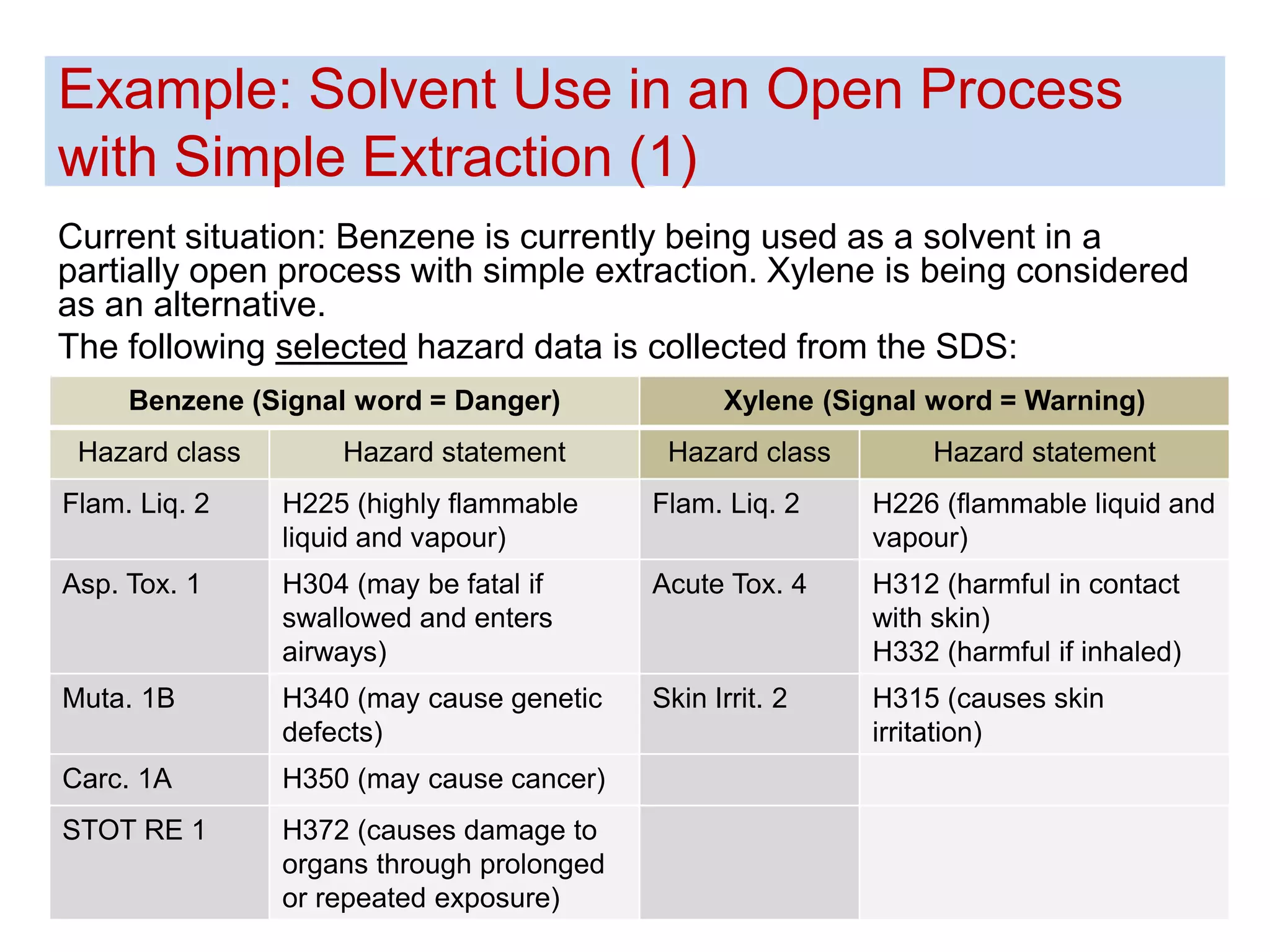
Current situation: Benzene is currently being used as a solvent in a
partially open process with simple extraction. Xylene is being considered
as an alternative.
The following selected hazard data is collected from the SDS:
UNIDO│IAMC Toolkit│Images may not be copied, transmitted or manipulated 25
Benzene (Signal word = Danger) Xylene (Signal word = Warning)
Hazard class Hazard statement Hazard class Hazard statement
Flam. Liq. 2 H225 (highly flammable
liquid and vapour)
Flam. Liq. 2 H226 (flammable liquid and
vapour)
Asp. Tox. 1 H304 (may be fatal if
swallowed and enters
airways)
Acute Tox. 4 H312 (harmful in contact
with skin)
H332 (harmful if inhaled)
Muta. 1B H340 (may cause genetic
defects)
Skin Irrit. 2 H315 (causes skin
irritation)
Carc. 1A H350 (may cause cancer)
STOT RE 1 H372 (causes damage to
organs through prolonged
or repeated exposure)
Example: Solvent Use in an Open Process
with Simple Extraction (2)
UNIDO│IAMC Toolkit│Images may not be copied, transmitted or manipulated 26
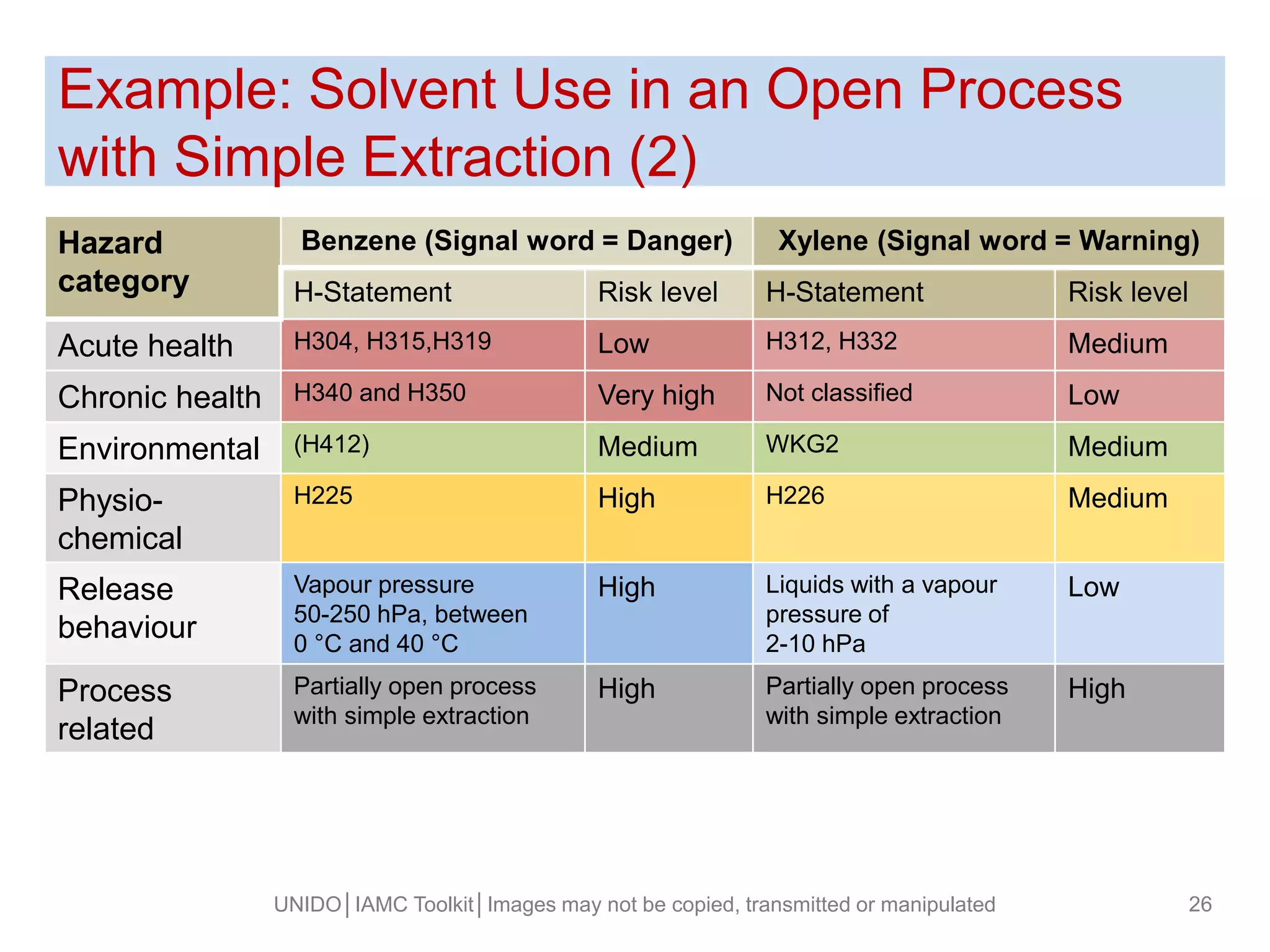
Hazard
category
Benzene (Signal word = Danger) Xylene (Signal word = Warning)
H-Statement Risk level H-Statement Risk level
Acute health H304, H315,H319 Low H312, H332 Medium
Chronic health H340 and H350 Very high Not classified Low
Environmental (H412) Medium WKG2 Medium
Physio-
chemical
H225 High H226 Medium
Release
behaviour
Vapour pressure
50-250 hPa, between
0 °C and 40 °C
High Liquids with a vapour
pressure of
2-10 hPa
Low
Process
related
Partially open process
with simple extraction
High Partially open process
with simple extraction
High
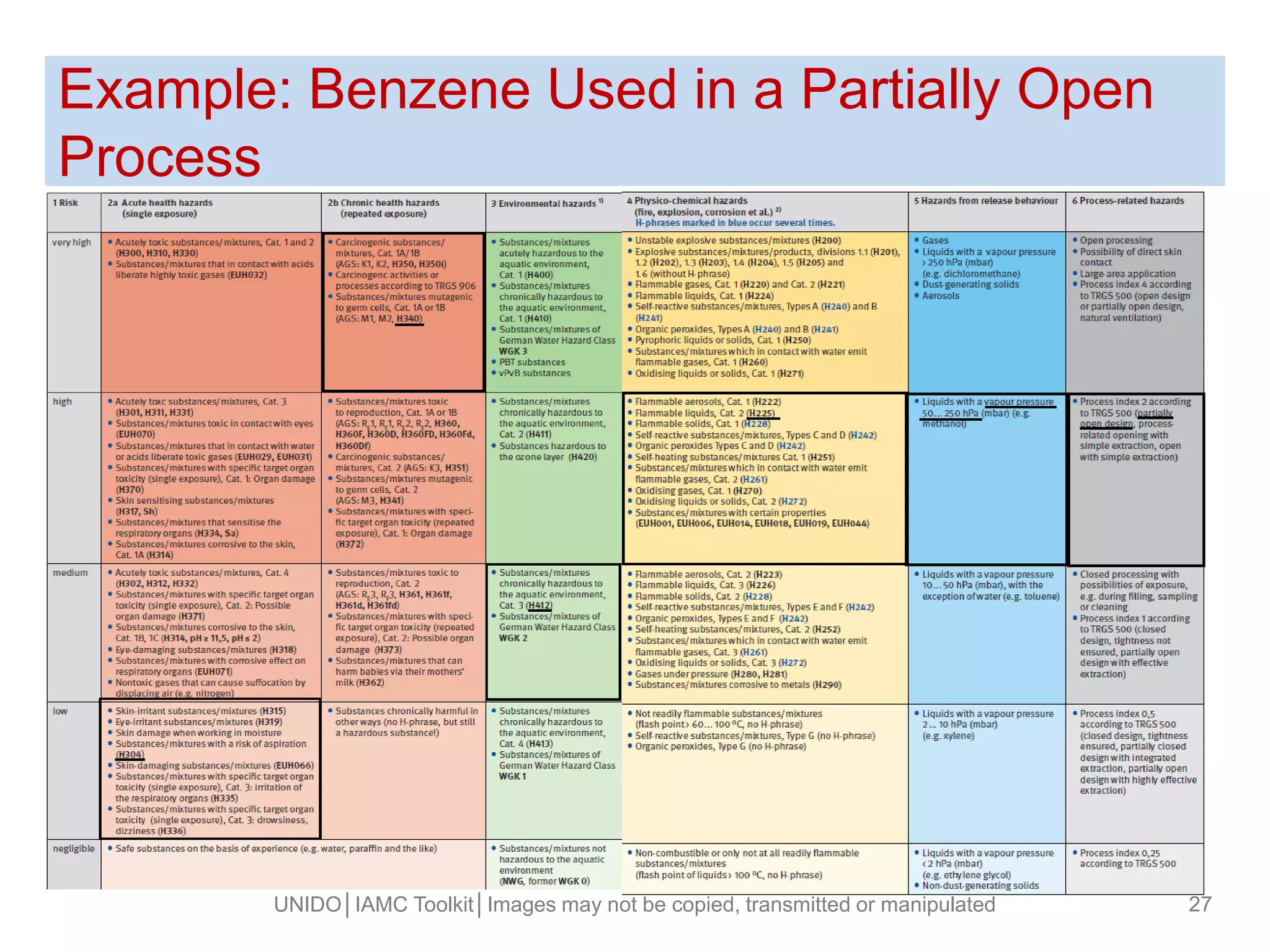
Example: Benzene Used in a Partially Open
Process
UNIDO│IAMC Toolkit│Images may not be copied, transmitted or manipulated 27
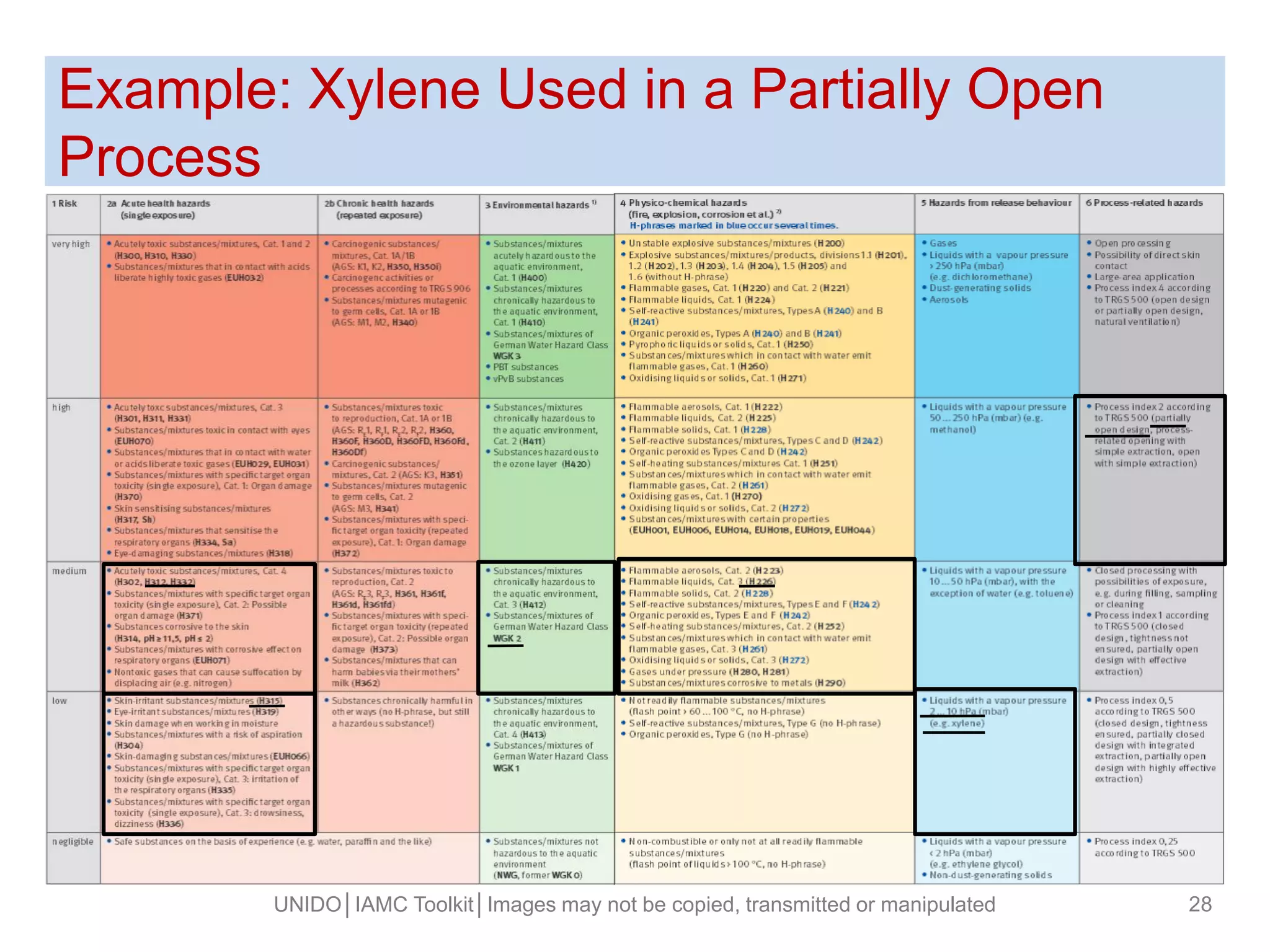
Example: Xylene Used in a Partially Open
Process
UNIDO│IAMC Toolkit│Images may not be copied, transmitted or manipulated 28
Example: Solvent Use in an Open Process
with Simple Extraction (3)
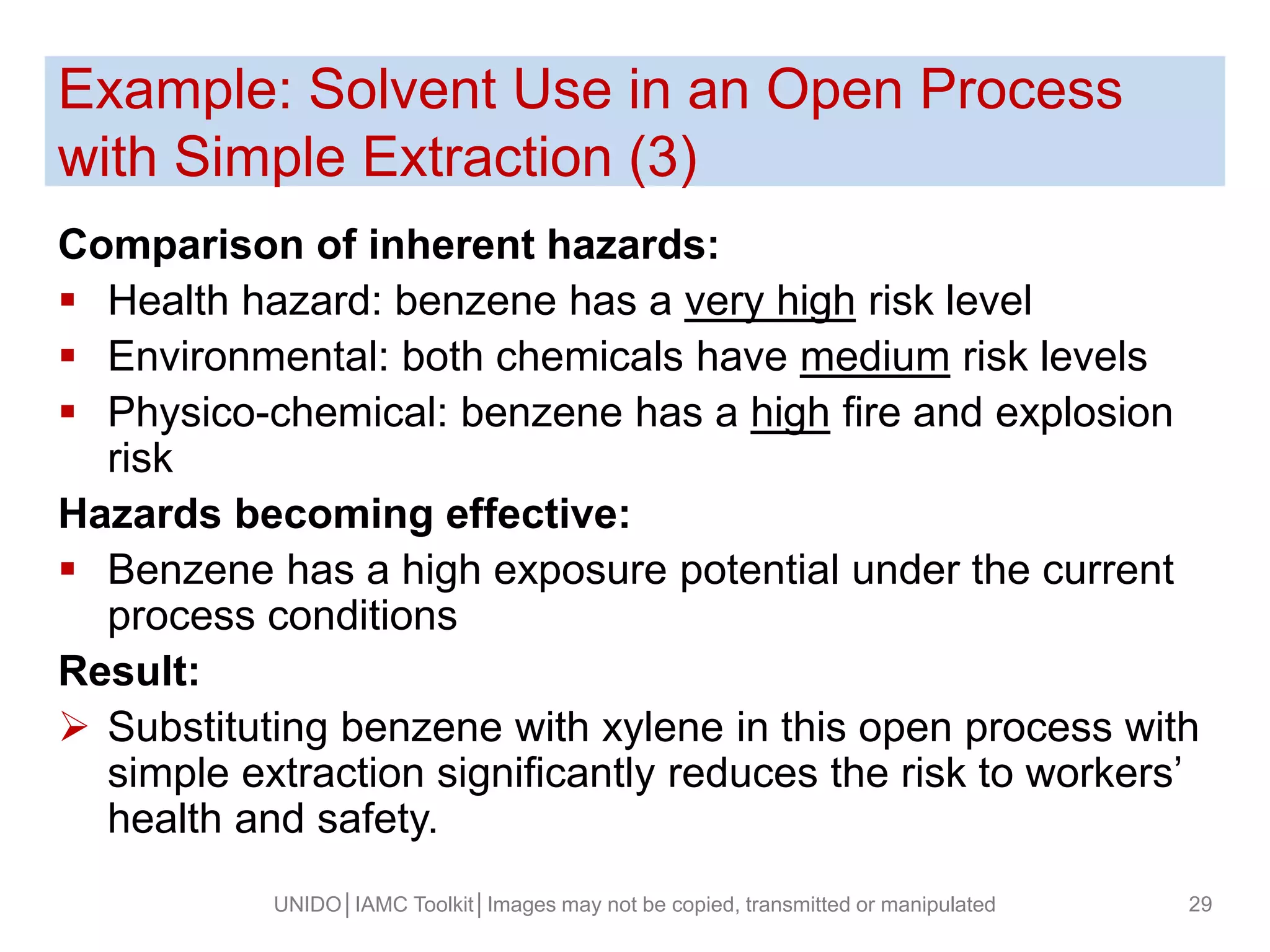
Comparison of inherent hazards:
 Health hazard: benzene has a very high risk level
 Environmental: both chemicals have medium risk levels
 Physico-chemical: benzene has a high fire and explosion
risk
Hazards becoming effective:
 Benzene has a high exposure potential under the current
process conditions
Result:
 Substituting benzene with xylene in this open process with
simple extraction significantly reduces the risk to workers’
health and safety.
UNIDO│IAMC Toolkit│Images may not be copied, transmitted or manipulated 29
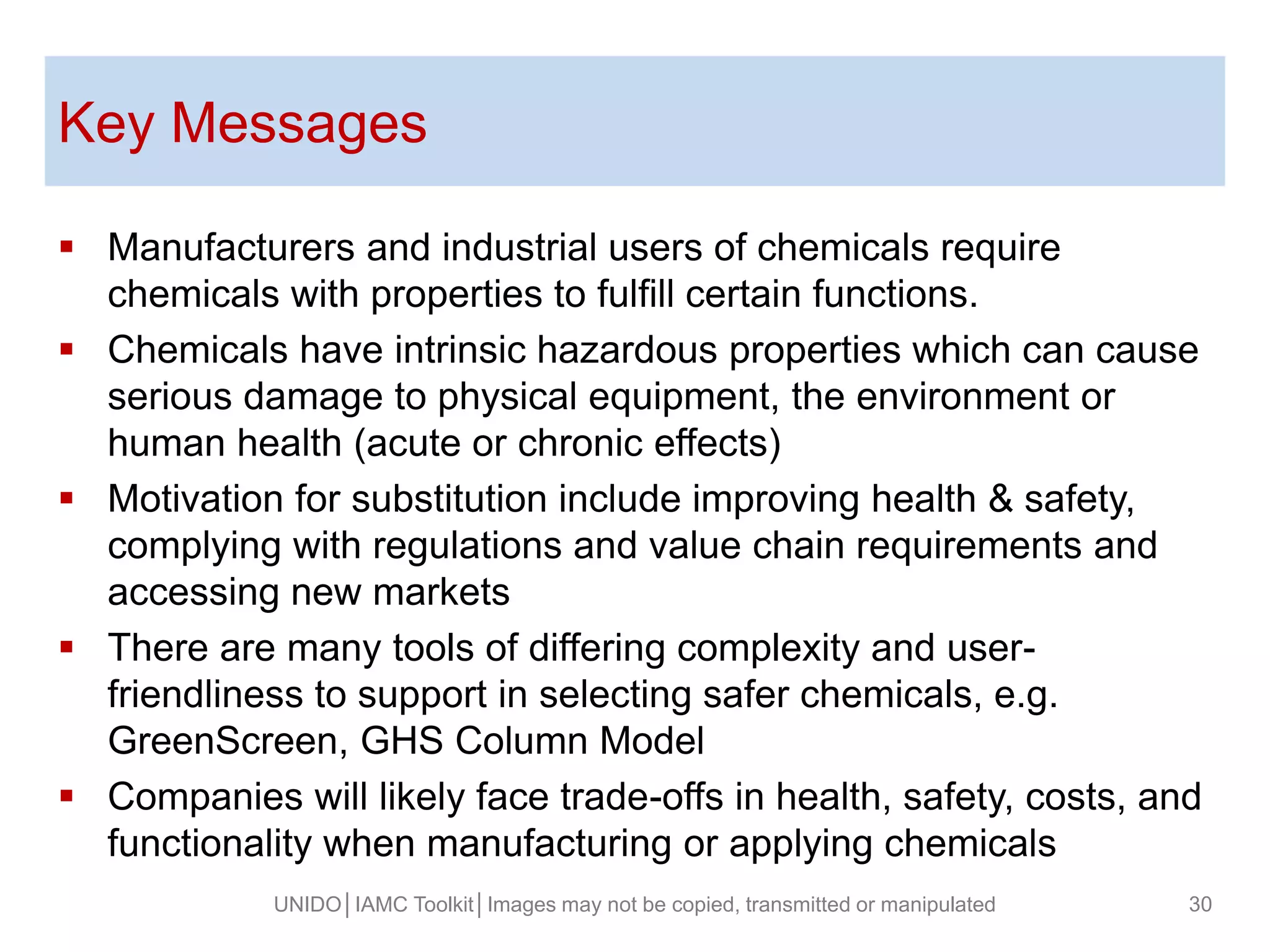
Key Messages
 Manufacturers and industrial users of chemicals require
chemicals with properties to fulfill certain functions.
 Chemicals have intrinsic hazardous properties which can cause
serious damage to physical equipment, the environment or
human health (acute or chronic effects)
 Motivation for substitution include improving health & safety,
complying with regulations and value chain requirements and
accessing new markets
 There are many tools of differing complexity and user-
friendliness to support in selecting safer chemicals, e.g.
GreenScreen, GHS Column Model
 Companies will likely face trade-offs in health, safety, costs, and
functionality when manufacturing or applying chemicals
UNIDO│IAMC Toolkit│Images may not be copied, transmitted or manipulated 30
Where to Find More Information
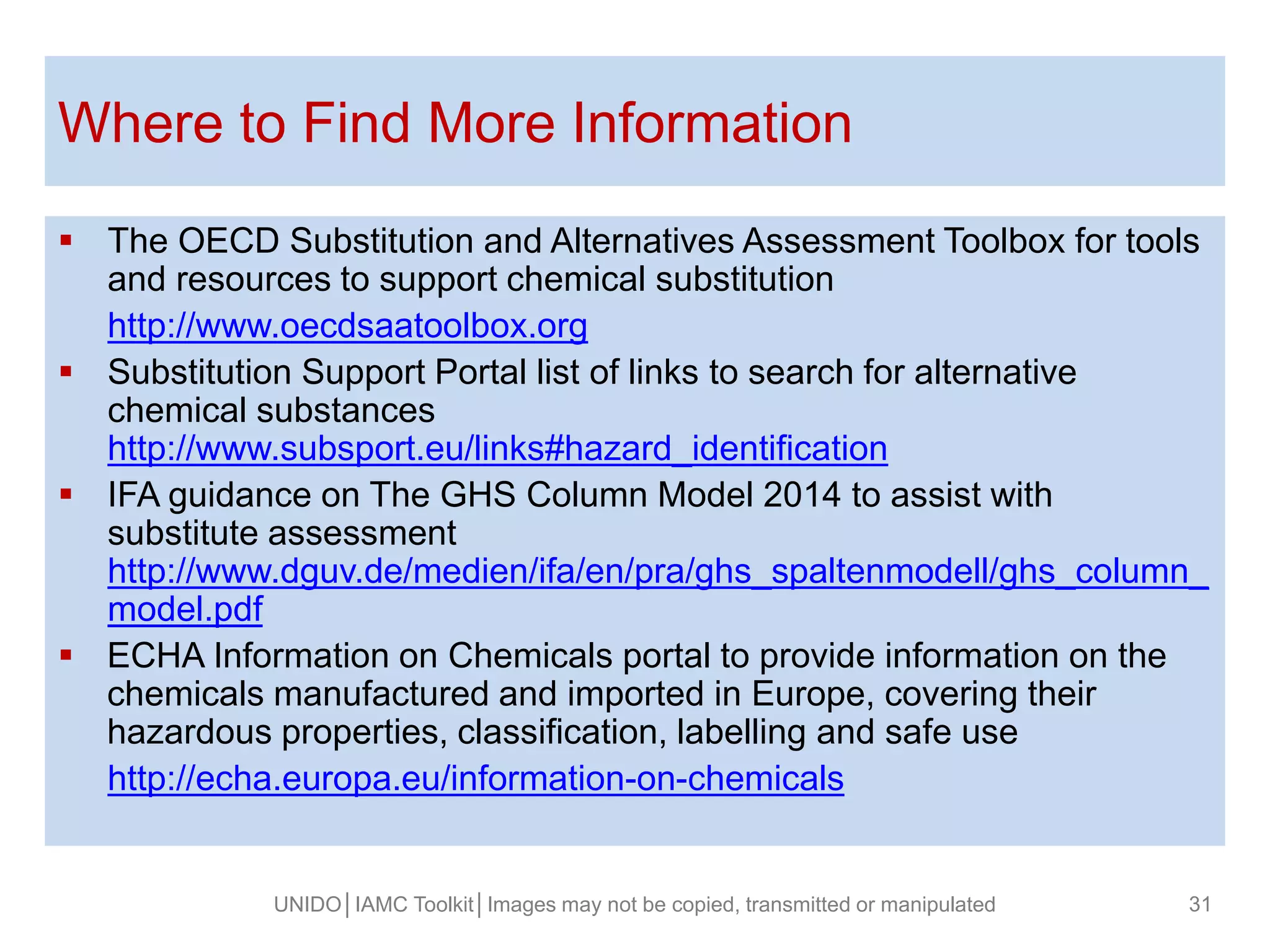
 The OECD Substitution and Alternatives Assessment Toolbox for tools
and resources to support chemical substitution
http://www.oecdsaatoolbox.org
 Substitution Support Portal list of links to search for alternative
chemical substances
http://www.subsport.eu/links#hazard_identification
 IFA guidance on The GHS Column Model 2014 to assist with
substitute assessment
http://www.dguv.de/medien/ifa/en/pra/ghs_spaltenmodell/ghs_column_
model.pdf
 ECHA Information on Chemicals portal to provide information on the
chemicals manufactured and imported in Europe, covering their
hazardous properties, classification, labelling and safe use
http://echa.europa.eu/information-on-chemicals
UNIDO│IAMC Toolkit│Images may not be copied, transmitted or manipulated 31
Sources
UNIDO│IAMC Toolkit│Images may not be copied, transmitted or manipulated 32
Fusce posuere, magna sed pulvinar ultricies,
purus lectus malesuada libero, sit amet magna
eros quis (ARIAL 32).
Sources
 CSD Engineers, Switzerland / ISSPPRO, Germany, 2015
 BAuA (Bundesanstalt für Arbeitsschutz und Arbeitsmedizin),
TRGS (Technical Rules for Hazardous Substances) 600, 2008
 Frode S, substitution of hazardous chemicals in the working
environment, http://www.arbejdskemi.dk/substitution.htm
 Hester and Harrison, Chemical Alternatives Assessment, Issues
in Environmental Science and Technology Vol.36, Royal Society
of Chemistry, 2013
 IFA (Institut für Arbeitsschutz der Deutschen Gesetzlichen
Unfallversicherung), The GHS Column Model 2014, An aid to
substitute assessment, 2014
http://www.dguv.de/medien/ifa/en/pra/ghs_spaltenmodell/ghs_c
olumn_model.pdf
UNIDO│IAMC Toolkit│Images may not be copied, transmitted or manipulated 33
Fusce posuere, magna sed pulvinar ultricies,
purus lectus malesuada libero, sit amet magna
eros quis (ARIAL 32).
Sources
 OSHA (2003), Factsheet 34: Elimination and substitution
of dangerous substances, https://osha.europa.eu/en/tools-
and-
publications/publications/factsheets/34/viewSoerensen
 SUBSPORT (Substitution Support Portal), Moving towards
safer alternatives
Case study database: www.subsport.eu/case-stories-database
Tools: http://www.subsport.eu/substitution-tools
 US Department of Labor, Occupational Safety & Health
Administration, Transitioning to Safer Chemicals: A Toolkit
for Employers and Workers:
https://www.osha.gov/dsg/safer_chemicals/index.html
UNIDO│IAMC Toolkit│Images may not be copied, transmitted or manipulated 34
Fusce posuere, magna sed pulvinar ultricies,
purus lectus malesuada libero, sit amet magna
eros quis (ARIAL 32).
Images
 ISSPPRO GmbH, Germany, 2015
UNIDO│IAMC Toolkit│Images may not be copied, transmitted or manipulated 35
This presentation was prepared with the requested diligence
and with the generally accepted principles of the relevant
field.
If a third party uses the contents of the presentation in order
to take decisions, the authors disclaim any liability for any
kind of direct or indirect (consequential) damage.
Disclaimer
UNIDO│IAMC Toolkit│Images may not be copied, transmitted or manipulated 36

C12 1 moving towards safer chemicals_final-web

  • 1.
    TRP 1 Moving TowardsSafer Chemicals: Introduction IAMC Toolkit Innovative Approaches for the Sound Management of Chemicals and Chemical Waste
  • 2.
    Introduction Manufacturers and industrialusers of chemicals require chemicals with properties to fulfill certain functions. At the same time, chemicals have intrinsic hazardous properties which can cause serious damage to physical equipment, the environment or human health (acute or chronic effects). This presentation provides step-by-step guidance on how to compare chemicals with respect to their risks and substitute with safer alternatives. Specifically, the presentations shows how to assess the intrinsic hazards of chemicals, compare different chemicals on the basis of their chemical hazards, as well as functional and economic performance. UNIDO│IAMC Toolkit│Images may not be copied, transmitted or manipulated 2
  • 3.
    1. Motivation 2. Stepsfor Moving Towards Safer Chemicals 3. Tools for Selecting Alternatives 4. Example Tool: GHS Column Model Contents UNIDO│IAMC Toolkit│Images may not be copied, transmitted or manipulated 3
  • 4.
    Motivation UNIDO│IAMC Toolkit│Images maynot be copied, transmitted or manipulated 4
  • 5.
    Substitution: The FirstStep in Risk Reduction UNIDO│IAMC Toolkit│Images may not be copied, transmitted or manipulated 5 Time to implement Elimination or substitution Technical control measures Organizational measures Personal protective equipment (PPE) Protective measures Preventive measures Hazard and risk Eliminates the exposure to a hazard before it can occur Requires a physical change to the workplace Requires workers or employers to act Requires workers to wear equipment What is substitution?  The transition to alternative, safer chemical substances  An effective preventive measure for risk reduction Source: ISSPPRO Chemicals have intrinsic hazardous properties which can cause serious damage to physical equipment, the environment or human health (acute or chronic effects). If elimination is not a possibility, substitution of a hazardous chemical should be the first step to reduce risk to human health environment.
  • 6.
    Why Substitute?  Improvehealth and safety: Substitution of hazardous chemicals is a key preventive measure to reduce risks to the environment, workers, consumers and public health as well as to minimize the risk of major accidents.  Comply with laws, regulations and value chain requirements: International regulations and value chains require companies to disclose more information about chemical products in the supply chain, avoid certain chemicals and use safer alternatives.  Improve market acceptance of products: Innovation and pro- active elimination of hazardous chemicals can differentiate products and add value for customers.  Reduce costs: Substitution can eliminate exposure to hazardous chemicals, thereby reducing the risks of chemical accidents, the costs of technical control measures and the costs for storage and disposal. UNIDO│IAMC Toolkit│Images may not be copied, transmitted or manipulated 6
  • 7.
    Elimination and Substitutionat Different Levels  Replace the product by an alternative which is produced with lower amounts of hazardous substances or none at all.  Avoid the process, e.g. by changing the design of a product and making certain steps redundant.  Implement a new process, e.g. by replacing chemical processes by mechanical ones.  Change the design of the process, e.g. by using closed systems to reduce exposure and emissions.  Change the substance by replacing the hazardous chemical by a less harmful alternative.  Chemical substitution UNIDO│IAMC Toolkit│Images may not be copied, transmitted or manipulated 7 Replace the product Avoid the process Implement a new process Change the process design Change the substance Source: ISSPPRO
  • 8.
    Key Terminology GHS (GloballyHarmonized System of Classification and Labelling of Chemicals)  Standardized international system created by the United Nations to harmonize the classification and hazard communication of chemical substances and mixtures Hazard classification  The GHS comprises three major hazard groups:  Physical hazards, health hazards and environmental hazards  Each hazard group consists of classes and categories (sub-sections of classes). The safety data sheet (SDS) includes:  Hazard classification and hazard statements which are the starting point for risk assessments  Information on the safe storage, handling, transportation and final disposal of the chemical Refer to TRP 2, D11_1 and D11_2 for more information on GHS classification and labelling as well as on safety data sheets. UNIDO│IAMC Toolkit│Images may not be copied, transmitted or manipulated 8 D11_2_SDSD11_1_Chemical classification and labelling
  • 9.
    Steps for MovingTowards Safer Chemicals UNIDO│IAMC Toolkit│Images may not be copied, transmitted or manipulated 9
  • 10.
    Steps for MovingTowards Safer Chemicals UNIDO│IAMC Toolkit│Images may not be copied, transmitted or manipulated 10 1 Define the problem and prioritize 2 Search for alternatives 3 Assess and compare alternatives 4 Test at pilot scale 5 Implement and improve
  • 11.
    Step 1: Definethe Problem and Prioritize Identify and prioritize chemicals to be substituted based on the following activities:  Ensure that an up-to-date inventory of chemicals is available.  Describe hazards arising from the chemicals, the functions they perform and how their use might harm workers, public health and the environment.  Identify chemicals impacted by existing or potential regulations. Regulated chemicals can be found at: SUBSPORT List of Lists Database  Identify chemicals with high risks used in the company and consider substitution as an option for risk reduction. The Responsible Production Toolkit has a risk matrix tool that can be used for this purpose.  Possible criteria for prioritizing include risk level, hazard, regulation potential and marketability of the product. UNIDO│IAMC Toolkit│Images may not be copied, transmitted or manipulated 11
  • 12.
    Step 2: Searchfor Alternatives This step provides an overview of possible alternatives based on the following activities:  Search for alternatives within your company.  Ask your supplier to formulate safer alternatives.  Contact authorities, professional associations, NCPCs, NGOs, trade unions, suppliers, manufacturers, universities or consultancies.  Consider material or process changes to eliminate hazardous chemicals.  Search for relevant case studies targeting similar applications on knowledge repositories (e.g. OECD SAA Toolbox, SUBSPORT, IFCS).  Consider collaborating with companies facing similar challenges.  Partner with value chain actors to develop a new product for undeveloped and uncontested markets. UNIDO│IAMC Toolkit│Images may not be copied, transmitted or manipulated 12
  • 13.
    Step 3: Assessand Compare Alternatives  Take an informed decision on possible alternatives by considering:  The technical, functional and performance requirements of the chemical  The fixed and operating costs as well as revenues expected from the substitution  The risk to the safety and health of workers in the supply chain, society and the environment  Assess and compare the hazards using any of the tools (e.g. the GHS Column Model) presented in the following section. A description of many useful tools can be found in the OECD SAA Toolbox.  Compare the alternatives based on their technical, economic and safety performance (e.g. by using the German TRGS 600 summary table).  Select the best option according to safety (workers and consumers), environmental impact, technical performance as well as costs and revenues. Refer to the Methodology ‘Select Options’ for guidance on selecting the best option for the company. UNIDO│IAMC Toolkit│Images may not be copied, transmitted or manipulated 13 B14_1_Select options
  • 14.
    Step 4: Testat Pilot Scale Before switching over completely to an alternative, consider testing the alternative on a smaller pilot scale first.  Identify how the risks change. Evaluate required changes in protective measures.  Specify how the alternative will affect functional performance. Ensure that the alternative is cost-effective and its supply is stable and secure.  Identify any technical or organizational changes required.  Identify and address the training needs of workers and other stakeholders to use the alternative safely and effectively.  Actively integrate workers and other stakeholders in implementing and assessing the tests of the alternative.  Define how success will be evaluated in terms of functional performance, economic feasibility and impact on the environment, workers and consumers.  Be prepared to monitor unforeseen consequences. UNIDO│IAMC Toolkit│Images may not be copied, transmitted or manipulated 14
  • 15.
    Step 5: Implementand Improve Implement the alternative at the commercial level, record the impacts and continuously improve the goal of substitution.  Develop a plan for commercial implementation incorporating lessons learned from pilot testing. Identify additional measures.  Communicate changes to workers and other stakeholders, such as suppliers, downstream users and consumers.  Continuously collect feedback from stakeholders to improve the substitution process.  Monitor and improve the performance of the implemented alternative with respect to economic, technical, environmental and health and safety impacts.  Promote and disseminate the results and establish links to national and international initiatives, ecolabels or sustainability certificates. Refer to ‘Methodology’ for additional guidance on implementing and continuously improving innovation activities. UNIDO│IAMC Toolkit│Images may not be copied, transmitted or manipulated 15 B1_Methodology
  • 16.
    Tools for Selecting Alternatives UNIDO│IAMCToolkit│Images may not be copied, transmitted or manipulated 16
  • 17.
    Tools for SelectingSafer Chemicals (1) GHS Column Model + Free, easy to use as it is based on SDSs + Includes chemical and process hazards - Relies on GHS classification provided in SDSs (which could be incorrect) GHS Column Model Green Screen for Safer Chemicals + Focus on hazard reduction ± Many parameters and indicators used - Expert knowledge and training required Green Screen software UNIDO│IAMC Toolkit│Images may not be copied, transmitted or manipulated 17
  • 18.
    Tools for SelectingSafer Chemicals (2) Pollution Prevention Options Analysis System (P2OASys) + Chemicals, processes or technologies can be compared + Facilitates a more comprehensive and systematic approach to potential hazards (chemical, environment, health) - Expertise and dedication required TURI P2OASys Priority-Setting Guide (PRIO) ± Web-based + Provides guidance for decision-making and a database - Based on R-phrases and covers only the 7,000 chemicals classified in the EC CLP regulations Kemi PRIO UNIDO│IAMC Toolkit│Images may not be copied, transmitted or manipulated 18
  • 19.
    GHS Column Model UNIDO│IAMCToolkit│Images may not be copied, transmitted or manipulated 19
  • 20.
    GHS Column Model TheGHS Column Model:  Compares the hazards of different substances and mixtures under specific process conditions  Uses the classification of chemicals according to GHS and uses hazard statements and process conditions as input  Is especially suitable for small and medium-sized enterprises (SMEs)  Drawbacks:  Relies on correct safety data sheets  Mixtures are not assessed based on their components but on their overall classification. Note: The GHS Column Model can be used to select less hazardous chemicals to formulate safer mixtures. UNIDO│IAMC Toolkit│Images may not be copied, transmitted or manipulated 20
  • 21.
    GHS Column ModelMethodology: Example of Classification Criteria UNIDO│IAMC Toolkit│Images may not be copied, transmitted or manipulated 21 1 Risk 2a Acute health hazards (single exposure) 2b Chronic health hazards (repeated exposure) 3 Environmental hazards 4 Physico-chemical hazards (fire, explosion, corrosion) 5 Hazards from release behaviour 6 Process-related hazards Very high Acutely toxic, Cat. 1 and 2. (H300, H310,H330) Carcinogenic substances/ mixtures, Cat. 1A/1B (AGS: K1, K2, H350, H350i) Substances/mixtur es acutely hazardous to the aquatic environment, Cat. 1 (H400) Unstable explosive substances/mixtures (H200) Liquids with a vapour pressure of > 250 hPa (mbar) (e.g. dichloromethane) Open processing High Acutely toxic substances/ mixtures, Cat. 3 (H301, H311, H331) Carcinogenic substances/ mixtures, Cat. 2 (AGS: K3, H351) Substances hazardous to the ozone layer (H420) Flammable aerosols, Cat. 1 (H222) Liquids with a vapour pressure of 50-250 hPa (mbar) (e.g. methanol) Partially open design, process related opening with simple extraction, open with simple extraction Medium Acutely toxic substances/ mixtures, Cat. 4 (H302, H312, H332) Substances/mixtures toxic to reproduction, Cat. 2 (AGS: RE3, RF3, H361, H361f, H361d, H361fd) Substances/mixtur es chronically hazardous to the aquatic environment, Cat. 3 (H412) Flammable aerosols, Cat. 2 (H223) Liquids with a vapour pressure of 10-50 hPa (mbar), with the exception of water (e.g. toluene) Closed processing with possibilities of exposure, e.g. during filling, sampling or cleaning Low Skin-irritant substances/ mixtures (H315) Substances chronically harmful in other ways (no H- phrase, but still a hazardous substance!) Substances/mixtur es chronically hazardous to the aquatic environment, Cat. 4 (H413) Self-reactive substances/mixtures, Type G (no H-phrase) Liquids with a vapour pressure of 2-10 hPa (mbar) (e.g. xylene) Closed design, tightness ensured, partially closed design with integrated extraction, etc Negligible Safe substances based on experience (e.g. water, paraffin, etc.) Substances/mixtur es not hazardous to the aquatic environment Non-combustible or only not at all readily flammable substances/mixtures (flash point of liquids > 100 °C, no H-phrase) Liquids with a vapour pressure of < 2 hPa (mbar) (e.g. ethylene glycol) Process index 0,25 according to TRGS 500 Hazards Hazards becoming effective
  • 22.
    How to Usethe GHS Column Model 1. Make a copy of the table for:  Every hazardous substance  Every potential alternative 2. Collect information about the substances and products (see safety data sheets). 3. Mark the relevant information, including process-specific data, in the table. 4. Compare the columns (not the rows).  Note: Acute health hazards and chronic health hazards are to be treated as a single column. 5. Prioritize the hazards according to process-specific exposure scenarios. UNIDO│IAMC Toolkit│Images may not be copied, transmitted or manipulated 22
  • 23.
    Interpreting the Results Theobjective is to reduce risks, not just to eliminate the hazard source. The result is obvious if the alternative rates better in all five columns.  This does not happen often! Often alternatives will have better ratings in some columns and worse in others. Consider the following in order to evaluate the overall risk:  Assess which hazards are more important for your situation, for example:  If ignition sources cannot be excluded in a process, the fire and explosion hazards (column 4) together with exposure potential (columns 5-6) will become more important.  If significant amounts of waste chemicals are generated, the environmental hazards will become more important.  Assess the hazards (columns 2-4) and the hazards becoming effective (columns 5-6) together  Example: A potential alternative may have a lower hazard in one category. However, if the alternative has a hazard with a high probability of becoming effective in this situation (according to columns 5-6), the alternative could increase the overall risk.  The alternative should result in significant improvements to the environment, human health and safety. UNIDO│IAMC Toolkit│Images may not be copied, transmitted or manipulated 23
  • 24.
    Data Sources forthe GHS Column Model The information required for the GHS Column Model can be found in the safety data sheet of a substance. To ensure the validity and accuracy of the data contained in the SDS:  Request GHS compliant SDSs from the suppliers and ensure they are up-to-date.  Extended SDSs (E-SDSs) are available for some chemicals and provide additional data on exposure scenarios and risk management measures.  Confirm the classification contained in the SDS by cross-referencing with competent authorities: ECHA – Information on Chemicals UNIDO│IAMC Toolkit│Images may not be copied, transmitted or manipulated 24
  • 25.
    Example: Solvent Usein an Open Process with Simple Extraction (1) Current situation: Benzene is currently being used as a solvent in a partially open process with simple extraction. Xylene is being considered as an alternative. The following selected hazard data is collected from the SDS: UNIDO│IAMC Toolkit│Images may not be copied, transmitted or manipulated 25 Benzene (Signal word = Danger) Xylene (Signal word = Warning) Hazard class Hazard statement Hazard class Hazard statement Flam. Liq. 2 H225 (highly flammable liquid and vapour) Flam. Liq. 2 H226 (flammable liquid and vapour) Asp. Tox. 1 H304 (may be fatal if swallowed and enters airways) Acute Tox. 4 H312 (harmful in contact with skin) H332 (harmful if inhaled) Muta. 1B H340 (may cause genetic defects) Skin Irrit. 2 H315 (causes skin irritation) Carc. 1A H350 (may cause cancer) STOT RE 1 H372 (causes damage to organs through prolonged or repeated exposure)
  • 26.
    Example: Solvent Usein an Open Process with Simple Extraction (2) UNIDO│IAMC Toolkit│Images may not be copied, transmitted or manipulated 26 Hazard category Benzene (Signal word = Danger) Xylene (Signal word = Warning) H-Statement Risk level H-Statement Risk level Acute health H304, H315,H319 Low H312, H332 Medium Chronic health H340 and H350 Very high Not classified Low Environmental (H412) Medium WKG2 Medium Physio- chemical H225 High H226 Medium Release behaviour Vapour pressure 50-250 hPa, between 0 °C and 40 °C High Liquids with a vapour pressure of 2-10 hPa Low Process related Partially open process with simple extraction High Partially open process with simple extraction High
  • 27.
    Example: Benzene Usedin a Partially Open Process UNIDO│IAMC Toolkit│Images may not be copied, transmitted or manipulated 27
  • 28.
    Example: Xylene Usedin a Partially Open Process UNIDO│IAMC Toolkit│Images may not be copied, transmitted or manipulated 28
  • 29.
    Example: Solvent Usein an Open Process with Simple Extraction (3) Comparison of inherent hazards:  Health hazard: benzene has a very high risk level  Environmental: both chemicals have medium risk levels  Physico-chemical: benzene has a high fire and explosion risk Hazards becoming effective:  Benzene has a high exposure potential under the current process conditions Result:  Substituting benzene with xylene in this open process with simple extraction significantly reduces the risk to workers’ health and safety. UNIDO│IAMC Toolkit│Images may not be copied, transmitted or manipulated 29
  • 30.
    Key Messages  Manufacturersand industrial users of chemicals require chemicals with properties to fulfill certain functions.  Chemicals have intrinsic hazardous properties which can cause serious damage to physical equipment, the environment or human health (acute or chronic effects)  Motivation for substitution include improving health & safety, complying with regulations and value chain requirements and accessing new markets  There are many tools of differing complexity and user- friendliness to support in selecting safer chemicals, e.g. GreenScreen, GHS Column Model  Companies will likely face trade-offs in health, safety, costs, and functionality when manufacturing or applying chemicals UNIDO│IAMC Toolkit│Images may not be copied, transmitted or manipulated 30
  • 31.
    Where to FindMore Information  The OECD Substitution and Alternatives Assessment Toolbox for tools and resources to support chemical substitution http://www.oecdsaatoolbox.org  Substitution Support Portal list of links to search for alternative chemical substances http://www.subsport.eu/links#hazard_identification  IFA guidance on The GHS Column Model 2014 to assist with substitute assessment http://www.dguv.de/medien/ifa/en/pra/ghs_spaltenmodell/ghs_column_ model.pdf  ECHA Information on Chemicals portal to provide information on the chemicals manufactured and imported in Europe, covering their hazardous properties, classification, labelling and safe use http://echa.europa.eu/information-on-chemicals UNIDO│IAMC Toolkit│Images may not be copied, transmitted or manipulated 31
  • 32.
    Sources UNIDO│IAMC Toolkit│Images maynot be copied, transmitted or manipulated 32
  • 33.
    Fusce posuere, magnased pulvinar ultricies, purus lectus malesuada libero, sit amet magna eros quis (ARIAL 32). Sources  CSD Engineers, Switzerland / ISSPPRO, Germany, 2015  BAuA (Bundesanstalt für Arbeitsschutz und Arbeitsmedizin), TRGS (Technical Rules for Hazardous Substances) 600, 2008  Frode S, substitution of hazardous chemicals in the working environment, http://www.arbejdskemi.dk/substitution.htm  Hester and Harrison, Chemical Alternatives Assessment, Issues in Environmental Science and Technology Vol.36, Royal Society of Chemistry, 2013  IFA (Institut für Arbeitsschutz der Deutschen Gesetzlichen Unfallversicherung), The GHS Column Model 2014, An aid to substitute assessment, 2014 http://www.dguv.de/medien/ifa/en/pra/ghs_spaltenmodell/ghs_c olumn_model.pdf UNIDO│IAMC Toolkit│Images may not be copied, transmitted or manipulated 33
  • 34.
    Fusce posuere, magnased pulvinar ultricies, purus lectus malesuada libero, sit amet magna eros quis (ARIAL 32). Sources  OSHA (2003), Factsheet 34: Elimination and substitution of dangerous substances, https://osha.europa.eu/en/tools- and- publications/publications/factsheets/34/viewSoerensen  SUBSPORT (Substitution Support Portal), Moving towards safer alternatives Case study database: www.subsport.eu/case-stories-database Tools: http://www.subsport.eu/substitution-tools  US Department of Labor, Occupational Safety & Health Administration, Transitioning to Safer Chemicals: A Toolkit for Employers and Workers: https://www.osha.gov/dsg/safer_chemicals/index.html UNIDO│IAMC Toolkit│Images may not be copied, transmitted or manipulated 34
  • 35.
    Fusce posuere, magnased pulvinar ultricies, purus lectus malesuada libero, sit amet magna eros quis (ARIAL 32). Images  ISSPPRO GmbH, Germany, 2015 UNIDO│IAMC Toolkit│Images may not be copied, transmitted or manipulated 35
  • 36.
    This presentation wasprepared with the requested diligence and with the generally accepted principles of the relevant field. If a third party uses the contents of the presentation in order to take decisions, the authors disclaim any liability for any kind of direct or indirect (consequential) damage. Disclaimer UNIDO│IAMC Toolkit│Images may not be copied, transmitted or manipulated 36