Factors Affecting SLA/L   Luz V. León Evelyn Gómez
Individual Learner Differences   Why do some learners do better than others?
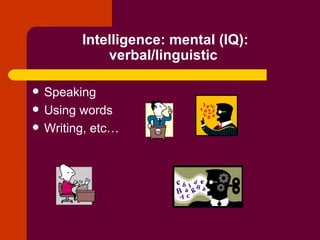
Intelligence: mental (IQ): verbal/linguistic  Speaking Using words Writing, etc…
Aptitude: Potential for Achievement.   4 Abilities:  * Identify and memorize. * Understand the functions of words in sentences. * Figure out grammar rules. * Memorize new words.
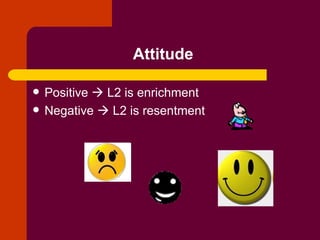
Attitude   Positive    L2 is enrichment Negative    L2 is resentment
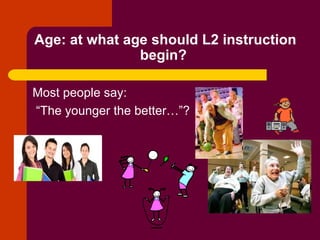
Age: at what age should L2 instruction begin?   Most people say: “ The younger the better…”?
Affective Factors There are some characteristics that are likely to affect L2 learning such as:
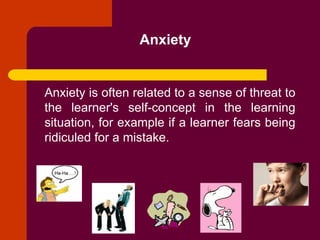
Anxiety Anxiety is often related to a sense of threat to the learner's self-concept in the learning situation, for example if a learner fears being ridiculed for a mistake.
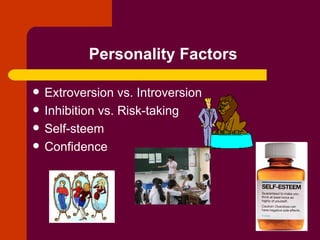
Personality Factors  Extroversion vs. Introversion Inhibition vs. Risk-taking Self-steem Confidence
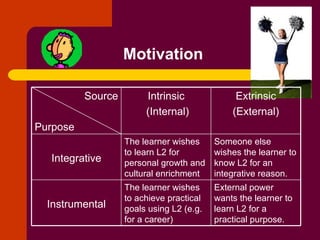
Motivation   Source Purpose Intrinsic (Internal) Extrinsic (External) Integrative The learner wishes to learn L2 for personal growth and cultural enrichment Someone else wishes the learner to know L2 for an integrative reason. Instrumental The learner wishes to achieve practical goals using L2 (e.g. for a career) External power wants the learner to learn L2 for a practical purpose.
Learner Preferences   Learning style: an individual’s natural, habitual, and preferred way of absorbing information, processing and retaining new information and skills (Reid 2009).
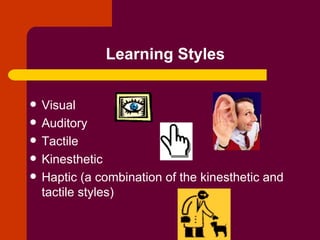
Learning Styles Visual Auditory Tactile Kinesthetic Haptic (a combination of the kinesthetic and tactile styles)
Beliefs and Strategies Previous learning experiences and assumptions.
Thanks!!

Factors affecting SLA/L

  • 1.
    Factors Affecting SLA/L Luz V. León Evelyn Gómez
  • 2.
    Individual Learner Differences Why do some learners do better than others?
  • 3.
    Intelligence: mental (IQ):verbal/linguistic Speaking Using words Writing, etc…
  • 4.
    Aptitude: Potential forAchievement. 4 Abilities: * Identify and memorize. * Understand the functions of words in sentences. * Figure out grammar rules. * Memorize new words.
  • 5.
    Attitude Positive  L2 is enrichment Negative  L2 is resentment
  • 6.
    Age: at whatage should L2 instruction begin? Most people say: “ The younger the better…”?
  • 7.
    Affective Factors Thereare some characteristics that are likely to affect L2 learning such as:
  • 8.
    Anxiety Anxiety isoften related to a sense of threat to the learner's self-concept in the learning situation, for example if a learner fears being ridiculed for a mistake.
  • 9.
    Personality Factors Extroversion vs. Introversion Inhibition vs. Risk-taking Self-steem Confidence
  • 10.
    Motivation Source Purpose Intrinsic (Internal) Extrinsic (External) Integrative The learner wishes to learn L2 for personal growth and cultural enrichment Someone else wishes the learner to know L2 for an integrative reason. Instrumental The learner wishes to achieve practical goals using L2 (e.g. for a career) External power wants the learner to learn L2 for a practical purpose.
  • 11.
    Learner Preferences Learning style: an individual’s natural, habitual, and preferred way of absorbing information, processing and retaining new information and skills (Reid 2009).
  • 12.
    Learning Styles VisualAuditory Tactile Kinesthetic Haptic (a combination of the kinesthetic and tactile styles)
  • 13.
    Beliefs and StrategiesPrevious learning experiences and assumptions.
  • 14.