
-Waste: A Serious
Global Concern
-Mohammad
Ahmad Shoeb
-12 KEB 513
I want Nexus 6,
which is just
launched!
That’s great! But why
this when you have a
Nexus 5 already?
Coz this is brand new
technology!
“Today’s trend is people like to upgrade their
technology.
Apparently, they don’t realize they contribute to e-
waste.”
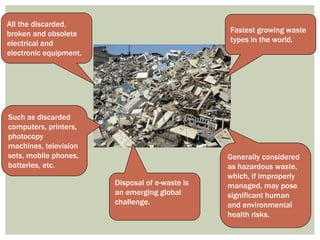
All the discarded,
broken and obsolete
electrical and
electronic equipment.
Such as discarded
computers, printers,
photocopy
machines, television
sets, mobile phones,
batteries, etc.
Fastest growing waste
types in the world.
Generally considered
as hazardous waste,
which, if improperly
managed, may pose
significant human
and environmental
health risks.
Disposal of e-waste is
an emerging global
challenge.
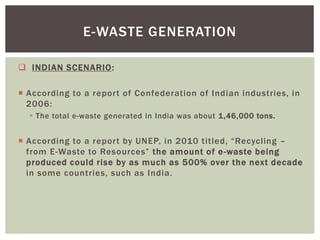
 INDIAN SCENARIO:
 According to a report of Confederation of Indian industries, in
2006:
 The total e-waste generated in India was about 1,46,000 tons.
 According to a report by UNEP, in 2010 titled, “Recycling –
from E-Waste to Resources” the amount of e-waste being
produced could rise by as much as 500% over the next decade
in some countries, such as India.
E-WASTE GENERATION
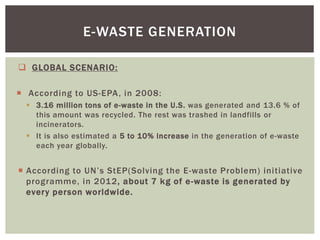
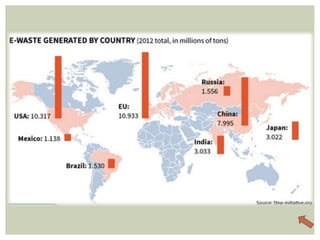
 GLOBAL SCENARIO:
 According to US-EPA, in 2008:
 3.16 million tons of e-waste in the U.S. was generated and 13.6 % of
this amount was recycled. The rest was trashed in landfills or
incinerators.
 It is also estimated a 5 to 10% increase in the generation of e-waste
each year globally.
 According to UN’s StEP(Solving the E-waste Problem) initiative
programme, in 2012, about 7 kg of e-waste is generated by
every person worldwide.
E-WASTE GENERATION
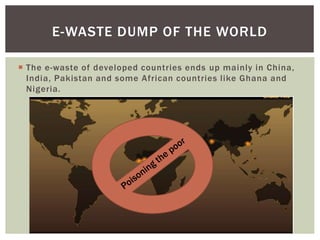
 The e-waste of developed countries ends up mainly in China,
India, Pakistan and some African countries like Ghana and
Nigeria.
E-WASTE DUMP OF THE WORLD
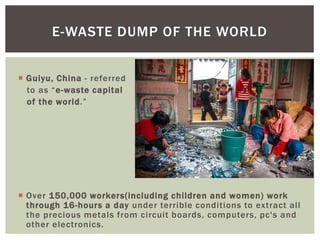
 Guiyu, China - referred
to as “e-waste capital
of the world.”
 Over 150,000 workers(including children and women) work
through 16-hours a day under terrible conditions to extract all
the precious metals from circuit boards, computers, pc's and
other electronics.
E-WASTE DUMP OF THE WORLD
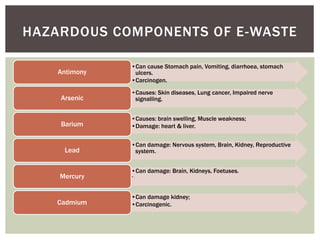
•Can cause Stomach pain, Vomiting, diarrhoea, stomach
ulcers.
•Carcinogen.
Antimony
•Causes: Skin diseases, Lung cancer, Impaired nerve
signalling.Arsenic
•Causes: brain swelling, Muscle weakness;
•Damage: heart & liver.Barium
•Can damage: Nervous system, Brain, Kidney, Reproductive
system.Lead
•Can damage: Brain, Kidneys, Foetuses.
•.Mercury
•Can damage kidney;
•Carcinogenic.Cadmium
HAZARDOUS COMPONENTS OF E-WASTE
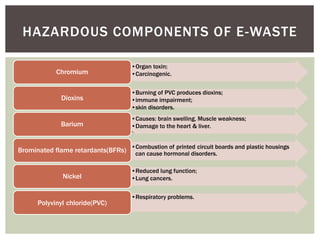
•Organ toxin;
•Carcinogenic.Chromium
•Burning of PVC produces dioxins;
•immune impairment;
•skin disorders.
Dioxins
•Causes: brain swelling, Muscle weakness;
•Damage to the heart & liver.
•.
Barium
•Combustion of printed circuit boards and plastic housings
can cause hormonal disorders.
Brominated flame retardants(BFRs)
•Reduced lung function;
•Lung cancers.Nickel
•Respiratory problems.
Polyvinyl chloride(PVC)
HAZARDOUS COMPONENTS OF E-WASTE
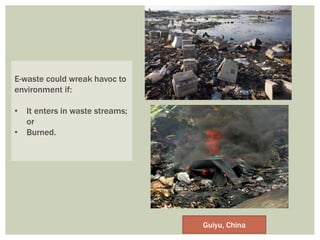
E-waste could wreak havoc to
environment if:
• It enters in waste streams;
or
• Burned.
Guiyu, China
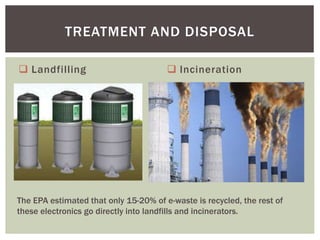
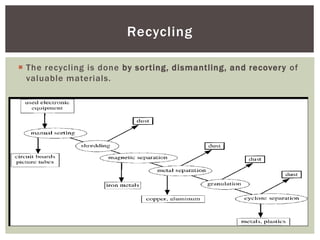
 Landfilling  Incineration
TREATMENT AND DISPOSAL
The EPA estimated that only 15-20% of e-waste is recycled, the rest of
these electronics go directly into landfills and incinerators.
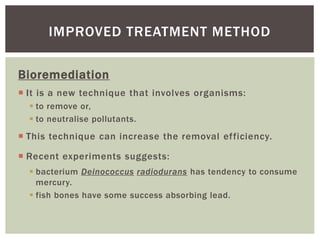
 The recycling is done by sorting, dismantling, and recovery of
valuable materials.
Recycling
Bioremediation
 It is a new technique that involves organisms:
 to remove or,
 to neutralise pollutants.
 This technique can increase the removal efficiency.
 Recent experiments suggests:
 bacterium Deinococcus radiodurans has tendency to consume
mercury.
 fish bones have some success absorbing lead.
IMPROVED TREATMENT METHOD
CONCLUSIONS
 E-wastes are found to be hazardous and ever growing
threat to human health and environment.
 Current simple treatment and disposal techniques are
rudimentary.
 Bioremediation can improve the scenario of current
treatment practices but there is a need of doing more
research on this.
 Recycle e-waste to the Registered e-waste
Dismantler/Recycler in the country.
http://www.cpcb.nic.in/Ewaste_Registration_List.pdf
 Never dispose-of e-waste with garbage and other
household wastes.
 Try to Reduce your e-waste.
WHAT CAN YOU DO?
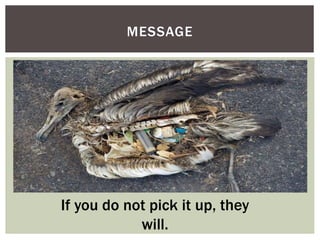
MESSAGE
If you do not pick it up, they
will.
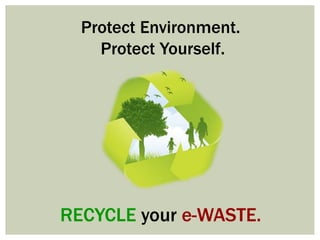
Protect Environment.
Protect Yourself.
RECYCLE your e-WASTE.
REFERENCES
1. Sharma Pramila, Fulekar M.H. and Pathak Bhawana. (March
2012). “E-Waste- A Challenge for Tomorrow”. Research
Journal of Recent Sciences. Vol. 1(3), 86-93.
2. Devi B.S, Shobha S.V., Kamble R.K., “E-Waste: The Hidden
harm of Technological Revolution”, Journal IAEM, 31, 196-
205, (2004)
THANK YOU

E-waste

  • 1.
    -Waste: A Serious GlobalConcern -Mohammad Ahmad Shoeb -12 KEB 513
  • 2.
    I want Nexus6, which is just launched! That’s great! But why this when you have a Nexus 5 already? Coz this is brand new technology! “Today’s trend is people like to upgrade their technology. Apparently, they don’t realize they contribute to e- waste.”
  • 3.
    All the discarded, brokenand obsolete electrical and electronic equipment. Such as discarded computers, printers, photocopy machines, television sets, mobile phones, batteries, etc. Fastest growing waste types in the world. Generally considered as hazardous waste, which, if improperly managed, may pose significant human and environmental health risks. Disposal of e-waste is an emerging global challenge.
  • 5.
     INDIAN SCENARIO: According to a report of Confederation of Indian industries, in 2006:  The total e-waste generated in India was about 1,46,000 tons.  According to a report by UNEP, in 2010 titled, “Recycling – from E-Waste to Resources” the amount of e-waste being produced could rise by as much as 500% over the next decade in some countries, such as India. E-WASTE GENERATION
  • 6.
     GLOBAL SCENARIO: According to US-EPA, in 2008:  3.16 million tons of e-waste in the U.S. was generated and 13.6 % of this amount was recycled. The rest was trashed in landfills or incinerators.  It is also estimated a 5 to 10% increase in the generation of e-waste each year globally.  According to UN’s StEP(Solving the E-waste Problem) initiative programme, in 2012, about 7 kg of e-waste is generated by every person worldwide. E-WASTE GENERATION
  • 8.
     The e-wasteof developed countries ends up mainly in China, India, Pakistan and some African countries like Ghana and Nigeria. E-WASTE DUMP OF THE WORLD
  • 9.
     Guiyu, China- referred to as “e-waste capital of the world.”  Over 150,000 workers(including children and women) work through 16-hours a day under terrible conditions to extract all the precious metals from circuit boards, computers, pc's and other electronics. E-WASTE DUMP OF THE WORLD
  • 10.
    •Can cause Stomachpain, Vomiting, diarrhoea, stomach ulcers. •Carcinogen. Antimony •Causes: Skin diseases, Lung cancer, Impaired nerve signalling.Arsenic •Causes: brain swelling, Muscle weakness; •Damage: heart & liver.Barium •Can damage: Nervous system, Brain, Kidney, Reproductive system.Lead •Can damage: Brain, Kidneys, Foetuses. •.Mercury •Can damage kidney; •Carcinogenic.Cadmium HAZARDOUS COMPONENTS OF E-WASTE
  • 11.
    •Organ toxin; •Carcinogenic.Chromium •Burning ofPVC produces dioxins; •immune impairment; •skin disorders. Dioxins •Causes: brain swelling, Muscle weakness; •Damage to the heart & liver. •. Barium •Combustion of printed circuit boards and plastic housings can cause hormonal disorders. Brominated flame retardants(BFRs) •Reduced lung function; •Lung cancers.Nickel •Respiratory problems. Polyvinyl chloride(PVC) HAZARDOUS COMPONENTS OF E-WASTE
  • 12.
    E-waste could wreakhavoc to environment if: • It enters in waste streams; or • Burned. Guiyu, China
  • 13.
     Landfilling Incineration TREATMENT AND DISPOSAL The EPA estimated that only 15-20% of e-waste is recycled, the rest of these electronics go directly into landfills and incinerators.
  • 14.
     The recyclingis done by sorting, dismantling, and recovery of valuable materials. Recycling
  • 15.
    Bioremediation  It isa new technique that involves organisms:  to remove or,  to neutralise pollutants.  This technique can increase the removal efficiency.  Recent experiments suggests:  bacterium Deinococcus radiodurans has tendency to consume mercury.  fish bones have some success absorbing lead. IMPROVED TREATMENT METHOD
  • 16.
    CONCLUSIONS  E-wastes arefound to be hazardous and ever growing threat to human health and environment.  Current simple treatment and disposal techniques are rudimentary.  Bioremediation can improve the scenario of current treatment practices but there is a need of doing more research on this.
  • 17.
     Recycle e-wasteto the Registered e-waste Dismantler/Recycler in the country. http://www.cpcb.nic.in/Ewaste_Registration_List.pdf  Never dispose-of e-waste with garbage and other household wastes.  Try to Reduce your e-waste. WHAT CAN YOU DO?
  • 18.
    MESSAGE If you donot pick it up, they will.
  • 19.
  • 20.
    REFERENCES 1. Sharma Pramila,Fulekar M.H. and Pathak Bhawana. (March 2012). “E-Waste- A Challenge for Tomorrow”. Research Journal of Recent Sciences. Vol. 1(3), 86-93. 2. Devi B.S, Shobha S.V., Kamble R.K., “E-Waste: The Hidden harm of Technological Revolution”, Journal IAEM, 31, 196- 205, (2004)
  • 21.

Editor's Notes

  • #2 E-waste: A serious global concern.
  • #3 Everybody see technology…everybody wants new…but nobody thinks about waste. But I care. Therefore, I bring to you the study of e-waste. Let’s know something about e-waste.
  • #4 Let’s know something about e-waste. Starting with the definition…. I think all of you got a little idea…further I will discuss and focus mainly…(next slide)
  • #9 Electronic Waste Dump of the World or who gets the trash.
  • #11 e-waste contains mostly metals and plastics……...
  • #12 Here, I only discussed the impact of on humans. These hazardous components have the same toxic effects on animals.
  • #13 E-waste could wreak havoc if enters in waste streams or if burned….Collectively, if improperly managed.
  • #14 E-wastes are not completely waste. There are many things in that can be recycled……landfilling and incineration are totally unacceptable for harmony with environment but, are still in practice.
  • #15 E-wastes are not completely waste. There are many things in that can be recycled. And may be all of u know the benefits of recycling over landfilling and incineration……….(explain)…….the leftovers after recycling can be landfilled. But the landfilling must be secured landfilling.
  • #18 -The link provided here will give u the list of dismantler/recycler registered/approved by cpcb, govt. of India. U can recycle….. b/c Waste reduction is better than recycling! Your little efforts can make a big difference. Before winding up I want to give a message that make u realise the consequences of improperly managed e-waste.(next slide)
  • #19 Now let me wind up by giving some important messages…….(explain pic)……If u don’t have harmony with environment, it means u don’t have harmony with yourself.