The impact of technology on
today’s consumers
Consumers’ shopping habits have drastically
changed over the past decade as their choice
of products and methods of purchasing have
increased.
Introduction
The use of digital technology to research,
browse and purchase is now common.
Retailers and service providers need to
embrace this change and evolve with it to
survive.
Introduction
Proactive brands are already providing
innovations to enhance the shopping
experience as customer expectations change.
Such an example are Apple Experience Stores.
Investing in digital technology is becoming a
necessity for any retail brand to survive this
new wave of consumer expectations.
Introduction
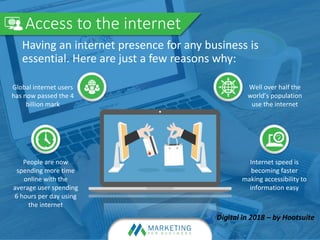
Access to the internet
Digital in 2018 – by Hootsuite
People are now
spending more time
online with the
average user spending
6 hours per day using
the internet
Internet speed is
becoming faster
making accessibility to
information easy
Global internet users
has now passed the 4
billion mark
Well over half the
world’s population
use the internet
Having an internet presence for any business is
essential. Here are just a few reasons why:
Access to the internet
Digital in 2018 – by Hootsuite
More people are accessing the internet due to
affordability of devices and are spending a long time
there.
People will spend the equivalent of 1 billion years
online in 2018
This growth is driven by more affordable
smartphones and mobile data plans
Digital Devices
Digital in 2018 – by Hootsuite
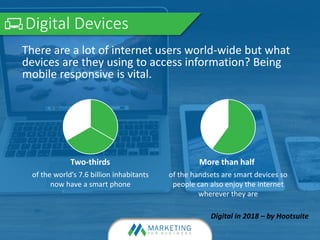
There are a lot of internet users world-wide but what
devices are they using to access information? Being
mobile responsive is vital.
of the world’s 7.6 billion inhabitants
now have a smart phone
Two-thirds
of the handsets are smart devices so
people can also enjoy the internet
wherever they are
More than half
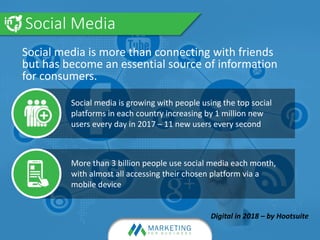
Social Media
Digital in 2018 – by Hootsuite
Social media is more than connecting with friends
but has become an essential source of information
for consumers.
Social media is growing with people using the top social
platforms in each country increasing by 1 million new
users every day in 2017 – 11 new users every second
More than 3 billion people use social media each month,
with almost all accessing their chosen platform via a
mobile device
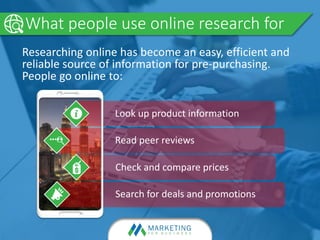
What people use online research for
Researching online has become an easy, efficient and
reliable source of information for pre-purchasing.
People go online to:
Look up product information
Read peer reviews
Check and compare prices
Search for deals and promotions
The Ultimate List of Marketing
Statistics for 2018
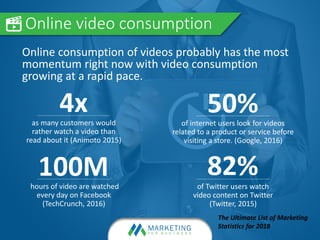
Online consumption of videos probably has the most
momentum right now with video consumption
growing at a rapid pace.
4xas many customers would
rather watch a video than
read about it (Animoto 2015)
50%of internet users look for videos
related to a product or service before
visiting a store. (Google, 2016)
100Mhours of video are watched
every day on Facebook
(TechCrunch, 2016)
82%of Twitter users watch
video content on Twitter
(Twitter, 2015)
Online video consumption
The Ultimate List of
Marketing Statistics for 2018
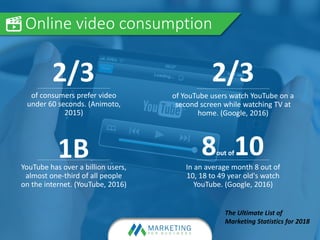
2/3
of consumers prefer video
under 60 seconds. (Animoto,
2015)
2/3
of YouTube users watch YouTube on a
second screen while watching TV at
home. (Google, 2016)
1BYouTube has over a billion users,
almost one-third of all people
on the internet. (YouTube, 2016)
8out of10In an average month 8 out of
10, 18 to 49 year old's watch
YouTube. (Google, 2016)
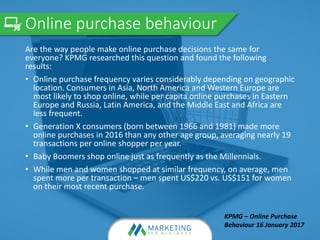
Are the way people make online purchase decisions the same for
everyone? KPMG researched this question and found the following
results:
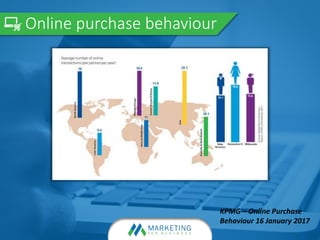
• Online purchase frequency varies considerably depending on geographic
location. Consumers in Asia, North America and Western Europe are
most likely to shop online, while per capita online purchases in Eastern
Europe and Russia, Latin America, and the Middle East and Africa are
less frequent.
• Generation X consumers (born between 1966 and 1981) made more
online purchases in 2016 than any other age group, averaging nearly 19
transactions per online shopper per year.
• Baby Boomers shop online just as frequently as the Millennials.
• While men and women shopped at similar frequency, on average, men
spent more per transaction – men spent US$220 vs. US$151 for women
on their most recent purchase.
Online purchase behaviour
KPMG – Online Purchase
Behaviour 16 January 2017
Online purchase behaviour
KPMG – Online Purchase
Behaviour 16 January 2017
Online purchase behaviour
KPMG – Online Purchase
Behaviour 16 January 2017
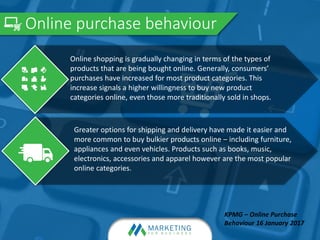
Greater options for shipping and delivery have made it easier and
more common to buy bulkier products online – including furniture,
appliances and even vehicles. Products such as books, music,
electronics, accessories and apparel however are the most popular
online categories.
Online shopping is gradually changing in terms of the types of
products that are being bought online. Generally, consumers’
purchases have increased for most product categories. This
increase signals a higher willingness to buy new product
categories online, even those more traditionally sold in shops.
Online purchase behaviour
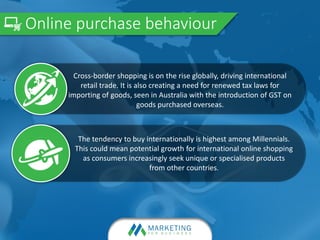
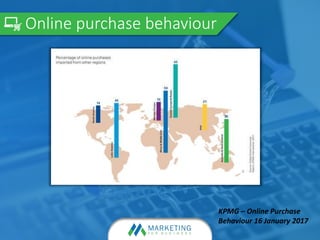
The tendency to buy internationally is highest among Millennials.
This could mean potential growth for international online shopping
as consumers increasingly seek unique or specialised products
from other countries.
Cross-border shopping is on the rise globally, driving international
retail trade. It is also creating a need for renewed tax laws for
importing of goods, seen in Australia with the introduction of GST on
goods purchased overseas.
Online purchase behaviour
KPMG – Online Purchase
Behaviour 16 January 2017
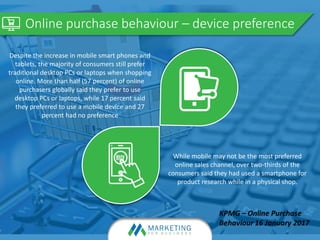
Online purchase behaviour – device preference
Despite the increase in mobile smart phones and
tablets, the majority of consumers still prefer
traditional desktop PCs or laptops when shopping
online. More than half (57 percent) of online
purchasers globally said they prefer to use
desktop PCs or laptops, while 17 percent said
they preferred to use a mobile device and 27
percent had no preference
While mobile may not be the most preferred
online sales channel, over two-thirds of the
consumers said they had used a smartphone for
product research while in a physical shop.
What consumers buy online
“Today’s consumer no longer goes shopping, but is shopping, all the time
and everywhere. And in a truly global online marketplace, competition is
no longer limited to local shops during regular business hours. Consumers
can easily buy from retailers and manufacturers located anywhere in the
world – or from those with no physical retail locations at all,”
Willy Kruh, Global Chair, Consumer Markets, KPMG International
KPMG – Online Purchase
Behaviour 16 January 2017
How technology has changed consumer trends
The retail industry is going through a transformation mainly
driven by the influence of digital technology on the shopping
experience.
Consumers are performing shopping-related tasks on their
mobile phones regularly such as research, buying and
comparing prices.
Consumers are using digital technology to
research, browse and purchase. As a result,
clever retailers are implementing new
strategies to attract and retain this omni-
channel shopper. Strategies include responsive
website design, free shipping offers, mobile
alerts and content marketing. Use of these
digital tools has gone from just a few, to
mainstream and essential.
How technology has changed consumer trends
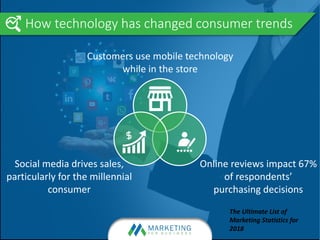
Online reviews impact 67%
of respondents’
purchasing decisions
Customers use mobile technology
while in the store
Social media drives sales,
particularly for the millennial
consumer
The Ultimate List of
Marketing Statistics for
2018
How technology has changed consumer trends
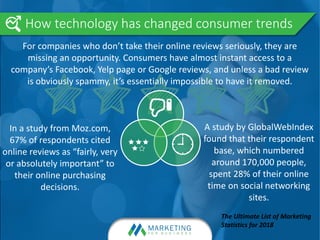
A study by GlobalWebIndex
found that their respondent
base, which numbered
around 170,000 people,
spent 28% of their online
time on social networking
sites.
For companies who don’t take their online reviews seriously, they are
missing an opportunity. Consumers have almost instant access to a
company’s Facebook, Yelp page or Google reviews, and unless a bad review
is obviously spammy, it’s essentially impossible to have it removed.
In a study from Moz.com,
67% of respondents cited
online reviews as “fairly, very
or absolutely important” to
their online purchasing
decisions.
The Ultimate List of Marketing
Statistics for 2018
Conclusion
Consumer purchase behaviour is changing. How
consumers conduct research, how they
recommend brands, and how they finally decide to
make a purchase is going digital.
This is not a marketing choice anymore. Those
retailers not on board with this – will be the ones
left behind.
References
 Digital in 2018 – by Hootsuite https://hootsuite.com/pages/digital-in-2018
(accessed 13 June 2018)
 The Ultimate List of Marketing Statistics for 2018:
https://www.hubspot.com/marketing-statistics (accessed 13 June 2018)
 KPMG – Online Purchase Behaviour 16 January 2017
https://home.kpmg.com/au/en/home/insights/2017/01/online-purchase-
behavior.html (accessed 13 June 2018)
 6 Important Stats on How Consumer Behaviour Has Changed in the Digital
Age http://www.inboundmarketingagents.com/inbound-marketing-agents-
blog/6-important-stats-on-how-consumer-behavior-has-changed-in-the-
digital-age (accessed 13 June 2018)

Technology and Consumer Behaviour

  • 1.
    The impact oftechnology on today’s consumers
  • 2.
    Consumers’ shopping habitshave drastically changed over the past decade as their choice of products and methods of purchasing have increased. Introduction
  • 3.
    The use ofdigital technology to research, browse and purchase is now common. Retailers and service providers need to embrace this change and evolve with it to survive. Introduction
  • 4.
    Proactive brands arealready providing innovations to enhance the shopping experience as customer expectations change. Such an example are Apple Experience Stores. Investing in digital technology is becoming a necessity for any retail brand to survive this new wave of consumer expectations. Introduction
  • 5.
    Access to theinternet Digital in 2018 – by Hootsuite People are now spending more time online with the average user spending 6 hours per day using the internet Internet speed is becoming faster making accessibility to information easy Global internet users has now passed the 4 billion mark Well over half the world’s population use the internet Having an internet presence for any business is essential. Here are just a few reasons why:
  • 6.
    Access to theinternet Digital in 2018 – by Hootsuite More people are accessing the internet due to affordability of devices and are spending a long time there. People will spend the equivalent of 1 billion years online in 2018 This growth is driven by more affordable smartphones and mobile data plans
  • 7.
    Digital Devices Digital in2018 – by Hootsuite There are a lot of internet users world-wide but what devices are they using to access information? Being mobile responsive is vital. of the world’s 7.6 billion inhabitants now have a smart phone Two-thirds of the handsets are smart devices so people can also enjoy the internet wherever they are More than half
  • 8.
    Social Media Digital in2018 – by Hootsuite Social media is more than connecting with friends but has become an essential source of information for consumers. Social media is growing with people using the top social platforms in each country increasing by 1 million new users every day in 2017 – 11 new users every second More than 3 billion people use social media each month, with almost all accessing their chosen platform via a mobile device
  • 9.
    What people useonline research for Researching online has become an easy, efficient and reliable source of information for pre-purchasing. People go online to: Look up product information Read peer reviews Check and compare prices Search for deals and promotions
  • 10.
    The Ultimate Listof Marketing Statistics for 2018 Online consumption of videos probably has the most momentum right now with video consumption growing at a rapid pace. 4xas many customers would rather watch a video than read about it (Animoto 2015) 50%of internet users look for videos related to a product or service before visiting a store. (Google, 2016) 100Mhours of video are watched every day on Facebook (TechCrunch, 2016) 82%of Twitter users watch video content on Twitter (Twitter, 2015) Online video consumption
  • 11.
    Online video consumption TheUltimate List of Marketing Statistics for 2018 2/3 of consumers prefer video under 60 seconds. (Animoto, 2015) 2/3 of YouTube users watch YouTube on a second screen while watching TV at home. (Google, 2016) 1BYouTube has over a billion users, almost one-third of all people on the internet. (YouTube, 2016) 8out of10In an average month 8 out of 10, 18 to 49 year old's watch YouTube. (Google, 2016)
  • 12.
    Are the waypeople make online purchase decisions the same for everyone? KPMG researched this question and found the following results: • Online purchase frequency varies considerably depending on geographic location. Consumers in Asia, North America and Western Europe are most likely to shop online, while per capita online purchases in Eastern Europe and Russia, Latin America, and the Middle East and Africa are less frequent. • Generation X consumers (born between 1966 and 1981) made more online purchases in 2016 than any other age group, averaging nearly 19 transactions per online shopper per year. • Baby Boomers shop online just as frequently as the Millennials. • While men and women shopped at similar frequency, on average, men spent more per transaction – men spent US$220 vs. US$151 for women on their most recent purchase. Online purchase behaviour KPMG – Online Purchase Behaviour 16 January 2017
  • 13.
    Online purchase behaviour KPMG– Online Purchase Behaviour 16 January 2017
  • 14.
    Online purchase behaviour KPMG– Online Purchase Behaviour 16 January 2017 Greater options for shipping and delivery have made it easier and more common to buy bulkier products online – including furniture, appliances and even vehicles. Products such as books, music, electronics, accessories and apparel however are the most popular online categories. Online shopping is gradually changing in terms of the types of products that are being bought online. Generally, consumers’ purchases have increased for most product categories. This increase signals a higher willingness to buy new product categories online, even those more traditionally sold in shops.
  • 15.
    Online purchase behaviour Thetendency to buy internationally is highest among Millennials. This could mean potential growth for international online shopping as consumers increasingly seek unique or specialised products from other countries. Cross-border shopping is on the rise globally, driving international retail trade. It is also creating a need for renewed tax laws for importing of goods, seen in Australia with the introduction of GST on goods purchased overseas.
  • 16.
    Online purchase behaviour KPMG– Online Purchase Behaviour 16 January 2017
  • 17.
    Online purchase behaviour– device preference Despite the increase in mobile smart phones and tablets, the majority of consumers still prefer traditional desktop PCs or laptops when shopping online. More than half (57 percent) of online purchasers globally said they prefer to use desktop PCs or laptops, while 17 percent said they preferred to use a mobile device and 27 percent had no preference While mobile may not be the most preferred online sales channel, over two-thirds of the consumers said they had used a smartphone for product research while in a physical shop.
  • 18.
    What consumers buyonline “Today’s consumer no longer goes shopping, but is shopping, all the time and everywhere. And in a truly global online marketplace, competition is no longer limited to local shops during regular business hours. Consumers can easily buy from retailers and manufacturers located anywhere in the world – or from those with no physical retail locations at all,” Willy Kruh, Global Chair, Consumer Markets, KPMG International KPMG – Online Purchase Behaviour 16 January 2017
  • 19.
    How technology haschanged consumer trends The retail industry is going through a transformation mainly driven by the influence of digital technology on the shopping experience. Consumers are performing shopping-related tasks on their mobile phones regularly such as research, buying and comparing prices.
  • 20.
    Consumers are usingdigital technology to research, browse and purchase. As a result, clever retailers are implementing new strategies to attract and retain this omni- channel shopper. Strategies include responsive website design, free shipping offers, mobile alerts and content marketing. Use of these digital tools has gone from just a few, to mainstream and essential. How technology has changed consumer trends
  • 21.
    How technology haschanged consumer trends Online reviews impact 67% of respondents’ purchasing decisions Customers use mobile technology while in the store Social media drives sales, particularly for the millennial consumer The Ultimate List of Marketing Statistics for 2018
  • 22.
    How technology haschanged consumer trends A study by GlobalWebIndex found that their respondent base, which numbered around 170,000 people, spent 28% of their online time on social networking sites. For companies who don’t take their online reviews seriously, they are missing an opportunity. Consumers have almost instant access to a company’s Facebook, Yelp page or Google reviews, and unless a bad review is obviously spammy, it’s essentially impossible to have it removed. In a study from Moz.com, 67% of respondents cited online reviews as “fairly, very or absolutely important” to their online purchasing decisions. The Ultimate List of Marketing Statistics for 2018
  • 23.
    Conclusion Consumer purchase behaviouris changing. How consumers conduct research, how they recommend brands, and how they finally decide to make a purchase is going digital. This is not a marketing choice anymore. Those retailers not on board with this – will be the ones left behind.
  • 24.
    References  Digital in2018 – by Hootsuite https://hootsuite.com/pages/digital-in-2018 (accessed 13 June 2018)  The Ultimate List of Marketing Statistics for 2018: https://www.hubspot.com/marketing-statistics (accessed 13 June 2018)  KPMG – Online Purchase Behaviour 16 January 2017 https://home.kpmg.com/au/en/home/insights/2017/01/online-purchase- behavior.html (accessed 13 June 2018)  6 Important Stats on How Consumer Behaviour Has Changed in the Digital Age http://www.inboundmarketingagents.com/inbound-marketing-agents- blog/6-important-stats-on-how-consumer-behavior-has-changed-in-the- digital-age (accessed 13 June 2018)