E-mail Security
Using Certified Electronic mail (CEM)
Team Members

 Pankaj Bhambhani (200901047) (pankajb64@gmail.com)
 Pratik Kumar (200901239) (pratik.kumar.bharat@gmail.com)
 Dipesh Shah (200901094) (dipesh1005@gmail.com)
 Jignesh Kakadiya (200901201) (jigneshhk1992@gmail.com)
 Ajay Dhameliya (200901203) (dhameliyaajay26@yahoo.in)
Topics

 Why E-mail security?
 CEM - Certified Electronic Mail
 Properties of CEM
 Existing Protocol - S/MIME – properties
 Missing properties in S/MIME and their importance
 Sample Certified Email Protocol
 How to do- Design
 Conclusion and our thoughts
 References
Why E-mail Security?

 Primitive E-Mail service – different intended purpose.
     Exchange of messages between small universities in a closed network.
     Not much concern about misuse.


 Different Game Altogether Today.
     Internet an open network - large number of messages sent.
     Can contain sensitive, valuable information. Security is essential.


 We shall examine Certified Electronic Mail as a theoretical measure of E-
  mail Security.
Certified Electronic Mail (CEM)


 Added value to traditional electronic mail.


 Examination of various properties.


 Use a sample certified email protocols to demonstrate properties.


 Its use in improvement of existing protocol : S/MIME
Properties of CEM : Non-Repudiation


 Postal services force the recipient to sign a receipt token before delivering
  the envelope which contains the certified message.
     Here the recipient only recognizes that it received an envelope which, in turn,
      can be empty (intentionally or not).


 Hence there is a difference with respect to the digital evidence of receipt
  (linked to the message and not to the envelope).
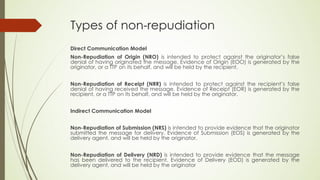
Types of non-repudiation
Direct Communication Model
Non-Repudiation of Origin (NRO) is intended to protect against the originator’s false
denial of having originated the message. Evidence of Origin (EOO) is generated by the
originator, or a TTP on its behalf, and will be held by the recipient.


Non-Repudiation of Receipt (NRR) is intended to protect against the recipient’s false
denial of having received the message. Evidence of Receipt (EOR) is generated by the
recipient, or a TTP on its behalf, and will be held by the originator.


Indirect Communication Model


Non-Repudiation of Submission (NRS) is intended to provide evidence that the originator
submitted the message for delivery. Evidence of Submission (EOS) is generated by the
delivery agent, and will be held by the originator.


Non-Repudiation of Delivery (NRD) is intended to provide evidence that the message
has been delivered to the recipient. Evidence of Delivery (EOD) is generated by the
delivery agent, and will be held by the originator
Properties of CEM : Non-Repudiation
                 (Contd…)
 Different Possible Message Transfer Combinations:
    •   Exchange of message and NRO for NRR linked to the message.
    •   Exchange of message and NRO for acknowledgement of receipt.
    •   Exchange of message for NRR linked to the message.
    •   Exchange of message for acknowledgement of receipt.
    •    Exchange of envelope and, if possible, NRO for NRR, if possible,
        linked to the message.
    •   Exchange of envelope and, if possible, NRO for acknowledgement
        of receipt.
    •   Exchange of envelope for NRR, if possible, linked to the message.
    •   Exchange of envelope for acknowledgement of receipt.
Communication Model

 The originator and the recipient potentially do not trust each other.
 The originator is not sure that the recipient will acknowledge a message it
  has received.
 On the other hand, the recipient will only acknowledge messages it has
  received.
 In order to facilitate a fair exchange in which neither party will gain an
  advantage during the transaction, a TTP will usually be involved.
 The extent of the trusted third party’s involvement varies among different
  protocols
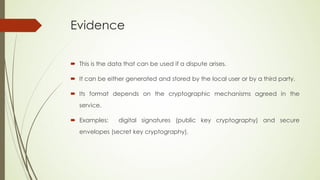
Evidence


 This is the data that can be used if a dispute arises.

 It can be either generated and stored by the local user or by a third party.

 Its format depends on the cryptographic mechanisms agreed in the
   service.

 Examples:      digital signatures (public key cryptography) and secure
   envelopes (secret key cryptography).
Common Elements of Evidence format


 Non-repudiation service to which evidence is related

 Non-repudiation policy identifier

 Originator identity

 Recipient identity

 Third party identity if evidence generator differs from the originator

 Message or a digital fingerprint
Common Elements of Evidence format
          (Contd … )
 Information needed for verifying evidence (i.e. digital certificate, symmetric
  secret key info) if it is not publicly available
 TTP’s identifier
 Time information (time and date that evidence was generated, expiry
  date, . . . ).
 If this data is certified by a Time Stamp Authority (TSA), it could include a
  time-stamp service identifier.
Properties of CEM : Fairness

 A certified e-mail protocol is fair if and only if at the end of a protocol
  execution either Alice got the non-repudiation of receipt evidence, and
  Bob got the corresponding mail (as well as the non-repudiation of origin
  evidence if required), or none of them got any valuable information.
 Types of Fairness
     Strong, Weak, Light, True, Probabilistic


 Fairness is mandatory, so one of these properties must be compulsory.
  Weak Fairness is enough, although strong fairness is desirable. Probabilistic
  Fairness is not desirable
Properties of CEM : TTP

 The probability to cheat the other entity in a protocol can be decreased by
  increasing the number of messages necessary in the protocol. To avoid the
  communication overhead, a different approach using a trusted third party
  (TTP) can be introduced. Both entities can send their items to the TTP that
  forwards them to the respective entities.
 Types of TTP
     In-line TTP, On-line TTP, Off-line TTP, Transparent TTP, Verifiable TTP
 Off-line TTP is desired, but the involvement of the TTP depends on the
  application.
 Transparent and Verifiable TTP are desired, but only one of them can be
  achieved because they are incompatible.
Properties of CEM : Timeliness

 A certifed e-mail protocol provides timeliness if and only if all honest parties
  always have the ability to reach, in a finite amount of time, a point in the
  protocol where they can stop the protocol while preserving fairness.
 Types of Timeliness
     Synchronous Timeliness – Here deadlines are used and the TTP clock is assumed
      as the reference time.
     Asynchronous Timeliness – There are no deadlines here for participants.


 Asynchronous Timeliness is desirable as it is difficult to achieve clock
  synchronization.
Properties of CEM : State Storage

 TTPs can be classified with respect to how long (temporal criteria) do they
  need, if applicable, to store state information.
 Types of State Storage
     Strong Stateless TTP
     Weak Stateless TTP
     Strong Stateful TTP
     Weak Stateful TTP


 Strong Stateless TTP is the most desirable property from a resource and
  storage point of view.
Properties of CEM : Confidentiality

 A certified e-mail protocol is said to provide data confidentiality, if and only
  if Alice and Bob are the only entities that can extract the content of the
  sent mail out of the protocol messages.
 Confidentiality is not always required as adding confidentiality may harm
  the efficiency of the protocol.
 Types of Confidentiality
     Data confidentiality
     Identity confidentiality
 We could also consider privacy of the originator (anonymity). However
  anonymity and NRO cannot be provided at the same time.
Properties of CEM : Evidence
                     Transferability
   It mainly consists of the sending and reception of evidence among participants.
 It is greatly influenced by communication channel properties. The different options
    are as follows:
    1. The communication channel is unreliable. In this case, data can be lost.
    2. The communication channel is resilient (also called asynchronous network). In
       this case, data is delivered after a finite but unknown amount of time.
    3. The communication channel is operational (also called synchronous network).In this
      case, data is delivered after a known, constant amount of time.
 An unreliable channel will in most cases be transformed into a resilient channel by the use
  of an appropriate transport protocol (e.g. retransmissions).
Dispute Resolution in CEM

 Dispute resolution is the last phase in a non-repudiation service. This phase
  will not be activated unless disputes related to a transaction arise.
 When a dispute arises, an adjudicator will be invoked to settle the dispute
  according to the non-repudiation evidence provided by the disputing
  parties and the non-repudiation policy in effect. This policy should be
  agreed in advance by the parties involved in the service.
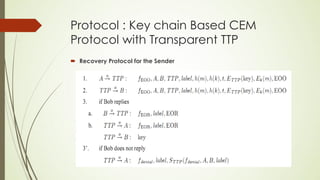
Protocol : Key chain Based CEM
Protocol with Transparent TTP

 In 2010, Zhiyuan Liu, Jun Pang and Chenyi Zhang proposed an optimistic
  certified email protocol, which employs key chains to reduce the storage
  requirement of the trusted third party (TTP).
 Satisfies the following CEM properties:
     NOR,NRR
     Strong Fairness
     Timeliness
     TTP Transparency
Protocol : Key chain Based CEM
Protocol with Transparent TTP

 Key Terms in Protocol:
       EOO : Evidence of Origin
       EOR: Evidence of Receipt
       M : Message
       T : TTP
       sid : sender ID
       A,B : Sender , Receiver
       h(i) : hash of the I
       label : It is used to identify the protocol run.
     fT : flag indicating the purpose of the message where T identifies the
      corresponding message in that protocol
Protocol : Key chain Based CEM
Protocol with Transparent TTP
 Protocol
Protocol : Key chain Based CEM
Protocol with Transparent TTP
 Recovery Protocol for the Sender
Protocol : Key chain Based CEM
Protocol with Transparent TTP
 Recovery Protocol for the Receiver


 where label is h(A,B,TTP, h(m), h(k), t)
Working of S/MIME (in brief)

Message sending mechanism:
Working of S/MIME (in brief)
Message receiving mechanism:
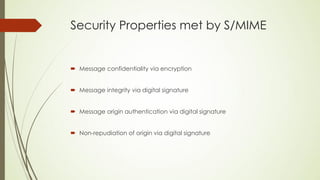
Security Properties met by S/MIME


 Message confidentiality via encryption


 Message integrity via digital signature


 Message origin authentication via digital signature


 Non-repudiation of origin via digital signature
Security property not met by S/MIME


 Non-repudiation of receipt

     S/MIME does not protect the sender of information against the denial of the
      receiver, who may say the sender never sent the information, or that he/she did
      not send it on time.


 Lack of this property prevents professional use of email.
Addition of NRR with Fairness in S/Mime

 Sender sends encrypted message and encryption key for message derived
  from message.
     some function of hash of message for e.g.)
     encrypted by public key of receiver.
 TTP calculates hash of this and sends it to receiver.
 Receiver signs this hash and sends back to TTP.
 Now TTP sends signed hash back to sender encrypted by sender’s public
  key (which he can verify) and also sends message to receiver.
Conclusion and our Thought

 Certified e-mail, also known as authenticated e-mail or stamped e-mail, is a
  system in which senders of commercial e-mail messages pay a small fee to
  ensure that their messages will bypass spam filter s to reach intended
  recipients.
 Both America Online ( AOL ) and Yahoo have announced certified e-mail
  plans based on a technology developed by Goodmail Systems.
 For a fee of approximately 1/4 of a cent (USD $0.0025) per e-mail, or USD
  $2.00 to $3.00 for every 1000 messages sent, advertisers can post e-mail
  messages that defeat most spam filters commonly used at the server level
  by Internet service providers ( ISP s).
References

 Josep Lluis Ferrer-Gomilla a , Jose A. Onieva b , Magdalena Payeras a ,
  Javier Lopez b, * : Certified electronic mail: Properties revisited Computers &
  Security Volume 29, Issue 2, March 2010, Pages 167–179
 Secure Multi-Party Non-Repudiation Protocols and Applications, José A.
  Onieva, University of Malaga Spain, Javier Lopez ,University of Malaga
  ,Spain, Jianying Zhou, Institute for Infocomm Research, Singapore Ch – 2
  Fundamentals of Non-Repudiation Pages 17-34
 Selective Receipt in Certified E-Mail, Steve Kremer and Olivier Markowitch
  fskremer,omarkowg@ulb.ac.be, 2001 (http://www.ulb.ac.be/di/scsi/markowitch/publications/ic01.pdf)

 Oppliger R. Certified mail: the next challenge for secure messaging. ACM
  Press. Communications of the ACM 2004;47: 75–9
References

 Extending a Key-Chain Based Certified Email Protocol with Transparent TTP
  Zhiyuan Liu, Jun Pang, Chenyi Zhang, Conference: Embedded and
  Ubiquitous Computing - EUC , pp. 630-636, 2010, DOI: 10.1109/EUC.2010.101
 Understanding S/MIME (http://technet.microsoft.com/en-us/library/aa995740(v=exchg.65).aspx)
 Prof. Manik Lal Das Slides (L11 - E-Mail Security.pdf)
 Certified e-mail (authenticated e-mail or stamped e-mail)
  (http://whatis.techtarget.com/definition/certified-e-mail-authenticated-e-mail-or-stamped-e-mail)

E mail security using Certified Electronic Mail (CEM)

  • 1.
    E-mail Security Using CertifiedElectronic mail (CEM)
  • 2.
    Team Members  PankajBhambhani (200901047) (pankajb64@gmail.com)  Pratik Kumar (200901239) (pratik.kumar.bharat@gmail.com)  Dipesh Shah (200901094) (dipesh1005@gmail.com)  Jignesh Kakadiya (200901201) (jigneshhk1992@gmail.com)  Ajay Dhameliya (200901203) (dhameliyaajay26@yahoo.in)
  • 3.
    Topics  Why E-mailsecurity?  CEM - Certified Electronic Mail  Properties of CEM  Existing Protocol - S/MIME – properties  Missing properties in S/MIME and their importance  Sample Certified Email Protocol  How to do- Design  Conclusion and our thoughts  References
  • 4.
    Why E-mail Security? Primitive E-Mail service – different intended purpose.  Exchange of messages between small universities in a closed network.  Not much concern about misuse.  Different Game Altogether Today.  Internet an open network - large number of messages sent.  Can contain sensitive, valuable information. Security is essential.  We shall examine Certified Electronic Mail as a theoretical measure of E- mail Security.
  • 5.
    Certified Electronic Mail(CEM)  Added value to traditional electronic mail.  Examination of various properties.  Use a sample certified email protocols to demonstrate properties.  Its use in improvement of existing protocol : S/MIME
  • 6.
    Properties of CEM: Non-Repudiation  Postal services force the recipient to sign a receipt token before delivering the envelope which contains the certified message.  Here the recipient only recognizes that it received an envelope which, in turn, can be empty (intentionally or not).  Hence there is a difference with respect to the digital evidence of receipt (linked to the message and not to the envelope).
  • 7.
    Types of non-repudiation DirectCommunication Model Non-Repudiation of Origin (NRO) is intended to protect against the originator’s false denial of having originated the message. Evidence of Origin (EOO) is generated by the originator, or a TTP on its behalf, and will be held by the recipient. Non-Repudiation of Receipt (NRR) is intended to protect against the recipient’s false denial of having received the message. Evidence of Receipt (EOR) is generated by the recipient, or a TTP on its behalf, and will be held by the originator. Indirect Communication Model Non-Repudiation of Submission (NRS) is intended to provide evidence that the originator submitted the message for delivery. Evidence of Submission (EOS) is generated by the delivery agent, and will be held by the originator. Non-Repudiation of Delivery (NRD) is intended to provide evidence that the message has been delivered to the recipient. Evidence of Delivery (EOD) is generated by the delivery agent, and will be held by the originator
  • 8.
    Properties of CEM: Non-Repudiation (Contd…)  Different Possible Message Transfer Combinations: • Exchange of message and NRO for NRR linked to the message. • Exchange of message and NRO for acknowledgement of receipt. • Exchange of message for NRR linked to the message. • Exchange of message for acknowledgement of receipt. • Exchange of envelope and, if possible, NRO for NRR, if possible, linked to the message. • Exchange of envelope and, if possible, NRO for acknowledgement of receipt. • Exchange of envelope for NRR, if possible, linked to the message. • Exchange of envelope for acknowledgement of receipt.
  • 9.
    Communication Model  Theoriginator and the recipient potentially do not trust each other.  The originator is not sure that the recipient will acknowledge a message it has received.  On the other hand, the recipient will only acknowledge messages it has received.  In order to facilitate a fair exchange in which neither party will gain an advantage during the transaction, a TTP will usually be involved.  The extent of the trusted third party’s involvement varies among different protocols
  • 10.
    Evidence  This isthe data that can be used if a dispute arises.  It can be either generated and stored by the local user or by a third party.  Its format depends on the cryptographic mechanisms agreed in the service.  Examples: digital signatures (public key cryptography) and secure envelopes (secret key cryptography).
  • 11.
    Common Elements ofEvidence format  Non-repudiation service to which evidence is related  Non-repudiation policy identifier  Originator identity  Recipient identity  Third party identity if evidence generator differs from the originator  Message or a digital fingerprint
  • 12.
    Common Elements ofEvidence format (Contd … )  Information needed for verifying evidence (i.e. digital certificate, symmetric secret key info) if it is not publicly available  TTP’s identifier  Time information (time and date that evidence was generated, expiry date, . . . ).  If this data is certified by a Time Stamp Authority (TSA), it could include a time-stamp service identifier.
  • 13.
    Properties of CEM: Fairness  A certified e-mail protocol is fair if and only if at the end of a protocol execution either Alice got the non-repudiation of receipt evidence, and Bob got the corresponding mail (as well as the non-repudiation of origin evidence if required), or none of them got any valuable information.  Types of Fairness  Strong, Weak, Light, True, Probabilistic  Fairness is mandatory, so one of these properties must be compulsory. Weak Fairness is enough, although strong fairness is desirable. Probabilistic Fairness is not desirable
  • 14.
    Properties of CEM: TTP  The probability to cheat the other entity in a protocol can be decreased by increasing the number of messages necessary in the protocol. To avoid the communication overhead, a different approach using a trusted third party (TTP) can be introduced. Both entities can send their items to the TTP that forwards them to the respective entities.  Types of TTP  In-line TTP, On-line TTP, Off-line TTP, Transparent TTP, Verifiable TTP  Off-line TTP is desired, but the involvement of the TTP depends on the application.  Transparent and Verifiable TTP are desired, but only one of them can be achieved because they are incompatible.
  • 15.
    Properties of CEM: Timeliness  A certifed e-mail protocol provides timeliness if and only if all honest parties always have the ability to reach, in a finite amount of time, a point in the protocol where they can stop the protocol while preserving fairness.  Types of Timeliness  Synchronous Timeliness – Here deadlines are used and the TTP clock is assumed as the reference time.  Asynchronous Timeliness – There are no deadlines here for participants.  Asynchronous Timeliness is desirable as it is difficult to achieve clock synchronization.
  • 16.
    Properties of CEM: State Storage  TTPs can be classified with respect to how long (temporal criteria) do they need, if applicable, to store state information.  Types of State Storage  Strong Stateless TTP  Weak Stateless TTP  Strong Stateful TTP  Weak Stateful TTP  Strong Stateless TTP is the most desirable property from a resource and storage point of view.
  • 17.
    Properties of CEM: Confidentiality  A certified e-mail protocol is said to provide data confidentiality, if and only if Alice and Bob are the only entities that can extract the content of the sent mail out of the protocol messages.  Confidentiality is not always required as adding confidentiality may harm the efficiency of the protocol.  Types of Confidentiality  Data confidentiality  Identity confidentiality  We could also consider privacy of the originator (anonymity). However anonymity and NRO cannot be provided at the same time.
  • 18.
    Properties of CEM: Evidence Transferability  It mainly consists of the sending and reception of evidence among participants.  It is greatly influenced by communication channel properties. The different options are as follows: 1. The communication channel is unreliable. In this case, data can be lost. 2. The communication channel is resilient (also called asynchronous network). In this case, data is delivered after a finite but unknown amount of time. 3. The communication channel is operational (also called synchronous network).In this case, data is delivered after a known, constant amount of time.  An unreliable channel will in most cases be transformed into a resilient channel by the use of an appropriate transport protocol (e.g. retransmissions).
  • 19.
    Dispute Resolution inCEM  Dispute resolution is the last phase in a non-repudiation service. This phase will not be activated unless disputes related to a transaction arise.  When a dispute arises, an adjudicator will be invoked to settle the dispute according to the non-repudiation evidence provided by the disputing parties and the non-repudiation policy in effect. This policy should be agreed in advance by the parties involved in the service.
  • 20.
    Protocol : Keychain Based CEM Protocol with Transparent TTP  In 2010, Zhiyuan Liu, Jun Pang and Chenyi Zhang proposed an optimistic certified email protocol, which employs key chains to reduce the storage requirement of the trusted third party (TTP).  Satisfies the following CEM properties:  NOR,NRR  Strong Fairness  Timeliness  TTP Transparency
  • 21.
    Protocol : Keychain Based CEM Protocol with Transparent TTP  Key Terms in Protocol:  EOO : Evidence of Origin  EOR: Evidence of Receipt  M : Message  T : TTP  sid : sender ID  A,B : Sender , Receiver  h(i) : hash of the I  label : It is used to identify the protocol run.  fT : flag indicating the purpose of the message where T identifies the corresponding message in that protocol
  • 22.
    Protocol : Keychain Based CEM Protocol with Transparent TTP  Protocol
  • 23.
    Protocol : Keychain Based CEM Protocol with Transparent TTP  Recovery Protocol for the Sender
  • 24.
    Protocol : Keychain Based CEM Protocol with Transparent TTP  Recovery Protocol for the Receiver  where label is h(A,B,TTP, h(m), h(k), t)
  • 25.
    Working of S/MIME(in brief) Message sending mechanism:
  • 26.
    Working of S/MIME(in brief) Message receiving mechanism:
  • 27.
    Security Properties metby S/MIME  Message confidentiality via encryption  Message integrity via digital signature  Message origin authentication via digital signature  Non-repudiation of origin via digital signature
  • 28.
    Security property notmet by S/MIME  Non-repudiation of receipt  S/MIME does not protect the sender of information against the denial of the receiver, who may say the sender never sent the information, or that he/she did not send it on time.  Lack of this property prevents professional use of email.
  • 29.
    Addition of NRRwith Fairness in S/Mime  Sender sends encrypted message and encryption key for message derived from message.  some function of hash of message for e.g.)  encrypted by public key of receiver.  TTP calculates hash of this and sends it to receiver.  Receiver signs this hash and sends back to TTP.  Now TTP sends signed hash back to sender encrypted by sender’s public key (which he can verify) and also sends message to receiver.
  • 30.
    Conclusion and ourThought  Certified e-mail, also known as authenticated e-mail or stamped e-mail, is a system in which senders of commercial e-mail messages pay a small fee to ensure that their messages will bypass spam filter s to reach intended recipients.  Both America Online ( AOL ) and Yahoo have announced certified e-mail plans based on a technology developed by Goodmail Systems.  For a fee of approximately 1/4 of a cent (USD $0.0025) per e-mail, or USD $2.00 to $3.00 for every 1000 messages sent, advertisers can post e-mail messages that defeat most spam filters commonly used at the server level by Internet service providers ( ISP s).
  • 31.
    References  Josep LluisFerrer-Gomilla a , Jose A. Onieva b , Magdalena Payeras a , Javier Lopez b, * : Certified electronic mail: Properties revisited Computers & Security Volume 29, Issue 2, March 2010, Pages 167–179  Secure Multi-Party Non-Repudiation Protocols and Applications, José A. Onieva, University of Malaga Spain, Javier Lopez ,University of Malaga ,Spain, Jianying Zhou, Institute for Infocomm Research, Singapore Ch – 2 Fundamentals of Non-Repudiation Pages 17-34  Selective Receipt in Certified E-Mail, Steve Kremer and Olivier Markowitch fskremer,omarkowg@ulb.ac.be, 2001 (http://www.ulb.ac.be/di/scsi/markowitch/publications/ic01.pdf)  Oppliger R. Certified mail: the next challenge for secure messaging. ACM Press. Communications of the ACM 2004;47: 75–9
  • 32.
    References  Extending aKey-Chain Based Certified Email Protocol with Transparent TTP Zhiyuan Liu, Jun Pang, Chenyi Zhang, Conference: Embedded and Ubiquitous Computing - EUC , pp. 630-636, 2010, DOI: 10.1109/EUC.2010.101  Understanding S/MIME (http://technet.microsoft.com/en-us/library/aa995740(v=exchg.65).aspx)  Prof. Manik Lal Das Slides (L11 - E-Mail Security.pdf)  Certified e-mail (authenticated e-mail or stamped e-mail) (http://whatis.techtarget.com/definition/certified-e-mail-authenticated-e-mail-or-stamped-e-mail)