Network Software: The Protocol Hierarchy
The first computer networks were designed with the hardware as the main concern
and the software as an afterthought.This strategy no longer works. Network
software is now highly structured.
To reduce their design complexity, most networks are organized as a series or
hierarchy of layers or levels.
The number of layers, the name of each layer, the contents of each layer, and the
function of each layer differ from network to network.
Layer n on one machine communicates with layer n on another machine on the
network using an some rules known as the layer n protocol.
A protocol is an agreement between the communicating parties on how the
communication is to proceed.
The entities comprising the corresponding layers on two communicating machines
over the network are called peers.
In realty, no data is transferred from layer n on any two machines. Instead, each
data and control information is passed to the layer below.
Additional information including protocol control information may be appended by
each layer to data as it travels from higher to lower layers in the form of layer
headers.
Below layer 1 is the physical medium through which actual communication occur
over communication channels.
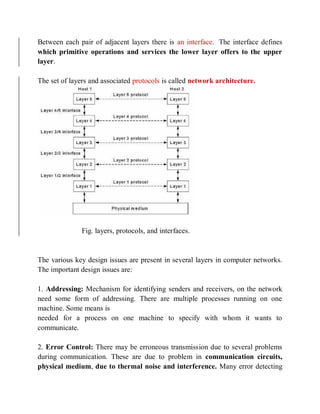
Between each pair of adjacent layers there is an interface. The interface defines
which primitive operations and services the lower layer offers to the upper
layer.
The set of layers and associated protocols is called network architecture.
Fig. layers, protocols, and interfaces.
The various key design issues are present in several layers in computer networks.
The important design issues are:
1. Addressing: Mechanism for identifying senders and receivers, on the network
need some form of addressing. There are multiple processes running on one
machine. Some means is
needed for a process on one machine to specify with whom it wants to
communicate.
2. Error Control: There may be erroneous transmission due to several problems
during communication. These are due to problem in communication circuits,
physical medium, due to thermal noise and interference. Many error detecting
and error correcting codes are known, but both ends of the connection must agree
on which one being used. In addition, the receiver must have some mechanism of
telling the sender which messages have been received correctly and which has not.
3. Flow control: If there is a fast sender at one end sending data to a slow receiver,
then there must be flow control mechanism to control the loss of data by slow
receivers. There are several mechanisms used for flow control such as increasing
buffer size at receivers, slow down the fast sender, and so on.
4. Multiplexing / demultiplexing: If the data has to be transmitted on transmission
media separately, it is inconvenient or expensive to setup separate connection for
each pair of communicating processes. So, multiplexing is needed in the physical
layer at sender end and demultiplexing is need at the receiver end.
5. Routing: When data has to be transmitted from source to destination, there may
be multiple paths between them. An optimized (shortest) route must be chosen.
This decision is made on the basis of several routing algorithms, which chooses
optimized route to the destination.
Connection Oriented and Connectionless Services
These are the two services given by the layers to layers above them. These services
are :
1 Connection Oriented Service
2 Connectionless Services
Connection Oriented Services
There is a sequence of operation to be followed by the users of connection oriented
service. These are :
1. Connection is established
2. Information is sent
3. Connection is released
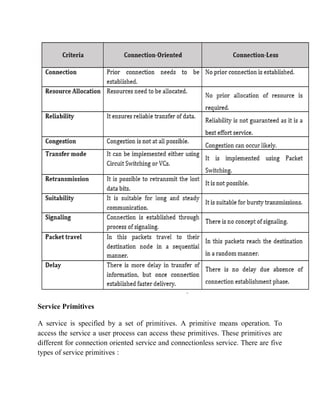
In connection oriented service we have to establish a connection before starting the
communication. When connection is established we send the message or the
information and then we release the connection.
Connection oriented service is more reliable than connectionless service. We can
send the message in connection oriented service if there is an error at the receivers
end. Example of connection oriented is TCP (Transmission Control Protocol)
protocol.
Connection Less Services
It is similar to the postal services, as it carries the full address where the message
(letter) is to be carried. Each message is routed independently from source to
destination. The order of message sent can be different from the order received.
In connectionless the data is transferred in one direction from source to destination
without checking that destination is still there or not or if it prepared to accept the
message. Authentication is not needed in this. Example of Connectionless service
is UDP (User Datagram Protocol) protocol.
Service Primitives
A service is specified by a set of primitives. A primitive means operation. To
access the service a user process can access these primitives. These primitives are
different for connection oriented service and connectionless service. There are five
types of service primitives :
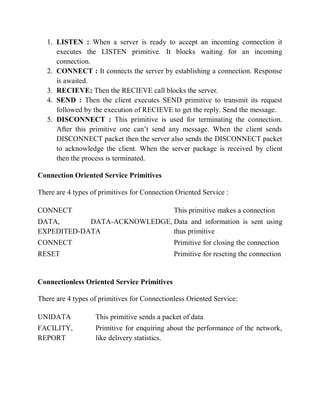
1. LISTEN : When a server is ready to accept an incoming connection it
executes the LISTEN primitive. It blocks waiting for an incoming
connection.
2. CONNECT : It connects the server by establishing a connection. Response
is awaited.
3. RECIEVE: Then the RECIEVE call blocks the server.
4. SEND : Then the client executes SEND primitive to transmit its request
followed by the execution of RECIEVE to get the reply. Send the message.
5. DISCONNECT : This primitive is used for terminating the connection.
After this primitive one can’t send any message. When the client sends
DISCONNECT packet then the server also sends the DISCONNECT packet
to acknowledge the client. When the server package is received by client
then the process is terminated.
Connection Oriented Service Primitives
There are 4 types of primitives for Connection Oriented Service :
CONNECT This primitive makes a connection
DATA, DATA-ACKNOWLEDGE,
EXPEDITED-DATA
Data and information is sent using
thus primitive
CONNECT Primitive for closing the connection
RESET Primitive for reseting the connection
Connectionless Oriented Service Primitives
There are 4 types of primitives for Connectionless Oriented Service:
UNIDATA This primitive sends a packet of data
FACILITY,
REPORT
Primitive for enquiring about the performance of the network,
like delivery statistics.
Relationship of Services to Protocol
Services
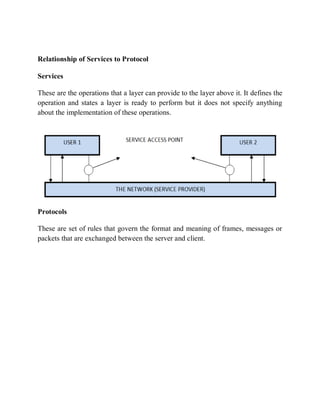
These are the operations that a layer can provide to the layer above it. It defines the
operation and states a layer is ready to perform but it does not specify anything
about the implementation of these operations.
Protocols
These are set of rules that govern the format and meaning of frames, messages or
packets that are exchanged between the server and client.
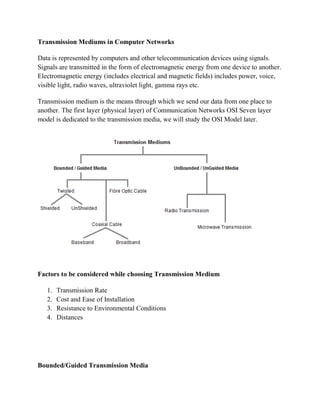
Transmission Mediums in Computer Networks
Data is represented by computers and other telecommunication devices using signals.
Signals are transmitted in the form of electromagnetic energy from one device to another.
Electromagnetic energy (includes electrical and magnetic fields) includes power, voice,
visible light, radio waves, ultraviolet light, gamma rays etc.
Transmission medium is the means through which we send our data from one place to
another. The first layer (physical layer) of Communication Networks OSI Seven layer
model is dedicated to the transmission media, we will study the OSI Model later.
Factors to be considered while choosing Transmission Medium
1. Transmission Rate
2. Cost and Ease of Installation
3. Resistance to Environmental Conditions
4. Distances
Bounded/Guided Transmission Media
It is the transmission media in which signals are confined to a specific path using wire or
cable. The types of Bounded/ Guided are discussed below.
Twisted Pair Cable
This cable is the most commonly used and is cheaper than others. It is lightweight, cheap,
can be installed easily, and they support many different types of network. Some
important points :
 Its frequency range is 0 to 3.5 kHz.
 Typical attenuation is 0.2 dB/Km @ 1kHz.
 Typical delay is 50 µs/km.
 Repeater spacing is 2km.
Twisted Pair is of two types :
 Unshielded Twisted Pair (UTP)
 Shielded Twisted Pair (STP)
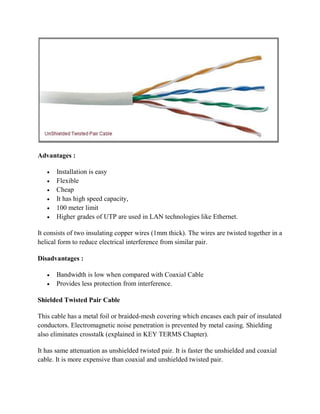
Unshielded Twisted Pair Cable
It is the most common type of telecommunication when compared with Shielded Twisted
Pair Cable which consists of two conductors usually copper, each with its own colour
plastic insulator. Identification is the reason behind coloured plastic insulation.
UTP cables consist of 2 or 4 pairs of twisted cable. Cable with 2 pair use RJ-11
connector and 4 pair cable use RJ-45 connector.
Advantages :
 Installation is easy
 Flexible
 Cheap
 It has high speed capacity,
 100 meter limit
 Higher grades of UTP are used in LAN technologies like Ethernet.
It consists of two insulating copper wires (1mm thick). The wires are twisted together in a
helical form to reduce electrical interference from similar pair.
Disadvantages :
 Bandwidth is low when compared with Coaxial Cable
 Provides less protection from interference.
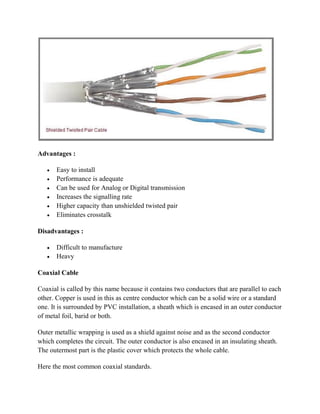
Shielded Twisted Pair Cable
This cable has a metal foil or braided-mesh covering which encases each pair of insulated
conductors. Electromagnetic noise penetration is prevented by metal casing. Shielding
also eliminates crosstalk (explained in KEY TERMS Chapter).
It has same attenuation as unshielded twisted pair. It is faster the unshielded and coaxial
cable. It is more expensive than coaxial and unshielded twisted pair.
Advantages :
 Easy to install
 Performance is adequate
 Can be used for Analog or Digital transmission
 Increases the signalling rate
 Higher capacity than unshielded twisted pair
 Eliminates crosstalk
Disadvantages :
 Difficult to manufacture
 Heavy
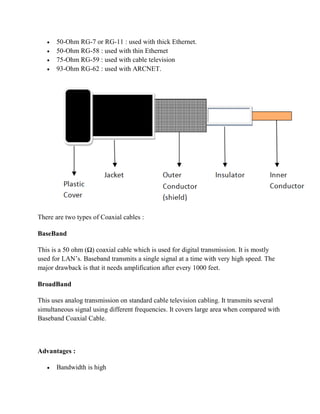
Coaxial Cable
Coaxial is called by this name because it contains two conductors that are parallel to each
other. Copper is used in this as centre conductor which can be a solid wire or a standard
one. It is surrounded by PVC installation, a sheath which is encased in an outer conductor
of metal foil, barid or both.
Outer metallic wrapping is used as a shield against noise and as the second conductor
which completes the circuit. The outer conductor is also encased in an insulating sheath.
The outermost part is the plastic cover which protects the whole cable.
Here the most common coaxial standards.
 50-Ohm RG-7 or RG-11 : used with thick Ethernet.
 50-Ohm RG-58 : used with thin Ethernet
 75-Ohm RG-59 : used with cable television
 93-Ohm RG-62 : used with ARCNET.
There are two types of Coaxial cables :
BaseBand
This is a 50 ohm (Ω) coaxial cable which is used for digital transmission. It is mostly
used for LAN’s. Baseband transmits a single signal at a time with very high speed. The
major drawback is that it needs amplification after every 1000 feet.
BroadBand
This uses analog transmission on standard cable television cabling. It transmits several
simultaneous signal using different frequencies. It covers large area when compared with
Baseband Coaxial Cable.
Advantages :
 Bandwidth is high
 Used in long distance telephone lines.
 Transmits digital signals at a very high rate of 10Mbps.
 Much higher noise immunity
 Data transmission without distortion.
 The can span to longer distance at higher speeds as they have better shielding
when compared to twisted pair cable
Disadvantages :
 Single cable failure can fail the entire network.
 Difficult to install and expensive when compared with twisted pair.
 If the shield is imperfect, it can lead to grounded loop.
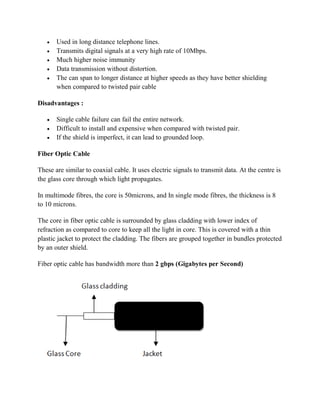
Fiber Optic Cable
These are similar to coaxial cable. It uses electric signals to transmit data. At the centre is
the glass core through which light propagates.
In multimode fibres, the core is 50microns, and In single mode fibres, the thickness is 8
to 10 microns.
The core in fiber optic cable is surrounded by glass cladding with lower index of
refraction as compared to core to keep all the light in core. This is covered with a thin
plastic jacket to protect the cladding. The fibers are grouped together in bundles protected
by an outer shield.
Fiber optic cable has bandwidth more than 2 gbps (Gigabytes per Second)
Advantages :
 Provides high quality transmission of signals at very high speed.
 These are not affected by electromagnetic interference, so noise and distortion is
very less.
 Used for both analog and digital signals.
Disadvantages :
 It is expensive
 Difficult to install.
 Maintenance is expensive and difficult.
 Do not allow complete routing of light signals.
UnBounded/UnGuided Transmission Media
Unguided or wireless media sends the data through air (or water), which is available to
anyone who has a device capable of receiving them. Types of unguided/ unbounded
media are discussed below :
 Radio Transmission
 MicroWave Transmission
Radio Transmission
Its frequency is between 10 kHz to 1GHz. It is simple to install and has high attenuation.
These waves are used for multicast communications.
Types of Propogation
Radio Transmission utilizes different types of propogation :
 Troposphere : The lowest portion of earth’s atmosphere extending outward
approximately 30 miles from the earth’s surface. Clouds, jet planes, wind is found
here.
 Ionosphere : The layer of the atmosphere above troposphere, but below space.
Contains electrically charged particles.
Microwave Transmission
It travels at high frequency than the radio waves. It requires the sender to be inside of the
receiver. It operates in a system with a low gigahertz range. It is mostly used for unicast
communication.
There are 2 types of Microwave Transmission :
1. Terrestrial Microwave
2. Satellite Microwave
Advantages of Microwave Transmission
 Used for long distance telephone communication
 Carries 1000’s of voice channels at the same time
Disadvantages of Microwave Transmission
 It is Very costly
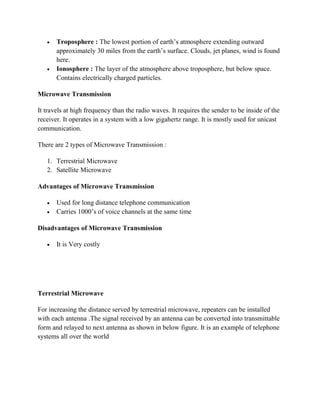
Terrestrial Microwave
For increasing the distance served by terrestrial microwave, repeaters can be installed
with each antenna .The signal received by an antenna can be converted into transmittable
form and relayed to next antenna as shown in below figure. It is an example of telephone
systems all over the world
There are two types of antennas used for terrestrial microwave communication :
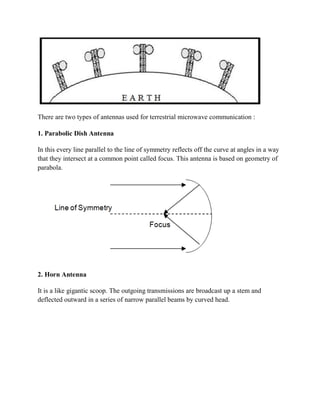
1. Parabolic Dish Antenna
In this every line parallel to the line of symmetry reflects off the curve at angles in a way
that they intersect at a common point called focus. This antenna is based on geometry of
parabola.
2. Horn Antenna
It is a like gigantic scoop. The outgoing transmissions are broadcast up a stem and
deflected outward in a series of narrow parallel beams by curved head.
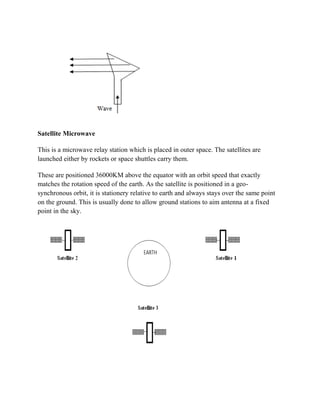
Satellite Microwave
This is a microwave relay station which is placed in outer space. The satellites are
launched either by rockets or space shuttles carry them.
These are positioned 36000KM above the equator with an orbit speed that exactly
matches the rotation speed of the earth. As the satellite is positioned in a geo-
synchronous orbit, it is stationery relative to earth and always stays over the same point
on the ground. This is usually done to allow ground stations to aim antenna at a fixed
point in the sky.
Features of Satellite Microwave :
 Bandwidth capacity depends on the frequency used.
 Satellite microwave deployment for orbiting satellite is difficult.
Advantages of Satellite Microwave :
 Transmitting station can receive back its own transmission and check whether the
satellite has transmitted information correctly.
 A single microwave relay station which is visible from any point.
Disadvantages of Satellite Microwave :
 Satellite manufacturing cost is very high
 Cost of launching satellite is very expensive
 Transmission highly depends on whether conditions, it can go down in bad
weather

Computer network notes

  • 1.
    Network Software: TheProtocol Hierarchy The first computer networks were designed with the hardware as the main concern and the software as an afterthought.This strategy no longer works. Network software is now highly structured. To reduce their design complexity, most networks are organized as a series or hierarchy of layers or levels. The number of layers, the name of each layer, the contents of each layer, and the function of each layer differ from network to network. Layer n on one machine communicates with layer n on another machine on the network using an some rules known as the layer n protocol. A protocol is an agreement between the communicating parties on how the communication is to proceed. The entities comprising the corresponding layers on two communicating machines over the network are called peers. In realty, no data is transferred from layer n on any two machines. Instead, each data and control information is passed to the layer below. Additional information including protocol control information may be appended by each layer to data as it travels from higher to lower layers in the form of layer headers. Below layer 1 is the physical medium through which actual communication occur over communication channels.
  • 2.
    Between each pairof adjacent layers there is an interface. The interface defines which primitive operations and services the lower layer offers to the upper layer. The set of layers and associated protocols is called network architecture. Fig. layers, protocols, and interfaces. The various key design issues are present in several layers in computer networks. The important design issues are: 1. Addressing: Mechanism for identifying senders and receivers, on the network need some form of addressing. There are multiple processes running on one machine. Some means is needed for a process on one machine to specify with whom it wants to communicate. 2. Error Control: There may be erroneous transmission due to several problems during communication. These are due to problem in communication circuits, physical medium, due to thermal noise and interference. Many error detecting
  • 3.
    and error correctingcodes are known, but both ends of the connection must agree on which one being used. In addition, the receiver must have some mechanism of telling the sender which messages have been received correctly and which has not. 3. Flow control: If there is a fast sender at one end sending data to a slow receiver, then there must be flow control mechanism to control the loss of data by slow receivers. There are several mechanisms used for flow control such as increasing buffer size at receivers, slow down the fast sender, and so on. 4. Multiplexing / demultiplexing: If the data has to be transmitted on transmission media separately, it is inconvenient or expensive to setup separate connection for each pair of communicating processes. So, multiplexing is needed in the physical layer at sender end and demultiplexing is need at the receiver end. 5. Routing: When data has to be transmitted from source to destination, there may be multiple paths between them. An optimized (shortest) route must be chosen. This decision is made on the basis of several routing algorithms, which chooses optimized route to the destination. Connection Oriented and Connectionless Services These are the two services given by the layers to layers above them. These services are : 1 Connection Oriented Service 2 Connectionless Services Connection Oriented Services There is a sequence of operation to be followed by the users of connection oriented service. These are : 1. Connection is established 2. Information is sent 3. Connection is released
  • 4.
    In connection orientedservice we have to establish a connection before starting the communication. When connection is established we send the message or the information and then we release the connection. Connection oriented service is more reliable than connectionless service. We can send the message in connection oriented service if there is an error at the receivers end. Example of connection oriented is TCP (Transmission Control Protocol) protocol. Connection Less Services It is similar to the postal services, as it carries the full address where the message (letter) is to be carried. Each message is routed independently from source to destination. The order of message sent can be different from the order received. In connectionless the data is transferred in one direction from source to destination without checking that destination is still there or not or if it prepared to accept the message. Authentication is not needed in this. Example of Connectionless service is UDP (User Datagram Protocol) protocol.
  • 5.
    Service Primitives A serviceis specified by a set of primitives. A primitive means operation. To access the service a user process can access these primitives. These primitives are different for connection oriented service and connectionless service. There are five types of service primitives :
  • 6.
    1. LISTEN :When a server is ready to accept an incoming connection it executes the LISTEN primitive. It blocks waiting for an incoming connection. 2. CONNECT : It connects the server by establishing a connection. Response is awaited. 3. RECIEVE: Then the RECIEVE call blocks the server. 4. SEND : Then the client executes SEND primitive to transmit its request followed by the execution of RECIEVE to get the reply. Send the message. 5. DISCONNECT : This primitive is used for terminating the connection. After this primitive one can’t send any message. When the client sends DISCONNECT packet then the server also sends the DISCONNECT packet to acknowledge the client. When the server package is received by client then the process is terminated. Connection Oriented Service Primitives There are 4 types of primitives for Connection Oriented Service : CONNECT This primitive makes a connection DATA, DATA-ACKNOWLEDGE, EXPEDITED-DATA Data and information is sent using thus primitive CONNECT Primitive for closing the connection RESET Primitive for reseting the connection Connectionless Oriented Service Primitives There are 4 types of primitives for Connectionless Oriented Service: UNIDATA This primitive sends a packet of data FACILITY, REPORT Primitive for enquiring about the performance of the network, like delivery statistics.
  • 7.
    Relationship of Servicesto Protocol Services These are the operations that a layer can provide to the layer above it. It defines the operation and states a layer is ready to perform but it does not specify anything about the implementation of these operations. Protocols These are set of rules that govern the format and meaning of frames, messages or packets that are exchanged between the server and client.
  • 8.
    Transmission Mediums inComputer Networks Data is represented by computers and other telecommunication devices using signals. Signals are transmitted in the form of electromagnetic energy from one device to another. Electromagnetic energy (includes electrical and magnetic fields) includes power, voice, visible light, radio waves, ultraviolet light, gamma rays etc. Transmission medium is the means through which we send our data from one place to another. The first layer (physical layer) of Communication Networks OSI Seven layer model is dedicated to the transmission media, we will study the OSI Model later. Factors to be considered while choosing Transmission Medium 1. Transmission Rate 2. Cost and Ease of Installation 3. Resistance to Environmental Conditions 4. Distances Bounded/Guided Transmission Media
  • 9.
    It is thetransmission media in which signals are confined to a specific path using wire or cable. The types of Bounded/ Guided are discussed below. Twisted Pair Cable This cable is the most commonly used and is cheaper than others. It is lightweight, cheap, can be installed easily, and they support many different types of network. Some important points :  Its frequency range is 0 to 3.5 kHz.  Typical attenuation is 0.2 dB/Km @ 1kHz.  Typical delay is 50 µs/km.  Repeater spacing is 2km. Twisted Pair is of two types :  Unshielded Twisted Pair (UTP)  Shielded Twisted Pair (STP) Unshielded Twisted Pair Cable It is the most common type of telecommunication when compared with Shielded Twisted Pair Cable which consists of two conductors usually copper, each with its own colour plastic insulator. Identification is the reason behind coloured plastic insulation. UTP cables consist of 2 or 4 pairs of twisted cable. Cable with 2 pair use RJ-11 connector and 4 pair cable use RJ-45 connector.
  • 10.
    Advantages :  Installationis easy  Flexible  Cheap  It has high speed capacity,  100 meter limit  Higher grades of UTP are used in LAN technologies like Ethernet. It consists of two insulating copper wires (1mm thick). The wires are twisted together in a helical form to reduce electrical interference from similar pair. Disadvantages :  Bandwidth is low when compared with Coaxial Cable  Provides less protection from interference. Shielded Twisted Pair Cable This cable has a metal foil or braided-mesh covering which encases each pair of insulated conductors. Electromagnetic noise penetration is prevented by metal casing. Shielding also eliminates crosstalk (explained in KEY TERMS Chapter). It has same attenuation as unshielded twisted pair. It is faster the unshielded and coaxial cable. It is more expensive than coaxial and unshielded twisted pair.
  • 11.
    Advantages :  Easyto install  Performance is adequate  Can be used for Analog or Digital transmission  Increases the signalling rate  Higher capacity than unshielded twisted pair  Eliminates crosstalk Disadvantages :  Difficult to manufacture  Heavy Coaxial Cable Coaxial is called by this name because it contains two conductors that are parallel to each other. Copper is used in this as centre conductor which can be a solid wire or a standard one. It is surrounded by PVC installation, a sheath which is encased in an outer conductor of metal foil, barid or both. Outer metallic wrapping is used as a shield against noise and as the second conductor which completes the circuit. The outer conductor is also encased in an insulating sheath. The outermost part is the plastic cover which protects the whole cable. Here the most common coaxial standards.
  • 12.
     50-Ohm RG-7or RG-11 : used with thick Ethernet.  50-Ohm RG-58 : used with thin Ethernet  75-Ohm RG-59 : used with cable television  93-Ohm RG-62 : used with ARCNET. There are two types of Coaxial cables : BaseBand This is a 50 ohm (Ω) coaxial cable which is used for digital transmission. It is mostly used for LAN’s. Baseband transmits a single signal at a time with very high speed. The major drawback is that it needs amplification after every 1000 feet. BroadBand This uses analog transmission on standard cable television cabling. It transmits several simultaneous signal using different frequencies. It covers large area when compared with Baseband Coaxial Cable. Advantages :  Bandwidth is high
  • 13.
     Used inlong distance telephone lines.  Transmits digital signals at a very high rate of 10Mbps.  Much higher noise immunity  Data transmission without distortion.  The can span to longer distance at higher speeds as they have better shielding when compared to twisted pair cable Disadvantages :  Single cable failure can fail the entire network.  Difficult to install and expensive when compared with twisted pair.  If the shield is imperfect, it can lead to grounded loop. Fiber Optic Cable These are similar to coaxial cable. It uses electric signals to transmit data. At the centre is the glass core through which light propagates. In multimode fibres, the core is 50microns, and In single mode fibres, the thickness is 8 to 10 microns. The core in fiber optic cable is surrounded by glass cladding with lower index of refraction as compared to core to keep all the light in core. This is covered with a thin plastic jacket to protect the cladding. The fibers are grouped together in bundles protected by an outer shield. Fiber optic cable has bandwidth more than 2 gbps (Gigabytes per Second)
  • 14.
    Advantages :  Provideshigh quality transmission of signals at very high speed.  These are not affected by electromagnetic interference, so noise and distortion is very less.  Used for both analog and digital signals. Disadvantages :  It is expensive  Difficult to install.  Maintenance is expensive and difficult.  Do not allow complete routing of light signals. UnBounded/UnGuided Transmission Media Unguided or wireless media sends the data through air (or water), which is available to anyone who has a device capable of receiving them. Types of unguided/ unbounded media are discussed below :  Radio Transmission  MicroWave Transmission Radio Transmission Its frequency is between 10 kHz to 1GHz. It is simple to install and has high attenuation. These waves are used for multicast communications. Types of Propogation Radio Transmission utilizes different types of propogation :
  • 15.
     Troposphere :The lowest portion of earth’s atmosphere extending outward approximately 30 miles from the earth’s surface. Clouds, jet planes, wind is found here.  Ionosphere : The layer of the atmosphere above troposphere, but below space. Contains electrically charged particles. Microwave Transmission It travels at high frequency than the radio waves. It requires the sender to be inside of the receiver. It operates in a system with a low gigahertz range. It is mostly used for unicast communication. There are 2 types of Microwave Transmission : 1. Terrestrial Microwave 2. Satellite Microwave Advantages of Microwave Transmission  Used for long distance telephone communication  Carries 1000’s of voice channels at the same time Disadvantages of Microwave Transmission  It is Very costly Terrestrial Microwave For increasing the distance served by terrestrial microwave, repeaters can be installed with each antenna .The signal received by an antenna can be converted into transmittable form and relayed to next antenna as shown in below figure. It is an example of telephone systems all over the world
  • 16.
    There are twotypes of antennas used for terrestrial microwave communication : 1. Parabolic Dish Antenna In this every line parallel to the line of symmetry reflects off the curve at angles in a way that they intersect at a common point called focus. This antenna is based on geometry of parabola. 2. Horn Antenna It is a like gigantic scoop. The outgoing transmissions are broadcast up a stem and deflected outward in a series of narrow parallel beams by curved head.
  • 17.
    Satellite Microwave This isa microwave relay station which is placed in outer space. The satellites are launched either by rockets or space shuttles carry them. These are positioned 36000KM above the equator with an orbit speed that exactly matches the rotation speed of the earth. As the satellite is positioned in a geo- synchronous orbit, it is stationery relative to earth and always stays over the same point on the ground. This is usually done to allow ground stations to aim antenna at a fixed point in the sky.
  • 18.
    Features of SatelliteMicrowave :  Bandwidth capacity depends on the frequency used.  Satellite microwave deployment for orbiting satellite is difficult. Advantages of Satellite Microwave :  Transmitting station can receive back its own transmission and check whether the satellite has transmitted information correctly.  A single microwave relay station which is visible from any point. Disadvantages of Satellite Microwave :  Satellite manufacturing cost is very high  Cost of launching satellite is very expensive  Transmission highly depends on whether conditions, it can go down in bad weather