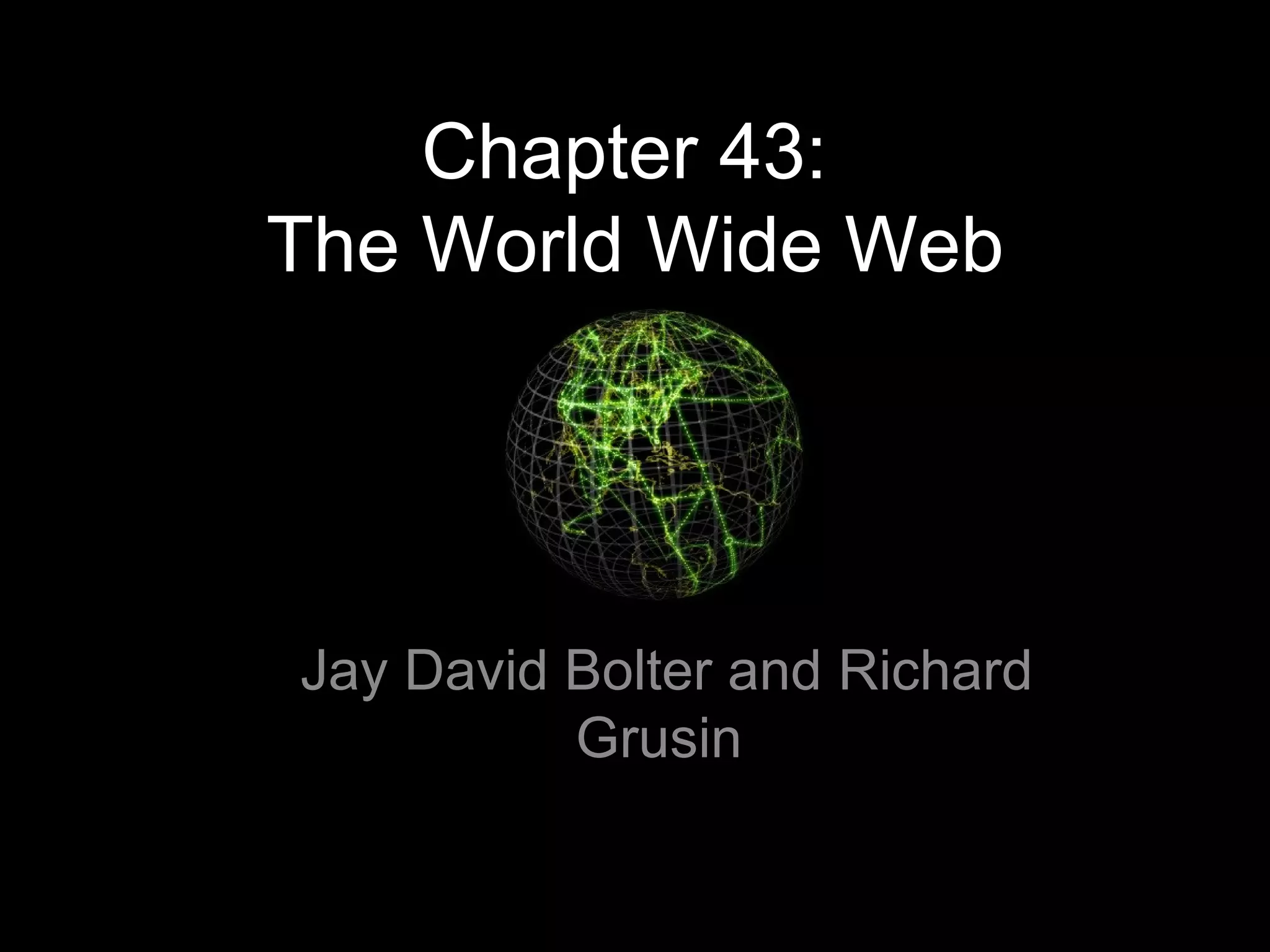
Chapter 43:  The World Wide Web Jay David Bolter and Richard Grusin
Definitions Internet  An interconnected system of networks that connects computers around the world (dictionary.com) World Wide Web A system of extensively interlinked hypertext documents:  a branch of the Internet  (dictionary.com)
Thesis The Internet and its further extensions remediate earlier media by enhancing the graphics, audio, visual and speed of access to information This allows the breakdown of distance barriers to include a more wide-spread audience, access to a larger, more organized compilation of information and creates opportunities for creativity, self expression and expansion
Introduction The internet remediates the telegraph 1993 = the first graphic web browser 2 things came of this: larger audience other media (i.e. magazines and newspapers online) The World Wide Web then evolved to include moving images, animation, digital audio and visual, refashioning radio, film and television
Remediations on the Web Remediation:  the correction of something bad or defective  (dictionary.com) Respectful: “ Project Gutenberg” - replication “ American Memory Project” - preservation Radical: Online Encyclopaedias - improvement Online Television - control Internet Phone Service - economic More Examples:   Spark Notes ,  Facebook, YouTube,  E-mail
Web Cameras Like “television only better” (Crowley & Heyer 313)  Constant live video stream that is able to monitor events as they happen Can be viewed almost instantaneously on the Internet Incorporated in many aspects of life (i.e. family life, work and play) Webcams “make some part of the physical world transparent to the Internet” (Crowley & Heyer 314)
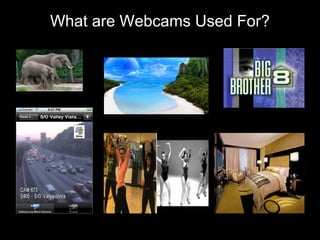
What are Webcams Used For?
Online Chat http://www.youtube.com/watch?v=Yl95nIN3Jx8 Breaks down barriers of distance Connects family and friends when they can’t see each other face-to-face Conferences can be held over webcam making it more convenient and affordable Close as you can get to reality on the Internet
Discussion Questions Do you think remediations of human interaction on the web will become more common/preferred than actual interactions? For example: MSN chatting, instead of face-to-face conversation Do you think the webcam replaces real face-to-face interaction or enhances them and why?
Telecom Nation “Introduction” Mussio, L.B.
Thesis The mass expansion of telecommunication systems in the twentieth century caused the Canadian government to intervene.
Telecommunications The telecommunications system in the 20 th  century was too important to be left to the market alone, as the telephone carried massive social and political consequences for the country Everything about these communication technologies had to do with the public  They depended on public law Used public property Provided public services And became public utilities
Government Responses The rapid spread and adaptations of communications systems forced governments to respond Each country’s government had their own way of asserting control and intervening
Telecommunications (2) First half of the 20 th  century featured one major innovation: TELEPHONY The relationship between public power and communications became a vital one in Canada Before 1945 Government regulation confined itself to seeing that:  Telecom monopolies made a reasonable profit Consumers had reliable service at a reasonable cost Ensured system development Made sure that economic objectives were possible
Telecommunications (3) End of WWII= explosion in communications that offset the balance between public power and technology Telecommunications technology was becoming universal, accessible, and indispensible Major Institutional Players: Bell Telephone Company of Canada IBM, the International Business Machine of America
The Arrival of the Computer   1960s Regulators had to balance the importance of it’s development, with pressure over rates and services Governments never really responded to these technological changes in consistent ways
Telecom Nation Canada’s encounter with the post-war transformation in communications The consequences of the interaction between public power and technological change Computer + Telecommunications= Information Highway Policy makers were trying to take control over and develop a technological change and information highway before it even existed
Telecommunications (4) The history of Canadian Broadcasting surfaced the attempts of the state to defend its communication interests, while mediating between the competing attempts of other actors  The success of Canadian telecommunications is the result of both government and non government regulation  A majority of telecommunications is operated at a national level
Telecommunication Utilities Three principle telecommunication utilities which are operated at the federal level: The Bell Telephone Company of Canada, operated in Ontario, Quebec, and North West Territories British Columbia Telephones, operated in British Columbia CN/CP Telegraphs (later Telecommunications), operated nationally
Telecommunications (5) Overseas telecommunication operated by The Canadian Overseas Telecommunications Corporation Telecommunications did influence Canadian Economics; however, Canadian Political arrangements shaped how this technology would be dealt with Historical patterns as well as government attitudes shaped how new communication technologies were perceived
Discussion Questions Do you think within our modern day telecommunication system the government is still regulated to a certain degree? Or is the public the primary influencing factor? Do you think monopolies of a few telecommunication industries would be beneficial or harmful to the general population? Would they provide stronger/weaker services in terms of price and quality?

Group Q

  • 1.
    Chapter 43: The World Wide Web Jay David Bolter and Richard Grusin
  • 2.
    Definitions Internet An interconnected system of networks that connects computers around the world (dictionary.com) World Wide Web A system of extensively interlinked hypertext documents: a branch of the Internet (dictionary.com)
  • 3.
    Thesis The Internetand its further extensions remediate earlier media by enhancing the graphics, audio, visual and speed of access to information This allows the breakdown of distance barriers to include a more wide-spread audience, access to a larger, more organized compilation of information and creates opportunities for creativity, self expression and expansion
  • 4.
    Introduction The internetremediates the telegraph 1993 = the first graphic web browser 2 things came of this: larger audience other media (i.e. magazines and newspapers online) The World Wide Web then evolved to include moving images, animation, digital audio and visual, refashioning radio, film and television
  • 5.
    Remediations on theWeb Remediation: the correction of something bad or defective (dictionary.com) Respectful: “ Project Gutenberg” - replication “ American Memory Project” - preservation Radical: Online Encyclopaedias - improvement Online Television - control Internet Phone Service - economic More Examples: Spark Notes , Facebook, YouTube, E-mail
  • 6.
    Web Cameras Like“television only better” (Crowley & Heyer 313) Constant live video stream that is able to monitor events as they happen Can be viewed almost instantaneously on the Internet Incorporated in many aspects of life (i.e. family life, work and play) Webcams “make some part of the physical world transparent to the Internet” (Crowley & Heyer 314)
  • 7.
  • 8.
    Online Chat http://www.youtube.com/watch?v=Yl95nIN3Jx8Breaks down barriers of distance Connects family and friends when they can’t see each other face-to-face Conferences can be held over webcam making it more convenient and affordable Close as you can get to reality on the Internet
  • 9.
    Discussion Questions Doyou think remediations of human interaction on the web will become more common/preferred than actual interactions? For example: MSN chatting, instead of face-to-face conversation Do you think the webcam replaces real face-to-face interaction or enhances them and why?
  • 10.
  • 11.
    Thesis The massexpansion of telecommunication systems in the twentieth century caused the Canadian government to intervene.
  • 12.
    Telecommunications The telecommunicationssystem in the 20 th century was too important to be left to the market alone, as the telephone carried massive social and political consequences for the country Everything about these communication technologies had to do with the public They depended on public law Used public property Provided public services And became public utilities
  • 13.
    Government Responses Therapid spread and adaptations of communications systems forced governments to respond Each country’s government had their own way of asserting control and intervening
  • 14.
    Telecommunications (2) Firsthalf of the 20 th century featured one major innovation: TELEPHONY The relationship between public power and communications became a vital one in Canada Before 1945 Government regulation confined itself to seeing that: Telecom monopolies made a reasonable profit Consumers had reliable service at a reasonable cost Ensured system development Made sure that economic objectives were possible
  • 15.
    Telecommunications (3) Endof WWII= explosion in communications that offset the balance between public power and technology Telecommunications technology was becoming universal, accessible, and indispensible Major Institutional Players: Bell Telephone Company of Canada IBM, the International Business Machine of America
  • 16.
    The Arrival ofthe Computer 1960s Regulators had to balance the importance of it’s development, with pressure over rates and services Governments never really responded to these technological changes in consistent ways
  • 17.
    Telecom Nation Canada’sencounter with the post-war transformation in communications The consequences of the interaction between public power and technological change Computer + Telecommunications= Information Highway Policy makers were trying to take control over and develop a technological change and information highway before it even existed
  • 18.
    Telecommunications (4) Thehistory of Canadian Broadcasting surfaced the attempts of the state to defend its communication interests, while mediating between the competing attempts of other actors The success of Canadian telecommunications is the result of both government and non government regulation A majority of telecommunications is operated at a national level
  • 19.
    Telecommunication Utilities Threeprinciple telecommunication utilities which are operated at the federal level: The Bell Telephone Company of Canada, operated in Ontario, Quebec, and North West Territories British Columbia Telephones, operated in British Columbia CN/CP Telegraphs (later Telecommunications), operated nationally
  • 20.
    Telecommunications (5) Overseastelecommunication operated by The Canadian Overseas Telecommunications Corporation Telecommunications did influence Canadian Economics; however, Canadian Political arrangements shaped how this technology would be dealt with Historical patterns as well as government attitudes shaped how new communication technologies were perceived
  • 21.
    Discussion Questions Doyou think within our modern day telecommunication system the government is still regulated to a certain degree? Or is the public the primary influencing factor? Do you think monopolies of a few telecommunication industries would be beneficial or harmful to the general population? Would they provide stronger/weaker services in terms of price and quality?