
Presentation by Ehab Ahmad
Master Student of
information technology engineering
E-learning
The cause and the benefit
Headlines Links
 The history of e-learning
 Health related issues of e-
learning
 Can we learn Online?
 How to get the best Benefit?
 Where can i learn?
 VS in Class learning
 What about the future?
 How to do it?
 Is it all about video learning ?
 Example
 Types of E-learning
o LMS LMS
 E-learning Technologies
 E-learning Trends
 What ABOUT SYRIA
Click on any link you like:
A rapid lookPlay video
The history of e-learning
The term “e-learning” has only been in
existence since 1999, when the word was first
utilized at a CBT systems seminar. Other
words also began to spring up in search of an
accurate description such as “online learning”
and “virtual learning”. However, the principles
behind e-learning have been well documented
throughout history, and there is even evidence
which suggests that early forms of e-learning
existed as far back as the 19th century.
History
In 1924, the first testing machine was
invented. This device allowed students to
tests themselves. Then, in 1954, BF
Skinner, a Harvard Professor, invented
the “teaching machine”, which enabled
schools to administer programmed
instruction to their students. It wasn’t until
1960 however that the first computer
based training program was introduced
to the world.
Histor
y
Health related issues of e-learning
E-learning requires the use of a computer and
other such devices; this means that eyestrain,
bad posture and other physical problems may
affect the learner. When running an online
course it’s a good practice to send out
guidelines about correct sitting posture, desk
height, and recommendations for regular
breaks.
Health
Can we learn Online?
E-Learning, in comparison with traditional
learning, significantly reduces the time needed
to locate information. It also offers access to
online resources, databases, periodicals,
journals and other material you wouldn't
normally have access to from a library
Can we?
If a student has trouble understanding part of
the coursework, finding tips on the matter
couldn't be easier than having immediate
access to supplementary, unlimited and mostly
free material online! Those characteristics can
potentially maximize the time spent actually
learning rather than looking for information
Can we learn Online?
Can we?
How to get the best Benefit?
 Online learning can offer a wide range of
benefits. However, the knowledge that a
student is able to acquire this way depends
not only on the course material that is offered,
but also the practices used to provide them
with this information. Here are just a few of
the best practices of online training which help
to better facilitate the e-learning process:
Get the Benefit
 A supportive community
 Clear expectations
 Asynchronous and synchronous activities
 Effective usage of available resources
How to get the best Benefit?
Get the Benefit
Where can i learn?
 E-learning allows both students and business
executives to learn anywhere and at any time.
You can learn from
 virtually any place with a computer or mobile
device and internet connection, meaning you
can study from home, on vacation or in your
break.
Every where Every Time
VS in Class learning
 What happens in educational institutes?
 In comparison with corporate learning, learning in
the education sector focuses primarily on
knowledge transfer and not on training i.e. in
education we mainly strive to learn things with
global scope (e.g. a subject such as mathematics)
whilst corporate e-learning is more focused on
business needs (e.g. new recruit induction).
Versus
What about the future?
 The future of e-learning
 E-learning is here to stay. As computer ownership
grows across the globe e-learning becomes
increasingly viable and accessible. Internet
connection speeds are increasing, and with that,
opportunities for more multimedia training
methods arise. With the immense improvement of
mobile networks in the past few years and the
increase in telecommuting, taking all the awesome
features of e-learning on the road is a reality with
smart phones and other portable devices.
Technologies such as social media are also
transforming education constantly.
Future?
How to do it?
 There are a lot of simple ways to get the Benefit of
the E-learning
if you are a teacher you could connect your
student with you on SKYPE which is a simple way
to camera chat with your students
 A lot of websites gives free online lessons through
there websites in a scheduled time
while the students just have to register on their
website
How to do it
Is it all about video learning ?
 The answer is no for sure
a lot of sites doesn’t support video learning
but they have their own learning machines
which are several applications about several
courses .these applications can lead you to your
goal without a teacher at all.
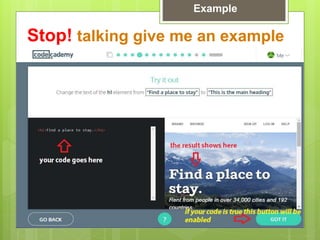
 Code academy is a good example just register
>login >start learning whenever and what ever
you want
What is it all about
Stop! talking give me an example
Example
To make it simpler:
 The difference between real time video
chatting and offline learning or application
based learning “like the
codeacademey ”example above can be
cleared if we separate the E-learning system
in two kinds:
 synchronous learning
 asynchronous learning
Kinds of e-learning
What is synchronous learning?
 Examples of synchronous e-learning are
online chat and videoconferencing. Any
learning tool that is in real-time, such as
instant messaging that allows students and
teachers to ask and answer questions
immediately, is synchronous.
synchronous learning
What is asynchronous learning?
 Asynchronous learning on the other hand can be
carried out even when the student or teacher is
offline. Coursework and communications delivered
via web, email and messages posted on
community forums are perfect examples of
asynchronous e-learning. In these instances,
students will typically complete the lessons on
their own and merely use the internet as a support
tool
asynchronous learning
What is LMS?
 What is a LMS?
 LMS stands for Learning Management
System and it's a global term for a computer
system specifically developed for managing
online courses, distributing course materials
and allowing collaboration between students
and teachers.
LMS
 In essence, the LMS is the backbone of most e-
learning activities.
 LMSs are built on various platforms, commonly
PHP, .Net or Java and they will hook up to a
database such as
 PostgreSQL, MySQL or SQL Server. There are
many LMSs out there, both commercial and open
source.
What is LMS?
LMS
E-Learning Creation Tools
 An e-learning authoring tool is a software package
which developers use to create and package e-
learning content deliverable to end users.
 According to Wikipedia.org, “a content-authoring
tool is a software application used to create
multimedia content typically for delivery on the
World Wide Web. Content-authoring tools may
also create content in other file formats so the
training can be delivered on a CD (compact disc)
or in other formats for various different uses.
Creating E-learning
Social Networking??
 Yes YouTube ….
 YouTube is a really good partner of FREE e-
learning, a lot of channels provides hundreds of
videos of all types of learning
like : cooking, technologies , music, studying
etc…
 BY THE WAY this is our Channel
it’s all about computer skills and it’s all free
https://www.youtube.com/user/impactsyria/
YouTube
Technologies used in e-learning
 E-learning makes use of many technologies - some of which have
been developed specifically for it, whilst others conveniently
complemented the learning process, for example computer
games. Communication technologies are also widely used in e-
learning. Starting with the use of email and instant messaging,
message
 forums and social networks, we see a plethora of tools that any
internet user would use in any case.
E-learning Technologies
 There are also some technologies that work in a
complementary manner to other software and
enable new features, for example software that
adds a whiteboard on your video conferencing
tool to allow you or your peers to make changes
on other people’s work for review, or screen-
sharing which allows someone to make a
presentation while still making comments and
giving input using the microphone.
Technologies used in e-learning
E-learning Technologies
 E-learning makes good use of database and
CMS (Content Management System)
technologies. These two work hand in hand to
store your course content, test results and
student records. The data is stored in the
database and the CMS provides a user
interface for you to add, update and delete
data. A good LMS will often provide reporting
tools to generate and store progress reports.
Technologies used in e-learning
E-learning Technologies
E-learning trends
1-Blended learning
Blended learning is a combination of offline
(face-to-face, traditional learning) and online
learning in a way that the one compliments
the other. It provides individuals with the
opportunity to enjoy the best of both worlds.
E-learning trends
2-Social and collaborative learning
Collaborative learning is an e-learning approach
where students are able to socially interact with
other students, as well as instructors. In essence,
learners work together in order to expand their
knowledge of a particular subject or skill. In e-
learning environments, this is typically done
through live chats, message boards, or instant
messaging.
E-learning trends
3-Micro-learning
Micro-learning involves learning in smaller
steps, and goes hand-in-hand with traditional
e-learning. Activities that are micro-learning
based usually feature short term lessons,
projects, or coursework that is designed to
provide the student with ‘bits’ of information.
For example, rather than trying to teach a
student about a broad subject all at once,
aspects of the topic will be broken down into
smaller lesson plans or projects.
E-learning trends
4-Personalization
Key elements that are customized in
personalized e-learning are: the pace of
learning, the instructional approach, and
lessons and activities that draw upon the
student's experience and interests. In truly
personalized e-learning environments
students are given the chance to learn what
they want when they want, and even the
method of learning! This typically leads to
improved learning results.
E-learning trends
5-Continuous learning
On a personal level, continuous learning is
about the constant expansion of skills and
skill-sets through learning and increasing
knowledge. As life changes the need to adapt
both professionally and personally is as real
as the changes themselves.
E-learning trends
What about Syria?
E-learning in Schools and universities
Action policies taken by
Syrian Government toward utilizing
ICT in e-learning in schools and
universities are briefly .
What about Syria?
Online University Distance
Education
o In this regard, Syria by means of the Ministry
of Higher Education, erected in September
2002 the first online university in Arab World
naming it Syrian Virtual University (SVU).
o SVU is expected from the start to provide
world-class education without boundaries,
internationally accredited degrees, and to link
the Arab region with the western world.
What about Syria?
The Syrian Virtual
University
SVU is fully accredited and endorsed by the Syrian
Ministry of Higher Education. The primarily goals of
SVU are to provide Arab students worldwide with a
world-class quality education at home through an
integrated online learning environments by utilizing
international experiences and the latest
technological and educational advances. Further,
the Syrian Virtual University has a unique role to
exercise in establishing and promoting a new
educational culture in Arab Middle East, that is:
Lifelong Learning.
SVU
E-learning for Syrian war injuries
E-Learning For Syria
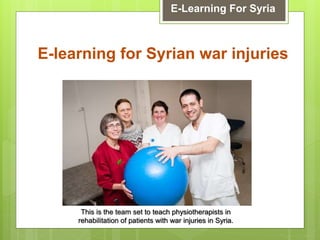
This is the team set to teach physiotherapists in
rehabilitation of patients with war injuries in Syria.
E-learning for Syrian war injuries
E-Learning For Syria
In an effort to contribute to the growing need of
physiotherapy and rehabilitation services, the
Norwegian Centre for Integrated Care and Telemedicine
(NST) and the department for physiotherapy at the
University Hospital of North Norway (UNN) has offered
to teach and give guidance to local physiotherapists in
Syria. The project is financed by Norwegian Aid
Committee (NORWAC) with support from the
Norwegian department for exterior affairs (UD).
 With this unit as a starting point NST and
UNN will teach and give guidance both on site
and from distance using telemedicine
solutions and e-learning. The unit will be tied
to one of the temporary health centers already
established in some areas.
E-learning for Syrian war injuries
E-Learning For Syria

E learning

  • 1.
    Presentation by EhabAhmad Master Student of information technology engineering
  • 2.
  • 3.
    Headlines Links  Thehistory of e-learning  Health related issues of e- learning  Can we learn Online?  How to get the best Benefit?  Where can i learn?  VS in Class learning  What about the future?  How to do it?  Is it all about video learning ?  Example  Types of E-learning o LMS LMS  E-learning Technologies  E-learning Trends  What ABOUT SYRIA Click on any link you like:
  • 4.
  • 5.
    The history ofe-learning The term “e-learning” has only been in existence since 1999, when the word was first utilized at a CBT systems seminar. Other words also began to spring up in search of an accurate description such as “online learning” and “virtual learning”. However, the principles behind e-learning have been well documented throughout history, and there is even evidence which suggests that early forms of e-learning existed as far back as the 19th century. History
  • 6.
    In 1924, thefirst testing machine was invented. This device allowed students to tests themselves. Then, in 1954, BF Skinner, a Harvard Professor, invented the “teaching machine”, which enabled schools to administer programmed instruction to their students. It wasn’t until 1960 however that the first computer based training program was introduced to the world. Histor y
  • 7.
    Health related issuesof e-learning E-learning requires the use of a computer and other such devices; this means that eyestrain, bad posture and other physical problems may affect the learner. When running an online course it’s a good practice to send out guidelines about correct sitting posture, desk height, and recommendations for regular breaks. Health
  • 8.
    Can we learnOnline? E-Learning, in comparison with traditional learning, significantly reduces the time needed to locate information. It also offers access to online resources, databases, periodicals, journals and other material you wouldn't normally have access to from a library Can we?
  • 9.
    If a studenthas trouble understanding part of the coursework, finding tips on the matter couldn't be easier than having immediate access to supplementary, unlimited and mostly free material online! Those characteristics can potentially maximize the time spent actually learning rather than looking for information Can we learn Online? Can we?
  • 10.
    How to getthe best Benefit?  Online learning can offer a wide range of benefits. However, the knowledge that a student is able to acquire this way depends not only on the course material that is offered, but also the practices used to provide them with this information. Here are just a few of the best practices of online training which help to better facilitate the e-learning process: Get the Benefit
  • 11.
     A supportivecommunity  Clear expectations  Asynchronous and synchronous activities  Effective usage of available resources How to get the best Benefit? Get the Benefit
  • 12.
    Where can ilearn?  E-learning allows both students and business executives to learn anywhere and at any time. You can learn from  virtually any place with a computer or mobile device and internet connection, meaning you can study from home, on vacation or in your break. Every where Every Time
  • 13.
    VS in Classlearning  What happens in educational institutes?  In comparison with corporate learning, learning in the education sector focuses primarily on knowledge transfer and not on training i.e. in education we mainly strive to learn things with global scope (e.g. a subject such as mathematics) whilst corporate e-learning is more focused on business needs (e.g. new recruit induction). Versus
  • 14.
    What about thefuture?  The future of e-learning  E-learning is here to stay. As computer ownership grows across the globe e-learning becomes increasingly viable and accessible. Internet connection speeds are increasing, and with that, opportunities for more multimedia training methods arise. With the immense improvement of mobile networks in the past few years and the increase in telecommuting, taking all the awesome features of e-learning on the road is a reality with smart phones and other portable devices. Technologies such as social media are also transforming education constantly. Future?
  • 15.
    How to doit?  There are a lot of simple ways to get the Benefit of the E-learning if you are a teacher you could connect your student with you on SKYPE which is a simple way to camera chat with your students  A lot of websites gives free online lessons through there websites in a scheduled time while the students just have to register on their website How to do it
  • 16.
    Is it allabout video learning ?  The answer is no for sure a lot of sites doesn’t support video learning but they have their own learning machines which are several applications about several courses .these applications can lead you to your goal without a teacher at all.  Code academy is a good example just register >login >start learning whenever and what ever you want What is it all about
  • 17.
    Stop! talking giveme an example Example
  • 18.
    To make itsimpler:  The difference between real time video chatting and offline learning or application based learning “like the codeacademey ”example above can be cleared if we separate the E-learning system in two kinds:  synchronous learning  asynchronous learning Kinds of e-learning
  • 19.
    What is synchronouslearning?  Examples of synchronous e-learning are online chat and videoconferencing. Any learning tool that is in real-time, such as instant messaging that allows students and teachers to ask and answer questions immediately, is synchronous. synchronous learning
  • 20.
    What is asynchronouslearning?  Asynchronous learning on the other hand can be carried out even when the student or teacher is offline. Coursework and communications delivered via web, email and messages posted on community forums are perfect examples of asynchronous e-learning. In these instances, students will typically complete the lessons on their own and merely use the internet as a support tool asynchronous learning
  • 21.
    What is LMS? What is a LMS?  LMS stands for Learning Management System and it's a global term for a computer system specifically developed for managing online courses, distributing course materials and allowing collaboration between students and teachers. LMS
  • 22.
     In essence,the LMS is the backbone of most e- learning activities.  LMSs are built on various platforms, commonly PHP, .Net or Java and they will hook up to a database such as  PostgreSQL, MySQL or SQL Server. There are many LMSs out there, both commercial and open source. What is LMS? LMS
  • 23.
    E-Learning Creation Tools An e-learning authoring tool is a software package which developers use to create and package e- learning content deliverable to end users.  According to Wikipedia.org, “a content-authoring tool is a software application used to create multimedia content typically for delivery on the World Wide Web. Content-authoring tools may also create content in other file formats so the training can be delivered on a CD (compact disc) or in other formats for various different uses. Creating E-learning
  • 24.
    Social Networking??  YesYouTube ….  YouTube is a really good partner of FREE e- learning, a lot of channels provides hundreds of videos of all types of learning like : cooking, technologies , music, studying etc…  BY THE WAY this is our Channel it’s all about computer skills and it’s all free https://www.youtube.com/user/impactsyria/ YouTube
  • 25.
    Technologies used ine-learning  E-learning makes use of many technologies - some of which have been developed specifically for it, whilst others conveniently complemented the learning process, for example computer games. Communication technologies are also widely used in e- learning. Starting with the use of email and instant messaging, message  forums and social networks, we see a plethora of tools that any internet user would use in any case. E-learning Technologies
  • 26.
     There arealso some technologies that work in a complementary manner to other software and enable new features, for example software that adds a whiteboard on your video conferencing tool to allow you or your peers to make changes on other people’s work for review, or screen- sharing which allows someone to make a presentation while still making comments and giving input using the microphone. Technologies used in e-learning E-learning Technologies
  • 27.
     E-learning makesgood use of database and CMS (Content Management System) technologies. These two work hand in hand to store your course content, test results and student records. The data is stored in the database and the CMS provides a user interface for you to add, update and delete data. A good LMS will often provide reporting tools to generate and store progress reports. Technologies used in e-learning E-learning Technologies
  • 28.
    E-learning trends 1-Blended learning Blendedlearning is a combination of offline (face-to-face, traditional learning) and online learning in a way that the one compliments the other. It provides individuals with the opportunity to enjoy the best of both worlds. E-learning trends
  • 29.
    2-Social and collaborativelearning Collaborative learning is an e-learning approach where students are able to socially interact with other students, as well as instructors. In essence, learners work together in order to expand their knowledge of a particular subject or skill. In e- learning environments, this is typically done through live chats, message boards, or instant messaging. E-learning trends
  • 30.
    3-Micro-learning Micro-learning involves learningin smaller steps, and goes hand-in-hand with traditional e-learning. Activities that are micro-learning based usually feature short term lessons, projects, or coursework that is designed to provide the student with ‘bits’ of information. For example, rather than trying to teach a student about a broad subject all at once, aspects of the topic will be broken down into smaller lesson plans or projects. E-learning trends
  • 31.
    4-Personalization Key elements thatare customized in personalized e-learning are: the pace of learning, the instructional approach, and lessons and activities that draw upon the student's experience and interests. In truly personalized e-learning environments students are given the chance to learn what they want when they want, and even the method of learning! This typically leads to improved learning results. E-learning trends
  • 32.
    5-Continuous learning On apersonal level, continuous learning is about the constant expansion of skills and skill-sets through learning and increasing knowledge. As life changes the need to adapt both professionally and personally is as real as the changes themselves. E-learning trends
  • 33.
    What about Syria? E-learningin Schools and universities Action policies taken by Syrian Government toward utilizing ICT in e-learning in schools and universities are briefly . What about Syria?
  • 34.
    Online University Distance Education oIn this regard, Syria by means of the Ministry of Higher Education, erected in September 2002 the first online university in Arab World naming it Syrian Virtual University (SVU). o SVU is expected from the start to provide world-class education without boundaries, internationally accredited degrees, and to link the Arab region with the western world. What about Syria?
  • 35.
    The Syrian Virtual University SVUis fully accredited and endorsed by the Syrian Ministry of Higher Education. The primarily goals of SVU are to provide Arab students worldwide with a world-class quality education at home through an integrated online learning environments by utilizing international experiences and the latest technological and educational advances. Further, the Syrian Virtual University has a unique role to exercise in establishing and promoting a new educational culture in Arab Middle East, that is: Lifelong Learning. SVU
  • 36.
    E-learning for Syrianwar injuries E-Learning For Syria This is the team set to teach physiotherapists in rehabilitation of patients with war injuries in Syria.
  • 37.
    E-learning for Syrianwar injuries E-Learning For Syria In an effort to contribute to the growing need of physiotherapy and rehabilitation services, the Norwegian Centre for Integrated Care and Telemedicine (NST) and the department for physiotherapy at the University Hospital of North Norway (UNN) has offered to teach and give guidance to local physiotherapists in Syria. The project is financed by Norwegian Aid Committee (NORWAC) with support from the Norwegian department for exterior affairs (UD).
  • 38.
     With thisunit as a starting point NST and UNN will teach and give guidance both on site and from distance using telemedicine solutions and e-learning. The unit will be tied to one of the temporary health centers already established in some areas. E-learning for Syrian war injuries E-Learning For Syria