Dr. Anjali Sharma
Associate Professor, Department of Education, Tezpur, Assam.
Ms. Neha Rawat
Research Scholar, Department Of Education,
University of Rajasthan, Jaipur, Rajasthan.
Any where-anytime-lifelong-
life-wide medium of Learning.
8/17/2017Anjali Sharma & Neha Rawat 2
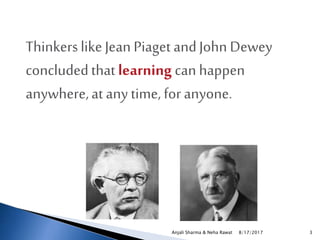
ThinkerslikeJean Piaget andJohn Dewey
concludedthat learning can happen
anywhere,at any time, for anyone.
8/17/2017Anjali Sharma & Neha Rawat 3
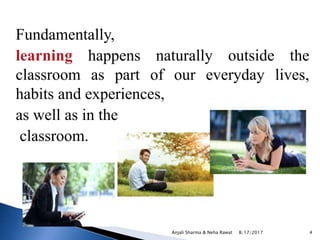
Fundamentally,
learning happens naturally outside the
classroom as part of our everyday lives,
habits and experiences,
as well as in the
classroom.
8/17/2017Anjali Sharma & Neha Rawat 4
8/17/2017Anjali Sharma & Neha Rawat 5
8/17/2017Anjali Sharma & Neha Rawat 6
8/17/2017Anjali Sharma & Neha Rawat 7
 Massive Open Online course (MOOC)
 Technology Enhanced Learning(TEL)
 Computer Based Learning(CBL)
 Computer Assisted Learning (CAL)
 Computer Based Instructions (CBI)
 Computer Aided Learning (CAL)
 Web- Based Learning (WBL)
 Online Education
 Online Learning
 Internet Based Learning(IBL)
8/17/2017Anjali Sharma & Neha Rawat 8
“E-learning is the use of electronic media for a
variety of learning purposes that range from
add-on functions in conventional classrooms to
full substitution for the face-to-face meetings
by online encounters .
(Guri-
Rosenblit)
“E-learning is to take a course online using
a modem, wireless, or cable connection to
access academic course material from a
computer, phone, or handheld device.”
Governors State
University
8/17/2017Anjali Sharma & Neha Rawat 9
Technology-Driven
Definitions
“E-learning is an on-line education
defined as the self-paced or real-
time delivery of training and
education over the internet to an
end-user device”
Lee &
Lee
8/17/2017Anjali Sharma & Neha Rawat 10
“E-learning is learning based on
information and communication technologies
with pedagogical interaction between students
and the content, students and the instructors
or among students through the web”
González-Videgaray
8/17/2017Anjali Sharma & Neha Rawat 11
“E-learning refers to educational processes
that utilise information and communications
technology to mediate synchronous as well as
asynchronous learning and teaching
activities”
Jereb & Šmitek
8/17/2017Anjali Sharma & Neha Rawat 12
8/17/2017Anjali Sharma & Neha Rawat 13
E / Revolution of E-
Learning
8/17/2017Anjali Sharma & Neha Rawat 14
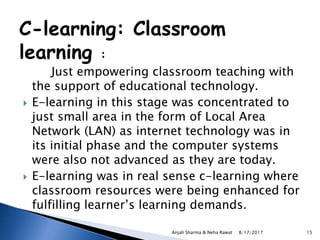
C-learning: Classroom
learning :
Just empowering classroom teaching with
the support of educational technology.
 E-learning in this stage was concentrated to
just small area in the form of Local Area
Network (LAN) as internet technology was in
its initial phase and the computer systems
were also not advanced as they are today.
 E-learning was in real sense c-learning where
classroom resources were being enhanced for
fulfilling learner’s learning demands.
8/17/2017Anjali Sharma & Neha Rawat 15
 First Computer Based
Lecture can be traced from
1960, a year when for the
first time the University of
Illinois initiated a classroom
system based on linked
computer terminals where
students could access
informational resources on a
particular course while
listening to the lectures that
were recorded via some
form of remotely device like
television or audio device
 Local Area Network (LAN) based
lectures in Universities:In the same
year, Stanford University psychology
professors Patrick Suppes and Richard
C. Atkinson experimented with using
computers to teach math and reading
to young children in elementary
schools in East Palo Alto, California.
Stanford's Education Program for
Gifted Youth is descended from those
early experiments. In 1963, Bernard
Luskin installed the first computer in a
community college for instruction,
from then many universities embraced
e-learning in diverse educational areas.
8/17/2017Anjali Sharma & Neha Rawat 16
 Origin of Internet: In year 1960 The United States
government commissioned to build robust, fault-tolerant
communication computer network. This was the origin of
Internet. The already existing ARPANET served as primary
precursor network frontier connecting emerging networks
of regional, academic and military to make World Wide
Web.
(“Internet”, n. d.).
 Origin of wireless Communication: In 1962, the world's
first active communications satellite, Telstar 1, was
launched AT&T and Bell Laboratories. This was the dawn
of revolutionary era of wireless communication.
(“Communication Satellite”, n. d.)
8/17/2017Anjali Sharma & Neha Rawat 17
 The microprocessor brought the fourth generation of
computers, as thousands of integrated circuits were
built onto a single silicon chip. The Intel 4004 chip,
developed in 1971, located all the components of the
computer—from the central processing unit and
memory to input/output controls—on a single
chip.1981 IBM introduced its first computer for the
home users, and in 1984 Apple introduced the
Macintosh. Microprocessors computers were small
and handy so they became more powerful. They
could be linked together to form networks, which
eventually led to the development of the Internet.
Fourth generation computers also saw the
development of GUIs,
the mouse and handheld devices. (Beal, 2015)
8/17/2017Anjali Sharma & Neha Rawat 18
Final contender in the development of E-
learning is advancement of distance learning
through internet. The origin of first distance
education is considered to be 1840 when
Isaac Pitman taught his pupils shorthand via
correspondence. But modern distance
learning took leap with the growing power of
E-learning. The first open University in Britain
started utilized potential of E-learning to
offer wide range of interactive educational
courses via e-mail to students.
8/17/2017Anjali Sharma & Neha Rawat 19
 This term Me-learning has been coined from
mobile learning concept. “Me” here points
towards mobile learning which is highly
personalized form of learning across multiple
contexts, through social and content
interactions, using personal electronic
devices. M-learning technologies include
handheld computers, MP3 players,
notebooks, mobile phones and tablets. (“M-
learning”, 2015).
8/17/2017Anjali Sharma & Neha Rawat 20
 In October 2001, NTT Do Co Mo Japan
pioneered the 3G mobile services. 3G
transformed the mobile industry and enabled
wide spread mobile Internet services possible
like Internet TV and Radio. With its high
speed mobile devices have become more fast
and compact.(Brookes, n.d.)
8/17/2017Anjali Sharma & Neha Rawat 21
All nations are adopting we-learning
which is futuristic form of E-learning. Latest
electronic gadgets, high speed internet
communication and 4G mobile connections
have supported we-learning appropriately.
Collaborative approaches of E-learning are
social-networking platforms and various
online learning applications.
8/17/2017Anjali Sharma & Neha Rawat 22
8/17/2017Anjali Sharma & Neha Rawat 23
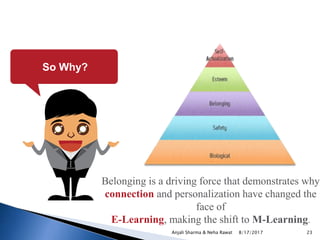
So Why?
Belonging is a driving force that demonstrates why
connection and personalization have changed the
face of
E-Learning, making the shift to M-Learning.
Knowledge Management
Knowledge
Communities
knowledge communities use
collective intelligence, able to
convert tacit knowledge to explicit
KC are the best way to
develop knowledge path among
various partners of society 8/17/2017Anjali Sharma & Neha Rawat 24
8/17/2017Anjali Sharma & Neha Rawat 25
Sharing Knowledge
Talking Therapy,
Organizational Dialogue
Learning Conversations
8/17/2017Anjali Sharma & Neha Rawat 26
As E-learning has become so omnipresent
that it is imperative to explore its new
perspective according to future collaborative
societies.
E-learning has to be given two new
dimensions namely endless and essential
along with emotional. These three words
together define future of E-learning
8/17/2017Anjali Sharma & Neha Rawat 27
 E-learning can be used not only for
collaborative learning, but also for
autonomous, individual learning.
 E-learning is a means of facilitating the
achievement of (formal or informal) learning
goals.
 E-learning is a new learning/training model, a
new way to learn.
8/17/2017Anjali Sharma & Neha Rawat 28
Short video lectures are viewed by
students at home before the class session,
while in-class time is devoted to exercises,
projects, or discussions. The video lecture is
often seen as the key ingredient in the flipped
approach, such lectures being either created
by the instructor and posted online or
selected from an online repository.
8/17/2017Anjali Sharma & Neha Rawat 29
The ubiquitous learning
environment provides an
interoperable, pervasive, and
seamless learning architecture to
connect, integrate, and share three
major dimensions of learning
resources: learning collaborators,
learning contents, and learning
services (Cheng, et. al., 2005;
Haruo, et. al.,
8/17/2017Anjali Sharma & Neha Rawat 30
 MOOCs are a recent and widely researched
development in distance education which was
first introduced in 2008 and emerged as a
popular mode of learning in 2012.
 MOOCs allow millions of people to take the same
course at once from just about anywhere in the
world.
 Online courses and MOOCs are similar in a lot of
ways. The one main difference between them
is interaction. Online courses are not interactive
and they involve a single learner, almost at all
times.
8/17/2017Anjali Sharma & Neha Rawat 31
 Interactive user forums to support
community
 Unlimited participation and open
access via the web.
 Interactions between students,
professors, and teaching assistants
8/17/2017Anjali Sharma & Neha Rawat 32
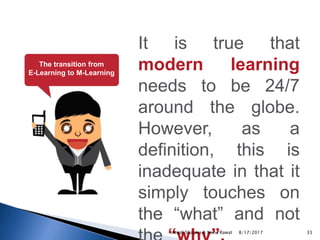
The transition from
E-Learning to M-Learning
It is true that
modern learning
needs to be 24/7
around the globe.
However, as a
definition, this is
inadequate in that it
simply touches on
the “what” and not
8/17/2017Anjali Sharma & Neha Rawat 33
Talk and work
Talk made the
work more intelligible
and work made talk
intelligible
8/17/2017Anjali Sharma & Neha Rawat 34
for inclusion of all so e-
learning has shifted to
we-learning which
supports a combined
environment of
collaborative learning
where there is online or
offline exchange of8/17/2017Anjali Sharma & Neha Rawat 35
E- Learning

E- Learning

  • 1.
    Dr. Anjali Sharma AssociateProfessor, Department of Education, Tezpur, Assam. Ms. Neha Rawat Research Scholar, Department Of Education, University of Rajasthan, Jaipur, Rajasthan.
  • 2.
    Any where-anytime-lifelong- life-wide mediumof Learning. 8/17/2017Anjali Sharma & Neha Rawat 2
  • 3.
    ThinkerslikeJean Piaget andJohnDewey concludedthat learning can happen anywhere,at any time, for anyone. 8/17/2017Anjali Sharma & Neha Rawat 3
  • 4.
    Fundamentally, learning happens naturallyoutside the classroom as part of our everyday lives, habits and experiences, as well as in the classroom. 8/17/2017Anjali Sharma & Neha Rawat 4
  • 5.
  • 6.
  • 7.
    8/17/2017Anjali Sharma &Neha Rawat 7  Massive Open Online course (MOOC)  Technology Enhanced Learning(TEL)  Computer Based Learning(CBL)  Computer Assisted Learning (CAL)  Computer Based Instructions (CBI)  Computer Aided Learning (CAL)  Web- Based Learning (WBL)  Online Education  Online Learning  Internet Based Learning(IBL)
  • 8.
  • 9.
    “E-learning is theuse of electronic media for a variety of learning purposes that range from add-on functions in conventional classrooms to full substitution for the face-to-face meetings by online encounters . (Guri- Rosenblit) “E-learning is to take a course online using a modem, wireless, or cable connection to access academic course material from a computer, phone, or handheld device.” Governors State University 8/17/2017Anjali Sharma & Neha Rawat 9 Technology-Driven Definitions
  • 10.
    “E-learning is anon-line education defined as the self-paced or real- time delivery of training and education over the internet to an end-user device” Lee & Lee 8/17/2017Anjali Sharma & Neha Rawat 10
  • 11.
    “E-learning is learningbased on information and communication technologies with pedagogical interaction between students and the content, students and the instructors or among students through the web” González-Videgaray 8/17/2017Anjali Sharma & Neha Rawat 11
  • 12.
    “E-learning refers toeducational processes that utilise information and communications technology to mediate synchronous as well as asynchronous learning and teaching activities” Jereb & Šmitek 8/17/2017Anjali Sharma & Neha Rawat 12
  • 13.
  • 14.
    E / Revolutionof E- Learning 8/17/2017Anjali Sharma & Neha Rawat 14
  • 15.
    C-learning: Classroom learning : Justempowering classroom teaching with the support of educational technology.  E-learning in this stage was concentrated to just small area in the form of Local Area Network (LAN) as internet technology was in its initial phase and the computer systems were also not advanced as they are today.  E-learning was in real sense c-learning where classroom resources were being enhanced for fulfilling learner’s learning demands. 8/17/2017Anjali Sharma & Neha Rawat 15
  • 16.
     First ComputerBased Lecture can be traced from 1960, a year when for the first time the University of Illinois initiated a classroom system based on linked computer terminals where students could access informational resources on a particular course while listening to the lectures that were recorded via some form of remotely device like television or audio device  Local Area Network (LAN) based lectures in Universities:In the same year, Stanford University psychology professors Patrick Suppes and Richard C. Atkinson experimented with using computers to teach math and reading to young children in elementary schools in East Palo Alto, California. Stanford's Education Program for Gifted Youth is descended from those early experiments. In 1963, Bernard Luskin installed the first computer in a community college for instruction, from then many universities embraced e-learning in diverse educational areas. 8/17/2017Anjali Sharma & Neha Rawat 16
  • 17.
     Origin ofInternet: In year 1960 The United States government commissioned to build robust, fault-tolerant communication computer network. This was the origin of Internet. The already existing ARPANET served as primary precursor network frontier connecting emerging networks of regional, academic and military to make World Wide Web. (“Internet”, n. d.).  Origin of wireless Communication: In 1962, the world's first active communications satellite, Telstar 1, was launched AT&T and Bell Laboratories. This was the dawn of revolutionary era of wireless communication. (“Communication Satellite”, n. d.) 8/17/2017Anjali Sharma & Neha Rawat 17
  • 18.
     The microprocessorbrought the fourth generation of computers, as thousands of integrated circuits were built onto a single silicon chip. The Intel 4004 chip, developed in 1971, located all the components of the computer—from the central processing unit and memory to input/output controls—on a single chip.1981 IBM introduced its first computer for the home users, and in 1984 Apple introduced the Macintosh. Microprocessors computers were small and handy so they became more powerful. They could be linked together to form networks, which eventually led to the development of the Internet. Fourth generation computers also saw the development of GUIs, the mouse and handheld devices. (Beal, 2015) 8/17/2017Anjali Sharma & Neha Rawat 18
  • 19.
    Final contender inthe development of E- learning is advancement of distance learning through internet. The origin of first distance education is considered to be 1840 when Isaac Pitman taught his pupils shorthand via correspondence. But modern distance learning took leap with the growing power of E-learning. The first open University in Britain started utilized potential of E-learning to offer wide range of interactive educational courses via e-mail to students. 8/17/2017Anjali Sharma & Neha Rawat 19
  • 20.
     This termMe-learning has been coined from mobile learning concept. “Me” here points towards mobile learning which is highly personalized form of learning across multiple contexts, through social and content interactions, using personal electronic devices. M-learning technologies include handheld computers, MP3 players, notebooks, mobile phones and tablets. (“M- learning”, 2015). 8/17/2017Anjali Sharma & Neha Rawat 20
  • 21.
     In October2001, NTT Do Co Mo Japan pioneered the 3G mobile services. 3G transformed the mobile industry and enabled wide spread mobile Internet services possible like Internet TV and Radio. With its high speed mobile devices have become more fast and compact.(Brookes, n.d.) 8/17/2017Anjali Sharma & Neha Rawat 21
  • 22.
    All nations areadopting we-learning which is futuristic form of E-learning. Latest electronic gadgets, high speed internet communication and 4G mobile connections have supported we-learning appropriately. Collaborative approaches of E-learning are social-networking platforms and various online learning applications. 8/17/2017Anjali Sharma & Neha Rawat 22
  • 23.
    8/17/2017Anjali Sharma &Neha Rawat 23 So Why? Belonging is a driving force that demonstrates why connection and personalization have changed the face of E-Learning, making the shift to M-Learning.
  • 24.
    Knowledge Management Knowledge Communities knowledge communitiesuse collective intelligence, able to convert tacit knowledge to explicit KC are the best way to develop knowledge path among various partners of society 8/17/2017Anjali Sharma & Neha Rawat 24
  • 25.
  • 26.
    Sharing Knowledge Talking Therapy, OrganizationalDialogue Learning Conversations 8/17/2017Anjali Sharma & Neha Rawat 26
  • 27.
    As E-learning hasbecome so omnipresent that it is imperative to explore its new perspective according to future collaborative societies. E-learning has to be given two new dimensions namely endless and essential along with emotional. These three words together define future of E-learning 8/17/2017Anjali Sharma & Neha Rawat 27
  • 28.
     E-learning canbe used not only for collaborative learning, but also for autonomous, individual learning.  E-learning is a means of facilitating the achievement of (formal or informal) learning goals.  E-learning is a new learning/training model, a new way to learn. 8/17/2017Anjali Sharma & Neha Rawat 28
  • 29.
    Short video lecturesare viewed by students at home before the class session, while in-class time is devoted to exercises, projects, or discussions. The video lecture is often seen as the key ingredient in the flipped approach, such lectures being either created by the instructor and posted online or selected from an online repository. 8/17/2017Anjali Sharma & Neha Rawat 29
  • 30.
    The ubiquitous learning environmentprovides an interoperable, pervasive, and seamless learning architecture to connect, integrate, and share three major dimensions of learning resources: learning collaborators, learning contents, and learning services (Cheng, et. al., 2005; Haruo, et. al., 8/17/2017Anjali Sharma & Neha Rawat 30
  • 31.
     MOOCs area recent and widely researched development in distance education which was first introduced in 2008 and emerged as a popular mode of learning in 2012.  MOOCs allow millions of people to take the same course at once from just about anywhere in the world.  Online courses and MOOCs are similar in a lot of ways. The one main difference between them is interaction. Online courses are not interactive and they involve a single learner, almost at all times. 8/17/2017Anjali Sharma & Neha Rawat 31
  • 32.
     Interactive userforums to support community  Unlimited participation and open access via the web.  Interactions between students, professors, and teaching assistants 8/17/2017Anjali Sharma & Neha Rawat 32
  • 33.
    The transition from E-Learningto M-Learning It is true that modern learning needs to be 24/7 around the globe. However, as a definition, this is inadequate in that it simply touches on the “what” and not 8/17/2017Anjali Sharma & Neha Rawat 33
  • 34.
    Talk and work Talkmade the work more intelligible and work made talk intelligible 8/17/2017Anjali Sharma & Neha Rawat 34
  • 35.
    for inclusion ofall so e- learning has shifted to we-learning which supports a combined environment of collaborative learning where there is online or offline exchange of8/17/2017Anjali Sharma & Neha Rawat 35

Editor's Notes