E-Learning- Concept, Need,
Characteristics, Types & Application
Presentation By: Dr. Pratibha Sagar
What is E-Learning ?
A learning system based
on formalized teaching
but with the help of
electronic resources
learning facilitated and
supported by
Information
Communication
technologies (ICT)
enable people to learn
anytime and anywhere
use of technology to
connect teachers and
students who are
physically miles apart
E-Learning is learning
utilizing electronic technologies to
access educational curriculum
outside of a
traditional classroom
refers to a course,
program or degree
delivered completely
online.
eLearning as courses
that are specifically
delivered via the
internet to
somewhere other
than the classroom
learning process
created by combining
digitally delivered
content with
(learning) support
and services
component of flexible
learning which includes
computer-based
learning, web-based
learning, virtual
classrooms and digital
collaboration
What is E-Learning ?
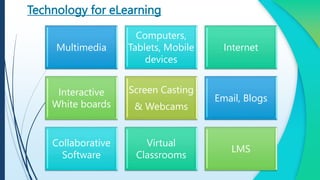
Technology for eLearning
Multimedia
Computers,
Tablets, Mobile
devices
Internet
Interactive
White boards
Screen Casting
& Webcams
Email, Blogs
Collaborative
Software
Virtual
Classrooms
LMS
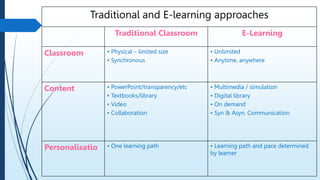
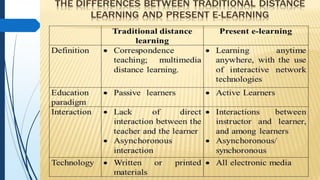
Traditional and E-learning approaches
Traditional Classroom E-Learning
Classroom • Physical – limited size
• Synchronous
• Unlimited
• Anytime, anywhere
Content • PowerPoint/transparency/etc
• Textbooks/library
• Video
• Collaboration
• Multimedia / simulation
• Digital library
• On demand
• Syn & Asyn. Communication
Personalisatio • One learning path • Learning path and pace determined
by learner
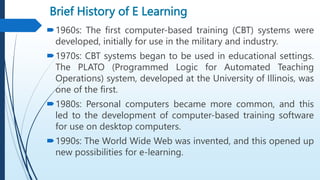
Brief History of E Learning
1960s: The first computer-based training (CBT) systems were
developed, initially for use in the military and industry.
1970s: CBT systems began to be used in educational settings.
The PLATO (Programmed Logic for Automated Teaching
Operations) system, developed at the University of Illinois, was
one of the first.
1980s: Personal computers became more common, and this
led to the development of computer-based training software
for use on desktop computers.
1990s: The World Wide Web was invented, and this opened up
new possibilities for e-learning.
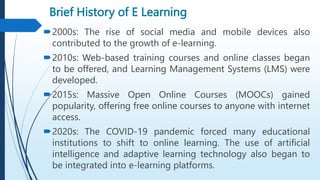
Brief History of E Learning
2000s: The rise of social media and mobile devices also
contributed to the growth of e-learning.
2010s: Web-based training courses and online classes began
to be offered, and Learning Management Systems (LMS) were
developed.
2015s: Massive Open Online Courses (MOOCs) gained
popularity, offering free online courses to anyone with internet
access.
2020s: The COVID-19 pandemic forced many educational
institutions to shift to online learning. The use of artificial
intelligence and adaptive learning technology also began to
be integrated into e-learning platforms.
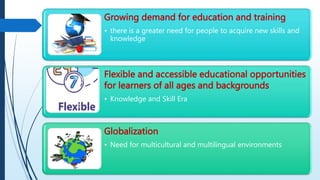
Growing demand for education and training
• there is a greater need for people to acquire new skills and
knowledge
Flexible and accessible educational opportunities
for learners of all ages and backgrounds
• Knowledge and Skill Era
Globalization
• Need for multicultural and multilingual environments
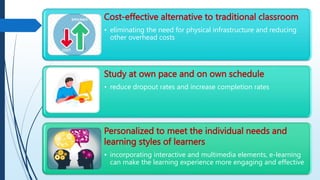
Cost-effective alternative to traditional classroom
• eliminating the need for physical infrastructure and reducing
other overhead costs
Study at own pace and on own schedule
• reduce dropout rates and increase completion rates
Personalized to meet the individual needs and
learning styles of learners
• incorporating interactive and multimedia elements, e-learning
can make the learning experience more engaging and effective
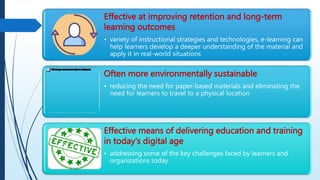
Effective at improving retention and long-term
learning outcomes
• variety of instructional strategies and technologies, e-learning can
help learners develop a deeper understanding of the material and
apply it in real-world situations
Often more environmentally sustainable
• reducing the need for paper-based materials and eliminating the
need for learners to travel to a physical location
Effective means of delivering education and training
in today's digital age
• addressing some of the key challenges faced by learners and
organizations today
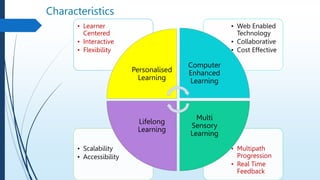
Characteristics
• Multipath
Progression
• Real Time
Feedback
• Scalability
• Accessibility
• Web Enabled
Technology
• Collaborative
• Cost Effective
• Learner
Centered
• Interactive
• Flexibility
Personalised
Learning
Computer
Enhanced
Learning
Multi
Sensory
Learning
Lifelong
Learning
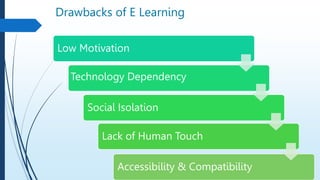
Drawbacks of E Learning
Low Motivation
Technology Dependency
Social Isolation
Lack of Human Touch
Accessibility & Compatibility
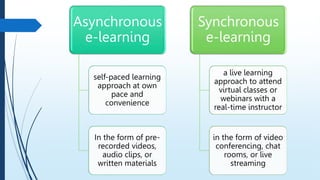
Asynchronous
e-learning
self-paced learning
approach at own
pace and
convenience
In the form of pre-
recorded videos,
audio clips, or
written materials
Synchronous
e-learning
a live learning
approach to attend
virtual classes or
webinars with a
real-time instructor
in the form of video
conferencing, chat
rooms, or live
streaming
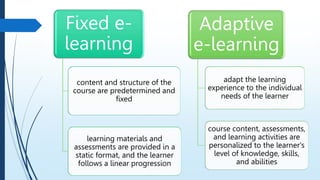
Fixed e-
learning
content and structure of the
course are predetermined and
fixed
learning materials and
assessments are provided in a
static format, and the learner
follows a linear progression
Adaptive
e-learning
adapt the learning
experience to the individual
needs of the learner
course content, assessments,
and learning activities are
personalized to the learner's
level of knowledge, skills,
and abilities
Computer
Managed
Learning (CML)
software applications that are
used to manage and deliver
learning content, track learner
progress, and generate reports
personalized learning experience
that is tailored to individual needs
and learning styles.
Computer
Assisted
Instructions (CAI)
computer technology to assist
in the delivery of instruction
with interactive multimedia
content, such as videos,
animations, and simulations
provide learners with
immediate feedback on their
performance, allowing them to
track their progress
Applications of E-Learning
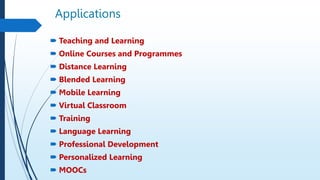
Applications
 Teaching and Learning
 Online Courses and Programmes
 Distance Learning
 Blended Learning
 Mobile Learning
 Virtual Classroom
 Training
 Language Learning
 Professional Development
 Personalized Learning
 MOOCs
E-Learning Presentation.ppsx

E-Learning Presentation.ppsx

  • 1.
    E-Learning- Concept, Need, Characteristics,Types & Application Presentation By: Dr. Pratibha Sagar
  • 2.
    What is E-Learning? A learning system based on formalized teaching but with the help of electronic resources learning facilitated and supported by Information Communication technologies (ICT) enable people to learn anytime and anywhere use of technology to connect teachers and students who are physically miles apart
  • 3.
    E-Learning is learning utilizingelectronic technologies to access educational curriculum outside of a traditional classroom refers to a course, program or degree delivered completely online. eLearning as courses that are specifically delivered via the internet to somewhere other than the classroom learning process created by combining digitally delivered content with (learning) support and services component of flexible learning which includes computer-based learning, web-based learning, virtual classrooms and digital collaboration What is E-Learning ?
  • 4.
    Technology for eLearning Multimedia Computers, Tablets,Mobile devices Internet Interactive White boards Screen Casting & Webcams Email, Blogs Collaborative Software Virtual Classrooms LMS
  • 6.
    Traditional and E-learningapproaches Traditional Classroom E-Learning Classroom • Physical – limited size • Synchronous • Unlimited • Anytime, anywhere Content • PowerPoint/transparency/etc • Textbooks/library • Video • Collaboration • Multimedia / simulation • Digital library • On demand • Syn & Asyn. Communication Personalisatio • One learning path • Learning path and pace determined by learner
  • 7.
    Brief History ofE Learning 1960s: The first computer-based training (CBT) systems were developed, initially for use in the military and industry. 1970s: CBT systems began to be used in educational settings. The PLATO (Programmed Logic for Automated Teaching Operations) system, developed at the University of Illinois, was one of the first. 1980s: Personal computers became more common, and this led to the development of computer-based training software for use on desktop computers. 1990s: The World Wide Web was invented, and this opened up new possibilities for e-learning.
  • 8.
    Brief History ofE Learning 2000s: The rise of social media and mobile devices also contributed to the growth of e-learning. 2010s: Web-based training courses and online classes began to be offered, and Learning Management Systems (LMS) were developed. 2015s: Massive Open Online Courses (MOOCs) gained popularity, offering free online courses to anyone with internet access. 2020s: The COVID-19 pandemic forced many educational institutions to shift to online learning. The use of artificial intelligence and adaptive learning technology also began to be integrated into e-learning platforms.
  • 10.
    Growing demand foreducation and training • there is a greater need for people to acquire new skills and knowledge Flexible and accessible educational opportunities for learners of all ages and backgrounds • Knowledge and Skill Era Globalization • Need for multicultural and multilingual environments
  • 11.
    Cost-effective alternative totraditional classroom • eliminating the need for physical infrastructure and reducing other overhead costs Study at own pace and on own schedule • reduce dropout rates and increase completion rates Personalized to meet the individual needs and learning styles of learners • incorporating interactive and multimedia elements, e-learning can make the learning experience more engaging and effective
  • 12.
    Effective at improvingretention and long-term learning outcomes • variety of instructional strategies and technologies, e-learning can help learners develop a deeper understanding of the material and apply it in real-world situations Often more environmentally sustainable • reducing the need for paper-based materials and eliminating the need for learners to travel to a physical location Effective means of delivering education and training in today's digital age • addressing some of the key challenges faced by learners and organizations today
  • 14.
    Characteristics • Multipath Progression • RealTime Feedback • Scalability • Accessibility • Web Enabled Technology • Collaborative • Cost Effective • Learner Centered • Interactive • Flexibility Personalised Learning Computer Enhanced Learning Multi Sensory Learning Lifelong Learning
  • 17.
    Drawbacks of ELearning Low Motivation Technology Dependency Social Isolation Lack of Human Touch Accessibility & Compatibility
  • 19.
    Asynchronous e-learning self-paced learning approach atown pace and convenience In the form of pre- recorded videos, audio clips, or written materials Synchronous e-learning a live learning approach to attend virtual classes or webinars with a real-time instructor in the form of video conferencing, chat rooms, or live streaming
  • 20.
    Fixed e- learning content andstructure of the course are predetermined and fixed learning materials and assessments are provided in a static format, and the learner follows a linear progression Adaptive e-learning adapt the learning experience to the individual needs of the learner course content, assessments, and learning activities are personalized to the learner's level of knowledge, skills, and abilities
  • 21.
    Computer Managed Learning (CML) software applicationsthat are used to manage and deliver learning content, track learner progress, and generate reports personalized learning experience that is tailored to individual needs and learning styles. Computer Assisted Instructions (CAI) computer technology to assist in the delivery of instruction with interactive multimedia content, such as videos, animations, and simulations provide learners with immediate feedback on their performance, allowing them to track their progress
  • 22.
  • 23.
    Applications  Teaching andLearning  Online Courses and Programmes  Distance Learning  Blended Learning  Mobile Learning  Virtual Classroom  Training  Language Learning  Professional Development  Personalized Learning  MOOCs