E-learning
Submitted by:-
Shruti kumar
What is e-learning?
“There are two great equalisers in life - the internet
and education. By combining the two, e-learning
will be the great equaliser in the next century. By
eliminating barriers of time, distance, and socio-
economic status, individuals can now take charge of
their own lifelong learning.”
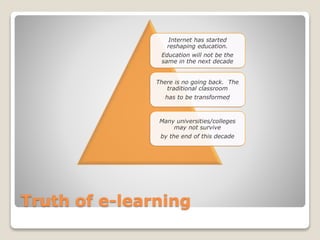
Truth of e-learning
Internet has started
reshaping education.
Education will not be the
same in the next decade
There is no going back. The
traditional classroom
has to be transformed
Many universities/colleges
may not survive
by the end of this decade
E-learning is going to be big
Over the last decade, the number of
corporate universities grew
from 400 to 1,800
Education and
training forms
one of
the largest sectors
of the economy
in most countries
40% of Fortune
500 companies
have established
corporate
universities
Skilled jobs now
represent 85%
of all jobs in US,
in contrast to
20% in 1950.
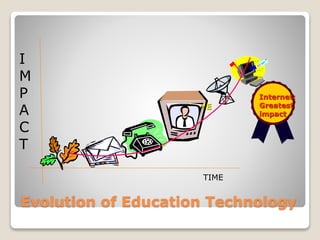
Evolution of Education Technology
TIME
Internet:
Greatest
impact
I
M
P
A
C
T
TIME
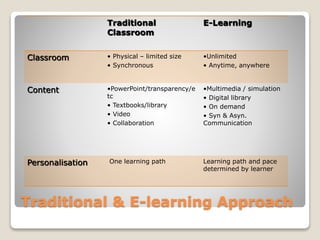
Traditional & E-learning Approach
Traditional
Classroom
E-Learning
Classroom • Physical – limited size
• Synchronous
•Unlimited
• Anytime, anywhere
Content •PowerPoint/transparency/e
tc
• Textbooks/library
• Video
• Collaboration
•Multimedia / simulation
• Digital library
• On demand
• Syn & Asyn.
Communication
Personalisation One learning path Learning path and pace
determined by learner
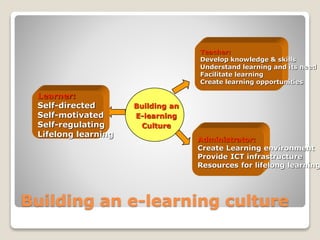
Building an e-learning culture
Building an
E-learning
Culture
Teacher:
Develop knowledge & skills
Understand learning and its need
Facilitate learning
Create learning opportunities
Learner:
Self-directed
Self-motivated
Self-regulating
Lifelong learning
Administrator:
Create Learning environment
Provide ICT infrastructure
Resources for lifelong learning
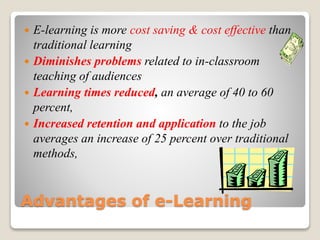
Advantages of e-Learning
 E-learning is more cost saving & cost effective than
traditional learning
 Diminishes problems related to in-classroom
teaching of audiences
 Learning times reduced, an average of 40 to 60
percent,
 Increased retention and application to the job
averages an increase of 25 percent over traditional
methods,
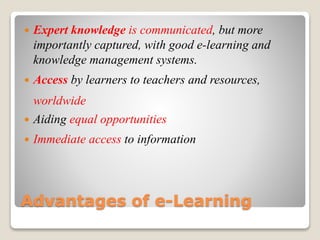
Advantages of e-Learning
 Expert knowledge is communicated, but more
importantly captured, with good e-learning and
knowledge management systems.
 Access by learners to teachers and resources,
worldwide
 Aiding equal opportunities
 Immediate access to information
Advantages of e-learning
 Self-pacing
◦ Users learn at their own pace;Learner can control What to
learn, When, Where, and How.
◦ It reduces stress and increases satisfaction.
◦ You can revise a topic as many times, fast or slow, as you
like, until you understand it.
 On-demand availability
◦ Enables students to complete training conveniently at off-hours or from
home.
 Interactivity
◦ engages users, pushing them rather than pulling them through training.
Advantages of e-Learning
 E-learning encourages students to take personal
responsibility for their own learning.
 Empower students to be accountable for their own
study
 Helps students develop skills for self-directed
learning.
Advantages of e-Learning
 Training occurs in small parcels; a programmed
instruction approach
 When learners succeed, it builds self-knowledge and self-
confidence in them.
 Developing skills and confidence in handling difficult
tasks and problem solving
 Flexibility
◦ E-learning has the advantage of taking class anytime anywhere.
◦ E-learning delivers teaching material and learning activities in a
flexible format.
◦ Potential to develop tailored personalised learning resources (the
adaptive curriculum).
Advantages of e-Learning
 E-learning offers individualized instruction, which
print media cannot provide, and instructor-led
courses allow clumsily and at great cost.
 In conjunction with assessing needs, e-learning can
target specific needs.
 Information can be displayed on a need to know
basis.
Disadvantages
 Technology issues of the learners
◦ Technophobia
◦ Unavailability of required technologies.
◦ Limited access to a computer as well as the Internet.
◦ Required computer skills especially for beginners;
 For beginners, it has been reported that confronting
computer technology was more stressful and
consumed more time at the beginning of a course.
Disadvantages
 Feeling isolated and missing social contact
 Feeling that they communicate largely with a
machine rather than other human beings
 Possible inadequate opportunity to discuss and
interact with teachers
 Portability of training has become a strength of e-
learning, but still does not rival that of printed
workbooks or reference material.
conclusion
 There is a proper interaction between the Admin and the
Employees. All the activities can be carried out
effectively without losing its transparency. This on-line
system will be of great help in carrying out the
registration process, interaction between two different
users(i.e Admin and students),managing their work and
their details.
 This system will save time, and the biggest advantage of
being it web based.This web based system will provide
better prospective for the enhancement of study methods
regarding to quality and transparency.
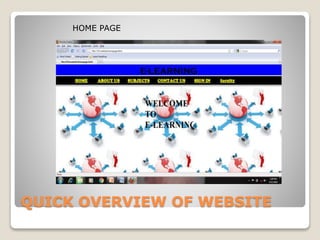
QUICK OVERVIEW OF WEBSITE
HOME PAGE
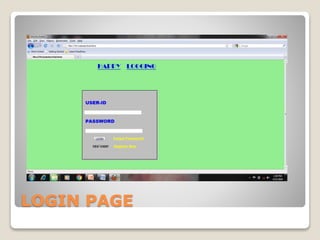
LOGIN PAGE
COURSES OFFERED PAGE
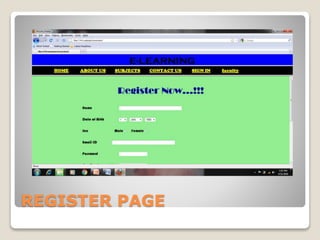
REGISTER PAGE
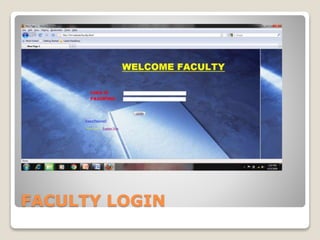
FACULTY LOGIN
WELCOME PAGE
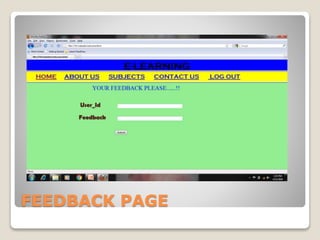
FEEDBACK PAGE
ABOUT WEBSITE
 The purpose of this report is to present a detail
description of the
 “E-Learning” system.
 It will explain the purpose and features of the system, the
interface of the system, what the system will do and how
it will benefit the user.
 This website will mainly be designed for computer
students who want to take help in their course. It will
prove to be helpful to students in their studies as well as
some other mock activities
SCOPE
 This website can be used in educational institutions
as well as for personal use.
 It can be used anywhere anytime as it is a web based
application.
 Self learning of course and self-evaluated material
which are relevant and easily understandable and
accurate.
 Students can save the material.
THANK YOU

ppt

  • 1.
  • 2.
    What is e-learning? “Thereare two great equalisers in life - the internet and education. By combining the two, e-learning will be the great equaliser in the next century. By eliminating barriers of time, distance, and socio- economic status, individuals can now take charge of their own lifelong learning.”
  • 3.
    Truth of e-learning Internethas started reshaping education. Education will not be the same in the next decade There is no going back. The traditional classroom has to be transformed Many universities/colleges may not survive by the end of this decade
  • 4.
    E-learning is goingto be big Over the last decade, the number of corporate universities grew from 400 to 1,800 Education and training forms one of the largest sectors of the economy in most countries 40% of Fortune 500 companies have established corporate universities Skilled jobs now represent 85% of all jobs in US, in contrast to 20% in 1950.
  • 5.
    Evolution of EducationTechnology TIME Internet: Greatest impact I M P A C T TIME
  • 6.
    Traditional & E-learningApproach Traditional Classroom E-Learning Classroom • Physical – limited size • Synchronous •Unlimited • Anytime, anywhere Content •PowerPoint/transparency/e tc • Textbooks/library • Video • Collaboration •Multimedia / simulation • Digital library • On demand • Syn & Asyn. Communication Personalisation One learning path Learning path and pace determined by learner
  • 7.
    Building an e-learningculture Building an E-learning Culture Teacher: Develop knowledge & skills Understand learning and its need Facilitate learning Create learning opportunities Learner: Self-directed Self-motivated Self-regulating Lifelong learning Administrator: Create Learning environment Provide ICT infrastructure Resources for lifelong learning
  • 8.
    Advantages of e-Learning E-learning is more cost saving & cost effective than traditional learning  Diminishes problems related to in-classroom teaching of audiences  Learning times reduced, an average of 40 to 60 percent,  Increased retention and application to the job averages an increase of 25 percent over traditional methods,
  • 9.
    Advantages of e-Learning Expert knowledge is communicated, but more importantly captured, with good e-learning and knowledge management systems.  Access by learners to teachers and resources, worldwide  Aiding equal opportunities  Immediate access to information
  • 10.
    Advantages of e-learning Self-pacing ◦ Users learn at their own pace;Learner can control What to learn, When, Where, and How. ◦ It reduces stress and increases satisfaction. ◦ You can revise a topic as many times, fast or slow, as you like, until you understand it.  On-demand availability ◦ Enables students to complete training conveniently at off-hours or from home.  Interactivity ◦ engages users, pushing them rather than pulling them through training.
  • 11.
    Advantages of e-Learning E-learning encourages students to take personal responsibility for their own learning.  Empower students to be accountable for their own study  Helps students develop skills for self-directed learning.
  • 12.
    Advantages of e-Learning Training occurs in small parcels; a programmed instruction approach  When learners succeed, it builds self-knowledge and self- confidence in them.  Developing skills and confidence in handling difficult tasks and problem solving  Flexibility ◦ E-learning has the advantage of taking class anytime anywhere. ◦ E-learning delivers teaching material and learning activities in a flexible format. ◦ Potential to develop tailored personalised learning resources (the adaptive curriculum).
  • 13.
    Advantages of e-Learning E-learning offers individualized instruction, which print media cannot provide, and instructor-led courses allow clumsily and at great cost.  In conjunction with assessing needs, e-learning can target specific needs.  Information can be displayed on a need to know basis.
  • 14.
    Disadvantages  Technology issuesof the learners ◦ Technophobia ◦ Unavailability of required technologies. ◦ Limited access to a computer as well as the Internet. ◦ Required computer skills especially for beginners;  For beginners, it has been reported that confronting computer technology was more stressful and consumed more time at the beginning of a course.
  • 15.
    Disadvantages  Feeling isolatedand missing social contact  Feeling that they communicate largely with a machine rather than other human beings  Possible inadequate opportunity to discuss and interact with teachers  Portability of training has become a strength of e- learning, but still does not rival that of printed workbooks or reference material.
  • 16.
    conclusion  There isa proper interaction between the Admin and the Employees. All the activities can be carried out effectively without losing its transparency. This on-line system will be of great help in carrying out the registration process, interaction between two different users(i.e Admin and students),managing their work and their details.  This system will save time, and the biggest advantage of being it web based.This web based system will provide better prospective for the enhancement of study methods regarding to quality and transparency.
  • 17.
    QUICK OVERVIEW OFWEBSITE HOME PAGE
  • 18.
  • 19.
  • 20.
  • 21.
  • 22.
  • 23.
  • 24.
    ABOUT WEBSITE  Thepurpose of this report is to present a detail description of the  “E-Learning” system.  It will explain the purpose and features of the system, the interface of the system, what the system will do and how it will benefit the user.  This website will mainly be designed for computer students who want to take help in their course. It will prove to be helpful to students in their studies as well as some other mock activities
  • 25.
    SCOPE  This websitecan be used in educational institutions as well as for personal use.  It can be used anywhere anytime as it is a web based application.  Self learning of course and self-evaluated material which are relevant and easily understandable and accurate.  Students can save the material.
  • 26.