E-Learner Platform 2.0  Technology for Personal Development
Overview E-Learner Platform 2.0 is about leveraging existing open source software and Web 2.0 technology to help children from economically disadvantaged backgrounds learn about the incredible learning tools that are available free and accessible for public usage at low cost.
Uniqueness E-learner Platform 2.0 Motivation Insufficient resources to build computing programs Vocational skills and quick fixes Goals Holistic education: Personal Development + Vocational Training Use of open source and web 2.0 technology A curriculum: Active Self-reliant Creative Critical thinking Sharing/Collaborating/ Living/ Working
Background
Who we are Hung Nguyen - senior student at Foreign Trade University, majoring in International business Matteus Pan - University of Pennsylvania, Computer Science and Finance Paola Di Maio - Information systems and learning specialist working as lecturer and researcher for a university in Thailand John Tim Denny - advisor of the International Development, Education  and ICT and Executive Director of the PC4peace 
Lab Scenario 1: OLPC Pros Educational: actively engaged in a process of learning through doing, learn by teaching, actively assisting other learners Technical: writing, composing, simulating, expressing, constructing, designing, modeling, imagining, creating, critiquing, etc. A profound level of freedom and a gateway to other forms of technology; matching emphasis and goals of the OLPC and E-Learner Platform 2.0 Ownership  Cons Price Age range (performance limitation of XO's for more advanced learners)
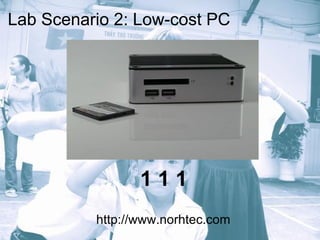
Lab Scenario 2: Low-cost PC     1 1 1 http://www.norhtec.com
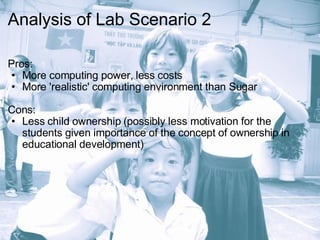
Analysis of Lab Scenario 2 Pros: More computing power, less costs More 'realistic' computing environment than Sugar Cons: Less child ownership (possibly less motivation for the students given importance of the concept of ownership in educational development)
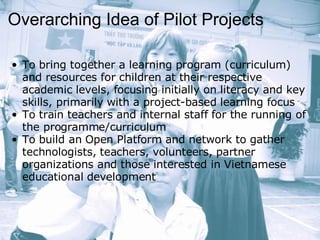
Overarching Idea of Pilot Projects To bring together a learning program (curriculum) and resources for children at their respective academic levels, focusing initially on literacy and key skills, primarily with a project-based learning focus To train teachers and internal staff for the running of the programme/curriculum To build an Open Platform and network to gather technologists, teachers, volunteers, partner organizations and those interested in Vietnamese educational development
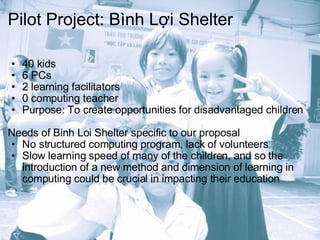
Pilot Project: Bình Lợi Shelter 40 kids 6 PCs 2 learning facilitators 0 computing teacher Purpose: To create opportunities for disadvantaged children Needs of Binh Loi Shelter specific to our proposal No structured computing program, lack of volunteers Slow learning speed of many of the children, and so the introduction of a new method and dimension of learning in computing could be crucial in impacting their education
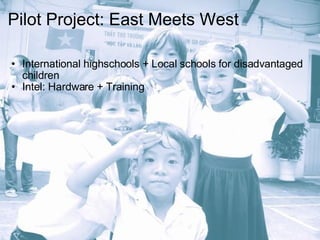
Pilot Project: East Meets West International highschools + Local schools for disadvantaged children Intel: Hardware + Training
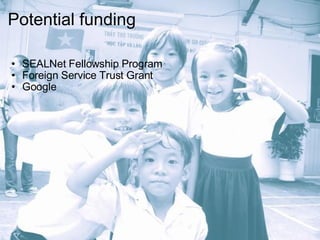
Potential funding     SEALNet Fellowship Program Foreign Service Trust Grant Google

E Learner Platform 2 0

  • 1.
    E-Learner Platform 2.0 Technology for Personal Development
  • 2.
    Overview E-Learner Platform2.0 is about leveraging existing open source software and Web 2.0 technology to help children from economically disadvantaged backgrounds learn about the incredible learning tools that are available free and accessible for public usage at low cost.
  • 3.
    Uniqueness E-learner Platform2.0 Motivation Insufficient resources to build computing programs Vocational skills and quick fixes Goals Holistic education: Personal Development + Vocational Training Use of open source and web 2.0 technology A curriculum: Active Self-reliant Creative Critical thinking Sharing/Collaborating/ Living/ Working
  • 4.
  • 5.
    Who we areHung Nguyen - senior student at Foreign Trade University, majoring in International business Matteus Pan - University of Pennsylvania, Computer Science and Finance Paola Di Maio - Information systems and learning specialist working as lecturer and researcher for a university in Thailand John Tim Denny - advisor of the International Development, Education  and ICT and Executive Director of the PC4peace 
  • 6.
    Lab Scenario 1:OLPC Pros Educational: actively engaged in a process of learning through doing, learn by teaching, actively assisting other learners Technical: writing, composing, simulating, expressing, constructing, designing, modeling, imagining, creating, critiquing, etc. A profound level of freedom and a gateway to other forms of technology; matching emphasis and goals of the OLPC and E-Learner Platform 2.0 Ownership Cons Price Age range (performance limitation of XO's for more advanced learners)
  • 7.
    Lab Scenario 2:Low-cost PC     1 1 1 http://www.norhtec.com
  • 8.
    Analysis of LabScenario 2 Pros: More computing power, less costs More 'realistic' computing environment than Sugar Cons: Less child ownership (possibly less motivation for the students given importance of the concept of ownership in educational development)
  • 9.
    Overarching Idea ofPilot Projects To bring together a learning program (curriculum) and resources for children at their respective academic levels, focusing initially on literacy and key skills, primarily with a project-based learning focus To train teachers and internal staff for the running of the programme/curriculum To build an Open Platform and network to gather technologists, teachers, volunteers, partner organizations and those interested in Vietnamese educational development
  • 10.
    Pilot Project: BìnhLợi Shelter 40 kids 6 PCs 2 learning facilitators 0 computing teacher Purpose: To create opportunities for disadvantaged children Needs of Binh Loi Shelter specific to our proposal No structured computing program, lack of volunteers Slow learning speed of many of the children, and so the introduction of a new method and dimension of learning in computing could be crucial in impacting their education
  • 11.
    Pilot Project: EastMeets West International highschools + Local schools for disadvantaged children Intel: Hardware + Training
  • 12.
    Potential funding    SEALNet Fellowship Program Foreign Service Trust Grant Google