E-Governance A Password to Economic Growth
Content Economic Growth Governance Model Growth of ICT and E-Governance  Challenges in E-Governance Maharashtra Perspective
Economic Growth Rise in GDP Increase in per capital Income Increased Productivity Very well established & maintained Infrastructure Good governance
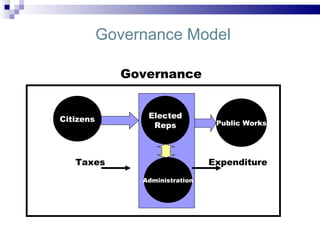
Governance Model Governance Elected Reps Taxes  Expenditure Administration Citizens Public Works
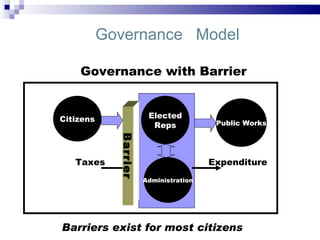
Governance  Model Governance with Barrier Barriers exist for most citizens Elected Reps Taxes  Expenditure Administration Citizens Public Works Barrier
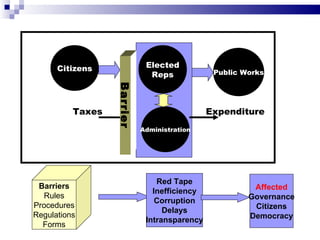
Barriers Rules Procedures Regulations Forms Elected Reps Taxes  Expenditure Administration Citizens Public Works Barrier Red Tape Inefficiency Corruption Delays Intransparency Affected Governance Citizens Democracy
Information and Communication Technology Can ICT  be a change agent to  reduce barriers, expand participation  and strengthen democracy? Can ICT be a change agent  for achieving economic growth?
What  is E-governance? E-government is the continuous optimisation of service delivery, constituency participations and governance by transforming internal and external relationships through technology, internet  and New media.(Silubane, 2001)
E-Governance: Good and Efficient governance  through ICT What does E-Governance seek to achieve Efficiency Transparency Citizens’ participation Thus contributes to  Good governance Trust and Accountability Citizen’s awareness and empowerment  Citizen’s welfare Democracy Nation’s economic growth
Impact of E-Governance New Opportunity for delivery of services to citizen Provides easy access to government information and services Reduces the  need for large  physical infrastructure Allows developing countries to leapfrog
India can’t be a Developed Country   if  It is not e-Governed
Why?
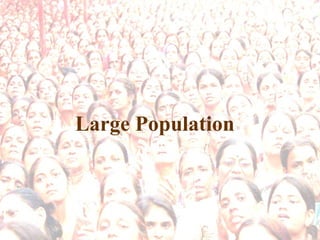
Large Population
Wide Spread Corruption
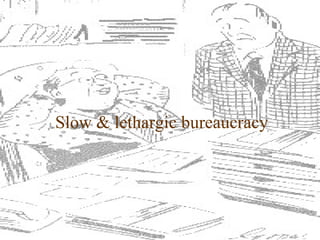
Slow & lethargic bureaucracy
Long decision time
Challenges Massive Size- multitude of departments and agencies Managing Process changes, change management Rigid Government structures/barriers Very slow process with long gestation period Exposed to risk of ever changing priority  due to changing Heads of govt depts Skepticism from citizens due to delay  in getting widespread tangible benefits Localization Costs Technology is least of the problems
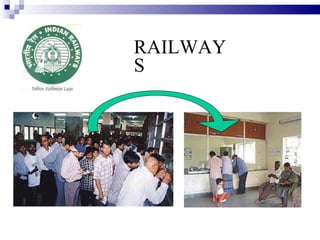
RAILWAYS
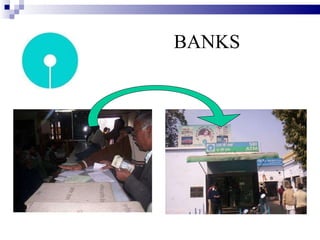
BANKS
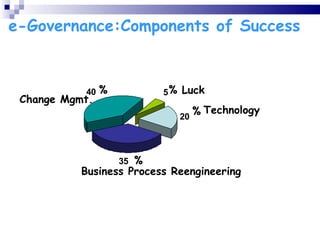
e-Governance:Components of Success % Luck % Change Mgmt. % Business Process Reengineering % Technology
Factors for successful E-governance   Political will and top management support  Appropriate Cyber laws – e-transactions, dispute  handling, Business processes re-engineering Reduction of  decision making layers Security and privacy Involvement of Staff and Stake-holders from concept to implementation Change management Private-public partnership- appropriate revenue  model Common  standards and infrastructure Indian Languages Training and Motivation
Stages of E-Governance Phase I: Publish – using ICT to expand access to government information Phase II:Interact – using ICT for two-way communication between citizens and government Phase III: Transact – enabling citizens to do transactions on-line (Center for Democracy and Technology,2002)
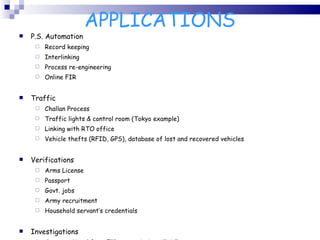
APPLICATIONS P.S. Automation Record keeping Interlinking Process re-engineering Online FIR Traffic Challan Process Traffic lights & control room (Tokyo example) Linking with RTO office Vehicle thefts (RFID, GPS), database of lost and recovered vehicles Verifications Arms License Passport Govt. jobs Army recruitment Household servant’s credentials Investigations Case tracking ( from FIR to conviction till SC) Inventory Management (of maal mukadmati)
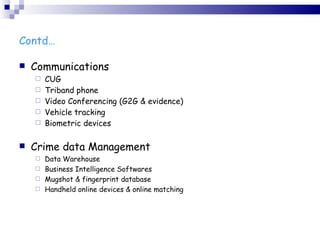
Contd… Communications CUG Triband phone Video Conferencing (G2G & evidence) Vehicle tracking Biometric devices Crime data Management Data Warehouse Business Intelligence Softwares Mugshot & fingerprint database Handheld online devices & online matching
Maharashtra Perspective
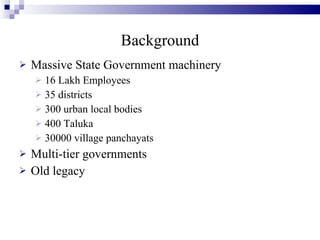
Background Massive State Government machinery 16 Lakh Employees 35 districts 300 urban local bodies 400 Taluka 30000 village panchayats Multi-tier governments Old legacy
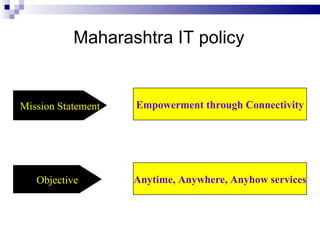
Maharashtra IT policy  Empowerment through Connectivity Anytime, Anywhere, Anyhow services Mission Statement Objective
Approach Start small, deliver value, scale fast Earliest application are the ones that provide maximum visible benefit Business Process Re engineering examined instead of mere automation of existing manual process Outsourcing the entire IT infrastructure to service the requirements relating to Hardware, Networks, Application Support, Database and OS Support, Help Desk and Processes relating to citizen interface Service levels for fail safe operations against payment for the services either from the Citizens for the front end or by government institution for the back end
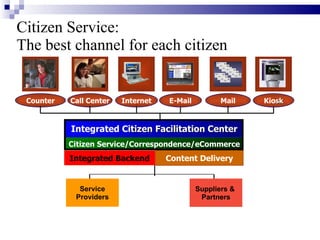
Citizen Service:  The best channel for each citizen Citizen Service/Correspondence/eCommerce Integrated C itizen Facilitation Center Integrated Backend Content Delivery Service Providers Suppliers &  Partners Internet Mail E-Mail Kio sk Counter Call Center
Criticizers are our Friends !!!

E Governance

  • 1.
    E-Governance A Passwordto Economic Growth
  • 2.
    Content Economic GrowthGovernance Model Growth of ICT and E-Governance Challenges in E-Governance Maharashtra Perspective
  • 3.
    Economic Growth Risein GDP Increase in per capital Income Increased Productivity Very well established & maintained Infrastructure Good governance
  • 4.
    Governance Model GovernanceElected Reps Taxes Expenditure Administration Citizens Public Works
  • 5.
    Governance ModelGovernance with Barrier Barriers exist for most citizens Elected Reps Taxes Expenditure Administration Citizens Public Works Barrier
  • 6.
    Barriers Rules ProceduresRegulations Forms Elected Reps Taxes Expenditure Administration Citizens Public Works Barrier Red Tape Inefficiency Corruption Delays Intransparency Affected Governance Citizens Democracy
  • 7.
    Information and CommunicationTechnology Can ICT be a change agent to reduce barriers, expand participation and strengthen democracy? Can ICT be a change agent for achieving economic growth?
  • 8.
    What isE-governance? E-government is the continuous optimisation of service delivery, constituency participations and governance by transforming internal and external relationships through technology, internet and New media.(Silubane, 2001)
  • 9.
    E-Governance: Good andEfficient governance through ICT What does E-Governance seek to achieve Efficiency Transparency Citizens’ participation Thus contributes to Good governance Trust and Accountability Citizen’s awareness and empowerment Citizen’s welfare Democracy Nation’s economic growth
  • 10.
    Impact of E-GovernanceNew Opportunity for delivery of services to citizen Provides easy access to government information and services Reduces the need for large physical infrastructure Allows developing countries to leapfrog
  • 11.
    India can’t bea Developed Country if It is not e-Governed
  • 12.
  • 13.
  • 14.
  • 15.
    Slow & lethargicbureaucracy
  • 16.
  • 17.
    Challenges Massive Size-multitude of departments and agencies Managing Process changes, change management Rigid Government structures/barriers Very slow process with long gestation period Exposed to risk of ever changing priority due to changing Heads of govt depts Skepticism from citizens due to delay in getting widespread tangible benefits Localization Costs Technology is least of the problems
  • 18.
  • 19.
  • 20.
    e-Governance:Components of Success% Luck % Change Mgmt. % Business Process Reengineering % Technology
  • 21.
    Factors for successfulE-governance Political will and top management support Appropriate Cyber laws – e-transactions, dispute handling, Business processes re-engineering Reduction of decision making layers Security and privacy Involvement of Staff and Stake-holders from concept to implementation Change management Private-public partnership- appropriate revenue model Common standards and infrastructure Indian Languages Training and Motivation
  • 22.
    Stages of E-GovernancePhase I: Publish – using ICT to expand access to government information Phase II:Interact – using ICT for two-way communication between citizens and government Phase III: Transact – enabling citizens to do transactions on-line (Center for Democracy and Technology,2002)
  • 23.
    APPLICATIONS P.S. AutomationRecord keeping Interlinking Process re-engineering Online FIR Traffic Challan Process Traffic lights & control room (Tokyo example) Linking with RTO office Vehicle thefts (RFID, GPS), database of lost and recovered vehicles Verifications Arms License Passport Govt. jobs Army recruitment Household servant’s credentials Investigations Case tracking ( from FIR to conviction till SC) Inventory Management (of maal mukadmati)
  • 24.
    Contd… Communications CUGTriband phone Video Conferencing (G2G & evidence) Vehicle tracking Biometric devices Crime data Management Data Warehouse Business Intelligence Softwares Mugshot & fingerprint database Handheld online devices & online matching
  • 25.
  • 26.
    Background Massive StateGovernment machinery 16 Lakh Employees 35 districts 300 urban local bodies 400 Taluka 30000 village panchayats Multi-tier governments Old legacy
  • 27.
    Maharashtra IT policy Empowerment through Connectivity Anytime, Anywhere, Anyhow services Mission Statement Objective
  • 28.
    Approach Start small,deliver value, scale fast Earliest application are the ones that provide maximum visible benefit Business Process Re engineering examined instead of mere automation of existing manual process Outsourcing the entire IT infrastructure to service the requirements relating to Hardware, Networks, Application Support, Database and OS Support, Help Desk and Processes relating to citizen interface Service levels for fail safe operations against payment for the services either from the Citizens for the front end or by government institution for the back end
  • 29.
    Citizen Service: The best channel for each citizen Citizen Service/Correspondence/eCommerce Integrated C itizen Facilitation Center Integrated Backend Content Delivery Service Providers Suppliers & Partners Internet Mail E-Mail Kio sk Counter Call Center
  • 30.